US10042249B2 - Imprint apparatus to detect a contact state between a mold and a substrate - Google Patents
Imprint apparatus to detect a contact state between a mold and a substrate Download PDFInfo
- Publication number
- US10042249B2 US10042249B2 US14/482,426 US201414482426A US10042249B2 US 10042249 B2 US10042249 B2 US 10042249B2 US 201414482426 A US201414482426 A US 201414482426A US 10042249 B2 US10042249 B2 US 10042249B2
- Authority
- US
- United States
- Prior art keywords
- mold
- pattern
- substrate
- imprint material
- contact
- Prior art date
- Legal status (The legal status is an assumption and is not a legal conclusion. Google has not performed a legal analysis and makes no representation as to the accuracy of the status listed.)
- Active, expires
Links
Images


Classifications
-
- G—PHYSICS
- G03—PHOTOGRAPHY; CINEMATOGRAPHY; ANALOGOUS TECHNIQUES USING WAVES OTHER THAN OPTICAL WAVES; ELECTROGRAPHY; HOLOGRAPHY
- G03F—PHOTOMECHANICAL PRODUCTION OF TEXTURED OR PATTERNED SURFACES, e.g. FOR PRINTING, FOR PROCESSING OF SEMICONDUCTOR DEVICES; MATERIALS THEREFOR; ORIGINALS THEREFOR; APPARATUS SPECIALLY ADAPTED THEREFOR
- G03F7/00—Photomechanical, e.g. photolithographic, production of textured or patterned surfaces, e.g. printing surfaces; Materials therefor, e.g. comprising photoresists; Apparatus specially adapted therefor
- G03F7/0002—Lithographic processes using patterning methods other than those involving the exposure to radiation, e.g. by stamping
-
- B—PERFORMING OPERATIONS; TRANSPORTING
- B29—WORKING OF PLASTICS; WORKING OF SUBSTANCES IN A PLASTIC STATE IN GENERAL
- B29C—SHAPING OR JOINING OF PLASTICS; SHAPING OF MATERIAL IN A PLASTIC STATE, NOT OTHERWISE PROVIDED FOR; AFTER-TREATMENT OF THE SHAPED PRODUCTS, e.g. REPAIRING
- B29C59/00—Surface shaping of articles, e.g. embossing; Apparatus therefor
- B29C59/02—Surface shaping of articles, e.g. embossing; Apparatus therefor by mechanical means, e.g. pressing
-
- B—PERFORMING OPERATIONS; TRANSPORTING
- B82—NANOTECHNOLOGY
- B82Y—SPECIFIC USES OR APPLICATIONS OF NANOSTRUCTURES; MEASUREMENT OR ANALYSIS OF NANOSTRUCTURES; MANUFACTURE OR TREATMENT OF NANOSTRUCTURES
- B82Y10/00—Nanotechnology for information processing, storage or transmission, e.g. quantum computing or single electron logic
-
- B—PERFORMING OPERATIONS; TRANSPORTING
- B82—NANOTECHNOLOGY
- B82Y—SPECIFIC USES OR APPLICATIONS OF NANOSTRUCTURES; MEASUREMENT OR ANALYSIS OF NANOSTRUCTURES; MANUFACTURE OR TREATMENT OF NANOSTRUCTURES
- B82Y40/00—Manufacture or treatment of nanostructures
-
- G—PHYSICS
- G03—PHOTOGRAPHY; CINEMATOGRAPHY; ANALOGOUS TECHNIQUES USING WAVES OTHER THAN OPTICAL WAVES; ELECTROGRAPHY; HOLOGRAPHY
- G03F—PHOTOMECHANICAL PRODUCTION OF TEXTURED OR PATTERNED SURFACES, e.g. FOR PRINTING, FOR PROCESSING OF SEMICONDUCTOR DEVICES; MATERIALS THEREFOR; ORIGINALS THEREFOR; APPARATUS SPECIALLY ADAPTED THEREFOR
- G03F9/00—Registration or positioning of originals, masks, frames, photographic sheets or textured or patterned surfaces, e.g. automatically
- G03F9/70—Registration or positioning of originals, masks, frames, photographic sheets or textured or patterned surfaces, e.g. automatically for microlithography
- G03F9/7003—Alignment type or strategy, e.g. leveling, global alignment
- G03F9/7042—Alignment for lithographic apparatus using patterning methods other than those involving the exposure to radiation, e.g. by stamping or imprinting
-
- G—PHYSICS
- G03—PHOTOGRAPHY; CINEMATOGRAPHY; ANALOGOUS TECHNIQUES USING WAVES OTHER THAN OPTICAL WAVES; ELECTROGRAPHY; HOLOGRAPHY
- G03F—PHOTOMECHANICAL PRODUCTION OF TEXTURED OR PATTERNED SURFACES, e.g. FOR PRINTING, FOR PROCESSING OF SEMICONDUCTOR DEVICES; MATERIALS THEREFOR; ORIGINALS THEREFOR; APPARATUS SPECIALLY ADAPTED THEREFOR
- G03F9/00—Registration or positioning of originals, masks, frames, photographic sheets or textured or patterned surfaces, e.g. automatically
- G03F9/70—Registration or positioning of originals, masks, frames, photographic sheets or textured or patterned surfaces, e.g. automatically for microlithography
- G03F9/7049—Technique, e.g. interferometric
-
- G—PHYSICS
- G03—PHOTOGRAPHY; CINEMATOGRAPHY; ANALOGOUS TECHNIQUES USING WAVES OTHER THAN OPTICAL WAVES; ELECTROGRAPHY; HOLOGRAPHY
- G03F—PHOTOMECHANICAL PRODUCTION OF TEXTURED OR PATTERNED SURFACES, e.g. FOR PRINTING, FOR PROCESSING OF SEMICONDUCTOR DEVICES; MATERIALS THEREFOR; ORIGINALS THEREFOR; APPARATUS SPECIALLY ADAPTED THEREFOR
- G03F9/00—Registration or positioning of originals, masks, frames, photographic sheets or textured or patterned surfaces, e.g. automatically
- G03F9/70—Registration or positioning of originals, masks, frames, photographic sheets or textured or patterned surfaces, e.g. automatically for microlithography
- G03F9/7065—Production of alignment light, e.g. light source, control of coherence, polarization, pulse length, wavelength
-
- B—PERFORMING OPERATIONS; TRANSPORTING
- B29—WORKING OF PLASTICS; WORKING OF SUBSTANCES IN A PLASTIC STATE IN GENERAL
- B29C—SHAPING OR JOINING OF PLASTICS; SHAPING OF MATERIAL IN A PLASTIC STATE, NOT OTHERWISE PROVIDED FOR; AFTER-TREATMENT OF THE SHAPED PRODUCTS, e.g. REPAIRING
- B29C59/00—Surface shaping of articles, e.g. embossing; Apparatus therefor
- B29C59/02—Surface shaping of articles, e.g. embossing; Apparatus therefor by mechanical means, e.g. pressing
- B29C59/022—Surface shaping of articles, e.g. embossing; Apparatus therefor by mechanical means, e.g. pressing characterised by the disposition or the configuration, e.g. dimensions, of the embossments or the shaping tools therefor
- B29C2059/023—Microembossing
-
- G—PHYSICS
- G01—MEASURING; TESTING
- G01J—MEASUREMENT OF INTENSITY, VELOCITY, SPECTRAL CONTENT, POLARISATION, PHASE OR PULSE CHARACTERISTICS OF INFRARED, VISIBLE OR ULTRAVIOLET LIGHT; COLORIMETRY; RADIATION PYROMETRY
- G01J9/00—Measuring optical phase difference; Determining degree of coherence; Measuring optical wavelength
- G01J9/02—Measuring optical phase difference; Determining degree of coherence; Measuring optical wavelength by interferometric methods
- G01J2009/0234—Measurement of the fringe pattern
Definitions
- This disclosure relates to an imprint apparatus configured to detect a contact state between a mold used for imprinting and an imprint material supplied onto a substrate, an imprint method, and a device manufacturing method.
- An imprint technique is a technique for transferring a pattern formed on a mold to an imprint material supplied onto a substrate, and is proposed as one of lithography techniques for manufacturing semiconductor devices or magnetic storage medium.
- An imprint apparatus is configured to bring an imprint material (for example, a photo-curing resin) on a substrate and a mold into contact with each other and let the imprint material to cure in a contact state. The distance between the cured imprint material and the mold is increased and the mold is separated from the imprint material, so that the mold pattern is transferred to the imprint material on the substrate.
- an imprint material for example, a photo-curing resin
- Air bubbles may remain in a concave of the mold pattern coming into contact with the imprint material. If the imprint material is cured with the air bubbles remaining in the concave, the imprint material is molded into a shape different from the shape of the concave. Therefore, a desired pattern is not formed on the substrate. Therefore, in order to facilitate filling of the imprint material into the concave of the pattern, a method of curving (deforming) a pattern surface of the mold so as to project toward the substrate and bringing the curved projection into contact with the imprint material is known (PCT Japanese Translation Patent Publication No. 2009-536591). By bringing the mold pattern into contact with the imprint material from a center portion of the pattern toward the outside, the imprint material may be filled easily in the concave of the pattern of the mold and probability of remaining of air bubbles may be reduced.
- the contact state includes posture (inclination) of the mold, and presence or absence of dust between the mold and the substrate.
- the mold and the imprint material preferably come into contact with each other so that a contact portion between the mold and the imprint material spreads out from a center toward a peripheral portion of the pattern in a concentric fashion. Therefore, a technique of observing the contact state between the mold and the imprint material is required.
- 2006-514428 proposes a method of figuring out a contact state between a mold and the imprint material by observing how a plurality of individual liquid droplets (beads) supplied onto the substrate spread when the mold and imprint material come into contact with each other.
- an imprint apparatus configured to form a pattern with an imprint material by bringing the imprint material on a substrate and a pattern of the mold into contact with each other including: a drive unit configured to bring part of the pattern of the mold into contact with the imprint material, and then bring the pattern into contact with the imprint material so that a contact surface area between the pattern of the mold and the imprint material increases; an interference fringe detecting unit configured to detect an interference fringe generated by reflected light from the pattern of the mold and reflected light from the substrate and changing as the contact surface area between the pattern of the mold and the imprint material increases; and a state detecting unit configured to detect a contact state between the pattern of the mold and the imprint material on the basis of the interference fringe.
- FIG. 1 is a drawing illustrating an imprint apparatus of a first embodiment.
- FIG. 2 is a drawing illustrating a detecting unit of the first embodiment.
- FIG. 3 is a drawing illustrating a correcting mechanism of a mold of the first embodiment.
- FIG. 4 is a cross-sectional view illustrating a state of bringing the mold and an imprint material into contact with each other.
- FIGS. 5A to 5F are drawings illustrating a contact area between the mold and the imprint material and an interference fringe in the periphery thereof.
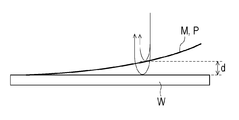
- FIG. 6 is an explanatory drawing illustrating a phenomenon in which the interference fringe is seen in the periphery of the contact area.
- FIGS. 7A to 7D are drawings illustrating a contact state among the detected interference fringe, the mold, and the substrate of the first embodiment.
- FIG. 8 is a drawing illustrating a detecting unit of a second embodiment.
- FIGS. 9A and 9B are a cross-sectional view of the mold and the flat plate, and a drawing illustrating a contact state of a third embodiment.
- FIG. 1 illustrates an imprint apparatus IMP of a first embodiment.
- the imprint apparatus IMP of the first embodiment includes a substrate chuck 1 (substrate holding portion) configured to hold a substrate W, and a mold chuck 3 (die retaining unit) configured to hold a mold M.
- the imprint apparatus IMP further includes a mold stage 4 (mold drive unit) configured to support and move the mold chuck 3 , and an alignment scope 5 fixed to the mold stage 4 and configured to detect an alignment mark formed on the substrate W (substrate-side mark 6 ) and an alignment mark formed on the mold M (mold-side mark 7 ).
- the imprint apparatus IMP further includes a substrate stage 2 configured to support and move the substrate chuck 1 , and a control unit CNT configured to control an imprint action.
- the alignment scope 5 detects the substrate-side mark 6 formed in a shot area on the substrate W and the mold-side mark 7 formed on a pattern P of the mold M.
- a calculating unit CAL of the control unit CNT (state detecting unit) obtains a relative positional deviation between the mold M and the substrate W from results of detection of the substrate-side mark 6 and the mold-side mark 7 detected by the alignment scope 5 .
- the control unit CNT drives the substrate stage 2 and the mold stage 4 on the basis of the result of the obtained relative positional deviation and corrects the relative positional deviation between the mold M and the substrate W.
- the relative positional deviation is not limited to a shift component, and includes errors of magnification and rotational component.
- a shape of the pattern P (pattern area) of the mold M may be corrected so as to match the shot area formed on the substrate W.
- a moiré signal that reflects a relative position between two marks may be used. The relative position of two marks may be obtained by detecting respective images of the marks.
- the imprint apparatus IMP is provided with a supply unit D (dispenser) configured to supply an imprint material 11 onto the substrate W.
- a supply unit D dispenser
- an imprint material 11 onto the substrate W.
- the supply unit D needs not to be provided in the imprint apparatus IMP.
- the imprint apparatus IMP further includes a mirror 9 , a light source S configured to radiate exposure light (UV-ray) 8 , and a detecting unit 10 configured to observe the shot area (pattern P) by using detection light (for example, visible light) having a wavelength different from the exposure light.
- the mirror 9 is a dichroic mirror, and includes a property to reflect the exposure light 8 and allow the detection light to pass therethrough.
- the exposure light 8 from the light source S is reflected by the mirror 9 , and radiates the imprint material 11 .
- the detection light (visible light) from the detecting unit 10 passes through the mirror 9 , the mold stage 4 , and the mold chuck 3 , and illuminates the shot area on the substrate W.
- the visible light which illuminates the shot area is reflected by a surface of the substrate W and a surface of the pattern of a mold M, and is detected by the detecting unit 10 as a detection light (interfering light) including the reflected light from the substrate W and the reflected light from the mold M overlapped with each other.
- the detection light is detected by the detecting unit 10 as an interference fringe.
- the imprint apparatus IMP observes a contact state between the mold M and the imprint material 11 by using the detected interference fringe.
- the amount of liquid droplets of the imprint material to be supplied onto the substrate is several picoliters and the diameter of the liquid droplet is several micrometers.
- the detecting unit 10 of the first embodiment needs only to have an optical system that detects the interference fringe, and high cost optical systems having high optical performances are not required.
- FIG. 2 illustrates the detecting unit 10 of the first embodiment. Illuminating light from the detecting unit 10 and detection light detected by the detecting unit 10 pass through the mirror 9 , the mold stage 4 , and the mold chuck 3 in FIG. 1 , respectively. However, the mold chuck 3 , the mold stage 4 and the mirror 9 are omitted in FIG. 2 .
- the detecting unit 10 is a scope capable of observing the contact state between the mold M (or the pattern P) and the imprint material 11 .
- the detecting unit 10 is designed to observe entire or part of the shot area to which the pattern P of the mold M is transferred.
- the detecting unit 10 is provided with a light source 13 configured to irradiate the mold M and the substrate W with visible light.
- the visible light from the light source 13 is reflected by an optical element 17 (beam splitter), passes through a lens 15 , and illuminates the substrate W as illuminating light.
- the illuminating light reflected by the substrate W passes through the lens 15 and the optical element 17 as detection light, and is detected by an image pickup element 19 (imaging unit).
- image pickup element 19 imaging unit
- a light receiving surface of the image pickup element 19 is an optically conjugated surface with respect to surfaces of the pattern P of the mold M and the substrate W in contact with the imprint material 11 , and the lens 15 is configured to form an image of the surfaces of the pattern P of the mold M and the substrate W on the light receiving surface.
- the illuminating light from the light source 13 has been described to be visual light. However, the illuminating light is not limited to the visible light.
- the detecting unit 10 detects an interference fringe in order to observe the contact state between (the surface of the pattern P of) the mold M and the imprint material 11 as described later. Therefore, the interference fringe can be detected more easily by using light having a narrow wavelength range (monochromatic light) as illuminating light to be radiated from the light source 13 .
- the detection light is fixed to have a narrow wavelength range, visibility of the detection light may be impaired due to interference conditions with the mold M or the substrate W. Therefore, the wavelength is preferably remained to be variable. If interference fringes that can be detected by the image pickup element 19 can be generated with light having a wide wavelength range (light having a large bandwidth), light having a wide wavelength range may be used.
- the wavelength of light to be radiated from the light source 13 may be determined by arranging a plurality of LEDs configured to radiate light having different wavelengths, and selecting an LED that radiates light having a wavelength which makes the interference fringe visible optimally.
- Light from lamp light configured to radiate light having a wide wavelength range may be extracted.
- Light having a wavelength range optimal to detect the interference fringe may be generated by providing a plurality of wavelength cut filters having different band frequencies and switching among the wavelength cut filters as needed.
- FIG. 3 illustrates correcting mechanisms 16 (deforming unit) configured to correct (deforming member) the shape of the mold M.
- the correcting mechanisms 16 are configured to apply a force from a direction parallel to the surface of the pattern of the mold M to deform the pattern P (surface of the pattern P).
- each of the correcting mechanisms 16 includes a contact portion 16 a configured to come into contact with a side surface of the mold M, and an actuator 16 b configured to drive the contact portion 16 a in a direction toward the side surface of the mold M or away from the side surface of the mold M as illustrated in FIG. 3 .
- the correcting mechanisms 16 may each have a heating device configured to provide the mold M or the substrate W with heat, and the pattern P may be deformed by controlling the temperature of the mold M by the correcting mechanisms 16 each including the heating device. Alternatively, the shot area of the substrate W may be deformed by controlling the temperature of the substrate W.
- the contact portions 16 a may be sucking mechanisms which suck the side surface of the mold M.
- FIG. 4 illustrates a state in which the mold M (surface of the pattern) is curved to project toward the substrate W.
- a method of curving the mold M (surface of the pattern) a method of applying pressure from the mold chuck 3 that holds the mold M to the mold M is exemplified.
- a space between the mold M and the mold chuck 3 is a closed space, and the mold chuck 3 is provided with a mechanism configured to vary the pressure (air pressure) in the space.
- the imprint apparatus of the first embodiment brings part of the pattern P into contact with the imprint material 11 on the substrate in a state in which the mold M is curved as illustrated in FIG. 4 .
- the imprint material 11 is brought into contact with an entire surface of the pattern P so as to increase the contact surface area between the pattern P and the imprint material 11 while straightening the mold M curved into a convex shape (canceling the curvature).
- the mold M By bringing the mold M into contact with the imprint material 11 in the curved state, air bubbles can hardly be remained in a concave of the pattern P.
- FIGS. 5A to 5F are drawings illustrating the contact state in which the mold M is brought into contact with the imprint material 11 in the curved state.
- FIGS. 5A to 5F illustrate a state in which no foreign substance (particle) is present between the mold M and the substrate W.
- FIGS. 5A, 5C, and 5E illustrate observed images detected by the image pickup element 19 of the detecting unit 10 when bringing the pattern P into contact with the imprint material 11 , respectively.
- FIGS. 5B, 5D, and 5F illustrate cross sections of the pattern P and the substrate W, respectively.
- FIG. 5A illustrates a state in which the mold M is curved (deformed), and the pattern P is brought into a first contact with the imprint material 11 .
- the highest point of the pattern P in the convex shape is in contact with the imprint material 11 .
- the observed image observed by the detecting unit 10 includes an area where the pattern P and the imprint material 11 are in contact with each other (solid area at a center), and an interference fringe caused by interference of light in the periphery thereof.
- FIG. 5B illustrates a cross section of the pattern P and the substrate W at this time.
- FIGS. 5C and 5E illustrate a state in which the contact surface area between the pattern P and the imprint material 11 is increased.
- a state in which the contact surface area between the pattern P and the imprint material 11 is uniformly (concentrically) increased from the center of the pattern portion toward the peripheral portion is illustrated.
- FIGS. 5D and 5F illustrate cross sections of the pattern P and the substrate W corresponding to FIGS. 5C and 5E , respectively. It is understood that the contact surface area between the pattern P and the imprint material 11 is increased as the curvature of the mold M (pattern P) is gradually straightened. The interference fringe seen in the periphery of the area where the pattern P and the imprint material 11 are in contact with each other is also spread corresponding to the increase of the contact surface area. The interference fringe is generated by interference between light reflected from the surface of the pattern P and light reflected from the surface of the substrate W. Finally, the pattern P and the imprint material 11 come into contact with each other over the entire surface of the imprint area (shot area), the interference fringe is not seen any longer.
- a phenomenon in which the interference fringe due to the interference of light is seen in the periphery of the contact area will be described with reference to FIG. 6 .
- the mold M is curved with respect to the substrate W and brought into contact with (stamped on) the imprint material 11 , illuminating light radiated from the detecting unit 10 onto the mold M and the substrate W is reflect by the surface of the substrate W, and is reflected by the surface opposing the substrate W of the mold M (pattern P).
- the interference fringe is generated by interference between the reflected light from the substrate W and the reflected light from the mold M.
- the distances at respective positions in a range from the centers of the substrate and the mold M toward the peripheries thereof is represented by d
- a wavelength of the detection light used in the detecting unit 10 is represented by ⁇
- a refractive index of medium between the substrate W and the mold M is represented by n
- the conditions of generation of the interference fringe is expressed by
- the imprint material is present between the mold M and the substrate W.
- the interference fringe is not generated in the area in which the mold M and the imprint material 11 are in contact with each other.
- FIGS. 7A to 7D illustrate images of contact areas picked up by the detecting unit 10 and interference fringes in the peripheries thereof, and illustrate cases where the contact states are different from the contact states illustrated in FIGS. 5A to 5F (ideal contact state) due to any event.
- FIG. 7A illustrates a contact area observed when the mold M and the imprint material 11 are brought into contact with each other, and a case where the interference fringe in the periphery thereof is formed into an ellipse. This shows a case where the curvature of the curved mold M is different between the vertical direction and the lateral direction. If the correction amount of the mold M by the correcting mechanisms 16 described in conjunction with FIG. 3 is significantly different between the vertical direction and the lateral direction, the curvature of the curve of the mold M in the vertical direction may be different between the vertical direction and the lateral direction. As illustrated in FIGS. 5A, 5C, and 5E , the contact area and the interference fringe in the periphery thereof are preferably close to a circle. Since the mold M and the imprint material 11 may be brought into contact with each other without difference depending on the direction by pressing the mold M with the same curvature in the vertical direction and the lateral direction, the concave of the pattern may easily be filled with a resin.
- the mold M and the imprint material come into contact with each other, lengths of a long side A and a short side B are obtained from the image of the elliptical interference fringe picked up by the detecting unit 10 . Accordingly, the elliptical shape may be detected.
- the ellipticity may be obtained from the ratio of the short side B with respect to the long side A as the expression given below.
- a flattening and an eccentricity may be obtained from the values of the long side and the short side.
- a relationship between the amount of deformation (amount of curvature) of the mold M and the elliptical shape is obtained in advance, and is compared with the elliptical shape detected by the detecting unit 10 , whereby the amount of deformation of the mold M may be obtained.
- the correction amount of the correcting mechanisms 16 is optimized on the basis of the obtained amount of deformation, adjustment of the amount of deformation is achieved.
- the contact state is corrected by adjusting the amount of deformation of the mold M. In order to curve the mold M so as to project toward the substrate W, the pressure of gas present in the space on the side opposite to the surface where the pattern P of the mold M is formed is increased for adjustment.
- the difference in force applied by the correcting mechanisms 16 is significant between the lateral direction and the vertical direction, there arises a difference in amount of deformation of the mold M. Therefore, the difference in amount of deformation of the mold M is adjusted by adjusting the forces of the correcting mechanisms 16 from two directions. However, if the correcting mechanisms 16 are adjusted, precision in superposition (pattern transfer precision) may be affected. Therefore, one of the correction amount of the pattern P by the correcting mechanisms 16 and the amount of curvature at the time of contact between the pattern P and the imprint material, which has a larger influence on pattern transfer, may be adjusted according to the ellipticity of the interference fringe or the like.
- FIG. 7B illustrates an example in which the center of the contact area and the interference fringe generated in the periphery thereof observed when the mold M and the imprint material 11 come into contact with each other is deviated from the center of the pattern P (shot area).
- the reason may be that the pattern P of the mold M and the shot area on the substrate W are deviated, or the mold M is in contact with the imprint material 11 in an inclined manner.
- the contact state may be corrected by measuring the alignment marks on the mold M and the substrate W again and performing alignment again.
- the direction and the amount of the relative inclination between the mold M and the substrate W are detected on the basis of the direction and the amount of positional deviation of the center of the interference fringe.
- the inclination of the mold M or the substrate W is adjusted so that the center of the interference fringe is aligned with the center of the pattern P (or the shot area on the substrate W).
- the detecting unit 10 is configured to pick up the images of a scribe line surrounding the shot area or an end of the area where the pattern P of the mold M is formed simultaneously with the contact area and the interference fringe in the periphery thereof.
- the shot area may be obtained from the scribe line the image of which is picked up or the end of the area where the pattern P of the mold M is formed.
- pattern matching with the concentric pattern indicating the contact area is performed on the basis of the result of image picked up by the detecting unit 10 , so that the center of the contact area (contact position) may be obtained from the center of the shot area.
- a pattern partly lacking is transferred to the substrate.
- the mold M is inclined on purpose in order to cause the mold M and the imprint material 11 to come into contact with each other from a specific position such as the center or a position of center of gravity of the shot area (position C in FIG. 7C ) or a portion near the center of the substrate (position C′ in FIG. 7C ).
- Whether the mold M and the imprint material 11 are brought into contact with each other firstly at the specific position may be checked from the position where the interference fringe is generated.
- the detection unit 10 detects the position of the center of the interference fringe generated in the contact area and in the periphery thereof (the position of the interference fringe), whereby correction of the contact position as the contact state is enabled.
- the contact area and the interference fringe generated in the periphery thereof observed when the mold M and the imprint material 11 are brought into contact with each other has a shape losing touch with the circular shape (deformed shape). This may be because an air bubble or a foreign substance (particle) is present between the mold M and the substrate W.
- the distance d ( FIG. 6 ) between the substrate W and the mold M is determined continuously by the inclination (amount of deformation) of the mold M. Therefore, the contact area and the interference fringe in the periphery thereof spread from the center of the shot area to the peripheral portions in a concentric fashion as illustrated in FIGS. 5A to 5F .
- the interference fringe cannot have a concentric circular shape due to an air bubble or a foreign substance present between the mold M and the substrate W.
- a method of detecting an interference fringe deformed from the concentric circular shape includes a method of obtaining an inclination of a tangent line on a boundary from the contact area or the image of the interference fringe detected by the detecting unit 10 when bringing the mold M and the imprint material 11 into contact with each other.
- the circular shape indicating the contact area or the inclination of the tangent line of the shape of the interference fringe do not change.
- the obtained inclination of tangent line changes correspondingly. Part subjected to the change may be recognized as the deformation of the interference fringe.
- the contact state that is, a time period required for the imprint material to spread over the area in which the pattern is formed from the first contact (spreading time) may be obtained.
- the size of the contact area after a predetermined time period has elapsed from the start of contact at the normal pattern transfer illustrated in FIGS. 5A to 5F may be obtained in advance.
- the result of image picked up by the detecting unit when a predetermined period has elapsed after the first contact and the pattern obtained in advance are compared, and whether the time required for the contact area to spread is short or long may be obtained from the difference in size in comparison with that at the time of normal pattern transfer. If the air bubble remains between the mold and the substrate, defective transfer pattern results. Therefore, the corresponding shot becomes a defective shot. Since the probability of the defective shot may be pointed out in advance, the corresponding shot area may be intensively inspected at a defect inspection after an imprint process. If the foreign substance is present therebetween, the mold M may become damaged, for example, the pattern P may be broken by the foreign substance attached to the mold M. If the pattern is transferred to another shot area with the foreign substance attached to the mold M, defective transfer patterns may occur repeatedly.
- the imprint process is preferably stopped immediately in order to avoid damage on the mold M or the substrate W.
- a process from the contact between the pattern P and the imprint material 11 until the filling of the entire surface of the pattern P with the imprint material 11 is performed in a very short time, there may be a case where the imprint process cannot be stopped.
- the mold M or the substrate W may be curved locally by the presence of the foreign substance, and the interference fringe may be generated around the foreign substance, the foreign substance may be detected by using this phenomenon. Furthermore, the state of imprint material supplied (applied) onto the substrate may be detected by observing how the interference fringe spreads. When the amount of supply of the imprint material is large, the distance between the mold M and the substrate W is increased, and when the amount of supply of the imprint material is small, the distance between the mold M and the substrate W is small. The interference fringe generated differs depending on the distance between the mold M and the substrate W. Therefore, by observing the difference in the interference fringes, the cases where the amount of the imprint material 11 supplied onto the substrate W is large or small may be detected to adjust the amount of supply or the position of supply (distribution) of the imprint material 11 .
- the contact state between the mold M and the substrate W can be detected by detecting the interference fringe that may be generated in association with the contact between the pattern P and the imprint material 11 .
- Examples of the contact state that may be detected include the amount of curvature of the mold M, the relative portion between the mold M and the substrate W, the contact position therebetween, presence or absence of foreign substances, the amount of supply of the imprint material, and the position of supply.
- FIG. 8 illustrates a detecting unit 20 and a cross section of the mold M and the substrate W.
- Light (illuminating light) from the light source 13 is reflected by the optical element 17 (half mirror) and passes through the lens 15 to illuminate the mold M and the pattern P of the substrate W.
- light (transmitted light) from the light source 13 passes through a polarization element 14 , whereby only light having a polarization direction parallel to a paper plane can be passed therethrough.
- Light (detection light) reflected from the mold M or the substrate W passes through the lens 15 , passes through the optical element 17 , and is detected by the image pickup element 19 .
- the image pickup element 19 detects only part of the detection light passing through the optical element 17 which passes through a polarization element 18 .
- the polarization element 18 is arranged so as to polarize light in a direction orthogonal to the polarization direction of light passing through the polarization element 14 . If the polarization direction of light passing through the polarization element 14 has no change, the detection light does not pass through the polarization element 18 , and hence is not detected by the image pickup element 19 .
- a stress birefringence may occur depending on the strain of the mold M.
- polarization light that passes through the mold is scattered (the polarization direction is changed). Therefore, the strain of the mold M may be detected by using polarization light as the illuminating light.
- the polarization direction of light after having passed through the polarization element 14 does not change. Since the polarization element 18 is orthogonal to the polarization of the detection light, the detection light does not pass through the polarization element 18 , and does not enter the image pickup element 19 .
- the mold M is strained, and a stress birefringence occurs, so that the polarization direction of light passing through the polarization element 14 changes. Since the light having the polarization direction changed by birefringence passes through the polarization element 18 , the detection light from the mold M may be observed by the image pickup element 19 . The contact state between the mold M and the substrate W may be detected by using the polarization light, and whether there is a foreign substance present between the mold M and the substrate W may be detected.
- the optical element 17 and the polarization element 18 may be integrally formed.
- a so-called polarizing beam splitter as the optical element 17 , the function of the polarization element 18 may be provided, and the relationship of reflection and penetration on the basis of the above-described polarization direction may be established.
- a method of detecting a foreign substance attached on the substrate W will be described with reference to FIGS. 9A and 9B .
- a foreign substance attached on the substrate W is detected by pressing a flat plate 21 (inspection board) having no pattern formed thereon against the substrate W before the imprint process in a third embodiment.
- the flat plate 21 having no pattern formed thereon is pressed against the substrate W before the imprint process.
- the flat plate 21 is brought into contact with the substrate W in a curved shape and the curved flat plate 21 is brought into contact with the substrate W so as to increase the contact surface area between the flat plate 21 and the substrate W while making the flat plate 21 restored to the flat shape (canceling the curve).
- the flat plate 21 needs to be free from the foreign substance on the surface coming into contact with the substrate so that cleaning is performed before bringing into contact with the substrate W.
- FIG. 9B illustrates a state of the interference fringe detected by the detecting unit 10 when a foreign substance is attached on the substrate W. Since the foreign substance is attached between the flat plate 21 and the substrate W, the contact area does not spread in a concentric fashion. The interference fringe in the periphery of the contact area is also deformed from the concentric circle shape.
- the flat plate 21 may be changed easily.
- the flat plate 21 may be brought into contact with the substrate W after having supplied suitable liquid onto the substrate W.
- attachment of a foreign substance on the substrate W may be detected before the imprint process by detecting the contact area between the flat plate 21 and the substrate W or the interference fringe in the periphery thereof by using the flat plate 21 .
- a process of removing the foreign substance on the substrate W may be performed, or the position of the foreign substance on the substrate W may be memorized. If the removal of the foreign substance on the substrate is failed, the imprint process is performed so as not to bring the pattern P of the mold M into contact with an area of the substrate W where the foreign substance is attached.
- a photo-curing method which is an imprint method in which the imprint material (photo-curing resin) is cured by radiating light (UV-light) has been described.
- imprint method examples include a heat cycle method in addition to the photo-curing method.
- a thermoplastic resin is heated to a temperature not lower than a glass-transition temperature, the mold is pressed against the substrate by the intermediary of the resin in a state in which fluidity of the resin is increased, and the mold is separated from the resin after having cooled, whereby a pattern is formed.
- the imprint method using a heat cycle method is also applicable as long as the contact area where the imprint material supplied to the substrate and the mold are in contact with each other or the interference fringe generated in the periphery thereof may be detected by the detecting unit 10 during the imprint process.
- a method of manufacturing a device includes a process of forming a pattern on a substrate (wafer, glass plate, and film wafer) by using the imprint apparatus described above.
- the manufacturing method described above may include a process of etching the substrate on which a pattern is formed.
- the manufacturing method may include other processes which machine the substrate on which the pattern is formed instead of etching.
- the method of manufacturing an article of the embodiment is advantageous in terms of at least one of performance, quality, productivity, and production cost or articles in comparison with the method of the related art.
Landscapes
- Physics & Mathematics (AREA)
- General Physics & Mathematics (AREA)
- Engineering & Computer Science (AREA)
- Chemical & Material Sciences (AREA)
- Nanotechnology (AREA)
- Shaping Of Tube Ends By Bending Or Straightening (AREA)
- Crystallography & Structural Chemistry (AREA)
- Mechanical Engineering (AREA)
- Theoretical Computer Science (AREA)
- Manufacturing & Machinery (AREA)
- Condensed Matter Physics & Semiconductors (AREA)
- Mathematical Physics (AREA)
- Exposure Of Semiconductors, Excluding Electron Or Ion Beam Exposure (AREA)
Priority Applications (1)
| Application Number | Priority Date | Filing Date | Title |
|---|---|---|---|
| US16/003,723 US10303050B2 (en) | 2013-09-13 | 2018-06-08 | Imprint apparatus, imprint method, detecting method, and method of manufacturing device |
Applications Claiming Priority (2)
| Application Number | Priority Date | Filing Date | Title |
|---|---|---|---|
| JP2013-190477 | 2013-09-13 | ||
| JP2013190477A JP6282069B2 (ja) | 2013-09-13 | 2013-09-13 | インプリント装置、インプリント方法、検出方法及びデバイス製造方法 |
Related Child Applications (1)
| Application Number | Title | Priority Date | Filing Date |
|---|---|---|---|
| US16/003,723 Division US10303050B2 (en) | 2013-09-13 | 2018-06-08 | Imprint apparatus, imprint method, detecting method, and method of manufacturing device |
Publications (2)
| Publication Number | Publication Date |
|---|---|
| US20150076724A1 US20150076724A1 (en) | 2015-03-19 |
| US10042249B2 true US10042249B2 (en) | 2018-08-07 |
Family
ID=52667279
Family Applications (2)
| Application Number | Title | Priority Date | Filing Date |
|---|---|---|---|
| US14/482,426 Active 2036-09-29 US10042249B2 (en) | 2013-09-13 | 2014-09-10 | Imprint apparatus to detect a contact state between a mold and a substrate |
| US16/003,723 Active US10303050B2 (en) | 2013-09-13 | 2018-06-08 | Imprint apparatus, imprint method, detecting method, and method of manufacturing device |
Family Applications After (1)
| Application Number | Title | Priority Date | Filing Date |
|---|---|---|---|
| US16/003,723 Active US10303050B2 (en) | 2013-09-13 | 2018-06-08 | Imprint apparatus, imprint method, detecting method, and method of manufacturing device |
Country Status (4)
| Country | Link |
|---|---|
| US (2) | US10042249B2 (enExample) |
| JP (1) | JP6282069B2 (enExample) |
| KR (2) | KR101783081B1 (enExample) |
| TW (1) | TWI625219B (enExample) |
Families Citing this family (34)
| Publication number | Priority date | Publication date | Assignee | Title |
|---|---|---|---|---|
| JP6472189B2 (ja) * | 2014-08-14 | 2019-02-20 | キヤノン株式会社 | インプリント装置、インプリント方法及び物品の製造方法 |
| JP6674218B2 (ja) * | 2014-12-09 | 2020-04-01 | キヤノン株式会社 | インプリント装置、インプリント方法及び物品の製造方法 |
| US10747106B2 (en) * | 2014-12-09 | 2020-08-18 | Canon Kabushiki Kaisha | Imprint apparatus |
| US10248018B2 (en) * | 2015-03-30 | 2019-04-02 | Canon Kabushiki Kaisha | Imprint apparatus and method of manufacturing article |
| JP6553926B2 (ja) | 2015-04-09 | 2019-07-31 | キヤノン株式会社 | インプリント装置、インプリント方法、および物品の製造方法 |
| JP6403627B2 (ja) * | 2015-04-14 | 2018-10-10 | キヤノン株式会社 | インプリント装置、インプリント方法及び物品の製造方法 |
| JP6562707B2 (ja) * | 2015-05-13 | 2019-08-21 | キヤノン株式会社 | インプリント装置、インプリント方法及び物品の製造方法 |
| JP2016225542A (ja) | 2015-06-02 | 2016-12-28 | キヤノン株式会社 | インプリント装置、インプリント方法、および、物品の製造方法 |
| US10642171B2 (en) | 2015-06-10 | 2020-05-05 | Canon Kabushiki Kaisha | Imprint apparatus, imprint method, and method for producing article |
| JP6282298B2 (ja) * | 2015-06-10 | 2018-02-21 | キヤノン株式会社 | インプリント装置、インプリント方法、および物品の製造方法 |
| US10386737B2 (en) | 2015-06-10 | 2019-08-20 | Canon Kabushiki Kaisha | Imprint apparatus and method for producing article |
| JP6799397B2 (ja) * | 2015-08-10 | 2020-12-16 | キヤノン株式会社 | インプリント装置、および物品の製造方法 |
| JP6541518B2 (ja) * | 2015-09-04 | 2019-07-10 | キヤノン株式会社 | インプリント装置、インプリント方法、および物品の製造方法 |
| JP6643022B2 (ja) * | 2015-09-28 | 2020-02-12 | キヤノン株式会社 | インプリント装置、インプリント方法、異物検出方法および物品製造方法 |
| US10191368B2 (en) * | 2015-11-05 | 2019-01-29 | Board Of Regents, The University Of Texas System | Multi-field overlay control in jet and flash imprint lithography |
| JP6655988B2 (ja) * | 2015-12-25 | 2020-03-04 | キヤノン株式会社 | インプリント装置の調整方法、インプリント方法および物品製造方法 |
| JP6942491B2 (ja) * | 2016-03-15 | 2021-09-29 | キヤノン株式会社 | インプリント装置、および物品の製造方法 |
| US10807373B2 (en) * | 2016-09-23 | 2020-10-20 | Hewlett-Packard Development Company, L.P. | Fluid ejection device and particle detector |
| US11454883B2 (en) | 2016-11-14 | 2022-09-27 | Canon Kabushiki Kaisha | Template replication |
| JP6978859B2 (ja) | 2017-06-15 | 2021-12-08 | キヤノン株式会社 | インプリント装置、および物品の製造方法 |
| US11175598B2 (en) * | 2017-06-30 | 2021-11-16 | Canon Kabushiki Kaisha | Imprint apparatus and method of manufacturing article |
| JP7043199B2 (ja) * | 2017-08-03 | 2022-03-29 | キヤノン株式会社 | インプリント方法、プログラム、インプリント装置及び物品の製造方法 |
| JP7015147B2 (ja) * | 2017-11-06 | 2022-02-02 | キヤノン株式会社 | インプリント装置および物品製造方法 |
| JP7022615B2 (ja) * | 2018-02-26 | 2022-02-18 | キヤノン株式会社 | インプリント方法、インプリント装置、モールドの製造方法、および、物品の製造方法 |
| JP7262939B2 (ja) | 2018-07-20 | 2023-04-24 | キヤノン株式会社 | クリーニング装置、インプリント装置、リソグラフィ装置、および、クリーニング方法 |
| JP7225030B2 (ja) * | 2019-05-31 | 2023-02-20 | キヤノン株式会社 | インプリント方法、及び、物品の製造方法 |
| JP7041699B2 (ja) * | 2020-01-31 | 2022-03-24 | キヤノン株式会社 | インプリント装置の情報出力方法、インプリント装置、情報出力方法および装置 |
| JP7433949B2 (ja) * | 2020-02-06 | 2024-02-20 | キヤノン株式会社 | インプリント装置、インプリント方法及び物品の製造方法 |
| JP7401396B2 (ja) * | 2020-06-04 | 2023-12-19 | キヤノン株式会社 | インプリント装置、物品の製造方法、及びインプリント装置のための測定方法 |
| US20220197134A1 (en) * | 2020-12-23 | 2022-06-23 | Canon Kabushiki Kaisha | System and Method of Determining Shaping Parameters Based on Contact Line Motion |
| US11614693B2 (en) * | 2021-06-30 | 2023-03-28 | Canon Kabushiki Kaisha | Method of determining the initial contact point for partial fields and method of shaping a surface |
| JP7361831B2 (ja) * | 2021-07-30 | 2023-10-16 | キヤノン株式会社 | 情報処理装置、成形装置、成形方法及び物品の製造方法 |
| TWI906524B (zh) | 2021-07-30 | 2025-12-01 | 日商佳能股份有限公司 | 資訊處理設備、成型設備、成型方法及物品製造方法 |
| JP7721736B1 (ja) | 2024-05-14 | 2025-08-12 | キヤノン株式会社 | 平坦化装置、平坦化方法、および物品の製造方法 |
Citations (15)
| Publication number | Priority date | Publication date | Assignee | Title |
|---|---|---|---|---|
| US20020098426A1 (en) | 2000-07-16 | 2002-07-25 | Sreenivasan S. V. | High-resolution overlay alignment methods and systems for imprint lithography |
| JP2003316016A (ja) | 2002-04-22 | 2003-11-06 | Fuji Photo Film Co Ltd | 感光性平版印刷版の露光装置及び感光性平版印刷版と原画の密着度判定方法 |
| JP2004335910A (ja) | 2003-05-12 | 2004-11-25 | Canon Inc | アライメント方法、該アライメント方法を用いた露光方法、露光用マスク、該マスクを備えた露光装置 |
| US20060032437A1 (en) | 2004-08-13 | 2006-02-16 | Molecular Imprints, Inc. | Moat system for an imprint lithography template |
| JP2006514428A (ja) | 2002-12-12 | 2006-04-27 | モレキュラー・インプリンツ・インコーポレーテッド | 液体の形状を使用して基板の特性を求める方法及びシステム |
| US20090140445A1 (en) * | 2007-12-04 | 2009-06-04 | Molecular Imprints | High Throughput Imprint Based on Contact Line Motion Tracking Control |
| JP2009536591A (ja) | 2006-05-11 | 2009-10-15 | モレキュラー・インプリンツ・インコーポレーテッド | 厚さが変化するテンプレート |
| TWI337255B (en) | 2005-12-27 | 2011-02-11 | Asml Netherlands Bv | Inspection apparatus, lithographic system provided with the inspection apparatus and a method for inspecting a sample |
| US20110206852A1 (en) * | 2010-02-24 | 2011-08-25 | Canon Kabushiki Kaisha | Imprint apparatus, template of imprint apparatus, and article manufacturing method |
| KR20120118639A (ko) | 2011-04-19 | 2012-10-29 | 캐논 가부시끼가이샤 | 임프린트 장치 및 그것을 사용한 물품의 제조 방법 |
| JP2012253325A (ja) | 2011-05-10 | 2012-12-20 | Canon Inc | 検出装置、検出方法、インプリント装置及びデバイス製造方法 |
| JP2013038365A (ja) | 2011-08-11 | 2013-02-21 | Canon Inc | インプリント装置、それを用いた物品の製造方法 |
| US20130056905A1 (en) | 2011-09-07 | 2013-03-07 | Canon Kabushiki Kaisha | Imprint apparatus and article manufacturing method using same |
| TW201319552A (zh) | 2011-11-01 | 2013-05-16 | Asml Holding Nv | 微影裝置及元件製造方法 |
| TWI407263B (zh) | 2007-12-21 | 2013-09-01 | Asml荷蘭公司 | 微影裝置,平坦一物件方法和微影投影方法 |
Family Cites Families (8)
| Publication number | Priority date | Publication date | Assignee | Title |
|---|---|---|---|---|
| TW337255U (en) * | 1997-08-20 | 1998-07-21 | Wen-Nan Guo | Improved structure of an extruding machine mold |
| US6204982B1 (en) * | 1997-11-12 | 2001-03-20 | Iomega Corporation | Method and apparatus for cartridge ejection and overwrite protection |
| JP4721393B2 (ja) * | 2003-08-15 | 2011-07-13 | キヤノン株式会社 | 近接場露光方法 |
| JP4574240B2 (ja) * | 2004-06-11 | 2010-11-04 | キヤノン株式会社 | 加工装置、加工方法、デバイス製造方法 |
| JP2009200345A (ja) * | 2008-02-22 | 2009-09-03 | Canon Inc | 加工装置 |
| JP5127785B2 (ja) * | 2009-07-21 | 2013-01-23 | 株式会社東芝 | インプリント装置およびインプリント方法 |
| JP5455583B2 (ja) * | 2009-11-30 | 2014-03-26 | キヤノン株式会社 | インプリント装置 |
| JP2013110162A (ja) * | 2011-11-17 | 2013-06-06 | Canon Inc | インプリント装置及び物品の製造方法 |
-
2013
- 2013-09-13 JP JP2013190477A patent/JP6282069B2/ja active Active
-
2014
- 2014-08-27 TW TW103129554A patent/TWI625219B/zh active
- 2014-09-10 US US14/482,426 patent/US10042249B2/en active Active
- 2014-09-12 KR KR1020140120855A patent/KR101783081B1/ko active Active
-
2017
- 2017-09-21 KR KR1020170121858A patent/KR101879549B1/ko active Active
-
2018
- 2018-06-08 US US16/003,723 patent/US10303050B2/en active Active
Patent Citations (17)
| Publication number | Priority date | Publication date | Assignee | Title |
|---|---|---|---|---|
| US20020098426A1 (en) | 2000-07-16 | 2002-07-25 | Sreenivasan S. V. | High-resolution overlay alignment methods and systems for imprint lithography |
| JP2003316016A (ja) | 2002-04-22 | 2003-11-06 | Fuji Photo Film Co Ltd | 感光性平版印刷版の露光装置及び感光性平版印刷版と原画の密着度判定方法 |
| JP2006514428A (ja) | 2002-12-12 | 2006-04-27 | モレキュラー・インプリンツ・インコーポレーテッド | 液体の形状を使用して基板の特性を求める方法及びシステム |
| JP2004335910A (ja) | 2003-05-12 | 2004-11-25 | Canon Inc | アライメント方法、該アライメント方法を用いた露光方法、露光用マスク、該マスクを備えた露光装置 |
| US20060032437A1 (en) | 2004-08-13 | 2006-02-16 | Molecular Imprints, Inc. | Moat system for an imprint lithography template |
| TWI337255B (en) | 2005-12-27 | 2011-02-11 | Asml Netherlands Bv | Inspection apparatus, lithographic system provided with the inspection apparatus and a method for inspecting a sample |
| JP2009536591A (ja) | 2006-05-11 | 2009-10-15 | モレキュラー・インプリンツ・インコーポレーテッド | 厚さが変化するテンプレート |
| JP2011512019A (ja) | 2007-12-04 | 2011-04-14 | モレキュラー・インプリンツ・インコーポレーテッド | 接触線運動トラッキング制御に基づく高スループット・インプリント |
| US20090140445A1 (en) * | 2007-12-04 | 2009-06-04 | Molecular Imprints | High Throughput Imprint Based on Contact Line Motion Tracking Control |
| TWI407263B (zh) | 2007-12-21 | 2013-09-01 | Asml荷蘭公司 | 微影裝置,平坦一物件方法和微影投影方法 |
| US20110206852A1 (en) * | 2010-02-24 | 2011-08-25 | Canon Kabushiki Kaisha | Imprint apparatus, template of imprint apparatus, and article manufacturing method |
| TW201139118A (en) | 2010-02-24 | 2011-11-16 | Canon Kk | Imprint apparatus, template of imprint apparatus, and article manufacturing method |
| KR20120118639A (ko) | 2011-04-19 | 2012-10-29 | 캐논 가부시끼가이샤 | 임프린트 장치 및 그것을 사용한 물품의 제조 방법 |
| JP2012253325A (ja) | 2011-05-10 | 2012-12-20 | Canon Inc | 検出装置、検出方法、インプリント装置及びデバイス製造方法 |
| JP2013038365A (ja) | 2011-08-11 | 2013-02-21 | Canon Inc | インプリント装置、それを用いた物品の製造方法 |
| US20130056905A1 (en) | 2011-09-07 | 2013-03-07 | Canon Kabushiki Kaisha | Imprint apparatus and article manufacturing method using same |
| TW201319552A (zh) | 2011-11-01 | 2013-05-16 | Asml Holding Nv | 微影裝置及元件製造方法 |
Also Published As
| Publication number | Publication date |
|---|---|
| JP6282069B2 (ja) | 2018-02-21 |
| KR20150031202A (ko) | 2015-03-23 |
| TW201518068A (zh) | 2015-05-16 |
| JP2015056589A (ja) | 2015-03-23 |
| KR101879549B1 (ko) | 2018-07-17 |
| US20180292748A1 (en) | 2018-10-11 |
| KR101783081B1 (ko) | 2017-09-28 |
| US10303050B2 (en) | 2019-05-28 |
| US20150076724A1 (en) | 2015-03-19 |
| TWI625219B (zh) | 2018-06-01 |
| KR20170115010A (ko) | 2017-10-16 |
Similar Documents
| Publication | Publication Date | Title |
|---|---|---|
| US10303050B2 (en) | Imprint apparatus, imprint method, detecting method, and method of manufacturing device | |
| US10228616B2 (en) | Imprint apparatus and method of manufacturing article | |
| US10901324B2 (en) | Imprint method, imprint apparatus, and article manufacturing method using the same | |
| US9921469B2 (en) | Imprint method, imprint apparatus, and method of manufacturing article | |
| US9703190B2 (en) | Imprint method, imprint apparatus, and article manufacturing method | |
| US20180259863A1 (en) | Detection device, imprint apparatus, method of manufacturing article, illumination optical system, and detection method | |
| KR101573572B1 (ko) | 임프린트 장치, 물품 제조 방법 및 패턴 전사 방법 | |
| KR101777905B1 (ko) | 임프린트 장치 그리고 물품을 제조하는 방법 | |
| JP6978859B2 (ja) | インプリント装置、および物品の製造方法 | |
| KR102026503B1 (ko) | 임프린트 장치, 임프린트 방법 및 물품의 제조 방법 | |
| JP2015077758A (ja) | インプリント用基板の検査方法、インプリント用基板の製造方法、インプリント方法及びインプリントシステム | |
| JP2020092179A (ja) | インプリント装置、および物品製造方法 | |
| KR20160007377A (ko) | 임프린트 장치 및 물품 제조 방법 |
Legal Events
| Date | Code | Title | Description |
|---|---|---|---|
| AS | Assignment |
Owner name: CANON KABUSHIKI KAISHA, JAPAN Free format text: ASSIGNMENT OF ASSIGNORS INTEREST;ASSIGNOR:SATO, HIROSHI;REEL/FRAME:035602/0784 Effective date: 20140826 |
|
| STCF | Information on status: patent grant |
Free format text: PATENTED CASE |
|
| MAFP | Maintenance fee payment |
Free format text: PAYMENT OF MAINTENANCE FEE, 4TH YEAR, LARGE ENTITY (ORIGINAL EVENT CODE: M1551); ENTITY STATUS OF PATENT OWNER: LARGE ENTITY Year of fee payment: 4 |
|
| MAFP | Maintenance fee payment |
Free format text: PAYMENT OF MAINTENANCE FEE, 8TH YEAR, LARGE ENTITY (ORIGINAL EVENT CODE: M1552); ENTITY STATUS OF PATENT OWNER: LARGE ENTITY Year of fee payment: 8 |