EP3852728B1 - Preparation of lipid nanoparticles and methods of administration thereof - Google Patents
Preparation of lipid nanoparticles and methods of administration thereof Download PDFInfo
- Publication number
- EP3852728B1 EP3852728B1 EP19782838.7A EP19782838A EP3852728B1 EP 3852728 B1 EP3852728 B1 EP 3852728B1 EP 19782838 A EP19782838 A EP 19782838A EP 3852728 B1 EP3852728 B1 EP 3852728B1
- Authority
- EP
- European Patent Office
- Prior art keywords
- mir
- group
- alkyl
- optionally substituted
- alkenyl
- Prior art date
- Legal status (The legal status is an assumption and is not a legal conclusion. Google has not performed a legal analysis and makes no representation as to the accuracy of the status listed.)
- Active
Links
Images


















Classifications
-
- A—HUMAN NECESSITIES
- A61—MEDICAL OR VETERINARY SCIENCE; HYGIENE
- A61K—PREPARATIONS FOR MEDICAL, DENTAL OR TOILETRY PURPOSES
- A61K9/00—Medicinal preparations characterised by special physical form
- A61K9/14—Particulate form, e.g. powders, Processes for size reducing of pure drugs or the resulting products, Pure drug nanoparticles
- A61K9/19—Particulate form, e.g. powders, Processes for size reducing of pure drugs or the resulting products, Pure drug nanoparticles lyophilised, i.e. freeze-dried, solutions or dispersions
-
- A—HUMAN NECESSITIES
- A61—MEDICAL OR VETERINARY SCIENCE; HYGIENE
- A61K—PREPARATIONS FOR MEDICAL, DENTAL OR TOILETRY PURPOSES
- A61K9/00—Medicinal preparations characterised by special physical form
- A61K9/48—Preparations in capsules, e.g. of gelatin, of chocolate
- A61K9/50—Microcapsules having a gas, liquid or semi-solid filling; Solid microparticles or pellets surrounded by a distinct coating layer, e.g. coated microspheres, coated drug crystals
- A61K9/51—Nanocapsules; Nanoparticles
- A61K9/5192—Processes
-
- A—HUMAN NECESSITIES
- A61—MEDICAL OR VETERINARY SCIENCE; HYGIENE
- A61K—PREPARATIONS FOR MEDICAL, DENTAL OR TOILETRY PURPOSES
- A61K45/00—Medicinal preparations containing active ingredients not provided for in groups A61K31/00 - A61K41/00
- A61K45/06—Mixtures of active ingredients without chemical characterisation, e.g. antiphlogistics and cardiaca
-
- A—HUMAN NECESSITIES
- A61—MEDICAL OR VETERINARY SCIENCE; HYGIENE
- A61K—PREPARATIONS FOR MEDICAL, DENTAL OR TOILETRY PURPOSES
- A61K9/00—Medicinal preparations characterised by special physical form
- A61K9/10—Dispersions; Emulsions
- A61K9/127—Synthetic bilayered vehicles, e.g. liposomes or liposomes with cholesterol as the only non-phosphatidyl surfactant
-
- A—HUMAN NECESSITIES
- A61—MEDICAL OR VETERINARY SCIENCE; HYGIENE
- A61K—PREPARATIONS FOR MEDICAL, DENTAL OR TOILETRY PURPOSES
- A61K9/00—Medicinal preparations characterised by special physical form
- A61K9/10—Dispersions; Emulsions
- A61K9/127—Synthetic bilayered vehicles, e.g. liposomes or liposomes with cholesterol as the only non-phosphatidyl surfactant
- A61K9/1271—Non-conventional liposomes, e.g. PEGylated liposomes or liposomes coated or grafted with polymers
-
- A—HUMAN NECESSITIES
- A61—MEDICAL OR VETERINARY SCIENCE; HYGIENE
- A61K—PREPARATIONS FOR MEDICAL, DENTAL OR TOILETRY PURPOSES
- A61K9/00—Medicinal preparations characterised by special physical form
- A61K9/48—Preparations in capsules, e.g. of gelatin, of chocolate
- A61K9/50—Microcapsules having a gas, liquid or semi-solid filling; Solid microparticles or pellets surrounded by a distinct coating layer, e.g. coated microspheres, coated drug crystals
- A61K9/51—Nanocapsules; Nanoparticles
- A61K9/5107—Excipients; Inactive ingredients
- A61K9/5123—Organic compounds, e.g. fats, sugars
-
- A—HUMAN NECESSITIES
- A61—MEDICAL OR VETERINARY SCIENCE; HYGIENE
- A61K—PREPARATIONS FOR MEDICAL, DENTAL OR TOILETRY PURPOSES
- A61K9/00—Medicinal preparations characterised by special physical form
- A61K9/48—Preparations in capsules, e.g. of gelatin, of chocolate
- A61K9/50—Microcapsules having a gas, liquid or semi-solid filling; Solid microparticles or pellets surrounded by a distinct coating layer, e.g. coated microspheres, coated drug crystals
- A61K9/51—Nanocapsules; Nanoparticles
- A61K9/5107—Excipients; Inactive ingredients
- A61K9/513—Organic macromolecular compounds; Dendrimers
- A61K9/5146—Organic macromolecular compounds; Dendrimers obtained otherwise than by reactions only involving carbon-to-carbon unsaturated bonds, e.g. polyethylene glycol, polyamines, polyanhydrides
-
- Y—GENERAL TAGGING OF NEW TECHNOLOGICAL DEVELOPMENTS; GENERAL TAGGING OF CROSS-SECTIONAL TECHNOLOGIES SPANNING OVER SEVERAL SECTIONS OF THE IPC; TECHNICAL SUBJECTS COVERED BY FORMER USPC CROSS-REFERENCE ART COLLECTIONS [XRACs] AND DIGESTS
- Y02—TECHNOLOGIES OR APPLICATIONS FOR MITIGATION OR ADAPTATION AGAINST CLIMATE CHANGE
- Y02A—TECHNOLOGIES FOR ADAPTATION TO CLIMATE CHANGE
- Y02A50/00—TECHNOLOGIES FOR ADAPTATION TO CLIMATE CHANGE in human health protection, e.g. against extreme weather
- Y02A50/30—Against vector-borne diseases, e.g. mosquito-borne, fly-borne, tick-borne or waterborne diseases whose impact is exacerbated by climate change
Definitions
- the present disclosure provides novel methods of producing nucleic acid lipid nanoparticle (LNP) formulations, the produced formulations thereof, and the related therapeutic and/or diagnostic uses.
- LNP nucleic acid lipid nanoparticle
- nucleic acids The effective targeted delivery of biologically active substances such as small molecule drugs, proteins, and nucleic acids represents a continuing medical challenge.
- nucleic acids the delivery of nucleic acids to cells is made difficult by the relative instability and low cell permeability of such species.
- Lipid-containing nanoparticles or lipid nanoparticles, liposomes, and lipoplexes have proven effective as transport vehicles into cells and/or intracellular compartments for biologically active substances such as small molecule drugs, proteins, and nucleic acids.
- lipid nanoparticles are described in WO2017/218704 .
- the encapsulation of therapeutic polymers such as mRNA and siRNA is described in WO2018/006052 and US2013/115274 .
- WO2017/070618 describes cancer RNA vaccines. Though a variety of such lipid-containing nanoparticles have been demonstrated, improvements in safety, efficacy, and specificity are still lacking.
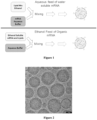
- the present disclosure provides a method of producing a lipid nanoparticle (LNP) composition, the method comprising: (i) mixing an aqueous buffer solution and an organic solution, thereby forming a lipid nanoparticle (LNP) formulation comprising a lipid nanoparticle (LNP) encapsulating a nucleic acid; and (ii) processing the lipid nanoparticle (LNP) formulation, thereby forming the lipid nanoparticle composition; wherein the organic solution comprises an organic solvent-soluble nucleic acid and an ionizable lipid in an organic solvent; and wherein the organic solvent-soluble nucleic acid comprises an organic cation.
- LNP lipid nanoparticle
- the present disclosure is based, in part, on the discovery that the method of producing the lipid nanoparticle (LNP) formulation, as disclosed herein, can influence and/or dictate physical (e.g., LNP stability), chemical (e.g., nucleic acid stability), and/or biological (e.g. efficacy, intracellular delivery, immunogenicity) properties of the LNP formulation.
- physical e.g., LNP stability
- chemical e.g., nucleic acid stability
- biological e.g. efficacy, intracellular delivery, immunogenicity
- the method of the present disclosure mitigates an undesired property change from the produced lipid nanoparticle (LNP) formulation. In some embodiments, the method of the present disclosure mitigates an undesired property change from the produced lipid nanoparticle (LNP) formulation as compared to the LNP formulation produced by a comparable method (e.g., a method without one or more of the steps as disclosed herein).
- the stress is induced during producing, purifying, packing, storing, transporting, and/or using the LNP formulation.
- the stress is heat, shear, excessive agitation, membrane concentration polarization (change in charge state), dehydration, freezing stress, drying stress, freeze/thaw stress, and/or nebulization stress.
- the stress is induced during freezing or lyophilizing a LNP formulation.
- the undesired property change is a reduction of the physical stability of the LNP formulation. In some embodiments, the undesired property change is an increase of the amount of impurities and/or sub-visible particles, or an increase in the average size of the LNP in the LNP formulation.
- the method of the present disclosure mitigates a reduction of the physical stability (e.g., an increase in the average size of the LNP) from the produced LNP formulation as compared to the LNP formulation produced by a comparable method as disclosed herein.
- a reduction of the physical stability e.g., an increase in the average size of the LNP
- the LNP formulation produced by the method of the present disclosure has an average LNP diameter being about 99% or less, about 98% or less, about 97% or less, about 96% or less, about 95% or less, about 90% or less, about 85% or less, about 80% or less, about 75% or less, about 70% or less, about 65% or less, about 60% or less, about 55% or less, about 50% or less, about 40% or less, about 30% or less, about 20% or less, or about 10% or less as compared to the average LNP diameter of the LNP formulation produced by a comparable method as disclosed herein.
- the undesired property change is a reduction of the chemical stability of the LNP formulation. In some embodiments, the undesired property change is a reduction of the integrity of the nucleic acid (e.g., RNA (e.g., mRNA)) in the LNP formulation.
- RNA e.g., mRNA
- the undesired property change is a reduction of the biological property of the LNP formulation. In some embodiments, the undesired property change is a reduction of efficacy, intracellular delivery, and/or immunogenicity of the LNP formulation.
- the LNP formulation produced by the method of the present disclosure has an efficacy, intracellular delivery, and/or immunogenicity being higher than the efficacy, intracellular delivery, and/or immunogenicity of the LNP formulation produced by a comparable method as disclosed herein.
- the LNP formulation produced by the method of the present disclosure has an efficacy, intracellular delivery, and/or immunogenicity being higher than the efficacy, intracellular delivery, and/or immunogenicity of the LNP formulation produced by a comparable method by about 5% or higher, about 10% or more, about 15% or more, about 20% or more, about 30% or more, about 40% or more, about 50% or more, about 60% or more, about 70% or more, about 80% or more, about 90% or more, about 1 folds or more, about 2 folds or more, about 3 folds or more, about 4 folds or more, about 5 folds or more, about 10 folds or more, about 20 folds or more, about 30 folds or more, about 40 folds or more, about 50 folds or more, about 100 folds or more, about 200 folds or more, about 300 folds or more, about 400 folds or more, about 500 folds or more, about 1000 folds or more, about 2000 folds or more, about 3000 folds or more, about 4000 folds or more,
- the LNP formulation produced by the method of the present disclosure exhibits a nucleic acid expression (e.g., the mRNA expression) higher than the nucleic acid expression (e.g., the mRNA expression) of the LNP formulation produced by a comparable method.
- a nucleic acid expression e.g., the mRNA expression
- the nucleic acid expression e.g., the mRNA expression
- the LNP formulation produced by the method of the present disclosure exhibits a nucleic acid expression (e.g., the mRNA expression) higher than the nucleic acid expression (e.g., the mRNA expression) of the LNP formulation produced by a comparable method by about 5% or higher, about 10% or more, about 15% or more, about 20% or more, about 30% or more, about 40% or more, about 50% or more, about 60% or more, about 70% or more, about 80% or more, about 90% or more, about 1 folds or more, about 2 folds or more, about 3 folds or more, about 4 folds or more, about 5 folds or more, about 10 folds or more, about 20 folds or more, about 30 folds or more, about 40 folds or more, about 50 folds or more, about 100 folds or more, about 200 folds or more, about 300 folds or more, about 400 folds or more, about 500 folds or more, about 1000 folds or more, about 2000 folds or more, about 3000 folds or more, about
- the present invention overcomes some of the limitations brought on by complex mixing used in traditional lipid nanoparticle (LNP) formation processes by pre-combining the oligonucleotide and lipid components in the organic phase prior to the introduction of the aqueous phase in the LNP formation process.
- LNP lipid nanoparticle
- This is achieved using mRNA whose solubility has been altered through ion pairing to make it soluble in organic solutions compatible with traditional LNP formation processes.
- Creating mRNA salts where the cation associated with the phosphate backbone is a hydrophobic organic molecule converts the solubility profile of the mRNA from being highly water soluble, to something now soluble in organic solvents and solvent mixtures with high ethanol content. In contrast to traditional procedures, this enables the dissolution of oligonucleotide payloads directly with the hydrophobic lipid and cationic lipid components of the LNP in the organic phase prior to mixing with the aqueous phase during LNP formation.
- Typical lipid nanoparticle (LNP) formation procedures involve the controlled mixing of hydrophobic lipid components dissolved in an organic solvent such as ethanol with an aqueous buffer solution containing the oligonucleotide to be loaded into the resulting particle. Due to the complexity of mixing, and the various ionic interactions necessary to successfully entrap the oligonucleotide in the particle core, there are a large number of variables at play throughout the particle forming process which can impact the quality, stability, and function of the resultant particle.
- This invention simplifies the LNP formation process by combining the mRNA or other oligonucleotide with the lipid components in the organic solvent phase prior to mixing with the aqueous phase.
- Organic solvent soluble mRNA ensures that the condensing cationic lipids have free access to the mRNA throughout the entire mixing process, and prevents the need for mRNA to partition into the hydrophobic environment or be coated with hydrophobic components during mixing to allow incorporation into the LNP core.
- This is expected to reduce the complexities associated with the controlled mixing process, generate a more dehydrated LNP core, and provide for more compositional flexibility around LNP surface parameters, as the mRNA is starting from the organic phase, a more dehydrated state.
- This additional dehydration should have beneficial effects for particle stability and mRNA chemical stability within the formulation, while the reduced burden on mixing and transition of the payload out of the bulk aqueous phase should simplify the formulation process.
- oligonucleotide residence in the organic phase with the hydrophobic components which make up the core of the LNP prior to introduction of the aqueous phase would enable more flexibility in LNP surface by removing the need for the oligo payload to transfer from the aqueous phase to the LNP core.
- Molecules such as PEGylated lipids at high density can create steric barriers for mRNA exchange under traditional formation techniques when the oligonucleotide is fed from the aqueous phase.
- OSSM ensures the mRNA is already in close proximity to the hydrophobic components of the LNP before the aqueous phase introduction, enabling an increased flexibility in LNP composition, especially for LNP surface modifying components.
- the invention involves the process of enabling the formation of LNPs using mRNA dissolved in the organic solvent phase.
- the first step involves the conversion of the water-soluble sodium salt form of mRNA to the organic solvent soluble mRNA (OSSM) form.
- the next step is the dissolution of the OSSM in organic solvent or solvent mixtures to enable LNP formation with the organic solution fed mRNA.
- OSM organic solvent soluble mRNA
- Water soluble forms of mRNA like sodium salts, are dissolved in water. This solution is combined with a buffer solution where the basic portion of the buffer is comprised of an organic compound with increased organic solubility. This solution is then treated with a buffer exchange process to eliminate residual inorganic cations from the solution, and leave only the desired hydrophobic cation present to interact with the phosphate backbone of the mRNA.
- the mRNA solution is processed using tangential flow filtration by exchanging the mRNA solution with buffer to drive the cation exchange to the hydrophobic cation.
- the mRNA solution may be further exchanged with of ddH 2 O to remove excess buffer, leaving the mRNA in solution in the hydrophobic cation salt form.
- This solution may then be concentrated by tangential flow filtration (TFF), and dried through evaporation or lyophilization to afford the material for dissolution in the organic phase needed for the LNP process.
- dialysis is used to convert the water-soluble mRNA to the hydrophobic salt form.
- the starting mRNA solution is dissolved in buffer whose basic component is the hydrophobic organic cation.
- the mRNA is then dialyzed against addition buffer to drive the cation exchange process with additional buffer replacements.
- the mRNA containing solution may then bed dialyzed against ddH 2 O to remove the excess buffer while leaving the desired salt form of mRNA.
- the mRNA solution may be dried through evaporation or lyophilization to afford the material for dissolution in the organic phase needed for the LNP process.
- a hydrophobic ion pairing reverse phase method is used to create the desired hydrophobic salt form of mRNA.
- the mRNA may be bound to a reverse phase support using a hydrophobic ion pairing approach.
- the mRNA may then be eluted off the reverse phase column with a combination of organic solvent and aqueous buffer whose cationic portion is a hydrophobic organic molecule.
- the resulting fractions containing the mRNA may be further dried to afford the mRNA in a desired hydrophobic cation form.
- the method is particularly useful in that the process of creating the hydrophobic salt of the mRNA that can be incorporated into reverse phase purification techniques commonly used in the production and purification of an mRNA and other oligonucleotide constructs.
- an ion exchange resin can be used to convert the mRNA from the water-soluble cation salt form to a hydrophobic salt form.
- the ion exchange resin is loaded with the desired hydrophobic cation, and treated with the mRNA solution to afford desired hydrophobic salt form of the mRNA.
- the mRNA solution is dried through evaporation or lyophilization to afford the material for dissolution in the organic phase needed for the LNP process.
- appropriate molecular weight centrifugation devices can be used to exchange the cation on mRNA to a more hydrophobic and organic soluble one.
- the mRNA solution containing the water-soluble cation salt of mRNA is diluted with a buffer containing the desired hydrophobic cation as the basic component of the buffer. Repeated concentration and dilution with the exchange buffer steps, followed by optional exchanges with ddH 2 O results in the desired hydrophobic salt form of the mRNA.
- the mRNA solution is dried through evaporation or lyophilization to afford the material for dissolution in the organic phase needed for the LNP process.
- the material can be dissolved in organic solutions to enable LNP formulation.
- the organic solvent soluble mRNA (OSSM) is directly dissolved in the desired organic solvent such as mRNA.
- the OSSM is first dissolved in a small amount of organic solvent such as benzyl alcohol to facilitate wetting and dissolution of the hydrophobic mRNA salt, followed by dilution with the desired solvent for use in the bulk phase such as ethanol to result in a mixed organic solvent system.
- organic solvent such as benzyl alcohol
- This solution can be combined with cationic lipids, helper lipids, PEGylated lipids to generate an organic solution of mRNA and lipids suitable for LNP production.
- the organic solution of mRNA and lipids can be precipitated into aqueous buffers such as acetate buffer pH 5 to ensure protonation of the desired cationic lipid components and promote the cation exchange with mRNA and displace the hydrophobic cation used to create the initial organic soluble mRNA material.
- aqueous buffers such as acetate buffer pH 5 to ensure protonation of the desired cationic lipid components and promote the cation exchange with mRNA and displace the hydrophobic cation used to create the initial organic soluble mRNA material.
- the organic solution of mRNA and lipids can be mixed using a microfluidics or T mixing approach with aqueous buffers such as acetate buffer pH 5 to ensure protonation of the desired cationic lipid components and promote the cation exchange with mRNA and displace the hydrophobic cation used to create the initial organic soluble mRNA material.
- aqueous buffers such as acetate buffer pH 5
- the present disclosure is based, in part, on the discovery that the method of producing the lipid nanoparticle can influence distribution of certain components within the lipid nanoparticles, and that this distribution can influence and/or dictate physical (e.g., stability) and/or biological (e.g. efficacy, intracellular delivery, immunogenicity) properties of the lipid nanoparticles.
- physical e.g., stability
- biological e.g. efficacy, intracellular delivery, immunogenicity
- compositions comprising lipid nanoparticles having an advantageous distribution of components.
- organic soluble mRNA and/or aqueous-soluble mRNA could enable bedside formulation of mRNA LNPs.
- the mRNA stored in an unformulated state should offer significant storage and stability advantages, while cation pKa and formulation parameters can be used to reduce or eliminate the need for buffering or pH adjustment during formulation.
- the present disclosure provides a method of producing a lipid nanoparticle (LNP) formulation, comprising: (i) providing a LNP solution comprising a lipid nanoparticle (LNP), wherein the LNP comprises a nucleic acid and an ionizable lipid; and (ii) processing the LNP solution, thereby forming the LNP formulation.
- LNP lipid nanoparticle
- the present disclosure provides a method of producing a lipid nanoparticle (LNP) composition, the method comprising: (i) mixing an aqueous buffer solution and an organic solution, thereby forming a lipid nanoparticle (LNP) formulation comprising a lipid nanoparticle (LNP) encapsulating a nucleic acid; and (ii) processing the lipid nanoparticle (LNP) formulation, thereby forming the lipid nanoparticle composition; wherein the organic solution comprises an organic solvent-soluble nucleic acid and an ionizable lipid in an organic solvent; and wherein the organic solvent-soluble nucleic acid comprises an organic cation.
- LNP lipid nanoparticle
- nucleic acid is an RNA (e.g., mRNA).
- Suitable ionizable lipids for the methods of the present disclosure are further disclosed herein.
- the LNP further comprises a phospholipid, a PEG lipid, a structural lipid, or any combination thereof. Suitable phospholipids, PEG lipids, and structural lipids for the methods of the present disclosure are further disclosed herein.
- the step of providing the LNP solution comprises mixing an aqueous buffer solution and an organic solution wherein the organic solution comprises an organic solvent-soluble nucleic acid and an ionizable lipid in an organic solvent; and wherein the organic solvent-soluble nucleic acid comprises a hydrophobic organic cation.
- the step of providing the LNP solution comprises: ia) converting a water-soluble salt of a nucleic acid to an organic solvent-soluble nucleic acid prior to the mixing, thereby forming the organic solvent-solvent soluble nucleic acid.
- the step of providing the LNP solution comprises: iaa) lyophilizing the organic solvent-soluble nucleic acid after the converting.
- the converting comprises a dialysis.
- the converting comprises a tangential flow filtration (TFF).
- the converting comprises employing a hydrophobic ion pairing reverse phase column.
- the converting comprises employing an ion exchange resin.
- the converting comprises employing a size exclusion column.
- the organic solvent-soluble nucleic acid is a tertiary amine salt.
- the organic solvent-soluble nucleic acid is a tributylamine (TBA) salt.
- the organic solvent-soluble nucleic acid is a tripropylamine (TPA) salt.
- TPA tripropylamine
- the organic solvent-soluble nucleic acid is a trimethylamine (TEA) salt.
- the water-soluble salt of a nucleic acid a sodium salt.
- the water-soluble salt of a nucleic acid is a tris(hydroxymethyl)aminomethane (Tris) salt.
- the organic solvent is an alcohol
- the organic solvent is ethanol.
- the organic solvent comprises a first organic solvent and a second organic solvent.
- the first organic solvent is an alcohol and the second organic solvent is an alcohol.
- the first organic solvent is ethanol and the second organic solvent is benzyl alcohol.
- a wt/wt ratio of the first organic solvent to the second organic solvent is in a range of from about 100: 1 to about 1:1.
- a wt/wt ratio of the first organic solvent to the second organic solvent is in a range of from about 50: 1 to about 1:1.
- a wt/wt ratio of the first organic solvent to the second organic solvent is in a range of from about 20:1 to about 1:1.
- a wt/wt ratio of the first organic solvent to the second organic solvent is in a range of from about 10:1 to about 1:1.
- the aqueous buffer solution has a pH in a range of from about 4 to about 6.
- the aqueous buffer solution has a pH in a range of from about 4.5 to about 5.5.
- the aqueous buffer solution has a pH in a range of from about 4.8 to about 5.2.
- the aqueous buffer solution has a pH in a range of from about 4 to about 6, about 4.5 to about 5.5, or about 4.8 to about 5.2.
- the organic solution has a pH in a range of from about 7.0 to about 9.0, about 7.0 to about 8.1, or about 7.1 to about 7.8, or about 7.2 to about 7.7, or about 7.3 to about 7.6, or about 7.4 to about 7.5
- the aqueous buffer solution is an acetate buffer.
- the mixing comprises turbulent mixing.
- the mixing comprises laminar mixing.
- the mixing comprises microfluidic mixing.
- the mixing is performed by a NanoAssembr TM .
- the mixing is not turbulent and has a Reynolds number of less than 5.0 ⁇ 10 4 .
- the mixing is not turbulent and has a Reynolds number of less than 1.0 ⁇ 10 4 .
- the mixing is not turbulent and has a Reynolds number of less than 5.0 ⁇ 10 3 .
- the mixing is not turbulent and has a Reynolds number of less than 2.5 ⁇ 10 3 .
- the mixing has a Reynolds number of less than 5.0 ⁇ 10 4 , less than 1.0 ⁇ 10 4 , less than 5.0 ⁇ 10 3 , or less than 2.5 ⁇ 10 3 .
- the mixing has a Reynolds number of less than about 1000, less than about 500, or less than about 250.
- processing includes one or more steps to purify, pH adjust, buffer exchange, and/or concentrate LNPs.
- the step of processing the LNP solution comprises: iia) filtering the LNP solution.
- the filtration removes an organic solvent (e.g., an alcohol or ethanol) from the LNP solution.
- the processing comprises a tangential flow filtration (TFF).
- the LNP solution upon removal of the organic solvent (e.g. an alcohol or ethanol), the LNP solution is converted to a solution buffered at a neutral pH, pH 6.5 to 7.8, pH 6.8 to pH 7.5, preferably, pH 7.0 to pH 7.2 (e.g., a phosphate or HEPES buffer).
- the resulting LNP solution is preferably sterilized before storage or use, e.g., by filtration (e.g., through a 0.1-0.5 ⁇ m filter).
- the step of processing the LNP solution further comprises packing the LNP solution.
- packing may refer to storing a drug product in its final state or in-process storage of LNPs before they are placed into final packaging.
- Modes of storage and/or packing include, but are not limited to, refrigeration in sterile bags, refrigerated or frozen formulations in vials, lyophilized formulations in vials and syringes, etc.
- the step of packing the LNP solution comprises one or more of the following steps:
- the cryoprotectant is added to the LNP solution prior to the lyophilization.
- the cryoprotectant comprises one or more cryoprotective agents, and each of the one or more cryoprotective agents is independently a polyol (e.g., a diol or a triol such as propylene glycol (i.e., 1,2-propanediol), 1,3-propanediol, glycerol, (+/-)-2-methyl-2,4-pentanediol, 1,6-hexanediol, 1,2-butanediol, 2,3-butanediol, ethylene glycol, or diethylene glycol), a nondetergent sulfobetaine (e.g., NDSB-201 (3-(1-pyridino)-1-propane sulfonate), an osmolyte (e.g., L-proline or trimethylamine N-oxid
- the lyophilization is carried out in a suitable glass receptacle (e.g., a 10 mL cylindrical glass vial).
- the glass receptacle can preferably withstand extreme changes in temperatures between lower than -40 °C and higher than room temperature in short periods of time, and/or be cut in a uniform shape.
- the step of lyophilizing comprises freezing the LNP solution at a temperature higher than about -40 °C and, preferably, lower than about -30 °C, thereby forming a frozen LNP solution; and drying the frozen LNP solution to form the lyophilized LNP composition.
- the freezing step preferably results in a linear decrease in temperature to the final over about 6 minutes, preferably at about 1 °C per minute from 20 °C to -40 °C.
- sucrose at 12-15% may be used, and the drying step is performed at a vacuum ranging from about 50 mTorr to about 150 mTorr, preferably, first at a low temperature ranging from about -35 °C to about -15 °C, and then at a higher temperature ranging from room temperature to about 25 °C, and preferably, the drying step is completed in three to seven days.
- the drying step is performed at a vacuum ranging from about 50 mTorr to about 100 mTorr, preferably, first at a low temperature ranging from about -15 °C to about 0 °C, and then at a higher temperature.
- the LNP solution or the lyophilized LNP composition is stored at a temperature of about -40 °C, about -35 °C, about -30 °C, about -25 °C, about -20 °C, about - 15 °C, about -10 °C, about -5 °C, about 0 °C, about 5 °C, about 10 °C, about 15 °C, about 20 °C, or about 25 °C prior to adding the buffering solution.
- the LNP solution or the lyophilized LNP composition is stored at a temperature of ranging from about -40 °C to about 0 °C, from about -35 °C to about -5 °C, from about -30 °C to about -10 °C, from about -25 °C to about -15 °C, from about -22 °C to about -18 °C, or from about -21 °C to about -19 °C prior to adding the buffering solution.
- the LNP solution or the lyophilized LNP composition is stored at a temperature of about -20 °C prior to adding the buffering solution.
- the present disclosure describes a method of administering a lipid nanoparticle (LNP) formulation to a patient, the method comprising: (i) providing an aqueous solution having a first pH in a range of from about 7.0 to about 9.0 comprising a therapeutic and/or prophylactic agent in an aqueous buffer and an organic solution comprising an ionizable lipid and an encapsulation agent in an organic solvent; (ii) forming a lipid nanoparticle formulation comprising a lipid nanoparticle encapsulating the therapeutic and/or prophylactic agent by mixing the aqueous solution and the organic solution such that the lipid nanoparticle formulation has a second pH in a range of from about 7.0 to about 9.0 and comprises at least 1% by volume of the organic solvent relative to the total volume of the lipid nanoparticle formulation; and (iii) administering the lipid nanoparticle formulation to the patient less than about 72 hours after the mixing.
- LNP lipid nanoparticle
- the present disclosure describes a method of administering a lipid nanoparticle (LNP) formulation to a patient, the method comprising: (i) providing an aqueous solution having a first pH in a range of from about 4.5 to about less than 7.0 comprising a therapeutic and/or prophylactic agent in an aqueous buffer and an organic solution comprising an ionizable lipid in an organic solvent; (ii) forming a lipid nanoparticle formulation comprising a lipid nanoparticle encapsulating the therapeutic and/or prophylactic agent by mixing the aqueous solution and the organic solution such that the lipid nanoparticle formulation has a second pH in a range of from about 4.5 to about less than 7.0 and comprises at least 1% by volume of the organic solvent relative to the total volume of the lipid nanoparticle formulation; and (iii) administering the lipid nanoparticle formulation to the patient less than about 72 hours after the mixing.
- LNP lipid nanoparticle
- the present disclosure describes A method of administering a lipid nanoparticle (LNP) formulation to a patient, the method comprising: (i) providing an aqueous buffer solution having a first pH in a range of from about 7.0 to about 9.0 and an organic solution comprising an ionizable lipid, an encapsulation agent, and a therapeutic and/or prophylactic agent in an organic solvent; (ii) forming a lipid nanoparticle formulation comprising a lipid nanoparticle encapsulating the therapeutic and/or prophylactic agent by mixing the aqueous buffer solution and the organic solution such that the lipid nanoparticle formulation has a second pH in a range of from about 7.0 to about 9.0 and comprises at least about 1% by volume of the organic solvent relative to the total volume of the lipid nanoparticle formulation; and (iii) administering the lipid nanoparticle formulation to the patient less than about 72 hours after the mixing.
- LNP lipid nanoparticle
- the present disclosure describes a method of administering a lipid nanoparticle (LNP) formulation to a patient, the method comprising: (i) providing an aqueous buffer solution having a first pH in a range of from about 4.5 to about less than 7.0 and an organic solution comprising an ionizable lipid and a therapeutic and/or prophylactic agent in an organic solvent; (ii) forming a lipid nanoparticle formulation comprising a lipid nanoparticle encapsulating the therapeutic and/or prophylactic agent by mixing the aqueous buffer solution and the organic solution such that the lipid nanoparticle formulation has a second pH in a range of from about 4.5 to about less than 7.0 and comprises at least 1% by volume of the organic solvent relative to the total volume of the lipid nanoparticle formulation; and (iii) administering the lipid nanoparticle formulation to the patient less than about 72 hours after the mixing.
- LNP lipid nanoparticle
- the first pH and the second pH are in a range of from about 7.0 to about 8.1, or about 7.1 to about 7.8, or about 7.2 to about 7.7, or about 7.3 to about 7.6, or about 7.4 to about 7.5.
- the first pH and the second pH are in a range of from about 4.5 to about 6.5, or about 4.6 to about 6.0, or about 4.8 to about 5.5.
- the administering is performed less than about 72 hours after the mixing, preferably less than about 60 hours after the mixing, preferably less than about 48 hours after the mixing, preferably less than about 36 hours after the mixing, preferably less than about 24 hours after the mixing, preferably less than about 20 hours after the mixing, preferably less than about 16 hours after the mixing, preferably less than about 12 hours after the mixing, preferably less than about 8 hours after the mixing.
- the administering is performed less than about 120 minutes after the mixing, preferably less than about 100 minutes after the mixing, preferably less than about 90 minutes after the mixing, preferably less than about 80 minutes after the mixing, preferably less than about 70 minutes after the mixing, preferably less than about 60 minutes after the mixing, preferably less than about 50 minutes after the mixing, preferably less than about 40 minutes after the mixing, preferably less than about 30 minutes after the mixing, preferably less than about 20 minutes after the mixing, preferably less than about 15 minutes after the mixing, preferably less than about 10 minutes after the mixing.
- the lipid nanoparticle formulation is not processed between the mixing and the administering.
- the lipid nanoparticle formulation is not filtered between the mixing and the administering.
- the method further comprises receiving at a first inlet of a mixing and administration device the organic solution.
- the method further comprises receiving at a second inlet of a mixing and administration device the aqueous buffer solution.
- the mixing is performed at a mixer site of a mixing and administration device.
- the lipid nanoparticle formulation is administered via an outlet of a mixing and administration device.
- the providing, the forming, the mixing and the administering are all performed employing a single mixing and administration device, preferably a fluidly connected mixing and administration device.
- the mixing and administration device comprises a double-barrel syringe.
- the mixing and administration device comprises a least one selected from the group consisting of a K-syringe and a L-syringe.
- the mixing and administration device comprises a static mixer at the mixer site.
- the static mixer is a helical static mixer.
- the pH of the aqueous buffer solution and the pH of the lipid nanoparticle formulation are about the same.
- the lipid nanoparticle formulation comprises about 1 % by volume to about 50% by volume of the organic solvent relative to the total volume of the lipid nanoparticle formulation, preferably about 2% by volume to about 45% by volume, preferably about 3% by volume to about 40% by volume, preferably about 4% by volume to about 35% by volume, preferably about 5% by volume to about 33% by volume of the organic solvent relative to the total volume of the lipid nanoparticle formulation.
- the organic solvent is an alcohol
- the organic solvent is ethanol.
- the organic solvent comprises a first organic solvent and a second organic solvent.
- the first organic solvent is an alcohol and the second organic solvent is an alcohol.
- the first organic solvent is ethanol and the second organic solvent is benzyl alcohol.
- a wt/wt ratio of the first organic solvent to the second organic solvent is in a range of from about 100:1 to about 1:1, or about 50:1 to about 1:1, or about 20:1 to about 1:1, or about 10:1 to about 1:1.
- the organic solution further comprises a wetting agent.
- a wetting agent may refer to an agent that increases, decreases or improves the ability of a liquid to maintain contact with a surface, such as a solid surface and/or liquid surface.
- the wetting agent is an organic solvent.
- the wetting agent is dimethyl sulfoxide (DMSO).
- a wt/wt ratio of the wetting agent to the organic solvent is in a range of from about 1000:1 to about 1:1, or about 500:1 to about 5:1, or about 100:1 to about 10:1.
- the aqueous buffer solution is at least one selected from the group consisting of an acetate buffer, citrate buffer, phosphate buffer, and a tris buffer.
- the aqueous buffer solution may be any buffer suitable for maintaining a physiological pH.
- the aqueous buffer solution may be any buffer suitable for maintaining a pH suitable for administering to a patient, preferably a mammalian patient, preferably a human patient.
- the aqueous buffer solution further comprises a tonicity agent.
- a tonicity agent may refer to an agent that increases, decreases, or improves the effective osmotic pressure gradient, as defined by the water potential of two solutions, or a relative concentration of solutes dissolve in solution impacting the direction and extent of diffusion.
- the tonicity agent is a sugar.
- the sugar is sucrose.
- the LNP formulation of the present disclosure is prepared by a method disclosed herein.
- the LNP formulation of the present disclosure comprises a plurality of LNPs, wherein the LNPs comprise a nucleic acid and an ionizable lipid.
- RNA e.g., mRNA
- Suitable ionizable lipids for the methods of the present disclosure are further disclosed herein.
- the LNP further comprises a phospholipid, a PEG lipid, a structural lipid, or any combination thereof. Suitable phospholipids, PEG lipids, and structural lipids for the methods of the present disclosure are further disclosed herein.
- the LNP formulation of the disclosure includes at least one lipid nanoparticle component.
- Lipid nanoparticles may include a lipid component and one or more additional components, such as a therapeutic and/or prophylactic, such as a nucleic acid.
- a LNP may be designed for one or more specific applications or targets.
- the elements of a LNP may be selected based on a particular application or target, and/or based on the efficacy, toxicity, expense, ease of use, availability, or other feature of one or more elements.
- the particular formulation of a LNP may be selected for a particular application or target according to, for example, the efficacy and toxicity of particular combination of elements.
- the efficacy and tolerability of a LNP formulation may be affected by the stability of the formulation.
- the lipid component of a LNP may include, for example, a lipid according to Formula (IL-I), (IL-IA), (IL-IB), (IL-II), (IL-IIa), (IL-IIb), (IL-IIc), (IL-IId), (IL-IIe), (IL-IIf), (IL-IIg), (IL-III), (IL-IIIa1), (IL-IIIa2), (IL-IIIa3), (IL-IIIa4), (IL-IIIa5), (IL-IIIa6), (IL-IIIa7), or (IL-IIIa8), a phospholipid (such as an unsaturated lipid, e.g., DOPE or DSPC), a PEG lipid, and a structural lipid.
- a phospholipid such as an unsaturated lipid, e.g., DOPE or DSPC
- the lipid component of a LNP may include, for example, a lipid according to Formula (IL-I), (IL-IA), (IL-IB), (IL-II), (IL-IIa), (IL-IIb), (IL-IIc), (IL-IId), (IL-IIe), (IL-IIf), (IL-IIg), (IL-III), (IL-IIIa1), (IL-IIIa2), (IL-IIIa3), (IL-IIIa4), (IL-IIIa5), (IL-IIIa6), (IL-IIIa7), or (IL-IIIa8), a phospholipid (such as an unsaturated lipid, e.g., DOPE or DSPC), and a structural lipid.
- the elements of the lipid component may be provided in specific fractions.
- the lipid component of a LNP includes a lipid according to Formula (IL-I), (IL-IA), (IL-IB), (IL-II), (IL-IIa), (IL-IIb), (IL-IIc), (IL-IId), (IL-IIe), (IL-IIf), (IL-IIg), (IL-III), (IL-IIIa1), (IL-IIIa2), (IL-IIIa3), (IL-IIIa4), (IL-IIIa5), (IL-IIIa6), (IL-IIIa7), or (IL-IIIa8), a phospholipid, a PEG lipid, and a structural lipid.
- the lipid component of the lipid nanoparticle includes about 30 mol % to about 60 mol % compound of Formula (IL-I), (IL-IA), (IL-IB), (IL-II), (IL-IIa), (IL-IIb), (IL-IIc), (IL-IId), (IL-IIe), (IL-IIf), (IL-IIg), (IL-III), (IL-IIIa1), (IL-IIIa2), (IL-IIIa3), (IL-IIIa4), (IL-IIIa5), (IL-IIIa6), (IL-IIIa7), or (IL-IIIa8), about 0 mol % to about 30 mol % phospholipid, about 18.5 mol % to about 48.5 mol % structural lipid, and about 0 mol % to about 10 mol % of PEG lipid, provided that the total mol % does not exceed 100%.
- the lipid component of the lipid nanoparticle includes about 35 mol % to about 55 mol % compound of Formula (IL-I), (IL-IA), (IL-IB), (IL-II), (IL-IIa), (IL-IIb), (IL-IIc), (IL-IId), (IL-IIe), (IL-IIf), (IL-IIg), (IL-III), (IL-IIIa1), (IL-IIIa2), (IL-IIIa3), (IL-IIIa4), (IL-IIIa5), (IL-IIIa6), (IL-IIIa7), or (IL-IIIa8), about 5 mol % to about 25 mol % phospholipid, about 30 mol % to about 40 mol % structural lipid, and about 0 mol % to about 10 mol % of PEG lipid.
- the lipid component includes about 50 mol % said compound, about 10 mol % phospholipid, about 38.5 mol % structural lipid, and about 1.5 mol % of PEG lipid. In another particular embodiment, the lipid component includes about 40 mol % said compound, about 20 mol % phospholipid, about 38.5 mol % structural lipid, and about 1.5 mol % of PEG lipid.
- the phospholipid may be DOPE or DSPC.
- the PEG lipid may be PEG-DMG and/or the structural lipid may be cholesterol.
- Lipid nanoparticles may be designed for one or more specific applications or targets.
- a LNP may be designed to deliver a therapeutic and/or prophylactic such as an RNA to a particular cell, tissue, organ, or system or group thereof in a mammal's body.
- Physiochemical properties of lipid nanoparticles may be altered in order to increase selectivity for particular bodily targets. For instance, particle sizes may be adjusted based on the fenestration sizes of different organs.
- the therapeutic and/or prophylactic included in a LNP may also be selected based on the desired delivery target or targets.
- a therapeutic and/or prophylactic may be selected for a particular indication, condition, disease, or disorder and/or for delivery to a particular cell, tissue, organ, or system or group thereof (e.g., localized or specific delivery).
- a LNP may include an mRNA encoding a polypeptide of interest capable of being translated within a cell to produce the polypeptide of interest.
- Such a composition may be designed to be specifically delivered to a particular organ.
- a composition may be designed to be specifically delivered to a mammalian liver.
- the amount of a therapeutic and/or prophylactic in a LNP may depend on the size, composition, desired target and/or application, or other properties of the lipid nanoparticle as well as on the properties of the therapeutic and/or prophylactic.
- the amount of an RNA useful in a LNP may depend on the size, sequence, and other characteristics of the RNA.
- the relative amounts of a therapeutic and/or prophylactic and other elements (e.g., lipids) in a LNP may also vary.
- the wt/wt ratio of the lipid component to a therapeutic and/or prophylactic, such as a nucleic acid, in a LNP may be from about 5:1 to about 60:1, such as 5:1, 6:1, 7:1, 8:1, 9:1, 10:1, 11:1, 12:1, 13:1, 14:1, 15:1, 16:1, 17:1, 18:1, 19:1, 20:1, 25:1, 30:1, 35:1, 40:1, 45:1, 50:1, and 60:1.
- the wt/wt ratio of the lipid component to a therapeutic and/or prophylactic may be from about 10:1 to about 40:1. In some examples, the wt/wt ratio is about 20:1.
- the amount of a therapeutic and/or prophylactic in a LNP may, for example, be measured using absorption spectroscopy (e.g., ultraviolet-visible spectroscopy).
- a LNP includes one or more RNAs, and the one or more RNAs, lipids, and amounts thereof may be selected to provide a specific N:P ratio.
- the N:P ratio of the composition refers to the molar ratio of nitrogen atoms in one or more lipids to the number of phosphate groups in an RNA. In general, a lower N:P ratio is preferred.
- the one or more RNA, lipids and amounts thereof may be selected to provide an N:P ratio from about 2:1 to about 30:1, such as 2:1, 3:1, 4:1, 5:1, 6:1, 7:1, 8:1, 9:1, 10:1, 12:1, 14:1, 16:1, 18:1, 20:1, 22:1, 24:1, 26:1, 28:1, or 30:1.
- the N:P ratio may be from about 2:1 to about 8:1. In some examples, the N:P ratio is from about 5:1 to about 8:1. In some examples, the N:P ratio may be about 5.0:1, about 5.5:1, about 5.67:1, about 6.0:1, about 6.5:1, or about 7.0:1. In some examples, the N:P ratio may be about 5.67:1.
- the formulation including a LNP may further include a salt, such as a chloride salt.
- the formulation including a LNP may further include a sugar such as a disaccharide.
- the formulation further includes a sugar but not a salt, such as a chloride salt.
- the physical properties of the LNP of the present disclosure may be characterized by a variety of methods.
- microscopy e.g., transmission electron microscopy or scanning electron microscopy
- Dynamic light scattering or potentiometry e.g., potentiometric titrations
- Dynamic light scattering may also be utilized to determine particle sizes.
- Instruments such as the Zetasizer Nano ZS (Malvern Instruments Ltd, Malvern, Worcestershire, UK) may also be used to measure multiple characteristics of a LNP, such as particle size, polydispersity index, and zeta potential.
- the average LNP diameter of the LNP formulation may be between 10s of nm and 100s of nm, e.g., measured by dynamic light scattering (DLS).
- the average LNP diameter of the LNP formulation may be from about 40 nm to about 150 nm, such as about 40 nm, 45 nm, 50 nm, 55 nm, 60 nm, 65 nm, 70 nm, 75 nm, 80 nm, 85 nm, 90 nm, 95 nm, 100 nm, 105 nm, 110 nm, 115 nm, 120 nm, 125 nm, 130 nm, 135 nm, 140 nm, 145 nm, or 150 nm.
- the average LNP diameter of the LNP formulation may be from about 50 nm to about 100 nm, from about 50 nm to about 90 nm, from about 50 nm to about 80 nm, from about 50 nm to about 70 nm, from about 50 nm to about 60 nm, from about 60 nm to about 100 nm, from about 60 nm to about 90 nm, from about 60 nm to about 80 nm, from about 60 nm to about 70 nm, from about 70 nm to about 100 nm, from about 70 nm to about 90 nm, from about 70 nm to about 80 nm, from about 80 nm to about 100 nm, from about 80 nm to about 90 nm, or from about 90 nm to about 100 nm.
- the average LNP diameter of the LNP formulation may be from about 70 nm to about 100 nm. In a particular embodiment, the average LNP diameter of the LNP formulation may be about 80 nm. In some embodiments, the average LNP diameter of the LNP formulation may be about 100 nm.
- the average LNP diameter of the LNP formulation ranges from about 1mm to about 500 mm, from about 5 mm to about 200 mm, from about 10 mm to about 100 mm, from about 20 mm to about 80 mm, from about 25 mm to about 60 mm, from about 30 mm to about 55 mm, from about 35 mm to about 50 mm, or from about 38 mm to about 42 mm.
- the average LNP diameter of the LNP formulation is about 99% or less, about 98% or less, about 97% or less, about 96% or less, about 95% or less, about 90% or less, about 85% or less, about 80% or less, about 75% or less, about 70% or less, about 65% or less, about 60% or less, about 55% or less, about 50% or less, about 40% or less, about 30% or less, about 20% or less, or about 10% or less as compared to the LNP formulation produced by a comparable method.
- a LNP may be relatively homogenous.
- a polydispersity index may be used to indicate the homogeneity of a LNP, e.g ., the particle size distribution of the lipid nanoparticles.
- a small ( e.g., less than 0.3) polydispersity index generally indicates a narrow particle size distribution.
- a LNP may have a polydispersity index from about 0 to about 0.25, such as 0.01, 0.02, 0.03, 0.04, 0.05, 0.06, 0.07, 0.08, 0.09, 0.10, 0.11, 0.12, 0.13, 0.14, 0.15, 0.16, 0.17, 0.18, 0.19, 0.20, 0.21, 0.22, 0.23, 0.24, or 0.25.
- the polydispersity index of a LNP may be from about 0.10 to about 0.20.
- the zeta potential of a LNP may be used to indicate the electrokinetic potential of the composition.
- the zeta potential may describe the surface charge of a LNP.
- Lipid nanoparticles with relatively low charges, positive or negative, are generally desirable, as more highly charged species may interact undesirably with cells, tissues, and other elements in the body.
- the zeta potential of a LNP may be from about -10 mV to about +20 mV, from about -10 mV to about +15 mV, from about -10 mV to about +10 mV, from about -10 mV to about +5 mV, from about -10 mV to about 0 mV, from about -10 mV to about -5 mV, from about -5 mV to about +20 mV, from about -5 mV to about +15 mV, from about -5 mV to about +10 mV, from about -5 mV to about +5 mV, from about -5 mV to about 0 mV, from about 0 mV to about +20 mV, from about 0 mV to about +15 mV, from about 0 mV to about +10 mV, from about 0 mV to about +5 mV, from about 0 mV to about +20 mV, from
- the efficiency of encapsulation of a therapeutic and/or prophylactic, such as a nucleic acid describes the amount of therapeutic and/or prophylactic that is encapsulated or otherwise associated with a LNP after preparation, relative to the initial amount provided.
- the encapsulation efficiency is desirably high ( e.g., close to 100%).
- the encapsulation efficiency may be measured, for example, by comparing the amount of therapeutic and/or prophylactic in a solution containing the lipid nanoparticle before and after breaking up the lipid nanoparticle with one or more organic solvents or detergents.
- An anion exchange resin may be used to measure the amount of free therapeutic and/or prophylactic (e.g., RNA) in a solution.
- the encapsulation efficiency of a therapeutic and/or prophylactic may be at least 50%, for example 50%, 55%, 60%, 65%, 70%, 75%, 80%, 85%, 90%, 91%, 92%, 93%, 94%, 95%, 96%, 97%, 98%, 99%, or 100%.
- the encapsulation efficiency may be at least 80%.
- the encapsulation efficiency may be at least 90%.
- the encapsulation efficiency may be at least 95%.
- a LNP may optionally comprise one or more coatings.
- a LNP may be formulated in a capsule, film, or table having a coating.
- a capsule, film, or tablet including a composition described herein may have any useful size, tensile strength, hardness or density.
- the chemical properties of the LNP, LNP solution, lyophilized LNP composition, or LNP formulation of the present disclosure may be characterized by a variety of methods.
- electrophoresis e.g., capillary electrophoresis
- chromatography e.g., reverse phase liquid chromatography
- the LNP integrity of the LNP, LNP solution, lyophilized LNP composition, or LNP formulation of the present disclosure is about 20% or higher, about 25% or higher, about 30% or higher, about 35% or higher, about 40% or higher, about 45% or higher, about 50% or higher, about 55% or higher, about 60% or higher, about 65% or higher, about 70% or higher, about 75% or higher, about 80% or higher, about 85% or higher, about 90% or higher, about 95% or higher, about 96% or higher, about 97% or higher, about 98% or higher, or about 99% or higher.
- the LNP integrity of the LNP, LNP solution, lyophilized LNP composition, or LNP formulation of the present disclosure is higher than the LNP integrity of the LNP, LNP solution, lyophilized LNP composition, or LNP formulation produced by a comparable method by about 5% or higher, about 10% or more, about 15% or more, about 20% or more, about 30% or more, about 40% or more, about 50% or more, about 60% or more, about 70% or more, about 80% or more, about 90% or more, about 1 folds or more, about 2 folds or more, about 3 folds or more, about 4 folds or more, about 5 folds or more, about 10 folds or more, about 20 folds or more, about 30 folds or more, about 40 folds or more, about 50 folds or more, about 100 folds or more, about 200 folds or more, about 300 folds or more, about 400 folds or more, about 500 folds or more, about 1000 folds or more, about 2000 folds or more, about 3000 folds or more, about 4
- the T 80% of the LNP, LNP solution, lyophilized LNP composition, or LNP formulation of the present disclosure is about 12 months or longer, about 15 months or longer, about 18 months or longer, about 21 months or longer, about 24 months or longer, about 27 months or longer, about 30 months or longer, about 33 months or longer, about 36 months or longer, about 48 months or longer, about 60 months or longer, about 72 months or longer, about 84 months or longer, about 96 months or longer, about 108 months or longer, about 120 months or longer.
- the T 80% of the LNP, LNP solution, lyophilized LNP composition, or LNP formulation of the present disclosure is longer than the T 80% of the LNP, LNP solution, lyophilized LNP composition, or LNP formulation produced by a comparable method by about 5% or higher, about 10% or more, about 15% or more, about 20% or more, about 30% or more, about 40% or more, about 50% or more, about 60% or more, about 70% or more, about 80% or more, about 90% or more, about 1 folds or more, about 2 folds or more, about 3 folds or more, about 4 folds or more, about 5 folds or more.
- the T 1/2 of the LNP, LNP solution, lyophilized LNP composition, or LNP formulation of the present disclosure is about 12 months or longer, about 15 months or longer, about 18 months or longer, about 21 months or longer, about 24 months or longer, about 27 months or longer, about 30 months or longer, about 33 months or longer, about 36 months or longer, about 48 months or longer, about 60 months or longer, about 72 months or longer, about 84 months or longer, about 96 months or longer, about 108 months or longer, about 120 months or longer.
- the T 1/2 of the LNP, LNP solution, lyophilized LNP composition, or LNP formulation of the present disclosure is longer than the T 1/2 of the LNP, LNP solution, lyophilized LNP composition, or LNP formulation produced by a comparable method by about 5% or higher, about 10% or more, about 15% or more, about 20% or more, about 30% or more, about 40% or more, about 50% or more, about 60% or more, about 70% or more, about 80% or more, about 90% or more, about 1 folds or more, about 2 folds or more, about 3 folds or more, about 4 folds or more, about 5 folds or more
- alkyl or “alkyl group” means a linear or branched, saturated hydrocarbon including one or more carbon atoms (e.g., one, two, three, four, five, six, seven, eight, nine, ten, eleven, twelve, thirteen, fourteen, fifteen, sixteen, seventeen, eighteen, nineteen, twenty, or more carbon atoms), which is optionally substituted.
- C 1-14 alkyl means an optionally substituted linear or branched, saturated hydrocarbon including 1-14 carbon atoms.
- an alkyl group described herein refers to both unsubstituted and substituted alkyl groups.
- alkenyl or “alkenyl group” means a linear or branched hydrocarbon including two or more carbon atoms ( e.g., two, three, four, five, six, seven, eight, nine, ten, eleven, twelve, thirteen, fourteen, fifteen, sixteen, seventeen, eighteen, nineteen, twenty, or more carbon atoms) and at least one double bond, which is optionally substituted.
- C 2-14 alkenyl means an optionally substituted linear or branched hydrocarbon including 2-14 carbon atoms and at least one carbon-carbon double bond.
- An alkenyl group may include one, two, three, four, or more carbon-carbon double bonds.
- C 18 alkenyl may include one or more double bonds.
- a C 18 alkenyl group including two double bonds may be a linoleyl group.
- an alkenyl group described herein refers to both unsubstituted and substituted alkenyl groups.
- Carbocycle or “carbocyclic group” means an optionally substituted mono- or multi-cyclic system including one or more rings of carbon atoms. Rings may be three, four, five, six, seven, eight, nine, ten, eleven, twelve, thirteen, fourteen, fifteen, sixteen, seventeen, eighteen, nineteen, or twenty membered rings.
- the notation "C 3-6 carbocycle” means a carbocycle including a single ring having 3-6 carbon atoms. Carbocycles may include one or more carbon-carbon double or triple bonds and may be non-aromatic or aromatic ( e.g., cycloalkyl or aryl groups).
- carbocycles include cyclopropyl, cyclopentyl, cyclohexyl, phenyl, naphthyl, and 1,2-dihydronaphthyl groups.
- cycloalkyl as used herein means a non-aromatic carbocycle and may or may not include any double or triple bond.
- carbocycles described herein refers to both unsubstituted and substituted carbocycle groups, i.e., optionally substituted carbocycles.
- heterocycle or “heterocyclic group” means an optionally substituted mono- or multi-cyclic system including one or more rings, where at least one ring includes at least one heteroatom.
- Heteroatoms may be, for example, nitrogen, oxygen, or sulfur atoms. Rings may be three, four, five, six, seven, eight, nine, ten, eleven, twelve, thirteen, or fourteen membered rings.
- Heterocycles may include one or more double or triple bonds and may be non-aromatic or aromatic ( e.g., heterocycloalkyl or heteroaryl groups).
- heterocycles include imidazolyl, imidazolidinyl, oxazolyl, oxazolidinyl, thiazolyl, thiazolidinyl, pyrazolidinyl, pyrazolyl, isoxazolidinyl, isoxazolyl, isothiazolidinyl, isothiazolyl, morpholinyl, pyrrolyl, pyrrolidinyl, furyl, tetrahydrofuryl, thiophenyl, pyridinyl, piperidinyl, quinolyl, and isoquinolyl groups.
- heterocycloalkyl as used herein means a non-aromatic heterocycle and may or may not include any double or triple bond. Unless otherwise specified, heterocycles described herein refers to both unsubstituted and substituted heterocycle groups, i.e., optionally substituted heterocycles.
- a “biodegradable group” is a group that may facilitate faster metabolism of a lipid in a mammalian entity.
- a biodegradable group may be selected from the group consisting of, but is not limited to, -C(O)O-, -OC(O)-, -C(O)N(R')-, -N(R')C(O)-, -C(O)-,
- an "aryl group” is an optionally substituted carbocyclic group including one or more aromatic rings. Examples of aryl groups include phenyl and naphthyl groups. As used herein, a "heteroaryl group” is an optionally substituted heterocyclic group including one or more aromatic rings.
- heteroaryl groups include pyrrolyl, furyl, thiophenyl, imidazolyl, oxazolyl, and thiazolyl. Both aryl and heteroaryl groups may be optionally substituted.
- M and M' can be selected from the non-limiting group consisting of optionally substituted phenyl, oxazole, and thiazole. In the formulas herein, M and M' can be independently selected from the list of biodegradable groups above.
- aryl or heteroaryl groups described herein refers to both unsubstituted and substituted groups, i.e., optionally substituted aryl or heteroaryl groups.
- Alkyl, alkenyl, and cyclyl (e.g., carbocyclyl and heterocyclyl) groups may be optionally substituted unless otherwise specified.
- each OR are alkoxy groups that can be the same or different and R ⁇ is an alkyl or alkenyl group
- a phosphate e.g., P(O) 4 3-
- a thiol e.g., -SH
- a sulfoxide e.g., -S(O)R
- a sulfinic acid e.g., -S(O)OH
- a sulfonic acid e.g., -S(O) 2 OH
- a thial e.g., -C(S)H
- a sulfate e.g., S(O) 4 2-
- a sulfonyl e.g., -S(O) 2 -
- an amide e.g., -C(O)NR 2 , or -N(R)C(O)R
- R is an alkyl or alkenyl group, as defined herein.
- the substituent groups themselves may be further substituted with, for example, one, two, three, four, five, or six substituents as defined herein.
- a C 1-6 alkyl group may be further substituted with one, two, three, four, five, or six substituents as described herein.
- a LNP including a lipid component having about 40% of a given compound may include 30-50% of the compound.
- isotopes refers to atoms having the same atomic number but different mass numbers resulting from a different number of neutrons in the nuclei.
- isotopes of hydrogen include tritium and deuterium.
- a compound, salt, or complex of the present disclosure can be prepared in combination with solvent or water molecules to form solvates and hydrates by routine methods.
- contacting means establishing a physical connection between two or more entities.
- contacting a mammalian cell with a LNP means that the mammalian cell and a nanoparticle are made to share a physical connection.
- Methods of contacting cells with external entities both in vivo and ex vivo are well known in the biological arts.
- contacting a LNP and a mammalian cell disposed within a mammal may be performed by varied routes of administration (e.g., intravenous, intramuscular, intradermal, and subcutaneous) and may involve varied amounts of lipid nanoparticles.
- routes of administration e.g., intravenous, intramuscular, intradermal, and subcutaneous
- more than one mammalian cell may be contacted by a LNP.
- the term "comparable method” refers to a method with comparable parameters or steps, as of the method being compared (e.g., the producing the LNP formulation of the present disclosure).
- the "comparable method” is a method with one or more of steps i), ia), iaa), ib), ii), iia), iib), iic), iid), and iie) of the method being compared.
- the "comparable method” is a method without one or more of steps i), ia), iaa), ib), ii), iia), iib), iic), iid), and iie) of the method being compared. In some embodiments, the "comparable method” is a method without one or more of steps ia) and ib) of the method being compared. In some embodiments, the "comparable method” is a method employing a water-soluble salt of a nucleic acid. In some embodiments, the “comparable method” is a method employing an organic solution that does not comprise an organic solvent-soluble nucleic acid. In some embodiments, the "comparable method” is a method comprising processing the lipid nanoparticle prior to administering the lipid nanoparticle formulation.
- delivering means providing an entity to a destination.
- delivering a therapeutic and/or prophylactic to a subject may involve administering a LNP including the therapeutic and/or prophylactic to the subject (e.g., by an intravenous, intramuscular, intradermal, or subcutaneous route).
- Administration of a LNP to a mammal or mammalian cell may involve contacting one or more cells with the lipid nanoparticle.
- the term "enhanced delivery” means delivery of more( e.g ., at least 1.5 fold more, at least 2-fold more, at least 3-fold more, at least 4-fold more, at least 5-fold more, at least 6-fold more, at least 7-fold more, at least 8-fold more, at least 9-fold more, at least 10-fold more) of a therapeutic and/or prophylactic by a nanoparticle to a target tissue of interest (e.g., mammalian liver) compared to the level of delivery of a therapeutic and/or prophylactic by a control nanoparticle to a target tissue of interest (e.g., MC3, KC2, or DLinDMA).
- a target tissue of interest e.g., mammalian liver
- a control nanoparticle to a target tissue of interest e.g., MC3, KC2, or DLinDMA
- the level of delivery of a nanoparticle to a particular tissue may be measured by comparing the amount of protein produced in a tissue to the weight of said tissue, comparing the amount of therapeutic and/or prophylactic in a tissue to the weight of said tissue, comparing the amount of protein produced in a tissue to the amount of total protein in said tissue, or comparing the amount of therapeutic and/or prophylactic in a tissue to the amount of total therapeutic and/or prophylactic in said tissue.
- a surrogate such as an animal model (e.g., a rat model).
- the term “specific delivery,” “specifically defiver,” or “specifically delivering” means delivery of more (e.g., at least 1.5 fold more, at least 2-fold more, at least 3-fold more, at least 4-fold more, at least 5-fold more, at least 6-fold more, at least 7-fold more, at least 8-fold more, at least 9-fold more, at least 10-fold more) of a therapeutic and/or prophylactic by a nanoparticle to a target tissue of interest (e.g., mammalian liver) compared to an off-target tissue (e.g., mammalian spleen).
- a target tissue of interest e.g., mammalian liver
- an off-target tissue e.g., mammalian spleen
- the level of delivery of a nanoparticle to a particular tissue may be measured by comparing the amount of protein produced in a tissue to the weight of said tissue, comparing the amount of therapeutic and/or prophylactic in a tissue to the weight of said tissue, comparing the amount of protein produced in a tissue to the amount of total protein in said tissue, or comparing the amount of therapeutic and/or prophylactic in a tissue to the amount of total therapeutic and/or prophylactic in said tissue.
- a therapeutic and/or prophylactic is specifically provided to a mammalian kidney as compared to the liver and spleen if 1.5, 2-fold, 3-fold, 5-fold, 10-fold, 15 fold, or 20 fold more therapeutic and/or prophylactic per 1 g of tissue is delivered to a kidney compared to that delivered to the liver or spleen following systemic administration of the therapeutic and/or prophylactic.
- a surrogate such as an animal model (e.g., a rat model).
- encapsulation efficiency refers to the amount of a therapeutic and/or prophylactic that becomes part of a LNP, relative to the initial total amount of therapeutic and/or prophylactic used in the preparation of a LNP. In some embodiments, if 97 mg of therapeutic and/or prophylactic are encapsulated in a LNP out of a total 100 mg of therapeutic and/or prophylactic initially provided to the composition, the encapsulation efficiency may be given as 97%. As used herein, “encapsulation” may refer to complete, substantial, or partial enclosure, confinement, surrounding, or encasement.
- expression of a nucleic acid sequence refers to translation of an mRNA into a polypeptide or protein and/or post-translational modification of a polypeptide or protein.
- in vitro refers to events that occur in an artificial environment, e.g., in a test tube or reaction vessel, in cell culture, in a Petri dish, etc., rather than within an organism ( e.g., animal, plant, or microbe).
- in vivo refers to events that occur within an organism (e.g., animal, plant, or microbe or cell or tissue thereof).
- ex vivo refers to events that occur outside of an organism (e.g., animal, plant, or microbe or cell or tissue thereof). Ex vivo events may take place in an environment minimally altered from a natural (e.g., in vivo) environment.
- the term "isomer” means any geometric isomer, tautomer, zwitterion, stereoisomer, enantiomer, or diastereomer of a compound.
- Compounds may include one or more chiral centers and/or double bonds and may thus exist as stereoisomers, such as double-bond isomers (i.e., geometric E/Z isomers) or diastereomers ( e.g., enantiomers (i.e., (+) or (-)) or cis / trans isomers).
- the present disclosure encompasses any and all isomers of the compounds described herein, including stereomerically pure forms (e.g., geometrically pure, enantiomerically pure, or diastereomerically pure) and enantiomeric and stereoisomeric mixtures, e.g., racemates. Enantiomeric and stereomeric mixtures of compounds and means of resolving them into their component enantiomers or stereoisomers are well-known.
- lipid component is that component of a lipid nanoparticle that includes one or more lipids.
- the lipid component may include one or more cationic/ionizable, PEGylated, structural, or other lipids, such as phospholipids.
- a "linker” is a moiety connecting two moieties, for example, the connection between two nucleosides of a cap species.
- a linker may include one or more groups including but not limited to phosphate groups (e.g., phosphates, boranophosphates, thiophosphates, selenophosphates, and phosphonates), alkyl groups, amidates, or glycerols.
- two nucleosides of a cap analog may be linked at their 5' positions by a triphosphate group or by a chain including two phosphate moieties and a boranophosphate moiety.
- methods of administration may include intravenous, intramuscular, intradermal, subcutaneous, or other methods of delivering a composition to a subject.
- a method of administration may be selected to target delivery (e.g., to specifically deliver) to a specific region or system of a body.
- RNA may be a modified RNA. That is, an RNA may include one or more nucleobases, nucleosides, nucleotides, or linkers that are non-naturally occurring.
- a “modified” species may also be referred to herein as an "altered” species. Species may be modified or altered chemically, structurally, or functionally. In some embodiments, a modified nucleobase species may include one or more substitutions that are not naturally occurring.
- N:P ratio is the molar ratio of ionizable (in the physiological pH range) nitrogen atoms in a lipid to phosphate groups in an RNA, e.g., in a LNP including a lipid component and an RNA.
- lipid nanoparticle is a composition comprising one or more lipids.
- Lipid nanoparticles are typically sized on the order of micrometers or smaller and may include a lipid bilayer.
- Lipid nanoparticles encompass lipid nanoparticles (LNPs), liposomes (e.g., lipid vesicles), and lipoplexes.
- LNPs lipid nanoparticles
- liposomes e.g., lipid vesicles
- lipoplexes e.g., lipoplexes.
- a LNP may be a liposome having a lipid bilayer with a diameter of 500 nm or less.
- patient refers to a subject who may seek or be in need of treatment, requires treatment, is receiving treatment, will receive treatment, or a subject who is under care by a trained professional for a particular disease or condition.
- PEG lipid or “PEGylated lipid” refers to a lipid comprising a polyethylene glycol component.
- phrases "pharmaceutically acceptable” is used herein to refer to those compounds, materials, composition, and/or dosage forms which are, within the scope of sound medical judgment, suitable for use in contact with the tissues of human beings and animals without excessive toxicity, irritation, allergic response, or other problems or complication, commensurate with a reasonable benefit/risk ratio.
- phrases "pharmaceutically acceptable excipient,” as used herein, refers to any ingredient other than the compounds described herein (for example, a vehicle capable of suspending, complexing, or dissolving the active compound) and having the properties of being substantially nontoxic and non-inflammatory in a patient.
- Excipients may include, for example: anti-adherents, antioxidants, binders, coatings, compression aids, disintegrants, dyes (colors), emollients, emulsifiers, fillers (diluents), film formers or coatings, flavors, fragrances, glidants (flow enhancers), lubricants, preservatives, printing inks, sorbents, suspending or dispersing agents, sweeteners, and waters of hydration.
- anti-adherents antioxidants, binders, coatings, compression aids, disintegrants, dyes (colors), emollients, emulsifiers, fillers (diluents), film formers or coatings, flavors, fragrances, glidants (flow enhancers), lubricants, preservatives, printing inks, sorbents, suspending or dispersing agents, sweeteners, and waters of hydration.
- excipients include, but are not limited to: butylated hydroxytoluene (BHT), calcium carbonate, calcium phosphate (dibasic), calcium stearate, croscarmellose, crosslinked polyvinyl pyrrolidone, citric acid, crospovidone, cysteine, ethylcellulose, gelatin, hydroxypropyl cellulose, hydroxypropyl methylcellulose, lactose, magnesium stearate, maltitol, mannitol, methionine, methylcellulose, methyl paraben, microcrystalline cellulose, polyethylene glycol, polyvinyl pyrrolidone, povidone, pregelatinized starch, propyl paraben, retinyl palmitate, shellac, silicon dioxide, sodium carboxymethyl cellulose, sodium citrate, sodium starch glycolate, sorbitol, starch (corn), stearic acid, sucrose, talc, titanium dioxide, vitamin A, vitamin E (alpha-
- compositions may also include salts of one or more compounds.
- Salts may be pharmaceutically acceptable salts.
- pharmaceutically acceptable salts refers to derivatives of the disclosed compounds wherein the parent compound is altered by converting an existing acid or base moiety to its salt form (e.g., by reacting a free base group with a suitable organic acid).
- examples of pharmaceutically acceptable salts include, but are not limited to, mineral or organic acid salts of basic residues such as amines; alkali or organic salts of acidic residues such as carboxylic acids; and the like.
- Representative acid addition salts include acetate, adipate, alginate, ascorbate, aspartate, benzenesulfonate, benzoate, bisulfate, borate, butyrate, camphorate, camphorsulfonate, citrate, cyclopentanepropionate, digluconate, dodecylsulfate, ethanesulfonate, fumarate, glucoheptonate, glycerophosphate, hemisulfate, heptonate, hexanoate, hydrobromide, hydrochloride, hydroiodide, 2-hydroxy-ethanesulfonate, lactobionate, lactate, laurate, lauryl sulfate, malate, maleate, malonate, methanesulfonate, 2-naphthalenesulfonate, nicotinate, nitrate, oleate, oxalate, palmitate, pamoate, pe
- alkali or alkaline earth metal salts include sodium, lithium, potassium, calcium, magnesium, and the like, as well as nontoxic ammonium, quaternary ammonium, and amine cations, including, but not limited to ammonium, tetramethylammonium, tetraethylammonium, methylamine, dimethylamine, trimethylamine, triethylamine, ethylamine, and the like.
- the pharmaceutically acceptable salts of the present disclosure include the conventional non-toxic salts of the parent compound formed, for example, from non-toxic inorganic or organic acids.
- the pharmaceutically acceptable salts of the present disclosure can be synthesized from the parent compound which contains a basic or acidic moiety by conventional chemical methods.
- such salts can be prepared by reacting the free acid or base forms of these compounds with a stoichiometric amount of the appropriate base or acid in water or in an organic solvent, or in a mixture of the two; generally, nonaqueous media like ether, ethyl acetate, ethanol, isopropanol, or acetonitrile are preferred.
- nonaqueous media like ether, ethyl acetate, ethanol, isopropanol, or acetonitrile are preferred.
- Lists of suitable salts are found in Remington's Pharmaceutical Sciences, 17th ed., Mack Publishing Company, Easton, Pa., 1985, p. 1418 , Pharmaceutical Salts: Properties, Selection, and Use, P.H. Stahl and C.G. Wermuth (eds.), Wiley-VCH, 2008 , and Berge et al., Journal of Pharmaceutical Science, 66, 1-19 (1977 ).
- a "phospholipid” is a lipid that includes a phosphate moiety and one or more carbon chains, such as unsaturated fatty acid chains.
- a phospholipid may include one or more multiple (e.g., double or triple) bonds (e.g., one or more unsaturations).
- a phospholipid or an analog or derivative thereof may include choline.
- a phospholipid or an analog or derivative thereof may not include choline.
- Particular phospholipids may facilitate fusion to a membrane.
- a cationic phospholipid may interact with one or more negatively charged phospholipids of a membrane (e.g., a cellular or intracellular membrane). Fusion of a phospholipid to a membrane may allow one or more elements of a lipid-containing composition to pass through the membrane permitting, e.g., delivery of the one or more elements to a cell.
- the "polydispersity index” is a ratio that describes the homogeneity of the particle size distribution of a system. A small value, e.g., less than 0.3, indicates a narrow particle size distribution.
- polypeptide or “polypeptide of interest” refers to a polymer of amino acid residues typically joined by peptide bonds that can be produced naturally (e.g., isolated or purified) or synthetically.
- an "RNA” refers to a ribonucleic acid that may be naturally or non-naturally occurring.
- an RNA may include modified and/or non-naturally occurring components such as one or more nucleobases, nucleosides, nucleotides, or linkers.
- An RNA may include a cap structure, a chain terminating nucleoside, a stem loop, a polyA sequence, and/or a polyadenylation signal.
- An RNA may have a nucleotide sequence encoding a polypeptide of interest.
- an RNA may be a messenger RNA (mRNA).
- RNAs may be selected from the non-liming group consisting of small interfering RNA (siRNA), asymmetrical interfering RNA (aiRNA), microRNA (miRNA), Dicer-substrate RNA (dsRNA), small hairpin RNA (shRNA), mRNA, long non-coding RNA (lncRNA) and mixtures thereof.
- siRNA small interfering RNA
- aiRNA asymmetrical interfering RNA
- miRNA microRNA
- dsRNA Dicer-substrate RNA
- shRNA small hairpin RNA
- mRNA long non-coding RNA
- lncRNA long non-coding RNA
- a "single unit dose” is a dose of any therapeutic administered in one dose/at one time/single route/single point of contact, i.e., single administration event.
- a split dose is the division of a single unit dose or total daily dose into two or more doses.
- the term "subject” refers to any organism to which a composition or formulation in accordance with the disclosure may be administered, e.g., for experimental, diagnostic, prophylactic, and/or therapeutic purposes.
- Typical subjects include animals (e.g., mammals such as mice, rats, rabbits, non-human primates, and humans) and/or plants.
- T x refers to the amount of time lasted for the nucleic acid integrity (e.g., mRNA integrity) of a LNP, LNP solution, lyophilized LNP composition, or LNP formulation to degrade to about X of the initial integrity of the nucleic acid (e.g., mRNA) used for the preparation of the LNP, LNP solution, lyophilized LNP composition, or LNP formulation.
- nucleic acid integrity e.g., mRNA integrity
- T 80% refers to the amount of time lasted for the nucleic acid integrity (e.g., mRNA integrity) of a LNP, LNP solution, lyophilized LNP composition, or LNP formulation to degrade to about 80% of the initial integrity of the nucleic acid (e.g., mRNA) used for the preparation of the LNP, LNP solution, lyophilized LNP composition, or LNP formulation.
- nucleic acid integrity e.g., mRNA integrity
- T 1/2 refers to the amount of time lasted for the nucleic acid integrity (e.g., mRNA integrity) of a LNP, LNP solution, lyophilized LNP composition, or LNP formulation to degrade to about 1/2 of the initial integrity of the nucleic acid (e.g., mRNA) used for the preparation of the LNP, LNP solution, lyophilized LNP composition, or LNP formulation.
- nucleic acid integrity e.g., mRNA integrity
- targeted cells refers to any one or more cells of interest.
- the cells may be found in vitro, in vivo, in situ, or in the tissue or organ of an organism.
- the organism may be an animal, preferably a mammal, more preferably a human and most preferably a patient.
- target tissue refers to any one or more tissue types of interest in which the delivery of a therapeutic and/or prophylactic would result in a desired biological and/or pharmacological effect.
- target tissues of interest include specific tissues, organs, and systems or groups thereof.
- a target tissue may be a kidney, a lung, a spleen, vascular endothelium in vessels ( e.g., intra-coronary or intra-femoral), or tumor tissue ( e.g., via intratumoral injection).
- An "off-target tissue” refers to any one or more tissue types in which the expression of the encoded protein does not result in a desired biological and/or pharmacological effect.
- off-target tissues may include the liver and the spleen.
- therapeutic agent refers to any agent that, when administered to a subject, has a therapeutic, diagnostic, and/or prophylactic effect and/or elicits a desired biological and/or pharmacological effect.
- Therapeutic agents are also referred to as “actives” or “active agents.” Such agents include, but are not limited to, cytotoxins, radioactive ions, chemotherapeutic agents, small molecule drugs, proteins, and nucleic acids.
- the term "therapeutically effective amount” means an amount of an agent to be delivered (e.g., nucleic acid, drug, composition, therapeutic agent, diagnostic agent, prophylactic agent, etc.) that is sufficient, when administered to a subject suffering from or susceptible to an infection, disease, disorder, and/or condition, to treat, improve symptoms of, diagnose, prevent, and/or delay the onset of the infection, disease, disorder, and/or condition.
- an agent to be delivered e.g., nucleic acid, drug, composition, therapeutic agent, diagnostic agent, prophylactic agent, etc.
- transfection refers to the introduction of a species (e.g., an RNA) into a cell. Transfection may occur, for example, in vitro, ex vivo, or in vivo.
- a species e.g., an RNA
- treating refers to partially or completely alleviating, ameliorating, improving, relieving, delaying onset of, inhibiting progression of, reducing severity of, and/or reducing incidence of one or more symptoms or features of a particular infection, disease, disorder, and/or condition.
- "treating" cancer may refer to inhibiting survival, growth, and/or spread of a tumor. Treatment may be administered to a subject who does not exhibit signs of a disease, disorder, and/or condition and/or to a subject who exhibits only early signs of a disease, disorder, and/or condition for the purpose of decreasing the risk of developing pathology associated with the disease, disorder, and/or condition.
- the "zeta potential” is the electrokinetic potential of a lipid, e.g., in a particle composition.
- the ionizable lipids of the present disclosure may be one or more of compounds of Formula (IL-1): or their N-oxides, or salts or isomers thereof, wherein:
- m is 5, 7, or 9.
- Q is OH, -NHC(S)N(R) 2 , or - NHC(O)N(R) 2 .
- Q is -N(R)C(O)R, or -N(R)S(O) 2 R.
- a subset of compounds of Formula (I) includes those of Formula (IL-IB): or its N-oxide, or a salt or isomer thereof, in which all variables are as defined herein.
- m is selected from 5, 6, 7, 8, and 9;
- m is 5, 7, or 9.
- Q is OH, -NHC(S)N(R) 2 , or - NHC(O)N(R) 2 .
- Q is -N(R)C(O)R, or -N(R)S(O) 2 R.
- the compounds of Formula (IL-I) are of Formula (IL-IIa): or their N-oxides, or salts or isomers thereof, wherein R 4 is as described herein.
- the compounds of Formula (IL-I) are of Formula (IL-IIb): or their N-oxides, or salts or isomers thereof, wherein R 4 is as described herein.
- the compounds of Formula (IL-I) are of Formula (IL-IIc) or (IL-IIe): or their N-oxides, or salts or isomers thereof, wherein R 4 is as described herein.
- the compounds of Formula (IL-I) are of Formula (IL-IIf): or their N-oxides, or salts or isomers thereof, wherein M is -C(O)O- or -OC(O)-, M" is C 1-6 alkyl or C 2-6 alkenyl, R 2 and R 3 are independently selected from the group consisting of C 5-14 alkyl and C 5-14 alkenyl, and n is selected from 2, 3, and 4.
- the compounds of Formula (IL-I) are of Formula (IL-IId): or their N-oxides, or salts or isomers thereof, wherein n is 2, 3, or 4; and m, R', R", and R 2 through R 6 are as described herein.
- each of R 2 and R 3 may be independently selected from the group consisting of C 5-14 alky and C 5-14 alkenyl.
- the compounds of Formula (IL-I) are of Formula (IL-IIg): or their N-oxides, or salts or isomers thereof, wherein l is selected from 1, 2, 3, 4, and 5; m is selected from 5, 6, 7, 8, and 9; M 1 is a bond or M'; M and M' are independently selected from -C(O)O-, -OC(O)-, -OC(O)-M"-C(O)O-, -C(O)N(R')-, -P(O)(OR')O-, -S-S-, an aryl group, and a heteroaryl group; and R 2 and R 3 are independently selected from the group consisting of H, C 1-14 alkyl, and C 2-14 alkenyl.
- M" is C 1-6 alkyl (e.g., C 1-4 alkyl) or C 2-6 alkenyl (e.g. C 2-4 alkenyl).
- R 2 and R 3 are independently selected from the group consisting of C 5-14 alkyl and C 5-14 alkenyl.
- the ionizable lipids are one or more of the compounds described in U.S. Application Nos. 62/220,091 , 62/252,316 , 62/253,433 , 62/266,460 , 62/333,557 , 62/382,740 , 62/393,940 , 62/471,937 , 62/471,949 , 62/475,140 , and 62/475,166 , and PCT Application No. PCT/US2016/052352 .
- the ionizable lipids are selected from Compounds 1-280 described in U.S. Application No. 62/475,166 .
- the ionizable lipid is or a salt thereof.
- the ionizable lipid is or a salt thereof.
- the ionizable lipid is or a salt thereof.
- the ionizable lipid is or a salt thereof.
- the ionizable lipids of the present disclosure may be one or more of compounds of formula (IL-III): or salts thereof, wherein,
- the compound is of any of formulae (IL-IIIa1)-(IL-IIIa8):
- the ionizable lipids are selected from Compound 1-156 described in U.S. Application No. 62/519,826 .
- the ionizable lipids are selected from Compounds 1-16, 42-66, 68-76, and 78-156 described in U.S. Application No. 62/519,826 .
- the ionizable lipid is or a salt thereof.
- a lipid may have a positive or partial positive charge at physiological pH.
- Such lipids may be referred to as cationic or ionizable (amino)lipids.
- Lipids may also be zwitterionic, i.e., neutral molecules having both a positive and a negative charge.
- PEG lipid refers to polyethylene glycol (PEG)-modified lipids.
- PEG lipids include PEG-modified phosphatidylethanolamine and phosphatidic acid, PEG-ceramide conjugates (e.g., PEG-CerC14 or PEG-CerC20), PEG-modified dialkylamines and PEG-modified 1,2-diacyloxypropan-3-amines.
- PEGylated lipids PEGylated lipids.
- a PEG lipid can be PEG-c-DOMG, PEG-DMG, PEG-DLPE, PEG-DMPE, PEG-DPPC, or a PEG-DSPE lipid.
- the PEG lipid includes, but are not limited to, 1,2-dimyristoyl-sn-glycerol methoxypolyethylene glycol (PEG-DMG), 1,2-distearoyl-sn-glycero-3-phosphoethanolamine-N-(amino(polyethylene glycol)] (PEG-DSPE), PEG-disteryl glycerol (PEG-DSG), PEG-dipalmetoleyl, PEG-dioleyl, PEG-distearyl, PEG-diacylglycamide (PEG-DAG), PEG-dipalmitoyl phosphatidylethanolamine (PEG-DPPE), or PEG-1,2-dimyristyloxlpropyl-3-amine (PEG-c-DMA).
- PEG-DMG 1,2-dimyristoyl-sn-glycerol methoxypolyethylene glycol
- PEG-DSPE 1,2-distearoyl-sn
- the PEG lipid is selected from the group consisting of a PEG-modified phosphatidylethanolamine, a PEG-modified phosphatidic acid, a PEG-modified ceramide, a PEG-modified dialkylamine, a PEG-modified diacylglycerol, a PEG-modified dialkylglycerol, and mixtures thereof.
- the lipid moiety of the PEG lipids includes those having lengths of from about C 14 to about C 22 , preferably from about C 14 to about C 16 .
- a PEG moiety for example an mPEG-NH 2 , has a size of about 1000, 2000, 5000, 10,000, 15,000 or 20,000 daltons.
- the PEG lipid is PEG 2k -DMG.
- the lipid nanoparticles described herein can comprise a PEG lipid which is a non-diffusible PEG.
- PEG lipid which is a non-diffusible PEG.
- non-diffusible PEGs include PEG-DSG and PEG-DSPE.
- PEG lipids are known in the art, such as those described in U.S. Patent No. 8158601 and International Publ. No. WO 2015/130584 A2 .
- the lipid component of a lipid nanoparticle composition may include one or more molecules comprising polyethylene glycol, such as PEG or PEG-modified lipids. Such species may be alternately referred to as PEGylated lipids.
- a PEG lipid is a lipid modified with polyethylene glycol.
- a PEG lipid may be selected from the non-limiting group including PEG-modified phosphatidylethanolamines, PEG-modified phosphatidic acids, PEG-modified ceramides, PEG-modified dialkylamines, PEG-modified diacylglycerols, PEG-modified dialkylglycerols, and mixtures thereof.
- a PEG lipid may be PEG-c-DOMG, PEG-DMG, PEG-DLPE, PEG-DMPE, PEG-DPPC, or a PEG-DSPE lipid.
- the PEG-modified lipids are a modified form of PEG DMG.
- PEG-DMG has the following structure:
- PEG lipids useful in the present invention can be PEGylated lipids described in International Publication No. WO2012099755 . Any of these exemplary PEG lipids described herein may be modified to comprise a hydroxyl group on the PEG chain.
- the PEG lipid is a PEG-OH lipid.
- a "PEG-OH lipid" (also referred to herein as "hydroxy-PEGylated lipid”) is a PEGylated lipid having one or more hydroxyl (-OH) groups on the lipid.
- the PEG-OH lipid includes one or more hydroxyl groups on the PEG chain.
- a PEG-OH or hydroxy-PEGylated lipid comprises an -OH group at the terminus of the PEG chain.
- a PEG lipid useful in the present invention is a compound of Formula (PL-I).
- PL-I compounds of Formula (PL-I): or salts thereof, wherein:
- the compound of Formula (PL-I) is a PEG-OH lipid (i.e., R 3 is -OR O , and R O is hydrogen). In some embodiments, the compound of Formula (PL-I) is of Formula (PL-I-OH): or a salt thereof.
- a PEG lipid useful in the present invention is a PEGylated fatty acid.
- a PEG lipid useful in the present invention is a compound of Formula (PL-II).
- Provided herein are compounds of Formula (PL-II): or a salt thereof, wherein:
- the compound of Formula (PL-II) is of Formula (PL-II-OH): or a salt thereof. In some embodiments, r is 45.
- the compound of Formula (PL-II) is: or a salt thereof.
- the compound of Formula (PL-II) is N-(2-aminoethyl)-2-aminoethyl-N-(2-aminoethyl)-2-aminoethyl-N-(2-aminoethyl)-2-aminoethyl-N-(2-aminoethyl)-2-aminoethyl-N-(2-aminoethyl)-2-oxidethyl
- the PEG lipid may be one or more of the PEG lipids described in U.S. Application No. 62/520,530 .
- a PEG lipid useful in the present invention is a compound of Formula (PL-IV): or salts thereof, wherein:
- r is 0.
- R 6 is C 16 alkyl.
- R 6 is Cis alkyl.
- the compound of Formula (PL-IV) is BRIJ ® C2 (e.g. polyoxyethylene cetyl ether).
- the compound of Formula (PL-IV) is BRIJ ® O2 (e.g. polyoxyethylene cetyl ether).
- the lipid composition of the pharmaceutical compositions described herein does not comprise a PEG lipid.
- structural lipid refers to sterols and also to lipids containing sterol moieties.
- incorporation of a structural lipid in the lipid nanoparticle may help mitigate aggregation of other lipids in the particle.
- Structural lipids can be selected from the group including but not limited to, cholesterol, fecosterol, sitosterol, ergosterol, campesterol, stigmasterol, brassicasterol, tomatidine, tomatine, ursolic acid, alpha-tocopherol, hopanoids, phytosterols, steroids, and mixtures thereof.
- the structural lipid is a sterol.
- "sterols" are a subgroup of steroids consisting of steroid alcohols.
- the structural lipid is a steroid.
- the structural lipid is cholesterol.
- the structural lipid is an analog of cholesterol.
- the structural lipid is alpha-tocopherol.
- the structural lipids may be one or more structural lipids described in U.S. Application No. 62/520,530 .
- the encapsulation agent is a compound of Formula (EA-I): or salts or isomers thereof, wherein
- R 201 and R 202 are each independently selected from the group consisting of H and CH 3 .
- R 203 is selected from the group consisting of C 1 -C 20 alkyl, C 8 -C 18 alkyl, and C 12 -C 16 alkyl.
- R 204 is selected from the group consisting of H, C 1 -C 20 alkyl, C 2 -C 20 alkenyl, C(O)(OC 1 -C 20 alkyl), C(O)(OC 2 -C 20 alkenyl), C(O)(NHC 1 -C 20 alkyl), and C(O)(NHC 2 -C 20 alkenyl); C 8 -C 18 alkyl, C 8 -C 18 alkenyl, C(O)(OC 8 -C 18 alkyl), C(O)(OC 8 -C 18 alkenyl), C(O)(NHC 8 -C 18 alkyl), and C(O)(NHC 8 -C 18 alkenyl); and C 12 -C 16 alkyl, C 12 -C 16 alkenyl, C(O)(OC 12 -C 16 alkyl), C(O)(OC 12 -C 16 alkenyl), C(O)(NHC 12 -C 16
- n1 is selected from 1, 2, 3, 4, 5, 6, 7, 8, 9, and 10; n1 is selected from 1, 2, 3, 4, 5, and 6; n1 is selected from 2, 3, and 4.
- n1 is 3.
- the encapsulation agent is a compound of Formula (EA-II): or salts or isomers thereof, wherein
- X 101 is a bond.
- X 101 is NH.
- X 101 is O.
- R 101 and R 102 are each independently selected from the group consisting of H and CH 3 .
- R 103 is selected from the group consisting of C 1 -C 20 alkyl, C 8 -C 18 alkyl, and C 12 -C 16 alkyl.
- R 104 is selected from the group consisting of C 1 -C 20 alkyl, C 8 -C 18 alkyl, and C 12 -C 16 alkyl.
- n1 is selected from 1, 2, 3, 4, 5, 6, 7, 8, 9, and 10; n1 is selected from 1, 2, 3, 4, 5, and 6; or n1 is selected from 2, 3, and 4.
- n1 is 3.
- Exemplary encapsulation agents include, but are not limited to, ethyl lauroyl arginate, ethyl myristoyl arginate, ethyl palmitoyl arginate, ethyl oleic arginate, ethyl capric arginate, and ethyl carprylic arginate.
- the encapsulation agent is ethyl lauroyl arginate, (EA-1) or a salt or isomer thereof.
- the encapsulation agent is at least one compound selected from the group consisting of: or salts and isomers thereof, such as, for example free bases, TFA salts, and/or HCl salts.
- the encapsulation agent is a compound of Formula (EA-III): or salts or isomers thereof, wherein
- R 105 and R 106 are each independently selected from the group consisting of H and CH 3 .
- R 107 is selected from the group consisting of C 1 -C 20 alkyl, Cs-Cis alkyl, and C 12 -C 16 alkyl.
- n2 is selected from 1, 2, 3, 4, 5, 6, 7, 8, 9, and 10.
- n2 is selected from 1, 2, 3, 4, 5, and 6.
- n2 is selected from 2, 3, and 4.
- n2 is 3.
- Exemplary encapsulation agents include, but are not limited to, EA-11, EA-12, EA-13, and EA-14.
- the encapsulation agent is at least one compound selected from the group consisting of: or salts and isomers thereof, such as, for example free bases, TFA salts, and/or HCl salts.
- Phospholipids may assemble into one or more lipid bilayers.
- phospholipids comprise a phospholipid moiety and one or more fatty acid moieties.
- a phospholipid moiety can be selected, for example, from the non-limiting group consisting of phosphatidyl choline, phosphatidyl ethanolamine, phosphatidyl glycerol, phosphatidyl serine, phosphatidic acid, 2-lysophosphatidyl choline, and a sphingomyelin.
- a fatty acid moiety can be selected, for example, from the non-limiting group consisting of lauric acid, myristic acid, myristoleic acid, palmitic acid, palmitoleic acid, stearic acid, oleic acid, linoleic acid, alpha-linolenic acid, erucic acid, phytanoic acid, arachidic acid, arachidonic acid, eicosapentaenoic acid, behenic acid, docosapentaenoic acid, and docosahexaenoic acid.
- a cationic phospholipid can interact with one or more negatively charged phospholipids of a membrane (e.g., a cellular or intracellular membrane). Fusion of a phospholipid to a membrane can allow one or more elements (e.g., a therapeutic agent) of a lipid-containing composition (e.g., LNPs) to pass through the membrane permitting, e.g., delivery of the one or more elements to a target tissue.
- a cationic phospholipid can interact with one or more negatively charged phospholipids of a membrane (e.g., a cellular or intracellular membrane). Fusion of a phospholipid to a membrane can allow one or more elements (e.g., a therapeutic agent) of a lipid-containing composition (e.g., LNPs) to pass through the membrane permitting, e.g., delivery of the one or more elements to a target tissue.
- elements e.g., a therapeutic agent
- LNPs lipid-containing composition
- Non-natural phospholipid species including natural species with modifications and substitutions including branching, oxidation, cyclization, and alkynes are also contemplated.
- a phospholipid can be functionalized with or cross-linked to one or more alkynes (e.g., an alkenyl group in which one or more double bonds is replaced with a triple bond).
- an alkyne group can undergo a copper-catalyzed cycloaddition upon exposure to an azide.
- Such reactions can be useful in functionalizing a lipid bilayer of a nanoparticle composition to facilitate membrane permeation or cellular recognition or in conjugating a nanoparticle composition to a useful component such as a targeting or imaging moiety (e.g., a dye).
- Phospholipids include, but are not limited to, glycerophospholipids such as phosphatidylcholines, phosphatidylethanolamines, phosphatidylserines, phosphatidylinositols, phosphatidy glycerols, and phosphatidic acids. Phospholipids also include phosphosphingolipid, such as sphingomyelin.
- a phospholipid useful or potentially useful in the present invention is an analog or variant of DSPC.
- a phospholipid useful or potentially useful in the present invention is a compound of Formula (PL-I): or a salt thereof, wherein:
- the phospholipids may be one or more of the phospholipids described in U.S. Application No. 62/520,530 .
- a phospholipid useful or potentially useful in the present invention comprises a modified phospholipid head (e.g., a modified choline group).
- a phospholipid with a modified head is DSPC, or analog thereof, with a modified quaternary amine.
- at least one of R 1 is not methyl.
- at least one of R 1 is not hydrogen or methyl.
- the compound of Formula (PL-I) is one of the following formulae: or a salt thereof, wherein:
- a compound of Formula (PL-I) is of Formula (PL-I-a): or a salt thereof.
- a phospholipid useful or potentially useful in the present invention comprises a cyclic moiety in place of the glyceride moiety.
- a phospholipid useful in the present invention is DSPC, or analog thereof, with a cyclic moiety in place of the glyceride moiety.
- the compound of Formula (PL-I) is of Formula (PL-I-b): or a salt thereof.
- a phospholipid useful or potentially useful in the present invention comprises a modified tail.
- a phospholipid useful or potentially useful in the present invention is DSPC, or analog thereof, with a modified tail.
- a "modified tail” may be a tail with shorter or longer aliphatic chains, aliphatic chains with branching introduced, aliphatic chains with substituents introduced, aliphatic chains wherein one or more methylenes are replaced by cyclic or heteroatom groups, or any combination thereof.
- the compound of Formula (PL-I) is of Formula (PL-I-c): or a salt thereof, wherein:
- a phospholipid useful or potentially useful in the present invention comprises a modified phosphocholine moiety, wherein the alkyl chain linking the quaternary amine to the phosphoryl group is not ethylene (e.g., n is not 2). Therefore, in some embodiments, a phospholipid useful or potentially useful in the present invention is a compound of Formula (PL-I), wherein n is 1, 3, 4, 5, 6, 7, 8, 9, or 10. In some embodiments, a compound of Formula (PL-I) is of one of the following formulae: or a salt thereof.
- an alternative lipid is used in place of a phospholipid of the present disclosure.
- Alternative lipids include the following:
- a LNP that includes one or more lipids described herein may further include one or more adjuvants, e.g., Glucopyranosyl Lipid Adjuvant (GLA), CpG oligodeoxynucleotides (e.g., Class A or B), poly(I:C), aluminum hydroxide, and Pam3CSK4.
- GLA Glucopyranosyl Lipid Adjuvant
- CpG oligodeoxynucleotides e.g., Class A or B
- poly(I:C) poly(I:C)
- aluminum hydroxide e.g., aluminum hydroxide, and Pam3CSK4.
- Lipid nanoparticles may include one or more therapeutics and/or prophylactics, such as a nucleic acid.
- the disclosure features methods of delivering a therapeutic and/or prophylactic, such as a nucleic acid, to a mammalian cell or organ, producing a polypeptide of interest in a mammalian cell, and treating a disease or disorder in a mammal in need thereof comprising administering to a mammal and/or contacting a mammalian cell with a LNP including a therapeutic and/or prophylactic, such as a nucleic acid.
- Therapeutics and/or prophylactics include biologically active substances and are alternately referred to as "active agents".
- a therapeutic and/or prophylactic may be a substance that, once delivered to a cell or organ, brings about a desirable change in the cell, organ, or other bodily tissue or system. Such species may be useful in the treatment of one or more diseases, disorders, or conditions.
- a therapeutic and/or prophylactic is a small molecule drug useful in the treatment of a particular disease, disorder, or condition.
- drugs useful in the lipid nanoparticles include, but are not limited to, antineoplastic agents (e.g., vincristine, doxorubicin, mitoxantrone, camptothecin, cisplatin, bleomycin, cyclophosphamide, methotrexate, and streptozotocin), antitumor agents (e.g., actinomycin D, vincristine, vinblastine, cytosine arabinoside, anthracyclines, alkylating agents, platinum compounds, antimetabolites, and nucleoside analogs, such as methotrexate and purine and pyrimidine analogs), anti-infective agents, local anesthetics (e.g., dibucaine and chlorpromazine), beta-adrenergic blockers (e.g., propranolol, timolol, and labetalol), antihypertensive agents (e.g., clonidine and
- g . miconazole, terconazole, econazole, isoconazole, butaconazole, clotrimazole, itraconazole, nystatin, naftifine, and amphotericin B), antiparasitic agents, hormones, hormone antagonists, immunomodulators, neurotransmitter antagonists, antiglaucoma agents, vitamins, narcotics, and imaging agents.
- a therapeutic and/or prophylactic is a cytotoxin, a radioactive ion, a chemotherapeutic, a vaccine, a compound that elicits an immune response, and/or another therapeutic and/or prophylactic.
- a cytotoxin or cytotoxic agent includes any agent that may be detrimental to cells.
- Examples include, but are not limited to, taxol, cytochalasin B, gramicidin D, ethidium bromide, emetine, mitomycin, etoposide, teniposide, vincristine, vinblastine, colchicine, doxorubicin, daunorubicin, dihydroxyanthracinedione, mitoxantrone, mithramycin, actinomycin D, 1-dehydrotestosterone, glucocorticoids, procaine, teracaine, lidocaine, propranolol, puromycin, maytansinoids, e.g., maytansinol, rachelmycin (CC-1065), and analogs or homologs thereof.
- taxol cytochalasin B, gramicidin D, ethidium bromide, emetine, mitomycin, etoposide, teniposide, vincristine, vinblastine, colchicine,
- Radioactive ions include, but are not limited to iodine (e.g., iodine 125 or iodine 131), strontium 89, phosphorous, palladium, cesium, iridium, phosphate, cobalt, yttrium 90, samarium 153, and praseodymium.
- Vaccines include compounds and preparations that are capable of providing immunity against one or more conditions related to infectious diseases such as influenza, measles, human papillomavirus (HPV), rabies, meningitis, whooping cough, tetanus, plague, hepatitis, and tuberculosis and can include mRNAs encoding infectious disease derived antigens and/or epitopes.
- Vaccines also include compounds and preparations that direct an immune response against cancer cells and can include mRNAs encoding tumor cell derived antigens, epitopes, and/or neoepitopes.
- Compounds eliciting immune responses may include, but are not limited to, vaccines, corticosteroids (e.g., dexamethasone), and other species.
- a therapeutic and/or prophylactic is a protein.
- Therapeutic proteins useful in the nanoparticles in the disclosure include, but are not limited to, gentamycin, amikacin, insulin, erythropoietin (EPO), granulocyte-colony stimulating factor (G-CSF), granulocyte-macrophage colony stimulating factor (GM-CSF), Factor VIR, luteinizing hormone-releasing hormone (LHRH) analogs, interferons, heparin, Hepatitis B surface antigen, typhoid vaccine, and cholera vaccine.
- EPO erythropoietin
- G-CSF granulocyte-colony stimulating factor
- GM-CSF granulocyte-macrophage colony stimulating factor
- LHRH luteinizing hormone-releasing hormone
- a vaccine and/or a compound capable of eliciting an immune response is administered intramuscularly via a composition including a compound according to Formula (IL-I), (IL-IA), (IL-IB), (IL-II), (IL-IIa), (IL-IIb), (IL-IIc), (IL-IId), (IL-IIe), (IL-IIf), (IL-IIg), (IL-III), (IL-IIIa1), (IL-IIIa2), (IL-IIIa3), (IL-IIIa4), (IL-IIIa5), (IL-IIIa6), (IL-IIIa7), or (IL-IIIa8) (e.g., Compound 3, 18, 20, 26, or 29).
- IL-III e.g., Compound 3, 18, 20, 26, or 29.
- therapeutics and/or prophylactics include, but are not limited to, antimetabolites (e.g., methotrexate, 6-mercaptopurine, 6-thioguanine, cytarabine, 5-fluorouracil dacarbazine), alkylating agents (e.g., mechlorethamine, thiotepa chlorambucil, rachelmycin (CC-1065), melphalan, carmustine (BSNU), lomustine (CCNU), cyclophosphamide, busulfan, dibromomannitol, streptozotocin, mitomycin C, and cis-dichlorodiamine platinum (II) (DDP) cisplatin), anthracyclines (e.g., daunorubicin (formerly daunomycin) and doxorubicin), antibiotics (e.g., dactinomycin (formerly actinomycin), bleomycin, mithramycin, and anthr
- a therapeutic agent is a polynucleotide or nucleic acid (e.g., ribonucleic acid or deoxyribonucleic acid).
- nucleic acid e.g., ribonucleic acid or deoxyribonucleic acid.
- polynucleotide in its broadest sense, includes any compound and/or substance that is or can be incorporated into an oligonucleotide chain.
- Exemplary polynucleotides for use in accordance with the present disclosure include, but are not limited to, one or more of deoxyribonucleic acid (DNA), ribonucleic acid (RNA) including messenger RNA (mRNA), hybrids thereof, RNAi-inducing agents, RNAi agents, siRNAs, shRNAs, miRNAs, antisense RNAs, ribozymes, catalytic DNA, RNAs that induce triple helix formation, aptamers, vectors, etc.
- a thereapeutic and/or prophylactic is an RNA.
- RNAs useful in the compositions and methods described herein can be selected from the group consisting of, but are not limited to, shortmers, antagomirs, antisense, ribozymes, small interfering RNA (siRNA), asymmetrical interfering RNA (aiRNA), microRNA (miRNA), Dicer-substrate RNA (dsRNA), small hairpin RNA (shRNA), transfer RNA (tRNA), messenger RNA (mRNA), and mixtures thereof.
- the RNA is an mRNA.
- a therapeutic and/or prophylactic is an mRNA.
- An mRNA may encode any polypeptide of interest, including any naturally or non-naturally occurring or otherwise modified polypeptide.
- a polypeptide encoded by an mRNA may be of any size and my have any secondary structure or activity.
- a polypeptide encoded by an mRNA may have a therapeutic effect when expressed in a cell.
- a therapeutic and/or prophylactic is an siRNA.
- An siRNA may be capable of selectively knocking down or down regulating expression of a gene of interest.
- an siRNA could be selected to silence a gene associated with a particular disease, disorder, or condition upon administration to a subject in need thereof of a LNP including the siRNA.
- An siRNA may comprise a sequence that is complementary to an mRNA sequence that encodes a gene or protein of interest.
- the siRNA may be an immunomodulatory siRNA.
- a therapeutic and/or prophylactic is an shRNA or a vector or plasmid encoding the same.
- An shRNA may be produced inside a target cell upon delivery of an appropriate construct to the nucleus. Constructs and mechanisms relating to shRNA are well known in the relevant arts.
- Nucleic acids and polynucleotides useful in the disclosure typically include a first region of linked nucleosides encoding a polypeptide of interest (e.g., a coding region), a first flanking region located at the 5'-terminus of the first region (e.g., a 5'-UTR), a second flanking region located at the 3'-terminus of the first region (e.g., a 3'-UTR) at least one 5'-cap region, and a 3'-stabilizing region.
- a nucleic acid or polynucleotide further includes a poly-A region or a Kozak sequence (e.g., in the 5'-UTR).
- polynucleotides may contain one or more intronic nucleotide sequences capable of being excised from the polynucleotide.
- a polynucleotide or nucleic acid e.g., an mRNA
- a polynucleotide or nucleic acid may include a 5' cap structure, a chain terminating nucleotide, a stem loop, a poly A sequence, and/or a polyadenylation signal. Any one of the regions of a nucleic acid may include one or more alternative components (e.g., an alternative nucleoside).
- the 3'-stabilizing region may contain an alternative nucleoside such as an L-nucleoside, an inverted thymidine, or a 2'-O-methyl nucleoside and/or the coding region, 5;-UTR, 3'-UTR, or cap region may include an alternative nucleoside such as a 5-substituted uridine (e.g., 5-methoxyuridine), a 1-substituted pseudouridine (e.g., 1-methyl-pseudouridine), and/or a 5-substituted cytidine (e.g., 5-methyl-cytidine).
- an alternative nucleoside such as an L-nucleoside, an inverted thymidine, or a 2'-O-methyl nucleoside
- the coding region, 5;-UTR, 3'-UTR, or cap region may include an alternative nucleoside such as a 5-substituted uridine (e.g., 5-
- the shortest length of a polynucleotide can be the length of the polynucleotide sequence that is sufficient to encode for a dipeptide. In another embodiment, the length of the polynucleotide sequence is sufficient to encode for a tripeptide. In another embodiment, the length of the polynucleotide sequence is sufficient to encode for a tetrapeptide. In another embodiment, the length of the polynucleotide sequence is sufficient to encode for a pentapeptide. In another embodiment, the length of the polynucleotide sequence is sufficient to encode for a hexapeptide. In another embodiment, the length of the polynucleotide sequence is sufficient to encode for a heptapeptide.
- the length of the polynucleotide sequence is sufficient to encode for an octapeptide. In another embodiment, the length of the polynucleotide sequence is sufficient to encode for a nonapeptide. In another embodiment, the length of the polynucleotide sequence is sufficient to encode for a decapeptide.
- dipeptides that the alternative polynucleotide sequences can encode for include, but are not limited to, carnosine and anserine.
- a polynucleotide is greater than 30 nucleotides in length. In another embodiment, the polynucleotide molecule is greater than 35 nucleotides in length. In another embodiment, the length is at least 40 nucleotides. In another embodiment, the length is at least 45 nucleotides. In another embodiment, the length is at least 50 nucleotides. In another embodiment, the length is at least 55 nucleotides. In another embodiment, the length is at least 60 nucleotides. In another embodiment, the length is at least 80 nucleotides. In another embodiment, the length is at least 90 nucleotides. In another embodiment, the length is at least 100 nucleotides.
- the length is at least 120 nucleotides. In another embodiment, the length is at least 140 nucleotides. In another embodiment, the length is at least 160 nucleotides. In another embodiment, the length is at least 180 nucleotides. In another embodiment, the length is at least 200 nucleotides. In another embodiment, the length is at least 250 nucleotides. In another embodiment, the length is at least 300 nucleotides. In another embodiment, the length is at least 350 nucleotides. In another embodiment, the length is at least 400 nucleotides. In another embodiment, the length is at least 450 nucleotides. In another embodiment, the length is at least 500 nucleotides.
- the length is at least 600 nucleotides. In another embodiment, the length is at least 700 nucleotides. In another embodiment, the length is at least 800 nucleotides. In another embodiment, the length is at least 900 nucleotides. In another embodiment, the length is at least 1000 nucleotides. In another embodiment, the length is at least 1100 nucleotides. In another embodiment, the length is at least 1200 nucleotides. In another embodiment, the length is at least 1300 nucleotides. In another embodiment, the length is at least 1400 nucleotides. In another embodiment, the length is at least 1500 nucleotides. In another embodiment, the length is at least 1600 nucleotides.
- the length is at least 1800 nucleotides. In another embodiment, the length is at least 2000 nucleotides. In another embodiment, the length is at least 2500 nucleotides. In another embodiment, the length is at least 3000 nucleotides. In another embodiment, the length is at least 4000 nucleotides. In another embodiment, the length is at least 5000 nucleotides, or greater than 5000 nucleotides.
- Nucleic acids and polynucleotides may include one or more naturally occurring components, including any of the canonical nucleotides A (adenosine), G (guanosine), C (cytosine), U (uridine), or T (thymidine).
- all or substantially all of the nucleotides comprising (a) the 5'-UTR, (b) the open reading frame (ORF), (c) the 3'-UTR, (d) the poly A tail, and any combination of (a, b, c, or d above) comprise naturally occurring canonical nucleotides A (adenosine), G (guanosine), C (cytosine), U (uridine), or T (thymidine).
- Nucleic acids and polynucleotides may include one or more alternative components, as described herein, which impart useful properties including increased stability and/or the lack of a substantial induction of the innate immune response of a cell into which the polynucleotide is introduce.
- an alternative polynucleotide or nucleic acid exhibits reduced degradation in a cell into which the polynucleotide or nucleic acid is introduced, relative to a corresponding unaltered polynucleotide or nucleic acid.
- These alternative species may enhance the efficiency of protein production, intracellular retention of the polynucleotides, and/or viability of contacted cells, as well as possess reduced immunogenicity.
- Polynucleotides and nucleic acids may be naturally or non-naturally occurring. Polynucleotides and nucleic acids may include one or more modified (e.g., altered or alternative) nucleobases, nucleosides, nucleotides, or combinations thereof.
- the nucleic acids and polynucleotides useful in a LNP can include any useful modification or alteration, such as to the nucleobase, the sugar, or the internucleoside linkage (e.g., to a linking phosphate, to a phosphodiester linkage, to the phosphodiester backbone).
- alterations are present in each of the nucleobase, the sugar, and the internucleoside linkage.
- Alterations according to the present disclosure may be alterations of ribonucleic acids (RNAs) to deoxyribonucleic acids (DNAs), e.g., the substitution of the 2'-OH of the ribofuranosyl ring to 2'-H, threose nucleic acids (TNAs), glycol nucleic acids (GNAs), peptide nucleic acids (PNAs), locked nucleic acids (LNAs), or hybrids thereof. Additional alterations are described herein.
- Polynucleotides and nucleic acids may or may not be uniformly altered along the entire length of the molecule.
- one or more or all types of nucleotide e.g., purine or pyrimidine, or any one or more or all of A, G, U, C
- nucleotide may or may not be uniformly altered in a polynucleotide or nucleic acid, or in a given predetermined sequence region thereof.
- nucleotides X in a polynucleotide are altered, wherein X may be any one of nucleotides A, G, U, C, or any one of the combinations A+G, A+U, A+C, G+U, G+C, U+C, A+G+U, A+G+C, G+U+C, or A+G+U+C.
- nucleotide analogs or other alteration(s) may be located at any position(s) of a polynucleotide such that the function of the polynucleotide is not substantially decreased.
- An alteration may also be a 5'- or 3'-terminal alteration.
- the polynucleotide includes an alteration at the 3'-terminus.
- the polynucleotide may contain from about 1% to about 100% alternative nucleotides (either in relation to overall nucleotide content, or in relation to one or more types of nucleotide, i.e., any one or more of A, G, U, or C) or any intervening percentage (e.g., from 1% to 20%, from 1% to 25%, from 1% to 50%, from 1% to 60%, from 1% to 70%, from 1% to 80%, from 1% to 90%, from 1% to 95%, from 10% to 20%, from 10% to 25%, from 10% to 50%, from 10% to 60%, from 10% to 70%, from 10% to 80%, from 10% to 90%, from 10% to 95%, from 10% to 100%, from 20% to 25%, from 20% to 50%, from 20% to 60%, from 20% to 70%, from 20% to 80%, from 20% to 90%, from 20% to 95%, from 20% to 100%, from 50% to 60%, from 50% to 70%, from 50% to 80%, from 50% to 90%, from 50% to 95%, from 50% to 100%,
- Polynucleotides may contain at a minimum zero and at a maximum 100% alternative nucleotides, or any intervening percentages, such as at least 5% alternative nucleotides, at least 10% alternative nucleotides, at least 25% alternative nucleotides, at least 50% alternative nucleotides, at least 80% alternative nucleotides, or at least 90% alternative nucleotides.
- polynucleotides may contain an alternative pyrimidine such as an alternative uracil or cytosine.
- At least 5%, at least 10%, at least 25%, at least 50%, at least 80%, at least 90% or 100% of the uracil in a polynucleotide is replaced with an alternative uracil (e.g., a 5-substituted uracil).
- the alternative uracil can be replaced by a compound having a single unique structure, or can be replaced by a plurality of compounds having different structures ( e.g., 2, 3, 4 or more unique structures).
- cytosine in the polynucleotide is replaced with an alternative cytosine (e.g., a 5-substituted cytosine).
- the alternative cytosine can be replaced by a compound having a single unique structure, or can be replaced by a plurality of compounds having different structures ( e.g., 2, 3, 4 or more unique structures).
- nucleic acids do not substantially induce an innate immune response of a cell into which the polynucleotide (e.g., mRNA) is introduced.
- a cell into which the polynucleotide e.g., mRNA
- an induced innate immune response include 1) increased expression of pro-inflammatory cytokines, 2) activation of intracellular PRRs (RIG-I, MDA5, etc.), and/or 3) termination or reduction in protein translation.
- the nucleic acids can optionally include other agents (e.g., RNAi-inducing agents, RNAi agents, siRNAs, shRNAs, miRNAs, antisense RNAs, ribozymes, catalytic DNA, tRNA, RNAs that induce triple helix formation, aptamers, vectors).
- the nucleic acids may include one or more messenger RNAs (mRNAs) having one or more alternative nucleoside or nucleotides (i.e., alternative mRNA molecules).
- a nucleic acid (e.g., mRNA) molecule, formula, composition or method associated therewith comprises one or more polynucleotides comprising features as described in WO2002/098443 , WO2003/051401 , WO2008/052770 , WO2009127230 , WO2006122828 , WO2008/083949 , WO2010088927 , WO2010/037539 , WO2004/004743 , WO2005/016376 , WO2006/024518 , WO2007/095976 , WO2008/014979 , WO2008/077592 , WO2009/030481 , WO2009/095226 , WO2011069586 , WO2011026641 , WO2011/144358 , WO2012019780 , WO2012013326 , WO2012089338 , WO2012113513 , WO2012116811 ,
- the alternative nucleosides and nucleotides can include an alternative nucleobase.
- a nucleobase of a nucleic acid is an organic base such as a purine or pyrimidine or a derivative thereof.
- a nucleobase may be a canonical base (e.g., adenine, guanine, uracil, thymine, and cytosine). These nucleobases can be altered or wholly replaced to provide polynucleotide molecules having enhanced properties, e.g., increased stability such as resistance to nucleases.
- Non-canonical or modified bases may include, for example, one or more substitutions or modifications including, but not limited to, alkyl, aryl, halo, oxo, hydroxyl, alkyloxy, and/or thio substitutions; one or more fused or open rings; oxidation; and/or reduction.
- Alternative nucleotide base pairing encompasses not only the standard adenine-thymine, adenine-uracil, or guanine-cytosine base pairs, but also base pairs formed between nucleotides and/or alternative nucleotides including non-standard or alternative bases, wherein the arrangement of hydrogen bond donors and hydrogen bond acceptors permits hydrogen bonding between a non-standard base and a standard base or between two complementary non-standard base structures.
- non-standard base pairing is the base pairing between the alternative nucleotide inosine and adenine, cytosine, or uracil.
- the nucleobase is an alternative uracil.
- Exemplary nucleobases and nucleosides having an alternative uracil include, but are not limited to, pseudouridine ( ⁇ ), pyridin-4-one ribonucleoside, 5-aza-uracil, 6-aza-uracil, 2-thio-5-aza-uracil, 2-thio-uracil (s 2 U), 4-thio-uracil (s 4 U), 4-thio-pseudouridine, 2-thio-pseudouridine, 5-hydroxy-uracil (ho 5 U), 5-aminoallyl-uracil, 5-halo-uracil (e.g., 5-iodo-uracil or 5-bromo-uracil), 3-methyl-uracil (m 3 U), 5-methoxy-uracil (mo 5 U), uracil 5-oxyacetic acid (cmo 5 U), uracil 5-oxyacetic acid methyl ester (mcmo 5
- the nucleobase is an alternative cytosine.
- Exemplary nucleobases and nucleosides having an alternative cytosine include, but are not limited to, 5-aza-cytosine, 6-aza-cytosine, pseudoisocytidine, 3-methyl-cytosine (m3C), N4-acetyl-cytosine (ac4C), 5-formyl-cytosine (f5C), N4-methyl-cytosine (m4C), 5-methyl-cytosine (m5C), 5-halo-cytosine ( e.g., 5-iodo-cytosine), 5-hydroxymethyl-cytosine (hm5C), 1-methyl-pseudoisocytidine, pyrrolo-cytosine, pyrrolo-pseudoisocytidine, 2-thio-cytosine (s2C), 2-thio-5-methyl-cytosine, 4-thio-pseudoisocytidine, 4-thio-1-
- the nucleobase is an alternative adenine.
- Exemplary nucleobases and nucleosides having an alternative adenine include, but are not limited to, 2-amino-purine, 2,6-diaminopurine, 2-amino-6-halo-purine (e.g., 2-amino-6-chloro-purine), 6-halo-purine ( e.g., 6-chloro-purine), 2-amino-6-methyl-purine, 8-azido-adenine, 7-deaza-adenine, 7-deaza-8-aza-adenine, 7-deaza-2-amino-purine, 7-deaza-8-aza-2-amino-purine, 7-deaza-2,6-diaminopurine, 7-deaza-8-aza-2,6-diaminopurine, 1-methyl-adenine (m1A), 2-methyl-adenine (m2A), N6-methyl-adenine (m1A
- the nucleobase is an alternative guanine.
- Exemplary nucleobases and nucleosides having an alternative guanine include, but are not limited to, inosine (I), 1-methyl-inosine (m1I), wyosine (imG), methylwyosine (mimG), 4-demethyl-wyosine (imG-14), isowyosine (imG2), wybutosine (yW), peroxywybutosine (o2yW), hydroxywybutosine (OHyW), undermodified hydroxywybutosine (OHyW*), 7-deaza-guanine, queuosine (Q), epoxyqueuosine (oQ), galactosyl-queuosine (galQ), mannosyl-queuosine (manQ), 7-cyano-7-deaza-guanine (preQ0), 7-aminomethyl-7-deaza-guanine (
- the alternative nucleobase of a nucleotide can be independently a purine, a pyrimidine, a purine or pyrimidine analog.
- the nucleobase can be an alternative to adenine, cytosine, guanine, uracil, or hypoxanthine.
- the nucleobase can also include, for example, naturally-occurring and synthetic derivatives of a base, including, but not limited to, pyrazolo[3,4-d]pyrimidines, 5-methylcytosine (5-me-C), 5-hydroxymethyl cytosine, xanthine, hypoxanthine, 2-aminoadenine, 6-methyl and other alkyl derivatives of adenine and guanine, 2-propyl and other alkyl derivatives of adenine and guanine, 2-thiouracil, 2-thiothymine and 2-thiocytosine, 5-propynyl uracil and cytosine, 6-azo uracil, cytosine and thymine, 5-uracil (pseudouracil), 4-thiouracil, 8-halo (e.g., 8-bromo), 8-amino, 8-thiol, 8-thioalkyl, 8-hydroxy and other 8-substituted
- each letter refers to the representative base and/or derivatives thereof, e.g., A includes adenine or adenine analogs, e.g., 7-deaza adenine).
- Nucleosides include a sugar molecule (e.g., a 5-carbon or 6-carbon sugar, such as pentose, ribose, arabinose, xylose, glucose, galactose, or a deoxy derivative thereof) in combination with a nucleobase, while nucleotides are nucleosides containing a nucleoside and a phosphate group or alternative group (e.g., boranophosphate, thiophosphate, selenophosphate, phosphonate, alkyl group, amidate, and glycerol).
- a sugar molecule e.g., a 5-carbon or 6-carbon sugar, such as pentose, ribose, arabinose, xylose, glucose, galactose, or a deoxy derivative thereof
- nucleotides are nucleosides containing a nucleoside and a phosphate group or alternative group (e.g., boranophosphate, thio
- a nucleoside or nucleotide may be a canonical species, e.g., a nucleoside or nucleotide including a canonical nucleobase, sugar, and, in the case of nucleotides, a phosphate group, or may be an alternative nucleoside or nucleotide including one or more alternative components.
- alternative nucleosides and nucleotides can be altered on the sugar of the nucleoside or nucleotide.
- the alternative nucleosides or nucleotides include the structure: or In each of the Formulae IV, V, VI and VII,
- the 2'-hydroxy group (OH) can be modified or replaced with a number of different substituents.
- exemplary substitutions at the 2'-position include, but are not limited to, H, azido, halo (e.g., fluoro), optionally substituted C 1-6 alkyl (e.g., methyl); optionally substituted C 1-6 alkoxy ( e.g., methoxy or ethoxy); optionally substituted C 6-10 aryloxy; optionally substituted C 3-8 cycloalkyl; optionally substituted C 6-10 aryl-C 1-6 alkoxy, optionally substituted C 1-12 (heterocyclyl)oxy; a sugar ( e.g., ribose, pentose, or any described herein); a polyethyleneglycol (PEG), -O(CH 2 CH 2 O) n CH 2 CH 2 OR, where R is H or optionally substituted alkyl, and n is an integer from 0 to 20 ( e
- RNA includes the sugar group ribose, which is a 5-membered ring having an oxygen.
- exemplary, non-limiting alternative nucleotides include replacement of the oxygen in ribose (e.g., with S, Se, or alkylene, such as methylene or ethylene); addition of a double bond (e.g., to replace ribose with cyclopentenyl or cyclohexenyl); ring contraction of ribose (e.g., to form a 4-membered ring of cyclobutane or oxetane); ring expansion of ribose (e.g., to form a 6- or 7-membered ring having an additional carbon or heteroatom, such as for anhydrohexitol, altritol, mannitol, cyclohexanyl, cyclohexenyl, and morpholino (that also has a phosphoramidate backbone)); multicyclic forms
- the sugar group contains one or more carbons that possess the opposite stereochemical configuration of the corresponding carbon in ribose.
- a polynucleotide molecule can include nucleotides containing, e.g., arabinose or L-ribose, as the sugar.
- the polynucleotide includes at least one nucleoside wherein the sugar is L-ribose, 2'-O-methyl-ribose, 2'-fluoro-ribose, arabinose, hexitol, an LNA, or a PNA.
- nucleotides can be altered on the internucleoside linkage (e.g., phosphate backbone).
- phosphate backbone in the context of the polynucleotide backbone, the phrases “phosphate” and “phosphodiester” are used interchangeably.
- Backbone phosphate groups can be altered by replacing one or more of the oxygen atoms with a different substituent.
- the alternative nucleotides can include the wholesale replacement of an unaltered phosphate moiety with another internucleoside linkage as described herein.
- alternative phosphate groups include, but are not limited to, phosphorothioate, phosphoroselenates, boranophosphates, boranophosphate esters, hydrogen phosphonates, phosphoramidates, phosphorodiamidates, alkyl or aryl phosphonates, and phosphotriesters.
- Phosphorodithioates have both non-linking oxygens replaced by sulfur.
- the phosphate linker can also be altered by the replacement of a linking oxygen with nitrogen (bridged phosphoramidates), sulfur (bridged phosphorothioates), and carbon (bridged methylene-phosphonates).
- the alternative nucleosides and nucleotides can include the replacement of one or more of the non-bridging oxygens with a borane moiety (BH 3 ), sulfur (thio), methyl, ethyl, and/or methoxy.
- a borane moiety BH 3
- sulfur (thio) thio
- methyl ethyl
- methoxy e.g., methoxy of two non-bridging oxygens at the same position
- two non-bridging oxygens at the same position e.g., the alpha ( ⁇ ), beta ( ⁇ ) or gamma ( ⁇ ) position
- the replacement of one or more of the oxygen atoms at the ⁇ position of the phosphate moiety is provided to confer stability (such as against exonucleases and endonucleases) to RNA and DNA through the unnatural phosphorothioate backbone linkages.
- Phosphorothioate DNA and RNA have increased nuclease resistance and subsequently a longer half-life in a cellular environment.
- internucleoside linkages that may be employed according to the present disclosure, including internucleoside linkages which do not contain a phosphorous atom, are described herein.
- Polynucleotides may contain an internal ribosome entry site (IRES).
- IRES may act as the sole ribosome binding site, or may serve as one of multiple ribosome binding sites of an mRNA.
- a polynucleotide containing more than one functional ribosome binding site may encode several peptides or polypeptides that are translated independently by the ribosomes (e.g., multicistronic mRNA).
- a second translatable region is optionally provided.
- IRES sequences that can be used according to the present disclosure include without limitation, those from picornaviruses (e.g., FMDV), pest viruses (CFFV), polio viruses (PV), encephalomyocarditis viruses (ECMV), foot-and-mouth disease viruses (FMDV), hepatitis C viruses (HCV), classical swine fever viruses (CSFV), murine leukemia virus (MLV), simian immune deficiency viruses (SIV) or cricket paralysis viruses (CrPV).
- picornaviruses e.g., FMDV
- CFFV pest viruses
- PV polio viruses
- ECMV encephalomyocarditis viruses
- FMDV foot-and-mouth disease viruses
- HCV hepatitis C viruses
- CSFV classical swine fever viruses
- MLV murine leukemia virus
- SIV simian immune deficiency viruses
- CrPV cricket paralysis viruses
- a polynucleotide may include a 5'-cap structure.
- the 5'-cap structure of a polynucleotide is involved in nuclear export and increasing polynucleotide stability and binds the mRNA Cap Binding Protein (CBP), which is responsible for polynucleotide stability in the cell and translation competency through the association of CBP with poly-A binding protein to form the mature cyclic mRNA species.
- CBP mRNA Cap Binding Protein
- the cap further assists the removal of 5'-proximal introns removal during mRNA splicing.
- Endogenous polynucleotide molecules may be 5'-end capped generating a 5'-ppp-5'-triphosphate linkage between a terminal guanosine cap residue and the 5'-terminal transcribed sense nucleotide of the polynucleotide. This 5'-guanylate cap may then be methylated to generate an N7-methyl-guanylate residue.
- the ribose sugars of the terminal and/or anteterminal transcribed nucleotides of the 5' end of the polynucleotide may optionally also be 2'-O-methylated.
- 5'-decapping through hydrolysis and cleavage of the guanylate cap structure may target a polynucleotide molecule, such as an mRNA molecule, for degradation.
- Alterations to polynucleotides may generate a non-hydrolyzable cap structure preventing decapping and thus increasing polynucleotide half-life. Because cap structure hydrolysis requires cleavage of 5'-ppp-5' phosphorodiester linkages, alternative nucleotides may be used during the capping reaction.
- a Vaccinia Capping Enzyme from New England Biolabs (Ipswich, MA) may be used with ⁇ -thio-guanosine nucleotides according to the manufacturer's instructions to create a phosphorothioate linkage in the 5'-ppp-5' cap. Additional alternative guanosine nucleotides may be used such as ⁇ -methyl-phosphonate and seleno-phosphate nucleotides.
- Additional alterations include, but are not limited to, 2'-O-methylation of the ribose sugars of 5 '-terminal and/or 5'-anteterminal nucleotides of the polynucleotide (as mentioned above) on the 2'-hydroxy group of the sugar.
- Multiple distinct 5'-cap structures can be used to generate the 5 '-cap of a polynucleotide, such as an mRNA molecule.
- 5'-Cap structures include those described in International Patent Publication Nos. WO2008127688 , WO 2008016473 , and WO 2011015347 .
- Cap analogs which herein are also referred to as synthetic cap analogs, chemical caps, chemical cap analogs, or structural or functional cap analogs, differ from natural (i.e., endogenous, wild-type, or physiological) 5'-caps in their chemical structure, while retaining cap function. Cap analogs may be chemically (i.e., non-enzymatically) or enzymatically synthesized and/linked to a polynucleotide.
- the Anti-Reverse Cap Analog (ARCA) cap contains two guanosines linked by a 5'-5'-triphosphate group, wherein one guanosine contains an N7-methyl group as well as a 3'-O-methyl group (i.e., N7,3'-O-dimethyl-guanosine-5'-triphosphate-5'-guanosine, m 7 G-3'mppp-G, which may equivalently be designated 3' O-Me-m7G(5')ppp(5')G).
- N7,3'-O-dimethyl-guanosine-5'-triphosphate-5'-guanosine, m 7 G-3'mppp-G which may equivalently be designated 3' O-Me-m7G(5')ppp(5')G).
- the 3'-O atom of the other, unaltered, guanosine becomes linked to the 5'-terminal nucleotide of the capped polynucleotide (e.g., an mRNA).
- the N7- and 3'-O-methylated guanosine provides the terminal moiety of the capped polynucleotide (e.g., mRNA).
- mCAP which is similar to ARCA but has a 2'-O-methyl group on guanosine (i.e., N7,2'-O-dimethyl-guanosine-5'-triphosphate-5'-guanosine, m 7 Gm-ppp-G).
- a cap may be a dinucleotide cap analog.
- the dinucleotide cap analog may be modified at different phosphate positions with a boranophosphate group or a phophoroselenoate group such as the dinucleotide cap analogs described in US Patent No. 8,519,110 .
- a cap analog may be a N7-(4-chlorophenoxyethyl) substituted dinucleotide cap analog known in the art and/or described herein.
- Non-limiting examples of N7-(4-chlorophenoxyethyl) substituted dinucleotide cap analogs include a N7-(4-chlorophenoxyethyl)-G(5')ppp(5')G and a N7-(4-chlorophenoxyethyl)-m3'-OG(5')ppp(5')G cap analog (see, e.g., the various cap analogs and the methods of synthesizing cap analogs described in Kore et al. Bioorganic & Medicinal Chemistry 2013 21:4570-4574 ).
- a cap analog useful in the polynucleotides of the present disclosure is a 4-chloro/bromophenoxyethyl analog.
- cap analogs allow for the concomitant capping of a polynucleotide in an in vitro transcription reaction, up to 20% of transcripts remain uncapped. This, as well as the structural differences of a cap analog from endogenous 5 '-cap structures of polynucleotides produced by the endogenous, cellular transcription machinery, may lead to reduced translational competency and reduced cellular stability.
- Alternative polynucleotides may also be capped post-transcriptionally, using enzymes, in order to generate more authentic 5 '-cap structures.
- the phrase "more authentic” refers to a feature that closely mirrors or mimics, either structurally or functionally, an endogenous or wild type feature. That is, a "more authentic" feature is better representative of an endogenous, wild-type, natural or physiological cellular function, and/or structure as compared to synthetic features or analogs of the prior art, or which outperforms the corresponding endogenous, wild-type, natural, or physiological feature in one or more respects.
- Non-limiting examples of more authentic 5 '-cap structures useful in the polynucleotides of the present disclosure are those which, among other things, have enhanced binding of cap binding proteins, increased half-life, reduced susceptibility to 5'-endonucleases, and/or reduced 5'-decapping, as compared to synthetic 5'-cap structures known in the art (or to a wild-type, natural or physiological 5'-cap structure).
- recombinant Vaccinia Virus Capping Enzyme and recombinant 2'-O-methyltransferase enzyme can create a canonical 5'-5'-triphosphate linkage between the 5 '-terminal nucleotide of a polynucleotide and a guanosine cap nucleotide wherein the cap guanosine contains an N7-methylation and the 5'-terminal nucleotide of the polynucleotide contains a 2'-O-methyl.
- Cap1 structure is termed the Cap1 structure.
- cap results in a higher translational-competency, cellular stability, and a reduced activation of cellular pro-inflammatory cytokines, as compared, e.g., to other 5' cap analog structures known in the art.
- Other exemplary cap structures include 7mG(5')ppp(5')N,pN2p (Cap 0), 7mG(5')ppp(5')NlmpNp (Cap 1), 7mG(5')-ppp(5')NlmpN2mp (Cap 2), and m(7)Gpppm(3)(6,6,2')Apm(2')Apm(2')Cpm(2)(3,2')Up (Cap 4).
- the alternative polynucleotides may be capped post-transcriptionally, and because this process is more efficient, nearly 100% of the alternative polynucleotides may be capped. This is in contrast to ⁇ 80% when a cap analog is linked to a polynucleotide in the course of an in vitro transcription reaction.
- 5 '-terminal caps may include endogenous caps or cap analogs.
- a 5'-terminal cap may include a guanosine analog.
- Useful guanosine analogs include inosine, N1-methyl-guanosine, 2'-fluoro-guanosine, 7-deaza-guanosine, 8-oxo-guanosine, 2-amino-guanosine, LNA-guanosine, and 2-azido-guanosine.
- a polynucleotide contains a modified 5'-cap.
- a modification on the 5 '-cap may increase the stability of polynucleotide, increase the half-life of the polynucleotide, and could increase the polynucleotide translational efficiency.
- the modified 5 '-cap may include, but is not limited to, one or more of the following modifications: modification at the 2'- and/or 3'-position of a capped guanosine triphosphate (GTP), a replacement of the sugar ring oxygen (that produced the carbocyclic ring) with a methylene moiety (CH2), a modification at the triphosphate bridge moiety of the cap structure, or a modification at the nucleobase (G) moiety.
- GTP capped guanosine triphosphate
- CH2 methylene moiety
- G nucleobase
- a 5'-UTR may be provided as a flanking region to polynucleotides (e.g., mRNAs).
- a 5'-UTR may be homologous or heterologous to the coding region found in a polynucleotide.
- Multiple 5'-UTRs may be included in the flanking region and may be the same or of different sequences. Any portion of the flanking regions, including none, may be codon optimized and any may independently contain one or more different structural or chemical alterations, before and/or after codon optimization.
- each 5'-UTR (5'-UTR-005 to 5'-UTR 68511) is identified by its start and stop site relative to its native or wild type (homologous) transcript (ENST; the identifier used in the ENSEMBL database).
- ENST wild type (homologous) transcript
- 5'-UTRs which are heterologous to the coding region of an alternative polynucleotide (e.g., mRNA) may be engineered.
- the polynucleotides e.g., mRNA
- the polynucleotides may then be administered to cells, tissue or organisms and outcomes such as protein level, localization, and/or half-life may be measured to evaluate the beneficial effects the heterologous 5'-UTR may have on the alternative polynucleotides (mRNA).
- Variants of the 5'-UTRs may be utilized wherein one or more nucleotides are added or removed to the termini, including A, T, C or G.
- 5'-UTRs may also be codon-optimized, or altered in any manner described herein.
- the 5'-UTR of a polynucleotides may include at least one translation enhancer element.
- translation enhancer element refers to sequences that increase the amount of polypeptide or protein produced from a polynucleotide.
- the TEE may be located between the transcription promoter and the start codon.
- the polynucleotides (e.g., mRNA) with at least one TEE in the 5'-UTR may include a cap at the 5'-UTR. Further, at least one TEE may be located in the 5'-UTR of polynucleotides (e.g., mRNA) undergoing cap-dependent or cap-independent translation.
- TEEs are conserved elements in the UTR which can promote translational activity of a polynucleotide such as, but not limited to, cap-dependent or cap-independent translation.
- a polynucleotide such as, but not limited to, cap-dependent or cap-independent translation.
- the TEEs known may be in the 5'-leader of the Gtx homeodomain protein ( Chappell et al., Proc. Natl. Acad. Sci. USA 101:9590-9594, 2004 ).
- TEEs are disclosed in US Patent Publication Nos. 2009/0226470 and 2013/0177581 , International Patent Publication Nos. WO2009/075886 , WO2012/009644 , and WO1999/024595 , US Patent Nos. 6,310,197 , and 6,849,405 .
- the TEE may be an internal ribosome entry site (IRES), HCV-IRES or an IRES element such as, but not limited to, those described in US Patent No. 7,468,275 , US Patent Publication Nos. 2007/0048776 and 2011/0124100 and International Patent Publication Nos. WO2007/025008 and WO2001/055369 .
- the IRES elements may include, but are not limited to, the Gtx sequences (e.g., Gtx9-nt, Gtx8-nt, Gtx7-nt) described by Chappell et al. (Proc. Natl. Acad. Sci. USA 101:9590-9594, 2004 ) and Zhou et al. (PNAS 102:6273-6278, 2005 ) and in US Patent Publication Nos. 2007/0048776 and 2011/0124100 and International Patent Publication No. WO2007/025008 .
- Gtx sequences e.g., Gtx
- Translational enhancer polynucleotides are polynucleotides which include one or more of the specific TEE exemplified herein and/or disclosed in the art (see e.g., U.S. Patent Nos. 6,310,197 , 6,849,405 , 7,456,273 , 7,183,395 , U.S. Patent Publication Nos. 20090/226470 , 2007/0048776 , 2011/0124100 , 2009/0093049 , 2013/0177581 , International Patent Publication Nos.
- WO2009/075886 WO2007/025008 , WO2012/009644 , WO2001/055371 WO1999/024595 , and European Patent Nos. 2610341 and 2610340 ) or their variants, homologs or functional derivatives.
- One or multiple copies of a specific TEE can be present in a polynucleotide (e.g., mRNA).
- the TEEs in the translational enhancer polynucleotides can be organized in one or more sequence segments.
- a sequence segment can harbor one or more of the specific TEEs exemplified herein, with each TEE being present in one or more copies.
- multiple sequence segments When multiple sequence segments are present in a translational enhancer polynucleotide, they can be homogenous or heterogeneous. Thus, the multiple sequence segments in a translational enhancer polynucleotide can harbor identical or different types of the specific TEEs exemplified herein, identical or different number of copies of each of the specific TEEs, and/or identical or different organization of the TEEs within each sequence segment.
- a polynucleotide may include at least one TEE that is described in International Patent Publication Nos. WO1999/024595 , WO2012/009644 , WO2009/075886 , WO2007/025008 , WO1999/024595 , European Patent Publication Nos. 2610341 and 2610340 , US Patent Nos. 6,310,197 , 6,849,405 , 7,456,273 , 7,183,395 , and US Patent Publication Nos. 2009/0226470 , 2011/0124100 , 2007/0048776 , 2009/0093049 , and 2013/0177581 .
- the TEE may be located in the 5'-UTR of the polynucleotides (e.g., mRNA).
- a polynucleotide may include at least one TEE that has at least 50%, at least 55%, at least 60%, at least 65%, at least 70%, at least 75%, at least 80%, at least 85%, at least 90%, at least 95% or at least 99% identity with the TEEs described in US Patent Publication Nos. 2009/0226470 , 2007/0048776 , 2013/0177581 and 2011/0124100 , International Patent Publication Nos. WO1999/024595 , WO2012/009644 , WO2009/075886 and WO2007/025008 , European Patent Publication Nos. 2610341 and 2610340 , US Patent Nos. 6,310,197 , 6,849,405 , 7,456,273 , 7,183,395 .
- the 5'-UTR of a polynucleotide may include at least 1, at least 2, at least 3, at least 4, at least 5, at least 6, at least 7, at least 8, at least 9, at least 10, at least 11, at least 12, at least 13, at least 14, at least 15, at least 16, at least 17, at least 18 at least 19, at least 20, at least 21, at least 22, at least 23, at least 24, at least 25, at least 30, at least 35, at least 40, at least 45, at least 50, at least 55 or more than 60 TEE sequences.
- the TEE sequences in the 5'-UTR of a polynucleotide e.g., mRNA
- the TEE sequences in the 5'-UTR of a polynucleotide may be the same or different TEE sequences.
- the TEE sequences may be in a pattern such as ABABAB, AABBAABBAABB, or ABCABCABC, or variants thereof, repeated once, twice, or more than three times.
- each letter, A, B, or C represent a different TEE sequence at the nucleotide level.
- the 5'-UTR may include a spacer to separate two TEE sequences.
- the spacer may be a 15 nucleotide spacer and/or other spacers known in the art.
- the 5'-UTR may include a TEE sequence-spacer module repeated at least once, at least twice, at least 3 times, at least 4 times, at least 5 times, at least 6 times, at least 7 times, at least 8 times, at least 9 times, or more than 9 times in the 5'-UTR.
- the spacer separating two TEE sequences may include other sequences known in the art which may regulate the translation of the polynucleotides (e.g., mRNA) of the present disclosure such as, but not limited to, miR sequences (e.g., miR binding sites and miR seeds).
- miR sequences e.g., miR binding sites and miR seeds.
- each spacer used to separate two TEE sequences may include a different miR sequence or component of a miR sequence (e.g., miR seed sequence).
- the TEE in the 5'-UTR of a polynucleotide may include at least 5%, at least 10%, at least 15%, at least 20%, at least 25%, at least 30%, at least 35%, at least 40%, at least 45%, at least 50%, at least 55%, at least 60%, at least 65%, at least 70%, at least 75%, at least 80%, at least 85%, at least 90%, at least 95%, at least 99% or more than 99% of the TEE sequences disclosed in US Patent Publication Nos. 2009/0226470 , 2007/0048776 , 2013/0177581 and 2011/0124100 , International Patent Publication Nos.
- the TEE in the 5'-UTR of the polynucleotides (e.g., mRNA) of the present disclosure may include a 5-30 nucleotide fragment, a 5-25 nucleotide fragment, a 5-20 nucleotide fragment, a 5-15 nucleotide fragment, a 5-10 nucleotide fragment of the TEE sequences disclosed in US Patent Publication Nos. 2009/0226470 , 2007/0048776 , 2013/0177581 and 2011/0124100 , International Patent Publication Nos. WO1999/024595 , WO2012/009644 , WO2009/075886 and WO2007/025008 , European Patent Publication Nos. 2610341 and 2610340 , and US Patent Nos. 6,310,197 , 6,849,405 , 7,456,273 , and 7,183,395 .
- the TEE in the 5'-UTR of the polynucleotides (e.g., mRNA) of the present disclosure may include at least 5%, at least 10%, at least 15%, at least 20%, at least 25%, at least 30%, at least 35%, at least 40%, at least 45%, at least 50%, at least 55%, at least 60%, at least 65%, at least 70%, at least 75%, at least 80%, at least 85%, at least 90%, at least 95%, at least 99% or more than 99% of the TEE sequences disclosed in Chappell et al. (Proc. Natl. Acad. Sci. USA 101:9590-9594, 2004 ) and Zhou et al.
- the TEE in the 5'-UTR of the polynucleotides (e.g., mRNA) of the present disclosure may include a 5-30 nucleotide fragment, a 5-25 nucleotide fragment, a 5-20 nucleotide fragment, a 5-15 nucleotide fragment, a 5-10 nucleotide fragment of the TEE sequences disclosed in Chappell et al. (Proc. Natl.
- the TEE used in the 5'-UTR of a polynucleotide is an IRES sequence such as, but not limited to, those described in US Patent No. 7,468,275 and International Patent Publication No. WO2001/055369 .
- the TEEs used in the 5'-UTR of a polynucleotide may be identified by the methods described in US Patent Publication Nos. 2007/0048776 and 2011/0124100 and International Patent Publication Nos. WO2007/025008 and WO2012/009644 .
- the TEEs used in the 5'-UTR of a polynucleotide (e.g., mRNA) of the present disclosure may be a transcription regulatory element described in US Patent Nos. 7,456,273 and 7,183,395 , US Patent Publication No. 2009/0093049 , and International Publication No. WO2001/055371 .
- the transcription regulatory elements may be identified by methods known in the art, such as, but not limited to, the methods described in US Patent Nos. 7,456,273 and 7,183,395 , US Patent Publication No. 2009/0093049 , and International Publication No. WO2001/055371 .
- the TEE used in the 5'-UTR of a polynucleotide is a polynucleotide or portion thereof as described in US Patent Nos. 7,456,273 and 7,183,395 , US Patent Publication No. 2009/0093049 , and International Publication No. WO2001/055371 .
- the 5'-UTR including at least one TEE described herein may be incorporated in a monocistronic sequence such as, but not limited to, a vector system or a polynucleotide vector.
- a monocistronic sequence such as, but not limited to, a vector system or a polynucleotide vector.
- the vector systems and polynucleotide vectors may include those described in US Patent Nos. 7,456,273 and 7,183,395 , US Patent Publication Nos. 2007/0048776 , 2009/0093049 and 2011/0124100 , and International Patent Publication Nos. WO2007/025008 and WO2001/055371 .
- the TEEs described herein may be located in the 5'-UTR and/or the 3'-UTR of the polynucleotides (e.g., mRNA).
- the TEEs located in the 3'-UTR may be the same and/or different than the TEEs located in and/or described for incorporation in the 5'-UTR.
- the 3'-UTR of a polynucleotide may include at least 1, at least 2, at least 3, at least 4, at least 5, at least 6, at least 7, at least 8, at least 9, at least 10, at least 11, at least 12, at least 13, at least 14, at least 15, at least 16, at least 17, at least 18 at least 19, at least 20, at least 21, at least 22, at least 23, at least 24, at least 25, at least 30, at least 35, at least 40, at least 45, at least 50, at least 55 or more than 60 TEE sequences.
- the TEE sequences in the 3'-UTR of the polynucleotides (e.g., mRNA) of the present disclosure may be the same or different TEE sequences.
- the TEE sequences may be in a pattern such as ABABAB, AABBAABBAABB, or ABCABCABC, or variants thereof, repeated once, twice, or more than three times.
- each letter, A, B, or C represent a different TEE sequence at the nucleotide level.
- the 3'-UTR may include a spacer to separate two TEE sequences.
- the spacer may be a 15 nucleotide spacer and/or other spacers known in the art.
- the 3'-UTR may include a TEE sequence-spacer module repeated at least once, at least twice, at least 3 times, at least 4 times, at least 5 times, at least 6 times, at least 7 times, at least 8 times, at least 9 times, or more than 9 times in the 3'-UTR.
- the spacer separating two TEE sequences may include other sequences known in the art which may regulate the translation of the polynucleotides (e.g., mRNA) of the present disclosure such as, but not limited to, miR sequences described herein (e.g., miR binding sites and miR seeds).
- miR sequences described herein e.g., miR binding sites and miR seeds.
- each spacer used to separate two TEE sequences may include a different miR sequence or component of a miR sequence (e.g., miR seed sequence).
- a polyribonucleotide of the disclosure comprises a miR and/or TEE sequence.
- the incorporation of a miR sequence and/or a TEE sequence into a polyribonucleotide of the disclosure can change the shape of the stem loop region, which can increase and/or decrease translation. See e.g., Kedde et al., Nature Cell Biology 2010 12(10):1014-20 ).
- Sensor sequences include, for example, microRNA (miRNA) binding sites, transcription factor binding sites, structured mRNA sequences and/or motifs, artificial binding sites engineered to act as pseudo-receptors for endogenous nucleic acid binding molecules, and combinations thereof.
- miRNA microRNA
- Non-limiting examples of sensor sequences are described in U.S. Publication 2014/0200261 .
- a polyribonucleotide e.g., a ribonucleic acid (RNA), e.g., a messenger RNA (mRNA)
- RNA ribonucleic acid
- mRNA messenger RNA
- ORF open reading frame
- the sensor sequence is a miRNA binding site.
- a miRNA is a 19-25 nucleotide long noncoding RNA that binds to a polyribonucleotide and down-regulates gene expression either by reducing stability or by inhibiting translation of the polyribonucleotide.
- a miRNA sequence comprises a "seed" region, i.e., a sequence in the region of positions 2-8 of the mature miRNA.
- a miRNA seed can comprise positions 2-8 or 2-7 of the mature miRNA.
- a miRNA seed can comprise 7 nucleotides (e.g., nucleotides 2-8 of the mature miRNA), wherein the seed-complementary site in the corresponding miRNA binding site is flanked by an adenosine (A) opposed to miRNA position 1.
- A adenosine
- a miRNA seed can comprise 6 nucleotides (e.g., nucleotides 2-7 of the mature miRNA), wherein the seed-complementary site in the corresponding miRNA binding site is flanked by an adenosine (A) opposed to miRNA position 1.
- A adenosine
- miRNA profiling of the target cells or tissues can be conducted to determine the presence or absence of miRNA in the cells or tissues.
- a polyribonucleotide e.g., a ribonucleic acid (RNA), e.g., a messenger RNA (mRNA)
- RNA ribonucleic acid
- mRNA messenger RNA
- microRNA binding site refers to a sequence within a polyribonucleotide, e.g., within a DNA or within an RNA transcript, including in the 5'UTR and/or 3'UTR, that has sufficient complementarity to all or a region of a miRNA to interact with, associate with or bind to the miRNA.
- a polyribonucleotide of the disclosure comprising an ORF encoding a polypeptide further comprises a miRNA binding site.
- a 5'UTR and/or 3'UTR of the polyribonucleotide comprises a miRNA binding site.
- RNA ribonucleic acid
- mRNA messenger RNA
- a miRNA binding site having sufficient complementarity to a miRNA refers to a degree of complementarity sufficient to facilitate miRNA-mediated regulation of a polyribonucleotide, e.g., miRNA-mediated translational repression or degradation of the polyribonucleotide.
- a miRNA binding site having sufficient complementarity to the miRNA refers to a degree of complementarity sufficient to facilitate miRNA-mediated degradation of the polyribonucleotide, e.g., miRNA-guided RNA-induced silencing complex (RISC)-mediated cleavage of mRNA.
- miRNA-guided RNA-induced silencing complex RISC
- the miRNA binding site can have complementarity to, for example, a 19-25 nucleotide miRNA sequence, to a 19-23 nucleotide miRNA sequence, or to a 22 nucleotide miRNA sequence.
- a miRNA binding site can be complementary to only a portion of a miRNA, e.g., to a portion less than 1, 2, 3, or 4 nucleotides of the full length of a naturally-occurring miRNA sequence.
- Full or complete complementarity e.g., full complementarity or complete complementarity over all or a significant portion of the length of a naturally-occurring miRNA is preferred when the desired regulation is mRNA degradation.
- a miRNA binding site includes a sequence that has complementarity (e.g., partial or complete complementarity) with an miRNA seed sequence. In some embodiments, the miRNA binding site includes a sequence that has complete complementarity with a miRNA seed sequence. In some embodiments, a miRNA binding site includes a sequence that has complementarity (e.g., partial or complete complementarity) with an miRNA sequence. In some embodiments, the miRNA binding site includes a sequence that has complete complementarity with a miRNA sequence. In some embodiments, a miRNA binding site has complete complementarity with a miRNA sequence but for 1, 2, or 3 nucleotide substitutions, terminal additions, and/or truncations.
- the miRNA binding site is the same length as the corresponding miRNA. In some embodiments, the miRNA binding site is one, two, three, four, five, six, seven, eight, nine, ten, eleven or twelve nucleotide(s) shorter than the corresponding miRNA at the 5' terminus, the 3' terminus, or both. In still other embodiments, the microRNA binding site is two nucleotides shorter than the corresponding microRNA at the 5' terminus, the 3' terminus, or both. The miRNA binding sites that are shorter than the corresponding miRNAs are still capable of degrading the mRNA incorporating one or more of the miRNA binding sites or preventing the mRNA from translation.
- the miRNA binding site binds to the corresponding mature miRNA that is part of an active RISC containing Dicer. In another embodiment, binding of the miRNA binding site to the corresponding miRNA in RISC degrades the mRNA containing the miRNA binding site or prevents the mRNA from being translated. In some embodiments, the miRNA binding site has sufficient complementarity to miRNA so that a RISC complex comprising the miRNA cleaves the polyribonucleotide comprising the miRNA binding site. In some embodiments, the miRNA binding site has imperfect complementarity so that a RISC complex comprising the miRNA induces instability in the polyribonucleotide comprising the miRNA binding site. In another embodiment, the miRNA binding site has imperfect complementarity so that a RISC complex comprising the miRNA represses transcription of the polyribonucleotide comprising the miRNA binding site.
- the miRNA binding site has one, two, three, four, five, six, seven, eight, nine, ten, eleven or twelve mismatch(es) from the corresponding miRNA.
- the miRNA binding site has at least about ten, at least about eleven, at least about twelve, at least about thirteen, at least about fourteen, at least about fifteen, at least about sixteen, at least about seventeen, at least about eighteen, at least about nineteen, at least about twenty, or at least about twenty-one contiguous nucleotides complementary to at least about ten, at least about eleven, at least about twelve, at least about thirteen, at least about fourteen, at least about fifteen, at least about sixteen, at least about seventeen, at least about eighteen, at least about nineteen, at least about twenty, or at least about twenty-one, respectively, contiguous nucleotides of the corresponding miRNA.
- the polyribonucleotide By engineering one or more miRNA binding sites into a polyribonucleotide of the disclosure, the polyribonucleotide can be targeted for degradation or reduced translation, provided the miRNA in question is available. This can reduce off-target effects upon delivery of the polyribonucleotide.
- a polyribonucleotide of the disclosure if a polyribonucleotide of the disclosure is not intended to be delivered to a tissue or cell but ends up there, then a miRNA abundant in the tissue or cell can inhibit the expression of the gene of interest if one or multiple binding sites of the miRNA are engineered into the 5'UTR and/or 3'UTR of the polyribonucleotide.
- miRNA binding sites can be removed from polyribonucleotide sequences in which they naturally occur in order to increase protein expression in specific tissues.
- a binding site for a specific miRNA can be removed from a polyribonucleotide to improve protein expression in tissues or cells containing the miRNA.
- a polyribonucleotide of the disclosure can include at least one miRNA-binding site in the 5'UTR and/or 3'UTR in order to direct cytotoxic or cytoprotective mRNA therapeutics to specific cells such as, but not limited to, normal and/or cancerous cells.
- a polyribonucleotide of the disclosure can include two, three, four, five, six, seven, eight, nine, ten, or more miRNA-binding sites in the 5'-UTR and/or 3'-UTR in order to direct cytotoxic or cytoprotective mRNA therapeutics to specific cells such as, but not limited to, normal and/or cancerous cells.
- Regulation of expression in multiple tissues can be accomplished through introduction or removal of one or more miRNA binding sites.
- the decision whether to remove or insert a miRNA binding site can be made based on miRNA expression patterns and/or their profilings in diseases. Identification of miRNAs, miRNA binding sites, and their expression patterns and role in biology have been reported (e.g., Bonauer et al., Curr Drug Targets 2010 11:943-949 ; Anand and Cheresh Curr Opin Hematol 2011 18:171-176 ; Contreras and Rao Leukemia 2012 26:404-413 (2011 Dec 20.
- tissues where miRNA are known to regulate mRNA, and thereby protein expression include, but are not limited to, liver (miR-122), muscle (miR-133, miR-206, miR-208), endothelial cells (miR-17-92, miR-126), myeloid cells (miR-142-3p, miR-142-5p, miR-16, miR-21, miR-223, miR-24, miR-27), adipose tissue (let-7, miR-30c), heart (miR-1d, miR-149), kidney (miR-192, miR-194, miR-204), and lung epithelial cells (let-7, miR-133, miR-126).
- liver miR-122
- muscle miR-133, miR-206, miR-208
- endothelial cells miR-17-92, miR-126
- myeloid cells miR-142-3p, miR-142-5p, miR-16, miR-21, miR-223, miR
- miRNAs are known to be differentially expressed in immune cells (also called hematopoietic cells), such as antigen presenting cells (APCs) (e.g., dendritic cells and macrophages), macrophages, monocytes, B lymphocytes, T lymphocytes, granulocytes, natural killer cells, etc.
- APCs antigen presenting cells
- Immune cell specific miRNAs are involved in immunogenicity, autoimmunity, the immune-response to infection, inflammation, as well as unwanted immune response after gene therapy and tissue/organ transplantation. Immune cells specific miRNAs also regulate many aspects of development, proliferation, differentiation and apoptosis of hematopoietic cells (immune cells).
- miR-142 and miR-146 are exclusively expressed in immune cells, particularly abundant in myeloid dendritic cells. It has been demonstrated that the immune response to a polyribonucleotide can be shut-off by adding miR-142 binding sites to the 3'-UTR of the polyribonucleotide, enabling more stable gene transfer in tissues and cells. miR-142 efficiently degrades exogenous polyribonucleotides in antigen presenting cells and suppresses cytotoxic elimination of transduced cells (e.g., Annoni A et al., blood, 2009, 114, 5152-5161 ; Brown BD, et al., Nat med. 2006, 12(5), 585-591 ; Brown BD, et al., blood, 2007, 110(13): 4144-4152 ).
- An antigen-mediated immune response can refer to an immune response triggered by foreign antigens, which, when entering an organism, are processed by the antigen presenting cells and displayed on the surface of the antigen presenting cells. T cells can recognize the presented antigen and induce a cytotoxic elimination of cells that express the antigen.
- Introducing a miR-142 binding site into the 5'UTR and/or 3'UTR of a polyribonucleotide of the disclosure can selectively repress gene expression in antigen presenting cells through miR-142 mediated degradation, limiting antigen presentation in antigen presenting cells (e.g., dendritic cells) and thereby preventing antigen-mediated immune response after the delivery of the polyribonucleotide.
- the polyribonucleotide is then stably expressed in target tissues or cells without triggering cytotoxic elimination.
- binding sites for miRNAs that are known to be expressed in immune cells can be engineered into a polyribonucleotide of the disclosure to suppress the expression of the polyribonucleotide in antigen presenting cells through miRNA mediated RNA degradation, subduing the antigen-mediated immune response. Expression of the polyribonucleotide is maintained in non-immune cells where the immune cell specific miRNAs are not expressed.
- any miR-122 binding site can be removed and a miR-142 (and/or mirR-146) binding site can be engineered into the 5'UTR and/or 3'UTR of a polyribonucleotide of the disclosure.
- a polyribonucleotide of the disclosure can include a further negative regulatory element in the 5'UTR and/or 3'UTR, either alone or in combination with miR-142 and/or miR-146 binding sites.
- the further negative regulatory element is a Constitutive Decay Element (CDE).
- Immune cell specific miRNAs include, but are not limited to, hsa-let-7a-2-3p, hsa-let-7a-3p, hsa-7a-5p, hsa-let-7c, hsa-let-7e-3p, hsa-let-7e-5p, hsa-let-7g-3p, hsa-let-7g-5p, hsa-let-7i-3p, hsa-let-7i-5p, miR-10a-3p, miR-10a-5p, miR-1184, hsa-let-7f-1--3p, hsa-let-7f-2--5p, hsa-let-7f-5p, miR-125b-1-3p, miR-125b-2-3p, miR-125b-5p, miR-1279, miR-130a-3p, miR-130a-5p, miR-132-3p, miR-132-5p, miR-142-3p, miR-142-5p, mi
- novel miRNAs can be identified in immune cell through micro-array hybridization and microtome analysis (e.g., Jima DD et al, Blood, 2010, 116:e118-e127 ; Vaz C et al., BMC Genomics, 2010, 11,288 ).
- miRNAs that are known to be expressed in the liver include, but are not limited to, miR-107, miR-122-3p, miR-122-5p, miR-1228-3p, miR-1228-5p, miR-1249, miR-129-5p, miR-1303, miR-151a-3p, miR-151a-5p, miR-152, miR-194-3p, miR-194-5p, miR-199a-3p, miR-199a-5p, miR-199b-3p, miR-199b-5p, miR-296-5p, miR-557, miR-581, miR-939-3p, and miR-939-5p.
- liver specific miRNA binding sites from any liver specific miRNA can be introduced to or removed from a polyribonucleotide of the disclosure to regulate expression of the polyribonucleotide in the liver.
- Liver specific miRNA binding sites can be engineered alone or further in combination with immune cell (e.g., APC) miRNA binding sites in a polyribonucleotide of the disclosure.
- miRNAs that are known to be expressed in the lung include, but are not limited to, let-7a-2-3p, let-7a-3p, let-7a-5p, miR-126-3p, miR-126-5p, miR-127-3p, miR-127-5p, miR-130a-3p, miR-130a-5p, miR-130b-3p, miR-130b-5p, miR-133a, miR-133b, miR-134, miR-18a-3p, miR-18a-5p, miR-18b-3p, miR-18b-5p, miR-24-1-5p, miR-24-2-5p, miR-24-3p, miR-296-3p, miR-296-5p, miR-32-3p, miR-337-3p, miR-337-5p, miR-381-3p, and miR-381-5p.
- MiRNA binding sites from any lung specific miRNA can be introduced to or removed from a polyribonucleotide of the disclosure to regulate expression of the polyribonucleotide in the lung.
- Lung specific miRNA binding sites can be engineered alone or further in combination with immune cell (e.g., APC) miRNA binding sites in a polyribonucleotide of the disclosure.
- miRNAs that are known to be expressed in the heart include, but are not limited to, miR-1, miR-133a, miR-133b, miR-149-3p, miR-149-5p, miR-186-3p, miR-186-5p, miR-208a, miR-208b, miR-210, miR-296-3p, miR-320, miR-451a, miR-451b, miR-499a-3p, miR-499a-5p, miR-499b-3p, miR-499b-5p, miR-744-3p, miR-744-5p, miR-92b-3p, and miR-92b-5p.
- MiRNA binding sites from any heart specific microRNA can be introduced to or removed from a polyribonucleotide of the disclosure to regulate expression of the polyribonucleotide in the heart.
- Heart specific miRNA binding sites can be engineered alone or further in combination with immune cell (e.g., APC) miRNA binding sites in a polyribonucleotide of the disclosure.
- miRNAs that are known to be expressed in the nervous system include, but are not limited to, miR-124-5p, miR-125a-3p, miR-125a-5p, miR-125b-1-3p, miR-125b-2-3p, miR-125b-5p,miR-1271-3p, miR-1271-5p, miR-128, miR-132-5p, miR-135a-3p, miR-135a-5p, miR-135b-3p, miR-135b-5p, miR-137, miR-139-5p, miR-139-3p, miR-149-3p, miR-149-5p, miR-153, miR-181c-3p, miR-181c-5p, miR-183-3p, miR-183-5p, miR-190a, miR-190b, miR-212-3p, miR-212-5p, miR-219-1-3p, miR-219-2-3p, miR-23a-3p, miR-23a-5p,mi
- MiRNAs enriched in the nervous system further include those specifically expressed in neurons, including, but not limited to, miR-132-3p, miR-132-3p, miR-148b-3p, miR-148b-5p, miR-151a-3p, miR-151a-5p, miR-212-3p, miR-212-5p, miR-320b, miR-320e, miR-323a-3p, miR-323a-5p, miR-324-5p, miR-325, miR-326, miR-328, miR-922 and those specifically expressed in glial cells, including, but not limited to, miR-1250, miR-219-1-3p, miR-219-2-3p, miR-219-5p, miR-23a-3p, miR-23a-5p, miR-3065-3p, miR-3065-5p, miR-30e-3p, miR-30e-5p, miR-32-5p, miR-338-5p, and miR-657.
- MiRNA binding sites from any CNS specific miRNA can be introduced to or removed from a polyribonucleotide of the disclosure to regulate expression of the polyribonucleotide in the nervous system.
- Nervous system specific miRNA binding sites can be engineered alone or further in combination with immune cell (e.g., APC) miRNA binding sites in a polyribonucleotide of the disclosure.
- miRNAs that are known to be expressed in the pancreas include, but are not limited to, miR-105-3p, miR-105-5p, miR-184, miR-195-3p, miR-195-5p, miR-196a-3p, miR-196a-5p, miR-214-3p, miR-214-5p, miR-216a-3p, miR-216a-5p, miR-30a-3p, miR-33a-3p, miR-33a-5p, miR-375, miR-7-1-3p, miR-7-2-3p, miR-493-3p, miR-493-5p, and miR-944.
- MiRNA binding sites from any pancreas specific miRNA can be introduced to or removed from a polyribonucleotide of the disclosure to regulate expression of the polyribonucleotide in the pancreas.
- Pancreas specific miRNA binding sites can be engineered alone or further in combination with immune cell (e.g., APC) miRNA binding sites in a polyribonucleotide of the disclosure.
- miRNAs that are known to be expressed in the kidney include, but are not limited to, miR-122-3p, miR-145-5p, miR-17-5p, miR-192-3p, miR-192-5p, miR-194-3p, miR-194-5p, miR-20a-3p, miR-20a-5p, miR-204-3p, miR-204-5p, miR-210, miR-216a-3p, miR-216a-5p, miR-296-3p, miR-30a-3p, miR-30a-5p, miR-30b-3p, miR-30b-5p, miR-30c-1-3p, miR-30c-2-3p, miR30c-5p, miR-324-3p, miR-335-3p, miR-335-5p, miR-363-3p, miR-363-5p, and miR-562.
- MiRNA binding sites from any kidney specific miRNA can be introduced to or removed from a polyribonucleotide of the disclosure to regulate expression of the polyribonucleotide in the kidney.
- Kidney specific miRNA binding sites can be engineered alone or further in combination with immune cell (e.g., APC) miRNA binding sites in a polyribonucleotide of the disclosure.
- miRNAs that are known to be expressed in the muscle include, but are not limited to, let-7g-3p, let-7g-5p, miR-1, miR-1286, miR-133a, miR-133b, miR-140-3p, miR-143-3p, miR-143-5p, miR-145-3p, miR-145-5p, miR-188-3p, miR-188-5p, miR-206, miR-208a, miR-208b, miR-25-3p, and miR-25-5p.
- MiRNA binding sites from any muscle specific miRNA can be introduced to or removed from a polyribonucleotide of the disclosure to regulate expression of the polyribonucleotide in the muscle.
- Muscle specific miRNA binding sites can be engineered alone or further in combination with immune cell (e.g., APC) miRNA binding sites in a polyribonucleotide of the disclosure.
- miRNAs that are known to be expressed in endothelial cells include, but are not limited to, let-7b-3p, let-7b-5p, miR-100-3p, miR-100-5p, miR-101-3p, miR-101-5p, miR-126-3p, miR-126-5p, miR-1236-3p, miR-1236-5p, miR-130a-3p, miR-130a-5p, miR-17-5p, miR-17-3p, miR-18a-3p, miR-18a-5p, miR-19a-3p, miR-19a-5p, miR-19b-1-5p, miR-19b-2-5p, miR-19b-3p, miR-20a-3p, miR-20a-5p, miR-217, miR-210, miR-21-3p, miR-21-5p, miR-221-3p, miR-221-5p, miR-222-3p, miR-222-5p, miR-23a-3p, miR-23a-5p, miR-296-5p
- MiRNA binding sites from any endothelial cell specific miRNA can be introduced to or removed from a polyribonucleotide of the disclosure to regulate expression of the polyribonucleotide in the endothelial cells.
- miRNAs that are known to be expressed in epithelial cells include, but are not limited to, let-7b-3p, let-7b-5p, miR-1246, miR-200a-3p, miR-200a-5p, miR-200b-3p, miR-200b-5p, miR-200c-3p, miR-200c-5p, miR-338-3p, miR-429, miR-451a, miR-451b, miR-494, miR-802 and miR-34a, miR-34b-5p, miR-34c-5p, miR-449a, miR-449b-3p, miR-449b-5p specific in respiratory ciliated epithelial cells, let-7 family, miR-133a, miR-133b, miR-126 specific in lung epithelial cells, miR-382-3p, miR-382-5p specific in renal epithelial cells, and miR-762 specific in corneal epithelial cells. MiRNA binding sites from any epithelial cell
- a large group of miRNAs are enriched in embryonic stem cells, controlling stem cell self-renewal as well as the development and/or differentiation of various cell lineages, such as neural cells, cardiac, hematopoietic cells, skin cells, osteogenic cells and muscle cells (e.g., Kuppusamy KT et al., Curr. Mol Med, 2013, 13(5), 757-764 ; Vidigal JA and Ventura A, Semin Cancer Biol.
- MiRNAs abundant in embryonic stem cells include, but are not limited to, let-7a-2-3p, let-a-3p, let-7a-5p, let7d-3p, let-7d-5p, miR-103a-2-3p, miR-103a-5p, miR-106b-3p, miR-106b-5p, miR-1246, miR-1275, miR-138-1-3p, miR-138-2-3p, miR-138-5p, miR-154-3p, miR-154-5p, miR-200c-3p, miR-200c-5p, miR-290, miR-301a-3p, miR-301a-5p, miR-302a-3p, miR-302a-5p, miR-302b-3p, miR-302b-5p, miR-302c-3p, miR-302c-5p, miR-302d-3p, miR-302d-5p, miR-302e, miR-367-3p, miR-367-5p, miR-369-3p
- the binding sites of embryonic stem cell specific miRNAs can be included in or removed from the 3'UTR of a polyribonucleotide of the disclosure to modulate the development and/or differentiation of embryonic stem cells, to inhibit the senescence of stem cells in a degenerative condition (e.g., degenerative diseases), or to stimulate the senescence and apoptosis of stem cells in a disease condition (e.g., cancer stem cells).
- a degenerative condition e.g., degenerative diseases
- apoptosis of stem cells e.g., cancer stem cells
- miRNAs are differentially expressed in cancer cells ( WO2008/154098 , US2013/0059015 , US2013/0042333 , WO2011/157294 ); cancer stem cells ( US2012/0053224 ); pancreatic cancers and diseases ( US2009/0131348 , US2011/0171646 , US2010/0286232 , US8389210 ); asthma and inflammation ( US8415096 ); prostate cancer ( US2013/0053264 ); hepatocellular carcinoma ( WO2012/151212 , US2012/0329672 , WO2008/054828 , US8252538 ); lung cancer cells ( WO2011/076143 , WO2013/033640 , WO2009/070653 , US2010/0323357 ); cutaneous T
- miRNA binding sites for miRNAs that are over-expressed in certain cancer and/or tumor cells can be removed from the 3'UTR of a polyribonucleotide of the disclosure, restoring the expression suppressed by the over-expressed miRNAs in cancer cells, thus ameliorating the corresponsive biological function, for instance, transcription stimulation and/or repression, cell cycle arrest, apoptosis and cell death.
- normal cells and tissues, wherein miRNAs expression is not up-regulated, will remain unaffected.
- MiRNA can also regulate complex biological processes such as angiogenesis (e.g., miR-132) ( Anand and Cheresh Curr Opin Hematol 2011 18:171-176 ).
- angiogenesis e.g., miR-132
- miRNA binding sites that are involved in such processes can be removed or introduced, in order to tailor the expression of the polyribonucleotides to biologically relevant cell types or relevant biological processes.
- the polyribonucleotides of the disclosure are defined as auxotrophic polyribonucleotides.
- Polynucleotides may include a stem loop such as, but not limited to, a histone stem loop.
- the stem loop may be a nucleotide sequence that is about 25 or about 26 nucleotides in length such as, but not limited to, those as described in International Patent Publication No. WO2013/103659 .
- the histone stem loop may be located 3'-relative to the coding region (e.g., at the 3'-terminus of the coding region). As a non-limiting example, the stem loop may be located at the 3'-end of a polynucleotide described herein.
- a polynucleotide e.g., an mRNA
- includes more than one stem loop e.g., two stem loops. Examples of stem loop sequences are described in International Patent Publication Nos. WO2012/019780 and WO201502667 .
- a polynucleotide includes the stem loop sequence CAAAGGCTCTTTTCAGAGCCACCA (SEQ ID NO: 1).
- a polynucleotide includes the stem loop sequence CAAAGGCUCUUUUCAGAGCCACCA (SEQ ID NO: 2).
- a stem loop may be located in a second terminal region of a polynucleotide.
- the stem loop may be located within an untranslated region (e.g., 3'-UTR) in a second terminal region.
- a polynucleotide such as, but not limited to mRNA, which includes the histone stem loop may be stabilized by the addition of a 3'-stabilizing region (e.g., a 3'-stabilizing region including at least one chain terminating nucleoside).
- a 3'-stabilizing region e.g., a 3'-stabilizing region including at least one chain terminating nucleoside.
- the addition of at least one chain terminating nucleoside may slow the degradation of a polynucleotide and thus can increase the half-life of the polynucleotide.
- a polynucleotide such as, but not limited to mRNA, which includes the histone stem loop may be stabilized by an alteration to the 3'-region of the polynucleotide that can prevent and/or inhibit the addition of oligio(U) (see e.g., International Patent Publication No. WO2013/103659 ).
- a polynucleotide such as, but not limited to mRNA, which includes the histone stem loop may be stabilized by the addition of an oligonucleotide that terminates in a 3'-deoxynucleoside, 2',3'-dideoxynucleoside 3'-O- methylnucleosides, 3'-O-ethylnucleosides, 3'-arabinosides, and other alternative nucleosides known in the art and/or described herein.
- the polynucleotides of the present disclosure may include a histone stem loop, a poly-A region, and/or a 5'-cap structure.
- the histone stem loop may be before and/or after the poly-A region.
- the polynucleotides including the histone stem loop and a poly-A region sequence may include a chain terminating nucleoside described herein.
- the polynucleotides of the present disclosure may include a histone stem loop and a 5 '-cap structure.
- the 5 '-cap structure may include, but is not limited to, those described herein and/or known in the art.
- the conserved stem loop region may include a miR sequence described herein.
- the stem loop region may include the seed sequence of a miR sequence described herein.
- the stem loop region may include a miR-122 seed sequence.
- the conserved stem loop region may include a miR sequence described herein and may also include a TEE sequence.
- the incorporation of a miR sequence and/or a TEE sequence changes the shape of the stem loop region which may increase and/or decrease translation.
- a miR sequence and/or a TEE sequence changes the shape of the stem loop region which may increase and/or decrease translation.
- Polynucleotides may include at least one histone stem-loop and a poly-A region or polyadenylation signal.
- Non-limiting examples of polynucleotide sequences encoding for at least one histone stem-loop and a poly-A region or a polyadenylation signal are described in International Patent Publication No. WO2013/120497 , WO2013/120629 , WO2013/120500 , WO2013/120627 , WO2013/120498 , WO2013/120626 , WO2013/120499 and WO2013/120628 .
- the polynucleotide encoding for a histone stem loop and a poly-A region or a polyadenylation signal may code for a pathogen antigen or fragment thereof such as the polynucleotide sequences described in International Patent Publication No WO2013/120499 and WO2013/120628 .
- the polynucleotide encoding for a histone stem loop and a poly-A region or a polyadenylation signal may code for a therapeutic protein such as the polynucleotide sequences described in International Patent Publication No WO2013/120497 and WO2013/120629 .
- the polynucleotide encoding for a histone stem loop and a poly-A region or a polyadenylation signal may code for a tumor antigen or fragment thereof such as the polynucleotide sequences described in International Patent Publication No WO2013/120500 and WO2013/120627 .
- the polynucleotide encoding for a histone stem loop and a poly-A region or a polyadenylation signal may code for an allergenic antigen or an autoimmune self-antigen such as the polynucleotide sequences described in International Patent Publication No WO2013/120498 and WO2013/120626 .
- a polynucleotide or nucleic acid may include a polyA sequence and/or polyadenylation signal.
- a polyA sequence may be comprised entirely or mostly of adenine nucleotides or analogs or derivatives thereof.
- a polyA sequence may be a tail located adjacent to a 3' untranslated region of a nucleic acid.
- poly-A region a long chain of adenosine nucleotides (poly-A region) is normally added to messenger RNA (mRNA) molecules to increase the stability of the molecule.
- mRNA messenger RNA
- poly-A polymerase adds a chain of adenosine nucleotides to the RNA.
- the process called polyadenylation, adds a poly-A region that is between 100 and 250 residues long.
- Unique poly-A region lengths may provide certain advantages to the alternative polynucleotides of the present disclosure.
- the length of a poly-A region of the present disclosure is at least 30 nucleotides in length. In another embodiment, the poly-A region is at least 35 nucleotides in length. In another embodiment, the length is at least 40 nucleotides. In another embodiment, the length is at least 45 nucleotides. In another embodiment, the length is at least 55 nucleotides. In another embodiment, the length is at least 60 nucleotides. In another embodiment, the length is at least 70 nucleotides. In another embodiment, the length is at least 80 nucleotides. In another embodiment, the length is at least 90 nucleotides. In another embodiment, the length is at least 100 nucleotides.
- the length is at least 120 nucleotides. In another embodiment, the length is at least 140 nucleotides. In another embodiment, the length is at least 160 nucleotides. In another embodiment, the length is at least 180 nucleotides. In another embodiment, the length is at least 200 nucleotides. In another embodiment, the length is at least 250 nucleotides. In another embodiment, the length is at least 300 nucleotides. In another embodiment, the length is at least 350 nucleotides. In another embodiment, the length is at least 400 nucleotides. In another embodiment, the length is at least 450 nucleotides. In another embodiment, the length is at least 500 nucleotides.
- the length is at least 600 nucleotides. In another embodiment, the length is at least 700 nucleotides. In another embodiment, the length is at least 800 nucleotides. In another embodiment, the length is at least 900 nucleotides. In another embodiment, the length is at least 1000 nucleotides. In another embodiment, the length is at least 1100 nucleotides. In another embodiment, the length is at least 1200 nucleotides. In another embodiment, the length is at least 1300 nucleotides. In another embodiment, the length is at least 1400 nucleotides. In another embodiment, the length is at least 1500 nucleotides. In another embodiment, the length is at least 1600 nucleotides.
- the length is at least 1700 nucleotides. In another embodiment, the length is at least 1800 nucleotides. In another embodiment, the length is at least 1900 nucleotides. In another embodiment, the length is at least 2000 nucleotides. In another embodiment, the length is at least 2500 nucleotides. In another embodiment, the length is at least 3000 nucleotides.
- the poly-A region may be 80 nucleotides, 120 nucleotides, 160 nucleotides in length on an alternative polynucleotide molecule described herein.
- the poly-A region may be 20, 40, 80, 100, 120, 140 or 160 nucleotides in length on an alternative polynucleotide molecule described herein.
- the poly-A region is designed relative to the length of the overall alternative polynucleotide. This design may be based on the length of the coding region of the alternative polynucleotide, the length of a particular feature or region of the alternative polynucleotide (such as mRNA), or based on the length of the ultimate product expressed from the alternative polynucleotide.
- the poly-A region may be 10, 20, 30, 40, 50, 60, 70, 80, 90 or 100% greater in length than the additional feature.
- the poly-A region may also be designed as a fraction of the alternative polynucleotide to which it belongs.
- the poly-A region may be 10, 20, 30, 40, 50, 60, 70, 80, or 90% or more of the total length of the construct or the total length of the construct minus the poly-A region.
- engineered binding sites and/or the conjugation of polynucleotides (e.g., mRNA) for poly-A binding protein may be used to enhance expression.
- the engineered binding sites may be sensor sequences which can operate as binding sites for ligands of the local microenvironment of the polynucleotides (e.g., mRNA).
- the polynucleotides (e.g., mRNA) may include at least one engineered binding site to alter the binding affinity of poly-A binding protein (PABP) and analogs thereof. The incorporation of at least one engineered binding site may increase the binding affinity of the PABP and analogs thereof.
- PABP poly-A binding protein
- multiple distinct polynucleotides may be linked together to the PABP (poly-A binding protein) through the 3'-end using alternative nucleotides at the 3'-terminus of the poly-A region.
- Transfection experiments can be conducted in relevant cell lines at and protein production can be assayed by ELISA at 12 hours, 24 hours, 48 hours, 72 hours, and day 7 post-transfection. As a non-limiting example, the transfection experiments may be used to evaluate the effect on PABP or analogs thereof binding affinity as a result of the addition of at least one engineered binding site.
- a poly-A region may be used to modulate translation initiation. While not wishing to be bound by theory, the poly-A region recruits PABP which in turn can interact with translation initiation complex and thus may be essential for protein synthesis.
- a poly-A region may also be used in the present disclosure to protect against 3'-5'-exonuclease digestion.
- a polynucleotide may include a polyA-G quartet.
- the G-quartet is a cyclic hydrogen bonded array of four guanosine nucleotides that can be formed by G-rich sequences in both DNA and RNA.
- the G-quartet is incorporated at the end of the poly-A region.
- the resultant polynucleotides e.g., mRNA
- the polyA-G quartet results in protein production equivalent to at least 75% of that seen using a poly-A region of 120 nucleotides alone.
- a polynucleotide e.g., mRNA
- the polynucleotides (e.g., mRNA) with a poly-A region may further include a 5 '-cap structure.
- a polynucleotide e.g., mRNA
- a polynucleotide with a poly-A-G quartet may further include a 5'-cap structure.
- the 3 '-stabilizing region which may be used to stabilize a polynucleotide (e.g., mRNA) including a poly-A region or poly-A-G quartet may be, but is not limited to, those described in International Patent Publication No. WO2013/103659 .
- the 3 '-stabilizing region which may be used with the present disclosure include a chain termination nucleoside such as 3'-deoxyadenosine (cordycepin), 3'-deoxyuridine, 3'-deoxycytosine, 3'-deoxyguanosine, 3'-deoxythymine, 2',3'-dideoxynucleosides, such as 2',3'-dideoxyadenosine, 2',3'-dideoxyuridine, 2',3'-dideoxycytosine, 2',3'- dideoxyguanosine, 2',3'-dideoxythymine, a 2'-deoxynucleoside, or an O-methylnucleoside.
- a chain termination nucleoside such as 3'-deoxyadenosine (cordycepin), 3'-deoxyuridine, 3'-deoxycytosine, 3'-deoxyguanosine, 3'-deoxythymine, 2'
- a polynucleotide such as, but not limited to mRNA, which includes a polyA region or a poly-A-G quartet may be stabilized by an alteration to the 3'-region of the polynucleotide that can prevent and/or inhibit the addition of oligio(U) (see e.g., International Patent Publication No. WO2013/103659 ).
- a polynucleotide such as, but not limited to mRNA, which includes a poly-A region or a poly-A-G quartet may be stabilized by the addition of an oligonucleotide that terminates in a 3'-deoxynucleoside, 2',3'-dideoxynucleoside 3'-O-methylnucleosides, 3'-O-ethylnucleosides, 3'-arabinosides, and other alternative nucleosides known in the art and/or described herein.
- a nucleic acid may include a chain terminating nucleoside.
- a chain terminating nucleoside may include those nucleosides deoxygenated at the 2' and/or 3' positions of their sugar group.
- Such species may include 3'-deoxyadenosine (cordycepin), 3'-deoxyuridine, 3'-deoxycytosine, 3'-deoxyguanosine, 3'-deoxythymine, and 2',3'-dideoxynucleosides, such as 2',3'-dideoxyadenosine, 2',3'-dideoxyuridine, 2',3'-dideoxycytosine, 2',3'-dideoxyguanosine, and 2',3'-dideoxythymine.
- the nucleic acid is suitable for a genome editing technique.
- the genome editing technique is clustered regularly interspaced short palindromic repeats (CRISPR) or transcription activator-like effector nuclease (TALEN).
- CRISPR clustered regularly interspaced short palindromic repeats
- TALEN transcription activator-like effector nuclease
- the nucleic acid is at least one nucleic acid suitable for a genome editing technique selected from the group consisting of a CRISPR RNA (crRNA), a trans-activating crRNA (tracrRNA), a single guide RNA (sgRNA), and a DNA repair template.
- crRNA CRISPR RNA
- tracrRNA trans-activating crRNA
- sgRNA single guide RNA
- the therapeutic and/or prophylactic is a ribonucleic acid (RNA) cancer vaccine of an RNA (e.g., messenger RNA (mRNA)) that can safely direct the body' s cellular machinery to produce nearly any cancer protein or fragment thereof of interest.
- RNA e.g., messenger RNA (mRNA)
- mRNA messenger RNA
- the RNA is a modified RNA.
- the RNA vaccines of the present disclosure may be used to induce a balanced immune response against cancers, comprising both cellular and humoral immunity, without risking the possibility of insertional mutagenesis, for example.
- the RNA vaccines may be utilized in various settings depending on the prevalence of the cancer or the degree or level of unmet medical need.
- the RNA vaccines may be utilized to treat and/or prevent a cancer of various stages or degrees of metastasis.
- the RNA vaccines have superior properties in that they produce much larger antibody titers and produce responses earlier than alternative anti-cancer therapies including cancer vaccines. While not wishing to be bound by theory, it is believed that the RNA vaccines, as mRNA polynucleotides, are better designed to produce the appropriate protein conformation upon translation as the RNA vaccines co-opt natural cellular machinery. Unlike traditional vaccines which are manufactured ex vivo and may trigger unwanted cellular responses, the RNA vaccines are presented to the cellular system in a more native fashion.
- cancer vaccines that include at least one ribonucleic acid (RNA) polynucleotide having an open reading frame encoding at least one cancer antigenic polypeptide or an immunogenic fragment thereof ⁇ e.g., an immunogenic fragment capable of inducing an immune response to cancer).
- RNA ribonucleic acid
- Other examples include at least one ribonucleic acid (RNA) polynucleotide having an open reading frame encoding two or more antigens or epitopes capable of inducing an immune response to cancer.
- the invention in some aspects is a vaccine of an mRNA having an open reading frame encoding a cancer antigen and a mRNA having an open reading frame encoding an immune checkpoint modulator.
- the immune checkpoint modulator is an inhibitory checkpoint polypeptide.
- the inhibitory checkpoint polypeptide is an antibody or fragment thereof that specifically binds to a molecule selected from the group consisting of PD-1, TIM-3, VISTA, A2AR, B7-H3, B7-H4, BTLA, CTLA-4, IDO, HIR and LAG3.
- the inhibitory checkpoint polypeptide is an anti-CTLA4 or anti-PDl antibody in some examples.
- the vaccine includes a lipid nanoparticle.
- a vaccine of a mRNA having an open reading frame encoding a cancer antigen is administered to a subject.
- the checkpoint inhibitor is administered 4 weeks later.
- the disclosure provides a personalized cancer vaccine of a mRNA having an open reading frame encoding at least 2 cancer antigens, wherein the at least 2 cancer antigens are patient specific cancer antigens, and a lipid nanoparticle carrier.
- the lipid nanoparticle has a mean diameter of 50-200 nm.
- the disclosure provides a personalized cancer vaccine of a mRNA having an open reading frame encoding at least 2 cancer antigens wherein the at least 2 cancer antigens are representative of antigens of a patient.
- the antigens of a patient are exosome identified antigens of the patient.
- a single mRNA encodes the cancer antigens.
- a plurality of mRNA encode the cancer antigens.
- Each mRNA may encode 5-10 cancer antigens or a single cancer antigen in some examples.
- the mRNA encodes 2-100 cancer antigens.
- mRNA encodes 10-100, 20-100, 50-100, 100-200, 300-400, 500-600, 600-700, 700-800, 900-1,000, or 1,000-10,000 cancer antigens.
- each cancer antigen comprises 31 amino acids and includes a centrally located SNP mutation with 15 flanking amino acids on each side of the SNP mutation.
- the vaccine is a personalized cancer vaccine and wherein the cancer antigen is a subject specific cancer antigen.
- the subject specific cancer antigen may be representative of an exome of a tumor sample of the subject, or of a transcriptome of a tumor sample of the subject.
- the subject specific cancer antigen may be representative of an exosome of the subject.
- the open reading frame further encodes one or more traditional cancer antigens.
- the traditional cancer antigen is a non-mutated antigen.
- the traditional cancer antigen is a mutated antigen.
- the mRNA vaccine further comprises an mRNA having an open reading frame encoding one or more traditional cancer antigens.
- a single mRNA encodes the cancer antigens. In some examples a plurality of mRNA encode the cancer antigens.
- Each cancer antigen is 10-50 amino acids in length in some examples. In some examples each cancer antigen is 15- 20 amino acids in length. In some examples the cancer antigen is 20-50, 25-100, 100-200, 200-300, 300-400, 400-500, 500-1,000, or 1,000-10,000 amino acids in length.
- the vaccines further comprise an adjuvant.
- RNA ribonucleic acid
- a cancer vaccine that includes at least one ribonucleic acid (RNA) polynucleotide having an open reading frame encoding at least one cancer polypeptide, at least one 5' terminal cap and at least one chemical modification, formulated within a lipid nanoparticle.
- RNA ribonucleic acid
- a 5' terminal cap is 7mG(5')ppp(5')NlmpNp.
- At least one chemical modification is selected from pseudouridine, Nl-methylpseudouridine, Nl-ethylpseudouridine, 2-thiouridine, 4'- thiouridine, 5-methylcytosine, 2-thio-l -methyl- 1-deaza-pseudouridine, 2-thio-l-methyl- pseudouridine, 2-thio-5-aza-uridine , 2-thio-dihydropseudouridine, 2-thio-dihydrouridine, 2- thio-pseudouridine, 4-methoxy-2-thio-pseudouridine, 4-methoxy-pseudouridine, 4-thio-l- methyl-pseudouridine, 4-thio-pseudouridine, 5-aza-uridine, dihydropseudouridine, 5- methyluridine, 5-methoxyuridine and 2' -O-methyl uridine.
- a lipid nanoparticle comprises a cationic lipid, a PEG-modified lipid, a sterol and a non-cationic lipid.
- a cationic lipid is an ionizable cationic lipid and the non-cationic lipid is a neutral lipid, and the sterol is a cholesterol.
- a cationic lipid is selected from 2,2-dilinoleyl-4-dimethylaminoethyl- [l,3]-dioxolane (DLin-KC2-DMA), dilinoleyl-methyl-4-dimethylaminobutyrate (DLin-MC3- DMA), and di((Z)-non-2-en-1-yl) 9-((4-(dimethylamino)butanoyl)oxy)heptadecanedioate (L319).
- DLin-KC2-DMA 2,2-dilinoleyl-4-dimethylaminoethyl- [l,3]-dioxolane
- DLin-MC3- DMA dilinoleyl-methyl-4-dimethylaminobutyrate
- the lipid nanoparticle formulation includes an immune potentiator (e.g., TLR agonist) to enhance immunogenicity of the vaccine (formulation).
- an immune potentiator e.g., TLR agonist
- 100% of the uracil in the open reading frame have a chemical modification.
- a chemical modification is in the 5-position of the uracil.
- a chemical modification is a Nl-methyl pseudouridine.
- a mRNA encoding an APC reprograming molecule is included in the vaccine or coadministered with the vaccine.
- the APC reprograming molecule may be a CIITA, a chaperone protein such as CLIP, HLA-DO, HLA-DM, a costimulatory molecule such as CD40, CD80, CD86, a CIITA fragment such as amino acids 26-137 of CIITA or a protein having 80% sequence identity to CIITA.
- a method of eliciting an immune response in a subject by identifying at least 2 cancer antigens from a sample of a subject, wherein the at least 2 cancer antigens include mutations selected from the group consisting of frame-shift mutations and recombinations, and administering a mRNA vaccine having an open reading frame encoding the at least 2 cancer antigens to the subject is provided.
- the cancer antigens are identified from an exosome of the subject.
- 2-100 antigens are identified from the exosome.
- the mRNA vaccine has an open reading frame encoding the 2-100 antigens. A single mRNA or a plurality of mRNA may encode the antigens.
- the antigens are cancer antigens.
- the cancer antigens may have mutations selected from point mutations, frame-shift mutations and recombinations.
- the method may further involve confirming that the cancer antigens are subject specific by exome analysis.
- the method may further involve confirming that the cancer antigens are subject specific by transcriptome analysis.
- the method also involves at least one month after the administration of the mRNA vaccine, identifying at least 2 cancer antigens from a sample of the subject to produce a second set of cancer antigens, and administering to the subject a mRNA vaccine having an open reading frame encoding the second set of cancer antigens to the subject.
- the sample of the subject is a tumor sample.
- the invention comprises a method of eliciting an immune response in a subject by identifying at least 2 cancer antigens from a sample of a subject to produce a first set of cancer antigens, administering to the subject a mRNA vaccine having an open reading frame encoding the first set of cancer antigens to the subject, at least one month after the administration of the mRNA vaccine, identifying at least 2 cancer antigens from a sample of a subject to produce a second set of cancer antigens, and administering to the subject a mRNA vaccine having an open reading frame encoding the second set of cancer antigens to the subject.
- the mRNA vaccine having an open reading frame encoding second set of antigens in some examples, is administered to the subject 6 months to 1 year after the mRNA vaccine having an open reading frame encoding first set of cancer antigens. In some examples the mRNA vaccine having an open reading frame encoding second set of antigens is administered to the subject 1-2 years after the mRNA vaccine having an open reading frame encoding first set of cancer antigens.
- a single mRNA has an open reading frame encoding the cancer antigens.
- a plurality of mRNA encode the antigens.
- the second set of cancer antigens includes 2-100 antigens.
- the cancer antigens have mutations selected from point mutations, frame-shift mutations and recombinations.
- the invention comprises a method of eliciting an immune response in a subject, by identifying at least 2 cancer antigens from a sample of a subject, administering a mRNA having an open reading frame encoding the at least 2 cancer antigens to the subject, and administering a cancer therapeutic agent to the subject.
- the cancer therapeutic agent is a targeted therapy.
- the targeted therapy may be a BRAF inhibitor such as vemurafenib (PLX4032) or dabrafenib.
- the cancer therapeutic agent is a T-cell therapeutic agent.
- the T-cell therapeutic agent may be a checkpoint inhibitor such as an anti-PD- 1 antibody or an anti-CTLA-4 antibody.
- the anti-PD- 1 antibody is BMS-936558 (nivolumab).
- the anti-CTLA-4 antibody is ipilimumab.
- the T-cell therapeutic agent in some examples is OX40L.
- the cancer therapeutic agent is a vaccine comprising a population based tumor specific antigen.
- the cancer therapeutic agent is a vaccine comprising an mRNA having an open reading frame encoding one or more traditional cancer antigens.
- the mRNA having an open reading frame encoding the at least 2 cancer antigens is administered to the subject simultaneously with the cancer therapeutic agent. In some examples, the mRNA having an open reading frame encoding the at least 2 cancer antigens is administered to the subject before administration of the cancer therapeutic agent. In some examples, the mRNA having an open reading frame encoding the at least 2 cancer antigens is administered to the subject after administration of the cancer therapeutic agent.
- a method comprising mixing a mRNA having an open reading frame encoding a cancer antigen with a lipid nanoparticle formulation to produce a mRNA cancer vaccine, and administering the mRNA cancer vaccine to a subject within 24 hours of mixing is provided in other examples of the invention.
- the mRNA cancer vaccine is administered to the subject within 12 hours of mixing.
- the mRNA cancer vaccine is administered to the subject within 1 hour of mixing.
- the mRNA cancer vaccine encodes 2-100 cancer antigens or 10-100 cancer antigens in some examples.
- the vaccine is a personalized cancer vaccine and wherein the cancer antigen is a subject specific cancer antigen.
- a single mRNA encodes the cancer antigens. In some embodiments a plurality of mRNA encode the cancer antigens. Each mRNA encodes 5-10 cancer antigens or a single cancer antigen in some embodiments. In some embodiments each cancer antigen is 10-50 amino acids in length or 15-20 amino acids in length.
- cancer vaccines in the manufacture of a medicament for use in a method of inducing an antigen specific immune response in a subject, the method comprising administering the cancer vaccine to the subject in an amount effective to produce an antigen specific immune response.
- a method of treating cancer in a subject in need thereof by identifying at least 2 cancer antigens from an exosome isolated from the subject; producing, based on the identified antigens, a mRNA vaccine having an open reading frame encoding the antigens; and administering the mRNA vaccine to the subject, wherein the mRNA vaccine induces a tumor-specific immune response in the subject, thereby treating cancer in the subject is provided in other examples.
- the invention in other examples is a RNA vaccine preparable according to a method involving identifying at least 2 cancer antigens from an exosome isolated from a subject; producing, based on the identified antigens, a mRNA vaccine having an open reading frame encoding the antigens.
- a method of eliciting an immune response in a subject against a cancer antigen involves administering to the subject a RNA vaccine comprising at least one RNA polynucleotide having an open reading frame encoding at least one antigenic polypeptide or an immunogenic fragment thereof, thereby inducing in the subject an immune response specific to the antigenic polypeptide or an immunogenic fragment thereof, wherein the anti-antigenic polypeptide antibody titer in the subject is increased following vaccination relative to anti-antigenic polypeptide antibody titer in a subject vaccinated with a prophylactically effective dose of a traditional vaccine against the cancer.
- An "anti-antigenic polypeptide antibody” is a serum antibody the binds specifically to the antigenic polypeptide.
- a prophylactically effective dose is a therapeutically effective dose that prevents advancement of cancer at a clinically acceptable level.
- the therapeutically effective dose is a dose listed in a package insert for the vaccine.
- a traditional vaccine refers to a vaccine other than the mRNA vaccines of the invention.
- a traditional vaccine includes but is not limited to live microorganism vaccines, killed microorganism vaccines, subunit vaccines, protein antigen vaccines, DNA vaccines, etc.
- a traditional vaccine is a vaccine that has achieved regulatory approval and/or is registered by a national drug regulatory body, for example the Food and Drug Administration (FDA) in the United States or the European Medicines Agency (EMA.)
- the anti-antigenic polypeptide antibody titer in the subject is increased 1 log to 10 log following vaccination relative to anti-antigenic polypeptide antibody titer in a subject vaccinated with a prophylactically effective dose of a traditional vaccine against the cancer.
- the anti-antigenic polypeptide antibody titer in the subject is increased 1 log following vaccination relative to anti-antigenic polypeptide antibody titer in a subject vaccinated with a prophylactically effective dose of a traditional vaccine against the cancer.
- the anti-antigenic polypeptide antibody titer in the subject is increased 2 log following vaccination relative to anti-antigenic polypeptide antibody titer in a subject vaccinated with a prophylactically effective dose of a traditional vaccine against the cancer.
- the anti-antigenic polypeptide antibody titer in the subject is increased 3 log following vaccination relative to anti-antigenic polypeptide antibody titer in a subject vaccinated with a prophylactically effective dose of a traditional vaccine against the cancer.
- the anti-antigenic polypeptide antibody titer in the subject is increased 5 log following vaccination relative to anti-antigenic polypeptide antibody titer in a subject vaccinated with a prophylactically effective dose of a traditional vaccine against the or cancer.
- the anti-antigenic polypeptide antibody titer in the subject is increased 10 log following vaccination relative to anti-antigenic polypeptide antibody titer in a subject vaccinated with a prophylactically effective dose of a traditional vaccine against the or cancer.
- a method of eliciting an immune response in a subject against a cancer antigen involves administering to the subject a RNA vaccine comprising at least one RNA polynucleotide having an open reading frame encoding at least one antigenic polypeptide or an immunogenic fragment thereof, thereby inducing in the subject an immune response specific to antigenic polypeptide or an immunogenic fragment thereof, wherein the immune response in the subject is equivalent to an immune response in a subject vaccinated with a traditional vaccine against the cancer antigen at 2 times to 100 times the dosage level relative to the RNA vaccine.
- the immune response in the subject is equivalent to an immune response in a subject vaccinated with a traditional vaccine at twice the dosage level relative to the RNA vaccine.
- the immune response in the subject is equivalent to an immune response in a subject vaccinated with a traditional vaccine at three times the dosage level relative to the RNA vaccine.
- the immune response in the subject is equivalent to an immune response in a subject vaccinated with a traditional vaccine at 4 times the dosage level relative to the RNA vaccine.
- the immune response in the subject is equivalent to an immune response in a subject vaccinated with a traditional vaccine at 5 times the dosage level relative to the RNA vaccine. In some examples the immune response in the subject is equivalent to an immune response in a subject vaccinated with a traditional vaccine at 10 times the dosage level relative to the RNA vaccine.
- the immune response in the subject is equivalent to an immune response in a subject vaccinated with a traditional vaccine at 50 times the dosage level relative to the RNA vaccine.
- the immune response in the subject is equivalent to an immune response in a subject vaccinated with a traditional vaccine at 100 times the dosage level relative to the RNA vaccine.
- the immune response in the subject is equivalent to an immune response in a subject vaccinated with a traditional vaccine at 10 times to 1000 times the dosage level relative to the RNA vaccine.
- the immune response in the subject is equivalent to an immune response in a subject vaccinated with a traditional vaccine at 100 times to 1000 times the dosage level relative to the RNA vaccine.
- the immune response is assessed by determining antibody titer in the subject.
- the invention comprises a method of eliciting an immune response in a subject against a by administering to the subject a RNA vaccine comprising at least one RNA polynucleotide having an open reading frame encoding at least one cancer antigenic polypeptide or an immunogenic fragment thereof, thereby inducing in the subject an immune response specific to the antigenic polypeptide or an immunogenic fragment thereof, wherein the immune response in the subject is induced 2 days to 10 weeks earlier relative to an immune response induced in a subject vaccinated with a prophylactically effective dose of a traditional vaccine against the cancer antigen.
- the immune response in the subject is induced in a subject vaccinated with a prophylactically effective dose of a traditional vaccine at 2 times to 100 times the dosage level relative to the RNA vaccine.
- the immune response in the subject is induced 2 days earlier relative to an immune response induced in a subject vaccinated with a prophylactically effective dose of a traditional vaccine.
- the immune response in the subject is induced 3 days earlier relative to an immune response induced in a subject vaccinated a prophylactically effective dose of a traditional vaccine. In some examples the immune response in the subject is induced 1 week earlier relative to an immune response induced in a subject vaccinated with a prophylactically effective dose of a traditional vaccine.
- the immune response in the subject is induced 2 weeks earlier relative to an immune response induced in a subject vaccinated with a prophylactically effective dose of a traditional vaccine.
- the immune response in the subject is induced 3 weeks earlier relative to an immune response induced in a subject vaccinated with a prophylactically effective dose of a traditional vaccine.
- the immune response in the subject is induced 5 weeks earlier relative to an immune response induced in a subject vaccinated with a prophylactically effective dose of a traditional vaccine.
- the immune response in the subject is induced 10 weeks earlier relative to an immune response induced in a subject vaccinated with a prophylactically effective dose of a traditional vaccine.
- a method of eliciting an immune response in a subject against an cancer by administering to the subject a cancer RNA vaccine having an open reading frame encoding a first antigenic polypeptide, wherein the RNA polynucleotide does not include a stabilization element, and wherein an adjuvant is not coformulated or co-administered with the vaccine.
- the disclosure provides a method of producing an mRNA encoding a concatemeric cancer antigen comprising between 1000 and 3000 nucleotides, the method by
- the invention provides a cancer therapeutic vaccine comprising mRNA encoding an open reading frame (ORF) coding for one or more of neoantigen peptides (1) through (4).
- the invention provides the selective administration of a vaccine containing or coding for one or more of peptides (1)-(4), based on the patient's tumor containing any of the above mutations.
- the invention provides the selective administration of the vaccine based on the dual criteria of the subject's tumor containing any of the above mutations and the subject's normal HLA type containing the corresponding HLA allele predicted to bind to the resulting neoantigen.
- a method for treating a subject with a personalized mRNA cancer vaccine by isolating a sample from a subject, identifying a set of neoepitopes by analyzing a patient transcriptome and/or a patient exome from the sample to produce a patient specific mutanome, selecting a set of neoepitopes for the vaccine from the mutanome based on MHC binding strength, MHC binding diversity, predicted degree of immunogenicity, low self-reactivity, and/or T cell reactivity, preparing the mRNA vaccine to encode the set of neoepitopes and administering the mRNA vaccine to the subject within two months of isolating the sample from the subject is provided in other examples of the disclosure. In some examples the mRNA vaccine is administered to the subject within one month of isolating the sample from the subject.
- the invention comprises a method of identifying a set of neoepitopes for use in a personalized mRNA cancer vaccine having one or more polynucleotides that encode the set of neoepitopes by a. identifying a patient specific mutanome by analyzing a patient transcriptome and a patient exome, b. selecting a subset of 15-500 neoepitopes from the mutanome using a weighted value for the neoepitopes based on at least three of: an assessment of gene or transcript-level expression in patient RNA-seq; variant call confidence score; RNA-seq allele- specific expression; conservative vs.
- HLA-C IC50 for 8mers-l lmers
- HLA-DRB3-5 IC50 for 15mers-20mers
- HLA-DQB 1/A1 IC50 for 15mers-20mers
- HLA-DPB 1/A1 IC50 for 15mers-20mers
- Class I vs Class II proportion
- Diversity of patient HLA-A, -B and DRB 1 allotypes covered proportion of point mutation vs complex epitopes (e.g. frameshifts); and /or pseudo-epitope HLA binding scores, and c.
- the set of neoepitopes for use in a personalized mRNA cancer vaccine from the subset based on the highest weighted value, wherein the set of neoepitopes comprise 15-40 neoepitopes.
- nucleic acid vaccines described herein are chemically modified. In some examples the nucleic acid vaccines are unmodified.
- compositions for and methods of vaccinating a subject comprising administering to the subject a nucleic acid vaccine comprising one or more RNA polynucleotides having an open reading frame encoding a first antigenic polypeptide or a concatemeric polypeptide, wherein the RNA polynucleotide does not include a stabilization element, and wherein an adjuvant is not coformulated or co-administered with the vaccine.
- the disclosure provides a composition for or method of vaccinating a subject comprising administering to the subject a nucleic acid vaccine comprising one or more RNA polynucleotides having an open reading frame encoding a first antigenic polypeptide wherein a dosage of between 10 ug/kg and 400 ug/kg of the nucleic acid vaccine is administered to the subject.
- the dosage of the RNA polynucleotide is 1-5 ug, 5-10 ug, 10-15 ug, 15-20 ug, 10-25 ug, 20-25 ug, 20-50 ug, 30-50 ug, 40-50 ug, 40-60 ug, 60-80 ug, 60-100 ug, 50-100 ug, 80-120 ug, 40-120 ug, 40-150 ug, 50-150 ug, 50-200 ug, 80-200 ug, 100-200 ug, 120-250 ug, 150-250 ug, 180-280 ug, 200-300 ug, 50-300 ug, 80-300 ug, 100- 300 ug, 40-300 ug, 50-350 ug, 100-350 ug, 200-350 ug, 300-350 ug, 320-400 ug, 40-380 ug, 40-100 ug, 100-400
- the nucleic acid vaccine is administered to the subject by intradermal or intramuscular injection. In some examples, the nucleic acid vaccine is administered to the subject on day zero. In some examples, a second dose of the nucleic acid vaccine is administered to the subject on day twenty one.
- a dosage of 25 micrograms of the RNA polynucleotide is included in the nucleic acid vaccine administered to the subject. In some examples, a dosage of 100 micrograms of the RNA polynucleotide is included in the nucleic acid vaccine administered to the subject. In some examples, a dosage of 50 micrograms of the RNA polynucleotide is included in the nucleic acid vaccine administered to the subject. In some examples, a dosage of 75 micrograms of the RNA polynucleotide is included in the nucleic acid vaccine administered to the subject. In some examples, a dosage of 150 micrograms of the RNA polynucleotide is included in the nucleic acid vaccine administered to the subject.
- a dosage of 400 micrograms of the RNA polynucleotide is included in the nucleic acid vaccine administered to the subject. In some examples, a dosage of 200 micrograms of the RNA polynucleotide is included in the nucleic acid vaccine administered to the subject. In some examples, the RNA polynucleotide accumulates at a 100 fold higher level in the local lymph node in comparison with the distal lymph node. In some examples the nucleic acid vaccine is chemically modified and in some examples the nucleic acid vaccine is not chemically modified.
- RNA polynucleotides having an open reading frame encoding a first antigenic polypeptide or a concatemeric polypeptide, wherein the RNA polynucleotide does not include a stabilization element, and a pharmaceutically acceptable carrier or excipient, wherein an adjuvant is not included in the vaccine.
- the stabilization element is a histone stem- loop.
- the stabilization element is a nucleic acid sequence having increased GC content relative to wild type sequence.
- nucleic acid vaccines comprising one or more RNA polynucleotides having an open reading frame encoding a first antigenic polypeptide, wherein the RNA polynucleotide is present in the formulation for in vivo administration to a host, which confers an antibody titer superior to the criterion for seroprotection for the first antigen for an acceptable percentage of human subjects.
- the antibody titer produced by the mRNA vaccines of the invention is a neutralizing antibody titer.
- the neutralizing antibody titer is greater than a protein vaccine.
- the neutralizing antibody titer produced by the mRNA vaccines of the invention is greater than an adjuvanted protein vaccine.
- the neutralizing antibody titer produced by the mRNA vaccines of the invention is 1,000- 10,000, 1,200- 10,000, 1,400- 10,000, 1,500- 10,000, 1,000- 5,000, 1,000- 4,000, 1,800- 10,000, 2000-10,000, 2,000- 5,000, 2,000- 3,000, 2,000-4,000, 3,000- 5,000, 3,000- 4,000, or 2,000- 2,500.
- a neutralization titer is typically expressed as the highest serum dilution required to achieve a 50% reduction in the number of plaques.
- vaccines of the invention produce prophylactically- and/or therapeutically efficacious levels, concentrations and/or titers of antigen- specific antibodies in the blood or serum of a vaccinated subject.
- antibody titer refers to the amount of antigen-specific antibody produces in s subject, e.g., a human subject.
- antibody titer is expressed as the inverse of the greatest dilution (in a serial dilution) that still gives a positive result.
- antibody titer is determined or measured by enzyme- linked immunosorbent assay (ELISA).
- ELISA enzyme- linked immunosorbent assay
- antibody titer is determined or measured by neutralization assay, e.g., by microneutralization assay.
- antibody titer measurement is expressed as a ratio, such as 1:40, 1: 100, etc.
- an efficacious vaccine produces an antibody titer of greater than 1:40, greater that 1: 100, greater than 1:400, greater than 1: 1000, greater than 1:2000, greater than 1:3000, greater than 1:4000, greater than 1:500, greater than 1:6000, greater than 1:7500, greater than 1: 10000.
- the antibody titer is produced or reached by 10 days following vaccination, by 20 days following vaccination, by 30 days following vaccination, by 40 days following vaccination, or by 50 or more days following vaccination.
- the titer is produced or reached following a single dose of vaccine administered to the subject.
- the titer is produced or reached following multiple doses, e.g., following a first and a second dose (e.g., a booster dose.)
- antigen-specific antibodies are measured in units of ⁇ g/ml or are measured in units of IU/L (International Units per liter) or mlU/ml (milli International Units per ml).
- an efficacious vaccine produces >0.5 ⁇ g/ml, >0.1 ⁇ g/ml, >0.2 ⁇ g/ml, >0.35 ⁇ g/ml, >0.5 ⁇ g/ml, >1 ⁇ g/ml, >2 ⁇ g/ml, >5 ⁇ g/ml or >10 ⁇ g/ml.
- an efficacious vaccine produces >10 mlU/ml, >20 mlU/ml, >50 mlU/ml, >100 mlU/ml, >200 mlU/ml, >500 mlU/ml or > 1000 mlU/ml.
- the antibody level or concentration is produced or reached by 10 days following vaccination, by 20 days following vaccination, by 30 days following vaccination, by 40 days following vaccination, or by 50 or more days following vaccination.
- the level or concentration is produced or reached following a single dose of vaccine administered to the subject.
- the level or concentration is produced or reached following multiple doses, e.g., following a first and a second dose (e.g., a booster dose.)
- antibody level or concentration is determined or measured by enzyme-linked immunosorbent assay (ELISA).
- antibody level or concentration is determined or measured by neutralization assay, e.g., by microneutralization assay.
- nucleic acid vaccines comprising one or more RNA polynucleotides having an open reading frame encoding a first antigenic polypeptide or a concatemeric polypeptide, wherein the RNA polynucleotide is present in a formulation for in vivo administration to a host for eliciting a longer lasting high antibody titer than an antibody titer elicited by an mRNA vaccine having a stabilizing element or formulated with an adjuvant and encoding the first antigenic polypeptide.
- the RNA polynucleotide is formulated to produce a neutralizing antibodies within one week of a single administration.
- the adjuvant is selected from a cationic peptide and an immunostimulatory nucleic acid.
- the cationic peptide is protamine.
- nucleic acid vaccines comprising one or more RNA polynucleotides having an open reading frame comprising at least one chemical modification or optionally no nucleotide modification, the open reading frame encoding a first antigenic polypeptide or a concatemeric polypeptide, wherein the RNA polynucleotide is present in the formulation for in vivo administration to a host such that the level of antigen expression in the host significantly exceeds a level of antigen expression produced by an mRNA vaccine having a stabilizing element or formulated with an adjuvant and encoding the first antigenic polypeptide.
- nucleic acid vaccines comprising one or more RNA polynucleotides having an open reading frame comprising at least one chemical modification or optionally no nucleotide modification, the open reading frame encoding a first antigenic polypeptide or a concatemeric polypeptide, wherein the vaccine has at least 10 fold less RNA polynucleotide than is required for an unmodified mRNA vaccine to produce an equivalent antibody titer.
- the RNA polynucleotide is present in a dosage of 25- 100 micrograms.
- Examples of the disclosure also provide a unit of use vaccine, comprising between lOug and 400 ug of one or more RNA polynucleotides having an open reading frame comprising at least one chemical modification or optionally no nucleotide modification, the open reading frame encoding a first antigenic polypeptide or a concatemeric polypeptide, and a pharmaceutically acceptable carrier or excipient, formulated for delivery to a human subject.
- the vaccine further comprises a cationic lipid nanoparticle.
- Examples of the disclosure provide methods of creating, maintaining or restoring antigenic memory to a tumor in an individual or population of individuals comprising administering to said individual or population an antigenic memory booster nucleic acid vaccine comprising (a) at least one RNA polynucleotide, said polynucleotide comprising at least one chemical modification or optionally no nucleotide modification and two or more codon-optimized open reading frames, said open reading frames encoding a set of reference antigenic polypeptides, and (b) optionally a pharmaceutically acceptable carrier or excipient.
- the vaccine is administered to the individual via a route selected from the group consisting of intramuscular administration, intradermal administration and subcutaneous administration.
- the administering step comprises contacting a muscle tissue of the subject with a device suitable for injection of the composition. In some examples, the administering step comprises contacting a muscle tissue of the subject with a device suitable for injection of the composition in combination with electroporation.
- Examples of the disclosure provide methods of vaccinating a subject comprising administering to the subject a single dosage of between 25 ug/kg and 400 ug/kg of a nucleic acid vaccine comprising one or more RNA polynucleotides having an open reading frame encoding a first antigenic polypeptide or a concatemeric polypeptide in an effective amount to vaccinate the subject.
- nucleic acid vaccines comprising one or more RNA polynucleotides having an open reading frame comprising at least one chemical modification, the open reading frame encoding a first antigenic polypeptide or a concatemeric polypeptide, wherein the vaccine has at least 10 fold less RNA polynucleotide than is required for an unmodified mRNA vaccine to produce an equivalent antibody titer.
- the RNA polynucleotide is present in a dosage of 25-100 micrograms.
- nucleic acid vaccines comprising an LNP formulated RNA polynucleotide having an open reading frame comprising no nucleotide modifications (unmodified), the open reading frame encoding a first antigenic polypeptide or a concatemeric polypeptide, wherein the vaccine has at least 10 fold less RNA polynucleotide than is required for an unmodified mRNA vaccine not formulated in a LNP to produce an equivalent antibody titer.
- the RNA polynucleotide is present in a dosage of 25-100 micrograms.
- the disclosure provides a method of treating an elderly subject age 60 years or older comprising administering to the subject a nucleic acid vaccine comprising one or more RNA polynucleotides having an open reading frame encoding an antigenic polypeptide or a concatemeric polypeptide in an effective amount to vaccinate the subject.
- the disclosure provides a method of treating a young subject age 17 years or younger comprising administering to the subject a nucleic acid vaccine comprising one or more RNA polynucleotides having an open reading frame encoding an antigenic polypeptide or a concatemeric polypeptide in an effective amount to vaccinate the subject.
- the disclosure provides a method of treating an adult subject comprising administering to the subject a nucleic acid vaccine comprising one or more RNA polynucleotides having an open reading frame encoding an antigenic polypeptide or a concatemeric polypeptide in an effective amount to vaccinate the subject.
- the disclosure provides a method of vaccinating a subject with a combination vaccine including at least two nucleic acid sequences encoding antigens wherein the dosage for the vaccine is a combined therapeutic dosage wherein the dosage of each individual nucleic acid encoding an antigen is a sub therapeutic dosage.
- the combined dosage is 25 micrograms of the RNA polynucleotide in the nucleic acid vaccine administered to the subject.
- the combined dosage is 100 micrograms of the RNA polynucleotide in the nucleic acid vaccine administered to the subject.
- the combined dosage is 50 micrograms of the RNA polynucleotide in the nucleic acid vaccine administered to the subject.
- the combined dosage is 75 micrograms of the RNA polynucleotide in the nucleic acid vaccine administered to the subject. In some examples, the combined dosage is 150 micrograms of the RNA polynucleotide in the nucleic acid vaccine administered to the subject. In some examples, the combined dosage is 400 micrograms of the RNA polynucleotide in the nucleic acid vaccine administered to the subject. In some examples, the sub therapeutic dosage of each individual nucleic acid encoding an antigen is 1, 2, 3, 4, 5, 6, 7, 8, 9, 10, 11, 12, 13, 14, 15, 16, 17, 18, 19, or 20 micrograms. In some examples the nucleic acid vaccine is chemically modified and in some examples the nucleic acid vaccine is not chemically modified.
- a LNP may include one or more components in addition to those described in the preceding sections.
- a LNP may include one or more small hydrophobic molecules such as a vitamin (e.g., vitamin A or vitamin E) and/or a sterol.
- Lipid nanoparticles may also include one or more permeability enhancer molecules, carbohydrates, polymers, surface altering agents, or other components.
- a permeability enhancer molecule may be a molecule described by U.S. patent application publication No. 2005/0222064 .
- Carbohydrates may include simple sugars (e.g., glucose) and polysaccharides (e.g., glycogen and derivatives and analogs thereof).
- a polymer may be included in and/or used to encapsulate or partially encapsulate a LNP.
- a polymer may be biodegradable and/or biocompatible.
- a polymer may be selected from, but is not limited to, polyamines, polyethers, polyamides, polyesters, polycarbamates, polyureas, polycarbonates, polystyrenes, polyimides, polysulfones, polyurethanes, polyacetylenes, polyethylenes, polyethyleneimines, polyisocyanates, polyacrylates, polymethacrylates, polyacrylonitriles, and polyarylates.
- a polymer may include poly(caprolactone) (PCL), ethylene vinyl acetate polymer (EVA), poly(lactic acid) (PLA), poly(L-lactic acid) (PLLA), poly(glycolic acid) (PGA), poly(lactic acid-co-glycolic acid) (PLGA), poly(L-lactic acid-co-glycolic acid) (PLLGA), poly(D,L-lactide) (PDLA), poly(L-lactide) (PLLA), poly(D,L-lactide-co-caprolactone), poly(D,L-lactide-co-caprolactone-co-glycolide), poly(D, L-lactide-co-PEO-co -D, L-lactide), poly(D,L-lactide-co-PPO-co-D,L-lactide), polyalkyl cyanoacrylate, polyurethane, poly-L-lysine (PLL), hydroxypropyl methacrylate
- PCL
- Surface altering agents may include, but are not limited to, anionic proteins (e.g., bovine serum albumin), surfactants (e.g., cationic surfactants such as dimethyldioctadecyl-ammonium bromide), sugars or sugar derivatives ( e.g., cyclodextrin), nucleic acids, polymers (e.g., heparin, polyethylene glycol, and poloxamer), mucolytic agents (e.g., acetylcysteine, mugwort, bromelain, papain, clerodendrum, bromhexine, carbocisteine, eprazinone, mesna, ambroxol, sobrerol, domiodol, letosteine, stepronin, tiopronin, gelsolin, thymosin ⁇ 4, dornase alfa, neltenexine, and erdosteine), and DNases (
- a LNP may also comprise one or more functionalized lipids.
- a lipid may be functionalized with an alkyne group that, when exposed to an azide under appropriate reaction conditions, may undergo a cycloaddition reaction.
- a lipid bilayer may be functionalized in this fashion with one or more groups useful in facilitating membrane permeation, cellular recognition, or imaging.
- the surface of a LNP may also be conjugated with one or more useful antibodies. Functional groups and conjugates useful in targeted cell delivery, imaging, and membrane permeation are well known in the art.
- lipid nanoparticles may include any substance useful in pharmaceutical compositions.
- the lipid nanoparticle may include one or more pharmaceutically acceptable excipients or accessory ingredients such as, but not limited to, one or more solvents, dispersion media, diluents, dispersion aids, suspension aids, granulating aids, disintegrants, fillers, glidants, liquid vehicles, binders, surface active agents, isotonic agents, thickening or emulsifying agents, buffering agents, lubricating agents, oils, preservatives, and other species. Excipients such as waxes, butters, coloring agents, coating agents, flavorings, and perfuming agents may also be included. Pharmaceutically acceptable excipients are well known in the art (see for example Remington's The Science and Practice of Pharmacy, 21st Edition, A. R. Gennaro; Lippincott, Williams & Wilkins, Baltimore, MD, 2006 ).
- diluents may include, but are not limited to, calcium carbonate, sodium carbonate, calcium phosphate, dicalcium phosphate, calcium sulfate, calcium hydrogen phosphate, sodium phosphate lactose, sucrose, cellulose, microcrystalline cellulose, kaolin, mannitol, sorbitol, inositol, sodium chloride, dry starch, cornstarch, powdered sugar, and/or combinations thereof.
- Granulating and dispersing agents may be selected from the non-limiting list consisting of potato starch, corn starch, tapioca starch, sodium starch glycolate, clays, alginic acid, guar gum, citrus pulp, agar, bentonite, cellulose and wood products, natural sponge, cation-exchange resins, calcium carbonate, silicates, sodium carbonate, cross-linked poly(vinylpyrrolidone) (crospovidone), sodium carboxymethyl starch (sodium starch glycolate), carboxymethyl cellulose, cross-linked sodium carboxymethyl cellulose (croscarmellose), methylcellulose, pregelatinized starch (starch 1500), microcrystalline starch, water insoluble starch, calcium carboxymethyl cellulose, magnesium aluminum silicate (VEEGUM ® ), sodium lauryl sulfate, quaternary ammonium compounds, and/or combinations thereof.
- crospovidone cross-linked poly(vinylpyrrolidone)
- crospovidone sodium carb
- Surface active agents and/or emulsifiers may include, but are not limited to, natural emulsifiers (e.g., acacia, agar, alginic acid, sodium alginate, tragacanth, chondrux, cholesterol, xanthan, pectin, gelatin, egg yolk, casein, wool fat, cholesterol, wax, and lecithin), colloidal clays (e.g., bentonite [aluminum silicate] and VEEGUM ® [magnesium aluminum silicate]), long chain amino acid derivatives, high molecular weight alcohols (e.g., stearyl alcohol, cetyl alcohol, oleyl alcohol, triacetin monostearate, ethylene glycol distearate, glyceryl monostearate, and propylene glycol monostearate, polyvinyl alcohol), carbomers (e.g., carboxy polymethylene, polyacrylic acid, acrylic acid polymer, and carboxyvinyl polymer), car
- a binding agent may be starch (e.g., cornstarch and starch paste); gelatin; sugars (e.g., sucrose, glucose, dextrose, dextrin, molasses, lactose, lactitol, mannitol); natural and synthetic gums (e.g., acacia, sodium alginate, extract of Irish moss, panwar gum, ghatti gum, mucilage of isapol husks, carboxymethylcellulose, methylcellulose, ethylcellulose, hydroxyethylcellulose, hydroxypropyl cellulose, hydroxypropyl methylcellulose, microcrystalline cellulose, cellulose acetate, poly(vinyl-pyrrolidone), magnesium aluminum silicate (VEEGUM ® ), and larch arabogalactan); alginates; polyethylene oxide; polyethylene glycol; inorganic calcium salts; silicic acid; polymethacrylates; waxes; water; alcohol; and combinations thereof, or any other suitable
- preservatives may include, but are not limited to, antioxidants, chelating agents, antimicrobial preservatives, antifungal preservatives, alcohol preservatives, acidic preservatives, and/or other preservatives.
- antioxidants include, but are not limited to, alpha tocopherol, ascorbic acid, ascorbyl palmitate, butylated hydroxyanisole, butylated hydroxy toluene, monothioglycerol, potassium metabisulfite, propionic acid, propyl gallate, sodium ascorbate, sodium bisulfite, sodium metabisulfite, and/or sodium sulfite.
- chelating agents include ethylenediaminetetraacetic acid (EDTA), citric acid monohydrate, disodium edetate, dipotassium edetate, edetic acid, fumaric acid, malic acid, phosphoric acid, sodium edetate, tartaric acid, and/or trisodium edetate.
- EDTA ethylenediaminetetraacetic acid
- citric acid monohydrate disodium edetate
- dipotassium edetate dipotassium edetate
- edetic acid fumaric acid, malic acid, phosphoric acid, sodium edetate, tartaric acid, and/or trisodium edetate.
- antimicrobial preservatives include, but are not limited to, benzalkonium chloride, benzethonium chloride, benzyl alcohol, bronopol, cetrimide, cetylpyridinium chloride, chlorhexidine, chlorobutanol, chlorocresol, chloroxylenol, cresol, ethyl alcohol, glycerin, hexetidine, imidurea, phenol, phenoxyethanol, phenylethyl alcohol, phenylmercuric nitrate, propylene glycol, and/or thimerosal.
- antifungal preservatives include, but are not limited to, butyl paraben, methyl paraben, ethyl paraben, propyl paraben, benzoic acid, hydroxybenzoic acid, potassium benzoate, potassium sorbate, sodium benzoate, sodium propionate, and/or sorbic acid.
- alcohol preservatives include, but are not limited to, ethanol, polyethylene glycol, benzyl alcohol, phenol, phenolic compounds, bisphenol, chlorobutanol, hydroxybenzoate, and/or phenylethyl alcohol.
- acidic preservatives include, but are not limited to, vitamin A, vitamin C, vitamin E, beta-carotene, citric acid, acetic acid, dehydroascorbic acid, ascorbic acid, sorbic acid, and/or phytic acid.
- preservatives include, but are not limited to, tocopherol, tocopherol acetate, deteroxime mesylate, cetrimide, butylated hydroxyanisole (BHA), butylated hydroxytoluene (BHT), ethylenediamine, sodium lauryl sulfate (SLS), sodium lauryl ether sulfate (SLES), sodium bisulfite, sodium metabisulfite, potassium sulfite, potassium metabisulfite, GLYDANT PLUS ® , PHENONIP ® , methylparaben, GERMALL ® 115, GERMABEN ® II, NEOLONE TM , KATHON TM , and/or EUXYL ® .
- buffering agents include, but are not limited to, citrate buffer solutions, acetate buffer solutions, phosphate buffer solutions, ammonium chloride, calcium carbonate, calcium chloride, calcium citrate, calcium glubionate, calcium gluceptate, calcium gluconate, d-gluconic acid, calcium glycerophosphate, calcium lactate, calcium lactobionate, propanoic acid, calcium levulinate, pentanoic acid, dibasic calcium phosphate, phosphoric acid, tribasic calcium phosphate, calcium hydroxide phosphate, potassium acetate, potassium chloride, potassium gluconate, potassium mixtures, dibasic potassium phosphate, monobasic potassium phosphate, potassium phosphate mixtures, sodium acetate, sodium bicarbonate, sodium chloride, sodium citrate, sodium lactate, dibasic sodium phosphate, monobasic sodium phosphate, sodium phosphate mixtures, tromethamine, amino-sulfonate buffers (e.g., HEPES), magnesium
- Lubricating agents may selected from the non-limiting group consisting of magnesium stearate, calcium stearate, stearic acid, silica, talc, malt, glyceryl behenate, hydrogenated vegetable oils, polyethylene glycol, sodium benzoate, sodium acetate, sodium chloride, leucine, magnesium lauryl sulfate, sodium lauryl sulfate, and combinations thereof.
- oils include, but are not limited to, almond, apricot kernel, avocado, babassu, bergamot, black current seed, borage, cade, camomile, canola, caraway, carnauba, castor, cinnamon, cocoa butter, coconut, cod liver, coffee, corn, cotton seed, emu, eucalyptus, evening primrose, fish, flaxseed, geraniol, gourd, grape seed, hazel nut, hyssop, isopropyl myristate, jojoba, kukui nut, lavandin, lavender, lemon, litsea cubeba, macademia nut, mallow, mango seed, meadowfoam seed, mink, nutmeg, olive, orange, orange roughy, palm, palm kernel, peach kernel, peanut, poppy seed, pumpkin seed, rapeseed, rice bran, rosemary, safflower, sandalwood, sasquana, savoury
- Formulations comprising lipid nanoparticles may be formulated in whole or in part as pharmaceutical compositions.
- Pharmaceutical compositions may include one or more lipid nanoparticles.
- a pharmaceutical composition may include one or more lipid nanoparticles including one or more different therapeutics and/or prophylactics.
- Pharmaceutical compositions may further include one or more pharmaceutically acceptable excipients or accessory ingredients such as those described herein.
- General guidelines for the formulation and manufacture of pharmaceutical compositions and agents are available, for example, in Remington's The Science and Practice of Pharmacy, 21st Edition, A. R. Gennaro; Lippincott, Williams & Wilkins, Baltimore, MD, 2006 .
- excipients and accessory ingredients may be used in any pharmaceutical composition, except insofar as any conventional excipient or accessory ingredient may be incompatible with one or more components of a LNP in the formulation of the disclosure.
- An excipient or accessory ingredient may be incompatible with a component of a LNP of the formulation if its combination with the component or LNP may result in any undesirable biological effect or otherwise deleterious effect.
- one or more excipients or accessory ingredients may make up greater than 50% of the total mass or volume of a pharmaceutical composition including a LNP. In some embodiments, the one or more excipients or accessory ingredients may make up 50%, 60%, 70%, 80%, 90%, or more of a pharmaceutical convention. In some embodiments, a pharmaceutically acceptable excipient is at least 95%, at least 96%, at least 97%, at least 98%, at least 99%, or 100% pure. In some embodiments, an excipient is approved for use in humans and for veterinary use. In some embodiments, an excipient is approved by United States Food and Drug Administration. In some embodiments, an excipient is pharmaceutical grade. In some embodiments, an excipient meets the standards of the United States Pharmacopoeia (USP), the European Pharmacopoeia (EP), the British Pharmacopoeia, and/or the International Pharmacopoeia.
- USP United States Pharmacopoeia
- EP European Pharmacopoeia
- a pharmaceutical composition may comprise between 0.1% and 100% (wt/wt) of one or more lipid nanoparticles.
- a pharmaceutical composition may comprise between 0.1% and 15% (wt/vol) of one or more amphiphilic polymers (e.g., 0.5%, 1%, 2.5%, 5%, 10%, or 12.5% w/v).
- the lipid nanoparticles and/or pharmaceutical compositions of the disclosure are refrigerated or frozen for storage and/or shipment (e.g., being stored at a temperature of 4 °C or lower, such as a temperature between about -150 °C and about 0 °C or between about -80 °C and about -20 °C (e.g., about -5 °C, -10 °C, -15 °C, -20°C, -25 °C, -30 °C, -40 °C, -50 °C, -60 °C, -70°C, -80 °C, -90 °C, -130 °C or -150 °C).
- a temperature of 4 °C or lower such as a temperature between about -150 °C and about 0 °C or between about -80 °C and about -20 °C (e.g., about -5 °C, -10 °C, -15 °C, -20
- the pharmaceutical composition comprising one or more lipid nanoparticles is a solution or solid (e.g., via lyophilization) that is refrigerated for storage and/or shipment at, for example, about - 20 °C, -30 °C, -40 °C, -50°C, -60 °C, -70°C, or -80 °C.
- the disclosure also relates to a method of increasing stability of the lipid nanoparticles and by storing the lipid nanoparticles and/or pharmaceutical compositions thereof at a temperature of 4 °C or lower, such as a temperature between about -150 °C and about 0 °C or between about -80 °C and about -20 °C, e.g., about -5 °C, -10 °C, -15 °C, -20 °C, -25 °C, -30 °C, -40 °C, -50 °C, -60 °C, -70 °C, -80 °C, -90 °C, -130 °C or -150 °C).
- a temperature of 4 °C or lower such as a temperature between about -150 °C and about 0 °C or between about -80 °C and about -20 °C, e.g., about -5 °C, -10 °C, -15
- Lipid nanoparticles and/or pharmaceutical compositions including one or more lipid nanoparticles may be administered to any patient or subject, including those patients or subjects that may benefit from a therapeutic effect provided by the delivery of a therapeutic and/or prophylactic to one or more particular cells, tissues, organs, or systems or groups thereof, such as the renal system.
- lipid nanoparticles and pharmaceutical compositions including lipid nanoparticles are principally directed to compositions which are suitable for administration to humans, it will be understood by the skilled artisan that such compositions are generally suitable for administration to any other mammal.
- compositions suitable for administration to humans in order to render the compositions suitable for administration to various animals is well understood, and the ordinarily skilled veterinary pharmacologist can design and/or perform such modification with merely ordinary, if any, experimentation.
- Subjects to which administration of the compositions is contemplated include, but are not limited to, humans, other primates, and other mammals, including commercially relevant mammals such as cattle, pigs, hoses, sheep, cats, dogs, mice, and/or rats.
- a pharmaceutical composition including one or more lipid nanoparticles may be prepared by any method known or hereafter developed in the art of pharmacology. In general, such preparatory methods include bringing the active ingredient into association with an excipient and/or one or more other accessory ingredients, and then, if desirable or necessary, dividing, shaping, and/or packaging the product into a desired single- or multi-dose unit.
- a pharmaceutical composition in accordance with the present disclosure may be prepared, packaged, and/or sold in bulk, as a single unit dose, and/or as a plurality of single unit doses.
- a "unit dose" is discrete amount of the pharmaceutical composition comprising a predetermined amount of the active ingredient (e.g., lipid nanoparticle).
- the amount of the active ingredient is generally equal to the dosage of the active ingredient which would be administered to a subject and/or a convenient fraction of such a dosage such as, for example, one-half or one-third of such a dosage.
- compositions may be prepared in a variety of forms suitable for a variety of routes and methods of administration.
- pharmaceutical compositions may be prepared in liquid dosage forms (e.g., emulsions, microemulsions, nanoemulsions, solutions, suspensions, syrups, and elixirs), injectable forms, solid dosage forms (e.g., capsules, tablets, pills, powders, and granules), dosage forms for topical and/or transdermal administration (e.g., ointments, pastes, creams, lotions, gels, powders, solutions, sprays, inhalants, and patches), suspensions, powders, and other forms.
- liquid dosage forms e.g., emulsions, microemulsions, nanoemulsions, solutions, suspensions, syrups, and elixirs
- injectable forms e.g., solid dosage forms (e.g., capsules, tablets, pills, powders, and granules)
- Liquid dosage forms for oral and parenteral administration include, but are not limited to, pharmaceutically acceptable emulsions, microemulsions, nanoemulsions, solutions, suspensions, syrups, and/or elixirs.
- liquid dosage forms may comprise inert diluents commonly used in the art such as, for example, water or other solvents, solubilizing agents and emulsifiers such as ethyl alcohol, isopropyl alcohol, ethyl carbonate, ethyl acetate, benzyl alcohol, benzyl benzoate, propylene glycol, 1,3-butylene glycol, dimethylformamide, oils (in particular, cottonseed, groundnut, corn, germ, olive, castor, and sesame oils), glycerol, tetrahydrofurfuryl alcohol, polyethylene glycols and fatty acid esters of sorbitan, and mixtures thereof.
- inert diluents commonly used in the art
- oral compositions can include additional therapeutics and/or prophylactics, additional agents such as wetting agents, emulsifying and suspending agents, sweetening, flavoring, and/or perfuming agents.
- additional agents such as wetting agents, emulsifying and suspending agents, sweetening, flavoring, and/or perfuming agents.
- solubilizing agents such as Cremophor ® , alcohols, oils, modified oils, glycols, polysorbates, cyclodextrins, polymers, and/or combinations thereof.
- Injectable preparations for example, sterile injectable aqueous or oleaginous suspensions may be formulated according to the known art using suitable dispersing agents, wetting agents, and/or suspending agents.
- Sterile injectable preparations may be sterile injectable solutions, suspensions, and/or emulsions in nontoxic parenterally acceptable diluents and/or solvents, for example, as a solution in 1,3-butanediol.
- the acceptable vehicles and solvents that may be employed are water, Ringer's solution, U.S.P., and isotonic sodium chloride solution.
- Sterile, fixed oils are conventionally employed as a solvent or suspending medium.
- any bland fixed oil can be employed including synthetic mono- or diglycerides.
- Fatty acids such as oleic acid can be used in the preparation of injectables.
- Injectable formulations can be sterilized, for example, by filtration through a bacterial-retaining filter, and/or by incorporating sterilizing agents in the form of sterile solid compositions which can be dissolved or dispersed in sterile water or other sterile injectable medium prior to use.
- the rate of drug release can be controlled.
- biodegradable polymers include poly(orthoesters) and poly(anhydrides).
- Depot injectable formulations are prepared by entrapping the drug in liposomes or microemulsions which are compatible with body tissues.
- compositions for rectal or vaginal administration are typically suppositories which can be prepared by mixing compositions with suitable non-irritating excipients such as cocoa butter, polyethylene glycol or a suppository wax which are solid at ambient temperature but liquid at body temperature and therefore melt in the rectum or vaginal cavity and release the active ingredient.
- suitable non-irritating excipients such as cocoa butter, polyethylene glycol or a suppository wax which are solid at ambient temperature but liquid at body temperature and therefore melt in the rectum or vaginal cavity and release the active ingredient.
- Solid dosage forms for oral administration include capsules, tablets, pills, films, powders, and granules.
- an active ingredient is mixed with at least one inert, pharmaceutically acceptable excipient such as sodium citrate or dicalcium phosphate and/or fillers or extenders (e.g., starches, lactose, sucrose, glucose, mannitol, and silicic acid), binders (e.g., carboxymethylcellulose, alginates, gelatin, polyvinylpyrrolidone, sucrose, and acacia), humectants (e.g., glycerol), disintegrating agents (e.g., agar, calcium carbonate, potato or tapioca starch, alginic acid, certain silicates, and sodium carbonate), solution retarding agents (e.g., paraffin), absorption accelerators (e.g., quaternary ammonium compounds), wetting agents (e.g., cetyl alcohol and glycerol monoste
- Solid compositions of a similar type may be employed as fillers in soft and hard-filled gelatin capsules using such excipients as lactose or milk sugar as well as high molecular weight polyethylene glycols and the like.
- Solid dosage forms of tablets, dragees, capsules, pills, and granules can be prepared with coatings and shells such as enteric coatings and other coatings well known in the pharmaceutical formulating art. They may optionally comprise opacifying agents and can be of a composition that they release the active ingredient(s) only, or preferentially, in a certain part of the intestinal tract, optionally, in a delayed manner. Examples of embedding compositions which can be used include polymeric substances and waxes.
- Solid compositions of a similar type may be employed as fillers in soft and hard-filled gelatin capsules using such excipients as lactose or milk sugar as well as high molecular weight polyethylene glycols and the like.
- Dosage forms for topical and/or transdermal administration of a composition may include ointments, pastes, creams, lotions, gels, powders, solutions, sprays, inhalants, and/or patches.
- an active ingredient is admixed under sterile conditions with a pharmaceutically acceptable excipient and/or any needed preservatives and/or buffers as may be required.
- the present disclosure contemplates the use of transdermal patches, which often have the added advantage of providing controlled delivery of a compound to the body.
- dosage forms may be prepared, for example, by dissolving and/or dispensing the compound in the proper medium.
- rate may be controlled by either providing a rate controlling membrane and/or by dispersing the compound in a polymer matrix and/or gel.
- Suitable devices for use in delivering intradermal pharmaceutical compositions described herein include short needle devices such as those described in U.S. Patents 4,886,499 ; 5,190,521 ; 5,328,483 ; 5,527,288 ; 4,270,537 ; 5,015,235 ; 5,141,496 ; and 5,417,662 .
- Intradermal compositions may be administered by devices which limit the effective penetration length of a needle into the skin, such as those described in PCT publication WO 99/34850 and functional equivalents thereof. Jet injection devices which deliver liquid compositions to the dermis via a liquid jet injector and/or via a needle which pierces the stratum corneum and produces a jet which reaches the dermis are suitable.
- Jet injection devices are described, for example, in U.S. Patents 5,480,381 ; 5,599,302 ; 5,334,144 ; 5,993,412 ; 5,649,912 ; 5,569,189 ; 5,704,911 ; 5,383,851 ; 5,893,397 ; 5,466,220 ; 5,339,163 ; 5,312,335 ; 5,503,627 ; 5,064,413 ; 5,520,639 ; 4,596,556 ; 4,790,824 ; 4,941,880 ; 4,940,460 ; and PCT publications WO 97/37705 and WO 97/13537 .
- Ballistic powder/particle delivery devices which use compressed gas to accelerate vaccine in powder form through the outer layers of the skin to the dermis are suitable.
- conventional syringes may be used in the classical mantoux method of intradermal administration.
- Formulations suitable for topical administration include, but are not limited to, liquid and/or semi liquid preparations such as liniments, lotions, oil in water and/or water in oil emulsions such as creams, ointments and/or pastes, and/or solutions and/or suspensions.
- Topically-administrable formulations may, for example, comprise from about 1% to about 10% (wt/wt) active ingredient, although the concentration of active ingredient may be as high as the solubility limit of the active ingredient in the solvent.
- Formulations for topical administration may further comprise one or more of the additional ingredients described herein.
- a pharmaceutical composition may be prepared, packaged, and/or sold in a formulation suitable for pulmonary administration via the buccal cavity.
- a formulation may comprise dry particles which comprise the active ingredient.
- Such compositions are conveniently in the form of dry powders for administration using a device comprising a dry powder reservoir to which a stream of propellant may be directed to disperse the powder and/or using a self-propelling solvent/powder dispensing container such as a device comprising the active ingredient dissolved and/or suspended in a low-boiling propellant in a sealed container.
- Dry powder compositions may include a solid fine powder diluent such as sugar and are conveniently provided in a unit dose form.
- Low boiling propellants generally include liquid propellants having a boiling point of below 65 °F at atmospheric pressure. Generally the propellant may constitute 50% to 99.9% (wt/wt) of the composition, and active ingredient may constitute 0.1 % to 20% (wt/wt) of the composition.
- a propellant may further comprise additional ingredients such as a liquid nonionic and/or solid anionic surfactant and/or a solid diluent (which may have a particle size of the same order as particles comprising the active ingredient).
- compositions formulated for pulmonary delivery may provide an active ingredient in the form of droplets of a solution and/or suspension.
- Such formulations may be prepared, packaged, and/or sold as aqueous and/or dilute alcoholic solutions and/or suspensions, optionally sterile, comprising active ingredient, and may conveniently be administered using any nebulization and/or atomization device.
- Such formulations may further comprise one or more additional ingredients including, but not limited to, a flavoring agent such as saccharin sodium, a volatile oil, a buffering agent, a surface active agent, and/or a preservative such as methylhydroxybenzoate.
- Droplets provided by this route of administration may have an average diameter in the range from about 1 nm to about 200 nm.
- Formulations described herein as being useful for pulmonary delivery are useful for intranasal delivery of a pharmaceutical composition.
- Another formulation suitable for intranasal administration is a coarse powder comprising the active ingredient and having an average particle from about 0.2 ⁇ m to 500 ⁇ m. Such a formulation is administered in the manner in which snuff is taken, i.e. by rapid inhalation through the nasal passage from a container of the powder held close to the nose.
- Formulations suitable for nasal administration may, for example, comprise from about as little as 0.1% (wt/wt) and as much as 100% (wt/wt) of active ingredient, and may comprise one or more of the additional ingredients described herein.
- a pharmaceutical composition may be prepared, packaged, and/or sold in a formulation suitable for buccal administration. Such formulations may, for example, be in the form of tablets and/or lozenges made using conventional methods, and may, for example, 0.1% to 20% (wt/wt) active ingredient, the balance comprising an orally dissolvable and/or degradable composition and, optionally, one or more of the additional ingredients described herein.
- formulations suitable for buccal administration may comprise a powder and/or an aerosolized and/or atomized solution and/or suspension comprising active ingredient.
- Such powdered, aerosolized, and/or aerosolized formulations when dispersed, may have an average particle and/or droplet size in the range from about 0.1 nm to about 200 nm, and may further comprise one or more of any additional ingredients described herein.
- a pharmaceutical composition may be prepared, packaged, and/or sold in a formulation suitable for ophthalmic administration.
- Such formulations may, for example, be in the form of eye drops including, for example, a 0.1/1.0% (wt/wt) solution and/or suspension of the active ingredient in an aqueous or oily liquid excipient.
- Such drops may further comprise buffering agents, salts, and/or one or more other of any additional ingredients described herein.
- Other ophthalmically-administrable formulations which are useful include those which comprise the active ingredient in microcrystalline form and/or in a liposomal preparation. Ear drops and/or eye drops are contemplated as being within the scope of this present disclosure.
- the present disclosure provides methods of producing a polypeptide of interest in a mammalian cell.
- Methods of producing polypeptides involve contacting a cell with a formulation of the disclosure comprising a LNP including an mRNA encoding the polypeptide of interest.
- the mRNA may be taken up and translated in the cell to produce the polypeptide of interest.
- the step of contacting a mammalian cell with a LNP including an mRNA encoding a polypeptide of interest may be performed in vivo, ex vivo, in culture, or in vitro.
- the amount of lipid nanoparticle contacted with a cell, and/or the amount of mRNA therein, may depend on the type of cell or tissue being contacted, the means of administration, the physiochemical characteristics of the lipid nanoparticle and the mRNA ( e.g., size, charge, and chemical composition) therein, and other factors.
- an effective amount of the lipid nanoparticle will allow for efficient polypeptide production in the cell. Metrics for efficiency may include polypeptide translation (indicated by polypeptide expression), level of mRNA degradation, and immune response indicators.
- the step of contacting a LNP including an mRNA with a cell may involve or cause transfection.
- a phospholipid including in the lipid component of a LNP may facilitate transfection and/or increase transfection efficiency, for example, by interacting and/or fusing with a cellular or intracellular membrane. Transfection may allow for the translation of the mRNA within the cell.
- the lipid nanoparticles described herein may be used therapeutically.
- an mRNA included in a LNP may encode a therapeutic polypeptide (e.g., in a translatable region) and produce the therapeutic polypeptide upon contacting and/or entry ( e.g., transfection) into a cell.
- an mRNA included in a LNP may encode a polypeptide that may improve or increase the immunity of a subject.
- an mRNA may encode a granulocyte-colony stimulating factor or trastuzumab.
- an mRNA included in a LNP may encode a recombinant polypeptide that may replace one or more polypeptides that may be substantially absent in a cell contacted with the lipid nanoparticle.
- the one or more substantially absent polypeptides may be lacking due to a genetic mutation of the encoding gene or a regulatory pathway thereof.
- a recombinant polypeptide produced by translation of the mRNA may antagonize the activity of an endogenous protein present in, on the surface of, or secreted from the cell.
- An antagonistic recombinant polypeptide may be desirable to combat deleterious effects caused by activities of the endogenous protein, such as altered activities or localization caused by mutation.
- a recombinant polypeptide produced by translation of the mRNA may indirectly or directly antagonize the activity of a biological moiety present in, on the surface of, or secreted from the cell.
- Antagonized biological moieties may include, but are not limited to, lipids (e.g., cholesterol), lipoproteins (e.g., low density lipoprotein), nucleic acids, carbohydrates, and small molecule toxins.
- Recombinant polypeptides produced by translation of the mRNA may be engineered for localization within the cell, such as within a specific compartment such as the nucleus, or may be engineered for secretion from the cell or for translocation to the plasma membrane of the cell.
- contacting a cell with a LNP including an mRNA may reduce the innate immune response of a cell to an exogenous nucleic acid.
- a cell may be contacted with a first lipid nanoparticle including a first amount of a first exogenous mRNA including a translatable region and the level of the innate immune response of the cell to the first exogenous mRNA may be determined.
- the cell may be contacted with a second composition including a second amount of the first exogenous mRNA, the second amount being a lesser amount of the first exogenous mRNA compared to the first amount.
- the second composition may include a first amount of a second exogenous mRNA that is different from the first exogenous mRNA.
- the steps of contacting the cell with the first and second compositions may be repeated one or more times. Additionally, efficiency of polypeptide production (e.g., translation) in the cell may be optionally determined, and the cell may be re-contacted with the first and/or second composition repeatedly until a target protein production efficiency is achieved.
- the present disclosure provides methods of delivering a therapeutic and/or prophylactic, such as a nucleic acid, to a mammalian cell or organ.
- Delivery of a therapeutic and/or prophylactic to a cell involves administering a formulation of the disclosure that comprises a LNP including the therapeutic and/or prophylactic, such as a nucleic acid, to a subject, where administration of the composition involves contacting the cell with the composition.
- a protein, cytotoxic agent, radioactive ion, chemotherapeutic agent, or nucleic acid such as an RNA, e.g., mRNA
- RNA e.g., mRNA
- a translatable mRNA upon contacting a cell with the lipid nanoparticle, a translatable mRNA may be translated in the cell to produce a polypeptide of interest.
- mRNAs that are substantially not translatable may also be delivered to cells.
- Substantially non-translatable mRNAs may be useful as vaccines and/or may sequester translational components of a cell to reduce expression of other species in the cell.
- a LNP may target a particular type or class of cells (e.g., cells of a particular organ or system thereof).
- a LNP including a therapeutic and/or prophylactic of interest may be specifically delivered to a mammalian liver, kidney, spleen, femur, or lung. Specific delivery to a particular class of cells, an organ, or a system or group thereof implies that a higher proportion of lipid nanoparticles including a therapeutic and/or prophylactic are delivered to the destination (e.g., tissue) of interest relative to other destinations, e.g., upon administration of a LNP to a mammal.
- tissue of the targeted destination e.g., tissue of interest, such as a liver
- another destination e.g., the spleen
- the tissue of interest is selected from the group consisting of a liver, kidney, a lung, a spleen, a femur, vascular endothelium in vessels ( e.g., intra-coronary or intra-femoral) or kidney, and tumor tissue ( e.g., via intratumoral injection).
- an mRNA that encodes a protein-binding partner e.g., an antibody or functional fragment thereof, a scaffold protein, or a peptide
- a receptor on a cell surface may be included in a LNP.
- An mRNA may additionally or instead be used to direct the synthesis and extracellular localization of lipids, carbohydrates, or other biological moieties.
- other therapeutics and/or prophylactics or elements e.g., lipids or ligands
- a LNP may be selected based on their affinity for particular receptors (e.g ., low density lipoprotein receptors) such that a LNP may more readily interact with a target cell population including the receptors.
- ligands may include, but are not limited to, members of a specific binding pair, antibodies, monoclonal antibodies, Fv fragments, single chain Fv (scFv) fragments, Fab' fragments, F(ab')2 fragments, single domain antibodies, camelized antibodies and fragments thereof, humanized antibodies and fragments thereof, and multivalent versions thereof; multivalent binding reagents including mono- or bi-specific antibodies such as disulfide stabilized Fv fragments, scFv tandems, diabodies, tribodies, or tetrabodies; and aptamers, receptors, and fusion proteins.
- a ligand may be a surface-bound antibody, which can permit tuning of cell targeting specificity. This is especially useful since highly specific antibodies can be raised against an epitope of interest for the desired targeting site.
- multiple antibodies are expressed on the surface of a cell, and each antibody can have a different specificity for a desired target. Such approaches can increase the avidity and specificity of targeting interactions.
- a ligand can be selected, e.g., by a person skilled in the biological arts, based on the desired localization or function of the cell.
- an estrogen receptor ligand such as tamoxifen, can target cells to estrogen-dependent breast cancer cells that have an increased number of estrogen receptors on the cell surface.
- ligand/receptor interactions include CCR1 (e.g., for treatment of inflamed joint tissues or brain in rheumatoid arthritis, and/or multiple sclerosis), CCR7, CCR8 (e.g., targeting to lymph node tissue), CCR6, CCR9, CCR10 (e.g., to target to intestinal tissue), CCR4, CCR10 (e.g., for targeting to skin), CXCR4 (e.g., for general enhanced transmigration), HCELL (e.g., for treatment of inflammation and inflammatory disorders, bone marrow), Alpha4beta7 ( e.g., for intestinal mucosa targeting), and VLA-4NCAM-1 ( e.g., targeting to endothelium).
- any receptor involved in targeting e.g., cancer metastasis
- any receptor involved in targeting e.g., cancer metastasis
- any receptor involved in targeting can be harnessed for use in the methods and compositions described herein.
- Targeted cells may include, but are not limited to, hepatocytes, epithelial cells, hematopoietic cells, epithelial cells, endothelial cells, lung cells, bone cells, stem cells, mesenchymal cells, neural cells, cardiac cells, adipocytes, vascular smooth muscle cells, cardiomyocytes, skeletal muscle cells, beta cells, pituitary cells, synovial lining cells, ovarian cells, testicular cells, fibroblasts, B cells, T cells, reticulocytes, leukocytes, granulocytes, and tumor cells.
- a LNP may target hepatocytes.
- Apolipoproteins such as apolipoprotein E (apoE) have been shown to associate with neutral or near neutral lipid-containing lipid nanoparticles in the body, and are known to associate with receptors such as low-density lipoprotein receptors (LDLRs) found on the surface of hepatocytes.
- LDLRs low-density lipoprotein receptors
- a LNP including a lipid component with a neutral or near neutral charge that is administered to a subject may acquire apoE in a subject's body and may subsequently deliver a therapeutic and/or prophylactic (e.g., an RNA) to hepatocytes including LDLRs in a targeted manner.
- a therapeutic and/or prophylactic e.g., an RNA
- Lipid nanoparticles may be useful for treating a disease, disorder, or condition.
- such compositions may be useful in treating a disease, disorder, or condition characterized by missing or aberrant protein or polypeptide activity.
- a formulation of the disclosure that comprises a LNP including an mRNA encoding a missing or aberrant polypeptide may be administered or delivered to a cell. Subsequent translation of the mRNA may produce the polypeptide, thereby reducing or eliminating an issue caused by the absence of or aberrant activity caused by the polypeptide. Because translation may occur rapidly, the methods and compositions may be useful in the treatment of acute diseases, disorders, or conditions such as sepsis, stroke, and myocardial infarction.
- a therapeutic and/or prophylactic included in a LNP may also be capable of altering the rate of transcription of a given species, thereby affecting gene expression.
- Diseases, disorders, and/or conditions characterized by dysfunctional or aberrant protein or polypeptide activity for which a composition may be administered include, but are not limited to, rare diseases, infectious diseases (as both vaccines and therapeutics), cancer and proliferative diseases, genetic diseases (e.g., cystic fibrosis), autoimmune diseases, diabetes, neurodegenerative diseases, cardio- and reno-vascular diseases, and metabolic diseases. Multiple diseases, disorders, and/or conditions may be characterized by missing (or substantially diminished such that proper protein function does not occur) protein activity. Such proteins may not be present, or they may be essentially non-functional.
- a specific example of a dysfunctional protein is the missense mutation variants of the cystic fibrosis transmembrane conductance regulator (CFTR) gene, which produce a dysfunctional protein variant of CFTR protein, which causes cystic fibrosis.
- the present disclosure provides a method for treating such diseases, disorders, and/or conditions in a subject by administering a LNP including an RNA and a lipid component including a lipid according to Formula (I), a phospholipid (optionally unsaturated), a PEG lipid, and a structural lipid, wherein the RNA may be an mRNA encoding a polypeptide that antagonizes or otherwise overcomes an aberrant protein activity present in the cell of the subject.
- a LNP including an RNA and a lipid component including a lipid according to Formula (I), a phospholipid (optionally unsaturated), a PEG lipid, and a structural lipid
- the RNA may be an mRNA encoding a polypeptide that an
- the disclosure provides methods involving administering lipid nanoparticles including one or more therapeutic and/or prophylactic agents, such as a nucleic acid, and pharmaceutical compositions including the same.
- therapeutic and prophylactic can be used interchangeably herein with respect to features and examples of the present disclosure.
- Therapeutic compositions, or imaging, diagnostic, or prophylactic compositions thereof may be administered to a subject using any reasonable amount and any route of administration effective for preventing, treating, diagnosing, or imaging a disease, disorder, and/or condition and/or any other purpose.
- the specific amount administered to a given subject may vary depending on the species, age, and general condition of the subject; the purpose of the administration; the particular composition; the mode of administration; and the like.
- compositions in accordance with the present disclosure may be formulated in dosage unit form for ease of administration and uniformity of dosage. It will be understood, however, that the total daily usage of a composition of the present disclosure will be decided by an attending physician within the scope of sound medical judgment.
- the specific therapeutically effective, prophylactically effective, or otherwise appropriate dose level (e.g., for imaging) for any particular patient will depend upon a variety of factors including the severity and identify of a disorder being treated, if any; the one or more therapeutics and/or prophylactics employed; the specific composition employed; the age, body weight, general health, sex, and diet of the patient; the time of administration, route of administration, and rate of excretion of the specific pharmaceutical composition employed; the duration of the treatment; drugs used in combination or coincidental with the specific pharmaceutical composition employed; and like factors well known in the medical arts.
- a LNP including one or more therapeutics and/or prophylactics, such as a nucleic acid may be administered by any route.
- compositions, including prophylactic, diagnostic, or imaging compositions including one or more lipid nanoparticles described herein are administered by one or more of a variety of routes, including oral, intravenous, intramuscular, intra-arterial, intramedullary, intrathecal, subcutaneous, intraventricular, trans- or intra-dermal, interdermal, rectal, intravaginal, intraperitoneal, topical (e.g., by powders, ointments, creams, gels, lotions, and/or drops), mucosal, nasal, buccal, enteral, intravitreal, intratumoral, sublingual, intranasal; by intratracheal instillation, bronchial instillation, and/or inhalation; as an oral spray and/or powder, nasal spray, and/or aerosol, and/or through a portal vein catheter.
- routes including oral, intrave
- a composition may be administered intravenously, intramuscularly, intradermally, intra-arterially, intratumorally, subcutaneously, or by inhalation.
- the present disclosure encompasses the delivery or administration of compositions described herein by any appropriate route taking into consideration likely advances in the sciences of drug delivery. In general, the most appropriate route of administration will depend upon a variety of factors including the nature of the lipid nanoparticle including one or more therapeutics and/or prophylactics (e.g., its stability in various bodily environments such as the bloodstream and gastrointestinal tract), the condition of the patient (e.g., whether the patient is able to tolerate particular routes of administration), etc.
- compositions in accordance with the present disclosure may be administered at dosage levels sufficient to deliver from about 0.0001 mg/kg to about 10 mg/kg, from about 0.001 mg/kg to about 10 mg/kg, from about 0.005 mg/kg to about 10 mg/kg, from about 0.01 mg/kg to about 10 mg/kg, from about 0.05 mg/kg to about 10 mg/kg, from about 0.1 mg/kg to about 10 mg/kg, from about 1 mg/kg to about 10 mg/kg, from about 2 mg/kg to about 10 mg/kg, from about 5 mg/kg to about 10 mg/kg, from about 0.0001 mg/kg to about 5 mg/kg, from about 0.001 mg/kg to about 5 mg/kg, from about 0.005 mg/kg to about 5 mg/kg, from about 0.01 mg/kg to about 5 mg/kg, from about 0.05 mg/kg to about 5 mg/kg, from about 0.1 mg/kg to about 5 mg/kg, from about 1 mg/kg to about 5 mg/kg, from about 2 mg/kg to
- a dose of about 0.001 mg/kg to about 10 mg/kg of a therapeutic and/or prophylactic (e.g., mRNA) of a LNP may be administered.
- a dose of about 0.005 mg/kg to about 2.5 mg/kg of a therapeutic and/or prophylactic may be administered.
- a dose of about 0.1 mg/kg to about 1 mg/kg may be administered.
- a dose of about 0.05 mg/kg to about 0.25 mg/kg may be administered.
- a dose may be administered one or more times per day, in the same or a different amount, to obtain a desired level of mRNA expression and/or therapeutic, diagnostic, prophylactic, or imaging effect.
- the desired dosage may be delivered, for example, three times a day, two times a day, once a day, every other day, every third day, every week, every two weeks, every three weeks, or every four weeks.
- the desired dosage may be delivered using multiple administrations ( e.g., two, three, four, five, six, seven, eight, nine, ten, eleven, twelve, thirteen, fourteen, or more administrations).
- a single dose may be administered, for example, prior to or after a surgical procedure or in the instance of an acute disease, disorder, or condition.
- Lipid nanoparticles including one or more therapeutics and/or prophylactics, such as a nucleic acid may be used in combination with one or more other therapeutic, prophylactic, diagnostic, or imaging agents.
- one or more lipid nanoparticles including one or more different therapeutics and/or prophylactics may be administered in combination.
- Compositions can be administered concurrently with, prior to, or subsequent to, one or more other desired therapeutics or medical procedures. In general, each agent will be administered at a dose and/or on a time schedule determined for that agent.
- the present disclosure encompasses the delivery of compositions, or imaging, diagnostic, or prophylactic compositions thereof in combination with agents that improve their bioavailability, reduce and/or modify their metabolism, inhibit their excretion, and/or modify their distribution within the body.
- therapeutically, prophylactically, diagnostically, or imaging active agents utilized in combination may be administered together in a single composition or administered separately in different compositions.
- agents utilized in combination will be utilized at levels that do not exceed the levels at which they are utilized individually. In some examples, the levels utilized in combination may be lower than those utilized individually.
- the particular combination of therapies (therapeutics or procedures) to employ in a combination regimen will take into account compatibility of the desired therapeutics and/or procedures and the desired therapeutic effect to be achieved. It will also be appreciated that the therapies employed may achieve a desired effect for the same disorder (for example, a composition useful for treating cancer may be administered concurrently with a chemotherapeutic agent), or they may achieve different effects ( e.g., control of any adverse effects, such as infusion related reactions).
- a LNP may be used in combination with an agent to increase the effectiveness and/or therapeutic window of the composition.
- an agent may be, for example, an anti-inflammatory compound, a steroid (e.g., a corticosteroid), a statin, an estradiol, a BTK inhibitor, an S1P1 agonist, a glucocorticoid receptor modulator (GRM), or an anti-histamine.
- a LNP may be used in combination with dexamethasone, methotrexate, acetaminophen, an H1 receptor blocker, or an H2 receptor blocker.
- a method of treating a subject in need thereof or of delivering a therapeutic and/or prophylactic to a subject may involve pre-treating the subject with one or more agents prior to administering a LNP.
- a subject may be pre-treated with a useful amount (e.g., 10 mg, 20 mg, 30 mg, 40 mg, 50 mg, 60 mg, 70 mg, 80 mg, 90 mg, 100 mg, or any other useful amount) of dexamethasone, methotrexate, acetaminophen, an H1 receptor blocker, or an H2 receptor blocker.
- Pre-treatment may occur 24 or fewer hours (e.g., 24 hours, 20 hours, 16 hours, 12 hours, 8 hours, 4 hours, 2 hours, 1 hour, 50 minutes, 40 minutes, 30 minutes, 20 minutes, or 10 minutes) before administration of the lipid nanoparticle and may occur one, two, or more times in, for example, increasing dosage amounts.
- articles such as “a,” “an,” and “the” may mean one or more than one unless indicated to the contrary or otherwise evident from the context. Claims or descriptions that include “or” between one or more members of a group are considered satisfied if one, more than one, or all of the group members are present in, employed in, or otherwise relevant to a given product or process unless indicated to the contrary or otherwise evident from the context.
- the disclosure includes embodiments in which exactly one member of the group is present in, employed in, or otherwise relevant to a given product or process.
- the disclosure includes embodiments in which more than one, or all, of the group members are present in, employed in, or otherwise relevant to a given product or process.
- compositions are described as having, including, or comprising specific components, it is contemplated that compositions also consist essentially of, or consist of, the recited components.
- methods or processes are described as having, including, or comprising specific process steps, the processes also consist essentially of, or consist of, the recited processing steps.
- order of steps or order for performing certain actions is immaterial so long as the invention remains operable. Moreover, two or more steps or actions can be conducted simultaneously.
- mRNA can be solubilized in organic solvents to enable formulation with diverse nanoparticle delivery platforms and approaches.
- Organic soluble mRNA may simplify the mixing requirements during nanoprecipitation ( Figure 1 ). Simplification of mixing has shown promise towards enabling high-throughput formulation approaches and strategies contemplated for bedside applications.
- Intermediate salts of mRNA enable incorporation of mRNA into nanoparticles via the organic phase.
- Standard LNP formulation techniques rely on mRNA extraction from aqueous streams during particle formulation in processes that limit control prior to and during particle formation.
- TBA-mRNA the tributylamine salt form
- TBA-mRNA the tributylamine salt form
- the approach is envisioned to impart enough hydrophobicity to mRNA to achieve organic solubility while avoiding mRNA precipitation.
- Pretreatment of the mRNA with a heat cycle can be included in the organic soluble mRNA conversion process.
- a solution of approximately 1 mg/mL mRNA in the initial aqueous soluble form is heated to 65 °C, held at the target temperature for 5 minutes, then rapidly cooled in a water/ice bath.
- mRNA (1-10 mg/mL) may be diluted in 10 mM tributylammoium acetate (TBAA, -pH 6.5) and place in an appropriate MWCO dialysis tube or cassette.
- the mRNA may be dialyzed extensively against the buffer to replace the hydrophilic cations with TBA molecules.
- dialysis against 10 diavolumes of 10 mM TBAA -pH 6.5 with replacement of buffer ⁇ 3 times over 24 hours may be performed, and the dialysis bag/cassette contents may be lyophilized to a white powder.
- a tangential flow filtration (TFF) may be performed with fundamental processes, buffers, and concepts remaining the same.
- the intermediate cation remaining in the particle is undesirable. Chemical properties of the intermediate cation and cationic lipid may dictate removal efficiency during formulation.
- Alternative intermediate cations may be screened to define the hydrophobicity needed for mRNA solubility in organic solvents. This may be focused on finding the least hydrophobic counter ion capable of generating organic solvent soluble mRNA salts with the lower hydrophobicity of intermediate cations promoting extraction and ion exchange with cationic lipids during nanoparticle formation.
- a combination of large delta in log D values between cations and large surface to volume ratio for collapsing organic droplets may result in efficient exchange.
- tributylammonium acetate A stock concentration of tributylammonium acetate (TBAA) was initially prepared from tributylamine and acetic acid.
- tributyl amine was prepared at 100 mM in water and allowed to stir at room temperature for 1 hour.
- Glacial acetic acid (initial 1:1 stoichiometry) was added and the pH monitored. Additional glacial acetic acid was added until the pH was adjusted between 6.3-6.6.
- the TBAA stock is mixed thoroughly and allowed to stir overnight in a fume hood. This solution is then cooled at 4 °C.
- a stock 100 mM TBAA solution was first diluted down to 10 mM with water and cooled to -4 °C. This procedure is specific for preparing a volume of 15 mL, but can be adjusted based on amount of mRNA salt required.
- a specific mass of mRNA was added to a 50 mL conical tube. Based on an average nucleoside monophosphate molecular weight of 344 g/mol, the number of moles of mRNA was calculated.
- the ratio of TBA:mRNA was initially kept between 1:1 and 3:1.
- An appropriate amount of TBAA stock was added to the mRNA and the volume adjusted to 15 mL. This solution was kept on ice until addition to a dialysis cassette (20 kDa MWCO).
- the mRNA:TBA solution was dialyzed against cold TBAA (10 mM, 2 L) for 2 hours.
- the dialysis medium was changed to fresh TBAA (10 mM, 2 L).
- the mRNA:TBA solution was removed from the dialysis cassette and flash frozen in a 50 mL conical tube with liquid nitrogen. This material was lyophilized, resulting in a flaky white powder.
- the 100 mM TBAA solution was first diluted down to 10 mM with water and cooled to -4 °C. This procedure was specific to converting 200 mg mRNA to TBA salt, but can be adjusted accordingly.
- TBAA 10 mM, 104 mL
- This solution was kept on ice and circulated through a cold TFF (300 kDa MWCO membrane) against 5 diavolumes of TBAA (10mM) for 5-10 minutes.
- the 5 diavolumes are then sent to waste and the retained mRNA:TBA solution is collected ( ⁇ 200 mL). This solution is divided into an appropriate number of 50 mL conical tubes and flash frozen with liquid nitrogen. This material is lyophilized, resulting in a flaky white powder.
- TSA mRNA-tributylamine
- a Zetasizer Nano ZS (Malvern Instruments Ltd, Malvern, Worcestershire, UK) can be used to determine the particle size, the polydispersity index (PDI) and the zeta potential of the nanoparticle compositions in 1 ⁇ PBS in determining particle size and 15 mM PBS in determining zeta potential.
- Ultraviolet-visible spectroscopy can be used to determine the concentration of a therapeutic and/or prophylactic agent (e.g., RNA) in nanoparticle compositions.
- a therapeutic and/or prophylactic agent e.g., RNA
- 100 ⁇ L of the diluted formulation in 1 ⁇ PBS is added to 900 ⁇ L of a 4:1 (v/v) mixture of methanol and chloroform. After mixing, the absorbance spectrum of the solution is recorded, for example, between 230 nm and 330 nm on a DU 800 spectrophotometer (Beckman Coulter, Beckman Coulter, Inc., Brea, CA).
- the concentration of therapeutic and/or prophylactic agent in the nanoparticle composition can be calculated based on the extinction coefficient of the therapeutic and/or prophylactic agent used in the composition and on the difference between the absorbance at a wavelength of, for example, 260 nm and the baseline value at a wavelength of, for example, 330 nm.
- a QUANT-ITTM RIBOGREEN ® RNA assay (Invitrogen Corporation, Carlsbad, CA) can be used to evaluate the encapsulation of an RNA by the nanoparticle composition.
- the samples are diluted to a concentration of approximately 5 ⁇ g/mL in a TE buffer solution (10 mM Tris-HCl, 1 mM EDTA, pH 7.5). 50 ⁇ L of the diluted samples are transferred to a polystyrene 96 well plate and either 50 ⁇ L of TE buffer or 50 ⁇ L of a 2% Triton X-100 solution is added to the wells. The plate is incubated at a temperature of 37 °C for 15 minutes.
- the RIBOGREEN ® reagent is diluted 1:100 in TE buffer, and 100 ⁇ L of this solution is added to each well.
- the fluorescence intensity can be measured using a fluorescence plate reader (Wallac Victor 1420 Multilabel Counter; Perkin Elmer, Waltham, MA) at an excitation wavelength of, for example, about 480 nm and an emission wavelength of, for example, about 520 nm.
- the fluorescence values of the reagent blank are subtracted from that of each of the samples and the percentage of free RNA is determined by dividing the fluorescence intensity of the intact sample (without addition of Triton X-100) by the fluorescence value of the disrupted sample (caused by the addition of Triton X-100).
- Nanoparticles can be made with mixing processes such as microfluidics and T-junction mixing of two fluid streams, one of which is organic containing the therapeutic and/or prophylactic agent (i.e. mRNA) as well as the lipid components (i.e. ionizable/cationic lipid, structural lipid, phospholipid/helper lipids, PEG lipid) and the other aqueous buffered to facilitate formation of the lipid nanoparticle.
- the therapeutic and/or prophylactic agent i.e. mRNA
- lipid components i.e. ionizable/cationic lipid, structural lipid, phospholipid/helper lipids, PEG lipid
- Organic soluble mRNA (prepared as described herein) can be co-solubilized with standard lipid mixtures in ethanol to produce functional lipid nanoparticles (LNPs).
- Organic feed solutions of lipid compositions and mRNA may be prepared by combining a lipid according to one of formulae described herein, a phospholipid (such as DOPE or DSPC, obtainable from Avanti Polar Lipids, Alabaster, AL), a PEG lipid (such as 1,2-dimyristoyl-sn-glycerol methoxypolyethylene glycol, also known as PEG-DMG, obtainable from Avanti Polar Lipids, Alabaster, AL, or a PEG lipid according to one of the formulae described herein), and a structural lipid (such as cholesterol, obtainable from Sigma-Aldrich, Taufmün, Germany) at concentrations of about 50 mM in ethanol and mRNA at a concentration of approximately 0.05-0.50 mg/mL.
- a phospholipid such
- Solutions should be refrigerated for storage at, for example, -20° C. Lipids are combined to yield desired molar ratios and diluted with water and/or ethanol to a final lipid concentration of between about 5.5 mM and about 25 mM.
- Nanoparticle compositions including a therapeutic and/or prophylactic agent (i.e. RNA, mRNA) and a lipid component are prepared by combining the organic feed solution with an aqueous solution (i.e. acetate buffer 5-10 mM, pH ⁇ 5.0) at volume ratios between about 1:1 and about 50:1.
- the organic solution may be rapidly injected using a NanoAssemblr microfluidic based system at flow rates between about 10 ml/min and about 18 ml/min into the aqueous solution to produce a suspension with a water to ethanol ratio between about 1:1 and about 4:1.
- Nanoparticle compositions can be processed by dialysis to remove ethanol and achieve buffer exchange.
- Formulations may be dialyzed twice against phosphate buffered saline (PBS), pH 7.4, at volumes 200 times that of the primary product using Slide-A-Lyzer cassettes (Thermo Fisher Scientific Inc., Rockford, IL) with a molecular weight cutoff of 10 kD.
- the first dialysis may be carried out at room temperature for 3 hours.
- the formulations may then be dialyzed overnight at 4° C.
- the resulting nanoparticle suspension may be filtered through 0.2 ⁇ m sterile filters (Sarstedt, Nümbrecht, Germany) into glass vials and sealed with crimp closures.
- Nanoparticle composition solutions of 0.01 mg/ml to 0.10 mg/ml are generally obtained.
- Organic soluble mRNA in ethanol feed has the potential to improve process efficiencies, reproducibility, and scalability of mRNA LNPs.
- potential for organic (i.e. ethanol) feeding mRNA with standard lipid mixtures is high including simplified mixing, reduced fouling, and composition flexibility. In terms of simplified mixing there is no need to extract mRNA from the aqueous phase during particle formation. This may allow for greater size control through traditional surfactant and mixing energy techniques.
- the expected reduction in fouling is in prevention of mRNA precipitation at the water/ethanol interface during particle formation.
- the removal of mRNA partitioning during the formulation process should allow for increased excipient flexibility, especially with regards to oil/water interface species, such as PEG lipids.
- hydrophobic luciferase mRNA organic feed was used to generate LNPs from standard lipid compositions by nanoprecipitation.
- the formulations can be made using simple mixing in a stirring vial or NanoAssemblr TM microfluidic mixing device.
- Ethanol feeding TBA-mRNA with standard LNP lipid mixtures formed functional particles demonstrating high encapsulation efficiencies and fairly uniform sizes over various combinations (Table 1).
- Cryo images for nanoprecipitated particles show well-defined, fairly uniform particle structures with a well-defined multilamellar architecture even when using relatively crude mixing approaches ( Figure 2 ).
- Lipid nanoparticles may be formed using a microfluidics mixing chamber (NanoAssemblrTM) combining an aqueous solution of buffer (acetate buffer 6.25 mM, pH 5.0) with an ethanol solution containing organic fed mRNA ( ⁇ 0.1-0.5 mg/mL) cationic lipid (Ionizable Lipid 1), cholesterol as structural lipid, helper lipids (DSPC) as phospholipid, and PEG lipids (PEG2K-DMG) (48:40.5:10:1.5 mole ratio) at a 3:1 volume ratio.
- buffer acetate buffer 6.25 mM, pH 5.0
- organic fed mRNA ⁇ 0.1-0.5 mg/mL
- cationic lipid Ionizable Lipid 1
- cholesterol ⁇ 0.1-0.5 mg/mL
- DSPC helper lipids
- PEG2K-DMG PEG lipids
- the resulting LNP containing solution may be dialyzed at 4 °C against 4000 mL of PBS buffer (pH 7.4) and exchanged 2 times over 18 hours.
- the collected nanoparticles were tested for accessible mRNA using Ribogreen quantification assay and particle sizing by dynamic light scattering (DLS).
- DLS dynamic light scattering
- particles Prior to in vivo dosing, particles were concentrated using centrifugal filter devices (Millipore Amicon Ultra 100 kDA MWCO, 4 °C). After concentration, the sample was filtered (0.2 ⁇ m).
- a lipid stock containing a cationic lipid (Ionizable Lipid 1), cholesterol as structural lipid, helper lipid DSPC as phospholipid and PEG lipid in a molar ratio of 50:38.5:10:1.5 was mixed with mRNA dissolved in benzyl alcohol/ethanol.
- the organic feed containing lipids mRNA were loaded into a syringe and mixed in a volume ratio of 3:1 with sodium acetate using a PEEK T junction.
- An initial T-mix batch at a 5 mg scale was successfully run employing a Tech Dev apparatus.
- the T-mixed product (TMP) was inline diluted, adjusted to the desired final pH, and the mRNA-loaded lipid nanoparticles were concentrated, and residual ethanol removed by tangential flow filtration.
- a T-mixing process was developed to evaluate larger scale LNP batches and validate the reduced fouling with improved encapsulation efficiency.
- a brief schematic diagram and outline of the T-mix process is presented in Figure 5 .
- the components included organic feed mRNA (OFM) Luc-TBA mRNA prepared as described herein, Ionizable Lipid - 1 (50 mol % ), DSPC phospholipid (10 mol % ), cholesterol structural lipid (38.5 mol % ) and PEG-DMG PEG lipid (1.5 mol % ).
- the process parameters included a 60 mL/min mRNA stream, a 20 mL/min lipid stream, a 30 minute hold prior to pH adjustment and a 5 % by weight, 0.1 mL/s pH adjustment. Further modifications may be made to the setup including aqueous:ethanol ratio and organic solvents to solidify particles more rapidly, as well as dehydrate the organic phase during mixing. Consistent and desirable sizing and encapsulation efficiency values (EE % , RiboGreen assay) were obtained for the final lipid nanoparticle formulations (Table 2) and excellent correlation between encapsulation values calculated across additional assays was noted. A generally uniform particle morphology was observed with cryo-electron microscopy (cryo-EM) ( Figure 6 ).
- Table 2 Summary of organic feed T-mix LNPs using TBA-mRNA/DSPC/ Cholesterol/PEG-DMG/Ionizable Lipid - 1 Process Group Size Diameter (nm) PDI % EE (RiboGreen) mRNA Quant (mg/mL) after mixing 74.96 0.212 - - after pH 82.72 0.257 - - Tmix + dialysis (1) in Figure 5 87.91 0.064 94.79 0.103 Tmix + in-line + dialysis (2) in Figure 5 69.96 0.143 97.27 0.019 after tangential flow filtration (TFF) (3) in Figure 5 70.17 0.096 94.91 0.235
- Organic soluble mRNA reduces the need for stringent mixing environments. Rapid parallel mixing and purification could significantly increase formulation screening bandwith.
- Another organic soluble mRNA fed particle formulation employed high-throughput mixing to generate particles. In this manner, individual formulations were prepared having the same composition.
- Organic soluble mRNA was dissolved in an ethanol phase and particles were generated by simple mixing in a 96-well format. Each particle composition was identical and contained 50 ⁇ g of mRNA. After formation, particle formulations may be pooled together and dialyzed against PBS.
- the LNPs of this process were formed in stirring wells of a 96 well plate mixer (VP710E3) using tumble disc stirring at 800 rpm. Briefly, 0.412 mL of buffer (acetate buffer 6.25 mM, pH 5.0) was added to each well and stirred using the tumbling disc approach.
- buffer acetate buffer 6.25 mM, pH 5.0
- the collected nanoparticles were tested for accessible mRNA using a Ribogreen quantification assay and particle sizing with DLS.
- particles Prior to in vivo dosing, particles were concentrated using centrifugal filter devices (Millipore Amicon Ultra 100 kDA MWCO, 4 °C). After concentrations, the sample was filtered (0.2 ⁇ m). Consistent and desirable sizing and encapsulation efficiency values (EE % , RiboGreen assay) were obtained for the final lipid nanoparticle formulations (Table 3). Further, in vitro expression for 96 well plate LNP formulation particles is comparable to vial stirring and NanoAssemblr formulations over both individual and pooled wells ( Figure 7 ).
- organic feed mRNA (OFM) is best suited for parallel mixing particle formation ( Figure 8 ).
- Organic phase mRNA is more amenable to lower energy mixing than aqueous phase mRNA.
- High energy mixing i.e. micro Tee, Gilson
- a fluorescence assay utilizing Laurdan indicated less surface disruption for high throughput 96-well plate mixing and T-mixing organic feed mRNA (OFM) sample formulations compared to an aqueous feed mRNA (AFM) NanoAssemblr mixing sample formulation. Fluorescence measurements suggest a less polar surface for OFM particles compared to traditional AFM particles.
- Table 3 Summary of organic feed high-throughput 96-well mixing LNPs using TBA-mRNA/DSPC/ Cholesterol/PEG-DMG/Ionizable Lipid - 1 Process Description Size (nm) PDI % EE (RiboGreen) [mRNA] final ( ⁇ g/mL) Bmax (10 6 ) Aqueous Feed mRNA (AFM) - 96 well plate 197 0.15 76 % - 0.83 Organic Feed mRNA (OFM) - 96-well plate, A 89 0.09 96 % 60 1.68 Organic Feed mRNA (OFM) - 96-well plate, B 89 0.07 96 % 51 1.77 Organic Feed mRNA (OFM) - 96-well plate, C 95 0.06 96 % 55 1.93 Organic Feed mRNA (OFM) - 96-well plate, Pooled 87 0.10 97 % 58 1.56
- nanoparticle compositions including a particular therapeutic and/or prophylactic agent are prepared and administered to rodent populations.
- Mice are intravenously, intramuscularly, intraarterially, or intratumorally administered a single dose including a nanoparticle composition with a formulation such as those provided herein. In some instances, mice may be made to inhale doses. Dose sizes may range from 0.001 mg/kg to 10 mg/kg, where 10 mg/kg describes a dose including 10 mg of a therapeutic and/or prophylactic agent in a nanoparticle composition for each 1 kg of body mass of the mouse.
- a control composition including PBS may also be employed.
- nanoparticle compositions Upon administration of nanoparticle compositions to mice, dose delivery profiles, dose responses, and toxicity of particular formulations and doses thereof can be measured by enzyme-linked immunosorbent assays (ELISA), bioluminescent imaging, or other methods.
- ELISA enzyme-linked immunosorbent assays
- time courses of protein expression can also be evaluated. Samples collected from the rodents for evaluation may include blood, sera, and tissue (for example, muscle tissue from the site of an intramuscular injection and internal tissue); sample collection may involve sacrifice of the animals.
- Nanoparticle compositions including mRNA are useful in the evaluation of the efficacy and usefulness of various formulations for the delivery of therapeutic and/or prophylactic agents. Higher levels of protein expression induced by administration of a composition including an mRNA will be indicative of higher mRNA translation and/or nanoparticle composition mRNA delivery efficiencies. As the non-RNA components are not thought to affect translational machineries themselves, a higher level of protein expression is likely indicative of higher efficiency of delivery of the therapeutic and/or prophylactic agent by a given nanoparticle composition relative to other nanoparticle compositions or the absence thereof.
- the efficacy of nanoparticle compositions described herein was evaluated with a bioluminescence study.
- the study evaluated expression of organic feed LNP formulated Luciferase (Luc) mRNA in mice dosed intramuscularly (i.m.) or intravenously (i.v).
- the study tested the expression and similarity of biodistribution in mice as compared to the standard aqueous feed LNP formulations.
- Formulations included Ionizable Lipid 1 and various organic soluble mRNA feed solutions produced by methods described herein employing organic soluble mRNA tributylamine (TBA) salts.
- Two organic soluble mRNA feed particle preparation methods (T-mix organic feed mRNA and 96-well plate mixing organic feed mRNA) for LNP formulation were compared to a traditional aqueous mRNA NanoAssemblrTM LNP formulation.
- the comparative control process was a standard aqueous mRNA formulation generated using NanoAssemblrTM microfluidic mixing. This was a standard LNP process with standard aqueous feed mRNA (AFM) conditions. The aqueous phase contained mRNA and was buffered with acetate buffer (pH 5, 6.25 mM). Particles were formed using NanoAssemblrTM and dialyzed into PBS.
- Lipid nanoparticles for the comparative control process were formed using a microfluidics mixing chamber (NanoAssemblrTM) combining an aqueous solution of mRNA (0.121 mg/mL) in buffer (acetate buffer 6.25 mM, pH 5.0) with an ethanol solution containing cationic lipid (Ionizable Lipid 1), cholesterol as structural lipid, helper lipids (DSPC) as phospholipid, and PEG lipids (PEG2K-DMG) (48:40.5:10:1.5 mole ratio) at a 3:1 volume ratio.
- NanoAssemblrTM combining an aqueous solution of mRNA (0.121 mg/mL) in buffer (acetate buffer 6.25 mM, pH 5.0) with an ethanol solution containing cationic lipid (Ionizable Lipid 1), cholesterol as structural lipid, helper lipids (DSPC) as phospholipid, and PEG lipids (PEG2K-DMG) (48:40.5:
- the resulting LNP containing solution was dialyzed at 4 °C against 4000 mL of PBS buffer (pH 7.4) and exchanged 2 times over 18 hours.
- the collected nanoparticles were tested for accessible mRNA using Ribogreen quantification assay and particle sizing by dynamic light scattering (DLS).
- DLS dynamic light scattering
- particles Prior to in vivo dosing, particles were concentrated using centrifugal filter devices (Millipore Amicon Ultra 100 kDA MWCO, 4 °C). After concentration, the sample was filtered (0.2 ⁇ m).
- a lipid stock containing a cationic lipid (Ionizable Lipid 1), cholesterol as structural lipid, helper lipid DSPC as phospholipid and PEG lipid in a molar ratio of 50:38.5:10:1.5 was mixed with mRNA dissolved in benzyl alcohol/ethanol.
- the organic feed containing lipids mRNA were loaded into a syringe and mixed in a volume ratio of 3:1 with sodium acetate using a PEEK T junction.
- An initial T-mix batch at a 5 mg scale was successfully run employing a Tech Dev apparatus.
- the T-mixed product (TMP) was inline diluted, adjusted to the desired final pH, and the mRNA-loaded lipid nanoparticles were concentrated, and residual ethanol removed by tangential flow filtration.
- a second organic soluble mRNA fed particle formulation employed high-throughput mixing to generate particles.
- 20 individual formulations were prepared having the same composition.
- Organic soluble mRNA was dissolved in an ethanol phase and particles were generated by simple mixing in a 96-well format.
- Each particle composition was identical and contained 50 ⁇ g of mRNA. After formation, particle formulations were pooled together and dialyzed against PBS.
- the LNPs of this process were formed in stirring wells of a 96 well plate mixer (VP710E3) using tumble disc stirring at 800 rpm. Briefly, 0.412 mL of buffer (acetate buffer 6.25 mM, pH 5.0) was added to each well and stirred using the tumbling disc approach.
- buffer acetate buffer 6.25 mM, pH 5.0
- the collected nanoparticles were tested for accessible mRNA using a Ribogreen quantification assay and particle sizing with DLS. Prior to in vivo dosing, particles were concentrated using centrifugal filter devices (Millipore Amicon Ultra 100 kDA MWCO, 4 °C). After concentrations, the sample was filtered (0.2 ⁇ m).
- Table 4 Summary of LNP formulation methods and associated properties employed for in vivo bioluminescence study Formulation Process Description Size (nm) PDI % EE (RiboGreen) 1 PBS control - Buffer only - - - 2 Aqueous Feed mRNA (AFM) - NanoAssemblr TM 96 0.11 94 % 3 Organic Feed mRNA (OFM) - T-mix, TBA salt 78 0.13 94 % 4 Organic Feed mRNA (OFM) - 96-well plate, TBA salt 110 0.07 93 %
- the experimental formulations administered intravenously and intramuscularly expressed well in vivo were comparable to traditional aqueous feed mRNA LNP formulations.
- the 96-well plate mixing formulation was approximately 10X lower but promising considering the simplicity of the mixing performed ( Figure 9, Figure 10 , Figures 11A-11D , Figures 12A-12D , Figures 13A-13C , Figures 14A-14D , Figure 15, Figure 16 , Figures 17A-17D , Figures 18A-18D , Figures 19A-19D , Figures 20A-20D , Figures 21A-21D , and Figures 22A-22D ).
- Example 4 Preparation of Lipid nanoparticles from various organic feed mRNA (OFM) salts exchanged into ethanol and solubilized by tangential flow filtration (TFF) with no lyophilization
- OFM organic feed mRNA
- a tangential flow filtration (TFF) process was developed without the need for lyophilization.
- a conversion with cation exchange was performed via tangential flow filtration, followed by tangential flow filtration exchange into ethanol.
- the process was designed to eliminate the need for any benzyl alcohol in the ethanol solution to solubilize the lyophilized dried powder.
- processes of this design enable faster turnaround times (hours as compared to days) to go from water soluble to organic soluble mRNA.
- these processes facilitate less hydrophobic cations (i.e. trimethylamine) which have proven more difficult to generate soluble mRNA using lyophilization/reconstitution procedures.
- TSA tributylamine
- TPA tripopylamine
- TSA triethylamine
- a solution of 100 mM tributylammonium acetate (TBAA), tripropylammonium acetate (TPAA), or triethylammonium acetate (TEAA) in water was prepared by combining tributylamine, tripropylamine, or triethylamine, respectively, and acetic acid at a 1:1 molar ratio (i.e., final concentrations of 100 mM each) and bringing to volume with deionized water.
- the pH of the solution was expected to be approximately 6.0-6.5 when fully dissolved.
- the stock was then diluted to the working concentration of 10 mM with deionized water.
- the pre-treated mRNA was added to the reservoir of the tangential flow filtration (TFF) device and diluted approximately 5-fold with 10 mM TBAA, TPAA, or TEAA.
- the mRNA was incubated with the TBAA, TPAA, or TEA while recirculating in the cold TFF system for approximately 10 minutes.
- the mRNA was then washed with an additional 10 diavolumes of 10 mM TBAA.
- the mRNA-TBA, mRNA-TPA, or mRNA-TEA was exchanged into absolute ethanol by washing with 20 diavolumes, followed by collection of the mRNA-TBA, mRNA-TPA, or mRNA-TEA in ethanol, generally at concentrations of approximately 0.5 - 1.0 mg/mL.
- the organic phase contained cationic lipid (Ionizable Lipid - 1), cholesterol as structural lipid, helper lipid (DSPC) as phospholipid, and PEG lipid (PEG2K-DMG) in a 50:38.5:10:1.5 mole ratio and the organic-soluble mRNA salt (0.37 mg/mL mRNA in the TEA, TPA, or TBA salt form) in ethanol.
- the aqueous phase contained 6.25 mM acetate buffer, pH 5.0. LNPs were formed by nanoprecipitation: the organic phase was added to a vial containing aqueous buffer while stirring at 1000 rpm with a magnetic stir bar, at a volume ratio of 3:1 (aqueous to organic).
- the resulting LNP-containing solution was dialyzed at 4 °C against 4000 mL of PBS buffer (pH 7.4) and exchanged two times over 18 hours.
- the collected nanoparticles were tested for accessible mRNA using a Ribogreen quantification assay, and particle sizing was performed by DLS. Particles were concentrated using centrifugal filter devices (Millipore Amicon Ultra 100 kDa MWCO, 4 °C).
- Example 5 Physiological pH formulations and aqueous solution flexibility with organic feed mRNA (OFM)
- the standard formulations included Ionizable Lipid-1: DSPC: Cholesterol: PEG-DMG (50:10:38.5:1.5) with readouts including clinical observation at the injection site, EPO ELISA (3h, 6h, 24h) and cytokine levels (6h). Due to mixing volumes for syringe type, particles formed at an aqueous:organic ratio of 4: 1.
- the organic feed mRNA (OFM) included hEPO TBA lyophilized and DMSO in contrast to the aqueous feed mRNA (AFM).
- the control formulation (1) was processed using standard workup procedures (i.e. NanoAssemblr mixing and dialysis prior to dosing). Bedside formulations were dosed without further processing or purification post mixing. All bedside formulations show good performance in vivo, with hEPO expression comparable to the NanoAssemblr control (See Figure 29 and Figure 30 ).
- Table 6 Summary of LNP formulation methods and associated properties employed for in vivo bedside formulation study Formulation Process Description Diameter (nm) PDI % EE (RiboGreen) Apparent pH % Organic (v/v) solvent in dose prep 1 NanoAssemblr control (1x PBS) - Buffer only 71 0.07 99 % 7.02 - 2 Organic Feed mRNA (OFM) - (6.25 mM acetate 8 % sucrose, pH 5) 64 0.10 99 % 5.52 0.97 % DMSO 10.1 % ethanol 3 Organic Feed mRNA (OFM) - (20 mM tris 8 % sucrose, pH 7.4) + EA-1 84 0.11 92 % 7.40 1 % DMSO 10.1 % ethanol 4 Aqueous Feed mRNA (AFM) - (6.25 mM acetate 8 % sucrose, pH 5) 71 0.08 98 % 5.67 10.5 % ethanol 5 Aqueous Feed mRNA (
- DMSO small amounts of DMSO were required to solubilize the lyophilized TBA salt in groups 2 and 3, and the EA-1 in groups 3 and 5. This DMSO may be avoided in future studies. Values calculated based on 2 ⁇ g mRNA dose with 0.02 kg animal body weight assuming 100 mg/mL EA-1 in DMSO stock; 4.2 mg/mL hEPO TBA in DMSO stock. Groups 2-5 were diluted ⁇ 1.75x prior to dosing. Groups 2-5 contain ⁇ 11 % ethanol at dosing concentration. Groups 2 and 4 were diluted with 6.25 mM acetate 8 % sucrose, pH 5. Groups 3 and 5 were diluted with 20 mM tris 8 % sucrose, pH 7.4
- the study as designed included standard formulations including Ionizable Lipid- 1: DSPC: Cholesterol: PEG-DMG (50:10:38.5:1.5), N:P 5.8.
- the OFM was hEPO TEA salt in EtOH and the AFM was untreated hEPO.
- the organic solvent was ethanol and the aqueous was 6.25 mM acetate, pH 5, the mixing volumes for syringe type result in particle formation at an aqueous:organic ratio of 4:1.
- the processing included dialyzing in 1X PBS, concentrating by centrifugal filtration and 0.2 ⁇ m filtered. All mixing strategies generate particles with good size and high % EE (RiboGreen), the AFM particles tend to be slightly smaller in diameter compared to OFM.
- the hEPO expression was tested in primary mouse hepatocyte cells and for all three mixing techniques, AFM outperformed OFM in vitro.
- Each hEPO mRNA formulation was dosed at either the acidic nanoprecipitation pH 5, and after neutralization to 1X pH 7.4 with PBS.
- a control formulation was also dosed at neutral pH.
- Table 8 shows the lipid concentrations in the ethanol phase during the nanoprecipitation, the % PEG 2K DMG, N:P ratio, and pH of the aqueous phase. Higher lipid stock concentrations result in higher output mRNA concentrations increasing the achievable dose in a bedside setting.
- the Dose Prep Diluent corresponds to the buffer used diluting the samples prior to injection to achieve and mRNA dose of 2 ⁇ g per animal at the desired pH.
- Table 8 Formulations characterization and dose preparation diluent Group Formulation Description
- Example 7 The impact of dosing pH observed in Example 7 highlighted the benefit afforded by neutral pH dosing with aqueous feed mRNA (AFM). Acidic formulation procedures would require an additional neutralization step complicating point of use or bedside applications. Cations with pKa values higher than pH 7.4 remove the need for acidification during nanoprecipitation, eliminating the need for neutralization prior to dosing.
- the EA-5 and EA-13 cations used in the neutral pH formulations are shown in Figure 40 .
- LNPs were generated using the bedside static mixing approach (groups 2-5) under the conditions described in Example 7 and formulation specifics described in Table 9 with characterization data shown for time 0 and after a 20 hr hold at 5 °C.
- the LNP control made using traditional nanoprecipitation procedures.
- Groups 4 and 5 had 2 charge equivalents relative to phosphates of either EA-5 or EA-13 added in addition to the 5.8 N:P of traditional cationic lipid.
- Table 9 Formulation description and characterization data at time zero Group Formulation Description Size (nm) PDI %EE (RiboGreen) 1 Standard Process LNP 79 0.09 99 % 2/3 40 mM Lipid Stock, 0.5 % PEG 2k -DMG, pH 5 75 0.10 100 % 4 40 mM Lipid Stock, 0.5 % PEG 2k -DMG, pH 7.4 EA-13 95 0.18 100 % 5 40 mM Lipid Stock, 0.5 % PEG 2k -DMG, pH 7.4 EA-5 98 0.11 100 %
- Formulations were held at 5 °C for 20 hours before dosing Table 10. Groups 2 and 3 were generated from the same pH 5 nanoprecipitation with group 3 split off and neutralized to pH 7.4 with PBS. Formulations were characterized again prior to dosing. A tris sucrose solution matching the neutral pH formulation diluent was also dosed as a control.
- Table 10 Formulation description and characterization data after a 20 hr hold at 5 °C prior to dosing Group Formulation Description Size (nm) PDI %EE (RiboGreen) 1 Standard Process LNP 82 0.08 98 % 2 40 mM Lipid Stock, 0.5 % PEG 2k -DMG, pH 5 88 0.07 99 % 3 40 mM Lipid Stock, 0.5 % PEG 2k - DMG, pH 5 ⁇ 7.4 (Neutralized) 125 0.09 98 % 4 40 mM Lipid Stock, 0.5 % PEG 2k -DMG, pH 7.4 EA-13 95 0.16 99 % 5 40 mM Lipid Stock, 0.5 % PEG 2k - DMG, pH 7.4 EA-5 98 0.14 99 %
- Additional high pKa lipids were screened to determine suitable properties for aqueous feed mRNA (AFM), neutral pH, and static mixing bedside formulation procedures designed to enable bedside formulation of mRNA.
- Neutral pH formulation conditions outlined in example 8 were employed to formulate hEPO mRNA.
- Formulation mole ratios were Ionizable Lipid-1:DSPC:Chol:PEG 2k -DMG 50:10:38.5:1.5 or Ionizable Lipid-1:DSPC:Chol:PEG 2k -DMG 50:10:39.5:0.5 depending on PEG 2K -DMG levels, with 2 charge equivalents of higher pKa cation ( Figure 44 ) added relative to mRNA phosphate input.
- CMV cytomegalovirus
- Groups 1 and 2 were traditionally made LNPs which were manufactured in a traditional nanoprecipitation manner and purified before dosing according to industry norms.
- Groups 3 through 6 were made using the static mixing bedside nanoprecipitation process without purification prior to dosing.
- Groups 3 and 4 were dosed directly at pH 5 without neutralization.
- Groups 5 and 6 were constructed using the neutral pH bedside procedure through the addition of 2 charge equivalents of EA-1 as the high pKa encapsulation lipid.
- Formulation mole ratios for groups 3 through 6 were Ionizable Lipid-1:DSPC:Chol:PEG 2k -DMG 50:10:38.5:1.5 or Ionizable Lipid-1:DSPC:Chol:PEG 2k -DMG 50:10:39.5:0.5 depending on PEG 2K -DMG levels, with 2 charge equivalents of higher pKa cation EA-1 added for groups 5 and 6.
- Table 13 Dose1 formulation description and characterization at time zero Group Formulation Description Size (nm) PDI % EE Ribogreen 1 Standard Process 1.5 % PEG 2k -DMG 66 0.18 - 2 Standard Process 2 100 0.11 - 3 Bedside pH 5, 1.5 % PEG 2k -DMG 69 0.10 99 % 4 Bedside pH 5, 0.5 % PEG 2k -DMG 89 0.12 100 % 5 Bedside pH 7.4, 1.5 % PEG 2k -DMG + EA-1 94 0.08 94 % 6 Bedside pH 7.4, 0.5 % PEG + EA-1 144 0.15 99 % Table 14: Dose 1 formulation description and characterization prior to dosing after a 24 hr 5 °C hold Group Formulation Description Size (nm) PDI %EE Ribogreen 1 Standard Process 1.5% PEG 2k -DMG 80 0.21 99 % 2 Standard Process 2 107 0.05 98 % 3 Bedside pH 5, 1.5 % PEG 2k
- Dose 2 was prepared in a similar manner to dose 1.
- Table 15 Example 10 Dose 2 formulation description and characterization at time zero Group Formulation Description Size (nm) PDI %EE Ribogreen 1 Standard Process 1.5 % PEG 2k -DMG 66 0.18 - 2 Standard Process 2 100 0.11 - 3 Bedside pH 5, 1.5 % PEG 2k -DMG 69 0.10 99 % 4 Bedside pH 5, 0.5 % PEG 2k -DMG 89 0.12 100 % 5 Bedside pH 7.4, 1.5 % PEG 2k -DMG + EA-1 94 0.08 94 % 6 Bedside pH 7.4, 0.5 % PEG 2k + EA-1 144 0.15 99 % Table 16: Dose 2 formulation description and characterization prior to dosing after a 24 hr 5 °C hold Group Formulation Description Size (nm) PDI %EE Ribogreen 1 Standard Process 1.5 % PEG 2k -DMG 80 0.21 99 % 2 Standard Process 2
- the ELISA titers for the pentamer ( Figure 51 ) and the gB protein ( Figure 52 ) showed immunological responses across all formulations including those prepared with acidic or neutral bedside nanoprecipitation processes.
- Example 11 Bedside Nanoprecipitation for Personalized Vaccination
- Bedside aqueous feed mRNA (AFM) nanoprecipitation could reduce times and costs associated with personalized treatments such as patient specific cancer or other vaccines.
- AMF aqueous feed mRNA
- mice Female Bl/6 mice were given 2 doses (day 1, 8) of 5 ug/dose (split into 2.5 ug/quad/dose) IM ( Figure 53 ). Diluents for each are noted in Table 1. Cytokines were read 6 hr post each dosing with IFN ⁇ ELISpot analysis for three Class I cancer antigens (CA-A, CA-B, and CA-C) ( Figure 54 ), as well as two Class II cancer antigens (CA-D, and CA-E) ( Figure 55 ).
- CA-A, CA-B, and CA-C Class IFN ⁇ ELISpot analysis for three Class I cancer antigens (CA-A, CA-B, and CA-C) ( Figure 54 ), as well as two Class II cancer antigens (CA-D, and CA-E) ( Figure 55 ).
- Table 28 Dose 1 Formulation Characterization Group Process and Formulation Description Size (nm) PDI %EE Ribogreen 3 Bedside pH 5, 0.5 % PEG 2k -DMG 71 0.17 99 % 4 Bedside, pH 5, 1.5 % PEG 2k -DMG 73 0.13 99 % 5 Bedside pH 7.4 + EA-1, 1.5 % PEG 2k -DMG 88 0.17 97 % Table 3: Dose 2 Formulation Characterization Group Process and Formulation Description Size (nm) PDI %EE Ribogreen 3 Bedside pH 5, 0.5 % PEG 2k -DMG 87 0.14 100 % 4 Bedside, pH 5, 1.5 % PEG 2k -DMG 79 0.11 99 % 5 Bedside pH 7.4 + EA-1, 1.5 % PEG 2k -DMG 81 0.18 97 %
- Lipid nanoparticles with reduced PEG coverage or no PEG input were formulated to determine if the short stability window needed for bedside nanoprecipitation procedures lessens the need for steric stabilizers like PEG in the formulation.
- Bedside nanoprecipitation formulation made with the static mixing approach under the acidic (pH 5 conditions) were compared to a standard formulation.
- Formulations were dose either in acidic (pH 5) diluent or neutralized with PBS (pH 7.4) prior to dosing.
- Formulations contained the following compositions Ionizable Lipid-1:DSPC:Chol: (PEG 2k -DMG or PEG-Substitute) at N:P 5.8 and lipid mole ratios of 50:10:39.5:0.5.
- Three PEG 2k -DMG replacements were screened: Brij C2, Brij O2, and Cetyl Alcohol. Final ethanol concentrations were diluted to ⁇ 8 % by volume prior to dosing.
- Formulation descriptions and dosing diluent for each group are shown in Table along with the particle characterization data.
- Table 20 Formulation descriptions for reduced PEG and no-PEG formulations dosed in vivo Group PEG 2k -DMG Replacement Dose Prep Diluent Size (nm) PDI [mRNA] ( ⁇ g/mL) % EE (Ribogreen) 1 Standard LNP Control 1x PBS, pH 7.4 77 0.06 110 99 % 2 0.5 % Brij C2 6.25 mM acetate 8 % sucrose, pH 5 89 0.10 94 99 % 3 0.5 % Brij O2 6.25 mM acetate 8 % sucrose, pH 5 91 0.13 90 99 % 4 0.5 % cetyl alcohol 6.25 mM acetate 8 % sucrose, pH 5 92 0.11 104 99 % 5 0.5 % Brij C2 1x PBS, pH 7.4 108 0.10 93 98 % 6 0.5 %
- Bedside nanoprecipitation formulations were made with the static mixing approach and EA-13 as a high pKa lipid to drive encapsulation. Formulations were nanoprecipitated and dosed at neutral pH. EA-13 was added to each formulation at 2 charge equivalents relative to mRNA phosphates. The EA-13 lipids used in the formulations in Example 13 are shown in Figure 60 .
- mice Female Cd-1 mice were dosed 2 ug hEPO mRNA IM with hEPO readouts at 6 ( Figure 61 ) and 24 hours ( Figure 62 ) and Cytokines at 6hr for IP10 ( Figure 63 ) and MCP-1 ( Figure 64 ).
- Table 21 Characterization of Example 13 dosed formulations at time zero Group Formulation Description Size (nm) PDI %EE (RiboGreen) 1 Standard LNP Control 79 0.09 99 % 2 1.5 % PEG 2k -DMG, N:P 5.8 70 0.16 99 % 3 1.5 % PEG 2k -DMG, N:P 5 72 0.12 99 % 4 1.5 % PEG 2k -DMG, N:P 4 78 0.06 99 % 5 1.5 % PEG 2k -DMG, N:P 3 85 0.08 99 %
- Table 22 Characterization of Example 13 dosed formulations after 20 hr at 5 °C Group Formulation Description Size (nm) PDI %EE (RiboGreen) 1 Standard LNP Control 83 0.08 98 % 2 1.5 % PEG 2k -DMG, N:P5.8 71 0.07 98 % 3 1.5 % PEG 2k -DMG, N:P 5 76 0.06 99 % 4 1.5 %
Landscapes
- Health & Medical Sciences (AREA)
- Chemical & Material Sciences (AREA)
- Bioinformatics & Cheminformatics (AREA)
- Engineering & Computer Science (AREA)
- Veterinary Medicine (AREA)
- General Health & Medical Sciences (AREA)
- Public Health (AREA)
- Animal Behavior & Ethology (AREA)
- Medicinal Chemistry (AREA)
- Pharmacology & Pharmacy (AREA)
- Epidemiology (AREA)
- Life Sciences & Earth Sciences (AREA)
- Optics & Photonics (AREA)
- Biomedical Technology (AREA)
- Nanotechnology (AREA)
- Physics & Mathematics (AREA)
- Dispersion Chemistry (AREA)
- Pharmaceuticals Containing Other Organic And Inorganic Compounds (AREA)
- Medicinal Preparation (AREA)
- Medicines Containing Antibodies Or Antigens For Use As Internal Diagnostic Agents (AREA)
- Medicines That Contain Protein Lipid Enzymes And Other Medicines (AREA)
Applications Claiming Priority (2)
| Application Number | Priority Date | Filing Date | Title |
|---|---|---|---|
| US201862733974P | 2018-09-20 | 2018-09-20 | |
| PCT/US2019/052160 WO2020061457A1 (en) | 2018-09-20 | 2019-09-20 | Preparation of lipid nanoparticles and methods of administration thereof |
Publications (2)
| Publication Number | Publication Date |
|---|---|
| EP3852728A1 EP3852728A1 (en) | 2021-07-28 |
| EP3852728B1 true EP3852728B1 (en) | 2024-09-18 |
Family
ID=68136550
Family Applications (1)
| Application Number | Title | Priority Date | Filing Date |
|---|---|---|---|
| EP19782838.7A Active EP3852728B1 (en) | 2018-09-20 | 2019-09-20 | Preparation of lipid nanoparticles and methods of administration thereof |
Country Status (6)
| Country | Link |
|---|---|
| US (1) | US12090235B2 (https=) |
| EP (1) | EP3852728B1 (https=) |
| JP (1) | JP2022501367A (https=) |
| CN (1) | CN113271926A (https=) |
| CA (1) | CA3113651A1 (https=) |
| WO (1) | WO2020061457A1 (https=) |
Families Citing this family (111)
| Publication number | Priority date | Publication date | Assignee | Title |
|---|---|---|---|---|
| PL4023249T3 (pl) | 2014-04-23 | 2025-03-10 | Modernatx, Inc. | Szczepionki z kwasem nukleinowym |
| EP4299058A3 (en) | 2014-06-24 | 2024-03-27 | The Trustees of Princeton University | Process for encapsulating soluble biologics, therapeutics, and imaging agents |
| MA42543A (fr) | 2015-07-30 | 2018-06-06 | Modernatx Inc | Arn épitope peptidiques concatémériques |
| JP6948313B6 (ja) | 2015-09-17 | 2022-01-14 | モデルナティエックス インコーポレイテッド | 治療剤の細胞内送達のための化合物および組成物 |
| EP4011451A1 (en) | 2015-10-22 | 2022-06-15 | ModernaTX, Inc. | Metapneumovirus mrna vaccines |
| LT3394030T (lt) | 2015-12-22 | 2022-04-11 | Modernatx, Inc. | Junginiai ir kompozicijos terapinei medžiagai teikti intraceliuliniu būdu |
| WO2017201342A1 (en) | 2016-05-18 | 2017-11-23 | Modernatx, Inc. | Polynucleotides encoding jagged1 for the treatment of alagille syndrome |
| CA3036831A1 (en) | 2016-09-14 | 2018-03-22 | Modernatx, Inc. | High purity rna compositions and methods for preparation thereof |
| MA46766A (fr) | 2016-11-11 | 2019-09-18 | Modernatx Inc | Vaccin antigrippal |
| EP4186888B1 (en) | 2017-03-15 | 2025-11-26 | ModernaTX, Inc. | Compound and compositions for intracellular delivery of therapeutic agents |
| WO2018170322A1 (en) | 2017-03-15 | 2018-09-20 | Modernatx, Inc. | Crystal forms of amino lipids |
| CA3055653A1 (en) | 2017-03-15 | 2018-09-20 | Modernatx, Inc. | Lipid nanoparticle formulation |
| US11905525B2 (en) | 2017-04-05 | 2024-02-20 | Modernatx, Inc. | Reduction of elimination of immune responses to non-intravenous, e.g., subcutaneously administered therapeutic proteins |
| WO2018232120A1 (en) | 2017-06-14 | 2018-12-20 | Modernatx, Inc. | Compounds and compositions for intracellular delivery of agents |
| MA49421A (fr) | 2017-06-15 | 2020-04-22 | Modernatx Inc | Formulations d'arn |
| EP3668979A4 (en) | 2017-08-18 | 2021-06-02 | Modernatx, Inc. | METHOD OF HPLC ANALYSIS |
| MA49914A (fr) | 2017-08-18 | 2021-04-21 | Modernatx Inc | Procédés analytiques par hplc |
| WO2019036682A1 (en) | 2017-08-18 | 2019-02-21 | Modernatx, Inc. | RNA VARIANTS POLYMERASE |
| EP3675817A1 (en) | 2017-08-31 | 2020-07-08 | Modernatx, Inc. | Methods of making lipid nanoparticles |
| WO2019090030A1 (en) | 2017-11-03 | 2019-05-09 | Prudhomme Robert K | Hydrophobic ion pairing and flash nanoprecipitation for formation of controlled-release nanocarrier formulations |
| EP3746090A4 (en) | 2018-01-29 | 2021-11-17 | ModernaTX, Inc. | RSV RNA Vaccines |
| WO2020018890A1 (en) | 2018-07-19 | 2020-01-23 | Prudhomme Robert K | Triblock copolymer stabilizers for the formation of nanoparticles encapsulating soluble biologics, therapeutics, and imaging agents |
| WO2020061367A1 (en) | 2018-09-19 | 2020-03-26 | Modernatx, Inc. | Compounds and compositions for intracellular delivery of therapeutic agents |
| WO2020061295A1 (en) | 2018-09-19 | 2020-03-26 | Modernatx, Inc. | High-purity peg lipids and uses thereof |
| CA3113025A1 (en) | 2018-09-19 | 2020-03-26 | Modernatx, Inc. | Peg lipids and uses thereof |
| WO2020061457A1 (en) | 2018-09-20 | 2020-03-26 | Modernatx, Inc. | Preparation of lipid nanoparticles and methods of administration thereof |
| HRP20240586T1 (hr) | 2018-10-09 | 2024-07-19 | The University Of British Columbia | Sastavi i sustavi koji sadrže transfekcijske sposobne vezikle bez organskih otapala i deterdženta i s njim povezanim postupcima |
| CN113874502A (zh) | 2019-03-11 | 2021-12-31 | 摩登纳特斯有限公司 | 补料分批体外转录方法 |
| US12070495B2 (en) | 2019-03-15 | 2024-08-27 | Modernatx, Inc. | HIV RNA vaccines |
| JP7759311B2 (ja) | 2019-07-19 | 2025-10-23 | フラッグシップ パイオニアリング イノベーションズ シックス,エルエルシー | リコンビナーゼ組成物及び使用方法 |
| CA3155015A1 (en) | 2019-09-19 | 2021-03-25 | Modernatx, Inc. | Carbonate containing lipid compounds and compositions for intracellular delivery of therapeutic agents |
| AU2020350759A1 (en) | 2019-09-19 | 2022-03-31 | Modernatx, Inc. | Branched tail lipid compounds and compositions for intracellular delivery of therapeutic agents |
| CN121422256A (zh) * | 2019-12-04 | 2026-01-30 | 奥纳治疗公司 | 环状rna组合物和方法 |
| IL297419B2 (en) | 2020-04-22 | 2025-02-01 | BioNTech SE | Coronavirus vaccine |
| IL298362A (en) | 2020-05-20 | 2023-01-01 | Flagship Pioneering Innovations Vi Llc | Coronavirus antigen compositions and their uses |
| EP4153223A1 (en) | 2020-05-20 | 2023-03-29 | Flagship Pioneering Innovations VI, LLC | Immunogenic compositions and uses thereof |
| KR20230029685A (ko) | 2020-05-29 | 2023-03-03 | 플래그쉽 파이어니어링 이노베이션스 브이아이, 엘엘씨 | Trem 조성물 및 이에 관련된 방법 |
| WO2021243301A2 (en) | 2020-05-29 | 2021-12-02 | Flagship Pioneering Innovations Vi, Llc. | Trem compositions and methods relating thereto |
| AU2021336976A1 (en) | 2020-09-03 | 2023-03-23 | Flagship Pioneering Innovations Vi, Llc | Immunogenic compositions and uses thereof |
| CZ310613B6 (cs) | 2020-09-23 | 2026-01-28 | Ústav organické chemie a biochemie AV ČR, v. v. i. | Lipidoidy pro transfekci nukleových kyselin a jejich použití |
| EP4228658A4 (en) | 2020-10-14 | 2025-02-19 | George Mason Research Foundation, Inc. | IONIZABLE LIPIDS AND METHODS FOR THE PRODUCTION AND USE THEREOF |
| WO2022115645A1 (en) | 2020-11-25 | 2022-06-02 | Akagera Medicines, Inc. | Lipid nanoparticles for delivery of nucleic acids, and related methods of use |
| IL303886A (en) | 2020-12-23 | 2023-08-01 | Flagship Pioneering Inc | Compositions of modified trems and uses thereof |
| EP4274607A1 (en) | 2021-01-11 | 2023-11-15 | ModernaTX, Inc. | Seasonal rna influenza virus vaccines |
| US11524023B2 (en) * | 2021-02-19 | 2022-12-13 | Modernatx, Inc. | Lipid nanoparticle compositions and methods of formulating the same |
| EP4313072A1 (en) * | 2021-03-26 | 2024-02-07 | ModernaTX, Inc. | Pertussis vaccine |
| CA3171429A1 (en) * | 2021-03-31 | 2022-09-30 | Alexander SCHWENGER | Syringes containing pharmaceutical compositions comprising rna |
| EP4313109A1 (en) | 2021-03-31 | 2024-02-07 | Flagship Pioneering Innovations V, Inc. | Thanotransmission polypeptides and their use in treating cancer |
| US20220363937A1 (en) | 2021-05-14 | 2022-11-17 | Armstrong World Industries, Inc. | Stabilization of antimicrobial coatings |
| CZ310443B6 (cs) | 2021-07-19 | 2025-06-25 | Ústav organické chemie a biochemie AV ČR, v. v. i. | Cyklohexanové lipidoidy pro transfekci nukleových kyselin a jejich použití |
| EP4377457A1 (en) | 2021-07-26 | 2024-06-05 | Flagship Pioneering Innovations VI, LLC | Trem compositions and uses thereof |
| EP4387596A1 (en) * | 2021-08-16 | 2024-06-26 | GlaxoSmithKline Biologicals SA | Low-dose lyophilized rna vaccines and methods for preparing and using the same |
| US20240350410A1 (en) * | 2021-08-16 | 2024-10-24 | Glaxosmithkline Biologicals Sa | Freeze-drying of lipid nanoparticles (lnps) encapsulating rna and formulations thereof |
| MX2024003262A (es) | 2021-09-17 | 2024-06-19 | Flagship Pioneering Innovations Vi Llc | Composiciones y metodos para producir poliribonucleotidos circulares. |
| WO2023056401A1 (en) * | 2021-10-01 | 2023-04-06 | Modernatx, Inc. | Rna formulations for high volume distribution, and methods of using the same for treating a disease or condition caused by or associated with human cytomegalovirus |
| EP4163006B8 (en) * | 2021-10-11 | 2024-03-20 | leon-nanodrugs GmbH | Methods for validating an apparatus for producing nanoparticles |
| CA3235625A1 (en) | 2021-10-18 | 2023-04-27 | Flagship Pioneering Innovations Vi, Llc | Compositions and methods for purifying polyribonucleotides |
| EP4419082A1 (en) * | 2021-10-20 | 2024-08-28 | ModernaTX, Inc. | Drug product surrogate solutions |
| IL312965A (en) | 2021-11-24 | 2024-07-01 | Flagship Pioneering Innovations Vi Llc | Immunogenic compositions and their uses |
| EP4436984A1 (en) | 2021-11-24 | 2024-10-02 | Flagship Pioneering Innovations VI, LLC | Coronavirus immunogen compositions and their uses |
| CN118401544A (zh) | 2021-11-24 | 2024-07-26 | 旗舰创业创新六公司 | 水痘-带状疱疹病毒免疫原组合物及其用途 |
| US12186387B2 (en) | 2021-11-29 | 2025-01-07 | BioNTech SE | Coronavirus vaccine |
| CA3240127A1 (en) * | 2021-12-07 | 2023-06-15 | Zihao Wang | Rna formulations and lipids |
| US12529047B1 (en) | 2021-12-21 | 2026-01-20 | Modernatx, Inc. | mRNA quantification methods |
| EP4453201A1 (en) | 2021-12-22 | 2024-10-30 | Flagship Pioneering Innovations VI, LLC | Compositions and methods for purifying polyribonucleotides |
| KR20240118881A (ko) | 2021-12-23 | 2024-08-05 | 플래그쉽 파이어니어링 이노베이션스 브이아이, 엘엘씨 | 항푸소제닉 폴리펩티드를 인코딩하는 원형 폴리리보뉴클레오티드 |
| WO2023122331A2 (en) * | 2021-12-23 | 2023-06-29 | Optimeos Life Sciences, Inc. | Nanoparticles and methods of production for the encapsulation of nucleic acids |
| CN114306279A (zh) * | 2021-12-30 | 2022-04-12 | 复旦大学 | 基于科罗索酸或其类似物的脂质纳米颗粒系统及其制备方法和应用 |
| WO2023177904A1 (en) * | 2022-03-18 | 2023-09-21 | Modernatx, Inc. | Sterile filtration of lipid nanoparticles and filtration analysis thereof for biological applications |
| WO2023196634A2 (en) | 2022-04-08 | 2023-10-12 | Flagship Pioneering Innovations Vii, Llc | Vaccines and related methods |
| CA3257006A1 (en) | 2022-05-09 | 2023-11-16 | Flagship Pioneering Innovations Vi, Llc | TREM COMPOSITIONS AND METHODS OF USE FOR TREATING PROLIFERATIVE DISORDERS |
| TW202409283A (zh) | 2022-05-13 | 2024-03-01 | 美商旗艦先鋒創新有限責任(Vii)公司 | 雙股dna組合物及相關方法 |
| CN117203186A (zh) * | 2022-05-13 | 2023-12-08 | 南方科技大学 | 一种含有二硫键的脂质化合物及其组合物 |
| CA3256897A1 (en) | 2022-05-25 | 2023-11-30 | Akagera Medicines, Inc. | Lipid nanoparticles for the administration of nucleic acids and their methods of use |
| US20250179492A1 (en) | 2022-06-22 | 2025-06-05 | Flagship Pioneering Innovations Vi, Llc | Compositions of modified trems and uses thereof |
| WO2024002985A1 (en) | 2022-06-26 | 2024-01-04 | BioNTech SE | Coronavirus vaccine |
| EP4565604A2 (en) | 2022-08-01 | 2025-06-11 | Flagship Pioneering Innovations VII, LLC | Immunomodulatory proteins and related methods |
| EP4565209A1 (en) * | 2022-08-04 | 2025-06-11 | Sanofi Pasteur Inc. | Quantitative assessment of rna encapsulation |
| WO2024035952A1 (en) | 2022-08-12 | 2024-02-15 | Remix Therapeutics Inc. | Methods and compositions for modulating splicing at alternative splice sites |
| CN117849250B (zh) * | 2022-09-30 | 2025-04-22 | 深圳瑞吉生物科技有限公司 | 一种检测lnp药物中包裹脂质和/或游离脂质的方法 |
| US20240174732A1 (en) | 2022-10-05 | 2024-05-30 | Flagship Pioneering Innovations V, Inc. | Nucleic acid molecules encoding trif and additional polypeptides and their use in treating cancer |
| EP4612296A1 (en) | 2022-10-31 | 2025-09-10 | Flagship Pioneering Innovations VI, LLC | Compositions and methods for purifying polyribonucleotides |
| CN115708818B (zh) * | 2022-11-03 | 2023-07-18 | 荣灿生物医药技术(上海)有限公司 | 一种用于雾化吸入脂质纳米粒的通用型处方 |
| TW202434728A (zh) | 2022-11-08 | 2024-09-01 | 美商旗艦先鋒創新有限責任公司 | 用於產生環狀多核糖核苷酸的組成物和方法 |
| CN116196326B (zh) * | 2022-12-07 | 2025-02-25 | 常州大学 | miRNA剂型的骨关节炎药物制剂及其制备方法 |
| TW202430215A (zh) | 2022-12-14 | 2024-08-01 | 美商旗艦先鋒創新有限責任(Vii)公司 | 用於將治療劑遞送至骨之組成物和方法 |
| US20240252520A1 (en) | 2023-01-09 | 2024-08-01 | Beth Israel Deaconess Medical Center, Inc. | Therapeutic agents and their use for treating chronic wounds |
| WO2024151687A1 (en) | 2023-01-09 | 2024-07-18 | Flagship Pioneering Innovations V, Inc. | Genetic switches and their use in treating cancer |
| WO2024151673A2 (en) | 2023-01-09 | 2024-07-18 | President And Fellows Of Harvard College | Recombinant nucleic acid molecules and their use in wound healing |
| CN121263425A (zh) | 2023-02-13 | 2026-01-02 | 旗舰创业创新第七有限责任公司 | 含可裂解接头的可电离脂质和用于治疗性组合物的脂质载体 |
| EP4665405A1 (en) | 2023-02-17 | 2025-12-24 | Flagship Pioneering Innovations VII, LLC | Dna compositions comprising modified uracil |
| IL322378A (en) | 2023-02-17 | 2025-09-01 | Flagship Pioneering Innovations Vii Llc | DNA compositions containing modified cytosine |
| CN121358494A (zh) | 2023-03-15 | 2026-01-16 | 旗舰创业创新第六有限责任公司 | 免疫原性组合物及其用途 |
| EP4680750A1 (en) | 2023-03-15 | 2026-01-21 | Flagship Pioneering Innovations VI, LLC | Compositions comprising polyribonucleotides and uses thereof |
| EP4695391A1 (en) | 2023-04-12 | 2026-02-18 | Flagship Pioneering Innovations VI, LLC | Trems for use in correction of missense mutations |
| WO2024243399A1 (en) * | 2023-05-24 | 2024-11-28 | Nutcracker Therapeutics, Inc. | Analytical method for characterization of rna in lipid nanoparticles |
| WO2025006684A1 (en) | 2023-06-28 | 2025-01-02 | Flagship Pioneering Innovations Vi, Llc | Circular polyribonucleotides encoding antifusogenic polypeptides |
| WO2025035202A1 (en) * | 2023-08-04 | 2025-02-20 | Nanovation Therapeutics Inc. | Ionizable lipids comprising macrocyclic rings for the delivery of therapeutic agents |
| WO2025042786A1 (en) | 2023-08-18 | 2025-02-27 | Flagship Pioneering Innovations Vi, Llc | Compositions comprising circular polyribonucleotides and uses thereof |
| EP4516295A1 (en) * | 2023-09-04 | 2025-03-05 | ETH Zurich | Ph-inducible structure-switching lipid nanovectors, semi-synthetic extracellular vesicles, methods of making same and uses thereof |
| WO2025064475A2 (en) | 2023-09-18 | 2025-03-27 | Flagship Pioneering Innovations Vii, Llc | Ionizable lipidoid compositions and therapeutic uses thereof |
| WO2025098237A1 (en) * | 2023-11-10 | 2025-05-15 | Immorna (hangzhou) Biotechnology Co., Ltd. | Lyophilized mrna-lnp vaccine products |
| CN117229160B (zh) * | 2023-11-13 | 2024-03-08 | 北京悦康科创医药科技股份有限公司 | 三酯类阳离子脂质化合物、包含其的组合物及用途 |
| WO2025106670A1 (en) | 2023-11-14 | 2025-05-22 | Flagship Pioneering Innovations Vii, Llc | Ionizable lipidoid compositions and therapeutic uses thereof |
| GB202402999D0 (en) * | 2024-03-01 | 2024-04-17 | Sisaf Ltd | Medicinal products and uses thereof |
| CN117886711B (zh) * | 2024-03-13 | 2024-08-06 | 北京新合睿恩生物医疗科技有限公司 | 一种阳离子脂质化合物及其制备方法和应用、及lnp组合物 |
| WO2025224267A1 (en) * | 2024-04-25 | 2025-10-30 | Global Life Sciences Solutions Canada Ulc | Method for producing a liquid composition including a nanoparticle, and formulation thereof |
| CN118576561B (zh) * | 2024-05-27 | 2025-10-28 | 中国农业大学 | 一种响应面法优化生物相容囊泡包载盐酸青藤碱的方法 |
| WO2025250244A1 (en) * | 2024-05-30 | 2025-12-04 | Massachusetts Institute Of Technology | Controlled assembly of lipid-based nanoparticles from surfactant micelles |
| WO2026033348A1 (en) * | 2024-08-07 | 2026-02-12 | Centro Alta Tecnologia Istituto Di Ricerche Chimiche E Biochimiche "G. Ronzoni" S.R.L. | Polysaccharides and oligosaccharides encapsulated in lipid nanoparticles |
| WO2026085300A1 (en) | 2024-10-16 | 2026-04-23 | Flagship Pioneering Innovations Vii, Llc | Compositions and methods |
Family Cites Families (569)
| Publication number | Priority date | Publication date | Assignee | Title |
|---|---|---|---|---|
| US4270537A (en) | 1979-11-19 | 1981-06-02 | Romaine Richard A | Automatic hypodermic syringe |
| US5171568A (en) | 1984-04-06 | 1992-12-15 | Chiron Corporation | Recombinant herpes simplex gb-gd vaccine |
| US4857319A (en) | 1985-01-11 | 1989-08-15 | The Regents Of The University Of California | Method for preserving liposomes |
| US5223263A (en) | 1988-07-07 | 1993-06-29 | Vical, Inc. | Liponucleotide-containing liposomes |
| US4596556A (en) | 1985-03-25 | 1986-06-24 | Bioject, Inc. | Hypodermic injection apparatus |
| US4737323A (en) | 1986-02-13 | 1988-04-12 | Liposome Technology, Inc. | Liposome extrusion method |
| CA1283827C (en) | 1986-12-18 | 1991-05-07 | Giorgio Cirelli | Appliance for injection of liquid formulations |
| GB8704027D0 (en) | 1987-02-20 | 1987-03-25 | Owen Mumford Ltd | Syringe needle combination |
| US4941880A (en) | 1987-06-19 | 1990-07-17 | Bioject, Inc. | Pre-filled ampule and non-invasive hypodermic injection device assembly |
| US4790824A (en) | 1987-06-19 | 1988-12-13 | Bioject, Inc. | Non-invasive hypodermic injection device |
| US4940460A (en) | 1987-06-19 | 1990-07-10 | Bioject, Inc. | Patient-fillable and non-invasive hypodermic injection device assembly |
| US4946683A (en) | 1987-11-18 | 1990-08-07 | Vestar, Inc. | Multiple step entrapment/loading procedure for preparing lipophilic drug-containing liposomes |
| US5339163A (en) | 1988-03-16 | 1994-08-16 | Canon Kabushiki Kaisha | Automatic exposure control device using plural image plane detection areas |
| FR2638359A1 (fr) | 1988-11-03 | 1990-05-04 | Tino Dalto | Guide de seringue avec reglage de la profondeur de penetration de l'aiguille dans la peau |
| US5049392A (en) | 1989-01-18 | 1991-09-17 | The Liposome Company, Inc. | Osmotically dependent vesicles |
| CA2489769A1 (en) | 1989-03-21 | 1990-10-04 | Philip L. Felgner | Expression of exogenous polynucleotide sequences in a vertebrate |
| US5703055A (en) | 1989-03-21 | 1997-12-30 | Wisconsin Alumni Research Foundation | Generation of antibodies through lipid mediated DNA delivery |
| US5194654A (en) | 1989-11-22 | 1993-03-16 | Vical, Inc. | Lipid derivatives of phosphonoacids for liposomal incorporation and method of use |
| US5064413A (en) | 1989-11-09 | 1991-11-12 | Bioject, Inc. | Needleless hypodermic injection device |
| US5312335A (en) | 1989-11-09 | 1994-05-17 | Bioject Inc. | Needleless hypodermic injection device |
| US5190521A (en) | 1990-08-22 | 1993-03-02 | Tecnol Medical Products, Inc. | Apparatus and method for raising a skin wheal and anesthetizing skin |
| US5527288A (en) | 1990-12-13 | 1996-06-18 | Elan Medical Technologies Limited | Intradermal drug delivery device and method for intradermal delivery of drugs |
| FR2676072B1 (fr) | 1991-05-03 | 1994-11-18 | Transgene Sa | Vecteur de delivrance d'arn. |
| WO1993003709A1 (en) | 1991-08-16 | 1993-03-04 | Vical, Inc. | Composition and method for treating cystic fibrosis |
| GB9118204D0 (en) | 1991-08-23 | 1991-10-09 | Weston Terence E | Needle-less injector |
| SE9102652D0 (sv) | 1991-09-13 | 1991-09-13 | Kabi Pharmacia Ab | Injection needle arrangement |
| US5256555A (en) | 1991-12-20 | 1993-10-26 | Ambion, Inc. | Compositions and methods for increasing the yields of in vitro RNA transcription and other polynucleotide synthetic reactions |
| JPH07503372A (ja) | 1992-01-23 | 1995-04-13 | バイカル・インコーポレイテッド | 生体外遺伝子導入 |
| US5328483A (en) | 1992-02-27 | 1994-07-12 | Jacoby Richard M | Intradermal injection device with medication and needle guard |
| US5383851A (en) | 1992-07-24 | 1995-01-24 | Bioject Inc. | Needleless hypodermic injection device |
| US5569189A (en) | 1992-09-28 | 1996-10-29 | Equidyne Systems, Inc. | hypodermic jet injector |
| US5334144A (en) | 1992-10-30 | 1994-08-02 | Becton, Dickinson And Company | Single use disposable needleless injector |
| WO1995024176A1 (en) | 1994-03-07 | 1995-09-14 | Bioject, Inc. | Ampule filling device |
| US5466220A (en) | 1994-03-08 | 1995-11-14 | Bioject, Inc. | Drug vial mixing and transfer device |
| US5807718A (en) | 1994-12-02 | 1998-09-15 | The Scripps Research Institute | Enzymatic DNA molecules |
| US5599302A (en) | 1995-01-09 | 1997-02-04 | Medi-Ject Corporation | Medical injection system and method, gas spring thereof and launching device using gas spring |
| US5795587A (en) | 1995-01-23 | 1998-08-18 | University Of Pittsburgh | Stable lipid-comprising drug delivery complexes and methods for their production |
| US5730723A (en) | 1995-10-10 | 1998-03-24 | Visionary Medical Products Corporation, Inc. | Gas pressured needle-less injection device and method |
| US5981501A (en) | 1995-06-07 | 1999-11-09 | Inex Pharmaceuticals Corp. | Methods for encapsulating plasmids in lipid bilayers |
| US20050287540A1 (en) | 1995-09-27 | 2005-12-29 | Murphy Brian R | Production of attenuated negative stranded RNA virus vaccines from cloned nucleotide sequences |
| US5893397A (en) | 1996-01-12 | 1999-04-13 | Bioject Inc. | Medication vial/syringe liquid-transfer apparatus |
| AU1874397A (en) | 1996-02-16 | 1997-09-02 | Stichting Rega Vzw | Hexitol containing oligonucleotides and their use in antisense strategies |
| GB9607549D0 (en) | 1996-04-11 | 1996-06-12 | Weston Medical Ltd | Spring-powered dispensing device |
| US5993412A (en) | 1997-05-19 | 1999-11-30 | Bioject, Inc. | Injection apparatus |
| US20030083272A1 (en) | 1997-09-19 | 2003-05-01 | Lahive & Cockfield, Llp | Sense mrna therapy |
| US6303378B1 (en) | 1997-10-24 | 2001-10-16 | Valentis, Inc. | Methods for preparing polynucleotide transfection complexes |
| CA2309535A1 (en) | 1997-11-12 | 1999-05-20 | Brigham And Women's Hospital, Inc. | The translation enhancer element of the human amyloid precursor protein gene |
| IT1298087B1 (it) | 1998-01-08 | 1999-12-20 | Fiderm S R L | Dispositivo per il controllo della profondita' di penetrazione di un ago, in particolare applicabile ad una siringa per iniezioni |
| US6432925B1 (en) | 1998-04-16 | 2002-08-13 | John Wayne Cancer Institute | RNA cancer vaccine and methods for its use |
| US7094423B1 (en) | 1999-07-15 | 2006-08-22 | Inex Pharmaceuticals Corp. | Methods for preparation of lipid-encapsulated therapeutic agents |
| BR0012624B1 (pt) | 1999-07-15 | 2011-08-09 | métodos para a preparação de agentes terapêuticos envolvidos por lipìdeos. | |
| AU7725500A (en) | 1999-09-30 | 2001-04-30 | National Jewish Medical And Research Center | Method for inhibition of pathogenic microorganisms |
| US6831072B2 (en) | 1999-10-29 | 2004-12-14 | Cygene, Inc. | Compositions and methods of synthesis and use of novel nucleic acid structures |
| CA2398790A1 (en) | 2000-01-28 | 2001-08-02 | The Scripps Research Institute | Methods of identifying synthetic transcriptional and translational regulatory elements, and compositions relating to same |
| US7468275B2 (en) | 2000-01-28 | 2008-12-23 | The Scripps Research Institute | Synthetic internal ribosome entry sites and methods of identifying same |
| US6696038B1 (en) | 2000-09-14 | 2004-02-24 | Expression Genetics, Inc. | Cationic lipopolymer as biocompatible gene delivery agent |
| US20040142474A1 (en) | 2000-09-14 | 2004-07-22 | Expression Genetics, Inc. | Novel cationic lipopolymer as a biocompatible gene delivery agent |
| US20030165849A1 (en) | 2000-11-28 | 2003-09-04 | Biliang Zhang | Methods and reagents for introducing a sulfhydryl group into the 5'-terminus of RNA |
| DE10109897A1 (de) | 2001-02-21 | 2002-11-07 | Novosom Ag | Fakultativ kationische Liposomen und Verwendung dieser |
| RU2294192C2 (ru) | 2001-05-30 | 2007-02-27 | Дзе Скриппс Рисерч Инститьют | Система доставки нуклеиновых кислот |
| ES2340499T3 (es) | 2001-06-05 | 2010-06-04 | Curevac Gmbh | Arnm de antigeno tumoral estabilizado con un contenido de g/c aumentado. |
| EP2447370B1 (en) | 2001-09-28 | 2018-07-18 | Max-Planck-Gesellschaft zur Förderung der Wissenschaften e.V. | MicroRNA molecules |
| DE10162480A1 (de) | 2001-12-19 | 2003-08-07 | Ingmar Hoerr | Die Applikation von mRNA für den Einsatz als Therapeutikum gegen Tumorerkrankungen |
| US20050222064A1 (en) | 2002-02-20 | 2005-10-06 | Sirna Therapeutics, Inc. | Polycationic compositions for cellular delivery of polynucleotides |
| EP3006043B1 (en) | 2002-04-04 | 2019-05-29 | Zoetis Belgium S.A. | Immunostimulatory g,u-containing oligoribonucleotides |
| WO2003097805A2 (en) | 2002-05-15 | 2003-11-27 | California Pacific Medical Center | Delivery of nucleic acid-like compounds |
| EP1519714B1 (en) | 2002-06-28 | 2010-10-20 | Protiva Biotherapeutics Inc. | Method and apparatus for producing liposomes |
| DE10229872A1 (de) | 2002-07-03 | 2004-01-29 | Curevac Gmbh | Immunstimulation durch chemisch modifizierte RNA |
| EP1873180B1 (en) | 2002-08-14 | 2014-05-07 | Novartis AG | Ophthalmic device made from a radiation-curable prepolymer |
| US8426194B2 (en) | 2003-01-21 | 2013-04-23 | Ptc Therapeutics, Inc. | Methods and agents for screening for compounds capable of modulating VEGF expression |
| CA2532228C (en) | 2003-07-16 | 2017-02-14 | Protiva Biotherapeutics, Inc. | Lipid encapsulated interfering rna |
| US7683036B2 (en) | 2003-07-31 | 2010-03-23 | Regulus Therapeutics Inc. | Oligomeric compounds and compositions for use in modulation of small non-coding RNAs |
| DE10335833A1 (de) | 2003-08-05 | 2005-03-03 | Curevac Gmbh | Transfektion von Blutzellen mit mRNA zur Immunstimulation und Gentherapie |
| CA2542099A1 (en) | 2003-10-11 | 2005-04-21 | Inex Pharmaceuticals Corporation | Methods and compositions for enhancing innate immunity and antibody dependent cellular cytotoxicity |
| US20050143336A1 (en) | 2003-12-30 | 2005-06-30 | Board Of Regents, The University Of Texas System | Methods and compositions for improved non-viral gene therapy |
| ES2246694B1 (es) | 2004-04-29 | 2007-05-01 | Instituto Cientifico Y Tecnologico De Navarra, S.A. | Nanoparticulas pegiladas. |
| CA2569664C (en) | 2004-06-07 | 2013-07-16 | Protiva Biotherapeutics, Inc. | Lipid encapsulated interfering rna |
| JP4764426B2 (ja) | 2004-06-07 | 2011-09-07 | プロチバ バイオセラピューティクス インコーポレイティッド | カチオン性脂質および使用方法 |
| DE102004042546A1 (de) | 2004-09-02 | 2006-03-09 | Curevac Gmbh | Kombinationstherapie zur Immunstimulation |
| US8663599B1 (en) | 2004-10-05 | 2014-03-04 | Gp Medical, Inc. | Pharmaceutical composition of nanoparticles |
| EP2402323A3 (en) | 2004-10-13 | 2012-05-30 | PTC Therapeutics, Inc. | Pyrazole or triazole compounds and their use for the manufacture of a medicament for treating somatic mutation-related diseases |
| WO2006058088A2 (en) | 2004-11-23 | 2006-06-01 | Ptc Therapeutics, Inc. | Carbazole, carboline and indole derivatives useful in the inhibition of vegf production |
| WO2006063249A2 (en) | 2004-12-10 | 2006-06-15 | Justin Hanes | Functionalized poly (ether-anhydride) block copolymers |
| DE102005023170A1 (de) | 2005-05-19 | 2006-11-23 | Curevac Gmbh | Optimierte Formulierung für mRNA |
| PL2578685T3 (pl) | 2005-08-23 | 2020-01-31 | The Trustees Of The University Of Pennsylvania | Rna zawierający zmodyfikowane nukleozydy i sposoby jego zastosowania |
| EP2479254A1 (en) | 2005-08-24 | 2012-07-25 | The Scripps Research Institute | Translation enhancer-element dependent vector systems |
| AU2006325030B2 (en) | 2005-12-16 | 2012-07-26 | Cellectis | Cell penetrating peptide conjugates for delivering nucleic acids into cells |
| US7670840B2 (en) | 2006-01-05 | 2010-03-02 | The Ohio State University Research Foundation | Micro-RNA expression abnormalities of pancreatic, endocrine and acinar tumors |
| EP1969147B1 (en) | 2006-01-05 | 2014-07-30 | The Ohio State University Research Foundation | microRNA-based methods for the diagnosis of stomach cancer |
| DE102006007433A1 (de) | 2006-02-17 | 2007-08-23 | Curevac Gmbh | Adjuvanz in Form einer Lipid-modifizierten Nukleinsäure |
| EP2522746B1 (en) | 2006-03-02 | 2014-11-12 | The Ohio State University Research Foundation | MicroRNA expression profile associated with pancreatic cancer |
| CA2648099C (en) | 2006-03-31 | 2012-05-29 | The Brigham And Women's Hospital, Inc | System for targeted delivery of therapeutic agents |
| US8304529B2 (en) | 2006-07-28 | 2012-11-06 | Life Technologies Corporation | Dinucleotide MRNA cap analogs |
| EP2046954A2 (en) | 2006-07-31 | 2009-04-15 | Curevac GmbH | NUCLEIC ACID OF FORMULA (I): GIXmGn, OR (II): CIXmCn, IN PARTICULAR AS AN IMMUNE-STIMULATING AGENT/ADJUVANT |
| US20090131348A1 (en) | 2006-09-19 | 2009-05-21 | Emmanuel Labourier | Micrornas differentially expressed in pancreatic diseases and uses thereof |
| CA2927045A1 (en) | 2006-10-03 | 2008-04-10 | Muthiah Manoharan | Lipid containing formulations |
| US8313777B2 (en) | 2006-10-05 | 2012-11-20 | The Johns Hopkins University | Water-dispersible oral, parenteral, and topical formulations for poorly water soluble drugs using smart polymeric nanoparticles |
| DE102006051516A1 (de) | 2006-10-31 | 2008-05-08 | Curevac Gmbh | (Basen-)modifizierte RNA zur Expressionssteigerung eines Proteins |
| US8252538B2 (en) | 2006-11-01 | 2012-08-28 | The Ohio State University | MicroRNA expression signature for predicting survival and metastases in hepatocellular carcinoma |
| PT2121011E (pt) | 2006-12-06 | 2014-07-31 | Novartis Ag | Vacinas compreendendo um antigénio a partir de quatro estirpes do vírus da gripe |
| WO2008073915A2 (en) | 2006-12-08 | 2008-06-19 | Asuragen, Inc. | Micrornas differentially expressed in leukemia and uses thereof |
| DE102006061015A1 (de) | 2006-12-22 | 2008-06-26 | Curevac Gmbh | Verfahren zur Reinigung von RNA im präparativen Maßstab mittels HPLC |
| US9284355B2 (en) | 2006-12-28 | 2016-03-15 | The Trustees Of The University Of Pennsylvania | Herpes simplex virus combined subunit vaccines and methods of use thereof |
| DE102007001370A1 (de) | 2007-01-09 | 2008-07-10 | Curevac Gmbh | RNA-kodierte Antikörper |
| GB0700914D0 (en) | 2007-01-18 | 2007-02-28 | Animal Health Inst | Polynucleotides and uses thereof |
| CA2689042A1 (en) | 2007-02-16 | 2008-08-28 | Merck & Co., Inc. | Compositions and methods for potentiated activity of biologicaly active molecules |
| WO2008127688A1 (en) | 2007-04-13 | 2008-10-23 | Hart Communication Foundation | Synchronizing timeslots in a wireless communication protocol |
| HUE040417T2 (hu) | 2007-05-04 | 2019-03-28 | Marina Biotech Inc | Aminosavlipidek és alkalmazásuk |
| WO2008147974A1 (en) | 2007-05-23 | 2008-12-04 | University Of South Florida | Micro-rnas modulating immunity and inflammation |
| US20090099034A1 (en) | 2007-06-07 | 2009-04-16 | Wisconsin Alumni Research Foundation | Reagents and Methods for miRNA Expression Analysis and Identification of Cancer Biomarkers |
| US20090042825A1 (en) | 2007-08-06 | 2009-02-12 | Majed Matar | Composition, method of preparation & application of concentrated formulations of condensed nucleic acids with a cationic lipopolymer |
| US9144546B2 (en) | 2007-08-06 | 2015-09-29 | Clsn Laboratories, Inc. | Nucleic acid-lipopolymer compositions |
| CA2695420A1 (en) | 2007-08-23 | 2009-02-26 | Novartis Ag | Methods for detecting oligonucleotides |
| WO2009030254A1 (en) | 2007-09-04 | 2009-03-12 | Curevac Gmbh | Complexes of rna and cationic peptides for transfection and for immunostimulation |
| EP2436376B1 (en) | 2007-09-28 | 2014-07-09 | BIND Therapeutics, Inc. | Cancer cell targeting using nanoparticles |
| JP2011500569A (ja) | 2007-10-12 | 2011-01-06 | マサチューセッツ インスティテュート オブ テクノロジー | ワクチンナノテクノロジー |
| CN101918594A (zh) | 2007-11-30 | 2010-12-15 | 俄亥俄州立大学研究基金会 | 肺癌中外周血中的微rna表达特征谱和靶向 |
| US20090148905A1 (en) | 2007-11-30 | 2009-06-11 | Claire Ashman | Antigen-binding constructs |
| SG10201408162PA (en) | 2007-12-11 | 2015-01-29 | Scripps Research Inst | Compositions and methods related to mrna translational enhancer elements |
| CA2710983A1 (en) | 2007-12-27 | 2009-10-01 | The Ohio State University Research Foundation | Lipid nanoparticle compositions and methods of making and using the same |
| DK2176408T5 (en) | 2008-01-31 | 2015-12-14 | Curevac Gmbh | Nucleic acids comprising FORMULA (NuGiXmGnNv) a AND DERIVATIVES AS IMMUNE STIMULATING AGENTS / ADJUVANTS. |
| EP2260110B1 (en) | 2008-02-08 | 2014-11-12 | Asuragen, INC. | miRNAs DIFFERENTIALLY EXPRESSED IN LYMPH NODES FROM CANCER PATIENTS |
| CA2717026A1 (en) | 2008-02-28 | 2009-09-03 | The Ohio State University Research Foundation | Microrna signatures associated with human chronic lymphocytic leukemia (ccl) and uses thereof |
| CA2721333C (en) | 2008-04-15 | 2020-12-01 | Protiva Biotherapeutics, Inc. | Novel lipid formulations for nucleic acid delivery |
| WO2009127230A1 (en) | 2008-04-16 | 2009-10-22 | Curevac Gmbh | MODIFIED (m)RNA FOR SUPPRESSING OR AVOIDING AN IMMUNOSTIMULATORY RESPONSE AND IMMUNOSUPPRESSIVE COMPOSITION |
| EP2112235A1 (en) | 2008-04-24 | 2009-10-28 | Max-Planck-Gesellschaft zur Förderung der Wissenschaften e.V. | Compositions and methods for microRNA expression profiling of nasopharyngeal carcinoma |
| EP2288336B8 (en) | 2008-04-25 | 2017-03-22 | Northwestern University | Nanostructures suitable for sequestering cholesterol |
| US8697098B2 (en) | 2011-02-25 | 2014-04-15 | South Dakota State University | Polymer conjugated protein micelles |
| CA2972694C (en) | 2008-05-13 | 2020-02-11 | University Of Washington | Diblock copolymers and polynucleotide complexes thereof for delivery into cells |
| PL215513B1 (pl) | 2008-06-06 | 2013-12-31 | Univ Warszawski | Nowe boranofosforanowe analogi dinukleotydów, ich zastosowanie, czasteczka RNA, sposób otrzymywania RNA oraz sposób otrzymywania peptydów lub bialka |
| TWI451876B (zh) | 2008-06-13 | 2014-09-11 | Lilly Co Eli | 聚乙二醇化之離脯胰島素化合物 |
| EA020954B1 (ru) | 2008-06-16 | 2015-03-31 | Бинд Терапьютикс, Инк. | Загруженные лекарственным средством полимерные наночастицы, фармацевтическая композиция и способ лечения рака |
| WO2010005726A2 (en) | 2008-06-16 | 2010-01-14 | Bind Biosciences Inc. | Therapeutic polymeric nanoparticles with mtor inhibitors and methods of making and using same |
| WO2010018563A2 (en) | 2008-08-12 | 2010-02-18 | Rosetta Genomics Ltd. | Compositions and methods for the prognosis of lymphoma |
| US20120021519A1 (en) | 2008-09-19 | 2012-01-26 | Presidents And Fellows Of Harvard College | Efficient induction of pluripotent stem cells using small molecule compounds |
| WO2010037408A1 (en) | 2008-09-30 | 2010-04-08 | Curevac Gmbh | Composition comprising a complexed (m)rna and a naked mrna for providing or enhancing an immunostimulatory response in a mammal and uses thereof |
| CA2740000C (en) | 2008-10-09 | 2017-12-12 | Tekmira Pharmaceuticals Corporation | Improved amino lipids and methods for the delivery of nucleic acids |
| JP2012505913A (ja) | 2008-10-16 | 2012-03-08 | マリーナ バイオテック,インコーポレイテッド | 遺伝子発現を抑制する治療におけるリポソームによる効率的な送達のプロセスおよび組成物 |
| EP3269395A1 (en) | 2008-11-07 | 2018-01-17 | Massachusetts Institute Of Technology | Aminoalcohol lipidoids and uses thereof |
| CN111808084A (zh) | 2008-11-10 | 2020-10-23 | 阿布特斯生物制药公司 | 用于递送治疗剂的新型脂质和组合物 |
| US9074206B2 (en) | 2008-11-13 | 2015-07-07 | Fudan University | Compositions and methods for micro-RNA expression profiling of colorectal cancer |
| US8734853B2 (en) | 2008-11-17 | 2014-05-27 | University Of North Texas Health Science Center At Fort Worth | HDL particles for delivery of nucleic acids |
| EP2358902A1 (en) | 2008-12-10 | 2011-08-24 | Universität Regensburg | Compositions and methods for micro-rna expression profiling of cancer stem cells |
| US8563041B2 (en) | 2008-12-12 | 2013-10-22 | Bind Therapeutics, Inc. | Therapeutic particles suitable for parenteral administration and methods of making and using same |
| EP3243504A1 (en) | 2009-01-29 | 2017-11-15 | Arbutus Biopharma Corporation | Improved lipid formulation |
| WO2010088927A1 (en) | 2009-02-09 | 2010-08-12 | Curevac Gmbh | Use of pei for the improvement of endosomal release and expression of transfected nucleic acids, complexed with cationic or polycationic compounds |
| AU2010223967B2 (en) | 2009-03-12 | 2015-07-30 | Alnylam Pharmaceuticals, Inc. | Lipid formulated compositions and methods for inhibiting expression of Eg5 and VEGF genes |
| US8460696B2 (en) | 2009-03-20 | 2013-06-11 | Egen, Inc. | Polyamine derivatives |
| US20120095077A1 (en) | 2009-03-23 | 2012-04-19 | University Of Utah Research Foundation | Methods and compositions related to modified guanine bases for controlling off-target effects in rna interference |
| SG10201911942UA (en) | 2009-05-05 | 2020-02-27 | Muthiah Manoharan | Lipid compositions |
| EP2427574A2 (en) | 2009-05-08 | 2012-03-14 | The Ohio State University Research Foundation | Microrna expression profiling and targeting in chronic obstructive pulmonary disease (copd) lung tissue and methods of use thereof |
| WO2014066811A1 (en) | 2012-10-25 | 2014-05-01 | The Johns Hopkins University | Bioreducible poly (b-amino ester)s for sirna delivery |
| KR101766408B1 (ko) | 2009-06-10 | 2017-08-10 | 알닐람 파마슈티칼스 인코포레이티드 | 향상된 지질 조성물 |
| WO2011000107A1 (en) | 2009-07-01 | 2011-01-06 | Protiva Biotherapeutics, Inc. | Novel lipid formulations for delivery of therapeutic agents to solid tumors |
| US8569256B2 (en) | 2009-07-01 | 2013-10-29 | Protiva Biotherapeutics, Inc. | Cationic lipids and methods for the delivery of therapeutic agents |
| WO2011017297A2 (en) | 2009-08-03 | 2011-02-10 | The University Of North Carolina At Chapel Hill | Biodegradable delivery system complexes for the delivery of bioactive compounds |
| EP2281579A1 (en) | 2009-08-05 | 2011-02-09 | BioNTech AG | Vaccine composition comprising 5'-Cap modified RNA |
| US20110053829A1 (en) | 2009-09-03 | 2011-03-03 | Curevac Gmbh | Disulfide-linked polyethyleneglycol/peptide conjugates for the transfection of nucleic acids |
| CN107028886A (zh) | 2009-11-04 | 2017-08-11 | 不列颠哥伦比亚大学 | 含有核酸的脂质粒子及相关的方法 |
| US9415113B2 (en) | 2009-11-18 | 2016-08-16 | University Of Washington | Targeting monomers and polymers having targeting blocks |
| EP3318248B1 (en) | 2009-12-01 | 2019-04-10 | Translate Bio, Inc. | Delivery of mrna for the augmentation of proteins and enzymes in human genetic diseases |
| EP3296398A1 (en) | 2009-12-07 | 2018-03-21 | Arbutus Biopharma Corporation | Compositions for nucleic acid delivery |
| US8808982B2 (en) | 2009-12-07 | 2014-08-19 | Cellscript, Llc | Compositions and methods for reprogramming eukaryotic cells |
| WO2011069529A1 (en) | 2009-12-09 | 2011-06-16 | Curevac Gmbh | Mannose-containing solution for lyophilization, transfection and/or injection of nucleic acids |
| DK2509634T3 (en) | 2009-12-11 | 2019-04-23 | Pfizer | Stable formulations for lyophilization of therapeutic particles |
| EP3494963A1 (en) | 2009-12-18 | 2019-06-12 | The University of British Columbia | Methods and compositions for delivery of nucleic acids |
| CA3009891C (en) | 2009-12-23 | 2020-09-15 | Novartis Ag | Lipids, lipid compositions, and methods of using them |
| WO2011076142A1 (en) | 2009-12-24 | 2011-06-30 | Fudan University | Compositions and methods for microrna expession profiling in plasma of colorectal cancer |
| WO2011076143A1 (en) | 2009-12-24 | 2011-06-30 | Fudan University | Compositions and methods for microrna expression profiling of lung cancer |
| EP2341145A1 (en) | 2009-12-30 | 2011-07-06 | febit holding GmbH | miRNA fingerprint in the diagnosis of diseases |
| WO2011094683A2 (en) | 2010-01-29 | 2011-08-04 | H. Lee Moffitt Cancer Center And Research Institute, Inc. | Method of identifying myelodysplastic syndromes |
| EP2354246A1 (en) | 2010-02-05 | 2011-08-10 | febit holding GmbH | miRNA in the diagnosis of ovarian cancer |
| US20130059015A1 (en) | 2010-03-11 | 2013-03-07 | H. Lee Moffitt Cancer Center & Research Institute | Human Cancer micro-RNA Expression Profiles Predictive of Chemo-Response |
| US9149432B2 (en) | 2010-03-19 | 2015-10-06 | Massachusetts Institute Of Technology | Lipid vesicle compositions and methods of use |
| WO2011119058A2 (en) | 2010-03-22 | 2011-09-29 | Universidade De Coimbra | F3-peptide targeted lipid-based nanoparticles useful for the treatment of angiogenesis-dependent diseases |
| EP2553019A1 (en) | 2010-03-26 | 2013-02-06 | Mersana Therapeutics, Inc. | Modified polymers for delivery of polynucleotides, method of manufacture, and methods of use thereof |
| US20130037977A1 (en) * | 2010-04-08 | 2013-02-14 | Paul A. Burke | Preparation of Lipid Nanoparticles |
| JP5794541B2 (ja) | 2010-04-21 | 2015-10-14 | 国立大学法人北海道大学 | 核内移行性を有する脂質膜構造体 |
| US20130156845A1 (en) | 2010-04-29 | 2013-06-20 | Alnylam Pharmaceuticals, Inc. | Lipid formulated single stranded rna |
| WO2011143230A1 (en) | 2010-05-10 | 2011-11-17 | Alnylam Pharmaceuticals | Methods and compositions for delivery of active agents |
| WO2011141704A1 (en) | 2010-05-12 | 2011-11-17 | Protiva Biotherapeutics, Inc | Novel cyclic cationic lipids and methods of use |
| US20130123338A1 (en) | 2010-05-12 | 2013-05-16 | Protiva Biotherapeutics, Inc. | Novel cationic lipids and methods of use thereof |
| EP2387999A1 (en) | 2010-05-21 | 2011-11-23 | CureVac GmbH | Histidine-containing solution for transfection and/or injection of nucleic acids and uses thereof |
| US8802863B2 (en) | 2010-05-24 | 2014-08-12 | Sirna Therapeutics, Inc. | Amino alcohol cationic lipids for oligonucleotide delivery |
| DK2575767T3 (en) | 2010-06-04 | 2017-03-13 | Sirna Therapeutics Inc | HOWEVER UNKNOWN LOW MOLECULAR CATIONIC LIPIDS TO PROCESS OIGONUCLEOTIDES |
| WO2011157294A1 (en) | 2010-06-16 | 2011-12-22 | Universita' Degli Studi Di Padova | Compositions for use in treating or preventing cancer, breast cancer, lung cancer, ovarian cancer, metastasis, heart failure, cardiac remodelling, dilated cardiomyopathy, autoimmune diseases, or diseases or disorders related thereto |
| US20130236968A1 (en) | 2010-06-21 | 2013-09-12 | Alnylam Pharmaceuticals, Inc. | Multifunctional copolymers for nucleic acid delivery |
| MX342608B (es) | 2010-07-06 | 2016-10-06 | Novartis Ag * | Particulas de suministro similares a viriones para moleculas de arn de autorreplicacion. |
| US9192661B2 (en) | 2010-07-06 | 2015-11-24 | Novartis Ag | Delivery of self-replicating RNA using biodegradable polymer particles |
| ES2557382T3 (es) | 2010-07-06 | 2016-01-25 | Glaxosmithkline Biologicals Sa | Liposomas con lípidos que tienen un valor de pKa ventajoso para el suministro de ARN |
| US20130230884A1 (en) | 2010-07-16 | 2013-09-05 | John Chaput | Methods to Identify Synthetic and Natural RNA Elements that Enhance Protein Translation |
| KR101761388B1 (ko) | 2010-07-30 | 2017-07-25 | 큐어백 아게 | 트랜스펙션 및 면역 자극을 위한 이황화-크로스링크된 양이온 성분 및 핵산의 복합체 |
| WO2012019168A2 (en) | 2010-08-06 | 2012-02-09 | Moderna Therapeutics, Inc. | Engineered nucleic acids and methods of use thereof |
| WO2012019630A1 (en) | 2010-08-13 | 2012-02-16 | Curevac Gmbh | Nucleic acid comprising or coding for a histone stem-loop and a poly(a) sequence or a polyadenylation signal for increasing the expression of an encoded protein |
| SI4043040T1 (sl) | 2010-08-31 | 2023-04-28 | Glaxosmithkline Biologicals Sa | Mali liposomi za dostavo imunogen-kodirajoče RNA |
| LT4226941T (lt) | 2010-08-31 | 2025-01-10 | Glaxosmithkline Biologicals Sa | Pegilintos liposomos, skirtos imunogeną koduojančios rnr pristatymui |
| MX2013002332A (es) | 2010-08-31 | 2013-03-18 | Novartis Ag | Lipidos apropiados para suministro liposomal del arn que codifica la proteina. |
| US10307372B2 (en) | 2010-09-10 | 2019-06-04 | The Johns Hopkins University | Rapid diffusion of large polymeric nanoparticles in the mammalian brain |
| US8466122B2 (en) | 2010-09-17 | 2013-06-18 | Protiva Biotherapeutics, Inc. | Trialkyl cationic lipids and methods of use thereof |
| CA2809858C (en) | 2010-09-20 | 2019-11-12 | Sirna Therapeutics, Inc. | Novel low molecular weight cationic lipids for oligonucleotide delivery |
| CA2811430A1 (en) | 2010-09-30 | 2012-04-05 | Merck Sharp & Dohme Corp. | Low molecular weight cationic lipids for oligonucleotide delivery |
| EP2625189B1 (en) | 2010-10-01 | 2018-06-27 | ModernaTX, Inc. | Engineered nucleic acids and methods of use thereof |
| EP3485913A1 (en) | 2010-10-21 | 2019-05-22 | Sirna Therapeutics, Inc. | Low molecular weight cationic lipids for oligonucleotide delivery |
| WO2012089225A1 (en) | 2010-12-29 | 2012-07-05 | Curevac Gmbh | Combination of vaccination and inhibition of mhc class i restricted antigen presentation |
| WO2012094304A1 (en) | 2011-01-04 | 2012-07-12 | Brown University | Nanotubes as carriers of nucleic acids into cells |
| CA2824526C (en) | 2011-01-11 | 2020-07-07 | Alnylam Pharmaceuticals, Inc. | Pegylated lipids and their use for drug delivery |
| CN102068701B (zh) | 2011-01-18 | 2012-11-07 | 沈阳药科大学 | 可断裂peg脂质衍生物在制剂中的应用 |
| US10363309B2 (en) | 2011-02-04 | 2019-07-30 | Case Western Reserve University | Targeted nanoparticle conjugates |
| WO2012116715A1 (en) | 2011-03-02 | 2012-09-07 | Curevac Gmbh | Vaccination in newborns and infants |
| WO2012112730A2 (en) | 2011-02-15 | 2012-08-23 | Merrimack Pharmaceuticals, Inc. | Compositions and methods for delivering nucleic acid to a cell |
| WO2012113413A1 (en) | 2011-02-21 | 2012-08-30 | Curevac Gmbh | Vaccine composition comprising complexed immunostimulatory nucleic acids and antigens packaged with disulfide-linked polyethyleneglycol/peptide conjugates |
| WO2012116714A1 (en) | 2011-03-02 | 2012-09-07 | Curevac Gmbh | Vaccination in elderly patients |
| CN102204920B (zh) | 2011-03-18 | 2013-03-20 | 海南本创医药科技有限公司 | 阿司匹林钠普伐他汀钠药物组合物固体制剂 |
| WO2012129483A1 (en) | 2011-03-24 | 2012-09-27 | Novartis Ag | Adjuvant nanoemulsions with phospholipids |
| EP2691443B1 (en) | 2011-03-28 | 2021-02-17 | Massachusetts Institute of Technology | Conjugated lipomers and uses thereof |
| AU2012236099A1 (en) | 2011-03-31 | 2013-10-03 | Moderna Therapeutics, Inc. | Delivery and formulation of engineered nucleic acids |
| WO2013158127A1 (en) | 2012-04-16 | 2013-10-24 | Molecular Transfer, Inc. | Agents for improved delivery of nucleic acids to eukaryotic cells |
| AU2012249474A1 (en) | 2011-04-28 | 2013-11-07 | Stc.Unm | Porous nanoparticle-supported lipid bilayers (protocells) for targeted delivery and methods of using same |
| DK2701684T3 (en) | 2011-04-28 | 2017-09-18 | Platform Brightworks Two Ltd | Improved parenteral formulations of lipophilic pharmaceuticals and methods for their preparation and use |
| MX374963B (es) | 2011-04-29 | 2025-03-06 | Selecta Biosciences Inc | Nanoportadores sintéticos tolerogénicos para reducir las respuestas de anticuerpos. |
| WO2012151212A1 (en) | 2011-05-01 | 2012-11-08 | University Of Rochester | Multifocal hepatocellular carcinoma microrna expression patterns and uses thereof |
| EP2705370A2 (en) | 2011-05-06 | 2014-03-12 | Xentech | Markers for cancer prognosis and therapy and methods of use |
| CN103687624B (zh) | 2011-05-11 | 2018-02-02 | 雷蒙特亚特特拉维夫大学有限公司 | 靶向的聚合缀合物和其用途 |
| US20140072657A1 (en) | 2011-05-12 | 2014-03-13 | Helmut Vockner | Novel pharmaceutical formulation |
| ES2762224T3 (es) | 2011-05-12 | 2020-05-22 | Yissum Res Dev Co Of Hebrew Univ Jerusalem Ltd | Liposomas que comprenden lípidos conjugados con polímero y usos relacionados |
| CA2835428A1 (en) | 2011-05-17 | 2012-11-22 | Moderna Therapeutics, Inc. | Engineered nucleic acids and methods of use thereof for non-human vertebrates |
| US8691750B2 (en) | 2011-05-17 | 2014-04-08 | Axolabs Gmbh | Lipids and compositions for intracellular delivery of biologically active compounds |
| WO2012159643A1 (en) | 2011-05-24 | 2012-11-29 | Biontech Ag | Individualized vaccines for cancer |
| EP2714017B1 (en) | 2011-06-02 | 2018-08-01 | The Regents of The University of California | Membrane encapsulated nanoparticles and method of use |
| SG194800A1 (en) | 2011-06-02 | 2013-12-30 | Novartis Ag | Biomarkers for hedgehog inhibitor therapy |
| ES2795110T3 (es) | 2011-06-08 | 2020-11-20 | Translate Bio Inc | Lípidos escindibles |
| RU2013154295A (ru) | 2011-06-08 | 2015-07-20 | Шир Хьюман Дженетик Терапис, Инк. | КОМПОЗИЦИИ ЛИПИДНЫХ НАНОЧАСТИЦ И СПОСОБЫ ДЛЯ ДОСТАВКИ мРНК |
| EP2718261B1 (en) | 2011-06-08 | 2016-02-24 | Nitto Denko Corporation | Compounds for targeting drug delivery and enhancing sirna activity |
| CN102813929B (zh) | 2011-06-09 | 2014-04-09 | 沈阳药科大学 | 低浓度peg脂质衍生物及其应用 |
| WO2012168491A1 (en) | 2011-06-10 | 2012-12-13 | Novartis Ag | Pharmaceutical formulations of pcsk9 antagonists |
| WO2012170607A2 (en) | 2011-06-10 | 2012-12-13 | Novartis Ag | Use of pcsk9 antagonists |
| MX350258B (es) | 2011-07-06 | 2017-08-31 | Novartis Ag | Emulsiones cationicas de aceite en agua. |
| JP6059220B2 (ja) | 2011-07-06 | 2017-01-18 | ノバルティス アーゲー | 核酸を含む水中油型エマルジョン |
| EP2729165B1 (en) | 2011-07-06 | 2017-11-08 | GlaxoSmithKline Biologicals SA | Immunogenic combination compositions and uses thereof |
| EP4115875A1 (en) | 2011-07-06 | 2023-01-11 | GlaxoSmithKline Biologicals S.A. | Liposomes having useful n:p ratio for delivery of rna molecules |
| CA2841047A1 (en) | 2011-07-06 | 2013-01-10 | Novartis Ag | Immunogenic compositions and uses thereof |
| DK2732052T3 (en) | 2011-07-15 | 2017-02-20 | Leo Pharma As | Diagnostic microRNA profiling in cutaneous T cell lymphoma (CTCL) |
| WO2013012476A2 (en) | 2011-07-21 | 2013-01-24 | Arizona Chemical Company, Llc | Branched polyether-polyamide block copolymers and methods of making and using the same |
| WO2013032829A1 (en) | 2011-08-26 | 2013-03-07 | Arrowhead Research Corporation | Poly(vinyl ester) polymers for in vivo nucleic acid delivery |
| MX366055B (es) | 2011-08-31 | 2019-06-26 | Novartis Ag | Liposomas pegilados para admistracion de acido ribonucleico (arn) que codifica para inmunogeno. |
| JP2014527071A (ja) | 2011-08-31 | 2014-10-09 | マリンクロッド エルエルシー | H−ホスホネートによるナノ粒子pegの改変 |
| US9126966B2 (en) | 2011-08-31 | 2015-09-08 | Protiva Biotherapeutics, Inc. | Cationic lipids and methods of use thereof |
| EP2751292A4 (en) | 2011-09-01 | 2015-05-20 | Allegro Diagnostics Corp | METHOD AND COMPOSITIONS FOR DETECTING CANCER BASED ON MIRNA EXPRESSION PROFILES |
| WO2013033620A1 (en) | 2011-09-01 | 2013-03-07 | Irm Llc | Compounds and compositions as pdgfr kinase inhibitors |
| US9464124B2 (en) | 2011-09-12 | 2016-10-11 | Moderna Therapeutics, Inc. | Engineered nucleic acids and methods of use thereof |
| WO2013039861A2 (en) | 2011-09-12 | 2013-03-21 | modeRNA Therapeutics | Engineered nucleic acids and methods of use thereof |
| WO2013072929A2 (en) | 2011-09-23 | 2013-05-23 | Indian Institute Of Technology | Nanop article based cosmetic composition |
| EP3456317B1 (en) | 2011-09-27 | 2025-09-24 | Alnylam Pharmaceuticals, Inc. | Di-aliphatic substituted pegylated lipids |
| EP2765997A4 (en) | 2011-10-14 | 2015-06-24 | Stc Unm | POROUS NANOPARTICLE-SUPPORTED LIPID DOUBLE LAYERS (PROTOCOLS) FOR THE TARGETED RELEASE BY TRANSDERMAL RELEASE AND USE METHOD THEREFOR |
| CN107266391B (zh) | 2011-10-18 | 2020-04-17 | 迪克纳制药公司 | 胺阳离子脂质及其用途 |
| EP2768528A1 (en) | 2011-10-20 | 2014-08-27 | Novartis AG | Adjuvanted influenza b virus vaccines for pediatric priming |
| WO2013059922A1 (en) | 2011-10-25 | 2013-05-02 | The University Of British Columbia | Limit size lipid nanoparticles and related methods |
| US20140243240A1 (en) | 2011-10-26 | 2014-08-28 | Georgetown University | microRNA EXPRESSION PROFILING OF THYROID CANCER |
| PE20181541A1 (es) | 2011-10-27 | 2018-09-26 | Massachusetts Inst Technology | Derivados de aminoacidos funcionalizados en la terminal n capaces de formar microesferas encapsuladoras de farmaco |
| CN104023793B (zh) | 2011-10-31 | 2017-11-24 | 马林克罗特有限公司 | 用于治疗癌症的联合脂质体组合物 |
| US9579338B2 (en) * | 2011-11-04 | 2017-02-28 | Nitto Denko Corporation | Method of producing lipid nanoparticles for drug delivery |
| JP6143269B2 (ja) | 2011-11-04 | 2017-06-07 | エージェンシー フォー サイエンス,テクノロジー アンド リサーチ | 自己組織化複合超小型ペプチドポリマーヒドロゲル |
| US9872870B2 (en) | 2011-11-04 | 2018-01-23 | University Of Notre Dame Du Lac | Multifunctional micellar nanoparticle-based drug and targeting agent system |
| EP3485875A1 (en) * | 2011-11-04 | 2019-05-22 | Nitto Denko Corporation | Single use system for sterelily producing lipid-nucleic acid particles |
| US9849087B2 (en) | 2011-11-08 | 2017-12-26 | The Board Of Trustees Of The University Of Arkansas | Methods and compositions for X-ray induced release from pH sensitive liposomes |
| WO2013082529A1 (en) | 2011-12-02 | 2013-06-06 | Yale University | Enzymatic synthesis of poly(amine-co-esters) and methods of use thereof for gene delivery |
| WO2013086373A1 (en) | 2011-12-07 | 2013-06-13 | Alnylam Pharmaceuticals, Inc. | Lipids for the delivery of active agents |
| WO2013086354A1 (en) | 2011-12-07 | 2013-06-13 | Alnylam Pharmaceuticals, Inc. | Biodegradable lipids for the delivery of active agents |
| AU2012347605B2 (en) | 2011-12-07 | 2017-09-21 | Alnylam Pharmaceuticals, Inc. | Branched alkyl and cycloalkyl terminated biodegradable lipids for the delivery of active agents |
| EP2787977A4 (en) | 2011-12-09 | 2015-05-06 | Univ California | LIPOSOMAL ACTIVE INVERTING |
| KR20140111272A (ko) | 2011-12-12 | 2014-09-18 | 교와 핫꼬 기린 가부시키가이샤 | 양이온성 지질의 조합을 함유하는 지질 나노 입자 |
| JP6182457B2 (ja) | 2011-12-12 | 2017-08-16 | 協和発酵キリン株式会社 | カチオン性脂質を含有するドラックデリバリーシステムのための脂質ナノ粒子 |
| EP2604253A1 (en) | 2011-12-13 | 2013-06-19 | Otto Glatter | Water-in-oil emulsions and methods for their preparation |
| WO2013130161A1 (en) | 2011-12-14 | 2013-09-06 | modeRNA Therapeutics | Methods of responding to a biothreat |
| WO2013087083A1 (en) | 2011-12-15 | 2013-06-20 | Biontech Ag | Particles comprising single stranded rna and double stranded rna for immunomodulation |
| WO2013090601A2 (en) | 2011-12-16 | 2013-06-20 | Massachusetts Institute Of Technology | Compact nanoparticles for biological applications |
| CA3018046A1 (en) | 2011-12-16 | 2013-06-20 | Moderna Therapeutics, Inc. | Modified nucleoside, nucleotide, and nucleic acid compositions |
| CN104968354A (zh) | 2011-12-21 | 2015-10-07 | 现代治疗公司 | 增加器官或器官外植体的活力或寿命的方法 |
| EP3144389B1 (en) | 2011-12-30 | 2018-05-09 | Cellscript, Llc | Making and using in vitro-synthesized ssrna for introducing into mammalian cells to induce a biological or biochemical effect |
| WO2013103659A1 (en) | 2012-01-04 | 2013-07-11 | Board Of Supervisors Of Louisiana State University And Agricultural And Mechanical College | Stabilizing rna by incorporating chain-terminating nucleosides at the 3'-terminus |
| KR20140128966A (ko) | 2012-01-26 | 2014-11-06 | 라이프 테크놀로지스 코포레이션 | 바이러스의 감염성을 증가시키는 방법 |
| AU2013212068B2 (en) | 2012-01-26 | 2018-02-15 | Life Technologies Corporation | Methods for increasing the infectivity of viruses |
| WO2013113325A1 (en) | 2012-01-31 | 2013-08-08 | Curevac Gmbh | Negatively charged nucleic acid comprising complexes for immunostimulation |
| EP2623121A1 (en) | 2012-01-31 | 2013-08-07 | Bayer Innovation GmbH | Pharmaceutical composition comprising a polymeric carrier cargo complex and an antigen |
| WO2013113326A1 (en) | 2012-01-31 | 2013-08-08 | Curevac Gmbh | Pharmaceutical composition comprising a polymeric carrier cargo complex and at least one protein or peptide antigen |
| WO2013120499A1 (en) | 2012-02-15 | 2013-08-22 | Curevac Gmbh | Nucleic acid comprising or coding for a histone stem-loop and a poly (a) sequence or a polyadenylation signal for increasing the expression of an encoded pathogenic antigen |
| WO2013120500A1 (en) | 2012-02-15 | 2013-08-22 | Curevac Gmbh | Nucleic acid comprising or coding for a histone stem-loop and a poly(a) sequence or a polyadenylation signal for increasing the expression of an encoded tumour antigen |
| WO2013120498A1 (en) | 2012-02-15 | 2013-08-22 | Curevac Gmbh | Nucleic acid comprising or coding for a histone stem-loop and a poly(a) sequence or a polyadenylation signal for increasing the expression of an encoded allergenic antigen or an autoimmune self-antigen |
| WO2013120497A1 (en) | 2012-02-15 | 2013-08-22 | Curevac Gmbh | Nucleic acid comprising or coding for a histone stem-loop and a poly(a) sequence or a polyadenylation signal for increasing the expression of an encoded therapeutic protein |
| US20140037573A1 (en) | 2012-02-22 | 2014-02-06 | Cerulean Pharma Inc. | Conjugates, particles, compositions, and related methods |
| EP2817287B1 (en) | 2012-02-24 | 2018-10-03 | Arbutus Biopharma Corporation | Trialkyl cationic lipids and methods of use thereof |
| US10322089B2 (en) | 2012-03-14 | 2019-06-18 | The Board Of Trustees Of The Leland Stanford Junior University | Nanoparticles, nanoparticle delivery methods, and systems of delivery |
| US8962577B2 (en) | 2012-03-16 | 2015-02-24 | The Johns Hopkins University | Controlled release formulations for the delivery of HIF-1 inhibitors |
| JP6138904B2 (ja) | 2012-03-16 | 2017-05-31 | ザ・ジョンズ・ホプキンス・ユニバーシティー | 活性剤の送達のための非線状マルチブロックコポリマー薬物コンジュゲート |
| AU2013231638B2 (en) | 2012-03-16 | 2017-10-12 | Merck Patent Gmbh | Targeting aminoacid lipids |
| WO2013143555A1 (en) | 2012-03-26 | 2013-10-03 | Biontech Ag | Rna formulation for immunotherapy |
| US9717685B2 (en) | 2012-03-26 | 2017-08-01 | President And Fellows Of Harvard College | Lipid-coated nucleic acid nanostructures of defined shape |
| MX362981B (es) | 2012-03-27 | 2019-02-28 | Curevac Ag | Moleculas artificiales de acido nucleico para la expresion mejorada de proteina o peptido. |
| SG11201405542UA (en) | 2012-03-27 | 2014-10-30 | Curevac Gmbh | Artificial nucleic acid molecules |
| WO2013143700A2 (en) | 2012-03-27 | 2013-10-03 | Curevac Gmbh | Artificial nucleic acid molecules comprising a 5'top utr |
| AU2013240051B2 (en) | 2012-03-27 | 2017-11-30 | Sirna Therapeutics, Inc. | Diether based biodegradable cationic lipids for siRNA delivery |
| AU2013237874B2 (en) | 2012-03-29 | 2018-01-18 | Translate Bio, Inc. | Lipid-derived neutral nanoparticles |
| US10501513B2 (en) | 2012-04-02 | 2019-12-10 | Modernatx, Inc. | Modified polynucleotides for the production of oncology-related proteins and peptides |
| CN104411338A (zh) | 2012-04-02 | 2015-03-11 | 现代治疗公司 | 用于产生与人类疾病相关的生物制剂和蛋白质的修饰多核苷酸 |
| US9283287B2 (en) | 2012-04-02 | 2016-03-15 | Moderna Therapeutics, Inc. | Modified polynucleotides for the production of nuclear proteins |
| WO2013151665A2 (en) | 2012-04-02 | 2013-10-10 | modeRNA Therapeutics | Modified polynucleotides for the production of proteins associated with human disease |
| US9254311B2 (en) | 2012-04-02 | 2016-02-09 | Moderna Therapeutics, Inc. | Modified polynucleotides for the production of proteins |
| WO2013151650A1 (en) | 2012-04-05 | 2013-10-10 | University Of Florida Research Foundation, Inc. | Neurophilic nanoparticles |
| HK1210479A1 (en) | 2012-04-10 | 2016-04-22 | The Trustees Of The University Of Pennsylvania | Human respiratory syncytial virus consensus antigens, nucleic acid constructs and vaccines made therefrom, and methods of using same |
| NZ700397A (en) | 2012-04-11 | 2016-02-26 | Intezyne Technologies Inc | Block copolymers for stable micelles |
| CA2869748C (en) | 2012-04-12 | 2017-10-24 | Yale University | Vehicles for controlled delivery of different pharmaceutical agents |
| AU2013249548A1 (en) | 2012-04-19 | 2014-11-06 | Sirna Therapeutics, Inc. | Novel diester and triester based low molecular weight, biodegradable cationic lipids for oligonucleotide delivery |
| AU2013256008B2 (en) | 2012-05-04 | 2016-02-25 | The Johns Hopkins University | Lipid-based drug carriers for rapid penetration through mucus linings |
| WO2013173693A1 (en) | 2012-05-18 | 2013-11-21 | The United States Of America, As Represented By The Secretary, Department Of Health And Human Services | Nanoparticles with enhanced entry into cancer cells |
| EP2852380A4 (en) | 2012-05-23 | 2016-01-20 | Univ Ohio State | LIPID-COATED ALBUMIN NANOPARTICLE COMPOSITIONS AND METHOD FOR THE PREPARATION AND METHOD OF USE THEREOF |
| WO2013174409A1 (en) | 2012-05-25 | 2013-11-28 | Curevac Gmbh | Reversible immobilization and/or controlled release of nucleic acid containing nanoparticles by (biodegradable) polymer coatings |
| EP2858679B2 (en) | 2012-06-08 | 2024-06-05 | Translate Bio, Inc. | Pulmonary delivery of mrna to non-lung target cells |
| HRP20181855T1 (hr) | 2012-06-08 | 2018-12-28 | Nitto Denko Corporation | Lipidi za formulacije namijenjene unosu terapijskog sredstva |
| WO2014008334A1 (en) | 2012-07-06 | 2014-01-09 | Alnylam Pharmaceuticals, Inc. | Stable non-aggregating nucleic acid lipid particle formulations |
| WO2014025795A1 (en) | 2012-08-07 | 2014-02-13 | Northeastern University | Compositions for the delivery of rna and drugs into cells |
| WO2014024193A1 (en) | 2012-08-07 | 2014-02-13 | Prodel Pharma Ltd. | Compositions and methods for rapid transmucosal delivery of pharmaceutical ingredients |
| WO2014028487A1 (en) | 2012-08-13 | 2014-02-20 | Massachusetts Institute Of Technology | Amine-containing lipidoids and uses thereof |
| WO2014028429A2 (en) | 2012-08-14 | 2014-02-20 | Moderna Therapeutics, Inc. | Enzymes and polymerases for the synthesis of rna |
| CA2881605A1 (en) | 2012-08-14 | 2014-02-20 | Aaron FROESE | Internal structured self assembling liposomes |
| JP2015524849A (ja) | 2012-08-15 | 2015-08-27 | ザ・ユニバーシティ・オブ・シカゴThe University Of Chicago | 神経変性疾患に対するエキソソームに基づく治療法 |
| US8703197B2 (en) | 2012-09-13 | 2014-04-22 | International Business Machines Corporation | Branched polyamines for delivery of biologically active materials |
| WO2014043618A1 (en) | 2012-09-17 | 2014-03-20 | Bind Therapeutics, Inc. | Process for preparing therapeutic nanoparticles |
| WO2014047649A1 (en) | 2012-09-24 | 2014-03-27 | The Regents Of The University Of California | Methods for arranging and packing nucleic acids for unusual resistance to nucleases and targeted delivery for gene therapy |
| US20150246137A1 (en) | 2012-09-27 | 2015-09-03 | The University Of North Carolina At Chapel Hill | Lipid coated nanoparticles containing agents having low aqueous and lipid solubilities and methods thereof |
| WO2014093924A1 (en) | 2012-12-13 | 2014-06-19 | Moderna Therapeutics, Inc. | Modified nucleic acid molecules and uses thereof |
| US20150202153A1 (en) | 2012-10-04 | 2015-07-23 | University Of The Witwatersrand, Johannesburg | Liposomal drug delivery system |
| WO2014053880A1 (en) | 2012-10-04 | 2014-04-10 | Centre National De La Recherche Scientifique | Cell penetrating peptides for intracellular delivery of molecules |
| WO2014053881A1 (en) | 2012-10-04 | 2014-04-10 | Centre National De La Recherche Scientifique | Cell penetrating peptides for intracellular delivery of molecules |
| WO2014053882A1 (en) | 2012-10-04 | 2014-04-10 | Centre National De La Recherche Scientifique | Cell penetrating peptides for intracellular delivery of molecules |
| WO2014053879A1 (en) | 2012-10-04 | 2014-04-10 | Centre National De La Recherche Scientifique | Cell penetrating peptides for intracellular delivery of molecules |
| BR112015008365A2 (pt) | 2012-10-16 | 2017-07-04 | Endocyte Inc | composto da fórmula b-l(d)x, ou um sal farmaceuticamente aceitável do mesmo, composição farmacêutica, uso de um composto, composição de forma de dosagem unitária ou dose unitária, composição para tratar um câncer em um paciente, e método para tratar um câncer em um paciente |
| AU2013336237A1 (en) | 2012-10-22 | 2015-06-11 | Sabag-Rfa Ltd | A system for delivering therapeutic agents into living cells and cells nuclei |
| WO2014066898A1 (en) | 2012-10-26 | 2014-05-01 | The Johns Hopkins University | A layer-by-layer approach to co-deliver dna and sirna via aunps: a potential platform for modifying release kinetics |
| AU2013336582A1 (en) | 2012-10-26 | 2015-06-11 | Nlife Therapeutics, S.L. | Compositions and methods for selective delivery of oligonucleotide molecules to cell types |
| WO2014071072A2 (en) | 2012-11-02 | 2014-05-08 | Pungente Michael D | Novel cationic carotenoid-based lipids for cellular nucleic acid uptake |
| US8852648B2 (en) | 2012-11-06 | 2014-10-07 | Rochal Industries, Llp | Delivery of biologically-active agents using volatile, hydrophobic solvents |
| US9669104B2 (en) | 2012-11-07 | 2017-06-06 | Council Of Scientific And Industrial Research | Nanocomplex containing amphipathic peptide useful for efficient transfection of biomolecules |
| MX373894B (es) | 2012-11-08 | 2020-07-09 | Clearside Biomedical Inc | Métodos y dispositivos para el tratamiento de trastornos oculares en sujetos humanos. |
| US9200119B2 (en) | 2012-11-09 | 2015-12-01 | Momentive Performance Materials Inc. | Silicon-containing zwitterionic linear copolymer composition |
| EP2916853B1 (en) | 2012-11-09 | 2020-05-06 | Velin-Pharma A/S | Compositions for pulmonary delivery |
| AU2013341711A1 (en) | 2012-11-12 | 2015-05-21 | Redwood Bioscience, Inc. | Compounds and methods for producing a conjugate |
| US9943608B2 (en) | 2012-11-13 | 2018-04-17 | Baylor College Of Medicine | Multi-arm biodegradable polymers for nucleic acid delivery |
| EP2732825B1 (en) | 2012-11-19 | 2015-07-01 | Invivogen | Conjugates of a TLR7 and/or TLR8 agonist and a TLR2 agonist |
| WO2014081849A1 (en) | 2012-11-20 | 2014-05-30 | Phasebio Pharmaceuticals, Inc. | Formulations of active agents for sustained release |
| FI2922574T3 (fi) | 2012-11-22 | 2023-08-11 | Tagworks Pharmaceuticals B V | Kemiallisesti pilkkoutuva ryhmä |
| WO2014081300A1 (en) | 2012-11-22 | 2014-05-30 | Tagworks Pharmaceuticals B.V. | Channel protein activatable liposomes |
| WO2014081299A1 (en) | 2012-11-22 | 2014-05-30 | Tagworks Pharmaceuticals B.V. | Activatable liposomes |
| PL2922554T3 (pl) | 2012-11-26 | 2022-06-20 | Modernatx, Inc. | Na zmodyfikowany na końcach |
| EP4331620A3 (en) | 2012-12-07 | 2024-12-04 | Translate Bio, Inc. | Lipidic nanoparticles for mrna delivery |
| WO2014089239A1 (en) | 2012-12-07 | 2014-06-12 | Alnylam Pharmaceuticals, Inc. | Improved nucleic acid lipid particle formulations |
| WO2014093574A1 (en) | 2012-12-13 | 2014-06-19 | Moderna Therapeutics, Inc. | Modified polynucleotides for altering cell phenotype |
| CN109045294A (zh) | 2013-01-10 | 2018-12-21 | 思齐乐 | 流感病毒免疫原性组合物及其应用 |
| AU2013374345A1 (en) | 2013-01-17 | 2015-08-06 | Moderna Therapeutics, Inc. | Signal-sensor polynucleotides for the alteration of cellular phenotypes |
| US9974845B2 (en) | 2013-02-22 | 2018-05-22 | Curevac Ag | Combination of vaccination and inhibition of the PD-1 pathway |
| EP2968391A1 (en) | 2013-03-13 | 2016-01-20 | Moderna Therapeutics, Inc. | Long-lived polynucleotide molecules |
| CN105142614A (zh) * | 2013-03-14 | 2015-12-09 | 迪克纳制药公司 | 用于配制阴离子试剂的方法 |
| US20160032316A1 (en) | 2013-03-14 | 2016-02-04 | The Trustees Of The University Of Pennsylvania | Purification and Purity Assessment of RNA Molecules Synthesized with Modified Nucleosides |
| JP6586075B2 (ja) | 2013-03-14 | 2019-10-02 | トランスレイト バイオ, インコーポレイテッド | メッセンジャーrnaの精製方法 |
| WO2014152211A1 (en) | 2013-03-14 | 2014-09-25 | Moderna Therapeutics, Inc. | Formulation and delivery of modified nucleoside, nucleotide, and nucleic acid compositions |
| US10590161B2 (en) | 2013-03-15 | 2020-03-17 | Modernatx, Inc. | Ion exchange purification of mRNA |
| EP3388834B1 (en) | 2013-03-15 | 2020-04-15 | Translate Bio, Inc. | Synergistic enhancement of the delivery of nucleic acids via blended formulations |
| CN105143456A (zh) | 2013-03-15 | 2015-12-09 | 不列颠哥伦比亚大学 | 用于转染的脂质纳米粒子和相关方法 |
| US8980864B2 (en) | 2013-03-15 | 2015-03-17 | Moderna Therapeutics, Inc. | Compositions and methods of altering cholesterol levels |
| WO2014152031A1 (en) | 2013-03-15 | 2014-09-25 | Moderna Therapeutics, Inc. | Ribonucleic acid purification |
| WO2014152027A1 (en) | 2013-03-15 | 2014-09-25 | Moderna Therapeutics, Inc. | Manufacturing methods for production of rna transcripts |
| US9693958B2 (en) | 2013-03-15 | 2017-07-04 | Cureport, Inc. | Methods and devices for preparation of lipid nanoparticles |
| WO2014144039A1 (en) | 2013-03-15 | 2014-09-18 | Moderna Therapeutics, Inc. | Characterization of mrna molecules |
| DK2970948T3 (en) | 2013-03-15 | 2019-04-08 | Glaxosmithkline Biologicals Sa | METHODS OF RNA PURIFICATION |
| WO2014165782A2 (en) | 2013-04-05 | 2014-10-09 | Massachusetts Institute Of Technology | Compositions, methods, and kits comprising platinum compounds associated with a ligand comprising a targeting moiety |
| EP2983702A2 (en) | 2013-04-07 | 2016-02-17 | The Broad Institute, Inc. | Compositions and methods for personalized neoplasia vaccines |
| WO2014182661A2 (en) | 2013-05-06 | 2014-11-13 | Alnylam Pharmaceuticals, Inc | Dosages and methods for delivering lipid formulated nucleic acid molecules |
| WO2014210356A1 (en) | 2013-06-26 | 2014-12-31 | Massachusetts Institute Of Technology | Multi-tailed lipids and uses thereof |
| WO2015002667A1 (en) | 2013-07-01 | 2015-01-08 | Myq, Inc. | A location regulated point-of-sale system and enhancements |
| TW201534578A (zh) | 2013-07-08 | 2015-09-16 | Daiichi Sankyo Co Ltd | 新穎脂質 |
| CA2917348A1 (en) | 2013-07-11 | 2015-01-15 | Moderna Therapeutics, Inc. | Compositions comprising synthetic polynucleotides encoding crispr related proteins and synthetic sgrnas and methods of use |
| JP6620093B2 (ja) | 2013-07-23 | 2019-12-11 | アービュートゥス バイオファーマ コーポレイションArbutus Biopharma Corporation | メッセンジャーrnaを送達するための組成物及び方法 |
| US10125172B2 (en) | 2013-07-25 | 2018-11-13 | Calder Biosciences Inc. | Conformationally stabilized RSV pre-fusion F proteins |
| WO2015023461A2 (en) | 2013-08-06 | 2015-02-19 | The Trustees Of The University Of Pennsylvania | Influenza nucleic acid molecules and vaccines made therefrom |
| BR112016001192A2 (pt) | 2013-08-21 | 2017-08-29 | Curevac Ag | Vacina contra a raiva |
| KR102354389B1 (ko) | 2013-08-21 | 2022-01-20 | 큐어백 아게 | Rna―암호화된 단백질의 발현을 증가시키는 방법 |
| MY174677A (en) | 2013-08-21 | 2020-05-06 | Curevac Ag | Composition and vaccine for treating lung cancer |
| RU2016109938A (ru) | 2013-08-21 | 2017-09-26 | Куревак Аг | Композиция и вакцина для лечения рака предстательной железы |
| AU2014310935B2 (en) | 2013-08-21 | 2019-11-21 | CureVac SE | Combination vaccine |
| BR112016003361A2 (pt) | 2013-08-21 | 2017-11-21 | Curevac Ag | vacina do vírus sincicial respiratório (rsv) |
| WO2015048744A2 (en) | 2013-09-30 | 2015-04-02 | Moderna Therapeutics, Inc. | Polynucleotides encoding immune modulating polypeptides |
| EP3052511A4 (en) | 2013-10-02 | 2017-05-31 | Moderna Therapeutics, Inc. | Polynucleotide molecules and uses thereof |
| EP3052521A1 (en) | 2013-10-03 | 2016-08-10 | Moderna Therapeutics, Inc. | Polynucleotides encoding low density lipoprotein receptor |
| AU2014337156A1 (en) | 2013-10-18 | 2016-05-12 | Modernatx, Inc. | Compositions and methods for tolerizing cellular systems |
| AU2014340149B2 (en) | 2013-10-22 | 2020-12-24 | Shire Human Genetic Therapies, Inc. | CNS delivery of mRNA and uses thereof |
| JP6506749B2 (ja) | 2013-10-22 | 2019-04-24 | シャイアー ヒューマン ジェネティック セラピーズ インコーポレイテッド | フェニルケトン尿症のためのmRNA療法 |
| WO2015062738A1 (en) | 2013-11-01 | 2015-05-07 | Curevac Gmbh | Modified rna with decreased immunostimulatory properties |
| CN105873568B (zh) | 2013-12-05 | 2019-10-08 | 赛伦斯治疗有限公司 | 用于肺特异性递送的工具 |
| EP3083556B1 (en) | 2013-12-19 | 2019-12-25 | Novartis AG | Lipids and lipid compositions for the delivery of active agents |
| JP2017500865A (ja) | 2013-12-19 | 2017-01-12 | ノバルティス アーゲー | レプチンmRNAの組成物および製剤 |
| US10426737B2 (en) | 2013-12-19 | 2019-10-01 | Novartis Ag | Lipids and lipid compositions for the delivery of active agents |
| SG11201604198YA (en) | 2013-12-30 | 2016-07-28 | Curevac Ag | Methods for rna analysis |
| CA2927254C (en) | 2013-12-30 | 2023-10-24 | Curevac Ag | Artificial nucleic acid molecules |
| CN111304231A (zh) | 2013-12-30 | 2020-06-19 | 库瑞瓦格股份公司 | 人工核酸分子 |
| KR102396026B1 (ko) | 2014-01-21 | 2022-05-09 | 안자리움 바이오사이언시스 아게 | 하이브리도좀, 이를 포함하는 조성물, 이의 제조 방법 및 이의 용도 |
| US10821175B2 (en) | 2014-02-25 | 2020-11-03 | Merck Sharp & Dohme Corp. | Lipid nanoparticle vaccine adjuvants and antigen delivery systems |
| EP3113795B1 (en) | 2014-03-01 | 2019-07-10 | The Board of Regents of The University of Texas System | Recombinant isfahan viral vectors |
| CA2935878C (en) | 2014-03-12 | 2023-05-02 | Curevac Ag | Combination of vaccination and ox40 agonists |
| PL4023249T3 (pl) | 2014-04-23 | 2025-03-10 | Modernatx, Inc. | Szczepionki z kwasem nukleinowym |
| WO2015196128A2 (en) | 2014-06-19 | 2015-12-23 | Moderna Therapeutics, Inc. | Alternative nucleic acid molecules and uses thereof |
| HUE060907T2 (hu) | 2014-06-25 | 2023-04-28 | Acuitas Therapeutics Inc | Új lipidek és lipid nanorészecske formulációk nukleinsavak bevitelére |
| US20170204152A1 (en) | 2014-07-16 | 2017-07-20 | Moderna Therapeutics, Inc. | Chimeric polynucleotides |
| CA2955375A1 (en) | 2014-07-17 | 2016-01-21 | Modernatx, Inc. | Terminal modifications of polynucleotides |
| US10125092B2 (en) | 2014-09-05 | 2018-11-13 | Novartis Ag | Lipids and lipid compositions for the delivery of active agents |
| CN104644555A (zh) | 2014-11-18 | 2015-05-27 | 中国科学院过程工程研究所 | 一种避免加速血液清除现象的长循环脂质体、制备方法及应用 |
| EP3247363A4 (en) | 2015-01-21 | 2018-10-03 | Moderna Therapeutics, Inc. | Lipid nanoparticle compositions |
| WO2016123864A1 (en) | 2015-02-08 | 2016-08-11 | Tongli Biomedical Co., Ltd. | Lipid nanoparticles and uses thereof |
| WO2016164762A1 (en) | 2015-04-08 | 2016-10-13 | Moderna Therapeutics, Inc. | Polynucleotides encoding low density lipoprotein receptor egf-a and intracellular domain mutants and methods of using the same |
| EP4353257A3 (en) | 2015-04-13 | 2024-08-07 | CureVac Manufacturing GmbH | Method for producing rna compositions |
| WO2016201377A1 (en) | 2015-06-10 | 2016-12-15 | Moderna Therapeutics, Inc. | Targeted adaptive vaccines |
| PT3313829T (pt) | 2015-06-29 | 2024-07-08 | Acuitas Therapeutics Inc | Formulações de lípidos e de nanopartículas lipídicas para a administração de ácidos nucleicos |
| WO2017011773A2 (en) | 2015-07-15 | 2017-01-19 | Modernatx, Inc. | Codon-optimized nucleic acids encoding antibodies |
| WO2017015457A1 (en) | 2015-07-21 | 2017-01-26 | Modernatx, Inc. | Ebola vaccine |
| MA42502A (fr) | 2015-07-21 | 2018-05-30 | Modernatx Inc | Vaccins contre une maladie infectieuse |
| MA42543A (fr) | 2015-07-30 | 2018-06-06 | Modernatx Inc | Arn épitope peptidiques concatémériques |
| US20190008887A1 (en) | 2015-07-30 | 2019-01-10 | ModernaTX Inc. | Multimeric mrna |
| WO2017031241A1 (en) | 2015-08-17 | 2017-02-23 | Modernatx, Inc. | Rna mapping/fingerprinting |
| US11564893B2 (en) | 2015-08-17 | 2023-01-31 | Modernatx, Inc. | Methods for preparing particles and related compositions |
| RU2018105118A (ru) * | 2015-08-21 | 2019-09-23 | Пфайзер Инк. | Терапевтические наночастицы, содержащие терапевтический агент, и способы их получения и применения |
| JP6948313B6 (ja) | 2015-09-17 | 2022-01-14 | モデルナティエックス インコーポレイテッド | 治療剤の細胞内送達のための化合物および組成物 |
| EP3359670B2 (en) | 2015-10-05 | 2024-02-14 | ModernaTX, Inc. | Methods for therapeutic administration of messenger ribonucleic acid drugs |
| WO2017066789A1 (en) | 2015-10-16 | 2017-04-20 | Modernatx, Inc. | Mrna cap analogs with modified sugar |
| EP3365009A4 (en) | 2015-10-22 | 2019-07-03 | ModernaTX, Inc. | VACCINES AGAINST HERPES SIMPLEX VIRUS |
| EA201891000A1 (ru) * | 2015-10-22 | 2018-12-28 | МОДЕРНАТиЭкс, ИНК. | Вакцина против респираторно-синцитиального вируса |
| AU2016341309A1 (en) | 2015-10-22 | 2018-06-07 | Modernatx, Inc. | Cancer vaccines |
| EP4011451A1 (en) | 2015-10-22 | 2022-06-15 | ModernaTX, Inc. | Metapneumovirus mrna vaccines |
| AU2016342376A1 (en) | 2015-10-22 | 2018-06-07 | Modernatx, Inc. | Sexually transmitted disease vaccines |
| JP7384512B2 (ja) | 2015-10-22 | 2023-11-21 | モデルナティエックス インコーポレイテッド | 広域インフルエンザウイルスワクチン |
| WO2017070624A1 (en) | 2015-10-22 | 2017-04-27 | Modernatx, Inc. | Tropical disease vaccines |
| AU2016342045A1 (en) | 2015-10-22 | 2018-06-07 | Modernatx, Inc. | Human cytomegalovirus vaccine |
| WO2017070601A1 (en) | 2015-10-22 | 2017-04-27 | Modernatx, Inc. | Nucleic acid vaccines for varicella zoster virus (vzv) |
| EP3368089B1 (en) | 2015-10-26 | 2025-11-05 | Translate Bio Ma, Inc. | Nanoparticle formulations for delivery of nucleic acid complexes |
| PL3386484T3 (pl) | 2015-12-10 | 2022-07-25 | Modernatx, Inc. | Kompozycje i sposoby dostarczania środków terapeutycznych |
| MA43568A (fr) | 2015-12-17 | 2018-11-14 | Modernatx Inc | Polynucléotides codant pour la méthylmalonyl-coa mutase |
| LT3394030T (lt) | 2015-12-22 | 2022-04-11 | Modernatx, Inc. | Junginiai ir kompozicijos terapinei medžiagai teikti intraceliuliniu būdu |
| US10465190B1 (en) | 2015-12-23 | 2019-11-05 | Modernatx, Inc. | In vitro transcription methods and constructs |
| EP3405579A1 (en) | 2016-01-22 | 2018-11-28 | Modernatx, Inc. | Messenger ribonucleic acids for the production of intracellular binding polypeptides and methods of use thereof |
| WO2017191274A2 (en) | 2016-05-04 | 2017-11-09 | Curevac Ag | Rna encoding a therapeutic protein |
| WO2017201328A1 (en) | 2016-05-18 | 2017-11-23 | Modernatx, Inc. | POLYNUCLEOTIDES ENCODING α-GALACTOSIDASE A FOR THE TREATMENT OF FABRY DISEASE |
| WO2017201342A1 (en) | 2016-05-18 | 2017-11-23 | Modernatx, Inc. | Polynucleotides encoding jagged1 for the treatment of alagille syndrome |
| US12123030B2 (en) | 2016-05-18 | 2024-10-22 | Modernatx, Inc. | Polynucleotides encoding lipoprotein lipase for the treatment of hyperlipidemia |
| WO2017201317A1 (en) | 2016-05-18 | 2017-11-23 | Modernatx, Inc. | Polyribonucleotides containing reduced uracil content and uses thereof |
| MA45036A (fr) | 2016-05-18 | 2019-03-27 | Modernatx Inc | Polynucléotides codant pour la citrine pour le traitement de la citrullinémie de type 2 |
| US11001861B2 (en) | 2016-05-18 | 2021-05-11 | Modernatx, Inc. | Polynucleotides encoding galactose-1-phosphate uridylyltransferase for the treatment of galactosemia type 1 |
| JP2019519516A (ja) | 2016-05-18 | 2019-07-11 | モデルナティーエックス, インコーポレイテッド | がんの治療のためのmRNA併用療法 |
| EP3458108A4 (en) | 2016-05-18 | 2020-04-22 | ModernaTX, Inc. | POLYNUCLEOTIDES ENCODING A CYSTIC FIBROSIS TRANSMEMBRANE CONDUCTANCE REGULATOR FOR THE TREATMENT OF CYSTIC FIBROSIS |
| IL263079B2 (en) | 2016-05-18 | 2024-05-01 | Modernatx Inc | Polynucleotides encoding relaxin |
| US20190298657A1 (en) | 2016-05-18 | 2019-10-03 | Modernatx, Inc. | Polynucleotides Encoding Acyl-CoA Dehydrogenase, Very Long-Chain for the Treatment of Very Long-Chain Acyl-CoA Dehydrogenase Deficiency |
| JP2019519601A (ja) | 2016-05-18 | 2019-07-11 | モダーナティエックス・インコーポレイテッドModernaTX, Inc. | 急性間欠性ポルフィリン症の治療のためのポルホビリノゲン脱アミノ酵素をコードするポリヌクレオチド |
| WO2017218704A1 (en) * | 2016-06-14 | 2017-12-21 | Modernatx, Inc. | Stabilized formulations of lipid nanoparticles |
| US20190323038A1 (en) | 2016-06-17 | 2019-10-24 | Montana State Univesity | Bidirectional targeting for genome editing |
| CN109563511A (zh) | 2016-06-30 | 2019-04-02 | 阿布特斯生物制药公司 | 用于递送信使rna的组合物和方法 |
| EP3500294A4 (en) | 2016-08-22 | 2020-07-29 | Arbutus Biopharma Corporation | ANTI-PD-1 ANTIBODIES, OR THEIR FRAGMENTS, FOR THE TREATMENT OF HEPATITIS B |
| CA3036831A1 (en) | 2016-09-14 | 2018-03-22 | Modernatx, Inc. | High purity rna compositions and methods for preparation thereof |
| EP3528821A4 (en) | 2016-10-21 | 2020-07-01 | ModernaTX, Inc. | HUMAN CYTOMEGALOVIRUS VACCINE |
| EP3532103B1 (en) * | 2016-10-26 | 2025-12-03 | Acuitas Therapeutics, Inc. | Lipid nanoparticle formulations |
| CA3040337A1 (en) | 2016-10-26 | 2018-05-03 | Curevac Ag | Lipid nanoparticle mrna vaccines |
| WO2018081462A1 (en) | 2016-10-26 | 2018-05-03 | Modernatx, Inc. | Methods and compositions for rna mapping |
| CN110402145A (zh) | 2016-10-26 | 2019-11-01 | 莫得纳特斯公司 | 用于增强免疫应答的信使核糖核酸及其使用方法 |
| US11583504B2 (en) | 2016-11-08 | 2023-02-21 | Modernatx, Inc. | Stabilized formulations of lipid nanoparticles |
| CA3043033A1 (en) | 2016-11-10 | 2018-05-17 | Translate Bio, Inc. | Improved ice-based lipid nanoparticle formulation for delivery of mrna |
| AU2017357758B2 (en) | 2016-11-10 | 2023-11-16 | Translate Bio, Inc. | Improved process of preparing mRNA-loaded lipid nanoparticles |
| MA46766A (fr) | 2016-11-11 | 2019-09-18 | Modernatx Inc | Vaccin antigrippal |
| WO2018107088A2 (en) | 2016-12-08 | 2018-06-14 | Modernatx, Inc. | Respiratory virus nucleic acid vaccines |
| US11384352B2 (en) | 2016-12-13 | 2022-07-12 | Modernatx, Inc. | RNA affinity purification |
| WO2018115507A2 (en) | 2016-12-23 | 2018-06-28 | Curevac Ag | Henipavirus vaccine |
| US20180243225A1 (en) | 2017-01-25 | 2018-08-30 | Modernatx, Inc. | Ebola/marburg vaccines |
| US20190351040A1 (en) | 2017-02-01 | 2019-11-21 | Modernatx, Inc. | Rna cancer vaccines |
| BR112019015797A2 (pt) | 2017-02-01 | 2020-03-17 | Modernatx, Inc. | Composições de mrna terapêuticas imunomoduladoras que codificam peptídeos de mutação de oncogene de ativação |
| EP3577221A4 (en) | 2017-02-01 | 2020-12-23 | ModernaTX, Inc. | Polynucleotide secondary structure |
| MA47515A (fr) | 2017-02-16 | 2019-12-25 | Modernatx Inc | Compositions immunogènes très puissantes |
| WO2018157009A1 (en) | 2017-02-24 | 2018-08-30 | Modernatx, Inc. | Nucleic acid-based therapy of muscular dystrophies |
| WO2018170270A1 (en) | 2017-03-15 | 2018-09-20 | Modernatx, Inc. | Varicella zoster virus (vzv) vaccine |
| CA3055653A1 (en) | 2017-03-15 | 2018-09-20 | Modernatx, Inc. | Lipid nanoparticle formulation |
| WO2018170245A1 (en) | 2017-03-15 | 2018-09-20 | Modernatx, Inc. | Broad spectrum influenza virus vaccine |
| WO2018170256A1 (en) | 2017-03-15 | 2018-09-20 | Modernatx, Inc. | Herpes simplex virus vaccine |
| EP3595713A4 (en) | 2017-03-15 | 2021-01-13 | ModernaTX, Inc. | RESPIRATORY SYNCYTIAL VIRUS Vaccine |
| EP4186888B1 (en) | 2017-03-15 | 2025-11-26 | ModernaTX, Inc. | Compound and compositions for intracellular delivery of therapeutic agents |
| EP3595676A4 (en) | 2017-03-17 | 2021-05-05 | Modernatx, Inc. | RNA VACCINES AGAINST ZOONOSES |
| WO2018175783A1 (en) | 2017-03-22 | 2018-09-27 | Modernatx, Inc. | Rna bacterial vaccines |
| US11905525B2 (en) | 2017-04-05 | 2024-02-20 | Modernatx, Inc. | Reduction of elimination of immune responses to non-intravenous, e.g., subcutaneously administered therapeutic proteins |
| WO2018200737A1 (en) | 2017-04-26 | 2018-11-01 | Modernatx, Inc. | Herpes simplex virus vaccine |
| WO2018232120A1 (en) | 2017-06-14 | 2018-12-20 | Modernatx, Inc. | Compounds and compositions for intracellular delivery of agents |
| WO2018232355A1 (en) | 2017-06-15 | 2018-12-20 | Modernatx, Inc. | Rna antibodies |
| MA49421A (fr) | 2017-06-15 | 2020-04-22 | Modernatx Inc | Formulations d'arn |
| TWI728255B (zh) | 2017-07-24 | 2021-05-21 | 國邑藥品科技股份有限公司 | 包含弱酸藥物之脂質體組成物及其用途 |
| EP3668979A4 (en) | 2017-08-18 | 2021-06-02 | Modernatx, Inc. | METHOD OF HPLC ANALYSIS |
| MA49914A (fr) | 2017-08-18 | 2021-04-21 | Modernatx Inc | Procédés analytiques par hplc |
| US20200254086A1 (en) | 2017-08-18 | 2020-08-13 | Moderna TX, Inc. | Efficacious mrna vaccines |
| WO2019036682A1 (en) | 2017-08-18 | 2019-02-21 | Modernatx, Inc. | RNA VARIANTS POLYMERASE |
| EP3675817A1 (en) | 2017-08-31 | 2020-07-08 | Modernatx, Inc. | Methods of making lipid nanoparticles |
| WO2019055807A1 (en) | 2017-09-14 | 2019-03-21 | Modernatx, Inc. | RNA VACCINES AGAINST ZIKA VIRUS |
| SI3703658T1 (sl) | 2017-10-31 | 2022-09-30 | Astrazeneca Ab | Lipidni nanodelci za dostavljanje spremenjene RNA, ki kodira polipeptid VEGF-A |
| US20190192646A1 (en) | 2017-11-03 | 2019-06-27 | Modernatx, Inc. | Salmonella vaccines |
| MA50813A (fr) | 2017-11-21 | 2020-09-30 | Modernatx Inc | Vaccins contre le virus d'epstein-barr |
| EP3746090A4 (en) | 2018-01-29 | 2021-11-17 | ModernaTX, Inc. | RSV RNA Vaccines |
| AU2019254591B2 (en) | 2018-04-17 | 2025-12-11 | CureVac SE | Novel RSV RNA molecules and compositions for vaccination |
| AU2019293244B2 (en) | 2018-06-27 | 2026-04-02 | Modernatx, Inc. | Personalized cancer vaccine epitope selection |
| US12109310B2 (en) | 2018-06-28 | 2024-10-08 | Hadi Valadi | Exosome extracellular vesicles and methods of use |
| KR20210091120A (ko) | 2018-08-29 | 2021-07-21 | 트랜슬레이트 바이오 인코포레이티드 | Mrna-로딩된 지질 나노입자를 제조하는 개선된 공정 |
| CA3111836A1 (en) | 2018-09-13 | 2020-03-19 | Modernatx, Inc. | Modified mrna for the treatment of progressive familial intrahepatic cholestasis disorders |
| WO2020061367A1 (en) | 2018-09-19 | 2020-03-26 | Modernatx, Inc. | Compounds and compositions for intracellular delivery of therapeutic agents |
| CA3113025A1 (en) | 2018-09-19 | 2020-03-26 | Modernatx, Inc. | Peg lipids and uses thereof |
| WO2020061295A1 (en) | 2018-09-19 | 2020-03-26 | Modernatx, Inc. | High-purity peg lipids and uses thereof |
| WO2020061457A1 (en) | 2018-09-20 | 2020-03-26 | Modernatx, Inc. | Preparation of lipid nanoparticles and methods of administration thereof |
| HRP20240586T1 (hr) | 2018-10-09 | 2024-07-19 | The University Of British Columbia | Sastavi i sustavi koji sadrže transfekcijske sposobne vezikle bez organskih otapala i deterdženta i s njim povezanim postupcima |
| CA3112837A1 (en) | 2018-10-19 | 2020-04-23 | Translate Bio, Inc. | Pumpless encapsulation of messenger rna |
| MA54192A (fr) | 2018-11-07 | 2021-09-15 | Modernatx Inc | Vaccins à arn contre le cancer |
| CN118697900A (zh) | 2019-01-31 | 2024-09-27 | 摩登纳特斯有限公司 | 制备脂质纳米颗粒的方法 |
| US11351242B1 (en) | 2019-02-12 | 2022-06-07 | Modernatx, Inc. | HMPV/hPIV3 mRNA vaccine composition |
| AU2020224103A1 (en) | 2019-02-20 | 2021-09-16 | Modernatx, Inc. | Rna polymerase variants for co-transcriptional capping |
| CN113874502A (zh) | 2019-03-11 | 2021-12-31 | 摩登纳特斯有限公司 | 补料分批体外转录方法 |
| US12070495B2 (en) | 2019-03-15 | 2024-08-27 | Modernatx, Inc. | HIV RNA vaccines |
| CA3140423A1 (en) | 2019-05-14 | 2020-11-19 | Translate Bio, Inc. | Improved process of preparing mrna-loaded lipid nanoparticles |
| US20220236253A1 (en) | 2019-05-31 | 2022-07-28 | Modernatx, Inc. | Expanded t cell assay |
| CA3146675A1 (en) | 2019-07-23 | 2021-01-28 | Translate Bio, Inc. | Stable compositions of mrna-loaded lipid nanoparticles and processes of making |
| CN114269918A (zh) | 2019-08-14 | 2022-04-01 | 摩登纳特斯有限公司 | 用于纯化体外转录的下游产物的方法 |
| CA3154082A1 (en) | 2019-09-11 | 2021-03-18 | Modernatx, Inc. | Human cytomegalovirus vaccine |
| AU2020350759A1 (en) | 2019-09-19 | 2022-03-31 | Modernatx, Inc. | Branched tail lipid compounds and compositions for intracellular delivery of therapeutic agents |
| WO2021055811A1 (en) | 2019-09-19 | 2021-03-25 | Modernatx, Inc. | Cap guides and methods of use thereof for rna mapping |
| JP2023508881A (ja) | 2019-12-20 | 2023-03-06 | トランスレイト バイオ, インコーポレイテッド | Mrna担持脂質ナノ粒子を調製する改善されたプロセス |
| EP4088281A4 (en) | 2020-01-10 | 2024-02-21 | ModernaTX, Inc. | VARIOUS AUTOCECODER FOR GENERATING BIOLOGICAL SEQUENCE |
| US20210228707A1 (en) | 2020-01-28 | 2021-07-29 | Modernatx, Inc. | Coronavirus rna vaccines |
| JP2023513073A (ja) | 2020-01-30 | 2023-03-30 | モデルナティエックス インコーポレイテッド | 呼吸器系ウイルス免疫化組成物 |
| CA3169669A1 (en) | 2020-01-31 | 2021-08-05 | Modernatx, Inc. | Methods of preparing lipid nanoparticles |
| BR112022015565A2 (pt) | 2020-02-07 | 2022-09-27 | Modernatx Inc | Vacinas de domínio de mrna para sars-cov-2 |
| CN115427021A (zh) | 2020-02-25 | 2022-12-02 | 翻译生物公司 | 制备负载mrna的脂质纳米颗粒的改进方法 |
| WO2021204175A1 (en) | 2020-04-09 | 2021-10-14 | Suzhou Abogen Biosciences Co., Ltd. | Lipid nanoparticle composition |
| WO2021211343A1 (en) | 2020-04-13 | 2021-10-21 | Modernatx, Inc. | Zika virus mrna vaccines |
| WO2021222304A1 (en) | 2020-04-27 | 2021-11-04 | Modernatx, Inc. | Sars-cov-2 rna vaccines |
| WO2021159130A2 (en) | 2020-05-15 | 2021-08-12 | Modernatx, Inc. | Coronavirus rna vaccines and methods of use |
| EP4149485A4 (en) | 2020-05-15 | 2024-10-23 | ModernaTX, Inc. | RNA FORMULATIONS FOR HIGH VOLUME DISTRIBUTION AND METHODS OF USE THEREOF FOR THE TREATMENT OF COVID-19 |
| JP2023526284A (ja) | 2020-05-15 | 2023-06-21 | トランスレイト バイオ, インコーポレイテッド | mRNA送達のための脂質ナノ粒子製剤 |
| EP4153238A4 (en) | 2020-05-21 | 2024-12-18 | ModernaTX, Inc. | METHYLENE BLUE STABILIZED MRNA COMPOSITIONS |
| CA3185855A1 (en) | 2020-06-05 | 2021-12-09 | Modernatx, Inc. | Bacterial strains for dna production |
| EP4192432A1 (en) | 2020-08-06 | 2023-06-14 | ModernaTX, Inc. | Methods of preparing lipid nanoparticles |
| US11406703B2 (en) | 2020-08-25 | 2022-08-09 | Modernatx, Inc. | Human cytomegalovirus vaccine |
| EP4217371A1 (en) | 2020-09-25 | 2023-08-02 | ModernaTX, Inc. | Multi-proline-substituted coronavirus spike protein vaccines |
| US20220133631A1 (en) | 2020-10-12 | 2022-05-05 | Translate Bio, Inc. | Process of preparing ice-based lipid nanoparticles |
| KR20230087536A (ko) | 2020-10-12 | 2023-06-16 | 트랜슬레이트 바이오 인코포레이티드 | Mrna-로딩된 지질 나노입자를 제조하는 개선된 프로세스 |
| EP4274607A1 (en) | 2021-01-11 | 2023-11-15 | ModernaTX, Inc. | Seasonal rna influenza virus vaccines |
| JP2024503699A (ja) | 2021-01-15 | 2024-01-26 | モデルナティエックス インコーポレイテッド | バリアント株ベースのコロナウイルスワクチン |
| WO2022155524A1 (en) | 2021-01-15 | 2022-07-21 | Modernatx, Inc. | Variant strain-based coronavirus vaccines |
| EP4301405A4 (en) | 2021-03-05 | 2025-01-29 | ModernaTX, Inc. | ENTEROVIRAL VACCINES WITH VIRUS-LIKE PARTICLES (VLP) |
| EP4313072A1 (en) | 2021-03-26 | 2024-02-07 | ModernaTX, Inc. | Pertussis vaccine |
| WO2022212442A1 (en) | 2021-03-31 | 2022-10-06 | Modernatx, Inc. | Synthesis of trinucleotide and tetranucleotide caps for mrna production |
| JP2024512780A (ja) | 2021-04-01 | 2024-03-19 | モデルナティエックス インコーポレイテッド | 多価rna組成物中のrna種の識別及び比率決定のための方法 |
| WO2022212191A1 (en) | 2021-04-01 | 2022-10-06 | Modernatx, Inc. | Mucosal expression of antibody structures and isotypes by mrna |
| WO2022221336A1 (en) | 2021-04-13 | 2022-10-20 | Modernatx, Inc. | Respiratory syncytial virus mrna vaccines |
| JP2024514182A (ja) | 2021-04-13 | 2024-03-28 | モデルナティエックス インコーポレイテッド | 呼吸器ウイルス組み合わせワクチン |
| EP4322997A4 (en) | 2021-04-13 | 2025-02-26 | ModernaTX, Inc. | EPSTEIN-BARR VIRUS mRNA VACCINES |
| WO2022221440A1 (en) | 2021-04-14 | 2022-10-20 | Modernatx, Inc. | Influenza-coronavirus combination vaccines |
| WO2022232585A1 (en) | 2021-04-29 | 2022-11-03 | Modernatx, Inc. | Lyophilization methods for preparing lipid formulated therapeutics |
| US20220363937A1 (en) | 2021-05-14 | 2022-11-17 | Armstrong World Industries, Inc. | Stabilization of antimicrobial coatings |
| EP4355761A1 (en) | 2021-06-14 | 2024-04-24 | ModernaTX, Inc. | Mrna vaccines encoding flexible coronavirus spike proteins |
| US20240293534A1 (en) | 2021-06-14 | 2024-09-05 | Modernatx, Inc. | Coronavirus glycosylation variant vaccines |
| US20240218353A1 (en) | 2021-06-17 | 2024-07-04 | Modernatx, Inc. | Alternative rna purification strategies |
| US20240358819A1 (en) | 2021-07-09 | 2024-10-31 | Modernatx, Inc. | Pan-human coronavirus domain vaccines |
| WO2023283642A2 (en) | 2021-07-09 | 2023-01-12 | Modernatx, Inc. | Pan-human coronavirus concatemeric vaccines |
| US20240382581A1 (en) | 2021-07-09 | 2024-11-21 | Modernatx, Inc. | Pan-human coronavirus vaccines |
-
2019
- 2019-09-20 WO PCT/US2019/052160 patent/WO2020061457A1/en not_active Ceased
- 2019-09-20 CN CN201980076044.3A patent/CN113271926A/zh active Pending
- 2019-09-20 JP JP2021515466A patent/JP2022501367A/ja active Pending
- 2019-09-20 CA CA3113651A patent/CA3113651A1/en active Pending
- 2019-09-20 US US17/277,994 patent/US12090235B2/en active Active
- 2019-09-20 EP EP19782838.7A patent/EP3852728B1/en active Active
Also Published As
| Publication number | Publication date |
|---|---|
| CN113271926A (zh) | 2021-08-17 |
| JP2022501367A (ja) | 2022-01-06 |
| CA3113651A1 (en) | 2020-03-26 |
| EP3852728A1 (en) | 2021-07-28 |
| US20210378980A1 (en) | 2021-12-09 |
| US12090235B2 (en) | 2024-09-17 |
| WO2020061457A1 (en) | 2020-03-26 |
Similar Documents
| Publication | Publication Date | Title |
|---|---|---|
| EP3852728B1 (en) | Preparation of lipid nanoparticles and methods of administration thereof | |
| EP3917503B1 (en) | Methods of preparing lipid nanoparticles | |
| US12357575B2 (en) | Methods of making lipid nanoparticles | |
| US12144895B2 (en) | Stabilized formulations of lipid nanoparticles | |
| JP2022095702A (ja) | 脂質ナノ粒子の安定化製剤 | |
| AU2021212262A1 (en) | Methods of preparing lipid nanoparticles |
Legal Events
| Date | Code | Title | Description |
|---|---|---|---|
| STAA | Information on the status of an ep patent application or granted ep patent |
Free format text: STATUS: UNKNOWN |
|
| STAA | Information on the status of an ep patent application or granted ep patent |
Free format text: STATUS: THE INTERNATIONAL PUBLICATION HAS BEEN MADE |
|
| PUAI | Public reference made under article 153(3) epc to a published international application that has entered the european phase |
Free format text: ORIGINAL CODE: 0009012 |
|
| STAA | Information on the status of an ep patent application or granted ep patent |
Free format text: STATUS: REQUEST FOR EXAMINATION WAS MADE |
|
| 17P | Request for examination filed |
Effective date: 20210415 |
|
| AK | Designated contracting states |
Kind code of ref document: A1 Designated state(s): AL AT BE BG CH CY CZ DE DK EE ES FI FR GB GR HR HU IE IS IT LI LT LU LV MC MK MT NL NO PL PT RO RS SE SI SK SM TR |
|
| DAV | Request for validation of the european patent (deleted) | ||
| DAX | Request for extension of the european patent (deleted) | ||
| REG | Reference to a national code |
Ref country code: HK Ref legal event code: DE Ref document number: 40056040 Country of ref document: HK |
|
| RAP3 | Party data changed (applicant data changed or rights of an application transferred) |
Owner name: MODERNATX, INC. |
|
| STAA | Information on the status of an ep patent application or granted ep patent |
Free format text: STATUS: EXAMINATION IS IN PROGRESS |
|
| 17Q | First examination report despatched |
Effective date: 20230228 |
|
| GRAP | Despatch of communication of intention to grant a patent |
Free format text: ORIGINAL CODE: EPIDOSNIGR1 |
|
| STAA | Information on the status of an ep patent application or granted ep patent |
Free format text: STATUS: GRANT OF PATENT IS INTENDED |
|
| INTG | Intention to grant announced |
Effective date: 20240418 |
|
| RAP3 | Party data changed (applicant data changed or rights of an application transferred) |
Owner name: MODERNATX, INC. |
|
| GRAS | Grant fee paid |
Free format text: ORIGINAL CODE: EPIDOSNIGR3 |
|
| GRAA | (expected) grant |
Free format text: ORIGINAL CODE: 0009210 |
|
| STAA | Information on the status of an ep patent application or granted ep patent |
Free format text: STATUS: THE PATENT HAS BEEN GRANTED |
|
| AK | Designated contracting states |
Kind code of ref document: B1 Designated state(s): AL AT BE BG CH CY CZ DE DK EE ES FI FR GB GR HR HU IE IS IT LI LT LU LV MC MK MT NL NO PL PT RO RS SE SI SK SM TR |
|
| REG | Reference to a national code |
Ref country code: GB Ref legal event code: FG4D |
|
| REG | Reference to a national code |
Ref country code: CH Ref legal event code: EP |
|
| REG | Reference to a national code |
Ref country code: IE Ref legal event code: FG4D |
|
| REG | Reference to a national code |
Ref country code: DE Ref legal event code: R096 Ref document number: 602019059129 Country of ref document: DE |
|
| P01 | Opt-out of the competence of the unified patent court (upc) registered |
Free format text: CASE NUMBER: APP_56358/2024 Effective date: 20241015 |
|
| REG | Reference to a national code |
Ref country code: LT Ref legal event code: MG9D |
|
| PG25 | Lapsed in a contracting state [announced via postgrant information from national office to epo] |
Ref country code: NO Free format text: LAPSE BECAUSE OF FAILURE TO SUBMIT A TRANSLATION OF THE DESCRIPTION OR TO PAY THE FEE WITHIN THE PRESCRIBED TIME-LIMIT Effective date: 20241218 |
|
| PG25 | Lapsed in a contracting state [announced via postgrant information from national office to epo] |
Ref country code: GR Free format text: LAPSE BECAUSE OF FAILURE TO SUBMIT A TRANSLATION OF THE DESCRIPTION OR TO PAY THE FEE WITHIN THE PRESCRIBED TIME-LIMIT Effective date: 20241219 Ref country code: FI Free format text: LAPSE BECAUSE OF FAILURE TO SUBMIT A TRANSLATION OF THE DESCRIPTION OR TO PAY THE FEE WITHIN THE PRESCRIBED TIME-LIMIT Effective date: 20240918 |
|
| PG25 | Lapsed in a contracting state [announced via postgrant information from national office to epo] |
Ref country code: BG Free format text: LAPSE BECAUSE OF FAILURE TO SUBMIT A TRANSLATION OF THE DESCRIPTION OR TO PAY THE FEE WITHIN THE PRESCRIBED TIME-LIMIT Effective date: 20240918 |
|
| PG25 | Lapsed in a contracting state [announced via postgrant information from national office to epo] |
Ref country code: LV Free format text: LAPSE BECAUSE OF FAILURE TO SUBMIT A TRANSLATION OF THE DESCRIPTION OR TO PAY THE FEE WITHIN THE PRESCRIBED TIME-LIMIT Effective date: 20240918 |
|
| PG25 | Lapsed in a contracting state [announced via postgrant information from national office to epo] |
Ref country code: HR Free format text: LAPSE BECAUSE OF FAILURE TO SUBMIT A TRANSLATION OF THE DESCRIPTION OR TO PAY THE FEE WITHIN THE PRESCRIBED TIME-LIMIT Effective date: 20240918 |
|
| REG | Reference to a national code |
Ref country code: NL Ref legal event code: MP Effective date: 20240918 |
|
| PG25 | Lapsed in a contracting state [announced via postgrant information from national office to epo] |
Ref country code: RS Free format text: LAPSE BECAUSE OF FAILURE TO SUBMIT A TRANSLATION OF THE DESCRIPTION OR TO PAY THE FEE WITHIN THE PRESCRIBED TIME-LIMIT Effective date: 20241218 |
|
| PG25 | Lapsed in a contracting state [announced via postgrant information from national office to epo] |
Ref country code: RS Free format text: LAPSE BECAUSE OF FAILURE TO SUBMIT A TRANSLATION OF THE DESCRIPTION OR TO PAY THE FEE WITHIN THE PRESCRIBED TIME-LIMIT Effective date: 20241218 Ref country code: NO Free format text: LAPSE BECAUSE OF FAILURE TO SUBMIT A TRANSLATION OF THE DESCRIPTION OR TO PAY THE FEE WITHIN THE PRESCRIBED TIME-LIMIT Effective date: 20241218 Ref country code: LV Free format text: LAPSE BECAUSE OF FAILURE TO SUBMIT A TRANSLATION OF THE DESCRIPTION OR TO PAY THE FEE WITHIN THE PRESCRIBED TIME-LIMIT Effective date: 20240918 Ref country code: HR Free format text: LAPSE BECAUSE OF FAILURE TO SUBMIT A TRANSLATION OF THE DESCRIPTION OR TO PAY THE FEE WITHIN THE PRESCRIBED TIME-LIMIT Effective date: 20240918 Ref country code: GR Free format text: LAPSE BECAUSE OF FAILURE TO SUBMIT A TRANSLATION OF THE DESCRIPTION OR TO PAY THE FEE WITHIN THE PRESCRIBED TIME-LIMIT Effective date: 20241219 Ref country code: FI Free format text: LAPSE BECAUSE OF FAILURE TO SUBMIT A TRANSLATION OF THE DESCRIPTION OR TO PAY THE FEE WITHIN THE PRESCRIBED TIME-LIMIT Effective date: 20240918 Ref country code: BG Free format text: LAPSE BECAUSE OF FAILURE TO SUBMIT A TRANSLATION OF THE DESCRIPTION OR TO PAY THE FEE WITHIN THE PRESCRIBED TIME-LIMIT Effective date: 20240918 |
|
| REG | Reference to a national code |
Ref country code: AT Ref legal event code: MK05 Ref document number: 1724102 Country of ref document: AT Kind code of ref document: T Effective date: 20240918 |
|
| PG25 | Lapsed in a contracting state [announced via postgrant information from national office to epo] |
Ref country code: NL Free format text: LAPSE BECAUSE OF FAILURE TO SUBMIT A TRANSLATION OF THE DESCRIPTION OR TO PAY THE FEE WITHIN THE PRESCRIBED TIME-LIMIT Effective date: 20240918 |
|
| REG | Reference to a national code |
Ref country code: DE Ref legal event code: R119 Ref document number: 602019059129 Country of ref document: DE |
|
| PG25 | Lapsed in a contracting state [announced via postgrant information from national office to epo] |
Ref country code: PT Free format text: LAPSE BECAUSE OF FAILURE TO SUBMIT A TRANSLATION OF THE DESCRIPTION OR TO PAY THE FEE WITHIN THE PRESCRIBED TIME-LIMIT Effective date: 20250120 Ref country code: IS Free format text: LAPSE BECAUSE OF FAILURE TO SUBMIT A TRANSLATION OF THE DESCRIPTION OR TO PAY THE FEE WITHIN THE PRESCRIBED TIME-LIMIT Effective date: 20250118 |
|
| PG25 | Lapsed in a contracting state [announced via postgrant information from national office to epo] |
Ref country code: RO Free format text: LAPSE BECAUSE OF FAILURE TO SUBMIT A TRANSLATION OF THE DESCRIPTION OR TO PAY THE FEE WITHIN THE PRESCRIBED TIME-LIMIT Effective date: 20240918 Ref country code: SM Free format text: LAPSE BECAUSE OF FAILURE TO SUBMIT A TRANSLATION OF THE DESCRIPTION OR TO PAY THE FEE WITHIN THE PRESCRIBED TIME-LIMIT Effective date: 20240918 |
|
| PG25 | Lapsed in a contracting state [announced via postgrant information from national office to epo] |
Ref country code: ES Free format text: LAPSE BECAUSE OF FAILURE TO SUBMIT A TRANSLATION OF THE DESCRIPTION OR TO PAY THE FEE WITHIN THE PRESCRIBED TIME-LIMIT Effective date: 20240918 |
|
| PG25 | Lapsed in a contracting state [announced via postgrant information from national office to epo] |
Ref country code: EE Free format text: LAPSE BECAUSE OF FAILURE TO SUBMIT A TRANSLATION OF THE DESCRIPTION OR TO PAY THE FEE WITHIN THE PRESCRIBED TIME-LIMIT Effective date: 20240918 Ref country code: AT Free format text: LAPSE BECAUSE OF FAILURE TO SUBMIT A TRANSLATION OF THE DESCRIPTION OR TO PAY THE FEE WITHIN THE PRESCRIBED TIME-LIMIT Effective date: 20240918 |
|
| PG25 | Lapsed in a contracting state [announced via postgrant information from national office to epo] |
Ref country code: CZ Free format text: LAPSE BECAUSE OF FAILURE TO SUBMIT A TRANSLATION OF THE DESCRIPTION OR TO PAY THE FEE WITHIN THE PRESCRIBED TIME-LIMIT Effective date: 20240918 Ref country code: PL Free format text: LAPSE BECAUSE OF FAILURE TO SUBMIT A TRANSLATION OF THE DESCRIPTION OR TO PAY THE FEE WITHIN THE PRESCRIBED TIME-LIMIT Effective date: 20240918 |
|
| PG25 | Lapsed in a contracting state [announced via postgrant information from national office to epo] |
Ref country code: IT Free format text: LAPSE BECAUSE OF FAILURE TO SUBMIT A TRANSLATION OF THE DESCRIPTION OR TO PAY THE FEE WITHIN THE PRESCRIBED TIME-LIMIT Effective date: 20240918 Ref country code: SK Free format text: LAPSE BECAUSE OF FAILURE TO SUBMIT A TRANSLATION OF THE DESCRIPTION OR TO PAY THE FEE WITHIN THE PRESCRIBED TIME-LIMIT Effective date: 20240918 |
|
| REG | Reference to a national code |
Ref country code: CH Ref legal event code: PL |
|
| PG25 | Lapsed in a contracting state [announced via postgrant information from national office to epo] |
Ref country code: LU Free format text: LAPSE BECAUSE OF NON-PAYMENT OF DUE FEES Effective date: 20240920 |
|
| PG25 | Lapsed in a contracting state [announced via postgrant information from national office to epo] |
Ref country code: MC Free format text: LAPSE BECAUSE OF FAILURE TO SUBMIT A TRANSLATION OF THE DESCRIPTION OR TO PAY THE FEE WITHIN THE PRESCRIBED TIME-LIMIT Effective date: 20240918 |
|
| PG25 | Lapsed in a contracting state [announced via postgrant information from national office to epo] |
Ref country code: DE Free format text: LAPSE BECAUSE OF NON-PAYMENT OF DUE FEES Effective date: 20250401 |
|
| PG25 | Lapsed in a contracting state [announced via postgrant information from national office to epo] |
Ref country code: DK Free format text: LAPSE BECAUSE OF FAILURE TO SUBMIT A TRANSLATION OF THE DESCRIPTION OR TO PAY THE FEE WITHIN THE PRESCRIBED TIME-LIMIT Effective date: 20240918 |
|
| REG | Reference to a national code |
Ref country code: BE Ref legal event code: MM Effective date: 20240930 |
|
| PG25 | Lapsed in a contracting state [announced via postgrant information from national office to epo] |
Ref country code: BE Free format text: LAPSE BECAUSE OF NON-PAYMENT OF DUE FEES Effective date: 20240930 |
|
| PG25 | Lapsed in a contracting state [announced via postgrant information from national office to epo] |
Ref country code: CH Free format text: LAPSE BECAUSE OF NON-PAYMENT OF DUE FEES Effective date: 20240930 |
|
| PLBE | No opposition filed within time limit |
Free format text: ORIGINAL CODE: 0009261 |
|
| STAA | Information on the status of an ep patent application or granted ep patent |
Free format text: STATUS: NO OPPOSITION FILED WITHIN TIME LIMIT |
|
| PG25 | Lapsed in a contracting state [announced via postgrant information from national office to epo] |
Ref country code: IE Free format text: LAPSE BECAUSE OF NON-PAYMENT OF DUE FEES Effective date: 20240920 |
|
| 26N | No opposition filed |
Effective date: 20250619 |
|
| GBPC | Gb: european patent ceased through non-payment of renewal fee |
Effective date: 20241218 |
|
| PG25 | Lapsed in a contracting state [announced via postgrant information from national office to epo] |
Ref country code: SE Free format text: LAPSE BECAUSE OF FAILURE TO SUBMIT A TRANSLATION OF THE DESCRIPTION OR TO PAY THE FEE WITHIN THE PRESCRIBED TIME-LIMIT Effective date: 20240918 |
|
| PG25 | Lapsed in a contracting state [announced via postgrant information from national office to epo] |
Ref country code: GB Free format text: LAPSE BECAUSE OF NON-PAYMENT OF DUE FEES Effective date: 20241218 |
|
| PG25 | Lapsed in a contracting state [announced via postgrant information from national office to epo] |
Ref country code: FR Free format text: LAPSE BECAUSE OF NON-PAYMENT OF DUE FEES Effective date: 20241118 |
|
| PG25 | Lapsed in a contracting state [announced via postgrant information from national office to epo] |
Ref country code: CY Free format text: LAPSE BECAUSE OF FAILURE TO SUBMIT A TRANSLATION OF THE DESCRIPTION OR TO PAY THE FEE WITHIN THE PRESCRIBED TIME-LIMIT; INVALID AB INITIO Effective date: 20190920 |
|
| PG25 | Lapsed in a contracting state [announced via postgrant information from national office to epo] |
Ref country code: HU Free format text: LAPSE BECAUSE OF FAILURE TO SUBMIT A TRANSLATION OF THE DESCRIPTION OR TO PAY THE FEE WITHIN THE PRESCRIBED TIME-LIMIT; INVALID AB INITIO Effective date: 20190920 |