EP3284699B2 - Zigarettenpackung - Google Patents
Zigarettenpackung Download PDFInfo
- Publication number
- EP3284699B2 EP3284699B2 EP17001656.2A EP17001656A EP3284699B2 EP 3284699 B2 EP3284699 B2 EP 3284699B2 EP 17001656 A EP17001656 A EP 17001656A EP 3284699 B2 EP3284699 B2 EP 3284699B2
- Authority
- EP
- European Patent Office
- Prior art keywords
- lid
- front wall
- pack
- recess
- collar
- Prior art date
- Legal status (The legal status is an assumption and is not a legal conclusion. Google has not performed a legal analysis and makes no representation as to the accuracy of the status listed.)
- Active
Links
Images





Classifications
-
- B—PERFORMING OPERATIONS; TRANSPORTING
- B65—CONVEYING; PACKING; STORING; HANDLING THIN OR FILAMENTARY MATERIAL
- B65D—CONTAINERS FOR STORAGE OR TRANSPORT OF ARTICLES OR MATERIALS, e.g. BAGS, BARRELS, BOTTLES, BOXES, CANS, CARTONS, CRATES, DRUMS, JARS, TANKS, HOPPERS, FORWARDING CONTAINERS; ACCESSORIES, CLOSURES, OR FITTINGS THEREFOR; PACKAGING ELEMENTS; PACKAGES
- B65D77/00—Packages formed by enclosing articles or materials in preformed containers, e.g. boxes, cartons, sacks or bags
- B65D77/02—Wrapped articles enclosed in rigid or semi-rigid containers
-
- B—PERFORMING OPERATIONS; TRANSPORTING
- B65—CONVEYING; PACKING; STORING; HANDLING THIN OR FILAMENTARY MATERIAL
- B65D—CONTAINERS FOR STORAGE OR TRANSPORT OF ARTICLES OR MATERIALS, e.g. BAGS, BARRELS, BOTTLES, BOXES, CANS, CARTONS, CRATES, DRUMS, JARS, TANKS, HOPPERS, FORWARDING CONTAINERS; ACCESSORIES, CLOSURES, OR FITTINGS THEREFOR; PACKAGING ELEMENTS; PACKAGES
- B65D85/00—Containers, packaging elements or packages, specially adapted for particular articles or materials
- B65D85/07—Containers, packaging elements or packages, specially adapted for particular articles or materials for compressible or flexible articles
- B65D85/08—Containers, packaging elements or packages, specially adapted for particular articles or materials for compressible or flexible articles rod-shaped or tubular
- B65D85/10—Containers, packaging elements or packages, specially adapted for particular articles or materials for compressible or flexible articles rod-shaped or tubular for cigarettes
-
- B—PERFORMING OPERATIONS; TRANSPORTING
- B65—CONVEYING; PACKING; STORING; HANDLING THIN OR FILAMENTARY MATERIAL
- B65D—CONTAINERS FOR STORAGE OR TRANSPORT OF ARTICLES OR MATERIALS, e.g. BAGS, BARRELS, BOTTLES, BOXES, CANS, CARTONS, CRATES, DRUMS, JARS, TANKS, HOPPERS, FORWARDING CONTAINERS; ACCESSORIES, CLOSURES, OR FITTINGS THEREFOR; PACKAGING ELEMENTS; PACKAGES
- B65D77/00—Packages formed by enclosing articles or materials in preformed containers, e.g. boxes, cartons, sacks or bags
- B65D77/22—Details
- B65D77/30—Opening or contents-removing devices added or incorporated during filling or closing of containers
- B65D77/32—Tearing-strings or like flexible elements
-
- B—PERFORMING OPERATIONS; TRANSPORTING
- B65—CONVEYING; PACKING; STORING; HANDLING THIN OR FILAMENTARY MATERIAL
- B65D—CONTAINERS FOR STORAGE OR TRANSPORT OF ARTICLES OR MATERIALS, e.g. BAGS, BARRELS, BOTTLES, BOXES, CANS, CARTONS, CRATES, DRUMS, JARS, TANKS, HOPPERS, FORWARDING CONTAINERS; ACCESSORIES, CLOSURES, OR FITTINGS THEREFOR; PACKAGING ELEMENTS; PACKAGES
- B65D77/00—Packages formed by enclosing articles or materials in preformed containers, e.g. boxes, cartons, sacks or bags
- B65D77/22—Details
- B65D77/30—Opening or contents-removing devices added or incorporated during filling or closing of containers
- B65D77/38—Weakened closure seams
-
- B—PERFORMING OPERATIONS; TRANSPORTING
- B65—CONVEYING; PACKING; STORING; HANDLING THIN OR FILAMENTARY MATERIAL
- B65D—CONTAINERS FOR STORAGE OR TRANSPORT OF ARTICLES OR MATERIALS, e.g. BAGS, BARRELS, BOTTLES, BOXES, CANS, CARTONS, CRATES, DRUMS, JARS, TANKS, HOPPERS, FORWARDING CONTAINERS; ACCESSORIES, CLOSURES, OR FITTINGS THEREFOR; PACKAGING ELEMENTS; PACKAGES
- B65D83/00—Containers or packages with special means for dispensing contents
- B65D83/771—Containers or packages with special means for dispensing contents for dispensing fluent contents by means of a flexible bag or a deformable membrane or diaphragm
- B65D83/7713—Containers or packages with special means for dispensing contents for dispensing fluent contents by means of a flexible bag or a deformable membrane or diaphragm the contents of a flexible bag being expelled by a piston, or a movable bottom or partition provided in the container or the package
-
- B—PERFORMING OPERATIONS; TRANSPORTING
- B65—CONVEYING; PACKING; STORING; HANDLING THIN OR FILAMENTARY MATERIAL
- B65D—CONTAINERS FOR STORAGE OR TRANSPORT OF ARTICLES OR MATERIALS, e.g. BAGS, BARRELS, BOTTLES, BOXES, CANS, CARTONS, CRATES, DRUMS, JARS, TANKS, HOPPERS, FORWARDING CONTAINERS; ACCESSORIES, CLOSURES, OR FITTINGS THEREFOR; PACKAGING ELEMENTS; PACKAGES
- B65D85/00—Containers, packaging elements or packages, specially adapted for particular articles or materials
- B65D85/07—Containers, packaging elements or packages, specially adapted for particular articles or materials for compressible or flexible articles
- B65D85/08—Containers, packaging elements or packages, specially adapted for particular articles or materials for compressible or flexible articles rod-shaped or tubular
- B65D85/10—Containers, packaging elements or packages, specially adapted for particular articles or materials for compressible or flexible articles rod-shaped or tubular for cigarettes
- B65D85/1036—Containers formed by erecting a rigid or semi-rigid blank
- B65D85/1045—Containers formed by erecting a rigid or semi-rigid blank having a cap-like lid hinged to an edge
-
- B—PERFORMING OPERATIONS; TRANSPORTING
- B65—CONVEYING; PACKING; STORING; HANDLING THIN OR FILAMENTARY MATERIAL
- B65D—CONTAINERS FOR STORAGE OR TRANSPORT OF ARTICLES OR MATERIALS, e.g. BAGS, BARRELS, BOTTLES, BOXES, CANS, CARTONS, CRATES, DRUMS, JARS, TANKS, HOPPERS, FORWARDING CONTAINERS; ACCESSORIES, CLOSURES, OR FITTINGS THEREFOR; PACKAGING ELEMENTS; PACKAGES
- B65D85/00—Containers, packaging elements or packages, specially adapted for particular articles or materials
- B65D85/07—Containers, packaging elements or packages, specially adapted for particular articles or materials for compressible or flexible articles
- B65D85/08—Containers, packaging elements or packages, specially adapted for particular articles or materials for compressible or flexible articles rod-shaped or tubular
- B65D85/10—Containers, packaging elements or packages, specially adapted for particular articles or materials for compressible or flexible articles rod-shaped or tubular for cigarettes
- B65D85/1036—Containers formed by erecting a rigid or semi-rigid blank
- B65D85/1045—Containers formed by erecting a rigid or semi-rigid blank having a cap-like lid hinged to an edge
- B65D85/1048—Containers formed by erecting a rigid or semi-rigid blank having a cap-like lid hinged to an edge characterized by the shape of the container
-
- B—PERFORMING OPERATIONS; TRANSPORTING
- B65—CONVEYING; PACKING; STORING; HANDLING THIN OR FILAMENTARY MATERIAL
- B65D—CONTAINERS FOR STORAGE OR TRANSPORT OF ARTICLES OR MATERIALS, e.g. BAGS, BARRELS, BOTTLES, BOXES, CANS, CARTONS, CRATES, DRUMS, JARS, TANKS, HOPPERS, FORWARDING CONTAINERS; ACCESSORIES, CLOSURES, OR FITTINGS THEREFOR; PACKAGING ELEMENTS; PACKAGES
- B65D85/00—Containers, packaging elements or packages, specially adapted for particular articles or materials
- B65D85/07—Containers, packaging elements or packages, specially adapted for particular articles or materials for compressible or flexible articles
- B65D85/08—Containers, packaging elements or packages, specially adapted for particular articles or materials for compressible or flexible articles rod-shaped or tubular
- B65D85/10—Containers, packaging elements or packages, specially adapted for particular articles or materials for compressible or flexible articles rod-shaped or tubular for cigarettes
- B65D85/1036—Containers formed by erecting a rigid or semi-rigid blank
- B65D85/1045—Containers formed by erecting a rigid or semi-rigid blank having a cap-like lid hinged to an edge
- B65D85/1056—Containers formed by erecting a rigid or semi-rigid blank having a cap-like lid hinged to an edge characterized by the lid
- B65D85/10568—Containers formed by erecting a rigid or semi-rigid blank having a cap-like lid hinged to an edge characterized by the lid opening of the lid opens simultaneously an inner package within the container
-
- Y—GENERAL TAGGING OF NEW TECHNOLOGICAL DEVELOPMENTS; GENERAL TAGGING OF CROSS-SECTIONAL TECHNOLOGIES SPANNING OVER SEVERAL SECTIONS OF THE IPC; TECHNICAL SUBJECTS COVERED BY FORMER USPC CROSS-REFERENCE ART COLLECTIONS [XRACs] AND DIGESTS
- Y02—TECHNOLOGIES OR APPLICATIONS FOR MITIGATION OR ADAPTATION AGAINST CLIMATE CHANGE
- Y02W—CLIMATE CHANGE MITIGATION TECHNOLOGIES RELATED TO WASTEWATER TREATMENT OR WASTE MANAGEMENT
- Y02W30/00—Technologies for solid waste management
- Y02W30/50—Reuse, recycling or recovery technologies
- Y02W30/80—Packaging reuse or recycling, e.g. of multilayer packaging
Definitions
- the invention relates to packs, in particular for cigarette groups, having the features of claim 1.
- Cigarette packs with an inner wrapping made of, in particular, moisture- and aroma-tight foil are known in various designs, with the cigarette group and inner wrapping forming a (sealed) block.
- the cigarette block or sealing block can be provided with a special reusable opening aid, in particular in the version with an adhesive closure label for an opening which can be returned to the closed position after the consumer has removed the contents of the pack.
- the closure label can be operated manually, in particular by means of a grip tab, as for example in EN 10 2011 119 344 A1 .
- a grip tab as for example in EN 10 2011 119 344 A1 .
- an opening tab is covered by a closure label that surrounds the opening tab on all sides and can be fixed with a free connecting edge to an area of the inner wrapper surrounding the removal opening.
- the closure label is manually grasped by an adhesive-free grip tab for opening and closing.
- Cigarette packs are known in which the closure label of the inner pack is permanently attached with an end piece to the inside of the lid of a hinged lid pack as an outer pack, so that when the lid is operated, the closure label is moved into the open or closed position ( EP 2 155 568 B1 ).
- the invention relates to improvements to packages of the above or similar design.
- it concerns measures for the reliable production of an adhesive connection between the closure label and the lid of the outer package.
- it concerns the design of the package to facilitate precise, reliable attachment of the closure means or closure label to the block-shaped inner package, as well as an optimal appearance of the package.
- the package according to the invention is designed with the features of claim 1.
- an inner flap of the lid which is usual for this type of pack, is aligned in terms of position, shape and size with a collar of the hinged box consisting of a separate cut-out, in such a way that when the lid is closed, the inner flap of the lid is arranged completely within the recess formed in the area of the collar front wall.
- the collar front wall and the specially designed inner flap of the lid lie (approximately) in a common plane.
- the recess of the collar front wall is designed in such a way that when the lid is closed, an opening or a window is formed in the area of a box front wall of the box part - below a closing edge formed by the lid front wall - preferably approximately in the width or length of the dimension of the inner flap of the lid.
- the cigarette packs shown relate to a special interaction between an outer pack 10, in particular in the form of a hinged lid pack, and an inner pack 11.
- This consists of a foil blank, in particular in the form of a (thermally sealable) multi-layer sealing foil.
- the inner pack 11 or the foil blank surrounds a group of cigarettes 12, forming an inner front wall 13, inner rear wall 14, inner side walls 15 and inner end wall 16.
- An inner bottom wall, which is also present, is not shown.
- the inner pack 11, which surrounds the cigarette group 12 on all sides, has connecting or sealing seams produced by thermal sealing.
- Side seams 17 are formed in the area of the inner side walls 15, namely in the form of a fin seam.
- a transverse seam 18 is formed in the area of the inner rear wall 14, also in the form of a fin seam.
- the transverse seam 18 extends approximately halfway up the inner rear wall 14.
- the inner packaging 11 is provided with a fold in the area of the inner side walls 15 that is known and customary for tinfoil or soft packaging, namely with an envelope fold 19 to form trapezoidal folding flaps. These are also connected to one another by thermal sealing (or by gluing). A corresponding fold is located in the area of the inner bottom wall (not shown).
- the inner pack 11 is provided with a generally known opening aid.
- a weakening line in particular a perforation line 20, forms or delimits an opening tab 21 which extends across the inner end wall 16 and in an upper region of the inner front wall 13. In the open position, the opening tab 21 releases a removal opening 22 of the inner pack 11 for the removal of cigarettes.
- the handling means for the multiple-use opening aid consists of a closure label 23.
- This is arranged as a film cut with preferably full-surface bonding in an upper, front area of the inner packaging 11, in the present case with a front leg 24 in the area of the inner front wall 13, a front section 25 in the area of the inner front wall 16 and an anchoring leg 26 on the inner rear wall 14.
- the closure label 23 covers the opening tab 21 and is preferably bonded to it over the entire surface.
- An edge strip 27 of the closure label 23 is bonded to areas of the inner packaging 11 next to the closure label 23 (removably).
- the closure label 23 is grasped at an end area of the front leg 24 - actuating tab 28 - and moved into the opening position while taking the closure label 23 with it ( Fig.2 , Fig.6 ).
- the closure label 23 is activated according to Fig. 1 to Fig. 10 coupled with the opening and closing process of the outer packaging 10.
- this consists of a box part 29 and a lid 30.
- the box part 29 has a box front wall 31, box side walls 32 and a box rear wall 33.
- the lid 30 is designed in an analogous manner with a lid front wall 34, lid side walls 35 and lid rear wall 36.
- the upper end is a lid end wall 37.
- the lid rear wall 36 is pivotally connected to the box rear wall 33 via a transverse linear joint 38.
- the lid front wall 34 is double-walled, namely provided with an inner lid flap 39 which is folded against the inside of the lid front wall 34 to form a lid edge 40 and is connected to it (by gluing).
- the closure label 23 is connected to the lid 30 in such a way that when the lid is opened, the closure label 23 is also pulled into the open position, taking the opening tab 21 with it.
- the closure label 23 is connected to the inside of the lid front wall 34 (permanently and with sufficient durability), in particular to the inside of the lid inner flap 39.
- the actuating tab 28 is preferably provided with dot- or strip-shaped glue fields, which bring about a durable connection between the closure label 23 and the lid 30.
- Measures are provided which, in particular during the manufacture of the pack or during the positioning of the lid front wall 34 in the closed position of the pack, generate a local contact pressure for producing the (glue) connection between the closure label 23 or actuating tab 28 and the lid front wall 34, preferably with the lid inner tab 39.
- the inner packing 11 is provided with a
- the inner collar 42 is preferably made of (thin) cardboard and is designed, for example, like a tray with a tray front wall 43, side flaps or side walls, a bottom wall and possibly a rear wall.
- the front wall 43 preferably extends over the full height of the inner pack 11.
- a recess 44 is formed in an upper area corresponding to the usual recess of a standard collar of a hinged box.
- a first, outward-facing elevation or a local projection 45 is attached to the inner collar 42, specifically in the area of the tray front wall 43.
- the projection 45 which is designed as a bead-like embossing, is located in an upper area of the front wall 43, immediately below the recess 44, specifically at the level of the connection of the actuating tab 28 with the lid 30 or with the lid inner tab 39.
- the actuating tab 28 is folded over so that an inner side of the closure label 23 faces outwards.
- the glue field 41 is therefore located on the outside due to the folding of the actuating tab 28 and is pressed against the lid inner tab 39 when the lid 30 is closed or when the lid front wall 34 is folded.
- the outer packaging 10 is preferably provided with a counter-pressure part.
- the lid front wall 34 has a counter-projection 46 on the inside. This is preferably located at the level of the projection 45 and increases the contact pressure (on both sides) acting on the connection point of the closure label 23.
- the actuating tab 28 is connected to the lid front wall 34 by means of a glue field 41 in the area of the counter-projection 46.
- the counter-projection 46 which is preferably produced by embossing, is formed in the area of the inner flap 39 of the lid, so that an inwardly offset connection point for the actuating tab 28 with the lid front wall 34 is created.
- the outer packaging 10 is designed as a (standard) hinged box, with a conventional collar 47 with a collar front wall 48 and collar side flaps 62.
- the collar front wall 48 has a front recess 49, which is usual for this type of packaging and which facilitates access to the contents of the packaging.
- the fastening of the actuating tab 28 is preferably in the area of this recess 49, as are the projections 45, 46.
- the closure label 23 is preferably designed in such a way that strip-shaped extensions are formed on the sides, namely holding strips 50. These extend in the area of the inner front wall 16, preferably in such a way that the entire surface of the inner front wall 16 is covered by the closure label 23. Short legs run into the inner front wall 13 and - not shown - into the inner rear wall 14. The holding strips 50 are separated from a central main part of the closure label 23 by weakening lines or perforation lines 51 and are separated from this when it is opened for the first time, thus remaining in a permanent, adhesive connection with the inner package 11 ( Fig.2 ).
- the packaging according to Fig. 5 to Fig. 7 is designed with regard to the outer packaging 10 and the inner packaging 11 in a manner largely consistent with the embodiment described above.
- the collar 47 of the outer packaging 10 is used to connect the closure label 23 or the actuating tab 28 to the lid 30 of the outer packaging 10.
- a connecting piece 52 for fixing the actuating tab 48 (on the inside) and for connecting it to the lid 30 or the inside of the lid front wall 34.
- the connecting piece 52 can be connected as a separate part to the closure label 23, in particular to the actuating tab 28, by means of a glue field 41 or glue strip 53. In the present example, this is not folded, but lies with the (otherwise glue-free) outside on the connecting piece 52 or is connected to it.
- the connecting piece 52 is preferably also connected to the front wall 32 of the lid using glue, in this case using two glue strips 54, during the manufacture of the pack, in particular during the final folding of the front wall 32 of the lid.
- the connection is made to the inside of the inner flap 39 of the lid.
- the connecting piece 52 acts as a distance compensation between the lid 30 or inner flap 39 of the lid on the one hand and the actuating tab 28 of the closure label 23 on the other.
- the connecting piece 52 is preferably (originally) connected to the cut of the collar 47, namely to the collar front wall 48 in the region of the recess 49.
- the connecting piece 52 is designed as a strip that is adapted to the contour of the recess 49.
- the connection to the collar 47 is designed in such a way that it can be easily separated, namely when the lid 30 is opened for the first time.
- the connecting piece 52 is connected to the collar 47 via residual connections 55 delimited by punchings.
- a continuous punch line 56 is arranged in the area of a transverse edge of the recess 49 in accordance with the contour of the same.
- the residual connections 55 are only located in the area of upright legs, namely in the area of webs 57 of the collar 47, which ensure the unity of the connecting piece 52 with the collar 47 until the package is completed, but on the other hand release the recess 49 formed in the usual way when the lid 30 is opened.
- the connecting piece 52 remains permanently connected to the inside of the lid front wall 34 ( Fig.7 ).
- a special (cigarette) pack with automatic opening of a (tight) inner pack 11 is in Fig.8 to Fig. 10 shown.
- the outer packaging 10 is a simplified version of a hinged lid box, and the otherwise usual collar is missing.
- the inner packaging 11 is preferably provided with an inner collar 42.
- the inner packaging 11 has an opening tab 21 which is delimited by a weakening line 58.
- This is preferably designed such that in the case of a multi-layer film of the inner packaging 11 only individual layers are provided with punch lines or perforations, but at least one layer or layer of the film remains intact, so that the inner packaging 11 is also tight in the area of the opening tab 21 in its original state.
- the opening tab 21 is immediately grasped and pulled into the open position.
- the opening tab 21 is preferably designed, namely contoured, so that a lower end in the area of the inner front wall 13 can be easily grasped.
- the end area of the opening tab 21 is shaped here as a tongue 59.
- the dimensions of the opening tab 21 are expediently selected so that the tongue 59 or a lower part thereof lies in the area of the tray front wall 43 of the inner collar 42, specifically below the recess 44 of the front wall 43.
- the opening tab 21 of the inner pack 11 is connected to the lid 30, namely to the lid front wall 34. This is preferably conventionally provided with an inner lid tab 39.
- the opening tab 21 is attached to this, in this case with a glue strip 60. This is attached to the outside of the inner pack 11 in the area of the opening tab 21, specifically in the area of the tongue 59, preferably below a transverse edge of the recess 44 of the inner tray 42.
- the inner flap 39 of the lid is located in the immediate vicinity of the inner pack 11, namely the tongue 59 of the opening flap 21.
- the contact pressure during the folding process creates the connection with the glue strip 60 applied to the outside.
- the opening flap 21 is separated from the connection with the blank of the inner pack 11.
- the inner pack 11 is opened in this way ( Fig.9 ).
- the removal of the cigarettes is made easier due to the removal opening 22 and the recess 44 of the inner collar 42.
- envelope folds 19 of the inner pack 11 are advantageously formed, which, when the lid is opened, give the impression of a conventional inner wrapping made of tinfoil, for example.
- the folding flaps of the envelope fold 19 are preferably connected to one another by thermal sealing.
- the outer packaging 10 of this packaging design is provided with bevelled upright packaging edges, i.e. bevelled edges 61, throughout the area of the box part 29 and the lid 30.
- the packaging is thus designed as an octagonal or octagonal packaging.
- the inner collar 42 is also adapted to this contour of the outer packaging 10.
- a special feature of the packs according to Fig. 11 to Fig. 13 is that measures have been implemented to facilitate precise attachment of the closure label 23 and to facilitate handling by the consumer.
- the closure label 23 can be designed in any way, including as a strip-shaped cut. In the packaging examples shown, specially designed closure labels 23 are used.
- a special design relates to the configuration of the collar 47 of the outer pack 10 designed as a hinged box.
- the recess 49 delimited by the collar front wall 48 and the collar side tabs 42 is enlarged or expanded, in particular such that it extends (approximately) over the full width of the front of the pack, i.e. over the full width of the collar front wall 48.
- the upper, front area of the inner pack 11 is exposed, in particular up to an upper boundary edge or transverse closing edge 63 of the box part 29, namely the box front wall 31. This provides a large area for attaching, but also for handling, the closure label 23.
- the entire free surface of the inner pack 11 or the inner front wall 13 above the box front wall 31 is kept free by means of a corresponding recess 49 in the collar front wall 48.
- the collar side tabs 62 are visible in the area of the lid side walls 35. These are designed in a special way, namely with a slanted tab edge 64 that is slightly set back from the cuboid-shaped inner pack 11.
- the collar side tabs 62 are therefore designed in the upper area with a converging transverse profile and with a rounding in the transition to the horizontal upper edge.
- the stability of the pack, also with regard to the closed position of the lid 30, is preferably ensured by a correspondingly designed support member within the inner pack, in particular by means of an inner collar.
- the collar 47 is provided with a lower boundary of the recess 49, which runs as a transverse, preferably straight collar edge 65 at the level of the closing edge 63 or - as shown - below it.
- the collar front wall 48 extends almost into the area of a bottom wall of the outer packaging, matching the size and contour of the recess 49.
- the outer packaging is in the present case exactly cuboid-shaped, i.e. with upright packaging edges 66 that are rectangular in cross section.
- Fig. 12 relates to an embodiment that is advantageously used in a hinged box as an outer packaging 10 with bevelled edges 61 - analogous to Fig.9 - is designed.
- the collar 47 is adapted to this package contour, with the collar side tabs 62 having beveled legs 67 in the area of the front beveled edges 61, which are directed at an obtuse angle to the collar side tabs 62, corresponding to the shape of the beveled edges 61.
- the recess 49 is therefore limited in this embodiment by the beveled legs 67 or by their tab edge 64, which is preferably directed at an angle, with a width converging towards the lid end wall 37.
- a rear tab leg 68 is also arranged in the area of the rear beveled edges 61 on the collar side tabs 62.
- the collar edge 65 is also preferably located below the closing edge 63. Both edges 63 and 65 are - preferably running parallel - polygon-shaped with edge sections each directed at an obtuse angle to one another, directed upwards towards the side walls 32.
- Fig. 13 shows a Fig. 12 A similarly designed pack in which the upright pack edges are designed as rounded edges 69, specifically in accordance with the dimensions of cigarettes.
- the rounded edges 69 also extend in the area of the lid 30, preferably at the front and back.
- the collar 47 is adapted to this packing design.
- the recess 49 is laterally delimited by round legs 70, which enclose the inner packing 11 in this area.
- the round legs 70 on both sides are delimited by tab edges 64, which are preferably analogous to Fig. 12 are directed obliquely to form a width of the recess 49 that diverges towards the front side.
- a transverse collar edge 64 for delimiting the recess 49 preferably extends at a short distance below the likewise transverse closing edge 63 of the box part 29. Both edges 63, 65 are preferably arranged in a straight line and parallel to one another.
- Fig. 14 shows a spread-out blank for a collar 47, namely in the left half in the design for a hinged box with beveled edges 61 and in the right half in the design for hinged boxes with rounded edges 69.
- closure labels 23 used in these packages can be designed in any way, including as strip-shaped cuts, preferably with the formation of a front leg 24, a front section 25 and a rear anchoring leg 26.
- a special feature are the closure labels 23 according to Fig. 11 and Fig. 12 .
- the closure labels 23 extend (approximately) over the full width of the inner package 11, whereby the inner front wall 16 is preferably completely covered and also an upper area of the inner front wall 13 adjacent to the inner front wall 16.
- the front section 25 is adapted to the contour of the outer packing (10) (octagonal packing) at the end or edge by means of bevel cuts.
- the front leg 24 is designed with a slightly reduced width while maintaining a slight distance from the flap edges 64.
- the (adhesive-free) actuating tab (28) which is preferably grasped by hand here.
- the closure labels 23 can be moved into the open and closed position over their full width.
- a main strip 71 of the closure label 23 is grasped and separated from the lateral holding strips 50.
- the holding strips 50 can be separated from the holding strips 50 by the perforation lines 51 when the closure label 23 is opened (for the first time).
- the perforation lines 51 preferably extend at least in the area of the legs 24 and 25 of the closure label 23.
- the perforation lines 51 - starting from the actuating tab 28 - run diverging, so that the main strip 71 has a greater width than the actuating tab 28, at least in the area of the inner end wall 16.
- the holding strips 50 extend over the entire length of the closure label in this embodiment.
- transverse folding lines 72 are preferably designed as a weakening line in the label material (film) in all versions of the closure label 23, with perforation cuts being formed in a partial cross-section of the film, at least while maintaining an internal sealing layer of the multi-layer film. This makes folding easier without impairing the importance of the closure label 23.
- the inner packing 11 in these embodiments is preferably in the form described in connection with Fig. 1 to Fig. 10 described, in particular with an inner collar 42. Furthermore, the (large-area) closure labels 23 in the embodiment according to Fig. 11, Fig. 12 also in the packaging of Fig. 1 to Fig. 7 be used.
- Fig. 15 is the front view of an inner package 11 in the design as a sealing block.
- the closure label 23 visible with respect to the front leg 24 corresponds here (approximately) to the design according to Fig. 11 and Fig. 12 .
- the special feature primarily concerns the design of the outer packaging 10, in the example here in the design with round edges 69.
- the collar 47 - consisting of a separate cut - is provided with a recess 49, which is in principle standard, which is delimited by lateral webs 57 in the area of the front side of the packaging (collar front wall 48).
- the recess 49 or the webs 57 are formed in this area by obliquely directed Web edges 73 which delimit a recess 49 diverging towards the front side.
- the recess 49 preferably extends into an area below the closing edge 63 of the box front wall 31.
- the transverse collar edge 65 is straight.
- the closure label 23 is arranged at least with the actuating tab 28 in the area of the recess 49 of the collar front wall 48, and can therefore be grasped by hand, for example - when the lid 30 is open. Furthermore, the perforation lines 51 delimiting the main strip 71 of the opening tab 21 extend within the recess 49, preferably parallel to the web edges 73. When the opening tab 21 is actuated - and when the main strip 71 is torn out - the lateral areas of the closure label 23, i.e. in this case the holding strips 50, remain predominantly in the area of the webs 57 and are covered by them.
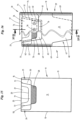
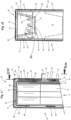
- the inner flap 39 of the lid of the outer packaging 10 is designed and arranged in a special way, namely such that when the lid is closed, the inner flap 39 of the lid lies completely within the recess 49 of the collar front wall 48, i.e. in particular without mutual overlap. This ensures that the inner flap 39 of the lid lies (approximately) flush with the collar front wall 48 when the lid 30 is closed (in particular Fig. 17 ). This leads to a better closing position of the cover 30.
- the inner flap 39 of the cover When forming a collar 47 with a recess 49 which - in width - extends only over a partial area of the collar front wall 48, the inner flap 39 of the cover must be adapted to the recess 49 at least in terms of size and positioning, preferably also in terms of contour.
- the inner flap 39 of the cover With the - preferably - trapezoidal contour of the recess 49 ( Fig. 16 , Fig. 18 ), the inner flap 39 of the cover is preferably also trapezoidal ( Fig. 19 ) with an outer edge 74 which is larger or longer than a connecting line of the inner flap 39 of the lid with the front wall 34 of the lid, i.e. with the lid edge 40 formed by folding.
- the dimension of the inner flap 39 of the lid in the longitudinal direction of the blank is preferably selected such that the (folded) inner flap 39 of the lid extends approximately over the full dimension (height) of the front wall 34 of the lid.
- Oblique or converging side edges 75 of the inner flap 39 of the lid are arranged parallel to the web edges 73 and at a distance from them.
- a window 76 is formed in the area of the closing edge 63, preferably in the middle. This consists of a recess or a cutout on the free edge of the box front wall 31 ( Fig. 19 ).
- the window 76 is an interruption in the closing edge 63, i.e. an interruption in the contact of the lid edge 40 with the closing edge 63 of the box part 29.
- the inner pack 11 or the inner front wall 13 is visible.
- the recess 49 in the collar front wall 48 is dimensioned and/or designed such that the window 76 lies completely within the area of the recess 49.
- the dimension of the window 76 along the closing edge 63 is selected such that the lid edge 40, i.e.
- the folding edge of the inner lid tab 39 with the lid front wall 34 largely corresponds to the dimension of the window 76 in the transverse direction of the pack.
- the lid edge 40 designed as a folding edge results in a slight offset 77 which remains inconspicuous due to the window 76.
- the actuating tab 28 is connected by adhesive - glue dots 78 - to the inside of the lid front wall 34, in particular to the lid inner tab 39.
- Outer packaging 46 Counter-advantage 11
- Inner packing 47 collar 12
- Cigarette group 48 Collar front wall 13
- Interior front wall 49 Recess 14
- Interior rear wall 50 Retaining strips 15
- Interior side wall 51 16
- Interior bulkhead 52 Connector 17
- Side seam 53 Glue strips 18
- Cross seam 53
- Glue strips 19 Envelope folding 55 Remaining connection 20 Perforation line 56 Punching line 21 Opening tab 57 web 22
- Removal opening 58 Line of weakness 23
- Front leg 60
- Glue strips 25 Forehead section 61
- Anchoring leg 62 Collar side flaps 27
- Edge strips 63
- Closing edge 28 Actuating tab 64 flap edge 29 Box part 65
- Collar edge 30 13
Landscapes
- Engineering & Computer Science (AREA)
- Mechanical Engineering (AREA)
- Packaging Of Annular Or Rod-Shaped Articles, Wearing Apparel, Cassettes, Or The Like (AREA)
- Cartons (AREA)
Description
- Die Erfindung betrifft Packungen, insbesondere für Zigarettengruppen, mit den Merkmalen des Anspruchs 1.
- Zigarettenpackungen mit einer Innenumhüllung aus insbesondere feuchtigkeits- und aromadichter Folie sind in unterschiedlicher Ausführung bekannt, wobei Zigarettengruppe und Innenumhüllung einen (Dicht-)Block bilden.
- Der Zigarettenblock bzw. Dichtblock kann mit einer besonderen mehrfach benutzbaren Öffnungshilfe versehen sein, insbesondere in der Ausführung mit einem klebenden Verschlussetikett für eine Öffnung, die nach Entnahme von Packungsinhalt durch den Verbraucher wieder in die Schließstellung gebracht werden kann.
- Das Verschlussetikett kann von Hand betätigt werden, insbesondere mittels Grifflasche, wie beispielsweise in
DE 10 2011 119 344 A1 . Darin ist eine Zigarettenpackung mit Klappdeckel beschrieben, bei der eine Innenumhüllung mit einer mehrfach verschließbaren Entnahmeöffnung versehen ist. Dazu ist eine Öffnungslasche von einem Verschlussetikett abgedeckt, das die Öffnungslasche allseitig umgibt und mit einem freien Verbindungsrand an einem die Entnahmeöffnung umgebenden Bereich der Innenumhüllung fixierbar ist. Das Verschlussetikett wird zum Öffnen und Schließen manuell an einer klebstofffreien Grifflasche erfasst. Bekannt sind Zigarettenpackungen, bei denen das Verschlussetikett der Innenpackung mit einem Endstück dauerhaft an der Innenseite des Deckels einer Klappdeckelpackung als Außenpackung befestigt ist, sodass beim Betätigen des Deckels das Verschlussetikett in Öffnungs- oder Schließstellung bewegt wird (EP 2 155 568 B1 ). - Die Erfindung befasst sich mit Verbesserungen an Packungen der vorstehenden oder ähnlicher Ausführung. Einerseits geht es um Maßnahmen für die zuverlässige Herstellung einer klebenden Verbindung des Verschlussetiketts mit dem Deckel der Außenpackung. Andererseits geht es um die Gestaltung der Packung zur Erleichterung einer präzisen, zuverlässigen Anbringung des Verschlussmittels bzw. Verschlussetiketts an der blockförmigen Innenpackung, sowie um ein optimales Erscheinungsbild der Packung.
- Zur Lösung der vorstehenden Aufgabe ist die erfindungsgemäße Packung mit den Merkmalen des Anspruchs 1 ausgebildet.
- Bei den Zigarettenpackungen des Typs Klappschachtel im allgemeinen und insbesondere mit einem mehrfach verschließbaren Dichtblock als Innenpackung ist ein bei diesem Packungstyp üblicher Deckel-Innenlappen hinsichtlich der Position, der Form und der Größe so auf einen aus einem gesonderten Zuschnitt bestehenden Kragen der Klappschachtel ausgerichtet, dass bei geschlossenem Deckel der Deckel-Innenlappen vollständig innerhalb der im Bereich der Kragen-Vorderwand gebildeten Ausnehmung angeordnet ist. Bei geschlossenem Deckel liegen die Kragen-Vorderwand und der besonders ausgebildete Deckel-Innenlappen (etwa) in einer gemeinsamen Ebene. Die Ausnehmung der Kragen-Vorderwand ist so ausgebildet, dass bei geschlossenem Deckel im Bereich einer Schachtel-Vorderwand des Schachtelteils - unterhalb einer von der Deckel-Vorderwand gebildeten Schließkante - eine Öffnung bzw. ein Fenster gebildet ist, vorzugsweise etwa in der Breite bzw. Länge der Abmessung des Deckel-Innenlappes.
- Weitere Einzelheiten und Merkmale der Innovation ergeben sich aus der Beschreibung der in den Patentzeichnungen dargestellten Ausführungsbeispiele. Die
Fig. 1-14 sind nicht erfindungsgemäß. Es zeigt: - Fig. 1
- eine Innenpackung bzw. einen Dichtblock mit Verschlussetikett in perspektivischer Darstellung,
- Fig. 2
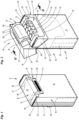
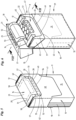
- eine komplette (Zigaretten-)Packung in der Ausführung als Klappschachtel mit geöffnetem Deckel, ebenfalls in perspektivischer Darstellung,
- Fig. 3
- einen Vertikalschnitt eines oberen Bereichs der Packung gemäß
Fig. 2 , bei vergrößertem Maßstab, - Fig. 4
- eine Darstellung analog
Fig. 3 bei geschlossenem Deckel der Außenpackung, - Fig. 5
- eine andere Ausführung einer Innen- bzw. Dichtpackung in perspektivischer Darstellung,
- Fig. 6
- eine (Zigaretten-)Packung analog zu
Fig. 2 mit einem Dichtblock derFig. 5 , - Fig. 7
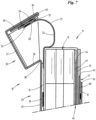
- einen vertikalen Teilschnitt VII-VII der
Fig. 6 in vergrößertem Maßstab, - Fig. 8
- eine dritte Ausführung einer Innen- bzw. Dichtpackung in perspektivischer Darstellung,
- Fig. 9
- eine Zigarettenpackung in einer Darstellung analog
Fig. 2 ,Fig. 6 mit einer Innenpackung gemäßFig. 8 , - Fig. 10
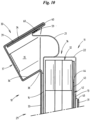
- einen vertikalen Teilschnitt X-X der
Fig. 9 in vergrößertem Maßstab, - Fig. 11
- eine weitere Ausführung einer Packung mit offenem Deckel in perspektivischer Darstellung,
- Fig. 12
- eine Darstellung einer Packung analog
Fig. 11 für eine Ausführung mit Schrägkanten (Oktagonal-Packung), - Fig. 13
- eine Darstellung entsprechend
Fig. 12 für eine Außenpackung mit Rundkanten, - Fig. 14
- einen ausgebreiteten Zuschnitt für einen Kragen der Außenpackung,
- Fig. 15
- eine Innenpackung, insbesondere ein Dichtblock in Vorderansicht,
- Fig. 16
- eine (Zigaretten-)Packung in der Ausführung mit Klappschachtel und Teilansicht auf Innenpackung mit Kragen,
- Fig. 17
- einen Vertikalschnitt durch einen oberen Teilbereich der Packung gemäß
Fig. 16 , Schnittebene XVII-XVII, in vergrößertem Maßstab, - Fig. 18
- die Packung gemäß
Fig. 17 in frontseitiger Ansicht mit Vertikalschnitt im Deckelbereich entsprechend Sicht- und Schnittebene XVIII-XVIII, - Fig. 19
- einen Teilbereich eines ausgebreiteten Zuschnitts für eine (Außen-)Packung gemäß
Fig. 16 bis Fig. 18 , - Fig. 20
- einen Ausschnitt XX in
Fig. 18 bei vergrößertem Maßstab. - Die dargestellten Zigarettenpackungen betreffen ein besonderes Zusammenspiel zwischen einer Außenpackung 10, insbesondere in der Ausführung einer Klappschachtel bzw. Hinge Lid Packung und einer Innenpackung 11. Diese besteht aus einem Folienzuschnitt, insbesondere in der Ausführung als (thermisch siegelbarer) mehrlagigen Dichtfolie. Die Innenpackung 11 bzw. der Folienzuschnitt umgibt eine Zigarettengruppe 12 unter Bildung von Innen-Vorderwand 13, Innen-Rückwand 14, Innen-Seitenwänden 15 und Innen-Stirnwand 16. Eine ebenfalls vorhandene Innen-Bodenwand ist nicht gezeigt.
- Die die Zigarettengruppe 12 allseitig umgebende Innenpackung 11 weist durch thermisches Siegeln hergestellte Verbindungs- bzw. Verschlussnähte auf. Bei dem Ausführungsbeispiel gemäß
Fig. 1 bzw. gemäßFig. 5 sind Seitennähte 17 im Bereich der Innen-Seitenwände 15 gebildet, und zwar in der Ausführung als Flossennaht. Weiterhin ist eine Quernaht 18 im Bereich der Innen-Rückwand 14 gebildet, ebenfalls in der Ausführung als Flossennaht. Die Quernaht 18 erstreckt sich etwa in halber Höhe der Innen-Rückwand 14. Bei der Packung gemäßFig. 8 bis Fig. 10 ist die Innenpackung 11 mit einer bei Stanniol- bzw. Weichpackungen bekannten und üblichen Faltung im Bereich der Innen-Seitenwände 15 versehen, nämlich mit einer Kuvertfaltung 19 unter Bildung trapezförmiger Faltlappen. Diese sind ebenfalls durch thermisches Siegeln (oder durch Klebung) miteinander verbunden. Eine entsprechende Faltung befindet sich im Bereich der Innen-Bodenwand (nicht gezeigt). - Die Innenpackung 11 ist mit einer grundsätzlich bekannten Öffnungshilfe versehen. Eine Schwächungslinie, insbesondere eine Perforationslinie 20, bildet bzw. begrenzt eine Öffnungslasche 21, die sich quer über die Innen-Stirnwand 16 und in einem oberen Bereich der Innen-Vorderwand 13 erstreckt. Die Öffnungslasche 21 gibt in Öffnungsstellung eine Entnahmeöffnung 22 der Innenpackung 11 für die Entnahme von Zigaretten frei.
- Das Handhabungsmittel für die mehrfach benutzbare Öffnungshilfe besteht aus einem Verschlussetikett 23. Dieses ist als Folienzuschnitt mit vorzugsweise vollflächiger Verklebung in einem oberen, stirnseitigen Bereich der Innenpackung 11 angeordnet, vorliegend mit einem Frontschenkel 24 im Bereich der Innen-Vorderwand 13, einem Stirnabschnitt 25 im Bereich der Innen-Stirnwand 16 und einem Verankerungsschenkel 26 an der Innen-Rückwand 14. Das Verschlussetikett 23 überdeckt die Öffnungslasche 21 und ist vorzugsweise vollflächig mit dieser verklebt. Ein Randstreifen 27 des Verschlussetiketts 23 ist mit Bereichen der Innenpackung 11 neben dem Verschlussetikett 23 (lösbar) verklebt. Zum Öffnen der Innenpackung 11 wird das Verschlussetikett 23 an einem Endbereich des Frontschenkels 24 - Betätigungslasche 28 - erfasst und unter Mitnahme des Verschlussetiketts 23 in die Öffnungsstellung bewegt (
Fig. 2 ,Fig. 6 ). - Die Betätigung des Verschlussetiketts 23 ist gemäß
Fig. 1 bis Fig. 10 mit dem Öffnungs- und Schließvorgang der Außenpackung 10 gekoppelt. Diese besteht in der Ausführung als Klappschachtel aus einem Schachtelteil 29 und einem Deckel 30. Der Schachtelteil 29 weist eine Schachtel-Vorderwand 31, Schachtel-Seitenwände 32 und eine Schachtel-Rückwand 33 auf. In analoger Weise ist der Deckel 30 ausgebildet mit Deckel-Vorderwand 34, Deckel-Seitenwänden 35 und Deckel-Rückwand 36. Der obere Abschluss ist eine Deckel-Stirnwand 37. Die Deckel-Rückwand 36 ist mit der Schachtel-Rückwand 33 über ein quergerichtetes Liniengelenk 38 schwenkbar verbunden. Die Deckel-Vorderwand 34 ist bei den gezeigten Beispielen doppelwandig ausgebildet, nämlich mit einem Deckel-Innenlappen 39 versehen, der unter Bildung einer Deckelkante 40 gegen die Innenseite der Deckel-Vorderwand 34 gefaltet und mit dieser (durch Klebung) verbunden ist. - Das Verschlussetikett 23 ist mit dem Deckel 30 derart verbunden, dass beim Öffnen desselben das Verschlussetikett 23 - unter Mitnahme der Öffnungslasche 21 - ebenfalls in die Öffnungsstellung gezogen wird. Zu diesem Zweck ist das Verschlussetikett 23 mit der Innenseite der Deckel-Vorderwand 34 (dauerhaft und mit ausreichender Haltbarkeit) verbunden, insbesondere mit der Innenseite des Deckel-Innenlappens 39. Die Betätigungslasche 28 ist vorzugsweise mit punkt- bzw. streifenförmigen Leimfeldern versehen, die eine haltbare Verbindung zwischen Verschlussetikett 23 und Deckel 30 bewirken.
- Es sind Maßnahmen vorgesehen, die insbesondere bei der Herstellung der Packung bzw. bei der Positionierung der Deckel-Vorderwand 34 in der packungsgemäßen Schließstellung einen örtlichen Anpressdruck erzeugen zur Herstellung der (Leim-Verbindung zwischen Verschlussetikett 23 bzw. Betätigungslasche 28 und Deckel-Vorderwand 34, vorzugsweise mit dem Deckel-Innenlappen 39.
- Bei dem Ausführungsbeispiel gemäß
Fig. 1 bis Fig. 5 sind zusammenwirkende Packungsteile mit Vorsprüngen, Verdickungen, Erhöhungen oder dergleichen versehen, die örtlich einen erhöhten Druck bei geschlossenem Deckel 30 erzeugen, um die (Klebe-)Verbindung zu bewirken. Bei dem Ausführungsbeispiel ist die Innenpackung 11 mit einem Innenkragen 42 versehen. Dieser besteht vorzugsweise aus (dünnem) Karton und ist beispielsweise trayartig ausgebildet mit einer Tray-Vorderwand 43, Seitenlappen bzw. Seitenwänden, Bodenwand und ggf. Rückwand. Der Einfachheit halber ist in den Zeichnungen nur die Tray-Vorderwand 43 - innerhalb der Dichtpackung 11 - gezeigt. Die Vorderwand 43 erstreckt sich vorzugsweise über die volle Höhe der Innenpackung 11. Des Weiteren ist in einem oberen Bereich eine Ausnehmung 44 gebildet entsprechend der üblichen Ausnehmung eines standardmäßigen Kragens einer Klappschachtel. - Eine erste, nach außen gerichtete Erhöhung bzw. ein lokaler Vorsprung 45 ist am Innenkragen 42 angebracht, und zwar im Bereich der Tray-Vorderwand 43. Der als wulstartige Prägung ausgebildete Vorsprung 45 befindet sich in einem oberen Bereich der Vorderwand 43, unmittelbar unterhalb der Ausnehmung 44, und zwar in Höhe der Verbindung der Betätigungslasche 28 mit dem Deckel 30 bzw. mit dem Deckel-Innenlappen 39. Die Betätigungslasche 28 ist bei diesem Ausführungsbeispiel umgefaltet, so dass eine Innenseite des Verschlussetiketts 23 nach außen gerichtet ist. Das Leimfeld 41 befindet sich demnach aufgrund der Faltung der Betätigungslasche 28 an der Außenseite und wird beim Schließen des Deckels 30 bzw. beim Falten der Deckel-Vorderwand 34 an den Deckelinnenlappen 39 gedrückt.
- Die Außenpackung 10 ist vorzugsweise mit einem Gegendruckteil versehen. Die Deckel-Vorderwand 34 weist an der Innenseite einen Gegenvorsprung 46 auf. Dieser befindet sich vorzugsweise in Höhe des Vorsprungs 45 und erhöht den auf die Verbindungsstelle des Verschlussetiketts 23 wirkenden (beidseitigen) Anpressdruck. Die Betätigungslasche 28 wird mittels Leimfeld 41 im Bereich des Gegenvorsprungs 46 mit der Deckel-Vorderwand 34 verbunden. Eine weitere Besonderheit besteht darin, dass der vorzugsweise durch Prägen hergestellte Gegenvorsprung 46 im Bereich des Deckelinnenlappens 39 gebildet ist, so dass eine nach innen versetzte Verbindungsstelle für die Betätigungslasche 28 mit der Deckelvorderwand 34 geschaffen ist.
- Die Außenpackung 10 ist als (standardmäßige) Klappschachtel ausgebildet, und zwar mit einem üblichen Kragen 47 mit einer Kragen-Vorderwand 48 und Kragen-Seitenlappen 62. Die Kragen-Vorderwand 48 weist eine bei diesem Packungstyp übliche stirnseitige Ausnehmung 49 auf, die den Zugang zum Packungsinhalt erleichtert. Die Befestigung der Betätigungslasche 28 liegt vorzugsweise im Bereich dieser Ausnehmung 49, ebenso die Vorsprünge 45, 46.
- Das Verschlussetikett 23 ist vorzugsweise so ausgebildet, dass seitlich streifenförmige Erweiterungen gebildet sind, nämlich Haltestreifen 50. Diese erstrecken sich im Bereich der Innen-Stirnwand 16, vorzugsweise derart, dass die gesamte Fläche der Innen-Stirnwand 16 durch das Verschlussetikett 23 abgedeckt ist. Kurze Schenkel verlaufen in die Innen-Vorderwand 13 und - nicht dargestellt - bis in die Innen-Rückwand 14. Die Haltestreifen 50 sind durch Schwächungslinien bzw. Perforationslinien 51 von einem mittleren Hauptteil des Verschlussetiketts 23 abgegrenzt und werden beim erstmaligen Öffnen von diesem abgetrennt, bleiben also in dauerhafter, klebender Verbindung mit der Innenpackung 11 (
Fig. 2 ). - Die Packung gemäß
Fig. 5 bis Fig. 7 ist hinsichtlich der Außenpackung 10 und der Innenpackung 11 in weitgehender Übereinstimmung mit dem voranstehend beschriebenen Ausführungsbeispiel ausgebildet. Hinsichtlich der Verbindung des Verschlussetiketts 23 bzw. der Betätigungslasche 28 mit dem Deckel 30 der Außenpackung 10 wird der Kragen 47 der Außenpackung 10 herangezogen. Im Bereich der vorzugsweise konventionell gestalteten Ausnehmung 49 der Kragen-Vorderwand 48 befindet sich ein Verbindungsstück 52 zum Fixieren der Betätigungslasche 48 (an der Innenseite) und zur Verbindung derselben mit dem Deckel 30 bzw. der Innenseite der Deckel-Vorderwand 34. - Das Verbindungsstück 52 kann als gesondertes Teilstück mittels Leimfeld 41 bzw. Leimstreifen 53 mit dem Verschlussetikett 23, insbesondere mit der Betätigungslasche 28, verbunden sein. Diese ist bei dem vorliegenden Beispiel nicht gefaltet, sondern liegt mit der (im Übrigen leimfreien) Außenseite an dem Verbindungsstück 52 an bzw. ist mit diesem verbunden. Das Verbindungsstück 52 ist vorzugsweise bei der Herstellung der Packung, insbesondere bei der abschließenden Faltung der Deckel-Vorderwand 32, mit dieser ebenfalls über Leim, vorliegend über zwei Leimstreifen 54, verbunden. Auch hier erfolgt die Verbindung mit der Innenseite des Deckel-Innenlappens 39. Das Verbindungsstück 52 wirkt dabei als Distanzausgleich zwischen Deckel 30 bzw. Deckelinnenlappen 39 einerseits und Betätigungslasche 28 des Verschlussetiketts 23 andererseits.
- Das Verbindungsstück 52 ist vorzugsweise (ursprünglich) mit dem Zuschnitt des Kragens 47 verbunden, und zwar mit der Kragen-Vorderwand 48 im Bereich der Ausnehmung 49.
- Das Verbindungsstück 52 ist als Streifen ausgebildet, der an die Kontur der Ausnehmung 49 angepasst ist. Die Verbindung mit dem Kragen 47 ist so ausgebildet, dass eine leichte Abtrennung möglich ist, nämlich beim erstmaligen Öffnen des Deckels 30. Das Verbindungsstück 52 ist über durch Stanzungen begrenzte Restverbindungen 55 mit dem Kragen 47 verbunden. Vorliegend ist eine durchgehende Stanzlinie 56 im Bereich einer quer gerichteten Kante der Ausnehmung 49 entsprechend der Kontur derselben angeordnet. Lediglich im Bereich aufrechter Schenkel, nämlich im Bereich von Stegen 57 des Kragens 47, befinden sich die Restverbindungen 55, die die Einheit des Verbindungsstücks 52 mit dem Kragen 47 bis zur Fertigstellung der Packung gewährleisten, andererseits aber beim Öffnen des Deckels 30 die in üblicher Weise ausgebildete Ausnehmung 49 freigeben. Das Verbindungsstück 52 bleibt dauerhaft in Verbindung mit der Innenseite der Deckel-Vorderwand 34 (
Fig. 7 ). - Eine besondere (Zigaretten-)Packung mit selbsttätiger Öffnung einer (dichten) Innenpackung 11 ist in
Fig. 8 bis Fig. 10 gezeigt. Die Außenpackung 10 ist eine vereinfachte Version einer Klappschachtel bzw. Hinge Lid Packung, und zwar fehlt der sonst übliche Kragen. Die Innenpackung 11 ist vorzugsweise mit einem Innenkragen 42 versehen. - Die Innenpackung 11 weist eine Öffnungslasche 21 auf, die durch eine Schwächungslinie 58 begrenzt ist. Diese ist vorzugsweise so ausgebildet, dass bei einer mehrlagigen Folie der Innenpackung 11 nur einzelne Lagen mit Stanzlinien bzw. Perforationen versehen sind, jedoch mindestens eine Lage bzw. Schicht der Folie unversehrt bleibt, so dass die Innenpackung 11 im Ursprungszustand auch im Bereich der Öffnungslasche 21 dicht ist.
- Zum Öffnen der Innenpackung 11 wird die Öffnungslasche 21 unmittelbar erfasst und in die Öffnungsstellung gezogen. Die Öffnungslasche 21 ist vorzugsweise so ausgebildet, nämlich konturiert, dass ein unteres Ende im Bereich der Innen-Vorderwand 13 leicht erfasst werden kann. Der Endbereich der Öffnungslasche 21 ist hier als Zunge 59 geformt. Die Abmessungen der Öffnungslasche 21 sind zweckmäßigerweise so gewählt, dass die Zunge 59 bzw. ein unterer Teil derselben im Bereich der Tray-Vorderwand 43 des Innenkragens 42 liegt, und zwar unterhalb der Ausnehmung 44 der Vorderwand 43.
- Die Öffnungslasche 21 der Innenpackung 11 ist mit dem Deckel 30 verbunden, nämlich mit der Deckel-Vorderwand 34. Diese ist vorzugsweise konventionell mit einem Deckelinnenlappen 39 versehen. An diesem ist die Öffnungslasche 21 befestigt, vorliegend mit einem Leimstreifen 60. Dieser ist an der Außenseite der Innenpackung 11 im Bereich der Öffnungslasche 21 angebracht, und zwar im Bereich der Zunge 59, vorzugsweise unterhalb einer quer gerichteten Kante der Ausnehmung 44 des Innen-Trays 42.
- Bei der Fertigung der Packung 10, nämlich beim Positionieren des Deckels 30 mit der Deckel-Vorderwand 34 in der Schließstellung, befindet sich der Deckelinnenlappen 39 in unmittelbarer Nachbarschaft der Innenpackung 11, nämlich der Zunge 59 der Öffnungslasche 21. Durch den Anlagedruck beim Faltvorgang wird die Verbindung mit dem an der Außenseite aufgebrachten Leimstreifen 60 hergestellt. Beim (erstmaligen) Öffnen des Deckels 30 wird die Öffnungslasche 21 aus der Verbindung mit dem Zuschnitt der Innenpackung 11 herausgetrennt. Die Innenpackung 11 wird so geöffnet (
Fig. 9 ). Die Entnahme der Zigaretten ist aufgrund der Entnahmeöffnung 22 und der Ausnehmung 44 des Innenkragens 42 erleichtert. - Bei dieser Ausführung fehlt eine Abdeckung der Innen-Seitenwände 15 der Innenpackung 11 im Bereich oberhalb bzw. außerhalb des Schachtelteils 29. Vorteilhafterweise sind deshalb im Bereich dieser Innen-Seitenwände 15 Kuvertfaltungen 19 der Innenpackung 11 gebildet, die bei geöffnetem Deckel das Bild einer üblichen Innenumhüllung aus beispielsweise Stanniol vermitteln. Die Faltlappen der Kuvertfaltung 19 sind vorzugsweise durch thermisches Siegeln miteinander verbunden.
- Weiterhin besteht eine Besonderheit darin, dass die Außenpackung 10 dieser Packungsausführung mit abgeschrägten aufrechten Packungskanten, also Schrägkanten 61 versehen ist, und zwar durchgehend im Bereich von Schachtelteil 29 und Deckel 30. Die Packung ist somit als Achteck- bzw. Oktagonalpackung ausgebildet. Auch der Innenkragen 42 ist an diese Kontur der Außenpackung 10 angepasst.
- Eine Besonderheit der Packungen gemäß
Fig. 11 bis Fig. 13 besteht darin, dass Maßnahmen für eine erleichterte, präzise Anbringung des Verschlussetiketts 23 und für eine erleichterte Handhabung durch den Verbraucher verwirklicht sind sind. Das Verschlussetikett 23 kann in beliebiger Weise ausgebildet sein, auch als streifenförmiger Zuschnitt. Bei den gezeigten Packungsbeispielen sind besonders gestaltete Verschlussetiketten 23 eingesetzt. - Eine besondere Ausbildung bezieht sich auf die Gestaltung des Kragens 47 der als Klappschachtel ausgebildeten Außenpackung 10. Die von der Kragen-Vorderwand 48 und den Kragen-Seitenlappen 42 begrenzte Ausnehmung 49 ist vergrößert bzw. erweitert, insbesondere derart, dass sie sich (etwa) über die volle Breite der Packungsvorderseite, also über die volle Breite der Kragen-Vorderwand 48 erstreckt. Dadurch liegt der obere, stirnseitige Bereich der Innenpackung 11 frei, insbesondere bis zu einer oberen Begrenzungskante bzw. quergerichteten Schließkante 63 des Schachtelteils 29, nämlich der Schachtel-Vorderwand 31. Es steht dadurch ein großflächiger Bereich für die Anbringung, aber auch für die Handhabung des Verschlussetiketts 23 zur Verfügung.
- Bei dem Ausführungsbeispiel der
Fig. 11 wird durch entsprechende Ausnehmung 49 der Kragen-Vorderwand 48 die volle freie Fläche der Innenpackung 11 bzw. der Innen-Vorderwand 13 oberhalb der Schachtel-Vorderwand 31 freigehalten. Bei geöffnetem Deckel 30 sind lediglich die Kragen-Seitenlappen 62 im Bereich der Deckel-Seitenwände 35 sichtbar. Diese sind in besonderer Weise ausgebildet, nämlich einer schräg liegenden, gegenüber der quaderförmigen Innenpackung 11 leicht zurückgesetzten Lappenkante 64. Die Kragen-Seitenlappen 62 sind demnach im oberen Bereich mit einem konvergierenden Querprofil ausgebildet und mit einer Rundung im Übergang zur horizontalen Oberkante. Die Stabilität der Packung auch hinsichtlich der Schließstellung des Deckels 30 wird vorzugsweise ein entsprechend ausgebildetes Stützorgan innerhalb der Innenpackung gewährleistet, insbesondere durch einen Innenkragen. - Der Kragen 47 ist bei diesem Ausführungsbeispiel mit einer unteren Begrenzung der Ausnehmung 49 versehen, die als quergerichtete, vorzugsweise gradlinige Kragenkante 65 in Höhe der Schließkante 63 oder - wie gezeigt - unterhalb derselben verläuft. Die Kragen-Vorderwand 48 erstreckt sich nahezu bis in den Bereich einer Bodenwand der Außenpackung, passend zu Größe und Kontur der Ausnehmung 49. Die Außenpackung ist vorliegend exakt quaderförmig ausgebildet, also im Querschnitt rechtwinkligen aufrechten Packungskanten 66.
-
Fig. 12 betrifft ein Ausführungsbeispiel, dass vorteilhafterweise bei einer Klappschachtel als Außenpackung 10 mit Schrägkanten 61 - analog zuFig. 9 - ausgebildet ist. Der Kragen 47 ist an diese Packungskontur angepasst, wobei die Kragen-Seitenlappen 62 im Bereich der frontseitigen Schrägkanten 61 Schrägschenkel 67 aufweisen, die gegenüber den Kragen-Seitenlappen 62 unter einem stumpfen Winkel gerichtet sind, entsprechend der Form der Schrägkanten 61. Die Ausnehmung 49 ist demnach bei dieser Ausführung durch die Schrägschenkel 67 begrenzt bzw. durch deren Lappenkante 64, die vorzugsweise schräg gerichtet ist, mit zur Deckel-Stirnwand 37 konvergierender Breite. Vorzugsweise ist bei dieser Packungsform auch ein rückseitiger Lappenschenkel 68 im Bereich rückseitiger Schrägkanten 61 an den Kragen-Seitenlappen 62 angeordnet. - Die Kragenkante 65 liegt auch bei diesem Ausführungsbeispiel vorzugsweise unterhalb der Schließkante 63. Beide Kanten 63 und 65 sind - vorzugsweise parallel verlaufend - poligonartig ausgebildet mit jeweils unter einem stumpfen Winkel zueinander gerichteten Katenabschnitten, zu den Seitenwänden 32 aufwärts gerichtet.
-
Fig. 13 zeigt eine zuFig. 12 analog ausgebildete Packung, bei der die aufrechten Packungskanten als Rundkanten 69 ausgebildet sind, und zwar unter Abstimmung auf die Abmessung von Zigaretten. Die Rundkanten 69 erstrecken sich auch im Bereich des Deckels 30, vorzugsweise frontseitig und rückseitig. - Der Kragen 47 ist an diese Packungsgestaltung angepasst. Die Ausnehmung 49 ist seitlich durch Rundschenkel 70 begrenzt, die die Innenpackung 11 in diesem Bereich umfassen. Die beidseitigen Rundschenkel 70 sind durch Lappenkanten 64 begrenzt, die vorzugsweise analog zu
Fig. 12 schräg gerichtet sind unter Bildung einer zur Stirnseite divergierenden Breite der Ausnehmung 49. Eine quergerichtete Kragenkante 64 zur Begrenzung der Ausnehmung 49 erstreckt sich vorzugsweise mit geringem Abstand unterhalb der ebenfalls quer gerichteten Schließkante 63 des Schachtelteils 29. Beide Kanten 63, 65 sind vorzugsweise gradlinig und parallel zueinander angeordnet. -
Fig. 14 zeigt einen ausgebreiteten Zuschnitt für einen Kragen 47, und zwar in der linken Hälfte in der Ausführung für eine Klappschachtel mit Schrägkanten 61 und in der rechten Hälfte in der Ausführung für Klappschachteln mit Rundkanten 69. - Die bei diesen Packungen eingesetzten Verschlussetiketten 23 können in beliebiger Weise, auch als streifenförmige Zuschnitte, ausgebildet sein, vorzugsweise unter Bildung von Frontschenkel 24, Stirnabschnitt 25 und Rückseitigem Verankerungsschenkel 26.
- Eine Besonderheit sind die Verschlussetiketten 23 gemäß
Fig. 11 und Fig. 12 . Die Verschlussetiketten 23 erstrecken sich (etwa) über die volle Breite der Innenpackung 11, wobei vorzugsweise die Innenstirnwand 16 vollflächig gedeckt ist und ebenso ein oberer, zur Innen-Stirnwand 16 benachbarter Bereich der Innen-Vorderwand 13. Bei dem Beispiel gemäßFig. 5 ist der Stirnabschnitt 25 end- bzw. randseitig durch Schrägschnitte an die Kontur der Außenpackung (10) (Oktagonalpackung), angepasst. Der Frontschenkel 24 ist mit geringfügig reduzierter Breite ausgebildet unter Einhaltung eines geringfügigen Abstands von den Lappenkanten 64. Im Bereich eines hinteren Querrandes befindet sich die (klebstofffreie) Betätigungslasche (28), die hier vorzugsweise von Hand zu erfassen ist. - Die Verschlussetiketten 23 können mit voller Breite in die Öffnungs- und Schließstellung bewegt werden. Bei den vorliegend gezeigten Ausführungsbeispielen wird ein Hauptstreifen 71 des Verschlussetiketts 23 erfasst und von den seitlichen Haltestreifen 50 abgetrennt. Die Haltestreifen 50 sind bei den vorliegenden Beispielen durch die Perforationslinien 51 von den Haltestreifen 50 abtrennbar beim (erstmaligen) Öffnen des Verschlussetiketts 23. Die Perforationslinien 51 erstrecken sich vorzugsweise mindestens im Bereich der Schenkel 24 und 25 des Verschlussetiketts 23.
- Bei den besonderen Verschlussetiketten 23 gemäß
Fig. 11, Fig. 12 verlaufen die Perforationslinien 51 - ausgehend von der Betätigungslasche 28 - divergierend, so dass der Hauptstreifen 71 mindestens im Bereich der Innen-Stirnwand 16 eine größere Breite aufweist als die Betätigungslasche 28. Die Haltestreifen 50 erstrecken sich bei diesem Ausführungsbeispiel über die gesamte Länge des Verschlussetiketts. - Eine weitere Besonderheit besteht darin, dass quergerichtete Faltlinien 72 bei vorzugsweise allen Ausführungen des Verschlussetiketts 23 als Schwächungslinie des Etikettenmaterials (Folie) ausgebildet sind, wobei Perforationsschnitte in einem TeilQuerschnitt der Folie gebildet sind, jedenfalls unter Erhaltung einer innenliegenden Dichtlage der mehrlagigen Folie. Dadurch ist die Faltung erleichtert, ohne die Wichtigkeit des Verschlussetiketts 23 zu beeinträchtigen.
- Die Innenpackung 11 ist bei diesen Ausführungsbeispielen vorzugsweise in der im Zusammenhang mit
Fig. 1 bis Fig. 10 beschriebenen Weise ausgebildet, also insbesondere mit einem Innenkragen 42. Des Weiteren können die (großflächigen) Verschlussetiketten 23 in der Ausführung gemäßFig. 11, Fig. 12 auch bei den Packungen derFig. 1 bis Fig. 7 eingesetzt werden. - Weitere Besonderheiten hinsichtlich der Ausbildung von (Zigaretten-)Packungen mit einer Außenpackung 10 in der Ausführung als Klappschachtel/Hinge Lid Pack und einer Innenpackung 11 vorzugsweise als Dichtblock zeigen
Fig. 15 bis Fig. 20 . -
Fig. 15 ist die Frontansicht einer Innenpackung 11 in der Ausführung als Dichtblock. Das hinsichtlich des Frontschenkels 24 sichtbare Verschlussetikett 23 entspricht hier (etwa) der Ausführung gemäßFig. 11 und Fig. 12 . - Die Besonderheit betrifft vorrangig die Ausbildung der Außenpackung 10, vorliegend beispielhaft in der Ausführung mit Rundkanten 69. Der - aus einem gesonderten Zuschnitt bestehende - Kragen 47 ist mit einer im Prinzip üblichen Ausnehmung 49 versehen, die von seitlichen Stegen 57 im Bereich der Frontseite der Packung (Kragen-Vorderwand 48) begrenzt ist. Die Ausnehmung 49 bzw. die Stege 57 sind in diesem Bereich durch schräggerichtete Stegkanten 73 begrenzt, die eine zur Stirnseite divergierende Ausnehmung 49 begrenzen. Die Ausnehmung 49 erstreckt sich vorzugsweise bis in einen Bereich unterhalb der Schließkante 63 der Schachtel-Vorderwand 31. Die quergerichtete Kragenkante 65 ist geradlinig.
- Das Verschlussetikett 23 ist mindestens mit der Betätigungslasche 28 im Bereich der Ausnehmung 49 der Kragen-Vorderwand 48 angeordnet, kann demnach beispielsweise von Hand erfasst werden - bei geöffnetem Deckel 30. Weiterhin erstrecken sich die den Hauptstreifen 71 der Öffnungslasche 21 begrenzenden Perforationslinien 51 innerhalb der Ausnehmung 49, vorzugsweise parallel zu den Stegkanten 73. Bei Betätigen der Öffnungslasche 21 - und beim Heraustrennen des Hauptstreifens 71 - bleiben demnach die seitlichen Bereiche des Verschlussetiketts 23, also vorliegend die Haltestreifen 50, überwiegend im Bereich der Stege 57, sind von diesen verdeckt.
- Der Deckel-Innenlappen 39 der Außenpackung 10 ist in besonderer Weise ausgebildet und angeordnet, nämlich derart, dass bei geschlossenem Deckel der Deckel-Innenlappen 39 vollständig innerhalb der Ausnehmung 49 der Kragen-Vorderwand 48 liegt, also insbesondere ohne wechselseitige Überdeckung. Dadurch wird erreicht, dass der Deckel-Innenlappen 39 bei geschlossenem Deckel 30 (etwa) mit der Kragen-Vorderwand 48 bündig liegt (insbesondere
Fig. 17 ). Dies führt zu einer besseren Schließstellung des Deckels 30. - Bei Ausbildung eines Kragens 47 mit einer Ausnehmung 49, die sich - in der Breite - nur über einen Teilbereich der Kragen-Vorderwand 48 erstreckt, muss der Deckel-Innenlappen 39 mindestens hinsichtlich der Größe und Positionierung an die Ausnehmung 49 angepasst sein, vorzugsweise auch hinsichtlich der Kontur. Bei der - vorzugsweise - trapezförmigen Kontur der Ausnehmung 49 (
Fig. 16 ,Fig. 18 ) ist der Deckel-Innenlappen 39 vorzugsweise ebenfalls trapezförmig ausgebildet (Fig. 19 ) mit einer Außenkante 74 die größer bzw. länger ist als eine Verbindungslinie des Deckel-Innenlappens 39 mit der Deckel-Vorderwand 34, also mit der durch Falten gebildeten Deckelkante 40. Die Abmessung des Deckel-Innenlappens 39 in Längsrichtung des Zuschnitts ist vorzugsweise so gewählt, dass sich der (gefaltete) Deckel-Innenlappen 39 annähernd über die volle Abmessung (Höhe) der Deckel-Vorderwand 34 erstreckt. Schräg bzw. konvergierend verlaufende Seitenkanten 75 des Deckel-Innenlappens 39 sind vorliegend parallel zu den Stegkanten 73 und mit Abstand von diesen angeordnet. - Als weitere Besonderheit ist im Bereich der Schließkante 63, vorzugsweise mittig, ein Fenster 76 gebildet. Dieses besteht aus einer Vertiefung bzw. aus einem Ausschnitt am freien Rand der Schachtel-Vorderwand 31 (
Fig. 19 ). Das Fenster 76 ist eine Unterbrechung der Schließkante 63, also eine Unterbrechung der Anlage der Deckelkante 40 an der Schließkante 63 des Schachtelteils 29. Im Bereich des Fensters 76 ist die Innenpackung 11 bzw. die Innen-Vorderwand 13 sichtbar. Die Ausnehmung 49 der Kragen-Vorderwand 48 ist so bemessen und/oder gestaltet, dass das Fenster 76 vollständig innerhalb des Bereichs der Ausnehmung 49 liegt. Die Abmessung des Fensters 76 entlang der Schließkante 63 ist so gewählt, dass die Deckelkante 40, also die Faltkante des Deckel-Innenlappens 39 mit der Deckel-Vorderwand 34, weitgehend der Abmessung des Fensters 76 in Querrichtung der Packung entspricht. Durch die als Faltkante ausgebildete Deckelkante 40 ergibt sich ein geringfügiger Versatz 77, der aufgrund des Fensters 76 unauffällig bleibt. - Die Betätigungslasche 28 ist durch Klebung - Leimpunkte 78 - mit der Innenseite der Deckel-Vorderwand 34 verbunden, insbesondere mit dem Deckel-Innenlappen 39.
Bezugszeichenliste: 10 Außenpackung 46 Gegenvorsprung 11 Innenpackung 47 Kragen 12 Zigarettengruppe 48 Kragen-Vorderwand 13 Innen-Vorderwand 49 Ausnehmung 14 Innen-Rückwand 50 Haltestreifen 15 Innen-Seitenwand 51 Perforationslinie 16 Innen-Stirnwand 52 Verbindungsstück 17 Seitennaht 53 Leimstreifen 18 Quernaht 54 Leimstreifen 19 Kuvertfaltung 55 Restverbindung 20 Perforationslinie 56 Stanzlinie 21 Öffnungslasche 57 Steg 22 Entnahmeöffnung 58 Schwächungslinie 23 Verschlussetikett 59 Zunge 24 Frontschenkel 60 Leimstreifen 25 Stirnabschnitt 61 Schrägkante 26 Verankerungsschenkel 62 Kragen-Seitenlappen 27 Randstreifen 63 Schließkante 28 Betätigungslasche 64 Lappenkante 29 Schachtelteil 65 Kragenkante 30 Deckel 66 Packungskanten 31 Schachtel-Vorderwand 67 Schrägschenkel 32 Schachtel-Seitenwand 68 Lappenschenkel 33 Schachtel-Rückwand 69 Rundkante 34 Deckel-Vorderwand 70 Rundschenkel 35 Deckel-Seitenwand 71 Hauptstreifen 36 Deckel-Rückwand 72 Faltlinie 37 Deckel-Stirnwand 73 Stegkante 38 Liniengelenk 74 Außenkante 39 Deckel-Innenlappen 75 Seitenkante 40 Deckelkante 76 Fenster 41 Leimfeld 77 Versatz 42 Innenkragen 78 Leimpunkte 43 Tray-Vorderwand 44 Ausnehmung 45 Vorsprung
Claims (3)
- Packung für eine Zigarettengruppe (12), bestehend aus einer Innenpackung (11) mit einem Innen-Zuschnitt zur Umhüllung der Zigarettengruppe (12) und mit einer Außenpackung (10) in der Ausführung als Hinge Lid Pack bzw. als Klappdeckelpackung, bestehend aus Schachtelteil (29), Deckel (30) mit einem gegen die Innenseite einer Deckel-Vorderwand (34) gefalteten Deckel-Innenlappen (39) und einem aus einem gesonderten Zuschnitt gebildeten Kragen (47) mit Kragen-Vorderwand (48) und Kragen-Seitenlappen (62), wobei die Kragen-Vorderwand (48) eine zum Deckel (13) bzw. zu einer Innen-Stirnwand (16) der Innenpackung (11) hin offene Ausnehmung (49) bildet, in deren Bereich ein Verschlussetikett (23) zum Öffnen und Schließen einer Entnahmeöffnung (22) der Innenpackung (11) angeordnet ist, dadurch gekennzeichnet, dass die Ausnehmung (49) der Kragen-Vorderwand (48) und der Deckel-Innenlappen (39) hinsichtlich Größe und/oder (geometrischer) Form und/oder Positionierung bzw. Lage so aufeinander abgestimmt sind, dass der Deckel-Innenlappen (39) vollständig innerhalb der Ausnehmung (49) bei geschlossenem Deckel (30) liegt, und dass eine Betätigungslasche (28) des Verschlussetiketts (23) durch Klebung mit dem Deckel-Innenlappen (39) verbunden ist, und dass sich die Ausnehmung (49) im Bereich der Kragen-Vorderwand (48) bis in einen Bereich eines Schachtelteils (29) der Außenpackung (10), nämlich bis in den Bereich einer Schachtel-Vorderwand (31) erstreckt, wobei die Schachtel-Vorderwand (31) einen Ausschnitt bzw. eine Öffnung im Bereich einer quergerichteten Schließkante (63) aufweist zur Bildung eines Fensters (76) bei geschlossenem Deckel (30), wobei die Ausnehmung (49) der Kragen-Vorderwand (48) so angeordnet ist, dass sich das Fenster (76) vollständig im Bereich der Ausnehmung (49) befindet.
- Packung nach Anspruch 1, dadurch gekennzeichnet, dass die Ausnehmung (49) der Kragen-Vorderwand (48) zur freien Seite divergierende Begrenzungskanten, nämlich Stegkanten (73) aufweist, derart, dass im Bereich der Kragen-Vorderwand (48) die Ausnehmung (44) begrenzende Stege (57) mit vorzugsweise schräg gerichteten Stegkanten (73) gebildet sind und dass der Deckel-Innenlappen (39) vorzugsweise trapezförmig ausgebildet ist mit Seitenkanten (75), die bei gefaltetem Deckel-Innenlappen (39) etwa parallel zu den Stegkanten (73), also zu den seitlichen Begrenzungskanten der Ausnehmung (49) verlaufen.
- Packung nach Anspruch 1, dadurch gekennzeichnet, dass die Abmessung des Fensters (76) quer zur Packung, nämlich entlang der Schließkante (63) auf die Länge einer Faltkante des Deckel-Innenlappens (39) mit der Deckel-Vorderwand (34) nämlich die Deckelkante (40) abgestimmt ist, insbesondere derart, dass die Abmessung des Fensters (76) etwa der Länge der Faltkante bzw. der Deckelkante (40) entspricht.
Priority Applications (1)
| Application Number | Priority Date | Filing Date | Title |
|---|---|---|---|
| EP20173707.9A EP3708516B1 (de) | 2014-08-06 | 2015-07-13 | Zigarettenpackung |
Applications Claiming Priority (3)
| Application Number | Priority Date | Filing Date | Title |
|---|---|---|---|
| DE102014011396.5A DE102014011396A1 (de) | 2014-08-06 | 2014-08-06 | Zigarettenpackung |
| PCT/EP2015/001429 WO2016020032A1 (de) | 2014-08-06 | 2015-07-13 | Zigarettenpackung |
| EP15738590.7A EP3177547B1 (de) | 2014-08-06 | 2015-07-13 | Zigarettenpackung |
Related Parent Applications (2)
| Application Number | Title | Priority Date | Filing Date |
|---|---|---|---|
| EP15738590.7A Division EP3177547B1 (de) | 2014-08-06 | 2015-07-13 | Zigarettenpackung |
| EP15738590.7A Division-Into EP3177547B1 (de) | 2014-08-06 | 2015-07-13 | Zigarettenpackung |
Related Child Applications (2)
| Application Number | Title | Priority Date | Filing Date |
|---|---|---|---|
| EP20173707.9A Division-Into EP3708516B1 (de) | 2014-08-06 | 2015-07-13 | Zigarettenpackung |
| EP20173707.9A Division EP3708516B1 (de) | 2014-08-06 | 2015-07-13 | Zigarettenpackung |
Publications (4)
| Publication Number | Publication Date |
|---|---|
| EP3284699A2 EP3284699A2 (de) | 2018-02-21 |
| EP3284699A3 EP3284699A3 (de) | 2018-03-07 |
| EP3284699B1 EP3284699B1 (de) | 2020-06-17 |
| EP3284699B2 true EP3284699B2 (de) | 2024-05-15 |
Family
ID=53673053
Family Applications (3)
| Application Number | Title | Priority Date | Filing Date |
|---|---|---|---|
| EP20173707.9A Active EP3708516B1 (de) | 2014-08-06 | 2015-07-13 | Zigarettenpackung |
| EP15738590.7A Revoked EP3177547B1 (de) | 2014-08-06 | 2015-07-13 | Zigarettenpackung |
| EP17001656.2A Active EP3284699B2 (de) | 2014-08-06 | 2015-07-13 | Zigarettenpackung |
Family Applications Before (2)
| Application Number | Title | Priority Date | Filing Date |
|---|---|---|---|
| EP20173707.9A Active EP3708516B1 (de) | 2014-08-06 | 2015-07-13 | Zigarettenpackung |
| EP15738590.7A Revoked EP3177547B1 (de) | 2014-08-06 | 2015-07-13 | Zigarettenpackung |
Country Status (10)
| Country | Link |
|---|---|
| US (2) | US10633169B2 (de) |
| EP (3) | EP3708516B1 (de) |
| JP (2) | JP2017526586A (de) |
| CN (1) | CN106573720B (de) |
| BR (1) | BR112017002115B1 (de) |
| DE (1) | DE102014011396A1 (de) |
| PL (2) | PL3708516T3 (de) |
| RU (3) | RU2713680C1 (de) |
| TR (1) | TR201819206T4 (de) |
| WO (1) | WO2016020032A1 (de) |
Families Citing this family (40)
| Publication number | Priority date | Publication date | Assignee | Title |
|---|---|---|---|---|
| ITBO20150185A1 (it) | 2015-04-16 | 2016-10-16 | Gd Spa | Pacchetto di articoli da fumo. |
| RU2719933C2 (ru) | 2015-06-26 | 2020-04-23 | Колопласт А/С | Мочевой катетер в сборе |
| MX2018004691A (es) | 2015-10-26 | 2018-07-06 | Philip Morris Products Sa | Contenedor con empaque interno. |
| DE102016003277A1 (de) * | 2016-03-18 | 2017-09-21 | Focke & Co. (Gmbh & Co. Kg) | Zigarettenpackung sowie Verfahren und Vorrichtung zum Herstellen derselben |
| BR112018067566B1 (pt) * | 2016-03-31 | 2023-02-07 | Philip Morris Products S.A. | Recipiente relacrável incluindo guia facilmente aberta |
| DE102016003737A1 (de) * | 2016-03-31 | 2017-10-05 | Focke & Co. (Gmbh & Co. Kg) | Zigarettenpackung sowie Verfahren und Vorrichtung zum Herstellen derselben |
| EP3478598B1 (de) * | 2016-06-30 | 2021-12-15 | Philip Morris Products S.A. | Wiederverschliessbarer behälter mit verbessertem wiederverschliessbarem klebeetikett |
| WO2018019950A1 (en) * | 2016-07-27 | 2018-02-01 | Philip Morris Products S.A. | Container with radio frequency element |
| DE102016114350A1 (de) * | 2016-08-03 | 2018-02-08 | Focke & Co. (Gmbh & Co. Kg) | Packung für Zigaretten sowie Verfahren und Vorrichtung zum Herstellen derselben |
| DE102016009793A1 (de) * | 2016-08-12 | 2018-02-15 | Focke & Co. (Gmbh & Co. Kg) | Packung für Zigaretten |
| EP3519031B1 (de) | 2016-09-27 | 2021-09-22 | Coloplast A/S | Hydratisierter katheter mit hülse |
| ES2840174T3 (es) * | 2016-09-30 | 2021-07-06 | Jt Int Sa | Método y aparato para empaquetar artículos de fumar |
| WO2018060478A1 (en) * | 2016-09-30 | 2018-04-05 | Philip Morris Products S.A. | Container for consumer goods with audible indication of closing of an inner package |
| US10086987B2 (en) | 2016-10-13 | 2018-10-02 | Altria Client Services Llc | Reseal label for box in a box re-sealable pack |
| US10124953B2 (en) | 2016-10-13 | 2018-11-13 | Altria Client Services Llc | Box in a box re-sealable cigarette pack |
| DE102016012300A1 (de) * | 2016-10-17 | 2018-04-19 | Focke & Co. (Gmbh & Co. Kg) | Zigarettenpackung sowie Verfahren und Vorrichtung zum Herstellen derselben |
| TW201817661A (zh) * | 2016-11-14 | 2018-05-16 | 瑞士商菲利浦莫里斯製品股份有限公司 | 用於消費品之加強型可重複密封容器 |
| TW201817660A (zh) * | 2016-11-14 | 2018-05-16 | 瑞士商菲利浦莫里斯製品股份有限公司 | 用於消費品之加強型可重複密封容器 |
| KR102516955B1 (ko) * | 2016-11-18 | 2023-04-03 | 필립모리스 프로덕츠 에스.에이. | 개선된 재밀폐가능 커버 부재를 갖는 용기 |
| IT201700020954A1 (it) * | 2017-02-24 | 2018-08-24 | Gd Spa | Pacchetto di articoli da fumo con incarto provvisto di etichetta di chiusura |
| IT201700025745A1 (it) * | 2017-03-08 | 2018-09-08 | Gd Spa | Metodo per realizzare un pacchetto di articoli da fumo, impianto che implementa tale metodo e pacchetto ottenuto da tale metodo. |
| ES2866153T3 (es) * | 2017-03-27 | 2021-10-19 | Jt Int Sa | Envase para bienes de consumo con solapa recerrable |
| ES2744752T3 (es) * | 2017-05-18 | 2020-02-26 | Jt Int Sa | Envase para productos de consumo con solapa recerrable y método de formación de un envase para productos de consumo |
| PL3403950T3 (pl) * | 2017-05-18 | 2019-07-31 | Jt International Sa | Pojemnik na dobra konsumenckie z klapką wielokrotnego zamykania i sposób tworzenia pojemnika na dobra konsumenckie |
| US11097888B2 (en) | 2017-05-18 | 2021-08-24 | Jt International S.A. | Container for consumer goods with reclosable flap |
| CN110678401B (zh) * | 2017-05-18 | 2021-04-09 | Jt国际公司 | 用于具有可重新关闭的盖片的消费品的容器 |
| US20190002187A1 (en) * | 2017-06-30 | 2019-01-03 | Maui Kahawaiolaa | Multi-Compartment Cigarette Package |
| DE112018004965T5 (de) * | 2017-10-24 | 2020-06-25 | G. D Societa' Per Azioni | Starre Schachtel für Tabakartikel |
| IT201700120254A1 (it) * | 2017-10-24 | 2019-04-24 | Gd Spa | Pacchetto rigido di articoli da fumo. |
| GB201801343D0 (en) | 2018-01-26 | 2018-03-14 | British American Tobacco Investments Ltd | A Pack |
| GB201801342D0 (en) | 2018-01-26 | 2018-03-14 | British American Tobacco Investments Ltd | A Pack |
| GB201801347D0 (en) | 2018-01-26 | 2018-03-14 | British American Tobacco Investments Ltd | A pack |
| US20210032013A1 (en) * | 2018-02-09 | 2021-02-04 | British American Tobacco (Investments) Limited | A pack |
| DK180417B1 (en) | 2018-07-20 | 2021-04-22 | Coloplast As | INTERMITTING URINCATHER FITTING |
| US11771584B2 (en) | 2018-12-20 | 2023-10-03 | Coloplast A/S | Urine collecting bag |
| US10894411B2 (en) | 2019-02-11 | 2021-01-19 | Xerox Corporation | Cap and application devices stabilizing ink in nozzles of inkjet printheads |
| WO2020212079A1 (en) * | 2019-04-17 | 2020-10-22 | Jt International Sa | Hidden perforated strip |
| CN112224649B (zh) * | 2020-10-28 | 2024-11-22 | 惠州市精艺印刷有限公司 | 磁吸式复合包装纸盒 |
| CN113120379A (zh) * | 2021-03-24 | 2021-07-16 | 正业包装(中山)有限公司 | 一种防伪纸箱 |
| DE102021133798A1 (de) * | 2021-12-20 | 2023-06-22 | Focke & Co. (Gmbh & Co. Kg) | Packung für Produkte der Zigarettenindustrie |
Citations (5)
| Publication number | Priority date | Publication date | Assignee | Title |
|---|---|---|---|---|
| US2889100A (en) † | 1956-02-21 | 1959-06-02 | Container Corp | Carton with hinged lid |
| DE2551427A1 (de) † | 1975-11-15 | 1977-05-26 | Focke Pfuhl Verpack Automat | Packung mit klappdeckel zur aufnahme von zigaretten u.dgl. sowie verfahren zum herstellen derselben |
| JP2001171768A (ja) † | 1999-12-21 | 2001-06-26 | Japan Tobacco Inc | ヒンジリッドパック及びこのパックのためのブランク |
| WO2008142540A1 (en) † | 2007-05-22 | 2008-11-27 | G.D Societa' Per Azioni | Package of tobacco articles having an inner package with a cover flap fixed to a hinged lid |
| WO2012147073A1 (en) † | 2011-04-29 | 2012-11-01 | G.D Societa' Per Azioni | Package of tobacco articles with an inner package fitted with a sealing flap fixed to a hinged lid |
Family Cites Families (46)
| Publication number | Priority date | Publication date | Assignee | Title |
|---|---|---|---|---|
| DE1142545B (de) | 1956-02-21 | 1963-01-17 | Container Corp | Pappschachtel |
| US2992766A (en) * | 1957-11-08 | 1961-07-18 | Guyer Reynolds | Hinged top carton |
| GB1570525A (en) | 1976-03-15 | 1980-07-02 | Molins Ltd | Packets |
| US4392338A (en) * | 1976-03-15 | 1983-07-12 | Molins Limited | Packets and the manufacture thereof |
| DE2759178C2 (de) * | 1977-12-31 | 1985-01-31 | Focke & Pfuhl, 2810 Verden | Zuschnitt für quaderförmige Klappschachteln, insbesondere für Zigaretten etc. sowie Bahn od.dgl. aus Verpackungsmaterial zum Herstellen derartiger Zuschnitte |
| DE2833494C2 (de) * | 1978-07-31 | 1984-06-20 | Focke & Co, 2810 Verden | Klappschachtel, insbesondere für Zigaretten |
| DE2854443C2 (de) * | 1978-12-16 | 1985-05-30 | Focke & Co, 2810 Verden | Packung, insbesondere quaderförmige Packung für Zigaretten, Zigarillos oder dergleichen |
| DE3150561A1 (de) * | 1981-12-21 | 1983-07-07 | Maschinenfabrik Alfred Schmermund Gmbh & Co, 5820 Gevelsberg | "zuschnitt fuer eine fuer zigaretten oder zigarillos bestimmte schachtel" |
| US5314062A (en) * | 1991-01-16 | 1994-05-24 | P.T.H.M. Sampoerna | Innerframe and apparatus for producing an improved innerframe |
| DE4103612C2 (de) * | 1991-02-07 | 1994-11-10 | Focke & Co | Klappschachtel für Zigaretten oder dergleichen |
| DE4109702A1 (de) | 1991-03-23 | 1992-09-24 | Focke & Co | Klappschachtel, insbesondere fuer zigaretten |
| JPH0738127Y2 (ja) * | 1991-12-26 | 1995-08-30 | 日本たばこ産業株式会社 | ヒンジ蓋付パッケ−ジ |
| DE4310769A1 (de) * | 1993-04-02 | 1994-10-06 | Focke & Co | Klappschachtel |
| PT942880E (pt) * | 1996-11-21 | 2001-06-29 | British American Tobacco Co | Embalagem para artigos para fumar |
| UA57158C2 (uk) | 1998-07-22 | 2003-06-16 | Імперіал Тобакко Лімітед | Пачка для тютюнових виробів |
| AUPP871699A0 (en) | 1999-02-16 | 1999-03-11 | Technosearch Pty. Limited | Lid arrangement for a container |
| US6360943B1 (en) * | 1999-02-17 | 2002-03-26 | Focke & Co. (Gmbh & Co.) | Flip-top box for cigarettes |
| DE19938167A1 (de) | 1999-08-16 | 2001-02-22 | Focke & Co | Klappschachtel für Zigaretten |
| DE19938196A1 (de) * | 1999-08-17 | 2001-02-22 | Focke & Co | Klappschachtel für Zigaretten |
| JP2001301745A (ja) * | 2000-04-24 | 2001-10-31 | Toppan Printing Co Ltd | 二重包装容器の同時開封構造 |
| DE10106549A1 (de) * | 2001-02-13 | 2002-08-22 | Philip Morris Prod | Klappdeckelschachtel |
| DE10335525A1 (de) * | 2003-07-31 | 2005-05-12 | Focke & Co | Klappschachtel für Zigaretten |
| RU2407687C1 (ru) | 2007-05-01 | 2010-12-27 | Джапан Тобакко Инк. | Упаковка для стержнеобразных курительных изделий и заготовка для нее |
| DE102007030267A1 (de) * | 2007-06-28 | 2009-01-08 | Focke & Co.(Gmbh & Co. Kg) | Packung für stückige oder körnige Güter |
| DE102008013173A1 (de) * | 2008-03-07 | 2009-09-10 | Focke & Co.(Gmbh & Co. Kg) | Klappschachtel für Zigaretten |
| JP2009292571A (ja) | 2008-06-04 | 2009-12-17 | Konica Minolta Business Technologies Inc | 紙折り装置と画像形成装置の後処理装置 |
| JP5227086B2 (ja) * | 2008-06-06 | 2013-07-03 | 日本たばこ産業株式会社 | タングリッド型パッケージ |
| IT1391000B1 (it) | 2008-07-04 | 2011-10-27 | Marco Vecchi | Pacchetto e relativo fustellato |
| US8797226B2 (en) | 2008-12-02 | 2014-08-05 | Andrew Llc | Antenna heat fins |
| GB0822405D0 (en) | 2008-12-09 | 2009-01-14 | British American Tobacco Co | A package for tobacco products |
| EP2455302B1 (de) * | 2009-07-14 | 2013-09-11 | Japan Tobacco, Inc. | Zigarettenpackung |
| DE102009034705A1 (de) * | 2009-07-24 | 2011-01-27 | Focke & Co.(Gmbh & Co. Kg) | Zigarettenpackung und Verfahren zum Herstellen von Zigarettenpackungen |
| ITBO20100157A1 (it) * | 2010-03-15 | 2011-09-16 | Gd Spa | Confezione rigida con coperchio incernierato e corrispondenti metodo di incarto e macchina impacchettatrice. |
| DE102010023753A1 (de) * | 2010-06-15 | 2011-12-15 | Focke & Co. (Gmbh & Co. Kg) | Packung für Zigaretten sowie Verfahren und Vorrichtung zur Herstellung derselben |
| DE102010027175A1 (de) | 2010-07-14 | 2012-01-19 | Focke & Co. (Gmbh & Co. Kg) | Weichpackung für Zigaretten |
| DE102011008666A1 (de) | 2011-01-14 | 2012-07-19 | Focke & Co. (Gmbh & Co. Kg) | (Zigaretten-)Packung mit Verschlussetikett |
| WO2013046444A1 (ja) | 2011-09-30 | 2013-04-04 | 日本たばこ産業株式会社 | タングリッド型パッケージ |
| DE102011119344A1 (de) * | 2011-10-11 | 2013-04-11 | Focke & Co. (Gmbh & Co. Kg) | Packung für Zigaretten sowie Verfahren zum Herstellen derselben |
| JP5768142B2 (ja) | 2011-12-07 | 2015-08-26 | 日本たばこ産業株式会社 | 包装容器 |
| GB2498732A (en) | 2012-01-25 | 2013-07-31 | British American Tobacco Co | Pack for smoking articles |
| EP2814764B1 (de) | 2012-02-15 | 2019-10-09 | Philip Morris Products S.a.s. | Wiederversiegelbarer behälter mit taktilen elementen |
| TWI586596B (zh) * | 2012-02-15 | 2017-06-11 | 菲利浦莫里斯製品股份有限公司 | 容器用強化之可再密封內包裝 |
| ES2654422T3 (es) * | 2012-02-15 | 2018-02-13 | Philip Morris Products S.A. | Recipiente con etiqueta adhesiva con un área sin adhesivo |
| ITBO20120391A1 (it) * | 2012-07-20 | 2014-01-21 | Gd Spa | Metodo d'incarto e macchina impacchettatrice per realizzare un incarto sigillato contenente un gruppo di articoli da fumo |
| US20150320111A1 (en) * | 2012-11-30 | 2015-11-12 | Philip Morris Products S.A. | Container with guide element for adhesive |
| ITBO20120696A1 (it) * | 2012-12-21 | 2014-06-22 | Gd Spa | Pacchetto di sigarette. |
-
2014
- 2014-08-06 DE DE102014011396.5A patent/DE102014011396A1/de not_active Withdrawn
-
2015
- 2015-07-13 WO PCT/EP2015/001429 patent/WO2016020032A1/de not_active Ceased
- 2015-07-13 EP EP20173707.9A patent/EP3708516B1/de active Active
- 2015-07-13 BR BR112017002115-3A patent/BR112017002115B1/pt active IP Right Grant
- 2015-07-13 PL PL20173707.9T patent/PL3708516T3/pl unknown
- 2015-07-13 RU RU2019106766A patent/RU2713680C1/ru active
- 2015-07-13 PL PL15738590T patent/PL3177547T3/pl unknown
- 2015-07-13 EP EP15738590.7A patent/EP3177547B1/de not_active Revoked
- 2015-07-13 RU RU2017107093A patent/RU2687808C2/ru active
- 2015-07-13 EP EP17001656.2A patent/EP3284699B2/de active Active
- 2015-07-13 CN CN201580042169.6A patent/CN106573720B/zh active Active
- 2015-07-13 JP JP2017506302A patent/JP2017526586A/ja not_active Ceased
- 2015-07-13 TR TR2018/19206T patent/TR201819206T4/tr unknown
- 2015-07-13 US US15/328,345 patent/US10633169B2/en active Active
-
2019
- 2019-09-27 JP JP2019177097A patent/JP6923612B2/ja active Active
- 2019-12-27 RU RU2019144449A patent/RU2727789C1/ru active
-
2020
- 2020-02-17 US US16/792,457 patent/US11279542B2/en not_active Expired - Fee Related
Patent Citations (5)
| Publication number | Priority date | Publication date | Assignee | Title |
|---|---|---|---|---|
| US2889100A (en) † | 1956-02-21 | 1959-06-02 | Container Corp | Carton with hinged lid |
| DE2551427A1 (de) † | 1975-11-15 | 1977-05-26 | Focke Pfuhl Verpack Automat | Packung mit klappdeckel zur aufnahme von zigaretten u.dgl. sowie verfahren zum herstellen derselben |
| JP2001171768A (ja) † | 1999-12-21 | 2001-06-26 | Japan Tobacco Inc | ヒンジリッドパック及びこのパックのためのブランク |
| WO2008142540A1 (en) † | 2007-05-22 | 2008-11-27 | G.D Societa' Per Azioni | Package of tobacco articles having an inner package with a cover flap fixed to a hinged lid |
| WO2012147073A1 (en) † | 2011-04-29 | 2012-11-01 | G.D Societa' Per Azioni | Package of tobacco articles with an inner package fitted with a sealing flap fixed to a hinged lid |
Also Published As
| Publication number | Publication date |
|---|---|
| US20170203910A1 (en) | 2017-07-20 |
| US20200180853A1 (en) | 2020-06-11 |
| RU2727789C1 (ru) | 2020-07-23 |
| RU2017107093A (ru) | 2018-09-06 |
| EP3284699B1 (de) | 2020-06-17 |
| BR112017002115B1 (pt) | 2022-01-04 |
| EP3177547B1 (de) | 2018-09-12 |
| RU2713680C1 (ru) | 2020-02-06 |
| WO2016020032A1 (de) | 2016-02-11 |
| US10633169B2 (en) | 2020-04-28 |
| JP6923612B2 (ja) | 2021-08-25 |
| RU2687808C2 (ru) | 2019-05-16 |
| PL3708516T3 (pl) | 2023-04-11 |
| US11279542B2 (en) | 2022-03-22 |
| JP2017526586A (ja) | 2017-09-14 |
| PL3177547T3 (pl) | 2019-01-31 |
| EP3284699A2 (de) | 2018-02-21 |
| EP3708516B1 (de) | 2022-11-23 |
| DE102014011396A1 (de) | 2016-02-11 |
| RU2017107093A3 (de) | 2019-03-26 |
| CN106573720A (zh) | 2017-04-19 |
| CN106573720B (zh) | 2019-06-14 |
| BR112017002115A2 (pt) | 2017-11-21 |
| EP3284699A3 (de) | 2018-03-07 |
| JP2020023360A (ja) | 2020-02-13 |
| TR201819206T4 (tr) | 2019-01-21 |
| EP3177547A1 (de) | 2017-06-14 |
| EP3708516A1 (de) | 2020-09-16 |
Similar Documents
| Publication | Publication Date | Title |
|---|---|---|
| EP3177547B1 (de) | Zigarettenpackung | |
| EP3066032B1 (de) | Zigarettenpackung | |
| EP3393931B1 (de) | Packung für zigaretten | |
| EP3674230B1 (de) | Packung für zigaretten | |
| EP2170734B1 (de) | Kappenschachtel für tabakprodukte | |
| EP2832663B2 (de) | Zigarettenpackung | |
| DE10115935C2 (de) | Cigarettenpackung | |
| DE102011119344A1 (de) | Packung für Zigaretten sowie Verfahren zum Herstellen derselben | |
| EP3114044B1 (de) | Zigarettenpackung | |
| WO2001012528A1 (de) | Klappschachtel für zigaretten | |
| EP2170728A1 (de) | Packung für stückige oder körnige güter | |
| DE2420110A1 (de) | Zigarettenpackung | |
| DE102016012300A1 (de) | Zigarettenpackung sowie Verfahren und Vorrichtung zum Herstellen derselben | |
| DE10115936A1 (de) | Cigarettenpackung | |
| DE1043930B (de) | Packung | |
| DE2813390A1 (de) | Klappschachtel, insbesondere fuer zigaretten | |
| EP2064134B1 (de) | Klappschachtel für zigaretten sowie zuschnitt für klappschachteln | |
| DE3927561A1 (de) | Verpackung sowie zuschnitt und verfahren zur herstellung derselben | |
| DE4429095A1 (de) | Faltschachtel | |
| DE2339103B2 (de) | Schachtel mit einem Klarsichtfenster | |
| DE2407766C3 (de) | Zigarettenschachtel oder dergleichen | |
| DE2759850C2 (de) | Verpackung für Zigaretten od. dgl. | |
| DE1143385B (de) | Faltschachtel, Zuschnitt und Verfahren zum Herstellen der Faltschachtel | |
| DE3813308A1 (de) | Faltschachtel mit einer in der deckwand angeordneten entnahmeoeffnung | |
| DE1147169B (de) | Verpackung |
Legal Events
| Date | Code | Title | Description |
|---|---|---|---|
| PUAI | Public reference made under article 153(3) epc to a published international application that has entered the european phase |
Free format text: ORIGINAL CODE: 0009012 |
|
| STAA | Information on the status of an ep patent application or granted ep patent |
Free format text: STATUS: THE APPLICATION HAS BEEN PUBLISHED |
|
| PUAL | Search report despatched |
Free format text: ORIGINAL CODE: 0009013 |
|
| AC | Divisional application: reference to earlier application |
Ref document number: 3177547 Country of ref document: EP Kind code of ref document: P |
|
| AK | Designated contracting states |
Kind code of ref document: A2 Designated state(s): AL AT BE BG CH CY CZ DE DK EE ES FI FR GB GR HR HU IE IS IT LI LT LU LV MC MK MT NL NO PL PT RO RS SE SI SK SM TR |
|
| AK | Designated contracting states |
Kind code of ref document: A3 Designated state(s): AL AT BE BG CH CY CZ DE DK EE ES FI FR GB GR HR HU IE IS IT LI LT LU LV MC MK MT NL NO PL PT RO RS SE SI SK SM TR |
|
| RIC1 | Information provided on ipc code assigned before grant |
Ipc: B65D 77/02 20060101AFI20180201BHEP Ipc: B65D 85/10 20060101ALI20180201BHEP |
|
| STAA | Information on the status of an ep patent application or granted ep patent |
Free format text: STATUS: REQUEST FOR EXAMINATION WAS MADE |
|
| 17P | Request for examination filed |
Effective date: 20180621 |
|
| RBV | Designated contracting states (corrected) |
Designated state(s): AL AT BE BG CH CY CZ DE DK EE ES FI FR GB GR HR HU IE IS IT LI LT LU LV MC MK MT NL NO PL PT RO RS SE SI SK SM TR |
|
| STAA | Information on the status of an ep patent application or granted ep patent |
Free format text: STATUS: EXAMINATION IS IN PROGRESS |
|
| 17Q | First examination report despatched |
Effective date: 20190122 |
|
| REG | Reference to a national code |
Ref country code: DE Ref legal event code: R079 Ref document number: 502015012837 Country of ref document: DE Free format text: PREVIOUS MAIN CLASS: B65D0077020000 Ipc: B65D0083000000 |
|
| GRAP | Despatch of communication of intention to grant a patent |
Free format text: ORIGINAL CODE: EPIDOSNIGR1 |
|
| STAA | Information on the status of an ep patent application or granted ep patent |
Free format text: STATUS: GRANT OF PATENT IS INTENDED |
|
| RIC1 | Information provided on ipc code assigned before grant |
Ipc: B65D 83/00 20060101AFI20191205BHEP |
|
| INTG | Intention to grant announced |
Effective date: 20200107 |
|
| GRAS | Grant fee paid |
Free format text: ORIGINAL CODE: EPIDOSNIGR3 |
|
| GRAA | (expected) grant |
Free format text: ORIGINAL CODE: 0009210 |
|
| STAA | Information on the status of an ep patent application or granted ep patent |
Free format text: STATUS: THE PATENT HAS BEEN GRANTED |
|
| AC | Divisional application: reference to earlier application |
Ref document number: 3177547 Country of ref document: EP Kind code of ref document: P |
|
| AK | Designated contracting states |
Kind code of ref document: B1 Designated state(s): AL AT BE BG CH CY CZ DE DK EE ES FI FR GB GR HR HU IE IS IT LI LT LU LV MC MK MT NL NO PL PT RO RS SE SI SK SM TR |
|
| REG | Reference to a national code |
Ref country code: GB Ref legal event code: FG4D Free format text: NOT ENGLISH |
|
| REG | Reference to a national code |
Ref country code: CH Ref legal event code: EP |
|
| REG | Reference to a national code |
Ref country code: IE Ref legal event code: FG4D Free format text: LANGUAGE OF EP DOCUMENT: GERMAN |
|
| REG | Reference to a national code |
Ref country code: DE Ref legal event code: R096 Ref document number: 502015012837 Country of ref document: DE |
|
| REG | Reference to a national code |
Ref country code: AT Ref legal event code: REF Ref document number: 1281057 Country of ref document: AT Kind code of ref document: T Effective date: 20200715 |
|
| PG25 | Lapsed in a contracting state [announced via postgrant information from national office to epo] |
Ref country code: SE Free format text: LAPSE BECAUSE OF FAILURE TO SUBMIT A TRANSLATION OF THE DESCRIPTION OR TO PAY THE FEE WITHIN THE PRESCRIBED TIME-LIMIT Effective date: 20200617 Ref country code: FI Free format text: LAPSE BECAUSE OF FAILURE TO SUBMIT A TRANSLATION OF THE DESCRIPTION OR TO PAY THE FEE WITHIN THE PRESCRIBED TIME-LIMIT Effective date: 20200617 Ref country code: NO Free format text: LAPSE BECAUSE OF FAILURE TO SUBMIT A TRANSLATION OF THE DESCRIPTION OR TO PAY THE FEE WITHIN THE PRESCRIBED TIME-LIMIT Effective date: 20200917 Ref country code: GR Free format text: LAPSE BECAUSE OF FAILURE TO SUBMIT A TRANSLATION OF THE DESCRIPTION OR TO PAY THE FEE WITHIN THE PRESCRIBED TIME-LIMIT Effective date: 20200918 Ref country code: LT Free format text: LAPSE BECAUSE OF FAILURE TO SUBMIT A TRANSLATION OF THE DESCRIPTION OR TO PAY THE FEE WITHIN THE PRESCRIBED TIME-LIMIT Effective date: 20200617 |
|
| REG | Reference to a national code |
Ref country code: LT Ref legal event code: MG4D |
|
| REG | Reference to a national code |
Ref country code: NL Ref legal event code: MP Effective date: 20200617 |
|
| PG25 | Lapsed in a contracting state [announced via postgrant information from national office to epo] |
Ref country code: LV Free format text: LAPSE BECAUSE OF FAILURE TO SUBMIT A TRANSLATION OF THE DESCRIPTION OR TO PAY THE FEE WITHIN THE PRESCRIBED TIME-LIMIT Effective date: 20200617 Ref country code: RS Free format text: LAPSE BECAUSE OF FAILURE TO SUBMIT A TRANSLATION OF THE DESCRIPTION OR TO PAY THE FEE WITHIN THE PRESCRIBED TIME-LIMIT Effective date: 20200617 Ref country code: BG Free format text: LAPSE BECAUSE OF FAILURE TO SUBMIT A TRANSLATION OF THE DESCRIPTION OR TO PAY THE FEE WITHIN THE PRESCRIBED TIME-LIMIT Effective date: 20200917 Ref country code: HR Free format text: LAPSE BECAUSE OF FAILURE TO SUBMIT A TRANSLATION OF THE DESCRIPTION OR TO PAY THE FEE WITHIN THE PRESCRIBED TIME-LIMIT Effective date: 20200617 |
|
| PG25 | Lapsed in a contracting state [announced via postgrant information from national office to epo] |
Ref country code: NL Free format text: LAPSE BECAUSE OF FAILURE TO SUBMIT A TRANSLATION OF THE DESCRIPTION OR TO PAY THE FEE WITHIN THE PRESCRIBED TIME-LIMIT Effective date: 20200617 Ref country code: AL Free format text: LAPSE BECAUSE OF FAILURE TO SUBMIT A TRANSLATION OF THE DESCRIPTION OR TO PAY THE FEE WITHIN THE PRESCRIBED TIME-LIMIT Effective date: 20200617 |
|
| PG25 | Lapsed in a contracting state [announced via postgrant information from national office to epo] |
Ref country code: RO Free format text: LAPSE BECAUSE OF FAILURE TO SUBMIT A TRANSLATION OF THE DESCRIPTION OR TO PAY THE FEE WITHIN THE PRESCRIBED TIME-LIMIT Effective date: 20200617 Ref country code: CZ Free format text: LAPSE BECAUSE OF FAILURE TO SUBMIT A TRANSLATION OF THE DESCRIPTION OR TO PAY THE FEE WITHIN THE PRESCRIBED TIME-LIMIT Effective date: 20200617 Ref country code: SM Free format text: LAPSE BECAUSE OF FAILURE TO SUBMIT A TRANSLATION OF THE DESCRIPTION OR TO PAY THE FEE WITHIN THE PRESCRIBED TIME-LIMIT Effective date: 20200617 Ref country code: EE Free format text: LAPSE BECAUSE OF FAILURE TO SUBMIT A TRANSLATION OF THE DESCRIPTION OR TO PAY THE FEE WITHIN THE PRESCRIBED TIME-LIMIT Effective date: 20200617 Ref country code: PT Free format text: LAPSE BECAUSE OF FAILURE TO SUBMIT A TRANSLATION OF THE DESCRIPTION OR TO PAY THE FEE WITHIN THE PRESCRIBED TIME-LIMIT Effective date: 20201019 Ref country code: ES Free format text: LAPSE BECAUSE OF FAILURE TO SUBMIT A TRANSLATION OF THE DESCRIPTION OR TO PAY THE FEE WITHIN THE PRESCRIBED TIME-LIMIT Effective date: 20200617 |
|
| PG25 | Lapsed in a contracting state [announced via postgrant information from national office to epo] |
Ref country code: SK Free format text: LAPSE BECAUSE OF FAILURE TO SUBMIT A TRANSLATION OF THE DESCRIPTION OR TO PAY THE FEE WITHIN THE PRESCRIBED TIME-LIMIT Effective date: 20200617 Ref country code: PL Free format text: LAPSE BECAUSE OF FAILURE TO SUBMIT A TRANSLATION OF THE DESCRIPTION OR TO PAY THE FEE WITHIN THE PRESCRIBED TIME-LIMIT Effective date: 20200617 Ref country code: IS Free format text: LAPSE BECAUSE OF FAILURE TO SUBMIT A TRANSLATION OF THE DESCRIPTION OR TO PAY THE FEE WITHIN THE PRESCRIBED TIME-LIMIT Effective date: 20201017 |
|
| REG | Reference to a national code |
Ref country code: CH Ref legal event code: PL |
|
| REG | Reference to a national code |
Ref country code: DE Ref legal event code: R026 Ref document number: 502015012837 Country of ref document: DE |
|
| PLBI | Opposition filed |
Free format text: ORIGINAL CODE: 0009260 |
|
| PLAX | Notice of opposition and request to file observation + time limit sent |
Free format text: ORIGINAL CODE: EPIDOSNOBS2 |
|
| PG25 | Lapsed in a contracting state [announced via postgrant information from national office to epo] |
Ref country code: MC Free format text: LAPSE BECAUSE OF FAILURE TO SUBMIT A TRANSLATION OF THE DESCRIPTION OR TO PAY THE FEE WITHIN THE PRESCRIBED TIME-LIMIT Effective date: 20200617 |
|
| 26 | Opposition filed |
Opponent name: G.D S.P.A. Effective date: 20210317 |
|
| REG | Reference to a national code |
Ref country code: BE Ref legal event code: MM Effective date: 20200731 |
|
| PG25 | Lapsed in a contracting state [announced via postgrant information from national office to epo] |
Ref country code: LU Free format text: LAPSE BECAUSE OF NON-PAYMENT OF DUE FEES Effective date: 20200713 Ref country code: LI Free format text: LAPSE BECAUSE OF NON-PAYMENT OF DUE FEES Effective date: 20200731 Ref country code: DK Free format text: LAPSE BECAUSE OF FAILURE TO SUBMIT A TRANSLATION OF THE DESCRIPTION OR TO PAY THE FEE WITHIN THE PRESCRIBED TIME-LIMIT Effective date: 20200617 Ref country code: CH Free format text: LAPSE BECAUSE OF NON-PAYMENT OF DUE FEES Effective date: 20200731 |
|
| GBPC | Gb: european patent ceased through non-payment of renewal fee |
Effective date: 20200917 |
|
| PG25 | Lapsed in a contracting state [announced via postgrant information from national office to epo] |
Ref country code: BE Free format text: LAPSE BECAUSE OF NON-PAYMENT OF DUE FEES Effective date: 20200731 Ref country code: SI Free format text: LAPSE BECAUSE OF FAILURE TO SUBMIT A TRANSLATION OF THE DESCRIPTION OR TO PAY THE FEE WITHIN THE PRESCRIBED TIME-LIMIT Effective date: 20200617 |
|
| PG25 | Lapsed in a contracting state [announced via postgrant information from national office to epo] |
Ref country code: FR Free format text: LAPSE BECAUSE OF NON-PAYMENT OF DUE FEES Effective date: 20200817 |
|
| PLBB | Reply of patent proprietor to notice(s) of opposition received |
Free format text: ORIGINAL CODE: EPIDOSNOBS3 |
|
| PG25 | Lapsed in a contracting state [announced via postgrant information from national office to epo] |
Ref country code: GB Free format text: LAPSE BECAUSE OF NON-PAYMENT OF DUE FEES Effective date: 20200917 Ref country code: IE Free format text: LAPSE BECAUSE OF NON-PAYMENT OF DUE FEES Effective date: 20200713 |
|
| REG | Reference to a national code |
Ref country code: AT Ref legal event code: MM01 Ref document number: 1281057 Country of ref document: AT Kind code of ref document: T Effective date: 20200713 |
|
| PG25 | Lapsed in a contracting state [announced via postgrant information from national office to epo] |
Ref country code: AT Free format text: LAPSE BECAUSE OF NON-PAYMENT OF DUE FEES Effective date: 20200713 |
|
| PG25 | Lapsed in a contracting state [announced via postgrant information from national office to epo] |
Ref country code: TR Free format text: LAPSE BECAUSE OF FAILURE TO SUBMIT A TRANSLATION OF THE DESCRIPTION OR TO PAY THE FEE WITHIN THE PRESCRIBED TIME-LIMIT Effective date: 20200617 Ref country code: MT Free format text: LAPSE BECAUSE OF FAILURE TO SUBMIT A TRANSLATION OF THE DESCRIPTION OR TO PAY THE FEE WITHIN THE PRESCRIBED TIME-LIMIT Effective date: 20200617 Ref country code: CY Free format text: LAPSE BECAUSE OF FAILURE TO SUBMIT A TRANSLATION OF THE DESCRIPTION OR TO PAY THE FEE WITHIN THE PRESCRIBED TIME-LIMIT Effective date: 20200617 |
|
| PG25 | Lapsed in a contracting state [announced via postgrant information from national office to epo] |
Ref country code: MK Free format text: LAPSE BECAUSE OF FAILURE TO SUBMIT A TRANSLATION OF THE DESCRIPTION OR TO PAY THE FEE WITHIN THE PRESCRIBED TIME-LIMIT Effective date: 20200617 |
|
| P01 | Opt-out of the competence of the unified patent court (upc) registered |
Effective date: 20230517 |
|
| PUAH | Patent maintained in amended form |
Free format text: ORIGINAL CODE: 0009272 |
|
| STAA | Information on the status of an ep patent application or granted ep patent |
Free format text: STATUS: PATENT MAINTAINED AS AMENDED |
|
| REG | Reference to a national code |
Ref country code: CH Ref legal event code: PK Free format text: DIE PUBLIKATION VOM 17.04.2024 WURDE AM 24.04.2024 IRRTUEMLICHERWEISE ERNEUT PUBLIZIERT. LA PUBLICATION DU 17.04.2024 A ETE REPUBLIEE PAR ERREUR LE 24.04.2024. LA PUBBLICAZIONE DEL 17.04.2024 E STATA ERRONEAMENTE RIPUBBLICATA IL 24.04.2024. |
|
| 27A | Patent maintained in amended form |
Effective date: 20240515 |
|
| AK | Designated contracting states |
Kind code of ref document: B2 Designated state(s): AL AT BE BG CH CY CZ DE DK EE ES FI FR GB GR HR HU IE IS IT LI LT LU LV MC MK MT NL NO PL PT RO RS SE SI SK SM TR |
|
| REG | Reference to a national code |
Ref country code: DE Ref legal event code: R102 Ref document number: 502015012837 Country of ref document: DE |
|
| PGFP | Annual fee paid to national office [announced via postgrant information from national office to epo] |
Ref country code: DE Payment date: 20250627 Year of fee payment: 11 |
|
| PGFP | Annual fee paid to national office [announced via postgrant information from national office to epo] |
Ref country code: IT Payment date: 20250731 Year of fee payment: 11 |