EP2631981A1 - Zyklische sulfatverbindung, nichtwässrige elektrolytlösung damit und lithiumsekundärbatterie - Google Patents
Zyklische sulfatverbindung, nichtwässrige elektrolytlösung damit und lithiumsekundärbatterie Download PDFInfo
- Publication number
- EP2631981A1 EP2631981A1 EP11834483.7A EP11834483A EP2631981A1 EP 2631981 A1 EP2631981 A1 EP 2631981A1 EP 11834483 A EP11834483 A EP 11834483A EP 2631981 A1 EP2631981 A1 EP 2631981A1
- Authority
- EP
- European Patent Office
- Prior art keywords
- formula
- group
- carbon atoms
- represented
- electrolyte solution
- Prior art date
- Legal status (The legal status is an assumption and is not a legal conclusion. Google has not performed a legal analysis and makes no representation as to the accuracy of the status listed.)
- Granted
Links
- 0 CC1C(*CC2CC2)CCC1 Chemical compound CC1C(*CC2CC2)CCC1 0.000 description 3
- KYLPYQSZXXJJRE-UHFFFAOYSA-N COCC(CO1)OS1(=O)=O Chemical compound COCC(CO1)OS1(=O)=O KYLPYQSZXXJJRE-UHFFFAOYSA-N 0.000 description 2
Images
Classifications
-
- C—CHEMISTRY; METALLURGY
- C07—ORGANIC CHEMISTRY
- C07D—HETEROCYCLIC COMPOUNDS
- C07D327/00—Heterocyclic compounds containing rings having oxygen and sulfur atoms as the only ring hetero atoms
- C07D327/10—Heterocyclic compounds containing rings having oxygen and sulfur atoms as the only ring hetero atoms two oxygen atoms and one sulfur atom, e.g. cyclic sulfates
-
- C—CHEMISTRY; METALLURGY
- C07—ORGANIC CHEMISTRY
- C07D—HETEROCYCLIC COMPOUNDS
- C07D327/00—Heterocyclic compounds containing rings having oxygen and sulfur atoms as the only ring hetero atoms
- C07D327/02—Heterocyclic compounds containing rings having oxygen and sulfur atoms as the only ring hetero atoms one oxygen atom and one sulfur atom
- C07D327/04—Five-membered rings
-
- H—ELECTRICITY
- H01—ELECTRIC ELEMENTS
- H01M—PROCESSES OR MEANS, e.g. BATTERIES, FOR THE DIRECT CONVERSION OF CHEMICAL ENERGY INTO ELECTRICAL ENERGY
- H01M10/00—Secondary cells; Manufacture thereof
- H01M10/05—Accumulators with non-aqueous electrolyte
- H01M10/052—Li-accumulators
- H01M10/0525—Rocking-chair batteries, i.e. batteries with lithium insertion or intercalation in both electrodes; Lithium-ion batteries
-
- H—ELECTRICITY
- H01—ELECTRIC ELEMENTS
- H01M—PROCESSES OR MEANS, e.g. BATTERIES, FOR THE DIRECT CONVERSION OF CHEMICAL ENERGY INTO ELECTRICAL ENERGY
- H01M10/00—Secondary cells; Manufacture thereof
- H01M10/05—Accumulators with non-aqueous electrolyte
- H01M10/056—Accumulators with non-aqueous electrolyte characterised by the materials used as electrolytes, e.g. mixed inorganic/organic electrolytes
- H01M10/0564—Accumulators with non-aqueous electrolyte characterised by the materials used as electrolytes, e.g. mixed inorganic/organic electrolytes the electrolyte being constituted of organic materials only
- H01M10/0566—Liquid materials
- H01M10/0567—Liquid materials characterised by the additives
-
- Y—GENERAL TAGGING OF NEW TECHNOLOGICAL DEVELOPMENTS; GENERAL TAGGING OF CROSS-SECTIONAL TECHNOLOGIES SPANNING OVER SEVERAL SECTIONS OF THE IPC; TECHNICAL SUBJECTS COVERED BY FORMER USPC CROSS-REFERENCE ART COLLECTIONS [XRACs] AND DIGESTS
- Y02—TECHNOLOGIES OR APPLICATIONS FOR MITIGATION OR ADAPTATION AGAINST CLIMATE CHANGE
- Y02E—REDUCTION OF GREENHOUSE GAS [GHG] EMISSIONS, RELATED TO ENERGY GENERATION, TRANSMISSION OR DISTRIBUTION
- Y02E60/00—Enabling technologies; Technologies with a potential or indirect contribution to GHG emissions mitigation
- Y02E60/10—Energy storage using batteries
-
- Y—GENERAL TAGGING OF NEW TECHNOLOGICAL DEVELOPMENTS; GENERAL TAGGING OF CROSS-SECTIONAL TECHNOLOGIES SPANNING OVER SEVERAL SECTIONS OF THE IPC; TECHNICAL SUBJECTS COVERED BY FORMER USPC CROSS-REFERENCE ART COLLECTIONS [XRACs] AND DIGESTS
- Y02—TECHNOLOGIES OR APPLICATIONS FOR MITIGATION OR ADAPTATION AGAINST CLIMATE CHANGE
- Y02P—CLIMATE CHANGE MITIGATION TECHNOLOGIES IN THE PRODUCTION OR PROCESSING OF GOODS
- Y02P70/00—Climate change mitigation technologies in the production process for final industrial or consumer products
- Y02P70/50—Manufacturing or production processes characterised by the final manufactured product
-
- Y—GENERAL TAGGING OF NEW TECHNOLOGICAL DEVELOPMENTS; GENERAL TAGGING OF CROSS-SECTIONAL TECHNOLOGIES SPANNING OVER SEVERAL SECTIONS OF THE IPC; TECHNICAL SUBJECTS COVERED BY FORMER USPC CROSS-REFERENCE ART COLLECTIONS [XRACs] AND DIGESTS
- Y02—TECHNOLOGIES OR APPLICATIONS FOR MITIGATION OR ADAPTATION AGAINST CLIMATE CHANGE
- Y02T—CLIMATE CHANGE MITIGATION TECHNOLOGIES RELATED TO TRANSPORTATION
- Y02T10/00—Road transport of goods or passengers
- Y02T10/60—Other road transportation technologies with climate change mitigation effect
- Y02T10/70—Energy storage systems for electromobility, e.g. batteries
Definitions
- the present invention relates to a non-aqueous electrolyte solution having an excellent performance of maintaining the open circuit voltage during the storage of a battery in a charged state, a lithium secondary battery using the electrolyte solution, an additive for lithium secondary batteries which is useful as an additive for electrolyte solutions, and a cyclic sulfate compound suitable for the additive.
- Lithium secondary batteries are widely used as power sources for electronic devices such as mobile telephones and notebook computers, or for electric cars or electric power storage. Particularly recently, there is a rapidly increasing demand for a high capacity and high power battery with a high energy density, which can be mounted in hybrid cars or electric cars.
- Lithium secondary batteries are primarily composed of a positive electrode and a negative electrode, which contain materials capable of absorption and desorption of lithium, and a non-aqueous electrolyte solution containing a lithium salt and a non-aqueous solvent.
- positive electrode active materials used in a positive electrode include lithium metal oxides such as LiCoO 2 , LiMnO 2 , LiNiO 2 , and LiFePO 4 .
- non-aqueous electrolyte solution solutions prepared by mixing a mixed solvent (non-aqueous solvent) of carbonates such as ethylene carbonate, propylene carbonate, ethylene carbonate or methyl carbonate, with a Li electrolyte such as LiPF 6 , LiBF 4 , LiN(SO 2 CF 3 ) 2 or LiN(SO 2 CF 2 CF 3 ) 2 , are used.
- a Li electrolyte such as LiPF 6 , LiBF 4 , LiN(SO 2 CF 3 ) 2 or LiN(SO 2 CF 2 CF 3 ) 2
- the active material for a negative electrode that is used in negative electrodes metal lithium, metal compounds (elemental metals, oxides, alloys with lithium, and the like) capable of absorption and desorption of lithium, and carbon materials are known.
- lithium secondary batteries employing cokes, artificial graphite or natural graphite, which are all capable of absorption and desorption of lithium have been put to practical use.
- the invention was achieved in order to cope with the problem described above, and it is an object of the invention to provide a non-aqueous electrolyte solution which can significantly suppress a decrease in the open circuit voltage during the storage of a battery in a charged state, while improving the capacity retention performance of the battery, and a lithium secondary battery using the non-aqueous electrolyte solution. It is another object of the invention to provide an additive for lithium secondary batteries which is useful for such a non-aqueous electrolyte solution, and a cyclic sulfate compound which is useful as an additive for non-aqueous electrolyte solutions.
- the inventors of the invention have conducted a thorough investigation in connection with the problems described above, and as a result, the inventors found that when a particular compound is added to a non-aqueous electrolyte solution for lithium secondary batteries, a decrease in potential (a decrease in the open circuit voltage during the storage of a battery in a charged state) can be markedly suppressed, while the capacity retention performance is improved.
- the inventors completed the invention. That is, the means for solving the problems of the invention are as follows.
- a non-aqueous electrolyte solution comprising:
- R 1 represents a group represented by the above formula (II) or a group represented by the above formula (III); and R 2 represents a hydrogen atom, an alkyl group having from 1 to 6 carbon atoms, a group represented by formula (II), or a group represented by formula (III).
- R 3 represents a halogen atom, an alkyl group having from 1 to 6 carbon atoms, a halogenated alkyl group having from 1 to 6 carbon atoms, an alkoxy group having from 1 to 6 carbon atoms, or a group represented by the above formula (IV); and the wavy line in formula (II), formula (III) and formula (IV) represents the position of bonding.
- the two groups represented by formula (II) may be the same as or different from each other.
- R 1 represents a group represented by formula (II) (provided that in formula (II), R 3 represents a fluorine atom, an alkyl group having from 1 to 3 carbon atoms, a halogenated alkyl group having from 1 to 3 carbon atoms, an alkoxy group having from 1 to 3 carbon atoms, or a group represented by formula (IV)), or a group represented by formula (III); and R 2 represents a hydrogen atom, an alkyl group having from 1 to 3 carbon atoms, a group represented by formula (II) (provided that in formula (II), R 3 represents a fluorine atom, an alkyl group having from 1 to 3 carbon atoms, a halogenated alkyl group having from 1 to 3 carbon atoms, an alkoxy group having from 1 to 3 carbon atoms, or a group represented by formula (IV)), or a
- M represents an alkali metal
- Y represents a transition element, or an element of Group 13, Group 14 or Group 15 of the Periodic Table of Elements
- b represents an integer from 1 to 3
- m represents an integer from 1 to 4
- n represents an integer from 0 to 8
- q represents 0 or 1
- R 11 represents an alkylene group having from 1 to 10 carbon atoms, a halogenated alkylene group having from 1 to 10 carbon atoms, an arylene group having from 6 to 20 carbon atoms, or a halogenated arylene group having from 6 to 20 carbon atoms, wherein such groups may each contain a substituent or a heteroatom in the structure, and when q is 1 and m is 2 to 4, m units of R 11 may be bonded to each other;
- R 12 represents a halogen atom, an alkyl group having from 1 to 10 carbon atoms, a halogenated alkyl group having from 1 to 10 carbon atoms, an aryl
- M has the same definition as M in formula (V).
- Y 1 and Y 2 each independently represent a hydrogen atom, a methyl group, an ethyl group, or a propyl group.
- X 1 , X 2 , X 3 and X 4 each independently represent an alkyl group, having from 1 to 3 carbon atoms, that may be substituted with a fluorine atom; a hydrogen atom; a fluorine atom; or a chlorine atom, provided that X 1 to X 4 are not both hydrogen atoms at the same time.
- An additive for a lithium secondary battery comprising a cyclic sulfate compound represented by the following formula (I) as an active ingredient.
- R 1 represents a group represented by the above formula (II) or a group represented by the above formula (III); and R 2 represents a hydrogen atom, an alkyl group having from 1 to 6 carbon atoms, a group represented by formula (II), or a group represented by formula (III).
- R 3 represents a halogen atom, an alkyl group having from 1 to 6 carbon atoms, a halogenated alkyl group having from 1 to 6 carbon atoms, an alkoxy group having from 1 to 6 carbon atoms, or a group represented by the above formula (IV); and the wavy line in formula (II), formula (III) and formula (IV) represents the position of bonding.
- the two groups represented by formula (II) may be the same as or different from each other.
- R 1 represents a group represented by the above formula (II) or a group represented by the above formula (III); and R 2 represents a hydrogen atom, an alkyl group having from 1 to 6 carbon atoms, a group represented by formula (II), or a group represented by formula (III).
- R 3 represents a halogen atom, an alkyl group having from 1 to 6 carbon atoms, a halogenated alkyl group having from 1 to 6 carbon atoms, an alkoxy group having from 1 to 6 carbon atoms, or a group represented by the above formula (IV); and the wavy line in formula (II), formula (III) and formula (IV) represents the position of bonding.
- the two groups represented by formula (II) may be the same as or different from each other.
- R 2 represents a hydrogen atom or an alkyl group having from 1 to 6 carbon atoms
- R 3 represents a halogen atom, an alkyl group having from 1 to 6 carbon atoms, a halogenated alkyl group having from 1 to 6 carbon atoms, an alkoxy group having from 1 to 6 carbon atoms, or a group represented by formula (IV).
- cyclic sulfate compound described in item ⁇ 15> which is 4-methylsulfonyloxymethyl-2,2-dioxo-1,3,2-dioxathiolane, 4-ethylsulfonyloxymethyl-2,2-dioxo-1,3,2-dioxathiolane, or bis((2,2-dioxo-1,3,2-dioxathiolane-4-yl)methyl) sulfate.
- a lithium secondary battery comprising:
- a lithium secondary battery obtained by charging or discharging a lithium secondary battery that includes: a positive electrode; a negative electrode containing, as a negative electrode active material, at least one selected from metal lithium, a lithium-containing alloy, a metal or alloy capable of alloying with lithium, an oxide capable of doping and dedoping of lithium ions, transition metal nitrides capable of doping and dedoping of lithium ions, or a carbon material capable of doping and dedoping of lithium ions; and the non-aqueous electrolyte solution described in any one of items ⁇ 1> to ⁇ 12>.
- a non-aqueous electrolyte solution which is used in lithium secondary batteries, and can markedly suppress a decrease in the open circuit voltage during the storage of a battery in a charged state, while improving the capacity retention performance of the battery, and a lithium secondary battery using the non-aqueous electrolyte solution can be provided. Furthermore, according to the invention, an additive for lithium secondary batteries which is useful for such a non-aqueous electrolyte solution, and a novel cyclic sulfate compound which is useful as an additive for non-aqueous electrolyte solutions can be provided.
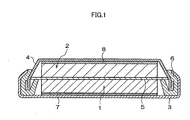
- FIG. 1 is a schematic cross-sectional diagram of a coin cell illustrating an example of the lithium secondary battery of the invention.
- the cyclic sulfate compound of the invention a non-aqueous electrolyte solution using the compound, an additive for lithium secondary batteries, and a lithium secondary battery will be described specifically.
- the cyclic sulfate compound of the invention is a cyclic sulfate compound represented by the following formula (I).
- R 1 represents a group represented by the above formula (II) or a group represented by the above formula (III); and R 2 represents a hydrogen atom, an alkyl group having from 1 to 6 carbon atoms, a group represented by formula (II), or a group represented by formula (III).
- R 3 represents a halogen atom, an alkyl group having from 1 to 6 carbon atoms, a halogenated alkyl group having from 1 to 6 carbon atoms, an alkoxy group having from 1 to 6 carbon atoms, or a group represented by the above formula (IV); and the wavy line in formula (II), formula (III) and formula (IV) represents the position of bonding.
- the two groups represented by formula (II) may be the same as or different from each other.
- halogen atom examples include a fluorine atom, a chlorine atom, a bromine atom, and an iodine atom.
- the halogen atom is preferably a fluorine atom.
- the "alkyl group having from 1 to 6 carbon atoms” is a linear or branched alkyl group having from 1 to 6 carbon atoms, and specific examples thereof include a methyl group, an ethyl group, a propyl group, an isopropyl group, a butyl group, an isobutyl group, a sec-butyl group, a tert-butyl group, a pentyl group, a 2-methylbutyl group, a 1-methylpentyl group, a neopentyl group, a 1-ethylpropyl group, a hexyl group, and a 3,3-dimethylbutyl group.
- the alkyl group having from 1 to 6 carbon atoms is more preferably an alkyl group having from 1 to 3 carbon atoms.
- the "halogenated alkyl group having from 1 to 6 carbon atoms" is a linear or branched halogenated alkyl group having from 1 to 6 carbon atoms, and specific examples thereof include a fluoromethyl group, a difluoromethyl group, a trifluoromethyl group, a 2,2,2-trifluoroethyl group, a perfluoroethyl group, a perfluoropropyl group, a perfluorobutyl group, a perfluoropentyl group, a perfluorohexyl group, a perfluoroisopropyl group, a perfluoroisobutyl group, a chloromethyl group, a chloroethyl group, a chloropropyl group, a bromomethyl group, a bromoethyl group, a bromopropyl group, an iodomethyl group, an iodoethyl group, and an
- the "alkoxy group having from 1 to 6 carbon atoms" is a linear or branched alkoxy group having from 1 to 6 carbon atoms, and specific examples thereof include a methoxy group, an ethoxy group, a propoxy group, an isopropoxy group, a butoxy group, an isobutoxy group, a sec-butoxy group, a tert-butoxy group, a pentyloxy group, a 2-methylbutoxy group, a 1-methylpentyloxy group, a neopentyloxy group, a 1-ethylpropoxy group, a hexyloxy group, and a 3,3-dimethylbutoxy group.
- the alkoxy group having from 1 to 6 carbon atoms is more preferably an alkoxy group having from 1 to 3 carbon atoms.
- R 1 in formula (I) is preferably a group represented by formula (II) (in formula (II), R 3 is preferably a fluorine atom, an alkyl group having from 1 to 3 carbon atoms, a halogenated alkyl group having from 1 to 3 carbon atoms, an alkoxy group having from 1 to 3 carbon atoms, or a group represented by formula (IV)), or a group represented by formula (III).
- R 2 in formula (I) is preferably a hydrogen atom, an alkyl group having from 1 to 3 carbon atoms, a group represented by formula (II) (in formula (II), R 3 is preferably a fluorine atom, an alkyl group having from 1 to 3 carbon atoms, a halogenated alkyl group having from 1 to 3 carbon atoms, an alkoxy group having from 1 to 3 carbon atoms, or a group represented by formula (IV)), or a group represented by formula (III), and more preferably a hydrogen atom or a methyl group.
- R 2 is particularly preferably a hydrogen atom.
- R 3 in formula (II) is a halogen atom, an alkyl group having from 1 to 6 carbon atoms, a halogenated alkyl group having from 1 to 6 carbon atoms, an alkoxy group having from 1 to 6 carbon atoms or a group represented by formula (IV) as described above, but R 3 is more preferably a fluorine atom, an alkyl group having from 1 to 3 carbon atoms, a halogenated alkyl group having from 1 to 3 carbon atoms, an alkoxy group having from 1 to 3 carbon atoms, or a group represented by formula (IV), and even more preferably a fluorine atom, a methyl group, an ethyl group, a methoxy group, an ethoxy group, or a group represented by formula (IV).
- R 2 in formula (I) is a group represented by formula (II)
- R 1 and R 2 in formula (I) is a combination in which R 1 represents a group represented by formula (II) (in formula (II), R 3 is preferably a fluorine atom, an alkyl group having from 1 to 3 carbon atoms, a halogenated alkyl group having from 1 to 3 carbon atoms, an alkoxy group having from 1 to 3 carbon atoms, or a group represented by formula (IV)), or a group represented by formula (III), and R 2 represents a hydrogen atom, an alkyl group having from 1 to 3 carbon atoms, a group represented by formula (II) (in formula (II), R 3 is preferably a fluorine atom, an alkyl group having from 1 to 3 carbon atoms, a halogenated alkyl group having from 1 to 3 carbon atoms, an alkoxy group having from 1 to 3 carbon atoms, or a group represented by formula (IV)), or a group represented by formula (III).
- R 1 and R 2 in formula (I) are a combination in which R 1 represents a group represented by formula (II) (in formula (II), R 3 is preferably a fluorine atom, a methyl group, an ethyl group, a methoxy group, an ethoxy group, or a group represented by formula (IV)), or a group represented by formula (III), and R 2 represents a hydrogen atom or a methyl group.
- R 1 and R 2 in formula (I) are a combination in which in formula (I), R 1 represents a group represented by formula (III) and R 2 represents a hydrogen atom (most preferably 1,2:3,4-di-O-sulfanyl-meso-erythritol).
- R 2 and R 3 have the same definitions as R 2 and R 3 in formula (I) and formula (II), respectively.
- the cyclic sulfate compound represented by formula (XII) is preferably a compound in which R 2 represents a hydrogen atom or an alkyl group having from 1 to 6 carbon atoms, R 3 represents a halogen atom, an alkyl group having from 1 to 6 carbon atoms, a halogenated alkyl group having from 1 to 6 carbon atoms, an alkoxy group having from 1 to 6 carbon atoms, or a group represented by formula (IV).
- the cyclic sulfate compound represented by formula (XII) is particularly preferably a compound in which R 2 represents a hydrogen atom or a methyl group, and R 3 represents a fluorine atom, a methyl group, an ethyl group, a methoxy group, an ethoxy group, or a group represented by formula (IV).
- the cyclic sulfate compound represented by formula (I) is preferably 4-methylsulfonyloxymethyl-2,2-dioxo-1,3,2-dioxathiolane, 4-ethylsulfonyloxymethyl-2,2-dioxo-1,3,2-dioxathiolane, bis((2,2-dioxo-1,3,2-dioxathiolane-4-yl)methyl) sulfate, 1,2:3,4-di-O-sulfanyl-meso-erythritol, or 1,2:3,4-di-O-sulfanyl-D,L-threitol; more preferably 4-methylsulfonyloxymethyl-2,2-dioxo-,3 ,2-dioxathiolane, 4-ethylsulfonyloxymethyl-2,2-dioxo-1,3,2-dioxathiolane, bis((2,2-dioxo
- Me represents a methyl group
- Et represents an ethyl group
- Pr represents a propyl group
- iPr represents an isopropyl group
- Bu represents a butyl group
- tBu represents a tertiary butyl group
- Pent represents a pentyl group
- Hex represents a hexyl group
- OMe represents a methoxy group
- OEt represents an ethoxy group
- OPr represents a propoxy group
- OBu represents a butoxy group
- OOPent represents a pentyloxy group
- Oex represents a hexyloxy group.
- R 1 to R 3 represents the position of bonding.
- a 2,2-dioxo-1,3,2-dioxathiolane ring may have stereoisomers arising from the substituents at the 4-position and the 5-position, but both the isomers are compounds that are included in the invention.
- exemplary compound 22 (4,4'-bis(2,2-dioxo-1,3,2-dioxathiolane) has two kinds of diastereomers, which are indicated as exemplary compound 22a described below and exemplary compound 22b described below, respectively.
- the exemplary compound 22a may be referred to as 1,2:3,4-di-O-sulfanyl-meso-erythritol, and the exemplary compound 22b may be referred to as 1,2:3,4-di-O-sulfanyl-D,L-threitol.
- cyclic sulfate compound represented by formula (I) is useful as an additive for lithium secondary batteries as will be described below.
- the cyclic sulfate compound represented by formula (I) in the invention in which R 1 represents a group represented by formula (II) (for example, a cyclic sulfate compound represented by formula (XII)), can be produced by, for example, the process that will be described below, but the production method is not intended to be limited to this production method.
- R 2 and R 3 have the same definitions as R 2 and R 3 in formula (I), respectively; and in the above formula, X represents a halogen atom.
- Step 1 is a step for producing a cyclic sulfurous acid ester represented by formula (2) (hereinafter, also referred to as “compound (2)”) by causing an alcohol derivative represented by formula (I) (hereinafter, also referred to as “compound (1)”) to react with thionyl chloride.
- the solvent to be used is not particularly limited as long as the solvent does not inhibit the reaction and is capable of dissolving the starting materials to some extent, and examples thereof include ethers such as diethyl ether, dimethoxyethane, tetrahydrofuran, and dioxane; aromatic hydrocarbons such as benzene, toluene, xylene and chlorobenzene; aliphatic hydrocarbons such as hexane, cyclohexane and heptane; halogenated hydrocarbons such as methylene chloride, 1,2-dichloroethane and chloroform; and mixture thereof.
- ethers such as diethyl ether, dimethoxyethane, tetrahydrofuran, and dioxane
- aromatic hydrocarbons such as benzene, toluene, xylene and chlorobenzene
- aliphatic hydrocarbons such as hexane, cyclohexane and
- Suitable solvents are halogenated hydrocarbons, aliphatic hydrocarbons, and aromatic hydrocarbons, and more suitable solvents are methylene chloride and toluene.
- the amount of thionyl chloride to be used is 1.0 mol to 5.0 mol, and suitably 1.0 mol to 2.0, mol, relative to 1 mol of the compound (1).
- Regarding the amount of the solvent usually 0.3 liters to 5 liters, and suitably 0.5 liters to 2 liters, can be used relative to 1 mol of the compound (1).
- the reaction temperature may vary depending on the raw material compounds, reaction reagents, solvents and the like, but usually, the reaction can be carried out in a temperature range of from -20°C to the reflux temperature in the reaction system, and suitably -10°C to 20°C.
- the reaction time may vary depending on the raw material compounds, reaction reagents, solvents, reaction temperature, and the like, but usually, the reaction can be carried out in the range of 0.5 hours to 48 hours, and suitably 0.5 hours to 24 hours.
- the compound (1) used in the present step may be a commercially available product, or is produced according to an already known method, for example, the method described in Tetrahedron: Asymmetry, 2005, Vol. 16, p. 3268-3274 .
- Step 2 is a step for producing a cyclic sulfurous acid ester (4) represented by formula (4) (hereinafter, also referred to as "compound (4)") by causing the cyclic sulfurous acid ester represented by formula (2) (compound (2)) to react with a compound represented by formula (3) in the presence of a base.
- compound (4) a cyclic sulfurous acid ester represented by formula (4)
- the base to be used is not particularly limited as long as it is a base exhibiting a deprotonation ability against the substrate, and examples thereof include carbonates of alkali metals, such as sodium carbonate and potassium carbonate; hydrogen carbonates of alkali metals, such as sodium hydrogen carbonate and potassium hydrogen carbonate; organic bases such as triethylamine, N,N-dimethylaniline, and pyridine; metal hydrides such as sodium hydride and potassium hydride; and metal alkoxides such as sodium methoxide, sodium ethoxide, and potassium tert-butoxide.
- Suitable bases are organic bases, and a more suitable base is triethylamine.
- the solvent to be used is not particularly limited as long as the solvent does not inhibit the reaction and is capable of dissolving the starting materials to some extent, and examples thereof include ethers such as diethyl ether, dimethoxyethane, tetrahydrofuran, and dioxane; aromatic hydrocarbons such as benzene, toluene, xylene, and chlorobenzene; aliphatic hydrocarbons such as hexane, cyclohexane, and heptane; halogenated hydrocarbons such as methylene chloride, 1,2-dichloroethane, and chloroform; esters such as ethyl acetate and butyl acetate; and mixture thereof.
- ethers such as diethyl ether, dimethoxyethane, tetrahydrofuran, and dioxane
- aromatic hydrocarbons such as benzene, toluene, xylene, and chlorobenzene
- Suitable solvents include halogenated hydrocarbons, aliphatic hydrocarbons, and aromatic hydrocarbons, and more suitable solvents include methylene chloride and toluene.
- the amount of the solvent that can be used is usually 0.5 liters to 10 liters, and suitably 1.0 liter to 5 liters, relative to 1 mol of the compound (2).
- the reaction temperature may vary depending on the raw material compounds, reaction reagents, solvents and the like, but usually, the reaction can be carried out in a temperature range of from -20°C to the reflux temperature in the reaction system, and suitably -10°C to 50°C.
- the reaction time may vary depending on the raw material compounds, reaction reagents, solvents, reaction temperature, and the like, but usually, the reaction can be carried out in the range of 0.5 hours to 48 hours, and suitably 0.5 hours to 24 hours.
- Step 3 is a step for producing a cyclic sulfate (XII) by causing the cyclic sulfurous acid ester derivative represented by formula (4) (compound (4)) to react with an oxidizing agent.
- the oxidizing agent that may be used include ruthenium salts such as ruthenium oxide, ruthenium chloride, and ruthenium bromide, or hydrates thereof.
- Suitable oxidizing agents are ruthenium oxide and ruthenium trichloride hydrate.
- co-oxidizing agents for the present reaction system include sodium periodate, sodium perchlorate, sodium chlorite, and sodium hypochlorite, and suitable examples include sodium hypochlorite and sodium periodate.
- the solvent to be used is not particularly limited as long as the solvent does not inhibit the reaction and is capable of dissolving the starting materials to some extent, and examples thereof include water; ethers such as diethyl ether, dimethoxyethane, tetrahydrofuran, and dioxane; aromatic hydrocarbons such as benzene, toluene, xylene, and chlorobenzene; aliphatic hydrocarbons such as hexane, cyclohexane, and heptane; halogenated hydrocarbons such as methylene chloride, 1,2-dichloroethane, and chloroform; esters such as ethyl acetate and butyl acetate; nitriles such as acetonitrile and propionitrile; and mixture thereof.
- water examples thereof include water; ethers such as diethyl ether, dimethoxyethane, tetrahydrofuran, and dioxane; aromatic hydrocarbon
- Suitable solvents include esters, nitriles, water, and mixture thereof, and a more suitable solvent is a mixture of acetonitrile and water.
- the amount of the solvent that can be used is usually 0.5 liters to 10 liters, and suitably 1.0 liter to 5 liters, relative to 1 mol of the compound (4).
- the reaction temperature may vary depending on the raw material compounds, reaction reagents, solvent and the like, but usually, the reaction can be carried out in a temperature range of from -20°C to the reflux temperature in the reaction system, and suitably -10°C to 50°C.
- the reaction time may vary depending on the raw material compounds, reaction reagents, solvent, reaction temperature, and the like, but usually, the reaction can be carried out in the range of 0.5 hours to 48 hours, and suitably 0.5 hours to 24 hours.
- the cyclic sulfate compound represented by formula (I) of the invention in which R 1 represents a group represented by formula (III), can be produced by an already known method, for example, the method described in Tetrahedron Letters, 2000, vol. 41, p. 5053-5056 .
- the cyclic sulfate compound represented by formula (I) is useful as an additive for lithium secondary batteries, particularly as an additive for a non-aqueous electrolyte solution for lithium secondary batteries that will be described below.
- this additive is added to a non-aqueous electrolyte solution, a decrease in the open circuit voltage during the storage of a battery in a charged state can be suppressed, while the capacity retention performance of the battery is improved.
- a speculated reason why the cyclic sulfate compound represented by formula (I) offers the above-described effects will be explained below.
- the cyclic sulfate compound represented by formula (I) that is included in the non-aqueous electrolyte solution of the invention may be used singly, or two or more kinds may be used.
- the content (if two or more kinds are included, the total content) of the cyclic sulfate compound represented by formula (I) that is included in the non-aqueous electrolyte solution of the invention is preferably 0.001 mass% to 10 mass%, and more preferably in the range of 0.05 mass% to 5 mass%, relative to the total mass of the non-aqueous electrolyte solution. When the content is in this range, a decrease in the open circuit voltage during battery storage can be more effectively suppressed, while the capacity of the battery is retained.
- the non-aqueous electrolyte solution of the invention preferably further contains at least one of an electrolyte compound represented by the following formula (V) or lithium difluorophosphate (LiOP(O)F 2 ), in addition to the cyclic sulfate compound represented by formula (I) described above.
- the non-aqueous electrolyte solution of the invention contains the cyclic sulfate compound represented by formula (I) described above, and at least one of an electrolyte compound represented by the following formula (V) or lithium difluorophosphate (LiOP(O)F 2 ), a good balance can be achieved between the initial characteristics of a battery and the storage characteristics of the battery.
- the non-aqueous electrolyte solution does not contain the cyclic sulfate compound represented by formula (I) described above but contains at least one of the electrolyte compound represented by the following formula (V) or lithium difluorophosphate (LiOP(O)F 2 ), the effect of enhancing the low temperature discharge characteristics of the battery in the early stage may be obtained, but the storage characteristics of the battery cannot be sufficiently satisfied. That is, in this case, the low temperature discharge characteristics during storage or the capacity retention performance during storage may deteriorate, and a decrease in the open circuit voltage during storage may not be suppressed.
- the electrolyte compound represented by formula (V) will be described.
- M represents an alkali metal
- Y represents a transition element, or an element of Group 13, Group 14 or Group 15 of the Periodic Table of Elements
- b represents an integer from 1 to 3
- m represents an integer from 1 to 4
- n represents an integer from 0 to 8
- q represents 0 or 1
- R 11 represents an alkylene group having from 1 to 10 carbon atoms, a halogenated alkylene group having from 1 to 10 carbon atoms, an arylene group having from 6 to 20 carbon atoms, or a halogenated arylene group having from 6 to 20 carbon atoms, wherein such groups may each contain a substituent or a heteroatom in the structure, and when q is 1 and m is 2 to 4, m units of R 11 may be bonded to each other;
- R 12 represents a halogen atom, an alkyl group having from 1 to 10 carbon atoms, a halogenated alkyl group having from 1 to 10 carbon atoms, an aryl
- M represents an alkali metal
- Y represents a transition metal or an element of Group 13, Group 14 or Group 15 of the Periodic Table of Elements.
- Y is preferably Al, B, V, Ti, Si, Zr, Ge, Sn, Cu, Y, Zn, Ga, Nb, Ta, Bi, P, As, Sc, Hf, or Sb, and more preferably Al, B or P.
- Symbol b which represents the valency of the anion and the number of cations, is an integer from 1 to 3, and is preferably 1.
- the constants m and n are values related to the number of ligands and are determined in accordance with the kind of M; however, m represents an integer from 1 to 4, and n represents an integer from 0 to 8.
- the constant q is 0 or 1. When q is 0, the chelate ring becomes a 5-membered ring, and when q is 1, the chelate ring becomes a 6-membered ring.
- R 11 represents an alkylene group having from 1 to 10 carbon atoms, a halogenated alkylene group having from 1 to 10 carbon atoms, an arylene group having from 6 to 20 carbon atoms, or a halogenated arylene group having from 6 to 20 carbon atoms.
- These alkylene group, halogenated alkylene group, arylene group and halogenated arylene group may each contain a substituent or a heteroatom in the structure.
- these groups may each contain a halogen atom, a chain-lik or cyclic alkyl group, an aryl group, an alkenyl group, an alkoxy group, an aryloxy group, a sulfonyl group, an amino group, a cyano group, a carbonyl group, an acyl group, an amide group, or a hydroxyl group as a substituent, instead of a hydrogen atom.
- these groups may also have a structure in which a nitrogen atom, a sulfur atom or an oxygen atom is introduced instead of the carbon element.
- q is 1 and m is 2 to 4
- m units of R 11 may be bonded to each other.
- An example thereof may be a ligand such as ethylenediamine tetraacetate.
- R 12 represents a halogen atom, an alkyl group having from 1 to 10 carbon atoms, a halogenated alkyl group having from 1 to 10 carbon atoms, an aryl group having from 6 to 20 carbon atoms, a halogenated aryl group having from 6 to 20 carbon atoms, or -Q 3 R 13 (Q 3 and R 13 will be explained below).
- These alkyl group, halogenated alkyl group, aryl group and halogenated aryl group for R 12 may each contain a substituent or a heteroatom in the structure as in the case of R 11 , and when n is 2 to 8, n units of R 12 may be bonded to each other to form a ring.
- R 12 is preferably an electron-withdrawing group, and is particularly preferably a fluorine atom.
- Q 1 , Q 2 and Q 3 each independently represent O, S or NR 14 . That is, a ligand is bonded to Y through these heteroatoms.
- R 13 and R 14 each independently represent a hydrogen atom, an alkyl group having from 1 to 10 carbon atoms, a halogenated alkyl group having from 1 to 10 carbon atoms, an aryl group having from 6 to 20 carbon atoms, or a halogenated aryl group having from 6 to 20 carbon atoms.
- These alkyl group, halogenated alkyl group, aryl group and halogenated aryl group may each contain a substituent or a heteroatom in the structure as in the case of R 11 .
- the respective groups may be bonded to each other to form a ring.
- alkali metal for M examples include lithium, sodium and potassium. Among these, lithium is particularly preferred.
- n is preferably an integer from 0 to 4.
- the non-aqueous electrolyte solution of the invention may include only one kind of the compound represented by formula (V), or may include two or more kinds thereof.
- the electrolyte compound represented by formula (V) is more preferably at least one compound selected from the group consisting of a compound represented by the following formula (VI), a compound represented by the following formula (VII), a compound represented by the following formula (VIII), and a compound represented by the following formula (IX).
- a compound in which M represents lithium, sodium or potassium may be mentioned as a more preferred compound of the electrolyte compound represented by formula (V), and particularly preferably, the electrolyte compound is a compound represented by formula (VIII), in which M represents lithium.
- M has the same definition as M in formula (V).
- a method of causing LiBF 4 to react with a lithium alkoxide in a two-fold molar amount of LiBF 4 in a non-aqueous solvent, subsequently adding oxalic acid, and substituting the alkoxide bonded to boron with oxalic acid may be used.
- a method of causing LiPF 6 to react with oxalic acid in a one-fold molar amount of this LiPF 6 in a non-aqueous solvent, and substituting the fluorine atom bonded to phosphorus with oxalic acid may be used.
- a method of causing LiPF 6 to react with oxalic acid in a two-fold molar amount of this LiPF 6 in a non-aqueous solvent, and substituting the fluorine atom bonded to phosphorus with oxalic acid may be used.
- the content of at least one (if two or more kinds are included, the total content) of the electrolyte compound represented by formula (V) or lithium difluorophosphate is preferably 0.001 mass% to 10 mass%, and more preferably in the range of 0.05 mass% to 5 mass%, relative to the total mass of the non-aqueous electrolyte solution.
- the content is in this range, a balance can be achieved more effectively between an improvement in the low temperature characteristics of a battery and an improvement in the storage characteristics of the battery.
- the content (if two or more kinds are included, the total content) of the cyclic sulfate compound represented by formula (I) is preferably 0.001 mass% to 10 mass%, and more preferably in the range of 0.05 mass% to 5 mass%, relative to the total mass of the non-aqueous electrolyte solution.
- the content is in this range, a balance can be achieved more effectively between an improvement in the low temperature discharge characteristics of a battery and an improvement in the storage characteristics of the battery.
- the non-aqueous electrolyte solution of the invention may also include other components in addition to the cyclic sulfate compound represented by formula (I) (and at least one of the electrolyte compound represented by formula (V) or lithium difluorophosphate that are used according to necessity). Regarding the other components, any known components can be optionally included. The other components that are preferably included in the non-aqueous electrolyte solution of the invention will be explained.
- the non-aqueous electrolyte solution generally contains an electrolyte and a non-aqueous solvent.
- an example of the other components that are preferably included in the non-aqueous electrolyte solution of the invention may be at last one compound represented by formula (X) shown below or formula (XI) shown below, from the viewpoint of obtaining the effects of the invention more effectively.
- non-aqueous solvent related to the invention various known solvents can be appropriately selected, but it is preferable to use a cyclic aprotic solvent and/or a linear aprotic solvent. When an increase in the flash point of the solvent is intended to enhance the safety of the battery, it is preferable to use a cyclic aprotic solvent as the non-aqueous solvent.
- Examples of the cyclic aprotic solvent that can be used include a cyclic carbonate, a cyclic carboxylic acid ester, a cyclic sulfone, and a cyclic ether.
- the cyclic aprotic solvent may be used alone, or a mixture of plural kinds may also be used.
- the mixing proportion of the cyclic aprotic solvent in the non-aqueous solvent is 10 mass% to 100 mass%, more preferably 20 mass% to 90 mass%, and particularly preferably 30 mass% to 80 mass%. When such a ratio is employed, the conductivity of the electrolyte solution that is related to the charge-discharge characteristics of the battery can be increased.
- cyclic carbonate examples include ethylene carbonate, propylene carbonate, 1,2-butylene carbonate, 2,3-butylene carbonate, 1,2-pentylene carbonate, and 2,3-pentylene carbonate.
- ethylene carbonate and propylene carbonate having high dielectric constants are suitably used.
- ethylene carbonate is more preferable.
- two or more kinds of these cyclic carbonates may also be used in mixture.
- cyclic carboxylic acid ester examples include ⁇ -butyrolactone, ⁇ -valerolactone, and alkyl-substituted forms such as methyl- ⁇ -butyrolactone, ethyl- ⁇ -butyrolactone, and ethyl- ⁇ -valerolactone.
- a cyclic carboxylic acid ester has a low vapor pressure, has low viscosity, has a high dielectric constant, and can lower the viscosity of the electrolyte solution without decreasing the flash point of the electrolyte solution and the degree of dissociation of the electrolyte.
- a cyclic carboxylic acid ester has a feature that the conductivity of the electrolyte solution, which is an index associated with the discharge characteristics of a battery, can be increased without increasing the inflammability of the electrolyte solution. Therefore, in the case where an improvement in the flash point of the solvent is intended, it is preferable to use a cyclic carboxylic acid ester as the cyclic aprotic solvent.
- a cyclic carboxylic acid esters ⁇ -butyrolactone is most preferred.
- Examples of the cyclic sulfone include sulfolane, 2-methylsulfolane, 3-methylsulfolane, dimethylsulfone, diethylsulfone, dipropylsulfone, methylethylsulfone, and methylpropylsulfone.
- Examples of the cyclic ether include dioxolane.
- Examples of the acyclic aprotic solvent of the invention that can be used include an acyclic carbonate, an acyclic carboxylic acid ester, an acyclic ether, and an acyclic phosphoric acid ester.
- the mixing proportion of the acyclic aprotic solvent in the non-aqueous solvent is 10 mass% to 100 mass%, more preferably 20 mass% to 90 mass%, and particularly preferably 30 mass% to 80 mass%.
- acyclic carbonate examples include dimethyl carbonate, methyl ethyl carbonate, diethyl carbonate, methyl propyl carbonate, methyl isopropyl carbonate, ethyl propyl carbonate, dipropyl carbonate, methyl butyl carbonate, ethyl butyl carbonate, dibutyl carbonate, methyl pentyl carbonate, ethyl pentyl carbonate, dipentyl carbonate, methyl heptyl carbonate, ethyl heptyl carbonate, diheptyl carbonate, methyl hexyl carbonate, ethyl hexyl carbonate, dihexyl carbonate, methyl octyl carbonate, ethyl octyl carbonate, dioctyl carbonate, and methyl trifluoroethyl carbonate.
- These acyclic carbonates may also be used as mixtures of two or more kinds.
- acyclic carboxylic acid ester examples include methyl pivalate.
- Specific examples of the acyclic ether include dimethoxyethane.
- Specific examples of the acyclic phosphoric acid ester include trimethyl phosphate.
- the non-aqueous solvent used in the non-aqueous electrolyte solution related to the invention may be used singly or as a mixture of plural kinds. Furthermore, only cyclic aprotic solvents may be used singly or as a combination of plural kinds; only acyclic aprotic solvents may be used singly or as a combination of plural kinds; or mixtures of cyclic aprotic solvents and acyclic protic solvents may also be used. Particularly when an enhancement of the rate characteristics and the low temperature characteristics of the battery is intended, it is preferable to use a cyclic aprotic solvent and an acyclic aprotic solvent in combination as the non-aqueous solvent.
- a cyclic carbonate as the cyclic aprotic solvent
- an acyclic carbonate as the acyclic aprotic solvent
- a cyclic carbonate and an acyclic carbonate include ethylene carbonate with dimethyl carbonate; ethylene carbonate with methyl ethyl carbonate; ethylene carbonate with diethyl carbonate; propylene carbonate with dimethyl carbonate; propylene carbonate with methyl ethyl carbonate; propylene carbonate with diethyl carbonate; ethylene carbonate with propylene carbonate and methyl ethyl carbonate; ethylene carbonate with propylene carbonate and diethyl carbonate; ethylene carbonate with dimethyl carbonate and methyl ethyl carbonate; ethylene carbonate with dimethyl carbonate and diethyl carbonate; ethylene carbonate with methyl ethyl carbonate and diethyl carbonate; ethylene carbonate with dimethyl carbonate, methyl ethyl carbonate and diethyl carbonate; ethylene carbonate with dimethyl carbonate, methyl ethyl carbonate and diethyl carbonate; ethylene carbonate with dimethyl carbonate
- the mixing proportion of the cyclic carbonate and the acyclic carbonate is such that when expressed as a mass ratio, the ratio of cyclic carbonate : acyclic carbonate is 5 : 95 to 80 : 20, more preferably 10 : 90 to 70 : 30, and particularly preferably 15 : 85 to 55 : 45.
- ratios When such ratios are employed, an increase in the viscosity of the electrolyte solution is suppressed, and the degree of dissociation of the electrolyte can be increased. Therefore, the conductivity of the electrolyte solution related to the charge-discharge characteristics of a battery can be increased. Furthermore, the solubility of the electrolyte can be further increased. Accordingly, since an electrolyte solution having excellent electrical conductivity at normal temperature or at a low temperature can be obtained, the rate characteristics of a battery at normal temperature to a low temperature can be improved.
- a cyclic carboxylic acid ester with a cyclic carbonate and/or an acyclic carbonate examples include ⁇ -butyrolactone with ethylene carbonate; ⁇ -butyrolactone with ethylene carbonate and dimethyl carbonate; ⁇ -butyrolactone with ethylene carbonate and methyl ethyl carbonate; ⁇ -butyrolactone with ethylene carbonate and diethyl carbonate; ⁇ -butyrolactone with propylene carbonate; ⁇ -butyrolactone with propylene carbonate and dimethyl carbonate; ⁇ -butyrolactone with propylene carbonate and methyl ethyl carbonate; ⁇ -butyrolactone with propylene carbonate and diethyl carbonate; ⁇ -butyrolactone with ethylene carbonate and propylene carbonate; ⁇ -butyrolactone with ethylene carbonate, propylene carbonate and dimethyl carbonate; ⁇ -butyrolactone with ethylene carbonate, propylene carbon
- the non-aqueous electrolyte solution related to the invention may also include another solvent in addition to the solvents described above, as the non-aqueous solvent.
- the other solvent include amides such as dimethylformamide; acyclic carbamates such as methyl-N,N-dimethyl carbamate; cyclic amides such as N-methylpyrrolidone; cyclic ureas such as N,N-dimethylimidazolidinone; boron compounds such as trimethyl borate, triethyl borate, tributyl borate, trioctyl borate, and trimethylsilyl borate; and polyethylene glycol derivatives represented by the following formulas: HO(CH 2 CH 2 O) a H HO[CH 2 CH(CH 3 )O] b H CH 3 O(CH 2 CH 2 O) c H CH 3 O[CH 2 CH(CH 3 )O] d H CH 3 O(CH 2 CH 2 O) e CH 3 CH 3 O[CH 2 CH
- the non-aqueous electrolyte solution of the invention may contain a compound represented by formula (X).
- An embodiment that the non-aqueous electrolyte solution of the invention contains a compound represented by formula (X) is preferable from the viewpoint of forming a passivation film of the negative electrode surface.
- Y 1 and Y 2 each independently represent a hydrogen atom, a methyl group, an ethyl group, or a propyl group.
- Examples of the compound represented by formula (X) include vinylene carbonate, methylvinylene carbonate, ethylvinylene carbonate, propylvinylene carbonate, dimethylvinylene carbonate, diethylvinylene carbonate, and dipropylvinylene carbonate. Among these, vinylene carbonate is most preferred.
- the non-aqueous electrolyte solution of the invention may contain only one kind of the compound represented by formula (X), or may contain two or more kinds thereof.
- the content (if two or more kinds are included, the total content) of the compound represented by formula (X) can be appropriately selected in accordance with the purpose, but the content is preferably 0.001 mass% to 10 mass%, and more preferably 0.05 mass% to 5 mass%, relative to the total mass of the non-aqueous electrolyte solution.
- the non-aqueous electrolyte solution related to the invention may contain a compound represented by formula (XI).
- An embodiment that the non-aqueous electrolyte solution of the invention contains a compound represented by formula (XI) is preferable from the viewpoint of forming a passivation film of the negative electrode surface.
- X 1 , X 2 , X 3 and X 4 each independently represent a hydrogen atom, a fluorine atom, a chlorine atom, or an alkyl group having from 1 to 3 carbon atoms which may be substituted with a fluorine atom, provided that X 1 to X 4 are not both hydrogen atoms at the same time.
- examples of the alkyl group having from 1 to 3 carbon atoms which may be substituted with a fluorine atom as represented by X 1 to X 4 include fluoromethyl, difluoromethyl, trifluoromethyl, pentafluoroethyl, and heptafluoropropyl.
- known compounds can be used, and examples thereof include fluorinated ethylene carbonates in which 1 to 4 hydrogen atoms of ethylene carbonate are substituted by fluorine atoms, such as 4-fluoroethylene carbonate, 4,4-difluoroethylene carbonate, 4,5-difluoroethylene carbonate, 4,4,5-trifluoroethylene carbonate, and 4,4,5,5-tetrafluoroethylene carbonate.
- fluorinated ethylene carbonates in which 1 to 4 hydrogen atoms of ethylene carbonate are substituted by fluorine atoms, such as 4-fluoroethylene carbonate, 4,4-difluoroethylene carbonate, 4,5-difluoroethylene carbonate, 4,4,5-trifluoroethylene carbonate, and 4,4,5,5-tetrafluoroethylene carbonate.
- 4,5-difluoroethylene carbonate and 4-fluoroethylene carbonate are most preferred.
- the non-aqueous electrolyte solution of the invention may contain only one kind of the compound represented by formula (XI), or may contain two or more kinds thereof.
- the content (if two or more kinds are included, the total content) of the compound represented by formula (XI) can be appropriately selected in accordance with the purpose, but the content is preferably 0.001 mass% to 10 mass%, and more preferably 0.05 mass% to 5 mass%, relative to the total mass of the non-aqueous electrolyte solution.
- non-aqueous electrolyte solution of the invention various electrolytes can be used, and usually, any electrolyte which is used as an electrolyte for non-aqueous electrolyte solutions can be used.
- the electrolyte for the non-aqueous electrolyte solution of the invention at least one of the electrolyte compound represented by formula (V) or lithium difluorophosphate may be used; another electrolyte having a structure that is different from the structures of the electrolyte compound represented by formula (V) or lithium difluorophosphate (hereinafter, also simply referred to as "other electrolyte”) may be used; or at least one of the electrolyte compound represented by formula (V) or lithium difluorophosphate and another electrolyte may be used in combination.
- the non-aqueous electrolyte solution of the invention contains at least one of the electrolyte compound represented by formula (V) or lithium difluorophosphate and another electrolyte
- electrical conductivity which is a fundamental performance of an electrolyte for conventional non-aqueous electrolyte solutions is retained, and also, the battery performance (particularly, the low temperature discharge characteristics of the battery in the early stage and during storage in a charged state) is also further enhanced.
- the relevant compound serves as a stable supply source of lithium ions.
- An electrolyte is generally preferably included in the non-aqueous electrolyte at a concentration of 0.1 mol/L to 3 mol/L, and preferably 0.5 mol/L to 2 mol/L.
- the non-aqueous electrolyte solution of the invention in the case of using a cyclic carboxylic acid ester such as ⁇ -butyrolactone in combination as the non-aqueous solvent, preferably contains LiPF 6 in particular. Since LiPF 6 has a high degree of dissociation, LiPF 6 can increase the conductivity of the electrolyte solution, and also has an action of suppressing the reductive decomposition reaction of the electrolyte solution on the negative electrode. LiPF 6 may be used alone, or LiPF 6 and another electrolyte may be used together.
- the proportion of LiPF 6 included in the lithium salts is preferably 1 mass% to 100 mass%, preferably 10 mass% to 100 mass%, and more preferably 50 mass% to 100 mass%.
- Such an electrolyte is preferably included in the non-aqueous electrolyte solution at a concentration of 0.1 mol/L to 3 mol/L, and preferably 0.5 mol/L to 2 mol/L.
- the non-aqueous electrolyte solution of the invention is not only suitable as a non-aqueous electrolyte solution for lithium secondary batteries, but can also be used as a non-aqueous electrolyte solution for primary batteries, a non-aqueous electrolyte solution for electrochemical capacitors, or an electrolyte solution for electric double layer capacitors or aluminum electrolytic capacitors.
- the lithium secondary battery of the invention is constituted to basically include a negative electrode, a positive electrode, and the non-aqueous electrolyte solution of the invention, and usually, a separator is provided between the negative electrode and the positive electrode.
- the negative electrode active material that constitutes the negative electrode at least one selected from metal lithium, a lithium-containing alloy, a metal or alloy capable of alloying with lithium, an oxide capable of doping and dedoping of lithium ions, transition metal nitrides capable of doping and dedoping of lithium ions, and a carbon material capable of doping and dedoping of lithium ions (these may be used singly, or mixtures including two or more kinds of these may also be used) can be used.
- the metal or alloy capable of alloying with lithium (or lithium ions) include silicon, a silicon alloy, tin, and a tin alloy.
- lithium titanate is also acceptable.
- a carbon material capable of doping and dedoping of lithium ions is preferred.
- a carbon material include carbon black, activated carbon, a graphite material (artificial graphite or natural graphite), and an amorphous carbon material.
- the form of the carbon material may be any of a fibrous form, a spherical form, a potato form and a flake form.
- the amorphous carbon material include hard carbon, cokes, mesocarbon microbeads (MCMB) calcined at or below 1500°C, and mesophase pitch carbon fibers (MCF).
- the graphite material include natural graphite and artificial graphite. Regarding the artificial graphite, graphitized MCMB, graphitized MCF, and the like are used. Furthermore, compounds containing boron can also be used as the graphite material. Also, as the graphite material, a graphite material coated with a metal such as gold, platinum, silver, copper or tin; a graphite material coated with an amorphous carbon; or a mixture of amorphous carbon and graphite can also be used.
- the carbon material is particularly preferably a carbon material in which the interplanar spacing d(002) of the (002) plane measured by an X-ray analysis is 0.340 nm or less. Furthermore, the carbon material is also preferably a graphite having a true density of 1.70 g/cm 3 or greater, or a highly crystalline carbon material having properties close thereto. When a carbon material such as described above is used, the energy density of the battery can be further increased.
- the positive electrode active material that constitutes the positive electrode examples include transition metal oxides or transition metal sulfides, such as MoS 2 , TiS 2 , MnO 2 , and V 2 O 5 ; composite oxides composed of lithium and transition metals, such as LiCoO 2 , LiMnO 2 , LiMn 2 O 4 , LiNiO 2 , LiNi X Co (1-X) O 2 [0 ⁇ X ⁇ 1], and LiFePO 4 ; and electroconductive polymer materials such as polyaniline, polythiophene, polypyrrole, polyacetylene, polyacene, dimercaptothiadiazole, and a polyaniline composite. Among these, composite oxides composed of lithium and transition metals are particularly preferred.
- the negative electrode is formed of lithium metal or a lithium alloy
- a carbon material can be used as the positive electrode.
- a mixture of a composite oxide of lithium and a transition metal with a carbon material can be used as the positive electrode.
- the positive electrode active materials described above may be used singly, or two or more kinds may also be used as mixtures. If the positive electrode active material has insufficient electroconductivity, the positive electrode can be constructed by using the positive electrode active material together with an electroconductive aid. Examples of the electroconductive aid include carbon materials such as carbon black, amorphous whiskers, and graphite.
- the separator is a membrane which electrically insulates the positive electrode and the negative electrode, and transmits lithium ions, and examples thereof include a porous film and a polymer electrolyte.
- a finely porous polymer film is suitably used, and examples of materials of the porous film include polyolefins, polyimides, polyvinylidene fluoride, and polyesters.
- porous polyolefins are preferred, and specific examples thereof include a porous polyethylene film, a porous polypropylene film, and a multilayer film of a porous polyethylene film and a porous polypropylene film.
- a porous polyolefin film may also have another resin with excellent thermal stability coated thereon.
- polymer electrolyte examples include a polymer having a lithium salt dissolved therein, and a polymer swollen with an electrolyte solution.
- the non-aqueous electrolyte solution of the invention may also be used for the purpose of obtaining a polymer electrolyte by swelling a polymer.
- the lithium secondary battery of the invention includes the negative electrode active material, positive electrode active material, and separator described above.
- the lithium secondary battery of the invention can adopt various known shapes, and the lithium secondary battery can be formed into a cylindrical shape, a coin shape, a rectangular shape, a film shape, and any other shapes.
- the basic structure of the battery is the same irrespective of the shape, and modifications in design can be applied in accordance with the purpose.
- An example of the non-aqueous electrolyte secondary battery of the invention may be a coin cell as illustrated in FIG. 1 . In the coin cell illustrated in FIG.
- a disc-shaped negative electrode 2 in which a non-aqueous electrolyte solution obtained by dissolving an electrolyte in a non-aqueous solvent has been injected
- a disc-shaped positive electrode 1 and optionally, spacer plates 7 and 8 made of stainless steel, aluminum or the like, which are laminated in this order, are accommodated between a positive electrode can 3 (hereinafter, also referred to as a "battery can") and a sealing plate 4 (hereinafter, also referred to as a “battery can lid”).
- the positive electrode can 3 and the sealing plate 4 are sealed by caulking with a gasket 6.
- the lithium secondary battery of the invention may be a lithium secondary battery obtained by charging and discharging a lithium secondary battery (a lithium secondary battery before being charged and discharged) which includes a negative electrode, a positive electrode, and the non-aqueous electrolyte solution of the invention. That is, the lithium secondary battery of the invention may be a lithium secondary battery (a lithium secondary battery that has been charged and discharged) obtained by first producing a lithium secondary battery before being charged and discharged, which includes a negative electrode, a positive electrode and the non-aqueous electrolyte solution of the invention, and subsequently charging and discharging one or more times the lithium secondary battery before being charged and discharged.
- the electrolyte solution and the secondary battery can be widely utilized in small-sized portable devices as well as in large-sized devices, such as notebook computers, mobile computers, mobile telephones, headphone stereos, video movie cameras, liquid crystal television sets, handy cleaners, electronic organizers, calculators, radios, back-up power supply applications, motors, automobiles, electric cars, motorcycles, electric motorcycles, bicycles, electric bicycles, illuminating devices, game players, time pieces, electric tools, and cameras.
- the reaction mixture was diluted with ethyl acetate (300 ml), subsequently dried over anhydrous magnesium sulfate, and concentrated.
- the NMR analysis results for the exemplary compound 1 were as follows.
- the reaction mixture was diluted with ethyl acetate (500 ml), subsequently dried over anhydrous magnesium sulfate, and concentrated.
- the mixture was filtered and then dried under reduced pressure, and thus an exemplary compound 22a (8.47 g, 26% yield) was obtained.
- the NMR analysis results for the exemplary compound 22a were as follows. 1 H-NMR(270MHz,acetone-d 6 ) ⁇ (ppm):5.76-5.69(1H,m),5.26-5.18(1H,m),5.10-5.00(1 H,m).
- a lithium secondary battery was prepared by the following procedure.
- the negative electrode described above was punched into a disc form having a diameter of 14 mm, while the positive electrode described above was punched into a disc form having a diameter of 13 mm, and thus coin-shaped electrodes (a negative electrode and a positive electrode) were obtained. Furthermore, a finely porous polyethylene film having a thickness of 20 ⁇ m was punched into a disc form having a diameter of 17 mm, and thus a separator was obtained.
- the coin-shaped negative electrode, the separator and the coin-shaped positive electrode thus obtained were laminated in this order inside a battery can (size 2032) made of stainless steel, and 20 ⁇ l of a non-aqueous electrolyte solution was injected therein to impregnate the separator, the positive electrode, and the negative electrode. Furthermore, an aluminum plate (thickness: 1.2 mm, diameter: 16 mm) and a spring were mounted on the positive electrode, a gasket made of polypropylene was inserted, and the battery was sealed by caulking with the battery can lid.
- a coin type lithium secondary battery (hereinafter, may be referred to as a "coin cell” or a “test battery”) having a diameter of 20 mm and a height of 3.2 mm and having the configuration illustrated in FIG. 1 was prepared.
- the coin cell (a test battery) thus obtained was subjected to an evaluation of charge-discharge characteristics and the measurement of open circuit voltage.
- a test battery was subjected to a cycle of charging at a constant current of 1 mA and a constant voltage of 4.2 V in a constant temperature chamber at 25°C, and discharging to 2.85 V at a constant current of 1 mA in this constant temperature chamber at 25°C, for 10 cycles.
- initial charge-discharge efficiency was calculated from the charge capacity [mAh] and the discharge capacity [mAh] of the first cycle, by the following formula.
- the coin cell was charged at a constant voltage of 4.2 V, and the charged coin cell was stored in a constant temperature chamber at 80°C for 3 days (hereinafter, this operation will be referred to as a "high temperature storage test").
- the discharge capacity [mAh] after the high temperature storage test was measured by the same method as that used for initial discharge capacity, and the capacity retention after the high temperature storage test was calculated by the following formula. The results thus obtained are presented in Table 1.
- Capacity retention [%] after high storage temperature test Discharge capacity [mAh] after high temperature storage test/discharge capacity of first cycle [mAh] x 100
- the open circuit voltage after the high temperature storage test was measured, and the open circuit voltage deterioration degree was calculated by the following formula.
- the open circuit voltage deterioration degree thus obtained was compared with the open circuit voltage deterioration degree of [Comparative Example 1-1] that will be described below, with the latter open circuit voltage deterioration degree being defined as 100.
- Table 1 indicates the open circuit voltage deterioration degree (relative values) obtained relative to the open circuit voltage deterioration degree of [Comparative Example 1-1] which was taken as 100.
- Open circuit voltage deterioration degree [%] (4.2 - open circuit voltage after high temperature storage test [V])/4.2 x 100 [%]
- a coin cell was obtained in the same manner as in Example 1-1, except that the amount of addition of the cyclic sulfate compound [exemplary compound 1] used in the preparation of the non-aqueous electrolyte solution was changed such that the content relative to the total mass of the non-aqueous electrolyte solution would be 0.2 mass%.
- the coin cell thus obtained was subjected to an evaluation of the charge-discharge characteristics and the measurement of the open circuit voltage in the same manner as in Example 1-1. The evaluation results are presented in Table 1.
- a coin cell was obtained in the same manner as in Example 1-1, except that the amount of addition of the cyclic sulfate compound [exemplary compound 1] used in the preparation of the non-aqueous electrolyte solution was changed such that the content relative to the total mass of the non-aqueous electrolyte solution would be 1.0 mass%.
- the coin cell thus obtained was subjected to an evaluation of the charge-discharge characteristics and the measurement of the open circuit voltage in the same manner as in Example 1-1. The evaluation results are presented in Table 1.
- a coin cell was obtained in the same manner as in Example 1-1, except that the amount of addition of the cyclic sulfate compound [exemplary compound 1] used in the preparation of the non-aqueous electrolyte solution was changed such that the content relative to the total mass of the non-aqueous electrolyte solution would be 1.5 mass%.
- the coin cell thus obtained was subjected to an evaluation of the charge-discharge characteristics and the measurement of the open circuit voltage in the same manner as in Example 1-1. The evaluation results are presented in Table 1.
- a coin cell was obtained in the same manner as in Example 1-1, except that the [exemplary compound 2] was added instead of the cyclic sulfate compound [exemplary compound 1] used in the preparation of the non-aqueous electrolyte solution such that the content relative to the total mass of the non-aqueous electrolyte solution would be 0.5 mass%.
- the coin cell thus obtained was subjected to an evaluation of the charge-discharge characteristics and the measurement of the open circuit voltage in the same manner as in Example 1-1. The evaluation results are presented in Table 1.
- a coin cell was obtained in the same manner as in Example 1-1, except that the [exemplary compound 16] was added instead of the cyclic sulfate compound [exemplary compound 1] used in the preparation of the non-aqueous electrolyte solution such that the content relative to the total mass of the non-aqueous electrolyte solution would be 0.5 mass%.
- the coin cell thus obtained was subjected to an evaluation of the charge-discharge characteristics and the measurement of the open circuit voltage in the same manner as in Example 1-1. The evaluation results are presented in Table 1.
- a coin cell was obtained in the same manner as in Example 1-1, except that the [exemplary compound 22a] was added instead of the cyclic sulfate compound [exemplary compound 1] used in the preparation of the non-aqueous electrolyte solution such that the content relative to the total mass of the non-aqueous electrolyte solution would be 0.5 mass%.
- the coin cell thus obtained was subjected to an evaluation of the charge-discharge characteristics and the measurement of the open circuit voltage in the same manner as in Example 1-1. The evaluation results are presented in Table 1.
- a coin cell was obtained in the same manner as in Example 1-7, except that the amount of addition of the cyclic sulfate compound [exemplary compound 22a] used in the preparation of the non-aqueous electrolyte solution such that the content relative to the total mass of the non-aqueous electrolyte solution would be 0.2 mass%.
- the coin cell thus obtained was subjected to an evaluation of the charge-discharge characteristics and the measurement of the open circuit voltage in the same manner as in Example 1-1. The evaluation results are presented in Table 1.
- a coin cell was obtained in the same manner as in Example 1-7, except that the amount of addition of the cyclic sulfate compound [exemplary compound 22a] used in the preparation of the non-aqueous electrolyte solution such that the content relative to the total mass of the non-aqueous electrolyte solution would be 1.0 mass%.
- the coin cell thus obtained was subjected to an evaluation of the charge-discharge characteristics and the measurement of the open circuit voltage in the same manner as in Example 1-1. The evaluation results are presented in Table 1.
- a coin cell was obtained in the same manner as in Example 1-7, except that the amount of addition of the cyclic sulfate compound [exemplary compound 22a] used in the preparation of the non-aqueous electrolyte solution such that the content relative to the total mass of the non-aqueous electrolyte solution would be 1.5 mass%.
- the coin cell thus obtained was subjected to an evaluation of the charge-discharge characteristics and the measurement of the open circuit voltage in the same manner as in Example 1-1. The evaluation results are presented in Table 1.
- a coin cell was obtained in the same manner as in Example 1-7, except that the amount of addition of the cyclic sulfate compound [exemplary compound 22a] used in the preparation of the non-aqueous electrolyte solution such that the content relative to the total mass of the non-aqueous electrolyte solution would be 2.0 mass%.
- the coin cell thus obtained was subjected to an evaluation of the charge-discharge characteristics and the measurement of the open circuit voltage in the same manner as in Example 1-1. The evaluation results are presented in Table 1.
- a coin cell was obtained in the same manner as in Example 1-1, except that the [exemplary compound 22b] was added instead of the cyclic sulfate compound [exemplary compound 1] used in the preparation of the non-aqueous electrolyte solution such that the content relative to the total mass of the non-aqueous electrolyte solution would be 0.5 mass%.
- the coin cell thus obtained was subjected to an evaluation of the charge-discharge characteristics and the measurement of the open circuit voltage in the same manner as in Example 1-1, The evaluation results are presented in Table 1.
- a coin cell was obtained in the same manner as in Example 1-1, except that the cyclic sulfate compound [exemplary compound 1] used in the preparation of the non-aqueous electrolyte solution was not added.
- the coin cell thus obtained was subjected to an evaluation of the charge-discharge characteristics and the measurement of the open circuit voltage in the same manner as in Example 1-1. The evaluation results are presented in Table 1.
- a coin cell was obtained in the same manner as in Example 1-1, except that the following comparative compound 1 was added as the cyclic sulfate instead of the cyclic sulfate compound [exemplary compound 1] used in the preparation of the non-aqueous electrolyte solution such that the content relative to the total mass of the non-aqueous electrolyte solution would be 0.5 mass%.
- the comparative compound 1 is a cyclic sulfate compound which is not included in the scope of the invention (hereinafter, also referred to as a "comparative cyclic sulfate compound").
- the coin cell thus obtained was subjected to an evaluation of the charge-discharge characteristics and the measurement of the open circuit voltage in the same manner as in Example 1-1. The evaluation results are presented in Table 1.
- a coin cell was obtained in the same manner as in Example 1-1, except that a comparative compound 2 was added as the cyclic sulfate instead of the cyclic sulfate compound [exemplary compound 1] used in the preparation of the non-aqueous electrolyte solution such that the content relative to the total mass of the non-aqueous electrolyte solution would be 0.5 mass%.
- the comparative compound 2 is a cyclic sulfate compound which is not included in the scope of the invention (a comparative cyclic sulfate compound).
- the coin cell thus obtained was subjected to an evaluation of the charge-discharge characteristics and the measurement of the open circuit voltage in the same manner as in Example 1-1. The evaluation results are presented in Table 1.
- the "open circuit voltage deterioration degree” is a relative value with respect to the open circuit voltage deterioration degree (%) of Comparative Example 1-1, which is defined as 100.
- a lithium secondary battery was prepared by the following procedure.
- a negative electrode was prepared in the same manner as in Example 1-1.
- a positive electrode mixture slurry in a paste form was prepared in the same manner as in Example 1-1, except that LiMnO 2 was used instead of LiCoO 2 of Example 1-1.
- this positive electrode mixture slurry was applied on a strip-shaped positive electrode current collector made of an aluminum foil having a thickness of 20 ⁇ m, and the slurry was dried. Subsequently, the assembly was compressed with a roll press, and thus a sheet-like positive electrode composed of a positive electrode current collector and a positive electrode active material was obtained.
- the coating density of a positive electrode active material layer in this case was 32 mg/cm 2 , and the packing density was 2.7 g/ml.
- a coin cell was prepared in the same manner as in Example 1-1, except that the positive electrode and the non-aqueous electrolyte solution used in Example 1-1 were changed to the positive electrode and the non-aqueous electrolyte solution obtained as described above.
- the coin cell thus obtained was subjected to an evaluation of the charge-discharge characteristics and the measurement of the open circuit voltage in the same manner as in Example 1-1.
- the evaluation results are presented in Table 2.
- a coin cell was obtained in the same manner as in Example 2-1, except that the [exemplary compound 22a] was added instead of the cyclic sulfate compound [exemplary compound 1] used in the preparation of the non-aqueous electrolyte solution such that the content relative to the total mass of the non-aqueous electrolyte solution would be 1.0 mass%.
- the coin cell thus obtained was subjected to an evaluation of the charge-discharge characteristics and the measurement of the open circuit voltage in the same manner as in Example 2-1. The evaluation results are presented in Table 2.
- a coin cell was obtained in the same manner as in Example 2-1, except that the cyclic sulfate compound [exemplary compound 1] used in the preparation of the non-aqueous electrolyte solution was not added.
- the coin cell thus obtained was subjected to an evaluation of the charge-discharge characteristics and the measurement of the open circuit voltage in the same manner as in Example 2-1.
- the evaluation results are presented in Table 2.
- a coin cell was obtained in the same manner as in Example 2-1, except that the comparative compound 1 was added as the cyclic sulfate instead of the cyclic sulfate compound [exemplary compound 1] used in the preparation of the non-aqueous electrolyte solution such that the content relative to the total mass of the non-aqueous electrolyte solution would be 1.0 mass%.
- the comparative compound 1 is a cyclic sulfate compound which is not included in the scope of the invention.
- the coin cell thus obtained was subjected to an evaluation of the charge-discharge characteristics and the measurement of the open circuit voltage in the same manner as in Example 2-1. The evaluation results are presented in Table 2.
- a coin cell was obtained in the same manner as in Example 2-1, except that the comparative compound 2 was added as the cyclic sulfate instead of the cyclic sulfate compound [exemplary compound 1] used in the preparation of the non-aqueous electrolyte solution such that the content relative to the total mass of the non-aqueous electrolyte solution would be 1.0 mass%.
- the comparative compound 2 is a cyclic sulfate compound which is not included in the scope of the invention.
- the coin cell thus obtained was subjected to an evaluation of the charge-discharge characteristics and the measurement of the open circuit voltage in the same manner as in Example 2-1. The evaluation results are presented in Table 2.
- the "open circuit voltage deterioration degree” is a relative value with respect to the open circuit voltage deterioration degree (%) of Comparative Example 1-1, which is defined as 100.
- a lithium secondary battery was prepared by the following procedure.
- a negative electrode was prepared in the same manner as in Example 1-1.
- a positive electrode was prepared in the same manner as in Example 2-1.
- a non-aqueous electrolyte solution was obtained in the same manner as in Example 2-1, except that fluoroethylene carbonate (FEC) was used instead of vinylene carbonate.
- FEC fluoroethylene carbonate
- a coin cell was prepared in the same manner as in Example 2-1, except that the non-aqueous electrolyte solution used in Example 2-1 was changed to the non-aqueous electrolyte solution obtained as described above.
- the coin cell thus obtained was subjected to an evaluation of the charge-discharge characteristics and the measurement of the open circuit voltage in the same manner as in Example 2-1.
- a coin type lithium secondary battery was obtained in the same manner as in Example 3-1, except that the [exemplary compound 22a] was added instead of the cyclic sulfate compound [exemplary compound 1] used in the preparation of the non-aqueous electrolyte solution such that the content relative to the total mass of the non-aqueous electrolyte solution would be 1.0 mass%.
- the coin cell thus obtained was subjected to an evaluation of the charge-discharge characteristics and the measurement of the open circuit voltage in the same manner as in Example 3-1. The evaluation results are presented in Table 3.
- a coin cell was obtained in the same manner as in Example 3-1, except that the cyclic sulfate compound [exemplary compound 1] used in the preparation of the non-aqueous electrolyte solution was not added.
- the coin cell thus obtained was subjected to an evaluation of the charge-discharge characteristics and the measurement of the open circuit voltage in the same manner as in Example 3-1. The evaluation results are presented in Table 3.
- a coin cell was obtained in the same manner as in Example 3-1, except that the comparative compound 1 was added as the cyclic sulfate instead of the cyclic sulfate compound [exemplary compound 1] used in the preparation of the non-aqueous electrolyte solution such that the content relative to the total mass of the non-aqueous electrolyte solution would be 1.0 mass%.
- the comparative compound 1 is a cyclic sulfate compound which is not included in the scope of the invention.
- the coin cell thus obtained was subjected to an evaluation of the charge-discharge characteristics and the measurement of the open circuit voltage in the same manner as in Example 3-1. The evaluation results are presented in Table 3.
- a coin cell was obtained in the same manner as in Example 3-1, except that the comparative compound 2 was added as the cyclic sulfate instead of the cyclic sulfate compound [exemplary compound 1] used in the preparation of the non-aqueous electrolyte solution such that the content relative to the total mass of the non-aqueous electrolyte solution would be 1.0 mass%.
- the comparative compound 2 is a cyclic sulfate compound which is not included in the scope of the invention.
- the coin cell thus obtained was subjected to an evaluation of the charge-discharge characteristics and the measurement of the open circuit voltage in the same manner as in Example 3-1. The evaluation results are presented in Table 3.
- the "open circuit voltage deterioration degree” is a relative value with respect to the open circuit voltage deterioration degree (%) of Comparative Example 1-1, which is defined as 100.
- a lithium secondary battery was prepared by the following procedure.
- a negative electrode was prepared in the same manner as in Example 1-1.
- a positive electrode was prepared in the same manner as in Example 1-1.
- the electrolyte compound represented by formula (V) is indicated as a "compound of formula (V)”
- a coin cell was prepared in the same manner as in Example 1-1, except that the non-aqueous electrolyte solution used in Example 1-1 was changed to the non-aqueous electrolyte solution obtained as described above.
- the coin cell (test battery) thus obtained was subjected to an evaluation as described below.
- the initial resistance value (-20°C) was measured in the manner described below. A lower initial resistance value (-20°C) is more satisfactory.
- Each of the coin type batteries was charged at a constant voltage of 4.0 V, and then the charged coin cell was cooled to -20°C in a constant temperature chamber.
- the coin cell was discharged at a constant current of 0.2 mA at -20°C, and the decrease in potential for 10 seconds from the initiation of discharge was measured. Thereby, the direct current resistance [ ⁇ ] of the coin cell was measured, and this value was defined as the initial resistance value (-20°C).
- a relative value was determined with respect to the initial resistance value of [Comparative Example 1-1], which was defined as 100.
- the relative values of the initial resistance value (-20°C) are presented in Table 4.
- the capacity retention, open circuit voltage deterioration degree, and resistance retention ratio described below were evaluated.
- the capacity retention is higher, the retention characteristics of the battery are more satisfactory; as the open circuit voltage deterioration degree is lower, the retention characteristics of the battery are more satisfactory; and as the resistance retention ratio is lower, the retention characteristics of the battery are more satisfactory.
- a coin cell after the measurement of the initial resistance value was charged at a constant voltage of 4.2 V, and the charged coin cell was stored for 3 days in a constant temperature chamber at 80°C (hereinafter, this operation will be referred to as a "high temperature storage test").
- the resistance value after the high temperature storage test was measured by the same method as that used for the initial resistance value (-20°C) (that is, under the conditions of -20°C), and thus the resistance retention ratio (-20°C) of the battery was calculated by the following formula.
- the results thus obtained are presented in Table 4.
- resistance retention ratio (-20°C) (Resistance value [ ⁇ ] after high temperature storage test/initial resistance value [ ⁇ ])/(resistance value [ ⁇ ] after high temperature storage in Comparative Example 1-1/initial resistance value [ ⁇ ] in Comparative Example 1-1)
- a coin cell was obtained in the same manner as in Example 4-1, except that the [exemplary compound 22a] was added instead of the cyclic sulfate compound [exemplary compound 1] used in the preparation of the non-aqueous electrolyte solution such that the content relative to the total mass of the non-aqueous electrolyte solution would be 0.5 mass%.
- the coin cell thus obtained was subjected to various analyses in the same manner as in Example 4-1. The evaluation results are presented in Table 4.
- a coin cell was obtained in the same manner as in Example 4-1, except that the [exemplary compound 22b] was added instead of the cyclic sulfate compound [exemplary compound 1] used in the preparation of the non-aqueous electrolyte solution such that the content relative to the total mass of the non-aqueous electrolyte solution would be 0.5 mass%.
- the coin cell thus obtained was subjected to various analyses in the same manner as in Example 4-1. The evaluation results are presented in Table 4.
- a coin cell of Comparative Example 1-1 was obtained by the method described above. Meanwhile, the non-aqueous electrolyte solution for Comparative Example 1-1 contained neither the cyclic sulfate compound represented by formula (I) nor the electrolyte compound represented by formula (V). The coin cell thus obtained was subjected to various analyses in the same manner as in Example 4-1. The evaluation results are presented in Table 4.
- a coin cell was obtained in the same manner as in Example 4-1, except that the cyclic sulfate compound [exemplary compound 1] used in the preparation of the non-aqueous electrolyte solution was not added.
- the coin cell thus obtained was subjected to various analyses in the same manner as in Example 4-1. The evaluation results are presented in Table 4.
- the "resistance value (-20°C)" as an initial characteristic is a relative value with respect to the initial resistance value of Comparative Example 1-1, which is defined as 100.
- the "open circuit voltage deterioration degree” as a storage characteristic is a relative value with respect to the open circuit voltage deterioration degree (%) of Comparative Example 1-1, which is defined as 100.
- a lithium secondary battery was prepared by the following procedure.
- a negative electrode was prepared in the same manner as in Example 1-1.
- a positive electrode was prepared in the same manner as in Example 1-1.
- the cyclic sulfate compound [exemplary compound 22a] obtained in Synthesis Example 1 described above and lithium difluorophosphate (LiOP(O)F 2 ) were added as additives such that their contents relative to the total mass of the non-aqueous electrolyte solution would be respectively 0.5 mass%, and thus a non-aqueous electrolyte solution was obtained.
- a coin cell was prepared in the same manner as in Example 1-1, except that the non-aqueous electrolyte solution used in Example 1-1 was changed to the non-aqueous electrolyte solution obtained as described above.
- the coin cell (test battery) thus obtained was subjected to an evaluation in the same manner as in Example 4-1.
- the evaluation results are presented in Table 5.
- a coin cell of Comparative Example 1-1 was obtained by the method described above. Meanwhile, the non-aqueous electrolyte solution for Comparative Example 1-1 contained neither the cyclic sulfate compound represented by formula (I) nor lithium difluorophosphate (LiOP(O)F 2 ). The coin cell thus obtained was subjected to various analyses in the same manner as in Example 5-1. The evaluation results are presented in Table 5.
- a coin cell was obtained in the same manner as in Example 5-1, except that the cyclic sulfate compound [exemplary compound 22a] used in the preparation of the non-aqueous electrolyte solution was not added.
- the coin cell thus obtained was subjected to various analyses in the same manner as in Example 5-1. The evaluation results are presented in Table 5.
- the "resistance value (-20°C)" as an initial characteristic is a relative value with respect to the initial resistance value of Comparative Example 1-1, which is defined as 100.
- the "open circuit voltage deterioration degree” as a storage characteristic is a relative value with respect to the open circuit voltage deterioration degree (%) of Comparative Example 1-1, which is defined as 100.
- Example 5-1 the low temperature resistance value as an initial characteristic was significantly reduced, and the capacity retention and the open circuit voltage deterioration degree as storage characteristics were satisfactorily maintained while the low temperature resistance retention ratio was significantly improved, as compared with Comparative Example 1-1 that did not contain any additive.
- Comparative Example 5-1 when only the electrolyte compound represented by LiOP(O)F 2 was added, it is effective in the reduction of the low temperature resistance value as an initial characteristic, but sufficient effects cannot be obtained for the general storage characteristics.
Landscapes
- Chemical & Material Sciences (AREA)
- Organic Chemistry (AREA)
- Engineering & Computer Science (AREA)
- Electrochemistry (AREA)
- Manufacturing & Machinery (AREA)
- Chemical Kinetics & Catalysis (AREA)
- General Chemical & Material Sciences (AREA)
- General Physics & Mathematics (AREA)
- Inorganic Chemistry (AREA)
- Condensed Matter Physics & Semiconductors (AREA)
- Physics & Mathematics (AREA)
- Materials Engineering (AREA)
- Secondary Cells (AREA)
- Battery Electrode And Active Subsutance (AREA)
Applications Claiming Priority (3)
| Application Number | Priority Date | Filing Date | Title |
|---|---|---|---|
| JP2010237173 | 2010-10-22 | ||
| JP2011189632 | 2011-08-31 | ||
| PCT/JP2011/074339 WO2012053644A1 (ja) | 2010-10-22 | 2011-10-21 | 環状硫酸エステル化合物、それを含有する非水電解液、及びリチウム二次電池 |
Publications (3)
| Publication Number | Publication Date |
|---|---|
| EP2631981A1 true EP2631981A1 (de) | 2013-08-28 |
| EP2631981A4 EP2631981A4 (de) | 2014-09-10 |
| EP2631981B1 EP2631981B1 (de) | 2016-08-17 |
Family
ID=45975351
Family Applications (1)
| Application Number | Title | Priority Date | Filing Date |
|---|---|---|---|
| EP11834483.7A Active EP2631981B1 (de) | 2010-10-22 | 2011-10-21 | Zyklische sulfatverbindung, nichtwässrige elektrolytlösung damit und lithiumsekundärbatterie |
Country Status (6)
| Country | Link |
|---|---|
| US (1) | US9227950B2 (de) |
| EP (1) | EP2631981B1 (de) |
| JP (1) | JP5524347B2 (de) |
| KR (1) | KR101449353B1 (de) |
| CN (1) | CN103098290B (de) |
| WO (1) | WO2012053644A1 (de) |
Cited By (2)
| Publication number | Priority date | Publication date | Assignee | Title |
|---|---|---|---|---|
| EP2905836A4 (de) * | 2012-10-03 | 2016-06-01 | Gs Yuasa Int Ltd | Sekundärbatterie mit nichtwässrigem elektrolyt sowie verfahren zur herstellung der sekundärbatterie mit nichtwässrigem elektrolyt |
| EP3872914A1 (de) * | 2020-02-28 | 2021-09-01 | SK Innovation Co., Ltd. | Elektrolyt für lithiumsekundärbatterie und lithiumsekundärbatterie damit |
Families Citing this family (84)
| Publication number | Priority date | Publication date | Assignee | Title |
|---|---|---|---|---|
| JP5573875B2 (ja) * | 2012-03-27 | 2014-08-20 | Tdk株式会社 | 非水電解質溶液およびリチウムイオン二次電池 |
| JP6036168B2 (ja) * | 2012-10-29 | 2016-11-30 | 株式会社Gsユアサ | 非水電解質二次電池 |
| EP2913880B1 (de) * | 2012-10-29 | 2018-01-10 | GS Yuasa International Ltd. | Batterie mit nichtwässrigem elektrolyt und verfahren zur herstellung der batterie mit nichtwässrigem elektrolyt |
| JP6403943B2 (ja) * | 2013-07-19 | 2018-10-10 | 株式会社Gsユアサ | リチウムイオン二次電池、及び、その製造方法、並びに、その使用方法 |
| JP6403942B2 (ja) * | 2013-07-19 | 2018-10-10 | 株式会社Gsユアサ | リチウムイオン二次電池、及び、その製造方法、並びに、その使用方法 |
| WO2014196177A1 (ja) * | 2013-06-06 | 2014-12-11 | 株式会社Gsユアサ | 非水電解質二次電池及び非水電解質二次電池の製造方法 |
| WO2015045989A1 (ja) | 2013-09-25 | 2015-04-02 | 三井化学株式会社 | 電池用非水電解液、及びリチウム二次電池 |
| JP6287015B2 (ja) * | 2013-10-03 | 2018-03-07 | 株式会社Gsユアサ | 非水電解質二次電池の製造方法および非水電解質二次電池 |
| US20160190643A1 (en) * | 2013-10-25 | 2016-06-30 | Lg Chem, Ltd. | Non-aqueous electrolyte for lithium secondary battery and lithium secondary battery having the same |
| JP6487147B2 (ja) * | 2014-02-07 | 2019-03-20 | 三井化学株式会社 | 電池用非水電解液、及びリチウム二次電池 |
| JP6368501B2 (ja) * | 2014-02-26 | 2018-08-01 | 三井化学株式会社 | 電池用非水電解液、及びリチウム二次電池 |
| JP2015176760A (ja) * | 2014-03-14 | 2015-10-05 | 三井化学株式会社 | リチウム二次電池 |
| JP2015187926A (ja) * | 2014-03-26 | 2015-10-29 | 三井化学株式会社 | リチウム二次電池 |
| JP6433486B2 (ja) | 2014-03-27 | 2018-12-05 | ダイキン工業株式会社 | 電解液及び電気化学デバイス |
| JP6338913B2 (ja) * | 2014-03-31 | 2018-06-06 | 三井化学株式会社 | 電池用非水電解液、及びリチウム二次電池 |
| JP6376454B2 (ja) * | 2014-08-28 | 2018-08-22 | 株式会社Gsユアサ | 蓄電素子及び蓄電素子の製造方法 |
| JP6285332B2 (ja) * | 2014-09-24 | 2018-02-28 | 三井化学株式会社 | 電池用非水電解液、及びリチウム二次電池 |
| AU2015360385A1 (en) * | 2014-12-12 | 2017-07-06 | Viking Power Systems Pte. Ltd. | Electrochemical cell and method of making the same |
| KR102380512B1 (ko) | 2015-01-16 | 2022-03-31 | 삼성에스디아이 주식회사 | 리튬 전지용 전해액 및 이를 채용한 리튬 전지 |
| KR102436423B1 (ko) | 2015-03-12 | 2022-08-25 | 삼성에스디아이 주식회사 | 리튬전지용 전해질 및 상기 전해질을 포함한 리튬 전지 |
| US20180138551A1 (en) * | 2015-05-26 | 2018-05-17 | Mitsui Chemicals, Inc. | Non-aqueous electrolyte solution for battery and lithium secondary battery |
| JP6735777B2 (ja) * | 2015-07-16 | 2020-08-05 | エスケー ケミカルズ カンパニー リミテッド | 二次電池用電解液添加剤、これを含む電解液及び二次電池 |
| CN105098242B (zh) * | 2015-07-31 | 2020-08-07 | 宁德新能源科技有限公司 | 电解液以及包括该电解液的锂离子电池 |
| JP6098684B2 (ja) | 2015-08-12 | 2017-03-22 | セントラル硝子株式会社 | 非水電解液二次電池用電解液及びそれを用いた非水電解液二次電池 |
| WO2017038406A1 (ja) * | 2015-08-28 | 2017-03-09 | 三井化学株式会社 | 電池用非水電解液及びリチウム二次電池 |
| JP2017045723A (ja) * | 2015-08-28 | 2017-03-02 | 三井化学株式会社 | 電池用非水電解液及びリチウム二次電池 |
| KR20170039369A (ko) | 2015-10-01 | 2017-04-11 | 에스케이케미칼주식회사 | 이차전지용 전해액 첨가제 및 이를 포함하는 이차전지 |
| WO2017061102A1 (ja) * | 2015-10-06 | 2017-04-13 | 株式会社Gsユアサ | 非水電解質二次電池及び非水電解質二次電池の製造方法 |
| EP3352283B1 (de) * | 2015-10-22 | 2021-02-17 | Daikin Industries, Ltd. | Elektrolytlösung, elektrochemische vorrichtung, lithium-ionen-sekundärbatterie und modul |
| CN106905291A (zh) * | 2015-12-22 | 2017-06-30 | 天津鑫源广泰新材料科技有限公司 | 一种3,3—联二硫酸乙烯酯的生产方法 |
| KR102391374B1 (ko) * | 2016-02-08 | 2022-04-27 | 샌트랄 글래스 컴퍼니 리미티드 | 비수전해액 전지용 전해액, 및 이것을 이용한 비수전해액 전지 |
| FR3048664B1 (fr) * | 2016-03-14 | 2018-04-13 | Valeo Systemes D'essuyage | Dispositif de nettoyage d'un systeme de detection optique pour vehicule automobile |
| JP6631404B2 (ja) * | 2016-05-19 | 2020-01-15 | 株式会社Gsユアサ | 非水電解液二次電池用非水電解液、非水電解液二次電池、及び非水電解液二次電池の製造方法 |
| EP3497738A4 (de) | 2016-08-12 | 2020-05-06 | Viking Power Systems Pte. Ltd. | Additiv mit elektrolyten für hochenergetische wiederaufladbare metallanodenbatterien |
| JP6911655B2 (ja) * | 2016-09-16 | 2021-07-28 | 株式会社Gsユアサ | 蓄電素子用非水電解質、非水電解質蓄電素子、及び非水電解質蓄電素子の製造方法 |
| JP6354964B2 (ja) * | 2016-10-31 | 2018-07-11 | 株式会社Gsユアサ | 非水電解質二次電池 |
| KR101901886B1 (ko) * | 2016-12-28 | 2018-09-28 | 파낙스 이텍(주) | 이차전지 전해액 및 이를 포함하는 이차전지 |
| CN110506358B (zh) | 2017-03-30 | 2022-09-30 | 三井化学株式会社 | 电池用非水电解液及锂二次电池 |
| KR102492766B1 (ko) | 2017-06-15 | 2023-01-26 | 선천 캡쳄 테크놀로지 컴퍼니 리미티드 | 이차전지용 전해액 및 이를 포함하는 이차전지 |
| WO2019027925A1 (en) | 2017-07-31 | 2019-02-07 | Pellion Technologies | ELECTROCHEMICAL CELL WITH GETTER AND METHOD OF FORMING THE SAME |
| US11652237B2 (en) | 2017-08-24 | 2023-05-16 | Mitsui Chemicals, Inc. | Nonaqueous electrolyte solution including boron compound additive having higher reductive decomposition potential than additional additive and lithium secondary battery including the same |
| WO2019126360A1 (en) | 2017-12-21 | 2019-06-27 | Pellion Technologies Inc. | Electrochemical cell and electrolyte for same |
| CN108376800A (zh) * | 2018-02-02 | 2018-08-07 | 江苏海基新能源股份有限公司 | 能够改善锂离子电池高温循环性能的电解液及锂离子电池 |
| JP7192230B2 (ja) * | 2018-03-30 | 2022-12-20 | 三井化学株式会社 | 電池用非水電解液及びリチウム二次電池 |
| CN112470320B (zh) | 2018-07-26 | 2024-12-27 | 三井化学株式会社 | 电池用非水电解液及锂二次电池 |
| CN113169377B (zh) * | 2018-12-13 | 2024-12-03 | 三井化学株式会社 | 电池用非水电解液及锂二次电池 |
| CN109818060A (zh) * | 2019-01-31 | 2019-05-28 | 珠海光宇电池有限公司 | 非水电解液及含有该非水电解液的锂离子电池 |
| EP3933997A4 (de) | 2019-02-28 | 2022-04-27 | Mitsubishi Chemical Corporation | Wasserfreie elektrolytlösung für natrium-ionen-sekundärbatterie sowie natrium-ionen-sekundärbatterie |
| US12272790B2 (en) | 2019-04-11 | 2025-04-08 | Ses Holdings Pte. Ltd. | Localized high-salt-concentration electrolytes containing longer-sidechain glyme-based solvents and fluorinated diluents, and uses thereof |
| US11196088B2 (en) | 2019-04-11 | 2021-12-07 | Ses Holdings Pte. Ltd. | Localized high-salt-concentration electrolytes containing longer-sidechain glyme-based solvents and fluorinated diluents, and uses thereof |
| CN110190329B (zh) * | 2019-05-20 | 2022-02-22 | 惠州市豪鹏科技有限公司 | 4,4-双-1,3,2-二噁唑噻吩-2,2-二氧化物的应用和电解液、锂离子电池 |
| CN112174932A (zh) * | 2019-07-03 | 2021-01-05 | 张家港市国泰华荣化工新材料有限公司 | 磺酸酯及其合成方法和应用 |
| CN112349957A (zh) * | 2019-08-06 | 2021-02-09 | 珠海冠宇电池股份有限公司 | 一种电解液及其制备方法和锂离子电池 |
| CN110931863B (zh) * | 2019-11-12 | 2022-03-29 | 深圳市比克动力电池有限公司 | 电池电解液用添加剂、锂离子电池电解液、锂离子电池 |
| JP7314458B2 (ja) * | 2019-12-13 | 2023-07-26 | 三井化学株式会社 | 電池用非水電解液及びリチウムイオン二次電池 |
| KR102887987B1 (ko) | 2020-01-20 | 2025-11-19 | 닝더 엠프렉스 테크놀로지 리미티드 | 전해액 및 이를 사용하는 전기화학 디바이스 |
| CN111244541B (zh) * | 2020-01-20 | 2024-04-05 | 宁德新能源科技有限公司 | 电解液和使用其的电化学装置 |
| CN113683626A (zh) * | 2020-05-19 | 2021-11-23 | 张家港市国泰华荣化工新材料有限公司 | 一种赤藓糖醇硫酸酯的制备提纯方法 |
| JP7714864B2 (ja) * | 2020-06-30 | 2025-07-30 | 株式会社Gsユアサ | 非水電解質蓄電素子及びその製造方法 |
| WO2022054696A1 (ja) * | 2020-09-14 | 2022-03-17 | 住友精化株式会社 | 非水電解液用添加剤、非水電解液及び蓄電デバイス |
| CN114685424B (zh) * | 2020-12-25 | 2023-09-05 | 浙江蓝天环保高科技股份有限公司 | 一种联二硫酸乙烯酯的制备方法 |
| CN114695944B (zh) * | 2020-12-28 | 2025-07-11 | 深圳新宙邦科技股份有限公司 | 一种锂离子电池 |
| CN112563573B (zh) * | 2020-12-29 | 2022-08-30 | 宁德国泰华荣新材料有限公司 | 一种电解液及锂电池 |
| WO2022141010A1 (zh) * | 2020-12-29 | 2022-07-07 | 远景动力技术(江苏)有限公司 | 硫酸盐类化合物、包含其的非水电解液及蓄电设备 |
| US12683191B2 (en) | 2021-02-02 | 2026-07-14 | Mitsui Chemicals, Inc. | Nonaqueous electrolyte solution for lithium secondary batteries, lithium secondary battery precursor, lithium secondary battery, and method for manufacturing lithium secondary battery |
| JP7551221B2 (ja) | 2021-03-23 | 2024-09-17 | エルジー・ケム・リミテッド | 化合物、これを含む非水電解液およびリチウム二次電池 |
| CN116491005B (zh) * | 2021-03-29 | 2026-07-14 | 株式会社Lg化学 | 锂二次电池用非水电解质溶液添加剂及包含其的锂二次电池用非水电解质溶液和锂二次电池 |
| KR102976150B1 (ko) * | 2021-04-12 | 2026-06-11 | 주식회사 엘지화학 | 비수 전해질용 첨가제, 이를 포함하는 비수 전해질 및 리튬 이차전지 |
| CN113363581B (zh) * | 2021-06-16 | 2022-07-29 | 珠海市赛纬电子材料股份有限公司 | 非水电解液及其二次电池 |
| KR20230058778A (ko) | 2021-10-25 | 2023-05-03 | 엘티소재주식회사 | 1,3-프로판설톤 유도체 제조방법 |
| CN114497692B (zh) * | 2021-12-24 | 2023-05-09 | 深圳新宙邦科技股份有限公司 | 二次电池 |
| CN114447295B (zh) * | 2021-12-28 | 2024-07-02 | 深圳新宙邦科技股份有限公司 | 锂离子电池 |
| CN114597494A (zh) * | 2022-03-17 | 2022-06-07 | 洛阳大生新能源开发有限公司 | 一种非水电解液及使用该非水电解液的二次电池 |
| KR20230161810A (ko) * | 2022-05-19 | 2023-11-28 | 에스케이이노베이션 주식회사 | 리튬 이차 전지용 전해액 및 이를 포함하는 리튬 이차 전지 |
| JP7866932B2 (ja) * | 2022-12-28 | 2026-05-28 | Muアイオニックソリューションズ株式会社 | 非水系電解液及び該非水系電解液を含む非水系電解液電池 |
| CN116351413B (zh) * | 2023-02-24 | 2024-11-08 | 无锡威孚环保催化剂有限公司 | 一种硫酸乙烯酯合成用催化剂及硫酸乙烯酯的制备方法 |
| EP4621911A4 (de) * | 2023-03-09 | 2026-02-25 | Contemporary Amperex Technology Hong Kong Ltd | Wasserfreier elektrolyt, sekundärbatterie und elektrische vorrichtung |
| JP2026518244A (ja) * | 2023-05-31 | 2026-06-04 | 寧徳時代新能源科技股▲分▼有限公司 | 非水電解液、二次電池及び電力消費装置 |
| WO2024244005A1 (zh) * | 2023-06-02 | 2024-12-05 | 宁德时代新能源科技股份有限公司 | 非水电解液、二次电池和用电装置 |
| CN120500763A (zh) * | 2023-06-05 | 2025-08-15 | 宁德时代新能源科技股份有限公司 | 一种二次电池及用电装置 |
| WO2025239435A1 (ja) * | 2024-05-16 | 2025-11-20 | Muアイオニックソリューションズ株式会社 | ナトリウムイオン二次電池およびナトリウムイオン二次電池用非水電解液 |
| CN121748536A (zh) * | 2024-09-27 | 2026-03-27 | 宁德时代新能源科技股份有限公司 | 二次电池和用电装置 |
| CN119253059A (zh) * | 2024-10-30 | 2025-01-03 | 浙江永太新能源材料有限公司 | 一种非水锂离子电池电解液及其制备方法和应用 |
| WO2026126991A1 (ja) * | 2024-12-11 | 2026-06-18 | 三井化学株式会社 | リチウム二次電池 |
Family Cites Families (13)
| Publication number | Priority date | Publication date | Assignee | Title |
|---|---|---|---|---|
| US5705647A (en) | 1996-09-05 | 1998-01-06 | Agouron Pharmaceuticals, Inc. | Intermediates for making HIV-protease inhibitors |
| JP3760540B2 (ja) | 1996-12-25 | 2006-03-29 | 三菱化学株式会社 | リチウム二次電池用電解液 |
| JP4151060B2 (ja) | 2001-11-14 | 2008-09-17 | 株式会社ジーエス・ユアサコーポレーション | 非水系二次電池 |
| JP4625231B2 (ja) | 2002-04-18 | 2011-02-02 | 株式会社Gsユアサ | 非水系二次電池 |
| JP4167012B2 (ja) | 2002-06-20 | 2008-10-15 | 株式会社ジーエス・ユアサコーポレーション | 非水電解質二次電池 |
| KR100490626B1 (ko) * | 2002-12-27 | 2005-05-17 | 삼성에스디아이 주식회사 | 리튬 이차 전지용 전해액 및 이를 포함하는 리튬 이차 전지 |
| JP2005011762A (ja) | 2003-06-20 | 2005-01-13 | Tdk Corp | リチウムイオン二次電池 |
| JP2006140115A (ja) * | 2004-11-15 | 2006-06-01 | Hitachi Maxell Ltd | 非水電解液二次電池 |
| JP5604105B2 (ja) * | 2006-09-20 | 2014-10-08 | エルジー・ケム・リミテッド | 非水電解液添加剤及びこれを用いた二次電池 |
| JP2009140921A (ja) * | 2007-11-15 | 2009-06-25 | Ube Ind Ltd | スルホン酸フェニル化合物、それを用いた非水電解液、及びリチウム電池 |
| JP4588093B2 (ja) | 2009-03-31 | 2010-11-24 | 株式会社ジオ技術研究所 | 測定装置および測定システム |
| JP2011189632A (ja) | 2010-03-15 | 2011-09-29 | Fujifilm Corp | 液体供給系の異常判定装置及び方法ならびにインクジェット記録装置 |
| US9203113B2 (en) | 2010-03-30 | 2015-12-01 | Ube Industries, Ltd. | Nonaqueous electrolyte solution, electrochemical element using same, and 1,2-dioxypropane compound used in same |
-
2011
- 2011-10-21 EP EP11834483.7A patent/EP2631981B1/de active Active
- 2011-10-21 CN CN201180043250.8A patent/CN103098290B/zh active Active
- 2011-10-21 WO PCT/JP2011/074339 patent/WO2012053644A1/ja not_active Ceased
- 2011-10-21 JP JP2012539785A patent/JP5524347B2/ja active Active
- 2011-10-21 KR KR1020137006007A patent/KR101449353B1/ko active Active
- 2011-10-21 US US13/820,969 patent/US9227950B2/en active Active
Cited By (3)
| Publication number | Priority date | Publication date | Assignee | Title |
|---|---|---|---|---|
| EP2905836A4 (de) * | 2012-10-03 | 2016-06-01 | Gs Yuasa Int Ltd | Sekundärbatterie mit nichtwässrigem elektrolyt sowie verfahren zur herstellung der sekundärbatterie mit nichtwässrigem elektrolyt |
| EP3872914A1 (de) * | 2020-02-28 | 2021-09-01 | SK Innovation Co., Ltd. | Elektrolyt für lithiumsekundärbatterie und lithiumsekundärbatterie damit |
| US11728515B2 (en) | 2020-02-28 | 2023-08-15 | Sk On Co., Ltd. | Electrolyte for lithium secondary battery and lithium secondary battery including the same |
Also Published As
| Publication number | Publication date |
|---|---|
| JPWO2012053644A1 (ja) | 2014-02-24 |
| US9227950B2 (en) | 2016-01-05 |
| WO2012053644A1 (ja) | 2012-04-26 |
| CN103098290A (zh) | 2013-05-08 |
| KR20130043221A (ko) | 2013-04-29 |
| EP2631981B1 (de) | 2016-08-17 |
| EP2631981A4 (de) | 2014-09-10 |
| KR101449353B1 (ko) | 2014-10-08 |
| US20130171514A1 (en) | 2013-07-04 |
| JP5524347B2 (ja) | 2014-06-18 |
| CN103098290B (zh) | 2015-05-13 |
Similar Documents
| Publication | Publication Date | Title |
|---|---|---|
| EP2631981B1 (de) | Zyklische sulfatverbindung, nichtwässrige elektrolytlösung damit und lithiumsekundärbatterie | |
| EP2770573B1 (de) | Nichtwässrige elektrolytlösung mit einer phosphonschwefelsäureverbindung und lithium-sekundärbatterie damit | |
| EP3051619B1 (de) | Nichtwässrige elektrolytlösung für batterien und lithiumsekundärbatterie | |
| EP2991154B1 (de) | Nichtwässrige elektrolytlösung für batterien, neuartige verbindung, polymerelektrolyt und lithiumsekundärbatterie | |
| US9303011B2 (en) | Nonaqueous electrolyte solution containing cyclic sulfone compound, and lithium secondary battery | |
| JP2014170689A (ja) | 非水電解液及びリチウム二次電池 | |
| US20180138551A1 (en) | Non-aqueous electrolyte solution for battery and lithium secondary battery | |
| EP3745520A1 (de) | Wasserfreie elektrolytlösung für batterien und lithiumsekundärbatterie | |
| JPWO2011145623A1 (ja) | シリルエステル基含有ホスホン酸誘導体を含有する非水電解液及びリチウム二次電池 | |
| JP6913159B2 (ja) | 電池用非水電解液及びリチウム二次電池 | |
| CN107889541A (zh) | 电池用非水电解液及锂二次电池 | |
| JP5542827B2 (ja) | 不飽和スルトン化合物を含有するリチウム二次電池用非水電解液、リチウム二次電池用添加剤、及びリチウム二次電池 | |
| JP5552088B2 (ja) | ベンゾジオキサジチエピン誘導体を含有する非水電解液及びリチウム二次電池 | |
| JP5674600B2 (ja) | 環状スルホン化合物を含有するリチウム二次電池用非水電解液、及びそのリチウム二次電池 | |
| CN111066191A (zh) | 非水电解液用添加剂、非水电解液及蓄电装置 | |
| JP5785064B2 (ja) | ホスホノ酢酸化合物を含有する非水電解液、及びリチウム二次電池 |
Legal Events
| Date | Code | Title | Description |
|---|---|---|---|
| PUAI | Public reference made under article 153(3) epc to a published international application that has entered the european phase |
Free format text: ORIGINAL CODE: 0009012 |
|
| 17P | Request for examination filed |
Effective date: 20130305 |
|
| AK | Designated contracting states |
Kind code of ref document: A1 Designated state(s): AL AT BE BG CH CY CZ DE DK EE ES FI FR GB GR HR HU IE IS IT LI LT LU LV MC MK MT NL NO PL PT RO RS SE SI SK SM TR |
|
| DAX | Request for extension of the european patent (deleted) | ||
| A4 | Supplementary search report drawn up and despatched |
Effective date: 20140812 |
|
| RIC1 | Information provided on ipc code assigned before grant |
Ipc: H01M 10/052 20100101ALI20140804BHEP Ipc: C07D 327/10 20060101ALI20140804BHEP Ipc: H01M 10/0567 20100101AFI20140804BHEP |
|
| GRAP | Despatch of communication of intention to grant a patent |
Free format text: ORIGINAL CODE: EPIDOSNIGR1 |
|
| GRAP | Despatch of communication of intention to grant a patent |
Free format text: ORIGINAL CODE: EPIDOSNIGR1 |
|
| INTG | Intention to grant announced |
Effective date: 20160301 |
|
| INTG | Intention to grant announced |
Effective date: 20160314 |
|
| GRAS | Grant fee paid |
Free format text: ORIGINAL CODE: EPIDOSNIGR3 |
|
| GRAA | (expected) grant |
Free format text: ORIGINAL CODE: 0009210 |
|
| AK | Designated contracting states |
Kind code of ref document: B1 Designated state(s): AL AT BE BG CH CY CZ DE DK EE ES FI FR GB GR HR HU IE IS IT LI LT LU LV MC MK MT NL NO PL PT RO RS SE SI SK SM TR |
|
| REG | Reference to a national code |
Ref country code: GB Ref legal event code: FG4D |
|
| REG | Reference to a national code |
Ref country code: CH Ref legal event code: EP |
|
| REG | Reference to a national code |
Ref country code: IE Ref legal event code: FG4D |
|
| REG | Reference to a national code |
Ref country code: AT Ref legal event code: REF Ref document number: 821842 Country of ref document: AT Kind code of ref document: T Effective date: 20160915 |
|
| REG | Reference to a national code |
Ref country code: DE Ref legal event code: R096 Ref document number: 602011029462 Country of ref document: DE |
|
| REG | Reference to a national code |
Ref country code: NL Ref legal event code: MP Effective date: 20160817 |
|
| REG | Reference to a national code |
Ref country code: LT Ref legal event code: MG4D |
|
| REG | Reference to a national code |
Ref country code: AT Ref legal event code: MK05 Ref document number: 821842 Country of ref document: AT Kind code of ref document: T Effective date: 20160817 |
|
| PG25 | Lapsed in a contracting state [announced via postgrant information from national office to epo] |
Ref country code: LT Free format text: LAPSE BECAUSE OF FAILURE TO SUBMIT A TRANSLATION OF THE DESCRIPTION OR TO PAY THE FEE WITHIN THE PRESCRIBED TIME-LIMIT Effective date: 20160817 Ref country code: NL Free format text: LAPSE BECAUSE OF FAILURE TO SUBMIT A TRANSLATION OF THE DESCRIPTION OR TO PAY THE FEE WITHIN THE PRESCRIBED TIME-LIMIT Effective date: 20160817 Ref country code: HR Free format text: LAPSE BECAUSE OF FAILURE TO SUBMIT A TRANSLATION OF THE DESCRIPTION OR TO PAY THE FEE WITHIN THE PRESCRIBED TIME-LIMIT Effective date: 20160817 Ref country code: FI Free format text: LAPSE BECAUSE OF FAILURE TO SUBMIT A TRANSLATION OF THE DESCRIPTION OR TO PAY THE FEE WITHIN THE PRESCRIBED TIME-LIMIT Effective date: 20160817 Ref country code: RS Free format text: LAPSE BECAUSE OF FAILURE TO SUBMIT A TRANSLATION OF THE DESCRIPTION OR TO PAY THE FEE WITHIN THE PRESCRIBED TIME-LIMIT Effective date: 20160817 Ref country code: IT Free format text: LAPSE BECAUSE OF FAILURE TO SUBMIT A TRANSLATION OF THE DESCRIPTION OR TO PAY THE FEE WITHIN THE PRESCRIBED TIME-LIMIT Effective date: 20160817 Ref country code: NO Free format text: LAPSE BECAUSE OF FAILURE TO SUBMIT A TRANSLATION OF THE DESCRIPTION OR TO PAY THE FEE WITHIN THE PRESCRIBED TIME-LIMIT Effective date: 20161117 |
|
| PG25 | Lapsed in a contracting state [announced via postgrant information from national office to epo] |
Ref country code: BE Free format text: LAPSE BECAUSE OF NON-PAYMENT OF DUE FEES Effective date: 20161031 Ref country code: AT Free format text: LAPSE BECAUSE OF FAILURE TO SUBMIT A TRANSLATION OF THE DESCRIPTION OR TO PAY THE FEE WITHIN THE PRESCRIBED TIME-LIMIT Effective date: 20160817 Ref country code: GR Free format text: LAPSE BECAUSE OF FAILURE TO SUBMIT A TRANSLATION OF THE DESCRIPTION OR TO PAY THE FEE WITHIN THE PRESCRIBED TIME-LIMIT Effective date: 20161118 Ref country code: LV Free format text: LAPSE BECAUSE OF FAILURE TO SUBMIT A TRANSLATION OF THE DESCRIPTION OR TO PAY THE FEE WITHIN THE PRESCRIBED TIME-LIMIT Effective date: 20160817 Ref country code: SE Free format text: LAPSE BECAUSE OF FAILURE TO SUBMIT A TRANSLATION OF THE DESCRIPTION OR TO PAY THE FEE WITHIN THE PRESCRIBED TIME-LIMIT Effective date: 20160817 Ref country code: PL Free format text: LAPSE BECAUSE OF FAILURE TO SUBMIT A TRANSLATION OF THE DESCRIPTION OR TO PAY THE FEE WITHIN THE PRESCRIBED TIME-LIMIT Effective date: 20160817 Ref country code: ES Free format text: LAPSE BECAUSE OF FAILURE TO SUBMIT A TRANSLATION OF THE DESCRIPTION OR TO PAY THE FEE WITHIN THE PRESCRIBED TIME-LIMIT Effective date: 20160817 Ref country code: PT Free format text: LAPSE BECAUSE OF FAILURE TO SUBMIT A TRANSLATION OF THE DESCRIPTION OR TO PAY THE FEE WITHIN THE PRESCRIBED TIME-LIMIT Effective date: 20161219 |
|
| PG25 | Lapsed in a contracting state [announced via postgrant information from national office to epo] |
Ref country code: EE Free format text: LAPSE BECAUSE OF FAILURE TO SUBMIT A TRANSLATION OF THE DESCRIPTION OR TO PAY THE FEE WITHIN THE PRESCRIBED TIME-LIMIT Effective date: 20160817 Ref country code: RO Free format text: LAPSE BECAUSE OF FAILURE TO SUBMIT A TRANSLATION OF THE DESCRIPTION OR TO PAY THE FEE WITHIN THE PRESCRIBED TIME-LIMIT Effective date: 20160817 |
|
| REG | Reference to a national code |
Ref country code: DE Ref legal event code: R097 Ref document number: 602011029462 Country of ref document: DE |
|
| PG25 | Lapsed in a contracting state [announced via postgrant information from national office to epo] |
Ref country code: DK Free format text: LAPSE BECAUSE OF FAILURE TO SUBMIT A TRANSLATION OF THE DESCRIPTION OR TO PAY THE FEE WITHIN THE PRESCRIBED TIME-LIMIT Effective date: 20160817 Ref country code: BE Free format text: LAPSE BECAUSE OF FAILURE TO SUBMIT A TRANSLATION OF THE DESCRIPTION OR TO PAY THE FEE WITHIN THE PRESCRIBED TIME-LIMIT Effective date: 20160817 Ref country code: CZ Free format text: LAPSE BECAUSE OF FAILURE TO SUBMIT A TRANSLATION OF THE DESCRIPTION OR TO PAY THE FEE WITHIN THE PRESCRIBED TIME-LIMIT Effective date: 20160817 Ref country code: SK Free format text: LAPSE BECAUSE OF FAILURE TO SUBMIT A TRANSLATION OF THE DESCRIPTION OR TO PAY THE FEE WITHIN THE PRESCRIBED TIME-LIMIT Effective date: 20160817 Ref country code: BG Free format text: LAPSE BECAUSE OF FAILURE TO SUBMIT A TRANSLATION OF THE DESCRIPTION OR TO PAY THE FEE WITHIN THE PRESCRIBED TIME-LIMIT Effective date: 20161117 Ref country code: SM Free format text: LAPSE BECAUSE OF FAILURE TO SUBMIT A TRANSLATION OF THE DESCRIPTION OR TO PAY THE FEE WITHIN THE PRESCRIBED TIME-LIMIT Effective date: 20160817 |
|
| REG | Reference to a national code |
Ref country code: CH Ref legal event code: PL |
|
| PLBE | No opposition filed within time limit |
Free format text: ORIGINAL CODE: 0009261 |
|
| STAA | Information on the status of an ep patent application or granted ep patent |
Free format text: STATUS: NO OPPOSITION FILED WITHIN TIME LIMIT |
|
| 26N | No opposition filed |
Effective date: 20170518 |
|
| GBPC | Gb: european patent ceased through non-payment of renewal fee |
Effective date: 20161117 |
|
| REG | Reference to a national code |
Ref country code: IE Ref legal event code: MM4A |
|
| REG | Reference to a national code |
Ref country code: FR Ref legal event code: ST Effective date: 20170630 |
|
| PG25 | Lapsed in a contracting state [announced via postgrant information from national office to epo] |
Ref country code: LI Free format text: LAPSE BECAUSE OF NON-PAYMENT OF DUE FEES Effective date: 20161031 Ref country code: FR Free format text: LAPSE BECAUSE OF NON-PAYMENT OF DUE FEES Effective date: 20161102 Ref country code: CH Free format text: LAPSE BECAUSE OF NON-PAYMENT OF DUE FEES Effective date: 20161031 |
|
| PG25 | Lapsed in a contracting state [announced via postgrant information from national office to epo] |
Ref country code: SI Free format text: LAPSE BECAUSE OF FAILURE TO SUBMIT A TRANSLATION OF THE DESCRIPTION OR TO PAY THE FEE WITHIN THE PRESCRIBED TIME-LIMIT Effective date: 20160817 Ref country code: LU Free format text: LAPSE BECAUSE OF NON-PAYMENT OF DUE FEES Effective date: 20161021 |
|
| PG25 | Lapsed in a contracting state [announced via postgrant information from national office to epo] |
Ref country code: IE Free format text: LAPSE BECAUSE OF NON-PAYMENT OF DUE FEES Effective date: 20161021 Ref country code: GB Free format text: LAPSE BECAUSE OF NON-PAYMENT OF DUE FEES Effective date: 20161117 |
|
| PG25 | Lapsed in a contracting state [announced via postgrant information from national office to epo] |
Ref country code: HU Free format text: LAPSE BECAUSE OF FAILURE TO SUBMIT A TRANSLATION OF THE DESCRIPTION OR TO PAY THE FEE WITHIN THE PRESCRIBED TIME-LIMIT; INVALID AB INITIO Effective date: 20111021 Ref country code: CY Free format text: LAPSE BECAUSE OF FAILURE TO SUBMIT A TRANSLATION OF THE DESCRIPTION OR TO PAY THE FEE WITHIN THE PRESCRIBED TIME-LIMIT Effective date: 20160817 |
|
| PG25 | Lapsed in a contracting state [announced via postgrant information from national office to epo] |
Ref country code: MT Free format text: LAPSE BECAUSE OF NON-PAYMENT OF DUE FEES Effective date: 20161031 Ref country code: MK Free format text: LAPSE BECAUSE OF FAILURE TO SUBMIT A TRANSLATION OF THE DESCRIPTION OR TO PAY THE FEE WITHIN THE PRESCRIBED TIME-LIMIT Effective date: 20160817 Ref country code: IS Free format text: LAPSE BECAUSE OF FAILURE TO SUBMIT A TRANSLATION OF THE DESCRIPTION OR TO PAY THE FEE WITHIN THE PRESCRIBED TIME-LIMIT Effective date: 20160817 Ref country code: MC Free format text: LAPSE BECAUSE OF FAILURE TO SUBMIT A TRANSLATION OF THE DESCRIPTION OR TO PAY THE FEE WITHIN THE PRESCRIBED TIME-LIMIT Effective date: 20160817 |
|
| PG25 | Lapsed in a contracting state [announced via postgrant information from national office to epo] |
Ref country code: TR Free format text: LAPSE BECAUSE OF FAILURE TO SUBMIT A TRANSLATION OF THE DESCRIPTION OR TO PAY THE FEE WITHIN THE PRESCRIBED TIME-LIMIT Effective date: 20160817 Ref country code: AL Free format text: LAPSE BECAUSE OF FAILURE TO SUBMIT A TRANSLATION OF THE DESCRIPTION OR TO PAY THE FEE WITHIN THE PRESCRIBED TIME-LIMIT Effective date: 20160817 |
|
| PGFP | Annual fee paid to national office [announced via postgrant information from national office to epo] |
Ref country code: DE Payment date: 20251021 Year of fee payment: 15 |