EP1632923A2 - Fahrunterstützungssystem und -modul - Google Patents
Fahrunterstützungssystem und -modul Download PDFInfo
- Publication number
- EP1632923A2 EP1632923A2 EP05018885A EP05018885A EP1632923A2 EP 1632923 A2 EP1632923 A2 EP 1632923A2 EP 05018885 A EP05018885 A EP 05018885A EP 05018885 A EP05018885 A EP 05018885A EP 1632923 A2 EP1632923 A2 EP 1632923A2
- Authority
- EP
- European Patent Office
- Prior art keywords
- vehicle
- judgment
- information
- warning
- image information
- Prior art date
- Legal status (The legal status is an assumption and is not a legal conclusion. Google has not performed a legal analysis and makes no representation as to the accuracy of the status listed.)
- Withdrawn
Links
- 238000004891 communication Methods 0.000 claims description 22
- 238000001514 detection method Methods 0.000 claims description 7
- 230000002708 enhancing effect Effects 0.000 abstract description 6
- 238000000034 method Methods 0.000 description 16
- 238000010586 diagram Methods 0.000 description 7
- 238000004519 manufacturing process Methods 0.000 description 4
- 230000004397 blinking Effects 0.000 description 2
- 239000000284 extract Substances 0.000 description 2
- 230000004913 activation Effects 0.000 description 1
- 238000004364 calculation method Methods 0.000 description 1
- 238000010276 construction Methods 0.000 description 1
- 238000010191 image analysis Methods 0.000 description 1
- 239000004973 liquid crystal related substance Substances 0.000 description 1
- 230000003287 optical effect Effects 0.000 description 1
- 238000003909 pattern recognition Methods 0.000 description 1
- 210000001747 pupil Anatomy 0.000 description 1
Images






Classifications
-
- G—PHYSICS
- G08—SIGNALLING
- G08G—TRAFFIC CONTROL SYSTEMS
- G08G1/00—Traffic control systems for road vehicles
- G08G1/09—Arrangements for giving variable traffic instructions
- G08G1/0962—Arrangements for giving variable traffic instructions having an indicator mounted inside the vehicle, e.g. giving voice messages
- G08G1/0967—Systems involving transmission of highway information, e.g. weather, speed limits
- G08G1/096708—Systems involving transmission of highway information, e.g. weather, speed limits where the received information might be used to generate an automatic action on the vehicle control
- G08G1/096716—Systems involving transmission of highway information, e.g. weather, speed limits where the received information might be used to generate an automatic action on the vehicle control where the received information does not generate an automatic action on the vehicle control
-
- G—PHYSICS
- G08—SIGNALLING
- G08G—TRAFFIC CONTROL SYSTEMS
- G08G1/00—Traffic control systems for road vehicles
- G08G1/09—Arrangements for giving variable traffic instructions
- G08G1/0962—Arrangements for giving variable traffic instructions having an indicator mounted inside the vehicle, e.g. giving voice messages
-
- G—PHYSICS
- G08—SIGNALLING
- G08G—TRAFFIC CONTROL SYSTEMS
- G08G1/00—Traffic control systems for road vehicles
- G08G1/09—Arrangements for giving variable traffic instructions
- G08G1/0962—Arrangements for giving variable traffic instructions having an indicator mounted inside the vehicle, e.g. giving voice messages
- G08G1/0967—Systems involving transmission of highway information, e.g. weather, speed limits
- G08G1/096733—Systems involving transmission of highway information, e.g. weather, speed limits where a selection of the information might take place
- G08G1/096758—Systems involving transmission of highway information, e.g. weather, speed limits where a selection of the information might take place where no selection takes place on the transmitted or the received information
-
- G—PHYSICS
- G08—SIGNALLING
- G08G—TRAFFIC CONTROL SYSTEMS
- G08G1/00—Traffic control systems for road vehicles
- G08G1/09—Arrangements for giving variable traffic instructions
- G08G1/0962—Arrangements for giving variable traffic instructions having an indicator mounted inside the vehicle, e.g. giving voice messages
- G08G1/0967—Systems involving transmission of highway information, e.g. weather, speed limits
- G08G1/096766—Systems involving transmission of highway information, e.g. weather, speed limits where the system is characterised by the origin of the information transmission
- G08G1/096783—Systems involving transmission of highway information, e.g. weather, speed limits where the system is characterised by the origin of the information transmission where the origin of the information is a roadside individual element
-
- G—PHYSICS
- G08—SIGNALLING
- G08G—TRAFFIC CONTROL SYSTEMS
- G08G1/00—Traffic control systems for road vehicles
- G08G1/09—Arrangements for giving variable traffic instructions
- G08G1/0962—Arrangements for giving variable traffic instructions having an indicator mounted inside the vehicle, e.g. giving voice messages
- G08G1/0967—Systems involving transmission of highway information, e.g. weather, speed limits
- G08G1/096766—Systems involving transmission of highway information, e.g. weather, speed limits where the system is characterised by the origin of the information transmission
- G08G1/096791—Systems involving transmission of highway information, e.g. weather, speed limits where the system is characterised by the origin of the information transmission where the origin of the information is another vehicle
-
- G—PHYSICS
- G08—SIGNALLING
- G08G—TRAFFIC CONTROL SYSTEMS
- G08G1/00—Traffic control systems for road vehicles
- G08G1/16—Anti-collision systems
- G08G1/167—Driving aids for lane monitoring, lane changing, e.g. blind spot detection
Definitions
- the present invention relates to a driving support system including vehicle location detection means for detecting the location of the vehicle and display means for displaying navigation information in the form of an image.
- vehicle location detection means for detecting the location of the vehicle
- display means for displaying navigation information in the form of an image.
- the present invention also relates to a driving support module for use in such a driving support system.
- An on-board navigation apparatus is a widely known driving support system.
- the on-board navigation apparatus typically includes vehicle location detection means for detecting the location of the vehicle and a map information database in which map information is stored, whereby the vehicle location detected by the vehicle location detection means is displayed on a map image of an area around the vehicle location, thereby providing guidance (navigation) to a destination.
- vehicle location detection means for detecting the location of the vehicle
- map information database in which map information is stored
- the vehicle location detected by the vehicle location detection means is displayed on a map image of an area around the vehicle location, thereby providing guidance (navigation) to a destination.
- navigation information is provided such that a route to a destination is displayed in a highlighted fashion and image information associated with the vicinity of an intersection is also displayed.
- Some navigation apparatus have the capability of providing a voice message such as "intersection at which to make a left turn will be reached soon".
- the driving support system of this type typically includes display means (a display unit, an in-panel display, or a
- display means is used to display an image of a virtual vehicle on the windshield so that the virtual vehicle guides a driver along a route to a destination.
- This "head-up" display system allows the driver to easily understand the route, and thus ensures that the driver can drive his/her car to the destination in a highly reliable manner.
- a driving support system such as a navigation apparatus also has a map database and a camera for taking an image of the view (scene) ahead of the vehicle on which the driving support system is installed, such that various types of information associated with an area around the current location of the vehicle can be acquired.
- the present invention provides a system that not only provides information for the purpose of simply enhancing the safety of driving a vehicle, as with a driving support system such as a navigation apparatus, but that also has a capability of displaying information in a manner in which the information can be directly used by a driver in driving the vehicle, thereby further enhancing driving safety.
- the present invention also provides a driving support module for use in such a system, capable of detecting a blind spot which cannot be seen by a driver and which is thus a factor that can result in danger to the vehicle and driver.
- the driving support system includes vehicle location detection means for detecting the location of a vehicle and display means for displaying navigation information in the form of an image.
- the driving support system further includes judgment information acquisition means for acquiring judgment information, based on which a decision is made as to whether or not to give a warning to a driver, judgment means for judging whether or not to give the warning to the driver, based on the judgment information acquired by the judgment information acquisition means, and image information generation means for generating virtual image information depending on (corresponding to) the type of warning, responsive to a judgment by the judgment means that the warning should be given, wherein the virtual image information generated by the image information generation means is displayed on the display means.
- Figs. 2A, 2B, 4A, 4B and 6 show specific examples of the virtual image information.
- an image of a virtual pedestrian is generated as the virtual image information.
- an image of a virtual motorcycle possibly positioned so that it cannot be seen by the driver of the vehicle, is generated as the virtual image information.
- Plural items of virtual image information may be prepared for use in various situations in which a warning should be given to a driver, and one of such items of virtual image information may be selected, depending on the actual situation encountered by the vehicle, or virtual image information may be modified depending on the actual situation.
- the virtual image information generated by the image information generation means is displayed on the display means.
- the virtual image information displayed on the display means can act as a warning to a driver or a passenger, thereby enhancing driving safety.
- the judgment information may be one item of or any combination of items of image information supplied from an on-board camera, map information associated with roads or facilities within a particular distance from the current vehicle location, vehicle status information associated with operation of the vehicle, traffic information acquired via communication means as to another vehicle or a road, and time information indicating the current time.
- the image taken by the camera can be used to detect and/or view a blind spot that cannot be seen by the driver, and to obtain an image of an object in the blind spot which might be a danger, can be used as virtual image information.
- Map information can be used to detect a school or the like located in the vicinity (local area) of the vehicle's current location. When the vehicle is in an area including a school and within a time zone in which pupils pass through the area to or from the school, virtual image information including an image of a virtual pedestrian walking along a pedestrian crossing close to the school is generated and supplied to the display means to give a warning. When a vehicle is approaching a corner at which visibility is bad, an image of the corner is displayed as a virtual image on the display means to inform the driver of the poor visibility at the corner.
- the vehicle status information includes, for example, information indicating the running speed of the vehicle and/or information indicating that the vehicle is going to turn to the right or to the left.
- information indicating the running speed of the vehicle and/or information indicating that the vehicle is going to turn to the right or to the left.
- the vehicle status information can be used to determine, with high reliability, whether or not the vehicle is in a situation that requires a warning to the driver.
- traffic information can be used to determine, for example, whether there is another vehicle approaching the intersection or the junction from the opposite or another direction.
- a judgment as to whether to give a warning to a driver be made based on the traffic information, and an image of a virtual vehicle corresponding to the vehicle approaching the intersection or the junction from the opposite or another direction be generated and displayed.
- the time information may be used to determine whether the current time is in a time period for school attendance and thus whether the current time is within a particular time period in which there are likely to be many pedestrians at a pedestrian crossing.
- the judgment information is preferably image information
- the judgment means includes blind spot judgment means for determining existence of a blind spot that cannot be seen by the driver, based on the image information, and, if the blind spot judgment means determines that there is a blind spot, the image information generation means generates virtual image information including a virtual object drawn at a location corresponding to the detected blind spot.
- the present invention makes it possible to detect a blind spot in the driver's field of view by analyzing the image information using the blind spot judgment means, and to include an image of a virtual small-size vehicle, motorcycle, or pedestrian as a virtual object in the virtual image information. By displaying the resultant virtual image information, it is possible to warn the driver of the presence of a dangerous or potentially dangerous situation.
- the driving support system of the present invention preferably has the capability of acquiring map information or traffic information as the judgment information
- the judgment means preferably includes event judgment means for determining, from the map information or the traffic information, whether there is an event of which the driver should be aware, and when the event judgment means determines that there is such an event, the image information generation means generates virtual image information including a virtual object drawn at a location corresponding to the detected event. This makes it possible to handle a dangerous situation in which the vehicle is running through a school zone, is approaching a corner, or is approaching an intersection or other road junction simultaneously approached by another vehicle from a different direction. More specifically, for example, when the vehicle is passing through a school zone, the event judgment means detects a school from the map information.
- the event judgment means detects the corner from the map information. Furthermore, the event judgment means determines whether or not the vehicle is in a situation that dictates issuance of a warning to the driver. If the event judgment means determines that the vehicle is in a situation where a warning to the driver is appropriate, the image information generation means generates virtual image information including an image of a virtual object indicative of the situation actually encountered (for example, an image of a pedestrian within a crossing close to a school, an image indicating the shape or feature of a corner, or an image of a vehicle coming from the opposite direction). The resultant virtual image information is displayed on the display means to contribute to safety in driving the vehicle.
- the driving support system of the present invention further includes warning point candidate registration means for determining, in advance, candidate warning points along the route to the destination, as indicated by navigation information, and for registering the candidate warning points, wherein when the vehicle reaches one of candidate warning points, it is further determined whether or not to issue a warning, and virtual image information is produced and displayed if it is determined that the warning should be given.
- warning point candidate registration means for determining, in advance, candidate warning points along the route to the destination, as indicated by navigation information, and for registering the candidate warning points, wherein when the vehicle reaches one of candidate warning points, it is further determined whether or not to issue a warning, and virtual image information is produced and displayed if it is determined that the warning should be given.
- the navigation route to a destination is determined in advance.
- warning points i.e. points where a warning to the driver may be appropriate.
- the warning point candidate registration means registers in advance such an intersection as a warning point candidate.
- the driving support system of the present invention may further include warning point judgment means for determining whether the vehicle is at one of the candidate warning points. If the warning point judgment means determines that the current location of the vehicle is at one of candidate warning points, a determination may be made as to whether to give a warning, and virtual image information may be produced and displayed if it is determined that the warning should be given.
- a preliminary judgment is made on a point-by-point basis as to whether the vehicle is at one of the candidate warning points, based on information indicating whether the vehicle is in the middle of an intersection or about to enter an intersection. If it is determined in the preliminary judgment that the vehicle is at one of the candidate warning points, a further judgment is made. This allows a reduction in the processing load imposed on the driving support system.
- the virtual image information is combined with the image taken by the on-board camera, and the resultant combined image is displayed. This allows the driver to easily recognize the potentially dangerous situation which is the subject of the warning given by the system, in addition to other information included in the image taken by the on-board camera.
- the driving support system may further include an on-board camera, and if an image of an actual object corresponding to a virtual object, included in the virtual image information is taken by the on-board camera, the virtual object displayed on the display means may be changed.
- a blind spot that cannot be seen by the driver is detected, and an image of a virtual object is displayed at a position corresponding to the detected blind spot to give a warning to the driver.
- the detection of such a blind spot may be performed using a driving support module constructed in the manner described below.
- the preferred driving support module includes an on-board camera for taking an image of a scene ahead of the vehicle, blind spot judgment means for determining whether there is a blind spot that cannot be seen by the driver, based on image information provided by the on-board camera, and output means for outputting blind spot information, when the blind spot judgment means determines that there is a blind spot.
- the vehicle speed may be limited to a range lower than a predetermined upper limit, or a voice warning or a warning by a vibration may be given to the driver, further contributing to driving safety.
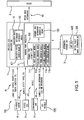
- Fig. 1 is a block diagram of a driving support system according to the present invention.
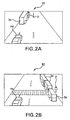
- Figs. 2A and 2B show images displayed on the display means wherein the vehicle is running straight.
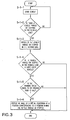
- Fig. 3 is a flow chart of a process for producing a virtual image as shown in Fig. 2A or 2B.
- Figs. 4A and 4B are diagrams showing images displayed on the display means wherein the vehicle is turning to the right.
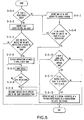
- Fig. 5 is a flow chart of a process for producing a virtual image as shown in Fig. 4A or 4B.
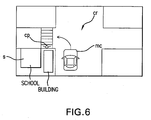
- Fig. 6 is a diagram showing an image displayed on the display means wherein the vehicle is turning to the left.
- Fig. 7 is a flow chart of a process for producing a virtual image as shown in Fig. 6.
- Fig. 8 is a diagram showing an image displayed on the display means wherein a vehicle is approaching an intersection.
- Fig. 9 is a flow chart of a process for producing a virtual image as shown in Fig. 8.
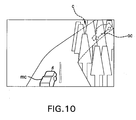
- Fig. 10 is a diagram showing an image displayed on the display means wherein the vehicle is approaching a corner.
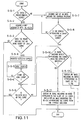
- Fig. 11 is a flow chart of a process for producing a virtual image as shown in Fig. 10.
- Fig. 12 is a diagram showing an image displayed on the display means wherein a vehicle is approaching a junction.
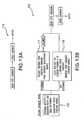
- Figs. 13(A) to 13(E) are flowcharts of processing associated with respective judgments.
- Fig. 14 is a block diagram of a driving support module that makes a judgment in terms of a blind spot.
- the driving support system 100 includes a navigation ECU (navigation electronic control unit) 1 having a navigation capability and a display unit 2 serving as display means for displaying information output from the navigation ECU 1.
- a navigation ECU navigation electronic control unit
- a display unit 2 serving as display means for displaying information output from the navigation ECU 1.
- the navigation ECU 1 is connected to an information storage unit 3 such that information can be exchanged between the information storage unit 3 and the navigation ECU 1.
- the navigation ECU 1 is also connected to an on-board camera 4 for taking an image of a scene ahead of a vehicle, a vehicle ECU 5 for controlling operating conditions of the vehicle mc in accordance with commands issued by a driver, a communication unit 6 for vehicle-to-vehicle communication and/or a road-to-vehicle communication (communication with a stationary station), and a current position detector 8 including a GPS receiver 7, such that the navigation ECU 1 can communicate with such units.
- the on-board camera 4 is installed at a position that allows it to take an image of a view that can be seen by the driver so that the image provides information representing the view seen by the driver.
- the units 3, 4, 5, 6, and 7 are used to acquire judgment information used to determine whether to issue a warning regarding driving operation, and thus form the judgment information acquisition means of the present invention.
- the navigation ECU 1 determines whether a warning should be given to the driver of the vehicle, depending on the status of the vehicle mc (that is, depending on the current position and the speed of the vehicle and/or depending on whether the vehicle is going to turn to the right or left), based on judgment information input to or stored in the navigation ECU 1. If it is determined that the warning should be given, the navigation ECU 1 generates virtual image information depending on the type of the warning and displays the virtual image information on the display unit 2.
- a head-up display is used as the display unit 2.
- a head-up display (HUD) unit typically includes a projector which projects a display onto a portion of the windshield.
- Another type of HUD projects a two-dimensional image onto the driver's eye on a see-through basis, using a holographic optical element, as described for example in U.S. 6,922,267.
- a virtual image such as that shown in Fig. 2, 4, 6, 8, or 10 is displayed on the head-up display 2 depending on the running condition of the vehicle mc, as will be described later.
- the display unit 2 used as the display means for the above purpose is not limited to a head-up display, but other types of displays such as a liquid crystal display or a meter panel display may also be used.
- the judgment information used in making judgments by the navigation ECU 1 is described below.
- a map database mDB is stored in the information storage unit 3 connected for data exchange with the navigation ECU 1.
- the map database mDB By accessing the map database mDB, it is possible to acquire information about intersections (crossings cr), pedestrian crossings, corners C, schools s, and the like located on a navigation route or close to the vehicle.
- intersections crossings cr
- pedestrian crossings corners C
- schools s schools s, and the like located on a navigation route or close to the vehicle.
- map information such information acquirable from the map database mDB is generically referred to as "map information”.
- "image information" output from the on-board camera 4 is captured by the navigation ECU 1.
- the navigation ECU 1 detects other vehicles present in an area covered by the image information and identifies the type or the status of the detected vehicles. For example, a determination is made to determine whether the other vehicle is a large-size vehicle bc and/or to determine whether the vehicle is parked or stopped or stopping. More specifically, in the image analysis, a determination is made as to the type/status of a vehicle is made such that the contour the vehicle is first detected, and a determination as to whether the vehicle is, for example, a large-size vehicle bc. A determination is also made as to the position of that vehicle relative to the position of the vehicle mc by detecting the position of the large-size vehicle bc relative to a white line drawn on a road or relative to the side edge of the road.
- Fig. 14 shows a construction of a driving support module 140 that detects a blind spot.
- Image information output from the on-board camera 4 is supplied to the driving support module 140.
- the driving support module 140 includes large-size vehicle recognition means 141, route recognition means 142, background recognition means 143, and blind spot judgment means 144.
- the blind spot judgment means 144 determines whether there is a blind spot that cannot be seen by the driver, based on information supplied from the large-size vehicle recognition means 141, the route recognition means 142, and the background recognition means 143. If the blind spot judgment means 144 determines that there is a blind spot caused by the presence of a large-size vehicle, blind spot information associated with the blind spot is supplied to output means 145 for output.
- the large-size vehicle recognition means 141 makes the judgment as to whether the vehicle is a large-size vehicle based on the edge-to-edge dimension of the vehicle on a horizontal line or a vertical line. Furthermore, the large-size vehicle recognition means 141 extracts a candidate for an image of a large-size vehicle, and compares, using a pattern recognition technique, the contour of the extracted candidate with an image of a large-size vehicle prestored in storage means. If there is good similarity, it is determined that the vehicle is of the large size.
- the route recognition means 142 makes a judgment as to the direction of a road by recognizing a white line drawn in the center of the route, and a step, a guard rail, and/or the like are detected based on side edges of the road whose direction is determined based on the direction of the white line. If there is a large-size vehicle parked or stopped on the road, the image of the side edge extending the same direction as the direction of the road is interrupted by the image of the large-size vehicle, and thus it is possible to distinguish the road from the large-size vehicle.
- the background recognition means 143 makes a judgment to distinguish the large-size vehicle and the road from the other parts of the background.
- the blind spot judgment means 144 determines that there is a blind spot behind the large-size vehicle.
- the driving support module 140 also has the capability of evaluating, using the blind spot judgment means 144, the visibility to the driver of the route ahead, based on the image of the road detected by the route recognition means 142.
- the blind spot judgment means 144 evaluates the visibility at an intersection cr or a corner C from locations, sizes, and/or other features of houses or buildings located close to the intersection cr or the corner C. More specifically, in the example shown in Fig. 8, the blind spot judgment means 144 determines whether the driver can see (have a clear view of) a road crossing the driver's route at an intersection. In the example shown in Fig. 10, the blind spot judgment means 144 determines whether the driver can see that portion of road extending ahead of the corner C.
- the visibility in the driver's field of the view is judged. More specifically, for example, when the image of the view includes a building, a tree, or the like that hides a portion of a road ahead in the image, the blind spot judgment means 144 determines that the visibility is poor. On the other hand, when there is no such building, tree or the like hiding a portion of a road ahead, e.g. The driver's route or a road intersecting same, the blind spot judgment means 144 determines that the visibility is good. The determination as to the visibility is included in the blind spot judgment.
- the driving support module 140 is disposed in first judgment means 111, second judgment means 112, fourth judgment means 114, or fifth judgment means 115, all of which are incorporated into the warning point judgment unit 110, thereby providing the capability of detecting a blind point caused by the presence of a large-size vehicle, judging the visibility at an intersection, and/or judging the visibility at a corner.
- the navigation ECU 1 is connected to the vehicle ECU 5 (the electric control unit that controls the running of the vehicle mc in accordance with commands issued by the driver) such that the navigation ECU 1 can acquire, from the vehicle ECU 5, information indicating activation of a right-turn or left-turn blinker of the vehicle mc and/or information indicating the running speed of the vehicle mc. This makes it possible for the navigation ECU 1 to determine from the supplied information whether the vehicle mc is going to turn to the left or right. Such information associated with the vehicle mc is referred to herein as "vehicle status information".
- the navigation ECU 1 is also connected to the communication unit 6 for vehicle-to-vehicle communication and/or station-to-vehicle communication to acquire information associated with other vehicles oc and/or roads.
- the current position detector 8 Based on information supplied by the GPS receiver 7 in the current position detector 8, it is possible to determine the location of the vehicle mc and also the "current time". That is, the current position detector 8 serves as vehicle position detection means.
- the navigation ECU 1 is a key component of the driving support system according to the present invention, and includes, as shown in Fig. 1, a navigation unit 10 for searching for a navigation route and displaying the determined navigation route and also includes a warning processor 11 for execution of a warning routine, which warning processor and routine are features of the present invention.
- the navigation unit 10 is an essential component of the on-board navigation apparatus which provides navigational guidance to a destination.
- the navigation unit 10 includes navigation route searching means 101 for searching for a navigation route to a destination and navigation image information generation means 102 that compares the navigation route supplied from the navigation route searching means 101 with information indicating the current location of the vehicle mc and/or direction information supplied from the current position detector 8, and that, based on the results of the comparison, generates image information necessary for navigation (navigational guidance to the destination, facilities en route to the destination, etc.).
- the navigation image information may be displayed as a highlighted navigation route on a map, with an arrow displayed to indicate the navigational direction, depending on the location of the vehicle on the navigation route.
- the driving support system 100 recognizes the navigation route to the destination and uses it in the process of determining whether or not to give a warning.
- the warning processor is a unit that automatically executes a driving support routine (warning process), which is a feature of the present invention, to give a warning to the driver in the form of a virtual image.
- the system 100 has the capability of giving five different types of warnings (the capability of performing first to fifth judgments).
- the warnings are not limited to these five types, rather, less than five of these types of warnings, any combination of these types, and/or other types of warnings may also be used.
- the first judgment is made by the first judgment means 111.
- a virtual image of a blind spot with pedestrian p therein is displayed, e.g. a blind spot hidden by a large-size vehicle bc present in the driver's field of view (Figs. 2A and 2B).
- the second judgment is made by the second judgment means 112.
- the warning is in the form of a virtual image of a motorcycle b in a blind spot hidden by a large-size vehicle bc present in the driver's field of view (Figs. 4A and 4B).
- the third judgment is made by the third judgment means 113.
- a likelihood alternatively, a possibility
- a virtual image of a pedestrian p is displayed (Fig. 6).
- the fourth judgment is made by the fourth judgment means 114.
- the warning is in the form of a display of a virtual image of the intersection and a traffic signal sg.
- a virtual image of another vehicle oc may also be displayed as shown in Fig. 8.
- the fifth judgment is made by the fifth judgment means 115.
- a virtual image of the corner C is displayed.
- a virtual image of the approaching vehicle oc is also displayed (Fig. 10).
- the warning processor 11 includes the warning point judgment unit 110 that makes the judgments described above and also includes warning image information generation means 120 that is arranged to operate at a stage following the warning point judgment unit 110 and that serves to generate virtual image information, depending on the type of warning to be given.
- the warning image information generation means 120 generates different virtual image information depending on the type of a warning determined to be given by the judgment means 111, 112, 113, 114, or 115, incorporated into the warning point judgment unit 110. For example, if the first judgment means 111 determines that a warning should be given, virtual image information (a virtual image of a pedestrian p behind a large-size vehicle bc) corresponding to the judgment is generated.
- virtual object image information is read from a database iDB stored in the information storage unit 3, and the virtual object image information is used in the generation of the virtual image information. More specifically, a pedestrian p is read responsive to a positive first or third judgment, and a motorcycle p is read responsive to a positive second judgment. A traffic signal sp and another vehicle oc are read responsive to a positive fourth judgment, and a corner shape C and another vehicle oc are read responsive to a positive fifth judgment.
- the generated virtual image information is converted to a display on the display unit 2. Details of Judgments
- Figs. 2 to 11 serve to illustrate the manner in which the respective judgments are made.
- Figs. 13A - 13E are flowcharts summarizing the judgment processes. With reference to these flowcharts, the respective judgment routines are described below. Note that in the following description associated with the flow charts, steps are denoted by symbols in the form of "S-numeral-numeral" where the first numeral indicates a judgment number assigned to each judgment routine, and the second numeral indicates the step number in each judgment routine.
- the first judgment is made repeatedly by the first judgment means 111 as the vehicle mc travels along the determined route ("navigational route"), as shown in Figs. 2A and 2B.
- the determined route (“navigational route")
- Figs. 2A and 2B there is a large-size vehicle bc parked or stopped at a location in the same lane as that in which the vehicle mc is traveling, and there is the possibility of a pedestrian p suddenly appearing from behind the large-size vehicle.
- Fig. 2A there is a large-size vehicle bc parked or stopped at a location in the same lane as that in which the vehicle mc is traveling, and there is the possibility of a pedestrian p suddenly appearing from behind the large-size vehicle.
- a virtual image of a pedestrian p is displayed, as a "virtual object" according to the present invention, on a virtual screen.
- the "blind spot judgment" and the “speed judgment” according to the present invention are made using image information supplied from the on-board camera 4 and from vehicle status information including information indicating the running speed of the vehicle.
- step S-1-1 the vehicle is running.
- step S-1-2 it is determined from an image taken by the on-board camera 4 whether or not, within a predetermined distance (for example, within a distance of 200 m) ahead of the vehicle mc, there is a vehicle c that is parked or stopped in the same lane as that in which the vehicle mc is traveling.
- a predetermined distance for example, within a distance of 200 m
- step S-1-3 image recognition is executed to recognize the vehicle c that is parked or stopped in the same lane as that in which the vehicle mc is traveling.
- step S-1-4 it is determined whether the vehicle c, which is parked or stopped, is a large-size vehicle bc, based on the results of the image recognition.
- large-size vehicle bc refers to a large vehicle such as a bus, a truck, or the like.
- step S-1-5 it is determined whether the vehicle ms is running straight at a speed equal to or greater than a predetermined speed (for example, 40 km/h).
- a predetermined speed for example, 40 km/h.
- step S-1-6 if it is determined that the vehicle c parked or stopped in the opposite lane is a large-size vehicle bc and if it is determined that the speed of the vehicle mc is equal to or greater than the threshold value (40 km/h), then image information is generated so as to include a virtual image of a pedestrian p or the like located in an area corresponding to a blind spot behind the large-size vehicle bc. Note that the determination as to whether such virtual image information should be generated and displayed is made so that such virtual image information is not unnecessarily generated and displayed. The virtual image may be displayed such that a blind spot is indicated by an enclosing frame or by display of a warning mark.
- a pedestrian p present in a blind area is detected by person-to-vehicle communication
- the second judgment is made by the second judgment means 112. This judgment is made, as shown in Figs. 4A and 4B, when the vehicle mc is to turn to the right at an intersection cr.
- a large-size vehicle bc is to turn to the right at the same intersection cr from an opposing lane, and there is the possibility that a motorcycle b or the like may suddenly appear from behind the large-size vehicle.
- a large-size vehicle bc is passing straight through an intersection cr and there exists the possibility that a motorcycle b or the like may suddenly appear from behind the large-size vehicle bc.
- a virtual image of the motorcycle b is displayed as a "virtual object" on the virtual screen.
- blind spot judgment and speed judgment are executed using image information supplied from the on-board camera 4 and vehicle status information including information indicating the running speed of the vehicle mc.
- the judgment routine is illustrated by the flowcharts shown in Figs. 5, and 13(A) - 13(E).
- the judgment routine is divided into two parts: the first part including steps S-2-1 to S-2-8 for a preliminary judgment; and the second part for a main judgment including steps following steps S-2-8.
- “blind spot judgment” and “speed judgment” are performed in a manner similar to the first judgment described above, to determine whether or not it is necessary to give a warning, depending on whether there is a blind spot and also depending on the detected speed of the vehicle mc.
- navigation route checking means 116 checks if a navigation route has been determined, and then the steps which follow are selectively executed, depending on the result of the check, i.e. by warning point candidate registration means 117 and warning point judgment means 118. More specifically, in the case in which a navigation route has been determined, the warning point candidate registration means 117 extracts points ("candidate warning points") having a high probability of need to give a warning, and registers in advance the extracted points so that it is sufficient to execute the following judgment routine only when the vehicle mc reaches one of the registered candidate warning points. On the other hand, when no navigation route has been determined, the warning point judgment means 118 is activated to determine whether the vehicle is in a situation which indicates a need for further execution of the main judgment routine.
- the determination as to whether a certain point is a candidate warning point is made, as shown in Figs. 4A and 4B, by judging whether the point is a right turn intersection cr.
- step S-2-1 the navigation route checking means 116 checks whether or not a navigation route has been determined.
- the warning point candidate registration means 117 executed the routine described above, and, in the following steps, the "blind point judgment" and the “speed judgment” are executed only at candidate warning points, in the manner described below.
- step S-2-2 navigation route information (a map) indicating a route to a destination is acquired.
- step S-2-3 it is determined, based on the acquired navigation route information, whether or not the navigation route information includes one or more intersections cr at which to make a right turn is to be made.
- step S-2-4 detected crossings cr at which a right turn is to be made are registered in advance as memorized points (particular points registered in memory).
- step S-2-5 the vehicle is running.
- step S-2-6 it is determined whether or not the vehicle mc has reached one of the registered intersections cr at which to make a right turn. If so, the following judgment routine is executed, but otherwise, driving of the vehicle without issuance of a warning is continued.
- the warning point judgment means 118 continues to monitor whether the vehicle has reached a point at which the "blind point judgment" and the "speed judgment” should be executed. Note that only when the warning point judgment means 118 determines that such judgments are needed, are the judgments executed.
- step S-2-7 when no navigation route has been determined, map information of an area around (in the vicinity of) the current location is acquired.
- step S-2-8 when the vehicle mc is approaching an intersection cr, a determination is made as to whether the vehicle is going to turn to the right at that intersection cr, based on the vehicle status information, specifically the status of blinkers and/or information indicating whether the vehicle mc is in a right-turn lane.
- step S-2-9 it is determined, using the on-board camera 4, whether there is a vehicle c approaching the intersection cr, at which the vehicle mc is going to make a right turn, from the opposite direction. Opposing lanes in sight are continuously monitored for the presence of such a vehicle.
- step S-2-10 image recognition is executed to determine whether there is a large-size vehicle bc in an opposing lane.
- step S-2-11 it is determined from the speed information whether the vehicle mc is going to turn to the right at a speed equal to or greater than a predetermined threshold value (for example, 40 km/h).
- a predetermined threshold value for example, 40 km/h.
- step S-2-12 if there is a large-size vehicle c in an opposing lane and the speed of the vehicle mc is equal to or greater than the threshold value (40 km/h), image information is generated which includes a virtual image of a motorcycle b or the like, located in an area corresponding to the blind spot behind the large-size vehicle bc. Note that the determination as to whether such virtual image information should be generated and displayed is made preliminarily so that virtual image information is not unnecessarily generated and displayed.
- the virtual image is displayed, as with the first judgment described earlier, such that the blind area is highlighted by being surrounded by a frame or by display of a warning mark or the like.
- a vehicle such as a motorcycle in the blind spot
- an image of the actual vehicle may displayed instead of the virtual image, or a warning indicating the actual presence of a vehicle in the blind spot may be given.
- the virtual image and an image indicating an actual vehicle or the like may be distinguished, for example, such that the virtual image is drawn by dotted lines but the image indicating the actual presence of a vehicle is drawn by solid lines, or the virtual image may be a blinking image, while the image indicating the actual presence of a vehicle is continuously displayed.
- the third judgment is made by the third judgment means 113. This judgment is made when the vehicle mc is to turn to the left at an intersection cr, as shown in Fig. 6.
- the vehicle mc is going to turn to the left at the intersection cr, and there is a pedestrian crossing extending across the road onto which the vehicle mc is going to turn. Furthermore, there is also a school s facing the road onto which the vehicle mc is going to turn. Thus the situation is that a pedestrian cp may suddenly walk into the road with the intention of crossing at the pedestrian crossing.
- a virtual image of a pedestrian cp is displayed as a virtual object according to the present invention on the virtual screen.
- the "event judgment", the “time judgment”, and the “speed judgment”, according to the present invention are executed using map information acquired from the map database mDB, time information indicating the current time, and the vehicle status information.
- FIG. 7 A flowchart of a routine for making these judgments is shown in Fig. 7.
- the main judgment routine comprising the following steps is executed.
- the preliminary judgment it is determined whether the vehicle mc has approached near an intersection cr at which a left turn is to be made.
- the main judgment routine as shown in Fig. 13(C), the "event judgment”, the “time judgment”, and the "speed judgment” are made in accordance with the present invention. If the results of these judgments indicate that a pedestrian cp may walk into a road onto which the vehicle mc is to turn, a virtual image of a pedestrian cp is displayed as a virtual object (Fig. 6).
- the preliminary judgment part of the routine is performed in a similar manner to the second judgment described above, except for the difference in the determination criterion, the navigation route checking means 116, the warning point candidate registration means 117, and the warning point judgment means 118.
- step S-3-1 the navigation route checking means 116 checks whether a navigation route has been determined.
- the warning point candidate registration means 117 executes the process described below.
- step S-3-2 navigation route information (a map) indicating a route to a destination is acquired.
- step S-3-3 it is determined, based on the acquired navigation route information, whether the navigation route information includes one or more intersections cr at which a left turn is to be made.
- step S-3-4 detected intersections cr at which a left turn is to be made are registered in advance as memorized points.
- step S-3-5 the vehicle is running.
- step S-3-6 it is determined whether the vehicle mc has reached one of the registered intersections cr at which to make a left turn. If so, the following judgment routine is executed, but otherwise, driving of the vehicle is continued uninterrupted.
- the warning point judgment means 118 executes the steps described below.
- step S-3-7 when no navigation route has been determined, map information for an area surrounding the current location is acquired.
- step S-3-8 when the vehicle mc is approaching an intersection cr, a determination is made as to whether the vehicle is going to turn to the left at the intersection cr, based on the vehicle status information, specifically the status of blinkers and/or information indicating whether the vehicle mc is in a left-turn lane.
- step S-3-9 it is determined, based on the map database mDB, whether there is a station or a school within a predetermined range (for example, 1 km) from the intersection cr.
- the event judgment means judges, based on map information, whether there is an event or factor of which the driver should be made aware.
- step S-3-10 it is determined from the GPS time information or vehicle time information whether the current time is within a predetermined time zone (for example, from 6:00 am to 10:00 am or from 16:00 pm to 20:00 pm).
- a predetermined time zone for example, from 6:00 am to 10:00 am or from 16:00 pm to 20:00 pm.
- step S-3-11 it is determined from the speed information whether the vehicle mc will turn to the left at a speed equal to or greater than a predetermined threshold value (for example, 40 km/h).
- a predetermined threshold value for example, 40 km/h.
- step S-3-12 if it is determined that the vehicle mc is to turn to the left at a speed equal to or greater than the predetermined threshold value (km/h) at an intersection cr and in a particular time zone, image information is generated which includes a virtual image of a pedestrian cp in or near the section of road onto which the vehicle mc is going to turn. Note that the preliminary determination as to whether such virtual image information should be generated and displayed is made so that virtual image information is not unnecessarily generated and displayed.
- a blind spot may be indicated by enclosing the blind spot by a frame or by displaying a warning mark.
- the actual presence of a vehicle present in a blind spot is detected by a vehicle-to-vehicle communication or a road-to-vehicle communication, it is desirable to display an image indicating the actual presence of a vehicle or to give a warning indicating that a vehicle is actually present in the blind spot, instead of displaying the virtual image.
- the virtual image and the image indicating the actual presence of a vehicle or the like may be distinguished, for example, by representing the virtual image with dotted lines, while indicating the actual presence of a vehicle with solid lines, or the virtual image may be a blinking image while the image indicating the actual presence of a vehicle is continuously displayed, as in the previous example.
- the fourth judgment is made by the fourth judgment means 114 when the vehicle mc is about to enter an intersection cr, to determine whether there is another vehicle oc also about to enter the same intersection cr, as shown in Fig. 8. This judgment is useful when the vehicle mc entering an intersection cr at which no traffic signal sg is installed, to warn the driver of the possibility that another vehicle oc is also about to enter the intersection cr.
- a virtual image of a traffic signal sg is displayed as a virtual object according to the present invention on the virtual screen.
- “visibility judgment” (which can be regarded as a type of blind spot judgment) and “event judgment” are executed according to the present invention, using image information supplied from the on-board camera 4, traffic information acquired by vehicle-vehicle communication, and vehicle status information indicating the current location and the speed of the vehicle mc.
- FIG. 9 A flowchart of a routine for making this fourth judgment is shown in Fig. 9.
- step S-4-1 the navigation route checking means 116 checks whether a navigation route has been determined.
- the warning point candidate registration means 117 then executes the steps described below.
- step S-4-2 navigation route information (a map) indicating a route to the destination is acquired.
- step S-4-3 it is determined, based on the acquired navigation route information, whether the navigation route information includes one or more intersections cr, without a traffic signal, to be crossed by the vehicle mc.
- step S-4-4 detected intersections cr located on the determined route and having no traffic signal are registered in advance as memorized points.
- step S-4-5 the vehicle is running.
- step S-4-6 it is determined whether the vehicle mc has reached one of the registered intersections cr having no traffic signal. If so, the following judgment routine is executed, but otherwise, driving of the vehicle is continued without issuance of any warning.
- the warning point judgment means 118 executes the steps described below.
- step S-4-7 when no navigation route has been determined, map information for an area surrounding the current location is acquired, and it is determined whether the vehicle mc is approaching an intersection cr having no traffic signal.
- step S-4-8 it is determined whether the vehicle mc has reached intersection. If so, the following judgment process is executed, but otherwise, the above-described steps are repeated.
- step S-4-9 it is determined whether there is good visibility at the intersection cr ahead of the vehicle mc, based on the image information output from the on-board camera 4. More specifically, the visibility can be evaluated, for example, by determining the presence of a physical object such as a house, or can be evaluated based on navigation information. Information indicating the visibility may be registered in advance for a memorized point.
- step S-4-11 a calculation is made to predict the arrival time of the vehicle oc, based on the location and the speed of the vehicle oc and the distance from the vehicle oc to the center of the intersection cr.
- step S-4-12 it is determined whether an on-coming vehicle oc will reach the intersection cr before the vehicle mc reaches the same intersection cr, based on the location and the speed of the vehicle mc and the distance from the vehicle mc to the center of the intersection cr.
- Means for making a judgment as to occurrence of an event of which the driver should be made aware is also referred to as event judgment means.
- step S-4-13 virtual image information is generated so as to include a virtual image of a traffic signal sg showing a red light, to thereby cause the driver to pay attention to the on-coming vehicle and to make it possible for the driver to reduce the speed or to stop the vehicle mc if necessary.
- step S-4-14 virtual image information is generated so as to include a virtual image of a traffic signal sg showing a green light, thereby informing the driver that the intersection cr should be passed through without stopping.
- a warning in an arbitrary form may be displayed, or an image of the vehicle oc may be displayed.
- the fifth judgment is made by the fifth judgment means 115 when the vehicle mc is approaching a corner C, as shown in Fig. 10.
- the vehicle mc is approaching a corner C at which the visibility is poor, thereby presenting a dangerous situation in which the poor visibility can hide another vehicle oc approaching the corner C from the opposite direction.
- a virtual image of the hidden portion of the corner C and a virtual image of the vehicle oc coming from the opposite direction are displayed as virtual objects on the virtual screen.
- the "visibility judgment” and the “event judgment” are made using the image information output from the on-board camera 4 and traffic information acquired by the vehicle-to-vehicle communication or the like.
- FIG. 11 A flowchart of a routine for making these judgments is shown in Fig. 11.
- step S-5-1 the navigation route checking means 116 checks whether a navigation route has been determined.
- the warning point candidate registration means 117 then executes the steps described below.
- step S-5-2 navigation route information (a map) indicating a route to the destination is acquired.
- step S-5-3 it is determined, based on the acquired navigation route information, whether the navigation route information includes one or more dangerous corners C, such as a sharp or long corner.
- the determination as to whether a corner is dangerous or not may be made by judging whether the corner satisfies a particular condition, such as the curvature of the corner, the length of the corner, and/or the number of successive corners. The degree of danger increases with the curvature of the corner, the length of the corner, and the number of successive corners.
- step S-5-4 detected dangerous corners C, such as sharp corners C or successive corners C, are registered in advance for memorized points.
- step S-5-5 the vehicle is running.
- step S-5-6 it is determined whether the vehicle mc has reached a dangerous corner C. If so, the following judgment routine is executed, but otherwise, driving of the vehicle is continued without issuance of a warning.
- the warning point candidate registration means 117 then executes the steps described below.
- step S-5-7 when no navigation route has been determined, map information for an area surrounding the current position is acquired.
- step S-5-8 it is determined whether or not the vehicle mc has reached a dangerous corner C. If so, the following judgment routine is executed, but otherwise, the above-described routine is repeated.
- step S-5-9 it is determined whether there is good visibility at the corner C ahead of the vehicle mc, based on the image information output from the on-board camera 4.
- the visibility can be evaluated, for example, by determining the presence of a physical object such as a house, or can be evaluated based on navigation information. Information indicating the visibility may be registered in advance for a memorized point.
- step S-5-10 if it is determined that the visibility is bad, then it is further determined whether there is another vehicle oc coming from the opposite direction, based on information obtained by vehicle-to-vehicle communication or by road-to-vehicle (or station-to-vehicle) communication. Also in this case, the event judgment means is used.
- step S-5-11 image information is generated which includes a virtual image of the vehicle oc coming from the opposite direction.
- step S-5-12 image information is generated which includes a virtual image of the corner C.
- the fourth judgment is performed, by way of example, in a situation in which the vehicle mc is going to cross through an intersection cr having no traffic signal sg.
- the fourth judgment may also be performed in a situation in which the vehicle mc is approaching a junction im having a traffic signal sg, as shown in Fig. 12.
- the presence of another vehicle oc approaching the junction im from another road, and furthermore the position (location) and the speed of the vehicle oc are detected from traffic information.
- the position and the speed of the vehicle mc are also detected, and a virtual image of a traffic signal, with a red or green light lit, is displayed depending on the predicted arrival times of the two vehicles at the junction.
- the driving support module is provided with judgment means for making a judgment as to the existence of a blind spot or as to the visibility and for outputting blind spot information indicating the result of such judgment.
- the output from this module can be used, not only to give a warning according to the present invention, but can also be supplied to the vehicle ECU, which may reduce the speed of the vehicle responsive thereto.
- the present invention provides a system that not only uses information for the purpose of enhancing driving safety, as does a driving support system such as a navigation apparatus, but that also has a capability of displaying information in a manner in which the information can be directly used by a driver in driving the vehicle, thereby further enhancing driving safety.
- the present invention also provides a driving support module for use in such a system, capable of detecting a blind spot that cannot be seen by a driver and thus can result in danger to the driver and vehicle.
Landscapes
- Physics & Mathematics (AREA)
- General Physics & Mathematics (AREA)
- Life Sciences & Earth Sciences (AREA)
- Atmospheric Sciences (AREA)
- Traffic Control Systems (AREA)
- Navigation (AREA)
Applications Claiming Priority (1)
| Application Number | Priority Date | Filing Date | Title |
|---|---|---|---|
| JP2004257368A JP2006072830A (ja) | 2004-09-03 | 2004-09-03 | 運転支援システム及び運転支援モジュール |
Publications (2)
| Publication Number | Publication Date |
|---|---|
| EP1632923A2 true EP1632923A2 (de) | 2006-03-08 |
| EP1632923A3 EP1632923A3 (de) | 2007-10-03 |
Family
ID=35448137
Family Applications (1)
| Application Number | Title | Priority Date | Filing Date |
|---|---|---|---|
| EP05018885A Withdrawn EP1632923A3 (de) | 2004-09-03 | 2005-08-31 | Fahrunterstützungssystem und -modul |
Country Status (3)
| Country | Link |
|---|---|
| US (1) | US7379813B2 (de) |
| EP (1) | EP1632923A3 (de) |
| JP (1) | JP2006072830A (de) |
Cited By (9)
| Publication number | Priority date | Publication date | Assignee | Title |
|---|---|---|---|---|
| WO2009122284A1 (en) * | 2008-03-31 | 2009-10-08 | Toyota Jidosha Kabushiki Kaisha | Intersection visibility determination device, vehicle with intersection visibility determination device, and method for determining intersection visibility |
| WO2012034834A1 (de) * | 2010-09-15 | 2012-03-22 | Continental Teves Ag & Co. Ohg | Visuelles fahrerinformations- und warnsystem für einen fahrer eines kraftfahrzeugs |
| WO2012076952A3 (en) * | 2010-12-08 | 2012-08-23 | Toyota Jidosha Kabushiki Kaisha | Vehicle information transmission device |
| CN101687509B (zh) * | 2007-03-08 | 2013-02-13 | 丰田自动车株式会社 | 具有盲区预测、道路探测和车辆间通信的周围环境估计装置 |
| EP2703873A3 (de) * | 2012-08-31 | 2014-06-11 | Samsung Electronics Co., Ltd | Informationen lieferndes Verfahren und Informationen lieferndes Fahrzeug dafür |
| JP2014203349A (ja) * | 2013-04-08 | 2014-10-27 | スズキ株式会社 | 車両運転支援装置 |
| WO2016177450A1 (de) * | 2015-05-04 | 2016-11-10 | Audi Ag | Einblenden eines objekts oder ereignisses in einer kraftfahrzeugumgebung |
| EP3057076A4 (de) * | 2013-10-11 | 2018-10-10 | Kabushiki Kaisha Toshiba | Vorrichtung zur erkennung geparkter fahrzeuge, fahrzeugverwaltungssystem und steuerungsverfahren |
| CN121191325A (zh) * | 2025-10-10 | 2025-12-23 | 四川超算云科技有限公司 | 交通安全监测预警方法及系统 |
Families Citing this family (103)
| Publication number | Priority date | Publication date | Assignee | Title |
|---|---|---|---|---|
| JP2006112962A (ja) * | 2004-10-15 | 2006-04-27 | Aisin Aw Co Ltd | 運転支援方法及び運転支援装置 |
| JP4610305B2 (ja) * | 2004-11-08 | 2011-01-12 | アルパイン株式会社 | 警報発生方法及び警報発生装置 |
| US8885045B2 (en) * | 2005-08-02 | 2014-11-11 | Nissan Motor Co., Ltd. | Device and method for monitoring vehicle surroundings |
| JP4353162B2 (ja) * | 2005-09-26 | 2009-10-28 | トヨタ自動車株式会社 | 車輌周囲情報表示装置 |
| JP4923647B2 (ja) * | 2006-03-17 | 2012-04-25 | 株式会社デンソー | 運転支援画像表示装置及びプログラム |
| JP4936755B2 (ja) * | 2006-03-20 | 2012-05-23 | 株式会社東芝 | 衝突防止装置 |
| JP4715579B2 (ja) * | 2006-03-23 | 2011-07-06 | 株式会社豊田中央研究所 | 潜在危険度推定装置 |
| JP5010850B2 (ja) * | 2006-04-28 | 2012-08-29 | クラリオン株式会社 | 車両搭載装置、警告方法及びプログラム |
| JP2007334449A (ja) * | 2006-06-12 | 2007-12-27 | Denso Corp | 車両運転支援システム |
| US20090128630A1 (en) * | 2006-07-06 | 2009-05-21 | Nissan Motor Co., Ltd. | Vehicle image display system and image display method |
| JP4254887B2 (ja) * | 2006-07-06 | 2009-04-15 | 日産自動車株式会社 | 車両用画像表示システム |
| JP2008046761A (ja) * | 2006-08-11 | 2008-02-28 | Sumitomo Electric Ind Ltd | 移動体画像処理システム、装置及び方法 |
| JP2008059178A (ja) * | 2006-08-30 | 2008-03-13 | Nippon Soken Inc | 運転支援装置およびプログラム |
| ATE459061T1 (de) * | 2006-11-21 | 2010-03-15 | Harman Becker Automotive Sys | Darstellung von videobildern einer fahrzeugumgebung |
| JP4286876B2 (ja) * | 2007-03-01 | 2009-07-01 | 富士通テン株式会社 | 画像表示制御装置 |
| JP2008250486A (ja) * | 2007-03-29 | 2008-10-16 | Nippon Soken Inc | 運転支援装置およびプログラム |
| JP4973347B2 (ja) * | 2007-07-11 | 2012-07-11 | 株式会社デンソー | 運転支援画像表示システム及び車載装置 |
| US7908060B2 (en) * | 2007-07-31 | 2011-03-15 | International Business Machines Corporation | Method and system for blind spot identification and warning utilizing portable and wearable devices |
| KR101405944B1 (ko) * | 2007-10-15 | 2014-06-12 | 엘지전자 주식회사 | 통신 기기 및 이것의 위치 정보 제공 방법 |
| WO2009084133A1 (ja) * | 2007-12-28 | 2009-07-09 | Mitsubishi Electric Corporation | ナビゲーション装置 |
| JP2009225322A (ja) * | 2008-03-18 | 2009-10-01 | Hyundai Motor Co Ltd | 車両用情報表示システム |
| WO2009141092A1 (de) * | 2008-05-21 | 2009-11-26 | Adc Automotive Distance Control Systems Gmbh | Fahrerassistenzsystem zur vermeidung von kollisionen eines fahrzeugs mit fussgängern |
| JP5345350B2 (ja) * | 2008-07-30 | 2013-11-20 | 富士重工業株式会社 | 車両の運転支援装置 |
| JP5027759B2 (ja) * | 2008-08-19 | 2012-09-19 | 本田技研工業株式会社 | 車両の視覚支援装置 |
| US8229663B2 (en) * | 2009-02-03 | 2012-07-24 | GM Global Technology Operations LLC | Combined vehicle-to-vehicle communication and object detection sensing |
| JP5426900B2 (ja) * | 2009-02-26 | 2014-02-26 | アルパイン株式会社 | 車載システム |
| US8981964B2 (en) * | 2009-03-11 | 2015-03-17 | Toyota Jidosha Kabushiki Kaisha | Driving supporting device |
| US8358224B2 (en) * | 2009-04-02 | 2013-01-22 | GM Global Technology Operations LLC | Point of interest location marking on full windshield head-up display |
| US20100253595A1 (en) * | 2009-04-02 | 2010-10-07 | Gm Global Technology Operations, Inc. | Virtual controls and displays by laser projection |
| US20100268466A1 (en) * | 2009-04-15 | 2010-10-21 | Velayutham Kadal Amutham | Anti-collision system for railways |
| JP4877364B2 (ja) | 2009-07-10 | 2012-02-15 | トヨタ自動車株式会社 | 物体検出装置 |
| US8559673B2 (en) * | 2010-01-22 | 2013-10-15 | Google Inc. | Traffic signal mapping and detection |
| MY156130A (en) | 2010-03-30 | 2016-01-15 | Ns Solutions Corp | Information processing apparatus, system, vacant space guidance method and program |
| JP5786288B2 (ja) * | 2010-07-12 | 2015-09-30 | 日産自動車株式会社 | 右折時走行支援装置、右折時走行支援方法 |
| JP5223014B2 (ja) * | 2010-07-30 | 2013-06-26 | 三洋電機株式会社 | 無線装置 |
| JP5454695B2 (ja) * | 2010-09-08 | 2014-03-26 | トヨタ自動車株式会社 | 危険度算出装置 |
| JP5703682B2 (ja) * | 2010-10-22 | 2015-04-22 | トヨタ自動車株式会社 | 危険度算出装置及び危険度算出方法 |
| WO2012131871A1 (ja) * | 2011-03-28 | 2012-10-04 | パイオニア株式会社 | 情報表示装置、制御方法、プログラム、及び記憶媒体 |
| WO2012169052A1 (ja) * | 2011-06-09 | 2012-12-13 | トヨタ自動車株式会社 | 他車両検出装置及び他車両検出方法 |
| WO2013021491A1 (ja) * | 2011-08-10 | 2013-02-14 | トヨタ自動車株式会社 | 運転支援装置 |
| CN103797529B (zh) * | 2011-09-12 | 2016-11-09 | 日产自动车株式会社 | 三维物体检测装置 |
| JP5849762B2 (ja) * | 2012-02-22 | 2016-02-03 | 日本電気株式会社 | 予測情報提示システム、予測情報提示装置、予測情報提示方法および予測情報提示プログラム |
| JP2013186723A (ja) * | 2012-03-08 | 2013-09-19 | Nissan Motor Co Ltd | 走行制御装置及び走行制御方法 |
| CN104620076B (zh) * | 2012-08-17 | 2017-05-17 | 本田技研工业株式会社 | 驾驶辅助装置 |
| US9514650B2 (en) * | 2013-03-13 | 2016-12-06 | Honda Motor Co., Ltd. | System and method for warning a driver of pedestrians and other obstacles when turning |
| US9164281B2 (en) | 2013-03-15 | 2015-10-20 | Honda Motor Co., Ltd. | Volumetric heads-up display with dynamic focal plane |
| US9064420B2 (en) * | 2013-03-14 | 2015-06-23 | Honda Motor Co., Ltd. | Augmented reality heads up display (HUD) for yield to pedestrian safety cues |
| US9251715B2 (en) | 2013-03-15 | 2016-02-02 | Honda Motor Co., Ltd. | Driver training system using heads-up display augmented reality graphics elements |
| US10215583B2 (en) | 2013-03-15 | 2019-02-26 | Honda Motor Co., Ltd. | Multi-level navigation monitoring and control |
| US9393870B2 (en) | 2013-03-15 | 2016-07-19 | Honda Motor Co., Ltd. | Volumetric heads-up display with dynamic focal plane |
| US10339711B2 (en) | 2013-03-15 | 2019-07-02 | Honda Motor Co., Ltd. | System and method for providing augmented reality based directions based on verbal and gestural cues |
| US9747898B2 (en) | 2013-03-15 | 2017-08-29 | Honda Motor Co., Ltd. | Interpretation of ambiguous vehicle instructions |
| US9378644B2 (en) | 2013-03-15 | 2016-06-28 | Honda Motor Co., Ltd. | System and method for warning a driver of a potential rear end collision |
| DE102013205393A1 (de) * | 2013-03-27 | 2014-10-02 | Bayerische Motoren Werke Aktiengesellschaft | Verknüpfen von Navigations- und Sicherheitshinweisen in einem Fahrzeug |
| BR112016000707B1 (pt) * | 2013-07-19 | 2022-05-24 | Nissan Motor Co., Ltd | Dispositivo de assistência de condução para veículo e método de assistência de condução para veículo |
| JP6429368B2 (ja) | 2013-08-02 | 2018-11-28 | 本田技研工業株式会社 | 歩車間通信システムおよび方法 |
| CN103456295B (zh) * | 2013-08-05 | 2016-05-18 | 科大讯飞股份有限公司 | 歌唱合成中基频参数生成方法及系统 |
| DE102013216994B4 (de) * | 2013-08-27 | 2025-11-06 | Robert Bosch Gmbh | Geschwindigkeitsassistent für ein Kraftfahrzeug |
| DE102014205014A1 (de) * | 2014-03-18 | 2015-09-24 | Ford Global Technologies, Llc | Verfahren und Vorrichtung zum Erfassen von bewegten Objekten in der Umgebung eines Fahrzeugs |
| JP6297138B2 (ja) * | 2014-04-02 | 2018-03-20 | 三菱電機株式会社 | 衝突防止支援装置、衝突防止支援システムおよび衝突防止支援方法 |
| US9475422B2 (en) * | 2014-05-22 | 2016-10-25 | Applied Invention, Llc | Communication between autonomous vehicle and external observers |
| KR20160001178A (ko) * | 2014-06-26 | 2016-01-06 | 엘지전자 주식회사 | 글래스 타입 단말기 및 이의 제어방법 |
| US9707960B2 (en) | 2014-07-31 | 2017-07-18 | Waymo Llc | Traffic signal response for autonomous vehicles |
| US20160063332A1 (en) * | 2014-08-27 | 2016-03-03 | Toyota Jidosha Kabushiki Kaisha | Communication of external sourced information to a driver |
| KR101596751B1 (ko) * | 2014-09-26 | 2016-02-23 | 현대자동차주식회사 | 운전자 맞춤형 사각 영역 표시 방법 및 장치 |
| US9649979B2 (en) | 2015-01-29 | 2017-05-16 | Toyota Motor Engineering & Manufacturing North America, Inc. | Autonomous vehicle operation in view-obstructed environments |
| US9588340B2 (en) | 2015-03-03 | 2017-03-07 | Honda Motor Co., Ltd. | Pedestrian intersection alert system and method thereof |
| EP3267680A4 (de) * | 2015-03-03 | 2018-10-03 | Hitachi Construction Machinery Co., Ltd. | Vorrichtung zur überwachung von fahrzeugumgebungen |
| US10373378B2 (en) | 2015-06-26 | 2019-08-06 | Paccar Inc | Augmented reality system for vehicle blind spot prevention |
| US9604639B2 (en) * | 2015-08-28 | 2017-03-28 | Delphi Technologies, Inc. | Pedestrian-intent-detection for automated vehicles |
| US10474964B2 (en) | 2016-01-26 | 2019-11-12 | Ford Global Technologies, Llc | Training algorithm for collision avoidance |
| US11242068B2 (en) * | 2016-05-30 | 2022-02-08 | Lg Electronics Inc. | Vehicle display device and vehicle |
| EP3298874B1 (de) * | 2016-09-22 | 2020-07-01 | Honda Research Institute Europe GmbH | Robotergartenarbeitsvorrichtung und verfahren zur steuerung davon |
| DE102016011414A1 (de) | 2016-09-22 | 2018-03-22 | Daimler Ag | Verfahren zum Warnen eines Fahrers eines Kraftfahrzeugs unter Berücksichtigung eines aktuellen Sichtbereichs des Fahrers, Recheneinrichtung sowie Erfassungsfahrzeug |
| US10089880B2 (en) * | 2016-11-08 | 2018-10-02 | International Business Machines Corporation | Warning driver of intent of others |
| JP6661796B2 (ja) * | 2017-01-06 | 2020-03-11 | 三菱電機株式会社 | 報知制御装置および報知制御方法 |
| WO2018132614A2 (en) * | 2017-01-12 | 2018-07-19 | Mobileye Vision Technologies Ltd. | Rules-based navigation |
| JP6497819B2 (ja) | 2017-03-10 | 2019-04-10 | 株式会社Subaru | 画像表示装置 |
| JP6429413B2 (ja) * | 2017-03-10 | 2018-11-28 | 株式会社Subaru | 画像表示装置 |
| JP6465317B2 (ja) | 2017-03-10 | 2019-02-06 | 株式会社Subaru | 画像表示装置 |
| JP6497818B2 (ja) | 2017-03-10 | 2019-04-10 | 株式会社Subaru | 画像表示装置 |
| JP6593803B2 (ja) | 2017-03-10 | 2019-10-23 | 株式会社Subaru | 画像表示装置 |
| JP6465318B2 (ja) | 2017-03-10 | 2019-02-06 | 株式会社Subaru | 画像表示装置 |
| JP6515125B2 (ja) | 2017-03-10 | 2019-05-15 | 株式会社Subaru | 画像表示装置 |
| JP6974792B2 (ja) * | 2017-07-24 | 2021-12-01 | 住友電気工業株式会社 | 信号システム、サーバ、信号表示方法 |
| US10755112B2 (en) | 2018-03-13 | 2020-08-25 | Toyota Research Institute, Inc. | Systems and methods for reducing data storage in machine learning |
| US11206375B2 (en) | 2018-03-28 | 2021-12-21 | Gal Zuckerman | Analyzing past events by utilizing imagery data captured by a plurality of on-road vehicles |
| US12110010B2 (en) * | 2018-04-13 | 2024-10-08 | Mitsubishi Electric Corporation | Driving assistance device |
| US11138418B2 (en) | 2018-08-06 | 2021-10-05 | Gal Zuckerman | Systems and methods for tracking persons by utilizing imagery data captured by on-road vehicles |
| US11866042B2 (en) | 2018-08-20 | 2024-01-09 | Indian Motorcycle International, LLC | Wheeled vehicle adaptive speed control method and system |
| CN112888623A (zh) | 2018-08-20 | 2021-06-01 | 印度摩托车国际有限公司 | 轮式车辆通知系统及方法 |
| US10580298B1 (en) * | 2018-09-11 | 2020-03-03 | Toyota Research Institute, Inc. | Self-driving infrastructure |
| CN109584596A (zh) * | 2018-12-20 | 2019-04-05 | 奇瑞汽车股份有限公司 | 车辆驾驶提示方法及装置 |
| TW202102392A (zh) * | 2019-07-02 | 2021-01-16 | 帷享科技股份有限公司 | 提高判斷精度及提早預警之行車安全輔助系統與方法 |
| JP2021018807A (ja) * | 2019-07-19 | 2021-02-15 | 株式会社デンソー | 制御装置 |
| DE102019210842A1 (de) * | 2019-07-22 | 2021-01-28 | Continental Automotive Gmbh | Abbiegeassistenzvorrichtung für ein Ego-Fahrzeug |
| CN111332317A (zh) * | 2020-02-17 | 2020-06-26 | 吉利汽车研究院(宁波)有限公司 | 一种基于增强现实技术的行车提醒方法、系统和装置 |
| DE102020206246A1 (de) | 2020-05-18 | 2021-11-18 | Ktm Ag | Reduzierung eines Kollisionsrisikos mit einem verdeckten Kraftfahrzeug |
| DE102020213515A1 (de) | 2020-10-28 | 2022-04-28 | Volkswagen Aktiengesellschaft | Verfahren zur Erzeugung einer Warnnachricht für einen Nutzer eines Kraftfahrzeugs mittels eines Assistenzsystems, sowie Assistenzsystem |
| US11955001B2 (en) * | 2021-09-27 | 2024-04-09 | GridMatrix, Inc. | Traffic near miss collision detection |
| WO2024116364A1 (ja) * | 2022-12-01 | 2024-06-06 | 株式会社Subaru | 運転支援装置、車両、コンピュータプログラムを記録した記録媒体及び運転支援方法 |
| DE102024205804A1 (de) * | 2024-06-21 | 2025-12-24 | Volkswagen Aktiengesellschaft | Kraftfahrzeug und Verfahren zur Darstellung von Umfeldobjekten und/oder Verkehrsteilnehmern |
| JP7690665B1 (ja) | 2024-08-23 | 2025-06-10 | ジオテクノロジーズ株式会社 | 情報処理方法、情報処理プログラム、情報処理装置、およびデータ構造 |
Citations (3)
| Publication number | Priority date | Publication date | Assignee | Title |
|---|---|---|---|---|
| JP2001141495A (ja) | 1999-11-10 | 2001-05-25 | Matsushita Electric Ind Co Ltd | ナビゲーション装置 |
| JP2004257368A (ja) | 2003-02-27 | 2004-09-16 | Fuji Heavy Ind Ltd | 車両の燃料カット制御装置 |
| US6922267B2 (en) | 2001-03-21 | 2005-07-26 | Minolta Co., Ltd. | Image display apparatus |
Family Cites Families (12)
| Publication number | Priority date | Publication date | Assignee | Title |
|---|---|---|---|---|
| JP3102250B2 (ja) * | 1994-02-14 | 2000-10-23 | 三菱自動車工業株式会社 | 車両用周囲情報表示装置 |
| US5907293A (en) * | 1996-05-30 | 1999-05-25 | Sun Microsystems, Inc. | System for displaying the characteristics, position, velocity and acceleration of nearby vehicles on a moving-map |
| US6853849B1 (en) * | 1996-05-30 | 2005-02-08 | Sun Microsystems, Inc. | Location/status-addressed radio/radiotelephone |
| KR20010112433A (ko) * | 1999-04-16 | 2001-12-20 | 마츠시타 덴끼 산교 가부시키가이샤 | 화상처리장치 및 감시시스템 |
| KR100349908B1 (ko) * | 1999-12-15 | 2002-08-22 | 삼성에스디아이 주식회사 | 각형 밀폐전지 |
| US6411898B2 (en) * | 2000-04-24 | 2002-06-25 | Matsushita Electric Industrial Co., Ltd. | Navigation device |
| JP3951559B2 (ja) * | 2000-06-05 | 2007-08-01 | マツダ株式会社 | 車両の表示装置 |
| JP2002240659A (ja) * | 2001-02-14 | 2002-08-28 | Nissan Motor Co Ltd | 車両周囲の状況を判断する装置 |
| DE10131720B4 (de) * | 2001-06-30 | 2017-02-23 | Robert Bosch Gmbh | Head-Up Display System und Verfahren |
| US6946978B2 (en) * | 2002-04-25 | 2005-09-20 | Donnelly Corporation | Imaging system for vehicle |
| US7068155B2 (en) * | 2004-07-14 | 2006-06-27 | General Motors Corporation | Apparatus and methods for near object detection |
| DE102004048347A1 (de) * | 2004-10-01 | 2006-04-20 | Daimlerchrysler Ag | Fahrassistenzvorrichtung zur gegenüber dem Sichtfeld des Fahrers eines Kraftfahrzeugs positionsrichtigen Darstellung des weiteren Straßenverlaufs auf einem Fahrzeugdisplay |
-
2004
- 2004-09-03 JP JP2004257368A patent/JP2006072830A/ja active Pending
-
2005
- 2005-08-31 EP EP05018885A patent/EP1632923A3/de not_active Withdrawn
- 2005-09-02 US US11/217,509 patent/US7379813B2/en not_active Expired - Fee Related
Patent Citations (3)
| Publication number | Priority date | Publication date | Assignee | Title |
|---|---|---|---|---|
| JP2001141495A (ja) | 1999-11-10 | 2001-05-25 | Matsushita Electric Ind Co Ltd | ナビゲーション装置 |
| US6922267B2 (en) | 2001-03-21 | 2005-07-26 | Minolta Co., Ltd. | Image display apparatus |
| JP2004257368A (ja) | 2003-02-27 | 2004-09-16 | Fuji Heavy Ind Ltd | 車両の燃料カット制御装置 |
Cited By (16)
| Publication number | Priority date | Publication date | Assignee | Title |
|---|---|---|---|---|
| CN101687509B (zh) * | 2007-03-08 | 2013-02-13 | 丰田自动车株式会社 | 具有盲区预测、道路探测和车辆间通信的周围环境估计装置 |
| US8451141B2 (en) | 2008-03-31 | 2013-05-28 | Toyota Jidosha Kabushiki Kaisha | Intersection visibility determination device, vehicle with intersection visibility determination device, and method for determining intersection visibility |
| WO2009122284A1 (en) * | 2008-03-31 | 2009-10-08 | Toyota Jidosha Kabushiki Kaisha | Intersection visibility determination device, vehicle with intersection visibility determination device, and method for determining intersection visibility |
| CN101978404B (zh) * | 2008-03-31 | 2014-02-05 | 丰田自动车株式会社 | 交叉口可见度确定设备、带有交叉口可见度确定设备的车辆,和用于确定交叉口可见度的方法 |
| US8994520B2 (en) | 2010-09-15 | 2015-03-31 | Continental Teves Ag & Co. Ohg | Visual driver information and warning system for a driver of a motor vehicle |
| WO2012034834A1 (de) * | 2010-09-15 | 2012-03-22 | Continental Teves Ag & Co. Ohg | Visuelles fahrerinformations- und warnsystem für einen fahrer eines kraftfahrzeugs |
| WO2012076952A3 (en) * | 2010-12-08 | 2012-08-23 | Toyota Jidosha Kabushiki Kaisha | Vehicle information transmission device |
| US9222636B2 (en) | 2010-12-08 | 2015-12-29 | Toyota Jidosha Kabushiki Kaisha | Vehicle information transmission device |
| EP2703873A3 (de) * | 2012-08-31 | 2014-06-11 | Samsung Electronics Co., Ltd | Informationen lieferndes Verfahren und Informationen lieferndes Fahrzeug dafür |
| US10002462B2 (en) | 2012-08-31 | 2018-06-19 | Samsung Electronics Co., Ltd. | Information providing method and information providing vehicle therefor |
| EP3413118A1 (de) * | 2012-08-31 | 2018-12-12 | Samsung Electronics Co., Ltd. | Informationsbereitstellungsverfahren und informationsbereitstellungsfahrzeug dafür |
| EP3588168A1 (de) * | 2012-08-31 | 2020-01-01 | Samsung Electronics Co., Ltd. | Informationsbereitstellungsverfahren und informationsbereitstellungsfahrzeug dafür |
| JP2014203349A (ja) * | 2013-04-08 | 2014-10-27 | スズキ株式会社 | 車両運転支援装置 |
| EP3057076A4 (de) * | 2013-10-11 | 2018-10-10 | Kabushiki Kaisha Toshiba | Vorrichtung zur erkennung geparkter fahrzeuge, fahrzeugverwaltungssystem und steuerungsverfahren |
| WO2016177450A1 (de) * | 2015-05-04 | 2016-11-10 | Audi Ag | Einblenden eines objekts oder ereignisses in einer kraftfahrzeugumgebung |
| CN121191325A (zh) * | 2025-10-10 | 2025-12-23 | 四川超算云科技有限公司 | 交通安全监测预警方法及系统 |
Also Published As
| Publication number | Publication date |
|---|---|
| JP2006072830A (ja) | 2006-03-16 |
| US20060055525A1 (en) | 2006-03-16 |
| EP1632923A3 (de) | 2007-10-03 |
| US7379813B2 (en) | 2008-05-27 |
Similar Documents
| Publication | Publication Date | Title |
|---|---|---|
| US7379813B2 (en) | Driving support system and driving support module | |
| JP4967015B2 (ja) | 安全運転支援装置 | |
| CN109334566B (zh) | 用于提供车外反馈的方法、装置、设备和存储介质 | |
| JP6635428B2 (ja) | 自動車周辺情報表示システム | |
| JP5198835B2 (ja) | ビデオ画像を提示する方法およびシステム | |
| CN114987460A (zh) | 用于车辆的盲区辅助的方法和设备 | |
| US20140107911A1 (en) | User interface method for terminal for vehicle and apparatus thereof | |
| US11042154B2 (en) | Transportation equipment and traveling control method therefor | |
| US20190244515A1 (en) | Augmented reality dsrc data visualization | |
| CN105612567A (zh) | 车辆用驾驶辅助装置以及车辆用驾驶辅助方法 | |
| JP2009031196A (ja) | 情報通知システム及びプログラム | |
| JP4311426B2 (ja) | 移動体を表示するための表示システム、車載装置及び表示方法 | |
| JP4247710B2 (ja) | 車両用情報提供装置 | |
| CN111601279A (zh) | 在车载显示器中显示动态交通态势的方法和车载系统 | |
| KR20200058613A (ko) | 관제시스템을 이용한 자율주행차량의 교차로 통과지원장치 및 방법 | |
| KR102353084B1 (ko) | 교차로 횡단보도 신호등 안전표시 전광판 | |
| JP7432198B2 (ja) | 状況認識推定システム及び運転支援システム | |
| JP2005125953A (ja) | 車載用物体認識システムおよびこれを用いた運転支援システム | |
| KR101405785B1 (ko) | 자동차 등급 부여 시스템 및 그 방법 | |
| CN115376329A (zh) | 一种行车障碍预警方法及系统 | |
| KR102628893B1 (ko) | 광 차단기를 이용한 도로횡단 안전시스템 | |
| JP2009075767A (ja) | 運転支援装置及び運転支援方法 | |
| CN117341695A (zh) | 辅助驾驶引导方法、增强现实设备及可读存储介质 | |
| EP3857530A1 (de) | Dsrc-datenansicht der erweiterten realität | |
| JP2020095659A (ja) | 車両の制御装置、制御システム、及び制御プログラム |
Legal Events
| Date | Code | Title | Description |
|---|---|---|---|
| PUAI | Public reference made under article 153(3) epc to a published international application that has entered the european phase |
Free format text: ORIGINAL CODE: 0009012 |
|
| AK | Designated contracting states |
Kind code of ref document: A2 Designated state(s): AT BE BG CH CY CZ DE DK EE ES FI FR GB GR HU IE IS IT LI LT LU LV MC NL PL PT RO SE SI SK TR |
|
| AX | Request for extension of the european patent |
Extension state: AL BA HR MK YU |
|
| PUAL | Search report despatched |
Free format text: ORIGINAL CODE: 0009013 |
|
| AK | Designated contracting states |
Kind code of ref document: A3 Designated state(s): AT BE BG CH CY CZ DE DK EE ES FI FR GB GR HU IE IS IT LI LT LU LV MC NL PL PT RO SE SI SK TR |
|
| AX | Request for extension of the european patent |
Extension state: AL BA HR MK YU |
|
| 17P | Request for examination filed |
Effective date: 20080326 |
|
| AKX | Designation fees paid |
Designated state(s): AT BE BG CH CY CZ DE DK EE ES FI FR GB GR HU IE IS IT LI LT LU LV MC NL PL PT RO SE SI SK TR |
|
| 17Q | First examination report despatched |
Effective date: 20090422 |
|
| STAA | Information on the status of an ep patent application or granted ep patent |
Free format text: STATUS: THE APPLICATION HAS BEEN WITHDRAWN |
|
| 18W | Application withdrawn |
Effective date: 20090811 |