EP1574477A2 - Verfahren zur Herstellung von Lithium-Metall-Verbindungen zur Verwendung als aktive Kathodenmaterialien - Google Patents
Verfahren zur Herstellung von Lithium-Metall-Verbindungen zur Verwendung als aktive Kathodenmaterialien Download PDFInfo
- Publication number
- EP1574477A2 EP1574477A2 EP05010853A EP05010853A EP1574477A2 EP 1574477 A2 EP1574477 A2 EP 1574477A2 EP 05010853 A EP05010853 A EP 05010853A EP 05010853 A EP05010853 A EP 05010853A EP 1574477 A2 EP1574477 A2 EP 1574477A2
- Authority
- EP
- European Patent Office
- Prior art keywords
- metal
- lithium
- phosphate
- compound
- reaction product
- Prior art date
- Legal status (The legal status is an assumption and is not a legal conclusion. Google has not performed a legal analysis and makes no representation as to the accuracy of the status listed.)
- Withdrawn
Links
- 238000000034 method Methods 0.000 title claims abstract description 124
- 229910052744 lithium Inorganic materials 0.000 title claims abstract description 109
- 239000006182 cathode active material Substances 0.000 title claims description 12
- 150000002736 metal compounds Chemical class 0.000 title abstract description 31
- 229910019142 PO4 Inorganic materials 0.000 claims abstract description 89
- 229910052751 metal Inorganic materials 0.000 claims abstract description 77
- 239000002184 metal Substances 0.000 claims abstract description 77
- 239000010452 phosphate Substances 0.000 claims abstract description 64
- 229910001463 metal phosphate Inorganic materials 0.000 claims abstract description 54
- -1 phosphate compound Chemical class 0.000 claims abstract description 54
- WHXSMMKQMYFTQS-UHFFFAOYSA-N Lithium Chemical compound [Li] WHXSMMKQMYFTQS-UHFFFAOYSA-N 0.000 claims abstract description 53
- 239000003638 chemical reducing agent Substances 0.000 claims abstract description 49
- 150000002642 lithium compounds Chemical class 0.000 claims abstract description 24
- 239000000203 mixture Substances 0.000 claims description 142
- PQXKHYXIUOZZFA-UHFFFAOYSA-M lithium fluoride Chemical compound [Li+].[F-] PQXKHYXIUOZZFA-UHFFFAOYSA-M 0.000 claims description 70
- 239000012298 atmosphere Substances 0.000 claims description 49
- 239000007795 chemical reaction product Substances 0.000 claims description 49
- 239000007858 starting material Substances 0.000 claims description 49
- 229910052723 transition metal Inorganic materials 0.000 claims description 49
- 150000003624 transition metals Chemical class 0.000 claims description 49
- 150000001875 compounds Chemical class 0.000 claims description 39
- GNTDGMZSJNCJKK-UHFFFAOYSA-N divanadium pentaoxide Chemical compound O=[V](=O)O[V](=O)=O GNTDGMZSJNCJKK-UHFFFAOYSA-N 0.000 claims description 39
- 238000010438 heat treatment Methods 0.000 claims description 38
- XKRFYHLGVUSROY-UHFFFAOYSA-N Argon Chemical compound [Ar] XKRFYHLGVUSROY-UHFFFAOYSA-N 0.000 claims description 36
- OKTJSMMVPCPJKN-UHFFFAOYSA-N Carbon Chemical compound [C] OKTJSMMVPCPJKN-UHFFFAOYSA-N 0.000 claims description 33
- NBIIXXVUZAFLBC-UHFFFAOYSA-K phosphate Chemical compound [O-]P([O-])([O-])=O NBIIXXVUZAFLBC-UHFFFAOYSA-K 0.000 claims description 31
- LFVGISIMTYGQHF-UHFFFAOYSA-N ammonium dihydrogen phosphate Chemical compound [NH4+].OP(O)([O-])=O LFVGISIMTYGQHF-UHFFFAOYSA-N 0.000 claims description 30
- DWYMPOCYEZONEA-UHFFFAOYSA-L fluoridophosphate Chemical compound [O-]P([O-])(F)=O DWYMPOCYEZONEA-UHFFFAOYSA-L 0.000 claims description 29
- XEEYBQQBJWHFJM-UHFFFAOYSA-N iron Substances [Fe] XEEYBQQBJWHFJM-UHFFFAOYSA-N 0.000 claims description 29
- 229910052799 carbon Inorganic materials 0.000 claims description 28
- 239000000470 constituent Substances 0.000 claims description 28
- 230000001590 oxidative effect Effects 0.000 claims description 28
- MNNHAPBLZZVQHP-UHFFFAOYSA-N diammonium hydrogen phosphate Chemical compound [NH4+].[NH4+].OP([O-])([O-])=O MNNHAPBLZZVQHP-UHFFFAOYSA-N 0.000 claims description 26
- 229910000388 diammonium phosphate Inorganic materials 0.000 claims description 26
- 238000004519 manufacturing process Methods 0.000 claims description 25
- UQSXHKLRYXJYBZ-UHFFFAOYSA-N Iron oxide Chemical compound [Fe]=O UQSXHKLRYXJYBZ-UHFFFAOYSA-N 0.000 claims description 24
- PXHVJJICTQNCMI-UHFFFAOYSA-N nickel Substances [Ni] PXHVJJICTQNCMI-UHFFFAOYSA-N 0.000 claims description 23
- 229910001319 LiVPO4F Inorganic materials 0.000 claims description 22
- 229910052802 copper Inorganic materials 0.000 claims description 22
- 239000010949 copper Substances 0.000 claims description 22
- 229910000387 ammonium dihydrogen phosphate Inorganic materials 0.000 claims description 20
- 229910052742 iron Inorganic materials 0.000 claims description 20
- 235000019837 monoammonium phosphate Nutrition 0.000 claims description 20
- 229910052759 nickel Inorganic materials 0.000 claims description 20
- 229910052720 vanadium Inorganic materials 0.000 claims description 20
- 235000019838 diammonium phosphate Nutrition 0.000 claims description 19
- 229910052786 argon Inorganic materials 0.000 claims description 18
- 229910052804 chromium Inorganic materials 0.000 claims description 18
- 239000011651 chromium Substances 0.000 claims description 18
- WBJZTOZJJYAKHQ-UHFFFAOYSA-K iron(3+) phosphate Chemical compound [Fe+3].[O-]P([O-])([O-])=O WBJZTOZJJYAKHQ-UHFFFAOYSA-K 0.000 claims description 18
- CURLTUGMZLYLDI-UHFFFAOYSA-N Carbon dioxide Chemical compound O=C=O CURLTUGMZLYLDI-UHFFFAOYSA-N 0.000 claims description 17
- 229910052748 manganese Inorganic materials 0.000 claims description 17
- 239000011572 manganese Substances 0.000 claims description 17
- 239000010936 titanium Substances 0.000 claims description 17
- 229910052719 titanium Inorganic materials 0.000 claims description 17
- GWEVSGVZZGPLCZ-UHFFFAOYSA-N Titan oxide Chemical compound O=[Ti]=O GWEVSGVZZGPLCZ-UHFFFAOYSA-N 0.000 claims description 16
- 238000002156 mixing Methods 0.000 claims description 16
- 229910052782 aluminium Inorganic materials 0.000 claims description 14
- 239000002245 particle Substances 0.000 claims description 13
- IJGRMHOSHXDMSA-UHFFFAOYSA-N Atomic nitrogen Chemical compound N#N IJGRMHOSHXDMSA-UHFFFAOYSA-N 0.000 claims description 12
- 229910002092 carbon dioxide Inorganic materials 0.000 claims description 12
- 229910012704 LiTiPO4F Inorganic materials 0.000 claims description 11
- 229910052793 cadmium Inorganic materials 0.000 claims description 10
- 229910052725 zinc Inorganic materials 0.000 claims description 10
- 229910011631 LiCrPO4F Inorganic materials 0.000 claims description 9
- 229910010722 LiFePO4F Inorganic materials 0.000 claims description 9
- 229910052788 barium Inorganic materials 0.000 claims description 9
- 229910052790 beryllium Inorganic materials 0.000 claims description 9
- 229910052791 calcium Inorganic materials 0.000 claims description 9
- 229910052745 lead Inorganic materials 0.000 claims description 9
- 229910052749 magnesium Inorganic materials 0.000 claims description 9
- 229910052712 strontium Inorganic materials 0.000 claims description 9
- 229910052718 tin Inorganic materials 0.000 claims description 9
- 229910052796 boron Inorganic materials 0.000 claims description 8
- 229910000151 chromium(III) phosphate Inorganic materials 0.000 claims description 8
- QRVIVVYHHBRVQU-UHFFFAOYSA-H [Li+].[V+5].[O-]P([O-])(F)=O.[O-]P([O-])(F)=O.[O-]P([O-])(F)=O Chemical compound [Li+].[V+5].[O-]P([O-])(F)=O.[O-]P([O-])(F)=O.[O-]P([O-])(F)=O QRVIVVYHHBRVQU-UHFFFAOYSA-H 0.000 claims description 7
- QVGXLLKOCUKJST-UHFFFAOYSA-N atomic oxygen Chemical compound [O] QVGXLLKOCUKJST-UHFFFAOYSA-N 0.000 claims description 7
- 229910000398 iron phosphate Inorganic materials 0.000 claims description 7
- 229910052760 oxygen Inorganic materials 0.000 claims description 7
- 239000001301 oxygen Substances 0.000 claims description 7
- 239000007789 gas Substances 0.000 claims description 6
- 229910052757 nitrogen Inorganic materials 0.000 claims description 6
- JUWGUJSXVOBPHP-UHFFFAOYSA-B titanium(4+);tetraphosphate Chemical compound [Ti+4].[Ti+4].[Ti+4].[O-]P([O-])([O-])=O.[O-]P([O-])([O-])=O.[O-]P([O-])([O-])=O.[O-]P([O-])([O-])=O JUWGUJSXVOBPHP-UHFFFAOYSA-B 0.000 claims description 6
- 239000011701 zinc Substances 0.000 claims description 6
- UGFAIRIUMAVXCW-UHFFFAOYSA-N Carbon monoxide Chemical compound [O+]#[C-] UGFAIRIUMAVXCW-UHFFFAOYSA-N 0.000 claims description 5
- 239000001569 carbon dioxide Substances 0.000 claims description 5
- 229910002091 carbon monoxide Inorganic materials 0.000 claims description 5
- IKZBVTPSNGOVRJ-UHFFFAOYSA-K chromium(iii) phosphate Chemical compound [Cr+3].[O-]P([O-])([O-])=O IKZBVTPSNGOVRJ-UHFFFAOYSA-K 0.000 claims description 5
- 238000001764 infiltration Methods 0.000 claims description 5
- 230000008595 infiltration Effects 0.000 claims description 5
- OGIDPMRJRNCKJF-UHFFFAOYSA-N titanium oxide Inorganic materials [Ti]=O OGIDPMRJRNCKJF-UHFFFAOYSA-N 0.000 claims description 5
- XUIMIQQOPSSXEZ-UHFFFAOYSA-N Silicon Chemical compound [Si] XUIMIQQOPSSXEZ-UHFFFAOYSA-N 0.000 claims description 4
- GLMOMDXKLRBTDY-UHFFFAOYSA-A [V+5].[V+5].[V+5].[O-]P([O-])([O-])=O.[O-]P([O-])([O-])=O.[O-]P([O-])([O-])=O.[O-]P([O-])([O-])=O.[O-]P([O-])([O-])=O Chemical compound [V+5].[V+5].[V+5].[O-]P([O-])([O-])=O.[O-]P([O-])([O-])=O.[O-]P([O-])([O-])=O.[O-]P([O-])([O-])=O.[O-]P([O-])([O-])=O GLMOMDXKLRBTDY-UHFFFAOYSA-A 0.000 claims description 4
- AMWRITDGCCNYAT-UHFFFAOYSA-L hydroxy(oxo)manganese;manganese Chemical compound [Mn].O[Mn]=O.O[Mn]=O AMWRITDGCCNYAT-UHFFFAOYSA-L 0.000 claims description 4
- 229910021645 metal ion Inorganic materials 0.000 claims description 4
- 229910052710 silicon Inorganic materials 0.000 claims description 4
- 239000010703 silicon Substances 0.000 claims description 4
- LIVNPJMFVYWSIS-UHFFFAOYSA-N silicon monoxide Chemical compound [Si-]#[O+] LIVNPJMFVYWSIS-UHFFFAOYSA-N 0.000 claims description 4
- 229910000314 transition metal oxide Inorganic materials 0.000 claims description 4
- 239000012002 vanadium phosphate Substances 0.000 claims description 4
- WGLPBDUCMAPZCE-UHFFFAOYSA-N Trioxochromium Chemical compound O=[Cr](=O)=O WGLPBDUCMAPZCE-UHFFFAOYSA-N 0.000 claims description 3
- 229910000423 chromium oxide Inorganic materials 0.000 claims description 3
- 229910052755 nonmetal Inorganic materials 0.000 claims description 3
- 229910014760 LiMnPO4F Inorganic materials 0.000 claims description 2
- PQKQEQXBMKUHEA-UHFFFAOYSA-L P(=O)([O-])([O-])F.[Ti+4].[Li+] Chemical compound P(=O)([O-])([O-])F.[Ti+4].[Li+] PQKQEQXBMKUHEA-UHFFFAOYSA-L 0.000 claims description 2
- RZYIPQOEBSGIGQ-UHFFFAOYSA-J [Li+].[Cr+3].[O-]P([O-])(F)=O.[O-]P([O-])(F)=O Chemical compound [Li+].[Cr+3].[O-]P([O-])(F)=O.[O-]P([O-])(F)=O RZYIPQOEBSGIGQ-UHFFFAOYSA-J 0.000 claims description 2
- FGSXRUYPQWMIRU-UHFFFAOYSA-L lithium fluoro-dioxido-oxo-lambda5-phosphane iron(2+) Chemical compound P(=O)([O-])([O-])F.[Fe+2].[Li+] FGSXRUYPQWMIRU-UHFFFAOYSA-L 0.000 claims description 2
- IEGXPSYBFYOQLC-UHFFFAOYSA-L lithium fluoro-dioxido-oxo-lambda5-phosphane manganese(2+) Chemical compound P(=O)([O-])([O-])F.[Mn+2].[Li+] IEGXPSYBFYOQLC-UHFFFAOYSA-L 0.000 claims description 2
- 230000002829 reductive effect Effects 0.000 claims description 2
- KRHYYFGTRYWZRS-UHFFFAOYSA-M Fluoride anion Chemical compound [F-] KRHYYFGTRYWZRS-UHFFFAOYSA-M 0.000 claims 4
- 229910021437 lithium-transition metal oxide Inorganic materials 0.000 claims 2
- CPSYWNLKRDURMG-UHFFFAOYSA-L hydron;manganese(2+);phosphate Chemical compound [Mn+2].OP([O-])([O-])=O CPSYWNLKRDURMG-UHFFFAOYSA-L 0.000 claims 1
- 229910001512 metal fluoride Inorganic materials 0.000 claims 1
- 229910001465 mixed metal phosphate Inorganic materials 0.000 claims 1
- 238000006243 chemical reaction Methods 0.000 abstract description 92
- 229910021450 lithium metal oxide Inorganic materials 0.000 abstract description 9
- 229910044991 metal oxide Inorganic materials 0.000 abstract description 6
- 150000004706 metal oxides Chemical class 0.000 abstract description 6
- 239000007769 metal material Substances 0.000 abstract 2
- 210000004027 cell Anatomy 0.000 description 69
- 239000000463 material Substances 0.000 description 68
- 239000008188 pellet Substances 0.000 description 63
- 235000021317 phosphate Nutrition 0.000 description 60
- 230000008569 process Effects 0.000 description 42
- 239000000843 powder Substances 0.000 description 33
- 230000015572 biosynthetic process Effects 0.000 description 31
- 239000000376 reactant Substances 0.000 description 28
- 238000005755 formation reaction Methods 0.000 description 27
- 239000000047 product Substances 0.000 description 25
- 238000002441 X-ray diffraction Methods 0.000 description 21
- 239000011149 active material Substances 0.000 description 20
- 150000003013 phosphoric acid derivatives Chemical class 0.000 description 20
- 239000002243 precursor Substances 0.000 description 19
- 239000003792 electrolyte Substances 0.000 description 18
- XGZVUEUWXADBQD-UHFFFAOYSA-L lithium carbonate Chemical compound [Li+].[Li+].[O-]C([O-])=O XGZVUEUWXADBQD-UHFFFAOYSA-L 0.000 description 18
- 229910052808 lithium carbonate Inorganic materials 0.000 description 18
- 238000001816 cooling Methods 0.000 description 14
- 238000003780 insertion Methods 0.000 description 14
- 230000037431 insertion Effects 0.000 description 13
- 239000011777 magnesium Substances 0.000 description 13
- 229910052493 LiFePO4 Inorganic materials 0.000 description 12
- 239000013078 crystal Substances 0.000 description 12
- 229910001416 lithium ion Inorganic materials 0.000 description 12
- KMTRUDSVKNLOMY-UHFFFAOYSA-N Ethylene carbonate Chemical compound O=C1OCCO1 KMTRUDSVKNLOMY-UHFFFAOYSA-N 0.000 description 11
- HBBGRARXTFLTSG-UHFFFAOYSA-N Lithium ion Chemical compound [Li+] HBBGRARXTFLTSG-UHFFFAOYSA-N 0.000 description 11
- VYPSYNLAJGMNEJ-UHFFFAOYSA-N Silicium dioxide Chemical compound O=[Si]=O VYPSYNLAJGMNEJ-UHFFFAOYSA-N 0.000 description 11
- 229920001577 copolymer Polymers 0.000 description 11
- 229910000399 iron(III) phosphate Inorganic materials 0.000 description 11
- 239000012528 membrane Substances 0.000 description 11
- NDLPOXTZKUMGOV-UHFFFAOYSA-N oxo(oxoferriooxy)iron hydrate Chemical compound O.O=[Fe]O[Fe]=O NDLPOXTZKUMGOV-UHFFFAOYSA-N 0.000 description 11
- 239000002904 solvent Substances 0.000 description 11
- 239000007787 solid Substances 0.000 description 10
- 150000004649 carbonic acid derivatives Chemical class 0.000 description 9
- 239000011236 particulate material Substances 0.000 description 9
- 238000002360 preparation method Methods 0.000 description 9
- 238000006722 reduction reaction Methods 0.000 description 9
- 229910010951 LiH2 Inorganic materials 0.000 description 8
- XAGFODPZIPBFFR-UHFFFAOYSA-N aluminium Chemical compound [Al] XAGFODPZIPBFFR-UHFFFAOYSA-N 0.000 description 8
- 238000000227 grinding Methods 0.000 description 8
- 239000001257 hydrogen Substances 0.000 description 8
- 229910052739 hydrogen Inorganic materials 0.000 description 8
- UFHFLCQGNIYNRP-UHFFFAOYSA-N Hydrogen Chemical compound [H][H] UFHFLCQGNIYNRP-UHFFFAOYSA-N 0.000 description 7
- 239000011230 binding agent Substances 0.000 description 7
- QDOXWKRWXJOMAK-UHFFFAOYSA-N dichromium trioxide Chemical compound O=[Cr]O[Cr]=O QDOXWKRWXJOMAK-UHFFFAOYSA-N 0.000 description 7
- SNKMVYBWZDHJHE-UHFFFAOYSA-M lithium;dihydrogen phosphate Chemical compound [Li+].OP(O)([O-])=O SNKMVYBWZDHJHE-UHFFFAOYSA-M 0.000 description 7
- 239000011159 matrix material Substances 0.000 description 7
- 230000009467 reduction Effects 0.000 description 7
- 239000004408 titanium dioxide Substances 0.000 description 7
- 229910000319 transition metal phosphate Inorganic materials 0.000 description 7
- 239000010406 cathode material Substances 0.000 description 6
- IEJIGPNLZYLLBP-UHFFFAOYSA-N dimethyl carbonate Chemical compound COC(=O)OC IEJIGPNLZYLLBP-UHFFFAOYSA-N 0.000 description 6
- 239000007772 electrode material Substances 0.000 description 6
- 238000000605 extraction Methods 0.000 description 6
- 239000012467 final product Substances 0.000 description 6
- GELKBWJHTRAYNV-UHFFFAOYSA-K lithium iron phosphate Chemical compound [Li+].[Fe+2].[O-]P([O-])([O-])=O GELKBWJHTRAYNV-UHFFFAOYSA-K 0.000 description 6
- 229910000686 lithium vanadium oxide Inorganic materials 0.000 description 6
- 150000002739 metals Chemical class 0.000 description 6
- 239000004014 plasticizer Substances 0.000 description 6
- 238000003303 reheating Methods 0.000 description 6
- 150000003839 salts Chemical class 0.000 description 6
- 238000012360 testing method Methods 0.000 description 6
- BQCIDUSAKPWEOX-UHFFFAOYSA-N 1,1-Difluoroethene Chemical compound FC(F)=C BQCIDUSAKPWEOX-UHFFFAOYSA-N 0.000 description 5
- RYGMFSIKBFXOCR-UHFFFAOYSA-N Copper Chemical compound [Cu] RYGMFSIKBFXOCR-UHFFFAOYSA-N 0.000 description 5
- 229910002097 Lithium manganese(III,IV) oxide Inorganic materials 0.000 description 5
- 229910010318 TiPO4 Inorganic materials 0.000 description 5
- 238000013459 approach Methods 0.000 description 5
- 238000007630 basic procedure Methods 0.000 description 5
- 229910002804 graphite Inorganic materials 0.000 description 5
- 239000010439 graphite Substances 0.000 description 5
- 230000003647 oxidation Effects 0.000 description 5
- 238000007254 oxidation reaction Methods 0.000 description 5
- 230000005855 radiation Effects 0.000 description 5
- 229910052814 silicon oxide Inorganic materials 0.000 description 5
- 229920006370 Kynar Polymers 0.000 description 4
- 229910032387 LiCoO2 Inorganic materials 0.000 description 4
- 229910003005 LiNiO2 Inorganic materials 0.000 description 4
- 229910001290 LiPF6 Inorganic materials 0.000 description 4
- PNEYBMLMFCGWSK-UHFFFAOYSA-N aluminium oxide Inorganic materials [O-2].[O-2].[O-2].[Al+3].[Al+3] PNEYBMLMFCGWSK-UHFFFAOYSA-N 0.000 description 4
- 230000001351 cycling effect Effects 0.000 description 4
- 239000011888 foil Substances 0.000 description 4
- 238000002844 melting Methods 0.000 description 4
- 230000008018 melting Effects 0.000 description 4
- 239000011541 reaction mixture Substances 0.000 description 4
- 239000000243 solution Substances 0.000 description 4
- 238000003786 synthesis reaction Methods 0.000 description 4
- OIFBSDVPJOWBCH-UHFFFAOYSA-N Diethyl carbonate Chemical compound CCOC(=O)OCC OIFBSDVPJOWBCH-UHFFFAOYSA-N 0.000 description 3
- 229910013311 LiMPO4F Inorganic materials 0.000 description 3
- OKKJLVBELUTLKV-UHFFFAOYSA-N Methanol Chemical compound OC OKKJLVBELUTLKV-UHFFFAOYSA-N 0.000 description 3
- 229910019205 PO4F Inorganic materials 0.000 description 3
- RTAQQCXQSZGOHL-UHFFFAOYSA-N Titanium Chemical compound [Ti] RTAQQCXQSZGOHL-UHFFFAOYSA-N 0.000 description 3
- 229910000147 aluminium phosphate Inorganic materials 0.000 description 3
- 230000008901 benefit Effects 0.000 description 3
- 239000006229 carbon black Substances 0.000 description 3
- 150000004770 chalcogenides Chemical class 0.000 description 3
- 229910017052 cobalt Inorganic materials 0.000 description 3
- 239000010941 cobalt Substances 0.000 description 3
- GUTLYIVDDKVIGB-UHFFFAOYSA-N cobalt atom Chemical compound [Co] GUTLYIVDDKVIGB-UHFFFAOYSA-N 0.000 description 3
- 229910052593 corundum Inorganic materials 0.000 description 3
- VUPKGFBOKBGHFZ-UHFFFAOYSA-N dipropyl carbonate Chemical compound CCCOC(=O)OCCC VUPKGFBOKBGHFZ-UHFFFAOYSA-N 0.000 description 3
- JBTWLSYIZRCDFO-UHFFFAOYSA-N ethyl methyl carbonate Chemical compound CCOC(=O)OC JBTWLSYIZRCDFO-UHFFFAOYSA-N 0.000 description 3
- 238000005562 fading Methods 0.000 description 3
- 150000002222 fluorine compounds Chemical class 0.000 description 3
- 239000011261 inert gas Substances 0.000 description 3
- 238000003475 lamination Methods 0.000 description 3
- VTHJTEIRLNZDEV-UHFFFAOYSA-L magnesium dihydroxide Chemical compound [OH-].[OH-].[Mg+2] VTHJTEIRLNZDEV-UHFFFAOYSA-L 0.000 description 3
- 239000000347 magnesium hydroxide Substances 0.000 description 3
- 229910001862 magnesium hydroxide Inorganic materials 0.000 description 3
- 239000010450 olivine Substances 0.000 description 3
- 229910052609 olivine Inorganic materials 0.000 description 3
- 239000007774 positive electrode material Substances 0.000 description 3
- RUOJZAUFBMNUDX-UHFFFAOYSA-N propylene carbonate Chemical compound CC1COC(=O)O1 RUOJZAUFBMNUDX-UHFFFAOYSA-N 0.000 description 3
- GPPXJZIENCGNKB-UHFFFAOYSA-N vanadium Chemical compound [V]#[V] GPPXJZIENCGNKB-UHFFFAOYSA-N 0.000 description 3
- 229910001845 yogo sapphire Inorganic materials 0.000 description 3
- ODINCKMPIJJUCX-UHFFFAOYSA-N Calcium oxide Chemical compound [Ca]=O ODINCKMPIJJUCX-UHFFFAOYSA-N 0.000 description 2
- VYZAMTAEIAYCRO-UHFFFAOYSA-N Chromium Chemical compound [Cr] VYZAMTAEIAYCRO-UHFFFAOYSA-N 0.000 description 2
- QPLDLSVMHZLSFG-UHFFFAOYSA-N Copper oxide Chemical compound [Cu]=O QPLDLSVMHZLSFG-UHFFFAOYSA-N 0.000 description 2
- RTZKZFJDLAIYFH-UHFFFAOYSA-N Diethyl ether Chemical compound CCOCC RTZKZFJDLAIYFH-UHFFFAOYSA-N 0.000 description 2
- NIQCNGHVCWTJSM-UHFFFAOYSA-N Dimethyl phthalate Chemical compound COC(=O)C1=CC=CC=C1C(=O)OC NIQCNGHVCWTJSM-UHFFFAOYSA-N 0.000 description 2
- YCKRFDGAMUMZLT-UHFFFAOYSA-N Fluorine atom Chemical compound [F] YCKRFDGAMUMZLT-UHFFFAOYSA-N 0.000 description 2
- 229910005052 Li1−xM1−yMIyPO4F Inorganic materials 0.000 description 2
- CPLXHLVBOLITMK-UHFFFAOYSA-N Magnesium oxide Chemical compound [Mg]=O CPLXHLVBOLITMK-UHFFFAOYSA-N 0.000 description 2
- RLTFLELMPUMVEH-UHFFFAOYSA-N [Li+].[O--].[O--].[O--].[V+5] Chemical compound [Li+].[O--].[O--].[O--].[V+5] RLTFLELMPUMVEH-UHFFFAOYSA-N 0.000 description 2
- YWJVFBOUPMWANA-UHFFFAOYSA-H [Li+].[V+5].[O-]P([O-])([O-])=O.[O-]P([O-])([O-])=O Chemical compound [Li+].[V+5].[O-]P([O-])([O-])=O.[O-]P([O-])([O-])=O YWJVFBOUPMWANA-UHFFFAOYSA-H 0.000 description 2
- XHCLAFWTIXFWPH-UHFFFAOYSA-N [O-2].[O-2].[O-2].[O-2].[O-2].[V+5].[V+5] Chemical compound [O-2].[O-2].[O-2].[O-2].[O-2].[V+5].[V+5] XHCLAFWTIXFWPH-UHFFFAOYSA-N 0.000 description 2
- WNROFYMDJYEPJX-UHFFFAOYSA-K aluminium hydroxide Chemical compound [OH-].[OH-].[OH-].[Al+3] WNROFYMDJYEPJX-UHFFFAOYSA-K 0.000 description 2
- 229910021502 aluminium hydroxide Inorganic materials 0.000 description 2
- LDDQLRUQCUTJBB-UHFFFAOYSA-N ammonium fluoride Chemical compound [NH4+].[F-] LDDQLRUQCUTJBB-UHFFFAOYSA-N 0.000 description 2
- 239000012300 argon atmosphere Substances 0.000 description 2
- 238000009835 boiling Methods 0.000 description 2
- 238000005266 casting Methods 0.000 description 2
- 238000012512 characterization method Methods 0.000 description 2
- IAQWMWUKBQPOIY-UHFFFAOYSA-N chromium(4+);oxygen(2-) Chemical compound [O-2].[O-2].[Cr+4] IAQWMWUKBQPOIY-UHFFFAOYSA-N 0.000 description 2
- AYTAKQFHWFYBMA-UHFFFAOYSA-N chromium(IV) oxide Inorganic materials O=[Cr]=O AYTAKQFHWFYBMA-UHFFFAOYSA-N 0.000 description 2
- 239000011248 coating agent Substances 0.000 description 2
- 238000000576 coating method Methods 0.000 description 2
- 239000004020 conductor Substances 0.000 description 2
- DOIRQSBPFJWKBE-UHFFFAOYSA-N dibutyl phthalate Chemical compound CCCCOC(=O)C1=CC=CC=C1C(=O)OCCCC DOIRQSBPFJWKBE-UHFFFAOYSA-N 0.000 description 2
- FLKPEMZONWLCSK-UHFFFAOYSA-N diethyl phthalate Chemical compound CCOC(=O)C1=CC=CC=C1C(=O)OCC FLKPEMZONWLCSK-UHFFFAOYSA-N 0.000 description 2
- 239000006185 dispersion Substances 0.000 description 2
- SZVJSHCCFOBDDC-UHFFFAOYSA-N ferrosoferric oxide Chemical compound O=[Fe]O[Fe]O[Fe]=O SZVJSHCCFOBDDC-UHFFFAOYSA-N 0.000 description 2
- 239000011737 fluorine Substances 0.000 description 2
- 229910052731 fluorine Inorganic materials 0.000 description 2
- 229910021485 fumed silica Inorganic materials 0.000 description 2
- 229910001679 gibbsite Inorganic materials 0.000 description 2
- 238000005469 granulation Methods 0.000 description 2
- 230000003179 granulation Effects 0.000 description 2
- 239000000543 intermediate Substances 0.000 description 2
- 229910000765 intermetallic Inorganic materials 0.000 description 2
- 229910000155 iron(II) phosphate Inorganic materials 0.000 description 2
- 230000000670 limiting effect Effects 0.000 description 2
- 239000011244 liquid electrolyte Substances 0.000 description 2
- JVLRGEATDIWSHH-UHFFFAOYSA-K lithium;magnesium;iron(2+);phosphate Chemical compound [Li+].[Mg+2].[Fe+2].[O-]P([O-])([O-])=O JVLRGEATDIWSHH-UHFFFAOYSA-K 0.000 description 2
- NUJOXMJBOLGQSY-UHFFFAOYSA-N manganese dioxide Chemical compound O=[Mn]=O NUJOXMJBOLGQSY-UHFFFAOYSA-N 0.000 description 2
- WPBNNNQJVZRUHP-UHFFFAOYSA-L manganese(2+);methyl n-[[2-(methoxycarbonylcarbamothioylamino)phenyl]carbamothioyl]carbamate;n-[2-(sulfidocarbothioylamino)ethyl]carbamodithioate Chemical compound [Mn+2].[S-]C(=S)NCCNC([S-])=S.COC(=O)NC(=S)NC1=CC=CC=C1NC(=S)NC(=O)OC WPBNNNQJVZRUHP-UHFFFAOYSA-L 0.000 description 2
- 229910000158 manganese(II) phosphate Inorganic materials 0.000 description 2
- 229910052752 metalloid Inorganic materials 0.000 description 2
- 150000002738 metalloids Chemical class 0.000 description 2
- 239000007773 negative electrode material Substances 0.000 description 2
- 229940085991 phosphate ion Drugs 0.000 description 2
- 238000011160 research Methods 0.000 description 2
- 238000000926 separation method Methods 0.000 description 2
- 239000000377 silicon dioxide Substances 0.000 description 2
- 241000894007 species Species 0.000 description 2
- 238000004611 spectroscopical analysis Methods 0.000 description 2
- 239000003832 thermite Substances 0.000 description 2
- XOLBLPGZBRYERU-UHFFFAOYSA-N tin dioxide Chemical compound O=[Sn]=O XOLBLPGZBRYERU-UHFFFAOYSA-N 0.000 description 2
- 150000003623 transition metal compounds Chemical class 0.000 description 2
- 229910001935 vanadium oxide Inorganic materials 0.000 description 2
- 229910000165 zinc phosphate Inorganic materials 0.000 description 2
- AFINAILKDBCXMX-PBHICJAKSA-N (2s,3r)-2-amino-3-hydroxy-n-(4-octylphenyl)butanamide Chemical compound CCCCCCCCC1=CC=C(NC(=O)[C@@H](N)[C@@H](C)O)C=C1 AFINAILKDBCXMX-PBHICJAKSA-N 0.000 description 1
- ZZXUZKXVROWEIF-UHFFFAOYSA-N 1,2-butylene carbonate Chemical compound CCC1COC(=O)O1 ZZXUZKXVROWEIF-UHFFFAOYSA-N 0.000 description 1
- TVAJJUOMNRUGQA-UHFFFAOYSA-N 2-butoxyethyl dihydrogen phosphate Chemical compound CCCCOCCOP(O)(O)=O TVAJJUOMNRUGQA-UHFFFAOYSA-N 0.000 description 1
- DDFHBQSCUXNBSA-UHFFFAOYSA-N 5-(5-carboxythiophen-2-yl)thiophene-2-carboxylic acid Chemical compound S1C(C(=O)O)=CC=C1C1=CC=C(C(O)=O)S1 DDFHBQSCUXNBSA-UHFFFAOYSA-N 0.000 description 1
- ZOXJGFHDIHLPTG-UHFFFAOYSA-N Boron Chemical compound [B] ZOXJGFHDIHLPTG-UHFFFAOYSA-N 0.000 description 1
- 229910019965 CrPO4+2NH3+3/2H2O Inorganic materials 0.000 description 1
- 239000012692 Fe precursor Substances 0.000 description 1
- 229910005061 Li1−xMPO4F Inorganic materials 0.000 description 1
- 229910001045 Li1−xVPO4F Inorganic materials 0.000 description 1
- 229910001367 Li3V2(PO4)3 Inorganic materials 0.000 description 1
- 229910011869 LiFe0.9Mg0.1PO4 Inorganic materials 0.000 description 1
- 229910001305 LiMPO4 Inorganic materials 0.000 description 1
- 229910012769 LiV0.9Al0.1PO4F Inorganic materials 0.000 description 1
- 229910012985 LiVO3 Inorganic materials 0.000 description 1
- FYYHWMGAXLPEAU-UHFFFAOYSA-N Magnesium Chemical compound [Mg] FYYHWMGAXLPEAU-UHFFFAOYSA-N 0.000 description 1
- 229910003206 NH4VO3 Inorganic materials 0.000 description 1
- MYFLOHPVNQHIRI-UHFFFAOYSA-L P(=O)([O-])([O-])F.[Al+3].[V+5].[Li+] Chemical compound P(=O)([O-])([O-])F.[Al+3].[V+5].[Li+] MYFLOHPVNQHIRI-UHFFFAOYSA-L 0.000 description 1
- 229920003171 Poly (ethylene oxide) Polymers 0.000 description 1
- NINIDFKCEFEMDL-UHFFFAOYSA-N Sulfur Chemical compound [S] NINIDFKCEFEMDL-UHFFFAOYSA-N 0.000 description 1
- 229910009973 Ti2O3 Inorganic materials 0.000 description 1
- 239000007983 Tris buffer Substances 0.000 description 1
- KLARSDUHONHPRF-UHFFFAOYSA-N [Li].[Mn] Chemical class [Li].[Mn] KLARSDUHONHPRF-UHFFFAOYSA-N 0.000 description 1
- 229910016948 aMIbPO4F Inorganic materials 0.000 description 1
- 238000010521 absorption reaction Methods 0.000 description 1
- 239000003513 alkali Substances 0.000 description 1
- ILRRQNADMUWWFW-UHFFFAOYSA-K aluminium phosphate Chemical compound O1[Al]2OP1(=O)O2 ILRRQNADMUWWFW-UHFFFAOYSA-K 0.000 description 1
- ZRIUUUJAJJNDSS-UHFFFAOYSA-N ammonium phosphates Chemical compound [NH4+].[NH4+].[NH4+].[O-]P([O-])([O-])=O ZRIUUUJAJJNDSS-UHFFFAOYSA-N 0.000 description 1
- 230000003466 anti-cipated effect Effects 0.000 description 1
- 239000007864 aqueous solution Substances 0.000 description 1
- 229910052785 arsenic Inorganic materials 0.000 description 1
- RQNWIZPPADIBDY-UHFFFAOYSA-N arsenic atom Chemical compound [As] RQNWIZPPADIBDY-UHFFFAOYSA-N 0.000 description 1
- RQPZNWPYLFFXCP-UHFFFAOYSA-L barium dihydroxide Chemical compound [OH-].[OH-].[Ba+2] RQPZNWPYLFFXCP-UHFFFAOYSA-L 0.000 description 1
- 239000006227 byproduct Substances 0.000 description 1
- AXCZMVOFGPJBDE-UHFFFAOYSA-L calcium dihydroxide Chemical compound [OH-].[OH-].[Ca+2] AXCZMVOFGPJBDE-UHFFFAOYSA-L 0.000 description 1
- 239000000920 calcium hydroxide Substances 0.000 description 1
- 229910001861 calcium hydroxide Inorganic materials 0.000 description 1
- 239000000292 calcium oxide Substances 0.000 description 1
- 210000003850 cellular structure Anatomy 0.000 description 1
- 239000003795 chemical substances by application Substances 0.000 description 1
- 229940090961 chromium dioxide Drugs 0.000 description 1
- 229910052681 coesite Inorganic materials 0.000 description 1
- 239000000571 coke Substances 0.000 description 1
- 238000004891 communication Methods 0.000 description 1
- 238000005056 compaction Methods 0.000 description 1
- 238000010276 construction Methods 0.000 description 1
- 229910052906 cristobalite Inorganic materials 0.000 description 1
- 230000000593 degrading effect Effects 0.000 description 1
- 239000003085 diluting agent Substances 0.000 description 1
- FBSAITBEAPNWJG-UHFFFAOYSA-N dimethyl phthalate Natural products CC(=O)OC1=CC=CC=C1OC(C)=O FBSAITBEAPNWJG-UHFFFAOYSA-N 0.000 description 1
- 229960001826 dimethylphthalate Drugs 0.000 description 1
- 230000003292 diminished effect Effects 0.000 description 1
- 239000011263 electroactive material Substances 0.000 description 1
- 238000003487 electrochemical reaction Methods 0.000 description 1
- 239000008151 electrolyte solution Substances 0.000 description 1
- 150000002148 esters Chemical class 0.000 description 1
- 238000002474 experimental method Methods 0.000 description 1
- 238000009472 formulation Methods 0.000 description 1
- 239000008187 granular material Substances 0.000 description 1
- 230000005283 ground state Effects 0.000 description 1
- BHEPBYXIRTUNPN-UHFFFAOYSA-N hydridophosphorus(.) (triplet) Chemical compound [PH] BHEPBYXIRTUNPN-UHFFFAOYSA-N 0.000 description 1
- 150000002431 hydrogen Chemical class 0.000 description 1
- 150000004679 hydroxides Chemical class 0.000 description 1
- 238000010348 incorporation Methods 0.000 description 1
- 239000011256 inorganic filler Substances 0.000 description 1
- 229910003475 inorganic filler Inorganic materials 0.000 description 1
- 230000003993 interaction Effects 0.000 description 1
- 230000037427 ion transport Effects 0.000 description 1
- 150000002500 ions Chemical class 0.000 description 1
- 150000002506 iron compounds Chemical class 0.000 description 1
- 230000002427 irreversible effect Effects 0.000 description 1
- 150000002596 lactones Chemical class 0.000 description 1
- YADSGOSSYOOKMP-UHFFFAOYSA-N lead dioxide Inorganic materials O=[Pb]=O YADSGOSSYOOKMP-UHFFFAOYSA-N 0.000 description 1
- YEXPOXQUZXUXJW-UHFFFAOYSA-N lead(II) oxide Inorganic materials [Pb]=O YEXPOXQUZXUXJW-UHFFFAOYSA-N 0.000 description 1
- RSNHXDVSISOZOB-UHFFFAOYSA-N lithium nickel Chemical class [Li].[Ni] RSNHXDVSISOZOB-UHFFFAOYSA-N 0.000 description 1
- 208000020442 loss of weight Diseases 0.000 description 1
- 239000000395 magnesium oxide Substances 0.000 description 1
- GEYXPJBPASPPLI-UHFFFAOYSA-N manganese(III) oxide Inorganic materials O=[Mn]O[Mn]=O GEYXPJBPASPPLI-UHFFFAOYSA-N 0.000 description 1
- 239000011812 mixed powder Substances 0.000 description 1
- 229910052758 niobium Inorganic materials 0.000 description 1
- 239000010955 niobium Substances 0.000 description 1
- 150000002894 organic compounds Chemical class 0.000 description 1
- 239000003960 organic solvent Substances 0.000 description 1
- 239000007800 oxidant agent Substances 0.000 description 1
- 230000036961 partial effect Effects 0.000 description 1
- 238000005453 pelletization Methods 0.000 description 1
- 229920000642 polymer Polymers 0.000 description 1
- 229920002981 polyvinylidene fluoride Polymers 0.000 description 1
- 238000003825 pressing Methods 0.000 description 1
- 230000001737 promoting effect Effects 0.000 description 1
- 230000001681 protective effect Effects 0.000 description 1
- 238000010791 quenching Methods 0.000 description 1
- 230000035484 reaction time Effects 0.000 description 1
- 230000000717 retained effect Effects 0.000 description 1
- 235000012239 silicon dioxide Nutrition 0.000 description 1
- 239000007784 solid electrolyte Substances 0.000 description 1
- 239000011343 solid material Substances 0.000 description 1
- 239000012265 solid product Substances 0.000 description 1
- 229910052682 stishovite Inorganic materials 0.000 description 1
- 238000006467 substitution reaction Methods 0.000 description 1
- HXJUTPCZVOIRIF-UHFFFAOYSA-N sulfolane Chemical class O=S1(=O)CCCC1 HXJUTPCZVOIRIF-UHFFFAOYSA-N 0.000 description 1
- 150000003462 sulfoxides Chemical class 0.000 description 1
- 229910052717 sulfur Inorganic materials 0.000 description 1
- 239000011593 sulfur Substances 0.000 description 1
- 238000001308 synthesis method Methods 0.000 description 1
- 238000010189 synthetic method Methods 0.000 description 1
- QHGNHLZPVBIIPX-UHFFFAOYSA-N tin(II) oxide Inorganic materials [Sn]=O QHGNHLZPVBIIPX-UHFFFAOYSA-N 0.000 description 1
- GQUJEMVIKWQAEH-UHFFFAOYSA-N titanium(III) oxide Chemical compound O=[Ti]O[Ti]=O GQUJEMVIKWQAEH-UHFFFAOYSA-N 0.000 description 1
- 230000007704 transition Effects 0.000 description 1
- 229910052905 tridymite Inorganic materials 0.000 description 1
- LSGOVYNHVSXFFJ-UHFFFAOYSA-N vanadate(3-) Chemical compound [O-][V]([O-])([O-])=O LSGOVYNHVSXFFJ-UHFFFAOYSA-N 0.000 description 1
- GRUMUEUJTSXQOI-UHFFFAOYSA-N vanadium dioxide Chemical compound O=[V]=O GRUMUEUJTSXQOI-UHFFFAOYSA-N 0.000 description 1
- 239000002699 waste material Substances 0.000 description 1
- 208000016261 weight loss Diseases 0.000 description 1
- 230000004580 weight loss Effects 0.000 description 1
Images



Classifications
-
- H—ELECTRICITY
- H01—ELECTRIC ELEMENTS
- H01M—PROCESSES OR MEANS, e.g. BATTERIES, FOR THE DIRECT CONVERSION OF CHEMICAL ENERGY INTO ELECTRICAL ENERGY
- H01M10/00—Secondary cells; Manufacture thereof
- H01M10/05—Accumulators with non-aqueous electrolyte
- H01M10/052—Li-accumulators
-
- C—CHEMISTRY; METALLURGY
- C01—INORGANIC CHEMISTRY
- C01B—NON-METALLIC ELEMENTS; COMPOUNDS THEREOF; METALLOIDS OR COMPOUNDS THEREOF NOT COVERED BY SUBCLASS C01C
- C01B25/00—Phosphorus; Compounds thereof
-
- C—CHEMISTRY; METALLURGY
- C01—INORGANIC CHEMISTRY
- C01B—NON-METALLIC ELEMENTS; COMPOUNDS THEREOF; METALLOIDS OR COMPOUNDS THEREOF NOT COVERED BY SUBCLASS C01C
- C01B25/00—Phosphorus; Compounds thereof
- C01B25/16—Oxyacids of phosphorus; Salts thereof
- C01B25/26—Phosphates
- C01B25/45—Phosphates containing plural metal, or metal and ammonium
-
- C—CHEMISTRY; METALLURGY
- C01—INORGANIC CHEMISTRY
- C01B—NON-METALLIC ELEMENTS; COMPOUNDS THEREOF; METALLOIDS OR COMPOUNDS THEREOF NOT COVERED BY SUBCLASS C01C
- C01B25/00—Phosphorus; Compounds thereof
- C01B25/16—Oxyacids of phosphorus; Salts thereof
- C01B25/26—Phosphates
- C01B25/455—Phosphates containing halogen
-
- C—CHEMISTRY; METALLURGY
- C01—INORGANIC CHEMISTRY
- C01G—COMPOUNDS CONTAINING METALS NOT COVERED BY SUBCLASSES C01D OR C01F
- C01G31/00—Compounds of vanadium
- C01G31/006—Compounds containing vanadium, with or without oxygen or hydrogen, and containing two or more other elements
-
- C—CHEMISTRY; METALLURGY
- C01—INORGANIC CHEMISTRY
- C01G—COMPOUNDS CONTAINING METALS NOT COVERED BY SUBCLASSES C01D OR C01F
- C01G37/00—Compounds of chromium
- C01G37/006—Compounds containing chromium, with or without oxygen or hydrogen, and containing two or more other elements
-
- C—CHEMISTRY; METALLURGY
- C01—INORGANIC CHEMISTRY
- C01G—COMPOUNDS CONTAINING METALS NOT COVERED BY SUBCLASSES C01D OR C01F
- C01G49/00—Compounds of iron
- C01G49/009—Compounds containing iron, with or without oxygen or hydrogen, and containing two or more other elements
-
- H—ELECTRICITY
- H01—ELECTRIC ELEMENTS
- H01M—PROCESSES OR MEANS, e.g. BATTERIES, FOR THE DIRECT CONVERSION OF CHEMICAL ENERGY INTO ELECTRICAL ENERGY
- H01M4/00—Electrodes
- H01M4/02—Electrodes composed of, or comprising, active material
- H01M4/36—Selection of substances as active materials, active masses, active liquids
- H01M4/48—Selection of substances as active materials, active masses, active liquids of inorganic oxides or hydroxides
- H01M4/485—Selection of substances as active materials, active masses, active liquids of inorganic oxides or hydroxides of mixed oxides or hydroxides for inserting or intercalating light metals, e.g. LiTi2O4 or LiTi2OxFy
-
- H—ELECTRICITY
- H01—ELECTRIC ELEMENTS
- H01M—PROCESSES OR MEANS, e.g. BATTERIES, FOR THE DIRECT CONVERSION OF CHEMICAL ENERGY INTO ELECTRICAL ENERGY
- H01M4/00—Electrodes
- H01M4/02—Electrodes composed of, or comprising, active material
- H01M4/36—Selection of substances as active materials, active masses, active liquids
- H01M4/48—Selection of substances as active materials, active masses, active liquids of inorganic oxides or hydroxides
- H01M4/50—Selection of substances as active materials, active masses, active liquids of inorganic oxides or hydroxides of manganese
- H01M4/505—Selection of substances as active materials, active masses, active liquids of inorganic oxides or hydroxides of manganese of mixed oxides or hydroxides containing manganese for inserting or intercalating light metals, e.g. LiMn2O4 or LiMn2OxFy
-
- H—ELECTRICITY
- H01—ELECTRIC ELEMENTS
- H01M—PROCESSES OR MEANS, e.g. BATTERIES, FOR THE DIRECT CONVERSION OF CHEMICAL ENERGY INTO ELECTRICAL ENERGY
- H01M4/00—Electrodes
- H01M4/02—Electrodes composed of, or comprising, active material
- H01M4/36—Selection of substances as active materials, active masses, active liquids
- H01M4/48—Selection of substances as active materials, active masses, active liquids of inorganic oxides or hydroxides
- H01M4/52—Selection of substances as active materials, active masses, active liquids of inorganic oxides or hydroxides of nickel, cobalt or iron
- H01M4/525—Selection of substances as active materials, active masses, active liquids of inorganic oxides or hydroxides of nickel, cobalt or iron of mixed oxides or hydroxides containing iron, cobalt or nickel for inserting or intercalating light metals, e.g. LiNiO2, LiCoO2 or LiCoOxFy
-
- H—ELECTRICITY
- H01—ELECTRIC ELEMENTS
- H01M—PROCESSES OR MEANS, e.g. BATTERIES, FOR THE DIRECT CONVERSION OF CHEMICAL ENERGY INTO ELECTRICAL ENERGY
- H01M4/00—Electrodes
- H01M4/02—Electrodes composed of, or comprising, active material
- H01M4/36—Selection of substances as active materials, active masses, active liquids
- H01M4/58—Selection of substances as active materials, active masses, active liquids of inorganic compounds other than oxides or hydroxides, e.g. sulfides, selenides, tellurides, halogenides or LiCoFy; of polyanionic structures, e.g. phosphates, silicates or borates
- H01M4/5825—Oxygenated metallic salts or polyanionic structures, e.g. borates, phosphates, silicates, olivines
-
- C—CHEMISTRY; METALLURGY
- C01—INORGANIC CHEMISTRY
- C01P—INDEXING SCHEME RELATING TO STRUCTURAL AND PHYSICAL ASPECTS OF SOLID INORGANIC COMPOUNDS
- C01P2002/00—Crystal-structural characteristics
- C01P2002/70—Crystal-structural characteristics defined by measured X-ray, neutron or electron diffraction data
- C01P2002/72—Crystal-structural characteristics defined by measured X-ray, neutron or electron diffraction data by d-values or two theta-values, e.g. as X-ray diagram
-
- C—CHEMISTRY; METALLURGY
- C01—INORGANIC CHEMISTRY
- C01P—INDEXING SCHEME RELATING TO STRUCTURAL AND PHYSICAL ASPECTS OF SOLID INORGANIC COMPOUNDS
- C01P2006/00—Physical properties of inorganic compounds
- C01P2006/40—Electric properties
-
- H—ELECTRICITY
- H01—ELECTRIC ELEMENTS
- H01M—PROCESSES OR MEANS, e.g. BATTERIES, FOR THE DIRECT CONVERSION OF CHEMICAL ENERGY INTO ELECTRICAL ENERGY
- H01M4/00—Electrodes
- H01M4/02—Electrodes composed of, or comprising, active material
- H01M2004/026—Electrodes composed of, or comprising, active material characterised by the polarity
- H01M2004/028—Positive electrodes
-
- H—ELECTRICITY
- H01—ELECTRIC ELEMENTS
- H01M—PROCESSES OR MEANS, e.g. BATTERIES, FOR THE DIRECT CONVERSION OF CHEMICAL ENERGY INTO ELECTRICAL ENERGY
- H01M4/00—Electrodes
- H01M4/02—Electrodes composed of, or comprising, active material
-
- Y—GENERAL TAGGING OF NEW TECHNOLOGICAL DEVELOPMENTS; GENERAL TAGGING OF CROSS-SECTIONAL TECHNOLOGIES SPANNING OVER SEVERAL SECTIONS OF THE IPC; TECHNICAL SUBJECTS COVERED BY FORMER USPC CROSS-REFERENCE ART COLLECTIONS [XRACs] AND DIGESTS
- Y02—TECHNOLOGIES OR APPLICATIONS FOR MITIGATION OR ADAPTATION AGAINST CLIMATE CHANGE
- Y02E—REDUCTION OF GREENHOUSE GAS [GHG] EMISSIONS, RELATED TO ENERGY GENERATION, TRANSMISSION OR DISTRIBUTION
- Y02E60/00—Enabling technologies; Technologies with a potential or indirect contribution to GHG emissions mitigation
- Y02E60/10—Energy storage using batteries
Definitions
- This invention relates to methods for producing electrode active materials which can be used to formulate electrodes for use in electrochemical cells in batteries. More particularly, the present invention relates to methods for the production of electrode active lithium metal phosphate materials. Even more particularly, the present invention relates to methods whereby electrode active materials having unique triclinic or olivine crystalline structures can be produced.
- Lithium batteries have become a useful and desirable energy source in recent years.
- lithium batteries are prepared from one or more lithium electrochemical cells containing electrochemically active (electroactive) materials.
- Such cells typically include an anode (negative electrode), a cathode (positive electrode), and an electrolyte interposed between spaced apart positive and negative electrodes.
- Batteries with anodes of metallic lithium and containing metal chalcogenide cathode active material have received acceptance in industry and commerce.
- the negative electrode of the cell is defined as the anode.
- Cells having a metallic lithium anode and metal chalcogenide cathode are charged in an initial condition.
- lithium ions from the metallic anode pass through a liquid electrolyte to the electrochemically active (electroactive) material of the cathode whereupon they release electrical energy to an external circuit.
- lithium metal anode with an insertion anode, such as a lithium metal chalcogenide, lithium metal oxide, coke or graphite.
- a lithium metal chalcogenide lithium metal oxide
- coke or graphite lithium metal oxide
- These types of electrodes are typically used with lithium-containing insertion cathodes to form an electroactive couple in a cell.
- the resulting cells are not charged in an initial condition. Before this type of cell can be used to deliver electrochemical energy, it must be charged. In the charging operation, lithium is transferred from the lithium-containing cathode to the anode. During discharge the lithium is transferred from the anode back to the cathode. During a subsequent recharge, the lithium is transferred back to the anode where it reinserts.
- Preferred positive electrode active materials generally include LiCoO 2 , LiMn 2 O 4 , and LiNiO 2 . These materials are synthesized by a variety of synthesis modes which can generally be classified as "wet method synthesis". Methods of making lithium compounds are described in U.S. Patent Nos. 5,135,732 by Barbus, et al. and 4,246,253 by Hunter, and involve the formation of aqueous solutions as intermediate steps. Lithium compounds containing cobalt are relatively expensive to synthesize due to the intermediates required, while successful synthesis of lithium-nickel compounds is relatively complex and difficult. Lithium-manganese compounds, such as LiMn 2 O 4 , are generally more economical to synthesize than the preceding material and result in a relatively economical positive electrode.
- This invention provides a method of making lithium metal phosphate compounds suitable for use as active materials in electrodes.
- the various materials utilized are in particulate form and include at least one metal compound and at least one phosphate compound. These materials are present as solid particulate materials and are admixed in the presence of a reducing agent at a suitable reaction temperature in an appropriate non-oxidizing environment.
- the particulate metal, particulate phosphate and reducing agent remain in contact with one another for an interval and at a temperature sufficient to form a particulate metal phosphate reaction product.
- the resulting metal phosphate reaction product characteristically contains a metal ion derived from the particulate metal compound and a phosphate ion derived from the particulate phosphate compound.
- the resulting metal phosphate reaction product is reacted with a source of lithium ions in a manner sufficient to form a lithium metal phosphate reaction product.
- novel methods of making lithium-metal-fluorophosphate materials are provided; new materials which, upon electrochemical interaction, release lithium ions, and are capable of reversibly cycling lithium ions.
- Such materials can be employed in various ways, including but not limited to, use in a rechargeable lithium battery which comprises an electrolyte; a first electrode having a compatible active material; and a second electrode comprising the novel lithium-metal-fluorophosphate materials.
- Lithium-metal-fluorophosphate materials produced by the process of the present invention can be represented by the nominal general formula LiM 1-y MI y PO 4 F where 0 ⁇ y ⁇ 1.
- Such compounds are also represented by Li 1-x MPO 4 F and Li 1-x M 1-y MI y PO 4 F, where in an initial condition, "x" is essentially zero; and during cycling a quantity of "x" lithium is released where 0 ⁇ x ⁇ 1.
- M has more than one oxidation state in the lithium metal fluorophosphate compound, and more than one oxidation state above the ground state M 0 .
- oxidation state and valence state are used in the art interchangeably.
- the method of making lithium metal phosphate materials of the present invention utilizes precursor materials in particulate or powder form.
- the terms powder, particle, and particulate are used interchangeably herein.
- Particulate starting materials include a phosphate compound, at least one metal compound, in intimate admixture with one another and in intimate contact with a reducing agent.
- the reducing agent optionally, can be a metal in its elemental state.
- the admixture and reducing agent of the starting materials is heated under conditions which do not support oxidation.
- the reaction temperature and interval are generally defined as those sufficient to form a reaction product comprising the metal and the phosphate.
- the starting material may comprise more than one metal compound provided that at least one of the metal compounds employed is a transition metal compound.
- the resulting metal phosphate compound is mixed with a lithium compound.
- the resulting mixture is then heated at a sufficient temperature and for a sufficient time to form a reaction product comprising the metal phosphate and the lithium having the nominal general formula: LiM 1-y MI y PO 4 where 0 ⁇ y ⁇ 1.
- the resulting metal phosphate produced as above can be admixed with a fluorine-containing lithium compound.
- the resulting admixture is then heated at a sufficient temperature and for a sufficient time to form a reaction product comprising the metal phosphate, the lithium and fluorine. It is also considered within the purview of this invention to utilize particulate metal phosphate materials derived from other synthetic methods in admixture with materials such as lithium fluoride to produce a lithium metal fluorophosphate.
- the present invention is a method for producing lithium metal phosphates, including lithium metal fluorophosphate, useful as electrode active materials. Such materials permit and facilitate lithium ion extraction and reinsertion when employed as part of an electrode in a suitable electrochemical cell to achieve significant capacity. Extraction of lithium ion from a material, such as lithium-metal-fluorophosphate, result in generation of electrochemical energy when the material is present in a suitable electrochemical cell denoted as extraction of a quantity x of lithium from lithium-metal-fluorophosphate Li 1-x M 1-y MI y PO 4 F when 0 is less than or equal to y is less than or equal to 1.
- suitable precursor materials are intimately admixed in the presence of a suitable reducing agent in a suitable environment which will not support appreciable oxidation.
- the materials are reacted at a temperature and for an interval sufficient to result in a metal phosphate reaction product.
- This metal phosphate reaction product is, then, admixed with a suitable source of lithium and reacted at a temperature and for an interval sufficient to produce a lithium metal phosphate reaction product.
- Suitable starting materials for producing a lithium metal phosphate reaction product useful in the process of the present invention will include at least one metal compound and at least one phosphate compound. It is within the purview of the present invention to include a second metal compound in the starting materials. The second metal compound, where employed, may be the same as or different from the metal mentioned above.
- the resulting lithium metal phosphate reaction product will contain at least one metal ion derived from the metal compound employed as a starting material and at least one phosphate compound employed as the phosphate starting material.
- the metal compound and phosphate compound may be present in any ratio which will support the formation of the metal phosphate reaction product.
- the ratio of metal compound to phosphate will be such that equimolar amounts of metal in the metal compound to phosphate in the phosphate compound are provided.
- the amount of metallic compound will be stoichiometrically equal to the available phosphate ions.
- the particulate material generally has a granule size suitable for permitting and promoting the reaction yielding the metal phosphate reaction product of the present invention.
- the particulate starting materials will have a particle size less than about 500 micrometers with a particle size less than about 200 micrometers being preferred.
- the various starting material compounds do not have to be of identical grain size, however the various materials should have sizes which will permit the reaction to proceed.
- particulate material of suitable grain size it is within the purview of the process of the present invention to admix the two materials and subject the admixed materials to a suitable granulation process to form particulate material of the desired size.
- the materials were admixed and granulated in a ball-mill.
- the granulated materials may be homogeneously admixed and formed into pellets by any suitable process.
- the first metal compound choice is selected from the group transition metals; oxides of transition metals; carbonates of transition metals; and mixtures thereof.
- the transition metal of choice is selected from the group consisting of Fe, Co, Ni, Mn, Cu, V, Ti, Cr, and mixtures thereof.
- the metal of choice is selected from the group consisting of Fe, Co, Ni, Mn, Cu, and V.
- the second metal may be the same or different form the first metal.
- a second metal compound may be selected from the group consisting of transition metals; oxides of transition metals; carbonates of transition metals; non-transition metals; oxides of non-transition metals; carbonates of non-transition metals; and mixtures thereof.
- the transition metals are those selected from the group consisting of Fe, Co, Ni, Mn, Cu, V, Ti, Cr, and mixtures thereof.
- the non-transition metals are those selected from the group consisting of Mg, Ca, Zn, Sr, Pb, Cd, Sn, Ba, Be, Al, B, and mixtures thereof.
- the phosphate compound employed as the starting materials is one capable of existing as a solid particulate material.
- the phosphate material of choice is preferably a phosphoric acid derivative such as a phosphoric acid ammonium salt.
- the phosphate material of choice is selected from the group consisting of diammonium hydrogen phosphate (DAHP), ammonium dihydrogen phosphate (ADHP), and mixtures thereof.
- the particulate starting materials are admixed in suitable ratio in the presence of a reducing agent and at a suitable reaction temperature in a non-oxidizing environment.
- the particulate metal compound, particulate phosphate and reducing agent remain in contact with one another for an interval and at a temperature sufficient to form a particulate metal phosphate reaction product.
- the resulting metal phosphate reaction product characteristically contains a metal ion derived from the particulate metal compound and a phosphate ion derived from the particulate phosphate compound.
- the reducing agent employed in the process of the present invention may be any suitable material which will reduce the transition metal during the formation of the metal phosphate compound. Any reducing agent capable of reducing the transition metal may theoretically be employed as the reducing agent of choice in the formation of metal phosphate reaction product from the process of the present invention. However, it is preferred that the reducing agent be selected from the group consisting of hydrogen, carbon, elemental metals, and mixtures thereof. Where gaseous reducing agent is employed, the gaseous reducing agent is introduced into contact with the pelletized starting material at a rate sufficient to provide ample reducing agent to maintain the concentration of reducing agent and the associated reaction process. Advantages of hydrogen include the removal of unwanted products in a gaseous form during the reaction process, leaving behind the desired solid product.
- the reducing agent may be a solid material such as carbon, silicon oxide (SiO), titanium (TiO), or elemental metals. Generally, excess amounts of the reducing agent are used to insure the reaction goes to completion. When the reducing agent is carbon, unwanted carbon monoxide or carbon dioxide are removed as a gaseous byproduct. Any unreacted carbon can be incorporated into the cathode, and will remain with the electrode active material. Carbon is added in the formation of electrodes as an.appropriate conductive material and therefore any remaining carbon need not be removed. Elemental metals can be used also as reducing' agents.
- the elemental metal is the same metal as found in the metal compounds for the formation of the metal phosphates, and can be incorporated directly into the active material formed, i.e., the metal phosphate.
- the elemental metal chosen is one which is desired to be incorporated into the active material.
- the reaction occurs in a non-oxidizing environment.
- a suitable environment can be achieved by performing the process under a blanket of inert gas such as a gas selected from the group consisting of argon, nitrogen, and mixtures thereof. It is also within the purview of the method of the present invention to achieve a non-oxidizing environment by limiting the amount of oxygen available throughout the reaction to a concentration below that which interferes or competes with the primary reduction reaction. This can be achieved in numerous ways, such as by restricting the amount of replacement oxygen available in a covered container or the like.
- the temperature sufficient to promote formation of the metal reaction product is generally one which falls between about 500°C and below the melting point of the metal phosphate, with a reaction temperature between about 700°C and about 1200°C being preferred.
- the preferred reaction temperatures will vary depending on the choice of metal for metal phosphate formation, as well as dwell time chosen. Reaction at the specified temperatures preferably occurs with gradual temperature elevation at the outset of the process. Generally, starting materials are held at a temperature at or near ambient when the reaction commences with a suitable temperature elevation occurring over an initial interval until the desired peak temperature is reached.
- Temperature ramp rates between a fraction of 1°C/minute and about 10°C/minute can be successfully employed in the process of the present invention, with ramp rates between about 1°C/minute and about 5°C/minute being preferred and between about 1°C/minute and about 3°C/minute being most preferred.
- the pellets of particulate material are maintained at or near the desired reaction temperature for an interval sufficient to permit production of the metal phosphate reaction product.
- This interval can vary depending upon other variables in the reaction process. However, the reaction interval at temperature is generally between about 10 minutes and many hours, with an interval between about 6 hours and about 8 hours being preferred. The preferred time will depend on the choice of metal for production of metal phosphate as well as choice of temperature of reaction and choice of reaction precursors.
- the material is permitted to cool to ambient temperature. If desired or required, the pelletized material can be reground and reformed into pellets. The reaction process can be repeated in this fashion for sufficient iterations to ensure proper and complete reaction.
- the heating process of the present invention may also include an optional preheating reaction phase in which pelletized, homogeneously blended starting materials are initially brought to a first temperature level which is at or below the second or final temperature elevation level.
- a preheating temperature elevation reaction process it is anticipated that the pelletized homogeneously blended particulate starting materials will be brought to a first elevated temperature between about 100°C and about 500°C, with a temperature between about 250°C and about 400°C being preferred and with a temperature between about 250°C and about 350°C being most preferred.
- the pellets are then allowed to cool to ambient, are ground and re-pelletized.
- the newly formed pellets are then re-heated to a second elevated temperature greater than the first elevated temperature, with the second elevated temperature generally being in a range between about 500°C and below the melting point of the metal phosphate, with a temperature between about 700°C and about 1200°C being preferred and with a temperature between about 700°C and about 900°C being most preferred.
- the temperature elevation is accomplished at a ramp rate between about a fraction of 1°C/minute and about 10°C/minute with ramp rates between about 1°C/minute and about 5°C/minute being preferred and ramp rates between about 1°C/minute and about 3°C/minute being most preferred.
- cooling may occur at any suitable controlled rate. Generally, cooling proceeds at a rate between about 1°C/minute and about 100°C/minute with cooling rates between about 10°C/minute and about 60°C/minute being preferred and cooling rates between about 40°C/minute and about 50°C/minute being most preferred.
- Lithium mixed metal fluorophosphate Lithium mixed metal fluorophosphate
- a preferred approach is a two staged approach.
- the lithium mixed metal fluorophosphates are compounds produced by this invention having a triclinic crystalline structure.
- the first stage involves the production of a metal phosphate, followed by a second stage wherein the metal phosphate is reacted with a lithium compound and a fluoride compound to produce a lithium metal fluorophosphate.
- the first stage is also a stand alone process for fabricating transition metal phosphate compounds for use as precursors in the further fabrication of cathode active materials. The basic procedure is described with reference to illustrative starting materials, but is not limited thereby.
- the first stage involves admixing and reacting the starting materials at an elevated temperature for a period of time sufficient to carry the reaction to completion.
- the first stage process involves intimately admixing the starting materials in particle form.
- the starting materials can be finely ground and then admixed, or admixed while being finely ground.
- the grinding and admixing is of sufficient duration to produce a uniform finely ground powder.
- the starting materials can be admixed and ground in a ball mill for a period from a few minutes to several hours, with a preferred mixing time in a ball mill from about 10 minutes to about one hour, and with a most preferred mixing time in a ball mill of about 30 minutes.
- the starting materials for the first stage include at least one transition metal compound, and at least one phosphate compound.
- the metal compounds include transition metal oxides and preferredly are selected from the group consisting of vanadium pentoxide (V 2 O 5 ), ferric oxide (Fe 2 O 3 ), titanium dioxide (TiO 2 ), chromium dioxide (CrO 2 ), and mixtures thereof.
- the phosphate compounds include phosphoric acid derivatives and, preferably, a compound selected from the group consisting of ammonium dihydrogen phosphate (ADHP), diammonium hydrogen phosphate (DAHP), or mixtures thereof.
- the materials are admixed in proportions on a molar basis of about one metal to one phosphate.
- the starting materials may also include a solid reducing agent.
- the solid reducing agent is finely ground and intimately admixed with the starting materials.
- the solid reducing agent is added in an amount greater than or equal to the stoichiometric amounts necessary for reduction.
- the solid reducing agents include elemental metals, carbon, and metalloids.
- solid reducing agents are selected from the group consisting of Fe, Co, Ni, Mn, Cu, V, Ti, Cr, Nb, Mo, Mg, Ca, Zn, Sr, Pb, Cd, Sn, Ba, Be, Al, B, C, SiO, and mixtures thereof.
- the mixed powders were then pressed into pellets. Pelletization, while not necessary improves particle-particle contact, and simple compaction of the admixture may provide adequate interparticle contact.
- the reaction was conducted by heating the pellets in an oven at a preferred ramped heating rate to an elevated temperature, and held at such elevated temperature for several hours in the presence of a reducing agent.
- a ramped heating rate of about 1°C/minute to about 20°C/minute can be employed, while a preferred ramp rate of about 2°C/minute is used to heat to an elevated temperature from about 250°C to about 1200°C, and dwells for a period between 2 and 24 hours.
- a preferred approach was to preheat the reaction mixture for a period, re-grind the reactants, re-pelletize the reactants, and reheat and react the reactants at a second elevated temperature for several hours.
- the reaction mixture was heated to an elevated temperature from about 100°C to about 500°C, with a preferred temperature of about 300°C.
- the reaction mixture is held at the elevated temperature from about two to about ten hours, with a preferred reaction time from about three to about eight hours.
- the reaction is carried out in the presence of a reducing agent.
- the reaction mixture is then cooled to ambient, re-ground, and re-pelletized.
- the pellet is reheated, and a ramped heating rate of about 1°C/minute to about 20°C/minute can be employed, while a preferred ramp rate of about 2°C/minute is used to heat to an elevated temperature from about 600°C to about 1100°C, with a preferred elevated temperature in the range of about 700°C to about 850°C.
- the pellet is held at the elevated temperature for a time from about 2 to 10 hours, with a preferred time from about 6 to 8 hours.
- the reaction during the reheating step is carried out in the presence of a reducing agent.
- the pellet is cooled to ambient and reground leaving a metal phosphate powder.
- the second stage of the lithium mixed metal fluorophosphate fabrication involves grinding to a fine powder the metal phosphate with a lithium compound and a fluoride compound.
- the lithium and fluoride compounds are admixed with the metal phosphate compound on roughly an equimolar basis.
- the mixture can be ground and admixed, or admixed and then ground to produce a uniform finely ground powder.
- a preferred admixing method is in a ball mill with a admixing time from about 10 minutes to about one hour, and with a most preferred admixing time in a ball mill of about 30 minutes.
- Lithium compounds include lithium carbonate and lithium fluoride, and fluorine compounds include ammonium fluoride and lithium fluoride with a preferred compound of lithium fluoride.
- the finely ground intimately admixed mixture is pressed into a pellet, and the pellet is heated at a ramped heating rate of about 1°C/minute to about 20°C/minute can be employed, while a preferred ramp rate of about 2°C/minute is used to heat to an elevated temperature from about 400°C to below the melting point of the metal phosphate, with a preferred temperature range from about 500°C to about 1200°C, and with a most preferred elevated temperature of about 700°C.
- the pellet is held at the elevated temperature for a time from about 10 minutes to 2 hours, with a preferred time of about 15 minutes.
- the reaction during the second stage is carried out under a' normal air atmosphere. However, the pellet is placed in a covered crucible to limit oxygen availability. Following the heating step, the pellet is cooled to ambient and re-ground.
- An advantage of the two stage method is the second stage produces a product without loss of weight, or very little production of waste products, resulting in a very pure compound.
- the lithium metal fluorophosphate can be a lithium mixed metal fluorophosphate compound.
- the mixed metal compound is fabricated by mixing desired metal phosphate compounds in a desired ratio with the lithium and fluorine compounds during the second stage.
- the metal phosphate compounds being fabricated individually according to the first stage.
- doping of materials with non-transition metals or other elements, such as boron, and particularly aluminum, tends to increase the operating voltage.
- Substitution of non-transition elements such as aluminum for transition metals tends to stabilize the structure of cathode active materials. This may aid the stability and cyclability of the materials.
- a single stage process is used.
- a mixture was made of at least one metal compound, for example a metal oxide, at least one phosphate compound, at least one lithium compound, and at least one fluoride compound.
- the list of compounds are as above for the first and second stages.
- the single stage process involves admixing and reacting the starting materials at an elevated temperature for a period of time sufficient to carry the reaction to completion.
- the starting materials are intimately admixed in particle form.
- the starting materials can be finely ground and then admixed, or admixed while being finely ground.
- the grinding and admixing is of sufficient duration to produce a uniform finely ground powder.
- the starting materials can be admixed and ground in a ball mill for a period from a few minutes to several hours, with a preferred mixing time in a ball mill from about 10 minutes to about one hour, and with a most preferred mixing time in a ball mill of about 30 minutes.
- the finely ground mixture is pressed into a pellet, and heated to an initial elevated temperature at a controlled ramped heating rate.
- the ramped heating rate is from about 1°C/minute to about 20°C/minute, with a preferred rate from about 1°C/minute to about 5°C/minute, and a most preferred rate of about 2°C/minute.
- the initial elevated temperature is from about 100°C to about 500°C, and is held at that temperature from about 2 to 12 hours, with a preferred elevated temperature of about 250°C to about 350°C, and held at a preferred time of about 7 to 9 hours.
- the pellet is allowed to cool to ambient, re-ground, and reformed into a pellet.
- the reformed pellet is heated to a second elevated temperature at a controlled ramped heating rate.
- the ramped heating rate is from about 1°C/minute to about 20°C/minute, with a preferred rate from about 1°C/minute to about 5°C/minute, and a most preferred rate of about 2°C/minute.
- the initial elevated temperature is from about 500°C to about 1200°C, and is held at that temperature from about 2 to 12 hours, with a preferred elevated temperature of about 800°C to about 950°C, and held at a preferred time of about 7 to 9 hours.
- the pellet is cooled to ambient, and re-ground, leaving a powder of the lithium metal fluorophosphate.
- Lithium metal phosphates and lithium metal oxides Lithium metal phosphates and lithium metal oxides:
- the present invention provides methods of making lithium metal phosphates and lithium metal oxides for use as cathode active materials.
- the lithium metal phosphates are materials having an olivine crystal structure and the lithium metal oxides are materials having an orthorhombic crystal structure.
- An important aspect of this method involves the use of metalloids, such as silicon oxide, and elemental metals as reducing agents.
- lithium metal phosphates are formed with a one stage process.
- the particulate precursors are admixed and subject to a suitable grinding process.
- the particulate material is subject to a granulation process to produce material having a particle size below about 500 micrometers with a preferred size below about 200 micrometers.
- the first metal compound choice is selected from compounds of transition metals from the group consisting of Fe, Co, Ni, Mn, Cu, V, Ti, Cr, and mixtures thereof.
- the choice of metal compounds include oxides of these transition metals, phosphates of these transition metals, carbonates of these transition metals, and mixtures thereof.
- the metal compounds are admixed with a particulate lithium compound and a particulate phosphate compound.
- Preferred lithium compounds are lithium dihydrogen phosphate and lithium carbonate.
- the phosphate compound is selected from metal phosphate compounds, lithium dihydrogen phosphate, ammonium dihydrogen phosphate, diammonium hydrogen phosphate, and mixtures thereof.
- the second metal may be the same or different from the first metal.
- a second metal compound may be selected from the group consisting of transition metals; oxides of transition metals; carbonates of transition metals; non-transition metals; oxides of non-transition metals; carbonates of non-transition metals; and mixtures thereof.
- the transition metals are those selected from the group consisting of Fe, Co, Ni, Mn, Cu, V, Ti, Cr, and mixtures thereof.
- the non-transition metals are those selected from the group consisting of Mg, Ca, Zn, Sr, Pb, Cd, Sn, Ba, Be, Al, B, and mixtures thereof.
- the reaction occurs in a non-oxidizing environment.
- a suitable environment is achieved by performing the process under a blanketing inert gas.
- suitable inert gases for the process include nitrogen, and argon.
- the process can also be carried out in a closed environment, where the amount of oxidant in the blanketing gas is kept to a minimum and does not substantially compete or interfere with the reduction reaction.
- the process of the present invention involves heating the pelletized precursors to an elevated temperature sufficient to promote the formation of the reaction product.
- the elevated temperature is from about 500°C to about 1200°C with a preferred elevated temperature between about 700°C and about 950°C and a elevated temperature between about 700°C and about 800°C being most preferred.
- Reaction at the specified temperatures occurs with the gradual temperature elevation at the outset of the process.
- the rate of heating the precursors is at a ramp rate from a fraction of 1°C per minute to 10°C per minute and preferably about 2°C per minute.
- reaction interval at the elevated temperature is generally between about 10 minutes and 24 hours, with an interval between about 6 hours and about 8 hours being preferred.
- the preferred time will depend on the choice of metal for production of metal phosphate as well as choice of temperature of reaction and choice of reaction precursors.
- the material is permitted to cool to ambient temperature.
- the rate of cooling can be from a few degrees per minute to about 100°C/minute, with a preferred cooling rate between about 20°C/minute and about 60°C/minute. Desirably, the cooling occurs at a rate of about 50°C/minute. Such cooling has been found to be adequate to achieve the desired structure of the final product. It is also possible to quench the products at a cooling rate on the order of about 100°C/minute. In some instances, such rapid cooling may be preferred. If desired or required, the pelletized material can be re-ground and reformed into pellets. The reaction process can be repeated in this fashion for sufficient iterations to ensure proper and complete reaction.
- Exemplary compounds produced by this method include lithium iron phosphate, lithium vanadate, and lithium vanadium phosphate.
- a variety of starting materials are available for production of lithium iron phosphate, and include materials such as lithium carbonate, lithium dihydrogen phosphate, iron phosphate, and iron oxide.
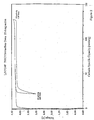
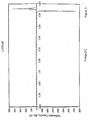
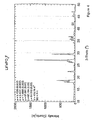
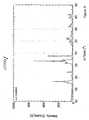
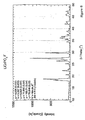
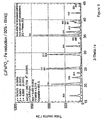
- Figures 1-6 which will be described more particularly below show the characterization data and electrochemical performance in actual use for the cathode materials (positive electrodes) of the invention. Some tests were conducted in a cell comprising a lithium metal counter electrode (negative electrode). All of the cells had an electrolyte with EC/DMC as solvent in a 2:1 weight ratio with 1 mole LiPF 6 salt.
- test cells are often fabricated using lithium metal electrodes.
- test cells are often fabricated using lithium metal electrodes.
- an insertion positive electrode and a graphitic carbon negative electrode When forming cells for use as batteries, it is preferred to use an insertion positive electrode and a graphitic carbon negative electrode.
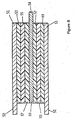
- a typical laminated battery cell structure 10 is depicted in Figure 7. It comprises a negative electrode side 12, a positive electrode side 14, and an electrolyte/separator 16 therebetween.
- Negative electrode side 12 includes current collector 18, and positive electrode side 14 includes current collector 22.
- the electrolyte/separator film 16 membrane is preferably a plasticized copolymer. This electrolyte/separator preferably comprises a polymeric separator and a suitable electrolyte for ion transport.
- the electrolyte/separator is positioned upon the electrode element and is covered with a positive electrode membrane 24 comprising a composition of a finely divided lithium insertion compound in a polymeric binder matrix.
- An aluminum collector foil or grid 22 completes the assembly.
- Protective bagging material 40 covers the cell and prevents infiltration of air and moisture.
- a multi-cell battery configuration as per Figure 8 is prepared with copper current collector 51, negative electrode 53, electrolyte/separator 55, positive electrode 57, and aluminum current collector 59. Tabs 52 and 58 of the current collector elements form respective terminals for the battery structure.
- the terms "cell” and “battery” refer to an individual cell comprising anode/electrolyte/cathode and also refer to a multi-cell arrangement in a stack.
- the relative weight proportions of the components of the positive electrode are generally: 50-90% by weight active material; 5-30% carbon black as the electric conductive diluent; and 3-20% binder chosen to hold all particulate materials in contact with one another without degrading ionic conductivity. Stated ranges are not critical, and the amount of active material in an electrode may range from 25-95 weight percent.
- the negative electrode comprises about 50-95%' by weight of a preferred graphite, with the balance constituted by the binder.
- a typical electrolyte separator film comprises approximately two parts polymer for every one part of a preferred fumed silica.
- the conductive solvent comprises any number of suitable solvents and salts. Desirable solvents and salts are described in U.S. Patent Nos. 5,643,695 and 5,418,091. One example is a mixture of EC:DMC:LiPF 6 in a weight ratio of about 60:30:10.
- Solvents are selected to be used individually or in mixtures, and include dimethyl carbonate (DMC), diethylcarbonate (DEC), dipropylcarbonate (DPC), ethylmethylcarbonate (EMC), ethylene carbonate (EC), propylene carbonate (PC), butylene carbonate, lactones, esters, glymes, sulfoxides, sulfolanes, etc.
- the preferred solvents are EC/DMC, EC/DEC, EC/DPC and EC/EMC.
- the salt content ranges from 5% to 65% by weight, preferably from 8% to 35% by weight.
- any number of methods are used to form films from the casting solution using conventional meter bar or doctor blade apparatus. It is usually sufficient to air-dry the films at moderate temperature to yield self-supporting films of copolymer composition.
- Lamination of assembled cell structures is accomplished by conventional means by pressing between metal plates at a temperature of about 120-160°C. Subsequent to lamination, the battery cell material may be stored either with the retained plasticizer or as a dry sheet after extraction of the plasticizer with a selective low-boiling point solvent.
- the plasticizer extraction solvent is not critical, and methanol or ether are often used.
- Separator membrane element 16 is generally polymeric and prepared from a composition comprising a copolymer.
- a preferred composition is the 75 to 92% vinylidene fluoride with 8 to 25% hexafluoropropylene copolymer (available commercially from Atochem North America as Kynar FLEX) and an organic solvent plasticizer.
- the plasticizing solvent may be one of the various organic compounds commonly used as solvents for electrolyte salts, e.g., propylene carbonate or ethylene carbonate, as well as mixtures of these compounds.
- Higher-boiling plasticizer compounds such as dibutyl phthalate, dimethyl phthalate, diethyl phthalate, and tris butoxyethyl phosphate are particularly suitable.
- Inorganic filler adjuncts such as fumed alumina or silanized fumed silica, may be used to enhance the physical strength and melt viscosity of a separator membrane and, in some compositions, to increase the subsequent level of electrolyte solution absorption.
- a current collector layer of aluminum foil or grid is overlaid with a positive electrode film, or membrane, separately prepared as a coated layer of a dispersion of insertion electrode composition.
- This is typically an insertion compound such as LiMn 2 O 4 (LMO), LiCoO 2 , or LiNiO 2 , powder in a copolymer matrix solution, which is dried to form the positive electrode.
- Other insertion compounds include lithium metal fluorophosphate, lithium metal phosphates and lithium metal oxides produced by this method.
- An electrolyte/separator membrane is formed as a dried coating of a composition comprising a solution containing VdF:HFP copolymer and a plasticizer solvent is then overlaid on the positive electrode film.
- a negative electrode membrane formed as a dried coating of a powdered carbon or other negative electrode material dispersion in a VdF:HFP copolymer matrix solution is similarly overlaid on the separator membrane layer.
- a copper current collector foil or grid is laid upon the negative electrode layer to complete the cell assembly. Therefore, the VdF:HFP copolymer composition is used as a binder in all of the major cell components, positive electrode film, negative electrode film, and electrolyte/separator membrane. The assembled components are then heated under pressure to achieve heat-fusion bonding between the plasticized copolymer matrix electrode and electrolyte components, and to the collector grids, to thereby form an effective laminate of cell elements. This produces an essentially unitary and flexible battery cell structure.
- the electrochemical cell operated as per the invention may be prepared in a variety of ways.
- the negative electrode may be metallic lithium.
- the negative electrode is an insertion active material, such as, metal oxides and graphite.
- the components of the electrode are the metal oxide, electrically conductive carbon, and binder, in proportions similar to that described above for the positive electrode.
- the negative electrode active material is graphite particles.
- test cells are often fabricated using lithium metal electrodes. When forming cells for use as batteries, it is preferred to use an insertion metal oxide positive electrode and a graphitic carbon negative electrode.
- Various methods for fabricating electrochemical cells and batteries and for forming electrode components are described herein. The invention is not, however, limited by any particular fabrication method.
- Exemplary metal compounds include Fe 2 O 3 , Fe 3 O 4 , V 2 O 5 , VO 2 , LiVO 3 , NH 4 VO 3 , Mg(OH) 2 , CaO, MgO, Ca(OH) 2' MnO 2 , Mn 2 O 3 , Mn 3 (PO 4 ) 2 , CuO, SnO, SnO 2 , TiO 2 , Ti 2 O 3 , Cr 2 O 3 , PbO 2 , PbO, Ba(OH) 2 , BaO, Cd(OH) 2 , FePO 4 , Fe 3 (PO 4 ) 2 , Zn 3 (PO 4 ) 2 , Mg 3 (PO 4 ) 2 and mixtures thereof.
- the metal compounds are reduced in the presence of a reducing agent, such as hydrogen or carbon.
- a reducing agent such as hydrogen or carbon.
- the same considerations apply to other metal and phosphate containing starting materials.
- the thermodynamic considerations such as ease of reduction, of the selected starting materials, the reaction kinetics, and the melting point of the salts will cause adjustment in the general procedure, such as the amount of reducing agent, the temperature of the reaction, and the dwell time.
- Reaction 1(a) - Using hydrogen to form precursors 0.5 V 2 O 5 + NH 4 H 2 PO 4 + H 2 ⁇ VPO 4 + NH 3 + 2.5 H 2 O
- Reaction 2(a) - Using a carbothermal method to form precursors. 0.5 V 2 O 5 + NH 4 H 2 PO 4 + C - VPO 4 + NH 3 + 1.5 H 2 O + CO
- Reaction 3(b) Formation of lithium vanadium aluminum fluorophosphate 0.9 VPO 4 + 0.1 AlPO 4 + 1.0 LiF ⁇ LiV 0.9 Al 0.1 PO 4 F
- Reaction 4 Production of lithium vanadium fluorophosphate in an alternate formulation.
- Reaction 5 Single step preparation of lithium vanadium fluorophosphate using lithium fluoride in a carbothermal method.
- Reaction 6a Formation of iron phosphate.
- Reaction 7a Formation of titanium phosphate.
- Reaction 8a Formation of chromium phosphate. 0.5 Cr 2 O 3 + 1.0 (NH 4 ) 2 HPO 4 ⁇ CrPO 4 + 2NH 3 + 3/2H 2 O
- Reaction 9a Formation of titanium phosphate using carbothermal method.
- Reaction 10 Thermite reduction of lithium and iron precursors for producing a cathode active material.
- Reaction 11 Thermite reduction of lithium and iron compounds for the production of lithium iron phosphate as a cathode material.
- Reaction 12 Preparation of lithium iron phosphate using iron phosphate and aluminum. 1 ⁇ 2 Li 2 CO 3 + FePO 4 + 1/3 Al ⁇ LiFePO 4 + 1 ⁇ 2 CO 2 + 1/6 Al 2 O 3
- Reaction 13 Preparation of lithium magnesium iron phosphate using aluminum.
- Reaction 14 Preparation of lithium vanadium oxide (LiV 2 O 5 ) using vanadium oxide and metallic vanadium.
- Li 2 CO 3 + 0.9 V 2 O 5 + 0.2 V ⁇ LiV 2 O 5 + 0.5 CO 2
- Reaction 15 Preparation of lithium vanadium oxide (LiV 2 O 5 ) using vanadium oxide and metallic aluminum.
- Li 2 CO 3 1.0 V 2 O 5 + 0.333 Al ⁇ LiV 2 O 5 + 0.5 CO 2 + 0.167 Al 2 O 3
- Reaction 16 Preparation of lithium vanadium phosphate 1.5 Li 2 CO 3 + 0.7125 V 2 O 5 + 0.575 V + 3 (NH 4 ) 2 HPO 4 ⁇ Li 3 V 2 (PO 4 ) 3 + 1.5 CO 2 + 6 NH 3 + 4.5 H 2 O
- Reaction 17 Preparation of lithium iron phosphate using silicon dioxide.
- Reaction 18 Preparation of lithium magnesium iron phosphate using magnesium. LiH 2 PO 4 + 0.333 Fe 2 O 3 + 0.333 Mg - LiFe 0.667 Mg 0.333 PO 4 + H 2 O
- the final product LiVPO 4 F prepared from V 2 O 5 metal compound per Reaction 1, appeared black in color.
- the LiVPO 4 F was formed using a two stage process. The first stage involved creating a metal phosphate precursor, vanadium phosphate.
- the vanadium phosphate was created following the basic procedure, with vanadium pentoxide and ADHP mixed in about a 1:2 molar ratio in a ball mill, and ground for about 30 minutes.
- the mixture was formed into a pellet, and heated at about 2°C/minute to a temperature of about 300°C. The pellet was maintained at that temperature for about 8 hours before cooling to ambient.
- the pellet was re-ground and re-pelletized before reheating at about 2°C/minute to a greater temperature of about 850°C, and maintained at that temperature for about 8 hours.
- the reactions were carried out under a flowing hydrogen atmosphere.
- the second stage involved mixing and grinding the vanadium phosphate formed in stage one with lithium fluoride.
- the mixture was pressed into a pellet, and the pellet was heated at about 2°C/minute to a temperature of about 700°C.
- the pellet was held at this temperature for about 15 minutes, and then cooled to ambient, and ground into a powder.
- the resulting product was a material with a triclinic crystal structure.
- the triclinic unit cell crystal structure is characterized by a lack of symmetry.
- nominal formula refers to the fact that the relative proportion of atomic species may vary slightly on the order of up to 5 percent, or more typically, 1 percent to 3 percent.
- any portion of P (phosphorous) may be substituted by Si (silicon), S (sulfur) and/or As (arsenic).
- the LiVPO 4 F prepared as described immediately above, was tested in an electrochemical cell.
- the positive electrode was prepared as described above, using 22.5mg of active material.
- the positive electrode contained, on a weight % basis, 80% active material, 8% carbon black, and 12% Kynar. Kynar is commercially available PVdF:HFP copolymers used as binder material.
- the negative electrode was metallic lithium.
- the electrolyte was 2:1 weight ratio mixture of EC and DMC within which was dissolved 1 molar LiPF 6 .
- the cells were cycled between 3.5 and 4.4 with performance as shown in Figure 2.
- Figure 2 is an Electrochemical Voltage Spectroscopy (EVS) voltage/capacity profile for a cell with cathode material formed with LiVPO 4 F.
- EVS Electrochemical Voltage Spectroscopy
- Figure 2 shows the results of the first cycle with the critical limiting current density less than 0.1 milliamps per square centimeter with ⁇ 10mV steps between about 3.0 and 4.4 volts based upon 29.4 milligrams of the LiVPO 4 F active material in the cathode (positive electrode).
- the positive electrode active material is LiVPO 4 F.
- the lithium is extracted from the LiVPO 4 F during charging of the cell.
- about 0.75 unit of lithium had been removed per formula unit. Consequently, the positive electrode active material corresponds to Li 1 - x VPO 4 F where x appears to be equal to about 0.75, when the cathode material is at 4.4 volts versus Li/Li + .
- the extraction represents approximately 129 milliamp hours per gram corresponding to about 3.8 milliamp hours based on 29.4 milligrams active material.
- the cell is discharged whereupon a quantity of lithium is re-inserted into the LiVPO 4 F.
- the re-insertion corresponds to approximately 109 milliamp hours per gram proportional to the insertion of essentially all of the lithium.
- the bottom of the curve corresponds to approximately 3.0 volts.
- Figure 3 is an Electrochemical Voltage Spectroscopy differential capacity plot based on Figure 2.
- the relatively symmetrical nature of the peaks indicates good electrical reversibility.
- Lithium vanadium fluorophosphate was also produced using a one stage process from Example V.
- a mixture was made of vanadium pentoxide, ammonium dihydrogen phosphate, lithium fluoride and carbon.
- the compounds were mixed with ratio of about 0.5:1:1:1 on a molar basis.
- the mixture was dry ground for about 30 minutes to intimately mix the powders in a ball mill.
- the powders were pressed into pellets.
- the reaction was conducted by heating the pellets in an oven at a preferred rate of about 2°C/minute to a first elevated temperature of about 300°C.
- the reaction was carried out at 300°C for about 8 hours.
- the pellets were allowed to cool, then re-ground and repressed into pellets.
- the reaction was continued by reheating the pellets in an oven at a preferred heating rate of about 2°C/minute to about 750°C, and held at 750°C for about 8 hours to complete the reaction.
- the pellets were cooled to ambient and reground leaving the product LiVPO 4 F.
- the final product LiFePO 4 F prepared from Fe 2 O 3 metal compound per Reaction 6, appeared brown in color.
- the LiFePO 4 F was formed using a two stage process. The first stage involved creating a metal phosphate precursor, iron phosphate.
- the iron phosphate was created following the basic procedure, with iron oxide and DAHP mixed in about a 1:2 molar ratio in a ball mill, and ground for about 30 minutes.
- the mixture was formed into a pellet, and heated at about 2°C/minute to a temperature of about 300°C. The pellet was maintained at that temperature for about 8 hours before cooling to ambient.
- the pellet was re-ground and re-pelletized before reheating at about 2°C/minute to a second elevated temperature of about 900°C, and maintained at that temperature for about 8 hours.
- the second stage involved mixing and grinding the iron phosphate formed in the first stage with lithium fluoride.
- the mixture was pressed into a pellet, and the pellet was heated at about 2°C/minute to a temperature of about 700°C.
- the pellet was held at this temperature for about 15 minutes, and then cooled to ambient, and ground into a powder.
- the resulting product was a material with a triclinic crystal structure. This product's CuK ⁇ x-ray diffraction pattern contained all of the peaks expected for this material as shown in Figure 4.
- the final product LiTiPO 4 F prepared from TiO 2 metal compound per Reaction 7, appeared green in color.
- the LiTiPO 4 F was formed using a two stage process. The first stage involved creating a metal phosphate precursor, titanium phosphate.
- the titanium phosphate was created following the basic procedure, with titanium dioxide and ADHP mixed in about a 1:1 molar ratio in a ball mill, and ground for about 30 minutes. The mixture was formed into a pellet, and heated at about 2°C/minute to a temperature of about 300°C. The pellet was maintained at that temperature for about 3 hours before cooling to ambient.
- the pellet was re-ground and re-pelletized before reheating at about 2°C/minute to a second elevated temperature of about 850°C, and maintained at that temperature for about 8 hours.
- the reactions were carried out under a flowing hydrogen atmosphere.
- the second stage involved mixing and grinding the titanium phosphate formed in the first stage with lithium fluoride.
- the mixture was pressed into a pellet, and the pellet was heated at about 2°C/minute to a temperature of about 700°C.
- the pellet was held at this temperature for about 15 minutes, and then cooled to ambient, and ground into a powder.
- the resulting product was a material with a triclinic crystal structure.
- This product's CuK ⁇ x-ray diffraction (XRD) pattern contained all of the peaks expected for this material as shown in Figure 5.
- the pattern evident in . Figure 5 is consistent with the single phase triclinic phosphate LiTiPO 4 F. This is evidenced by the position of the peaks in terms of the scattering angle 2 ⁇ (theta), x axis.
- the x-ray diffraction pattern was triclinic.
- LiTiPO 4 F was prepared by the carbothermal method as in Reaction 9.
- the carbothermal method used carbon at the reducing agent, instead of hydrogen.
- the product using this method exhibited the same characteristics as the product prepared by Reaction 7.
- the final product LiCrPO 4 F prepared from Cr 2 O 3 metal compound per Reaction 8, appeared green in color.
- the LiCrPO 4 F was formed using a two stage process.
- the first stage involved creating a metal phosphate precursor, chromium phosphate.
- the chromium phosphate was created following the basic procedure, with chromium oxide and DAHP mixed in about a 1:2 molar ratio in a ball mill, and ground for about 30 minutes.
- the mixture was formed into a pellet, and heated at about 2°C/minute to a temperature of about 500°C.
- the pellet was maintained at that temperature for about 6 hours before cooling to ambient.
- the pellet was re-ground and re-pelletized before reheating at about 2°C/minute to a greater temperature of about 1050°C, and maintained at that temperature for about 6 hours.
- the second stage involved mixing and grinding the chromium phosphate formed in stage one with lithium fluoride.
- the mixture was pressed into a pellet, and the pellet was heated at about 2°C/minute to a temperature of about 700°C.
- the pellet was held at this temperature for about 15 minutes, and then cooled to ambient, and ground into a powder.
- the resulting product was a material with a triclinic crystal structure. This product's CuK ⁇ x-ray diffraction pattern contained all of the peaks expected for this material as shown in Figure 6.
- lithium metal phosphates and lithium metal oxides were produced by this invention.
- One such compound, lithium iron phosphate was fabricated, tested and characterized.
- the final product LiFePO 4 was prepared from iron oxide as per Reaction 10.
- the starting materials are intimately mixed and dry ground for 30 minutes producing uniform finely ground powder.
- the starting materials are lithium dihydrogen phosphate, iron oxide, and the reducing agent elemental iron.
- the mixture is then pressed into pellet form.
- the reaction was conducted by heating at a preferred ramped heating rate of about 2°C/minute to an elevated temperature of about 750°C and allowed to dwell for 8 hours.
- the reaction was carried out under a non-oxiding atmosphere.
- the pellets were allowed to cool to ambient temperature and then ground into powder.
- This product's CuK ⁇ x-ray diffraction pattern contained all the peaks expected for this material as shown in Figure 9.
- the space group and lattice parameters from XRD refinement are consistent with the olivine structure.
- the x-ray pattern demonstrates that the product of the invention was LiFePO 4 .
- the LiFePO 4 prepared as described immediately above, was tested in an electrochemical cell.
- the positive electrode was prepared as described above using 10.7 mg of active material.
- the positive electrode contained, on a weight % basis, 80% active material, 8% carbon black, and 12% Kynar.
- the negative electrode was metallic lithium.
- the electrolyte was 2:1 weight ratio mixture of EC and DMC within which was dissolved 1 molar LiPF 6 .
- the cells were cycled between 2.5 and 3.9 volts with performances as shown in Figure 10.
- Figure 10 is a constant current cycling result using current density of ⁇ 0.2 mA/cm 2 between 2.5V and 4.0V for a cell with cathode material formed with LiFePO 4 .
- the product LiFePO 4 was prepared by several alternatives using different starting compounds and different reductants as evidenced by Reactions 11, 12, and 17. The products prepared by these reactions exhibited the same characteristics as the product prepared by Reaction 10.
- Examples X - XVIII demonstrate the invention is applicable for the production of other lithium metal compounds useable as cathode active materials. Specifically, lithium metal phosphates and lithium metal oxides have been successfully produced using carbon and metals for reducing agents for the production of high purity cathode active materials.
- the invention provides new methods for making new compounds LiM a MI b PO 4 F, more specifically, LiM 1-y MI y PO 4 F, which are adaptable to commercial scale production.
- the new compounds are triclinic compounds as demonstrated by XRD analysis.
- the new materials demonstrate relatively high specific capacity coupled to a desirable voltage range and energetic reversibility and the methods provide efficient processes for making these new compounds. These properties make these materials excellent candidates as cathode active compound for lithium ion applications.
- the new process produces materials conveniently and in high purity from available precursors.
- the precursors can be produced by methods, such as carbothermal reduction.
- this invention provides new methods of producing compounds capable of being commercially and economically produced for use in batteries.
- the invention provides methods of producing lithium metal phosphates and lithium metal oxides, as well as precursor materials such as transition metal phosphates.
- Transition metal phosphates are important precursor materials for the formation of cathode active materials.
- the metal phosphates are especially attractive when reacting with lithium fluoride as there is no weight loss in the generation of the lithium metal fluorophosphate cathode active materials.
- the carbothermal method is especially attractive, because any excess carbon that is not consumed is used as electrically conductive material in the cathode.
- the hydrogen reduction method for producing the metal phosphate precursors is also attractive, because the method produces compounds having a high purity.
- the invention comprises, but is not limited to, the following embodiments:
Landscapes
- Chemical & Material Sciences (AREA)
- Organic Chemistry (AREA)
- Inorganic Chemistry (AREA)
- Chemical Kinetics & Catalysis (AREA)
- Electrochemistry (AREA)
- General Chemical & Material Sciences (AREA)
- Engineering & Computer Science (AREA)
- Manufacturing & Machinery (AREA)
- Crystallography & Structural Chemistry (AREA)
- Materials Engineering (AREA)
- Battery Electrode And Active Subsutance (AREA)
- Secondary Cells (AREA)
Priority Applications (1)
| Application Number | Priority Date | Filing Date | Title |
|---|---|---|---|
| EP10184419A EP2277829A3 (de) | 2000-11-28 | 2001-11-19 | Verfahren zur Herstellung von Lithiummetallverbindungen als Kathodenaktivmaterialien |
Applications Claiming Priority (3)
| Application Number | Priority Date | Filing Date | Title |
|---|---|---|---|
| US09/724,085 US6645452B1 (en) | 2000-11-28 | 2000-11-28 | Methods of making lithium metal cathode active materials |
| US724085 | 2000-11-28 | ||
| EP01998506A EP1343720B1 (de) | 2000-11-28 | 2001-11-19 | Verfahren zur herstellung von lithiummetallverbindungen, die zur verwendung als kathodenaktivmasse geeignet sind |
Related Parent Applications (1)
| Application Number | Title | Priority Date | Filing Date |
|---|---|---|---|
| EP01998506A Division EP1343720B1 (de) | 2000-11-28 | 2001-11-19 | Verfahren zur herstellung von lithiummetallverbindungen, die zur verwendung als kathodenaktivmasse geeignet sind |
Publications (2)
| Publication Number | Publication Date |
|---|---|
| EP1574477A2 true EP1574477A2 (de) | 2005-09-14 |
| EP1574477A3 EP1574477A3 (de) | 2005-11-09 |
Family
ID=24908921
Family Applications (3)
| Application Number | Title | Priority Date | Filing Date |
|---|---|---|---|
| EP05010853A Withdrawn EP1574477A3 (de) | 2000-11-28 | 2001-11-19 | Verfahren zur Herstellung von Lithium-Metall-Verbindungen zur Verwendung als aktive Kathodenmaterialien |
| EP10184419A Withdrawn EP2277829A3 (de) | 2000-11-28 | 2001-11-19 | Verfahren zur Herstellung von Lithiummetallverbindungen als Kathodenaktivmaterialien |
| EP01998506A Revoked EP1343720B1 (de) | 2000-11-28 | 2001-11-19 | Verfahren zur herstellung von lithiummetallverbindungen, die zur verwendung als kathodenaktivmasse geeignet sind |
Family Applications After (2)
| Application Number | Title | Priority Date | Filing Date |
|---|---|---|---|
| EP10184419A Withdrawn EP2277829A3 (de) | 2000-11-28 | 2001-11-19 | Verfahren zur Herstellung von Lithiummetallverbindungen als Kathodenaktivmaterialien |
| EP01998506A Revoked EP1343720B1 (de) | 2000-11-28 | 2001-11-19 | Verfahren zur herstellung von lithiummetallverbindungen, die zur verwendung als kathodenaktivmasse geeignet sind |
Country Status (12)
| Country | Link |
|---|---|
| US (2) | US6645452B1 (de) |
| EP (3) | EP1574477A3 (de) |
| JP (2) | JP4248876B2 (de) |
| KR (4) | KR100851485B1 (de) |
| CN (1) | CN100411977C (de) |
| AT (1) | ATE390385T1 (de) |
| AU (1) | AU2002217799A1 (de) |
| CA (4) | CA2638751C (de) |
| DE (1) | DE60133405T2 (de) |
| RU (1) | RU2003119145A (de) |
| TW (1) | TW544967B (de) |
| WO (1) | WO2002044084A2 (de) |
Cited By (2)
| Publication number | Priority date | Publication date | Assignee | Title |
|---|---|---|---|---|
| FR2952367A1 (fr) * | 2009-11-10 | 2011-05-13 | Commissariat Energie Atomique | Synthese d'un fluorophosphate metallique et utilisation comme materiau actif d'electrode pour accumulateur |
| US9809456B2 (en) | 2009-08-07 | 2017-11-07 | Semiconductor Energy Laboratory Co., Ltd. | Manufacturing method for positive electrode active material |
Families Citing this family (128)
| Publication number | Priority date | Publication date | Assignee | Title |
|---|---|---|---|---|
| EP1094533A1 (de) * | 1999-04-06 | 2001-04-25 | Sony Corporation | Aktives material für positive platte, nichtwässrige sekundäre elektrolytische zelle und verfahren zur herstellung aktiven materials für positive platte |
| US6528033B1 (en) * | 2000-01-18 | 2003-03-04 | Valence Technology, Inc. | Method of making lithium-containing materials |
| US6964827B2 (en) | 2000-04-27 | 2005-11-15 | Valence Technology, Inc. | Alkali/transition metal halo- and hydroxy-phosphates and related electrode active materials |
| US8367036B2 (en) | 2000-04-27 | 2013-02-05 | Valence Technology, Inc. | Alkali/transition metal halo-and hydroxy-phosphates and related electrode active materials |
| US8057769B2 (en) | 2000-04-27 | 2011-11-15 | Valence Technology, Inc. | Method for making phosphate-based electrode active materials |
| US6387568B1 (en) * | 2000-04-27 | 2002-05-14 | Valence Technology, Inc. | Lithium metal fluorophosphate materials and preparation thereof |
| US6777132B2 (en) * | 2000-04-27 | 2004-08-17 | Valence Technology, Inc. | Alkali/transition metal halo—and hydroxy-phosphates and related electrode active materials |
| US7524584B2 (en) | 2000-04-27 | 2009-04-28 | Valence Technology, Inc. | Electrode active material for a secondary electrochemical cell |
| US6794084B2 (en) * | 2002-07-26 | 2004-09-21 | Valence Technology, Inc. | Alkali metal hydrogen phosphates as precursors for phosphate-containing electrochemical active materials |
| US7371338B2 (en) * | 2002-10-01 | 2008-05-13 | Rutgers, The State University | Metal fluorides as electrode materials |
| DE10255124A1 (de) * | 2002-11-26 | 2004-06-03 | Degussa Ag | Pyrogenes Oxidpulver, Verfahren zu seiner Herstellung und seine Verwendung in einem Separator für eine elektrochemische Zelle |
| CA2539723A1 (en) | 2003-09-22 | 2005-04-07 | Valence Technology, Inc. | Electrical systems, power supply apparatuses, and power supply operations methods |
| JP4656653B2 (ja) * | 2003-10-27 | 2011-03-23 | 三井造船株式会社 | 二次電池用正極材料、二次電池用正極材料の製造方法、および二次電池 |
| JP2007515762A (ja) | 2003-12-23 | 2007-06-14 | ウニヴェルシテ ド モントリオール | 電気活性挿入化合物の調製方法及び得られる電極物質 |
| US7719227B2 (en) | 2004-02-13 | 2010-05-18 | Valence Technology, Inc. | Electrical energy supply methods and electrical energy power supplies |
| US7060238B2 (en) * | 2004-03-04 | 2006-06-13 | Valence Technology, Inc. | Synthesis of metal phosphates |
| US7824800B1 (en) | 2004-04-08 | 2010-11-02 | Electrochemical Systems, Inc. | Lithium-ion cell with a wide operating temperature range |
| US7582380B1 (en) | 2004-04-08 | 2009-09-01 | Electrochemical Systems, Inc. | Lithium-ion cell with a wide operating temperature range |
| US7960057B2 (en) * | 2004-05-17 | 2011-06-14 | Toyota Motor Engineering & Manufacturing North America, Inc. | Battery with molten salt electrolyte and phosphorus-containing cathode |
| US7338647B2 (en) * | 2004-05-20 | 2008-03-04 | Valence Technology, Inc. | Synthesis of cathode active materials |
| US7629080B1 (en) | 2004-07-23 | 2009-12-08 | The United States Of America As Represented By The Secretary Of The Army | Electrode materials for electrochemical cells |
| TWI459616B (zh) * | 2004-08-16 | 2014-11-01 | Showa Denko Kk | Lithium batteries with positive and the use of its lithium batteries |
| US20060091362A1 (en) * | 2004-11-02 | 2006-05-04 | Wixom Michael R | Composite electrochemical material |
| US20070160519A1 (en) * | 2005-03-28 | 2007-07-12 | Jeremy Barker | Method Of Making Active Materials For Use In Secondary Electrochemical Cells |
| US7700236B2 (en) * | 2005-09-09 | 2010-04-20 | Aquire Energy Co., Ltd. | Cathode material for manufacturing a rechargeable battery |
| TWI254031B (en) * | 2005-05-10 | 2006-05-01 | Aquire Energy Co Ltd | Manufacturing method of LixMyPO4 compound with olivine structure |
| JP4869629B2 (ja) * | 2005-05-30 | 2012-02-08 | 住友大阪セメント株式会社 | リチウム電池用正極活物質の製造方法及びリチウム電池用正極活物質並びにリチウム電池 |
| US7939201B2 (en) * | 2005-08-08 | 2011-05-10 | A123 Systems, Inc. | Nanoscale ion storage materials including co-existing phases or solid solutions |
| US8158090B2 (en) | 2005-08-08 | 2012-04-17 | A123 Systems, Inc. | Amorphous and partially amorphous nanoscale ion storage materials |
| US8323832B2 (en) * | 2005-08-08 | 2012-12-04 | A123 Systems, Inc. | Nanoscale ion storage materials |
| US7524529B2 (en) * | 2005-09-09 | 2009-04-28 | Aquire Energy Co., Ltd. | Method for making a lithium mixed metal compound having an olivine structure |
| JP5548366B2 (ja) * | 2005-12-02 | 2014-07-16 | エー123 システムズ, インコーポレイテッド | アモルファスおよび部分的にアモルファスからなるナノスケールイオン貯蔵材料 |
| CN100388535C (zh) * | 2005-12-19 | 2008-05-14 | 南开大学 | 锂离子二次电池正极材料氟化磷酸钒锂的制备方法 |
| KR20130106440A (ko) | 2006-02-28 | 2013-09-27 | 프리메트 프리시젼 머테리알스, 인크. | 리튬계 화합물 나노입자 조성물 및 이의 제조 방법 |
| FR2898885B1 (fr) * | 2006-03-27 | 2008-05-30 | Commissariat Energie Atomique | Compose a base de disphosphate de titane et de carbone, procede de preparation et utilisation comme materiau actif d'une electrode pour accumulateur au lithium. |
| US7723958B2 (en) | 2006-03-31 | 2010-05-25 | Valence Technology, Inc. | Battery charge indication methods, battery charge monitoring devices, rechargeable batteries, and articles of manufacture |
| JP5479096B2 (ja) * | 2006-08-21 | 2014-04-23 | エルジー・ケム・リミテッド | リチウム金属リン酸化物の製造方法 |
| US20090061314A1 (en) * | 2007-08-30 | 2009-03-05 | Ming Dong | Method of Processing Active Materials For Use In Secondary Electrochemical Cells |
| US7718319B2 (en) | 2006-09-25 | 2010-05-18 | Board Of Regents, The University Of Texas System | Cation-substituted spinel oxide and oxyfluoride cathodes for lithium ion batteries |
| US7960047B2 (en) | 2006-10-17 | 2011-06-14 | Valence Technology, Inc. | Method and apparatus for monitoring and controlling an electrochemical cell |
| CN100435390C (zh) * | 2007-01-12 | 2008-11-19 | 中南大学 | 溶胶凝胶法合成锂离子电池正极材料氟磷酸钒锂 |
| JP4983356B2 (ja) * | 2007-04-10 | 2012-07-25 | 株式会社豊田中央研究所 | 水系リチウム二次電池 |
| JP4336372B2 (ja) * | 2007-04-27 | 2009-09-30 | Tdk株式会社 | 電極用複合粒子及びその製造方法、並びに、電気化学デバイス |
| WO2008141422A1 (en) * | 2007-05-21 | 2008-11-27 | Transfert Plus, S.E.C. | Processes for preparing inorganic phosphates |
| US20080305256A1 (en) * | 2007-06-08 | 2008-12-11 | Conocophillips Company | Method for producing lithium vanadium polyanion powders for batteries |
| US20080303004A1 (en) * | 2007-06-08 | 2008-12-11 | Conocophillips Company | Method for producing lithium transition metal polyanion powders for batteries |
| WO2009015565A1 (en) * | 2007-07-31 | 2009-02-05 | Byd Company Limited | Method for preparing lithium iron phosphate as positive electrode active material for lithium ion secondary battery |
| US20090035661A1 (en) * | 2007-08-01 | 2009-02-05 | Jeffrey Swoyer | Synthesis of cathode active materials |
| US20090068080A1 (en) * | 2007-09-06 | 2009-03-12 | Valence Technology, Inc. | Method of Making Active Materials For Use in Secondary Electrochemical Cells |
| CN101399343B (zh) * | 2007-09-25 | 2011-06-15 | 比亚迪股份有限公司 | 锂离子二次电池正极活性物质磷酸铁锂的制备方法 |
| CN101420048A (zh) * | 2007-10-26 | 2009-04-29 | 比亚迪股份有限公司 | 一种锂离子二次电池的制备方法 |
| EP2209925A4 (de) * | 2007-11-14 | 2017-11-22 | Chun-Chieh Chang | Verfahren und vorrichtungen zur herstellung von luftempfindlichen elektrodenmaterialien für lithiumionenbatterie-anwendungen |
| CN101453019B (zh) * | 2007-12-07 | 2011-01-26 | 比亚迪股份有限公司 | 含磷酸亚铁锂的正极活性物质及其制备方法和正极及电池 |
| US20090148377A1 (en) * | 2007-12-11 | 2009-06-11 | Moshage Ralph E | Process For Producing Electrode Active Material For Lithium Ion Cell |
| CN101471432B (zh) * | 2007-12-27 | 2012-11-21 | 比亚迪股份有限公司 | 一种隔膜及其制备方法及锂离子电池 |
| CN101494305B (zh) * | 2008-01-25 | 2011-05-18 | 比亚迪股份有限公司 | 锂离子电池电解液和含有该电解液的电池及电池组 |
| US8088305B2 (en) * | 2008-02-22 | 2012-01-03 | Byd Company Limited | Lithium iron phosphate cathode material |
| US8062560B2 (en) * | 2008-02-29 | 2011-11-22 | Byd Company Limited | Composite compound with mixed crystalline structure |
| US8057711B2 (en) * | 2008-02-29 | 2011-11-15 | Byd Company Limited | Composite compound with mixed crystalline structure |
| US8062559B2 (en) * | 2008-02-29 | 2011-11-22 | Byd Company Limited | Composite compound with mixed crystalline structure |
| US8052897B2 (en) * | 2008-02-29 | 2011-11-08 | Byd Company Limited | Composite compound with mixed crystalline structure |
| US20090220858A1 (en) * | 2008-02-29 | 2009-09-03 | Byd Company Limited | Composite Compound With Mixed Crystalline Structure |
| US8148015B2 (en) * | 2008-03-21 | 2012-04-03 | Byd Company Limited | Cathode materials for lithium batteries |
| US8623549B2 (en) * | 2008-05-23 | 2014-01-07 | Nathalie Pereira | Iron oxyfluoride electrodes for electrochemical energy storage |
| US8951668B2 (en) | 2010-11-19 | 2015-02-10 | Rutgers, The State University Of New Jersey | Iron oxyfluoride electrodes for electrochemical energy storage |
| CN101597089A (zh) * | 2008-06-06 | 2009-12-09 | 比亚迪股份有限公司 | 一种过渡金属氢氧化物及其氧化物和正极材料的制备方法 |
| CN101640288B (zh) * | 2008-07-30 | 2012-03-07 | 比亚迪股份有限公司 | 一种锂离子电池电解液及含有该电解液的锂离子电池 |
| WO2010023129A2 (en) * | 2008-08-29 | 2010-03-04 | Basf Se | New alkali transition metal fluorophosphates |
| TWI548589B (zh) | 2008-10-22 | 2016-09-11 | Lg化學股份有限公司 | 具橄欖石結構之磷酸鋰鐵及其分析方法 |
| US20100154206A1 (en) * | 2008-12-19 | 2010-06-24 | Conocophillips Company | Process for making composite lithium powders for batteries |
| KR20170064562A (ko) * | 2008-12-19 | 2017-06-09 | 파이로텍, 인크. | 전지용 플루오르화 리튬 바나듐 폴리음이온 분말의 제조 방법 |
| US8022009B2 (en) * | 2009-01-16 | 2011-09-20 | Intematix Corporation | Process for synthesizing LixFeMZO4/ carbon and LixMZO4/ carbon composite materials |
| DE102009001204A1 (de) * | 2009-02-26 | 2010-09-02 | Chemische Fabrik Budenheim Kg | Herstellung von Eisenorthophosphat |
| US20100266474A1 (en) * | 2009-04-16 | 2010-10-21 | Titus Faulkner | Method of Making Active Materials for Use in Secondary Electrochemical Cells |
| US8372540B2 (en) * | 2009-04-16 | 2013-02-12 | Valence Technology, Inc. | Electrode active material for secondary electrochemical cell |
| WO2010129417A1 (en) * | 2009-05-04 | 2010-11-11 | Meecotech, Inc. | Electrode active composite materials and methods of making thereof |
| KR101134511B1 (ko) | 2009-12-21 | 2012-04-13 | 한국과학기술원 | 망간을 기초로 하는 올리빈 복합고용체 및 이의 제조 방법 |
| EP2355214B1 (de) * | 2010-01-28 | 2013-12-25 | Prayon | Lithium-Akku auf Lithiumeisenphosphat und Kohlenstoffbasis |
| US9318741B2 (en) | 2010-04-28 | 2016-04-19 | Semiconductor Energy Laboratory Co., Ltd. | Positive electrode active material of power storage device, power storage device, electrically propelled vehicle, and method for manufacturing power storage device |
| CN102263235A (zh) * | 2010-05-27 | 2011-11-30 | 群顺绿能股份有限公司 | 含锂电极材料烧结方法 |
| DE102010022883A1 (de) * | 2010-06-07 | 2011-12-08 | Harmony Brother Co., Ltd. | Verfahren zum Sintern eines Lithium enthaltenden Elektrodenmaterials |
| JP5609485B2 (ja) * | 2010-09-22 | 2014-10-22 | Tdk株式会社 | 活物質、活物質の製造方法、電極及びリチウムイオン二次電池 |
| CN106229475B (zh) | 2010-10-08 | 2019-12-17 | 株式会社半导体能源研究所 | 储能装置用正极活性材料的制造方法及储能装置 |
| JP2012204322A (ja) * | 2011-03-28 | 2012-10-22 | Gs Yuasa Corp | 非水電解質二次電池用活物質の製造方法 |
| KR101219401B1 (ko) * | 2011-05-31 | 2013-01-15 | 전자부품연구원 | 이차전지용 양극재료 및 이의 제조방법 |
| CN102315439A (zh) * | 2011-09-14 | 2012-01-11 | 耿世达 | 一种锰酸钒锂正极材料及其制造方法 |
| JP2013069456A (ja) * | 2011-09-21 | 2013-04-18 | Fuji Heavy Ind Ltd | 正極活物質の製造方法、正極、および蓄電デバイス |
| JP2013093316A (ja) * | 2011-10-04 | 2013-05-16 | Semiconductor Energy Lab Co Ltd | 二次粒子の作製方法と蓄電装置の電極の作製方法 |
| CN102354754A (zh) * | 2011-10-26 | 2012-02-15 | 张爱萍 | 硼、钡活化磷酸铁锂正极材料 |
| US10128491B2 (en) * | 2011-12-01 | 2018-11-13 | Nanoscale Components, Inc. | Method for alkaliating electrodes |
| DE102011056815A1 (de) * | 2011-12-21 | 2013-08-01 | Chemische Fabrik Budenheim Kg | Nährstoffzusammensetzung für biologische Systeme |
| JP5821877B2 (ja) * | 2012-03-27 | 2015-11-24 | Tdk株式会社 | リチウムイオン二次電池 |
| JP5621869B2 (ja) | 2012-03-27 | 2014-11-12 | Tdk株式会社 | リチウムイオン二次電池 |
| RU2506668C1 (ru) * | 2012-06-05 | 2014-02-10 | Федеральное государственное бюджетное образовательное учреждение высшего профессионального образования "Самарский государственный технический университет" | Расплавляемый электролит для химического источника тока |
| US9692039B2 (en) | 2012-07-24 | 2017-06-27 | Quantumscape Corporation | Nanostructured materials for electrochemical conversion reactions |
| US20140147586A1 (en) * | 2012-11-27 | 2014-05-29 | Universite De Montreal | Process for making an alkali metal oxyanion comprising iron |
| GB201221425D0 (en) | 2012-11-28 | 2013-01-09 | Faradion Ltd | Metal-containing compound |
| KR101400593B1 (ko) * | 2012-12-06 | 2014-05-27 | 삼성정밀화학 주식회사 | 양극 활물질, 이의 제조방법 및 이를 포함하는 리튬 이차 전지 |
| KR101489779B1 (ko) * | 2013-01-21 | 2015-02-04 | 포항공과대학교 산학협력단 | 고상 반응을 이용한 리튬 이차전지의 양극 활물질용 불소 화합물의 제조방법, 양극 및 이 양극을 포함하는 리튬 이차전지 |
| MX382395B (es) | 2013-02-01 | 2025-03-13 | Emd Acquisition Llc | Composiciones mejoradas de óxido de litio manganeso. |
| JP6111118B2 (ja) * | 2013-03-29 | 2017-04-05 | Fdk株式会社 | リチウム二次電池用電極活物質の製造方法 |
| GB201308654D0 (en) | 2013-05-14 | 2013-06-26 | Faradion Ltd | Metal-containing compounds |
| RU2542721C1 (ru) * | 2013-09-27 | 2015-02-27 | Общество с ограниченной ответственностью "Научный центр "Автономные источники тока" (ООО "Научный центр "АИТ") | Композитный катодный материал литий-ионного аккумулятора на основе li3v2(po4)3со структурой насикон и способ его получения |
| WO2015130831A1 (en) | 2014-02-25 | 2015-09-03 | Quantumscape Corporation | Hybrid electrodes with both intercalation and conversion materials |
| US10326135B2 (en) | 2014-08-15 | 2019-06-18 | Quantumscape Corporation | Doped conversion materials for secondary battery cathodes |
| JP6326366B2 (ja) * | 2014-12-25 | 2018-05-16 | 信越化学工業株式会社 | リチウムリン系複合酸化物炭素複合体及びその製造方法並びに、電気化学デバイス及びリチウムイオン二次電池 |
| KR20160112665A (ko) * | 2015-03-20 | 2016-09-28 | 자동차부품연구원 | 리튬이차전지, 리튬이차전지 전극 소재 및 그 제조방법 |
| CN107810571B (zh) * | 2015-06-26 | 2021-12-10 | A123系统有限责任公司 | 用于高功率应用的纳米级孔结构阴极和材料合成方法 |
| RU2619600C2 (ru) * | 2015-09-28 | 2017-05-17 | Федеральное государственное бюджетное образовательное учреждение высшего образования "Московский государственный университет имени М.В. Ломоносова" (МГУ) | Электродный материал для металл-ионных аккумуляторов, способ его получения, электрод и аккумулятор на основе электродного материала |
| KR102739946B1 (ko) | 2016-09-23 | 2024-12-06 | 삼성전자주식회사 | 양극활물질, 양극활물질의 제조방법 및 이를 포함한 전고체형 전지 |
| FR3067709B1 (fr) * | 2017-06-16 | 2020-06-19 | Rhodia Operations | Procede de preparation d'un phosphate de vanadium |
| CN110998916A (zh) | 2017-07-10 | 2020-04-10 | 那诺思卡乐康母庞特公司 | 用于在阳极上形成sei层的方法 |
| JP7048266B2 (ja) * | 2017-11-13 | 2022-04-05 | 大陽日酸株式会社 | 正極活物質の製造方法 |
| US11251430B2 (en) | 2018-03-05 | 2022-02-15 | The Research Foundation For The State University Of New York | ϵ-VOPO4 cathode for lithium ion batteries |
| TWI719496B (zh) * | 2019-06-06 | 2021-02-21 | 台灣立凱電能科技股份有限公司 | 二次電池用正極材料之製造方法 |
| EP4038209A1 (de) * | 2019-10-03 | 2022-08-10 | Umicore | Verfahren zur herstellung von vorlegierten pulvern für diamantwerkzeuge und dadurch erhaltene pulver |
| RU2727620C1 (ru) * | 2019-11-27 | 2020-07-22 | Общество с ограниченной ответственностью "РУСТОР" | Способ получения активного материала катода на основе литий-обогащенного фосфата Li1+xFe1-yPO4 со структурой оливина, электродная масса и катод литий-ионного аккумулятора |
| CN110950315A (zh) * | 2019-12-24 | 2020-04-03 | 广东石油化工学院 | 一种复合离子掺杂的磷酸铁锂材料的制备方法 |
| RU2748159C1 (ru) * | 2020-12-11 | 2021-05-20 | Автономная некоммерческая образовательная организация высшего образования "Сколковский институт науки и технологий" (Сколковский институт науки и технологий) | Электродный материал для натрий-ионных аккумуляторов, способ его получения, электрод и аккумулятор на основе электродного материала |
| KR102369513B1 (ko) * | 2021-03-29 | 2022-03-04 | 국민대학교산학협력단 | 플루오르인산염 기반 이차전지 양극활물질의 제조 방법, 이를 통하여 제조된 플루오르인산염 기반 이차전지 양극활물질 및 이차전지 |
| CN113178615A (zh) * | 2021-03-30 | 2021-07-27 | 深圳市新创材料科技有限公司 | 一种latp固态电解质的制备方法 |
| WO2022215582A1 (ja) * | 2021-04-07 | 2022-10-13 | 株式会社豊田自動織機 | 正極活物質、正極及びリチウムイオン二次電池 |
| WO2023203383A1 (en) * | 2022-04-19 | 2023-10-26 | Lithium Werks Technology Bv | Methods for preparation of electroactive lithium mixed metal materials for high energy density batteries |
| CN118832176A (zh) * | 2023-04-24 | 2024-10-25 | 宜春国轩电池有限公司 | 一种金属锂单质及其制备方法和应用 |
| US20250286127A1 (en) | 2024-03-06 | 2025-09-11 | Lyten, Inc. | Electrolyte systems including electron withdrawing compounds with an alpha-beta motif for improving performance of lithium-based secondary batteries |
| GB202409902D0 (en) | 2024-07-08 | 2024-08-21 | Redoxion Ltd | Method for producing metal-containing compounds |
| GB202409903D0 (en) | 2024-07-08 | 2024-08-21 | Redoxion Ltd | Methods for producing metal-containing compounds |
| GB202500573D0 (en) | 2025-01-16 | 2025-03-05 | Redoxion Ltd | Method for producing a metal-carbon composite |
Citations (2)
| Publication number | Priority date | Publication date | Assignee | Title |
|---|---|---|---|---|
| EP1094532A1 (de) * | 1999-04-06 | 2001-04-25 | Sony Corporation | Verfahren zur herstellung aktiver materialien einer positiven platte und verfahren zur herstellung nichtwässriger elektrolytischer sekundärzellen |
| WO2001084655A1 (en) * | 2000-04-27 | 2001-11-08 | Valence Technology, Inc. | Lithium metal fluorophosphate materials and preparation thereof |
Family Cites Families (75)
| Publication number | Priority date | Publication date | Assignee | Title |
|---|---|---|---|---|
| US2508878A (en) | 1945-03-24 | 1950-05-23 | Dow Chemical Co | Process for the production of carbothermal magnesium furnace charge |
| US2570232A (en) | 1945-06-26 | 1951-10-09 | North Carolina Magnesium Dev C | Continuous process for recovery of magnesium |
| US3865745A (en) | 1971-01-15 | 1975-02-11 | Grace W R & Co | Process for the preparation of metal carbide and metal oxide microspheres |
| US3736184A (en) | 1972-03-29 | 1973-05-29 | Mallory & Co Inc P R | Metal phosphate and metal arsenate organic electrolyte cells |
| US4009092A (en) | 1976-02-27 | 1977-02-22 | E. I. Du Pont De Nemours And Company | Substituted lithium phosphates and solid electrolytes therefrom |
| US4049891A (en) | 1976-06-21 | 1977-09-20 | Massachusetts Institute Of Technology | Compositions for fast alkali-metal-ion transport |
| GB1565065A (en) | 1976-08-23 | 1980-04-16 | Tetronics Res & Dev Co Ltd | Carbothermal production of aluminium |
| US4194062A (en) | 1978-07-27 | 1980-03-18 | Bell Telephone Laboratories, Incorporated | Rechargeable dichalcogenide cell |
| US4246253A (en) | 1978-09-29 | 1981-01-20 | Union Carbide Corporation | MnO2 derived from LiMn2 O4 |
| FR2457018A1 (fr) | 1979-02-16 | 1980-12-12 | Accumulateurs Fixes | Matiere active positive pour generateur electrochimique a electrolyte non aqueux et methode de preparation de celle-ci |
| IT1131478B (it) | 1980-05-13 | 1986-06-25 | Consiglio Nazionale Ricerche | Pile ricaricabili ad elevata energia specifica con anodo e catodo a intercalazione |
| JPS56162477A (en) | 1980-05-20 | 1981-12-14 | Nippon Telegr & Teleph Corp <Ntt> | Battery |
| US4434216A (en) | 1980-10-24 | 1984-02-28 | Rayovac Corporation | Solid state electrolyte |
| US4427652A (en) * | 1980-12-31 | 1984-01-24 | Colgate-Palmolive Company | Antigingivitis composition |
| DE3224142A1 (de) * | 1981-07-03 | 1983-02-10 | Intradal Nv | Mund- und zahnpflegemittel |
| US4512905A (en) | 1982-05-18 | 1985-04-23 | The Texas A&M University System | Method of making sodium zirconium silico-phosphates |
| US4707422A (en) | 1983-06-27 | 1987-11-17 | Voltaix, Inc. | Composite coating for electrochemical electrode and method |
| FR2563382B1 (fr) | 1984-04-24 | 1986-05-30 | Elf Aquitaine | Nouveau generateur electrochimique a electrode composite |
| FR2576712B1 (fr) | 1985-01-30 | 1988-07-08 | Accumulateurs Fixes | Generateur electrochimique a electrolyte non aqueux |
| CA1265580A (en) | 1985-05-10 | 1990-02-06 | Akira Yoshino | Secondary battery |
| JPS61263069A (ja) | 1985-05-17 | 1986-11-21 | Matsushita Electric Ind Co Ltd | 電池 |
| JPS62176054A (ja) | 1986-01-30 | 1987-08-01 | Nippon Telegr & Teleph Corp <Ntt> | リチウム電池 |
| GB2196785B (en) | 1986-10-29 | 1990-05-23 | Sony Corp | Organic electrolyte secondary cell |
| US4792504A (en) | 1987-09-18 | 1988-12-20 | Mhb Joint Venture | Liquid containing polymer networks as solid electrolytes |
| US4830939B1 (en) | 1987-10-30 | 1996-10-08 | Mhb Joint Venture | Radiation cured solid electrolytes and electrochemical devices employing the same |
| US5037712A (en) | 1987-10-30 | 1991-08-06 | Ultracell, Inc. | Preparation of radiation cured solid electrolytes and electrochemical devices employing the same |
| US4828833A (en) * | 1987-12-08 | 1989-05-09 | Colgate-Palmolive Company | Dentifrice having decreased abrasivity |
| US4985317A (en) | 1988-11-30 | 1991-01-15 | Japan Synthetic Rubber Co., Ltd. | Lithium ion-conductive solid electrolyte containing lithium titanium phosphate |
| US4990413A (en) | 1989-01-18 | 1991-02-05 | Mhb Joint Venture | Composite solid electrolytes and electrochemical devices employing the same |
| US4935317A (en) | 1989-06-21 | 1990-06-19 | Mhb Joint Venture | Method for producing solid state electrochemical laminar cell utilizing cathode rolling step |
| US5262548A (en) | 1990-05-21 | 1993-11-16 | Scientific Design Company, Inc. | Phosphorous/vanadium oxidation catalyst |
| US5130211A (en) | 1990-10-24 | 1992-07-14 | Her Majesty The Queen In Right Of The Provence Of British Columbia | Electrolyte solution sequestering agents for electrochemical cells having carbonaceous electrodes |
| CA2057946A1 (en) | 1990-12-20 | 1992-06-21 | Michael M. Thackeray | Electrochemical cell |
| US5173215A (en) | 1991-02-21 | 1992-12-22 | Atraverda Limited | Conductive titanium suboxide particulates |
| ES2077409T3 (es) | 1991-03-22 | 1995-11-16 | Dow Chemical Co | Procedimiento en lecho movil para la sintesis carbotermica de polvos de ceramica no oxidada. |
| US5135732A (en) | 1991-04-23 | 1992-08-04 | Bell Communications Research, Inc. | Method for preparation of LiMn2 O4 intercalation compounds and use thereof in secondary lithium batteries |
| US5232794A (en) | 1991-10-17 | 1993-08-03 | The United States Of America As Represented By The United States Department Of Energy | Ionic conductors for solid oxide fuel cells |
| CA2096386A1 (en) * | 1992-05-18 | 1993-11-19 | Masahiro Kamauchi | Lithium secondary battery |
| US5262253A (en) | 1992-07-22 | 1993-11-16 | Valence Technology, Inc. | Solid electrolytes derived by polymerization of vinyl sulfonate polyalkylene oxides |
| ZA936168B (en) | 1992-08-28 | 1994-03-22 | Technology Finance Corp | Electrochemical cell |
| US5300373A (en) | 1992-09-11 | 1994-04-05 | Valence Technology, Inc. | Electrochemical cell stack and method of making an electrochemical cell stack |
| EP0668935B1 (de) | 1992-11-16 | 1998-03-04 | Mineral Development International A/S | Verfahren zur herstellung metallischen magnesiums, magnesiumoxid oder refraktären materials |
| RU2038395C1 (ru) | 1992-12-17 | 1995-06-27 | Дальневосточный государственный технический университет | Способ обезвреживания хромсодержащих отходов гальванического производства |
| US5296436A (en) | 1993-01-08 | 1994-03-22 | Scientific Design Company, Inc. | Phosphorous/vanadium oxidation catalyst |
| US5418090A (en) | 1993-02-17 | 1995-05-23 | Valence Technology, Inc. | Electrodes for rechargeable lithium batteries |
| US5460904A (en) | 1993-08-23 | 1995-10-24 | Bell Communications Research, Inc. | Electrolyte activatable lithium-ion rechargeable battery cell |
| US5540741A (en) | 1993-03-05 | 1996-07-30 | Bell Communications Research, Inc. | Lithium secondary battery extraction method |
| US5418091A (en) | 1993-03-05 | 1995-05-23 | Bell Communications Research, Inc. | Polymeric electrolytic cell separator membrane |
| JPH08507745A (ja) | 1993-03-17 | 1996-08-20 | アルトラライフ バッテリーズ (ユーケー) リミテッド | マンガン酸リチウムの製造方法及びこの方法によって製造されたマンガン酸リチウム |
| US5512214A (en) | 1993-03-30 | 1996-04-30 | Koksbang; Rene | Lithium battery electrode compositions |
| US5411820A (en) | 1993-06-08 | 1995-05-02 | Valence Technology, Inc. | Solid, glyme-containing electrolytes including ion salt derivatives and electrolytic cells produced therefrom |
| US5384291A (en) | 1993-06-25 | 1995-01-24 | The Dow Chemical Company | Carbothermal synthesis precursors |
| JP2966261B2 (ja) | 1993-11-02 | 1999-10-25 | 三菱電線工業株式会社 | リチウム電池用正極材及びその製造方法 |
| US5435054A (en) | 1993-11-15 | 1995-07-25 | Valence Technology, Inc. | Method for producing electrochemical cell |
| US5399447A (en) | 1993-12-06 | 1995-03-21 | Valence Technology, Inc. | Acidity reduction of adhesion promoter layer and electrolytic cells produced therefrom |
| US5463179A (en) | 1993-12-06 | 1995-10-31 | Chaloner-Gill; Benjamin | Solid electrolyte obtained by the polymerization of diacrylate monomer having a rigid alkane segment |
| US5482795A (en) | 1994-05-25 | 1996-01-09 | Chaloner-Gill; Benjamin | Solid electrolyte utilizing a polymeric matrix obtained by the polymerization of a substituted allylic chloroformate |
| US5514490A (en) | 1994-08-30 | 1996-05-07 | Industrial Technology Research Institute | Secondary lithium battery using a new layered anode material |
| US5643695A (en) | 1995-09-26 | 1997-07-01 | Valence Technology, Inc. | Carbonaceous electrode and compatible electrolyte |
| JP3484003B2 (ja) | 1995-11-07 | 2004-01-06 | 日本電信電話株式会社 | 非水電解質二次電池 |
| JP3523397B2 (ja) | 1995-11-07 | 2004-04-26 | 日本電信電話株式会社 | 非水電解質二次電池 |
| US5910382A (en) | 1996-04-23 | 1999-06-08 | Board Of Regents, University Of Texas Systems | Cathode materials for secondary (rechargeable) lithium batteries |
| US5871866A (en) | 1996-09-23 | 1999-02-16 | Valence Technology, Inc. | Lithium-containing phosphates, method of preparation, and use thereof |
| US6447951B1 (en) * | 1996-09-23 | 2002-09-10 | Valence Technology, Inc. | Lithium based phosphates, method of preparation, and uses thereof |
| US6085015A (en) | 1997-03-25 | 2000-07-04 | Hydro-Quebec | Lithium insertion electrode materials based on orthosilicate derivatives |
| US6136472A (en) | 1998-06-26 | 2000-10-24 | Valence Technology, Inc. | Lithium-containing silicon/phosphates, method of preparation, and uses thereof including as electrodes for a battery |
| US6153333A (en) | 1999-03-23 | 2000-11-28 | Valence Technology, Inc. | Lithium-containing phosphate active materials |
| EP1094533A1 (de) | 1999-04-06 | 2001-04-25 | Sony Corporation | Aktives material für positive platte, nichtwässrige sekundäre elektrolytische zelle und verfahren zur herstellung aktiven materials für positive platte |
| CA2270771A1 (fr) | 1999-04-30 | 2000-10-30 | Hydro-Quebec | Nouveaux materiaux d'electrode presentant une conductivite de surface elevee |
| JP3246480B2 (ja) | 1999-06-17 | 2002-01-15 | 独立行政法人 農業技術研究機構 | 造粒方法及び装置 |
| JP3618257B2 (ja) | 1999-06-23 | 2005-02-09 | 株式会社クボタ | 耕耘装置の昇降制御装置 |
| JP3504195B2 (ja) | 1999-09-16 | 2004-03-08 | 日本電信電話株式会社 | リチウム二次電池正極活物質およびリチウム二次電池 |
| JP2001110414A (ja) | 1999-10-04 | 2001-04-20 | Nippon Telegr & Teleph Corp <Ntt> | リチウム二次電池正極活物質およびリチウム二次電池 |
| US7001690B2 (en) | 2000-01-18 | 2006-02-21 | Valence Technology, Inc. | Lithium-based active materials and preparation thereof |
| US6528033B1 (en) | 2000-01-18 | 2003-03-04 | Valence Technology, Inc. | Method of making lithium-containing materials |
-
2000
- 2000-11-28 US US09/724,085 patent/US6645452B1/en not_active Expired - Fee Related
-
2001
- 2001-11-19 KR KR1020077025241A patent/KR100851485B1/ko not_active Expired - Fee Related
- 2001-11-19 KR KR1020077025245A patent/KR100851487B1/ko not_active Expired - Fee Related
- 2001-11-19 WO PCT/US2001/043633 patent/WO2002044084A2/en not_active Ceased
- 2001-11-19 AT AT01998506T patent/ATE390385T1/de not_active IP Right Cessation
- 2001-11-19 EP EP05010853A patent/EP1574477A3/de not_active Withdrawn
- 2001-11-19 CN CNB018196942A patent/CN100411977C/zh not_active Expired - Fee Related
- 2001-11-19 DE DE60133405T patent/DE60133405T2/de not_active Expired - Lifetime
- 2001-11-19 KR KR1020037007055A patent/KR100851484B1/ko not_active Expired - Fee Related
- 2001-11-19 CA CA2638751A patent/CA2638751C/en not_active Expired - Fee Related
- 2001-11-19 CA CA2636694A patent/CA2636694C/en not_active Expired - Fee Related
- 2001-11-19 JP JP2002546034A patent/JP4248876B2/ja not_active Expired - Fee Related
- 2001-11-19 EP EP10184419A patent/EP2277829A3/de not_active Withdrawn
- 2001-11-19 EP EP01998506A patent/EP1343720B1/de not_active Revoked
- 2001-11-19 AU AU2002217799A patent/AU2002217799A1/en not_active Abandoned
- 2001-11-19 CA CA2638745A patent/CA2638745C/en not_active Expired - Fee Related
- 2001-11-19 KR KR1020077025243A patent/KR100851486B1/ko not_active Expired - Fee Related
- 2001-11-19 CA CA002428201A patent/CA2428201C/en not_active Expired - Fee Related
- 2001-11-19 RU RU2003119145/15A patent/RU2003119145A/ru not_active Application Discontinuation
- 2001-11-26 TW TW090129206A patent/TW544967B/zh not_active IP Right Cessation
-
2003
- 2003-10-09 US US10/683,643 patent/US6960331B2/en not_active Expired - Lifetime
-
2008
- 2008-09-02 JP JP2008224255A patent/JP4991662B2/ja not_active Expired - Fee Related
Patent Citations (2)
| Publication number | Priority date | Publication date | Assignee | Title |
|---|---|---|---|---|
| EP1094532A1 (de) * | 1999-04-06 | 2001-04-25 | Sony Corporation | Verfahren zur herstellung aktiver materialien einer positiven platte und verfahren zur herstellung nichtwässriger elektrolytischer sekundärzellen |
| WO2001084655A1 (en) * | 2000-04-27 | 2001-11-08 | Valence Technology, Inc. | Lithium metal fluorophosphate materials and preparation thereof |
Cited By (4)
| Publication number | Priority date | Publication date | Assignee | Title |
|---|---|---|---|---|
| US9809456B2 (en) | 2009-08-07 | 2017-11-07 | Semiconductor Energy Laboratory Co., Ltd. | Manufacturing method for positive electrode active material |
| FR2952367A1 (fr) * | 2009-11-10 | 2011-05-13 | Commissariat Energie Atomique | Synthese d'un fluorophosphate metallique et utilisation comme materiau actif d'electrode pour accumulateur |
| WO2011058239A1 (fr) * | 2009-11-10 | 2011-05-19 | Commissariat à l'Energie Atomique et aux Energies Alternatives | Synthèse d'un fluorophosphate métallique et utilisation comme matériau actif d'électrode pour accumulateur |
| US8652431B2 (en) | 2009-11-10 | 2014-02-18 | Commissariat A L'energie Atomique Et Aux Energies Alternatives | Metal fluorophosphate synthesis and use as an active material for a battery electrode |
Also Published As
Similar Documents
| Publication | Publication Date | Title |
|---|---|---|
| EP1343720B1 (de) | Verfahren zur herstellung von lithiummetallverbindungen, die zur verwendung als kathodenaktivmasse geeignet sind | |
| EP1277248B1 (de) | Lithiummetallfluorophosphat-materialien und verfahren zu ihrer herstellung | |
| JP4191467B2 (ja) | 電気化学的電極活物質及びそれを使用した電極並びにリチウムイオンバッテリー | |
| JP4387401B2 (ja) | リチウム金属含有物質の製造方法、生成物、組成物およびバッテリー |
Legal Events
| Date | Code | Title | Description |
|---|---|---|---|
| PUAI | Public reference made under article 153(3) epc to a published international application that has entered the european phase |
Free format text: ORIGINAL CODE: 0009012 |
|
| AC | Divisional application: reference to earlier application |
Ref document number: 1343720 Country of ref document: EP Kind code of ref document: P |
|
| AK | Designated contracting states |
Kind code of ref document: A2 Designated state(s): AT BE CH CY DE DK ES FI FR GB GR IE IT LI LU MC NL PT SE TR |
|
| PUAL | Search report despatched |
Free format text: ORIGINAL CODE: 0009013 |
|
| AK | Designated contracting states |
Kind code of ref document: A3 Designated state(s): AT BE CH CY DE DK ES FI FR GB GR IE IT LI LU MC NL PT SE TR |
|
| 17P | Request for examination filed |
Effective date: 20060509 |
|
| AKX | Designation fees paid |
Designated state(s): AT BE CH CY DE DK ES FI FR GB GR IE IT LI LU MC NL PT SE TR |
|
| 17Q | First examination report despatched |
Effective date: 20091006 |
|
| STAA | Information on the status of an ep patent application or granted ep patent |
Free format text: STATUS: THE APPLICATION IS DEEMED TO BE WITHDRAWN |
|
| 18D | Application deemed to be withdrawn |
Effective date: 20150602 |