EP1207575A2 - Positive active material for non-aqueous electrolyte secondary battery and non-aqueous electroyte secondary battery comprising same - Google Patents
Positive active material for non-aqueous electrolyte secondary battery and non-aqueous electroyte secondary battery comprising same Download PDFInfo
- Publication number
- EP1207575A2 EP1207575A2 EP01126790A EP01126790A EP1207575A2 EP 1207575 A2 EP1207575 A2 EP 1207575A2 EP 01126790 A EP01126790 A EP 01126790A EP 01126790 A EP01126790 A EP 01126790A EP 1207575 A2 EP1207575 A2 EP 1207575A2
- Authority
- EP
- European Patent Office
- Prior art keywords
- active material
- positive active
- lithium
- secondary battery
- composite oxide
- Prior art date
- Legal status (The legal status is an assumption and is not a legal conclusion. Google has not performed a legal analysis and makes no representation as to the accuracy of the status listed.)
- Withdrawn
Links
Images


Classifications
-
- H—ELECTRICITY
- H01—ELECTRIC ELEMENTS
- H01M—PROCESSES OR MEANS, e.g. BATTERIES, FOR THE DIRECT CONVERSION OF CHEMICAL ENERGY INTO ELECTRICAL ENERGY
- H01M4/00—Electrodes
- H01M4/02—Electrodes composed of, or comprising, active material
- H01M4/36—Selection of substances as active materials, active masses, active liquids
- H01M4/48—Selection of substances as active materials, active masses, active liquids of inorganic oxides or hydroxides
- H01M4/52—Selection of substances as active materials, active masses, active liquids of inorganic oxides or hydroxides of nickel, cobalt or iron
- H01M4/525—Selection of substances as active materials, active masses, active liquids of inorganic oxides or hydroxides of nickel, cobalt or iron of mixed oxides or hydroxides containing iron, cobalt or nickel for inserting or intercalating light metals, e.g. LiNiO2, LiCoO2 or LiCoOxFy
-
- C—CHEMISTRY; METALLURGY
- C01—INORGANIC CHEMISTRY
- C01G—COMPOUNDS CONTAINING METALS NOT COVERED BY SUBCLASSES C01D OR C01F
- C01G51/00—Compounds of cobalt
- C01G51/40—Complex oxides containing cobalt and at least one other metal element
- C01G51/42—Complex oxides containing cobalt and at least one other metal element containing alkali metals, e.g. LiCoO2
-
- C—CHEMISTRY; METALLURGY
- C01—INORGANIC CHEMISTRY
- C01G—COMPOUNDS CONTAINING METALS NOT COVERED BY SUBCLASSES C01D OR C01F
- C01G53/00—Compounds of nickel
- C01G53/40—Complex oxides containing nickel and at least one other metal element
- C01G53/42—Complex oxides containing nickel and at least one other metal element containing alkali metals, e.g. LiNiO2
- C01G53/44—Complex oxides containing nickel and at least one other metal element containing alkali metals, e.g. LiNiO2 containing manganese
- C01G53/50—Complex oxides containing nickel and at least one other metal element containing alkali metals, e.g. LiNiO2 containing manganese of the type (MnO2)n-, e.g. Li(NixMn1-x)O2 or Li(MyNixMn1-x-y)O2
-
- C—CHEMISTRY; METALLURGY
- C01—INORGANIC CHEMISTRY
- C01P—INDEXING SCHEME RELATING TO STRUCTURAL AND PHYSICAL ASPECTS OF SOLID INORGANIC COMPOUNDS
- C01P2002/00—Crystal-structural characteristics
- C01P2002/50—Solid solutions
- C01P2002/52—Solid solutions containing elements as dopants
-
- C—CHEMISTRY; METALLURGY
- C01—INORGANIC CHEMISTRY
- C01P—INDEXING SCHEME RELATING TO STRUCTURAL AND PHYSICAL ASPECTS OF SOLID INORGANIC COMPOUNDS
- C01P2002/00—Crystal-structural characteristics
- C01P2002/70—Crystal-structural characteristics defined by measured X-ray, neutron or electron diffraction data
- C01P2002/74—Crystal-structural characteristics defined by measured X-ray, neutron or electron diffraction data by peak-intensities or a ratio thereof only
-
- C—CHEMISTRY; METALLURGY
- C01—INORGANIC CHEMISTRY
- C01P—INDEXING SCHEME RELATING TO STRUCTURAL AND PHYSICAL ASPECTS OF SOLID INORGANIC COMPOUNDS
- C01P2004/00—Particle morphology
- C01P2004/60—Particles characterised by their size
- C01P2004/61—Micrometer sized, i.e. from 1-100 micrometer
-
- C—CHEMISTRY; METALLURGY
- C01—INORGANIC CHEMISTRY
- C01P—INDEXING SCHEME RELATING TO STRUCTURAL AND PHYSICAL ASPECTS OF SOLID INORGANIC COMPOUNDS
- C01P2006/00—Physical properties of inorganic compounds
- C01P2006/12—Surface area
-
- C—CHEMISTRY; METALLURGY
- C01—INORGANIC CHEMISTRY
- C01P—INDEXING SCHEME RELATING TO STRUCTURAL AND PHYSICAL ASPECTS OF SOLID INORGANIC COMPOUNDS
- C01P2006/00—Physical properties of inorganic compounds
- C01P2006/40—Electric properties
-
- H—ELECTRICITY
- H01—ELECTRIC ELEMENTS
- H01M—PROCESSES OR MEANS, e.g. BATTERIES, FOR THE DIRECT CONVERSION OF CHEMICAL ENERGY INTO ELECTRICAL ENERGY
- H01M10/00—Secondary cells; Manufacture thereof
- H01M10/05—Accumulators with non-aqueous electrolyte
- H01M10/052—Li-accumulators
- H01M10/0525—Rocking-chair batteries, i.e. batteries with lithium insertion or intercalation in both electrodes; Lithium-ion batteries
-
- H—ELECTRICITY
- H01—ELECTRIC ELEMENTS
- H01M—PROCESSES OR MEANS, e.g. BATTERIES, FOR THE DIRECT CONVERSION OF CHEMICAL ENERGY INTO ELECTRICAL ENERGY
- H01M4/00—Electrodes
- H01M4/02—Electrodes composed of, or comprising, active material
- H01M2004/021—Physical characteristics, e.g. porosity, surface area
-
- H—ELECTRICITY
- H01—ELECTRIC ELEMENTS
- H01M—PROCESSES OR MEANS, e.g. BATTERIES, FOR THE DIRECT CONVERSION OF CHEMICAL ENERGY INTO ELECTRICAL ENERGY
- H01M4/00—Electrodes
- H01M4/02—Electrodes composed of, or comprising, active material
-
- H—ELECTRICITY
- H01—ELECTRIC ELEMENTS
- H01M—PROCESSES OR MEANS, e.g. BATTERIES, FOR THE DIRECT CONVERSION OF CHEMICAL ENERGY INTO ELECTRICAL ENERGY
- H01M4/00—Electrodes
- H01M4/02—Electrodes composed of, or comprising, active material
- H01M4/13—Electrodes for accumulators with non-aqueous electrolyte, e.g. for lithium-accumulators; Processes of manufacture thereof
- H01M4/131—Electrodes based on mixed oxides or hydroxides, or on mixtures of oxides or hydroxides, e.g. LiCoOx
-
- H—ELECTRICITY
- H01—ELECTRIC ELEMENTS
- H01M—PROCESSES OR MEANS, e.g. BATTERIES, FOR THE DIRECT CONVERSION OF CHEMICAL ENERGY INTO ELECTRICAL ENERGY
- H01M4/00—Electrodes
- H01M4/02—Electrodes composed of, or comprising, active material
- H01M4/36—Selection of substances as active materials, active masses, active liquids
- H01M4/48—Selection of substances as active materials, active masses, active liquids of inorganic oxides or hydroxides
- H01M4/50—Selection of substances as active materials, active masses, active liquids of inorganic oxides or hydroxides of manganese
- H01M4/505—Selection of substances as active materials, active masses, active liquids of inorganic oxides or hydroxides of manganese of mixed oxides or hydroxides containing manganese for inserting or intercalating light metals, e.g. LiMn2O4 or LiMn2OxFy
-
- H—ELECTRICITY
- H01—ELECTRIC ELEMENTS
- H01M—PROCESSES OR MEANS, e.g. BATTERIES, FOR THE DIRECT CONVERSION OF CHEMICAL ENERGY INTO ELECTRICAL ENERGY
- H01M6/00—Primary cells; Manufacture thereof
- H01M6/04—Cells with aqueous electrolyte
- H01M6/06—Dry cells, i.e. cells wherein the electrolyte is rendered non-fluid
- H01M6/10—Dry cells, i.e. cells wherein the electrolyte is rendered non-fluid with wound or folded electrodes
-
- Y—GENERAL TAGGING OF NEW TECHNOLOGICAL DEVELOPMENTS; GENERAL TAGGING OF CROSS-SECTIONAL TECHNOLOGIES SPANNING OVER SEVERAL SECTIONS OF THE IPC; TECHNICAL SUBJECTS COVERED BY FORMER USPC CROSS-REFERENCE ART COLLECTIONS [XRACs] AND DIGESTS
- Y02—TECHNOLOGIES OR APPLICATIONS FOR MITIGATION OR ADAPTATION AGAINST CLIMATE CHANGE
- Y02E—REDUCTION OF GREENHOUSE GAS [GHG] EMISSIONS, RELATED TO ENERGY GENERATION, TRANSMISSION OR DISTRIBUTION
- Y02E60/00—Enabling technologies; Technologies with a potential or indirect contribution to GHG emissions mitigation
- Y02E60/10—Energy storage using batteries
Definitions
- the present invention relates to a positive active material for the non-aqueous electrolyte secondary battery and a non-aqueous electrolyte secondary battery comprising same.
- lithium ion battery comprising a positive electrode made of lamellar lithium-cobalt composite oxide as a positive active material has a high working voltage and a high energy density and thus is useful for the foregoing purpose and has been widely used.
- Lithium-cobalt composite oxide occurs scarcely and thus is expensive. Therefore, as a positive active material substituting for lithium-cobalt composite oxide, there has been proposed lithium-manganese composite oxide or lithium-nickel composite oxide.
- lithium-manganese composite oxide is disadvantageous in that it has a low theoretical capacity density and shows a great capacity drop with charge and discharge cycles. Further, lithium-nickel composite oxide has the highest theoretical capacity density but is disadvantageous in that it exhibits deteriorated cycle life performance and thermal stability.
- a lithium-nickel composite oxide comprising lithium in a molar ratio which is not completely stoichiometrical can easily have an incomplete hexagonal structure having the Ni element incorporated in Li layer sites and thus easily cause deterioration of the cycle life performance.
- the method for evaluating the safety of these batteries include the nail penetrating test defined in "Guideline for Criterion on Evaluation of Safety of Lithium Secondary Battery (SBA G101)" published by Nihon Chikudenchi Kogyokai (Japan Society of Storage Battery Industry).
- SBA G101 Serviceline for Criterion on Evaluation of Safety of Lithium Secondary Battery
- Nihon Chikudenchi Kogyokai Japanese Society of Storage Battery Industry
- an object of the present invention is to provide a lithium-nickel composite oxide having a high capacity density and improved charge and discharge cycle life performance and thermal stability and provide a non-aqueous electrolyte secondary battery having a higher safety comprising such a lithium-nickel composite oxide as a positive active material.
- the present invention relates to a positive active material for the non-aqueous electrolyte secondary battery comprising a lithium-nickel composite oxide represented by the compositional formula Li a Ni 1-b-c Co b Mn c O 2 (in which the suffix a is not greater than 1.09 (a ⁇ 1.09), the suffix b is from not smaller than 0.05 to not greater than 0.35 (0.05 ⁇ b ⁇ 0.35), and the suffix c is from not smaller than 0.15 to not greater than 0.35 (0.15 ⁇ c ⁇ 0.35), with the proviso that the sum of b and c is from not smaller than 0.25 to not greater than 0.55 (0.25 ⁇ b + c ⁇ 0.55)) having a hexagonal structure.
- a lithium-nickel composite oxide represented by the compositional formula Li a Ni 1-b-c Co b Mn c O 2 (in which the suffix a is not greater than 1.09 (a ⁇ 1.09), the suffix b is from not smaller than 0.05
- the crystallinity of the positive active material represented by the compositional formula Li a Ni 1-b-c Co b Mn c O 2 can be kept high.
- the adhesivity of the positive active material to the electrically conductive material and the binder in the positive electrode material can be kept to inhibit the rise of internal resistance, making it possible to secure the good capacity density and cycle life performance.
- the proportion of the Li element in the Li layer site in the hexagonal structure can be increased to obtain a positive active material having a high crystallinity.
- the compositional ratio "a" exceeds 1.09, Li layer site is filled with Li element, but Li element may exist also in other sites, lowering the crystallinity of the positive active material.
- the resulting positive active material can be provided with an enhanced thermal stability.
- the compositional ratio b and c can be predetermined to the range of from not smaller than 0.05 to not greater than 0.35 and from not smaller than 0.15 to not greater than 0.35, with the proviso that the sum of b and c is from not smaller than 0.25 to not greater than 0.55, the resulting positive active material can be provided with an excellent thermal stability without lowering the capacity density thereof.
- the data of the diffraction peak intensity on various crystalline planes obtained by X-ray diffractometry is used as an important parameter from which the crystallinity of lithium-nickel composite oxide can be presumed.
- the positive active material preferably has a mean particle diameter D 50 of from 4 ⁇ m to 25 ⁇ m and a BET specific surface area of from 0.2 to 1.5 m 2 /g.
- the mean particle diameter D 50 of the lithium-nickel composite oxide indicates the particle diameter corresponding to the volume of 50% on the volume distribution of particles measured by the laser diffraction scattering method.
- a lithium-nickel composite oxide having a mean particle diameter D 50 of from 4 ⁇ m to 25 ⁇ m as a positive active material the capacity density can be kept high.
- the mean particle diameter D 50 of the lithium-nickel composite oxide falls below 4 ⁇ m, a part of the composite oxide powder may not come in contact with the electrically conductive material.
- the mean particle diameter D 50 of the lithium-nickel composite oxide exceeds 25 ⁇ m, the electrolyte may not penetrate deep into the composite oxide powder, presumably producing portions which cannot make sufficient contribution to charge and discharge reaction.
- the capacity density can be kept high.
- BET specific surface area falls below 0.2 m 2 /g, the reaction area on the electrode in contact with the liquid electrolyte is reduced, raising the reaction resistance.
- BET specific surface area exceeds 1.5 m 2 /g, the repetition of charge and discharge causes expansion/shrinkage that reduces the adhesivity of the positive active material to the binder, raising the internal resistance and hence making it impossible to obtain a sufficient capacity density.
- composition of the positive active material is preferably arranged such that the suffixes b and c are from not smaller than 0.05 to not greater than 0.25 and from not smaller than 0.2 to not greater than 0.35, respectively.
- the amount of Mn to be replaced in the lithium-nickel composite oxide as the positive active material can be controlled further more preferably, making it possible to obtain a positive active material having a high thermal stability without lowering the capacity density too much.
- the present invention also relates to a positive active material for the non-aqueous electrolyte secondary battery comprising a lithium-nickel composite oxide represented by the compositional formula Li a Ni 1-b-c Co b Mn c M d O 2 (in which M is at least one metal element selected from the group consisting of Al, Ti, W, Nb and Mo, the suffix a is not greater than 1.09(a ⁇ 1.09), the suffix b is from not smaller than 0.05 to not greater than 0.35 (0.05 ⁇ b ⁇ 0.35), the suffix c is from not smaller than 0.15 to not greater than 0.35 (0.15 ⁇ c ⁇ 0.35), and the suffix d is from greater than 0 to not greater than 0.35 (0 ⁇ d ⁇ 0.35), with the proviso that the sum of b, c and d is from not smaller than 0.25 to not greater than 0.55 (0.25 ⁇ b + c + d ⁇ 0.55)) having a hexagonal structure.
- M
- the crystallinity of the positive active material represented by the compositional formula Li a Ni 1-b-c Co b Mn c M d O 2 can be kept high.
- the adhesivity of the positive active material to the electrically conductive material and the binder in the positive electrode compound can be kept to inhibit the increase of internal resistance, making it possible to secure the excellent capacity density and cycle life performance.
- the positive active material preferably has a mean particle diameter D 50 of from 4 ⁇ m to 25 ⁇ m and a BET specific surface area of from 0.2 to 1.5 m 2 /g.
- the capacity density can be kept high.
- the mean particle diameter D 50 of the lithium-nickel composite oxide falls below 4 ⁇ m, a part of the composite oxide powder may not come in contact with the electrically conductive material.
- the mean particle diameter D 50 of the lithium-nickel composite oxide exceeds 25 ⁇ m, the liquid electrolyte may not penetrate deep into the composite oxide powder, presumably producing portions which cannot make sufficient contribution to charge and discharge reaction.
- the capacity density can be kept high.
- the BET specific surface area falls below 0.2 m 2 /g, the reaction area on the electrode in contact with the liquid electrolyte is reduced, raising the reaction resistance.
- BET specific surface area exceeds 1.5 m 2 /g, the repetition of charge and discharge causes expansion/shrinkage that reduces the adhesivity of the positive active material to the binder, raising the internal resistance and hence making it impossible to obtain sufficient capacity density.
- a lithium-nickel composite oxide having a high capacity density and improved cycle life performance and thermal stability can be obtained as a positive active material.
- a non-aqueous electrolyte secondary battery comprising a positive electrode containing the foregoing positive active material, a negative electrode containing a carbon-based material and a non-aqueous electrolyte exhibits an improved cycle life performance and a drastically enhanced safety. Even when the foregoing positive active material comprises other active materials incorporated therein, the effect of the foregoing positive active material can be exerted as a matter of course, making it possible to obtain a non-aqueous electrolyte secondary battery having the same excellent performance as mentioned above.
- the positive active material for the non-aqueous electrolyte secondary battery of the present invention can be obtained by, for example, the method described in the following Examples.
- the positive active material for the non-aqueous electrolyte secondary battery of the present invention there is used a lithium-nickel composite oxide having a hexagonal structure, which is represented by the compositional formula Li a Ni 1-b-c Co b Mn c O 2 or Li a Ni 1-b-c Co b Mn c M d O 2 (in which M is at least one metal element selected from the group consisting of Al, Ti, W, Nb and Mo), wherein the compositional ratio of elements and the physical properties of the positive active material are specified.
- the resulting non-aqueous electrolyte secondary battery exhibits almost the same capacity density as that of lithium-cobalt composite oxide, i.e., not smaller than 150 mAh/g, an excellent cycle life performance and a drastically enhanced the safety of the battery.
- the foregoing positive active material has a small cobalt content, making it possible to provide a non-aqueous electrolyte secondary battery at a low cost.
- the non-aqueous electrolyte secondary battery of the invention comprises, as a positive active material, a lithium-nickel composite oxide having a hexagonal structure represented by the compositional formula Li a Ni 1-b-c Co b Mn c O 2 or Li a Ni 1-b-c Co b Mn c M d O 2 (in which M is at least one metal element selected from the group consisting of Al, Ti, W, Nb and Mo), and the foregoing lithium-nickel composite oxide may be used in admixture with other positive active materials.
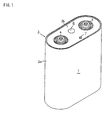
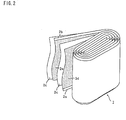
- the non-aqueous electrolyte secondary battery 1 comprises a flat electrode block 2 and a non-aqueous electrolyte containing an electrolyte salt received in a battery case 3a, wherein the flat electrode block 2 comprises a positive electrode 2a having an aluminum current collector coated with a positive electrode compound and a negative electrode 2b having a copper current collector coated with a negative electrode compound wound with a separator 2c interposed therebetween, as shown in Figs. 1 and 2.
- a case cover 3a provided with a safety valve 6 is laser-welded to the battery case 3a.
- a positive electrode terminal 4 is connected to the positive electrode 2a via a positive electrode lead wire.
- a negative electrode terminal 5 is electrically connected to the negative electrode 2b by causing the negative electrode 2b to contact the inner wall of the battery case 3a.
- the negative electrode, separator 2c, electrolyte, etc. to be used in the non-aqueous electrolyte secondary battery 1 are not specifically limited. Materials known as these components may be used.
- the negative electrode material to be used herein is not specifically limited.
- known carbon-based materials such as coke, glass-like carbon, graphite, hardly graphitizable carbon, pyrolytic carbon and carbon fiber, or metallic lithium, lithium alloy, polyacene, etc. may be used singly or in admixture or two or more.
- a transition metal may be used in the form of oxide or nitrite.
- a microporous membrane made of polyolefin resin such as polyethylene.
- a laminate of a plurality of microporous membranes made of different materials having different weight-mean molecular weights and porosities may be used.
- these microporous membranes may comprise various additives such as a plasticizer, an antioxidant and a fire retardant incorporated therein in a proper amount.
- the organic solvent for the liquid electrolyte to be used in the non-aqueous electrolyte secondary battery of the invention is not specifically limited.
- the organic solvents employable herein include ethers, ketones, lactones, nitriles, amines, amides, sulfur compounds, halogenated hydrocarbons, esters, carbonates, nitro compounds, phosphate compounds, and sulfolan-based hydrocarbons.
- Preferred among these organic solvents are ethers, ketones, esters, lactones, halogenated hydrocarbons, carbonates, and sulfolan-based compounds.
- organic solvents include tetrahydrofuran, 2-methyltetrahydrofuran, 1,4-dioxane, anisole, monoglyme, 4-methyl-2-pentanone, ethyl acetate, methyl acetate, methyl propionate, ethyl propionate, 1,2-dichloroethane, ⁇ -butyrolactone, dimethoxyethane, methyl formate, dimethyl carbonate, methyl ethyl carbonate, diethyl carbonate, propylene carbonate, ethylene carbonate, vinylene carbonate, dimethylformamide, dimethyl sulfoxide, dimethylthioformamide, sulfolan, 3-methyl-sulfolan, trimethyl phosphate, triethyl phosphate, and mixture thereof.
- the present invention is not limited to these compounds.
- Preferred among these compounds are cyclic carbonates and cyclic esters. Even more desirable among these compounds are ethylene carbonate, propylene carbonate, methyl ethyl carbonate, and diethyl carbonate. These compounds may be used singly or in combination of two or more thereof.
- the electrolyte salt to be used in the non-aqueous electrolyte secondary battery of the invention is not specifically limited. In practice, however, LiClO 4 , LiBF 4 , LiAsF 6 , CF 3 SO 3 Li, LiPF 6 , LiPF 3 (C 2 F 5 ) 3 , LiN(CF 3 SO 2 ) 2 , LiN(C 2 F 5 SO 2 ) 2 , LiI, LiAlCl 4 , and mixture thereof may be used.
- lithium salt such as LiBF 4 and LiPF 6 may be used singly or in admixture.
- the structure of the non-aqueous electrolyte secondary battery may be a combination of a positive electrode, a negative electrode, a separator, an organic or inorganic solid electrolyte membrane as a separator, and the foregoing non-aqueous liquid electrolyte, or a combination of a positive electrode, a negative electrode, an organic or inorganic solid electrolyte membrane as a separator, and the aforementioned non-aqueous liquid electrolyte.
- a polymer electrolyte membrane made of polyethylene oxide, polyacrylonitrile, polyethylene glycol or modification product thereof has a light weight and flexibility and thus can be used as an electrode to be wound to advantage.
- an inorganic solid electrolyte or a mixture of an organic polymer electrolyte and an inorganic solid electrolyte may be used.
- battery constituents include the current collector, the terminals, the insulating plate, the battery case, etc. Conventionally known materials as they are may be used as these constituents.
- the present invention is preferably applied to a large-sized, non-aqueous electrolyte secondary battery having a capacity of 3 Ah or more.
- a mixed carbonates represented by the compositional formula Ni 1-b-c Co b Mn c CO 3 (in which b and c vary from greater than 0 to smaller than 1 (0 ⁇ b ⁇ 1; 0 ⁇ c ⁇ 1)) and lithium hydroxide were mixed.
- the mixture was calcined at the temperature set forth in Table 1 in an oxygen atmosphere for 24 hours, and then ground to obtain a lithium-nickel composite oxide represented by the compositional formula Li a Ni 1-b-c Co b Mn c O 2 set forth in Table 1.
- a lithium-nickel composite oxide represented by the compositional formula Li a Ni 1-b-c Co b Mn c O 2 set forth in Table 1.
- the composition of these composite oxides were then quantitatively analyzed by the ICP emission spectroscopy. The results are set forth in terms of compositional formula of composite oxide in Table 1.
- lithium carbonate and cobalt tetraoxide were mixed.
- the mixture was calcined at a temperature of 800°C in the atmosphere for 24 hours, and then ground to obtain a lithium-cobalt composite oxide represented by the compositional formula LiCoO 2 (Comparative Example 12).
- LiCoO 2 Comparative Example 12
- All the positive active materials thus prepared exhibited a mean particle diameter D 50 of 11.0 ⁇ m and a BET surface area of 0.60 m 2 /g.
- D 50 the distribution of volume of particles was measured by the laser diffraction scattering method.
- the mean particle diameter D 50 corresponding to the volume of 50% was then determined.
- the BET surface area was measured by the N 2 gas absorption method.
- N-methyl-2-pyrrolidone To a positive electrode compound obtained by mixing 87% of the aforementioned positive active material, 5% by weight of acetylene black and 8% by weight of a polyvinylidene fluoride was added N-methyl-2-pyrrolidone to prepare a viscous material. A foamed aluminum having a porosity of 90% was filled with this viscous material, dried in vacuo at a temperature of 150°C to cause N-methyl-2-pyrrolidone to evaporate thoroughly, and then pressure-molded.
- the positive electrode having an electrode area of 2.25 cm 2 thus pressure-molded, a counter electrode and a reference electrode were put in a glass cell.
- the glass cell was then filled with a non-aqueous, liquid electrolyte obtained by dissolving 1 mol/L of LiClO 4 in a 1/1 (vol/vol) mixture of ethylene carbonate and diethyl carbonate to form a test battery.
- This test battery was charged to 4.3 V (with respect to lithium metal) at a current of 1.0 mA/cm 2 , and then discharged to 3.0 V at a current of 1.0 mA/cm 2 . The discharge capacity at this point was then measured. The capacity density per 1 g of positive active material was then calculated. The results of evaluation are set forth in Table 1.
- the test battery was charged to 4.3 V (with respect to lithium metal) at a current of 1.0 mA/cm 2 , and then discharged to 3.0 V at a current of 1.0 mA/cm 2 .
- the discharge capacity at this point was then measured. Under these conditions, charge and discharge were then repeated. After 50 cycles of charge and discharge, the test battery was then measured for discharge capacity. The capacity retention was then calculated by dividing the discharge capacity by the initial discharge capacity.
- Kind of positive active material Li a Ni 1-b-c Co b Mn c O 2 Diffraction peak intensity ratio R Calcining tempe rature (°C) Capacity density (mAh/g) Discharge capacity retention (%) a b c b + c Ex.
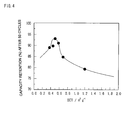
- the aforementioned lithium-nickel composite oxides were each subjected to the powder X-ray diffractometry with the cuK ⁇ ray to determine the diffraction peak intensity I 101 on the 101 plane, the diffraction peak intensity I 012 on the 012 plane and the diffraction peak intensity I 006 on the 006 plane. From these measurements was then calculated the intensity R defined by (I 101 + I 006 )/I 101 .
- the lithium-nickel composite oxide LiNi 1-b-c Co b Mn c O 3 giving a capacity density of not smaller than that of the conventional LiCoO 2 (150 mA/g) and a capacity retention as good as not smaller than 80% has a formulation such that the suffix a is not greater than 1.09, the suffix b is from not smaller than 0.05 to not greater than 0.35, the suffix c is from not smaller than 0.15 to not greater than 0.35, the sum of b and c is from not smaller than 0.25 to not greater than 0.55, and R is not greater than 0.50.
- Positive active materials having the same formulation as in Example 10 but having different mean particle diameters D 50 and BET surface areas were prepared as shown in Table 2. These positive active materials were each then used to prepare positive electrodes in the same manner as mentioned above. These positive electrodes were each then used to prepare test batteries.
- test batteries were each charged to 4.3 V (with respect to lithium metal) at a current of 1.0 mA/cm 2 , and then discharged to 3.0 V at a current of 1.0 mA/cm 2 . At this point, the test batteries were each measured for discharge capacity. Under these conditions, charge and discharge were then repeated. After 50 cycles of charge and discharge, the test battery was then measured for discharge capacity. The capacity retention was then calculated by dividing the discharge capacity by the initial discharge capacity.
- the resulting positive active material exhibits, particularly, a high capacity retention and a good charge and discharge cycle life performance.
- Positive active materials having the formulation set forth in Table 3 were prepared in the same manner as mentioned above.
- Kind of positive active material Li a Ni 1-b-c Co b Mn c O 2 Diffraction peak intensity ratio R Calcining temperature (°C) Exotherm starting temperature (°C) Dissipated heat (J/g) a b c b + c Comp.
- Ex. 13 1.00 0.35 0.10 0.45 0.491 900 231.2 662 Ex. 13 1.04 0.35 0.15 0.50 0.491 900 232.8 435
- 14 1.03 0.25 0.15 0.40 0.497 900 235.0 603
- 24 1.00 0.25 0.20 0.45 0.462 900 236.9 649
- Ex. 25 1.00 0.15 0.30 0.45 0.422 900 251.2 405
- Comp. Ex. 14 1.00 1.0 0.0 1.0 0.473 900 210.1 489
- the specimen to be tested for thermal stability was prepared as follows.
- a positive electrode compound was prepared by mixing 94% by weight of each of the positive active materials set forth in Table 3, 2% by weight of acetylene black and 4% by weight of a polyvinylidene fluoride. To the positive electrode compound thus prepared was then added N-methyl-2-pyrrolidone to prepare a viscous material. The viscous material was applied to an aluminum foil, and then dried at a temperature of 150°C in vacuo to cause N-methyl-2-pyrrolidone to evaporate thoroughly. The coated aluminum foil was roll-pressed in such a manner that the electrode area and porosity reached 3 cm 2 and 30%, respectively. The aluminum foil thus processed was used as a positive electrode. Lithium metal was used as counter electrode and reference electrode. As a liquid electrolyte, there was used a mixture of ethylene carbonate containing 1M LiPF 6 and diethyl carbonate. Thus, a test battery was prepared.
- test batteries of Comparative Example 13, Example 13, Example 14, Example 24 and Example 25 were each charged at a current of 0.5 mA/cm 2 until the state of Li reached Li 0.3 .
- the test battery of Comparative Example 14 was charged at a current of 0.5 mA/cm 2 until the state of Li reached Li 0.5 .
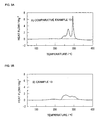
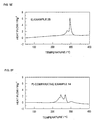
- the positive electrode compound thus charged was withdrawn from the battery, and then heated with the liquid electrolyte present therein by means of a differential scanning calorimeter (DSC). At this point, the exotherm and endotherm were measured.
- DSC differential scanning calorimeter
- the compounds comprising the positive active materials of Example 13, Example 14, Example 24 and Example 25 had an increased content of manganese and thus showed an exotherm starting temperature shifted toward higher temperature and a reduced exotherm. This is presumably because the manganese element inhibited the elimination of oxygen in the crystal structures and suppressed the exotherm.
- these positive electrode compounds those of Examples 24 and 25 exhibited a high exotherm starting temperature and a small exotherm.
- the positive electrode compound of Example 25 exhibited a better thermal stability than that of Comparative Example 14.
- the positive active material of the invention exhibits an excellent thermal stability. It can be seen that the formulation of lithium-nickel composite oxide represented by the compositional formula LiNi 1-b-c Co b Mn c O 2 where the thermal stability can be judged particularly excellent can be represented by the relationships 0.05 ⁇ b ⁇ 0.25 and 0.2 ⁇ c ⁇ 0.35.
- This battery was a non-aqueous electrolyte secondary battery 1 having a designed capacity of 10 Ah as shown in Fig. 1.
- the positive electrode 2a was prepared by mixing the aforementioned positive active material with a polyvinylidene fluoride and acetylene black, adding NMP to the mixture to prepare a paste, applying the paste to an aluminum foil, and then drying the coated aluminum to form a positive electrode compound layer thereon.
- the negative electrode 2b was prepared by mixing a carbon-based material (graphite) with a polyvinylidene fluoride, adding NMP to the mixture to prepare a paste, applying the paste to a copper foil, and then drying the coated copper foil to form a negative electrode compound layer thereon. (Safety test on large-sized battery (the nail penetrating test))
- the large-sized battery comprising the positive active material of Comparative Example 13 exhibited an insufficient thermal stability on the positive electrode and showed ignition during the nail penetrating test.
- the large-sized batteries comprising the positive active materials of Examples 24 and 25 exhibited milder damage on the battery during the nail penetrating test as the manganese content in the positive active material rose. These test results are presumably attributed to the enhancement of the thermal stability of the positive active material.
- Li 1.08 Ni 0.53 Co 0.14 Mn 0.30 Al 0.03 O 2 was prepared as Example 26.
- the starting material of the positive active material was prepared by mixing Ni 0.55 Co 0.15 Mn 0.30 CO 3 with aluminum hydroxide Al(OH) 3 and lithium hydroxide LiOH in an amount of 0.03 mols and 1.1 mols, respectively, per mol of Ni 0.55 Co 0.15 Mn 0.30 CO 3 , and then calcining the mixture at a temperature of 900°C in an oxygen atmosphere for 24 hours.
- the positive active material was then used to prepare a positive electrode and a battery in the same manner as in Example 1.
- the battery thus prepared was then measured for the diffraction peak intensity ratio, capacity density, discharge capacity retention, exotherm starting temperature and exotherm.
- the diffraction peak intensity ratio R was 0.458
- the capacity density was 158 mAh/g
- the discharge capacity retention was 91%
- the exotherm starting temperature was 253.0°C
- the exotherm was 357 J/g.
- the lithium-nickel composite oxide of the invention exhibits a high capacity density and excellent charge and discharge cycle life performance and thermal stability. Accordingly, the use of the lithium-nickel composite oxide of the invention as a positive active material makes it possible to provide a non-aqueous electrolyte secondary battery having a high energy density, a prolonged life and an excellent safety.
- the lithium-nickel composite oxide of the invention makes a great contribution to the enhancement of safety and thus is extremely useful as a positive active material for a large-sized non-aqueous electrolyte secondary battery.
- the lithium-nickel composite oxide of the invention has a less content of cobalt, which is expensive, than lithium-cobalt composite oxides which are widely used at present and thus can lead to the cost reduction and has an extremely high commercial value.
Landscapes
- Chemical & Material Sciences (AREA)
- Organic Chemistry (AREA)
- Inorganic Chemistry (AREA)
- Chemical Kinetics & Catalysis (AREA)
- Electrochemistry (AREA)
- General Chemical & Material Sciences (AREA)
- Battery Electrode And Active Subsutance (AREA)
- Secondary Cells (AREA)
Applications Claiming Priority (2)
| Application Number | Priority Date | Filing Date | Title |
|---|---|---|---|
| JP2000346973 | 2000-11-14 | ||
| JP2000346973A JP5034136B2 (ja) | 2000-11-14 | 2000-11-14 | 非水電解質二次電池用正極活物質およびそれを用いた非水電解質二次電池 |
Publications (1)
| Publication Number | Publication Date |
|---|---|
| EP1207575A2 true EP1207575A2 (en) | 2002-05-22 |
Family
ID=18820771
Family Applications (1)
| Application Number | Title | Priority Date | Filing Date |
|---|---|---|---|
| EP01126790A Withdrawn EP1207575A2 (en) | 2000-11-14 | 2001-11-09 | Positive active material for non-aqueous electrolyte secondary battery and non-aqueous electroyte secondary battery comprising same |
Country Status (4)
| Country | Link |
|---|---|
| US (1) | US6893776B2 (enExample) |
| EP (1) | EP1207575A2 (enExample) |
| JP (1) | JP5034136B2 (enExample) |
| CN (1) | CN1218417C (enExample) |
Cited By (4)
| Publication number | Priority date | Publication date | Assignee | Title |
|---|---|---|---|---|
| EP1434288A1 (en) * | 2002-12-20 | 2004-06-30 | Toyota Jidosha Kabushiki Kaisha | Active material for positive electrode for non-aqueous electrolyte secondary battery and method of manufacturing the same |
| WO2005104274A1 (ja) | 2004-04-27 | 2005-11-03 | Mitsubishi Chemical Corporation | リチウム二次電池正極材料用層状リチウムニッケルマンガンコバルト系複合酸化物粉体及びその製造方法と、それを用いたリチウム二次電池用正極、並びにリチウム二次電池 |
| EP1624509A4 (en) * | 2003-05-13 | 2010-03-24 | Mitsubishi Chem Corp | HISTORIZED LITHIUM NICKEL COMPOSITION OXIDE POWDER AND PROCESS FOR ITS MANUFACTURE |
| CN114914440A (zh) * | 2022-06-10 | 2022-08-16 | 蜂巢能源科技股份有限公司 | 一种超高镍多晶镍铝镁锆酸锂正极材料及其制备方法和应用 |
Families Citing this family (68)
| Publication number | Priority date | Publication date | Assignee | Title |
|---|---|---|---|---|
| JP2002289261A (ja) * | 2001-01-16 | 2002-10-04 | Matsushita Electric Ind Co Ltd | 非水電解質二次電池 |
| WO2002073718A1 (en) * | 2001-03-14 | 2002-09-19 | Yuasa Corporation | Positive electrode active material and nonaqueous electrolyte secondary cell comprising the same |
| US6964828B2 (en) * | 2001-04-27 | 2005-11-15 | 3M Innovative Properties Company | Cathode compositions for lithium-ion batteries |
| JP4635386B2 (ja) * | 2001-07-13 | 2011-02-23 | 株式会社Gsユアサ | 正極活物質およびこれを用いた非水電解質二次電池 |
| GB0117235D0 (en) * | 2001-07-14 | 2001-09-05 | Univ St Andrews | Improvements in or relating to electrochemical cells |
| US20030108793A1 (en) | 2001-08-07 | 2003-06-12 | 3M Innovative Properties Company | Cathode compositions for lithium ion batteries |
| US7393476B2 (en) * | 2001-11-22 | 2008-07-01 | Gs Yuasa Corporation | Positive electrode active material for lithium secondary cell and lithium secondary cell |
| US7691535B2 (en) | 2002-03-27 | 2010-04-06 | Gs Yuasa Corporation | Active substance of positive electrode and non-aqueous electrolyte battery containing the same |
| JP2004006264A (ja) * | 2002-04-17 | 2004-01-08 | Shin Kobe Electric Mach Co Ltd | リチウム二次電池 |
| EP1505672A4 (en) * | 2002-05-16 | 2012-01-04 | Panasonic Corp | ACTIVE MATERIAL OF A POSITIVE ELECTRODE FOR A SECONDARY BATTERY WITH A WATER-FREE ELECTROLYTE AND PROCESS FOR THEIR MANUFACTURE |
| CN100517818C (zh) * | 2002-09-25 | 2009-07-22 | 清美化学股份有限公司 | 锂二次电池用正极材料及其制造方法 |
| KR100485093B1 (ko) * | 2002-10-28 | 2005-04-22 | 삼성에스디아이 주식회사 | 리튬-황 전지용 양극 및 이를 포함하는 리튬-황 전지 |
| US20050191554A1 (en) * | 2002-10-31 | 2005-09-01 | Mitsubishi Chemical Corporation | Additive for positive electrode material for lithium secondary battery, positive electrode material for lithium secondary battery, and positive electrode and lithium secondary battery using the positive electrode material for lithium secondary battery |
| KR100778961B1 (ko) * | 2002-11-06 | 2007-11-28 | 가부시끼가이샤 도시바 | 비수전해질 이차 전지 |
| US7316862B2 (en) | 2002-11-21 | 2008-01-08 | Hitachi Maxell, Ltd. | Active material for electrode and non-aqueous secondary battery using the same |
| US20040121234A1 (en) * | 2002-12-23 | 2004-06-24 | 3M Innovative Properties Company | Cathode composition for rechargeable lithium battery |
| US20050220700A1 (en) * | 2003-03-14 | 2005-10-06 | Seimi Chemical Co., Ltd. | Positive electrode active material powder for lithium secondary battery |
| JP4061648B2 (ja) * | 2003-04-11 | 2008-03-19 | ソニー株式会社 | 非水電解質二次電池用正極活物質及びそれを用いた非水電解質二次電池 |
| NZ538480A (en) * | 2003-04-17 | 2007-12-21 | Seimi Chem Kk | Lithium-nickel-cobalt-manganese containing composite oxide, material for positive electrode active material for lithium secondary battery, and methods for producing these |
| JP2004335223A (ja) * | 2003-05-06 | 2004-11-25 | Japan Storage Battery Co Ltd | 非水電解質二次電池 |
| JP4740409B2 (ja) | 2003-06-11 | 2011-08-03 | 株式会社日立製作所 | 電気自動車或いはハイブリット自動車用リチウム二次電池 |
| KR100560540B1 (ko) * | 2003-07-18 | 2006-03-15 | 삼성에스디아이 주식회사 | 리튬 이차 전지용 양극 활물질, 그의 제조 방법 및 그를포함하는 리튬 이차 전지 |
| US7211237B2 (en) | 2003-11-26 | 2007-05-01 | 3M Innovative Properties Company | Solid state synthesis of lithium ion battery cathode material |
| JP4100341B2 (ja) | 2003-12-26 | 2008-06-11 | 新神戸電機株式会社 | リチウム二次電池用正極材料及びそれを用いたリチウム二次電池 |
| JP4900888B2 (ja) * | 2004-03-10 | 2012-03-21 | 三井金属鉱業株式会社 | リチウム電池用リチウム遷移金属酸化物 |
| JP4784085B2 (ja) | 2004-12-10 | 2011-09-28 | 新神戸電機株式会社 | リチウム二次電池用正極材料とその製造法及びリチウム二次電池 |
| JP5217076B2 (ja) * | 2005-02-04 | 2013-06-19 | Tdk株式会社 | リチウムイオン組電池 |
| KR100911798B1 (ko) * | 2005-03-23 | 2009-08-12 | 파나소닉 주식회사 | 리튬이온 2차전지 및 그 제조법 |
| US20070292761A1 (en) * | 2005-04-13 | 2007-12-20 | Lg Chem, Ltd. | Material for lithium secondary battery of high performance |
| US20080032196A1 (en) | 2005-04-13 | 2008-02-07 | Lg Chem, Ltd. | Method of preparing material for lithium secondary battery of high performance |
| US20070298512A1 (en) | 2005-04-13 | 2007-12-27 | Lg Chem, Ltd. | Material for lithium secondary battery of high performance |
| US7648693B2 (en) * | 2005-04-13 | 2010-01-19 | Lg Chem, Ltd. | Ni-based lithium transition metal oxide |
| WO2006136050A1 (en) * | 2005-06-20 | 2006-12-28 | Shenzhen Bak Battery Co., Ltd | A multicomponent composite lithium oxide containing nickel and cobalt, a method for producing the same, the use thereof as a positive electrode active material for lithium ion secondary battery and lithium ion secondary battery |
| JP2007018883A (ja) * | 2005-07-07 | 2007-01-25 | Toshiba Corp | 負極活物質、非水電解質電池及び電池パック |
| JP4213688B2 (ja) | 2005-07-07 | 2009-01-21 | 株式会社東芝 | 非水電解質電池及び電池パック |
| CN101083321B (zh) * | 2006-05-31 | 2010-12-15 | 湖南美特新材料有限公司 | 一种锰钴镍三元锂离子电池正极材料锂锰钴镍氧及其合成方法 |
| EP2337125A1 (en) * | 2006-12-26 | 2011-06-22 | Mitsubishi Chemical Corporation | Lithium transition metal based compound powder and method for manufacturing the same |
| WO2010079963A2 (ko) * | 2009-01-06 | 2010-07-15 | 주식회사 엘지화학 | 양극 활물질 및 이를 포함하는 리튬 이차전지 |
| JP5325888B2 (ja) * | 2009-04-10 | 2013-10-23 | 日立マクセル株式会社 | 電極用活物質、非水二次電池用電極および非水二次電池 |
| JP5341837B2 (ja) | 2009-08-25 | 2013-11-13 | 株式会社東芝 | 正極、非水電解質電池及び電池パック |
| JP2010177207A (ja) * | 2010-04-02 | 2010-08-12 | Sanyo Electric Co Ltd | 非水電解質二次電池 |
| JP5534595B2 (ja) * | 2010-04-19 | 2014-07-02 | 日立マクセル株式会社 | リチウム二次電池用正極およびリチウム二次電池 |
| KR101084218B1 (ko) * | 2010-06-11 | 2011-11-17 | 삼성에스디아이 주식회사 | 전극 도전제, 전극 재료, 및 이를 채용한 전극과 리튬 전지 |
| KR101330613B1 (ko) * | 2010-06-13 | 2013-11-18 | 삼성에스디아이 주식회사 | 리튬 이차전지용 양극 활물질의 제조 방법 |
| US9023526B2 (en) | 2010-06-13 | 2015-05-05 | Samsung Sdi Co., Ltd. | Positive active material for rechargeable lithium battery, method of preparing the same, and rechargeable lithium battery including the same |
| KR101309150B1 (ko) * | 2010-06-13 | 2013-09-17 | 삼성에스디아이 주식회사 | 리튬 이차 전지용 양극 활물질, 이의 제조 방법 및 이를 포함하는 리튬 이차 전지 |
| KR20110136001A (ko) * | 2010-06-13 | 2011-12-21 | 삼성에스디아이 주식회사 | 리튬 이차전지용 양극 활물질의 제조 방법 및 이를 이용한 리튬 이차전지 |
| CN102324568A (zh) * | 2011-09-15 | 2012-01-18 | 诺莱特科技(苏州)有限公司 | 一种改善锂离子电池鼓气的电解质溶液 |
| JP5826653B2 (ja) * | 2012-02-01 | 2015-12-02 | 株式会社Gsユアサ | 非水電解質二次電池用正極活物質およびそれを用いた非水電解質二次電池 |
| US9716268B2 (en) * | 2012-03-29 | 2017-07-25 | Sanyo Electric Co., Ltd. | Nonaqueous electrolyte secondary battery |
| WO2014014913A2 (en) * | 2012-07-20 | 2014-01-23 | 3M Innovative Properties Company | High voltage cathode compositions for lithium-ion batteries |
| CN109599555A (zh) * | 2013-02-28 | 2019-04-09 | 日产自动车株式会社 | 正极活性物质、正极材料、正极及非水电解质二次电池 |
| KR101904896B1 (ko) * | 2013-11-27 | 2018-10-05 | 삼성에스디아이 주식회사 | 리튬 이차 전지용 양극 활물질, 이의 제조 방법 및 이를 포함하는 리튬 이차 전지 |
| TWI600202B (zh) * | 2014-03-06 | 2017-09-21 | 烏明克公司 | 用於在汽車應用中的電池組之摻雜並且塗覆的鋰過渡金屬氧化物陰極材料 |
| WO2015141194A1 (ja) * | 2014-03-20 | 2015-09-24 | 三洋電機株式会社 | 非水電解質二次電池用正極及び非水電解質二次電池 |
| JP6112367B2 (ja) * | 2014-09-12 | 2017-04-12 | トヨタ自動車株式会社 | リチウムイオン二次電池およびその製造方法 |
| KR101802018B1 (ko) * | 2014-09-26 | 2017-11-27 | 주식회사 엘지화학 | 비수성 전해액 및 이를 포함하는 리튬 이차 전지 |
| TWI580097B (zh) * | 2014-09-26 | 2017-04-21 | Lg化學股份有限公司 | 非水性液態電解質及含彼之鋰二次電池 |
| US11437646B2 (en) | 2014-09-26 | 2022-09-06 | Lg Energy Solution, Ltd. | Non-aqueous liquid electrolyte and lithium secondary battery comprising the same |
| JP6466161B2 (ja) * | 2014-12-18 | 2019-02-06 | オートモーティブエナジーサプライ株式会社 | リチウムイオン電池用負極材料 |
| WO2020013301A1 (ja) * | 2018-07-11 | 2020-01-16 | 株式会社モルフ | 組立体及び蓄電池の製造方法 |
| JP7300610B2 (ja) * | 2018-08-29 | 2023-06-30 | パナソニックIpマネジメント株式会社 | 非水電解質二次電池用正極活物質及び非水電解質二次電池 |
| WO2020114034A1 (zh) * | 2018-12-07 | 2020-06-11 | 北京大学深圳研究生院 | 一种二次离子电池层状正极材料及其制备方法和应用 |
| CN112436134B (zh) | 2019-04-28 | 2022-03-08 | 宁德时代新能源科技股份有限公司 | 正极活性材料及其制备方法、正极极片、锂离子二次电池和电动汽车 |
| CN112151789B (zh) * | 2019-06-28 | 2021-10-01 | 宁德时代新能源科技股份有限公司 | 一种正极材料及其制备方法和用途 |
| CN114678528B (zh) * | 2021-12-07 | 2023-10-27 | 北京当升材料科技股份有限公司 | 钴酸锂正极材料及其制备方法与应用 |
| CN114709417B (zh) * | 2021-12-07 | 2024-01-26 | 北京当升材料科技股份有限公司 | 多元正极材料及其制备方法与应用 |
| CN116375106B (zh) * | 2023-03-31 | 2024-11-15 | 宁波容百新能源科技股份有限公司 | 一种正极材料前驱体及其制备方法、应用 |
Family Cites Families (9)
| Publication number | Priority date | Publication date | Assignee | Title |
|---|---|---|---|---|
| JP3244314B2 (ja) | 1991-11-13 | 2002-01-07 | 三洋電機株式会社 | 非水系電池 |
| JP3550783B2 (ja) | 1994-05-16 | 2004-08-04 | 東ソー株式会社 | リチウム含有遷移金属複合酸化物及びその製造方法並びにその用途 |
| US5707756A (en) * | 1994-11-29 | 1998-01-13 | Fuji Photo Film Co., Ltd. | Non-aqueous secondary battery |
| JPH08213015A (ja) | 1995-01-31 | 1996-08-20 | Sony Corp | リチウム二次電池用正極活物質及びリチウム二次電池 |
| JP3362583B2 (ja) | 1995-12-21 | 2003-01-07 | 松下電器産業株式会社 | 非水電解液二次電池 |
| US5718989A (en) * | 1995-12-29 | 1998-02-17 | Japan Storage Battery Co., Ltd. | Positive electrode active material for lithium secondary battery |
| JPH10289731A (ja) | 1997-04-15 | 1998-10-27 | Sanyo Electric Co Ltd | 非水電解液電池 |
| JPH11307094A (ja) | 1998-04-20 | 1999-11-05 | Chuo Denki Kogyo Co Ltd | リチウム二次電池用正極活物質とリチウム二次電池 |
| JP2000133262A (ja) | 1998-10-21 | 2000-05-12 | Sanyo Electric Co Ltd | 非水系電解液二次電池 |
-
2000
- 2000-11-14 JP JP2000346973A patent/JP5034136B2/ja not_active Expired - Lifetime
-
2001
- 2001-11-08 US US09/986,431 patent/US6893776B2/en not_active Expired - Lifetime
- 2001-11-09 EP EP01126790A patent/EP1207575A2/en not_active Withdrawn
- 2001-11-14 CN CN011349212A patent/CN1218417C/zh not_active Expired - Lifetime
Cited By (11)
| Publication number | Priority date | Publication date | Assignee | Title |
|---|---|---|---|---|
| EP1434288A1 (en) * | 2002-12-20 | 2004-06-30 | Toyota Jidosha Kabushiki Kaisha | Active material for positive electrode for non-aqueous electrolyte secondary battery and method of manufacturing the same |
| US7332248B2 (en) | 2002-12-20 | 2008-02-19 | Sumitomo Metal Mining Co., Ltd. | Active material for positive electrode for non-aqueous electrolyte secondary battery and method of manufacturing the same |
| EP1624509A4 (en) * | 2003-05-13 | 2010-03-24 | Mitsubishi Chem Corp | HISTORIZED LITHIUM NICKEL COMPOSITION OXIDE POWDER AND PROCESS FOR ITS MANUFACTURE |
| US7923147B2 (en) | 2003-05-13 | 2011-04-12 | Mitsubishi Chemical Corporation | Layered lithium-nickel-based compound oxide powder and its prodution process |
| EP2485306A1 (en) * | 2003-05-13 | 2012-08-08 | Mitsubishi Chemical Corporation | Layered lithium nickel composite oxide powder and process for producing the same |
| WO2005104274A1 (ja) | 2004-04-27 | 2005-11-03 | Mitsubishi Chemical Corporation | リチウム二次電池正極材料用層状リチウムニッケルマンガンコバルト系複合酸化物粉体及びその製造方法と、それを用いたリチウム二次電池用正極、並びにリチウム二次電池 |
| EP1742281A4 (en) * | 2004-04-27 | 2010-01-20 | Mitsubishi Chem Corp | LAYER LITHIUM NICKEL MANGAN COBALT COMPOUND OXIDE POWDER FOR THE MATERIAL OF A POSITIVE ELECTRODE OF A LITHIUM SECONDARY BATTERY, MANUFACTURING PROCESS THEREFOR, POSITIVE ELECTRODE OF A LITHIUM SECONDARY BATTERY THEREOF AND LITHIUM SECONDARY BATTERY |
| KR100946610B1 (ko) * | 2004-04-27 | 2010-03-09 | 미쓰비시 가가꾸 가부시키가이샤 | 리튬 이차 전지의 양극 재료용 층상 리튬 니켈 망간코발트계 복합 산화물의 분말 및 그 제조방법과, 그것을사용한 리튬 이차 전지용 양극, 및 리튬 이차 전지 |
| US8354191B2 (en) | 2004-04-27 | 2013-01-15 | Mitsubishi Chemical Corporation | Layered lithium nickel manganese cobalt composite oxide powder for material of positive electrode of lithium secondary battery, process for producing the same, positive electrode of lithium secondary battery therefrom, and lithium secondary battery |
| CN114914440A (zh) * | 2022-06-10 | 2022-08-16 | 蜂巢能源科技股份有限公司 | 一种超高镍多晶镍铝镁锆酸锂正极材料及其制备方法和应用 |
| CN114914440B (zh) * | 2022-06-10 | 2024-03-29 | 蜂巢能源科技股份有限公司 | 一种超高镍多晶镍铝镁锆酸锂正极材料及其制备方法和应用 |
Also Published As
| Publication number | Publication date |
|---|---|
| CN1218417C (zh) | 2005-09-07 |
| US20020086210A1 (en) | 2002-07-04 |
| US6893776B2 (en) | 2005-05-17 |
| JP5034136B2 (ja) | 2012-09-26 |
| JP2002151076A (ja) | 2002-05-24 |
| CN1356737A (zh) | 2002-07-03 |
Similar Documents
| Publication | Publication Date | Title |
|---|---|---|
| US6893776B2 (en) | Positive active material for non-aqueous electrolyte secondary battery and non-aqueous electrolyte secondary battery comprising same | |
| US7214449B2 (en) | Cathode active material and non-aqueous electrolyte secondary battery | |
| JP3233352B2 (ja) | 非水溶媒二次電池の製造方法 | |
| US6007947A (en) | Mixed lithium manganese oxide and lithium nickel cobalt oxide positive electrodes | |
| KR100882144B1 (ko) | 양극 활성 물질 및 비수전해액 2차 전지 | |
| KR100700340B1 (ko) | 양극 활성 물질, 양극 활성 물질 조성물 및 리튬 이온 2차전지 | |
| CN100487962C (zh) | 锂离子二次电池及其制备方法 | |
| KR100686848B1 (ko) | 리튬 이차 전지 | |
| JP4910243B2 (ja) | 非水電解質二次電池 | |
| EP0834941A1 (en) | An electrode for a battery and a battery containing it | |
| EP1335445A1 (en) | Electrolyte for non-aqueous cell and non-aqueous secondary cell | |
| US20090214946A1 (en) | Negative electrode for lithium ion battery and lithium ion battery using the same | |
| KR20010107665A (ko) | 비수성 전해질 이차 배터리 | |
| KR20090046700A (ko) | 정극 및 리튬 이온 2차 전지 | |
| JP4210892B2 (ja) | 二次電池 | |
| JP4848577B2 (ja) | 非水電解質電池 | |
| KR100742111B1 (ko) | 양극 재료와 이차 배터리 | |
| JP2003203631A (ja) | 正極活物質及びこれを用いた非水電解質二次電池 | |
| KR100321954B1 (ko) | 비수 전해질 전지 | |
| KR101179059B1 (ko) | 리튬 이차전지용 양극 활물질 및 이를 포함한 리튬 이차전지 | |
| JP2008016414A (ja) | 非水電解質二次電池 | |
| EP4697437A1 (en) | Secondary battery | |
| JP2002216759A (ja) | リチウムイオン二次電池 | |
| JPH10214626A (ja) | リチウム二次電池およびリチウム二次電池用正極活物質 | |
| JP4940505B2 (ja) | リチウムイオン二次電池 |
Legal Events
| Date | Code | Title | Description |
|---|---|---|---|
| PUAI | Public reference made under article 153(3) epc to a published international application that has entered the european phase |
Free format text: ORIGINAL CODE: 0009012 |
|
| AX | Request for extension of the european patent |
Free format text: AL;LT;LV;MK;RO;SI |
|
| STAA | Information on the status of an ep patent application or granted ep patent |
Free format text: STATUS: THE APPLICATION HAS BEEN WITHDRAWN |
|
| 18W | Application withdrawn |
Effective date: 20050426 |