EP1144100B1 - Membranen aus sulfoniertem aromatischen polyetherketon und polybenzimidazol sowie deren verwendung - Google Patents
Membranen aus sulfoniertem aromatischen polyetherketon und polybenzimidazol sowie deren verwendung Download PDFInfo
- Publication number
- EP1144100B1 EP1144100B1 EP99955884A EP99955884A EP1144100B1 EP 1144100 B1 EP1144100 B1 EP 1144100B1 EP 99955884 A EP99955884 A EP 99955884A EP 99955884 A EP99955884 A EP 99955884A EP 1144100 B1 EP1144100 B1 EP 1144100B1
- Authority
- EP
- European Patent Office
- Prior art keywords
- membrane according
- polybenzimidazole
- polymer
- polyether ketone
- membrane
- Prior art date
- Legal status (The legal status is an assumption and is not a legal conclusion. Google has not performed a legal analysis and makes no representation as to the accuracy of the status listed.)
- Revoked
Links
- 239000012528 membrane Substances 0.000 title claims abstract description 69
- 229920001643 poly(ether ketone) Polymers 0.000 title claims abstract description 54
- 229920002480 polybenzimidazole Polymers 0.000 title claims abstract description 37
- 239000004693 Polybenzimidazole Substances 0.000 title claims abstract description 28
- 229920000642 polymer Polymers 0.000 claims abstract description 47
- 125000003118 aryl group Chemical group 0.000 claims abstract description 18
- SECXISVLQFMRJM-UHFFFAOYSA-N N-Methylpyrrolidone Chemical compound CN1CCCC1=O SECXISVLQFMRJM-UHFFFAOYSA-N 0.000 claims abstract description 14
- 238000005342 ion exchange Methods 0.000 claims abstract description 12
- 238000000034 method Methods 0.000 claims abstract description 10
- 150000003839 salts Chemical class 0.000 claims abstract description 8
- XLYOFNOQVPJJNP-UHFFFAOYSA-N water Substances O XLYOFNOQVPJJNP-UHFFFAOYSA-N 0.000 claims description 24
- 239000000446 fuel Substances 0.000 claims description 20
- RTZKZFJDLAIYFH-UHFFFAOYSA-N Diethyl ether Chemical compound CCOCC RTZKZFJDLAIYFH-UHFFFAOYSA-N 0.000 claims description 10
- 239000002253 acid Substances 0.000 claims description 9
- QAOWNCQODCNURD-UHFFFAOYSA-N Sulfuric acid Chemical compound OS(O)(=O)=O QAOWNCQODCNURD-UHFFFAOYSA-N 0.000 claims description 8
- 125000000217 alkyl group Chemical group 0.000 claims description 7
- 229910052739 hydrogen Inorganic materials 0.000 claims description 7
- 239000001257 hydrogen Substances 0.000 claims description 7
- 238000006277 sulfonation reaction Methods 0.000 claims description 7
- 125000001140 1,4-phenylene group Chemical group [H]C1=C([H])C([*:2])=C([H])C([H])=C1[*:1] 0.000 claims description 5
- QGZKDVFQNNGYKY-UHFFFAOYSA-O Ammonium Chemical compound [NH4+] QGZKDVFQNNGYKY-UHFFFAOYSA-O 0.000 claims description 4
- NBIIXXVUZAFLBC-UHFFFAOYSA-N Phosphoric acid Chemical compound OP(O)(O)=O NBIIXXVUZAFLBC-UHFFFAOYSA-N 0.000 claims description 4
- 125000004435 hydrogen atom Chemical group [H]* 0.000 claims description 4
- 125000005499 phosphonyl group Chemical group 0.000 claims description 4
- 125000000472 sulfonyl group Chemical group *S(*)(=O)=O 0.000 claims description 4
- AVXURJPOCDRRFD-UHFFFAOYSA-N Hydroxylamine Chemical compound ON AVXURJPOCDRRFD-UHFFFAOYSA-N 0.000 claims description 3
- GRYLNZFGIOXLOG-UHFFFAOYSA-N Nitric acid Chemical compound O[N+]([O-])=O GRYLNZFGIOXLOG-UHFFFAOYSA-N 0.000 claims description 3
- 150000001768 cations Chemical class 0.000 claims description 3
- 238000001566 impedance spectroscopy Methods 0.000 claims description 3
- 229910017604 nitric acid Inorganic materials 0.000 claims description 3
- 239000003960 organic solvent Substances 0.000 claims description 3
- 229910000147 aluminium phosphate Inorganic materials 0.000 claims description 2
- 150000003863 ammonium salts Chemical class 0.000 claims description 2
- 125000002843 carboxylic acid group Chemical group 0.000 claims description 2
- 239000007788 liquid Substances 0.000 claims description 2
- 229910052744 lithium Inorganic materials 0.000 claims description 2
- 229910052751 metal Inorganic materials 0.000 claims description 2
- 239000002184 metal Substances 0.000 claims description 2
- 125000004957 naphthylene group Chemical group 0.000 claims description 2
- 125000000449 nitro group Chemical group [O-][N+](*)=O 0.000 claims description 2
- 125000004433 nitrogen atom Chemical group N* 0.000 claims description 2
- 125000000962 organic group Chemical group 0.000 claims description 2
- 125000000843 phenylene group Chemical group C1(=C(C=CC=C1)*)* 0.000 claims description 2
- 229910052700 potassium Inorganic materials 0.000 claims description 2
- 239000013557 residual solvent Substances 0.000 claims description 2
- 229910052708 sodium Inorganic materials 0.000 claims description 2
- 239000011734 sodium Substances 0.000 claims description 2
- 238000005406 washing Methods 0.000 claims description 2
- OKKJLVBELUTLKV-UHFFFAOYSA-N Methanol Chemical compound OC OKKJLVBELUTLKV-UHFFFAOYSA-N 0.000 claims 3
- 241001012508 Carpiodes cyprinus Species 0.000 claims 1
- DGAQECJNVWCQMB-PUAWFVPOSA-M Ilexoside XXIX Chemical compound C[C@@H]1CC[C@@]2(CC[C@@]3(C(=CC[C@H]4[C@]3(CC[C@@H]5[C@@]4(CC[C@@H](C5(C)C)OS(=O)(=O)[O-])C)C)[C@@H]2[C@]1(C)O)C)C(=O)O[C@H]6[C@@H]([C@H]([C@@H]([C@H](O6)CO)O)O)O.[Na+] DGAQECJNVWCQMB-PUAWFVPOSA-M 0.000 claims 1
- WHXSMMKQMYFTQS-UHFFFAOYSA-N Lithium Chemical compound [Li] WHXSMMKQMYFTQS-UHFFFAOYSA-N 0.000 claims 1
- ZLMJMSJWJFRBEC-UHFFFAOYSA-N Potassium Chemical compound [K] ZLMJMSJWJFRBEC-UHFFFAOYSA-N 0.000 claims 1
- 229910006069 SO3H Inorganic materials 0.000 claims 1
- 125000002915 carbonyl group Chemical group [*:2]C([*:1])=O 0.000 claims 1
- 239000011591 potassium Substances 0.000 claims 1
- 239000000203 mixture Substances 0.000 abstract description 21
- IAZDPXIOMUYVGZ-UHFFFAOYSA-N Dimethylsulphoxide Chemical compound CS(C)=O IAZDPXIOMUYVGZ-UHFFFAOYSA-N 0.000 abstract description 9
- ZMXDDKWLCZADIW-UHFFFAOYSA-N N,N-Dimethylformamide Chemical compound CN(C)C=O ZMXDDKWLCZADIW-UHFFFAOYSA-N 0.000 abstract description 9
- 239000002904 solvent Substances 0.000 abstract description 6
- FXHOOIRPVKKKFG-UHFFFAOYSA-N N,N-Dimethylacetamide Chemical compound CN(C)C(C)=O FXHOOIRPVKKKFG-UHFFFAOYSA-N 0.000 abstract description 5
- 238000004519 manufacturing process Methods 0.000 abstract description 5
- 238000005266 casting Methods 0.000 abstract description 2
- 238000005507 spraying Methods 0.000 abstract description 2
- 238000004528 spin coating Methods 0.000 abstract 1
- 238000003892 spreading Methods 0.000 abstract 1
- 210000004379 membrane Anatomy 0.000 description 48
- -1 aromatic radical Chemical class 0.000 description 26
- 150000003254 radicals Chemical group 0.000 description 23
- 239000000243 solution Substances 0.000 description 22
- 239000000463 material Substances 0.000 description 12
- HEMHJVSKTPXQMS-UHFFFAOYSA-M Sodium hydroxide Chemical compound [OH-].[Na+] HEMHJVSKTPXQMS-UHFFFAOYSA-M 0.000 description 6
- JUPQTSLXMOCDHR-UHFFFAOYSA-N benzene-1,4-diol;bis(4-fluorophenyl)methanone Chemical compound OC1=CC=C(O)C=C1.C1=CC(F)=CC=C1C(=O)C1=CC=C(F)C=C1 JUPQTSLXMOCDHR-UHFFFAOYSA-N 0.000 description 4
- 238000009835 boiling Methods 0.000 description 4
- 229920006393 polyether sulfone Polymers 0.000 description 4
- 125000001989 1,3-phenylene group Chemical group [H]C1=C([H])C([*:1])=C([H])C([*:2])=C1[H] 0.000 description 3
- LSNNMFCWUKXFEE-UHFFFAOYSA-M Bisulfite Chemical class OS([O-])=O LSNNMFCWUKXFEE-UHFFFAOYSA-M 0.000 description 3
- 239000004696 Poly ether ether ketone Substances 0.000 description 3
- 239000004695 Polyether sulfone Substances 0.000 description 3
- 229920004695 VICTREX™ PEEK Polymers 0.000 description 3
- 125000002252 acyl group Chemical group 0.000 description 3
- 239000002585 base Substances 0.000 description 3
- 230000003993 interaction Effects 0.000 description 3
- 230000007935 neutral effect Effects 0.000 description 3
- 229920005547 polycyclic aromatic hydrocarbon Polymers 0.000 description 3
- 229920002530 polyetherether ketone Polymers 0.000 description 3
- 229920002959 polymer blend Polymers 0.000 description 3
- 125000001424 substituent group Chemical group 0.000 description 3
- IJGRMHOSHXDMSA-UHFFFAOYSA-N Atomic nitrogen Chemical compound N#N IJGRMHOSHXDMSA-UHFFFAOYSA-N 0.000 description 2
- YCKRFDGAMUMZLT-UHFFFAOYSA-N Fluorine atom Chemical compound [F] YCKRFDGAMUMZLT-UHFFFAOYSA-N 0.000 description 2
- 230000002411 adverse Effects 0.000 description 2
- 229910052784 alkaline earth metal Inorganic materials 0.000 description 2
- 150000001342 alkaline earth metals Chemical class 0.000 description 2
- 125000003545 alkoxy group Chemical group 0.000 description 2
- 125000004432 carbon atom Chemical group C* 0.000 description 2
- 150000001732 carboxylic acid derivatives Chemical class 0.000 description 2
- 239000008367 deionised water Substances 0.000 description 2
- 229910021641 deionized water Inorganic materials 0.000 description 2
- 229960001760 dimethyl sulfoxide Drugs 0.000 description 2
- 229910052731 fluorine Inorganic materials 0.000 description 2
- 239000011737 fluorine Substances 0.000 description 2
- 239000011521 glass Substances 0.000 description 2
- 229910052736 halogen Inorganic materials 0.000 description 2
- 150000002367 halogens Chemical class 0.000 description 2
- 150000002431 hydrogen Chemical class 0.000 description 2
- 150000002576 ketones Chemical class 0.000 description 2
- 238000005259 measurement Methods 0.000 description 2
- 125000002496 methyl group Chemical group [H]C([H])([H])* 0.000 description 2
- BASFCYQUMIYNBI-UHFFFAOYSA-N platinum Chemical compound [Pt] BASFCYQUMIYNBI-UHFFFAOYSA-N 0.000 description 2
- 229920001657 poly(etheretherketoneketone) Polymers 0.000 description 2
- 229920001652 poly(etherketoneketone) Polymers 0.000 description 2
- 239000005518 polymer electrolyte Substances 0.000 description 2
- 159000000000 sodium salts Chemical class 0.000 description 2
- AKEJUJNQAAGONA-UHFFFAOYSA-N sulfur trioxide Chemical compound O=S(=O)=O AKEJUJNQAAGONA-UHFFFAOYSA-N 0.000 description 2
- 230000008961 swelling Effects 0.000 description 2
- 238000010345 tape casting Methods 0.000 description 2
- SCYULBFZEHDVBN-UHFFFAOYSA-N 1,1-Dichloroethane Chemical compound CC(Cl)Cl SCYULBFZEHDVBN-UHFFFAOYSA-N 0.000 description 1
- KEQGZUUPPQEDPF-UHFFFAOYSA-N 1,3-dichloro-5,5-dimethylimidazolidine-2,4-dione Chemical compound CC1(C)N(Cl)C(=O)N(Cl)C1=O KEQGZUUPPQEDPF-UHFFFAOYSA-N 0.000 description 1
- 125000004959 2,6-naphthylene group Chemical group [H]C1=C([H])C2=C([H])C([*:1])=C([H])C([H])=C2C([H])=C1[*:2] 0.000 description 1
- NGNBDVOYPDDBFK-UHFFFAOYSA-N 2-[2,4-di(pentan-2-yl)phenoxy]acetyl chloride Chemical compound CCCC(C)C1=CC=C(OCC(Cl)=O)C(C(C)CCC)=C1 NGNBDVOYPDDBFK-UHFFFAOYSA-N 0.000 description 1
- WKBOTKDWSSQWDR-UHFFFAOYSA-N Bromine atom Chemical compound [Br] WKBOTKDWSSQWDR-UHFFFAOYSA-N 0.000 description 1
- OKTJSMMVPCPJKN-UHFFFAOYSA-N Carbon Chemical compound [C] OKTJSMMVPCPJKN-UHFFFAOYSA-N 0.000 description 1
- ZAMOUSCENKQFHK-UHFFFAOYSA-N Chlorine atom Chemical compound [Cl] ZAMOUSCENKQFHK-UHFFFAOYSA-N 0.000 description 1
- UFHFLCQGNIYNRP-UHFFFAOYSA-N Hydrogen Chemical compound [H][H] UFHFLCQGNIYNRP-UHFFFAOYSA-N 0.000 description 1
- 229920000557 Nafion® Polymers 0.000 description 1
- 239000004793 Polystyrene Substances 0.000 description 1
- NINIDFKCEFEMDL-UHFFFAOYSA-N Sulfur Chemical compound [S] NINIDFKCEFEMDL-UHFFFAOYSA-N 0.000 description 1
- 239000002250 absorbent Substances 0.000 description 1
- 230000002745 absorbent Effects 0.000 description 1
- 150000007513 acids Chemical class 0.000 description 1
- 125000003158 alcohol group Chemical group 0.000 description 1
- 239000003513 alkali Substances 0.000 description 1
- 239000000956 alloy Substances 0.000 description 1
- 229910045601 alloy Inorganic materials 0.000 description 1
- 230000009435 amidation Effects 0.000 description 1
- 238000007112 amidation reaction Methods 0.000 description 1
- 125000003277 amino group Chemical group 0.000 description 1
- 150000005840 aryl radicals Chemical class 0.000 description 1
- QVGXLLKOCUKJST-UHFFFAOYSA-N atomic oxygen Chemical compound [O] QVGXLLKOCUKJST-UHFFFAOYSA-N 0.000 description 1
- 230000015572 biosynthetic process Effects 0.000 description 1
- GDTBXPJZTBHREO-UHFFFAOYSA-N bromine Substances BrBr GDTBXPJZTBHREO-UHFFFAOYSA-N 0.000 description 1
- 229910052794 bromium Inorganic materials 0.000 description 1
- 229910052799 carbon Inorganic materials 0.000 description 1
- 125000003178 carboxy group Chemical group [H]OC(*)=O 0.000 description 1
- 125000003262 carboxylic acid ester group Chemical group [H]C([H])([*:2])OC(=O)C([H])([H])[*:1] 0.000 description 1
- 230000015556 catabolic process Effects 0.000 description 1
- 238000006243 chemical reaction Methods 0.000 description 1
- 239000000460 chlorine Substances 0.000 description 1
- 229910052801 chlorine Inorganic materials 0.000 description 1
- XTHPWXDJESJLNJ-UHFFFAOYSA-N chlorosulfonic acid Substances OS(Cl)(=O)=O XTHPWXDJESJLNJ-UHFFFAOYSA-N 0.000 description 1
- 238000003776 cleavage reaction Methods 0.000 description 1
- 230000003750 conditioning effect Effects 0.000 description 1
- 125000004122 cyclic group Chemical group 0.000 description 1
- 230000002950 deficient Effects 0.000 description 1
- 238000006731 degradation reaction Methods 0.000 description 1
- 230000001419 dependent effect Effects 0.000 description 1
- 239000012153 distilled water Substances 0.000 description 1
- 238000001035 drying Methods 0.000 description 1
- 239000007772 electrode material Substances 0.000 description 1
- 238000000921 elemental analysis Methods 0.000 description 1
- 238000005516 engineering process Methods 0.000 description 1
- 125000001033 ether group Chemical group 0.000 description 1
- 238000001704 evaporation Methods 0.000 description 1
- 230000008020 evaporation Effects 0.000 description 1
- 238000001914 filtration Methods 0.000 description 1
- 238000005227 gel permeation chromatography Methods 0.000 description 1
- 238000001879 gelation Methods 0.000 description 1
- 238000010438 heat treatment Methods 0.000 description 1
- 239000012456 homogeneous solution Substances 0.000 description 1
- 229920001477 hydrophilic polymer Polymers 0.000 description 1
- 125000002883 imidazolyl group Chemical group 0.000 description 1
- 239000012535 impurity Substances 0.000 description 1
- 238000010348 incorporation Methods 0.000 description 1
- 229910052500 inorganic mineral Inorganic materials 0.000 description 1
- 150000002500 ions Chemical class 0.000 description 1
- 125000000956 methoxy group Chemical group [H]C([H])([H])O* 0.000 description 1
- 239000011707 mineral Substances 0.000 description 1
- 238000002156 mixing Methods 0.000 description 1
- LJDZFAPLPVPTBD-UHFFFAOYSA-N nitroformic acid Chemical compound OC(=O)[N+]([O-])=O LJDZFAPLPVPTBD-UHFFFAOYSA-N 0.000 description 1
- 229910052757 nitrogen Inorganic materials 0.000 description 1
- 229920006120 non-fluorinated polymer Polymers 0.000 description 1
- 230000000269 nucleophilic effect Effects 0.000 description 1
- 229910052760 oxygen Inorganic materials 0.000 description 1
- 239000001301 oxygen Substances 0.000 description 1
- 229910052697 platinum Inorganic materials 0.000 description 1
- 229920003208 poly(ethylene sulfide) Polymers 0.000 description 1
- 229920002223 polystyrene Polymers 0.000 description 1
- 239000011148 porous material Substances 0.000 description 1
- 238000002360 preparation method Methods 0.000 description 1
- 238000012545 processing Methods 0.000 description 1
- 238000013341 scale-up Methods 0.000 description 1
- 230000007017 scission Effects 0.000 description 1
- 238000009987 spinning Methods 0.000 description 1
- 230000002269 spontaneous effect Effects 0.000 description 1
- 238000003756 stirring Methods 0.000 description 1
- 150000003460 sulfonic acids Chemical class 0.000 description 1
- 229910052717 sulfur Inorganic materials 0.000 description 1
- 239000011593 sulfur Substances 0.000 description 1
- 125000004434 sulfur atom Chemical group 0.000 description 1
- 238000012360 testing method Methods 0.000 description 1
- DQWPFSLDHJDLRL-UHFFFAOYSA-N triethyl phosphate Chemical compound CCOP(=O)(OCC)OCC DQWPFSLDHJDLRL-UHFFFAOYSA-N 0.000 description 1
Classifications
-
- B—PERFORMING OPERATIONS; TRANSPORTING
- B01—PHYSICAL OR CHEMICAL PROCESSES OR APPARATUS IN GENERAL
- B01D—SEPARATION
- B01D71/00—Semi-permeable membranes for separation processes or apparatus characterised by the material; Manufacturing processes specially adapted therefor
- B01D71/06—Organic material
- B01D71/52—Polyethers
-
- H—ELECTRICITY
- H01—ELECTRIC ELEMENTS
- H01M—PROCESSES OR MEANS, e.g. BATTERIES, FOR THE DIRECT CONVERSION OF CHEMICAL ENERGY INTO ELECTRICAL ENERGY
- H01M8/00—Fuel cells; Manufacture thereof
- H01M8/10—Fuel cells with solid electrolytes
- H01M8/1016—Fuel cells with solid electrolytes characterised by the electrolyte material
- H01M8/1018—Polymeric electrolyte materials
- H01M8/102—Polymeric electrolyte materials characterised by the chemical structure of the main chain of the ion-conducting polymer
- H01M8/1025—Polymeric electrolyte materials characterised by the chemical structure of the main chain of the ion-conducting polymer having only carbon and oxygen, e.g. polyethers, sulfonated polyetheretherketones [S-PEEK], sulfonated polysaccharides, sulfonated celluloses or sulfonated polyesters
-
- H—ELECTRICITY
- H01—ELECTRIC ELEMENTS
- H01M—PROCESSES OR MEANS, e.g. BATTERIES, FOR THE DIRECT CONVERSION OF CHEMICAL ENERGY INTO ELECTRICAL ENERGY
- H01M8/00—Fuel cells; Manufacture thereof
- H01M8/10—Fuel cells with solid electrolytes
- H01M8/1016—Fuel cells with solid electrolytes characterised by the electrolyte material
- H01M8/1018—Polymeric electrolyte materials
- H01M8/102—Polymeric electrolyte materials characterised by the chemical structure of the main chain of the ion-conducting polymer
- H01M8/1027—Polymeric electrolyte materials characterised by the chemical structure of the main chain of the ion-conducting polymer having carbon, oxygen and other atoms, e.g. sulfonated polyethersulfones [S-PES]
-
- H—ELECTRICITY
- H01—ELECTRIC ELEMENTS
- H01M—PROCESSES OR MEANS, e.g. BATTERIES, FOR THE DIRECT CONVERSION OF CHEMICAL ENERGY INTO ELECTRICAL ENERGY
- H01M8/00—Fuel cells; Manufacture thereof
- H01M8/10—Fuel cells with solid electrolytes
- H01M8/1016—Fuel cells with solid electrolytes characterised by the electrolyte material
- H01M8/1018—Polymeric electrolyte materials
- H01M8/102—Polymeric electrolyte materials characterised by the chemical structure of the main chain of the ion-conducting polymer
- H01M8/103—Polymeric electrolyte materials characterised by the chemical structure of the main chain of the ion-conducting polymer having nitrogen, e.g. sulfonated polybenzimidazoles [S-PBI], polybenzimidazoles with phosphoric acid, sulfonated polyamides [S-PA] or sulfonated polyphosphazenes [S-PPh]
-
- H—ELECTRICITY
- H01—ELECTRIC ELEMENTS
- H01M—PROCESSES OR MEANS, e.g. BATTERIES, FOR THE DIRECT CONVERSION OF CHEMICAL ENERGY INTO ELECTRICAL ENERGY
- H01M8/00—Fuel cells; Manufacture thereof
- H01M8/10—Fuel cells with solid electrolytes
- H01M8/1016—Fuel cells with solid electrolytes characterised by the electrolyte material
- H01M8/1018—Polymeric electrolyte materials
- H01M8/1041—Polymer electrolyte composites, mixtures or blends
- H01M8/1044—Mixtures of polymers, of which at least one is ionically conductive
-
- H—ELECTRICITY
- H01—ELECTRIC ELEMENTS
- H01M—PROCESSES OR MEANS, e.g. BATTERIES, FOR THE DIRECT CONVERSION OF CHEMICAL ENERGY INTO ELECTRICAL ENERGY
- H01M8/00—Fuel cells; Manufacture thereof
- H01M8/10—Fuel cells with solid electrolytes
- H01M8/1016—Fuel cells with solid electrolytes characterised by the electrolyte material
- H01M8/1018—Polymeric electrolyte materials
- H01M8/1069—Polymeric electrolyte materials characterised by the manufacturing processes
-
- H—ELECTRICITY
- H01—ELECTRIC ELEMENTS
- H01M—PROCESSES OR MEANS, e.g. BATTERIES, FOR THE DIRECT CONVERSION OF CHEMICAL ENERGY INTO ELECTRICAL ENERGY
- H01M8/00—Fuel cells; Manufacture thereof
- H01M8/10—Fuel cells with solid electrolytes
- H01M8/1016—Fuel cells with solid electrolytes characterised by the electrolyte material
- H01M8/1018—Polymeric electrolyte materials
- H01M8/1069—Polymeric electrolyte materials characterised by the manufacturing processes
- H01M8/1081—Polymeric electrolyte materials characterised by the manufacturing processes starting from solutions, dispersions or slurries exclusively of polymers
-
- H—ELECTRICITY
- H01—ELECTRIC ELEMENTS
- H01M—PROCESSES OR MEANS, e.g. BATTERIES, FOR THE DIRECT CONVERSION OF CHEMICAL ENERGY INTO ELECTRICAL ENERGY
- H01M8/00—Fuel cells; Manufacture thereof
- H01M8/10—Fuel cells with solid electrolytes
- H01M8/1016—Fuel cells with solid electrolytes characterised by the electrolyte material
- H01M8/1018—Polymeric electrolyte materials
- H01M8/1069—Polymeric electrolyte materials characterised by the manufacturing processes
- H01M8/1086—After-treatment of the membrane other than by polymerisation
-
- Y—GENERAL TAGGING OF NEW TECHNOLOGICAL DEVELOPMENTS; GENERAL TAGGING OF CROSS-SECTIONAL TECHNOLOGIES SPANNING OVER SEVERAL SECTIONS OF THE IPC; TECHNICAL SUBJECTS COVERED BY FORMER USPC CROSS-REFERENCE ART COLLECTIONS [XRACs] AND DIGESTS
- Y02—TECHNOLOGIES OR APPLICATIONS FOR MITIGATION OR ADAPTATION AGAINST CLIMATE CHANGE
- Y02E—REDUCTION OF GREENHOUSE GAS [GHG] EMISSIONS, RELATED TO ENERGY GENERATION, TRANSMISSION OR DISTRIBUTION
- Y02E60/00—Enabling technologies; Technologies with a potential or indirect contribution to GHG emissions mitigation
- Y02E60/30—Hydrogen technology
- Y02E60/50—Fuel cells
-
- Y—GENERAL TAGGING OF NEW TECHNOLOGICAL DEVELOPMENTS; GENERAL TAGGING OF CROSS-SECTIONAL TECHNOLOGIES SPANNING OVER SEVERAL SECTIONS OF THE IPC; TECHNICAL SUBJECTS COVERED BY FORMER USPC CROSS-REFERENCE ART COLLECTIONS [XRACs] AND DIGESTS
- Y02—TECHNOLOGIES OR APPLICATIONS FOR MITIGATION OR ADAPTATION AGAINST CLIMATE CHANGE
- Y02P—CLIMATE CHANGE MITIGATION TECHNOLOGIES IN THE PRODUCTION OR PROCESSING OF GOODS
- Y02P70/00—Climate change mitigation technologies in the production process for final industrial or consumer products
- Y02P70/50—Manufacturing or production processes characterised by the final manufactured product
Definitions
- the present invention relates to membranes having a thickness of at least 5 microns containing 30-99.5 wt .-% of a sulfonated aromatic polyether ketone having a Jonenonerkapaztician of 1.3 to 4.0 meq (-So 3 H) / g polymer and 0.5 to 70% by weight of a polybenzimidazole; as well as the use of these membranes in fuel cells.
- Fuel cells are electrochemical energy converters, which are characterized by their high efficiency.
- Polymer electrolyte fuel cells (hereinafter referred to as PEM) are distinguished by their high power density and low power weight among the various types of fuel cells.
- Proton-conducting membranes based on sulfonated polyether ketones are known, for example from a report article by A. Steck in Proc. 1st Inter. Symp. On New Materials For Fuel Cell Systems, Montreal 1995, pp 74 , or from an article from CA Linkous et al. in Int. J. Hydrogen Energy, Vol. 7, pp. 525-9 (1998 ).
- WO-A-96/29359 and WO-A-96/29360 be polymer electrolytes from sulfonated aromatic polyether ketones and the production of membranes described from these materials.
- EP-A-0152161 are described predominantly from the repeating unit -O-Ar-CO-Ar- existing polyether ketones (hereinafter called PEK) and molded articles produced therefrom.
- PEK repeating unit -O-Ar-CO-Ar- existing polyether ketones
- Membranes of homogeneous polymer alloys based on sulfonated, aromatic polyether ketones, polyethersulfones and a third, hydrophilic polymer are known from US Pat EP-A-0688824 also mentioned for use in electrochemical cells.
- the invention provides powerful membranes made from compositions comprised of inexpensive materials.
- the compositions used in the invention outperform the performance of conventionally used standard fluorinated materials.
- the membranes according to the invention have mechanical properties and at the same time excellent proton conductivity.
- compositions from which the membranes according to the invention are prepared contain 30-99.5% by weight. a sulfonated aromatic polyether ketone having an ion exchange capacity of 1.3 to 4.0 meq (-SO 3 H) / g polymer), and 0.5-70 wt% of a polybenzimidazole.
- the ion exchange capacity (hereinafter also referred to as "IEC") is determined by elemental analysis of the washed and dried polymer by the determination of the ratio of carbon to sulfur (C / S quotient).
- aromatic polyether ketones are understood as meaning all polymers which have structural units -Ar-O- and -Ar-CO-, in which Ar represents an aromatic radical. These structural units can be linked together in various ways, especially in the p-position. According to common usage, the first unit is referred to as “E” (ether) and the second unit as “K” (ketone). Depending on the sequence of the ether and ketone units, a distinction is made, for example, between PEK, PEEK, PEKK or PEEKK types. All of these types of polymers are encompassed by the term polyether ketones within the meaning of this invention.
- the sulfonated aromatic polyether ketones used according to the invention may be any desired polymers, for example PEEK, PEKK, PEEKK or, in particular, PEK, as long as they have the above-defined ion exchange capacity.
- compositions in which the sulfonated polyether ketone has the repeating unit of the formula I. - [Ar 1 -O-Ar 2 -CO] - (I), wherein Ar 1 and Ar 2 are independently divalent aromatic radicals optionally substituted with one or more inert monovalent organic groups, and wherein at least a portion of Ar 1 and Ar 2 are substituted with radicals of the formula - (SO 3 ) w M where M is a metal cation of valency w, an ammonium cation or especially hydrogen, and w is an integer, in particular 1 or 2.
- M is preferably a cation of one Alkali or alkaline earth metal.
- radicals are divalent aromatic radicals, these are mono- or polynuclear aromatic hydrocarbon radicals or heterocyclic-aromatic radicals which may be mononuclear or polynuclear.
- heterocyclic-aromatic radicals these have in particular one or two oxygen, nitrogen or sulfur atoms in the aromatic radical.
- Polynuclear aromatic radicals may be fused together or linked to each other via C-C bonds or bridging groups such as -O-, -S-, -CO-, -SO 2 - or -C n H 2n , where n is an integer of 1 to 10 means.
- the valence bonds may be in para or in a comparable coaxial or parallel position or in a meta or in a comparable angled position relative to one another.
- the valence bonds which are in coaxial or parallel position, are oppositely directed.
- An example of coaxial, oppositely directed bonds are biphenyl-4,4'-ene bonds.
- An example of parallel, oppositely directed bonds are the naphthalene-1,5 or -2,6 bonds, while the naphthalene-1,8 bonds are parallel-aligned.
- Examples of preferred divalent aromatic radicals Ar 1 and Ar 2 whose valence bonds are in para- or in a comparable coaxial or parallel position to one another are mononuclear aromatic radicals having mutually para-free valences, in particular 1,4-phenylene, or binuclear condensed aromatic radicals having parallel, oppositely directed bonds, in particular 1,4-, 1,5- and 2,6-naphthylene, or dinuclear linked via a CC bond aromatic radicals having coaxial, oppositely directed bonds, in particular 4,4'-biphenylene.
- valence bonds which are in meta or in a comparable angled position to each other are arranged at an angle.
- Examples of preferred divalent aromatic radicals Ar 1 and Ar 2 whose valence bonds are in meta or in a comparable angled position to each other, are mononuclear aromatic radicals having mutually meta from free valencies, especially 1,3-phenylene, or binuclear fused aromatic radicals with each other angled bonds, in particular 1,6- and 2,7-naphthylene, or dinuclear bonded via a CC bond aromatic radicals with mutually angled bonds, in particular 3,4'-biphenylene.
- Preferred radicals Ar 1 and Ar 2 are 1,3-phenylene or in particular 1,4-phenylene.
- aromatic radicals of the polymers used according to the invention can be substituted by inert groups. These are to be understood as meaning substituents which do not adversely affect the application envisaged.
- substituents are alkyl, alkoxy, aryl, amino, alcohol, ether, sulfonyl, phosphonyl, acyl, nitro, carboxylic acid, carboxylic acid or carboxylic acid amide or halogen.
- Alkyl groups are to be understood as meaning branched or preferably straight-chain alkyl radicals, for example alkyl having one to six carbon atoms, in particular methyl.
- Alkoxy groups are to be understood as meaning branched or preferably straight-chain alkoxy radicals, for example alkoxy radicals having one to six carbon atoms, in particular methoxy.
- amino groups are meant radicals of the formula -NH 2 , -NHR 1 or -NR 1 R 2 , where R 1 and R 2 independently of one another are alkyl or aryl radicals, preferably methyl.
- Alcohol groups are radicals of the formula -OH to understand.
- Ether groups are radicals of the formula R 1 -O- to understand, wherein R 1 has the meaning given above.
- sulfonyl groups are meant radicals of the formula -SO 2 R 1 , in which R 1 has the meaning defined above.
- Phosphonyl groups are radicals of the formula -P (OR 3 ) 3 , in which the radicals R 3, independently of one another, are hydrogen, alkyl or aryl.
- Acyl groups are radicals of the formula -CO-R 3 , where R 3 has the meaning defined above.
- Carboxylic acid groups are radicals of the formula -COOH.
- Carboxylic acid ester groups are radicals of the formula -COOR 1 , where R 1 has the meaning defined above.
- Carboxylic acid amide groups are radicals of the formula -CONH 2 , -CONHR 1 or - CONR 1 R 2 to understand, wherein R 1 and R 2 have the meaning defined above.
- radicals are halogen, these are, for example, fluorine, bromine or, in particular, chlorine.
- compositions in which Ar 1 and Ar 2 are naphthylene or in particular phenylene.
- polybenzimidazoles are understood as meaning all polymers which have repeating structural units of the formula II, wherein Ar "is a tetravalent aromatic radical, Ar 'is a divalent aromatic radical and R is hydrogen or a monovalent inert organic radical.
- the divalent aromatic radicals Ar ' may be, as in Ar 1 and Ar 2 , mono- or polynuclear aromatic hydrocarbon radicals or heterocyclic-aromatic radicals which may be mononuclear or polynuclear.
- the valence bonds may be in para or in a comparable coaxial or parallel position or in a meta or comparable angled position to each other. Examples of radicals Ar 'have already been given above in the description of the radicals Ar.
- Preferred radicals Ar ' are 1,3-phenylene or in particular 1,4-phenylene.
- the tetravalent aromatic radicals Ar may likewise be mononuclear or polynuclear aromatic hydrocarbon radicals or heterocyclic-aromatic radicals which may be mononuclear or polynuclear,
- Ar the valence bonds are arranged in pairs in such a way that the two Imidazole rings can form.
- the two valence bonds are in ortho-position to each other and these pairs are in turn in opposite position on the aromatic ring or on the ring system.
- preferred radicals Ar are phen-1,2,4,5-ylene, or biphen-3,4,3 ', 4'-ylene.
- aromatic radicals Ar 'and / or Ar "of the polybenzimidazoles used according to the invention may be substituted by inert groups, which are understood to mean substituents which do not adversely affect the application envisaged, examples of which are already given above for the sulfonated polyether ketones enumerated.
- Particularly preferred is a polybenzimidazole of the formula II in which Ar is phen-1,2,4,5-ylene or biphen-3,4,3 ', 4'-ylene, Ar'1,3- or 1,4-phenylene and R is hydrogen.
- compositions wherein the proportion of polybenzimidazole is selected depending on the degree of sulfonation of the sulfonated polyether ketone. It has been found that there is an optimum mixing ratio between sulfonated polyether ketone and polybenzimidazole, which is dependent on the ion exchange capacity of the polyether ketone used. Membranes made from such polymer blends have an optimum property combination between modulus of elasticity at 80 ° C. in water, swelling behavior at 80 ° C. and proton conductivity.
- x is the ion exchange capacity of the sulfonated polyether ketone in meq (-SO 3 H) / g polymer.
- the molecular weight of the polymers used in the compositions must be sufficient to allow the formation of polymer solutions from which the membranes of the invention can be formed.
- the sulfonated polyether ketones have number average molecular weights in the range of 45,000-70,000 g / mole as determined by gel permeation chromatography in NMP with salts under polystyrene calibration.
- the polybenzimidazoles preferably have an intrinsic viscosity in the range of 0.8-1.2, measured at 25 ° C.
- the membranes according to the invention usually have a thickness of greater than or equal to 5 .mu.m, preferably greater than 10 .mu.m, particularly preferably from 10 to 100 .mu.m.
- the thickness of the membranes is usually at least 30 microns.
- polymer solutions having different viscosities preference is given to using polymer solutions having different viscosities.
- polymer solutions with a Viscosity of 500 to 2000 mPas (measured at 80 ° C in a solution of the polymers in the solvent in question).
- polymer solutions having a viscosity of 1500 to 5000 mPas (measured at 80 ° C in a solution of the polymers in the solvent in question).
- the membranes produced in this way were tested, above all, for their mechanical stability in the dry and wet state, their proton conductivity and their performance in the fuel cell.
- the membranes according to the invention are distinguished by excellent electrical properties. These include an ionic conductivity of not less than 50 mS / cm (measured in contact with liquid water at room temperature using 4-pole impedance spectroscopy at a phase angle
- the membranes according to the invention are distinguished by excellent mechanical properties. These include an E-modulus in the dry state at 23 ° C and 50% rel. Humidity of at least 600 MPa, an E modulus in water at 60 ° C of at least 90 MPa, an E modulus in water at 80 ° C of at least 50 MPa and an elongation at break of over 200%.
- the e-modules were determined in each case as a slope of the tangent at 1.2 MPa.
- the membranes of the invention are also characterized by excellent resistance to boiling water. Thus, it has been found that sulfonated PEK membranes of the present invention remain mechanically stable after 72 hours of treatment in boiling water at 100 ° C.
- the membrane according to the invention preferably has a residual solvent content of less than 0.5% by weight.
- membranes of sulfonated PEEK with an IEC above 1.5 meq (-SO 3 H) / g (polymer) (based on Victrex 450 PF) in boiling water are only stable for about 2-3 hours.
- membranes of sulfonated polyether ketones, eg based on Victrex PEK with a comparable IEC are stable in boiling water for more than 50 hours.
- the invention therefore also relates to a polyether ketone of the PEK type, which has an ion exchange capacity of 1.3 to 4.0 meq (-SO 3 H) / g of polymer) and a membrane produced therefrom.
- Sulfonated polyether ketones with the -O-Ar-CO-Ar repeat unit can currently be produced on an industrial scale up to an IEC of about 4.0 meq (-SO 3 H) / g (polymer).
- membranes of such highly sulfonated polymers or membranes of compositions containing such highly sulfonated polymers and polybenzimidazoles can be used particularly for low or no humidification fuel cells.
- the invention thus also relates to the use of the membranes in fuel cells.
- a homogeneous solution of sulfonated polyether ketones and polybenzimidazoles can be prepared by using the salts, preferably the Li, Na, K and ammonium salts, the sulfonic acids and polybenzimidazole in dry organic solvents, preferably DMSO, DMF, DMAc, NMP.
- the resulting solution of the blend can be applied to a support and dried at temperatures up to 160 ° C.
- the membrane is converted to the acid form of the sulfonic acid by conditioning with a dilute acid, preferably a dilute mineral acid such as a 0.1-20% acid (sulfuric acid, phosphoric acid, nitric acid). At the same time ionic (salts) and organic impurities (solvent residues) are removed by this treatment.
- a dilute acid preferably a dilute mineral acid such as a 0.1-20% acid (sulfuric acid, phosphoric acid, nitric acid).
- ionic (salts) and organic impurities (solvent residues) are removed by this treatment.
- the ammonium form of the membrane can be converted into the acid form by thermal cleavage of the ammonium group (release of NH 3 ).
- the membrane obtained after the pretreatment described above can still be rinsed with water.
- the membrane may be dried by heating until e.g. the residual content of solvent is less than 0.5% by weight.
- a further preferred variant of the preparation of the membrane according to the invention consists in that the solution containing 30-99.5% by weight of the salt of the sulfonated polyether ketone and 0.5-70% by weight of the polybenzimidazole is introduced into an absorbent nonwoven, and the solvent then removed by evaporation.
- the membranes of the invention can be used wet and dry for further processing.
- the values for the proton conductivity of mixtures with sulfonated PEK and PBI were determined.
- the PEK had an IEC of 2.12 meq (-SO 3 H) / g (polymer).
- the proton conductivity was measured with a 4-pole arrangement.
- the electrode material used was platinum.
- the membrane was overflowed during the measurement with tempered, demineralized water. Thickness and width of the membrane were wet when at room temperature, after treatment with 10% nitric acid at 40 ° C and washing with deionized water at room temperature, determined.
- the measuring instrument used was a toothed IM 5d, retrofitted for measurement in a 4-pole arrangement.
- the following table shows the determined conductivity values for membranes from different compositions according to the invention. Temperature (° C) 5% PBI in PEKT2 6% PBI in PEKT2 7.5% PBI in PEKT2 10% PBI in PEKT2 20% PBI in PEKT2 Guide (S / cm) Guide (S / cm) Guide (S / cm) Guide (S / cm) Guide (S / cm) 23 0.056282855 0.032303263 0.020937892 0.013605442 0.003425338 30 0.06373923 0.037894398 0.025139398 0.016196955 0.004068961 40 0.075557805 0.045612115 0.030444042 0.019729946 0.004964972 50 0.090157708 0.053875319 0.035936192 0.023627396 0.005839962 60 0.120093433 0.072562358 0.043677182 0.028423626 0.00668619 70 0.165000165 0.10442
- Example 2 Production of the Blends Using the Example of the Membrane Used in Example 1
- the ground sulfonated polymer was added to an excess of 1 molar sodium hydroxide solution and heated to a temperature of 40-80 ° C.
- the sodium salt of the sulfonic acid polymer was suction filtered through a suction filter and excess sodium hydroxide solution was squeezed out. Finally, the polymer was washed neutral and dried to constant weight.
- a 15-20% solution in NMP was prepared using a toothed disc stirrer.
- the clear solution was mixed with the appropriate amount of a 15% solution of PBI in DMAc (prepared according to EP-A-816.415 ) and stirred for at least 1 h with a toothed disc stirrer.
- the solution was applied to a glass plate by knife coating and dried in a convection oven at temperatures between 80 and 140 ° C overnight.
- the film was separated from the glass plate and the sodium salt removed by treatment with 1 molar sulfuric acid at 40 ° C.
- the membranes were washed neutral with deionized water and dried.
- the polymer was filtered off, washed neutral (test with BaCl 2 solution) and dried at 60-120 ° C in a convection oven.
- Example 4 Mechanical data of the membranes prepared according to Example 3
Landscapes
- Chemical & Material Sciences (AREA)
- Manufacturing & Machinery (AREA)
- Engineering & Computer Science (AREA)
- Chemical Kinetics & Catalysis (AREA)
- Electrochemistry (AREA)
- Sustainable Development (AREA)
- Sustainable Energy (AREA)
- Life Sciences & Earth Sciences (AREA)
- General Chemical & Material Sciences (AREA)
- Crystallography & Structural Chemistry (AREA)
- Dispersion Chemistry (AREA)
- Composite Materials (AREA)
- Fuel Cell (AREA)
- Manufacture Of Macromolecular Shaped Articles (AREA)
- Separation Using Semi-Permeable Membranes (AREA)
- Conductive Materials (AREA)
- Polyethers (AREA)
- Compositions Of Macromolecular Compounds (AREA)
- Manufacture Of Porous Articles, And Recovery And Treatment Of Waste Products (AREA)
Description
- Die vorliegende Erfindung betrifft Membranen mit einer Dicke von wenigstens 5 µm enthaltend 30-99,5 Gew.-% eines sulfonierten aromatischen Polyetherketons, das eine Jonenaustauscherkapazität von 1,3 bis 4,0 meq (-So3H)/g Polymer aufweist und 0,5 bis 70 Gew.-% eines Polybenzimidazols; sowie den Einsatz dieser Membranen in Brennstoffzellen.
- Brennstoffzellen sind elektrochemische Energieumwandler, die sich besonders durch ihren hohen Wirkungsgrad auszeichnen. Polymerelektrolyt-Brennstoffzellen (nachstehend PEM genannt) zeichnen sich unter den verschiedenen Arten von Brennstoffzellen durch ihre hohe Leistungsdichte und ihr geringes Leistungsgewicht aus.
- Herkömmliche Brennstoffzellen arbeiten in der Regel mit Membranen auf der Basis von fluorhaltigen Polymeren, beispielsweise mit dem Material Nafion®.
- Für die Kommerzialisierung der Brennstoffzellentechnologie insbesondere für Anwendungen in größerem Maßstab ist es notwendig, die Herstellkosten der zum Einsatz kommenden Materialien zu reduzieren ohne daß dabei eine Einbuße an Leistungsfähigkeit gegenüber den herkömmlich verwendeten Materialien in Kauf genommen werden muß.
- Protonenleitende Membranen auf Basis von sulfonierten Polyetherketonen sind bekannt, beispielsweise aus einem Bericht Artikel von A. Steck in Proc. 1st Inter. Symp. On New Materials For Fuel Cell Systems, Montreal 1995, pp 74. oder aus einem Artikel von C.A. Linkous et al. in Int. J. Hydrogen Energy, Vol. 23, No. 7, pp. 525-9 (1998).
In denWO-A-96/29359 WO-A-96/29360
In derEP-A-0152161 werden überwiegend aus der Wiederholungseinheit -O-Ar-CO-Ar- bestehende Polyetherketone (nachfolgend PEK genannt) und daraus hergestellte geformte Gebilde beschrieben. - Sulfonierte, streng alternierende Polyetherketone mit der Wiederholungseinheit -O-Ar-CO-Ar- werden in J. Polym. Sci.: Vol. 23, 2205-2222, 1985 beschrieben. Der Aufbau der Polyetherketone geschieht hier durch elektrophilen, und nicht wie in
EP-A-0152161 beschrieben, durch nucleophilen Angriff. Die Polymeren wurden durch Sulfurtrioxid unter Verwendung von Triethylphosphat in Dichlorethan sulfoniert. Eine weitere, in dieser Literaturstelle verwendete Sulfonierungsmethode ist die Chlorsulfonierung mit Chlorsulfonsäure. Allerdings wird bei dieser Methode, abhängig vom Grad der Sulfonierung, auch ein Abbau des Molekulargewichtes beobachtet. Es schließt sich die Amidierung des Säurechlorides an. Als mögliches Einsatzgebiet derartiger Polymere wird die Verwendung als lonenaustauscher oder als Entsalzer angegeben. Der Einsatz in Brennstoffzellen wird nicht beschrieben. Eigenschaftsprofile, die den Einsatz in Brennstoffzellen nahelegen, kommen ebenso nicht vor. - Membranen aus homogenen Polymerlegierungen auf Basis von sulfonierten, aromatischen Polyetherketonen, Polyethersulfonen und einem dritten, hydrophilen Polymer sind aus der
EP-A-0688824 auch für den Einsatz in elektrochemischen Zellen erwähnt. - Aus der
WO-A-98/07164 - Die Anwendung von Polybenzimidzolen in der Brennstoffzelle wird bereits von Savinell et al. in J. Electrochemical Soc., 141, 1994, S. L46-L48 beschrieben. Mischungen von verschiedenen Polymeren mit Polybenzimidazolen sind ebenfalls bekannt, z.B. aus der
US-A-5,290,884 . - Die Eignung aromatischer, nicht fluorierter Polymerer, wozu auch aromatische Polyetherketone gehören, für den Einsatz in Brennstoffzellen wird in der Literatur in Frage gestellt (A. Steck, Proc. 1st Inter. Symp. On New Materials For Fuel Cell Systems, Montreal 1995, pp 74).
- Die Eigenschaften von polymeren Materialien durch die Beimischung von weiteren Komponenten zu verändern ist ein allgemein bekanntes Verfahren. Allerdings ist das Eigenschaftprofil von Polymermischungen nur schwer vorherzusehen. Es wird bezweifelt, daß es irgendeine Theorie gibt, die die komplexe Natur von Polymer-Polymer-Wechselwirkungen widerspiegelt (Macomolecules, Vol. 16, 1983, p 753-7).
- Mit der Erfindung werden leistungsfähige Membranen bereitgestellt, die aus Zusammensetzungen bestehend aus kostengünstigen Materialien hergestellt werden. Die erfindungsgemäß verwendeten Zusammensetzungen übertreffen die Leistungsfähigkeit der herkömmlich eingesetzten fluorierten Standard-Materialien. Die erfindungsgemäßen Membranen weisen mechanische Eigenschaften und gleichzeitig ausgezeichnete Protonenleitfähigkeit auf.
- Diese Eigenschaftskombination ist nicht zu erwarten gewesen und tritt bei anderen Polymermischungen nicht auf. So findet man beispielsweise von Zusammensetzungen aus sulfoniertem Polyetherketon und Polyethersulfon, daß bereits die Zugabe von geringen Mengen an Polyethersulfon zu einem deutlichen Absinken der Protonenleitfähigkeit der Membranen aus diesem Material führt.
- Die Zusammensetzungen aus denen die erfindungsgemäßen Membranen hergestellt werden, enthalten 30 - 99,5 Gew.% eines sulfonierten aromatischen Polyetherketons, das eine lonenaustauscherkapazität von 1,3 bis 4,0 meq (-SO3H)/g Polymer) aufweist, und 0,5-70 Gew.% eines Polybenzimidazols.
- Die lonenaustauscherkapazität (nachstehend auch "IEC" genannt) wird durch Elementaranalyse des gewaschenen und getrockneten Polymeren durch die Bestimmung des Verhältnisses von Kohlenstoff zu Schwefel (C/S-Quotient) ermittelt.
- Unter aromatischen Polyetherketonen werden im Rahmen dieser Erfindung alle Polymere verstanden, die Struktureinheiten -Ar-O- und -Ar-CO- aufweisen, worin Ar für einen aromatischen Rest steht. Diese Struktureinheiten können auf verschiedene Art und Weise miteinander verknüpft sein, insbesondere in p-Stellung. Gemäß dem allgemeinen Sprachgebrauch bezeichnet man die erste Einheit als "E" (Ether) und die zweite Einheit als "K" (Keton). Je nach Abfolge der Ether- und Ketoneinheiten unterscheidet man z.B zwischen PEK, PEEK, PEKK oder PEEKK-Typen. Alle diese Polymertypen sind vom Begriff Polyetherketone im Sinne dieser Erfindung umfaßt. Bei den erfindungsgemäß zum Einsatz kommenden sulfonierten aromatischen Polyetherketonen kann es sich um beliebige Polymere handeln, beispielsweise um PEEK, PEKK, PEEKK oder insbesondere um PEK, solange diese die oben definierte lonenaustauscherkapazität aufweisen.
- Besonders bevorzugt werden Zusammensetzungen, bei denen das sulfonierte Polyetherketon die wiederkehrende Einheit der Formel I aufweist
-[Ar1-O-Ar2-CO]- (I),
worin Ar1 und Ar2 unabhängig voneinander zweiwertige aromatische, gegebenenfalls mit ein oder mehreren unter Einsatzbedingungen inerten einwertigen organischen Gruppen substituierte Reste sind, und wobei zumindest ein Teil der Reste Ar1 und Ar2 mit Resten der Formel -(SO3)wM substituiert ist, wobei M ein Metallkation der Wertigkeit w, ein Ammoniumkation oder insbesondere Wasserstoff ist, und w eine ganze Zahl bedeutet, insbesondere 1 oder 2. M ist vorzugsweise ein Kation eines Alkali- oder Erdalkalimetalls. - Bedeuten irgendwelche Reste zweiwertige aromatische Reste, so handelt es sich dabei um ein- oder mehrkernige aromatische Kohlenwasserstoffreste oder um heterocyclisch-aromatische Reste, die ein oder mehrkernig sein können. Im Falle von heterocyclisch-aromatischen Resten weisen diese insbesondere ein oder zwei Sauerstoff-, Stickstoff- oder Schwefelatome im aromatischen Rest auf.
- Mehrkernige aromatische Reste können miteinander kondensiert sein oder über C-C-Bindungen oder über Brückengruppen, wie -O-, -S-, -CO-, -SO2- oder -CnH2n-miteinander verbunden sein, wobei n eine ganze Zahl von 1 bis 10 bedeutet.
- Bei den zweiwertigen aromatischen Resten können die Valenzbindungen sich in para- oder in vergleichbarer koaxialer oder paralleler Position oder in meta- oder in vergleichbarer gewinkelter Position zueinander befinden.
- Die Valenzbindungen, die in koaxialer oder parallel zueinander befindlicher Stellung stehen, sind entgegengesetzt gerichtet. Ein Beispiel für koaxiale, entgegengesetzt gerichtete Bindungen sind Biphenyl-4,4'-en-Bindungen. Ein Beispiel für parallel, entgegengesetzt gerichtete Bindungen sind die Naphthalin-1,5- oder -2,6-Bindungen, während die Naphthalin-1,8-Bindungen parallel gleichgerichtet sind.
- Beispiele für bevorzugte zweiwertige aromatische Reste Ar1 und Ar2, deren Valenzbindungen sich in para- oder in vergleichbarer koaxialer oder paralleler Position zueinander befinden, sind einkernige aromatische Reste mit zueinander para-ständigen freien Valenzen, insbesondere 1,4-Phenylen, oder zweikernige kondensierte aromatische Reste mit parallelen, entgegengesetzt gerichteten Bindungen, insbesondere 1,4-, 1,5- und 2,6-Naphthylen, oder zweikernig über eine C-C Bindung verknüpfte aromatische Reste mit koaxialen, entgegengesetzt gerichteten Bindungen, insbesondere 4,4'-Biphenylen.
- Die Valenzbindungen, die sich in meta- oder in vergleichbarer gewinkelter Position zueinander befinden, sind gewinkelt angeordnet.
- Beispiele für bevorzugte zweiwertige aromatische Reste Ar1 und Ar2, deren Valenzbindungen sich in meta- oder in vergleichbarer gewinkelter Position zueinander befinden, sind einkernige aromatische Reste mit zueinander metaständigen freien Valenzen, insbesondere 1,3-Phenylen, oder zweikernige kondensierte aromatische Reste mit zueinander gewinkelt gerichteten Bindungen, insbesondere 1,6- und 2,7-Naphthylen, oder zweikernig über eine C-C Bindung verknüpfte aromatische Reste mit zueinander gewinkelt gerichteten Bindungen, insbesondere 3,4'-Biphenylen.
- Bevorzugte Reste Ar1 und Ar2 sind 1,3-Phenylen oder insbesondere 1,4-Phenylen.
- Die aromatischen Reste der erfindungsgemäß zum Einsatz kommenden Polymeren können mit inerten Gruppen substituiert sein. Darunter sind Substituenten zu verstehen, die die ins Auge gefaßte Anwendung nicht negativ beeinflussen.
- Beispiele für solche Substituenten sind Alkyl-, Alkoxy-, Aryl-, Amino-, Alkohol-, Ether, Sulfonyl-, Phosphonyl-, Acyl-, Nitro-, Carbonsäure-, Carbonsäureester oder Carbonsäure-amidgruppen oder Halogen.
- Unter Alkylgruppen sind verzweigte oder vorzugsweise geradkettige Alkylreste zu verstehen, beispielsweise Alkyl mit ein bis sechs Kohlenstoffatomen, insbesondere Methyl.
- Unter Alkoxygruppen sind verzweigte oder vorzugsweise geradkettige Alkoxyreste zu verstehen, beispielsweise Alkoxyreste mit ein bis sechs Kohlenstoffatomen, insbesondere Methoxy.
- Unter Aminogruppen sind Reste der Formel -NH2, -NHR1 oder -NR1 R2 zu verstehen, worin R1 und R2 unabhängig voneinander Alkyl- oder Arylreste, vorzugsweise Methyl, darstellen.
- Unter Alkoholgruppen sind Reste der Formel -OH zu verstehen.
- Unter Ethergruppen sind Reste der Formel R1-O- zu verstehen, worin R1 die oben angegebene Bedeutung besitzt.
- Unter Sulfonylgruppen sind Reste der Formel -SO2R1 zu verstehen, worin R1 die oben definierte Bedeutung besitzt.
- Unter Phosphonylgruppen sind Reste der Formel -P(OR3)3 zu verstehen, worin die Reste R3 unabhängig voneinander Wasserstoff, Alkyl oder Aryl sind.
- Unter Acylgruppen sind Reste der Formel -CO-R3 zu verstehen, worin R3 die oben definierte Bedeutung besitzt.
- Unter Carbonsäuregruppen sind Reste der Formel -COOH zu verstehen.
- Unter Carbonsäureestergruppen sind Reste der Formel -COOR1 zu verstehen, worin R1 die oben definierte Bedeutung besitzt.
- Unter Carbonsäureamidgruppen sind Reste der Formel -CONH2, -CONHR1 oder - CONR1 R2 zu verstehen, worin R1 und R2 die oben definierte Bedeutung besitzen.
- Bedeuten irgendwelche Reste Halogen, so handelt es sich dabei beispielsweise um Fluor, Brom oder insbesondere um Chlor.
- Bevorzugt werden Zusammensetzungen, worin Ar1 und Ar2 Naphthylen oder insbesondere Phenylen sind.
- Bevorzugt werden Zusammensetzungen, worin Ar1 und Ar2 mit ein bis vier Amino-, Alkohol-, Ether, Alkyl-, Aryl-, Sulfonyl-, Phosphonyl-, Acyl, Nitro-, Carbonsäure-, Carbonsäureester und/oder Carbonsäureamidgruppen substitutiert sind und/oder worin die Stickstoffatome des Polybenzimidazols mit diesen Gruppen substituiert sind.
Besonders bevorzugt werden Zusammensetzungen verwendet worin das sulfonierte Polyetherketon eine lonenaustauscherkapazität von 1,6 bis 2,9 meq (-SO3H)/g Polymer) aufweist. - Unter Polybenzimidazolen werden im Rahmen dieser Erfindung alle Polymere verstanden, die wiederkehrenden Struktureinheiten der Formel II aufweisen,

- Bei den zweiwertigen aromatischen Resten Ar' kann es sich wie bei Ar1 und Ar2 um ein- oder mehrkernige aromatische Kohlenwasserstoffreste oder um heterocyclisch-aromatische Reste, die ein- oder mehrkernig sein können, handeln. Bei Ar' können sich die Valenzbindungen in para- oder in vergleichbarer koaxialer oder paralleler Position oder in meta- oder in vergleichbarer gewinkelter Position zueinander befinden. Beispiele für Reste Ar' sind bereits weiter oben bei der Beschreibung der Reste Ar gegeben worden.
- Bevorzugte Reste Ar' sind 1,3-Phenylen oder insbesondere 1,4-Phenylen.
- Bei den vierwertigen aromatischen Resten Ar" kann es sich ebenfalls um ein- oder mehrkernige aromatische Kohlenwasserstoffreste oder um heterocyclisch-aromatische Reste, die ein- oder mehrkernig sein können, handeln. Bei Ar" sind die Valenzbindungen jeweils paarweise so angeordnet, daß sich die beiden Imidazolringe ausbilden können.
- Vorzugsweise befinden sich die jeweils zwei Valenzbindungen in ortho-Position zueinander und diese Paare wiederum befinden sich in gegenüberliegender Position am aromatischen Ring oder am Ringsystem.
Beispiele für bevorzugte Reste Ar" sind Phen-1,2,4,5-ylen, oder Biphen-3,4,3',4'-ylen. - Weitere Polybenzimidazole und bevorzugte Reste Ar" und Ar'sind in der
US-A-5,290,884 beschrieben, deren Beschreibung als Teil der vorliegenden Beschreibung gilt. - Die aromatischen Reste Ar' und/oder Ar" der erfindungsgemäß zum Einsatz kommenden Polybenzimidazole können mit inerten Gruppen substituiert sein. Darunter sind Substituenten zu verstehen, die die ins Auge gefaßte Anwendung nicht negativ beeinflussen. Beispiele dafür sind weiter oben bereits für die sulfonierten Polyetherketone bereits aufgezählt.
- Besonders bevorzugt wird ein Polybenzimidazol der Formel II, worin Ar Phen-1,2,4,5-ylen oder Biphen-3,4,3',4'-ylen ist, Ar'1,3- oder 1,4-Phenylen bedeutet und R Wasserstoff ist.
- Besonders bevorzugt sind Zusammensetzungen, worin der Anteil des Polybenzimidazols in Abhängigkeit vom Sulfonierungsgrad des sulfonierten Polyetherketons ausgewählt wird. Es wurde gefunden, daß es ein optimales Mischungsverhältnis zwischen sulfoniertem Polyetherketon und Polybenzimidazol gibt, das abhängig von der lonenaustauscherkapazität des verwendeten Polyetherketons ist. Membranen, die aus derartigen Polymermischungen hergestellt wurden, weisen eine optimale Eigenschaftskombination zwischen E-Modul bei 80°C in Wasser, Quellverhalten bei 80°C und Protonenleitfähigkeit auf.
- Für sulfonierte PEK-Typen der Formel I wurde gefunden, daß der Anteil des Polybenzimidazols in Abhängigkeit vom Sulfonierungsgrad des sulfonierten Polyetherketons vorzugsweise nach folgender Formel III ausgewählt werden sollte:

- Dabei bedeutet x die lonenaustauscherkapazität des sulfonierten Polyetherketons in meq (-SO3H)/g Polymer.
- Das Molekulargewicht der in den Zusammensetzungen zum Einsatz kommenden Polymeren muß ausreichend sein, daß die Ausbildung von Polymerlösungen möglich ist, aus denen die erfindungsgemäßen Membranen ausgebildet werden können.
- Die sulfonierten Polyetherketone weisen Molekulargewichte (Zahlenmittel) im Bereich von 45.000 - 70.000 g/Mol auf, bestimmt durch Gelpermeationschromatographie in NMP mit Salzen unter Polystyrol-Eichung.
- Die Polybenzimidazole weisen vorzugsweise eine intrinsische Viskosität im Bereich von 0,8 - 1,2, gemessen bei 25°C, auf.
- Die erfindungsgemäßen Membranen weisen üblicherweise eine Dicke von größer gleich 5 µm, vorzugsweise von mehr als 10 µm, besonders bevorzugt von 10 bis 100 µm. Für Anwendungen in der Brennstoffzelle beträgt die Dicke der Membranen in der Regel wenigstens 30 µm.
- In Abhängigkeit von der gewünschter Dicke der Membran kommen vorzugsweise Polymerlösungen mit unterschiedlicher Viskosität zum Einsatz. Für Membranen von 5 bis 50 µm Dicke verwendet man vorzugsweise Polymerlösungen mit einer Viskosität von 500 bis 2000 mPas (gemessen bei 80°C in einer Lösung der Polymeren in dem betreffenden Lösungsmittel). Für Membranen von 10 bis 100 µm Dicke verwendet man vorzugsweise Polymerlösungen mit einer Viskosität von 1500 bis 5000 mPas (gemessen bei 80°C in einer Lösung der Polymeren in dem betreffenden Lösungsmittel).
- Die so hergestellten Membranen wurden vor allem im Hinblick auf ihre mechanische Stabilität im trockenen und im naßen Zustand, ihre Protonenleitfähigkeit und ihre Leistungen in der Brennstoffzelle überprüft.
- Es wurde gefunden, daß sich die erfindungsgemäßen Membranen durch hervorragende elektrische Eigenschaften auszeichnen. Dazu zählen eine lonenleitfähigkeit von nicht unter 50 mS/cm (gemessen in Kontakt mit flüssigem Wasser bei Raumtemperatur mit Hilfe der 4-Pol Impedanzspektroskopie bei einem Phasenwinkel |Θ| < 1 °).
- Es wurde gefunden, daß die Protonenleitfähigkeit bei hervorragenden mechanischen Eigenschaften im Bereich von 120-200 mS/cm bei 80°C liegt (gemessen mit Impedanzspektroskopie in 4-Pol-Technik in reinem Wasser).
Die erfindungsgemäßen Membranen zeichnen sich durch hervorragende mechanische Eigenschaften aus. Dazu zählen ein E-Modul im trocknen Zustand bei 23°C und 50% rel. Feuchte von mindestens 600 MPa, ein E-Modul in Wasser bei 60°C von mindestens 90 MPa, ein E-Modul in Wasser bei 80°C von mindestens 50 MPa und eine Reißdehnung von über 200 %. Die E-Module wurden dabei jeweils als Steigung der Tangente bei 1,2 MPa bestimmt. - Es wurde also gefunden, daß eine Erhöhung der mechanischen Stabilität eintritt. So steigt das im Wasser festgestellte E-Modul (Steigung der Tangente bei 1,2 MPa) bis auf einen Wert von 350 N/mm2 bei 80°C an. Das im Vergleich dazu bei reinen Materialien festgestellte E-Modul betrug lediglich 4-5 N/mm2. Erstaunlicherweise sind bei Mischungen mit PES und PEEK (IEC 1,54 mmol/g Polymer) keine solchen Verhältnisse gefunden worden.
- Die erfindungsgemäßen Membranen zeichnen sich ferner durch hervorragende Kochwasserbeständigkeit aus. So wurde gefunden, daß erfindungsgemäßen Membranen auf Basis von sulfoniertem PEK nach einer 72-stündigen Behandlung in kochendem Wasser bei 100°C mechanisch stabil blieben.
- Die erfindungsgemäße Membran weist vorzugsweise einen Restgehalt an Lösungmittel von weniger als 0,5 Gew.% auf.
- Es wurde gefunden, daß Membranen aus sulfonierten PEEK mit einem IEC ab 1,5 meq (-SO3H)/g (Polymer) (auf Basis von Victrex 450 PF) in kochendem Wasser nur für etwa 2-3 Stunden stabil sind. Überraschenderweise sind Membranen aus sulfonierten Polyetherketonen, z.B. auf Basis von Victrex PEK mit einem vergleichbarem IEC, in kochendem Wasser für mehr als 50 h stabil. Die Erfindung betrifft daher auch ein Polyetherketon vom Typ PEK, das eine Ionenaustauscherkapazität von 1,3 bis 4,0 meq (-SO3H)/g Polymer) aufweist sowie eine daraus hergestellte Membran.
- Ferner wurde gefunden, daß die infolge des Fehlens von -O-Ar-O- Einheiten elektronenarme Struktur des Polyetherketon-Polymerrückgrates besonders geeignet für Brennstoffzellenanwendungen zu sein scheint.
- Sulfonierte Polyetherketone mit der Wederholungseinheit -O-Ar-CO-Ar- lassen sich derzeit im technischen Maßstab bis etwa zu einem IEC von 4,0 meq (-SO3H)/g (Polymer) herstellen.
- Es wurde gefunden, daß Membranen aus solchen hochsulfonierten Polymeren oder Membranen aus Zusammensetzungen enthaltend solche hochsulfonierte Polymere und Polybenzimidazole besonders für Brennstoffzellen mit niedriger oder keiner Befeuchtung zum Einsatz kommen können. Die Erfindung betrifft somit auch die Verwendung der Membranen in Brennstoffzellen.
- Die erfindungsgemäße Membran ist erhältlich, indem
- a) eine Lösung enthaltend 30 - 99,5 Gew.% eines Salzes eines sulfonierten Polyetherketons und 0,5-70 Gew.% eines Polybenzimidazols durch Auflösen der beiden Polymeren in einem geeigneten organischen Lösungsmittel, insbesondere Dimethylsulfoxid, N,N-Dimethylformamid, N,N-Dimethylacetamid oder N-Methyl-2-pyrrolidon hergestellt wird,
- b) diese Lösung nach an sich bekannten Verfahren, wie Gießen, Rakeln, Sprühen oder Schleudern zu einer Membran verformt wird, und
- c) die gemäß b) erhaltene Membran mit Wasser oder einer verdünnten 0,1 - 20% igen Säure gewaschen wird.
- Mischungen von Polybenzimidazolen und sulfonierten Polyetherketonen neigen, durch die vorhandene Säure-Base Wechselwirkung zur spontanen Gelation und können daher auch bei erhöhter Temperatur nicht oder nur schwer zu flächigen Gebilden wie Membranen weiterverarbeitet werden.
Eine homogene Lösung von sulfonierten Polytherketonen und Polybenzimidazolen kann man durch Einsatz der Salze, vorzugsweise der Li-, Na-, K- und Ammoniumsalze, der Sulfonsäuren und Polybenzimidazol in trocknen organischen Lösungsmitteln, bevozugt DMSO, DMF, DMAc, NMP, herstellen. Die so erhaltene Lösung des Blends kann auf einen Träger aufgebracht werden und bei Temperaturen bis zu 160°C getrocknet werden. - Trotz des beschriebenen Umweges über die Salze der Sulfonsäure ist die beschriebene Herstelltechnik von großem Interesse, da mit diesen Membranen mit der Eigenschaftskombination hohe Protonenleitfähigkeit und hohes E-Modul bei 80°C in Wasser sowie geringem Quellverhalten hergestellt werden können.
- Die Membran wird durch Konditionieren mit einer verdünnten Säure, bevorzugt eine verdünnte Mineralsäure, wie einer 0,1 - 20 % igen Säure (Schwefelsäure, Phosphorsäure, Salpetersäure), in die Säureform der Sulfonsäure überführt. Gleichzeitig werden durch diese Behandlung ionische (Salze) und organische Verunreinigungen (Lösungsmittelreste) entfernt.
- Alternativ kann die Ammoniumform der Membran durch thermische Spaltung der Ammoniumgruppe (Freisetzung von NH3) in die Säureform übergeführt werden.
- Wahlweise kann die nach der oben beschriebenen Vorbehandlung erhaltene Membran noch mit Wasser gespült werden.
- Danach kann die Membran durch Erhitzen getrocknet werden, bis z.B. der Restgehalt an Lösungmittel kleiner als 0,5 Gew.% beträgt. Eine weitere bevorzugte Variante der Herstellung der erfindungsgemäßen Membran besteht darin, daß die Lösung enthaltend 30 - 99,5 Gew.% des Salzes des sulfonierten Polyetherketons und 0,5 - 70 Gew.% des Polybenzimidazols in ein saugfähiges Vlies eingebracht wird, und das Lösungsmittel anschließend durch Verdampfen entfernt wird.
- Die erfindungsgemäßen Membranen können naß und trocken zur Weiterverarbeitung eingesetzt werden.
- Die folgenden Beispiele erläutern die Erfindung ohne diese zu begrenzen.
- Es wurden die Werte für die Protonenleitfähigkeit von Mischungen mit sulfoniertem PEK und PBI ermittelt. Das PEK wies einen IEC von 2,12 meq (-SO3H)/g (Polymer) auf. Die Protonenleitfähigkeit wurde mit einer 4-Pol Anordnung gemessen. Das verwendete Elektrodenmaterial war Platin. Die Membran wurde während der Messung mit temperierten, vollentsalztem Wasser überströmt. Dicke und Breite der Membran wurden im naßen Zustand bei Raumtemperatur, nach der Behandlung mit 10 %iger Salpetersäure bei 40°C und Waschen mit vollentsalztem Wasser bei Raumtemperatur, bestimmt.
- Das verwendete Meßgerät war ein Zahner IM 5d, umgerüstet für die Messung in einer 4-Pol Anordnung.
- Die nachfolgende Tabelle zeigt die ermittelten Leitfähigkeitswerte für Membranen aus unterschiedlichen erfindungsgemäße Zusammensetzungen an.
Temperatur (°C) 5%PBI in PEKT2 6%PBI in PEKT2 7,5%PBI in PEKT2 10%PBI in PEKT2 20%PBI in PEKT2 Leitf. (S/cm) Leitf. (S/cm) Leitf. (S/cm) Leitf. (S/cm) Leitf. (S/cm) 23 0,056282855 0,032303263 0,020937892 0,013605442 0,003425338 30 0,06373923 0,037894398 0,025139398 0,016196955 0,004068961 40 0,075557805 0,045612115 0,030444042 0,019729946 0,004964972 50 0,090157708 0,053875319 0,035936192 0,023627396 0,005839962 60 0,120093433 0,072562358 0,043677182 0,028423626 0,00668619 70 0,165000165 0,104427736 0,065316573 0,03554655 0,007445129 80 0,212844755 0,153029799 0,094613645 0,044791579 0,008032903 80 0,21159084 0,162716718 0,101837142 0,047391961 0,007758072 70 0,193606813 0,146548329 0,0927432 0,046527588 0,006821236 60 0,178111123 0,131412736 0,082758164 0,037013218 0,006063031 50 0,159793228 0,073186886 0,033942891 0,005317593 40 0,143398472 0,101506097 0,063428635 0,028582862 0,004400614 30 0,12434795 0,053606943 0,023420644 0,00363643 25 0,116734811 0,077666133 0,046482549 0,02159594 0,003248673 - Das gemahlene sulfonierte Polymer wurde in einen Überschuß an 1 molarer Natronlauge eingetragen und bis auf eine Temperatur von 40 - 80°C erwärmt. Das Natriumsalz des sulfonsauren Polymers wurde über eine Nutsche abgesaugt und überschüssige Natronlauge abgepreßt. Schließlich wurde das Polymer neutral gewaschen und bis zur Gewichtskonstanz getrocknet.
- Mit dem trocknen Polymer wurde mit Hilfe eines Zahnscheibenrührers eine 15-20 %ige Lösung in NMP hergestellt. Die klare Lösung wurde mit dem entsprechendem Anteil einer 15%igen Lösung von PBI in DMAc (hergestellt nach
EP-A-816,415
Nach der Filtration über ein PET-Tiefenfilter mit einer mittleren Porenweite von 0,7 µm bei 80°C wurde die Lösung auf eine Glasplatte durch Rakeln aufgebracht und in einem Umlufttrockenschrank bei Temperaturen zwischen 80 und 140°C über Nacht getrocknet. - Nach der Trocknung wurde die Folie von der Glasplatte getrennt und das Natriumsalz durch Behandlung mit 1 molarer Schwefelsäure bei 40°C entfernt. Die Membranen wurden mit vollentsalztem Wasser neutral gewaschen und getrocknet.
- 3,49 kg 98%ige Schwefelsäure wurden in einem beheizbaren Doppelmantelreaktiongefäß vorgelegt. Unter Rühren mit einer Zahnscheibe wurden möglich schnell 400 g Victrex PEK in die Lösung eingetragen. Die Temperatur wurde auf 50°C erhöht. Sobald eine klare, rote Lösung erhalten worden war, wurden 2,40 kg Oleum (20 % freies SO3) zugegeben. Sobald der gewünschte Sulfonierungsgrad (bei einem IEC von 2,12 meq (-SO3H)/g (Polymer) etwa nach 1-2 Stunden) erreicht worden war, wurde die Lösung auf 20°C abgekühlt und das Polymer in destilliertem Wasser ausgefällt.
- Das Polymer wurde abgesaugt, neutral gewaschen (Test mit BaCl2-Lösung) und bei 60 - 120°C im Umlufttrockenschrank getrocknet.
-
IEC des PEK Gehalt an PBI E-Modul, 23°C, 50 % rel. Feuchte Reißdehnung E-Modul 60°C, Wasser* Reißdehnung [%] [MPa] [%] [MPa] [%] 2.12 0 695 121 7 200 2.12 5 1140 72 536 284 2.12 7.5 725 30 158 288 2.12 10 646 28 195 300 2.12 12.5 1445 111 124 370 2.12 17.5 636 26 110 231 2.12 20 1058 40 100 235 *gemessen in Wasser, E-Modul in Wasser bestimmt als Steigung der Tangente bei 1,2 MPa
Claims (17)
- Membran mit einer Dicke von wenigstens 5 µm enthaltend(i) 30 - 99,5 Gew.% eines sulfonierten aromatischen Polyetherketons, das eine lonenaustauscherkapazität von 1,3 bis 4,0 meq (-SO3H)/g Polymer aufweist und dessen Molekulargewicht als Zahlenmittel im Bereich von 45.000 bis 70.000 g/Mol beträgt, und(ii) 0,5-70 Gew.% eines Polybenzimidazols erhältlich durch ein Verfahren umfassend folgende Maßnahmen:a) Herstellung einer Lösung enthaltend 30 - 99,5 Gew.% eines sulfonierten Polyetherketons und 0,5-70 Gew.% eines Polybenzimidazols durch Auflösen des Salzes des sulfonierten Polyetherketons und des Polybenzimidazols in einem geeigneten organischen Lösungsmittel,b) Erzeugen einer Membran mit der gemäß Maßnahme a) erhaltenen Lösung mittels an sich bekannten Verfahrenc) Waschen der gemäß Maßnahme b) erhaltenen Membran mit Wasser oder einer verdünnten 0,1 - 20 % igen Säure
- Membran nach Anspruch 1, dadurch gekennzeichnet, daß diese eine Dicke von wenigstens 30 µm aufweist.
- Membran nach Anspruch 1, dadurch gekennzeichnet, daß diese eine lonenleitfähigkeit, gemessen in Kontakt mit flüssigem Wasser bei Raumtemperatur mit Hilfe der 4-Pol Impedanzspektroskopie bei einem Phasenwinkel |Θ| < 1°, von nicht unter 50 mS/cm aufweist.
- Membran nach Anspruch 1, dadurch gekennzeichnet, daß diese einen E-Modul bestimmt als Steigung der Tangente bei 1,2 MPa im trocknen Zustand bei 23°C und 50% rel. Feuchte von mindestens 600 MPa aufweist.
- Membran nach Anspruch 1, dadurch gekennzeichnet, daß diese einen E-Modul bestimmt als Steigung der Tangente bei 1,2 MPa in Wasser bei 60°C von mindestens 90 MPa und eine Reißdehnung von über 200 % aufweist.
- Membran nach Anspruch 1, dadurch gekennzeichnet, daß diese einen Restgehalt an Lösungmittel von weniger als 0,5 Gew.% aufweist.
- Membran nach Anspruch 1, dadurch gekennzeichnet, daß ein sulfoniertes Polyetherketon enthaltend wiederkehrende Einheiten der Formel I
-[Ar1-O-Ar2-CO]- (I),
worin
Ar1 und Ar2 unabhängig voneinander zweiwertige aromatische oder heteroaromatische, gegebenenfalls mit ein oder mehreren unter Einsatzbedingungen inerten einwertigen organischen Gruppen substituierte Reste sind, und wobei zumindest ein Teil der Reste Ar1 und Ar2 mit Resten der Formel -(SO3)WM substituiert ist, wobei M ein Metallkation der Wertigkeit w, oder ein Ammoniumkation ist und w eine ganze Zahl 1 oder 2 bedeutet, eingesetzt wird. - Membran nach Anspruch 7, dadurch gekennzeichnet, daß Ar1 und Ar2 Naphthylen oder insbesondere Phenylen sind.
- Membran nach Anspruch 7, dadurch gekennzeichnet, daß Ar1 und Ar2 mit ein bis vier Amino-, Alkohol-, Ether-, Alkyl-, Aryl-, Sulfonyl-, Phosphonyl-, Carbonyl-, Nitro-, Carbonsäuregruppen substitutiert sind und/oder daß die Stickstoffatome des Polybenzimidazols mit diesen Gruppen substituiert sind.
- Membran nach Anspruch 1, dadurch gekennzeichnet, daß das Polybenzimidazol wiederkehrenden Struktureinheiten der Formel II aufweist
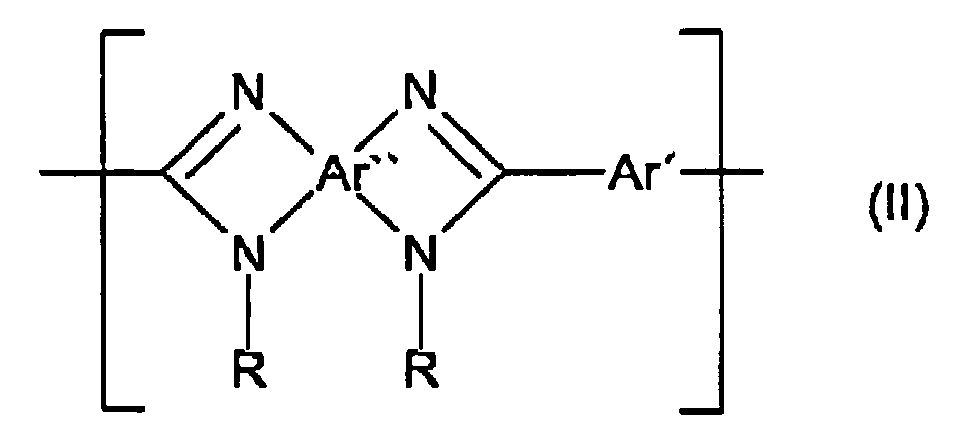
- Membran nach Anspruch 10, dadurch gekennzeichnet, daß Ar" Phen-1,2,4,5-ylen oder Biphen-3,4,3',4'-ylen ist, Ar'1,3- oder 1,4-Phenylen bedeutet und R Wasserstoff ist.
- Membran nach Anspruch 1, dadurch gekennzeichnet, daß als sulfoniertes aromatisches Polyetherketon ein Polymer vom Typ PEK, das eine lonenaustauscher-kapazität von 1,3 bis 4,0 meq (-S03H)/g Polymer aufweist eingesetzt wird.
- Membran nach Anspruch 1, dadurch gekennzeichnet, daß das sulfonierte Polyetherketon in Form des Lithium, Natrium, Kalium oder Ammoniumsalz eingesetzt wird.
- Membran nach Anspruch 1, dadurch gekennzeichnet, daß der Anteil des Polybenzimidazols in Abhängigkeit vom Sulfonierungsgrad des sulfonierten Polyetherketons nach folgender Formel III ausgewählt wird:

wobei x die lonenaustauscherkapazität des sulfonierten Polyetherketons in meq (-SO3H)/g Polymer) bedeutet. - Membran nach Anspruch 1, dadurch gekennzeichnet, daß die gemäß Maßnahme a) erhaltene Lösung eine Viskosität von 500 - 5000 mPas gemessen bei 80°C in einer Lösung der Polymeren in N-Methylpyrrolidon mit einem Rotationsviskosimeter nach Couette aufweist.
- Membran nach Anspruch 1, dadurch gekennzeichnet, daß gemäß Maßnahme c) Salpetersäure, Schwefelsäure oder Phosphorsäure eingesetzt werden.
- Verwendung der Membran nach einem der Ansprüche 1 bis 16 für den Einsatz in Brennstoffzellen, insbesondere für den Einsatz in Direkt-Methanol-Brennstoffzellen.
Priority Applications (1)
| Application Number | Priority Date | Filing Date | Title |
|---|---|---|---|
| EP08014127A EP2014349A1 (de) | 1998-11-09 | 1999-10-26 | Membranen aus sulfoniertem aromatischen Polyetherketon und Polybenzimidazol, sowie deren Verwendung |
Applications Claiming Priority (3)
| Application Number | Priority Date | Filing Date | Title |
|---|---|---|---|
| DE19851498 | 1998-11-09 | ||
| DE19851498A DE19851498A1 (de) | 1998-11-09 | 1998-11-09 | Polymerzusammensetzung, Membran enthaltend diese, Verfahren zu deren Herstellung und deren Verwendung |
| PCT/EP1999/008084 WO2000027513A2 (de) | 1998-11-09 | 1999-10-26 | Polymerzusammensetzung, membran enthaltend diese, verfahren zu deren herstellung und deren verwendung |
Related Child Applications (1)
| Application Number | Title | Priority Date | Filing Date |
|---|---|---|---|
| EP08014127A Division EP2014349A1 (de) | 1998-11-09 | 1999-10-26 | Membranen aus sulfoniertem aromatischen Polyetherketon und Polybenzimidazol, sowie deren Verwendung |
Publications (2)
| Publication Number | Publication Date |
|---|---|
| EP1144100A2 EP1144100A2 (de) | 2001-10-17 |
| EP1144100B1 true EP1144100B1 (de) | 2008-10-29 |
Family
ID=7887108
Family Applications (2)
| Application Number | Title | Priority Date | Filing Date |
|---|---|---|---|
| EP99955884A Revoked EP1144100B1 (de) | 1998-11-09 | 1999-10-26 | Membranen aus sulfoniertem aromatischen polyetherketon und polybenzimidazol sowie deren verwendung |
| EP08014127A Withdrawn EP2014349A1 (de) | 1998-11-09 | 1999-10-26 | Membranen aus sulfoniertem aromatischen Polyetherketon und Polybenzimidazol, sowie deren Verwendung |
Family Applications After (1)
| Application Number | Title | Priority Date | Filing Date |
|---|---|---|---|
| EP08014127A Withdrawn EP2014349A1 (de) | 1998-11-09 | 1999-10-26 | Membranen aus sulfoniertem aromatischen Polyetherketon und Polybenzimidazol, sowie deren Verwendung |
Country Status (13)
| Country | Link |
|---|---|
| US (2) | US6632847B1 (de) |
| EP (2) | EP1144100B1 (de) |
| JP (1) | JP2002529546A (de) |
| KR (1) | KR100618914B1 (de) |
| CN (1) | CN1165369C (de) |
| AT (1) | ATE412461T1 (de) |
| BR (1) | BR9915177A (de) |
| CA (1) | CA2350205C (de) |
| DE (2) | DE19851498A1 (de) |
| DK (1) | DK1144100T3 (de) |
| ES (1) | ES2313796T3 (de) |
| RU (1) | RU2224583C2 (de) |
| WO (1) | WO2000027513A2 (de) |
Families Citing this family (47)
| Publication number | Priority date | Publication date | Assignee | Title |
|---|---|---|---|---|
| DE19851498A1 (de) * | 1998-11-09 | 2000-07-06 | Aventis Res & Tech Gmbh & Co | Polymerzusammensetzung, Membran enthaltend diese, Verfahren zu deren Herstellung und deren Verwendung |
| JP2000281819A (ja) * | 1999-01-27 | 2000-10-10 | Aventis Res & Technol Gmbh & Co Kg | 架橋高分子膜の製造方法及び燃料電池 |
| GR1003647B (el) * | 1999-12-30 | 2001-08-30 | ����������������������������������������&�������������������...� | Μεμβρανεσαπολυμερωναεμποτισμενεσαμεαοξυαγιααχρησηαωσαστερεοιαηλεκτρολυτεσ.α |
| DE10021106A1 (de) * | 2000-05-02 | 2001-11-08 | Univ Stuttgart | Polymere Membranen |
| CN1439032A (zh) | 2000-06-02 | 2003-08-27 | Sri国际公司 | 聚合物组合物 |
| US20020045081A1 (en) * | 2000-07-05 | 2002-04-18 | Masaaki Nanaumi | Electrolyte membrane/electrode assembly of solid polymer electrolyte fuel cell |
| ATE400904T1 (de) | 2001-06-01 | 2008-07-15 | Polyfuel Inc | Austauschbare brennstoffpatrone, brennstoffzellenaggregat mit besagter brennstoffpatrone für tragbare elektronische geräte und entsprechendes gerät |
| US7316855B2 (en) | 2001-06-01 | 2008-01-08 | Polyfuel, Inc. | Fuel cell assembly for portable electronic device and interface, control, and regulator circuit for fuel cell powered electronic device |
| DE10209784A1 (de) * | 2001-09-01 | 2003-12-04 | Univ Stuttgart Inst Fuer Chemi | Sulfinatgruppen enthaltende Oligomere und Polymere und Verfahren zu ihrer Herstellung |
| WO2003062493A1 (en) * | 2002-01-23 | 2003-07-31 | Polyfuel, Inc. | Acid-base proton conducting polymer blend membrane |
| WO2003081707A1 (en) * | 2002-03-25 | 2003-10-02 | Matsushita Electric Industrial Co., Ltd. | Electrolyte membrane/electrode union for fuel cell and process for producing the same |
| US7354679B2 (en) | 2002-05-13 | 2008-04-08 | Polyfuel, Inc. | Ion conductive random copolymers |
| CA2485971A1 (en) | 2002-05-13 | 2004-05-21 | Polyfuel, Inc. | Ion conductive block copolymers |
| WO2003095509A1 (en) | 2002-05-13 | 2003-11-20 | Polyfuel, Inc. | Sulfonated copolymer |
| JP3878520B2 (ja) * | 2002-07-18 | 2007-02-07 | 本田技研工業株式会社 | プロトン伝導性高分子固体電解質およびその製造方法 |
| JP3878521B2 (ja) * | 2002-07-18 | 2007-02-07 | 本田技研工業株式会社 | プロトン伝導性高分子固体電解質およびその製造方法 |
| US6987163B2 (en) * | 2002-08-07 | 2006-01-17 | Research Foundation Of The State University Of New York | Modified polybenzimidazole (PBI) membranes for enhanced polymer electrochemical cells |
| DE10246461A1 (de) * | 2002-10-04 | 2004-04-15 | Celanese Ventures Gmbh | Protonenleitende Polymermembran enthaltend Polyazolblends und deren Anwendung in Brennstoffzellen |
| DE10246373A1 (de) | 2002-10-04 | 2004-04-15 | Celanese Ventures Gmbh | Protonenleitende Polymermembran umfassend Sulfonsäuregruppen enthaltende Polyazole und deren Anwendung in Brennstoffzellen |
| US7366818B2 (en) | 2002-10-08 | 2008-04-29 | Koninklijke Philips Electronics N.V. | Integrated circuit comprising a plurality of processing modules and a network and method for exchanging data using same |
| EP1465277A1 (de) * | 2003-03-19 | 2004-10-06 | HONDA MOTOR CO., Ltd. | Feststoff Polymerelektrolyt und Protonenleitende Membran |
| GB2421505B (en) * | 2003-06-27 | 2008-09-17 | Asahi Kasei Chemicals Corp | Polymer electrolyte membrane having high durability and method for producing the same |
| DE10340927A1 (de) * | 2003-09-04 | 2005-03-31 | Celanese Ventures Gmbh | Protonenleitende Polymermembran enthaltend Polymere mit an aromatische Gruppen kovalent gebundene Sulfonsäuregruppen, Membran-Elektoden-Einheit und deren Anwendung in Brennstoffzellen |
| DE10340929A1 (de) * | 2003-09-04 | 2005-04-07 | Celanese Ventures Gmbh | Protonenleitende Polymermembran umfassend mindestens ein poröses Trägermaterial und deren Anwendung in Brennstoffzellen |
| US7301002B1 (en) | 2003-10-14 | 2007-11-27 | Sandia Corporation | Sulfonated polyphenylene polymers |
| JP4486340B2 (ja) * | 2003-10-22 | 2010-06-23 | 本田技研工業株式会社 | 燃料電池用電極−膜接合体の製造方法 |
| US20090233142A2 (en) * | 2004-04-30 | 2009-09-17 | Sumitomo Chemical Company, Limited | Polymer having oxocarbon group, and use thereof |
| KR100589345B1 (ko) * | 2004-06-30 | 2006-06-14 | 삼성에스디아이 주식회사 | 술폰화 폴리벤즈이미다졸의 제조방법과 이로부터 제조된술폰화 폴리벤즈이미다졸 및 이를 포함하는 고분자 전해질막 |
| RU2276160C1 (ru) * | 2005-01-20 | 2006-05-10 | Общество с ограниченной ответственностью "Объединенный центр исследований и разработок" (ООО "ЮРД-Центр") | Бензимидазолзамещенные полибензимидазолы - исходный материал для изготовления протонпроводящих мембран |
| CN101185191A (zh) * | 2005-06-01 | 2008-05-21 | 复合燃料公司 | 含有离子导电共聚物和非离子聚合物的聚合物共混物 |
| RU2284214C1 (ru) * | 2005-07-04 | 2006-09-27 | Иркутский институт химии им. А.Е. Фаворского Сибирского отделения Российской академии наук (ИрИХ СО РАН) | Протонпроводящие композиционные полимерные мембраны и способ их получения |
| US20070065700A1 (en) * | 2005-09-22 | 2007-03-22 | Sri International | High temperature polymer electrolyte membranes |
| EP1979972B1 (de) * | 2006-01-23 | 2015-11-18 | Between Lizenz GmbH | Phosphonsäurehaltiger elektrolyt |
| TWI305214B (en) * | 2006-05-02 | 2009-01-11 | Univ Yuan Ze | A novel proton exchange composite membrane with low thickness and preparation thereof |
| EP2033324B1 (de) | 2006-05-24 | 2016-04-13 | Ben Gurion University of the Negev Research and Development Authority | Membranen und herstellungsverfahren dafür |
| JP2008239647A (ja) | 2007-03-23 | 2008-10-09 | Toshiba Corp | 高分子電解質材料、高分子電解質材料の製造方法、高分子電解質部品、燃料電池、及び燃料電池の製造方法 |
| CN101230137B (zh) * | 2007-12-29 | 2011-05-25 | 浙江工业大学 | 含醚酮/醚砜结构聚苯并咪唑及其磺化聚合物和它们的制备方法 |
| KR101085358B1 (ko) * | 2008-11-17 | 2011-11-22 | 서강대학교산학협력단 | 실란계 화합물을 포함하는 탄화수소계 고분자막, 이의 제조방법, 이를 포함하는 막-전극 어셈블리 및 연료전지 |
| AU2010215116A1 (en) | 2009-02-19 | 2011-10-13 | Ben-Gurion University Of The Negev Research And Development Authority | Chemically resistant membranes, coatings and films and methods for their preparation |
| CA2735411C (en) * | 2009-02-25 | 2020-06-30 | Council Of Scientific & Industrial Research | A polybenzimidazole based membrane for deacidification |
| WO2012081026A2 (en) | 2010-12-12 | 2012-06-21 | Ben-Gurion University Of The Negev Research And Development Authority | Anion exchange membranes, methods of preparation and uses |
| MX2016008147A (es) | 2013-12-19 | 2016-09-14 | Treofan Germany Gmbh & Co Kg | Membrana de intercambio ionico elaborada de una pelicula beta-porosa estirada biaxialmente. |
| CA2941371C (en) * | 2014-03-07 | 2023-01-03 | Toray Industries, Inc. | Polymer electrolyte membrane, catalyst coated membrane, membrane electrode assembly, and polymer electrolyte fuel cell |
| US9534097B2 (en) | 2014-04-25 | 2017-01-03 | Sandia Corporation | Poly(phenylene alkylene)-based lonomers |
| JP6156332B2 (ja) * | 2014-11-14 | 2017-07-05 | トヨタ自動車株式会社 | 燃料電池システムおよびその制御方法 |
| EP3993115A1 (de) * | 2020-10-31 | 2022-05-04 | Mann+Hummel Life Sciences & Environment Holding Singapore Pte. Ltd. | Membranen aus säure-base-polymermischungen |
| DE102021205986A1 (de) | 2021-06-14 | 2022-12-15 | Robert Bosch Gesellschaft mit beschränkter Haftung | Verfahren zur Konditionierung einer elektrochemischen Zelleneinheit |
Family Cites Families (13)
| Publication number | Priority date | Publication date | Assignee | Title |
|---|---|---|---|---|
| GB8401411D0 (en) | 1984-01-19 | 1984-02-22 | Ici Plc | Aromatic polyetherketone |
| JPH03232536A (ja) * | 1990-02-09 | 1991-10-16 | Tokyo Electric Power Co Inc:The | 耐熱性イオン交換樹脂 |
| BR9100570A (pt) * | 1990-02-12 | 1991-10-29 | Union Carbide Ind Gases Tech | Processo para a desidratacao de gases e membranas composito para o mesmo |
| US5290884A (en) | 1991-03-27 | 1994-03-01 | Hoechst Celanese Corp. | Blends of polybenzimidazoles and aromatic polyamides, aromatic polyamide-hydrazides or aromatic polyamides containing heterocyclic linkages |
| TW256843B (de) * | 1992-06-11 | 1995-09-11 | Hoechst Ag | |
| DE4422158A1 (de) | 1994-06-24 | 1996-01-04 | Hoechst Ag | Homogene Polymerlegierungen auf der Basis von sulfonierten, aromatischen Polyetherketonen |
| DE59610504D1 (de) | 1995-03-20 | 2003-07-10 | Celanese Ventures Gmbh | Verfahren zur herstellung von polymerelektrolyten |
| WO1996029360A1 (de) | 1995-03-20 | 1996-09-26 | Hoechst Aktiengesellschaft | Sulfonierte polyetherketone, verfahren zu ihrer herstellung und verwendung zur herstellung von membranen |
| JP3607004B2 (ja) * | 1996-07-05 | 2005-01-05 | クラリアント インターナショナル リミテッド | ポリベンゾイミダゾール系化合物の溶液およびその製法 |
| DE19632285A1 (de) | 1996-08-09 | 1998-02-19 | Hoechst Ag | Protonenleiter mit einer Temperaturbeständigkeit in einem weiten Bereich und guten Protonenleitfähigkeiten |
| JP3232536B2 (ja) | 1997-05-14 | 2001-11-26 | 多栄子 森岡 | 片腕安全抑制具 |
| DE19817374A1 (de) * | 1998-04-18 | 1999-10-21 | Univ Stuttgart Lehrstuhl Und I | Engineering-Ionomerblends und Engineering-Ionomermembranen |
| DE19851498A1 (de) * | 1998-11-09 | 2000-07-06 | Aventis Res & Tech Gmbh & Co | Polymerzusammensetzung, Membran enthaltend diese, Verfahren zu deren Herstellung und deren Verwendung |
-
1998
- 1998-11-09 DE DE19851498A patent/DE19851498A1/de not_active Withdrawn
-
1999
- 1999-10-26 AT AT99955884T patent/ATE412461T1/de not_active IP Right Cessation
- 1999-10-26 BR BR9915177-4A patent/BR9915177A/pt active Search and Examination
- 1999-10-26 DE DE59914889T patent/DE59914889D1/de not_active Expired - Lifetime
- 1999-10-26 US US09/831,338 patent/US6632847B1/en not_active Expired - Fee Related
- 1999-10-26 WO PCT/EP1999/008084 patent/WO2000027513A2/de not_active Ceased
- 1999-10-26 ES ES99955884T patent/ES2313796T3/es not_active Expired - Lifetime
- 1999-10-26 EP EP99955884A patent/EP1144100B1/de not_active Revoked
- 1999-10-26 CA CA002350205A patent/CA2350205C/en not_active Expired - Fee Related
- 1999-10-26 RU RU2001116125/04A patent/RU2224583C2/ru not_active IP Right Cessation
- 1999-10-26 JP JP2000580734A patent/JP2002529546A/ja active Pending
- 1999-10-26 DK DK99955884T patent/DK1144100T3/da active
- 1999-10-26 EP EP08014127A patent/EP2014349A1/de not_active Withdrawn
- 1999-10-26 CN CNB998143340A patent/CN1165369C/zh not_active Expired - Fee Related
- 1999-10-26 KR KR1020017005814A patent/KR100618914B1/ko not_active Expired - Fee Related
-
2003
- 2003-10-14 US US10/685,179 patent/US20040091762A1/en not_active Abandoned
Also Published As
| Publication number | Publication date |
|---|---|
| DE19851498A1 (de) | 2000-07-06 |
| ATE412461T1 (de) | 2008-11-15 |
| CN1165369C (zh) | 2004-09-08 |
| CA2350205A1 (en) | 2000-05-18 |
| US20040091762A1 (en) | 2004-05-13 |
| EP2014349A1 (de) | 2009-01-14 |
| DK1144100T3 (da) | 2009-02-23 |
| CN1330566A (zh) | 2002-01-09 |
| DE59914889D1 (de) | 2008-12-11 |
| WO2000027513A3 (de) | 2000-08-31 |
| KR20010080963A (ko) | 2001-08-25 |
| ES2313796T3 (es) | 2009-03-01 |
| WO2000027513A2 (de) | 2000-05-18 |
| CA2350205C (en) | 2010-01-05 |
| US6632847B1 (en) | 2003-10-14 |
| KR100618914B1 (ko) | 2006-09-01 |
| EP1144100A2 (de) | 2001-10-17 |
| JP2002529546A (ja) | 2002-09-10 |
| BR9915177A (pt) | 2001-10-30 |
| RU2224583C2 (ru) | 2004-02-27 |
Similar Documents
| Publication | Publication Date | Title |
|---|---|---|
| EP2014349A1 (de) | Membranen aus sulfoniertem aromatischen Polyetherketon und Polybenzimidazol, sowie deren Verwendung | |
| EP1337319B1 (de) | Neue membranen für den einsatz in brennstoffzellen mit einer verbesserten mechanik | |
| EP1971635B1 (de) | Protonenleitende polymermembran | |
| DE60036358T2 (de) | Polymerelektrolyt und Herstellungsverfahren dafür | |
| DE60117595T2 (de) | Polybenzazolverbindung mit Sulfo- und/oder Phosphonogruppen, diese enthaltende Harzzusammensetzung, Harzformteil, Polymerfestelektrolytfolie, Verbund aus Festelektrolytfolie und Elektrodenkatalysatorschicht und Verfahren zur Herstellung des Verbunds | |
| DE60214166T2 (de) | Polymerelektrolyt für eine brennstoffzelle des festpolymertyps und brennstoffzelle | |
| DE102009020181B4 (de) | Sulfonierte Perfluorcyclobutanblockcopolymere und protonenleitende Polymermembranen | |
| EP0688824B1 (de) | Homogene Polmerlegierungen auf der Basis von sulfonierten, aromatischen Polyetherketonen | |
| DE102009020232B4 (de) | Sulfonierte Polyperfluorcyclobutan-Polyphenylen-Polymere für PEM-Brennstoffzellenanwendungen | |
| EP1073690B1 (de) | Säure-base-polymerblends und ihre verwendung in membranprozessen | |
| DE60225232T2 (de) | Verfahren zur Herstellung einer Polymerelektrolytmembran | |
| DE69933129T2 (de) | Ionenaustauschpolymere | |
| EP2443172B1 (de) | Aromatische polyethersulfon-blockcopolymere | |
| EP1165216B1 (de) | Verwendung von aromatischen polymeren in brennstoffzellen oder in hochleistungskondensatoren | |
| DE60025101T2 (de) | Protonenleitendes Polymer, Herstellungsverfahren dafür, fester Polymerelektrolyt und Elektrode | |
| DE102009020129A1 (de) | Protonenleitende Polymerelektrolyte und Brennstoffzellen | |
| DE102006019414B4 (de) | Blockcopolymere mit Säuregruppen | |
| EP1856188B1 (de) | Sulfonierte poly(arylene) als hydrolytisch und thermo-oxidativ stabile polymere | |
| DE10347530A1 (de) | Blockcopolymer und dessen Verwendung | |
| EP1124625B1 (de) | Membranen, enthaltend sulfoniertes polyetherketon und weiteres polymer, verfahren zu deren herstellung und deren verwendung | |
| DE102017208805B4 (de) | Verfahren zur Herstellung von Blockcopolychinoxalinen mit Sulfon- oder Phosphonsäure-Gruppen und deren Einsatz als protonenleitende Membran | |
| DE60220425T2 (de) | Ionenleitendes polymermaterial für brennstoffzelle oder elektrolysezelle | |
| DE602004008754T2 (de) | Ionenleitfähige polymermaterialien | |
| DE102013216706A1 (de) | Polyolefin-PFCB-Ionomer | |
| DE112006003456T5 (de) | Copolymer, Polymerelektrolyt und seine Verwendung |
Legal Events
| Date | Code | Title | Description |
|---|---|---|---|
| PUAI | Public reference made under article 153(3) epc to a published international application that has entered the european phase |
Free format text: ORIGINAL CODE: 0009012 |
|
| 17P | Request for examination filed |
Effective date: 20010611 |
|
| AK | Designated contracting states |
Kind code of ref document: A2 Designated state(s): AT BE CH CY DE DK ES FI FR GB GR IE IT LI LU MC NL PT SE |
|
| RIN1 | Information on inventor provided before grant (corrected) |
Inventor name: KNAUF, RUEDIGER Inventor name: PAWLIK, JUERGEN Inventor name: BAURMEISTER, JOCHEN Inventor name: FRANK, GEORG Inventor name: SOZCKA-GUTH, THOMAS |
|
| RTI1 | Title (correction) |
Free format text: MEMBRANES MADE OF SULPHONATED POLYETHER KETONE AND POLYBENZIMIDAZOLE, AND THEIR USE |
|
| 17Q | First examination report despatched |
Effective date: 20040330 |
|
| RAP1 | Party data changed (applicant data changed or rights of an application transferred) |
Owner name: PEMEAS GMBH |
|
| RAP1 | Party data changed (applicant data changed or rights of an application transferred) |
Owner name: BASF FUEL CELL GMBH |
|
| GRAP | Despatch of communication of intention to grant a patent |
Free format text: ORIGINAL CODE: EPIDOSNIGR1 |
|
| GRAS | Grant fee paid |
Free format text: ORIGINAL CODE: EPIDOSNIGR3 |
|
| GRAA | (expected) grant |
Free format text: ORIGINAL CODE: 0009210 |
|
| AK | Designated contracting states |
Kind code of ref document: B1 Designated state(s): AT BE CH CY DE DK ES FI FR GB GR IE IT LI LU MC NL PT SE |
|
| REG | Reference to a national code |
Ref country code: GB Ref legal event code: FG4D Free format text: NOT ENGLISH |
|
| REG | Reference to a national code |
Ref country code: CH Ref legal event code: EP |
|
| REG | Reference to a national code |
Ref country code: IE Ref legal event code: FG4D Free format text: LANGUAGE OF EP DOCUMENT: GERMAN |
|
| REF | Corresponds to: |
Ref document number: 59914889 Country of ref document: DE Date of ref document: 20081211 Kind code of ref document: P |
|
| REG | Reference to a national code |
Ref country code: DK Ref legal event code: T3 |
|
| REG | Reference to a national code |
Ref country code: ES Ref legal event code: FG2A Ref document number: 2313796 Country of ref document: ES Kind code of ref document: T3 |
|
| NLV1 | Nl: lapsed or annulled due to failure to fulfill the requirements of art. 29p and 29m of the patents act | ||
| PG25 | Lapsed in a contracting state [announced via postgrant information from national office to epo] |
Ref country code: PT Free format text: LAPSE BECAUSE OF FAILURE TO SUBMIT A TRANSLATION OF THE DESCRIPTION OR TO PAY THE FEE WITHIN THE PRESCRIBED TIME-LIMIT Effective date: 20090330 Ref country code: NL Free format text: LAPSE BECAUSE OF FAILURE TO SUBMIT A TRANSLATION OF THE DESCRIPTION OR TO PAY THE FEE WITHIN THE PRESCRIBED TIME-LIMIT Effective date: 20081029 Ref country code: FI Free format text: LAPSE BECAUSE OF FAILURE TO SUBMIT A TRANSLATION OF THE DESCRIPTION OR TO PAY THE FEE WITHIN THE PRESCRIBED TIME-LIMIT Effective date: 20081029 |
|
| REG | Reference to a national code |
Ref country code: IE Ref legal event code: FD4D |
|
| PG25 | Lapsed in a contracting state [announced via postgrant information from national office to epo] |
Ref country code: IE Free format text: LAPSE BECAUSE OF FAILURE TO SUBMIT A TRANSLATION OF THE DESCRIPTION OR TO PAY THE FEE WITHIN THE PRESCRIBED TIME-LIMIT Effective date: 20081029 |
|
| PLBI | Opposition filed |
Free format text: ORIGINAL CODE: 0009260 |
|
| NLXE | Nl: other communications concerning ep-patents (part 3 heading xe) |
Free format text: A REQUEST FOR RESTORATION TO THE PRIOR STATE (ARTICLE 23 OF THE PATENTS ACT 1995) HAS BEEN FILED ON 20090611 |
|
| PG25 | Lapsed in a contracting state [announced via postgrant information from national office to epo] |
Ref country code: SE Free format text: LAPSE BECAUSE OF FAILURE TO SUBMIT A TRANSLATION OF THE DESCRIPTION OR TO PAY THE FEE WITHIN THE PRESCRIBED TIME-LIMIT Effective date: 20090129 |
|
| PLAX | Notice of opposition and request to file observation + time limit sent |
Free format text: ORIGINAL CODE: EPIDOSNOBS2 |
|
| 26 | Opposition filed |
Opponent name: HAERING, THOMAS Effective date: 20090729 |
|
| NLXE | Nl: other communications concerning ep-patents (part 3 heading xe) |
Free format text: THE REQUEST FOR RESTORATION TO THE PRIOR STATE, AS PROVIDED FOR IN ARTICLE 23 OF THE PATENTS ACT 1995 (SEE PUBLICATION IN HEADING XE OF THE PATENT BULLETIN OF 20090803), HAS BEEN GRANTED; THE RESTORATION OF THE PATENT HAS BEEN ENTERED IN THE PATENT REGISTER. |
|
| PLAF | Information modified related to communication of a notice of opposition and request to file observations + time limit |
Free format text: ORIGINAL CODE: EPIDOSCOBS2 |
|
| PGFP | Annual fee paid to national office [announced via postgrant information from national office to epo] |
Ref country code: DE Payment date: 20091022 Year of fee payment: 11 |
|
| PGFP | Annual fee paid to national office [announced via postgrant information from national office to epo] |
Ref country code: NL Payment date: 20091030 Year of fee payment: 11 |
|
| PLBB | Reply of patent proprietor to notice(s) of opposition received |
Free format text: ORIGINAL CODE: EPIDOSNOBS3 |
|
| BERE | Be: lapsed |
Owner name: BASF FUEL CELL G.M.B.H. Effective date: 20091031 |
|
| PGFP | Annual fee paid to national office [announced via postgrant information from national office to epo] |
Ref country code: GB Payment date: 20091021 Year of fee payment: 11 Ref country code: FR Payment date: 20091029 Year of fee payment: 11 |
|
| PG25 | Lapsed in a contracting state [announced via postgrant information from national office to epo] |
Ref country code: MC Free format text: LAPSE BECAUSE OF NON-PAYMENT OF DUE FEES Effective date: 20091031 |
|
| REG | Reference to a national code |
Ref country code: CH Ref legal event code: PL |
|
| REG | Reference to a national code |
Ref country code: DK Ref legal event code: EBP |
|
| PG25 | Lapsed in a contracting state [announced via postgrant information from national office to epo] |
Ref country code: LI Free format text: LAPSE BECAUSE OF NON-PAYMENT OF DUE FEES Effective date: 20091031 Ref country code: GR Free format text: LAPSE BECAUSE OF FAILURE TO SUBMIT A TRANSLATION OF THE DESCRIPTION OR TO PAY THE FEE WITHIN THE PRESCRIBED TIME-LIMIT Effective date: 20090130 Ref country code: CH Free format text: LAPSE BECAUSE OF NON-PAYMENT OF DUE FEES Effective date: 20091031 Ref country code: BE Free format text: LAPSE BECAUSE OF NON-PAYMENT OF DUE FEES Effective date: 20091031 |
|
| PG25 | Lapsed in a contracting state [announced via postgrant information from national office to epo] |
Ref country code: DK Free format text: LAPSE BECAUSE OF NON-PAYMENT OF DUE FEES Effective date: 20091031 Ref country code: AT Free format text: LAPSE BECAUSE OF NON-PAYMENT OF DUE FEES Effective date: 20091026 |
|
| PG25 | Lapsed in a contracting state [announced via postgrant information from national office to epo] |
Ref country code: LU Free format text: LAPSE BECAUSE OF NON-PAYMENT OF DUE FEES Effective date: 20091026 |
|
| REG | Reference to a national code |
Ref country code: NL Ref legal event code: V1 Effective date: 20110501 |
|
| GBPC | Gb: european patent ceased through non-payment of renewal fee |
Effective date: 20101026 |
|
| PG25 | Lapsed in a contracting state [announced via postgrant information from national office to epo] |
Ref country code: FR Free format text: LAPSE BECAUSE OF NON-PAYMENT OF DUE FEES Effective date: 20101102 |
|
| REG | Reference to a national code |
Ref country code: FR Ref legal event code: ST Effective date: 20110630 |
|
| REG | Reference to a national code |
Ref country code: DE Ref legal event code: R119 Ref document number: 59914889 Country of ref document: DE Effective date: 20110502 |
|
| PG25 | Lapsed in a contracting state [announced via postgrant information from national office to epo] |
Ref country code: GB Free format text: LAPSE BECAUSE OF NON-PAYMENT OF DUE FEES Effective date: 20101026 |
|
| PG25 | Lapsed in a contracting state [announced via postgrant information from national office to epo] |
Ref country code: CY Free format text: LAPSE BECAUSE OF FAILURE TO SUBMIT A TRANSLATION OF THE DESCRIPTION OR TO PAY THE FEE WITHIN THE PRESCRIBED TIME-LIMIT Effective date: 20081029 |
|
| REG | Reference to a national code |
Ref country code: ES Ref legal event code: FD2A Effective date: 20111116 |
|
| REG | Reference to a national code |
Ref country code: DE Ref legal event code: R103 Ref document number: 59914889 Country of ref document: DE Ref country code: DE Ref legal event code: R064 Ref document number: 59914889 Country of ref document: DE |
|
| RDAF | Communication despatched that patent is revoked |
Free format text: ORIGINAL CODE: EPIDOSNREV1 |
|
| PG25 | Lapsed in a contracting state [announced via postgrant information from national office to epo] |
Ref country code: ES Free format text: LAPSE BECAUSE OF NON-PAYMENT OF DUE FEES Effective date: 20091027 |
|
| PG25 | Lapsed in a contracting state [announced via postgrant information from national office to epo] |
Ref country code: IT Free format text: LAPSE BECAUSE OF NON-PAYMENT OF DUE FEES Effective date: 20101026 |
|
| RDAG | Patent revoked |
Free format text: ORIGINAL CODE: 0009271 |
|
| STAA | Information on the status of an ep patent application or granted ep patent |
Free format text: STATUS: PATENT REVOKED |
|
| 27W | Patent revoked |
Effective date: 20111121 |
|
| REG | Reference to a national code |
Ref country code: AT Ref legal event code: MA03 Ref document number: 412461 Country of ref document: AT Kind code of ref document: T Effective date: 20111121 |
|
| PG25 | Lapsed in a contracting state [announced via postgrant information from national office to epo] |
Ref country code: DE Free format text: LAPSE BECAUSE OF NON-PAYMENT OF DUE FEES Effective date: 20110502 |
|
| PG25 | Lapsed in a contracting state [announced via postgrant information from national office to epo] |
Ref country code: NL Free format text: LAPSE BECAUSE OF FAILURE TO SUBMIT A TRANSLATION OF THE DESCRIPTION OR TO PAY THE FEE WITHIN THE PRESCRIBED TIME-LIMIT Effective date: 20110501 |