EP0688824A2 - Homogene Polmerlegierungen auf der Basis von sulfonierten, aromatischen Polyetherketonen - Google Patents
Homogene Polmerlegierungen auf der Basis von sulfonierten, aromatischen Polyetherketonen Download PDFInfo
- Publication number
- EP0688824A2 EP0688824A2 EP95109010A EP95109010A EP0688824A2 EP 0688824 A2 EP0688824 A2 EP 0688824A2 EP 95109010 A EP95109010 A EP 95109010A EP 95109010 A EP95109010 A EP 95109010A EP 0688824 A2 EP0688824 A2 EP 0688824A2
- Authority
- EP
- European Patent Office
- Prior art keywords
- aromatic
- sulfonated
- polysulfone
- polymer alloy
- alloy according
- Prior art date
- Legal status (The legal status is an assumption and is not a legal conclusion. Google has not performed a legal analysis and makes no representation as to the accuracy of the status listed.)
- Granted
Links
- 229920001643 poly(ether ketone) Polymers 0.000 title claims abstract description 46
- 125000003118 aryl group Chemical group 0.000 title claims abstract description 39
- 229920005623 miscible polymer blend Polymers 0.000 title abstract 2
- 229920002492 poly(sulfone) Polymers 0.000 claims abstract description 28
- 229920000036 polyvinylpyrrolidone Polymers 0.000 claims abstract description 19
- 235000013855 polyvinylpyrrolidone Nutrition 0.000 claims abstract description 19
- 239000001267 polyvinylpyrrolidone Substances 0.000 claims abstract description 18
- 229920000151 polyglycol Polymers 0.000 claims abstract description 13
- 239000010695 polyglycol Substances 0.000 claims abstract description 13
- 229920001477 hydrophilic polymer Polymers 0.000 claims abstract description 7
- 239000003960 organic solvent Substances 0.000 claims abstract description 5
- 150000001983 dialkylethers Chemical class 0.000 claims abstract description 4
- 150000002148 esters Chemical class 0.000 claims abstract description 4
- 229920000642 polymer Polymers 0.000 claims description 43
- 239000000956 alloy Substances 0.000 claims description 38
- 229910045601 alloy Inorganic materials 0.000 claims description 38
- -1 2-oxo-1-pyrrolidinyl Chemical group 0.000 claims description 16
- 239000012528 membrane Substances 0.000 claims description 10
- 238000000034 method Methods 0.000 claims description 7
- 239000002904 solvent Substances 0.000 claims description 7
- 125000004178 (C1-C4) alkyl group Chemical group 0.000 claims description 5
- 125000005843 halogen group Chemical group 0.000 claims description 5
- 239000011888 foil Substances 0.000 claims description 4
- 238000004519 manufacturing process Methods 0.000 claims description 4
- 125000000843 phenylene group Chemical group C1(=C(C=CC=C1)*)* 0.000 claims description 4
- 125000000542 sulfonic acid group Chemical group 0.000 claims description 4
- 229910052717 sulfur Inorganic materials 0.000 claims description 4
- VGGSQFUCUMXWEO-UHFFFAOYSA-N Ethene Chemical compound C=C VGGSQFUCUMXWEO-UHFFFAOYSA-N 0.000 claims description 3
- 239000005977 Ethylene Substances 0.000 claims description 3
- 229910006069 SO3H Inorganic materials 0.000 claims description 3
- 125000003668 acetyloxy group Chemical group [H]C([H])([H])C(=O)O[*] 0.000 claims description 3
- 229920001577 copolymer Polymers 0.000 claims description 3
- RTZKZFJDLAIYFH-UHFFFAOYSA-N ether Chemical group CCOCC RTZKZFJDLAIYFH-UHFFFAOYSA-N 0.000 claims description 3
- 125000001072 heteroaryl group Chemical group 0.000 claims description 3
- 229910052760 oxygen Inorganic materials 0.000 claims description 3
- 238000006068 polycondensation reaction Methods 0.000 claims description 3
- 125000000020 sulfo group Chemical group O=S(=O)([*])O[H] 0.000 claims description 3
- 125000004653 anthracenylene group Chemical group 0.000 claims description 2
- 125000002529 biphenylenyl group Chemical group C1(=CC=CC=2C3=CC=CC=C3C12)* 0.000 claims description 2
- 238000005341 cation exchange Methods 0.000 claims description 2
- 238000000576 coating method Methods 0.000 claims description 2
- 239000000835 fiber Substances 0.000 claims description 2
- 125000004957 naphthylene group Chemical group 0.000 claims description 2
- 239000000470 constituent Substances 0.000 claims 1
- 238000000465 moulding Methods 0.000 claims 1
- 239000000203 mixture Substances 0.000 abstract description 9
- QAOWNCQODCNURD-UHFFFAOYSA-N Sulfuric acid Chemical compound OS(O)(=O)=O QAOWNCQODCNURD-UHFFFAOYSA-N 0.000 description 12
- 229920006393 polyether sulfone Polymers 0.000 description 11
- 239000000463 material Substances 0.000 description 9
- XLYOFNOQVPJJNP-UHFFFAOYSA-N water Substances O XLYOFNOQVPJJNP-UHFFFAOYSA-N 0.000 description 9
- LCGLNKUTAGEVQW-UHFFFAOYSA-N Dimethyl ether Chemical compound COC LCGLNKUTAGEVQW-UHFFFAOYSA-N 0.000 description 8
- 239000000243 solution Substances 0.000 description 8
- ZMXDDKWLCZADIW-UHFFFAOYSA-N N,N-Dimethylformamide Chemical compound CN(C)C=O ZMXDDKWLCZADIW-UHFFFAOYSA-N 0.000 description 6
- HEMHJVSKTPXQMS-UHFFFAOYSA-M Sodium hydroxide Chemical compound [OH-].[Na+] HEMHJVSKTPXQMS-UHFFFAOYSA-M 0.000 description 6
- 238000010521 absorption reaction Methods 0.000 description 6
- 238000005342 ion exchange Methods 0.000 description 6
- 239000002202 Polyethylene glycol Substances 0.000 description 5
- 229920001223 polyethylene glycol Polymers 0.000 description 5
- 239000002253 acid Substances 0.000 description 4
- 238000006277 sulfonation reaction Methods 0.000 description 4
- KFZMGEQAYNKOFK-UHFFFAOYSA-N Isopropanol Chemical compound CC(C)O KFZMGEQAYNKOFK-UHFFFAOYSA-N 0.000 description 3
- SECXISVLQFMRJM-UHFFFAOYSA-N N-Methylpyrrolidone Chemical compound CN1CCCC1=O SECXISVLQFMRJM-UHFFFAOYSA-N 0.000 description 3
- 125000004432 carbon atom Chemical group C* 0.000 description 3
- 238000005868 electrolysis reaction Methods 0.000 description 3
- 239000000446 fuel Substances 0.000 description 3
- 238000005259 measurement Methods 0.000 description 3
- 150000003254 radicals Chemical class 0.000 description 3
- CSCPPACGZOOCGX-UHFFFAOYSA-N Acetone Chemical compound CC(C)=O CSCPPACGZOOCGX-UHFFFAOYSA-N 0.000 description 2
- WKBOTKDWSSQWDR-UHFFFAOYSA-N Bromine atom Chemical compound [Br] WKBOTKDWSSQWDR-UHFFFAOYSA-N 0.000 description 2
- IAZDPXIOMUYVGZ-UHFFFAOYSA-N Dimethylsulphoxide Chemical compound CS(C)=O IAZDPXIOMUYVGZ-UHFFFAOYSA-N 0.000 description 2
- XTXRWKRVRITETP-UHFFFAOYSA-N Vinyl acetate Chemical compound CC(=O)OC=C XTXRWKRVRITETP-UHFFFAOYSA-N 0.000 description 2
- 150000007513 acids Chemical class 0.000 description 2
- 238000005275 alloying Methods 0.000 description 2
- IOJUPLGTWVMSFF-UHFFFAOYSA-N benzothiazole Chemical compound C1=CC=C2SC=NC2=C1 IOJUPLGTWVMSFF-UHFFFAOYSA-N 0.000 description 2
- 238000007334 copolymerization reaction Methods 0.000 description 2
- 150000005690 diesters Chemical class 0.000 description 2
- 239000011521 glass Substances 0.000 description 2
- 239000000047 product Substances 0.000 description 2
- 238000003860 storage Methods 0.000 description 2
- 150000003457 sulfones Chemical group 0.000 description 2
- BCMCBBGGLRIHSE-UHFFFAOYSA-N 1,3-benzoxazole Chemical compound C1=CC=C2OC=NC2=C1 BCMCBBGGLRIHSE-UHFFFAOYSA-N 0.000 description 1
- LQIAZOCLNBBZQK-UHFFFAOYSA-N 1-(1,2-Diphosphanylethyl)pyrrolidin-2-one Chemical compound PCC(P)N1CCCC1=O LQIAZOCLNBBZQK-UHFFFAOYSA-N 0.000 description 1
- HYZJCKYKOHLVJF-UHFFFAOYSA-N 1H-benzimidazole Chemical compound C1=CC=C2NC=NC2=C1 HYZJCKYKOHLVJF-UHFFFAOYSA-N 0.000 description 1
- XHLKOHSAWQPOFO-UHFFFAOYSA-N 5-phenyl-1h-imidazole Chemical compound N1C=NC=C1C1=CC=CC=C1 XHLKOHSAWQPOFO-UHFFFAOYSA-N 0.000 description 1
- SVQBNYOMUXHGTH-UHFFFAOYSA-N CCC(C)(CC)c(cc1)ccc1C(c(cc1)ccc1C(c(cc1)ccc1Oc(cc1)ccc1OC(CC)(CC)C(CC)(CC)c(cc1)ccc1C(c(cc1)ccc1C(c(cc1)ccc1Oc(cc1)cc(S(O)(=O)=O)c1OC(C)(CC)CC)=O)=O)=O)=O Chemical compound CCC(C)(CC)c(cc1)ccc1C(c(cc1)ccc1C(c(cc1)ccc1Oc(cc1)ccc1OC(CC)(CC)C(CC)(CC)c(cc1)ccc1C(c(cc1)ccc1C(c(cc1)ccc1Oc(cc1)cc(S(O)(=O)=O)c1OC(C)(CC)CC)=O)=O)=O)=O SVQBNYOMUXHGTH-UHFFFAOYSA-N 0.000 description 1
- ZAMOUSCENKQFHK-UHFFFAOYSA-N Chlorine atom Chemical compound [Cl] ZAMOUSCENKQFHK-UHFFFAOYSA-N 0.000 description 1
- PXGOKWXKJXAPGV-UHFFFAOYSA-N Fluorine Chemical compound FF PXGOKWXKJXAPGV-UHFFFAOYSA-N 0.000 description 1
- 229920003083 Kollidon® VA64 Polymers 0.000 description 1
- FXHOOIRPVKKKFG-UHFFFAOYSA-N N,N-Dimethylacetamide Chemical compound CN(C)C(C)=O FXHOOIRPVKKKFG-UHFFFAOYSA-N 0.000 description 1
- WHNWPMSKXPGLAX-UHFFFAOYSA-N N-Vinyl-2-pyrrolidone Chemical compound C=CN1CCCC1=O WHNWPMSKXPGLAX-UHFFFAOYSA-N 0.000 description 1
- 229920000557 Nafion® Polymers 0.000 description 1
- 239000004696 Poly ether ether ketone Substances 0.000 description 1
- 229920003295 Radel® Polymers 0.000 description 1
- NINIDFKCEFEMDL-UHFFFAOYSA-N Sulfur Chemical compound [S] NINIDFKCEFEMDL-UHFFFAOYSA-N 0.000 description 1
- 150000007933 aliphatic carboxylic acids Chemical class 0.000 description 1
- 150000001450 anions Chemical class 0.000 description 1
- IFVTZJHWGZSXFD-UHFFFAOYSA-N biphenylene Chemical compound C1=CC=C2C3=CC=CC=C3C2=C1 IFVTZJHWGZSXFD-UHFFFAOYSA-N 0.000 description 1
- GDTBXPJZTBHREO-UHFFFAOYSA-N bromine Substances BrBr GDTBXPJZTBHREO-UHFFFAOYSA-N 0.000 description 1
- 229910052794 bromium Inorganic materials 0.000 description 1
- 239000003795 chemical substances by application Substances 0.000 description 1
- 229910052801 chlorine Inorganic materials 0.000 description 1
- 239000000460 chlorine Substances 0.000 description 1
- 230000000052 comparative effect Effects 0.000 description 1
- SWXVUIWOUIDPGS-UHFFFAOYSA-N diacetone alcohol Natural products CC(=O)CC(C)(C)O SWXVUIWOUIDPGS-UHFFFAOYSA-N 0.000 description 1
- 150000005218 dimethyl ethers Chemical class 0.000 description 1
- 238000006073 displacement reaction Methods 0.000 description 1
- 238000001035 drying Methods 0.000 description 1
- 125000001033 ether group Chemical group 0.000 description 1
- 238000001704 evaporation Methods 0.000 description 1
- 230000008020 evaporation Effects 0.000 description 1
- 239000010408 film Substances 0.000 description 1
- OMRRUNXAWXNVFW-UHFFFAOYSA-N fluoridochlorine Chemical compound ClF OMRRUNXAWXNVFW-UHFFFAOYSA-N 0.000 description 1
- 229910052731 fluorine Inorganic materials 0.000 description 1
- 239000011737 fluorine Substances 0.000 description 1
- 230000009477 glass transition Effects 0.000 description 1
- 239000008187 granular material Substances 0.000 description 1
- 150000002390 heteroarenes Chemical class 0.000 description 1
- 239000008240 homogeneous mixture Substances 0.000 description 1
- 230000003993 interaction Effects 0.000 description 1
- 239000013067 intermediate product Substances 0.000 description 1
- 229920002521 macromolecule Polymers 0.000 description 1
- 238000001471 micro-filtration Methods 0.000 description 1
- 238000002156 mixing Methods 0.000 description 1
- 238000010534 nucleophilic substitution reaction Methods 0.000 description 1
- 238000005457 optimization Methods 0.000 description 1
- 229920002530 polyetherether ketone Polymers 0.000 description 1
- 239000002861 polymer material Substances 0.000 description 1
- 229920002689 polyvinyl acetate Polymers 0.000 description 1
- 239000011118 polyvinyl acetate Substances 0.000 description 1
- 239000000843 powder Substances 0.000 description 1
- 238000001556 precipitation Methods 0.000 description 1
- 239000002994 raw material Substances 0.000 description 1
- 239000000126 substance Substances 0.000 description 1
- 239000011593 sulfur Substances 0.000 description 1
- 230000008961 swelling Effects 0.000 description 1
- 238000000108 ultra-filtration Methods 0.000 description 1
Classifications
-
- C—CHEMISTRY; METALLURGY
- C08—ORGANIC MACROMOLECULAR COMPOUNDS; THEIR PREPARATION OR CHEMICAL WORKING-UP; COMPOSITIONS BASED THEREON
- C08L—COMPOSITIONS OF MACROMOLECULAR COMPOUNDS
- C08L65/00—Compositions of macromolecular compounds obtained by reactions forming a carbon-to-carbon link in the main chain; Compositions of derivatives of such polymers
-
- C—CHEMISTRY; METALLURGY
- C08—ORGANIC MACROMOLECULAR COMPOUNDS; THEIR PREPARATION OR CHEMICAL WORKING-UP; COMPOSITIONS BASED THEREON
- C08L—COMPOSITIONS OF MACROMOLECULAR COMPOUNDS
- C08L81/00—Compositions of macromolecular compounds obtained by reactions forming in the main chain of the macromolecule a linkage containing sulfur with or without nitrogen, oxygen or carbon only; Compositions of polysulfones; Compositions of derivatives of such polymers
- C08L81/06—Polysulfones; Polyethersulfones
-
- C—CHEMISTRY; METALLURGY
- C08—ORGANIC MACROMOLECULAR COMPOUNDS; THEIR PREPARATION OR CHEMICAL WORKING-UP; COMPOSITIONS BASED THEREON
- C08G—MACROMOLECULAR COMPOUNDS OBTAINED OTHERWISE THAN BY REACTIONS ONLY INVOLVING UNSATURATED CARBON-TO-CARBON BONDS
- C08G65/00—Macromolecular compounds obtained by reactions forming an ether link in the main chain of the macromolecule
- C08G65/34—Macromolecular compounds obtained by reactions forming an ether link in the main chain of the macromolecule from hydroxy compounds or their metallic derivatives
- C08G65/48—Polymers modified by chemical after-treatment
-
- C—CHEMISTRY; METALLURGY
- C08—ORGANIC MACROMOLECULAR COMPOUNDS; THEIR PREPARATION OR CHEMICAL WORKING-UP; COMPOSITIONS BASED THEREON
- C08L—COMPOSITIONS OF MACROMOLECULAR COMPOUNDS
- C08L71/00—Compositions of polyethers obtained by reactions forming an ether link in the main chain; Compositions of derivatives of such polymers
-
- C—CHEMISTRY; METALLURGY
- C08—ORGANIC MACROMOLECULAR COMPOUNDS; THEIR PREPARATION OR CHEMICAL WORKING-UP; COMPOSITIONS BASED THEREON
- C08L—COMPOSITIONS OF MACROMOLECULAR COMPOUNDS
- C08L71/00—Compositions of polyethers obtained by reactions forming an ether link in the main chain; Compositions of derivatives of such polymers
- C08L71/02—Polyalkylene oxides
-
- Y—GENERAL TAGGING OF NEW TECHNOLOGICAL DEVELOPMENTS; GENERAL TAGGING OF CROSS-SECTIONAL TECHNOLOGIES SPANNING OVER SEVERAL SECTIONS OF THE IPC; TECHNICAL SUBJECTS COVERED BY FORMER USPC CROSS-REFERENCE ART COLLECTIONS [XRACs] AND DIGESTS
- Y10—TECHNICAL SUBJECTS COVERED BY FORMER USPC
- Y10S—TECHNICAL SUBJECTS COVERED BY FORMER USPC CROSS-REFERENCE ART COLLECTIONS [XRACs] AND DIGESTS
- Y10S525/00—Synthetic resins or natural rubbers -- part of the class 520 series
- Y10S525/906—Polysulfone
Definitions
- the invention relates to polymer alloys which contain at least one sulfonated, aromatic polyether ketone, at least one aromatic polysulfone and a hydrophilic polymer in a homogeneous mixture.
- the invention further relates to the production and use of the polymers.
- a basic requirement for the possibility of producing a homogeneous polymer alloy is the complete miscibility of the alloy components.
- complete miscibility is an unusual property of polymer systems, which usually tend to form multiphase systems (Polymer, Vol. 24, p. 60 (1983)).
- thermodynamic theories have had limited success in predicting miscibility. It was therefore doubted that any practical theory could be developed that takes into account the real complexities that nature gives polymer-polymer interactions (Macromolecules, Vol. 16, p. 753 (1983)).
- ion exchange materials previously used in this area e.g. ®NAFION (Du PONT) imitate the operating temperatures of membrane electrolysis or membrane fuel cells to approx. 80 ° C - 100 ° C due to their low heat resistance.
- membranes for ultra or microfiltration consist of polymer alloys of sulfonated polyether ether ketones and polyether sulfones; however, these membranes have poor chemical resistance in acids and bases. In addition, the water absorption capacity of these systems is unsatisfactory.
- the invention was therefore based on the object of providing homogeneous polymer alloys based on sulfonated polyether ketones whose water absorption capacity and their mechanical properties can be adjusted in a targeted manner by varying the mixture components and / or the mixture ratios.
- the new systems should be processable into films that are chemically and thermally resistant.
- These ion exchange foils should have higher heat resistance than the known systems, e.g. to enable operating temperatures of at least 100 ° C in membrane electrolysis or membrane fuel cells.
- the ion exchange equivalent of these systems should be selectively adjustable.
- a homogeneous polymer alloy which contains at least one sulfonated, aromatic polyether ketone and at least one polysulfone and is characterized in that the polysulfone is an aromatic polysulfone, the weight ratio of sulfonated polyether ketone / polysulfone is 1:99 to 99: 1 and the alloy Contains 5 to 30 wt .-% of at least one hydrophilic polymer which is selected from the group of polyvinyl pyrrolidone, polyglycol dialkyl ether, polyglycol dialkyl ester and poly- [1- (2-oxo-1-pyrrolidinyl) ethylene-co-1- (acetyloxy) ethylene ].
- Aromatic polysulfones are understood to mean in particular polyether sulfones, ie polymers which are formally composed of an aromatic dihydroxy component and an aromatic dihalogen component, the aromatic groups in at least one of these building blocks being linked to one another via a sulfone unit.
- Such products are commercially available or can be produced by the customary polycondensation processes, such as, for example, in "The Organic Chemistry of Sulfur ", Wiley, New York, 1962, p. 29;” Aromatic Nucleophilic Substitution “, Elsevier, New York, 1968; RN Johnson, AG Farnham, RA Clendinning, WF Hale and CN Merriam: J. Polym. Sci ., Polym. Chem. Ed., 1967, 5, 2375.
- Sulfonated polyether ketones are already known. They can be produced by conventional sulfonation processes (e.g. according to EP-A-008895, EP-A-041780), but are also accessible by a new process (European patent application 0 575 807). They are characterized by high temperature resistance, excellent hydrophilicity and good solubility in organic solvents such as N-methylpyrrolidone or N, N-dimethylformamide.
- the sulfonated, aromatic polyether ketone and the aromatic polysulfone are preferably present in a weight ratio of 1: 9 to 9: 1 in the polymer alloy according to the invention.
- the polymer alloy still contains poly-N-vinyl-2-pvrrolidone and / or a copolymer of N-vinyl-2-pyrrolidone and vinyl acetate, it is advantageous if the proportion of sulfonated aromatic polyether ketones is 60 to 80% by weight and The proportion of aromatic polysulfones is 10 to 20% by weight.
- sulfonated polyether ketones can also be used which are composed of at least two different repeating units of the general formulas II, III and IV. They can be prepared by copolymerization of units of the general formula II, III, IV (but free of sulfonic acid groups) and subsequent sulfonation of the copolymer obtained.
- the sulfonated polyether ketones used preferably have molar masses, given as the weight average, in the range from 10,000 to 150,000 g / mol, in particular in the range from 20,000 to 100,000 g / mol.
- aromatic radicals Ar 1 are the 4,4'-biphenyl radical and the anthranylene radical.
- heteroaromatics from which Ar 1 can be derived are benzoxazole, benzothiazole, benzimidazole and 4-phenylimidazole.
- the molecular weights of alloyed polyvinylpyrrolidone (PVP) and copolyvinylpyrrolidone-polyvinyl acetate poly- [1- (2-oxo-1-pyrrolidinyl) ethylene-co-1- (acetoxy) ethylene] (abbreviated: CoPVPAc), are given as weight average, mostly at 1,000 to 3 million, preferably at 20,000 to 200,000, in particular at 40,000 to 100,000.
- the polyethylene glycol diesters which may be present are derived from aliphatic carboxylic acids with 1-3 C atoms or from aromatic carboxylic acids with 7 to 11 C atoms.
- the terminal ether groups of the polyethylene glycol diethers which may be present are alkyl radicals, preferably with 1-8 C atoms. In both cases, the molecular weights, given as weight average, are usually from 100 to 100,000, preferably from 250 to 80,000, in particular from 500 to 50,000.
- the polyethylene glycol dimethyl ethers or diacetates are particularly preferred.
- the homogeneously mixed polymer alloys according to the invention can be produced from a common solution which contains at least one sulfonated, aromatic polyether ketone, at least one polysulfone and at least one of the hydrophilic polymers described above, e.g. Contains polyvinylpyrrolidone and / or CoPVPAc in an aprotic organic solvent.
- the polysulfone can be dissolved in the appropriate solvent
- the sulfonated polyether ketone and the hydrophilic polymer can be dissolved in a suitable concentration, and a mixture of the respective polymer solutions can then be prepared in the calculated ratio.
- an aprotic hydrophilic solvent e.g. Dimethylformamide, dimethyl sulfoxide, N-methylpyrrolidone or N, N-dimethylacetamide can be used.
- sulfonated polyether ketone and the hydrophilic polymer in dry form can be added directly to the polysulfone solution after the polycondensation is complete.
- the polymer alloys according to the invention can be removed from the solutions by removing the solvent, e.g. By evaporation or by precipitation in a suitable precipitant, e.g. Acetone or isopropyl alcohol, isolated and further processed to intermediate products (granules or powder), which are then used as raw materials for the production of e.g. Shaped bodies, films, fibers, membranes or coatings and generally as cation exchange material can be used alone or in connection with anion exchangers in bipolar systems.
- a suitable precipitant e.g. Acetone or isopropyl alcohol
- Advantageous properties of the homogeneously mixed polymer alloys according to the invention based on sulfonated polyether ketones and aromatic polysulfones are their improved mechanical properties, for example compared to sulfonated polyether ketones, and the improved tensile strength in Table 3 is particularly advantageous.
- the hydrophilicity of the alloys is adjusted in a targeted manner by admixing polyvinylpyrrolidone, CoPVPAc or polyethylene glycol diether or polyethylene glycol diester (Table 3) without the properties described above being lost.
- Another important property of polymer alloys is their higher glass transition temperature compared to pure sulfonated polyether ketones. This enables the materials to be used at higher operating temperatures. This is particularly important for electrochemical applications.
- the following polymers were manufactured or used as commercial products.
- the sum of the indices x + y is 1 in each case.
- Poly-N-vinylpyrolidone PVP, ®Luviskol K30, BASF
- Polymer of N-vinyl-2-pyrollidone and vinyl acetate CoPVPAc, ®Kollidon VA 64, BASF
- ®ULTRASON E 1000 (BASF, PES I, low-viscosity setting) were used as polyarylsulfones; ®ULTRASON S 2000 (BASF, PES II, medium viscosity setting) and ®RADEL R5000 (Union Carbide, PES III).
- Polyglycol dimethyl ether (PG, HOECHST AG) were used with molecular weights of 500 and 2000, given as mass averages.
- compositions of the individual alloys are summarized in Tables 1 and 2.
- the sulfonated polyether ketones, the aromatic polysulfones, the polyvinylpyrrolidones and / or the polyglycols were dissolved in different weight ratios (cf. Tables 1 and 2) in N-methylpyrolidone (10% (g / g) solutions). These solutions were knife-coated onto glass plates. The solvent was then removed (reduced pressure at 80 ° C. for 24 hours). After drying, the films obtained were washed several times and dried again (reduced pressure at 80 ° C. for 24 hours). All foils were transparent and ductile, meaning that they could be folded onto one another without breaking.
- Table 3 shows that the tensile stress at break of the sulfonated polyether ketones can be improved by alloying with aromatic polysulfones.
- the hydrophilicity (water absorption) of the alloys can be specifically adjusted by adding polyvinylpyrrolidone or polyglycol dimethyl ether (see Table 4).
- the blends show significantly improved acid and base stability compared to the sulfonated polyether ketones.
- the films made of sulfonated polyether ketones become brittle after only a short storage time in 30% NaOH or KOH and at If the folding attempt breaks, the blends of sulfonated polyether ketones and polysulfone and / or polyvinyl pyrrolidone and / or polyglycol dimethyl ether remain mechanically stable after storage for several days in 30% NaOH or KOH.
- the high glass temperatures of the blends ensure that these ion exchange materials are used at temperatures above 140 ° C (see Tables 1 and 2).
- Examples 1-15 and 21 and 22 are comparative examples. Examples 16-20 are in accordance with the invention. Table 2 Alloys of sulfonated polyether ketones, polysulfones, polyvinyl pyrrolidone or polyglycol dimethyl ether Examples Concentrations of the mixture components [in% by weight] PEK [%] PES [%] PVP [%] PG [%] T g [° C] IAK [mmol / g] 16 PEK I [80] PES I [15] PVP [5] PG 500 [0] 178 1.3 17th PEK I [80] PES I [10] PVP [5] PG 500 [5] 165 1.3 18th PEK I [80] PES I [15] PVP [0] PG 500 [5] 172 1.3 19th PEK I [60] PES I [20] PVP [20] PG 500 [0] 153 0.96 20th PEK I [60] PES I [20] PVP [0] PG 500
- the samples were stored at 23 ° C. and a relative atmospheric humidity of 85% for at least 210 days.
- the quantities of water (water content% by weight) which are released from the samples at an elevated temperature in accordance with the specified standard were then determined coulombimetrically.
Landscapes
- Chemical & Material Sciences (AREA)
- Health & Medical Sciences (AREA)
- Chemical Kinetics & Catalysis (AREA)
- Medicinal Chemistry (AREA)
- Polymers & Plastics (AREA)
- Organic Chemistry (AREA)
- General Chemical & Material Sciences (AREA)
- Manufacture Of Macromolecular Shaped Articles (AREA)
- Compositions Of Macromolecular Compounds (AREA)
- Processes Of Treating Macromolecular Substances (AREA)
- Laminated Bodies (AREA)
Abstract
Description
- Die Erfindung betrifft Polymerlegierungen, die in homogener Mischung mindestens ein sulfoniertes, aromatisches Polyetherketon, mindestens ein aromatisches Polysulfon sowie ein hydrophiles Polymer enthalten. Die Erfindung betrifft ferner die Herstellung und Verwendung der Polymeren.
- Das Prinzip der Modifizierung von Werkstoffeigenschaften von Polymeren durch Herstellung von homogenen Polymerlegierungen ist bekannt. Auf diese Weise können technologisch wichtige Eigenschaften von Polymerwerkstoffen verbessert oder gezielt eingestellt werden, die oft auf eine andere Art und Weise, wie z.B. durch Copolymerisation, nicht oder nur schwierig realisierbar sind.
- Eine Grundvoraussetzung für die Möglichkeit der Herstellung einer homogenen Polymerlegierung ist die vollständige Mischbarkeit der Legierungskomponenten. Die vollständige Mischbarkeit ist jedoch eine ungewöhnliche Eigenschaft von Polymer-Systemen, die normalerweise dazu tendieren, Mehrphasensysteme auszubilden (Polymer, Vol. 24, S. 60 (1983)).
- Selbst moderne thermodynamische Theorien sind bis heute nur begrenzt erfolgreich, was die Vorhersage der Mischbarkeit betrifft. Es wurde daher bezweifelt, daß irgendeine praktische Theorie entwickelt werden kann, welche die realen Komplexitäten berücksichtigt, die die Natur den Polymer-Polymer-Wechselwirkungen verleiht (Macromolecules, Vol. 16, S. 753 (1983)).
- Man ist deshalb bis heute weit davon entfernt, die Eigenschaften einer Legierung aus den Eigenschaften ihrer Einzelkomponenten gesichert vorhersagen zu können, so daß das Legieren von Polymeren noch weitgehend empirisch ist (Olabisi, Robeson, Shaw: Polymer-Polymer-Miscibility, Academic Press, New York 1979, S. 321-327). Insbesondere ist die homogene Mischbarkeit von Polymerlegierungen, die stark wechselwirkende Polymere enthalten, trotz einer sehr großen Zahl von experimentellen und theoretischen Arbeiten auf diesem Gebiet, nicht vorherzusagen (Journal of Polymer Science, Polymer Physics Edition, Vol. 21, S. 11 (1983)).
- In der Technik besteht jedoch ein sehr großes Interesse an homogen gemischten Polymerlegierungen, da deren Eigenschaften durch Variation der Legierungskomponenten und deren Mischungsverhältnissen bestimmten Anforderungen gezielt angepaßt werden können. Insbesondere wird gerade auf dem Gebiet der Ionenaustauschermaterialien, die als Membrane in modernen elektrochemischen Zellen - z.B. Elektrolyse- und Brennstoffzellen eingesetzt werden, die Einstellung der mechanischen Eigenschaften auf das jeweilige Anwendungsfeld gefordert. Dabei muß berücksichtigt werden, daß in diesen elektrochemischen Zellen der Einsatz eines freitragenden Films erforderlich ist, der im Betrieb der elektrochemischen Einheit über mehrere tausend Stunden mechanisch stabil bleiben muß. Außerdem wird von den Materialien eine ausreichende Basen- bzw. Säurestabilität bei gleichzeitiger optimaler Wasseraufnahmefähigkeit ohne starke Quellung, und dadurch Verlust der mechanischen Eigenschaften, gefordert. Als Zielgrößen werden die Optimierung der Leitfähigkeit und die Steigerung der Energiedichte der Ionenaustauscherkapazität angestrebt.
- Die bisher auf diesem Gebiet eingesetzten Ionenaustauschermaterialien, z.B. ®NAFION (Du PONT) imitieren durch ihre niedrige Wärmeformbeständigkeit die Betriebstemperaturen von Membranelektrolyse- bzw. Membranbrennstoffzellen auf ca. 80°C - 100°C.
- Aus GB 2 216 134 sind bereits Membranen für die Ultra- oder Mikrofiltration bekannt, die aus Polymerlegierungen von sulfonierten Polyetheretherketonen und Polyethersulfonen bestehen; jedoch besitzen diese Membranen nur geringe chemische Beständigkeit in Säure und Basen. Außerdem ist die Wasseraufnahmefähigkeit dieser Systeme unbefriedigend.
- Der Erfindung lag deshalb die Aufgabe zugrunde, homogene Polymerlegierungen auf der Basis von sulfonierten Polyetherketonen bereitzustellen, deren Wasseraufnahmefähigkeit und deren mechanische Eigenschaften durch Variation der Mischungskomponenten und/oder der Mischungsverhältnisse gezielt eingestellt werden können. Zudem sollten die neuen Systeme zu Filmen verarbeitbar sein, die chemisch sowie thermisch beständig sind. Diese Ionenaustauscherfolien sollten gegenüber den bekannten Systemen höhere Wärmeformbeständigkeiten aufweisen, um z.B. in Membranelektrolyse- bzw. Membranbrennstoffzellen Betriebstemperaturen von mindestens 100°C zu ermöglichen. Außerdem sollte das Ionenaustauscheräquivalent dieser Systeme gezielt einstellbar sein.
- Es wurde nun eine homogene Polymerlegierung gefunden, die mindestens ein sulfoniertes, aromatisches Polyetherketon und mindestens ein Polysulfon enthält und dadurch gekennzeichnet ist, daß das Polysulfon ein aromatisches Polysulfon ist, das Gewichtsverhältnis sulfoniertes Polyetherketon/Polysulfon 1:99 bis 99:1 beträgt und die Legierung 5 bis 30 Gew.-% mindestens eines hydrophilen Polymers enthält, das ausgewählt wird aus der Gruppe von Polyvinylpyrrolidon, Polyglykoldialkylether, Polyglykoldialkylester und Poly-[1-(2-oxo-1-pyrrolidinyl)ethylen-co-1-(acetyloxy)ethylen]. Unter aromatischen Polysulfonen werden dabei insbesondere Polyethersulfone verstanden, d.h. Polymere, die formal aus einer aromatischen Dihydroxykomponente und einer aromatischen Dihalogenkomponente aufgebaut sind, wobei in mindestens einem dieser Bausteine die aromatischen Gruppen über eine Sulfoneinheit miteinander verknüpft sind. Solche Produkte sind kommerziell erhältlich oder können nach den üblichen Polykondensationsverfahren hergestellt werden, wie z.B. in "The Organic Chemistry of Sulfur", Wiley, New York, 1962, p. 29; "Aromatic Nucleophilic Substitution", Elsevier, New York, 1968; R.N. Johnson, A.G. Farnham, R.A. Clendinning, W.F. Hale and C.N. Merriam: J. Polym. Sci., Polym. Chem. Ed., 1967, 5, 2375 beschrieben wird.
- Sulfonierte Polyetherketone sind bereits bekannt. Sie lassen sich durch konventionelle Sulfonierungsverfahren herstellen (z.B. nach EP-A-008895, EP-A-041780), sind aber auch durch ein neues Verfahren zugänglich (europäische Patentanmeldung 0 575 807). Sie zeichnen sich durch eine hohe Temperaturbeständigkeit, eine ausgezeichnete Hydrophilie und durch eine gute Löslichkeit in organischen Lösungsmitteln, wie N-Methylpyrrolidon oder N,N-Dimethylformamid, aus.
- Vorzugsweise sind in der erfindungsgemäßen Polymerlegierung das sulfonierte, aromatische Polyetherketon und das aromatische Polysulfon in einem Gewichtsverhältnis von 1:9 bis 9:1 vorhanden.
- Soweit die Polymerlegierung noch Poly-N-vinyl-2-pvrrolidon und/oder ein Copolymerisat aus N-Vinyl-2-pyrrolidon und Vinylacetat enthält, ist es vorteilhaft, wenn der Anteil an sulfonierten aromatischen Polyetherketonen 60 bis 80 Gew.-% und der Anteil an aromatischen Polysulfonen 10 bis 20 Gew.-% beträgt.
- Es ist vorteilhaft, wenn die sulfonierten, aromatischen Polyetherketone aus Wiederholeinheiten der allgemeinen Formel I,

aufgebaut sind, wobei - Ar
- einen Phenylenring mit para- und/oder meta-Bindungen,
- Ar'-
- einen Phenylen-, Naphthylen-, Biphenylen-, Anthrylen- oder eine andere zweiwertige aromatische Einheit,
- X, M und N
- unabhängig voneinander Null oder 1,
- Y
- Null, 1, 2 oder 3,
- p
- 1, 2, 3 oder 4,
- Bevorzugt eingesetzt werden sulfonierte Polyetherketone der allgemeinen Formel II,

wobei a eine Zahl von 0,2 bis 1, c eine Zahl von 0 bis 0,8 bedeutet und die Summe

wobei a eine Zahl von 0,2 bis 1, c eine Zahl von 0 bis 0,8 bedeutet und die Summe

wobei a eine Zahl von 0 bis 1, b eine Zahl von 0 bis 1,
c eine Zahl von 0 bis 0,5 bedeutet, und die Summe
- Darüber hinaus können auch sulfonierte Polyetherketone eingesetzt werden, die aus mindestens zwei unterschiedlichen Wiederholeinheiten der allgemeinen Formeln II, III und IV zusammengesetzt sind.
Man kann sie herstellen durch Copolymerisation von Einheiten der allgemeinen Formel II, III, IV (jedoch frei von Sulfonsäuregruppen) und nachträglicher Sulfonierung des gewonnenen Copolymeren. - Die eingesetzten sulfonierten Polyetherketone besitzen vorzugsweise Molmassen, angegeben als Gewichtsmittel, im Bereich von 10 000 bis 150 000 g/mol, insbesondere im Bereich von 20 000 bis 100 000 g/mol.
- Die Herstellung von sulfonierten Polyetherketonen kann nach einem üblichen Sulfonierungsverfahren erfolgen (z.B. EP-A0-008 895, EP-A0-041 780). Vorzugsweise wird nach dem in der europäischen Patentanmeldung 0 575 807 beschriebenen Verfahren sulfoniert.
Die erfindungsgemäßen Polymerlegierungen enthalten als aromatische Polysulfone vorzugsweise mindestens eines, das Struktureinheiten der allgemeinen Formel (V)
-X-Ar¹-(-Z-Ar²-)n-(X-Ar³)m-SO₂-Ar¹- (V)
aufweist, wobei - -Ar¹-
- einen 1,4-Phenylenrest oder einen zweiwertigen Rest eines Heteroaromaten oder eines (C₁₀-C₁₄)-Aromaten, der gegebenenfalls Sulfonsäuregruppen oder Etherbrücken enthält und gegebenenfalls mit einem oder zwei verzweigten oder unverzweigten C₁-C₄-Alkyl- oder Alkoxyresten oder mit einem oder mehreren Halogenatomen, beispielsweise Chlor, Fluor oder Brom substituiert ist,
- -Ar²- und -Ar³-
- gleiche oder verschiedene 1,2-Phenylen-, 1,3-Phenylen-, 1,4-Phenylen- oder 4,4'-Biphenylreste, die gegebenenfalls mit einem oder zwei verzweigten oder unverzweigten C₁-C₄-Alkyl- oder Alkoxyresten oder mit einem oder mehreren Halogenatomen, substituiert sind,
- -Z-
- eine direkte Bindung oder einen der folgenden zweiwertigen Reste -O-, -S-, -C(CH₃)₂-, -C(CF₃)₂-, -SO₂- oder - X-Ar³-X- bedeuten, wobei -Ar³- die vorstehend genannte Bedeutung hat,
- X
- O, S, SO, CO oder SO₂ und
- n
- eine ganze Zahl, insbesondere n = 0, 1 oder 2 und
- m
- eine ganze Zahl, insbesondere m = 0, 1 oder 2, bedeuten.
- Beispiele für aromatische Reste Ar¹ sind der 4,4'-Biphenylrest und der Anthranylen-Rest. Beispiele für Heteroaromaten, von denen sich Ar¹ ableiten kann, sind Benzoxazol, Benzthiazol, Benzimidazol und 4-Phenyl-imidazol.
- Bevorzugte Polysulfone sind Polyethersulfone und Copolyethersulfone, der allgemeinen Formel V, die aus den Struktureinheiten A, B, C und/oder D
- (A) -O-Ar-SO₂-Ar-
- (B) -O-Ar-O-Ar-SO₂-Ar-
- (C) -O-Ar-C(CH₃)₂-Ar-O-Ar-SO₂-Ar-,
- (D) -O-Ar-Ar-O-Ar-SO₂-Ar-
- Die Molekulargewichte von einlegiertem Polyvinylpyrrolidon (PVP) und Copolyvinylpyrrolidon-polyvinylacetat = Poly-[1-(2-oxo-1-pyrrolidinyl)ethylen-co-1-(acetoxy)ethylen] (abgekürzt: CoPVPAc), liegen, angegeben als Gewichtsmittel, meist bei 1000 bis 3 Millionen, vorzugsweise bei 20 000 bis 200 000, insbesondere bei 40 000 bis 100 000.
- Die gegebenenfalls vorhandenen Polyethylenglykoldiester leiten sich von aliphatischen Carbonsäuren mit 1-3 C-Atomen oder von aromatischen Carbonsäuren mit 7 bis 11 C-Atomen ab. Die endständigen Ethergruppen der gegebenenfalls vorhandenen Polyethylenglykoldiether sind Alkylreste, vorzugweise mit 1-8 C-Atomen. In beiden Fällen liegen die Molekulargewichte, angegeben als Gewichtsmittel, meist bei 100 bis 100 000, vorzugsweise bei 250 bis 80 000, insbesondere bei 500 bis 50 000. Besonders bevorzugt sind die Polyethylenglykoldimethylether bzw. -diacetate.
- Die erfindungsgemäßen homogen gemischten Polymerlegierungen können aus einer gemeinsamen Lösung hergestellt werden, die mindestens ein sulfoniertes, aromatisches Polyetherketon, mindestens ein Polysulfon und mindestens eines der oben beschriebenen hydrophilen Polymeren, z.B. Polyvinylpyrrolidon und/oder CoPVPAc in einem aprotischen organischen Lösemittel enthält. Dazu kann beispielsweise das Polysulfon im entsprechenden Lösemittel gelöst werden, das sulfonierte Polyetherketon und das hydrophile Polymer in geeigneter Konzentration gelöst und anschließend eine Mischung der jeweiligen Polymerlösungen im berechneten Mengenverhältnis hergestellt werden. Als aprotisches hydrophiles Lösungmittel kann z.B. Dimethylformamid, Dimethylsulfoxid, N-Methylpyrrolidon oder N,N-Dimethylacetamid eingesetzt werden.
- Alternativ dazu kann sulfoniertes Polyetherketon und das hydrophile Polymer in trockener Form direkt in die Polysulfonlösung nach Abschluß der Polykondensation gegeben werden.
- Die erfindungsgemäßen Polymerlegierungen können aus den Lösungen durch Entfernen des Lösungsmittels, z. B. durch Verdampfen oder durch Fällung in einem geeigneten Fällungsmittel, z.B. Aceton oder Isopropylalkohol, isoliert und zu Zwischenprodukten (Granulat oder Pulver) weiterverarbeitet werden, die dann als Rohstoffe für die Herstellung von z.B. Formkörpern, Folien, Fasern, Membranen oder Beschichtungen sowie allgemein als Kationenaustauschermaterial alleine oder in Verbindung mit Anionenaustauschern in Bipolaren-Systemen eingesetzt werden können.
- Vorteilhafte Eigenschaften der erfindungsgemäßen homogen gemischten Polymerlegierungen auf der Basis von sulfonierten Polyetherketonen und aromatischen Polysulfonen sind ihre z.B. gegenüber sulfonierten Polyetherketonen verbesserten mechanischen Eigenschaften, besonders vorteilhaft ist die verbesserte Reißspannung Tabelle 3). Außerdem ist die verbesserte Stabilität der Polymerlegierung gegenüber Säuren und Basen hervorzuheben. Die Hydrophilie der Legierungen wird durch Zumischen von Polyvinylpyrrolidon, CoPVPAc bzw. Polyethylenglykoldiether oder Polyethylenglykoldiester gezielt eingestellt (Tabelle 3), ohne daß die oben beschriebenen Eigenschaften verloren gehen. Ein weitere wichtige Eigenschaft der Polymerlegierungen ist ihre gegenüber den reinen sulfonierten Polyetherketonen höhere Glasübergangstemperatur. Dadurch können die Materialien bei höheren Betriebstemperaturen eingesetzt werden. Dies ist insbesondere für elektrochemische Anwendungen wichtig.
- Die Erfindung wird durch die nachfolgenden Beispiele näher erläutert.
- Die folgenden Polymere wurden hergestellt, bzw. als kommerzielle Produkte eingesetzt. Die Summe der Indizes x + y beträgt jeweils 1.
- Sulfoniertes Polyetherketon I (PEK-I), mit einer inhärenten Viskosität von 0,7 dl/g, gemessen in Schwefelsäure bei 25°C, mit wiederkehrenden Einheiten der folgenden Formel

y = 0,70
Sulfoniertes Polyetherketon II (PEK-II), mit einer inhärenten Viskosität von 0,22 dl/g, gemessen in Schwefelsäure bei 25°C, mit wiederkehrenden Einheiten der folgenden Formel
y = 1
Sulfoniertes Polyetherketon III (PEK-III), mit einer inhärenten Viskosität von 0,5 dl/g, gemessen in Schwefelsäure bei 25 °C, mit wiederkehrenden Einheiten der folgenden Formel
y = 0,75
Sulfoniertes Polyetherketon IV (PEK-IV), mit einer inhärenten Viskosität von 0,57 dl/g, gemessen in Schwefelsäure bei 25 °C, mit wiederkehrenden Einheiten der folgenden Formel
y = 0,64
Sulfoniertes Polyetherketon V (PEK-V), mit einer inhärenten Viskosität von 0,6 dl/g, gemessen in Schwefelsäure bei 25 °C, mit wiederkehrenden Einheiten der folgenden Formel
y = 0,70
Sulfoniertes Polyetherketon VI (PEK-VI), mit einer inhärenten Viskosität von 0,65 dl/g gemessen in Schwefelsäure bei 25°C, bestehend aus wiederkehrenden Einheiten der folgenden Formel
in der 1,38 O-Phenylen-O-Einheiten pro wiederkehrender Einheit eine SO₃H-Gruppe tragen. - Poly-N-vinylpyrolidon (PVP, ®Luviskol K30, BASF) und das Polymerisat aus N-Vinyl-2-Pyrollidon und Vinylacatat (CoPVPAc, ®Kollidon VA 64, BASF) wurden eingesetzt mit Molekulargewichten von 40 000, angegeben als Massenmittel.
- Als Polyarylsulfone wurden ®ULTRASON E 1000 (BASF,PES I, niedrigviskose Einstellung); ®ULTRASON S 2000 (BASF, PES II, mittelviskose Einstellung) und ®RADEL R5000 (Union Carbide, PES III) eingesetzt.
- Polyglykoldimethylether (PG, HOECHST AG) wurden eingesetzt mit Molekulargewichten von 500 und 2000, angegeben als Massenmittel.
- Die Zusammensetzungen der einzelnen Legierungen sind in Tabelle 1 und 2 zusammengestellt.
- Die sulfonierten Polyetherketone, die aromatischen Polysulfone, die Polyvinylpyrrolidone und/oder die Polyglykole wurden in unterschiedlichen Gewichtsverhältnissen (vgl. Tabelle 1 u. 2) in N-Methylpyrolidon gelöst (10 %ige (g/g) Lösungen). Diese Lösungen wurden auf Glasplatten aufgerakelt. Anschließend wurde das Lösungsmittel entfernt (verminderter Druck bei 80°C für 24 Stunden). Die erhaltenen Folien wurden nach dem Trocknen mehrfach gewässert und erneut getrocknet (verminderter Druck bei 80°C für 24 Stunden). Sämtliche Folien waren transparent und duktil, d.h. sie konnten ohne zu brechen aufeinander gefaltet werden. Tabelle 3 zeigt, daß die Reißspannung der sulfonierten Polyetherketone durch Legieren mit aromatischen Polysulfonen verbessert werden kann. Die Hydrophilie (Wasseraufnahme) der Legierungen kann durch Zumischen von Polyvinylpyrrolidon bzw. Polyglykoldimethylether gezielt eingestellt werden (vgl. Tabelle 4). Außerdem zeigen die Blends eine deutlich verbesserte Säure- bzw. Basenstabilität im Vergleich zu den sulfonierten Polyetherketonen. Während die Folien aus sulfonierten Polyetherketonen bereits nach kurzer Lagerzeit in 30 %iger NaOH bzw. KOH spröde werden und beim Faltversuch brechen, bleiben die Blends aus sulfonierten Polyetherketonen und Polysulfon und/oder Polyvinylpyrrolidon und/oder Polyglykoldimethylether nach mehereren Tagen Lagerung in 30 %iger NaOH bzw. KOH mechanisch stabil. Die hohen Glastemperaturen der Blends gewährleisten einen Einsatz dieser Ionenaustauschermaterialien bei Temperaturen oberhalb von 140°C (vgl. Tabelle 1 und 2).
- Die Beispiele 1-15 sowie 21 und 22 sind Vergleichsbeispiele. Die Beispiele 16-20 sind erfindungsgemäß.
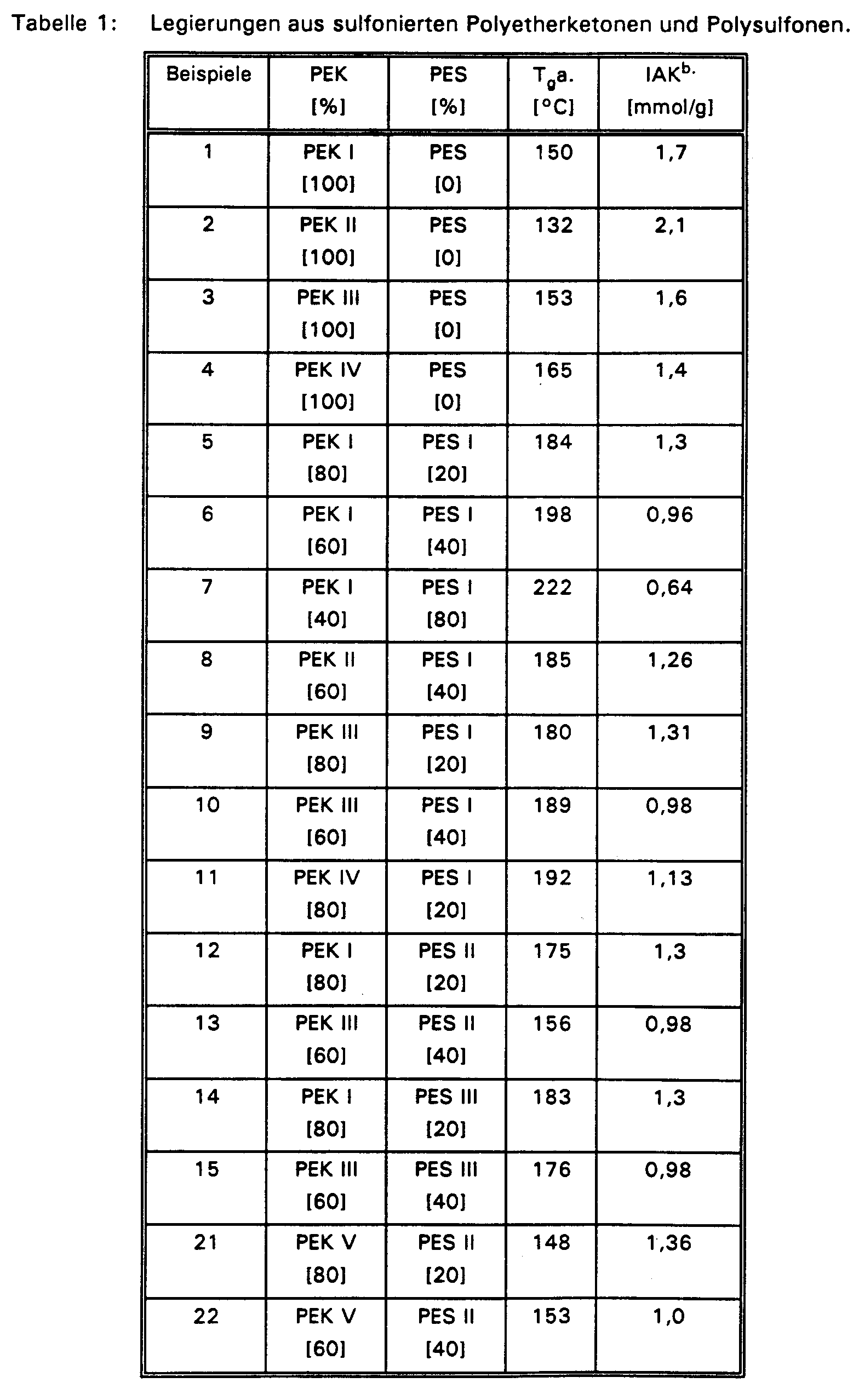

Tabelle 2 Legierungen aus sulfonierten Polyetherketonen, Polysulfonen, Polyvinylpyrrolidon bzw. Polyglykoldimethylether Beispiele Konzentrationen der Mischungskomponenten [in Gew.-%] PEK [%] PES [%] PVP [%] PG [%] Tg [°C] IAK [mmol/g] 16 PEK I [80] PES I [15] PVP [5] PG 500 [0] 178 1,3 17 PEK I [80] PES I [10] PVP [5] PG 500 [5] 165 1,3 18 PEK I [80] PES I [15] PVP [0] PG 500 [5] 172 1,3 19 PEK I [60] PES I [20] PVP [20] PG 500 [0] 153 0,96 20 PEK I [60] PES I [20] PVP [0] PG 500 [20] 155 0,96 vgl. Legende nach Tabelle 1 Tabelle 3 Mechanische Daten der Folien aus den Polymerlegierungen gemäß den Beispielen Beispiele E-Modul [GPa] Reißdehnung [%] Reißspannung [MPa] 1 2,3 124 17 5 2,3 113 30 6 2,8 108 44 7 3,0 95 56 9 2,7 120 36 12 2,4 115 28 13 2,4 103 26 14 2,6 117 40 15 3,1 109 38 16 2,1 132 19 17 2,0 145 15 18 2,1 140 17 19 2,4 135 12 20 2,2 128 14 21 2,3 108 24 22 2,6 98 27 - Zur Bestimmung der mechanischen Eigenschaften der hergestellten Materialien wurden die Proben 24 h bei RT in Wasser gelagert und anschließend nach dem oberflächlichen trockentupfen unter folgenden Bedingungen vermessen:
- Prüfgerät:
- ®Instron 4302 (Fa. Instron, Offenbach, Deutschland)
- Probenkörper:
- Folie gegossen aus Lösung
- Probengeometrie:
- Länge: 50 mm; Breite: 10 mm; Dicke: 0,25 mm
- Prüfvorschrift:
- 1 kN Meßdose
- Einspannlänge:
- 35 mm
-
- Meßlänge:
- 10 mm
- Meßgeschwindigkeit:
- 1 mm/min bis 0,35 mm Dehnung
-
- Meßlänge:
- 35 mm
- Meßgeschwindigkeit:
- 1 mm/min bis 0,35 mm, dann Umstellung auf 50 mm/min bis Bruch
-
Tabelle 4 Wasseraufnahmetests nach ASTM D 4019-81 ¹Wassergehalt Gew.-% Beispiel min. max. ²MW Anzahl der Messungen Standardabweichung 1 11,5 12,1 11,8 4 ± 0,25 5 7,14 7,87 7,5 4 ± 0,24 6 4,52 4,90 4,72 4 ± 0,16 7 3,27 3,62 3,44 3 ± 0,29 13 4,23 4,65 4,44 4 ± 0,20 14 6,64 7,10 6,88 4 ± 0,25 15 5,3 6,2 5,75 4 ± 0,10 16 13,2 13,9 13,5 3 ± 0,19 17 17,4 18,1 17,5 2 ± 0,24 18 15,3 15,9 15,6 3 ± 0,34 19 25,3 25,9 25,6 3 ± 0,40 ¹ Bezogen auf das Trockengewicht ²MW = Mittelwert - Zur Bestimmung der Wasseraufnahmefähigkeit der hergestellten Materialien nach ASTM D 4019-81 wurden die Proben bei 23°C bei einer relativen Luftfeuchtigkeit von 85% mindestens 210 Tage lang gelagert. Die Mengen an Wasser (Wassergehalt Gew-%), die bei einer erhöhten Temperatur gemäß der angegebenen Norm von den Proben abgegeben werden, wurden anschließend coulombmetrisch bestimmt.

Claims (12)
- Homogene Polymerlegierung, enthaltend mindestens ein sulfoniertes, aromatisches Polyetherketon und mindestens ein Polysulfon, dadurch gekennzeichnet, daß das Polysulfon ein aromatisches Polysulfon ist, das Gewichtsverhältnis sulfoniertes Polyetherketon/Polysulfon 1:99 bis 99:1 beträgt und die Legierung 5 bis 30 Gew.-% mindestens eines hydrophilen Polymers enthält, das ausgewählt wird aus der Gruppe von Polyvinylpyrrolidon, Polyglykoldialkylether, Polyglykoldialkylester und Poly-[1-(2-oxo-1-pyrrolidinyl)ethylen-co-1-(acetyloxy)ethylen].
- Homogene Polymerlegierung nach Anspruch 1, dadurch gekennzeichnet, daß sie mindestens ein sulfoniertes, aromatisches Polyetherketon mit der allgemeinen Formel I,
 Ar einen Phenylenring mit para- und/oder meta-Bindungen,Ar'- einen Phenylen-, Naphthylen-, Biphenylen-, Anthrylen- oder eine andere zweiwertige aromatische Einheit,X, N und M unabhängig voneinander Null oder 1,Y Null, 1, 2 oder 3,p 1, 2, 3 oder 4,bedeuten und wobei in der allgemeinen Formel I mindestens 20 % und maximal 100 % der O-Ar-O-Einheiten mit einer SO₃H-Gruppe substituiert sind.
 - Polymerlegierung nach Anspruch 1 oder 2, dadurch gekennzeichnet, daß sie mindestens ein sulfoniertes, aromatisches Polyetherketon der allgemeinen Formel II,


- Polymerlegierung nach Anspruch 3, dadurch gekennzeichnet, daß das sulfonierte, aromatische Polyetherketon ein sulfoniertes Copolymer ist, das aus mindestens zwei unterschiedlichen Wiederholeinheiten der allgemeinen Formel II, III und IV aufgebaut ist.
- Polymerlegierung nach Anspruch 1, dadurch gekennzeichnet, daß die sulfonierten, aromatischen Polyetherketone eine Molmasse besitzen, deren Gewichtsmittel im Bereich von 10 000 bis 150 000 g/mol liegt.
- Polymerlegierung nach den Ansprüchen 1 oder 2, dadurch gekennzeichnet, daß sie mindestens ein aromatisches Polysulfon enthält, das Struktureinheiten der allgemeinen Formel V
-X-Ar¹-(-Z-Ar²-)n-(X-Ar³)m-SO₂-Ar¹- (V)
aufweist, wobei-Ar¹- einen 1,4-Phenylenrest oder einen zweiwertigen Rest eines Heteroaromaten oder eines C₁₀-C₁₄-Aromaten, der gegebenenfalls Sulfonsäuregruppen oder Etherbrücken enthält und gegebenenfalls mit einem oder zwei verzweigten oder unverzweigten C₁-C₄-Alkyl oder Alkoxyresten oder mit einem oder mehreren Halogenatomen substituiert ist,-Ar²- und -Ar³- gleiche oder verschiedene 1,2-Phenylen-, 1,3-Phenylen-, 1,4-Phenylen- oder 4,4'-Biphenylreste, die gegebenenfalls mit einem oder zwei verzweigten oder unverzweigten C₁-C₄-Alkyl- oder Alkoxyresten oder mit einem oder mehreren Halogenatomen, substituiert sind,-Z- eine direkte Bindung oder einen der folgenden zweiwertigen Reste -O-, -S-, -C(CH₃)₂-, -C(CF₃)₂-, -SO₂- oder - X-Ar³-X-,X O, S, SO, CO oder SO₂n eine ganze Zahl, insbesondere 0, 1 oder 2 undm eine ganze Zahl, insbesondere 0, 1 oder 2
bedeuten. - Polymerlegierung nach Anspruch 1 oder 2, dadurch gekennzeichnet, daß sie mindestens ein aromtisches Polysulfon der Formel A, B, C oder D enthält,(A) -O-Ar-SO₂-Ar-(B) -O-Ar-O-Ar-SO₂-Ar-(C) -O-Ar-C(CH₃)₂-Ar-O-Ar-SO₂-Ar-,(D) -O-Ar-Ar-O-Ar-SO₂-Ar-wobei die einzelnen Gruppen Ar unabhängig voneinander einen Phenylenrest oder einen zweiwertigen Rest eines Heteroaromaten oder eines C₁₀-C₁₄-Aromaten bedeuten, der gegebenenfalls Sulfonsäuregruppen oder Etherbrücken enthält und gegebenenfalls mit einem oder zwei C₁-C₄-Alkyl- oder C₁-C₄-Alkoxyresten oder ein oder mehreren Halogenatome substituiert ist.
- Polymerlegierung nach Anspruch 1, dadurch gekennzeichnet, daß sie ein Polyvinylpyrrolidon enthält, dessen Molekulargewicht, angegeben als Gewichtsmittel, im Bereich von 1000 bis 3 Millionen, vorzugsweise im Bereich von 20 000 bis 200 000, insbesondere im Bereich von 40 000 bis 100 000, liegt.
- Polymerlegierung nach Anspruch 1, dadurch gekennzeichnet, daß sie einen Polyglykoldialkylether oder Polyglykoldialkylester mit einem Molekulargewicht enthält, dessen Gewichtsmittel im Bereich von 100 bis 100 000, vorzugsweise im Bereich von 250 bis 80 000, insbesondere im Bereich von 500 bis 50 000, liegt.
- Verfahren zur Herstellung einer homogenen Polymerlegierung nach Anspruch 1, dadurch gekennzeichnet, daß man eine Lösung bereitet, die das sulfonierte aromatische Polyetherketon, das aromatische Polysulfon und die restlichen Polymerbestandteile in einem aprotischen organischen Lösemittel enthält und dann das Lösemittel entfernt.
- Verfahren nach Anspruch 10, dadurch gekennzeichnet, daß man das aromatische Polysulfon in einem aprotischen, organischen Lösemittel durch Polykondensation herstellt und die Lösung des Polysulfon mit einer Lösung vereinigt, die das sulfonierte, aromatische Polyetherketon sowie gegebenenfalls weitere Polymerbestandteile im gleichen Lösemittel enthält, und dann das Lösemittel entfernt.
- Verwendung der Polymerlegierung gemäß Anspruch 1, für die Herstellung von Formkörpern, Folien, symmetrischen und asymmetrischen Membranen, Beschichtungen oder Fasern sowie als Kationenaustauschermembran.
Applications Claiming Priority (2)
| Application Number | Priority Date | Filing Date | Title |
|---|---|---|---|
| DE4422158 | 1994-06-24 | ||
| DE4422158A DE4422158A1 (de) | 1994-06-24 | 1994-06-24 | Homogene Polymerlegierungen auf der Basis von sulfonierten, aromatischen Polyetherketonen |
Publications (3)
| Publication Number | Publication Date |
|---|---|
| EP0688824A2 true EP0688824A2 (de) | 1995-12-27 |
| EP0688824A3 EP0688824A3 (de) | 1996-06-05 |
| EP0688824B1 EP0688824B1 (de) | 2004-11-24 |
Family
ID=6521430
Family Applications (1)
| Application Number | Title | Priority Date | Filing Date |
|---|---|---|---|
| EP95109010A Expired - Lifetime EP0688824B1 (de) | 1994-06-24 | 1995-06-12 | Homogene Polmerlegierungen auf der Basis von sulfonierten, aromatischen Polyetherketonen |
Country Status (5)
| Country | Link |
|---|---|
| US (1) | US5834566A (de) |
| EP (1) | EP0688824B1 (de) |
| JP (1) | JP3851363B2 (de) |
| KR (1) | KR100387061B1 (de) |
| DE (2) | DE4422158A1 (de) |
Cited By (11)
| Publication number | Priority date | Publication date | Assignee | Title |
|---|---|---|---|---|
| WO2000023177A1 (de) * | 1998-10-16 | 2000-04-27 | Celanese Ventures Gmbh | Membranen, enthaltend sulfoniertes polyetherketon und weiteres polymer, verfahren zu deren herstellung und deren verwendung |
| WO2000027513A3 (de) * | 1998-11-09 | 2000-08-31 | Axiva Gmbh | Polymerzusammensetzung, membran enthaltend diese, verfahren zu deren herstellung und deren verwendung |
| WO2000051716A1 (de) * | 1999-03-02 | 2000-09-08 | Celanese Ventures Gmbh | Sulfonierte aromatische polymere, membran enthaltend diese polymeren, verfahren zu deren herstellung und deren verwendung |
| DE10052242A1 (de) * | 2000-10-21 | 2002-05-02 | Celanese Ventures Gmbh | Mit Säure dotierte, ein- oder mehrschichtige Kunststoffmembran mit Schichten aufweisend Polymerblends umfassend Polymere mit wiederkehrenden Azoleinheiten, Verfahren zur Herstellung solche Kunststoffmembranen sowie deren Verwendung |
| WO2002075835A3 (en) * | 2001-03-21 | 2003-10-16 | Victrex Mfg Ltd | Polymer electrolyte membrane fuel cell |
| US6828353B1 (en) | 1998-09-11 | 2004-12-07 | Victrex Manufacturing Limited | Ion-exchange polymers |
| WO2007082526A3 (de) * | 2006-01-23 | 2008-01-24 | Between Lizenz Gmbh | Phosphonsäurehaltiger elektrolyt |
| EP1040155B2 (de) † | 1997-12-08 | 2010-12-01 | BASF Fuel Cell GmbH | Verfahren zur herstellung einer membran zum betrieb von brennstoffzellen und elektrolyseuren |
| EP2355218A1 (de) * | 2005-03-04 | 2011-08-10 | Ube Industries, Ltd. | Neuartiger Polymerelektrolyt, Polymerelektrolytzusammensetzung, Elektrolytmembran sowie Herstellungsverfahren und Verwendung dafür |
| CN103044292A (zh) * | 2011-10-13 | 2013-04-17 | 中国科学技术大学 | 一种磺酸化芳香族化合物以及一种含磺酸化芳香基团的聚酮及其制备方法 |
| US8455141B2 (en) | 2003-06-25 | 2013-06-04 | Toray Industries, Inc. | Polymer electrolyte as well as polymer electrolyte membrane, membrane electrode assembly and polymer electrolyte fuel cell using the same |
Families Citing this family (37)
| Publication number | Priority date | Publication date | Assignee | Title |
|---|---|---|---|---|
| DE19622338A1 (de) * | 1996-06-04 | 1997-12-11 | Dlr Deutsche Forschungsanstalt | Modifizierung von Polymeren |
| JP4802354B2 (ja) * | 1999-12-27 | 2011-10-26 | 住友化学株式会社 | 高分子電解質およびその製造方法 |
| JP5202783B2 (ja) * | 2000-03-22 | 2013-06-05 | ビクトレックス マニュファクチャリング リミテッド | イオン交換材料 |
| CN1439032A (zh) | 2000-06-02 | 2003-08-27 | Sri国际公司 | 聚合物组合物 |
| US7316855B2 (en) | 2001-06-01 | 2008-01-08 | Polyfuel, Inc. | Fuel cell assembly for portable electronic device and interface, control, and regulator circuit for fuel cell powered electronic device |
| ATE400904T1 (de) | 2001-06-01 | 2008-07-15 | Polyfuel Inc | Austauschbare brennstoffpatrone, brennstoffzellenaggregat mit besagter brennstoffpatrone für tragbare elektronische geräte und entsprechendes gerät |
| US7601448B2 (en) * | 2001-07-03 | 2009-10-13 | Sumitomo Chemical Company, Limited | Polymer electrolyte membrane and fuel cell |
| GB0123109D0 (en) * | 2001-09-26 | 2001-11-14 | Victrex Mfg Ltd | Cells |
| DE10207411A1 (de) | 2002-02-21 | 2003-09-04 | Daimler Chrysler Ag | Verfahren zur Herstellung von Kompositmembranen |
| US6986571B2 (en) * | 2002-04-23 | 2006-01-17 | Hewlett-Packard Development Company, L.P. | Filter for a print cartridge |
| KR100440895B1 (ko) * | 2002-05-11 | 2004-07-19 | 정보통신연구진흥원 | 양이온교환막용 설폰화 폴리설폰의 제조방법 |
| US7354679B2 (en) | 2002-05-13 | 2008-04-08 | Polyfuel, Inc. | Ion conductive random copolymers |
| CA2485971A1 (en) | 2002-05-13 | 2004-05-21 | Polyfuel, Inc. | Ion conductive block copolymers |
| WO2003095509A1 (en) | 2002-05-13 | 2003-11-20 | Polyfuel, Inc. | Sulfonated copolymer |
| DE10246373A1 (de) | 2002-10-04 | 2004-04-15 | Celanese Ventures Gmbh | Protonenleitende Polymermembran umfassend Sulfonsäuregruppen enthaltende Polyazole und deren Anwendung in Brennstoffzellen |
| DE10246461A1 (de) | 2002-10-04 | 2004-04-15 | Celanese Ventures Gmbh | Protonenleitende Polymermembran enthaltend Polyazolblends und deren Anwendung in Brennstoffzellen |
| TW200416257A (en) * | 2002-10-15 | 2004-09-01 | Sumitomo Chemical Co | Block copolymer and application thereof |
| AU2004248640A1 (en) * | 2003-06-12 | 2004-12-23 | Mc Research & Innovation Center | Fullerene-based electrolyte for fuel cells |
| US20060024546A1 (en) * | 2003-06-12 | 2006-02-02 | Mc Research & Innovation Corp And Mer Corporation | Fullerene-based electrolyte for fuel cells |
| ATE509383T1 (de) * | 2003-07-31 | 2011-05-15 | Toyo Boseki | Elektrolyt-membran-elektroden-baugruppe, brennstoffzelle damit und verfahren zur herstellung einer elektrolyt-membran-elektroden- baugruppe |
| JP4424129B2 (ja) * | 2003-10-17 | 2010-03-03 | 住友化学株式会社 | ブロック共重合体及びその用途 |
| TW200518377A (en) * | 2003-10-17 | 2005-06-01 | Sumitomo Chemical Co | Block copolymer and applications thereof |
| JP4843910B2 (ja) * | 2004-06-10 | 2011-12-21 | 東レ株式会社 | 高分子電解質材、ならびにそれを用いた高分子電解質膜、膜電極複合体および高分子電解質型燃料電池 |
| WO2006025351A1 (ja) * | 2004-09-03 | 2006-03-09 | Toray Industries, Inc. | 高分子電解質材料、高分子電解質部品、膜電極複合体、および高分子電解質型燃料電池 |
| US20060178500A1 (en) | 2005-02-07 | 2006-08-10 | Fuji Photo Film Co., Ltd. | Solid electrolyte, method for producing solid electrolyte, membrane and electrode assembly, and fuel cell |
| JP5044132B2 (ja) | 2005-07-07 | 2012-10-10 | 富士フイルム株式会社 | 固体電解質フィルムの製造方法及び製造設備 |
| JP5093870B2 (ja) | 2005-07-07 | 2012-12-12 | 富士フイルム株式会社 | 固体電解質複層フィルムの製造方法 |
| CN101517800B (zh) | 2006-09-29 | 2011-10-12 | 富士胶片株式会社 | 膜电极接合体及其制造方法 |
| JP5094295B2 (ja) | 2007-09-10 | 2012-12-12 | 富士フイルム株式会社 | 膜電極接合体および燃料電池 |
| JP2009070631A (ja) | 2007-09-11 | 2009-04-02 | Fujifilm Corp | 電解質膜、膜電極接合体および膜電極接合体を用いた燃料電池 |
| JP5068610B2 (ja) | 2007-09-11 | 2012-11-07 | 富士フイルム株式会社 | イオン性ポリマー粒子分散液およびその製造方法 |
| CA2784974A1 (en) * | 2009-12-04 | 2011-06-09 | Prudent Energy Inc. | Polymer blend proton exchange membrane and preparation method thereof |
| JP2014046264A (ja) * | 2012-08-31 | 2014-03-17 | Dai Ichi Kogyo Seiyaku Co Ltd | 高耐熱性・高耐久性イオン交換体及びそれを用いた有用金属・有害金属の捕集方法 |
| JP5655878B2 (ja) * | 2013-02-21 | 2015-01-21 | 東レ株式会社 | 高分子電解質膜、膜電極複合体および高分子電解質型燃料電池 |
| WO2015005370A1 (ja) * | 2013-07-09 | 2015-01-15 | Jsr株式会社 | 電解質膜、膜-電極接合体および固体高分子型燃料電池 |
| JP6610326B2 (ja) * | 2016-02-22 | 2019-11-27 | 三菱ケミカル株式会社 | フィルム |
| JP7348367B1 (ja) * | 2022-09-01 | 2023-09-20 | 三菱ガス化学トレーディング株式会社 | 成形機用洗浄剤 |
Citations (4)
| Publication number | Priority date | Publication date | Assignee | Title |
|---|---|---|---|---|
| EP0008895A1 (de) | 1978-09-05 | 1980-03-19 | Imperial Chemical Industries Plc | Sulfonierte Polyarylätherketone und Verfahren zu ihrer Herstellung |
| EP0041780A1 (de) | 1980-06-10 | 1981-12-16 | Imperial Chemical Industries Plc | Sulfonierte Polyarylätherketone |
| GB2216134A (en) | 1988-03-29 | 1989-10-04 | Paterson Candy Int | Membranes |
| EP0575807A1 (de) | 1992-06-11 | 1993-12-29 | Hoechst Aktiengesellschaft | Sulphonierte Polyetherketonen |
Family Cites Families (3)
| Publication number | Priority date | Publication date | Assignee | Title |
|---|---|---|---|---|
| GB2247419B (en) * | 1989-10-30 | 1993-08-25 | Aligena Ag | Semipermeable composite membranes |
| US5279739A (en) * | 1991-08-19 | 1994-01-18 | Koch Membrane Systems, Inc. | Durable filtration membrane having optimized molecular weight |
| US5340480A (en) * | 1992-04-29 | 1994-08-23 | Kuraray Co., Ltd. | Polysulfone-based hollow fiber membrane and process for manufacturing the same |
-
1994
- 1994-06-24 DE DE4422158A patent/DE4422158A1/de not_active Withdrawn
-
1995
- 1995-06-12 DE DE59510970T patent/DE59510970D1/de not_active Expired - Fee Related
- 1995-06-12 EP EP95109010A patent/EP0688824B1/de not_active Expired - Lifetime
- 1995-06-23 JP JP15775995A patent/JP3851363B2/ja not_active Expired - Fee Related
- 1995-06-23 KR KR1019950017000A patent/KR100387061B1/ko not_active Expired - Fee Related
-
1997
- 1997-06-30 US US08/885,514 patent/US5834566A/en not_active Expired - Lifetime
Patent Citations (4)
| Publication number | Priority date | Publication date | Assignee | Title |
|---|---|---|---|---|
| EP0008895A1 (de) | 1978-09-05 | 1980-03-19 | Imperial Chemical Industries Plc | Sulfonierte Polyarylätherketone und Verfahren zu ihrer Herstellung |
| EP0041780A1 (de) | 1980-06-10 | 1981-12-16 | Imperial Chemical Industries Plc | Sulfonierte Polyarylätherketone |
| GB2216134A (en) | 1988-03-29 | 1989-10-04 | Paterson Candy Int | Membranes |
| EP0575807A1 (de) | 1992-06-11 | 1993-12-29 | Hoechst Aktiengesellschaft | Sulphonierte Polyetherketonen |
Non-Patent Citations (6)
| Title |
|---|
| "The Organic Chemistry of Sulfur", 1962, WILEY, NEW YORK, pages: 29 |
| J. POLYM. SCI. POLYM. CHEM. ED., vol. 5, 1967, pages 2375 |
| JOURNAL OF POLYMER SCIENCE, POLYMER PHYSICS EDITION, vol. 21, 1983, pages 11 |
| MACROMOLECULES, vol. 16, 1983, pages 753 |
| OLABISI, ROBESON, SHAW: "Polymer-Polymer-Miscibility", 1979, ACADEMIC PRESS, NEW YORK, pages: 321 - 327 |
| POLYMER, vol. 24, 1983, pages 60 |
Cited By (23)
| Publication number | Priority date | Publication date | Assignee | Title |
|---|---|---|---|---|
| EP1040155B2 (de) † | 1997-12-08 | 2010-12-01 | BASF Fuel Cell GmbH | Verfahren zur herstellung einer membran zum betrieb von brennstoffzellen und elektrolyseuren |
| US6828353B1 (en) | 1998-09-11 | 2004-12-07 | Victrex Manufacturing Limited | Ion-exchange polymers |
| US6969755B2 (en) | 1998-09-11 | 2005-11-29 | Victrex Manufacturing Limited | Ion-exchange polymers |
| US6914084B1 (en) | 1998-10-16 | 2005-07-05 | Celanese Ventures Gmbh | Membranes containing sulfonated polyetherketone and another polymer, method for the production and use thereof |
| WO2000023177A1 (de) * | 1998-10-16 | 2000-04-27 | Celanese Ventures Gmbh | Membranen, enthaltend sulfoniertes polyetherketon und weiteres polymer, verfahren zu deren herstellung und deren verwendung |
| EP2014349A1 (de) | 1998-11-09 | 2009-01-14 | BASF Fuel Cell GmbH | Membranen aus sulfoniertem aromatischen Polyetherketon und Polybenzimidazol, sowie deren Verwendung |
| WO2000027513A3 (de) * | 1998-11-09 | 2000-08-31 | Axiva Gmbh | Polymerzusammensetzung, membran enthaltend diese, verfahren zu deren herstellung und deren verwendung |
| US6632847B1 (en) | 1998-11-09 | 2003-10-14 | Celanese Ventures Gmbh | Polymer composition, membrane containing said composition, method for the production and uses thereof |
| WO2000051716A1 (de) * | 1999-03-02 | 2000-09-08 | Celanese Ventures Gmbh | Sulfonierte aromatische polymere, membran enthaltend diese polymeren, verfahren zu deren herstellung und deren verwendung |
| US6994788B1 (en) | 1999-03-02 | 2006-02-07 | Pemeas Gmbh | Sulfonated aromatic polymers, membrane containing said polymers and a method for production and use of the same |
| DE10052242A1 (de) * | 2000-10-21 | 2002-05-02 | Celanese Ventures Gmbh | Mit Säure dotierte, ein- oder mehrschichtige Kunststoffmembran mit Schichten aufweisend Polymerblends umfassend Polymere mit wiederkehrenden Azoleinheiten, Verfahren zur Herstellung solche Kunststoffmembranen sowie deren Verwendung |
| US7303830B2 (en) | 2001-03-21 | 2007-12-04 | Victrex Manufacturing Limited | Fuel cell |
| WO2002075835A3 (en) * | 2001-03-21 | 2003-10-16 | Victrex Mfg Ltd | Polymer electrolyte membrane fuel cell |
| US8455141B2 (en) | 2003-06-25 | 2013-06-04 | Toray Industries, Inc. | Polymer electrolyte as well as polymer electrolyte membrane, membrane electrode assembly and polymer electrolyte fuel cell using the same |
| EP2355218A1 (de) * | 2005-03-04 | 2011-08-10 | Ube Industries, Ltd. | Neuartiger Polymerelektrolyt, Polymerelektrolytzusammensetzung, Elektrolytmembran sowie Herstellungsverfahren und Verwendung dafür |
| EP2362472A1 (de) * | 2005-03-04 | 2011-08-31 | Ube Industries, Ltd. | Neuartiger Polymerelektrolyt, Polymerelektrolytzusammensetzung, Elektrolytmembran sowie Herstellungsverfahren und Verwendung dafür |
| US8710176B2 (en) | 2005-03-04 | 2014-04-29 | Ube Industries, Ltd. | Method for producing a sulfonated polyarylether block copolymer |
| US9005843B2 (en) | 2005-03-04 | 2015-04-14 | Ube Industries, Ltd. | Polymer electrolyte composition |
| WO2007082526A3 (de) * | 2006-01-23 | 2008-01-24 | Between Lizenz Gmbh | Phosphonsäurehaltiger elektrolyt |
| US9023557B2 (en) | 2006-01-23 | 2015-05-05 | Between Lizenz Gmbh | Method for preparing a solution of a sulfonated polymer and an amino-phosphonic acid in an aprotic solvent |
| US10556996B2 (en) | 2006-01-23 | 2020-02-11 | Between Lizenz Gmbh | Method for preparing a solution of a sulfonated polymer and an amino-phosphonic acid in an aprotic solvent |
| CN103044292A (zh) * | 2011-10-13 | 2013-04-17 | 中国科学技术大学 | 一种磺酸化芳香族化合物以及一种含磺酸化芳香基团的聚酮及其制备方法 |
| CN103044292B (zh) * | 2011-10-13 | 2014-10-15 | 中国科学技术大学 | 一种磺酸化芳香族化合物以及一种含磺酸化芳香基团的聚酮及其制备方法 |
Also Published As
| Publication number | Publication date |
|---|---|
| KR960001038A (ko) | 1996-01-25 |
| EP0688824A3 (de) | 1996-06-05 |
| EP0688824B1 (de) | 2004-11-24 |
| DE4422158A1 (de) | 1996-01-04 |
| US5834566A (en) | 1998-11-10 |
| KR100387061B1 (ko) | 2003-11-10 |
| JP3851363B2 (ja) | 2006-11-29 |
| JPH0820716A (ja) | 1996-01-23 |
| DE59510970D1 (de) | 2004-12-30 |
Similar Documents
| Publication | Publication Date | Title |
|---|---|---|
| EP0688824B1 (de) | Homogene Polmerlegierungen auf der Basis von sulfonierten, aromatischen Polyetherketonen | |
| EP1337319B1 (de) | Neue membranen für den einsatz in brennstoffzellen mit einer verbesserten mechanik | |
| DE112010003842B4 (de) | Aromatisches Polysulfonharz und Membranen daraus | |
| EP1144100B1 (de) | Membranen aus sulfoniertem aromatischen polyetherketon und polybenzimidazol sowie deren verwendung | |
| DE60036358T2 (de) | Polymerelektrolyt und Herstellungsverfahren dafür | |
| DE60020915T2 (de) | Polymere Kompositmembran und Verfahren zu ihrer Herstellung | |
| DE102009020231B4 (de) | Neue Protonenaustauschmembranen für Brennstoffzellenanwendungen | |
| DE102009020181B4 (de) | Sulfonierte Perfluorcyclobutanblockcopolymere und protonenleitende Polymermembranen | |
| EP1268045B1 (de) | Neue blendpolymermembranen zum einsatz in brennstoffzellen | |
| DE10129458A1 (de) | Verbesserte Polymerfolien auf Basis von Polyazolen | |
| EP3044249B2 (de) | Polyarylenethersulfon-polymere für membrananwendungen | |
| EP0840760B1 (de) | Polymerelektrolyte und verfahren zu deren herstellung | |
| DE19909028A1 (de) | Sulfonierte aromatische Polymere, Membran enthaltend diese Polymeren, Verfahren zu deren Herstellung und deren Verwendung | |
| EP0147708A2 (de) | Verzweigte, hochmolekulare, thermoplastische, Nitrilgruppen enthaltende Polyarylenether und deren Herstellung | |
| EP1681311B1 (de) | Verzweigte sulfonierte Polyarylether | |
| DE10347530A1 (de) | Blockcopolymer und dessen Verwendung | |
| DE19527435A1 (de) | Polymerelektrolyte und Verfahren zu deren Herstellung | |
| WO2000023177A1 (de) | Membranen, enthaltend sulfoniertes polyetherketon und weiteres polymer, verfahren zu deren herstellung und deren verwendung | |
| EP0604881B1 (de) | Homogene Polymerlegierungen auf der Basis von sulfonierten, aromatischen Polyetherketonen | |
| EP0329029A2 (de) | Hochtemperaturbeständige aromatische Polyether | |
| EP0422576B1 (de) | Legierungen mit einer Glastemperatur | |
| DE60004148T2 (de) | Verfahren zur Herstellung von meta-verknüpftem Polyanilin | |
| DE19538025C2 (de) | Sulfonierte Polyaryletherketone | |
| DE19548425A1 (de) | Polymerelektrolyte und Verfahren zu deren Herstellung | |
| DE102011013840A1 (de) | Aus löslichen Perfluorcyclobutanpolymeren mit Sulfonylchloridgruppen abgeleitete Polyelektrolytmembranen |
Legal Events
| Date | Code | Title | Description |
|---|---|---|---|
| PUAI | Public reference made under article 153(3) epc to a published international application that has entered the european phase |
Free format text: ORIGINAL CODE: 0009012 |
|
| AK | Designated contracting states |
Kind code of ref document: A2 Designated state(s): BE DE FR GB IT |
|
| PUAL | Search report despatched |
Free format text: ORIGINAL CODE: 0009013 |
|
| AK | Designated contracting states |
Kind code of ref document: A3 Designated state(s): BE DE FR GB IT |
|
| 17P | Request for examination filed |
Effective date: 19961205 |
|
| 17Q | First examination report despatched |
Effective date: 19990308 |
|
| RAP1 | Party data changed (applicant data changed or rights of an application transferred) |
Owner name: AVENTIS RESEARCH & TECHNOLOGIES GMBH & CO. KG |
|
| APAB | Appeal dossier modified |
Free format text: ORIGINAL CODE: EPIDOS NOAPE |
|
| RAP1 | Party data changed (applicant data changed or rights of an application transferred) |
Owner name: AXIVA GMBH |
|
| APAB | Appeal dossier modified |
Free format text: ORIGINAL CODE: EPIDOS NOAPE |
|
| APAD | Appeal reference recorded |
Free format text: ORIGINAL CODE: EPIDOS REFNE |
|
| RAP1 | Party data changed (applicant data changed or rights of an application transferred) |
Owner name: CELANESE VENTURES GMBH |
|
| GRAP | Despatch of communication of intention to grant a patent |
Free format text: ORIGINAL CODE: EPIDOSNIGR1 |
|
| RAP1 | Party data changed (applicant data changed or rights of an application transferred) |
Owner name: PEMEAS GMBH |
|
| GRAS | Grant fee paid |
Free format text: ORIGINAL CODE: EPIDOSNIGR3 |
|
| GRAA | (expected) grant |
Free format text: ORIGINAL CODE: 0009210 |
|
| AK | Designated contracting states |
Kind code of ref document: B1 Designated state(s): BE DE FR GB IT |
|
| PG25 | Lapsed in a contracting state [announced via postgrant information from national office to epo] |
Ref country code: IT Free format text: LAPSE BECAUSE OF FAILURE TO SUBMIT A TRANSLATION OF THE DESCRIPTION OR TO PAY THE FEE WITHIN THE PRE;WARNING: LAPSES OF ITALIAN PATENTS WITH EFFECTIVE DATE BEFORE 2007 MAY HAVE OCCURRED AT ANY TIME BEFORE 2007. THE CORRECT EFFECTIVE DATE MAY BE DIFFERENT FROM THE ONE RECORDED.SCRIBED TIME-LIMIT Effective date: 20041124 |
|
| REG | Reference to a national code |
Ref country code: GB Ref legal event code: FG4D Free format text: NOT ENGLISH |
|
| REF | Corresponds to: |
Ref document number: 59510970 Country of ref document: DE Date of ref document: 20041230 Kind code of ref document: P |
|
| GBT | Gb: translation of ep patent filed (gb section 77(6)(a)/1977) |
Effective date: 20050324 |
|
| PG25 | Lapsed in a contracting state [announced via postgrant information from national office to epo] |
Ref country code: BE Free format text: LAPSE BECAUSE OF NON-PAYMENT OF DUE FEES Effective date: 20050630 |
|
| PLBE | No opposition filed within time limit |
Free format text: ORIGINAL CODE: 0009261 |
|
| STAA | Information on the status of an ep patent application or granted ep patent |
Free format text: STATUS: NO OPPOSITION FILED WITHIN TIME LIMIT |
|
| APAH | Appeal reference modified |
Free format text: ORIGINAL CODE: EPIDOSCREFNO |
|
| 26N | No opposition filed |
Effective date: 20050825 |
|
| ET | Fr: translation filed | ||
| BERE | Be: lapsed |
Owner name: *PEMEAS G.M.B.H. Effective date: 20050630 |
|
| PGFP | Annual fee paid to national office [announced via postgrant information from national office to epo] |
Ref country code: DE Payment date: 20090604 Year of fee payment: 15 |
|
| PGFP | Annual fee paid to national office [announced via postgrant information from national office to epo] |
Ref country code: GB Payment date: 20100401 Year of fee payment: 16 Ref country code: FR Payment date: 20100726 Year of fee payment: 16 |
|
| PG25 | Lapsed in a contracting state [announced via postgrant information from national office to epo] |
Ref country code: DE Free format text: LAPSE BECAUSE OF NON-PAYMENT OF DUE FEES Effective date: 20110101 |
|
| GBPC | Gb: european patent ceased through non-payment of renewal fee |
Effective date: 20110612 |
|
| REG | Reference to a national code |
Ref country code: FR Ref legal event code: ST Effective date: 20120229 |
|
| PG25 | Lapsed in a contracting state [announced via postgrant information from national office to epo] |
Ref country code: FR Free format text: LAPSE BECAUSE OF NON-PAYMENT OF DUE FEES Effective date: 20110630 |
|
| PG25 | Lapsed in a contracting state [announced via postgrant information from national office to epo] |
Ref country code: GB Free format text: LAPSE BECAUSE OF NON-PAYMENT OF DUE FEES Effective date: 20110612 |