EP0301409A2 - Thermoplastisch verarbeitbare Polyarylenether mit 9,9-Bis-(4'-hydroxyphenyl)fluoren - Google Patents
Thermoplastisch verarbeitbare Polyarylenether mit 9,9-Bis-(4'-hydroxyphenyl)fluoren Download PDFInfo
- Publication number
- EP0301409A2 EP0301409A2 EP88111757A EP88111757A EP0301409A2 EP 0301409 A2 EP0301409 A2 EP 0301409A2 EP 88111757 A EP88111757 A EP 88111757A EP 88111757 A EP88111757 A EP 88111757A EP 0301409 A2 EP0301409 A2 EP 0301409A2
- Authority
- EP
- European Patent Office
- Prior art keywords
- units
- bis
- formula
- polyarylene ether
- hydroxyphenyl
- Prior art date
- Legal status (The legal status is an assumption and is not a legal conclusion. Google has not performed a legal analysis and makes no representation as to the accuracy of the status listed.)
- Ceased
Links
- UHOVQNZJYSORNB-UHFFFAOYSA-N c1ccccc1 Chemical compound c1ccccc1 UHOVQNZJYSORNB-UHFFFAOYSA-N 0.000 description 2
Classifications
-
- C—CHEMISTRY; METALLURGY
- C08—ORGANIC MACROMOLECULAR COMPOUNDS; THEIR PREPARATION OR CHEMICAL WORKING-UP; COMPOSITIONS BASED THEREON
- C08G—MACROMOLECULAR COMPOUNDS OBTAINED OTHERWISE THAN BY REACTIONS ONLY INVOLVING UNSATURATED CARBON-TO-CARBON BONDS
- C08G65/00—Macromolecular compounds obtained by reactions forming an ether link in the main chain of the macromolecule
- C08G65/34—Macromolecular compounds obtained by reactions forming an ether link in the main chain of the macromolecule from hydroxy compounds or their metallic derivatives
- C08G65/38—Macromolecular compounds obtained by reactions forming an ether link in the main chain of the macromolecule from hydroxy compounds or their metallic derivatives derived from phenols
- C08G65/40—Macromolecular compounds obtained by reactions forming an ether link in the main chain of the macromolecule from hydroxy compounds or their metallic derivatives derived from phenols from phenols (I) and other compounds (II), e.g. OH-Ar-OH + X-Ar-X, where X is halogen atom, i.e. leaving group
- C08G65/4012—Other compound (II) containing a ketone group, e.g. X-Ar-C(=O)-Ar-X for polyetherketones
Definitions
- Aromatic polyethers with plastic properties partly include for a long time to the state of the art and have also gained economic importance as technical products.
- Common properties of the aromatic polyethers which are advantageous for many applications are their softening temperature above 200 ° C. and their thermoplastic processability.
- aromatic polyethers In addition to polymers such as polyxylenol, which is known as PPO and which is built up alternately from aromatic and ether oxygen units in the polymer chain, aromatic polyethers also include polymers which, in addition to the characteristic aromatic and oxygen units in the main polymer chain, also contain other characteristic atomic groups, how contain.
- the chemical building blocks for the production of polyarylene ethers by polycondensation are preferably symmetrical compounds of type I. with R ′: covalent single bond; and Y: OH;
- Polyarylene ethers based on 9,9-bis (4'-hydroxyphenyl) fluorene are distinguished by high heat resistance, determined by the glass transition temperature of the polymers.
- the polyether obtainable by reacting 4,4'-difluorobenzophenone with 9,9-bis (4'-hydroxyphenyl) fluorene has a Tg of 252 degrees C.
- Our own studies on workpieces of this polymer showed that plastics with this elongation at break of about 10% are relatively brittle materials.
- the polyarylene ethers according to the invention can thus be characterized by the repeating structural units of the general formula (1) represent in which A, B and C mean the above-mentioned building blocks of the polymer linked ether-like via the O atom and for m and n the molar ratio applies, and the distribution, ie the sequence of the B- or C-containing structural units in the macromolecule can be both statistical and alternating.
- the copolymers according to the invention have glass transition temperatures in the range from 160 to 220 degrees C (measured with the DSC), are tough-elastic materials with elongation at break of mostly over 20% and with elastic moduli around 3,000 MPa, which are further used in UL94 fire classification at least class VI and mostly class VO, have very low smoke densities and in the event of fire they do not develop toxic gases containing sulfur or nitrogen.
- Workpieces obtained from the polymers e.g. by thermoplastic processing
- the new copolycondensates of the formula (1) are distinguished as materials with superior properties.
- essentially bifunctional monomers A ', B' and C ' are used, which differ from the basic building blocks A, B and C by additional functional groups Differentiate groups.
- those with halogen, preferably with fluorine and chlorine, and those with phenolic hydroxyl groups, which are preferably reacted as phenolate, are used as reactive compounds.
- dihalogen compounds and bisphenols such as bifunctional starting compounds are also those which contain both a halogen group and a phenolic group in the same molecule.
- the compounds A ', B' and C ' are used in such a ratio to one another that the ratio m: n according to the invention is set in (1) and that the halogen and HO groups reacting with one another are equivalent. It is thereby achieved that the polycondensates according to the invention have molecular weights (Mw) of over 20,000 and plastic properties.
- the polycondensation conditions to be used are those described in US Pat. No. 4,175,175 and those for the production of phosphorus-containing polyarylene ethers in US 4,492,805 described analogously.
- water entraining agents such as chlorobenzene or xylenes
- polar aprotic solvents such as dimethyl sulfoxide, sulfolane, N, N-dimethylformamide, N, N-dimethylacetamide, N-methylpyrrolidone
- polycondensation at temperatures of 100 up to 300 degrees C in the presence of strongly basic alkali compounds, such as alkali hydroxides, such as sodium or potassium hydroxide, or as in particular in the presence of sodium or potassium carbonate.
- the functional halogen or hydroxyl groups are preferably in the "4-position". Other positional isomers may also be present in minor amounts in the starting compounds A '.
- the starting compounds B'and C 'for the introduction of the B and C units are the phenolic compounds 9,9-bis (4'-hydroxyphenyl) fluorene and 2,2-bis (4-hydroxyphenyl) propane, known as bisphenol A, used.
- B 'and C' are in the molar ratio used in the production of the new polymers.
- the new polyarylene ethers may also have branched structures.
- branch points in the new polyethers for example 1,3,5-tris (4'-hydroxyphenyl) benzene, 1,1,1-tris (4-hydroxyphenyl) ethane are suitable as additional starting compounds.
- the xylene was distilled off via the water separator at approximately 180 ° C. and the reaction mixture which remained was kept at this temperature until the molecular weight Mw of the polycondensate was approximately 77,000 (measurement: GPC, calibration with polystyrene). Then 0.2 mol of methyl chloride was passed through.
Landscapes
- Chemical & Material Sciences (AREA)
- Health & Medical Sciences (AREA)
- Chemical Kinetics & Catalysis (AREA)
- Medicinal Chemistry (AREA)
- Polymers & Plastics (AREA)
- Organic Chemistry (AREA)
- Polyethers (AREA)
- Compositions Of Macromolecular Compounds (AREA)
Abstract


Description
- Die Erfindung betrifft aromatische Polyether-Kunststoffe mit hohen Glas- und Zersetzungstemperaturen und Verfahren zu ihrer Herstellung. Sie sind schwer brennbar und lassen sich thermoplastisch verarbeiten.
- Aromatische Polyether mit Kunststoffeigenschaften gehoren z.T. schon lange zum Stand der Technik und haben teilweise auch als technische Produkte wirtschaftliche Bedeutung erlangt. Für viele Anwendungszwecke vorteilhafte gemeinsame Eigenschaften der aromatischen Polyether sind ihre über 200 Grad C liegende Erweichungstemperatur und ihre thermoplastische Verarbeitbarkeit.
- Zu den aromatischen Polyethern gehören neben Polymeren wie dem Polyxylenol, das als PPO bekannt ist, und das abwechselnd aus aromatischen- und Ethersauerstoffeinheiten in der Polymerkette aufgebaut ist, auch Polymere, die außer den charakteristischen Aromaten- und Sauerstoffeinheiten in der Polymerhauptkette noch weitere charakteristische Atomgruppen, wie

- Wohl bekannt sind hier aromatische Polyäthersulfone, die auch als Polyarylsulfone bezeichnet werden und als technische Produkte auf dem Markt sind. (Ullmanns Encyclopädie der technischen Chemie, 4. Auflage, Band 15, Seiten 429 bis 435 und US-Patent 4 175 175).
- In der US 4 492 805 sind weiter aromatische Polyether mit phosphorhaltigen Strukturelementen, z.B. Triphenylphosphinoxideinheiten, in der Polymerkette beschrieben, die sich als schwerbrennbare bzw. unbrennbare Kunststoffe auszeichnen. Die Herstellung aromatischer Polyether kann im allgemeinen durch Polykondensation der chemischen Bausteine erfolgen. So werden beispielsweise die phosphorhaltigen Polyarylenether der US 4 492 805 durch Polykondensation eines bifunktionellen Phosphins bzw. Phosphinoxides, insbesondere der entsprechenden Dihalogenverbindung, mit einer weiteren bifunktionellen aromatischen Verbindung, insbesondere einer Bishydroxiverbindung, erhalten.
- Die chemischen Bausteine für die Herstellung von Polyarylenethern durch Polykondensation sind vorzugsweise symmetrische Verbindungen des Typs I


- Als chemische Bausteine für die Herstellung der aromatischen Polyether kommen aber auch Verbindungen der Typen I und II in Frage, in denen die reaktiven Gruppen X bzw. Y ganz oder zur Hälfte gegen Y bzw. X ersetzt sind.
- In Polymer Science USSR, 14, (1972), 2962 - 2970, und in Polymer Journal, Vol. 19, 78 - 79 (1987), sind aromatische Polyether des "Cardo" Typs beschrieben. Sie werden hergestellt durch Polykondensation von Dihalogenverbindungen des Typs I, wobei R SO₂ oder CO ist, mit Bisphenolen des Typs II, in denen R′ eine cyclische organische Gruppe ist, von welcher ein Kohlenstoffatom das die beiden aromatischen Ringe von Verbindungen des Typs II verbindende Glied ist. Dieses quartäre Kohlenstoffatom ist nach der Polykondensation Teil der Polymerhauptkette. Beispiele solcher Bisphenole sind danach u.a. Phenolphthalein und Phenolfluoren (= 9,9-Bis-(4′-hydroxyphenyl)fluoren).
- Phosphorhaltige Polyarylenether, die analog denjenigen der US 4 492 805 aufgebaut sind, aber "Cardo"-Bausteine enthalten, sind in den deutschen Anmeldungen P 35 21 123.7 und P 35 21 124.5 genannt.
- Polyarylenether auf Basis 9,9-Bis(4′-hydroxyphenyl)fluoren wie sie nach Polymer Journal, Vol. 19, 78 - 79 (1987) erhältlich sind, zeichnen sich durch hohe Wärmefestigkeiten, bestimmt über die Glastemperatur der Polymeren, aus. Der durch Umsetzung von 4,4′-Difluorbenzophenon mit 9,9-Bis(4′-hydroxyphenyl)fluoren erhältliche Polyether weist einen Tg-Wert von 252 Grad C auf. Eigene Untersuchungen an Werkstücken dieses Polymeren ergaben, daß mit Reißdehnungswerten von etwa 10 % Kunststoffe aus diesem Polymeren relativ spröde Materialien sind.
- Polyarylenether mit sulfongruppen- oder stickstoffhaltigen Bausteinen entwickeln im Brandfall toxische Gase, wie SO₂ oder Stickoxid oder auch HCN. Solche Schadstoffe sind aus einem Polyarylenether, dessen Bausteine als Elemente nur C, H und O enthalten, nicht zu erwarten.
- Der Stand der Technik weist aus, daß die bekannten Polyarylenether in ihren Eigenschaftsprofilen deutlich voneinander abweichen. Bei ihrer Verwendung als Kunststoffe zeigen sich daher neben ihren hervorragenden Eigenschaften auch ihre Mängel. Es war die Aufgabe, Kunststoffe zu entwickeln, die amorph, thermoplastisch verarbeitbar, stabil, z.B. hydrolysestabil, und zäh sind, mit relativ hohen Wärmefestigkeiten von etwa 200 Grad C und geringen Wasseraufnahmen, und die im Brandfall keine schwefel- und stickstoffhaltigen toxischen Gase freisetzen und sehr niedrige Rauchgasdichten aufweisen.
- Es wurde gefunden, daß Kunststoffe, die das gewünschte Eigenschaftsprofil aufweisen, Polyarylenther sind, die Ether-überbrückte
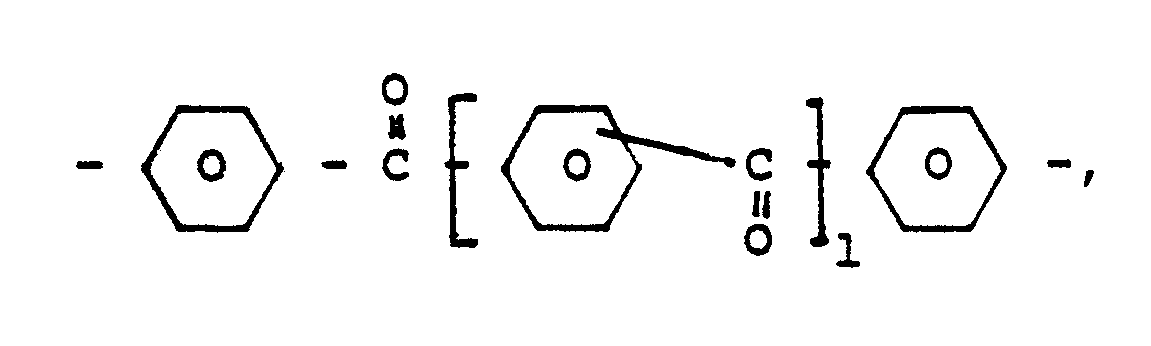
4,4′- bzw. 4,4˝-Benzophenon-Einheiten der Formel :
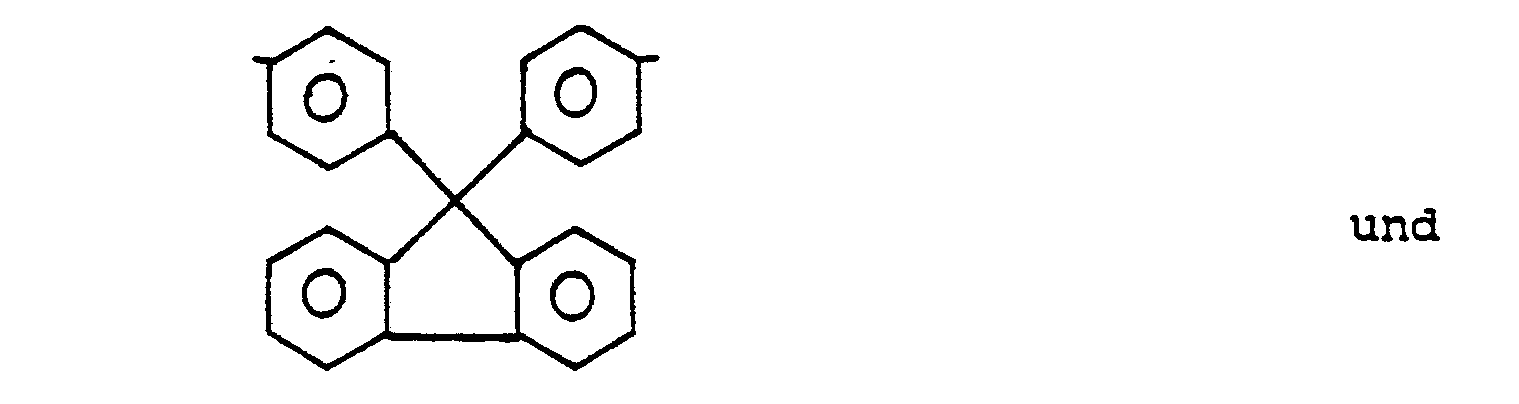
9,9-Bis(4′-phenyl) fluoren-Einheiten der Formel:

- Die erfindungsgemäßen Polyarylenether lassen sich so durch die wiederkehrenden Struktureinheiten der allgemeinen Formel (1)


- Thermoplastisch verarbeitbar zu transparenten, zähen Kunststoffen sind die erfindungsgemäßen Polyarylenether der allgemeinen Formel I mit Molekulargewichten > 20 000 (bestimmt als Mw nach der Gpc-Methode), insbesondere solche mit Molekulargewichten (Mw) größer 30 000. Vorteilhaft werden die neuen Polymeren durch Polykondensation der Dihalogenderivate von A, beispielsweise von 4,4′-Difluorbenzophenon, mit einem Gemisch der Bisphenole 9,9-Bis(4′-hydroxyphenyl)fluoren und 2,2-Bis(4-hydroxyphenyl)propan (Bisphenol A), in einem Molverhältnis der beiden Bisphenole von 0,4 : 0,6 bis 0,6 : 0,4, hergestellt.
Die Erfindung betrifft daher hochtemperaturbeständige, thermoplastisch verarbeitbare Polyarylenether mit wiederkehrenden Struktureinheiten der allgemeinen Formel (1):
- A : 4,4′ bzw. 4,4˝-Benzophenon-Einheiten der Formel
- B: 9,9-Bis(4′-phenyl)fluoren-Einheiten der Formel

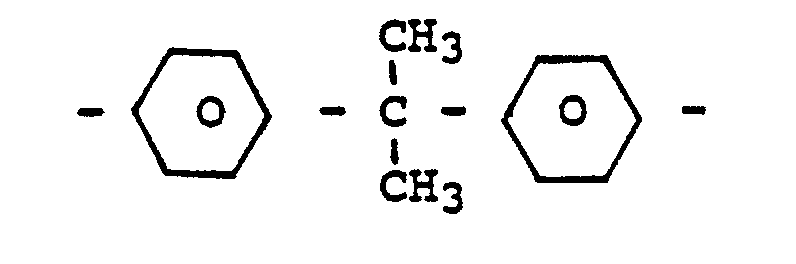
- C: 2,2-Bis(4-phenyl)propan-Einheiten der Formel

Die thermoplastisch verarbeitbaren neuen Polymere haben Molekulargewichte (Mw) > 20 000 und werden durch Co-Polykondensation hergestellt. - Mit den neuen Polymeren stehen jetzt Kunststoffe zur Verfügung, deren technisch hochwertige Eigenschaften von den bisher bekannten hochtemperaturbeständigen Kunststoffen immer nur teilweise erreicht werden. Die erfindungsgemäßen Copolymeren haben Glastemperaturen im Bereich von 160 bis 220 Grad C (gemessen mit der DSC), sind mit Reißdehnungen von meist über 20 % und mit Elastizitätsmodulen um 3 000 MPa zäh-elastische Materialien, die weiter bei der UL94-Brandklassifizierung mindestens die Klasse Vl und zumeist die Klasse VO erreichen, sehr niedere Rauchgasdichten haben und im Brandfall keine toxischen Schwefel- bzw. Stickstoffhaltigen Gase entwickeln. Aus den Polymeren (z.B. durch thermoplastische Verarbeitung) erhaltene Werkstücke sind transparent und zeigen Wasseraufnahmen bis maximal 0,7 % (Sättigungswert bei 23 Grad C Wasserlagerung). Diese geringen Wasseraufnahmen tragen maßgebend zur hohen Dimensionsstabilität entsprechender Werkstücke aus den neuen Polymeren bei. Infolge Fehlens von besonders hydrolyse-empfindlichen Gruppen zeichnen sich die neuen Materialien auch durch entsprechende Hydrolysebeständigkeit aus.
- Demgegenüber weisen bekannte Spezialkunststoffe neben ausgezeichneten Eigenschaften weniger geeignete aus, wie: (Teil)kristallinität und keine Transparenz (PPO; Noryl ®: PPO-Blends, PEEK ®), zu niedrige Wärmeformbeständigkeiten (Tg Grad C) (Noryl ®: 155 Grad C, Makrolon ®:150 Grad C), oder schlechteres Brandverhalten (Polysulfon und Polyethersulfon: toxische, schwefelhaltige Gase; Polyimide wie z.B. Ultem: toxische stickstoffhaltige Gase). Auch gegenüber den bekannten Polykondensaten der Zusammensetzung - A - O - B - O -, die wie schon beschrieben spröde Kunststoffmaterialien geben, und solchen der Zusammensetzung - A - O - C - O - , die Polymere mit relativ niedriger Glastemperatur (Tg ∼ 150 Grad C) darstellen, zeichnen sich die neuen Co-Polykondensate der Formel (1), mit den etherüberbrückten A-, B- und C-Bausteinen im angegebenen m : n-Verhältnis, als Werkstoffe mit gehobenen Eigenschaften aus.
- Für die Herstellung der neuen aromatischen Polyether (1) mit den aromatischen Grundbausteinen A, B und C durch Polykondensation werden im wesentlichen bifunktionelle Monomere A′, B′ und C′ eingesetzt, die sich von den Grundbausteinen A, B und C durch jeweils zusätzliche funktionelle Gruppen unterscheiden. Als reaktive Verbindungen werden insbesondere solche mit Halogen, vorzugsweise mit Fluor und Chlor, und solche mit phenolischen Hydroxylgruppen, die vorzugsweise als Phenolat zur Reaktion gebracht werden, eingesetzt. Neben Dihalogenverbindungen und Bisphenolen, wie sie u.a. weiter oben als Verbindungen des Typs I und Verbindungen des Typs II beschrieben sind, kommen als bifunktionelle Ausgangsverbindungen auch solche infrage, die im gleichen Molekül sowohl eine Halogengruppe als auch eine phenolische Gruppe enthalten. Die Verbindungen A′, B′ und C′ werden in einem solchen Verhältnis zueinander eingesetzt, daß einmal das erfindungsgemäße Verhältnis m : n in (1) eingestellt wird und daß zum anderen die miteinander reagierenden Halogen- und HO-Gruppen äquivalent sind. Dadurch wird erreicht, daß die erfindungsgemäßen Polykondensate Molekulargewichte (Mw) von über 20 000 und Kunststoffeigenschaften haben.
- Bei der Herstellung der neuen Polyarylenether sind die anzuwendenden Polykondensationsbedingungen denen in US 4 175 175 beschriebenen und denen für die Herstellung von phosphorhaltigen Polyarylenethern in US 4 492 805 beschriebenen analog. Dies betrifft die Verwendung geeigneter Wasserschleppmittel, wie z.B. Chlorbenzol oder Xylole, und polar-aprotischer Lösungsmittel, wie u.a. Dimethylsulfoxid, Sulfolan, N,N-Dimethylformamid, N,N- Dimethylacetamid, N-Methylpyrrolidon, und die Durchführung der Polykondensation bei Temperaturen von 100 bis 300 Grad C in Gegenwart stark basischer Alkaliverbindungen, wie Alkalihydroxiden, wie Natrium-oder Kaliumhydroxid, oder wie insbesondere in Gegenwart von Natrium- oder Kaliumcarbonat.
- Die Umsetzung wird praktisch bei Normaldruck bzw. bei dem, unter den Temperaturbedingungen in der Umsetzungsapparatur sich einstellenden Druck durchgeführt. Zur Bildung der erfindungsgemäßen Polymeren unter den genannten Bedingungen werden Reaktionszeiten von 30 Minuten bis etwa 50 Stunden benötigt. Die Isolierung des Polykondensats kann durch Abdestillieren des Lösungsmittels und Waschen des Rückstands mit Wasser erfolgen oder man setzt dem Reaktionsansatz Fällungsmittel wie beispielsweise Wasser oder Ethanol zu, filtriert das ausgefällte Polymerisat ab und trocknet es.
- Für die Einführung der A-Einheiten in das Polykondensat (1) werden als reaktive Ausgangsverbindungen A′ 4,4′-Difluorbenzophenon, 4,4′-Dichlorbenzophenon 4-Chlor- bzw. 4-Fluor-4′-hydroxybenzophenon und

- Die funktionellen Halogen- bzw. Hydroxygruppen stehen bevorzugt in den "4er-Stellungen." In den Ausgangsverbindungen A′ können aber auch in untergeordneten Mengen andere Stellungsisomere vorhanden sein.
Als Ausgangsverbindungen B′und C′ für die Einführung der B- und C-Einheiten werden die phenolischen Verbindungen
9,9-Bis(4′-hydroxyphenyl)fluoren und
2,2-Bis(4-hydroxyphenyl)propan, bekannt als Bisphenol A,
verwendet. - B′ und C′ werden im Molverhältnis

- Die neuen Polyarylenether können aber auch, wie dies in der Patentanmeldung P 35 21 123.7 für phosphorhaltige Polyarylenether beschrieben ist, gegebenenfalls verzweigte Strukturen besitzen. Für die Einführung von Verzweigungsstellen in den neuen Polyethern kommen als zusätzliche Ausgangsverbindungen beispielsweise 1,3,5-Tris(4′-hydroxyphenyl)benzol, 1,1,1-Tris(4-hydroxyphenyl)ethan in Betracht.
- Synthese eines Polyethers aus 4,4′-Difluorbenzophenon (1), Bisphenol A (2) und 9,9-Bis(4′-hydroxyphenyl)fluoren (3) mit Molverhältnissen von (1) : (2) : (3) = 10 : 4 : 6
- In einem 6 l-Vierhalskolben mit Rührer, Innenthermometer, Stickstoffzuleitung und Wasserabscheider mit aufgesetztem Rückflußkühler wurden 137,0 g (0,6 mol) Bisphenol A, 315,4 g (0,9 mol) 9,9-Bis(4′-hydroxyphenyl)fluoren, 327,3 g (1,5 mol) 4,4′-Difluorbenzophenon, 218,4 g Kaliumcarbonat, 2,25 1 N-Methylpyrrolidon und 1,35 1 techn. Xylolgemisch vorgelegt. Die Reaktionsmischung wurde unter Stickstoffatmosphäre nun mit einem Ölbad auf Rückflußtemperatur erhitzt und das sich bildende Wasser innerhalb von 2 Stunden ausgekreist. Nach vollständiger Entfernung des Wassers wurde das Xylol über den Wasserabscheider bei ca. 180 Grad C abdestilliert und das zurückbleibende Reaktionsgemisch bei dieser Temperatur so lange gehalten, bis das Molekulargewicht Mw des Polykondensats ca. 77.000 betrug (Messung: GPC, Eichung mit Polystyrol). Anschließend wurden 0,2 Mol Methylchlorid durchgeleitet.
- Nach Abkühlung wurde der Ansatz mit 500 ml N-Methylpyrrolidon verdünnt und von den festen Bestandteilen des Reaktionsgemisches abgesaugt. Der Polyether wurde anschließend in der 7-fachen Menge Wasser/Ethanol (Volumenverhältnis = 7 : 3) ausgefällt, von der Flüssigkeit durch Filtration getrennt und nach 18-stündigem Trocknen bei Raumtemperatur in möglichst wenig Methylenchlorid gelöst. Die Lösung wurde zur 5-fachen Menge Ethanol zugetropft, wobei das Polykondensat ausfiel. Das Produkt wurde im Vakuum bei 140 Grad C bis zur Gewichtskonstanz getrocknet. Ausbeute: 597,3 g (83 % d.Th.)
Die Analyse erfolgte durch H-1- bzw. C-13-NMR-Spektroskopie.
An durch thermoplastische Verarbeitung (Extrusion) erhaltenen Werkstücken wurden folgende Eigenschaften ermittelt.Mw1) Reißdehnung2) (%) E-Modul2) (MPa) Zugfestigkeit (MPa) UL94-Klassifiz.3) Rauchdichte4) 1,5/4 min) Glastemp.5) (Grad C) Wasseraufnahme6) (23 Grad C) (%) 87700 52 3100 83 V-O 1/2 190 0,64 1) GPC, Eichung mit Polystyrol 2) DIN 53 455 3) Test der Underwriter Laboratories, USA; V-O ist beste Klassifizierung 4) Rauchkammer entsprechend den Vorschriften des National Bureau of Standards, USA 5) Differential Scanning Calorimetry (vgl. E.A. TURI, Ed. "Thermal Characterization of Polymeric Materials pg. 169, Academic Press, New York 1981) 6) DIN 53 495 - Die Umsetzung wurde wie im Beispiel 1 beschrieben durchgeführt, mit der Ausnahme, daß das Molverhältnis Bisphenol A: 9,9-Bis(4′-hydroxyphenyl)fluoren = 5 : 5 bzw.3 : 7 betrug. Man erhält dann Kunststoffe mit folgenden Eigenschaften:
Beisp. Nr. Molverh. Reißdehnung (%) E-Modul (MPa) Zugfestigkeit (MPa) UL94-Klassif. Rauchdichte (1,5/4 min) Glastemp. (Grad C) Wasseraufnahme (23 Grad C) (%) 2 5 : 5 44 2963 86 V-1 - 185 0,56 3 3 : 7 42 3079 86 V-0 4/11 - - - Die Umsetzung wurde wie im Beispiel l beschrieben durchgeführt, wobei jedoch das 4,4′-Difluorbenzophenon durch 4,4˝-Difluor-iso-(I) und/oder -terephthalophenon(Ii) ersetzt war und Bisphenol A und 9,9-Bis(4′-hydroxyphenyl)fluoren im Molverhältnis 1 : 1 eingsetzt wurden.
- Man erhält Produkte mit folgenden Glastemperaturen
Beisp. Nr. aktiviertes Dihalogenid Glastemperatur des Polykondensats (Grad C) 4 I 202 5 II 185 6 je 50 % I und II 193
Claims (8)

A: 4,4′-bzw. 4,4˝-Benzophenon-Einheiten der Formel


Applications Claiming Priority (2)
| Application Number | Priority Date | Filing Date | Title |
|---|---|---|---|
| DE3725058 | 1987-07-29 | ||
| DE19873725058 DE3725058A1 (de) | 1987-07-29 | 1987-07-29 | Thermoplastisch verarbeitbare polyarylenether mit 9,9-bis-(4'-hydroxyphenyl)fluoren |
Publications (2)
| Publication Number | Publication Date |
|---|---|
| EP0301409A2 true EP0301409A2 (de) | 1989-02-01 |
| EP0301409A3 EP0301409A3 (de) | 1990-08-16 |
Family
ID=6332580
Family Applications (1)
| Application Number | Title | Priority Date | Filing Date |
|---|---|---|---|
| EP88111757A Ceased EP0301409A3 (de) | 1987-07-29 | 1988-07-21 | Thermoplastisch verarbeitbare Polyarylenether mit 9,9-Bis-(4'-hydroxyphenyl)fluoren |
Country Status (5)
| Country | Link |
|---|---|
| US (1) | US4889909A (de) |
| EP (1) | EP0301409A3 (de) |
| JP (1) | JPS6462324A (de) |
| CA (1) | CA1306576C (de) |
| DE (1) | DE3725058A1 (de) |
Cited By (2)
| Publication number | Priority date | Publication date | Assignee | Title |
|---|---|---|---|---|
| EP0364741A1 (de) * | 1988-10-01 | 1990-04-25 | Bayer Ag | Aromatische Polyetherketone |
| EP0755957A1 (de) * | 1995-07-13 | 1997-01-29 | Air Products And Chemicals, Inc. | Halogenfreie Poly(arylenether) |
Families Citing this family (20)
| Publication number | Priority date | Publication date | Assignee | Title |
|---|---|---|---|---|
| DE3804988A1 (de) * | 1988-02-18 | 1989-08-31 | Roehm Gmbh | Hochtemperaturbestaendige aromatische polyether |
| WO1990014379A1 (fr) * | 1989-05-23 | 1990-11-29 | Teijin Limited | Poly(arylene-ether-cetone), procede de production et utilisation d'un tel compose |
| US5110993A (en) * | 1991-02-08 | 1992-05-05 | Hay Allan S | 9,9-bis(3,5-diphenyl-4-hydroxyphenyl)fluorene and poly(arylene ethers) |
| US6742774B2 (en) | 1999-07-02 | 2004-06-01 | Holl Technologies Company | Process for high shear gas-liquid reactions |
| US7538237B2 (en) * | 1999-07-02 | 2009-05-26 | Kreido Laboratories | Process for high shear gas-liquid reactions |
| US6391082B1 (en) | 1999-07-02 | 2002-05-21 | Holl Technologies Company | Composites of powdered fillers and polymer matrix |
| US6652805B2 (en) | 1999-07-02 | 2003-11-25 | Holl Technologies Company | Highly filled composites of powdered fillers and polymer matrix |
| US6471392B1 (en) | 2001-03-07 | 2002-10-29 | Holl Technologies Company | Methods and apparatus for materials processing |
| US6830806B2 (en) * | 2001-04-12 | 2004-12-14 | Kreido Laboratories | Methods of manufacture of electric circuit substrates and components having multiple electric characteristics and substrates and components so manufactured |
| WO2003022415A2 (en) * | 2001-09-13 | 2003-03-20 | Holl Technologies Company | Methods and apparatus for transfer of heat energy between a body surface and heat transfer fluid |
| US6787246B2 (en) | 2001-10-05 | 2004-09-07 | Kreido Laboratories | Manufacture of flat surfaced composites comprising powdered fillers in a polymer matrix |
| TW200306323A (en) * | 2002-05-09 | 2003-11-16 | Sumitomo Chemical Co | Aromatic polysulfone resin and use thereof |
| US7098360B2 (en) * | 2002-07-16 | 2006-08-29 | Kreido Laboratories | Processes employing multiple successive chemical reaction process steps and apparatus therefore |
| US7165881B2 (en) * | 2002-09-11 | 2007-01-23 | Holl Technologies Corporation | Methods and apparatus for high-shear mixing and reacting of materials |
| WO2004030802A2 (en) * | 2002-10-03 | 2004-04-15 | Kreido Laboratories | Apparatus for transfer of heat energy between a body surface and heat transfer fluid |
| WO2011071340A2 (ko) * | 2009-12-11 | 2011-06-16 | 한양대학교 산학협력단 | 투명성과 고내열성을 갖는 폴리아릴렌에테르계 중합체 및 그 제조 방법 |
| CN108140846B (zh) | 2015-09-24 | 2021-07-16 | 可隆工业株式会社 | 燃料电池用膜电极组件及其制造方法以及包括该组件的燃料电池系统 |
| CN108028407B (zh) | 2015-09-30 | 2021-06-11 | 可隆工业株式会社 | 离子导电体及其制造方法、以及包含该导电体的离子交换膜、膜电极组件及燃料电池 |
| RU2680524C1 (ru) * | 2018-09-18 | 2019-02-22 | Российская Федерация, от имени которой выступает ФОНД ПЕРСПЕКТИВНЫХ ИССЛЕДОВАНИЙ | Способ получения термостойких сополиэфиркетонов с улучшенными физико-механическими характеристиками |
| CN109851776B (zh) * | 2019-01-03 | 2020-07-14 | 吉林大学 | 一种聚芳醚酮/碳纳米管复合材料及其制备方法和聚芳醚酮/碳纳米管复合材料薄膜 |
Family Cites Families (9)
| Publication number | Priority date | Publication date | Assignee | Title |
|---|---|---|---|---|
| US871207A (en) * | 1906-10-15 | 1907-11-19 | James W Connaty | Table-top. |
| US4175175A (en) * | 1963-07-16 | 1979-11-20 | Union Carbide Corporation | Polyarylene polyethers |
| DE1545106C3 (de) * | 1963-07-16 | 1979-05-31 | Union Carbide Corp., New York, N.Y. (V.St.A.) | Verfahren zur Herstellung von linearen Polyarylenpolyäthern |
| DE2738962A1 (de) * | 1976-11-08 | 1978-05-11 | Gen Electric | Filmbildende, ausformbare aromatische polyformalharze und verfahren zu ihrer herstellung |
| DE3203186A1 (de) * | 1982-01-30 | 1983-08-11 | Röhm GmbH, 6100 Darmstadt | Phosphorhaltige polyarylenaether |
| US4598137A (en) * | 1984-11-30 | 1986-07-01 | Canadian Patents And Development Limited | Polyarylene polyethersulfone ionomers |
| DE3521124A1 (de) * | 1985-06-13 | 1986-12-18 | Röhm GmbH, 6100 Darmstadt | Verfahren zur herstellung phosphorhaltiger polyarylenaether |
| DE3521123A1 (de) * | 1985-06-13 | 1986-12-18 | Röhm GmbH, 6100 Darmstadt | Phosphorhaltige polyarylenaether und verfahren zu ihrer herstellung |
| US4806618A (en) * | 1986-11-11 | 1989-02-21 | Central Glass Company, Limited | Aromatic polyethers having biphenylfluorene group |
-
1987
- 1987-07-29 DE DE19873725058 patent/DE3725058A1/de not_active Withdrawn
-
1988
- 1988-07-19 US US07/221,321 patent/US4889909A/en not_active Expired - Fee Related
- 1988-07-21 EP EP88111757A patent/EP0301409A3/de not_active Ceased
- 1988-07-27 CA CA000573222A patent/CA1306576C/en not_active Expired - Lifetime
- 1988-07-29 JP JP63188565A patent/JPS6462324A/ja active Pending
Cited By (3)
| Publication number | Priority date | Publication date | Assignee | Title |
|---|---|---|---|---|
| EP0364741A1 (de) * | 1988-10-01 | 1990-04-25 | Bayer Ag | Aromatische Polyetherketone |
| US4964890A (en) * | 1988-10-01 | 1990-10-23 | Bayer Aktiengesellschaft | Aromatic polyether ketones |
| EP0755957A1 (de) * | 1995-07-13 | 1997-01-29 | Air Products And Chemicals, Inc. | Halogenfreie Poly(arylenether) |
Also Published As
| Publication number | Publication date |
|---|---|
| JPS6462324A (en) | 1989-03-08 |
| EP0301409A3 (de) | 1990-08-16 |
| DE3725058A1 (de) | 1989-02-09 |
| US4889909A (en) | 1989-12-26 |
| CA1306576C (en) | 1992-08-18 |
Similar Documents
| Publication | Publication Date | Title |
|---|---|---|
| DE3725058A1 (de) | Thermoplastisch verarbeitbare polyarylenether mit 9,9-bis-(4'-hydroxyphenyl)fluoren | |
| DE3382700T2 (de) | Verwendung eines amorphen aromatischen thermoplastischen Polymeren. | |
| EP0688824B1 (de) | Homogene Polmerlegierungen auf der Basis von sulfonierten, aromatischen Polyetherketonen | |
| EP2358787B1 (de) | Verfahren zur herstellung eines reaktiven polyarylenethers | |
| EP3044249B2 (de) | Polyarylenethersulfon-polymere für membrananwendungen | |
| EP0388358B1 (de) | Neue Polyarylenether | |
| EP0147708B1 (de) | Verzweigte, hochmolekulare, thermoplastische, Nitrilgruppen enthaltende Polyarylenether und deren Herstellung | |
| EP0332012B1 (de) | Hochtemperaturbeständige Polyarylethersulfon-/Polyaryletherketon-Formmassen mit verbesserter Phasenbindung | |
| EP2390281A1 (de) | Verstärkte thermoplastische Formmassen auf Basis von Polyarylenethern | |
| EP3247737B1 (de) | Entsalzung von polyarylethern mittels schmelzeextraktion | |
| DE3889380T2 (de) | Polyimidharz-Zusammensetzung. | |
| EP0327984A2 (de) | Polyaryletherketone mit verbesserter Verarbeitbarkeit | |
| EP0561831A1 (de) | Legierungen aus teilkristallinen und amorphen polyaryletherketonen | |
| DE3614753A1 (de) | Hochtemperaturbestaendige copolykondensat-formmassen | |
| EP0243831A2 (de) | Hochtemperaturbeständige Formmassen | |
| DE4423349C2 (de) | Polyamidimidharze, die Isophorondiamin enthalten und Verfahren zu ihrer Herstellung | |
| DE3888869T2 (de) | Polyimidharz-Zusammensetzung. | |
| EP0329029B1 (de) | Hochtemperaturbeständige aromatische Polyether | |
| EP0479192A2 (de) | Modifizierte Polyarylenether-Blockcopolymere | |
| EP0205124B1 (de) | Verfahren zur Herstellung phosphorhaltiger Polyarylenäther | |
| DE68905225T2 (de) | Polyimiaharzzusammensetzung. | |
| EP0096799B1 (de) | Phosphorhaltige Polyarylenester und Verfahren zu ihrer Herstellung | |
| EP0265842A2 (de) | Hochtemperaturbeständige Polyethersulfon/Polyetherketon-Blockcopolykondensate | |
| EP0206099B1 (de) | Phosphorhaltige Polyarylenäther und Verfahren zu ihrer Herstellung | |
| EP0604881B1 (de) | Homogene Polymerlegierungen auf der Basis von sulfonierten, aromatischen Polyetherketonen |
Legal Events
| Date | Code | Title | Description |
|---|---|---|---|
| PUAI | Public reference made under article 153(3) epc to a published international application that has entered the european phase |
Free format text: ORIGINAL CODE: 0009012 |
|
| AK | Designated contracting states |
Kind code of ref document: A2 Designated state(s): DE FR GB IT NL |
|
| PUAL | Search report despatched |
Free format text: ORIGINAL CODE: 0009013 |
|
| AK | Designated contracting states |
Kind code of ref document: A3 Designated state(s): DE FR GB IT NL |
|
| 17P | Request for examination filed |
Effective date: 19900829 |
|
| 17Q | First examination report despatched |
Effective date: 19920929 |
|
| STAA | Information on the status of an ep patent application or granted ep patent |
Free format text: STATUS: THE APPLICATION HAS BEEN REFUSED |
|
| 18R | Application refused |
Effective date: 19930516 |