EP0147708B1 - Verzweigte, hochmolekulare, thermoplastische, Nitrilgruppen enthaltende Polyarylenether und deren Herstellung - Google Patents
Verzweigte, hochmolekulare, thermoplastische, Nitrilgruppen enthaltende Polyarylenether und deren Herstellung Download PDFInfo
- Publication number
- EP0147708B1 EP0147708B1 EP84115039A EP84115039A EP0147708B1 EP 0147708 B1 EP0147708 B1 EP 0147708B1 EP 84115039 A EP84115039 A EP 84115039A EP 84115039 A EP84115039 A EP 84115039A EP 0147708 B1 EP0147708 B1 EP 0147708B1
- Authority
- EP
- European Patent Office
- Prior art keywords
- compounds
- bis
- mol
- dihalobenzene
- amount
- Prior art date
- Legal status (The legal status is an assumption and is not a legal conclusion. Google has not performed a legal analysis and makes no representation as to the accuracy of the status listed.)
- Expired
Links
- 0 CCC#C[C@@](C)(C(C1)C1C(C)CCCC(C)*(C)C)C1CC(**(C)C(C)*)CC1 Chemical compound CCC#C[C@@](C)(C(C1)C1C(C)CCCC(C)*(C)C)C1CC(**(C)C(C)*)CC1 0.000 description 2
Classifications
-
- C—CHEMISTRY; METALLURGY
- C08—ORGANIC MACROMOLECULAR COMPOUNDS; THEIR PREPARATION OR CHEMICAL WORKING-UP; COMPOSITIONS BASED THEREON
- C08G—MACROMOLECULAR COMPOUNDS OBTAINED OTHERWISE THAN BY REACTIONS ONLY INVOLVING UNSATURATED CARBON-TO-CARBON BONDS
- C08G65/00—Macromolecular compounds obtained by reactions forming an ether link in the main chain of the macromolecule
- C08G65/34—Macromolecular compounds obtained by reactions forming an ether link in the main chain of the macromolecule from hydroxy compounds or their metallic derivatives
- C08G65/38—Macromolecular compounds obtained by reactions forming an ether link in the main chain of the macromolecule from hydroxy compounds or their metallic derivatives derived from phenols
- C08G65/40—Macromolecular compounds obtained by reactions forming an ether link in the main chain of the macromolecule from hydroxy compounds or their metallic derivatives derived from phenols from phenols (I) and other compounds (II), e.g. OH-Ar-OH + X-Ar-X, where X is halogen atom, i.e. leaving group
- C08G65/4012—Other compound (II) containing a ketone group, e.g. X-Ar-C(=O)-Ar-X for polyetherketones
- C08G65/4031—(I) or (II) containing nitrogen
- C08G65/4037—(I) or (II) containing nitrogen in ring structure, e.g. pyridine group
-
- C—CHEMISTRY; METALLURGY
- C08—ORGANIC MACROMOLECULAR COMPOUNDS; THEIR PREPARATION OR CHEMICAL WORKING-UP; COMPOSITIONS BASED THEREON
- C08G—MACROMOLECULAR COMPOUNDS OBTAINED OTHERWISE THAN BY REACTIONS ONLY INVOLVING UNSATURATED CARBON-TO-CARBON BONDS
- C08G65/00—Macromolecular compounds obtained by reactions forming an ether link in the main chain of the macromolecule
- C08G65/34—Macromolecular compounds obtained by reactions forming an ether link in the main chain of the macromolecule from hydroxy compounds or their metallic derivatives
- C08G65/38—Macromolecular compounds obtained by reactions forming an ether link in the main chain of the macromolecule from hydroxy compounds or their metallic derivatives derived from phenols
- C08G65/40—Macromolecular compounds obtained by reactions forming an ether link in the main chain of the macromolecule from hydroxy compounds or their metallic derivatives derived from phenols from phenols (I) and other compounds (II), e.g. OH-Ar-OH + X-Ar-X, where X is halogen atom, i.e. leaving group
- C08G65/4006—(I) or (II) containing elements other than carbon, oxygen, hydrogen or halogen as leaving group (X)
-
- C—CHEMISTRY; METALLURGY
- C08—ORGANIC MACROMOLECULAR COMPOUNDS; THEIR PREPARATION OR CHEMICAL WORKING-UP; COMPOSITIONS BASED THEREON
- C08G—MACROMOLECULAR COMPOUNDS OBTAINED OTHERWISE THAN BY REACTIONS ONLY INVOLVING UNSATURATED CARBON-TO-CARBON BONDS
- C08G65/00—Macromolecular compounds obtained by reactions forming an ether link in the main chain of the macromolecule
- C08G65/34—Macromolecular compounds obtained by reactions forming an ether link in the main chain of the macromolecule from hydroxy compounds or their metallic derivatives
- C08G65/38—Macromolecular compounds obtained by reactions forming an ether link in the main chain of the macromolecule from hydroxy compounds or their metallic derivatives derived from phenols
- C08G65/40—Macromolecular compounds obtained by reactions forming an ether link in the main chain of the macromolecule from hydroxy compounds or their metallic derivatives derived from phenols from phenols (I) and other compounds (II), e.g. OH-Ar-OH + X-Ar-X, where X is halogen atom, i.e. leaving group
- C08G65/4012—Other compound (II) containing a ketone group, e.g. X-Ar-C(=O)-Ar-X for polyetherketones
- C08G65/4031—(I) or (II) containing nitrogen
-
- C—CHEMISTRY; METALLURGY
- C08—ORGANIC MACROMOLECULAR COMPOUNDS; THEIR PREPARATION OR CHEMICAL WORKING-UP; COMPOSITIONS BASED THEREON
- C08G—MACROMOLECULAR COMPOUNDS OBTAINED OTHERWISE THAN BY REACTIONS ONLY INVOLVING UNSATURATED CARBON-TO-CARBON BONDS
- C08G75/00—Macromolecular compounds obtained by reactions forming a linkage containing sulfur with or without nitrogen, oxygen, or carbon in the main chain of the macromolecule
- C08G75/20—Polysulfones
- C08G75/23—Polyethersulfones
Definitions
- DE-AS-1 545 106 describes linear polyarylene polyethers which have been prepared by reacting double alkali metal salts of bisphenols with an equimolecular amount of a dihalobenzene compound in the presence of sulfoxides or sulfones as solvents.
- DE-OS-1 957 091 and 2 731 816 and Canadian Patent 847 963 polysulfone ethers are obtained from phenolates and aromatic dihalogen compounds in the presence of polar high-boiling solvents and anhydrous alkali carbonate.
- These polymers have the disadvantage that their resistance to acids and alkalis and organic solvents at high temperatures leaves something to be desired. In addition, their surface hardness is in need of improvement.
- branched polyethers are obtained by using small amounts of a triphenol or a haloaryl compound. in which the halogen substituents are, for example, on at least two different aromatic rings.
- Such polyethers have improved solvent resistance, but still leave something to be desired in terms of surface hardness.
- Crosslinked polyethers are known from US Pat. No. 801,837 Defense which contain, as crosslinking agents, radicals which are derived from polyhalogen heterocycles. The surface hardness of these polymers is still in need of improvement.
- the invention was based on the technical problem of producing polyethers with improved solvent resistance and surface hardness using readily available starting materials, without having to change the proven processes for producing polyethers, with the aim of already having such monomers for the synthesis of various copolymers or block copolymers to use known methods for the production of polyethers.
- the invention further relates to a process for the preparation of branched, high molecular weight, thermoplastic nitrile group-containing polyarylene ethers by polycondensation of essentially equivalent amounts of a bisphenol or a mixture of several bisphenols with a dihalobenzene compound or a mixture of several dihalobenzene compounds and branching agents in the presence of anhydrous alkali carbonate characterized in that at least one polyhalobenzene compound of the formulas is used as the branching agent in which X represents a fluorine or chlorine atom, in an amount of 0.01 to 5 mol%, based on the amount of dihalobenzene compounds.
- the branched polyarylene ethers containing nitrile groups according to the invention are notable for improved solvent resistance, stress corrosion cracking resistance and, at the same time, high surface hardness. They are available using easily accessible monomers without having to change the tried and tested processes for producing polyethers. It also manages to co- and To produce block copolymers in a simple manner by varying the monomeric starting materials.
- Suitable bisphenols are, for example, hydroquinone, resorcinol, 4,4'-bisphenol, bis- (4-hydroxyphenyl) propane-2,2, bis- (4-hydroxyphenyl) ketone or bis- (4-hydroxyphenyl) sulfone.
- the bisphenols can be used individually or in the form of mixtures.
- Bis- (4-hydroxyphenyl) sulfone and bis- (4-hydroxyphenyl) propane-2,2 have become particularly important.
- Suitable polyhalobenzene compounds are, for example, bis (4-chlorophenyl) sulfone, bis (4-fluorophenyl) sulfone, bis (4-chlorophenyl) ketone, 1,4-bis (4-chlorobenzoyl) benzene, 1, 4-bis (4-chlorobenzenesulfonyl) benzene, 4,4'-bis (4-chlorobenzoyl) diphenyl ether, 4,4'-bis (4-chlorobenzoyl) diphenyl sulfide, 4,4'-bis (4- chlorobenzoyl-) diphenyl, 4,4'-bis (4-chlorobenzenesulfonyl) diphenyl ether, 4,4'-bis (4-chlorobenzenesulfonyl) diphenyl sulfide or 4,4'-bis (4-chlorobenzenesulfonyl) diphenyl.
- the branching agents according to the invention are polyhalogen compounds of the formulas II to VI in which X denotes a fluorine or preferably a chlorine atom.
- X denotes a fluorine or preferably a chlorine atom.
- the chlorine atoms are advantageously ortho and / or para to the nitrogen-containing radicals.
- Suitable polyhalogen compounds of the formulas II-VI are, for example, pentachlorobenzene nitrile, pentafluorobenzonitrile, tetrachlorophthalodinitrile, tetrachloroisophthalodinitrile, tetrachloropyridinecarboxylic acid nitrile, trichloropyridinedicarboxylic acid dinitrile.
- Particularly preferred polyhalogen compounds are those of the formulas II and 111, in particular tetrachlorophthalodinitrile, pentachlorobenzonitrile, tetrachloroisophthalodinitrile.
- the reaction is carried out with the use of anhydrous alkali carbonates.
- Sodium or potassium carbonates or a mixture thereof are particularly suitable.
- Potassium carbonate has proven particularly useful.
- the examples with the dihalobenzene compounds can first be allowed to react completely, and only then can tri-functional or polyfunctional polyhalogen compounds be added. On the other hand, it is also possible to carry out the addition of the halogen compounds in the reverse order.
- the aforementioned polyhalogen compounds of the formulas 11 to VI are advantageously used in amounts of 0.01 to 5 mol%, preferably 0.1 to 2 mol%, based on the amount of dihalobenzene compounds.
- the polyhalogen compounds of the formulas II to VI according to the invention can be added at any point in the reaction.
- the reaction mixture is polycondensed in the temperature range mentioned until the required degree of condensation is reached.
- the polycondensation time is generally from 0.1 to 10 hours, preferably from 0.2 to 2 hours and depends on the starting compounds selected. All chemically inert groups are suitable as end groups for the polycondensates. To incorporate the end groups, a corresponding monofunctional compound is expediently added to the polycondensation mixture in a small amount after the desired degree of polycondensation has been reached. Aliphatic or aromatic monohalogen compounds, in particular methyl chloride, are preferably used.
- the inorganic by-products for example sodium or potassium chloride, are generally removed by suitable methods, such as dissolving and filtering, sieving or extracting.
- 1 mol of bisphenol is added with about 1 mol of dihalobenzene compounds and the stated amounts of polyhalogen compounds and 1.0 to 2.2 mol of anhydrous alkali carbonate in polar, aprotic solvents at a temperature of 150 to 300 ° C., preferably 180 to 250 ° C, and the resulting water is removed for example with the help of azeotrope, but can also be distilled off without the use of azeotrope.
- Suitable polar, aprotic solvents are N-substituted acid amides, sulfoxides or sulfones such as N, N-dimethylformamide, N, N-dimethylacetamide, N-methylpyrrolidone, dimethyl sulfoxide, dimethyl sulfone, Tetramethyl sulfone or diphenyl sulfone. N-methylpyrrolidone is preferably used.
- the polar, aprotic solvents are generally used in amounts of 5 to 100, preferably 10 to 20, moles per mole of bisphenol. This means that 5 to 50% by weight, preferably 20 to 40% by weight, polymer solutions are obtained.
- Suitable water azeotroping agents are all substances that boil in the range of the reaction temperature at normal pressure and can be mixed homogeneously with the reaction mixture without undergoing chemical reactions.
- azeotroping agents of the type mentioned are: chlorobenzene, toluene or xylene. Chlorobenzene is preferably used.
- the reaction mixture is advantageously heated in a first reaction stage until at least 90% by weight, preferably 90 to 96% by weight, of the amount of water theoretically possible, advantageously 0.5 to 4 hours, preferably 1 to 2 hours.
- condensation is carried out until completely water-free.
- azeotroping agents can be added continuously to the reaction mixture and the azeotropic mixture formed can be distilled off at the same time.
- the reaction time is usually 0.5 to 4 hours, preferably 1 to 2 hours.
- the polycondensation is terminated by introducing suitable monohalogen compounds, such as methyl chloride.
- the polyether can be isolated in various ways. According to a possible procedure, polyether with a precipitant, e.g. B. water and / or methanol precipitated. On the other hand, it is also possible to evaporate the solvent.
- a precipitant e.g. B. water and / or methanol precipitated.
- the inorganic constituents are removed from the polyether by suitable methods such as solution, filtration or sieving.
- the polyethers according to the invention have reduced viscosities (measured at 23 ° C. in a 1% strength by weight solution in sulfuric acid) from 0.4 to 1.5, preferably from 0.6 to 1.2. This corresponds to approximately molecular weights of 16,000 to 120,000, preferably 25,000 to 80,000.
- the available polyethers are suitable for the production of moldings, fibers, foils, adhesives and coating materials.
- the invention is illustrated by the following examples.
- the parts mentioned are parts by weight. They relate to the parts of the room like kg to I.
- the reduced viscosity ( ⁇ red) was measured at 24 ° C in 1% by weight solution in sulfuric acid and according to the formula. certainly.
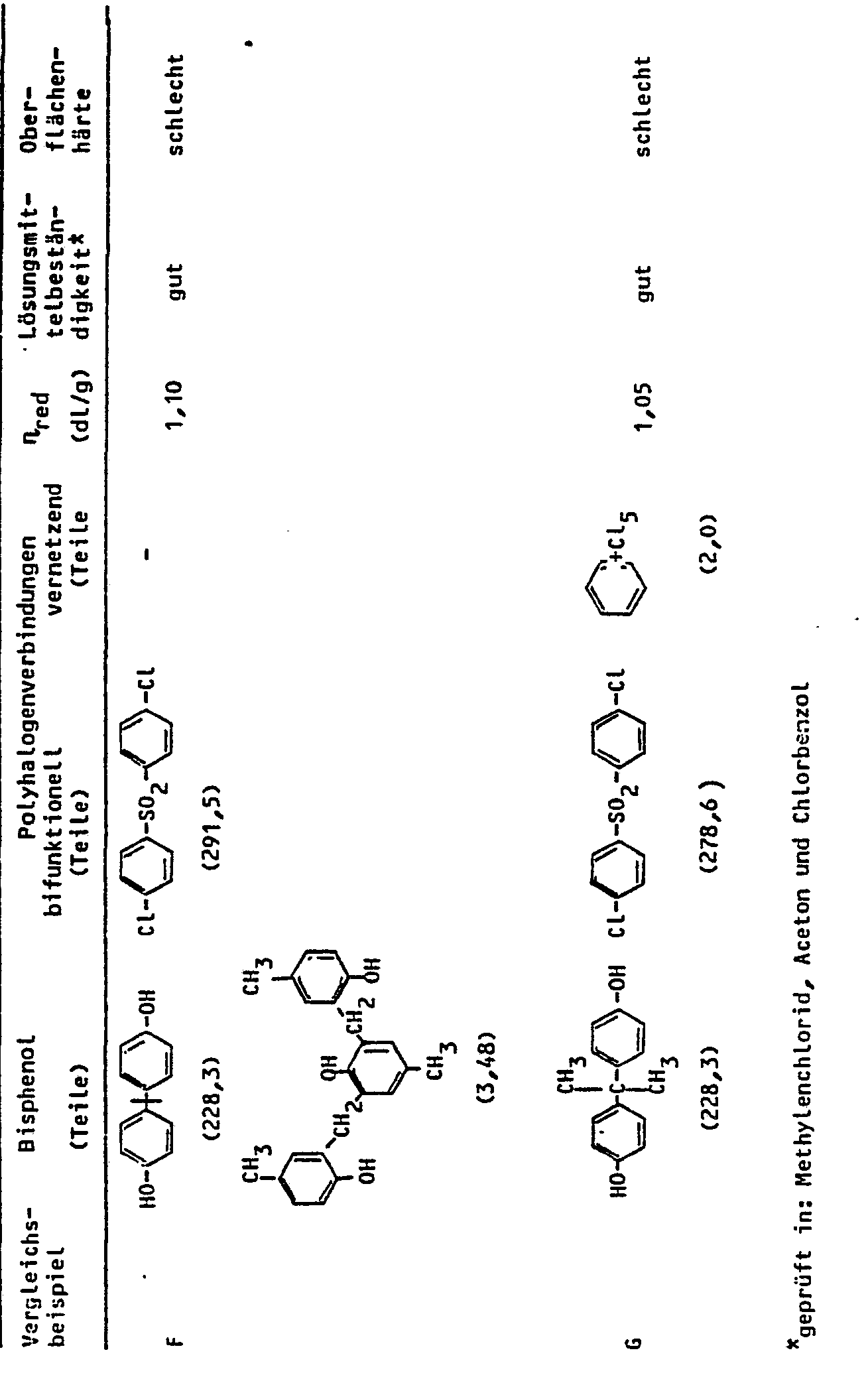
- Example 2 The procedure for A, C, D and G is analogous to Example 1, but the monomers listed in Table 2 are used. Comparative test B is carried out analogously to example 2. Test E is carried out according to Example 1 of DE-OS-2 940 190, F for Example 1 of DE-PS-2 305 413. The properties of the polymers are shown in Table 2.
Landscapes
- Chemical & Material Sciences (AREA)
- Health & Medical Sciences (AREA)
- Chemical Kinetics & Catalysis (AREA)
- Medicinal Chemistry (AREA)
- Polymers & Plastics (AREA)
- Organic Chemistry (AREA)
- Crystallography & Structural Chemistry (AREA)
- Polyethers (AREA)
- Organic Low-Molecular-Weight Compounds And Preparation Thereof (AREA)
- Polymers With Sulfur, Phosphorus Or Metals In The Main Chain (AREA)
Description
- Polymere, die Sulfon- und Ethergruppen enthalten, sind bereits bekannt. In der DE-AS-1 545 106 werden lineare Polyarylenpolyether beschrieben, die durch Umsetzung von Alkalimetalldoppelsalzen von Bisphenolen mit einer äquimolekularen Menge einer Dihalogenbenzolverbindung in Gegenwart von Sulfoxiden oder Sulfonen als Lösungsmitteln hergestellt wurden. Entsprechend der DE-OS-1 957 091 und 2 731 816 sowie der kanadischen Patentschrift 847 963 erhält man Polysulfonether aus Phenolaten und aromatischen Dihalogenverbindungen in Gegenwart von polaren hochsiedenden Lösungsmitteln und wasserfreiem Alkalicarbonat. Diese Polymeren haben den Nachteil, daß ihre Beständigkeit gegen Säuren und Alkalien sowie organischen Lösungsmitteln bei hohen Temperaturen zu wünschen übrigläßt. Zudem ist ihre Oberflächenhärte verbesserungsbedürftig.
- Aus der DE-OS-2 940 190 ist auch bekannt, amidgruppenhaltige Polyether herzustellen. Diese verzweigten Polymeren weisen zwar eine verbesserte Lösungsmittelbeständigkeit auf, jedoch lassen die Farbqualität und Härteeigenschaften zu wünschen übrig. Zudem bedarf es zu ihrer Herstellung Monomerer die technisch schwer zugänglich sind.
- Entsprechend der DE-PS-2 305 413 erhält man verzweigte Polyether durch Mitverwendung von geringen Mengen eines Triphenols oder einer Halogenarylverbindung. in der die Halogensubstitituenten sich beispielsweise an mindestens zwei verschiedenen aromatischen Ringen befinden. Solche Polyether haben zwar eine verbesserte Lösungsmittelbeständigkeit, lassen jedoch hinsichtlich der Oberflächenhärte noch zu wünschen übrig.
- Aus der US-PS-801 837 Defense sind vernetzte Polyether bekannt, die als Vernetzungsmittel Reste enthalten, die sich von Polyhalogenheterocyclen herleiten. Die Oberflächenhärte dieser Polymeren ist noch verbesserungsbedürftig.
- Der Erfindung lag die technische Aufgabe zugrunde, Polyether mit verbesserter Lösungsmittelbeständigkeit und Oberflächenhärte unter Verwendung leicht zugänglicher Ausgangsstoffe herzustellen, ohne dabei die bewährten Verfahren zur Herstellung von Polyethern verändern zu müssen, mit dem Ziel, derartige Monomere auch zur Synthese verschiedener Co- oder Blockcopolymerisate nach bereits bekannten Verfahren zur Herstellung von Polyethern einsetzen zu können.
- Gegenstand der Erfindung sind verzweigte, hochmolekulare, thermoplastische, Nitrilgruppen enthaltende Polyarylenether mit einem Molekulargewicht von 16 000 - 120 000, aufgebaut aus wiederkehrenden Einheiten der Formel

- E1 einen Rest bezeichnet, der sich von Dihalogenverbindungen ableitet und
- E2 einen Rest bedeutet, der sich von Bisphenolen ableitet, und Verzweigungsmitteln gekennzeichnet durch einen Gehalt von 0,01 bis 5 Mol.-%, bezogen auf E1. an mindestens einem Rest, der sich von Polyhalogenverbindungen der Formeln





- Ferner ist ein Gegenstand der Erfindung ein Verfahren zur Herstellung von verzweigten, hichmolekularen, thermoplastischen Nitrilgruppen enthaltenden Polyarylenethern durch Polykondensation von im wesrentlichen äquivalenten Mengen eines Bisphenols oder einer Mischung mehrerer Bisphenole mit einer Dihalogenbenzolverbindung oder einer Mischung mehrerer Dihalogenbenzolverbindungen sowie Verzweigungsmitteln in Gegenwart von wasserfreiem Alkalicarbonat, dadurch gekennzeichnet, daß man als Verzweigungsmittel mindestens eine Polyhalogenbenzolverbindung der Formeln




- Die erfindungsgemäßen verzweigten, Nitrilgruppenenthaltenden Polyarylenether zeichnen sich durch verbesserte Lösungsmittelbeständigkeit, Spannungsrißkorrosionsbeständigkeit und gleichzeitig hohe Oberflächenhärte aus. Sie sind erhältlich unter Verwendung von leicht zugänglichen Monomeren ohne dabei die bewährten Verfahren zur Herstellung von Polyethern verändern zu müssen. Zudem gelingt es, Co- und Blockcopolymere durch Variieren der monomeren Ausgangsstoffe auf einfache Weise herzustellen.
- Bevorzugte Bisphenole sind solche der Formel VII

- Ar1 einen aromatischen Rest mit 6 bis 12 Kohlenstoffatomen insbesondere einen Phenylenrest und
- A' einen zweiwertigen Rest aus der Gruppe -C(CH3)2-, -O-, -CO- und -S02- bedeuten und
- n und m für 0 oder 1 stehen.
- Geeignete Bisphenole sind beispielsweise Hydrochinon, Resorcin, 4,4'-Bisphenol, Bis-(4-hydroxyphenyl)propan-2,2, Bis-(4-hydroxyphenyl)-keton oder Bis-(4-hydroxyphenyl)-sulfon. Die Bisphenole können einzeln oder in Form von Mischungen angewandt werden. Besondere Bedeutung haben Bis-(4-hydroxyphenyl)-sulfon und Bis-(4-hydroxyphenyl)-propan-2,2 erlangt.
- Bevorzugte Dihalogenbenzolverbindungen sind solche der Formeln VIII bis X


- Y ein Fluoratom oder vorzugsweise ein Chloratom bezeichnen,
- A2 den Rest -CO- oder vorzugsweise -S02- bedeutet,
- A3 für -0- oder -S- steht und
- r 0 oder 1 ist.
- Geeignete Polyhalogenbenzolverbindungen sind beispielsweise Bis-(4-chlorphenyl-)sulfon, Bis-(4- fluorphenyl-)sulfon, Bis-(4-chlorphenyl-)keton, 1,4-Bis-(4-chlorbenzoyl-)benzol, 1,4-Bis-(4-chlorbenzolsulfonyl)benzol, 4,4'-Bis-(4-chlorbenzoyl-)diphenylether, 4,4'-Bis-(4-chlorbenzoyl-)diphenylsulfid, 4,4'-Bis(4-chlorbenzoyl-)diphenyl, 4,4'-Bis-(4-chlorbenzol-sulfonyl-)diphenylether, 4,4'-Bis-(4-chlorbenzolsulfonyl-)diphenylsulfid oder 4,4'-Bis-(4-chlorbenzolsulfonyl-)diphenyl. Die Halogenbenzolverbindungen können einzeln oder als Gemische verwendet werden. Vorzugsweise verwendet man Bis-(4-Chlorphenyl-)sulfon oder 4,4'-Bis-(4-chlorbenzoyl-)-diphenylether.
- Besonders bevorzugt verwendet man mindestens 70 Mol.-% an Bis-(4-hydroxyphenyl)sulfon oder 2,2-Bis-(4-hydroxyphenyl)propan-, bezogen auf die verwendete Menge an Bisphenolen und mindestens 70 Mol.-% an Bis-(4-chlorphenyl)sulfon, bezogen auf die Menge an Dihalogenbenzolverbindungen.
- Die erfindungsgemäßen Verzweigungsmittel sind Polyhalogenverbindungen der Formeln II bis VI




- Geeignete Polyhalogenverbindungen der Formeln II - VI sind beispielsweise Pentachlorbenzolnitril, Pentafluorbenzonitril, Tetrachlorphthalodinitril, Tetrachlorisophthalodinitril, Tetrachlorpyridincarbonsäurenitril, Trichlorpyridindicarbonsäuredinitril.
- Besonders bevorzugte Polyhalogenverbindungen sind solche der Formel II und 111, insbesondere Tetrachlorphtalodinitril, Pentachlorbenzonitril, Tetrachlorisophthalodinitril.
- Die Umsetzung wird unter Mitverwendung von wasserfrein Alkalicarbonaten durchgeführt. Besonders geeignet sind Natrium- oder Kaliumcarbonate oder deren Mischung. Besonders bewährt hat sich Kaliumcarbonat.
- Zur Herstellung der Polymeren kann man zuerst die Beispiele mit den Dihalogenbenzolverbindungen vollständig abreagieren lassen, und dann erst tri- oder mehrfunktionelle Polyhalogenverbindungen zugeben. Andererseits ist es auch möglich, die Zugabe der Halogenverbindungen in umgekehrter Reihenfolge durchzuführen.
- Die vorgenannten Polyhalogenverbindungen der Formeln 11 bis VI verwendet man vorteilhaft in Mengen von 0,01 bis 5 Mol-%, vorzugsweise 0,1 bis 2 Mol-%, bezogen auf die Menge an Dihalogenbenzolverbindungen. Nach einer bevorzugten Ausführungsform des Verfahrens setzt man ein 1 Mol Bisphenol oder Bisphenolgemisch mit 0,9 bis 1,1 Mol, vorzugsweise ungefähr einem Mol Dihalogenbenzolverbindungen sowie Verzweigungsmitteln der Formeln II bis VI und 1,0 bis 2,2 Mol, vorzugsweise 1,1 bis 2,0 Mol, wasserfreiem Kaliumcarbonat in Abwesenheit von Lösungsmittel, vorzugsweise in der Schmelze bei Temperaturen von 200 bis 400°C, oder bis zur beginnenden Zersetzung der Komponenten, vorzugsweise von 250 bis 350°C, um. Die erfindungsgemäßen Polyhalogenverbindungen der Formeln II bis VI können zu jedem Zeitpunkt der Reaktion zugesetzt werden.
- Das Reaktionsgemisch wird solange im genannten Temperaturbereich polykondensiert, bis der erforderliche Kondensationsgrad erreicht ist. Die Polykondensationszeit beträgt in der Regel von 0,1 bis 10 Stunden, vorzugsweise von 0,2 bis 2 Stunden und ist abhängig von den gewählten Ausgangsverbindungen. Als Endgruppen für die Polykondensate eignen sich alle chemisch inerten Gruppen. Zum Einbau der Endgruppen wird dem Polykondensationsgemisch zweckmäßig nach Erreichen des gewünschten Polykondensationsgrades eine entsprechende monofunktionelle Verbindung in einer geringen Menge zugesetzt. Vorzugsweise verwendet man aliphatische oder aromatische Monohalogenverbindungen, insbesondere Methylchlorid.
- Die anorganischen Nebenprodukte, beispielsweise Natrium- oder Kaliumchlorid werden in der Regel durch geeignete Methoden wie Lösen und Filtrieren, Sieben oder Extrahieren entfernt.
- Nach einer anderen bevorzugten Methode setzt man 1 Mol Bisphenol mit ungefähr 1 Mol Dihalogenbenzolverbindungen und den genannten Mengen an Polyhalogenverbindungen sowie 1,0 bis 2,2 Mol wasserfreiem Alkalicarbonat in polaren, aprotischen Lösungsmitteln bei einer Temperatur von 150 bis 300° C, vorzugsweise 180 bis 250°C um, und das hierbei entstehende Wasser wird beispielsweise mit Hilfe von Azeotropbildnern entfernt, kann aber auch ohne Mitverwendung von Azeotropbildnern abdestilliert werden.
- Als polare, aprotische Lösungsmittel eignen sich N-substituierte Säureamide, Sulfoxide oder Sulfone wie N,N-Dimethylformamid, N,N-Dimethylacetamid, N-Methylpyrrolidon, Dimethylsulfoxid, Dimethylsulfon, Tetramethylsulfon oder Diphenylsulfon. Bevorzugt wird N-Methylpyrrolidon verwendet.
- Die polaren, aprotischen Lösungsmittel werden in der Regel in Mengen von 5 bis 100, vorzugsweise von 10 bis 20 Mol je Mol Bisphenol verwendet. Dieses beinhaltet, daß man 5 bis 50 gew.-%-ige, vorzugsweise 20 bis 40 gew.-%-ige Polymerlösungen erhält.
- Geeignete Wasser-Azeotropbildner sind alle Substanzen, die im Bereich der Reaktionstemperatur bei Normaldruck sieden und sich mit dem Reaktionsgemisch homogen mischen lassen, ohne chemische Reaktionen einzugehen. Als Azeotropbildner der genannten Art seien beispielsweise genannt: Chlorbenzol, Toluol oder Xylol. Bevorzugt wird Chlorbenzol verwendet.
- Vorteilhaft wird das Reaktionsgemisch in einer ersten Reaktionsstufe bis zu Abtrennung von mindestens 90 Gew.-%, vorzugsweise 90 bis 96 Gew.-%, der theoretisch möglichen Wassermenge, vorteilhaft 0,5 bis 4 Stunden, vorzugsweise 1 bis 2 Stunden, erhitzt.
- In der zweiten Reaktionsstufe wird bis zur völligen Wasserfreiheit kondensiert. Hierzu kann das Reaktionsgemisch ständig mit Azeotropbildner versetzt und gleichzeitig das entstehende Azeotropgemisch abdestilliert werden. Die Reaktionszeit beträgt in der Regel 0,5 bis 4 Stunden, vorzugsweise 1 bis 2 Stunden.
- Nach Erreichen des gewünschten Molekulargewichtes wird die Polykondensation durch Einleiten von geeigneten Monohalogenverbindungen, wie Methylchlorid, abgebrochen.
- Die Isolierung des Polyethers kann auf verschiedene Weise durchgeführt werden. Nach einer möglichen Arbeitsweise wird Polyether mit einem Fällungsmittel, z. B. Wasser und/oder Methanol, ausgefällt. Andererseits ist es auch möglich, das Lösungsmittel zu verdampfen. Die anorganischen Bestandteile werden durch geeignete Methoden wie Lösung, Filtrieren oder Sieben aus dem Polyether entfernt.
- Die erfindungsgemäßen Polyether haben reduzierte Viskositäten (gemessen bei 23°C in 1 gew.-%-iger Lösung in Schwefelsäure) von 0,4 bis 1,5, vorzugsweise von 0,6 bis 1,2. Dies entspricht etwa Molekulargewichten von 16 000 bis 120 000, vorzugsweise 25 000 bis 80 000.
- Die erhältlichen Polyether eignen sich zur Herstellung von Formkörpern, Fasern, Folien, Kleb- und Beschichtungsstoffen.
- Die Erfindung sei an folgenden Beispielen erläutert. Die genannten Teile sind Gewichtsteile. Sie verhalten sich zu den Raumteilen wie kg zu I. Die reduzierte Viskosität (ηred) wurde bei 24°C in 1 gew.-%-iger Lösung in Schwefelsäure gemessen und entsprechend der Formel.

- 228,3 Teile 2.2-Bis(4-hydroxyphenyl)propan wurden in 900 Teilen N-Methylpyrrolidon mit 140 Teilen wasserfreiem Kaliumcarbonat versetzt. Das Reaktionsgemisch wurde unter ständigem Abdestillieren von Wasser innerhalb von zwei Stunden auf 190°C erhitzt. Nachdem 18 Teile Wasser entfernt waren, wurden 285,7 Teile Bis(4-chlorphenyl)sulfon und 1,38 Teile Pentachlorbenzonitril zugefügt und das Reaktionsgemisch 7 Stunden bei 190°C gerührt. Durch 30-minütiges Einleiten eines Methylchlorid-Stromes wurde die Polykondensation abgebrochen. Die anorganischen Bestandteile wurden nach Zugabe von 600 ml N-Methylpyrrolidon abfiltriert, das Polymere in Wasser ausgefällt und 12 Stunden bei 80° C im Vakuum getrocknet. Es besaß die in Tabelle 1 aufgeführten Eigenschaften.
- 250,3 Teile Bis(4-hydroxyphenyl)sulfon wurden in 900 Teilen N-Methylpyrrolidon mit 140 Teilen wasserfreiem Kaliumcarbonat und analog Beispiel 1 verfahren mit dem Unterschied, daß nach Zugabe von 285,7 Teilen Bis(4- chlorphenyl)sulfon und 1,38 Teilen Pentachlorbenzonitril 8 Stunden bei 210°C gerührt wude. Das erhaltene Polymere ist in Tabelle 1 näher beschrieben.
- Man verfährt analog Beispiel 1, setzt jedoch die in der Tabelle 1 aufgeführten Monomeren ein. Die Ergebnisse sind aus Tabelle 1 zu entnehmen.
- Man verfährt bei A, C, D und G analog Beispiel 1, setzt jedoch die in der Tabelle 2 aufgeführten Monomeren ein. Der Vergleichsversuch B wird analog Beispiel 2 durchgeführt. Bei Versuch E wird nach Beispiel 1 der DE-OS-2 940 190, bei F nach Beispiel 1 der DE-PS-2 305 413 verfahren. Die Eigenschaften der Polymeren sind aus Tabelle 2 zu entnehmen.


Claims (9)






Applications Claiming Priority (2)
| Application Number | Priority Date | Filing Date | Title |
|---|---|---|---|
| DE19833345416 DE3345416A1 (de) | 1983-12-15 | 1983-12-15 | Verzweigte, hochmolekulare, thermoplastische, nitrilgruppen enthaltende polyarylenether und deren herstellung |
| DE3345416 | 1983-12-15 |
Publications (3)
| Publication Number | Publication Date |
|---|---|
| EP0147708A2 EP0147708A2 (de) | 1985-07-10 |
| EP0147708A3 EP0147708A3 (en) | 1985-08-07 |
| EP0147708B1 true EP0147708B1 (de) | 1989-04-19 |
Family
ID=6217048
Family Applications (1)
| Application Number | Title | Priority Date | Filing Date |
|---|---|---|---|
| EP84115039A Expired EP0147708B1 (de) | 1983-12-15 | 1984-12-10 | Verzweigte, hochmolekulare, thermoplastische, Nitrilgruppen enthaltende Polyarylenether und deren Herstellung |
Country Status (3)
| Country | Link |
|---|---|
| US (1) | US4567248A (de) |
| EP (1) | EP0147708B1 (de) |
| DE (2) | DE3345416A1 (de) |
Families Citing this family (19)
| Publication number | Priority date | Publication date | Assignee | Title |
|---|---|---|---|---|
| US4963643A (en) * | 1983-03-31 | 1990-10-16 | Amoco Corporation | Crystalline polyarylnitrile ether polymer |
| DE3414144A1 (de) * | 1984-04-14 | 1985-10-24 | Basf Ag, 6700 Ludwigshafen | Temperaturbestaendige aromatische polyether |
| DE3416856A1 (de) * | 1984-05-08 | 1985-11-14 | Basf Ag, 6700 Ludwigshafen | Thermoplastische formmassen |
| JPS61152729A (ja) * | 1984-12-27 | 1986-07-11 | Idemitsu Kosan Co Ltd | ポリシアノアリ−ルエ−テル粉末の製造法 |
| US4640975A (en) * | 1985-01-10 | 1987-02-03 | Idemitsu Kosan Company Limited | Polycyanoaryl ether and method of preparing the same |
| DE3765291D1 (de) * | 1986-03-25 | 1990-11-08 | Idemitsu Kosan Co | Polycyanoarylether, verfahren zu ihrer herstellung und ihre verwendung. |
| US4977234A (en) * | 1986-03-25 | 1990-12-11 | Idemitsu Kosan Company Limited | Polycyanoaryl ether composition method for preparing the same and uses thereof |
| JPS633059A (ja) * | 1986-06-24 | 1988-01-08 | Idemitsu Kosan Co Ltd | 熱可塑性樹脂組成物 |
| JPS633058A (ja) * | 1986-06-23 | 1988-01-08 | Idemitsu Kosan Co Ltd | 熱可塑性樹脂組成物 |
| JPS62223226A (ja) * | 1986-03-25 | 1987-10-01 | Idemitsu Kosan Co Ltd | 新規重合体及びその製造方法 |
| GB8725886D0 (en) * | 1987-11-04 | 1987-12-09 | Raychem Ltd | Poly(ar-lene ether ketones) |
| US5187255A (en) * | 1989-11-21 | 1993-02-16 | Idemitsu Kosan Co., Ltd. | Method of producing a polyether copolymer |
| US5149581A (en) * | 1989-11-21 | 1992-09-22 | Idemitsu Kosan Co., Ltd. | Polyether copolymers, resin compositions containing them, and molded articles formed from them |
| US5124430A (en) * | 1990-08-28 | 1992-06-23 | The Dow Chemical Company | Arylene carbonate cyanoaryl ether copolymer |
| US5034034A (en) * | 1990-08-28 | 1991-07-23 | The Dow Chemical Company | Novel aryl carbonate cyanoaryl ether gas separation membranes |
| US5080698A (en) * | 1991-04-25 | 1992-01-14 | E. I. Du Pont De Nemours And Company | Aromatic polyethers containing cyano groups for gas separation |
| US20110168631A1 (en) * | 2006-12-15 | 2011-07-14 | General Electric Company | Methods and apparatuses for water filtration using polyarylether membranes |
| CN101418072B (zh) * | 2008-11-25 | 2010-12-22 | 四川飞亚新材料有限公司 | 一种半晶型聚芳醚醚腈的工业化生产方法 |
| WO2023090101A1 (ja) * | 2021-11-18 | 2023-05-25 | 本州化学工業株式会社 | ポリエーテルニトリルの製造方法 |
Family Cites Families (12)
| Publication number | Priority date | Publication date | Assignee | Title |
|---|---|---|---|---|
| CA847963A (en) * | 1970-07-28 | Zutty Nathan | Process for preparing polyarylene polyethers | |
| DE1545106C3 (de) * | 1963-07-16 | 1979-05-31 | Union Carbide Corp., New York, N.Y. (V.St.A.) | Verfahren zur Herstellung von linearen Polyarylenpolyäthern |
| GB1201534A (en) * | 1968-03-27 | 1970-08-05 | Ici Ltd | Thermosetting plastics |
| NL6916865A (de) * | 1968-11-21 | 1970-05-25 | ||
| US3730946A (en) * | 1971-01-20 | 1973-05-01 | Gen Electric | Process for making cyanoaryloxy polymers and products derived therefrom |
| US3798255A (en) * | 1971-05-03 | 1974-03-19 | Jefferson Chem Co Inc | Ethers of polychlorinated benzonitriles |
| US3784504A (en) * | 1971-07-19 | 1974-01-08 | Ici Ltd | Thermoset resins prepared from dihydric phenol,dihalobenzenoid compound and polyhaloheterocyclic compound |
| BE795329A (fr) * | 1972-02-16 | 1973-08-13 | Monsanto Chemicals | Matieres resineuses aromatiques pour produits de revetement |
| DE2305413C2 (de) * | 1973-02-03 | 1982-05-13 | Bayer Ag, 5090 Leverkusen | Verzweigte aromatische Polyaryläthersulfone |
| DE2457154A1 (de) * | 1974-12-04 | 1976-06-10 | Bayer Ag | S-triazin-vorpolymerisate und ein verfahren zu deren herstellung |
| DE2731816A1 (de) * | 1977-07-14 | 1979-02-01 | Basf Ag | Verfahren zur herstellung von polyaethern |
| DE2940190A1 (de) * | 1979-10-04 | 1981-04-16 | Basf Ag, 6700 Ludwigshafen | Verfahren zur herstellung von amidgruppenhaltigen polyaethern |
-
1983
- 1983-12-15 DE DE19833345416 patent/DE3345416A1/de not_active Withdrawn
-
1984
- 1984-12-10 EP EP84115039A patent/EP0147708B1/de not_active Expired
- 1984-12-10 DE DE8484115039T patent/DE3477795D1/de not_active Expired
- 1984-12-13 US US06/681,243 patent/US4567248A/en not_active Expired - Fee Related
Also Published As
| Publication number | Publication date |
|---|---|
| US4567248A (en) | 1986-01-28 |
| DE3477795D1 (en) | 1989-05-24 |
| DE3345416A1 (de) | 1985-06-27 |
| EP0147708A3 (en) | 1985-08-07 |
| EP0147708A2 (de) | 1985-07-10 |
Similar Documents
| Publication | Publication Date | Title |
|---|---|---|
| EP0147708A2 (de) | Verzweigte, hochmolekulare, thermoplastische, Nitrilgruppen enthaltende Polyarylenether und deren Herstellung | |
| DE3382700T2 (de) | Verwendung eines amorphen aromatischen thermoplastischen Polymeren. | |
| EP0157732B1 (de) | Vernetzbare, lineare Polyätherharze | |
| EP0000361A1 (de) | Verfahren zur Herstellung von Poly(phenylenoxyphenylensulfon) | |
| DE69409828T2 (de) | Aromatische polysulfone | |
| DE3330154A1 (de) | Verfahren zur herstellung von polyethern | |
| EP0001768B1 (de) | Verfahren zur Herstellung von Polyäthern | |
| EP0234223B1 (de) | Verfahren zur Herstellung von aromatischen Block-Copolyethern | |
| DE2425166A1 (de) | Aromatische polymere, ihr herstellungsverfahren und diese enthaltende formkoerper | |
| DE2202168A1 (de) | Verfahren zur Herstellung von Cyanaryloxy-Polymeren und die davon abgeleiteten Produkte | |
| DE3820959A1 (de) | Verfahren zur herstellung von aromatischen polyethersulfonen | |
| EP0301409A2 (de) | Thermoplastisch verarbeitbare Polyarylenether mit 9,9-Bis-(4'-hydroxyphenyl)fluoren | |
| DE2734200A1 (de) | Polyharnstoffharzmassen und ihre verwendung | |
| EP0038028A1 (de) | Verfahren zur Herstellung von ketogruppenhaltigen Polyäthern | |
| DE3614753A1 (de) | Hochtemperaturbestaendige copolykondensat-formmassen | |
| DE1909441B2 (de) | Verfahren zur Herstellung von linearen aromatischen Copolymeren | |
| EP0479192A2 (de) | Modifizierte Polyarylenether-Blockcopolymere | |
| DE4237768A1 (en) | New polyarylene ether derivs. with reduced viscosity - used to prepare moulded bodies, foils, fibres and membranes, as matrix resins, adhesives or coating agents or as polymer additives | |
| EP0265842A2 (de) | Hochtemperaturbeständige Polyethersulfon/Polyetherketon-Blockcopolykondensate | |
| EP0161453B1 (de) | Temperaturbeständige aromatische Polyether | |
| EP0447358A2 (de) | Lösliche Polyarylenethersulfone | |
| DE2940190A1 (de) | Verfahren zur herstellung von amidgruppenhaltigen polyaethern | |
| EP0210136B1 (de) | Vernetzbare Polyätherharze | |
| DE3414492A1 (de) | Polyetherthioethernitrile | |
| DE19538025C2 (de) | Sulfonierte Polyaryletherketone |
Legal Events
| Date | Code | Title | Description |
|---|---|---|---|
| PUAI | Public reference made under article 153(3) epc to a published international application that has entered the european phase |
Free format text: ORIGINAL CODE: 0009012 |
|
| PUAL | Search report despatched |
Free format text: ORIGINAL CODE: 0009013 |
|
| AK | Designated contracting states |
Designated state(s): BE CH DE FR GB IT LI NL |
|
| AK | Designated contracting states |
Designated state(s): BE CH DE FR GB IT LI NL |
|
| 17P | Request for examination filed |
Effective date: 19850619 |
|
| 17Q | First examination report despatched |
Effective date: 19860506 |
|
| R17C | First examination report despatched (corrected) |
Effective date: 19870210 |
|
| GRAA | (expected) grant |
Free format text: ORIGINAL CODE: 0009210 |
|
| AK | Designated contracting states |
Kind code of ref document: B1 Designated state(s): BE CH DE FR GB IT LI NL |
|
| ITF | It: translation for a ep patent filed | ||
| ITF | It: translation for a ep patent filed | ||
| GBT | Gb: translation of ep patent filed (gb section 77(6)(a)/1977) | ||
| REF | Corresponds to: |
Ref document number: 3477795 Country of ref document: DE Date of ref document: 19890524 |
|
| ET | Fr: translation filed | ||
| PLBE | No opposition filed within time limit |
Free format text: ORIGINAL CODE: 0009261 |
|
| STAA | Information on the status of an ep patent application or granted ep patent |
Free format text: STATUS: NO OPPOSITION FILED WITHIN TIME LIMIT |
|
| 26N | No opposition filed | ||
| PGFP | Annual fee paid to national office [announced via postgrant information from national office to epo] |
Ref country code: FR Payment date: 19901114 Year of fee payment: 7 |
|
| PGFP | Annual fee paid to national office [announced via postgrant information from national office to epo] |
Ref country code: CH Payment date: 19901115 Year of fee payment: 7 |
|
| PGFP | Annual fee paid to national office [announced via postgrant information from national office to epo] |
Ref country code: BE Payment date: 19901129 Year of fee payment: 7 |
|
| PGFP | Annual fee paid to national office [announced via postgrant information from national office to epo] |
Ref country code: GB Payment date: 19901203 Year of fee payment: 7 |
|
| PGFP | Annual fee paid to national office [announced via postgrant information from national office to epo] |
Ref country code: DE Payment date: 19901213 Year of fee payment: 7 |
|
| ITTA | It: last paid annual fee | ||
| PGFP | Annual fee paid to national office [announced via postgrant information from national office to epo] |
Ref country code: NL Payment date: 19901231 Year of fee payment: 7 |
|
| PG25 | Lapsed in a contracting state [announced via postgrant information from national office to epo] |
Ref country code: GB Effective date: 19911210 |
|
| PG25 | Lapsed in a contracting state [announced via postgrant information from national office to epo] |
Ref country code: DE Effective date: 19911220 |
|
| PG25 | Lapsed in a contracting state [announced via postgrant information from national office to epo] |
Ref country code: LI Effective date: 19911231 Ref country code: CH Effective date: 19911231 Ref country code: BE Effective date: 19911231 |
|
| BERE | Be: lapsed |
Owner name: BASF A.G. Effective date: 19911231 |
|
| PG25 | Lapsed in a contracting state [announced via postgrant information from national office to epo] |
Ref country code: NL Effective date: 19920701 |
|
| GBPC | Gb: european patent ceased through non-payment of renewal fee | ||
| NLV4 | Nl: lapsed or anulled due to non-payment of the annual fee | ||
| PG25 | Lapsed in a contracting state [announced via postgrant information from national office to epo] |
Ref country code: FR Effective date: 19920831 |
|
| REG | Reference to a national code |
Ref country code: CH Ref legal event code: PL |
|
| REG | Reference to a national code |
Ref country code: FR Ref legal event code: ST |