EP0759641B1 - Polymerizable aromatic additives for overcharge protection in non-aqueous rechargeable lithium batteries - Google Patents
Polymerizable aromatic additives for overcharge protection in non-aqueous rechargeable lithium batteries Download PDFInfo
- Publication number
- EP0759641B1 EP0759641B1 EP96305460A EP96305460A EP0759641B1 EP 0759641 B1 EP0759641 B1 EP 0759641B1 EP 96305460 A EP96305460 A EP 96305460A EP 96305460 A EP96305460 A EP 96305460A EP 0759641 B1 EP0759641 B1 EP 0759641B1
- Authority
- EP
- European Patent Office
- Prior art keywords
- battery
- additive
- rechargeable lithium
- aqueous rechargeable
- lithium battery
- Prior art date
- Legal status (The legal status is an assumption and is not a legal conclusion. Google has not performed a legal analysis and makes no representation as to the accuracy of the status listed.)
- Expired - Lifetime
Links
- 239000000654 additive Substances 0.000 title claims description 91
- 229910052744 lithium Inorganic materials 0.000 title claims description 62
- WHXSMMKQMYFTQS-UHFFFAOYSA-N Lithium Chemical compound [Li] WHXSMMKQMYFTQS-UHFFFAOYSA-N 0.000 title claims description 57
- 125000003118 aryl group Chemical group 0.000 title claims description 22
- 230000000996 additive effect Effects 0.000 claims description 71
- 150000001875 compounds Chemical class 0.000 claims description 24
- YLQBMQCUIZJEEH-UHFFFAOYSA-N Furan Chemical group C=1C=COC=1 YLQBMQCUIZJEEH-UHFFFAOYSA-N 0.000 claims description 22
- 239000011244 liquid electrolyte Substances 0.000 claims description 22
- ZUOUZKKEUPVFJK-UHFFFAOYSA-N diphenyl Chemical compound C1=CC=CC=C1C1=CC=CC=C1 ZUOUZKKEUPVFJK-UHFFFAOYSA-N 0.000 claims description 16
- 238000003780 insertion Methods 0.000 claims description 16
- 230000037431 insertion Effects 0.000 claims description 16
- 239000000203 mixture Substances 0.000 claims description 13
- QUBJDMPBDURTJT-UHFFFAOYSA-N 3-chlorothiophene Chemical group ClC=1C=CSC=1 QUBJDMPBDURTJT-UHFFFAOYSA-N 0.000 claims description 12
- 238000000034 method Methods 0.000 claims description 11
- 229920000098 polyolefin Polymers 0.000 claims description 11
- -1 polypropylene Polymers 0.000 claims description 11
- OIFBSDVPJOWBCH-UHFFFAOYSA-N Diethyl carbonate Chemical compound CCOC(=O)OCC OIFBSDVPJOWBCH-UHFFFAOYSA-N 0.000 claims description 10
- KMTRUDSVKNLOMY-UHFFFAOYSA-N Ethylene carbonate Chemical compound O=C1OCCO1 KMTRUDSVKNLOMY-UHFFFAOYSA-N 0.000 claims description 10
- 235000010290 biphenyl Nutrition 0.000 claims description 8
- 239000004305 biphenyl Substances 0.000 claims description 8
- 230000001965 increasing effect Effects 0.000 claims description 8
- 230000000379 polymerizing effect Effects 0.000 claims description 8
- 239000004743 Polypropylene Substances 0.000 claims description 6
- 150000002642 lithium compounds Chemical class 0.000 claims description 6
- 229920001155 polypropylene Polymers 0.000 claims description 6
- 229910001290 LiPF6 Inorganic materials 0.000 claims description 5
- JBTWLSYIZRCDFO-UHFFFAOYSA-N ethyl methyl carbonate Chemical compound CCOC(=O)OC JBTWLSYIZRCDFO-UHFFFAOYSA-N 0.000 claims description 5
- 239000004698 Polyethylene Substances 0.000 claims description 4
- 229920000573 polyethylene Polymers 0.000 claims description 4
- 238000002844 melting Methods 0.000 claims description 3
- 230000008018 melting Effects 0.000 claims description 3
- 229910001091 LixCoO2 Inorganic materials 0.000 claims description 2
- 229910015329 LixMn2O4 Inorganic materials 0.000 claims description 2
- 229910014149 LixNiO2 Inorganic materials 0.000 claims description 2
- 229910052736 halogen Inorganic materials 0.000 claims description 2
- 239000000178 monomer Substances 0.000 claims 8
- WKBOTKDWSSQWDR-UHFFFAOYSA-N Bromine atom Chemical compound [Br] WKBOTKDWSSQWDR-UHFFFAOYSA-N 0.000 claims 1
- ZAMOUSCENKQFHK-UHFFFAOYSA-N Chlorine atom Chemical compound [Cl] ZAMOUSCENKQFHK-UHFFFAOYSA-N 0.000 claims 1
- PXGOKWXKJXAPGV-UHFFFAOYSA-N Fluorine Chemical compound FF PXGOKWXKJXAPGV-UHFFFAOYSA-N 0.000 claims 1
- GDTBXPJZTBHREO-UHFFFAOYSA-N bromine Substances BrBr GDTBXPJZTBHREO-UHFFFAOYSA-N 0.000 claims 1
- 229910052794 bromium Inorganic materials 0.000 claims 1
- 229910052801 chlorine Inorganic materials 0.000 claims 1
- 239000000460 chlorine Substances 0.000 claims 1
- 229910052731 fluorine Inorganic materials 0.000 claims 1
- 239000011737 fluorine Substances 0.000 claims 1
- 150000002367 halogens Chemical group 0.000 claims 1
- 239000003792 electrolyte Substances 0.000 description 44
- 238000006116 polymerization reaction Methods 0.000 description 25
- 239000011888 foil Substances 0.000 description 14
- 229910001416 lithium ion Inorganic materials 0.000 description 14
- HBBGRARXTFLTSG-UHFFFAOYSA-N Lithium ion Chemical compound [Li+] HBBGRARXTFLTSG-UHFFFAOYSA-N 0.000 description 13
- 150000001491 aromatic compounds Chemical class 0.000 description 12
- 229920000642 polymer Polymers 0.000 description 11
- ABDKAPXRBAPSQN-UHFFFAOYSA-N veratrole Chemical compound COC1=CC=CC=C1OC ABDKAPXRBAPSQN-UHFFFAOYSA-N 0.000 description 11
- 239000002904 solvent Substances 0.000 description 10
- 238000012360 testing method Methods 0.000 description 9
- 230000002411 adverse Effects 0.000 description 8
- 238000013022 venting Methods 0.000 description 8
- YTPLMLYBLZKORZ-UHFFFAOYSA-N Thiophene Chemical compound C=1C=CSC=1 YTPLMLYBLZKORZ-UHFFFAOYSA-N 0.000 description 6
- YXFVVABEGXRONW-UHFFFAOYSA-N Toluene Chemical compound CC1=CC=CC=C1 YXFVVABEGXRONW-UHFFFAOYSA-N 0.000 description 6
- 230000008901 benefit Effects 0.000 description 5
- XCMISAPCWHTVNG-UHFFFAOYSA-N 3-bromothiophene Chemical compound BrC=1C=CSC=1 XCMISAPCWHTVNG-UHFFFAOYSA-N 0.000 description 4
- 239000002033 PVDF binder Substances 0.000 description 4
- 229910052782 aluminium Inorganic materials 0.000 description 4
- XAGFODPZIPBFFR-UHFFFAOYSA-N aluminium Chemical compound [Al] XAGFODPZIPBFFR-UHFFFAOYSA-N 0.000 description 4
- 125000004429 atom Chemical group 0.000 description 4
- 239000011230 binding agent Substances 0.000 description 4
- 230000015572 biosynthetic process Effects 0.000 description 4
- 239000010406 cathode material Substances 0.000 description 4
- 230000001351 cycling effect Effects 0.000 description 4
- 230000005518 electrochemistry Effects 0.000 description 4
- 229920002981 polyvinylidene fluoride Polymers 0.000 description 4
- 150000003839 salts Chemical class 0.000 description 4
- 239000007787 solid Substances 0.000 description 4
- 239000011877 solvent mixture Substances 0.000 description 4
- WNXJIVFYUVYPPR-UHFFFAOYSA-N 1,3-dioxolane Chemical compound C1COCO1 WNXJIVFYUVYPPR-UHFFFAOYSA-N 0.000 description 3
- OKTJSMMVPCPJKN-UHFFFAOYSA-N Carbon Chemical compound [C] OKTJSMMVPCPJKN-UHFFFAOYSA-N 0.000 description 3
- 229910000733 Li alloy Inorganic materials 0.000 description 3
- 239000010405 anode material Substances 0.000 description 3
- 125000006615 aromatic heterocyclic group Chemical group 0.000 description 3
- 238000002484 cyclic voltammetry Methods 0.000 description 3
- 230000000694 effects Effects 0.000 description 3
- 239000010408 film Substances 0.000 description 3
- 150000002500 ions Chemical class 0.000 description 3
- 235000015110 jellies Nutrition 0.000 description 3
- 239000008274 jelly Substances 0.000 description 3
- 239000001989 lithium alloy Substances 0.000 description 3
- 239000011255 nonaqueous electrolyte Substances 0.000 description 3
- 239000000843 powder Substances 0.000 description 3
- 229930192474 thiophene Natural products 0.000 description 3
- IJGRMHOSHXDMSA-UHFFFAOYSA-N Atomic nitrogen Chemical compound N#N IJGRMHOSHXDMSA-UHFFFAOYSA-N 0.000 description 2
- RYGMFSIKBFXOCR-UHFFFAOYSA-N Copper Chemical compound [Cu] RYGMFSIKBFXOCR-UHFFFAOYSA-N 0.000 description 2
- 239000002000 Electrolyte additive Substances 0.000 description 2
- 229910002097 Lithium manganese(III,IV) oxide Inorganic materials 0.000 description 2
- 238000009835 boiling Methods 0.000 description 2
- 229910052799 carbon Inorganic materials 0.000 description 2
- 239000011248 coating agent Substances 0.000 description 2
- 238000000576 coating method Methods 0.000 description 2
- 238000010276 construction Methods 0.000 description 2
- 239000011889 copper foil Substances 0.000 description 2
- 125000004122 cyclic group Chemical group 0.000 description 2
- 238000010438 heat treatment Methods 0.000 description 2
- 150000002391 heterocyclic compounds Chemical class 0.000 description 2
- 125000000623 heterocyclic group Chemical group 0.000 description 2
- 230000006872 improvement Effects 0.000 description 2
- 239000000155 melt Substances 0.000 description 2
- 230000002441 reversible effect Effects 0.000 description 2
- 239000002002 slurry Substances 0.000 description 2
- 239000000126 substance Substances 0.000 description 2
- 239000000758 substrate Substances 0.000 description 2
- WPAQIMRFMFRJTP-UHFFFAOYSA-N 3-fluorothiophene Chemical compound FC=1C=CSC=1 WPAQIMRFMFRJTP-UHFFFAOYSA-N 0.000 description 1
- 229910032387 LiCoO2 Inorganic materials 0.000 description 1
- 229910003005 LiNiO2 Inorganic materials 0.000 description 1
- 229910005580 NiCd Inorganic materials 0.000 description 1
- 229910005813 NiMH Inorganic materials 0.000 description 1
- NINIDFKCEFEMDL-UHFFFAOYSA-N Sulfur Chemical compound [S] NINIDFKCEFEMDL-UHFFFAOYSA-N 0.000 description 1
- 229910003092 TiS2 Inorganic materials 0.000 description 1
- 239000002253 acid Substances 0.000 description 1
- 230000003213 activating effect Effects 0.000 description 1
- 230000004913 activation Effects 0.000 description 1
- HSFWRNGVRCDJHI-UHFFFAOYSA-N alpha-acetylene Natural products C#C HSFWRNGVRCDJHI-UHFFFAOYSA-N 0.000 description 1
- QVGXLLKOCUKJST-UHFFFAOYSA-N atomic oxygen Chemical compound [O] QVGXLLKOCUKJST-UHFFFAOYSA-N 0.000 description 1
- 125000000319 biphenyl-4-yl group Chemical group [H]C1=C([H])C([H])=C([H])C([H])=C1C1=C([H])C([H])=C([*])C([H])=C1[H] 0.000 description 1
- 230000000903 blocking effect Effects 0.000 description 1
- 125000001246 bromo group Chemical group Br* 0.000 description 1
- 238000003490 calendering Methods 0.000 description 1
- 125000004432 carbon atom Chemical group C* 0.000 description 1
- 239000006229 carbon black Substances 0.000 description 1
- 239000006182 cathode active material Substances 0.000 description 1
- 125000001309 chloro group Chemical group Cl* 0.000 description 1
- 239000000571 coke Substances 0.000 description 1
- 230000001143 conditioned effect Effects 0.000 description 1
- 230000007797 corrosion Effects 0.000 description 1
- 238000005260 corrosion Methods 0.000 description 1
- 238000002788 crimping Methods 0.000 description 1
- 230000003247 decreasing effect Effects 0.000 description 1
- 238000013461 design Methods 0.000 description 1
- 238000011161 development Methods 0.000 description 1
- 238000007599 discharging Methods 0.000 description 1
- 230000002708 enhancing effect Effects 0.000 description 1
- 239000000835 fiber Substances 0.000 description 1
- 125000001153 fluoro group Chemical group F* 0.000 description 1
- 229910002804 graphite Inorganic materials 0.000 description 1
- 239000010439 graphite Substances 0.000 description 1
- 125000005843 halogen group Chemical group 0.000 description 1
- 231100001261 hazardous Toxicity 0.000 description 1
- 238000010348 incorporation Methods 0.000 description 1
- 239000003112 inhibitor Substances 0.000 description 1
- 239000010416 ion conductor Substances 0.000 description 1
- 238000009533 lab test Methods 0.000 description 1
- 239000007788 liquid Substances 0.000 description 1
- 229910001540 lithium hexafluoroarsenate(V) Inorganic materials 0.000 description 1
- 229910001496 lithium tetrafluoroborate Inorganic materials 0.000 description 1
- 229910021437 lithium-transition metal oxide Inorganic materials 0.000 description 1
- 229910052757 nitrogen Inorganic materials 0.000 description 1
- 238000009783 overcharge test Methods 0.000 description 1
- 229910052760 oxygen Inorganic materials 0.000 description 1
- 239000001301 oxygen Substances 0.000 description 1
- 238000007747 plating Methods 0.000 description 1
- 229920001197 polyacetylene Polymers 0.000 description 1
- 239000005518 polymer electrolyte Substances 0.000 description 1
- 229920000123 polythiophene Polymers 0.000 description 1
- 230000008569 process Effects 0.000 description 1
- RUOJZAUFBMNUDX-UHFFFAOYSA-N propylene carbonate Chemical compound CC1COC(=O)O1 RUOJZAUFBMNUDX-UHFFFAOYSA-N 0.000 description 1
- 238000012827 research and development Methods 0.000 description 1
- 239000011435 rock Substances 0.000 description 1
- 229910052717 sulfur Inorganic materials 0.000 description 1
- 239000011593 sulfur Substances 0.000 description 1
- 239000010409 thin film Substances 0.000 description 1
- 230000001988 toxicity Effects 0.000 description 1
- 231100000419 toxicity Toxicity 0.000 description 1
- 229910000314 transition metal oxide Inorganic materials 0.000 description 1
- 238000004804 winding Methods 0.000 description 1
Images

Classifications
-
- H—ELECTRICITY
- H01—ELECTRIC ELEMENTS
- H01M—PROCESSES OR MEANS, e.g. BATTERIES, FOR THE DIRECT CONVERSION OF CHEMICAL ENERGY INTO ELECTRICAL ENERGY
- H01M10/00—Secondary cells; Manufacture thereof
- H01M10/05—Accumulators with non-aqueous electrolyte
- H01M10/056—Accumulators with non-aqueous electrolyte characterised by the materials used as electrolytes, e.g. mixed inorganic/organic electrolytes
- H01M10/0564—Accumulators with non-aqueous electrolyte characterised by the materials used as electrolytes, e.g. mixed inorganic/organic electrolytes the electrolyte being constituted of organic materials only
- H01M10/0566—Liquid materials
- H01M10/0567—Liquid materials characterised by the additives
-
- H—ELECTRICITY
- H01—ELECTRIC ELEMENTS
- H01M—PROCESSES OR MEANS, e.g. BATTERIES, FOR THE DIRECT CONVERSION OF CHEMICAL ENERGY INTO ELECTRICAL ENERGY
- H01M10/00—Secondary cells; Manufacture thereof
- H01M10/42—Methods or arrangements for servicing or maintenance of secondary cells or secondary half-cells
- H01M10/4235—Safety or regulating additives or arrangements in electrodes, separators or electrolyte
-
- H—ELECTRICITY
- H01—ELECTRIC ELEMENTS
- H01M—PROCESSES OR MEANS, e.g. BATTERIES, FOR THE DIRECT CONVERSION OF CHEMICAL ENERGY INTO ELECTRICAL ENERGY
- H01M6/00—Primary cells; Manufacture thereof
- H01M6/14—Cells with non-aqueous electrolyte
- H01M6/16—Cells with non-aqueous electrolyte with organic electrolyte
- H01M6/162—Cells with non-aqueous electrolyte with organic electrolyte characterised by the electrolyte
- H01M6/168—Cells with non-aqueous electrolyte with organic electrolyte characterised by the electrolyte by additives
-
- Y—GENERAL TAGGING OF NEW TECHNOLOGICAL DEVELOPMENTS; GENERAL TAGGING OF CROSS-SECTIONAL TECHNOLOGIES SPANNING OVER SEVERAL SECTIONS OF THE IPC; TECHNICAL SUBJECTS COVERED BY FORMER USPC CROSS-REFERENCE ART COLLECTIONS [XRACs] AND DIGESTS
- Y02—TECHNOLOGIES OR APPLICATIONS FOR MITIGATION OR ADAPTATION AGAINST CLIMATE CHANGE
- Y02E—REDUCTION OF GREENHOUSE GAS [GHG] EMISSIONS, RELATED TO ENERGY GENERATION, TRANSMISSION OR DISTRIBUTION
- Y02E60/00—Enabling technologies; Technologies with a potential or indirect contribution to GHG emissions mitigation
- Y02E60/10—Energy storage using batteries
Definitions
- This invention pertains to non-aqueous rechargeable lithium batteries and to methods for improving the safety thereof. Specifically, it pertains to the use of polymerizable aromatic additives as means for providing overcharge protection in lithium ion batteries.
- lithium-ion or 'rocking chair' has become available commercially and represents a preferred rechargeable power. source for many consumer electronics applications.
- These batteries have the greatest energy density (Wh/L) of presently available conventional rechargeable systems (ie. NiCd, NiMH, or lead acid batteries).
- NiCd, NiMH, or lead acid batteries ie., NiCd, NiMH, or lead acid batteries.
- lithium ion batteries operate around 31 ⁇ 2 volts which is often sufficiently high such that a single cell can suffice for many electronics applications.
- Lithium ion batteries use two different insertion compounds for the active cathode and anode materials. Insertion compounds are those that act as a host solid for the reversible insertion of guest atoms (in this case, lithium atoms). The excellent reversibility of this insertion makes such compounds function extremely well in rechargeable battery applications wherein thousands of battery cycles can be obtained.
- lithium ion battery lithium is extracted from the anode material while lithium is concurrently inserted into the cathode on discharge of the battery. The reverse processes occur on recharge of the battery. Lithium atoms travel or "rock" from one electrode to the other as ions dissolved in a non-aqueous electrolyte with the associated electrons travelling in the circuit external to the battery.
- lithium ion batteries based on LiCoO 2 / pre-graphitic carbon electrochemistry are now commercially available (eg. products of Sony Energy Tec. or A&T Battery).
- Many other lithium transition metal oxide compounds are suitable for use as cathode material, including LiNiO 2 (described in U.S. Patent No. 4,302,518) and LiMn 2 O 4 (described in U.S. Patent No. 4,507,371).
- a wide range of carbonaceous compounds is suitable for use as the anode material, including coke (described in U.S. Patent No. 4,725,422) and pure graphite (described in U.S. Patent No. 4,423,125).
- non-aqueous electrolytes comprising LiBF 4 or LiPF 6 salts and solvent mixtures of ethylene carbonate, propylene carbonate, diethyl carbonate, and the like.
- LiBF 4 or LiPF 6 salts and solvent mixtures of ethylene carbonate, propylene carbonate, diethyl carbonate, and the like.
- Lithium ion batteries can be sensitive to certain types of abuse, particularly overcharge abuse wherein the normal operating voltage is exceeded during recharge.
- overcharge excessive lithium is extracted from the cathode with a corresponding excessive insertion or even plating of lithium at the anode. This can make both electrodes less stable thermally.
- Overcharging also results in heating of the battery since much of the input energy is dissipated rather than stored. The decrease in thermal stability combined with battery heating can lead to thermal runaway and fire on overcharge.
- Many manufacturers have decided to incorporate additional safety devices as a greater level of protection against overcharge abuse. For instance, the aforementioned products of Sony incorporate an internal disconnect device which activates during overcharge abuse (as described in U.S. Patent No. 4,943,497).
- Such devices can be effective, but their incorporation introduces additional cost and reliability problems pertaining to the device and its operation. More importantly, the contents of the battery are left in a less thermally stable state, thereby making them more sensitive to mechanical abuse. Internally disconnected batteries cannot be externally discharged to drain them of energy for purposes of safer disposal.
- Tadiran disclose a method for protecting non-aqueous rechargeable lithium batteries against both overcharge and overtemperature abuse via use of a polymerizing electrolyte.
- the liquid electrolyte polymerizes at battery voltages greater than the maximum operating voltage or maximum operating temperature of the battery thereby increasing the internal resistance of the battery and protecting the battery.
- the method is suitable for lithium batteries employing pure lithium metal, lithium alloy, and/or lithium insertion compound anodes. Therein, many requirements are imposed on the bulk electrolyte characteristics simultaneously. The bulk electrolyte must provide acceptable battery performance and yet also serve to provide protection against overcharge and overtemperature abuse.
- the preferred embodiment in the aforementioned European Application employs an electrolyte comprising 1,3 dioxolane solvent and LiAsF 6 salt in a battery normally charged to 3.4 volts.
- the preferred embodiment further required a polymerization inhibitor to prevent undesirable polymerization during normal operation.
- Suitable electrolytes for use in higher voltage batteries (such as typical commercial lithium ion batteries) were not identified.
- Some aromatic compounds have been used in electrolyte solvent mixtures and/or as electrolyte solvent additives in certain specific rechargeable non-aqueous lithium batteries.
- toluene has been used as an electrolyte solvent and/or electrolyte additive to enhance cycle life (as in Japanese Patent Application Laid-open No. 04-249870) and/or provide a means for activating an internal disconnect device (similar to that described in U.S. Patent No. 4,943,497 above) on overcharge (as in Japanese Patent Application Laid-open No. 04-332479).
- non-aqueous rechargeable lithium batteries having liquid electrolytes can be protected against overcharge abuse by using small amounts of aromatic compounds as an electrolyte additive therein.
- the invention comprises both methods for providing overcharge protection utilizing such aromatic additives and battery embodiments incorporating such additives.
- these batteries comprise a lithium insertion compound cathode, a lithium compound anode (eg. lithium metal, lithium alloy, or lithium insertion compound), a separator, and a non-aqueous liquid electrolyte.
- a battery can be protected during overcharge abuse if the bulk non-aqueous liquid electrolyte polymerizes at voltages greater than the normal maximum operating voltage of the battery thereby increasing the internal resistance of the battery.
- the bulk non-aqueous liquid electrolyte is incapable of polymerizing under these conditions such that the battery is protected, we have discovered that a small amount- of polymerizable aromatic additive mixed in the liquid electrolyte can be used instead.
- the aromatic additive polymerizes at voltages greater than the maximum operating voltage thereby increasing the internal resistance of the battery sufficiently for protection. Bulk electrolytes having other desirable properties can thus be employed without sacrificing this desirable overcharge protection.
- aromatic compounds are particularly suitable as additives. Amounts of aromatic additive ranging from about 1% to 4% by volume in the electrolyte/additive mixture can be sufficient for protection.
- the aromatic additive can be biphenyl comprising an amount about 2.5% by weight of the electrolyte/additive mixture.
- the aromatic additive can be 3-R-thiophene wherein R is a halogen selected from the group consisting of bromo, chloro, or fluoro.
- a preferred additive is 3-chloro-thiophene comprising an amount in the range from about 2% to about 4% by volume of the electrolyte/additive mixture.
- the additive can be furan, preferably comprising about 1% furan by volume of the mixture.
- Batteries of the invention can have maximum operating charging voltages greater than 4 volts as is typical for lithium ion batteries.
- the lithium insertion compound cathode can be Li x Mn 2 O 4 , or alternately can be selected from the group consisting of Li x CoO 2 and Li x NiO 2 .
- the lithium compound anode can be a carbonaceous insertion compound.
- the liquid electrolyte solvent can comprise ethylene carbonate and diethyl carbonate, and also methylethyl carbonate.
- the liquid electrolyte solute can comprise LiPF 6 .
- both overcharge and overtemperature protection can be obtained in batteries of the invention if the separator therein has a shutdown temperature such that the internal resistance of the battery is increased when the battery temperature exceeds the shutdown temperature thereby protecting the battery during thermal abuse, and if the aromatic additives employed do not polymerize below the shutdown temperature.
- the separator employed in such a case can be similar to those of conventional lithium batteries, ie. a microporous polyolefin film wherein the shutdown temperature is about the melting point of the polyolefin.
- the polyolefin can be selected from the group consisting of polypropylene and polyethylene.
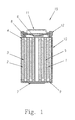
- Figure 1 depicts a cross-sectional view of a preferred embodiment of a cylindrical spiral-wound lithium ion battery.
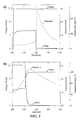
- Figures 2a and b show the voltage, temperature, and current data during overcharge of a conventional battery in Example i) and of a battery of the invention in Example ii) respectively.
- Figure 3 shows the capacity versus cycle number data for representative batteries of Examples i), ii), iii), and vi).
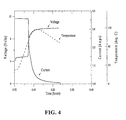
- Figure 4 shows the voltage, temperature and current data during overcharge of a battery of the invention in Example vii).
- non-aqueous rechargeable batteries The design of all non-aqueous rechargeable batteries involves tradeoffs between performance characteristics and safety characteristics. Often, certain non-aqueous electrolytes provide substantially improved performance over other much safer electrolyte choices. For this reason, it is highly desirable to be able to provide these characteristics as independently as possible. Usually, a mixture of two electrolytes in amounts of similar magnitude (perhaps one for performance and one for safety) results in net characteristics that are far below the optimal expectations of each individual electrolyte. Often however, small amounts of additives can be employed to serve a function without substantially affecting the other characteristics of the bulk electrolyte. Herein, it is shown how overcharge protection can be provided in certain non-aqueous rechargeable batteries by incorporating a small amount of a suitable aromatic additive in the electrolyte.
- aromatic refers to a class of ring compounds that are substantially stabilized by pi-electron delocalization. Such compounds are cyclic, planar, and each atom in the ring has a p orbital perpendicular to the plane of the ring ( sp 2 -hybrid state). Also, the ring system must have 4 n +2 pi electrons where n is an integer (the Huckel rule).
- heterocyclic see The Condensed Chemical Dictionary 9th Ed., G.G. Hawley, Van Nostrand Reinhold, 1977 denotes a closed-ring structure, usually of either 5 or 6 members, in which one or more of the atoms in the ring is an element other than carbon (eg. sulfur, oxygen, and nitrogen.)
- Examples of aromatic homocyclic compounds are toluene, biphenyl and the like.
- Examples of aromatic heterocyclic compounds are furan, thiophene, and derivatives thereof.
- the literature provides information on the polymerization potential and other related characteristics of many aromatic compounds, including those that are heterocyclic. Table 1 shows the polymerization potential for several such compounds. Note however that the polymerization potentials depend to some extent on the electrodes and other electrolyte components employed in the electrochemical system. The literature values thus are useful for suggesting potential aromatic compound candidates for the instant application. Under actual battery conditions, a compound may be suitable if it polymerizes at voltages above the maximum operating charging voltage of the battery but below the overcharge voltage at which the battery is hazardous (eg. the voltage during overcharge just prior to catching fire).
- Aromatic Compound Polymerization Potential (Volts vs. Li/Li + ) Reference Thiophene 5.34 1 3-Bromothiophene 5.401 1 3-Chlorothiophene 5.461 1 3-Fluorothiophene 5.481 1 1,2-Dimethoxybenzene 4.937 2 1-methyl-3-(pyrrol-1-ylmethyl) pyrridinium tetrafluoroborate 4.411 3 Furan 5.20 4 Biphenyl 4.70 5 References: 1 A.E. Kassmi et al., J. Electroanal. Chem. , 373 (1994) 241. 2 O.P. Marquez et al., J. Electrochem. Soc., 142 (1995) 707. 3 H. Mao et al., J. Electroanal. Chem., 265 (1989) 127. 4 Example c) in the Illustrative Examples following. 5 Example vii) in the 18650 Battery Examples following.
- additives meeting the preceding polymerization voltage criteria are thus potentially suitable as overcharge protection additives.
- polymerization may proceed somewhat differently in the actual battery environment.
- polymerization of the additive may not result in an adequate increase in the internal resistance of the battery and thus may not protect the battery in practice during overcharge.
- the amount of the additive must be such that battery performance is otherwise not adversely affected to any significant degree. Suitable additives therefore must be relatively inert with respect to lithium and to the electrodes (ie. should not be capable of reacting with or inserting therein).
- suitable additives should not substantially cause an increase in the internal resistance or impedance of the battery during normal operation (ie. should not adversely effect the double layer impedance, etc.).
- the construction of batteries of the invention is conventional.
- an enabling amount of additive is simply mixed in with the bulk electrolyte at some preferred point during normal assembly. Minor handling changes may of course be required to account for differences in the properties of the bulk electrolyte and the additive (eg. vapor pressure, toxicity, etc.).
- Non-aqueous rechargeable lithium batteries appear in various configurations commercially (ie. prismatic formats or miniature coin cells) and many different components may be used.
- a preferred construction for a lithium ion type product is depicted in the cross-sectional view of a conventional spiral-wound battery in Figure 1.
- a jelly roll 4 is created by spirally winding a cathode foil 1, an anode foil 2, and two microporous polyolefin sheets 3 that act as separators.
- Cathode foils are prepared by applying a mixture of a suitable powdered (about 10 micron size typically) cathode material, such as a lithiated transition metal oxide, possibly other powdered cathode material if desired, a binder, and a conductive dilutant onto a thin aluminum foil.
- a suitable powdered (about 10 micron size typically) cathode material such as a lithiated transition metal oxide, possibly other powdered cathode material if desired, a binder, and a conductive dilutant onto a thin aluminum foil.
- the application method first involves dissolving the binder in a suitable liquid carrier. Then, a slurry is prepared using this solution plus the other powdered solid components. The slurry is then coated uniformly onto the substrate foil. Afterwards, the carrier solvent is evaporated away. Often, both sides of the aluminum foil substrate are coated in this manner and subsequently the cathode foil is calendered.
- Anode foils are prepared in a like manner except that a powdered (also typically about 10 micron size) carbonaceous insertion compound is used instead of the cathode material and thin copper foil is usually used instead of aluminum.
- Anode foils are typically slightly wider than the cathode foils in order to ensure that anode foil is always opposite cathode foil.
- the jelly roll 4 is inserted into a conventional battery can 10.
- a header 11 and gasket 12 are used to seal the battery 15.
- the header may include additional safety devices if desired. Often, a safety vent is incorporated that ruptures if excessive pressure builds up in the battery. Also, a positive thermal coefficient device (PTC) may be incorporated into the header to limit the short circuit current capability of the battery.
- PTC positive thermal coefficient device
- the external surface of the header 11 is used as the positive terminal, while the external surface of the can 10 serves as the negative terminal.
- electrolyte 5 Prior to crimping the header 11 to the can 10 in order to seal the battery, electrolyte 5 is added to fill the porous spaces in the jelly roll 4. In batteries of the invention, the electrolyte 5 additionally comprises an amount of polymerizing additive.
- anode can migrate towards the cathode and polymerize on contact therewith, perhaps resulting in a high concentration of polymer at the separator-cathode interface. Such a high concentration at this interface may block the separator and result in a substantial increase in internal resistance of the battery, even though only a relatively small amount of polymer overall is involved (ie. relative to the bulk electrolyte).
- the polymer forms in a porous fibre like fashion (eg. as does dimethoxybenzene), it may not be effective in impeding transport of ions in the electrolyte or in blocking the interface between cathode and electrolyte. Additionally, some polymers can be reasonably good ion conductors in their own right and serve as bulk electrolytes in certain developmental rechargeable lithium batteries.
- Aromatic compounds in general have ring structures that can be fairly easily opened for polymerization electrochemically in a voltage range suitable for application in the instant invention.
- the presence of foreign atoms in the ring structure of many aromatic heterocyclic compounds makes the neighboring carbon atoms electron rich and hence the ring structure is easily polymerized at these locations.
- Other unsaturated ring compounds do not polymerize as easily electrochemically.
- Aromatic compounds are often compatible with lithium battery chemistries in small amounts.
- Aromatic compounds do not however typically polymerize at temperatures below an order of 150°C. Thus, polymerization of such aromatic compounds typically does not occur in embodiments of the invention below the normal maximum operating voltage. Thermal polymerization- is therefore not a factor in normal operation nor in thermal abuse. Alternative independent means for providing overtemperature protection can thus be employed.
- Cathodes 1 comprised a mixture of LiMn 2 O 4 powder, a carbonaceous conductive dilutant, and polyvinylidene fluoride (PVDF) binder uniformly coated on both sides of a thin aluminum foil about 5.4 cm in width by 49.5 cm in length. Coating weight was about 49 mg/cm 2 .
- PVDF polyvinylidene fluoride
- Anodes 2 were made using a mixture of a spherical graphitic powder plus Super S (trademark of Ensagri) carbon black and polyvinylidene fluoride (PVDF) binder (in amounts of about 2% and 10% by weight respectively to that of the spherical graphitic powder) uniformly coated on thin copper foil of similar length to the cathode but 0.2 mm greater in width. Coating weight was about 19 mg/cm 2 . Celgard® 2502 microporous polypropylene film was used to form the separators 3.
- Super S trademark of Ensagri
- PVDF polyvinylidene fluoride
- the electrolyte 5 was a solution of 1M LiPF 6 salt dissolved in a solvent mixture of ethylene carbonate (EC) and diethyl carbonate (DEC) in a EC/DEC volume ratio of 30/70. Approximately 5 cc of electrolyte was used in each battery. The batteries were equipped with a pressure relief vent but no other protection hardware.
- batteries were thermostatted at 21 ⁇ 1°C. All batteries were initially conditioned by charging, discharging, and then charging again to the normal maximum operating voltage of 4.2 volts. Further cycling was performed where indicated using a current limited, constant voltage charge ( 0.5 A maximum , 4.2 volts) and constant 1 amp current discharge to a 3.0 volt cutoff. Every 20 cycles, a series of discharge currents with decreasing magnitude (1A, 0.5A, 0.25A, 0.125A) was applied in a stepwise fashion for purposes of determining if any observed capacity loss was recovered at a lower discharge rate, ie. a loss in delivered capacity resulting from an impedance buildup.
Landscapes
- Chemical & Material Sciences (AREA)
- Manufacturing & Machinery (AREA)
- Engineering & Computer Science (AREA)
- Chemical Kinetics & Catalysis (AREA)
- Electrochemistry (AREA)
- General Chemical & Material Sciences (AREA)
- General Physics & Mathematics (AREA)
- Condensed Matter Physics & Semiconductors (AREA)
- Inorganic Chemistry (AREA)
- Physics & Mathematics (AREA)
- Secondary Cells (AREA)
- Battery Electrode And Active Subsutance (AREA)
- Cell Separators (AREA)
- Connection Of Batteries Or Terminals (AREA)
Applications Claiming Priority (2)
| Application Number | Priority Date | Filing Date | Title |
|---|---|---|---|
| CA2156800 | 1995-08-23 | ||
| CA002156800A CA2156800C (en) | 1995-08-23 | 1995-08-23 | Polymerizable aromatic additives for overcharge protection in non-aqueous rechargeable lithium batteries |
Publications (2)
| Publication Number | Publication Date |
|---|---|
| EP0759641A1 EP0759641A1 (en) | 1997-02-26 |
| EP0759641B1 true EP0759641B1 (en) | 2003-07-09 |
Family
ID=4156483
Family Applications (1)
| Application Number | Title | Priority Date | Filing Date |
|---|---|---|---|
| EP96305460A Expired - Lifetime EP0759641B1 (en) | 1995-08-23 | 1996-07-25 | Polymerizable aromatic additives for overcharge protection in non-aqueous rechargeable lithium batteries |
Country Status (5)
| Country | Link |
|---|---|
| US (1) | US5879834A (enExample) |
| EP (1) | EP0759641B1 (enExample) |
| JP (1) | JP3061756B2 (enExample) |
| CA (1) | CA2156800C (enExample) |
| DE (1) | DE69628978T2 (enExample) |
Families Citing this family (137)
| Publication number | Priority date | Publication date | Assignee | Title |
|---|---|---|---|---|
| CA2163187C (en) * | 1995-11-17 | 2003-04-15 | Huanyu Mao | Aromatic monomer gassing agents for protecting non-aqueous lithium batteries against overcharge |
| CA2205683C (en) * | 1997-05-16 | 2001-05-15 | Moli Energy (1990) Limited | Polymerizable additives for making non-aqueous rechargeable lithium batteries safe after overcharge |
| CA2216898C (en) * | 1997-09-26 | 2005-03-22 | Moli Energy (1990) Limited | Improved additives for overcharge protection in non-aqueous rechargeable lithium batteries |
| CN1338130A (zh) | 1998-06-08 | 2002-02-27 | 摩尔科技公司 | 用于非水电化学电池安全保护的多官能活性单体 |
| DE19910968A1 (de) | 1999-03-12 | 2000-11-09 | Merck Patent Gmbh | Anwendung von Additiven in Elektrolyten für elektrochemische Zellen |
| US6303250B1 (en) * | 1999-04-09 | 2001-10-16 | Matsushita Electric Industrial Co., Ltd. | Secondary battery including an electrolytic solution with an organic additive |
| JP3113652B1 (ja) | 1999-06-30 | 2000-12-04 | 三洋電機株式会社 | リチウム二次電池 |
| JP4411691B2 (ja) * | 1999-06-30 | 2010-02-10 | パナソニック株式会社 | 非水電解液二次電池および非水電解液二次電池の充電制御システムおよびこれを用いた機器 |
| JP4529274B2 (ja) | 2000-04-18 | 2010-08-25 | ソニー株式会社 | 非水電解質電池 |
| US7150944B2 (en) * | 2000-05-03 | 2006-12-19 | Samsung Sdi Co., Ltd. | Non-aqueous electrolyte compositions and lithium secondary batteries made thereof |
| JP3475911B2 (ja) * | 2000-05-25 | 2003-12-10 | 宇部興産株式会社 | 非水電解液およびそれを用いたリチウム二次電池 |
| JP2001357876A (ja) * | 2000-06-13 | 2001-12-26 | Nippon Steel Chem Co Ltd | リチウム電池 |
| JP2002025615A (ja) | 2000-07-10 | 2002-01-25 | Toyota Central Res & Dev Lab Inc | リチウム二次電池 |
| KR100326467B1 (ko) * | 2000-07-25 | 2002-02-28 | 김순택 | 리튬 설퍼 전지용 전해액 |
| KR100390099B1 (ko) * | 2000-09-28 | 2003-07-04 | 가부시끼가이샤 도시바 | 비수전해질 및 비수전해질 이차전지 |
| CN100344027C (zh) * | 2000-10-03 | 2007-10-17 | 宇部兴产株式会社 | 锂二次电池及非水电解液 |
| KR20080026223A (ko) | 2000-10-03 | 2008-03-24 | 우베 고산 가부시키가이샤 | 리튬 이차 전지 및 비수용성 전해 용액 |
| JP4695748B2 (ja) | 2000-10-12 | 2011-06-08 | パナソニック株式会社 | 非水系電池用電解液および非水系二次電池 |
| US7201994B2 (en) * | 2000-12-28 | 2007-04-10 | Matsushita Electric Industrial Co., Ltd. | Non-aqueous electrolyte secondary battery |
| US8252465B2 (en) * | 2001-01-19 | 2012-08-28 | Samsung Sdi Co., Ltd. | Electrolyte for lithium secondary battery and lithium secondary battery comprising same |
| WO2002059999A1 (en) * | 2001-01-24 | 2002-08-01 | Ube Industries, Ltd. | Nonaqueous electrolytic solution and lithium secondary batteries |
| JP4967195B2 (ja) * | 2001-03-07 | 2012-07-04 | パナソニック株式会社 | 非水電解質二次電池 |
| JP3512021B2 (ja) * | 2001-05-15 | 2004-03-29 | 株式会社日立製作所 | リチウム二次電池 |
| WO2003012912A1 (fr) * | 2001-07-27 | 2003-02-13 | Mitsubishi Chemical Corporation | Solution electrolytique non aqueuse et cellule secondaire utilisant ladite solution electrolytique non aqueuse |
| JP4221550B2 (ja) | 2001-12-12 | 2009-02-12 | 日本電気株式会社 | リチウム二次電池用電解液及びそれを用いたリチウム二次電池 |
| JP3914048B2 (ja) * | 2001-12-21 | 2007-05-16 | 日立マクセル株式会社 | 非水二次電池及びこれを用いた携帯機器 |
| US20030157412A1 (en) * | 2001-12-21 | 2003-08-21 | Takitaro Yamaguchi | Electrolyte and rechargeable lithium battery |
| KR100546031B1 (ko) * | 2002-01-24 | 2006-01-24 | 히다치 막셀 가부시키가이샤 | 비수 2차전지 및 이것을 내장한 전자기기 |
| JP4211439B2 (ja) * | 2002-03-18 | 2009-01-21 | 新神戸電機株式会社 | リチウム二次電池の正極活物質用複合酸化物の選定方法 |
| KR100458568B1 (ko) * | 2002-04-03 | 2004-12-03 | 삼성에스디아이 주식회사 | 리튬 전지용 전해질 및 이를 포함하는 리튬 전지 |
| DE10219423A1 (de) * | 2002-05-02 | 2003-11-20 | Varta Microbattery Gmbh | Verfahren zur Herstellung eines galvanischen Elements |
| JP4056302B2 (ja) * | 2002-06-21 | 2008-03-05 | 三洋電機株式会社 | 非水電解質二次電池 |
| KR100463189B1 (ko) * | 2002-07-15 | 2004-12-23 | 삼성에스디아이 주식회사 | 리튬 이차 전지 및 그 제조방법 |
| KR100462784B1 (ko) * | 2002-08-12 | 2004-12-29 | 삼성에스디아이 주식회사 | 안전성이 개선된 비수계 전해액 및 이를 채용한 리튬 전지 |
| KR100467435B1 (ko) * | 2002-09-06 | 2005-01-24 | 삼성에스디아이 주식회사 | 리튬 전지용 전해질 및 이를 포함하는 리튬 전지 |
| KR100482816B1 (ko) * | 2002-09-12 | 2005-04-14 | 주식회사 엘지화학 | 비수전해액을 이용한 리튬 이차 전지 |
| DE10340500A1 (de) * | 2002-09-16 | 2004-03-25 | H.C. Starck Gmbh | Überladeschutz nichtwässriger wieder aufladbarer Lithium-Batterien durch cyano-substituierte Thiophene als Elektrolytadditive |
| KR100527827B1 (ko) * | 2003-03-13 | 2005-11-09 | 삼성에스디아이 주식회사 | 비수성 전해질 및 이를 포함하는 리튬 이차 전지 |
| KR100471973B1 (ko) * | 2003-04-03 | 2005-03-10 | 삼성에스디아이 주식회사 | 비수성 전해질 및 이를 포함하는 리튬 이차 전지 |
| KR100515332B1 (ko) * | 2003-04-28 | 2005-09-15 | 삼성에스디아이 주식회사 | 리튬 전지용 전해질 및 이를 포함하는 리튬 전지 |
| KR100558846B1 (ko) | 2003-08-19 | 2006-03-10 | 에스케이씨 주식회사 | 전해질 조성물 및 이를 채용한 리튬 전지와 그의 제조방법 |
| KR20050029778A (ko) * | 2003-09-22 | 2005-03-28 | 삼성에스디아이 주식회사 | 리튬 전지용 전해질 및 이를 포함하는 리튬 전지 |
| EP1528616B1 (en) * | 2003-10-31 | 2017-03-08 | Samsung SDI Co., Ltd. | Electrolyte for rechargeable lithium battery and rechargeable lithium battery comprising same |
| CN100541863C (zh) | 2003-12-15 | 2009-09-16 | 三菱化学株式会社 | 非水电解液二次电池 |
| KR100578804B1 (ko) * | 2004-03-29 | 2006-05-11 | 삼성에스디아이 주식회사 | 캡 조립체 및 이를 구비한 이차 전지 |
| KR100536252B1 (ko) | 2004-03-29 | 2005-12-12 | 삼성에스디아이 주식회사 | 리튬 전지용 전해질, 그의 제조 방법 및 그를 포함하는리튬 전지 |
| KR20050096401A (ko) * | 2004-03-30 | 2005-10-06 | 삼성에스디아이 주식회사 | 리튬 전지용 전해질 및 그를 포함하는 리튬 전지 |
| KR101163803B1 (ko) * | 2004-04-01 | 2012-07-09 | 쓰리엠 이노베이티브 프로퍼티즈 컴파니 | 재충전가능 리튬이온 배터리에서의 과방전 보호를 위한산화환원 셔틀 |
| EP1733450B1 (en) * | 2004-04-01 | 2010-12-08 | 3M Innovative Properties Company | Redox shuttle for rechargeable lithium-ion cell |
| KR100658741B1 (ko) * | 2004-10-28 | 2006-12-15 | 삼성에스디아이 주식회사 | 리튬 전지용 전해질 및 이를 포함하는 리튬 전지 |
| KR100627269B1 (ko) * | 2004-10-28 | 2006-09-25 | 삼성에스디아이 주식회사 | 리튬 전지용 전해질, 및 그를 포함하는 리튬 전지 |
| KR100658742B1 (ko) * | 2004-10-28 | 2006-12-15 | 삼성에스디아이 주식회사 | 리튬 전지용 전해질 및 이를 포함하는 리튬 전지 |
| KR100628470B1 (ko) | 2004-11-03 | 2006-09-26 | 삼성에스디아이 주식회사 | 리튬 전지용 전해질 및 이를 포함하는 리튬 전지 |
| US7811707B2 (en) * | 2004-12-28 | 2010-10-12 | Boston-Power, Inc. | Lithium-ion secondary battery |
| US20080008933A1 (en) * | 2005-12-23 | 2008-01-10 | Boston-Power, Inc. | Lithium-ion secondary battery |
| KR101191636B1 (ko) | 2005-02-28 | 2012-10-18 | 삼성에스디아이 주식회사 | 리튬 전지용 전해질 및 그를 포함하는 리튬 전지 |
| JP4940570B2 (ja) * | 2005-04-08 | 2012-05-30 | ソニー株式会社 | リチウム二次電池用電解液およびリチウム二次電池 |
| TWI332937B (en) | 2005-04-20 | 2010-11-11 | Lg Chemical Ltd | Additive for non-aqueous electrolyte and secondary battery using the same |
| US7615312B2 (en) * | 2005-05-17 | 2009-11-10 | 3M Innovative Properties Company | Substituted phenothiazine redox shuttles for rechargeable lithium-ion cell |
| CN101263396B (zh) | 2005-07-14 | 2011-04-27 | 波士顿电力公司 | 用于锂离子电池的控制电子元件 |
| US20070077496A1 (en) * | 2005-10-05 | 2007-04-05 | Medtronic, Inc. | Lithium-ion battery |
| KR102102105B1 (ko) | 2005-10-20 | 2020-04-20 | 미쯔비시 케미컬 주식회사 | 리튬 2 차 전지 및 그것에 사용하는 비수계 전해액 |
| KR100812056B1 (ko) * | 2005-10-24 | 2008-03-07 | 주식회사 엘지화학 | 레독스 셔틀제의 수명 감소 억제제, 이를 포함하는 비수전해액 및 이차전지 |
| KR100713622B1 (ko) * | 2006-01-09 | 2007-05-02 | 제일모직주식회사 | 디페닐에테르계 화합물을 포함하는 비수성 전해액 및 이를포함하는 리튬 2차 전지 |
| TWI338396B (en) * | 2006-01-17 | 2011-03-01 | Lg Chemical Ltd | Additives for non-aqueous electrolyte and lithium secondary battery using the same |
| US20080193852A1 (en) * | 2006-02-03 | 2008-08-14 | Sanyo Electric Co., Ltd. | Nonaqueous Electrolyte Secondary Battery |
| JP4994677B2 (ja) | 2006-02-28 | 2012-08-08 | パナソニック株式会社 | 非水電解液二次電池 |
| KR101508788B1 (ko) | 2006-06-02 | 2015-04-06 | 미쓰비시 가가꾸 가부시키가이샤 | 비수계 전해액 및 비수계 전해액 전지 |
| KR101295037B1 (ko) * | 2006-06-27 | 2013-08-09 | 보스톤-파워, 인크. | 리튬-이온 전지를 위한 통합 전류-차단 장치 |
| TWI426678B (zh) * | 2006-06-28 | 2014-02-11 | 波士頓電力公司 | 具有多重充電率之電子裝置、電池組、充電於電子裝置中的鋰離子電荷儲存電源供應器之方法及可攜式電腦 |
| US8758945B2 (en) | 2007-03-06 | 2014-06-24 | Air Products And Chemicals, Inc. | Overcharge protection by coupling redox shuttle chemistry with radical polymerization additives |
| JP5303857B2 (ja) * | 2007-04-27 | 2013-10-02 | 株式会社Gsユアサ | 非水電解質電池及び電池システム |
| JP4943242B2 (ja) | 2007-06-20 | 2012-05-30 | ソニー株式会社 | リチウムイオン二次電池 |
| CN101803070B (zh) | 2007-06-22 | 2014-10-22 | 波士顿电力公司 | 用于锂离子电池的电流中断装置维持装置 |
| US20110008681A1 (en) * | 2007-09-12 | 2011-01-13 | Meiten Koh | Electrolytic solution |
| WO2009102604A1 (en) * | 2008-02-12 | 2009-08-20 | 3M Innovative Properties Company | Redox shuttles for high voltage cathodes |
| CN105762402A (zh) | 2008-02-29 | 2016-07-13 | 三菱化学株式会社 | 非水电解液及非水电解质电池 |
| US20090297937A1 (en) * | 2008-04-24 | 2009-12-03 | Lampe-Onnerud Christina M | Lithium-ion secondary battery |
| KR100995413B1 (ko) | 2008-08-01 | 2010-11-18 | 삼성에스디아이 주식회사 | 리튬 이온 이차 전지용 전해액 및 이를 포함하는 리튬 이온이차 전지 |
| EP2347318A1 (en) * | 2008-09-12 | 2011-07-27 | Boston-Power, Inc. | Method and apparatus for embedded battery cells and thermal management |
| CZ2008572A3 (cs) * | 2008-09-19 | 2010-02-10 | He3Da S.R.O. | Lithiový akumulátor s prostorovým typem elektrod a zpusob jeho výroby |
| US8642195B2 (en) | 2008-12-19 | 2014-02-04 | Boston-Power, Inc. | Modular CID assembly for a lithium ion battery |
| TWI411149B (zh) * | 2008-12-31 | 2013-10-01 | Ind Tech Res Inst | 鋰電池及其製造方法 |
| US20100289457A1 (en) * | 2009-05-18 | 2010-11-18 | Boston-Power, Inc. | Energy efficient and fast charge modes of a rechargeable battery |
| JP2010277827A (ja) * | 2009-05-28 | 2010-12-09 | Sony Corp | 非水電解液、正極およびそれらを用いた非水電解質二次電池 |
| JP5499542B2 (ja) * | 2009-07-14 | 2014-05-21 | 三菱化学株式会社 | 非水系電解液及び非水系電解液電池 |
| JP4934704B2 (ja) * | 2009-07-27 | 2012-05-16 | 株式会社日立製作所 | リチウムイオン二次電池及びリチウムイオン二次電池用過充電抑制剤 |
| CN102484281A (zh) | 2009-08-31 | 2012-05-30 | 三菱化学株式会社 | 非水电解液及使用该非水电解液的非水电解质电池 |
| KR20120060820A (ko) * | 2009-09-01 | 2012-06-12 | 보스톤-파워, 인크. | 대형 배터리 시스템 및 조립 방법 |
| EP2473371A4 (en) * | 2009-09-01 | 2017-11-08 | Boston-Power, Inc. | Safety and performance optimized controls for large scale electric vehicle battery systems |
| JP5427101B2 (ja) * | 2010-04-27 | 2014-02-26 | 株式会社日立製作所 | 非水電解液及びそれを用いた非水電解液二次電池 |
| CN102237550A (zh) * | 2010-04-29 | 2011-11-09 | 比亚迪股份有限公司 | 一种非水电解液及其制备方法和采用该电解液的电池 |
| JP5438602B2 (ja) | 2010-06-16 | 2014-03-12 | 株式会社日立製作所 | 充電制御システム |
| WO2012029578A1 (ja) * | 2010-09-02 | 2012-03-08 | 日本電気株式会社 | 二次電池 |
| CZ2010703A3 (cs) | 2010-09-23 | 2012-04-04 | He3Da S.R.O. | Lithiový akumulátor |
| JP5455889B2 (ja) * | 2010-12-28 | 2014-03-26 | 株式会社日立製作所 | 非水電解液及び二次電池 |
| US9136559B2 (en) | 2010-12-29 | 2015-09-15 | Industrial Technology Research Institute | Non-aqueous electrolyte and lithium secondary battery including the same |
| US8772412B2 (en) | 2010-12-29 | 2014-07-08 | Industrial Technology Research Institute | Meta-stable state nitrogen-containing polymer |
| JP5617792B2 (ja) * | 2011-08-05 | 2014-11-05 | 株式会社豊田自動織機 | リチウムイオン二次電池 |
| US9455472B2 (en) | 2011-06-07 | 2016-09-27 | 3M Innovative Properties Company | Lithium-ion electrochemical cells including fluorocarbon electrolyte additives |
| US20120315551A1 (en) * | 2011-06-09 | 2012-12-13 | Wildcat Discovery Technologies, Inc. | Materials for Battery Electrolytes and Methods for Use |
| JP5870767B2 (ja) * | 2011-09-08 | 2016-03-01 | トヨタ自動車株式会社 | 非水電解液二次電池の電池保守再生方法 |
| DE102011055028A1 (de) | 2011-11-04 | 2013-05-08 | Jacobs University Bremen Ggmbh | Elektrolyt-Zusatz für Lithium-basierte Energiespeicher |
| CN103947031B (zh) | 2011-11-22 | 2017-07-11 | 吉坤日矿日石能源株式会社 | 有机系电解质和有机系电解质蓄电池 |
| US8951654B2 (en) | 2011-12-02 | 2015-02-10 | GM Global Technology Operations LLC | Materials and methods for retarding or preventing thermal runaway in batteries |
| KR20140116069A (ko) | 2011-12-22 | 2014-10-01 | 제이엑스 닛코닛세키에너지주식회사 | 유기 전해질 및 유기 전해질 축전지 |
| EP2797153A4 (en) | 2011-12-22 | 2015-07-29 | Jx Nippon Oil & Energy Corp | ORGANIC ELECTROLYTE AND MEMORY BATTERY WITH ORGANIC ELECTROLYTE |
| DE102012200980B4 (de) * | 2012-01-24 | 2023-04-20 | Robert Bosch Gmbh | Sicherheitssystem für Batterien |
| CN104321923B (zh) | 2012-03-06 | 2016-10-12 | 吉坤日矿日石能源株式会社 | Li蓄电池用电解质和Li蓄电池 |
| EP2830143B1 (en) | 2012-03-19 | 2019-05-22 | Mitsubishi Chemical Corporation | Nonaqueous electrolyte solution and nonaqueous electrolyte battery |
| CN104205472B (zh) | 2012-03-30 | 2017-04-12 | 三菱化学株式会社 | 非水电解液及使用其的非水电解质电池 |
| WO2013153996A1 (ja) | 2012-04-11 | 2013-10-17 | Jx日鉱日石エネルギー株式会社 | 有機系電解質及びそれを用いた有機系電解質蓄電池 |
| KR102022363B1 (ko) | 2012-11-21 | 2019-09-18 | 에스케이이노베이션 주식회사 | 리튬 이차전지용 전해액 및 이를 포함하는 리튬 이차전지 |
| KR102037211B1 (ko) | 2012-11-21 | 2019-11-26 | 에스케이이노베이션 주식회사 | 리튬 이차전지용 전해액 및 이를 포함하는 리튬 이차전지 |
| KR102040067B1 (ko) | 2012-11-26 | 2019-11-05 | 에스케이이노베이션 주식회사 | 리튬 이차전지용 전해액 및 이를 포함하는 리튬 이차전지 |
| KR101970725B1 (ko) | 2012-11-26 | 2019-04-22 | 에스케이이노베이션 주식회사 | 리튬 이차전지용 전해액 및 이를 포함하는 리튬 이차전지 |
| TWI501444B (zh) | 2012-12-20 | 2015-09-21 | Ind Tech Res Inst | 鋰離子二次電池用的電解液添加劑 |
| CN105144460B (zh) | 2013-12-06 | 2017-09-29 | Sk新技术株式会社 | 锂二次电池用电解液及包括该电解液的锂二次电池 |
| US9979049B2 (en) | 2013-12-09 | 2018-05-22 | Sk Innovation Co., Ltd. | Electrolyte for lithium secondary battery and lithium secondary battery comprising same |
| KR102188424B1 (ko) | 2013-12-19 | 2020-12-08 | 에스케이이노베이션 주식회사 | 리튬 이차전지 전해액 및 이를 포함하는 리튬 이차전지 |
| KR102460822B1 (ko) | 2013-12-19 | 2022-11-01 | 에스케이온 주식회사 | 리튬 이차전지 전해액 및 이를 포함하는 리튬 이차전지 |
| KR102100244B1 (ko) | 2013-12-19 | 2020-04-13 | 에스케이이노베이션 주식회사 | 리튬 이차전지 전해액 및 이를 포함하는 리튬 이차전지 |
| US10135094B2 (en) | 2013-12-19 | 2018-11-20 | Sk Innovation Co., Ltd. | Electrolyte for lithium secondary battery and lithium secondary battery containing the same |
| KR102247161B1 (ko) | 2013-12-19 | 2021-05-04 | 에스케이이노베이션 주식회사 | 리튬 이차전지 전해액 및 이를 포함하는 리튬 이차전지 |
| JP6086249B2 (ja) * | 2014-03-26 | 2017-03-01 | トヨタ自動車株式会社 | 非水電解質二次電池 |
| KR20160029457A (ko) | 2014-09-05 | 2016-03-15 | 에스케이이노베이션 주식회사 | 리튬 이차전지 전해액 및 이를 포함하는 리튬 이차전지 |
| KR102353962B1 (ko) | 2014-09-12 | 2022-01-24 | 에스케이온 주식회사 | 리튬 이차전지 전해액 및 이를 포함하는 리튬 이차전지 |
| KR102310478B1 (ko) | 2014-09-16 | 2021-10-08 | 에스케이이노베이션 주식회사 | 리튬 이차전지 전해액 및 이를 포함하는 리튬 이차전지 |
| KR102266993B1 (ko) | 2014-09-18 | 2021-06-18 | 에스케이이노베이션 주식회사 | 신규한 화합물 및 이를 포함하는 리튬 이차전지 전해액 |
| CN104733781A (zh) * | 2015-03-27 | 2015-06-24 | 山东海容电源材料有限公司 | 一种4.4v高电压钴酸锂型锂电池电解质溶液 |
| KR102451966B1 (ko) | 2015-06-08 | 2022-10-07 | 에스케이온 주식회사 | 리튬 이차전지 전해액 및 이를 포함하는 리튬 이차전지 |
| KR102761047B1 (ko) * | 2017-02-14 | 2025-02-03 | 에스케이온 주식회사 | 리튬 이차전지 전해액 및 이를 포함하는 리튬 이차전지 |
| KR102633167B1 (ko) | 2018-08-02 | 2024-02-05 | 에스케이온 주식회사 | 리튬 이차전지 |
| CA3226202A1 (en) * | 2018-08-14 | 2020-02-20 | Hydro-Quebec | Additives for electrolyte and cathode material in li-ion batteries comprising metal-based cathode material which produces m2+ metal ions |
| KR102679602B1 (ko) | 2018-10-01 | 2024-07-01 | 에스케이온 주식회사 | 리튬 이차전지 전해액 및 이를 포함하는 리튬 이차전지 |
| KR20200037622A (ko) | 2018-10-01 | 2020-04-09 | 에스케이이노베이션 주식회사 | 리튬 이차전지 전해액 및 이를 포함하는 리튬 이차전지 |
| KR102940360B1 (ko) | 2021-01-07 | 2026-03-16 | 주식회사 엘지에너지솔루션 | 리튬 이차전지용 비수계 전해액 및 이를 포함하는 리튬 이차전지 |
Family Cites Families (12)
| Publication number | Priority date | Publication date | Assignee | Title |
|---|---|---|---|---|
| US4489145A (en) * | 1983-10-18 | 1984-12-18 | Abraham Kuzhikalail M | Lithium battery |
| JPS61147475A (ja) * | 1984-12-19 | 1986-07-05 | Showa Denko Kk | 二次電池 |
| JPS61230276A (ja) * | 1985-04-05 | 1986-10-14 | Nippon Telegr & Teleph Corp <Ntt> | リチウム二次電池用電解液 |
| CA2000873C (en) * | 1988-10-21 | 1999-12-14 | Shigeru Oishi | Cell having current cutoff valve |
| JPH04249870A (ja) * | 1990-12-28 | 1992-09-04 | Sony Corp | 非水電解液二次電池 |
| JPH04272659A (ja) * | 1991-02-27 | 1992-09-29 | Matsushita Electric Ind Co Ltd | 可逆性電極 |
| DE4109812A1 (de) * | 1991-03-26 | 1992-10-01 | Basf Ag | Elektrochemisches sekundaerelement mit einem nichtwaessrigen elektrolyten |
| JPH04332479A (ja) * | 1991-05-02 | 1992-11-19 | Sony Corp | 非水電解液二次電池 |
| EP0614239A3 (en) * | 1993-03-01 | 1996-10-16 | Tadiran Ltd | Light-weight secondary cell with safety device. |
| WO1995021467A1 (en) * | 1994-02-02 | 1995-08-10 | Valence Technology, Inc. | Equalizing charge rates of individual battery cells |
| JP3809657B2 (ja) * | 1994-03-07 | 2006-08-16 | ソニー株式会社 | 非水電解液二次電池 |
| JP3669024B2 (ja) * | 1995-05-26 | 2005-07-06 | ソニー株式会社 | 非水電解液二次電池 |
-
1995
- 1995-08-23 CA CA002156800A patent/CA2156800C/en not_active Expired - Lifetime
-
1996
- 1996-07-22 US US08/681,171 patent/US5879834A/en not_active Expired - Lifetime
- 1996-07-25 EP EP96305460A patent/EP0759641B1/en not_active Expired - Lifetime
- 1996-07-25 DE DE69628978T patent/DE69628978T2/de not_active Expired - Lifetime
- 1996-08-13 JP JP8213517A patent/JP3061756B2/ja not_active Expired - Lifetime
Also Published As
| Publication number | Publication date |
|---|---|
| DE69628978T2 (de) | 2004-01-08 |
| DE69628978D1 (de) | 2003-08-14 |
| CA2156800C (en) | 2003-04-29 |
| US5879834A (en) | 1999-03-09 |
| JPH09106835A (ja) | 1997-04-22 |
| CA2156800A1 (en) | 1997-02-24 |
| EP0759641A1 (en) | 1997-02-26 |
| JP3061756B2 (ja) | 2000-07-10 |
Similar Documents
| Publication | Publication Date | Title |
|---|---|---|
| US5879834A (en) | Polymerizable aromatic additives for overcharge protection in non-aqueous rechargeable lithium batteries | |
| EP0776058B1 (en) | Aromatic monomer gassing agents for protecting non-aqueous lithium batteries against overcharge | |
| US6074776A (en) | Polymerizable additives for making non-aqueous rechargeable lithium batteries safe after overcharge | |
| US6074777A (en) | Additives for overcharge protection in non-aqueous rechargeable lithium batteries | |
| JP3575735B2 (ja) | 非水系の再充電可能なリチウム電池 | |
| US5891592A (en) | Additives for improving cycle life of non-aqueous rechargeable lithium batteries | |
| US20060234125A1 (en) | Lithium Ion Rocking Chair Rechargeable Battery | |
| JP2939469B1 (ja) | 非水系電池用電解液およびこの電解液を用いた二次電池 | |
| JP2983205B1 (ja) | 非水系二次電池 | |
| US8940443B2 (en) | Polyvinylpyridine additives for nonaqueous electrolytes activating lithium rechargeable electrochemical cells | |
| JP3080609B2 (ja) | 非水系電池用電解液およびこの電解液を用いた二次電池 | |
| US7998623B2 (en) | Electrolyte for lithium ion secondary battery and lithium ion secondary battery including the same | |
| EP0457741A1 (en) | Safety electrolyte solvent and eletrochemical cells containing a safety electrolyte solvent | |
| JP2000058112A (ja) | 非水系電池用電解液およびこの電解液を用いた二次電池 | |
| JPH11329500A (ja) | 固体電解質電池 | |
| JP2939468B1 (ja) | 非水系電池用電解液およびこの電解液を用いた二次電池 | |
| JP2928779B1 (ja) | 非水系電池用電解液およびこの電解液を用いた二次電池 |
Legal Events
| Date | Code | Title | Description |
|---|---|---|---|
| PUAI | Public reference made under article 153(3) epc to a published international application that has entered the european phase |
Free format text: ORIGINAL CODE: 0009012 |
|
| AK | Designated contracting states |
Kind code of ref document: A1 Designated state(s): DE FR GB |
|
| 17P | Request for examination filed |
Effective date: 19970630 |
|
| 17Q | First examination report despatched |
Effective date: 19990303 |
|
| GRAG | Despatch of communication of intention to grant |
Free format text: ORIGINAL CODE: EPIDOS AGRA |
|
| GRAG | Despatch of communication of intention to grant |
Free format text: ORIGINAL CODE: EPIDOS AGRA |
|
| GRAG | Despatch of communication of intention to grant |
Free format text: ORIGINAL CODE: EPIDOS AGRA |
|
| GRAH | Despatch of communication of intention to grant a patent |
Free format text: ORIGINAL CODE: EPIDOS IGRA |
|
| GRAH | Despatch of communication of intention to grant a patent |
Free format text: ORIGINAL CODE: EPIDOS IGRA |
|
| GRAA | (expected) grant |
Free format text: ORIGINAL CODE: 0009210 |
|
| AK | Designated contracting states |
Designated state(s): DE FR GB |
|
| REG | Reference to a national code |
Ref country code: GB Ref legal event code: FG4D |
|
| REF | Corresponds to: |
Ref document number: 69628978 Country of ref document: DE Date of ref document: 20030814 Kind code of ref document: P |
|
| ET | Fr: translation filed | ||
| PLBE | No opposition filed within time limit |
Free format text: ORIGINAL CODE: 0009261 |
|
| STAA | Information on the status of an ep patent application or granted ep patent |
Free format text: STATUS: NO OPPOSITION FILED WITHIN TIME LIMIT |
|
| 26N | No opposition filed |
Effective date: 20040414 |
|
| PGFP | Annual fee paid to national office [announced via postgrant information from national office to epo] |
Ref country code: GB Payment date: 20120725 Year of fee payment: 17 |
|
| PGFP | Annual fee paid to national office [announced via postgrant information from national office to epo] |
Ref country code: DE Payment date: 20120727 Year of fee payment: 17 Ref country code: FR Payment date: 20120731 Year of fee payment: 17 |
|
| REG | Reference to a national code |
Ref country code: DE Ref legal event code: R119 Ref document number: 69628978 Country of ref document: DE |
|
| GBPC | Gb: european patent ceased through non-payment of renewal fee |
Effective date: 20130725 |
|
| REG | Reference to a national code |
Ref country code: FR Ref legal event code: ST Effective date: 20140331 |
|
| PG25 | Lapsed in a contracting state [announced via postgrant information from national office to epo] |
Ref country code: DE Free format text: LAPSE BECAUSE OF NON-PAYMENT OF DUE FEES Effective date: 20140201 Ref country code: GB Free format text: LAPSE BECAUSE OF NON-PAYMENT OF DUE FEES Effective date: 20130725 |
|
| REG | Reference to a national code |
Ref country code: DE Ref legal event code: R079 Ref document number: 69628978 Country of ref document: DE Free format text: PREVIOUS MAIN CLASS: H01M0010400000 Ipc: H01M0010056400 |
|
| PG25 | Lapsed in a contracting state [announced via postgrant information from national office to epo] |
Ref country code: FR Free format text: LAPSE BECAUSE OF NON-PAYMENT OF DUE FEES Effective date: 20130731 |
|
| REG | Reference to a national code |
Ref country code: DE Ref legal event code: R119 Ref document number: 69628978 Country of ref document: DE Effective date: 20140201 Ref country code: DE Ref legal event code: R079 Ref document number: 69628978 Country of ref document: DE Free format text: PREVIOUS MAIN CLASS: H01M0010400000 Ipc: H01M0010056400 Effective date: 20140526 |