WO2020004412A1 - 端子用樹脂フィルム及びこれを用いた蓄電装置 - Google Patents
端子用樹脂フィルム及びこれを用いた蓄電装置 Download PDFInfo
- Publication number
- WO2020004412A1 WO2020004412A1 PCT/JP2019/025221 JP2019025221W WO2020004412A1 WO 2020004412 A1 WO2020004412 A1 WO 2020004412A1 JP 2019025221 W JP2019025221 W JP 2019025221W WO 2020004412 A1 WO2020004412 A1 WO 2020004412A1
- Authority
- WO
- WIPO (PCT)
- Prior art keywords
- resin
- layer
- terminal
- resin film
- melting point
- Prior art date
- Legal status (The legal status is an assumption and is not a legal conclusion. Google has not performed a legal analysis and makes no representation as to the accuracy of the status listed.)
- Ceased
Links
Images


Classifications
-
- H—ELECTRICITY
- H01—ELECTRIC ELEMENTS
- H01M—PROCESSES OR MEANS, e.g. BATTERIES, FOR THE DIRECT CONVERSION OF CHEMICAL ENERGY INTO ELECTRICAL ENERGY
- H01M50/00—Constructional details or processes of manufacture of the non-active parts of electrochemical cells other than fuel cells, e.g. hybrid cells
- H01M50/10—Primary casings; Jackets or wrappings
- H01M50/183—Sealing members
- H01M50/19—Sealing members characterised by the material
- H01M50/197—Sealing members characterised by the material having a layered structure
-
- C—CHEMISTRY; METALLURGY
- C08—ORGANIC MACROMOLECULAR COMPOUNDS; THEIR PREPARATION OR CHEMICAL WORKING-UP; COMPOSITIONS BASED THEREON
- C08G—MACROMOLECULAR COMPOUNDS OBTAINED OTHERWISE THAN BY REACTIONS ONLY INVOLVING UNSATURATED CARBON-TO-CARBON BONDS
- C08G63/00—Macromolecular compounds obtained by reactions forming a carboxylic ester link in the main chain of the macromolecule
- C08G63/02—Polyesters derived from hydroxycarboxylic acids or from polycarboxylic acids and polyhydroxy compounds
- C08G63/12—Polyesters derived from hydroxycarboxylic acids or from polycarboxylic acids and polyhydroxy compounds derived from polycarboxylic acids and polyhydroxy compounds
- C08G63/16—Dicarboxylic acids and dihydroxy compounds
- C08G63/18—Dicarboxylic acids and dihydroxy compounds the acids or hydroxy compounds containing carbocyclic rings
- C08G63/181—Acids containing aromatic rings
- C08G63/183—Terephthalic acids
-
- C—CHEMISTRY; METALLURGY
- C09—DYES; PAINTS; POLISHES; NATURAL RESINS; ADHESIVES; COMPOSITIONS NOT OTHERWISE PROVIDED FOR; APPLICATIONS OF MATERIALS NOT OTHERWISE PROVIDED FOR
- C09D—COATING COMPOSITIONS, e.g. PAINTS, VARNISHES OR LACQUERS; FILLING PASTES; CHEMICAL PAINT OR INK REMOVERS; INKS; CORRECTING FLUIDS; WOODSTAINS; PASTES OR SOLIDS FOR COLOURING OR PRINTING; USE OF MATERIALS THEREFOR
- C09D163/00—Coating compositions based on epoxy resins; Coating compositions based on derivatives of epoxy resins
-
- C—CHEMISTRY; METALLURGY
- C09—DYES; PAINTS; POLISHES; NATURAL RESINS; ADHESIVES; COMPOSITIONS NOT OTHERWISE PROVIDED FOR; APPLICATIONS OF MATERIALS NOT OTHERWISE PROVIDED FOR
- C09D—COATING COMPOSITIONS, e.g. PAINTS, VARNISHES OR LACQUERS; FILLING PASTES; CHEMICAL PAINT OR INK REMOVERS; INKS; CORRECTING FLUIDS; WOODSTAINS; PASTES OR SOLIDS FOR COLOURING OR PRINTING; USE OF MATERIALS THEREFOR
- C09D167/00—Coating compositions based on polyesters obtained by reactions forming a carboxylic ester link in the main chain; Coating compositions based on derivatives of such polymers
- C09D167/02—Polyesters derived from dicarboxylic acids and dihydroxy compounds
-
- C—CHEMISTRY; METALLURGY
- C09—DYES; PAINTS; POLISHES; NATURAL RESINS; ADHESIVES; COMPOSITIONS NOT OTHERWISE PROVIDED FOR; APPLICATIONS OF MATERIALS NOT OTHERWISE PROVIDED FOR
- C09D—COATING COMPOSITIONS, e.g. PAINTS, VARNISHES OR LACQUERS; FILLING PASTES; CHEMICAL PAINT OR INK REMOVERS; INKS; CORRECTING FLUIDS; WOODSTAINS; PASTES OR SOLIDS FOR COLOURING OR PRINTING; USE OF MATERIALS THEREFOR
- C09D175/00—Coating compositions based on polyureas or polyurethanes; Coating compositions based on derivatives of such polymers
- C09D175/04—Polyurethanes
-
- C—CHEMISTRY; METALLURGY
- C09—DYES; PAINTS; POLISHES; NATURAL RESINS; ADHESIVES; COMPOSITIONS NOT OTHERWISE PROVIDED FOR; APPLICATIONS OF MATERIALS NOT OTHERWISE PROVIDED FOR
- C09D—COATING COMPOSITIONS, e.g. PAINTS, VARNISHES OR LACQUERS; FILLING PASTES; CHEMICAL PAINT OR INK REMOVERS; INKS; CORRECTING FLUIDS; WOODSTAINS; PASTES OR SOLIDS FOR COLOURING OR PRINTING; USE OF MATERIALS THEREFOR
- C09D181/00—Coating compositions based on macromolecular compounds obtained by reactions forming in the main chain of the macromolecule a linkage containing sulfur, with or without nitrogen, oxygen, or carbon only; Coating compositions based on polysulfones; Coating compositions based on derivatives of such polymers
- C09D181/04—Polysulfides
-
- C—CHEMISTRY; METALLURGY
- C09—DYES; PAINTS; POLISHES; NATURAL RESINS; ADHESIVES; COMPOSITIONS NOT OTHERWISE PROVIDED FOR; APPLICATIONS OF MATERIALS NOT OTHERWISE PROVIDED FOR
- C09J—ADHESIVES; NON-MECHANICAL ASPECTS OF ADHESIVE PROCESSES IN GENERAL; ADHESIVE PROCESSES NOT PROVIDED FOR ELSEWHERE; USE OF MATERIALS AS ADHESIVES
- C09J175/00—Adhesives based on polyureas or polyurethanes; Adhesives based on derivatives of such polymers
- C09J175/04—Polyurethanes
- C09J175/06—Polyurethanes from polyesters
-
- H—ELECTRICITY
- H01—ELECTRIC ELEMENTS
- H01M—PROCESSES OR MEANS, e.g. BATTERIES, FOR THE DIRECT CONVERSION OF CHEMICAL ENERGY INTO ELECTRICAL ENERGY
- H01M10/00—Secondary cells; Manufacture thereof
- H01M10/05—Accumulators with non-aqueous electrolyte
- H01M10/052—Li-accumulators
- H01M10/0525—Rocking-chair batteries, i.e. batteries with lithium insertion or intercalation in both electrodes; Lithium-ion batteries
-
- H—ELECTRICITY
- H01—ELECTRIC ELEMENTS
- H01M—PROCESSES OR MEANS, e.g. BATTERIES, FOR THE DIRECT CONVERSION OF CHEMICAL ENERGY INTO ELECTRICAL ENERGY
- H01M50/00—Constructional details or processes of manufacture of the non-active parts of electrochemical cells other than fuel cells, e.g. hybrid cells
- H01M50/10—Primary casings; Jackets or wrappings
- H01M50/116—Primary casings; Jackets or wrappings characterised by the material
- H01M50/117—Inorganic material
- H01M50/119—Metals
-
- H—ELECTRICITY
- H01—ELECTRIC ELEMENTS
- H01M—PROCESSES OR MEANS, e.g. BATTERIES, FOR THE DIRECT CONVERSION OF CHEMICAL ENERGY INTO ELECTRICAL ENERGY
- H01M50/00—Constructional details or processes of manufacture of the non-active parts of electrochemical cells other than fuel cells, e.g. hybrid cells
- H01M50/10—Primary casings; Jackets or wrappings
- H01M50/116—Primary casings; Jackets or wrappings characterised by the material
- H01M50/121—Organic material
-
- H—ELECTRICITY
- H01—ELECTRIC ELEMENTS
- H01M—PROCESSES OR MEANS, e.g. BATTERIES, FOR THE DIRECT CONVERSION OF CHEMICAL ENERGY INTO ELECTRICAL ENERGY
- H01M50/00—Constructional details or processes of manufacture of the non-active parts of electrochemical cells other than fuel cells, e.g. hybrid cells
- H01M50/10—Primary casings; Jackets or wrappings
- H01M50/116—Primary casings; Jackets or wrappings characterised by the material
- H01M50/124—Primary casings; Jackets or wrappings characterised by the material having a layered structure
- H01M50/126—Primary casings; Jackets or wrappings characterised by the material having a layered structure comprising three or more layers
- H01M50/128—Primary casings; Jackets or wrappings characterised by the material having a layered structure comprising three or more layers with two or more layers of only inorganic material
-
- H—ELECTRICITY
- H01—ELECTRIC ELEMENTS
- H01M—PROCESSES OR MEANS, e.g. BATTERIES, FOR THE DIRECT CONVERSION OF CHEMICAL ENERGY INTO ELECTRICAL ENERGY
- H01M50/00—Constructional details or processes of manufacture of the non-active parts of electrochemical cells other than fuel cells, e.g. hybrid cells
- H01M50/10—Primary casings; Jackets or wrappings
- H01M50/172—Arrangements of electric connectors penetrating the casing
- H01M50/174—Arrangements of electric connectors penetrating the casing adapted for the shape of the cells
- H01M50/176—Arrangements of electric connectors penetrating the casing adapted for the shape of the cells for prismatic or rectangular cells
-
- H—ELECTRICITY
- H01—ELECTRIC ELEMENTS
- H01M—PROCESSES OR MEANS, e.g. BATTERIES, FOR THE DIRECT CONVERSION OF CHEMICAL ENERGY INTO ELECTRICAL ENERGY
- H01M50/00—Constructional details or processes of manufacture of the non-active parts of electrochemical cells other than fuel cells, e.g. hybrid cells
- H01M50/10—Primary casings; Jackets or wrappings
- H01M50/172—Arrangements of electric connectors penetrating the casing
- H01M50/174—Arrangements of electric connectors penetrating the casing adapted for the shape of the cells
- H01M50/178—Arrangements of electric connectors penetrating the casing adapted for the shape of the cells for pouch or flexible bag cells
-
- H—ELECTRICITY
- H01—ELECTRIC ELEMENTS
- H01M—PROCESSES OR MEANS, e.g. BATTERIES, FOR THE DIRECT CONVERSION OF CHEMICAL ENERGY INTO ELECTRICAL ENERGY
- H01M50/00—Constructional details or processes of manufacture of the non-active parts of electrochemical cells other than fuel cells, e.g. hybrid cells
- H01M50/10—Primary casings; Jackets or wrappings
- H01M50/183—Sealing members
- H01M50/186—Sealing members characterised by the disposition of the sealing members
-
- H—ELECTRICITY
- H01—ELECTRIC ELEMENTS
- H01M—PROCESSES OR MEANS, e.g. BATTERIES, FOR THE DIRECT CONVERSION OF CHEMICAL ENERGY INTO ELECTRICAL ENERGY
- H01M50/00—Constructional details or processes of manufacture of the non-active parts of electrochemical cells other than fuel cells, e.g. hybrid cells
- H01M50/10—Primary casings; Jackets or wrappings
- H01M50/183—Sealing members
- H01M50/186—Sealing members characterised by the disposition of the sealing members
- H01M50/188—Sealing members characterised by the disposition of the sealing members the sealing members being arranged between the lid and terminal
-
- H—ELECTRICITY
- H01—ELECTRIC ELEMENTS
- H01M—PROCESSES OR MEANS, e.g. BATTERIES, FOR THE DIRECT CONVERSION OF CHEMICAL ENERGY INTO ELECTRICAL ENERGY
- H01M50/00—Constructional details or processes of manufacture of the non-active parts of electrochemical cells other than fuel cells, e.g. hybrid cells
- H01M50/10—Primary casings; Jackets or wrappings
- H01M50/183—Sealing members
- H01M50/19—Sealing members characterised by the material
-
- H—ELECTRICITY
- H01—ELECTRIC ELEMENTS
- H01M—PROCESSES OR MEANS, e.g. BATTERIES, FOR THE DIRECT CONVERSION OF CHEMICAL ENERGY INTO ELECTRICAL ENERGY
- H01M50/00—Constructional details or processes of manufacture of the non-active parts of electrochemical cells other than fuel cells, e.g. hybrid cells
- H01M50/10—Primary casings; Jackets or wrappings
- H01M50/183—Sealing members
- H01M50/19—Sealing members characterised by the material
- H01M50/193—Organic material
-
- H—ELECTRICITY
- H01—ELECTRIC ELEMENTS
- H01M—PROCESSES OR MEANS, e.g. BATTERIES, FOR THE DIRECT CONVERSION OF CHEMICAL ENERGY INTO ELECTRICAL ENERGY
- H01M50/00—Constructional details or processes of manufacture of the non-active parts of electrochemical cells other than fuel cells, e.g. hybrid cells
- H01M50/10—Primary casings; Jackets or wrappings
- H01M50/183—Sealing members
- H01M50/19—Sealing members characterised by the material
- H01M50/198—Sealing members characterised by the material characterised by physical properties, e.g. adhesiveness or hardness
-
- H—ELECTRICITY
- H01—ELECTRIC ELEMENTS
- H01M—PROCESSES OR MEANS, e.g. BATTERIES, FOR THE DIRECT CONVERSION OF CHEMICAL ENERGY INTO ELECTRICAL ENERGY
- H01M50/00—Constructional details or processes of manufacture of the non-active parts of electrochemical cells other than fuel cells, e.g. hybrid cells
- H01M50/50—Current conducting connections for cells or batteries
- H01M50/543—Terminals
- H01M50/547—Terminals characterised by the disposition of the terminals on the cells
- H01M50/55—Terminals characterised by the disposition of the terminals on the cells on the same side of the cell
-
- H—ELECTRICITY
- H01—ELECTRIC ELEMENTS
- H01M—PROCESSES OR MEANS, e.g. BATTERIES, FOR THE DIRECT CONVERSION OF CHEMICAL ENERGY INTO ELECTRICAL ENERGY
- H01M50/00—Constructional details or processes of manufacture of the non-active parts of electrochemical cells other than fuel cells, e.g. hybrid cells
- H01M50/50—Current conducting connections for cells or batteries
- H01M50/543—Terminals
- H01M50/552—Terminals characterised by their shape
- H01M50/553—Terminals adapted for prismatic, pouch or rectangular cells
- H01M50/557—Plate-shaped terminals
-
- H—ELECTRICITY
- H01—ELECTRIC ELEMENTS
- H01M—PROCESSES OR MEANS, e.g. BATTERIES, FOR THE DIRECT CONVERSION OF CHEMICAL ENERGY INTO ELECTRICAL ENERGY
- H01M2300/00—Electrolytes
- H01M2300/0017—Non-aqueous electrolytes
- H01M2300/0065—Solid electrolytes
-
- Y—GENERAL TAGGING OF NEW TECHNOLOGICAL DEVELOPMENTS; GENERAL TAGGING OF CROSS-SECTIONAL TECHNOLOGIES SPANNING OVER SEVERAL SECTIONS OF THE IPC; TECHNICAL SUBJECTS COVERED BY FORMER USPC CROSS-REFERENCE ART COLLECTIONS [XRACs] AND DIGESTS
- Y02—TECHNOLOGIES OR APPLICATIONS FOR MITIGATION OR ADAPTATION AGAINST CLIMATE CHANGE
- Y02E—REDUCTION OF GREENHOUSE GAS [GHG] EMISSIONS, RELATED TO ENERGY GENERATION, TRANSMISSION OR DISTRIBUTION
- Y02E60/00—Enabling technologies; Technologies with a potential or indirect contribution to GHG emissions mitigation
- Y02E60/10—Energy storage using batteries
Definitions
- the present disclosure relates to a terminal resin film used for sealing a current extraction terminal in a power storage device or a power generation device, and a power storage device using the same.
- lithium ion batteries a type of power storage device
- metal cans have been often used as exterior materials used for lithium ion batteries.
- packaging materials in which a laminate including a metal layer (for example, aluminum foil) and a resin film is formed in a bag shape. It is being used.
- a lithium-ion battery in which the battery body is sealed inside the outer package is called a laminated lithium-ion battery.
- This type of lithium ion battery includes a current extraction terminal (sometimes called a “tab lead”).
- a terminal resin film sometimes called a “tab sealant” is placed so as to cover a part of the outer periphery of the current extraction terminal for the purpose of improving the adhesion between the current extraction terminal and the exterior material.
- the all-solid-state battery has a feature that a solid electrolyte is used without using an organic electrolyte as an electrolyte.
- Lithium ion batteries cannot be used under temperature conditions higher than the boiling point temperature of the electrolyte (about 80 ° C.), while all solid state batteries can be used under temperature conditions exceeding 100 ° C.
- Operating under high temperature conditions eg, 100-150 ° C. can increase the conductivity of lithium ions.
- the present disclosure has been made in view of the above problems, and provides a terminal resin film having excellent heat resistance and a power storage device using the same.
- the terminal resin film according to the present disclosure is used for sealing a current extraction terminal in at least one of a power storage device and a power generation device, and includes a resin composition having adhesion to the current extraction terminal.
- the resin composition is characterized by containing at least one of a thermosetting resin and a thermoplastic resin having a melting point of 160 ° C. or more, and not containing a thermoplastic resin having a melting point of less than 160 ° C.
- the conventional terminal resin film is mainly made of polypropylene and has a melting point of about 150 ° C. For this reason, for example, the heat resistance is insufficient for use in an all-solid battery that can be at a temperature of 100 to 150 ° C.
- the terminal resin film according to the present disclosure includes at least one of a thermosetting resin and a thermoplastic resin having a melting point of 160 ° C. or higher, and does not include a thermoplastic resin having a melting point of less than 160 ° C. Has excellent heat resistance. Therefore, even if the power storage device or the power generation device is used under a temperature condition of, for example, 100 to 150 ° C., the hermeticity of the package of these devices can be sufficiently maintained.
- the “melting point” means a “melting peak temperature” determined according to the method described in JIS K7121-1987. When two or more melting peaks appear independently, the lowest melting peak temperature is used. Is adopted.
- An all-solid-state battery is an example of a power storage device to which the terminal resin film according to the present disclosure can be applied.
- the present invention is not limited thereto, and the terminal resin film may be applied to other power storage devices and power generation devices.
- thermosetting resin polyimide resin, phenol resin, urea resin, melamine resin, unsaturated polyester resin, urethane resin, allyl resin, epoxy resin, furan resin and at least selected from the group consisting of silicone resin What is necessary is just to employ a kind of resin.
- thermosetting resins have excellent adhesion to metal materials (for example, aluminum and nickel) constituting the surface of the current extraction terminal, and also have excellent heat resistance.
- polyester resins eg, polyethylene terephthalate (PET) and copolymers thereof, and polyester resins based on PET components
- nylon polyvinyl alcohol resins
- polychlorinated resins are used as the thermoplastic resins.
- At least one resin selected from the group consisting of vinylidene, polyamide resin, polybutylene terephthalate resin, polyphenylene sulfide, polyetherimide, polysulfone, fluororesin, polyamideimide and acetyl cellulose may be used.
- These thermoplastic resins have excellent adhesion to metal materials (for example, aluminum and nickel) constituting the surface of the current extraction terminal, and also have excellent heat resistance.
- the terminal resin film according to the present disclosure may have a single-layer structure or a multilayer structure.
- the resin composition constituting the terminal resin film is preferably a resin selected from the group consisting of polyester resins, polyphenylene sulfide, urethane resins, and epoxy resins. .
- the terminal resin film is a resin selected from the group consisting of a polyester resin having a melting point of 170 to 280 ° C. and a polyphenylene sulfide (PPS) having a melting point of 260 to 290 ° C. And a second layer composed of one of a thermosetting resin and a thermoplastic resin having a melting point of 160 to 280 ° C.
- the second layer is preferably formed on the surface of the first layer on the side facing the current extraction terminal.
- a third layer formed on the surface of the first layer opposite to the side on which the second layer is formed may be used. It may be further provided.
- the third layer can be made of a thermosetting resin or a thermoplastic resin having a melting point of 160 to 280 ° C.
- the first layer may be made of a thermosetting resin.
- the terminal resin film includes a thermosetting resin layer formed on at least one surface of the first layer, and the thermosetting resin layer is larger than the thermosetting resin forming the first layer.
- the fluidity is high.
- the present disclosure relates to a power storage device main body, a current extraction terminal extending from the power storage device main body, an exterior material sandwiching the current extraction terminal and housing the power storage device main body, and disposed between the current extraction terminal and the exterior material.
- a power storage device for example, an all-solid battery including the terminal film is provided.
- a terminal resin film having excellent heat resistance is provided.
- FIG. 1 is a perspective view illustrating an all-solid-state battery that is an embodiment of a power storage device according to the present disclosure.
- FIG. 2 is a cross-sectional view schematically showing one embodiment of the exterior material.
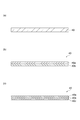
- 3A to 3C are cross-sectional views schematically showing the configuration of the inner layer.
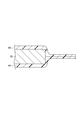
- FIG. 4 is a cross-sectional view taken along the line IV-IV shown in FIG. 1, and is a view schematically showing the configuration of the tab (resin film for terminal and metal terminal) of the all-solid-state battery.
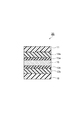
- 5A to 5C are cross-sectional views schematically showing the configuration of the terminal resin film.
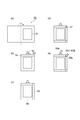
- FIGS. 6A to 6E are schematic diagrams for explaining a method of manufacturing an evaluation sample in Examples and Comparative Examples.
- FIG. 1 is a perspective view illustrating a schematic configuration of a power storage device according to the present embodiment.
- FIG. 1 illustrates an all-solid-state battery as an example of the power storage device 100, and the following description will be given.
- the power storage device having the structure illustrated in FIG. 1 is sometimes referred to as a battery pack or a battery cell.
- the power storage device 100 is an all-solid-state battery, and includes a power storage device main body 10, an exterior material 20, a pair of metal terminals 30 (current extraction terminals), and a terminal resin film 40 (tab sealant).
- the power storage device main body 10 is a battery main body that performs charging and discharging.
- the exterior member 20 is arranged so as to cover the surface of the power storage device main body 10 and to contact a part of the terminal resin film 40.
- FIG. 2 is a cross-sectional view illustrating an example of a cut surface of the exterior material 20.
- the exterior material 20 is, from the outside toward the inside (the power storage device main body 10 side), a base layer 11, a first adhesive layer 12a, a first corrosion prevention treatment layer 13a, and a barrier layer (metal foil layer). 15, a second corrosion prevention treatment layer 13b, a second adhesive layer 12b, and an inner layer 18 in this order.
- the inner layer 18 contains PET and / or its copolymer and has a melting peak temperature in the range of 160 to 280 ° C., for example, the power storage device 100 (all-solid-state battery) used under a temperature condition of 100 to 150 ° C.
- the exterior material 20 can achieve the heat resistance required for the exterior material of (2).
- the PET copolymer means a copolymer containing a unit of polyethylene terephthalate and a unit of another resin.
- Other resins include, for example, polybutylene terephthalate.
- the inner layer 18 contains polyethylene terephthalate (PET) and / or its copolymer and has a melting peak temperature in the range of 160 to 280 ° C.
- the base layer 11 preferably has a melting peak temperature higher than the melting peak temperature of the inner layer 18. Since the base layer 11 has a melting peak temperature higher than the melting peak temperature of the inner layer 18, it is possible to suppress the appearance from being deteriorated due to the melting of the base layer 11 (outer layer) during heat sealing. .
- the inner layer 18 and the base material layer 11 will be described.
- a commercially available crystalline PET film (melting peak temperature: about 255 ° C.) can be used.
- the melting peak temperature of the inner layer 18 may be adjusted within the above range according to the heat resistance required for the inner layer 18 (such as the operating temperature condition of the power storage device 100). For example, the crystallinity of the crystalline PET film is adjusted. Or non-stretched, a copolymer containing units of polyethylene terephthalate and units of other resins, or a PET film containing crystalline PET and amorphous PET may be used. . Alternatively, a polyester resin based on the PET component may be used as the material of the inner layer 18.
- Such a polyester resin has a structural unit derived from ethylene glycol and a structural unit derived from terephthalic acid, and other structural units.
- the dihydric alcohol component from which the structural unit of the polyester resin is derived include neopentyl glycol, 1,4-butadiol, diethylene glycol, and the like.
- the acid component from which the structural unit of the polyester resin is derived include isophthalic acid, adipic acid, sebacic acid, and the like. By adjusting the amounts of these structural units, the melting point of the polyester resin can be adjusted.
- the polyester-based resin based on the PET copolymer and the PET component is referred to as a PET-based resin.
- the melting peak temperature of the inner layer 18 is in the range of 160 to 280 ° C. as described above. If this temperature is lower than 160 ° C., the heat resistance of the inner layer 18 becomes insufficient, and if it exceeds 280 ° C., the temperature required for heat sealing becomes excessively high.
- the lower limit of the melting peak temperature of the inner layer 18 may be 165 ° C, 175 ° C, 185 ° C, 195 ° C, 200 ° C, 205 ° C, 215 ° C, 225 ° C or 235 ° C.
- the upper limit of the melting peak temperature of the inner layer 18 may be 275 ° C, 268 ° C, 262 ° C, or 252 ° C.
- the inner layer 18 may have a single-layer structure or a multilayer structure. As shown in FIG. 3A, when the inner layer 18 has a single-layer structure, the inner layer 18 may be, for example, a crystalline PET film (melting peak temperature: about 255 ° C.) or a crystalline PET film. May be adjusted, the non-stretched material may be adjusted, or the melting peak temperature may be lowered to a range of, for example, 160 to 250 ° C. by using a PET resin. When a PET film or a PET-based resin film having a lowered melting peak temperature is used as the inner layer 18, a crystalline PET film (melting peak temperature: about 255 ° C.) can be used as the base layer 11. It is.
- a crystalline PET film melting peak temperature: about 255 ° C.
- the thickness of the inner layer 18 is preferably 10 to 100 ⁇ m, and more preferably 20 to 80 ⁇ m.
- the thickness of the inner layer 18 is 10 ⁇ m or more, it is easy to secure sealing and insulating properties, and when it is 100 ⁇ m or less, cost can be reduced.
- the inner layer 18 may have a two-layer structure including a first layer 18a and a second layer 18b formed on a surface inside the first layer 18a.
- the first layer 18a preferably contains PET and / or PET-based resin and has a melting peak temperature of 170 to 280 ° C.
- the second layer 18b preferably contains PET and / or PET-based resin and has a lower melting peak temperature than the melting peak temperature of the first layer 18a.
- the melting peak temperature of the second layer 18b may be, for example, in the range of 160 to 270 ° C.
- Differences in melting peak temperature T B of the first and the melting peak temperature T A of the layer 18a a second layer 18b is a preferably at 10 ° C. or higher, more preferably 20 ⁇ 100 ° C. is there. When the temperature difference is 10 ° C. or more, more excellent sealing strength can be achieved.
- the thickness of the first layer 18a is preferably 5 to 500 ⁇ m, more preferably 20 to 200 ⁇ m. When the thickness of the first layer 18a is 5 ⁇ m or more, it is easy to secure insulation, and when it is 500 ⁇ m or less, cost can be reduced.
- the second layer 18b may contain a thermosetting resin instead of PET and / or PET resin, or may be made of PET and / or PET resin and thermosetting resin. It may contain both curable resins.
- the thermosetting resin include polyimide resin, phenol resin, urea resin, melamine resin, unsaturated polyester resin, urethane resin, allyl resin, epoxy resin, furan resin and silicone resin. Of these, one type may be used alone, or two or more types may be used in combination.
- the thickness of the second layer 18b is preferably 5-500 ⁇ m, more preferably 20-200 ⁇ m. When the thickness of the second layer 18b is 5 ⁇ m or more, it is easy to secure sealing performance, and when it is 500 ⁇ m or less, cost reduction can be achieved.
- the inner layer 18 has a first layer 18a, a second layer 18b, and a surface of the first layer 18a opposite to the side on which the second layer 18b is formed. May have a three-layer structure having the third layer 18c formed on the third layer.
- the third layer 18c comprises PET and has a lower melting peak temperature than the melting peak temperature of the first layer 18a.
- the melting peak temperature of the third layer 18c may be, for example, in the range of 160 to 270 ° C.
- Differences in melting peak temperature T C of the first and the melting peak temperature T A of the layer 18a third layer 18c (T A -T C) is preferably 10 ° C. or higher. When the temperature difference is 10 ° C. or more, more excellent sealing strength can be achieved.
- the third layer 18c may contain a thermosetting resin instead of PET and / or PET resin, or may be made of PET and / or PET resin and thermosetting resin. It may contain both curable resins.
- the thermosetting resin include polyimide resin, phenol resin, urea resin, melamine resin, unsaturated polyester resin, urethane resin, allyl resin, epoxy resin, furan resin and silicone resin. Of these, one type may be used alone, or two or more types may be used in combination.
- the thickness of the third layer 18c is preferably 5 to 500 ⁇ m, and more preferably 20 to 200 ⁇ m. When the thickness of the third layer 18c is 5 ⁇ m or more, high sealing strength can be easily secured, and when it is 500 ⁇ m or less, cost reduction can be achieved.
- the above-described second layer 18b and third layer 18c may have the same configuration or different configurations.
- the inner layer 18 may include, for example, various additives (for example, a flame retardant, a slip agent, an antiblocking agent, an antioxidant, a light stabilizer, a tackifier, and the like).
- the base material layer 11 has a melting peak temperature higher than the melting peak temperature of the inner layer 18 as described above.
- the melting peak temperature of the inner layer 18 means the melting peak temperature of the layer having the highest melting peak temperature (for example, the first layer 18a).
- the melting peak temperature of the base material layer 11 is preferably higher than the melting peak temperature of the inner layer 18 by 10 ° C. or more, more preferably 30 ° C. or more.
- the resin film that can be used as the base material layer 11 and have a melting peak temperature in the above range include a nylon film, a PET film, a polyamide film, and a polyphenylene sulfide film (PPS film).
- the base layer 11 a commercially available film may be used, or the base layer 11 may be formed by coating (application and drying of a coating liquid).
- the base layer 11 may have a single-layer structure or a multi-layer structure, and may be formed by applying a thermosetting resin.
- the base material layer 11 may include, for example, various additives (for example, a flame retardant, a slip agent, an anti-blocking agent, an antioxidant, a light stabilizer, a tackifier, and the like).
- Differences in melting peak temperature T 18 of the melting peak temperature T 11 and the inner layer 18 of the substrate layer 11 is preferably at 20 ° C. or higher, more preferably 40 ⁇ 100 ° C..
- the thickness of the base material layer 11 is preferably 5 to 50 ⁇ m, and more preferably 12 to 30 ⁇ m.
- first adhesive layer 12a the first corrosion prevention treatment layer 13a, the barrier layer (metal foil layer) 15, the second corrosion prevention treatment layer 13b, and the second adhesion layer 12b will be described. These layers have the same or higher heat resistance as the inner layer 18 and the base layer 11 described above.
- the adhesive layers 12a and 12b only need to have sufficient heat resistance.
- known adhesives such as a general adhesive for dry lamination, an acid-modified heat-fusible resin, and a thermosetting adhesive can be used.
- An adhesive can be appropriately selected and used.
- the thermosetting adhesive include a polyester urethane adhesive and an epoxy adhesive.
- the barrier layer 15 is a metal layer having conductivity.
- a material of the barrier layer 15 for example, aluminum, stainless steel, or the like can be exemplified. However, aluminum is preferable in terms of cost, weight (density), and the like.
- the corrosion prevention treatment layers 13a and 13b are for protecting the barrier layer 15.
- a layer containing a rare earth element oxide (for example, cerium oxide) and phosphoric acid or phosphate may be mentioned.
- FIG. 4 is a cross-sectional view of the terminal resin film and the metal terminal shown in FIG. 1 taken along the line IV-IV.
- One of the pair of (two in FIG. 1) metal terminals 30, 30 is electrically connected to the positive electrode of the power storage device main body 10, and the other metal terminal 30 is connected to the power storage device. It is electrically connected to the negative electrode of the main body 10.
- the pair of metal terminals 30 extends from the power storage device main body 10 to the outside of the exterior material 20.
- the shape of the pair of metal terminals 30, 30 can be, for example, a flat plate shape.
- a metal can be used as the material of the metal terminal 30.
- the metal used as the material of the metal terminal 30 may be determined in consideration of the structure of the power storage device main body 10, the material of each component of the power storage device main body 10, and the like. For example, when power storage device 100 is an all-solid-state battery, it is preferable to use aluminum as the material of metal terminal 30 connected to the positive electrode of power storage device main body 10. As a material of the metal terminal 30 connected to the negative electrode of the power storage device main body 10, it is preferable to use copper having a nickel plating layer formed on the surface or nickel.
- the thickness of the metal terminal 30 depends on the size and capacity of the all-solid-state battery. When the all-solid-state battery is small, the thickness of the metal terminal 30 may be, for example, 50 ⁇ m or more. In the case of a large all-solid-state battery for power storage and in-vehicle use, the thickness of the metal terminal 30 can be appropriately set within a range of, for example, 100 to 500 ⁇ m.
- the terminal resin film 40 is arranged so as to cover a part of the outer peripheral surface of the metal terminal 30.
- the terminal resin film 40 has the same or higher heat resistance as the inner layer 18 and the base layer 11 described above.
- the terminal resin film 40 is made of a resin composition having adhesiveness to the metal terminal 30, and the resin composition is formed of at least one of a thermosetting resin and a thermoplastic resin having a melting peak temperature (melting point) of 160 ° C. or more. It does not contain a thermoplastic resin having a melting peak temperature of less than 160 ° C. According to the terminal resin film 40 having such a configuration, even if the power storage device is used under a temperature condition of, for example, 100 to 150 ° C., the temperature of the metal terminal 30 reaches, for example, 100 to 150 ° C. However, the power storage device 100 can be sufficiently sealed.
- the resin composition contains at least one of a thermosetting resin and a thermoplastic resin having a melting peak temperature (melting point) of 200 ° C. or more, and does not contain a thermoplastic resin having a melting peak temperature of less than 200 ° C. You may.
- thermosetting resin used for the terminal resin film 40 is selected from the group consisting of polyimide resin, phenol resin, urea resin, melamine resin, unsaturated polyester resin, urethane resin, allyl resin, epoxy resin, furan resin and silicone resin. At least one kind of resin to be used. These thermosetting resins have excellent adhesion to metal materials (for example, aluminum and nickel) forming the surface of the metal terminal 30 and also have excellent heat resistance.
- thermoplastic resin used for the terminal resin film 40 examples include PET, the above-mentioned PET resin, nylon, polyvinyl alcohol resin, polyvinylidene chloride, polyamide resin, polybutylene terephthalate resin, polyphenylene sulfide, polyetherimide, polysulfone, and fluorine. At least one resin selected from the group consisting of resin, polyamideimide and acetyl cellulose may be employed. These thermoplastic resins have excellent adhesion to metal materials (for example, aluminum and nickel) constituting the surface of the metal terminal 30, and also have excellent heat resistance.
- metal materials for example, aluminum and nickel
- the terminal resin film 40 may have a single-layer structure or a multilayer structure.
- the resin composition constituting the terminal resin film 40 is made of PET, the above-mentioned PET-based resin, polyphenylene sulfide, urethane resin, and epoxy resin. It is preferably a kind of thermoplastic resin selected from the group consisting of and / or a kind of thermosetting resin selected from the group consisting of urethane resin and epoxy resin.
- the terminal resin film 40 may be made of PET and / or PET resin having a melting peak temperature of 170 to 270 ° C. or polyphenylene sulfide (PPS) having a melting peak temperature of 260 to 300 ° C. ) And a second layer made of a thermosetting resin or a thermoplastic resin having a melting peak temperature of 160 to 270 ° C. formed on the surface of the first layer 40 a facing the metal terminal 30. (See FIG. 5B).
- PET and / or PET-based resin or PPS having a sufficiently high melting peak temperature as a resin constituting the first layer 40a, the first layer 40a does not melt during heat sealing. Excellent insulation can be achieved.
- the melting peak temperature of PET or PET-based resin constituting the first layer 40a may be 210 ° C. or higher.
- the melting peak temperature of PET or PET-based resin constituting the second layer 40b may be 200 ° C. or higher.
- Differences in melting peak temperature S B of the first melting peak temperature of the layer 40a S A and the second layer 40b (S A -S B) is a preferably at 10 ° C. or higher, more preferably 20 ⁇ 100 ° C. is there. When this temperature difference is 10 ° C. or more, excellent insulation of the metal terminal 30 can be achieved.
- the thickness of the first layer 40a is preferably 5 to 500 ⁇ m, more preferably 20 to 200 ⁇ m. When the thickness of the first layer 40a is 5 ⁇ m or more, insulation can be easily ensured, and when it is 500 ⁇ m or less, cost can be reduced.
- the thickness of the second layer 40b is preferably from 5 to 500 ⁇ m, more preferably from 20 to 200 ⁇ m. When the thickness of the second layer 40b is 5 ⁇ m or more, it is easy to secure sealing performance, and when it is 500 ⁇ m or less, cost reduction can be achieved.
- the terminal resin film 40 When the terminal resin film 40 has a multilayer structure including the first and second layers 40a and 40b, the terminal resin film 40 is formed on the surface of the first layer 40a opposite to the side on which the second layer 40b is formed.
- a third layer 40c may be further provided (see FIG. 5C).
- the third layer 40c can be made of a thermosetting resin or a thermoplastic resin having a melting peak temperature of 160 to 270 ° C.
- the first layer 40a is made of a thermosetting resin
- a thermosetting resin having higher fluidity than the thermosetting resin forming the first layer 40a As the second layer 40b, excellent adhesion to the metal terminal 30 can be achieved by the second layer 40b during heat sealing.
- a thermosetting resin having higher fluidity than the thermosetting resin forming the first layer 40a may be employed as the third layer 40c. With such a structure, the power storage device 100 with more excellent sealing performance can be obtained.
- the thickness of the third layer 40c is preferably 5 to 500 ⁇ m, and more preferably 20 to 200 ⁇ m. When the thickness of the third layer 40c is 5 ⁇ m or more, it is easy to secure sealing performance, and when it is 500 ⁇ m or less, cost reduction can be achieved.
- an electric solid-state battery is illustrated as the power storage device to which the terminal resin film 40 is applied, but the terminal resin film 40 is applied to another power storage device (for example, a lithium ion battery) or a power generation device. May be applied.
- a base material layer As a base material layer, a high heat-resistant polyamide film having a melting peak temperature of 300 ° C. (manufactured by Unitika Ltd., thickness: 25 ⁇ m) was prepared. An aluminum foil (thickness: 40 ⁇ m) was prepared as a metal foil layer. As the inner layer, a PET film (thickness: 75 ⁇ m, single layer structure) having a melting peak temperature of 255 ° C. was prepared. The base material layer and the metal foil layer are bonded together with a thermosetting adhesive (polyester urethane), and the metal foil layer and the inner layer are bonded together with the same adhesive to form an exterior material having sufficient heat resistance. Obtained.
- a thermosetting adhesive polyyester urethane
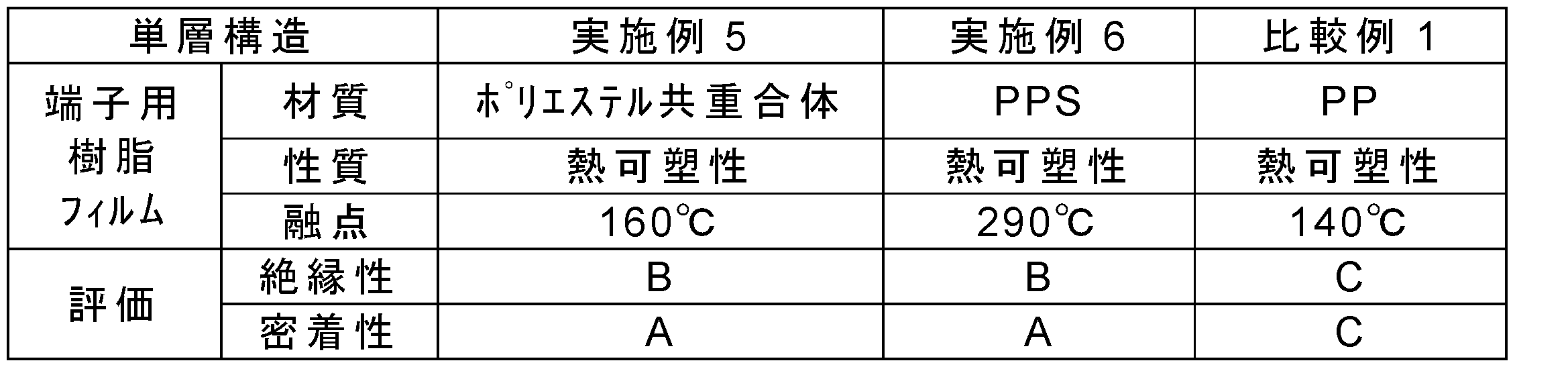
- Example 1 ⁇ Preparation of terminal resin film (single-layer structure)> (Example 1) An epoxy resin film (thickness: 100 ⁇ m) was prepared as a terminal resin film (single-layer structure).
- Example 2 A urethane resin film (thickness: 100 ⁇ m) was prepared as a terminal resin film (single-layer structure).
- Example 3 A nylon film (thickness: 100 ⁇ m, melting point: 225 ° C.) was prepared as a terminal resin film (single-layer structure).
- Example 4 A PET film (thickness: 100 ⁇ m, melting point: 255 ° C.) was prepared as a terminal resin film (single-layer structure).
- Example 5 As the terminal resin film (single-layer structure), a polyester copolymer film (thickness: 100 ⁇ m, melting point: 160 ° C.) was used.
- Example 6 A PPS film (thickness: 100 ⁇ m, melting point: 290 ° C.) was prepared as a terminal resin film (single-layer structure).
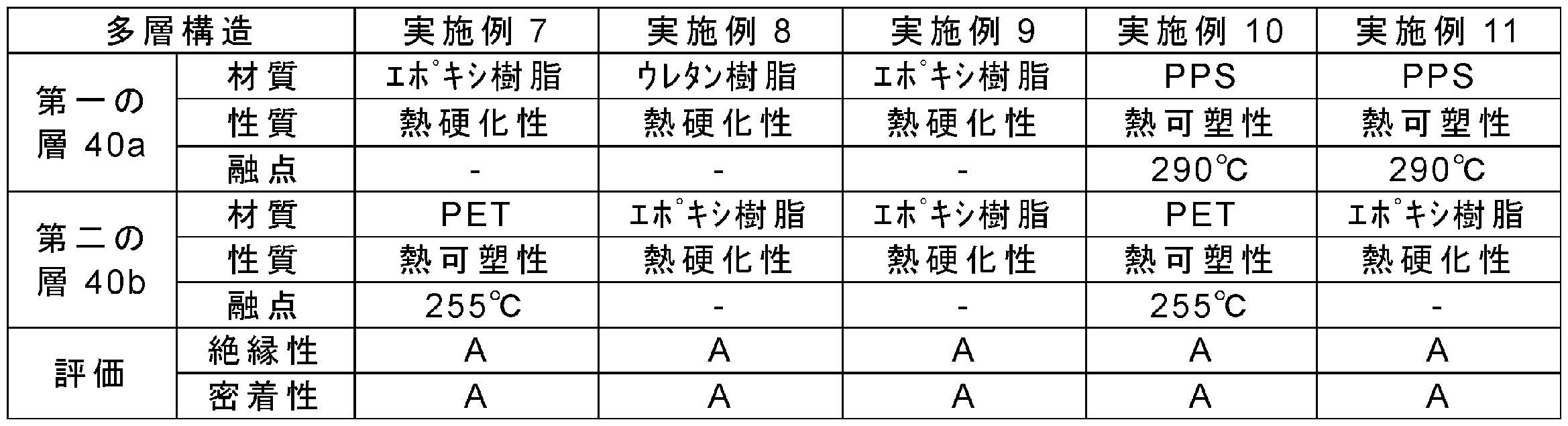
- Example 8 By bonding the following films, a terminal resin film having a two-layer structure including a first layer and a second layer was produced.
- First layer urethane resin film (thickness: 50 ⁇ m)
- Second layer epoxy resin film (thickness: 50 ⁇ m)
- Example 9 By bonding the following films, a terminal resin film having a two-layer structure including a first layer and a second layer was produced.
- First layer Epoxy resin film (thickness: 50 ⁇ m)
- Second layer epoxy resin film (thickness: 50 ⁇ m)
- Example 11 By bonding the following films, a terminal resin film having a two-layer structure including a first layer and a second layer was produced.
- First layer PPS film (thickness: 50 ⁇ m, melting point: 290 ° C.)
- Second layer epoxy resin film (thickness: 50 ⁇ m)
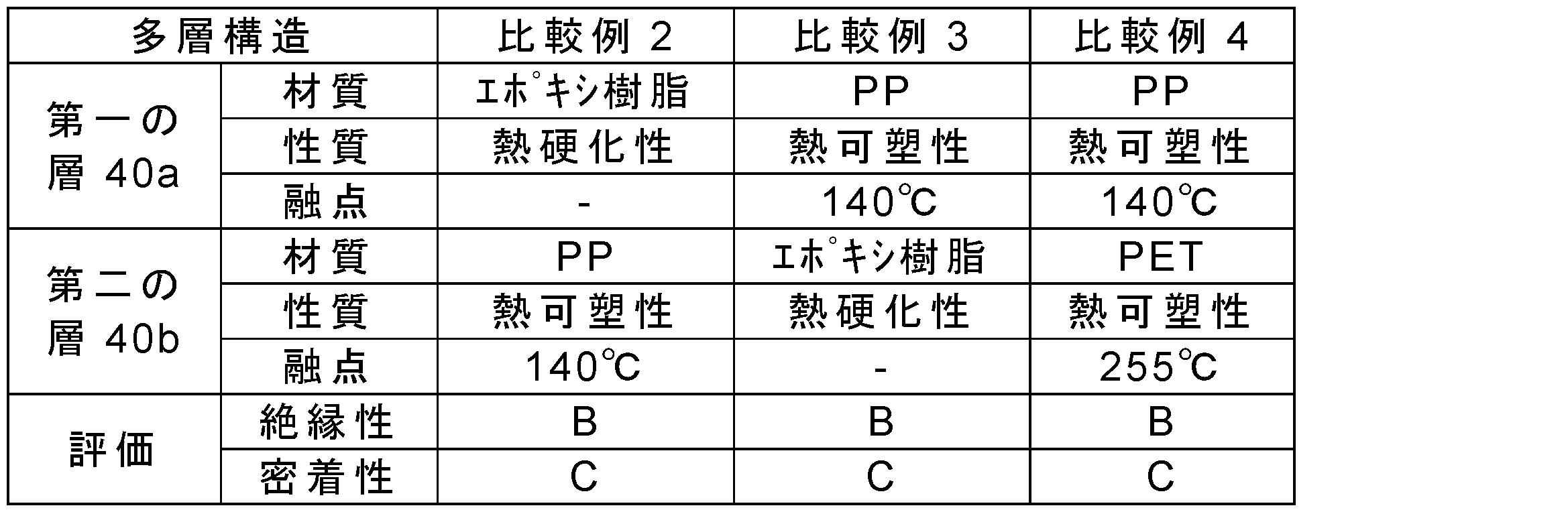
- a terminal resin film having a two-layer structure including a first layer and a second layer was produced.
- First layer PP film (thickness: 50 ⁇ m, melting point: 140 ° C.)
- Second layer epoxy resin film (thickness: 50 ⁇ m)
- the sample 50 having the outer material cut into 120 mm x 200 mm was set in a cold molding die so that the inner layer was in contact with the convex portion of the molding machine, and subjected to a 2.0 mm drawing process at a molding speed of 15 mm / sec to form a concave portion. 51 were formed. Thereafter, the sample 50 was folded in two (see FIG. 6A). Next, the upper side portion 54 of 100 mm was heat-sealed while the metal terminal 52 (material: aluminum) was sandwiched between the terminal resin films 53 according to Examples and Comparative Examples (see FIG.
- a terminal resin film having excellent heat resistance is provided.
- SYMBOLS 10 Power storage device main body, 20 ... Exterior material, 30 ... Metal terminal (current extraction terminal), 40 ... Terminal resin film, 40a ... First layer, 40b ... Second layer, 40c ... Third layer, 100 ... Power storage device
Landscapes
- Chemical & Material Sciences (AREA)
- Chemical Kinetics & Catalysis (AREA)
- Electrochemistry (AREA)
- General Chemical & Material Sciences (AREA)
- Organic Chemistry (AREA)
- Engineering & Computer Science (AREA)
- Materials Engineering (AREA)
- Life Sciences & Earth Sciences (AREA)
- Wood Science & Technology (AREA)
- Inorganic Chemistry (AREA)
- Manufacturing & Machinery (AREA)
- Health & Medical Sciences (AREA)
- Medicinal Chemistry (AREA)
- Polymers & Plastics (AREA)
- Sealing Battery Cases Or Jackets (AREA)
- Laminated Bodies (AREA)
- Electric Double-Layer Capacitors Or The Like (AREA)
- Physics & Mathematics (AREA)
- Condensed Matter Physics & Semiconductors (AREA)
- General Physics & Mathematics (AREA)
Abstract
Description
図1は、本実施形態に係る蓄電装置の概略構成を示す斜視図である。図1では、蓄電装置100の一例として、全固体電池を例に挙げて図示し、以下の説明を行う。なお、図1に示す構成の蓄電装置は、電池パック又は電池セルと呼ばれることがある。
図2は、外装材20の切断面の一例を示す断面図である。外装材20は、外側から内側(蓄電装置本体10側)に向けて、基材層11と、第一の接着層12aと、第一の腐食防止処理層13aと、バリア層(金属箔層)15と、第二の腐食防止処理層13bと、第二の接着層12bと、内層18とをこの順序で備える多層構造を有することが好ましい。内層18がPET及び/又はその共重合体を含み且つ160~280℃の範囲に融解ピーク温度を有することで、例えば、100~150℃の温度条件下で使用される蓄電装置100(全固体電池)の外装材に求められる耐熱性を外装材20が達成し得る。なお、本開示においてPETの共重合体は、ポリエチレンテレフタラートの単位と、他の樹脂の単位とを含む共重合体を意味する。他の樹脂として、例えば、ポリブチレンテレフタラートが挙げられる。
図4は、図1に示す端子用樹脂フィルム及び金属端子のIV-IV線方向の断面図である。一対(図1の場合、2つ)の金属端子30,30のうち、一方の金属端子30は、蓄電装置本体10の正極と電気的に接続されており、他方の金属端子30は、蓄電装置本体10の負極と電気的に接続されている。一対の金属端子30,30は、蓄電装置本体10から外装材20の外部まで延びている。一対の金属端子30,30の形状は、例えば、平板形状とすることができる。
図4に示すように、端子用樹脂フィルム40は、金属端子30の一部の外周面を覆うように配置されている。金属端子30と外装材20との間に端子用樹脂フィルム40を配置されることで、蓄電装置100の密封性及び絶縁性をより一層高度に達成することができる。端子用樹脂フィルム40は、上述の内層18及び基材層11と同等又はこれを越える耐熱性を有する。
基材層として、融解ピーク温度が300℃の高耐熱ポリアミドフィルム(ユニチカ株式会社製、厚さ:25μm)を準備した。金属箔層として、アルミニウム箔(厚さ:40μm)を準備した。内層として、融解ピーク温度が255℃のPETフィルム(厚さ:75μm、単層構造)を準備した。基材層と金属箔層とを熱硬化性接着剤(ポリエステルウレタン系)で貼り合わせるとともに、これと同じ接着剤で金属箔層と内層とを貼り合わせることによって十分に耐熱性を有する外装材を得た。
(実施例1)
端子用樹脂フィルム(単層構造)として、エポキシ樹脂フィルム(厚さ:100μm)を準備した。
端子用樹脂フィルム(単層構造)として、ウレタン樹脂フィルム(厚さ:100μm)を準備した。
端子用樹脂フィルム(単層構造)として、ナイロンフィルム(厚さ:100μm、融点:225℃)を準備した。
端子用樹脂フィルム(単層構造)として、PETフィルム(厚さ:100μm、融点:255℃)を準備した。
端子用樹脂フィルム(単層構造)として、ポリエステル共重合体フィルム(厚さ:100μm、融点160℃)を使用した。
端子用樹脂フィルム(単層構造)として、PPSフィルム(厚さ:100μm、融点:290℃)を準備した。
端子用樹脂フィルム(単層構造)として、PPフィルム(厚さ:100μm、融点:140℃)を準備した。
(実施例7)
以下のフィルムを貼り合わせることにより、第一の層及び第二の層からなる二層構造の端子用樹脂フィルムを作製した。
・第一の層:エポキシ樹脂フィルム(厚さ:50μm)
・第二の層:PETフィルム(厚さ:50μm、融点:255℃)
以下のフィルムを貼り合わせることにより、第一の層及び第二の層からなる二層構造の端子用樹脂フィルムを作製した。
・第一の層:ウレタン樹脂フィルム(厚さ:50μm)
・第二の層:エポキシ樹脂フィルム(厚さ:50μm)
以下のフィルムを貼り合わせることにより、第一の層及び第二の層からなる二層構造の端子用樹脂フィルムを作製した。
・第一の層:エポキシ樹脂フィルム(厚さ:50μm)
・第二の層:エポキシ樹脂フィルム(厚さ:50μm)
以下のフィルムを貼り合わせることにより、第一の層及び第二の層からなる二層構造の端子用樹脂フィルムを作製した。
・第一の層:PPSフィルム(厚さ:50μm、融点:290℃)
・第二の層:PETフィルム(厚さ:50μm、融点:255℃)
以下のフィルムを貼り合わせることにより、第一の層及び第二の層からなる二層構造の端子用樹脂フィルムを作製した。
・第一の層:PPSフィルム(厚さ:50μm、融点:290℃)
・第二の層:エポキシ樹脂フィルム(厚さ:50μm)
以下のフィルムを貼り合わせることにより、第一の層及び第二の層からなる二層構造の端子用樹脂フィルムを作製した。
・第一の層:エポキシ樹脂フィルム(厚さ:50μm)
・第二の層:PPフィルム(厚さ:50μm、融点:140℃)
以下のフィルムを貼り合わせることにより、第一の層及び第二の層からなる二層構造の端子用樹脂フィルムを作製した。
・第一の層:PPフィルム(厚さ:50μm、融点:140℃)
・第二の層:エポキシ樹脂フィルム(厚さ:50μm)
以下のフィルムを貼り合わせることにより、第一の層及び第二の層からなる二層構造の端子用樹脂フィルムを作製した。
・第一の層:PPフィルム(厚さ:50μm、融点:140℃)
・第二の層:PETフィルム(厚さ:50μm、融点:255℃)
図6(a)~図6(e)を参照しながら、電流取出し端子に対する密着性の評価方法を説明する。外装材を120mm×200mmにカットしたサンプル50を、内層が成型機の凸部に接するように冷間成型用金型にセットし、成型速度15mm/秒で2.0mmの絞り加工を施して凹部51を形成した。その後、サンプル50を2つ折りにした(図6(a)参照)。次いで、金属端子52(材質:アルミニウム)と実施例及び比較例に係る各端子用樹脂フィルム53とを間に挟んだ状態で100mmの上辺部54をヒートシールした(図6(b)参照)。その後、120mmの側辺部55及び100mmの下辺部56をヒートシールした(図6(c)参照)。電極を接触させるために、サンプル50の外層の一部を削って金属箔層の露出部57を形成した(図6(d)参照)。次いで、60℃のオーブンに1週間保管した後、タブ52と金属箔層の露出部57に電極58a,58bをそれぞれ接続し、耐電圧・絶縁抵抗試験器(KIKUSUI製、「TOS9201」)を用いて25Vを印加し、そのときの抵抗値を測定した(図6(e)参照)。
A:200MΩ以上
B: 30MΩ以上200MΩ未満
C: 30MΩ未満
金属箔層の露出部46を形成しなかったことの他は、上記絶縁性の評価と同様にして測定用試料を作製した。実施例及び比較例に係る各試料における電流取出し端子と端子用フィルムの接合部に赤色の浸透液(株式会社タセト製)を吹きかけた。10分経過後、試料を解体して内部への浸透液の浸入の有無(赤色の程度)を目視で確認することによって密着性の評価を行った。評価は以下の基準に従って行い、評価Cを不適とした。表1~4に結果を示す。
A:浸透液の浸入が認められない。
B:浸透液のパッケージ内部への浸入は認められないものの、電流取出し端子と端子用フィルムの接合部の途中まで浸透液が浸入している。
C:浸透液の浸入によってパッケージ内部の一部が赤色に染まっている。

Claims (14)
- 蓄電装置及び発電装置の少なくとも一方において電流取出し端子をシールするために使用される端子用樹脂フィルムであって、
前記電流取出し端子に対する密着性を有する樹脂組成物からなり、
前記樹脂組成物は、熱硬化性樹脂及び融点が160℃以上の熱可塑性樹脂の少なくとも一方を含み、且つ、融点が160℃未満の熱可塑性樹脂を含まない、端子用樹脂フィルム。 - 前記蓄電装置が全固体電池である、請求項1に記載の端子用樹脂フィルム。
- 前記熱硬化性樹脂がポリイミド樹脂、フェノール樹脂、ユリア樹脂、メラミン樹脂、不飽和ポリエステル樹脂、ウレタン樹脂、アリル樹脂、エポキシ樹脂、フラン樹脂及びシリコーン樹脂からなる群より選択される少なくとも一種の樹脂であり、
前記熱可塑性樹脂がポリエステル系樹脂、ナイロン、ポリビニルアルコール樹脂、ポリ塩化ビニリデン、ポリアミド樹脂、ポリブチレンテレフタレート樹脂、ポリフェニレンスルファイド、ポリエーテルイミド、ポリスルフォン、フッ素樹脂、ポリアミドイミド及びアセチルセルロースからなる群より選択される少なくとも一種の樹脂である、請求項1又は2に記載の端子用樹脂フィルム。 - 前記樹脂組成物からなる単層構造である、請求項1~3のいずれか一項に記載の端子用樹脂フィルム。
- 前記樹脂組成物がポリエステル系樹脂、ポリフェニレンスルファイド、ウレタン樹脂及びエポキシ樹脂からなる群より選ばれる一種の樹脂である、請求項4に記載の端子用樹脂フィルム。
- 融点が170~280℃のポリエステル系樹脂及び融点が260~290℃のポリフェニレンスルファイドの一方からなる第一の層と、
熱硬化性樹脂及び融点が160~280℃の熱可塑性樹脂の一方からなる第二の層と、
を備える多層構造を有し、
前記第二の層は前記第一の層の前記電流取出し端子と対面する側の表面に形成されている、請求項1~3のいずれか一項に記載の端子用樹脂フィルム。 - 前記第一の層は、ポリエチレンテレフタラートからなり、
前記第二の層は、融点が低温化されたポリエチレンテレフタラートからなる、請求項6に記載の端子用樹脂フィルム。 - 融点が低温化された前記ポリエチレンテレフタラートは、エチレングリコールに由来する構造単位及びテレフタル酸に由来する構造単位と、その他の構造単位とを含み、
前記その他の構造単位の由来となる二価アルコール成分がネオペンチルグリコール、1,4-ブタジオール及びジエチレングリコールからなる群から選ばれる少なくとも一種である、請求項7に記載の端子用樹脂フィルム。 - 融点が低温化された前記ポリエチレンテレフタラートは、エチレングリコールに由来する構造単位及びテレフタル酸に由来する構造単位と、その他の構造単位とを含み、
前記その他の構造単位の由来となる酸成分がイソフタル酸、アジピン酸及びセバシン酸からなる群から選ばれる少なくとも一種である、請求項7又は8に記載の端子用樹脂フィルム。 - 前記第一の層の融点SAと前記第二の層の融点SBとの差SA-SBが10℃以上である、請求項6~9のいずれか一項に記載の子用樹脂フィルム。
- 前記第一の層における前記第二の層が形成されている側と反対側の表面に形成された第三の層を更に備え、
前記第三の層が熱硬化性樹脂又は融点が160~280℃の熱可塑性樹脂からなる、請求項6~10のいずれか一項に記載の端子用樹脂フィルム。 - 熱硬化性樹脂からなる第一の層と、
前記第一の層の少なくとも一方の表面に形成された熱硬化性樹脂層と、
を備える多層構造であり、
前記熱硬化性樹脂層は、前記第一の層を構成する前記熱硬化性樹脂よりも流動性が高い、請求項1~3のいずれか一項に記載の端子用樹脂フィルム。 - 蓄電装置本体と、
前記蓄電装置本体から延在する電流取出し端子と、
前記電流取出し端子を挟持し且つ前記蓄電装置本体を収容する外装材と、
前記電流取出し端子と前記外装材と間に配置された、請求項1~12のいずれか一項に記載の端子用樹脂フィルムと、
を備える蓄電装置。 - 全固体電池である、請求項13に記載の蓄電装置。
Priority Applications (7)
| Application Number | Priority Date | Filing Date | Title |
|---|---|---|---|
| EP19827576.0A EP3817083A4 (en) | 2018-06-27 | 2019-06-25 | RESIN FILM FOR TERMINAL DEVICE AND ENERGY STORAGE DEVICE WITH RESIN FILM FOR TERMINAL DEVICE |
| CN202411274786.6A CN118943596A (zh) | 2018-06-27 | 2019-06-25 | 端子用树脂膜以及使用了该端子用树脂膜的蓄电装置 |
| KR1020207031935A KR102989350B1 (ko) | 2018-06-27 | 2019-06-25 | 단자용 수지 필름 및 이것을 사용한 축전 장치 |
| KR1020267021133A KR20260112248A (ko) | 2018-06-27 | 2019-06-25 | 단자용 수지 필름 및 이것을 사용한 축전 장치 |
| JP2020527553A JP7415921B2 (ja) | 2018-06-27 | 2019-06-25 | 端子用樹脂フィルム及びこれを用いた蓄電装置 |
| CN201980042072.3A CN112335102A (zh) | 2018-06-27 | 2019-06-25 | 端子用树脂膜以及使用了该端子用树脂膜的蓄电装置 |
| US17/110,862 US20210091435A1 (en) | 2018-06-27 | 2020-12-03 | Terminal coating resin film and power storage device using the same |
Applications Claiming Priority (2)
| Application Number | Priority Date | Filing Date | Title |
|---|---|---|---|
| JP2018121792 | 2018-06-27 | ||
| JP2018-121792 | 2018-06-27 |
Related Child Applications (1)
| Application Number | Title | Priority Date | Filing Date |
|---|---|---|---|
| US17/110,862 Continuation US20210091435A1 (en) | 2018-06-27 | 2020-12-03 | Terminal coating resin film and power storage device using the same |
Publications (1)
| Publication Number | Publication Date |
|---|---|
| WO2020004412A1 true WO2020004412A1 (ja) | 2020-01-02 |
Family
ID=68986716
Family Applications (1)
| Application Number | Title | Priority Date | Filing Date |
|---|---|---|---|
| PCT/JP2019/025221 Ceased WO2020004412A1 (ja) | 2018-06-27 | 2019-06-25 | 端子用樹脂フィルム及びこれを用いた蓄電装置 |
Country Status (6)
| Country | Link |
|---|---|
| US (1) | US20210091435A1 (ja) |
| EP (1) | EP3817083A4 (ja) |
| JP (1) | JP7415921B2 (ja) |
| KR (2) | KR102989350B1 (ja) |
| CN (2) | CN112335102A (ja) |
| WO (1) | WO2020004412A1 (ja) |
Cited By (14)
| Publication number | Priority date | Publication date | Assignee | Title |
|---|---|---|---|---|
| JPWO2020004412A1 (ja) * | 2018-06-27 | 2021-08-02 | 凸版印刷株式会社 | 端子用樹脂フィルム及びこれを用いた蓄電装置 |
| JPWO2021201213A1 (ja) * | 2020-04-02 | 2021-10-07 | ||
| WO2022014706A1 (ja) * | 2020-07-16 | 2022-01-20 | 大日本印刷株式会社 | 金属端子用接着性フィルム、金属端子用接着性フィルム付き金属端子、当該金属端子用接着性フィルムを用いた蓄電デバイス、及び蓄電デバイスの製造方法 |
| US11545709B2 (en) * | 2020-06-18 | 2023-01-03 | Samsung Sdi Co., Ltd. | Rechargeable battery |
| JPWO2023058735A1 (ja) * | 2021-10-06 | 2023-04-13 | ||
| WO2023112503A1 (ja) * | 2021-12-14 | 2023-06-22 | 株式会社村田製作所 | 外装材、ならびに固体電池および電子デバイス |
| JP7311076B1 (ja) * | 2022-01-19 | 2023-07-19 | 大日本印刷株式会社 | 金属端子用接着性フィルム及びその製造方法、金属端子用接着性フィルム付き金属端子、当該金属端子用接着性フィルムを用いた蓄電デバイス、金属端子用接着性フィルムと蓄電デバイス用外装材を含むキット、並びに蓄電デバイスの製造方法 |
| WO2023157391A1 (ja) | 2022-02-16 | 2023-08-24 | 株式会社クレハ | 全固体二次電池用外装材および全固体二次電池 |
| JP7355286B1 (ja) * | 2022-01-19 | 2023-10-03 | 大日本印刷株式会社 | 金属端子用接着性フィルム及びその製造方法、金属端子用接着性フィルム付き金属端子、当該金属端子用接着性フィルムを用いた蓄電デバイス、金属端子用接着性フィルムと蓄電デバイス用外装材を含むキット、並びに蓄電デバイスの製造方法 |
| JP2024026882A (ja) * | 2020-04-27 | 2024-02-28 | Toppanホールディングス株式会社 | 蓄電装置用端子フィルム及び蓄電装置 |
| EP4184637A4 (en) * | 2020-07-16 | 2024-08-14 | Dai Nippon Printing Co., Ltd. | Adhesive film for metal terminals of all-solid-state batteries, metal terminal with adhesive film for metal terminals, all-solid-state battery using said adhesive film for metal terminals, and method for producing all-solid-state battery |
| KR20240140087A (ko) | 2022-02-02 | 2024-09-24 | 도판 홀딩스 가부시키가이샤 | 전고체 전지의 단자용 수지 필름 및 전고체 전지 |
| WO2024218886A1 (ja) * | 2023-04-19 | 2024-10-24 | 藤森工業株式会社 | 封止フィルム、電極リード線部材および電池 |
| KR103000300B1 (ko) * | 2020-06-18 | 2026-08-04 | 삼성에스디아이 주식회사 | 이차 전지 |
Families Citing this family (5)
| Publication number | Priority date | Publication date | Assignee | Title |
|---|---|---|---|---|
| CN113097617A (zh) * | 2021-03-30 | 2021-07-09 | 宁德新能源科技有限公司 | 电化学装置和电子装置 |
| US20240283060A1 (en) * | 2021-06-17 | 2024-08-22 | Vehicle Energy Japan Inc. | Solid electrolyte battery, manufacturing method for solid electrolyte battery, and transportation apparatus |
| CN113604117A (zh) * | 2021-06-23 | 2021-11-05 | 杭州日耀涂料有限公司 | 一种热固性树脂制备方法 |
| CN117795743A (zh) * | 2021-08-16 | 2024-03-29 | 株式会社力森诺科包装 | 全固态电池用外装件及全固态电池 |
| CN220627729U (zh) | 2022-06-27 | 2024-03-19 | 米沃奇电动工具公司 | 熔断器及包括用于通过电流的导电路径的装置 |
Citations (11)
| Publication number | Priority date | Publication date | Assignee | Title |
|---|---|---|---|---|
| JPH11213965A (ja) | 1998-01-23 | 1999-08-06 | Asahi Chem Ind Co Ltd | 電池用外装体及び電池 |
| WO2000026976A1 (fr) * | 1998-10-30 | 2000-05-11 | Sony Corporation | Cellule d'electrolyse non-aqueuse et son procede de production |
| JP2002025535A (ja) * | 2000-07-07 | 2002-01-25 | At Battery:Kk | 電 池 |
| JP2008004316A (ja) | 2006-06-21 | 2008-01-10 | Kyoritsu Kagaku Sangyo Kk | シールフィルム付きリード線部材の製造方法 |
| JP2009259739A (ja) | 2008-04-21 | 2009-11-05 | Sumitomo Electric Ind Ltd | 電気部品、非水電解質電池、並びに、それらに用いられるリード線及び封入容器 |
| JP2010218766A (ja) | 2009-03-13 | 2010-09-30 | Sumitomo Electric Ind Ltd | リード導体の把持方法、リード部材の製造方法および製造に用いられる固定治具 |
| KR20160060526A (ko) * | 2014-11-20 | 2016-05-30 | 주식회사 폴 | 이차전지의 리드탭용 실부재 |
| JP2016129105A (ja) * | 2015-01-09 | 2016-07-14 | 古河電気工業株式会社 | タブリード |
| JP2017120790A (ja) | 2015-12-29 | 2017-07-06 | 大日本印刷株式会社 | 蓄電デバイス金属端子部密封用接着性フィルム |
| JP2018045163A (ja) | 2016-09-16 | 2018-03-22 | 株式会社ユポ・コーポレーション | 電子写真用記録用紙およびそれを用いた記録物 |
| WO2018150997A1 (ja) | 2017-02-15 | 2018-08-23 | 東洋紡株式会社 | ポリエステル系シーラントフィルム、積層体及び包装体 |
Family Cites Families (19)
| Publication number | Priority date | Publication date | Assignee | Title |
|---|---|---|---|---|
| JP2004515879A (ja) * | 2000-02-10 | 2004-05-27 | 日本特殊陶業株式会社 | シールドされたリードを備えたリチウムイオン電池及び/又はリチウムイオンポリマー電池 |
| JP2002245988A (ja) * | 2001-02-20 | 2002-08-30 | At Battery:Kk | 薄型電池 |
| JP3484695B2 (ja) | 2002-04-15 | 2004-01-06 | 東洋紡績株式会社 | ポリエステル系樹脂積層フィルム |
| JP4635415B2 (ja) * | 2003-07-15 | 2011-02-23 | 凸版印刷株式会社 | 電極タブ用シーリング材 |
| US8679674B2 (en) * | 2005-03-25 | 2014-03-25 | Front Edge Technology, Inc. | Battery with protective packaging |
| JP2007157412A (ja) * | 2005-12-02 | 2007-06-21 | Dainippon Printing Co Ltd | リチウムイオン電池タブ及びその製造方法並びにそれを用いたリチウムイオン電池 |
| JP2008047721A (ja) * | 2006-08-17 | 2008-02-28 | Toppan Printing Co Ltd | 太陽電池用基板およびその製造方法、並びに、それを用いた太陽電池およびその製造方法 |
| JP4508199B2 (ja) * | 2007-02-05 | 2010-07-21 | ソニー株式会社 | リード用シーラントフィルム及び非水電解質電池 |
| JP5287104B2 (ja) * | 2008-09-30 | 2013-09-11 | 大日本印刷株式会社 | 電気化学セル |
| JP5630189B2 (ja) * | 2010-10-05 | 2014-11-26 | 新神戸電機株式会社 | リチウムイオン電池 |
| JP6281176B2 (ja) * | 2013-01-07 | 2018-02-21 | 凸版印刷株式会社 | 電極端子およびその製造方法ならびに電池パック |
| WO2014200087A1 (ja) * | 2013-06-14 | 2014-12-18 | 凸版印刷株式会社 | 樹脂フィルム、金属端子部材、及び二次電池 |
| WO2016136640A1 (ja) * | 2015-02-23 | 2016-09-01 | 凸版印刷株式会社 | 二次電池用外装材及び二次電池 |
| JP2016179648A (ja) * | 2015-03-25 | 2016-10-13 | 旭化成株式会社 | 熱収縮性積層フィルム |
| JP6887103B2 (ja) * | 2017-02-27 | 2021-06-16 | パナソニックIpマネジメント株式会社 | 非水電解質二次電池 |
| JP7316755B2 (ja) * | 2018-02-05 | 2023-07-28 | 藤森工業株式会社 | 電極リード線部材、及び電池 |
| WO2019244971A1 (ja) * | 2018-06-20 | 2019-12-26 | 大日本印刷株式会社 | 金属端子用接着性フィルム、接着性フィルム付き金属端子、及び電池 |
| JP7318647B2 (ja) | 2018-06-27 | 2023-08-01 | 凸版印刷株式会社 | 蓄電装置用外装材及びこれを用いた蓄電装置 |
| JP7415921B2 (ja) | 2018-06-27 | 2024-01-17 | Toppanホールディングス株式会社 | 端子用樹脂フィルム及びこれを用いた蓄電装置 |
-
2019
- 2019-06-25 JP JP2020527553A patent/JP7415921B2/ja active Active
- 2019-06-25 WO PCT/JP2019/025221 patent/WO2020004412A1/ja not_active Ceased
- 2019-06-25 EP EP19827576.0A patent/EP3817083A4/en active Pending
- 2019-06-25 KR KR1020207031935A patent/KR102989350B1/ko active Active
- 2019-06-25 KR KR1020267021133A patent/KR20260112248A/ko active Pending
- 2019-06-25 CN CN201980042072.3A patent/CN112335102A/zh active Pending
- 2019-06-25 CN CN202411274786.6A patent/CN118943596A/zh active Pending
-
2020
- 2020-12-03 US US17/110,862 patent/US20210091435A1/en active Pending
Patent Citations (12)
| Publication number | Priority date | Publication date | Assignee | Title |
|---|---|---|---|---|
| JPH11213965A (ja) | 1998-01-23 | 1999-08-06 | Asahi Chem Ind Co Ltd | 電池用外装体及び電池 |
| WO2000026976A1 (fr) * | 1998-10-30 | 2000-05-11 | Sony Corporation | Cellule d'electrolyse non-aqueuse et son procede de production |
| JP2002025535A (ja) * | 2000-07-07 | 2002-01-25 | At Battery:Kk | 電 池 |
| JP2008004316A (ja) | 2006-06-21 | 2008-01-10 | Kyoritsu Kagaku Sangyo Kk | シールフィルム付きリード線部材の製造方法 |
| JP2009259739A (ja) | 2008-04-21 | 2009-11-05 | Sumitomo Electric Ind Ltd | 電気部品、非水電解質電池、並びに、それらに用いられるリード線及び封入容器 |
| JP2010218766A (ja) | 2009-03-13 | 2010-09-30 | Sumitomo Electric Ind Ltd | リード導体の把持方法、リード部材の製造方法および製造に用いられる固定治具 |
| KR20160060526A (ko) * | 2014-11-20 | 2016-05-30 | 주식회사 폴 | 이차전지의 리드탭용 실부재 |
| JP2016129105A (ja) * | 2015-01-09 | 2016-07-14 | 古河電気工業株式会社 | タブリード |
| JP2017120790A (ja) | 2015-12-29 | 2017-07-06 | 大日本印刷株式会社 | 蓄電デバイス金属端子部密封用接着性フィルム |
| JP2018045163A (ja) | 2016-09-16 | 2018-03-22 | 株式会社ユポ・コーポレーション | 電子写真用記録用紙およびそれを用いた記録物 |
| WO2018150997A1 (ja) | 2017-02-15 | 2018-08-23 | 東洋紡株式会社 | ポリエステル系シーラントフィルム、積層体及び包装体 |
| US20210101379A1 (en) | 2017-02-15 | 2021-04-08 | Toyobo Co., Ltd. | Polyester sealant film, laminate and package |
Non-Patent Citations (1)
| Title |
|---|
| See also references of EP3817083A4 |
Cited By (30)
| Publication number | Priority date | Publication date | Assignee | Title |
|---|---|---|---|---|
| EP3817083A4 (en) * | 2018-06-27 | 2021-11-17 | Toppan Printing Co., Ltd. | RESIN FILM FOR TERMINAL DEVICE AND ENERGY STORAGE DEVICE WITH RESIN FILM FOR TERMINAL DEVICE |
| JPWO2020004412A1 (ja) * | 2018-06-27 | 2021-08-02 | 凸版印刷株式会社 | 端子用樹脂フィルム及びこれを用いた蓄電装置 |
| JP7415921B2 (ja) | 2018-06-27 | 2024-01-17 | Toppanホールディングス株式会社 | 端子用樹脂フィルム及びこれを用いた蓄電装置 |
| JPWO2021201213A1 (ja) * | 2020-04-02 | 2021-10-07 | ||
| WO2021201213A1 (ja) * | 2020-04-02 | 2021-10-07 | 大日本印刷株式会社 | 金属端子用接着性フィルム、金属端子用接着性フィルムの製造方法、金属端子用接着性フィルム付き金属端子、蓄電デバイス、及び蓄電デバイスの製造方法 |
| US12640434B2 (en) | 2020-04-02 | 2026-05-26 | Dai Nippon Printing Co., Ltd. | Adhesive film for metal terminal, method for producing adhesive film for metal terminal, metal terminal with adhesive film for metal terminal attached thereto, power storage device, and method for producing power storage device |
| JP7120491B2 (ja) | 2020-04-02 | 2022-08-17 | 大日本印刷株式会社 | 金属端子用接着性フィルム、金属端子用接着性フィルムの製造方法、金属端子用接着性フィルム付き金属端子、蓄電デバイス、及び蓄電デバイスの製造方法 |
| US12562440B2 (en) | 2020-04-27 | 2026-02-24 | Toppan Inc. | Terminal film for power storage device, and power storage device |
| JP7732528B2 (ja) | 2020-04-27 | 2025-09-02 | Toppanホールディングス株式会社 | 蓄電装置用端子フィルム及び蓄電装置 |
| JP2024026882A (ja) * | 2020-04-27 | 2024-02-28 | Toppanホールディングス株式会社 | 蓄電装置用端子フィルム及び蓄電装置 |
| KR103000300B1 (ko) * | 2020-06-18 | 2026-08-04 | 삼성에스디아이 주식회사 | 이차 전지 |
| US11545709B2 (en) * | 2020-06-18 | 2023-01-03 | Samsung Sdi Co., Ltd. | Rechargeable battery |
| EP4184637A4 (en) * | 2020-07-16 | 2024-08-14 | Dai Nippon Printing Co., Ltd. | Adhesive film for metal terminals of all-solid-state batteries, metal terminal with adhesive film for metal terminals, all-solid-state battery using said adhesive film for metal terminals, and method for producing all-solid-state battery |
| CN115917846A (zh) * | 2020-07-16 | 2023-04-04 | 大日本印刷株式会社 | 金属端子用粘接性膜、带有金属端子用粘接性膜的金属端子、使用了该金属端子用粘接性膜的蓄电装置和蓄电装置的制造方法 |
| KR102970343B1 (ko) * | 2020-07-16 | 2026-05-27 | 다이니폰 인사츠 가부시키가이샤 | 금속단자용 접착성 필름, 금속단자용 접착성 필름 부착 금속단자, 해당 금속단자용 접착성 필름을 이용한 축전 디바이스, 및 축전 디바이스의 제조 방법 |
| WO2022014706A1 (ja) * | 2020-07-16 | 2022-01-20 | 大日本印刷株式会社 | 金属端子用接着性フィルム、金属端子用接着性フィルム付き金属端子、当該金属端子用接着性フィルムを用いた蓄電デバイス、及び蓄電デバイスの製造方法 |
| JP7031805B1 (ja) * | 2020-07-16 | 2022-03-08 | 大日本印刷株式会社 | 金属端子用接着性フィルム、金属端子用接着性フィルム付き金属端子、当該金属端子用接着性フィルムを用いた蓄電デバイス、及び蓄電デバイスの製造方法 |
| KR103007218B1 (ko) * | 2020-07-16 | 2026-08-19 | 다이니폰 인사츠 가부시키가이샤 | 전고체 전지의 금속 단자용 접착성 필름, 금속 단자용 접착성 필름 부착 금속 단자, 상기 금속 단자용 접착성 필름을 사용한 전고체 전지, 및 전고체 전지의 제조 방법 |
| EP4183851A4 (en) * | 2020-07-16 | 2024-08-14 | Dai Nippon Printing Co., Ltd. | Adhesive film for metal terminals, metal terminal with adhesive film for metal terminals, power storage device using said adhesive film for metal terminals, and method for manufacturing power storage device |
| JPWO2023058735A1 (ja) * | 2021-10-06 | 2023-04-13 | ||
| WO2023058735A1 (ja) * | 2021-10-06 | 2023-04-13 | 大日本印刷株式会社 | 金属端子用接着性フィルム、金属端子用接着性フィルムの製造方法、金属端子用接着性フィルム付き金属端子、蓄電デバイス、及び蓄電デバイスの製造方法 |
| JP7878322B2 (ja) | 2021-10-06 | 2026-06-23 | 大日本印刷株式会社 | 金属端子用接着性フィルム、金属端子用接着性フィルムの製造方法、金属端子用接着性フィルム付き金属端子、蓄電デバイス、及び蓄電デバイスの製造方法 |
| WO2023112503A1 (ja) * | 2021-12-14 | 2023-06-22 | 株式会社村田製作所 | 外装材、ならびに固体電池および電子デバイス |
| JP7311076B1 (ja) * | 2022-01-19 | 2023-07-19 | 大日本印刷株式会社 | 金属端子用接着性フィルム及びその製造方法、金属端子用接着性フィルム付き金属端子、当該金属端子用接着性フィルムを用いた蓄電デバイス、金属端子用接着性フィルムと蓄電デバイス用外装材を含むキット、並びに蓄電デバイスの製造方法 |
| EP4468476A4 (en) * | 2022-01-19 | 2026-04-01 | Dainippon Printing Co Ltd | ADHESIVE FILM WITH METAL TERMINAL, ITS PRODUCTION METHOD, METAL TERMINAL HAVING AN ADHESIVE FILM WITH METAL TERMINAL, ENERGY STORAGE DEVICE USING SAID ADHESIVE FILM WITH METAL TERMINAL, KIT INCLUDING AN ADHESIVE FILM WITH METAL TERMINAL AND EXTERIOR MATERIAL FOR AN ENERGY STORAGE DEVICE, AND PRODUCTION METHOD FOR AN ENERGY STORAGE DEVICE |
| WO2023140338A1 (ja) * | 2022-01-19 | 2023-07-27 | 大日本印刷株式会社 | 金属端子用接着性フィルム及びその製造方法、金属端子用接着性フィルム付き金属端子、当該金属端子用接着性フィルムを用いた蓄電デバイス、金属端子用接着性フィルムと蓄電デバイス用外装材を含むキット、並びに蓄電デバイスの製造方法 |
| JP7355286B1 (ja) * | 2022-01-19 | 2023-10-03 | 大日本印刷株式会社 | 金属端子用接着性フィルム及びその製造方法、金属端子用接着性フィルム付き金属端子、当該金属端子用接着性フィルムを用いた蓄電デバイス、金属端子用接着性フィルムと蓄電デバイス用外装材を含むキット、並びに蓄電デバイスの製造方法 |
| KR20240140087A (ko) | 2022-02-02 | 2024-09-24 | 도판 홀딩스 가부시키가이샤 | 전고체 전지의 단자용 수지 필름 및 전고체 전지 |
| WO2023157391A1 (ja) | 2022-02-16 | 2023-08-24 | 株式会社クレハ | 全固体二次電池用外装材および全固体二次電池 |
| WO2024218886A1 (ja) * | 2023-04-19 | 2024-10-24 | 藤森工業株式会社 | 封止フィルム、電極リード線部材および電池 |
Also Published As
| Publication number | Publication date |
|---|---|
| CN118943596A (zh) | 2024-11-12 |
| KR20260112248A (ko) | 2026-07-16 |
| JPWO2020004412A1 (ja) | 2021-08-02 |
| CN112335102A (zh) | 2021-02-05 |
| KR102989350B1 (ko) | 2026-07-09 |
| JP7415921B2 (ja) | 2024-01-17 |
| US20210091435A1 (en) | 2021-03-25 |
| EP3817083A1 (en) | 2021-05-05 |
| KR20210021947A (ko) | 2021-03-02 |
| EP3817083A4 (en) | 2021-11-17 |
Similar Documents
| Publication | Publication Date | Title |
|---|---|---|
| JP7415921B2 (ja) | 端子用樹脂フィルム及びこれを用いた蓄電装置 | |
| TWI581959B (zh) | 電池用外裝材及鋰二次電池 | |
| JP7318647B2 (ja) | 蓄電装置用外装材及びこれを用いた蓄電装置 | |
| JP6497320B2 (ja) | 二次電池用端子被覆樹脂フィルムの製造方法 | |
| CN205752283U (zh) | 蓄电器件用外装体及蓄电器件 | |
| US10109826B2 (en) | Secondary battery | |
| TWI657256B (zh) | 電化學裝置及其製造方法 | |
| JP5169112B2 (ja) | 扁平型電気化学セル金属端子部密封用接着性シート | |
| KR101280798B1 (ko) | 전기 화학 디바이스 및 그 제조 방법 | |
| KR102200781B1 (ko) | 2차 전지용 금속 단자 피복 수지 필름 및 그 제조 방법, 및 전지 팩 | |
| TW201542354A (zh) | 電化學裝置 | |
| KR102537627B1 (ko) | 축전 디바이스 | |
| JP2017059402A (ja) | 非水電解質二次電池のタブシーラント耐熱性絶縁構造および非水電解質二次電池 | |
| JP2021510901A (ja) | パウチ型二次電池及びその製造方法 | |
| JP2003007261A (ja) | 電池用包装材料 | |
| KR20090092108A (ko) | 이차전지 패키지용 라미네이트 시트 및 이를 포함하는이차전지 | |
| JP2016197491A (ja) | 電池用外装材及びそれを用いた電池 | |
| CN114597600B (zh) | 层压式电池 | |
| JP2015156404A (ja) | 電池用外装材及びリチウム二次電池 | |
| JP2015215960A (ja) | 蓄電デバイス用端子フィルム、及び蓄電デバイス | |
| WO2014165004A1 (en) | Methods of attaching two layers together using a rivet formed of a sealing material and articles of manufacture made thereby |
Legal Events
| Date | Code | Title | Description |
|---|---|---|---|
| 121 | Ep: the epo has been informed by wipo that ep was designated in this application |
Ref document number: 19827576 Country of ref document: EP Kind code of ref document: A1 |
|
| ENP | Entry into the national phase |
Ref document number: 2020527553 Country of ref document: JP Kind code of ref document: A |
|
| ENP | Entry into the national phase |
Ref document number: 20207031935 Country of ref document: KR Kind code of ref document: A |
|
| NENP | Non-entry into the national phase |
Ref country code: DE |
|
| ENP | Entry into the national phase |
Ref document number: 2019827576 Country of ref document: EP Effective date: 20210127 |