WO2017138452A1 - 非水電解液電池用電解液、及びこれを用いた非水電解液電池 - Google Patents
非水電解液電池用電解液、及びこれを用いた非水電解液電池 Download PDFInfo
- Publication number
- WO2017138452A1 WO2017138452A1 PCT/JP2017/003964 JP2017003964W WO2017138452A1 WO 2017138452 A1 WO2017138452 A1 WO 2017138452A1 JP 2017003964 W JP2017003964 W JP 2017003964W WO 2017138452 A1 WO2017138452 A1 WO 2017138452A1
- Authority
- WO
- WIPO (PCT)
- Prior art keywords
- group
- general formula
- sultone
- electrolyte
- carbon atoms
- Prior art date
- Legal status (The legal status is an assumption and is not a legal conclusion. Google has not performed a legal analysis and makes no representation as to the accuracy of the status listed.)
- Ceased
Links
Classifications
-
- H—ELECTRICITY
- H01—ELECTRIC ELEMENTS
- H01M—PROCESSES OR MEANS, e.g. BATTERIES, FOR THE DIRECT CONVERSION OF CHEMICAL ENERGY INTO ELECTRICAL ENERGY
- H01M10/00—Secondary cells; Manufacture thereof
- H01M10/05—Accumulators with non-aqueous electrolyte
- H01M10/052—Li-accumulators
-
- H—ELECTRICITY
- H01—ELECTRIC ELEMENTS
- H01M—PROCESSES OR MEANS, e.g. BATTERIES, FOR THE DIRECT CONVERSION OF CHEMICAL ENERGY INTO ELECTRICAL ENERGY
- H01M10/00—Secondary cells; Manufacture thereof
- H01M10/05—Accumulators with non-aqueous electrolyte
- H01M10/056—Accumulators with non-aqueous electrolyte characterised by the materials used as electrolytes, e.g. mixed inorganic/organic electrolytes
- H01M10/0564—Accumulators with non-aqueous electrolyte characterised by the materials used as electrolytes, e.g. mixed inorganic/organic electrolytes the electrolyte being constituted of organic materials only
- H01M10/0566—Liquid materials
- H01M10/0569—Liquid materials characterised by the solvents
-
- H—ELECTRICITY
- H01—ELECTRIC ELEMENTS
- H01M—PROCESSES OR MEANS, e.g. BATTERIES, FOR THE DIRECT CONVERSION OF CHEMICAL ENERGY INTO ELECTRICAL ENERGY
- H01M10/00—Secondary cells; Manufacture thereof
- H01M10/05—Accumulators with non-aqueous electrolyte
- H01M10/052—Li-accumulators
- H01M10/0525—Rocking-chair batteries, i.e. batteries with lithium insertion or intercalation in both electrodes; Lithium-ion batteries
-
- H—ELECTRICITY
- H01—ELECTRIC ELEMENTS
- H01M—PROCESSES OR MEANS, e.g. BATTERIES, FOR THE DIRECT CONVERSION OF CHEMICAL ENERGY INTO ELECTRICAL ENERGY
- H01M10/00—Secondary cells; Manufacture thereof
- H01M10/05—Accumulators with non-aqueous electrolyte
- H01M10/056—Accumulators with non-aqueous electrolyte characterised by the materials used as electrolytes, e.g. mixed inorganic/organic electrolytes
- H01M10/0564—Accumulators with non-aqueous electrolyte characterised by the materials used as electrolytes, e.g. mixed inorganic/organic electrolytes the electrolyte being constituted of organic materials only
- H01M10/0566—Liquid materials
- H01M10/0567—Liquid materials characterised by the additives
-
- H—ELECTRICITY
- H01—ELECTRIC ELEMENTS
- H01M—PROCESSES OR MEANS, e.g. BATTERIES, FOR THE DIRECT CONVERSION OF CHEMICAL ENERGY INTO ELECTRICAL ENERGY
- H01M10/00—Secondary cells; Manufacture thereof
- H01M10/05—Accumulators with non-aqueous electrolyte
- H01M10/056—Accumulators with non-aqueous electrolyte characterised by the materials used as electrolytes, e.g. mixed inorganic/organic electrolytes
- H01M10/0564—Accumulators with non-aqueous electrolyte characterised by the materials used as electrolytes, e.g. mixed inorganic/organic electrolytes the electrolyte being constituted of organic materials only
- H01M10/0566—Liquid materials
- H01M10/0568—Liquid materials characterised by the solutes
-
- H—ELECTRICITY
- H01—ELECTRIC ELEMENTS
- H01M—PROCESSES OR MEANS, e.g. BATTERIES, FOR THE DIRECT CONVERSION OF CHEMICAL ENERGY INTO ELECTRICAL ENERGY
- H01M6/00—Primary cells; Manufacture thereof
- H01M6/14—Cells with non-aqueous electrolyte
- H01M6/16—Cells with non-aqueous electrolyte with organic electrolyte
- H01M6/162—Cells with non-aqueous electrolyte with organic electrolyte characterised by the electrolyte
- H01M6/168—Cells with non-aqueous electrolyte with organic electrolyte characterised by the electrolyte by additives
-
- H—ELECTRICITY
- H01—ELECTRIC ELEMENTS
- H01M—PROCESSES OR MEANS, e.g. BATTERIES, FOR THE DIRECT CONVERSION OF CHEMICAL ENERGY INTO ELECTRICAL ENERGY
- H01M2300/00—Electrolytes
- H01M2300/0017—Non-aqueous electrolytes
- H01M2300/0025—Organic electrolyte
-
- H—ELECTRICITY
- H01—ELECTRIC ELEMENTS
- H01M—PROCESSES OR MEANS, e.g. BATTERIES, FOR THE DIRECT CONVERSION OF CHEMICAL ENERGY INTO ELECTRICAL ENERGY
- H01M2300/00—Electrolytes
- H01M2300/0017—Non-aqueous electrolytes
- H01M2300/0025—Organic electrolyte
- H01M2300/0028—Organic electrolyte characterised by the solvent
- H01M2300/0037—Mixture of solvents
-
- Y—GENERAL TAGGING OF NEW TECHNOLOGICAL DEVELOPMENTS; GENERAL TAGGING OF CROSS-SECTIONAL TECHNOLOGIES SPANNING OVER SEVERAL SECTIONS OF THE IPC; TECHNICAL SUBJECTS COVERED BY FORMER USPC CROSS-REFERENCE ART COLLECTIONS [XRACs] AND DIGESTS
- Y02—TECHNOLOGIES OR APPLICATIONS FOR MITIGATION OR ADAPTATION AGAINST CLIMATE CHANGE
- Y02E—REDUCTION OF GREENHOUSE GAS [GHG] EMISSIONS, RELATED TO ENERGY GENERATION, TRANSMISSION OR DISTRIBUTION
- Y02E60/00—Enabling technologies; Technologies with a potential or indirect contribution to GHG emissions mitigation
- Y02E60/10—Energy storage using batteries
Definitions
- the present invention relates to an electrolyte for a non-aqueous electrolyte battery containing a specific silane compound and at least one of a cyclic sulfonic acid compound and a cyclic sulfate compound, and a non-aqueous electrolyte battery using the same. is there.
- Non-aqueous electrolyte batteries such as lithium ion batteries, lithium batteries, and lithium ion capacitors have been actively developed as candidates for these various power storage systems.
- a lithium secondary battery is mainly composed of a positive electrode, a non-aqueous electrolyte, and a negative electrode.
- the negative electrode constituting the lithium secondary battery for example, metal lithium, metal compounds capable of occluding and releasing lithium (for example, simple metals, oxides, alloys with lithium, etc.), carbon materials, etc. are known.
- Lithium secondary batteries using carbon materials such as coke, artificial graphite, and natural graphite that can occlude and release are widely put into practical use.
- a lithium secondary battery using a highly crystallized carbon material such as natural graphite or artificial graphite as a negative electrode material is reduced and decomposed on the negative electrode surface when the nonaqueous solvent in the nonaqueous electrolyte is charged. It has been reported that the degradation characteristics and gas generated impede the original electrochemical reaction of the battery, so that the cycle characteristics deteriorate.
- lithium secondary batteries that use lithium metal and its alloys, simple metals such as silicon and tin, and oxides as negative electrode materials have a high initial capacity, but the anode material is pulverized during the cycle. As compared with the negative electrode, non-aqueous solvents are more likely to undergo reductive decomposition. As a result, the first cycle charge / discharge efficiency decreases as the initial irreversible capacity of the battery increases, and the battery performance such as the battery capacity and cycle characteristics associated therewith decreases. It is known that it decreases greatly.
- the negative electrode and the lithium cation, or the negative electrode and the electrolyte solvent react to form a film mainly composed of lithium oxide, lithium carbonate, or lithium alkyl carbonate on the negative electrode surface.
- the film on the electrode surface is called Solid Electrolyte Interface (SEI), and its properties have a great influence on the battery performance, such as suppressing the reductive decomposition of the solvent and suppressing the deterioration of the battery performance.
- SEI Solid Electrolyte Interface
- the positive electrode for example LiCoO 2, LiMn 2 O 4, LiNiO 2, LiFePO 4 , etc. are known.
- the non-aqueous solvent in the non-aqueous electrolyte solution is partially oxidized and decomposed locally at the interface between the positive electrode material and the non-aqueous electrolyte solution.
- decomposition products and gases generated thereby inhibit the battery's original electrochemical reaction, resulting in deterioration of battery performance such as cycle characteristics.
- a film made of an oxidative decomposition product is formed on the surface of the positive electrode as well as the negative electrode, and this also plays important roles such as suppressing the oxidative decomposition of the solvent and reducing the amount of gas generated.
- SEI with high ion conductivity and low electron conductivity is stable over the long term. It is important to form a compound, and an attempt to positively form a good SEI by adding a small amount of a compound called an additive (usually 0.01% by mass or more and 10% by mass or less) to the electrolytic solution. Widely made
- Patent Document 1 discloses a portion that is highly crystallized by the activity on the carbon surface by containing 0.1 to 4% by weight of 1,3-propane sultone or 1,4-butane sultone in a non-aqueous solvent. It is described that the cycle characteristics and storage characteristics of a battery are improved by passivating the battery.
- Patent Document 2 and Patent Document 3 a non-aqueous electrolyte solution containing unsaturated sultone or a non-aqueous electrolyte solution containing unsaturated sultone and ethylene carbonate substituted with fluorine is used. It is described that the decomposition reaction of the solvent is suppressed, the capacity decrease of the battery during high temperature storage is suppressed, the gas generation is suppressed, and the deterioration of the load characteristics of the battery is suppressed.
- Patent Document 4 a nonaqueous electrolytic solution containing at least one selected from the group consisting of 1,3,2-dioxathiolane-2,2-dioxide derivatives or 1,3-propanediol cyclic sulfate derivatives is used.
- 1,3,2-dioxathiolane-2,2-dioxide derivatives or 1,3-propanediol cyclic sulfate derivatives is used.
- Patent Document 5 by using a nonaqueous electrolytic solution containing a cyclic sulfonate ester having at least two sulfonyl groups, decomposition of the solvent of the electrolytic solution can be suppressed, and Mn of the lithium-manganese composite oxide positive electrode can be reduced. It is described that the cycle life of the battery is improved and the increase in resistance is suppressed by suppressing elution and preventing the eluted Mn from adhering to the negative electrode.
- Patent Document 6 describes that by using a nonaqueous electrolytic solution containing a multimerized cyclic disulfonic acid ester compound, the decomposition of the solvent is suppressed, the cycle life of the battery is improved, and the increase in resistance is suppressed. Has been.
- Patent Documents 7 to 8 by adding a silicon compound such as a fluorosilane compound to a non-aqueous electrolyte, the cycle characteristics of the non-aqueous electrolyte battery and the increase in internal resistance are suppressed, and the high-temperature storage characteristics and the low-temperature characteristics. It is described to improve.
- Patent Document 9 describes that low temperature characteristics of a nonaqueous electrolyte battery are improved by adding a fluorosilane compound or a difluorophosphate compound.
- the present invention (I) at least one silane compound represented by the following general formula (1): (II) at least one of a cyclic sulfonic acid compound and a cyclic sulfate compound, (III) a non-aqueous organic solvent, and (IV) An electrolyte solution for a non-aqueous electrolyte battery containing a solute (hereinafter simply referred to as “non-aqueous electrolyte solution” or “electrolyte solution”).
- R 1 s each independently represent a group having a carbon-carbon unsaturated bond.
- R 2 s are each independently selected from a fluorine group, a linear alkyl group having 1 to 10 carbon atoms, or a branched alkyl group having 3 to 10 carbon atoms, wherein the alkyl group contains a fluorine atom and / or an oxygen atom. You may have. x is 2-4. ]
- At least one of the (I) at least one silane compound represented by the general formula (1), the (II) the cyclic sulfonic acid compound, and the cyclic sulfate compound is important to include both species. Only when these compounds are contained together, when the electrolyte is used in a non-aqueous electrolyte battery, the improvement in excellent high-temperature storage characteristics at a high temperature of 70 ° C. or higher, and the amount of gas generated during the high-temperature storage This is because the effect of reducing the above can be exhibited in a balanced manner.
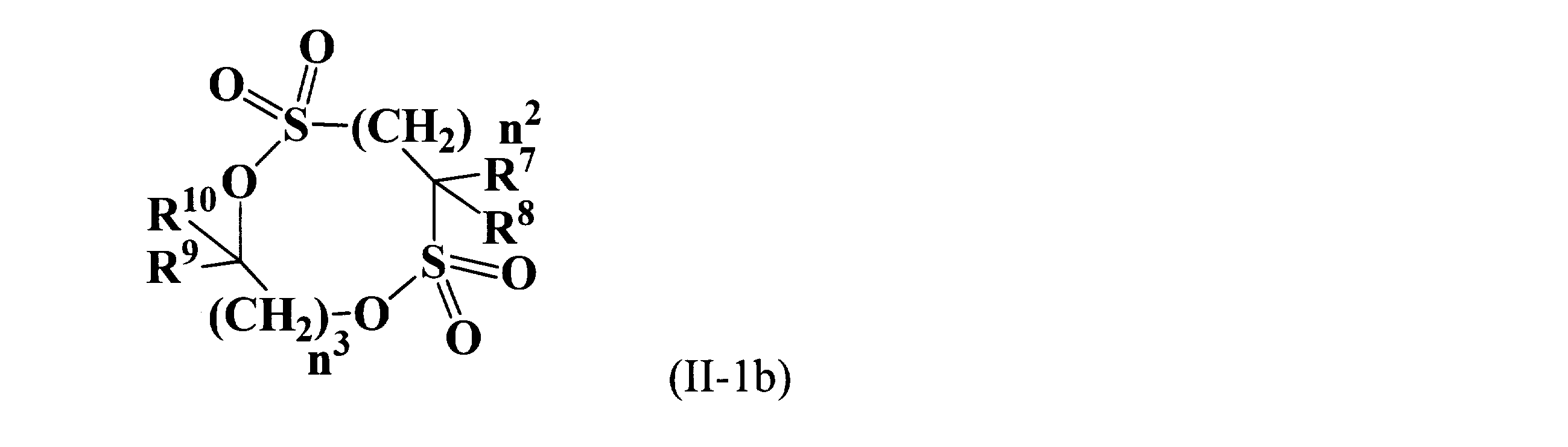
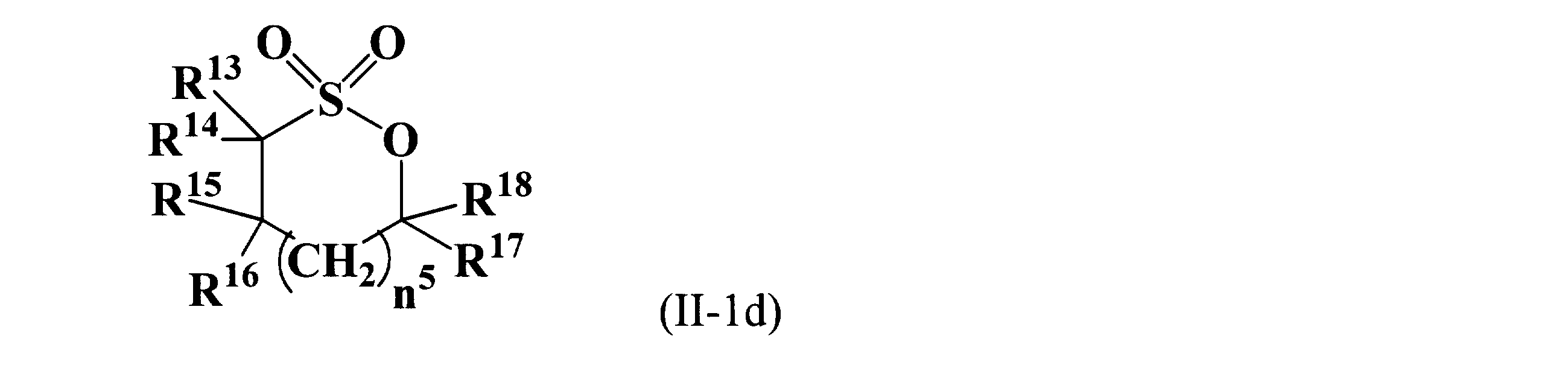
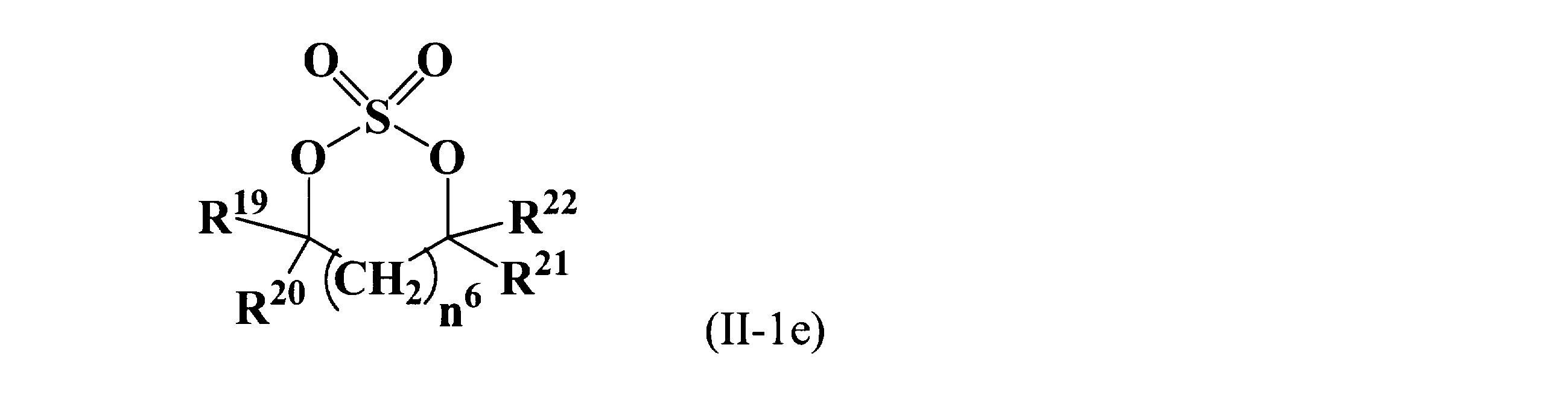
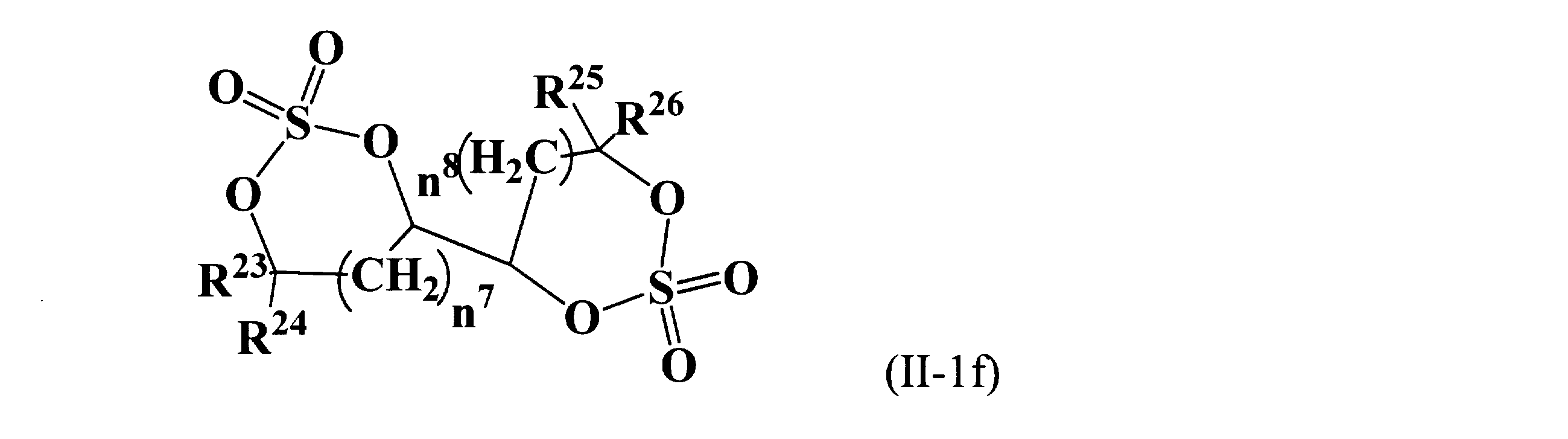
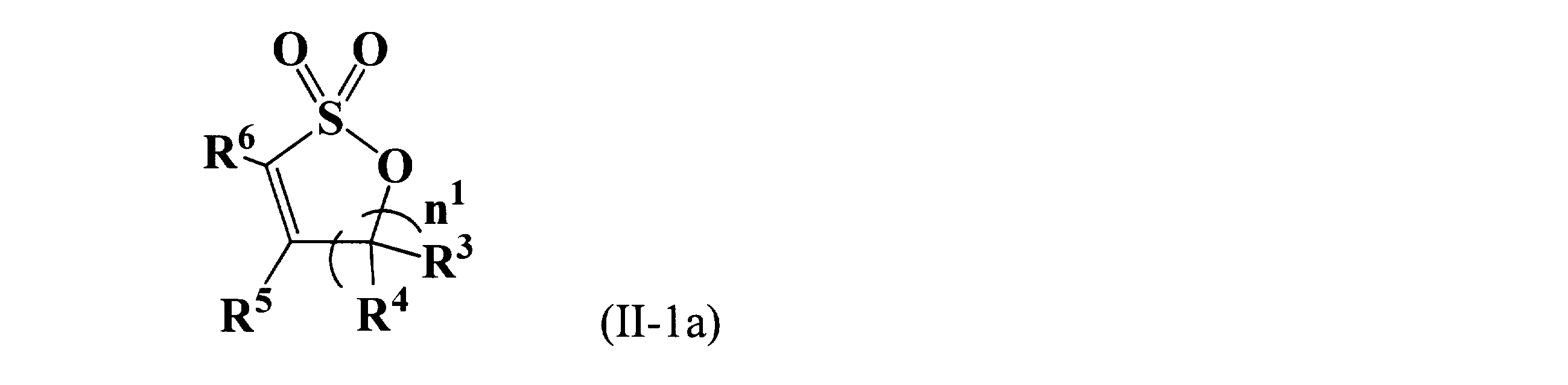
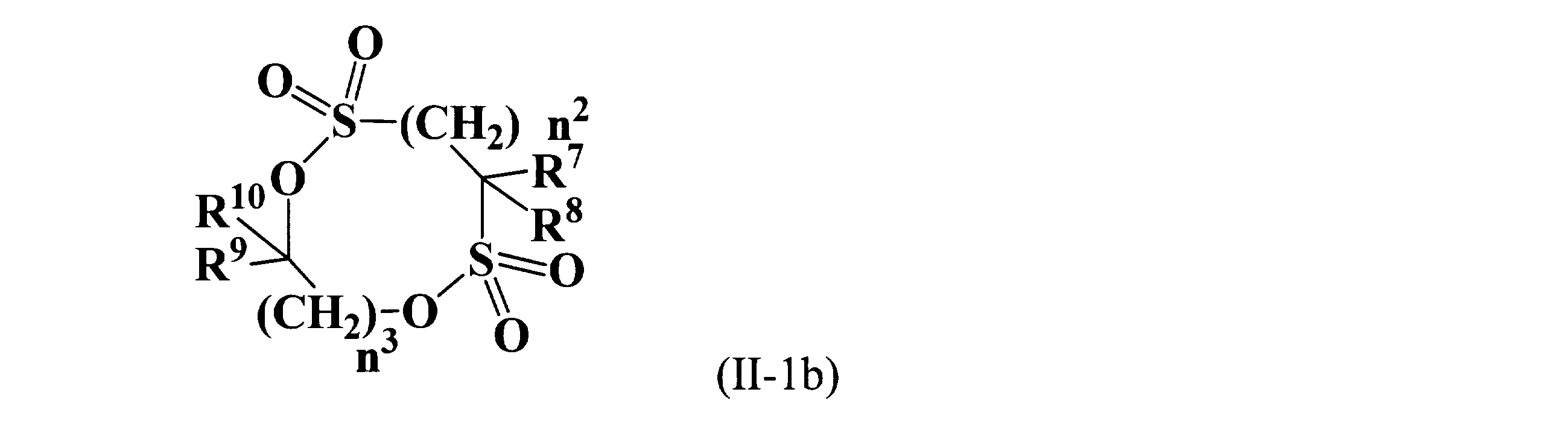
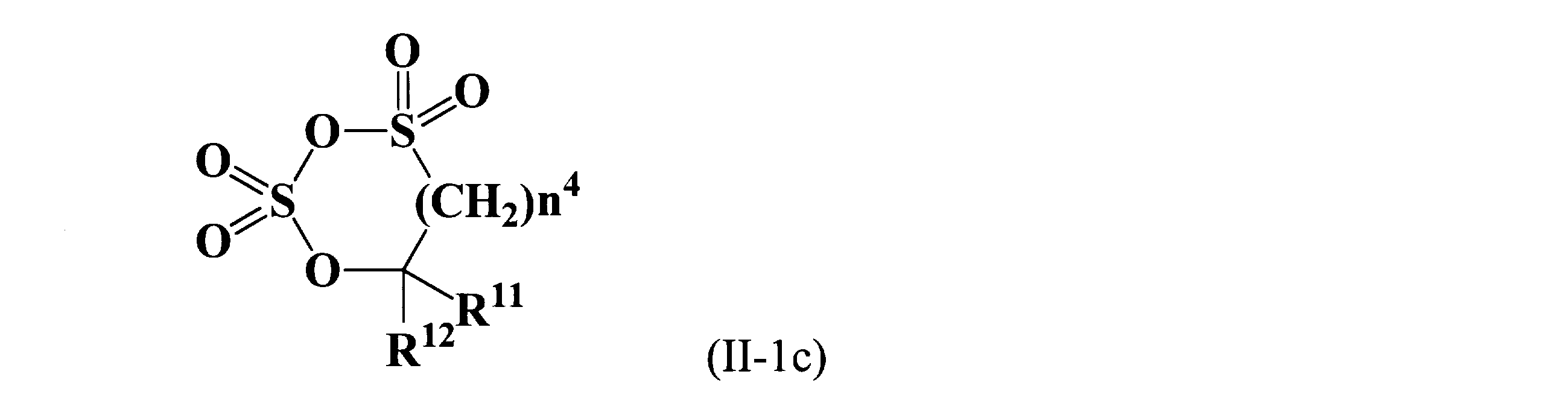
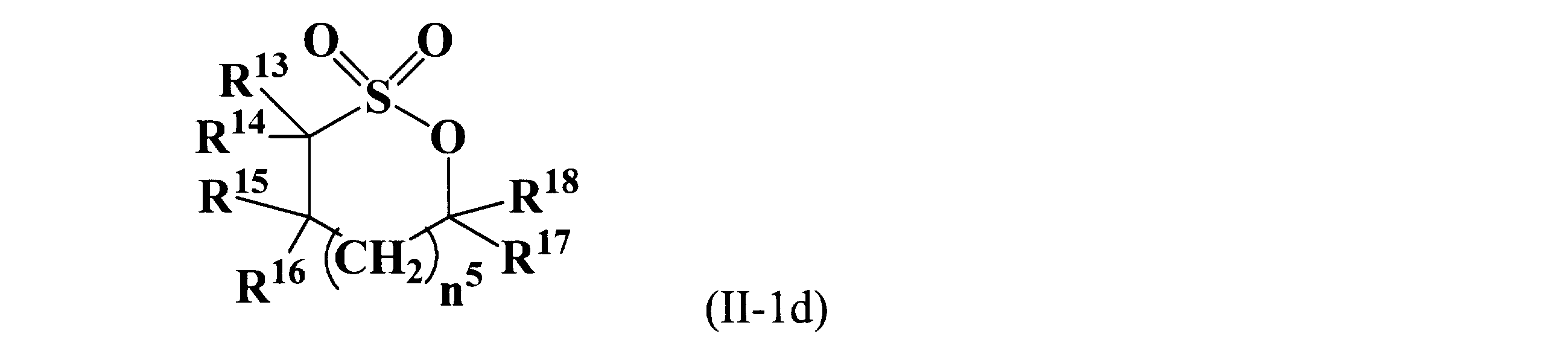
- (II) is selected from the group consisting of the following general formulas (II-1a), (II-1b), (II-1c), (II-1d), (II-1e), and (II-1f) It is preferably at least one selected.
- O is an oxygen atom
- S is a sulfur atom.
- R 3 to R 6 are each independently selected from the group consisting of a hydrogen atom, a substituted or unsubstituted alkyl group having 1 to 5 carbon atoms, and a substituted or unsubstituted fluoroalkyl group having 1 to 4 carbon atoms. Is done.
- n 1 is an integer of 1 to 3.
- O is an oxygen atom
- S is a sulfur atom
- R 7 and R 8 are each independently selected from the group consisting of a hydrogen atom, a halogen atom, and a substituted or unsubstituted alkyl group having 1 to 5 carbon atoms
- R 9 and R 10 are each independently And a hydrogen atom, a halogen atom, a substituted or unsubstituted alkyl group having 1 to 5 carbon atoms, and a substituted or unsubstituted fluoroalkyl group having 1 to 4 carbon atoms.
- n 2 is an integer from 0 to 4
- n 3 is an integer from 0 to 4.
- O is an oxygen atom
- S is a sulfur atom
- R 11 and R 12 each independently comprises a hydrogen atom, a halogen atom, a substituted or unsubstituted alkyl group having 1 to 5 carbon atoms, and a substituted or unsubstituted fluoroalkyl group having 1 to 4 carbon atoms. Selected from the group.
- n 4 is an integer of 0 to 3.
- O is an oxygen atom
- S is a sulfur atom.
- R 13 to R 18 are each independently selected from the group consisting of a hydrogen atom, a substituted or unsubstituted alkyl group having 1 to 6 carbon atoms, and a substituted or unsubstituted fluoroalkyl group having 1 to 4 carbon atoms. Is done. n 5 is an integer of 0-2. ] [In the general formula (II-1e), O is an oxygen atom, and S is a sulfur atom.
- R 19 to R 22 each independently represents a hydrogen atom, a substituted or unsubstituted alkyl group having 1 to 5 carbon atoms, a substituted or unsubstituted alkenyl group having 2 to 5 carbon atoms, or a substituted or unsubstituted carbon number. It is selected from the group consisting of 2 to 5 alkynyl groups and substituted or unsubstituted fluoroalkyl groups having 1 to 4 carbon atoms.
- n 6 is an integer of 0 to 1. However, when n 6 is 0, R 19 or R 20 and R 21 or R 22 may form a single bond with each other.
- O is an oxygen atom
- S is a sulfur atom.
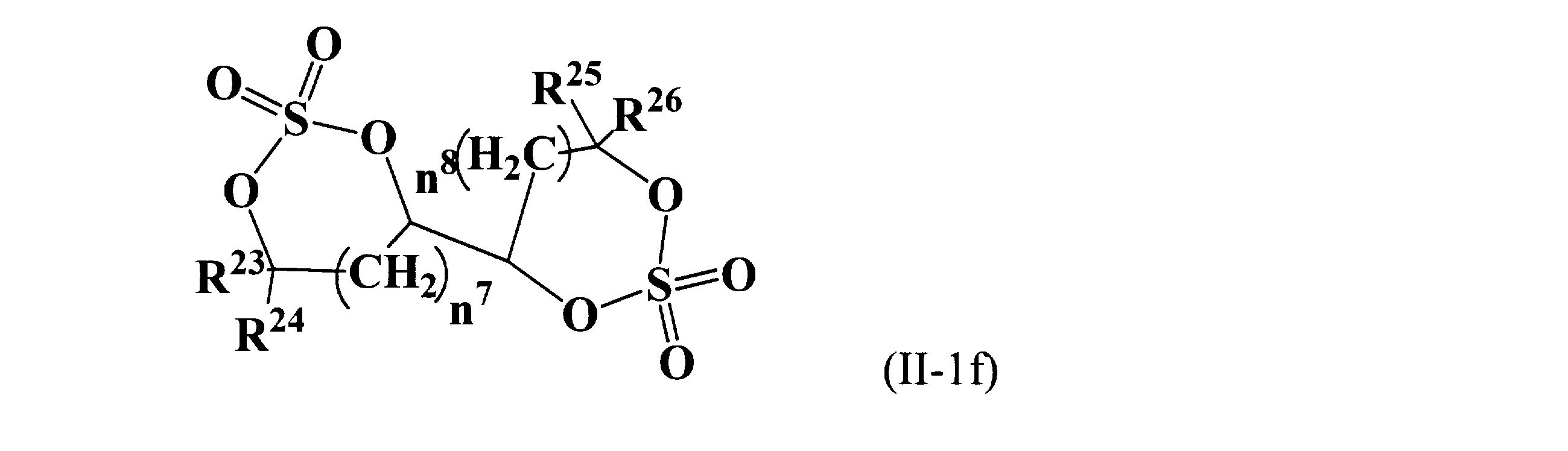
- R 23 to R 26 are each independently selected from the group consisting of a hydrogen atom, a substituted or unsubstituted alkyl group having 1 to 5 carbon atoms, and a substituted or unsubstituted fluoroalkyl group having 1 to 4 carbon atoms. Is done. n 7 and n 8 are integers from 0 to 1. ]
- the cyclic sulfonic acid compound represented by the general formula (II-1a) is 1,3-propene sultone, 1,4-butene sultone, 2,4-pentene sultone, 3,5-pentene sultone, 1-fluoro-1, From the group consisting of 3-propene sultone, 1-trifluoromethyl-1,3-propene sultone, 1,1,1-trifluoro-2,4-butene sultone, 1,4-butene sultone, and 1,5-pentene sultone It is preferable that at least one selected.
- the cyclic sulfonic acid compound represented by the general formula (II-1a) is preferably at least one selected from the group consisting of 1,3-propene sultone and 1,4-butene sultone.
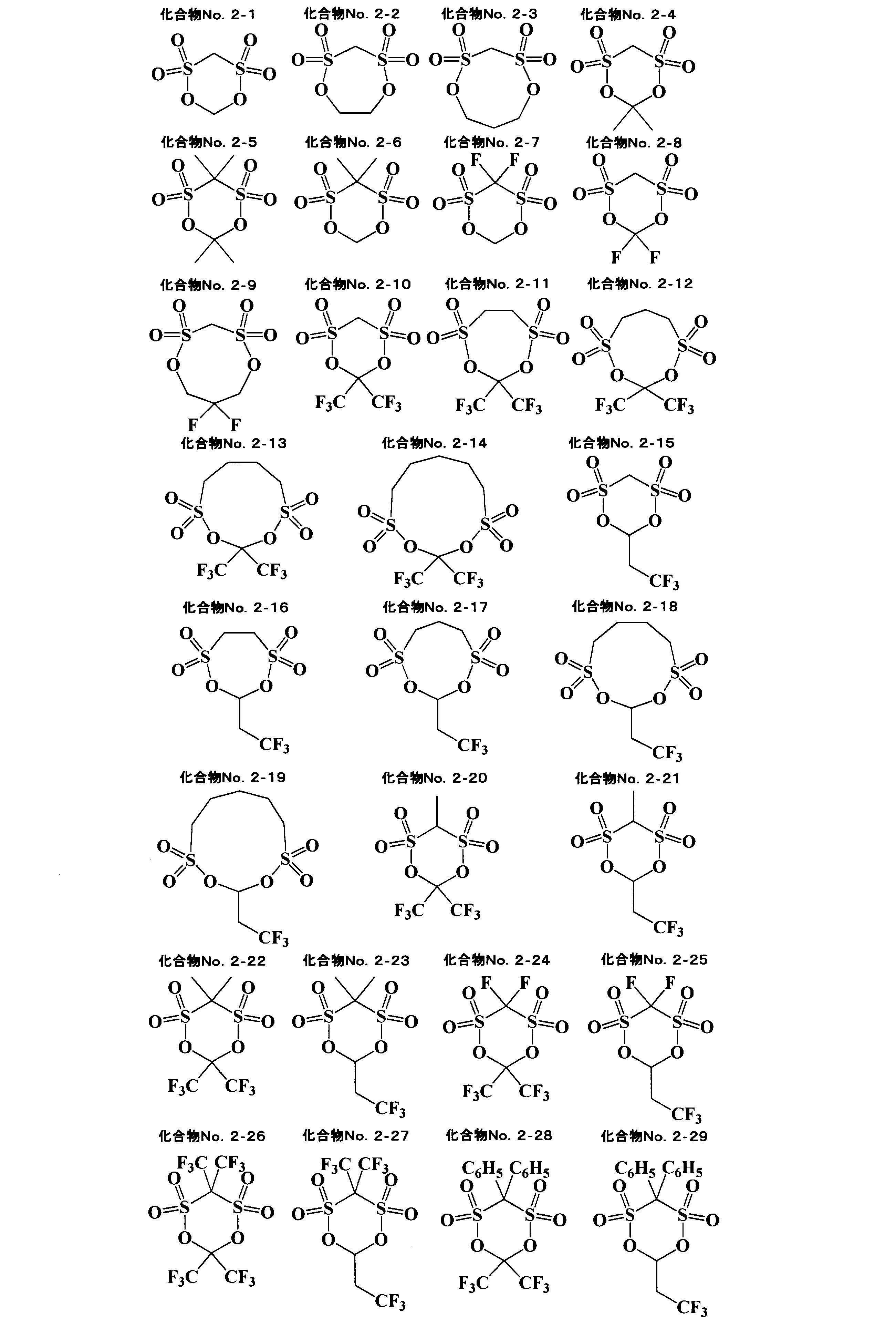
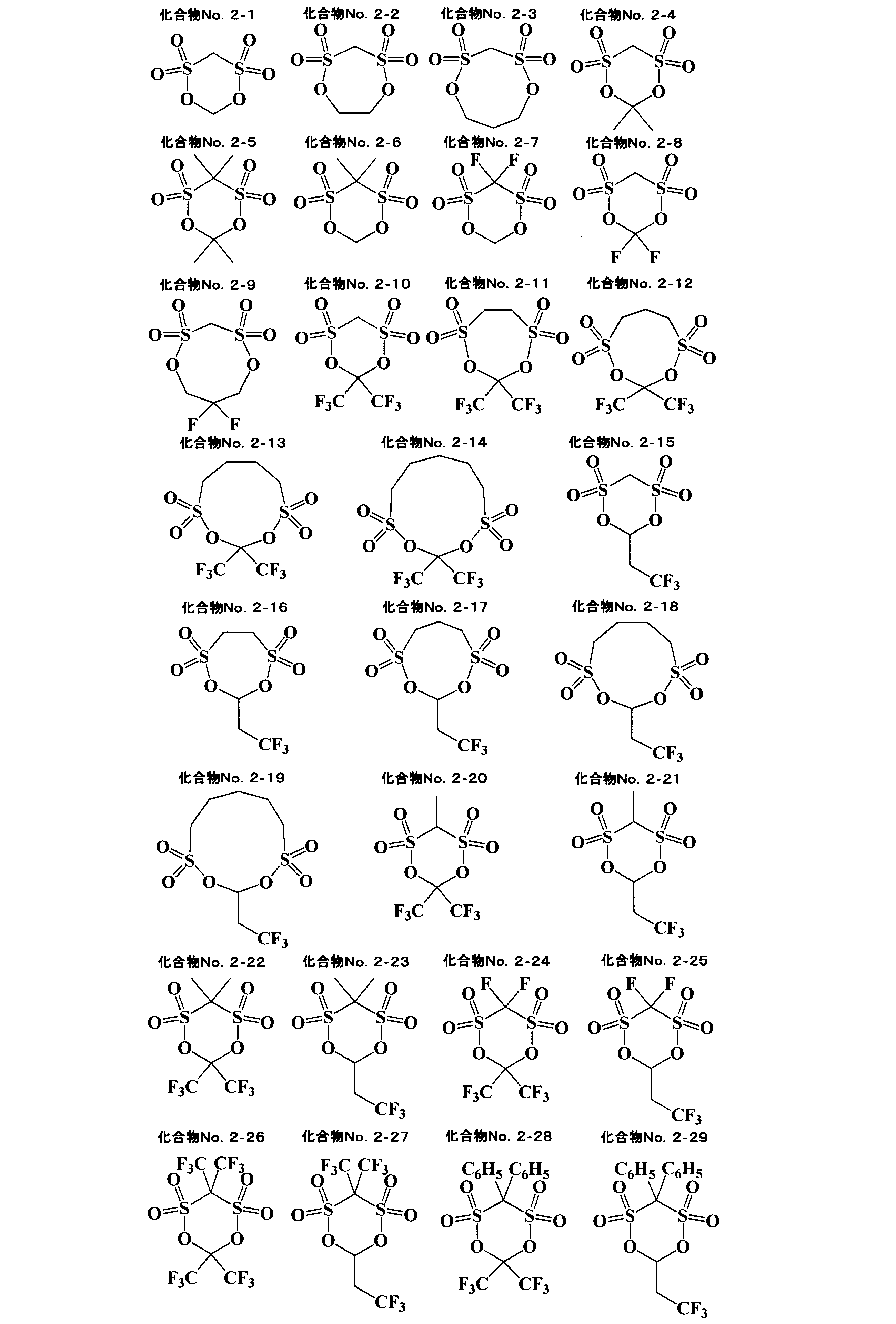
- the cyclic sulfonic acid compound represented by the general formula (II-1b) is compound No. 1 shown below. It is preferably at least one selected from the group consisting of 2-1 to 2-29.
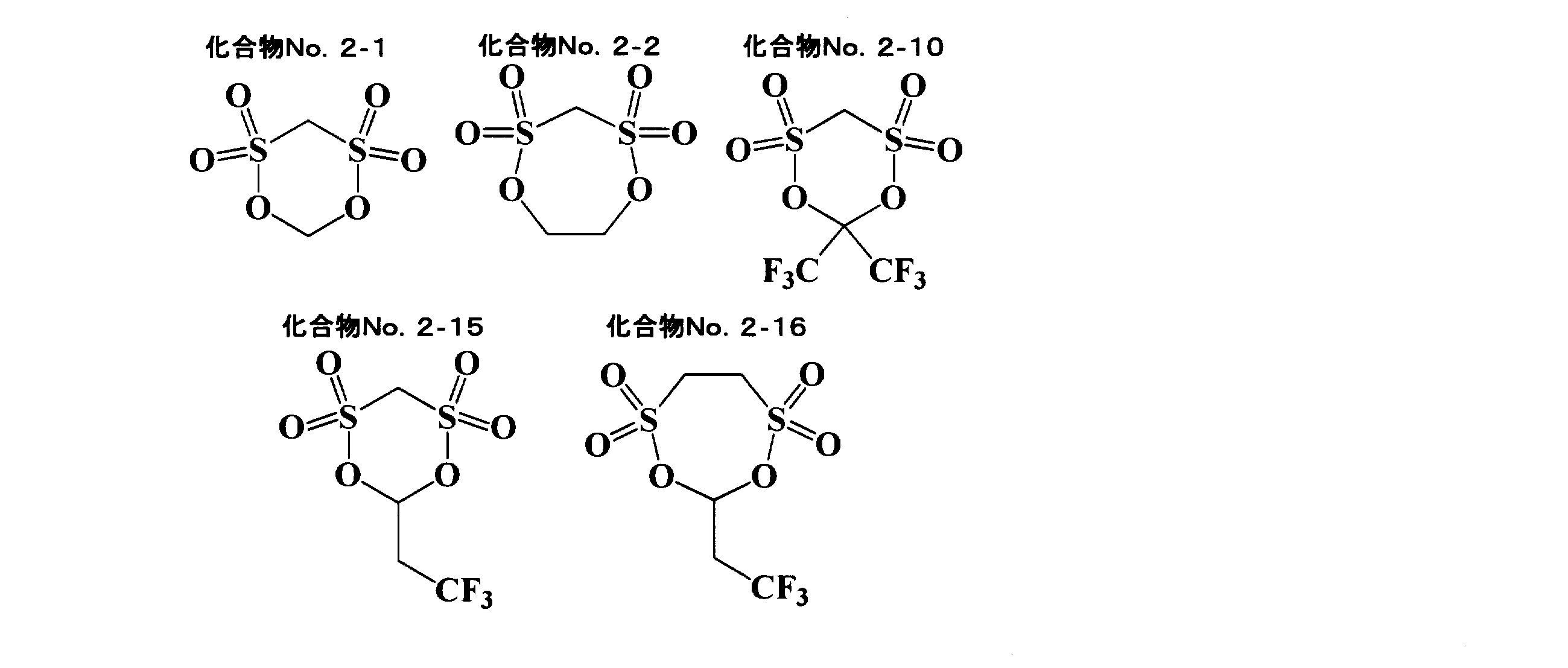
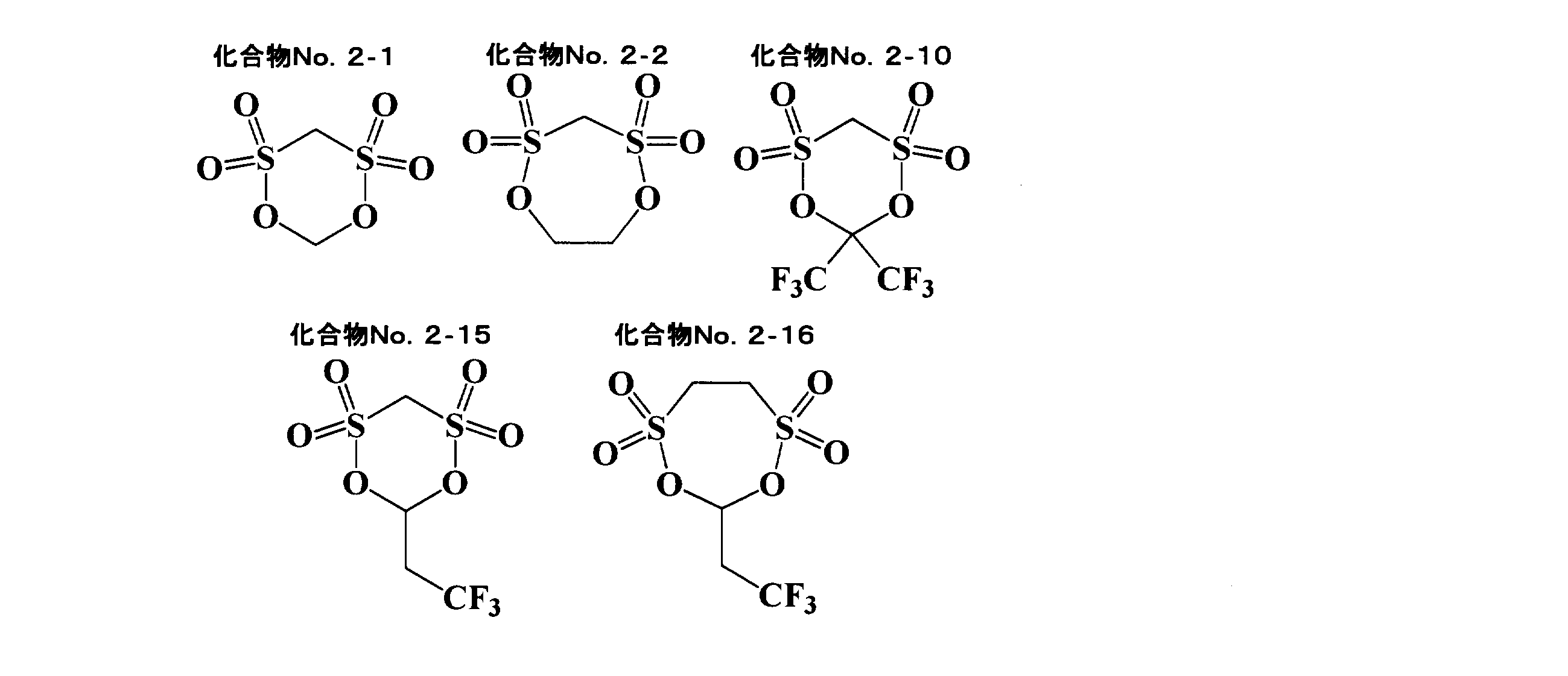
- the cyclic sulfonic acid compound represented by the general formula (II-1b) is compound No. 1 shown below. It is preferably at least one selected from the group consisting of 2-1, 2-2, 2-10, 2-15, and 2-16.
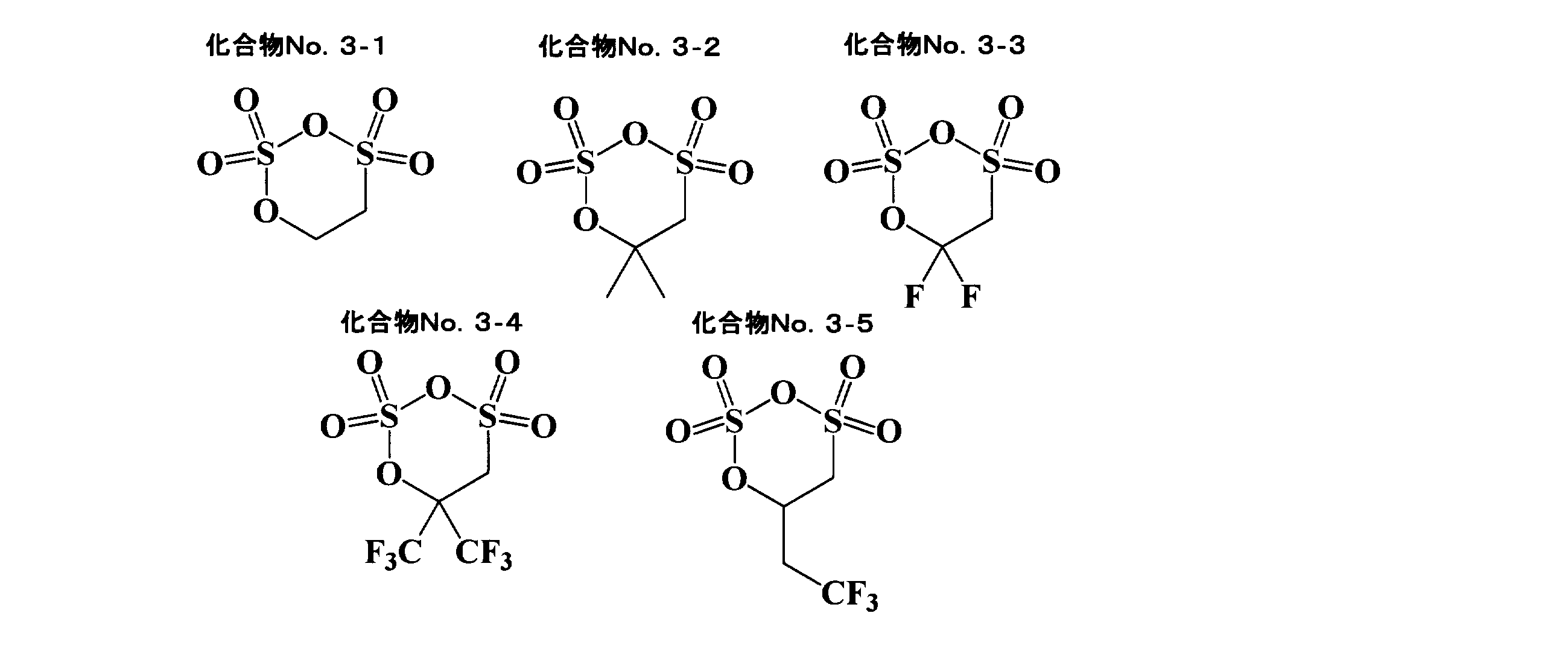
- the cyclic sulfonic acid compound represented by the general formula (II-1c) is represented by the following compound No. It is preferably at least one selected from the group consisting of 3-1 to 3-5.
- the cyclic sulfonic acid compound represented by the general formula (II-1c) is represented by the following compound No. It is preferably at least one selected from the group consisting of 3-1, 3-2, and 3-5.
- the cyclic sulfonic acid compound represented by the general formula (II-1d) is 1,3-propane sultone, ⁇ -trifluoromethyl- ⁇ -sultone, ⁇ -trifluoromethyl- ⁇ -sultone, ⁇ -trifluoromethyl- ⁇ -sultone, ⁇ -methyl- ⁇ -sultone, ⁇ , ⁇ -di (trifluoromethyl) - ⁇ -sultone, ⁇ , ⁇ -di (trifluoromethyl) - ⁇ -sultone, ⁇ -heptafluoropropyl- ⁇ - It is preferably at least one selected from the group consisting of sultone, 1,4-butane sultone, and 1,5-pentane sultone.
- the cyclic sulfonic acid compound represented by the general formula (II-1d) is preferably at least one selected from the group consisting of 1,3-propane sultone and 1,4-butane sultone.
- the cyclic sulfate compound represented by the general formula (II-1e) is the following compound No. It is preferably at least one selected from the group consisting of 4-1 to 4-8.
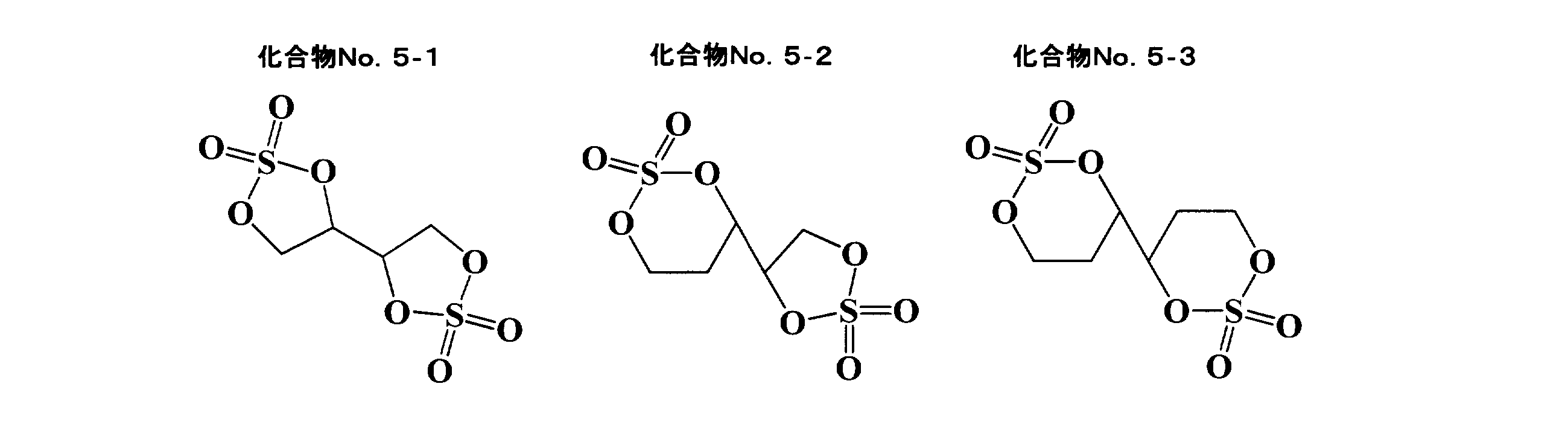
- the cyclic sulfate compound represented by the general formula (II-1f) is the following compound No. It is preferably at least one selected from the group consisting of 5-1 to 5-3.
- R 1 in the general formula (1) is independently selected from the group consisting of a vinyl group, an allyl group, a 1-propenyl group, a 2-propenyl group, an ethynyl group, and a 2-propynyl group. preferable.
- R 2 s independently of each other are fluorine, methyl, ethyl, propyl, 2,2,2-trifluoroethyl, 2,2,3,3-tetrafluoro.
- Propyl group 1,1,1-trifluoroisopropyl group, 1,1,1,3,3,3-hexafluoroisopropyl group, 2,2,2-trifluoroethoxy group, 2,2,3,3- Tetrafluoropropoxy, 2,2,3,3,3-pentafluoropropoxy, 1,1,1-trifluoroisopropoxy, and 1,1,1,3,3,3-hexafluoroisopropoxy
- X in the general formula (1) is preferably 3-4.
- the total amount of (I) is 0.001% by mass or more and 10.0% by mass or less with respect to the total amount of 100% by mass of (I), (II), (III), and (IV).
- the total amount of (II) is 0.01% by mass or more and 10.0% by mass or less with respect to the total amount of 100% by mass of (I), (II), (III), and (IV).
- the above (IV) is lithium hexafluorophosphate (LiPF 6 ), lithium tetrafluoroborate (LiBF 4 ), bis (trifluoromethanesulfonyl) imidolithium (LiN (CF 3 SO 2 ) 2 ), bis (fluorosulfonyl) Imidolithium (LiN (FSO 2 ) 2 ), bis (difluorophosphonyl) imide lithium (LiN (POF 2 ) 2 ), (difluorophosphonyl) (fluorosulfonyl) imide lithium ((LiN (POF 2 ) (FSO 2 )) And a solute containing at least one selected from the group consisting of lithium difluorophosphate (LiPO 2 F 2 ).
- the non-aqueous organic (III), wherein (III) includes at least one selected from the group consisting of cyclic carbonate, chain carbonate, cyclic ester, chain ester, cyclic ether, chain ether, sulfone compound, sulfoxide compound, and ionic liquid A solvent is preferred.
- the carbonate having a fluorine atom is fluoroethylene carbonate, 4,4-difluoroethylene carbonate, 4,5-difluoroethylene carbonate, and 4,5-difluoro-4. More preferably, it is at least one selected from the group consisting of 1,5-dimethylethylene carbonate.
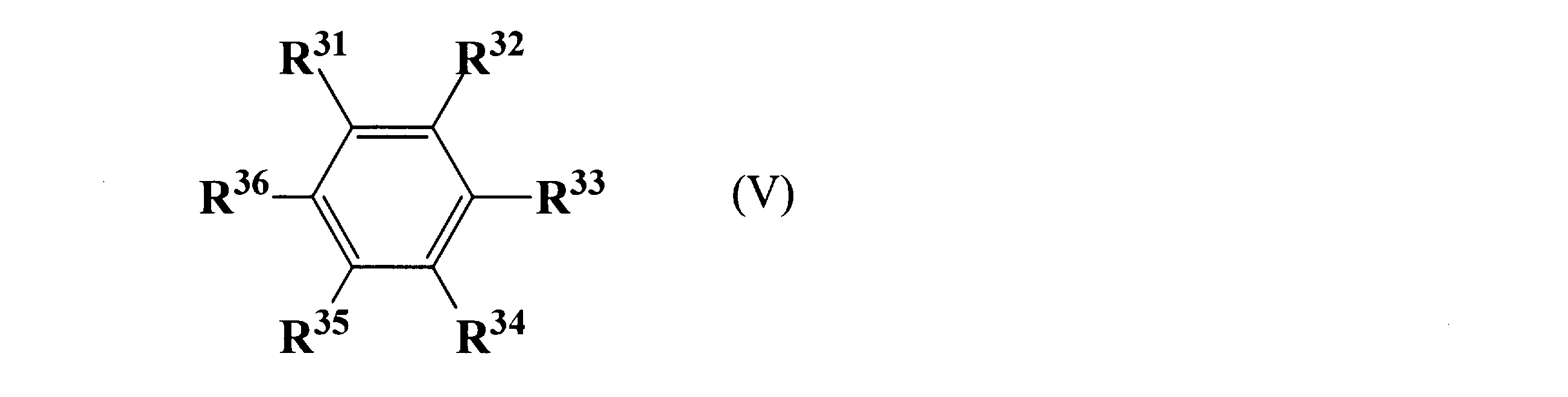
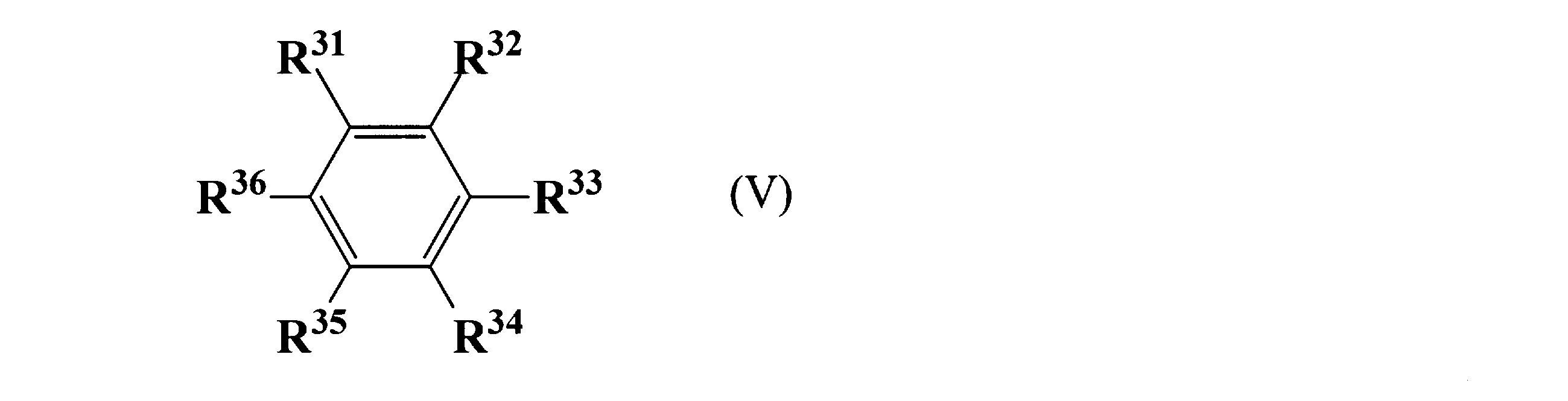
- R 31 to R 36 are each independently a hydrogen atom, a hydrocarbon group having 1 to 12 carbon atoms, or a halogen atom, and R 31 to R 36 are bonded to each other to form a ring. May be. ]
- the present invention provides a non-aqueous electrolyte battery (hereinafter simply referred to as “battery”) comprising at least a positive electrode, a negative electrode, and the electrolyte for a non-aqueous electrolyte battery described above. Yes).
- an electrolytic solution capable of improving the high-temperature storage characteristics at 70 ° C. or higher and reducing the amount of gas generated during high-temperature storage in a well-balanced manner, and a non-aqueous electrolyte battery using the same. be able to.
- the present invention (I) at least one silane compound represented by the following general formula (1): (II) at least one of a cyclic sulfonic acid compound and a cyclic sulfate compound, (III) a non-aqueous organic solvent, and (IV) solute, It is electrolyte solution for non-aqueous electrolyte batteries containing.
- R 1 s each independently represent a group having a carbon-carbon unsaturated bond.
- R 2 s are each independently selected from a fluorine group, a linear alkyl group having 1 to 10 carbon atoms, or a branched alkyl group having 3 to 10 carbon atoms, wherein the alkyl group contains a fluorine atom and / or an oxygen atom. You may have. x is 2-4. ]
- Electrolyte for non-aqueous electrolyte battery (I) is a non-aqueous electrolyte for forming a film having good ion conductivity on the surface of the positive electrode and the negative electrode by decomposing on the positive electrode and the negative electrode. It is a component to be included.
- This film suppresses direct contact between the non-aqueous solvent or solute and the electrode active material, prevents decomposition of the non-aqueous solvent or solute, and suppresses deterioration of battery performance. As a result, the high temperature cycle characteristics and high temperature storage characteristics of the nonaqueous electrolyte battery are improved.
- the group having a carbon-carbon unsaturated bond represented by R 1 includes a vinyl group, an allyl group, a 1-propenyl group, a 2-propenyl group, an isopropenyl group, and a 2-butenyl group.
- Alkenyl groups having 2 to 8 carbon atoms such as 1,3-butadienyl group or the like, alkenyloxy groups derived from these groups, ethynyl groups, 2-propynyl groups, 1,1-dimethyl-2-propynyl groups, etc.
- alkynyl group having 2 to 8 carbon atoms an aryl group having 6 to 12 carbon atoms such as alkynyloxy group, phenyl group, tolyl group and xylyl group derived from these groups, or aryloxy derived from these groups Groups.
- the above group may have a fluorine atom and an oxygen atom.
- a group containing a carbon-carbon unsaturated bond having 6 or less carbon atoms is preferable. When the number of carbon atoms is more than 6, the resistance when a film is formed on the electrode tends to be relatively large.
- a group selected from the group consisting of a vinyl group, an allyl group, a 1-propenyl group, a 2-propenyl group, an ethynyl group, and a 2-propynyl group is preferable.
- the alkyl group represented by R 2 includes a methyl group, an ethyl group, a propyl group, an isopropyl group, an n-butyl group, a sec-butyl group, an isobutyl group, and a tert-butyl group.
- an alkyl group having 1 to 12 carbon atoms such as a pentyl group.
- the above group may have a fluorine atom and an oxygen atom. Examples of the group having an oxygen atom include an alkoxy group derived from the above alkyl group.
- a group selected from an alkyl group and an alkoxy group tends to have a smaller resistance when a film is formed on the electrode, and as a result, is preferable from the viewpoint of output characteristics.
- methyl group, ethyl group, propyl group, 2,2,2-trifluoroethyl group, 2,2,3,3-tetrafluoropropyl group, 1,1,1-trifluoroisopropyl group, 1,1,1 , 3,3,3-hexafluoroisopropyl group, 2,2,2-trifluoroethoxy group, 2,2,3,3-tetrafluoropropoxy group, 2,2,3,3,3-pentafluoropropoxy group , 1,1,1-trifluoroisopropoxy group and 1,1,1,3,3,3-hexafluoroisopropoxy group are selected from the group consisting of: This is preferable because a non-aqueous electrolyte battery having better high-temperature cycle characteristics and high-temperature storage characteristics can be obtained.
- the number of the group having a carbon-carbon unsaturated bond represented by x in the general formula (1) is 2 to 4 in order to form a film on the electrode, and thus to achieve the object of the present invention.
- 3 to 4 is preferable because the high-temperature cycle characteristics and the high-temperature storage characteristics are easily improved. Although details are unknown, it is thought that it is easy to form a stronger film.
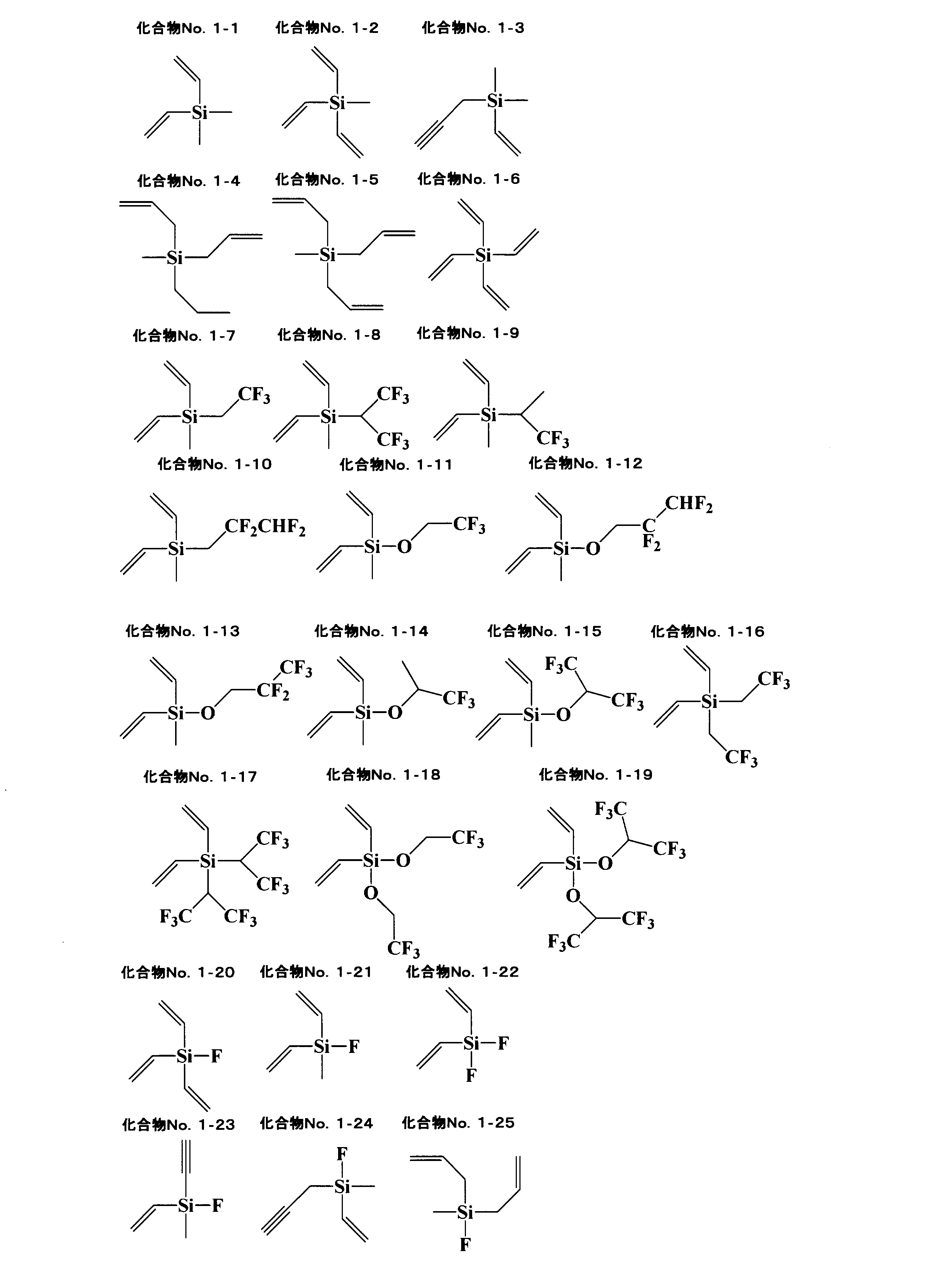
- examples of the silane compound represented by the general formula (1) include the following compound Nos. 1-1 to 1-25 and the like.
- the silane compound used in the present invention is not limited by the following examples.
- the silane compound represented by the general formula (1) includes, for example, a silicon compound having a silanol group or a hydrolyzable group and a carbon-carbon unsaturated bond as described in Patent Document 10 and Non-Patent Documents 1 and 2.
- a silicon compound containing a carbon-carbon unsaturated bond is produced by reacting with an organometallic reagent to replace the OH group or hydrolyzable group of the silanol group in the silicon compound with a carbon-carbon unsaturated bond group. It can be manufactured by a method.
- the lower limit of the total amount of (I) (hereinafter referred to as “the concentration of (I)”) is 0.001% by mass with respect to the total amount of (I), (II), (III), and (IV) of 100% by mass.
- it is 0.01% by mass or more, more preferably 0.1% by mass or more
- the upper limit is preferably 10.0% by mass or less, more preferably 5.0% by mass. % Or less, more preferably 2.0% by mass or less.
- concentration of (I) is less than 0.001% by mass, it is not preferable because the effect of improving the high-temperature cycle characteristics and the high-temperature storage characteristics of a non-aqueous electrolyte battery using the non-aqueous electrolyte is not sufficiently obtained.
- (II) is a component contained in the non-aqueous electrolyte in order to form a stable film on the positive electrode and negative electrode surfaces. This film suppresses the deterioration of the battery, and as a result, improves the high temperature cycle characteristics and high temperature storage characteristics of the nonaqueous electrolyte battery.
- (II) is selected from the group consisting of the general formulas (II-1a), (II-1b), (II-1c), (II-1d), (II-1e), and (II-1f). It is preferably at least one selected.
- Examples of the cyclic sulfonic acid compound represented by the general formula (II-1a) include 1,3-propene sultone, 1,4-butene sultone, 2,4-pentene sultone, 3,5-pentene sultone, 1-fluoro-1,3-propene sultone, 1-trifluoromethyl-1,3-propene sultone, 1,1,1-trifluoro-2,4 -At least one selected from the group consisting of -butene sultone, 1,4-butene sultone and 1,5-pentene sultone is preferred.
- 1,3-propene sultone (1,3-PRS) or 1,4-butene sultone.
- 1,3-propene sultone 1,3-PRS
- 1,4-butene sultone 1,4-butene sultone.
- the cyclic sulfonic acid ester having an unsaturated bond only one kind may be used alone, or two or more kinds may be used in combination.
- cyclic disulfonic acid ester As the cyclic sulfonic acid compound represented by the general formula (II-1b) (hereinafter referred to as “cyclic disulfonic acid ester”), for example, the above-mentioned compound No. At least one selected from the group consisting of compounds represented by 2-1 to 2-29 is preferred. Among these, compound no. More preferred is at least one selected from the group consisting of 2-1, 2-2, 2-10, 2-15, and 2-16.
- the cyclic disulfonic acid ester represented by the general formula (II-1b) is compound No. It is not limited to the compounds shown in 2-1 to 2-29, and other compounds may be used.
- cyclic disulfonic acid ester As the cyclic sulfonic acid compound represented by the general formula (II-1c) (hereinafter referred to as “cyclic disulfonic acid ester”), the above-mentioned compound No. At least one selected from the group consisting of compounds represented by 3-1 to 3-5 is preferred. Among these, Compound No. More preferred is at least one selected from the group consisting of 3-1, 3-2 and 3-5.
- the cyclic disulfonic acid ester represented by the general formula (II-1c) is compound No. It is not limited to the compounds shown in 3-1 to 3-5, and other compounds may be used.
- cyclic sulfonic acid ester examples include 1,3-propane sultone (1,3-PS), ⁇ -trifluoro Methyl- ⁇ -sultone, ⁇ -trifluoromethyl- ⁇ -sultone, ⁇ -trifluoromethyl- ⁇ -sultone, ⁇ -methyl- ⁇ -sultone, ⁇ , ⁇ -di (trifluoromethyl) - ⁇ -sultone, ⁇ , ⁇ -di (trifluoromethyl) - ⁇ -sultone, ⁇ -heptafluoropropyl- ⁇ -sultone, 1,4-butanesultone (1,4-BS), at least selected from the group consisting of 1,5-pentansultone Preferably, at least one selected from the group consisting of 1,3-propane sultone (1,3-PS) and 1,4-butane s
- 1,3-propane sultone (1,3-PS) is considered to form a decomposition film on the negative electrode of a non-aqueous electrolyte battery as described in JP-A-2009-070827 and the like. It is.
- the cyclic sulfonic acid ester only one kind may be used alone, or two or more kinds may be used in combination.
- cyclic sulfate examples include, for example, the compound No. 1 described above. And at least one selected from the group consisting of 4-1 to 4-8. 4-1, 4-4 are preferable.
- One of the above cyclic sulfates may be used alone, or two or more thereof may be used in combination. However, some of these have a somewhat low stability in the electrolyte solution. Therefore, when these are used, the above-mentioned stability, improvement of high-temperature storage characteristics at 70 ° C.
- cyclic sulfate examples include, for example, the compound No. 1 described above. And at least one selected from the group consisting of 5-1 to 5-3. 5-1 is preferred.
- One of the above cyclic sulfates may be used alone, or two or more thereof may be used in combination. However, some of these have a somewhat low stability in the electrolyte solution. Therefore, when these are used, the above-mentioned stability, improvement of high-temperature storage characteristics at 70 ° C.
- the total amount of (II) relative to 100% by mass of the total amount of (I), (II), (III), and (IV) has a lower limit of 0.01% by mass.
- it is 0.05% by mass or more, more preferably 0.1% by mass or more
- the upper limit is preferably 10.0% by mass or less, more preferably 5.0% by mass. % Or less, more preferably 2.0% by mass or less.
- concentration of (II) is less than 0.01% by mass, it is not preferable because the effect of improving the high-temperature cycle characteristics and the high-temperature storage characteristics of a non-aqueous electrolyte battery using the non-aqueous electrolyte is not sufficiently obtained.
- concentration of (II) exceeds 10.0% by mass, it is difficult to sufficiently obtain the effect of improving the high-temperature cycle characteristics and the high-temperature storage characteristics of a non-aqueous electrolyte battery using the non-aqueous electrolyte, which is not preferable.
- (II) may be used alone as long as it does not exceed 10.0% by mass, or two or more may be used in any combination and ratio according to the application.
- (I) forms a film with good ion conductivity on the surface of the positive electrode and the negative electrode by decomposing on the positive electrode and the negative electrode.
- This film suppresses direct contact between the non-aqueous solvent or solute and the electrode active material, prevents decomposition of the non-aqueous solvent or solute, and suppresses deterioration of battery performance.
- the film component formed on the electrode is not sufficient, and the obtained nonaqueous electrolyte battery has a temperature of 70 ° C. or higher. High temperature storage characteristics at high temperatures may not be sufficient.
- the above (II) also has an effect of forming a stable film on the surfaces of the positive electrode and the negative electrode and suppressing the deterioration of the battery, but without using the above (I) and (II) in combination, the above (II)
- the high-temperature storage characteristics at a high temperature of 70 ° C. or higher may not be sufficient. Therefore, it is important to use (I) and (II) together in the electrolyte for a non-aqueous electrolyte battery of the present invention.
- the non-aqueous electrolyte battery electrolyte is generally called a non-aqueous electrolyte, and if a polymer is used, the electrolyte is called a polymer solid electrolyte.
- the polymer solid electrolyte includes those containing a non-aqueous solvent as a plasticizer.
- the non-aqueous organic solvent (III) is not particularly limited as long as it is an aprotic solvent that can dissolve (I), (II), and (IV) of the present invention.
- an aprotic solvent that can dissolve (I), (II), and (IV) of the present invention.
- carbonates, Esters, ethers, lactones, nitriles, imides, sulfones and the like can be used.
- ethyl methyl carbonate dimethyl carbonate, diethyl carbonate, methyl propyl carbonate, ethyl propyl carbonate, methyl butyl carbonate, ethylene carbonate, propylene carbonate, butylene carbonate, methyl acetate, ethyl acetate, methyl propionate, ethyl propionate, Methyl 2-fluoropropionate, ethyl 2-fluoropropionate, diethyl ether, acetonitrile, propionitrile, tetrahydrofuran, 2-methyltetrahydrofuran, furan, tetrahydropyran, 1,3-dioxane, 1,4-dioxane, dibutyl ether, Diisopropyl ether, 1,2-dimethoxyethane, N, N-dimethylformimide, dimethyl sulfoxide, sulfolane, Beauty ⁇ - butyrolactone
- the polymer used for obtaining the polymer solid electrolyte is not particularly limited as long as it is an aprotic polymer capable of dissolving (I), (II), and (IV).
- aprotic polymer capable of dissolving (I), (II), and (IV) examples thereof include polymers having polyethylene oxide in the main chain or side chain, homopolymers or copolymers of polyvinylidene fluoride, methacrylic acid ester polymers, polyacrylonitrile and the like.
- a plasticizer is added to these polymers, the above-mentioned aprotic non-aqueous solvent can be used.
- a solute is not specifically limited,
- the salt which consists of arbitrary cation and anion pairs can be used.
- Specific examples include alkali metal ions such as lithium ions and sodium ions, alkaline earth metal ions, quaternary ammonium, etc. as cations, and hexafluorophosphoric acid, tetrafluoroboric acid, perchloric acid as anions.
- solutes may be used alone, or two or more kinds of solutes may be mixed and used in any combination and ratio according to the application.
- the cation is lithium, sodium, magnesium, quaternary ammonium
- the anion is hexafluorophosphoric acid, tetrafluoroboric acid, bis (trifluoromethanesulfonyl) imide, Bis (fluorosulfonyl) imide, bis (difluorophosphonyl) imide, (difluorophosphonyl) (fluorosulfonyl) imide, and difluorophosphoric acid are preferred.
- the total amount of (IV) (hereinafter referred to as “solute concentration”) with respect to the total amount of 100% by mass of (I), (II), (III), and (IV) is not particularly limited, but the lower limit is 0. 5 mol / L or more, preferably 0.7 mol / L or more, more preferably 0.9 mol / L or more, and the upper limit is 5.0 mol / L or less, preferably 4.0 mol / L or less, more preferably 2 The range is 0.0 mol / L or less. When the concentration is less than 0.5 mol / L, the cycle characteristics and output characteristics of the nonaqueous electrolyte battery are deteriorated due to a decrease in ionic conductivity.
- the electrolyte for the nonaqueous electrolyte battery is reduced. If the viscosity increases, the ionic conduction may be lowered, and the cycle characteristics and output characteristics of the nonaqueous electrolyte battery may be degraded.
- additives generally used in the electrolyte for non-aqueous electrolyte batteries of the present invention may be added in any ratio.
- Specific examples include compounds having an overcharge prevention effect, a negative electrode film formation effect, and a positive electrode protection effect, such as cyclohexylbenzene, biphenyl, t-butylbenzene, vinylene carbonate, vinylethylene carbonate, difluoroanisole, and carbonate having a fluorine atom. It is done.
- a carbonate having a fluorine atom from the viewpoint of further improving the high-temperature storage characteristics of the battery at a high temperature of 70 ° C. or higher and the effect of reducing the amount of gas generated during high-temperature storage.
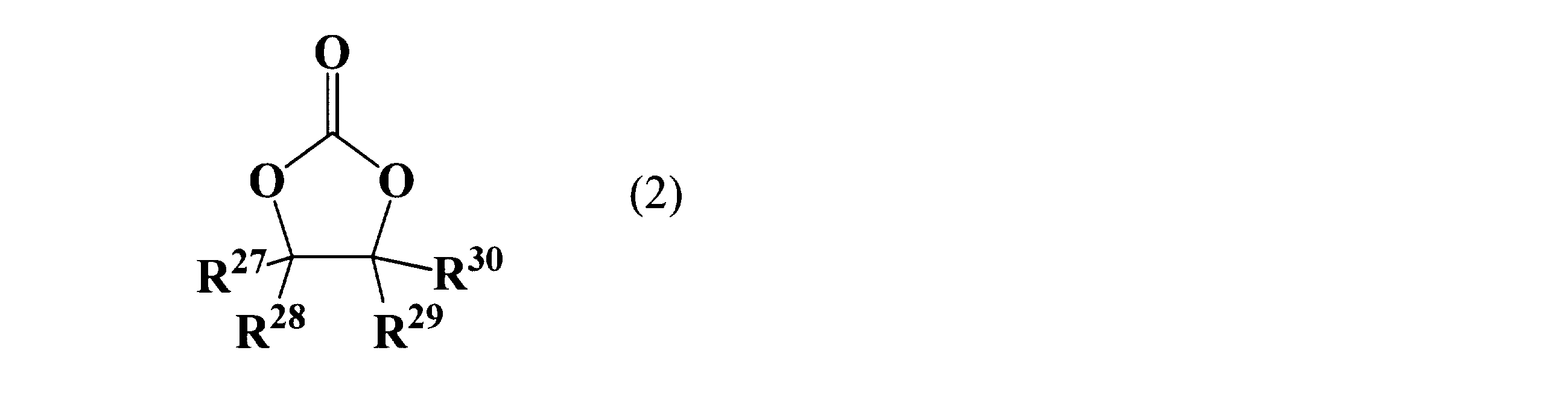
- the carbonate include a compound represented by the following general formula (2).
- O is an oxygen atom
- R 27 to R 30 are each independently a hydrogen atom, an alkyl group, a halogen atom, an alkyl group having a halogen atom, and an aryl group having a halogen atom.
- at least one of R 27 to R 30 is a fluorine atom.
- R 27 to R 30 may contain an ether bond.
- non-aqueous electrolyte battery electrolyte in a quasi-solid state with a gelling agent or a cross-linked polymer as used in a non-aqueous electrolyte battery called a polymer battery.
- R 31 to R 36 are each independently selected from a hydrogen atom, a hydrocarbon group having 1 to 12 carbon atoms, and a halogen atom, and R 31 to R 36 are bonded to each other to form a ring. May be formed.
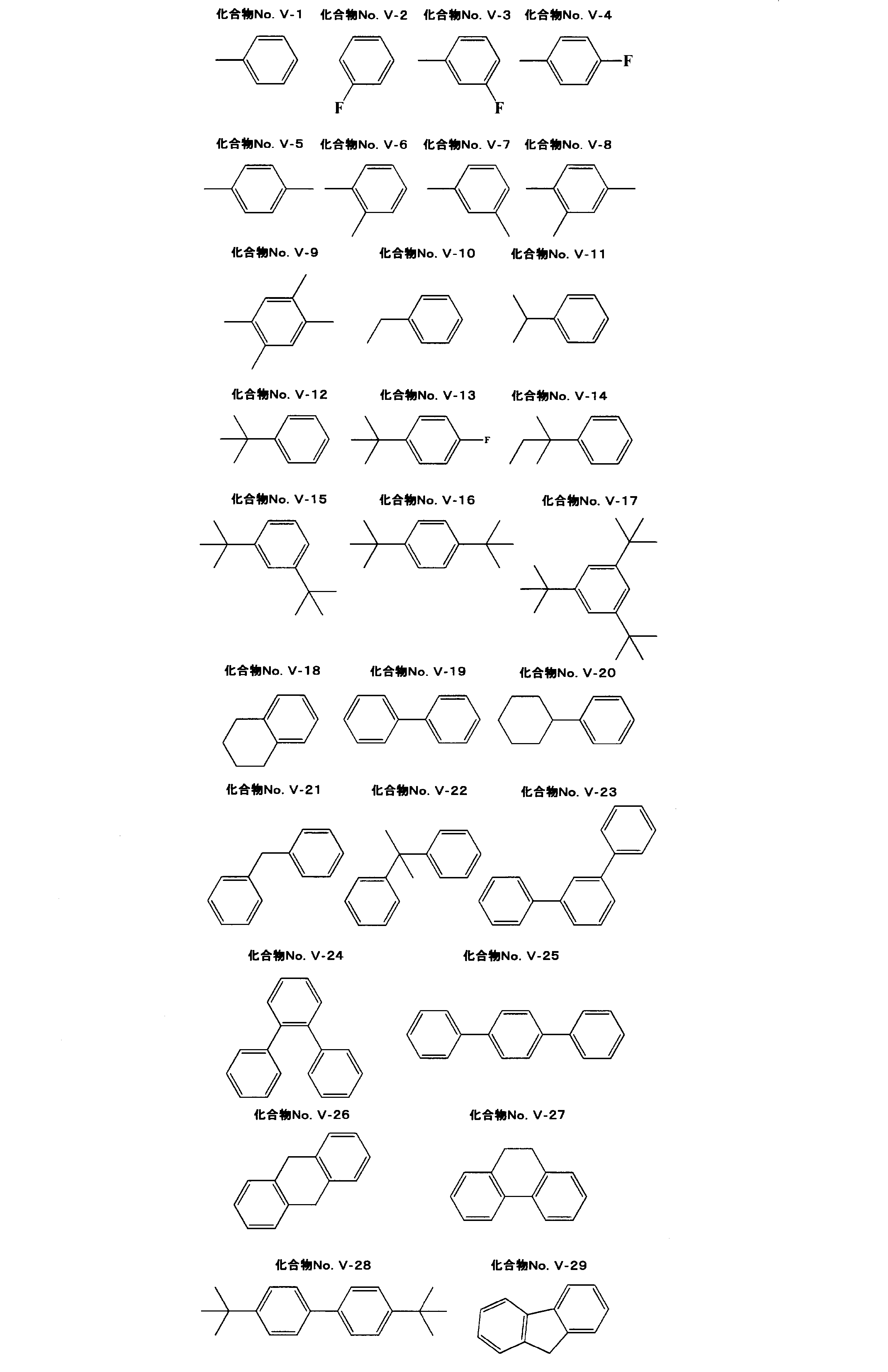
- examples of the compound represented by the general formula (V) include the following compound No. V-1 to V-29 and the like. V-12 and compound no. It is particularly preferable to contain at least one V-2.
- An electrochemical device using a positive electrode material into which alkali metal ions such as sodium ions and alkaline earth metal ions can be reversibly inserted and removed is called a non-aqueous electrolyte battery.
- the negative electrode is not particularly limited, but a material in which an alkali metal ion such as lithium ion or sodium ion or an alkaline earth metal ion can be reversibly inserted and removed is used, and the positive electrode is not particularly limited. However, materials in which alkali metal ions such as lithium ions and sodium ions or alkaline earth metal ions can be reversibly inserted and removed are used.
- the negative electrode material is lithium metal, alloys of lithium and other metals, intermetallic compounds, various carbon materials capable of inserting and extracting lithium, metal oxides, metal nitrides, activated carbon
- the carbon material include graphitizable carbon, non-graphitizable carbon (also referred to as hard carbon) having a (002) plane spacing of 0.37 nm or more, and a (002) plane spacing of 0.
- Examples thereof include graphite having a thickness of 34 nm or less, and the latter is made of artificial graphite, natural graphite or the like.
- lithium-containing transition metal composite oxides such as LiCoO 2 , LiNiO 2 , LiMnO 2 , LiMn 2 O 4 as the positive electrode material, Co, Mn, Ni, etc. of these lithium-containing transition metal composite oxides
- olivine Transition metal phosphate compounds oxides such as TiO 2 , V 2 O 5 and MoO 3 , sulfides such as TiS 2 and FeS, or conductive polymers such as polyacetylene, polyparaphenylene, polyaniline and polypyrrole, activated carbon , Polymers that generate radicals, carbon materials, and the like are used.
- acetylene black, ketjen black, carbon fiber, or graphite is added as a conductive material, and polytetrafluoroethylene, polyvinylidene fluoride, or SBR resin is added as a binder.
- the electrode sheet made can be used.
- a separator for preventing contact between the positive electrode and the negative electrode a nonwoven fabric or a porous sheet made of polypropylene, polyethylene, paper, glass fiber or the like is used.
- an electrochemical device having a coin shape, cylindrical shape, square shape, aluminum laminate sheet shape or the like is assembled.
- EC ethylene carbonate
- PC propylene carbonate
- DMC dimethyl carbonate
- EMC ethyl methyl carbonate
- LiPF 6 Lithium hexafluorophosphate
- LiPF 6 concentration of LiPF 6 as a solute is 1.0 mol / L and the concentration of bis (trifluoromethanesulfonyl) imide lithium (hereinafter “LiN (CF 3 SO 2 ) 2 ”) is 0.10 mol / L.
- LiN (CF 3 SO 2 ) 2 concentration of bis (trifluoromethanesulfonyl) imide lithium
- LiPF 6 LiPF 6 was dissolved as a solute at a concentration of 1.0 mol / L and bis (fluorosulfonyl) imidolithium (hereinafter “LiN (FSO 2 ) 2 ”) was dissolved at a concentration of 0.10 mol / L.
- LiN (FSO 2 ) 2 bis (fluorosulfonyl) imidolithium
- LiPF 6 LiPF 6 as a solute was dissolved at a concentration of 1.0 mol / L, and lithium difluorophosphate (hereinafter “LiPO 2 F 2 ”) was dissolved at a concentration of 0.10 mol / L.
- LiPO 2 F 2 lithium difluorophosphate
- LiPF 6 LiPF 6 was dissolved as a solute at a concentration of 1.0 mol / L and bis (fluorosulfonyl) imidolithium (hereinafter “LiN (FSO 2 ) 2 ”) was dissolved at a concentration of 0.10 mol / L.
- LiN (FSO 2 ) 2 bis (fluorosulfonyl) imidolithium
- LiPF 6 as a solute was dissolved at a concentration of 1.0 mol / L, and lithium difluorophosphate (hereinafter “LiPO 2 F 2 ”) was dissolved at a concentration of 0.10 mol / L.
- LiPO 2 F 2 lithium difluorophosphate
- LiPF 6 LiPF 6 as a solute
- LiPO 2 F 2 LiPO 2 F 2
- LiBF 4 lithium tetrafluoroborate
- 1,3-PRS means 1,3-propene sultone
- 1,4-BTS means 1,4-butene sultone
- TFBTS means 1,1,1-trifluoro-2,4- Means butene sultone
- 4,5-DFEC means 4,5-difluoroethylene carbonate
- 1,2-ES means the above compound no. 4-1 means 1,2-ethylene sulfate
- 1,3-PS means 1,3-propane sultone.
- comparative electrolyte solution No. In addition, comparative electrolyte solution No. In the preparation of 1-15 to 1-18, the following compound No. 1 was used instead of (I). 1-26 to 1-29 were used.
- NCM positive electrode active material LiNi 1/3 Co 1/3 Mn 1/3 O 2 (NCM) powder and acetylene black (conductive agent) are dry-mixed, and a binder, polyvinylidene fluoride (hereinafter “PVDF”), is used.
- An NCM mixture paste was prepared by uniformly dispersing in N-methyl-2-pyrrolidone (hereinafter “NMP”) dissolved in advance, mixing, and adding NMP for viscosity adjustment. This paste was applied on an aluminum foil (current collector), dried and pressurized, and then a test NMC positive electrode processed into a predetermined size was obtained.
- NMP N-methyl-2-pyrrolidone
- charging / discharging cycle is performed three times by charging at a constant current / constant voltage at a charging upper limit voltage of 4.3V and a 0.2C rate (6 mA) and discharging at a constant current of 0.2C (6 mA) to a discharge end voltage of 3.0V. Repeated.
- the battery After carrying out the above conditioning, the battery was charged at a constant current and a constant voltage at an ambient temperature of 25 ° C. at a charging upper limit voltage of 4.3 V and a 0.2 C rate (6 mA), and then stored at an ambient temperature of 70 ° C. for 10 days. Thereafter, the battery was discharged at a constant current of 0.2 C (6 mA) to a final discharge voltage of 3.0 V, and the initial discharge capacity of the discharge capacity at this time (discharge capacity measured before storage at 70 ° C. after performing the above conditioning) ) As the remaining capacity ratio, and the storage characteristics of the cells (discharge capacity retention after storage) were evaluated.
- each Example The “discharge capacity retention ratio after storage at 70 ° C.”, which is a relative value of the remaining capacity ratio of the comparative example, is described.
- Examples 1-42 to 1-44 and Comparative Examples 1-19 to 1-23 the remaining capacity ratio of each Example / Comparative Example when the remaining capacity ratio of Comparative Example 1-19 is 100 is used.
- the “discharge capacity retention rate after storage at 70 ° C.”, which is a relative value of is described.
- Example 1-45 to 1-47 and Comparative Examples 1-24 to 1-28 the remaining capacity ratio of each Example / Comparative Example when the remaining capacity ratio of Comparative Example 1-24 is 100 The “discharge capacity retention rate after storage at 70 ° C.”, which is a relative value of is described.
- Examples 1-48 to 1-50 and Comparative Examples 1-29 to 1-33 the remaining capacity ratio of each Example / Comparative Example when the remaining capacity ratio of Comparative Example 1-29 is 100 The “discharge capacity retention rate after storage at 70 ° C.”, which is a relative value of is described.
- Example 1-51 to 1-53 and Comparative Examples 1-34 to 1-35 the remaining capacity ratio of each Example / Comparative Example when the remaining capacity ratio of Comparative Example 1-24 is 100 The “discharge capacity retention rate after storage at 70 ° C.”, which is a relative value of is described.
- Examples 1-54 to 1-56 and Comparative Examples 1-36 to 1-37 the remaining capacity ratio of each Example / Comparative Example when the remaining capacity ratio of Comparative Example 1-29 is 100 The “discharge capacity retention rate after storage at 70 ° C.”, which is a relative value of is described.
- Example 1-57 and Comparative Examples 1-38 to 1-40 relative values of the remaining capacity ratios of the Examples and Comparative Examples when the remaining capacity ratio of Comparative Example 1-38 is 100 are shown.
- Example 1-58 and Comparative Examples 1-41 to 1-43 the relative values of the remaining capacity ratios of the respective Examples and Comparative Examples when the remaining capacity ratio of Comparative Example 1-41 is 100 are shown.
- a certain "discharge capacity maintenance rate after 70 degreeC storage" was described.
- the numerical values of the gas generation amounts described in Examples 1-1 to 1-41 and Comparative Examples 1-1 to 1-18 are set to 100 in Comparative Example 1-1. Relative value of the case.
- the numerical values of the gas generation amounts described in Examples 1-42 to 1-44 and Comparative Examples 1-19 to 1-23 are relative values when the gas generation amount of Comparative Example 1-19 is 100.
- the numerical values of the gas generation amounts described in Examples 1-45 to 1-47 and Comparative Examples 1-24 to 1-28 are relative values when the gas generation amount of Comparative Example 1-24 is 100.
- the numerical values of the gas generation amounts described in Examples 1-48 to 1-50 and Comparative Examples 1-29 to 1-33 are relative values when the gas generation amount of Comparative Example 1-29 is set to 100. .
- the numerical values of the gas generation amount in Examples 1-51 to 1-33 and Comparative Examples 1-34 to 1-35 are relative values when the gas generation amount in Comparative Example 1-24 is 100. Further, the numerical values of the gas generation amounts of Examples 1-54 to 1-56 and Comparative Examples 1-36 to 1-37 are relative values when the gas generation amount of Comparative Example 1-29 is set to 100. Further, the numerical values of the gas generation amount of Example 1-57 and Comparative Examples 1-38 to 1-40 are relative values when the gas generation amount of Comparative Example 1-38 is 100. Further, the numerical values of the gas generation amount of Example 1-58 and Comparative Examples 1-41 to 1-43 are relative values when the gas generation amount of Comparative Example 1-41 is 100.
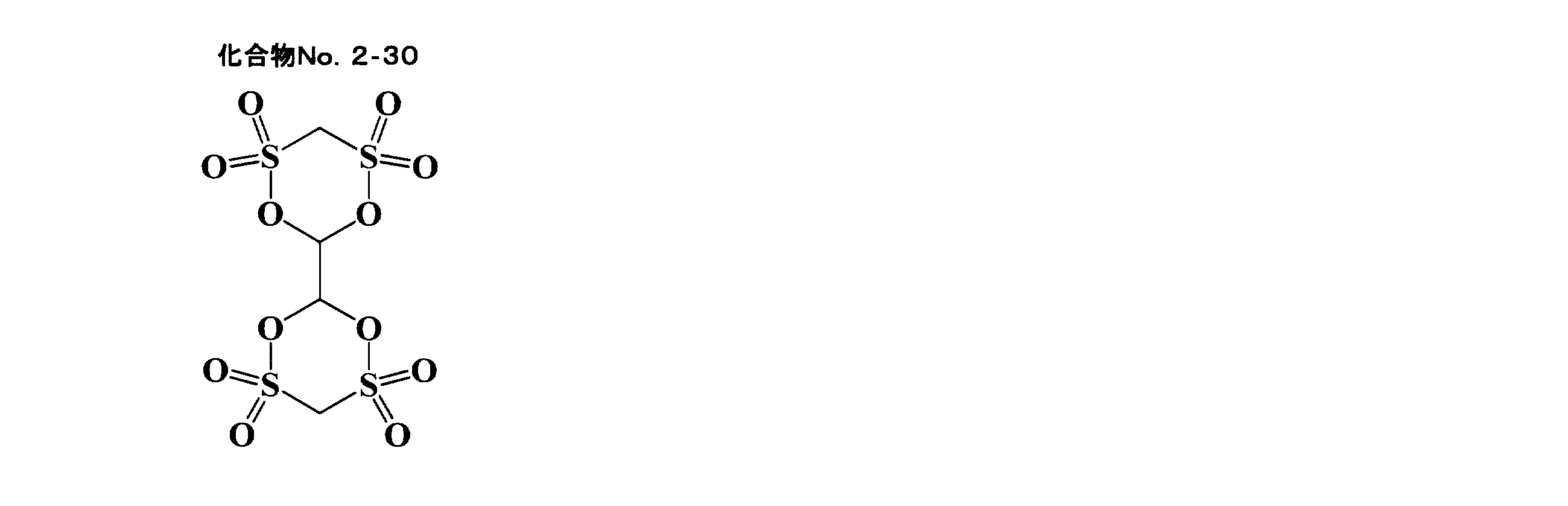
- Compound No. 2-30 has the following structure.
- Examples 2-1 to 2-47, Comparative Examples 2-1 to 2-13 Production and Evaluation of Nonaqueous Electrolyte Battery According to the same procedure as the nonaqueous electrolyte battery according to Example 1-1 described above. , NCM positive electrode for test, graphite negative electrode for test, and aluminum laminate outer cell (capacity 30 mAh) provided with cellulose separator. 2-1 to 2-47, comparative electrolyte No. Non-aqueous electrolyte batteries according to Examples 2-1 to 2-47 and Comparative Examples 2-1 to 2-13 were produced by impregnation with 2-1 to 2-13, respectively. For these nonaqueous electrolyte batteries, the following evaluations were carried out in the same manner as in Example 1-1. ⁇ Evaluation 1> High temperature storage characteristics (70 ° C.) ⁇ Evaluation 2> Amount of gas generated during high-temperature storage (70 ° C)
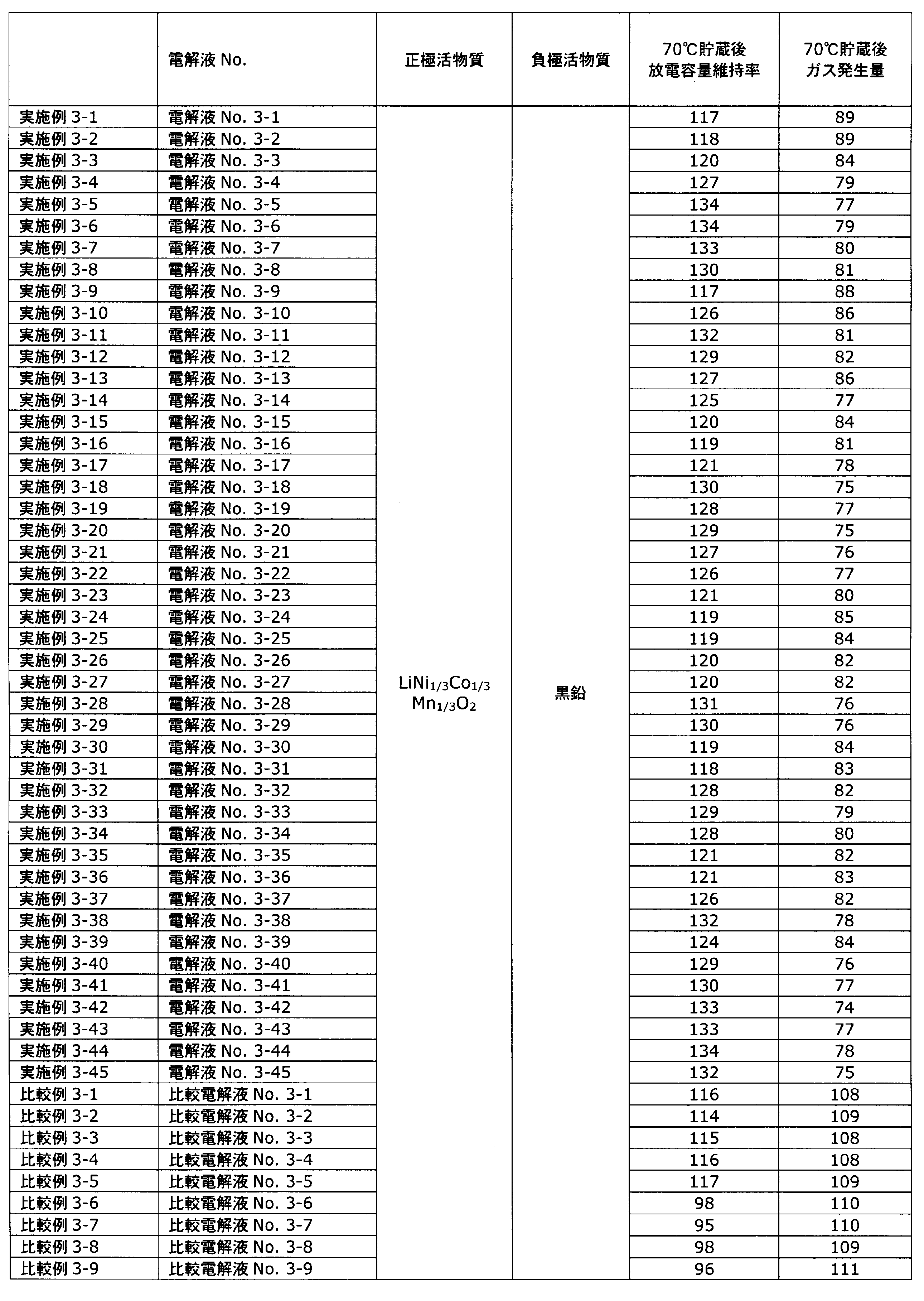
- Examples 3-1 to 3-45, Comparative Examples 3-1 to 3-9 Production and Evaluation of Nonaqueous Electrolyte Battery According to the same procedure as the nonaqueous electrolyte battery according to Example 1-1 described above.
- an aluminum laminate exterior cell comprising a test NCM positive electrode, a test graphite negative electrode, and a cellulose separator
- Non-aqueous electrolyte batteries according to Examples 3-1 to 3-45 and Comparative examples 3-1 to 3-9 were produced by impregnation with 3-1 to 3-9, respectively.
- Examples 4-1 to 4-45, Comparative Examples 4-1 to 4-9 Production and Evaluation of Nonaqueous Electrolyte Battery According to the same procedure as the nonaqueous electrolyte battery according to Example 1-1 described above.
- an aluminum laminate exterior cell (capacity 30 mAh) including a test NCM positive electrode, a test graphite negative electrode, and a cellulose separator
- electrolytic solution No. 4-1 to 4-45, comparative electrolyte No. 4-1 to 4-9 were impregnated, respectively, to prepare non-aqueous electrolyte batteries according to Examples 4-1 to 4-45 and Comparative examples 4-1 to 4-9.
- the following evaluations were carried out in the same manner as in Example 1-1.
- Examples 5-1 to 5-39, Comparative Examples 5-1 to 5-27 Production and Evaluation of Nonaqueous Electrolyte Batteries
- Examples 5-1 to 5-39 and Comparative Examples 5-1 to 5-27 As shown in Tables 13 to 15, a non-aqueous electrolyte battery was produced in the same manner as in Example 1-1 except that the negative electrode body and the electrolyte were changed, and the battery was evaluated.
- the negative electrode active material is Li 4 Ti 5 O 12
- the negative electrode body is 90% by mass of Li 4 Ti 5 O 12 powder.
- Example 1-1 The end-of-charge voltage and end-of-discharge voltage were the same as in Example 1-1.
- the negative electrode active material is hard carbon
- the negative electrode body is composed of 90% by mass of hard carbon powder and 5% by mass of PVDF as a binder. Then, 5% by mass of acetylene black as a conductive agent is mixed, NMP is further added, and the obtained paste is applied on a copper foil and dried to produce a charge end voltage of 4.
- the discharge end voltage was 2V and 2V.
- Tables 14 and 15 show the evaluation results of the high temperature storage characteristics and the amount of gas generated during high temperature storage.
- the evaluation results in Table 14 and Table 15 are the comparative electrolyte No. It is a relative value when the evaluation result of the comparative example using the electrolytic solution 1-1 is set to 100.
- Example 6-1 to 6-52 Production and Evaluation of Nonaqueous Electrolyte Battery
- Example 6-1 to 6-52 and Comparative Examples 6-1 to 6-36 As shown in Table 13, Table 16, and Table 17, a nonaqueous electrolyte battery was prepared in the same manner as in Example 1-1 except that the positive electrode body, the negative electrode body, and the electrolyte solution were changed, and the battery was evaluated. Carried out.
- a positive electrode body in which the positive electrode active material was LiCoO 2 was obtained by mixing 85% by mass of LiCoO 2 powder with 10% by mass of PVDF as a binder and 5% by mass of acetylene black as a conductive material, and further adding NMP. The paste was applied on an aluminum foil and dried.
- Example 1-1 in Examples 6-1 to 6-13 and Comparative Examples 6-1 to 6-9 in which the negative electrode active material is graphite, the end-of-charge voltage in the battery evaluation was 4.2 V, the discharge The final voltage was 3.0V.
- Examples 6-14 to 6-26 and Comparative Examples 6-10 to 6-18 in which the negative electrode active material is Li 4 Ti 5 O 12 as in Example 5-1 the end-of-charge voltage at the time of battery evaluation is The discharge end voltage was set to 2.7 V and 1.5 V.
- Examples 6-27 to 6-39 and Comparative Examples 6-19 to 6-27 in which the negative electrode active material is graphite (containing 9% by mass of silicon) as in Example 5-14 the charge termination at the time of battery evaluation The voltage was 4.2 V and the discharge end voltage was 3.0 V.
- Example 5-27 in Examples 6-40 to 6-52 and Comparative Examples 6-28 to 6-36 in which the negative electrode active material is hard carbon, the end-of-charge voltage during battery evaluation was 4.1 V, The final discharge voltage was 2.2V.
- Tables 16 and 17 show the evaluation results of the high temperature storage characteristics and the amount of gas generated during high temperature storage.
- the evaluation results in Table 16 and Table 17 are the comparative electrolyte No. in each electrode configuration. It is a relative value when the evaluation result of the comparative example using the electrolytic solution 1-1 is set to 100.
- Example 7-1 to 7-39, Comparative Examples 7-1 to 7-27 Production and Evaluation of Nonaqueous Electrolyte Batteries
- Examples 7-1 to 7-39 and Comparative Examples 7-1 to 7-27 As shown in Table 13, Table 18, and Table 19, a nonaqueous electrolyte battery was prepared and evaluated in the same manner as in Example 1-1 except that the positive electrode body and the electrolyte were changed.
- the positive electrode active material is LiNi 0.8 Co 0.15 Al 0.05 O 2
- the positive electrode body is LiNi 0.8 Co 0.15 Al 0.05 O 2 powder.
- the positive electrode active material is LiMn 2 O 4
- the positive electrode body is 10% by mass as a binder to 85% by mass of LiMn 2 O 4 powder.
- the positive electrode active material is LiFePO 4
- the positive electrode body is made up of 85% by mass of LiFePO 4 powder coated with amorphous carbon.
- 10% by mass of PVDF as a binder and 5% by mass of acetylene black as a conductive material were mixed, NMP was further added, and the obtained paste was applied on an aluminum foil and dried.
- the end-of-charge voltage was 4.2 V
- the end-of-discharge voltage was 2.5 V.
- Tables 18 and 19 show the evaluation results of the high temperature storage characteristics and the amount of gas generated during high temperature storage.
- the evaluation results in Table 18 and Table 19 are the comparative electrolyte No. in each electrode configuration. It is a relative value when the evaluation result of the comparative example using the electrolytic solution 1-1 is set to 100.
- the electrolyte solution for a non-aqueous electrolyte battery of the present invention is used.
- the high temperature storage characteristics were improved and the amount of gas generated during high temperature storage was reduced as compared with the corresponding comparative examples. Therefore, by using the non-aqueous electrolyte battery electrolyte of the present invention, the non-aqueous electrolyte battery exhibits excellent high-temperature storage characteristics and a reduction in the amount of gas generated during high-temperature storage regardless of the type of the negative electrode active material. It was shown that
- the nonaqueous electrolyte battery of the present invention is used in any of the examples using LiCoO 2 , LiNi 0.8 Co 0.15 Al 0.05 O 2 , LiMn 2 O 4 , and LiFePO 4 as the positive electrode active material. It was confirmed that the use of the electrolytic solution for use improved the high-temperature storage characteristics and reduced the amount of gas generated during high-temperature storage compared to the corresponding comparative examples. Therefore, by using the non-aqueous electrolyte battery electrolyte of the present invention, a non-aqueous electrolyte battery that exhibits excellent high-temperature storage characteristics and a reduction in the amount of gas generated during high-temperature storage, regardless of the type of positive electrode active material. It was shown that
Landscapes
- Chemical & Material Sciences (AREA)
- Engineering & Computer Science (AREA)
- Manufacturing & Machinery (AREA)
- Chemical Kinetics & Catalysis (AREA)
- Electrochemistry (AREA)
- General Chemical & Material Sciences (AREA)
- Physics & Mathematics (AREA)
- Condensed Matter Physics & Semiconductors (AREA)
- General Physics & Mathematics (AREA)
- Inorganic Chemistry (AREA)
- Materials Engineering (AREA)
- Secondary Cells (AREA)
Abstract
Description
また、特許文献9には、フルオロシラン化合物やジフオロリン酸化合物を添加することによって、非水電解液電池の低温特性を向上させることが記載されている。
(I)下記一般式(1)で示される少なくとも1種のシラン化合物、
(II)環状スルホン酸化合物及び環状硫酸エステル化合物からなる少なくとも1種、
(III)非水有機溶媒、及び、
(IV)溶質
とを含む、非水電解液電池用電解液(以降、単純に「非水電解液」又は「電解液」と記載する場合がある)である。





(I)下記一般式(1)で示される少なくとも1種のシラン化合物、
(II)環状スルホン酸化合物及び環状硫酸エステル化合物からなる少なくとも1種、
(III)非水有機溶媒、及び、
(IV)溶質、
とを含む、非水電解液電池用電解液である。

(I)について
(I)は、いずれも正極及び負極上で分解することによりイオン伝導性の良い皮膜を正極及び負極表面に形成するために、非水電解液に含有させる成分である。この皮膜は、非水溶媒や溶質と電極活物質との間の直接の接触を抑制して非水溶媒や溶質の分解を防ぎ、電池性能の劣化を抑制する。その結果、非水電解液電池の高温サイクル特性や高温貯蔵特性の向上効果を奏する。
(II)は、正極及び負極表面に安定な皮膜を形成するために、非水電解液に含有させる成分である。この皮膜は電池の劣化を抑制し、その結果、非水電解液電池の高温サイクル特性や高温貯蔵特性の向上効果を奏する。
また、上記(II)も、正極及び負極表面に安定な皮膜を形成し、電池の劣化を抑制する効果があるが、上記(I)と上記(II)を併用せずに、上記(II)のみを用いた場合、得られる非水電解液電池の70℃以上の高温での高温貯蔵特性は十分ではない場合がある。
従って、本発明の非水電解液電池用電解液において、上記(I)と上記(II)を併用することが重要である。上記(I)と上記(II)を併用することにより、(I)又は(II)をそれぞれ単独で添加した場合に比べて、70℃以上の高温での高温貯蔵特性が向上するメカニズムの詳細は明らかでないが、(I)と(II)が共存することで、(I)と(II)の混合組成に由来するより良好な皮膜が形成されることにより、高温での溶媒や溶質の分解が抑制される、あるいは、(I)によって形成された皮膜の表面を、(II)によって形成された皮膜が覆うことにより、(I)が形成する皮膜が高温下にて溶媒や溶質と反応することを抑制するためと推測される。
また、(I)又は(II)をそれぞれ単独で添加した場合に比べて、(I)と(II)を併用した場合は、70℃以上の高温での電解液からの分解ガスの発生量がより少ない傾向がある。該分解ガス発生量の低減効果は上述のような良好な皮膜がもたらす効果であると考えられる。
このように(I)と(II)を併用すると、(I)又は(II)をそれぞれ単独で用いる場合に比べて、70℃以上の高温での電池の高温貯蔵特性の向上、及び高温貯蔵時に発生したガス量の低減効果をバランスよく発揮することができる。
非水電解液電池用電解液は非水系溶媒を用いれば、一般に非水電解液と呼ばれ、ポリマーを用いれば、ポリマー固体電解質と呼ばれるものになる。ポリマー固体電解質には可塑剤として非水系溶媒を含有するものも含まれる。
溶質は特に限定されず、任意のカチオンとアニオンの対からなる塩を用いることができる。具体例としては、カチオンとしてリチウムイオンやナトリウムイオンを始めとするアルカリ金属イオン、アルカリ土類金属イオン、四級アンモニウム等が挙げられ、アニオンとして、ヘキサフルオロリン酸、テトラフルオロホウ酸、過塩素酸、ヘキサフルオロヒ酸、ヘキサフルオロアンチモン酸、トリフルオロメタンスルホン酸、ビス(トリフルオロメタンスルホニル)イミド、ビス(ペンタフルオロエタンスルホニル)イミド、(トリフルオロメタンスルホニル)(ペンタフルオロエタンスルホニル)イミド、ビス(フルオロスルホニル)イミド、(トリフルオロメタンスルホニル)(フルオロスルホニル)イミド、(ペンタフルオロエタンスルホニル) (フルオロスルホニル)イミド、トリス(トリフルオロメタンスルホニル)メチド、ビス(ジフルオロホスホニル)イミド、(ジフルオロホスホニル)(フルオロスルホニル)イミド、ジフルオロリン酸等が挙げられる。これらの溶質は、一種類を単独で用いても良く、二種類以上を用途に合わせて任意の組合せ、比率で混合して用いても良い。中でも、電池としてのエネルギー密度、出力特性、寿命等から考えると、カチオンはリチウム、ナトリウム、マグネシウム、四級アンモニウムが、アニオンはヘキサフルオロリン酸、テトラフルオロホウ酸、ビス(トリフルオロメタンスルホニル)イミド、ビス(フルオロスルホニル)イミド、ビス(ジフルオロホスホニル)イミド、(ジフルオロホスホニル)(フルオロスルホニル)イミド、ジフルオロリン酸が好ましい。
さらには、本発明の要旨を損なわない限りにおいて、本発明の非水電解液電池用電解液に一般に用いられる添加剤を任意の比率で添加しても良い。具体例としては、シクロヘキシルベンゼン、ビフェニル、t-ブチルベンゼン、ビニレンカーボネート、ビニルエチレンカーボネート、ジフルオロアニソール、フッ素原子を有するカーボネート等の過充電防止効果、負極皮膜形成効果、正極保護効果を有する化合物が挙げられる。
非水電解液電池用電解液と、リチウムイオンやナトリウムイオンを始めとするアルカリ金属イオン、又はアルカリ土類金属イオンが可逆的に挿入-脱離可能な負極材料と、リチウムイオンやナトリウムイオンを始めとするアルカリ金属イオン、又はアルカリ土類金属イオンが可逆的に挿入-脱離可能な正極材料を用いる電気化学ディバイスを非水電解液電池と呼ぶ。
非水溶媒としてエチレンカーボネート(以降「EC」)、プロピレンカーボネート(以降「PC」)、ジメチルカーボネート(以降「DMC」)、エチルメチルカーボネート(以降「EMC」)の体積比2:1:3:4の混合溶媒を用い、以下の手順にて電解液を調製した。
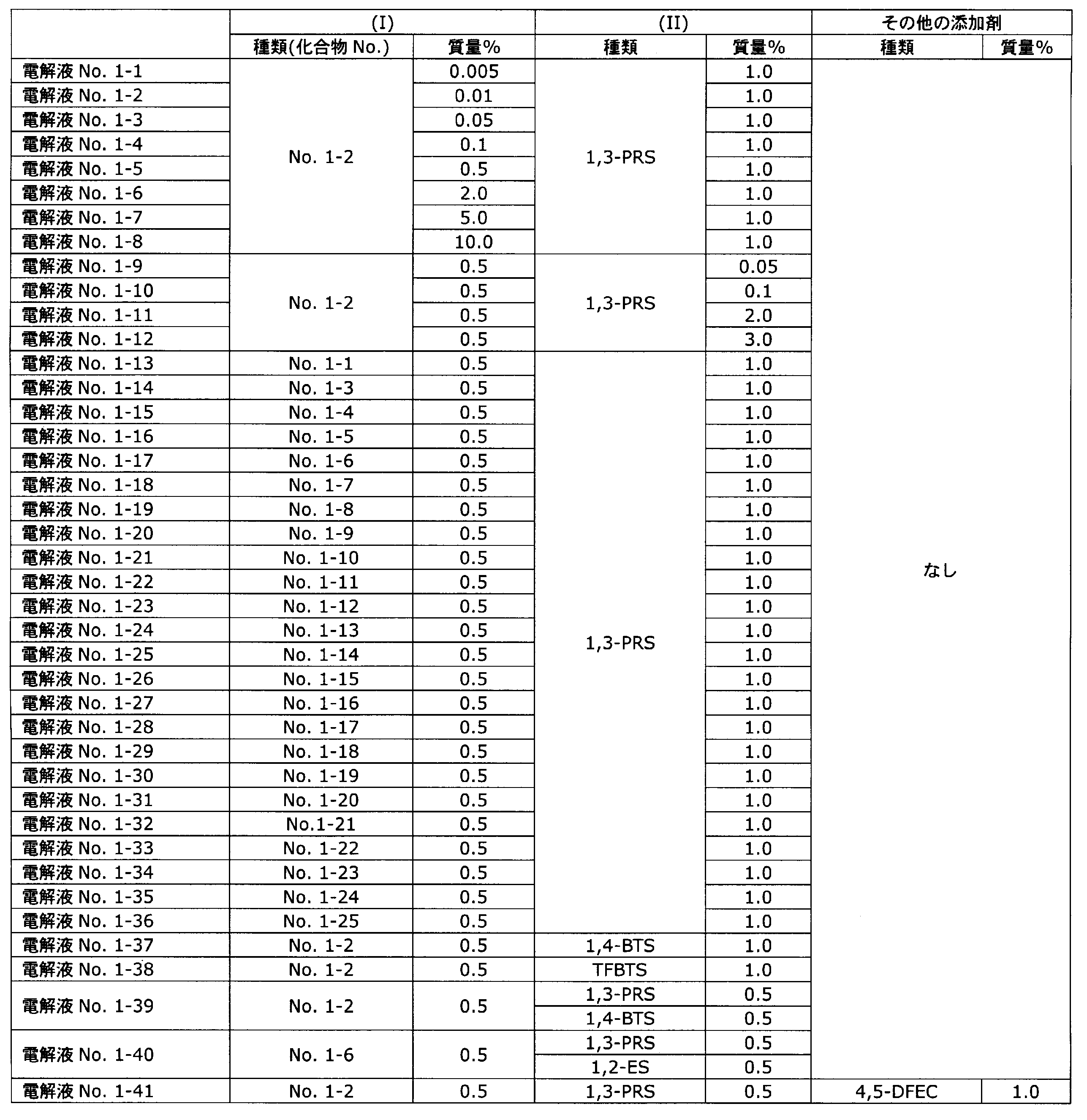
上述混合溶媒中に溶質としてヘキサフルオロリン酸リチウム(以降「LiPF6」)を1.0mol/Lの濃度となるように溶解し、表1及び表3に記載の(I)、(II)及びその他の添加剤を該表1及び表3に記載したように所定量溶解することで、電解液No.1-1~1-41、比較電解液No.1-1~1-18をそれぞれ調製した。
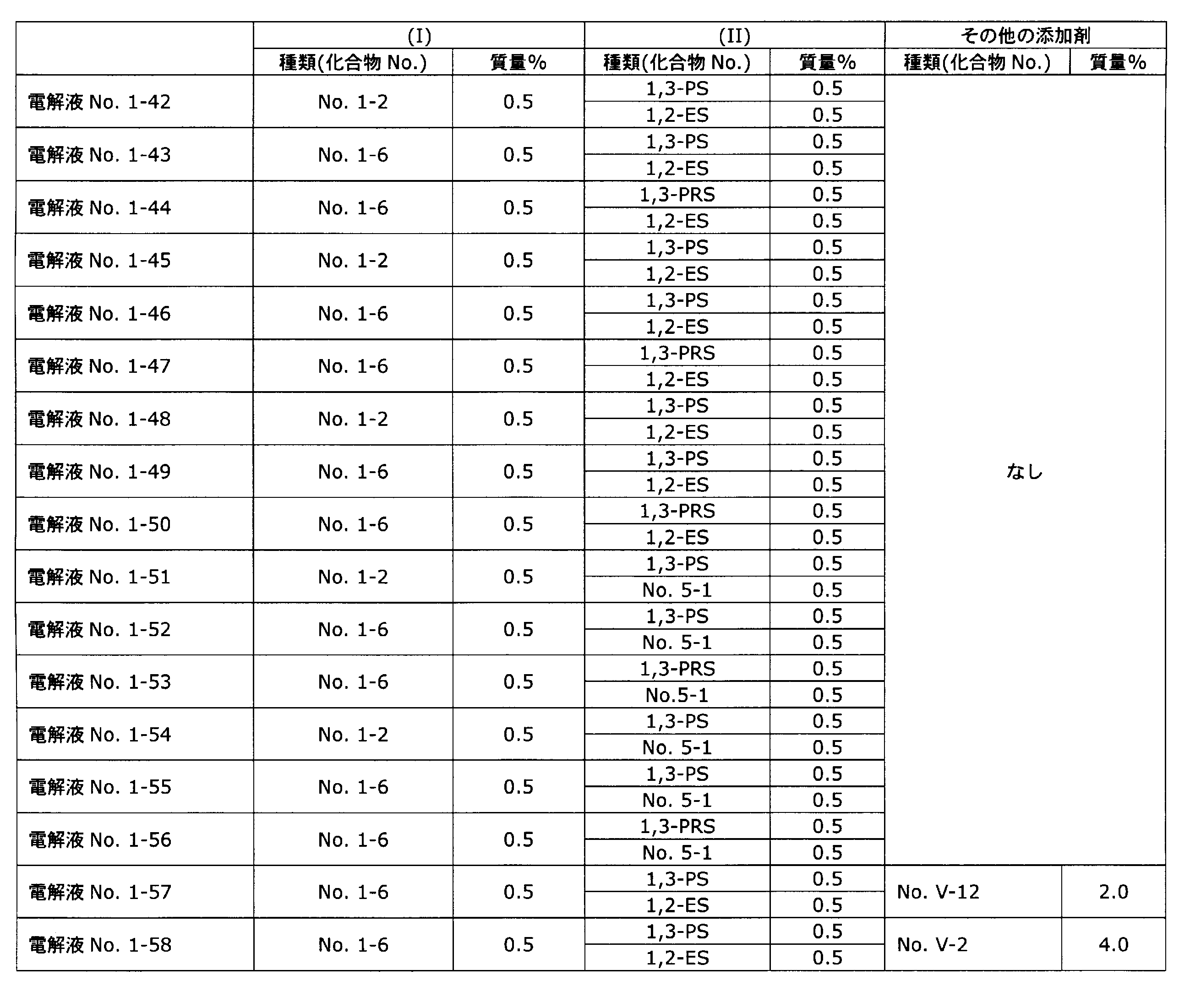
上述混合溶媒中に、溶質としてLiPF6を1.0mol/L、そしてビス(トリフルオロメタンスルホニル)イミドリチウム(以降「LiN(CF3SO2)2」)を0.10mol/Lの濃度となるように溶解し、表2に記載の(I)及び(II)を該表2に記載したように所定量溶解することで、電解液No.1-42~1-44をそれぞれ調製した。
上述混合溶媒中に、溶質としてLiPF6を1.0mol/L、そしてビス(フルオロスルホニル)イミドリチウム(以降「LiN(FSO2)2」)を0.10mol/Lの濃度となるように溶解し、表2に記載の(I)及び(II)を該表2に記載したように所定量溶解することで、電解液No.1-45~1-47をそれぞれ調製した。
上述混合溶媒中に、溶質としてLiPF6を1.0mol/L、そしてジフルオロリン酸リチウム(以降「LiPO2F2」)を0.10mol/Lの濃度となるように溶解し、表2に記載の(I)及び(II)を該表2に記載したように所定量溶解することで、電解液No.1-48~1-50をそれぞれ調製した。
上述混合溶媒中に、溶質としてLiPF6を1.0mol/L、そしてビス(フルオロスルホニル)イミドリチウム(以降「LiN(FSO2)2」)を0.10mol/Lの濃度となるように溶解し、表2に記載の(I)及び(II)を該表2に記載したように所定量溶解することで、電解液No.1-51~1-53をそれぞれ調製した。
上述混合溶媒中に、溶質としてLiPF6を1.0mol/L、そしてジフルオロリン酸リチウム(以降「LiPO2F2」)を0.10mol/Lの濃度となるように溶解し、表2に記載の(I)及び(II)を該表2に記載したように所定量溶解することで、電解液No.1-54~1-56をそれぞれ調製した。
上述混合溶媒中に、溶質としてLiPF6を1.0mol/L、LiPO2F2を0.10mol/L、テトラフルオロホウ酸リチウム(以降「LiBF4」)を0.025mol/Lの濃度となるように溶解し、表2に記載の(I)、(II)及びその他の添加剤を該表2に記載したように所定量溶解することで、電解液No.1-57を調製した。
上述混合溶媒中に、溶質としてLiPF6を1.0mol/L、LiN(FSO2)2を0.10mol/L、LiPO2F2を0.10mol/L、LiBF4を0.025mol/Lの濃度となるように溶解し、表2に記載の(I)、(II)及びその他の添加剤を該表2に記載したように所定量溶解することで、電解液No.1-58を調製した。
表3に記載のように、(I)、(II)及びその他の添加剤を含有させないこと以外は電解液No.1-42と同様にして、比較電解液No.1-19を調製した。
表3に記載のように、(II)を含有させないこと以外はそれぞれ電解液No.1-42、1-43と同様にして、比較電解液No.1-20、1-21を調製した。
表3に記載のように、(I)を含有させないこと以外はそれぞれ電解液No.1-42、1-44と同様にして、比較電解液No.1-22、1-23を調製した。
表3に記載のように、(I)、(II)及びその他の添加剤を含有させないこと以外は電解液No.1-45と同様にして、比較電解液No.1-24を調製した。
表3に記載のように、(II)を含有させないこと以外はそれぞれ電解液No.1-45、1-46と同様にして、比較電解液No.1-25、1-26を調製した。
表3に記載のように、(I)を含有させないこと以外はそれぞれ電解液No.1-45、1-47と同様にして、比較電解液No.1-27、1-28を調製した。
表3に記載のように、(I)、(II)及びその他の添加剤を含有させないこと以外は電解液No.1-48と同様にして、比較電解液No.1-29を調製した。
表3に記載のように、(II)を含有させないこと以外はそれぞれ電解液No.1-48、1-49と同様にして、比較電解液No.1-30、1-31を調製した。
表3に記載のように、(I)を含有させないこと以外はそれぞれ電解液No.1-48、1-50と同様にして、比較電解液No.1-32、1-33を調製した。
表3に記載のように、(I)を含有させないこと以外はそれぞれ電解液No.1-51、1-53と同様にして、比較電解液No.1-34、1-35を調製した。
表3に記載のように、(I)を含有させないこと以外はそれぞれ電解液No.1-54、1-56と同様にして、比較電解液No.1-36、1-37を調製した。
表3に記載のように、(I)、(II)を含有させないこと以外は電解液No.1-57と同様にして、比較電解液No.1-38を調製した。
表3に記載のように、(II)を含有させないこと以外は電解液No.1-57と同様にして、比較電解液No.1-39を調製した。
表3に記載のように、(I)を含有させないこと以外は電解液No.1-57と同様にして、比較電解液No.1-40を調製した。
表3に記載のように、(I)、(II)を含有させないこと以外は電解液No.1-58と同様にして、比較電解液No.1-41を調製した。
表3に記載のように、(II)を含有させないこと以外は電解液No.1-58と同様にして、比較電解液No.1-42を調製した。
表3に記載のように、(I)を含有させないこと以外は電解液No.1-58と同様にして、比較電解液No.1-43を調製した。
表中において、1,3-PRSは1,3-プロペンスルトンを意味し、1,4-BTSは1,4-ブテンスルトンを意味し、TFBTSは1,1,1-トリフルオロ-2,4-ブテンスルトンを意味し、4,5-DFECは4,5-ジフルオロエチレンカーボネートを意味し、1,2-ESは上記化合物No.4-1である1,2-エチレンスルファートを意味し、1,3-PSは1,3-プロパンスルトンを意味する。

正極活物質として、LiNi1/3Co1/3Mn1/3O2(NCM)粉末及びアセチレンブラック(導電剤)を乾式混合し、結着剤であるポリフッ化ビニリデン(以降「PVDF」)を予め溶解させたN-メチル-2-ピロリドン(以降「NMP」)中に均一に分散させ、混合し、さらに粘度調整用NMPを加え、NCM合剤ペーストを調製した。このペーストをアルミニウム箔(集電体)上に塗布して、乾燥、加圧を行った後に、所定のサイズに加工した試験用NMC正極を得た。正極中の固形分比率は、NCM:導電剤:PVDF=85:5:10(質量比)とした。
負極活物質として、黒鉛粉末を、結着剤であるPVDFを予め溶解させたNMP中に均一に分散させ、混合し、さらに粘度調整用NMPを加え、黒鉛合剤ペーストを調製した。このペーストを銅箔(集電体)上に塗布して、乾燥、加圧を行った後に、所定のサイズに加工した試験用黒鉛負極を得た。負極中の固形分比率は、黒鉛粉末:PVDF=90:10(質量比)とした。
上記の試験用NCM正極と、試験用黒鉛負極と、セルロース製セパレータとを備えるアルミラミネート外装セル(容量30mAh)に、表1~表3に記載の電解液No.1-1~1-58、及び比較電解液No.1-1~1-43をそれぞれ含浸させ、実施例1-1~1-58、比較例1-1~1-43に係る非水電解液電池を得た。

<評価1>高温貯蔵特性(70℃)
実施例1-1~1-58、比較例1-1~1-43に係る非水電解液電池のそれぞれについて、以下の評価を実施した。
まず、作製したセルを用いて、25℃の環境温度で、以下の条件でコンディショニングを実施した。すなわち、初回充放電として、充電上限電圧4.3V、0.1Cレート(3mA)で定電流定電圧充電し、放電終止電圧3.0Vまで0.2Cレート(6mA)定電流で放電を行い、その後、充電上限電圧4.3V、0.2Cレート(6mA)で定電流定電圧充電し、放電終止電圧3.0Vまで0.2Cレート(6mA)定電流で放電を行う充放電サイクルを3回繰り返した。
また、実施例1-42~1-44、比較例1-19~1-23については、比較例1-19の残存容量比を100とした場合の、各実施例・比較例の残存容量比の相対値である「70℃貯蔵後放電容量維持率」を記載した。
また、実施例1-45~1-47、比較例1-24~1-28については、比較例1-24の残存容量比を100とした場合の、各実施例・比較例の残存容量比の相対値である「70℃貯蔵後放電容量維持率」を記載した。
また、実施例1-48~1-50、比較例1-29~1-33については、比較例1-29の残存容量比を100とした場合の、各実施例・比較例の残存容量比の相対値である「70℃貯蔵後放電容量維持率」を記載した。
また、実施例1-51~1-53、比較例1-34~1-35については、比較例1-24の残存容量比を100とした場合の、各実施例・比較例の残存容量比の相対値である「70℃貯蔵後放電容量維持率」を記載した。
また、実施例1-54~1-56、比較例1-36~1-37については、比較例1-29の残存容量比を100とした場合の、各実施例・比較例の残存容量比の相対値である「70℃貯蔵後放電容量維持率」を記載した。
また、実施例1-57、比較例1-38~1-40については、比較例1-38の残存容量比を100とした場合の、各実施例・比較例の残存容量比の相対値である「70℃貯蔵後放電容量維持率」を記載した。
また、実施例1-58、比較例1-41~1-43については、比較例1-41の残存容量比を100とした場合の、各実施例・比較例の残存容量比の相対値である「70℃貯蔵後放電容量維持率」を記載した。
上記コンディショニングを実施後、及び上記70℃、10日間保存後に、電池の容積を測定し、その差分をガス発生量とした。
また、実施例1-42~1-44、比較例1-19~1-23に記載のガス発生量の数値は、比較例1-19のガス発生量を100とした場合の相対値である。
また、実施例1-45~1-47、比較例1-24~1-28に記載のガス発生量の数値は、比較例1-24のガス発生量を100とした場合の相対値である。
また、実施例1-48~1-50、比較例1-29~1-33に記載のガス発生量の数値は、比較例1-29のガス発生量を100とした場合の相対値である。
また、実施例1-51~1-53、比較例1-34~1-35のガス発生量の数値は、比較例1-24のガス発生量を100とした場合の相対値である。
また、実施例1-54~1-56、比較例1-36~1-37のガス発生量の数値は、比較例1-29のガス発生量を100とした場合の相対値である。
また、実施例1-57、比較例1-38~1-40のガス発生量の数値は、比較例1-38のガス発生量を100とした場合の相対値である。
また、実施例1-58、比較例1-41~1-43のガス発生量の数値は、比較例1-41のガス発生量を100とした場合の相対値である。


電解液No.2-1~2-47、比較電解液No.2-1~2-13については、上述の電解液No.1-1と同様の手順にて調製した。すなわち、非水溶媒としてEC、PC、DMC、EMCの体積比2:1:3:4の混合溶媒を用い、該溶媒中に溶質としてLiPF6を1.0mol/Lの濃度となるように溶解し、表6、表7に記載の(I)、(II)及びその他の添加剤を該表6、表7に記載したように所定量溶解することで、電解液No.2-1~2-47、比較電解液No.2-1~2-13をそれぞれ調製した。
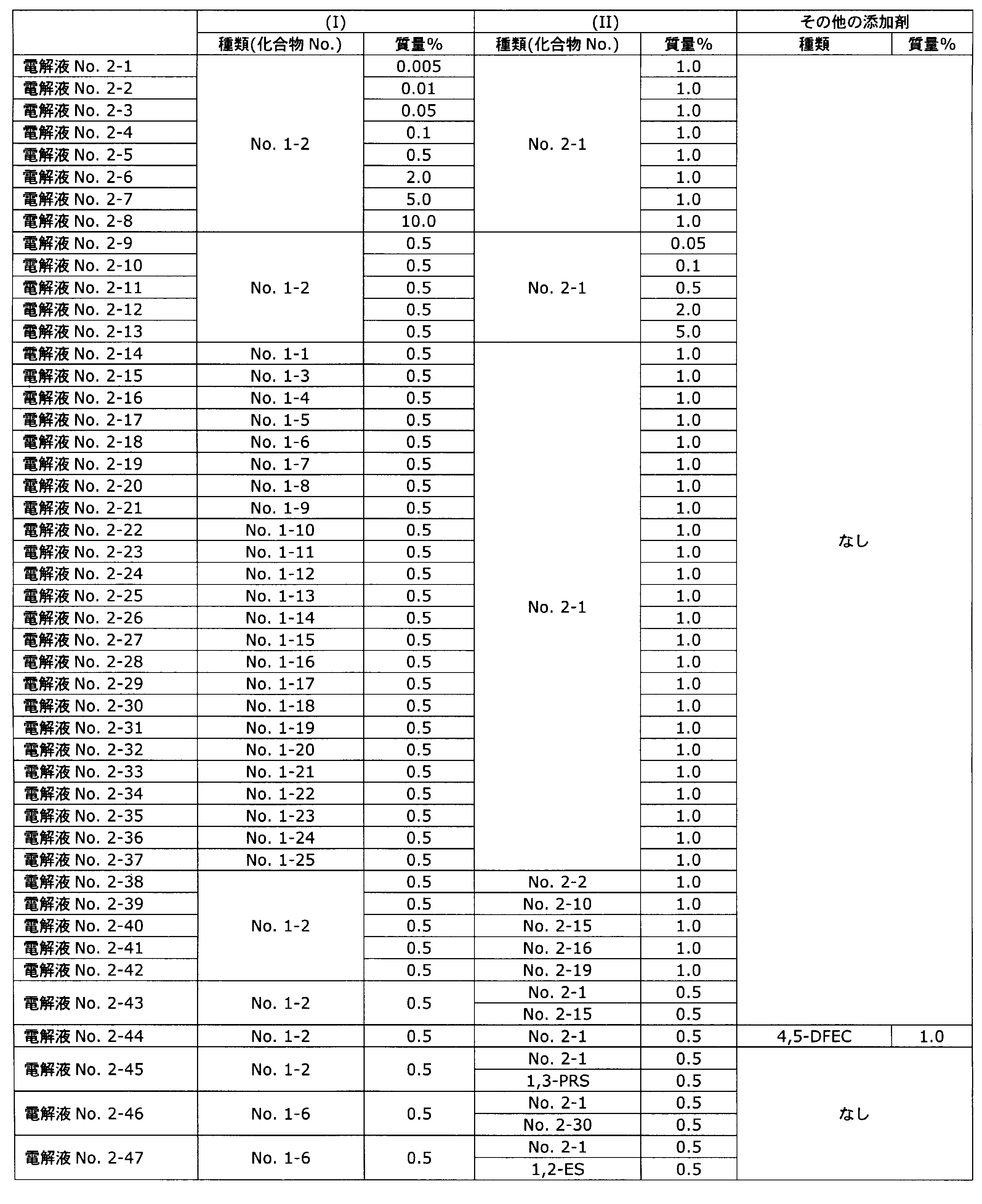

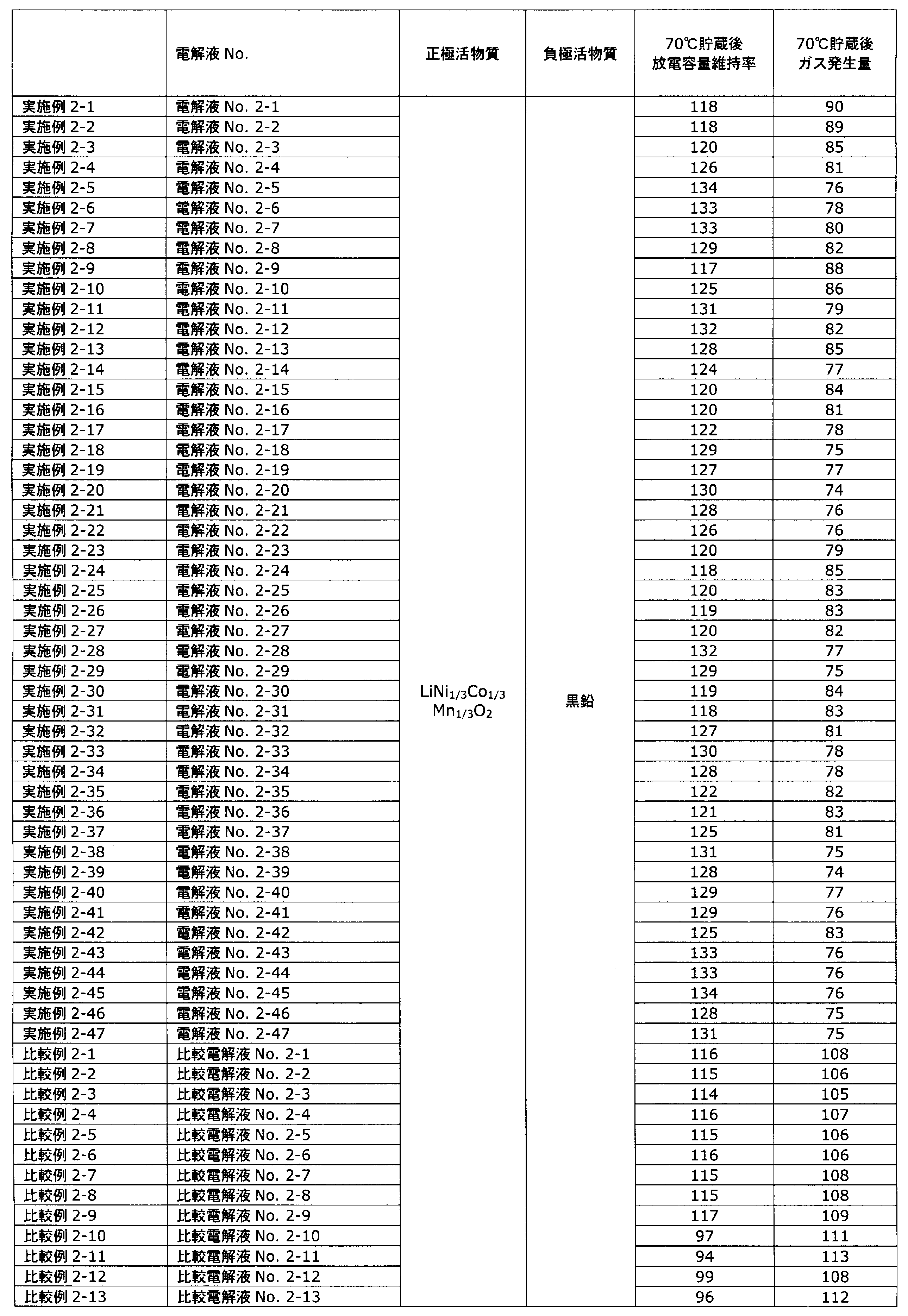
上述の実施例1-1に係る非水電解液電池と同様の手順にて、試験用NCM正極と、試験用黒鉛負極と、セルロース製セパレータとを備えるアルミラミネート外装セル(容量30mAh)に、表6、表7に記載の電解液No.2-1~2-47、比較電解液No.2-1~2-13をそれぞれ含浸させ、実施例2-1~2-47、比較例2-1~2-13に係る非水電解液電池を作製した。これら非水電解液電池については、上述の実施例1-1と同様、それぞれ以下の評価を実施した。
<評価1>高温貯蔵特性(70℃)
<評価2>高温貯蔵時に発生したガス量(70℃)
電解液No.3-1~3-45、比較電解液No.3-1~3-9については、上述の電解液No.1-1と同様の手順にて調製した。すなわち、非水溶媒としてEC、PC、DMC、EMCの体積比2:1:3:4の混合溶媒を用い、該溶媒中に溶質としてLiPF6を1.0mol/Lの濃度となるように溶解し、表9に記載の(I)、(II)及びその他の添加剤を該表9に記載したように所定量溶解することで、電解液No.3-1~3-45、比較電解液No.3-1~3-9をそれぞれ調製した。

上述の実施例1-1に係る非水電解液電池と同様の手順にて、試験用NCM正極と、試験用黒鉛負極と、セルロース製セパレータとを備えるアルミラミネート外装セル(容量30mAh)に、表9に記載の電解液No.3-1~3-45、比較電解液No.3-1~3-9をそれぞれ含浸させ、実施例3-1~3-45、比較例3-1~3-9に係る非水電解液電池を作製した。これら非水電解液電池については、上述の実施例1-1と同様、それぞれ以下の評価を実施した。
<評価1>高温貯蔵特性(70℃)
<評価2>高温貯蔵時に発生したガス量(70℃)
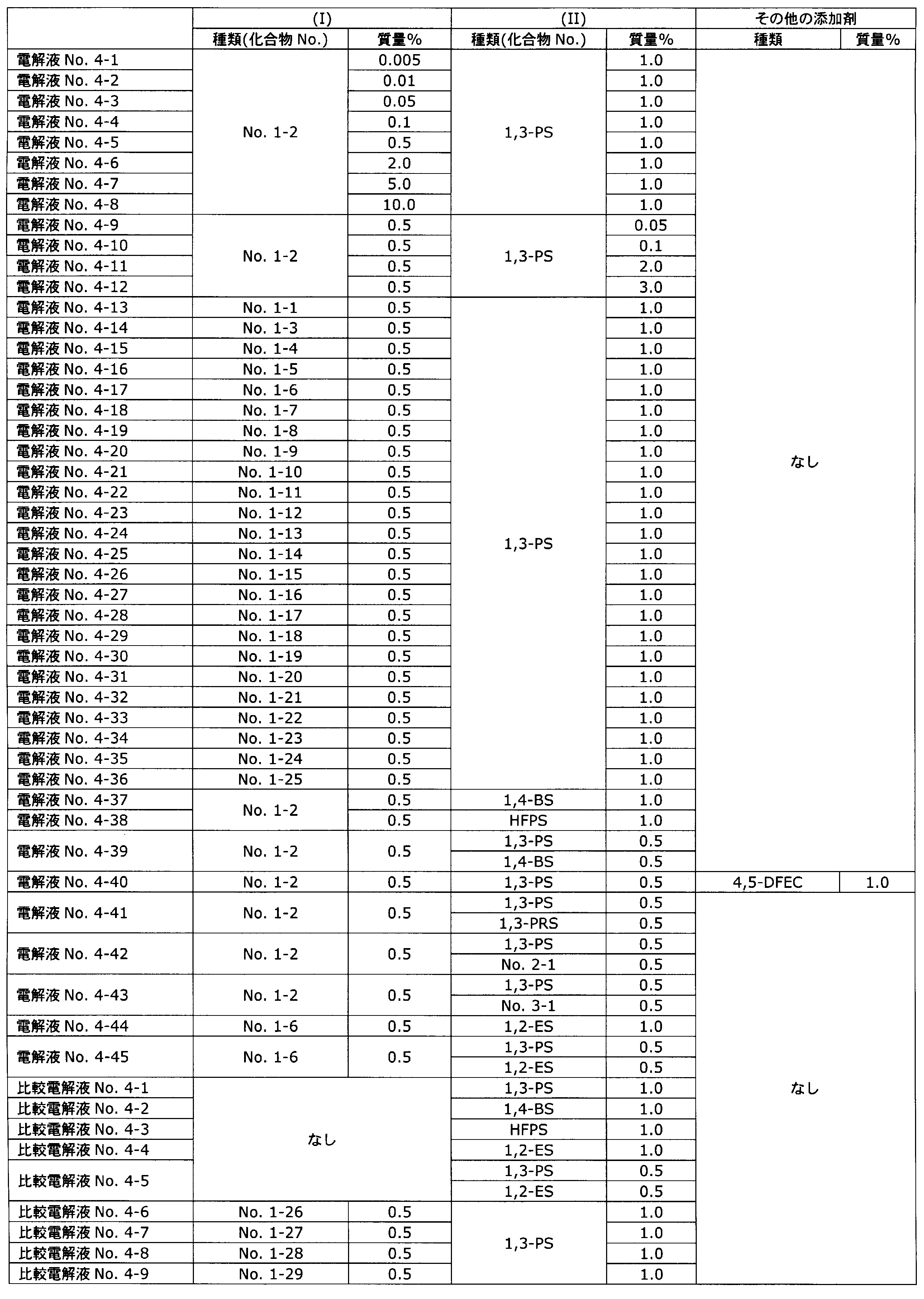
電解液No.4-1~4-45、比較電解液No.4-1~4-9については、上述の電解液No.1-1と同様の手順にて調製した。すなわち、非水溶媒としてEC、PC、DMC、EMCの体積比2:1:3:4の混合溶媒を用い、該溶媒中に溶質としてLiPF6を1.0mol/Lの濃度となるように溶解し、表11に記載の(I)、(II)及びその他の添加剤を該表11に記載したように所定量溶解することで、電解液No.4-1~4-45、比較電解液No.4-1~4-9をそれぞれ調製した。なお表中において、1,4-BSは1,4-ブタンスルトンを意味し、HFPSはα-ヘプタフルオロプロピル-γ-スルトンを意味する。
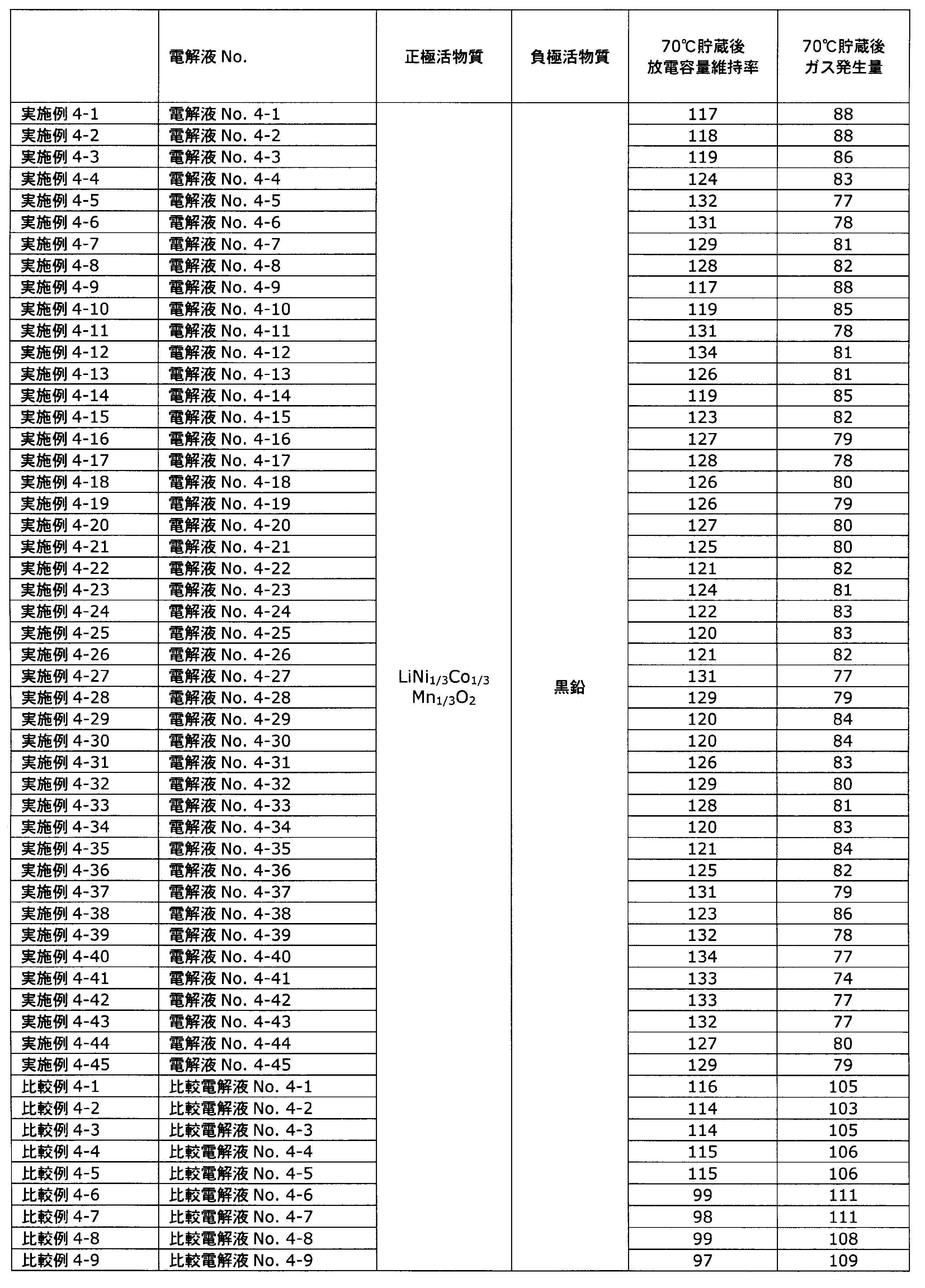
上述の実施例1-1に係る非水電解液電池と同様の手順にて、試験用NCM正極と、試験用黒鉛負極と、セルロース製セパレータとを備えるアルミラミネート外装セル(容量30mAh)に、表11に記載の電解液No.4-1~4-45、比較電解液No.4-1~4-9をそれぞれ含浸させ、実施例4-1~4-45、比較例4-1~4-9に係る非水電解液電池を作製した。これら非水電解液電池については、上述の実施例1-1と同様、それぞれ以下の評価を実施した。
<評価1>高温貯蔵特性(70℃)
<評価2>高温貯蔵時に発生したガス量(70℃)
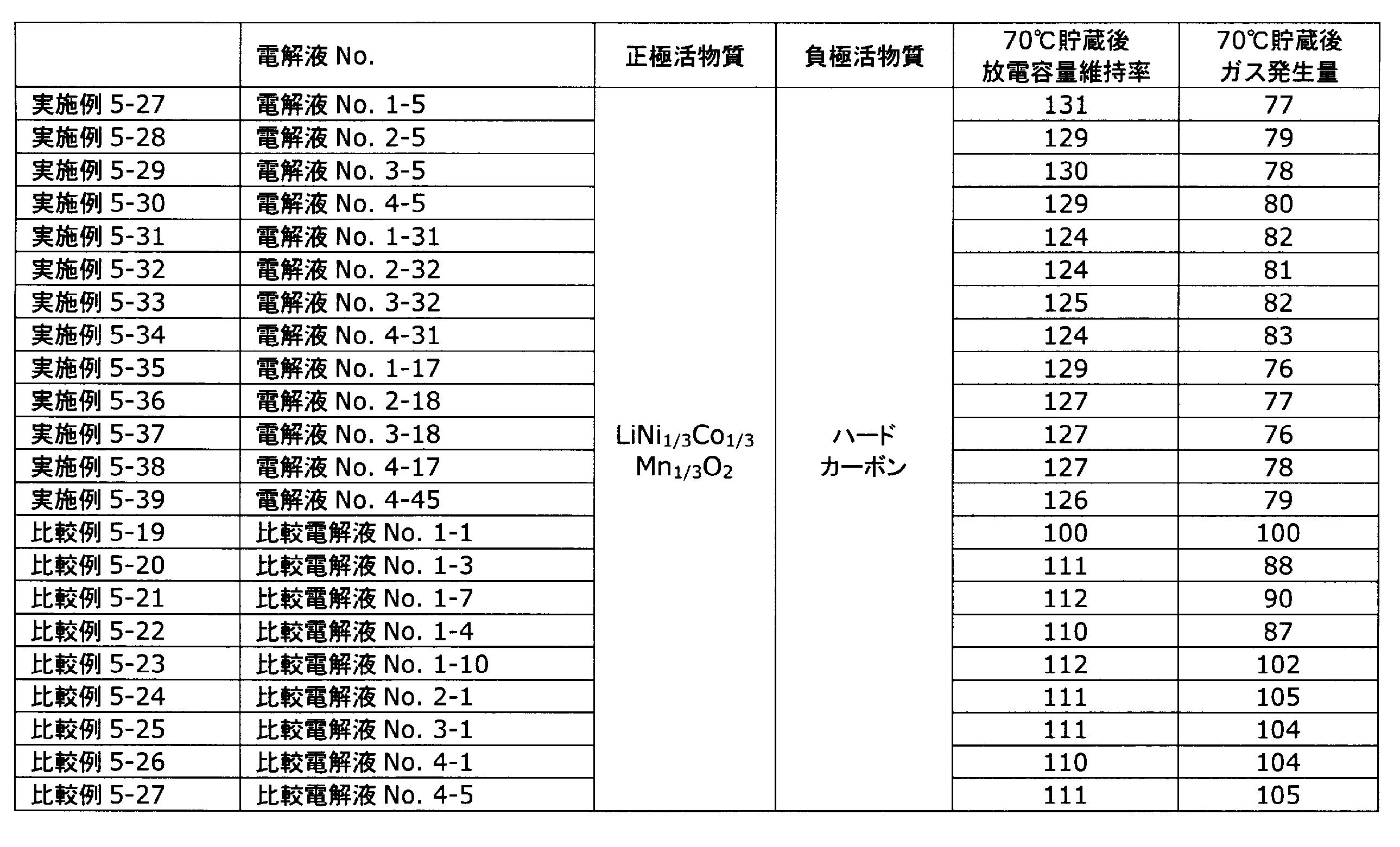
実施例5-1~5-39及び比較例5-1~5-27においては、表13~表15に示すように、負極体及び電解液を変えたこと以外は実施例1-1と同様に非水電解液電池を作製し、電池の評価を実施した。なお、負極活物質がLi4Ti5O12である実施例5-1~5-13及び比較例5-1~5-9において、負極体は、Li4Ti5O12粉末90質量%に、バインダーとして5質量%のPVDF、導電剤としてアセチレンブラックを5質量%混合し、さらにNMPを添加し、得られたペーストを銅箔上に塗布して、乾燥させることにより作製し、電池評価の際の充電終止電圧を2.7V、放電終止電圧を1.5Vとした。また、負極活物質が黒鉛(ケイ素含有)である実施例5-14~5-26及び比較例5-10~5-18において、負極体は、黒鉛粉末81質量%、ケイ素粉末9質量%に、バインダーとして5質量%のPVDF、導電材としてアセチレンブラックを5質量%混合しさらにNMPを添加し、得られたペーストを銅箔上に塗布して、乾燥させることにより作製し、電池評価の際の充電終止電圧と放電終止電圧は実施例1-1と同様とした。また、負極活物質がハードカーボンである実施例5-27~5-39及び比較例5-19~5-27において、負極体は、ハードカーボン粉末90質量%に、バインダーとして5質量%のPVDF、導電剤としてアセチレンブラックを5質量%混合し、さらにNMPを添加し、得られたペーストを銅箔上に塗布して、乾燥させることにより作製し、電池評価の際の充電終止電圧を4.2V、放電終止電圧を2.2Vとした。高温貯蔵特性と高温貯蔵時に発生したガス量の評価結果を表14及び表15に示す。
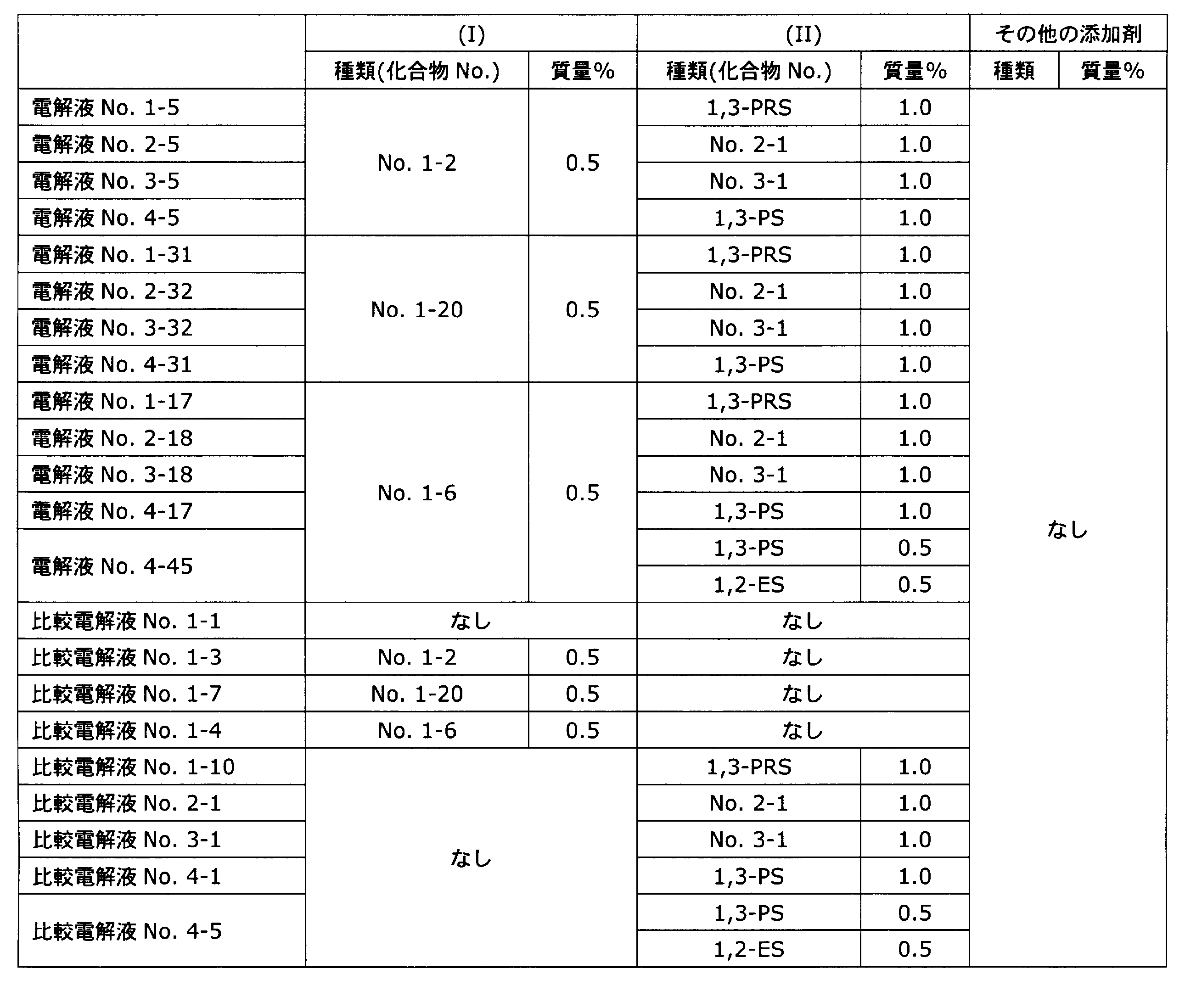

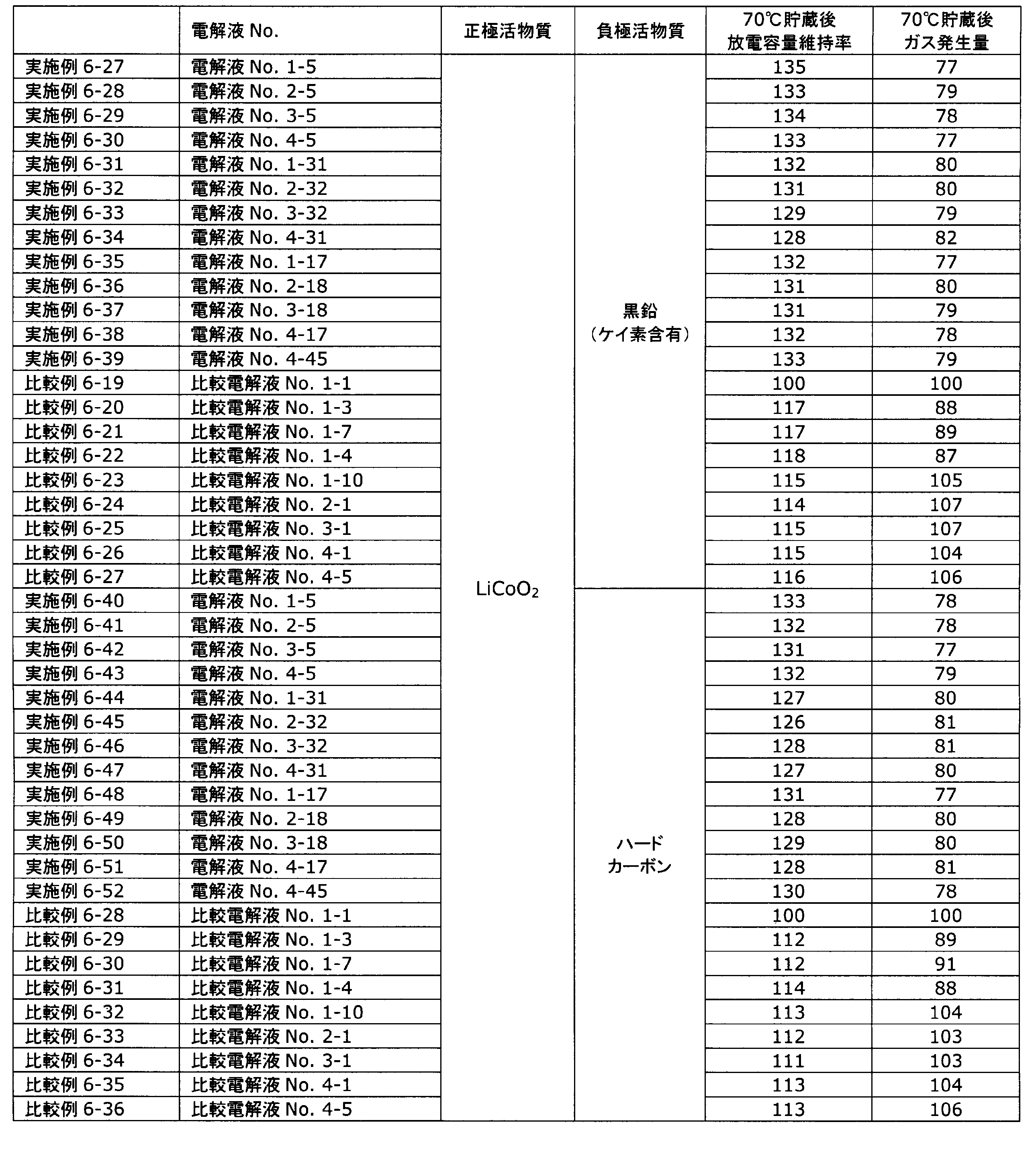
実施例6-1~6-52及び比較例6-1~6-36においては、表13、表16及び表17に示すように、正極体、負極体及び電解液を変えたこと以外は実施例1-1と同様に非水電解液電池を作製し、電池の評価を実施した。なお、正極活物質がLiCoO2である正極体は、LiCoO2粉末85質量%にバインダーとして10質量%のPVDF、導電材としてアセチレンブラックを5質量%混合し、さらにNMPを添加し、得られたペーストをアルミニウム箔上に塗布して、乾燥させることにより作製した。実施例1-1と同様に負極活物質が黒鉛である実施例6-1~6-13及び比較例6-1~6-9において、電池評価の際の充電終止電圧を4.2V、放電終止電圧を3.0Vとした。実施例5-1と同様に負極活物質がLi4Ti5O12である実施例6-14~6-26及び比較例6-10~6-18において、電池評価の際の充電終止電圧を2.7V、放電終止電圧を1.5Vとした。実施例5-14と同様に負極活物質が黒鉛(ケイ素9質量%含有)である実施例6-27~6-39及び比較例6-19~6-27において、電池評価の際の充電終止電圧を4.2V、放電終止電圧を3.0Vとした。実施例5-27と同様に負極活物質がハードカーボンである実施例6-40~6-52及び比較例6-28~6-36において、電池評価の際の充電終止電圧を4.1V、放電終止電圧を2.2Vとした。高温貯蔵特性と高温貯蔵時に発生したガス量の評価結果を表16及び表17に示す。

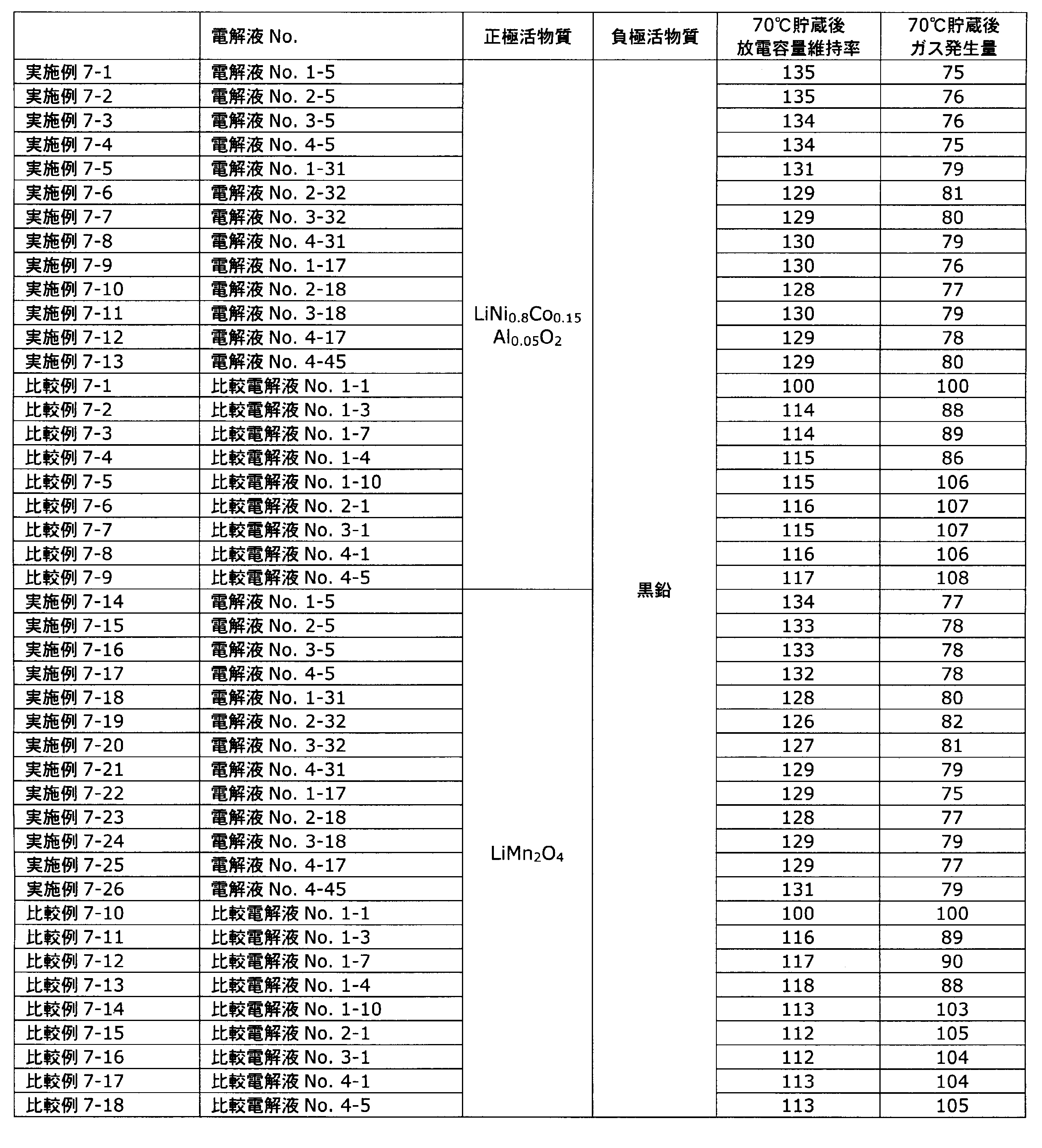
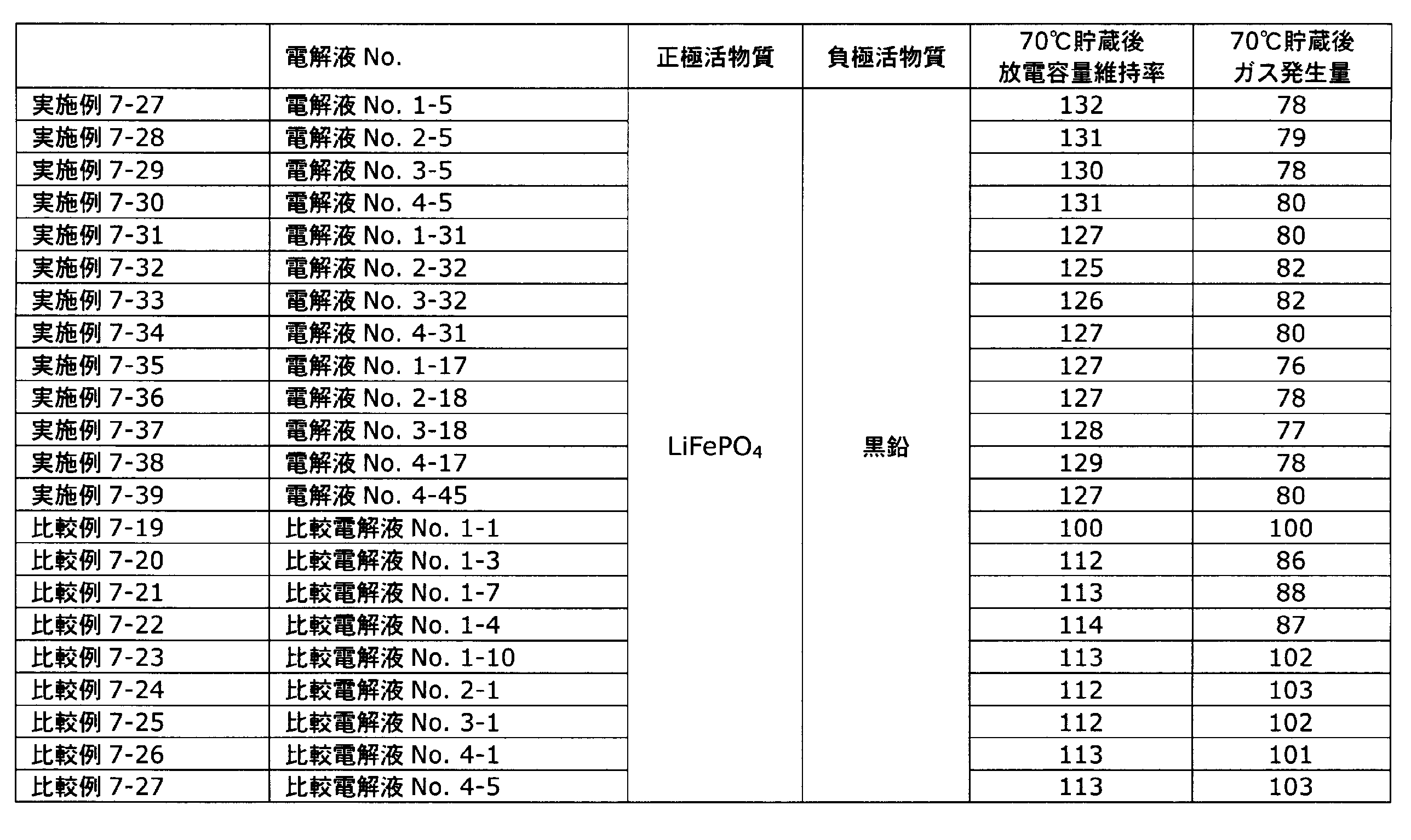
実施例7-1~7-39及び比較例7-1~7-27においては、表13、表18及び表19に示すように、正極体及び電解液を変えたこと以外は実施例1-1と同様に非水電解液電池を作製し、電池の評価を実施した。なお、正極活物質がLiNi0.8Co0.15Al0.05O2である実施例7-1~7-13及び比較例7-1~7-9において、正極体は、LiNi0.8Co0.15Al0.05O2粉末85質量%にバインダーとして10質量%のPVDF、導電材としてアセチレンブラックを5質量%混合し、さらにNMPを添加し、得られたペーストをアルミニウム箔上に塗布して、乾燥させることにより作製し、電池評価の際の充電終止電圧を4.3V、放電終止電圧を3.0Vとした。また、正極活物質がLiMn2O4である実施例7-14~7-26及び比較例7-10~7-18において、正極体は、LiMn2O4粉末85質量%にバインダーとして10質量%のPVDF、導電材としてアセチレンブラックを5質量%混合し、さらにNMPを添加し、得られたペーストをアルミニウム箔上に塗布して、乾燥させることにより作製し、電池評価の際の充電終止電圧を4.2V、放電終止電圧を3.0Vとした。また、正極活物質がLiFePO4である実施例7-27~7-39及び比較例7-19~7-27において、正極体は、非晶質炭素で被覆されたLiFePO4粉末85質量%にバインダーとして10質量%のPVDF、導電材としてアセチレンブラックを5質量%混合し、さらにNMPを添加し、得られたペーストをアルミニウム箔上に塗布して、乾燥させることにより作製し、電池評価の際の充電終止電圧を4.2V、放電終止電圧を2.5Vとした。高温貯蔵特性と高温貯蔵時に発生したガス量の評価結果を表18及び表19に示す。
Claims (23)
- 下記成分:
(I)下記一般式(1)で示される少なくとも1種のシラン化合物;
(II)環状スルホン酸化合物及び環状硫酸エステル化合物からなる少なくとも1種;
(III)非水有機溶媒;及び
(IV)溶質
を含む、非水電解液電池用電解液。

- 前記(II)が、下記一般式(II-1a)、(II-1b)、(II-1c)、(II-1d)、(II-1e)、及び、(II-1f)からなる群から選ばれる少なくとも1種である、請求項1に記載の非水電解液電池用電解液。

- 前記一般式(II-1a)で示される環状スルホン酸化合物が、1,3-プロペンスルトン、1,4-ブテンスルトン、2,4-ペンテンスルトン、3,5-ペンテンスルトン、1-フルオロ-1,3-プロペンスルトン、1-トリフルオロメチル-1,3-プロペンスルトン、1,1,1-トリフルオロ-2,4-ブテンスルトン、1,4-ブテンスルトン、及び1,5-ペンテンスルトンからなる群から選択される少なくとも1種である、請求項2に記載の非水電解液電池用電解液。
- 前記一般式(II-1a)で示される環状スルホン酸化合物が、1,3-プロペンスルトン、及び1,4-ブテンスルトンからなる群から選択される少なくとも1種である、請求項2に記載の非水電解液電池用電解液。
- 前記一般式(II-1b)で示される環状スルホン酸化合物が、下記化合物No.2-1~2-29からなる群から選択される少なくとも1種である、請求項2に記載の非水電解液電池用電解液。
- 前記一般式(II-1b)で示される環状スルホン酸化合物が、下記化合物No.2-1、2-2、2-10、2-15、及び2-16からなる群から選択される少なくとも1種である、請求項2に記載の非水電解液電池用電解液。
- 前記一般式(II-1c)で示される環状スルホン酸化合物が、下記化合物No.3-1~3-5からなる群から選択される少なくとも1種である、請求項2に記載の非水電解液電池用電解液。
- 前記一般式(II-1c)で示される環状スルホン酸化合物が、下記化合物No.3-1、3-2、及び3-5からなる群から選択される少なくとも1種である、請求項2に記載の非水電解液電池用電解液。

- 前記一般式(II-1d)で示される環状スルホン酸化合物が、1,3-プロパンスルトン、α-トリフルオロメチル-γ-スルトン、β-トリフルオロメチル-γ-スルトン、γ-トリフルオロメチル-γ-スルトン、α-メチル-γ-スルトン、α,β-ジ(トリフルオロメチル)-γ-スルトン、α,α-ジ(トリフルオロメチル)-γ-スルトン、α-ヘプタフルオロプロピル-γ-スルトン、1,4-ブタンスルトン、及び1,5-ペンタンスルトンからなる群から選択される少なくとも1種である、請求項2に記載の非水電解液電池用電解液。
- 前記一般式(II-1d)で示される環状スルホン酸化合物が、1,3-プロパンスルトン、及び1,4-ブタンスルトンからなる群から選択される少なくとも1種である、請求項2に記載の非水電解液電池用電解液。
- 前記一般式(II-1e)で示される環状硫酸エステル化合物が、下記化合物No.4-1~4-8からなる群から選択される少なくとも1種である、請求項2に記載の非水電解液電池用電解液。

- 前記一般式(II-1f)で示される環状硫酸エステル化合物が、下記化合物No.5-1~5-3からなる群から選択される少なくとも1種である、請求項2に記載の非水電解液電池用電解液。
- 前記一般式(1)のR1が、それぞれ互いに独立して、ビニル基、アリル基、1-プロペニル基、2-プロペニル基、エチニル基、及び2-プロピニル基からなる群から選択される、請求項1~12のいずれかに記載の非水電解液電池用電解液。
- 前記一般式(1)のR2が、それぞれ互いに独立して、フッ素基、メチル基、エチル基、プロピル基、2,2,2-トリフルオロエチル基、2,2,3,3-テトラフルオロプロピル基、1,1,1-トリフルオロイソプロピル基、1,1,1,3,3,3-ヘキサフルオロイソプロピル基、2,2,2-トリフルオロエトキシ基、2,2,3,3-テトラフルオロプロポキシ基、2,2,3,3,3-ペンタフルオロプロポキシ基、1,1,1-トリフルオロイソプロポキシ基、及び1,1,1,3,3,3-ヘキサフルオロイソプロポキシ基からなる群から選択される基であることを特徴とする、請求項1~13のいずれかに記載の非水電解液電池用電解液。
- 前記一般式(1)のxが3~4である、請求項1~14のいずれかに記載の非水電解液電池用電解液。
- (I)、(II)、(III)、(IV)の総量100質量%に対する、(I)の総量が0.001質量%以上10.0質量%以下である、請求項1~15のいずれかに記載の非水電解液電池用電解液。
- (I)、(II)、(III)、(IV)の総量100質量%に対する、(II)の総量が0.01質量%以上10.0質量%以下である、請求項1~16のいずれかに記載の非水電解液電池用電解液。
- 前記(IV)が、ヘキサフルオロリン酸リチウム、テトラフルオロホウ酸リチウム、ビス(トリフルオロメタンスルホニル)イミドリチウム、ビス(フルオロスルホニル)イミドリチウム、ビス(ジフルオロホスホニル)イミドリチウム、(ジフルオロホスホニル)(フルオロスルホニル)イミドリチウム、及びジフルオロリン酸リチウムからなる群から選ばれる少なくとも一つを含む溶質である、請求項1~17のいずれかに記載の非水電解液電池用電解液。
- 前記(III)が、環状カーボネート、鎖状カーボネート、環状エステル、鎖状エステル、環状エーテル、鎖状エーテル、スルホン化合物、スルホキシド化合物、及びイオン液体からなる群から選ばれる少なくとも一つを含む非水有機溶媒である、請求項1~18のいずれかに記載の非水電解液電池用電解液。
- さらに、フッ素原子を有するカーボネートを含有する、請求項1~19のいずれかに記載の非水電解液電池用電解液。
- 前記フッ素原子を有するカーボネートが、フルオロエチレンカーボネート、4,4-ジフルオロエチレンカーボネート、4,5-ジフルオロエチレンカーボネート、及び4,5-ジフルオロ-4,5-ジメチルエチレンカーボネートからなる群から選ばれる少なくとも1種である、請求項20に記載の非水電解液電池用電解液。
- 下記一般式(V)で表される化合物を更に含有する、請求項1~21のいずれかに記載の非水電解液電池用電解液。

- 少なくとも正極と、負極と、請求項1~22のいずれかに記載の非水電解液電池用電解液とを備える、非水電解液電池。
Priority Applications (8)
| Application Number | Priority Date | Filing Date | Title |
|---|---|---|---|
| EP17750175.6A EP3416229B1 (en) | 2016-02-08 | 2017-02-03 | Electrolytic solution for non-aqueous electrolyte battery, and non-aqueous electrolytic solution battery using the same |
| US16/076,181 US11302964B2 (en) | 2016-02-08 | 2017-02-03 | Electrolytic solution for nonaqueous electrolytic solution battery, and nonaqueous electrolytic solution battery using same |
| CN201780010142.8A CN108701864B (zh) | 2016-02-08 | 2017-02-03 | 非水电解液电池用电解液和使用了其的非水电解液电池 |
| JP2017566915A JP6955165B2 (ja) | 2016-02-08 | 2017-02-03 | 非水電解液電池用電解液、及びこれを用いた非水電解液電池 |
| PL17750175T PL3416229T3 (pl) | 2016-02-08 | 2017-02-03 | Roztwór elektrolityczny dla akumulatora z niewodnym elektrolitem, i zawierający go akumulator z niewodnym roztworem elektrolitycznym |
| CN202210577753.3A CN115101816A (zh) | 2016-02-08 | 2017-02-03 | 非水电解液电池用电解液和使用了其的非水电解液电池 |
| KR1020217002999A KR102391374B1 (ko) | 2016-02-08 | 2017-02-03 | 비수전해액 전지용 전해액, 및 이것을 이용한 비수전해액 전지 |
| KR1020187025611A KR20180108796A (ko) | 2016-02-08 | 2017-02-03 | 비수전해액 전지용 전해액, 및 이것을 이용한 비수전해액 전지 |
Applications Claiming Priority (2)
| Application Number | Priority Date | Filing Date | Title |
|---|---|---|---|
| JP2016021885 | 2016-02-08 | ||
| JP2016-021885 | 2016-02-08 |
Publications (1)
| Publication Number | Publication Date |
|---|---|
| WO2017138452A1 true WO2017138452A1 (ja) | 2017-08-17 |
Family
ID=59563833
Family Applications (1)
| Application Number | Title | Priority Date | Filing Date |
|---|---|---|---|
| PCT/JP2017/003964 Ceased WO2017138452A1 (ja) | 2016-02-08 | 2017-02-03 | 非水電解液電池用電解液、及びこれを用いた非水電解液電池 |
Country Status (8)
| Country | Link |
|---|---|
| US (1) | US11302964B2 (ja) |
| EP (1) | EP3416229B1 (ja) |
| JP (1) | JP6955165B2 (ja) |
| KR (2) | KR102391374B1 (ja) |
| CN (2) | CN115101816A (ja) |
| HU (1) | HUE049503T2 (ja) |
| PL (1) | PL3416229T3 (ja) |
| WO (1) | WO2017138452A1 (ja) |
Cited By (9)
| Publication number | Priority date | Publication date | Assignee | Title |
|---|---|---|---|---|
| WO2019117101A1 (ja) | 2017-12-12 | 2019-06-20 | セントラル硝子株式会社 | 非水電解液電池用電解液及びそれを用いた非水電解液電池 |
| JP2019153539A (ja) * | 2018-03-06 | 2019-09-12 | 三洋電機株式会社 | 非水電解質二次電池 |
| WO2019171434A1 (ja) * | 2018-03-05 | 2019-09-12 | 日立化成株式会社 | 電気化学デバイス |
| JP2020068212A (ja) * | 2018-10-26 | 2020-04-30 | 三星電子株式会社Samsung Electronics Co., Ltd. | リチウム電池 |
| CN111137870A (zh) * | 2018-11-06 | 2020-05-12 | 宁波氟创新能源科技有限公司 | 一种二氟磷酸锂、其制备方法及锂离子电池电解液 |
| KR20200090223A (ko) | 2017-12-12 | 2020-07-28 | 샌트랄 글래스 컴퍼니 리미티드 | 비수전해액 전지용 전해액 및 그것을 이용한 비수전해액 전지 |
| WO2024253162A1 (ja) | 2023-06-08 | 2024-12-12 | セントラル硝子株式会社 | 非水電解液二次電池用電解液、及びこれを用いた非水電解液二次電池 |
| JP2025530513A (ja) * | 2022-10-05 | 2025-09-11 | エルジー・ケム・リミテッド | リチウム金属電池 |
| WO2026083872A1 (ja) * | 2024-10-15 | 2026-04-23 | Muアイオニックソリューションズ株式会社 | 非水系電解液、非水系電解液の製造方法、電池、電池の製造方法及び車両 |
Families Citing this family (20)
| Publication number | Priority date | Publication date | Assignee | Title |
|---|---|---|---|---|
| KR102391374B1 (ko) | 2016-02-08 | 2022-04-27 | 샌트랄 글래스 컴퍼니 리미티드 | 비수전해액 전지용 전해액, 및 이것을 이용한 비수전해액 전지 |
| CN113396496A (zh) * | 2018-12-05 | 2021-09-14 | 昭和电工材料株式会社 | 电解液及电化学器件 |
| CN109546217A (zh) * | 2018-12-19 | 2019-03-29 | 珠海光宇电池有限公司 | 一种适配高容量石墨负极的电解液和锂离子电池 |
| CN109860703B (zh) | 2019-01-25 | 2021-04-06 | 宁德新能源科技有限公司 | 一种电解液及电化学装置 |
| CN110112464A (zh) * | 2019-04-17 | 2019-08-09 | 欣旺达电动汽车电池有限公司 | 一种含有三甲基氟硅烷的锂离子二次电池电解液 |
| HUE071168T2 (hu) * | 2019-04-29 | 2025-08-28 | Lg Energy Solution Ltd | Nem-vizes elektrolit lítium szekunder akkumulátorhoz és az azt tartalmazó lítium szekunder akkumulátor |
| CN110190329B (zh) * | 2019-05-20 | 2022-02-22 | 惠州市豪鹏科技有限公司 | 4,4-双-1,3,2-二噁唑噻吩-2,2-二氧化物的应用和电解液、锂离子电池 |
| CN110492177B (zh) * | 2019-07-09 | 2021-03-26 | 深圳市比克动力电池有限公司 | 电池电解液用添加剂、锂离子电池电解液、锂离子电池 |
| KR20220015216A (ko) * | 2020-07-30 | 2022-02-08 | 삼성에스디아이 주식회사 | 리튬 이차 전지용 전해액 및 이를 포함하는 리튬 이차 전지 |
| CN112054238B (zh) * | 2020-09-11 | 2021-10-22 | 山东海科新源材料科技股份有限公司 | 含硅氧链段的环状硫酸酯类添加剂、包合其的电解液及锂离子电池 |
| CN114447428B (zh) * | 2020-10-30 | 2023-12-05 | 张家港市国泰华荣化工新材料有限公司 | 一种非水电解液及锂电池 |
| KR102893455B1 (ko) * | 2021-01-28 | 2025-12-03 | 주식회사 엘지에너지솔루션 | 리튬-황 전지용 전해액 및 이를 포함하는 리튬-황 전지 |
| CN115380416A (zh) * | 2021-03-18 | 2022-11-22 | 三井化学株式会社 | 非水电解液、电化学设备前体、电化学设备、及电化学设备的制造方法 |
| CN113078360B (zh) * | 2021-03-25 | 2022-10-21 | 宁德新能源科技有限公司 | 一种电解液及包含该电解液的电化学装置 |
| CN113948770B (zh) * | 2021-10-12 | 2024-01-30 | 远景动力技术(江苏)有限公司 | 改善电池高温存储特性的电解液以及锂离子电池 |
| JP7841803B2 (ja) * | 2022-07-28 | 2026-04-07 | エルジー・ケム・リミテッド | 非水電解液およびそれを含むリチウム二次電池 |
| CN115377498A (zh) * | 2022-09-23 | 2022-11-22 | 珠海冠宇电池股份有限公司 | 一种电解液和电池 |
| KR20260014621A (ko) * | 2023-06-01 | 2026-01-30 | 컨템포러리 엠퍼렉스 테크놀로지 씨오., 리미티드 | 이차 전지 및 전기 장치 |
| KR20260014610A (ko) * | 2023-06-01 | 2026-01-30 | 컨템포러리 엠퍼렉스 테크놀로지 씨오., 리미티드 | 이차 전지용 비수성 전해액, 이차 전지 및 전기 장치 |
| KR20260014644A (ko) * | 2023-06-01 | 2026-01-30 | 컨템포러리 엠퍼렉스 테크놀로지 씨오., 리미티드 | 이차 전지용 비수성 전해액, 이차 전지 및 전기 장치 |
Citations (20)
| Publication number | Priority date | Publication date | Assignee | Title |
|---|---|---|---|---|
| JPH10139784A (ja) | 1996-11-06 | 1998-05-26 | Kanegafuchi Chem Ind Co Ltd | ビニルシリル基含有ケイ素化合物の製造方法 |
| JP2000003724A (ja) | 1997-08-22 | 2000-01-07 | Ube Ind Ltd | 非水電解液およびそれを用いたリチウム二次電池 |
| JP2002329528A (ja) | 2001-03-01 | 2002-11-15 | Mitsui Chemicals Inc | 非水電解液、それを用いた二次電池、および電解液用添加剤 |
| JP2004039510A (ja) | 2002-07-05 | 2004-02-05 | Denso Corp | 非水電解液及び該電解液を用いた非水電解液二次電池 |
| JP2004087459A (ja) | 2002-06-25 | 2004-03-18 | Mitsubishi Chemicals Corp | 非水電解液二次電池 |
| JP2004185931A (ja) | 2002-12-02 | 2004-07-02 | Japan Storage Battery Co Ltd | 非水電解質二次電池 |
| JP2004281368A (ja) | 2002-08-29 | 2004-10-07 | Nec Corp | 二次電池用電解液およびそれを用いた二次電池 |
| WO2007043624A1 (ja) | 2005-10-12 | 2007-04-19 | Mitsui Chemicals, Inc. | 非水電解液、それを用いたリチウム二次電池 |
| JP2007149656A (ja) | 2005-10-28 | 2007-06-14 | Mitsubishi Chemicals Corp | 二次電池用非水系電解液及びそれを用いた非水系電解液二次電池 |
| JP2009070827A (ja) | 2003-12-15 | 2009-04-02 | Nec Corp | 二次電池 |
| JP2010092748A (ja) * | 2008-10-09 | 2010-04-22 | Denso Corp | 二次電池用非水電解液及び該電解液を用いた非水電解液二次電池 |
| JP2010219011A (ja) | 2009-03-19 | 2010-09-30 | Nec Energy Devices Ltd | 非水電解液およびそれを用いた非水電解液二次電池 |
| JP2011077029A (ja) * | 2009-09-07 | 2011-04-14 | Adeka Corp | 非水電解液及び該電解液を用いた非水電解液二次電池 |
| CN103367804A (zh) * | 2013-06-27 | 2013-10-23 | 深圳新宙邦科技股份有限公司 | 一种锂离子电池用非水电解液及使用该非水电解液的锂离子电池 |
| KR20140067109A (ko) | 2011-10-21 | 2014-06-03 | 미쓰이 가가쿠 가부시키가이샤 | 포스포노술폰산 화합물을 함유하는 비수 전해액, 및 리튬 이차 전지 |
| JP2014170689A (ja) * | 2013-03-04 | 2014-09-18 | Mitsui Chemicals Inc | 非水電解液及びリチウム二次電池 |
| WO2014196177A1 (ja) * | 2013-06-06 | 2014-12-11 | 株式会社Gsユアサ | 非水電解質二次電池及び非水電解質二次電池の製造方法 |
| EP2905836A1 (en) | 2012-10-03 | 2015-08-12 | GS Yuasa International Ltd. | Non-aqueous electrolyte secondary battery and method for manufacturing non-aqueous electrolyte secondary battery |
| WO2016002774A1 (ja) * | 2014-07-02 | 2016-01-07 | セントラル硝子株式会社 | イオン性錯体、非水電解液電池用電解液、非水電解液電池及びイオン性錯体の合成法 |
| EP3165528A1 (en) | 2014-07-02 | 2017-05-10 | Central Glass Co., Ltd. | Ionic complex, electrolyte for nonaqueous electrolyte battery, nonaqueous electrolyte battery and ionic complex synthesis method |
Family Cites Families (9)
| Publication number | Priority date | Publication date | Assignee | Title |
|---|---|---|---|---|
| CA2245354C (en) | 1997-08-22 | 2009-01-06 | Ube Industries, Ltd. | Lithium secondary battery and electrolyte thereof |
| JP4450550B2 (ja) * | 2002-11-21 | 2010-04-14 | 三井化学株式会社 | 非水電解液およびそれを用いた二次電池 |
| JP5636622B2 (ja) * | 2005-11-29 | 2014-12-10 | 三菱化学株式会社 | リチウム二次電池用非水系電解液及びそれを用いたリチウム二次電池 |
| CN103098290B (zh) * | 2010-10-22 | 2015-05-13 | 三井化学株式会社 | 环状硫酸酯化合物、含有其的非水电解液、及锂二次电池 |
| CN103503220A (zh) * | 2011-04-28 | 2014-01-08 | 昭和电工株式会社 | 二次电池用非水电解液和非水电解液二次电池 |
| KR20130142375A (ko) * | 2012-06-19 | 2013-12-30 | 에스케이이노베이션 주식회사 | 첨가제를 포함하는 리튬 이차 전지용 전해질 및 이를 포함하는 리튬 이차 전지 |
| JP2015156372A (ja) * | 2014-01-15 | 2015-08-27 | 旭化成株式会社 | 非水蓄電デバイス用電解液及びリチウムイオン二次電池 |
| CN105206874A (zh) | 2015-10-19 | 2015-12-30 | 东莞市凯欣电池材料有限公司 | 一种含有炔基硅烷的锂离子电池电解液及使用该电解液的锂离子电池 |
| KR102391374B1 (ko) * | 2016-02-08 | 2022-04-27 | 샌트랄 글래스 컴퍼니 리미티드 | 비수전해액 전지용 전해액, 및 이것을 이용한 비수전해액 전지 |
-
2017
- 2017-02-03 KR KR1020217002999A patent/KR102391374B1/ko active Active
- 2017-02-03 HU HUE17750175A patent/HUE049503T2/hu unknown
- 2017-02-03 KR KR1020187025611A patent/KR20180108796A/ko not_active Ceased
- 2017-02-03 US US16/076,181 patent/US11302964B2/en active Active
- 2017-02-03 WO PCT/JP2017/003964 patent/WO2017138452A1/ja not_active Ceased
- 2017-02-03 CN CN202210577753.3A patent/CN115101816A/zh active Pending
- 2017-02-03 CN CN201780010142.8A patent/CN108701864B/zh active Active
- 2017-02-03 EP EP17750175.6A patent/EP3416229B1/en active Active
- 2017-02-03 PL PL17750175T patent/PL3416229T3/pl unknown
- 2017-02-03 JP JP2017566915A patent/JP6955165B2/ja active Active
Patent Citations (23)
| Publication number | Priority date | Publication date | Assignee | Title |
|---|---|---|---|---|
| JPH10139784A (ja) | 1996-11-06 | 1998-05-26 | Kanegafuchi Chem Ind Co Ltd | ビニルシリル基含有ケイ素化合物の製造方法 |
| JP2000003724A (ja) | 1997-08-22 | 2000-01-07 | Ube Ind Ltd | 非水電解液およびそれを用いたリチウム二次電池 |
| JP2002329528A (ja) | 2001-03-01 | 2002-11-15 | Mitsui Chemicals Inc | 非水電解液、それを用いた二次電池、および電解液用添加剤 |
| JP2004087459A (ja) | 2002-06-25 | 2004-03-18 | Mitsubishi Chemicals Corp | 非水電解液二次電池 |
| JP2004039510A (ja) | 2002-07-05 | 2004-02-05 | Denso Corp | 非水電解液及び該電解液を用いた非水電解液二次電池 |
| JP2004281368A (ja) | 2002-08-29 | 2004-10-07 | Nec Corp | 二次電池用電解液およびそれを用いた二次電池 |
| JP2004185931A (ja) | 2002-12-02 | 2004-07-02 | Japan Storage Battery Co Ltd | 非水電解質二次電池 |
| JP2009070827A (ja) | 2003-12-15 | 2009-04-02 | Nec Corp | 二次電池 |
| WO2007043624A1 (ja) | 2005-10-12 | 2007-04-19 | Mitsui Chemicals, Inc. | 非水電解液、それを用いたリチウム二次電池 |
| JP2007149656A (ja) | 2005-10-28 | 2007-06-14 | Mitsubishi Chemicals Corp | 二次電池用非水系電解液及びそれを用いた非水系電解液二次電池 |
| JP2010092748A (ja) * | 2008-10-09 | 2010-04-22 | Denso Corp | 二次電池用非水電解液及び該電解液を用いた非水電解液二次電池 |
| JP2010219011A (ja) | 2009-03-19 | 2010-09-30 | Nec Energy Devices Ltd | 非水電解液およびそれを用いた非水電解液二次電池 |
| JP2011077029A (ja) * | 2009-09-07 | 2011-04-14 | Adeka Corp | 非水電解液及び該電解液を用いた非水電解液二次電池 |
| KR20140067109A (ko) | 2011-10-21 | 2014-06-03 | 미쓰이 가가쿠 가부시키가이샤 | 포스포노술폰산 화합물을 함유하는 비수 전해액, 및 리튬 이차 전지 |
| EP2770573A1 (en) | 2011-10-21 | 2014-08-27 | Mitsui Chemicals, Inc. | Nonaqueous electrolyte solution containing phosphonosulfonic acid compound, and lithium secondary battery |
| EP2905836A1 (en) | 2012-10-03 | 2015-08-12 | GS Yuasa International Ltd. | Non-aqueous electrolyte secondary battery and method for manufacturing non-aqueous electrolyte secondary battery |
| JPWO2014054197A1 (ja) | 2012-10-03 | 2016-08-25 | 株式会社Gsユアサ | 非水電解質二次電池および非水電解質二次電池の製造方法 |
| JP2014170689A (ja) * | 2013-03-04 | 2014-09-18 | Mitsui Chemicals Inc | 非水電解液及びリチウム二次電池 |
| WO2014196177A1 (ja) * | 2013-06-06 | 2014-12-11 | 株式会社Gsユアサ | 非水電解質二次電池及び非水電解質二次電池の製造方法 |
| CN103367804A (zh) * | 2013-06-27 | 2013-10-23 | 深圳新宙邦科技股份有限公司 | 一种锂离子电池用非水电解液及使用该非水电解液的锂离子电池 |
| WO2016002774A1 (ja) * | 2014-07-02 | 2016-01-07 | セントラル硝子株式会社 | イオン性錯体、非水電解液電池用電解液、非水電解液電池及びイオン性錯体の合成法 |
| KR20170021335A (ko) | 2014-07-02 | 2017-02-27 | 샌트랄 글래스 컴퍼니 리미티드 | 이온성 착체, 비수전해액 전지용 전해액, 비수전해액 전지 및 이온성 착체의 합성법 |
| EP3165528A1 (en) | 2014-07-02 | 2017-05-10 | Central Glass Co., Ltd. | Ionic complex, electrolyte for nonaqueous electrolyte battery, nonaqueous electrolyte battery and ionic complex synthesis method |
Non-Patent Citations (3)
| Title |
|---|
| CHEMICKE ZVESTI, vol. 18, 1964, pages 21 - 7 |
| JOURNAL OF ORGANIC CHEMISTRY, vol. 22, 1957, pages 1200 - 2 |
| See also references of EP3416229A4 |
Cited By (13)
| Publication number | Priority date | Publication date | Assignee | Title |
|---|---|---|---|---|
| WO2019117101A1 (ja) | 2017-12-12 | 2019-06-20 | セントラル硝子株式会社 | 非水電解液電池用電解液及びそれを用いた非水電解液電池 |
| KR20200090223A (ko) | 2017-12-12 | 2020-07-28 | 샌트랄 글래스 컴퍼니 리미티드 | 비수전해액 전지용 전해액 및 그것을 이용한 비수전해액 전지 |
| JP7040594B2 (ja) | 2018-03-05 | 2022-03-23 | 昭和電工マテリアルズ株式会社 | 電気化学デバイス |
| WO2019171434A1 (ja) * | 2018-03-05 | 2019-09-12 | 日立化成株式会社 | 電気化学デバイス |
| JPWO2019171434A1 (ja) * | 2018-03-05 | 2021-02-25 | 昭和電工マテリアルズ株式会社 | 電気化学デバイス |
| JP2019153539A (ja) * | 2018-03-06 | 2019-09-12 | 三洋電機株式会社 | 非水電解質二次電池 |
| JP7067128B2 (ja) | 2018-03-06 | 2022-05-16 | 三洋電機株式会社 | 非水電解質二次電池 |
| JP2020068212A (ja) * | 2018-10-26 | 2020-04-30 | 三星電子株式会社Samsung Electronics Co., Ltd. | リチウム電池 |
| JP7475836B2 (ja) | 2018-10-26 | 2024-04-30 | 三星電子株式会社 | リチウム電池 |
| CN111137870A (zh) * | 2018-11-06 | 2020-05-12 | 宁波氟创新能源科技有限公司 | 一种二氟磷酸锂、其制备方法及锂离子电池电解液 |
| JP2025530513A (ja) * | 2022-10-05 | 2025-09-11 | エルジー・ケム・リミテッド | リチウム金属電池 |
| WO2024253162A1 (ja) | 2023-06-08 | 2024-12-12 | セントラル硝子株式会社 | 非水電解液二次電池用電解液、及びこれを用いた非水電解液二次電池 |
| WO2026083872A1 (ja) * | 2024-10-15 | 2026-04-23 | Muアイオニックソリューションズ株式会社 | 非水系電解液、非水系電解液の製造方法、電池、電池の製造方法及び車両 |
Also Published As
| Publication number | Publication date |
|---|---|
| CN108701864A (zh) | 2018-10-23 |
| EP3416229A4 (en) | 2019-03-20 |
| KR102391374B1 (ko) | 2022-04-27 |
| PL3416229T3 (pl) | 2020-11-16 |
| US11302964B2 (en) | 2022-04-12 |
| EP3416229A1 (en) | 2018-12-19 |
| JPWO2017138452A1 (ja) | 2018-12-06 |
| CN115101816A (zh) | 2022-09-23 |
| JP6955165B2 (ja) | 2021-10-27 |
| KR20180108796A (ko) | 2018-10-04 |
| CN108701864B (zh) | 2022-05-24 |
| HUE049503T2 (hu) | 2020-09-28 |
| US20210020992A1 (en) | 2021-01-21 |
| EP3416229B1 (en) | 2020-05-13 |
| KR20210013779A (ko) | 2021-02-05 |
Similar Documents
| Publication | Publication Date | Title |
|---|---|---|
| CN108701864B (zh) | 非水电解液电池用电解液和使用了其的非水电解液电池 | |
| US11652238B2 (en) | Electrolyte solution for non-aqueous electrolytic solution battery and non-aqueous electrolyte solution battery using same | |
| KR102720938B1 (ko) | 리튬 이차전지 전해액 및 이를 포함하는 리튬 이차전지 | |
| CN104380517B (zh) | 非水电解液电池用电解液及使用其的非水电解液电池 | |
| JP2020113539A (ja) | 非水電解液電池用電解液、及びこれを用いた非水電解液電池 | |
| WO2017138453A1 (ja) | 非水電解液電池用電解液、及びこれを用いた非水電解液電池 | |
| JP7168851B2 (ja) | 非水電解液電池用電解液及びそれを用いた非水電解液電池 | |
| US20220238909A1 (en) | Secondary lithium-ion battery electrolyte solution for reducing battery resistance and secondary lithium-ion battery thereof | |
| KR20180089530A (ko) | 비수전해액 전지용 전해액, 및 이를 이용한 비수전해액 전지 | |
| KR20200044539A (ko) | 리튬 이차전지 전해액 및 이를 포함하는 리튬 이차전지 | |
| KR102684992B1 (ko) | 리튬 이차전지 전해액 및 이를 포함하는 리튬 이차전지 | |
| CN104380518A (zh) | 非水电解液电池用电解液及使用其的非水电解液电池 | |
| US20150318578A1 (en) | Nonaqueous electrolyte solution and electrical storage device employing same | |
| JP6737280B2 (ja) | 蓄電デバイス用非水電解液及びそれを用いた蓄電デバイス | |
| KR20140063672A (ko) | 비수전해액 및 그것을 사용한 전기화학소자 | |
| KR20200089638A (ko) | 리튬 이차 전지용 전해질 및 이를 포함하는 리튬 이차 전지 | |
| KR20200092897A (ko) | 리튬 이차 전지 | |
| JP6083459B1 (ja) | リチウム二次電池用又はリチウムイオンキャパシタ用非水電解液及びそれを用いたリチウム二次電池又はリチウムイオンキャパシタ | |
| JP7695556B2 (ja) | 非水電解液、及びこれを用いた非水電解液電池 | |
| EP3965205A1 (en) | Non-aqueous electrolyte solution | |
| JPWO2017057588A1 (ja) | リチウム二次電池用又はリチウムイオンキャパシタ用非水電解液及びそれを用いたリチウム二次電池又はリチウムイオンキャパシタ | |
| KR102732917B1 (ko) | 리튬 이차전지용 비수성 전해액 및 이를 포함하는 리튬 이차전지 | |
| KR20250044162A (ko) | 비수 전해질 및 이를 포함하는 리튬 이차전지 | |
| KR20260058829A (ko) | 비수전해액 및 비수전해액 전지 | |
| KR20250180149A (ko) | 전해액 첨가제, 이를 포함하는 전지용 전해액 및 이를 포함하는 이차전지 |
Legal Events
| Date | Code | Title | Description |
|---|---|---|---|
| 121 | Ep: the epo has been informed by wipo that ep was designated in this application |
Ref document number: 17750175 Country of ref document: EP Kind code of ref document: A1 |
|
| WWE | Wipo information: entry into national phase |
Ref document number: 2017566915 Country of ref document: JP |
|
| NENP | Non-entry into the national phase |
Ref country code: DE |
|
| ENP | Entry into the national phase |
Ref document number: 20187025611 Country of ref document: KR Kind code of ref document: A |
|
| WWE | Wipo information: entry into national phase |
Ref document number: 1020187025611 Country of ref document: KR |
|
| WWE | Wipo information: entry into national phase |
Ref document number: 2017750175 Country of ref document: EP |
|
| ENP | Entry into the national phase |
Ref document number: 2017750175 Country of ref document: EP Effective date: 20180910 |