WO2017057320A1 - 高純度カルボン酸エステルおよびその製造方法 - Google Patents
高純度カルボン酸エステルおよびその製造方法 Download PDFInfo
- Publication number
- WO2017057320A1 WO2017057320A1 PCT/JP2016/078379 JP2016078379W WO2017057320A1 WO 2017057320 A1 WO2017057320 A1 WO 2017057320A1 JP 2016078379 W JP2016078379 W JP 2016078379W WO 2017057320 A1 WO2017057320 A1 WO 2017057320A1
- Authority
- WO
- WIPO (PCT)
- Prior art keywords
- carboxylic acid
- acid ester
- exchange resin
- anion exchange
- hydroxyisobutyrate
- Prior art date
- Legal status (The legal status is an assumption and is not a legal conclusion. Google has not performed a legal analysis and makes no representation as to the accuracy of the status listed.)
- Ceased
Links
Images

Classifications
-
- C—CHEMISTRY; METALLURGY
- C07—ORGANIC CHEMISTRY
- C07C—ACYCLIC OR CARBOCYCLIC COMPOUNDS
- C07C67/00—Preparation of carboxylic acid esters
- C07C67/48—Separation; Purification; Stabilisation; Use of additives
- C07C67/56—Separation; Purification; Stabilisation; Use of additives by solid-liquid treatment; by chemisorption
-
- B—PERFORMING OPERATIONS; TRANSPORTING
- B01—PHYSICAL OR CHEMICAL PROCESSES OR APPARATUS IN GENERAL
- B01J—CHEMICAL OR PHYSICAL PROCESSES, e.g. CATALYSIS OR COLLOID CHEMISTRY; THEIR RELEVANT APPARATUS
- B01J39/00—Cation exchange; Use of material as cation exchangers; Treatment of material for improving the cation exchange properties
- B01J39/04—Processes using organic exchangers
- B01J39/05—Processes using organic exchangers in the strongly acidic form
-
- B—PERFORMING OPERATIONS; TRANSPORTING
- B01—PHYSICAL OR CHEMICAL PROCESSES OR APPARATUS IN GENERAL
- B01J—CHEMICAL OR PHYSICAL PROCESSES, e.g. CATALYSIS OR COLLOID CHEMISTRY; THEIR RELEVANT APPARATUS
- B01J39/00—Cation exchange; Use of material as cation exchangers; Treatment of material for improving the cation exchange properties
- B01J39/08—Use of material as cation exchangers; Treatment of material for improving the cation exchange properties
- B01J39/16—Organic material
- B01J39/18—Macromolecular compounds
-
- B—PERFORMING OPERATIONS; TRANSPORTING
- B01—PHYSICAL OR CHEMICAL PROCESSES OR APPARATUS IN GENERAL
- B01J—CHEMICAL OR PHYSICAL PROCESSES, e.g. CATALYSIS OR COLLOID CHEMISTRY; THEIR RELEVANT APPARATUS
- B01J39/00—Cation exchange; Use of material as cation exchangers; Treatment of material for improving the cation exchange properties
- B01J39/26—Cation exchangers for chromatographic processes
-
- B—PERFORMING OPERATIONS; TRANSPORTING
- B01—PHYSICAL OR CHEMICAL PROCESSES OR APPARATUS IN GENERAL
- B01J—CHEMICAL OR PHYSICAL PROCESSES, e.g. CATALYSIS OR COLLOID CHEMISTRY; THEIR RELEVANT APPARATUS
- B01J41/00—Anion exchange; Use of material as anion exchangers; Treatment of material for improving the anion exchange properties
- B01J41/04—Processes using organic exchangers
- B01J41/07—Processes using organic exchangers in the weakly basic form
-
- B—PERFORMING OPERATIONS; TRANSPORTING
- B01—PHYSICAL OR CHEMICAL PROCESSES OR APPARATUS IN GENERAL
- B01J—CHEMICAL OR PHYSICAL PROCESSES, e.g. CATALYSIS OR COLLOID CHEMISTRY; THEIR RELEVANT APPARATUS
- B01J41/00—Anion exchange; Use of material as anion exchangers; Treatment of material for improving the anion exchange properties
- B01J41/08—Use of material as anion exchangers; Treatment of material for improving the anion exchange properties
- B01J41/12—Macromolecular compounds
-
- B—PERFORMING OPERATIONS; TRANSPORTING
- B01—PHYSICAL OR CHEMICAL PROCESSES OR APPARATUS IN GENERAL
- B01J—CHEMICAL OR PHYSICAL PROCESSES, e.g. CATALYSIS OR COLLOID CHEMISTRY; THEIR RELEVANT APPARATUS
- B01J41/00—Anion exchange; Use of material as anion exchangers; Treatment of material for improving the anion exchange properties
- B01J41/20—Anion exchangers for chromatographic processes
-
- B—PERFORMING OPERATIONS; TRANSPORTING
- B01—PHYSICAL OR CHEMICAL PROCESSES OR APPARATUS IN GENERAL
- B01J—CHEMICAL OR PHYSICAL PROCESSES, e.g. CATALYSIS OR COLLOID CHEMISTRY; THEIR RELEVANT APPARATUS
- B01J47/00—Ion-exchange processes in general; Apparatus therefor
- B01J47/02—Column or bed processes
- B01J47/026—Column or bed processes using columns or beds of different ion exchange materials in series
- B01J47/028—Column or bed processes using columns or beds of different ion exchange materials in series with alternately arranged cationic and anionic exchangers
-
- C—CHEMISTRY; METALLURGY
- C07—ORGANIC CHEMISTRY
- C07C—ACYCLIC OR CARBOCYCLIC COMPOUNDS
- C07C69/00—Esters of carboxylic acids; Esters of carbonic or haloformic acids
- C07C69/66—Esters of carboxylic acids having esterified carboxylic groups bound to acyclic carbon atoms and having any of the groups OH, O—metal, —CHO, keto, ether, acyloxy, groups, groups, or in the acid moiety
- C07C69/67—Esters of carboxylic acids having esterified carboxylic groups bound to acyclic carbon atoms and having any of the groups OH, O—metal, —CHO, keto, ether, acyloxy, groups, groups, or in the acid moiety of saturated acids
- C07C69/675—Esters of carboxylic acids having esterified carboxylic groups bound to acyclic carbon atoms and having any of the groups OH, O—metal, —CHO, keto, ether, acyloxy, groups, groups, or in the acid moiety of saturated acids of saturated hydroxy-carboxylic acids
- C07C69/68—Lactic acid esters
Definitions
- the present invention relates to a method for purifying a carboxylic acid ester with reduced metal impurities and anionic impurities.
- the carboxylic acid ester of the present invention is useful for a wide range of applications such as synthetic raw materials, solvents for electronic parts, solvents such as paints and adhesives.
- it is used as a processing agent for cleaning a semiconductor substrate, etching, developing a photoresist, etc. in the manufacture of an integrated circuit or a large scale integrated circuit.
- a semiconductor substrate is contaminated, so that it is required to have a very high purity, and a high-purity carboxylic acid ester containing as little impurities as possible is required.
- carboxylic acid esters have problems such as high concentrations of metal impurities and anionic impurities, which cannot be used in semiconductor applications.
- Patent Document 1 describes a method for limiting the water content in a carboxylic acid ester as a technique for improving the storage stability of a carboxylic acid ester and the corrosiveness to a metal material.
- limiting water content the hydrolysis of carboxylic acid ester is suppressed and the method of suppressing the increase in the acid component (hydrolysis product of carboxylic acid ester) which causes corrosion of a metal material, etc.
- Patent Document 2 describes a method for improving storage stability such as decomposition and discoloration during storage by reducing the acid component in the carboxylic acid ester by neutralization or the like. This method only suppresses decomposition and discoloration of the carboxylic acid ester itself, and the document does not mention anything about reduction of metal impurities.
- Patent Document 3 describes a method of bringing a substantially anhydrous organic liquid into contact with one or more cation exchange resins in order to reduce the content of alkali metal and alkaline earth metal cations.
- the metal cation species to be reduced are limited to alkali metals and alkaline earth metals, and there is no description regarding the reduction of anionic impurities, so that it is insufficient as a method for purifying a carboxylic acid ester.
- Patent Documents 4 and 5 when an ion exchange resin is used to remove metal ions or the like contained in a non-aqueous liquid material, the cation exchange resin alone or a mixed ion of the cation exchange resin and the anion exchange resin is used.
- a method is described in which a non-aqueous liquid material is brought into contact with the exchange resin, metal impurities in the non-aqueous liquid material are reduced to a very low concentration, and the eluate from the resin itself is also removed to achieve extremely high-purity purification. Yes.
- the concentration of Na after purification does not satisfy 50 ppb or less, which is 1 ppb or less, which is a metal impurity concentration necessary for semiconductor applications, and is insufficient as a method for purifying carboxylic acid esters.
- Patent Document 6 describes a method capable of removing metal ions in an organic solvent by using an ion exchange resin having OH or a weak acid as a counter ion of a strongly basic anion exchange resin.
- an ion exchange resin having OH or a weak acid as a counter ion of a strongly basic anion exchange resin.
- Fe and Pd are described as metal impurities that can be removed, and there is no mention of removing impurities such as other alkali metals, which is insufficient as a method for purifying carboxylic acid esters.
- a method for highly purifying carboxylic acid esters is not yet known.
- An object of the present invention is to provide a high purity carboxylic acid ester in which metal impurities and anionic impurities are greatly reduced.
- the present inventors have conducted intensive research on a method for purifying a carboxylic acid ester.
- an ion exchange resin is used to remove metal impurities and anionic impurities from the carboxylic acid ester.
- each content of Ag, Al, Au, Ca, Cr, Cu, Fe, K, Mg, Na, Sn, and Zn is less than 1 ppb, and the content of anionic impurities is 1 ppm.
- a metal impurity a crude carboxylic acid ester containing at least Ag, Al, Au, Ca, Cr, Cu, Fe, K, Mg, Na, Sn, and Zn, and an anionic impurity, and a cation exchange resin
- a method for producing a high purity carboxylic acid ester comprising a step of contacting with II) and then a step of contacting with anion exchange resin (III).
- the method for producing a high-purity carboxylic acid ester according to the above ⁇ 2> which comprises a step of contacting with the anion exchange resin (I) before contacting with the cation exchange resin (II).
- the carboxylic acid ester is methyl lactate, ethyl lactate, propyl lactate, methyl ⁇ -hydroxyisobutyrate, ethyl ⁇ -hydroxyisobutyrate, propyl ⁇ -hydroxyisobutyrate, butyl ⁇ -hydroxyisobutyrate, ⁇ -hydroxyiso
- the metal impurity content is less than 1 ppb for Ag, Al, Au, Ca, Cr, Cu, Fe, K, Mg, Na, Sn, and Zn, respectively.
- the content of the metal impurity is 8 ppb or more for Ag, Al, Au, Ca, Cr, Cu, Fe, K, Mg, Na, Sn, and Zn, and The method for producing a high-purity carboxylic acid ester according to any one of ⁇ 2> to ⁇ 5> above, wherein the content of anionic impurities is 20 ppm or more.
- the high-purity carboxylic acid ester obtained by the method of the present invention is highly reduced in metal impurities and anionic impurities, and can be suitably used for many applications in which carboxylic acid esters are used, particularly in the electronics industry. It is. Specifically, it can be used for a wide range of applications such as synthetic raw materials, solvents for electronic parts, solvents such as paints and adhesives, and semiconductor substrate cleaning, etching, and photoresists in the manufacture of integrated circuits and large scale integrated circuits. Used as a processing agent for development and the like. Therefore, the industrial significance of the present invention is great.
- the present invention is a high-purity carboxylic acid ester having a metal impurity content of less than 1 ppb for each metal species and an anionic impurity content of less than 1 ppm, and a method for producing the same.
- the high-purity carboxylic acid ester of the present invention is obtained by bringing a crude carboxylic acid ester containing a metal impurity and an anionic impurity into contact with the cation exchange resin and the anion exchange resin, thereby allowing the metal impurity to be absorbed by both the cation exchange resin and the anion exchange resin. It is produced by removing and removing anionic impurities with an anion exchange resin.
- an anionic impurity in this invention the carboxylic acid produced by the hydrolysis reaction of the said carboxylic acid ester contained in crude carboxylic acid ester is mentioned.
- the crude carboxylic acid ester in the present invention contains a metal impurity and an anionic impurity.
- Other components may also include water.
- the metal impurities include at least Ag, Al, Au, Ca, Cr, Cu, Fe, K, Mg, Na, Sn, and Zn.
- the content of the metal impurities is preferably 8 ppb or more for Ag, Al, Au, Ca, Cr, Cu, Fe, K, Mg, Na, Sn, and Zn, respectively. .
- it is preferable that content of the anion impurity is 20 ppm or more. In the present invention, even when a crude carboxylic acid ester having such a high impurity concentration is used, a high-purity carboxylic acid ester can be produced.
- the cation exchange resin (II) used in the present invention is preferably an H-type strong acid cation exchange resin or an Na-type strong acid cation exchange resin, and among them, an H-type strong acid cation exchange having a sulfonic acid group.
- Resins can be used particularly preferably.
- Commercially available products can be used as the cation exchange resin, and specific examples include 15JS-HG ⁇ DRY (manufactured by Organo).
- a method in which a crude carboxylic acid ester is brought into contact with a cation exchange resin and then brought into contact with an anion exchange resin examples include a method in which a crude carboxylic acid ester is brought into contact with an anion exchange resin, then brought into contact with a cation exchange resin, and then further brought into contact with an anion exchange resin.
- anion exchange resin (III) the anion exchange resin to be contacted after contact with the cation exchange resin
- anion exchange resin (I) anion exchange resin
- anion exchange resins (I) and (III) used in the present invention include strong basic anion exchange resins and weak basic anion exchange resins.
- the weakly basic anion exchange resin is more preferable.
- a weakly basic anion exchange resin having a tertiary ammonium base can be particularly preferably used.
- Commercially available products may be used as the anion exchange resin, and specific examples include B20-HG ⁇ DRY (manufactured by Organo).
- the anion exchange resins (I) and (III) may be of the same type or different types.
- the method for bringing the crude carboxylic acid ester into contact with the cation exchange resin (II) and the anion exchange resins (I) and (III) in the present invention is not particularly limited, but the crude carboxylic acid ester is converted into these cation exchange resin and anion exchange.
- a method of passing the liquid through the resin is common.
- the temperature of the crude carboxylic acid ester, the cation exchange resin, and the anion exchange resin is 100 ° C. or less in consideration of the durability of the ion exchange resin.
- the production method of the present invention can be carried out by either a batch method or a flow method, but a flow method in which liquid is passed through a column packed with an ion exchange resin is preferable from the viewpoint of purification efficiency.
- the liquid feeding method may be an upward flow or a downward flow, and the space velocity (SV: Hr ⁇ 1 ) of the liquid flow is appropriately determined depending on the type and viscosity of the liquid, the pressure loss of the resin, etc. However, it is preferably 1 to 50 Hr ⁇ 1 , more preferably 10 to 20 Hr ⁇ 1 .
- a method of contacting the anion exchange resin (I) before contacting the cation exchange resin (II) is more preferable.
- anionic impurities are newly generated by the hydrolysis reaction between the water contained in the crude carboxylic acid ester and the carboxylic acid ester as described above.
- the anionic impurities (the carboxylic acid) contained in the crude carboxylic acid ester are brought into contact with the anion exchange resin (I) in advance before being brought into contact with the cation exchange resin (II). This reduces the load of the amount of anionic impurities that are later supplemented by the anion exchange resin (III), so that the life of the anion exchange resin (III) can be improved.
- the metal impurity concentration and the anionic impurity concentration in the carboxylic acid ester were analyzed as shown below.
- ⁇ Analysis of metal impurity concentration> Quantitative analysis was performed using an ICP mass spectrometer (Agilent 7900 ICP-MS, manufactured by Agilent).
- ⁇ Analysis of anionic impurity concentration> Quantitative analysis was performed with 0.01 mol / L sodium hydroxide with an automatic titrator (Kyoto Electronics Co., Ltd., automatic titrator AT-510). Analysis was performed after adding 30 mL methanol to 50 mL carboxylic acid ester.
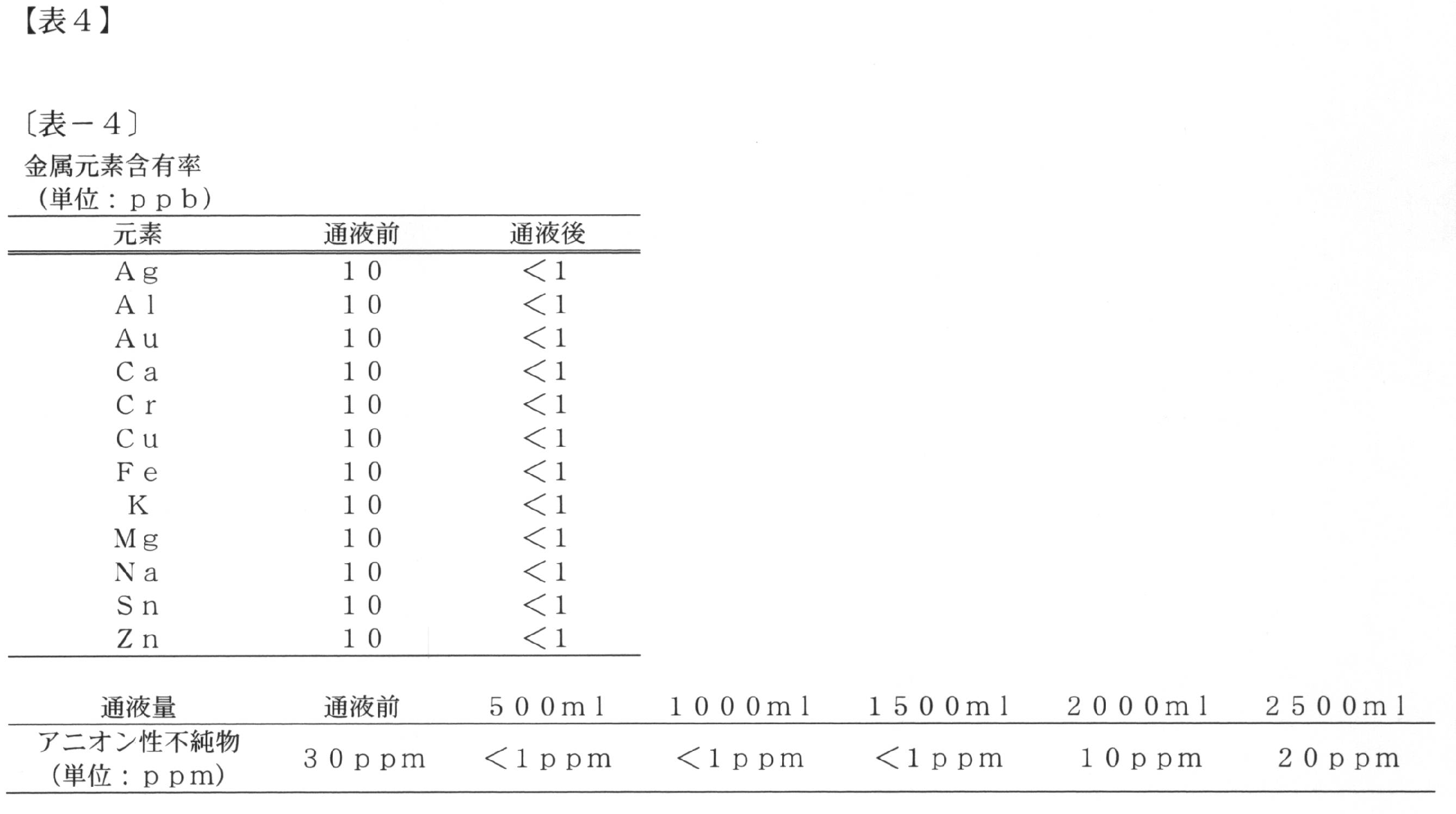
- Table 4 shows the concentration of each impurity after passing through. It can be seen from Table 4 that all the metals listed are highly removed. Regarding the anion content, it was highly removed up to 1500 ml from the start of liquid flow, but an increase in the anion content was observed after 1500 ml. From the results of Examples 2 and 3, from the case of Example 2 in which methyl hydroxyisobutyrate was passed through the weakly basic anion exchange resin (I) before passing through the strongly acidic cation exchange resin (II). However, the ability to remove the anion component is improved, and the life of the anion exchange resin (III) can be improved.
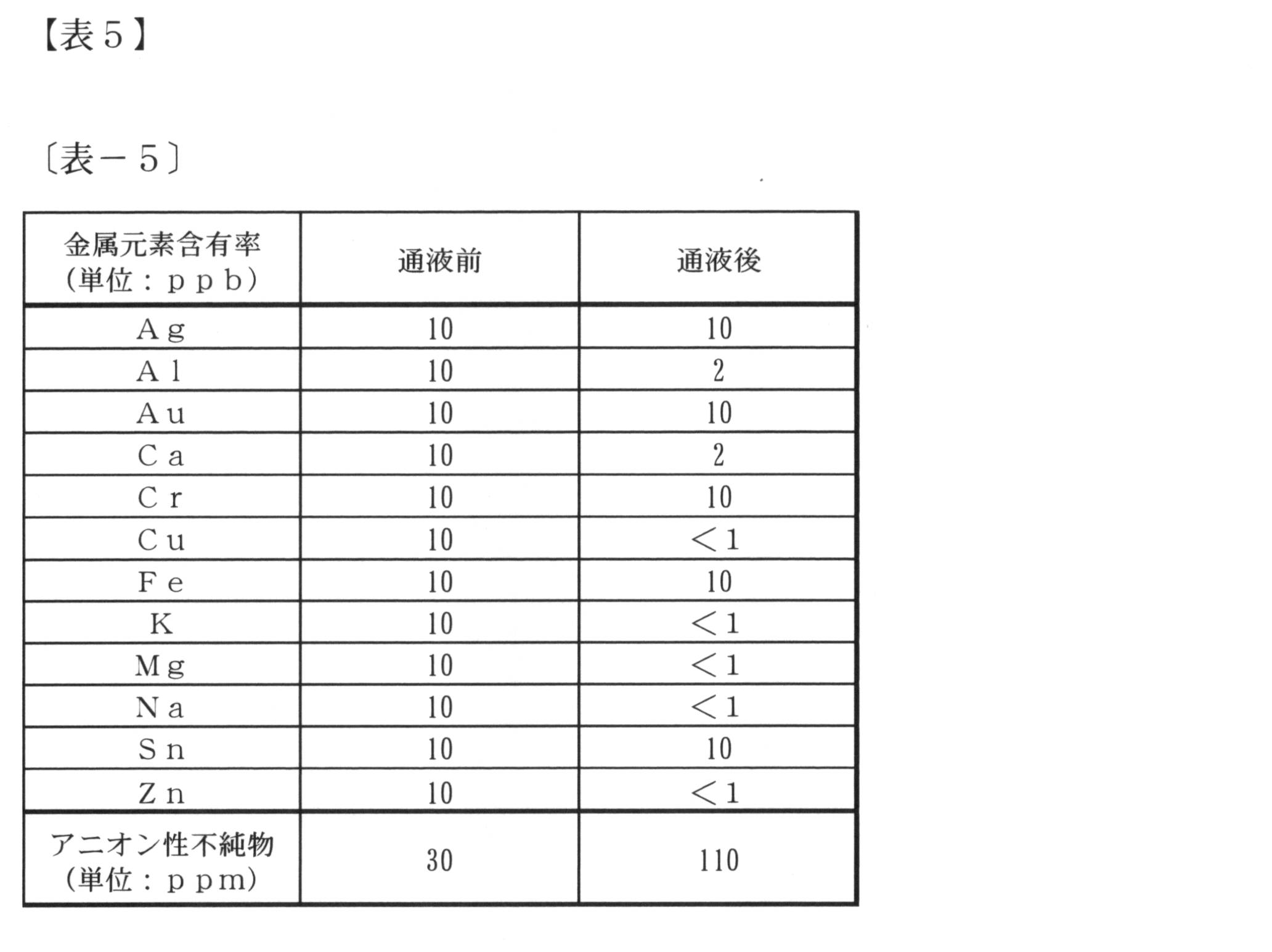
- the concentration of each impurity after passing through is shown in Table-5. From Table-5, it can be seen that Ag, Au, Cr, Fe, and Sn are hardly removed, and that anionic impurities are not removed.
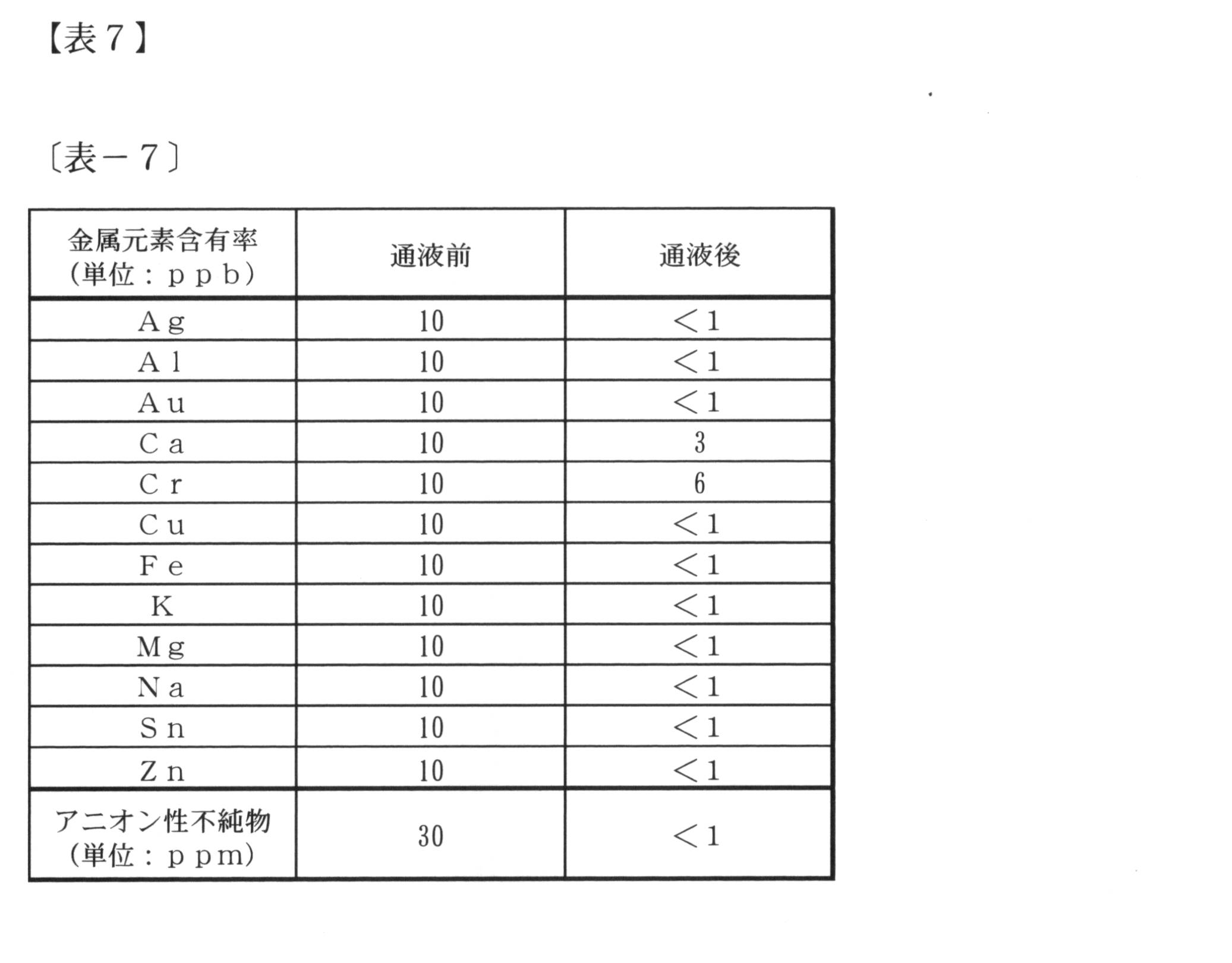
- ⁇ Comparative Example 3> 10 ml of H-type strongly acidic cation exchange resin (trade name: 15JS-HG ⁇ DRY made by Organo) and 20 ml of free base type weakly basic anion exchange resin (trade name: B20-HG ⁇ DRY made by Organo) After mixing and pretreating with ethyl lactate in the same manner as in Example 1, 30 ml of an FEP column having an inner diameter of 16 mm was packed, and ethyl lactate was passed at 25 ° C. with SV 20 Hr ⁇ 1 . Table 7 shows the concentration of each impurity after passing through. From Table 7, it can be seen that the removal of Ca and Cr is insufficient.
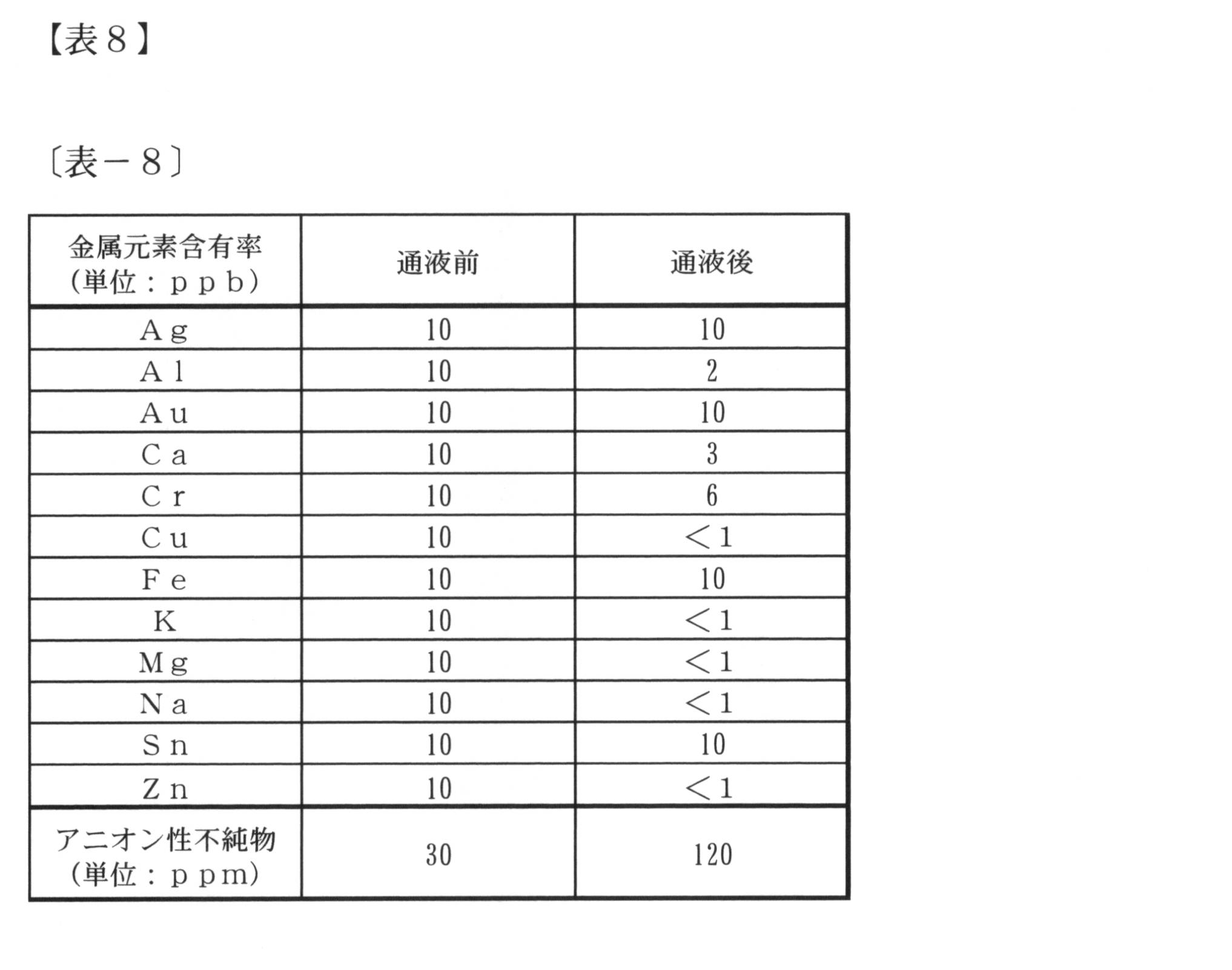
- Table 8 shows the concentration of each impurity after passing through. Table 8 shows that Ag, Au, Fe, and Sn are hardly removed and that anionic impurities are not removed.
- ⁇ Comparative Example 6> 10 ml of H-type strongly acidic cation exchange resin (trade name: 15JS-HG ⁇ DRY made by Organo) and 20 ml of free base type weakly basic anion exchange resin (trade name: B20-HG ⁇ DRY made by Organo) After mixing and pretreating with methyl hydroxyisobutyrate in the same manner as in Example 2, 30 ml of a FEP column having an inner diameter of 16 mm was packed, and methyl hydroxyisobutyrate was passed at 25 ° C. with SV 20 Hr ⁇ 1 . The concentration of each impurity after passing through is shown in Table-10. From Table 10, it can be seen that the removal of Ca and Cr is insufficient.
- the high-purity carboxylic acid ester provided in the present invention is highly industrially useful because it has a high reduction in metal impurities and anionic impurities.
- Carboxylic esters are used in a wide range of applications such as synthetic raw materials, solvents for electronic components, paints, adhesives, etc., and cleaning, etching, and photoresist development of semiconductor substrates in the manufacture of integrated circuits and large-scale integrated circuits. It is a compound useful as a treating agent for such as.
Landscapes
- Chemical & Material Sciences (AREA)
- Organic Chemistry (AREA)
- Chemical Kinetics & Catalysis (AREA)
- Analytical Chemistry (AREA)
- Organic Low-Molecular-Weight Compounds And Preparation Thereof (AREA)
Abstract
Description
<1> 金属不純物として、Ag,Al,Au,Ca,Cr,Cu,Fe,K,Mg,Na,Sn,およびZnのそれぞれの含有率が1ppb未満であり、アニオン性不純物の含有率が1ppm未満である、高純度カルボン酸エステルである。
<2> 金属不純物として、少なくともAg,Al,Au,Ca,Cr,Cu,Fe,K,Mg,Na,Sn,およびZnと、アニオン性不純物とを含む粗カルボン酸エステルを、カチオン交換樹脂(II)に接触させる工程と、次いでアニオン交換樹脂(III)に接触させる工程とを含むことを特徴とする、高純度カルボン酸エステルの製造方法である。
<3> 前記カチオン交換樹脂(II)に接触させる前に、アニオン交換樹脂(I)に接触させる工程を含む、上記<2>に記載の高純度カルボン酸エステルの製造方法である。
<4> 前記カルボン酸エステルが、乳酸メチル、乳酸エチル、乳酸プロピル、α-ヒドロキシイソ酪酸メチル、α-ヒドロキシイソ酪酸エチル、α-ヒドロキシイソ酪酸プロピル、α-ヒドロキシイソ酪酸ブチル、β-ヒドロキシイソ酪酸メチル、β-ヒドロキシイソ酪酸エチル、β-ヒドロキシイソ酪酸プロピル、およびβ-ヒドロキシイソ酪酸ブチルからなる群より選ばれる少なくとも1種である、上記<2>または<3>に記載の高純度カルボン酸エステルの製造方法である。
<5> 得られた高純度カルボン酸エステルにおいて、前記金属不純物の含有率が、Ag,Al,Au,Ca,Cr,Cu,Fe,K,Mg,Na,Sn,およびZnについてそれぞれ1ppb未満であり、前記アニオン性不純物の含有率が1ppm未満である、上記<2>~<4>のいずれかに記載の高純度カルボン酸エステルの製造方法である。
<6> 前記粗カルボン酸エステルにおいて、前記金属不純物の含有率が、Ag,Al,Au,Ca,Cr,Cu,Fe,K,Mg,Na,Sn,およびZnについてそれぞれ8ppb以上であり、前記アニオン不純物の含有量が20ppm以上である、上記<2>~<5>のいずれかに記載の高純度カルボン酸エステルの製造方法である。
本発明で用いるアニオン交換樹脂(I)および(III)としては、強塩基性陰イオン交換樹脂、弱塩基性陰イオン交換樹脂が挙げられるが、弱塩基性陰イオン交換樹脂が好ましく、遊離塩基形の弱塩基性陰イオン交換樹脂がより好ましい。中でも第三アンモニウム塩基を有する弱塩基性陰イオン交換樹脂が、特に好適に使用できる。上記アニオン交換樹脂は、市販製品を使用することもでき、具体的にはB20-HG・DRY(オルガノ社製)が挙げられる。本発明において、アニオン交換樹脂(I)および(III)は同一種類のものであってもよく、異なる種類のものであってもよい。
<金属不純物濃度の分析>
ICP質量分析計(Agilent社製、Agilent 7900 ICP-MS)により定量分析した。
<アニオン性不純物濃度の分析>
0.01mol/Lの水酸化ナトリウムを用い自動滴定装置(京都電子社製、自動滴定装置 AT-510)にて定量分析した。分析は、50mLのカルボン酸エステルに30mLのメタノールを加えた後に行った。
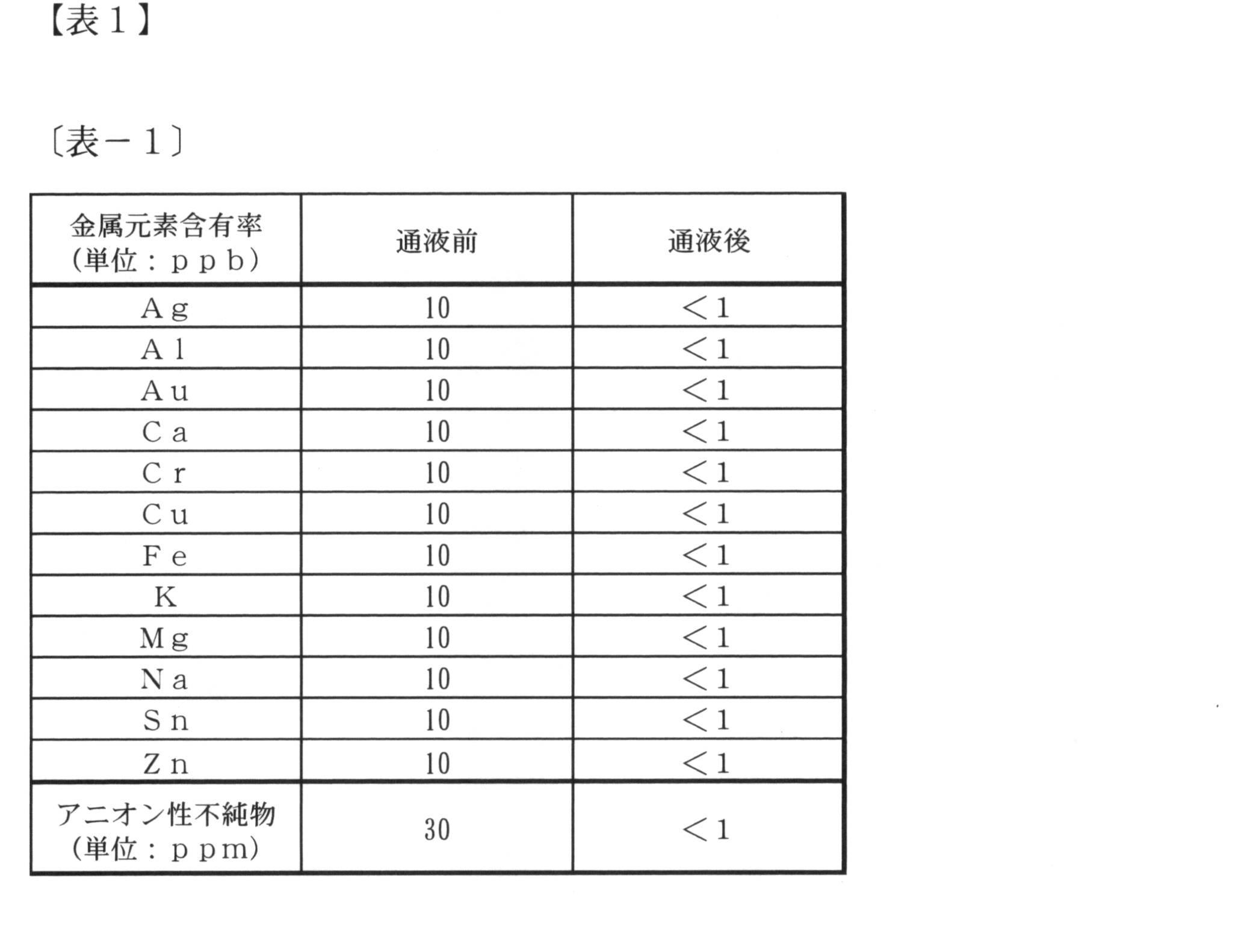
前処理としてH型の強酸性陽イオン交換樹脂(商品名:オルガノ社製15JS-HG・DRY)、及び遊離塩基形の弱塩基性陰イオン交換樹脂(商品名:オルガノ社製B20-HG・DRY)を乳酸エチルにそれぞれ別々に入れ、適宜緩やかに撹拌しながら1時間以上浸漬した。その後、内径16mmのFEP製カラム1本に10mlの強酸性陽イオン交換樹脂、2本に10mlずつ弱塩基性陰イオン交換樹脂を充填した後、乳酸エチルを25℃にてSV=20Hr-1で、図1に示すように、弱塩基性陰イオン交換樹脂(I)、強酸性陽イオン交換樹脂(II)、及び弱塩基性陰イオン交換樹脂(III)の順に通液した。通液後の各不純物濃度を表-1に示した。表-1から記載した全ての金属、及びアニオン分が高度に除去されているのが分かる。
前処理としてH型の強酸性陽イオン交換樹脂(商品名:オルガノ社製15JS-HG・DRY)、及び遊離塩基形の弱塩基性陰イオン交換樹脂(商品名:オルガノ社製B20-HG・DRY)をヒドロキシイソ酪酸メチルにそれぞれ別々に入れ、適宜緩やかに撹拌しながら1時間以上浸漬した。その後、内径16mmのFEP製カラム1本に10mlの強酸性陽イオン交換樹脂、2本に10mlずつ弱塩基性陰イオン交換樹脂を充填した後、ヒドロキシイソ酪酸メチルを25℃にてSV=20Hr-1で、図1に示すように、弱塩基性陰イオン交換樹脂(I)、強酸性陽イオン交換樹脂(II)、及び弱塩基性陰イオン交換樹脂(III)の順に通液した。通液後の各不純物濃度を表-2に示した。表-2から記載した全ての金属、及びアニオン分が高度に除去されているのが分かる。
更に、通液量を増やし、通液後のアニオン性不純物の濃度を表-3に示した。表-3から、アニオン分に関して、通液開始から2000mlまでは高度に除去されたが、2500ml以降ではアニオン分の上昇が認められた。
H型の強酸性陽イオン交換樹脂(商品名:オルガノ社製15JS-HG・DRY)、及び遊離塩基形の弱塩基性陰イオン交換樹脂(商品名:オルガノ社製B20-HG・DRY)を実施例2と同様にヒドロキシイソ酪酸メチルで前処理後、内径16mmのFEP製カラム1本に10mlの強酸性陽イオン交換樹脂、1本に10mlの弱塩基性陰イオン交換樹脂を充填した後、ヒドロキシイソ酪酸メチルを25℃にてSV=20Hr-1で強酸性陽イオン交換樹脂(II)、及び弱塩基性陰イオン交換樹脂(III)の順に通液した。通液後の各不純物濃度を表-4に示した。表-4から記載した全ての金属が高度に除去されているのが分かる。アニオン分に関しては、通液開始から1500mlまでは高度に除去されたが、1500ml以降ではアニオン分の上昇が認められた。
実施例2及び3の結果より、ヒドロキシイソ酪酸メチルを強酸性陽イオン交換樹脂(II)に通液する前に、弱塩基性陰イオン交換樹脂(I)に通液させた実施例2の方が、アニオン成分の除去能が改善され、しかもアニオン交換樹脂(III)の寿命を改善することができる。
H型の強酸性陽イオン交換樹脂(商品名:オルガノ社製15JS-HG・DRY)を実施例1と同様に乳酸エチルで前処理後、内径16mmのFEP製カラムに20ml充填した後、乳酸エチルを25℃にてSV=20Hr-1で通液した。通液後の各不純物濃度を表-5に示した。表-5からAg、Au、Cr、Fe、Snがほとんど除去されておらず、またアニオン性不純物が除去できていないことが分かる。
遊離塩基形の弱塩基性陰イオン交換樹脂(商品名:オルガノ社製B20-HG・DRY)を実施例1と同様に乳酸エチルで前処理後、内径16mmのFEP製カラムに20ml充填した後、乳酸エチルを25℃にてSV=20Hr-1で通液した。通液後の各不純物濃度を表-6に示した。表-6からK、Naがほとんど除去されていないことが分かる。
H型の強酸性陽イオン交換樹脂(商品名:オルガノ社製15JS-HG・DRY)10mlと遊離塩基型の弱塩基性陰イオン交換樹脂(商品名:オルガノ社製B20-HG・DRY)20mlを混合し乳酸エチルで実施例1と同様の前処理後、内径16mmのFEP製カラムに30ml充填した後、乳酸エチルを25℃にてSV=20Hr-1で通液した。通液後の各不純物濃度を表-7に示した。表-7からCa、Crの除去が不十分であるのが分かる。
H型の強酸性陽イオン交換樹脂(商品名:オルガノ社製15JS-HG・DRY)を実施例2と同様にヒドロキシイソ酪酸メチルで前処理後、内径16mmのFEP製カラムに20ml充填した後、ヒドロキシイソ酪酸メチルを25℃にてSV=20Hr-1で通液した。通液後の各不純物濃度を表-8に示した。表-8からAg、Au、Fe、Snがほとんど除去されておらず、またアニオン性不純物が除去できていないことが分かる。
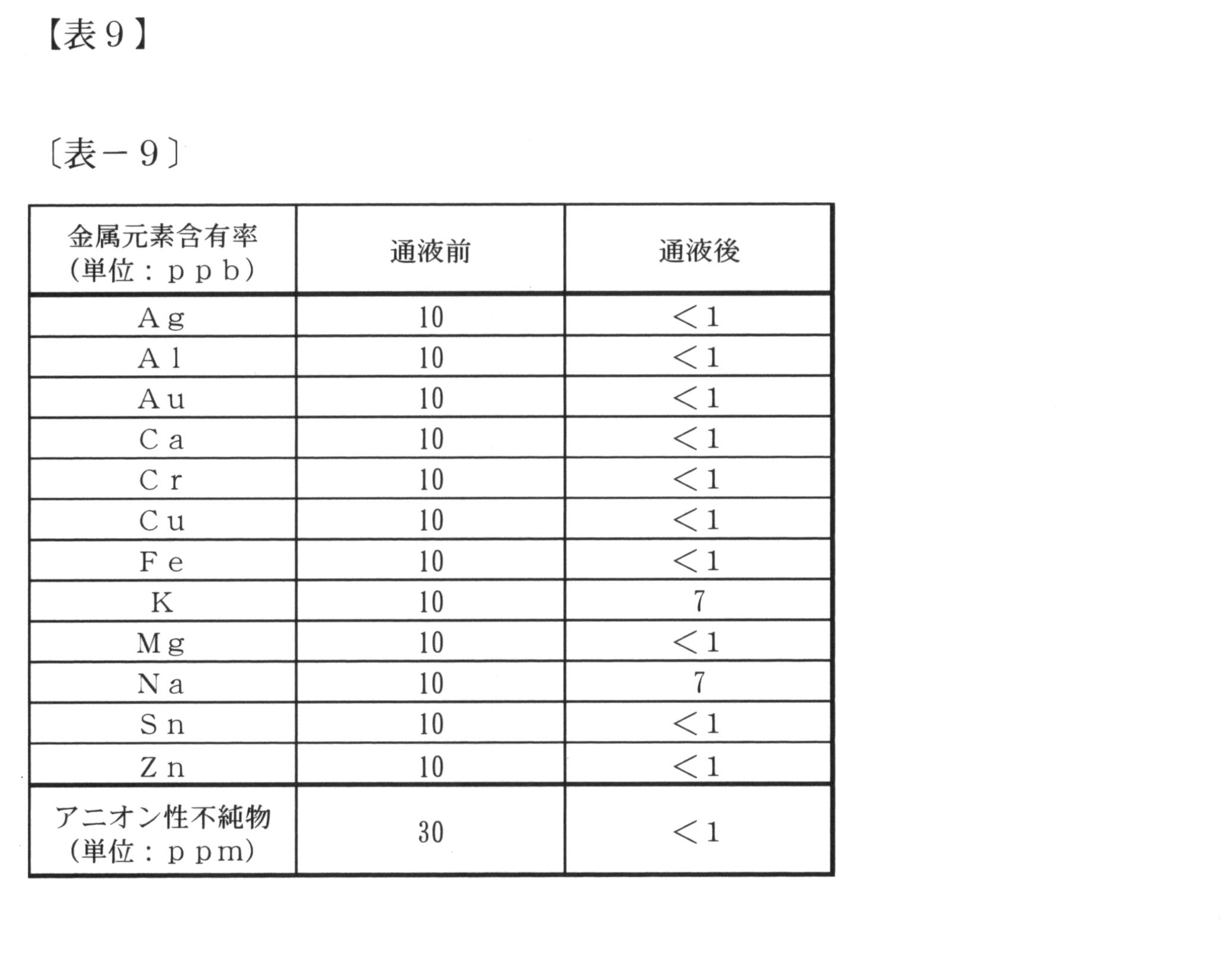
遊離塩基形の弱塩基性陰イオン交換樹脂(商品名:オルガノ社製B20-HG・DRY)を実施例2と同様にヒドロキシイソ酪酸メチルで前処理後、内径16mmのFEP製カラムに20ml充填した後、ヒドロキシイソ酪酸メチルを25℃にてSV=20Hr-1で通液した。通液後の各不純物濃度を表-9に示した。表-9からK、Naがほとんど除去されていないことが分かる。
H型の強酸性陽イオン交換樹脂(商品名:オルガノ社製15JS-HG・DRY)10mlと遊離塩基型の弱塩基性陰イオン交換樹脂(商品名:オルガノ社製B20-HG・DRY)20mlを混合しヒドロキシイソ酪酸メチルで実施例2と同様の前処理後、内径16mmのFEP製カラムに30ml充填した後、ヒドロキシイソ酪酸メチルを25℃にてSV=20Hr-1で通液した。通液後の各不純物濃度を表-10に示した。表-10からCa、Crの除去が不十分であるのが分かる。




Claims (6)
- 金属不純物として、Ag,Al,Au,Ca,Cr,Cu,Fe,K,Mg,Na,Sn,およびZnのそれぞれの含有率が1ppb未満であり、アニオン性不純物の含有率が1ppm未満である、高純度カルボン酸エステル。
- 金属不純物として、少なくともAg,Al,Au,Ca,Cr,Cu,Fe,K,Mg,Na,Sn,およびZnと、アニオン性不純物とを含む粗カルボン酸エステルを、カチオン交換樹脂(II)に接触させる工程と、次いでアニオン交換樹脂(III)に接触させる工程とを含むことを特徴とする、高純度カルボン酸エステルの製造方法。
- 前記カチオン交換樹脂(II)に接触させる前に、アニオン交換樹脂(I)に接触させる工程を含む、請求項2に記載の高純度カルボン酸エステルの製造方法。
- 前記カルボン酸エステルが、乳酸メチル、乳酸エチル、乳酸プロピル、α-ヒドロキシイソ酪酸メチル、α-ヒドロキシイソ酪酸エチル、α-ヒドロキシイソ酪酸プロピル、α-ヒドロキシイソ酪酸ブチル、β-ヒドロキシイソ酪酸メチル、β-ヒドロキシイソ酪酸エチル、β-ヒドロキシイソ酪酸プロピル、およびβ-ヒドロキシイソ酪酸ブチルからなる群より選ばれる少なくとも1種である、請求項2または3に記載の高純度カルボン酸エステルの製造方法。
- 得られた高純度カルボン酸エステルにおいて、前記金属不純物の含有率が、Ag,Al,Au,Ca,Cr,Cu,Fe,K,Mg,Na,Sn,およびZnについてそれぞれ1ppb未満であり、前記アニオン性不純物の含有率が1ppm未満である、請求項2~4のいずれかに記載の高純度カルボン酸エステルの製造方法。
- 前記粗カルボン酸エステルにおいて、前記金属不純物の含有率が、Ag,Al,Au,Ca,Cr,Cu,Fe,K,Mg,Na,Sn,およびZnについてそれぞれ8ppb以上であり、前記アニオン不純物の含有量が20ppm以上である、請求項2~5のいずれかに記載の高純度カルボン酸エステルの製造方法。
Priority Applications (5)
| Application Number | Priority Date | Filing Date | Title |
|---|---|---|---|
| US15/763,590 US20180273465A1 (en) | 2015-10-02 | 2016-09-27 | High-purity carboxylic acid ester and method for producing same |
| CN201680056934.4A CN108137476B (zh) | 2015-10-02 | 2016-09-27 | 高纯度羧酸酯及其制造方法 |
| KR1020187010671A KR102605799B1 (ko) | 2015-10-02 | 2016-09-27 | 고순도 카복실산 에스터 및 그의 제조 방법 |
| JP2017543410A JP6760299B2 (ja) | 2015-10-02 | 2016-09-27 | 高純度カルボン酸エステルおよびその製造方法 |
| US16/565,767 US11046634B2 (en) | 2015-10-02 | 2019-09-10 | High-purity carboxylic acid ester and method for producing same |
Applications Claiming Priority (2)
| Application Number | Priority Date | Filing Date | Title |
|---|---|---|---|
| JP2015-196769 | 2015-10-02 | ||
| JP2015196769 | 2015-10-02 |
Related Child Applications (2)
| Application Number | Title | Priority Date | Filing Date |
|---|---|---|---|
| US15/763,590 A-371-Of-International US20180273465A1 (en) | 2015-10-02 | 2016-09-27 | High-purity carboxylic acid ester and method for producing same |
| US16/565,767 Division US11046634B2 (en) | 2015-10-02 | 2019-09-10 | High-purity carboxylic acid ester and method for producing same |
Publications (1)
| Publication Number | Publication Date |
|---|---|
| WO2017057320A1 true WO2017057320A1 (ja) | 2017-04-06 |
Family
ID=58423857
Family Applications (1)
| Application Number | Title | Priority Date | Filing Date |
|---|---|---|---|
| PCT/JP2016/078379 Ceased WO2017057320A1 (ja) | 2015-10-02 | 2016-09-27 | 高純度カルボン酸エステルおよびその製造方法 |
Country Status (6)
| Country | Link |
|---|---|
| US (2) | US20180273465A1 (ja) |
| JP (1) | JP6760299B2 (ja) |
| KR (1) | KR102605799B1 (ja) |
| CN (1) | CN108137476B (ja) |
| TW (1) | TWI698425B (ja) |
| WO (1) | WO2017057320A1 (ja) |
Cited By (2)
| Publication number | Priority date | Publication date | Assignee | Title |
|---|---|---|---|---|
| CN107389834A (zh) * | 2017-07-12 | 2017-11-24 | 中国地质大学(武汉) | 一种可视低压同位素分离色层柱 |
| JP2020116524A (ja) * | 2019-01-24 | 2020-08-06 | 倉敷繊維加工株式会社 | カルボン酸誘導体を含む薬液を濾過する方法 |
Families Citing this family (4)
| Publication number | Priority date | Publication date | Assignee | Title |
|---|---|---|---|---|
| JP2017119234A (ja) * | 2015-12-28 | 2017-07-06 | ダウ グローバル テクノロジーズ エルエルシー | 親水性有機溶媒のための精製プロセス |
| WO2017116759A1 (en) | 2015-12-28 | 2017-07-06 | Dow Global Technologies Llc | Purification process for hydrolysable organic solvent |
| US12115525B2 (en) | 2019-04-26 | 2024-10-15 | Organo Corporation | Method for purifying organic solvent and apparatus for purifying organic solvent |
| WO2023169810A1 (de) | 2022-03-11 | 2023-09-14 | Röhm Gmbh | Verfahren zur herstellung von alpha-hydroxyisobuttersäuremethylester und dessen anwendung in der elektronik-industrie |
Citations (9)
| Publication number | Priority date | Publication date | Assignee | Title |
|---|---|---|---|---|
| JPS54157504A (en) * | 1978-05-31 | 1979-12-12 | Asahi Chem Ind Co Ltd | Preparation of carboxylic acid |
| JPS61207345A (ja) * | 1985-03-12 | 1986-09-13 | Nippon Paint Co Ltd | 有機物質の脱イオン方法 |
| JPH08283202A (ja) * | 1995-04-07 | 1996-10-29 | Nitto Chem Ind Co Ltd | 貯蔵安定性および金属腐食性の改善されたヒドロキシイソ酪酸エステル |
| JPH10316594A (ja) * | 1997-05-15 | 1998-12-02 | Elf Atochem Sa | 実質的に無水の有機液体の精製法 |
| JP2007117781A (ja) * | 2005-10-24 | 2007-05-17 | Japan Organo Co Ltd | イオン交換樹脂、イオン交換樹脂カラム、イオン交換樹脂の含有金属不純物量低減方法、精製装置、及び精製方法 |
| JP2009155208A (ja) * | 2007-12-25 | 2009-07-16 | Japan Organo Co Ltd | エステルの精製方法 |
| CN102320969A (zh) * | 2011-06-10 | 2012-01-18 | 天津大学 | 一种由食品级乳酸乙酯精馏提纯为电子级乳酸乙酯的系统及方法 |
| CN102381973A (zh) * | 2011-09-19 | 2012-03-21 | 南京大学 | 一种超高纯度(电子级)乳酸酯类产品的生产工艺 |
| CN104610061A (zh) * | 2015-02-06 | 2015-05-13 | 孝感市易生新材料有限公司 | 电子级乳酸乙酯的制备方法 |
Family Cites Families (8)
| Publication number | Priority date | Publication date | Assignee | Title |
|---|---|---|---|---|
| JP4116104B2 (ja) | 1995-04-07 | 2008-07-09 | 三菱レイヨン株式会社 | 貯蔵安定性の改善されたヒドロキシイソ酪酸エステル |
| JP2001122825A (ja) * | 1999-10-28 | 2001-05-08 | Japan Organo Co Ltd | 粗ビスヒドロキシアルキルテレフタレートの精製方法 |
| EP1300387A1 (de) * | 2001-10-05 | 2003-04-09 | Haltermann GmbH | Verfahren zum Herstellen von Estern einer Hydroxysäure |
| JPWO2003051815A1 (ja) * | 2001-12-18 | 2005-04-28 | 株式会社アイエス | ポリエステルのエチレングリコール分解生成溶液の脱イオン処理方法 |
| JP2004181351A (ja) | 2002-12-03 | 2004-07-02 | Japan Organo Co Ltd | 非水液状物の精製方法 |
| JP2004181352A (ja) * | 2002-12-03 | 2004-07-02 | Japan Organo Co Ltd | 非水液状物の精製方法 |
| JP2005247770A (ja) * | 2004-03-05 | 2005-09-15 | Nippon Kayaku Co Ltd | 微量金属イオンの除去方法 |
| CN105037156A (zh) * | 2015-07-13 | 2015-11-11 | 苏州晶瑞化学股份有限公司 | 一种超净高纯乙酸乙酯的生产方法 |
-
2016
- 2016-09-27 US US15/763,590 patent/US20180273465A1/en not_active Abandoned
- 2016-09-27 JP JP2017543410A patent/JP6760299B2/ja active Active
- 2016-09-27 WO PCT/JP2016/078379 patent/WO2017057320A1/ja not_active Ceased
- 2016-09-27 KR KR1020187010671A patent/KR102605799B1/ko active Active
- 2016-09-27 CN CN201680056934.4A patent/CN108137476B/zh active Active
- 2016-09-30 TW TW105131442A patent/TWI698425B/zh active
-
2019
- 2019-09-10 US US16/565,767 patent/US11046634B2/en active Active
Patent Citations (9)
| Publication number | Priority date | Publication date | Assignee | Title |
|---|---|---|---|---|
| JPS54157504A (en) * | 1978-05-31 | 1979-12-12 | Asahi Chem Ind Co Ltd | Preparation of carboxylic acid |
| JPS61207345A (ja) * | 1985-03-12 | 1986-09-13 | Nippon Paint Co Ltd | 有機物質の脱イオン方法 |
| JPH08283202A (ja) * | 1995-04-07 | 1996-10-29 | Nitto Chem Ind Co Ltd | 貯蔵安定性および金属腐食性の改善されたヒドロキシイソ酪酸エステル |
| JPH10316594A (ja) * | 1997-05-15 | 1998-12-02 | Elf Atochem Sa | 実質的に無水の有機液体の精製法 |
| JP2007117781A (ja) * | 2005-10-24 | 2007-05-17 | Japan Organo Co Ltd | イオン交換樹脂、イオン交換樹脂カラム、イオン交換樹脂の含有金属不純物量低減方法、精製装置、及び精製方法 |
| JP2009155208A (ja) * | 2007-12-25 | 2009-07-16 | Japan Organo Co Ltd | エステルの精製方法 |
| CN102320969A (zh) * | 2011-06-10 | 2012-01-18 | 天津大学 | 一种由食品级乳酸乙酯精馏提纯为电子级乳酸乙酯的系统及方法 |
| CN102381973A (zh) * | 2011-09-19 | 2012-03-21 | 南京大学 | 一种超高纯度(电子级)乳酸酯类产品的生产工艺 |
| CN104610061A (zh) * | 2015-02-06 | 2015-05-13 | 孝感市易生新材料有限公司 | 电子级乳酸乙酯的制备方法 |
Cited By (3)
| Publication number | Priority date | Publication date | Assignee | Title |
|---|---|---|---|---|
| CN107389834A (zh) * | 2017-07-12 | 2017-11-24 | 中国地质大学(武汉) | 一种可视低压同位素分离色层柱 |
| JP2020116524A (ja) * | 2019-01-24 | 2020-08-06 | 倉敷繊維加工株式会社 | カルボン酸誘導体を含む薬液を濾過する方法 |
| JP7229023B2 (ja) | 2019-01-24 | 2023-02-27 | 倉敷繊維加工株式会社 | カルボン酸誘導体を含む薬液を濾過する方法 |
Also Published As
| Publication number | Publication date |
|---|---|
| JP6760299B2 (ja) | 2020-09-23 |
| US11046634B2 (en) | 2021-06-29 |
| KR20180059472A (ko) | 2018-06-04 |
| CN108137476B (zh) | 2021-03-02 |
| TW201730144A (zh) | 2017-09-01 |
| TWI698425B (zh) | 2020-07-11 |
| US20180273465A1 (en) | 2018-09-27 |
| JPWO2017057320A1 (ja) | 2018-07-19 |
| KR102605799B1 (ko) | 2023-11-23 |
| CN108137476A (zh) | 2018-06-08 |
| US20200002264A1 (en) | 2020-01-02 |
Similar Documents
| Publication | Publication Date | Title |
|---|---|---|
| JP6760299B2 (ja) | 高純度カルボン酸エステルおよびその製造方法 | |
| RU2091365C1 (ru) | Способ удаления примесей с*001-с*001*000-алкилйодидов из жидких карбоновых кислот с*002-с*006 и/или соответствующих ангидридов кислот, содержащих также примеси ионов металлов | |
| HK8697A (en) | Method for the production of novolak resins with low content of metal-ions | |
| JP7265867B2 (ja) | 加水分解性有機溶媒のための精製プロセス | |
| JP5096907B2 (ja) | エステルの精製方法 | |
| US10865113B2 (en) | Method for producing purified aqueous solution of silicic acid | |
| CN1269727C (zh) | 制备基本上不含金属离子的羟胺水溶液的方法 | |
| JP2011012044A (ja) | 水酸化テトラアルキルアンモニウムの製造方法 | |
| CN102906069B (zh) | 二环己基二硫化物的制造方法 | |
| EP2110371B1 (en) | Method for preparing cycloalkanone | |
| JP5049528B2 (ja) | 高純度水酸化アルカリ金属の製造方法 | |
| JP4508394B2 (ja) | 有機ホスホン酸の精製方法 | |
| JP4554193B2 (ja) | ヒドロキシルアミン安定剤の製造方法及び精製方法 | |
| JP2009084673A (ja) | 特定金属イオンの選択的分離回収方法 | |
| TWI552963B (zh) | Waste acid solution treatment method | |
| JP5369440B2 (ja) | 高純度アルカリ金属炭酸塩水溶液の製造方法及び高純度アルカリ金属炭酸塩水溶液の連続製造方法 | |
| JP4996172B2 (ja) | 高純度水酸化アルカリ金属の製造方法 | |
| TWI900288B (zh) | 有機磺酸化合物的製造方法 | |
| EP3945099A1 (en) | Process for removal of fluoroorganic compounds from aqueous media | |
| US7045655B2 (en) | Preparation and purification of hydroxylamine stabilizers | |
| US3117988A (en) | Process for purification of acrylonitrile | |
| JPS59141413A (ja) | 純粋のシリカの製造法 | |
| JP2009167036A (ja) | 高純度アルカリ金属炭酸塩水溶液の製造方法 | |
| PL227556B1 (pl) | Sposób przygotowania roztworu siarczanu cyrkonu i hafnu o niskim stopniu polimeryzacji |
Legal Events
| Date | Code | Title | Description |
|---|---|---|---|
| 121 | Ep: the epo has been informed by wipo that ep was designated in this application |
Ref document number: 16851491 Country of ref document: EP Kind code of ref document: A1 |
|
| ENP | Entry into the national phase |
Ref document number: 2017543410 Country of ref document: JP Kind code of ref document: A |
|
| WWE | Wipo information: entry into national phase |
Ref document number: 15763590 Country of ref document: US |
|
| NENP | Non-entry into the national phase |
Ref country code: DE |
|
| ENP | Entry into the national phase |
Ref document number: 20187010671 Country of ref document: KR Kind code of ref document: A |
|
| 122 | Ep: pct application non-entry in european phase |
Ref document number: 16851491 Country of ref document: EP Kind code of ref document: A1 |