WO2016158037A1 - 離型フィルム - Google Patents
離型フィルム Download PDFInfo
- Publication number
- WO2016158037A1 WO2016158037A1 PCT/JP2016/054282 JP2016054282W WO2016158037A1 WO 2016158037 A1 WO2016158037 A1 WO 2016158037A1 JP 2016054282 W JP2016054282 W JP 2016054282W WO 2016158037 A1 WO2016158037 A1 WO 2016158037A1
- Authority
- WO
- WIPO (PCT)
- Prior art keywords
- film
- layer
- release
- polyester
- coating
- Prior art date
- Legal status (The legal status is an assumption and is not a legal conclusion. Google has not performed a legal analysis and makes no representation as to the accuracy of the status listed.)
- Ceased
Links
- 0 C*(C)COc1c[s]cc1OC Chemical compound C*(C)COc1c[s]cc1OC 0.000 description 1
Classifications
-
- C—CHEMISTRY; METALLURGY
- C09—DYES; PAINTS; POLISHES; NATURAL RESINS; ADHESIVES; COMPOSITIONS NOT OTHERWISE PROVIDED FOR; APPLICATIONS OF MATERIALS NOT OTHERWISE PROVIDED FOR
- C09J—ADHESIVES; NON-MECHANICAL ASPECTS OF ADHESIVE PROCESSES IN GENERAL; ADHESIVE PROCESSES NOT PROVIDED FOR ELSEWHERE; USE OF MATERIALS AS ADHESIVES
- C09J7/00—Adhesives in the form of films or foils
- C09J7/40—Adhesives in the form of films or foils characterised by release liners
- C09J7/405—Adhesives in the form of films or foils characterised by release liners characterised by the substrate of the release liner
-
- B—PERFORMING OPERATIONS; TRANSPORTING
- B32—LAYERED PRODUCTS
- B32B—LAYERED PRODUCTS, i.e. PRODUCTS BUILT-UP OF STRATA OF FLAT OR NON-FLAT, e.g. CELLULAR OR HONEYCOMB, FORM
- B32B27/00—Layered products comprising a layer of synthetic resin
- B32B27/36—Layered products comprising a layer of synthetic resin comprising polyesters
-
- B—PERFORMING OPERATIONS; TRANSPORTING
- B32—LAYERED PRODUCTS
- B32B—LAYERED PRODUCTS, i.e. PRODUCTS BUILT-UP OF STRATA OF FLAT OR NON-FLAT, e.g. CELLULAR OR HONEYCOMB, FORM
- B32B27/00—Layered products comprising a layer of synthetic resin
-
- B—PERFORMING OPERATIONS; TRANSPORTING
- B32—LAYERED PRODUCTS
- B32B—LAYERED PRODUCTS, i.e. PRODUCTS BUILT-UP OF STRATA OF FLAT OR NON-FLAT, e.g. CELLULAR OR HONEYCOMB, FORM
- B32B27/00—Layered products comprising a layer of synthetic resin
- B32B27/18—Layered products comprising a layer of synthetic resin characterised by the use of special additives
-
- C—CHEMISTRY; METALLURGY
- C09—DYES; PAINTS; POLISHES; NATURAL RESINS; ADHESIVES; COMPOSITIONS NOT OTHERWISE PROVIDED FOR; APPLICATIONS OF MATERIALS NOT OTHERWISE PROVIDED FOR
- C09J—ADHESIVES; NON-MECHANICAL ASPECTS OF ADHESIVE PROCESSES IN GENERAL; ADHESIVE PROCESSES NOT PROVIDED FOR ELSEWHERE; USE OF MATERIALS AS ADHESIVES
- C09J7/00—Adhesives in the form of films or foils
- C09J7/20—Adhesives in the form of films or foils characterised by their carriers
- C09J7/22—Plastics; Metallised plastics
- C09J7/25—Plastics; Metallised plastics based on macromolecular compounds obtained otherwise than by reactions involving only carbon-to-carbon unsaturated bonds
- C09J7/255—Polyesters
-
- C—CHEMISTRY; METALLURGY
- C09—DYES; PAINTS; POLISHES; NATURAL RESINS; ADHESIVES; COMPOSITIONS NOT OTHERWISE PROVIDED FOR; APPLICATIONS OF MATERIALS NOT OTHERWISE PROVIDED FOR
- C09J—ADHESIVES; NON-MECHANICAL ASPECTS OF ADHESIVE PROCESSES IN GENERAL; ADHESIVE PROCESSES NOT PROVIDED FOR ELSEWHERE; USE OF MATERIALS AS ADHESIVES
- C09J7/00—Adhesives in the form of films or foils
- C09J7/40—Adhesives in the form of films or foils characterised by release liners
-
- B—PERFORMING OPERATIONS; TRANSPORTING
- B32—LAYERED PRODUCTS
- B32B—LAYERED PRODUCTS, i.e. PRODUCTS BUILT-UP OF STRATA OF FLAT OR NON-FLAT, e.g. CELLULAR OR HONEYCOMB, FORM
- B32B2307/00—Properties of the layers or laminate
- B32B2307/40—Properties of the layers or laminate having particular optical properties
- B32B2307/418—Refractive
-
- C—CHEMISTRY; METALLURGY
- C09—DYES; PAINTS; POLISHES; NATURAL RESINS; ADHESIVES; COMPOSITIONS NOT OTHERWISE PROVIDED FOR; APPLICATIONS OF MATERIALS NOT OTHERWISE PROVIDED FOR
- C09J—ADHESIVES; NON-MECHANICAL ASPECTS OF ADHESIVE PROCESSES IN GENERAL; ADHESIVE PROCESSES NOT PROVIDED FOR ELSEWHERE; USE OF MATERIALS AS ADHESIVES
- C09J2301/00—Additional features of adhesives in the form of films or foils
- C09J2301/30—Additional features of adhesives in the form of films or foils characterized by the chemical, physicochemical or physical properties of the adhesive or the carrier
- C09J2301/312—Additional features of adhesives in the form of films or foils characterized by the chemical, physicochemical or physical properties of the adhesive or the carrier parameters being the characterizing feature
-
- C—CHEMISTRY; METALLURGY
- C09—DYES; PAINTS; POLISHES; NATURAL RESINS; ADHESIVES; COMPOSITIONS NOT OTHERWISE PROVIDED FOR; APPLICATIONS OF MATERIALS NOT OTHERWISE PROVIDED FOR
- C09J—ADHESIVES; NON-MECHANICAL ASPECTS OF ADHESIVE PROCESSES IN GENERAL; ADHESIVE PROCESSES NOT PROVIDED FOR ELSEWHERE; USE OF MATERIALS AS ADHESIVES
- C09J2467/00—Presence of polyester
- C09J2467/006—Presence of polyester in the substrate
-
- C—CHEMISTRY; METALLURGY
- C09—DYES; PAINTS; POLISHES; NATURAL RESINS; ADHESIVES; COMPOSITIONS NOT OTHERWISE PROVIDED FOR; APPLICATIONS OF MATERIALS NOT OTHERWISE PROVIDED FOR
- C09J—ADHESIVES; NON-MECHANICAL ASPECTS OF ADHESIVE PROCESSES IN GENERAL; ADHESIVE PROCESSES NOT PROVIDED FOR ELSEWHERE; USE OF MATERIALS AS ADHESIVES
- C09J2483/00—Presence of polysiloxane
- C09J2483/005—Presence of polysiloxane in the release coating
Definitions
- the present invention relates to a release film, and in particular, relates to a release film having an effect of excellent visibility after heat treatment and less foreign matter generation.
- a biaxially stretched polyester film is excellent in transparency, dimensional stability, mechanical properties, heat resistance, electrical properties, etc., for example, a mold release based on a biaxially stretched polyester film and a silicone resin as a main component. Release films provided with layers are used in many fields.
- a release film in which a release layer mainly composed of a silicone resin is provided on a biaxially stretched polyester film is characterized in that static electricity is generated and is easily charged. For example, when peeling from an adherend such as an adhesive, peeling electrification may occur. As a result, in processing sites, not only defects due to adhesion or entrainment of foreign substances, but also nearby electronic elements due to electrostatic failure May cause serious problems such as damage to the product and product defects. For this reason, it is not always sufficient to take antistatic measures only by handling equipment in the manufacturing process, and there is a strong demand for antistatic treatment of the release film itself.
- Patent Document 1 proposes an antistatic release agent.
- a release film coated with such a release material is not sufficient because the release from the adhesive is heavy.
- Patent Document 2 proposes a base film provided with an antistatic layer on the surface opposite to the release layer.
- a release film with an antistatic layer on the back side has a certain effect on charging when the release film wound in a roll shape is unwound, but the release surface has an antistatic property. Therefore, there still remains a problem that the effect is not sufficient or there is no effect of suppressing the peeling charge when the release film is peeled off from the adherend.
- the film is exposed to a high temperature as an application in which the release film is used.
- it may be the heat when applying and drying the pressure-sensitive adhesive composition on the release layer, or the process of heating the adherend while the release film is stuck.
- a release film based on a biaxially stretched polyester film does not have sufficient characteristics to withstand use depending on the application.
- This invention is made
- the solution subject is providing the release film which has the effect that the visibility after heat processing is especially excellent, and there is little foreign material production
- the present inventors have found that the above problems can be solved by sequentially forming a polyester film substrate, a specific undercoat layer, and a release layer.
- the present invention has been completed.
- the gist of the present invention is a release film in which a base material made of a biaxially stretched polyester film is laminated with a first undercoat layer, a second undercoat layer, and a release layer containing a curable silicone resin in this order.
- the surface resistivity of the release layer surface is less than 1 ⁇ 10 12 ⁇ .
- the laminated polyester film of the present invention since the oligomer precipitation from the film is suppressed even after high-temperature and long-time treatment, a product with an excellent appearance without generation of foreign matters on the surface of the release layer is obtained. It can be obtained and its industrial utility value is high.
- the base film of the release film of the present invention is made of polyester.
- polyesters include dicarboxylic acids such as terephthalic acid, isophthalic acid, 2,6-naphthalenedicarboxylic acid, adipic acid, sebacic acid, 4,4′-diphenyldicarboxylic acid, 1,4-cyclohexyldicarboxylic acid or esters thereof.
- It is a polyester produced by melt polycondensation with glycols such as ethylene glycol, diethylene glycol, triethylene glycol, propylene glycol, 1,4-butanediol, neopentyl glycol, and 1,4-cyclohexanedimethanol.
- Polyesters composed of these acid components and glycol components can be produced by arbitrarily using a commonly used method. For example, a transesterification reaction between a lower alkyl ester of an aromatic dicarboxylic acid and a glycol, or a direct esterification of an aromatic dicarboxylic acid and a glycol, to form a substantially bisglycol of an aromatic dicarboxylic acid A method is employed in which an ester or a low polymer thereof is formed and then polycondensed by heating under reduced pressure. Depending on the purpose, an aliphatic dicarboxylic acid may be copolymerized.
- polyester of the present invention examples include polyethylene terephthalate, polyethylene-2,6-naphthalate, poly-1,4-cyclohexanedimethylene terephthalate, and the like. It may be a polymerized polyester and may contain other components and additives as necessary.
- the polyester film in the present invention has a single layer or a multilayer structure.
- the surface layer and the inner layer, or both the surface layer and each layer can be made of different polyesters depending on the purpose.
- an additive when added to the film, it can be added to the single layer film or only to a part of the layers of the multilayer film.
- the film has a three-layer structure, and particles are not added to the inner layer, but particles are added to one or both outer layers, thereby making it possible to achieve both the slipperiness and the transparency.
- polyester having a low oligomer content for the polyester film of the present invention.
- the amount of the polyester having a low oligomer content is preferably 50% by weight or more of the total polyester when the film has a single layer structure, and the undercoat layer when the film has a multilayer structure. It is suitable that it is 50% by weight of the surface layer in contact.
- a polyester having a low oligomer content refers to a polyester having a cyclic trimer of 0.7% by weight or less. Particularly preferably, the cyclic trimer is 0.5% by weight or less.
- the oligomer content is simply reduced, the amount of precipitation does not decrease accordingly.
- the oligomer content is 0.5% by weight. It was found that the amount of precipitation can be greatly reduced at the degree.
- the thickness of the surface layer is usually 2 ⁇ m or more, preferably 3 ⁇ m or more. The thicker this thickness is, the more the oligomer precipitation is suppressed.
- the surface layer thickness is thinner than the above range, sufficient oligomer precipitation suppression effect It has been found that there are cases where cannot be obtained.
- particles can be contained for the purpose of ensuring the running property of the film and preventing scratches.
- examples of such particles include inorganic particles such as silica, calcium carbonate, magnesium carbonate, calcium phosphate, kaolin, talc, aluminum oxide, titanium oxide, alumina, barium sulfate, calcium fluoride, lithium fluoride, zeolite, and molybdenum sulfide.
- organic particles such as crosslinked polymer particles and calcium oxalate, and precipitated particles during the polyester production process can be used.
- the particle size and content of the particles used are selected according to the use and purpose of the film, but the average particle size (d50) is usually 0.01 to 3 ⁇ m, preferably 0.02 to 2.5 ⁇ m, more preferably Is in the range of 0.03 to 2 ⁇ m.
- the average particle size exceeds 3.0 ⁇ m, the surface roughness of the film may become too rough, or the particles may easily fall off from the film surface.
- the average particle size is less than 0.01 ⁇ m, the surface roughness is too small and sufficient slipperiness may not be obtained.
- the particle content is usually in the range of 0.0003 to 1.0% by weight, preferably 0.0005 to 0.5% by weight, based on the polyester layer containing the particles.
- the particle content is less than 0.0003% by weight, the slipperiness of the film may be insufficient.
- the content exceeds 1.0% by weight, the transparency of the film is poor. It may be enough.
- it can also be configured so as not to substantially contain particles. Further, various stabilizers, lubricants, antistatic agents and the like can be appropriately added to the film.
- a film forming method of the film of the present invention a generally known film forming method can be adopted.
- a sheet obtained by melt extrusion is first stretched 2 to 6 times at 70 to 145 ° C. by a roll stretching method to obtain a uniaxially stretched polyester film, and then perpendicular to the previous stretching direction in a tenter.
- a film can be obtained by stretching 2 to 6 times in the direction at 80 to 160 ° C. and further performing heat treatment at 150 to 250 ° C. for 1 to 600 seconds. Further, at this time, a method of relaxing 0.1 to 20% in the longitudinal direction and / or the transverse direction in the heat treatment zone and / or the cooling zone at the heat treatment outlet is preferable.
- the first undercoat layer of the present invention can be provided by either a so-called off-line coating in which a coating layer is provided later on the formed film or a so-called in-line coating in which a coating layer is provided during film formation.
- it is preferably provided by in-line coating, particularly a coating stretching method in which stretching is performed after coating.
- In-line coating is a method of coating within the process of manufacturing a polyester film. Specifically, it is a method of coating at any stage from melt extrusion of polyester to biaxial stretching and then heat setting and winding. is there. Normally, it is coated on either a substantially amorphous unstretched sheet obtained by melting and quenching, then a uniaxially stretched film stretched in the longitudinal direction (longitudinal direction), or a biaxially stretched film before heat setting. To do.
- a coating stretching method a method of stretching in the transverse direction after coating on a uniaxially stretched film is excellent. According to such a method, since film formation and coating layer coating can be performed at the same time, there is a merit in manufacturing cost. Stabilize.
- the polyester film before biaxial stretching is first covered with a resin layer constituting the coating layer, and then the base film and the coating layer are firmly adhered by stretching the film and the coating layer simultaneously. become.
- the biaxial stretching of the polyester film is achieved by stretching the film in the lateral direction while holding the film end with a tenter clip, so that the film is constrained in the longitudinal / lateral direction and is flat without wrinkles or the like in heat setting. High temperature can be applied while maintaining the nature. Therefore, since the heat treatment performed after coating can be performed at a high temperature that cannot be achieved by other methods, the film forming property of the coating layer is improved, and the coating layer and the polyester film are firmly adhered.
- the uniformity of the coating layer, the improvement of the film forming property, and the adhesion between the coating layer and the film often produce preferable characteristics.
- the coating solution to be used is preferably an aqueous solution or an aqueous dispersion for safety reasons in terms of handling, working environment, but water is the main medium and does not exceed the gist of the present invention. If so, an organic solvent may be contained.
- the first undercoat layer of the present invention is preferably obtained by applying a coating solution having a crosslinking agent ratio of 70% by weight or more with respect to all nonvolatile components and drying it.
- the coating solution may contain other components.
- cross-linking agent described herein refers to a cross-linkable resin that reacts particularly with heat, and examples thereof include amino resin-based, isocyanate-based, oxazoline-based, and epoxy-based resins. Also included are polymer-type cross-linking reactive compounds having reactive groups in other polymer skeletons.
- an oxazoline-based cross-linking agent since both suppression of oligomer precipitation from the polyester film and good appearance of the undercoat layer are compatible.
- the effect of suppressing oligomers precipitated from the polyester film upon heating is preferably increased. This is presumably because when the undercoat layer is formed, the presence of cross-linking agents with different reaction rates effectively fills the voids in the undercoat layer and suppresses oligomer precipitation.
- the effect obtained is particularly high when an oxazoline-based or epoxy-based material is used in combination, or when an amino resin-based, oxazoline-based, or epoxy-based material is used in combination.
- the oxazoline-based crosslinking agent is preferably a polymer containing an oxazoline group in the molecule, and can be prepared by polymerization of an addition polymerizable oxazoline group-containing monomer alone or with another monomer.
- Addition-polymerizable oxazoline group-containing monomers include 2-vinyl-2-oxazoline, 2-vinyl-4-methyl-2-oxazoline, 2-vinyl-5-methyl-2-oxazoline, 2-isopropenyl-2-oxazoline, Examples thereof include 2-isopropenyl-4-methyl-2-oxazoline, 2-isopropenyl-5-ethyl-2-oxazoline, and the like, and one or a mixture of two or more thereof can be used.
- 2-isopropenyl-2-oxazoline is easily available and suitable industrially, but the other monomer may be any monomer that can be copolymerized with an addition polymerizable oxazoline group-containing monomer.
- the oxazoline-based crosslinking agent in the present invention has a content of oxazoline group in the range of usually 0.5 to 10 mmol / g, preferably 3 to 9 mmol / g, more preferably 5 to 8 mmol / g.
- a content of oxazoline group in the range usually 0.5 to 10 mmol / g, preferably 3 to 9 mmol / g, more preferably 5 to 8 mmol / g.
- the effect obtained is high by selecting an oxazoline-based crosslinking agent in the above range.
- the epoxy-based crosslinking agent is a compound having an epoxy group in the molecule.
- a condensate of epichlorohydrin with a hydroxyl group or amino group such as ethylene glycol, polyethylene glycol, glycerin, polyglycerin, or bisphenol A.
- polyepoxy compounds, diepoxy compounds, monoepoxy compounds, glycidylamine compounds, and the like are examples of polyepoxy compounds, diepoxy compounds, monoepoxy compounds, glycidylamine compounds, and the like.
- polyepoxy compound examples include sorbitol polyglycidyl ether, polyglycerol polyglycidyl ether, pentaerythritol polyglycidyl ether, diglycerol polyglycidyl ether, triglycidyl tris (2-hydroxyethyl) isocyanate, glycerol polyglycidyl ether, trimethylolpropane.
- polyglycidyl ether and diepoxy compound examples include neopentyl glycol diglycidyl ether, 1,6-hexanediol diglycidyl ether, resorcin diglycidyl ether, ethylene glycol diglycidyl ether, polyethylene glycol diglycidyl ether, and propylene glycol diglycidyl ether.
- Polypropylene glycol diglycidyl ether, Ritetramethylene glycol diglycidyl ether and monoepoxy compounds include, for example, allyl glycidyl ether, 2-ethylhexyl glycidyl ether, phenyl glycidyl ether, and glycidyl amine compounds such as N, N, N ′, N′-tetraglycidyl-m- Examples include xylylenediamine and 1,3-bis (N, N-diglycidylamino) cyclohexane.
- amino resin-based cross-linking agents those in which the amino group of the melamine resin is methylolized and a part of the methylol group is methylated are water-soluble, easy to handle, highly reactive, A release film having excellent adhesion to the material film and durability of the undercoat layer can be obtained.
- a crosslinking component when such a crosslinking component is contained, a component for promoting crosslinking at the same time, for example, a crosslinking catalyst can be used in combination.
- components other than those described above can be included as necessary.
- surfactants other binders, particles, antifoaming agents, coatability improvers, thickeners, antioxidants, ultraviolet absorbers, foaming agents, dyes, pigments and the like.
- additives may be used alone or in combination of two or more as necessary.
- the thickness of the first undercoat layer is finally usually 0.003 to 1 ⁇ m, preferably 0.005 to 0.5 ⁇ m, more preferably 0.00 as the film thickness on the biaxially stretched polyester film. It is in the range of 01 to 0.2 ⁇ m. When the thickness is smaller than this, the amount of oligomers precipitated from the film may not be sufficiently reduced. On the other hand, if it is thicker than this, problems such as deterioration of the appearance of the first undercoat layer and easy blocking may occur.
- the thickness of the first subbing layer is determined by dyeing the coated film with a heavy metal such as a ruthenium compound or an osmium compound, adjusting the cross section of the coated film by an ultrathin section method, and then coating with a transmission electron microscope. This can be confirmed by observing a plurality of coating layers on the cross section of the film and averaging the measured values.
- a heavy metal such as a ruthenium compound or an osmium compound
- a coating technique as shown in “Coating system” published by Yuji Harasaki, Tsuji Shoten, published in 1979 can be used. Specifically, air doctor coater, blade coater, rod coater, knife coater, squeeze coater, impregnation coater, reverse roll coater, transfer roll coater, gravure coater, kiss roll coater, cast coater, spray coater, curtain coater, calendar coater And a technique such as an extrusion coater.
- the film may be subjected to chemical treatment, corona discharge treatment, plasma treatment, etc. before coating.
- the second undercoat layer in the present invention can be obtained by applying and drying a coating solution containing a thiophene-based conductive compound.
- the thiophene-based conductive polymer mentioned here is a polymer doped with a thiophene or thiophene derivative, a polymer doped with another anionic compound, or a compound comprising a thiophene or thiophene derivative and having an anionic group. Doped polymers are preferred. These substances are preferable because of their excellent conductivity.
- Examples of the compound (A) include those obtained by polymerizing a compound of the following formula (1) or (2) in the presence of a polyanion.
- R 1 and R 2 each independently represent hydrogen or an aliphatic hydrocarbon group having 1 to 20 carbon atoms, an alicyclic hydrocarbon group, an aromatic hydrocarbon group, or the like. .
- n an integer of 1 to 4.
- polyanion described here examples include poly (meth) acrylic acid, polymaleic acid, polystyrene sulfonic acid, and polyvinyl sulfonic acid.
- a method for producing such a polymer for example, a method as disclosed in JP-A-7-90060 can be employed.
- polyanions when these poly anions are acidic, some or all of them may be neutralized.
- base used for neutralization ammonia, organic amines, and alkali metal hydroxides are preferable.
- the coating liquid for forming the second undercoat layer may contain a plurality of components.
- each skeleton structure may have a composite structure substantially by copolymerization or the like.
- the resin having a composite structure include acrylic resin graft polyester, acrylic resin graft polyurethane, vinyl resin graft polyester, and vinyl resin graft polyurethane.
- polyester resin copolymerized with sulfoisophthalic acid, acrylic resin using reactive emulsifier, acrylic resin using nonionic emulsifier, dimethylol Urethane resins in which carboxyl groups are introduced into the skeleton using propionic acid, dimethylolbutanoic acid or the like are easy to use.
- glycerin, polyglycerin, glycerin or alkylene oxide adducts to polyglycerin, polyalkylene oxide, polysaccharides, compounds having an amino group, and the like may be contained.
- these compounds are contained, an effect of improving the transparency and antistatic performance of the obtained second undercoat layer may be obtained.
- inorganic particles may be contained for the purpose of improving the adhesion and slipperiness of the undercoat layer, and specific examples include silica, alumina, kaolin, calcium carbonate, titanium oxide, barium salt and the like.
- an antifoaming agent a coating property improver, a thickener, an organic lubricant, organic polymer particles, an antioxidant, a UV absorber foaming agent, a dye, and the like may be contained as necessary.
- only one type of organic solvent may be used for the purpose of improving dispersibility, improving film forming property, etc., and two or more types may be used as appropriate.
- the compounded liquid dispersed in water can be diluted with an organic solvent that can be mixed with water, such as alcohols, to obtain a coating liquid.
- the coating amount of the second undercoat layer in the present invention is usually in the range of 0.01 to 1 ⁇ m, preferably 0.02 to 0.5 ⁇ m, as the thickness of the coating after drying.
- the coating amount is less than 0.01 ⁇ m, the antistatic performance may be insufficient or the performance may be uneven depending on the location.
- the coating is applied in excess of 1 ⁇ m, the strength of the coating film is weak and may fall off or inhibit the curing of silicone in the release layer.
- the thickness of the second undercoat layer is determined by dyeing the coated film with a heavy metal such as a ruthenium compound or an osmium compound, adjusting the cross section of the coated film by an ultrathin section method, and then coating with a transmission electron microscope. This can be confirmed by observing a plurality of coating layers on the cross section of the film and averaging the measured values.
- a heavy metal such as a ruthenium compound or an osmium compound
- a coating technique as shown in “Coating system” published by Yuji Harasaki, Tsuji Shoten, published in 1979 can be used. Specifically, air doctor coater, blade coater, rod coater, knife coater, squeeze coater, impregnation coater, reverse roll coater, transfer roll coater, gravure coater, kiss roll coater, cast coater, spray coater, curtain coater, calendar coater And a technique such as an extrusion coater.
- a heat treatment of usually 100 ° C. or higher is given, preferably 100 to 200 ° C. for 3 to 40 seconds, more preferably 120 to 160. Heat treatment is performed at 3 ° C. for 3 to 40 seconds as a guide. Moreover, you may use together heat processing and active energy ray irradiation, such as ultraviolet irradiation, as needed. When the heat treatment is not performed at 100 ° C. or higher, the coating layer is not sufficiently cured, which is not preferable because the antistatic performance and the peeling force of the release layer vary greatly.
- a release layer containing a curable silicone resin is further provided on the first undercoat layer and the second undercoat layer on the biaxially stretched polyester film obtained as described above.
- a type having a curable silicone resin as a main component may be used, or a modified silicone type by graft polymerization with an organic resin such as a urethane resin, an epoxy resin, or an alkyd resin may be used.
- any of the curing reaction types such as an addition type, a condensation type, an ultraviolet curable type, an electron beam curable type, and a solventless type can be used.
- An addition-type curable silicone resin is preferred from the viewpoint of environmental impact such as the release layer obtained has excellent release characteristics and does not use an organic tin catalyst.
- the addition-type curable silicone has a problem that the curing reaction tends to be insufficient on a layer containing a large amount of nitrogen, such as the first undercoat layer of the present invention. If the curing reaction is insufficient, problems such as the silicone release layer being easily removed from the film or the release characteristics becoming unstable are likely to occur. However, by providing the second undercoat layer as in the present invention, this curing inhibition can be suppressed.
- conventionally known coating methods such as reverse roll coating, gravure coating, bar coating, doctor blade coating and the like can be used as a method of providing a release layer on the polyester film.
- the coating amount of the release layer in the present invention is usually in the range of 0.01 to 1 g / m 2 as a dry film after the release layer is formed.
- the coating amount of the release layer can be calculated from the weight concentration and coating area of the coating material and the usage amount of the coating material. If the coating amount is less than this, it may be difficult to obtain uniform releasability, and if it is more than this, problems such as blocking may occur.
- the thickness of a mold release layer can also be calculated
- the specific gravity of the curable silicone is about 0.9 to 1.2.
- the coating amount of the release layer having a thickness of 0.1 ⁇ m is 0.1 g / m 2 .
- the biaxially oriented polyester film used in the present invention preferably has an orientation main axis tilt of 12 degrees or less depending on the method of use.
- the inclination of the orientation principal axis here is also called an orientation angle, and is the inclination of the principal axis with respect to the film width direction or the longitudinal direction.
- the inspection may be performed by the crossed Nicols method of polarized transmitted light.
- the release film is also placed under the crossed Nicol at the time of the cross Nicol method inspection as the inspection of the polarizing plate.
- a release film using a biaxially oriented polyester film having an orientation angle of more than 12 degrees in this inspection process light leakage is large, which hinders the detection of defects such as foreign matter and scratches.
- the orientation of the orientation main axis can be adjusted by changing conditions such as the temperature and stretching ratio in longitudinal stretching, the temperature and stretching ratio in transverse stretching, and the relaxation treatment.
- the evaluation method in an Example and a comparative example is as follows.
- Preparation of the standard sample was performed by accurately weighing the preliminarily collected oligomer (cyclic trimer) and dissolving it in the accurately weighed DMF.
- concentration of the standard sample is preferably in the range of 0.001 to 0.01 mg / ml.
- Mobile phase A Acetonitrile
- Mobile phase B 2% acetic acid aqueous solution
- Column temperature: 40 ° C Flow rate: 1 ml / min Detection wavelength: 254 nm
- orientation angle Measurement of orientation of main axis (orientation angle): The orientation of the polyester film was observed using a polarization microscope manufactured by Carl Zeiss, and the orientation angle was determined by measuring how many times the direction of the main orientation axis in the polyester film plane was tilted with respect to the width direction of the polyester film. This measurement was carried out at a total of three locations on the center and both ends of the film, and the largest orientation angle value among the three locations was taken as the maximum orientation angle.
- Coating layer thickness The film was fixed with an embedding resin, the cross section was cut with a microtome, and the sample was prepared by staining with 2% osmic acid at 60 ° C. for 2 hours. The obtained sample was observed with a transmission electron microscope (JEM2010 manufactured by JEOL Ltd.), and the thickness of the coating layer was measured. A total of 15 points on the film are measured, and an average of 9 points excluding 3 points from the larger value and 3 points from the smaller value is defined as the coating layer thickness.
- Adhesive layer optical defect inspection 1 Acrylic adhesive Coponil N-2233 (manufactured by Nippon Synthetic Chemical) was applied to the release surface of the release film to a thickness of 2 ⁇ m after drying to provide an adhesive layer. The release film was attached to a glass plate through this adhesive layer, and then heated at 180 ° C. for 10 minutes. Thereafter, the release film was peeled off, further attached to a glass plate, and subjected to an aging treatment for 10 days in an environment of 60 ° C. and 90% RH with the adhesive layer sandwiched between the two glass plates. Thereafter, the foreign matter generated in the adhesive layer was examined under an optical microscope.
- an area of 100 mm ⁇ 100 mm was selected from 12 arbitrary positions of the sample, and the number of foreign matters having a size of 2 ⁇ m or more was counted.
- a total of 12 foreign substances were excluded from the total of 12 inspection ranges, and the determination was made based on the following criteria from the total number of foreign substances within the 10 inspection ranges.
- Adhesive layer optical defect inspection 2 Acrylic adhesive Coponil N-2233 (manufactured by Nippon Synthetic Chemical) was applied to the release surface of the release film to a thickness of 2 ⁇ m after drying to provide an adhesive layer.
- the release film was attached to a glass plate via this adhesive layer, and then heated at 180 ° C. for 30 minutes. Thereafter, the release film was peeled off, further attached to a glass plate, and subjected to an aging treatment for 10 days in an environment of 60 ° C. and 90% RH with the adhesive layer sandwiched between the two glass plates. Thereafter, the foreign matter generated in the adhesive layer was examined under an optical microscope.
- an area of 100 mm ⁇ 100 mm was selected from 12 arbitrary positions of the sample, and the number of foreign matters having a size of 2 ⁇ m or more was counted.
- a total of 12 foreign substances were excluded from the total of 12 inspection ranges, and the determination was made based on the following criteria from the total number of foreign substances within the 10 inspection ranges.
- polyester 1 used in the Examples and Comparative Examples is as follows.
- Poly 1 Using 100 parts by weight of dimethyl terephthalate and 60 parts by weight of ethylene glycol as starting materials, 0.09 parts by weight of magnesium acetate tetrahydrate as a catalyst is placed in the reactor, the reaction start temperature is set to 150 ° C., and the methanol is distilled off gradually. The reaction temperature was raised to 230 ° C. after 3 hours. After 4 hours, the transesterification reaction was substantially terminated. After adding 0.04 part of ethyl acid phosphate to this reaction mixture, 0.04 part of antimony trioxide was added, and a polycondensation reaction was carried out for 4 hours. That is, the temperature was gradually raised from 230 ° C.
- the obtained polyester 1 had an intrinsic viscosity of 0.63 and an oligomer (cyclic trimer) content of 0.97% by weight.
- Polyester 1 is pre-crystallized at 160 ° C. in advance, and then solid-phase polymerized in a nitrogen atmosphere at a temperature of 220 ° C. to obtain a polyester having an intrinsic viscosity of 0.75 and an oligomer (cyclic trimer) content of 0.46% by weight. 2 was obtained.
- polyester 3 In the production method of polyester 1, after adding 0.04 part of ethyl acid phosphate, 1.5 parts of synthetic calcium carbonate particles having an average particle diameter (d50) of 0.8 ⁇ m dispersed in ethylene glycol, 0% of antimony trioxide Polyester 3 was obtained using the same method as the production method of polyester 1 except that .04 parts was added and the polycondensation reaction was stopped at the time corresponding to the intrinsic viscosity of 0.65. The obtained polyester 3 had an intrinsic viscosity of 0.65 and an oligomer (cyclic trimer) content of 0.91% by weight.
- C3 Polyglycerol polyglycidyl ether having an epoxy content of 5.5 (eq / kg)
- C4 hexamolar ratio of imino group / methylol group / methoxy group of 1.5 / 2 / 2.5 Methoxymethylolated melamine
- (B1): Water-soluble acrylic resin methyl methacrylate / isobutyl acrylate / 2-hydroxyethyl methacrylate 50 / 30/10
- composition contained in the coating liquid for providing the second undercoat layer was used as a composition contained in the coating liquid for providing the second undercoat layer.
- A1 Thiophene-based conductive polymer-containing paint Sepulzida AS-Q01 (manufactured by Shin-Etsu Polymer) This was diluted 10-fold to prepare a second undercoat layer coating solution. Diluting solvent: Methanol / propylene glycol monomethyl ether mixed solvent (mixing ratio is 4: 1)
- R1 curable silicone resin (LTC303E: manufactured by Toray Dow Corning)
- R2 Curing agent (SRX212: manufactured by Toray Dow Corning)
- This film was stretched 2.9 times in the longitudinal direction while passing through a group of 90 ° C. heating rolls to obtain a uniaxially oriented film.
- this film was guided to a tenter stretching machine, stretched 5.1 times in the width direction at 120 ° C., further heat treated at 210 ° C., and then subjected to a relaxation treatment of 5% in the width direction, so that the film thickness was 38 ⁇ m.
- An axially oriented polyethylene terephthalate film was obtained.
- (Production Example 2): A blend of polyester 2 and polyester 3 at a weight ratio of 60/40 is used as a raw material for layer A, and polyester 1 alone is used as a raw material for layer B. And heat-melting, layer A is divided into two layers, the outer layer (surface layer) is co-extruded in a layer configuration of two types and three layers (layer A / layer B / layer A) with the layer B as an intermediate layer, electrostatic adhesion method Was used to cool and solidify while closely adhering to a mirror surface cooling drum having a surface temperature of 40 to 50 ° C., and an unstretched polyethylene terephthalate film having a thickness composition ratio of A layer / B layer / A layer 3/32/3 was prepared. .
- This film was stretched 2.9 times in the longitudinal direction while passing through a group of 90 ° C. heating rolls to obtain a uniaxially oriented film.
- this film was guided to a tenter stretching machine, stretched 5.1 times in the width direction at 120 ° C., further heat treated at 210 ° C., and then subjected to a relaxation treatment of 5% in the width direction, so that the film thickness was 38 ⁇ m.
- An axially oriented polyethylene terephthalate film was obtained.
- This film was stretched 3.4 times in the longitudinal direction while passing through a group of 90 ° C. heating rolls to obtain a uniaxially oriented film.
- this film was guided to a tenter stretching machine, stretched 4.0 times in the width direction at 120 ° C., and further heat treated at 230 ° C., and then subjected to a relaxation treatment of 4.5% in the width direction, resulting in a film thickness of 38 ⁇ m.
- a biaxially oriented polyethylene terephthalate film was obtained.
- Example 1 In the process of Production Example 1, a coating solution as shown in Table 1 was applied to one side of the obtained uniaxially oriented film. Next, the film was guided to a tenter stretching machine, and the coating liquid was dried and heat-treated using the heat, and the same process as in Production Example 1 was performed on the biaxially oriented polyethylene terephthalate film having a film thickness of 38 ⁇ m. A laminated polyester film provided with a first undercoat layer having the thickness shown in Table 1 was obtained.
- the second undercoat layer coating solution was applied to the obtained film so that the coating thickness after drying was 0.05 ⁇ m, dried at 120 ° C. for 30 seconds, and heat-treated. Further, the following release layer coating was applied by a reverse gravure coating method so that the coating amount after drying was 0.1 g / m 2 , then dried and heat-treated at 150 ° C. for 30 seconds, and then on the polyester film.
- a release film in which a first undercoat layer, a second undercoat layer, and a release layer were laminated in order was obtained.
- R1 100 parts
- R2 1 part MEK / toluene mixed solvent (mixing ratio is 1: 2) 1500 parts
- Examples 2-7, Comparative Example 1 In the process of Production Example 2, a coating solution as shown in Table 1 was applied to one side of the obtained uniaxially oriented film. Next, the film was guided to a tenter stretching machine, and the coating liquid was dried and heat-treated using the heat, and the same process as in Production Example 2 was performed on the biaxially oriented polyethylene terephthalate film having a film thickness of 38 ⁇ m. A laminated polyester film provided with a first undercoat layer having the thickness shown in Table 1 was obtained.
- the second undercoat layer coating solution was applied to the obtained film so as to have the coating thickness after drying shown in Table 2, and dried and heat-treated at 120 ° C. for 30 seconds. Further, the following release layer coating was applied by a reverse gravure coating method so that the coating amount after drying was 0.1 g / m 2 , then dried and heat-treated at 150 ° C. for 30 seconds, and then on the polyester film.
- a release film in which a first undercoat layer, a second undercoat layer, and a release layer were laminated in order was obtained.
- R1 100 parts
- R2 1 part MEK / toluene mixed solvent (mixing ratio is 1: 1) 1500 parts
- Example 8 In the process of Production Example 3, a coating solution as shown in Table 1 was applied to one side of the obtained uniaxially oriented film. Next, the film was guided to a tenter stretching machine, and the coating liquid was dried and heat-treated using the heat, and the same process as in Production Example 3 was performed on the biaxially oriented polyethylene terephthalate film having a film thickness of 38 ⁇ m. A laminated polyester film provided with a first undercoat layer having the thickness shown in Table 1 was obtained.
- the second undercoat layer coating solution was applied to the obtained film so as to have the coating thickness after drying shown in Table 2, and dried and heat-treated at 120 ° C. for 30 seconds. Further, the following release layer coating was applied by a reverse gravure coating method so that the coating amount after drying was 0.1 g / m 2 , then dried and heat-treated at 150 ° C. for 30 seconds, and then on the polyester film.
- a release film in which a first undercoat layer, a second undercoat layer, and a release layer were laminated in order was obtained.
- R1 100 parts
- R2 1 part MEK / toluene mixed solvent (mixing ratio is 1: 1) 1500 parts
- Comparative Example 2 Release film in which a second undercoat layer and a release layer are sequentially laminated on a polyester film in the same manner as in Examples 2 to 8, except that the first undercoat layer was not provided. Got.
- Comparative Example 3 A release film in which a first undercoat layer and a release layer are sequentially laminated on a polyester film in the same manner as in Examples 2 to 8, except that the second undercoat layer was not provided. Got.
- the weight ratio in Table 1 represents the weight ratio of the non-volatile content of each component in the coating solution.
- Table 3 shows the characteristics of the films obtained in Examples and Comparative Examples.
- the film of the present invention can be suitably used as a release film in applications where foreign matter generated on an adherend after exposure to high temperature or charging is a problem. Furthermore, suitable characteristics are also provided for applications inspected under crossed Nicols.
Landscapes
- Chemical & Material Sciences (AREA)
- Organic Chemistry (AREA)
- Chemical Kinetics & Catalysis (AREA)
- Laminated Bodies (AREA)
- Adhesive Tapes (AREA)
Abstract
特に加熱処理後の視認性が優れていることや異物生成が少ないという効果を有する離型フィルムを提供する。 二軸延伸ポリエステルフィルムからなる基材に、第一下引き層、第二下引き層、および硬化型シリコーン樹脂を含有する離型層が順に積層された離型フィルムであり、離型層表面の表面固有抵抗値が1×10¹²Ω未満である離型フィルム。
Description
本発明は、離型フィルムに関し、特に加熱処理後の視認性が優れていることや異物生成が少ないという効果を有する離型フィルムに関するものである。
二軸延伸ポリエステルフィルムは、透明性、寸法安定性、機械的特性、耐熱性、電気的特性などに優れ、例えば、二軸延伸ポリエステルフィルムを基材とし、シリコーン樹脂などを主成分とする離型層を設けた離型フィルムは、多くの分野で使用されている。
しかし、二軸延伸ポリエステルフィルム上にシリコーン樹脂を主成分とする離型層を設けた離型フィルムは、静電気が発生して帯電しやすいと言う特徴がある。例えば、粘着剤等の被着体から剥離させた際に剥離帯電が発生する場合があり、その結果加工現場においては、異物等の付着或いは巻き込みによる不具合のみならず、静電気障害によって近傍の電子素子が損傷を受け製品不良が発生する等の深刻な不具合を生じる場合があった。そのため製造工程における設備対応による帯電防止対策だけでは必ずしも十分ではなく、離型フィルム自体の帯電防止処理が強く望まれる状況である。
このような帯電を抑制するために、種々の離型フィルムが提案されている。例えば、特許文献1では、帯電防止性の離型剤が提案されている。しかし、このような離型材料を塗布した離型フィルムは、粘着剤からの剥離が重く、十分ではない。
また、特許文献2では、基材フィルムの、離型層とは反対側の面に帯電防止性の層を設けたものが提案されている。しかし、背面に帯電防止性の層を設けた離型フィルムでは、ロール状に巻かれた離型フィルムを巻きだした時の帯電に関しては一定の効果が見られるが、離型面に帯電防止性がないため、その効果が十分でなかったり、被着体から離型フィルムを剥離した際の剥離帯電を抑制する効果がなかったりするという問題が依然残る。
一方でまた、離型フィルムの使用される用途として、高温にさらされることも多くある。例えば、離型層の上に、粘着剤組成物を塗布・乾燥する際の熱であったり、離型フィルムが貼られた状態で被着体を加熱する工程であったりする。
粘着剤の塗布乾燥工程では、100℃から180℃程度の熱が加えられることがある。しかし、ポリエステルフィルムの問題として、このような高温の処理にさらされると、フィルム中に含有されるオリゴマー(ポリエステルの低分子量成分、特に環状三量体)が、フィルム内部から析出してくる。このようにして析出してきたオリゴマーが、離型層を通り抜けて、粘着層の内部で結晶化して異物となることで、外観検査に支障を来たすといった問題が生じる。
そのため、二軸延伸ポリエステルフィルムを基材とした離型フィルムは、用途によっては十分に使用に耐える特性を有してはいない。
本発明は、上記実情に鑑みなされたものであって、その解決課題は、特に加熱処理後の視認性が優れていることや異物生成が少ないという効果を有する離型フィルムを提供することにある。
本発明者らは、上記の課題に関して鋭意検討を重ねた結果、順次に、ポリエステルフィルム基材、特定の下引き層、離型層の構成とすることにより、上記課題が解決されることを見いだし、本発明を完成するに至った。
すなわち、本発明の要旨は、二軸延伸ポリエステルフィルムからなる基材に、第一下引き層、第二下引き層、および硬化型シリコーン樹脂を含有する離型層が順に積層された離型フィルムであり、離型層表面の表面固有抵抗値が1×10¹²Ω未満であることを特徴とする離型フィルムに存する。
本発明の積層ポリエステルフィルムによれば、高温長時間の処理を行っても、フィルムからのオリゴマー析出が抑制されているために、離型層表面への異物の生成のない優れた外観の製品を得ることができ、その工業的な利用価値は高い。
本発明の離型フィルムの基材フィルムは、ポリエステルからなるものである。かかるポリエステルとは、テレフタル酸、イソフタル酸、2,6-ナフタレンジカルボン酸、アジピン酸、セバシン酸、4,4’-ジフェニルジカルボン酸、1,4-シクロヘキシルジカルボン酸のようなジカルボン酸またはそのエステルとエチレングリコール、ジエチレングリコール、トリエチレングリコール、プロピレングリコール、1,4-ブタンジオール、ネオペンチルグリコール、1,4-シクロヘキサンジメタノールのようなグリコールとを溶融重縮合させて製造されるポリエステルである。これらの酸成分とグリコール成分とからなるポリエステルは、通常行われている方法を任意に使用して製造することができる。
例えば、芳香族ジカルボン酸の低級アルキルエステルとグリコールとの間でエステル交換反応をさせるか、あるいは芳香族ジカルボン酸とグリコールとを直接エステル化させるかして、実質的に芳香族ジカルボン酸のビスグリコールエステル、またはその低重合体を形成させ、次いでこれを減圧下、加熱して重縮合させる方法が採用される。その目的に応じ、脂肪族ジカルボン酸を共重合しても構わない。
例えば、芳香族ジカルボン酸の低級アルキルエステルとグリコールとの間でエステル交換反応をさせるか、あるいは芳香族ジカルボン酸とグリコールとを直接エステル化させるかして、実質的に芳香族ジカルボン酸のビスグリコールエステル、またはその低重合体を形成させ、次いでこれを減圧下、加熱して重縮合させる方法が採用される。その目的に応じ、脂肪族ジカルボン酸を共重合しても構わない。
本発明のポリエステルとしては、代表的には、ポリエチレンテレフタレートやポリエチレン-2,6-ナフタレート、ポリ-1,4-シクロヘキサンジメチレンテレフタレート等が挙げられるが、その他に上記の酸成分やグリコール成分を共重合したポリエステルであってもよく、必要に応じて他の成分や添加剤を含有していてもよい。
本発明におけるポリエステルフィルムは、単層または多層構造である。多層構造の場合は、表層と内層、あるいは両表層や各層を目的に応じ異なるポリエステルとすることができる。
また添加剤をフィルム中に加える場合、単層フィルムに加えたり、多層フィルムの一部の層のみに加えたりすることもできる。例えば、フィルムを3層構成とし、内層には粒子を加えず、一方もしくは両方の外層に粒子を加えることで、易滑性と透明性を、より両立することができる。
また、本発明のポリエステルフィルムは、オリゴマーの含有量が少ないポリエステルを用いると好ましい。かかるオリゴマー含有量の少ないポリエステルの使用量としては、フィルムが単層構造である場合は、全ポリエステルの50重量%以上であると好適であり、フィルムが多層構造である場合は、下引き層に接する表層のうち50重量%であると好適である。オリゴマーの含有量の少ないポリエステルとは、環状三量体が0.7重量%以下であるようなポリエステルを指す。特に好ましくは、環状三量体が0.5重量%以下である。ポリエステルフィルムを高温で加熱した場合に、オリゴマーがフィルム表面に析出してくることを抑制するには、0.7重量%以下であると良好な効果が得られる。また、単にオリゴマー含有量を少なくすれば、それに応じて析出量が減るわけではなく、特にフィルム表面に粘着剤層などが設けられた状態で加熱する場合は、オリゴマー含有量が0.5重量%程度を境に、析出量が大幅に低減できることが分かった。
また、多層構造のフィルムの表層を、このようにオリゴマー含有量の少ないポリエステルとする場合は、表層の厚さは、通常2μm以上、好ましくは3μm以上である。この厚みが厚いほど、オリゴマーの析出が抑制されるのであるが、離型フィルムが加熱工程を経る様々な条件で試験した結果、表層の厚みが上記範囲より薄い場合、十分なオリゴマーの析出抑制効果が得られない場合があることが分かった。
本発明におけるポリエステルフィルムには、フィルムの走行性を確保したり、キズが入ることを防いだりする等の目的で粒子を含有させることができる。このような粒子としては、例えば、シリカ、炭酸カルシウム、炭酸マグネシウム、リン酸カルシウム、カオリン、タルク、酸化アルミニウム、酸化チタン、アルミナ、硫酸バリウム、フッ化カルシウム、フッ化リチウム、ゼオライト、硫化モリブデン等の無機粒子、架橋高分子粒子、シュウ酸カルシウム等の有機粒子、さらに、ポリエステル製造工程時の析出粒子等を用いることができる。
用いる粒子の粒径や含有量はフィルムの用途や目的に応じて選択されるが、平均粒径(d50)に関しては、通常0.01~3μm、好ましくは0.02~2.5μm、さらに好ましくは0.03~2μmの範囲である。平均粒径が3.0μmを超えると、フィルムの表面粗度が粗くなりすぎたり、粒子がフィルム表面から脱落しやすくなったりすることがある。平均粒径が0.01μm未満では、表面粗度が小さすぎて、十分な易滑性が得られない場合がある。
粒子含有量については、粒子を含有するポリエステル層に対し、通常0.0003~1.0重量%、好ましくは0.0005~0.5重量%の範囲である。粒子含有量が0.0003重量%未満の場合には、フィルムの易滑性が不十分な場合があり、一方、1.0重量%を超えて添加する場合には、フィルムの透明性が不十分な場合がある。なおフィルムの透明性、平滑性などを特に確保したい場合には、実質的に粒子を含有しない構成とすることもできる。また、適宜、各種安定剤、潤滑剤、帯電防止剤等をフィルム中に加えることもできる。
本発明のフィルムの製膜方法としては、通常知られている製膜法を採用できる。例えば、まず溶融押出によって得られたシートを、ロール延伸法により、70~145℃で2~6倍に延伸して、一軸延伸ポリエステルフィルムを得、次いで、テンター内で先の延伸方向とは直角方向に80~160℃で2~6倍に延伸し、さらに、150~250℃で1~600秒間熱処理を行うことでフィルムが得られる。さらにこの際、熱処理のゾーンおよび/または熱処理出口のクーリングゾーンにおいて、縦方向および/または横方向に0.1~20%弛緩する方法が好ましい。
本発明の第一下引き層は、製膜したフィルムに後から塗布層を設ける、いわゆるオフラインコーティングと、フィルムの製膜中に塗布層を設ける、いわゆるインラインコーティングのいずれでも設けることができる。ただしインラインコーティング、特に塗布後に延伸を行う塗布延伸法により設けられることが好ましい。
インラインコーティングは、ポリエステルフィルム製造の工程内でコーティングを行う方法であり、具体的には、ポリエステルを溶融押出ししてから二軸延伸後熱固定して巻き上げるまでの任意の段階でコーティングを行う方法である。通常は、溶融・急冷して得られる実質的に非晶状態の未延伸シート、その後に長手方向(縦方向)に延伸された一軸延伸フィルム、熱固定前の二軸延伸フィルムの何れかにコーティングする。特に塗布延伸法としては、一軸延伸フィルムにコーティングした後に横方向に延伸する方法が優れている。かかる方法によれば、製膜と塗布層塗設を同時に行うことができるため製造コスト上のメリットがあり、コーティング後に延伸を行うために、薄膜で均一なコーティングとなるために塗布層の特性が安定する。また、二軸延伸される前のポリエステルフィルム上を、まず塗布層を構成する樹脂層で被覆し、その後フィルムと塗布層を同時に延伸することで、基材フィルムと塗布層が強固に密着することになる。また、ポリエステルフィルムの二軸延伸は、テンタークリップによりフィルム端部を把持しつつ横方向に延伸することで、フィルムが長手/横手方向に拘束されており、熱固定において、しわ等が入らず平面性を維持したまま高温をかける事ができる。それゆえ、コーティング後に施される熱処理が他の方法では達成されない高温とすることができるために、塗布層の造膜性が向上し、また塗布層とポリエステルフィルムが強固に密着する。塗布層を設けたポリエステルフィルムとして、塗布層の均一性、造膜性の向上および塗布層とフィルムの密着は好ましい特性を生む場合が多い。
塗布延伸法の場合、用いる塗布液は、取扱い上、作業環境上、安全上の理由から水溶液または水分散液であることが望ましいが、水を主たる媒体としており、本発明の要旨を越えない範囲であれば、有機溶剤を含有していてもよい。
本発明の第一下引き層は、全不揮発成分に対する架橋剤の比率が70重量%以上である塗布液を塗布し、乾燥して得られることが好ましい。なお塗布液中には、その他の成分を含有していても構わない。
ここで述べる架橋剤とは、特に熱で反応する架橋性樹脂のことであり、例えばアミノ樹脂系、イソシアネート系、オキサゾリン系、エポキシ系などが挙げられる。他のポリマー骨格に反応性基を持たせた、ポリマー型架橋反応性化合物も含まれる。
本発明においては、特にオキサゾリン系の架橋剤を使用することが、ポリエステルフィルムからのオリゴマー析出の抑制と、下引き層の外観が良好であることが両立し好ましい。
また、特に2種類以上の架橋剤を併用すると、加熱時にポリエステルフィルムから析出するオリゴマーが抑制される効果が高くなり好ましい。これはおそらく、下引き層が形成される時に、反応速度の異なる架橋剤が存在することで、より効果的に下引き層の空隙を埋め、オリゴマーの析出を抑制する層となるためと推測される。
種々の組み合わせを検討した結果、オキサゾリン系、エポキシ系を併用する、ないし、アミノ樹脂系、オキサゾリン系、エポキシ系を併用すると、特に得られる効果が高い。
オキサゾリン系の架橋剤としては、分子内にオキサゾリン基を含有する重合体が好ましく、付加重合性オキサゾリン基含有モノマー単独もしくは他のモノマーとの重合によって作成できる。付加重合性オキサゾリン基含有モノマーは、2-ビニル-2-オキサゾリン、2-ビニル-4-メチル-2-オキサゾリン、2-ビニル-5-メチル-2-オキサゾリン、2-イソプロペニル-2-オキサゾリン、2-イソプロペニル-4-メチル-2-オキサゾリン、2-イソプロペニル-5-エチル-2-オキサゾリン等を挙げることができ、これらの1種または2種以上の混合物を使用することができる。これらの中でも2-イソプロペニル-2-オキサゾリンが工業的にも入手しやすく好適であるが、他のモノマーは、付加重合性オキサゾリン基含有モノマーと共重合可能なモノマーであれば構わない。
また、本発明におけるオキサゾリン系架橋剤は、オキサゾリン基の含有量として、通常0.5~10mmol/g、好ましくは3~9mmol/g、より好ましくは5~8mmol/gの範囲である。特に2種類以上の架橋剤を併用する場合に、上記範囲であるオキサゾリン系架橋剤を選定することで、得られる効果が高い。
エポキシ系の架橋剤は、分子内にエポキシ基を有する化合物のことであり、例えば、エピクロロヒドリンとエチレングリコール、ポリエチレングリコール、グリセリン、ポリグリセリン、ビスフェノールA等の水酸基やアミノ基との縮合物が挙げられ、ポリエポキシ化合物、ジエポキシ化合物、モノエポキシ化合物、グリシジルアミン化合物等がある。
ポリエポキシ化合物としては、例えば、ソルビトールポリグリシジルエーテル、ポリグリセロールポリグリシジルエーテル、ペンタエリスリトールポリグリシジルエーテル、ジグリセロールポリグリシジルエーテル、トリグリシジルトリス(2-ヒドロキシエチル)イソシアネート、グリセロールポリグリシジルエーテル、トリメチロールプロパンポリグリシジルエーテル、ジエポキシ化合物としては、例えば、ネオペンチルグリコールジグリシジルエーテル、1,6-ヘキサンジオールジグリシジルエーテル、レゾルシンジグリシジルエーテル、エチレングリコールジグリシジルエーテル、ポリエチレングリコールジグリシジルエーテル、プロピレングリコールジグリシジルエーテル、ポリプロピレングリコールジグリシジルエーテル、ポリテトラメチレングリコールジグリシジルエーテル、モノエポキシ化合物としては、例えば、アリルグリシジルエーテル、2-エチルヘキシルグリシジルエーテル、フェニルグリシジルエーテル、グリシジルアミン化合物としてはN,N,N’,N’-テトラグリシジル-m-キシリレンジアミン、1,3-ビス(N,N-ジグリシジルアミノ)シクロヘキサン等が挙げられる。
アミノ樹脂系の架橋剤の中でも、メラミン樹脂のアミノ基をメチロール化し、さらにそのメチロール基の一部をメチル化したものが、水溶性で取扱いがよく、反応性も高く、また下引き層と基材フィルムとの密着性や下引き層の耐久性に優れた離型フィルムが得られる。
なお、かかる架橋成分を含有する場合、同時に架橋を促進するための成分、例えば架橋触媒などを併用することができる。
第一下引き層を設けるための塗布液中には、必要に応じて上記述べた成分以外を含むことができる。例えば、界面活性剤、その他のバインダー、粒子、消泡剤、塗布性改良剤、増粘剤、酸化防止剤、紫外線吸収剤、発泡剤、染料、顔料等である。これらの添加剤は単独で用いてもよいが、必要に応じて二種以上を併用してもよい。
また、第一下引き層の厚さは、最終的に、二軸延伸ポリエステルフィルム上の皮膜厚さとして、通常0.003~1μm、好ましくは0.005~0.5μm、さらに好ましくは0.01~0.2μmの範囲である。厚さがこれより薄い場合には、フィルムから析出するオリゴマー量が十分に少なくならないことがある。また、これより厚い場合には、第一下引き層の外観の悪化や、ブロッキングしやすくなるなどの問題が生じることがある。
なお、第一下引き層の厚みは、塗布フィルムをルテニウム化合物やオスミウム化合物等の重金属を用いて染色を行い、超薄切片法により塗布フィルムの断面を調整した後、透過型電子顕微鏡にて塗布フィルム断面の塗布層を複数個所観測し、その実測値を平均することで確認できる。
ポリエステルフィルムに塗布液を塗布する方法としては、例えば、原崎勇次著、槙書店、1979年発行、「コーティング方式」に示されるような塗布技術を用いることができる。具体的には、エアドクターコーター、ブレードコーター、ロッドコーター、ナイフコーター、スクイズコーター、含浸コーター、リバースロールコーター、トランスファロールコーター、グラビアコーター、キスロールコーター、キャストコーター、スプレイコーター、カーテンコーター、カレンダコーター、押出コーター等のような技術が挙げられる。
なお、塗布剤のフィルムへの塗布性、接着性を改良するため、塗布前にフィルムに化学処理やコロナ放電処理、プラズマ処理等を施してもよい。
また、本発明における第二下引き層は、チオフェン系の導電性化合物を含有する塗布液を塗布・乾燥して得られる。ここで言うチオフェン系の導電性高分子とは、チオフェンまたはチオフェン誘導体からなる化合物に、他の陰イオン化合物によりドーピングされた重合体、またはチオフェンまたはチオフェン誘導体からなる化合物中に陰イオン基を持ち自己ドープされた重合体が好適である。これらの物質は、優れた導電性を示し好適である。
化合物(A)としては、たとえば下記式(1)もしくは(2)の化合物を、ポリ陰イオンの存在下で重合して得られるものを例示できる。
化合物(A)としては、たとえば下記式(1)もしくは(2)の化合物を、ポリ陰イオンの存在下で重合して得られるものを例示できる。

上記式(1)中、R1,R2は、それぞれが独立して、水素または炭素数が1~20の脂肪族炭化水素基、脂環族炭化水素基、芳香族炭化水素基などを表す。
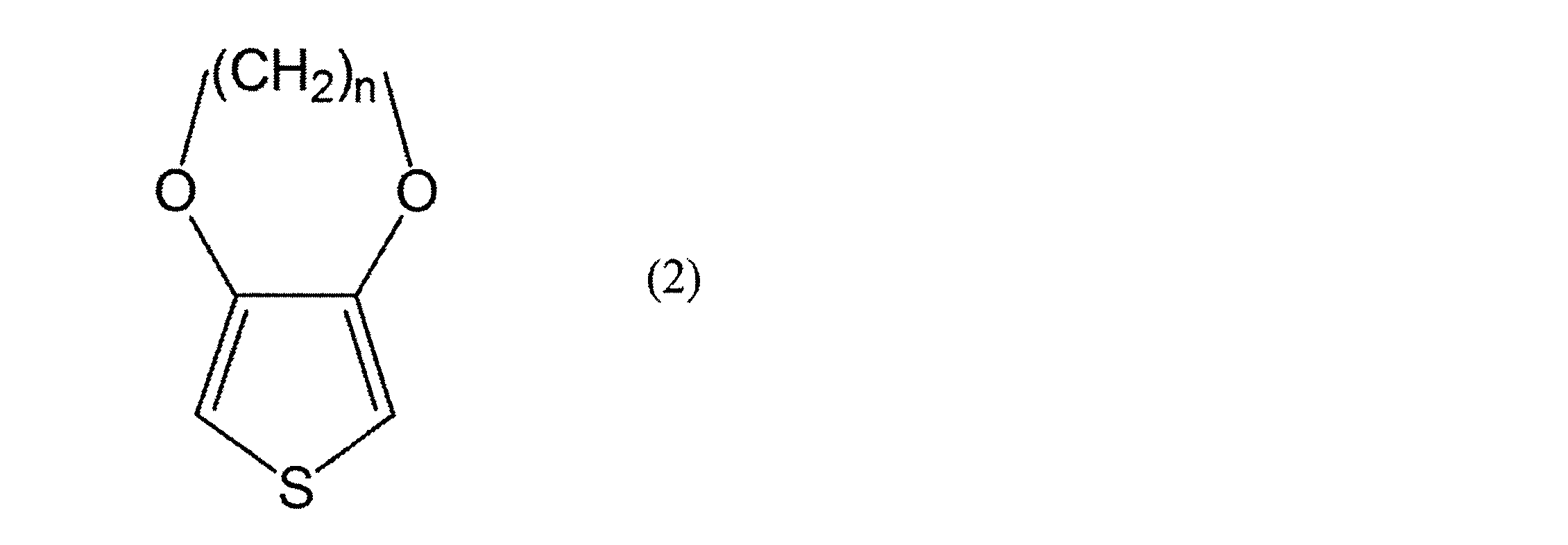
上記式(2)中、nは1~4の整数を表す。
ここで述べるポリ陰イオンとしては、例えばポリ(メタ)アクリル酸、ポリマレイン酸、ポリスチレンスルホン酸、ポリビニルスルホン酸などが例示される。
なお、かかる重合体の製造方法としては、例えば特開平7-90060に示されるような方法が採用できる。
本発明において、特に好ましい様態としては、上記式(2)の化合物においてn=2、ポリ陰イオンとしてポリスチレンスルホン酸を用いたものが挙げられる。
また、これらのポリ陰イオンが酸性である場合、一部または全てが中和されていてもよい。中和に用いる塩基としてはアンモニア、有機アミン類、アルカリ金属水酸化物が好ましい。
第二下引き層を形成するための塗布液中には、その他に、複数の成分を含有しても良い。
例えば、ポリエーテル樹脂、ポリエステル樹脂、アクリル樹脂、ポリウレタン樹脂、ビニル樹脂、エポキシ樹脂、アミド樹脂等が挙げられる。これらは、それぞれの骨格構造が共重合等により実質的に複合構造を有していてもよい。複合構造を持つ樹脂としては、例えば、アクリル樹脂グラフトポリエステル、アクリル樹脂グラフトポリウレタン、ビニル樹脂グラフトポリエステル、ビニル樹脂グラフトポリウレタン等が挙げられる。これらの樹脂を含有することで、得られる塗布層の強度や基材フィルム、他の下引き層、離型層への密着性を向上する可能性がある。チオフェン系導電性高分子と混合した際の安定性などの観点からは、スルホイソフタル酸を共重合したポリエステル樹脂や、反応性乳化剤を使用したアクリル樹脂、ノニオン性乳化剤を使用したアクリル樹脂、ジメチロールプロピオン酸やジメチロールブタン酸等を用いて骨格にカルボキシル基を導入したウレタン樹脂などが使用しやすい。
またその他に、例えば、グリセリン、ポリグリセリン、グリセリンまたはポリグリセリンへのアルキレンオキサイド付加物、ポリアルキレンオキサイド、多糖類、アミノ基を有する化合物などを含有していても良い。これらの化合物を含有すると、得られた第二下引き層の透明性や帯電防止性能が向上する効果が得られることがある。
さらに下引き層の固着性、滑り性改良を目的として、無機系粒子を含有してもよく、具体例としてはシリカ、アルミナ、カオリン、炭酸カルシウム、酸化チタン、バリウム塩等が挙げられる。
また、必要に応じて消泡剤、塗布性改良剤、増粘剤、有機系潤滑剤、有機系高分子粒子、酸化防止剤、紫外線吸収剤発泡剤、染料等が含有されてもよい。
本発明の要旨を越えない範囲において、分散性改良、造膜性改良等を目的として、使用する有機溶剤は一種類のみでもよく、適宜、二種類以上を使用してもよい。
水で分散した配合液を、水と混合可能な有機溶剤、例えばアルコール類で希釈して塗布液とすることもできる。
本発明における第二下引き層の塗布量は、乾燥後被膜の厚みとして、通常0.01~1μm、好ましくは0.02~0.5μmの範囲である。塗布量が0.01μm未満の場合には、帯電防止性能が不十分となったり、場所によって性能が不均一となったりする場合がある。一方、1μmを超えて塗布する場合には、塗膜の強度が弱く、脱落を生じたり、離型層のシリコーンの硬化阻害を起こしたりする場合がある。
なお、第二下引き層の厚みは、塗布フィルムをルテニウム化合物やオスミウム化合物等の重金属を用いて染色を行い、超薄切片法により塗布フィルムの断面を調整した後、透過型電子顕微鏡にて塗布フィルム断面の塗布層を複数個所観測し、その実測値を平均することで確認できる。
本発明において、第二下引き層を設ける方法は、例えば、原崎勇次著、槙書店、1979年発行、「コーティング方式」に示されるような塗布技術を用いることができる。具体的には、エアドクターコーター、ブレードコーター、ロッドコーター、ナイフコーター、スクイズコーター、含浸コーター、リバースロールコーター、トランスファロールコーター、グラビアコーター、キスロールコーター、キャストコーター、スプレイコーター、カーテンコーター、カレンダコーター、押出コーター等のような技術が挙げられる。
本発明において、ポリエステルフィルム上に第二下引き層を形成する際の硬化条件に関しては、通常100℃以上の熱処理を与え、好ましくは100~200℃で3~40秒間、さらに好ましくは120~160℃で3~40秒間を目安として熱処理を行う。また、必要に応じて熱処理と紫外線照射等の活性エネルギー線照射とを併用してもよい。100℃以上で加熱処理されない場合、塗布層の硬化が不十分なために、帯電防止性能や、離型層の剥離力の変動が大きくなったりして好ましくない。
本発明では、上述のようにして得られた、二軸延伸ポリエステルフィルム上の第一下引き層、第二下引き層の上にさらに硬化型シリコーン樹脂を含有する離型層を設ける。硬化型シリコーン樹脂を主成分とするタイプでもよいし、ウレタン樹脂、エポキシ樹脂、アルキッド樹脂等の有機樹脂とのグラフト重合等による変性シリコーンタイプ等を使用してもよい。
硬化型シリコーン樹脂の種類としては、付加型・縮合型・紫外線硬化型・電子線硬化型・無溶剤型等何れの硬化反応タイプでも用いることができる。
具体例を挙げると、信越化学工業(株)製KS-774、KS-775、KS-778、KS-779H、KS-847H、KS-856、X-62-2422、X-62-2461、ダウ・コーニング・アジア(株)製DKQ3-202、DKQ3-203、DKQ3-204、DKQ3-205、DKQ3-210、東芝シリコーン(株)製YSR-3022、TPR-6700、TPR-6720、TPR-6721、東レ・ダウ・コーニング(株)製SD7220、SD7226、SD7229等が挙げられる。さらに離型層の剥離性等を調整するために剥離コントロール剤を併用してもよい。
得られる離型層が優れた剥離特性を持ち、かつ有機スズ触媒を使用しない等の環境負荷の観点からは、付加型の硬化型シリコーン樹脂が好ましい。
付加型の硬化型シリコーンは、本発明の第一下引き層の様な、窒素を多く含有する層の上では硬化反応が不十分となりやすい課題がある。硬化反応が不十分な場合、シリコーン離型層がフィルムから脱落しやすい、あるいは剥離特性が不安定になるなどの不具合を生じやすい。しかし本発明のように第二下引き層を設けることで、この硬化阻害も抑えることができる。
本発明において、ポリエステルフィルムに離型層を設ける方法としては、リバースロールコート、グラビアコート、バーコート、ドクターブレードコート等、従来公知の塗工方式を用いることができる。
本発明における離型層の塗布量は、離型層形成後の乾燥被膜として、通常0.01~1g/m2の範囲である。離型層の塗布量は、塗料の重量濃度と塗布面積、塗料の使用量から計算できる。塗布量がこれより少ない場合、均一な離型性を得ることが難しくなることがあり、これより多い場合、ブロッキングなどの問題が生じてくることがある。
なお、離型層の厚みを前述のように透過型電子顕微鏡にて断面から確認し、比重で割ることで塗布量を求めることもできる。一般的に硬化性シリコーンの比重は0.9~1.2程度が多い。厚み0.1μmの離型層の塗布量は、比重1の時0.1g/m2である。
本発明に用いられる二軸配向ポリエステルフィルムは、使用法によっては、配向主軸の傾きが12度以下であると好ましい。なお、ここでいう配向主軸の傾きとは配向角とも称され、フィルム幅方向または縦方向に対する主軸の傾きである。離型フィルムの使用法の中で、偏光透過光のクロスニコル法により検査が行なわれることがある。例えば、偏光板に粘着剤を介して離型フィルムが貼り合わされている場合、偏光板の検査としてのクロスニコル法検査の際、離型フィルムも同時にクロスニコル下に置かれる。この検査工程にて配向角が12度を超える二軸配向ポリエステルフィルムを使用した離型フィルムの場合では光漏れが大きく、異物や傷等の欠陥検出に支障をきたす。
本発明の二軸配向ポリエステルフィルムにおいて配向主軸の向きは、縦延伸における温度および延伸倍率、横延伸における温度および延伸倍率、および弛緩処理等の条件を変更することで調整することができる。
以下に実施例を挙げて本発明をさらに詳細に説明するが、本発明はその要旨を越えない限り、以下の実施例に限定されるものではない。
なお、実施例および比較例における評価方法は下記のとおりである。
(1)ポリエステルの固有粘度の測定方法:
ポリエステル1gを精秤し、フェノール/テトラクロロエタン=50/50(重量比)の混合溶媒100mlを加えて溶解させ、30℃で測定した。
(1)ポリエステルの固有粘度の測定方法:
ポリエステル1gを精秤し、フェノール/テトラクロロエタン=50/50(重量比)の混合溶媒100mlを加えて溶解させ、30℃で測定した。
(2)ポリエステル原料に含有される含有エステル環状三量体の測定方法:
ポリエステル原料を約200mg秤量し、クロロホルム/HFIP(ヘキサフルオロ-2-イソプロパノル)の比率3:2の混合溶媒2mlに溶解させる。溶解後、クロロホルム20mlを追加した後、メタノール10mlを少しずつ加える。沈殿物を濾過により除去し、さらに、沈殿物をクロロホルム/メタノールの比率2:1の混合溶媒で洗浄し、濾液・洗浄液を回収し、エバポレーターにより濃縮、その後、乾固させる。乾固物をDMF(ジメチルホルムアミド)25mlに溶解後、この溶液を液体クロマトグラフィー(島津製作所製「LC-7A」)に供給して、DMF中のオリゴマー量を求め、この値をクロロホルム/HFIP混合溶媒に溶解させたポリエステル原料量で割って、含有オリゴマー量(重量%)とする。DMF中のオリゴマー量は、標準試料ピーク面積と測定試料ピーク面積のピーク面積比より求めた(絶対検量線法)。
ポリエステル原料を約200mg秤量し、クロロホルム/HFIP(ヘキサフルオロ-2-イソプロパノル)の比率3:2の混合溶媒2mlに溶解させる。溶解後、クロロホルム20mlを追加した後、メタノール10mlを少しずつ加える。沈殿物を濾過により除去し、さらに、沈殿物をクロロホルム/メタノールの比率2:1の混合溶媒で洗浄し、濾液・洗浄液を回収し、エバポレーターにより濃縮、その後、乾固させる。乾固物をDMF(ジメチルホルムアミド)25mlに溶解後、この溶液を液体クロマトグラフィー(島津製作所製「LC-7A」)に供給して、DMF中のオリゴマー量を求め、この値をクロロホルム/HFIP混合溶媒に溶解させたポリエステル原料量で割って、含有オリゴマー量(重量%)とする。DMF中のオリゴマー量は、標準試料ピーク面積と測定試料ピーク面積のピーク面積比より求めた(絶対検量線法)。
標準試料の作成は、予め分取したオリゴマー(環状三量体)を正確に秤量し、正確に秤量したDMFに溶解し作成した。標準試料の濃度は、0.001~0.01mg/mlの範囲が好ましい。
なお、液体クロマトグラフの条件は下記のとおりとした。
移動相A:アセトニトリル
移動相B:2%酢酸水溶液
カラム:三菱化学(株)製「MCI GEL ODS 1HU」
カラム温度:40℃
流速:1ml/分
検出波長:254nm
移動相B:2%酢酸水溶液
カラム:三菱化学(株)製「MCI GEL ODS 1HU」
カラム温度:40℃
流速:1ml/分
検出波長:254nm
(3)平均粒径(d50:μm)の測定方法:
遠心沈降式粒度分布測定装置(株式会社島津製作所社製SA-CP3型)を使用して測定した等価球形分布における積算(重量基準)50%の値を平均粒径とした。
遠心沈降式粒度分布測定装置(株式会社島津製作所社製SA-CP3型)を使用して測定した等価球形分布における積算(重量基準)50%の値を平均粒径とした。
(4)配向主軸の向き(配向角)の測定:
カールツァイス社製偏光顕微鏡を用いて、ポリエステルフィルムの配向を観察し、ポリエステルフィルム面内の主配向軸の方向がポリエステルフィルムの幅方向に対して何度傾いているかを測定し配向角とした。この測定を得られたフィルムの中央部と両端の計3カ所について実施し、3カ所の内で最も大きい配向角の値を最大配向角とした。
カールツァイス社製偏光顕微鏡を用いて、ポリエステルフィルムの配向を観察し、ポリエステルフィルム面内の主配向軸の方向がポリエステルフィルムの幅方向に対して何度傾いているかを測定し配向角とした。この測定を得られたフィルムの中央部と両端の計3カ所について実施し、3カ所の内で最も大きい配向角の値を最大配向角とした。
(5)塗布層厚さ:
包埋樹脂でフィルムを固定し断面をミクロトームで切断し、2%オスミウム酸で60℃、2時間染色して試料を調整した。得られた試料を、透過型電子顕微鏡(日本電子製JEM2010)で観察し、塗布層の厚みを測定した。フィルムの計15箇所を測定し、数値の大きい方から3点と、小さい方から3点を除いた9点の平均を塗布層厚みとする。
包埋樹脂でフィルムを固定し断面をミクロトームで切断し、2%オスミウム酸で60℃、2時間染色して試料を調整した。得られた試料を、透過型電子顕微鏡(日本電子製JEM2010)で観察し、塗布層の厚みを測定した。フィルムの計15箇所を測定し、数値の大きい方から3点と、小さい方から3点を除いた9点の平均を塗布層厚みとする。
(6)ラブオフテスト:
ポリエステルフィルムの試料を23℃/50%RHの室内に30日間放置後、離型面を指先で数回摩擦し、離型面の具合を下記の評価基準にて判断し、密着性の目安とした。
A:フィルム表面に変化が見られず良好
B:フィルム表面に指で擦った痕が見られ、剥離力も変化している
ポリエステルフィルムの試料を23℃/50%RHの室内に30日間放置後、離型面を指先で数回摩擦し、離型面の具合を下記の評価基準にて判断し、密着性の目安とした。
A:フィルム表面に変化が見られず良好
B:フィルム表面に指で擦った痕が見られ、剥離力も変化している
(7)粘着層光学欠陥検査1:
離型フィルムの離型面に、アクリル系粘着剤 コーポニールN-2233(日本合成化学製)を乾燥後厚さ2μmになるように塗布し、粘着層を設けた。この粘着層を介し、離型フィルムをガラス板に貼り付けた後、180℃で10分加熱した。その後、離型フィルムを剥離し、さらにガラス板に貼り付け、2枚のガラス板に粘着層を挟み込んだ状態で、60℃、90%RHの環境下で10日間エージング処理を行った。その後、粘着層内に生じた異物を光学顕微鏡下で検査した。検査は、100mm×100mmの面積を、試料の任意の箇所から12箇所選択し、2μm以上の大きさの異物個数をカウントした。全12箇所の検査範囲のうち、異物個数が最も多かった2箇所を除き、10箇所の検査範囲内での異物個数の合計から、以下の基準で判定した。
離型フィルムの離型面に、アクリル系粘着剤 コーポニールN-2233(日本合成化学製)を乾燥後厚さ2μmになるように塗布し、粘着層を設けた。この粘着層を介し、離型フィルムをガラス板に貼り付けた後、180℃で10分加熱した。その後、離型フィルムを剥離し、さらにガラス板に貼り付け、2枚のガラス板に粘着層を挟み込んだ状態で、60℃、90%RHの環境下で10日間エージング処理を行った。その後、粘着層内に生じた異物を光学顕微鏡下で検査した。検査は、100mm×100mmの面積を、試料の任意の箇所から12箇所選択し、2μm以上の大きさの異物個数をカウントした。全12箇所の検査範囲のうち、異物個数が最も多かった2箇所を除き、10箇所の検査範囲内での異物個数の合計から、以下の基準で判定した。
A:異物が見つからない
B:異物が1個以上、3個未満(実用上やや問題になる)
C:異物が3個以上(実用上問題になる)
B:異物が1個以上、3個未満(実用上やや問題になる)
C:異物が3個以上(実用上問題になる)
(8)粘着層光学欠陥検査2:
離型フィルムの離型面に、アクリル系粘着剤 コーポニールN-2233(日本合成化学製)を乾燥後厚さ2μmになるように塗布し、粘着層を設けた。この粘着層を介し、離型フィルムをガラス板に貼り付けた後、180℃で30分加熱した。その後、離型フィルムを剥離し、さらにガラス板に貼り付け、2枚のガラス板に粘着層を挟み込んだ状態で、60℃、90%RHの環境下で10日間エージング処理を行った。その後、粘着層内に生じた異物を光学顕微鏡下で検査した。検査は、100mm×100mmの面積を、試料の任意の箇所から12箇所選択し、2μm以上の大きさの異物個数をカウントした。全12箇所の検査範囲のうち、異物個数が最も多かった2箇所を除き、10箇所の検査範囲内での異物個数の合計から、以下の基準で判定した。
離型フィルムの離型面に、アクリル系粘着剤 コーポニールN-2233(日本合成化学製)を乾燥後厚さ2μmになるように塗布し、粘着層を設けた。この粘着層を介し、離型フィルムをガラス板に貼り付けた後、180℃で30分加熱した。その後、離型フィルムを剥離し、さらにガラス板に貼り付け、2枚のガラス板に粘着層を挟み込んだ状態で、60℃、90%RHの環境下で10日間エージング処理を行った。その後、粘着層内に生じた異物を光学顕微鏡下で検査した。検査は、100mm×100mmの面積を、試料の任意の箇所から12箇所選択し、2μm以上の大きさの異物個数をカウントした。全12箇所の検査範囲のうち、異物個数が最も多かった2箇所を除き、10箇所の検査範囲内での異物個数の合計から、以下の基準で判定した。
A:異物が見つからない
B:異物が1個以上、3個未満(実用上やや問題になる)
C:異物が3個以上(実用上問題になる)
B:異物が1個以上、3個未満(実用上やや問題になる)
C:異物が3個以上(実用上問題になる)
(9)表面固有抵抗:
三菱化学社製低抵抗率計:ロレスタGP MCP-T600を使用し、23℃,50%RHの測定雰囲気でサンプルを30分間調湿後、離型層の表面固有抵抗を測定した。表面固有抵抗値が低いほど、帯電を防止する作用に優れており、1×10¹²Ω未満であれば良好であり、1×10⁸Ω未満であればきわめて良好と言える。
三菱化学社製低抵抗率計:ロレスタGP MCP-T600を使用し、23℃,50%RHの測定雰囲気でサンプルを30分間調湿後、離型層の表面固有抵抗を測定した。表面固有抵抗値が低いほど、帯電を防止する作用に優れており、1×10¹²Ω未満であれば良好であり、1×10⁸Ω未満であればきわめて良好と言える。
(10)クロスニコル下での目視検査性:
離型フィルムの幅方向が、偏光子の配向軸と平行となるように、粘着剤を介して離型フィルムを偏光板に密着させ試料を作成する。密着させた離型フィルム上に配向軸がフィルム幅方向と直交するように検査用の偏光板を重ね合わせ、偏光板側より白色光を照射し、検査用の偏光板より目視にて観察し、クロスニコル下での目視検査性を下記基準に従い評価した。
A:光干渉性無く検査可能
B:光干渉はあるが検査可能
C:光干渉があり検査難しい
AおよびBのものが実使用上において、好ましいレベルである。
離型フィルムの幅方向が、偏光子の配向軸と平行となるように、粘着剤を介して離型フィルムを偏光板に密着させ試料を作成する。密着させた離型フィルム上に配向軸がフィルム幅方向と直交するように検査用の偏光板を重ね合わせ、偏光板側より白色光を照射し、検査用の偏光板より目視にて観察し、クロスニコル下での目視検査性を下記基準に従い評価した。
A:光干渉性無く検査可能
B:光干渉はあるが検査可能
C:光干渉があり検査難しい
AおよびBのものが実使用上において、好ましいレベルである。
実施例および比較例で使用したポリエステルは、以下のものである。
(ポリエステル1):
テレフタル酸ジメチル100重量部とエチレングリコール60重量部とを出発原料とし、触媒として酢酸マグネシウム・四水塩0.09重量部を反応器にとり、反応開始温度を150℃とし、メタノールの留去とともに徐々に反応温度を上昇させ、3時間後に230℃とした。4時間後、実質的にエステル交換反応を終了させた。この反応混合物にエチルアシッドフォスフェート0.04部を添加した後、三酸化アンチモン0.04部を加えて、4時間重縮合反応を行った。すなわち、温度を230℃から徐々に昇温し280℃とした。一方、圧力は常圧より徐々に減じ、最終的には0.3mmHgとした。反応開始後、反応槽の攪拌動力の変化により、極限粘度0.63に相当する時点で反応を停止し、窒素加圧下ポリマーを吐出させた。得られたポリエステル1の極限粘度は0.63、オリゴマー(環状三量体)の含有量は0.97重量%であった。
(ポリエステル1):
テレフタル酸ジメチル100重量部とエチレングリコール60重量部とを出発原料とし、触媒として酢酸マグネシウム・四水塩0.09重量部を反応器にとり、反応開始温度を150℃とし、メタノールの留去とともに徐々に反応温度を上昇させ、3時間後に230℃とした。4時間後、実質的にエステル交換反応を終了させた。この反応混合物にエチルアシッドフォスフェート0.04部を添加した後、三酸化アンチモン0.04部を加えて、4時間重縮合反応を行った。すなわち、温度を230℃から徐々に昇温し280℃とした。一方、圧力は常圧より徐々に減じ、最終的には0.3mmHgとした。反応開始後、反応槽の攪拌動力の変化により、極限粘度0.63に相当する時点で反応を停止し、窒素加圧下ポリマーを吐出させた。得られたポリエステル1の極限粘度は0.63、オリゴマー(環状三量体)の含有量は0.97重量%であった。
(ポリエステル2):
ポリエステル1を、予め160℃で予備結晶化させた後、温度220℃の窒素雰囲気下で固相重合し、極限粘度0.75、オリゴマー(環状三量体)含有量0.46重量%のポリエステル2を得た。
ポリエステル1を、予め160℃で予備結晶化させた後、温度220℃の窒素雰囲気下で固相重合し、極限粘度0.75、オリゴマー(環状三量体)含有量0.46重量%のポリエステル2を得た。
(ポリエステル3):
ポリエステル1の製造方法において、エチルアシッドフォスフェート0.04部を添加後、エチレングリコールに分散させた平均粒子径(d50)が0.8μmの合成炭酸カルシウム粒子を1.5部、三酸化アンチモン0.04部を加えて、極限粘度0.65に相当する時点で重縮合反応を停止した以外は、ポリエステル1の製造方法と同様の方法を用いてポリエステル3を得た。得られたポリエステル3は、極限粘度0.65、オリゴマー(環状三量体)含有量0.91重量%であった。
ポリエステル1の製造方法において、エチルアシッドフォスフェート0.04部を添加後、エチレングリコールに分散させた平均粒子径(d50)が0.8μmの合成炭酸カルシウム粒子を1.5部、三酸化アンチモン0.04部を加えて、極限粘度0.65に相当する時点で重縮合反応を停止した以外は、ポリエステル1の製造方法と同様の方法を用いてポリエステル3を得た。得られたポリエステル3は、極限粘度0.65、オリゴマー(環状三量体)含有量0.91重量%であった。
第一下引き層を設けるための塗布液に含有する組成物としては以下を用いた。
(C1):オキサゾリン基がアクリル系樹脂にブランチされたポリマー型架橋剤(株式会社日本触媒製エポクロス) オキサゾリン基量=7.7mmol/g
(C2):オキサゾリン基がアクリル系樹脂にブランチされたポリマー型架橋剤(株式会社日本触媒製エポクロス) オキサゾリン基量=4.5mmol/g
(C3):エポキシ含量=5.5(eq/kg)のポリグリセロールポリグリシジルエーテル
(C4):イミノ基/メチロール基/メトキシ基が1.5/2/2.5のモル比である、ヘキサメトキシメチロール化メラミン
(C1):オキサゾリン基がアクリル系樹脂にブランチされたポリマー型架橋剤(株式会社日本触媒製エポクロス) オキサゾリン基量=7.7mmol/g
(C2):オキサゾリン基がアクリル系樹脂にブランチされたポリマー型架橋剤(株式会社日本触媒製エポクロス) オキサゾリン基量=4.5mmol/g
(C3):エポキシ含量=5.5(eq/kg)のポリグリセロールポリグリシジルエーテル
(C4):イミノ基/メチロール基/メトキシ基が1.5/2/2.5のモル比である、ヘキサメトキシメチロール化メラミン
(T1):2-アミノ-2-メチルプロパノールハイドロクロライド
(B1):下記の組成で重合した、ガラス展移転が44℃の水溶性アクリル樹脂
メチルメタクリレート/イソブチルアクリレート/2-ヒドロキシエチルメタクリレート=50/30/10
(B2):反応性乳化剤としてアルコキシポリエチレングリコールメタクリレートを存在下に、アクリル酸アルキルエステル、メタクリル酸アルキルエステル、メタクリル酸、N-メチロールアクリルアミドを主成分として共重合した、ガラス転移点が50℃、酸価が14mgKOH、平均粒径が0.05μmであるアクリル樹脂水分散体。
(F1):BET法による平均粒径が0.07μmのシリカ粒子
(S1):界面活性剤サーフィノール465(エアープロダクツ製)
(B1):下記の組成で重合した、ガラス展移転が44℃の水溶性アクリル樹脂
メチルメタクリレート/イソブチルアクリレート/2-ヒドロキシエチルメタクリレート=50/30/10
(B2):反応性乳化剤としてアルコキシポリエチレングリコールメタクリレートを存在下に、アクリル酸アルキルエステル、メタクリル酸アルキルエステル、メタクリル酸、N-メチロールアクリルアミドを主成分として共重合した、ガラス転移点が50℃、酸価が14mgKOH、平均粒径が0.05μmであるアクリル樹脂水分散体。
(F1):BET法による平均粒径が0.07μmのシリカ粒子
(S1):界面活性剤サーフィノール465(エアープロダクツ製)
第二下引き層を設けるための塗布液に含有する組成物としては以下を用いた。
(A1):チオフェン系導電性高分子含有塗料 セプルジーダAS-Q01(信越ポリマー製) これを、濃度10倍に希釈して第二下引き層塗布液を調整した。
希釈溶剤:メタノール/プロピレングリコールモノメチルエーテル混合溶媒(混合比率は4:1)
(A1):チオフェン系導電性高分子含有塗料 セプルジーダAS-Q01(信越ポリマー製) これを、濃度10倍に希釈して第二下引き層塗布液を調整した。
希釈溶剤:メタノール/プロピレングリコールモノメチルエーテル混合溶媒(混合比率は4:1)
離型層の組成物としては以下を用いた。
(R1):硬化型シリコーン樹脂(LTC303E:東レ・ダウコーニング製)
(R2):硬化剤(SRX212:東レ・ダウコーニング製)
(R1):硬化型シリコーン樹脂(LTC303E:東レ・ダウコーニング製)
(R2):硬化剤(SRX212:東レ・ダウコーニング製)
<ポリエステルフィルムの製造例>
(製造例1):
ポリエステル1とポリエステル3とを重量比で60/40でブレンドしたものをA層、ポリエステル1のみのものをB層の原料として、二台のベント式二軸押出機にそれぞれを供給し、285℃に加熱溶融し、A層を二分配して再外層(表層)、B層を中間層とする二種三層(A層/B層/A層)の層構成で共押出し、静電密着法を用いて表面温度40~50℃の鏡面冷却ドラムに密着させながら冷却固化させて、厚み構成比がA層/B層/A層=3/32/3となる未延伸ポリエチレンテレフタレートフィルムを作成した。このフィルムを90℃の加熱ロール群を通過させながら長手方向に2.9倍延伸し、一軸配向フィルムとした。次いでこのフィルムをテンター延伸機に導き、120℃で幅方向に5.1倍延伸し、さらに210℃で熱処理を施した後、幅方向に5%の弛緩処理を行い、フィルム厚みが38μmの二軸配向ポリエチレンテレフタレートフィルムを得た。
(製造例1):
ポリエステル1とポリエステル3とを重量比で60/40でブレンドしたものをA層、ポリエステル1のみのものをB層の原料として、二台のベント式二軸押出機にそれぞれを供給し、285℃に加熱溶融し、A層を二分配して再外層(表層)、B層を中間層とする二種三層(A層/B層/A層)の層構成で共押出し、静電密着法を用いて表面温度40~50℃の鏡面冷却ドラムに密着させながら冷却固化させて、厚み構成比がA層/B層/A層=3/32/3となる未延伸ポリエチレンテレフタレートフィルムを作成した。このフィルムを90℃の加熱ロール群を通過させながら長手方向に2.9倍延伸し、一軸配向フィルムとした。次いでこのフィルムをテンター延伸機に導き、120℃で幅方向に5.1倍延伸し、さらに210℃で熱処理を施した後、幅方向に5%の弛緩処理を行い、フィルム厚みが38μmの二軸配向ポリエチレンテレフタレートフィルムを得た。
(製造例2):
ポリエステル2とポリエステル3とを重量比で60/40でブレンドしたものをA層、ポリエステル1のみのものをB層の原料として、二台のベント式二軸押出機にそれぞれを供給し、285℃に加熱溶融し、A層を二分配して再外層(表層)、B層を中間層とする二種三層(A層/B層/A層)の層構成で共押出し、静電密着法を用いて表面温度40~50℃の鏡面冷却ドラムに密着させながら冷却固化させて、厚み構成比がA層/B層/A層=3/32/3となる未延伸ポリエチレンテレフタレートフィルムを作成した。このフィルムを90℃の加熱ロール群を通過させながら長手方向に2.9倍延伸し、一軸配向フィルムとした。次いでこのフィルムをテンター延伸機に導き、120℃で幅方向に5.1倍延伸し、さらに210℃で熱処理を施した後、幅方向に5%の弛緩処理を行い、フィルム厚みが38μmの二軸配向ポリエチレンテレフタレートフィルムを得た。
ポリエステル2とポリエステル3とを重量比で60/40でブレンドしたものをA層、ポリエステル1のみのものをB層の原料として、二台のベント式二軸押出機にそれぞれを供給し、285℃に加熱溶融し、A層を二分配して再外層(表層)、B層を中間層とする二種三層(A層/B層/A層)の層構成で共押出し、静電密着法を用いて表面温度40~50℃の鏡面冷却ドラムに密着させながら冷却固化させて、厚み構成比がA層/B層/A層=3/32/3となる未延伸ポリエチレンテレフタレートフィルムを作成した。このフィルムを90℃の加熱ロール群を通過させながら長手方向に2.9倍延伸し、一軸配向フィルムとした。次いでこのフィルムをテンター延伸機に導き、120℃で幅方向に5.1倍延伸し、さらに210℃で熱処理を施した後、幅方向に5%の弛緩処理を行い、フィルム厚みが38μmの二軸配向ポリエチレンテレフタレートフィルムを得た。
(製造例3):
ポリエステル2とポリエステル3とを重量比で60/40でブレンドしたものをA層、ポリエステル1のみのものをB層の原料として、二台のベント式二軸押出機にそれぞれを供給し、285℃に加熱溶融し、A層を二分配して再外層(表層)、B層を中間層とする二種三層(A層/B層/A層)の層構成で共押出し、静電密着法を用いて表面温度40~50℃の鏡面冷却ドラムに密着させながら冷却固化させて、厚み構成比がA層/B層/A層=3/32/3となる未延伸ポリエチレンテレフタレートフィルムを作成した。このフィルムを90℃の加熱ロール群を通過させながら長手方向に3.4倍延伸し、一軸配向フィルムとした。次いでこのフィルムをテンター延伸機に導き、120℃で幅方向に4.0倍延伸し、さらに230℃で熱処理を施した後、幅方向に4.5%の弛緩処理を行い、フィルム厚みが38μmの二軸配向ポリエチレンテレフタレートフィルムを得た。
ポリエステル2とポリエステル3とを重量比で60/40でブレンドしたものをA層、ポリエステル1のみのものをB層の原料として、二台のベント式二軸押出機にそれぞれを供給し、285℃に加熱溶融し、A層を二分配して再外層(表層)、B層を中間層とする二種三層(A層/B層/A層)の層構成で共押出し、静電密着法を用いて表面温度40~50℃の鏡面冷却ドラムに密着させながら冷却固化させて、厚み構成比がA層/B層/A層=3/32/3となる未延伸ポリエチレンテレフタレートフィルムを作成した。このフィルムを90℃の加熱ロール群を通過させながら長手方向に3.4倍延伸し、一軸配向フィルムとした。次いでこのフィルムをテンター延伸機に導き、120℃で幅方向に4.0倍延伸し、さらに230℃で熱処理を施した後、幅方向に4.5%の弛緩処理を行い、フィルム厚みが38μmの二軸配向ポリエチレンテレフタレートフィルムを得た。
実施例1:
製造例1の工程において、得られた一軸配向フィルムの片面に、表1に示すとおりの塗布液を塗布した。次いでこのフィルムをテンター延伸機に導き、その熱を利用して塗布液の乾燥、熱処理を行いつつ、製造例1と同様の工程によって、フィルム厚みが38μmの二軸配向ポリエチレンテレフタレートフィルムの上に、表1に示す厚さの第一下引き層を設けた積層ポリエステルフィルムを得た。
製造例1の工程において、得られた一軸配向フィルムの片面に、表1に示すとおりの塗布液を塗布した。次いでこのフィルムをテンター延伸機に導き、その熱を利用して塗布液の乾燥、熱処理を行いつつ、製造例1と同様の工程によって、フィルム厚みが38μmの二軸配向ポリエチレンテレフタレートフィルムの上に、表1に示す厚さの第一下引き層を設けた積層ポリエステルフィルムを得た。
得られたフィルムにさらに、第二下引き層塗布液を、乾燥後の塗布厚みが0.05μmとなるように塗布し、120℃、30秒間乾燥、熱処理した。
さらに、以下の離型層塗料を、乾燥後の塗布量が0.1g/m2になるように、リバースグラビアコート方式により塗布した後、150℃、30秒間乾燥、熱処理し、ポリエステルフィルムの上に、順に、第一下引き層、第二下引き層、離型層が積層された離型フィルムを得た。
(R1) 100部
(R2) 1部
MEK/トルエン混合溶媒(混合比率は1:2) 1500部
さらに、以下の離型層塗料を、乾燥後の塗布量が0.1g/m2になるように、リバースグラビアコート方式により塗布した後、150℃、30秒間乾燥、熱処理し、ポリエステルフィルムの上に、順に、第一下引き層、第二下引き層、離型層が積層された離型フィルムを得た。
(R1) 100部
(R2) 1部
MEK/トルエン混合溶媒(混合比率は1:2) 1500部
実施例2~7、比較例1:
製造例2の工程において、得られた一軸配向フィルムの片面に、表1に示すとおりの塗布液を塗布した。次いでこのフィルムをテンター延伸機に導き、その熱を利用して塗布液の乾燥、熱処理を行いつつ、製造例2と同様の工程によって、フィルム厚みが38μmの二軸配向ポリエチレンテレフタレートフィルムの上に、表1に示す厚さの第一下引き層を設けた積層ポリエステルフィルムを得た。
製造例2の工程において、得られた一軸配向フィルムの片面に、表1に示すとおりの塗布液を塗布した。次いでこのフィルムをテンター延伸機に導き、その熱を利用して塗布液の乾燥、熱処理を行いつつ、製造例2と同様の工程によって、フィルム厚みが38μmの二軸配向ポリエチレンテレフタレートフィルムの上に、表1に示す厚さの第一下引き層を設けた積層ポリエステルフィルムを得た。
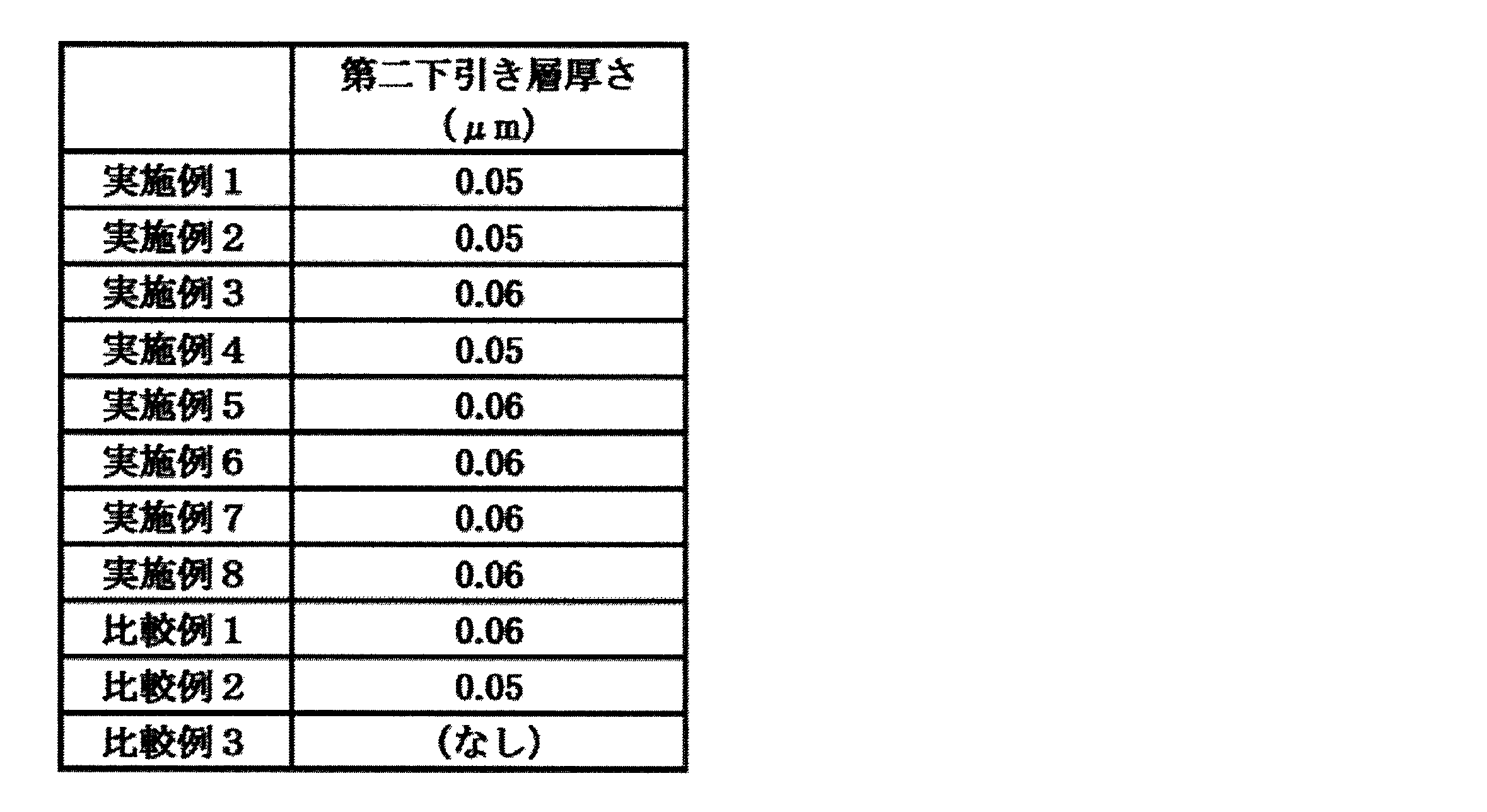
得られたフィルムにさらに、第二下引き層塗布液を、表2に示す乾燥後の塗布厚みとなるように塗布し、120℃、30秒間乾燥、熱処理した。
さらに、以下の離型層塗料を、乾燥後の塗布量が0.1g/m2になるように、リバースグラビアコート方式により塗布した後、150℃、30秒間乾燥、熱処理し、ポリエステルフィルムの上に、順に、第一下引き層、第二下引き層、離型層が積層された離型フィルムを得た。
(R1) 100部
(R2) 1部
MEK/トルエン混合溶媒(混合比率は1:1) 1500部
さらに、以下の離型層塗料を、乾燥後の塗布量が0.1g/m2になるように、リバースグラビアコート方式により塗布した後、150℃、30秒間乾燥、熱処理し、ポリエステルフィルムの上に、順に、第一下引き層、第二下引き層、離型層が積層された離型フィルムを得た。
(R1) 100部
(R2) 1部
MEK/トルエン混合溶媒(混合比率は1:1) 1500部
実施例8:
製造例3の工程において、得られた一軸配向フィルムの片面に、表1に示すとおりの塗布液を塗布した。次いでこのフィルムをテンター延伸機に導き、その熱を利用して塗布液の乾燥、熱処理を行いつつ、製造例3と同様の工程によって、フィルム厚みが38μmの二軸配向ポリエチレンテレフタレートフィルムの上に、表1に示す厚さの第一下引き層を設けた積層ポリエステルフィルムを得た。
製造例3の工程において、得られた一軸配向フィルムの片面に、表1に示すとおりの塗布液を塗布した。次いでこのフィルムをテンター延伸機に導き、その熱を利用して塗布液の乾燥、熱処理を行いつつ、製造例3と同様の工程によって、フィルム厚みが38μmの二軸配向ポリエチレンテレフタレートフィルムの上に、表1に示す厚さの第一下引き層を設けた積層ポリエステルフィルムを得た。
得られたフィルムにさらに、第二下引き層塗布液を、表2に示す乾燥後の塗布厚みとなるように塗布し、120℃、30秒間乾燥、熱処理した。
さらに、以下の離型層塗料を、乾燥後の塗布量が0.1g/m2になるように、リバースグラビアコート方式により塗布した後、150℃、30秒間乾燥、熱処理し、ポリエステルフィルムの上に、順に、第一下引き層、第二下引き層、離型層が積層された離型フィルムを得た。
(R1) 100部
(R2) 1部
MEK/トルエン混合溶媒(混合比率は1:1) 1500部
さらに、以下の離型層塗料を、乾燥後の塗布量が0.1g/m2になるように、リバースグラビアコート方式により塗布した後、150℃、30秒間乾燥、熱処理し、ポリエステルフィルムの上に、順に、第一下引き層、第二下引き層、離型層が積層された離型フィルムを得た。
(R1) 100部
(R2) 1部
MEK/トルエン混合溶媒(混合比率は1:1) 1500部
比較例2:
実施例2~8と同様の工程で、第一下引き層を設けなかった以外は同様にして、ポリエステルフィルムの上に、順に、第二下引き層、離型層が積層された離型フィルムを得た。
実施例2~8と同様の工程で、第一下引き層を設けなかった以外は同様にして、ポリエステルフィルムの上に、順に、第二下引き層、離型層が積層された離型フィルムを得た。
比較例3:
実施例2~8と同様の工程で、第二下引き層を設けなかった以外は同様にして、ポリエステルフィルムの上に、順に、第一下引き層、離型層が積層された離型フィルムを得た。
実施例2~8と同様の工程で、第二下引き層を設けなかった以外は同様にして、ポリエステルフィルムの上に、順に、第一下引き層、離型層が積層された離型フィルムを得た。
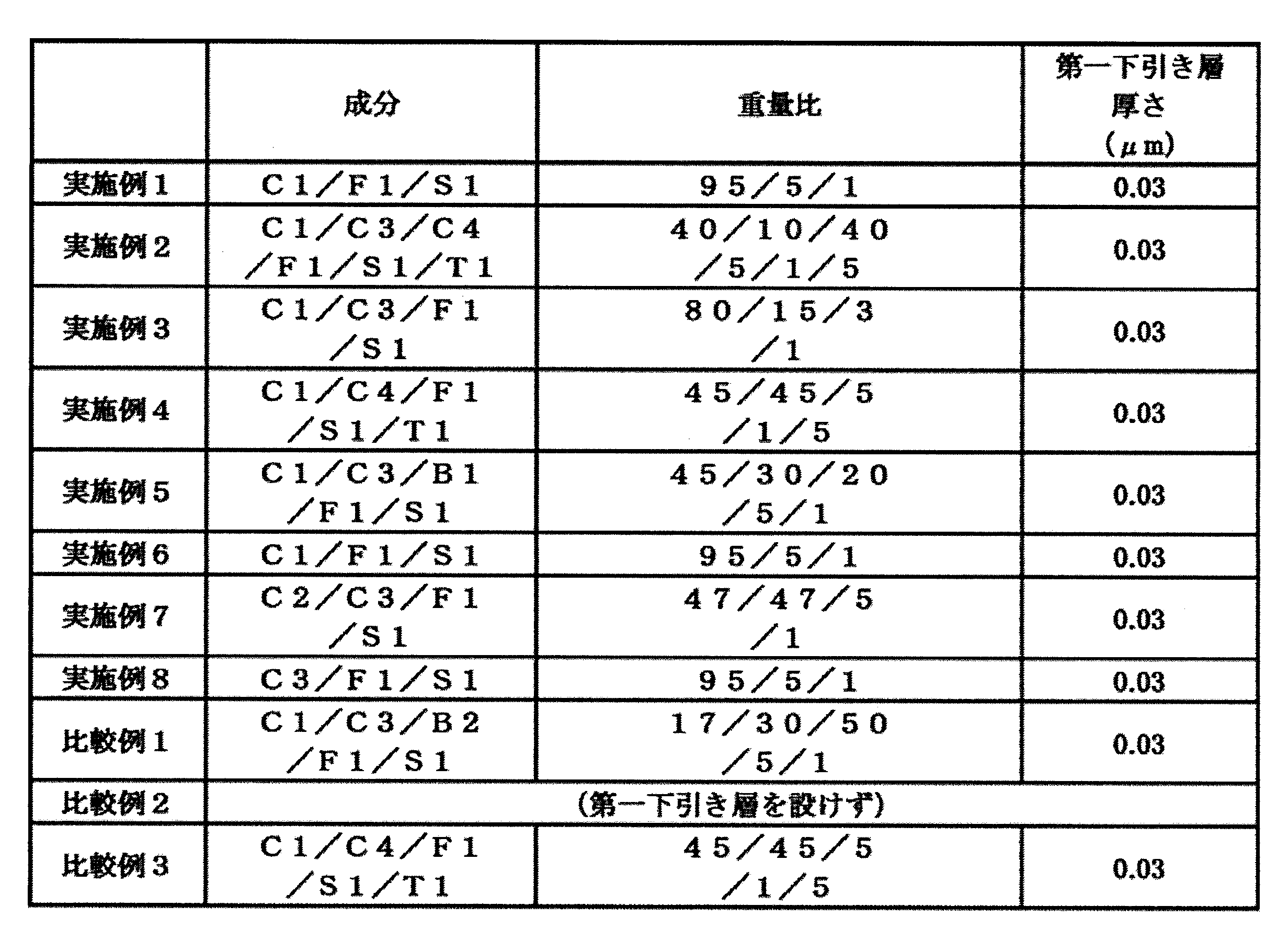
表1中の重量比は、塗布液中における各成分の不揮発分の重量比を表す。
実施例、比較例において得られたフィルムの特性を表3に示す。

本発明のフィルムは、高温にさらされた後に被着体に発生した異物や、帯電が問題となる用途における離型フィルムとして、好適に利用することができる。さらに、クロスニコル下で検査される用途においても好適な特性を与える。
Claims (5)
- 二軸延伸ポリエステルフィルムからなる基材に、第一下引き層、第二下引き層、および硬化型シリコーン樹脂を含有する離型層が順に積層された離型フィルムであり、離型層表面の表面固有抵抗値が1×10¹²Ω未満であることを特徴とする離型フィルム。
- 第一下引き層が、全不揮発成分に対する架橋剤の比率が70重量%以上である塗布液を塗布・乾燥して得られたものである請求項1に記載の離型フィルム。
- 第二下引き層が、チオフェン系の導電性化合物を含有する塗布液を塗布・乾燥して得られたものである請求項1または2に記載の離型フィルム。
- ポリエステルフィルムのうち、下引き層に接する面を構成するポリエスエルフィルム層が、オリゴマー含有量0.7重量%以下のポリエステル50重量%以上から構成された、厚み2μm以上の層である請求項1~3のいずれかに記載の離型フィルム。
- 二軸配向ポリエステルフィルムの配向主軸の向きが12度以下である請求項1~4のいずれかに記載の離型フィルム。
Priority Applications (2)
| Application Number | Priority Date | Filing Date | Title |
|---|---|---|---|
| CN201680014045.1A CN107405909B (zh) | 2015-03-28 | 2016-02-15 | 脱模膜 |
| KR1020177020912A KR102050747B1 (ko) | 2015-03-28 | 2016-02-15 | 이형 필름 |
Applications Claiming Priority (2)
| Application Number | Priority Date | Filing Date | Title |
|---|---|---|---|
| JP2015067763A JP6536123B2 (ja) | 2015-03-28 | 2015-03-28 | 離型フィルム |
| JP2015-067763 | 2015-03-28 |
Publications (1)
| Publication Number | Publication Date |
|---|---|
| WO2016158037A1 true WO2016158037A1 (ja) | 2016-10-06 |
Family
ID=57004191
Family Applications (1)
| Application Number | Title | Priority Date | Filing Date |
|---|---|---|---|
| PCT/JP2016/054282 Ceased WO2016158037A1 (ja) | 2015-03-28 | 2016-02-15 | 離型フィルム |
Country Status (5)
| Country | Link |
|---|---|
| JP (1) | JP6536123B2 (ja) |
| KR (1) | KR102050747B1 (ja) |
| CN (1) | CN107405909B (ja) |
| TW (1) | TWI686281B (ja) |
| WO (1) | WO2016158037A1 (ja) |
Cited By (2)
| Publication number | Priority date | Publication date | Assignee | Title |
|---|---|---|---|---|
| WO2024029346A1 (ja) * | 2022-08-05 | 2024-02-08 | 三菱ケミカル株式会社 | 離型フィルム |
| WO2024048548A1 (ja) * | 2022-09-01 | 2024-03-07 | Agc株式会社 | 積層体、その製造方法及び半導体パッケージの製造方法 |
Families Citing this family (4)
| Publication number | Priority date | Publication date | Assignee | Title |
|---|---|---|---|---|
| JP6208728B2 (ja) * | 2015-09-30 | 2017-10-04 | 日東電工株式会社 | セパレータ付き粘着剤層、セパレータ付き粘着剤層付きの光学フィルム、画像表示装置及びその製造方法 |
| CN114728555A (zh) * | 2019-11-27 | 2022-07-08 | 横滨橡胶株式会社 | 充气轮胎 |
| KR20230101888A (ko) * | 2020-12-23 | 2023-07-06 | 도요보 가부시키가이샤 | 수지 시트 성형용 이형 필름의 제조 방법 |
| CN118900771A (zh) * | 2022-03-15 | 2024-11-05 | 东丽株式会社 | 层合聚酯膜 |
Citations (14)
| Publication number | Priority date | Publication date | Assignee | Title |
|---|---|---|---|---|
| JP2005089622A (ja) * | 2003-09-18 | 2005-04-07 | Teijin Dupont Films Japan Ltd | 光学用ポリエステルフィルム |
| WO2011105441A1 (ja) * | 2010-02-23 | 2011-09-01 | 三菱樹脂株式会社 | 二軸配向ポリエステルフィルムおよびこれを用いた離型フィルム |
| JP2013052552A (ja) * | 2011-09-02 | 2013-03-21 | Mitsubishi Plastics Inc | 離型フィルム |
| JP2013107384A (ja) * | 2011-10-24 | 2013-06-06 | Mitsubishi Plastics Inc | 積層ポリエステルフィルム |
| WO2013146155A1 (ja) * | 2012-03-26 | 2013-10-03 | 三菱樹脂株式会社 | 塗布フィルム |
| WO2014097757A1 (ja) * | 2012-12-17 | 2014-06-26 | 三菱樹脂株式会社 | 基材レス両面粘着シート |
| JP2014113741A (ja) * | 2012-12-10 | 2014-06-26 | Mitsubishi Plastics Inc | 離型フィルム |
| JP2014131834A (ja) * | 2013-01-04 | 2014-07-17 | Mitsubishi Plastics Inc | 離型フィルム |
| JP2014141557A (ja) * | 2013-01-23 | 2014-08-07 | Mitsubishi Plastics Inc | 離型フィルム |
| JP2014151573A (ja) * | 2013-02-09 | 2014-08-25 | Mitsubishi Plastics Inc | 離型フィルム |
| JP2014151572A (ja) * | 2013-02-09 | 2014-08-25 | Mitsubishi Plastics Inc | 離型フィルム |
| WO2015008522A1 (ja) * | 2013-07-16 | 2015-01-22 | 三菱樹脂株式会社 | 塗布フィルム |
| JP2015202657A (ja) * | 2014-04-16 | 2015-11-16 | 三菱樹脂株式会社 | 離型フィルム |
| JP2015202656A (ja) * | 2014-04-16 | 2015-11-16 | 三菱樹脂株式会社 | 離型フィルム |
Family Cites Families (6)
| Publication number | Priority date | Publication date | Assignee | Title |
|---|---|---|---|---|
| JP2801437B2 (ja) * | 1991-07-23 | 1998-09-21 | 帝人株式会社 | 帯電防止性能を有する離型フイルム |
| JP2000108252A (ja) * | 1998-10-02 | 2000-04-18 | Mitsubishi Polyester Film Copp | 離型フィルム |
| JP2002067019A (ja) | 2000-08-30 | 2002-03-05 | Toyobo Co Ltd | セラミックシート製造用離型フィルム |
| JP2003226838A (ja) | 2002-02-05 | 2003-08-15 | Matsumoto Seiyaku Kogyo Kk | 表面処理剤 |
| JP2005178163A (ja) * | 2003-12-19 | 2005-07-07 | Mitsubishi Polyester Film Copp | 離型フィルム用ポリエステルフィルム |
| JP5519361B2 (ja) * | 2010-03-25 | 2014-06-11 | 帝人デュポンフィルム株式会社 | 離型フィルム |
-
2015
- 2015-03-28 JP JP2015067763A patent/JP6536123B2/ja active Active
-
2016
- 2016-02-15 KR KR1020177020912A patent/KR102050747B1/ko active Active
- 2016-02-15 CN CN201680014045.1A patent/CN107405909B/zh active Active
- 2016-02-15 WO PCT/JP2016/054282 patent/WO2016158037A1/ja not_active Ceased
- 2016-02-25 TW TW105105661A patent/TWI686281B/zh active
Patent Citations (14)
| Publication number | Priority date | Publication date | Assignee | Title |
|---|---|---|---|---|
| JP2005089622A (ja) * | 2003-09-18 | 2005-04-07 | Teijin Dupont Films Japan Ltd | 光学用ポリエステルフィルム |
| WO2011105441A1 (ja) * | 2010-02-23 | 2011-09-01 | 三菱樹脂株式会社 | 二軸配向ポリエステルフィルムおよびこれを用いた離型フィルム |
| JP2013052552A (ja) * | 2011-09-02 | 2013-03-21 | Mitsubishi Plastics Inc | 離型フィルム |
| JP2013107384A (ja) * | 2011-10-24 | 2013-06-06 | Mitsubishi Plastics Inc | 積層ポリエステルフィルム |
| WO2013146155A1 (ja) * | 2012-03-26 | 2013-10-03 | 三菱樹脂株式会社 | 塗布フィルム |
| JP2014113741A (ja) * | 2012-12-10 | 2014-06-26 | Mitsubishi Plastics Inc | 離型フィルム |
| WO2014097757A1 (ja) * | 2012-12-17 | 2014-06-26 | 三菱樹脂株式会社 | 基材レス両面粘着シート |
| JP2014131834A (ja) * | 2013-01-04 | 2014-07-17 | Mitsubishi Plastics Inc | 離型フィルム |
| JP2014141557A (ja) * | 2013-01-23 | 2014-08-07 | Mitsubishi Plastics Inc | 離型フィルム |
| JP2014151573A (ja) * | 2013-02-09 | 2014-08-25 | Mitsubishi Plastics Inc | 離型フィルム |
| JP2014151572A (ja) * | 2013-02-09 | 2014-08-25 | Mitsubishi Plastics Inc | 離型フィルム |
| WO2015008522A1 (ja) * | 2013-07-16 | 2015-01-22 | 三菱樹脂株式会社 | 塗布フィルム |
| JP2015202657A (ja) * | 2014-04-16 | 2015-11-16 | 三菱樹脂株式会社 | 離型フィルム |
| JP2015202656A (ja) * | 2014-04-16 | 2015-11-16 | 三菱樹脂株式会社 | 離型フィルム |
Cited By (4)
| Publication number | Priority date | Publication date | Assignee | Title |
|---|---|---|---|---|
| WO2024029346A1 (ja) * | 2022-08-05 | 2024-02-08 | 三菱ケミカル株式会社 | 離型フィルム |
| JPWO2024029346A1 (ja) * | 2022-08-05 | 2024-02-08 | ||
| JP7708319B2 (ja) | 2022-08-05 | 2025-07-15 | 三菱ケミカル株式会社 | 離型フィルム |
| WO2024048548A1 (ja) * | 2022-09-01 | 2024-03-07 | Agc株式会社 | 積層体、その製造方法及び半導体パッケージの製造方法 |
Also Published As
| Publication number | Publication date |
|---|---|
| TW201703966A (zh) | 2017-02-01 |
| JP2016187866A (ja) | 2016-11-04 |
| TWI686281B (zh) | 2020-03-01 |
| CN107405909A (zh) | 2017-11-28 |
| KR102050747B1 (ko) | 2019-12-02 |
| JP6536123B2 (ja) | 2019-07-03 |
| KR20170100012A (ko) | 2017-09-01 |
| CN107405909B (zh) | 2020-03-03 |
Similar Documents
| Publication | Publication Date | Title |
|---|---|---|
| CN109070383B (zh) | 陶瓷生片制造用脱模膜 | |
| KR101665429B1 (ko) | 적층 폴리에스테르 필름 | |
| WO2016158037A1 (ja) | 離型フィルム | |
| CN103756526B (zh) | 一种抗静电水性涂布液 | |
| KR20120028319A (ko) | 적층 폴리에스테르 필름 | |
| EP3023452B1 (en) | Coated film | |
| JP5557463B2 (ja) | 積層ポリエステルフィルムの製造方法 | |
| JP5728143B2 (ja) | 離型フィルム | |
| JP2018058270A (ja) | 積層ポリエステルフィルム | |
| JP6500821B2 (ja) | 積層フィルム | |
| JP2012000993A (ja) | 帯電防止性塗布層を有するポリエステルフィルム | |
| JP6776787B2 (ja) | 離型フィルム | |
| JP6428679B2 (ja) | 積層フィルム | |
| JP2011140562A (ja) | ポリエステルフィルム | |
| KR20140018194A (ko) | 도포 필름 | |
| JP5952049B2 (ja) | 粘着フィルム | |
| KR102389982B1 (ko) | 대전방지 폴리에스테르 필름 | |
| KR20140018195A (ko) | 도포 필름 | |
| JP2011230516A (ja) | 帯電防止性塗布層を有するポリエステルフィルム | |
| JP7017102B2 (ja) | 積層ポリエステルフィルム | |
| JP2015016677A (ja) | 離型ポリエステルフィルム | |
| JP6531348B2 (ja) | 離型フィルム | |
| JP5818260B2 (ja) | 積層ポリエステルフィルム | |
| JP5711557B2 (ja) | 離型ポリエステルフィルム | |
| JP6104052B2 (ja) | 離型フィルム |
Legal Events
| Date | Code | Title | Description |
|---|---|---|---|
| 121 | Ep: the epo has been informed by wipo that ep was designated in this application |
Ref document number: 16771921 Country of ref document: EP Kind code of ref document: A1 |
|
| ENP | Entry into the national phase |
Ref document number: 20177020912 Country of ref document: KR Kind code of ref document: A |
|
| NENP | Non-entry into the national phase |
Ref country code: DE |
|
| 122 | Ep: pct application non-entry in european phase |
Ref document number: 16771921 Country of ref document: EP Kind code of ref document: A1 |