WO2016006631A1 - Cmp用研磨液及び研磨方法 - Google Patents
Cmp用研磨液及び研磨方法 Download PDFInfo
- Publication number
- WO2016006631A1 WO2016006631A1 PCT/JP2015/069662 JP2015069662W WO2016006631A1 WO 2016006631 A1 WO2016006631 A1 WO 2016006631A1 JP 2015069662 W JP2015069662 W JP 2015069662W WO 2016006631 A1 WO2016006631 A1 WO 2016006631A1
- Authority
- WO
- WIPO (PCT)
- Prior art keywords
- polishing
- cmp
- metal
- cobalt
- group
- Prior art date
- Legal status (The legal status is an assumption and is not a legal conclusion. Google has not performed a legal analysis and makes no representation as to the accuracy of the status listed.)
- Ceased
Links
Images


Classifications
-
- C—CHEMISTRY; METALLURGY
- C09—DYES; PAINTS; POLISHES; NATURAL RESINS; ADHESIVES; COMPOSITIONS NOT OTHERWISE PROVIDED FOR; APPLICATIONS OF MATERIALS NOT OTHERWISE PROVIDED FOR
- C09G—POLISHING COMPOSITIONS; SKI WAXES
- C09G1/00—Polishing compositions
- C09G1/02—Polishing compositions containing abrasives or grinding agents
-
- H—ELECTRICITY
- H10—SEMICONDUCTOR DEVICES; ELECTRIC SOLID-STATE DEVICES NOT OTHERWISE PROVIDED FOR
- H10P—GENERIC PROCESSES OR APPARATUS FOR THE MANUFACTURE OR TREATMENT OF DEVICES COVERED BY CLASS H10
- H10P52/00—Grinding, lapping or polishing of wafers, substrates or parts of devices
- H10P52/40—Chemomechanical polishing [CMP]
- H10P52/403—Chemomechanical polishing [CMP] of conductive or resistive materials
-
- B—PERFORMING OPERATIONS; TRANSPORTING
- B24—GRINDING; POLISHING
- B24B—MACHINES, DEVICES, OR PROCESSES FOR GRINDING OR POLISHING; DRESSING OR CONDITIONING OF ABRADING SURFACES; FEEDING OF GRINDING, POLISHING, OR LAPPING AGENTS
- B24B37/00—Lapping machines or devices; Accessories
-
- B—PERFORMING OPERATIONS; TRANSPORTING
- B24—GRINDING; POLISHING
- B24B—MACHINES, DEVICES, OR PROCESSES FOR GRINDING OR POLISHING; DRESSING OR CONDITIONING OF ABRADING SURFACES; FEEDING OF GRINDING, POLISHING, OR LAPPING AGENTS
- B24B37/00—Lapping machines or devices; Accessories
- B24B37/04—Lapping machines or devices; Accessories designed for working plane surfaces
- B24B37/042—Lapping machines or devices; Accessories designed for working plane surfaces operating processes therefor
- B24B37/044—Lapping machines or devices; Accessories designed for working plane surfaces operating processes therefor characterised by the composition of the lapping agent
-
- C—CHEMISTRY; METALLURGY
- C09—DYES; PAINTS; POLISHES; NATURAL RESINS; ADHESIVES; COMPOSITIONS NOT OTHERWISE PROVIDED FOR; APPLICATIONS OF MATERIALS NOT OTHERWISE PROVIDED FOR
- C09K—MATERIALS FOR MISCELLANEOUS APPLICATIONS, NOT PROVIDED FOR ELSEWHERE
- C09K13/00—Etching, surface-brightening or pickling compositions
- C09K13/04—Etching, surface-brightening or pickling compositions containing an inorganic acid
- C09K13/06—Etching, surface-brightening or pickling compositions containing an inorganic acid with organic material
-
- C—CHEMISTRY; METALLURGY
- C09—DYES; PAINTS; POLISHES; NATURAL RESINS; ADHESIVES; COMPOSITIONS NOT OTHERWISE PROVIDED FOR; APPLICATIONS OF MATERIALS NOT OTHERWISE PROVIDED FOR
- C09K—MATERIALS FOR MISCELLANEOUS APPLICATIONS, NOT PROVIDED FOR ELSEWHERE
- C09K3/00—Materials not provided for elsewhere
- C09K3/14—Anti-slip materials; Abrasives
- C09K3/1409—Abrasive particles per se
-
- C—CHEMISTRY; METALLURGY
- C09—DYES; PAINTS; POLISHES; NATURAL RESINS; ADHESIVES; COMPOSITIONS NOT OTHERWISE PROVIDED FOR; APPLICATIONS OF MATERIALS NOT OTHERWISE PROVIDED FOR
- C09K—MATERIALS FOR MISCELLANEOUS APPLICATIONS, NOT PROVIDED FOR ELSEWHERE
- C09K3/00—Materials not provided for elsewhere
- C09K3/14—Anti-slip materials; Abrasives
- C09K3/1454—Abrasive powders, suspensions and pastes for polishing
- C09K3/1463—Aqueous liquid suspensions
-
- C—CHEMISTRY; METALLURGY
- C23—COATING METALLIC MATERIAL; COATING MATERIAL WITH METALLIC MATERIAL; CHEMICAL SURFACE TREATMENT; DIFFUSION TREATMENT OF METALLIC MATERIAL; COATING BY VACUUM EVAPORATION, BY SPUTTERING, BY ION IMPLANTATION OR BY CHEMICAL VAPOUR DEPOSITION, IN GENERAL; INHIBITING CORROSION OF METALLIC MATERIAL OR INCRUSTATION IN GENERAL
- C23F—NON-MECHANICAL REMOVAL OF METALLIC MATERIAL FROM SURFACE; INHIBITING CORROSION OF METALLIC MATERIAL OR INCRUSTATION IN GENERAL; MULTI-STEP PROCESSES FOR SURFACE TREATMENT OF METALLIC MATERIAL INVOLVING AT LEAST ONE PROCESS PROVIDED FOR IN CLASS C23 AND AT LEAST ONE PROCESS COVERED BY SUBCLASS C21D OR C22F OR CLASS C25
- C23F11/00—Inhibiting corrosion of metallic material by applying inhibitors to the surface in danger of corrosion or adding them to the corrosive agent
- C23F11/08—Inhibiting corrosion of metallic material by applying inhibitors to the surface in danger of corrosion or adding them to the corrosive agent in other liquids
- C23F11/10—Inhibiting corrosion of metallic material by applying inhibitors to the surface in danger of corrosion or adding them to the corrosive agent in other liquids using organic inhibitors
- C23F11/14—Nitrogen-containing compounds
- C23F11/149—Heterocyclic compounds containing nitrogen as hetero atom
-
- H—ELECTRICITY
- H10—SEMICONDUCTOR DEVICES; ELECTRIC SOLID-STATE DEVICES NOT OTHERWISE PROVIDED FOR
- H10P—GENERIC PROCESSES OR APPARATUS FOR THE MANUFACTURE OR TREATMENT OF DEVICES COVERED BY CLASS H10
- H10P52/00—Grinding, lapping or polishing of wafers, substrates or parts of devices
-
- H—ELECTRICITY
- H10—SEMICONDUCTOR DEVICES; ELECTRIC SOLID-STATE DEVICES NOT OTHERWISE PROVIDED FOR
- H10P—GENERIC PROCESSES OR APPARATUS FOR THE MANUFACTURE OR TREATMENT OF DEVICES COVERED BY CLASS H10
- H10P52/00—Grinding, lapping or polishing of wafers, substrates or parts of devices
- H10P52/40—Chemomechanical polishing [CMP]
- H10P52/402—Chemomechanical polishing [CMP] of semiconductor materials
-
- H—ELECTRICITY
- H10—SEMICONDUCTOR DEVICES; ELECTRIC SOLID-STATE DEVICES NOT OTHERWISE PROVIDED FOR
- H10W—GENERIC PACKAGES, INTERCONNECTIONS, CONNECTORS OR OTHER CONSTRUCTIONAL DETAILS OF DEVICES COVERED BY CLASS H10
- H10W20/00—Interconnections in chips, wafers or substrates
- H10W20/01—Manufacture or treatment
- H10W20/031—Manufacture or treatment of conductive parts of the interconnections
- H10W20/032—Manufacture or treatment of conductive parts of the interconnections of conductive barrier, adhesion or liner layers
- H10W20/054—Manufacture or treatment of conductive parts of the interconnections of conductive barrier, adhesion or liner layers by selectively removing parts thereof
-
- H—ELECTRICITY
- H10—SEMICONDUCTOR DEVICES; ELECTRIC SOLID-STATE DEVICES NOT OTHERWISE PROVIDED FOR
- H10P—GENERIC PROCESSES OR APPARATUS FOR THE MANUFACTURE OR TREATMENT OF DEVICES COVERED BY CLASS H10
- H10P95/00—Generic processes or apparatus for manufacture or treatments not covered by the other groups of this subclass
- H10P95/06—Planarisation of inorganic insulating materials
- H10P95/062—Planarisation of inorganic insulating materials involving a dielectric removal step
-
- H—ELECTRICITY
- H10—SEMICONDUCTOR DEVICES; ELECTRIC SOLID-STATE DEVICES NOT OTHERWISE PROVIDED FOR
- H10P—GENERIC PROCESSES OR APPARATUS FOR THE MANUFACTURE OR TREATMENT OF DEVICES COVERED BY CLASS H10
- H10P95/00—Generic processes or apparatus for manufacture or treatments not covered by the other groups of this subclass
- H10P95/08—Planarisation of organic insulating materials
-
- H—ELECTRICITY
- H10—SEMICONDUCTOR DEVICES; ELECTRIC SOLID-STATE DEVICES NOT OTHERWISE PROVIDED FOR
- H10W—GENERIC PACKAGES, INTERCONNECTIONS, CONNECTORS OR OTHER CONSTRUCTIONAL DETAILS OF DEVICES COVERED BY CLASS H10
- H10W20/00—Interconnections in chips, wafers or substrates
- H10W20/01—Manufacture or treatment
- H10W20/031—Manufacture or treatment of conductive parts of the interconnections
- H10W20/062—Manufacture or treatment of conductive parts of the interconnections by smoothing of conductive parts, e.g. by planarisation
-
- H—ELECTRICITY
- H10—SEMICONDUCTOR DEVICES; ELECTRIC SOLID-STATE DEVICES NOT OTHERWISE PROVIDED FOR
- H10W—GENERIC PACKAGES, INTERCONNECTIONS, CONNECTORS OR OTHER CONSTRUCTIONAL DETAILS OF DEVICES COVERED BY CLASS H10
- H10W20/00—Interconnections in chips, wafers or substrates
- H10W20/40—Interconnections external to wafers or substrates, e.g. back-end-of-line [BEOL] metallisations or vias connecting to gate electrodes
- H10W20/41—Interconnections external to wafers or substrates, e.g. back-end-of-line [BEOL] metallisations or vias connecting to gate electrodes characterised by their conductive parts
- H10W20/425—Barrier, adhesion or liner layers
Definitions
- a conductive material portion is deposited on an insulating material portion having a concave portion (for example, a groove portion) and a convex portion (for example, a raised portion) formed in advance on the surface, and the conductive material is embedded in the concave portion.
- the conductive material deposited on the convex portion is removed by CMP to form a buried wiring.
- cobalt Co
- a barrier metal for example, a copper-based metal such as copper or a copper alloy
- the embedding property of the conductive material is improved.
- the adhesion between the insulating material and the conductive substance can be supplemented.
- Another embodiment of the present invention is a polishing slurry for CMP used for polishing a surface to be polished having at least a cobalt-containing portion and a metal-containing portion containing a metal other than cobalt.
- a polishing slurry for CMP having at least two selected from the group consisting of pyridines, tetrazoles, triazoles, benzotriazoles, and phthalic acids, and having a pH of 4.0 or less.
- Still another embodiment of the present invention uses any one of the above-described CMP polishing liquids, and includes a cobalt-containing portion and a surface to be polished having at least a cobalt-containing portion and a metal-containing portion containing a metal other than cobalt.
- the present invention relates to a polishing method in which at least a part is polished and removed.
- the conductive material portion contains copper as a main component.
- the polishing slurry for CMP that can suppress galvanic corrosion of a cobalt-containing part while maintaining a good polishing rate of the cobalt-containing part.
- the polishing method which can suppress the galvanic corrosion of a cobalt containing part can be provided, maintaining the favorable grinding
- the “polishing rate” means a rate at which the substance A to be CMPed is removed by polishing (for example, a reduction amount of the thickness of the substance A per time. Removable Rate).
- “Process” is not only an independent process, but even if it cannot be clearly distinguished from other processes, it cannot be clearly distinguished from other processes as long as the operations specified in the “process” are performed. A process is also included.
- the numerical range indicated by using “to” indicates a range including the numerical values described before and after “to” as the minimum value and the maximum value, respectively.
- the content of each component in the CMP polishing liquid is the sum of the plurality of substances present in the CMP polishing liquid unless there is a specific indication when there are a plurality of substances corresponding to each component in the CMP polishing liquid. Means quantity.
- the CMP polishing liquid contains abrasive particles (hereinafter sometimes referred to as “abrasive grains”), a metal anticorrosive, and water, and has a pH of 4.0 or less.
- abrasive grains abrasive particles
- metal anticorrosive a metal anticorrosive
- water abrasive water
- pH 4.0 or less.
- CMP polishing liquid according to the present embodiment in the polishing solution for CMP, when measuring the corrosion potential of metal other than the corrosion potential E A and cobalt cobalt E B, the corrosion potential E A corrosion potential E B A polishing liquid in which the absolute value of the corrosion potential difference E A -E B is 0 to 300 mV.
- the polishing liquid for CMP contains abrasive grains. Due to the inclusion of the abrasive grains, the polishing rate of the metal-containing part provided in the vicinity of the cobalt-containing part tends to be improved.
- An abrasive grain can be used individually by 1 type or in mixture of 2 or more types.
- Abrasive grains include, for example, inorganic abrasive particles such as silica particles, alumina particles, zirconia particles, ceria particles, titania particles, germania particles, and silicon carbide particles; organic polishing such as polystyrene particles, polyacrylic acid particles, and polyvinyl chloride particles. Particles; These modified products and the like.
- inorganic abrasive particles such as silica particles, alumina particles, zirconia particles, ceria particles, titania particles, germania particles, and silicon carbide particles
- organic polishing such as polystyrene particles, polyacrylic acid particles, and polyvinyl chloride particles. Particles; These modified products and the like.
- the content of the abrasive grains is preferably 1.0% by mass or more, more preferably 1.2% by mass or more, and further preferably 1.5% by mass in the total mass of the polishing slurry for CMP from the viewpoint of obtaining a good polishing rate. It is at least mass%.
- the content of the abrasive grains is preferably 5.0% by mass or less, more preferably 5.0% by mass or less, based on the total mass of the polishing slurry for CMP, from the viewpoint of maintaining good dispersion stability of the abrasive grains and suppressing the occurrence of polishing flaws. Is 4.5% by mass or less, more preferably 4.0% by mass or less.
- the particle size of the abrasive grains is determined by using an aqueous dispersion obtained by diluting a CMP polishing liquid with water as necessary, using a light diffraction scattering type particle size distribution meter (for example, “COULTER” manufactured by COULTER Electronics Co., Ltd.). N4SD ").
- the measurement conditions of the light diffraction / scattering particle size distribution meter are: measurement temperature 20 ° C., solvent refractive index 1.333 (corresponding to the refractive index of water), particle refractive index Unknown (setting), solvent viscosity 1.005 mPa (water Equivalent to viscosity), Run Time 200 sec, laser incident angle 90 °.
- the CMP polishing liquid is diluted with water to After obtaining the dispersion, measurement is performed.
- the CMP polishing liquid contains a metal anticorrosive.
- a metal anticorrosive By containing the metal anticorrosive, galvanic corrosion can be effectively suppressed while maintaining a good polishing rate for the cobalt-containing portion.
- a metal anticorrosive can be used individually by 1 type or in mixture of 2 or more types.
- the pyridines are preferably pyridines having an amino group or a hydroxy group, more preferably pyridines having an amino group, still more preferably 3-aminopyridine or 4-aminopyridine, and particularly preferably 3 -Aminopyridine.
- the tetrazole is preferably a tetrazole having an amino group or an alkyl group, more preferably a tetrazole having an amino group, and still more preferably 5-aminotetrazole.
- Metal anticorrosives can be used alone or in combination of two or more. When mixing two or more, preferably, at least one selected from the group consisting of pyridines, tetrazoles, triazoles and benzotriazoles, and pyridines, tetrazoles, triazoles and At least one selected from the group consisting of benzotriazoles is mixed.
- a combination of two kinds of metal anticorrosives has been mentioned, but other metal anticorrosives (for example, other azoles) can be used in combination. From the viewpoint of efficiently obtaining the effect of the combination of the two types of metal anticorrosives, it is possible to use only the two types of metal anticorrosives.
- the content ratio of the metal anticorrosive (A) and the metal anticorrosive (B) is preferably 10: 1 to 1:10, more preferably 5: 1 to 1: 5, and even more preferably 2: 1 from the viewpoint of obtaining a good polishing rate for the cobalt-containing part. ⁇ 1: 2.
- the CMP polishing liquid may further contain organic acids.
- Organic acids have the effect of improving the polishing rate for the cobalt-containing part and the metal-containing part.
- Organic acids include organic acids, organic acid salts, organic acid anhydrides, and organic acid esters (the “water-soluble polymer” described below is not included in organic acids).
- phthalic acids are preferable from the viewpoint of suppressing corrosion of the cobalt-containing part. By using phthalic acids, a good polishing rate of the cobalt-containing part can be obtained, and corrosion can be suppressed.
- Phthalic acids include phthalic acid, salts of phthalic acid, phthalic anhydride, and esters of phthalic acid, which may or may not have a substituent.
- the organic acid When phthalic acids are used as the organic acid, other organic acids can be used in combination. From the viewpoint of efficiently obtaining the effects of using phthalic acids, it is also possible to use phthalic acids alone.
- the phthalic acid is at least one selected from the group consisting of pyridines and azoles as a metal anticorrosive, more preferably at least one selected from the group consisting of pyridines, tetrazoles, triazoles and benzotriazoles When used together, a high effect is obtained.
- the content is preferably 0.01% by mass or more in the total mass of the CMP polishing liquid from the viewpoint of obtaining a good polishing rate of the cobalt-containing part. 0.02% by mass or more is preferable, and 0.05% by mass or more is more preferable.
- the content of the metal oxidant is preferably 30% by mass or less, more preferably 15% by mass or less, and still more preferably 10% by mass or less, from the viewpoint of preventing the polished surface from being rough.
- the organic solvent is preferably at least one selected from glycols, derivatives of glycols, alcohols, and carbonates, and more preferably alcohols.
- polycarboxylic acid or a salt thereof pectic acid; agar; polymalic acid; polyacrylamide; polyvinyl alcohol; polyvinyl pyrrolidone; an ester or ammonium salt thereof is preferable, and a polyacrylic acid ammonium salt is more preferable.
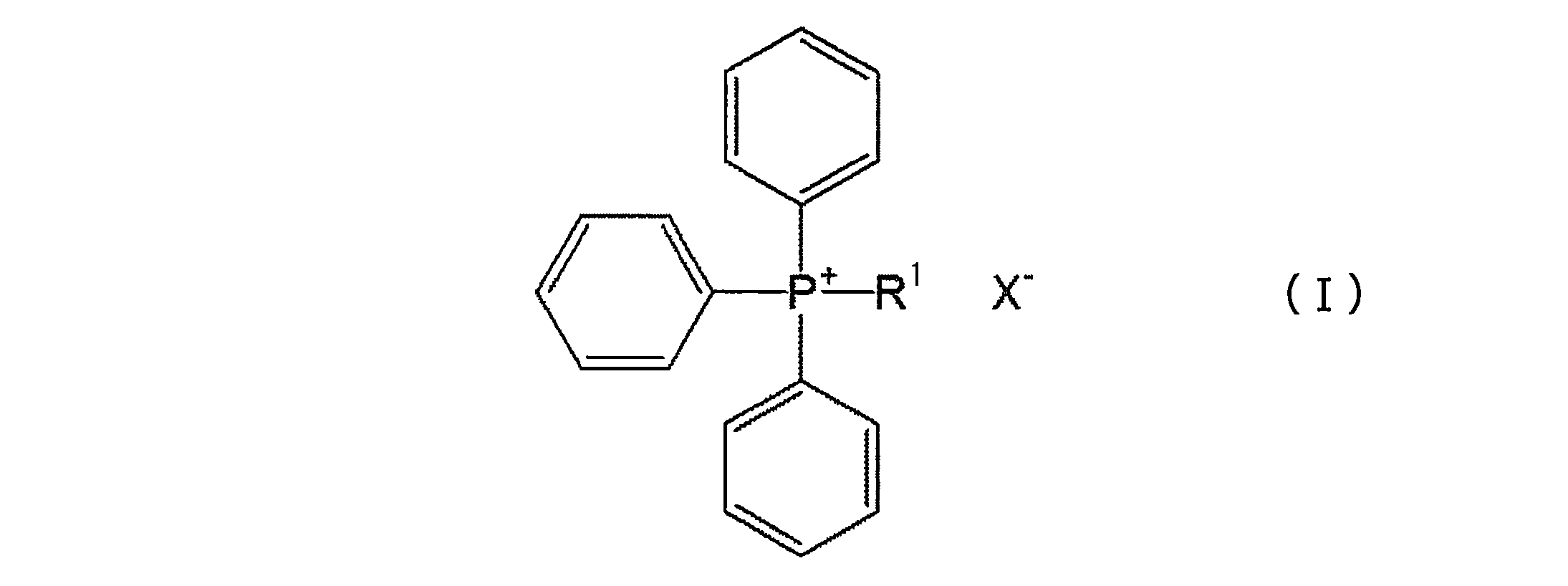
- the counter anions described above can be used as the counter anions of the quaternary phosphonium cation.
- the anion X ⁇ is not particularly limited, but is preferably a halogen ion, more preferably a bromide ion.
- the pH of the polishing liquid for CMP is 4.0 or less.
- pH is 4.0 or less, it is excellent in the polishing rate of a cobalt containing part and a metal containing part.
- it is 3.8 or less, More preferably, it is 3.6 or less, More preferably, it is 3.5 or less.
- the pH of the polishing slurry for CMP is preferably 2.0 or more from the viewpoint of suppressing galvanic corrosion of the cobalt-containing part and the metal-containing part, and from the viewpoint of eliminating difficulty in handling due to strong acidity. 5 or more are more preferable, and 2.8 or more are still more preferable.
- the substrate is polished while supplying the polishing slurry for CMP according to the above embodiment between the surface of the substrate on which the cobalt-containing portion and the metal-containing portion are formed and the polishing pad on the polishing surface plate.
- this polishing method at least a part of the cobalt-containing portion is polished and removed by relatively moving the substrate and the polishing platen while being pressed.
- the insulating material portion 1 is formed by, for example, a CVD (chemical vapor deposition) method, a spin coating method, a dip coating method, a spray method, or the like.
- Specific examples of the insulating material portion 1 include an interlayer insulating film in an LSI manufacturing process, particularly a multilayer wiring forming process.
- the insulating material portion 1 has a thickness of about 0.01 ⁇ m to 2.0 ⁇ m
- the cobalt-containing portion 2a has a thickness of about 0.01 ⁇ m to 2.5 ⁇ m
- the barrier metal portion 2b has a thickness of about 0.01 ⁇ m to 2.5 ⁇ m.
- the thickness of the metal-containing portion 3a is preferably about 0.01 ⁇ m to 2.5 ⁇ m.
- substrate 20 or 120 which has the conductor pattern (namely, wiring pattern) by which the electroconductive substance part on the convex part was removed, the cobalt containing part 2a was exposed on the surface, and the electroconductive substance was left in the recessed part is obtained.
- the polishing slurry for CMP for a conductive material having a sufficiently high polishing rate ratio of the conductive material portion / cobalt-containing portion 2a for example, the polishing slurry for CMP described in Japanese Patent No. 3337464 can be used.
- a part of the cobalt-containing portion 2a on the convex portion may be polished together with the conductive substance portion.
- the cobalt-containing portion 2a exposed by the first polishing step from the state shown in FIG. 1B to the state shown in FIG. Use and polish to remove excess cobalt-containing part.
- the polishing conditions are not particularly limited, but the rotation speed of the polishing surface plate is preferably a low rotation speed of 200 min ⁇ 1 or less so that the substrate does not pop out.
- the pressing pressure of the substrate against the polishing pad is preferably 1 kPa to 100 kPa, and more preferably 5 kPa to 50 kPa in order to satisfy the uniformity of the polishing speed within the surface and the flatness of the pattern.
- the CMP polishing liquid of the above embodiment is continuously supplied by a pump or the like between the polishing pad and the surface to be polished.
- the supply amount is not limited, it is preferable that the surface of the polishing pad is always covered with a CMP polishing liquid.
- the substrate after polishing is preferably washed in running water and then dried after removing water droplets adhering to the substrate using spin drying or the like.
- the polishing slurry for CMP of the present invention can be used not only for polishing a semiconductor substrate as described above but also for polishing a substrate such as a magnetic head.
- the corrosion potential difference E A -E B was measured according to the following.
- the CMP polishing liquid is used for polishing a surface to be polished having a “cobalt-containing portion” described later and “copper” as a metal-containing portion containing a metal other than cobalt.
- the corrosion potential of cobalt as E a to measure the corrosion potential of copper as corrosion potential E B.
- the results are shown in Tables 1 to 3.
- polishing substrate 1 Using the polishing slurry for CMP of Examples 1 to 10 and Comparative Examples 1 to 5, CMP was performed on the substrate 1 to be polished for 1 min under the following polishing conditions.
- Polishing device Polishing machine for single-sided metal film ("Reflexion LK" manufactured by Applied Materials) Polishing pad: Polishing pad made of polyurethane foam resin Surface plate rotation speed: 93 min -1 Polishing head rotation speed: 87 min ⁇ 1 Polishing pressure: 10.3 kPa (1.5 psi) Supply amount of polishing liquid for CMP: 300 mL / min Polishing time: 1 min
- the conductive material layer had a pattern in which the wiring width was 180 nm and the wiring density was 50% (interlayer insulating film having a width of 180 nm and copper wiring having a width (including a barrier metal layer) of 180 nm alternately. Lined pattern). Copper other than the concave portions (groove portions) was polished by a known CMP method using a copper polishing liquid, and the barrier metal layer on the convex portions was exposed on the surface to be polished to obtain the substrate 2 to be polished. The substrate 2 to be polished was cut into 2 cm ⁇ 2 cm pieces and used for the following CMP.
- polishing substrate 2 Using the polishing slurry for CMP of Examples 1 to 10 and Comparative Examples 1 to 5, the substrate 2 to be polished was subjected to CMP for 30 seconds under the following polishing conditions.
- Polishing device “Enwrapping machine IMPTEC 10DVT” manufactured by Nippon Engis Co., Ltd.)
- Polishing pad Polishing pad made of foamed polyurethane resin Polishing pressure: 30 kPa (4.4 psi)
- Supply amount of polishing liquid for CMP 15 mL / min Polishing time: 30 sec
- the galvanic corrosion of the substrate 2 after polishing was evaluated under the following conditions. That is, a portion where the wiring width in the polished substrate 2 after polishing was 180 nm and the wiring density was 50% was observed using a “field emission electron microscope S-4800” manufactured by Hitachi High-Technologies Corporation. A case where no galvanic corrosion was confirmed (when no cobalt etching was confirmed near the interface between cobalt and copper) was evaluated as a good result, and is shown as “A” in Tables 1 to 3. The cases where galvanic corrosion was confirmed are shown as “B” in Tables 1 to 3.
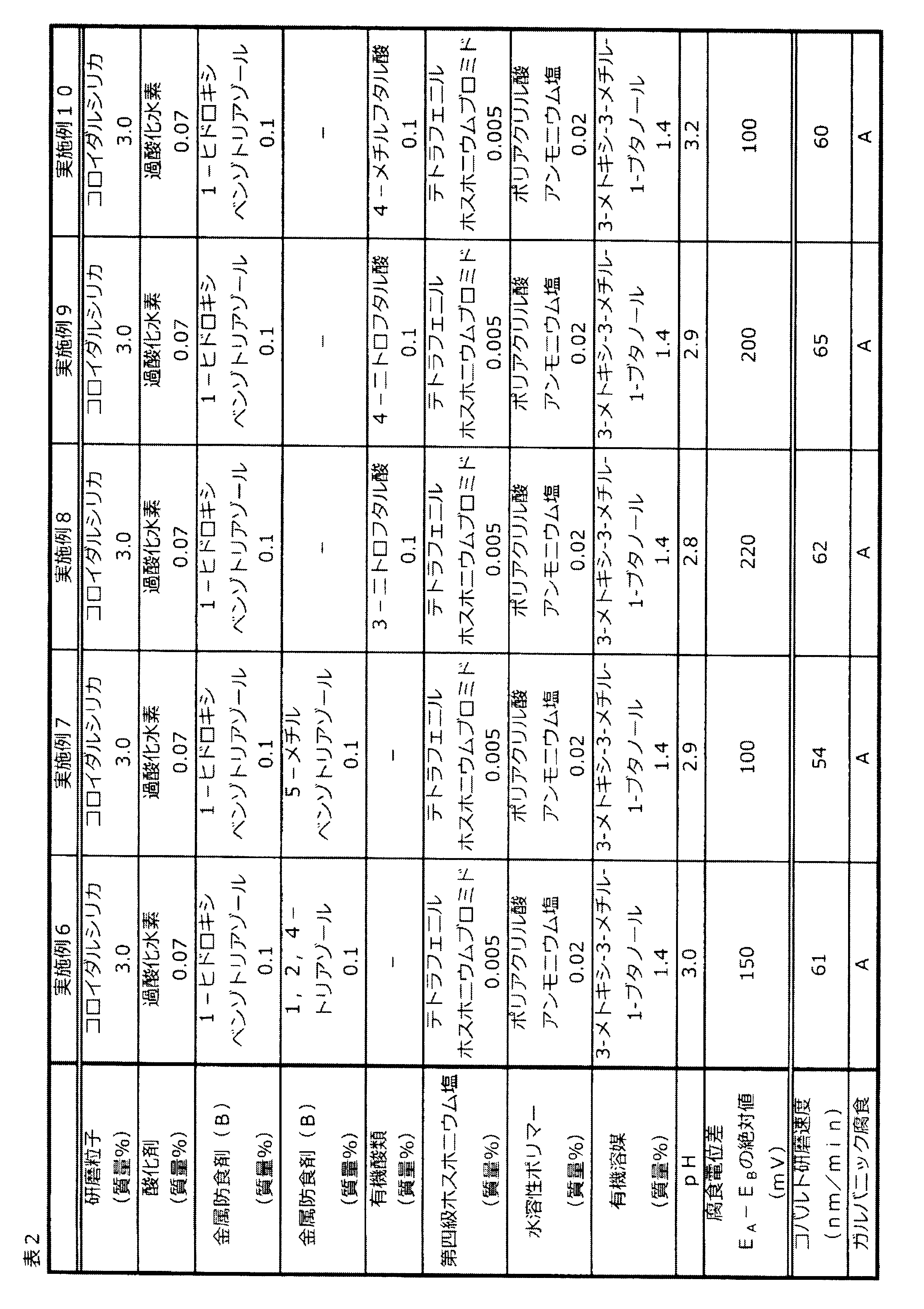
- the absolute value of the corrosion potential difference E A -E B is small, or the polishing liquid for CMP is a specific metal anticorrosive and / or organic acid. By containing, galvanic corrosion could be suppressed while maintaining the polishing rate of the cobalt-containing part.
Landscapes
- Chemical & Material Sciences (AREA)
- Engineering & Computer Science (AREA)
- Organic Chemistry (AREA)
- Mechanical Engineering (AREA)
- Materials Engineering (AREA)
- Inorganic Chemistry (AREA)
- Metallurgy (AREA)
- Mechanical Treatment Of Semiconductor (AREA)
- Finish Polishing, Edge Sharpening, And Grinding By Specific Grinding Devices (AREA)
Abstract
Description
本発明は、2014年7月9日に出願された特願2014-141533号に記載の主題と関連しており、その開示内容は、参照によりここに援用される。
「工程」には、独立した工程だけではなく、他の工程と明確に区別できない場合であっても、当該「工程」において規定される操作が実施される限り、他の工程と明確に区別できない工程も含まれる。
「~」を用いて示された数値範囲は、「~」の前後に記載される数値をそれぞれ最小値及び最大値として含む範囲を示す。
CMP用研磨液中の各成分の含有量は、CMP用研磨液中に各成分に該当する物質が複数存在する場合、特に断らない限り、CMP用研磨液中に存在する当該複数の物質の合計量を意味する。
<CMP用研磨液>
本実施形態に係るCMP用研磨液は、コバルト含有部と、コバルト以外の金属を含有する金属含有部とを少なくとも有する被研磨面の研磨に用いられるCMP用研磨液である。
CMP用研磨液は、砥粒を含有する。砥粒の含有により、コバルト含有部の近傍に設けられた、金属含有部の研磨速度が向上する傾向がある。砥粒は、一種を単独で、又は二種以上を混合して用いることができる。
CMP用研磨液は、金属防食剤を含有する。金属防食剤の含有により、コバルト含有部に対し、良好な研磨速度を保ちながらガルバニック腐食を効果的に抑制できる。金属防食剤は、一種を単独で、又は二種以上を混合して用いることができる。
CMP用研磨液は、有機酸類を更に含有してもよい。有機酸類は、コバルト含有部及び金属含有部に対する研磨速度を向上させる効果を有する。有機酸類には、有機酸、有機酸の塩、有機酸の無水物、及び有機酸のエステルが含まれる(後述する「水溶性ポリマ」は、有機酸類には含まれないものとする)。有機酸類の中でも、コバルト含有部の腐食を抑制する観点から、フタル酸類が好ましい。フタル酸類を用いることにより、コバルト含有部の良好な研磨速度が得られるとともに、腐食を抑制できる。フタル酸類には、フタル酸、フタル酸の塩、フタル酸の無水物、及びフタル酸のエステルが含まれ、これらは置換基を有しても、置換基を有しなくてもよい。有機酸としてフタル酸類を使用する場合、更に他の有機酸を併用することも可能である。フタル酸類を用いることによる効果を効率よく得るという観点から、フタル酸類を単独で使用することも可能である。フタル酸類は、特に、金属防食剤としてピリジン類及びアゾール類からなる群から選択される少なくとも一種、より好ましくは、ピリジン類、テトラゾール類、トリアゾール類及びベンゾトリアゾール類からなる群から選択される少なくとも一種と共に使用した場合に、高い効果が得られる。
CMP用研磨液は、金属酸化剤を含有することが好ましい。金属酸化剤としては、特に制限はないが、例えば、過酸化水素、ペルオキソ硫酸塩、硝酸、過ヨウ素酸カリウム、次亜塩素酸、オゾン等が挙げられる。金属含有部の研磨速度を向上させる観点から、過酸化水素が特に好ましい。金属酸化剤は、一種を単独で、又は二種以上を混合して用いることができる。
CMP用研磨液は、有機溶媒を更に含有してもよい。有機溶媒の含有により、コバルト含有部の近傍に設けられた金属含有部に対する、CMP用研磨液の濡れ性を向上させることができる。有機溶媒としては、特に制限はないが、水と混合できるものが好ましく、25℃において、水100gに対して0.1g以上溶解するものがより好ましい。有機溶媒は、一種を単独で、又は二種以上を混合して用いることができる。
CMP用研磨液は、水溶性ポリマを更に含有してもよい。水溶性ポリマの含有により、コバルト含有部のガルバニック腐食の抑制、被研磨面の保護、欠陥(ディフェクト)発生の低減等が可能である。水溶性ポリマは、25℃において、水100gに対して0.1g以上溶解するものが好ましい。水溶性ポリマは、一種を単独で、又は二種以上を混合して用いることができる。
検出器:株式会社日立製作所製、RI-モニター「L-3000」
インテグレーター:株式会社日立製作所製、GPCインテグレーター「D-2200」
ポンプ:株式会社日立製作所製「L-6000」
デガス装置:昭和電工株式会社製「Shodex DEGAS」
カラム:日立化成株式会社製「GL-R440」、「GL-R430」、及び「GL-R420」をこの順番で連結して使用
溶離液:テトラヒドロフラン(THF)
測定温度:23℃
流速:1.75mL/min
測定時間:45min
注入量:10μL
標準ポリアクリル酸:日立化成テクノサービス株式会社製「PMAA-32」
CMP用研磨液は、第四級ホスホニウム塩を更に含有してもよい。第四級ホスホニウム塩の含有により、被研磨面の保護、金属含有部及び絶縁材料部(例えば、Low-k膜)の研磨の抑制等が可能である。
CMP用研磨液は水を含有する。水は、特に制限されるものではないが、純水を好ましく用いることができる。水は残部として配合されていればよく、含有量に特に制限はない。
CMP用研磨液のpHは、4.0以下である。pHが4.0以下である場合、コバルト含有部及び金属含有部の研磨速度に優れる。好ましくは3.8以下であり、より好ましくは3.6以下であり、更に好ましくは3.5以下である。また、CMP用研磨液のpHは、コバルト含有部及び金属含有部のガルバニック腐食を抑制する観点、また、酸性が強いことによる取扱い難さを解消する観点から、2.0以上が好ましく、2.5以上がより好ましく、2.8以上が更に好ましい。
CMP用研磨液は、コバルト含有部と金属含
有部とを有する被研磨面の研磨に用いられる。CMP用研磨液は、当該CMP用研磨液中において、コバルトの腐食電位EAとコバルト以外の金属の腐食電位EBとを測定した場合に、腐食電位差EA-EBの絶対値として0~300mVを与える。腐食電位差EA-EBの絶対値が0~300mVであるCMP用研磨液を用いることによって、コバルト含有部がガルバニック腐食を受けることを抑制できる。
本実施形態に係る研磨方法は、前記実施形態のCMP用研磨液を用い、コバルト含有部と、コバルト以外の金属を含有する金属含有部とを少なくとも有する被研磨面の、コバルト含有部の少なくとも一部を研磨して除去する研磨方法である。好ましくは、少なくとも一方の面に、コバルト含有部及び金属含有部が形成された基板に対し、コバルト含有部の余分の部分を研磨して除去する研磨方法である。より具体的には、基板のコバルト含有部及び金属含有部が形成された面と研磨定盤上の研磨パッドとの間に、前記実施形態のCMP用研磨液を供給しながら、基板を研磨パッドに押圧した状態で、基板と研磨定盤とを相対的に動かすことによってコバルト含有部の少なくとも一部を研磨して除去する研磨方法である。
表1~3に示す各成分を用いてCMP用研磨液を下記の方法で作製した。
(実施例1~7及び比較例1~3)
表1~3に示す種類の金属防食剤と、有機溶媒として3-メトキシ-3-メチル-1-ブタノールと、水溶性ポリマとしてポリアクリル酸アンモニウム塩(重量平均分子量8,000)と、砥粒としてコロイダルシリカ(平均二次粒径60nm)と、第四級ホスホニウム塩としてテトラフェニルホスホニウムブロミドとを容器に入れ、更に超純水を注ぎ、撹拌により混合して全成分を溶解させた。酸化剤として過酸化水素水(30質量%水溶液)を添加した後、超純水を加えて全体を100質量部とし、CMP用研磨液を得た。
表2及び3に示す種類の金属防食剤と、表2及び3に示す種類の有機酸と、有機溶媒として3-メトキシ-3-メチル-1-ブタノールと、水溶性ポリマとしてポリアクリル酸アンモニウム塩(重量平均分子量8,000)と、砥粒としてコロイダルシリカ(平均粒径60nm)と、第四級ホスホニウム塩としてテトラフェニルホスホニウムブロミドとを容器に入れ、更に超純水を注ぎ、撹拌により混合して全成分を溶解させた。酸化剤として過酸化水素水(30質量%水溶液)を添加した後、超純水を加えて全体を100質量部とし、CMP用研磨液を得た。
CMP用研磨液のpHを下記に従って測定した。
測定温度:25℃
測定器:電気化学計器株式会社製「PHL-40」
測定方法:標準緩衝液(フタル酸塩pH緩衝液 pH:4.01(25℃)、中性リン酸塩pH緩衝液 pH:6.86(25℃)、ホウ酸塩pH緩衝液 pH:9.18(25℃)を用いて、3点校正した後、電極をCMP用研磨液に入れて、3min以上経過して安定した後の値を測定した。結果を表1~3に示す。
CMP用研磨液を用い、下記に従って腐食電位差EA-EBの測定を行った。なお、本実施例では、CMP用研磨液を、後述する「コバルト含有部」と、コバルト以外の金属を含有する金属含有部として「銅」とを有する被研磨面の研磨に用いるため、腐食電位EAとしてコバルトの腐食電位を、腐食電位EBとして銅の腐食電位を測定した。結果を表1~3に示す。
以下の項目により、実施例1~10及び比較例1~5のCMP用研磨液の評価を行った。
[被研磨基板1(ブランケット基板)]
シリコン基板(直径12インチウエハ)に厚さ200nmのコバルト層を形成し、ブランケット基板を得た。このブランケット基板を被研磨基板1とした。
実施例1~10及び比較例1~5のCMP用研磨液を用いて、下記研磨条件で被研磨基板1をそれぞれ1min、CMPした。
研磨パッド:発泡ポリウレタン樹脂製研磨パッド
定盤回転数:93min-1
研磨ヘッド回転数:87min-1
研磨圧力:10.3kPa(1.5psi)
CMP用研磨液の供給量:300mL/min
研磨時間:1min
前記で研磨した被研磨基板1の被研磨面にスポンジブラシ(ポリビニルアルコール系樹脂製)を押し付けた後、蒸留水を被研磨基板1に供給しながら被研磨基板1とスポンジブラシとを回転させ、1min洗浄した。次に、スポンジブラシを取り除いた後、被研磨基板1の被研磨面に蒸留水を1min間供給した。最後に被研磨基板1を高速で回転させて蒸留水を弾き飛ばして被研磨基板1を乾燥した。
研磨速度を下記のように評価した。
種々の膜厚を有するコバルト層を形成したブランケット基板の抵抗値から検量線を得て、下記式(1)より、研磨前と研磨後のコバルト層の膜厚をそれぞれ求めた。
研磨前後のコバルト層の膜厚[nm]=104.5×(被研磨基板1の抵抗値[mΩ]/1000)-0.893・・・(1)
コバルト層の研磨速度(Co-RR)[nm/min]=(研磨前のコバルト層の膜厚[nm]―研磨後のコバルト層の膜厚[nm])/1[min]・・・(2)
抵抗値の測定には、株式会社日立国際電気製、金属膜厚測定装置「VR-120/08S」を用いた。測定結果を「コバルト研磨速度」として表1~3に示す。
上記においてCMPした後の被研磨基板1について、目視観察及び光学顕微鏡観察を行い、研磨傷の発生の有無を確認した。その結果、全ての実施例及び比較例において顕著な研磨傷の発生は認められなかった。
[被研磨基板2(パターン基板)の作製]
直径12インチ(30.5cm)(φ)サイズの銅配線付きパターン基板(Advanced Material Technology社製「SEMATECH754CMPパターン」)を用意した。パターン基板は、二酸化ケイ素からなる層間絶縁膜(厚さ3500Å);窒化タンタルからなるバリア金属層(厚さ60Å);コバルトからなるバリア金属層(厚さ60Å);及び、銅からなる導電性物質層を有していた。導電性物質層は、配線幅が180nmであり、配線密度が50%であるパターンを有していた(幅180nmの層間絶縁膜と幅(バリア金属層を含む)180nmの銅配線とが交互に並んだパターン)。凹部(溝部)以外の銅を、銅用研磨液を用いて公知のCMP法により研磨し、凸部上のバリア金属層を被研磨面に露出させ、被研磨基板2を得た。被研磨基板2を2cm×2cmの小片に切断し、下記のCMPに使用した。
実施例1~10及び比較例1~5のCMP用研磨液を用いて、下記研磨条件で被研磨基板2をそれぞれ30sec、CMPした。
研磨装置:日本エンギス株式会社製「ラッピングマシーンIMPTEC 10DVT」)
研磨パッド:発泡ポリウレタン樹脂製研磨パッド
研磨圧力:30kPa(4.4psi)
定盤回転数:90min-1
CMP用研磨液の供給量:15mL/min
研磨時間:30sec
研磨後の被研磨基板2のガルバニック腐食を下記条件により評価した。すなわち、研磨後の被研磨基板2における配線幅が180nmであり、配線密度が50%である部分を、日立ハイテクノロジーズ株式会社製「電界放出形電子顕微鏡S-4800」を用いて観察した。ガルバニック腐食が全く確認されなかった場合(コバルトと銅の界面付近において、コバルトのエッチングが全く確認されなかった場合)を良好な結果と評価し、表1~3中に「A」として記した。ガルバニック腐食が確認された場合を、表1~3中に「B」として記した。


2 バリア金属部
2a コバルト含有部
2b バリア金属部
3 導電性物質部
3a コバルト以外の金属を含有する金属含有部
10、110、210 研磨前の基板
20、120、220 第一の研磨工程後の基板
30、130、230 第二の研磨工程後の基板
11 貫通孔
12 上部治具
13 下部治具
14 基板
15 CMP用研磨液
16 カウンター電極
17 参照電極
Claims (17)
- コバルト含有部と、コバルト以外の金属を含有する金属含有部とを少なくとも有する被研磨面の研磨に用いられるCMP用研磨液であって、
研磨粒子、金属防食剤、及び水を含有し、pHが4.0以下であり、
当該CMP用研磨液中でコバルトの腐食電位EAと前記金属の腐食電位EBとを測定した場合、腐食電位EAと腐食電位EBとの腐食電位差EA-EBの絶対値が0~300mVである、CMP用研磨液。 - 前記金属防食剤が、ピリジン類及びアゾール類からなる群から選択される少なくとも一種を含む、請求項1に記載のCMP用研磨液。
- フタル酸類を更に含有する、請求項1又は2に記載のCMP用研磨液。
- コバルト含有部と、コバルト以外の金属を含有する金属含有部とを少なくとも有する被研磨面の研磨に用いられるCMP用研磨液であって、
研磨粒子、水、並びに、ピリジン類、テトラゾール類、トリアゾール類、ベンゾトリアゾール類及びフタル酸類からなる群から選択される少なくとも二種を含有し、
pHが4.0以下である、CMP用研磨液。 - 研磨粒子、水、ピリジン類及びテトラゾール類からなる群から選択される少なくとも一種、並びに、トリアゾール類及びベンゾトリアゾール類からなる群から選択される少なくとも一種を含有する、請求項2~4のいずれか一項に記載のCMP用研磨液。
- 研磨粒子、水、並びに、トリアゾール類及びベンゾトリアゾール類からなる群から選択される少なくとも二種を含有する、請求項2~4のいずれか一項に記載のCMP用研磨液。
- 研磨粒子、水、ピリジン類、テトラゾール類、トリアゾール類及びベンゾトリアゾール類からなる群から選択される少なくとも一種、並びに、フタル酸類を含有する、請求項2~4のいずれか一項に記載のCMP用研磨液。
- 第四級ホスホニウム塩を更に含有する、請求項1~7のいずれか一項に記載のCMP用研磨液。
- 前記第四級ホスホニウム塩が、トリアリールホスホニウム塩及びテトラアリールホスホニウム塩からなる群から選択される少なくとも一種を含む、請求項8に記載のCMP用研磨液。
- 前記研磨粒子が、シリカ粒子、アルミナ粒子、セリア粒子、チタニア粒子、ジルコニア粒子、ゲルマニア粒子、及びこれらの変性物からなる群から選択される少なくとも一種を含む、請求項1~9のいずれか一項に記載のCMP用研磨液。
- 金属酸化剤を更に含有する、請求項1~10のいずれか一項に記載のCMP用研磨液。
- 有機溶媒を更に含有する、請求項1~11のいずれか一項に記載のCMP用研磨液。
- 請求項1~12のいずれか一項に記載のCMP用研磨液を用い、コバルト含有部と、コバルト以外の金属を含有する金属含有部とを少なくとも有する被研磨面の、前記コバルト含有部の少なくとも一部を研磨して除去する、研磨方法。
- 表面に凹部及び凸部を有する絶縁材料部と、前記凹部及び凸部に沿って前記絶縁材料部を被覆するバリア金属部と、前記凹部を充填して前記バリア金属部を被覆する導電性物質部とを有し、前記バリア金属部がコバルト含有部を有し、前記導電性物質部がコバルト以外の金属を含有する金属含有部を有する基板を用意する工程、
前記導電性物質部を研磨して前記凸部上の前記バリア金属部を露出させる第一の研磨工程、及び、
前記第一の研磨工程で露出した前記バリア金属部を請求項1~12のいずれか一項に記載のCMP用研磨液により研磨して除去する第二の研磨工程、
を有する、研磨方法。 - 前記絶縁材料部が、シリコン系絶縁体又は有機ポリマ系絶縁体を含有する、請求項14に記載の研磨方法。
- 前記導電性物質部が、銅を主成分とする、請求項14又は15に記載の研磨方法。
- 前記バリア金属部が、コバルト含有部と、タンタル含有部、チタン含有部、タングステン含有部及びルテニウム含有部からなる群から選択される少なくとも一種とを有する、請求項14~16のいずれか一項に記載の研磨方法。
Priority Applications (3)
| Application Number | Priority Date | Filing Date | Title |
|---|---|---|---|
| JP2016532955A JP6631520B2 (ja) | 2014-07-09 | 2015-07-08 | Cmp用研磨液及び研磨方法 |
| US15/324,578 US10283373B2 (en) | 2014-07-09 | 2015-07-08 | CMP polishing liquid and polishing method |
| KR1020167035671A KR102458648B1 (ko) | 2014-07-09 | 2015-07-08 | Cmp용 연마액 및 연마 방법 |
Applications Claiming Priority (2)
| Application Number | Priority Date | Filing Date | Title |
|---|---|---|---|
| JP2014-141533 | 2014-07-09 | ||
| JP2014141533 | 2014-07-09 |
Publications (1)
| Publication Number | Publication Date |
|---|---|
| WO2016006631A1 true WO2016006631A1 (ja) | 2016-01-14 |
Family
ID=55064260
Family Applications (1)
| Application Number | Title | Priority Date | Filing Date |
|---|---|---|---|
| PCT/JP2015/069662 Ceased WO2016006631A1 (ja) | 2014-07-09 | 2015-07-08 | Cmp用研磨液及び研磨方法 |
Country Status (5)
| Country | Link |
|---|---|
| US (1) | US10283373B2 (ja) |
| JP (1) | JP6631520B2 (ja) |
| KR (1) | KR102458648B1 (ja) |
| TW (2) | TW201631108A (ja) |
| WO (1) | WO2016006631A1 (ja) |
Cited By (10)
| Publication number | Priority date | Publication date | Assignee | Title |
|---|---|---|---|---|
| CN107880277A (zh) * | 2017-12-05 | 2018-04-06 | 池州学院 | 一种二维锌配位聚合物及其制备方法 |
| WO2019069370A1 (ja) * | 2017-10-03 | 2019-04-11 | 日立化成株式会社 | 研磨液、研磨液セット、研磨方法及び欠陥抑制方法 |
| WO2020255616A1 (ja) * | 2019-06-20 | 2020-12-24 | 富士フイルム株式会社 | 研磨液、及び、化学的機械的研磨方法 |
| WO2020255582A1 (ja) * | 2019-06-20 | 2020-12-24 | 富士フイルム株式会社 | 研磨液、及び、化学的機械的研磨方法 |
| JPWO2020255602A1 (ja) * | 2019-06-20 | 2020-12-24 | ||
| WO2021101227A1 (ko) * | 2019-11-21 | 2021-05-27 | 엘티씨 (주) | 디스플레이 제조용 포토레지스트 박리액 조성물 |
| KR20220007663A (ko) | 2019-06-20 | 2022-01-18 | 후지필름 가부시키가이샤 | 연마액, 및, 화학적 기계적 연마 방법 |
| WO2023032929A1 (ja) * | 2021-08-31 | 2023-03-09 | 株式会社レゾナック | 研磨液、研磨方法、部品の製造方法、及び、半導体部品の製造方法 |
| JP2024511276A (ja) * | 2021-02-18 | 2024-03-13 | マクダーミッド エンソン インコーポレイテッド | コバルト電着のための電解液及び方法 |
| JP2025078076A (ja) * | 2023-11-06 | 2025-05-19 | エスケー エンパルス カンパニー リミテッド | 半導体工程用研磨組成物及びこれを用いた基板の製造方法 |
Families Citing this family (14)
| Publication number | Priority date | Publication date | Assignee | Title |
|---|---|---|---|---|
| KR102463863B1 (ko) * | 2015-07-20 | 2022-11-04 | 삼성전자주식회사 | 연마용 조성물 및 이를 이용한 반도체 장치의 제조 방법 |
| US10676646B2 (en) * | 2017-05-25 | 2020-06-09 | Fujifilm Electronic Materials U.S.A., Inc. | Chemical mechanical polishing slurry for cobalt applications |
| CN111344438B (zh) | 2017-11-20 | 2025-06-06 | 巴斯夫欧洲公司 | 用于电镀钴的包含流平剂的组合物 |
| EP3774647A4 (en) * | 2018-03-28 | 2022-04-06 | FUJIFILM Electronic Materials U.S.A, Inc. | CHEMICAL-MECHANICAL POLISHING COMPOSITION FOR RUTHENIUM MATERIALS |
| CN110491790B (zh) * | 2018-05-09 | 2021-11-09 | 台湾积体电路制造股份有限公司 | 半导体装置的制造方法 |
| US10947414B2 (en) * | 2018-07-31 | 2021-03-16 | Taiwan Semiconductor Manufacturing Co., Ltd. | Compositions for use in chemical mechanical polishing |
| WO2020126687A1 (en) * | 2018-12-21 | 2020-06-25 | Basf Se | Composition for cobalt plating comprising additive for void-free submicron feature filling |
| KR102082922B1 (ko) * | 2019-03-04 | 2020-04-23 | 영창케미칼 주식회사 | 실리콘산화막 연마용 슬러리 조성물 및 그를 이용한 연마방법 |
| TWI794474B (zh) * | 2019-04-15 | 2023-03-01 | 日商昭和電工材料股份有限公司 | 研磨液、研磨液套組及研磨方法 |
| JP6874231B1 (ja) * | 2019-09-27 | 2021-05-19 | 株式会社トクヤマ | RuO4ガスの発生抑制剤及びRuO4ガスの発生抑制方法 |
| US11244915B2 (en) | 2019-10-31 | 2022-02-08 | Globalfoundries Singapore Pte. Ltd. | Bond pads of semiconductor devices |
| CN113004801B (zh) * | 2019-12-20 | 2024-03-12 | 安集微电子(上海)有限公司 | 一种化学机械抛光液 |
| JP7575878B2 (ja) * | 2020-03-24 | 2024-10-30 | 株式会社フジミインコーポレーテッド | 研磨用組成物、その製造方法、および研磨方法 |
| US11274230B1 (en) * | 2021-04-27 | 2022-03-15 | Rohm And Haas Electronic Materials Cmp Holdings, Inc. | Polishing composition and method of polishing a substrate having enhanced defect inhibition |
Citations (8)
| Publication number | Priority date | Publication date | Assignee | Title |
|---|---|---|---|---|
| JP2006080388A (ja) * | 2004-09-10 | 2006-03-23 | Nitta Haas Inc | 金属研磨用組成物 |
| JP2010503233A (ja) * | 2006-09-08 | 2010-01-28 | キャボット マイクロエレクトロニクス コーポレイション | オニウム含有cmp組成物、およびそれらの使用方法 |
| JP2011091248A (ja) * | 2009-10-23 | 2011-05-06 | Hitachi Chem Co Ltd | コバルト用研磨液、及びこの研磨液を用いた基板の研磨方法 |
| JP2012182158A (ja) * | 2011-02-08 | 2012-09-20 | Hitachi Chem Co Ltd | 研磨液、及びこの研磨液を用いた基板の研磨方法 |
| JP2013042123A (ja) * | 2011-07-20 | 2013-02-28 | Hitachi Chemical Co Ltd | 研磨剤及び基板の研磨方法 |
| WO2014007063A1 (ja) * | 2012-07-06 | 2014-01-09 | 日立化成株式会社 | Cmp用研磨液、貯蔵液及び研磨方法 |
| JP2014053484A (ja) * | 2012-09-07 | 2014-03-20 | Hitachi Chemical Co Ltd | 研磨液、スラリ及び研磨方法 |
| WO2015108113A1 (ja) * | 2014-01-16 | 2015-07-23 | 日立化成株式会社 | 研磨液の製造方法及び研磨方法 |
Family Cites Families (11)
| Publication number | Priority date | Publication date | Assignee | Title |
|---|---|---|---|---|
| JP2000144109A (ja) * | 1998-11-10 | 2000-05-26 | Okamoto Machine Tool Works Ltd | 化学機械研磨用研磨剤スラリ− |
| US20050076580A1 (en) * | 2003-10-10 | 2005-04-14 | Air Products And Chemicals, Inc. | Polishing composition and use thereof |
| US20070108063A1 (en) * | 2005-09-28 | 2007-05-17 | Ebara Corporation | Layer forming method, layer forming apparatus, workpiece processing apparatus, interconnect forming method, and substrate interconnect structure |
| EP1936673A4 (en) * | 2005-10-12 | 2011-01-05 | Hitachi Chemical Co Ltd | POLISHING SOLUTION FOR CMP AND POLISHING PROCESS |
| US7265055B2 (en) * | 2005-10-26 | 2007-09-04 | Cabot Microelectronics Corporation | CMP of copper/ruthenium substrates |
| JP2008277723A (ja) * | 2007-03-30 | 2008-11-13 | Fujifilm Corp | 金属用研磨液及び研磨方法 |
| JP5452859B2 (ja) * | 2007-11-05 | 2014-03-26 | 富士フイルム株式会社 | 金属研磨用組成物、及び金属研磨方法 |
| JP5493526B2 (ja) * | 2009-07-14 | 2014-05-14 | 日立化成株式会社 | Cmp用研磨液及び研磨方法 |
| CN102304327A (zh) * | 2011-07-05 | 2012-01-04 | 复旦大学 | 一种基于金属Co的抛光工艺的抛光液 |
| KR20130042123A (ko) | 2011-10-18 | 2013-04-26 | 최대용 | 기립근 운동 기구 |
| US20130186850A1 (en) * | 2012-01-24 | 2013-07-25 | Applied Materials, Inc. | Slurry for cobalt applications |
-
2015
- 2015-07-08 WO PCT/JP2015/069662 patent/WO2016006631A1/ja not_active Ceased
- 2015-07-08 US US15/324,578 patent/US10283373B2/en active Active
- 2015-07-08 JP JP2016532955A patent/JP6631520B2/ja active Active
- 2015-07-08 KR KR1020167035671A patent/KR102458648B1/ko active Active
- 2015-07-09 TW TW104122239A patent/TW201631108A/zh unknown
- 2015-07-09 TW TW108148248A patent/TWI723710B/zh active
Patent Citations (8)
| Publication number | Priority date | Publication date | Assignee | Title |
|---|---|---|---|---|
| JP2006080388A (ja) * | 2004-09-10 | 2006-03-23 | Nitta Haas Inc | 金属研磨用組成物 |
| JP2010503233A (ja) * | 2006-09-08 | 2010-01-28 | キャボット マイクロエレクトロニクス コーポレイション | オニウム含有cmp組成物、およびそれらの使用方法 |
| JP2011091248A (ja) * | 2009-10-23 | 2011-05-06 | Hitachi Chem Co Ltd | コバルト用研磨液、及びこの研磨液を用いた基板の研磨方法 |
| JP2012182158A (ja) * | 2011-02-08 | 2012-09-20 | Hitachi Chem Co Ltd | 研磨液、及びこの研磨液を用いた基板の研磨方法 |
| JP2013042123A (ja) * | 2011-07-20 | 2013-02-28 | Hitachi Chemical Co Ltd | 研磨剤及び基板の研磨方法 |
| WO2014007063A1 (ja) * | 2012-07-06 | 2014-01-09 | 日立化成株式会社 | Cmp用研磨液、貯蔵液及び研磨方法 |
| JP2014053484A (ja) * | 2012-09-07 | 2014-03-20 | Hitachi Chemical Co Ltd | 研磨液、スラリ及び研磨方法 |
| WO2015108113A1 (ja) * | 2014-01-16 | 2015-07-23 | 日立化成株式会社 | 研磨液の製造方法及び研磨方法 |
Cited By (30)
| Publication number | Priority date | Publication date | Assignee | Title |
|---|---|---|---|---|
| WO2019069370A1 (ja) * | 2017-10-03 | 2019-04-11 | 日立化成株式会社 | 研磨液、研磨液セット、研磨方法及び欠陥抑制方法 |
| WO2019069863A1 (ja) * | 2017-10-03 | 2019-04-11 | 日立化成株式会社 | 研磨液、研磨液セット、研磨方法及び欠陥抑制方法 |
| JPWO2019069863A1 (ja) * | 2017-10-03 | 2020-11-05 | 日立化成株式会社 | 研磨液、研磨液セット、研磨方法及び欠陥抑制方法 |
| US12365815B2 (en) | 2017-10-03 | 2025-07-22 | Resonac Corporation | Polishing liquid, polishing liquid set, polishing method, and defect suppression method |
| JP7006698B2 (ja) | 2017-10-03 | 2022-01-24 | 昭和電工マテリアルズ株式会社 | 研磨液、研磨液セット、研磨方法及び欠陥抑制方法 |
| CN107880277A (zh) * | 2017-12-05 | 2018-04-06 | 池州学院 | 一种二维锌配位聚合物及其制备方法 |
| CN107880277B (zh) * | 2017-12-05 | 2021-08-31 | 池州学院 | 一种二维锌配位聚合物及其制备方法 |
| JPWO2020255582A1 (ja) * | 2019-06-20 | 2020-12-24 | ||
| US12006446B2 (en) | 2019-06-20 | 2024-06-11 | Fujifilm Corporation | Polishing liquid and chemical mechanical polishing method |
| US12448541B2 (en) | 2019-06-20 | 2025-10-21 | Fujifilm Corporation | Polishing liquid and chemical mechanical polishing method |
| WO2020255616A1 (ja) * | 2019-06-20 | 2020-12-24 | 富士フイルム株式会社 | 研磨液、及び、化学的機械的研磨方法 |
| WO2020255582A1 (ja) * | 2019-06-20 | 2020-12-24 | 富士フイルム株式会社 | 研磨液、及び、化学的機械的研磨方法 |
| JPWO2020255602A1 (ja) * | 2019-06-20 | 2020-12-24 | ||
| KR20220007663A (ko) | 2019-06-20 | 2022-01-18 | 후지필름 가부시키가이샤 | 연마액, 및, 화학적 기계적 연마 방법 |
| JPWO2020255616A1 (ja) * | 2019-06-20 | 2020-12-24 | ||
| KR20220010530A (ko) | 2019-06-20 | 2022-01-25 | 후지필름 가부시키가이샤 | 연마액, 및, 화학적 기계적 연마 방법 |
| JP7295236B2 (ja) | 2019-06-20 | 2023-06-20 | 富士フイルム株式会社 | 研磨液、及び、化学的機械的研磨方法 |
| JP7263516B2 (ja) | 2019-06-20 | 2023-04-24 | 富士フイルム株式会社 | 研磨液、及び、化学的機械的研磨方法 |
| JP7244642B2 (ja) | 2019-06-20 | 2023-03-22 | 富士フイルム株式会社 | 研磨液、及び、化学的機械的研磨方法 |
| KR102334425B1 (ko) * | 2019-11-21 | 2021-12-01 | 엘티씨 (주) | 디스플레이 제조용 포토레지스트 박리액 조성물 |
| KR20210062762A (ko) * | 2019-11-21 | 2021-06-01 | 엘티씨 (주) | 디스플레이 제조용 포토레지스트 박리액 조성물 |
| US12429777B2 (en) | 2019-11-21 | 2025-09-30 | Ltc Co., Ltd. | Photoresist stripper composition for manufacturing display |
| WO2021101227A1 (ko) * | 2019-11-21 | 2021-05-27 | 엘티씨 (주) | 디스플레이 제조용 포토레지스트 박리액 조성물 |
| JP2024511276A (ja) * | 2021-02-18 | 2024-03-13 | マクダーミッド エンソン インコーポレイテッド | コバルト電着のための電解液及び方法 |
| WO2023032928A1 (ja) * | 2021-08-31 | 2023-03-09 | 株式会社レゾナック | 研磨液、研磨方法、部品の製造方法、及び、半導体部品の製造方法 |
| JPWO2023032928A1 (ja) * | 2021-08-31 | 2023-03-09 | ||
| WO2023032929A1 (ja) * | 2021-08-31 | 2023-03-09 | 株式会社レゾナック | 研磨液、研磨方法、部品の製造方法、及び、半導体部品の製造方法 |
| JP7729388B2 (ja) | 2021-08-31 | 2025-08-26 | 株式会社レゾナック | 研磨液、研磨方法、部品の製造方法、及び、半導体部品の製造方法 |
| JP2025078076A (ja) * | 2023-11-06 | 2025-05-19 | エスケー エンパルス カンパニー リミテッド | 半導体工程用研磨組成物及びこれを用いた基板の製造方法 |
| JP7847633B2 (ja) | 2023-11-06 | 2026-04-17 | ワイシーケム カンパニー リミテッド | 半導体工程用研磨組成物及びこれを用いた基板の製造方法 |
Also Published As
| Publication number | Publication date |
|---|---|
| TW202014500A (zh) | 2020-04-16 |
| JP6631520B2 (ja) | 2020-01-15 |
| US20170154787A1 (en) | 2017-06-01 |
| KR102458648B1 (ko) | 2022-10-26 |
| US10283373B2 (en) | 2019-05-07 |
| TWI723710B (zh) | 2021-04-01 |
| KR20170028889A (ko) | 2017-03-14 |
| JPWO2016006631A1 (ja) | 2017-06-01 |
| TW201631108A (zh) | 2016-09-01 |
Similar Documents
| Publication | Publication Date | Title |
|---|---|---|
| JP6631520B2 (ja) | Cmp用研磨液及び研磨方法 | |
| KR101437725B1 (ko) | 연마제 및 기판의 연마 방법 | |
| CN102690607B (zh) | 金属用研磨液及其应用 | |
| JP6620597B2 (ja) | Cmp研磨液及び研磨方法 | |
| JP2012182158A (ja) | 研磨液、及びこの研磨液を用いた基板の研磨方法 | |
| JP2020096190A (ja) | Cmp用研磨液、及び、これを用いた研磨方法 | |
| JP5493526B2 (ja) | Cmp用研磨液及び研磨方法 | |
| US20160107286A1 (en) | Cmp polishing solution and polishing method using same | |
| WO2014175397A1 (ja) | Cmp用研磨液及びこれを用いた研磨方法 | |
| CN104170065A (zh) | 研磨方法 | |
| TWI722306B (zh) | 研磨方法及研磨液 | |
| JP2009278061A (ja) | Cmp用研磨液及び研磨方法 | |
| WO2015108113A1 (ja) | 研磨液の製造方法及び研磨方法 | |
| JP6459275B2 (ja) | Cmp用研磨液及びこれを用いた研磨方法 | |
| JP2013038237A (ja) | Cmp用研磨液及び研磨方法 | |
| TW201607999A (zh) | 金屬膜用硏磨液及使用其的硏磨方法 | |
| JP2012134358A (ja) | Cmp研磨液及び研磨方法 | |
| JP2015029001A (ja) | Cmp用研磨液及び研磨方法 | |
| JP2018026372A (ja) | Cmp用研磨液及びそれを用いた研磨方法 | |
| JP6604061B2 (ja) | Cmp用研磨液及び研磨方法 | |
| JP2010114402A (ja) | Cmp用研磨液及びこのcmp用研磨液を用いた研磨方法 |
Legal Events
| Date | Code | Title | Description |
|---|---|---|---|
| 121 | Ep: the epo has been informed by wipo that ep was designated in this application |
Ref document number: 15819715 Country of ref document: EP Kind code of ref document: A1 |
|
| ENP | Entry into the national phase |
Ref document number: 2016532955 Country of ref document: JP Kind code of ref document: A |
|
| ENP | Entry into the national phase |
Ref document number: 20167035671 Country of ref document: KR Kind code of ref document: A |
|
| WWE | Wipo information: entry into national phase |
Ref document number: 15324578 Country of ref document: US |
|
| NENP | Non-entry into the national phase |
Ref country code: DE |
|
| 122 | Ep: pct application non-entry in european phase |
Ref document number: 15819715 Country of ref document: EP Kind code of ref document: A1 |