WO2015146748A1 - 常温硬化型水性塗料組成物 - Google Patents
常温硬化型水性塗料組成物 Download PDFInfo
- Publication number
- WO2015146748A1 WO2015146748A1 PCT/JP2015/058088 JP2015058088W WO2015146748A1 WO 2015146748 A1 WO2015146748 A1 WO 2015146748A1 JP 2015058088 W JP2015058088 W JP 2015058088W WO 2015146748 A1 WO2015146748 A1 WO 2015146748A1
- Authority
- WO
- WIPO (PCT)
- Prior art keywords
- coating composition
- aqueous
- water
- room temperature
- hydrazine
- Prior art date
- Legal status (The legal status is an assumption and is not a legal conclusion. Google has not performed a legal analysis and makes no representation as to the accuracy of the status listed.)
- Ceased
Links
Classifications
-
- C—CHEMISTRY; METALLURGY
- C09—DYES; PAINTS; POLISHES; NATURAL RESINS; ADHESIVES; COMPOSITIONS NOT OTHERWISE PROVIDED FOR; APPLICATIONS OF MATERIALS NOT OTHERWISE PROVIDED FOR
- C09D—COATING COMPOSITIONS, e.g. PAINTS, VARNISHES OR LACQUERS; FILLING PASTES; CHEMICAL PAINT OR INK REMOVERS; INKS; CORRECTING FLUIDS; WOODSTAINS; PASTES OR SOLIDS FOR COLOURING OR PRINTING; USE OF MATERIALS THEREFOR
- C09D5/00—Coating compositions, e.g. paints, varnishes or lacquers, characterised by their physical nature or the effects produced; Filling pastes
- C09D5/02—Emulsion paints including aerosols
-
- C—CHEMISTRY; METALLURGY
- C09—DYES; PAINTS; POLISHES; NATURAL RESINS; ADHESIVES; COMPOSITIONS NOT OTHERWISE PROVIDED FOR; APPLICATIONS OF MATERIALS NOT OTHERWISE PROVIDED FOR
- C09D—COATING COMPOSITIONS, e.g. PAINTS, VARNISHES OR LACQUERS; FILLING PASTES; CHEMICAL PAINT OR INK REMOVERS; INKS; CORRECTING FLUIDS; WOODSTAINS; PASTES OR SOLIDS FOR COLOURING OR PRINTING; USE OF MATERIALS THEREFOR
- C09D133/00—Coating compositions based on homopolymers or copolymers of compounds having one or more unsaturated aliphatic radicals, each having only one carbon-to-carbon double bond, and at least one being terminated by only one carboxyl radical, or of salts, anhydrides, esters, amides, imides, or nitriles thereof; Coating compositions based on derivatives of such polymers
- C09D133/24—Homopolymers or copolymers of amides or imides
- C09D133/26—Homopolymers or copolymers of acrylamide or methacrylamide
-
- C—CHEMISTRY; METALLURGY
- C08—ORGANIC MACROMOLECULAR COMPOUNDS; THEIR PREPARATION OR CHEMICAL WORKING-UP; COMPOSITIONS BASED THEREON
- C08G—MACROMOLECULAR COMPOUNDS OBTAINED OTHERWISE THAN BY REACTIONS ONLY INVOLVING UNSATURATED CARBON-TO-CARBON BONDS
- C08G18/00—Polymeric products of isocyanates or isothiocyanates
- C08G18/06—Polymeric products of isocyanates or isothiocyanates with compounds having active hydrogen
- C08G18/08—Processes
- C08G18/0804—Manufacture of polymers containing ionic or ionogenic groups
- C08G18/0819—Manufacture of polymers containing ionic or ionogenic groups containing anionic or anionogenic groups
- C08G18/0823—Manufacture of polymers containing ionic or ionogenic groups containing anionic or anionogenic groups containing carboxylate salt groups or groups forming them
-
- C—CHEMISTRY; METALLURGY
- C08—ORGANIC MACROMOLECULAR COMPOUNDS; THEIR PREPARATION OR CHEMICAL WORKING-UP; COMPOSITIONS BASED THEREON
- C08G—MACROMOLECULAR COMPOUNDS OBTAINED OTHERWISE THAN BY REACTIONS ONLY INVOLVING UNSATURATED CARBON-TO-CARBON BONDS
- C08G18/00—Polymeric products of isocyanates or isothiocyanates
- C08G18/06—Polymeric products of isocyanates or isothiocyanates with compounds having active hydrogen
- C08G18/08—Processes
- C08G18/10—Prepolymer processes involving reaction of isocyanates or isothiocyanates with compounds having active hydrogen in a first reaction step
-
- C—CHEMISTRY; METALLURGY
- C08—ORGANIC MACROMOLECULAR COMPOUNDS; THEIR PREPARATION OR CHEMICAL WORKING-UP; COMPOSITIONS BASED THEREON
- C08G—MACROMOLECULAR COMPOUNDS OBTAINED OTHERWISE THAN BY REACTIONS ONLY INVOLVING UNSATURATED CARBON-TO-CARBON BONDS
- C08G18/00—Polymeric products of isocyanates or isothiocyanates
- C08G18/06—Polymeric products of isocyanates or isothiocyanates with compounds having active hydrogen
- C08G18/28—Polymeric products of isocyanates or isothiocyanates with compounds having active hydrogen characterised by the compounds used containing active hydrogen
- C08G18/2805—Compounds having only one group containing active hydrogen
- C08G18/2815—Monohydroxy compounds
- C08G18/282—Alkanols, cycloalkanols or arylalkanols including terpenealcohols
-
- C—CHEMISTRY; METALLURGY
- C08—ORGANIC MACROMOLECULAR COMPOUNDS; THEIR PREPARATION OR CHEMICAL WORKING-UP; COMPOSITIONS BASED THEREON
- C08G—MACROMOLECULAR COMPOUNDS OBTAINED OTHERWISE THAN BY REACTIONS ONLY INVOLVING UNSATURATED CARBON-TO-CARBON BONDS
- C08G18/00—Polymeric products of isocyanates or isothiocyanates
- C08G18/06—Polymeric products of isocyanates or isothiocyanates with compounds having active hydrogen
- C08G18/28—Polymeric products of isocyanates or isothiocyanates with compounds having active hydrogen characterised by the compounds used containing active hydrogen
- C08G18/30—Low-molecular-weight compounds
- C08G18/32—Polyhydroxy compounds; Polyamines; Hydroxyamines
- C08G18/3203—Polyhydroxy compounds
- C08G18/3206—Polyhydroxy compounds aliphatic
-
- C—CHEMISTRY; METALLURGY
- C08—ORGANIC MACROMOLECULAR COMPOUNDS; THEIR PREPARATION OR CHEMICAL WORKING-UP; COMPOSITIONS BASED THEREON
- C08G—MACROMOLECULAR COMPOUNDS OBTAINED OTHERWISE THAN BY REACTIONS ONLY INVOLVING UNSATURATED CARBON-TO-CARBON BONDS
- C08G18/00—Polymeric products of isocyanates or isothiocyanates
- C08G18/06—Polymeric products of isocyanates or isothiocyanates with compounds having active hydrogen
- C08G18/28—Polymeric products of isocyanates or isothiocyanates with compounds having active hydrogen characterised by the compounds used containing active hydrogen
- C08G18/30—Low-molecular-weight compounds
- C08G18/34—Carboxylic acids; Esters thereof with monohydroxyl compounds
- C08G18/348—Hydroxycarboxylic acids
-
- C—CHEMISTRY; METALLURGY
- C08—ORGANIC MACROMOLECULAR COMPOUNDS; THEIR PREPARATION OR CHEMICAL WORKING-UP; COMPOSITIONS BASED THEREON
- C08G—MACROMOLECULAR COMPOUNDS OBTAINED OTHERWISE THAN BY REACTIONS ONLY INVOLVING UNSATURATED CARBON-TO-CARBON BONDS
- C08G18/00—Polymeric products of isocyanates or isothiocyanates
- C08G18/06—Polymeric products of isocyanates or isothiocyanates with compounds having active hydrogen
- C08G18/28—Polymeric products of isocyanates or isothiocyanates with compounds having active hydrogen characterised by the compounds used containing active hydrogen
- C08G18/40—High-molecular-weight compounds
- C08G18/42—Polycondensates having carboxylic or carbonic ester groups in the main chain
- C08G18/4236—Polycondensates having carboxylic or carbonic ester groups in the main chain containing only aliphatic groups
- C08G18/4238—Polycondensates having carboxylic or carbonic ester groups in the main chain containing only aliphatic groups derived from dicarboxylic acids and dialcohols
-
- C—CHEMISTRY; METALLURGY
- C08—ORGANIC MACROMOLECULAR COMPOUNDS; THEIR PREPARATION OR CHEMICAL WORKING-UP; COMPOSITIONS BASED THEREON
- C08G—MACROMOLECULAR COMPOUNDS OBTAINED OTHERWISE THAN BY REACTIONS ONLY INVOLVING UNSATURATED CARBON-TO-CARBON BONDS
- C08G18/00—Polymeric products of isocyanates or isothiocyanates
- C08G18/06—Polymeric products of isocyanates or isothiocyanates with compounds having active hydrogen
- C08G18/28—Polymeric products of isocyanates or isothiocyanates with compounds having active hydrogen characterised by the compounds used containing active hydrogen
- C08G18/40—High-molecular-weight compounds
- C08G18/42—Polycondensates having carboxylic or carbonic ester groups in the main chain
- C08G18/4266—Polycondensates having carboxylic or carbonic ester groups in the main chain prepared from hydroxycarboxylic acids and/or lactones
- C08G18/4269—Lactones
- C08G18/4277—Caprolactone and/or substituted caprolactone
-
- C—CHEMISTRY; METALLURGY
- C08—ORGANIC MACROMOLECULAR COMPOUNDS; THEIR PREPARATION OR CHEMICAL WORKING-UP; COMPOSITIONS BASED THEREON
- C08G—MACROMOLECULAR COMPOUNDS OBTAINED OTHERWISE THAN BY REACTIONS ONLY INVOLVING UNSATURATED CARBON-TO-CARBON BONDS
- C08G18/00—Polymeric products of isocyanates or isothiocyanates
- C08G18/06—Polymeric products of isocyanates or isothiocyanates with compounds having active hydrogen
- C08G18/28—Polymeric products of isocyanates or isothiocyanates with compounds having active hydrogen characterised by the compounds used containing active hydrogen
- C08G18/40—High-molecular-weight compounds
- C08G18/48—Polyethers
- C08G18/4825—Polyethers containing two hydroxy groups
-
- C—CHEMISTRY; METALLURGY
- C08—ORGANIC MACROMOLECULAR COMPOUNDS; THEIR PREPARATION OR CHEMICAL WORKING-UP; COMPOSITIONS BASED THEREON
- C08G—MACROMOLECULAR COMPOUNDS OBTAINED OTHERWISE THAN BY REACTIONS ONLY INVOLVING UNSATURATED CARBON-TO-CARBON BONDS
- C08G18/00—Polymeric products of isocyanates or isothiocyanates
- C08G18/06—Polymeric products of isocyanates or isothiocyanates with compounds having active hydrogen
- C08G18/28—Polymeric products of isocyanates or isothiocyanates with compounds having active hydrogen characterised by the compounds used containing active hydrogen
- C08G18/40—High-molecular-weight compounds
- C08G18/48—Polyethers
- C08G18/4833—Polyethers containing oxyethylene units
-
- C—CHEMISTRY; METALLURGY
- C08—ORGANIC MACROMOLECULAR COMPOUNDS; THEIR PREPARATION OR CHEMICAL WORKING-UP; COMPOSITIONS BASED THEREON
- C08G—MACROMOLECULAR COMPOUNDS OBTAINED OTHERWISE THAN BY REACTIONS ONLY INVOLVING UNSATURATED CARBON-TO-CARBON BONDS
- C08G18/00—Polymeric products of isocyanates or isothiocyanates
- C08G18/06—Polymeric products of isocyanates or isothiocyanates with compounds having active hydrogen
- C08G18/28—Polymeric products of isocyanates or isothiocyanates with compounds having active hydrogen characterised by the compounds used containing active hydrogen
- C08G18/65—Low-molecular-weight compounds having active hydrogen with high-molecular-weight compounds having active hydrogen
- C08G18/66—Compounds of groups C08G18/42, C08G18/48, or C08G18/52
- C08G18/6633—Compounds of group C08G18/42
- C08G18/6659—Compounds of group C08G18/42 with compounds of group C08G18/34
-
- C—CHEMISTRY; METALLURGY
- C08—ORGANIC MACROMOLECULAR COMPOUNDS; THEIR PREPARATION OR CHEMICAL WORKING-UP; COMPOSITIONS BASED THEREON
- C08G—MACROMOLECULAR COMPOUNDS OBTAINED OTHERWISE THAN BY REACTIONS ONLY INVOLVING UNSATURATED CARBON-TO-CARBON BONDS
- C08G18/00—Polymeric products of isocyanates or isothiocyanates
- C08G18/06—Polymeric products of isocyanates or isothiocyanates with compounds having active hydrogen
- C08G18/28—Polymeric products of isocyanates or isothiocyanates with compounds having active hydrogen characterised by the compounds used containing active hydrogen
- C08G18/65—Low-molecular-weight compounds having active hydrogen with high-molecular-weight compounds having active hydrogen
- C08G18/66—Compounds of groups C08G18/42, C08G18/48, or C08G18/52
- C08G18/6666—Compounds of group C08G18/48 or C08G18/52
- C08G18/6692—Compounds of group C08G18/48 or C08G18/52 with compounds of group C08G18/34
-
- C—CHEMISTRY; METALLURGY
- C08—ORGANIC MACROMOLECULAR COMPOUNDS; THEIR PREPARATION OR CHEMICAL WORKING-UP; COMPOSITIONS BASED THEREON
- C08G—MACROMOLECULAR COMPOUNDS OBTAINED OTHERWISE THAN BY REACTIONS ONLY INVOLVING UNSATURATED CARBON-TO-CARBON BONDS
- C08G18/00—Polymeric products of isocyanates or isothiocyanates
- C08G18/06—Polymeric products of isocyanates or isothiocyanates with compounds having active hydrogen
- C08G18/70—Polymeric products of isocyanates or isothiocyanates with compounds having active hydrogen characterised by the isocyanates or isothiocyanates used
- C08G18/72—Polyisocyanates or polyisothiocyanates
- C08G18/73—Polyisocyanates or polyisothiocyanates acyclic
-
- C—CHEMISTRY; METALLURGY
- C08—ORGANIC MACROMOLECULAR COMPOUNDS; THEIR PREPARATION OR CHEMICAL WORKING-UP; COMPOSITIONS BASED THEREON
- C08G—MACROMOLECULAR COMPOUNDS OBTAINED OTHERWISE THAN BY REACTIONS ONLY INVOLVING UNSATURATED CARBON-TO-CARBON BONDS
- C08G18/00—Polymeric products of isocyanates or isothiocyanates
- C08G18/06—Polymeric products of isocyanates or isothiocyanates with compounds having active hydrogen
- C08G18/70—Polymeric products of isocyanates or isothiocyanates with compounds having active hydrogen characterised by the isocyanates or isothiocyanates used
- C08G18/72—Polyisocyanates or polyisothiocyanates
- C08G18/74—Polyisocyanates or polyisothiocyanates cyclic
- C08G18/75—Polyisocyanates or polyisothiocyanates cyclic cycloaliphatic
- C08G18/751—Polyisocyanates or polyisothiocyanates cyclic cycloaliphatic containing only one cycloaliphatic ring
- C08G18/752—Polyisocyanates or polyisothiocyanates cyclic cycloaliphatic containing only one cycloaliphatic ring containing at least one isocyanate or isothiocyanate group linked to the cycloaliphatic ring by means of an aliphatic group
- C08G18/753—Polyisocyanates or polyisothiocyanates cyclic cycloaliphatic containing only one cycloaliphatic ring containing at least one isocyanate or isothiocyanate group linked to the cycloaliphatic ring by means of an aliphatic group containing one isocyanate or isothiocyanate group linked to the cycloaliphatic ring by means of an aliphatic group having a primary carbon atom next to the isocyanate or isothiocyanate group
- C08G18/755—Polyisocyanates or polyisothiocyanates cyclic cycloaliphatic containing only one cycloaliphatic ring containing at least one isocyanate or isothiocyanate group linked to the cycloaliphatic ring by means of an aliphatic group containing one isocyanate or isothiocyanate group linked to the cycloaliphatic ring by means of an aliphatic group having a primary carbon atom next to the isocyanate or isothiocyanate group and at least one isocyanate or isothiocyanate group linked to a secondary carbon atom of the cycloaliphatic ring, e.g. isophorone diisocyanate
-
- C—CHEMISTRY; METALLURGY
- C09—DYES; PAINTS; POLISHES; NATURAL RESINS; ADHESIVES; COMPOSITIONS NOT OTHERWISE PROVIDED FOR; APPLICATIONS OF MATERIALS NOT OTHERWISE PROVIDED FOR
- C09D—COATING COMPOSITIONS, e.g. PAINTS, VARNISHES OR LACQUERS; FILLING PASTES; CHEMICAL PAINT OR INK REMOVERS; INKS; CORRECTING FLUIDS; WOODSTAINS; PASTES OR SOLIDS FOR COLOURING OR PRINTING; USE OF MATERIALS THEREFOR
- C09D175/00—Coating compositions based on polyureas or polyurethanes; Coating compositions based on derivatives of such polymers
- C09D175/04—Polyurethanes
- C09D175/06—Polyurethanes from polyesters
-
- C—CHEMISTRY; METALLURGY
- C09—DYES; PAINTS; POLISHES; NATURAL RESINS; ADHESIVES; COMPOSITIONS NOT OTHERWISE PROVIDED FOR; APPLICATIONS OF MATERIALS NOT OTHERWISE PROVIDED FOR
- C09D—COATING COMPOSITIONS, e.g. PAINTS, VARNISHES OR LACQUERS; FILLING PASTES; CHEMICAL PAINT OR INK REMOVERS; INKS; CORRECTING FLUIDS; WOODSTAINS; PASTES OR SOLIDS FOR COLOURING OR PRINTING; USE OF MATERIALS THEREFOR
- C09D175/00—Coating compositions based on polyureas or polyurethanes; Coating compositions based on derivatives of such polymers
- C09D175/04—Polyurethanes
- C09D175/08—Polyurethanes from polyethers
-
- C—CHEMISTRY; METALLURGY
- C08—ORGANIC MACROMOLECULAR COMPOUNDS; THEIR PREPARATION OR CHEMICAL WORKING-UP; COMPOSITIONS BASED THEREON
- C08F—MACROMOLECULAR COMPOUNDS OBTAINED BY REACTIONS ONLY INVOLVING CARBON-TO-CARBON UNSATURATED BONDS
- C08F220/00—Copolymers of compounds having one or more unsaturated aliphatic radicals, each having only one carbon-to-carbon double bond, and only one being terminated by only one carboxyl radical or a salt, anhydride ester, amide, imide or nitrile thereof
- C08F220/02—Monocarboxylic acids having less than ten carbon atoms; Derivatives thereof
- C08F220/10—Esters
- C08F220/12—Esters of monohydric alcohols or phenols
- C08F220/16—Esters of monohydric alcohols or phenols of phenols or of alcohols containing two or more carbon atoms
- C08F220/18—Esters of monohydric alcohols or phenols of phenols or of alcohols containing two or more carbon atoms with acrylic or methacrylic acids
- C08F220/1804—C4-(meth)acrylate, e.g. butyl (meth)acrylate, isobutyl (meth)acrylate or tert-butyl (meth)acrylate
-
- C—CHEMISTRY; METALLURGY
- C09—DYES; PAINTS; POLISHES; NATURAL RESINS; ADHESIVES; COMPOSITIONS NOT OTHERWISE PROVIDED FOR; APPLICATIONS OF MATERIALS NOT OTHERWISE PROVIDED FOR
- C09D—COATING COMPOSITIONS, e.g. PAINTS, VARNISHES OR LACQUERS; FILLING PASTES; CHEMICAL PAINT OR INK REMOVERS; INKS; CORRECTING FLUIDS; WOODSTAINS; PASTES OR SOLIDS FOR COLOURING OR PRINTING; USE OF MATERIALS THEREFOR
- C09D7/00—Features of coating compositions, not provided for in group C09D5/00; Processes for incorporating ingredients in coating compositions
- C09D7/40—Additives
- C09D7/60—Additives non-macromolecular
- C09D7/63—Additives non-macromolecular organic
Definitions
- the present invention relates to a room temperature curable aqueous coating composition, and more particularly to a room temperature curable aqueous coating composition with improved secondary adhesion.
- solvent-type paint compositions have been mainly used for painting buildings and outdoor buildings.
- the solvent-based coating composition has problems such as hygiene and pollution because the solvent is volatilized during film formation. Therefore, in recent years, a shift from a solvent-type coating composition to an aqueous coating composition has been conspicuous.
- outdoor coating applications such as architecture and outdoor buildings, when a coating film is deteriorated, a coating composition is often directly coated on the deteriorated coating film. Therefore, in the coating composition for outdoor coating, adhesion to various surfaces and various coating films is important.
- Patent Document 1 discloses an aqueous normally dry crosslinked coating resin composition for curing an emulsion of an acrylic polymer using diacetone acrylamide or diacetone methacrylamide with a dihydrazide curing agent. ing.
- the present invention provides a room temperature curable water-based coating composition having improved adhesion to a base coating film, particularly secondary adhesion.
- the present inventor has adjusted the water permeability of the coating film to an appropriate range, so that the coating film does not swell even when a severe water resistance test is performed. As a result, the present invention has been completed.
- the present invention (A) diacetone (meth) acrylamide, and (b) an unsaturated monomer copolymerizable with the component (a),
- a room temperature curable water-based coating composition comprising: The content of the hydrazine and / or hydrazide derivative (B) is such that the hydrazine and / or hydrazide derivative (B) is used with respect to 1 equivalent of diacetone (meth) acrylamide (a) used for the polymerization of the aqueous emulsion (A).
- the hydrazide derivative preferably has the chemical formula: It is a dihydrazide compound represented by these.
- the amount of the chain transfer agent is 100 / 0.1 to 100 / 3.0 as a ratio of the monomer mixture (total of the component (a) and the component (b)) / chain transfer agent. Within the range is preferred.
- the content of the aqueous urethane polymer (C) is 1/100 to 50/100 in a ratio of non-volatile content of the aqueous urethane polymer (C) / non-volatile content of the aqueous emulsion (A). It is preferable to be within the range.
- the chain transfer agent may be lauryl mercaptan, n-butyl mercaptan, t-butyl mercaptan, dodecyl mercaptan, octyl mercaptan, 2-ethylhexyl thioglycolate, 2-methyl-5-t-butyl. It is preferably one or more selected from the group consisting of thiophenol, carbon tetrabromide, and ⁇ -methylstyrene dimer.
- the room-temperature curable aqueous coating composition obtained according to the present invention exhibits very excellent adhesion, particularly secondary adhesion, to the base coating film.
- a monomer mixture containing (a) diacetone (meth) acrylamide and (b) an unsaturated monomer copolymerizable with the component (a) in the presence of a chain transfer agent.
- the water permeability of the obtained coating film was adjusted to an appropriate range, whereby coating film swelling could be prevented, adhesion was greatly improved, and secondary adhesion was improved.
- “Secondary adhesion” in the present invention means adhesion when a water-based coating composition is applied on a base coating film, submerged for several days, and then subjected to a peel test.
- An example describes a method for measuring secondary adhesion.
- the undercoating film may be a sealer such as rust inhibitor or a deteriorated old paint film.
- the coating composition used for forming these undercoat films may be an aqueous coating composition or a solvent-type coating composition.
- the room temperature curable coating composition as described in Patent Document 1 crosslinks at room temperature, and therefore it is necessary to improve storage stability so that crosslinking does not proceed during storage. On the other hand, if the storage stability is too good, there is a problem that the crosslinkability is insufficient and the coating film performance is insufficient.
- the coating composition described in Patent Document 1 has good storage stability and provides an excellent coating film.
- patent document 1 it mentions about the water-resistant blister with respect to a base coating film.
- the water-resistant swelling performance in Patent Document 1 is an appearance evaluation after 24 hours of immersion.
- the adhesion of the coating composition described in Patent Document 1 when a more severe water resistance adhesion test is performed, coating film swelling occurs, and the adhesion of the coating film (that is, secondary adhesion) is not sufficient. It has been found.
- Room-temperature-curable aqueous coating composition comprises an aqueous emulsion (A) (hereinafter sometimes referred to as component (A)), hydrazine and / or hydrazide derivative (B) (hereinafter , Component (B)), and aqueous urethane polymer (C) (hereinafter also referred to as component (C)).
- A aqueous emulsion
- B hydrazine and / or hydrazide derivative
- C aqueous urethane polymer
- the aqueous emulsion (A) used in the present invention contains (a) diacetone (meth) acrylamide, and (b) an unsaturated monomer copolymerizable with the component (a), and the amount of the component (a).
- diacetone (meth) acrylamide means either one of diacetone acrylamide or diacetone methacrylamide, or a combination thereof. These compounds are commercially available from Nippon Kasei Corporation.
- the unsaturated monomer (b) that can be copolymerized with the diacetone (meth) acrylamide (a) is not particularly limited as long as it is a copolymerizable monomer.
- the unsaturated monomer (b) include a hydroxyl group-containing unsaturated monomer, an acid group-containing unsaturated monomer, an acrylic ester monomer, and other unsaturated monomers.
- hydroxyl group-containing unsaturated monomer examples include hydroxyethyl acrylate, hydroxyethyl methacrylate, hydroxypropyl methacrylate, hydroxybutyl acrylate, Plaxel FM-1 ( ⁇ -caprolactone-modified hydroxyethyl methacrylate manufactured by Daicel Chemical Industries, Ltd.), polyethylene glycol Mention may be made of alcohols such as monoacrylate or monomethacrylate, polypropylene glycol monoacrylate or monomethacrylate.
- Examples of the acidic group-containing unsaturated monomer include carboxylic acids such as acrylic acid, methacrylic acid, itaconic acid, crotonic acid, and maleic acid.
- acrylic ester monomers examples include esters of acrylic acid or methacrylic acid such as methyl, ethyl, propyl, butyl, hexyl, ethylhexyl, cyclohexyl, and lauryl.
- Examples of the other unsaturated monomers include unsaturated hydrocarbons such as styrene, ⁇ -methylstyrene, vinylnaphthalene, butadiene, and isoprene; nitriles such as acrylonitrile and methacrylonitrile; acrylamide, methacrylamide, and N-methylolacrylamide.
- Amides such as N, N-dimethylacrylamide; polyoxyalkylene derivatives such as polyethylene glycol methyl ether acrylate or methacrylate; divinylbenzene, allyl methacrylate, ethylene glycol di (meth) acrylate, glycerin tri (meth) acrylate, hexanediol di Such as (meth) acrylate, butanediol di (meth) acrylate, trimethylolpropane tri (meth) acrylate, etc. Those having two or more sum bonds per molecule; and the like.
- any appropriate emulsifier and initiator usually used in the field of coating compositions can be used.
- the diacetone (meth) acrylamide (a) is used in an amount of 4 to 40% by mass relative to the total monomer mass used for the preparation. This amount is preferably 4.5 to 18.0% by weight.
- diacetone (meth) acrylamide (a) in the above mass range, the water permeability of the coating film is secured and the secondary adhesion is improved.
- the amount of diacetone (meth) acrylamide (a) is less than 4% by mass, the water permeability of the coating film is lowered even when a chain transfer agent is used, so that the secondary adhesion is lowered.
- the present invention by increasing the water permeability of the coating film to an appropriate range, an increase in the water pressure at the coating film interface can be suppressed, thereby preventing the occurrence of coating film swelling.
- the present invention is characterized in that by adjusting the water permeability of the coating film to an appropriate range, the occurrence of coating film swelling is prevented and the secondary adhesion is improved.
- the unsaturated monomer (b) copolymerizable with the component (a) is everything except the component (a) in the monomer mixture, both (both component (a) and component (b)) In addition, it may be 100% by mass.
- the monomer mixture (the above component (a) and component (b)) is emulsion-polymerized in the presence of a chain transfer agent.
- a chain transfer agent include alkyl mercaptans such as lauryl mercaptan, n-butyl mercaptan, t-butyl mercaptan, dodecyl mercaptan, octyl mercaptan; 2-ethylhexyl thioglycolate, 2-methyl-5-t -Butylthiophenol, carbon tetrabromide, ⁇ -methylstyrene dimer and the like.
- the mass ratio of the monomer mixture (the sum of the components (a) and (b)) and the chain transfer agent is 100 within a range that does not impair the effects of the present invention by the ratio of the mass of the monomer mixture / the mass of the chain transfer agent. Any value other than / 0 can be taken, and it is preferably 100 / 0.1 to 100 / 3.0. When the ratio of the mass of the monomer mixture / the mass of the chain transfer agent is within the above range, the water resistance and secondary adhesion of the coating film are improved.
- An aqueous emulsion (A) is obtained by the emulsion polymerization.
- Any appropriate volume average particle diameter can be adopted as the volume average particle diameter of the resin particles of the aqueous emulsion as long as the effects of the present invention are not impaired.
- the volume average particle diameter of the resin particles is preferably 0.01 to 10 ⁇ m, more preferably 0.05 to 1 ⁇ m.
- the volume average particle diameter of the resin particles can be measured by a laser light scattering method or the like.
- the adjusted pH is preferably 6 to 10, and more preferably 7 to 9.
- the pH adjustment of the aqueous emulsion (A) is preferably performed using a basic compound.
- basic compounds used for pH adjustment include ammonia, methylamine, dimethylamine, trimethylamine, ethylamine, diethylamine, triethylamine, etalamine, diethanolamine, triethanolamine, dimethylethanolamine, and other amines, and water.
- alkali metal hydroxides such as potassium oxide and sodium hydroxide.
- the aqueous coating composition of the present invention contains hydrazine and / or a hydrazide derivative (B).
- the “hydrazino group” means both a hydrazino group and a hydrazide group.
- the hydrazine and / or hydrazide derivative (B) acts as a curing agent.
- the acetyl group derived from the component (a) contained in the aqueous emulsion (A) reacts with the hydrazino group of the hydrazine and / or hydrazide derivative (B) to cause crosslinking and cure.
- the hydrazide derivative has the following chemical formula: It is preferable that it is a dihydrazide compound represented by these.
- n is 0 to 8, preferably 1 to 6, more preferably 2 to 4, and still more preferably 4. When n is 9 or more, the hydrophilicity is lowered and it is difficult to dissolve in water.
- component (B) it is more preferable to use a dihydrazide compound represented by the above chemical formula, and it is more preferable to use a dihydrazide compound represented by the above chemical formula, wherein n is 2 to 4.
- the amount of hydrazine and / or hydrazide derivative (B) contained in the aqueous coating composition of the present invention is the same as that of diacetone (meth) acrylamide (a) used in the polymerization of the aqueous emulsion (A) contained in the aqueous coating composition.
- the amount of the hydrazino group that the hydrazine and / or hydrazide derivative (B) has is equivalent to 2 equivalents or less with respect to 1 equivalent.
- the amount of hydrazine used is 2 equivalents or less with respect to 1 equivalent of diacetone (meth) acrylamide (a).
- the equivalent of the hydrazino group (hydrazide group) of the dihydrazide compound is 2 equivalents or less with respect to 1 equivalent of diacetone (meth) acrylamide (a). It is used in an amount, that is, an amount such that the dihydrazide compound is 1 equivalent or less.
- the content of the hydrazine and / or hydrazide derivative (B) is such that the hydrazino group is 1.2 equivalents or less with respect to 1 equivalent of diacetone (meth) acrylamide (a) used in the polymerization of the aqueous emulsion (A).
- the amount of the hydrazino group is 0.05 to 1 equivalent.
- “below” means a concept that does not include 0, and includes a minute amount.
- the content of the hydrazine and / or hydrazide derivative (B) is more than 2.0 equivalents as the equivalent of the hydrazino group, no improvement in performance is observed with the content, and the initial low-temperature water resistance decreases.
- the content of the hydrazine and / or hydrazide derivative (B) is 0.05 to 1 equivalent as the equivalent of the hydrazino group, the low-temperature initial water resistance is very good. If the hydrazine and / or hydrazide derivative (B) is not contained, the water-resistant swelling and secondary adhesion of the coating film are lowered.
- the water-based coating composition of the present invention contains a water-based urethane polymer (C).
- This aqueous urethane polymer (C) promotes the film formation of the component (A) by the cohesive force of the urethane group, and improves the strength of the coating film.
- the aqueous urethane polymer (C) in the present invention includes a polyol compound (C-1), a compound (C-2) having an active hydrogen group and a hydrophilic group in the molecule, an organic polyisocyanate (C-3), and It is a polymer prepared using a chain extender and a polymerization terminator as necessary, and is obtained by dissolving or dispersing this in water.
- the polyol compound (C-1) is not particularly limited as long as it contains two or more hydroxyl groups.
- Examples of the polyol compound (C-1) include: Polyhydric alcohols such as ethylene glycol, propylene glycol, 1,4-butanediol, 1,6-hexanediol, trimethylolpropane, glycerin; Polyether polyols such as polyethylene glycol, polypropylene glycol, polytetramethylene ether glycol; Polyester obtained from dicarboxylic acids such as adipic acid, sebacic acid, itaconic acid, maleic anhydride, phthalic acid, isophthalic acid and glycols such as ethylene glycol, triethylene glycol, propylene glycol, butylene glycol, tripropylene glycol, neopentyl glycol Polyols; Polycaprolactone polyol; polybutadiene polyol; polycarbonate polyol; polythioether polyol; The
- Active hydrogen and anion group ⁇ anion group or anion-forming group reacts with a base to form an anion group.
- neutralization with a base before, during or after the urethanization reaction
- the compounds described in JP-B-42-24192 and JP-B-55-41607, specific examples include ⁇ , ⁇ -dimethylolpropionic acid , ⁇ , ⁇ -dimethylolbutyric acid, etc.);
- Those known as compounds having an active hydrogen and a cationic group (including a cation-forming group as described above) in the molecule for example, those described in JP-B-43-9076
- Known compounds having an active hydrogen and a nonionic hydrophilic group in the molecule for example, those described in JP-B-48-41718, specifically, polyethylene glycol, alkyl alcohol alkylene oxide adducts, etc.).
- the organic polyisocyanate (C-3) is not particularly limited as long as it has two or more isocyanate groups in the molecule.
- organic polyisocyanate (C-3) for example, 1,4-tetramethylene diisocyanate, 1,6-hexamethylene diisocyanate, 2,2,4-trimethylhexamethylene diisocyanate, 3-isocyanate methyl-3,5,5-trimethylcyclohexyl isocyanate, dicyclohexylmethane-4,4'- Diisocyanate, methylcyclohexyl-2,4-diisocyanate, methylcyclohexyl-2,6-diisocyanate, xylylene diisocyanate, 1,3-bis (isocyanate) methylcyclohexane, tetramethylxylylene diisocyanate, transcyclohexane-1,4-diisocyanate, Aliphatic diisocyanates such as lysine diis
- dimer of this polyisocyanate compound and a trimer may be sufficient, and you may make it react with an amine and use it as a biuret.
- polyisocyanates having urethane bonds obtained by reacting these polyisocyanate compounds with polyols can also be used.
- the organic polyisocyanate (C-3) It is more preferable to use an aliphatic diisocyanate as the organic polyisocyanate (C-3).
- an aliphatic diisocyanate By preparing the water-based urethane polymer (C) using an aliphatic diisocyanate, the water permeability of the resulting coating film can be adjusted to an appropriate range, and good low temperature initial water resistance can be obtained. There is.
- the amount of the components (C-1) to (C-3) can be arbitrarily changed according to the design of the aqueous urethane polymer (C) to be prepared.
- amount of the components (C-1) to (C-3) for example, (C-1) is 30 to 75 parts by mass, more preferably 35 to 70 parts by mass, (C-2) is 3 to 30 parts by mass, More preferably, the amount is 3 to 20 parts by mass, and (C-3) is 3 to 50 parts by mass, and more preferably 20 to 50 parts by mass.
- the chain extender that can be added as necessary when preparing the aqueous urethane polymer (C) is not particularly limited as long as it contains two or more active hydrogen groups, and examples thereof include low-molecular polyols, polyamines, and water. It is done.
- low molecular polyol examples include ethylene glycol, propylene glycol, 1,4-butanediol, 3-methylpentanediol, 2-ethyl-1,3-hexanediol, and trimethylolpropane.
- polyamine examples include ethylenediamine, hexamethylenediamine, diethylenetriamine, hydrazine, xylylenediamine, and isophoronediamine.
- examples of the polymerization terminator include a compound having one active hydrogen in the molecule, or a monoisocyanate compound.
- Examples of the compound having one active hydrogen in the molecule include monoalcohol (eg, alkyl alcohols such as methanol, butanol and octanol, alkyl alcohol alkylene oxide adducts), or monoamines (eg, butylamine, dibutylamine, etc.) Of the alkylamine).
- monoalcohol eg, alkyl alcohols such as methanol, butanol and octanol, alkyl alcohol alkylene oxide adducts
- monoamines eg, butylamine, dibutylamine, etc.
- Examples of the monoisocyanate compound include methyl isocyanate, ethyl isocyanate, propyl isocyanate, butyl isocyanate, lauryl isocyanate, cyclohexyl isocyanate, phenyl isocyanate, and tolylene isocyanate.
- the reaction method for producing the aqueous urethane polymer (C) may be either a one-shot method in which each component is reacted at once or a multistage method in which each component is reacted stepwise.
- a multi-stage method for example, a method in which a part of an active hydrogen-containing compound (for example, a polymer polyol) is reacted with a polyisocyanate to form an NCO-terminated prepolymer, and then the remainder of the active hydrogen-containing compound is reacted.
- the synthesis reaction of the aqueous urethane polymer (C) is usually carried out at 40 to 140 ° C, preferably 60 to 120 ° C.
- a tin-based catalyst such as dibutyltin laurate or tin octylate, or an amine-based catalyst such as triethylenediamine, which is generally used in the urethanization reaction, may be used.
- the above reaction may be performed in an organic solvent inert to isocyanate (for example, acetone, toluene, dimethylformamide, etc.), and the above organic solvent may be added during or after the reaction.
- the water-based urethane polymer (C) in the present invention is, if necessary, a known method according to the type of hydrophilic group possessed by the urethane polymer (for example, in the case of an anion-forming group, the anionic group is neutralized with a base).
- a method of forming a cation group with a quaternizing agent, or a method of neutralizing with an acid or a base and then dissolving and / or dispersing in water.
- the step of dissolving and / or dispersing in water is not particularly limited, and may be after the reaction or in the middle of the multistage method.
- the aqueous urethane polymer (C) is obtained by dissolving in water while chain-extending with water and / or polyamine.
- the solvent when used for the isocyanate, the solvent may be removed after dissolving in water.
- the amount of the water-based urethane polymer (C) is a mass ratio of the non-volatile content of the water-based urethane polymer (C) / non-volatile content of the aqueous emulsion (A), and may be any value other than 0/100 as long as the effects of the present invention are not impaired. Can be taken, and is preferably 1/100 to 50/100.
- the mass ratio of the non-volatile content of the aqueous urethane polymer (C) to the non-volatile content of the aqueous emulsion (A) is in the above range, the water resistance and secondary adhesion of the coating film are improved.
- the aqueous coating composition in the present invention may contain other components as required.
- Other components include, for example, pigments, design materials (sand, dredged sand, colored sand, beads, colored chips, mineral chips, glass chips, wooden chips, colored beads, etc.), other aqueous resins, film-forming aids, surface conditioning Agents, antiseptics, fungicides, antifoaming agents, light stabilizers, ultraviolet absorbers, antioxidants, pH adjusters and the like.
- the pigment is not particularly limited, for example, an azo chelate pigment, an insoluble azo pigment, a condensed azo pigment, a monoazo pigment, a disazo pigment, a diketopyrrolopyrrole pigment, a benzimidazolone pigment, a phthalocyanine pigment, Indigo pigment, thioindigo pigment, perinone pigment, perylene pigment, dioxane pigment, quinacridone pigment, isoindolinone pigment, naphthol pigment, pyrazolone pigment, anthraquinone pigment, anthorapyrimidine pigment, metal complex Organic color pigments such as pigments: yellow lead, yellow iron oxide, chromium oxide, molybdate orange, bengara, titanium yellow, zinc white, carbon black, titanium dioxide, cobalt green, phthalocyanine green, ultramarine, cobalt blue, phthalocyanine blue, Cobalt buy Inorganic pigments such as lettuce; mica pigments (titanium dioxide coated mica, colored mica
- the pigment mass concentration (PWC) with respect to the solid content of the aqueous coating composition is preferably in the range of 5 to 70% by mass. If the PWC is less than 5% by mass, the effect of improving the background concealing property with respect to the use of a pigment may not be sufficiently obtained. Moreover, when said PWC exceeds 70 mass%, there exists a possibility that a weather resistance may fall.
- the pigment mass concentration (PWC) is more preferably 20 to 45% by mass.
- the method for preparing the aqueous coating composition is not particularly limited, and can be prepared by stirring the above-described components with a stirrer or the like.
- a pigment or design material is contained in the aqueous coating composition
- the aqueous coating composition can be prepared by adding them and mixing with a stirrer. it can.
- a pigment and / or design material is predispersed in a vehicle containing water, a surfactant or a dispersant using a sand grind mill or the like, and this dispersion is added to form an aqueous coating composition.
- the coating method and drying conditions of the room temperature curable aqueous coating composition of the present invention are not particularly limited, and coating methods (for example, brush coating, spray coating, roller coating, etc.) and drying conditions commonly used by those skilled in the art. Can be used. Moreover, the coating composition of this invention can be utilized for various coating uses. As a coating application, particularly in a coating application in which a coating film is formed under normal temperature drying to forced drying conditions, excellent performance is exhibited.
- the term “normal temperature drying” as used herein means, for example, drying at 10 to 50 ° C., preferably 15 to 40 ° C.
- the forced drying usually means heating at about 80 ° C., but may be heating up to about 150 ° C., for example.
- the “room temperature curable type” in the present specification means having the ability to form a cured coating film under the room temperature drying.
- the material to be coated with the aqueous coating composition of the present invention is not particularly limited.
- iron, stainless steel, etc. metal substrates such as surface treated products thereof, cement substrates such as plaster, polyesters, acrylics, etc.
- plastic base materials examples thereof include plastic base materials.
- various construction materials such as building materials and structures made of these base materials, various coating materials for the automobile industry such as automobile bodies and parts, various coating materials for industrial fields such as electrical appliances and electronic parts. Can be mentioned.
- the water-based coating composition of the present invention can also be applied at the time of refurbishing each of the above objects.
- the coating can be performed without applying the undercoat coating composition before applying the aqueous coating composition.
- the said water-based coating composition can be applied after applying a primer coating composition.
- the surface to be coated include an inner wall surface of a vehicle unit, an inner wall for general buildings such as a house and an office, an outer wall surface, and a ceiling portion.
- an iron surface it is an internal and external iron surface for general buildings, such as an iron door of a condominium or a factory, a handrail, or a playground equipment, an electric pole, etc.
- Preparation Example 1 of Resin Emulsion In a glass reaction vessel equipped with a dropping funnel, a reflux condenser, a stirrer, and a thermometer, 50.50 parts of deionized water and 1.50 parts of an emulsifier (Belex SS-H; manufactured by Kao Corporation) as a reactive emulsifier are placed. The content temperature was 85 ° C.
- DAAM diacetone acrylamide
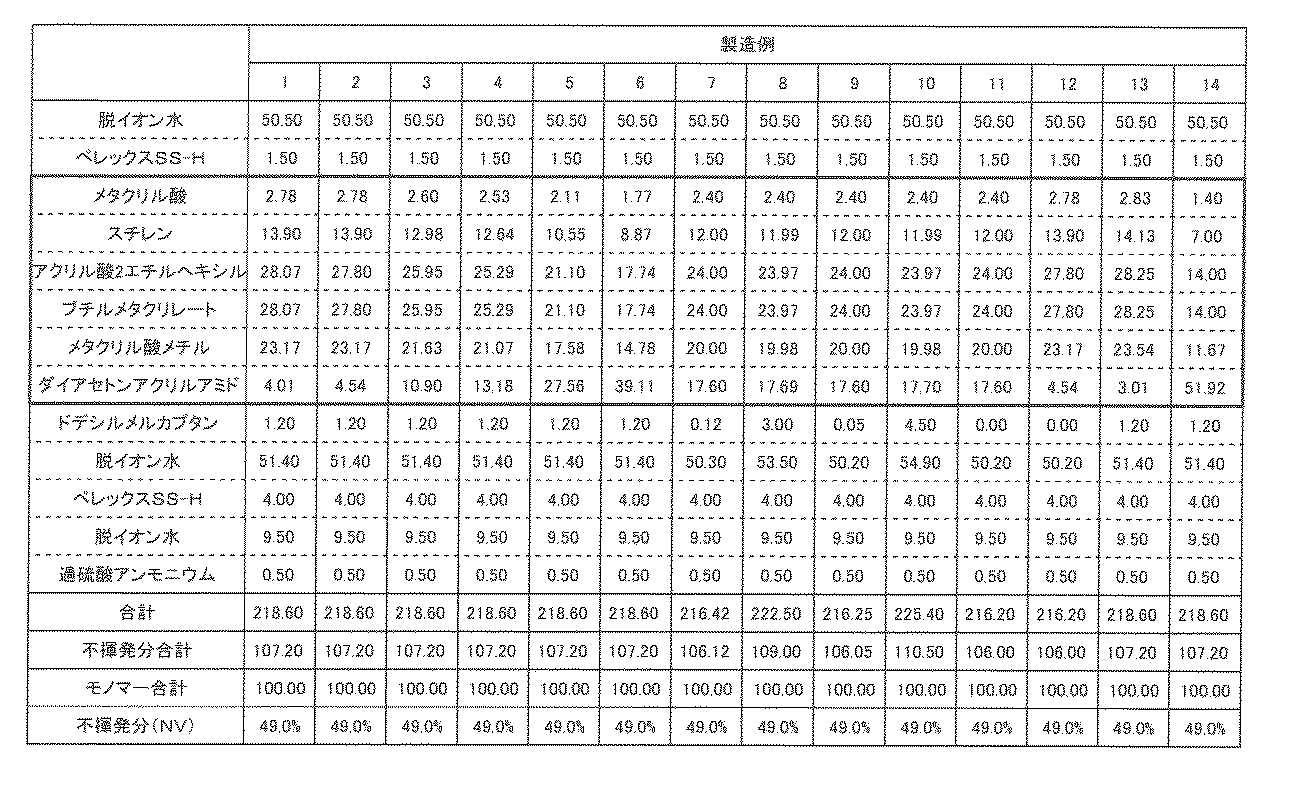
- Production Examples 2-14 A resin emulsion was prepared in the same manner as in Production Example 1 except that the monomer composition was changed as shown in Table 2 below.
- Production Example 15 An aqueous emulsion A of Production Example 1 described in paragraph [0012] of Patent Document 1 (Japanese Patent Laid-Open No. 4-249487) was prepared. 242 parts of deionized water and 2.4 parts of Newcol 707SF (Daiichi Kogyo Seiyaku Co., Ltd., solid content: 30%) 2.4 parts were added to a 2 liter four-necked flask, and kept at 80 ° C. after purging with nitrogen. Immediately before the pre-emulsion having the following composition was dropped, 0.7 part of ammonium persulfate was added, and the pre-emulsion was dropped over 3 hours.
- Newcol 707SF Newcol 707SF
- Production production example A of water-based urethane polymer In a closed reaction vessel equipped with a thermometer and a stirrer, 162.0 parts of polyethylene adipate diol (number average molecular weight 2000), 47.6 parts of dimethylolpropionic acid, 13.8 parts of n-butanol, 176. isophorone diisocyanate (IPDI). After charging 0 parts and 400.0 parts of acetone and replacing the reaction system with nitrogen gas, the reaction was carried out with stirring at 80 ° C. for 7 hours to obtain an acetone solution of an NCO-terminated urethane prepolymer having an NCO% content of 2.68%. It was.
- IPDI isophorone diisocyanate
- the obtained acetone solution was cooled to 30 ° C., and 35.9 parts of triethylamine was added. Next, 895.0 parts of water was added to the obtained acetone solution, and acetone was removed under reduced pressure at 50 to 60 ° C. to obtain 1300.0 parts of an aqueous urethane polymer having a solid content of 30.0%.
- Production example B In a closed reaction vessel equipped with a thermometer and a stirrer, 246.7 parts of polypropylene glycol (number average molecular weight 2000, PP-2000, manufactured by Sanyo Chemical Industries), 15.1 parts of 1,4-butanediol, dimethylolpropionic acid 17.9 parts, 123.0 parts of IPDI, and 400 parts of acetone were charged, the reaction system was replaced with nitrogen gas, and the reaction was carried out for 7 hours at 80 ° C. with stirring to react with an NCO-terminated urethane prepolymer having an NCO% content of 1.67%. A polymer was obtained. The obtained acetone solution was cooled to 30 ° C. and 13.5 parts of triethylamine was added. Next, 692.0 parts of water was added to the obtained acetone solution, and acetone was removed under reduced pressure at 50 to 60 ° C. to obtain 1000.0 parts of an aqueous urethane polymer having a solid content of 30.0%.
- Production Example D A closed reaction vessel equipped with a thermometer and a stirrer was charged with 240 parts of polyethylene glycol (PEG) 6000 (molecular weight 6000) and 99 parts of 2-octyl-1-dodecanol ethylene oxide (EO) adduct and 99 parts under reduced pressure. (10 mmHg or less) at 90 to 100 ° C. for 3 hours to make the water content of the system 0.03%. Next, the mixture was cooled to 80 ° C., 14.8 parts of hexamethylene diisocyanate (HMDI) was added, and the mixture was reacted at 80 to 90 ° C. for 2 hours under a nitrogen stream to confirm that the isocyanate content was 0%. Next, 825 parts of water was added and uniformly mixed and then cooled to obtain 1150.0 parts of an aqueous urethane polymer having a solid content of 30.0%.
- PEG polyethylene glycol
- EO 2-octyl-1-dodecanol
- Example 1 Titanium white dispersion consisting of 3 parts DISPER BKY190 (made by Big Chemie) as a pigment dispersant, 20 parts titanium oxide (trade name: TIPAQUE titanium CR-95, made by Ishihara Sangyo) as a pigment for white paint, and 4 parts deionized water
- the following evaluation test was performed using the obtained water-based coating composition.
- the composition of the coating composition and the evaluation test results are shown in the following table.
- Undercoat paint production example 1 A polished steel plate is used as the base material, and a weak solvent two-component paint composition (Hypon Fine Primer II, manufactured by Nippon Paint Co., Ltd.) is applied to the dry film thickness of 50 ⁇ m by air spray, and dried for one day. Thus, a base coating film production example 1 was obtained.
- the aqueous coating composition prepared above is coated on the above-mentioned base coating film with a brush in a 5 ° C environment so that the coating amount becomes 120 g / m 2, and at 5 ° C for 3 hours. Dried.
- the prepared coating film was immersed in water at 5 ° C. for 16 hours, and immediately after lifting, the appearance of the coating film was JIS K5600-8-2 (Japanese Industrial Standard corresponding to ISO 4628-2: 2003, which is an international standard).
- the density and size of the generated coating film swelling were evaluated with a rating of 0 to 5 and 1 to 5, respectively. Tables 4 and 5 list in density / size form. Grades 2 and below were judged as good and 3-5 as bad.
- Density 0 No coating film swelling occurs.
- 1 The area of the part of the coating film swelling relative to the test coating film is judged to be less than 1%.
- 2 The area of the part of the coating film swelling relative to the test coating film is determined to be 1% or more and less than 3%.
- 3 The area of the coating film swelling portion relative to the test coating film is determined to be 3% or more and less than 7%.
- 4 The area of the coating film swelling portion relative to the test coating film is determined to be 7% or more and less than 30%. 5: It is judged that the area of the part of the coating film swelling with respect to a test coating film exceeds 30%.
- Size 1 The diameter of the coating film swelling is less than 0.5 mm.
- 2 A coating film swelling having a diameter of 0.5 mm or more and less than 1 mm exists.
- 3 A coating film swelling having a diameter of 1 mm or more and less than 2 mm exists.
- 4 A coating film swelling having a diameter of 2 mm or more and less than 3 mm exists.
- 5 A coating film swelling having a diameter of 3 mm or more exists.
- Undercoat paint production examples 2-7 A polished steel plate is used as the base material, and a weak solvent two-component paint composition (Hypon Fine Primer II, manufactured by Nippon Paint Co., Ltd.) is applied to the dry film thickness of 50 ⁇ m by air spray, and dried for one day. did. Next, various coating compositions shown in Table 3 were applied with a brush to a dry film thickness of 60 ⁇ m to obtain respective undercoat film production examples 2 to 7.
- a weak solvent two-component paint composition Hypon Fine Primer II, manufactured by Nippon Paint Co., Ltd.
- Undercoat film production examples 8-13 After each of the undercoat film production examples 2 to 7 was applied, the object to be coated was subjected to accelerated weather resistance (xenon arc lamp method) in accordance with JIS K5600-7-7 (Japanese Industrial Standard corresponding to ISO 11341: 2004, an international standard). Undercoating film production examples 8 to 13 (old coating films) deteriorated for 3,000 hours were obtained.
- Tables 4 and 5 list in density / size form. Grades 2 and below were judged as good and 3-5 as bad. When the density was 0, there was no swelling of the coating film, so the size was represented by “ ⁇ ”. The density grade (0-5) and size grade (1-5) of the generated coating film swelling are the same as described above.
- a grid tape peeling test was carried out 5 minutes after the determination of the water-resistant swelling test. Hold the cutting blade of the cutter knife (NT cutter S type, A type, or equivalent) at 30 degrees on the coated plate that has been subjected to the water-proof blister test, and provide parallel lines at intervals of 2 mm to reach the substrate. Eleven lines were drawn, and 11 parallel lines with an interval of 2 mm perpendicular to the parallel lines were drawn to form 100 grids on the coating film. After the adhesive tape (industrial cellophane tape manufactured by Nichiban Co., Ltd.) is uniformly crimped with fingertips on this grid so that no air bubbles remain, hold the edge of the adhesive tape and make an angle of 60 degrees with the coating surface.
- the tape was peeled off from the coated surface, and the presence or absence of peeling of 100 grids was visually evaluated according to the following criteria. 0: The edges of the grid cut are completely smooth, and no peeling is confirmed. 1: Although peeling is confirmed at the intersection of the grid cut, the area of the peeling portion is less than 5% of the entire coating film. 2: The area of the peeled portion is 5% or more and less than 15% with respect to the entire coating film. 3: The area of the peeled portion is 15% or more and less than 35% with respect to the entire coating film. 4: The area of the peeled portion is 35% or more and less than 65% with respect to the entire coating film. 5: The area of the peeled portion is 65% or more with respect to the entire coating film.
- a sealer (aqueous cation sealer, Nippon Paint Co., Ltd.) was applied to the slate plate of the water permeability test with a roller. On the next day of coating, the prepared aqueous coating composition was applied with a brush so that the dry film thickness was 60 ⁇ m. After painting, it was cured for 14 days in a constant temperature and humidity room at 23 ° C. and 50% temperature. Then, the water permeability test was started under the same environment. The water permeability test method and evaluation criteria were carried out in accordance with the water permeability test B method described in JIS A 6909.
- a painted plate cured for 14 days is held horizontally, and a funnel with a caliber of 75 mm is placed upside down on the painted plate, and the periphery of the caliber is fastened to the test plate using a silicone sealing material.
- a 0.05 ml measuring pipette (capacity 5 ml) was connected to the top of the funnel foot using a rubber tube. Water at 23 ° C. was added so that the height of the water surface was 250 mm from the test plate and left for 24 hours. The difference between the scale of the water pipette immediately after the water was added and the scale of the water pipette pipette after standing for 24 hours was determined.
- Example 2 to 19 and Comparative Examples 1 to 8 A coating composition was prepared in the same manner as in Example 1 except that the coating composition was changed as described in Tables 4 and 5. Thereafter, in the same manner as in Example 1, a low temperature initial water resistance test, a water resistance swelling test, a secondary adhesion test, and a water permeability test were performed. The results obtained are shown in Tables 4 and 5.
- the coating composition according to claim 1 is excellent in low-temperature initial water resistance, water swell and secondary adhesion.
- Comparative Examples 1 and 2 are examples in which no chain transfer agent was used in the preparation of component (A).
- the water permeability is low, and depending on the base, the water-resistant swelling and secondary adhesion are poor.
- Comparative Example 3 is an example in which the DAAM content is 4% by mass or less based on the total mass of the monomers. In this comparative example, water permeability is low, and neither water-resistant swelling nor secondary adhesion is good except for the case where the base is rust-preventing (base manufacturing example 1).
- Comparative Example 4 is an example in which the amount of DAAM is more than 40% by mass with respect to the total mass of monomers.
- Comparative Example 5 is an example not containing the hydrazine and / or hydrazide derivative (B) which is a crosslinking agent. In this comparative example, none of the low-temperature initial water resistance, water-resistant blistering and secondary adhesion properties are good.
- the comparative example 6 is an example which does not contain the water-based urethane polymer of a component (C). In this comparative example, depending on the type of the underlying coating film, the water resistance and secondary adhesion are not good.
- Comparative Example 7 is an example using the aqueous emulsion A described in Patent Document 1.
- This aqueous emulsion A is prepared without using a chain transfer agent.
- the content of the hydrazine and / or hydrazide derivative (B) is one hydrazine and / or hydrazide derivative with respect to 1 equivalent of diacetone (meth) acrylamide (a) used for the polymerization of the aqueous emulsion (A).
- the low temperature initial water resistance is poor.
- the present invention provides a room temperature curable water-based coating composition having excellent adhesion to a base.
- the coating composition of the present invention has an adhesive property (secondary adhesive property) even when applied directly to the base coating film or under high humidity conditions such as exposure to long-term rainfall. Adhesion to be evaluated) is maintained.
Landscapes
- Chemical & Material Sciences (AREA)
- Organic Chemistry (AREA)
- Polymers & Plastics (AREA)
- Health & Medical Sciences (AREA)
- Chemical Kinetics & Catalysis (AREA)
- Medicinal Chemistry (AREA)
- Engineering & Computer Science (AREA)
- Life Sciences & Earth Sciences (AREA)
- Materials Engineering (AREA)
- Wood Science & Technology (AREA)
- Dispersion Chemistry (AREA)
- Manufacturing & Machinery (AREA)
- Paints Or Removers (AREA)
Abstract
本発明は、下地塗膜に対する付着性、特に2次付着性が改善された、常温硬化型水性塗料組成物に関する。 本発明は、(a)ダイアセトン(メタ)アクリルアミド、および(b)上記成分(a)と共重合しうる不飽和モノマー、を含有し、成分(a)の量がモノマー総質量に対して4~40質量%であるモノマー混合物を連鎖移動剤の存在下に乳化重合して得られた水性エマルション(A)、ヒドラジンおよび/またはヒドラジド誘導体(B)、および水性ウレタンポリマー(C)、を含有する、常温硬化型水性塗料組成物であって、上記ヒドラジンおよび/またはヒドラジド誘導体(B)の含有量は、上記水性エマルション(A)の重合に用いられるダイアセトン(メタ)アクリルアミド(a)1当量に対して、ヒドラジンおよび/またはヒドラジド誘導体(B)が有するヒドラジノ基の当量が2当量以下となる量である、常温硬化型水性塗料組成物、を提供する。
Description
本発明は、常温硬化型水性塗料組成物、特に2次付着性が向上した常温硬化型水性塗料組成物に関する。
建築、屋外建造物などを塗装するにあたっては、従来から主に溶剤型塗料組成物が使用されていた。溶剤型塗料組成物は、造膜時に溶剤が揮散するため、衛生面または公害などの問題がある。そのため、近年、溶剤型塗料組成物から水性塗料組成物への移行が目立っている。ところで、建築、屋外建造物などの屋外塗装用途においては、塗膜が劣化した場合、その劣化した塗膜の上に塗料組成物を直接上塗りすることも多い。そのため、屋外塗装用の塗料組成物においては、種々の表面および種々の塗膜に対する付着性が重要となる。
特開平4-249587号公報(特許文献1)には、ダイアセトンアクリルアミドあるいはダイアセトンメタクリルアミドを用いたアクリルポリマーのエマルションをジヒドラジド硬化剤で硬化する水性常乾架橋型塗料用樹脂組成物が開示されている。
本発明は、下地塗膜に対する付着性、特に2次付着性が改善された常温硬化型水性塗料組成物を提供する。
本発明者は前記の問題点を解決すべき鋭意検討した結果、塗膜の透水性を適切な範囲に調節することにより、過酷な耐水試験を行なっても塗膜フクレが発生せず、貯蔵安定性と両立できることを見出し、本発明を完成するに至った。
[1]
即ち、本発明は、
(a)ダイアセトン(メタ)アクリルアミド、および
(b)上記成分(a)と共重合しうる不飽和モノマー、
を含有し、成分(a)の量がモノマー総質量に対して4~40質量%であるモノマー混合物を連鎖移動剤の存在下に乳化重合して得られた水性エマルション(A)、
ヒドラジンおよび/またはヒドラジド誘導体(B)、および
水性ウレタンポリマー(C)、
を含有する、常温硬化型水性塗料組成物であって、
上記ヒドラジンおよび/またはヒドラジド誘導体(B)の含有量は、上記水性エマルション(A)の重合に用いられるダイアセトン(メタ)アクリルアミド(a)1当量に対して、ヒドラジンおよび/またはヒドラジド誘導体(B)が有するヒドラジノ基の当量が2当量以下となる量である、
常温硬化型水性塗料組成物、
を提供する。
[2]
上記ヒドラジド誘導体は、好ましくは、化学式:

で表されるジヒドラジド化合物である。
[3]
本発明では、上記連鎖移動剤の量は、上記モノマー混合物(成分(a)および成分(b)の合計)/連鎖移動剤の質量の比で、100/0.1~100/3.0の範囲内が好適である。
[4]
また、本発明では、上記水性ウレタンポリマー(C)の含有量は、水性ウレタンポリマー(C)の不揮発分質量/水性エマルション(A)の不揮発分質量の比で、1/100~50/100の範囲内であるのが好適である。
[5]
また、本発明では、上記連鎖移動剤は、ラウリルメルカプタン、n-ブチルメルカプタン、t-ブチルメルカプタン、ドデシルメルカプタン、オクチルメルカプタン、チオグリコール酸-2-エチルへキシル、2-メチル-5-t-ブチルチオフェノール、四臭化炭素、α-メチルスチレンダイマーからなる群から選択される1種またはそれ以上であるのが好適である。
[1]
即ち、本発明は、
(a)ダイアセトン(メタ)アクリルアミド、および
(b)上記成分(a)と共重合しうる不飽和モノマー、
を含有し、成分(a)の量がモノマー総質量に対して4~40質量%であるモノマー混合物を連鎖移動剤の存在下に乳化重合して得られた水性エマルション(A)、
ヒドラジンおよび/またはヒドラジド誘導体(B)、および
水性ウレタンポリマー(C)、
を含有する、常温硬化型水性塗料組成物であって、
上記ヒドラジンおよび/またはヒドラジド誘導体(B)の含有量は、上記水性エマルション(A)の重合に用いられるダイアセトン(メタ)アクリルアミド(a)1当量に対して、ヒドラジンおよび/またはヒドラジド誘導体(B)が有するヒドラジノ基の当量が2当量以下となる量である、
常温硬化型水性塗料組成物、
を提供する。
[2]
上記ヒドラジド誘導体は、好ましくは、化学式:
[3]
本発明では、上記連鎖移動剤の量は、上記モノマー混合物(成分(a)および成分(b)の合計)/連鎖移動剤の質量の比で、100/0.1~100/3.0の範囲内が好適である。
[4]
また、本発明では、上記水性ウレタンポリマー(C)の含有量は、水性ウレタンポリマー(C)の不揮発分質量/水性エマルション(A)の不揮発分質量の比で、1/100~50/100の範囲内であるのが好適である。
[5]
また、本発明では、上記連鎖移動剤は、ラウリルメルカプタン、n-ブチルメルカプタン、t-ブチルメルカプタン、ドデシルメルカプタン、オクチルメルカプタン、チオグリコール酸-2-エチルへキシル、2-メチル-5-t-ブチルチオフェノール、四臭化炭素、α-メチルスチレンダイマーからなる群から選択される1種またはそれ以上であるのが好適である。
本発明により得られる常温硬化型水性塗料組成物は、下地塗膜に対して非常に優れた付着性、特に2次付着性を示す。本発明では、(a)ダイアセトン(メタ)アクリルアミド、および(b)上記成分(a)と共重合しうる不飽和モノマーを含有するモノマー混合物を連鎖移動剤の存在下に乳化重合することによって、得られる塗膜の透水性が適切な範囲に調節され、それにより塗膜フクレを防止することができ、付着性が大きく改善され、2次付着性が良くなった。
本発明における「2次付着性」は、下地塗膜上に、水性塗料組成物を塗装した後、数日間水没し、その後剥離試験を行った際の付着性を意味する。実施例に2次付着性の測定方法について記載する。尚、下地塗膜は、さび止めなどのシーラーまたは劣化した旧塗膜のいずれであってもよい。また、これらの下地塗膜の形成に用いられた塗料組成物は、水性塗料組成物であってもよく、溶剤型塗料組成物であってもよい。
最初に、本発明に至った経緯を説明する。上記特許文献1に記載されるような常温硬化型塗料組成物は、常温で架橋することから、貯蔵時に架橋が進行しないように、貯蔵安定性を良くする必要がある。その一方で、貯蔵安定性が良すぎると、架橋性が不足して、塗膜性能が不足することとなるという問題がある。
上記特許文献1に記載される塗料組成物は、貯蔵安定性が良く、優れた塗膜を提供する。特許文献1においては、下地塗膜に対する耐水フクレについて言及している。しかしながら、この特許文献1における耐水フクレ性能は、没水24時間後の外観評価である。この特許文献1に記載の塗料組成物の付着性に関して、より過酷な耐水付着試験を行なった場合、塗膜フクレが発生し、塗膜の付着性(即ち、2次付着性)が十分ではないことが判明した。このように、塗膜が厳しい環境に曝される場合、塗膜の架橋性をコントロールするのみによって、貯蔵安定性と耐水性の両立を図ることは、困難であることが判明した。
本発明では、常温硬化型水性塗料組成物において、特に2次付着性を改善することを目的として、種々の検討を行った。そして、特定の水性エマルション(A)、ヒドラジンおよび/またはヒドラジド誘導体(B)、そして水性ウレタンポリマー(C)を組み合わせて用いることなどによって、特に2次付着性を改善することができることを見いだし、本発明を完成するに至った。以下、本発明の常温硬化型水性塗料組成物について詳述する。
常温硬化型水性塗料組成物
本発明の常温硬化型水性塗料組成物は、水性エマルション(A)(以下、成分(A)と記載することもある)、ヒドラジンおよび/またはヒドラジド誘導体(B)(以下、成分(B)と記載することもある)、および水性ウレタンポリマー(C)(以下、成分(C)と記載することもある)を含む。
本発明の常温硬化型水性塗料組成物は、水性エマルション(A)(以下、成分(A)と記載することもある)、ヒドラジンおよび/またはヒドラジド誘導体(B)(以下、成分(B)と記載することもある)、および水性ウレタンポリマー(C)(以下、成分(C)と記載することもある)を含む。
成分(A)
本発明で用いられる水性エマルション(A)は、(a)ダイアセトン(メタ)アクリルアミド、および(b)上記成分(a)と共重合しうる不飽和モノマー、を含有し、成分(a)の量がモノマー総質量に対して4~40質量%であるモノマー混合物を、連鎖移動剤の存在下に乳化重合して得られた、水性エマルションである。
本発明で用いられる水性エマルション(A)は、(a)ダイアセトン(メタ)アクリルアミド、および(b)上記成分(a)と共重合しうる不飽和モノマー、を含有し、成分(a)の量がモノマー総質量に対して4~40質量%であるモノマー混合物を、連鎖移動剤の存在下に乳化重合して得られた、水性エマルションである。
本明細書中において、ダイアセトン(メタ)アクリルアミドの表記は、ダイアセトンアクリルアミドまたはダイアセトンメタクリルアミドのいずれか一方、またはこれらの組合せを意味する。これらの化合物は、日本化成株式会社などから市販されている。
上記ダイアセトン(メタ)アクリルアミド(a)と共重合しうる不飽和モノマー(b)は、共重合可能なモノマーであれば特に限定されない。このような不飽和モノマー(b)として、例えば、水酸基含有不飽和モノマー、酸基含有不飽和モノマー、アクリルエステル系モノマー、その他の不飽和モノマーを挙げることができる。
上記水酸基含有不飽和モノマーとしては、例えば、ヒドロキシエチルアクリレート、ヒドロキシエチルメタクリレート、ヒドロキシプロピルメタクリレート、ヒドロキシブチルアクリレート、プラクセルFM-1(ダイセル化学工業株式会社製のε-カプロラクトン変性ヒドロキシエチルメタクリレート)、ポリエチレングリコールモノアクリレートまたはモノメタクリレート、ポリプロピレングリコールモノアクリレートまたはモノメタクリレートなどのアルコール類を挙げることができる。
上記酸性基含有不飽和モノマーとしては、例えば、アクリル酸、メタクリル酸、イタコン酸、クロトン酸、マレイン酸などのカルボン酸類を挙げることができる。
上記アクリルエステル系モノマーとしては、例えば、アクリル酸またはメタクリル酸のメチル、エチル、プロピル、ブチル、ヘキシル、エチルヘキシル、シクロヘキシル、ラウリルなどのエステルを挙げることができる。
上記その他の不飽和モノマーとしては、例えば、スチレン、α-メチルスチレン、ビニルナフタレン、ブタジエン、イソプレンなどの不飽和炭化水素;アクリロニトリル、メタクリロニトリルなどのニトリル類;アクリルアミド、メタクリルアミド、N-メチロールアクリルアミド、N,N-ジメチルアクリルアミドなどのアミド類;ポリエチレングリコールメチルエーテルアクリレートまたはメタクリレートなどのポリオキシアルキレン誘導体;ジビニルベンゼン、アリルメタクリレート、エチレングリコールジ(メタ)アクリレート、グリセリントリ(メタ)アクリレート、ヘキサンジオールジ(メタ)アクリレート、ブタンジオールジ(メタ)アクリレート、トリメチロールプロパントリ(メタ)アクリレート、などの炭素-炭素不飽和結合を1分子中に2つ以上有するもの;を挙げることができる。
不飽和モノマーを乳化重合させる際に用いられる乳化剤、開始剤は、塗料組成物の分野において通常用いられる、任意の適切な乳化剤、開始剤を使用することができる。
上記ダイアセトン(メタ)アクリルアミド(a)は、調製に用いられるモノマー総質量に対して4~40質量%となる量で用いる。この量は4.5~18.0質量%であるのが好ましい。本発明においては、ダイアセトン(メタ)アクリルアミド(a)を上記質量範囲で用いることによって、塗膜の透水性が確保され、2次付着性が向上する。ダイアセトン(メタ)アクリルアミド(a)の量が4質量%より少ないと、連鎖移動剤を使用しても塗膜の透水性が低下するため、2次付着性が低下する。ダイアセトン(メタ)アクリルアミド(a)の量が40質量%より多いと、透水性が高くなりすぎ、上塗り自体の吸水量が高く塗膜自体の強度が損なわれ、結果として2次付着不良になる。塗装によって得られた塗膜を水中に浸漬すると、塗膜から水溶性の成分が溶出し、劣化した塗膜とその上に塗装した塗膜の界面に溜まる。その水溶性の成分の濃度が高くなると、浸透圧により水を塗膜表面から界面に押し込み、そして塗膜界面の水圧が一定以上になると接着力に打ち克って塗膜フクレが発生する。本発明においては、塗膜の透水性を適切な範囲まで高くすることによって、塗膜界面の水圧上昇が抑制され、これによって、塗膜フクレの発生を防ぐことが可能となった。その一方で、透水性が高くなりすぎると、上述のように塗膜の強度が損なわれる不具合が生じる。すなわち本発明においては、塗膜の透水性を適切な範囲に調節することによって、塗膜フクレの発生を防ぎ、2次付着性を向上させていることを特徴とする。
上記成分(a)と共重合可能な不飽和モノマー(b)は、モノマー混合物において、上記成分(a)以外のもの全てであるので、両方(成分(a)と成分(b)の両方)を併せて100質量%になればよい。
本発明では、モノマー混合物(上記成分(a)および成分(b))を連鎖移動剤の存在下に乳化重合する。連鎖移動剤は、具体的には、ラウリルメルカプタン、n-ブチルメルカプタン、t-ブチルメルカプタン、ドデシルメルカプタン、オクチルメルカプタンなどのアルキルメルカプタン;チオグリコール酸-2-エチルへキシル、2-メチル-5-t-ブチルチオフェノール、四臭化炭素、α-メチルスチレンダイマーなどを挙げることができる。
上記モノマー混合物(成分(a)および成分(b)の合計)と連鎖移動剤との質量比は、上記モノマー混合物の質量/連鎖移動剤の質量の比で本発明の効果を損なわない範囲で100/0以外の任意の値を取ることができ、好ましくは100/0.1~100/3.0である。上記モノマー混合物の質量/連鎖移動剤の質量の比が上記範囲内であることによって、塗膜の耐水フクレと2次付着性が良好となる。
上記エマルション重合により水性エマルション(A)を得る。水性エマルションの樹脂粒子の体積平均粒子径は、本発明の効果を損なわない範囲で任意の適切な体積平均粒子径を採用し得る。樹脂粒子の体積平均粒子径は、好ましくは0.01~10μm、より好ましくは0.05~1μmである。樹脂粒子の体積平均粒子径は、レーザー光散乱法などによって測定することができる。
また、上記水性エマルション(A)は安定性向上のためにpH調整することが望ましい。調整後のpHは6~10であるのが好ましく、7~9であるのがより好ましい。上記水性エマルション(A)のpH調整は、塩基性化合物を用いて行うのが好ましい。pH調整に使用される塩基性化合物としては、例えば、アンモニア、メチルアミン、ジメチルアミン、トリメチルアミン、エチルアミン、ジエチルアミン、トリエチルアミン、エタールアミン、ジエタノールアミン、トリエタノールアミン、ジメチルエタノールアミンなどのアミン類、および、水酸化カリウム、水酸化ナトリウムなどのアルカリ金属水酸化物などを挙げることができる。
成分(B)
本発明の水性塗料組成物は、ヒドラジンおよび/またはヒドラジド誘導体(B)を含む。なお本明細書中において「ヒドラジノ基」とは、ヒドラジノ基およびヒドラジド基の両方を意味するものとする。上記ヒドラジンおよび/またはヒドラジド誘導体(B)は硬化剤として作用する。例えば、水性エマルション(A)に含まれる、成分(a)に由来するアセチル基と、ヒドラジンおよび/またはヒドラジド誘導体(B)が有するヒドラジノ基とが反応して、架橋が生じ、硬化する。
本発明の水性塗料組成物は、ヒドラジンおよび/またはヒドラジド誘導体(B)を含む。なお本明細書中において「ヒドラジノ基」とは、ヒドラジノ基およびヒドラジド基の両方を意味するものとする。上記ヒドラジンおよび/またはヒドラジド誘導体(B)は硬化剤として作用する。例えば、水性エマルション(A)に含まれる、成分(a)に由来するアセチル基と、ヒドラジンおよび/またはヒドラジド誘導体(B)が有するヒドラジノ基とが反応して、架橋が生じ、硬化する。
上記ヒドラジド誘導体は、下記の化学式:

で表されるジヒドラジド化合物であるのが好ましい。式中、nは0~8であり、好ましくは1~6であり、より好ましくは2~4であり、さらに好ましくは4である。nが9以上の場合、親水性が低下し、水に溶解することが困難となる。
で表されるジヒドラジド化合物であるのが好ましい。式中、nは0~8であり、好ましくは1~6であり、より好ましくは2~4であり、さらに好ましくは4である。nが9以上の場合、親水性が低下し、水に溶解することが困難となる。
成分(B)として、上記化学式で表されるジヒドラジド化合物を用いるのがより好ましく、上記化学式で表されるジヒドラジド化合物であって、nが2~4である化合物を用いるのがさらに好ましい。
本発明の水性塗料組成物中に含まれるヒドラジンおよび/またはヒドラジド誘導体(B)の量は、水性塗料組成物中に含まれる水性エマルション(A)の重合において用いられるダイアセトン(メタ)アクリルアミド(a)1当量に対して、ヒドラジンおよび/またはヒドラジド誘導体(B)が有するヒドラジノ基の当量が2当量以下となる量である。
例えば、成分(B)がヒドラジンを含む場合は、ダイアセトン(メタ)アクリルアミド(a)1当量に対して、ヒドラジンが2当量以下となる量で用いられる。
また例えば、成分(B)が上記ジヒドラジド化合物を含む場合は、ダイアセトン(メタ)アクリルアミド(a)1当量に対して、上記ジヒドラジド化合物が有するヒドラジノ基(ヒドラジド基)の当量が2当量以下となる量、つまり、上記ジヒドラジド化合物が1当量以下となる量、で用いられる。
ヒドラジンおよび/またはヒドラジド誘導体(B)の含有量は、水性エマルション(A)の重合において用いられるダイアセトン(メタ)アクリルアミド(a)1当量に対して、ヒドラジノ基が1.2当量以下となる量であるのがより好ましく、ヒドラジノ基が0.05~1当量となる量であるのがさらに好ましい。なおここで「以下」とは、0を含まない概念であって、微量でも含まれていることを意味する。
ヒドラジンおよび/またはヒドラジド誘導体(B)の含有量が、ヒドラジノ基の当量として2.0当量より多い場合は、含有量に伴った性能の向上が見られず、さらには低温初期耐水性が低下する。なおヒドラジンおよび/またはヒドラジド誘導体(B)の含有量が、ヒドラジノ基の当量として0.05~1当量となる量である場合は、低温初期耐水性が極めて良好となる。ヒドラジンおよび/またはヒドラジド誘導体(B)が含まれないと、塗膜の耐水フクレおよび2次付着性が低下する。
例えば、成分(B)がヒドラジンを含む場合は、ダイアセトン(メタ)アクリルアミド(a)1当量に対して、ヒドラジンが2当量以下となる量で用いられる。
また例えば、成分(B)が上記ジヒドラジド化合物を含む場合は、ダイアセトン(メタ)アクリルアミド(a)1当量に対して、上記ジヒドラジド化合物が有するヒドラジノ基(ヒドラジド基)の当量が2当量以下となる量、つまり、上記ジヒドラジド化合物が1当量以下となる量、で用いられる。
ヒドラジンおよび/またはヒドラジド誘導体(B)の含有量は、水性エマルション(A)の重合において用いられるダイアセトン(メタ)アクリルアミド(a)1当量に対して、ヒドラジノ基が1.2当量以下となる量であるのがより好ましく、ヒドラジノ基が0.05~1当量となる量であるのがさらに好ましい。なおここで「以下」とは、0を含まない概念であって、微量でも含まれていることを意味する。
ヒドラジンおよび/またはヒドラジド誘導体(B)の含有量が、ヒドラジノ基の当量として2.0当量より多い場合は、含有量に伴った性能の向上が見られず、さらには低温初期耐水性が低下する。なおヒドラジンおよび/またはヒドラジド誘導体(B)の含有量が、ヒドラジノ基の当量として0.05~1当量となる量である場合は、低温初期耐水性が極めて良好となる。ヒドラジンおよび/またはヒドラジド誘導体(B)が含まれないと、塗膜の耐水フクレおよび2次付着性が低下する。
成分(C)
本発明の水性塗料組成物は、水性ウレタンポリマー(C)を含む。この水性ウレタンポリマー(C)は、ウレタン基の凝集力により、成分(A)の成膜を促進し、塗膜の強度を向上させる。
本発明の水性塗料組成物は、水性ウレタンポリマー(C)を含む。この水性ウレタンポリマー(C)は、ウレタン基の凝集力により、成分(A)の成膜を促進し、塗膜の強度を向上させる。
本発明における水性ウレタンポリマー(C)は、ポリオール化合物(C-1)、分子内に活性水素基と親水基を有する化合物(C-2)、および、有機ポリイソシアネート(C-3)、そして、必要により鎖伸長剤および重合停止剤を用いて調製されるポリマーであり、これを水中に溶解または分散することにより得られるものである。
ポリオール化合物(C-1)としては、水酸基を2つ以上含有しているものであれば特に限定されない。ポリオール化合物(C-1)として、例えば、
エチレングリコール、プロピレングリコール、1,4-ブタンジオール、1,6-ヘキサンジオール、トリメチロールプロパン、グリセリンなどの多価アルコール;
ポリエチレングリコール、ポリプロピレングリコール、ポリテトラメチレンエーテルグリコールなどのポリエーテルポリオール;
アジピン酸、セバシン酸、イタコン酸、無水マレイン酸、フタル酸、イソフタル酸などのジカルボン酸とエチレングリコール、トリエチレングリコール、プロピレングリコール、ブチレングリコール、トリプロピレングリコール、ネオペンチルグリコールなどのグリコールから得られるポリエステルポリオール類;
ポリカプロラクトンポリオール;ポリブタジエンポリオール;ポリカーボネートポリオール;ポリチオエーテルポリオール;などが挙げられる。上記ポリオール化合物は単独で用いてもよく、または2種類以上併用してもよい。
エチレングリコール、プロピレングリコール、1,4-ブタンジオール、1,6-ヘキサンジオール、トリメチロールプロパン、グリセリンなどの多価アルコール;
ポリエチレングリコール、ポリプロピレングリコール、ポリテトラメチレンエーテルグリコールなどのポリエーテルポリオール;
アジピン酸、セバシン酸、イタコン酸、無水マレイン酸、フタル酸、イソフタル酸などのジカルボン酸とエチレングリコール、トリエチレングリコール、プロピレングリコール、ブチレングリコール、トリプロピレングリコール、ネオペンチルグリコールなどのグリコールから得られるポリエステルポリオール類;
ポリカプロラクトンポリオール;ポリブタジエンポリオール;ポリカーボネートポリオール;ポリチオエーテルポリオール;などが挙げられる。上記ポリオール化合物は単独で用いてもよく、または2種類以上併用してもよい。
分子内に活性水素基と親水基を有する化合物(C-2)としては、
活性水素とアニオン基{アニオン基またはアニオン形成性基(塩基と反応してアニオン基を形成するものであり、この場合にはウレタン化反応前、途中または後に塩基で中和することによってアニオン基に変える)}を含有する化合物として公知のもの(例えば、特公昭42-24192号公報明細書および特公昭55-41607号公報明細書に記載のもの、具体例としてはα,α-ジメチロールプロピオン酸、α,α-ジメチロール酪酸など);
分子内に活性水素とカチオン基(上記と同様に、カチオン形成性基も含む)を有する化合物として公知のもの(たとえば特公昭43-9076号公報明細書に記載のもの);および、
分子内に活性水素とノニオン性の親水基を有する化合物として公知のもの(例えば、特公昭48-41718号公報に記載のもの、具体的には、ポリエチレングリコール、アルキルアルコールアルキレンオキシド付加物など。但し上記化合物(C-1)に含まれる化合物は、化合物(C-2)には含まれない。);
などが挙げられる。
活性水素とアニオン基{アニオン基またはアニオン形成性基(塩基と反応してアニオン基を形成するものであり、この場合にはウレタン化反応前、途中または後に塩基で中和することによってアニオン基に変える)}を含有する化合物として公知のもの(例えば、特公昭42-24192号公報明細書および特公昭55-41607号公報明細書に記載のもの、具体例としてはα,α-ジメチロールプロピオン酸、α,α-ジメチロール酪酸など);
分子内に活性水素とカチオン基(上記と同様に、カチオン形成性基も含む)を有する化合物として公知のもの(たとえば特公昭43-9076号公報明細書に記載のもの);および、
分子内に活性水素とノニオン性の親水基を有する化合物として公知のもの(例えば、特公昭48-41718号公報に記載のもの、具体的には、ポリエチレングリコール、アルキルアルコールアルキレンオキシド付加物など。但し上記化合物(C-1)に含まれる化合物は、化合物(C-2)には含まれない。);
などが挙げられる。
有機ポリイソシアネート(C-3)としては、分子中に2個以上のイソシアネート基を有するものであれば特に限定されない。有機ポリイソシアネート(C-3)として、例えば、
1,4-テトラメチレンジイソシアネート、1,6-ヘキサメチレンジイソシアネート、2,2,4-トリメチルヘキサメチレンジイソシアネート、3-イソシアネートメチル-3,5,5-トリメチルシクロヘキシルイソシアネート、ジシクロヘキシルメタン-4,4’-ジイソシアネート、メチルシクロヘキシル-2,4-ジイソシアネート、メチルシクロヘキシル-2,6-ジイソシアネート、キシリレンジイソシアネート、1,3-ビス(イソシアネート)メチルシクロヘキサン、テトラメチルキシリレンジイソシアネート、トランスシクロヘキサン-1,4-ジイソシアネート、リジンジイソシアネートなどの脂肪族ジイソシアネート類;
2,4-トルイレンジイソシアネート、2,6-トルイレンジイソシアネート、ジフェニルメタン-4,4’-ジイソシアネート、1,5’-ナフテンジイソシアネート、トリジンジイソシアネート、ジフェニルメチルメタンジイソシアネート、テトラアルキルジフェニルメタンジイソシアネート、4,4’-ジベンジルジイソシアネート、1,3-フェニレンジイソシアネートなどの芳香族ジイソシアネート類;
リジンエステルトリイソシアネート、トリフェニルメタントリイソシアネート、1,6,11-ウンデカントリイソシアネート、1,8-ジイソシアネート-4,4-イソシアネートメチルオクタン、1,3,6-ヘキサメチレントリイソシアネート、ビシクロヘプタントリイソシアネートなどのトリイソシアネート類;
などが挙げられる。
また、これらのポリイソシアネート化合物のダイマー、トリマー(イソシアヌレート結合)であってもよく、また、アミンと反応させてビウレットとして用いてもよい。更に、これらのポリイソシアネート化合物と、ポリオールを反応させたウレタン結合を有するポリイソシアネートも用いることができる。
1,4-テトラメチレンジイソシアネート、1,6-ヘキサメチレンジイソシアネート、2,2,4-トリメチルヘキサメチレンジイソシアネート、3-イソシアネートメチル-3,5,5-トリメチルシクロヘキシルイソシアネート、ジシクロヘキシルメタン-4,4’-ジイソシアネート、メチルシクロヘキシル-2,4-ジイソシアネート、メチルシクロヘキシル-2,6-ジイソシアネート、キシリレンジイソシアネート、1,3-ビス(イソシアネート)メチルシクロヘキサン、テトラメチルキシリレンジイソシアネート、トランスシクロヘキサン-1,4-ジイソシアネート、リジンジイソシアネートなどの脂肪族ジイソシアネート類;
2,4-トルイレンジイソシアネート、2,6-トルイレンジイソシアネート、ジフェニルメタン-4,4’-ジイソシアネート、1,5’-ナフテンジイソシアネート、トリジンジイソシアネート、ジフェニルメチルメタンジイソシアネート、テトラアルキルジフェニルメタンジイソシアネート、4,4’-ジベンジルジイソシアネート、1,3-フェニレンジイソシアネートなどの芳香族ジイソシアネート類;
リジンエステルトリイソシアネート、トリフェニルメタントリイソシアネート、1,6,11-ウンデカントリイソシアネート、1,8-ジイソシアネート-4,4-イソシアネートメチルオクタン、1,3,6-ヘキサメチレントリイソシアネート、ビシクロヘプタントリイソシアネートなどのトリイソシアネート類;
などが挙げられる。
また、これらのポリイソシアネート化合物のダイマー、トリマー(イソシアヌレート結合)であってもよく、また、アミンと反応させてビウレットとして用いてもよい。更に、これらのポリイソシアネート化合物と、ポリオールを反応させたウレタン結合を有するポリイソシアネートも用いることができる。
有機ポリイソシアネート(C-3)として、脂肪族ジイソシアネートを用いるのがより好ましい。脂肪族ジイソシアネートを用いて水性ウレタンポリマー(C)を調製することによって、得られる塗膜の透水性を適切な範囲に調節することができ、また良好な低温初期耐水性を得ることができるという利点がある。
上記成分(C-1)~(C-3)の量は、調製する水性ウレタンポリマー(C)の設計に応じて任意に変更することができる。成分(C-1)~(C-3)の量として、例えば(C-1)が30~75質量部、より好ましくは35~70質量部、(C-2)が3~30質量部、より好ましくは3~20質量部、(C-3)が3~50質量部、より好ましくは20~50質量部となる量が挙げられる。
水性ウレタンポリマー(C)の調製時に必要により添加することができる鎖伸長剤としては、活性水素基を2つ以上含有していれば特に限定されないが、例えば、低分子ポリオール、ポリアミン、水が挙げられる。
上記低分子ポリオールとしては、エチレングリコール、プロピレングリコール、1,4-ブタンジオール、3-メチルペンタンジオール、2-エチル-1,3-ヘキサンジオールおよびトリメチロールプロパンなどが挙げられる。
上記ポリアミンとしては、エチレンジアミン、ヘキサメチレンジアミン、ジエチレントリアミン、ヒドラジン、キシリレンジアミン、イソホロンジアミンなどが挙げられる。
また、重合停止剤としては、分子内に活性水素を1個有する化合物、またはモノイソシアネート化合物が挙げられる。
上記分子内に活性水素を1個有する化合物としては、例えば、モノアルコール(例えば、メタノール、ブタノール、オクタノールなどのアルキルアルコール、アルキルアルコールアルキレンオキサイド付加物など)または、モノアミン(例えば、ブチルアミン、ジブチルアミンなどのアルキルアミンなど)が挙げられる。
上記モノイソシアネート化合物としては、例えば、メチルイソシアネート、エチルイソシアネート、プロピルイソシアネート、ブチルイソシアネート、ラウリルイソシアネート、シクロヘキシルイソシアネート、フェニルイソシアネート、トリレンイソシアネートなどが挙げられる。
水性ウレタンポリマー(C)を製造するにあたっての反応方法は、各成分を一度に反応させるワンショット法、または、各成分を段階的に反応させる多段法のいずれの方法でもよい。多段法として、例えば、活性水素含有化合物の一部(例えば、高分子ポリオール)とポリイソシアネートを反応させてNCO末端プレポリマーを形成し、次いで活性水素含有化合物の残部を反応させて製造する方法などが挙げられる。水性ウレタンポリマー(C)の合成反応は通常40~140℃、好ましくは60~120℃で行われる。反応を促進させるため、ウレタン化反応において一般的に用いられる、ジブチルスズラウレ-ト、オクチル酸スズなどのスズ系の触媒、または、トリエチレンジアミンなどのアミン系の触媒を使用してもよい。また上記反応は、イソシアネートに不活性な有機溶剤(例えば、アセトン、トルエン、ジメチルホルムアミドなど)の中で行ってもよく、反応の途中または反応後に、上記のような有機溶剤を加えてもよい。
本発明における水性ウレタンポリマー(C)は、必要に応じて、ウレタンポリマーが有する親水性基の種類に応じた公知の方法(例えば、アニオン形成性基の場合は、塩基で中和してアニオン基を形成する方法、カチオン形成性基の場合は4級化剤でカチオン基を形成する方法、または、酸または塩基で中和する方法など)で処理した後、水中に溶解および/または分散させることにより、水性ウレタンポリマーとして調製される。
上記の水中に溶解および/または分散させる工程は特に限定されず、上記反応後でも多段法の途中の段階でもよい。例えば、NCO末端プレポリマーの段階で水中に溶解するときは、水および/またはポリアミンで鎖伸長しながら水中に溶解することにより水性ウレタンポリマー(C)が得られる。
また、イソシアネートに不活性な有機溶剤を使用した場合、水中に溶解した後に脱溶剤処理を行ってもよい。
上記水性ウレタンポリマー(C)の量は、水性ウレタンポリマー(C)の不揮発分/水性エマルション(A)の不揮発分との質量比で、本発明の効果を損なわない範囲で0/100以外の任意の値を取ることができ、好ましくは1/100~50/100である。水性ウレタンポリマー(C)の不揮発分/水性エマルション(A)の不揮発分との質量比が上記範囲であることによって、塗膜の耐水フクレおよび2次付着性が良好となる。
その他の成分
本発明における水性塗料組成物は、上記成分(A)~(C)に加えて、必要に応じた他の成分を含んでもよい。他の成分として、例えば、顔料、意匠材料(砂、硅砂、カラーサンド、ビーズ、カラーチップ、鉱物チップ、ガラスチップ、木質チップおよびカラービーズなど)、その他の水性樹脂、造膜助剤、表面調整剤、防腐剤、防かび剤、消泡剤、光安定剤、紫外線吸収剤、酸化防止剤、pH調整剤などが挙げられる。
本発明における水性塗料組成物は、上記成分(A)~(C)に加えて、必要に応じた他の成分を含んでもよい。他の成分として、例えば、顔料、意匠材料(砂、硅砂、カラーサンド、ビーズ、カラーチップ、鉱物チップ、ガラスチップ、木質チップおよびカラービーズなど)、その他の水性樹脂、造膜助剤、表面調整剤、防腐剤、防かび剤、消泡剤、光安定剤、紫外線吸収剤、酸化防止剤、pH調整剤などが挙げられる。
顔料としては、特に限定されず、例えば、アゾキレート系顔料、不溶性アゾ系顔料、縮合アゾ系顔料、モノアゾ系顔料、ジスアゾ系顔料、ジケトピロロピロール系顔料、ベンズイミダゾロン系顔料、フタロシアニン系顔料、インジゴ系顔料、チオインジゴ系顔料、ペリノン系顔料、ペリレン系顔料、ジオキサン系顔料、キナクリドン系顔料、イソインドリノン系顔料、ナフトール系顔料、ピラゾロン系顔料、アントラキノン系顔料、アンソラピリミジン系顔料、金属錯体顔料などの有機系着色顔料;黄鉛、黄色酸化鉄、酸化クロム、モリブデートオレンジ、ベンガラ、チタンイエロー、亜鉛華、カーボンブラック、二酸化チタン、コバルトグリーン、フタロシアニングリーン、群青、コバルトブルー、フタロシアニンブルー、コバルトバイオレットなどの無機系着色顔料;マイカ顔料(二酸化チタン被覆マイカ、着色マイカ、金属メッキマイカなど);グラファイト顔料、アルミナフレーク顔料、金属チタンフレーク、ステンレスフレーク、板状酸化鉄、フタロシアニンフレーク、金属メッキガラスフレークなどの偏平顔料(着色偏平顔料、有色偏平顔料も含まれる);酸化チタン、炭酸カルシウム、硫酸バリウム、炭酸バリウム、珪酸マグネシウム、クレー、タルク、シリカ、焼成カオリンなどの体質顔料;などを挙げることができる。
水性塗料組成物が顔料を含む場合は、水性塗料組成物の固形分に対する顔料質量濃度(PWC)が5~70質量%の範囲内であることが好ましい。上記PWCが5質量%未満であると、顔料を用いることに対する下地隠蔽性の向上効果が十分に得られないおそれがある。また、上記PWCが70質量%を超えると、耐侯性が低下するおそれがある。顔料質量濃度(PWC)は20~45質量%であることがより好ましい。
水性塗料組成物の調製法としては特に限定されず、上述した各成分を、攪拌機などにより攪拌することによって調製することができる。水性塗料組成物中に顔料または意匠材料が含まれる場合は、分散性に優れた顔料または意匠材料を用いる場合は、これらを加えて攪拌機により混合することによって、水性塗料組成物を調製することができる。他の方法として、顔料および/または意匠材料を、水、界面活性剤または分散剤などを含むビヒクルに、サンドグラインドミルなどを用いて予め分散させ、この分散物を加えることによって、水性塗料組成物を調製することができる。
本発明の常温硬化型水性塗料組成物は、その塗装方法および乾燥条件については特に限定されず、当業者において通常用いられる塗装方法(例えば、刷毛塗り塗装、スプレー塗装、ローラー塗装など)および乾燥条件を用いることができる。また、本発明の塗料組成物は、種々の塗装用途に利用することができる。塗装用途として、特に、常温乾燥から強制乾燥条件において塗膜が形成される塗装用途において、優れた性能を発揮する。ここで常温乾燥とは、例えば10~50℃、好ましくは15~40℃での乾燥を意味する。また、強制乾燥とは、通常80℃程度の加熱を意味するものであるが、例えば、150℃程度までの加熱であってもよい。なお、本明細書における「常温硬化型」とは、上記常温乾燥下において、硬化塗膜を形成する性能を有することを意味する。
本発明の水性塗料組成物を塗装する被塗物としては特に限定されず、例えば、鉄、ステンレスなど、およびその表面処理物などの金属基材、石膏類などのセメント基材、ポリエステル類、アクリル類などのプラスチック系基材などを挙げることができる。また、これらの基材からなる建材、構造物などの建築用各種被塗物、自動車車体、部品などの自動車工業用各種被塗物、電化製品、電子部品などの工業用分野の各種被塗物を挙げることができる。また、本発明の水性塗料組成物は上記の各被塗物の改装時にも塗装することができる。
本発明の水性塗料組成物を用いた、各被塗物の塗装面の改装方法において、上記水性塗料組成物を塗装する前に、下塗り塗料組成物を塗装することなしに行うことができる。なお、汚れまたは錆が特にひどい場合などには、下塗り塗料組成物を塗装した後に、上記水性塗料組成物を塗装することができる。被塗物面としては、例えば、車両部の内壁面、住宅、事務所などの一般建築用内壁、外壁面および天井部分である。また、鉄面としては、例えば、マンションまたは工場の鉄扉、手すりなど、または、遊具、電柱などの一般建築用内部および外部鉄面である。
本発明を実施例に基づいて更に詳細に説明する。本発明はこれら実施例に限定されるものと解してはならない。実施例中、部および%は、特に指示しない限り、質量に基づく。
樹脂エマルションの調製
製造例1
滴下ロート、還流冷却器、撹拌装置および温度計付きガラス製反応容器に、脱イオン水50.50部および反応性乳化剤として乳化剤(ベレックスSS-H;花王株式会社製)1.50部を入れ、内容物温度を85℃とした。その中にメタクリル酸2.78、スチレン13.90部、アクリル酸2エチルヘキシル28.07部、ブチルメタクリレート28.07部、メタクリル酸メチル23.17部、ダイアセトンアクリルアミド(以下、「DAAM」と呼ぶことがある。)4.01部、ドデシルメルカプタン1.20部、乳化剤(ベレックスSS-H;花王株式会社製)4.00部、および脱イオン水51.40部からなるプレ乳化液と、重合開始剤として過硫酸アンモニウム5.0%水溶液10部を滴下ロートより2時間かけて一定速度で滴下し、反応させた。反応温度は85℃を保った。滴下終了後3時間同温度に保った後30℃に冷却後取り出し、不揮発分49%の樹脂エマルションを得た。
製造例1
滴下ロート、還流冷却器、撹拌装置および温度計付きガラス製反応容器に、脱イオン水50.50部および反応性乳化剤として乳化剤(ベレックスSS-H;花王株式会社製)1.50部を入れ、内容物温度を85℃とした。その中にメタクリル酸2.78、スチレン13.90部、アクリル酸2エチルヘキシル28.07部、ブチルメタクリレート28.07部、メタクリル酸メチル23.17部、ダイアセトンアクリルアミド(以下、「DAAM」と呼ぶことがある。)4.01部、ドデシルメルカプタン1.20部、乳化剤(ベレックスSS-H;花王株式会社製)4.00部、および脱イオン水51.40部からなるプレ乳化液と、重合開始剤として過硫酸アンモニウム5.0%水溶液10部を滴下ロートより2時間かけて一定速度で滴下し、反応させた。反応温度は85℃を保った。滴下終了後3時間同温度に保った後30℃に冷却後取り出し、不揮発分49%の樹脂エマルションを得た。
製造例2~14
モノマー組成を下記表2に記載のように変更したこと以外は、上記製造例1と同様にして、樹脂エマルションを調製した。
モノマー組成を下記表2に記載のように変更したこと以外は、上記製造例1と同様にして、樹脂エマルションを調製した。
製造例15
特許文献1(特開平4-249587号公報)の[0012]段落に記載の製造例1の水性エマルションAを作成した。
2リットルの4つ口フラスコに脱イオン水242部、Newcol 707SF(第一工業製薬製、固形分30%)2.4部を加え、窒素置換後、80℃に保った。下記組成のプレエマルションを滴下する直前に0.7部の過硫酸アンモニウムを加え、プレエマルションを3時間にわたって滴下した。

滴下終了後30分より、30分間0.7部の過硫酸アンモニウムを7部の脱イオン水に溶かした溶液を滴下し、さらに2時間80℃に保ってエマルションAを得た。
特許文献1(特開平4-249587号公報)の[0012]段落に記載の製造例1の水性エマルションAを作成した。
2リットルの4つ口フラスコに脱イオン水242部、Newcol 707SF(第一工業製薬製、固形分30%)2.4部を加え、窒素置換後、80℃に保った。下記組成のプレエマルションを滴下する直前に0.7部の過硫酸アンモニウムを加え、プレエマルションを3時間にわたって滴下した。
水性ウレタンポリマーの製造
製造例A
温度計および攪拌機を付けた密閉反応槽に、ポリエチレンアジペートジオール(数平均分子量2000)162.0部、ジメチロールプロピオン酸47.6部、n-ブタノール13.8部、イソホロンジイソシアネート(IPDI)176.0部、アセトン400.0部を仕込み、反応系を窒素ガスで置換したのち、攪拌下80℃で7時間反応してNCO%含有量2.68%のNCO末端ウレタンプレポリマーのアセトン溶液を得た。得られたアセトン溶液を30℃に冷却してトリエチルアミン35.9部を加えた。つぎに水895.0部を、得られたアセトン溶液に加え、減圧下50~60℃でアセトンを除去し、固形分30.0%の水性ウレタンポリマー1300.0部を得た。
製造例A
温度計および攪拌機を付けた密閉反応槽に、ポリエチレンアジペートジオール(数平均分子量2000)162.0部、ジメチロールプロピオン酸47.6部、n-ブタノール13.8部、イソホロンジイソシアネート(IPDI)176.0部、アセトン400.0部を仕込み、反応系を窒素ガスで置換したのち、攪拌下80℃で7時間反応してNCO%含有量2.68%のNCO末端ウレタンプレポリマーのアセトン溶液を得た。得られたアセトン溶液を30℃に冷却してトリエチルアミン35.9部を加えた。つぎに水895.0部を、得られたアセトン溶液に加え、減圧下50~60℃でアセトンを除去し、固形分30.0%の水性ウレタンポリマー1300.0部を得た。
製造例B
温度計および攪拌機を付けた密閉反応槽に、ポリプロピレングリコール(数平均分子量2000、PP-2000、三洋化成工業製)246.7部、1,4-ブタンジオールを15.1部、ジメチロールプロピオン酸17.9部、IPDI 123.0部、アセトン400部を仕込み、反応系を窒素ガスで置換したのち、攪拌下80℃で7時間反応してNCO%含有量1.67%のNCO末端ウレタンプレポリマーを得た。得られたアセトン溶液を30℃に冷却してトリエチルアミン13.5部を加えた。つぎに水692.0部を、得られたアセトン溶液に加え、減圧下50~60℃でアセトンを除去し、固形分30.0%の水性ウレタンポリマー1000.0部を得た。
温度計および攪拌機を付けた密閉反応槽に、ポリプロピレングリコール(数平均分子量2000、PP-2000、三洋化成工業製)246.7部、1,4-ブタンジオールを15.1部、ジメチロールプロピオン酸17.9部、IPDI 123.0部、アセトン400部を仕込み、反応系を窒素ガスで置換したのち、攪拌下80℃で7時間反応してNCO%含有量1.67%のNCO末端ウレタンプレポリマーを得た。得られたアセトン溶液を30℃に冷却してトリエチルアミン13.5部を加えた。つぎに水692.0部を、得られたアセトン溶液に加え、減圧下50~60℃でアセトンを除去し、固形分30.0%の水性ウレタンポリマー1000.0部を得た。
製造例C
温度計および攪拌機を付けた密閉反応槽に、ポリカプロラクトンジオール(数平均分子量2000)246.7部、1,4-ブタンジオールを7.4部、トリメチロールプロパン5.1部、ジメチロールプロピオン酸17.9部、IPDI 123.0部、アセトン400部を仕込み、反応系を窒素ガスで置換したのち、攪拌下80℃で7時間反応してNCO%含有量1.67%のNCO末端ウレタンプレポリマーを得た。得られたアセトン溶液を30℃に冷却してトリエチルアミン13.5部を加えた。つぎに水685.0部を、得られたアセトン溶液に加え、減圧下50~60℃でアセトンを除去し、固形分30.0%の水性ウレタンポリマー970.0部を得た。
温度計および攪拌機を付けた密閉反応槽に、ポリカプロラクトンジオール(数平均分子量2000)246.7部、1,4-ブタンジオールを7.4部、トリメチロールプロパン5.1部、ジメチロールプロピオン酸17.9部、IPDI 123.0部、アセトン400部を仕込み、反応系を窒素ガスで置換したのち、攪拌下80℃で7時間反応してNCO%含有量1.67%のNCO末端ウレタンプレポリマーを得た。得られたアセトン溶液を30℃に冷却してトリエチルアミン13.5部を加えた。つぎに水685.0部を、得られたアセトン溶液に加え、減圧下50~60℃でアセトンを除去し、固形分30.0%の水性ウレタンポリマー970.0部を得た。
製造例D
温度計および攪拌機を付けた密閉反応槽に、ポリエチレングリコール(PEG)6000(分子量6000) を240部、2-オクチル-1-ドデカノールのエチレンオキサイド(EO)20モル付加物を99 部仕込み、減圧下(10mmHg以下)にて90から100℃で3時間脱水し、系の水分量を0.03%とした。次いで、80℃に冷却しヘキサメチレンジイソシアネ-ト(HMDI)を14.8部を加え窒素気流下80~90℃にて2時間反応させ、イソシアネート含量が0%であることを確認し、次に水825部を加えて均一混合後冷却し、固形分30.0%の水性ウレタンポリマー1150.0部を得た。
温度計および攪拌機を付けた密閉反応槽に、ポリエチレングリコール(PEG)6000(分子量6000) を240部、2-オクチル-1-ドデカノールのエチレンオキサイド(EO)20モル付加物を99 部仕込み、減圧下(10mmHg以下)にて90から100℃で3時間脱水し、系の水分量を0.03%とした。次いで、80℃に冷却しヘキサメチレンジイソシアネ-ト(HMDI)を14.8部を加え窒素気流下80~90℃にて2時間反応させ、イソシアネート含量が0%であることを確認し、次に水825部を加えて均一混合後冷却し、固形分30.0%の水性ウレタンポリマー1150.0部を得た。
実施例1
顔料分散剤としてDISPER BKY190(ビックケミー社製)3部、白色塗料用の顔料として酸化チタン(商品名:TIPAQUE チタンCR-95、石原産業社製)20部、脱イオン水4部からなるチタン白分散ペーストに、上記製造例1で得られた樹脂エマルション(不揮発分(NV)49%)を52部、製造例Aで得られた水性ウレタンポリマー(不揮発分30%)を17部、増膜助剤としてトクソルベント(昭栄化学製石油系混合溶剤)を3.1部、防腐剤としてバイオカットAF-40(日本曹達社製)を0.05部、防汚剤としてベストサイド201(日本曹達社製)を0.03部、pH調整剤として25%アンモニア水を0.1部、増粘剤としてプライマル ASE-60(ローム・アンド・ハース社製)を2部、架橋剤としてアジピン酸ジヒドラジド7.5%水溶液を3部、消泡剤としてBYK-024(ビックケミー社製)を0.2部混合して水性塗料組成物を得た。
顔料分散剤としてDISPER BKY190(ビックケミー社製)3部、白色塗料用の顔料として酸化チタン(商品名:TIPAQUE チタンCR-95、石原産業社製)20部、脱イオン水4部からなるチタン白分散ペーストに、上記製造例1で得られた樹脂エマルション(不揮発分(NV)49%)を52部、製造例Aで得られた水性ウレタンポリマー(不揮発分30%)を17部、増膜助剤としてトクソルベント(昭栄化学製石油系混合溶剤)を3.1部、防腐剤としてバイオカットAF-40(日本曹達社製)を0.05部、防汚剤としてベストサイド201(日本曹達社製)を0.03部、pH調整剤として25%アンモニア水を0.1部、増粘剤としてプライマル ASE-60(ローム・アンド・ハース社製)を2部、架橋剤としてアジピン酸ジヒドラジド7.5%水溶液を3部、消泡剤としてBYK-024(ビックケミー社製)を0.2部混合して水性塗料組成物を得た。
得られた水性塗料組成物を用いて、以下に示す評価試験を行った。塗料組成物の組成および評価試験結果を下記表に示す。
下地塗膜の作成
下地塗膜製造例1
基材として磨き鋼板を用い、その上に錆止め塗料組成物として、弱溶剤2液型塗料組成物(日本ペイント社製ハイポンファインプライマーII)をエアスプレーで乾燥膜厚50μmに塗装し、1日乾燥し、下地塗膜製造例1を得た。
下地塗膜製造例1
基材として磨き鋼板を用い、その上に錆止め塗料組成物として、弱溶剤2液型塗料組成物(日本ペイント社製ハイポンファインプライマーII)をエアスプレーで乾燥膜厚50μmに塗装し、1日乾燥し、下地塗膜製造例1を得た。
低温初期耐水性試験
上記下地塗膜の上に、上記で作成した水性塗料組成物を、5℃環境下で、塗布量が120g/m2となるように刷毛で塗装し、5℃で3時間乾燥させた。作製された塗膜を5℃の水に16時間浸漬し、そして引き上げ直後に、塗膜外観について、JIS K5600-8-2(国際規格であるISO 4628-2:2003に対応する日本工業規格)に準拠して目視評価し、発生した塗膜フクレの密度および大きさについて、それぞれ等級0~5、1~5で評価を記載した。表4および5には、密度/大きさの形で記載した。それぞれ等級2以下を良、3~5を不良と判定した。密度0の場合は塗膜フクレ無しなので、大きさ「-」で表した。
密度
0:塗膜フクレが全く生じていない。
1:試験塗膜に対する塗膜フクレの部分の面積が、1%未満と判断される。
2:試験塗膜に対する塗膜フクレの部分の面積が、1%以上3%未満と判断される。
3:試験塗膜に対する塗膜フクレの部分の面積が、3%以上7%未満と判断される。
4:試験塗膜に対する塗膜フクレの部分の面積が、7%以上30%未満と判断される。
5:試験塗膜に対する塗膜フクレの部分の面積が、30%を超えると判断される。
大きさ
1:塗膜フクレの直径が0.5mm未満である。
2:直径0.5mm以上1mm未満の大きさの塗膜フクレが存在する。
3:直径1mm以上2mm未満の大きさの塗膜フクレが存在する。
4:直径2mm以上3mm未満の大きさの塗膜フクレが存在する。
5:直径3mm以上の大きさの塗膜フクレが存在する。
上記下地塗膜の上に、上記で作成した水性塗料組成物を、5℃環境下で、塗布量が120g/m2となるように刷毛で塗装し、5℃で3時間乾燥させた。作製された塗膜を5℃の水に16時間浸漬し、そして引き上げ直後に、塗膜外観について、JIS K5600-8-2(国際規格であるISO 4628-2:2003に対応する日本工業規格)に準拠して目視評価し、発生した塗膜フクレの密度および大きさについて、それぞれ等級0~5、1~5で評価を記載した。表4および5には、密度/大きさの形で記載した。それぞれ等級2以下を良、3~5を不良と判定した。密度0の場合は塗膜フクレ無しなので、大きさ「-」で表した。
密度
0:塗膜フクレが全く生じていない。
1:試験塗膜に対する塗膜フクレの部分の面積が、1%未満と判断される。
2:試験塗膜に対する塗膜フクレの部分の面積が、1%以上3%未満と判断される。
3:試験塗膜に対する塗膜フクレの部分の面積が、3%以上7%未満と判断される。
4:試験塗膜に対する塗膜フクレの部分の面積が、7%以上30%未満と判断される。
5:試験塗膜に対する塗膜フクレの部分の面積が、30%を超えると判断される。
大きさ
1:塗膜フクレの直径が0.5mm未満である。
2:直径0.5mm以上1mm未満の大きさの塗膜フクレが存在する。
3:直径1mm以上2mm未満の大きさの塗膜フクレが存在する。
4:直径2mm以上3mm未満の大きさの塗膜フクレが存在する。
5:直径3mm以上の大きさの塗膜フクレが存在する。
下地塗膜製造例2~7
基材として磨き鋼板を用い、その上に錆止め塗料組成物として、弱溶剤2液型塗料組成物(日本ペイント社製ハイポンファインプライマーII)をエアスプレーで乾燥膜厚50μmに塗装し、1日乾燥した。次に、表3に示す各種塗料組成物を、刷毛塗りで乾燥膜厚60μmに塗装し、それぞれの下地塗膜製造例2~7を得た。
基材として磨き鋼板を用い、その上に錆止め塗料組成物として、弱溶剤2液型塗料組成物(日本ペイント社製ハイポンファインプライマーII)をエアスプレーで乾燥膜厚50μmに塗装し、1日乾燥した。次に、表3に示す各種塗料組成物を、刷毛塗りで乾燥膜厚60μmに塗装し、それぞれの下地塗膜製造例2~7を得た。
下地塗膜製造例8~13
下地塗膜製造例2~7をそれぞれ塗装後、被塗物をJIS K5600-7-7(国際規格であるISO 11341:2004に対応する日本工業規格)に従う促進耐候性(キセノンアークランプ法)により3,000時間劣化させた下地塗膜製造例8~13(旧塗膜)を得た。
下地塗膜製造例2~7をそれぞれ塗装後、被塗物をJIS K5600-7-7(国際規格であるISO 11341:2004に対応する日本工業規格)に従う促進耐候性(キセノンアークランプ法)により3,000時間劣化させた下地塗膜製造例8~13(旧塗膜)を得た。
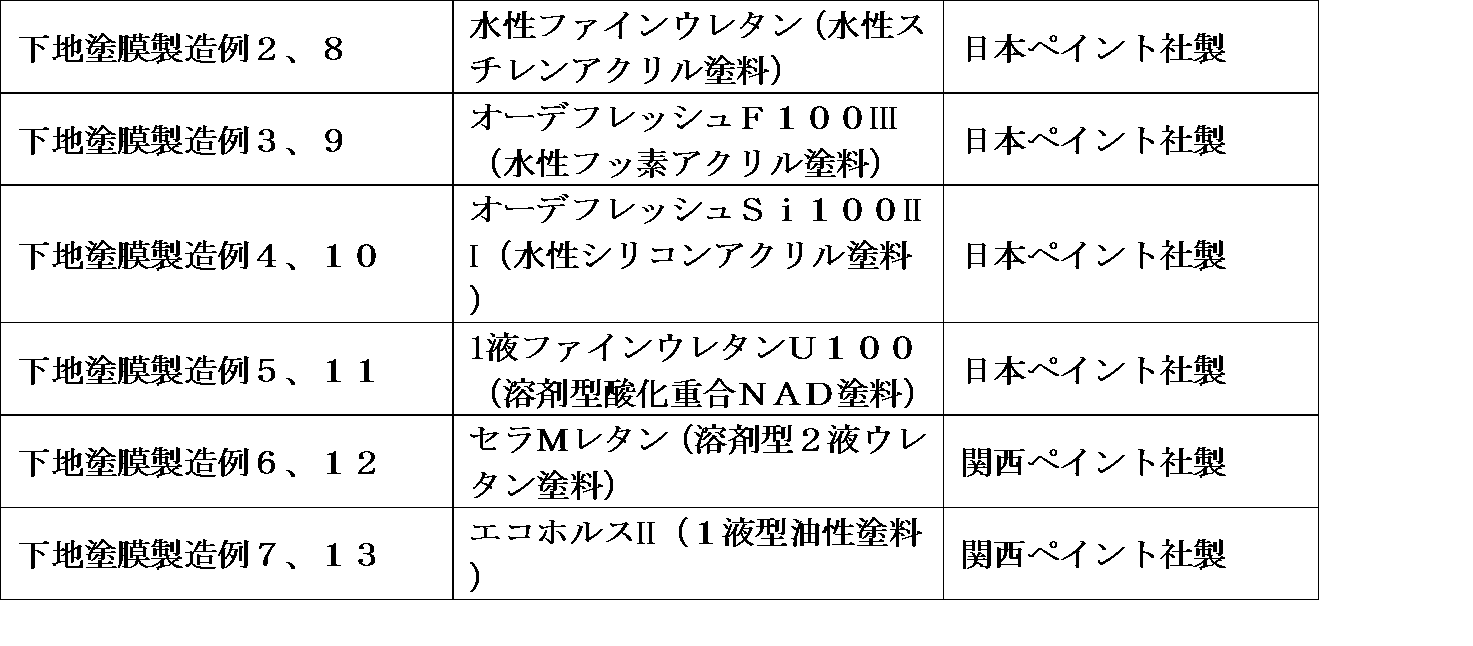
耐水フクレ試験
上記各下地塗膜の表面をから拭きし、その上に上記で作成した水性塗料組成物を、乾燥膜厚60μmになるように刷毛塗り塗装した。塗装後、23℃で湿度50%の条件の恒温恒湿部屋で7日間養生した。その後、同様の環境下で没水試験を開始した。没水から7日後に水から引き上げた。引き上げた直後に、塗膜外観について、JIS K5600-8-2(国際規格であるISO 4628-2:2003に対応する日本工業規格)に準拠して目視評価し、発生した塗膜フクレの密度および大きさについて、それぞれ等級0~5、1~5で評価を記載した。表4および5には、密度/大きさの形で記載した。それぞれ等級2以下を良、3~5を不良と判定した。密度0の場合は塗膜フクレ無しなので、大きさ「-」で表した。なお、発生した塗膜フクレの密度の等級(0~5)および大きさの等級(1~5)は上記と同様である。
上記各下地塗膜の表面をから拭きし、その上に上記で作成した水性塗料組成物を、乾燥膜厚60μmになるように刷毛塗り塗装した。塗装後、23℃で湿度50%の条件の恒温恒湿部屋で7日間養生した。その後、同様の環境下で没水試験を開始した。没水から7日後に水から引き上げた。引き上げた直後に、塗膜外観について、JIS K5600-8-2(国際規格であるISO 4628-2:2003に対応する日本工業規格)に準拠して目視評価し、発生した塗膜フクレの密度および大きさについて、それぞれ等級0~5、1~5で評価を記載した。表4および5には、密度/大きさの形で記載した。それぞれ等級2以下を良、3~5を不良と判定した。密度0の場合は塗膜フクレ無しなので、大きさ「-」で表した。なお、発生した塗膜フクレの密度の等級(0~5)および大きさの等級(1~5)は上記と同様である。
2次付着試験
上記耐水フクレ試験の判定から5分後に、碁盤目テープ剥離試験(2次付着試験)を実施した。耐水フクレ試験を行った塗装板に対して、カッターナイフ(NTカッターS型、A型、またはそれ、相当品)の切り刃を30度に保持して、素地に達するよう2mm間隔の平行線を11本引き、それらの平行線に直交する2mm間隔の平行線を11本引いて、塗膜に100個の碁盤目を形成した。この碁盤目の上に接着テープ(ニチバン社製の工業用セロハンテープ)を気泡が残らないように指先で均一に圧着させた後、接着テープの端を持ち、塗面に対して60度の角度で引っ張って、塗面からテープを剥がし、100個の碁盤目の剥がれの有無などについて、下記基準により目視評価した。
0:碁盤目カットの縁が完全に滑らかであり、はく離は確認されない。
1:碁盤目カットの交差点においてはく離が確認されるものの、はく離部分の面積は、塗膜全体の5%未満である。
2:はく離部分の面積が、塗膜全体に対して5%以上15%未満である。
3:はく離部分の面積が、塗膜全体に対して15%以上35%未満である。
4:はく離部分の面積が、塗膜全体に対して35%以上65%未満である。
5:はく離部分の面積が、塗膜全体に対して65%以上である。
上記耐水フクレ試験の判定から5分後に、碁盤目テープ剥離試験(2次付着試験)を実施した。耐水フクレ試験を行った塗装板に対して、カッターナイフ(NTカッターS型、A型、またはそれ、相当品)の切り刃を30度に保持して、素地に達するよう2mm間隔の平行線を11本引き、それらの平行線に直交する2mm間隔の平行線を11本引いて、塗膜に100個の碁盤目を形成した。この碁盤目の上に接着テープ(ニチバン社製の工業用セロハンテープ)を気泡が残らないように指先で均一に圧着させた後、接着テープの端を持ち、塗面に対して60度の角度で引っ張って、塗面からテープを剥がし、100個の碁盤目の剥がれの有無などについて、下記基準により目視評価した。
0:碁盤目カットの縁が完全に滑らかであり、はく離は確認されない。
1:碁盤目カットの交差点においてはく離が確認されるものの、はく離部分の面積は、塗膜全体の5%未満である。
2:はく離部分の面積が、塗膜全体に対して5%以上15%未満である。
3:はく離部分の面積が、塗膜全体に対して15%以上35%未満である。
4:はく離部分の面積が、塗膜全体に対して35%以上65%未満である。
5:はく離部分の面積が、塗膜全体に対して65%以上である。
透水試験
スレート板にシーラー(水性カチオンシーラー 日本ペイント社製)をローラーで塗装した。塗装翌日に、調製した水性塗料組成物を、乾燥膜厚が60μmになるように刷毛塗りで塗装した。塗装後、23℃で温度50%条件下の恒温恒湿部屋で14日養生した。その後、同様の環境下で透水試験を開始した。透水試験方法および評価基準は、JIS A 6909に記載された透水試験B法に従って実施した。具体的には、14日養生した塗装板を水平に保持し、この塗装板の上に、口径75mmの漏斗を逆さに置き、口径の周りを、シリコーンシーリング材を用いて、試験板に止め付け、48時間放置した。漏斗の足の上部に、1目盛り0.05mlのメスピペット(容量5ml)を、ゴム管を用いて連結した。23℃の水を、水面の高さが試験板から250mmとなるように入れ、24時間放置した。水を入れた直後の水面のメスピペットの目盛りと、24時間放置した後の水面のメスピペットの目盛りの差を求めた。
スレート板にシーラー(水性カチオンシーラー 日本ペイント社製)をローラーで塗装した。塗装翌日に、調製した水性塗料組成物を、乾燥膜厚が60μmになるように刷毛塗りで塗装した。塗装後、23℃で温度50%条件下の恒温恒湿部屋で14日養生した。その後、同様の環境下で透水試験を開始した。透水試験方法および評価基準は、JIS A 6909に記載された透水試験B法に従って実施した。具体的には、14日養生した塗装板を水平に保持し、この塗装板の上に、口径75mmの漏斗を逆さに置き、口径の周りを、シリコーンシーリング材を用いて、試験板に止め付け、48時間放置した。漏斗の足の上部に、1目盛り0.05mlのメスピペット(容量5ml)を、ゴム管を用いて連結した。23℃の水を、水面の高さが試験板から250mmとなるように入れ、24時間放置した。水を入れた直後の水面のメスピペットの目盛りと、24時間放置した後の水面のメスピペットの目盛りの差を求めた。
実施例2~19および比較例1~8
塗料組成を表4および5に記載するように変更すること以外は、実施例1と同様に塗料組成物を調製した。その後、実施例1と同様にして、低温初期耐水性試験、耐水フクレ試験、2次付着性試験および透水試験を行った。得られた結果を表4および5に示す。
塗料組成を表4および5に記載するように変更すること以外は、実施例1と同様に塗料組成物を調製した。その後、実施例1と同様にして、低温初期耐水性試験、耐水フクレ試験、2次付着性試験および透水試験を行った。得られた結果を表4および5に示す。

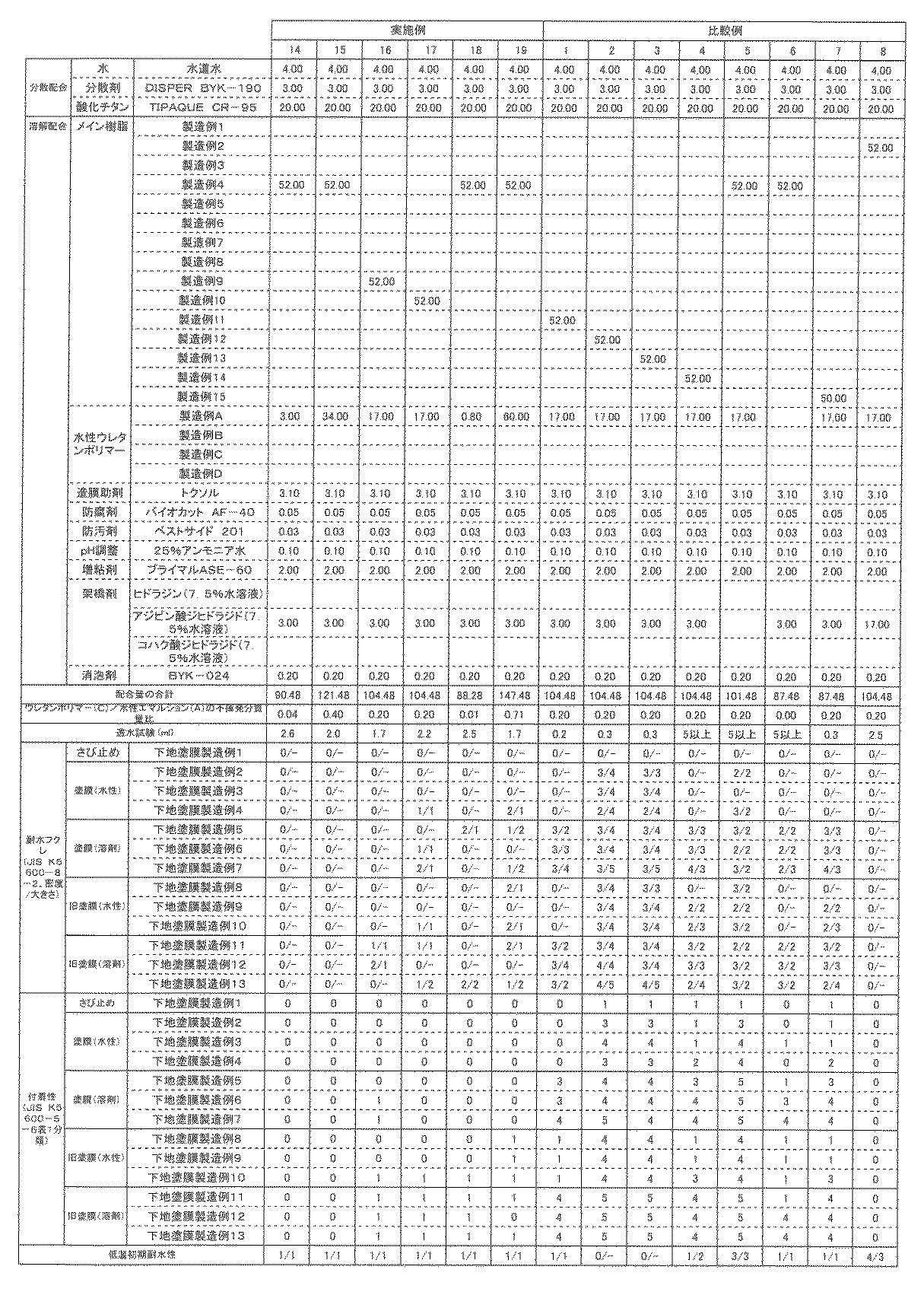
上記実施例から明らかなように、請求項1に記載の塗料組成物は、低温初期耐水性、耐水フクレおよび2次付着性が優れている。
比較例1および2は、成分(A)の調製において連鎖移動剤を用いていない例である。この比較例では、透水性が低くなり、下地によっては耐水フクレおよび2次付着性が悪くなっている。
比較例3は、DAAMの含有量がモノマーの総質量に対して4質量%以下の例である。この比較例では、透水性が低く、耐水フクレおよび2次付着性のいずれも下地がさび止め(下地製造例1)の場合を除いて良くない。
比較例4は、DAAMの量がモノマーの総質量に対して40質量%より多い例である。この比較例では、透水性の値が非常に高く、耐水フクレおよび2次付着性が良くない。
比較例5は、架橋剤であるヒドラジンおよび/またはヒドラジド誘導体(B)を含まない例である。この比較例では、低温初期耐水性、耐水フクレおよび2次付着性のいずれも良くない。
比較例6は、成分(C)の水性ウレタンポリマーを含まない例である。この比較例では、下地塗膜の種類によっては、耐水フクレおよび2次付着性が良くない。
比較例7は、特許文献1記載の水性エマルションAを用いた例である。この水性エマルションAは、連鎖移動剤を用いることなく調製されている。この比較例では、下地によっては耐水フクレおよび2次付着性が悪くなっている。
比較例8は、ヒドラジンおよび/またはヒドラジド誘導体(B)の含有量が、水性エマルション(A)の重合に用いられるダイアセトン(メタ)アクリルアミド(a)1当量に対して、ヒドラジンおよび/またはヒドラジド誘導体(B)が有するヒドラジノ基の当量が2当量よりも多い例である。この比較例では、低温初期耐水性が悪くなっている。
比較例3は、DAAMの含有量がモノマーの総質量に対して4質量%以下の例である。この比較例では、透水性が低く、耐水フクレおよび2次付着性のいずれも下地がさび止め(下地製造例1)の場合を除いて良くない。
比較例4は、DAAMの量がモノマーの総質量に対して40質量%より多い例である。この比較例では、透水性の値が非常に高く、耐水フクレおよび2次付着性が良くない。
比較例5は、架橋剤であるヒドラジンおよび/またはヒドラジド誘導体(B)を含まない例である。この比較例では、低温初期耐水性、耐水フクレおよび2次付着性のいずれも良くない。
比較例6は、成分(C)の水性ウレタンポリマーを含まない例である。この比較例では、下地塗膜の種類によっては、耐水フクレおよび2次付着性が良くない。
比較例7は、特許文献1記載の水性エマルションAを用いた例である。この水性エマルションAは、連鎖移動剤を用いることなく調製されている。この比較例では、下地によっては耐水フクレおよび2次付着性が悪くなっている。
比較例8は、ヒドラジンおよび/またはヒドラジド誘導体(B)の含有量が、水性エマルション(A)の重合に用いられるダイアセトン(メタ)アクリルアミド(a)1当量に対して、ヒドラジンおよび/またはヒドラジド誘導体(B)が有するヒドラジノ基の当量が2当量よりも多い例である。この比較例では、低温初期耐水性が悪くなっている。
本発明は、下地に対する付着性に優れた常温硬化型水性塗料組成物を提供する。本発明の塗料組成物は、特に、下地塗膜に直接塗装した場合でも、長期の降雨に曝されるなどの高湿度条件であっても、下地塗膜との付着性(2次付着性で評価する付着性)が保たれる。
Claims (5)
- (a)ダイアセトン(メタ)アクリルアミド、および
(b)前記成分(a)と共重合しうる不飽和モノマー、
を含有し、成分(a)の量がモノマー総質量に対して4~40質量%であるモノマー混合物を連鎖移動剤の存在下に乳化重合して得られた水性エマルション(A)、
ヒドラジンおよび/またはヒドラジド誘導体(B)、および
水性ウレタンポリマー(C)、
を含有する、常温硬化型水性塗料組成物であって、
前記ヒドラジンおよび/またはヒドラジド誘導体(B)の含有量は、前記水性エマルション(A)の重合に用いられるダイアセトン(メタ)アクリルアミド(a)1当量に対して、ヒドラジンおよび/またはヒドラジド誘導体(B)が有するヒドラジノ基の当量が2当量以下となる量である、
常温硬化型水性塗料組成物。 - 前記ヒドラジド誘導体は、下記化学式:

- 前記連鎖移動剤の量が、前記モノマー混合物(成分(a)および成分(b)の合計)の質量/連鎖移動剤の質量の比で、100/0.1~100/3.0の範囲内である、請求項1または2記載の常温硬化型水性塗料組成物。
- 前記水性ウレタンポリマー(C)の含有量が、水性ウレタンポリマー(C)の不揮発分質量/水性エマルション(A)の不揮発分質量の比で、1/100~50/100の範囲内である、請求項1~3いずれかに記載の常温硬化型水性塗料組成物。
- 前記連鎖移動剤は、ラウリルメルカプタン、n-ブチルメルカプタン、t-ブチルメルカプタン、ドデシルメルカプタン、オクチルメルカプタン、チオグリコール酸-2-エチルへキシル、2-メチル-5-t-ブチルチオフェノール、四臭化炭素、α-メチルスチレンダイマーからなる群から選択される1種またはそれ以上である、請求項1~4いずれかに記載の常温硬化型水性塗料組成物。
Applications Claiming Priority (4)
| Application Number | Priority Date | Filing Date | Title |
|---|---|---|---|
| JP2014066297 | 2014-03-27 | ||
| JP2014-066297 | 2014-03-27 | ||
| JP2014-147117 | 2014-07-17 | ||
| JP2014147117A JP6349180B2 (ja) | 2014-03-27 | 2014-07-17 | 常温硬化型水性塗料組成物 |
Publications (1)
| Publication Number | Publication Date |
|---|---|
| WO2015146748A1 true WO2015146748A1 (ja) | 2015-10-01 |
Family
ID=54195269
Family Applications (1)
| Application Number | Title | Priority Date | Filing Date |
|---|---|---|---|
| PCT/JP2015/058088 Ceased WO2015146748A1 (ja) | 2014-03-27 | 2015-03-18 | 常温硬化型水性塗料組成物 |
Country Status (2)
| Country | Link |
|---|---|
| JP (1) | JP6349180B2 (ja) |
| WO (1) | WO2015146748A1 (ja) |
Families Citing this family (2)
| Publication number | Priority date | Publication date | Assignee | Title |
|---|---|---|---|---|
| WO2019056334A1 (en) * | 2017-09-25 | 2019-03-28 | Dow Global Technologies Llc | AQUEOUS POLYMER COMPOSITION |
| JP7123158B2 (ja) * | 2019-03-13 | 2022-08-22 | 大日本塗料株式会社 | 水系塗料組成物、塗膜及び塗装物品 |
Citations (11)
| Publication number | Priority date | Publication date | Assignee | Title |
|---|---|---|---|---|
| JPH0551559A (ja) * | 1991-08-26 | 1993-03-02 | Mitsubishi Yuka Badische Co Ltd | 自己架橋型樹脂水性分散液 |
| JPH0598071A (ja) * | 1991-10-09 | 1993-04-20 | Mitsubishi Yuka Badische Co Ltd | 水性架橋性樹脂組成物 |
| JPH05179102A (ja) * | 1991-12-27 | 1993-07-20 | Mitsubishi Yuka Badische Co Ltd | 水性架橋性樹脂組成物 |
| JPH05339542A (ja) * | 1992-06-05 | 1993-12-21 | Kansai Paint Co Ltd | 常乾用水性塗料 |
| JPH06256709A (ja) * | 1993-03-04 | 1994-09-13 | Mitsubishi Yuka Badische Co Ltd | 水性架橋性樹脂組成物 |
| JPH0711193A (ja) * | 1993-04-28 | 1995-01-13 | Kansai Paint Co Ltd | 水性塗料用樹脂組成物 |
| JPH0827412A (ja) * | 1994-07-20 | 1996-01-30 | Mitsubishi Rayon Co Ltd | 水性被覆組成物 |
| JPH0995645A (ja) * | 1995-09-29 | 1997-04-08 | Nippon Paint Co Ltd | 常温硬化性樹脂組成物 |
| JPH10310739A (ja) * | 1997-05-12 | 1998-11-24 | Mitsubishi Chem Basf Co Ltd | 無機多孔質基材促進養生用の水性下塗剤 |
| JP2003096387A (ja) * | 2001-09-26 | 2003-04-03 | Kansai Paint Co Ltd | 水性塗料用樹脂組成物 |
| WO2006077738A1 (ja) * | 2004-12-28 | 2006-07-27 | Nippon Paint Co., Ltd. | 水性硬化型防汚塗料組成物、防汚性塗膜及び水中構造物 |
-
2014
- 2014-07-17 JP JP2014147117A patent/JP6349180B2/ja active Active
-
2015
- 2015-03-18 WO PCT/JP2015/058088 patent/WO2015146748A1/ja not_active Ceased
Patent Citations (11)
| Publication number | Priority date | Publication date | Assignee | Title |
|---|---|---|---|---|
| JPH0551559A (ja) * | 1991-08-26 | 1993-03-02 | Mitsubishi Yuka Badische Co Ltd | 自己架橋型樹脂水性分散液 |
| JPH0598071A (ja) * | 1991-10-09 | 1993-04-20 | Mitsubishi Yuka Badische Co Ltd | 水性架橋性樹脂組成物 |
| JPH05179102A (ja) * | 1991-12-27 | 1993-07-20 | Mitsubishi Yuka Badische Co Ltd | 水性架橋性樹脂組成物 |
| JPH05339542A (ja) * | 1992-06-05 | 1993-12-21 | Kansai Paint Co Ltd | 常乾用水性塗料 |
| JPH06256709A (ja) * | 1993-03-04 | 1994-09-13 | Mitsubishi Yuka Badische Co Ltd | 水性架橋性樹脂組成物 |
| JPH0711193A (ja) * | 1993-04-28 | 1995-01-13 | Kansai Paint Co Ltd | 水性塗料用樹脂組成物 |
| JPH0827412A (ja) * | 1994-07-20 | 1996-01-30 | Mitsubishi Rayon Co Ltd | 水性被覆組成物 |
| JPH0995645A (ja) * | 1995-09-29 | 1997-04-08 | Nippon Paint Co Ltd | 常温硬化性樹脂組成物 |
| JPH10310739A (ja) * | 1997-05-12 | 1998-11-24 | Mitsubishi Chem Basf Co Ltd | 無機多孔質基材促進養生用の水性下塗剤 |
| JP2003096387A (ja) * | 2001-09-26 | 2003-04-03 | Kansai Paint Co Ltd | 水性塗料用樹脂組成物 |
| WO2006077738A1 (ja) * | 2004-12-28 | 2006-07-27 | Nippon Paint Co., Ltd. | 水性硬化型防汚塗料組成物、防汚性塗膜及び水中構造物 |
Also Published As
| Publication number | Publication date |
|---|---|
| JP6349180B2 (ja) | 2018-06-27 |
| JP2015193779A (ja) | 2015-11-05 |
Similar Documents
| Publication | Publication Date | Title |
|---|---|---|
| KR101363238B1 (ko) | 코팅제 및 그 제조 방법 | |
| JP4440586B2 (ja) | 水性塗料組成物及びそれを用いた塗装方法 | |
| JP5290508B2 (ja) | 水性塗料組成物 | |
| CN105254842B (zh) | 多异氰酸酯组合物 | |
| CN108778529A (zh) | 多层涂层及其制备方法 | |
| US20060106157A1 (en) | Urethane acrylate tie coats | |
| PL201493B1 (pl) | Materiał powłokowy, zastosowanie materiału powłokowego i sposób wytwarzania barwnych i/lub dekoracyjnych powłok wielowarstwowych | |
| EP3186291B1 (en) | Coating compositions capable of producing surfaces with dry-erase properties | |
| CN101654500A (zh) | 聚合体复合物的制造方法 | |
| JP2012041558A (ja) | コーティングに関連した多成分の水媒介性コーティング組成物、および方法 | |
| JP2000313825A (ja) | 水性塗料組成物 | |
| JP2005200497A (ja) | 水性硬化性組成物、前記水性硬化性組成物を含む塗料及び接着剤 | |
| JP6349180B2 (ja) | 常温硬化型水性塗料組成物 | |
| JP2006117797A (ja) | 水性下塗り塗料組成物 | |
| JPH11343462A (ja) | 水性塗料組成物 | |
| JP4419053B2 (ja) | 水性硬化性組成物、該水性硬化性組成物を含んでなる塗料及び接着剤 | |
| JPH10219190A (ja) | 多液型水性塗料組成物 | |
| CN113227266A (zh) | 水性涂料组合物和涂膜形成方法 | |
| JP2003246827A (ja) | 水分散性ポリイソシアネート組成物、水性硬化性組成物、水性硬化性組成物を含む塗料および接着剤 | |
| JP2007016193A (ja) | 架橋性水系被覆組成物 | |
| JP2005187517A (ja) | 二液型水性被覆組成物 | |
| JP2003064149A (ja) | 水分散性ポリイソシアネート組成物、水性硬化性組成物、水性硬化性組成物を含む水性塗料および水性接着剤 | |
| JP2014129456A (ja) | 金属めっきプラスチック基材用クリヤー塗料組成物 | |
| JP4251273B2 (ja) | 水分散性ポリイソシアネート組成物、および当該組成物を含有する水性硬化性組成物 | |
| JPH11104556A (ja) | 金属面の塗装方法 |
Legal Events
| Date | Code | Title | Description |
|---|---|---|---|
| 121 | Ep: the epo has been informed by wipo that ep was designated in this application |
Ref document number: 15768936 Country of ref document: EP Kind code of ref document: A1 |
|
| NENP | Non-entry into the national phase |
Ref country code: DE |
|
| 122 | Ep: pct application non-entry in european phase |
Ref document number: 15768936 Country of ref document: EP Kind code of ref document: A1 |