WO2014076759A1 - 運転支援装置及び運転支援方法 - Google Patents
運転支援装置及び運転支援方法 Download PDFInfo
- Publication number
- WO2014076759A1 WO2014076759A1 PCT/JP2012/079378 JP2012079378W WO2014076759A1 WO 2014076759 A1 WO2014076759 A1 WO 2014076759A1 JP 2012079378 W JP2012079378 W JP 2012079378W WO 2014076759 A1 WO2014076759 A1 WO 2014076759A1
- Authority
- WO
- WIPO (PCT)
- Prior art keywords
- support
- vehicle
- driving
- unit
- assistance
- Prior art date
- Legal status (The legal status is an assumption and is not a legal conclusion. Google has not performed a legal analysis and makes no representation as to the accuracy of the status listed.)
- Ceased
Links
Images






Classifications
-
- B—PERFORMING OPERATIONS; TRANSPORTING
- B60—VEHICLES IN GENERAL
- B60W—CONJOINT CONTROL OF VEHICLE SUB-UNITS OF DIFFERENT TYPE OR DIFFERENT FUNCTION; CONTROL SYSTEMS SPECIALLY ADAPTED FOR HYBRID VEHICLES; ROAD VEHICLE DRIVE CONTROL SYSTEMS FOR PURPOSES NOT RELATED TO THE CONTROL OF A PARTICULAR SUB-UNIT
- B60W30/00—Purposes of road vehicle drive control systems not related to the control of a particular sub-unit, e.g. of systems using conjoint control of vehicle sub-units
- B60W30/08—Active safety systems predicting or avoiding probable or impending collision or attempting to minimise its consequences
- B60W30/09—Taking automatic action to avoid collision, e.g. braking and steering
-
- B—PERFORMING OPERATIONS; TRANSPORTING
- B60—VEHICLES IN GENERAL
- B60W—CONJOINT CONTROL OF VEHICLE SUB-UNITS OF DIFFERENT TYPE OR DIFFERENT FUNCTION; CONTROL SYSTEMS SPECIALLY ADAPTED FOR HYBRID VEHICLES; ROAD VEHICLE DRIVE CONTROL SYSTEMS FOR PURPOSES NOT RELATED TO THE CONTROL OF A PARTICULAR SUB-UNIT
- B60W10/00—Conjoint control of vehicle sub-units of different type or different function
- B60W10/04—Conjoint control of vehicle sub-units of different type or different function including control of propulsion units
-
- B—PERFORMING OPERATIONS; TRANSPORTING
- B60—VEHICLES IN GENERAL
- B60W—CONJOINT CONTROL OF VEHICLE SUB-UNITS OF DIFFERENT TYPE OR DIFFERENT FUNCTION; CONTROL SYSTEMS SPECIALLY ADAPTED FOR HYBRID VEHICLES; ROAD VEHICLE DRIVE CONTROL SYSTEMS FOR PURPOSES NOT RELATED TO THE CONTROL OF A PARTICULAR SUB-UNIT
- B60W30/00—Purposes of road vehicle drive control systems not related to the control of a particular sub-unit, e.g. of systems using conjoint control of vehicle sub-units
- B60W30/08—Active safety systems predicting or avoiding probable or impending collision or attempting to minimise its consequences
-
- B—PERFORMING OPERATIONS; TRANSPORTING
- B60—VEHICLES IN GENERAL
- B60W—CONJOINT CONTROL OF VEHICLE SUB-UNITS OF DIFFERENT TYPE OR DIFFERENT FUNCTION; CONTROL SYSTEMS SPECIALLY ADAPTED FOR HYBRID VEHICLES; ROAD VEHICLE DRIVE CONTROL SYSTEMS FOR PURPOSES NOT RELATED TO THE CONTROL OF A PARTICULAR SUB-UNIT
- B60W30/00—Purposes of road vehicle drive control systems not related to the control of a particular sub-unit, e.g. of systems using conjoint control of vehicle sub-units
- B60W30/08—Active safety systems predicting or avoiding probable or impending collision or attempting to minimise its consequences
- B60W30/095—Predicting travel path or likelihood of collision
-
- B—PERFORMING OPERATIONS; TRANSPORTING
- B60—VEHICLES IN GENERAL
- B60W—CONJOINT CONTROL OF VEHICLE SUB-UNITS OF DIFFERENT TYPE OR DIFFERENT FUNCTION; CONTROL SYSTEMS SPECIALLY ADAPTED FOR HYBRID VEHICLES; ROAD VEHICLE DRIVE CONTROL SYSTEMS FOR PURPOSES NOT RELATED TO THE CONTROL OF A PARTICULAR SUB-UNIT
- B60W30/00—Purposes of road vehicle drive control systems not related to the control of a particular sub-unit, e.g. of systems using conjoint control of vehicle sub-units
- B60W30/14—Adaptive cruise control
-
- B—PERFORMING OPERATIONS; TRANSPORTING
- B60—VEHICLES IN GENERAL
- B60W—CONJOINT CONTROL OF VEHICLE SUB-UNITS OF DIFFERENT TYPE OR DIFFERENT FUNCTION; CONTROL SYSTEMS SPECIALLY ADAPTED FOR HYBRID VEHICLES; ROAD VEHICLE DRIVE CONTROL SYSTEMS FOR PURPOSES NOT RELATED TO THE CONTROL OF A PARTICULAR SUB-UNIT
- B60W30/00—Purposes of road vehicle drive control systems not related to the control of a particular sub-unit, e.g. of systems using conjoint control of vehicle sub-units
- B60W30/14—Adaptive cruise control
- B60W30/143—Speed control
-
- B—PERFORMING OPERATIONS; TRANSPORTING
- B60—VEHICLES IN GENERAL
- B60W—CONJOINT CONTROL OF VEHICLE SUB-UNITS OF DIFFERENT TYPE OR DIFFERENT FUNCTION; CONTROL SYSTEMS SPECIALLY ADAPTED FOR HYBRID VEHICLES; ROAD VEHICLE DRIVE CONTROL SYSTEMS FOR PURPOSES NOT RELATED TO THE CONTROL OF A PARTICULAR SUB-UNIT
- B60W30/00—Purposes of road vehicle drive control systems not related to the control of a particular sub-unit, e.g. of systems using conjoint control of vehicle sub-units
- B60W30/14—Adaptive cruise control
- B60W30/16—Control of distance between vehicles, e.g. keeping a distance to preceding vehicle
-
- B—PERFORMING OPERATIONS; TRANSPORTING
- B60—VEHICLES IN GENERAL
- B60W—CONJOINT CONTROL OF VEHICLE SUB-UNITS OF DIFFERENT TYPE OR DIFFERENT FUNCTION; CONTROL SYSTEMS SPECIALLY ADAPTED FOR HYBRID VEHICLES; ROAD VEHICLE DRIVE CONTROL SYSTEMS FOR PURPOSES NOT RELATED TO THE CONTROL OF A PARTICULAR SUB-UNIT
- B60W50/00—Details of control systems for road vehicle drive control not related to the control of a particular sub-unit, e.g. process diagnostic or vehicle driver interfaces
-
- B—PERFORMING OPERATIONS; TRANSPORTING
- B60—VEHICLES IN GENERAL
- B60W—CONJOINT CONTROL OF VEHICLE SUB-UNITS OF DIFFERENT TYPE OR DIFFERENT FUNCTION; CONTROL SYSTEMS SPECIALLY ADAPTED FOR HYBRID VEHICLES; ROAD VEHICLE DRIVE CONTROL SYSTEMS FOR PURPOSES NOT RELATED TO THE CONTROL OF A PARTICULAR SUB-UNIT
- B60W50/00—Details of control systems for road vehicle drive control not related to the control of a particular sub-unit, e.g. process diagnostic or vehicle driver interfaces
- B60W2050/0062—Adapting control system settings
- B60W2050/0075—Automatic parameter input, automatic initialising or calibrating means
- B60W2050/009—Priority selection
-
- B—PERFORMING OPERATIONS; TRANSPORTING
- B60—VEHICLES IN GENERAL
- B60W—CONJOINT CONTROL OF VEHICLE SUB-UNITS OF DIFFERENT TYPE OR DIFFERENT FUNCTION; CONTROL SYSTEMS SPECIALLY ADAPTED FOR HYBRID VEHICLES; ROAD VEHICLE DRIVE CONTROL SYSTEMS FOR PURPOSES NOT RELATED TO THE CONTROL OF A PARTICULAR SUB-UNIT
- B60W2420/00—Indexing codes relating to the type of sensors based on the principle of their operation
- B60W2420/40—Photo, light or radio wave sensitive means, e.g. infrared sensors
- B60W2420/403—Image sensing, e.g. optical camera
-
- B—PERFORMING OPERATIONS; TRANSPORTING
- B60—VEHICLES IN GENERAL
- B60W—CONJOINT CONTROL OF VEHICLE SUB-UNITS OF DIFFERENT TYPE OR DIFFERENT FUNCTION; CONTROL SYSTEMS SPECIALLY ADAPTED FOR HYBRID VEHICLES; ROAD VEHICLE DRIVE CONTROL SYSTEMS FOR PURPOSES NOT RELATED TO THE CONTROL OF A PARTICULAR SUB-UNIT
- B60W2420/00—Indexing codes relating to the type of sensors based on the principle of their operation
- B60W2420/40—Photo, light or radio wave sensitive means, e.g. infrared sensors
- B60W2420/408—Radar; Laser, e.g. lidar
-
- B—PERFORMING OPERATIONS; TRANSPORTING
- B60—VEHICLES IN GENERAL
- B60W—CONJOINT CONTROL OF VEHICLE SUB-UNITS OF DIFFERENT TYPE OR DIFFERENT FUNCTION; CONTROL SYSTEMS SPECIALLY ADAPTED FOR HYBRID VEHICLES; ROAD VEHICLE DRIVE CONTROL SYSTEMS FOR PURPOSES NOT RELATED TO THE CONTROL OF A PARTICULAR SUB-UNIT
- B60W2520/00—Input parameters relating to overall vehicle dynamics
- B60W2520/10—Longitudinal speed
-
- B—PERFORMING OPERATIONS; TRANSPORTING
- B60—VEHICLES IN GENERAL
- B60W—CONJOINT CONTROL OF VEHICLE SUB-UNITS OF DIFFERENT TYPE OR DIFFERENT FUNCTION; CONTROL SYSTEMS SPECIALLY ADAPTED FOR HYBRID VEHICLES; ROAD VEHICLE DRIVE CONTROL SYSTEMS FOR PURPOSES NOT RELATED TO THE CONTROL OF A PARTICULAR SUB-UNIT
- B60W2520/00—Input parameters relating to overall vehicle dynamics
- B60W2520/10—Longitudinal speed
- B60W2520/105—Longitudinal acceleration
-
- B—PERFORMING OPERATIONS; TRANSPORTING
- B60—VEHICLES IN GENERAL
- B60W—CONJOINT CONTROL OF VEHICLE SUB-UNITS OF DIFFERENT TYPE OR DIFFERENT FUNCTION; CONTROL SYSTEMS SPECIALLY ADAPTED FOR HYBRID VEHICLES; ROAD VEHICLE DRIVE CONTROL SYSTEMS FOR PURPOSES NOT RELATED TO THE CONTROL OF A PARTICULAR SUB-UNIT
- B60W2554/00—Input parameters relating to objects
-
- B—PERFORMING OPERATIONS; TRANSPORTING
- B60—VEHICLES IN GENERAL
- B60W—CONJOINT CONTROL OF VEHICLE SUB-UNITS OF DIFFERENT TYPE OR DIFFERENT FUNCTION; CONTROL SYSTEMS SPECIALLY ADAPTED FOR HYBRID VEHICLES; ROAD VEHICLE DRIVE CONTROL SYSTEMS FOR PURPOSES NOT RELATED TO THE CONTROL OF A PARTICULAR SUB-UNIT
- B60W2554/00—Input parameters relating to objects
- B60W2554/40—Dynamic objects, e.g. animals, windblown objects
- B60W2554/402—Type
- B60W2554/4029—Pedestrians
-
- B—PERFORMING OPERATIONS; TRANSPORTING
- B60—VEHICLES IN GENERAL
- B60W—CONJOINT CONTROL OF VEHICLE SUB-UNITS OF DIFFERENT TYPE OR DIFFERENT FUNCTION; CONTROL SYSTEMS SPECIALLY ADAPTED FOR HYBRID VEHICLES; ROAD VEHICLE DRIVE CONTROL SYSTEMS FOR PURPOSES NOT RELATED TO THE CONTROL OF A PARTICULAR SUB-UNIT
- B60W2554/00—Input parameters relating to objects
- B60W2554/40—Dynamic objects, e.g. animals, windblown objects
- B60W2554/404—Characteristics
- B60W2554/4041—Position
-
- B—PERFORMING OPERATIONS; TRANSPORTING
- B60—VEHICLES IN GENERAL
- B60W—CONJOINT CONTROL OF VEHICLE SUB-UNITS OF DIFFERENT TYPE OR DIFFERENT FUNCTION; CONTROL SYSTEMS SPECIALLY ADAPTED FOR HYBRID VEHICLES; ROAD VEHICLE DRIVE CONTROL SYSTEMS FOR PURPOSES NOT RELATED TO THE CONTROL OF A PARTICULAR SUB-UNIT
- B60W2554/00—Input parameters relating to objects
- B60W2554/40—Dynamic objects, e.g. animals, windblown objects
- B60W2554/404—Characteristics
- B60W2554/4042—Longitudinal speed
-
- B—PERFORMING OPERATIONS; TRANSPORTING
- B60—VEHICLES IN GENERAL
- B60W—CONJOINT CONTROL OF VEHICLE SUB-UNITS OF DIFFERENT TYPE OR DIFFERENT FUNCTION; CONTROL SYSTEMS SPECIALLY ADAPTED FOR HYBRID VEHICLES; ROAD VEHICLE DRIVE CONTROL SYSTEMS FOR PURPOSES NOT RELATED TO THE CONTROL OF A PARTICULAR SUB-UNIT
- B60W2554/00—Input parameters relating to objects
- B60W2554/80—Spatial relation or speed relative to objects
- B60W2554/802—Longitudinal distance
-
- B—PERFORMING OPERATIONS; TRANSPORTING
- B60—VEHICLES IN GENERAL
- B60W—CONJOINT CONTROL OF VEHICLE SUB-UNITS OF DIFFERENT TYPE OR DIFFERENT FUNCTION; CONTROL SYSTEMS SPECIALLY ADAPTED FOR HYBRID VEHICLES; ROAD VEHICLE DRIVE CONTROL SYSTEMS FOR PURPOSES NOT RELATED TO THE CONTROL OF A PARTICULAR SUB-UNIT
- B60W2554/00—Input parameters relating to objects
- B60W2554/80—Spatial relation or speed relative to objects
- B60W2554/804—Relative longitudinal speed
-
- B—PERFORMING OPERATIONS; TRANSPORTING
- B60—VEHICLES IN GENERAL
- B60W—CONJOINT CONTROL OF VEHICLE SUB-UNITS OF DIFFERENT TYPE OR DIFFERENT FUNCTION; CONTROL SYSTEMS SPECIALLY ADAPTED FOR HYBRID VEHICLES; ROAD VEHICLE DRIVE CONTROL SYSTEMS FOR PURPOSES NOT RELATED TO THE CONTROL OF A PARTICULAR SUB-UNIT
- B60W2556/00—Input parameters relating to data
- B60W2556/45—External transmission of data to or from the vehicle
- B60W2556/65—Data transmitted between vehicles
-
- B—PERFORMING OPERATIONS; TRANSPORTING
- B60—VEHICLES IN GENERAL
- B60W—CONJOINT CONTROL OF VEHICLE SUB-UNITS OF DIFFERENT TYPE OR DIFFERENT FUNCTION; CONTROL SYSTEMS SPECIALLY ADAPTED FOR HYBRID VEHICLES; ROAD VEHICLE DRIVE CONTROL SYSTEMS FOR PURPOSES NOT RELATED TO THE CONTROL OF A PARTICULAR SUB-UNIT
- B60W2720/00—Output or target parameters relating to overall vehicle dynamics
-
- B—PERFORMING OPERATIONS; TRANSPORTING
- B60—VEHICLES IN GENERAL
- B60W—CONJOINT CONTROL OF VEHICLE SUB-UNITS OF DIFFERENT TYPE OR DIFFERENT FUNCTION; CONTROL SYSTEMS SPECIALLY ADAPTED FOR HYBRID VEHICLES; ROAD VEHICLE DRIVE CONTROL SYSTEMS FOR PURPOSES NOT RELATED TO THE CONTROL OF A PARTICULAR SUB-UNIT
- B60W2754/00—Output or target parameters relating to objects
- B60W2754/10—Spatial relation or speed relative to objects
-
- B—PERFORMING OPERATIONS; TRANSPORTING
- B60—VEHICLES IN GENERAL
- B60W—CONJOINT CONTROL OF VEHICLE SUB-UNITS OF DIFFERENT TYPE OR DIFFERENT FUNCTION; CONTROL SYSTEMS SPECIALLY ADAPTED FOR HYBRID VEHICLES; ROAD VEHICLE DRIVE CONTROL SYSTEMS FOR PURPOSES NOT RELATED TO THE CONTROL OF A PARTICULAR SUB-UNIT
- B60W2754/00—Output or target parameters relating to objects
- B60W2754/10—Spatial relation or speed relative to objects
- B60W2754/30—Longitudinal distance
Definitions
- the present invention relates to a driving support device and a driving support method for supporting driving of a vehicle.
- a driving support device that supports driving of a vehicle acquires traffic information that requires vehicle deceleration control such as an intersection, a temporary stop position, a curve, and the approach of a vehicle ahead by an in-vehicle camera or a navigation system. Then, based on the acquired traffic information around the vehicle, driving assistance such as deceleration assistance through voice deceleration guidance and semi-forced braking force is performed.
- vehicle deceleration control such as an intersection, a temporary stop position, a curve, and the approach of a vehicle ahead by an in-vehicle camera or a navigation system.
- Patent Document 1 Conventionally, as an example of a driving assistance device, as can be seen in Patent Document 1, for example, there is known a device that performs assistance for controlling the inter-vehicle distance between a vehicle to be supported and a preceding vehicle that travels forward in the traveling direction. ing.
- this apparatus recognizes the presence of a preceding vehicle by detecting the relative position and relative speed of an object that is in front of the vehicle to be supported in the traveling direction. When a preceding vehicle is detected, inter-vehicle distance control is performed to cause the preceding vehicle to follow the preceding vehicle.
- inter-vehicle distance control for example, when the inter-vehicle distance between the vehicle to be supported and the preceding vehicle becomes a certain distance or more, control for accelerating the vehicle to be supported is executed.
- the driving support device performs vehicle speed control that maintains the traveling speed of the vehicle to be supported at a set speed, so-called cruise control. In this cruise control, when the traveling speed of the vehicle to be supported falls below the set speed, control for accelerating the vehicle to the set speed is executed.
- Such problems are not limited to vehicles that provide driving assistance by inter-vehicle control or cruise control, but are generally common to vehicles that provide multiple types of driving assistance.
- the present invention has been made in view of such a situation, and the object thereof is a driving support device and driving capable of maintaining the appropriateness of each driving support, even if the vehicle is a vehicle that supports a plurality of types of driving support. It is to provide a support method.
- a driving support device that supports driving of a vehicle, wherein a driving support unit that performs different driving support using a plurality of types of support elements, and a specified specified time. And a support mediation unit that mediates at least two or more driving assistances when at least two driving assistances based on the plurality of types of assistance elements are executed by the driving assistance unit.
- a driving support method for supporting driving of a vehicle, wherein a driving support step for executing different driving support by a plurality of types of support elements, and a specified specified time. And at least two driving assistances based on the supporting elements are executed through the driving assistance step, and a support mediation step of mediating at least two or more driving assistances.
- a plurality of types of driving assistance are performed based on a plurality of types of support elements in the vehicle to be supported.
- the two or more driving assistances are arbitrated. Therefore, execution of two or more driving assists within a specified time is suppressed. That is, only one driving support based on one of the plurality of types of support elements is performed within the specified time. For this reason, it is suppressed that each driving assistance interferes with each other and a plurality of types of driving assistance are repeatedly executed within a specified time. Thereby, even if it is a vehicle in which multiple types of driving assistance is performed, it becomes possible to maintain the appropriateness of each driving assistance.
- the support mediation unit may be a second support element that configures the plurality of types of support elements during execution of driving support based on the first support element that configures the plurality of types of support elements. Detecting a driving support request based on the second support element when the driving support request based on the first support element is detected or after the completion of the driving support based on the first support element and before the specified time has elapsed In this case, one of a delay process for delaying the timing at which the driving support based on the second support element is activated and a suppression process for suppressing the activation of the driving support based on the second support element are performed as the arbitration. Run as.
- the second support element configuring the plurality of types of support elements during execution of driving support based on the first support element configuring the plurality of types of support elements. Detecting a driving support request based on the second support element when the driving support request based on the first support element is detected or after the completion of the driving support based on the first support element and before the specified time has elapsed At this time, one of a delay step of delaying the timing at which driving assistance based on the second support element is activated and a suppression step of suppressing activation of driving assistance based on the second assistance element is performed.
- the driving support based on the second support element when a driving support activation request based on the second support element is detected during execution of the driving support based on the first support element, the driving support based on the second support element is detected. Delay processing for delaying the timing at which is activated is performed as arbitration. Therefore, when the driving support based on the second support element is requested during the execution of the driving support based on the first support element, for example, the driving support based on the second support element is changed to the first support element. It is executed after a predetermined time has elapsed since the driving support based on the end. For this reason, it is suppressed that the driving assistance based on the 1st assistance element and the driving assistance based on the 2nd assistance element are performed within regulation time.
- the driving support based on the second support element that has been reserved is executed once the specified time has elapsed after the driving support based on the first support element is completed, so that the second support is performed.
- the effect of driving support by driving support based on the elements is also secured.
- the second support element when a driving support activation request based on the second support element is detected during the execution of the driving support based on the first support element, the second support element is used. Suppression processing that suppresses driving assistance is performed as arbitration. Therefore, the driving support activation request based on the second support element made during the execution of the driving support based on the first support element is temporarily canceled, and the execution of the driving support based on the second support element is suppressed. . As a result, since the driving support based on the first support element and the driving support based on the second support element are suppressed from being executed simultaneously, the driving support is prevented from interfering with each other.
- the driving support based on the second support element has been made after the prescribed time has elapsed since the driving support based on the first support element has been performed and the request for driving support based on the second support element has been made. Will be executed. Thereby, the activation is permitted at the timing when the request for driving support based on the second support element is made again, in other words, at the timing when the driving support based on the second support element is highly necessary. It becomes.
- the driving support activation request based on the second support element is detected after the completion of the driving support based on the first support element and before the lapse of the specified time. Then, delay processing for delaying the timing at which driving assistance based on the second assistance element is activated is performed as arbitration. Therefore, when the timing when the driving support activation request based on the second support element is made is after the execution of the driving support based on the first support element and before the lapse of the specified time, the second support element The driving assistance based on is temporarily reserved. The driving support based on the second support element is permitted to be activated when the specified time has elapsed, and this driving support is executed. The effect of driving support by driving support based on the second support element whose activation is suppressed while the driving support based on the first and second support elements is accurately suppressed within the specified time. Will also be secured.
- the driving support activation request based on the second support element is detected after the completion of the driving support based on the first support element and before the lapse of the specified time.
- operation activation of the driving assistance based on a 2nd assistance element is performed as arbitration. Therefore, after the execution of the driving support based on the first support element, but before the lapse of the specified time, the driving support activation request based on the second support element is temporarily canceled and the execution is suppressed. .
- the driving support based on the second support element is executed when the request for the driving support based on the second support element is made after the lapse of the specified time. Thereby, the activation is permitted at the timing when the request for driving support based on the second support element is made again, in other words, at the timing when the driving support based on the second support element is highly necessary. It becomes.
- the at least two driving assistances based on the plurality of types of assistance elements are separate driving assistances according to conflicting assistance aspects. In one aspect of the present invention, as each of at least two driving assistances based on the plurality of types of assistance elements, different driving assistances according to conflicting assistance aspects are selected.
- each different driving support is arbitrated by conflicting support modes as at least two driving support based on a plurality of types of support elements. For this reason, the appropriateness of each driving support of the conflicting support mode is suitably maintained, and the support effect by each driving support is also maintained.
- each of the different driving assistances according to the conflicting assistance modes includes acceleration assistance in which assistance for accelerating the vehicle to be supported is performed and deceleration assistance in which assistance for decelerating the vehicle to be supported is performed. Is included.
- acceleration support in which support for accelerating the vehicle to be supported is performed and deceleration support in which support for decelerating the vehicle to be supported is performed are provided.
- deceleration assistance in which assistance for decelerating the vehicle to be supported is performed and acceleration assistance in which assistance for accelerating the vehicle to be assistance is performed are often performed.
- the deceleration support and the acceleration support are assistances that prompt the vehicle to decelerate and accelerate, and have a great influence on the state of the vehicle. For this reason, when these deceleration support and acceleration support are executed simultaneously or repeatedly in a short time, the driver feels uncomfortable.
- acceleration support and deceleration support are arbitrated. For this reason, acceleration assistance and deceleration assistance are smoothly performed by arbitrating acceleration assistance and deceleration assistance that have a large influence on the state of the vehicle. Thereby, the acceleration of the vehicle through the acceleration support and the deceleration of the vehicle through the deceleration support are performed smoothly, and the effect of each driving support is ensured. This also suppresses the driver's uncomfortable feeling to a minimum even in a vehicle capable of providing conflicting assistance such as acceleration assistance and deceleration assistance.
- the plurality of types of support elements include an inter-vehicle distance support unit that supports control of an inter-vehicle distance between a vehicle to be supported and a preceding vehicle that precedes the vehicle in the traveling direction.
- a constant speed travel support unit that supports constant speed travel of the vehicle
- a collision avoidance support unit that assists in avoiding a collision between a vehicle to be supported and an object existing around the vehicle, and a vehicle to be supported
- At least two of the autonomous traveling support units that support autonomous traveling are included.
- inter-vehicle distance support that supports control of the inter-vehicle distance between a vehicle to be supported and a preceding vehicle that precedes the front in the traveling direction of the vehicle
- the support target Constant-speed driving support that supports constant-speed driving of the target vehicle
- collision avoidance support that supports the avoidance of a collision between the target vehicle and an object existing around the vehicle
- autonomousness of the target vehicle At least two types of autonomous driving support that supports driving are selected.
- Driving assistance executed by the vehicle mainly includes inter-vehicle distance support that supports control of the inter-vehicle distance between the vehicle to be supported and the preceding vehicle that precedes the front in the traveling direction of the vehicle, or the vehicle to be supported.
- There is constant speed driving support that supports constant speed driving.
- deceleration support and acceleration support for the vehicle to be supported is performed in order to maintain the inter-vehicle distance between the vehicle to be supported and the preceding vehicle at a specified distance.
- deceleration support and acceleration support for the vehicle to be supported are performed in order to maintain the traveling speed of the vehicle to be supported at a specified speed.
- recently developed driving assistance includes collision avoidance assistance that supports avoidance of collision between a vehicle to be supported and an object existing around the vehicle, and autonomous driving of the vehicle to be supported.
- autonomous driving support that supports Among these, in the collision avoidance support, in order to avoid a collision between a vehicle to be supported and an object existing in the vicinity thereof, support for prompting a deceleration or a course change is performed.
- autonomous traveling support for example, traveling that automatically performs a curve operation along a white line on a road or traveling that follows a preceding vehicle is automatically performed.
- the vehicle to be supported is a vehicle having at least two support functions of inter-vehicle distance support, constant speed travel support, collision avoidance support, and autonomous travel support. , Those driving assistance will be arbitrated. This enables smooth maintenance of the distance between the vehicle to be supported and the preceding vehicle, constant speed travel of the vehicle to be supported, collision avoidance between the vehicle to be supported and the object, and autonomous travel. Will be.
- the object is a moving object
- the collision avoidance support unit includes a first time when the vehicle reaches an intersection where the vehicle to be supported and the moving object intersect, Based on the relationship with the second time at which the mobile object reaches the intersection, the vehicle avoids a collision between the vehicle and the mobile object, and the support mediation unit is provided by the collision avoidance support unit.
- Acceleration support performed as acceleration control is the target of the arbitration.
- a moving object is selected as the object, and as the collision avoidance support, a first time when the vehicle reaches an intersection where the moving object and the vehicle to be supported intersect, Based on the relationship with the second time when the moving body reaches the intersection, the vehicle avoids a collision between the vehicle and the moving body, and the support mediation step is a support target by the collision avoidance support.
- Arbitration is performed between deceleration support for avoiding a collision between the vehicle and an object, and acceleration support for accelerating the vehicle as at least one of the inter-vehicle distance support, the constant speed travel support, and the autonomous travel support.
- the vehicle moves based on the relative relationship between the first time at which the vehicle reaches the intersection between the vehicle and the moving body and the second time at which the moving body reaches the intersection.
- Driving assistance is provided to prevent abnormal approach to the body. As a result, even when no sudden braking or sudden braking is required, abnormal approach between the vehicle and the moving body is suppressed by slow deceleration, and smooth driving assistance is performed.
- acceleration control for the vehicle to be supported is performed during or immediately after the completion of the collision avoidance support through at least one of inter-vehicle distance support, constant speed travel support, and autonomous travel support, the vehicle is decelerated by the collision avoidance support.
- the traveling speed of the vehicle that has been increased.
- the support effect by the collision avoidance support may be reduced.
- the collision avoidance support is executed again.
- acceleration control by inter-vehicle distance support, constant speed travel support, or autonomous travel support may be performed again.
- deceleration by collision avoidance support and acceleration by inter-vehicle distance support, constant speed travel support, and autonomous travel support are repeatedly performed.
- collision avoidance support and inter-vehicle distance support, constant speed travel support, and autonomous travel support in which acceleration control is performed as one of the support modes are arbitrated. For this reason, the support for prompting the deceleration and the acceleration is not performed alternately due to the interference of various types of support. Accordingly, it is possible to provide a collision avoidance support function and at least one support function of inter-vehicle distance support, constant speed travel support, and autonomous travel support for one vehicle while maintaining those support functions. .
- the collision avoidance support unit is configured such that the first time and the second time are less than or equal to a prescribed threshold value between the vehicle to be supported and the mobile object.
- a process for supporting collision avoidance is executed, and the support arbitration unit includes the inter-vehicle distance support unit, the constant speed travel support unit, and the autonomous system in a period in which the first time and the second time are equal to or less than the threshold.
- a process for suppressing activation of the acceleration support by at least one of the travel support units is executed.
- the collision avoidance support is executed on condition that the first time and the second time are equal to or less than a predetermined threshold.
- the period during which the first time and the second time are equal to or less than a predetermined threshold in other words, the period during which the collision avoidance support is being executed, is the inter-vehicle distance support unit, the constant speed travel support unit, and the autonomous travel support. Activation of acceleration support by at least one of the parts is suppressed. For this reason, in the middle of execution of the collision avoidance support, acceleration of the vehicle by the acceleration support is accurately suppressed.
- the collision avoidance support unit defines the relative relationship between the first time and the second time between a support region where driving support is performed and a non-support region where driving support is not performed.
- the map is stored, and collision avoidance assistance is performed through reference to the map.
- the support area where the driving support is performed and the non-support area where the driving support is not performed are defined with respect to the relative relationship between the first time and the second time. Maps are used. For this reason, collision avoidance is based on whether the first time and the second time based on the vehicle to be supported and the moving object in the vicinity belong to the support area or the non-support area of the map. It is determined whether or not support is required. As a result, the necessity of the collision avoidance support is easily performed.
- the at least two driving assistances based on the plurality of types of assistance elements include deceleration assistance that promotes deceleration of a vehicle that is a subject of assistance, and the driving assistance unit includes a required deceleration rate.
- the control arbitration unit calculates a control amount according to the support element, and when the support arbitration unit detects a request for activation of two or more deceleration support within the specified time, as the mediation, among the calculated control amount Permits only deceleration support with the maximum control amount.
- Some driving support based on multiple types of support elements may decelerate the vehicle to be supported.
- deceleration by each driving assistance is performed for different purposes, such as deceleration for avoiding a collision and deceleration for maintaining a distance between vehicles.
- the deceleration amount of the vehicle by each driving assistance also differs for each driving assistance.
- a plurality of types of deceleration support are executed individually, a plurality of deceleration supports are executed simultaneously or a plurality of times of deceleration support are executed in a short time.
- the traveling speed of the vehicle may be reduced more than necessary.
- FIG. 1 is a block diagram showing a schematic configuration of a vehicle to which a driving support device and a driving support method are applied according to a first embodiment of a driving support device and a driving support method according to the present invention.
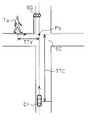
- the schematic diagram which shows the relative relationship of the vehicle and pedestrian which cross
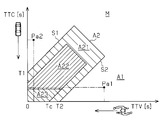
- the map which shows the relative relationship of 1st time and 2nd time.
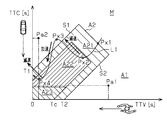
- the map which shows the relative relationship of 1st time and 2nd time.
- the flowchart which shows an example of the arbitration process of the embodiment.
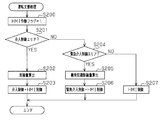
- the flowchart which shows an example of the driving assistance process by a collision avoidance assistance part.
- the vehicle to which the driving support apparatus and driving support method of the present embodiment is applied has a vehicle state acquisition unit 100 that acquires information on the state of the vehicle.
- the vehicle includes a moving body information acquisition unit 110 that acquires information on an object that is a moving body such as a person or a vehicle existing around the vehicle to be supported.
- the vehicle state acquisition unit 100 includes, for example, an accelerator sensor 101, a brake sensor 102, an acceleration sensor 103, a gyro sensor 104, a vehicle speed sensor 105, and the like.
- Each of the sensors 101 to 105 is electrically connected to a driving support unit 200 that performs driving support based on the detection results of the sensors 101 to 105.
- Accelerator sensor 101 detects the amount of accelerator depression that changes as the driver operates the accelerator pedal, and outputs a signal corresponding to the detected accelerator depression amount to vehicle-mounted driving support unit 200.
- the brake sensor 102 detects whether or not the driver has operated the brake pedal, and outputs a signal according to the detected presence or absence of the operation to the driving support unit 200.
- the acceleration sensor 103 detects the acceleration of the vehicle and outputs a signal corresponding to the detected acceleration to the driving support unit 200.
- the gyro sensor 104 detects the vehicle traveling direction, and outputs a signal corresponding to the detected traveling direction to the driving support unit 200.
- the vehicle speed sensor 105 detects the vehicle speed, which is the speed of the vehicle, and outputs a signal corresponding to the detected vehicle speed to the driving support unit 200.
- the moving body information acquisition unit 110 includes an in-vehicle camera 111 that is mounted on a vehicle and images the surrounding environment of the vehicle, a millimeter wave radar 112 that detects an object existing around the host vehicle, and a communication device 113 having a wireless communication function. I have.
- the in-vehicle camera 111 images a predetermined range in front of the vehicle with an optical CCD camera or the like installed on the back side of the rearview mirror.
- the in-vehicle camera 111 outputs an image signal based on the captured image to the driving support unit 200.
- the millimeter wave radar 112 has, for example, a distance measuring function for measuring the distance between an object existing around the host vehicle and the host vehicle, and a speed measuring function for measuring a relative speed between the object and the host vehicle.
- a distance measuring function for measuring the distance between an object existing around the host vehicle and the host vehicle
- a speed measuring function for measuring a relative speed between the object and the host vehicle.
- the communication device 113 acquires, for example, information indicating the traveling speed and latitude / longitude of the other vehicle through inter-vehicle communication with other vehicles existing around the host vehicle.
- the communication device 113 outputs the acquired information to the driving support unit 200.
- the communication device 113 performs road-to-vehicle communication with an optical beacon antenna provided on the road.
- the communication device 113 acquires an infrastructure information signal through road-to-vehicle communication with an optical beacon antenna.
- the communication device 113 outputs the received infrastructure information signal to the driving support unit 200.
- the infrastructure information signal includes, for example, the distance to the intersection, the signal cycle of the traffic signal provided at the intersection, the road alignment, and the road condition of the road where the optical beacon antenna is provided (intersection shape, curvature, gradient, lane) Including numbers).
- the infrastructure information signal includes accompanying information associated with the road and information on moving bodies such as other vehicles around the intersection detected by the ground equipment or the like.
- the moving body position calculation unit 120 calculates the position of the detected moving body based on the information input from the moving body information acquisition unit 110. For example, the moving body position calculation unit 120 analyzes the captured image indicated by the image signal input from the in-vehicle camera 111 to identify the moving body present in the vicinity of the host vehicle and the position of the moving body. In addition, the moving body position calculation unit 120 obtains, for example, a distance from the moving body existing in the vicinity of the own vehicle to the own vehicle and a moving speed of the moving body from the signal input from the millimeter wave radar 112. In addition, the moving body position calculation unit 120 specifies the moving direction of the moving body existing around the host vehicle based on, for example, a signal input from the millimeter wave radar 112.
- the mobile body position calculation unit 120 based on the infrastructure information, the distance from the mobile body existing around the host vehicle to the host vehicle, the moving speed of the mobile body, And the moving direction of the moving body is specified.
- the moving body position calculation unit 120 outputs a signal indicating the specific result to the driving support unit 200.
- Such a moving body is identified based on, for example, any one of an imaging result of the in-vehicle camera 111, a signal input from the millimeter wave radar 112, and infrastructure information input from the communication device 113.
- the driving support unit 200 includes a collision avoidance support unit 210 that performs collision avoidance support for avoiding a collision between a vehicle to be supported and a moving object existing in the vicinity thereof, that is, a target object. Further, the driving support unit 200 includes an inter-vehicle distance support unit 220 that performs inter-vehicle distance control support that supports control of the inter-vehicle distance between a vehicle to be supported and a preceding vehicle that precedes the vehicle. Furthermore, the driving support unit 200 includes a constant speed traveling support unit 230 that performs constant speed traveling control support that supports constant speed traveling of a vehicle to be supported. In the present embodiment, the collision avoidance support unit 210 constitutes the first support element, and the inter-vehicle distance support unit 220 and the constant speed travel support unit 230 constitute the second support element.
- the collision avoidance support unit 210 includes a collision time prediction unit 211 that predicts the time required for the host vehicle and the moving body to reach an intersection where the host vehicle and a moving body existing in the vicinity of the host vehicle.
- the driving support unit 200 is connected to an in-vehicle HMI (Human Machine Interface) 400 that transmits various types of information to the driver, and an in-vehicle intervention control device 410 that performs intervention control.
- HMI Human Machine Interface
- the collision time prediction unit 211 includes a TTC calculation unit 211a that calculates a first time TTC (Time To Collation) when the host vehicle reaches an intersection where the vehicle intersects the moving body.
- the first time TTC in the present embodiment corresponds to the time until the host vehicle collides with the moving body when traveling while maintaining the current course and traveling speed.
- the TTC calculation unit 211a uses the following equation (1). Based on this, a first time TTC is calculated.
- TTC x / (V ⁇ vx) (1)
- the TTC calculation unit 211a obtains the traveling speed “V” of the host vehicle based on the detection result of the vehicle speed sensor 105 and the like. Further, the TTC calculation unit 211a obtains the position “x” of the moving object and the speed “vx” of the moving object based on the signal input from the moving object information acquiring unit 110.
- the collision time prediction unit 211 has a TTV calculation unit 211b that calculates a second time TTV (Time To Vehicle) at which the moving body reaches the intersection.
- the second time TTV of the present embodiment corresponds to the time until the vehicle collides with the host vehicle when moving while maintaining the current course and travel speed.
- the vehicle Cr to be supported and the pedestrian Tg are heading from the direction where they intersect each other at the intersection SC where the traffic light SG is installed.
- the time for the vehicle Cr to reach the intersection Po between the vehicle Cr and the pedestrian Tg corresponds to the first time TTC.
- the time for the pedestrian Tg to reach the intersection Po corresponds to the second time TTV. That is, the intersection Po is an intersection of the predicted movement locus of the vehicle Cr and the expected movement locus of the moving body.
- the collision avoidance support unit 210 of the present embodiment stores a map indicating a relative positional relationship between the first time TTC and the second time TTV. 213.
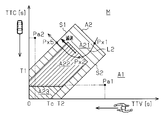
- the map storage unit 213 stores a map M in which the vertical axis is defined as the first time TTC [s] and the horizontal axis is defined as the second time TTV [s].
- the origin “0” corresponds to the intersection Po between the vehicle Cr and the pedestrian Tg in FIG.
- the intersection of the first time TTC and the second time TTV is separated from the origin.
- the vehicle Cr and the pedestrian Tg at the time of calculation of the first time TTC and the second time TTV are separated from the intersection Po. Will be located.
- a non-support area A1 in which the collision avoidance support for avoiding the collision between the vehicle Cr to be supported and the moving body such as the pedestrian Tg and other vehicles is not set is set.
- the map M has a support area A2 in which collision avoidance support is activated.
- the non-support area A1 and the support area A2 are areas defined based on, for example, experimental data.
- the non-support area A1 and the support area A2 can be set based on learning results of driving characteristics such as accelerator characteristics and brake characteristics of the driver.
- the collision avoidance support trigger condition when the relative positions of the calculated first time TTC and second time TTV on the map M are located in the non-support area A1, the collision avoidance support trigger condition is not satisfied.
- the collision avoidance support trigger condition is satisfied when the relative positions of the calculated first time TTC and second time TTV on the map M are located in the support area A2.
- Two straight lines S1 and S2 that rise to the right that form the boundary between the support area A2 and the non-support area A1 are set by the difference (TTC-TTV) between the first time TTC and the second time TTV.
- TTC-TTV the difference between the first time TTC and the second time TTV.
- a time corresponding to 1 to 3 seconds is set as the time T1 when the straight line S1 intersects the first time TTC.
- a time corresponding to, for example, 1 to 3 seconds is set as the time T2 when the straight line S2 intersects the horizontal axis of the second time TTV.
- the support area A2 is divided into an HMI area A21, an intervention control area A22, and an emergency intervention control area A23 according to the urgency level of driving support.
- the HMI area A21 is defined at a position farthest from the origin 0 of the first time TTC and the second time TTV in the support area A2.
- the HMI area A21 is an area where driving assistance is given to warn the driver of the presence of a moving body or abnormal approach between the vehicle Cr and the moving body.
- the driving assistance defined in the HMI area A21 is performed when the calculated first time TTC and second time TTV are located in the HMI area A21.
- Intervention control area A22 is an area where intervention control such as braking is performed, and is located closer to the origin 0 than HMI area A21.
- the emergency intervention control area A23 is an area where emergency intervention such as sudden braking is performed in order to avoid a collision between the moving body and the vehicle Cr, and is located within a predetermined range from the origin 0.
- the emergency intervention control area A23 is located closest to the origin 0 in the support area A2, and is defined at a position closest to the intersection Po between the vehicle Cr and the moving body.
- the non-support area A1 is a part other than the support area A2, and is an area that does not require driving support for avoiding a collision between the vehicle Cr and the moving body.
- the point Pa1 (TTV, TTC) located in the non-support area A1 is the first time TTC ⁇ second time TTV.
- the mobile body reaches the intersection Po after a certain time or more has elapsed since the vehicle Cr passed the intersection.
- the point Pa2 (TTV, TTC) located in the non-support area A1 is the first time TTC >> the second time TTV.
- the vehicle Cr When the first time TTC >> the second time TTV is established, the vehicle Cr reaches the intersection Po after a certain period of time has elapsed after the moving body passes the intersection. Therefore, in the non-support area A1, the timing at which the vehicle Cr and the moving body reach the intersection Po is different by a certain time or more, and the distance between the vehicle Cr and the moving body is a certain distance or more, so driving assistance becomes unnecessary. .
- the support activation unit 212 constituting the collision avoidance support unit 210 determines whether or not the activation condition of the collision avoidance support is successful. Based on the calculated first time TTC, second time TTV, and map M, the support activation unit 212 determines whether the activation condition is successful. In the support activation unit 212, the calculated first time TTC and second time TTV are located in any of the HMI area A21, the intervention control area A22, and the emergency intervention control area A23 that constitute the support area A2. At this time, it is determined that the trigger condition for the collision avoidance support is satisfied.
- the support activation unit 212 is located in any area on the map M where the intersection of the first time TTC and the second time TTV intersects. Identify what to do.
- the support activation unit 212 determines that the collision avoidance support activation condition is not satisfied.
- the position where the first time TTC and the second time TTV intersect is the point P2 (Tc, Td)
- the point P2 is located in the support area A2. Therefore, the support activation unit 212 determines that the activation condition for the collision avoidance support is satisfied.
- the relative relationship between the first time TTC and the second time TTV is indicated by the intersection of the first time TTC and the second time TTV.
- the support activation unit 212 is configured to locate an area (HMI area A21, intervention control area A22, and emergency intervention control area where the calculated first time TTC and second time TTV intersect.
- the signal indicating A23 is output to the avoidance control unit 214 that performs collision avoidance support.
- the support activation unit 212 outputs, for example, a signal indicating the calculated first time TTC and second time TTV, the latitude / longitude of the intersection, and the like to the avoidance control unit 214. To do.
- the avoidance control unit 214 selects driving support according to the HMI area A21, the intervention control area A22, and the emergency intervention control area A23 when various signals are input from the support activation unit 212.
- the avoidance control unit 214 generates a warning instruction signal for activating a warning by the HMI 400 when the intersection of the calculated first time TTC and second time TTV is located in the HMI area A21. Then, the avoidance control unit 214 outputs the generated warning instruction signal to the HMI 400.
- the warning instruction signal includes, for example, the position of the moving body where the collision with the vehicle Cr is predicted, the distance to the moving body, the predicted time until the collision, and the like.
- the avoidance control unit 214 performs intervention control by the intervention control device 410 when the intersection of the calculated first time TTC and second time TTV is located in the intervention control area A22 or the emergency intervention control area A23. Intervention control information for generating And the avoidance control part 214 outputs the produced
- the intervention control information includes, for example, a control amount indicating a brake deceleration amount or the like that allows the first time TTC located in the support area A2 to be outside the support area A2, that is, in the non-support area A1. It is.
- the control amount indicated by the intervention control information is set so that the control amount in the emergency intervention control area A23 is larger than the control amount in the intervention control area A22.
- the inter-vehicle distance support unit 220 constituting the driving support unit 200 identifies the preceding vehicle of the vehicle to be supported based on the information about the moving body input from the moving body information acquisition unit 110 and the moving body position calculation unit 120.
- the preceding vehicle identification unit 221 is provided.
- the inter-vehicle distance support unit 220 includes an inter-vehicle distance control unit 222 that controls the inter-vehicle distance between the vehicle identified by the preceding vehicle identification unit 221 and the host vehicle.
- the preceding vehicle identification unit 221 acquires information on the moving body existing around the vehicle to be supported from the moving body information acquisition unit 110, the preceding vehicle identification unit 221 identifies whether the moving body is a vehicle based on this information. In addition, the preceding vehicle identification unit 221 acquires information indicating the relative speed of the identified vehicle with respect to the host vehicle from the millimeter wave radar 112, for example. When the relative speed is equal to or lower than the specified speed, the preceding vehicle identification unit 221 identifies that the identified vehicle is a preceding vehicle that is traveling ahead in the traveling direction of the host vehicle. In addition, as the specified speed related to the relative speed, a speed for excluding pedestrians and oncoming vehicles is specified.
- the preceding vehicle identification unit 221 acquires information indicating the distance between the own vehicle and the preceding vehicle from the millimeter wave radar 112, for example.
- the inter-vehicle distance control unit 222 performs calculation and control for maintaining the inter-vehicle distance between the vehicle to be supported and the preceding vehicle above a specified distance.
- the inter-vehicle distance control unit 222 holds information related to the inter-vehicle distance defined for each traveling speed of the vehicle to be supported, for example.
- the inter-vehicle distance control unit 222 acquires information indicating the traveling speed of the host vehicle from the vehicle state acquisition unit 100.
- the inter-vehicle distance control unit 222 determines the inter-vehicle distance to be maintained based on information on the relative speed and relative position of the preceding vehicle, the traveling speed of the host vehicle, and the inter-vehicle distance. Next, the inter-vehicle distance control unit 222 compares the determined inter-vehicle distance with the inter-vehicle distances of the host vehicle and the preceding vehicle.
- the inter-vehicle distance control unit 222 calculates a control amount for accelerating the own vehicle until the determined inter-vehicle distance is reached when the actual inter-vehicle distance between the own vehicle and the preceding vehicle is longer than the determined inter-vehicle distance. To do.
- the inter-vehicle distance control unit 222 outputs acceleration information indicating the calculated control amount to the in-vehicle engine control device 420 that controls the engine of the host vehicle via the support arbitration unit 300 that mediates driving support.
- the inter-vehicle distance control unit 222 causes the traveling speed of the host vehicle to follow the traveling speed of the preceding vehicle. Take control. That is, the inter-vehicle distance control unit 222 performs acceleration support for accelerating the own vehicle until the own vehicle is brought close to the preceding vehicle to the determined inter-vehicle distance.
- the inter-vehicle distance control unit 222 is a control for decelerating the own vehicle until the determined inter-vehicle distance is secured when the actual inter-vehicle distance between the own vehicle and the preceding vehicle is shorter than the determined inter-vehicle distance as a result of the comparison. Calculate the amount.
- the inter-vehicle distance control unit 222 outputs deceleration information indicating the calculated control amount to the intervention control device 410 that performs braking for decelerating the traveling speed of the host vehicle via the support arbitration unit 300.
- the inter-vehicle distance control unit 222 sets the traveling speed of the own vehicle to the traveling speed of the preceding vehicle. Control to follow the speed.
- the constant speed running support unit 230 performs calculation and control for maintaining the speed of the vehicle to be supported at the set speed.
- the set speed is set by the driver of the host vehicle, for example.
- the constant speed travel support unit 230 acquires information indicating the travel speed of the host vehicle from the vehicle speed sensor 105 of the vehicle state acquisition unit 100, for example.
- the constant speed driving support unit 230 calculates a control amount for accelerating the host vehicle until the set speed is reached when the traveling speed of the host vehicle is slower than the set speed.
- the constant speed traveling support unit 230 outputs acceleration information indicating the calculated control amount to the engine control device 420 that controls the engine of the host vehicle via the support arbitration unit 300.
- the constant speed driving support unit 230 performs control for causing the traveling speed of the host vehicle to reach the set speed. That is, the constant speed running support unit 230 performs acceleration support for accelerating the host vehicle.
- the constant speed traveling support unit 230 performs control to maintain the traveling speed of the host vehicle at the set speed.
- the constant speed traveling support unit 230 calculates a control amount for decelerating the host vehicle until the set speed is reached.
- the constant speed traveling support unit 230 outputs deceleration information indicating the calculated control amount to the engine control device 420 that controls the engine of the host vehicle via the support arbitration unit 300.
- the constant speed driving support unit 230 performs control with the traveling speed of the host vehicle as the set speed. That is, the constant speed traveling support unit 230 performs deceleration support for decelerating the host vehicle.
- the constant speed traveling support unit 230 performs control to maintain the traveling speed of the host vehicle at the set speed.
- the support arbitration unit 300 includes deceleration support that is braking based on intervention control information output from the avoidance control unit 214 of the collision avoidance support unit 210, and acceleration by the inter-vehicle distance support unit 220 or the constant speed travel support unit 230. An arbitration process is performed to mediate support.
- the support arbitration unit 300 targets acceleration support and deceleration support for performing support in contradiction between acceleration and deceleration as targets for arbitration.
- the support mediation unit 300 includes a timing change unit 310 that mediates each driving support through a change in timing at which two or more conflicting driving assistances are executed.
- the timing changing unit 310 monitors the presence or absence of braking of the host vehicle based on the intervention control information input from the avoidance control unit 214 of the collision avoidance support unit 210.
- the timing changing unit 310 measures an elapsed time after the previous braking is completed based on the intervention control information.
- the timing changing unit 310 includes information input from the inter-vehicle distance control unit 222 and the constant speed driving support unit 230, which is either deceleration information for controlling the host vehicle to decelerate or acceleration information for controlling the host vehicle to accelerate. It is determined whether it is. When it is determined that the acceleration information is input, it is determined whether or not the host vehicle is being braked by the avoidance control unit 214.
- the acceleration control by the inter-vehicle distance control unit 222 or the constant speed traveling support unit 230 is performed.
- a delay process is performed for delaying the activation time of ⁇ ⁇ by a specified time specified in advance.
- the specified time for example, a time is set such that a standard driver does not feel bothered or uncomfortable due to acceleration by acceleration control after deceleration by braking the vehicle.
- this regulation time is prescribed
- the timing changing unit 310 also has the same delay when the timing at which the acceleration information is input is a timing at which the specified time has not elapsed since the previous braking of the host vehicle by the avoidance control unit 214 was completed. Process.
- the timing changing unit 310 performs a process of outputting acceleration information to the engine control device 420 after a lapse of the specified time as a delay process.
- the acceleration information is input to the engine control device 420 after a predetermined time has elapsed from the timing at which the inter-vehicle distance support unit 220 or the constant speed travel support unit 230 outputs the acceleration information.
- the engine control device 420 controls the engine or the like according to the acceleration information, so that the acceleration control for maintaining the inter-vehicle distance and for constant speed travel after the specified time has elapsed since the braking by the avoidance control unit 214 is performed. Will be performed.
- braking and acceleration control by collision avoidance support are suppressed from being performed simultaneously or repeatedly in a short time.
- the HMI 400 includes, for example, an audio device, a head-up display, a navigation system monitor, and a meter panel.
- the HMI 400 warns the driver that there is a person or a vehicle ahead in the traveling direction, or displays a warning text on a head-up display or the like. To do.
- the intervention control device 410 is configured by various control devices such as a brake control device that controls a brake actuator of a vehicle and a steering control device that controls a steering actuator.
- the intervention control device 410 controls the brake control device and the like based on the intervention control information.
- the relative position Po between the first time TTC and the second time TTV is changed due to a decrease in the traveling speed of the vehicle, and the moving body passes through the intersection Po before the vehicle reaches the intersection. It will be. That is, abnormal approach between the vehicle and the moving body is suppressed.
- the engine control device 420 controls to increase the engine rotation amount in accordance with the acceleration information. I do. As a result, the traveling speed of the vehicle increases according to the acceleration information.
- step S100 when a moving object such as a pedestrian or another vehicle existing in the vicinity of the vehicle is detected, the position, moving direction, and moving speed of the moving object, that is, the velocity vector is determined. Detected.
- a first time TTC and a second time TTV are calculated (steps S101 and S102). Then, the calculated first time TTC and second time TTV are applied on the map M, and the position where the first time TTC and the second time TTV intersect, that is, the first time TTC and the second time TTV.
- the relative relationship of the time TTV is specified (step S103).
- step S104 When the intersection of the first time TTC and the second time TTV is specified, it is determined whether or not this position belongs to the support area A2 (step S104). When the intersection of the first time TTC and the second time TTV falls within the range of the support area A2 (step S104: YES), the collision avoidance support by the collision avoidance support unit 210 is executed through the driving support processing (step S104). S105). Then, in step S100, detection of a moving body existing around the vehicle to be supported is performed again.
- step S104 when it is determined in step S104 that the intersection of the first time TTC and the second time TTV does not belong to the support area A2, the vehicle to be supported collides with a mobile object existing in the vicinity thereof. If the possibility is low, the collision avoidance support is not executed (step S104: NO).
- step S106 it is determined whether or not the inter-vehicle distance support unit 220 or the constant speed travel support unit 230 has output acceleration information for accelerating the vehicle during the inter-vehicle distance support or the constant speed travel support.
- the support mediation unit 300 has acquired the acceleration information output from the inter-vehicle distance support unit 220 or the constant speed travel support unit 230
- an acceleration support activation request is issued from the inter-vehicle distance support unit 220 or the constant speed travel support unit 230. Is detected.
- step S106 When the acceleration support activation request is made (step S106: YES), it is determined whether or not the collision avoidance support executed in step S105 has been completed (step S107). Then, when the collision avoidance support has ended (step S107: YES), it is determined whether or not a specified time has elapsed since the end point (step S108). Then, on the condition that the specified time has elapsed since the collision avoidance support has ended, the acceleration support is allowed to be activated, and the acceleration support based on the acceleration information is executed (step S109).
- the acceleration information is output from the inter-vehicle distance support unit 220
- the support target vehicle is accelerated so that the inter-vehicle distance of the support target vehicle and the preceding vehicle is shortened to the specified inter-vehicle distance.
- the acceleration information is output from the constant speed driving support unit 230
- the vehicle to be supported is accelerated so that the traveling speed of the vehicle to be supported reaches the set speed.
- step S107 when it is determined in step S107 that the collision avoidance support is being executed (step S107: NO), the execution of the collision avoidance support is finished, and the acceleration support is suspended until the specified time elapses ( Step S108). Then, when the specified time has elapsed, the activation of acceleration support is permitted (step S109).
- step S108 when it is determined in step S108 that the specified time has not elapsed since the collision avoidance support was completed (step S108: NO), the acceleration support is suspended until the specified time has elapsed. Then, when the specified time has elapsed, the activation of acceleration support is permitted (step S109).
- step S106 If it is determined in step S106 that the information input from the inter-vehicle distance support unit 220 or the constant speed travel support unit 230 is deceleration information, deceleration support corresponding to the deceleration information is executed. (Step S106: NO, S110).
- Step S105, Step S109, and S110 in FIG. 5 correspond to the driving support step.
- Steps S106 to S108 correspond to the support mediation step.
- Step S200 the collision avoidance assistance procedure by the driving assistance process of step S105 of FIG. 5 will be described in detail.
- the intersection of the first time TTC and the second time TTV belongs to the support area A2, so the HMI operation flag for operating the HMI 400 is “1”.
- step S201 it is determined whether or not the intersection of the first time TTC and the second time TTV belongs to the intervention control area A22 in the support area A2 (step S201).
- step S201: YES the control amount of the intervention control is calculated based on, for example, the map M (step S202).
- step S203 intervention control by the intervention control device 410 and warning by the HMI 400 are executed (step S203).
- braking of the vehicle heading to the moving body and warning to the driver of the vehicle are performed.
- deceleration guidance or the like is performed.
- step S201 when it is determined in step S201 that the intersection of the first time TTC and the second time TTV does not belong to the intervention control area A22 in the support area A2, the intersection belongs to the emergency intervention control area A23. Is determined (step S204).
- a collision avoidance control amount that is a control amount for emergency avoidance between the vehicle and the moving object. Is calculated (step S205). Then, emergency intervention control by the intervention control device 410 and warning by the HMI 400 are executed based on the calculated collision avoidance control amount (step S206). Thereby, emergency braking of the vehicle heading to the moving body and warning to the driver of the vehicle are performed. Note that as a warning to the driver of the vehicle, guidance for sudden deceleration, guidance for steering operation to avoid a collision, and the like are performed.
- the intersection of the first time TTC and the second time TTV belongs to the HMI area A21 or the intervention control area A22 until the intersection reaches the emergency intervention control area A23. Therefore, normally, before the emergency braking is activated, deceleration guidance by the HMI 400 and braking by the intervention control device 410 are performed, so that the intersection of the first time TTC and the second time TTV is the emergency intervention control area A23. Belonging to is avoided.
- step S204 when it is determined in step S204 that the intersection of the first time TTC and the second time TTV does not belong to the emergency intervention control area A23 (step S204: NO), the intersection belongs to the HMI area A21. Will be. Therefore, at this time, only the HMI control is executed, and a deceleration guide, a guide for informing the presence of the moving body, and the like are performed (step S205).
- FIG. 7 shows the transition L1 of the first time TTC and the second time TTV when the arbitration process is not executed, and the first time TTC and the second time TTV at the certain point Px1 are in the support area A2. If it belongs, the collision avoidance support is executed. As a result, the vehicle to be supported is decelerated. Then, the transition L1 of the first time TTC and the second time TTV proceeds from the point Px2 toward the point Px3 located at the boundary with the non-support area A1, and leaves the support area A2. That is, the time difference between the vehicle to be supported and the moving body existing in the vicinity thereof reaching the intersection is increased.
- acceleration support by inter-vehicle distance control or constant speed running control is executed before the specified time elapses after the collision avoidance support is ended because the first time TTC and the second time TTV have left the support area A2.
- the transition L1 proceeds from the point Px3 toward the point Px4 located in the emergency intervention control area A23.
- the first time TTC and the second time TTV that have once left the support area A2 belong to the support area A2.
- the transition L1 of the first time TTC and the second time TTV proceeds from the point Px4 so as to leave the support area A2.
- transition L2 in FIG. 8 in this embodiment, when the first time TTC and the second time TTV belong to the support area A2 at a certain point Px1, the collision avoidance support is performed. Executed. As a result, the vehicle to be supported is decelerated. Then, the transition L2 of the first time TTC and the second time TTV proceeds from the point Px2 toward the point Px5 on the straight line S1, and leaves the support area A2.
- the timing changing unit 310 activates the acceleration support. Is delayed. As a result, after the collision avoidance support is completed, the acceleration support is suppressed from being activated until a predetermined time has elapsed. Then, when the specified time has elapsed, the activation of acceleration support is permitted, and the inter-vehicle distance control by the inter-vehicle distance support unit 220 and the constant speed travel control by the constant speed travel support unit 230 are executed.
- the driving support unit 200 executes driving support of different types using a plurality of types of support elements. Further, when at least two driving assistances based on a plurality of types of assistance elements by the driving assistance unit 200 are executed within a prescribed time, the assistance mediation unit 300 mediates at least two driving assistances. . It is suppressed that the driving assistances performed by the driving assistance unit 200 interfere with each other and that multiple types of driving assistance are repeatedly executed within a specified time. Thereby, even if it is a vehicle in which multiple types of driving assistance is performed, it becomes possible to maintain the appropriateness of each driving assistance.
- the support mediation unit 300 is a collision avoidance support unit in which a driving support activation request based on the inter-vehicle distance support unit 220 or the constant speed driving support unit 230 constituting the second support element constitutes the first support element. It was detected whether or not it was performed during the execution of driving assistance based on 210. Then, the support mediation unit 300 delays the timing at which the inter-vehicle distance support unit 220 or the constant speed travel support unit 230 activates driving support when detecting the activation request. For this reason, it is suppressed that the driving assistance based on the collision avoidance assistance unit 210 and the driving assistance based on the inter-vehicle distance assistance unit 220 and the constant speed traveling assistance unit 230 are performed within a specified time.
- the support mediation unit 300 activates the driving support based on the inter-vehicle distance support unit 220 and the constant-speed traveling support unit 230 that have suspended the activation, and the specified time has elapsed after the driving support based on the collision avoidance support unit 210 ends. Allowed after. Thereby, the effect of the driving support performed by the inter-vehicle distance support unit 220 and the constant speed travel support unit 230 is also ensured. Further, the support arbitration unit 300 determines that the timing at which the driving support activation request based on the inter-vehicle distance support unit 220 or the constant speed driving support unit 230 has been made has elapsed from the end of execution of the driving support based on the collision avoidance support unit 210.
- the support arbitration unit 300 executes a delay process for delaying the driving support activation by the inter-vehicle distance support unit 220 and the constant speed driving support unit 230 until the specified time elapses. . For this reason, it is suppressed that the driving assistance based on the collision avoidance assistance unit 210 and the driving assistance based on the inter-vehicle distance assistance unit 220 and the constant speed traveling assistance unit 230 are performed within a specified time.
- the support mediation unit 300 activates the driving support based on the inter-vehicle distance support unit 220 and the constant-speed traveling support unit 230 that have suspended the activation, and the specified time has elapsed after the driving support based on the collision avoidance support unit 210 ends. Allowed after. Thereby, the effect of the driving support performed by the inter-vehicle distance support unit 220 and the constant speed travel support unit 230 is also ensured.
- the support mediation unit 300 targets each type of driving support according to conflicting support modes for mediation. For this reason, the appropriateness of each driving support of the conflicting support mode is suitably maintained, and the support effect by each driving support is also maintained.
- the support mediation unit 300 provides acceleration support in which assistance for accelerating the vehicle to be supported is performed and deceleration support in which assistance for decelerating the vehicle to be supported is performed as separate driving assistance in the conflicting support mode. Targeted. For this reason, acceleration support and deceleration support that have a large influence on the state of the vehicle are arbitrated, and acceleration support and deceleration support are smoothly performed. Thereby, the acceleration of the vehicle through the acceleration support and the deceleration of the vehicle through the deceleration support are performed smoothly, and the effect of each driving support is ensured. As a result, even in a vehicle in which conflicting assistances such as acceleration assistance and deceleration assistance are performed, a sense of discomfort to the driver is suppressed to a minimum.
- the driving support unit 200 serves as a support element, and an inter-vehicle distance support unit 220 that supports control of the inter-vehicle distance between a vehicle to be supported and a preceding vehicle that precedes the front in the traveling direction of the vehicle, and the support target.
- a constant speed running support unit 230 that supports constant speed running of the vehicle is provided.
- the driving support unit 200 includes a collision avoidance support unit 210 that supports the avoidance of a collision between a vehicle to be supported and an object existing around the vehicle as a support element.
- the support mediation unit 300 mediates driving assistance by the collision avoidance support unit 210, the inter-vehicle distance support unit 220, and the constant speed travel support unit 230. Thereby, maintenance of the inter-vehicle distance between the vehicle to be supported and the preceding vehicle, constant speed travel of the vehicle to be supported, and collision avoidance between the vehicle to be supported and the object are smoothly realized. .
- the collision avoidance support unit 210 has a first time TTC when the vehicle reaches the intersection Po where the movement locus of the vehicle to be supported and the movement locus of the moving object intersect, and the moving object at the intersection Po. Based on the relationship with the second time TTV when the vehicle arrives, assistance for avoiding a collision between the vehicle and the moving object was performed. As a result, even when sudden braking, sudden braking, or the like is not required, abnormal approach between the vehicle and the moving body is easily suppressed by slow deceleration, and smooth driving support is performed.
- the support mediation unit 300 is provided with a deceleration support performed as a support for avoiding a collision between a vehicle to be supported by the collision avoidance support unit 210 and an object, and a support target by the inter-vehicle distance support unit 220 and the constant speed travel support unit 230.
- Acceleration support performed as acceleration control for the vehicle to be the target of arbitration. For this reason, the support for prompting the deceleration and the acceleration is not performed alternately due to the interference of various types of support. Thereby, it is possible to provide the collision avoidance support function and the support functions of the inter-vehicle distance support and the constant speed driving support for one vehicle while maintaining the support functions.
- the collision avoidance support unit 210 executes the collision avoidance support on the condition that the first time TTC and the second time TTV are equal to or less than a prescribed threshold value. That is, the collision avoidance support unit 210 performed the collision avoidance support when the intersection of the first time TTC and the second time TTV belongs to the support area A2.
- the support mediation unit 300 performs acceleration support by the inter-vehicle distance support unit 220 and the constant speed driving support unit 230 in a period in which the first time TTC and the second time TTV are equal to or less than a threshold, that is, a period belonging to the support area A2. The process to suppress the activation of was executed. For this reason, in the middle of execution of the collision avoidance support, acceleration of the vehicle by the acceleration support is accurately suppressed.
- the support area A2 that performs driving support and the non-support area A1 that does not perform driving support are defined with respect to the relative relationship between the first time TTC and the second time TTV.
- a map storage unit 213 in which the map M is recorded is provided.
- the collision avoidance support unit 210 performs collision avoidance support through reference to the map M. For this reason, the collision avoidance support unit 210 determines that the intersection of the first time TTC and the second time TTV based on the vehicle to be supported and the mobile object existing in the vicinity thereof is the support area A2 in the map M and It becomes possible to determine whether or not the collision avoidance support is required based on which of the non-support areas A1 belongs. As a result, the necessity of the collision avoidance support is easily performed.
- the support area A2 of the map M is divided into an HMI area A21, an intervention control area A22, and an emergency intervention control area A23 according to the degree of emergency. Further, the driving support unit 200 determines whether the relative relationship between the first time TTC and the second time TTV of the vehicle to be supported belongs to the HMI area A21, the intervention control area A22, or the emergency intervention control area A23. Based on the above, we provided driving assistance for each. Thereby, driving assistance corresponding to the degree of urgency is set for each of the divided areas, so that driving assistance at a level corresponding to the relative positional relationship between the vehicle to be supported and the moving body is performed. Become. In addition, the driving support is activated appropriately for each level.
- FIGS. 9 and 10 a second embodiment of the driving support apparatus and driving support method according to the present invention will be described with reference to FIGS. 9 and 10 with a focus on differences from the first embodiment.
- the basic configuration of the driving support apparatus and the driving support method according to the present embodiment is the same as that of the first embodiment, and FIGS. 9 and 10 are substantially the same as those of the first embodiment.
- the same elements are denoted by the same reference numerals, and duplicate descriptions are omitted.
- the intervention control information that the avoidance control unit 214 that constitutes the collision avoidance support unit 210 outputs to the intervention control device 410 is subjected to intervention control via the in-vehicle support arbitration unit 300A. Output to device 410.
- the support arbitration unit 300A of the present embodiment further includes a deceleration arbitration unit 320 that arbitrates braking executed through the intervention control device 410, that is, deceleration support.
- the deceleration arbitration unit 320 is executed based on the intervention control information input from the collision avoidance support unit 210, the deceleration information input from the inter-vehicle distance support unit 220, and the deceleration information input from the constant speed travel support unit 230. Perform mediation processing to mediate support.
- the deceleration arbitration unit 320 performs other deceleration support when performing deceleration support based on information input from any of the collision avoidance support unit 210, the inter-vehicle distance support unit 220, and the constant speed travel support unit 230. When the information is input, the control amounts indicated by the information are compared. Then, the deceleration arbitration unit 320 selects information having a large control amount, and outputs only the selected information to the intervention control device 410.
- the deceleration arbitration unit 320 selects information having a large control amount even when the intervention braking information of the collision avoidance support unit 210 and the deceleration information of the inter-vehicle distance support unit 220 or the constant speed travel support unit 230 are simultaneously input. Only the selected information is output to the intervention control device 410. Similarly, when the deceleration information of the inter-vehicle distance support unit 220 and the constant speed travel support unit 230 is simultaneously input, the deceleration adjustment unit 320 selects information with a large control amount, and performs intervention control only on the selected information. Output to device 410.
- the intervention control device 410 performs braking according to a control amount indicated by one intervention braking information or deceleration information input from the deceleration arbitration unit 320. As a result, deceleration support is executed based on the information arbitrated by the deceleration arbitration unit 320.
- step S104 the intersection of the first time TTC and the second time TTV belongs to the range of the support area A2 (step S104: YES).
- step S104: YES the inter-vehicle distance support unit 220 or the constant speed driving support unit 230 decelerates. It is determined whether or not information is output, that is, whether or not a deceleration support request has been issued (step S120).
- step S120 when the deceleration support activation request is made (step S120: YES), the deceleration information output by the inter-vehicle distance support unit 220 or the constant speed travel support unit 230, and the intervention braking information output by the collision avoidance support unit 210.
- Information indicating the control amount with the maximum deceleration amount is selected from among the items (step S121).
- the vehicle is decelerated by the intervention control device 410 based on the selected control amount (step S122).
- the deceleration amount is maximized in each support.
- One support based on the control amount will be performed. That is, when the deceleration amount by the collision avoidance support is larger than the deceleration amount by the inter-vehicle distance support or the constant speed travel support, the collision avoidance support is executed. On the other hand, when the deceleration amount by the inter-vehicle distance support or the constant speed traveling support is larger than the deceleration amount by the collision avoidance support, the inter-vehicle distance support or the constant speed traveling support is executed.
- the deceleration amount is also included in each support when a request for decelerating support is issued by the inter-vehicle distance support unit 220 or the constant speed travel support unit 230.
- One support based on the maximum control amount will be provided.
- step S120 when it is determined in step S120 that the request for deceleration support by the inter-vehicle distance support unit 220 and the constant speed driving support unit 230 has not been made, the driving support process is performed as in step S105 of FIG.
- the collision avoidance support is executed (step S123).
- the effects (1) to (9) can be obtained, and the following effects can be further obtained.
- the support mediation unit 300A includes a deceleration mediation unit 320 that mediates deceleration support.
- the deceleration arbitration unit 320 is executed based on the intervention control information input from the collision avoidance support unit 210, the deceleration information input from the inter-vehicle distance support unit 220, and the deceleration information input from the constant speed travel support unit 230. Arbitration processing was performed to mediate support. For this reason, when a request for decelerating support is made by the inter-vehicle distance support unit 220 or the constant speed travel support unit 230 during the execution of the collision avoidance support by the collision avoidance support unit 210, the collision avoidance support and the inter-vehicle distance support or Mediation with constant-speed driving support.
- the support for decelerating the vehicle is continuously performed a plurality of times, and the traveling speed of the vehicle is suppressed from decelerating more than necessary.
- the execution timing of the collision avoidance support by the collision avoidance support unit 210 and the execution timing of the deceleration support by the inter-vehicle distance support unit 220 or the constant speed travel support unit 230 overlap, the collision avoidance support and the inter-vehicle distance support Or it is arbitrated with constant speed driving support. Therefore, simultaneous input of a plurality of information to the intervention control device 410 is suppressed, and the intervention control device 410 can perform smooth braking based on one information.
- the deceleration arbitration unit 320 selects information that maximizes the deceleration amount, and outputs the selected information to the intervention control device 410. Therefore, the deceleration amount required in each support is satisfied from any of the collision avoidance support, the vehicle distance support, and the constant speed driving support.
- each said embodiment can also be implemented with the following forms.
- HMI control by the HMI 400 is also performed.
- the present invention is not limited to this, and as shown in FIG. 11 as a diagram corresponding to FIG. 6, only intervention control may be performed when the execution condition for intervention control is satisfied (step S203A). Further, only the emergency intervention control may be performed when the execution condition of the emergency intervention control is satisfied (step S206A).
- the vehicle state acquisition unit 100 includes the accelerator sensor 101, the brake sensor 102, the acceleration sensor 103, the gyro sensor 104, the vehicle speed sensor 105, and the like.
- the vehicle state acquisition unit 100 may be configured by at least one of the accelerator sensor 101, the brake sensor 102, the acceleration sensor 103, the gyro sensor 104, and the vehicle speed sensor 105.
- the first time TTC may be calculated through a calculation based on the detection result of at least one sensor.
- the vehicle state acquisition part 100 may be comprised by GPS which detects the latitude longitude of the vehicle used as assistance object.
- the traveling speed of the vehicle is calculated based on the latitude and longitude of the vehicle detected by GPS, and the first time TTC is calculated.
- the vehicle state acquisition part 100 should just be what can acquire the information which can be used for calculation of 1st time TTC.
- the mobile body information acquisition unit 110 is configured by the in-vehicle camera 111, the millimeter wave radar 112, and the communication device 113.
- the moving body information acquisition unit 110 is not limited to this, and may be configured by at least one of the in-vehicle camera 111, the millimeter wave radar 112, and the communication device 113.
- the mobile body information acquisition unit 110 can be configured as long as the mobile body information that can be used for the calculation of the second time TTV can be acquired.
- the support area A2 of the map M illustrated in FIG. 3, FIG. 4, FIG. 7, and FIG. 8 is divided into the HMI area A21, the intervention control area A22, and the emergency intervention control area A23. It was done. Further, the support area A2 may be divided into four or more, and a driving support mode may be set for each of the divided areas. Further, the support area A2 may be defined by two or one area, and various driving support modes may be set in the defined area. When the support area A2 to be divided is configured only by the HMI area A21, the intervention control device 410 is omitted. Conversely, when the support area A2 to be divided is configured only by the intervention control area A22 or the emergency intervention control area A23, the HMI 400 is omitted. Further, the driving support mode set in the support area A2 is arbitrary and can be changed as appropriate.
- the collision avoidance support is performed based on the map M stored in the map storage unit 213.
- the present invention is not limited to this, as long as collision avoidance support is performed based on the relative relationship between the first time TTC and the second time TTV, and each value of the first time TTC and the second time TTV is defined. Whether or not the trigger condition for the collision avoidance support is satisfied may be determined based on whether or not this value is met.
- the information that maximizes the deceleration amount is selected when a plurality of deceleration support activation requests are generated. Based on the selected information, vehicle deceleration support was performed. Conversely, when a plurality of deceleration support activation requests are generated, information other than the information that maximizes the deceleration amount may be selected. This also facilitates smoothing of the deceleration support by arbitrating the multiple deceleration supports.
- a plurality of deceleration supports are targeted for arbitration.
- a plurality of acceleration supports may be targeted for arbitration. According to this, for example, when the acceleration request by the inter-vehicle distance control support and the acceleration request by the constant speed driving support are activated within a specified time, the vehicle acceleration control based on one of the acceleration requests is permitted. Thereby, a plurality of acceleration controls are performed, and the acceleration control is suppressed from being performed more than necessary.
- each movement locus used for collision avoidance assistance should just be a locus which intersects at the same point, and the angle at the time of those intersections exceeds 90 degrees, even if it is an angle less than 90 degrees It may be an angle.
- the inter-vehicle distance support unit 220B constituting the driving support unit 200B presents voice guidance and image guidance for inter-vehicle distance support to the driver. It further has a presentation processing unit 223 that performs processing for generating presentation information to be performed. Further, the constant speed driving support unit 230B constituting the driving support unit 200B further includes a presentation processing unit 233 that performs processing for generating presentation information for presenting voice guidance and image guidance for constant speed driving support to the driver.
- the support mediation unit 300B further includes a presentation mediation unit 330 that performs processing for mediating presentation information by the HMI 400.
- the presentation processing unit 223 of the inter-vehicle distance support unit 220B is necessary for maintaining, for example, the inter-vehicle distance between the preceding vehicle and the host vehicle based on the control amount calculated by the inter-vehicle distance control unit 222.
- the presentation information for guiding the driver to the target speed, deceleration, acceleration and the like is generated. Then, the presentation processing unit 223 outputs the generated information to the support mediation unit 300B.
- the presentation processing unit 233 of the constant speed traveling support unit 230B based on the control amount calculated by the constant speed traveling control unit 232, for example, presents information for guiding the set target speed, deceleration, acceleration, and the like. Generate. Then, the presentation processing unit 233 outputs the generated information to the presentation mediation unit 330 of the support mediation unit 300B.
- the presentation mediation unit 330 receives the presentation information for accelerating the vehicle from the inter-vehicle distance support unit 220B or the constant speed driving support unit 230B when the deceleration guidance for collision avoidance support is performed by the HMI 400 based on the intervention braking information.
- the presentation information is reserved until a predetermined time elapses after the deceleration guidance for collision avoidance support is completed.
- the presentation mediation unit 330 outputs the reserved presentation information to the HMI 400 when a predetermined time has elapsed after the deceleration guidance for collision avoidance support is completed.
- the acceleration guidance by the HMI 400 is retained until the specified time has elapsed after the guidance for collision avoidance support is completed. Therefore, deceleration guidance by collision avoidance assistance and acceleration guidance by acceleration assistance are suppressed in a short period of time, and repeated conflicting guidance within a certain time is suppressed. As a result, the driving support through the HMI 400 is optimized.
- the presentation arbitration unit 330 is similar to the deceleration arbitration unit 320 of the second embodiment, and the deceleration guidance based on the intervention braking information of the collision avoidance support unit 210 and the inter-vehicle distance support unit 220B or the constant speed travel support.
- the deceleration guidance based on the deceleration information of the unit 230B may be targeted for arbitration. According to this, for example, “Decelerate the travel speed to 20 km / h to avoid collision” and “Decelerate the travel speed to 20 km / h to maintain the inter-vehicle distance”. Therefore, a plurality of pieces of information having different contents are presented to the driver via the HMI 400.
- the collision avoidance support by the collision avoidance support unit 210 and the inter-vehicle distance support by the inter-vehicle distance support unit 220 are targeted for the arbitration process. Further, in each of the above embodiments, the collision avoidance support by the collision avoidance support unit 210 and the constant speed travel support by the constant speed travel support unit 230 are targeted for arbitration. Not limited to this, the inter-vehicle distance support by the inter-vehicle distance support unit 220 and the constant speed travel support by the constant speed travel support unit 230 may be targeted for arbitration.
- a request for decelerating support for securing the inter-vehicle distance to a specified value by the inter-vehicle distance support unit 220 and a decelerating support for reducing the traveling speed of the vehicle to be supported to a set speed When an activation request is made, only the deceleration support with the larger deceleration amount is performed. As a result, driving support in the same support mode is not continuously performed within a specified time, and driving support is facilitated.
- the support element is composed of the three elements of the collision avoidance support unit 210, the inter-vehicle distance support unit 220, and the constant speed travel support unit 230.
- the driving support unit 200 ⁇ / b> C may include an autonomous traveling support unit 240 that supports autonomous traveling of a vehicle to be supported as a support element. . According to this, the autonomous traveling support by the autonomous traveling support unit 240 and the driving support by other supporting elements are arbitrated. Therefore, even if the vehicle is provided with more various driving assistance, the driving assistance is optimized.
- the support element only needs to be configured by at least two elements of the collision avoidance support unit 210, the inter-vehicle distance support unit 220, the constant speed travel support unit 230, and the autonomous travel support unit 240, and combinations thereof. Can be appropriately changed.
- the support element only needs to provide driving support that supports driving of the vehicle, and can be changed as appropriate.
- the support mediation unit 300 is configured separately from the HMI 400 and the intervention control device 410.
- the HMI 400B and the intervention control device 410B have a support mediation unit 401 and a support mediation unit 411 having functions similar to the support mediation unit 300. It may be a configuration. According to this, even if the HMI 400B and the intervention control device 410B request the activation of multiple types of driving support from the driving support unit 200B, it is possible to mediate the multiple types of driving support independently.
- the place where the support mediation unit is arranged can be changed as appropriate.
- the driving support units 200, 200B, and 200C can include the support mediation unit.
- the driving support unit 200 and the support mediation unit 300 are mounted on the vehicle. Not only this but the driving assistance part 200 and the assistance mediation part 300 may be comprised by the application program installed in multifunctional telephone apparatuses, such as a smart phone, for example.
- the multi-function telephone device determines success or failure of the suppression condition based on the map information held in the multi-function phone device, traffic information that can be acquired via the internetwork, or the like.
- the multi-function telephone device provides driving support through voice guidance or image guidance, for example. As a result, driving assistance and optimization are achieved even in a vehicle that does not include a navigation system.
- the multi-function telephone device has high versatility, driving support and optimization thereof in more scenes can be achieved.
- multi-function telephone devices often have GPS or map information. For this reason, based on the latitude / longitude information and map information acquired by the GPS, the position of the vehicle to be supported can be specified, and the traveling environment of the vehicle to be supported can be specified. The first time TTC and the second time TTV can be calculated based on the position of the identifiable vehicle and the traveling environment.
- many users have multifunction telephone devices. Therefore, by providing the driving support unit 200 and the support suppressing unit 150 in the multifunction telephone device, appropriate driving support is realized in more scenes.
- the support for promoting the deceleration and the support for promoting the acceleration performed by the vehicle to be supported are arbitrated. Not limited to this, for example, when a vehicle to be supported has a plurality of support elements for prompting a course change, driving support based on each support element may be arbitrated.
- different driving assistances with conflicting assistance modes are subject to mediation. Not limited to this, for example, support for decelerating support and support for prompting a change of course, that is, support that does not have a conflicting relationship may be arbitrated. According to this, driving support capable of arbitration will be expanded.
- the driving support based on the second support element when a driving support activation request based on the second support element is detected during execution of the driving support based on the first support element, the driving support based on the second support element is activated. Delay processing to delay the timing to be performed was performed as arbitration. In each of the above embodiments, when a driving support activation request based on the second support element is detected after the completion of the driving support based on the first support element and before the lapse of the specified time, Delay processing for delaying the timing at which driving assistance based on the two support elements is activated was performed.
- the present invention is not limited to this, and instead of the delay process, a suppression process for suppressing the activation of driving assistance based on the second support element may be performed.
- the driving support activation request based on the second support element is detected during the execution of the driving support based on the first support element, the activation of the driving support based on the second support element is suppressed.
- a driving support activation request based on the second support element is detected after the completion of the driving support based on the first support element and before the lapse of the specified time, the driving based on the second support element is performed. Assistance is suppressed. Therefore, the driving support based on the second support element requested during the driving support based on the first support element or before the specified time elapses is not performed.
- the driving support is permitted when a new request for driving support based on the second support element is made.
- the activation is permitted at the timing when the request for driving support based on the second support element is made again, in other words, at the timing when the driving support based on the second support element is highly necessary. It becomes.
- the second One of the delay process and the suppression process for driving support based on the support element is executed as arbitration.
- the priority of each driving support is detected. May be compared. Then, as a result of the comparison, any one of the delay process and the suppression process may be executed for the driving assistance that is determined to have a low priority.
- driving support with a high priority is preferentially executed.
- accurate driving support according to the driving environment is performed.
- a driving support activation request based on the second support element is detected after the completion of the driving support based on the first support element and before the lapse of the specified time. Any one of the delay process and the suppression process for driving support based on the two support elements was performed as arbitration.
- a driving support activation request based on the second support elements constituting a plurality of types of support elements is detected after the completion of the driving support based on the first support elements and before the lapse of the specified time.
- the priority of each driving assistance may be compared. Then, as a result of the comparison, any one of the delay process and the suppression process may be executed for the driving assistance that is determined to have a low priority. Also in this case, when two or more driving support activation requests based on a plurality of support elements are made within a specified time, the driving support with a high priority is preferentially executed. Thus, accurate driving support according to the driving environment is performed. For example, it is preferable that the priority of the collision avoidance support be the highest among the collision avoidance support, the inter-vehicle distance support, the constant speed travel support, and the autonomous travel support.
- SYMBOLS 100 Vehicle state acquisition part, 101 ... Accelerator sensor, 102 ... Brake sensor, 103 ... Acceleration sensor, 104 ... Gyro sensor, 105 ... Vehicle speed sensor, 110 ... Moving body information acquisition part, 111 ... In-vehicle camera, 112 ... Millimeter wave radar , 113 ... communication device, 120 ... moving body position calculation unit, 140 ... HMI, 150 ... support suppression unit, 200, 200B, 200C ... driving support unit, 210 ... collision avoidance support unit, 211 ... collision time prediction unit, 211a ... TTC calculation unit, 211b ... TTV calculation unit, 212 ... support activation unit, 213 ...
- map storage unit 214 ... avoidance control unit, 220, 220B ... inter-vehicle distance support unit, 221 ... preceding vehicle identification unit, 222 ... inter-vehicle distance control unit 223 ... presentation processing unit, 230, 230B ... constant speed running support unit, 232 ... constant speed running control unit, 233 ... presentation processing unit, 2 DESCRIPTION OF SYMBOLS 0 ... Autonomous driving assistance part, 300, 300A, 300B ... Support mediation part, 310 ... Timing change part, 320 ... Deceleration mediation part, 330 ... Presentation mediation part, 400, 400B ... HMI, 401 ... Support mediation part, 410, 410B ... intervention control device, 411 ...
- support arbitration unit 420 ... engine control device, A1 ... non-support area, A2 ... support area, Cr ... vehicle to be supported, SC ... intersection, SG ... traffic light, A21 ... HMI area, A22 ... intervention control area, A23 ... emergency intervention control area.
Landscapes
- Engineering & Computer Science (AREA)
- Transportation (AREA)
- Mechanical Engineering (AREA)
- Automation & Control Theory (AREA)
- Chemical & Material Sciences (AREA)
- Combustion & Propulsion (AREA)
- Human Computer Interaction (AREA)
- Traffic Control Systems (AREA)
- Control Of Driving Devices And Active Controlling Of Vehicle (AREA)
- Controls For Constant Speed Travelling (AREA)
- Regulating Braking Force (AREA)
Abstract
Description
本発明は、このような実情に鑑みてなされたものであり、その目的は、複数種の運転支援が行われる車両であれ、各運転支援の適正性を維持することのできる運転支援装置及び運転支援方法を提供することにある。
上記課題を達成するため、本発明に従う運転支援装置は、車両の運転を支援する運転支援装置において、複数種の支援要素による各別の運転支援を実行する運転支援部と、規定された規定時間内に前記運転支援部による前記複数種の支援要素に基づく少なくとも2つの運転支援が実行されるとき、該少なくとも2以上の運転支援の調停を行う支援調停部と、を備える。
本発明の一態様では、前記複数種の支援要素に基づく少なくとも2つの運転支援として、相反する支援態様による各別の運転支援を選定する。
以下、本発明にかかる運転支援装置及び運転支援方法を具体化した第1の実施の形態について図1~図8を参照して説明する。
運転支援部200には、各種情報をドライバに伝達する車載のHMI(ヒューマン・マシン・インターフェース)400、及び介入制御を行う車載の介入制御装置410が接続されている。
TTC=x/(V-vx) …(1)
なお、TTC算出部211aは、自車両の走行速度「V」を、車速センサ105等の検出結果に基づき求める。また、TTC算出部211aは、移動体の位置「x」及び移動体の速度「vx」を、移動体情報取得部110から入力された信号に基づいて求める。
TTV=y/(vy) …(2)
なお、TTV算出部211bは、移動体の自車両に対する相対位置「y」、及び移動体の速度「vy」を、移動体情報取得部110から入力された信号に基づいて求める。
HMIエリアA21は、支援領域A2のうち、第1の時間TTCと第2の時間TTVとの原点0から最も離れた位置に規定されている。HMIエリアA21は、ドライバに対して移動体の存在や車両Crと移動体との異常接近を警告する運転支援が行われるエリアである。なお、このHMIエリアA21に規定された運転支援は、上記算出された第1の時間TTC及び第2の時間TTVが当該HMIエリアA21に位置するときに行われる。
支援発動部212は、発動条件が成立すると、上記算出された第1の時間TTC及び第2の時間TTVが交差する点が位置するエリア(HMIエリアA21、介入制御エリアA22、及び緊急介入制御エリアA23)を示す信号を、図1に示すように、衝突回避支援を実行する回避制御部214に出力する。また、支援発動部212は、発動条件が成立すると、例えば、上記算出された第1の時間TTC及び第2の時間TTV、並びに交差地点の緯度経度等を示す信号を、回避制御部214に出力する。
図5に示すように、まずステップS100において、車両の周辺に存在する歩行者や他車両等の移動体が検知されると、この移動体の位置、移動方向、及び移動速度、すなわち速度ベクトルが検出される。
図6に示すように、まず、本処理の実行時には第1の時間TTC及び第2の時間TTVの交点が支援領域A2に属していることから、HMI400を作動させるためのHMI作動フラグが「1」に設定される(ステップS200)。
これに対し、図8に推移L2として示すように、本実施の形態では、或るポイントPx1で第1の時間TTC及び第2の時間TTVが支援領域A2に属することになると、衝突回避支援が実行される。この結果、支援対象となる車両が減速する。そして、第1の時間TTC及び第2の時間TTVの推移L2は、ポイントPx2から直線S1上のポイントPx5に向かって進行し、支援領域A2を脱することとなる。
(1)運転支援部200が、複数種の支援要素による各別の運転支援を実行した。また、支援調停部300が、規定された規定時間内に運転支援部200による複数種の支援要素に基づく少なくとも2つの運転支援が実行されるとき、該少なくとも2以上の運転支援の調停を行った。運転支援部200が実行する各運転支援が互いに干渉することや、規定時間内に複数種の運転支援が繰り返し実行されることが抑制される。これにより、複数種の運転支援が行われる車両であれ、各運転支援の適正性を維持することが可能となる。
次に、本発明にかかる運転支援装置及び運転支援方法の第2の実施の形態を、第1の実施の形態との相違点を中心に、図9及び図10を参照して説明する。なお、本実施の形態にかかる運転支援装置及び運転支援方法も、その基本的な構成は第1の実施の形態と同等であり、図9及び図10においても第1の実施の形態と実質的に同一の要素にはそれぞれ同一の符号を付して示し、重複する説明は割愛する。
減速調停部320は、衝突回避支援部210から入力される介入制御情報、車間距離支援部220から入力される減速情報、及び定速走行支援部230から入力される減速情報に基づき実行される減速支援を調停する調停処理を実行する。
図10に示すように、本実施の形態では、先の図5のステップS100~ステップS103と同じ処理が実行され、第1の時間TTC及び第2の時間TTVの交点が支援領域A2の範囲内に属するか否かが判定される(ステップS104)。第1の時間TTC及び第2の時間TTVの交点が支援領域A2の範囲内に属していると判定されると(ステップS104:YES)、車間距離支援部220もしくは定速走行支援部230が減速情報を出力しているか否か、すなわち減速支援の発動要請が行われているか否かが判定される(ステップS120)。
なお、上記各実施の形態は、以下のような形態をもって実施することもできる。
・上記各実施の形態では、図6のステップS203、S206として示したように、介入制御もしくは緊急介入制御が行われるとき、HMI400によるHMI制御も共に行われた。これに限らず、図6に対応する図として図11に示すように、介入制御の実行条件が満たされたとき、介入制御のみが行われてもよい(ステップS203A)。また、緊急介入制御の実行条件が満たされたとき、緊急介入制御のみが行われてもよい(ステップS206A)。
Claims (15)
- 車両の運転を支援する運転支援装置において、
複数種の支援要素による各別の運転支援を実行する運転支援部と、
規定された規定時間内に前記運転支援部による前記複数種の支援要素に基づく少なくとも2つの運転支援が実行されるとき、該少なくとも2以上の運転支援の調停を行う支援調停部と、を備える
ことを特徴とする運転支援装置。 - 前記支援調停部は、前記複数種の支援要素を構成する第1の支援要素に基づく運転支援の実行中に前記複数種の支援要素を構成する第2の支援要素に基づく運転支援の発動要請を検知したとき、もしくは、第1の支援要素に基づく運転支援の実行終了後であって前記規定時間の経過前に第2の支援要素に基づく運転支援の発動要請を検知したとき、前記第2の支援要素に基づく運転支援が発動されるタイミングを遅延させる遅延処理及び前記第2の支援要素に基づく運転支援の発動を抑制する抑制処理のいずれか一方の処理を前記調停として実行する
請求項1に記載の運転支援装置。 - 前記複数種の支援要素に基づく少なくとも2つの運転支援が、相反する支援態様による各別の運転支援である
請求項1または2に記載の運転支援装置。 - 前記相反する支援態様による各別の運転支援には、支援対象となる車両を加速させる支援が行われる加速支援及び支援対象となる車両を減速させる支援が行われる減速支援が含まれる
請求項3に記載の運転支援装置。 - 請求項4に記載の運転支援装置において、
前記複数種の支援要素には、支援対象となる車両と該車両の進行方向前方を先行する先行車両との車間距離の制御を支援する車間距離支援部、支援対象となる車両の定速走行を支援する定速走行支援部、支援対象となる車両と該車両の周辺に存在する対象物との衝突の回避を支援する衝突回避支援部、及び支援対象となる車両の自律走行を支援する自律走行支援部の少なくとも2つが含まれる
ことを特徴とする運転支援装置。 - 前記対象物が移動体であり、
前記衝突回避支援部は、支援対象となる車両と前記移動体とが交差する交差地点に該車両が到達する第1の時間と、前記交差地点に前記移動体が到達する第2の時間との関係に基づき、それら車両と移動体との衝突を回避する支援を行うものであり、
前記支援調停部は、前記衝突回避支援部による支援対象となる車両と対象物との衝突の回避の支援として行う減速支援と、前記車間距離支援部及び前記定速走行支援部及び前記自律走行支援部の少なくとも1つによる支援対象となる車両に対する加速制御として行う加速支援とを、前記調停の対象とする
請求項5に記載の運転支援装置。 - 前記衝突回避支援部は、前記第1の時間及び前記第2の時間が、規定された閾値以下であることを条件として、支援対象となる車両と前記移動体との衝突の回避を支援する処理を実行し、
前記支援調停部は、前記第1の時間及び前記第2の時間が前記閾値以下の期間における前記車間距離支援部及び前記定速走行支援部及び前記自律走行支援部の少なくとも1つによる前記加速支援の発動を抑制する処理を実行する
請求項6に記載の運転支援装置。 - 前記衝突回避支援部は、運転支援を行う支援領域と運転支援を行わない非支援領域とが前記第1の時間と前記第2の時間との相対関係に対して規定されたマップを保有し、該マップの参照を通じて衝突回避支援を行う
請求項6または7に記載の運転支援装置。 - 前記複数種の支援要素に基づく少なくとも2つの運転支援には、支援対象とされる車両の減速を促す減速支援が含まれ、
前記運転支援部は、要求される減速度に応じた制御量を支援要素の別に算出し、
前記支援調停部は、前記規定時間内における2以上の減速支援の発動要請を検知したとき、前記調停として、前記算出された制御量の中で最大の制御量による減速支援の発動のみを許可する
請求項1~8のいずれか一項に記載の運転支援装置。 - 車両の運転を支援する運転支援方法において、
複数種の支援要素による各別の運転支援を実行する運転支援ステップと、
規定された規定時間内に前記運転支援ステップを通じて支援要素に基づく少なくとも2つの運転支援が実行されるとき、該少なくとも2以上の運転支援の調停を行う支援調停ステップと、を含む
ことを特徴とする運転支援方法。 - 前記支援調停ステップでは、前記複数種の支援要素を構成する第1の支援要素に基づく運転支援の実行中に前記複数種の支援要素を構成する第2の支援要素に基づく運転支援の発動要請を検知したとき、もしくは、第1の支援要素に基づく運転支援の実行終了後であって前記規定時間経過前に第2の支援要素に基づく運転支援の発動要請を検知したとき、前記第2の支援要素に基づく運転支援が発動されるタイミングを遅延させる遅延ステップ及び前記第2の支援要素に基づく運転支援の発動を抑制する抑制ステップのいずれか一方のステップを行う
請求項10に記載の運転支援方法。 - 前記複数種の支援要素に基づく少なくとも2つの運転支援として、相反する支援態様による各別の運転支援を選定する
請求項10または11に記載の運転支援方法。 - 前記相反する支援態様による各別の運転支援として、支援対象となる車両を加速させる支援が行われる加速支援と支援対象となる車両を減速させる支援が行われる減速支援を選定する
請求項12に記載の運転支援方法。 - 請求項13に記載の運転支援方法において、
前記複数種の支援要素による運転支援として、支援対象となる車両と該車両の進行方向前方を先行する先行車両との車間距離の制御を支援する車間距離支援、支援対象となる車両の定速走行を支援する定速走行支援、支援対象となる車両と該車両の周辺に存在する対象物との衝突の回避を支援する衝突回避支援、及び支援対象となる車両の自律走行を支援する自律走行支援の少なくとも2つを選定する
ことを特徴とする運転支援方法。 - 前記対象物として移動体を選定し、
前記衝突回避支援として、前記移動体と支援対象となる車両とが交差する交差地点に該車両が到達する第1の時間と、前記交差地点に前記移動体が到達する第2の時間との関係に基づき、それら車両と移動体との衝突を回避する支援を行い、
前記支援調停ステップでは、前記衝突回避支援による支援対象となる車両と対象物との衝突の回避のための減速支援と、前記車間距離支援及び前記定速走行支援及び前記自律走行支援の少なくとも1つとして行う車両を加速させる加速支援との調停を行う
請求項14に記載の運転支援方法。
Priority Applications (4)
| Application Number | Priority Date | Filing Date | Title |
|---|---|---|---|
| DE112012007124.7T DE112012007124T5 (de) | 2012-11-13 | 2012-11-13 | Fahrassistenzvorrichtung und Fahrassistenzverfahren |
| US14/438,077 US9415775B2 (en) | 2012-11-13 | 2012-11-13 | Drive assist apparatus, and drive assist method |
| JP2014546758A JP6065018B2 (ja) | 2012-11-13 | 2012-11-13 | 運転支援装置及び運転支援方法 |
| PCT/JP2012/079378 WO2014076759A1 (ja) | 2012-11-13 | 2012-11-13 | 運転支援装置及び運転支援方法 |
Applications Claiming Priority (1)
| Application Number | Priority Date | Filing Date | Title |
|---|---|---|---|
| PCT/JP2012/079378 WO2014076759A1 (ja) | 2012-11-13 | 2012-11-13 | 運転支援装置及び運転支援方法 |
Publications (1)
| Publication Number | Publication Date |
|---|---|
| WO2014076759A1 true WO2014076759A1 (ja) | 2014-05-22 |
Family
ID=50730707
Family Applications (1)
| Application Number | Title | Priority Date | Filing Date |
|---|---|---|---|
| PCT/JP2012/079378 Ceased WO2014076759A1 (ja) | 2012-11-13 | 2012-11-13 | 運転支援装置及び運転支援方法 |
Country Status (4)
| Country | Link |
|---|---|
| US (1) | US9415775B2 (ja) |
| JP (1) | JP6065018B2 (ja) |
| DE (1) | DE112012007124T5 (ja) |
| WO (1) | WO2014076759A1 (ja) |
Cited By (14)
| Publication number | Priority date | Publication date | Assignee | Title |
|---|---|---|---|---|
| JP2016037267A (ja) * | 2014-08-11 | 2016-03-22 | 日産自動車株式会社 | 走行制御装置および走行制御方法 |
| CN106463061A (zh) * | 2014-05-27 | 2017-02-22 | 本田技研工业株式会社 | 碰撞可能性判定装置 |
| KR20180063069A (ko) * | 2015-09-30 | 2018-06-11 | 소니 주식회사 | 운전 제어 장치 및 운전 제어 방법, 그리고 프로그램 |
| JP2018111335A (ja) * | 2017-01-06 | 2018-07-19 | トヨタ自動車株式会社 | 衝突回避装置 |
| JP2019008796A (ja) * | 2017-06-23 | 2019-01-17 | ウーバー テクノロジーズ,インコーポレイテッド | 自律可能車両用衝突回避システム |
| JP2019526130A (ja) * | 2016-07-29 | 2019-09-12 | ニッサン ノース アメリカ,インク | 学習し適応するスマートチュートリアル |
| DE102019107661A1 (de) | 2018-03-27 | 2019-10-02 | Toyota Jidosha Kabushiki Kaisha | Fahrzeugsteuerungsvorrichtung |
| DE102019108555A1 (de) | 2018-04-03 | 2019-10-10 | Toyota Jidosha Kabushiki Kaisha | Fahrzeugsteuerungsvorrichtung |
| CN110871788A (zh) * | 2018-08-30 | 2020-03-10 | 丰田自动车株式会社 | 信息处理装置 |
| JP2020074194A (ja) * | 2020-01-23 | 2020-05-14 | 株式会社デンソー | 車載システム |
| JP2020114703A (ja) * | 2019-01-17 | 2020-07-30 | トヨタ自動車株式会社 | 運転支援装置 |
| JP2021104702A (ja) * | 2019-12-26 | 2021-07-26 | トヨタ自動車株式会社 | 運転制御システム |
| JP2022009420A (ja) * | 2020-12-25 | 2022-01-14 | トヨタ自動車株式会社 | 制御装置、マネージャ、システム、制御方法、プログラム及び車両 |
| US11420627B2 (en) | 2019-11-07 | 2022-08-23 | Toyota Jidosha Kabushiki Kaisha | Driving assistance device |
Families Citing this family (21)
| Publication number | Priority date | Publication date | Assignee | Title |
|---|---|---|---|---|
| EP3006294A4 (en) * | 2013-05-31 | 2017-02-22 | Hitachi Automotive Systems, Ltd. | Vehicle control device |
| JP6115579B2 (ja) * | 2015-02-16 | 2017-04-19 | トヨタ自動車株式会社 | 衝突回避装置 |
| JP6265191B2 (ja) | 2015-09-15 | 2018-01-24 | トヨタ自動車株式会社 | 車両の制御装置 |
| JP6350465B2 (ja) * | 2015-09-15 | 2018-07-04 | トヨタ自動車株式会社 | 車両の制御装置 |
| EP3357780B1 (en) | 2015-09-30 | 2022-10-26 | Sony Group Corporation | Driving control device, driving control method, and program |
| US9922553B2 (en) * | 2015-12-22 | 2018-03-20 | Intel Corporation | Vehicle assistance systems and methods utilizing vehicle to vehicle communications |
| US20170263127A1 (en) * | 2016-03-08 | 2017-09-14 | GM Global Technology Operations LLC | Vehicle collision system and method of using the same |
| JP6443418B2 (ja) * | 2016-10-03 | 2018-12-26 | トヨタ自動車株式会社 | 車両運転支援装置 |
| KR101946940B1 (ko) | 2016-11-09 | 2019-02-12 | 엘지전자 주식회사 | 차량에 구비된 차량 제어 장치 및 차량의 제어방법 |
| WO2018105524A1 (ja) * | 2016-12-05 | 2018-06-14 | マツダ株式会社 | 車両制御装置 |
| KR102673055B1 (ko) | 2016-12-09 | 2024-06-10 | 현대자동차주식회사 | 차량 및 그 제어방법 |
| WO2019087380A1 (ja) * | 2017-11-06 | 2019-05-09 | 本田技研工業株式会社 | 車両制御装置 |
| KR102139590B1 (ko) * | 2018-02-27 | 2020-07-30 | 주식회사 만도 | 교차로에서의 차량 자동 긴급 제동 시스템 및 방법 |
| DE102018206808A1 (de) * | 2018-05-03 | 2019-11-07 | Volkswagen Aktiengesellschaft | Steuerungssystem für ein Kraftfahrzeug zum Koordinieren und Ausführen von Kundenfunktionen, Verfahren zum Betreiben eines derartigen Steuerungssystems sowie Kraftfahrzeug mit einem derartigen Steuerungssystem |
| JP7388238B2 (ja) * | 2020-02-21 | 2023-11-29 | トヨタ自動車株式会社 | 運転支援システム |
| JP7439563B2 (ja) * | 2020-02-26 | 2024-02-28 | トヨタ自動車株式会社 | 走行支援装置 |
| CN112466005B (zh) * | 2020-11-26 | 2022-08-09 | 重庆长安汽车股份有限公司 | 基于用户使用习惯的自动驾驶围栏的更新系统及方法 |
| JP7481290B2 (ja) * | 2021-04-06 | 2024-05-10 | トヨタ自動車株式会社 | マネージャ、電子制御ユニット、システム、制御方法、制御プログラム、及び車両 |
| JP7559675B2 (ja) * | 2021-06-08 | 2024-10-02 | トヨタ自動車株式会社 | マネージャ、制御方法、制御プログラム、及び車両 |
| JP2024125656A (ja) * | 2023-03-06 | 2024-09-19 | トヨタ自動車株式会社 | 情報処理装置、情報処理プログラム、情報処理方法 |
| US20250108791A1 (en) * | 2023-09-29 | 2025-04-03 | Honda Motor Co., Ltd. | Driving assistance device, driving assistance method, and storage medium |
Citations (3)
| Publication number | Priority date | Publication date | Assignee | Title |
|---|---|---|---|---|
| JP2002036908A (ja) * | 2000-07-28 | 2002-02-06 | Denso Corp | クルーズ制御装置、車間警報装置及び記録媒体 |
| JP2006188164A (ja) * | 2005-01-07 | 2006-07-20 | Toyota Motor Corp | 車輌の統合制御装置 |
| JP2010155547A (ja) * | 2008-12-26 | 2010-07-15 | Toyota Motor Corp | 運転支援装置及び運転支援方法 |
Family Cites Families (16)
| Publication number | Priority date | Publication date | Assignee | Title |
|---|---|---|---|---|
| JPH11227624A (ja) * | 1998-02-16 | 1999-08-24 | Toyota Central Res & Dev Lab Inc | 車両の緊急操舵装置 |
| JP3938023B2 (ja) * | 2002-11-27 | 2007-06-27 | 日産自動車株式会社 | リスクポテンシャル算出装置、車両用運転操作補助装置、その装置を備える車両およびリスクポテンシャル演算方法 |
| JP4100284B2 (ja) * | 2003-07-15 | 2008-06-11 | トヨタ自動車株式会社 | 衝突対応車両制御システム |
| JP2005186831A (ja) * | 2003-12-26 | 2005-07-14 | Toyota Motor Corp | 車両の統合制御システム |
| JP4740684B2 (ja) * | 2005-08-03 | 2011-08-03 | 日産自動車株式会社 | 車両用運転操作補助装置および車両用運転操作補助装置を備えた車両 |
| JP4734067B2 (ja) | 2005-09-09 | 2011-07-27 | 三菱自動車工業株式会社 | 車速制御装置 |
| JP4752679B2 (ja) * | 2005-10-13 | 2011-08-17 | 日産自動車株式会社 | 車両用運転操作補助装置 |
| JP4887980B2 (ja) * | 2005-11-09 | 2012-02-29 | 日産自動車株式会社 | 車両用運転操作補助装置および車両用運転操作補助装置を備えた車両 |
| JP4765766B2 (ja) * | 2006-05-23 | 2011-09-07 | 日産自動車株式会社 | 車両用運転操作補助装置および車両用運転操作補助装置を備えた車両 |
| JP4816248B2 (ja) * | 2006-05-23 | 2011-11-16 | 日産自動車株式会社 | 車両用運転操作補助装置 |
| JP5332356B2 (ja) * | 2008-07-08 | 2013-11-06 | 日産自動車株式会社 | 車両用運転支援装置 |
| JP5345819B2 (ja) * | 2008-10-22 | 2013-11-20 | 本田技研工業株式会社 | 車両挙動制御システム |
| JP5428611B2 (ja) | 2009-07-17 | 2014-02-26 | 日産自動車株式会社 | 運転支援システム、車載装置、コンピュータ・プログラムおよび情報記録媒体 |
| JP5689471B2 (ja) * | 2010-09-21 | 2015-03-25 | 本田技研工業株式会社 | 車両用走行制御装置 |
| US9262918B2 (en) * | 2011-05-13 | 2016-02-16 | Toyota Jidosha Kabushiki Kaisha | Vehicle-use signal information processing device and vehicle-use signal information processing method, as well as driving assistance device and driving assistance method |
| US9180890B2 (en) * | 2012-02-27 | 2015-11-10 | Ford Global Technologies | Smart adaptive cruise control |
-
2012
- 2012-11-13 US US14/438,077 patent/US9415775B2/en active Active
- 2012-11-13 JP JP2014546758A patent/JP6065018B2/ja active Active
- 2012-11-13 DE DE112012007124.7T patent/DE112012007124T5/de active Pending
- 2012-11-13 WO PCT/JP2012/079378 patent/WO2014076759A1/ja not_active Ceased
Patent Citations (3)
| Publication number | Priority date | Publication date | Assignee | Title |
|---|---|---|---|---|
| JP2002036908A (ja) * | 2000-07-28 | 2002-02-06 | Denso Corp | クルーズ制御装置、車間警報装置及び記録媒体 |
| JP2006188164A (ja) * | 2005-01-07 | 2006-07-20 | Toyota Motor Corp | 車輌の統合制御装置 |
| JP2010155547A (ja) * | 2008-12-26 | 2010-07-15 | Toyota Motor Corp | 運転支援装置及び運転支援方法 |
Cited By (28)
| Publication number | Priority date | Publication date | Assignee | Title |
|---|---|---|---|---|
| CN106463061B (zh) * | 2014-05-27 | 2019-10-18 | 本田技研工业株式会社 | 碰撞可能性判定装置 |
| CN106463061A (zh) * | 2014-05-27 | 2017-02-22 | 本田技研工业株式会社 | 碰撞可能性判定装置 |
| JP2016037267A (ja) * | 2014-08-11 | 2016-03-22 | 日産自動車株式会社 | 走行制御装置および走行制御方法 |
| KR20180063069A (ko) * | 2015-09-30 | 2018-06-11 | 소니 주식회사 | 운전 제어 장치 및 운전 제어 방법, 그리고 프로그램 |
| KR102498091B1 (ko) * | 2015-09-30 | 2023-02-09 | 소니그룹주식회사 | 운전 제어 장치 및 운전 제어 방법, 그리고 프로그램 |
| US11835954B2 (en) | 2015-09-30 | 2023-12-05 | Sony Group Corporation | Driving control apparatus, driving control method, and program |
| US10909873B2 (en) | 2016-07-29 | 2021-02-02 | Nissan North America, Inc. | Smart tutorial that learns and adapts |
| JP2019526130A (ja) * | 2016-07-29 | 2019-09-12 | ニッサン ノース アメリカ,インク | 学習し適応するスマートチュートリアル |
| JP2018111335A (ja) * | 2017-01-06 | 2018-07-19 | トヨタ自動車株式会社 | 衝突回避装置 |
| JP2019008796A (ja) * | 2017-06-23 | 2019-01-17 | ウーバー テクノロジーズ,インコーポレイテッド | 自律可能車両用衝突回避システム |
| DE102019107661A1 (de) | 2018-03-27 | 2019-10-02 | Toyota Jidosha Kabushiki Kaisha | Fahrzeugsteuerungsvorrichtung |
| DE102019107661B4 (de) | 2018-03-27 | 2023-02-23 | Toyota Jidosha Kabushiki Kaisha | Fahrzeugsteuerungsvorrichtung |
| US11008007B2 (en) | 2018-03-27 | 2021-05-18 | Toyota Jidosha Kabushiki Kaisha | Vehicle control apparatus |
| DE102019108555A1 (de) | 2018-04-03 | 2019-10-10 | Toyota Jidosha Kabushiki Kaisha | Fahrzeugsteuerungsvorrichtung |
| DE102019108555B4 (de) | 2018-04-03 | 2026-05-07 | Toyota Jidosha Kabushiki Kaisha | Fahrzeugsteuerungsvorrichtung |
| US10946860B2 (en) | 2018-04-03 | 2021-03-16 | Toyota Jidosha Kabushiki Kaisha | Vehicle control apparatus |
| DE102019009409B4 (de) | 2018-04-03 | 2026-01-15 | Toyota Jidosha Kabushiki Kaisha | Fahrzeugsteuerungsvorrichtung |
| CN110871788A (zh) * | 2018-08-30 | 2020-03-10 | 丰田自动车株式会社 | 信息处理装置 |
| CN110871788B (zh) * | 2018-08-30 | 2023-06-27 | 丰田自动车株式会社 | 信息处理装置 |
| JP2020114703A (ja) * | 2019-01-17 | 2020-07-30 | トヨタ自動車株式会社 | 運転支援装置 |
| JP7444539B2 (ja) | 2019-01-17 | 2024-03-06 | トヨタ自動車株式会社 | 運転支援装置 |
| US11420627B2 (en) | 2019-11-07 | 2022-08-23 | Toyota Jidosha Kabushiki Kaisha | Driving assistance device |
| JP2021104702A (ja) * | 2019-12-26 | 2021-07-26 | トヨタ自動車株式会社 | 運転制御システム |
| JP7276122B2 (ja) | 2019-12-26 | 2023-05-18 | トヨタ自動車株式会社 | 運転制御システム |
| JP7060028B2 (ja) | 2020-01-23 | 2022-04-26 | 株式会社デンソー | 車載システム |
| JP2020074194A (ja) * | 2020-01-23 | 2020-05-14 | 株式会社デンソー | 車載システム |
| JP7243786B2 (ja) | 2020-12-25 | 2023-03-22 | トヨタ自動車株式会社 | 制御装置、マネージャ、システム、制御方法、プログラム及び車両 |
| JP2022009420A (ja) * | 2020-12-25 | 2022-01-14 | トヨタ自動車株式会社 | 制御装置、マネージャ、システム、制御方法、プログラム及び車両 |
Also Published As
| Publication number | Publication date |
|---|---|
| US9415775B2 (en) | 2016-08-16 |
| JPWO2014076759A1 (ja) | 2016-09-08 |
| DE112012007124T5 (de) | 2015-07-23 |
| US20150274162A1 (en) | 2015-10-01 |
| JP6065018B2 (ja) | 2017-01-25 |
Similar Documents
| Publication | Publication Date | Title |
|---|---|---|
| JP6065018B2 (ja) | 運転支援装置及び運転支援方法 | |
| US12351206B2 (en) | Vehicle control device, vehicle control method, and storage medium | |
| JP6137194B2 (ja) | 運転支援装置及び運転支援方法 | |
| JP7226238B2 (ja) | 車両制御システム | |
| JP6040991B2 (ja) | 運転支援装置及び運転支援方法 | |
| CN115158354B (zh) | 驾驶辅助方法、驾驶辅助装置以及驾驶辅助系统 | |
| US9714036B2 (en) | Autonomous driving device | |
| US20230382377A1 (en) | Vehicle Guidance System and Method for Operating a Driving Function Depending on the Expected Stopping Duration | |
| US20160325750A1 (en) | Travel control apparatus | |
| JP6007739B2 (ja) | 運転支援装置及び運転支援方法 | |
| WO2021117132A1 (ja) | 運転制御方法及び運転制御装置 | |
| JP2018150012A (ja) | 駐車支援装置 | |
| CN111108031A (zh) | 行驶控制装置、车辆以及行驶控制方法 | |
| JP5846106B2 (ja) | 運転支援装置及び運転支援方法 | |
| JP2019066915A (ja) | 車両制御装置 | |
| JP2009208661A (ja) | 車両用走行制御システム | |
| JP6726903B2 (ja) | 運転支援方法およびそれを利用した運転支援装置、自動運転制御装置、車両、プログラム、運転支援システム | |
| EP4197870B1 (en) | Driving control apparatus for vehicle | |
| JP2018055321A (ja) | 運転支援方法及び運転支援装置 | |
| JP2021160708A (ja) | 提示制御装置、提示制御プログラム、自動走行制御システムおよび自動走行制御プログラム | |
| US12258031B2 (en) | Presentation control device and automated driving control system | |
| JP2020164074A (ja) | 車両制御方法及び車両制御装置 | |
| JP5874611B2 (ja) | 運転支援装置及び運転支援方法 | |
| JP2019043405A (ja) | 運転支援方法及び運転支援装置 | |
| JP2020093620A (ja) | 自動ブレーキ制御方法及び自動ブレーキ制御装置 |
Legal Events
| Date | Code | Title | Description |
|---|---|---|---|
| 121 | Ep: the epo has been informed by wipo that ep was designated in this application |
Ref document number: 12888530 Country of ref document: EP Kind code of ref document: A1 |
|
| WWE | Wipo information: entry into national phase |
Ref document number: 14438077 Country of ref document: US |
|
| ENP | Entry into the national phase |
Ref document number: 2014546758 Country of ref document: JP Kind code of ref document: A |
|
| WWE | Wipo information: entry into national phase |
Ref document number: 1120120071247 Country of ref document: DE Ref document number: 112012007124 Country of ref document: DE |
|
| 122 | Ep: pct application non-entry in european phase |
Ref document number: 12888530 Country of ref document: EP Kind code of ref document: A1 |