WO2014065331A1 - 微多孔フィルム用ポリプロピレン - Google Patents
微多孔フィルム用ポリプロピレン Download PDFInfo
- Publication number
- WO2014065331A1 WO2014065331A1 PCT/JP2013/078720 JP2013078720W WO2014065331A1 WO 2014065331 A1 WO2014065331 A1 WO 2014065331A1 JP 2013078720 W JP2013078720 W JP 2013078720W WO 2014065331 A1 WO2014065331 A1 WO 2014065331A1
- Authority
- WO
- WIPO (PCT)
- Prior art keywords
- polypropylene
- microporous film
- film
- molecular weight
- less
- Prior art date
- Legal status (The legal status is an assumption and is not a legal conclusion. Google has not performed a legal analysis and makes no representation as to the accuracy of the status listed.)
- Ceased
Links
Classifications
-
- C—CHEMISTRY; METALLURGY
- C08—ORGANIC MACROMOLECULAR COMPOUNDS; THEIR PREPARATION OR CHEMICAL WORKING-UP; COMPOSITIONS BASED THEREON
- C08J—WORKING-UP; GENERAL PROCESSES OF COMPOUNDING; AFTER-TREATMENT NOT COVERED BY SUBCLASSES C08B, C08C, C08F, C08G or C08H
- C08J5/00—Manufacture of articles or shaped materials containing macromolecular substances
- C08J5/18—Manufacture of films or sheets
-
- B—PERFORMING OPERATIONS; TRANSPORTING
- B01—PHYSICAL OR CHEMICAL PROCESSES OR APPARATUS IN GENERAL
- B01D—SEPARATION
- B01D71/00—Semi-permeable membranes for separation processes or apparatus characterised by the material; Manufacturing processes specially adapted therefor
- B01D71/06—Organic material
- B01D71/26—Polyalkenes
- B01D71/262—Polypropylene
-
- B—PERFORMING OPERATIONS; TRANSPORTING
- B29—WORKING OF PLASTICS; WORKING OF SUBSTANCES IN A PLASTIC STATE IN GENERAL
- B29C—SHAPING OR JOINING OF PLASTICS; SHAPING OF MATERIAL IN A PLASTIC STATE, NOT OTHERWISE PROVIDED FOR; AFTER-TREATMENT OF THE SHAPED PRODUCTS, e.g. REPAIRING
- B29C55/00—Shaping by stretching, e.g. drawing through a die; Apparatus therefor
- B29C55/005—Shaping by stretching, e.g. drawing through a die; Apparatus therefor characterised by the choice of materials
-
- B—PERFORMING OPERATIONS; TRANSPORTING
- B29—WORKING OF PLASTICS; WORKING OF SUBSTANCES IN A PLASTIC STATE IN GENERAL
- B29C—SHAPING OR JOINING OF PLASTICS; SHAPING OF MATERIAL IN A PLASTIC STATE, NOT OTHERWISE PROVIDED FOR; AFTER-TREATMENT OF THE SHAPED PRODUCTS, e.g. REPAIRING
- B29C55/00—Shaping by stretching, e.g. drawing through a die; Apparatus therefor
- B29C55/02—Shaping by stretching, e.g. drawing through a die; Apparatus therefor of plates or sheets
-
- B—PERFORMING OPERATIONS; TRANSPORTING
- B29—WORKING OF PLASTICS; WORKING OF SUBSTANCES IN A PLASTIC STATE IN GENERAL
- B29C—SHAPING OR JOINING OF PLASTICS; SHAPING OF MATERIAL IN A PLASTIC STATE, NOT OTHERWISE PROVIDED FOR; AFTER-TREATMENT OF THE SHAPED PRODUCTS, e.g. REPAIRING
- B29C55/00—Shaping by stretching, e.g. drawing through a die; Apparatus therefor
- B29C55/02—Shaping by stretching, e.g. drawing through a die; Apparatus therefor of plates or sheets
- B29C55/04—Shaping by stretching, e.g. drawing through a die; Apparatus therefor of plates or sheets uniaxial, e.g. oblique
- B29C55/06—Shaping by stretching, e.g. drawing through a die; Apparatus therefor of plates or sheets uniaxial, e.g. oblique parallel with the direction of feed
- B29C55/065—Shaping by stretching, e.g. drawing through a die; Apparatus therefor of plates or sheets uniaxial, e.g. oblique parallel with the direction of feed in several stretching steps
-
- C—CHEMISTRY; METALLURGY
- C08—ORGANIC MACROMOLECULAR COMPOUNDS; THEIR PREPARATION OR CHEMICAL WORKING-UP; COMPOSITIONS BASED THEREON
- C08F—MACROMOLECULAR COMPOUNDS OBTAINED BY REACTIONS ONLY INVOLVING CARBON-TO-CARBON UNSATURATED BONDS
- C08F110/00—Homopolymers of unsaturated aliphatic hydrocarbons having only one carbon-to-carbon double bond
- C08F110/04—Monomers containing three or four carbon atoms
- C08F110/06—Propene
-
- H—ELECTRICITY
- H01—ELECTRIC ELEMENTS
- H01G—CAPACITORS; CAPACITORS, RECTIFIERS, DETECTORS, SWITCHING DEVICES, LIGHT-SENSITIVE OR TEMPERATURE-SENSITIVE DEVICES OF THE ELECTROLYTIC TYPE
- H01G11/00—Hybrid capacitors, i.e. capacitors having different positive and negative electrodes; Electric double-layer [EDL] capacitors; Processes for the manufacture thereof or of parts thereof
- H01G11/52—Separators
-
- H—ELECTRICITY
- H01—ELECTRIC ELEMENTS
- H01M—PROCESSES OR MEANS, e.g. BATTERIES, FOR THE DIRECT CONVERSION OF CHEMICAL ENERGY INTO ELECTRICAL ENERGY
- H01M50/00—Constructional details or processes of manufacture of the non-active parts of electrochemical cells other than fuel cells, e.g. hybrid cells
- H01M50/40—Separators; Membranes; Diaphragms; Spacing elements inside cells
- H01M50/409—Separators, membranes or diaphragms characterised by the material
- H01M50/411—Organic material
- H01M50/414—Synthetic resins, e.g. thermoplastics or thermosetting resins
- H01M50/417—Polyolefins
-
- B—PERFORMING OPERATIONS; TRANSPORTING
- B29—WORKING OF PLASTICS; WORKING OF SUBSTANCES IN A PLASTIC STATE IN GENERAL
- B29K—INDEXING SCHEME ASSOCIATED WITH SUBCLASSES B29B, B29C OR B29D, RELATING TO MOULDING MATERIALS OR TO MATERIALS FOR MOULDS, REINFORCEMENTS, FILLERS OR PREFORMED PARTS, e.g. INSERTS
- B29K2023/00—Use of polyalkenes or derivatives thereof as moulding material
- B29K2023/10—Polymers of propylene
- B29K2023/12—PP, i.e. polypropylene
-
- B—PERFORMING OPERATIONS; TRANSPORTING
- B29—WORKING OF PLASTICS; WORKING OF SUBSTANCES IN A PLASTIC STATE IN GENERAL
- B29K—INDEXING SCHEME ASSOCIATED WITH SUBCLASSES B29B, B29C OR B29D, RELATING TO MOULDING MATERIALS OR TO MATERIALS FOR MOULDS, REINFORCEMENTS, FILLERS OR PREFORMED PARTS, e.g. INSERTS
- B29K2105/00—Condition, form or state of moulded material or of the material to be shaped
- B29K2105/04—Condition, form or state of moulded material or of the material to be shaped cellular or porous
- B29K2105/041—Microporous
-
- B—PERFORMING OPERATIONS; TRANSPORTING
- B29—WORKING OF PLASTICS; WORKING OF SUBSTANCES IN A PLASTIC STATE IN GENERAL
- B29L—INDEXING SCHEME ASSOCIATED WITH SUBCLASS B29C, RELATING TO PARTICULAR ARTICLES
- B29L2031/00—Other particular articles
- B29L2031/34—Electrical apparatus, e.g. sparking plugs or parts thereof
- B29L2031/3468—Batteries, accumulators or fuel cells
-
- C—CHEMISTRY; METALLURGY
- C08—ORGANIC MACROMOLECULAR COMPOUNDS; THEIR PREPARATION OR CHEMICAL WORKING-UP; COMPOSITIONS BASED THEREON
- C08J—WORKING-UP; GENERAL PROCESSES OF COMPOUNDING; AFTER-TREATMENT NOT COVERED BY SUBCLASSES C08B, C08C, C08F, C08G or C08H
- C08J2323/00—Characterised by the use of homopolymers or copolymers of unsaturated aliphatic hydrocarbons having only one carbon-to-carbon double bond; Derivatives of such polymers
- C08J2323/02—Characterised by the use of homopolymers or copolymers of unsaturated aliphatic hydrocarbons having only one carbon-to-carbon double bond; Derivatives of such polymers not modified by chemical after treatment
- C08J2323/10—Homopolymers or copolymers of propene
- C08J2323/12—Polypropene
-
- H—ELECTRICITY
- H01—ELECTRIC ELEMENTS
- H01G—CAPACITORS; CAPACITORS, RECTIFIERS, DETECTORS, SWITCHING DEVICES, LIGHT-SENSITIVE OR TEMPERATURE-SENSITIVE DEVICES OF THE ELECTROLYTIC TYPE
- H01G9/00—Electrolytic capacitors, rectifiers, detectors, switching devices, light-sensitive or temperature-sensitive devices; Processes of their manufacture
- H01G9/004—Details
- H01G9/02—Diaphragms; Separators
-
- H—ELECTRICITY
- H01—ELECTRIC ELEMENTS
- H01M—PROCESSES OR MEANS, e.g. BATTERIES, FOR THE DIRECT CONVERSION OF CHEMICAL ENERGY INTO ELECTRICAL ENERGY
- H01M10/00—Secondary cells; Manufacture thereof
- H01M10/05—Accumulators with non-aqueous electrolyte
- H01M10/052—Li-accumulators
- H01M10/0525—Rocking-chair batteries, i.e. batteries with lithium insertion or intercalation in both electrodes; Lithium-ion batteries
-
- H—ELECTRICITY
- H01—ELECTRIC ELEMENTS
- H01M—PROCESSES OR MEANS, e.g. BATTERIES, FOR THE DIRECT CONVERSION OF CHEMICAL ENERGY INTO ELECTRICAL ENERGY
- H01M50/00—Constructional details or processes of manufacture of the non-active parts of electrochemical cells other than fuel cells, e.g. hybrid cells
- H01M50/40—Separators; Membranes; Diaphragms; Spacing elements inside cells
- H01M50/489—Separators, membranes, diaphragms or spacing elements inside the cells, characterised by their physical properties, e.g. swelling degree, hydrophilicity or shut down properties
-
- Y—GENERAL TAGGING OF NEW TECHNOLOGICAL DEVELOPMENTS; GENERAL TAGGING OF CROSS-SECTIONAL TECHNOLOGIES SPANNING OVER SEVERAL SECTIONS OF THE IPC; TECHNICAL SUBJECTS COVERED BY FORMER USPC CROSS-REFERENCE ART COLLECTIONS [XRACs] AND DIGESTS
- Y02—TECHNOLOGIES OR APPLICATIONS FOR MITIGATION OR ADAPTATION AGAINST CLIMATE CHANGE
- Y02E—REDUCTION OF GREENHOUSE GAS [GHG] EMISSIONS, RELATED TO ENERGY GENERATION, TRANSMISSION OR DISTRIBUTION
- Y02E60/00—Enabling technologies; Technologies with a potential or indirect contribution to GHG emissions mitigation
- Y02E60/10—Energy storage using batteries
-
- Y—GENERAL TAGGING OF NEW TECHNOLOGICAL DEVELOPMENTS; GENERAL TAGGING OF CROSS-SECTIONAL TECHNOLOGIES SPANNING OVER SEVERAL SECTIONS OF THE IPC; TECHNICAL SUBJECTS COVERED BY FORMER USPC CROSS-REFERENCE ART COLLECTIONS [XRACs] AND DIGESTS
- Y02—TECHNOLOGIES OR APPLICATIONS FOR MITIGATION OR ADAPTATION AGAINST CLIMATE CHANGE
- Y02E—REDUCTION OF GREENHOUSE GAS [GHG] EMISSIONS, RELATED TO ENERGY GENERATION, TRANSMISSION OR DISTRIBUTION
- Y02E60/00—Enabling technologies; Technologies with a potential or indirect contribution to GHG emissions mitigation
- Y02E60/13—Energy storage using capacitors
Definitions
- the present invention relates to a polypropylene for a microporous film having a wide range of raw film production conditions and stretching process conditions, and excellent balance between film strength and air permeability and use thereof.
- Microporous films formed from polymer materials are used in various applications such as medical and industrial filtration membranes, separation membranes, separators for battery separators, capacitor separators, and the like.
- the wet method is a method for producing a microporous film by forming a film from a resin composition in which a filler or a plasticizer is blended with polypropylene and extracting the filler or the plasticizer from the film.
- This method not only has environmental problems such as working environment in the extraction process and processing of the extract, but also a small amount of filler, plasticizer, and extract may remain in the microporous film. I am concerned about sex.
- the dry method is a method of forming micropores in a film by cold drawing and hot drawing after producing a polypropylene original film.
- this method does not use any filler, plasticizer, or extract liquid, there is no environmental problem such as the above-mentioned working environment problems or processing of the extract liquid, and no filler, plasticizer, or extract liquid is used.
- This is a low-cost manufacturing method, and there is no possibility that trace amounts of fillers remain in the separator, and the performance and safety of the battery characteristics are not impaired.
- the dry method is a production method in which micropores are formed by stretching, the breathability and strength of the microporous film are greatly influenced by the properties of polypropylene, film formation, and stretching conditions. For this reason, with respect to the microporous film, the narrow processing width of the microporous film, the processing stability, and the quality stability of the film are problems.
- Patent Document 1 discloses a porous film for a battery separator having excellent lithium ion conductivity having a large porosity, maximum pore diameter, and air permeability, and a method for producing the same. However, since this porous film has a high molecular weight, the discharge amount is small in the raw film forming, and the productivity is poor.
- Patent Document 2 discloses a microporous membrane of highly crystalline polypropylene having a uniform pore size distribution, high pore density, and porosity. However, no investigation has been made on the improvement of the microporous film formation and the drawing process width.
- Patent Document 3 discloses a microporous film-forming propylene polymer having excellent heat resistance and strength. However, the microporous membrane is inferior in air permeability.
- Patent Document 4 discloses a microporous film obtained by using a polypropylene resin composition having specific elongation viscosity and shear viscosity, and discloses a film excellent in air permeability. However, no study has been made on polypropylene having an excellent balance between film strength and air permeability.
- Patent Documents 5, 6, and 7 propose a microporous film excellent in lithium ion permeability.
- Patent Document 4 a film having an excellent balance between film strength and permeability has been studied. Not.
- Patent Documents 8, 9, 10, and 11 also propose a microporous film excellent in lithium ion permeability.
- film strength although mention is made of film strength, only the description of tensile yield strength is given in the examples. In general, the tensile yield strength is a stress measured when the film is in an unbroken state, and is well known to be independent of the breaking strength of the film, such as the puncture strength. Therefore, no investigation has been made on substantially improving the breaking strength of the porous film. In addition, the processing condition width of the porous film has not been studied.
- An object of the present invention is to provide a polypropylene for a microporous film having a wide range of molding conditions for a raw film and stretching conditions for the raw film, and excellent balance between film strength and air permeability, and uses thereof. .
- the present invention relates to the following [1] to [13], for example.
- [1] A polypropylene for a microporous film, which satisfies the following requirements (1) to (2).
- the weight average molecular weight (Mw) value by gel permeation chromatography (GPC) is 100,000 or more and less than 800,000, and the value (Mw / Mn) obtained by dividing the weight average molecular weight by the number average molecular weight is 7.
- the value (Mz / Mw) obtained by dividing the Z-average molecular weight by the weight-average molecular weight is 3.8 or more and 9.0 or less.
- the mesopentad fraction measured by 13 C-NMR (nuclear magnetic resonance method) is 95.5% or more.
- a separation membrane comprising the microporous film polypropylene according to any one of [1] to [4] above.
- a separator for use in a battery including the polypropylene for a microporous film according to any one of [1] to [4] above.
- a polypropylene raw film for a microporous film according to any one of the above [1] to [4] is produced, and the produced raw film is cooled at a temperature of 0 ° C. or more and less than 100 ° C.
- a method for producing a microporous film in a warm drawing step in which the cold-drawn film is drawn at a temperature of 100 ° C. or higher and lower than 170 ° C. through a drawing step.
- the polypropylene for microporous film of the present invention has an ultra-high molecular weight component while having an appropriate molecular weight distribution, and has a high regularity. Therefore, by using this as a raw material, the crystal structure (orientation and crystal size) is highly advanced. An original film having excellent thickness accuracy can be obtained, which is controlled and has few defects such as fish eyes and blisters. Further, in the next stretching step, when the raw film is stretched, a large number of micropores are efficiently formed. Therefore, a microporous film having a wide range of stretching conditions and excellent air permeability and film strength can be obtained.
- polypropylene of the present invention the polypropylene for a microporous film according to the present invention (hereinafter also referred to as “polypropylene of the present invention”) will be specifically described.
- the microporous film refers to a polymer film having many micropores of about 0.03 to 2.0 ⁇ m, and in the present invention, a film having a Gurley air permeability measured in accordance with JIS P8117 in the range of 100 to 1000. Is defined as a microporous film.
- polypropylene for microporous film The polypropylene of the present invention satisfies the following requirements (1) to (2).
- the weight average molecular weight (Mw value) by gel permeation chromatography (GPC) is 100,000 or more and less than 800,000, and the value (Mw / Mn) obtained by dividing the weight average molecular weight by the number average molecular weight is 7.
- the value (Mz / Mw) obtained by dividing the Z-average molecular weight by the weight-average molecular weight is 3.8 or more and 9.0 or less.
- the polypropylene of the present invention preferably further satisfies the following requirement (3).
- the polypropylene of the present invention further satisfies the following requirement (4).
- the xylene-soluble part amount (CXS) at 23 ° C. is 5.0% or less.
- the polypropylene of the present invention has an Mw value of 100,000 or more and less than 800,000 by gel permeation chromatography (GPC). Preferably it is 200,000 or more and less than 750,000, More preferably, it is more than 500,000 and less than 750,000.
- Mw value is less than the lower limit, the amount of tie molecules (that is, amorphous chains) connecting the lamellae and the lamellae is reduced, and the film strength is lowered, which is not preferable. If it exceeds the upper limit value, an increase in extrusion load such as an increase in resin pressure or motor load occurs, which is not preferable.
- unevenness of melting, streaks, etc. occur and the thickness accuracy of the original film decreases, making it difficult to produce an original film suitable for stretching in the next step. It is not preferable.
- Mw / Mn by gel permeation chromatography is more than 7.0 and 12.0 or less. Preferably it is larger than 7.0 and 11.5 or less, More preferably, it is larger than 7.0 and 11.0 or less.
- Mw / Mn value is within the above range, it is preferable in that the balance between extrudability, film formability and strength is improved due to the presence of the low molecular weight body and the high molecular weight body. If it is less than the lower limit, the low molecular weight component decreases, and the extrusion load of the molten resin increases as the resin viscosity increases, which is not preferable.
- the polypropylene of the present invention has an Mz / Mw of 3.8 to 9.0 by gel permeation chromatography (GPC). Preferably they are 3.8 or more and 8.0 or less, More preferably, they are 3.8 or more and 7.0 or less.
- Mz / Mw is used as an index of the amount of ultrahigh molecular weight components. If it is less than the lower limit value, the ultra-high molecular weight component is decreased, so that the molecular orientation of the raw film is significantly lowered. Therefore, in the subsequent stretching step, the probability that micropores are connected in the thickness direction of the microporous film is reduced, and air permeability is poor.
- the ultra-high molecular weight component will not be mixed uniformly, causing uneven flow of the molten resin during production of the raw film, resulting in non-uniform molecular orientation, and non-uniform pores during the stretching process.
- the polypropylene of the present invention has Mz / Mw of 3.8 or more, the raw film production conditions and stretching process condition ranges for producing microporous films are remarkably wide, and the balance between air permeability and strength is remarkably improved. To do. This is because the relaxation time of the ultra-high molecular weight component is long, its temperature dependency is small, and the ultra-high molecular weight component is uniformly dispersed in the raw film, so that the resin temperature, stretching temperature, and stretching ratio in the stretching process. This is considered to be because uniform micropores are easily formed even when the thickness is changed, and thus through-holes are effectively formed in the stretching process.
- the relaxation time is proportional to the 3.4th power of the molecular weight, so the higher the molecular weight of the ultra-high molecular weight component, the smaller the effect of molecular orientation, and the smaller the content, the influence on Mw and Mw / Mn. Is extremely small, and problems such as an increase in the extrusion load during molding of the raw film and uneven melting do not occur.
- the ultra-high molecular weight component is difficult to mix with low molecular weight polypropylene, and when the ultra-high molecular weight component is directly blended, there is a problem that gel is generated on the raw film, and uniform micropores are not formed. It is preferable to produce by polymerization using
- an ultrahigh molecular component having a molecular weight of 7 million or more is 0.3% or more and 1.5% or less, preferably 0.3% or more and 1.3% or less, and more preferably 0%. It is preferable to contain 0.3% or more and 1.0% or less. If the range is less than the lower limit of the range, the range of molding conditions is not widened, and if the upper limit of the range is exceeded, Mw and Mw / Mn are also increased, and problems such as an increase in extrusion load and melt unevenness occur at the time of forming the raw film. Absent.
- Polypropylene having Mw in the above range is preferably produced by polymerization, for example, by adjusting the amount of hydrogen fed to the polymerization tank when propylene is polymerized using a known catalyst described later. Can do.
- a known catalyst to be described later is selected, the polymerization conditions such as polymerization temperature are adjusted, and if necessary, the molecular weight of each component, polymerization is performed by multistage polymerization. It can be manufactured by adjusting the quantitative ratio.
- a polypropylene within the above range can be produced by decomposing polypropylene by adding a peroxide during melt-kneading. . It is conceivable to adjust by blending polypropylene pellets or powder. However, fish eyes and other irregularities due to poor dispersion occur in the raw film, and uneven stretching occurs in the subsequent stretching process. The balance between breathability and strength is poor. In addition, since pinholes are also generated, there is a risk of short circuit when used as a battery separator.
- the polypropylene of the present invention has a mesopentad fraction of 95.5% or more as measured by 13 C-NMR (nuclear magnetic resonance method). Preferably they are 95.5% or more and 99.5% or less, More preferably, they are 95.5% or more and 99.0% or less.
- the mesopentad fraction is in the above range, the degree of crystallinity of the raw film is increased, and only the amorphous is deformed without deforming the lamella in the stretching process. This is preferable in that air permeability is obtained.
- the lamella is likely to be deformed in the stretching step due to the decrease in crystallinity and crystal size, and the air permeability of the microporous film may be decreased.
- the mesopentad fraction indicates the proportion of pentad isotactic structure in the molecular chain, and the propylene structural unit is located at the center of a chain having five mesostructured propylene monomer units. Is a fraction of.
- Polypropylene satisfying such requirements is obtained, for example, by polymerizing propylene with an olefin polymerization catalyst containing a known solid titanium catalyst component and an organometallic compound catalyst component described later, and an electron donor used as necessary. Can do.
- Polypropylene having a mmmm fraction in the above range can be produced by appropriately selecting a known catalyst described later.
- the polypropylene of the present invention has good melt resin extrudability at the time of production of the raw film, and has less fish eye, gel, streaks, melt unevenness and the like. An original film having excellent thickness accuracy can be obtained.
- the polypropylene of the present invention preferably satisfies the following requirement (3).
- the content of Cl is 5.0 ppm or less. Preferably it is 4.5 ppm or less, More preferably, it is 4.0 ppm or less. It is preferable that the content of Cl is within the above-mentioned range since the deterioration of the resin can be suppressed. Polypropylene having a Cl content in the above range can be produced by appropriately selecting a known catalyst described later. On the other hand, when the amount of Cl exceeds the upper limit, deterioration of the resin may be promoted, which is not preferable.
- the polypropylene of the present invention preferably satisfies the following requirement (4).
- the xylene-soluble part amount (CXS) at 23 ° C. is 5.0% or less.
- the xylene-soluble component at 23 ° C. is a component mainly having a low molecular weight and low stereoregularity, and is mainly a rubber-like adhesive component. If such a component is 5.0% or less, the sticky component is reduced, and thus the obtained microporous films show good blocking properties.
- the polypropylene of the present invention when used for a filtration film, a separation membrane, or a separator, the effect of reducing the component that elutes to the substance that contacts the resulting microporous film or the component that contacts and contaminates the contents can be obtained. However, it is preferable.
- the melting point by DSC measurement is 160 ° C or higher and 170 ° C or lower. It is preferable that the melting point is in the above range in that heat resistance that cannot be obtained with polyethylene can be imparted to the obtained microporous film. Polypropylene having a melting point in the above range can be produced by appropriately selecting a known catalyst described later.
- the polypropylene of the present invention is characterized in that the above requirements (1) to (2) are satisfied at the same time, preferably the requirements (3) and (4) are further satisfied, more preferably the requirement (5) is further satisfied, It is preferably produced using the following olefin polymerization catalyst.
- Method for producing polypropylene for microporous film Hereinafter, the manufacturing method of the polypropylene for microporous films is demonstrated.
- the polypropylene of the present invention may be either a propylene homopolymer or a propylene- ⁇ olefin copolymer (random polypropylene), but is preferably a propylene homopolymer.
- the method for producing polypropylene according to the present invention is not limited as long as the polypropylene satisfies the requirements (1) to (2), preferably (3) to (4), but usually a solid titanium catalyst.
- a method of polymerizing propylene in the presence of an olefin polymerization catalyst containing components is preferably used.
- the solid titanium catalyst component include (I) a solid titanium catalyst component containing magnesium, titanium, halogen and an electron donor, (II) an organometallic compound catalyst component, and (III) an alkoxysilane. And an organic donor compound represented by an organosilicon compound or a specific polyether compound.
- the solid titanium catalyst component (I) can be prepared by contacting a magnesium compound (a-1), a titanium compound (a-2) and an electron donor (a-3).
- the magnesium compound (a-1) include a magnesium compound having a reducing ability such as a magnesium compound having a magnesium-carbon bond or a magnesium-hydrogen bond, and a magnesium halide, an alkoxymagnesium halide, an allyloxymagnesium halide, an alkoxymagnesium, Examples thereof include magnesium compounds having no reducing ability, such as allyloxy magnesium and magnesium carboxylate.
- a tetravalent titanium compound represented by the following formula (3) is preferably used as the titanium compound (a-2).
- Ti (OR 6 ) g X 1 4-g (3) (In Formula (3), R 6 is a hydrocarbon group, X 1 is a halogen atom, and 0 ⁇ g ⁇ 4.) Specifically, titanium tetrahalides such as TiCl 4 , TiBr 4 , and TiI 4 ; Ti (OCH 3 ) Cl 3 , Ti (OC 2 H 5 ) Cl 3 , Ti (On—C 4 H 9 ) Cl 3 , Ti (OC 2 H 5 ) Br 3 , Ti (O-iso-C 4 H 9 ) Br 3 and other trihalogenated alkoxytitanium; Ti (OCH 3 ) 2 Cl 2 , Ti (OC 2 H 5 ) 2 Cl 2 , Di (halogenated dialkoxytitanium) such as Ti ( On -C 4 H 9 ) 2 Cl 2 , Ti (OC 2 H 5 ) 2 Br 2 ; Ti (OCH 3 ) 3 Cl, Ti (OC 2 H 5 ) 3 Cl, Ti (O-n
- Examples of the electron donor (a-3) used in the preparation of the solid titanium catalyst component (I) include alcohols, phenols, ketones, aldehydes, esters of organic acids or inorganic acids, organic acid halides, and the above polyethers. And ether, acid amide, acid anhydride, ammonia, amine, nitrile, isocyanate, nitrogen-containing cyclic compound, oxygen-containing cyclic compound and the like.
- preferred examples include aromatic polyester compounds having phthalic acid esters as representative examples, aliphatic polyesters having succinic acid esters having substituents as representative examples, and alicyclic polyesters to be described later, and the above polyethers. I can do it. These compounds may be used in combination of two or more.
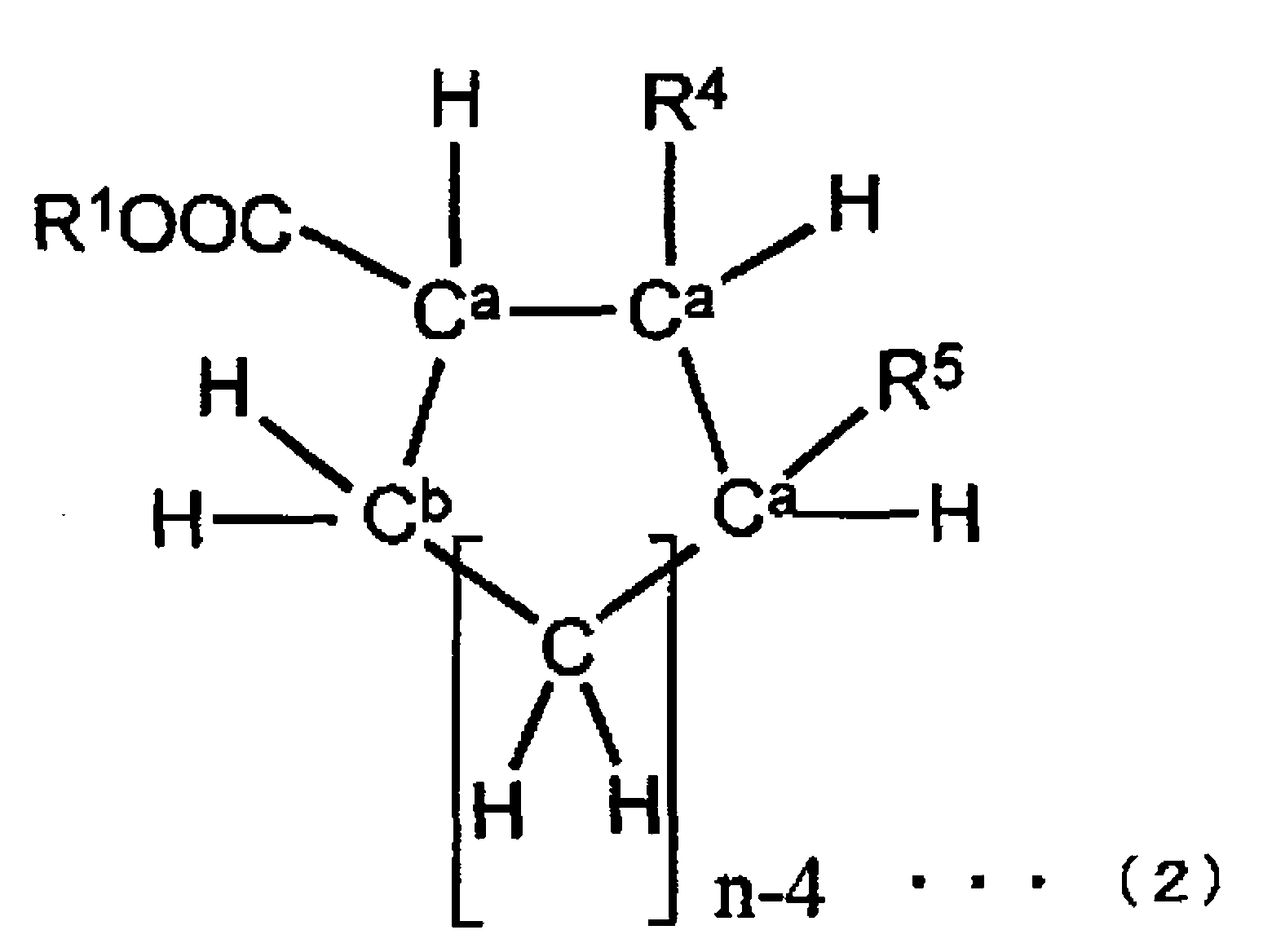
- the electron donor (a-3) preferably used includes a cyclic ester compound specified by the following formula (1). Moreover, the cyclic ester compound specified by following formula (2) may be included.
- n is an integer of 5 to 10.
- R 2 and R 3 are each independently COOR 1 or R, and at least one of R 2 and R 3 is COOR 1 .
- Single bonds in the cyclic skeleton (excluding C a -C a bonds and C a -C b bonds when R 3 is R) may be replaced by double bonds.
- R 1 is each independently a monovalent hydrocarbon group having 1 to 20 carbon atoms.
- Plural Rs are each independently an atom or group selected from a hydrogen atom, a hydrocarbon group having 1 to 20 carbon atoms, a halogen atom, a nitrogen-containing group, an oxygen-containing group, a phosphorus-containing group, a halogen-containing group, and a silicon-containing group. And may be bonded to each other to form a ring, but at least one R is not a hydrogen atom.
- a double bond may be contained in the ring skeleton formed by bonding R to each other, and when the ring skeleton contains two or more C a bonded with COOR 1 , The number of carbon atoms constituting the skeleton is 5 to 10.
- n is an integer of 5 to 10.
- R 4 and R 5 are each independently COOR 1 or a hydrogen atom, and at least one of R 4 and R 5 is COOR 1 .
- R 1 is each independently a monovalent hydrocarbon group having 1 to 20 carbon atoms. Single bonds in the cyclic skeleton (excluding C a -C a bonds and C a -C b bonds when R 5 is R) may be replaced by double bonds.
- cyclic ester compounds represented by the formula (1) diisobutyl 3,6-dimethylcyclohexane-1,2-dicarboxylate, di-n-hexyl 3,6-dimethylcyclohexane-1,2-dicarboxylate, 3,6- Di-n-octyl dimethylcyclohexane-1,2-dicarboxylate, diisobutyl 3-methyl-6-ethylcyclohexane-1,2-dicarboxylate, di-n-hexyl 3-methyl-6-ethylcyclohexane-1,2-dicarboxylate , 3-methyl-6-ethylcyclohexane-1,2-dicarboxylate di-n-octyl, 3-methyl-6-n-propylcyclohexane-1,2-dicarboxylate diisobutyl, 3-methyl
- cyclohexane-1,2-dicarboxylate diisobutyl cyclohexane-1,2-dicarboxylate dihexyl
- cyclohexane-1,2-dicarboxylate diheptyl cyclohexane-1,2- Dioctyl dicarboxylate and di-2-ethylhexyl cyclohexane-1,2-dicarboxylate are particularly preferred.
- the carrier-supported solid titanium catalyst component (I) can be prepared using a carrier.
- the solid titanium catalyst component (I) can be prepared by adopting any method including known methods, but a few examples will be briefly described below. (1) A hydrocarbon solution of an adduct of an alcohol or metal acid ester or the like and a magnesium compound (a-1) is contacted with a titanium compound (a-2) or an organometallic compound to precipitate a solid, Alternatively, it is a method of causing a contact reaction with the titanium compound (a-2) while precipitating. (2) Contact the magnesium compound (a-1), alcohol, ester, etc. with the solid adduct with the titanium compound (a-2) or the organometallic compound, and then react with the titanium compound (a-2). How to make.
- Any of the above methods comprising a step carried out in the presence of an aromatic halogenated hydrocarbon or the like. These are mentioned as preferable examples.
- organometallic compound catalyst component (II) those containing a metal selected from Group 1, Group 2 and Group 13 of the periodic table are preferable. Specifically, organoaluminum compounds and Group I metals as shown below are used. And a complex alkyl compound of aluminum and aluminum, and an organometallic compound of a Group II metal.
- R 7 and R 8 are hydrocarbon groups usually containing 1 to 15 carbon atoms, preferably 1 to 4 carbon atoms, which may be the same or different from each other.
- X represents a halogen atom
- An organic aluminum compound represented by 0 ⁇ m ⁇ 3, r is 0 ⁇ n ⁇ 3, p is a number 0 ⁇ p ⁇ 3, q is a number 0 ⁇ q ⁇ 3, and m + r + p + q 3) (b -1).
- Examples of the organoaluminum compound (b-1) include R 7 m Al (OR 8 ) 3-m (R 7 and R 8 are the same as described above, and m is preferably a number of 1.5 ⁇ m ⁇ 3.
- a compound represented by R 7 m AlX 3-m (wherein R 7 is as defined above, X is a halogen, and m is preferably 0 ⁇ m ⁇ 3)
- a compound represented by R 7 m AlH 3-m (R 7 is as defined above, m is preferably 2 ⁇ m ⁇ 3)
- organosilicon compound catalyst component (III) examples include an organosilicon compound represented by the following formula (4).
- SiR 9 R 10 d (OR 11 ) 3-d (4) (In formula (4), d is 0, 1 or 2, R 9 is selected from the group consisting of cyclopentyl, cyclohexyl, cyclopentenyl, cyclopentadienyl, alkyl, dialkylamino and derivatives thereof.
- R 9 is preferably a cyclopentyl group, 2-methylcyclopentyl group, 3-methylcyclopentyl group, 2-ethylcyclopentyl group, 3-propylcyclopentyl group, 3-isopropylcyclopentyl group, 3-butyl Cyclopentyl group, 3-tert-butylcyclopentyl group, 2,2-dimethylcyclopentyl group, 2,3-dimethylcyclopentyl group, 2,5-dimethylcyclopentyl group, 2,2,5-trimethylcyclopentyl group, 2,3,4 , 5-tetramethylcyclopentyl group, 2,2,5,5-tetramethylcyclopentyl group, 1-cyclopentylpropyl group, 1-methyl-1-cyclopentylethyl group and other cyclopentyl groups or derivatives thereof; cyclohexyl group, 2-methyl Cyclohexyl group, 2-methyl Cyclohexyl group,
- hydrocarbon group represented by R 10 and R 5 include hydrocarbon groups such as an alkyl group, a cycloalkyl group, an aryl group, and an aralkyl group in addition to the above substituents. Can be mentioned. When two or more R 10 or R 11 are present, R 10 or R 11 may be the same or different, and R 10 and R 11 may be the same or different. In the formula (4), R 9 and R 10 may be cross-linked with an alkylene group or the like.
- organosilicon compound represented by the formula (4) examples include diethylaminotriethoxysilane, cyclopentyltrimethoxysilane, 2-methylcyclopentyltrimethoxysilane, 2,3-dimethylcyclopentyltrimethoxysilane, and 2,5.
- -Trialkoxysilanes such as dimethylcyclopentyltrimethoxysilane, cyclopentyltriethoxysilane, cyclopentenyltrimethoxysilane, 3-cyclopentenyltrimethoxysilane, 2,4-cyclopentadienyltrimethoxysilane, cyclohexyltrimethoxysilane; Dimethoxysilane, tert-butylethyldimethoxysilane, cyclopentyl tert-butyldimethoxysilane, cyclohexylisobutyldimethoxysilane, bisdiethylaminodimethoxysilane Lan, dicyclopentyldimethoxysilane, bis (2-methylcyclopentyl) dimethoxysilane, bis (3-tert-butylcyclopentyl) dimethoxysilane, bis (2,3-dimethylcyclopentyl
- diisopropyldimethoxysilane, tert-butylethyldimethoxysilane, cyclopentyl tert-butyldimethoxysilane, cyclohexylisobutyldimethoxysilane, bisdiethylaminodimethoxysilane, diethylaminotriethoxysilane, dicyclopentyldimethoxysilane, etc. have the stereoregularity of polypropylene. Since it becomes high, it is preferable, and dicyclopentyldimethoxysilane is particularly preferable among them. These compounds can be used alone or in combination of two or more.
- pre-polymerization is performed in advance. You can also.
- the olefin is polymerized in the presence of the solid titanium catalyst component (I), the organometallic compound catalyst component (II), and, if necessary, the organosilicon compound catalyst component (III).
- an ⁇ -olefin having 2 to 8 carbon atoms can be used.
- linear olefins such as ethylene, propylene, 1-butene and 1-octene; 3-methyl-1-butene, 3-methyl-1-pentene, 3-ethyl-1-pentene, 4- Methyl-1-pentene, 4-methyl-1-hexene, 4,4-dimethyl-1-hexene, 4,4-dimethyl-1-pentene, 4-ethyl-1-hexene, 3-ethyl-1-hexene, etc.
- An olefin having a branched structure can be used. These may be copolymerized.
- bulky olefins such as 3-methyl-1-butene and 3-methyl-1-pentene.
- the prepolymerization is desirably performed so that about 0.1 to 1000 g, preferably about 0.3 to 500 g of a polymer is formed per 1 g of the solid titanium catalyst component (I). If the amount of prepolymerization is too large, the production efficiency of the polymer in the main polymerization may decrease.
- the catalyst can be used at a considerably higher concentration than the catalyst concentration in the system in the main polymerization.
- the solid titanium catalyst component (I) (or the prepolymerized catalyst) is converted to about 0.0001 to 50 mmol, preferably about 0.001 to 10 mmol in terms of titanium atom per liter of polymerization volume. It is desirable to use in quantity.
- the organometallic compound catalyst component (II) is desirably used in an amount of about 1 to 2000 moles, preferably about 2 to 500 moles, based on 1 mole of titanium atoms in the polymerization system.
- the organosilicon compound catalyst component (III) is desirably used in an amount of about 0.001 to 50 moles, preferably about 0.01 to 20 moles per mole of metal atoms of the organometallic compound catalyst component (II).
- Polymerization may be performed by any of a gas phase polymerization method, a liquid phase polymerization method such as a solution polymerization method and a suspension polymerization method, and each stage may be performed by a separate method. Further, it may be carried out by either a continuous type or a semi-continuous type, and each stage may be divided into a plurality of polymerization vessels, for example, 2 to 10 polymerization vessels.
- the polymerization medium inert hydrocarbons may be used, or liquid propylene may be used as the polymerization medium.
- the polymerization conditions in each stage are such that the polymerization temperature is in the range of about ⁇ 50 to + 200 ° C., preferably about 20 to 100 ° C., and the polymerization pressure is atmospheric pressure to 10 MPa (gauge pressure), preferably about 0.2 to 5 MPa. It is appropriately selected within the range of (gauge pressure).
- polypropylene is obtained as a powder by performing post-treatment steps such as a known catalyst deactivation treatment step, a catalyst residue removal step, and a drying step as necessary.
- the solid titanium catalyst component include Japanese Patent No. 2723137, Japanese Patent No. 2769914, International Publication No. 2006/77945, International Publication No. 2008/10459, Japanese Patent Laid-Open No. 4-218507, and Japanese Patent No. 2774160.
- Some of the catalysts disclosed in International Publication No. 2004/16662, Japanese Patent Application Laid-Open No. 2011-256278, Japanese Patent Application Laid-Open No. 2009-57473, and the like can also be used.
- antioxidants and neutralizers that can be generally added to polypropylene resins to the polypropylene.
- the blending amount of the antioxidant must be 500 ppm or more and less than 8000 ppm, preferably 750 ppm or more and less than 7500 ppm with respect to the polypropylene resin.
- the neutralizing agent that leads to film defects such as increased fisheye and sticky components is 5 ppm to 1000 ppm.
- the blending amount is less than 10 ppm, preferably 10 ppm or more and less than 750 ppm, more preferably 15 ppm or more and less than 500 ppm.
- additives other than the antioxidant and the neutralizing agent any known additive that can be blended in the polypropylene resin can be used as long as the purpose of the present invention is not impaired.
- ⁇ crystal nucleating agents such as acid ester metal salts and sorbitol compounds and ⁇ crystal nucleating agents such as amide compounds
- ultraviolet absorbers lubricants, flame retardants, antistatic agents, and the like
- lubricants lubricants
- flame retardants antistatic agents, and the like
- antistatic agents and the like
- a polypropylene composition is prepared by blending at least one material selected from the group consisting of a plasticizer, a polyolefin containing an ethylene-based copolymer, and an inorganic powder. Also good.
- polypropylene of the present invention may be blended with an ethylene-based copolymer for the purpose of imparting functions such as shutdown characteristics, for example, as long as the object of the present invention is not violated.
- the ethylene copolymer density 925 ⁇ 970kg / m 3, preferably ethylene-based copolymer of 930 ⁇ 965kg / m 3.
- the intrinsic viscosity [ ⁇ ] measured using a decalin solution of an ethylene copolymer is preferably 2 to 40 dl / g, more preferably 3 to 40 dl / g.
- the blending amount of the ethylene copolymer in the polypropylene fat composition containing polypropylene and the ethylene copolymer varies depending on the properties to be imparted, but is usually 1 to 50% by mass, preferably 5 to 40% by mass. .
- the polypropylene of the present invention may be blended with a plasticizer as long as the object of the present application is not impaired.
- the plasticizer is a liquid solvent at room temperature, nonane, decane, decalin, paraxylene, liquid paraffin and other aliphatic, cycloaliphatic or aromatic hydrocarbons, and mineral oil fractions with boiling points corresponding to these, room temperature
- solid solvents include stearyl alcohol and paraffin wax.
- a solvent which is liquid at room temperature is preferable, and liquid paraffin is particularly preferable.
- a part of the process for producing the microporous film includes a film washing process using a solvent.
- the polypropylene of the present invention may be blended with inorganic powder for the purpose of adjusting the shape and amount of holes and heat resistance.
- the inorganic powder examples include talc, clay, calcium carbonate, mica, silicates, carbonates, glass fibers, carbon fibers, and oxides and nitrides of metals such as silicon, aluminum, and titanium. Among these, metal oxides and nitrides are preferable, and silica powder is particularly preferable.
- the average particle size of the inorganic powder is desirably 0.001 to 10 ⁇ m, preferably 0.01 to 5 ⁇ m.
- Inorganic powder can be used individually by 1 type, and can also be used in combination of 2 or more type.
- the compounding amount of the inorganic powder is 1 to 80 parts by weight, preferably 10 to 60 parts by weight.
- melt-kneading and pelletizing are performed by melt-kneading at 170 to 280 ° C., preferably 190 to 250 ° C., and pelletizing using an ordinary single-screw extruder, twin-screw extruder, Brabender or roll.
- melt-kneading and pelletizing are performed by melt-kneading at 170 to 280 ° C., preferably 190 to 250 ° C., and pelletizing using an ordinary single-screw extruder, twin-screw extruder, Brabender or roll.
- it can be directly formed into a raw sheet or film for a microporous film by using a conventionally known technique without pelletizing.
- the preferable aspect at the time of preparing a microporous film using the polypropylene of this invention is as follows. That is, by using the polypropylene of the present invention and forming through the following raw film production process and stretching process (the cold stretching process followed by the warm stretching process), the film has excellent balance of film strength and air permeability.
- a microporous film can be produced.
- the extrusion temperature is set to 180 ° C to 250 ° C, preferably 180 ° C to 240 ° C, more preferably 190 ° C to 230 ° C. If the temperature is lower than the lower limit temperature, unmelted flaws and uneven melting occur, and if it exceeds the upper limit temperature, the molecular orientation of the raw film is insufficient, which is not preferable.
- the value obtained by dividing the lip opening of the T die by the thickness of the original film (drawing magnification) is set to 50 or more and less than 500, preferably 60 or more and less than 300, and more preferably 70 or more and less than 300.
- the film thickness of the raw film is set in the range of 10 ⁇ m to 50 ⁇ m. This range is preferable because the orientation of the raw film is particularly large, and micropores are formed between lamellae in the next stretching step.
- the temperature of the cooling roll (chill roll temperature) during production of the raw film is set to 60 ° C. to 160 ° C., preferably 80 ° C. to 150 ° C., more preferably 100 ° C. to 140 ° C.
- the chill roll temperature is set below the lower limit temperature, the raw film is rapidly cooled, resulting in a decrease in crystallinity and crystal size, and in the next stretching step, the lamella in the original film is deformed and micropores are formed. Since it is not formed, it is not preferable.
- the chill roll temperature exceeds the upper limit temperature, the molten film cannot be sufficiently solidified, and it is difficult to produce a raw film, which is not preferable.
- the obtained raw film is 80 ° C. or higher and 170 ° C. or lower, preferably 80 ° C. or higher and 160 ° C. or lower, more preferably 80 ° C. or higher and 150 ° C. or lower for 5 minutes or longer, preferably 30 minutes or longer, more preferably 1 hour. It is preferable to perform the above aging. This is because by aging the raw film within the above range, many fine pores are formed uniformly in the next stretching step, and the air permeability of the microporous film is improved. If the aging temperature range is set below the lower limit temperature, crystals do not grow sufficiently during aging, the effect of aging is not observed, and if the upper limit temperature is set, the raw film may melt, which is not preferable. .
- steps such as surface treatment such as corona treatment, flame treatment, ozone treatment, and hydrophilization treatment may be performed on both surfaces or one of the surfaces of the raw film.
- steps such as surface treatment such as corona treatment, flame treatment, ozone treatment, and hydrophilization treatment may be performed on both surfaces or one of the surfaces of the raw film.
- it may be blended with a resin having a lower melting point than the polypropylene of the present invention (including the above-mentioned polyethylene), or a multilayer film with a low melting point resin may be produced.
- blending or multilayering with resins such as polyolefin and polyamide having a melting point higher than that of the polypropylene of the present invention may be performed.
- Stretching process As stretching of the raw film, general stretching methods such as a roll stretching method, a tenter stretching method, and a tubular stretching method can be applied.
- the stretching method is not particularly limited, but uniaxial stretching using a roll stretching method is preferable.
- the stretching step consists of two steps. First, cold stretching is performed to cause cracks between lamellae, and then warm stretching is performed while maintaining the stretching ratio of cold stretching, and the cracks are expanded to form micropores.
- the stretching temperature of the original fabric film is 0 ° C. or higher and lower than 100 ° C., preferably 5 ° C. or higher and lower than 100 ° C., more preferably 10 ° C. or higher and lower than 100 ° C. It is 1.05 times or more and 3.00 times or less, preferably 1.10 times or more and 2.50 times or less, more preferably 1.15 times or more and 2.50 times or less.
- the stretching temperature is less than the lower limit, there is a case where the raw film is broken without causing cracks between lamellae, which is not preferable.
- the upper limit temperature is exceeded, the lamella is also deformed and no crack is generated. If the draw ratio is less than the lower limit, cracks do not occur, and if it exceeds the upper limit, the raw film may be broken.
- the drawing temperature is 100 ° C. or higher and lower than 170 ° C., preferably 100 ° C. or higher and lower than 165 ° C., more preferably 100 ° C. or higher and lower than 160 ° C.
- the draw ratio is 1 with respect to the film after cold drawing. 0.05 times or more and 3.00 times or less, preferably 1.10 times or more and 2.50 times or less, more preferably 1.15 times or more and 2.50 times or less.
- the stretching temperature is less than the lower limit, micropores are not formed, and through-holes are not effectively formed. If the upper limit is exceeded, the crystals melt and micropores are not formed.
- the draw ratio is less than the lower limit, micropores are not formed, and if it exceeds the upper limit, the raw film may be broken. Moreover, it is preferable to carry out warm drawing, maintaining the draw ratio of the film by cold drawing.
- the microporous film after hot stretching may be aged as necessary.
- the aging temperature is 30 ° C. or higher and lower than 170 ° C., preferably 40 ° C. or higher and lower than 165 ° C., more preferably 50 ° C. or higher and lower than 160 ° C.
- the fixing ratio of the film during aging is 0 with respect to the film after warm stretching. 70 times or more and 1.0 times or less, preferably 0.75 times or more and 1.00 times or less, more preferably 0.80 times or more and 0.95 times or less.
- the heat shrinkage rate of the microporous film cannot be adjusted, and if the upper limit is exceeded, the polypropylene crystals may melt and air permeability may be reduced.
- the micropores formed by stretching may be closed, or the size of the micropores may be extremely small, which may reduce the air permeability.
- Exceeding the upper limit is not preferable because the heat shrinkage rate cannot be adjusted.
- the film thickness of the microporous film is 10 ⁇ m or more and less than 50 ⁇ m, preferably 15 ⁇ m or more and less than 45 ⁇ m, more preferably 15 ⁇ m or more and less than 40 ⁇ m.
- the film thickness is less than the lower limit, the strength of the microporous film is lowered, which is not preferable.
- the film thickness exceeds the upper limit it is difficult to form a through hole, and thus the air permeability may be lowered. (surface treatment) If necessary, surface treatment using an inorganic coating for imparting heat resistance and chemical resistance to the obtained microporous film or a surfactant for changing wettability, etc. on both surfaces of the film or either Or it may be applied to one surface.
- the obtained microporous film is multilayered with a resin having a melting point lower than that of the polypropylene of the present invention (including an ethylene polymer), and further heat resistance is imparted.
- a resin having a melting point lower than that of the polypropylene of the present invention including an ethylene polymer
- multilayering with a resin having a melting point higher than that of the polypropylene of the present invention may be performed.
- a method of co-extrusion with polyethylene or low melting point polypropylene may be used.
- the polypropylene (PP) / polyethylene (PE) or low melting point polypropylene (PP)) / PP of the present invention or (PE or low melting point PP) / the present invention.
- a method for producing a multilayered raw film having a three-layer structure such as PP / (PE or low melting point PP).
- a method of producing and bonding microporous films using the polypropylene, polyethylene and low melting point polypropylene of the present invention may be used.
- a microporous film using a heat-resistant resin such as an aramid resin is prepared, and the microporous film is laminated by pasting the microporous film made of the polypropylene of the present invention. Multi-layering of the film may be performed.
- the polypropylene of the present invention is preferably used in one type selected from the group consisting of a microporous film, a separator, a filtration film and a separation membrane.
- the separator is a battery separator or a capacitor separator, and the battery separator is particularly preferably a lithium ion secondary battery separator.
- the filtration film is a medical filtration film, and the separation membrane is a medical separation membrane.
- Mobile phase medium o-dichlorobenzene Flow rate: 1.0 ml / min Measurement temperature: 140 ° C.
- Method for preparing calibration curve Sample concentration using standard polystyrene sample: 0.10% (W / W) Sample solution volume: 500 ⁇ l
- the Mw value, Mw / Mn value, and Mz / Mw value of the polypropylene of the present invention were calculated by measuring under the conditions of and analyzing the obtained chromatogram by a known method. The molecular weight was calculated by the universal calibration method, and the value in terms of polystyrene was calculated.
- the baseline of the GPC chromatogram is based on the retention time at which the elution curve rises, and the retention time corresponding to a molecular weight of 1000 as the end point. [Ultra-high molecular weight component amount (%)] From the chromatogram obtained at the time of molecular weight measurement, the peak ratio having a molecular weight of 7 million or more in the entire peak was calculated using the following formula.
- the filtrate is concentrated and dried, then dried at 60 ° C. and 160 mmHg for 6 hours, and the residue weight is weighed.
- the ratio of the weight of the sample used and the weight of the xylene eluate was calculated as the amount of CXS.
- MFR Melt flow rate
- the melt flow rate (MFR) was measured under the conditions of 230 ° C. and 2.16 kg load according to JISK7210.
- [Evaluation of microporous film] (Molding condition range) Using the molding conditions described in “(5) Production of microporous film” described later, in the range of about ⁇ 15% of the resin temperature of the T die at the time of forming the raw film, the stretching temperature in the warm stretching step, and the stretching ratio. Molded.
- the molding condition ranges are: T-die resin temperature 190 ° C, 210 ° C, 240 ° C, stretching temperature 110-150 ° C (every 5 ° C), draw ratio 1.2-1.7 times (every 0.1 times) ) And the setting were changed.
- the superiority or inferiority was judged as follows.
- TK homomixer M type (TK homomixer M type)) with an internal volume of 2 liters was sufficiently substituted with nitrogen, 700 ml of purified decane, 10 g of commercially available magnesium chloride, 24. 2 g and 3 g of the trade name Leodol SP-S20 (sorbite distearate manufactured by Kao Corporation) were added, and the temperature of the reaction system was increased while stirring the suspension. The suspension was heated at 120 ° C. and 800 rpm for 30 minutes. Stir. Next, while stirring this suspension at a high speed so as not to cause precipitation, 1 liter of purified decane that had been cooled to ⁇ 10 ° C. in advance was put in using a Teflon (registered trademark) tube having an inner diameter of 5 mm.
- Teflon registered trademark
- This solid adduct is suspended in decane, and 23 mmol of the above solid adduct converted to magnesium atom is introduced into 100 ml of titanium tetrachloride maintained at ⁇ 20 ° C. with stirring, and the mixture is mixed. Got. The mixture was heated to 80 ° C. over 5 hours, and when it reached 80 ° C., diisobutyl 3,6-dimethylcyclohexane-1,2-dicarboxylate (cis isomer, trans isomer mixture) was converted into a solid adduct. Was added in an amount of 0.085 mol per 1 mol of magnesium atom, and the temperature was raised to 110 ° C. in 40 minutes.
- cyclohexane 1,2-dicarboxylate diisobutyl (cis isomer, trans isomer mixture) was further added in an amount of 0.0625 mol with respect to 1 mol of magnesium atom in the solid adduct, and the temperature was adjusted. These were reacted by holding at 110 ° C. with stirring for 90 minutes.
- the solid part was collected by hot filtration, and the solid part was resuspended in 100 ml of titanium tetrachloride, and then heated to 110 ° C. and stirred for 45 minutes. These were allowed to react by holding. After completion of the reaction for 45 minutes, the solid part was again collected by hot filtration, and washed sufficiently with decane and heptane at 100 ° C. until no free titanium compound was detected in the washing solution.
- the solid titanium catalyst component ( ⁇ -1) prepared by the above operation was stored as a decane suspension, but a part of this was dried for the purpose of examining the catalyst composition.
- the composition of the solid titanium catalyst component ( ⁇ -1) thus obtained was 3.2% by mass of titanium, 17% by mass of magnesium, 57% by mass of chlorine, and diisobutyl 3,6-dimethylcyclohexane 1,2-dicarboxylate.
- the content was 10.6% by mass, 8.9% by mass of cyclohexane 1,2-dicarboxylate diisobutyl and 0.6% by mass of the ethyl alcohol residue.
- This prepolymerization catalyst contained 6 g of polypropylene per 1 g of the transition metal catalyst component.
- the obtained slurry was sent to a vessel polymerization vessel equipped with a stirrer having an internal volume of 500 L and further polymerized.
- propylene was supplied at 34 kg / hour, and hydrogen was supplied so that the hydrogen concentration in the gas phase was 3.5 mol%.
- Polymerization was performed at a polymerization temperature of 67 ° C. and a pressure of 3.0 MPa / G.
- the obtained slurry was sent to a vessel polymerization vessel equipped with a stirrer having an internal volume of 500 L and further polymerized.
- propylene was supplied at 13 kg / hour, and hydrogen was supplied so that the hydrogen concentration in the gas phase was 2.7 mol%.
- Polymerization was performed at a polymerization temperature of 65 ° C. and a pressure of 2.7 MPa / G.
- the resulting slurry was deactivated and then sent to a liquid propylene washing tank to wash the polypropylene powder. After vaporizing the resulting slurry, gas-solid separation was performed to obtain a propylene polymer. The resulting propylene polymer was introduced into a conical dryer and vacuum dried at 80 ° C. Next, 60 g of pure water and 0.54 liter of propylene oxide were added to 100 kg of the product, and after dechlorination treatment at 90 ° C. for 2 hours, vacuum drying was performed at 80 ° C. to obtain polypropylene powder. .
- microporous film used for measurement of Gurley air permeability and puncture strength was produced as follows.
- Example 2 A microporous film was obtained in the same manner as in Example 1 except that the main polymerization was changed as follows.
- the obtained slurry was sent to a vessel polymerization vessel equipped with a stirrer having an internal volume of 500 L and further polymerized.
- propylene was supplied at 29 kg / hour, and hydrogen was supplied so that the hydrogen concentration in the gas phase was 1.8 mol%.
- Polymerization was performed at a polymerization temperature of 71 ° C. and a pressure of 3.1 MPa / G.
- the obtained slurry was sent to a vessel polymerization vessel equipped with a stirrer having an internal volume of 500 L and further polymerized.
- Propylene was supplied to the polymerization vessel at 23 kg / hour, and hydrogen was supplied so that the hydrogen concentration in the gas phase was 1.5 mol%.
- Polymerization was performed at a polymerization temperature of 69 ° C. and a pressure of 3.1 MPa / G.
- the resulting slurry was deactivated and then sent to a liquid propylene washing tank to wash the polypropylene powder. After vaporizing the resulting slurry, gas-solid separation was performed to obtain a propylene polymer.
- the resulting propylene polymer was introduced into a conical dryer and vacuum dried at 80 ° C. Next, 60 g of pure water and 0.54 liter of propylene oxide were added to 100 kg of the product, and after dechlorination treatment at 90 ° C. for 2 hours, vacuum drying was performed at 80 ° C. to obtain polypropylene powder. .
- the obtained polypropylene was pelletized by the same method as in Example 1 to obtain a measurement sample, and physical properties were evaluated and a microporous film was formed. The results are shown in Table 1.
- Example 3 A microporous film was obtained in the same manner as in Example 1 except that the main polymerization was changed as follows.
- the obtained slurry was sent to a vessel polymerization vessel equipped with a stirrer having an internal volume of 500 L and further polymerized.
- propylene was supplied at 31 kg / hour, and hydrogen was supplied so that the hydrogen concentration in the gas phase was 2.2 mol%.
- Polymerization was performed at a polymerization temperature of 67 ° C. and a pressure of 2.9 MPa / G.
- the obtained slurry was sent to a vessel polymerization vessel equipped with a stirrer having an internal volume of 500 L and further polymerized.
- propylene was supplied at 15 kg / hour, and hydrogen was supplied so that the hydrogen concentration in the gas phase was 1.9 mol%.
- Polymerization was performed at a polymerization temperature of 65 ° C. and a pressure of 2.7 MPa / G.
- the obtained slurry was deactivated, and then sent to a liquid propylene washing tank to wash the polypropylene powder. After vaporizing the resulting slurry, gas-solid separation was performed to obtain a propylene polymer.
- the resulting propylene polymer was introduced into a conical dryer and vacuum dried at 80 ° C. Next, 60 g of pure water and 0.54 liter of propylene oxide were added to 100 kg of the product, and after dechlorination treatment at 90 ° C. for 2 hours, vacuum drying was performed at 80 ° C. to obtain polypropylene powder. .
- the obtained polypropylene was pelletized by the same method as in Example 1 to obtain a measurement sample, and physical properties were evaluated and a microporous film was formed.
- Example 4 A microporous film was obtained in the same manner as in Example 1 except that the main polymerization was changed as follows. (3) Main polymerization Into a vessel polymerization vessel with an internal volume of 1000 L, propylene in an amount of 132 kg / hour, the above catalyst slurry as a transition metal catalyst component, 1.4 g / hour, triethylaluminum 8.4 mL / hour, dicyclopentyldimethoxysilane 16.2 mL / hour was continuously supplied, and hydrogen was supplied so that the hydrogen concentration in the gas phase was 2.9 mol%. Polymerization was carried out at a polymerization temperature of 74 ° C. and a pressure of 3.2 MPa / G.
- the obtained slurry was sent to a vessel polymerization vessel equipped with a stirrer having an internal volume of 500 L and further polymerized.
- propylene was supplied at 29 kg / hour, and hydrogen was supplied so that the hydrogen concentration in the gas phase was 2.5 mol%.
- Polymerization was performed at a polymerization temperature of 71 ° C. and a pressure of 3.1 MPa / G.
- the obtained slurry was sent to a vessel polymerization vessel equipped with a stirrer having an internal volume of 500 L and further polymerized.
- propylene was supplied at a rate of 23 kg / hour, and hydrogen was supplied so that the hydrogen concentration in the gas phase was 2.0 mol%.
- Polymerization was performed at a polymerization temperature of 69 ° C. and a pressure of 3.1 MPa / G.
- the obtained slurry was deactivated, and then sent to a liquid propylene washing tank to wash the polypropylene powder. After vaporizing the resulting slurry, gas-solid separation was performed to obtain a propylene polymer.
- the resulting propylene polymer was introduced into a conical dryer and vacuum dried at 80 ° C. Next, 60 g of pure water and 0.54 liter of propylene oxide were added to 100 kg of the product, and after dechlorination treatment at 90 ° C. for 2 hours, vacuum drying was performed at 80 ° C. to obtain polypropylene powder. .
- the obtained polypropylene was pelletized by the same method as in Example 1 to obtain a measurement sample, and physical properties were evaluated and a microporous film was formed.
- the obtained solid catalyst component contained 2.2 wt% titanium and 11.0 wt% diisobutyl phthalate.
- Example 2 The obtained polypropylene was pelletized by the same method as in Example 1 to obtain a measurement sample, and physical properties were evaluated and a microporous film was formed. The results are shown in Table 1. Since the values of Mw / Mn and Mz / Mw were smaller than the lower limit values, a microporous film could not be formed.
- Example 3 A microporous film was obtained in the same manner as in Example 1 except that the main polymerization was changed as follows.
- the obtained slurry was sent to a vessel polymerization vessel equipped with a stirrer having an internal volume of 500 L and further polymerized.
- Propylene was supplied to the polymerization vessel at 34 kg / hour, and hydrogen was supplied so that the hydrogen concentration in the gas phase was 0.64 mol%.
- Polymerization was performed at a polymerization temperature of 71 ° C. and a pressure of 3.0 MPa / G.
- the obtained slurry was sent to a vessel polymerization vessel equipped with a stirrer having an internal volume of 500 L and further polymerized.
- propylene was supplied at 20 kg / hour, and hydrogen was supplied so that the hydrogen concentration in the gas phase was 0.49 mol%.
- Polymerization was performed at a polymerization temperature of 69 ° C. and a pressure of 3.0 MPa / G.
- the obtained slurry was deactivated, and then sent to a liquid propylene washing tank to wash the polypropylene powder. After vaporizing the resulting slurry, gas-solid separation was performed to obtain a propylene polymer.
- the resulting propylene polymer was introduced into a conical dryer and vacuum dried at 80 ° C. Next, 60 g of pure water and 0.54 liter of propylene oxide were added to 100 kg of the product, and after dechlorination treatment at 90 ° C. for 2 hours, vacuum drying was performed at 80 ° C. to obtain polypropylene powder. .
- the obtained polypropylene was pelletized by the same method as in Example 1 to obtain a measurement sample, and physical properties were evaluated and a microporous film was formed.
- the obtained PP1 and PP2 were dry blended at a ratio of 23 wt% / 77 wt%, and additives were blended and pelletized in the same manner as in Example 1 to make a measurement sample, to evaluate physical properties and to form a microporous film. It was. The results are shown in Table 1.
Landscapes
- Chemical & Material Sciences (AREA)
- Engineering & Computer Science (AREA)
- Chemical Kinetics & Catalysis (AREA)
- Mechanical Engineering (AREA)
- Polymers & Plastics (AREA)
- Health & Medical Sciences (AREA)
- Medicinal Chemistry (AREA)
- Organic Chemistry (AREA)
- Power Engineering (AREA)
- Manufacturing & Machinery (AREA)
- Materials Engineering (AREA)
- Microelectronics & Electronic Packaging (AREA)
- Electrochemistry (AREA)
- General Chemical & Material Sciences (AREA)
- Manufacture Of Porous Articles, And Recovery And Treatment Of Waste Products (AREA)
- Addition Polymer Or Copolymer, Post-Treatments, Or Chemical Modifications (AREA)
- Compositions Of Macromolecular Compounds (AREA)
Abstract
Description
(1)ゲルパーミエーションクロマトグラフィー(GPC)による重量平均分子量(Mw)値が100,000以上800,000未満であり、重量平均分子量を数平均分子量で除した値(Mw/Mn)が7.0より大きく12.0以下であり、かつZ平均分子量を重量平均分子量で除した値(Mz/Mw)が3.8以上9.0以下である。
(2)13C-NMR(核磁気共鳴法)で測定したメソペンタッド分率が95.5%以上である。
(3)含有Cl量が5.0ppm以下である。
(4)23℃におけるキシレン可溶部量(CXS)が5.0%以下である。
[4]分子量700万以上のポリプロピレンを0.3%以上1.5%以下含有すること特徴とする上記[1]~[3]のいずれか一項に記載の微多孔フィルム用ポリプロピレン。
[5]上記[1]~[4]のいずれか一項に記載の微多孔フィルム用ポリプロピレンを含む微多孔フィルム。
微多孔フィルムとは、0.03~2.0μm程度の微小孔が多数空いた高分子膜を指し、本発明では、JISP8117に準じて測定されるガーレ通気度が100~1000の範囲にある膜を微多孔フィルムと定義する。
本発明のポリプロピレンは、下記要件(1)~(2)を満たしている。
(4)23℃におけるキシレン可溶部量(CXS)が5.0%以下である。
本発明のポリプロピレンは、ゲルパーミエーションクロマトグラフィー(GPC)によるMw値が100,000以上800,000未満である。好ましくは200,000以上750,000未満、より好ましくは500,000より大きく750,000未満である。該Mw値が下限値未満になると、ラメラとラメラをつなぐタイ分子(すなわち、非晶鎖)の量が少なくなり、フィルム強度が低下するため好ましくない。上限値以上になると樹脂圧やモーター負荷の上昇等の押出負荷の増大が起こるため好ましくない。また、樹脂の流れ性の低下により、溶融ムラやスジ等が発生し、原反フィルムの厚み精度が低下することで、次工程の延伸に適した原反フィルムを作製することが困難となるため好ましくない。
本発明のポリプロピレンは、13C-NMR(核磁気共鳴法)で測定したメソペンタッド分率が95.5%以上である。好ましくは95.5%以上99.5%以下、より好ましくは95.5%以上99.0%以下である。メソペンタッド分率が上記範囲内にあると、原反フィルムの結晶化度が高くなり、延伸工程においてラメラが変形せずに非晶だけが変形するために効率的に微小孔が形成され、優れた通気性が得られる点で好ましい。一方、前記範囲の下限値未満になると、結晶化度、結晶サイズの低下により、延伸工程において、ラメラが変形しやすく、微多孔フィルムの通気性が低下する場合があるため好ましくない。
本発明のポリプロピレンは、下記(3)の要件を満たすことが好ましい。
本発明のポリプロピレンは、下記の(4)の要件を満たすことが好ましい。
(4)23℃におけるキシレン可溶部量(CXS)が5.0%以下である。23℃におけるキシレン可溶成分は、主として分子量が低く、立体規則性が低い成分であり、ゴム状の粘着性のある成分を主とする。このような成分が5.0%以下であれば、ベタつき成分が少なくなるため、得られる微多孔フィルム同士が良好なブロッキング性を示す。さらに本発明のポリプロピレンを濾過フィルムや分離膜、セパレーターに使用する場合は、得られる微多孔フィルムに接触する物質へ溶出する成分、もしくは内容物に接触し汚染する成分が少なくなる効果が得られる点でも好ましい。
《要件(5)》
本発明のポリプロピレンは、下記の(5)の要件を満たすことがさらに好ましい。
[微多孔フィルム用ポリプロピレンの製造方法]
以下、微多孔フィルム用ポリプロピレンの製造方法を説明する。本発明のポリプロピレンはプロピレン単独重合体でもプロピレン-αオレフィン共重合体(ランダムポリプロピレン)でもよいが、プロピレン単独重合体であることが好ましい。
(式(3)中、R6は炭化水素基、X1はハロゲン原子、0≦g≦4である。)
具体的にはTiCl4、TiBr4、TiI4などのテトラハロゲン化チタン;Ti(OCH3)Cl3、Ti(OC2H5)Cl3、Ti(O-n-C4H9)Cl3、Ti(OC2H5)Br3、Ti(O-iso-C4H9)Br3などのトリハロゲン化アルコキシチタン;Ti(OCH3)2Cl2、Ti(OC2H5)2Cl2、Ti(O-n-C4H9)2Cl2、Ti(OC2H5)2Br2などのジハロゲン化ジアルコキシチタン;Ti(OCH3)3Cl、Ti(OC2H5)3Cl、Ti(O-n-C4H9)3Cl、Ti(OC2H5)3Brなどのモノハロゲン化トリアルコキシチタン;Ti(OCH3)4、Ti(OC2H5)4、Ti(O-n-C4H9)4、Ti(O-iso-C4H9)4、Ti(O-2-エチルヘキシル)4などのテトラアルコキシチタン等が挙げられる。

(1)アルコールや金属酸エステルなどとマグネシウム化合物(a-1)との付加物の炭化水素溶液を、チタン化合物(a-2)や有機金属化合物と接触反応させて固体を析出させた後、または析出させながらチタン化合物(a-2)と接触反応させる方法。
(2)マグネシウム化合物(a-1)およびアルコールやエステルなどと固体状付加物をチタン化合物(a-2)や有機金属化合物と接触、反応させた後、チタン化合物(a-2)を接触反応させる方法。
(3)無機担体と有機マグネシウム化合物(a-1)との接触物に、チタン化合物(a-2)および電子供与体(a-3)を接触反応させる方法。この際予め接触物をハロゲン含有化合物および/または有機金属化合物と接触反応させてもよい。
(4)芳香族ハロゲン化炭化水素などの共存下に行う工程を含む上記いずれかの方法。
これらが好ましい例として挙げられる。
(式中、R7およびR8は炭素原子を通常1~15個、好ましくは1~4個含む炭化水素基であり、これらは互いに同一でも異なっていてもよい。Xはハロゲン原子を表し、0<m≦3、rは0≦n<3、pは0≦p<3、qは0≦q<3の数であり、かつm+r+p+q=3である。)で示される有機アルミニウム化合物(b-1)。
(式(4)中、dは0、1または2、R9はシクロペンチル基、シクロヘキシル基、シクロペンテニル基、シクロペンタジエニル基、アルキル基、ジアルキルアミノ基およびこれらの誘導体からなる群から選ばれる基、R10およびR11は炭化水素基を示す。)
式(4)において、R9の好ましいものとしては、シクロペンチル基、2-メチルシクロペンチル基、3-メチルシクロペンチル基、2-エチルシクロペンチル基、3-プロピルシクロペンチル基、3-イソプロピルシクロペンチル基、3-ブチルシクロペンチル基、3-tert-ブチルシクロペンチル基、2,2-ジメチルシクロペンチル基、2,3-ジメチルシクロペンチル基、2,5-ジメチルシクロペンチル基、2,2,5-トリメチルシクロペンチル基、2,3,4,5-テトラメチルシクロペンチル基、2,2,5,5-テトラメチルシクロペンチル基、1-シクロペンチルプロピル基、1-メチル-1-シクロペンチルエチル基などのシクロペンチル基またはその誘導体;シクロヘキシル基、2-メチルシクロヘキシル基、3-メチルシクロヘキシル基、4-メチルシクロヘキシル基、2-エチルシクロヘキシル基、3-エチルシクロヘキシル基、4-エチルシクロヘキシル基、3-プロピルシクロヘキシル基、3-イソプロピルシクロヘキシル基、3-ブチルシクロヘキシル基、3-tert-ブチルシクロヘキシル基、4-プロピルシクロヘキシル基、4-イソプロピルシクロヘキシル基、4-ブチルシクロヘキシル基、4-tert-ブチルシクロヘキシル基、2,2-ジメチルシクロヘキシル基、2,3-ジメチルシクロヘキシル基、2,5-ジメチルシクロヘキシル基、2,6-ジメチルシクロヘキシル基、2,2,5-トリメチルシクロヘキシル基、2,3,4,5-テトラメチルシクロヘキシル基、2,2,5,5-テトラメチルシクロヘキシル基、2,3,4,5,6-ペンタメチルシクロヘキシル基、1-シクロヘキシルプロピル基、1-メチル-1-シクロヘキシルエチル基などのシクロヘキシル基またはその誘導体;シクロペンテニル基、2-シクロペンテニル基、3-シクロペンテニル基、2-メチル-1-シクロペンテニル基、2-メチル-3-シクロペンテニル基、3-メチル-3-シクロペンテニル基、2-エチル-3-シクロペンテニル基、2,2-ジメチル-3-シクロペンテニル基、2,5-ジメチル-3-シクロペンテニル基、2,3,4,5-テトラメチル-3-シクロペンテニル基、2,2,5,5-テトラメチル-3-シクロペンテニル基などのシクロペンテニル基またはその誘導体;1,3-シクロペンタジエニル基、2,4-シクロペンタジエニル基、1,4-シクロペンタジエニル基、2-メチル-1,3-シクロペンタジエニル基、2-メチル-2,4-シクロペンタジエニル基、3-メチル-2,4-シクロペンタジエニル基、2-エチル-2,4-シクロペンタジエニル基、2,2-ジメチル-2,4-シクロペンタジエニル基、2,3-ジメチル-2,4-シクロペンタジエニル基、2,5-ジメチル-2,4-シクロペンタジエニル基、2,3,4,5-テトラメチル-2,4-シクロペンタジエニル基などのシクロペンタジエニル基またはその誘導体;イソプロピル基、tert-ブチル基、sec-ブチル基等のアルキル基;ジメチルアミノ基、ジエチルアミノ基、ジブチルアミノ基などのジアルキルアミノ基などの嵩高い置換基が挙げられる。より好ましくはシクロペンチル基、シクロヘキシル基、イソプロピル基であり、特に好ましくはシクロペンチル基である。
前記ポリプロピレンには添加剤としては、一般的にポリプロピレン樹脂に配合可能な公知の酸化防止剤、中和剤を配合することが好ましい。酸化防止剤の配合量はポリプロピレン樹脂に対して500ppm以上8000ppm未満、好ましくは750ppm以上7500ppm未満が必要であり、一方でフィッシュアイやベタつき成分の増加といったフィルムの不良につながる中和剤は5ppm以上1000ppm未満、好ましくは10ppm以上750ppm未満、より好ましくは15ppm以上500ppm未満の配合量が必要と考えられる。
[その他の成分]
本発明のポリプロピレンから微多孔フィルムを製造する際には、可塑剤、エチレン系共重合体を含むポリオレフィンおよび無機粉体からなる群より選ばれる少なくとも1種以上の材料を配合してポリプロピレン組成物としてもよい。
(ポリプロピレン以外のポリオレフィン)
本発明のポリプロピレンには、本発明の目的に反しない限り、例えばシャットダウン特性等の機能を付与する目的で、エチレン系共重合体を配合させてもよい。
(可塑剤)
本発明のポリプロピレンは、本願の目的を阻害しない範囲で可塑剤を配合させてもよい。
(無機粉体)
本発明のポリプロピレンは、孔の形状や量、耐熱性を調整する目的で、無機粉体を配合させてもよい。
[微多孔フィルムの調製方法]
本発明のポリプロピレンを用いた微多孔フィルムの調製方法としては、公知の各種の方法を用いることができる。例えば、ヘンシェルミキサー、リボンブレンダー、バンバリーミキサーなどの通常の混練装置を用いて、上述した各種成分を混練する方法が挙げられる。溶融混練およびペレタイズは、通常の単軸押出機あるいは2軸押出機、ブラベンダー又はロールを使用して、170~280℃、好ましくは190~250℃で溶融混練し、ペレタイズする。またはペレタイズなしに直接微多孔フィルム用の原反シート又は原反フィルムに従来公知の技術を用いて成形できる。
(原反フィルムの作製工程)原反フィルムの作製方法において、円筒状ダイスを使用するインフレーション成形機、長方形の口金形状のダイ(Tダイ)を使用するキャスト成形機、シート成形機などの一般的なフィルム成形機を用いることができる。特に、Tダイを有するキャスト成形機やシート成形機は一軸延伸が容易であるので好ましい。
原反フィルムの延伸としては、ロール延伸法、テンター延伸法及びチューブラー延伸法等の一般的な延伸方法が適用できる。特に延伸方法は限定されるものではないが、ロール延伸法を用いた一軸延伸が好ましい。延伸工程は2工程からなり、最初に冷延伸を行い、ラメラ間に亀裂を生じさせ、次いで冷延伸の延伸倍率を維持したまま温延伸を行い、亀裂を広げて微小孔を形成させる。
(表面処理)
必要に応じて、得られた微多孔フィルムに耐熱性や耐薬品性を付与するための無機物コーティングや、濡れ性を変化させるための界面活性剤等を利用した表面処理をフィルムの両表面もしくはどちらか片方の表面にほどこしてもよい。また、シャットダウン機能を付与する等の目的で、得られた微多孔フィルムに、例えば本発明のポリプロピレンよりも低融点の(エチレン系重合体を含む)樹脂との多層化、更なる耐熱性付与を目的に本発明のポリプロピレンよりも高融点の樹脂との多層化が行われてもよい。
(微多孔フィルムの多層フィルム化)
本発明のポリプロピレンはポリエチレンや低融点ポリプロピレンと共押出成形を行う方法を用いてもよい。たとえば、シャットダウン性を付与することを目的に、本発明のポリプロピレン(PP)/(ポリエチレン(PE)または低融点ポリプロピレン(PP))/本発明のPP、あるいは(PEまたは低融点PP)/本発明のPP/(PEまたは低融点PP)といった3層構成の多層化原反フィルムを作製する方法が挙げられる。また、本発明のポリプロピレン、ポリエチレン、低融点ポリプロピレンを使用した微多孔フィルムをそれぞれ作製し、張り合わせる方法を用いてもよい。
[用途]
本発明のポリプロピレンは、微多孔フィルム、セパレーター、濾過フィルムおよび分離膜からなる群より選ばれる1種に用いられることが好ましい。
[分子量、分子量分布]
液体クロマトグラフ:Waters製ALC/GPC150-Cplus型(示差屈折計検出器一体型)カラム:東ソー株式会社製GMH6-HT×2本およびGMH6-HTL×2本を直列接続した。
流速: 1.0ml/分
測定温度: 140℃
検量線の作成方法: 標準ポリスチレンサンプルを使用した
サンプル濃度: 0.10%(W/W)
サンプル溶液量: 500μl
の条件で測定し、得られたクロマトグラムを公知の方法によって解析することで、本発明のポリプロピレンのMw値、Mw/Mn値およびMz/Mw値を算出した。分子量の算出はユニバーサルキャリブレーション法により行い、ポリスチレン換算の値を算出した。GPCクロマトグラムのベースラインは、溶出曲線の立ち上がる保持時間を起点とし、分子量1000に相当する保持時間を終点とした。
[超高分子量成分量(%)]
分子量測定時に得られるクロマトグラムより、下記式を用いて、ピーク全体の中に占める分子量が700万以上のピーク割合を算出した。
[メソペンタッド分率]
メソペンタッド分率[mmmm]は、A.zambelliらのMacromolecules,8,687(1975)に示された帰属により定められた値であり、13C-NMRにより、下記条件で測定し、メソペンタッド分率=(21.7ppmでのピーク面積)/(19~23ppmでのピーク面積)とした。
分解能 400MHz
測定温度 125℃
溶媒 1,2,4-トリクロロベンゼン/重水素化ベンゼン=7/4
パルス幅 7.8μsec(45°パルス)
パルス間隔 5sec
積算回数 2000回
シフト基準 TMS=0ppm
モード シングルパルスブロードバンドデカップリング
[含有Cl量]
ポリプロピレン樹脂0.8gを三菱化成社製燃焼装置でアルゴン/酸素気流下で、400~900℃で燃焼した後、燃焼ガスを超純水で捕集し濃縮後の試料液を、日本ダイオネック(株)DIONEX-DX300型イオンクロマト測定装置を用いて、陰イオンカラムAS4A-SC(ダイオネッス社製)を用いて測定した。
[23℃におけるキシレン可溶部量(CXS)]
秤量したポリプロピレン系樹脂試料5gを500mlの沸騰キシレン中で完全に溶解した後、液温が20℃になるまで静置する。液温が20℃になってから、更に30分間静置した後、沈殿物をろ過する。ろ液を濃縮、乾固した後、更に60℃かつ160mmHgで6時間乾燥し、残渣重量を秤量する。使用した試料の重量とキシレン溶出物の重量の比率をCXS量として算出した。
[メルトフローレート(MFR)]
メルトフローレート(MFR)は、JISK7210に従い、230℃、2.16kg荷重の条件下で測定した。
[微多孔フィルムの評価]
(成形条件範囲)
後述する「(5)微多孔フィルムの製造」に記載した成形条件を用いて、原反フィルム成形時におけるTダイの樹脂温度、温延伸工程における延伸温度、延伸倍率の±15%程度の範囲で成形した。具体的には成形条件範囲をTダイの樹脂温度190℃、210℃、240℃、延伸温度110~150℃(5℃毎)、延伸倍率1.2~1.7倍(0.1倍毎)と設定を変化させた。優劣は下記のように判断した。
(ガーレ通気度(秒/100ml))
JISP8117により測定した。測定装置はB型ガーレ式デンソメーター(東洋製機製作所製)を使用した。試験温度23℃、湿度50%RH。試料面積は645mm2。円筒重量567gにより、筒内の空気を試験円孔部から、筒外へ通過させる。空気100ccが通過する時間を測定し、通気度とした。
(突刺強度(N))
直径1mm、0.5mmRの針を用いて2mm/秒で突刺した時の最大荷重を測定し、25mm厚さに換算した。測定条件を下記に記す:
試験機:(株)東洋精機製作所ストログラフV10-D
試験速度: 120mm/min
先端: 1.0mmΦ、0.5mm
R受け: 30.0mmΦ(グロス試験治具)
[実施例1]
(1)固体触媒の製造
内容積2リットルの高速撹拌装置(特殊機化工業製(TKホモミクサーM型))を充分窒素置換した後、この装置に精製デカン700ml、市販塩化マグネシウム10g、エタノール24.2gおよび商品名レオドールSP-S20(花王(株)製ソルビタンジステアレート)3gを入れ、この懸濁液を撹拌しながら反応系を昇温し、懸濁液を120℃にて800rpmで30分撹拌した。次いで、この懸濁液を、沈殿物が生じないように高速撹拌しながら、内径5mmのテフロン(登録商標)製チューブを用いて、予め-10℃に冷却された精製デカン1リットルを張り込んである2リットルのガラスフラスコ(攪拌機付)に移した。移液により生成した固体を濾過し、精製n-ヘプタンで充分洗浄することにより、塩化マグネシウム1モルに対してエタノールが2.8モル配位した固体状付加物を得た。
前記の(1)で調製した固体触媒成分150g、トリエチルアルミニウム74.4mL、ヘプタン75Lを内容量200Lの攪拌機付きオートクレーブに挿入し、内温10~18℃に保ちプロピレンを900g挿入し、60分間攪拌しながら反応させた。この前重合触媒は遷移金属触媒成分1g当りポリプロピレンを6g含んでいた。
内容量1000Lの攪拌器付きベッセル重合器に、プロピレンを139kg/時間、上記触媒スラリーを遷移金属触媒成分として1.6g/時間、トリエチルアルミニウム10.7mL/時間、ジシクロペンチルジメトキシシラン18.3mL/時間を連続的に供給し、水素を気相部の水素濃度が4.5mol%になるように供給した。重合温度70℃、圧力3.0MPa/Gで重合を行った。
得られたポリプロピレンパウダーを重合体粒子100重量部、3,5-ジ-t-ブチル-4-ヒドロキシトルエンを0.2重量部、テトラキス[メチレン-3(3,5-ジ-t-ブチル-4-ヒドロキシフェニル)プロピオネート]メタンを0.5重量部、ステアリン酸カルシウム0.005重量部を配合した後、230℃で溶融し、(株)ジーエムエンジニアリング製GMZ50-32(L/D=32)単軸押出機でペレット化して測定試料とし、物性評価を行った。さらに作製したペレットを原料として以下の方法にて微多孔フィルムの製造を行い、微多孔フィルムの物性評価結果もペレットの物性評価結果と合わせて表1に記載した。
ガーレ透気度および突刺し強度の測定に用いる微多孔フィルムは以下のように製造した。
本重合を以下のように変えた以外は、実施例1と同様の方法により微多孔フィルムを得た。
内容量1000Lの攪拌器付きベッセル重合器に、プロピレンを132kg/時間、上記触媒スラリーを遷移金属触媒成分として1.4g/時間、トリエチルアルミニウム8.4mL/時間、ジシクロペンチルジメトキシシラン16.2mL/時間を連続的に供給し、水素を気相部の水素濃度が2.5mol%になるように供給した。重合温度74℃、圧力3.2MPa/Gで重合を行った。
本重合を以下のように変えた以外は、実施例1と同様の方法により微多孔フィルムを得た。
内容量1000Lの攪拌器付きベッセル重合器に、プロピレンを136.2kg/時間、上記触媒スラリーを遷移金属触媒成分として1.13g/時間、トリエチルアルミニウム8.2mL/時間、ジシクロペンチルジメトキシシラン1.6mL/時間を連続的に供給し、水素を気相部の水素濃度が2.9mol%になるように供給した。重合温度70℃、圧力3.0MPa/Gで重合を行った。
[実施例4]
本重合を以下のように変えた以外は、実施例1と同様の方法により微多孔フィルムを得た。
(3)本重合
内容量1000Lの攪拌器付きベッセル重合器に、プロピレンを132kg/時間、上記触媒スラリーを遷移金属触媒成分として1.4g/時間、トリエチルアルミニウム8.4mL/時間、ジシクロペンチルジメトキシシラン16.2mL/時間を連続的に供給し、水素を気相部の水素濃度が2.9mol%になるように供給した。重合温度74℃、圧力3.2MPa/Gで重合を行った。
[比較例1]
特開平9-52917号公報の実施例2に従い、以下の方法にてプロピレン樹脂のサンプルの作成を行った。
(触媒の調製)
無水塩化マグネシウム300グラム、灯油1.6リットル、2-エチルヘキシルアルコール1.5リットルを140℃で3時間加熱して均一溶液とした。この溶液に無水フタル酸70グラムを添加し、130℃で1時間攪拌して溶解した後、室温まで冷却した。さらに上記の溶液を-20℃に冷却した四塩化チタン8.5リットル中にゆっくり滴下した。滴下終了後110℃まで昇温し、フタル酸ジイソブチル215ミリリットルを加え、さらに2時間攪拌した。熱時ろ過により固体を分離し、得られた固体を再度四塩化チタン10リットル中に懸濁させ、再び110℃で2時間攪拌した。熱時ろ過により固体を分離し、得られた固体をn-ヘプタンで、洗浄液にチタンが実質上検出されなくなるまで洗浄した。得られた固体触媒成分はチタン2.2wt%、フタル酸ジイソブチル11.0wt%を含有していた。
(重合)
内容積70リットルの充分に乾燥し、窒素で置換したオートクレーブを準備し、トリエチルアルミニウム2ミリリットルをヘプタン1000ミリリットルで希釈した混合物、ジシクロヘキシルジメトキシシラン0.8ミリリットル、上記固体触媒成分150ミリグラムを加え、プロピレン20kg、水素17Nリットルを加え、70℃で2時間重合した。重合後未反応のプロピレンをデカンテーションにより分離し、重合生成物を液化プロピレンで3回洗浄した。次いで、生成物に水0.2グラムとプロピレンオキサイド10ミリリットルを添加して、さらに90℃で15分間処理し、減圧下で5分間乾燥した。このプロピレンオキサイドによる処理を3回繰り返し、生成ポリマーを取り出して秤量したところ9.10kgのポリプロピレンが得られた。
[比較例2]
実施例1の(3)で得られたポリプロピレンパウダーに分子量分布を狭く調製するために過酸化物(化薬アクゾ社製パーカドックス14)を40ppm加え、共に230℃で溶融し、(株)ジーエムエンジニアリング製GMZ50-32(L/D=32)単軸押出機でペレット化して測定試料とし、物性評価、微多孔フィルムの成形を行った。結果を表1に記載した。
[比較例3]
本重合を以下のように変えた以外は、実施例1と同様の方法により微多孔フィルムを得た。
内容量1000Lの攪拌器付きベッセル重合器に、プロピレンを130kg/時間、上記触媒スラリーを遷移金属触媒成分として1.3g/時間、トリエチルアルミニウム8.4mL/時間、ジノルマルプロピルジメトキシシラン0.8mL/時間を連続的に供給し、水素を気相部の水素濃度が0.78mol%になるように供給した。重合温度74℃、圧力3.1MPa/Gで重合を行った。
[比較例4]
国際公開番号WO2010/079799号公報の合成例1に従い、以下の方法にてプロピレン樹脂のサンプル(PP1)の作成を行った。
(プロピレン単独重合体(PP1)の合成)
(1)予備重合
内容積0.5リットルの攪拌機付きの三つ口フラスコを窒素ガスで置換した後、脱水処理したヘプタンを400ミリリットル、トリエチルアルミニウム18ミリモル、ジシクロペンチルジメトキシシラン3.7ミリモル、固体状チタン触媒成分(三井化学(株)社製TK200触媒)4gを加えた。内温を20℃で攪拌しながらプロピレンを導入した。1時間後、攪拌を停止し結果的に固体触媒1g当たり2.0gのプロピレンが重合した予備重合触媒成分を得た。
(2)プロピレン重合内容積6リットルの攪拌機付きステンレス製オートクレーブを充分乾燥し、窒素置換の後、脱水処理したヘプタン6リットル、トリエチルアルミニウム6ミリモル、ジシクロペンチルジメトキシシラン1.2ミリモルを加えた。系内の窒素をプロピレンで置換した後に、攪拌しながらプロピレンを導入した。
(プロピレン単独重合体(PP2)の調整)
比較例1で使用したポリプロピレンパウダーに過酸化物(化薬アクゾ社製パーカドックス14)を1500ppm加え、実施例1で使用した押出機にてペレタイズを行い、MFR=250のプロピレン単独重合体(PP2)を得た。
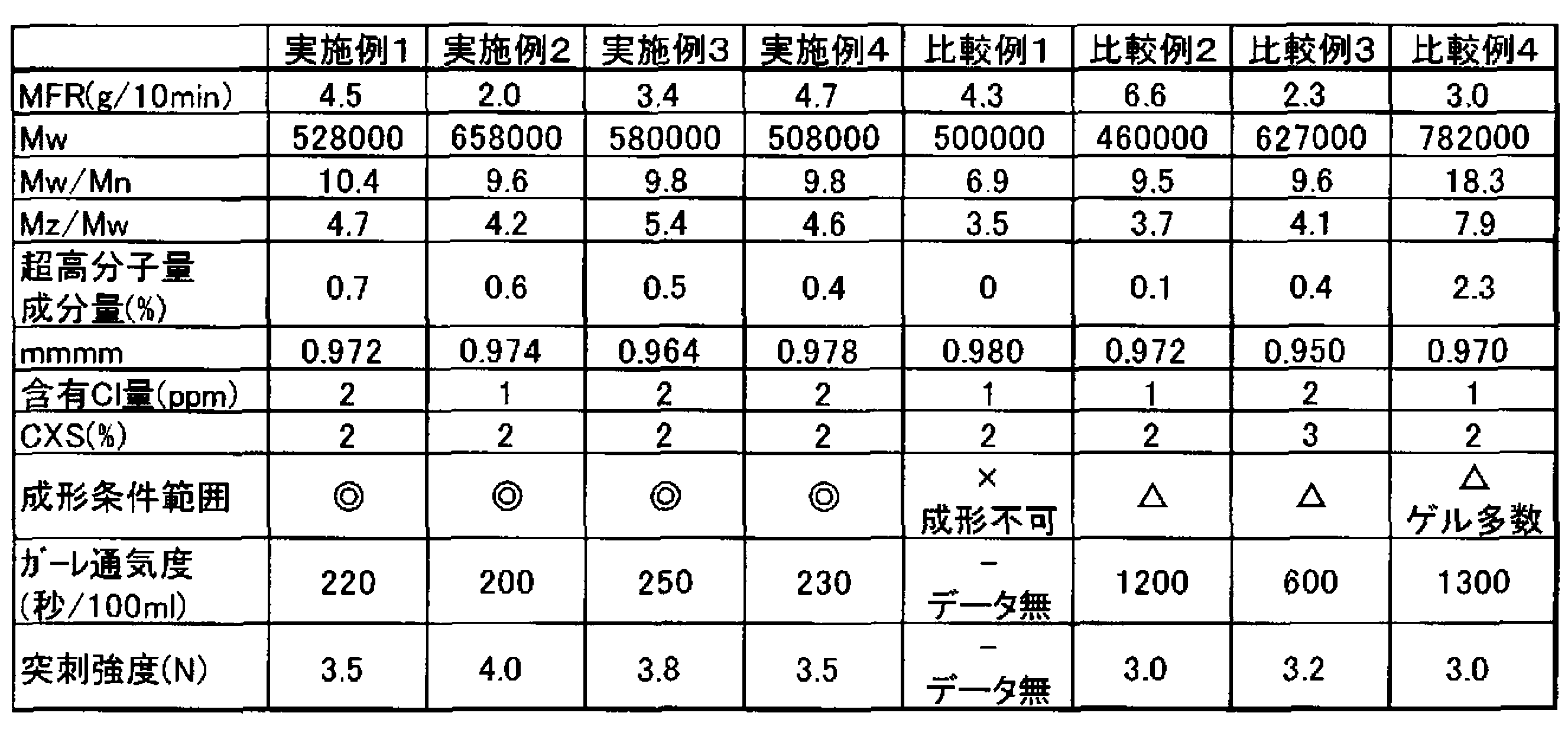
Claims (14)
- 下記要件(1)~(2)を満たすことを特徴とする、微多孔フィルム用ポリプロピレン。
(1)ゲルパーミエーションクロマトグラフィー(GPC)による重量平均分子量(Mw)値が100,000以上800,000未満であり、重量平均分子量を数平均分子量で除した値(Mw/Mn)が7.0より大きく12.0以下であり、かつZ平均分子量を重量平均分子量で除した値(Mz/Mw)が3.8以上9.0以下である。
(2)13C-NMR(核磁気共鳴法)で測定したメソペンタッド分率が95.5%以上である。 - 下記要件(3)を満たすことを特徴とする、請求項1に記載の微多孔フィルム用ポリプロピレン。
(3)含有Cl量が5.0ppm以下である。 - 下記要件(4)を満たすことを特徴とする、請求項1または2に記載の微多孔フィルム用ポリプロピレン。
(4)23℃におけるキシレン可溶部量(CXS)が5.0%以下である。 - 分子量700万以上のポリプロピレンを0.3%以上1.5%以下含有すること特徴とする請求項1~3のいずれか一項に記載の微多孔フィルム用ポリプロピレン。
- 請求項1~4のいずれか一項に記載の微多孔フィルム用ポリプロピレンを含む微多孔フィルム。
- 請求項1~4のいずれか一項に記載の微多孔フィルム用ポリプロピレンを含むセパレーター。
- 請求項1~4のいずれか一項に記載の微多孔フィルム用ポリプロピレンを含む濾過フィルム。
- 請求項1~4のいずれか一項に記載の微多孔フィルム用ポリプロピレンを含む分離膜。
- 請求項1~4のいずれか一項に記載の微多孔フィルム用ポリプロピレンを含む電池に用いられることを特徴とするセパレーター。
- 請求項1~4のいずれか一項に記載の微多孔フィルム用ポリプロピレンを含むコンデンサーに用いられることを特徴とするセパレーター。
- リチウムイオン二次電池に用いられることを特徴とする、請求項9に記載のセパレーター。
- 医療用途に用いられることを特徴とする請求項7に記載の濾過フィルム。
- 医薬用途に用いられることを特徴とする請求項8に記載の分離膜。
- 請求項1~4のいずれか一項に記載の微多孔フィルム用ポリプロピレンの原反フィルムを作製し、作製した原反フィルムを0℃以上100℃未満の温度で延伸する冷延伸工程を経て、前記冷延伸されたフィルムを、100℃以上170℃未満の温度で延伸する温延伸工程にて微多孔フィルムを製造する方法。
Priority Applications (6)
| Application Number | Priority Date | Filing Date | Title |
|---|---|---|---|
| SG11201503213PA SG11201503213PA (en) | 2012-10-25 | 2013-10-23 | Polypropylene for microporous film |
| EP13849075.0A EP2913350B1 (en) | 2012-10-25 | 2013-10-23 | Polypropylene for use in microporous films |
| KR1020157010250A KR102070560B1 (ko) | 2012-10-25 | 2013-10-23 | 미다공 필름용 폴리프로필렌 |
| CN201380054874.9A CN104736576B (zh) | 2012-10-25 | 2013-10-23 | 多微孔膜用聚丙烯 |
| US14/438,599 US10011693B2 (en) | 2012-10-25 | 2013-10-23 | Polypropylene for microporous film |
| JP2014543329A JP6289376B2 (ja) | 2012-10-25 | 2013-10-23 | 微多孔フィルムおよびその製造方法、セパレーター、濾過フィルム、分離膜 |
Applications Claiming Priority (2)
| Application Number | Priority Date | Filing Date | Title |
|---|---|---|---|
| JP2012235478 | 2012-10-25 | ||
| JP2012-235478 | 2012-10-25 |
Publications (1)
| Publication Number | Publication Date |
|---|---|
| WO2014065331A1 true WO2014065331A1 (ja) | 2014-05-01 |
Family
ID=50544706
Family Applications (1)
| Application Number | Title | Priority Date | Filing Date |
|---|---|---|---|
| PCT/JP2013/078720 Ceased WO2014065331A1 (ja) | 2012-10-25 | 2013-10-23 | 微多孔フィルム用ポリプロピレン |
Country Status (8)
| Country | Link |
|---|---|
| US (1) | US10011693B2 (ja) |
| EP (1) | EP2913350B1 (ja) |
| JP (1) | JP6289376B2 (ja) |
| KR (1) | KR102070560B1 (ja) |
| CN (1) | CN104736576B (ja) |
| SG (1) | SG11201503213PA (ja) |
| TW (1) | TWI605084B (ja) |
| WO (1) | WO2014065331A1 (ja) |
Cited By (12)
| Publication number | Priority date | Publication date | Assignee | Title |
|---|---|---|---|---|
| WO2016159069A1 (ja) * | 2015-03-31 | 2016-10-06 | 株式会社プライムポリマー | ポリプロピレン樹脂組成物及びその製造方法、二軸延伸フィルム及びその製造方法、並びにフィルムコンデンサ用キャパシタフィルム |
| JPWO2015012310A1 (ja) * | 2013-07-23 | 2017-03-02 | 東洋紡株式会社 | 空洞含有ポリプロピレンフィルム |
| WO2019093184A1 (ja) * | 2017-11-08 | 2019-05-16 | 東レ株式会社 | ポリオレフィン複合多孔質膜及びその製造方法、並びに電池用セパレータ及び電池 |
| EP3674331A1 (en) | 2018-12-27 | 2020-07-01 | Sumitomo Chemical Company, Limited | Olefin polymer and method for producing olefin polymer |
| KR20200081250A (ko) | 2018-12-27 | 2020-07-07 | 스미또모 가가꾸 가부시끼가이샤 | 올레핀 중합체, 및, 올레핀 중합체의 제조 방법 |
| JP2020105358A (ja) * | 2018-12-27 | 2020-07-09 | 株式会社プライムポリマー | プロピレン系重合体を含む延伸フィルム |
| JP2020114909A (ja) * | 2019-01-18 | 2020-07-30 | 株式会社プライムポリマー | プロピレン重合体組成物からなる微多孔フィルム |
| JPWO2020196120A1 (ja) * | 2019-03-27 | 2021-04-30 | 旭化成株式会社 | 蓄電デバイス用セパレータ |
| JP2022051522A (ja) * | 2020-09-18 | 2022-03-31 | 旭化成株式会社 | 蓄電デバイス用セパレータ及び蓄電デバイス |
| JP2022051521A (ja) * | 2020-09-18 | 2022-03-31 | 旭化成株式会社 | 蓄電デバイス用セパレータ |
| JP2022051520A (ja) * | 2020-09-18 | 2022-03-31 | 旭化成株式会社 | 蓄電デバイス用セパレータ及び蓄電デバイス |
| US12548849B2 (en) | 2020-04-13 | 2026-02-10 | Asahi Kasei Battery Separator Corporation | Method for producing separator for power storage device |
Families Citing this family (9)
| Publication number | Priority date | Publication date | Assignee | Title |
|---|---|---|---|---|
| JP6217542B2 (ja) | 2014-03-31 | 2017-10-25 | 王子ホールディングス株式会社 | コンデンサ用二軸延伸ポリプロピレンフィルム |
| CN106700224B (zh) * | 2015-07-23 | 2020-08-28 | 中国石化扬子石油化工有限公司 | 一种聚丙烯组合物及其制备方法 |
| EP3474909A1 (en) | 2016-06-28 | 2019-05-01 | Dow Global Technologies Llc | Microporous films, and articles made therefrom |
| EP3487928A1 (en) * | 2016-07-25 | 2019-05-29 | ExxonMobil Chemical Patents Inc. | Bimodal polypropylene compositions and method of making same |
| US10266685B2 (en) | 2016-07-25 | 2019-04-23 | Exxonmobil Chemical Patents Inc. | Bimodal polypropylene compositions and method of making same |
| JP6785002B2 (ja) * | 2016-12-21 | 2020-11-18 | 国立大学法人金沢大学 | 結晶性高分子の劣化測定方法 |
| US11177536B2 (en) * | 2017-11-08 | 2021-11-16 | Lg Chem, Ltd. | Separator with reduced ignition phenomenon upon battery perforation and battery including the same |
| CN111511829B (zh) | 2017-12-22 | 2023-11-24 | Sabic环球技术有限责任公司 | 用于带的丙烯组合物 |
| CN113320074A (zh) * | 2021-05-27 | 2021-08-31 | 北京艾和斯科畜牧科技有限公司 | 一种用于废气过滤的网状滤材的生产工艺 |
Citations (26)
| Publication number | Priority date | Publication date | Assignee | Title |
|---|---|---|---|---|
| JPH04218507A (ja) | 1990-04-13 | 1992-08-10 | Mitsui Petrochem Ind Ltd | オレフィン重合用固体状チタン触媒成分、オレフィン重合用触媒およびオレフィンの重合方法 |
| JPH0952917A (ja) | 1995-08-10 | 1997-02-25 | Mitsui Toatsu Chem Inc | ポリプロピレンおよびそれを用いた延伸フィルム |
| WO1997045463A1 (en) * | 1996-05-27 | 1997-12-04 | Mitsui Chemicals, Inc. | Crystalline polypropylene, process for preparing the same, polypropylene composition, and thermoformed article |
| JP2723137B2 (ja) | 1988-06-17 | 1998-03-09 | 三井化学株式会社 | オレフィンの重合方法およびオレフィン重合用触媒 |
| JP2774160B2 (ja) | 1988-09-30 | 1998-07-09 | ハイモント、インコーポレーテッド | オレフィン重合用触媒 |
| JP2776914B2 (ja) | 1988-09-30 | 1998-07-16 | ハイモント、インコーポレーテッド | オレフィン重合用固体触媒成分および触媒 |
| JPH11297297A (ja) | 1998-04-10 | 1999-10-29 | Ube Ind Ltd | 多孔質フイルムの製造方法および多孔質フイルム |
| JP2000204111A (ja) * | 1998-05-21 | 2000-07-25 | Grand Polymer:Kk | α―オレフィンの重合方法及びそれによって製造されるα―オレフィン重合体 |
| JP2000290333A (ja) * | 1999-02-04 | 2000-10-17 | Grand Polymer:Kk | ポリプロピレンブロック共重合体樹脂および製造方法 |
| JP2002284942A (ja) * | 2001-03-27 | 2002-10-03 | Grand Polymer Co Ltd | 結晶性ポリプロピレン樹脂組成物およびそれから製造されるシート |
| JP2003519723A (ja) | 2000-01-10 | 2003-06-24 | エルジー・ケミカル・カンパニー・リミテッド | 高結晶性ポリプロピレンの微細気孔膜、多成分系微細気孔膜及びその製造方法 |
| WO2004016662A1 (ja) | 2002-08-19 | 2004-02-26 | Ube Industries, Ltd. | α−オレフィンの重合又は共重合に用いられるα−オレフィンの重合又は重合用触媒、その触媒成分及びその触媒を用いたα−オレフィン重合方法 |
| WO2006077945A1 (ja) | 2005-01-19 | 2006-07-27 | Mitsui Chemicals, Inc. | 固体状チタン触媒成分、オレフィン重合用触媒およびオレフィン重合体の製造方法 |
| WO2008010459A1 (en) | 2006-07-18 | 2008-01-24 | Mitsui Chemicals, Inc. | Solid titanium catalyst ingredient, catalyst for olefin polymerization, and method of olefin polymerization |
| JP2009057473A (ja) | 2007-08-31 | 2009-03-19 | Mitsui Chemicals Inc | ポリプロピレン樹脂からなるキャパシタフィルム用原反シート、キャパシタフィルム及びそれらの製造方法 |
| WO2010079799A1 (ja) | 2009-01-07 | 2010-07-15 | 株式会社プライムポリマー | 微多孔膜形成用ポリプロピレン樹脂組成物 |
| JP2010248469A (ja) * | 2009-03-24 | 2010-11-04 | Mitsui Chemicals Inc | 固体状チタン触媒成分、オレフィン重合用触媒およびオレフィンの重合方法 |
| JP2011246659A (ja) | 2010-05-28 | 2011-12-08 | Sekisui Chem Co Ltd | プロピレン系樹脂微孔フィルム及びその製造方法 |
| JP2011246660A (ja) | 2010-05-28 | 2011-12-08 | Sekisui Chem Co Ltd | プロピレン系樹脂微孔フィルム及びその製造方法 |
| JP2011246658A (ja) | 2010-05-28 | 2011-12-08 | Sekisui Chem Co Ltd | プロピレン系樹脂微孔フィルム及びその製造方法 |
| JP2011256278A (ja) | 2010-06-09 | 2011-12-22 | Prime Polymer Co Ltd | 微多孔膜形成用プロピレン重合体およびその用途 |
| JP2011256316A (ja) | 2010-06-10 | 2011-12-22 | Asahi Kasei E-Materials Corp | 微多孔性フィルム及びその製造方法並びに電池用セパレータ |
| JP2012064556A (ja) | 2010-08-18 | 2012-03-29 | Sekisui Chem Co Ltd | プロピレン系樹脂微孔フィルム、電池用セパレータ、電池及びプロピレン系樹脂微孔フィルムの製造方法 |
| JP2012092286A (ja) | 2010-09-30 | 2012-05-17 | Sekisui Chem Co Ltd | プロピレン系樹脂微孔フィルム及びその製造方法、並びにリチウムイオン電池用セパレータ及びリチウムイオン電池 |
| JP2012092287A (ja) | 2010-09-30 | 2012-05-17 | Sekisui Chem Co Ltd | プロピレン系樹脂微孔フィルム及びその製造方法、並びにリチウムイオン電池用セパレータ及びリチウムイオン電池 |
| JP2012092288A (ja) | 2010-09-30 | 2012-05-17 | Sekisui Chem Co Ltd | プロピレン系樹脂微孔フィルム及びその製造方法、並びにリチウムイオン電池用セパレータ及びリチウムイオン電池 |
Family Cites Families (12)
| Publication number | Priority date | Publication date | Assignee | Title |
|---|---|---|---|---|
| KR920002488B1 (ko) | 1988-06-17 | 1992-03-26 | 미쓰이 세끼유 가가꾸 고오교오 가부시끼가이샤 | 올레핀의 중합방법 및 중합용 촉매 |
| US6403708B2 (en) | 1996-05-27 | 2002-06-11 | Mitsui Chemicals Inc | Crystalline polypropylenes, process for preparing thereof, polypropylene compositions, and thermoformed products |
| CN1213099C (zh) | 1997-04-24 | 2005-08-03 | 三井化学株式会社 | 结晶性聚丙烯树脂组合物 |
| US6376628B1 (en) | 1998-05-21 | 2002-04-23 | Grand Polymer Co., Ltd. | Process for polymerization of alpha-olefin and alpha-olefin polymer |
| JP4623831B2 (ja) | 1998-10-28 | 2011-02-02 | トレオファン・ジャーマニー・ゲーエムベーハー・ウント・コー・カーゲー | 昇温下において改善された収縮性を有する二軸配向電気絶縁性フィルム |
| KR100565151B1 (ko) | 1999-02-04 | 2006-03-30 | 미쓰이 가가쿠 가부시키가이샤 | 폴리프로필렌 블록 공중합체 수지 및 제조 방법 |
| KR100417254B1 (ko) * | 2000-01-10 | 2004-02-05 | 주식회사 엘지화학 | 고결정성 폴리프로필렌의 미세 기공막 및 이의 제조방법 |
| US20070203299A1 (en) * | 2006-02-27 | 2007-08-30 | Novolen Technology Holdings C.V. | High melt strength polypropylene |
| EP2093315A1 (en) * | 2008-02-22 | 2009-08-26 | Total Petrochemicals Research Feluy | Fibres and nonwoven prepared from polypropylene having a large dispersity index |
| EP2337114B1 (en) * | 2008-09-03 | 2016-11-02 | Mitsubishi Plastics, Inc. | Laminated porous film for separator |
| US9174384B2 (en) | 2009-09-01 | 2015-11-03 | Fina Technology, Inc. | Multilayer polypropylene films and methods of making and using same |
| SG10201500468RA (en) * | 2010-01-22 | 2015-03-30 | China Petroleum & Chemical | Propylene homopolymer having high melt strength and preparation method thereof |
-
2013
- 2013-10-23 CN CN201380054874.9A patent/CN104736576B/zh active Active
- 2013-10-23 SG SG11201503213PA patent/SG11201503213PA/en unknown
- 2013-10-23 JP JP2014543329A patent/JP6289376B2/ja active Active
- 2013-10-23 WO PCT/JP2013/078720 patent/WO2014065331A1/ja not_active Ceased
- 2013-10-23 US US14/438,599 patent/US10011693B2/en active Active
- 2013-10-23 KR KR1020157010250A patent/KR102070560B1/ko active Active
- 2013-10-23 EP EP13849075.0A patent/EP2913350B1/en active Active
- 2013-10-24 TW TW102138418A patent/TWI605084B/zh active
Patent Citations (26)
| Publication number | Priority date | Publication date | Assignee | Title |
|---|---|---|---|---|
| JP2723137B2 (ja) | 1988-06-17 | 1998-03-09 | 三井化学株式会社 | オレフィンの重合方法およびオレフィン重合用触媒 |
| JP2774160B2 (ja) | 1988-09-30 | 1998-07-09 | ハイモント、インコーポレーテッド | オレフィン重合用触媒 |
| JP2776914B2 (ja) | 1988-09-30 | 1998-07-16 | ハイモント、インコーポレーテッド | オレフィン重合用固体触媒成分および触媒 |
| JPH04218507A (ja) | 1990-04-13 | 1992-08-10 | Mitsui Petrochem Ind Ltd | オレフィン重合用固体状チタン触媒成分、オレフィン重合用触媒およびオレフィンの重合方法 |
| JPH0952917A (ja) | 1995-08-10 | 1997-02-25 | Mitsui Toatsu Chem Inc | ポリプロピレンおよびそれを用いた延伸フィルム |
| WO1997045463A1 (en) * | 1996-05-27 | 1997-12-04 | Mitsui Chemicals, Inc. | Crystalline polypropylene, process for preparing the same, polypropylene composition, and thermoformed article |
| JPH11297297A (ja) | 1998-04-10 | 1999-10-29 | Ube Ind Ltd | 多孔質フイルムの製造方法および多孔質フイルム |
| JP2000204111A (ja) * | 1998-05-21 | 2000-07-25 | Grand Polymer:Kk | α―オレフィンの重合方法及びそれによって製造されるα―オレフィン重合体 |
| JP2000290333A (ja) * | 1999-02-04 | 2000-10-17 | Grand Polymer:Kk | ポリプロピレンブロック共重合体樹脂および製造方法 |
| JP2003519723A (ja) | 2000-01-10 | 2003-06-24 | エルジー・ケミカル・カンパニー・リミテッド | 高結晶性ポリプロピレンの微細気孔膜、多成分系微細気孔膜及びその製造方法 |
| JP2002284942A (ja) * | 2001-03-27 | 2002-10-03 | Grand Polymer Co Ltd | 結晶性ポリプロピレン樹脂組成物およびそれから製造されるシート |
| WO2004016662A1 (ja) | 2002-08-19 | 2004-02-26 | Ube Industries, Ltd. | α−オレフィンの重合又は共重合に用いられるα−オレフィンの重合又は重合用触媒、その触媒成分及びその触媒を用いたα−オレフィン重合方法 |
| WO2006077945A1 (ja) | 2005-01-19 | 2006-07-27 | Mitsui Chemicals, Inc. | 固体状チタン触媒成分、オレフィン重合用触媒およびオレフィン重合体の製造方法 |
| WO2008010459A1 (en) | 2006-07-18 | 2008-01-24 | Mitsui Chemicals, Inc. | Solid titanium catalyst ingredient, catalyst for olefin polymerization, and method of olefin polymerization |
| JP2009057473A (ja) | 2007-08-31 | 2009-03-19 | Mitsui Chemicals Inc | ポリプロピレン樹脂からなるキャパシタフィルム用原反シート、キャパシタフィルム及びそれらの製造方法 |
| WO2010079799A1 (ja) | 2009-01-07 | 2010-07-15 | 株式会社プライムポリマー | 微多孔膜形成用ポリプロピレン樹脂組成物 |
| JP2010248469A (ja) * | 2009-03-24 | 2010-11-04 | Mitsui Chemicals Inc | 固体状チタン触媒成分、オレフィン重合用触媒およびオレフィンの重合方法 |
| JP2011246659A (ja) | 2010-05-28 | 2011-12-08 | Sekisui Chem Co Ltd | プロピレン系樹脂微孔フィルム及びその製造方法 |
| JP2011246660A (ja) | 2010-05-28 | 2011-12-08 | Sekisui Chem Co Ltd | プロピレン系樹脂微孔フィルム及びその製造方法 |
| JP2011246658A (ja) | 2010-05-28 | 2011-12-08 | Sekisui Chem Co Ltd | プロピレン系樹脂微孔フィルム及びその製造方法 |
| JP2011256278A (ja) | 2010-06-09 | 2011-12-22 | Prime Polymer Co Ltd | 微多孔膜形成用プロピレン重合体およびその用途 |
| JP2011256316A (ja) | 2010-06-10 | 2011-12-22 | Asahi Kasei E-Materials Corp | 微多孔性フィルム及びその製造方法並びに電池用セパレータ |
| JP2012064556A (ja) | 2010-08-18 | 2012-03-29 | Sekisui Chem Co Ltd | プロピレン系樹脂微孔フィルム、電池用セパレータ、電池及びプロピレン系樹脂微孔フィルムの製造方法 |
| JP2012092286A (ja) | 2010-09-30 | 2012-05-17 | Sekisui Chem Co Ltd | プロピレン系樹脂微孔フィルム及びその製造方法、並びにリチウムイオン電池用セパレータ及びリチウムイオン電池 |
| JP2012092287A (ja) | 2010-09-30 | 2012-05-17 | Sekisui Chem Co Ltd | プロピレン系樹脂微孔フィルム及びその製造方法、並びにリチウムイオン電池用セパレータ及びリチウムイオン電池 |
| JP2012092288A (ja) | 2010-09-30 | 2012-05-17 | Sekisui Chem Co Ltd | プロピレン系樹脂微孔フィルム及びその製造方法、並びにリチウムイオン電池用セパレータ及びリチウムイオン電池 |
Non-Patent Citations (1)
| Title |
|---|
| A. ZAMBELLI ET AL., MACROMOLECULES, vol. 8, 1975, pages 687 |
Cited By (17)
| Publication number | Priority date | Publication date | Assignee | Title |
|---|---|---|---|---|
| JPWO2015012310A1 (ja) * | 2013-07-23 | 2017-03-02 | 東洋紡株式会社 | 空洞含有ポリプロピレンフィルム |
| WO2016159069A1 (ja) * | 2015-03-31 | 2016-10-06 | 株式会社プライムポリマー | ポリプロピレン樹脂組成物及びその製造方法、二軸延伸フィルム及びその製造方法、並びにフィルムコンデンサ用キャパシタフィルム |
| WO2019093184A1 (ja) * | 2017-11-08 | 2019-05-16 | 東レ株式会社 | ポリオレフィン複合多孔質膜及びその製造方法、並びに電池用セパレータ及び電池 |
| JP7207997B2 (ja) | 2018-12-27 | 2023-01-18 | 株式会社プライムポリマー | プロピレン系重合体を含む延伸フィルム |
| EP3674331A1 (en) | 2018-12-27 | 2020-07-01 | Sumitomo Chemical Company, Limited | Olefin polymer and method for producing olefin polymer |
| KR20200081250A (ko) | 2018-12-27 | 2020-07-07 | 스미또모 가가꾸 가부시끼가이샤 | 올레핀 중합체, 및, 올레핀 중합체의 제조 방법 |
| JP2020105358A (ja) * | 2018-12-27 | 2020-07-09 | 株式会社プライムポリマー | プロピレン系重合体を含む延伸フィルム |
| JP7345257B2 (ja) | 2019-01-18 | 2023-09-15 | 株式会社プライムポリマー | プロピレン重合体組成物からなる微多孔フィルム |
| JP2020114909A (ja) * | 2019-01-18 | 2020-07-30 | 株式会社プライムポリマー | プロピレン重合体組成物からなる微多孔フィルム |
| JPWO2020196120A1 (ja) * | 2019-03-27 | 2021-04-30 | 旭化成株式会社 | 蓄電デバイス用セパレータ |
| US12548849B2 (en) | 2020-04-13 | 2026-02-10 | Asahi Kasei Battery Separator Corporation | Method for producing separator for power storage device |
| JP2022051522A (ja) * | 2020-09-18 | 2022-03-31 | 旭化成株式会社 | 蓄電デバイス用セパレータ及び蓄電デバイス |
| JP2022051521A (ja) * | 2020-09-18 | 2022-03-31 | 旭化成株式会社 | 蓄電デバイス用セパレータ |
| JP2022051520A (ja) * | 2020-09-18 | 2022-03-31 | 旭化成株式会社 | 蓄電デバイス用セパレータ及び蓄電デバイス |
| JP7822143B2 (ja) | 2020-09-18 | 2026-03-02 | 旭化成株式会社 | 蓄電デバイス用セパレータ |
| JP7822142B2 (ja) | 2020-09-18 | 2026-03-02 | 旭化成株式会社 | 蓄電デバイス用セパレータ及び蓄電デバイス |
| JP7825394B2 (ja) | 2020-09-18 | 2026-03-06 | 旭化成株式会社 | 蓄電デバイス用セパレータ及び蓄電デバイス |
Also Published As
| Publication number | Publication date |
|---|---|
| TW201422700A (zh) | 2014-06-16 |
| CN104736576A (zh) | 2015-06-24 |
| EP2913350B1 (en) | 2018-06-20 |
| KR102070560B1 (ko) | 2020-01-29 |
| JP6289376B2 (ja) | 2018-03-07 |
| EP2913350A4 (en) | 2016-06-29 |
| JPWO2014065331A1 (ja) | 2016-09-08 |
| US20150274908A1 (en) | 2015-10-01 |
| TWI605084B (zh) | 2017-11-11 |
| SG11201503213PA (en) | 2015-06-29 |
| US10011693B2 (en) | 2018-07-03 |
| EP2913350A1 (en) | 2015-09-02 |
| KR20150079621A (ko) | 2015-07-08 |
| CN104736576B (zh) | 2017-07-11 |
Similar Documents
| Publication | Publication Date | Title |
|---|---|---|
| JP6289376B2 (ja) | 微多孔フィルムおよびその製造方法、セパレーター、濾過フィルム、分離膜 | |
| JP5653761B2 (ja) | 微多孔膜形成用ポリプロピレン樹脂組成物 | |
| EP2374839B1 (en) | Polypropylene resin composition for microporous film formation | |
| JP6725496B2 (ja) | ポリプロピレン樹脂組成物及びその製造方法、二軸延伸フィルム及びその製造方法、並びにフィルムコンデンサ用キャパシタフィルム | |
| US10256041B2 (en) | Polypropylene for film capacitor, biaxially stretched film for film capacitor, film capacitor, and process for producing the same | |
| JP5539789B2 (ja) | 微多孔膜形成用プロピレン重合体およびその用途 | |
| CN103328552B (zh) | 微多孔膜、其制造方法及使用该微多孔膜的电池隔膜 | |
| JP7345257B2 (ja) | プロピレン重合体組成物からなる微多孔フィルム |
Legal Events
| Date | Code | Title | Description |
|---|---|---|---|
| 121 | Ep: the epo has been informed by wipo that ep was designated in this application |
Ref document number: 13849075 Country of ref document: EP Kind code of ref document: A1 |
|
| ENP | Entry into the national phase |
Ref document number: 2014543329 Country of ref document: JP Kind code of ref document: A |
|
| ENP | Entry into the national phase |
Ref document number: 20157010250 Country of ref document: KR Kind code of ref document: A |
|
| WWE | Wipo information: entry into national phase |
Ref document number: 14438599 Country of ref document: US |
|
| NENP | Non-entry into the national phase |
Ref country code: DE |
|
| WWE | Wipo information: entry into national phase |
Ref document number: 2013849075 Country of ref document: EP |