WO2012133665A1 - ポリイミドフィルム - Google Patents
ポリイミドフィルム Download PDFInfo
- Publication number
- WO2012133665A1 WO2012133665A1 PCT/JP2012/058399 JP2012058399W WO2012133665A1 WO 2012133665 A1 WO2012133665 A1 WO 2012133665A1 JP 2012058399 W JP2012058399 W JP 2012058399W WO 2012133665 A1 WO2012133665 A1 WO 2012133665A1
- Authority
- WO
- WIPO (PCT)
- Prior art keywords
- polyimide
- precursor solution
- mass
- film
- filler
- Prior art date
- Legal status (The legal status is an assumption and is not a legal conclusion. Google has not performed a legal analysis and makes no representation as to the accuracy of the status listed.)
- Ceased
Links
Classifications
-
- B—PERFORMING OPERATIONS; TRANSPORTING
- B32—LAYERED PRODUCTS
- B32B—LAYERED PRODUCTS, i.e. PRODUCTS BUILT-UP OF STRATA OF FLAT OR NON-FLAT, e.g. CELLULAR OR HONEYCOMB, FORM
- B32B27/00—Layered products comprising a layer of synthetic resin
- B32B27/28—Layered products comprising a layer of synthetic resin comprising synthetic resins not wholly covered by any one of the sub-groups B32B27/30 - B32B27/42
- B32B27/281—Layered products comprising a layer of synthetic resin comprising synthetic resins not wholly covered by any one of the sub-groups B32B27/30 - B32B27/42 comprising polyimides
-
- B—PERFORMING OPERATIONS; TRANSPORTING
- B32—LAYERED PRODUCTS
- B32B—LAYERED PRODUCTS, i.e. PRODUCTS BUILT-UP OF STRATA OF FLAT OR NON-FLAT, e.g. CELLULAR OR HONEYCOMB, FORM
- B32B27/00—Layered products comprising a layer of synthetic resin
- B32B27/18—Layered products comprising a layer of synthetic resin characterised by the use of special additives
- B32B27/20—Layered products comprising a layer of synthetic resin characterised by the use of special additives using fillers, pigments, thixotroping agents
-
- C—CHEMISTRY; METALLURGY
- C08—ORGANIC MACROMOLECULAR COMPOUNDS; THEIR PREPARATION OR CHEMICAL WORKING-UP; COMPOSITIONS BASED THEREON
- C08J—WORKING-UP; GENERAL PROCESSES OF COMPOUNDING; AFTER-TREATMENT NOT COVERED BY SUBCLASSES C08B, C08C, C08F, C08G or C08H
- C08J7/00—Chemical treatment or coating of shaped articles made of macromolecular substances
- C08J7/04—Coating
- C08J7/043—Improving the adhesiveness of the coatings per se, e.g. forming primers
-
- B—PERFORMING OPERATIONS; TRANSPORTING
- B32—LAYERED PRODUCTS
- B32B—LAYERED PRODUCTS, i.e. PRODUCTS BUILT-UP OF STRATA OF FLAT OR NON-FLAT, e.g. CELLULAR OR HONEYCOMB, FORM
- B32B27/00—Layered products comprising a layer of synthetic resin
- B32B27/34—Layered products comprising a layer of synthetic resin comprising polyamides
-
- C—CHEMISTRY; METALLURGY
- C08—ORGANIC MACROMOLECULAR COMPOUNDS; THEIR PREPARATION OR CHEMICAL WORKING-UP; COMPOSITIONS BASED THEREON
- C08J—WORKING-UP; GENERAL PROCESSES OF COMPOUNDING; AFTER-TREATMENT NOT COVERED BY SUBCLASSES C08B, C08C, C08F, C08G or C08H
- C08J5/00—Manufacture of articles or shaped materials containing macromolecular substances
- C08J5/18—Manufacture of films or sheets
-
- C—CHEMISTRY; METALLURGY
- C08—ORGANIC MACROMOLECULAR COMPOUNDS; THEIR PREPARATION OR CHEMICAL WORKING-UP; COMPOSITIONS BASED THEREON
- C08J—WORKING-UP; GENERAL PROCESSES OF COMPOUNDING; AFTER-TREATMENT NOT COVERED BY SUBCLASSES C08B, C08C, C08F, C08G or C08H
- C08J7/00—Chemical treatment or coating of shaped articles made of macromolecular substances
- C08J7/04—Coating
- C08J7/06—Coating with compositions not containing macromolecular substances
- C08J7/065—Low-molecular-weight organic substances, e.g. absorption of additives in the surface of the article
-
- C—CHEMISTRY; METALLURGY
- C09—DYES; PAINTS; POLISHES; NATURAL RESINS; ADHESIVES; COMPOSITIONS NOT OTHERWISE PROVIDED FOR; APPLICATIONS OF MATERIALS NOT OTHERWISE PROVIDED FOR
- C09D—COATING COMPOSITIONS, e.g. PAINTS, VARNISHES OR LACQUERS; FILLING PASTES; CHEMICAL PAINT OR INK REMOVERS; INKS; CORRECTING FLUIDS; WOODSTAINS; PASTES OR SOLIDS FOR COLOURING OR PRINTING; USE OF MATERIALS THEREFOR
- C09D7/00—Features of coating compositions, not provided for in group C09D5/00; Processes for incorporating ingredients in coating compositions
- C09D7/40—Additives
- C09D7/41—Organic pigments; Organic dyes
-
- B—PERFORMING OPERATIONS; TRANSPORTING
- B32—LAYERED PRODUCTS
- B32B—LAYERED PRODUCTS, i.e. PRODUCTS BUILT-UP OF STRATA OF FLAT OR NON-FLAT, e.g. CELLULAR OR HONEYCOMB, FORM
- B32B2305/00—Condition, form or state of the layers or laminate
- B32B2305/30—Fillers, e.g. particles, powders, beads, flakes, spheres, chips
-
- B—PERFORMING OPERATIONS; TRANSPORTING
- B32—LAYERED PRODUCTS
- B32B—LAYERED PRODUCTS, i.e. PRODUCTS BUILT-UP OF STRATA OF FLAT OR NON-FLAT, e.g. CELLULAR OR HONEYCOMB, FORM
- B32B2307/00—Properties of the layers or laminate
- B32B2307/20—Properties of the layers or laminate having particular electrical or magnetic properties, e.g. piezoelectric
- B32B2307/206—Insulating
-
- B—PERFORMING OPERATIONS; TRANSPORTING
- B32—LAYERED PRODUCTS
- B32B—LAYERED PRODUCTS, i.e. PRODUCTS BUILT-UP OF STRATA OF FLAT OR NON-FLAT, e.g. CELLULAR OR HONEYCOMB, FORM
- B32B2451/00—Decorative or ornamental articles
-
- C—CHEMISTRY; METALLURGY
- C08—ORGANIC MACROMOLECULAR COMPOUNDS; THEIR PREPARATION OR CHEMICAL WORKING-UP; COMPOSITIONS BASED THEREON
- C08J—WORKING-UP; GENERAL PROCESSES OF COMPOUNDING; AFTER-TREATMENT NOT COVERED BY SUBCLASSES C08B, C08C, C08F, C08G or C08H
- C08J2379/00—Characterised by the use of macromolecular compounds obtained by reactions forming in the main chain of the macromolecule a linkage containing nitrogen with or without oxygen, or carbon only, not provided for in groups C08J2361/00 - C08J2377/00
- C08J2379/04—Polycondensates having nitrogen-containing heterocyclic rings in the main chain; Polyhydrazides; Polyamide acids or similar polyimide precursors
- C08J2379/08—Polyimides; Polyester-imides; Polyamide-imides; Polyamide acids or similar polyimide precursors
Definitions
- the present invention relates to a polyimide film having excellent electrical insulation, low gloss, and excellent design.
- Polyimide film is excellent in heat resistance, dimensional stability, mechanical strength, electrical properties (electrical insulation), etc. and has flexibility, so it can be used in fields such as electrical / electronic devices and semiconductors. For example, it is widely used as a substrate of an electronic member.
- Patent Document 1 discloses a polyimide having a high rigidity and a low linear expansion coefficient as a polyimide film that is useful as an electric / electronic material and has improved adhesiveness particularly when laminated with a metal foil such as a copper foil by an adhesive.
- a polyimide film having a thin layer formed by heating a coating layer containing a heat-resistant surface treatment agent and a polyimide precursor that provides a highly heat-resistant and non-crystalline polyimide on at least one side of the core layer is disclosed.
- Patent Document 2 mainly comprises paraphenylenediamine and 4,4′-diaminodiphenyl ether, pyromellitic dianhydride and 3,3 ′, 4,4′-biphenyltetracarboxylic dianhydride,
- a coverlay is disclosed in which an adhesive layer is formed on one side of a polyimide film in which powder mainly composed of inorganic particles is dispersed in the film at a rate of 0.1 to 0.9% by weight per film resin weight. ing.
- Patent Document 3 proposes a perylene pigment as a black organic pigment suitable for coloring a polymer synthetic organic material such as polyimide, a natural polymer organic material, or an inorganic material.
- the above-described polyimide film containing carbon black has a problem of poor electrical insulation and electrical reliability.
- the surface of the polyimide film is smooth, it is difficult to say that the glossiness is high and the design is excellent.
- An object of the present invention is to provide a polyimide film that is excellent in electrical insulation and electrical reliability and excellent in design.
- the present invention relates to the following matters.
- the polyimide layer (A) contains a black organic pigment
- the polyimide film of the present invention uses a black organic pigment, preferably a perylene pigment, as a black pigment, so that sufficient light shielding properties can be ensured without impairing the inherent electrical insulation and electrical reliability of the polyimide. Is possible.
- the surface layer of the polyimide film that is, the polyimide layer (B) contains an inorganic or organic filler having an average particle diameter of 2 ⁇ m or more, the glossiness is suppressed and the design properties are improved.
- the amount of filler added to the polyimide layer (B) is 15 parts by mass or more, preferably 18 parts by mass or more, more preferably 20 parts by mass or more with respect to 100 parts by mass of the polyimide, thereby further increasing the glossiness. Can be suppressed.
- the polyimide film of the present invention has sufficient light shielding properties, is excellent in electrical insulation and electrical reliability, has a low glossiness, and is excellent in design.
- being excellent in designability means that the surface of the polyimide film is matt and brings a beautiful appearance.
- the glossiness is 50 or less, preferably 40 or less, more preferably 30 or less, further 25 or less, further 10 or less, and the transmittance is 0.5% or less, preferably 0. It is possible to obtain a polyimide film having a dielectric breakdown voltage of 200 kV ⁇ mm ⁇ 1 or more of 3% or less, more preferably 0.2% or less.
- the polyimide film of the present invention has a polyimide layer (B) containing an inorganic or organic filler having an average particle diameter of 2 ⁇ m or more on one side or both sides of a polyimide layer (A) containing a black organic pigment.
- the polyimide (A) constituting the polyimide layer (A) and the polyimide (B) constituting the polyimide layer (B) may be the same or different.
- a heat-resistant black organic pigment is preferable and a perylene pigment is particularly preferable so as not to impair the heat resistance inherent in polyimide.
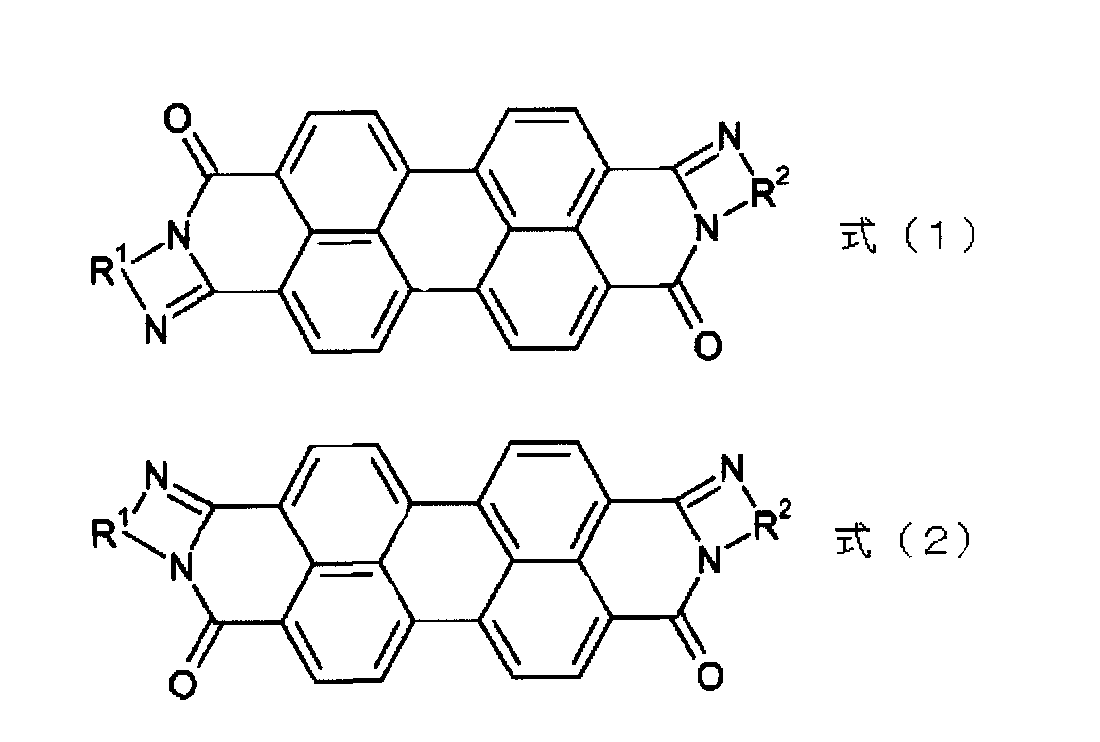
- perylene pigments include those described in JP-T-2007-522297. Specific examples include a compound having a structure represented by the following formula (1), a compound having a structure represented by the following formula (2), and a mixture of two or more thereof.
- R 1 and R 2 each independently represent phenylene, naphthylene, or pyridylene.
- the content of the black organic pigment in the polyimide layer (A) is not particularly limited and can be appropriately selected so as to obtain a desired light-shielding property (transmittance). About 10 parts by mass.
- the characteristics such as the particle size distribution and average particle size of the black organic pigment are preferably adjusted so that the polyimide film has a desired transmittance.
- the polyimide layer (B) may also contain a black organic pigment.
- the inorganic or organic filler used in the present invention has an average particle size of 2 ⁇ m or more.
- the average particle size of the filler is preferably 2 to 3 ⁇ m.
- the average particle size of the filler can be measured using a laser diffraction / scattering particle size distribution measuring apparatus.
- the content of the filler in the polyimide layer (B) is not particularly limited, but is preferably 15 parts by mass or more, more preferably 18 parts by mass or more with respect to 100 parts by mass of the polyimide, It is particularly preferably 20 parts by mass or more. Moreover, it is preferable that it is 40 mass parts or less with respect to 100 mass parts of polyimides, and, as for content in the polyimide layer (B) of a filler, it is especially preferable that it is 25 mass parts or less. Accordingly, the content of the filler in the polyimide layer (B) is preferably 15 to 40 parts by mass, more preferably 18 to 40 parts by mass, and 20 to 40 parts by mass with respect to 100 parts by mass of the polyimide. More preferred is 20 to 25 parts by mass. If the filler content is too large, the physical properties of the polyimide film may deteriorate.
- a silica filler, a porous silica filler, a polyimide filler, an aluminum oxide filler, a titanium dioxide filler etc. are mentioned, Especially a silica filler, More preferably, a porous silica filler is used. It can be used suitably. By using the porous silica filler, the glossiness of the polyimide film can be reduced with a small amount.
- the filler may be used alone or in combination of two or more.
- the porous silica is silica whose pore volume and pore diameter are adjusted, and has a porous shape.
- the pore volume is 0.4 to 1.8 ml / g
- the average pore diameter is 2 to 25 nm
- the pore volume as the porous filler used in the present invention is 1.2 to 1.8 ml / g. g is preferable
- the average pore diameter is preferably 15 to 25 nm.
- the oil absorption shown in JIS-K5101 is used, and this value is preferably 100 to 500 ml / 100 g, more preferably 200 to 400 ml / 100 g.
- General methods for producing silica are classified into a wet method and a dry method, but those produced by a wet method are preferred.
- the wet method can be divided into a precipitation method and a gel method depending on the production method, and a wet method is preferred which can be produced with a relatively small primary particle and has a large specific surface area.
- the polyimide layer (A) which is a core layer may contain a filler, it is preferable not to contain a filler having an average particle diameter of 2 ⁇ m or more from the viewpoint of maintaining excellent properties inherent in polyimide.
- the thickness of the polyimide layer (A) can be appropriately selected depending on the purpose of use, but is usually preferably 5 to 100 ⁇ m, more preferably 8 to 80 ⁇ m, and more preferably 8 to 35 ⁇ m. It is particularly preferred.
- the thickness of the polyimide layer (B) is preferably 0.4 to 1.5 ⁇ m, more preferably 0.4 to 1 ⁇ m, but is not particularly limited, and the thickness of the core layer (A) What is necessary is just a grade which can fix a filler to a polyimide layer (B), without impairing a characteristic.
- the polyimide (A) constituting the polyimide layer (A) and the polyimide (B) constituting the polyimide layer (B) may be the same or different.
- Polyimide (A) and polyimide (B) are obtained by reacting a tetracarboxylic acid component and a diamine component.
- the imidization may be performed by thermal imidization or chemical imidization. Moreover, it can also manufacture by the method which used thermal imidation and chemical imidization together.
- tetracarboxylic acid component examples include 3,3 ′, 4,4′-biphenyltetracarboxylic dianhydride (s-BPDA), pyromellitic dianhydride (PMDA), 2,3,3 ′, 4′-biphenyltetracarboxylic dianhydride (a-BPDA), bis (3,4-dicarboxyphenyl) ether dianhydride, oxydiphthalic dianhydride, diphenylsulfone-3,4,3 ′, 4′- Tetracarboxylic dianhydride, bis (3,4-dicarboxyphenyl) sulfide dianhydride, 2,2-bis (3,4-dicarboxyphenyl) -1,1,1,3,3,3-hexa Fluoropropane dianhydride, 2,3,3 ′, 4′-benzophenone tetracarboxylic dianhydride, 3,3 ′, 4,4′-benzophenone tetracarbox
- diamine component 1) One benzene nucleus diamine such as p-phenylenediamine (PPD), 1,3-diaminobenzene, 2,4-toluenediamine, 2,5-toluenediamine, 2,6-toluenediamine, 2) Diaminodiphenyl ethers such as 4,4'-diaminodiphenyl ether, 3,3'-diaminodiphenyl ether, 3,4'-diaminodiphenyl ether, 4,4'-diaminodiphenylmethane, 3,3'-dimethyl-4,4 ' -Diaminobiphenyl, 2,2'-dimethyl-4,4'-diaminobiphenyl, 2,2'-bis (trifluoromethyl) -4,4'-diaminobiphenyl, 3,3'-dimethyl-4,4 ' -Diaminodiphenylmethane, 3,3'-
- the benzene core of three diamines 4) 3,3′-bis (3-aminophenoxy) biphenyl, 3,3′-bis (4-aminophenoxy) biphenyl, 4,4′-bis (3-aminophenoxy) biphenyl, 4,4′-bis (4-aminophenoxy) biphenyl, 4,4′-bis (4-aminophenoxy) biphenyl, bis [3- (3-aminophenoxy) phenyl] ether, bis [3- (4-aminophenoxy) phenyl] ether, bis [4- (3-aminophenoxy) phenyl] ether, Bis [4- (4-aminophenoxy) phenyl] ether, bis [3- (3-aminophenoxy) phenyl] ketone, bis [3- (4-aminophenoxy) phenyl] ketone, bis [4- (3-amino Phenoxy) phenyl] ketone, bis [4- (4-a
- Examples of the tetracarboxylic acid component of the polyimide (A) constituting the polyimide layer (A) include 3,3 ′, 4,4′-biphenyltetracarboxylic dianhydride and / or pyromellitic dianhydride, An aromatic tetracarboxylic acid component containing 50 mol% or more, more preferably 70 mol% or more, particularly preferably 75 mol% or more of 3,3 ′, 4,4′-biphenyltetracarboxylic dianhydride is preferable.
- Examples of the diamine component of the polyimide (A) constituting the polyimide layer (A) include, for example, p-phenylenediamine and / or diaminodiphenyl ethers, more preferably p-phenylenediamine, or p-phenylenediamine and 4,4′- An aromatic diamine component containing diaminodiphenyl ether, particularly preferably p-phenylenediamine in an amount of 50 mol% or more, more preferably 70 mol% or more, particularly preferably 75 mol% or more is preferred.
- the polyimide (A) constituting the polyimide layer (A) includes, among others, 3,3 ′, 4,4′-biphenyltetracarboxylic dianhydride, p-phenylenediamine, p-phenylenediamine and 4,4. Polyimides obtained from '-diaminodiphenyl ether are preferred. In this case, the p-phenylenediamine / diaminodiphenyl ether (molar ratio) is preferably 100/0 to 85/15.
- a polyimide obtained from diamine or p-phenylenediamine and 4,4′-diaminodiphenyl ether is also preferred.
- the p-phenylenediamine / diaminodiphenyl ether (molar ratio) is preferably 100/0 to 10/90.
- 3,3 ', 4,4'-biphenyltetracarboxylic dianhydride / pyromellitic dianhydride (molar ratio) is preferably 30/70 to 100/0.
- a polyimide obtained from pyromellitic dianhydride, p-phenylenediamine and 4,4′-diaminodiphenyl ether is also preferable.
- the diaminodiphenyl ethers / p-phenylenediamine (molar ratio) is preferably 90/10 to 10/90.
- 3,3 ′, 4,4′-biphenyltetracarboxylic dianhydride is 50 mol% or more, more preferably 70 mol% or more, particularly preferably 75.
- the polyimide (B) constituting the polyimide layer (B) includes 2,3,3 ′, 4-biphenyltetracarboxylic dianhydride, 3,3 ′, 4,4′-biphenyltetracarboxylic dianhydride Or at least selected from pyromellitic dianhydride, bis (3,4-dicarboxyphenyl) ether dianhydride, bis (2,3-dicarboxyphenyl) ether dianhydride and naphthalenetetracarboxylic dianhydride
- a polyimide obtained from one aromatic tetracarboxylic acid component and an aromatic diamine component, more preferably at least one aromatic diamine component selected from p-phenylenediamine and 4,4′-diaminodiphenyl ether is preferred.
- polyimide (B) a polyimide obtained by adding a surface treatment agent to the polyimide precursor solution that gives the polyimide (B) and heat-treating the polyimide precursor solution containing the surface treatment agent is preferable.
- the surface treatment agent By including the surface treatment agent, the adhesion of the polyimide film is improved.
- the polyimide (B) is more preferably an amorphous polyimide. Thereby, the adhesiveness of a polyimide film further improves.
- the non-crystalline polyimide refers to a polyimide having a crystallinity of 5% or less, preferably 2% or less, particularly preferably 0%.
- the amorphous polyimide (B) is not particularly limited, and examples thereof include 2,3,3 ′, 4-biphenyltetracarboxylic dianhydride and bis (3,4-dicarboxyphenyl) ether. At least one aromatic tetracarboxylic acid component selected from dianhydrides, bis (2,3-dicarboxyphenyl) ether dianhydrides and naphthalenetetracarboxylic dianhydrides, p-phenylenediamine and 4,4 ′ And a polyimide obtained from at least one aromatic diamine component selected from diaminodiphenyl ethers. Of these, polyimides obtained from 2,3,3 ', 4-biphenyltetracarboxylic dianhydride and p-phenylenediamine are preferred.
- the polyimide (B) constituting the polyimide layer (B) includes 3,3 ′, 4,4′-biphenyltetracarboxylic dianhydride, p-phenylenediamine, p-phenylenediamine and 4,4.
- Polyimides obtained from '-diaminodiphenyl ether or 4,4'-diaminodiphenyl ether are also preferred.
- the p-phenylenediamine / diaminodiphenyl ether (molar ratio) is preferably 100/0 to 85/15.
- pyromellitic dianhydride or 3,3 ′, 4,4′-biphenyltetracarboxylic dianhydride and pyromellitic dianhydride, p-phenylenediamine, p-phenylenediamine, and 4,4 Polyimides obtained from '-diaminodiphenyl ether or 4,4'-diaminodiphenyl ether are also preferred.
- the p-phenylenediamine / diaminodiphenyl ether (molar ratio) is preferably 100/0 to 10/90.
- 3,3 ', 4,4'-biphenyltetracarboxylic dianhydride / pyromellitic dianhydride is preferably 30/70 to 0/100.
- a polyimide obtained from pyromellitic dianhydride and p-phenylenediamine and 4,4'-diaminodiphenyl ether or 4,4'-diaminodiphenyl ether.
- the diaminodiphenyl ethers / p-phenylenediamine (molar ratio) is preferably 90/10 to 10/90.
- 3,3 ′, 4,4′-biphenyltetracarboxylic dianhydride is 30 mol% or more, more preferably 70 mol% or more, particularly preferably 75.
- a polyimide obtained from an aromatic tetracarboxylic acid component containing at least mol% and an aromatic diamine component containing at least 50 mol%, more preferably at least 70 mol%, particularly preferably at least 75 mol% of p-phenylenediamine is also preferred.
- 3,3 ′, 4,4′-biphenyltetracarboxylic dianhydride is 50 mol% or more, more preferably 70 mol% or more, particularly preferably.
- polyimides are also preferred.
- Examples of the surface treatment agent include aminosilane-based, epoxysilane-based, and titanate-based surface treatment agents.
- Examples of aminosilane-based surface treatment agents include ⁇ -aminopropyl-triethoxysilane, N- ⁇ - (aminoethyl) - ⁇ -aminopropyl-triethoxysilane, and N- (aminocarbonyl) - ⁇ -aminopropyl-triethoxysilane.
- the epoxy silane surface treating agent include compounds such as ⁇ - (3,4-epoxycyclohexyl) -ethyl-trimethoxysilane, ⁇ -glycidyloxypropyl-trimethoxysilane.
- titanate-based surface treatment agents include isopropyl-tricumylphenyl-titanate, dicumylphenyl-oxyacetate-titanate, and the like.
- silane compounds such as aminosilane and epoxysilane are particularly preferable.
- the amount of the surface treatment agent to be contained in the polyimide precursor solution (b) can be appropriately selected according to the types of the polyimide layer (A) and the polyimide layer (B).
- the amount is preferably 1 to 15 parts by mass, more preferably 2 to 8 parts by mass, and more preferably 3 to 6 parts by mass with respect to 100 parts by mass of the polyimide precursor in the polyimide precursor solution (b). Particularly preferred.
- surface or both surfaces of the self-supporting film obtained from the polyimide precursor solution (a) which gives a polyimide layer (A) Preferably surface It is preferable to imidize by applying the polyimide precursor solution (b) containing the treating agent and heating and drying the resulting multilayer self-supporting film.
- the self-supporting film obtained from the polyimide precursor solution (a) that gives the polyimide layer (A) has a tetracarboxylic acid component and a diamine component, substantially equimolar, or a slight excess of either component,
- a polyamic acid solution [polyimide precursor solution (a)] obtained by reacting in an organic solvent is cast on a support and dried by heating.
- a black organic pigment, preferably a perylene pigment is added to the polyimide precursor solution (a) in an appropriate amount, for example, 1 to 10 parts by mass with respect to 100 parts by mass of the polyimide (A).
- a mixture of a polyamic acid and an organic solvent is referred to as a polyamic acid solution or a polyimide precursor solution unless otherwise specified.
- a polyamic acid solution or a polyimide precursor solution a mixture of a polyamic acid and an organic solvent
- a polyimide precursor solution composition what added other components, such as a black organic pigment and a filler, to a polyamic acid solution or a polyimide precursor solution.
- the polyimide precursor solution (b) that gives the polyimide layer (B) is also reacted in an organic solvent with the tetracarboxylic acid component and the diamine component being substantially equimolar, or a little excess of either component. Is obtained.
- a surface treating agent to the polyimide precursor solution (b).
- an inorganic or organic filler having an average particle diameter of 2 ⁇ m or more, preferably 2 to 3 ⁇ m is preferably added to this polyimide precursor solution (b), preferably 15 to 40 parts per 100 parts by weight of polyimide (B). It is added so as to be part by mass, more preferably 15 to 25 parts by mass.
- a black organic pigment, preferably a perylene pigment, may be added to the polyimide precursor solution (b).
- the polyimide film of the present invention is a polyimide precursor solution (b) that gives a polyimide layer (B), preferably a polyimide precursor solution (b) to which a surface treating agent is added, and a polyimide precursor solution that gives a polyimide layer (A). It can be obtained by coating on the self-supporting film of (a) and imidizing it.
- the maximum heating temperature of the heat treatment for imidization is preferably 350 to 600 ° C, more preferably 450 to 590 ° C, more preferably 490 to 580 ° C, and more preferably 500 to 580 ° C.
- Examples of the organic solvent for producing the polyimide precursor solution include N-methyl-2-pyrrolidone, N, N-dimethylacetamide, N, N-diethylacetamide, N, N-dimethylformamide, N, N-diethylformamide, Examples thereof include amides such as hexamethylsulfuramide, sulfoxides such as dimethyl sulfoxide and diethyl sulfoxide, and sulfones such as dimethyl sulfone and diethyl sulfone. These solvents may be used alone or in combination.
- the concentration of all the monomers in the organic solvent when the polymerization reaction of the polyimide precursor (a) and the polyimide precursor (b) is carried out can be appropriately selected according to the purpose of use.
- the concentration of all monomers in the organic solvent is preferably 5 to 40% by mass, more preferably 6 to 35% by mass, and 10 to 30% by mass. It is particularly preferred.
- the concentration of all monomers in the organic solvent is preferably 1 to 15% by mass, and particularly preferably 2 to 8% by mass.
- a tetracarboxylic acid component and a diamine component are substantially equimolar, or one of the components (acid component or diamine component).
- the polyamic acid (polyimide precursor) solution can be obtained by mixing at a reaction temperature of 100 ° C. or lower, preferably 80 ° C. or lower for about 0.2 to 60 hours.
- the solution viscosity of the polyimide precursor (a) and the polyimide precursor (b) can be appropriately selected depending on the purpose of use (coating, casting, etc.).
- the rotational viscosity measured at 30 ° C. is about 100 from the viewpoint of workability in handling the polyimide precursor solution. It is preferably ⁇ 5000 poise, more preferably 500 to 4,000 poise, and particularly preferably about 1000 to 3,000 poise.
- polyimide precursor is 1 to 100 centipoise from the viewpoint of workability in handling the polyimide precursor solution. It is preferably 3 to 50 centipoise, more preferably 5 to 20 centipoise. Therefore, it is desirable to carry out the polymerization reaction to such an extent that the produced polyamic acid (polyimide precursor) exhibits the above viscosity.
- the polyimide precursor solution (a) self-supporting film used as the polyimide layer (A) is made of, for example, a polyimide precursor solution (a) containing a black organic pigment made of a suitable support (for example, metal, ceramic, or plastic). Cast on the surface of a roll or a metal belt to form a film having a uniform thickness, and then heated to 50 to 210 ° C., particularly 60 to 200 ° C. using a heat source such as hot air or infrared rays. It can be obtained by heating to remove the solvent gradually and drying until self-supporting (for example, to the extent that it can be peeled off from the support).
- a suitable support for example, metal, ceramic, or plastic
- an inorganic or organic filler having an average particle diameter of 2 ⁇ m or more, which gives a polyimide layer (B) on one side or both sides of the self-supporting film of the polyimide precursor solution (a) thus obtained.
- a polyimide precursor solution (b) containing a surface treatment agent is preferably applied.
- the polyimide precursor solution (b) may be applied to the self-supporting film peeled from the support, or may be applied to the self-supporting film on the support before peeling from the support.
- the polyimide precursor solution (b) that gives the polyimide layer (B) can be applied to the self-supporting film of the polyimide precursor solution (a) by a known method, for example, gravure coating method, spin coating method And known coating methods such as silk screen method, dip coating method, spray coating method, bar coating method, knife coating method, roll coating method, blade coating method, and die coating method.
- a known method for example, gravure coating method, spin coating method
- known coating methods such as silk screen method, dip coating method, spray coating method, bar coating method, knife coating method, roll coating method, blade coating method, and die coating method.
- the self-supporting film preferably has a surface on which the polyimide precursor solution (b) that gives the polyimide (B) can be uniformly applied.
- the self-supporting film of the polyimide precursor solution (a) preferably has a loss on heating in the range of 20 to 40% by mass, and preferably has an imidization ratio in the range of 8 to 40%. If the heating weight loss and imidization rate are within the above ranges, the mechanical properties of the self-supporting film will be sufficient, and it will be easier to cleanly apply the polyimide precursor solution (b) on the upper surface of the self-supporting film, and imidization will occur.
- production of a foam, a crack, a craze, a crack, crack, etc. is not observed in the polyimide film obtained later, and the adhesive strength of a polyimide layer (B) and a polyimide layer (A) becomes enough.
- the imidization ratio of the self-supporting film can be calculated by measuring the IR spectrum of the self-supporting film and its fully cured product (polyimide film) by the ATR method and using the ratio of the peak area of the vibration band.
- the vibration band peak an asymmetric stretching vibration band of an imide carbonyl group, a benzene ring skeleton stretching vibration band, or the like is used.
- imidation rate measurement there is also a method using a Karl Fischer moisture meter described in JP-A-9-316199.
- the polyimide layer (A) preferably does not contain a filler having an average particle size of 2 ⁇ m or more except when the thickness of the core layer is sufficient with respect to the average particle size of the filler. Accordingly, a fine inorganic or organic filler (additive) having an average particle size of less than 2 ⁇ m can be blended.
- inorganic additives include particulate or flat inorganic fillers, such as particulate titanium dioxide powder, silicon dioxide (silica) powder, magnesium oxide powder, aluminum oxide (alumina) powder, and zinc oxide powder.
- Inorganic oxide powder such as, inorganic nitride powder such as particulate silicon nitride powder and titanium nitride powder, inorganic carbide powder such as silicon carbide powder, inorganic such as particulate calcium carbonate powder, calcium sulfate powder and barium sulfate powder Mention may be made of salt powder.
- the organic additive include polyimide particles and thermosetting resin particles. These additives may be used in combination of two or more. Moreover, in order to disperse these additives uniformly, a means known per se can be applied.
- the self-supporting film of the polyimide precursor solution (a) coated with the polyimide precursor solution (b) is then heated and imidized to obtain a polyimide film.
- This heat treatment is preferably performed stepwise. First, after the first heat treatment at a temperature of 200 ° C. or higher and lower than 300 ° C. for 1 minute to 60 minutes, the first heat treatment is performed at a temperature of 300 ° C. or higher and lower than 350 ° C. Secondary heat treatment, followed by tertiary heat treatment at a maximum heating temperature of 350 ° C. to 600 ° C., preferably 450 to 590 ° C., more preferably 490 to 580 ° C., more preferably 500 to 580 ° C. for 1 minute to 30 minutes. It is desirable to do. This heat treatment can be performed using a known apparatus such as a hot air furnace or an infrared heating furnace.
- this heat treatment is preferably performed by fixing the self-supporting film of the polyimide precursor solution (a) coated with the polyimide precursor solution (b) with a pin tenter, a clip or the like.
- the polyimide precursor solution (b) and / or the polyimide precursor solution (a) is used for the purpose of limiting the gelation of the polyamic acid (polyimide precursor), for example, a phosphorus stabilizer such as triphenyl phosphite, triphosphate phosphate. Phenyl and the like can be added in the range of 0.01 to 1% with respect to the solid content (polymer) concentration during polyamic acid polymerization.
- a basic organic compound can be added to the polyimide precursor solution (b) and / or the polyimide precursor solution (a) for the purpose of promoting imidization.
- imidazole, 2-methylimidazole, 1,2-dimethylimidazole, 2-phenylimidazole, benzimidazole, isoquinoline, substituted pyridine and the like are added in an amount of 0.0005 to 0.1 with respect to 100 parts by mass of polyamic acid (polyimide precursor). It can be added at a ratio of parts by mass, particularly 0.001 to 0.02 parts by mass. These can be used to avoid insufficient imidization to form polyimide films at relatively low temperatures.
- the polyimide film of the present invention is obtained by co-extrusion-casting film formation (also simply referred to as co-extrusion method), a polyimide layer (A) dope solution [polyimide precursor solution (a)] and a polyimide layer ( It is also possible to produce the multilayer polyimide film by laminating, drying and imidizing the dope solution [polyimide precursor solution (b)] of B).
- coextrusion method for example, a method described in JP-A-3-180343 (Japanese Patent Publication No. 7-102661) can be used.
- a polyimide film may be produced by applying a solution of a surface treatment agent to a multilayer self-supporting film in which a body solution (a) and a polyimide precursor solution (b) that gives a polyimide layer (B) are laminated.
- surface treatment agents various coupling agents such as silane coupling agents, borane coupling agents, aluminum coupling agents, aluminum chelating agents, titanate coupling agents, iron coupling agents, copper coupling agents, and chelating agents.
- Examples thereof include a treatment agent that improves adhesiveness and adhesion of the agent.
- the surface treatment agents can be used alone or in admixture of two or more.
- the content of the surface treatment agent in the solution of the surface treatment agent to be applied is preferably about 0.1 to 60% by mass, more preferably about 1 to 10% by mass.
- the polyimide film of the present invention may be used as it is, or if necessary, after the surface of the polyimide layer (B) is subjected to surface treatment such as corona discharge treatment, low-temperature plasma discharge treatment or atmospheric pressure plasma discharge treatment, or chemical etching. it can.
- the polyimide film of the present invention can be suitably used, for example, as a cover lay for protecting a wiring by laminating an adhesive layer on the surface of the polyimide layer (B).
- the above-mentioned adhesive layered on the polyimide film obtained in the present invention may be thermosetting or thermoplastic.
- epoxy resin NBR-phenolic resin, phenol-butyral resin, epoxy-NBR resin, epoxy -Phenolic resins, epoxy-nylon resins, epoxy-polyester resins, epoxy-acrylic resins, acrylic resins, polyamide-epoxy-phenolic resins, polyimide resins, maleimide resins, polyimide-epoxy resins, polyimidesiloxane- Thermosetting adhesives such as epoxy resins, or thermoplastic adhesives such as polyamide resins, polyester resins, polyimide adhesives, polyimide siloxane adhesives, and the like can be given.
- polyamide-epoxy-phenolic resin polyimidesiloxane-epoxy resin-based, acrylic resin-based thermosetting adhesive, polyimide-based resin, and polyimidesiloxane-epoxy resin-based thermoplastic adhesive are suitable.
- the polyimide film of the present invention can be suitably used as an insulating substrate material such as FPC, TAB, COF, or a metal wiring substrate, a cover substrate such as a metal wiring or a chip member such as an IC chip, or the like.
- the physical properties of the polyimide film were evaluated according to the following methods.
- Dielectric breakdown voltage was measured according to JIS C 2318.
- ⁇ Reference Example B1> [Production of dope (B-1) for polyimide layer (B)] 2,3,3,4-biphenyltetracarboxylic dianhydride and equimolar amount of p-phenylenediamine were polymerized in N, N-dimethylacetamide at 30 ° C. for 3 hours to obtain a concentration of 3.0% by mass. A polyamic acid solution was obtained.
- ⁇ -phenylaminopropyltrimethoxysilane as a heat-resistant surface treatment agent was used in a proportion of 3% by mass in the solution, and a porous silica filler having an average particle size of 2.3 ⁇ m (manufactured by Fuji Silysia Corporation).
- Silicia 300P, oil absorption 333 ml / 100 g) was added at a ratio of 20 parts by mass with respect to 100 parts by mass of the polyamic acid, and mixed uniformly to obtain a polyimide precursor solution composition (B-1).
- ⁇ Reference Example B3> [Production of dope (B-3) for polyimide layer (B)] Instead of a porous silica filler having an average particle size of 2.3 ⁇ m, 20 parts by mass of a porous silica filler having an average particle size of 2.9 ⁇ m (Mizukazil P-705, manufactured by Mizusawa Chemical Co., Ltd.) with respect to 100 parts by mass of polyamic acid Except for the addition, a polyimide precursor solution composition (B-3) was obtained in the same manner as in Reference Example B1.
- ⁇ Reference Example B5> [Manufacture of dope (B-5) for polyimide layer (B)] 20 parts by mass of a spherical silica filler (Mizusawa Chemical Industry Co., Ltd., Mizpearl K-150) having an average particle diameter of 1.7 ⁇ m is added to 100 parts by mass of polyamic acid instead of the porous silica filler having an average particle diameter of 2.3 ⁇ m. Except for the above, a polyimide precursor solution composition (B-5) was obtained in the same manner as in Reference Example B1.
- a spherical silica filler Mizusawa Chemical Industry Co., Ltd., Mizpearl K-150
- Example 1 The polyimide precursor solution composition (A-1) obtained in Reference Example A1 was cast on a substrate so that the film thickness after heating and drying was 11 ⁇ m, dried with hot air at 120 ° C., and self-supporting. A film was obtained. On one side of this self-supporting film, the polyimide precursor solution composition (B-1) obtained in Reference Example B1 was applied with a thickness after drying set to 1 ⁇ m, and then heated at 200 ° C. in a heating furnace. The temperature was gradually raised to 500 ° C. to remove the solvent, and imidization was performed to obtain a polyimide film. And the glossiness of this polyimide film was measured. The results are shown in Table 1.
- Example 2 A polyimide film was obtained in the same manner as in Example 1 except that the polyimide precursor solution composition (B-2) obtained in Reference Example B2 was used instead of the polyimide precursor solution composition (B-1). It was. And the glossiness of this polyimide film was measured. The results are shown in Table 1.
- Example 3 A polyimide film was obtained in the same manner as in Example 1 except that the polyimide precursor solution composition (B-3) obtained in Reference Example B3 was used instead of the polyimide precursor solution composition (B-1). It was. And the glossiness of this polyimide film was measured. The results are shown in Table 1.
- Example 4 A polyimide film was obtained in the same manner as in Example 1 except that the polyimide precursor solution composition (B-4) obtained in Reference Example B4 was used instead of the polyimide precursor solution composition (B-1). It was. And the glossiness of this polyimide film was measured. The results are shown in Table 1.
- surface represents the mass part with respect to 100 mass parts of polyamic acids.
- the polyimide film of Examples 1 to 4 in which the polyimide layer (B) as the surface layer contains a filler having an average particle size of 2 ⁇ m or more is the same as that of Comparative Example 1 in which the average particle size of the filler in the polyimide layer (B) is less than 2 ⁇ m.
- the gloss was lower than that of the polyimide film.
- the polyimide film of Example 1 whose addition amount of a filler is 20 mass parts with respect to 100 mass parts of polyimides is a polyimide film of Example 4 whose addition amount of a filler is 15 mass parts with respect to 100 mass parts of polyimides.
- Example 2 The polyimide film of Example 2 in which the glossiness was lower than that of Example 2 and the amount of filler added was 25 parts by mass with respect to 100 parts by mass of the polyimide was even lower in glossiness. Furthermore, when Example 1 and Comparative Example 1 are compared, the glossiness of the polyimide film to which the porous silica filler is added is clearly lower than that of the polyimide film to which the same amount of spherical silica filler is added.
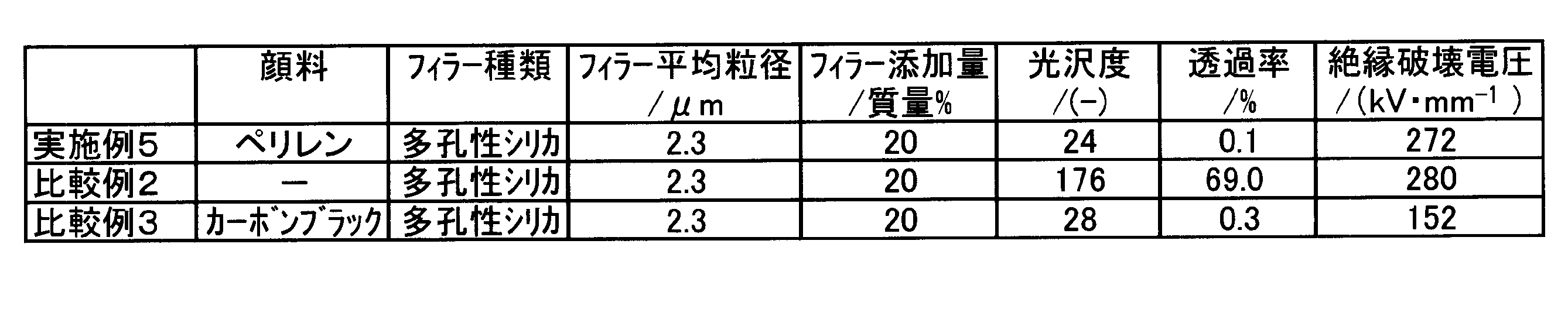
- Example 5 The polyimide precursor solution composition (A-1) obtained in Reference Example A1 was cast on a stainless steel substrate so that the film thickness after heating and drying was 11 ⁇ m, and dried continuously with hot air at 140 ° C. The film was peeled from the substrate to obtain a self-supporting film. After applying the polyimide precursor solution composition (B-1) obtained in Reference Example B1 so as to have a thickness of 1 ⁇ m on both sides of the self-supporting film using a die coater, a heating furnace The temperature was gradually raised from 200 ° C. to 500 ° C. to remove the solvent, and imidization was performed to obtain a polyimide film. And the glossiness, the transmittance
- Example 2 A polyimide film was obtained in the same manner as in Example 5 except that the polyimide precursor solution composition (A-2) obtained in Reference Example A2 was used instead of the polyimide precursor solution composition (A-1). It was. And the glossiness, the transmittance
- Example 3 A polyimide film was obtained in the same manner as in Example 5 except that the polyimide precursor solution composition (A-3) obtained in Reference Example A3 was used instead of the polyimide precursor solution composition (A-1). It was. And the glossiness, the transmittance
- surface represents the mass part with respect to 100 mass parts of polyamic acids.
- the dielectric breakdown voltage was lower than that of the polyimide film of Comparative Example 3 containing carbon black and the same breakdown voltage as that of the polyimide film of Comparative Example 2 containing no pigment.
Landscapes
- Chemical & Material Sciences (AREA)
- Organic Chemistry (AREA)
- Health & Medical Sciences (AREA)
- Chemical Kinetics & Catalysis (AREA)
- Medicinal Chemistry (AREA)
- Polymers & Plastics (AREA)
- Engineering & Computer Science (AREA)
- Manufacturing & Machinery (AREA)
- Materials Engineering (AREA)
- Life Sciences & Earth Sciences (AREA)
- Wood Science & Technology (AREA)
- Laminated Bodies (AREA)
- Coating Of Shaped Articles Made Of Macromolecular Substances (AREA)
- Macromolecular Compounds Obtained By Forming Nitrogen-Containing Linkages In General (AREA)
- Compositions Of Macromolecular Compounds (AREA)
Abstract
Description
ポリイミド層(A)が、黒色有機顔料を含み、
ポリイミド層(B)が、平均粒径が2μm以上である無機または有機フィラーを含むことを特徴とするポリイミドフィルム。
ポリアミック酸溶液(B)と平均粒径が2μm以上である無機または有機フィラーとを混合してポリイミド前駆体溶液組成物(B)を得る工程と、
前記ポリイミド前駆体溶液組成物(A)を支持体上に流延し、加熱し、自己支持性フィルムを得る工程と、
前記自己支持性フィルムの片面または両面にポリイミド前駆体溶液組成物(B)を塗工する工程と、
ポリイミド前駆体溶液組成物(B)が塗工された自己支持性フィルムを加熱する工程と
を含むポリイミドフィルムの製造方法。
本発明のポリイミドフィルムは、十分な遮光性を有し、電気絶縁性・電気信頼性に優れ、しかも光沢度が低く、意匠性にも優れたものである。ここで、意匠性に優れるとは、ポリイミドフィルムの表面が艶消しされ美観をもたらすことをいう。本発明によれば、例えば、光沢度が50以下、好ましくは40以下、より好ましくは30以下、さらには25以下、さらには10以下であり、透過率が0.5%以下、好ましくは0.3%以下、より好ましくは0.2%以下であり、絶縁破壊電圧が200kV・mm-1以上であるポリイミドフィルムを得ることができる。
1)p-フェニレンジアミン(PPD)、1,3-ジアミノベンゼン、2,4-トルエンジアミン、2,5-トルエンジアミン、2,6-トルエンジアミンなどのベンゼン核1つのジアミン、
2)4,4’-ジアミノジフェニルエーテル、3,3’-ジアミノジフェニルエーテル、3,4’-ジアミノジフェニルエーテルなどのジアミノジフェニルエーテル類、4,4’-ジアミノジフェニルメタン、3,3’-ジメチル-4,4’-ジアミノビフェニル、2,2’-ジメチル-4,4’-ジアミノビフェニル、2,2’-ビス(トリフルオロメチル)-4,4’-ジアミノビフェニル、3,3’-ジメチル-4,4’-ジアミノジフェニルメタン、3,3’-ジカルボキシ-4,4’-ジアミノジフェニルメタン、3,3’,5,5’-テトラメチル-4,4’-ジアミノジフェニルメタン、ビス(4-アミノフェニル)スルフィド、4,4’-ジアミノベンズアニリド、3,3’-ジクロロベンジジン、3,3’-ジメチルベンジジン(o-トリジン)、2,2’-ジメチルベンジジン(m-トリジン)、3,3’-ジメトキシベンジジン、2,2’-ジメトキシベンジジン、3,3’-ジアミノジフェニルエーテル、3,4’-ジアミノジフェニルエーテル、4,4’-ジアミノジフェニルエーテル、3,3’-ジアミノジフェニルスルフィド、3,4’-ジアミノジフェニルスルフィド、4,4’-ジアミノジフェニルスルフィド、3,3’-ジアミノジフェニルスルホン、3,4’-ジアミノジフェニルスルホン、4,4’-ジアミノジフェニルスルホン、3,3’-ジアミノベンゾフェノン、3,3’-ジアミノ-4,4’-ジクロロベンゾフェノン、3,3’-ジアミノ-4,4’-ジメトキシベンゾフェノン、3,3’-ジアミノジフェニルメタン、3,4’-ジアミノジフェニルメタン、4,4’-ジアミノジフェニルメタン、2,2-ビス(3-アミノフェニル)プロパン、2,2-ビス(4-アミノフェニル)プロパン、2,2-ビス(3-アミノフェニル)-1,1,1,3,3,3-ヘキサフルオロプロパン、2,2-ビス(4-アミノフェニル)-1,1,1,3,3,3-ヘキサフルオロプロパン、3,3’-ジアミノジフェニルスルホキシド、3,4’-ジアミノジフェニルスルホキシド、4,4’-ジアミノジフェニルスルホキシドなどのベンゼン核2つのジアミン、
3)1,3-ビス(3-アミノフェニル)ベンゼン、1,3-ビス(4-アミノフェニル)ベンゼン、1,4-ビス(3-アミノフェニル)ベンゼン、1,4-ビス(4-アミノフェニル)ベンゼン、1,3-ビス(4-アミノフェノキシ)ベンゼン、1,4-ビス(3-アミノフェノキシ)ベンゼン、1,4-ビス(4-アミノフェノキシ)ベンゼン、1,3-ビス(3-アミノフェノキシ)-4-トリフルオロメチルベンゼン、3,3’-ジアミノ-4-(4-フェニル)フェノキシベンゾフェノン、3,3’-ジアミノ-4,4’-ジ(4-フェニルフェノキシ)ベンゾフェノン、1,3-ビス(3-アミノフェニルスルフィド)ベンゼン、1,3-ビス(4-アミノフェニルスルフィド)ベンゼン、1,4-ビス(4-アミノフェニルスルフィド)ベンゼン、1,3-ビス(3-アミノフェニルスルホン)ベンゼン、1,3-ビス(4-アミノフェニルスルホン)ベンゼン、1,4-ビス(4-アミノフェニルスルホン)ベンゼン、1,3-ビス〔2-(4-アミノフェニル)イソプロピル〕ベンゼン、1,4-ビス〔2-(3-アミノフェニル)イソプロピル〕ベンゼン、1,4-ビス〔2-(4-アミノフェニル)イソプロピル〕ベンゼンなどのベンゼン核3つのジアミン、
4)3,3’-ビス(3-アミノフェノキシ)ビフェニル、3,3’-ビス(4-アミノフェノキシ)ビフェニル、4,4’-ビス(3-アミノフェノキシ)ビフェニル、4,4’-ビス(4-アミノフェノキシ)ビフェニル、ビス〔3-(3-アミノフェノキシ)フェニル〕エーテル、ビス〔3-(4-アミノフェノキシ)フェニル〕エーテル、ビス〔4-(3-アミノフェノキシ)フェニル〕エーテル、ビス〔4-(4-アミノフェノキシ)フェニル〕エーテル、ビス〔3-(3-アミノフェノキシ)フェニル〕ケトン、ビス〔3-(4-アミノフェノキシ)フェニル〕ケトン、ビス〔4-(3-アミノフェノキシ)フェニル〕ケトン、ビス〔4-(4-アミノフェノキシ)フェニル〕ケトン、ビス〔3-(3-アミノフェノキシ)フェニル〕スルフィド、ビス〔3-(4-アミノフェノキシ)フェニル〕スルフィド、ビス〔4-(3-アミノフェノキシ)フェニル〕スルフィド、ビス〔4-(4-アミノフェノキシ)フェニル〕スルフィド、ビス〔3-(3-アミノフェノキシ)フェニル〕スルホン、ビス〔3-(4-アミノフェノキシ)フェニル〕スルホン、ビス〔4-(3-アミノフェノキシ)フェニル〕スルホン、ビス〔4-(4-アミノフェノキシ)フェニル〕スルホン、ビス〔3-(3-アミノフェノキシ)フェニル〕メタン、ビス〔3-(4-アミノフェノキシ)フェニル〕メタン、ビス〔4-(3-アミノフェノキシ)フェニル〕メタン、ビス〔4-(4-アミノフェノキシ)フェニル〕メタン、2,2-ビス〔3-(3-アミノフェノキシ)フェニル〕プロパン、2,2-ビス〔3-(4-アミノフェノキシ)フェニル〕プロパン、2,2-ビス〔4-(3-アミノフェノキシ)フェニル〕プロパン、2,2-ビス〔4-(4-アミノフェノキシ)フェニル〕プロパン、2,2-ビス〔3-(3-アミノフェノキシ)フェニル〕-1,1,1,3,3,3-ヘキサフルオロプロパン、2,2-ビス〔3-(4-アミノフェノキシ)フェニル〕-1,1,1,3,3,3-ヘキサフルオロプロパン、2,2-ビス〔4-(3-アミノフェノキシ)フェニル〕-1,1,1,3,3,3-ヘキサフルオロプロパン、2,2-ビス〔4-(4-アミノフェノキシ)フェニル〕-1,1,1,3,3,3-ヘキサフルオロプロパンなどのベンゼン核4つのジアミン、
などを挙げることができる。これらは単独でも、2種以上を混合して用いることもできる。用いるジアミンは、所望の特性などに応じて適宜選択することができる。
本発明においては、ポリイミド層(A)を与えるポリイミド前駆体溶液(a)から得られる自己支持性フィルムの片面または両面に、ポリイミド層(B)を与えるポリイミド前駆体溶液(b)、好ましくは表面処理剤含有のポリイミド前駆体溶液(b)を塗工し、得られた多層の自己支持性フィルムを加熱、乾燥してイミド化を行うことが好ましい。
加熱減量(質量%)={(W1-W2)/W1}×100
本発明のポリイミドフィルムは、例えば、ポリイミド層(B)の表面に接着剤層を積層して、配線を保護するためのカバーレイ等として好適に使用することができる。
日立社製U-2800形分光光度計を用いてフィルムの透過率を測定し、波長550nmの透過率を示した。
スガ試験機製デジタル変角光沢度計VGV-5Dを用いて、入射角60°にてフィルムの光沢度を測定した。
JIS C 2318に従って絶縁破壊電圧の測定を行った。
レーザー回折/散乱式粒度分布測定装置(堀場製作所製、LA-950V2)を用い、フィラーを溶媒中へ分散し、その試料を測定、解析して、数平均粒子径を求めた。
〔ポリイミド層(A)用ドープ(A-1)の製造〕
N,N-ジメチルアセトアミドに、上記の式(1)の化合物および式(2)の化合物の混合物(R1、R2は共に、1,8-ナフチレン基)である黒色顔料(ペリレン顔料)を重合後のポリアミック酸100質量部に対して5質量部添加となるように加え、攪拌した。続いて3,3’,4,4’-ビフェニルテトラカルボン酸二無水物と等モル量のp-フェニレンジアミンとを加え、30℃、3時間重合して、18質量%濃度のポリアミック酸溶液を得た。このポリアミック酸溶液に、ポリアミック酸100質量部に対して0.1質量部のモノステアリルリン酸エステルトリエタノールアミン塩、次いでポリアミック酸100質量部に対して0.5質量部の易滑剤としてのシリカフィラー(平均粒径0.08μm、日産化学社製ST-ZL)を添加して均一に混合し、ポリイミド前駆体溶液組成物(A-1)を得た。
〔ポリイミド層(A)用ドープ(A-2)の製造〕
ペリレン顔料を使用しなかった以外は、参考例A1と同様にしてポリイミド前駆体溶液組成物(A-2)を得た。
〔ポリイミド層(A)用ドープ(A-3)の製造〕
ペリレン顔料に代えてカーボンブラックを重合後のポリアミック酸100質量部に対して2.5質量部となる量を加えた以外は、参考例A1と同様にしてポリイミド前駆体溶液組成物(A-3)を得た。
〔ポリイミド層(B)用ドープ(B-1)の製造〕
2,3,3,4-ビフェニルテトラカルボン酸二無水物と等モル量のp-フェニレンジアミンとをN,N-ジメチルアセトアミド中で、30℃、3時間重合して、3.0質量%濃度のポリアミック酸溶液を得た。このポリアミック酸溶液に、耐熱性表面処理剤としてγ―フェニルアミノプロピルトリメトキシシランを溶液中濃度が3質量%となる割合で、平均粒径2.3μmの多孔性シリカフィラー(富士シリシア株式会社製、サイリシア300P、吸油量333ml/100g)をポリアミック酸100質量部に対して20質量部となる割合で添加して均一に混合し、ポリイミド前駆体溶液組成物(B-1)を得た。
〔ポリイミド層(B)用ドープ(B-2)の製造〕
平均粒径2.3μmの多孔性シリカフィラーをポリアミック酸100質量部に対して25質量部添加した以外は、参考例B1と同様にしてポリイミド前駆体溶液組成物(B-2)を得た。
〔ポリイミド層(B)用ドープ(B-3)の製造〕
平均粒径2.3μmの多孔性シリカフィラーに代えて平均粒径2.9μmの多孔性シリカフィラー(水澤化学工業株式会社製、ミズカジルP-705)をポリアミック酸100質量部に対して20質量部添加した以外は、参考例B1と同様にしてポリイミド前駆体溶液組成物(B-3)を得た。
〔ポリイミド層(B)用ドープ(B-4)の製造〕
平均粒径2.3μmの多孔性シリカフィラーをポリアミック酸100質量部に対して15質量部添加した以外は、参考例B1と同様にしてポリイミド前駆体溶液組成物(B-4)を得た。
〔ポリイミド層(B)用ドープ(B-5)の製造〕
平均粒径2.3μmの多孔性シリカフィラーに代えて平均粒径1.7μmの球状シリカフィラー(水澤化学工業株式会社製、ミズパールK-150)をポリアミック酸100質量部に対して20質量部添加した以外は、参考例B1と同様にしてポリイミド前駆体溶液組成物(B-5)を得た。
参考例A1で得られたポリイミド前駆体溶液組成物(A-1)を加熱乾燥後のフィルム厚みが11μmになるように基板上に流延し、120℃の熱風で乾燥を行い、自己支持性フィルムを得た。この自己支持性フィルムの片面に、参考例B1で得られたポリイミド前駆体溶液組成物(B-1)を乾燥後の厚みが1μmになるように設定して塗布した後、加熱炉で200℃から500℃に徐々に加熱昇温して溶媒を除去し、イミド化を行ってポリイミドフィルムを得た。そして、このポリイミドフィルムの光沢度を測定した。結果を表1に示す。
ポリイミド前駆体溶液組成物(B-1)の代わりに、参考例B2で得られたポリイミド前駆体溶液組成物(B-2)を使用した以外は、実施例1と同様にしてポリイミドフィルムを得た。そして、このポリイミドフィルムの光沢度を測定した。結果を表1に示す。
ポリイミド前駆体溶液組成物(B-1)の代わりに、参考例B3で得られたポリイミド前駆体溶液組成物(B-3)を使用した以外は、実施例1と同様にしてポリイミドフィルムを得た。そして、このポリイミドフィルムの光沢度を測定した。結果を表1に示す。
ポリイミド前駆体溶液組成物(B-1)の代わりに、参考例B4で得られたポリイミド前駆体溶液組成物(B-4)を使用した以外は、実施例1と同様にしてポリイミドフィルムを得た。そして、このポリイミドフィルムの光沢度を測定した。結果を表1に示す。
ポリイミド前駆体溶液組成物(B-1)の代わりに、参考例B5で得られたポリイミド前駆体溶液組成物(B-5)を使用した以外は、実施例1と同様にしてポリイミドフィルムを得た。そして、このポリイミドフィルムの光沢度を測定した。結果を表1に示す。

参考例A1で得られたポリイミド前駆体溶液組成物(A-1)を加熱乾燥後のフィルム厚みが11μmになるようにステンレス基板上に流延し、140℃の熱風で連続的に乾燥を行い、基板から剥離して自己支持性フィルムを得た。この自己支持性フィルムの両面に、ダイコーターを用いて、参考例B1で得られたポリイミド前駆体溶液組成物(B-1)を厚みが1μmになるように設定して塗布した後、加熱炉で200℃から500℃に徐々に加熱昇温して溶媒を除去し、イミド化を行ってポリイミドフィルムを得た。そして、このポリイミドフィルムの光沢度、透過率および絶縁破壊電圧を測定した。結果を表2に示す。
ポリイミド前駆体溶液組成物(A-1)の代わりに、参考例A2で得られたポリイミド前駆体溶液組成物(A-2)を使用した以外は、実施例5と同様にしてポリイミドフィルムを得た。そして、このポリイミドフィルムの光沢度、透過率および絶縁破壊電圧を測定した。結果を表2に示す。
ポリイミド前駆体溶液組成物(A-1)の代わりに、参考例A3で得られたポリイミド前駆体溶液組成物(A-3)を使用した以外は、実施例5と同様にしてポリイミドフィルムを得た。そして、このポリイミドフィルムの光沢度、透過率および絶縁破壊電圧を測定した。結果を表2に示す。
Claims (11)
- ポリイミド層(A)の片面または両面上にポリイミド層(B)を有するポリイミドフィルムであって、
ポリイミド層(A)が、黒色有機顔料を含み、
ポリイミド層(B)が、平均粒径が2μm以上である無機または有機フィラーを含むことを特徴とするポリイミドフィルム。 - 前記フィラーの平均粒径が、2~3μmであることを特徴とする請求項1記載のポリイミドフィルム。
- 前記フィラーのポリイミド層(B)中の含有量が、ポリイミド100質量部に対して、15~40質量部であることを特徴とする請求項1または2記載のポリイミドフィルム。
- 前記フィラーが、多孔性シリカフィラーであることを特徴とする請求項1~3のいずれか1項に記載のポリイミドフィルム。
- 前記黒色有機顔料が、ペリレン系顔料であることを特徴とする請求項1~4のいずれか1項に記載のポリイミドフィルム。
- 光沢度が50以下であり、透過率が0.5%以下であり、絶縁破壊電圧が200kV・mm-1以上であることを特徴とする請求項1~5のいずれか1項に記載のポリイミドフィルム。
- 前記ポリイミド層(B)の厚さが、0.4~1.5μmであることを特徴とする請求項1~6のいずれか1項に記載のポリイミドフィルム。
- 前記ポリイミド層(A)の厚さが、8~35μmであることを特徴とする請求項1~7のいずれか1項に記載のポリイミドフィルム。
- 前記黒色有機顔料のポリイミド層(A)中の含有量が、ポリイミド100質量部に対して1~10質量部である請求項1~8のいずれか1項に記載のポリイミドフィルム。
- 前記多孔性シリカフィラーのJIS-K5101に従って測定した吸油量が、100~500ml/100gである請求項4記載のポリイミドフィルム。
- ポリアミック酸溶液(A)と黒色有機顔料とを混合してポリイミド前駆体溶液組成物(A)を得る工程と、
ポリアミック酸溶液(B)と平均粒径が2μm以上である無機または有機フィラーとを混合してポリイミド前駆体溶液組成物(B)を得る工程と、
前記ポリイミド前駆体溶液組成物(A)を支持体上に流延し、加熱し、自己支持性フィルムを得る工程と、
前記自己支持性フィルムの片面または両面にポリイミド前駆体溶液組成物(B)を塗工する工程と、
ポリイミド前駆体溶液組成物(B)が塗工された自己支持性フィルムを加熱する工程と
を含むポリイミドフィルムの製造方法。
Priority Applications (3)
| Application Number | Priority Date | Filing Date | Title |
|---|---|---|---|
| CN201280024958.3A CN103561953A (zh) | 2011-03-30 | 2012-03-29 | 聚酰亚胺膜 |
| JP2013507729A JP5796628B2 (ja) | 2011-03-30 | 2012-03-29 | ポリイミドフィルム |
| KR1020137028348A KR20140027185A (ko) | 2011-03-30 | 2012-03-29 | 폴리이미드 필름 |
Applications Claiming Priority (2)
| Application Number | Priority Date | Filing Date | Title |
|---|---|---|---|
| JP2011076799 | 2011-03-30 | ||
| JP2011-076799 | 2011-03-30 |
Publications (1)
| Publication Number | Publication Date |
|---|---|
| WO2012133665A1 true WO2012133665A1 (ja) | 2012-10-04 |
Family
ID=46931367
Family Applications (1)
| Application Number | Title | Priority Date | Filing Date |
|---|---|---|---|
| PCT/JP2012/058399 Ceased WO2012133665A1 (ja) | 2011-03-30 | 2012-03-29 | ポリイミドフィルム |
Country Status (5)
| Country | Link |
|---|---|
| JP (1) | JP5796628B2 (ja) |
| KR (1) | KR20140027185A (ja) |
| CN (1) | CN103561953A (ja) |
| TW (1) | TW201247403A (ja) |
| WO (1) | WO2012133665A1 (ja) |
Cited By (8)
| Publication number | Priority date | Publication date | Assignee | Title |
|---|---|---|---|---|
| JP2015044977A (ja) * | 2013-08-27 | 2015-03-12 | 達邁科技股▲分▼有限公司 | 着色ポリイミドフィルム及び該ポリイミドフィルムを含む金属積層構造体 |
| KR20150143480A (ko) | 2013-04-18 | 2015-12-23 | 다이요 잉키 세이조 가부시키가이샤 | 적층 구조체, 플렉시블 프린트 배선판 및 그의 제조 방법 |
| JP2017508637A (ja) * | 2013-12-13 | 2017-03-30 | イー・アイ・デュポン・ドウ・ヌムール・アンド・カンパニーE.I.Du Pont De Nemours And Company | 多層フィルム |
| JP2017145325A (ja) * | 2016-02-17 | 2017-08-24 | 株式会社カネカ | ポリイミドフィルム、多層ポリイミドフィルム、カバーレイ、及びフレキシブルプリント配線板 |
| WO2019135366A1 (ja) * | 2018-01-04 | 2019-07-11 | 東洋紡株式会社 | フィルム積層体製造方法およびフィルム積層体製造装置 |
| CN114292423A (zh) * | 2021-12-29 | 2022-04-08 | 无锡顺铉新材料有限公司 | 一种易裁切的聚酰亚胺复合薄膜及其制备方法 |
| KR20230163369A (ko) | 2021-03-31 | 2023-11-30 | 다이요 잉키 세이조 가부시키가이샤 | 경화성 수지 조성물, 적층 구조체, 경화물 및 전자 부품 |
| JP2025090579A (ja) * | 2020-07-28 | 2025-06-17 | バーシブ コンポジッツ リミテッド | 誘電体基板及びその形成方法 |
Families Citing this family (15)
| Publication number | Priority date | Publication date | Assignee | Title |
|---|---|---|---|---|
| TWI495404B (zh) * | 2013-06-21 | 2015-08-01 | Chi Mei Corp | 軟性基板用組成物及軟性基板 |
| SG11201607716PA (en) * | 2014-03-24 | 2016-11-29 | Lintec Corp | Protection membrane forming film, protection membrane forming utilization sheet, production method and inspection method for workpiece or processed product, workpiece determined as adequate product, and processed product determined as adequate product |
| KR102220012B1 (ko) * | 2014-04-04 | 2021-02-26 | 에스케이이노베이션 주식회사 | 폴리이미드 복합기판의 제조방법 및 이로 제조된 폴리이미드 복합기판 |
| KR102335085B1 (ko) * | 2014-11-10 | 2021-12-07 | 주식회사 넥스플렉스 | 폴리이미드 연성금속박적층체 |
| CN106883433A (zh) * | 2017-03-17 | 2017-06-23 | 桂林电器科学研究院有限公司 | 耐高温亚光有色聚酰亚胺薄膜及其制备方法 |
| CN106832367A (zh) * | 2017-03-17 | 2017-06-13 | 桂林电器科学研究院有限公司 | 耐高温有色聚酰亚胺薄膜及其制备方法 |
| KR102303632B1 (ko) * | 2018-11-09 | 2021-09-23 | 피아이첨단소재 주식회사 | 금속층과의 접착력이 향상된 폴리이미드 복합 필름 및 이를 제조하는 방법 |
| KR102164470B1 (ko) * | 2018-11-30 | 2020-10-13 | 피아이첨단소재 주식회사 | 입경이 상이한 2 이상의 필러를 포함하는 폴리이미드 필름 및 이를 포함하는 전자장치 |
| CN109823016B (zh) * | 2019-01-09 | 2020-12-01 | 宁波激智科技股份有限公司 | 一种聚酰亚胺复合薄膜及其制备方法 |
| CN109880366A (zh) * | 2019-03-12 | 2019-06-14 | 无锡创彩光学材料有限公司 | 一种高绝缘强度黑色聚酰亚胺复合膜及其制备方法 |
| KR20230025652A (ko) * | 2020-06-16 | 2023-02-22 | 도요보 가부시키가이샤 | 무색 다층 폴리이미드 필름, 적층체, 플렉시블 전자 디바이스의 제조 방법 |
| CN112280464B (zh) * | 2020-11-11 | 2022-02-22 | 住井科技(深圳)有限公司 | 提高涂料的保存稳定性的方法 |
| CN112391114B (zh) * | 2020-11-11 | 2021-11-05 | 住井科技(深圳)有限公司 | 绝缘涂料组合物以及绝缘皮膜 |
| CN112391113B (zh) * | 2020-11-11 | 2022-05-03 | 住井科技(深圳)有限公司 | 绝缘涂料组合物以及绝缘皮膜 |
| CN112280465B (zh) * | 2020-11-11 | 2022-01-25 | 住井科技(深圳)有限公司 | 绝缘涂料组合物以及绝缘皮膜 |
Citations (7)
| Publication number | Priority date | Publication date | Assignee | Title |
|---|---|---|---|---|
| JPH0632070A (ja) * | 1992-07-14 | 1994-02-08 | Dainippon Printing Co Ltd | 転写シート |
| JPH06262133A (ja) * | 1993-03-10 | 1994-09-20 | Dainippon Printing Co Ltd | つや消し化粧材 |
| JP2007522297A (ja) * | 2004-02-11 | 2007-08-09 | ビーエーエスエフ アクチェンゲゼルシャフト | 黒いペリレン顔料 |
| WO2010126047A1 (ja) * | 2009-04-28 | 2010-11-04 | 宇部興産株式会社 | 多層ポリイミドフィルム |
| JP2010264655A (ja) * | 2009-05-14 | 2010-11-25 | Ube Ind Ltd | 多層ポリイミドフィルム |
| JP2011095477A (ja) * | 2009-10-29 | 2011-05-12 | Kimoto & Co Ltd | 光学機器用遮光部材 |
| WO2011151886A1 (ja) * | 2010-05-31 | 2011-12-08 | 株式会社有沢製作所 | ポリイミド樹脂用組成物、及び該ポリイミド樹脂用組成物からなるポリイミド樹脂 |
Family Cites Families (1)
| Publication number | Priority date | Publication date | Assignee | Title |
|---|---|---|---|---|
| JP4742580B2 (ja) * | 2004-05-28 | 2011-08-10 | 住友化学株式会社 | フィルムおよびそれを用いた積層体 |
-
2012
- 2012-03-29 CN CN201280024958.3A patent/CN103561953A/zh active Pending
- 2012-03-29 KR KR1020137028348A patent/KR20140027185A/ko not_active Withdrawn
- 2012-03-29 JP JP2013507729A patent/JP5796628B2/ja active Active
- 2012-03-29 WO PCT/JP2012/058399 patent/WO2012133665A1/ja not_active Ceased
- 2012-03-30 TW TW101111445A patent/TW201247403A/zh unknown
Patent Citations (7)
| Publication number | Priority date | Publication date | Assignee | Title |
|---|---|---|---|---|
| JPH0632070A (ja) * | 1992-07-14 | 1994-02-08 | Dainippon Printing Co Ltd | 転写シート |
| JPH06262133A (ja) * | 1993-03-10 | 1994-09-20 | Dainippon Printing Co Ltd | つや消し化粧材 |
| JP2007522297A (ja) * | 2004-02-11 | 2007-08-09 | ビーエーエスエフ アクチェンゲゼルシャフト | 黒いペリレン顔料 |
| WO2010126047A1 (ja) * | 2009-04-28 | 2010-11-04 | 宇部興産株式会社 | 多層ポリイミドフィルム |
| JP2010264655A (ja) * | 2009-05-14 | 2010-11-25 | Ube Ind Ltd | 多層ポリイミドフィルム |
| JP2011095477A (ja) * | 2009-10-29 | 2011-05-12 | Kimoto & Co Ltd | 光学機器用遮光部材 |
| WO2011151886A1 (ja) * | 2010-05-31 | 2011-12-08 | 株式会社有沢製作所 | ポリイミド樹脂用組成物、及び該ポリイミド樹脂用組成物からなるポリイミド樹脂 |
Cited By (12)
| Publication number | Priority date | Publication date | Assignee | Title |
|---|---|---|---|---|
| KR20150143480A (ko) | 2013-04-18 | 2015-12-23 | 다이요 잉키 세이조 가부시키가이샤 | 적층 구조체, 플렉시블 프린트 배선판 및 그의 제조 방법 |
| KR102229343B1 (ko) | 2013-04-18 | 2021-03-19 | 다이요 잉키 세이조 가부시키가이샤 | 적층 구조체, 플렉시블 프린트 배선판 및 그의 제조 방법 |
| JP2015044977A (ja) * | 2013-08-27 | 2015-03-12 | 達邁科技股▲分▼有限公司 | 着色ポリイミドフィルム及び該ポリイミドフィルムを含む金属積層構造体 |
| JP2017508637A (ja) * | 2013-12-13 | 2017-03-30 | イー・アイ・デュポン・ドウ・ヌムール・アンド・カンパニーE.I.Du Pont De Nemours And Company | 多層フィルム |
| JP2017145325A (ja) * | 2016-02-17 | 2017-08-24 | 株式会社カネカ | ポリイミドフィルム、多層ポリイミドフィルム、カバーレイ、及びフレキシブルプリント配線板 |
| WO2019135366A1 (ja) * | 2018-01-04 | 2019-07-11 | 東洋紡株式会社 | フィルム積層体製造方法およびフィルム積層体製造装置 |
| JPWO2019135366A1 (ja) * | 2018-01-04 | 2021-01-07 | 東洋紡株式会社 | フィルム積層体製造方法およびフィルム積層体製造装置 |
| JP7211374B2 (ja) | 2018-01-04 | 2023-01-24 | 東洋紡株式会社 | フィルム積層体製造方法およびフィルム積層体製造装置 |
| JP2025090579A (ja) * | 2020-07-28 | 2025-06-17 | バーシブ コンポジッツ リミテッド | 誘電体基板及びその形成方法 |
| KR20230163369A (ko) | 2021-03-31 | 2023-11-30 | 다이요 잉키 세이조 가부시키가이샤 | 경화성 수지 조성물, 적층 구조체, 경화물 및 전자 부품 |
| CN114292423A (zh) * | 2021-12-29 | 2022-04-08 | 无锡顺铉新材料有限公司 | 一种易裁切的聚酰亚胺复合薄膜及其制备方法 |
| CN114292423B (zh) * | 2021-12-29 | 2023-01-17 | 无锡顺铉新材料有限公司 | 一种易裁切的聚酰亚胺复合薄膜及其制备方法 |
Also Published As
| Publication number | Publication date |
|---|---|
| KR20140027185A (ko) | 2014-03-06 |
| JP5796628B2 (ja) | 2015-10-21 |
| TW201247403A (en) | 2012-12-01 |
| JPWO2012133665A1 (ja) | 2014-07-28 |
| CN103561953A (zh) | 2014-02-05 |
Similar Documents
| Publication | Publication Date | Title |
|---|---|---|
| JP5796628B2 (ja) | ポリイミドフィルム | |
| JP5648630B2 (ja) | 多層ポリイミドフィルム | |
| JP4734837B2 (ja) | 接着性の改良されたポリイミドフィルム、その製造方法および積層体 | |
| JP5665846B2 (ja) | 熱伝導性ポリイミドフィルム及びそれを用いた熱伝導性積層体 | |
| JP6076673B2 (ja) | 黒色ポリイミドフィルム | |
| TWI893017B (zh) | 二氧化矽粒子、樹脂組成物、樹脂膜及覆金屬層疊板 | |
| CN112745676B (zh) | 树脂膜及覆金属层叠板 | |
| JP7812392B2 (ja) | 樹脂フィルムの製造方法及び金属張積層板の製造方法 | |
| JP7441029B2 (ja) | 樹脂フィルム及び金属張積層板 | |
| JP7745399B2 (ja) | 樹脂組成物、樹脂フィルム、積層体、カバーレイフィルム、樹脂付き銅箔、金属張積層板及び回路基板 | |
| JP5961511B2 (ja) | 黒色ポリイミドフィルム | |
| JP2022101201A (ja) | ポリアミド酸組成物、ポリイミド組成物、金属張積層板及び回路基板 | |
| JP6063195B2 (ja) | 黒色ポリイミドフィルム | |
| JP5696557B2 (ja) | ポリイミドフィルムの製造方法およびポリイミドフィルム | |
| JP2010264655A (ja) | 多層ポリイミドフィルム | |
| WO2011030860A1 (ja) | ポリイミド前駆体およびポリイミド | |
| WO2014115827A1 (ja) | 黒色ポリイミドフィルム | |
| JP2023552081A (ja) | 高い寸法安定性を有するポリイミドフィルム及びその製造方法 | |
| CN101232996B (zh) | 柔性覆金属层合板 | |
| JP7746470B2 (ja) | 高機能性導体被覆用のポリイミドワニスおよびこれにより製造されたポリイミド被覆物 | |
| JP5608049B2 (ja) | 多層フィルムの製造方法 | |
| JP2025141942A (ja) | ポリイミドフィルム | |
| JP2025037537A (ja) | ポリイミドフィルム |
Legal Events
| Date | Code | Title | Description |
|---|---|---|---|
| 121 | Ep: the epo has been informed by wipo that ep was designated in this application |
Ref document number: 12765548 Country of ref document: EP Kind code of ref document: A1 |
|
| ENP | Entry into the national phase |
Ref document number: 2013507729 Country of ref document: JP Kind code of ref document: A |
|
| NENP | Non-entry into the national phase |
Ref country code: DE |
|
| ENP | Entry into the national phase |
Ref document number: 20137028348 Country of ref document: KR Kind code of ref document: A |
|
| 122 | Ep: pct application non-entry in european phase |
Ref document number: 12765548 Country of ref document: EP Kind code of ref document: A1 |