WO2011158751A1 - ノボラック型フェノール樹脂の製造方法 - Google Patents
ノボラック型フェノール樹脂の製造方法 Download PDFInfo
- Publication number
- WO2011158751A1 WO2011158751A1 PCT/JP2011/063362 JP2011063362W WO2011158751A1 WO 2011158751 A1 WO2011158751 A1 WO 2011158751A1 JP 2011063362 W JP2011063362 W JP 2011063362W WO 2011158751 A1 WO2011158751 A1 WO 2011158751A1
- Authority
- WO
- WIPO (PCT)
- Prior art keywords
- reaction
- phenol resin
- phenols
- water
- producing
- Prior art date
- Legal status (The legal status is an assumption and is not a legal conclusion. Google has not performed a legal analysis and makes no representation as to the accuracy of the status listed.)
- Ceased
Links
Classifications
-
- C—CHEMISTRY; METALLURGY
- C08—ORGANIC MACROMOLECULAR COMPOUNDS; THEIR PREPARATION OR CHEMICAL WORKING-UP; COMPOSITIONS BASED THEREON
- C08G—MACROMOLECULAR COMPOUNDS OBTAINED OTHERWISE THAN BY REACTIONS ONLY INVOLVING UNSATURATED CARBON-TO-CARBON BONDS
- C08G8/00—Condensation polymers of aldehydes or ketones with phenols only
- C08G8/04—Condensation polymers of aldehydes or ketones with phenols only of aldehydes
- C08G8/08—Condensation polymers of aldehydes or ketones with phenols only of aldehydes of formaldehyde, e.g. of formaldehyde formed in situ
- C08G8/10—Condensation polymers of aldehydes or ketones with phenols only of aldehydes of formaldehyde, e.g. of formaldehyde formed in situ with phenol
Definitions
- the present invention relates to a method for producing a novolac type phenolic resin.
- the novolac type phenol resin can be obtained by reacting phenols and aldehydes with an inorganic acid or organic acid such as hydrochloric acid, sulfuric acid, phosphoric acid, phosphorous acid, oxalic acid, and p-toluenesulfonic acid as a catalyst.
- the molecular weight of the novolak-type phenol resin is generally adjusted by the charging ratio of phenols and aldehydes, but the novolak-type phenol resin having a small molecular weight tends to have a wide molecular weight distribution.
- General means for narrowing the molecular weight distribution include a method of reacting in an organic solvent and a method of removing low molecular weight components by steam distillation or solvent washing.
- the present invention provides a method for producing a novolak-type phenol resin with a low content of unreacted phenols and a narrow molecular weight distribution in a high yield.
- R-PO (OH) 2 (1) (R is a group containing a carbon atom and containing —COOH and / or —PO (OH) 2 ) [5] The method for producing a novolak type phenol resin according to any one of the above [1] to [4], wherein the tertiary phosphine compound is triphenylphosphine. [6] The method for producing a novolac type phenol resin according to any one of the above [1] to [5], wherein the phenols and aldehydes are reacted in a sealed device.
- the production method of the present invention can obtain a novolak type phenol resin having a low content of unreacted phenols and a narrow molecular weight distribution in a high yield as compared with the conventional production method of a novolak type phenol resin. For this reason, it is suitable as a manufacturing method of an industrial novolak type phenol resin.
- the production method of the present invention is a production method of a novolac type phenol resin in which a phenol and an aldehyde are reacted, and a water-soluble organic phosphonic acid is used as a reaction catalyst, and a tertiary phosphine compound is used as a reaction promoter. It is characterized by using.
- the phenols used in the production method of the present invention are not particularly limited. One type or two or more types of phenol can be selected and used in combination as necessary. Examples of phenols preferably used are selected from the group consisting of phenol, orthocresol, metacresol, paracresol, xylenol, para tertiary butylphenol, paraoctylphenol, paraphenylphenol, bisphenol A, bisphenol F, and resorcinol. Furthermore, at least one kind of phenols can be mentioned. Other preferred examples include ethylphenol, isopropylphenol, nonylphenol, cumylphenol, aminophenol, nitrophenol, naphthol, hydroquinone, bisphenol S, dihydroxynaphthalene and the like.
- the aldehydes used in the production method of the present invention are not particularly limited.
- One or two or more aldehydes can be selected and used in combination as necessary.
- Substances that are sources of aldehydes or solutions of these aldehydes can also be used in the production method of the present invention.
- substances that are sources of aldehydes include paraformaldehyde, hexamethylenetetramine, polyoxymethylene, and the like.
- the reaction molar ratio of the phenols to the aldehydes is preferably 0.1 to 3.0 moles, more preferably 0.3 to 2.0 moles, and further preferably 1.0 moles relative to 1.0 mole of the phenols. Is 0.5 to 1.0 mol. It does not specifically limit as a reaction method of phenols and aldehydes. For example, at the start of the reaction, all of the phenols and aldehydes may be charged all at once, and a reaction catalyst and a reaction promoter may be added and reacted. All may be mixed together.
- Aldehydes may be added in two or more portions.
- R-PO (OH) 2 (1) (R is a group containing a carbon atom and containing —COOH and / or —PO (OH) 2 )
- the organic phosphonic acid includes one or more —PO (OH) 2 , wherein R includes a carbon atom and at least one of —COOH and —PO (OH) 2 .
- R can be selected as necessary, but the smaller the number of carbons, the more the water solubility of the compound becomes higher and more preferable.
- Examples of the organic phosphonic acid represented by the general formula (1) include ethylenediaminetetrakismethylenephosphonic acid, ethylenediaminebismethylenephosphonic acid, aminotrismethylenephosphonic acid, ⁇ -aminoethylphosphonic acid N, N which are aminopolyphosphonic acids.
- -Diacetic acid aminomethylphosphonic acid N, N-diacetic acid, 1-hydroxyethylidene-1,1'-diphosphonic acid, and 2-phosphonobutane-1,2,4-tricarboxylic acid.
- aminotrismethylenephosphonic acid, 1-hydroxyethylidene-1,1′-diphosphonic acid, 2-phosphonobutane-1,2,4-tricarboxylic acid which are industrially mass-produced and inexpensive are preferable.
- the amount of the organic phosphonic acid added is preferably 0.001 to 4.0 moles, more preferably 0.003 to 2.0 moles, and still more preferably 0.005 to 1. moles per mole of phenols. 0 mol, particularly preferably 0.01 to 0.5 mol.
- the larger the amount of organic phosphonic acid added the smaller the content of unreacted phenols and the higher the yield of a novolak type phenol resin having a narrow molecular weight distribution, but the reaction catalyst addition amount is 4.0. If it exceeds the mole, the effect will not change. If it is less than 0.001 mol, the effect as a reaction catalyst is substantially lost.
- the addition amount of the organic phosphonic acid can be selected as necessary within the above range, but if the amount of the organic phosphonic acid is small, it is advantageous in that the remaining components are reduced.
- the catalyst and the like can be used in combination with an acid usually used in the production of a novolak type phenol resin such as oxalic acid, sulfuric acid, hydrochloric acid, and p-toluenesulfonic acid.
- a novolak type phenol resin such as oxalic acid, sulfuric acid, hydrochloric acid, and p-toluenesulfonic acid.
- the combined use of these acids is particularly effective for promoting the reaction in a polymer region having four or more nuclei and can be said to be an effective means for controlling the molecular weight distribution.
- the tertiary phosphine compound used as a reaction co-catalyst in the production method of the present invention can be selected as necessary.
- trimethylphosphine, triethylphosphine, triphenylphosphine, methyldiphenylphosphine, dimethylphenylphosphine, tolylphosphine There are trismethoxyphosphine, tributylphosphine, trioctylphosphine, tricyclohexylphosphine, and the like.
- triphenylphosphine having strong hydrophobicity is more preferable for the purpose of the present invention.
- the addition amount of the tertiary phosphine compound is preferably 100 to 5000 ppm, more preferably 300 to 3500 ppm, still more preferably 500 to 2000 ppm based on phenols.
- the addition amount is less than 100 ppm, the effect of obtaining a novolak-type phenol resin with a low content of unreacted phenols and a narrow molecular weight distribution by adding a tertiary phosphine compound in a high yield is low.
- the addition amount of the tertiary phosphine compound can be selected as necessary. However, if the amount of the tertiary phosphine compound is small, it is advantageous in that the remaining components are reduced.
- each condition of the production method of the present invention can be selected as necessary.
- the amount of water in the reaction system of phenols and aldehydes may be 40% by weight or less from the viewpoint of effects and handling. It is appropriate, and it is preferable that the reaction is carried out preferably at 30% by weight or less.
- the reaction is preferably carried out at a reaction temperature of 110 to 200 ° C.
- This reaction condition is effective not only for unreacted phenols but also for low-molecular-weight novolak-type phenolic resins such as dinuclear and trinuclear compounds, and effectively narrows the molecular weight distribution. It is a condition that can be.
- the reaction of unreacted phenols can be carried out even under conditions other than the above reaction conditions, that is, with a lot of water and at low temperatures, but on the other hand, it is relatively low in binuclear, trinuclear, etc. Further selective reaction of the resin in the molecular region may be insufficient under conditions deviating from the above reaction conditions, with the result that the molecular weight distribution tends to be broadened.
- the method for calculating the amount of water in the reaction system is a value obtained by dividing the amount of water in the charged raw material and the amount of condensed water produced by the reaction as the amount of water in the reaction system, and dividing this by the total amount charged.
- the amount of water in the reaction system is the amount of water in the reaction system obtained by subtracting the amount of water distilled away from the amount of water in the feed material and the amount of condensed water produced by the reaction. The smaller the amount of water, the less the content of unreacted phenols and the higher the effect of obtaining a novolak type phenol resin having a narrow molecular weight distribution in a high yield, so 20% by weight or less is more preferable.
- the amount of water that is sufficient to contain crystal water is preferably 1% by weight or more. When the amount of water exceeds 30% by weight, these effects hardly change.
- the reaction temperature in the production method of the present invention can be selected as necessary. However, in some cases, when the temperature is lower than 110 ° C., the organic phosphonic acid as a catalyst may become highly viscous or solidified under the condition of a small amount of water as described above, and the catalytic action may be lowered. When it exceeds 200 ° C., decomposition of the organic phosphonic acid and decomposition of the novolac type phenol resin may occur. Therefore, the reaction is preferably performed at 110 ° C. to 200 ° C. or less. On the other hand, decomposition of organic phosphonic acid and novolak type phenol resin hardly occurs at low temperatures.
- the temperature range for the organic phosphonic acid to have a sufficient catalytic action without increasing its viscosity or consolidation is preferably 130 to 160 ° C. .
- means for stirring and the like which may be used in carrying out the reaction, and the conditions and conditions thereof can be arbitrarily selected.
- the reflux temperature is approximately 110 to 200 ° C. when the water content is 30% by weight or less
- the normal pressure reaction is a preferable condition for controlling the temperature and the water content.
- Other possible reaction conditions that can be used in the present invention include solvent reflux dehydration using a non-aqueous solvent such as butanol and propanol, and a high-pressure reaction.
- the reaction in which the condensed water produced is removed by distillation or the like while adding aldehydes is preferable because the water content in the reaction system is constant. However, care must be taken because unreacted phenols are easily removed together with moisture at this time.
- the reaction is performed until the unreacted phenols are not distilled until the unreacted phenols become a certain amount or less, and then the water is removed by distillation or while removing water in the reaction system.
- the reaction can be continued at a water content of 30 wt% or less and a reaction temperature of 110 to 200 ° C.
- the production method of the present invention by using an organic phosphonic acid as a reaction catalyst and a tertiary phosphine compound as a reaction co-catalyst, it is possible to obtain a high yield of novolak type phenol resin with a low content of unreacted phenols and a narrow molecular weight distribution.
- the reason why the rate is obtained is considered as follows.
- the organic phosphonic acid used in the production method of the present invention has very high water solubility. However, organic phosphonic acids have low solubility in phenols, and novolak type phenol resins have properties that the solubility of organic phosphonic acids is further reduced as the resin molecular weight increases.
- generated by the water phase is rapidly extracted to the organic phase, and reaction becomes difficult to advance any more.
- trace amounts of reaction catalysts are also present in the organic phase containing phenols and novolac type phenol resins. For this reason, the reaction also proceeds in the organic phase, which reduces the effect of narrowing the molecular weight distribution while achieving a high yield.
- a tertiary phosphine compound as a reaction promoter, the catalytic action of organic phosphonic acid in the organic phase can be suppressed.
- reaction rate difference between the low molecular weight region and the high molecular weight region is larger than when only organic phosphonic acid is used as the reaction catalyst, resulting in a low content of unreacted phenols and a molecular weight distribution.
- a narrow novolac type phenolic resin can be produced in a high yield.
- an organic phosphonic acid is used as a reaction catalyst, and a tertiary phosphine compound is used as a reaction co-catalyst.
- the reaction conditions include a water content of 30% by weight or less and a reaction temperature of 110 to 200 ° C. It is characterized by doing.
- the reason why a novolak type phenol resin having a narrow molecular weight distribution and a high yield can be obtained by preferably using the above reaction conditions is considered as follows. When the water content in the reaction system is as low as 30% by weight or less and the reaction temperature is as high as 110 ° C. or higher, the following effects can be obtained.
- the temperature is high, not only phenols but also components in a low molecular weight region such as dinuclear and trinuclear bodies are easily eluted into the aqueous phase, and the reaction in the aqueous phase easily proceeds.
- the aqueous phase the water content is small and the ion concentration in the aqueous phase is maintained at a high level. As a result, the interface between the aqueous phase and the organic phase is more securely separated, so that the reaction on the organic phase side can be prevented.
- organic phosphonic acid has a property which raises a viscosity or solidifies when it is high concentration, since it is high temperature, it can be prevented from losing a catalyst function because it is in a molten state.
- organic phosphonic acid has a property which raises a viscosity or solidifies when it is high concentration, since it is high temperature, it can be prevented from losing a catalyst function because it is in a molten state.
- phenols and aldehydes can be reacted in a sealed device as necessary.
- components such as phenols, aldehydes, and moisture in the reaction system suddenly boil and overflow from the reactor if the reaction system suddenly generates heat. It may be difficult to raise the temperature further due to boiling of the above components. Even in such a case, such a problem can be avoided and the reaction can be efficiently advanced in a short time by reacting in a sealed device.
- the sealing device that can be used in the present invention is not particularly limited. For example, an autoclave etc. are mentioned.
- the organic phosphonic acid and tertiary phosphine compound which have water solubility with phenols and aldehydes can be collectively charged and made to react with a sealing apparatus.
- the reaction can be efficiently advanced in a short time.
- phenols and aldehydes can be reacted in a continuous mixing apparatus.
- the continuous mixing apparatus here is not particularly limited as long as mixing is performed continuously.
- a static mixer, an in-line mixer having a drive unit, and the like can be given.
- the stationary mixer is not particularly limited as long as it is a device that does not have a drive unit and mixes plural kinds of fluids.
- a device constituted by an element having a mixing action and a housing for housing the element can be used.
- the shape of the element is not particularly limited, but there is, for example, a spiral shape obtained by twisting a rectangular plate by 180 degrees, and usually a plurality of these elements continuously connected is used.
- the fluid to be mixed passes through the housing in which the elements are accommodated, and is homogenized by the action of division, conversion, inversion, and the like.
- the in-line mixer having a drive unit is not particularly limited.
- a device constituted by a stirring device having a mixing action and a housing for storing the stirring device can be used.
- stirring devices include those that mix by rotating a screw-shaped shaft with helical blades, and those that mix a mixed fluid with a turbine that consists of a stator and a turbine and rotates at high speed. There is. Both are devices having a function of homogenizing the fluid to be mixed by an action such as mixing and dispersion by driving the stirring device and allowing the fluid to be mixed to pass through.
- the continuous mixing apparatus is not particularly limited, but preferably has a temperature control mechanism. Thereby, phenols and aldehydes can be made to react at an appropriate temperature. And when a raw material mixture passes the inside of a continuous mixing apparatus, while receiving the heat transfer with high precision from a continuous mixing apparatus by the said effect
- the method of supplying phenols, aldehydes, water-soluble organic phosphonic acid and tertiary phosphine compound to the continuous mixing apparatus is not particularly limited.
- a method in which a predetermined amount of each of these raw materials is continuously charged with a metering pump or the like according to the blending ratio can be mentioned.
- the aldehydes can be supplied in small portions from the middle of the continuous mixing apparatus, for example, from several places.
- it is an efficient and preferred form because the resin for the supplied raw materials can be continuously obtained by preferably terminating the reaction continuously in one pass.
- a predetermined amount of phenols, aldehydes, water-soluble organic phosphonic acid and tertiary phosphine compound are weighed into a tank or the like and mixed uniformly to prepare a raw material mixture, which is then continuously added.
- the method of supplying to a type mixing device is also mentioned.
- the raw material mixed solution that has passed through the continuous mixing apparatus may be returned to the original tank for a circulation reaction or sent to another tank.
- the passing speed (hereinafter referred to as “flow velocity”) in the continuous mixing apparatus is not particularly limited, but the flow speed when a static mixer is used as the continuous mixing apparatus is preferably higher. / Min or more is preferable. More preferably, it is 5 m / min or more.
- the stirring speed of a drive part is quick. This is because the aqueous phase containing the catalyst and the organic phase containing the phenols are not mixed and the reaction proceeds in a non-uniform state, so the higher the flow rate and stirring speed, the higher the contact interface between the aqueous phase and the organic phase. This is because the reaction proceeds efficiently.
- the flow rate or the stirring speed is too slow, a portion that stays inside the continuous mixing apparatus is generated, and partial gelation may occur.
- the size and configuration of the continuous mixing apparatus used in the production method of the present invention there are no particular limitations on the size and configuration of the continuous mixing apparatus used in the production method of the present invention. This is because it depends on the type of continuous mixing apparatus to be used, the flow rate when the raw material mixture is passed, and the reaction temperature, and also varies depending on the reaction mode such as the continuous system or the circulation system. In general, any mixing apparatus that can secure a necessary reaction time, for example, about 2 to 3 minutes as a reaction time may be used. As an example, when a stationary mixer is used as a continuous mixing apparatus and the flow rate of the raw material mixture is 5 m / min in a continuous system and the reaction is performed at 120 ° C. or higher, the length of the stationary mixer is 10 to 15 m. Become.
- the phenol resin obtained by the production method of the present invention has a low content of unreacted phenols and a narrow molecular weight distribution. From these facts, the phenol resin is excellent in flow characteristics and curing characteristics at the time of melting. Therefore, it can be preferably used for materials in fields where such characteristics are required, for example, molding materials, friction materials, shell molds, proppants (flaxsands) and the like.
- modifiers such as a hardening accelerator, a lubricant, and a silane coupling agent, can be added as needed.
- curing accelerators include organic acids such as salicylic acid, benzoic acid, and maleic acid, and amines.
- Examples of lubricants that use basic compounds such as aniline include ethylene bis stearic acid amide and methylene bis stearic acid amide.
- oxystearic acid amide, stearic acid amide, methylol stearic acid amide, and the like can be used.
- silane coupling agent for example, an amino silane coupling agent, an epoxy silane coupling agent, and a vinyl silane coupling agent can be used.
- Parts described herein are “parts by weight”, and “%” indicates “% by weight” excluding the content of the binuclear component.
- Example 1 In a 3 L three-necked flask, 500 parts of a 60% aqueous solution of 1-hydroxyethylidene-1,1′-diphosphonic acid (Ferox 115, manufactured by Lion Corporation) was added, and atmospheric distillation was performed to a concentration of 80%. To this, 1 part of triphenylphosphine and 1000 parts of phenol were added and the temperature was raised to 100 ° C., 550 parts of a 37% formaldehyde aqueous solution was successively added over 30 minutes, atmospheric distillation was performed, and the temperature was raised to 130 ° C. The water content in the reaction system was 6%.
- the temperature was maintained at 130 ° C., the water content was kept constant at about 6%, and 140 parts of 37% formaldehyde aqueous solution was added over 30 minutes while performing atmospheric distillation. During this time, the amount of phenol lost by distillation was 0.3% with respect to the charged phenol. Thereafter, the reaction was performed while refluxing at 140 ° C. for 1 hour. The water content in the system during the reaction was 6% at the beginning of the reaction and 25% at the end of the reaction. After completion of the reaction, the reaction composition was sampled and the amount of unreacted phenol was measured using gas chromatography. Then, the water washing process which adds 500 parts of pure waters and removes the water phase isolate
- Example 2 In Example 1, except that the amount of triphenylphosphine added was changed to 0.1 part, a phenol resin was produced in the same process as in Example 1 to obtain 1073 parts of phenol resin B.
- Example 4 In a 3 L three-necked flask, 1000 parts of phenol, 1-hydroxyethylidene-1,1′-diphosphonic acid (1-1-hydroxyethylidene-1,1′-diphosphonic acid (monohydrate) 95% or more, Kishida Chemical Co., Ltd. 300 parts) and 1 part of triphenylphosphine were added. This was heated to 140 ° C., 277.5 parts of 92% paraformaldehyde was sequentially added over 30 minutes, and reacted at 126 ° C. for 1 hour under reflux. The water content in the system during this reaction was 2% at the beginning of the reaction and 12% at the end of the reaction.
- the reaction composition was sampled and the amount of unreacted phenol was measured using gas chromatography. Thereafter, in the same manner as in Example 1, 500 parts of pure water was added, and the water washing step of removing the aqueous phase separated from the resin was performed three times. Thereafter, atmospheric distillation was performed, the temperature was raised to 130 ° C., vacuum distillation was performed at a reduced pressure of 5000 Pa, and the temperature was raised to 150 ° C. to obtain 1074 parts of phenol resin D.
- Example 5 In a 3 L three-necked flask, 1000 parts of phenol, 200 parts of 1-hydroxyethylidene-1,1′-diphosphonic acid 60% aqueous solution (Ferox 115, manufactured by Lion) and 1 part of triphenylphosphine were added. This was heated to 100 ° C., 690 parts of a 37% formaldehyde aqueous solution was sequentially added over 30 minutes, and reacted at 100 ° C. for 1 hour under reflux. The water content in the system during this reaction was 7% at the beginning of the reaction and 37% at the end of the reaction. After completion of the reaction, the reaction composition was sampled and the amount of unreacted phenol was measured using gas chromatography.
- Example 1 Thereafter, as in Example 1, 500 parts of pure water was added and mixed, and then the aqueous phase separated from the resin was removed. Such a water washing process was performed 3 times. Thereafter, atmospheric distillation was performed, the temperature was raised to 130 ° C., vacuum distillation was performed at a reduced pressure of 5000 Pa, the temperature was raised to 150 ° C., and phenol resin E1058 parts were obtained.
- Example 6 In a 3 L three-necked flask, 1000 parts of phenol, 240 parts of an aminotrismethylenephosphonic acid 50% aqueous solution (Diquest 2000, manufactured by Solusia Japan) and 1 part of triphenylphosphine were added. This was heated to 100 ° C., 690 parts of a 37% formaldehyde aqueous solution was sequentially added over 30 minutes, and reacted at 100 ° C. for 1 hour under reflux. The water content in the system during this reaction was 10% at the beginning of the reaction and 38% at the end of the reaction. After completion of the reaction, the reaction composition was sampled and the amount of unreacted phenol was measured using gas chromatography.
- Example 2 Thereafter, in the same manner as in Example 1, 500 parts of pure water was added, and the water washing step of removing the aqueous phase separated from the resin was performed three times. Thereafter, atmospheric distillation was performed, the temperature was raised to 130 ° C., vacuum distillation was performed at a reduced pressure of 5000 Pa, the temperature was raised to 150 ° C., and phenol resin F1054 parts were obtained.
- Example 7 In a 3 L three-necked flask, 1000 parts of phenol, 240 parts of 2-phosphonobutane-1,2,4-tricarboxylic acid 50% aqueous solution (PBTC, manufactured by Johoku Chemical Co., Ltd.) and 1 part of triphenylphosphine were added. The temperature was raised to 100 ° C., 690 parts of a 37% aqueous formaldehyde solution were sequentially added over 30 minutes, and reacted at 100 ° C. for 1 hour under reflux. The water content in the system during this reaction was 10% at the beginning of the reaction and 38% at the end of the reaction.
- PBTC 2-phosphonobutane-1,2,4-tricarboxylic acid 50% aqueous solution
- the reaction composition was sampled and the amount of unreacted phenol was measured using gas chromatography. Thereafter, in the same manner as in Example 1, 500 parts of pure water was added, and the water washing step of removing the aqueous phase separated from the resin was performed three times. Thereafter, atmospheric distillation was performed, the temperature was raised to 130 ° C., vacuum distillation was performed at a reduced pressure of 5000 Pa, the temperature was raised to 150 ° C., and 1049 parts of phenol resin G was obtained.
- Example 8 In a 3 L three-necked flask, 1000 parts of phenol, 1000 parts of 1-hydroxyethylidene-1,1′-diphosphonic acid 60% aqueous solution (Ferox 115, manufactured by Lion) and 1 part of triphenylphosphine were added. The temperature was raised to 100 ° C., 690 parts of a 37% formaldehyde aqueous solution was sequentially added over 1 hour, and the reaction was performed while refluxing at 100 ° C. for 1 hour. The water content in the system during this reaction was 20% at the beginning of the reaction and 38% at the end of the reaction. After completion of the reaction, the reaction composition was sampled and the amount of unreacted phenol was measured using gas chromatography.
- Example 2 Thereafter, in the same manner as in Example 1, 500 parts of pure water was added, and the water washing step of removing the aqueous phase separated from the resin was performed three times. Thereafter, atmospheric distillation was performed, the temperature was raised to 130 ° C., vacuum distillation was performed at a reduced pressure of 5000 Pa, the temperature was raised to 150 ° C., and 1066 parts of phenol resin H was obtained.
- the pressure release cock was gradually opened, and the internal pressure was returned to 0 MPa via the cooling pipe.
- the internal temperature was lowered to 80 ° C., and the reaction product was taken out.
- the water content in the system during this reaction was 30% at the beginning of the reaction and 34% at the end of the reaction.
- the reaction composition was sampled and the amount of unreacted phenol was measured using gas chromatography. Thereafter, in the same manner as in Example 1, 500 parts of pure water was added, and the water washing step of removing the aqueous phase separated from the resin was performed three times. Thereafter, atmospheric distillation was performed, the temperature was raised to 130 ° C., vacuum distillation was performed at a reduced pressure of 5000 Pa, and the temperature was raised to 150 ° C. to obtain I3242 parts of phenol resin.
- Example 10 A 10-m long static mixer (element shape: a rectangular plate twisted 180 degrees) connected to the bottom of a 10-liter sealed container (device 1) equipped with a stirrer and a thermometer ) was connected via an open / close cock.
- the outlet of the stationary mixer was connected to the upper part of a 10 L sealed container (device 2) equipped with a stirrer, a cooling pipe, a thermometer and a cooling device via an open / close cock.
- the static mixer was kept warm at 160 ° C.
- the inside of the apparatus 1 was pressurized to 0.1 MPa with air, and the lower cock of the apparatus 1 was fully opened. At this time, the air pressure was adjusted so that the pressure in the apparatus 1 was maintained at 0.1 MPa.
- the opening of the upper cock of the apparatus 2 was adjusted so that the time required for the mixture to pass through the stationary mixer was 2 minutes.
- the apparatus 2 was cooled with stirring.
- the internal temperature in the static mixer (a thermometer was installed at a position 1 m from the apparatus 1) rose to 133 ° C.
- the inside of the apparatus 1 was emptied, and after the entire amount was transferred to the apparatus 2, the air was stopped and the cocks of the apparatuses 1 and 2 were closed.
- the internal temperature of the apparatus 2 was 64 ° C.
- the water content in the system during this reaction was 30% at the beginning of the reaction and 34% at the end of the reaction. Thereafter, 500 parts of water was added, and the mixture was stirred at an internal temperature of 80 to 90 ° C. for 15 minutes.
- the internal temperature was cooled to 60 ° C. and allowed to stand for 10 minutes.
- the reaction composition was sampled and the amount of unreacted phenol was measured using gas chromatography. Thereafter, in the same manner as in Example 1, 500 parts of pure water was added, and the water washing step of removing the aqueous phase separated from the resin was performed three times. Thereafter, atmospheric distillation was performed, the temperature was raised to 130 ° C., vacuum distillation was performed at a reduced pressure of 5000 Pa, the temperature was raised to 150 ° C., and 1072 parts of phenol resin J was obtained.
- Number average molecular weight, weight average molecular weight, binuclear mass liquid chromatography liquid chromatography: using Tosoh GPC column (G1000HXL: 1, G2000HXL: 2, G3000HXL: 1), flow rate: 1.0 ml / min, GPC measurement was performed using a differential refractometer as a detector under the analysis conditions of elution solvent tetrahydrofuran and a column temperature of 40 ° C., and the molecular weight was converted by standard polystyrene. The binuclear mass was determined from the area ratio of the chart measured by liquid chromatography.
- the production method of the present invention makes it possible to obtain a novolak-type phenol resin with a small amount of unreacted phenols and a narrow molecular weight distribution in a high yield.
- the present invention relates to a production method for obtaining a novolak-type phenol resin having a low content of unreacted phenols and a narrow molecular weight distribution in a high yield.
- the novolak-type phenolic resin obtained by the production method of the present invention is used as a binder for a molding material, a friction material, a grindstone, a sealing material, etc., and as a coating material for proppant (frac sand) used in petroleum mining.
- proppant frac sand
Landscapes
- Chemical & Material Sciences (AREA)
- Health & Medical Sciences (AREA)
- Chemical Kinetics & Catalysis (AREA)
- Medicinal Chemistry (AREA)
- Polymers & Plastics (AREA)
- Organic Chemistry (AREA)
- Phenolic Resins Or Amino Resins (AREA)
Abstract
Description
本願は、2010年6月14日に、日本に出願された特願2010-134781号に基づき優先権を主張し、その内容をここに援用する。
このような問題に対して、例えば、フェノール類とアルデヒド類とを、有機ホスホン酸を反応触媒として反応させる、ノボラック型フェノール樹脂の製造方法が開示されている(例えば、特許文献1参照。)。しかしながら、未反応フェノール類の低減、ノボラック型フェノール樹脂の高収率化などについて、更なる向上が望まれている。
[1]フェノール類とアルデヒド類とを反応させるノボラック型フェノール樹脂の製造方法であって、反応触媒として水溶性を有する有機ホスホン酸を用いるとともに、反応助触媒として3級ホスフィン化合物を用いることを特徴とする、ノボラック型フェノール樹脂の製造方法。
[2]上記3級ホスフィン化合物を、上記フェノール類に対して100~5000ppm用いる、上記[1]に記載のノボラック型フェノール樹脂の製造方法。
[3]上記フェノール類とアルデヒド類とを、反応系中の水分量を30重量%以下、反応温度を110~200℃の条件で反応させる、上記[1]又は[2]に記載のノボラック型フェノール樹脂の製造方法。
[4]上記有機ホスホン酸が、下記一般式(1)で示される構造を有する、上記[1]ないし[3]のいずれかに記載のノボラック型フェノール樹脂の製造方法。
R-PO(OH)2 (1)
(Rは、炭素原子を含み、かつ、-COOH及び/又は-PO(OH)2 を含む基である)
[5]上記3級ホスフィン化合物が、トリフェニルホスフィンである、上記[1]ないし[4]のいずれかに記載のノボラック型フェノール樹脂の製造方法。
[6]上記フェノール類とアルデヒド類とを、密閉装置中で反応させる、上記[1]ないし[5]のいずれかに記載のノボラック型フェノール樹脂の製造方法。
[7]上記フェノール類、アルデヒド類、水溶性を有する有機ホスホン酸、及び、3級ホスフィン化合物を一括して仕込み反応させる、上記[1]ないし[6]のいずれかに記載のノボラック型フェノール樹脂の製造方法。
[8]上記フェノール類とアルデヒド類とを、連続式混合装置で反応させる、上記[1]ないし[5]のいずれかに記載のノボラック型フェノール樹脂の製造方法。
[9]上記連続式混合装置として、静止型ミキサーを用いる、上記[8]に記載のノボラック型フェノール樹脂の製造方法。
本発明の製造方法は、フェノール類とアルデヒド類とを反応させるノボラック型フェノール樹脂の製造方法であって、反応触媒として水溶性を有する有機ホスホン酸を用いるとともに、反応助触媒として3級ホスフィン化合物を用いることを特徴とする。
フェノール類とアルデヒド類との反応方法としては特に限定されない。例えば、反応の開始時において、フェノール類とアルデヒド類を全量一括して仕込み、これに反応触媒、及び反応助触媒を添加し反応させてもよい。全てを一括して混合しても良い。あるいは、反応初期の発熱を抑えるため、フェノール類と反応触媒、及び反応助触媒を反応容器に添加してから、アルデヒド類を逐次添加して反応させてもよい。アルデヒド類は2回以上に分けて添加しても良い。
R-PO(OH)2 (1)
(Rは、炭素原子を含み、かつ、-COOH及び又は-PO(OH)2 を含む基である)
この有機ホスホン酸は1以上の-PO(OH)2を含み、式中のRは炭素原子及び-COOH及び-PO(OH)2 の少なくとも1つを含む。前記Rは必要に応じて選択できるが、炭素数が少ない程化合物の水溶性が高くなりより好ましい。
上記一般式(1)で示される有機ホスホン酸の例としては、アミノポリホスホン酸類であるエチレンジアミンテトラキスメチレンホスホン酸、エチレンジアミンビスメチレンホスホン酸、アミノトリスメチレンホスホン酸、β-アミノエチルホスホン酸N,N-ジ酢酸、アミノメチルホスホン酸N,N-ジ酢酸や、1-ヒドロキシエチリデン-1,1’-ジホスホン酸、及び2-ホスホノブタン-1,2,4-トリカルボン酸等がある。
本発明の目的からみて、工業的に大量生産され安価であるアミノトリスメチレンホスホン酸や、1-ヒドロキシエチリデン-1,1’-ジホスホン酸、2-ホスホノブタン-1,2,4-トリカルボン酸が好ましい。
また、本発明の製造方法では、前記触媒等と、シュウ酸、硫酸、塩酸、及びp-トルエンスルホン酸などの通常ノボラック型フェノール樹脂の製造で使用する酸との併用も可能である。これらの酸の併用は特に4核体以上の高分子の領域での反応促進に有効であり、分子量分布を制御する方法として有効な手段と言える。
3級ホスフィン化合物の添加量としては、フェノール類に対して100~5000ppmであることが好ましく、より好ましくは300~3500ppm、さらに好ましくは、500~2000ppmである。添加量が100ppm未満では、3級ホスフィン化合物添加による、未反応フェノール類の含有量が少なく、かつ、分子量分布が狭いノボラック型フェノール樹脂を高収率で得るという効果が低い。5000ppmを超えるとその効果が実質的に変わらない。上記範囲のうちで、必要に応じて3級ホスフィン化合物の添加量を選択できるが、3級ホスフィン化合物の量が少ないと残留する成分が少なくなるという点で有利である。
この反応条件は、未反応フェノール類のみならず、2核体や3核体といった低分子量領域のノボラック型フェノール樹脂が更に選択的に反応するのに有効であり、分子量分布を効果的に狭くすることができる条件である。言い換えれば、未反応フェノール類の反応は、上記反応条件から外れた条件でも、即ち、水分が多く、低温下でも十分に行いうるが、一方で、2核体、3核体等の比較的低分子領域にある樹脂の更なる選択的な反応は、上記反応条件から外れた条件では不十分となることがあり、その結果分子量分布が広くなる傾向がある。
水分には、仕込み時に添加した水分、添加するアルデヒド類に含まれる水分、添加する有機ホスホン酸に含まれる水分、有機ホスホン酸の結晶水等、仕込み原料に由来する水分、及び反応時に発生する縮合水などがある。本発明では、これらの反応系中の水分量が40重量%以下が適当であり、30重量%以下であることが好ましく、より好ましくは1~20重量%であり、さらに好ましくは1~15重量%である。反応系中の水分量の計算方法は、仕込み原料中の水分量と反応で生成する縮合水量を反応系中の水分量とし、これを仕込み全量で除した値である。また、水を蒸留して取り除きながら反応させる場合、上記仕込み原料中の水分量及び反応で生成する縮合水量から溜去した水分量を減じた水分量が反応系中の水分量である。この水分量は少ない程、未反応フェノール類の含有量が少なくなり、かつ、分子量分布が狭いノボラック型フェノール樹脂を高収率に得る効果が高くなるので、20重量%以下がより好ましい。しかし、水分量が少なすぎると有機ホスホン酸が高粘度化若しくは固結し、触媒作用が低下するため、結晶水を含む程度の水分量である1重量%以上が好ましい。水分量が30重量%を越えるとそれら効果がほとんど変わらなくなる。
本発明の製造方法に用いる有機ホスホン酸は、非常に水溶性が高い。しかし、有機ホスホン酸はフェノール類には溶解性が小さく、またノボラック型フェノール樹脂には樹脂の分子量増大とともに有機ホスホン酸の溶解性が更に小さくなる性質を有している。このため反応時には、反応触媒である有機ホスホン酸を多量に含んだ水相と、フェノール類、及び形成されたノボラック型フェノール樹脂からなる、反応触媒がほとんど存在しない有機相とに相分離した状態となる。フェノール類及び2核体等の低分子量成分は比較的水相に溶出しやすく、溶出した部分は水相中のアルデヒド類と反応する。しかし、高分子量領域では、すなわち高分子量成分は、水相への溶出がほとんどなく反応が進まない。また、水相で生成したノボラック型フェノール樹脂は速やかに有機相に抽出され、その以上反応は進みにくくなる。
しかしながら、フェノール類、及びノボラック型フェノール樹脂を含有する有機相にも極微量の反応触媒が存在する。このため有機相においても反応が進行し、このことが、高収率を達成しつつ分子量分布を狭くする効果を低下させる。
ここで、反応助触媒として3級ホスフィン化合物を使用することによって、有機相中での有機ホスホン酸の触媒作用を抑えられる。これにより、低分子量領域と高分子量領域の反応速度差が、反応触媒として有機ホスホン酸のみを用いた場合より大きくなるため、結果的に未反応フェノール類の含有量が少なく、かつ、分子量分布が狭いノボラック型フェノール樹脂を高収率に製造する事が可能となる。
本発明の製造方法において、好ましくは上記反応条件とすることにより、分子量分布が狭く、かつ高収率であるノボラック型フェノール樹脂を得ることができる理由は、以下のように考えられる。反応系中の水分が30重量%以下と少なく、反応温度が110℃以上の高温であることにより、以下のような効果を得ることができる。まず、高温であることから、フェノール類だけでなく2核体、3核体等の低分子量領域の成分も水相へ溶出されやすくなり、水相での反応が容易に進む。そして水相中では、水分量が少なく、かつ水相中のイオン濃度が高い状態で維持される。この結果、水相と有機相の界面がよりしっかりと分離するので、有機相側の反応を防止できる。また、有機ホスホン酸は高濃度であると粘度を高めたり固結したりする性質があるが、高温であるため溶融した状態となり触媒機能を失うことが防止できる。これらの作用により、未反応フェノール類の含有量が少なく、かつ、分子量分布が狭いノボラック型フェノール樹脂を高収率に得る効果をより高めることができる。
撹拌装置の一例を挙げると、らせん状のブレードを取付けたスクリュー形状のシャフトを回転させて混合を行うものや、ステーターとタービンとからなり、高速で回転するタービンにより被混合流体を混合するものなどがある。いずれも、撹拌装置を駆動させ、被混合流体を通過させることにより、混合、分散などの作用により被混合流体を均質化させる機能を有する装置である。
上記の方法で行う場合は、好ましくは連続的に1パスで反応を終了させることにより、供給した原材料分の樹脂を連続的に得ることができるので、効率的で好適な形態である。
この他、所定量のフェノール類、アルデヒド類、および水溶性を有する有機ホスホン酸と3級ホスフィン化合物をタンク等に計量して入れ、均一に混合して原材料混合液を調製した後、これを連続式混合装置に供給する方法も挙げられる。この場合、連続式混合装置を通過した原材料混合液は、元のタンクに戻すことにより循環反応を行ってもよいし、別のタンクに送ることもできる。
このような場合でも、連続式混合装置中で反応させていれば、このような問題を回避し、反応を効率よく短時間で進行させることができる。
これは、触媒を含む水相と、フェノール類を含む有機相とは、混じり合わず不均一な状態で反応が進行するため、流速や撹拌速度が速いほど、水相と有機相との接触界面が増加し、反応が効率的に進行するためである。
流速や撹拌速度が遅すぎる場合には、連続式混合装置内部で滞留する部分が発生し、部分的なゲル化が起こる場合がある。
一例を挙げると、連続式混合装置として静止型ミキサーを用い、連続方式にて原材料混合物の流速を5m/分とし、120℃以上で反応させる場合では、静止型ミキサーの長さは10~15mとなる。
本発明の製造方法により得られるフェノール樹脂をこれらの用途に用いる場合、必要に応じて硬化促進剤、滑剤、及びシランカップリング剤等の改質剤を加えることができる。硬化促進剤としてはサリチル酸、安息香酸、及びマレイン酸等の有機酸やアミン類が挙げられ、アニリン等の塩基性化合物が用いられる滑剤としては、例えば、エチレンビスステアリン酸アマイド、メチレンビスステアリン酸アマイド、オキシステアリン酸アマイド、ステアリン酸アマイド、及びメチロールステアリン酸アマイド等が使用でき、シランカップリング剤としては、例えば、アミノシランカップリング剤、エポキシシランカップリング剤、及びビニルシランカップリング剤等が使用できる。
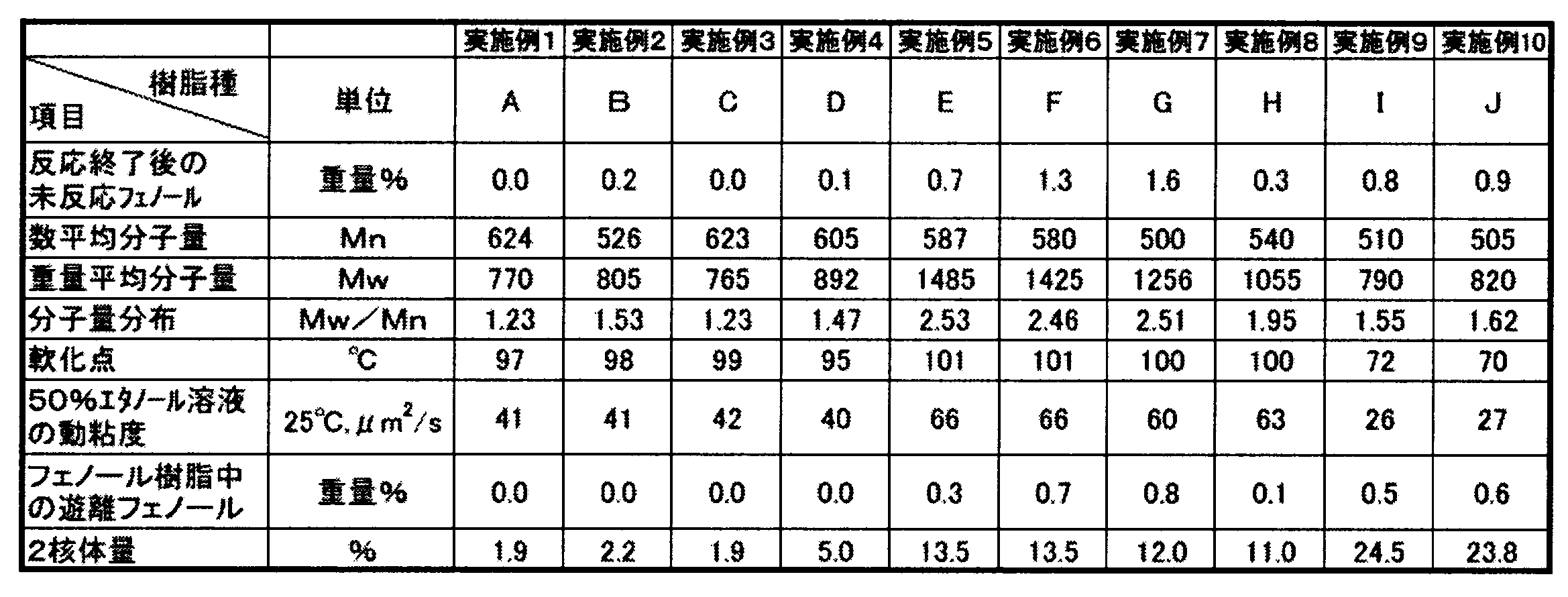
3Lの三口フラスコ中に1-ヒドロキシエチリデン-1,1’-ジホスホン酸60%水溶液(フェリオックス115、ライオン社製)500部を添加し、常圧蒸留を行い80%の濃度とした。これに、トリフェニルフォスフィン1部、フェノール1000部を添加して100℃に昇温し、37%ホルムアルデヒド水溶液550部を30分間かけて逐次添加し、常圧蒸留を行い、130℃まで昇温させ反応系中の水分量を6%とした。その後、130℃に温度を維持し、水分量を約6%で一定として、常圧蒸留を行いながら37%ホルムアルデヒド水溶液140部を30分間かけて添加した。この間蒸留により失われたフェノール量は仕込んだフェノールに対して0.3%であった。その後、140℃で1時間還流させながら反応を行った。反応時の系中水分は反応初期は6%であり、反応終了時は25%であった。反応終了後、反応組成物をサンプリングしガスクロマトグラフィーを用いて未反応フェノール量を測定した。その後、純水500部を添加し、樹脂と分離した水相を除去する水洗工程を3回行った。その後、常圧蒸留を行い130℃まで昇温し、5000Paの減圧度で減圧蒸留を行って150℃まで昇温し、フェノール樹脂A1073部を得た。
実施例1で、トリフェニルフォスフィン添加量を0.1部に変えた以外は実施例1と同様の工程でフェノール樹脂を製造し、フェノール樹脂B1073部を得た。
実施例1で、トリフェニルフォスフィン添加量を5部に変えた以外は実施例1と同様の工程でフェノール樹脂を製造し、フェノール樹脂C1078部を得た。
3Lの三口フラスコ中にフェノール1000部、1-ヒドロキシエチリデン-1,1’-ジホスホン酸(1-1-ヒドロキシエチリデン-1,1’-ジホスホン酸(1水和物)95%以上、キシダ化学社製)300部、トリフェニルフォスフィン1部を添加した。これを140℃に昇温し、92%パラホルムアルデヒド277.5部を30分間かけて逐次添加し、126℃で1時間還流させながら反応させた。この反応時の系中水分は反応初期は2%であり、反応終了時は12%であった。反応終了後、反応組成物をサンプリングしガスクロマトグラフィーを用いて未反応フェノール量を測定した。その後、実施例1と同様に、純水500部を添加し、樹脂と分離した水相を除去する水洗工程を3回行った。その後、常圧蒸留を行い130℃まで昇温し、5000Paの減圧度で減圧蒸留を行って150℃まで昇温し、フェノール樹脂D1074部を得た。
3Lの三口フラスコ中にフェノール1000部、1-ヒドロキシエチリデン-1,1’-ジホスホン酸60%水溶液(フェリオックス115、ライオン社製)を200部とトリフェニルフォスフィン1部を添加した。これを、100℃に昇温し、37%ホルムアルデヒド水溶液690部を30分間かけて逐次添加し、100℃で1時間還流させながら反応させた。この反応時の系中水分は反応初期は7%であり、反応終了時は37%であった。反応終了後、反応組成物をサンプリングしガスクロマトグラフィーを用いて未反応フェノール量を測定した。その後、実施例1と同様に、純水500部を添加し混合した後、樹脂と分離した水相を除去した。このような水洗工程を3回行った。その後、常圧蒸留を行い130℃まで昇温し、5000Paの減圧度で減圧蒸留を行って150℃まで昇温し、フェノール樹脂E1058部を得た。
3Lの三口フラスコ中にフェノール1000部、アミノトリスメチレンホスホン酸50%水溶液(ディクエスト2000、ソルーシア・ジャパン社製)240部とトリフェニルフォスフィン1部を添加した。これを、100℃に昇温し、37%ホルムアルデヒド水溶液690部を30分間かけて逐次添加し、100℃で1時間還流させながら反応させた。この反応時の系中水分は反応初期は10%であり、反応終了時は38%であった。反応終了後、反応組成物をサンプリングしガスクロマトグラフィーを用いて未反応フェノール量を測定した。その後、実施例1と同様に、純水500部を添加し、樹脂と分離した水相を除去する水洗工程を3回行った。その後、常圧蒸留を行い130℃まで昇温し、5000Paの減圧度で減圧蒸留を行って150℃まで昇温し、フェノール樹脂F1054部を得た。
3Lの三口フラスコ中にフェノール1000部、2-ホスホノブタン-1,2,4-トリカルボン酸50%水溶液(PBTC、城北化学社製)240部とトリフェニルフォスフィン1部を添加した。これを100℃に昇温し、37%ホルムアルデヒド水溶液690部を30分間かけて逐次添加し、100℃で1時間還流させながら反応させた。この反応時の系中水分は反応初期は10%であり、反応終了時は38%であった。反応終了後、反応組成物をサンプリングしガスクロマトグラフィーを用いて未反応フェノール量を測定した。その後、実施例1と同様に、純水500部を添加し、樹脂と分離した水相を除去する水洗工程を3回行った。その後、常圧蒸留を行い130℃まで昇温し、5000Paの減圧度で減圧蒸留を行って150℃まで昇温し、フェノール樹脂G1049部を得た。
3Lの三口フラスコ中にフェノール1000部、1-ヒドロキシエチリデン-1,1’-ジホスホン酸60%水溶液(フェリオックス115、ライオン社製)1000部、トリフェニルフォスフィン1部を添加した。これを100℃に昇温し、37%ホルムアルデヒド水溶液690部を1時間かけて逐次添加し、100℃で1時間還流させながら反応を行った。この反応時の系中水分は反応初期は20%であり、反応終了時は38%であった。反応終了後、反応組成物をサンプリングしガスクロマトグラフィーを用いて未反応フェノール量を測定した。その後、実施例1と同様に、純水500部を添加し、樹脂と分離した水相を除去する水洗工程を3回行った。その後、常圧蒸留を行い130℃まで昇温し、5000Paの減圧度で減圧蒸留を行って150℃まで昇温し、フェノール樹脂H1066部を得た。
攪拌装置及び温度計を備えた10Lの密閉装置(オートクレーブ)にフェノール3000部、1-ヒドロキシエチリデン-1,1’-ジホスホン酸60%水溶液(フェリオックス115、ライオン社製)3000部、37%ホルムアルデヒド水溶液1811部(モル比F/P=0.7)、トリフェニルフォスフィン3部を添加して密閉状態で加熱した。内温が80℃に上昇した時点で急激な発熱反応が起こり、内温が150℃までおよそ3分間で上昇した。同時に圧力も0.45MPaまで上昇した。内温が130℃まで低下した時点で圧力抜きコックを徐々に開き、冷却管経由で内圧を0MPaに戻した。内温を80℃まで低下させ、反応物を取り出した。この反応時の系中水分は反応初期は30%であり、反応終了時は34%であった。反応組成物をサンプリングしガスクロマトグラフィーを用いて未反応フェノール量を測定した。その後、実施例1と同様に、純水500部を添加し、樹脂と分離した水相を除去する水洗工程を3回行った。その後、常圧蒸留を行い130℃まで昇温し、5000Paの減圧度で減圧蒸留を行って150℃まで昇温し、フェノール樹脂I3242部を得た。
攪拌装置および温度計を備えた10Lの密閉容器(装置1)の下部に、蒸気で温調できる10m長さの静止型ミキサー(エレメント形状:長方形の板を180度捻ったスパイラル形状をつなげたもの)を開閉式のコックを介し接続した。静止型ミキサーの出口は、攪拌装置、冷却管、温度計および冷却装置を備えた10Lの密閉容器(装置2)の上部に、開閉式のコックを介し接続した。
装置1にフェノール1000部、37%ホルマリン溶液604部(モル比F/P=0.7)、1-ヒドロキシエチリデン-1,1’-ジホスホン酸60%水溶液(フェリオックス115、ライオン社製)1000部、トリフェニルフォスフィン1部を添加し、60℃にて密閉状態で充分に混合した。静止型ミキサーは160℃で保温した。装置1内を0.1MPaまでエアーで加圧し、装置1の下部コックを全開にした。この際、装置1内の圧力が0.1MPaを保つようにエアー圧を調整した。上記混合物が静止型ミキサーを通過するのに所要する時間が2分間となるように装置2上部のコックの開度を調整した。装置2は、攪拌しながら冷却した。静止型ミキサー内の内温(装置1から1mの位置に温度計を設置)は133℃まで上昇した。装置1内部が空になり、装置2へ全量移送終了後、エアーを停止し、装置1、2のコックを閉じた。この時点で装置2の内温は、64℃であった。この反応時の系中水分は反応初期は30%であり、反応終了時は34%であった。その後、水500部を加え、内温80~90℃で15分間攪拌した。内温を60℃まで冷却し、10分間静置した。反応組成物をサンプリングしガスクロマトグラフィーを用いて未反応フェノール量を測定した。その後、実施例1と同様に、純水500部を添加し、樹脂と分離した水相を除去する水洗工程を3回行った。その後、常圧蒸留を行い130℃まで昇温し、5000Paの減圧度で減圧蒸留を行って150℃まで昇温し、フェノール樹脂J1072部を得た。
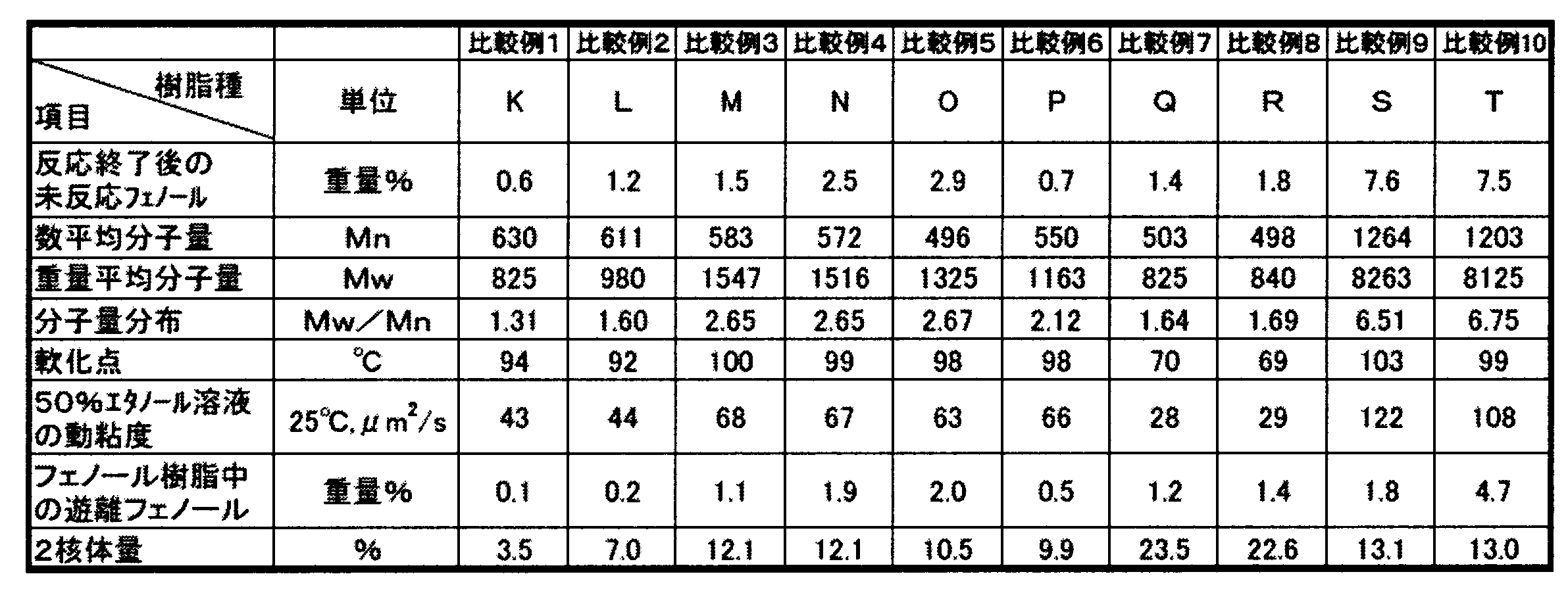
実施例1でトリフェニルフォスフィン添加を行わなかった以外は実施例1と同様の工程でフェノール樹脂を製造し、フェノール樹脂K1070部を得た。
実施例4でトリフェニルフォスフィン添加を行わなかった以外は実施例4と同様の工程でフェノール樹脂を製造し、フェノール樹脂L1071部を得た。
実施例5でトリフェニルフォスフィン添加を行わなかった以外は実施例5と同様の工程でフェノール樹脂を製造し、フェノール樹脂M1056部を得た。
実施例6でトリフェニルフォスフィン添加を行わなかった以外は実施例6と同様の工程でフェノール樹脂を製造し、フェノール樹脂N1052部を得た。
実施例7でトリフェニルフォスフィン添加を行わなかった以外は実施例7と同様の工程でフェノール樹脂を製造し、フェノール樹脂O1047部を得た。
実施例8でトリフェニルフォスフィン添加を行わなかった以外は実施例8と同様の工程でフェノール樹脂を製造し、フェノール樹脂P1065部を得た。
実施例9でトリフェニルフォスフィン添加を行わなかった以外は実施例9と同様の工程でフェノール樹脂を製造し、フェノール樹脂Q3225部を得た。
実施例10でトリフェニルフォスフィン添加を行わなかった以外は実施例10と同様の工程でフェノール樹脂を製造し、フェノール樹脂R1062部を得た。
3Lの三口フラスコ中にフェノール1000部、シュウ酸10部を添加し、100℃に昇温し、37%ホルムアルデヒド水溶液690部を30分間かけて逐次添加し、100℃で1時間還流させながら反応させた。反応終了後、反応組成物をサンプリングしガスクロマトグラフィーを用いて未反応フェノール量を測定した。その後、常圧蒸留を行い130℃まで昇温し、5000Paの減圧下で減圧蒸留を行って190℃まで昇温し、フェノール樹脂S957部を得た。
3Lの三口フラスコ中にフェノール1000部、シュウ酸10部を添加し、100℃に昇温し、37%ホルムアルデヒド水溶液690部を30分間かけて逐次添加し、100℃で1時間還流させながら反応させた。反応終了後、反応組成物をサンプリングしガスクロマトグラフィーを用いて未反応フェノール量を測定した。その後、実施例1と同様に、純水500部を添加し、樹脂と分離した水相を除去する水洗工程を3回行った。その後、常圧蒸留を行い130℃まで昇温し、5000Paの減圧下で減圧蒸留を行って150℃まで昇温し、フェノール樹脂T972部を得た。
1.反応終了後の未反応フェノール量及びフェノール樹脂中の遊離フェノール量:ガスクロマトグラフィーで測定した。
・ガスクロマトグラフィー:JIS K0114に準拠し、2,5-キシレノールを内部標準として内部標準法で測定した。
2.軟化点:JIS K2207に準拠して測定した。
3.50%エタノール溶液の動粘度:50重量%のエタノール溶液を25℃でキャノンフェンスケを用いて測定した。
4.数平均分子量、重量平均分子量、2核体量:液体クロマトグラフィー
液体クロマトグラフィー:東ソー製GPCカラム(G1000HXL:1本、G2000HXL:2本、G3000HXL:1本)を用い、流量1.0ml/分、溶出溶媒テトラヒドロフラン、カラム温度40℃の分析条件で示差屈折計を検出器として用いてGPC測定し、分子量は標準ポリスチレンにより換算した。また、2核体量は、液体クロマトグラフィーで測定したチャートの面積比から求めた。
Claims (9)
- フェノール類とアルデヒド類とを反応させるノボラック型フェノール樹脂の製造方法であって、反応触媒として水溶性を有する有機ホスホン酸を用いるとともに、反応助触媒として3級ホスフィン化合物を用いることを特徴とする、ノボラック型フェノール樹脂の製造方法。
- 前記3級ホスフィン化合物を、前記フェノール類に対して100~5000ppm用いる、請求項1に記載のノボラック型フェノール樹脂の製造方法。
- 前記フェノール類とアルデヒド類とを、反応系中の水分量を30重量%以下、反応温度を110~200℃の条件で反応させる、請求項1又は2に記載のノボラック型フェノール樹脂の製造方法。
- 前記水溶性を有する有機ホスホン酸が、下記一般式(1)で示される構造を有する、請求項1ないし3のいずれかに記載のノボラック型フェノール樹脂の製造方法。R-PO(OH)2 (1)
(Rは、炭素原子を含み、かつ、-COOH及び/又は-PO(OH)2 を含む基である) - 前記3級ホスフィン化合物が、トリフェニルホスフィンである、請求項1ないし4いずれかに記載のノボラック型フェノール樹脂の製造方法。
- 前記フェノール類とアルデヒド類とを、密閉装置中で反応させる、請求項1ないし5のいずれかに記載のノボラック型フェノール樹脂の製造方法。
- 前記フェノール類、アルデヒド類、水溶性を有する有機ホスホン酸、及び、3級ホスフィン化合物を一括して仕込み反応させる、請求項1ないし6のいずれかに記載のノボラック型フェノール樹脂の製造方法。
- 前記フェノール類とアルデヒド類とを、連続式混合装置で反応させる、請求項1ないし5のいずれかに記載のノボラック型フェノール樹脂の製造方法。
- 前記連続式混合装置として、静止型ミキサーを用いる、請求項8に記載のノボラック型フェノール樹脂の製造方法。
Priority Applications (3)
| Application Number | Priority Date | Filing Date | Title |
|---|---|---|---|
| US13/699,085 US8822627B2 (en) | 2010-06-14 | 2011-06-10 | Method of manufacture of novolac-type phenol resin |
| JP2012520422A JP5252130B2 (ja) | 2010-06-14 | 2011-06-10 | ノボラック型フェノール樹脂の製造方法 |
| CN201180028110.3A CN102933630B (zh) | 2010-06-14 | 2011-06-10 | 酚醛清漆型酚醛树脂的制造方法 |
Applications Claiming Priority (2)
| Application Number | Priority Date | Filing Date | Title |
|---|---|---|---|
| JP2010-134781 | 2010-06-14 | ||
| JP2010134781 | 2010-06-14 |
Publications (1)
| Publication Number | Publication Date |
|---|---|
| WO2011158751A1 true WO2011158751A1 (ja) | 2011-12-22 |
Family
ID=45348151
Family Applications (1)
| Application Number | Title | Priority Date | Filing Date |
|---|---|---|---|
| PCT/JP2011/063362 Ceased WO2011158751A1 (ja) | 2010-06-14 | 2011-06-10 | ノボラック型フェノール樹脂の製造方法 |
Country Status (4)
| Country | Link |
|---|---|
| US (1) | US8822627B2 (ja) |
| JP (1) | JP5252130B2 (ja) |
| CN (1) | CN102933630B (ja) |
| WO (1) | WO2011158751A1 (ja) |
Cited By (1)
| Publication number | Priority date | Publication date | Assignee | Title |
|---|---|---|---|---|
| WO2014171305A1 (ja) * | 2013-04-16 | 2014-10-23 | 住友ベークライト株式会社 | 樹脂組成物、注入剤および充填方法 |
Families Citing this family (1)
| Publication number | Priority date | Publication date | Assignee | Title |
|---|---|---|---|---|
| JP7095820B1 (ja) * | 2020-09-07 | 2022-07-05 | 住友ベークライト株式会社 | 水溶性レゾール型フェノール樹脂の水溶液 |
Citations (7)
| Publication number | Priority date | Publication date | Assignee | Title |
|---|---|---|---|---|
| JPH04226181A (ja) * | 1990-06-08 | 1992-08-14 | Dainippon Ink & Chem Inc | 熱硬化性塗装用組成物および塗料 |
| JP2001329034A (ja) * | 2000-05-22 | 2001-11-27 | Sumitomo Bakelite Co Ltd | フェノール樹脂の製造方法 |
| JP2002105157A (ja) * | 2000-09-28 | 2002-04-10 | Sumitomo Bakelite Co Ltd | フェノール樹脂の製造方法 |
| JP2002128849A (ja) * | 2000-10-26 | 2002-05-09 | Sumitomo Bakelite Co Ltd | フェノール樹脂の製造方法 |
| JP2002194041A (ja) * | 1999-12-16 | 2002-07-10 | Sumitomo Bakelite Co Ltd | フェノール樹脂の製造方法 |
| JP2004238618A (ja) * | 2003-01-16 | 2004-08-26 | Sumitomo Bakelite Co Ltd | ノボラック型アルキルフェノール樹脂の製造方法 |
| JP2004339256A (ja) * | 2003-05-13 | 2004-12-02 | Asahi Organic Chem Ind Co Ltd | ノボラック型フェノール樹脂の製造方法 |
Family Cites Families (3)
| Publication number | Priority date | Publication date | Assignee | Title |
|---|---|---|---|---|
| US4016348A (en) * | 1972-02-22 | 1977-04-05 | Adams George F | Reactor process and apparatus for continuous polymerization |
| US6326453B2 (en) * | 1999-12-16 | 2001-12-04 | Sumitomo Durez Company, Ltd. | Process for producing phenol resin |
| KR101310697B1 (ko) * | 2009-03-18 | 2013-09-25 | 디아이씨 가부시끼가이샤 | 인 원자 함유 페놀류의 제조 방법, 신규 인 원자 함유 페놀류, 경화성 수지 조성물, 그 경화물, 프린트 배선 기판, 및 반도체 봉지 재료 |
-
2011
- 2011-06-10 JP JP2012520422A patent/JP5252130B2/ja not_active Expired - Fee Related
- 2011-06-10 CN CN201180028110.3A patent/CN102933630B/zh not_active Expired - Fee Related
- 2011-06-10 US US13/699,085 patent/US8822627B2/en not_active Expired - Fee Related
- 2011-06-10 WO PCT/JP2011/063362 patent/WO2011158751A1/ja not_active Ceased
Patent Citations (7)
| Publication number | Priority date | Publication date | Assignee | Title |
|---|---|---|---|---|
| JPH04226181A (ja) * | 1990-06-08 | 1992-08-14 | Dainippon Ink & Chem Inc | 熱硬化性塗装用組成物および塗料 |
| JP2002194041A (ja) * | 1999-12-16 | 2002-07-10 | Sumitomo Bakelite Co Ltd | フェノール樹脂の製造方法 |
| JP2001329034A (ja) * | 2000-05-22 | 2001-11-27 | Sumitomo Bakelite Co Ltd | フェノール樹脂の製造方法 |
| JP2002105157A (ja) * | 2000-09-28 | 2002-04-10 | Sumitomo Bakelite Co Ltd | フェノール樹脂の製造方法 |
| JP2002128849A (ja) * | 2000-10-26 | 2002-05-09 | Sumitomo Bakelite Co Ltd | フェノール樹脂の製造方法 |
| JP2004238618A (ja) * | 2003-01-16 | 2004-08-26 | Sumitomo Bakelite Co Ltd | ノボラック型アルキルフェノール樹脂の製造方法 |
| JP2004339256A (ja) * | 2003-05-13 | 2004-12-02 | Asahi Organic Chem Ind Co Ltd | ノボラック型フェノール樹脂の製造方法 |
Cited By (1)
| Publication number | Priority date | Publication date | Assignee | Title |
|---|---|---|---|---|
| WO2014171305A1 (ja) * | 2013-04-16 | 2014-10-23 | 住友ベークライト株式会社 | 樹脂組成物、注入剤および充填方法 |
Also Published As
| Publication number | Publication date |
|---|---|
| US20130066036A1 (en) | 2013-03-14 |
| CN102933630A (zh) | 2013-02-13 |
| JPWO2011158751A1 (ja) | 2013-08-19 |
| JP5252130B2 (ja) | 2013-07-31 |
| US8822627B2 (en) | 2014-09-02 |
| CN102933630B (zh) | 2014-08-20 |
Similar Documents
| Publication | Publication Date | Title |
|---|---|---|
| JP4998271B2 (ja) | フェノール樹脂及び樹脂組成物 | |
| JP5252130B2 (ja) | ノボラック型フェノール樹脂の製造方法 | |
| CN103304778A (zh) | 酚树脂和热固性树脂组合物 | |
| JP7180815B2 (ja) | フェノール樹脂組成物およびその製造方法 | |
| JP5849771B2 (ja) | バイオマス誘導体、バイオマス誘導体組成物及びバイオマス誘導体硬化物 | |
| JP3651843B2 (ja) | フェノール樹脂の製造方法 | |
| CN102282187A (zh) | 酚醛清漆树脂和热固性树脂组合物 | |
| CN100519609C (zh) | 生产酚醛清漆树脂的方法 | |
| JP2005075939A (ja) | ノボラック型フェノール樹脂の製造方法 | |
| JP2003212945A (ja) | ノボラック型フェノール樹脂の製造方法 | |
| CN100372879C (zh) | 酚醛树脂的制造方法 | |
| TWI889893B (zh) | 水溶性甲階型酚醛樹脂之水溶液 | |
| JP2005200489A (ja) | 熱可塑性樹脂変性ノボラック型フェノール樹脂の製造方法 | |
| JP7711371B2 (ja) | フェノール樹脂組成物 | |
| JP2003206326A (ja) | ノボラック型フェノール樹脂の製造方法 | |
| JP2006016489A (ja) | レゾール型フェノール樹脂及びその製造方法 | |
| JP2005075937A (ja) | ノボラック型フェノール樹脂の製造方法 | |
| JPH10195158A (ja) | ノボラック型フェノール樹脂の製造方法 | |
| JP2005232389A (ja) | 硬化性樹脂組成物 | |
| JP3874338B2 (ja) | ノボラック型フェノール樹脂の製造方法 | |
| JP2006096891A (ja) | 熱硬化性樹脂の製造方法 | |
| KR100561898B1 (ko) | 고-분자량 고-오르토 노볼락형 페놀수지 | |
| JP2002302525A (ja) | ノボラック型フェノール樹脂の製造方法 | |
| JP2005154613A (ja) | 液状フェノール樹脂組成物 | |
| JP2005068395A (ja) | ノボラック型フェノール樹脂の製造方法 |
Legal Events
| Date | Code | Title | Description |
|---|---|---|---|
| WWE | Wipo information: entry into national phase |
Ref document number: 201180028110.3 Country of ref document: CN |
|
| 121 | Ep: the epo has been informed by wipo that ep was designated in this application |
Ref document number: 11795658 Country of ref document: EP Kind code of ref document: A1 |
|
| WWE | Wipo information: entry into national phase |
Ref document number: 2012520422 Country of ref document: JP |
|
| WWE | Wipo information: entry into national phase |
Ref document number: 13699085 Country of ref document: US |
|
| NENP | Non-entry into the national phase |
Ref country code: DE |
|
| 122 | Ep: pct application non-entry in european phase |
Ref document number: 11795658 Country of ref document: EP Kind code of ref document: A1 |