EP4524924A2 - Chaussure électronique intelligente et logique de commande pour exécuter des caractéristiques de chaussure automatisées - Google Patents
Chaussure électronique intelligente et logique de commande pour exécuter des caractéristiques de chaussure automatisées Download PDFInfo
- Publication number
- EP4524924A2 EP4524924A2 EP25154818.6A EP25154818A EP4524924A2 EP 4524924 A2 EP4524924 A2 EP 4524924A2 EP 25154818 A EP25154818 A EP 25154818A EP 4524924 A2 EP4524924 A2 EP 4524924A2
- Authority
- EP
- European Patent Office
- Prior art keywords
- user
- ies
- location
- footwear
- command signal
- Prior art date
- Legal status (The legal status is an assumption and is not a legal conclusion. Google has not performed a legal analysis and makes no representation as to the accuracy of the status listed.)
- Pending
Links
Images

Classifications
-
- A—HUMAN NECESSITIES
- A43—FOOTWEAR
- A43B—CHARACTERISTIC FEATURES OF FOOTWEAR; PARTS OF FOOTWEAR
- A43B3/00—Footwear characterised by the shape or the use
- A43B3/34—Footwear characterised by the shape or the use with electrical or electronic arrangements
- A43B3/36—Footwear characterised by the shape or the use with electrical or electronic arrangements with light sources
-
- A—HUMAN NECESSITIES
- A43—FOOTWEAR
- A43B—CHARACTERISTIC FEATURES OF FOOTWEAR; PARTS OF FOOTWEAR
- A43B3/00—Footwear characterised by the shape or the use
- A43B3/34—Footwear characterised by the shape or the use with electrical or electronic arrangements
-
- A—HUMAN NECESSITIES
- A43—FOOTWEAR
- A43B—CHARACTERISTIC FEATURES OF FOOTWEAR; PARTS OF FOOTWEAR
- A43B3/00—Footwear characterised by the shape or the use
- A43B3/34—Footwear characterised by the shape or the use with electrical or electronic arrangements
- A43B3/44—Footwear characterised by the shape or the use with electrical or electronic arrangements with sensors, e.g. for detecting contact or position
-
- A—HUMAN NECESSITIES
- A43—FOOTWEAR
- A43B—CHARACTERISTIC FEATURES OF FOOTWEAR; PARTS OF FOOTWEAR
- A43B3/00—Footwear characterised by the shape or the use
- A43B3/34—Footwear characterised by the shape or the use with electrical or electronic arrangements
- A43B3/48—Footwear characterised by the shape or the use with electrical or electronic arrangements with transmitting devices, e.g. GSM or Wi-Fi®
-
- A—HUMAN NECESSITIES
- A43—FOOTWEAR
- A43B—CHARACTERISTIC FEATURES OF FOOTWEAR; PARTS OF FOOTWEAR
- A43B3/00—Footwear characterised by the shape or the use
- A43B3/34—Footwear characterised by the shape or the use with electrical or electronic arrangements
- A43B3/50—Footwear characterised by the shape or the use with electrical or electronic arrangements with sound or music sources
-
- A—HUMAN NECESSITIES
- A43—FOOTWEAR
- A43C—FASTENINGS OR ATTACHMENTS OF FOOTWEAR; LACES IN GENERAL
- A43C11/00—Other fastenings specially adapted for shoes
- A43C11/16—Fastenings secured by wire, bolts, or the like
- A43C11/165—Fastenings secured by wire, bolts, or the like characterised by a spool, reel or pulley for winding up cables, laces or straps by rotation
-
- B—PERFORMING OPERATIONS; TRANSPORTING
- B60—VEHICLES IN GENERAL
- B60Q—ARRANGEMENT OF SIGNALLING OR LIGHTING DEVICES, THE MOUNTING OR SUPPORTING THEREOF OR CIRCUITS THEREFOR, FOR VEHICLES IN GENERAL
- B60Q1/00—Arrangement of optical signalling or lighting devices, the mounting or supporting thereof or circuits therefor
- B60Q1/26—Arrangement of optical signalling or lighting devices, the mounting or supporting thereof or circuits therefor the devices being primarily intended to indicate the vehicle, or parts thereof, or to give signals, to other traffic
- B60Q1/2661—Arrangement of optical signalling or lighting devices, the mounting or supporting thereof or circuits therefor the devices being primarily intended to indicate the vehicle, or parts thereof, or to give signals, to other traffic mounted on parts having other functions
- B60Q1/2673—Arrangement of optical signalling or lighting devices, the mounting or supporting thereof or circuits therefor the devices being primarily intended to indicate the vehicle, or parts thereof, or to give signals, to other traffic mounted on parts having other functions on parts worn by the driver, e.g. clothes, gloves or bags, specially adapted to provide auxiliary vehicle signalling
-
- B—PERFORMING OPERATIONS; TRANSPORTING
- B60—VEHICLES IN GENERAL
- B60Q—ARRANGEMENT OF SIGNALLING OR LIGHTING DEVICES, THE MOUNTING OR SUPPORTING THEREOF OR CIRCUITS THEREFOR, FOR VEHICLES IN GENERAL
- B60Q1/00—Arrangement of optical signalling or lighting devices, the mounting or supporting thereof or circuits therefor
- B60Q1/26—Arrangement of optical signalling or lighting devices, the mounting or supporting thereof or circuits therefor the devices being primarily intended to indicate the vehicle, or parts thereof, or to give signals, to other traffic
- B60Q1/50—Arrangement of optical signalling or lighting devices, the mounting or supporting thereof or circuits therefor the devices being primarily intended to indicate the vehicle, or parts thereof, or to give signals, to other traffic for indicating other intentions or conditions, e.g. request for waiting or overtaking
- B60Q1/525—Arrangement of optical signalling or lighting devices, the mounting or supporting thereof or circuits therefor the devices being primarily intended to indicate the vehicle, or parts thereof, or to give signals, to other traffic for indicating other intentions or conditions, e.g. request for waiting or overtaking automatically indicating risk of collision between vehicles in traffic or with pedestrians, e.g. after risk assessment using the vehicle sensor data
-
- B—PERFORMING OPERATIONS; TRANSPORTING
- B60—VEHICLES IN GENERAL
- B60Q—ARRANGEMENT OF SIGNALLING OR LIGHTING DEVICES, THE MOUNTING OR SUPPORTING THEREOF OR CIRCUITS THEREFOR, FOR VEHICLES IN GENERAL
- B60Q5/00—Arrangement or adaptation of acoustic signal devices
- B60Q5/005—Arrangement or adaptation of acoustic signal devices automatically actuated
- B60Q5/006—Arrangement or adaptation of acoustic signal devices automatically actuated indicating risk of collision between vehicles or with pedestrians
-
- B—PERFORMING OPERATIONS; TRANSPORTING
- B60—VEHICLES IN GENERAL
- B60Q—ARRANGEMENT OF SIGNALLING OR LIGHTING DEVICES, THE MOUNTING OR SUPPORTING THEREOF OR CIRCUITS THEREFOR, FOR VEHICLES IN GENERAL
- B60Q9/00—Arrangement or adaptation of signal devices not provided for in one of main groups B60Q1/00 - B60Q7/00, e.g. haptic signalling
- B60Q9/008—Arrangement or adaptation of signal devices not provided for in one of main groups B60Q1/00 - B60Q7/00, e.g. haptic signalling for anti-collision purposes
-
- G—PHYSICS
- G01—MEASURING; TESTING
- G01S—RADIO DIRECTION-FINDING; RADIO NAVIGATION; DETERMINING DISTANCE OR VELOCITY BY USE OF RADIO WAVES; LOCATING OR PRESENCE-DETECTING BY USE OF THE REFLECTION OR RERADIATION OF RADIO WAVES; ANALOGOUS ARRANGEMENTS USING OTHER WAVES
- G01S19/00—Satellite radio beacon positioning systems; Determining position, velocity or attitude using signals transmitted by such systems
- G01S19/01—Satellite radio beacon positioning systems transmitting time-stamped messages, e.g. GPS [Global Positioning System], GLONASS [Global Orbiting Navigation Satellite System] or GALILEO
- G01S19/13—Receivers
- G01S19/14—Receivers specially adapted for specific applications
- G01S19/19—Sporting applications
-
- G—PHYSICS
- G01—MEASURING; TESTING
- G01S—RADIO DIRECTION-FINDING; RADIO NAVIGATION; DETERMINING DISTANCE OR VELOCITY BY USE OF RADIO WAVES; LOCATING OR PRESENCE-DETECTING BY USE OF THE REFLECTION OR RERADIATION OF RADIO WAVES; ANALOGOUS ARRANGEMENTS USING OTHER WAVES
- G01S5/00—Position-fixing by co-ordinating two or more direction or position line determinations; Position-fixing by co-ordinating two or more distance determinations
- G01S5/0009—Transmission of position information to remote stations
- G01S5/0018—Transmission from mobile station to base station
- G01S5/0027—Transmission from mobile station to base station of actual mobile position, i.e. position determined on mobile
-
- G—PHYSICS
- G01—MEASURING; TESTING
- G01S—RADIO DIRECTION-FINDING; RADIO NAVIGATION; DETERMINING DISTANCE OR VELOCITY BY USE OF RADIO WAVES; LOCATING OR PRESENCE-DETECTING BY USE OF THE REFLECTION OR RERADIATION OF RADIO WAVES; ANALOGOUS ARRANGEMENTS USING OTHER WAVES
- G01S5/00—Position-fixing by co-ordinating two or more direction or position line determinations; Position-fixing by co-ordinating two or more distance determinations
- G01S5/0009—Transmission of position information to remote stations
- G01S5/0072—Transmission between mobile stations, e.g. anti-collision systems
-
- G—PHYSICS
- G08—SIGNALLING
- G08B—SIGNALLING SYSTEMS, e.g. PERSONAL CALLING SYSTEMS; ORDER TELEGRAPHS; ALARM SYSTEMS
- G08B21/00—Alarms responsive to a single specified undesired or abnormal condition and not otherwise provided for
- G08B21/02—Alarms for ensuring the safety of persons
-
- G—PHYSICS
- G08—SIGNALLING
- G08B—SIGNALLING SYSTEMS, e.g. PERSONAL CALLING SYSTEMS; ORDER TELEGRAPHS; ALARM SYSTEMS
- G08B7/00—Signalling systems according to two or more of groups G08B3/00 - G08B6/00
- G08B7/06—Signalling systems according to two or more of groups G08B3/00 - G08B6/00 using electric transmission, e.g. involving audible and visible signalling through the use of sound and light sources
-
- G—PHYSICS
- G08—SIGNALLING
- G08G—TRAFFIC CONTROL SYSTEMS
- G08G1/00—Traffic control systems for road vehicles
- G08G1/005—Traffic control systems for road vehicles including pedestrian guidance indicator
-
- G—PHYSICS
- G08—SIGNALLING
- G08G—TRAFFIC CONTROL SYSTEMS
- G08G1/00—Traffic control systems for road vehicles
- G08G1/07—Controlling traffic signals
-
- G—PHYSICS
- G08—SIGNALLING
- G08G—TRAFFIC CONTROL SYSTEMS
- G08G1/00—Traffic control systems for road vehicles
- G08G1/07—Controlling traffic signals
- G08G1/087—Override of traffic control, e.g. by signal transmitted by an emergency vehicle
-
- G—PHYSICS
- G08—SIGNALLING
- G08G—TRAFFIC CONTROL SYSTEMS
- G08G1/00—Traffic control systems for road vehicles
- G08G1/16—Anti-collision systems
- G08G1/161—Decentralised systems, e.g. inter-vehicle communication
- G08G1/162—Decentralised systems, e.g. inter-vehicle communication event-triggered
-
- G—PHYSICS
- G08—SIGNALLING
- G08G—TRAFFIC CONTROL SYSTEMS
- G08G1/00—Traffic control systems for road vehicles
- G08G1/16—Anti-collision systems
- G08G1/164—Centralised systems, e.g. external to vehicles
-
- G—PHYSICS
- G08—SIGNALLING
- G08G—TRAFFIC CONTROL SYSTEMS
- G08G1/00—Traffic control systems for road vehicles
- G08G1/16—Anti-collision systems
- G08G1/166—Anti-collision systems for active traffic, e.g. moving vehicles, pedestrians, bikes
-
- H—ELECTRICITY
- H04—ELECTRIC COMMUNICATION TECHNIQUE
- H04M—TELEPHONIC COMMUNICATION
- H04M1/00—Substation equipment, e.g. for use by subscribers
- H04M1/72—Mobile telephones; Cordless telephones, i.e. devices for establishing wireless links to base stations without route selection
- H04M1/724—User interfaces specially adapted for cordless or mobile telephones
- H04M1/72403—User interfaces specially adapted for cordless or mobile telephones with means for local support of applications that increase the functionality
- H04M1/72409—User interfaces specially adapted for cordless or mobile telephones with means for local support of applications that increase the functionality by interfacing with external accessories
- H04M1/72412—User interfaces specially adapted for cordless or mobile telephones with means for local support of applications that increase the functionality by interfacing with external accessories using two-way short-range wireless interfaces
-
- H—ELECTRICITY
- H04—ELECTRIC COMMUNICATION TECHNIQUE
- H04W—WIRELESS COMMUNICATION NETWORKS
- H04W4/00—Services specially adapted for wireless communication networks; Facilities therefor
- H04W4/02—Services making use of location information
- H04W4/021—Services related to particular areas, e.g. point of interest [POI] services, venue services or geofences
-
- H—ELECTRICITY
- H04—ELECTRIC COMMUNICATION TECHNIQUE
- H04W—WIRELESS COMMUNICATION NETWORKS
- H04W4/00—Services specially adapted for wireless communication networks; Facilities therefor
- H04W4/02—Services making use of location information
- H04W4/023—Services making use of location information using mutual or relative location information between multiple location based services [LBS] targets or of distance thresholds
-
- H—ELECTRICITY
- H04—ELECTRIC COMMUNICATION TECHNIQUE
- H04W—WIRELESS COMMUNICATION NETWORKS
- H04W4/00—Services specially adapted for wireless communication networks; Facilities therefor
- H04W4/30—Services specially adapted for particular environments, situations or purposes
- H04W4/40—Services specially adapted for particular environments, situations or purposes for vehicles, e.g. vehicle-to-pedestrians [V2P]
-
- H—ELECTRICITY
- H04—ELECTRIC COMMUNICATION TECHNIQUE
- H04W—WIRELESS COMMUNICATION NETWORKS
- H04W4/00—Services specially adapted for wireless communication networks; Facilities therefor
- H04W4/80—Services using short range communication, e.g. near-field communication [NFC], radio-frequency identification [RFID] or low energy communication
-
- G—PHYSICS
- G01—MEASURING; TESTING
- G01S—RADIO DIRECTION-FINDING; RADIO NAVIGATION; DETERMINING DISTANCE OR VELOCITY BY USE OF RADIO WAVES; LOCATING OR PRESENCE-DETECTING BY USE OF THE REFLECTION OR RERADIATION OF RADIO WAVES; ANALOGOUS ARRANGEMENTS USING OTHER WAVES
- G01S19/00—Satellite radio beacon positioning systems; Determining position, velocity or attitude using signals transmitted by such systems
- G01S19/38—Determining a navigation solution using signals transmitted by a satellite radio beacon positioning system
- G01S19/39—Determining a navigation solution using signals transmitted by a satellite radio beacon positioning system the satellite radio beacon positioning system transmitting time-stamped messages, e.g. GPS [Global Positioning System], GLONASS [Global Orbiting Navigation Satellite System] or GALILEO
- G01S19/42—Determining position
- G01S19/48—Determining position by combining or switching between position solutions derived from the satellite radio beacon positioning system and position solutions derived from a further system
- G01S19/49—Determining position by combining or switching between position solutions derived from the satellite radio beacon positioning system and position solutions derived from a further system whereby the further system is an inertial position system, e.g. loosely-coupled
Definitions
- the present disclosure relates generally to wearable electronic devices. More specifically, aspects of this disclosure relate to systems, methods, and devices for enabling automated features of intelligent electronic footwear and apparel.
- Articles of footwear are generally composed of two primary elements: an upper for securing the footwear to a user's foot; and a sole structure for providing subjacent support for the foot.
- Uppers may be fabricated from a variety of materials - including textiles, foams, polymers, natural and synthetic leathers, etc. - that are stitched or adhesively bonded together to form a shell or harness for securely receiving a foot.
- the upper may have an open toe or heel construction or may be generally limited to a series of straps extending over the instep and, in some designs, around the ankle.
- boot and shoe designs incorporate a full upper with a closed toe or heel construction and an ankle opening through a rear quarter portion that provides access to the footwear's interior, facilitating entry and removal of the foot into and from the upper.
- a shoelace or strap may be utilized to secure the foot within the upper.
- the sole structure is generally attached to a lower portion of the upper, positioned between the user's foot and the ground.
- the sole structure is a layered construction that generally incorporates a comfort-enhancing insole, an impact-mitigating midsole, and a surface-contacting outsole.
- the insole which may be located partially or entirely within the upper, is a thin and compressible member that provides a contact surface for the underside of the user's foot.
- the midsole is mounted underneath the insole, forming a middle layer of the sole structure. In addition to attenuating ground reaction forces, the midsole may help to control foot motion and impart stability.
- Secured to the underside of the midsole is an outsole that forms the ground-contacting portion of the footwear and is usually fashioned from a durable and wear-resistant material that includes features for improving traction.
- an Internet of Adaptive Apparel and Footwear (IoAAF) system that wirelessly communicates with an intelligent electronic shoe (IES) to automate communication between the shoe and a motor vehicle, i.e., footwear-to-vehicle (F2V) communications.
- IoAAF Internet of Adaptive Apparel and Footwear
- IES intelligent electronic shoe
- F2V footwear-to-vehicle
- ride-sharing application for example, a registered driver is paired with a ride-seeking passenger through a dedicated mobile application (“app") or a web-based applet operating on a personal smartphone or other handheld computing device.
- the rider - while wearing an IES - may wait outside on a curb for the ride-share driver.
- the IES will automate a hailing feature that helps the driver spot their fare.
- the IES tracks the rider's and driver's real-time locations; upon determining that the rider's location is within a predetermined location or proximity of the driver's location, the IES will automatically generate a visual or audible output sufficient to draw attention to the rider.
- an IES processor built into the midsole of the shoe issues a command signal to a built-in shoe light system, causing the lights to illuminate, flash, change color, or a combination thereof.
- the IES processor may wirelessly transmit a command prompt to a vehicle control system to responsively produce a visual or audible output, such as activating the vehicle horn or vehicle light system to help the rider identify the driver.
- the IES may piggyback a communication session established by the user's smartphone, handheld computing device, or other portable electronic device with wireless communications capabilities.
- the IES may operate as a standalone device with a resident wireless communications device that is packaged within the shoe structure.
- Other peripheral hardware may include resident memory, shortwave antenna, rechargeable battery, SIM card, etc., all of which are housed inside the shoe structure.
- An IES may be equipped with a human-machine interface (HMI) that allows the user to interact with the footwear and/or the IoAAF system.
- HMI human-machine interface
- one or more electroactive polymer (EAP) sensors may be woven into or formed as patches mounted on the shoe structure and operable to receive user inputs that allow the user to control operational aspects of the IES.
- EAP electroactive polymer
- any of the attendant operations for executing an automated footwear feature may be executed locally via the IES processor or may be off-boarded in a distributing computing fashion for execution by the smartphone, handheld computing device, IoAAF system, or any combination thereof.
- any one or more desired footwear features may initially require security authentication of a user via the IES processor and/or an IoAAF system server computer.
- a distributed array of sensors within the shoe structure communicates with the IES processor to perform biometric validation, such as confirming a user's weight (e.g., via pressure sensors), shoe size (e.g., via Electro Adaptive Reactive Lacing (EARL)), toe print (e.g., via an optical fingerprint sensor), or other suitable method.
- biometric validation such as confirming a user's weight (e.g., via pressure sensors), shoe size (e.g., via Electro Adaptive Reactive Lacing (EARL)), toe print (e.g., via an optical fingerprint sensor), or other suitable method.
- ETL Electro Adaptive Reactive Lacing
- any of the foregoing sensing devices may be employed as a binary (ON/OFF) switch to confirm the IES is actually on a user's foot when attempting to execute an automated feature.
- an intelligent electronic shoe may also
- Provisioning wireless data exchanges to facilitate execution of an automated feature may require the IES be registered with the IoAAF system. For instance, a user may record an IES serial number with the IoAAF system, which will then issue a validation key to a personal account, e.g., a "digital locker" operating on the user's smartphone, tablet, PC, or laptop, to provide additional authentication. Registration may be completed manually, e.g., via the user, or digitally, e.g., via a barcode or near-field communication (NFC) tag on the shoe.
- NFC near-field communication
- a unique virtual shoe may be assigned to an IES and stored in the digital locker; each virtual shoe may be backed by a blockchain security technology designed to help guarantee uniqueness and authenticity, such as a cryptographic hash function, a trusted timestamp, correlating transaction data, etc.
- the IES may be used to authenticate the user for entry to concerts, movies, sporting events, airplanes, other mass transit, and the like. While described with reference to an article of footwear as a representative application for the novel concepts presented herein, it is envisioned that many of the disclosed options and features may be applied to other wearable apparel, including clothing, headgear, eyewear, wrist wear, neck wear, leg wear, and the like.
- an intelligent electronic shoe system includes an article of footwear with an upper that attaches to a user's foot, and a sole structure that is attached to the upper and supports thereon the user's foot.
- the sole structure includes an outsole that defines a bottom-most, ground-engaging portion of the article of footwear.
- a controller-automated alert system which is mounted to the footwear's sole structure and/or upper, is operable to generate visible, audible and/or tactile outputs in response to one or more electronic command signals.
- the IES system also includes a wireless communications device that wirelessly communicates with a remote computing node, and a system controller that communicates with the wireless communications device and alert system.
- This controller which may be resident to or remote from the footwear, is programmed to receive location data that is indicative of the user's location and the remote computing node's location. Using this data, the controller determines whether the user's location is within a predetermined location or proximity to the node's location.
- the system controller In response to the user's location being within either the predetermined location or the predetermined proximity to the node's location, the system controller automatically transmits a command signal to the alert system to generate a predetermined visible, audible and/or tactile alert that is perceptible by the user and/or motor vehicle, e.g., thereby notifying one or both parties of their relative proximity/location.
- a method for manufacturing an article of footwear for a foot of a user.
- This representative method includes, in any order and in any combination with any of the above or below disclosed features and options: providing an upper configured to receive and attach to the foot of the user; providing a sole structure configured to support thereon the foot of the user, the sole structure having an outsole defining a ground-engaging portion of the footwear; attaching the sole structure to the upper; mounting a controller-automated alert system to the sole structure and/or upper, the alert system being configured to generate audible, visible and/or tactile outputs in response to command signals; mounting a wireless communications device to the sole structure and/or the upper, the wireless communications device being configured to wirelessly communicate with a remote computing node; and mounting a resident controller to the sole structure and/or the upper.
- This resident controller is operatively connected to the wireless communications device and the alert system.
- the resident controller is programmed to: receive user location data indicative of a current location of the user; receive node location data indicative of a current location of the remote computing node; determine whether the user's location is within a predetermined location or proximity to the node's location; and respond to the user's location being within the predetermined location or proximity to the node's location by automatically transmitting a command signal to the alert system to generate a predetermined alert.
- a method of executing an automated feature of an intelligent electronic shoe includes, in any order and in any combination with any of the above or below disclosed features and options: receiving, via a resident or remote wireless communications device, location data indicative of a user location of a user; receiving, via the wireless communications device, location data indicative of a node location of a remote computing node; determining, via a resident or remote footwear controller, whether the user is located within a predetermined location or a predetermined proximity to the node's location; and, in response to the user location being within either the predetermined location or proximity to the node location, the footwear controller automatically transmitting to a resident controller-automated alert system a command signal to generate a predetermined visible, audible and/or tactile alert perceptible by the user and/or motor vehicle, e.g., thereby notifying one or both parties of their relative proximity/location.
- an article of footwear includes an upper that receives, at least partially covers, and attaches to a user's foot.
- a sole structure which is attached to a lower portion of the upper and supports thereon the user's foot, includes an outsole that defines the footwear's ground-engaging surface.
- a resident alert system is mounted to the sole structure and selectively actuable to generate visible, audible and/or tactile alerts in response to electronic command signals.
- a resident wireless communications device is mounted inside the sole structure and operable to wirelessly communicate with a remote computing node, such as a motor vehicle, remote back-end server computer, middleware node, dedicated software app operating on a portable electronic device, etc.
- the footwear is also equipped with a resident controller that is mounted inside the sole structure and communicatively connected to the wireless communications device and alert system.
- This resident controller is programmed to receive location data indicative of the user's current location and the remote computing node's current location. The resident controller then determines whether the user's current location is within a predetermined location/proximity to the node's current location. If so, the resident controller responsively transmits one or more command signals to the alert system to generate a predetermined alert notifying the user/vehicle of their relative closeness.
- the footwear controller may transmit a command signal to a control system of the remote computing node to generate an audible or visual output, e.g., in response to the user location being within the predetermined location/proximity to the node location.
- the remote computing node may be a motor vehicle with a vehicle headlamp system; in this instance, the visual output prompted by the footwear controller may include illumination, flashing and/or intensification of the light output of the vehicle's headlamp system.
- the footwear controller may be operable to coordinate the light output of the vehicle headlamp system with a predetermined light output of the IES alert system.
- an audible output prompted by the footwear controller may include activation and/or modulation of an audible output of the motor vehicle's horn system, infotainment system, or other vehicle subsystem capable of producing an audible output.
- the footwear controller may be operable to coordinate the audible output of the vehicle audio system with a predetermined audio output of the IES alert system.
- the user may have a portable electronic device, such as a smartphone, tablet, and/or smartwatch; the wireless communications device may be designed to wirelessly connect to the portable electronic device and, through this connectivity, wirelessly communicate with the remote computing node.
- the alert system may include a haptic transducer that is mounted to the shoe structure.
- the footwear controller's command signal causes the haptic transducer to generate a haptic cue, e.g., to notify the user when the user's location is within the predetermined location/proximity to the node's location.
- the alert system may include an audio system that is mounted to the shoe structure.
- the footwear controller's command signal may cause the audio system to generate a predetermined sound output, e.g., to notify the user when the user's location is within the predetermined location/proximity to the node's location.
- the remote computing node may be a central control unit for a resident or commercial security system.
- the footwear controller may transmit a deactivation (or activation) command signal to the security system when the user's location is entering (or leaving) a predetermined location or proximity to the residence or building monitored by the security system.
- the remote computing node may be a central control unit for a home automation system.
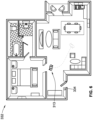
- the footwear controller may transmit a command signal to the home automation system to lock or unlock a door, activate or deactivate a room light, and/or increase or decrease a temperature of a thermostat, e.g., in response to the user's location being within a predetermined location or proximity to a home or a specific room within the home associated with the home automation system.
- the predetermined location or proximity may be delineated by a geofence that is produced by the footwear controller.
- a command signal is transmitted to the remote computing node or an IES subsystem upon detection of the remote computing node or IES breaching the geofence.
- a pressure sensor may be mounted to the shoe structure and configured to detect a presence of a foot in the upper.
- the command signal may be transmitted to the IES alert system only when there is a detected presence of a foot in the upper.
- Foot presence sensing in an article of footwear may be achieved via a variety of methods, including pressure/force sensing, capacitive sensing, magnetic signal sensing, etc.
- a pressure sensor may be mounted inside the sole structure and configured to detect a user's weight. From these sensor readings, the footwear controller may determine if the detected weight of a current user is within a predetermine range of a memory-stored validated user weight (i.e., authenticated to a registered user). Once validated, the footwear controller will then transmit the command signal to the IES alert system.
- the IES may include a shoelace that is attached to the upper, and a lace motor that is mounted inside the sole structure and operable to selectively transition the shoelace/strap between tensioned and untensioned states.
- the footwear controller may communicate with the lace motor to determine a current state of the shoelace.
- a command signal may be transmitted to the IES alert system only when the shoelace is in the tensioned state.
- the tensioned state may include multiple discrete tensioned positions; the IES system may include a lace sensor that detects a current discrete tensioned position for a current user.
- the footwear controller may communicate with the lace sensor to determine if the current discrete tensioned position corresponds to a memory-stored validated lace tensioned position (i.e., authenticated to a registered user). Once the current user is validated, the footwear controller will then transmit the command signal to the IES alert system. Additional information regarding footwear with motorized lacing and gesture control capabilities can be found, for example, in U.S. Patent Application Publication Nos. 2016/0262485 and 2018/0020764 , both of which are incorporated herein by reference in their respective entireties for all purposes.
- user recognition may be achieved via gait profiling and analysis, which may be determined from microelectromechanical systems (MEMS) in the shoe, e.g., to authenticate/validate a user (alone or in combination with validation on a smartphone).
- MEMS microelectromechanical systems
- the remote computing node may include an optical sensor, e.g., as part of a digital camera.
- the predetermined output of the IES alert system may include a personalized color and/or an encoded blinking pattern that is detectable by the optical sensor and designed to verify the user to the remote computing node.
- the wireless communications device may include a BLUETOOTH ® Low Energy (BLE), low-power and wide-area category (CAT) M1 or narrow-band CAT-NB1 wireless interface.
- a barcode, a radio-frequency identification (RFID) tag, or a near-field communications (NFC) tag may be attached to the sole structure and/or the upper; these features are designed to communicate a security authentication code to the remote computing node.
- RFID radio-frequency identification
- NFC near-field communications
- directional adjectives and adverbs such as fore, aft, medial, lateral, proximal, distal, vertical, horizontal, front, back, left, right, etc., may be with respect to an article of footwear when worn on a user's foot and operatively oriented with the base of the sole structure seated on a flat surface, for example.
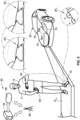
- the representative article of footwear 10 is generally depicted in FIGS. 1 and 2 as a bipartite construction that is primarily composed of a foot-receiving upper 12 mounted on top of a subjacent sole structure 14.
- footwear 10 may be divided into three anatomical regions: a forefoot region R FF , a midfoot region R MF , and a hindfoot (heel) region R HF , as shown in FIG. 2 .
- Footwear 10 may also be divided along a vertical plane into a lateral segment S LA - a distal half of the shoe 10 farthest from the sagittal plane of the human body - and a medial segment S ME - a proximal half of the shoe 10 closest to the sagittal plane of the human body.
- the forefoot region R FF is located at the front of the footwear 10 and generally corresponds with the phalanges (toes), metatarsals, and any interconnecting joints thereof.
- the midfoot region R MF Interposed between the forefoot and hindfoot regions R FF and R HF is the midfoot region R MF , which generally corresponds with the cuneiform, navicular and cuboid bones (i.e., the arch area of the foot).
- Heel region R HF is located at the rear of the footwear 10 and generally corresponds with the talus and calcaneus bones.
- Both lateral and medial segments S LA and S ME of the footwear 10 extend through all three anatomical regions R FF , R MF , R HF , and each corresponds to a respective transverse side of the footwear 10. While only a single shoe 10 for a left foot of a user is shown in FIGS.
- a mirrored, substantially identical counterpart for a right foot of a user may be provided, as shown in FIG. 3 .
- the shape, size, material composition, and method of manufacture of the shoe 10 may be varied, singly or collectively, to accommodate practically any conventional or nonconventional application.
- the upper 12 is depicted as having a closed toe and heel configuration that is generally defined by three interconnected sections: a toe box 12A, which covers and protects the toes, a vamp 12B, which is aft of the toe box 12A and extends around the lace eyelets 16 and tongue 18, and a quarter 12C, which is aft of the vamp 12B and includes the rear and sides of the upper 12 that covers the heel.
- the upper 12 portion of the footwear 10 may be fabricated from any one or combination of a variety of materials, such as textiles, foams, polymers, natural and synthetic leathers, etc., that are stitched, adhesively bonded, or welded together to form an interior void for comfortably receiving a foot.
- the individual material elements of the upper 12 may be selected and located with respect to the footwear 10 in order to selectively impart properties of durability, air-permeability, wear-resistance, flexibility, and comfort, for example.
- An ankle opening 15 in the rear quarter 12C of the upper 12 provides access to the interior of the shoe 10.
- a shoelace 20, strap, buckle, or other conventional mechanism may be utilized to modify the girth of the upper 12 to more securely retain the foot within the interior of the shoe 10 as well as to facilitate entry and removal of the foot from the upper 12.
- Shoelace 20 may be threaded through a series of eyelets in the upper 12; the tongue 18 may extend between the lace 20 and the interior void of the upper 12.
- Sole structure 14 is rigidly secured to the upper 12 such that the sole structure 14 extends between the upper 12 and a support surface upon which a user stands (e.g., ground surface Gsi of FIG. 3 ).
- the sole structure 14 functions as an intermediate support platform that separates the user's foot from the ground.
- sole structure 14 of FIG. 1 may provide traction, impart stability, and help to limit various foot motions, such as inadvertent foot inversion and eversion.
- the sole structure 14 is fabricated as a sandwich structure with a top-most insole 22, an intermediate midsole 24, and a bottom-most outsole 26.
- Insole 22 is shown located partially within the interior void of the footwear 10, firmly secured to a lower portion of the upper 12, such that the insole 22 is located adjacent a plantar surface of the foot.
- a midsole 24 that incorporates one or more materials or embedded elements that enhance the comfort, performance, and/or ground-reaction-force attenuation properties of footwear 10.
- These elements and materials may include, individually or in any combination, a polymer foam material, such as polyurethane or ethylene-vinyl acetate (EVA), filler materials, moderators, air-filled bladders, plates, lasting elements, or motion control members.
- Outsole 26, which may be absent in some configurations of footwear 10, is secured to a lower surface of the midsole 24.
- the outsole 26 may be formed from a rubber material that provides a durable and wear-resistant surface for engaging the ground.
- outsole 26 may also be textured to enhance the traction (i.e., friction) properties between footwear 10 and the underlying support surface.
- FIG. 3 is a partially schematic illustration of an exemplary IES data network and communications system, designated generally as 30, for provisioning wireless data exchanges to execute one or more automated footwear features for a pair of intelligent electronic shoes 10 worn by a user or client 13. While illustrating a single user 13 communicating over the IES system 30 with a single motor vehicle 32, it is envisioned that any number of users may communicate with any number of motor vehicles or other remote computing nodes that are suitably equipped for wirelessly exchanging information and data.
- One or both IES 10 of FIG. 3 communicatively couple to a remote host system 34 or a cloud computing system 36 via a wireless communications network 38.
- Wireless data exchanges between the IES 10 and IES system 30 may be conducted directly, e.g., in configurations in which the IES 10 is equipped as a standalone device, or indirectly, e.g., by pairing and piggy backing the IES 10 onto a smartphone 40, smartwatch 42, wireless fidelity (WiFi) node, or other suitable device.
- the IES 10 may communicate directly with the motor vehicle 32, e.g., via a short-range wireless communication device (e.g., a BLUETOOTH ® unit or near field communications (NFC) transceiver), a dedicated short-range communications (DSRC) component, a radio antenna, etc.
- a short-range wireless communication device e.g., a BLUETOOTH ® unit or near field communications (NFC) transceiver
- DSRC dedicated short-range communications
- the host system 34 may be implemented as a high-speed server computing device or a mainframe computer capable of handling bulk data processing, resource planning, and transaction processing.
- the host system 34 may operate as the host in a client-server interface for conducting any necessary data exchanges and communications with one or more "third party" servers to complete a particular transaction.
- the cloud computing system 36 may operate as middleware for IoT (Internet of Things), WoT (Web of Things), Internet of Adaptive Apparel and Footwear (IoAAF), and/or M2M (machine-to-machine) services, connecting an assortment of heterogeneous electronic devices with a service-oriented architecture (SOA) via a data network.
- IoT Internet of Things
- WoT Web of Things
- IoAAF Internet of Adaptive Apparel and Footwear
- M2M machine-to-machine
- cloud computing system 36 may be implemented as a middleware node to provide different functions for dynamically onboarding heterogeneous devices, multiplexing data from each of these devices, and routing the data through reconfigurable processing logic for processing and transmission to one or more destination applications.
- Network 38 may be any available type of network, including a combination of public distributed computing networks (e.g., Internet) and secured private networks (e.g., local area network, wide area network, virtual private network). It may also include wireless and wireline transmission systems (e.g., satellite, cellular network, terrestrial networks, etc.). In at least some aspects, most if not all data transaction functions carried out by the IES 10 may be conducted over a wireless network, such as a wireless local area network (WLAN) or cellular data network, to ensure freedom of movement of the user 13 and IES 10.
- WLAN wireless local area network
- cellular data network to ensure freedom of movement of the user 13 and IES 10.
- Footwear 10 is equipped with an assortment of embedded electronic hardware to operate as a hands-free, rechargeable, and intelligent wearable electronic device.
- the various electronic components of the IES 10 are governed by one or more electronic controller devices, such as a resident footwear controller 44 ( FIG. 2 ) that is packaged inside the sole structure 14 of footwear 10.
- the footwear controller 44 may comprise any one or various combinations of one or more of: a logic circuit, a dedicated control module, an electronic control unit, a processor, an application specific integrated circuit, or any suitable integrated circuit device, whether resident, remote or a combination of both.
- the footwear controller 44 may include a plurality of microprocessors including a master processor, a slave processor, and a secondary or parallel processor.
- Controller 44 may comprise any combination of hardware, software, and/or firmware disposed inside and/or outside of the shoe structure of the IES 10 that is configured to communicate with and/or control the transfer of data between the IES 10 and a bus, computer, processor, device, service, and/or network.
- the controller 44 is generally operable to execute any or all of the various computer program products, software, applications, algorithms, methods and/or other processes disclosed herein. Routines may be executed in real-time, continuously, systematically, sporadically and/or at regular intervals, for example, each 100 microseconds, 3.125, 6.25, 12.5, 25 and 100 milliseconds, etc., during ongoing use or operation of the controller 44.
- Footwear controller 44 may include or may communicate with a resident or remote memory device, such as a resident footwear memory 46 that is packaged inside the sole structure 14 of footwear 10.
- Resident footwear memory 46 may comprise semiconductor memory, including volatile memory (e.g., a random-access memory (RAM) or multiple RAM) and non-volatile memory (e.g., read only memory (ROM) or an EEPROM), magnetic-disk storage media, optical storage media, flash memory, etc.
- RAM random-access memory
- ROM read only memory
- EEPROM electrically erasable programmable read only memory
- Close-range wireless connectivity may be provided via a BLUETOOTH ® transceiver, an RFID tag, an NFC device, a DSRC component, or a radio antenna, all of which are collectively represented at 50.
- a resident power supply such as a lithium ion battery 52 with plug-in or cable-free (induction or resonance) rechargeable capabilities, may be embedded within upper 12 or sole structure 14 of the footwear 10.
- Wireless communications may be further facilitated through implementation of a BLUETOOTH ® Low Energy (BLE), category (CAT) M1 or CAT-NB1 wireless interface.
- the various communications devices described above may be configured to exchange data between devices as part of a systematic or periodic beacon message that is broadcast in a footwear-to-vehicle (F2V) information exchange, a footwear-to-everything (F2X) information exchange, e.g., footwear-to-infrastructure (F2I), footwear-to-pedestrian (F2P), or footwear-to-footwear (F2F).
- F2V footwear-to-vehicle
- F2X footwear-to-everything
- F2I footwear-to-infrastructure
- F2P footwear-to-pedestrian
- F2F footwear-to-footwear
- Location and movement of the IES 10 and, thus, the user 13 may be tracked via a location tracking device 54, which can reside inside the sole structure 14 or the upper 12.
- Location can be determined through a satellite-based global positioning system (GPS), iBeacons, BLUETOOTH, WiFi, or other suitable navigation system.
- GPS global positioning system
- iBeacons iBeacons
- BLUETOOTH WiFi
- WiFi Wireless Fidelity
- a GPS system may monitor the location of a person, a motor vehicle or other target object on earth using a collaborating group of orbiting GPS satellites the communicate with a suitable GPS transceiver to thereby generate, in real-time, a time-stamped series of data points.
- data provided via the GPS system may be adapted and used to provide information regarding elapsed time during execution of a designated operation, a total distance moved, an elevation or altitude at a specific location, an elevation change within a designated window of time, a movement direction, a movement speed, and the like.
- Aggregated sets of the foregoing GPS data may be used by the resident footwear controller 44 to estimate a predicted route of the user 13.
- GPS system data singly and collectively, may be used to supplement and optionally to calibrate accelerometer-based or other pedometer-based speed and distance data.
- information collected by the GPS satellite system may be used to generate correction factors and/or calibration parameters for use by the IES 10 to help ensure accurate sensor data and, thus, optimal system operation.
- the IES 10 can determine location and movement information through cooperation with a cellular system through a process known as "trilateration."
- a cellular system's towers and base stations communicate radio signals and are arranged into a network of cells.
- Cellular devices, such as IES 10 may be equipped with low-power transmitters for communicating with the nearest tower, base station, router, or access point.
- the base stations monitor the strength of the transmitter's signal.
- the transmitter signal strength diminishes for a current tower.
- the base station in the approaching cell detects a strength increase in the signal.
- Resident footwear controller 44 can determine the location of the IES 10 based on measurements of the transmitter signals, such as the angle of approach to the cell tower(s), the respective time it takes for individual signals to travel to multiple towers, and the respective strength of each signal when it reaches a corresponding tower.
- one or more movement sensing devices may be integrated into the shoe structure to determine dynamic movement (e.g., translation, rotation, velocity, acceleration, etc.) of the IES 10 with respect to an established datum or reference (e.g., position, spatial orientation, reaction, force, velocity, acceleration, electrical contact, etc.) about or along one or more axes.
- This lighting device 58 may be operated in an illuminated or "ON” state, a non-illuminated or “OFF” state, a series of illumination intensities (e.g., low, medium and high light outputs), an assortment of colors, and/or an assortment of illumination patterns. With this arrangement, the first lighting device 58 selectively illuminates a portion of upper 12, a portion of the sole 14, and a portion of the ground surface G S1 adjacent the IES 10.
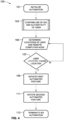
- FIG. 4 an improved method or control strategy for executing an automated feature, for example the footwear features illustrated in FIG. 3 , for a wearable electronic device, such as IES 10 of FIGS. 1 and 2 , is generally described at 100 in accordance with aspects of the present disclosure.
- Some or all of the operations illustrated in FIG. 4 and described in further detail below may be representative of an algorithm that corresponds to processor-executable instructions that may be stored, for example, in main or auxiliary or remote memory, and executed, for example, by a resident or remote controller, central processing unit (CPU), control logic circuit, or other module or device, to perform any or all of the above or below described functions associated with the disclosed concepts.
- CPU central processing unit
- control logic circuit or other module or device
- Method 100 begins at terminal block 101 with processor-executable instructions for a programmable controller or control module or similarly suitable processor, such as resident footwear controller 44 or FIG. 2 , to call up an initialization procedure for a protocol to govern operation of a wearable electronic device, such as IES 10 of FIG. 1 .
- This routine may be called-up and executed in real-time, continuously, systematically, sporadically, and/or at regular intervals, etc., during use of the intelligent electronic shoe 10.
- IES data network and communications system 30 architecture of FIG. 3 as a representative implementation of the methodology set forth in FIG.
- the initialization procedure at block 101 may be commenced each time the user 13 activates a ride-sharing software application through the smartphone 40 or smartwatch 42, or each time the user 13 is paired with a rideshare driver/vehicle 32 through the ride-sharing software application.
- the ride-seeking client 13 is paired with a rideshare driver (e.g., the operator of motor vehicle 32) that is registered with a rideshare server system (e.g., UBER ® , LYFT ® , etc., represented by cloud computing system 36).
- a rideshare driver e.g., the operator of motor vehicle 32
- a rideshare server system e.g., UBER ® , LYFT ® , etc., represented by cloud computing system 36.
- the illustrated example portrays a single rider - a private individual - receiving transportation from a single prospective driver - another private individual - in the driver's privately-owned automobile.
- the IES system 30 include any number of prospective riders seeking rides from any number of registered drivers operating any logically relevant type of motor vehicle.
- the fleet of available drivers may be comprised of private individuals, salaried or contract employees, public transit, private car or taxi service, autonomous vehicles, or any combination thereof.
- a transaction between the IES 10 and IES system 30 can be enabled by an authentication process at predefined process block 103.
- Authentication may be performed by a primary or secondary source that confirms proper activation of a wearable electronic device and/or a valid identity of the device's user.
- user identification information such as a password, PIN number, credit card number, personal information, biometric data, predefined key sequences, etc.
- the user may be permitted to access a personal account, e.g., a "digital locker" operating on the user's smartphone 40 with a NIKE+ ® Connect software application and registered with the IoAAF middleware node.
- a transaction can be enabled by, for example, a combination of personal identification input (e.g., mother's maiden name, social security number, etc.) with a secret PIN number (e.g., six or eight-digit code), or a combination of a password (e.g., created by the user 13) and a corresponding PIN number (e.g., issued by the host system 34), or a combination of a credit card input with secret PIN number.
- a barcode, RFID tag, or NFC tag may be imprinted on or attached to the IES 10 shoe structure, and configured to communicate a security authentication code to the IES system 30.
- Other established authentication and security techniques can be utilized to prevent unauthorized access to a user's account, for example, to minimize an impact of unsanctioned access to a user's account, or to prevent unauthorized access to personal information or funds accessible via a user's account.
- security authentication of the user 13 may be automated by the resident footwear controller 44.
- a pressure sensor 62 which may be in the nature of a binary contact-type sensor switch, may be attached to the footwear 10 (e.g., embedded within the midsole 24 of the sole structure 14). This pressure sensor 62 detects a calibrated minimum load on the insole 22 and thereby establishes the presence of a foot in the upper 12. Any future automated features of the IES 10 may first require the controller 44 confirm, via command prompt to the binary pressure sensor 62, that a foot is present in the upper 12 and, thus, the footwear 10 is in use before transmitting a command signal to initiate an automated operation.
- the IES 10 may be equipped with a distributed array of sensors, including pressure, temperature, moisture, and/or shoe dynamics sensors, packaged at discrete locations throughout the shoe structure.
- foot presence sensing may be determined via a variety of available sensing technologies, including capacitance, magnetic, etc. Additional information regarding foot presence sensing can be found, for example, in U.S. Patent Application Publication Nos. 2017/0265584 A1 and 2017/0265594 A1, to Steven H. Walker, et al. , both of which are incorporated herein by reference in their respective entireties and for all purposes.
- the pressure sensor 62 may take on a multi-modal sensor configuration (e.g., a polyurethane dielectric capacitive biofeedback sensor) that detects any of assorted biometric parameters, such as the magnitude of an applied pressure generated by a foot in the upper 12, and outputs one or more signals indicative thereof. These sensor signals may be passed from the pressure sensor 62 to the resident footwear controller 44, which then aggregates, filters and processes the received data to calculate a current user weight. The calculated current user weight for the individual presently using the IES 10 is compared to a previously validated, memory-stored user weight (e.g., authenticated to a registered user of an existing personal account).
- a multi-modal sensor configuration e.g., a polyurethane dielectric capacitive biofeedback sensor
- the footwear controller 44 can to determine if the current user weight is equal to or within a predetermined threshold range of the validated user weight. Once the current user is authenticated to the validated user, the resident footwear controller 44 is enabled to transmit command signals to one or more subsystems within the footwear 10 to automate a feature thereof.
- Automated security authentication of a user may be achieved through other available techniques, as part of predefined process block 103, including cross-referencing characteristics of a current user's foot with previously validated characteristics of an authenticated user's foot.
- the representative IES 10 of FIG. 2 is shown fabricated with a motorized lacing system utilizing a lace motor (M) 64 that is mounted to the footwear 10 and is selectively actuable to transition the shoelace 20 back-and-forth between an untensioned (loosened) state and one or more tensioned (tightened) states.
- Lace motor 64 may be in the nature of a two-way DC electric worm-gear motor that is housed inside the sole structure 14 and controlled by the resident footwear controller 44.
- Activation of the lace motor 64 may be initiated via a manually-activated switch built into the shoe structure or softkey activation through an app on the user's smartphone 40 or smartwatch 42.
- motor control may be automated via the resident footwear controller 44, for example, in response to a sensor signal from pressure sensor 62 indicating that a foot has been placed inside the upper 12.
- Shoelace tension may be actively modulated through governed operation of the lace motor 64 by the controller 44 during use of the IES 10, e.g., to better retain the foot in response to dynamic user movement.
- the foregoing functions, as well as any other logically relevant option or feature disclosed herein, may be applied to alternative types of wearable apparel, including but not limited to clothing, headgear, eyewear, wrist wear, neck wear, leg wear, undergarments, and the like.
- the lace motor 64 may be adapted to automate the tensioning and loosening of straps, latches, cables and other commercially available mechanisms for fastening shoes.
- the lace motor 64 may double as a binary (ON/OFF) switch that effectively enables and disables automated features of the IES 10. That is, the resident footwear controller 44, prior to executing an automated feature, may communicate with the lace motor 64 to determine whether the shoelace 20 is in a tensioned or untensioned state. If the latter, all automated features may be disabled by the resident footwear controller 44 to prevent the inadvertent initiation of an automated feature while the IES 10 is not in use, for example. Conversely, upon determination that the lace 20 is in the tensioned state, the footwear controller 44 is permitted to transmit automation command signals.
- the resident footwear controller 44 prior to executing an automated feature, may communicate with the lace motor 64 to determine whether the shoelace 20 is in a tensioned or untensioned state. If the latter, all automated features may be disabled by the resident footwear controller 44 to prevent the inadvertent initiation of an automated feature while the IES 10 is not in use, for example. Conversely, upon determination that the lace 20 is in the tensioned state
- the shoelace 20 may be placed in any one of multiple discrete, tensioned positions to accommodate feet with differing girths or users with different tension preferences.
- a lace sensor which may be built into the motor 64 or packaged in the sole structure 14 or upper 12, may be employed to detect a current tensioned position of the lace 20 for a given user.
- real-time tracking of a position of an output shaft (e.g., a worm gear) of the two-way electric lace motor 64 or a position of a designated section of the lace 20 e.g., a lace spool mated with the motor's worm gear
- a position of an output shaft e.g., a worm gear
- a position of a designated section of the lace 20 e.g., a lace spool mated with the motor's worm gear
- the resident footwear controller 44 Upon tensioning of the lace 20, the resident footwear controller 44 communicates with the lace motor 64 and/or lace sensor to identify a current tensioned position of the lace 20 for a current user. This current tensioned position is compared to a previously validated, memory-stored lace tensioned position (e.g., authenticated to a registered user of an existing personal account). Through this comparison, the footwear controller 44 can determine if the current tensioned position is equal to or within a predetermined threshold range of the validated tensioned position. After authenticating the current user to the validated user, command signals may be transmitted via the resident footwear controller 44 to one or more subsystems within the footwear 10 to automate a feature thereof.
- a previously validated, memory-stored lace tensioned position e.g., authenticated to a registered user of an existing personal account.
- command signals may be transmitted via the resident footwear controller 44 to one or more subsystems within the footwear 10 to automate a feature thereof.
- the method 100 of FIG. 4 proceeds to input/output block 105 with processor-executable instructions to retrieve sufficient data to identify respective locations of a wearable electronic device and a remote computing node with which it is communicating.
- the IES 10 may receive, either directly or through cooperative operation with the smartphone 40 or smartwatch 42, location data from the remote host system 34 and/or cloud computing system 36 that is indicative of a current location of the user 13 and a current location of the motor vehicle 32.
- User location can also, or alternatively, be tracked through a rideshare app or a route planning app running on the user's smartphone 40.
- a back office intermediary server such as cloud computing system 36 operating as a middleware node, tracks in real-time the location of the vehicle 32, e.g., either through an on-board transmission device or through an app on the driver's personal computing device.
- the method 100 of FIG. 4 continues to decision block 107 to determine whether the wearable electronic device and user's joint location is within a predetermined location or a predetermined proximity to the node's location.
- the user's smartphone 40 or smartwatch 42 may display the real-time locations of the IES 10 and vehicle 32 on a map using a distinct graphic for each party (e.g., using a corresponding graphical pin, symbol, avatar, animation, etc.), as well as movement of the IES 10 relative to the motor vehicle 32, for example, via placement and movement of these graphics.
- the IES 10 and/or IES system 30 may monitor a current proximity (e.g., number of feet, number of miles, number of minutes, etc.) of the IES 10 from the current location of the vehicle 32.
- a current proximity e.g., number of feet, number of miles, number of minutes, etc.
- the IES 10 and/or IES system 30 may monitor a current proximity (e.g., number of feet, number of miles, number of minutes, etc.) of the IES 10 from the current location of the vehicle 32.
- a current proximity e.g., number of feet, number of miles, number of minutes, etc.
- the predetermined location may include a virtual perimeter or "geofence" that is dynamically generated by the resident footwear controller 44.
- one or more command signals are transmitted to one or more subsystems to execute one or more automated features of a wearable electronic device.
- a first command signal is transmitted to a first subsystem to execute a first automated feature AF 1 of an intelligent electronic shoe.
- resident footwear controller 44 may confirm that the motor vehicle 32 is now within 100 ft or other pre-designated distance of the IES 10 and, thus, the user 13 is in plain sight of the vehicle driver.
- Resident footwear controller 44 automatically responds to this determination (i.e., without any user or external system prompt) by transmitting a command signal to resident lighting system 56 to activate lighting device 58 to thereby generate a predetermined light output.
- This predetermined light output may include a personalized color (e.g., aqua for a rider with UBER ® , pink for a rider with LYFT ® , green, blue and green for BLABLACAR ® , etc.) or a corresponding blinking pattern (e.g., strobing, user-specific or driver-specific blinking pattern, selected script in Morse Code, etc.).
- the selected color and/or pattern is detectable by a digital camera with an optical sensor on the motor vehicle 32.
- a resident vehicle controller or the ridesharing app on the driver's smartphone can evaluate the personalized color/pattern to verify the waiting user 13 of the IES 10 corresponds to the user's current ride-share request.
- the system may employ light-based wireless optical authentication, e.g., using LiFi, to transmit user authentication data.
- any of the disclosed connected wearable electronic devices may automate additional or alternative features as part of the methodology 100 set forth in FIG. 4 .
- a second command signal may be transmitted to a second subsystem to execute a second automated feature AF 2 of the wearable electronic device, as indicated at process block 111.
- the IES 10 of FIG. 2 is shown equipped with a haptic transducer 66 that is housed inside the sole structure 14 in operative communication to the insole 22.
- the resident footwear controller 44 emits a command signal to the haptic transducer 66 to generate a haptic cue (e.g., a perceptible vibration force or a series of vibration pulses) that is transmitted from the midsole 24, through the insole 22, and to the user's foot. Operation of the haptic transducer 66 may be coordinated with the output of the vehicle 32.
- a haptic cue e.g., a perceptible vibration force or a series of vibration pulses
- An optional third automated feature AF 3 may include operating the lace motor 64 as a haptic force-feedback device that is selectively activated by the footwear controller 44 to rapidly tension and release the shoelace 20.
- Audible, visual or haptic feedback from the IES 10 may be employed to notify the wearer of interactions with other computing devices, such as light system or haptic system feedback to alert the user to an incoming call on their personal smartphone.
- the IES 10 may operate in conjunction with the smartphone 40 (e.g., coordinated flashing of an LED camera light or an eccentric rotating mass (ERM) actuator) or an active apparel element 11 (e.g., coordinated activation of a built-in tactile or haptic device in the user's shirt), as illustrated in FIG. 3 .
- haptic feedback can be utilized to provide turn-by-turn directions to the user (e.g., left foot or right foot vibrates at a heightened intensity and/or with a designated pulse pattern to indicate a left turn or right turn).
- haptic feedback can be employed in a similar fashion to direct a user along a pre-selected route or to warn a user against taking a particular route (e.g., deemed unsafe). Additional information regarding footwear and apparel with haptic feedback can be found, for example, in U.S. Patent Application Publication No. 2017/0154505 A1 , to Ernest Kim, which is incorporated herein by reference in its entirety and for all purposes.
- the IES 10 may be provided with an audio system, which is represented in FIG. 1 by a miniaturized audio speaker 68 that is attached to the rear quarter 12C of the upper 12. Resident footwear controller 44, upon confirming that the user and/or node are within the predetermined location or are within proximity to each other, automatically transmits a command signal to the audio system speaker 68 to generate a predetermined sound output.
- the lace motor 64 may repeatedly tighten/loosen the shoelace 20 as a signal/cue, e.g., of an arriving pickup, a check in, a connection, etc.
- the IES 10 may be used by a user to locate, self-authenticate and access an autonomous vehicle or vehicle lease. The method 100 may then terminate at terminal block 113 and/or loop back to terminal block 101.
- Another optional feature may be a "dance party" mode wherein a musical interlude output by any of the vehicle's audio components, accompanied by a light show output by any of the vehicle's light systems, may be triggered via the IES 10.
- Sound (audio/music) output from the motor vehicle 32 may be linked to one or more features and subsystems of the IES 10. Coordinated activation of the shoelace motor 64, lighting device 58, and/or haptic transducer 66 may be provided to sync automation of the IES 10 with sound and/or light output from the vehicle 32. Audio output of the user's personal electronic device(s), such as smartphone 40 or smartwatch 42, can also be synced in a similar manner.
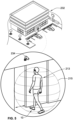
- Footwear-to-infrastructure communications may be enabled to allow the IES 10 to communicate with a networked "smart city” controller that, in turn, can modulate street lighting or traffic light changes to improve safety for a walker or runner.
- the "smart city” controller may communicate with the IES 10 to warn the user they are coming up to a pedestrian crossing with a "Do Not Walk” sign signaling that pedestrians must yield the right of way to oncoming vehicles.
- Light features built into the shoe may also be used during an athletic event (e.g., coordinated to match the colors of a user's favorite athletic team) or while exercising (e.g., to light roadway while running at night). Security features may also be installed to render the IES unusable to a non-authenticated party.
- the remote computing node may take on alternative forms from those described above, such as a central server computer or a parallel HMI of a residential or commercial security system.
- a predetermined location e.g., an entry way, a hallway, a room, etc.
- a pre-selected proximity of the facility being monitored e.g., delineated by an active geofence
- IES 10 of FIG. 2 may be considered particularly useful for interacting with a fully assisted or a fully autonomous motor vehicle, such as those classified as Society of Automotive Engineers (SAE) Levels 3, 4 or 5 vehicles.
- SAE Society of Automotive Engineers
- the IES 10 may communicate with a powertrain control module (PCM) or a route planning module (RPM) to automatically coordinate transporting the user 13 of the IES 10 to a predetermined location.
- PCM powertrain control module
- RPM route planning module
- motor vehicle 32 of FIG. 3 may propagate a unique geofence signal in order to pair with multiple users wearing compatible IES.
- aspects of the present disclosure may be practiced with a variety of computer-system and computer-network configurations, including multiprocessor systems, microprocessor-based or programmable-consumer electronics, minicomputers, mainframe computers, and the like.
- aspects of the present disclosure may be practiced in distributed-computing environments where tasks are performed by remote-processing devices that are linked through a communications network.
- program modules may be located in both local and remote storage media including memory storage devices.
- aspects of the present disclosure may therefore be implemented in connection with various hardware, software or a combination thereof, in a computer system or other processing system.
- Any of the methods described herein may include machine readable instructions for execution by: (a) a processor, (b) a controller, and/or (c) any other suitable processing device.
- Any algorithm, software, protocol or method disclosed herein may be embodied in software stored on a tangible medium such as, for example, a flash memory, a CD-ROM, a floppy disk, a hard drive, a digital versatile disk (DVD), or other memory devices, but persons of ordinary skill will readily appreciate that the entire algorithm and/or parts thereof could alternatively be executed by a device other than a controller and/or embodied in firmware or dedicated hardware in a known manner (e.g., implemented by an application specific integrated circuit (ASIC), a programmable logic device (PLD), a field programmable logic device (FPLD), discrete logic, etc.).
- ASIC application specific integrated circuit
- PLD programmable logic device
- FPLD field programmable logic device
- the predetermined location may include a geofence that is defined by the footwear controller.
- the command signal for activating the light system may be transmitted upon detection of the remote computing node breaching the geofence.
- the IES system may further comprise a pressure sensor that is mounted to the sole structure or upper; the pressure sensor is configured to detect a presence (or absence) of the foot in the upper.
- the command signal for activating the IES light system is transmitted, at least in part, as a response to the detected presence of the foot in the upper.
- the pressure sensor may also (or alternatively) be configured to detect the user's weight.
- the footwear controller may receive a sensor signal from the pressure sensor that is indicative of the user's detected weight, determine if the detected weight is within a predetermine range of a memory-stored validated user weight, and transmit the command signal to the IES light system only if the detected weight is within the predetermine range of the validated user weight.
- a shoelace is attached to the upper, and a lace motor is mounted inside the sole structure and configured to selectively transition the shoelace between tensioned and untensioned states.
- the footwear controller may communicate with the lace motor to determine whether the shoelace is in the tensioned or untensioned state.
- the command signal for activating the IES light system is transmitted further in response to the shoelace being in the tensioned state.
- the tensioned state includes multiple discrete tensioned positions; the IES system may include a lace sensor that detects a current one of the discrete tensioned positions for the user.
- the footwear controller may receive a sensor signal from the lace sensor that is indicative of the current discrete tensioned position for the user.
- the controller may determine if the current discrete tensioned position corresponds to a memory-stored validated lace tensioned position; the activation command signal for the IES light system may be transmitted in response to the current discrete tensioned position corresponding to the validated lace tensioned position.
- the remote computing node may include an optical sensor that is operable to detect the predetermined light output of the IES light system. This light output may include a personalized color and/or blinking pattern that is configured to verify the user to the remote computing node.
- the IES system's wireless communications device includes a BLE, CAT-M1 and/or CAT-NB1 wireless interface.
- the IES system may also include a barcode, an RFID tag, and/or an NFC tag attached to the sole structure/upper, each of which is configured to communicate a security authentication code to the remote computing node.
- Additional aspects of the present disclosure are directed to a method of manufacturing an article of footwear for a foot of a user.
- This method includes: providing an upper that is configured to receive and attach to the foot of the user; providing a sole structure that is configured to support thereon the foot of the user, the sole structure having an outsole defining a ground-engaging portion; attaching the sole structure to the upper; mounting a light system to the sole structure and/or the upper, the light system being configured to generate light in response to a command signal; mounting a wireless communications device to the sole structure and/or the upper, the wireless communications device being configured to wirelessly communicate with a remote computing node; and mounting a resident controller to the sole structure and/or the upper, the resident controller being operatively connected to the wireless communications device and the light system.
- the resident controller is configured to: receive location data indicative of the user's location; receive location data indicative of the remote computing node's location; determine whether the user's location is within a predetermined location or proximity to the node's location; and, responsive to the user being within the predetermined location/proximity to the node, transmitting a command signal to the light system to generate a predetermined light output.
- the footwear controller may further respond to the user's location being within the predetermined location/proximity to the node's location by transmitting a second command signal to a control system of the remote computing node to generate an audible or visual output.
- the remote computing node is a motor vehicle with a vehicle headlamp system; in this instance, the visual output includes illumination, flashing and/or intensification of the light output of the vehicle's headlamp system.
- the footwear controller may coordinate the light output of the vehicle's headlamp system with the predetermined light output of the IES's light system.
- the commanded audible output of the motor vehicle may include activation and/or modulation of an audible output of the vehicle's horn system.
- the wireless communications device may be configured to wirelessly connect to a portable electronic device of the user and thereby wirelessly communicate with the remote computing node.
- the IES may include a haptic transducer that is attached to the sole structure and/or upper; in this instance, the footwear controller may automatically transmit a third command signal to the haptic transducer to generate a haptic cue in response to the user's location being within the predetermined location/proximity to the node's location.
- the IES may also include an audio system that is attached to the sole structure and/or upper; in this case, the footwear controller may automatically transmit a fourth command signal to the audio system to generate a predetermined sound output in response to the user's location being within the predetermined location/proximity to the node's location.
- the remote computing node may be a segment of a residential or commercial security system.
- the footwear controller may automatically transmit a deactivation (or activation) command signal to the security system in response to the user entering (or leaving) a predetermined location or proximity with respect to a designated section of a residential or commercial building associated with the security system.
- the remote computing node may be a segment of a home automation system.
- the footwear controller may respond to the user entering or leaving a home (or a section of a home) associated with the home automation system by transmitting a fifth command signal to the home automation system to lock or unlock a door, activate or deactivate a room light, and/or increase or decrease a temperature of a thermostat.
- the predetermined location or proximity may be defined, at least in part, by a geofence that is generated by the footwear controller.
- Activation or deactivation command signals may be transmitted to a remote computing node or an IES subsystem upon detection of the remote computing node or the IES user breaching the geofence.
- the IES may incorporate therein a pressure sensor that is mounted to the sole structure or upper and configured to detect a presence of a foot in the upper. Transmission of a command signal by the footwear controller may be further in response to the detected presence of the foot in the upper.
- a pressure sensor mounted to the sole structure/upper may be configured to detect the user's weight.
- the footwear controller receives one or more sensor signals from the pressure sensor that is/are indicative of the detected weight of the user. The controller then determines if the detected weight is within a predetermine range of a memory-stored validated user weight.
- a command signal may be transmitted to the remote computing node or an IES subsystem in response to the detected weight being within the predetermine range of the validated user weight.
- the IES may include a shoelace or strap that is attached to the upper, and a lace motor mounted to the shoe structure and configured to selectively transition the lace/strap between tensioned and untensioned states.
- the resident footwear controller may determine whether the shoelace is in the tensioned or untensioned state and, if the lace is tensioned, responsively transmit a command signal to activate an IES subsystem.
- the tensioned state may be delineated into a plurality of discrete tensioned positions.
- the resident footwear controller may identify which of the discrete tensioned positions the lace is in (e.g., using sensor signals received from a lace sensor or by monitoring a position of the lace motor output shaft). Responsive to the current tensioned position of the lace corresponding to a memory-stored validated lace tensioned position, the footwear controller may transmit a command signal to a remote node or an IES subsystem.
- the remote computing node may include an optical sensor; in this instance, the predetermined light output of the IES light system may include a personalized color and/or a blinking pattern that is detectable by the optical sensor and configured to verify the user to the remote computing node.
- the IES wireless communications device may include a BLE, CAT-M1 and/or CAT-NB1 wireless interface.
- the IES may be provided with a barcode, an RFID tag, and/or an NFC tag attached to the sole structure and/or upper and configured to communicate a security authentication code to the remote computing node.
- Additional aspects of this disclosure are directed to footwear for a foot of a user.
- the footwear includes an upper for receiving and attaching to the user's foot, and a sole structure that is attached to the upper for supporting thereon the user's foot.
- a light system and/or sound system is/are mounted to the sole structure and configured to generate light/sound in response to a command signal.
- a wireless communications device is mounted inside the sole structure for wirelessly communicating with a remote computing node.
- a resident controller which is also mounted inside the sole structure, is operatively connected to the wireless communications device and light system. The resident controller receives location data indicative of the user's location and the remote computing node's location. The resident controller determines whether the user's location is within a predetermined location/proximity to the node's location; if so, the resident controller responsively transmits one or more command signals to the light system/sound to generate a predetermined light/sound output.
Landscapes
- Engineering & Computer Science (AREA)
- Physics & Mathematics (AREA)
- General Physics & Mathematics (AREA)
- Microelectronics & Electronic Packaging (AREA)
- Computer Networks & Wireless Communication (AREA)
- Signal Processing (AREA)
- Remote Sensing (AREA)
- Radar, Positioning & Navigation (AREA)
- Mechanical Engineering (AREA)
- Business, Economics & Management (AREA)
- Emergency Management (AREA)
- Multimedia (AREA)
- Human Computer Interaction (AREA)
- Acoustics & Sound (AREA)
- Footwear And Its Accessory, Manufacturing Method And Apparatuses (AREA)
- Computer Hardware Design (AREA)
- Theoretical Computer Science (AREA)
- General Engineering & Computer Science (AREA)
- Traffic Control Systems (AREA)
- Emergency Alarm Devices (AREA)
- Alarm Systems (AREA)
- Lighting Device Outwards From Vehicle And Optical Signal (AREA)
- Audible And Visible Signals (AREA)
- Electromagnetism (AREA)
- Management, Administration, Business Operations System, And Electronic Commerce (AREA)
- Navigation (AREA)
- Telephonic Communication Services (AREA)
Applications Claiming Priority (5)
| Application Number | Priority Date | Filing Date | Title |
|---|---|---|---|
| US201862678796P | 2018-05-31 | 2018-05-31 | |
| US16/114,632 US10178890B1 (en) | 2018-05-31 | 2018-08-28 | Intelligent electronic footwear and control logic for executing automated footwear features |
| US16/220,403 US10441020B1 (en) | 2018-05-31 | 2018-12-14 | Intelligent electronic footwear and control logic for executing automated footwear features |
| PCT/US2019/034130 WO2019231884A1 (fr) | 2018-05-31 | 2019-05-28 | Chaussures électroniques intelligentes et logique de commande d'exécution de caractéristiques de chaussures automatisées |
| EP19731052.7A EP3803826B1 (fr) | 2018-05-31 | 2019-05-28 | Chaussures électroniques intelligentes et logique de commande d'exécution de caractéristiques de chaussures automatisées |
Related Parent Applications (2)
| Application Number | Title | Priority Date | Filing Date |
|---|---|---|---|
| EP19731052.7A Division EP3803826B1 (fr) | 2018-05-31 | 2019-05-28 | Chaussures électroniques intelligentes et logique de commande d'exécution de caractéristiques de chaussures automatisées |
| EP19731052.7A Division-Into EP3803826B1 (fr) | 2018-05-31 | 2019-05-28 | Chaussures électroniques intelligentes et logique de commande d'exécution de caractéristiques de chaussures automatisées |
Publications (2)
| Publication Number | Publication Date |
|---|---|
| EP4524924A2 true EP4524924A2 (fr) | 2025-03-19 |
| EP4524924A3 EP4524924A3 (fr) | 2025-06-18 |
Family
ID=64872434
Family Applications (8)
| Application Number | Title | Priority Date | Filing Date |
|---|---|---|---|
| EP19731053.5A Active EP3803831B1 (fr) | 2018-05-31 | 2019-05-28 | Chaussure électronique intelligente et logique de commande pour évitement de collision de piéton automatique |
| EP24191494.4A Pending EP4427981A3 (fr) | 2018-05-31 | 2019-05-28 | Chaussure électronique intelligente et logique de commande pour éviter les collisions piétons automatisés |
| EP25154818.6A Pending EP4524924A3 (fr) | 2018-05-31 | 2019-05-28 | Chaussure électronique intelligente et logique de commande pour exécuter des caractéristiques de chaussure automatisées |
| EP24172239.6A Pending EP4383228A3 (fr) | 2018-05-31 | 2019-05-28 | Chaussure électronique intelligente et logique de commande pour suivi de piéton basé sur une infrastructure automatisée |
| EP19731054.3A Ceased EP3803827A1 (fr) | 2018-05-31 | 2019-05-28 | Chaussure électronique intelligente et logique de commande pour suivi de piéton basé sur une infrastructure automatisée |
| EP24191496.9A Pending EP4427982A3 (fr) | 2018-05-31 | 2019-05-28 | Chaussure électronique intelligente et logique de commande pour éviter les collisions piétons automatisés |
| EP24191513.1A Active EP4427983B1 (fr) | 2018-05-31 | 2019-05-28 | Chaussure électronique intelligente et logique de commande pour éviter les collisions piétons automatisés |
| EP19731052.7A Active EP3803826B1 (fr) | 2018-05-31 | 2019-05-28 | Chaussures électroniques intelligentes et logique de commande d'exécution de caractéristiques de chaussures automatisées |
Family Applications Before (2)
| Application Number | Title | Priority Date | Filing Date |
|---|---|---|---|
| EP19731053.5A Active EP3803831B1 (fr) | 2018-05-31 | 2019-05-28 | Chaussure électronique intelligente et logique de commande pour évitement de collision de piéton automatique |
| EP24191494.4A Pending EP4427981A3 (fr) | 2018-05-31 | 2019-05-28 | Chaussure électronique intelligente et logique de commande pour éviter les collisions piétons automatisés |
Family Applications After (5)
| Application Number | Title | Priority Date | Filing Date |
|---|---|---|---|
| EP24172239.6A Pending EP4383228A3 (fr) | 2018-05-31 | 2019-05-28 | Chaussure électronique intelligente et logique de commande pour suivi de piéton basé sur une infrastructure automatisée |
| EP19731054.3A Ceased EP3803827A1 (fr) | 2018-05-31 | 2019-05-28 | Chaussure électronique intelligente et logique de commande pour suivi de piéton basé sur une infrastructure automatisée |
| EP24191496.9A Pending EP4427982A3 (fr) | 2018-05-31 | 2019-05-28 | Chaussure électronique intelligente et logique de commande pour éviter les collisions piétons automatisés |
| EP24191513.1A Active EP4427983B1 (fr) | 2018-05-31 | 2019-05-28 | Chaussure électronique intelligente et logique de commande pour éviter les collisions piétons automatisés |
| EP19731052.7A Active EP3803826B1 (fr) | 2018-05-31 | 2019-05-28 | Chaussures électroniques intelligentes et logique de commande d'exécution de caractéristiques de chaussures automatisées |
Country Status (6)
| Country | Link |
|---|---|
| US (23) | US10172409B1 (fr) |
| EP (8) | EP3803831B1 (fr) |
| JP (17) | JP7124127B2 (fr) |
| KR (15) | KR102619277B1 (fr) |
| CN (8) | CN112219231B (fr) |
| WO (3) | WO2019231886A1 (fr) |
Families Citing this family (85)
| Publication number | Priority date | Publication date | Assignee | Title |
|---|---|---|---|---|
| US10852069B2 (en) | 2010-05-04 | 2020-12-01 | Fractal Heatsink Technologies, LLC | System and method for maintaining efficiency of a fractal heat sink |
| CN117010535A (zh) | 2014-05-06 | 2023-11-07 | 优步技术公司 | 用于要求至少一个运输车辆单元的出行计划的系统和方法 |
| US10458801B2 (en) | 2014-05-06 | 2019-10-29 | Uber Technologies, Inc. | Systems and methods for travel planning that calls for at least one transportation vehicle unit |
| US12400157B2 (en) | 2014-05-06 | 2025-08-26 | Uber Technologies, Inc. | System and methods for transporting end users |
| US9552559B2 (en) | 2014-05-06 | 2017-01-24 | Elwha Llc | System and methods for verifying that one or more directives that direct transport of a second end user does not conflict with one or more obligations to transport a first end user |
| US11100434B2 (en) | 2014-05-06 | 2021-08-24 | Uber Technologies, Inc. | Real-time carpooling coordinating system and methods |
| US9911170B2 (en) * | 2014-08-21 | 2018-03-06 | Uber Technologies, Inc. | Arranging a transport service for a user based on the estimated time of arrival of the user |
| US11103030B2 (en) | 2015-10-07 | 2021-08-31 | Puma SE | Article of footwear having an automatic lacing system |
| US11185130B2 (en) | 2015-10-07 | 2021-11-30 | Puma SE | Article of footwear having an automatic lacing system |
| US11033079B2 (en) | 2015-10-07 | 2021-06-15 | Puma SE | Article of footwear having an automatic lacing system |
| US9939279B2 (en) | 2015-11-16 | 2018-04-10 | Uber Technologies, Inc. | Method and system for shared transport |
| CA3004612C (fr) | 2015-12-02 | 2023-02-14 | Puma SE | Methode pour lacer une chaussure |
| US10685416B2 (en) | 2015-12-10 | 2020-06-16 | Uber Technologies, Inc. | Suggested pickup location for ride services |
| ES2827926T3 (es) * | 2016-02-05 | 2021-05-25 | Schreder | Módulo de control de lámparas compuesto por partes de base y de control, que comunica mediante NFC |
| US10242574B2 (en) | 2016-03-21 | 2019-03-26 | Uber Technologies, Inc. | Network computer system to address service providers to contacts |
| PT3544457T (pt) | 2016-11-22 | 2021-04-12 | Puma SE | Processo para pôr ou para tirar uma peça de vestuário na pessoa ou da pessoa que a veste ou para fechar, pôr, abrir ou tirar uma peça de bagagem transportada por uma pessoa |
| MX2019005959A (es) | 2016-11-22 | 2019-07-10 | Puma SE | Procedimiento para atar un zapato, en particular una zapatilla de deporte, y zapato, en particular zapatilla de deporte. |
| DE102016124275A1 (de) * | 2016-12-13 | 2018-06-14 | Brose Fahrzeugteile Gmbh & Co. Kommanditgesellschaft, Bamberg | Verfahren zur Ansteuerung einer motorischen Verschlusselementanordnung eines Kraftfahrzeugs |
| US9898791B1 (en) | 2017-02-14 | 2018-02-20 | Uber Technologies, Inc. | Network system to filter requests by destination and deadline |
| US10222864B2 (en) | 2017-04-17 | 2019-03-05 | Facebook, Inc. | Machine translation of consonant-vowel pairs and syllabic units to haptic sequences for transmission via haptic device |
| US10945484B1 (en) * | 2017-06-28 | 2021-03-16 | Apple Inc. | Haptic output devices |
| US10721327B2 (en) | 2017-08-11 | 2020-07-21 | Uber Technologies, Inc. | Dynamic scheduling system for planned service requests |
| US10731998B2 (en) | 2017-11-05 | 2020-08-04 | Uber Technologies, Inc. | Network computer system to arrange pooled transport services |
| US10172409B1 (en) * | 2018-05-31 | 2019-01-08 | Nike, Inc. | Intelligent electronic footwear and control logic for automated pedestrian collision avoidance |
| CN110458660A (zh) * | 2018-08-30 | 2019-11-15 | 腾讯科技(深圳)有限公司 | 虚拟宠物商品的交易方法、装置、系统及存储介质 |
| GB201900503D0 (en) * | 2019-01-14 | 2019-03-06 | Simplifai Systems Ltd | Traffic strategy system and method of implementing the same |
| USD906657S1 (en) | 2019-01-30 | 2021-01-05 | Puma SE | Shoe tensioning device |
| US10645534B1 (en) | 2019-02-01 | 2020-05-05 | Tile, Inc. | User presence-enabled tracking device functionality |
| WO2020159755A1 (fr) * | 2019-02-01 | 2020-08-06 | Tile, Inc. | Fonctionnalité de dispositif de suivi activé par la présence d'un utilisateur |
| IT201900002097A1 (it) * | 2019-02-18 | 2020-08-18 | Eng Team Srl | Calzatura sportiva con sistema di chiamata di emergenza |
| US12678067B1 (en) | 2019-03-20 | 2026-07-14 | Biological Art Group, Inc. | Telemetry implants |
| KR102192451B1 (ko) * | 2019-05-03 | 2020-12-16 | 주식회사 인포웍스 | 복합 보행 동작 인식 기반 스마트 신발 및 이의 데이터 처리 방법 |
| JP7345128B2 (ja) * | 2019-05-20 | 2023-09-15 | パナソニックIpマネジメント株式会社 | 歩行者装置および交通安全支援方法 |
| KR102804887B1 (ko) * | 2019-08-02 | 2025-05-09 | 현대자동차주식회사 | 회전 광원이 있는 자동차 램프 |
| CN110390825B (zh) * | 2019-08-04 | 2021-12-14 | 吴凤保 | 一种岔路口车辆通行诱导警示装置 |
| US11900815B2 (en) * | 2019-09-30 | 2024-02-13 | Gm Cruise Holdings Llc | Augmented reality wayfinding in rideshare applications |
| US11484089B2 (en) * | 2019-10-21 | 2022-11-01 | Puma SE | Article of footwear having an automatic lacing system with integrated sound damping |
| CN111444756B (zh) * | 2019-11-01 | 2020-11-20 | 合肥耀世同辉科技有限公司 | 危险行驶场景辨识平台、方法及存储介质 |
| US11915171B2 (en) * | 2019-11-26 | 2024-02-27 | Alarm.Com Incorporated | System and method integrating smart vehicles with a monitoring system |
| WO2021108937A1 (fr) * | 2019-12-06 | 2021-06-10 | Pontificia Universidad Católica De Chile | Dispositif de passage piéton pour feux de signalisation, système le contenant et procédé pour gérer ledit sytème |
| US20210170231A1 (en) * | 2019-12-08 | 2021-06-10 | Salvatore Paxia | Distributed race timing system with real time feedback for participants |
| US11570276B2 (en) | 2020-01-17 | 2023-01-31 | Uber Technologies, Inc. | Forecasting requests based on context data for a network-based service |
| US12099997B1 (en) | 2020-01-31 | 2024-09-24 | Steven Mark Hoffberg | Tokenized fungible liabilities |
| US11669786B2 (en) | 2020-02-14 | 2023-06-06 | Uber Technologies, Inc. | On-demand transport services |
| AU2021266917A1 (en) * | 2020-05-05 | 2022-11-24 | Arrowes Ip Holdings Pty Ltd | Traffic management system |
| JP7617143B2 (ja) * | 2020-05-15 | 2025-01-17 | ナイキ イノベイト シーブイ | 自動化された触覚、音声、および視覚フィードバックによるナビゲーション支援のためのインテリジェント電子フットウェアおよびロジック |
| GB2596847A (en) * | 2020-07-09 | 2022-01-12 | Sony Europe Bv | Systems, devices and methods for notifying a target |
| DE102020209226A1 (de) * | 2020-07-22 | 2022-01-27 | Robert Bosch Gesellschaft mit beschränkter Haftung | Haptische und/oder Taktile Warnung von Personen durch ein Fahrzeug |
| US11524627B2 (en) * | 2020-07-23 | 2022-12-13 | GM Global Technology Operations LLC | Adaptive interaction system with other road users |
| CN112315105A (zh) * | 2020-10-15 | 2021-02-05 | 向维智联(福建)科技有限公司 | 一种汽车自感应通讯智能鞋 |
| CN112562359A (zh) * | 2020-11-06 | 2021-03-26 | 龙南骏亚精密电路有限公司 | 一种交通信号灯人行道安全智能控制方法 |
| US20220171385A1 (en) | 2020-11-30 | 2022-06-02 | At&T Intellectual Property I, L.P. | Competitive and collaborative autonomous vehicle task performance |
| US11443518B2 (en) | 2020-11-30 | 2022-09-13 | At&T Intellectual Property I, L.P. | Uncrewed aerial vehicle shared environment privacy and security |
| US11726475B2 (en) | 2020-11-30 | 2023-08-15 | At&T Intellectual Property I, L.P. | Autonomous aerial vehicle airspace claiming and announcing |
| US11797896B2 (en) | 2020-11-30 | 2023-10-24 | At&T Intellectual Property I, L.P. | Autonomous aerial vehicle assisted viewing location selection for event venue |
| US12183110B2 (en) | 2020-11-30 | 2024-12-31 | At&T Intellectual Property I, L.P. | Autonomous aerial vehicle projection zone selection |
| CN112529721B (zh) * | 2020-12-30 | 2021-10-08 | 河南中盾云安信息科技有限公司 | 一种基于区块链与物联网的粮食监管方法 |
| CN112869286A (zh) * | 2021-01-15 | 2021-06-01 | 深圳如果技术有限公司 | 一种辅助行进的鞋套和方法 |
| CN112914884B (zh) * | 2021-01-19 | 2022-02-11 | 重庆火后草科技有限公司 | 通过稳态时长置信度测量睡眠状态下的体重值的方法 |
| US11834059B2 (en) | 2021-01-21 | 2023-12-05 | Toyota Research Institute, Inc. | Locating smart shoe relative to pedal |
| US11587440B2 (en) * | 2021-03-23 | 2023-02-21 | Kyndryl, Inc. | Prediction method for resilient interconnected traffic management |
| CN113112772A (zh) * | 2021-03-23 | 2021-07-13 | 黄启敏 | 一种能减少交通事故的汽车驾驶鞋及控制方法 |
| CN113096356A (zh) * | 2021-03-31 | 2021-07-09 | 西安建筑科技大学 | 一种摔倒报警及定位智能老人鞋 |
| KR102438303B1 (ko) * | 2021-04-01 | 2022-09-05 | 대한민국 | 압전소자가 구비된 안전신발 |
| RU2770938C1 (ru) * | 2021-04-25 | 2022-04-25 | Николай Анатольевич Грязнов | Коммуникационно-навигационная система для управления транспортными потоками |
| US11546734B2 (en) * | 2021-05-17 | 2023-01-03 | Ford Global Technologies, Llc | Providing security via vehicle-based surveillance of neighboring vehicles |
| USD962608S1 (en) * | 2021-09-16 | 2022-09-06 | Nike, Inc. | Shoe |
| USD962606S1 (en) * | 2021-09-16 | 2022-09-06 | Nike, Inc. | Shoe |
| USD962607S1 (en) * | 2021-09-16 | 2022-09-06 | Nike, Inc. | Shoe |
| GB2611570B (en) * | 2021-10-08 | 2026-03-25 | Burgess Kim | A wearable safety device |
| US12171306B2 (en) | 2021-11-16 | 2024-12-24 | Puma SE | Article of footwear having an automatic lacing system |
| US12379214B2 (en) * | 2022-03-28 | 2025-08-05 | Arm Limited | Method of augmenting human perception of the surroundings |
| US12704583B2 (en) * | 2022-04-14 | 2026-08-11 | Truist Bank | Security system for real-time interaction with a network of wearable user devices |
| KR102559481B1 (ko) * | 2022-07-22 | 2023-07-26 | 재단법인 지능형자동차부품진흥원 | 자율주행 차가 혼재된 도로에서 교차로 사고 감소를 위한 신호 제어 시스템 및 방법 |
| CN115359648B (zh) * | 2022-08-30 | 2024-06-04 | 歌尔科技有限公司 | 道路通行预警方法、移动设备及计算机可读存储介质 |
| EP4580764A1 (fr) | 2022-08-31 | 2025-07-09 | NIKE Innovate C.V. | Dispositif d'aide ambulatoire électromécanique |
| JP7618267B2 (ja) * | 2022-11-04 | 2025-01-21 | 株式会社ユニバーサルエンターテインメント | 遊技機 |
| EP4626275A1 (fr) | 2022-11-28 | 2025-10-08 | NIKE Innovate C.V. | Article chaussant doté d'une structure de semelle articulée pour faciliter l'accès |
| US20230225464A1 (en) * | 2023-01-09 | 2023-07-20 | Shengzhe ZHAO | Smart jewelry device and socail network system with smart reminder and social functionalities |
| CN116863753A (zh) * | 2023-07-24 | 2023-10-10 | 公安部道路交通安全研究中心 | 一种大型车辆通行提醒系统 |
| CN121398705A (zh) | 2023-08-31 | 2026-01-23 | 耐克创新有限合伙公司 | 用于鞋类制品的包括具有鞋类板的框架的装置 |
| US12562050B2 (en) * | 2023-11-13 | 2026-02-24 | Museau Tech Group | Active personal wireless connectivity network interface system |
| FR3155492A1 (fr) * | 2023-11-21 | 2025-05-23 | Renault S.A.S | Système d’adaptation de l’ambiance intérieure et/ou de la conduite d’un véhicule |
| US20250296558A1 (en) * | 2024-03-20 | 2025-09-25 | Janice H. Nickel | Enhanced situational awareness of road objects |
| DE102024138041A1 (de) * | 2024-12-16 | 2026-06-18 | Audi Aktiengesellschaft | Computerimplementiertes Verfahren zum Betreiben eines Kollisionsschutzsystems eines Kraftfahrzeugs und Kommunikationssystem |
Citations (3)
| Publication number | Priority date | Publication date | Assignee | Title |
|---|---|---|---|---|
| US20160262485A1 (en) | 2012-02-22 | 2016-09-15 | Nike, Inc. | Motorized Shoe With Gesture Control |
| US20170154505A1 (en) | 2015-11-30 | 2017-06-01 | Nike, Inc, | Apparel with ultrasonic position sensing and haptic feedback for activities |
| US20170265594A1 (en) | 2016-03-15 | 2017-09-21 | Nike, Inc. | Capacitive foot presence sensing for footwear |
Family Cites Families (188)
| Publication number | Priority date | Publication date | Assignee | Title |
|---|---|---|---|---|
| US5973618A (en) * | 1996-09-25 | 1999-10-26 | Ellis; Christ G. | Intelligent walking stick |
| JPH11250377A (ja) | 1997-02-04 | 1999-09-17 | Masanobu Kujirada | 携帯型安全システム |
| JP2000004901A (ja) | 1998-06-17 | 2000-01-11 | Matsushita Electric Ind Co Ltd | 靴 |
| JP2001134892A (ja) | 1999-11-05 | 2001-05-18 | Toshiba Corp | 交差点右折車両監視制御システム |
| AU2001268027A1 (en) * | 2000-02-23 | 2001-09-12 | Sri International | Biologically powered electroactive polymer generators |
| JP2001321202A (ja) * | 2000-03-09 | 2001-11-20 | Komariyo Co Ltd | 履 物 |
| JP2001353006A (ja) * | 2000-06-16 | 2001-12-25 | Q P Corp | 靴の中敷板 |
| JP2002223812A (ja) * | 2001-02-01 | 2002-08-13 | Ryoji Wada | 発光機能付履物 |
| US6876135B2 (en) * | 2001-10-05 | 2005-04-05 | Sri International | Master/slave electroactive polymer systems |
| JP2003346297A (ja) * | 2002-05-30 | 2003-12-05 | Matsushita Electric Ind Co Ltd | 情報タグ、路側無線送受信装置、車載無線送受信装置及び交通安全支援装置 |
| FR2848167A1 (fr) | 2002-12-02 | 2004-06-11 | Plastic Omnium Cie | Procede pour proteger des pietons en cas de collision avec des vehicules automobiles et piece de vetement de protection |
| JP2004187808A (ja) | 2002-12-09 | 2004-07-08 | Matsushita Electric Ind Co Ltd | 計測機能付き靴及び健康管理通信システム |
| ITFI20030007A1 (it) | 2003-01-10 | 2004-07-11 | C & C Design S R L | Calzatura con illuminazione |
| US7095336B2 (en) | 2003-09-23 | 2006-08-22 | Optimus Corporation | System and method for providing pedestrian alerts |
| JP3924683B2 (ja) | 2003-10-02 | 2007-06-06 | 株式会社ナビタイムジャパン | ナビゲーション装置、ナビゲーション方法およびプログラム |
| US9519898B2 (en) | 2004-10-22 | 2016-12-13 | Smart Cellco, Inc. | Wearable electronic devices and mobile transactions and/or actions |
| US7924152B1 (en) * | 2004-11-01 | 2011-04-12 | Sayo Isaac Daniel | Interactive video gaming footwear including means for transmitting location information to a remote party |
| US7254516B2 (en) | 2004-12-17 | 2007-08-07 | Nike, Inc. | Multi-sensor monitoring of athletic performance |
| US20060180647A1 (en) | 2005-02-11 | 2006-08-17 | Hansen Scott R | RFID applications |
| JP2006268379A (ja) | 2005-03-23 | 2006-10-05 | Fujitsu Ltd | 交通信号機の制御装置 |
| US20070028486A1 (en) | 2005-08-05 | 2007-02-08 | Montanya Phelps & Phelps, Inc. | Footwear with an electroluminescent lamp |
| JP4760244B2 (ja) * | 2005-09-08 | 2011-08-31 | 株式会社デンソー | 接近検知システム、車載装置、および携帯端末装置 |
| JP2007163343A (ja) * | 2005-12-15 | 2007-06-28 | Hitachi Software Eng Co Ltd | 人物の位置及び方位特定システム |
| US20070156414A1 (en) | 2006-01-03 | 2007-07-05 | Akhtar Mohammad W | Using Radio Frequency Identification (RFID) Technology to Assist Visually Impaired People and Others to Find Businesses, Services and Facilities |
| US20130218456A1 (en) | 2006-02-16 | 2013-08-22 | John S. Zelek | Wearable tactile navigation system |
| US20070201221A1 (en) | 2006-02-24 | 2007-08-30 | Cherdak Eric B | Lighted shoes |
| US7579946B2 (en) * | 2006-04-20 | 2009-08-25 | Nike, Inc. | Footwear products including data transmission capabilities |
| US10511950B2 (en) | 2006-05-16 | 2019-12-17 | RedSky Technologies, Inc. | Method and system for an emergency location information service (E-LIS) for Internet of Things (IoT) devices |
| US8035530B2 (en) | 2006-11-09 | 2011-10-11 | Sridhara Subbiah Ramasubbu | RFID intelligent traffic signaling |
| US7698101B2 (en) | 2007-03-07 | 2010-04-13 | Apple Inc. | Smart garment |
| JP4967015B2 (ja) * | 2007-04-02 | 2012-07-04 | パナソニック株式会社 | 安全運転支援装置 |
| US20110037619A1 (en) * | 2009-08-11 | 2011-02-17 | On Time Systems, Inc. | Traffic Routing Using Intelligent Traffic Signals, GPS and Mobile Data Devices |
| JP5223293B2 (ja) | 2007-10-25 | 2013-06-26 | 沖電気工業株式会社 | 位置表現抽出装置、方法及びプログラム |
| US7978097B2 (en) | 2007-12-03 | 2011-07-12 | International Business Machines Corporation | Dynamic speed limit system |
| US7864072B2 (en) * | 2007-12-11 | 2011-01-04 | International Business Machines Corporation | System and method for automatically adjusting traffic light |
| US20090224934A1 (en) | 2008-03-04 | 2009-09-10 | Sharon Collier Medley | Caneye process |
| US8056269B2 (en) | 2008-05-02 | 2011-11-15 | Nike, Inc. | Article of footwear with lighting system |
| US8046937B2 (en) | 2008-05-02 | 2011-11-01 | Nike, Inc. | Automatic lacing system |
| US8058837B2 (en) * | 2008-05-02 | 2011-11-15 | Nike, Inc. | Charging system for an article of footwear |
| US8314686B2 (en) | 2008-06-05 | 2012-11-20 | Kirtley Jr James M | Radio controlled safety stop system for forklift trucks with RFID |
| WO2009152456A2 (fr) | 2008-06-13 | 2009-12-17 | Nike, Inc. | Chaussure équipée d’un système de détection |
| US9297709B2 (en) * | 2013-03-15 | 2016-03-29 | Nike, Inc. | System and method for analyzing athletic activity |
| US9002680B2 (en) | 2008-06-13 | 2015-04-07 | Nike, Inc. | Foot gestures for computer input and interface control |
| DE102008034594B4 (de) | 2008-07-25 | 2021-06-24 | Bayerische Motoren Werke Aktiengesellschaft | Verfahren sowie Informationssystem zur Information eines Insassen eines Fahrzeuges |
| US20100039291A1 (en) | 2008-08-15 | 2010-02-18 | Harrison Michael A | Vehicle/Crosswalk Communication System |
| US20100184564A1 (en) | 2008-12-05 | 2010-07-22 | Nike, Inc. | Athletic Performance Monitoring Systems and Methods in a Team Sports Environment |
| US8231506B2 (en) | 2008-12-05 | 2012-07-31 | Nike, Inc. | Athletic performance monitoring systems and methods in a team sports environment |
| CA2754705A1 (fr) * | 2009-03-10 | 2010-09-16 | Bayer Materialscience Ag | Transducteurs polymeres electroactifs pour dispositifs a retroaction tactile |
| US8253589B2 (en) * | 2009-10-20 | 2012-08-28 | GM Global Technology Operations LLC | Vehicle to entity communication |
| US8274404B2 (en) * | 2009-12-14 | 2012-09-25 | At&T Mobility Ii Llc | Devices and methods for controlling a change of a status of traffic light at a crosswalk |
| KR20110071728A (ko) | 2009-12-21 | 2011-06-29 | 한국전자통신연구원 | 인솔형 네비게이션 장치 및 그 동작 방법 |
| US20110242316A1 (en) | 2010-03-30 | 2011-10-06 | Ramiro Velazquez Guerrero | Shoe-integrated tactile display for directional navigation |
| JP5520660B2 (ja) | 2010-03-31 | 2014-06-11 | セコム株式会社 | 出入管理システム |
| SE535102C2 (sv) * | 2010-04-08 | 2012-04-17 | Recco Invest Ab | Frekvensselektiv transponder med rörelsesensor |
| JP2011242957A (ja) | 2010-05-18 | 2011-12-01 | Hitachi Ltd | 特徴情報を利用した生体認証方法 |
| DE102010031254A1 (de) * | 2010-07-12 | 2012-01-12 | Continental Teves Ag & Co. Ohg | Verkehrssicherheitskommunikationssystem zur Erhöhung der Verkehrssicherheit von Fußgängern |
| US9230419B2 (en) * | 2010-07-27 | 2016-01-05 | Rite-Hite Holding Corporation | Methods and apparatus to detect and warn proximate entities of interest |
| CN202069017U (zh) | 2011-05-13 | 2011-12-14 | 惠州Tcl移动通信有限公司 | 一种导盲鞋系统 |
| US20170026504A1 (en) | 2011-07-13 | 2017-01-26 | Andrew Nichols | System and apparatus for mitigating of bad posture and property loss through computer-assisted appliance |
| JP4997617B1 (ja) * | 2011-10-26 | 2012-08-08 | 株式会社チェリー・Bpm | 靴に装着して用いる通報装置、靴に装着して用いる通報装置を搭載した靴、および通報システム。 |
| US8935860B2 (en) | 2011-10-28 | 2015-01-20 | George Torres | Self-tightening shoe |
| JP5646086B2 (ja) | 2011-11-29 | 2014-12-24 | 三菱電機株式会社 | 歩行者用通信装置およびこれを備えたナビゲーション装置、歩車間通信システム |
| US9368028B2 (en) | 2011-12-01 | 2016-06-14 | Microsoft Technology Licensing, Llc | Determining threats based on information from road-based devices in a transportation-related context |
| KR101307392B1 (ko) * | 2011-12-23 | 2013-09-16 | 정재영 | 특이 상황 알림이 가능한 신발 |
| US9558667B2 (en) | 2012-07-09 | 2017-01-31 | Elwha Llc | Systems and methods for cooperative collision detection |
| CN104822284B (zh) | 2012-08-31 | 2016-10-19 | 耐克创新有限合伙公司 | 具有传感器的机动张紧系统 |
| KR20150082313A (ko) | 2012-11-16 | 2015-07-15 | 텔레호낙티에볼라게트 엘엠 에릭슨(피유비엘) | 단거리 라디오 기술을 사용하는 햅틱 피드백 가능 내비게이션 시스템 |
| CN103903477B (zh) * | 2012-12-24 | 2017-03-01 | 联想(北京)有限公司 | 一种辅助交通安全的方法及电子设备 |
| US20140266570A1 (en) | 2013-03-12 | 2014-09-18 | Anirudh Sharma | System and method for haptic based interaction |
| US20140266571A1 (en) | 2013-03-12 | 2014-09-18 | Anirudh Sharma | System and method for haptic based interaction |
| DE102013206023A1 (de) * | 2013-04-05 | 2014-10-09 | Bayerische Motoren Werke Aktiengesellschaft | Verfahren und System zum Verbessern der Verkehrssicherheit von Kindern und Jugendlichen |
| US20140308930A1 (en) * | 2013-04-12 | 2014-10-16 | Bao Tran | Timely, glanceable information on a wearable device |
| US10551851B2 (en) * | 2013-07-01 | 2020-02-04 | Steven Sounyoung Yu | Autonomous unmanned road vehicle for making deliveries |
| DE102014213066A1 (de) | 2013-07-04 | 2015-01-08 | Continental Teves Ag & Co. Ohg | Car2X fähige Warnkleidung mit Ladeschnittstelle |
| ES2455841B1 (es) * | 2013-07-17 | 2015-01-21 | Kaparazoom Slu | Señal de identificación de semáforos para visión computarizada |
| JP6689744B2 (ja) * | 2013-07-19 | 2020-04-28 | ジオモビー プロプライエタリー リミテッドGeomoby Pty Ltd | 位置測定方法およびシステム |
| WO2015012749A1 (fr) * | 2013-07-26 | 2015-01-29 | Telefonaktiebolaget L M Ericsson (Publ) | Procédé, dispositif de commande d'alerte, réverbère, programme d'ordinateur et produit-programme d'ordinateur pour alerter la circulation |
| EP3046434B1 (fr) * | 2013-09-20 | 2019-05-22 | NIKE Innovate C.V. | Chaussure ayant un système de réglage motorisé amovible |
| JP6219504B2 (ja) | 2013-10-25 | 2017-10-25 | インテル コーポレイション | ユーザ体験をキャプチャおよび生成するための装置及び方法 |
| KR20160102968A (ko) | 2013-12-26 | 2016-08-31 | 인텔 코포레이션 | 플렉서블 전자 통신 디바이스를 위한 방법 및 장치 |
| US20150237949A1 (en) * | 2014-02-25 | 2015-08-27 | Efthimios Poulos | Safety boots with multi level safety features |
| CA2845406C (fr) * | 2014-03-12 | 2015-12-29 | Motaz Aladas | Dispositif a bouton-poussoir sans fil pour mecanisme de signal de traverse de pieton |
| JP2015219806A (ja) * | 2014-05-20 | 2015-12-07 | 株式会社デンソー | 歩行制御装置 |
| US9424749B1 (en) * | 2014-04-15 | 2016-08-23 | Amanda Reed | Traffic signal system for congested trafficways |
| US10092065B2 (en) | 2014-04-15 | 2018-10-09 | Nike, Inc. | Footwear having motorized adjustment system and removable midsole |
| US9380834B2 (en) | 2014-04-22 | 2016-07-05 | Nike, Inc. | Article of footwear with dynamic support |
| US9142127B1 (en) * | 2014-04-29 | 2015-09-22 | Maxwell Consulting, LLC | Systems and methods for traffic guidance nodes and traffic navigating entities |
| US20150324646A1 (en) | 2014-05-08 | 2015-11-12 | Brown University | Navigation methods and apparatus for the visually impaired |
| JP2015221065A (ja) * | 2014-05-22 | 2015-12-10 | 株式会社デンソー | 歩行制御装置 |
| US9817959B2 (en) | 2014-06-27 | 2017-11-14 | Intel Corporation | Wearable electronic devices |
| JP2014186040A (ja) | 2014-07-10 | 2014-10-02 | Zenrin Datacom Co Ltd | 経路決定装置、経路案内システム、経路決定方法、およびコンピュータプログラム |
| EP3183203B1 (fr) | 2014-08-19 | 2023-07-05 | Crown Equipment Corporation | Système indicateur fonctionnel décentralisé pour véhicule de manutention de matériaux |
| US9747781B2 (en) | 2014-09-26 | 2017-08-29 | Intel Corporation | Shoe-based wearable interaction system |
| JP2016073366A (ja) | 2014-10-03 | 2016-05-12 | 克弥 西沢 | 歩行による発電機能と無線通信および測位機能を備えた無線通信機および無線通信機を中敷として用いた歩行者の位置監視システム |
| US9483937B2 (en) | 2014-10-16 | 2016-11-01 | Paypal, Inc. | Wireless beacon devices providing crosswalk management through communication device connections |
| US10699560B2 (en) * | 2014-11-05 | 2020-06-30 | Key2Access inc. | Integrated accessible pedestrian system |
| JP6688556B2 (ja) * | 2014-11-11 | 2020-04-28 | 株式会社富士通アドバンストエンジニアリング | プログラム、情報処理装置及び情報処理方法 |
| US20160174899A1 (en) | 2014-12-19 | 2016-06-23 | Withings | Wireless Connected Indoors Slipper and Wireless Connected Footwear and Associated Detection Methods |
| CA2978397A1 (fr) | 2015-01-12 | 2016-07-21 | Ronen Izidor GABBAY | Dispositifs et procedes de navigation |
| EP3247937A4 (fr) * | 2015-01-13 | 2018-10-24 | Kaindl, Robert | Dispositif de sécurité personnelle, procédé et article |
| US9740945B2 (en) | 2015-01-14 | 2017-08-22 | Magna Electronics Inc. | Driver assistance system for vehicle |
| KR101698515B1 (ko) | 2015-01-16 | 2017-01-20 | 현대자동차주식회사 | 웨어러블 기기를 이용한 길 안내 제공 방법 및 이를 수행하는 차량 |
| US9711026B2 (en) * | 2015-02-25 | 2017-07-18 | Brandon F. Forbes | Footwear arrangement with battery and anti-theft protection |
| JP2017009573A (ja) | 2015-03-06 | 2017-01-12 | パナソニック インテレクチュアル プロパティ コーポレーション オブ アメリカPanasonic Intellectual Property Corporation of America | 装着端末、及び、装着端末の制御方法 |
| US9677901B2 (en) | 2015-03-10 | 2017-06-13 | Toyota Motor Engineering & Manufacturing North America, Inc. | System and method for providing navigation instructions at optimal times |
| JP6819575B2 (ja) * | 2015-03-31 | 2021-01-27 | 日本電気株式会社 | 生体パターン情報処理装置、生体パターン情報処理方法、およびプログラム |
| US20160299224A1 (en) | 2015-04-07 | 2016-10-13 | Alexis Stobbe | Active radar activated anti-collision apparatus |
| JP5864800B1 (ja) | 2015-04-11 | 2016-02-17 | 治幸 岩田 | ウェアラブルナビゲーションシステム、指輪・腕時計・腕輪、プログラム |
| US9609904B2 (en) * | 2015-04-23 | 2017-04-04 | Adidas Ag | Shoes for ball sports |
| US9896030B2 (en) | 2015-04-30 | 2018-02-20 | Honda Motor Co., Ltd. | System and method for vehicle collision mitigation with vulnerable road user context sensing |
| US9713359B2 (en) | 2015-05-06 | 2017-07-25 | Yu Hsieh Industrial Co., Ltd. | Shoe body with arch suspended support |
| US10455887B2 (en) | 2015-05-21 | 2019-10-29 | Justin London | Fitness apparatus |
| WO2016196310A1 (fr) | 2015-05-29 | 2016-12-08 | Nike Innovate C.V. | Article vestimentaire avec communication sans fil multi-fréquence |
| KR20160145981A (ko) * | 2015-06-11 | 2016-12-21 | 엘지전자 주식회사 | 인솔, 이동 단말기 및 그 제어 방법 |
| GB2541516B (en) | 2015-07-02 | 2018-04-11 | Wal Mart Stores Inc | Tactile navigation systems and methods |
| US9483948B1 (en) * | 2015-08-07 | 2016-11-01 | International Business Machines Corporation | Automated control of interactions between self-driving vehicles and pedestrians |
| CN105225474A (zh) * | 2015-08-19 | 2016-01-06 | 奇瑞汽车股份有限公司 | 基于智能可穿戴设备的车辆行人防碰撞预警系统 |
| KR20170025179A (ko) * | 2015-08-27 | 2017-03-08 | 엘지전자 주식회사 | 보행자 추돌 방지 시스템 및 그 동작방법 |
| US10123396B2 (en) | 2015-08-28 | 2018-11-06 | Lumenus, LLC | System for displaying information on interactive illuminated apparel and accessories |
| CN106525022A (zh) | 2015-09-15 | 2017-03-22 | 中兴通讯股份有限公司 | 一种导航方法、装置及设备 |
| JP2017068335A (ja) * | 2015-09-28 | 2017-04-06 | ルネサスエレクトロニクス株式会社 | データ処理装置および車載通信装置 |
| KR20170040458A (ko) * | 2015-10-05 | 2017-04-13 | 강규진 | 충돌 경보 장치 및 이를 포함하는 충돌 경보 시스템 |
| US11185130B2 (en) | 2015-10-07 | 2021-11-30 | Puma SE | Article of footwear having an automatic lacing system |
| WO2017070373A1 (fr) * | 2015-10-20 | 2017-04-27 | Stc, Inc. | Systèmes et procédés de détection de piétons et de petits véhicules aux intersections routières |
| CN106652556A (zh) * | 2015-10-28 | 2017-05-10 | 中国移动通信集团公司 | 一种人车避撞方法及装置 |
| CN105976640A (zh) * | 2015-11-03 | 2016-09-28 | 乐卡汽车智能科技(北京)有限公司 | 基于v2x通信的安全警示方法、行人鞋装置、车载平台及系统 |
| US20170142501A1 (en) | 2015-11-16 | 2017-05-18 | Qualcomm Incorporated | Internet of shoes |
| JP6191971B2 (ja) * | 2015-12-18 | 2017-09-06 | パナソニックIpマネジメント株式会社 | 歩行者端末装置、車載端末装置、歩車間通信制御装置、歩車間通信システムおよび歩車間通信方法 |
| US10419458B2 (en) | 2016-01-21 | 2019-09-17 | Cyiot Ltd | Distributed techniques for detecting atypical or malicious wireless communications activity |
| DE102016201151B4 (de) * | 2016-01-27 | 2020-11-19 | Adidas Ag | Herstellung eines individuell angepassten Sportkleidungsstücks basierend auf Sensordaten |
| FR3047574B1 (fr) | 2016-02-05 | 2019-08-16 | Intellinium | Article vestimentaire intelligent et communicant, procede et installation de communication bidirectionnelle avec un tel article vestimentaire |
| JP6428668B2 (ja) * | 2016-02-12 | 2018-11-28 | 株式会社デンソー | 情報配信システム |
| US9737263B1 (en) | 2016-02-15 | 2017-08-22 | Wipro Limited | Footwear for monitoring health condition of foot of a user and a method thereof |
| US11272762B2 (en) | 2016-03-15 | 2022-03-15 | Nike, Inc. | Assembly process for automated footwear platform |
| US10390589B2 (en) | 2016-03-15 | 2019-08-27 | Nike, Inc. | Drive mechanism for automated footwear platform |
| US10660406B2 (en) | 2016-03-15 | 2020-05-26 | Nike, Inc. | Tensioning system and reel member for footwear |
| JP6608314B2 (ja) * | 2016-03-15 | 2019-11-20 | 富士フイルム株式会社 | 画像評価装置、画像評価方法および画像評価プログラム |
| JP7113753B2 (ja) | 2016-03-15 | 2022-08-05 | ナイキ イノベイト シーブイ | 自動化されたフットウェア・プラットフォームのためのアクチュエータ |
| US10827804B2 (en) | 2016-03-15 | 2020-11-10 | Nike, Inc. | Lacing apparatus for automated footwear platform |
| US10238180B2 (en) * | 2016-03-15 | 2019-03-26 | Nike, Inc. | Position sensing assembly for a tensioning system |
| WO2017160927A2 (fr) | 2016-03-15 | 2017-09-21 | Nike Innovate C.V. | Commande moteur pour plateforme d'article chaussant automatisée |
| US10600138B2 (en) * | 2016-03-25 | 2020-03-24 | Intel Corporation | System to monitor utilization of personal protective equipment in restricted areas |
| JP6535631B2 (ja) | 2016-03-31 | 2019-06-26 | 株式会社エヌ・ティ・ティ・データ | ナビゲーション装置、及びナビゲーション方法 |
| CN205585398U (zh) | 2016-05-05 | 2016-09-21 | 东华理工大学 | 一种免充电并有记忆和智能提示功能的导航鞋 |
| KR102475627B1 (ko) * | 2016-05-18 | 2022-12-08 | 엘지전자 주식회사 | 스마트 단말 서비스 시스템 및 데이터를 처리하는 스마트 단말기 |
| US9958275B2 (en) | 2016-05-31 | 2018-05-01 | Toyota Motor Engineering & Manufacturing North America, Inc. | System and method for wearable smart device communications |
| CN105889882B (zh) * | 2016-06-06 | 2019-01-29 | 中国计量大学 | 一种道路路灯控制方法 |
| US9914624B2 (en) * | 2016-06-22 | 2018-03-13 | The Boeing Company | Systems and methods for object guidance and collision avoidance |
| EP3476029A4 (fr) * | 2016-06-23 | 2020-06-24 | RAS Labs, Inc. | Polymères électroactifs qui se contractent et se dilatent, détectent la pression et atténuent les forces, et systèmes les utilisant |
| US20180052004A1 (en) | 2016-06-28 | 2018-02-22 | Lab Brothers, LLC | Wearable navigation interface system |
| US10154791B2 (en) | 2016-07-01 | 2018-12-18 | L.I.F.E. Corporation S.A. | Biometric identification by garments having a plurality of sensors |
| WO2018009584A1 (fr) | 2016-07-06 | 2018-01-11 | Coney Lillie Bruce | Système d'assistance au voyage |
| US10546328B2 (en) | 2016-08-04 | 2020-01-28 | Walmart Apollo, Llc | In-store navigation systems and methods |
| US9730494B1 (en) * | 2016-09-23 | 2017-08-15 | Feinstein Patents, Llc | Self-fitting, self-adjusting, automatically adjusting and/or automatically fitting shoe/sneaker/footwear |
| CN106418873A (zh) | 2016-09-23 | 2017-02-22 | 武汉珞樱联创信息科技有限公司 | 一种可定位的无线智能鞋子 |
| CN107871402A (zh) | 2016-09-26 | 2018-04-03 | 财团法人工业技术研究院 | 路侧显示系统、路侧装置及其路侧显示方法 |
| US20180096595A1 (en) | 2016-10-04 | 2018-04-05 | Street Simplified, LLC | Traffic Control Systems and Methods |
| US11083248B2 (en) | 2016-10-26 | 2021-08-10 | Nike, Inc. | Automated footwear platform having upper elastic tensioner |
| KR101856999B1 (ko) | 2016-11-09 | 2018-05-14 | 발리교역(주) | 스마트 내비게이션 신발을 활용한 스마트 내비게이션 시스템 |
| JP2018087742A (ja) | 2016-11-29 | 2018-06-07 | バリ トレーディング カンパニー リミテッド | スマートナビゲーション履物を活用したスマートナビゲーションシステム |
| DE102016224516A1 (de) * | 2016-12-08 | 2018-06-14 | Robert Bosch Gmbh | Verfahren und Vorrichtung zum Erkennen zumindest eines Fußgängers durch ein Fahrzeug |
| US10945662B2 (en) | 2016-12-12 | 2021-03-16 | Justin London | Smart fitness apparatus |
| US10127747B2 (en) * | 2016-12-22 | 2018-11-13 | Active8 Software, LLC | Systems and methods for electronic ticketing, monitoring, and indicating permissive use of facilities |
| CN106726380A (zh) * | 2017-01-05 | 2017-05-31 | 东北大学秦皇岛分校 | 电子导盲鞋 |
| US12254755B2 (en) * | 2017-02-13 | 2025-03-18 | Starkey Laboratories, Inc. | Fall prediction system including a beacon and method of using same |
| CN106798374A (zh) | 2017-03-20 | 2017-06-06 | 信利光电股份有限公司 | 一种智能鞋垫 |
| JP2018163124A (ja) | 2017-03-27 | 2018-10-18 | 日本電産株式会社 | ナビゲーション装置、ナビゲーションシステム、およびナビゲーション機能付き靴 |
| CN107274722A (zh) * | 2017-07-14 | 2017-10-20 | 武汉理工大学 | 一种面向使用手机行人的交通安全预警系统和方法 |
| KR20190009640A (ko) | 2017-07-19 | 2019-01-29 | 엘지전자 주식회사 | 신발 끈 조절장치 및 이를 구비하는 신발 |
| US10607489B2 (en) * | 2017-08-01 | 2020-03-31 | The Boeing Company | Methods and apparatus for reducing probabilities of collisions between humans and automated machines operating within a workplace |
| US10801850B2 (en) | 2017-08-09 | 2020-10-13 | Curbside Inc. | Arrival predictions based on destination specific model |
| US10548366B2 (en) | 2017-12-07 | 2020-02-04 | International Business Machines Corporation | Navigation using microfluidics |
| US10192433B1 (en) * | 2018-02-07 | 2019-01-29 | Delphi Technologies, Llc | Traffic control system |
| US10235882B1 (en) | 2018-03-19 | 2019-03-19 | Derq Inc. | Early warning and collision avoidance |
| JP6719498B2 (ja) | 2018-03-23 | 2020-07-08 | 本田技研工業株式会社 | 情報処理方法、および電子機器 |
| CN108497607A (zh) | 2018-03-26 | 2018-09-07 | 黑天鹅智能科技(福建)有限公司 | 一种智能家居门禁控制系统和智能家居鞋 |
| US10403113B1 (en) | 2018-04-06 | 2019-09-03 | Witricity Corpoation | Methods for warning of electromagnetic fields produced by wireless electric vehicle charging systems |
| JP6909386B2 (ja) | 2018-04-24 | 2021-07-28 | 株式会社デンソー | カーファインダシステム |
| US10172409B1 (en) * | 2018-05-31 | 2019-01-08 | Nike, Inc. | Intelligent electronic footwear and control logic for automated pedestrian collision avoidance |
| US11122852B2 (en) | 2018-05-31 | 2021-09-21 | Nike, Inc. | Intelligent electronic footwear and logic for navigation assistance by automated tactile, audio, and visual feedback |
| CN108924735A (zh) | 2018-06-08 | 2018-11-30 | 四川斐讯信息技术有限公司 | 一种智能鞋引导系统及方法 |
| US10963547B2 (en) * | 2018-07-12 | 2021-03-30 | Securiport Llc | Wearable device for trusted biometric identity |
| KR20200036571A (ko) * | 2018-09-28 | 2020-04-07 | 삼성전자주식회사 | 사물의 위치 및 방향을 기반으로 기능을 제어하는 전자 장치 및 방법 |
| US10908732B1 (en) * | 2019-08-26 | 2021-02-02 | Google Llc | Removable electronics device for pre-fabricated sensor assemblies |
| WO2021106770A1 (fr) | 2019-11-25 | 2021-06-03 | 歩 千野 | Dispositif d'aide au guidage, système d'aide au guidage et article chaussant |
| CN110934375A (zh) | 2019-12-17 | 2020-03-31 | 浙江工贸职业技术学院 | 一种规划路线的导航鞋 |
| CN111227423A (zh) | 2020-02-18 | 2020-06-05 | 怀化学院 | 基于北斗导航技术的语音辅助自主避障导航鞋及系统 |
| JP7673425B2 (ja) * | 2021-03-02 | 2025-05-09 | 日油株式会社 | セラミド産生を促進する方法 |
-
2018
- 2018-08-28 US US16/114,646 patent/US10172409B1/en active Active
- 2018-08-28 US US16/114,632 patent/US10178890B1/en active Active
- 2018-08-28 US US16/114,648 patent/US10334906B1/en active Active
- 2018-12-14 US US16/220,410 patent/US11051574B2/en active Active
- 2018-12-14 US US16/220,403 patent/US10441020B1/en active Active
-
2019
- 2019-05-16 US US16/414,353 patent/US10681954B2/en active Active
- 2019-05-28 KR KR1020227040327A patent/KR102619277B1/ko active Active
- 2019-05-28 CN CN201980036634.3A patent/CN112219231B/zh active Active
- 2019-05-28 WO PCT/US2019/034132 patent/WO2019231886A1/fr not_active Ceased
- 2019-05-28 KR KR1020237033051A patent/KR102772831B1/ko active Active
- 2019-05-28 CN CN202210903692.5A patent/CN115294799B/zh active Active
- 2019-05-28 CN CN201980036625.4A patent/CN112236804B/zh active Active
- 2019-05-28 KR KR1020247020455A patent/KR102818314B1/ko active Active
- 2019-05-28 KR KR1020237044616A patent/KR102803391B1/ko active Active
- 2019-05-28 KR KR1020257005281A patent/KR20250026416A/ko active Pending
- 2019-05-28 KR KR1020207038098A patent/KR102483603B1/ko active Active
- 2019-05-28 KR KR1020207038044A patent/KR102469707B1/ko active Active
- 2019-05-28 EP EP19731053.5A patent/EP3803831B1/fr active Active
- 2019-05-28 CN CN202210896573.1A patent/CN115394072B/zh active Active
- 2019-05-28 CN CN201980037114.4A patent/CN112534486B/zh active Active
- 2019-05-28 EP EP24191494.4A patent/EP4427981A3/fr active Pending
- 2019-05-28 WO PCT/US2019/034130 patent/WO2019231884A1/fr not_active Ceased
- 2019-05-28 KR KR1020227045953A patent/KR102584836B1/ko active Active
- 2019-05-28 KR KR1020227045952A patent/KR102585680B1/ko active Active
- 2019-05-28 EP EP25154818.6A patent/EP4524924A3/fr active Pending
- 2019-05-28 EP EP24172239.6A patent/EP4383228A3/fr active Pending
- 2019-05-28 KR KR1020237033490A patent/KR102678065B1/ko active Active
- 2019-05-28 EP EP19731054.3A patent/EP3803827A1/fr not_active Ceased
- 2019-05-28 CN CN202210911549.0A patent/CN115294800B/zh active Active
- 2019-05-28 CN CN202210896902.2A patent/CN115410389A/zh active Pending
- 2019-05-28 CN CN202210898413.0A patent/CN115294798B/zh active Active
- 2019-05-28 JP JP2020566814A patent/JP7124127B2/ja active Active
- 2019-05-28 KR KR1020237043473A patent/KR102774054B1/ko active Active
- 2019-05-28 JP JP2020566831A patent/JP7256827B2/ja active Active
- 2019-05-28 KR KR1020257005841A patent/KR102939433B1/ko active Active
- 2019-05-28 JP JP2020566644A patent/JP7132360B2/ja active Active
- 2019-05-28 EP EP24191496.9A patent/EP4427982A3/fr active Pending
- 2019-05-28 KR KR1020257014030A patent/KR102977361B1/ko active Active
- 2019-05-28 EP EP24191513.1A patent/EP4427983B1/fr active Active
- 2019-05-28 KR KR1020207038091A patent/KR102483464B1/ko active Active
- 2019-05-28 KR KR1020227040326A patent/KR102616523B1/ko active Active
- 2019-05-28 EP EP19731052.7A patent/EP3803826B1/fr active Active
- 2019-05-28 WO PCT/US2019/034134 patent/WO2019231888A1/fr not_active Ceased
- 2019-09-05 US US16/561,324 patent/US10674783B2/en active Active
-
2020
- 2020-03-05 US US16/809,749 patent/US11058166B2/en active Active
- 2020-05-01 US US16/864,309 patent/US11109634B2/en active Active
-
2021
- 2021-06-09 US US17/343,722 patent/US11763676B2/en active Active
- 2021-06-25 US US17/358,211 patent/US11464275B2/en active Active
- 2021-08-06 US US17/395,559 patent/US11915592B2/en active Active
- 2021-08-06 US US17/395,561 patent/US11900810B2/en active Active
-
2022
- 2022-08-10 JP JP2022127565A patent/JP7404461B2/ja active Active
- 2022-08-10 JP JP2022127566A patent/JP7404462B2/ja active Active
- 2022-08-25 JP JP2022133742A patent/JP7401616B2/ja active Active
- 2022-08-25 JP JP2022133743A patent/JP7433388B2/ja active Active
- 2022-09-21 US US17/949,961 patent/US11727808B2/en active Active
- 2022-12-09 JP JP2022196749A patent/JP7455939B2/ja active Active
- 2022-12-09 JP JP2022196748A patent/JP7547444B2/ja active Active
- 2022-12-09 JP JP2022196750A patent/JP7455940B2/ja active Active
-
2023
- 2023-06-16 US US18/336,568 patent/US11990042B2/en active Active
- 2023-08-09 US US18/447,082 patent/US12475792B2/en active Active
- 2023-12-07 JP JP2023206848A patent/JP7746359B2/ja active Active
- 2023-12-13 JP JP2023209869A patent/JP7715319B2/ja active Active
- 2023-12-13 JP JP2023209871A patent/JP7715320B2/ja active Active
- 2023-12-22 US US18/394,918 patent/US12272246B2/en active Active
-
2024
- 2024-01-16 US US18/414,145 patent/US12198553B2/en active Active
- 2024-01-24 US US18/421,781 patent/US12198554B2/en active Active
- 2024-01-24 US US18/421,767 patent/US12205467B2/en active Active
- 2024-02-06 JP JP2024016087A patent/JP7803634B2/ja active Active
- 2024-03-13 JP JP2024038670A patent/JP7694866B2/ja active Active
- 2024-03-13 JP JP2024038672A patent/JP7769029B2/ja active Active
- 2024-04-22 US US18/641,985 patent/US12694789B2/en active Active
- 2024-08-28 JP JP2024146297A patent/JP2024178189A/ja active Pending
- 2024-12-05 US US18/970,330 patent/US20250095496A1/en active Pending
-
2025
- 2025-10-16 US US19/360,810 patent/US20260045163A1/en active Pending
Patent Citations (5)
| Publication number | Priority date | Publication date | Assignee | Title |
|---|---|---|---|---|
| US20160262485A1 (en) | 2012-02-22 | 2016-09-15 | Nike, Inc. | Motorized Shoe With Gesture Control |
| US20180020764A1 (en) | 2012-02-22 | 2018-01-25 | Nike, Inc. | Motorized shoe with gesture control |
| US20170154505A1 (en) | 2015-11-30 | 2017-06-01 | Nike, Inc, | Apparel with ultrasonic position sensing and haptic feedback for activities |
| US20170265594A1 (en) | 2016-03-15 | 2017-09-21 | Nike, Inc. | Capacitive foot presence sensing for footwear |
| US20170265584A1 (en) | 2016-03-15 | 2017-09-21 | Nike, Inc. | Foot presence sensing using magnets in footwear |
Also Published As
Similar Documents
| Publication | Publication Date | Title |
|---|---|---|
| US12198553B2 (en) | Intelligent electronic footwear and control logic for executing automated footwear features | |
| US11553754B2 (en) | Intelligent electronic footwear and logic for navigation assistance by automated tactile, audio, and visual feedback | |
| EP4150299B1 (fr) | Chaussure électronique intelligente et logique d'aide à la navigation par rétroaction tactile, audio et visuelle automatisée |
Legal Events
| Date | Code | Title | Description |
|---|---|---|---|
| PUAI | Public reference made under article 153(3) epc to a published international application that has entered the european phase |
Free format text: ORIGINAL CODE: 0009012 |
|
| STAA | Information on the status of an ep patent application or granted ep patent |
Free format text: STATUS: THE APPLICATION HAS BEEN PUBLISHED |
|
| REG | Reference to a national code |
Ref country code: DE Ref legal event code: R079 Free format text: PREVIOUS MAIN CLASS: G08B0021000000 Ipc: G08G0001005000 |
|
| AC | Divisional application: reference to earlier application |
Ref document number: 3803826 Country of ref document: EP Kind code of ref document: P |
|
| AK | Designated contracting states |
Kind code of ref document: A2 Designated state(s): AL AT BE BG CH CY CZ DE DK EE ES FI FR GB GR HR HU IE IS IT LI LT LU LV MC MK MT NL NO PL PT RO RS SE SI SK SM TR |
|
| RIC1 | Information provided on ipc code assigned before grant |
Ipc: G08G 1/087 20060101ALI20250224BHEP Ipc: G08G 1/07 20060101ALI20250224BHEP Ipc: A43B 3/00 20220101ALI20250224BHEP Ipc: G08G 1/16 20060101ALI20250224BHEP Ipc: G08G 1/005 20060101AFI20250224BHEP |
|
| PUAL | Search report despatched |
Free format text: ORIGINAL CODE: 0009013 |
|
| STAA | Information on the status of an ep patent application or granted ep patent |
Free format text: STATUS: REQUEST FOR EXAMINATION WAS MADE |
|
| AK | Designated contracting states |
Kind code of ref document: A3 Designated state(s): AL AT BE BG CH CY CZ DE DK EE ES FI FR GB GR HR HU IE IS IT LI LT LU LV MC MK MT NL NO PL PT RO RS SE SI SK SM TR |
|
| RIC1 | Information provided on ipc code assigned before grant |
Ipc: G08G 1/087 20060101ALI20250513BHEP Ipc: G08G 1/07 20060101ALI20250513BHEP Ipc: A43B 3/00 20220101ALI20250513BHEP Ipc: G08G 1/16 20060101ALI20250513BHEP Ipc: G08G 1/005 20060101AFI20250513BHEP |
|
| P01 | Opt-out of the competence of the unified patent court (upc) registered |
Free format text: CASE NUMBER: APP_24993/2025 Effective date: 20250526 |
|
| STAA | Information on the status of an ep patent application or granted ep patent |
Free format text: STATUS: EXAMINATION IS IN PROGRESS |
|
| 17P | Request for examination filed |
Effective date: 20250611 |
|
| 17Q | First examination report despatched |
Effective date: 20250702 |
|
| GRAP | Despatch of communication of intention to grant a patent |
Free format text: ORIGINAL CODE: EPIDOSNIGR1 |
|
| STAA | Information on the status of an ep patent application or granted ep patent |
Free format text: STATUS: GRANT OF PATENT IS INTENDED |
|
| INTG | Intention to grant announced |
Effective date: 20260309 |
|
| GRAJ | Information related to disapproval of communication of intention to grant by the applicant or resumption of examination proceedings by the epo deleted |
Free format text: ORIGINAL CODE: EPIDOSDIGR1 |
|
| STAA | Information on the status of an ep patent application or granted ep patent |
Free format text: STATUS: EXAMINATION IS IN PROGRESS |
|
| GRAP | Despatch of communication of intention to grant a patent |
Free format text: ORIGINAL CODE: EPIDOSNIGR1 |
|
| STAA | Information on the status of an ep patent application or granted ep patent |
Free format text: STATUS: GRANT OF PATENT IS INTENDED |
|
| INTC | Intention to grant announced (deleted) | ||
| INTG | Intention to grant announced |
Effective date: 20260713 |