EP4484407A2 - (meth)acrylatverbindung, additiv für optisches harz, optisches element und optische vorrichtung - Google Patents
(meth)acrylatverbindung, additiv für optisches harz, optisches element und optische vorrichtung Download PDFInfo
- Publication number
- EP4484407A2 EP4484407A2 EP24212280.2A EP24212280A EP4484407A2 EP 4484407 A2 EP4484407 A2 EP 4484407A2 EP 24212280 A EP24212280 A EP 24212280A EP 4484407 A2 EP4484407 A2 EP 4484407A2
- Authority
- EP
- European Patent Office
- Prior art keywords
- resin
- general formula
- optical
- bahf
- optical resin
- Prior art date
- Legal status (The legal status is an assumption and is not a legal conclusion. Google has not performed a legal analysis and makes no representation as to the accuracy of the status listed.)
- Pending
Links
Images




Classifications
-
- C—CHEMISTRY; METALLURGY
- C08—ORGANIC MACROMOLECULAR COMPOUNDS; THEIR PREPARATION OR CHEMICAL WORKING-UP; COMPOSITIONS BASED THEREON
- C08L—COMPOSITIONS OF MACROMOLECULAR COMPOUNDS
- C08L33/00—Compositions of homopolymers or copolymers of compounds having one or more unsaturated aliphatic radicals, each having only one carbon-to-carbon double bond, and only one being terminated by only one carboxyl radical, or of salts, anhydrides, esters, amides, imides or nitriles thereof; Compositions of derivatives of such polymers
- C08L33/04—Homopolymers or copolymers of esters
- C08L33/14—Homopolymers or copolymers of esters of esters containing halogen, nitrogen, sulfur, or oxygen atoms in addition to the carboxy oxygen
-
- C—CHEMISTRY; METALLURGY
- C08—ORGANIC MACROMOLECULAR COMPOUNDS; THEIR PREPARATION OR CHEMICAL WORKING-UP; COMPOSITIONS BASED THEREON
- C08F—MACROMOLECULAR COMPOUNDS OBTAINED BY REACTIONS ONLY INVOLVING CARBON-TO-CARBON UNSATURATED BONDS
- C08F220/00—Copolymers of compounds having one or more unsaturated aliphatic radicals, each having only one carbon-to-carbon double bond, and only one being terminated by only one carboxyl radical or a salt, anhydride ester, amide, imide or nitrile thereof
- C08F220/02—Monocarboxylic acids having less than ten carbon atoms; Derivatives thereof
- C08F220/10—Esters
- C08F220/22—Esters containing halogen
- C08F220/24—Esters containing halogen containing perhaloalkyl radicals
-
- C—CHEMISTRY; METALLURGY
- C07—ORGANIC CHEMISTRY
- C07C—ACYCLIC OR CARBOCYCLIC COMPOUNDS
- C07C69/00—Esters of carboxylic acids; Esters of carbonic or haloformic acids
- C07C69/52—Esters of acyclic unsaturated carboxylic acids having the esterified carboxyl group bound to an acyclic carbon atom
- C07C69/533—Monocarboxylic acid esters having only one carbon-to-carbon double bond
- C07C69/54—Acrylic acid esters; Methacrylic acid esters
-
- C—CHEMISTRY; METALLURGY
- C07—ORGANIC CHEMISTRY
- C07C—ACYCLIC OR CARBOCYCLIC COMPOUNDS
- C07C69/00—Esters of carboxylic acids; Esters of carbonic or haloformic acids
- C07C69/62—Halogen-containing esters
- C07C69/65—Halogen-containing esters of unsaturated acids
- C07C69/653—Acrylic acid esters; Methacrylic acid esters; Haloacrylic acid esters; Halomethacrylic acid esters
-
- C—CHEMISTRY; METALLURGY
- C08—ORGANIC MACROMOLECULAR COMPOUNDS; THEIR PREPARATION OR CHEMICAL WORKING-UP; COMPOSITIONS BASED THEREON
- C08F—MACROMOLECULAR COMPOUNDS OBTAINED BY REACTIONS ONLY INVOLVING CARBON-TO-CARBON UNSATURATED BONDS
- C08F2/00—Processes of polymerisation
- C08F2/46—Polymerisation initiated by wave energy or particle radiation
- C08F2/48—Polymerisation initiated by wave energy or particle radiation by ultraviolet or visible light
-
- C—CHEMISTRY; METALLURGY
- C08—ORGANIC MACROMOLECULAR COMPOUNDS; THEIR PREPARATION OR CHEMICAL WORKING-UP; COMPOSITIONS BASED THEREON
- C08F—MACROMOLECULAR COMPOUNDS OBTAINED BY REACTIONS ONLY INVOLVING CARBON-TO-CARBON UNSATURATED BONDS
- C08F222/00—Copolymers of compounds having one or more unsaturated aliphatic radicals, each having only one carbon-to-carbon double bond, and at least one being terminated by a carboxyl radical and containing at least one other carboxyl radical in the molecule; Salts, anhydrides, esters, amides, imides, or nitriles thereof
- C08F222/10—Esters
- C08F222/1006—Esters of polyhydric alcohols or polyhydric phenols
- C08F222/102—Esters of polyhydric alcohols or polyhydric phenols of dialcohols, e.g. ethylene glycol di(meth)acrylate or 1,4-butanediol dimethacrylate
-
- C—CHEMISTRY; METALLURGY
- C08—ORGANIC MACROMOLECULAR COMPOUNDS; THEIR PREPARATION OR CHEMICAL WORKING-UP; COMPOSITIONS BASED THEREON
- C08L—COMPOSITIONS OF MACROMOLECULAR COMPOUNDS
- C08L33/00—Compositions of homopolymers or copolymers of compounds having one or more unsaturated aliphatic radicals, each having only one carbon-to-carbon double bond, and only one being terminated by only one carboxyl radical, or of salts, anhydrides, esters, amides, imides or nitriles thereof; Compositions of derivatives of such polymers
- C08L33/04—Homopolymers or copolymers of esters
- C08L33/06—Homopolymers or copolymers of esters of esters containing only carbon, hydrogen and oxygen, which oxygen atoms are present only as part of the carboxyl radical
- C08L33/10—Homopolymers or copolymers of methacrylic acid esters
-
- C—CHEMISTRY; METALLURGY
- C09—DYES; PAINTS; POLISHES; NATURAL RESINS; ADHESIVES; COMPOSITIONS NOT OTHERWISE PROVIDED FOR; APPLICATIONS OF MATERIALS NOT OTHERWISE PROVIDED FOR
- C09D—COATING COMPOSITIONS, e.g. PAINTS, VARNISHES OR LACQUERS; FILLING PASTES; CHEMICAL PAINT OR INK REMOVERS; INKS; CORRECTING FLUIDS; WOODSTAINS; PASTES OR SOLIDS FOR COLOURING OR PRINTING; USE OF MATERIALS THEREFOR
- C09D135/00—Coating compositions based on homopolymers or copolymers of compounds having one or more unsaturated aliphatic radicals, each having only one carbon-to-carbon double bond, and at least one being terminated by a carboxyl radical, and containing at least another carboxyl radical in the molecule, or of salts, anhydrides, esters, amides, imides or nitriles thereof; Coating compositions based on derivatives of such polymers
- C09D135/02—Homopolymers or copolymers of esters
-
- C—CHEMISTRY; METALLURGY
- C09—DYES; PAINTS; POLISHES; NATURAL RESINS; ADHESIVES; COMPOSITIONS NOT OTHERWISE PROVIDED FOR; APPLICATIONS OF MATERIALS NOT OTHERWISE PROVIDED FOR
- C09D—COATING COMPOSITIONS, e.g. PAINTS, VARNISHES OR LACQUERS; FILLING PASTES; CHEMICAL PAINT OR INK REMOVERS; INKS; CORRECTING FLUIDS; WOODSTAINS; PASTES OR SOLIDS FOR COLOURING OR PRINTING; USE OF MATERIALS THEREFOR
- C09D135/00—Coating compositions based on homopolymers or copolymers of compounds having one or more unsaturated aliphatic radicals, each having only one carbon-to-carbon double bond, and at least one being terminated by a carboxyl radical, and containing at least another carboxyl radical in the molecule, or of salts, anhydrides, esters, amides, imides or nitriles thereof; Coating compositions based on derivatives of such polymers
- C09D135/06—Copolymers with vinyl aromatic monomers
-
- G—PHYSICS
- G02—OPTICS
- G02B—OPTICAL ELEMENTS, SYSTEMS OR APPARATUS
- G02B1/00—Optical elements characterised by the material of which they are made; Optical coatings for optical elements
- G02B1/04—Optical elements characterised by the material of which they are made; Optical coatings for optical elements made of organic materials, e.g. plastics
- G02B1/041—Lenses
-
- G—PHYSICS
- G02—OPTICS
- G02B—OPTICAL ELEMENTS, SYSTEMS OR APPARATUS
- G02B5/00—Optical elements other than lenses
- G02B5/18—Diffraction gratings
- G02B5/1814—Diffraction gratings structurally combined with one or more further optical elements, e.g. lenses, mirrors, prisms or other diffraction gratings
-
- G—PHYSICS
- G02—OPTICS
- G02B—OPTICAL ELEMENTS, SYSTEMS OR APPARATUS
- G02B5/00—Optical elements other than lenses
- G02B5/18—Diffraction gratings
- G02B5/1876—Diffractive Fresnel lenses; Zone plates; Kinoforms
-
- G—PHYSICS
- G02—OPTICS
- G02B—OPTICAL ELEMENTS, SYSTEMS OR APPARATUS
- G02B5/00—Optical elements other than lenses
- G02B5/18—Diffraction gratings
- G02B5/1876—Diffractive Fresnel lenses; Zone plates; Kinoforms
- G02B5/189—Structurally combined with optical elements not having diffractive power
- G02B5/1895—Structurally combined with optical elements not having diffractive power such optical elements having dioptric power
-
- G—PHYSICS
- G03—PHOTOGRAPHY; CINEMATOGRAPHY; ANALOGOUS TECHNIQUES USING WAVES OTHER THAN OPTICAL WAVES; ELECTROGRAPHY; HOLOGRAPHY
- G03F—PHOTOMECHANICAL PRODUCTION OF TEXTURED OR PATTERNED SURFACES, e.g. FOR PRINTING, FOR PROCESSING OF SEMICONDUCTOR DEVICES; MATERIALS THEREFOR; ORIGINALS THEREFOR; APPARATUS SPECIALLY ADAPTED THEREFOR
- G03F7/00—Photomechanical, e.g. photolithographic, production of textured or patterned surfaces, e.g. printing surfaces; Materials therefor, e.g. comprising photoresists; Apparatus specially adapted therefor
- G03F7/004—Photosensitive materials
- G03F7/027—Non-macromolecular photopolymerisable compounds having carbon-to-carbon double bonds, e.g. ethylenic compounds
Definitions
- m represents an integer of 0 to 5.
- X is substituted at any position of the carbons located at substitutable five positions in the aromatic ring and the bonding position is not limited.
- R 2 represents a hydrogen atom or a methyl group.
- l represents an integer of 1 to 5.
- X substitutes at any positions of the carbons located at substitutable five positions in the aromatic ring and the bonding position is not limited.
- the alkylene group represented by R 1 is preferably a linear, branched, or cyclic alkylene group having a carbon number of 1 to 8.
- the alkylene group having a carbon number of 1 to 8 include a methylene group, an ethylene group, an n-propylene group, an isopropylene group, an n-butylene group, and a t-butylene group. Of these groups, the methylene group is particularly preferable.
- fluorine-containing phenyl alcohol compounds represented by general formula (2) include 2-fluorobenzyl alcohol, 3-fluorobenzyl alcohol, 4-fluorobenzyl alcohol, 2,3-difluorobenzyl alcohol, 2,4-difluorobenzyl alcohol, 2,5-difluorobenzyl alcohol, 2,6-difluorobenzyl alcohol, 3,4-difluorobenzyl alcohol, 3,5-difluorobenzyl alcohol, 3,6-difluorobenzyl alcohol, 2,3,4-trifluorobenzyl alcohol, 2,3,5-trifluorobenzyl alcohol, 2,3,6-trifluorobenzyl alcohol, 2,4,5-trifluorobenzyl alcohol, 2,4,6-trifluorobenzyl alcohol, 2,5,6-trifluorobenzyl alcohol, 3,4,5-trifluorobenzyl alcohol, 2,3,4,5-tetrafluorobenzyl alcohol, 2,3,4,6-tetrafluorobenzyl
- a fluorine-containing phenoxyalkyl (meth)acrylate compound in which m is 1 to 5 and R 1 is an oxyalkylene group is, for example, obtained using a fluorine-containing phenol compound represented by general formula (3) below as a raw material.
- each X independently represents a fluorine atom or a methyl group in which at least one hydrogen atom is substituted with a fluorine atom and l represents an integer of 1 to 5.
- fluorine-containing phenol compounds represented by general formula (3) include 2-fluorophenol, 3-fluorophenol, 4-fluorophenol, 2,3-difluorophenol, 2,4-difluorophenol, 2,5-difluorophenol, 2,6-difluorophenol, 3,4-difluorophenol, 3,5-difluorophenol, 3,6-difluorophenol, 2,3,4-trifluorophenol, 2,3,5-trifluorophenol, 2,3,6-trifluorophenol, 2,4,5-trifluorophenol, 2,4,6-trifluorophenol, 2,5,6-trifluorophenol, 3,4,5-trifluorophenol, 2,3,4,5-tetrafluorophenol, 2,3,4,6-tetrafluorophenol, 2,3,5,6-tetrafluorophenol, 2,4,5,6-tetrafluorophenol, 2,3,4,5,6-pentafluorophenol, 2-(trifluoromethyl)phenol, 3-(trifluoromethyl)phenol,
- M represents an alkali metal atom or an alkaline earth metal atom and l represents an integer of 1 to 5.
- Examples of the suitable basic compound include inorganic bases such as lithium hydroxide, sodium hydroxide, potassium hydroxide, and calcium hydroxide. Of these compounds, potassium hydroxide is preferable because potassium hydroxide is easily available and inexpensive. Note that these compounds may be used singly or may be used by mixing two or more of the compounds.
- the reaction temperature of this reaction can be appropriately adjusted by the temperature of the above solvent or the like. It is desirable that the reaction temperature be in the range of 0°C to 100°C and preferably in the range of 20°C to 50°C from the viewpoints of reaction time and reduction in side reaction.
- a fluorine-containing alcohol compound represented by the following general formula (5) below is obtained by reacting the fluorine-containing phenoxide compound represented by general formula (4) serving as a nucleophilic agent with an alkyl halide alcohol.
- the oxyalkylene group represented by R 3 is preferably a linear or branched oxyalkylene group having a carbon number of 1 to 8.
- Specific examples of the oxyalkylene group having a carbon number of 1 to 8 include an oxymethylene group, an oxyethylene group, an oxy-n-propylene group, an oxy-isopropylene group, an oxy-n-butylene group, and an oxy-t-butylene group. Of these groups, the oxyethylene group is particularly preferable.
- Suitable alkyl halide alcohol is a linear or branched alkyl halide alcohol having a carbon number of 1 to 8 and specific examples of the alkyl halide alcohol include bromomethanol, chloromethanol, iodomethanol, 2-bromoethanol, 2-chloroethanol, 2-iodoethanol, 3-bromo-1-propanol, 3-chloro-1-propanol, 3-iodo-1-propanol, 1-bromo-2-propanol, 1-chloro-2-propanol, 1-iodo-2-propanol, 4-bromo-1-butanol, 4-chloro-1-butanol, 4-iodo-1-butanol, bromo-t-butyl alcohol, chloro-t-butyl alcohol, and iodo-t-butyl alcohol. Of these compounds, 2-bromoethanol is particularly preferable. These compounds may be used singly or may be used by mixing two or more of the compounds.
- a fluorine-containing phenylalkyl (meth)acrylate compound and a fluorine-containing phenoxyalkyl (meth)acrylate compound represented by general formula (1) can be obtained by (meth)acryloylating the fluorine-containing alcohol compound represented by general formulas (2) and (5).
- the (meth)acryloylating reaction is carried out by reacting the fluorine-containing alcohol compound with a (meth)acryloylating agent in the presence or absence of a base.
- a (meth)acryloylating agent examples include (meth)acrylic acid chloride and (meth)acrylic anhydride. These agents may be used singly or may be used by mixing two or more of the agents.
- the amount of the (meth)acryloylating agent to be used is, for example, about 1.0 molar equivalent to about 2.0 molar equivalents and preferably about 1.0 molar equivalent to about 1.5 molar equivalents relative to the fluorine-containing alcohol compound.
- a polymerization inhibitor for preventing polymerization may be added.
- examples of a phenylalkyl (meth)acrylate compound in which m is 0 and R 1 is an alkylene group include the following compounds.
- examples of a phenoxylalkyl (meth)acrylate compound in which m is 0 and R 1 is an oxyalkylene group include the following compounds.
- Examples the compounds include phenoxymethyl (meth)acrylate, 2-phenoxyethyl (meth)acrylate, 3-phenoxypropyl (meth)acrylate, 4-phenoxybutyl (meth)acrylate, 5-phenoxypentyl (meth)acrylate, 6-phenoxyhexyl (meth)acrylate, 7-phenoxyheptyl (meth)acrylate, and 8-phenoxyoctyl (meth)acrylate.
- Such a phenylalkyl (meth)acrylate compound and phenoxyalkyl (meth)acrylate compound may be obtained by conventionally known synthetic methods.
- the (meth)acrylate compound represented by general formula (1) preferably has a molecular weight of 800 or lower.
- the molecular weight is more preferably 600 or lower and more preferably 400 or lower.
- polymerization initiator examples include alkylphenone-based photopolymerization initiators such as 2,2-dimethoxy-1,2-diphenylethan-1-one, 2-hydroxy-2-methyl-1-phenylpropan-1-one, 2-hydroxy-1- ⁇ 4-[4-(2-hydroxy-2-methylpropionyl)-benzyl]phenyl ⁇ -2-methyl-propan-1-one, 1-hydroxycyclohexyl phenyl ketone, 1-[4-(2-hydroxyethoxy)-phenyl]-2-hydroxy-2-methyl-1-propan-1-one, and 2-methyl-1-[4-(methylthio)phenyl]-2-morpholinopropan-1-one, and acyl phoshine oxide-based photopolymerization initiators such as phenyl-bis(2,4,6-trimethylbenzoyl)phosphine oxide and 2,4,6-trimethylbenzoyldiphenylphosphine oxide. Of these compounds, 1-hydroxycyclohexyl phenyl
- Example of the refractive index adjusting component include 2,2,2-trifluoroethyl (meth)acrylate and 1,6-bis(acryloyloxy)-2,2,3,3,4,4,5,5-octafluorohexane (hereinafter referred to as Compound A).
- the refractive index adjusting component is not limited to the above compounds.
- a catalyst used in the polymerization reaction can be appropriately used depending on the polymerization method.
- a ligand in accordance with the metal catalyst can be appropriately used.
- the copolymer obtained by the living radical polymerization method can be subjected to further chemical reaction to convert the functional groups.
- the optical resin composition according to the embodiment of the present invention shall also include the copolymer after such a conversion. Examples of the conversion of the functional groups include esterification of a carboxy group originated from (meth)acrylate.
- the optical resin precursor composition according the embodiment of the present invention may include two or more of the (meth)acrylate compounds containing at least one constitutional unit represented by general formula (1).
- the optical resin precursor composition may also include one or more of any other constitutional units.
- synthesized copolymer having a constitutional unit represented by general formula (8) also has excellent transparency and thermal properties.
- high transparency is required for the optical resin composition and thus the optical resin composition desirably has an internal transmittance of 95% or higher in the entire wavelength range of 400 nm to 800 nm at a thickness of 100 ⁇ m.
- the resin composition obtained by curing the above-described optical resin precursor composition has an internal transmittance of 96% or higher (98.0% or higher in the wavelength range of 430 nm to 650 nm) over the entire wavelength range of 400 nm to 800 nm at a thickness of 100 ⁇ m and thus satisfies the condition of the internal transmittance.
- the types of lens obtained by forming a contact multilayer diffractive optical element include a bonding type in which the contact multilayer diffractive optical element is sandwiched between two lenses and a non-bonding type in which the contact multilayer diffractive optical element is formed on one side of one lens and no lens is bonded on the diffractive optical element. These two types have the same function of the diffractive optical element.
- the non-bonding type requires one glass lens less than the bonding type and thus is particularly advantageous in an optical system for which reduction in size and weight is required.
- the non-bonding molding type diffractive optical element allows the diffractive optical component having a spherical or aspherical surface shape to be molded by transferring the lens shape in the mold to a resin surface at the time of molding the diffractive optical component.
- the resin surface shape after molding may be different from the reverse shape of the mold due to cure shrinkage of the resin.
- the shape can be corrected by the correction processing of the mold shape so that the molded surface of the resin can be molded in the desired shape.
- the shape can be corrected by polishing the uppermost surface of the diffractive optical element, and thus the shape of the outermost surface can be selected freely while a highly precise resin surface can be molded.
- the optical resin composition after curing desirably satisfies the predetermined conditions of the linear expansion coefficient and a storage elastic modulus.
- a linear expansion coefficient of the material constituting the diffractive optical element is preferably 2.0 ⁇ 10 -4 (1/K, 25°C to 70°C) or lower.
- the linear expansion coefficient is preferably 1.2 ⁇ 10 -4 (1/K, 25°C to 70°C) or lower.
- the storage elastic modulus at 100°C is preferably 19 MPa or higher. The above-described optical resin composition satisfies these thermal properties.
- optical resin composition made by curing the above-described optical resin precursor composition, however, allows the optical resin composition satisfying both diffractive optical properties and thermal properties to be obtained.
- Such an optical resin precursor composition according to the embodiment of the present invention is suitable as, for example, a diffractive optical element provided in a number of optical devices.
- a diffractive optical element provided in a number of optical devices.
- the optical element and the optical device used in the embodiment of the present invention will be described.
- FIG. 1 illustrates an example of a structure (sectional shape) of a common contact multilayer diffractive optical element (DOE).
- DOE common contact multilayer diffractive optical element
- This diffractive optical element is configured of a first diffractive optical component 1 made of a resin having a low refractive index and high dispersion and a second diffractive optical component 2 made of a resin having a high refractive index and low dispersion.
- a saw-tooth relief pattern 5 (diffraction grating pattern) is formed between both diffractive optical components.
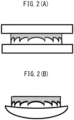
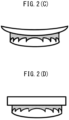
- FIGS. 2A to 2I illustrate seven additional structural examples of the contact multilayer diffractive optical elements (DOE).
- the contact multilayer diffractive optical element (DOE) is formed by stacking a resin having a high refractive index and low dispersion and a resin having a low refractive index and high dispersion compared with the first resin and is what is called a contact multilayer optical element in which a diffraction grating is located at the interface.
- the contact multilayer optical element may be formed on a single substrate or may have a configuration in which the optical element is sandwiched between two substrates.
- the substrate(s) may be a parallel flat plate or may be a plano-concave shape, plano-convex shape, a meniscus shape, or a biconvex shape.
- the contact multilayer optical element may be formed on a plane or may be formed on a convex surface or on a concave surface. Either of the high refractive index and low dispersion resin or the low refractive index and high dispersion resin may be formed as the first layer.
- An antireflection film may be formed on the upper surface of the contact multilayer optical element formed on a single substrate.
- the convex surface and concave surface of the substrate may be an aspherical surface.
- the surface of the air layer side of the second layer of optical element formed on a single substrate may be an aspherical surface.
- optical component and optical element according to the embodiment of the present invention are widely used for, for example, an image-taking optical system, a microscope optical system, and an observation optical system.
- An appropriately optimal configuration can be selected depending on the application and the form of the optical system.
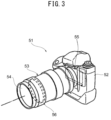
- FIG. 3 illustrates an image-taking device 51 mounting a contact multilayer diffractive optical element (DOE) using the optical resin composition according to the embodiment of the present invention as a base material.
- DOE diffractive optical element
- the image-taking device 51 is what is called a digital single-lens reflex camera and a lens barrel 53 is removably attached to a lens mount (not illustrated) of a camera body 52.
- the light passed through the image-taking lens 54 in the lens barrel 53 is imaged on a multi-chip module sensor chip (solid-state image-taking element) 55 located on the rear side of the camera body 52.
- At least one lens group 56 constituting the image-taking lens 54 includes the above-described contact multilayer diffractive optical element (DOE).
- DOE contact multilayer diffractive optical element
- optical device is not limited to such an image-taking device and examples of the optical device include microscopes, binoculars, telescopes, security cameras, and projectors.
- the crude product was purified by column chromatography using silica gel serving as a column packing and a mixed solvent of hexane-acetone serving as a developing solvent to give 10.1 g (57.7 mmol) of 2-(3,4-difluorophenoxy)ethanol as a yellow transparent liquid.
- the organic phase was washed with a sodium hydrogen carbonate saturated aqueous solution and a saturated brine and dried over sodium sulfate. Thereafter, the dried liquid was concentrated under reduced pressure to give 6.96 g of a crude product (a pale yellow transparent liquid).
- the crude product was purified by column chromatography using silica gel serving as a column packing and a mixed solvent of hexane-acetone serving as a developing solvent to give, as colorless transparent liquid, 5.15 g (22.6 mmol) of 2-(3,4-difluorophenoxy)ethyl acrylate represented by general formula (10) below.
- the organic phase was washed with hydrochloric acid (5 mM), a saturated sodium hydrogen carbonate aqueous solution, and a saturated brine and dried over sodium sulfate. Thereafter, the dried liquid was concentrated under reduced pressure to give 6.9 g of a crude product (pale yellow transparent liquid).
- optical resin precursor compositions were prepared by the method described below.
- HCPK 1-hydroxy cyclohexyl phenyl ketone
- this composition includes the constitutional unit represented by the following general formula (22).
- the numeric values in () represent measurement results of BAHF Lot 1: mixture having a viscosity of 16,500 mPa ⁇ s, whereas the numeric values without () represent measurement results of BAHF Lot 2: mixture having a viscosity of 19,800 mPa ⁇ s.
- viscosity reduction effect of the additives of Example 2 (EA1) and Examples 7, 8, 9, 10, and 11 (EM1, EM3, BA3, BA4, and BA5) was similarly confirmed to be equivalent to the viscosity reduction effect of the additives of Examples 1 and 6.
- an ultraviolet irradiation machine (UL-250, manufactured by HOYA CANDEO OPTRONICS Inc.) equipped with a high pressure mercury lamp generating ultraviolet rays having a wavelength of 365 nm was used and the resin precursor composition was irradiated as pre-curing through ground glass at 8 mW/cm 2 for 150 seconds (1,200 mJ/cm 2 ).
- the ground glass was removed and the pre-cured composition was further irradiated at 8 mW/cm 2 for 75 seconds (600 mJ/cm 2 ).
- the light source such as a metal halide lamp, a high-pressure mercury lamp, and an LED can be used as long as the light source emits light having a wavelength of 365 nm.
- the irradiated composition was irradiated as main curing at 31 mW/cm 2 for 233 seconds (about 7,000 mJ/cm 2 ) using an ultraviolet light irradiator (manufactured by Eye Graphics Co., Ltd.) equipped with a metal halide lamp emitting ultraviolet light having a wavelength of 365 nm.
- each of the optical resin precursors (BAHF-EA0-Compound A) in Example 22 was irradiated with ultraviolet rays to prepare a cured product of the resin composition BAHF-EA0 having a thickness of 5 mm.
- each of the resin compositions was irradiated as pre-curing through ground glass at 8 mW/cm 2 for 75 seconds (600 mJ/cm 2 ). The ground glass was removed and the pre-cured composition was further irradiated at 8 mW/cm 2 for 150 seconds (1,200 mJ/cm 2 ).
- an ultraviolet light irradiator manufactured by Eye Graphics Co., Ltd.
- a metal halide lamp emitting ultraviolet light having a wavelength of 365 nm was used and the irradiated composition was irradiated as main curing at 31 mW/cm 2 for 583 seconds (about 18,000 mJ/cm 2 ).
- Example 23 The same (or similar) process as the process in Example 22 above was carried out to the optical resin precursors (BAHF-EM0-Compound A) in Example 23 to prepare a cured product of the resin composition BAHF-EM0 having a thickness of 5 mm.
- the optical resin precursor composition (BAHF) prepared in Comparative Example 1 was irradiated with ultraviolet rays to prepare a cured product of the resin composition BAHF having a thickness of 5 mm.
- each of the resin compositions was irradiated as pre-curing through ground glass at 8 mW/cm 2 for 150 seconds (1,200 mJ/cm 2 ).
- the ground glass was removed and the pre-cured composition was further irradiated at 8 mW/cm 2 for 75 seconds (600 mJ/cm 2 ).
- an ultraviolet light irradiator manufactured by Eye Graphics Co., Ltd.
- a metal halide lamp emitting ultraviolet light having a wavelength of 365 nm was used and the irradiated composition was irradiated as main curing at 31 mW/cm 2 for 233 seconds (about 7,000 mJ/cm 2 ).
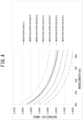
- FIG. 4 illustrates the refractive index wavelength characteristics of the optical resin precursor composition cured products prepared in the same (or similar) manner as described above by adding each of EA1, EA2, EA3, EA4, and EA5 synthesized in Examples 1 to 5 to BAHF or BMHF as additives in the following compositions.
- Composition ratio Abbe number vd BMHF:EA1:HCPK (50:50:0.5 parts by mass) 37.4 BMHF:EA2:HCPK (50:50:0.5 parts by mass) 38.0 BAHF:EA2:HCPK (50:50:0.5 parts by mass) 37.9 BAHF:EA3:HCPK (50:50:0.5 parts by mass) 37.8 BAHF:EA4:HCPK (50:50:0.5 parts by mass) 38.5 BAHF:EA5:HCPK (50:50:0.5 parts by mass) 38.9
- FIG. 5 illustrates the refractive index wavelength characteristics of the optical resin precursor composition cured products prepared in the same (or similar) manner as described above by adding each EM1, EM2, and EM3 synthesized in Examples 6 to 8 to BAMF as additives in the following compositions.
- Composition ratio Abbe number vd BMHF:EM1:HCPK (50:50:0.5 parts by mass) 37.9 BMHF:EM2:HCPK (50:50:0.5 parts by mass) 38.6 BMHF:EM3:HCPK (50:50:0.5 parts by mass) 38.5
- the optical resin precursor composition having a composition ratio of BAHF:EA2:HCPK (90:10:0.5) was dropped onto a glass substrate as the optical resin precursor composition (the low refractive index and high dispersion resin) 1 prepared as the first optical component illustrated in FIG. 1 .
- the predetermined mold was brought close to the resin surface and brought close to the glass substrate to a position where the resin thickness was reached to 200 ⁇ m to spread the resin.
- the spread resin was irradiated with ultraviolet rays.
- the ultraviolet ray irradiation was carried out using an ultraviolet ray irradiation machine (UL-250, manufactured by HOYA CANDEO OPTRONICS Corporation) having a high pressure mercury lamp emitting ultraviolet light having a wavelength of 365 nm.
- the spread resin was irradiated as pre-curing through ground glass at 6 mW/cm 2 for 167 seconds (1,000 mJ/cm 2 ).
- the ground glass was removed and the pre-cured composition was further irradiated at 7 mW/cm 2 for 14 seconds (100 mJ/cm 2 ).
- the light source such as a metal halide lamp, a high-pressure mercury lamp, an LED, and the like can be used as long as the light source emits light having a wavelength of 365 nm.
- the pre-cured product was removed from the mold to prepare the first diffractive optical component.
- the viscosity of the resin precursor used for the first optical component was 3,900 mPa ⁇ s, which is sufficiently low.
- A-DCP tricyclodecanedimethanol diacrylate
- DMDS di(2-mercaptodiethyl)sulfide
- the spread resin was irradiated with ultraviolet rays.
- the ultraviolet ray irradiation conditions carried out as the pre-curing were the same as (or similar to) the conditions of the pre-curing for the first optical component.
- the spread resin was irradiated as pre-curing through ground glass at 6 mW/cm 2 for 167 seconds (1,000 mJ/cm 2 ). The ground glass was removed and the pre-cured composition was further irradiated at 7 mW/cm 2 for 14 seconds (100 mJ/cm 2 ).
- the mold was released from the resin and the irradiated resin was irradiated as main curing at 20 mW/cm 2 for 500 seconds (10,000 mJ/cm 2 ) using an ultraviolet light irradiator (manufactured by Eye Graphics Co., Ltd.) equipped with a metal halide lamp emitting ultraviolet light having a wavelength of 365 nm to mold a diffractive optical element.
- the grating height of the diffraction grating was 28.2 ⁇ m.
- the grating height of the diffraction grating was 28.8 ⁇ m.
- the viscosity of the resin precursor used for the first optical component was 1,960 mPa ⁇ s
- a diffractive optical element was prepared in the same process to the process in Example 28 using the optical resin precursor composition having a composition ratio of BAHF:HCPK (100:0.5 parts by mass) prepared in Comparative Example 1 instead of the resin precursor composition having a composition ratio of BAHF:EA2:HCPK (90:10:0.5 parts by mass) in Example 28.
- the grating height of the diffraction grating was 27.9 ⁇ m.
- the viscosity of the optical resin precursor composition is significantly lowered by adding the additive according to the present embodiment represented by general formula (1) to BAHF serving as the optical resin precursor composition having a low refractive index and high dispersion and thus a precise relief patterns were able to be obtained without problems at the time of processing the diffractive optical element.
- the additives of Examples 2 to 8 it was ascertained that the effect of lowering the viscosity was the same (or similar) the effect in Example 1 and precise relief patterns were able to be obtained without problems at the time of processing the diffractive optical elements.
- the resin precursor composition of Comparative Example 1 caused mixing of bubbles unless the speed of mold movement for contacting the mold with the resin was sufficiently lowered in the process of spreading the resin with the mold, compared with the molding process using the optical resin precursor to which the additive represented by general formula (1) was added.
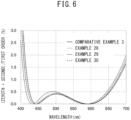
- FIG. 6 a graph of the relationship between the wavelength of light and the amount of flare is illustrated.
- the horizontal axis represents the wavelength of light (nm) and the vertical axis represents the ratio (%) of the sum of the zero-order diffracted light and the second order diffracted light to the first-order diffracted light.
- Each dotted line in FIG. 6 illustrates the flare amount of the diffractive optical elements prepared by using each of the optical resin precursor compositions of Examples 12, 22, and 24 above.
- the solid line in FIG. 6 illustrates the flare amount of the diffractive optical element prepared by using the optical resin precursor composition of Comparative Example 2 above.
- the amount of generated flare when the (meth)acrylate compound additive according to the present embodiment was added to the optical resin compound having a low refractive index and high dispersion properties was almost unchanged as compared with the case of BAHF alone.
- the amount of generated flare was also almost unchanged even when EM0, which is an additive and one of the compounds represented by general formula (1), was added.
- the copolymer of A-DCP and DMDS was used as the high refractive index and low dispersion resin.
- the resin is not limited to this copolymer.
- the usable high refractive index and low dispersion resin include hexanediol di(meth)acrylate, decanediol di(meth)acrylate, dipropylene glycol di(meth)acrylate, and neopentyl glycol di(meth)acrylate.
- the resin on the high refractive index and low dispersion side can be used by appropriate selection and formulation in accordance with the refractive index characteristics illustrated in FIGS. 4 and 5 .
- the material that lowers the reflective index may be selected as the high refractive index and low dispersion resin serving as the counterpart resin with respect to the resin in which the formulation ratio of fluorine is high and the refractive index is low as a whole.
- the viscosity of the low refractive index and high dispersion resin is lowered to improve processing properties.
- the degree of freedom of refractive index behavior adjustment with respect to the wavelength increases and more precise control of the wavelength-refractive index behavior is possible. Consequently, further flare light reduction effect can be expected.
- the thicknesses of the diffraction gratings of the first diffractive optical element and the second diffractive optical element are 200 ⁇ m and 300 ⁇ m, respectively.
- the diffraction grating height is about 28 ⁇ m.
- a film of an inorganic oxide made of a multilayer film was deposited on the surface of each of the four diffractive optical elements prepared in Example 28 to 30 and Comparative Example 3 by a vacuum evaporation method to form an antireflection film.
- the diffractive optical elements produced using the resins in Examples 28 to 30 having a linear expansion coefficient of 2.0 ⁇ 10 -4 (1/K, 25°C to 70°C) or lower no cracks were generated in the film and a film having excellent antireflection properties was able to be formed.
- the diffractive optical elements in Examples 28 to 30 made of the cured products having a storage elastic modulus at 100°C of 50 MPa or higher acting as the second diffractive optical components generated no wrinkles in the films even when environmental tests including a heat resistance test, a temperature cycle test, and a moisture resistance test were carried out.
- the antireflection film can be formed as long as the storage elastic modulus of the second diffractive optical component resin at 100°C is at least 19 MPa or higher.
- higher storage elastic modulus is preferable.
- the storage elastic modulus is preferably 50 MPa or higher by multiplying a factor of safety.
- the thickness of the second optical component is constant regardless of the location, that is, the second optical component has the equal thickness.
- the second optical component may have an aspherical surface shape by varying the thickness of the second optical component depending on the location in the radius direction.
- the diffractive optical element having the aspherical lens function in the second optical component in addition to the functions of the diffractive optical element can provide further significant contribution of reduction in size and weight of the optical system.
- thickness difference of the resin of the second diffractive optical component may be nearly equal to the thickness difference of the resin in the common composite aspherical lens.
- the resin thickness difference between the thickest portion and the thinnest portion may be set to 10 ⁇ m or larger and 1,500 ⁇ m or smaller.
- change in the resin thickness of the second optical component depending on the location tends to increase the risks of generation of cracks during formation of the multilayer film on the surface and generation of wrinkles in the environmental tests.
- both of the first diffractive optical component and the second diffractive optical component according to the present invention have linear expansion coefficients of 2.0 ⁇ 10 -4 (1/K, 25°C to 70°C) or lower, which are low coefficients
- the second diffractive optical element has a storage elastic modulus at 100°C of 50 MPa or higher, which is high modulus.
- the optical element having no problems of cracks or wrinkles in the film and high environmental resistance can be prepared even when the second diffractive optical component has the aspherical surface shape formed by varying the thickness.
- Diffractive optical components having a linear expansion coefficient of 1.2 ⁇ 10 -4 (1/K, 25°C to 70°C) or lower allows the diffractive optical component having a spherical or aspherical lens shape having a resin thickness difference of 1,000 ⁇ m or larger to be stably molded.
- the processing properties can be improved without impairing the optical properties.
- Example 1 is a (meth)acrylate compound represented by general formula (1): [in general formula (1), each X independently represents a fluorine atom or a methyl group in which at least one hydrogen atom is substituted with a fluorine atom; m represents 1 to 5; R 1 represents an alkylene group or an oxyalkylene group having a carbon number of 1 to 8; and R 2 represents a hydrogen atom or a methyl group].
- Example 2 is an additive for an optical resin comprising a (meth)acrylate compound represented by general formula (1): [in general formula (1), each X independently represents a fluorine atom or a methyl group in which at least one hydrogen atom is substituted with a fluorine atom; m represents 0 to 5; R 1 represents an alkylene group or an oxyalkylene group having a carbon number of 1 to 8; and R 2 represents a hydrogen atom or a methyl group].
- each X independently represents a fluorine atom or a methyl group in which at least one hydrogen atom is substituted with a fluorine atom
- m represents 0 to 5
- R 1 represents an alkylene group or an oxyalkylene group having a carbon number of 1 to 8
- R 2 represents a hydrogen atom or a methyl group
- Example 3 is a resin precursor composition comprising: bifunctional (meth)acrylate (A Component); monofunctional (meth)acrylate (B Component); and a photopolymerization initiator (C Component), wherein the B Component is a compound represented by general formula (1) below: [in general formula (1), each X independently represents a fluorine atom or a methyl group in which at least one hydrogen atom is substituted with a fluorine atom; m represents 1 to 5; R 1 represents an alkylene group or an oxyalkylene group having a carbon number of 1 to 8; and R 2 represents a hydrogen atom or a methyl group].
- each X independently represents a fluorine atom or a methyl group in which at least one hydrogen atom is substituted with a fluorine atom
- m represents 1 to 5
- R 1 represents an alkylene group or an oxyalkylene group having a carbon number of 1 to 8
- R 2 represents a hydrogen atom or a methyl group
- the resin precursor composition according to Example 3 can optionally further include that Component A is a compound represented by general formula (6) below and/or represented by general formula (7) below: [in general formula (6) and general formula (7), each R independently represents a hydrogen atom or a methyl group; p and q each independently represent an integer of 1 to 3; in general formula (7), R 4 and R 5 each independently represent a hydrogen atom or an alkyl group having a carbon number of 1 to 2; and R 6 , R 7 , R 8 , and R 9 each independently represent any one of a hydrogen atom, a fluorine atom, an alkyl group having a carbon number of 1 to 6, and a phenyl group in which one or some of hydrogen atoms are optionally substituted with an alkyl group having a carbon number of 1 to 6].
- Component A is a compound represented by general formula (6) below and/or represented by general formula (7) below: [in general formula (6) and general formula (7), each R independently represents a hydrogen atom
- Example 5 is an optical resin composition
- the optical resin composition according to Example 5 can optionally further include that the optical resin composition has a refractive index nd at d-line (587.56 nm) of 1.53 or smaller and an Abbe number vd of 39 or smaller.
- the optical resin composition according to Example 5 can optionally further include that the optical resin composition has a storage elastic modulus at 100°C of 50 MPa or higher.
- the optical resin composition according to Example 5 can optionally further include that the optical resin composition has a linear expansion coefficient from 25°C to 70°C of 2.0 ⁇ 10 -4 (1/K) or lower.
- Example 9 is an optical resin precursor composition comprising:
- Example 10 is an optical element comprising: a resin composition obtained by curing the optical resin composition according to any one of Examples 5 to 8 or the optical resin precursor composition according to Example 9.
- Example 11 is an optical element comprising:
- Example 12 is an optical device comprising the optical element according to Example 10 or 11.
Landscapes
- Physics & Mathematics (AREA)
- Chemical & Material Sciences (AREA)
- Organic Chemistry (AREA)
- General Physics & Mathematics (AREA)
- Optics & Photonics (AREA)
- Health & Medical Sciences (AREA)
- Chemical Kinetics & Catalysis (AREA)
- Medicinal Chemistry (AREA)
- Polymers & Plastics (AREA)
- Life Sciences & Earth Sciences (AREA)
- Engineering & Computer Science (AREA)
- Materials Engineering (AREA)
- Wood Science & Technology (AREA)
- Spectroscopy & Molecular Physics (AREA)
- Addition Polymer Or Copolymer, Post-Treatments, Or Chemical Modifications (AREA)
- Organic Low-Molecular-Weight Compounds And Preparation Thereof (AREA)
- Diffracting Gratings Or Hologram Optical Elements (AREA)
Priority Applications (1)
| Application Number | Priority Date | Filing Date | Title |
|---|---|---|---|
| EP24212280.2A EP4484407A3 (de) | 2017-01-17 | 2017-01-17 | (meth)acrylatverbindung, additiv für optisches harz, optisches element und optische vorrichtung |
Applications Claiming Priority (3)
| Application Number | Priority Date | Filing Date | Title |
|---|---|---|---|
| PCT/JP2017/001357 WO2018134871A1 (ja) | 2017-01-17 | 2017-01-17 | (メタ)アクリレート化合物、光学用樹脂添加剤、光学素子、及び光学装置 |
| EP17892595.4A EP3572396A4 (de) | 2017-01-17 | 2017-01-17 | (meth)acrylat-verbindung, additiv für optisches harz, optisches element und optische vorrichtung |
| EP24212280.2A EP4484407A3 (de) | 2017-01-17 | 2017-01-17 | (meth)acrylatverbindung, additiv für optisches harz, optisches element und optische vorrichtung |
Related Parent Applications (1)
| Application Number | Title | Priority Date | Filing Date |
|---|---|---|---|
| EP17892595.4A Division EP3572396A4 (de) | 2017-01-17 | 2017-01-17 | (meth)acrylat-verbindung, additiv für optisches harz, optisches element und optische vorrichtung |
Publications (2)
| Publication Number | Publication Date |
|---|---|
| EP4484407A2 true EP4484407A2 (de) | 2025-01-01 |
| EP4484407A3 EP4484407A3 (de) | 2025-07-02 |
Family
ID=62907859
Family Applications (2)
| Application Number | Title | Priority Date | Filing Date |
|---|---|---|---|
| EP17892595.4A Pending EP3572396A4 (de) | 2017-01-17 | 2017-01-17 | (meth)acrylat-verbindung, additiv für optisches harz, optisches element und optische vorrichtung |
| EP24212280.2A Pending EP4484407A3 (de) | 2017-01-17 | 2017-01-17 | (meth)acrylatverbindung, additiv für optisches harz, optisches element und optische vorrichtung |
Family Applications Before (1)
| Application Number | Title | Priority Date | Filing Date |
|---|---|---|---|
| EP17892595.4A Pending EP3572396A4 (de) | 2017-01-17 | 2017-01-17 | (meth)acrylat-verbindung, additiv für optisches harz, optisches element und optische vorrichtung |
Country Status (5)
| Country | Link |
|---|---|
| US (1) | US11142636B2 (de) |
| EP (2) | EP3572396A4 (de) |
| JP (1) | JP6809540B2 (de) |
| CN (3) | CN118359760A (de) |
| WO (1) | WO2018134871A1 (de) |
Families Citing this family (4)
| Publication number | Priority date | Publication date | Assignee | Title |
|---|---|---|---|---|
| JP7346262B2 (ja) | 2019-11-26 | 2023-09-19 | キヤノン株式会社 | 回折光学素子、回折光学素子の製造方法、光学機器および撮像装置 |
| WO2021220512A1 (ja) * | 2020-05-01 | 2021-11-04 | 株式会社ニコン | 化合物、樹脂前駆体、硬化物、光学素子、光学系、カメラ用交換レンズ、光学装置、接合レンズ、及び接合レンズの製造方法 |
| JP7884928B2 (ja) * | 2021-10-13 | 2026-07-06 | キヤノン株式会社 | 光学素子、光学機器、撮像装置 |
| CN114890873B (zh) * | 2022-03-18 | 2024-03-19 | 上海邃铸科技有限公司 | 一种组合物以及提高酰亚胺化率的方法 |
Family Cites Families (31)
| Publication number | Priority date | Publication date | Assignee | Title |
|---|---|---|---|---|
| DE3216987A1 (de) * | 1982-05-06 | 1983-11-17 | Chemische Werke Hüls AG, 4370 Marl | Phenylsubstituierter acrylsaeureester und dessen verwendung |
| JPH01234406A (ja) * | 1988-03-14 | 1989-09-19 | Nippon Kayaku Co Ltd | ジ(メタ)アクリル酸エステル、これを用いた樹脂組成物及びコーテイング剤 |
| JP2889593B2 (ja) * | 1989-05-24 | 1999-05-10 | 株式会社日立製作所 | 光学部品及びその製造方法とその応用装置 |
| JPH11349645A (ja) * | 1998-06-11 | 1999-12-21 | Mitsubishi Rayon Co Ltd | 活性エネルギー線硬化性樹脂組成物および光学シート |
| JP4255204B2 (ja) * | 1999-08-23 | 2009-04-15 | 富士フイルム株式会社 | 液晶配向膜、その製造方法、光学補償シート、stn型液晶表示装置およびディスコティック液晶性分子を配向させる方法 |
| US6540940B1 (en) * | 1999-08-23 | 2003-04-01 | Fuji Photo Film Co., Ltd. | Orientation layer containing (meth) acrylic copolymer having hydrophobic repeating units |
| KR100500092B1 (ko) * | 1999-11-29 | 2005-07-11 | 오므론 가부시키가이샤 | 내광성 마이크로 렌즈 어레이 및 그것에 사용되는 수지조성물 |
| EP1116973A1 (de) * | 2000-01-11 | 2001-07-18 | Corning Incorporated | Athermalisierte integrierte optische Wellenleitervorrichtungen |
| EP1118886A1 (de) * | 2000-01-11 | 2001-07-25 | Corning Incorporated | Abstimmung von optischen Wellenleiter Elementen mit organischem Material |
| US6531195B2 (en) | 2000-03-29 | 2003-03-11 | Fuji Photo Film Co., Ltd. | Process for orienting rod-like liquid crystal molecules |
| KR100557554B1 (ko) * | 2001-06-21 | 2006-03-03 | 주식회사 하이닉스반도체 | 불소가 치환된 벤질 카르복실레이트 그룹을 포함하는단량체 및 이를 함유한 포토레지스트 중합체 |
| JP4238729B2 (ja) * | 2001-11-30 | 2009-03-18 | 株式会社ニコン | 密着複層型回折光学素子 |
| EP1830204B1 (de) | 2004-12-20 | 2018-10-17 | Nikon Corporation | Dicht gebondetes beugendes optisches element, dafür verwendetes optisches material |
| JP5250949B2 (ja) * | 2006-08-07 | 2013-07-31 | デクセリアルズ株式会社 | 発光素子モジュール |
| US7989037B2 (en) | 2006-10-06 | 2011-08-02 | Fujifilm Corporation | Composition, retardation plate, and liquid-crystal display device |
| JP5069530B2 (ja) * | 2006-10-06 | 2012-11-07 | 富士フイルム株式会社 | 組成物、位相差板、液晶表示装置および、位相差板の製造方法 |
| JP2008203821A (ja) | 2007-01-22 | 2008-09-04 | Canon Inc | 積層型回折光学素子 |
| JP2010007004A (ja) * | 2008-06-30 | 2010-01-14 | Sanyo Chem Ind Ltd | 活性エネルギー線硬化型樹脂組成物 |
| JP2010037525A (ja) * | 2008-08-08 | 2010-02-18 | Hitachi Maxell Ltd | 光学シート |
| US8835524B2 (en) * | 2009-07-22 | 2014-09-16 | Nikon Corporation | Resin precursor composition and resin obtained by photocuring the same |
| KR20120061427A (ko) * | 2010-12-03 | 2012-06-13 | 재단법인대구경북과학기술원 | 액정 디스플레이용 광경화성 조성물 및 이를 이용한 액정 디스플레이 |
| US8809413B2 (en) * | 2011-06-29 | 2014-08-19 | Chau Ha | Ultraviolet radiation-curable high refractive index optically clear resins |
| JP5815304B2 (ja) * | 2011-06-29 | 2015-11-17 | 日揮触媒化成株式会社 | 光学薄膜形成用塗料および光学薄膜 |
| JP5827852B2 (ja) * | 2011-08-04 | 2015-12-02 | 株式会社ダイセル | ウェハレベルレンズの製造方法 |
| JP5916399B2 (ja) * | 2012-01-27 | 2016-05-11 | 株式会社タムラ製作所 | 紫外線硬化性透明樹脂組成物 |
| JP5898551B2 (ja) | 2012-03-29 | 2016-04-06 | 富士フイルム株式会社 | 半硬化物、硬化物およびそれらの製造方法、光学部品、硬化樹脂組成物 |
| JP2013227392A (ja) * | 2012-04-25 | 2013-11-07 | Nippon Kayaku Co Ltd | 光学レンズシート用エネルギー線硬化型樹脂組成物及びその硬化物(3) |
| JP6063228B2 (ja) * | 2012-11-30 | 2017-01-18 | デンカ株式会社 | 光硬化性樹脂組成物 |
| JP5835204B2 (ja) * | 2012-12-20 | 2015-12-24 | 信越化学工業株式会社 | レジスト材料及びこれを用いたパターン形成方法 |
| WO2016031249A1 (ja) * | 2014-08-26 | 2016-03-03 | 株式会社ニコン | 光学材料用樹脂前駆体組成物、この組成物から得られる光学要素およびこの光学要素を用いて構成される回折光学素子 |
| JP6500399B2 (ja) * | 2014-11-18 | 2019-04-17 | 三菱ケミカル株式会社 | 硬化性樹脂組成物、硬化物、光学部材、レンズ及びカメラモジュール |
-
2017
- 2017-01-17 JP JP2018562748A patent/JP6809540B2/ja active Active
- 2017-01-17 EP EP17892595.4A patent/EP3572396A4/de active Pending
- 2017-01-17 CN CN202410644590.5A patent/CN118359760A/zh active Pending
- 2017-01-17 CN CN201780078969.2A patent/CN110088077A/zh active Pending
- 2017-01-17 WO PCT/JP2017/001357 patent/WO2018134871A1/ja not_active Ceased
- 2017-01-17 EP EP24212280.2A patent/EP4484407A3/de active Pending
- 2017-01-17 CN CN202310093924.XA patent/CN116082563B/zh active Active
-
2019
- 2019-07-02 US US16/459,923 patent/US11142636B2/en active Active
Non-Patent Citations (1)
| Title |
|---|
| CHEMICAL PAPERS, vol. 68, no. 11, 2014, pages 1561 - 1572 |
Also Published As
| Publication number | Publication date |
|---|---|
| EP3572396A1 (de) | 2019-11-27 |
| US20190322857A1 (en) | 2019-10-24 |
| CN116082563B (zh) | 2024-09-20 |
| CN118359760A (zh) | 2024-07-19 |
| CN116082563A (zh) | 2023-05-09 |
| EP3572396A4 (de) | 2020-11-18 |
| US11142636B2 (en) | 2021-10-12 |
| CN110088077A (zh) | 2019-08-02 |
| WO2018134871A1 (ja) | 2018-07-26 |
| JP6809540B2 (ja) | 2021-01-06 |
| EP4484407A3 (de) | 2025-07-02 |
| JPWO2018134871A1 (ja) | 2019-11-07 |
Similar Documents
| Publication | Publication Date | Title |
|---|---|---|
| US11142636B2 (en) | (Meth)acrylate compound, additive for optical resin, optical element, and optical device | |
| US20100060986A1 (en) | Optic-purpose precursor composition, optic-purpose resin, optical element, and optical article | |
| TWI461757B (zh) | 偏光板及其製法 | |
| US10457756B2 (en) | Fluorinated compound, curable composition and cured product | |
| JP2012227190A (ja) | ナノインプリント用硬化性樹脂組成物 | |
| WO2019069488A1 (ja) | 化合物、樹脂前駆体、硬化物、光学素子、光学系、カメラ用交換レンズ、光学装置、接合レンズ、及び接合レンズの製造方法 | |
| WO2012014641A1 (ja) | 硬化性樹脂組成物および成形体 | |
| US11554539B2 (en) | Photocurable composition for three-dimensional stereolithography and three-dimensional object | |
| JP4204391B2 (ja) | 重合性アダマンタン化合物 | |
| JP2003040940A (ja) | 光学素子用重合性組成物及びこれを用いた光学素子 | |
| US12492273B2 (en) | Compound, resin precursor, cured object, optical element, optical system, interchangeable camera lens, optical device, cemented lens, and method for manufacturing cemented lens | |
| US20140226216A1 (en) | Composite optical element | |
| JP6149004B2 (ja) | 硬化性樹脂組成物、光学部品およびレンズ | |
| JP2011074280A (ja) | スターポリマー、硬化性樹脂組成物 | |
| WO2022196516A1 (ja) | 硬化性組成物、及び当該組成物から得られる光学材料 | |
| US12139646B2 (en) | Compound, resin precursor, cured object, optical element, optical system, interchangeable camera lens, optical device, cemented lens, and method for manufacturing cemented lens | |
| JP2022115135A (ja) | 重合性組成物、及び光学素子とその製造方法、光学機器、撮像装置 | |
| JP5213100B2 (ja) | 新規含硫黄エチレン性不飽和基含有化合物、及びその重合体 | |
| US20250224543A1 (en) | Resin composition, optical element, optical apparatus, image pickup apparatus, and method for manufacturing optical element | |
| WO2012017879A1 (ja) | 硬化性樹脂組成物および成形体 | |
| KR100773213B1 (ko) | 광학 부품 | |
| KR101406059B1 (ko) | 실리콘-함유 아크릴레이트 또는 메타크릴레이트 단량체 및 그의 용도 | |
| JP2025167442A (ja) | 硬化性組成物 | |
| CN112533974A (zh) | 光学构件、其制造方法和光学构件用固化性组合物 | |
| JP2022032186A (ja) | 光硬化性組成物、硬化物、及びレンズ |
Legal Events
| Date | Code | Title | Description |
|---|---|---|---|
| PUAI | Public reference made under article 153(3) epc to a published international application that has entered the european phase |
Free format text: ORIGINAL CODE: 0009012 |
|
| STAA | Information on the status of an ep patent application or granted ep patent |
Free format text: STATUS: REQUEST FOR EXAMINATION WAS MADE |
|
| 17P | Request for examination filed |
Effective date: 20241112 |
|
| AC | Divisional application: reference to earlier application |
Ref document number: 3572396 Country of ref document: EP Kind code of ref document: P |
|
| AK | Designated contracting states |
Kind code of ref document: A2 Designated state(s): AL AT BE BG CH CY CZ DE DK EE ES FI FR GB GR HR HU IE IS IT LI LT LU LV MC MK MT NL NO PL PT RO RS SE SI SK SM TR |
|
| REG | Reference to a national code |
Ref country code: DE Ref legal event code: R079 Free format text: PREVIOUS MAIN CLASS: C07C0069540000 Ipc: C07C0069653000 |
|
| PUAL | Search report despatched |
Free format text: ORIGINAL CODE: 0009013 |
|
| AK | Designated contracting states |
Kind code of ref document: A3 Designated state(s): AL AT BE BG CH CY CZ DE DK EE ES FI FR GB GR HR HU IE IS IT LI LT LU LV MC MK MT NL NO PL PT RO RS SE SI SK SM TR |
|
| RIC1 | Information provided on ipc code assigned before grant |
Ipc: C07C 69/54 20060101ALI20250527BHEP Ipc: G03F 7/027 20060101ALI20250527BHEP Ipc: G03F 7/004 20060101ALI20250527BHEP Ipc: G02B 1/18 20150101ALI20250527BHEP Ipc: G02B 1/04 20060101ALI20250527BHEP Ipc: C08F 20/22 20060101ALI20250527BHEP Ipc: C07C 69/653 20060101AFI20250527BHEP |