EP4425708A2 - Leiterplatte und verfahren zur herstellung einer leiterplatte - Google Patents
Leiterplatte und verfahren zur herstellung einer leiterplatte Download PDFInfo
- Publication number
- EP4425708A2 EP4425708A2 EP24188182.0A EP24188182A EP4425708A2 EP 4425708 A2 EP4425708 A2 EP 4425708A2 EP 24188182 A EP24188182 A EP 24188182A EP 4425708 A2 EP4425708 A2 EP 4425708A2
- Authority
- EP
- European Patent Office
- Prior art keywords
- wiring
- pattern region
- antenna
- wiring board
- substrate
- Prior art date
- Legal status (The legal status is an assumption and is not a legal conclusion. Google has not performed a legal analysis and makes no representation as to the accuracy of the status listed.)
- Pending
Links
Images















Classifications
-
- H—ELECTRICITY
- H05—ELECTRIC TECHNIQUES NOT OTHERWISE PROVIDED FOR
- H05K—PRINTED CIRCUITS; CASINGS OR CONSTRUCTIONAL DETAILS OF ELECTRIC APPARATUS; MANUFACTURE OF ASSEMBLAGES OF ELECTRICAL COMPONENTS
- H05K1/00—Printed circuits
- H05K1/02—Details
- H05K1/0274—Optical details, e.g. printed circuits comprising integral optical means
-
- H—ELECTRICITY
- H05—ELECTRIC TECHNIQUES NOT OTHERWISE PROVIDED FOR
- H05K—PRINTED CIRCUITS; CASINGS OR CONSTRUCTIONAL DETAILS OF ELECTRIC APPARATUS; MANUFACTURE OF ASSEMBLAGES OF ELECTRICAL COMPONENTS
- H05K1/00—Printed circuits
- H05K1/02—Details
-
- H—ELECTRICITY
- H01—ELECTRIC ELEMENTS
- H01B—CABLES; CONDUCTORS; INSULATORS; SELECTION OF MATERIALS FOR THEIR CONDUCTIVE, INSULATING OR DIELECTRIC PROPERTIES
- H01B5/00—Non-insulated conductors or conductive bodies characterised by their form
- H01B5/14—Non-insulated conductors or conductive bodies characterised by their form comprising conductive layers or films on insulating-supports
-
- H—ELECTRICITY
- H01—ELECTRIC ELEMENTS
- H01B—CABLES; CONDUCTORS; INSULATORS; SELECTION OF MATERIALS FOR THEIR CONDUCTIVE, INSULATING OR DIELECTRIC PROPERTIES
- H01B7/00—Insulated conductors or cables characterised by their form
- H01B7/08—Flat or ribbon cables
-
- H—ELECTRICITY
- H01—ELECTRIC ELEMENTS
- H01Q—ANTENNAS, i.e. RADIO AERIALS
- H01Q1/00—Details of, or arrangements associated with, antennas
-
- H—ELECTRICITY
- H01—ELECTRIC ELEMENTS
- H01Q—ANTENNAS, i.e. RADIO AERIALS
- H01Q1/00—Details of, or arrangements associated with, antennas
- H01Q1/36—Structural form of radiating elements, e.g. cone, spiral, umbrella; Particular materials used therewith
-
- H—ELECTRICITY
- H01—ELECTRIC ELEMENTS
- H01Q—ANTENNAS, i.e. RADIO AERIALS
- H01Q1/00—Details of, or arrangements associated with, antennas
- H01Q1/36—Structural form of radiating elements, e.g. cone, spiral, umbrella; Particular materials used therewith
- H01Q1/38—Structural form of radiating elements, e.g. cone, spiral, umbrella; Particular materials used therewith formed by a conductive layer on an insulating support
-
- H—ELECTRICITY
- H05—ELECTRIC TECHNIQUES NOT OTHERWISE PROVIDED FOR
- H05K—PRINTED CIRCUITS; CASINGS OR CONSTRUCTIONAL DETAILS OF ELECTRIC APPARATUS; MANUFACTURE OF ASSEMBLAGES OF ELECTRICAL COMPONENTS
- H05K3/00—Apparatus or processes for manufacturing printed circuits
- H05K3/10—Apparatus or processes for manufacturing printed circuits in which conductive material is applied to the insulating support in such a manner as to form the desired conductive pattern
- H05K3/108—Apparatus or processes for manufacturing printed circuits in which conductive material is applied to the insulating support in such a manner as to form the desired conductive pattern by semi-additive methods; masks therefor
-
- H—ELECTRICITY
- H05—ELECTRIC TECHNIQUES NOT OTHERWISE PROVIDED FOR
- H05K—PRINTED CIRCUITS; CASINGS OR CONSTRUCTIONAL DETAILS OF ELECTRIC APPARATUS; MANUFACTURE OF ASSEMBLAGES OF ELECTRICAL COMPONENTS
- H05K3/00—Apparatus or processes for manufacturing printed circuits
- H05K3/10—Apparatus or processes for manufacturing printed circuits in which conductive material is applied to the insulating support in such a manner as to form the desired conductive pattern
- H05K3/18—Apparatus or processes for manufacturing printed circuits in which conductive material is applied to the insulating support in such a manner as to form the desired conductive pattern using precipitation techniques to apply the conductive material
-
- H—ELECTRICITY
- H05—ELECTRIC TECHNIQUES NOT OTHERWISE PROVIDED FOR
- H05K—PRINTED CIRCUITS; CASINGS OR CONSTRUCTIONAL DETAILS OF ELECTRIC APPARATUS; MANUFACTURE OF ASSEMBLAGES OF ELECTRICAL COMPONENTS
- H05K1/00—Printed circuits
- H05K1/02—Details
- H05K1/0286—Programmable, customizable or modifiable circuits
- H05K1/0287—Programmable, customizable or modifiable circuits having an universal lay-out, e.g. pad or land grid patterns or mesh patterns
-
- H—ELECTRICITY
- H05—ELECTRIC TECHNIQUES NOT OTHERWISE PROVIDED FOR
- H05K—PRINTED CIRCUITS; CASINGS OR CONSTRUCTIONAL DETAILS OF ELECTRIC APPARATUS; MANUFACTURE OF ASSEMBLAGES OF ELECTRICAL COMPONENTS
- H05K1/00—Printed circuits
- H05K1/16—Printed circuits incorporating printed electric components, e.g. printed resistors, capacitors or inductors
- H05K1/165—Printed circuits incorporating printed electric components, e.g. printed resistors, capacitors or inductors incorporating printed inductors
-
- H—ELECTRICITY
- H05—ELECTRIC TECHNIQUES NOT OTHERWISE PROVIDED FOR
- H05K—PRINTED CIRCUITS; CASINGS OR CONSTRUCTIONAL DETAILS OF ELECTRIC APPARATUS; MANUFACTURE OF ASSEMBLAGES OF ELECTRICAL COMPONENTS
- H05K2201/00—Indexing scheme relating to printed circuits covered by H05K1/00
- H05K2201/01—Dielectrics
- H05K2201/0104—Properties and characteristics in general
- H05K2201/0108—Transparent
-
- H—ELECTRICITY
- H05—ELECTRIC TECHNIQUES NOT OTHERWISE PROVIDED FOR
- H05K—PRINTED CIRCUITS; CASINGS OR CONSTRUCTIONAL DETAILS OF ELECTRIC APPARATUS; MANUFACTURE OF ASSEMBLAGES OF ELECTRICAL COMPONENTS
- H05K2201/00—Indexing scheme relating to printed circuits covered by H05K1/00
- H05K2201/09—Shape and layout
- H05K2201/09209—Shape and layout details of conductors
- H05K2201/09218—Conductive traces
- H05K2201/09272—Layout details of angles or corners
-
- H—ELECTRICITY
- H05—ELECTRIC TECHNIQUES NOT OTHERWISE PROVIDED FOR
- H05K—PRINTED CIRCUITS; CASINGS OR CONSTRUCTIONAL DETAILS OF ELECTRIC APPARATUS; MANUFACTURE OF ASSEMBLAGES OF ELECTRICAL COMPONENTS
- H05K2201/00—Indexing scheme relating to printed circuits covered by H05K1/00
- H05K2201/09—Shape and layout
- H05K2201/09209—Shape and layout details of conductors
- H05K2201/09218—Conductive traces
- H05K2201/09281—Layout details of a single conductor
-
- H—ELECTRICITY
- H05—ELECTRIC TECHNIQUES NOT OTHERWISE PROVIDED FOR
- H05K—PRINTED CIRCUITS; CASINGS OR CONSTRUCTIONAL DETAILS OF ELECTRIC APPARATUS; MANUFACTURE OF ASSEMBLAGES OF ELECTRICAL COMPONENTS
- H05K2201/00—Indexing scheme relating to printed circuits covered by H05K1/00
- H05K2201/09—Shape and layout
- H05K2201/09209—Shape and layout details of conductors
- H05K2201/09654—Shape and layout details of conductors covering at least two types of conductors provided for in H05K2201/09218 - H05K2201/095
- H05K2201/09681—Mesh conductors, e.g. as a ground plane
-
- H—ELECTRICITY
- H05—ELECTRIC TECHNIQUES NOT OTHERWISE PROVIDED FOR
- H05K—PRINTED CIRCUITS; CASINGS OR CONSTRUCTIONAL DETAILS OF ELECTRIC APPARATUS; MANUFACTURE OF ASSEMBLAGES OF ELECTRICAL COMPONENTS
- H05K2201/00—Indexing scheme relating to printed circuits covered by H05K1/00
- H05K2201/09—Shape and layout
- H05K2201/09209—Shape and layout details of conductors
- H05K2201/09654—Shape and layout details of conductors covering at least two types of conductors provided for in H05K2201/09218 - H05K2201/095
- H05K2201/09727—Varying width along a single conductor; Conductors or pads having different widths
-
- H—ELECTRICITY
- H05—ELECTRIC TECHNIQUES NOT OTHERWISE PROVIDED FOR
- H05K—PRINTED CIRCUITS; CASINGS OR CONSTRUCTIONAL DETAILS OF ELECTRIC APPARATUS; MANUFACTURE OF ASSEMBLAGES OF ELECTRICAL COMPONENTS
- H05K2201/00—Indexing scheme relating to printed circuits covered by H05K1/00
- H05K2201/10—Details of components or other objects attached to or integrated in a printed circuit board
- H05K2201/10007—Types of components
- H05K2201/10098—Components for radio transmission, e.g. radio frequency identification [RFID] tag, printed or non-printed antennas
-
- H—ELECTRICITY
- H05—ELECTRIC TECHNIQUES NOT OTHERWISE PROVIDED FOR
- H05K—PRINTED CIRCUITS; CASINGS OR CONSTRUCTIONAL DETAILS OF ELECTRIC APPARATUS; MANUFACTURE OF ASSEMBLAGES OF ELECTRICAL COMPONENTS
- H05K2203/00—Indexing scheme relating to apparatus or processes for manufacturing printed circuits covered by H05K3/00
- H05K2203/01—Tools for processing; Objects used during processing
- H05K2203/0104—Tools for processing; Objects used during processing for patterning or coating
- H05K2203/0108—Male die used for patterning, punching or transferring
-
- H—ELECTRICITY
- H05—ELECTRIC TECHNIQUES NOT OTHERWISE PROVIDED FOR
- H05K—PRINTED CIRCUITS; CASINGS OR CONSTRUCTIONAL DETAILS OF ELECTRIC APPARATUS; MANUFACTURE OF ASSEMBLAGES OF ELECTRICAL COMPONENTS
- H05K2203/00—Indexing scheme relating to apparatus or processes for manufacturing printed circuits covered by H05K3/00
- H05K2203/07—Treatments involving liquids, e.g. plating, rinsing
- H05K2203/0703—Plating
- H05K2203/0723—Electroplating, e.g. finish plating
Definitions
- Embodiments of the present disclosure relate to a wiring board and a method for manufacturing a wiring board.
- a plurality of antennas corresponding to the communication bands are required.
- a plurality of antennas such as telephone antennas, wireless fidelity (WiFi) antennas, 3 generation (G) antennas, 4 generation (G) antennas, long term evolution (LTE) antennas, Bluetooth (registered trademark) antennas, and near field communication (NFC) antennas, are mounted on mobile terminal devices.
- WiFi wireless fidelity
- G generation
- G 4 generation
- LTE long term evolution
- Bluetooth registered trademark
- NFC near field communication
- a mounting space for the antennas has been limited with the miniaturization of mobile terminal devices, and the degree of freedom in antenna design has been narrowed. Further, the radio wave sensitivity is not always satisfactory because the antennas are built in the limited space.
- an antenna pattern is formed of a mesh-like conductor mesh layer having a conductor portion serving as a formation portion of an opaque conductor layer and a large number of opening portions serving as non-formation portions in a transparent antenna in which the antenna pattern is formed on a transparent substrate.
- One of objects of an embodiment of the present disclosure is to provide a wiring board having a radio wave transmission/reception function with improved conductivity and transparency, and a method for manufacturing the same.
- one or more mesh antennas are mounted on the transparent substrate in the conventional film antenna, but both a region where the antenna pattern is formed and a region where the antenna pattern is not formed are present on the transparent substrate. In this case, the region where the antenna pattern is formed is likely to be visible due to the presence of the region where the antenna pattern is not formed.
- One of objects of the present embodiment is to provide a wiring board and a method for manufacturing a wiring board, which can make it difficult to visually recognize an antenna pattern region.
- one or a plurality of mesh antennas are mounted on the transparent substrate in the conventional film antenna. While transmission and reception are performed using this mesh antenna, a current value tends to increase toward an edge of the mesh antenna, and the current value tends to decrease toward the center. Therefore, a current distribution in each of the mesh antennas is not uniform, and it is difficult to sufficiently improve antenna characteristics.
- the present embodiment provides the wiring board and the method for manufacturing the wiring board, which can make a current distribution in an antenna pattern region more uniform and improve antenna characteristics.
- a wiring board includes: a substrate having transparency; a plurality of first wiring which are arranged on an upper surface of the substrate and extend in a first direction and each of which has a back surface in contact with the substrate and a front surface facing an opposite side of the back surface; and a second wiring which is arranged on the upper surface of the substrate, extends in a second direction intersecting with the first direction, and has a back surface in contact with the substrate and a front surface facing an opposite side of the back surface, the first wiring has a pair of side surfaces which extend in the first direction and are adjacent to the back surface of the first wiring, and each of the pair of side surfaces of the first wiring is recessed inward, and the second wiring has a pair of side surfaces which extend in the second direction and are adjacent to the back surface of the second wiring, and each of the pair of side surfaces of the second wiring is recessed inward.
- a wiring board includes: a substrate having transparency; a plurality of first wiring which are arranged on an upper surface of the substrate and extend in a first direction and each of which has a back surface in contact with the substrate and a front surface facing an opposite side of the back surface; and a second wiring which is arranged on the upper surface of the substrate, extends in a second direction intersecting with the first direction, and has a back surface in contact with the substrate and a front surface facing an opposite side of the back surface, the first wiring has a pair of side surfaces which extend in the first direction and are adjacent to the back surface of the first wiring, the second wiring has a pair of side surfaces which extend in the second direction and are adjacent to the back surface of the second wiring, and one side surface of the first wiring and one side surface of the second wiring are continuously connected by a curved surface.
- a wiring board includes: a substrate having transparency; a plurality of first wirings which are arranged on an upper surface of the substrate and extend in a first direction and each of which has a back surface in contact with the substrate and a front surface facing an opposite side of the back surface; and a second wiring which is arranged on the upper surface of the substrate, extends in a second direction intersecting with the first direction, and has a back surface in contact with the substrate and a front surface facing an opposite side of the back surface, and a line width of the back surface of the second wiring is smaller than a line width of the back surface of the first wiring.
- the line width of the back surface of the first wiring may be larger than a line width of the front surface of the first wiring
- the line width of the back surface of the second wiring may be larger than a line width of the front surface of the second wiring.
- the second wiring may have a pair of side surfaces which extend in the second direction and are adjacent to the back surface of the second wiring, and an angle between the front surface and each of the side surfaces of the second wiring may be smaller than an external angle of an angle between the back surface and each of the side surfaces of the second wiring.
- the first wiring may have a pair of side surfaces which extend in the first direction and are adjacent to the back surface of the first wiring, and an angle between the front surface and each of the side surfaces of the first wiring may be smaller than an external angle of an angle between the back surface and each of the side surfaces of the first wiring.
- an intersection between the first wiring and the second wiring may include a curved surface at at least one of corners formed by the upper surface of the substrate, a surface adjacent to the back surface of the first wiring, and a surface adjacent to the back surface of the second wiring, the curved surface being continuous among the surfaces.
- the wiring board according to one embodiment of the present disclosure may have a radio wave transmission/reception function.
- a method for manufacturing a wiring board includes: forming a conductive layer on an upper surface of a substrate; forming an insulating layer that includes a first trench extending in a first direction and a second trench extending in a second direction; forming a first conductor arranged in the first trench and a second conductor arranged in the second trench; removing the insulating layer; and removing the conductive layer to expose the upper surface of the substrate and forming a first wiring and a second wiring from the first conductor and the second conductor.
- the first wiring may have a pair of side surfaces which extend in the first direction and are adjacent to a back surface of the first wiring, and each of the pair of side surfaces of the first wiring may be recessed inward
- the second wiring may have a pair of side surfaces which extend in the second direction and are adjacent to a back surface of the second wiring, and each of the pair of side surfaces of the second wiring may be recessed inward.
- the first wiring may have a pair of side surfaces which extend in the first direction and are adjacent to a back surface of the first wiring
- the second wiring may have a pair of side surfaces which extend in the second direction and are adjacent to a back surface of the second wiring
- one side surface of the first wiring and one side surface of the second wiring may be continuously connected by a curved surface.
- a line width of a back surface of the second wiring may be smaller than a line width of a back surface of the first wiring.
- the insulating layer that includes the first trench and the second trench may be formed using an imprinting method.
- a method for forming the first wiring and the second wiring may include: forming the conductive layer by a sputtering method; forming the first wiring and the second wiring by an electrolytic plating method; and removing the conductive layer by wet etching so as to expose the upper surface of the substrate.
- front surfaces of the first wiring and the second wiring may be subjected to a blackening treatment.
- the wiring board with the improved conductivity and transparency and the method for manufacturing the same.
- a wiring board is a wiring board including: a substrate having transparency; a wiring pattern region which is arranged on the substrate and includes a plurality of wirings; and a dummy pattern region which is arranged around the wiring pattern region and includes a plurality of dummy wirings electrically independent of the wirings, wherein each of the wiring pattern region and the dummy pattern region is formed by repeating a predetermined unit pattern shape, and a unit pattern shape of the dummy pattern region is a shape in which a part of a unit pattern shape of the wiring pattern region is missing, and an additional pattern apart from the dummy wiring is arranged in the dummy pattern region.
- the dummy wiring may have a first dummy wiring portion and a second dummy wiring portion, and the first dummy wiring portion and the second dummy wiring portion may be arranged apart from each other in a plane direction.
- a wiring board is a wiring board including: a substrate having transparency; a wiring pattern region which is arranged on the substrate and includes a plurality of wirings; and a dummy pattern region which is arranged around the wiring pattern region and includes a plurality of dummy wirings electrically independent of the wirings, wherein the dummy wiring has a substantially L shape in a plan view.
- an additional pattern apart from the dummy wiring may be arranged in the dummy pattern region.
- a wiring board is a wiring board including: a substrate having transparency; a wiring pattern region which is arranged on the substrate and includes a plurality of wirings; and a dummy pattern region which is arranged around the wiring pattern region and includes a plurality of dummy wirings electrically independent of the wirings, wherein the dummy wiring has a first dummy wiring portion and a second dummy wiring portion, and the first dummy wiring portion and the second dummy wiring portion are arranged obliquely with respect to the wiring.
- an aperture ratio of the dummy pattern region may be higher than an aperture ratio of the wiring pattern region.
- the aperture ratio of the dummy pattern region may be in a range of 87% or more and less than 100%.
- a difference between the aperture ratio of the dummy pattern region and the aperture ratio of the wiring pattern region may be 1% or less.
- the wiring pattern region may include a plurality of connection wirings connecting the plurality of wirings.
- a wiring board is a wiring board including: a substrate having transparency; and an antenna pattern region which is arranged on the substrate and includes a plurality of antenna wirings having a function as an antenna, wherein an aperture ratio of a widthwise central portion of the antenna pattern region is higher than an aperture ratio of a widthwise edge portion of the antenna pattern region.
- a pitch of the plurality of antenna wirings in the widthwise central portion of the antenna pattern region may be wider than a pitch of the plurality of antenna wirings in a widthwise edge portion of the antenna pattern region.
- a void portion in which the antenna wiring is not provided may be formed in a widthwise central portion of the antenna pattern region.
- a dummy pattern region including a plurality of dummy wirings electrically independent of the antenna wiring may be formed in the void portion.
- the antenna pattern region may have a first pattern region and a second pattern region separated with the void portion therebetween, the first pattern region and the second pattern region may be respectively arranged on both widthwise edge portions of the antenna pattern region, and the first pattern region and the second pattern region may be electrically connected to each other by a central pattern region.
- connection pattern regions each having an inclined portion formed obliquely to a width direction of the antenna pattern region may be provided between the central pattern region and each of the first pattern region and the second pattern region.
- a power feeding unit may be electrically connected to the antenna pattern region, and a length of the power feeding unit in the widthwise central portion may be longer than a length of the power feeding unit in the widthwise edge portion.
- a wiring board is a wiring board including: a substrate having transparency; an antenna pattern region which is arranged on the substrate and includes a plurality of antenna wirings having a function as an antenna; a power feeding unit electrically connected to the antenna pattern region, wherein a length of the power feeding unit in a widthwise central portion is longer than a length of the power feeding unit in a widthwise edge portion.
- a method for manufacturing a wiring board is a method for manufacturing a wiring board including: a step of preparing a substrate having transparency; and a step of forming an antenna pattern region, which includes a plurality of antenna wirings each having a function as an antenna, on the substrate, wherein an aperture ratio of a widthwise central portion of the antenna pattern region is higher than an aperture ratio of a widthwise edge portion of the antenna pattern region.
- a method for manufacturing a wiring board is a method for manufacturing a wiring board including: a step of preparing a substrate having transparency; and a step of forming an antenna pattern region including a plurality of antenna wirings each having a function as an antenna and a power feeding unit electrically connected to the antenna pattern region on the substrate, wherein a length of the power feeding unit in a widthwise central portion is longer than a length of the power feeding unit in a widthwise edge portion.
- the current distribution in the antenna pattern region can be made more uniform, and the antenna characteristic can be improved.
- a wiring board and a method for manufacturing the same according to a first embodiment will be described with reference to the drawings.
- the wiring board and the method for manufacturing the same according to the present embodiment can be carried out in many different modes, and is not construed as being limited to the following description of embodiments.
- Note that the same portions or portions having similar functions are denoted by the same reference signs in the drawings referred to in the present embodiment, and a repeated description thereof will be omitted.
- the description will be given using the term “upper” or “lower” for convenience of description, but the vertical direction may be reversed.
- a "front surface" of a wiring refers to a surface opposite to a surface on which a substrate is provided as viewed from the wiring in the present embodiment.
- a “back surface” of the wiring refers to a surface on the side where the substrate is provided as viewed from the wiring.
- a “side surface” of the wiring refers to a surface located between the “front surface” and the “back surface”, the surface facing a lateral side with respect to a longitudinal direction of the wiring.
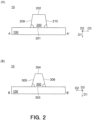
- a configuration of a wiring board 10 according to the present embodiment will be described with reference to Fig. 1 or 2 .
- Fig. 1 is a top view illustrating an example of the wiring board according to the present embodiment.
- Fig. 2 is a cross-sectional view illustrating an example of the wiring board according to the present embodiment.
- Fig. 2(A) is an enlarged cross-sectional view taken along a chain line A-A' of Fig. 1 .
- Fig. 2(B) is an enlarged cross-sectional view taken along a chain line B-B' of Fig. 1 .
- the wiring board 10 includes a substrate 100, a first wiring 200, and a second wiring 300.
- the first wiring 200 and the second wiring 300 are arranged on an upper surface of the substrate 100.
- two first wirings 200 and one second wiring 300 are arranged in the present embodiment, the configuration is not limited thereto. It is sufficient that two or more first wirings 200 and one or more second wirings 300 are provided.
- a line-and-space shape in which a plurality of lines extend independently from a first side 102 of the substrate 100 toward a second side 104 opposite to the first side 102 is illustrated as a planar shape of the first wiring 200.
- a planar shape of the second wiring 300 a shape in which one line extends in a direction orthogonal to a direction in which the first wiring 200 extends (a longitudinal direction of the second wiring 300, a second direction, and a D3 direction) is illustrated. That is, the second wiring 300 is orthogonal to the two first wirings 200. Further, the first wiring 200 is longer than the second wiring 300.
- the first wiring 200 has a function as an antenna
- the second wiring 300 has a function of connecting the plurality of first wirings 200.
- Each of the first wirings 200 extends in a direction (a D2 direction) corresponding to a frequency band of the antenna
- each of the second wirings 300 extends in the direction orthogonal to the first wiring 200 (the D3 direction).
- a plurality of lines intersect or are connected with each other in the planar shape of the first wiring 200 and the second wiring 300 without being limited to such a shape.
- a direction of the first wiring 200 and a direction of the second wiring 300 may intersect at an acute angle or may intersect at an obtuse angle.
- the planar shape thereof have such a repetitive shape. That is, a regular grid or mesh shape is formed by the first wiring 200 extending in the first direction and the second wiring 300 extending in the second direction.
- the configuration is not limited thereto, and the repetitive shape is not necessarily uniform on the substrate 100.
- the substrate 100 is rectangular in Fig. 1 , but is not limited to this shape.
- the first wiring 200 has a back surface (first surface) 201 in contact with the substrate 100, and a front surface (second surface) 202 facing the opposite side of the back surface 201.
- the second wiring 300 has a back surface (third surface) 303 in contact with the substrate 100, and a front surface (fourth surface) 304 facing the opposite side of the back surface 303.
- a line width of the front surface 304 of the second wiring 300 is smaller than a line width of the front surface 202 of the first wiring 200.
- a line width of the back surface 303 of the second wiring 300 is smaller than a line width of the back surface 201 of the first wiring 200.
- the line width means a width parallel to the upper surface of the substrate 100 in a cross section that intersects perpendicularly with a direction in which each wiring extends. That is, the line widths of the front surface 202 and the back surface 201 of the first wiring 200 in the present embodiment respectively indicate lengths of the front surface 202 and the back surface 201 in the D3 direction, and the line widths of the front surface 304 and the back surface 303 of the second wiring 300 respectively indicate lengths of the front surface 304 and the back surface 303 in the D2 direction.
- the line widths of the front surface 304 and the back surface 303 of the second wiring 300 are smaller than the line widths of the front surface 202 and the back surface 201 of the first wiring 200, respectively, it is possible to suppress the visibility of the spare second wiring 300 corresponding to the disconnection of the first wiring 200 or the like while maintaining reliability of the first wiring 200 having the radio wave transmission/reception function. Thus, a conductivity and transparency of the wiring board 10 can be improved.
- the line width of the front surface 304 of the second wiring 300 may be the same as the line width of the front surface 202 of the first wiring 200 without being limited to the above arrangement.
- the line width of the back surface 303 of the second wiring 300 may be the same as the line width of the back surface 201 of the first wiring 200.
- the line width of the back surface 201 of the first wiring 200 is larger than the line width of the front surface 202 of the first wiring 200.
- the line width of the back surface 303 of the second wiring 300 is larger than the line width of the front surface 304 of the second wiring 300. Since the first wiring 200 and the second wiring 300 are arranged such that the line width of the surface in contact with the substrate 100 is larger than the line width of the surface facing the side opposite to the surface in contact with the substrate 100, the adhesion between the substrate 100 and each of the first wiring 200 and the second wiring 300 can be improved while suppressing the visibility of the first wiring 200 and the second wiring 300 in a plan view in the D1 direction.
- a wiring resistance can be suppressed by increasing the area of each cross section of the first wiring 200 and the second wiring 300 that intersects perpendicularly with the direction in which each wiring extends.
- the transparency, the reliability, and the conductivity of the wiring board 10 can be improved.
- the first wiring 200 has a pair of side surfaces (ninth and tenth surfaces) 209 and 210 which extend in the direction of the first wiring 200 and are adjacent to the back surface 201.
- an angle between the back surface 201 and one side surface 209 and an angle between the back surface 201 and the other side surface 210 are acute angles.
- the angle between the back surface 201 and the one side surface 209 is the same as the angle between the back surface 201 and the other side surface 210. That is, in a cross section that intersects perpendicularly with a direction in which the first wiring 200 extends, the first wiring 200 is line-symmetric about the extending direction (the D2 direction).
- the second wiring 300 has a pair of side surfaces (fifth and sixth surfaces) 305 and 306 which extend in the direction of the second wiring 300 and are adjacent to the back surface 303.
- an angle between the back surface 303 and one side surface 305 and an angle between the back surface 303 and the other side surface 306 are acute angles.
- the angle between the back surface 303 and the one side surface 305 is the same as the angle between the back surface 303 and the other side surface 306. That is, in a cross section that intersects perpendicularly with the direction in which the second wiring 300 extends, the second wiring 300 is line-symmetric about the extending direction (the D3 direction).
- a material of the first wiring 200 and a material of the second wiring 300 are conductive metal materials.
- the material of the first wiring 200 and the material of the second wiring 300 are copper, but are not limited thereto.
- a metal material such as gold, silver, copper, platinum, tin, aluminum, iron, and nickel can be used.
- the line width of the first wiring 200 (the line width of the back surface 201 and the line width of the front surface 202) is not particularly limited as long as the above conditions are satisfied, and can be appropriately selected according to the application.
- the line width of the first wiring 200 can be selected in a range of 0.1 ⁇ m or more and 5.0 ⁇ m or less.
- the line width of the second wiring 300 (the line width of the back surface 303 and the line width of the front surface 304) is not particularly limited as long as the above conditions are satisfied, and can be appropriately selected according to the application.
- the line width of the second wiring 300 can be selected in a range of 0.1 ⁇ m or more and 5.0 ⁇ m or less.
- Each height of the first wiring 200 and the second wiring 300 is not particularly limited, and can be appropriately selected according to the application, and, for example, can be selected in the range of 0.1 ⁇ m or more and 5.0 ⁇ m or less.
- the first wiring 200 and the second wiring 300 be subjected to a blackening treatment on surfaces other than the surface in contact with the substrate 100.
- the surface facing the side opposite to the surface in contact with the substrate 100 be subjected to the blackening treatment for each of the first wiring 200 and the second wiring 300.
- the front surface 202 of the first wiring 200 and the front surface 304 of the second wiring 300 include copper oxide, which is an oxide film of each wiring material.
- the configuration is not limited thereto, and it is more preferable that the side surface 209 and the side surface 210 of the first wiring 200 and the side surface 305 and the side surface 306 of the second wiring 300 be further subjected to the blackening treatment.
- formation can be performed by a known blackening treatment method such as oxidation, sulfurization, and nickel black plating of the metal wiring.
- the blackening treatment may be performed by forming a black resin film or the like. Since the front surfaces of the first wiring 200 and the second wiring 300 are subjected to the blackening treatment, it is possible to suppress light reflection of the first wiring 200 and the second wiring 300, and to achieve absorption of external light of the wiring board 10 and contrast improvement.
- an adhesion layer may be further arranged between the substrate 100 and the first wiring 200 and between the substrate 100 and the second wiring 300.
- a material of the adhesion layer for example, indium-zinc-oxide (IZO) or the like can be used. Since the adhesion layer is arranged between the substrate 100 and the first wiring 200 and between the substrate 100 and the second wiring 300, the adhesion between the substrate 100 and the first wiring 200 and between the substrate 100 and the second wiring 300 can be further improved.
- a material of the substrate 100 is a material having transparency and an electrical insulating property in a visible light region.
- the material of the substrate 100 is polyethylene terephthalate, but is not limited thereto.
- an organic insulating material such as a polyester resin such as polyethylene terephthalate, an acrylic resin such as pomethylmethacrylate, a polycarbonate resin, a polyimide resin, a polyolefin resin such as a cycloolefin polymer, and a cellulosic resin material such as triacetyl cellulose.
- glass, ceramics, or the like can be appropriately selected as the material of the substrate 100 according to the application.
- the substrate 100 is constituted by a single layer is illustrated, but a structure in which a plurality of base materials or layers are stacked may be adopted without being limited thereto. Further, the substrate 100 may be in the form of a film or a plate. Thus, a thickness of the substrate 100 is not particularly limited, and can be appropriately selected according to the application.
- the wiring board 10 is arranged such that the line widths of the back surface 303 and the front surface 304 of the second wiring 300 are smaller than the line widths of the back surface 201 and the front surface 202 of the first wiring 200, respectively, on the substrate 100, and thus, it is possible to suppress the visibility of the second wiring 300 in a plan view in the D1 direction while maintaining the reliability of the first wiring 200 having the radio wave transmission/reception function.
- the adhesion between the substrate 100 and each of the first wiring 200 and the second wiring 300 can be improved while suppressing the visibility of the first wiring 200 and the second wiring 300 in a plan view in the D1 direction. Furthermore, a wiring resistance can be suppressed by increasing each cross-sectional area of the first wiring 200 and the second wiring 300 that intersects perpendicularly with the direction in which each wiring extends. Thus, the transparency, the reliability, and the conductivity of the wiring board 10 can be improved.
- the wiring board 10 can be mounted on a display device as a wireless communication module by being connected to a wireless communication circuit.
- the wiring board 10 is arranged on an upper surface of a display region such that the substrate 100 faces the display region of the display device so that it is possible to suppress the visibility of the first wiring 200 and the second wiring 300 in a plan view in the D1 direction.
- the display device including the wiring board having the radio wave transmission/reception function with improved transparency, reliability, and conductivity.
- the wiring board 10 may have any function of a telephone antenna, a WiFi antenna, a 3G antenna, a 4G antenna, an LTE antenna, a Bluetooth (registered trademark) antenna, and an NFC antenna.
- the wiring board 10 does not necessarily have the radio wave transmission/reception function, and in this case, the wiring board 10 may serve a function, for example, hovering (a function that enables operation without requiring a user to directly touch a display), fingerprint authentication, a heater, noise cut (shield), or the like.
- the second wiring 300 is line-symmetric about the longitudinal direction (the D3 direction) in the cross section that intersects perpendicularly with the direction in which the second wiring 300 extends.
- a second wiring 300a is asymmetric about a longitudinal direction (D3 direction) in a cross section that intersects perpendicularly with a direction in which the second wiring 300a extends.
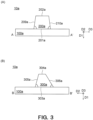
- a configuration of a wiring board 10a according to the present modification will be described with reference to Fig. 3 .
- the configuration of the wiring board 10a according to the present modification is the same as the configuration of the wiring board 10 illustrated in Figs. 1 and 2 except for the cross-sectional shape of the second wiring 300.
- detailed descriptions of the same portions as those in the mode illustrated in Figs. 1 and 2 will be omitted.
- Fig. 3 is a cross-sectional view illustrating an example of the wiring board according to the present modification.
- the wiring board 10a according to the present modification includes a substrate 100a, a first wiring 200a, and the second wiring 300a, which is similar to the mode illustrated in Fig. 1 .
- Fig. 3(A) is an enlarged cross-sectional view taken along a chain line A-A' of Fig. 1 .
- Fig. 3(B) is an enlarged cross-sectional view taken along a chain line B-B' of Fig. 1 .
- the first wiring 200a has a back surface (first surface) 201a in contact with the substrate 100a, and a front surface (second surface) 202a facing the opposite side of the back surface 201a.
- the second wiring 300a has a back surface (third surface) 303a in contact with the substrate 100a, and a front surface (fourth surface) 304a facing the opposite side of the back surface 303a.
- a line width of the front surface 304a of the second wiring 300a is smaller than a line width of the front surface 202a of the first wiring 200a.
- a line width of the back surface 303a of the second wiring 300a is smaller than a line width of the back surface 201a of the first wiring 200a.
- the line width of the back surface 201a of the first wiring 200a is larger than the line width of the front surface 202a of the first wiring 200a.
- the line width of the back surface 303a of the second wiring 300a is larger than the line width of the front surface 304a of the second wiring 300a.
- the adhesion between the substrate 100a and each of the first wiring 200a and the second wiring 300a can be improved while suppressing the visibility of the first wiring 200a and the second wiring 300a in a plan view in a D1 direction.
- a wiring resistance can be suppressed by increasing the area of each cross section of the first wiring 200a and the second wiring 300a that intersects perpendicularly with the direction in which each wiring extends.
- the transparency, the reliability, and the conductivity of the wiring board 10a can be improved.
- the first wiring 200a has a pair of side surfaces (ninth and tenth surfaces) 209a and 210a which extend in the direction of the first wiring 200a and are adjacent to the back surface 201a.
- an angle between the back surface 201a and one side surface 209a and an angle between the back surface 201a and the other side surface 210a are acute angles.
- the angle between the back surface 201a and the pair of side surfaces 209a is the same as the angle between the back surface 201a and the other side surface 210a. That is, in a cross section that intersects perpendicularly with a direction in which the first wiring 200a extends, the first wiring 200a is line-symmetric about the extending direction (the D2 direction).
- the second wiring 300a has a pair of side surfaces (fifth and sixth surfaces) 305a and 306a which extend in the direction of the second wiring 300a and are adjacent to the back surface 303a.
- an angle between the back surface 303a and one side surface 305a and an angle between the back surface 303a and the other side surface 306a are acute angles.
- the angle between the back surface 303a and the other side surface 306a is smaller than the angle between the back surface 303a and the one side surface 305a.
- the second wiring 300a is asymmetric about the extending direction (the D3 direction).
- the angle between the back surface 303a and the other side surface 306a is smaller than the angle between the back surface 303a and the one side surface 305a in the second wiring 300a
- the line width of the back side 303a becomes large, and it is possible to improve the adhesion between the substrate 100a and the second wiring 300a while suppressing the visibility of the one side surface 305a of the second wiring 300a in a plan view in the D1 direction.
- a wiring resistance can be suppressed by increasing a cross-sectional area of the second wiring 300a that intersects perpendicularly with the direction in which the wiring extends.
- the transparency, the reliability, and the conductivity of the wiring board 10a can be improved.
- the wiring board 10a according to the present modification is arranged such that the line widths of the back surface 303a and the front surface 304a of the second wiring 300a are smaller than the line widths of the back surface 201a and the front surface 202a of the first wiring 200a, respectively, on the substrate 100a, and thus, it is possible to suppress the visibility of the second wiring 300a in a plan view in the D1 direction while maintaining the reliability of the first wiring 200a having the radio wave transmission/reception function.
- the angle between the back surface 303a and the other side surface 306a is smaller than the angle between the back surface 303a and the one side surface 305a in the second wiring 300a, it is possible to improve the adhesion between the substrate 100a and the second wiring 300a while suppressing the visibility of the one side surface 305a of the second wiring 300a in a plan view in the D1 direction. Furthermore, a wiring resistance can be suppressed by increasing each cross-sectional area of the first wiring 200a and the second wiring 300a that intersects perpendicularly with the direction in which each wiring extends. Thus, the transparency, the reliability, and the conductivity of the wiring board 10a can be improved.
- the wiring board 10a according to the present modification can be mounted on a display device as a wireless communication module by being connected to a wireless communication circuit.
- the wiring board 10a is arranged on an upper surface of a display region such that the substrate 100a faces the display region of the display device so that it is possible to suppress the visibility of the first wiring 200a and the second wiring 300a in a plan view in the D1 direction.
- the wiring board 10a is arranged such that a direction of the first wiring 200a is a vertical direction of the display region and the one side surface 305a of the second wiring 300a is in the upper direction of the display region (light incident direction) so that the reflection of light by the other side surface 306a of the second wiring 300a can be suppressed.
- the display device including the wiring board having the radio wave transmission/reception function with improved transparency, reliability, and conductivity.
- the second wiring 300 is line-symmetric with respect to the longitudinal direction (the D3 direction) in the cross section that intersects perpendicularly with the direction in which the second wiring 300 extends.
- a second wiring 300b is asymmetric about a longitudinal direction (D3 direction) in a cross section that intersects perpendicularly with a direction in which the second wiring 300b extends.
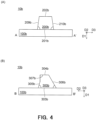
- a configuration of a wiring board 10b according to the present modification will be described with reference to Fig. 4 .
- the configuration of the wiring board 10b according to the present modification is the same as the configuration of the wiring board 10 illustrated in Figs. 1 and 2 except for the cross-sectional shape of the second wiring 300.
- detailed descriptions of the same portions as those in the mode illustrated in Figs. 1 and 2 will be omitted.
- Fig. 4 is a cross-sectional view illustrating an example of the wiring board according to the present modification.
- the wiring board 10b according to the present modification includes a substrate 100b, a first wiring 200b, and the second wiring 300b, which is similar to the mode illustrated in Fig. 1 .
- Fig. 4(A) is an enlarged cross-sectional view taken along the chain line A-A' of Fig. 1 .
- Fig. 4(B) is an enlarged cross-sectional view taken along the chain line B-B' of Fig. 1 .
- the first wiring 200b has a back surface (first surface) 201b in contact with the substrate 100b, and a front surface (second surface) 202b facing the opposite side of the back surface 201b.
- the second wiring 300b has a back surface (third surface) 303b in contact with the substrate 100b, and a front surface (fourth surface) 304b facing the opposite side of the back surface 303b.
- a line width of the front surface 304b of the second wiring 300b is smaller than a line width of the front surface 202b of the first wiring 200b.
- a line width of the back surface 303b of the second wiring 300b is smaller than a line width of the back surface 201b of the first wiring 200b.
- the line width of the back surface 201b of the first wiring 200b is larger than the line width of the front surface 202b of the first wiring 200b.
- the line width of the back surface 303b of the second wiring 300b is larger than the line width of the front surface 304b of the second wiring 300b.
- the adhesion between the substrate 100b and each of the first wiring 200b and the second wiring 300b can be improved while suppressing the visibility of the first wiring 200b and the second wiring 300b in a plan view in the D1 direction.
- a wiring resistance can be suppressed by increasing the area of each cross section of the first wiring 200b and the second wiring 300b that intersects perpendicularly with the direction in which each wiring extends.
- the transparency, the reliability, and the conductivity of the wiring board 10b can be improved.
- the first wiring 200b has a pair of side surfaces (ninth and tenth surfaces) 209b and 210b which extend in the direction of the first wiring 200b and are adjacent to the back surface 201b.
- an angle between the back surface 201b and one side surface 209b and an angle between the back surface 201b and the other side surface 210b are acute angles.
- the angle between the back surface 201b and the one side surface 209b is the same as the angle between the back surface 201b and the other side surface 210b. That is, in a cross section that intersects perpendicularly with a direction in which the first wiring 200b extends, the first wiring 200b is line-symmetric about the extending direction (the D2 direction).
- the second wiring 300b has a pair of side surfaces (fifth and sixth surfaces) 305b and 306b which extend in the direction of the second wiring 300b and are adjacent to the back surface 303b.
- an angle between the back surface 303b and one side surface 305b and an angle between the back surface 303b and the other side surface 306b are acute angles.
- the angle between the back surface 303b and the other side surface 306b is smaller than the angle between the back surface 303b and the one side surface 305b.
- the one side surface 305b of the second wiring 300b according to the present modification is recessed inward (toward the negative side in the D2 direction).
- the one side surface 305b includes an upper side surface (seventh surface) 307b adjacent to the front surface 304b.
- an angle between the front surface 304b and the upper side surface 307b is about 90°.
- the configuration is not limited thereto, and it is sufficient for the angle between the front surface 304b and the upper side surface 307b to be smaller than an external angle of the angle between the back surface 303b and the one side surface 305b (an angle obtained by subtracting the angle between the back surface 303b and the one side surface 305b from 180°).
- the angle between the front surface 304b and the upper side surface 307b is preferably in a range of 60° or more and 90° or less.
- the one side surface 305b of the second wiring 300b includes a shape (the upper side surface 307b) that is connected to the front surface 304b at an angle smaller than the external angle of the angle between the back surface 303b and the one side surface 305b.
- the configuration is not limited thereto, and the one side surface 305b may further include a different surface, and the respective surfaces forming the one side surface 305b may form a corner (intersection line) or may be continuously connected by a curved surface.
- the second wiring 300b is asymmetric about the extending direction (the D3 direction).
- the line width of the back side 303b becomes large, and it is possible to improve the adhesion between the substrate 100b and the second wiring 300b while suppressing the visibility of the one side surface 305b of the second wiring 300b in a plan view in the D1 direction.
- the angle between the front surface 304b and the upper side surface 307b is smaller than the external angle of the angle between the back surface 303b and the one side surface 305b in the second wiring 300b, the visibility of the upper side surface 307b of the second wiring 300b in a plan view in the D1 direction can be suppressed. Furthermore, a wiring resistance can be suppressed by increasing a cross-sectional area of the second wiring 300b that intersects perpendicularly with the direction in which the wiring extends. Thus, the transparency, the reliability, and the conductivity of the wiring board 10b can be improved.
- the wiring board 10b according to the present modification is arranged such that the line widths of the back surface 303b and the front surface 304b of the second wiring 300b are smaller than the line widths of the back surface 201b and the front surface 202b of the first wiring 200b, respectively, on the substrate 100b, and thus, it is possible to suppress the visibility of the second wiring 300b in a plan view in the D1 direction while maintaining the reliability of the first wiring 200b having the radio wave transmission/reception function.
- first wiring 200b and the second wiring 300b are arranged such that the line width of the surface in contact with the substrate 100b is larger than the surface facing the side opposite to the surface in contact with the substrate 100b, the adhesion between the substrate 100b and each of the first wiring 200b and the second wiring 300b can be improved while suppressing the visibility of the first wiring 200b and the second wiring 300b in a plan view in the D1 direction.
- the angle between the back surface 303b and the other side surface 306b is smaller than the angle between the back surface 303b and the one side surface 305b in the second wiring 300b, it is possible to improve the adhesion between the substrate 100b and the second wiring 300b while suppressing the visibility of the one side surface 305b of the second wiring 300b in a plan view in the D1 direction. Since the angle between the front surface 304b and the upper side surface 307b is smaller than the external angle of the angle between the back surface 303b and the one side surface 305b in the second wiring 300b, the visibility of the upper side surface 307b of the second wiring 300b in a plan view in the D1 direction can be suppressed.
- a wiring resistance can be suppressed by increasing each cross-sectional area of the first wiring 200b and the second wiring 300b that intersects perpendicularly with the direction in which each wiring extends.
- the transparency, the reliability, and the conductivity of the wiring board 10b can be improved.
- the wiring board 10b according to the present modification can be mounted on a display device as a wireless communication module by being connected to a wireless communication circuit.
- the wiring board 10b is arranged on an upper surface of a display region such that the substrate 100b faces the display region of the display device so that it is possible to suppress the visibility of the first wiring 200b and the second wiring 300b in a plan view in the D1 direction.
- the wiring board 10b is arranged such that a direction of the first wiring 200b is a vertical direction of the display region and the upper side surface 307b of the second wiring 300b is in the upper direction of the display region (light incident direction) so that the reflection of light by the other side surface 306b of the second wiring 300b can be suppressed.
- the display device including the wiring board having the radio wave transmission/reception function with improved transparency, reliability, and conductivity.
- the second wiring 300 is line-symmetric with respect to the longitudinal direction (the D3 direction) in the cross section that intersects perpendicularly with the direction in which the second wiring 300 extends.
- a second wiring 300c is asymmetric about a longitudinal direction (D3 direction) in a cross section that intersects perpendicularly with a direction in which the second wiring 300c extends.
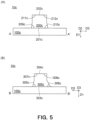
- a configuration of a wiring board 10c according to the present modification will be described with reference to Fig. 5 .
- the configuration of the wiring board 10c according to the present modification is the same as the configuration of the wiring board 10 illustrated in Figs. 1 and 2 except for the cross-sectional shapes of the first wiring 200 and the second wiring 300.
- detailed descriptions of the same portions as those in the mode illustrated in Figs. 1 and 2 will be omitted.
- Fig. 5 is a cross-sectional view illustrating an example of the wiring board according to the present modification.
- the wiring board 10c according to the present modification includes a substrate 100c, a first wiring 200c, and the second wiring 300c, which is similar to the mode illustrated in Fig. 1 .
- Fig. 5(A) is an enlarged cross-sectional view taken along the chain line A-A' of Fig. 1 .
- Fig. 5(B) is an enlarged cross-sectional view taken along the chain line B-B' of Fig. 1 .
- the first wiring 200c has a back surface (first surface) 201c in contact with the substrate 100c, and a front surface (second surface) 202c facing the opposite side of the back surface 201c.
- the second wiring 300c has a back surface (third surface) 303c in contact with the substrate 100c, and a front surface (fourth surface) 304c facing the opposite side of the back surface 303c.
- a line width of the front surface 304c of the second wiring 300c is smaller than a line width of the front surface 202c of the first wiring 200c.
- a line width of the back surface 303c of the second wiring 300c is smaller than a line width of the back surface 201c of the first wiring 200c.
- the line width of the back surface 201c of the first wiring 200c is larger than the line width of the front surface 202c of the first wiring 200c.
- the line width of the back surface 303c of the second wiring 300c is larger than the line width of the front surface 304c of the second wiring 300c.
- the adhesion between the substrate 100c and each of the first wiring 200c and the second wiring 300c can be improved while suppressing the visibility of the first wiring 200c and the second wiring 300c in a plan view in the D1 direction.
- a wiring resistance can be suppressed by increasing the area of each cross section of the first wiring 200c and the second wiring 300c that intersects perpendicularly with the direction in which each wiring extends.
- the transparency, the reliability, and the conductivity of the wiring board 10c can be improved.
- the first wiring 200c has a pair of side surfaces (ninth and tenth surfaces) 209c and 210c which extend in the direction of the first wiring 200c and are adjacent to the back surface 201c.
- an angle between the back surface 201c and one side surface 209c and an angle between the back surface 201c and the other side surface 210c are acute angles.
- the angle between the back surface 201c and the one side surface 209c is the same as the angle between the back surface 201c and the other side surface 210c.
- the one side surface 209c of the first wiring 200c according to the present modification is recessed inward (toward the positive side in the D3 direction).
- the one side surface 209c includes an upper side surface (eleventh surface) 211c adjacent to the front surface 202c.
- the other side surface 210c of the first wiring 200c is recessed inward (toward the negative side in the D3 direction).
- the other side surface 210c includes an upper side surface (twelfth surface) 212c adjacent to the front surface 202c.
- an angle between the front surface 202c and the upper side surface 211c and an angle between the front surface 202c and the upper side surface 212c are approximately 90°.
- the configuration is not limited thereto, and the angle between the front surface 202c and the upper side surface 211c may be smaller than an external angle of the angle between the back surface 201c and the one side surface 209c.
- the angle between the front surface 202c and the upper side surface 211c is preferably in a range of 60° or more and 90° or less. It is sufficient for the angle between the front surface 202c and the upper side surface 212c to be smaller than the external angle of the angle between the back surface 201c and the other side surface 210c.
- the angle between the front surface 202c and the upper side surface 212c is preferably in a range of 60° or more and 90° or less.
- the one side surface 209c of the first wiring 200c includes a shape (the upper side surface 211c) that is connected to the front surface 202c at an angle smaller than the external angle of the angle between the back surface 201c and the one side surface 209c.
- the other side surface 210c of the first wiring 200c includes a shape (the upper side surface 212c) that is connected to the front surface 202c at an angle smaller than the external angle of the angle between the back surface 201c and the other side surface 210c.
- the configuration is not limited thereto, and the one side surface 209c and the other side surface 210c may further include different surfaces, and the respective surfaces forming the one side surface 209c and the other side surface 210c may form a corner (intersection line) or may be continuously connected by a curved surface. That is, in a cross section that intersects perpendicularly with a direction in which the first wiring 200c extends, the first wiring 200c is line-symmetric about the extending direction (the D2 direction).
- the angle between the front surface 202c and the upper side surface 211c is smaller than the external angle of the angle between the back surface 201c and the one side surface 209c, and the angle between the front surface 202c and the upper side surface 212c is smaller than the external angle of the angle between the back surface 201c and the other side surface 210c in the first wiring 200c, it is possible to suppress the visibility of the upper side surface 211c and the upper side surface 212c of the first wiring 200c in a plan view in the D1 direction. Furthermore, a wiring resistance can be suppressed by increasing a cross-sectional area of the first wiring 200c that intersects perpendicularly with the direction in which the wiring extends. Thus, the transparency, the reliability, and the conductivity of the wiring board 10c can be improved.
- the second wiring 300c has a pair of side surfaces (fifth and sixth surfaces) 305c and 306c which extend in the direction of the second wiring 300c and are adjacent to the back surface 303c.
- an angle between the back surface 303c and one side surface 305c and an angle between the back surface 303c and the other side surface 306c are acute angles.
- the angle between the back surface 303c and the other side surface 306c is smaller than the angle between the back surface 303c and the one side surface 305c.
- the one side surface 305c of the second wiring 300c according to the present modification is recessed inward (toward the negative side in the D2 direction).
- the one side surface 305c includes an upper side surface (seventh surface) 307c adjacent to the front surface 304c.
- the other side surface 306c of the second wiring 300c is recessed inward (toward the positive side in the D2 direction).
- the other side surface 306c includes an upper side surface (eighth surface) 308c adjacent to the front surface 304c.
- an angle between the front surface 304c and the upper side surface 307c and an angle between the front surface 304c and the upper side surface 308c are approximately 90°.
- the configuration is not limited thereto, and the angle between the front surface 304c and the upper side surface 307c may be smaller than an external angle of the angle between the back surface 303c and the one side surface 305c.
- the angle between the front surface 304c and the upper side surface 307c is preferably in a range of 60° or more and 90° or less. It is sufficient for the angle between the front surface 304c and the upper side surface 308c to be smaller than the external angle of the angle between the back surface 303c and the other side surface 306c.
- the angle between the front surface 304c and the upper side surface 308c is preferably in a range of 60° or more and 90° or less.
- the one side surface 305c of the second wiring 300c includes a shape (the upper side surface 307c) that is connected to the front surface 304c at an angle smaller than the external angle of the angle between the back surface 303c and the one side surface 305c.
- the other side surface 306c of the second wiring 300c includes a shape (the upper side surface 308c) that is connected to the front surface 304c at an angle smaller than the external angle of the angle between the back surface 303c and the other side surface 306c.
- the configuration is not limited thereto, and the one side surface 305c and the other side surface 306c may further include different surfaces, and the respective surfaces forming the one side surface 305c and the other side surface 306c may form a corner (intersection line) or may be continuously connected by a curved surface.
- the second wiring 300c is asymmetric about the extending direction (the D3 direction).
- the line width of the back side 303c becomes large, and it is possible to improve the adhesion between the substrate 100c and the second wiring 300c while suppressing the visibility of the one side surface 305c of the second wiring 300c in a plan view in the D1 direction.
- the angle between the front surface 304c and the upper side surface 307c is smaller than the external angle of the angle between the back surface 303c and the one side surface 305c, and the angle between the front surface 304c and the upper side surface 308c is smaller than the external angle of the angle between the back surface 303c and the other side surface 306c in the second wiring 300c, it is possible to suppress the visibility of the upper side surface 307c and the upper side surface 308c of the second wiring 300c in a plan view in the D1 direction. Furthermore, a wiring resistance can be suppressed by increasing a cross-sectional area of the second wiring 300c that intersects perpendicularly with the direction in which the wiring extends. Thus, the transparency, the reliability, and the conductivity of the wiring board 10c can be improved.
- the wiring board 10c according to the present modification is arranged such that the line width of the front surface 304c of the second wiring 300c of the substrate 100c is smaller than the line width of the front surface 202c of the first wiring 200c, and thus, it is possible to suppress the visibility of the second wiring 300c in a plan view in the D1 direction while maintaining the reliability of the first wiring 200c having the radio wave transmission/reception function.
- first wiring 200c and the second wiring 300c are arranged such that the line width of the surface in contact with the substrate 100c is larger than the surface facing the side opposite to the surface in contact with the substrate 100c, the adhesion between the substrate 100c and each of the first wiring 200c and the second wiring 300c can be improved while suppressing the visibility of the first wiring 200c and the second wiring 300c in a plan view in the D1 direction.
- the angle between the front surface 202c and the upper side surface 211c is smaller than the external angle of the angle between the back surface 201c and the one side surface 209c, and the angle between the front surface 202c and the upper side surface 212c is smaller than the external angle of the angle between the back surface 201c and the other side surface 210c in the first wiring 200c, it is possible to suppress the visibility of the upper side surface 211c and the upper side surface 212c of the first wiring 200c in a plan view in the D1 direction.
- the angle between the back surface 303c and the other side surface 306c is smaller than the angle between the back surface 303c and the one side surface 305c in the second wiring 300c, it is possible to improve the adhesion between the substrate 100c and the second wiring 300c while suppressing the visibility of the one side surface 305c of the second wiring 300c in a plan view in the D1 direction.
- the angle between the front surface 304c and the upper side surface 307c is smaller than the external angle of the angle between the back surface 303c and the one side surface 305c, and the angle between the front surface 304c and the upper side surface 308c is smaller than the external angle of the angle between the back surface 303c and the other side surface 306c in the second wiring 300c, it is possible to suppress the visibility of the upper side surface 307c and the upper side surface 308c of the second wiring 300c in a plan view in the D1 direction. Furthermore, a wiring resistance can be suppressed by increasing each cross-sectional area of the first wiring 200c and the second wiring 300c that intersects perpendicularly with the direction in which each wiring extends. Thus, the transparency, the reliability, and the conductivity of the wiring board 10c can be improved.
- the side surfaces 209c and 210c of the first wiring 200c are recessed inward and the side surfaces 305c and 306c of the second wiring 300c are recessed inward according to the present modification, it is possible to suppress the maximum width as the first wiring 200c and the second wiring 300c are viewed at an oblique viewing angle. As a result, for example, it is possible to make the first wiring 200c and the second wiring 300c less visible on the front surface of the display, and to make it difficult for a user to visually recognize the first wiring 200c and the second wiring 300c with a naked eye.
- the respective side surfaces of the first wiring 200c and the second wiring 300c are recessed, light that is incident obliquely to the D1 direction is hardly reflected in the D1 direction so that it is possible to make it difficult to recognize the first wiring 200c and the second wiring 300c with the naked eye.
- the wiring board 10c according to the present modification can be mounted on a display device as a wireless communication module by being connected to a wireless communication circuit.
- the wiring board 10c is arranged on an upper surface of a display region such that the substrate 100c faces the display region of the display device so that it is possible to suppress the visibility of the first wiring 200c and the second wiring 300c in a plan view in the D1 direction.
- the wiring board 10c is arranged such that a direction of the first wiring 200 is a vertical direction of the display region and the upper side surface 307c of the second wiring 300c is in the upper direction of the display region (light incident direction) so that the reflection of light by the other side surface 306c of the second wiring 300c can be suppressed.
- the display device including the wiring board having the radio wave transmission/reception function with improved transparency, reliability, and conductivity.
- the second wiring 300 is line-symmetric with respect to the longitudinal direction (the D3 direction) in the cross section that intersects perpendicularly with the direction in which the second wiring 300 extends.
- a second wiring 300d is asymmetric about a longitudinal direction (D3 direction) in a cross section that intersects perpendicularly with a direction in which the second wiring 300d extends.
- a configuration of a wiring board 10d according to the present modification will be described with reference to Fig. 6 .
- the configuration of the wiring board 10d according to the modification is the same as the configuration of the wiring board 10 illustrated in Figs. 1 and 2 except for the cross-sectional shapes of the first wiring 200 and the second wiring 300.
- detailed descriptions of the same portions as those in the mode illustrated in Figs. 1 and 2 will be omitted.
- Fig. 6 is a cross-sectional view illustrating an example of the wiring board according to the present modification.
- the wiring board 10d according to the present modification includes a substrate 100d, a first wiring 200d, and the second wiring 300d, which is similar to the mode illustrated in Fig. 1 .
- Fig. 6(A) is an enlarged cross-sectional view taken along the chain line A-A' of Fig. 1 .
- Fig. 6(B) is an enlarged cross-sectional view taken along the chain line B-B' of Fig. 1 .
- the first wiring 200d has a back surface (first surface) 201d in contact with the substrate 100d, and a front surface (second surface) 202d facing the opposite side of the back surface 201d.
- the second wiring 300d has a back surface (third surface) 303d in contact with the substrate 100d and a front surface (fourth surface) 304d facing the opposite side of the back surface 303d.
- a line width of the front surface 304d of the second wiring 300d is smaller than a line width of the front surface 202d of the first wiring 200d.
- a line width of the back surface 303d of the second wiring 300d is smaller than a line width of the back surface 201d of the first wiring 200d.
- the line width of the back surface 201d of the first wiring 200d is larger than the line width of the front surface 202d of the first wiring 200d.
- the line width of the back surface 303d of the second wiring 300d is larger than the line width of the front surface 304d of the second wiring 300d.
- the adhesion between the substrate 100d and each of the first wiring 200d and the second wiring 300d can be improved while suppressing the visibility of the first wiring 200d and the second wiring 300d in a plan view in the D1 direction.
- a wiring resistance can be suppressed by increasing the area of each cross section of the first wiring 200d and the second wiring 300d that intersects perpendicularly with the direction in which each wiring extends.
- the transparency, the reliability, and the conductivity of the wiring board 10d can be improved.
- the first wiring 200d has a pair of side surfaces (ninth and tenth surfaces) 209d and 210d which extend in the direction of the first wiring 200d and are adjacent to the back surface 201d.
- an angle between the back surface 201d and one side surface 209d and an angle between the back surface 201d and the other side surface 210d are acute angles.
- the angle between the back surface 201d and the one side surface 209d is the same as the angle between the back surface 201d and the other side surface 210d.
- the one side surface 209d of the first wiring 200d according to the present modification is recessed inward (toward the positive side in the D3 direction).
- the one side surface 209d includes an upper side surface (eleventh surface) 211d adjacent to the front surface 202d.
- the other side surface 210d of the first wiring 200d is recessed inward (toward the negative side in the D3 direction).
- the other side surface 210d includes an upper side surface (twelfth surface) 212d adjacent to the front surface 202d.
- an angle between the front surface 202d and the upper side surface 211d and an angle between the front surface 202d and the upper side surface 212d are approximately 90°.
- the configuration is not limited thereto, and the angle between the front surface 202d and the upper side surface 211d may be smaller than an external angle of the angle between the back surface 201d and the one side surface 209d.
- the angle between the front surface 202d and the upper side surface 211d is preferably in a range of 60° or more and 90° or less. It is sufficient for the angle between the front surface 202d and the upper side surface 212d to be smaller than the external angle of the angle between the back surface 201d and the other side surface 210d.
- the angle between the front surface 202d and the upper side surface 212d is preferably in a range of 60° or more and 90° or less.
- the one side surface 209d of the first wiring 200d includes a shape (the upper side surface 211d) that is connected to the front surface 202d at an angle smaller than the external angle of the angle between the back surface 201d and the one side surface 209d.
- the other side surface 210d of the first wiring 200d includes a shape (the upper side surface 212d) that is connected to the front surface 202d at an angle smaller than the external angle of the angle between the back surface 201d and the other side surface 210d.
- the configuration is not limited thereto, and the one side surface 209d and the other side surface 210d may further include different surfaces, and the respective surfaces forming the one side surface 209d and the other side surface 210d may form a corner (intersection line) or may be continuously connected by a curved surface.
- the first wiring 200d according to the present modification further includes a protrusion d that extends in a direction orthogonal to the direction of the first wiring 200d and protrudes in a surface direction of the front surface between the front surface 202d and an adjacent surface.
- the first wiring 200d has the protrusions d protruding in the D3 direction between the front surface 202d and the upper side surface 211d and between the front surface 202d and the upper side surface 212d. That is, in a cross section that intersects perpendicularly with a direction in which the first wiring 200d extends, the first wiring 200d is line-symmetric about the extending direction (the D2 direction).
- the angle between the front surface 202d and the upper side surface 211d is smaller than the external angle of the angle between the back surface 201d and the one side surface 209d, and the angle between the front surface 202d and the upper side surface 212d is smaller than the external angle of the angle between the back surface 201d and the other side surface 210d in the first wiring 200d, it is possible to suppress the visibility of the upper side surface 211d and the upper side surface 212d of the first wiring 200d in a plan view in the D1 direction. Furthermore, a wiring resistance can be suppressed by increasing a cross-sectional area of the first wiring 200d that intersects perpendicularly with the direction in which the wiring extends. Thus, the transparency, the reliability, and the conductivity of the wiring board 10d can be improved.
- the second wiring 300d has a pair of side surfaces (fifth and sixth surfaces) 305d and 306d which extend in the direction of the second wiring 300d and are adjacent to the back surface 303d.
- an angle between the back surface 303d and one side surface 305d and an angle between the back surface 303d and the other side surface 306d are acute angles.
- the angle between the back surface 303d and the other side surface 306d is smaller than the angle between the back surface 303d and the one side surface 305d.
- the one side surface 305d of the second wiring 300d according to the present modification is recessed inward (toward the negative side in the D2 direction).
- the one side surface 305d includes an upper side surface (seventh surface) 307d adjacent to the front surface 304d.
- the other side surface 306d of the second wiring 300d is recessed inward (toward the positive side in the D2 direction).
- the other side surface 306d includes an upper side surface (eighth surface) 308d adjacent to the front surface 304d.
- an angle between the front surface 304d and the upper side surface 307d and an angle between the front surface 304d and the upper side surface 308d are approximately 90°.
- the configuration is not limited thereto, and the angle between the front surface 304d and the upper side surface 307d may be smaller than an external angle of the angle between the back surface 303d and the one side surface 305d.
- the angle between the front surface 304d and the upper side surface 307d is preferably in a range of 60° or more and 90° or less. It is sufficient for the angle between the front surface 304d and the upper side surface 308d to be smaller than the external angle between the back surface 303d and the other side surface 306d.
- the angle between the front surface 304d and the upper side surface 308d is preferably in a range of 60° or more and 90° or less.
- the one side surface 305d of the second wiring 300d includes a shape (the upper side surface 307d) that is connected to the front surface 304d at an angle smaller than the external angle of the angle between the back surface 303d and the one side surface 305d.
- the other side surface 306d of the second wiring 300d includes a shape (the upper side surface 308d) that is connected to the front surface 304d at an angle smaller than the external angle of the angle between the back surface 303d and the other side surface 306d.
- the configuration is not limited thereto, and the one side surface 305d and the other side surface 306d may further include different surfaces, and the respective surfaces forming the one side surface 305d and the other side surface 306d may form a corner (intersection line) or may be continuously connected by a curved surface.
- the second wiring 300d according to the present modification further includes the protrusion d that extends in a direction orthogonal to the direction of the second wiring 300d and protrudes in a surface direction of the front surface between the front surface 304d and an adjacent surface.
- the second wiring 300d has the protrusions d protruding in the D2 direction between the front surface 304d and the upper side surface 307d and between the front surface 202d and the upper side surface 308d.
- the second wiring 300d is asymmetric about the extending direction (the D3 direction).
- the line width of the back side 303d becomes large, and it is possible to improve the adhesion between the substrate 100d and the second wiring 300d while suppressing the visibility of the one side surface 305d of the second wiring 300d in a plan view in the D1 direction.
- the angle between the front surface 304d and the upper side surface 307d is smaller than the external angle of the angle between the back surface 303d and the one side surface 305d, and the angle between the front surface 304d and the upper side surface 308d is smaller than the external angle of the angle between the back surface 303d and the other side surface 306d in the second wiring 300d, it is possible to suppress the visibility of the upper side surface 307d and the upper side surface 308d of the second wiring 300d in a plan view in the D1 direction. Furthermore, a wiring resistance can be suppressed by increasing a cross-sectional area of the second wiring 300d that intersects perpendicularly with the direction in which the wiring extends. Thus, the transparency, the reliability, and the conductivity of the wiring board 10d can be improved.
- the wiring board 10d according to the present modification is arranged such that the line width of the front surface 304d of the second wiring 300d of the substrate 100d is smaller than the line width of the front surface 202d of the first wiring 200d, and thus, it is possible to suppress the visibility of the second wiring 300d in a plan view in the D1 direction while maintaining the reliability of the first wiring 200d having the radio wave transmission/reception function.
- first wiring 200d and the second wiring 300d are arranged such that the line width of the surface in contact with the substrate 100d is larger than the surface facing the side opposite to the surface in contact with the substrate 100d, the adhesion between the substrate 100d and each of the first wiring 200d and the second wiring 300d can be improved while suppressing the visibility of the first wiring 200d and the second wiring 300d in a plan view in the D1 direction.
- the angle between the front surface 202d and the upper side surface 211d is smaller than the external angle of the angle between the back surface 201d and the one side surface 209d, and the angle between the front surface 202d and the upper side surface 212d is smaller than the external angle of the angle between the back surface 201d and the other side surface 210d in the first wiring 200d, it is possible to suppress the visibility of the upper side surface 211d and the upper side surface 212d of the first wiring 200d in a plan view in the D1 direction.
- the angle between the back surface 303d and the other side surface 306d is smaller than the angle between the back surface 303d and the one side surface 305d in the second wiring 300d, it is possible to improve the adhesion between the substrate 100d and the second wiring 300d while suppressing the visibility of the one side surface 305d of the second wiring 300d in a plan view in the D1 direction.
- the angle between the front surface 304d and the upper side surface 307d is smaller than the external angle of the angle between the back surface 303d and the one side surface 305d, and the angle between the front surface 304d and the upper side surface 308d is smaller than the external angle of the angle between the back surface 303d and the other side surface 306d in the second wiring 300d, it is possible to suppress the visibility of the upper side surface 307d and the upper side surface 308d of the second wiring 300d in a plan view in the D1 direction. Furthermore, a wiring resistance can be suppressed by increasing each cross-sectional area of the first wiring 200d and the second wiring 300d that intersects perpendicularly with the direction in which each wiring extends. Thus, the transparency, the reliability, and the conductivity of the wiring board 10d can be improved.
- the wiring board 10d according to the present modification can be mounted on a display device as a wireless communication module by being connected to a wireless communication circuit.
- the wiring board 10d is arranged on an upper surface of a display region such that the substrate 100d faces the display region of the display device so that it is possible to suppress the visibility of the first wiring 200d and the second wiring 300d in a plan view in the D1 direction.
- the wiring board 10d is arranged such that a direction of the first wiring 200 is a vertical direction of the display region and the upper side surface 307d of the second wiring 300d is in the upper direction of the display region (light incident direction) so that the reflection of light by the other side surface 306d of the second wiring 300d can be suppressed.
- a protective film is arranged so as to cover the upper surface of the substrate 100d. Since the first wiring 200d and the second wiring 300d have the protrusions d, the adhesion between each of the first wiring 200d and the second wiring 300d and the protective film can be improved. Thus, it is possible to provide the display device including the wiring board having the radio wave transmission/reception function with improved transparency, reliability, and conductivity.
- a configuration of the wiring board 10e according to the present modification will be described with reference to Figs. 7 and 8 .
- the configuration of the wiring board 10e according to the present modification is the same as the configuration of the wiring board 10 illustrated in Figs. 1 and 2 except for the curved surface e at the intersection between the first wiring 200e and the second wiring 300e.
- detailed descriptions of the same portions as those in the mode illustrated in Figs. 1 and 2 will be omitted.
- Fig. 7 is a top view illustrating an example of the wiring board according to the present modification.
- Fig. 7 is an enlarged top view in a region C of Fig. 1 .
- Fig. 8 is a cross-sectional view illustrating an example of the wiring board according to the present modification.
- Fig. 8(A) is an enlarged cross-sectional view taken along a chain line D-D' of Fig. 7 .
- Fig. 8(B) is an enlarged cross-sectional view taken along a chain line E-E 'of Fig. 7 .
- the wiring board 10e includes the substrate 100e, the first wiring 200e, and the second wiring 300e.
- the first wiring 200e is orthogonal to the second wiring 300e.
- planar shapes of the first wiring 200e and the second wiring 300e it is sufficient for planar shapes of the first wiring 200e and the second wiring 300e to intersect or to be connected without being limited thereto.
- an upper surface of the substrate 100e, side surfaces adjacent to a back surface (first surface) 201e of the first wiring 200e, and side surfaces adjacent to a back surface (third surface) 303e of the second wiring 300e form four corners in a plan view.
- a corner formed by the upper surface of the substrate 100e, the other side surface (tenth surface) 210e of the first wiring 200e, and the other side surface (sixth surface) 306e of the second wiring 300e includes a curved surface e that is continuous with these surfaces. That is, the curved surface e continuously connects the other side surface 210e of the first wiring 200e and the other side surface 306e of the second wiring 300e.
- the curved surface e has a shape curved inward in both of a cross section perpendicular to a direction of the first wiring 200e and a cross section perpendicular to a direction of the second wiring 300e.
- the configuration is not limited thereto, and it is sufficient for the curved surface e to be arranged at one or more of four corners in a plan view formed by the upper surface of the substrate 100e, the side surfaces adjacent to the back surface 201e of the first wiring 200e, and the side surfaces adjacent to the back surface 303e of the second wiring 300e.
- the first wiring 200e is asymmetric about a longitudinal direction (D2 direction) in the cross section that intersects perpendicularly with the direction of the first wiring 200e at the corner including the curved surface e.
- the second wiring 300e is asymmetric about a longitudinal direction (D3 direction) in the cross section that intersects perpendicularly with the direction of the second wiring 300e at the corner including the curved surface e.
- a radius of curvature of the curved surface e is preferably 20% or more of a height of the second wiring 300e in the cross section perpendicular to the direction of the second wiring 300e.
- the curved surface e is provided at the corner formed by the upper surface of the substrate 100e, the side surface adjacent to the back surface 201e of the first wiring 200e, and the side surface adjacent to the back surface 303e of the second wiring 300e, line widths of the back surface 201e and the back surface 303e become large, and it is possible to improve the adhesion between the substrate 100e and the first wiring 200e and between the substrate 100e and the second wiring 300e.
- each cross-sectional area of the first wiring 200e and the second wiring 300e that intersects perpendicularly with the direction in which each wiring extends increases, it is possible to suppress a wiring resistance while suppressing the visibility of a front surface (second surface) 202e of the first wiring 200e and a front surface (fourth surface) 304e of the second wiring 300e in a plan view in the D1 direction.
- the transparency, the reliability, and the conductivity of the wiring board 10e can be improved.
- the wiring board 10e according to the present modification can be mounted on a display device as a wireless communication module by being connected to a wireless communication circuit.
- the wiring board 10e is arranged on an upper surface of a display region such that the substrate 100e faces the display region of the display device so that it is possible to suppress the visibility of the first wiring 200e and the second wiring 300e in a plan view in the D1 direction. Since the wiring board 10e is arranged such that a direction of the first wiring 200e is a vertical direction of the display region and the curved surface e is in the lower direction of the display region, it is possible to suppress reflection of light by the curved surface e. Thus, it is possible to provide the display device including the wiring board having the radio wave transmission/reception function with improved transparency, reliability, and conductivity.
- a wiring board 10f according to the present modification includes a substrate 100f, a first wiring 200f, and a second wiring 300f, which is similar to the wiring board 10a ( Fig. 3 ) according to the first modification.
- the wiring board 10f according to the present modification includes a curved surface f at an intersection between the first wiring 200f and the second wiring 300f.
- a configuration of the wiring board 10f according to the present modification will be described with reference to Figs. 9 and 10 .
- the configuration of the wiring board 10f according to the present modification is the same as the configuration of the wiring board 10a according to the first modification illustrated in Fig. 3 except for the curved surface f at the intersection between the first wiring 200f and the second wiring 300f.
- detailed descriptions of the same portions as those in the first modification will be omitted.
- Fig. 9 is a top view illustrating an example of the wiring board according to the present modification.
- Fig. 9 is an enlarged top view in the region C of Fig. 1 .
- Fig. 10 is a cross-sectional view illustrating an example of the wiring board according to the present modification.
- Fig. 10(A) is an enlarged cross-sectional view taken along a chain line D-D' of Fig. 9 .
- Fig. 10(B) is an enlarged cross-sectional view taken along a chain line E-E 'of Fig. 9 .
- the wiring board 10f includes the substrate 100f, the first wiring 200f, and the second wiring 300f.
- the first wiring 200f is orthogonal to the second wiring 300f.
- planar shapes of the first wiring 200f and the second wiring 300f it is sufficient for planar shapes of the first wiring 200f and the second wiring 300f to intersect or to be connected without being limited thereto.
- an upper surface of the substrate 100f, side surfaces adjacent to a back surface (first surface) 201f of the first wiring 200f, and side surfaces adjacent to a back surface (third surface) 303f of the second wiring 300f form four corners in a plan view.
- a corner formed by the upper surface of the substrate 100f, one side surface (ninth surface) 209f of the first wiring 200f, and the other side surface (sixth surface) 306f of the second wiring 300f includes a curved surface f that is continuous with these surfaces. That is, the curved surface f continuously connects the one side surface 209f of the first wiring 200f and the other side surface 306f of the second wiring 300f. Furthermore, a corner formed by the upper surface of the substrate 100f, the other side surface (tenth surface) 210f of the first wiring 200f, and the other side surface 306f of the second wiring 300f includes the curved surface f that is continuous with these surfaces.
- the curved surface f continuously connects the other side surface 210f of the first wiring 200f and the other side surface 306f of the second wiring 300f.
- the configuration is not limited thereto, and it is sufficient for the curved surface f to be arranged at one or more of four corners in a plan view formed by the upper surface of the substrate 100f, the side surfaces adjacent to the back surface 201f of the first wiring 200f, and the side surfaces adjacent to the back surface 303f of the second wiring 300f.
- the curved surface f is preferably arranged at one or more of two corners formed by the upper surface of the substrate 100f, the side surface adjacent to the back surface 201f of the first wiring 200f, and the other side surface 306f of the second wiring 300f.
- the first wiring 200f is line-symmetric about a longitudinal direction (D2 direction) in the cross section that intersects perpendicularly with the direction of the first wiring 200f at the corner including the curved surface f.
- the second wiring 300f is asymmetric about a longitudinal direction (D3 direction) in the cross section that intersects perpendicularly with the direction of the second wiring 300f at the corner including the curved surface f.
- a radius of curvature of the curved surface f is preferably 20% or more of a height of the second wiring 300e in the cross section perpendicular to the direction of the second wiring 300e.
- the curved surface f is provided at the corner formed by the upper surface of the substrate 100f, the side surface adjacent to the back surface 201f of the first wiring 200f, and the other side surface 306f of the second wiring 300f, line widths of the back surface 201f and the back surface 303f become large, and it is possible to improve the adhesion between the substrate 100f and the first wiring 200f and between the substrate 100f and the second wiring 300f.
- each cross-sectional area of the first wiring 200f and the second wiring 300f that intersects perpendicularly with the direction in which each wiring extends increases, it is possible to suppress a wiring resistance while suppressing the visibility of a front surface (second surface) 202f of the first wiring 200f and a front surface (fourth surface) 304f of the second wiring 300f in a plan view in the D1 direction.
- the transparency, the reliability, and the conductivity of the wiring board 10f can be improved.
- the wiring board 10f according to the present modification can be mounted on a display device as a wireless communication module by being connected to a wireless communication circuit.
- the wiring board 10f is arranged on an upper surface of a display region such that the substrate 100f faces the display region of the display device so that it is possible to suppress the visibility of the first wiring 200f and the second wiring 300f in a plan view in the D1 direction. Since the wiring board 10f is arranged such that a direction of the first wiring 200f is a vertical direction of the display region and the curved surface f is in the lower direction of the display region, it is possible to suppress reflection of light by the curved surface f. Thus, it is possible to provide the display device including the wiring board having the radio wave transmission/reception function with improved transparency, reliability, and conductivity.
- FIG. 11 and 12 A method for manufacturing the wiring boards according to the present embodiment and the respective modifications will be described with reference to Figs. 11 and 12 .
- Figs. 11 and 12 the same elements as the elements described in the above-described embodiment and the respective modifications are denoted by the same reference signs.
- detailed descriptions of the same portions as those in the modes illustrated in Figs. 1 to 10 will be omitted.
- Fig. 11(A) is a view illustrating a step of forming a conductive layer 400 on the upper surface of the substrate 100 in the method for manufacturing the wiring board according to the present embodiment.
- the conductive layer 400 is formed over substantially the entire surface of the substrate 100.
- a thickness of the conductive layer 400 is 200 nm.
- the thickness of the conductive layer 400 can be appropriately selected in a range of 10 nm or more and 1000 nm or less without being limited thereto.
- the conductive layer 400 is formed by a sputtering method using copper.
- a plasma CVD method can be also used.
- Fig. 11(B) is a view illustrating a step of forming an insulating layer 500 on the upper surface of the substrate 100 in the method for manufacturing the wiring board according to the present embodiment.
- the insulating layer 500 is formed over substantially the entire surface of the substrate 100.
- a thickness of the insulating layer 500 is 1200 nm.
- the thickness of the insulating layer 500 can be appropriately selected in a range of 500 nm or more and 2500 nm or less without being limited thereto.
- the insulating layer 500 may be a material having an electrical insulating property.
- Fig. 11(C) is a view illustrating a step of forming a first trench 510 in which the first wiring 200 is arranged and a second trench 520 (not illustrated) in which the second wiring 300 is arranged on an upper surface of the insulating layer 500 in the method for manufacturing the wiring board according to the present embodiment.
- the first trench 510 and the second trench 520 are formed by an imprinting method in the present embodiment.
- the insulating layer 500 is softened, and a mold 600 having protruding portions corresponding to the first trench 510 and the second trench 520 is press-fitted thereto. In this state, the insulating layer 500 is cured and the mold 600 is separated from the insulating layer 500, whereby the insulating layer 500 having a cross-sectional structure illustrated in Fig. 11(D) can be obtained.
- the first trench 510 corresponds to the first wiring 200
- the second trench 520 corresponds to the second wiring 300. Therefore, the first trench 510 extending in the first direction is orthogonal to the second trench 520 extending in the second direction. Further, the first trench 510 is longer than the second trench 520, and an opening width of the first trench 510 is formed to be larger than an opening width of the second trench 520.
- the opening width means a width of an opening portion parallel to the upper surface of the substrate 100 in a cross section that intersects perpendicularly with a direction in which each trench extends.
- Each aspect ratio of the first trench 510 and the second trench 520 can be appropriately selected according to the application.
- the aspect ratio of each of the first trench 510 and the second trench 520 is defined as a depth with respect to the opening portion width. If the aspect ratio of each of the first trench 510 and the second trench 520 is too small, it becomes difficult to form a fine pattern of the first wiring 200 and the second wiring 300 on the wiring board 10. When the aspect ratio of each of the first trench 510 and the second trench 520 is too large, it becomes difficult to fill the first trench 510 and the second trench 520 with a conductor.
- the opening width of the first trench 510 may be the same as the opening width of the second trench 520.
- a direction in which the mold 600 is separated from the insulating layer 500 is preferably a direction in which the longer first wiring 200 (first trench 510) extends.
- the direction in which the mold 600 is separated from the insulating layer 500 is more preferably a direction from one side surface 305 to the other side surface 306 of the second wiring 300. That is, the direction in which the mold 600 is separated from the insulating layer 500 is more preferably from the first side 102 to the second side 104 of the substrate 100
- the insulating layer 500 is formed in this manner, the cross-sectional shapes of the first wiring 200 and the second wiring 300 according to the above-described embodiment and the respective modifications can be formed.
- the method is not limited thereto, and the insulating layer 500 may be formed by a photolithography method in the method for manufacturing the wiring board 10 according to the above-described embodiment and the respective modifications. In this case, a resist pattern is formed by the photolithography method so as to expose the conductive layer 400 in a region where the first wiring 200 and the second wiring 300 are formed.
- a residue of an insulating material remain at each bottom of the first trench 510 and the second trench 520 formed in the insulating layer 500.
- the residue of the insulating material is removed by performing a wet treatment using a permanganate solution or N-methyl-2-pyrrolidone or a dry treatment using oxygen plasma.
- the first trench 510 and the second trench 520 exposing the conductive layer 400 can be formed as illustrated in Fig. 12(A) .
- Fig. 12(B) is a view illustrating a step of forming a first conductor 410 corresponding to the first wiring 200 and a second conductor 420 (not illustrated) corresponding to the second wiring 300 in the method for manufacturing the wiring board according to the present embodiment.
- the first trench 510 and the second trench 520 of the insulating layer 500 formed in Fig. 12(A) are filled with the first conductor 410 and the second conductor 420.
- the first trench 510 and the second trench 520 of the insulating layer 500 are filled with copper by an electrolytic plating method using the conductive layer 400 as a seed layer.
- first conductor 410 and the second conductor 420 are formed so as to protrude from the upper surface of the insulating layer 500 (on the opposite side of the substrate 100).
- the first conductor 410 and the second conductor 420 are formed on the upper surface of the insulating layer 500 to be larger than the opening width of the first trench 510 and the opening width of the second trench 520.
- each protruding portion of the first conductor 410 and the second conductor 420 is formed in a semicircular shape in a cross-sectional view, and each cross-sectional shape of the first conductor 410 and the second conductor 420 is formed in a mushroom shape.
- each protruding portion of the first conductor 410 and the second conductor 420 may be formed in a rectangular parallelepiped, and each cross-sectional shape of the first conductor 410 and the second conductor 420 may be formed in a T shape.
- Each height of the first conductor 410 and the second conductor 420 on the upper surface of the insulating layer 500 in the stacking direction (D1 direction) is preferably 5% or more and 80% or less of a height of the first trench 510 in the stacking direction (D1 direction) of the second trench 520.
- Fig. 12(C) is a view illustrating a step of removing the insulating layer 500 in the method for manufacturing the wiring board according to the present embodiment.
- the wet treatment using a permanganate solution or N-methyl-2-pyrrolidone or the dry treatment using oxygen plasma is performed to remove the insulating layer 500 on the substrate 100.
- Fig. 12(D) is a view illustrating a step of removing the conductive layer 400 in the method for manufacturing the wiring board according to the present embodiment.
- the conductive layer 400 is etched so as to expose the upper surface of the substrate 100 by performing a wet treatment using a hydrogen peroxide solution.
- the first conductor 410 and the second conductor 420 are also molded by etching. As the first conductor 410 and the second conductor 420 are molded in this manner, the cross-sectional shapes of the first wiring 200 and the second wiring 300 according to the above-described embodiment and the respective modifications can be formed.
- the first wiring 200 and the second wiring 300 be subjected to a blackening treatment on surfaces other than the surface in contact with the substrate 100.
- the front surface (second surface) 202 of the first wiring 200, and the front surface (fourth surface) 304 of the second wiring 300 are subjected to a blackening treatment by forming copper oxide which is an oxide film of each wiring material. Since the front surfaces of the first wiring 200 and the second wiring 300 are subjected to the blackening treatment, it is possible to suppress light reflection of the first wiring 200 and the second wiring 300, and to achieve absorption of external light of the wiring board 10 and contrast improvement.
- the cross-sectional shapes of the first wiring 200 and the second wiring 300 according to the above-described embodiment and the respective modifications can be formed by the simple method of forming the conductor to be thicker than the insulating layer in the stacking direction and performing molding by wet etching.
- the wiring board 10 with the improved transparency, reliability, and conductivity.
- Figs. 13(A) to 13(D) are views illustrating the modification of the method for manufacturing the wiring board, and are views corresponding to Figs. 12(A) to 12(D) .
- first trench 510 and the second trench 520 exposing the conductive layer 400 are formed in the same manner as the steps illustrated in Figs. 11(A) to 11(D) ( Fig. 13(A) ).
- the first conductor 410 corresponding to the first wiring 200 and the second conductor 420 (not illustrated) corresponding to the second wiring 300 are formed as illustrated in Fig. 13(B) . That is, the first trench 510 and the second trench 520 of the insulating layer 500 are filled with copper by an electrolytic plating method using the conductive layer 400 as a seed layer. In this case, the first conductor 410 and the second conductor 420 are formed to be lower than the upper surface of the insulating layer 500 (on the opposite side of the substrate 100). At this time, each upper surface of the first conductor 410 and the second conductor 420 is formed in a semicircular shape in a cross-sectional view.
- a wet treatment using a permanganate solution or N-methyl-2-pyrrolidone or a dry treatment using oxygen plasma is performed to remove the insulating layer 500 on the substrate 100 as illustrated in Fig. 13(C) .
- the conductive layer 400 is etched so as to expose the upper surface of the substrate 100, for example, by performing a wet treatment using a hydrogen peroxide solution as illustrated in Fig. 13(D) .
- the first conductor 410 and the second conductor 420 are also molded by etching.
- shapes of the first conductor 410 and the second conductor 420 can be adjusted by appropriately setting etching conditions (a type of an etching solution, a concentration, and an etching time) and the like. In this manner, the cross-sectional shapes of the first wiring 200 and the second wiring 300 according to the above-described embodiment and the respective modifications can be formed.
- Fig. 14 is a top view illustrating an example of the wireless communication module according to the present embodiment.
- the wireless communication module 20A includes a wiring board 10g and a circuit 700g.
- the circuit 700g is a wireless communication circuit, and is connected to a plurality of first wirings 200g of the wiring board 10g.
- the wiring board 10g includes a substrate 100g, the first wirings 200g, and second wirings 300g.
- the first wiring 200g and the second wiring 300g are arranged on an upper surface of the substrate 100g.
- four first wirings 200g and four second wirings 300g are arranged, but the configuration is not limited thereto. It is sufficient that two or more first wirings 200g and one or more second wirings 300g are provided.
- a line-and-space shape in which a plurality of lines extend independently from a first side 102 of the substrate 100g toward a second side 104 opposite to the first side 102 is illustrated as a planar shape of the first wiring 200g as viewed in a D1 direction.
- a line-and-space shape in which a plurality of lines extend independently in a direction orthogonal to the direction of the first wiring 200g (a longitudinal direction of the second wiring 300g, a second direction, and a D3 direction) is illustrated as a planar shape of the second wiring 300g as viewed in a D1 direction.
- a regular grid or mesh shape is formed by the first wiring 200g extending in the first direction and the second wiring 300g extending in the second direction.
- the plurality of first wirings 200g are orthogonal to the plurality of second wirings 300g.
- the first wiring 200g is longer than the second wiring 300g.
- an interval between the plurality of second wirings 300g is larger than an interval between the plurality of first wirings 200g.
- a direction of the first wiring 200g and a direction of the second wiring 300g may intersect at an acute angle or may intersect at an obtuse angle.
- an aperture ratio visible light transmissivity
- the transmittance of the wiring board 10g deteriorates
- the interval between the plurality of second wirings 300g is larger than the interval between the plurality of first wirings 200g, it is possible to suppress the visibility of the spare second wiring 300g corresponding to the disconnection of the first wiring 200g or the like while maintaining a conductivity of the first wiring 200g having a radio wave transmission/reception function.
- a conductivity and transparency of the wiring board 10g can be improved.
- Fig. 15 is a top view illustrating an example of a wireless communication module according to a modification.
- the wireless communication module 20A is, for example, a module for NFC (Near Field Communication), and includes the wiring board 10g and the circuit 700g.
- the wiring board 10g has a wiring region 106g formed in a spiral shape as a whole in a plan view.
- the wiring region 106g includes the plurality of first wirings 200g and the plurality of second wirings 300g. That is, the first wiring 200g and the second wiring 300g are formed in a mesh shape or a grid shape inside the wiring region 106g.
- the transparency of the wiring board 10g is enhanced, and thus, for example, the wiring board 10g for NFC can be also arranged on a display screen.
- the present disclosure is not limited to the above-described embodiments, and can be appropriately changed within a scope not departing from a gist.
- the respective embodiments described above as embodiments of the present disclosure can be implemented appropriately in combinations as long as there is no confliction with each other. Further, one that is obtained by addition, deletion, or a design change of a component appropriately performed based on the wiring board of each of the embodiments by a person skilled in the art or one that is obtained by adding or omitting a step or changing a condition is also included in the scope of the present invention as long as having the gist of the present invention.
- the wiring board according to Reference Example 1 of the present disclosure is the same as the wiring board according to the sixth modification ( Figs. 9 and 10 ) except for the width and interval (pitch) of each wiring, and thus, a detailed description thereof will be omitted. Manufacturing steps of the wiring board are the same as those of the mode illustrated in Figs. 11 to 13 , and thus a description will be omitted.
- FIG. 16 illustrates an image of an upper surface of the wiring board of Reference Example 1 observed using the electron microscope (SEM).
- Fig. 17 illustrates an image of the intersection between the first wiring 200 and the second wiring 300 in Reference Example 1 observed using the electron microscope (SEM).
- Fig. 17 is the electron microscope image of the intersection between the first wiring 200 and the second wiring 300 in Reference Example 1.
- the wiring board 10 according to the reference example 1 includes two curved surfaces at the intersection between the first wiring 200 and the second wiring 300. It has been observed that the corner formed by the upper surface of the substrate 100, the one side surface 209 of the first wiring 200, and the other side surface 306 of the second wiring 300 includes the curved surface f that is continuous with these surfaces. Furthermore, it has been observed that the corner formed by the upper surface of the substrate 100, the other side surface 210 of the first wiring 200, and the other side surface 306 of the second wiring 300 includes the curved surface f that is continuous with these surfaces.
- Figs. 18 to 37 are views illustrating the second embodiment.
- an "X direction” is a direction perpendicular to a longitudinal direction of the antenna pattern region, and is a direction perpendicular to a direction of a length corresponding to a frequency band of an antenna wiring.
- a “Y direction” is a direction perpendicular to the X direction and parallel to the longitudinal direction of the antenna pattern region, and is a direction parallel to the direction of the length corresponding to the frequency band of the antenna wiring.
- a “Z direction” is a direction perpendicular to both the X direction and the Y direction and parallel to a thickness direction of a wiring board.
- a “front surface” refers to a surface on the positive side in the Z direction, and is a surface on which the antenna wiring is provided on the substrate.
- a “back surface” refers to a surface on the negative side in the Z direction, and is a surface on the opposite side of the surface on which the antenna wiring is provided on the substrate. Note that a description is given by exemplifying a case where the wiring pattern region 20 is the antenna pattern region 20 having a radio wave transmission/reception function (function as an antenna) in the present embodiment, but the wiring pattern region 20 does not necessarily have the radio wave transmission/reception function (function as the antenna).
- FIG. 18 to 22 are views illustrating the wiring board according to the present embodiment.
- the wiring board 10 is arranged, for example, on a display of an image display device.
- a wiring board 10 includes: a substrate 11 having transparency, an antenna pattern region (wiring pattern region) 20 arranged on the substrate 11; and a dummy pattern region 30 arranged around the antenna pattern region 20 on the substrate 11. Further, a power feeding unit 40 is electrically connected to the antenna pattern region 20.
- the substrate 11 has a substantially rectangular shape in a plan view, and has a longitudinal direction parallel to the Y direction and a lateral direction parallel to the X direction.
- the substrate 11 has transparency and a substantially flat shape, and has a substantially uniform thickness as a whole.
- a length L 1 of the substrate 11 in the longitudinal direction (Y direction) can be selected, for example, in a range of 100 mm or more and 200 mm or less, and a length L 2 of the substrate 11 in the lateral direction (X direction) can be selected, for example, in a range of 50 mm or more and 100 mm or less.
- a material of the substrate 11 is a material having transparency and an electrical insulating property in a visible light region.
- the material of the substrate 11 is polyethylene terephthalate, but is not limited thereto.
- an organic insulating material such as a polyester resin such as polyethylene terephthalate, an acrylic resin such as pomethylmethacrylate, a polycarbonate resin, a polyimide resin, a polyolefin resin such as a cycloolefin polymer, and a cellulosic resin material such as triacetyl cellulose.
- glass, ceramics, or the like can be appropriately selected as the material of the substrate 11 according to the application.
- the substrate 11 is constituted by a single layer is illustrated, but a structure in which a plurality of base materials or layers are stacked may be adopted without being limited thereto. Further, the substrate 11 may be in the form of a film or a plate.
- the thickness of the substrate 11 is not particularly limited and can be appropriately selected according to the application, and a thickness (in the Z direction) T 1 of the substrate 11 (see Fig. 20 ) can be set, for example, in a range of 10 ⁇ m or more and 200 ⁇ m or less in one example.
- a plurality of (three) antenna pattern regions 20 are formed on the substrate 11 and correspond to different frequency bands, respectively.
- the plurality of antenna pattern regions 20 have different lengths (lengths in the Y direction) L a , and have the lengths corresponding to specific frequency bands, respectively. Note that the length L a of the antenna pattern region 20 increases as the corresponding frequency band is lower.
- each of the antenna pattern regions 20 may correspond to any of a telephone antenna, a WiFi antenna, a 3G antenna, a 4G antenna, an LTE antenna, a Bluetooth (registered trademark) antenna, an NFC antenna, and the like in the case of having the radio wave transmission/reception function.
- each of the wiring pattern regions 20 may serve a function, for example, hovering (a function that enables operation without requiring a user to directly touch a display), fingerprint authentication, a heater, noise cut (shield), or the like.
- Each of the antenna pattern regions 20 is substantially rectangular in a plan view.
- Each of the antenna pattern regions 20 has a longitudinal direction parallel to the Y direction and a lateral direction parallel to the X direction.
- a length L a of each of the antenna pattern regions 20 in the longitudinal direction (Y direction) can be selected, for example, in a range of 3 mm or more and 100 mm or less
- a width W a of each of the antenna pattern regions 20 in the lateral direction (X direction) can be selected, for example, in a range of 1 mm or more and 10 mm or less.
- the antenna pattern region 20 has metal lines formed in a lattice shape or a mesh shape, and has a uniform repetitive pattern in the X direction and the Y direction. That is, as illustrated in Fig. 19 , the antenna pattern region 20 is configured by repeating an L-shaped unit pattern shape 20a constituted by a portion extending in the X direction (a part of an antenna connection wiring 22 to be described later) and a portion extending in the Y direction (a part of an antenna wiring 21 to be described later).
- each of the antenna pattern regions 20 includes the plurality of antenna wirings (wirings) 21 each having a function as an antenna, and the plurality of antenna connection wirings (connection wirings) 22 that connect the plurality of antenna wirings 21.
- the plurality of antenna wirings 21 and the plurality of antenna connection wirings 22 are integrally formed as a whole to form a regular lattice shape or mesh shape.
- Each of the antenna wirings 21 extends in the direction corresponding to the frequency band of the antenna (Y direction), and each of the antenna connection wirings 22 extends in a direction (X direction) orthogonal to the antenna wiring 21.
- the antenna wiring 21 mainly functions as the antenna by having the length L a (the length of the above-described antenna pattern region 20) corresponding to a predetermined frequency band.
- the antenna connection wiring 22 connects these antenna wirings 21 to each other, thereby serving a role of suppressing a problem such as the disconnection of the antenna wiring 21 or failure in electrical connection between the antenna wiring 21 and the power feeding unit 40.
- a plurality of opening portions 23 are formed by being surrounded by the antenna wirings 21 adjacent to each other and the antenna connection wirings 22 adjacent to each other. Further, the antenna wiring 21 and the antenna connection wiring 22 are arranged at equal intervals from each other. That is, the plurality of antenna wirings 21 are arranged at equal intervals from each other, and a pitch P 1 thereof can be set, for example, in a range of 0.01 mm or more and 1 mm or less. Further, the plurality of antenna connection wirings 22 are arranged at equal intervals to each other, and a pitch P 2 thereof can be set, for example, in a range of 0.01 mm or more and 1 mm or less.
- each of the opening portions 23 has a substantially square shape in a plan view, and the substrate 11 having transparency is exposed from each of the opening portions 23.
- the transparency as the entire wiring board 10 can be increased by increasing the area of each of the opening portions 23.
- a length L 3 of one side of each of the opening portions 23 can be set, for example, in a range of 0.01 ⁇ m or more and 1 ⁇ m or less.
- the antenna wirings 21 and the antenna connection wirings 22 are orthogonal to each other, but are not limited thereto, and may intersect with each other at an acute angle or an obtuse angle.
- a shape of the opening portion 23 preferably has the same shape and the same size over the entire surface, but is not necessarily uniform over the entire surface, for example, depending on a location.
- each of the antenna wirings 21 has a substantially rectangular shape or a substantially square shape in a cross section perpendicular to the longitudinal direction (a cross section in the X direction).
- a cross-sectional shape of the antenna wiring 21 is substantially uniform along the longitudinal direction (Y direction) of the antenna wiring 21.
- a shape of a cross section (cross section in the Y direction) perpendicular to the longitudinal direction of each of the antenna connection wirings 22 is a substantially rectangular shape or a substantially square shape, and is substantially the same as the shape of the cross section (cross section in the X direction) of the antenna wiring 21 described above.
- the cross-sectional shape of the antenna connection wiring 22 is substantially uniform along the longitudinal direction (X direction) of the antenna connection wiring 22.
- the cross-sectional shapes of the antenna wiring 21 and the antenna connection wiring 22 are not necessarily the substantially rectangular shape or the substantially square shape, and may be, for example, a substantially trapezoidal shape in which the front surface side (positive side in the Z direction) is narrower than the back surface side (negative side in the Z direction), or a shape in which side surfaces located on both sides in the longitudinal direction are curved.
- a line width W 1 of the antenna wiring 21 (a length in the X direction, see Fig. 20 ) and a line width W 2 of the antenna connection wiring 22 (a length in the Y direction, see Fig. 21 ) are not particularly limited, and can be appropriately selected according to the application.
- the line width W 1 of the antenna wiring 21 can be selected in a range of 0.1 ⁇ m or more and 5.0 ⁇ m or less
- the line width W 2 of the antenna connection wiring 22 can be selected in a range of 0.1 ⁇ m or more and 5.0 ⁇ m or less.
- a height H 1 of the antenna wiring 21 (a length in the Z direction, see Fig.
- a height H 2 of the antenna connection wiring 22 (a length in the Z direction, see Fig. 21 ) are not particularly limited, and can be appropriately selected according to the application, and, for example, can be selected in a range of 0.1 ⁇ m or more and 5.0 ⁇ m or less.
- each material of the antenna wiring 21 and the antenna connection wiring 22 is a metal material having a conductivity.
- the materials of the antenna wiring 21 and the antenna connection wiring 22 are copper, but are not limited thereto.
- a metal material such as gold, silver, copper, platinum, tin, aluminum, iron, and nickel can be used.
- the dummy pattern region 30 is provided so as to surround the periphery of each of the antenna pattern regions 20, and is formed to surround the entire circumferential region (the positive side in the X direction, the negative side in the X direction, and the positive side in the Y direction) excluding the power feeding unit 40 side (the negative side in the Y direction) in each of the antenna pattern regions 20.
- the dummy pattern region 30 is arranged on the substrate 11 and over substantially the entire region excluding the antenna pattern region 20 and the power feeding unit 40.
- the dummy pattern region 30 does not substantially function as an antenna, which is different from the antenna pattern region 20.
- the dummy pattern region 30 is configured by repeating a dummy wiring 30a having a predetermined unit pattern shape. That is, the dummy pattern region 30 includes a plurality of the dummy wirings 30a each having the same shape, and each of the dummy wirings 30a is electrically independent of the antenna pattern region 20 (the antenna wiring 21 and the antenna connection wiring 22). Further, the plurality of dummy wirings 30a are regularly arranged over the entire region of the dummy pattern region 30. The plurality of dummy wirings 30a are spaced apart from each other in a plane direction, and are arranged in an island shape to protrude above the substrate 11.
- each of the dummy wirings 30a is electrically independent of the antenna pattern region 20, the power feeding unit 40, and the other dummy wirings 30a.
- Each of the dummy wirings 30a is substantially L shape in a plan view, and has a first dummy wiring portion 31 extending in the Y direction and a second dummy wiring portion 32 extending in the X direction.
- the first dummy wiring portion 31 has a predetermined length L 4 (length in the Y direction)
- a void portion 33a is formed between the dummy wirings 30a adjacent to each other in the X direction, and a void portion 33b is formed between the dummy wirings 30a adjacent to each other in the Y direction.
- the dummy wirings 30a are arranged at equal intervals. That is, the dummy wirings 30a adjacent to each other in the X direction are arranged at equal intervals, and a gap G 1 thereof can be set, for example, in a range of 1 ⁇ m or more and 20 ⁇ m or less.
- the dummy wirings 30a adjacent to each other in the Y direction are arranged at equal intervals, and a gap G 2 thereof can be set, for example, in a range of 1 ⁇ m or more and 20 ⁇ m or less.
- the maximum values of the gaps G 1 and G 2 may be 0.8 times or less of the above-described pitches P 1 and P 2 , respectively.
- the dummy wiring 30a has a shape in which a part of the above-described unit pattern shape 20a of the antenna pattern region 20 is missing. That is, the shape of the dummy wiring 30a is a shape obtained by removing the above-described void portions 33a and 33b from the L-shaped unit pattern shape 20a of the antenna pattern region 20. That is, the shape in which the plurality of dummy wirings 30a of the dummy pattern region 30 and the plurality of void portions 33a and 33b are combined corresponds to the lattice shape or the mesh shape forming the antenna pattern region 20.
- the dummy wiring 30a of the dummy pattern region 30 is formed into the shape in which a part of the unit pattern shape 20a of the antenna pattern region 20 is missing in this manner, it is possible to make it difficult to visually recognize a difference between the antenna pattern region 20 and the dummy pattern region 30, and to make the antenna pattern region 20 arranged on the substrate 11 hardly visible.
- the antenna pattern region 20 and the dummy pattern region 30 are adjacent to each other in the Y direction.
- the first dummy wiring portion 31 is formed on an extension of the antenna wiring 21 near a boundary between the antenna pattern region 20 and the dummy pattern region 30.
- the second dummy wiring portion 32 be formed on an extension of the antenna connection wiring 22 even in a place where the antenna pattern region 20 and the dummy pattern region 30 are adjacent to each other in the X direction although not illustrated.
- the first dummy wiring portion 31 of each of the dummy wirings 30a has a substantially rectangular or substantially square cross section (cross section in the X direction) perpendicular to a longitudinal direction thereof (the Y direction).
- the second dummy wiring portion 32 of each of the dummy wirings 30a has a substantially rectangular or substantially square cross section (cross section in the Y direction) perpendicular to a longitudinal direction thereof (the X direction).
- the cross-sectional shape of the first dummy wiring portion 31 is substantially the same as the cross-sectional shape of the antenna wiring
- the sectional shape of the second dummy wiring portion 32 is substantially the same as the sectional shape of the antenna connection wiring 22.
- a line width W 3 of the first dummy wiring portion 31 (a length in the X direction, see Fig. 22 ) is substantially the same as the line width W 1 of the antenna wiring 21, and a line width W 4 of the second dummy wiring portion 32 (a length in the Y direction, see Fig. 21 ) is substantially the same as the line width W 2 of the antenna connection wiring 22.
- a height H 3 of the first dummy wiring portion 31 (a length in the Z direction, see Fig. 22 ) and a height H 4 of the second dummy wiring portion 32 are substantially the same as the height H 1 of the antenna wiring 21 and the height H 2 of the antenna connection wiring 22, respectively.
- the same metal material as the material of the antenna wiring 21 and the material of the antenna connection wiring 22 can be used.
- the antenna pattern region 20 and the dummy pattern region 30 have predetermined aperture ratios A1 and A2, respectively.
- the aperture ratio A1 of the antenna pattern region 20 can be set, for example, in a range of 85% or more and 99.9% or less.
- the aperture ratio A2 of the dummy pattern region 30 can be set, for example, in a range of 87% or more and less than 100%.
- the aperture ratio A2 of the dummy pattern region 30 is higher than the aperture ratio A1 of the antenna pattern region 20 (A2 > A1).
- the transparency of the wiring board 10 can be ensured.
- the configuration is not limited thereto, and the aperture ratio A2 of the dummy pattern region 30 may be lower than the aperture ratio A1 of the antenna pattern region 20 (A2 ⁇ A1).
- a difference between the aperture ratio A2 of the dummy pattern region 30 and the aperture ratio A1 of the antenna pattern region 20 is preferably in a range of more than 0% and 7% or less, and is more preferably in a range of more than 0% and 1% or less.
- the difference between the aperture ratio A2 of the dummy pattern region 30 and the aperture ratio A1 of the antenna pattern region 20 is set to be small in this manner, the boundary between the antenna pattern region 20 and the dummy pattern region 30 can be made hardly visible, and the presence of the antenna pattern region 20 can be made hardly recognizable with the naked eye.
- a total aperture ratio A3 of the antenna pattern region 20 and the dummy pattern region 30 (a combined aperture ratio of the antenna pattern region 20 and the dummy pattern region 30) can be set, for example, in a range of 87% or more and less than 100%. As the total aperture ratio A3 of the wiring board 10 is set in this range, the conductivity and transparency of the wiring board 10 can be ensured.
- the aperture ratio refers to a ratio (%) of an area of an opening region (region where the metal portions such as the antenna wiring 21, the antenna connection wiring 22, and the dummy wiring 30a are not present and the substrate 11 is exposed) accounting for a unit area of a predetermined region (the antenna pattern region 20, the dummy pattern region 30, or the antenna pattern region 20 and the dummy pattern region 30).
- the power feeding unit 40 is electrically connected to the antenna pattern region 20.
- the power feeding unit 40 is made of a conductive thin plate member having a substantially rectangular shape.
- a longitudinal direction of the power feeding unit 40 is parallel to the X direction, and a lateral direction of the power feeding unit 40 is parallel to the Y direction.
- the power feeding unit 40 is arranged at a longitudinal end of the substrate 11 (an end on the negative side in the Y direction).
- a metal material including an alloy
- gold, silver, copper, platinum, tin, aluminum, iron, and nickel can be used.
- the power feeding unit 40 is electrically connected to the wireless communication circuit 92 of the image display device 90 when the wiring board 10 is incorporated in the image display device 90 (see Fig. 24 ). Note that the power feeding unit 40 is provided on the front surface of the substrate 11, but is not limited thereto, and the power feeding unit 40 may be partially or entirely located outside a peripheral edge of the substrate 11.
- Figs. 23(a) to 23(h) are cross-sectional views illustrating the method for manufacturing the wiring board according to the present embodiment.
- the substrate 11 is prepared, and a conductive layer 51 is formed on substantially the entire front surface of the substrate 11 as illustrated in Fig. 23(a) .
- a thickness of the conductive layer 51 is 200 nm.
- the thickness of the conductive layer 51 can be appropriately selected in a range of 10 nm or more and 1000 nm or less without being limited thereto.
- the conductive layer 51 is formed by a sputtering method using copper.
- a plasma CVD method may be used as a method for forming the conductive layer 51.
- a photocurable insulating resist 52 is supplied to substantially the entire front surface of the substrate 11 as illustrated in Fig. 23(b) .
- Examples of the photocurable insulating resist 52 include an organic resin such as an epoxy resin.
- a transparent mold 53 for imprinting having a protrusion 53a is prepared ( Fig. 23(c) ), and the mold 53 and the substrate 11 are brought close to each other, and the photocurable insulating resist 52 is developed between the mold 53 and the substrate 11.
- light irradiation is performed from the mold 53 side to cure the photocurable insulating resist 52, thereby forming an insulating layer 54.
- a trench 54a having a shape in which the protrusion 53a has been transferred is formed on a front surface of the insulating layer 54.
- the trench 54a has a planar shape pattern corresponding to the antenna wiring 21, the antenna connection wiring 22, and the dummy wiring 30a.
- a direction in which the mold 53 is separated from the insulating layer 54 is preferably the Y direction in which the longer antenna wiring 21 extends.
- the insulating layer 54 may be formed by a photolithography method without being limited thereto.
- a resist pattern is formed by the photolithography method so as to expose the conductive layer 51 corresponding to the antenna wiring 21, the antenna connection wiring 22, and the dummy wiring 30a.
- a residue of an insulating material may remain at a bottom of the trench 54a of the insulating layer 54.
- the residue of the insulating material is removed by performing a wet treatment using a permanganate solution or N-methyl-2-pyrrolidone or a dry treatment using oxygen plasma.
- the trench 54a exposing the conductive layer 51 can be formed as illustrated in Fig. 23(e) .
- the trench 54a of the insulating layer 54 is filled with a conductor 55 as illustrated in Fig. 23(f) .
- the trench 54a of the insulating layer 54 is filled with copper by an electrolytic plating method using the conductive layer 51 as a seed layer.
- the insulating layer 54 is removed as illustrated in Fig. 23(g) .
- the wet treatment using a permanganate solution or N-methyl-2-pyrrolidone or the dry treatment using oxygen plasma is performed to remove the insulating layer 54 on the substrate 11.
- the conductive layer 51 on the front surface of the substrate 11 is removed as illustrated in Fig. 23(h) .
- the conductive layer 51 is etched so as to expose the front surface of the substrate 11 by performing a wet process using a hydrogen peroxide solution.
- the wiring board 10, which includes the substrate 11, the antenna pattern region 20 and the dummy pattern region 30 arranged on the substrate 11, is obtained.
- the antenna pattern region 20 includes the antenna wiring 21 and the antenna connection wiring 22, and the dummy pattern region 30 includes the dummy wiring 30a.
- the above-described conductor 55 includes the antenna wiring 21, the antenna connection wiring 22, and the dummy wiring 30a.
- the wiring board 10 is incorporated in an image display device 90 including the display 91.
- the wiring board 10 is arranged on the display 91.
- Examples of such an image display device 90 include a mobile terminal device such as a smartphone and a tablet.
- the antenna pattern region 20 of the wiring board 10 is electrically connected to the wireless communication circuit 92 of the image display device 90 via the power feeding unit 40. In this manner, radio waves of a predetermined frequency can be transmitted and received via the antenna pattern region 20 so that communication can be performed using the image display device 90.
- the dummy pattern region 30 is separated from the antenna pattern region 20 and is electrically independent, and thus, there is no possibility that the transmission and reception of radio waves are affected by the provision of the dummy pattern region 30.
- the wiring board 10 includes: the substrate 11 having transparency and the antenna pattern region 20 including the plurality of antenna wirings 21 each of which is arranged on the substrate 11 and has the function as the antenna, and thus, the transparency of the wiring board 10 is ensured.
- the display 91 can be seen through the opening portion 23 of the antenna pattern region 20, so that the visibility of the display 91 is not hindered.
- the dummy pattern region 30 including the plurality of dummy wirings 30a electrically independent of the antenna wiring 21 is arranged around the antenna pattern region 20 according to the present embodiment. Since the dummy pattern region 30 is arranged around the antenna pattern region 20 in this manner, a boundary between the antenna pattern region 20 and the other region can be made obscure. As a result, it is possible to make the antenna pattern region 20 hardly visible on the front surface of the display 91, and to make it difficult for a user of the image display device 90 to recognize the antenna pattern region 20 with the naked eye.
- each of the antenna pattern region 20 and the dummy pattern region 30 is formed by repeating the predetermined unit pattern shape, and the unit pattern shape (the dummy wiring 30a) of the dummy pattern region 30 is the shape in which a part of the unit pattern shape 20a of the antenna pattern region 20 is missing.
- the aperture ratio A2 of the dummy pattern region 30 is higher than the aperture ratio A1 of the antenna pattern region 20 according to the present embodiment. As a result, it is possible to ensure the transparency of the wiring board 10 while making it difficult to recognize the antenna pattern region 20.
- the antenna pattern region 20 includes the plurality of antenna connection wirings 22 connecting the plurality of antenna wirings 21 according to the present embodiment. As a result, it is possible to make the disconnection of the antenna wiring 21 difficult, and to suppress a decrease in the function of the antenna wiring 21 as the antenna.
- Figs. 25 to 37 are views illustrating the various modifications of the wiring board.
- the respective modifications illustrated in Figs. 25 to 37 are different in terms of the configuration of the antenna pattern region 20 and/or the dummy pattern region 30, and the other configurations thereof are substantially the same as those of the above-described embodiment.
- Figs. 25 to 37 the same portions as those of the modes illustrated in Fig. 18 to Fig. 24 are denoted by the same reference signs, and detailed descriptions thereof will be omitted.
- Fig. 25 illustrates a wiring board 10A according to a first modification.
- the dummy pattern region 30 of the wiring board 10A includes the plurality of dummy wirings 30a each having a predetermined unit pattern shape.
- Each of the dummy wirings 30a is electrically independent of the antenna pattern region 20 (the antenna wiring 21 and the antenna connection wiring 22).
- Each of the dummy wirings 30a has the first dummy wiring portion 31 extending in the Y direction and the second dummy wiring portion 32 extending in the X direction. In this case, the first dummy wiring portion 31 and the second dummy wiring portion 32 of each of the dummy wirings 30a are arranged apart from each other in a plane direction.
- the void portion 33c is formed between the first dummy wiring portion 31 and the second dummy wiring portion 32 of each of the dummy wirings 30a. Further, when assuming a case where the dummy wiring 30a is supplemented with the void portion 33c, the void portions 33a and 33b are formed, respectively, between the dummy wirings 30a adjacent to each other in the X direction and between the dummy wirings 30a adjacent to each other in the Y direction.
- the dummy wiring 30a in the dummy pattern region 30 has a shape in which a part of the unit pattern shape 20a in the antenna pattern region 20 is missing. That is, the shape of the dummy wiring 30a is a shape obtained by removing the void portions 33a, 33b, and 33c from the L-shaped unit pattern shape 20a of the antenna pattern region 20.
- the aperture ratio A2 of the dummy pattern region 30 can be set, for example, in a range of 85% or more and less than 100%.
- first dummy wiring portion 31 and the second dummy wiring portion 32 of each of the dummy wirings 30a are arranged apart from each other in the plane direction in this manner, an aperture ratio of the dummy pattern region 30 can be further increased, and the transparency of the wiring board 10A can be improved.
- Fig. 26 illustrates a wiring board 10B according to a second modification.
- the dummy pattern region 30 of the wiring board 10B includes the plurality of dummy wirings 30a each having a predetermined unit pattern shape.
- Each of the dummy wirings 30a is electrically independent of the antenna pattern region 20 (the antenna wiring 21 and the antenna connection wiring 22).
- the dummy wiring 30a has the first dummy wiring portion 31 and the second dummy wiring portion 32 extending obliquely with respect to the X direction and the Y direction, respectively.
- the first dummy wiring portion 31 and the second dummy wiring portion 32 of each of the dummy wirings 30a are arranged apart from each other in a plane direction.
- a longitudinal direction of the first dummy wiring portion 31 is arranged to be inclined by 45° with respect to a longitudinal direction of the antenna wiring 21. Further, a longitudinal direction of the second dummy wiring portion 32 is located in a direction orthogonal to the longitudinal direction of the first dummy wiring portion 31. Note that the aperture ratio A2 of the dummy pattern region 30 can be set, for example, in a range of 85% or more and less than 100%.
- first dummy wiring portion 31 and the second dummy wiring portion 32 of each of the dummy wirings 30a are arranged obliquely with respect to the antenna wiring 21 in this manner, it is possible to suppress generation of an interference fringe caused by a diffraction grating.
- Fig. 27 illustrates a wiring board 10C according to a third modification.
- the antenna pattern region 20 of the wiring board 10C includes the plurality of antenna wirings 21 each having a function as an antenna and the plurality of antenna connection wirings 22 that connect the plurality of antenna wirings 21.
- the pitch P 1 of the antenna wiring 21 is smaller than the pitch P 2 of the antenna connection wiring 22 (P 1 ⁇ P 2 ).
- the pitch P 1 of the antenna wiring 21 can be set, for example, in a range of 0.01 mm or more and 1 mm or less
- the pitch P 2 of the antenna connection wiring 22 can be set, for example, in a range of 0.03 mm or more and 1 mm or less.
- Each of the opening portions 23 has a substantially rectangular shape that is longer in the Y direction than in the X direction in a plan view. As described above, the transparency of the entire wiring board 10C can be further increased by increasing the area of each of the opening portions 23.
- the dummy pattern region 30 includes the plurality of dummy wirings 30a each having a predetermined unit pattern shape. Each of the dummy wirings 30a is electrically independent of the antenna pattern region 20 (the antenna wiring 21 and the antenna connection wiring 22).
- the dummy wiring 30a includes a pair of first dummy wiring portions 31a and 31b each extending in the Y direction, and the second dummy wiring portion 32 extending in the X direction. In this case, the first dummy wiring portion 31a, the first dummy wiring portion 31b, and the second dummy wiring portion 32 of each of the dummy wirings 30a are arranged apart from each other in a plane direction.
- the void portion 33c is formed between the first dummy wiring portion 31a and the second dummy wiring portion 32 of each of the dummy wirings 30a. Further, a void portion 33d is formed between the first dummy wiring portions 31a and 31b. Furthermore, when assuming a case where the dummy wiring 30a is supplemented with the void portions 33c and 33d, the void portions 33a and 33b are formed, respectively, between the dummy wirings 30a adjacent to each other in the X direction and between the dummy wirings 30a adjacent to each other in the Y direction. In this case, the dummy wiring 30a in the dummy pattern region 30 has a shape in which a part of the unit pattern shape 20a in the antenna pattern region 20 is missing.
- the shape of the dummy wiring 30a is a shape obtained by removing the void portions 33a to 33d from the L-shaped unit pattern shape 20a of the antenna pattern region 20.
- the aperture ratio A2 of the dummy pattern region 30 can be set, for example, in a range of 90% or more and less than 100%.
- Fig. 28 illustrates a wiring board 10D according to a fourth modification.
- the dummy pattern region 30 of the wiring board 10D includes the plurality of dummy wirings 30a each having a predetermined unit pattern shape.
- Each of the dummy wirings 30a is electrically independent of the antenna pattern region 20 (the antenna wiring 21 and the antenna connection wiring 22).
- the dummy wiring 30a includes the pair of first dummy wiring portions 31a and 31b extending obliquely with respect to the X direction and the Y direction, respectively, and the second dummy wiring portion 32 extending obliquely with respect to the X direction and the Y direction.
- the first dummy wiring portion 31a, the first dummy wiring portion 31b, and the second dummy wiring portion 32 of each of the dummy wirings 30a are arranged apart from each other in a plane direction.
- longitudinal directions of the pair of first dummy wiring portions 31a and 31b are arranged to be inclined by 45° with respect to a longitudinal direction of the antenna wiring 21.
- a longitudinal direction of the second dummy wiring portion 32 is located in a direction orthogonal to the longitudinal direction of each of the first dummy wiring portions 31a and 31b.
- the aperture ratio A2 of the dummy pattern region 30 can be set, for example, in a range of 90% or more and less than 100%.
- first dummy wiring portions 31a and 31b and the second dummy wiring portion 32 of each of the dummy wirings 30a are arranged obliquely with respect to the antenna wiring 21 in this manner, it is possible to suppress generation of an interference fringe caused by a diffraction grating.
- Fig. 29 illustrates a wiring board 10E according to a fifth modification.
- the dummy pattern region 30 of the wiring board 10E includes the plurality of dummy wirings 30a each having a predetermined unit pattern shape.
- Each of the dummy wirings 30a is electrically independent of the antenna pattern region 20 (the antenna wiring 21 and the antenna connection wiring 22).
- the dummy wiring 30a includes a plurality of (four) first dummy wiring portions 31c each extending in the Y direction and a plurality of (four) second dummy wiring portions 32c extending in the X direction.
- the plurality of first dummy wiring portions 31c are arranged apart from each other in the Y direction
- the plurality of second dummy wiring portions 32c are arranged apart from each other in the X direction.
- a void portion 33e is formed at an intersection portion between the first dummy wiring portion 31a and the second dummy wiring portion 32c of the dummy wiring 30a. Further, a void portion 33f is formed between the plurality of first dummy wiring portions 31c. Further, a void portion 33g is formed between each of the plurality of second dummy wiring portions 32c.
- the dummy wiring 30a in the dummy pattern region 30 has a shape in which a part of the unit pattern shape 20a in the antenna pattern region 20 is missing. That is, the shape of the dummy wiring 30a is a shape obtained by removing the void portions 33e to 33g from the L-shaped unit pattern shape 20a of the antenna pattern region 20.
- an additional pattern 34 apart from the dummy wiring 30a of the dummy pattern region 30 is arranged in the dummy pattern region 30.
- the additional pattern 34 is arranged apart from the plurality of first dummy wiring portions 31c and the plurality of second dummy wiring portions 32c in both the X direction and the Y direction.
- each of the additional patterns 34 extends linearly in parallel with the Y direction.
- a plurality of (four) additional patterns 34 are arranged for one dummy wiring 30a. It is preferable that the total area of the plurality of (four) additional patterns 34 be close to the area of the void portions 33e to 33g of each of the dummy wirings 30a.
- a material of the additional pattern 34 can be the same metal material as the material of the dummy wiring 30a.
- the additional pattern 34 is arranged in the dummy pattern region 30 in this manner, a difference (
- the difference between the aperture ratio A2 and the aperture ratio A1 can be set in a range of 0% or more and 1% or less.
- Fig. 30 illustrates a wiring board 10F according to a sixth modification.
- the additional patterns 34 apart from the dummy wiring 30a of the dummy pattern region 30 are arranged in the dummy pattern region 30.
- each of the additional patterns 34 extends linearly to be inclined with respect to each of the X direction and the Y direction.
- a plurality of (four) additional patterns 34 are arranged for one dummy wiring 30a.
- the other configurations are substantially the same as those of the wiring board 10E (fifth modification) illustrated in Fig. 29 .
- Fig. 31 illustrates a wiring board 10G according to a seventh modification.
- the dummy wiring 30a includes a plurality of (two) first dummy wiring portions 31c each extending in the Y direction and a plurality of (two) second dummy wiring portions 32c extending in the X direction.
- each of the additional patterns 34 extends linearly to be inclined with respect to each of the X direction and the Y direction.
- a plurality of (two) additional patterns 34 are arranged for one dummy wiring 30a.
- the other configurations are substantially the same as those of the wiring board 10E (fifth modification) illustrated in Fig. 29 .
- Fig. 32 illustrates a wiring board 10H according to an eighth modification.
- the dummy wiring 30a includes the plurality of (two) first dummy wiring portions 31c each extending in the Y direction and the plurality of (two) second dummy wiring portions 32c extending in the X direction.
- one first dummy wiring portion 31c and one second dummy wiring portion 32c are connected to each other to form an L-shaped portion in a plan view.
- each of the additional patterns 34 extends linearly in parallel with respect to the Y direction.
- a plurality of (two) additional patterns 34 are arranged for one dummy wiring 30a.
- the other configurations are substantially the same as those of the wiring board 10E (fifth modification) illustrated in Fig. 29 .
- Fig. 33 illustrates a wiring board 10I according to a ninth modification.
- each of the additional patterns 34 extends linearly to be inclined with respect to each of the X direction and the Y direction.
- a plurality of (two) additional patterns 34 are arranged for one dummy wiring 30a.
- the other configurations are substantially the same as those of the wiring board 10H (eighth modification) illustrated in Fig. 32 .
- Fig. 34 illustrates a wiring board 101 according to a tenth modification.
- each of the additional patterns 34 has a cross shape in a plan view.
- one additional pattern 34 is arranged for one dummy wiring 30a.
- the other configurations are substantially the same as those of the wiring board 10E (fifth modification) illustrated in Fig. 29 .
- Fig. 35 illustrates a wiring board 10K according to an eleventh modification.
- each of the additional patterns 34 has a dot shape in a plan view.
- a plurality of dot-shaped additional patterns 34 are arranged for one dummy wiring 30a, and the plurality of additional patterns 34 are aligned in both the X direction and the Y direction.
- the other configurations are substantially the same as those of the wiring board 10G (seventh modification) illustrated in Fig. 31 .
- Fig. 36 illustrates a wiring board 10L according to a twelfth modification.
- each of the additional patterns 34 has a cross shape in a plan view.
- one additional pattern 34 is arranged for one dummy wiring 30a.
- the other configurations are substantially the same as those of the wiring board 10H (eighth modification) illustrated in Fig. 32 .
- Fig. 36 illustrates a wiring board 10M according to a thirteenth modification.
- each of the additional patterns 34 has a dot shape in a plan view.
- a plurality of dot-shaped additional patterns 34 are arranged for one dummy wiring 30a, and the plurality of additional patterns 34 are aligned in both the X direction and the Y direction.
- the other configurations are substantially the same as those of the wiring board 10H (eighth modification) illustrated in Fig. 32 .
- the additional pattern 34 may be provided in the dummy pattern region 30 even in each of the wiring boards 10 and 10A to 10D illustrated in Figs. 18 to 28 although not illustrated.
- Figs. 38 to 51 are views illustrating the third embodiment.
- the same portions as those of the second embodiment illustrated in Fig. 18 to Fig. 37 are denoted by the same reference signs, and detailed descriptions thereof will be omitted.
- Figs. 38 to 42 are views illustrating the wiring board according to the present embodiment.
- the wiring board 10 is arranged, for example, on a display of an image display device.
- a wiring board 10 includes the substrate 11 having transparency and the antenna pattern region 20 arranged on the substrate 11. Further, a power feeding unit 40 is electrically connected to the antenna pattern region 20.
- the configuration of the substrate 11 is substantially the same as that in the case of the second embodiment.
- Each of the antenna pattern regions 20 is substantially rectangular in a plan view.
- Each of the antenna pattern regions 20 has a longitudinal direction parallel to the Y direction and a lateral direction (width direction) parallel to the X direction.
- the length L a of each of the antenna pattern regions 20 in the longitudinal direction (Y direction) can be selected, for example, in a range of 3 mm or more and 100 mm or less
- the width W a of each of the antenna pattern regions 20 in the lateral direction (width direction) can be selected, for example, in a range of 1 mm or more and 10 mm or less.
- the antenna pattern region 20 has metal lines formed in a lattice shape or a mesh shape, and has a repetitive pattern in the X direction and the Y direction. That is, the antenna pattern region 20 is configured by repeating the L-shaped unit pattern shape 20a (see Fig. 40 ) constituted by a portion extending in the X direction (a part of the antenna connection wiring 22 to be described later) and a portion extending in the Y direction (a part of the antenna wiring 21 to be described later).
- each of the antenna pattern regions 20 includes the plurality of antenna wirings 21 each having a function as an antenna and the plurality of antenna connection wirings 22 that connect the plurality of antenna wirings 21.
- the plurality of antenna wirings 21 and the plurality of antenna connection wirings 22 are integrally formed as a whole to form a lattice shape or a mesh shape.
- Each of the antenna wirings 21 extends in the direction corresponding to the frequency band of the antenna (the longitudinal direction and the Y direction), and each of the antenna connection wirings 22 extends in a direction (the width direction and the X direction) orthogonal to the antenna wiring 21.
- the antenna wiring 21 mainly functions as the antenna by having the length L a (the length of the above-described antenna pattern region 20, see Fig. 38 ) corresponding to a predetermined frequency band.
- the antenna connection wiring 22 connects these antenna wirings 21 to each other, thereby serving a role of suppressing a problem such as the disconnection of the antenna wiring 21 or failure in electrical connection between the antenna wiring 21 and the power feeding unit 40.
- each of the antenna pattern regions 20 a plurality of opening portions 23 are formed by being surrounded by the antenna wirings 21 adjacent to each other and the antenna connection wirings 22 adjacent to each other.
- the antenna pattern region 20 has a central portion 20c in the width direction (X direction) and a pair of edge portions 20e 1 and 20e 2 in the width direction (X direction).
- the widthwise central portion 20c refers to a portion that is equidistant along the width direction from both end edges in the width direction (X direction) of the antenna pattern region 20.
- each of the widthwise central portion 20c and the widthwise edge portions 20e 1 and 20e 2 may have a certain width (length in the X direction).
- the widthwise central portion 20c and the widthwise edge portions 20e 1 and 20e 2 may be regions each having a width (length in the X direction) of about 5% or more and 30% or less of the width W a of the antenna pattern region 20.
- the plurality of antenna wirings 21 are arranged at an interval (the pitch P 1 ) in the width direction (X direction) of the antenna pattern region 20.
- the plurality of antenna wirings 21 are arranged at intervals different from each other between the central portion 20c in the width direction (X direction) of the antenna pattern region 20 and the edge portions 20e 1 and 20e 2 in the width direction (X direction).
- the plurality of antenna wirings 21 are arranged at a wide pitch P 1A in the widthwise central portion 20c of the antenna pattern region 20, and are arranged at a pitch P 1B narrower than the pitch P 1A in the widthwise edge portions 20e 1 and 20e 2 (P 1A > P 1B ).
- the pitch P 1 of the plurality of antenna wirings 21 is the widest in the widthwise central portion 20c of the antenna pattern region 20 (the pitch P 1A ), and is the narrowest in the widthwise edge portions 20e 1 and 20e 2 (the pitch P 1B ).
- the pitch P 1A of the antenna wiring 21 in the widthwise central portion 20c of the antenna pattern region 20 can be set, for example, in a range of 0.05 mm or more and 1 mm or less.
- the pitch P 1B of the antenna wiring 21 in the widthwise edge portions 20e 1 and 20e 2 of the antenna pattern region 20 can be set, for example, in a range of 0.01 mm or more and 0.3 mm or less.
- the pitch P 1 of the plurality of antenna wirings 21 may be gradually changed from the pitch P 1B in each of the widthwise edge portions 20e 1 and 20e 2 to the pitch P 1A in the widthwise central portion 20c.
- the plurality of antenna wirings 21 may be arranged at the uniform pitch P 1B in a region near each of the widthwise edge portions 20e 1 and 20e 2 , and arranged at the uniform pitch P 1A in a region near the widthwise central portion 20c.
- the pitch P 1B of the antenna wiring 21 in one widthwise edge portion 20e 1 is equal to the pitch P 1B of the antenna wiring 21 in the other widthwise edge portion 20e 2 in the present embodiment.
- the pitch P 1B of the antenna wiring 21 may be different between the one widthwise edge portion 20e 1 and the other widthwise edge portion 20e 2 without being limited thereto.
- the plurality of antenna connection wirings 22 are arranged at equal intervals in the longitudinal direction (Y direction) of the antenna pattern region 20.
- the pitch P 2 of the plurality of antenna connection wirings 22 can be set, for example, in a range of 0.01 mm or more and 1 mm or less.
- Each of the opening portions 23 has a substantially rectangular shape or a substantially square shape in a plan view, and the area of the opening portion 23 located on the widthwise central portion 20c side is larger than the area of the opening portion 23 located on the widthwise edge portions 20e 1 and 20e 2 side. Further, the substrate 11 having transparency is exposed from each of the opening portions 23. Thus, the transparency as the entire wiring board 10 can be increased by increasing the area of each of the opening portions 23.
- the antenna wirings 21 and the antenna connection wirings 22 are orthogonal to each other, but are not limited thereto, and may intersect with each other at an acute angle or an obtuse angle. Further, the pitch P 2 of the antenna connection wiring 22 is uniform in the longitudinal direction of the antenna pattern region 20 (Y direction), but is not limited thereto, and may be non-uniform in the longitudinal direction (Y direction).
- a cross-sectional shape of each of the antenna wirings 21 and each of the antenna connection wirings 22 is substantially the same as that in the case of the second embodiment. Further, the same material as that in the case of the second embodiment can be used as each material of the antenna wiring 21 and the antenna connection wiring 22.
- the widthwise central portion 20c of the antenna pattern region 20 has a predetermined aperture ratio Ac
- each of the widthwise edge portions 20e 1 and 20e 2 of the antenna pattern region 20 has a predetermined aperture ratio Ae.
- the aperture ratio Ac in the widthwise central portion 20c can be set, for example, in a range of 87% or more and less than 100%.
- the aperture ratio Ae in the widthwise edge portions 20e 1 and 20e 2 can be set, for example, in a range of 85% or more and 99% or less.
- the plurality of antenna wirings 21 are arranged at the relatively wide pitch P 1A in the widthwise central portion 20c of the antenna pattern region 20, and arranged at the relatively narrow pitch P 1B in the widthwise edge portions 20e 1 and 20e 2 .
- the aperture ratio Ac in the widthwise central portion 20c of the antenna pattern region 20 is higher than the aperture ratio Ae in the widthwise edge portions 20e 1 and 20e 2 of the antenna pattern region 20 (Ac > Ae).
- a difference between the aperture ratio Ac in the widthwise central portion 20c of the antenna pattern region 20 and the aperture ratio Ae in the widthwise edge portions 20e 1 and 20e 2 of the antenna pattern region 20 is preferably set in a range of more than 0% and 15% or less.
- the difference between the aperture ratio Ac and the aperture ratio Ae is set in the above range in this manner, it is possible to make the current distribution in the antenna pattern region 20 more uniform while maintaining the function as the antenna in the antenna pattern region 20.
- a total aperture ratio At of the antenna pattern region 20 can be set, for example, in a range of 87% or more and less than 100%. As the total aperture ratio At of the wiring board 10 is set in this range, the conductivity and transparency of the wiring board 10 can be ensured.
- the aperture ratio refers to a ratio (%) of an area of an opening region (region where the metal portions such as the antenna wiring 21 and the antenna connection wiring 22 are not present and the substrate 11 is exposed) accounting for a unit area of a predetermined region (for example, a part of the antenna pattern region 20).
- a configuration of the power feeding unit 40 is substantially the same as that in the case of the second embodiment.
- Figs. 43(a) to 43(h) are cross-sectional views illustrating the method for manufacturing the wiring board according to the present embodiment.
- the substrate 11 is prepared, and the conductive layer 51 is formed on substantially the entire front surface of the substrate 11 as illustrated in Fig. 43(a) .
- a thickness of the conductive layer 51 is 200 nm.
- the thickness of the conductive layer 51 can be appropriately selected in a range of 10 nm or more and 1000 nm or less without being limited thereto.
- the conductive layer 51 is formed by a sputtering method using copper. As a method for forming the conductive layer 51, a plasma CVD method may be used.
- the photocurable insulating resist 52 is supplied to substantially the entire front surface of the substrate 11 as illustrated in Fig. 43(b) .
- Examples of the photocurable insulating resist 52 include an organic resin such as an epoxy resin.
- the transparent mold 53 for imprinting having the protrusion 53a is prepared ( Fig. 43(c) ), and the mold 53 and the substrate 11 are brought close to each other, and the photocurable insulating resist 52 is developed between the mold 53 and the substrate 11.
- light irradiation is performed from the mold 53 side to cure the photocurable insulating resist 52, thereby forming an insulating layer 54.
- a trench 54a having a shape in which the protrusion 53a has been transferred is formed on a front surface of the insulating layer 54.
- the trench 54a has a planar shape pattern corresponding to the antenna wiring 21 and the antenna connection wiring 22.
- a direction in which the mold 53 is separated from the insulating layer 54 is preferably the Y direction in which the longer antenna wiring 21 extends.
- the insulating layer 54 may be formed by a photolithography method without being limited thereto.
- a resist pattern is formed by the photolithography method so as to expose the conductive layer 51 corresponding to the antenna wiring 21 and the antenna connection wiring 22.
- a residue of an insulating material may remain at a bottom of the trench 54a of the insulating layer 54.
- the residue of the insulating material is removed by performing a wet treatment using a permanganate solution or N-methyl-2-pyrrolidone or a dry treatment using oxygen plasma.
- the trench 54a exposing the conductive layer 51 can be formed as illustrated in Fig. 43(e) .
- the trench 54a of the insulating layer 54 is filled with the conductor 55 as illustrated in Fig. 43(f) .
- the trench 54a of the insulating layer 54 is filled with copper by an electrolytic plating method using the conductive layer 51 as a seed layer.
- the insulating layer 54 is removed as illustrated in Fig. 43(g) .
- the wet treatment using a permanganate solution or N-methyl-2-pyrrolidone or the dry treatment using oxygen plasma is performed to remove the insulating layer 54 on the substrate 11.
- the conductive layer 51 on the front surface of the substrate 11 is removed as illustrated in Fig. 43(h) .
- the conductive layer 51 is etched so as to expose the front surface of the substrate 11 by performing a wet process using a hydrogen peroxide solution.
- the wiring board 10, which includes the substrate 11 and the antenna pattern region 20 arranged on the substrate 11 is obtained.
- the antenna pattern region 20 includes the antenna wiring 21 and the antenna connection wiring 22.
- the above-described conductor 55 includes the antenna wiring 21 and the antenna connection wiring 22.
- the power feeding unit 40 may be formed by a part of the conductor 55. Alternatively, the power feeding unit 40 having a flat plate shape may be separately prepared, and this power feeding unit 40 may be electrically connected to the antenna pattern region 20.
- the wiring board 10 is incorporated in the image display device 90 including the display 91.
- the wiring board 10 is arranged on the display 91.
- Examples of such an image display device 90 include a mobile terminal device such as a smartphone and a tablet.
- the antenna pattern region 20 of the wiring board 10 is electrically connected to the wireless communication circuit 92 of the image display device 90 via the power feeding unit 40. In this manner, radio waves of a predetermined frequency can be transmitted and received via the antenna pattern region 20 so that communication can be performed using the image display device 90.
- a current value flowing through the antenna pattern region 20 is not uniform in the width direction (X direction) during transmission and reception of a radio wave using the antenna pattern region 20. Specifically, a current value flowing through the widthwise edge portions 20e 1 and 20e 2 of the antenna pattern region 20 is larger than a current value flowing through the widthwise central portion 20c of the antenna pattern region 20.
- Fig. 51 illustrates, as a reference example, a value of a flowing current calculated with a uniform mesh-like antenna pattern and a uniform plate-like antenna pattern.
- the horizontal axis represents a position in the width direction of the antenna pattern
- the left end of the horizontal axis indicates the widthwise edge portion of the antenna pattern
- the right end of the horizontal axis indicates the widthwise central portion of the antenna pattern.
- the vertical axis represents a value of a current flowing through the antenna pattern.
- the current value is larger in the widthwise edge portion of the antenna pattern than in the widthwise central portion of the antenna pattern in both the cases. In this case, it is difficult to sufficiently improve antenna characteristics since the current distribution in the antenna pattern is not uniform.
- the aperture ratio Ac in the widthwise central portion 20c of the antenna pattern region 20 is set to be higher than the aperture ratio Ae in the widthwise edge portions 20e 1 and 20e 2 of the antenna pattern region 20 (Ac > Ae). That is, the density (the pitch P 1A ) of the antenna wirings 21 in the widthwise edge portions 20e 1 and 20e 2 having the high current value is set to be higher than the density (the pitch P 1B ) of the antenna wirings 21 in the widthwise central portion 20c having the lower current value.
- the current distribution is made uniform between the widthwise central portion 20c and the widthwise edge portions 20e 1 and 20e 2 of the antenna pattern region 20 so that the antenna characteristics can be further improved.
- the wiring board 10 includes: the substrate 11 having transparency and the antenna pattern region 20 including the plurality of antenna wirings 21 each of which is arranged on the substrate 11 and has the function as the antenna, and thus, the transparency of the wiring board 10 is ensured.
- the display 91 can be seen through the opening portion 23 of the antenna pattern region 20, so that the visibility of the display 91 is not hindered.
- the antenna pattern region 20 includes the plurality of antenna connection wirings 22 connecting the plurality of antenna wirings 21 according to the present embodiment. As a result, it is possible to make the disconnection of the antenna wiring 21 difficult, and to suppress a decrease in the function of the antenna wiring 21 as the antenna.
- Figs. 45 to 50 are views illustrating the various modifications of the wiring board.
- the modifications illustrated in Figs. 45 to 50 are different in terms of the configuration of the antenna pattern region 20 and/or the power feeding unit 40, and the other configurations thereof are substantially the same as those of the above-described embodiment illustrated in Figs. 38 to 44 .
- Figs. 45 to 50 the same portions as those of the modes illustrated in Fig. 38 to Fig. 44 are denoted by the same reference signs, and detailed descriptions thereof will be omitted.
- Fig. 45 illustrates a wiring board 10P according to a first modification.
- a void portion 61 is formed in the widthwise central portion 20c of the antenna pattern region 20.
- the void portion 61 has a substantially rectangular shape in a plan view, and has a longitudinal direction parallel to the Y direction.
- the antenna wiring 21 and the antenna connection wiring 22 are not provided, and the substrate 11 is exposed.
- a width W b (length in the X direction) of the void portion 61 may be set, for example, in a range of about 20% or more and 80% or less of the width W a of the antenna pattern region 20.
- the antenna pattern region 20 has a first pattern region 20f and a second pattern region 20g separated with the void portion 61 therebetween.
- metal lines are formed in a lattice shape or a mesh shape, respectively.
- Each of the first pattern region 20f and the second pattern region 20g includes the plurality of antenna wirings 21 and the plurality of antenna connection wirings 22.
- Both the widthwise edge portions 20e 1 and 20e 2 of the antenna pattern region 20 are arranged in the first pattern region 20f and the second pattern region 20g, respectively. That is, the widthwise edge portion 20e 1 on the negative side in the X direction is arranged in the first pattern region 20f, and the widthwise edge portion 20e 2 on the positive side in the X direction is arranged in the second pattern region 20g.
- the width W c (length in the X direction) of each of the first pattern region 20f and the second pattern region 20g may be set, for example, in a range of about 10% or more and 40% or less of the width W a of the antenna pattern region 20. Note that the width W c of the first pattern region 20f and the width W c of the second pattern region 20g are equal to each other in Fig. 45 , but may be different from each other.
- first pattern region 20f and the second pattern region 20g are electrically connected to each other by a central pattern region 20h.
- the respective metal lines are formed in a lattice shape or a mesh shape.
- the central pattern region 20h includes the plurality of antenna wirings 21 and the plurality of antenna connection wirings 22. Further, the central pattern region 20h is arranged in the widthwise central portion 20c of the antenna pattern region 20.
- a width (length in the X direction) of the central pattern region 20h is equal to the width W b of the void portion 61.
- a length L b in the Y direction of the central pattern region 20h can be selected, for example, in the range of 0.05 mm or more and 5.0 mm or less.
- the aperture ratio Ac in the widthwise central portion 20c of the antenna pattern region 20 is higher than the aperture ratio Ae in the widthwise edge portions 20e 1 and 20e 2 . That is, a pitch of the antenna wiring 21 in the widthwise central portion 20c of the antenna pattern region 20 (the central pattern region 20h) is wider than a pitch of the antenna wiring 21 in the widthwise edge portions 20e 1 and 20e 2 of the antenna pattern region 20 (the first pattern region 20f and the second pattern region 20g). As a result, a current distribution can be made uniform between the widthwise central portion 20c and the widthwise edge portions 20e 1 and 20e 2 of the antenna pattern region 20. Furthermore, the transparency of the wiring board 10 can be improved since the void portion 61 is formed in the widthwise central portion 20c of the antenna pattern region 20.
- Fig. 46 illustrates a wiring board 10Q according to a second modification.
- the wiring board 10Q illustrated in Fig. 46 has the dummy pattern region 30 formed in the void portion 61 of the wiring board 10P illustrated in Fig. 45 (first modification).
- This dummy pattern region 30 is provided between the first pattern region 20f and the second pattern region 20g.
- the dummy pattern region 30 does not substantially function as an antenna, which is different from the antenna pattern region 20.
- the dummy pattern region 30 is configured by repeating the dummy wiring 30a having a predetermined unit pattern shape. That is, the dummy pattern region 30 includes a plurality of the dummy wirings 30a each having the same shape, and each of the dummy wirings 30a is electrically independent of the antenna pattern region 20 (the antenna wiring 21 and the antenna connection wiring 22). Further, the plurality of dummy wirings 30a are regularly arranged over the entire region of the dummy pattern region 30. The plurality of dummy wirings 30a are spaced apart from each other in a plane direction, and are arranged in an island shape to protrude above the substrate 11.
- each of the dummy wirings 30a is electrically independent of the antenna pattern region 20, the power feeding unit 40, and the other dummy wirings 30a.
- Each of the dummy wirings 30a has a substantially L shape in a plan view. Note that a width of the dummy wiring 30a (length in the X direction) may be gradually narrowed from the central portion in the width direction (X direction) of the dummy pattern region 30 toward the edge portion in the width direction (X direction) in accordance with the pitch of the antenna wiring 21.
- the dummy wiring 30a has a shape in which a part of the above-described unit pattern shape 20a (see Fig. 40(a) ) of the antenna pattern region 20 is missing. That is, the shape of the dummy wiring 30a is a shape obtained by removing a part of the L-shaped unit pattern shape 20a of the antenna pattern region 20. As a result, it is possible to make it difficult to visually recognize a difference between the antenna pattern region 20 and the dummy pattern region 30, and to make the antenna pattern region 20 arranged on the substrate 11 hardly visible.
- the dummy pattern region 30 electrically independent of the antenna pattern region 20 is arranged in the void portion 61 in this manner, a boundary between the antenna pattern region 20 and the void portion 61 can be made obscure. As a result, it is possible to make the antenna pattern region 20 hardly visible on the front surface of the display 91, and to make it difficult for a user of the image display device 90 to recognize the antenna pattern region 20 with the naked eye.
- Fig. 47 illustrates a wiring board 10R according to a third modification.
- a length (length in the Y direction) L c of the power feeding unit 40 in a widthwise central portion 40c is set to be longer than a length (length in the Y direction) L d of the power feeding unit 40 in each of widthwise edge portions 40e 1 and 40e 2 . That is, the power feeding unit 40 has a triangular shape in a plan view, and the length of the power feeding unit 40 (the length in the Y direction) is gradually shorten from the widthwise central portion 40c toward the widthwise edge portions 40e 1 and 40e 2 .
- the power feeding unit 40 has a straight long side 41a electrically connected to the antenna pattern region 20, and a pair of straight short sides 41b and 41c each of which is connected to the long side 41a.
- the planar shape of the power feeding unit 40 is not limited to the triangular shape.
- the short sides 41b and 41c may be formed in a step shape or an arc shape such as a circular arc.
- the length L c of the power feeding unit 40 in the widthwise central portion 40c is made longer than the length L d in each of the widthwise edge portions 40e 1 and 40e 2 in this manner, a current is likely to concentrate on the widthwise central portion 40c of the power feeding unit 40.
- a current distribution is made more uniform between the widthwise central portion 20c and the widthwise edge portions 20e 1 and 20e 2 of the antenna pattern region 20 so that the antenna characteristics can be further improved.
- the entire area of the power feeding unit 40 can be reduced, and thus, the weight of the wiring board 10 can be reduced.
- Fig. 48 illustrates a wiring board 10S according to a fourth modification.
- the void portion 61 in which the antenna wiring 21 and the antenna connection wiring 22 are not provided is formed in the widthwise central portion 20c of the antenna pattern region 20.
- the antenna pattern region 20 has the first pattern region 20f and the second pattern region 20g separated with the void portion 61 therebetween.
- a configuration of this antenna pattern region 20 is substantially the same as the configuration of the antenna pattern region 20 of the wiring board 10P illustrated in Fig. 45 (first modification).
- the power feeding unit 40 has a triangular shape, and a length (length in the Y direction) of the power feeding unit 40 in the widthwise central portion 40c is set to be longer than a length (length in the Y direction) of the power feeding unit 40 in each of the widthwise edge portions 40e 1 and 40e 2 .
- a configuration of this power feeding unit 40 is substantially the same as the configuration of the power feeding unit 40 of the wiring board 10R illustrated in Fig. 47 (third modification).
- the transparency of the wiring board 10 can be improved, and a current distribution in the antenna pattern region 20 can be made more uniform.
- Fig. 49 illustrates a wiring board 10T according to a fifth modification.
- connection pattern regions 20m and 20n are provided, respectively, between the central pattern region 20h of the antenna pattern region 20 and each of the first pattern region 20f and the second pattern region 20g.
- One connection pattern region 20m is provided between the central pattern region 20h and the first pattern region 20f
- the other connection pattern region 20n is provided between the central pattern region 20h and the second pattern region 20g.
- the connection pattern regions 20m and 20n have a substantially triangular shape in a plan view, and have inclined portions 20p and 20q formed obliquely with respect to the width direction (X direction) of the antenna pattern region 20, respectively.
- connection pattern regions 20m and 20n may include the antenna wiring 21 and the antenna connection wiring 22 formed in a lattice shape or a mesh shape similarly to the central pattern region 20h and the second pattern region 20g.
- the other configurations are substantially the same as the configurations of the wiring board 10S illustrated in Fig. 48 (fourth modification).
- the transparency of the wiring board 10 can be improved, and a current distribution in the antenna pattern region 20 can be made more uniform.
- Fig. 50 illustrates a wiring board 10U according to a sixth modification.
- each of the antenna pattern regions 20 includes the plurality of antenna wirings 21 each having a function as an antenna and the plurality of antenna connection wirings 22 that connect the plurality of antenna wirings 21.
- the plurality of antenna wirings 21 are arranged at equal intervals.
- the plurality of antenna connection wirings 22 are arranged at equal intervals. Note that a configuration of this power feeding unit 40 is substantially the same as the configuration of the power feeding unit 40 of the wiring board 10R illustrated in Fig. 47 (third modification).
- the plurality of antenna wirings 21 and the plurality of antenna connection wirings 22 are arranged at equal intervals in this manner, there is no variation in size of the opening portion 23 in each of the antenna pattern regions 20, and it is possible to make the antenna pattern region 20 less visible with the naked eye. Further, a current distribution in the antenna pattern region 20 can be made more uniform.
Landscapes
- Engineering & Computer Science (AREA)
- Microelectronics & Electronic Packaging (AREA)
- Manufacturing & Machinery (AREA)
- Structure Of Printed Boards (AREA)
- Details Of Aerials (AREA)
- Manufacturing Of Printed Wiring (AREA)
- Insulated Metal Substrates For Printed Circuits (AREA)
- Chemical And Physical Treatments For Wood And The Like (AREA)
Applications Claiming Priority (5)
| Application Number | Priority Date | Filing Date | Title |
|---|---|---|---|
| JP2017229272 | 2017-11-29 | ||
| JP2018045941 | 2018-03-13 | ||
| JP2018053281 | 2018-03-20 | ||
| PCT/JP2018/043909 WO2019107476A1 (ja) | 2017-11-29 | 2018-11-29 | 配線基板および配線基板の製造方法 |
| EP18883753.8A EP3720256B1 (de) | 2017-11-29 | 2018-11-29 | Leiterplatte und herstellungsverfahren für eine leiterplatte |
Related Parent Applications (1)
| Application Number | Title | Priority Date | Filing Date |
|---|---|---|---|
| EP18883753.8A Division EP3720256B1 (de) | 2017-11-29 | 2018-11-29 | Leiterplatte und herstellungsverfahren für eine leiterplatte |
Publications (2)
| Publication Number | Publication Date |
|---|---|
| EP4425708A2 true EP4425708A2 (de) | 2024-09-04 |
| EP4425708A3 EP4425708A3 (de) | 2024-11-27 |
Family
ID=66665672
Family Applications (2)
| Application Number | Title | Priority Date | Filing Date |
|---|---|---|---|
| EP18883753.8A Active EP3720256B1 (de) | 2017-11-29 | 2018-11-29 | Leiterplatte und herstellungsverfahren für eine leiterplatte |
| EP24188182.0A Pending EP4425708A3 (de) | 2017-11-29 | 2018-11-29 | Leiterplatte und verfahren zur herstellung einer leiterplatte |
Family Applications Before (1)
| Application Number | Title | Priority Date | Filing Date |
|---|---|---|---|
| EP18883753.8A Active EP3720256B1 (de) | 2017-11-29 | 2018-11-29 | Leiterplatte und herstellungsverfahren für eine leiterplatte |
Country Status (7)
| Country | Link |
|---|---|
| US (3) | US11705624B2 (de) |
| EP (2) | EP3720256B1 (de) |
| JP (4) | JP6573055B1 (de) |
| KR (2) | KR102743308B1 (de) |
| CN (2) | CN111373847B (de) |
| TW (3) | TWI888871B (de) |
| WO (1) | WO2019107476A1 (de) |
Families Citing this family (23)
| Publication number | Priority date | Publication date | Assignee | Title |
|---|---|---|---|---|
| JP7482390B2 (ja) * | 2020-03-04 | 2024-05-14 | 大日本印刷株式会社 | 配線基板及び配線基板の製造方法 |
| EP4135122A4 (de) | 2020-04-09 | 2024-05-01 | Dai Nippon Printing Co., Ltd. | Leiterplatte und verfahren zur herstellung einer leiterplatte |
| KR102703359B1 (ko) * | 2020-04-14 | 2024-09-04 | 동우 화인켐 주식회사 | 안테나 소자 및 이를 포함하는 디스플레이 장치 |
| KR102781279B1 (ko) * | 2020-06-29 | 2025-03-12 | 동우 화인켐 주식회사 | 안테나 소자 및 이를 포함하는 디스플레이 장치 |
| KR102305663B1 (ko) * | 2020-09-04 | 2021-09-28 | 주식회사 넥스웨이브 | 트렌치 구조를 이용한 안테나 패키지 및 이의 검사방법 |
| JP7803071B2 (ja) * | 2020-10-02 | 2026-01-21 | 大日本印刷株式会社 | 配線基板および配線基板の製造方法 |
| WO2022071608A1 (ja) * | 2020-10-02 | 2022-04-07 | 大日本印刷株式会社 | 配線基板および配線基板の製造方法 |
| US20230375833A1 (en) * | 2020-10-08 | 2023-11-23 | Dai Nippon Printing Co., Ltd. | Head mounted display |
| KR102899011B1 (ko) * | 2020-10-20 | 2025-12-12 | 삼성전자 주식회사 | 회로 기판 및 상기 회로 기판을 포함하는 전자 장치 |
| JP7593055B2 (ja) * | 2020-10-29 | 2024-12-03 | 大日本印刷株式会社 | 配線基板および配線基板の製造方法 |
| US20240235004A1 (en) * | 2021-03-16 | 2024-07-11 | Dai Nippon Printing Co., Ltd. | Wiring board, method for manufacturing wiring board, laminate for image display device, and image display device |
| JP7727903B2 (ja) * | 2021-04-09 | 2025-08-22 | 大日本印刷株式会社 | 配線基板および配線基板の製造方法 |
| JP7624158B2 (ja) * | 2021-04-15 | 2025-01-30 | 大日本印刷株式会社 | 配線基板および配線基板の製造方法 |
| TWI818257B (zh) * | 2021-05-07 | 2023-10-11 | 財團法人工業技術研究院 | 透明天線及其製作方法 |
| WO2022255763A1 (ko) * | 2021-06-01 | 2022-12-08 | 엘지이노텍 주식회사 | 회로 기판 및 이를 포함하는 안테나 장치 |
| JP2024160195A (ja) * | 2021-09-30 | 2024-11-13 | Tdk株式会社 | 導電性フィルム、及び表示装置 |
| JP7751802B2 (ja) * | 2021-10-04 | 2025-10-09 | 大日本印刷株式会社 | 画像表示装置用積層体及び画像表示装置 |
| JP7821405B2 (ja) * | 2021-10-04 | 2026-02-27 | 大日本印刷株式会社 | 配線基板、モジュール及び画像表示装置 |
| KR102875825B1 (ko) * | 2021-12-15 | 2025-10-22 | 동우 화인켐 주식회사 | 도전 패턴, 이를 포함하는 안테나 소자 및 이를 포함하는 화상 표시 장치 |
| EP4489225A4 (de) * | 2022-02-28 | 2026-02-18 | Dainippon Printing Co Ltd | Transparentes element zur steuerung elektromagnetischer wellen |
| JP2023156881A (ja) * | 2022-04-13 | 2023-10-25 | 大日本印刷株式会社 | 配線基板、モジュール、画像表示装置用積層体及び画像表示装置 |
| WO2025206738A1 (ko) * | 2024-03-29 | 2025-10-02 | 엘지이노텍 주식회사 | 회로 기판 및 이를 포함하는 반도체 패키지 |
| JP2026054116A (ja) * | 2024-09-13 | 2026-03-26 | 日東電工株式会社 | 配線回路基板 |
Citations (3)
| Publication number | Priority date | Publication date | Assignee | Title |
|---|---|---|---|---|
| JP2011066610A (ja) | 2009-09-16 | 2011-03-31 | Dainippon Printing Co Ltd | 透明アンテナ |
| JP5636735B2 (ja) | 2009-09-24 | 2014-12-10 | 大日本印刷株式会社 | 透明アンテナ用エレメント及び透明アンテナ |
| JP5695947B2 (ja) | 2010-03-25 | 2015-04-08 | ソニーモバイルコミュニケーションズ株式会社 | アンテナ装置および携帯機器 |
Family Cites Families (102)
| Publication number | Priority date | Publication date | Assignee | Title |
|---|---|---|---|---|
| JPS5392930A (en) | 1977-01-26 | 1978-08-15 | Agency Of Ind Science & Technol | Combustion system |
| JPS5636735U (de) | 1979-08-28 | 1981-04-08 | ||
| JPS5924600Y2 (ja) | 1979-12-21 | 1984-07-20 | 精興工業株式会社 | 自動車用荷台 |
| JP3366471B2 (ja) * | 1994-12-26 | 2003-01-14 | 富士通株式会社 | 半導体装置及びその製造方法 |
| KR100374222B1 (ko) | 1997-12-24 | 2003-03-04 | 군제 가부시키가이샤 | 전자파 실드용 투명부재 및 그 제조방법 |
| US7298331B2 (en) * | 2000-03-13 | 2007-11-20 | Rcd Technology, Inc. | Method for forming radio frequency antenna |
| WO2001078908A1 (en) * | 2000-04-04 | 2001-10-25 | Parlex Corporation | High speed flip chip assembly process |
| JP4411743B2 (ja) * | 2000-05-02 | 2010-02-10 | ソニー株式会社 | 設計データ変換装置、パターン設計支援装置、設計データ変換方法および配線基板のパターン設計方法。 |
| EP1304766A4 (de) * | 2000-06-30 | 2009-05-13 | Sharp Kk | Funkkommunikationsgerät mit integrierter antenne, integriertem sender und integriertem empfänger |
| JP3957178B2 (ja) * | 2002-07-31 | 2007-08-15 | Tdk株式会社 | パターン化薄膜形成方法 |
| US6816125B2 (en) * | 2003-03-01 | 2004-11-09 | 3M Innovative Properties Company | Forming electromagnetic communication circuit components using densified metal powder |
| US7370808B2 (en) * | 2004-01-12 | 2008-05-13 | Symbol Technologies, Inc. | Method and system for manufacturing radio frequency identification tag antennas |
| JP4308073B2 (ja) * | 2004-04-30 | 2009-08-05 | アルプス電気株式会社 | 信号受信装置 |
| WO2006004156A1 (ja) * | 2004-07-07 | 2006-01-12 | Matsushita Electric Industrial Co., Ltd. | 高周波デバイス |
| JP4633605B2 (ja) * | 2005-01-31 | 2011-02-16 | 富士通コンポーネント株式会社 | アンテナ装置及び電子装置、並びに、電子カメラ、電子カメラの発光装置、並びに、周辺装置 |
| KR101025054B1 (ko) * | 2005-04-01 | 2011-03-25 | 니폰샤신인사츠가부시키가이샤 | 디스플레이용 투명 안테나 및 안테나 부착 디스플레이용투광성 부재 및 안테나 부착 하우징용 부품 |
| US7843992B2 (en) * | 2005-05-31 | 2010-11-30 | Farrokh Mohamadi | Global instruction broadcasting for pulse-position modulated data transmission |
| US7542005B2 (en) * | 2005-05-31 | 2009-06-02 | Farrokh Mohamadi | Tunable integrated antenna |
| US7830989B2 (en) * | 2005-05-31 | 2010-11-09 | Farrokh Mohamadi | Ultra wideband impulse radar |
| CN101189625B (zh) * | 2005-05-31 | 2011-09-28 | 株式会社半导体能源研究所 | 半导体器件及其制造方法以及天线的制造方法 |
| EP1905065B1 (de) | 2005-06-20 | 2014-08-13 | Microcontinuum, Inc. | Mustererstellung von rolle zu rolle |
| JP4685601B2 (ja) * | 2005-11-16 | 2011-05-18 | 新光電気工業株式会社 | 実装基板および半導体装置 |
| JP2007142092A (ja) | 2005-11-17 | 2007-06-07 | Ibaraki Univ | 高密度配線基板の製法およびそれを用いて製造した高密度配線基板、電子装置ならびに電子機器 |
| US7977795B2 (en) * | 2006-01-05 | 2011-07-12 | Kabushiki Kaisha Toshiba | Semiconductor device, method of fabricating the same, and pattern generating method |
| KR101061648B1 (ko) * | 2006-02-19 | 2011-09-01 | 니폰샤신인사츠가부시키가이샤 | 안테나 부착 하우징의 급전 구조 |
| JP4294670B2 (ja) * | 2006-09-15 | 2009-07-15 | シャープ株式会社 | 無線通信装置 |
| EP2098362A4 (de) | 2006-12-27 | 2012-07-18 | Hitachi Chemical Co Ltd | Gravierte platte und basismaterial mit leitschichtstruktur und der gravierten platte |
| JP4737092B2 (ja) | 2007-01-09 | 2011-07-27 | 住友金属鉱山株式会社 | 成形加工用回路基板とこれを用いて得られた立体回路 |
| US7928539B2 (en) * | 2007-01-29 | 2011-04-19 | Renesas Electronics Corporation | Semiconductor device |
| JP2008294251A (ja) * | 2007-05-25 | 2008-12-04 | Cmk Corp | プリント配線板及びその製造方法 |
| JP4472006B2 (ja) * | 2007-09-04 | 2010-06-02 | メック株式会社 | エッチング液及び導体パターンの形成方法 |
| US7884757B2 (en) * | 2007-10-18 | 2011-02-08 | Tialinx, Inc. | Scanning ultra wideband impulse radar |
| KR20090040609A (ko) * | 2007-10-22 | 2009-04-27 | 주식회사 하이닉스반도체 | 필링 방지를 위한 본딩패드 및 그 형성방법 |
| JP5291917B2 (ja) * | 2007-11-09 | 2013-09-18 | ルネサスエレクトロニクス株式会社 | 半導体装置およびその製造方法 |
| KR20120020117A (ko) * | 2009-05-20 | 2012-03-07 | 소니 주식회사 | 안테나 장치 |
| JP5542399B2 (ja) * | 2009-09-30 | 2014-07-09 | 株式会社日立製作所 | 絶縁回路基板およびそれを用いたパワー半導体装置、又はインバータモジュール |
| JP5414451B2 (ja) * | 2009-10-21 | 2014-02-12 | パナソニック株式会社 | アンテナ装置 |
| CN102055062A (zh) * | 2009-10-29 | 2011-05-11 | 深圳富泰宏精密工业有限公司 | 电子装置壳体及其制作方法 |
| JP2011171503A (ja) * | 2010-02-18 | 2011-09-01 | Elpida Memory Inc | 半導体装置、設計装置、及びプログラム |
| JP5406099B2 (ja) * | 2010-03-30 | 2014-02-05 | Jx日鉱日石金属株式会社 | エッチング性に優れたプリント配線板用銅箔及び積層体 |
| WO2011125380A1 (ja) * | 2010-04-08 | 2011-10-13 | 日本電気株式会社 | 半導体素子内蔵配線基板 |
| JP5482421B2 (ja) * | 2010-05-10 | 2014-05-07 | ソニー株式会社 | 非接触通信媒体、アンテナコイル配置媒体、通信装置及び通信方法 |
| KR20120021945A (ko) | 2010-08-23 | 2012-03-09 | 삼성전자주식회사 | 회로 기판, 그의 형성 방법 및 그를 포함하는 반도체 패키지 |
| KR101742192B1 (ko) * | 2011-01-31 | 2017-06-16 | 삼성디스플레이 주식회사 | 표시 패널 및 이의 제조 방법 |
| WO2012111819A1 (ja) | 2011-02-18 | 2012-08-23 | 富士フイルム株式会社 | 導電シート及びタッチパネル |
| JP2012222161A (ja) * | 2011-04-08 | 2012-11-12 | Elpida Memory Inc | 半導体装置 |
| JP5780298B2 (ja) * | 2011-04-18 | 2015-09-16 | 株式会社村田製作所 | アンテナ装置および通信端末装置 |
| US8597860B2 (en) * | 2011-05-20 | 2013-12-03 | United Microelectronics Corp. | Dummy patterns and method for generating dummy patterns |
| JP6054596B2 (ja) * | 2011-05-31 | 2016-12-27 | ピーエスフォー ルクスコ エスエイアールエルPS4 Luxco S.a.r.l. | 半導体装置および半導体装置設計方法 |
| JP2013065661A (ja) * | 2011-09-16 | 2013-04-11 | Hitachi Cable Ltd | フレキシブルプリント配線板用銅箔、その製造方法及びフレキシブルプリント配線板 |
| JP2013149232A (ja) | 2011-12-22 | 2013-08-01 | Fujifilm Corp | 導電シート及びタッチパネル |
| ES2856068T3 (es) * | 2012-07-03 | 2021-09-27 | Lisa Draexlmaier Gmbh & Co Kg | Sistema de antena para comunicación satelital de banda ancha en el intervalo de frecuencias de GHz, dotado de red de alimentación |
| US20140209355A1 (en) * | 2013-01-28 | 2014-07-31 | John Andrew Lebens | Large-current micro-wire pattern |
| US20140104157A1 (en) * | 2012-10-15 | 2014-04-17 | Qualcomm Mems Technologies, Inc. | Transparent antennas on a display device |
| WO2014071866A1 (zh) * | 2012-11-09 | 2014-05-15 | 深圳光启创新技术有限公司 | 反射阵面及反射阵列天线 |
| JP2014107383A (ja) * | 2012-11-27 | 2014-06-09 | Renesas Electronics Corp | マスクおよびその製造方法、ならびに半導体装置 |
| CN103857172A (zh) | 2012-12-06 | 2014-06-11 | 富葵精密组件(深圳)有限公司 | 透明印刷电路板 |
| KR102022393B1 (ko) * | 2012-12-13 | 2019-09-19 | 삼성디스플레이 주식회사 | 표시패널용 모 패널 및 이를 이용한 표시패널의 제조방법 |
| KR20140095820A (ko) * | 2013-01-25 | 2014-08-04 | 삼성디스플레이 주식회사 | 박막 트랜지스터 기판, 그것의 제조 방법 및 그것을 포함하는 표시 장치 |
| US20140216783A1 (en) * | 2013-02-05 | 2014-08-07 | David P. Trauernicht | Micro-wire pattern with offset intersections |
| US20140216790A1 (en) * | 2013-02-05 | 2014-08-07 | David P. Trauernicht | Conductive micro-wire structure with offset intersections |
| US9748645B2 (en) * | 2013-06-04 | 2017-08-29 | Farrokh Mohamadi | Reconfigurable antenna with cluster of radiating pixelates |
| JP2015008426A (ja) * | 2013-06-25 | 2015-01-15 | キヤノン株式会社 | アンテナ、及び通信装置 |
| JP2015046034A (ja) * | 2013-08-28 | 2015-03-12 | 大日本印刷株式会社 | タッチパネルセンサ、タッチパネルセンサの製造方法およびタッチ位置検出機能付き表示装置 |
| EP2871709B1 (de) * | 2013-11-11 | 2019-10-23 | STMicroelectronics International N.V. | Anzeigeanordnung und Verfahren zur Herstellung einer Anzeigeanordnung |
| US20150188227A1 (en) * | 2013-12-31 | 2015-07-02 | Identive Group, Inc. | Antenna for near field communication, antenna arrangement, transponder with antenna, flat panel and methods of manufacturing |
| WO2015107977A1 (ja) | 2014-01-16 | 2015-07-23 | 三菱製紙株式会社 | 光透過性導電材料 |
| US20160330835A1 (en) * | 2014-01-24 | 2016-11-10 | Toppan Forms Co., Ltd. | Wiring board |
| FR3016997B1 (fr) * | 2014-01-30 | 2016-03-04 | Commissariat Energie Atomique | Detecteur de rayonnement photonique comportant un reseau d'antennes et un support resistif en spirale |
| WO2015156316A1 (ja) | 2014-04-08 | 2015-10-15 | 株式会社フジクラ | 配線体及び配線基板 |
| TW201545215A (zh) * | 2014-05-28 | 2015-12-01 | 介面光電股份有限公司 | 金屬線路微結構之製法 |
| US20150364549A1 (en) * | 2014-06-11 | 2015-12-17 | Mediatek Inc. | Semiconductor device with silicon carbide embedded dummy pattern |
| JP6307372B2 (ja) * | 2014-07-03 | 2018-04-04 | 富士フイルム株式会社 | 導電性フイルム、これを備える表示装置及び導電性フイルムの評価方法 |
| US9706668B2 (en) * | 2014-10-24 | 2017-07-11 | Samsung Electro-Mechanics Co., Ltd. | Printed circuit board, electronic module and method of manufacturing the same |
| CN107004108B (zh) * | 2014-11-25 | 2020-02-04 | 夏普株式会社 | 通信装置、显示装置以及通信系统 |
| US10411353B2 (en) * | 2014-12-18 | 2019-09-10 | Sharp Kabushiki Kaisha | Transparent antenna and transparent antenna-equipped display device |
| KR20160080444A (ko) * | 2014-12-29 | 2016-07-08 | 삼성전자주식회사 | 안테나 장치 및 그를 구비하는 전자 장치 |
| KR20160089168A (ko) * | 2015-01-19 | 2016-07-27 | 주식회사 아모센스 | 안테나 장치, 그의 제조 방법 및 그를 구비한 전자기기 |
| US9887455B2 (en) * | 2015-03-05 | 2018-02-06 | Kymeta Corporation | Aperture segmentation of a cylindrical feed antenna |
| JP2016184277A (ja) | 2015-03-26 | 2016-10-20 | 凸版印刷株式会社 | タッチパネル及び情報処理装置 |
| US9893079B2 (en) * | 2015-03-27 | 2018-02-13 | Toshiba Memory Corporation | Semiconductor memory device |
| JP6348874B2 (ja) | 2015-05-19 | 2018-06-27 | 富士フイルム株式会社 | タッチセンサパネル |
| KR101926594B1 (ko) * | 2015-08-20 | 2018-12-10 | 주식회사 아모텍 | 무선충전형 안테나유닛 및 이를 포함하는 무선전력 충전모듈 |
| JP6692711B2 (ja) * | 2015-08-31 | 2020-05-13 | 帝人株式会社 | 通信シート及び通信システム |
| KR102414328B1 (ko) * | 2015-09-09 | 2022-06-29 | 삼성전자주식회사 | 안테나 장치 및 그를 포함하는 전자 장치 |
| CN108174615B (zh) * | 2015-09-29 | 2023-02-17 | 大日本印刷株式会社 | 布线构造体制造方法、图案构造体形成方法及压印用模具 |
| JP2017123387A (ja) * | 2016-01-06 | 2017-07-13 | 日本特殊陶業株式会社 | 配線基板の製造方法、配線基板 |
| US11114764B2 (en) * | 2016-02-05 | 2021-09-07 | Amotech Co., Ltd. | Antenna module |
| JP2017162262A (ja) * | 2016-03-10 | 2017-09-14 | 三菱製紙株式会社 | 光透過性導電材料積層体 |
| WO2017152780A1 (zh) * | 2016-03-10 | 2017-09-14 | 昆山维信诺科技有限公司 | 具有nfc通信功能的显示装置 |
| JP6604552B2 (ja) * | 2016-03-25 | 2019-11-13 | 大日本印刷株式会社 | アンテナ |
| US10551448B2 (en) * | 2016-04-22 | 2020-02-04 | New York University | Trellis coil arrangement and methods for use thereof |
| KR102610025B1 (ko) * | 2016-06-02 | 2023-12-06 | 삼성디스플레이 주식회사 | 디스플레이 장치 |
| JP6736378B2 (ja) * | 2016-06-24 | 2020-08-05 | 東芝テック株式会社 | アンテナ装置 |
| CN109690870B (zh) * | 2016-08-08 | 2021-04-06 | 夏普株式会社 | 扫描天线 |
| KR102586280B1 (ko) * | 2016-08-30 | 2023-10-10 | 삼성디스플레이 주식회사 | 터치 패널 및 이를 포함하는 표시 장치 |
| US10741918B2 (en) * | 2016-08-31 | 2020-08-11 | Sharp Kabushiki Kaisha | NFC antenna and display device |
| US10511095B2 (en) * | 2017-03-24 | 2019-12-17 | Wits Co., Ltd. | Antenna module |
| US10305174B2 (en) * | 2017-04-05 | 2019-05-28 | Futurewei Technologies, Inc. | Dual-polarized, omni-directional, and high-efficiency wearable antenna array |
| US10297927B2 (en) * | 2017-05-01 | 2019-05-21 | Intel Corporation | Antenna package for large-scale millimeter wave phased arrays |
| EP3707585A4 (de) * | 2017-11-09 | 2021-06-30 | BOE Technology Group Co., Ltd. | Berührungssubstrat und berührungssteuerungsanzeigevorrichtung |
| JP2021503718A (ja) * | 2017-11-16 | 2021-02-12 | ジョージア テック リサーチ コーポレイション | 磁性層を有する基板対応インダクタ |
-
2018
- 2018-11-29 EP EP18883753.8A patent/EP3720256B1/de active Active
- 2018-11-29 EP EP24188182.0A patent/EP4425708A3/de active Pending
- 2018-11-29 KR KR1020207017616A patent/KR102743308B1/ko active Active
- 2018-11-29 TW TW112126970A patent/TWI888871B/zh active
- 2018-11-29 US US16/768,254 patent/US11705624B2/en active Active
- 2018-11-29 CN CN201880075830.7A patent/CN111373847B/zh active Active
- 2018-11-29 TW TW114124046A patent/TWI905068B/zh active
- 2018-11-29 JP JP2019523889A patent/JP6573055B1/ja active Active
- 2018-11-29 CN CN202410598390.0A patent/CN118474986A/zh active Pending
- 2018-11-29 WO PCT/JP2018/043909 patent/WO2019107476A1/ja not_active Ceased
- 2018-11-29 KR KR1020247041150A patent/KR20250007667A/ko active Pending
- 2018-11-29 TW TW107142720A patent/TWI805652B/zh active
-
2019
- 2019-07-04 JP JP2019125309A patent/JP6607477B2/ja active Active
- 2019-10-28 JP JP2019195479A patent/JP7333015B2/ja active Active
-
2023
- 2023-05-23 US US18/200,712 patent/US12107327B2/en active Active
- 2023-08-07 JP JP2023128830A patent/JP7695644B2/ja active Active
-
2024
- 2024-08-26 US US18/814,818 patent/US20240421471A1/en active Pending
Patent Citations (3)
| Publication number | Priority date | Publication date | Assignee | Title |
|---|---|---|---|---|
| JP2011066610A (ja) | 2009-09-16 | 2011-03-31 | Dainippon Printing Co Ltd | 透明アンテナ |
| JP5636735B2 (ja) | 2009-09-24 | 2014-12-10 | 大日本印刷株式会社 | 透明アンテナ用エレメント及び透明アンテナ |
| JP5695947B2 (ja) | 2010-03-25 | 2015-04-08 | ソニーモバイルコミュニケーションズ株式会社 | アンテナ装置および携帯機器 |
Also Published As
| Publication number | Publication date |
|---|---|
| EP4425708A3 (de) | 2024-11-27 |
| CN118474986A (zh) | 2024-08-09 |
| JP2020036031A (ja) | 2020-03-05 |
| TWI888871B (zh) | 2025-07-01 |
| EP3720256A4 (de) | 2021-11-17 |
| EP3720256A1 (de) | 2020-10-07 |
| TWI905068B (zh) | 2025-11-11 |
| WO2019107476A1 (ja) | 2019-06-06 |
| KR20250007667A (ko) | 2025-01-14 |
| CN111373847A (zh) | 2020-07-03 |
| CN111373847B (zh) | 2024-05-14 |
| TWI805652B (zh) | 2023-06-21 |
| US20230369751A1 (en) | 2023-11-16 |
| KR102743308B1 (ko) | 2024-12-17 |
| JP2023162225A (ja) | 2023-11-08 |
| JP6573055B1 (ja) | 2019-09-11 |
| TW202343485A (zh) | 2023-11-01 |
| JP6607477B2 (ja) | 2019-11-20 |
| EP3720256C0 (de) | 2024-08-07 |
| JP2019195090A (ja) | 2019-11-07 |
| US20200373653A1 (en) | 2020-11-26 |
| US20240421471A1 (en) | 2024-12-19 |
| US11705624B2 (en) | 2023-07-18 |
| US12107327B2 (en) | 2024-10-01 |
| KR20200093583A (ko) | 2020-08-05 |
| JP7333015B2 (ja) | 2023-08-24 |
| TW202541554A (zh) | 2025-10-16 |
| JPWO2019107476A1 (ja) | 2019-12-12 |
| TW201926368A (zh) | 2019-07-01 |
| JP7695644B2 (ja) | 2025-06-19 |
| EP3720256B1 (de) | 2024-08-07 |
Similar Documents
| Publication | Publication Date | Title |
|---|---|---|
| EP4425708A2 (de) | Leiterplatte und verfahren zur herstellung einer leiterplatte | |
| US20230318203A1 (en) | Wiring board and method of manufacturing wiring board | |
| CN115428259A (zh) | 配线基板和配线基板的制造方法 | |
| US20230253708A1 (en) | Wiring board and method for manufacturing wiring board | |
| JP7803071B2 (ja) | 配線基板および配線基板の製造方法 | |
| JP2025061455A (ja) | 配線基板および配線基板の製造方法 | |
| JP7482390B2 (ja) | 配線基板及び配線基板の製造方法 | |
| US20240188227A1 (en) | Wiring board and method of manufacturing wiring board |
Legal Events
| Date | Code | Title | Description |
|---|---|---|---|
| PUAI | Public reference made under article 153(3) epc to a published international application that has entered the european phase |
Free format text: ORIGINAL CODE: 0009012 |
|
| STAA | Information on the status of an ep patent application or granted ep patent |
Free format text: STATUS: THE APPLICATION HAS BEEN PUBLISHED |
|
| AC | Divisional application: reference to earlier application |
Ref document number: 3720256 Country of ref document: EP Kind code of ref document: P |
|
| AK | Designated contracting states |
Kind code of ref document: A2 Designated state(s): AL AT BE BG CH CY CZ DE DK EE ES FI FR GB GR HR HU IE IS IT LI LT LU LV MC MK MT NL NO PL PT RO RS SE SI SK SM TR |
|
| REG | Reference to a national code |
Ref country code: DE Ref legal event code: R079 Free format text: PREVIOUS MAIN CLASS: H01Q0005100000 Ipc: H05K0001020000 |
|
| PUAL | Search report despatched |
Free format text: ORIGINAL CODE: 0009013 |
|
| AK | Designated contracting states |
Kind code of ref document: A3 Designated state(s): AL AT BE BG CH CY CZ DE DK EE ES FI FR GB GR HR HU IE IS IT LI LT LU LV MC MK MT NL NO PL PT RO RS SE SI SK SM TR |
|
| RIC1 | Information provided on ipc code assigned before grant |
Ipc: H05K 1/16 20060101ALN20241018BHEP Ipc: H01Q 1/36 20060101ALI20241018BHEP Ipc: H05K 3/10 20060101ALI20241018BHEP Ipc: H05K 1/02 20060101AFI20241018BHEP |
|
| STAA | Information on the status of an ep patent application or granted ep patent |
Free format text: STATUS: REQUEST FOR EXAMINATION WAS MADE |
|
| 17P | Request for examination filed |
Effective date: 20250206 |