EP3702190B1 - Kraftübertragungssystem für ein fahrzeug mit vierradantrieb - Google Patents
Kraftübertragungssystem für ein fahrzeug mit vierradantrieb Download PDFInfo
- Publication number
- EP3702190B1 EP3702190B1 EP17929683.5A EP17929683A EP3702190B1 EP 3702190 B1 EP3702190 B1 EP 3702190B1 EP 17929683 A EP17929683 A EP 17929683A EP 3702190 B1 EP3702190 B1 EP 3702190B1
- Authority
- EP
- European Patent Office
- Prior art keywords
- transfer
- gear
- shaft
- power transmission
- case
- Prior art date
- Legal status (The legal status is an assumption and is not a legal conclusion. Google has not performed a legal analysis and makes no representation as to the accuracy of the status listed.)
- Not-in-force
Links
Images




Classifications
-
- B—PERFORMING OPERATIONS; TRANSPORTING
- B60—VEHICLES IN GENERAL
- B60K—ARRANGEMENT OR MOUNTING OF PROPULSION UNITS OR OF TRANSMISSIONS IN VEHICLES; ARRANGEMENT OR MOUNTING OF PLURAL DIVERSE PRIME-MOVERS IN VEHICLES; AUXILIARY DRIVES FOR VEHICLES; INSTRUMENTATION OR DASHBOARDS FOR VEHICLES; ARRANGEMENTS IN CONNECTION WITH COOLING, AIR INTAKE, GAS EXHAUST OR FUEL SUPPLY OF PROPULSION UNITS IN VEHICLES
- B60K5/00—Arrangement or mounting of internal-combustion or jet-propulsion units
- B60K5/04—Arrangement or mounting of internal-combustion or jet-propulsion units with the engine main axis, e.g. crankshaft axis, transversely to the longitudinal centre line of the vehicle
-
- B—PERFORMING OPERATIONS; TRANSPORTING
- B60—VEHICLES IN GENERAL
- B60K—ARRANGEMENT OR MOUNTING OF PROPULSION UNITS OR OF TRANSMISSIONS IN VEHICLES; ARRANGEMENT OR MOUNTING OF PLURAL DIVERSE PRIME-MOVERS IN VEHICLES; AUXILIARY DRIVES FOR VEHICLES; INSTRUMENTATION OR DASHBOARDS FOR VEHICLES; ARRANGEMENTS IN CONNECTION WITH COOLING, AIR INTAKE, GAS EXHAUST OR FUEL SUPPLY OF PROPULSION UNITS IN VEHICLES
- B60K17/00—Arrangement or mounting of transmissions in vehicles
- B60K17/22—Arrangement or mounting of transmissions in vehicles characterised by arrangement, location, or type of main drive shafting, e.g. cardan shaft
- B60K17/24—Arrangement of mountings for shafting
-
- B—PERFORMING OPERATIONS; TRANSPORTING
- B60—VEHICLES IN GENERAL
- B60K—ARRANGEMENT OR MOUNTING OF PROPULSION UNITS OR OF TRANSMISSIONS IN VEHICLES; ARRANGEMENT OR MOUNTING OF PLURAL DIVERSE PRIME-MOVERS IN VEHICLES; AUXILIARY DRIVES FOR VEHICLES; INSTRUMENTATION OR DASHBOARDS FOR VEHICLES; ARRANGEMENTS IN CONNECTION WITH COOLING, AIR INTAKE, GAS EXHAUST OR FUEL SUPPLY OF PROPULSION UNITS IN VEHICLES
- B60K17/00—Arrangement or mounting of transmissions in vehicles
- B60K17/34—Arrangement or mounting of transmissions in vehicles for driving both front and rear wheels, e.g. four wheel drive vehicles
- B60K17/348—Arrangement or mounting of transmissions in vehicles for driving both front and rear wheels, e.g. four wheel drive vehicles having differential means for driving one set of wheels, e.g. the front, at one speed and the other set, e.g. the rear, at a different speed
- B60K17/35—Arrangement or mounting of transmissions in vehicles for driving both front and rear wheels, e.g. four wheel drive vehicles having differential means for driving one set of wheels, e.g. the front, at one speed and the other set, e.g. the rear, at a different speed including arrangements for suppressing or influencing the power transfer, e.g. viscous clutches
-
- B—PERFORMING OPERATIONS; TRANSPORTING
- B60—VEHICLES IN GENERAL
- B60K—ARRANGEMENT OR MOUNTING OF PROPULSION UNITS OR OF TRANSMISSIONS IN VEHICLES; ARRANGEMENT OR MOUNTING OF PLURAL DIVERSE PRIME-MOVERS IN VEHICLES; AUXILIARY DRIVES FOR VEHICLES; INSTRUMENTATION OR DASHBOARDS FOR VEHICLES; ARRANGEMENTS IN CONNECTION WITH COOLING, AIR INTAKE, GAS EXHAUST OR FUEL SUPPLY OF PROPULSION UNITS IN VEHICLES
- B60K23/00—Arrangement or mounting of control devices for vehicle transmissions, or parts thereof, not otherwise provided for
- B60K23/08—Arrangement or mounting of control devices for vehicle transmissions, or parts thereof, not otherwise provided for for changing number of driven wheels, for switching from driving one axle to driving two or more axles
-
- B—PERFORMING OPERATIONS; TRANSPORTING
- B60—VEHICLES IN GENERAL
- B60K—ARRANGEMENT OR MOUNTING OF PROPULSION UNITS OR OF TRANSMISSIONS IN VEHICLES; ARRANGEMENT OR MOUNTING OF PLURAL DIVERSE PRIME-MOVERS IN VEHICLES; AUXILIARY DRIVES FOR VEHICLES; INSTRUMENTATION OR DASHBOARDS FOR VEHICLES; ARRANGEMENTS IN CONNECTION WITH COOLING, AIR INTAKE, GAS EXHAUST OR FUEL SUPPLY OF PROPULSION UNITS IN VEHICLES
- B60K23/00—Arrangement or mounting of control devices for vehicle transmissions, or parts thereof, not otherwise provided for
- B60K23/08—Arrangement or mounting of control devices for vehicle transmissions, or parts thereof, not otherwise provided for for changing number of driven wheels, for switching from driving one axle to driving two or more axles
- B60K23/0808—Arrangement or mounting of control devices for vehicle transmissions, or parts thereof, not otherwise provided for for changing number of driven wheels, for switching from driving one axle to driving two or more axles for varying torque distribution between driven axles, e.g. by transfer clutch
-
- B—PERFORMING OPERATIONS; TRANSPORTING
- B60—VEHICLES IN GENERAL
- B60K—ARRANGEMENT OR MOUNTING OF PROPULSION UNITS OR OF TRANSMISSIONS IN VEHICLES; ARRANGEMENT OR MOUNTING OF PLURAL DIVERSE PRIME-MOVERS IN VEHICLES; AUXILIARY DRIVES FOR VEHICLES; INSTRUMENTATION OR DASHBOARDS FOR VEHICLES; ARRANGEMENTS IN CONNECTION WITH COOLING, AIR INTAKE, GAS EXHAUST OR FUEL SUPPLY OF PROPULSION UNITS IN VEHICLES
- B60K17/00—Arrangement or mounting of transmissions in vehicles
- B60K17/34—Arrangement or mounting of transmissions in vehicles for driving both front and rear wheels, e.g. four wheel drive vehicles
- B60K17/344—Arrangement or mounting of transmissions in vehicles for driving both front and rear wheels, e.g. four wheel drive vehicles having a transfer gear
-
- B—PERFORMING OPERATIONS; TRANSPORTING
- B60—VEHICLES IN GENERAL
- B60K—ARRANGEMENT OR MOUNTING OF PROPULSION UNITS OR OF TRANSMISSIONS IN VEHICLES; ARRANGEMENT OR MOUNTING OF PLURAL DIVERSE PRIME-MOVERS IN VEHICLES; AUXILIARY DRIVES FOR VEHICLES; INSTRUMENTATION OR DASHBOARDS FOR VEHICLES; ARRANGEMENTS IN CONNECTION WITH COOLING, AIR INTAKE, GAS EXHAUST OR FUEL SUPPLY OF PROPULSION UNITS IN VEHICLES
- B60K23/00—Arrangement or mounting of control devices for vehicle transmissions, or parts thereof, not otherwise provided for
- B60K23/08—Arrangement or mounting of control devices for vehicle transmissions, or parts thereof, not otherwise provided for for changing number of driven wheels, for switching from driving one axle to driving two or more axles
- B60K23/0808—Arrangement or mounting of control devices for vehicle transmissions, or parts thereof, not otherwise provided for for changing number of driven wheels, for switching from driving one axle to driving two or more axles for varying torque distribution between driven axles, e.g. by transfer clutch
- B60K2023/0816—Arrangement or mounting of control devices for vehicle transmissions, or parts thereof, not otherwise provided for for changing number of driven wheels, for switching from driving one axle to driving two or more axles for varying torque distribution between driven axles, e.g. by transfer clutch for varying front-rear torque distribution with a central differential
- B60K2023/0833—Arrangement or mounting of control devices for vehicle transmissions, or parts thereof, not otherwise provided for for changing number of driven wheels, for switching from driving one axle to driving two or more axles for varying torque distribution between driven axles, e.g. by transfer clutch for varying front-rear torque distribution with a central differential for adding torque to the rear wheels
-
- B—PERFORMING OPERATIONS; TRANSPORTING
- B60—VEHICLES IN GENERAL
- B60K—ARRANGEMENT OR MOUNTING OF PROPULSION UNITS OR OF TRANSMISSIONS IN VEHICLES; ARRANGEMENT OR MOUNTING OF PLURAL DIVERSE PRIME-MOVERS IN VEHICLES; AUXILIARY DRIVES FOR VEHICLES; INSTRUMENTATION OR DASHBOARDS FOR VEHICLES; ARRANGEMENTS IN CONNECTION WITH COOLING, AIR INTAKE, GAS EXHAUST OR FUEL SUPPLY OF PROPULSION UNITS IN VEHICLES
- B60K6/00—Arrangement or mounting of plural diverse prime-movers for mutual or common propulsion, e.g. hybrid propulsion systems comprising electric motors and internal combustion engines
- B60K6/20—Arrangement or mounting of plural diverse prime-movers for mutual or common propulsion, e.g. hybrid propulsion systems comprising electric motors and internal combustion engines the prime-movers consisting of electric motors and internal combustion engines, e.g. HEVs
- B60K6/22—Arrangement or mounting of plural diverse prime-movers for mutual or common propulsion, e.g. hybrid propulsion systems comprising electric motors and internal combustion engines the prime-movers consisting of electric motors and internal combustion engines, e.g. HEVs characterised by apparatus, components or means specially adapted for HEVs
- B60K6/24—Arrangement or mounting of plural diverse prime-movers for mutual or common propulsion, e.g. hybrid propulsion systems comprising electric motors and internal combustion engines the prime-movers consisting of electric motors and internal combustion engines, e.g. HEVs characterised by apparatus, components or means specially adapted for HEVs characterised by the combustion engines
-
- B—PERFORMING OPERATIONS; TRANSPORTING
- B60—VEHICLES IN GENERAL
- B60K—ARRANGEMENT OR MOUNTING OF PROPULSION UNITS OR OF TRANSMISSIONS IN VEHICLES; ARRANGEMENT OR MOUNTING OF PLURAL DIVERSE PRIME-MOVERS IN VEHICLES; AUXILIARY DRIVES FOR VEHICLES; INSTRUMENTATION OR DASHBOARDS FOR VEHICLES; ARRANGEMENTS IN CONNECTION WITH COOLING, AIR INTAKE, GAS EXHAUST OR FUEL SUPPLY OF PROPULSION UNITS IN VEHICLES
- B60K6/00—Arrangement or mounting of plural diverse prime-movers for mutual or common propulsion, e.g. hybrid propulsion systems comprising electric motors and internal combustion engines
- B60K6/20—Arrangement or mounting of plural diverse prime-movers for mutual or common propulsion, e.g. hybrid propulsion systems comprising electric motors and internal combustion engines the prime-movers consisting of electric motors and internal combustion engines, e.g. HEVs
- B60K6/22—Arrangement or mounting of plural diverse prime-movers for mutual or common propulsion, e.g. hybrid propulsion systems comprising electric motors and internal combustion engines the prime-movers consisting of electric motors and internal combustion engines, e.g. HEVs characterised by apparatus, components or means specially adapted for HEVs
- B60K6/26—Arrangement or mounting of plural diverse prime-movers for mutual or common propulsion, e.g. hybrid propulsion systems comprising electric motors and internal combustion engines the prime-movers consisting of electric motors and internal combustion engines, e.g. HEVs characterised by apparatus, components or means specially adapted for HEVs characterised by the motors or the generators
-
- B—PERFORMING OPERATIONS; TRANSPORTING
- B60—VEHICLES IN GENERAL
- B60K—ARRANGEMENT OR MOUNTING OF PROPULSION UNITS OR OF TRANSMISSIONS IN VEHICLES; ARRANGEMENT OR MOUNTING OF PLURAL DIVERSE PRIME-MOVERS IN VEHICLES; AUXILIARY DRIVES FOR VEHICLES; INSTRUMENTATION OR DASHBOARDS FOR VEHICLES; ARRANGEMENTS IN CONNECTION WITH COOLING, AIR INTAKE, GAS EXHAUST OR FUEL SUPPLY OF PROPULSION UNITS IN VEHICLES
- B60K6/00—Arrangement or mounting of plural diverse prime-movers for mutual or common propulsion, e.g. hybrid propulsion systems comprising electric motors and internal combustion engines
- B60K6/20—Arrangement or mounting of plural diverse prime-movers for mutual or common propulsion, e.g. hybrid propulsion systems comprising electric motors and internal combustion engines the prime-movers consisting of electric motors and internal combustion engines, e.g. HEVs
- B60K6/22—Arrangement or mounting of plural diverse prime-movers for mutual or common propulsion, e.g. hybrid propulsion systems comprising electric motors and internal combustion engines the prime-movers consisting of electric motors and internal combustion engines, e.g. HEVs characterised by apparatus, components or means specially adapted for HEVs
- B60K6/36—Arrangement or mounting of plural diverse prime-movers for mutual or common propulsion, e.g. hybrid propulsion systems comprising electric motors and internal combustion engines the prime-movers consisting of electric motors and internal combustion engines, e.g. HEVs characterised by apparatus, components or means specially adapted for HEVs characterised by the transmission gearings
-
- B—PERFORMING OPERATIONS; TRANSPORTING
- B60—VEHICLES IN GENERAL
- B60Y—INDEXING SCHEME RELATING TO ASPECTS CROSS-CUTTING VEHICLE TECHNOLOGY
- B60Y2200/00—Type of vehicle
- B60Y2200/90—Vehicles comprising electric prime movers
- B60Y2200/92—Hybrid vehicles
-
- F—MECHANICAL ENGINEERING; LIGHTING; HEATING; WEAPONS; BLASTING
- F16—ENGINEERING ELEMENTS AND UNITS; GENERAL MEASURES FOR PRODUCING AND MAINTAINING EFFECTIVE FUNCTIONING OF MACHINES OR INSTALLATIONS; THERMAL INSULATION IN GENERAL
- F16H—GEARING
- F16H1/00—Toothed gearings for conveying rotary motion
- F16H1/02—Toothed gearings for conveying rotary motion without gears having orbital motion
- F16H1/20—Toothed gearings for conveying rotary motion without gears having orbital motion involving more than two intermeshing members
- F16H1/203—Toothed gearings for conveying rotary motion without gears having orbital motion involving more than two intermeshing members with non-parallel axes
Definitions
- the present invention relates to a power transmission system including a power source and a power transmission device of a four-wheel drive vehicle comprising a transfer that is supported by a gear case and that distributes power from the power source to main drive wheels and auxiliary drive wheels.
- a power transmission structure of a four-wheel drive vehicle equipped with a transfer case (the power distribution mechanism 1) that is mechanically connected to one power source (the engine 13) via a transmission (the transmission 7) is known from the prior art (for example Japanese Laid-Open Patent Application No. 2008-110748 ).
- US 6 076 623 A discloses a power transmission device for a four-wheel drive vehicle comprising: a gear case; and a transfer case that is supported by the gear case and that distributes power from a power source to main drive wheels and auxiliary drive wheels, wherein: the power source includes an engine; and the transfer case includes a transfer input shaft that is connected to a differential to the main drive wheels and that is arranged in the vehicle width direction, a transfer output shaft that is connected to the auxiliary drive wheels by a propeller shaft and that is arranged in a longitudinal direction of the vehicle, a power transmission mechanism that transmits power by changing the direction of an axis of rotation to an orthogonal direction between the transfer input shaft and the transfer output shaft and transmits the power, and a rotatable member of the power transmission mechanism, which rotatable member is provided on the transfer output shaft and is disposed in a position overlapping the gear case in the vehicle width direction.
- JP 2012 187954 A discloses a power transmission device for a four-wheel drive vehicle having an engine and an electric motor.
- the transfer case (the power distribution mechanism 1) is located on the same one of the two side surfaces of the transmission housing on which the power source (the engine 13) is supported.
- the transfer output shaft of the transfer case (the power distribution mechanism 1) is located essentially at the center in the vehicle width direction, and the propeller shaft can be disposed in the floor tunnel.
- the object of the present invention is to make it possible to locate the transfer output shaft at essentially the center in the vehicle width direction and to avoid the inability to locate the propeller shaft in the floor tunnel.
- the present invention provides a power transmission system comprising the features of according to the appended claim 1.
- a layout configuration of a front-side power transmission system in which a space that is not spatially restricted by the transfer case can be provided as the installation space for the steering system components, can be employed.
- a preferred embodiment for realizing a power transmission system including a power source and a power transmission device of a four-wheel drive vehicle according to the present invention will be described below based on first to fourth embodiments shown in the drawings.
- the configuration is described first.
- the power transmission device according to the first embodiment is applied to an FF-based four-wheel drive electrically driven vehicle (one example of a four-wheel drive vehicle) that has an engine as a power source for power generation and a motor as a power source for travel, and that uses the electrical power generated by the engine to drive the motor.
- the "overall system configuration,” the "layout configuration of the front-side power transmission system,” the “detailed configuration of the gear case,” and the “detailed configuration of the transfer case” will be separately described below with respect to the configuration of the first embodiment.
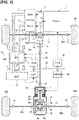
- Figure 1 shows an FF-based four-wheel drive electrically driven vehicle to which the power transmission device according to the first embodiment is applied.
- the overall system configuration of the four-wheel drive electrically driven vehicle will be described below with reference to Figure 1 .
- a front-wheel drive system of a four-wheel drive electrically driven vehicle is provided with a transverse engine 1 (a first power source), a motor 2 (a second power source), a generator 3, a gear case 4, a front differential 5, and left and right front wheels 6L, 6R (main drive wheels).
- a rear-wheel drive system is provided with a transfer case 7A, an electronically controlled coupling 8, a rear differential 9, and left and right rear wheels 10L, 10R (auxiliary drive wheels).
- the transverse engine 1 is supported by the gear case 4 and is horizontally disposed so that engine crankshaft 11 is oriented in the vehicle width direction.
- the transverse engine 1 is mounted as a power source for power generation that drives the generator 3.
- the motor 2 is supported by the gear case 4 and is horizontally disposed so that motor shaft 12 is oriented in the vehicle width direction.
- the motor 2 is a three-phase AC, permanent magnet-type synchronous motor that primarily functions as a power source for travel.
- a motor inverter 14a of an inverter unit 14 is connected to the stator coil of the motor 2 by means of an AC harness 15.
- a lithium-ion battery 17 is connected to the motor inverter 14a by means of a DC harness 16.
- the motor inverter 14a converts DC electrical energy from the lithium-ion battery 17 into three-phase AC electrical energy and generates driving torque for starting travel, constant-speed travel, and accelerating travel (a power source for travel function).
- the motor inverter 14a converts the three-phase AC electric energy generated in the motor 2 into DC for storage in the lithium-ion battery 17, recharging the lithium-ion battery 17 while resistive loading from the negative regenerative torque is applied to reduce the speed (a deceleration power generation function.
- the generator 3 is supported by the gear case 4 and is arranged horizontally such that generator shaft 13 is oriented in the vehicle width direction.
- the generator 3 is a three-phase AC, permanent magnet type synchronous motor that primarily functions as a power generation source.
- a generator inverter 14b of the inverter unit 14 is connected to the stator coil of the generator 3 by means of an AC harness 18.
- a lithium-ion battery 17 is connected to the generator inverter 14b by means of a DC harness 19.
- the generator inverter 14b converts the three-phase AC electrical energy generated by the generator 3 into DC electrical energy and charges the lithium-ion battery 17 (a power generation function).
- the generator inverter 14b converts the DC electrical energy from the lithium-ion battery 17 into three-phase AC electrical energy and driving torque is output for starting the transverse engine 1 (an engine starting function).
- the inverter unit 14 is disposed in an empty space region above the motor 2 and the generator 3.
- the lithium-ion battery 17 is disposed at a rear surface position of the floor panel in the seat area where the passenger seat is installed.
- the gear case 4 has the front differential 5.
- the front differential 5 has a left-side gear 5d to which a left front drive shaft 20L extending to a left front wheel 6L is connected, and a right-side gear 5e to which a right front drive shaft 20R extending to a right front wheel 6R is connected (refer to Figure 3 ).
- the transfer case 7A is supported on the same side surface of the gear case 4 on which the motor 2 and the generator 3 are supported.
- a transfer input shaft 71 of the transfer case 7A is connected to a differential case 5a of the front differential 5 (refer to Figure 3 ).
- a first rear propeller shaft 21, disposed essentially at the center in the vehicle width direction, is connected to a transfer output shaft 74 of the transfer case 7A and extends toward the rear of the vehicle.
- the electronically controlled coupling 8 is located between a first rear propeller shaft 21 and a second rear propeller shaft 22 and next to the rear differential 9.
- the electronically controlled coupling 8 has a built-in multi-plate friction clutch 8a and transmits power from the motor 2 to a left rear wheel 10L and a right rear wheel 10R with the electronically controlled clutch engagement torque as the maximum transmission torque.
- the electronically controlled coupling 8 and the rear differential 9 are incorporated in a common housing 23.
- the rear differential 9 includes a differential case 9a, a pinion shaft 9b, a pinion gear 9c, a left-side gear 9d, and a right-side gear 9e.
- the pinion gear 9c is rotatably supported by the pinion shaft 9b, which is supported by the differential case 9a.
- the left-side gear 9d and the right-side gear 9e mesh with the pinion gear 9c from the left and right sides, respectively.
- a left rear drive shaft 26L is connected to the left-side gear 9d, and a right rear drive shaft 26R is connected to the right-side gear 9e.
- Reference numeral 27 in Figure 1 indicates a joint provided on each shaft 20L, 20R, 21, 26L, and 26R.
- the electronic control system of the four-wheel drive electrically driven vehicle comprises a vehicle control module 31, a lithium-ion battery controller 32, an engine control module 33, and a 4WD control module 34.
- vehicle control module 31 a lithium-ion battery controller 32
- engine control module 33 a 4WD control module 34.
- control devices 31, 32, 33, 34 are connected by means of a CAN communication line 35 (here, CAN is an acronym for "Controller Area Network”) that is capable of bidirectional information exchange.
- CAN communication line 35 here, CAN is an acronym for "Controller Area Network”
- the vehicle control module 31 (acronym: "VCM”) is an integrated control means that suitably manages the energy consumption of the entire vehicle. For example, the accelerator opening degree, vehicle speed, and the like, are input to this module. Then, when the accelerator opening degree exceeds a prescribed opening degree, the vehicle control module outputs a command to the inverter 14 to carry out power control of the motor 2 in accordance with the accelerator opening degree. When the accelerator opening degree is less than or equal to the prescribed opening degree, the vehicle control module outputs a command to the inverter 14 to carry out regenerative control of the motor 2 in accordance with the accelerator opening degree.
- the vehicle control module when a charge request from the lithium-ion battery controller 32 is input, the vehicle control module starts the transverse engine 1 with the generator 3 and outputs a control command to the inverter 14 to shift to power generation.
- the vehicle control module outputs a control command to the inverter 14 to stop the power generation by the generator 3.
- the lithium-ion battery controller 32 (acronym: "LBC”) manages the battery temperature and the battery SOC of the lithium-ion battery 17, and the like. For example, when the battery SOC drops below a threshold value, the lithium-ion battery controller outputs a charge request to the vehicle control module 31 and the engine control module 33. When the battery SOC becomes greater than or equal to the threshold value, the lithium-ion battery controller outputs a charge-stop request to the vehicle control module 31 and the engine control module 33.
- LBC lithium-ion battery controller
- the engine control module 33 controls the engine start/engine stop, etc., by means of a control command to the transverse engine 1. For example, when a charge request from the lithium-ion battery controller 32 is input, the engine control module outputs an engine start command to the transverse engine 1 during cranking by the generator 3. When a charge-stop request from the lithium-ion battery controller 32 is input, the engine control module outputs an engine-stop command to the transverse engine 1.
- the 4WD control module 34 controls the power distribution ratio between the left and right front wheels 6L, 6R and the left and right rear wheels 10L, 10R by means of a control command to the electronically controlled coupling 8.
- the 4WD control module 34 inputs signals from a 4WD mode switch, a wheel speed sensor, a steering angle sensor, a yaw rate sensor, a G sensor, a brake switch, etc. Then, after carrying out a prescribed calculation process, the 4WD control module outputs a transmission torque command value to an electromagnetic actuator of the electronically controlled coupling 8, or the like.
- the 4WD control module calculates a torque command value by means of an initial torque process, a torque command value by means of a differential rotation torque process, and a torque command value by means of a driving force distribution torque process.
- the 4WD control module selects the final transmission torque command value by finding the highest of the calculated torque command values, and controls the driving force distribution ratio.
- the front and rear wheel driving force distribution ratios are controlled to be in 2WD mode by means of a front-wheel drive distribution, with a front-wheel distribution ratio of 100% : rear-wheel distribution ratio of 0%.
- Figure 2 shows a layout configuration of a front-side power transmission system in the first embodiment.
- the layout configuration of the front-side power transmission system will be described below with reference to Figure 2 .
- the front-side power transmission system includes the transverse engine 1, the motor 2, the generator 3, the gear case 4, the front differential 5, and the transfer case 7A, which are arranged in a front power unit room A.
- the transverse engine 1 is supported on the right side surface 4a of the two side surfaces 4a, 4b of the gear case 4 in the right-side space region of the front power unit room A and is arranged horizontally such that the engine crankshaft 11 is oriented along the vehicle width direction.
- the motor 2 is supported on the left side surface 4b of the two side surfaces 4a, 4b of the gear case 4 in the left-side space region of the front power unit room A and is arranged horizontally such that the motor shaft 12 is oriented along the vehicle width direction.
- the motor 2 is smaller than the transverse engine 1 in the vehicle width direction (the dimension of engine in the vehicle width direction > the dimension of motor in the vehicle width direction).
- the generator 3 is supported on the left side surface 4b of the two side surfaces 4a, 4b of the gear case 4 in the left-side space region of the front power unit room A in a position adjacent to and in front of and below the motor 2 with respect to the vehicle and is arranged horizontally such that the generator shaft 13 is oriented in the vehicle width direction.
- the generator 3 is smaller than the motor dimension of the motor 2 in the vehicle width direction (the motor dimension in the vehicle width direction > the dimension of generator in the vehicle width direction).
- the gear case 4 is arranged in a central space region of the front power unit room A, interposed between the transverse engine 1 on the side surfaces 4a, and the motor 2 and generator 3 on the side surface 4b.
- the gear case 4 in a plan view, has the form of a rectangle with the short side in the width direction of the vehicle and the long side in the longitudinal direction of the vehicle.
- the vehicle rearward portion of the gear case 4, which includes the front differential 5, projects farther toward the rear of the vehicle than the vehicle rearward end surfaces 1a, 2a of the transverse engine 1 and the motor 2, respectively.
- the transfer case 7A is supported by the gear case 4 so as to wrap around the left side surface 4b of the two side surfaces 4a, 4b of the gear case on which the motor 2 and the generator 3 are supported, from the left side surface 4b to the rear surface 4c of the exposed portion of the gear case 4.
- the transfer output shaft 74 then outputs power from the rear surface 4c of the gear case 4 to the left and right rear wheels 10L, 10R via the first propeller shaft 21 in the longitudinal direction of the vehicle.
- a shaft space SS, in which the first propeller shaft 21 is disposed, is provided in a floor tunnel 37 extending in the longitudinal direction of the vehicle at essentially the central area in the vehicle width direction.
- FIG 3 shows a configuration of the front differential 5 and a reduction gear mechanism 42 incorporated in the gear case 4.
- the detailed configuration of the gear case 4 will be described below with reference to Figures 2 and 3 .
- the gear case 4 has a speed-increasing gear mechanism 41, the reduction gear mechanism 42, and the front differential 5.
- the speed-increasing gear mechanism 41 is a gear train that connects the transverse engine 1 and the generator 3, and is configured by an intermeshing engine gear 41a, idler gear 41b, and generator gear 41c, as shown in Figure 2 .
- the engine gear 41a is provided at an end position of the engine crankshaft 11.
- the idler gear 41b is provided on an idler shaft 43, which is supported at both ends so as to be rotatable with respect to the gear case 4.
- the generator gear 41c is provided at an end position of the generator shaft 13. The three shafts, the engine crankshaft 11, the idler shaft 43, and the generator shaft 13, are arranged parallel to each other.
- FIG 2 which is an unfolded plan view
- the three shafts, the engine crankshaft 11, the idler shaft 43, and the generator shaft 13, are shown located at the same height.
- the engine crankshaft 11 is arranged at a central portion of the gear case 4.
- the idler shaft 43 and the generator shaft 13 are disposed at lower side positions that are more forward in the vehicle than the engine crankshaft 11.
- the relationship between the gear diameters of the speed-increasing gear mechanism 41 is such that the engine gear diameter > generator gear diameter, and when electric power is generated by the generator 3 by means of the operation of the transverse engine 1, a speed-increasing gear ratio is set. On the other hand, when the transverse engine 1 is started by the generator 3, a reduction gear ratio is set.
- the reduction gear mechanism 42 is a gear train that connects the motor 2 and the front differential 5 and is configured by an intermeshing motor gear 42a and first idler gear 42b, and an intermeshing second idler gear 42c and ring gear 42d, as shown in Figures 2 and 3 .
- the motor gear 42a is provided at an end position of the motor shaft 12, which is supported at both ends so as to be rotatable with respect to the gear case 4.
- the first idler gear 42b and the second idler gear 42c are provided adjacent to an idler shaft 43, which is supported at both ends so as to be rotatable with respect to the gear case 4.
- the ring gear 42d is connected at an outer circumferential position of the differential case 5a of the front differential 5.
- the three axes, the axis of the motor shaft 12, the axis of the idler shaft 43, and the axis of rotation 45 of the front differential 5, are arranged parallel to each other.
- a parking gear 42e is formed integrally on a side portion of the first idler gear 42b, so that a parking pawl engages when the parking range position is selected.
- the relationship between the gear diameters of the reduction gear mechanism 42 is such that the motor gear diameter ⁇ the ring gear diameter, and when the motor 2 is driven to rotate, the reduction gear ratio is set. On the other hand, during regenerative power generation by the motor 2, the speed-increasing gear ratio is set.
- FIG 3 a planar view is illustrated in which the three axes of the motor shaft 12, the axis of the idler shaft 43, and the axis of rotation 45 of the front differential 5, are shown as being located at the same height.
- the motor shaft 12 and the idler shaft 43 are disposed more toward the rear of the vehicle than the engine crankshaft 11, in an upper area of the gear case 4.
- the axis of rotation 45 of the front differential 5 is disposed lower and more toward the rear of the vehicle than the idler shaft 43, in a lower position of the gear case 4.
- the front differential 5 includes the differential case 5a, a pinion shaft 5b, a pinion gear 5c, the left-side gear 5d, and the right-side gear 5e.
- the pinion gear 5c is rotatably supported by the pinion shaft 5b, which is supported by the differential case 5a.
- the left-side gear 5d and the right-side gear 5e engage with the pinion gear 9c from the left and right sides, respectively.
- a left front drive shaft 20L is connected to the left-side gear 5d, and a right front drive shaft 20R is connected to the right-side gear 5e.
- the transfer input shaft 71 of the transfer case 7A is integrally provided at a left-side end position of the differential case 5a of the front differential 5 by means of spline connection, or the like. That is, the differential case 5a of the front differential 5 functions as a branch member for distributing power from the motor to the left and right front wheels 6L, 6R and the left and right rear wheels 10L, 10R.
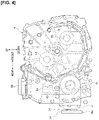
- Figure 4 shows the transfer case 7A supported by the gear case 4 in the power transmission device according to the first embodiment.
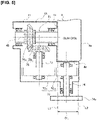
- Figure 5 shows the detailed configuration of the transfer case 7A. The detailed configuration of the transfer case 7A will be described below with reference to Figures 2 , 4 , and 5 .
- the transfer case 7A is supported at a rear surface position (the left-side position) on the vehicle-rearward lower side of the gear case 4 in a state in which the transfer output shaft 74 projects toward the rearward side of the vehicle when the gear case 4 is seen from the right side.
- a parking actuator 38 is disposed at the uppermost position of the gear case 4.
- the transfer case 7A includes the transfer input shaft 71, a transfer intermediate shaft 72, the transfer output shaft 74, a bevel gear pair 75, and a transfer gear pair 76 (a power transmission element) provided in a transfer casing 77.
- the bevel gear pair 75 and the transfer gear pair 76 are configured as a power transmission mechanism that transmits power by changing the direction of the axis of rotation of to an essentially orthogonal direction between the transfer input shaft 71 and the transfer output shaft 74.
- the transfer input shaft 71 is a hollow shaft that is connected to the differential case 5a of the front differential 5 and that is disposed in a position above the axis of rotation 45 of the front differential 5.
- the transfer input shaft 71 is oil-sealed with respect to the transfer casing 77 and supported at both ends.
- a ring gear 75a that meshes with a pinion gear 75b is integrally provided at an outer circumferential position of the transfer input shaft 71.
- the transfer intermediate shaft 72 extends toward the rear of the vehicle and is oriented essentially orthogonal to the transfer input shaft 71, which is arranged in the vehicle width direction; the front end portion of the transfer intermediate shaft is disposed in a position near the transfer input shaft 71.
- the transfer intermediate shaft 72 is supported at both ends with respect to the transfer casing 77.
- the pinion gear 75b that meshes with the ring gear 75a is provided at a front end portion of the transfer intermediate shaft 72.
- An intermediate shaft gear 76a is integrally provided at a rear portion of the transfer intermediate shaft 72.
- the transfer output shaft 74 is arranged parallel to the transfer intermediate shaft 72 arranged along the longitudinal direction of the vehicle. This transfer output shaft 74 is supported at both ends with respect to the transfer casing 77. An output shaft gear 76b that meshes with the intermediate shaft gear 76a is provided at the front portion of the transfer output shaft 74. A flange portion 74a, to which the first rear propeller shaft 21 is connected, is integrally provided at the rear end portion of the transfer output shaft 74. As seen from the side, the transfer output shaft 74 is disposed with a downward angle of inclination that gradually decreases toward the rear of the vehicle, as shown in Figure 4 .
- the bevel gear pair 75 is a power transmission element that connects the transfer input shaft 71 and the transfer intermediate shaft 72, which are arranged orthogonally to each other, so as to be capable of transmitting power by means of gear engagement.
- the bevel gear pair 75 is comprised of the ring gear 75a, which has a high void gear structure, and the pinion gear 75b, which orthogonally intermesh.
- the ring gear 75a of the bevel gear pair 75 is provided on the transfer input shaft 71.
- the position at which the ring gear 75a is set on the transfer input shaft 71 is configured to be adjustable over the vehicle width direction axis along the transfer input shaft 71.
- the transfer gear pair 76 is a power transmission element that connects the transfer intermediate shaft 72 and the transfer output shaft 74, which are arranged parallel to each other, so as to be capable of transmitting power by means of gear engagement.
- the transfer gear pair 76 is comprised of the intermediate shaft gear 76a of the transfer intermediate shaft 72 and the output shaft gear 76b of the transfer output shaft 74, which intermesh.
- the output shaft gear 76b (a rotatable member provided on the transfer output shaft) of the transfer gear pair 76 is disposed in a position overlapping the gear case 4 in the vehicle width direction.
- extension line L1 the line produced by extending the left side surface 4b of the gear case 4 in the longitudinal direction of the vehicle is defined as extension line L1
- extension line L2 the line produced by extending the engine-side outer peripheral end of the output shaft gear 76b in the longitudinal direction of the vehicle is defined as extension line L2.
- the output shaft gear 76b provides a margin of overlap OL that overlaps the gear case 4 between the extension line L1 and the extension line L2 in the vehicle width direction.
- the position at which the ring gear 75a is set on the transfer input shaft 71 is configured to be adjustable over the vehicle width direction axis along the transfer input shaft 71.
- the transfer intermediate shaft 72 and the transfer output shaft 74 are coupled so as to be capable of transmitting power by means of gear engagement. Therefore, it is possible to adjust the size of the margin of overlap OL by moving the ring gear 75a within an allowable range of margin and/or changing the gear diameters of the intermediate shaft gear 76a and the output shaft gear 76b.
- Figure 6 shows a vehicle mounting layout of an engine, a transmission, and a transfer in a conventional four-wheel drive engine-powered vehicle
- Figure 7 shows a vehicle mounting layout of an engine, an electric motor, a gear case, and a transfer case in a four-wheel drive hybrid vehicle of a comparative example
- Figure 8 shows a vehicle mounting layout of the transverse engine 1, the motor 2, the generator 3, the gear case 4, and the transfer case 7A in the four-wheel drive electrically driven vehicle according to the first embodiment.
- the operation of arranging the floor tunnel of the rear propeller shaft will be described below with reference to Figures 6 to 8 .
- the transfer case is located on the same side surface of the two side surfaces of the transmission housing that supports the engine, as shown in Figure 6 .
- the location TL of the transfer output shaft of the transfer case is arranged essentially coinciding with the center location CL of the engine and the transmission case in the vehicle width direction. Therefore, it is possible to dispose the propeller shaft, which is connected to the transfer output shaft, in the floor tunnel.
- the location TL' of the transfer output shaft shifts from the center location CL of the engine, the gear case, and the electric motor in the vehicle width direction toward the engine side in the vehicle width direction, as indicated by the arrow in Figure 7 .
- the reason for this is that the layout arrangement of the power unit with respect to the front power unit room is such that the end surface position of the transmission in the conventional example is used as a reference location RL, and the location of the end surface of the electric motor is also made to coincide with the reference location RL in the comparative example. Therefore, in the case of the conventional example, the engine and the transmission are arranged along the vehicle width direction, and the center location CL in the vehicle width direction overlaps the engine.
- the first embodiment employs a configuration in which the transfer case 7A is supported on the left side surface 4b of the gear case 4 and the output shaft gear 76b provided at the end portion of the transfer output shaft 74 is disposed in a position overlapping the gear case 4 in the vehicle width direction, as shown in Figure 8 .
- the transverse engine 1, the gear case 4, and the motor 2 are arranged in the vehicle width direction and the combined dimensions of the gear case 4 and the motor 2 in the vehicle width direction exceed the transmission dimension in the vehicle width direction, center location CL in the vehicle width direction overlaps the gear case 4.
- the output shaft gear 76b provided at the end portion of the transfer output shaft 74 in a position overlapping the gear case 4 in the vehicle width direction, the location TL of the transfer output shaft 74 will overlap the gear case 4. That is, the transfer case 7A is configured to wrap around such that the transfer output shaft 74 overlaps the gear case 4.
- the second embodiment is an example in which the power transmission element of the transfer intermediate shaft and the transfer output shaft is set as a transfer belt instead of the transfer gear of the first embodiment.
- the configuration is described first.
- the "overall system configuration,” the "layout configuration of the front-side power transmission system,” and the “detailed configuration of the gear case” are the same as in the first embodiment, so that the illustrations and descriptions thereof are omitted.
- the "detailed configuration of the transfer” of the second embodiment will be described below.
- Figure 9 shows a detailed configuration of a transfer case 7B supported by the gear case 4 in the power transmission device according to the second embodiment.
- the detailed configuration of the transfer case 7B will be described below with reference to Figure 9 .
- the transfer input shaft 71, a transfer intermediate shaft 72, the transfer output shaft 74, the bevel gear pair 75, and a transfer belt 78 (a power transmission element) are provided in the transfer casing 77.
- the bevel gear pair 75 and the transfer belt 78 are configured as a power transmission mechanism that transmits power by changing the direction of the axis of rotation to an essentially orthogonal direction between the transfer input shaft 71 and the transfer output shaft 74.
- the transfer input shaft 71 is a hollow shaft that is connected to the differential case 5a of the front differential 5 and that is disposed in a position above the axis of rotation 45 of the front differential 5.
- the transfer input shaft 71 is oil-sealed with respect to the transfer casing 77 and supported at both ends.
- the ring gear 75a that meshes with the pinion gear 75b is integrally provided at an outer circumferential position of the transfer input shaft 71.
- the gear setting orientation of the ring gear 75a is set to be the opposite of that of the first embodiment so as to match the direction of rotation.
- the transfer intermediate shaft 72 is oriented toward the rear of the vehicle, essentially orthogonal to the transfer input shaft 71, which is arranged in the vehicle width direction; the front end portion of the transfer intermediate shaft is disposed in a position next to the transfer input shaft 71.
- This transfer intermediate shaft 72 is supported at both ends with respect to the transfer casing 77.
- the pinion gear 75b that meshes with the ring gear 75a is provided at a front end portion of the transfer intermediate shaft 72.
- An intermediate shaft sprocket 78a is integrally provided at a rear portion of the transfer intermediate shaft 72.
- the transfer output shaft 74 is arranged parallel to the transfer intermediate shaft 72 arranged in the longitudinal direction of the vehicle. This transfer output shaft 74 is supported at both ends with respect to the transfer casing 77. An output shaft sprocket 78b is provided at a front portion of the transfer output shaft 74. The flange portion 74a, to which the first rear propeller shaft 21 is connected, is integrally provided at a rear end portion of the transfer output shaft 74. As seen from the side, the transfer output shaft 74 is disposed with a downward angle of inclination that gradually decreases toward the rear of the vehicle, as shown in Figure 4 .
- the bevel gear pair 75 is a power transmission element that connects the transfer input shaft 71 and the transfer intermediate shaft 72, which are arranged orthogonally to each other, so as to be capable of transmitting power by means of gear engagement.
- This bevel gear pair 75 is comprised of the pinion gear 75b and the ring gear 75a with a high void gear structure, which orthogonally intermesh.
- the ring gear 75a of the bevel gear pair 75 is provided on the transfer input shaft 71.
- the position at which the ring gear 75a is set on the transfer input shaft 71 is configured to be adjustable over the vehicle width direction axis along the transfer input shaft 71.
- the transfer belt 78 is a power transmission element that connects the transfer intermediate shaft 72 and the transfer output shaft 74, which are arranged parallel to each other, so as to be capable of transmitting power by means of a meshing belt 78c.
- This transfer belt 78 is comprised of the intermediate shaft sprocket 78a of the transfer intermediate shaft 72, the output shaft sprocket 78b of the transfer output shaft 74, and the meshing belt 78c that spans the two sprockets 78a, 78b.
- the output shaft sprocket 78b (a rotatable member provided on the transfer output shaft) of the transfer belt 78 is disposed in a position overlapping the gear case 4 in the vehicle width direction.
- extension line L1 the line produced by extending the left side surface 4b of the gear case 4 in the longitudinal direction of the vehicle is defined as extension line L1
- extension line L2 the line produced by extending the engine-side outer peripheral end of the output shaft sprocket 78b in the longitudinal direction of the vehicle is defined as extension line L2.
- the output shaft sprocket 78b provides a margin of overlap OL that overlaps the gear case 4 between the extension line L1 and the extension line L2 in the vehicle width direction.
- the position at which the ring gear 75a is set on the transfer input shaft 71 is configured to be adjustable over the vehicle width direction axis along the transfer input shaft 71.
- the transfer intermediate shaft 72 and the transfer output shaft 74 are coupled so as to be capable of transmitting power by means of the meshing belt 78c. Therefore, it is possible to adjust the size of the margin of overlap OL by moving the ring gear 75a within an allowable range of margin and/or changing the distance between the shafts of the transfer intermediate shaft 72 and the transfer output shaft 74.
- the intermediate shaft sprocket 78a is provided on the transfer intermediate shaft 72.
- the output shaft sprocket 78b is provided on the transfer output shaft 74.
- the power transmission element is set to be the transfer belt 78 comprised of the meshing belt 78c that spans the intermediate shaft sprocket 78a and the output shaft sprocket 78b ( Figure 9 ). Therefore, in addition to effect (4), the transmission of power from the transfer input shaft 71 to the transfer output shaft 74 of the transfer case 7B can be achieved by means of a combination of gear transmission and belt transmission.
- the third embodiment is an example in which a transfer parallel shaft is used instead of the transfer intermediate shaft of the first and second embodiments, and the power transmission element is a transfer gear pair.
- the configuration is described first.
- the "overall system configuration,” the "layout configuration of the front-side power transmission system,” and the “detailed configuration of the gear case” are the same as in the first embodiment, so that the illustrations and descriptions thereof are omitted.
- the "detailed configuration of the transfer” of the third embodiment will be described below.
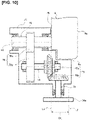
- Figure 10 shows a detailed configuration of a transfer case 7C supported by the gear case 4 in the power transmission device according to the third embodiment.
- the detailed configuration of the transfer case 7C will be described below with reference to Figure 10 .
- the transfer case 7C includes the transfer input shaft 71, a transfer parallel shaft 73, the transfer output shaft 74, the bevel gear pair 75, and the transfer gear pair 76 (the power transmission element) provided in the transfer casing 77.
- the bevel gear pair 75 and the transfer gear pair 76 are configured as a power transmission mechanism that transmits power by changing the direction of the axis of rotation to an essentially orthogonal direction between the transfer input shaft 71 and the transfer output shaft 74.
- the transfer input shaft 71 is a hollow shaft that is connected to the differential case 5a of the front differential 5 and that is disposed in a position above the axis of rotation 45 of the front differential 5.
- the transfer input shaft 71 is oil-sealed with respect to the transfer casing 77 and supported at both ends.
- An input shaft gear 76a that meshes with a parallel shaft gear 76b is integrally provided at an outer circumferential position of the transfer input shaft 71.
- the transfer parallel shaft 73 is arranged parallel to the transfer input shaft 71 arranged in the vehicle width direction, as shown in Figure 10 .
- the transfer parallel shaft 73 is supported at both ends with respect to the transfer casing 77.
- the parallel shaft gear 76b that meshes with the input shaft gear 76a is provided at a motor-side end portion of the transfer parallel shaft 73.
- the ring gear 75a that meshes with the pinion gear 75b is provided at an engine-side end portion of the transfer parallel shaft 73.
- the transfer output shaft 74 is arranged in the longitudinal direction of the vehicle and is orthogonal to the transfer input shaft 71 and the transfer parallel shaft 73, which are arranged in the vehicle width direction.
- the transfer output shaft 74 is supported at both ends with respect to the transfer casing 77.
- the pinion gear 75b that meshes with the ring gear 75a is provided at a front portion of the transfer output shaft 74.
- the flange portion 74a, to which the first rear propeller shaft 21 is connected, is integrally provided at a rear end portion of the transfer output shaft 74.
- the transfer output shaft 74 is disposed with a downward angle of inclination that gradually decreases toward the rear side of the vehicle, as shown in Figure 4 .
- the bevel gear pair 75 is a power transmission element that connects the transfer parallel shaft 73 and the transfer output shaft 74, which are arranged orthogonally to each other, so as to be capable of transmitting power by means of gear engagement.
- the bevel gear pair 75 is comprised of the pinion gear 75b and the ring gear 75a that has a high void gear structure, which intermesh orthogonally.
- the ring gear 75a of the bevel gear pair 75 is provided on the transfer parallel shaft 73.
- the position at which the ring gear 75a is set on the transfer parallel shaft 73 is configured to be adjustable over the vehicle width direction axis along the transfer parallel shaft 73.
- the transfer gear pair 76 is a power transmission element that connects the transfer input shaft 71 and the transfer parallel shaft 73, which are arranged parallel to each other, so as to be capable of transmitting power by means of gear engagement.
- the transfer gear pair 76 is comprised of the input shaft gear 76a of the transfer input shaft 71 and the parallel shaft gear 76b of the transfer parallel shaft 73, which intermesh.
- the pinion gear 75b (a rotatable member provided on the transfer output shaft) of the bevel gear pair 75 is disposed in a position overlapping the gear case 4 in the vehicle width direction.
- extension line L1 the line produced by extending the left side surface 4b of the gear case 4 in the longitudinal direction of the vehicle is defined as extension line L1
- extension line L2 the line produced by extending the engine-side outer peripheral end of the pinion gear 75b in the longitudinal direction of the vehicle is defined as extension line L2.
- the pinion gear 75b provides the margin of overlap OL that overlaps the gear case 4 between the extension line L1 and the extension line L2 in the vehicle width direction.
- the position at which the ring gear 75a is set on the transfer parallel shaft 73 is configured to be adjustable over the vehicle width direction axis along the transfer parallel shaft 73. Therefore, it is possible to adjust the size of the margin of overlap OL by moving the ring gear 75a within an allowable range of margin.
- the transfer case 7C has the transfer input shaft 71 in the vehicle width direction, the transfer parallel shaft 73 in the vehicle width direction, and the transfer output shaft 74 in the longitudinal direction of the vehicle.
- the power transmission mechanism has a power transmission element (the transfer gear pair 76) that is provided between the transfer input shaft 71 and the transfer parallel shaft 73 and that transmits power between the two shafts 71, 73 arranged in parallel to each other, and the ring gear 75a and the pinion gear 75b, which are respectively provided on the transfer parallel shaft 73 and the transfer output shaft 74 and define the bevel gear pair 75 that transmits power between the orthogonally arranged two shafts ( Figure 10 ).
- the transfer case 7C which transmits power by wrapping around from the side surface of the gear case 4 (the left side surface 4b) to the rear surface 4c, can be configured as a compact unit with a small number of components, including three shafts 71, 73, 74, the bevel gear pair 75, and the power transmission element (the transfer gear pair 76).
- the input shaft gear 76a is provided on the transfer input shaft 71.
- the parallel shaft gear 76b is provided on the transfer parallel shaft 73.
- the power transmission element is the transfer gear pair 76 comprised of the input shaft gear 76a and the parallel shaft gear 76b, which intermesh ( Figure 10 ). Therefore, in addition to effect (7), the power transmission from the transfer input shaft 71 to the transfer output shaft 74 of the transfer case 7C can be achieved by means of gear transmission.
- the fourth embodiment is an example in which a transfer parallel shaft is used instead of the transfer intermediate shaft of the first and second embodiments, and the power transmission element is a transfer belt.
- the configuration is described first.
- the "overall system configuration,” the "layout configuration of the front-side power transmission system,” and the “detailed configuration of the gear case” are the same as in the first embodiment, so that the illustrations and descriptions thereof are omitted.
- the "detailed configuration of the transfer” of the fourth embodiment will be described below.
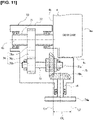
- Figure 11 shows a detailed configuration of a transfer case 7D supported by the gear case 4 in the power transmission device according to the fourth embodiment.
- the detailed configuration of the transfer case 7D will be described below with reference to Figure 11 .
- the transfer case 7D includes the transfer input shaft 71, the transfer parallel shaft 73, the transfer output shaft 74, the bevel gear pair 75, and the transfer belt 78 (a power transmission element) provided in the transfer casing 77.
- the bevel gear pair 75 and the transfer belt 78 are configured as a power transmission mechanism that transmits power by changing the direction of the axis of rotation to an essentially orthogonal direction between the transfer input shaft 71 and the transfer output shaft 74.
- the transfer input shaft 71 is a hollow shaft that is connected to the differential case 5a of the front differential 5 and that is disposed in a position above the axis of rotation 45 of the front differential 5.
- the transfer input shaft 71 is oil-sealed with respect to the transfer casing 77 and supported at both ends.
- An input shaft sprocket 78a is provided at an outer circumferential position of the transfer input shaft 71.
- the transfer parallel shaft 73 is arranged parallel to the transfer input shaft 71 in the vehicle width direction, as shown in Figure 11 .
- the transfer parallel shaft 73 is supported at both ends with respect to the transfer casing 77.
- a parallel shaft sprocket 78b is provided on a motor-side end portion of the transfer parallel shaft 73.
- the ring gear 75a which that meshes with the pinion gear 75b, is provided at the engine-side end portion of the transfer parallel shaft 73.
- the transfer output shaft 74 is arranged in the longitudinal direction of the vehicle, which is orthogonal to the transfer input shaft 71 and the transfer parallel shaft 73, which are arranged in the vehicle width direction.
- the transfer output shaft 74 is supported at both ends with respect to the transfer casing 77.
- the pinion gear 75b which meshes with the ring gear 75a, is provided at a front portion of the transfer output shaft 74.
- the flange portion 74a, to which the first rear propeller shaft 21 is connected, is integrally provided at a rear end portion of the transfer output shaft 74.
- the transfer output shaft 74 is disposed with a downward angle of inclination that gradually decreases toward the rear side of the vehicle, as shown in Figure 4 .
- the bevel gear pair 75 is a power transmission element that connects the transfer parallel shaft 73 and the transfer output shaft 74, which are arranged orthogonally to each other, so as to be capable of transmitting power by means of gear engagement.
- the bevel gear pair 75 is comprised of the pinion gear 75b and the ring gear 75a that has a high void gear structure, which orthogonally intermesh.
- the ring gear 75a of the bevel gear pair 75 is provided on the transfer parallel shaft 73.
- the position at which the ring gear 75a is set on the transfer parallel shaft 73 is configured to be adjustable over the vehicle width direction axis along the transfer parallel shaft 73.
- the transfer belt 78 is a power transmission element that connects the transfer input shaft 71 and the transfer parallel shaft 73, which are arranged parallel to each other, so as to be capable of transmitting power by means of the meshing belt 78c.
- the transfer belt 78 is comprised of the input shaft sprocket 78a of the transfer input shaft 71, the parallel shaft sprocket 78b of the transfer parallel shaft 73, and the meshing belt 78c that spans the two sprockets 78a, 78b.
- the pinion gear 75b (a rotatable member provided on the transfer output shaft) of the transfer gear pair 75 is disposed in a position overlapping the gear case 4 in the vehicle width direction.
- extension line L1 the line produced by extending the left side surface 4b of the gear case 4 in the longitudinal direction of the vehicle is defined as extension line L1
- extension line L2 the line produced by extending the engine-side outer peripheral end of the pinion gear 75b in the longitudinal direction of the vehicle is defined as extension line L2.
- the pinion gear 75b provides a margin of overlap OL that overlaps the gear case 4 between the extension line L1 and the extension line L2 in the vehicle width direction.
- the position at which the ring gear 75a is set on the transfer parallel shaft 73 is configured to be adjustable over the vehicle width direction axis along the transfer parallel shaft 73. Therefore, it is possible to adjust the size of the margin of overlap OL by moving the ring gear 75a within an allowable range of margin.
- the input shaft sprocket 78a is provided on the transfer input shaft 71.
- the parallel shaft sprocket 78b is provided on the transfer parallel shaft 73.
- the power transmission element is set to be the transfer belt 78 in which the meshing belt 78c spans the input shaft sprocket 78a and the parallel shaft sprocket 78b ( Figure 11 ). Therefore, in addition to effect (7), the transmission of power from the transfer input shaft 71 to the transfer output shaft 74 of the transfer case 7D can be achieved by means of a combined belt transmission and gear transmission.
- the power source includes the transverse engine 1, which is supported in the vehicle width direction on one side surface 4a of the two side surfaces 4a, 4b of the gear case 4, and the motor 2, which is supported in the vehicle width direction on the other side surface 4b and which is smaller than the transverse engine 1.
- the power source may include a main motor, which is supported in the vehicle width direction on one side surface of the two side surfaces of the gear case, and an auxiliary motor, which is supported in the vehicle width direction on the other side surface and which is smaller than the main motor.
- the power source may include a primary engine, which is supported along the vehicle width direction on one of two side surfaces of the gear case, and an auxiliary engine, which is supported along the vehicle width direction on the other side surface and which is smaller than the primary engine.
- the gear case 4 has the speed-increasing gear mechanism 41 that connects the transverse engine 1 and the generator 3, and the reduction gear mechanism 42 that connects the motor 2 and the front differential 5.
- the gear case may be such that a clutch mechanism that can connect the engine and the front differential, or the like, is added to the speed-increasing gear mechanism and the reduction gear mechanism.
- the gear case may include a stepped transmission gear mechanism, a stepless transmission gear mechanism, or a power split gear mechanism.
- the power transmission device of the present invention is applied to an FF-based four-wheel drive electrically driven vehicle that has an engine as a power source for power generation and a motor as a power source for travel, and that uses the electric power generated by the engine to travel with the motor.
- the power transmission device of the present invention can also be applied to an FR-based four-wheel drive electrically driven vehicle.
- the present invention can be applied not only to a four-wheel drive electrically driven vehicle, but also to a four-wheel drive engine-powered vehicle, a four-wheel drive electric vehicle, and a four-wheel drive hybrid vehicle.
Landscapes
- Engineering & Computer Science (AREA)
- Mechanical Engineering (AREA)
- Chemical & Material Sciences (AREA)
- Combustion & Propulsion (AREA)
- Transportation (AREA)
- Arrangement And Driving Of Transmission Devices (AREA)
- Hybrid Electric Vehicles (AREA)
- Electric Propulsion And Braking For Vehicles (AREA)
- General Engineering & Computer Science (AREA)
- Arrangement Of Transmissions (AREA)
Claims (8)
- Kraftübertragungssystem für ein Fahrzeug mit Allradantrieb, das aufweist:eine Kraftquelle, undeine Kraftübertragungsvorrichtung, die aufweist:ein Getriebegehäuse (4), undein Verteilergetriebe (7A, 7B, 7C, 7D), das durch das Getriebegehäuse gehalten wird und Kraft von der Kraftquelle auf Hauptantriebsräder (6L, 6R) undHilfsantriebsräder (10L, 10R) verteilt,wobei:
die Kraftquelle einen Verbrennungsmotor (1) aufweist; und das Verteilergetriebe aufweist:eine Verteilergetriebeeingangswelle (71), die mit einem Differential (5) mit den Hauptantriebsrädern verbunden ist und die in der Fahrzeugbreitenrichtung angeordnet ist,eine Verteilergetriebeausgangswelle (74), die durch eine Kardanwelle (21) mit den Hilfsantriebsrädern verbunden ist und die in einer Längsrichtung des Fahrzeugs angeordnet ist,einen Kraftübertragungsmechanismus (75, 76, 78), der Kraft durch Ändern der Richtung einer Drehachse auf eine orthogonale Richtung zwischen derVerteilergetriebeeingangswelle und derVerteilergetriebeausgangswelle überträgt und die Kraft überträgt, undein drehbares Element (75b, 76b, 78b) desKraftübertragungsmechanismus, wobei das drehbare Element an der Verteilergetriebeausgangswelle vorgesehen ist und an einer Position angeordnet ist, die das Getriebegehäuse in der Fahrzeugbreitenrichtung überlappt,dadurch gekennzeichnet, dass:der Verbrennungsmotor an einer von zwei Seitenflächen des Getriebegehäuses gehalten wird;die Kraftquelle ferner einen Elektromotor (2, 3) aufweist, der an der anderen Seitenfläche der beiden Seitenflächen gehalten wird und angeordnet ist und der kleiner als der Verbrennungsmotor in der Fahrzeugbreitenrichtung ist, wobei sich die andere Seitenfläche gegenüber der Seitenfläche befindet, an der der Verbrennungsmotor gehalten wird;das Verteilergetriebe an derselben Seitenfläche der beiden Seitenflächen des Getriebegehäuses wie die Seitenfläche gehalten wird, an der der Elektromotor gehalten wird; unddas Verteilergetriebe durch das Getriebegehäuse gehalten wird und sich in einer Layoutkonfiguration eines frontseitigen Kraftübertragungssystems von oben gesehen von der Seitenfläche, an der der Elektromotor gehalten wird, zu einer Rückseite herum windet, um einen Raum bereitzustellen, der durch eine Fahrzeugheck-Endfläche des Verbrennungsmotors, ein Armaturenbrett und ein Fahrzeugkarosserie-Seitenblech umgeben ist. - Kraftübertragungssystem für ein Fahrzeug mit Allradantrieb nach Anspruch 1, wobeider Elektromotor einen Motor (2) und einen Generator (3) aufweist, unddas Getriebegehäuse (4) einen drehzahlerhöhenden Getriebemechanismus (41), der den Verbrennungsmotor (1) und den Generator verbindet, und einen Untersetzungsgetriebemechanismus (42) aufweist, der den Motor und das Differential (5) verbindet.
- Kraftübertragungssystem für ein Fahrzeug mit Allradantrieb nach Anspruch 1 oder 2, wobeidas Verteilergetriebe (7A, 7B) die Verteilergetriebeeingangswelle (71), die sich in der Fahrzeugbreitenrichtung erstreckt, eine Verteilergetriebezwischenwelle (72), die sich in der Längsrichtung des Fahrzeugs erstreckt, und die Verteilergetriebeausgangswelle (74) aufweist, die sich in der Längsrichtung des Fahrzeugs erstreckt, undder Kraftübertragungsmechanismus (75, 76, 78) aufweist:ein Hohlrad (75a) und ein Ritzel (75b), die jeweils an der Verteilergetriebeeingangswelle und derVerteilergetriebezwischenwelle vorgesehen sind und die ein Kegelradpaar (75) definieren, das Kraft zwischen zwei orthogonal angeordneten Wellen überträgt, undein Kraftübertragungselement (76), das zwischen der Verteilergetriebezwischenwelle und derVerteilergetriebeausgangswelle vorgesehen ist und Kraft zwischen zwei parallelen Wellen überträgt.
- Kraftübertragungssystem für ein Fahrzeug mit Allradantrieb nach Anspruch 3, wobeiein Zwischenwellenrad (76a) an der Verteilergetriebezwischenwelle (72) vorgesehen ist,ein Ausgangswellenrad (76b) an der Verteilergetriebeausgangswelle (74) vorgesehen ist, und das Kraftübertragungselement ein Verteilergetrieberadpaar (76) ist, das aus dem Zwischenwellenrad und dem Ausgangswellenrad besteht, die miteinander in Eingriff stehen.
- Kraftübertragungssystem für ein Fahrzeug mit Allradantrieb nach Anspruch 3, wobeiein Zwischenwellenzahnkranz (78a) an der Verteilergetriebezwischenwelle vorgesehen ist,eine Ausgangswellenzahnkranz (78b) an der Verteilergetriebeausgangswelle (74) vorgesehen ist, und das Kraftübertragungselement ein Verteilergetrieberiemen (78) ist, in dem ein Eingriffsriemen (78c) den Zwischenwellenzahnkranz und den Ausgangswellenzahnkranz überbrückt.
- Kraftübertragungssystem für ein Fahrzeug mit Allradantrieb nach Anspruch 1 oder 2, wobeidas Verteilergetriebe (7C, 7D) die Verteilergetriebeeingangswelle (71), die sich in der Fahrzeugbreitenrichtung erstreckt, eine parallele Verteilergetriebewelle (73), die sich in der Fahrzeugbreitenrichtung erstreckt, und die Verteilergetriebeausgangswelle (74) aufweist, die sich in der Längsrichtung des Fahrzeugs erstreckt, undder Kraftübertragungsmechanismus (75, 76, 78) aufweist:ein Kraftübertragungselement (76), das zwischen der Verteilergetriebeeingangswelle und der parallelen Verteilergetriebewelle vorgesehen ist und das Kraft zwischen zwei parallelen Wellen überträgt, undein Hohlrad (75a) und ein Ritzel (75b), die jeweils an der parallelen Verteilergetriebewelle und derVerteilergetriebeausgangswelle vorgesehen sind und die ein Kegelradpaar (75) definieren, das Kraft zwischen den beiden orthogonal angeordneten Wellen überträgt.
- Kraftübertragungssystem für ein Fahrzeug mit Allradantrieb nach Anspruch 6, wobeiein Eingangswellenrad (76a) an der Verteilergetriebeeingangswelle (71) vorgesehen ist,ein paralleles Wellenrad (76b) an der parallelen Verteilergetriebewelle (73) vorgesehen ist, unddas Kraftübertragungselement ein Verteilergetrieberadpaar (76) ist, das aus dem Eingangswellenrad und dem parallelen Wellenrad besteht, die miteinander in Eingriff stehen.
- Kraftübertragungssystem für ein Fahrzeug mit Allradantrieb nach Anspruch 6, wobeiein Eingangswellenzahnkranz (78a) an der Verteilergetriebeeingangswelle (71) vorgesehen ist,ein paralleler Wellenzahnkranz (78b) an der parallelen Verteilergetriebewelle (73) vorgesehen ist, unddas Kraftübertragungselement ein Verteilergetrieberiemen (78) ist, in dem ein Eingriffsriemen (78c) den Eingangswellenzahnkranz und den parallelen Wellenzahnkranz überbrückt.
Applications Claiming Priority (1)
| Application Number | Priority Date | Filing Date | Title |
|---|---|---|---|
| PCT/JP2017/038273 WO2019082257A1 (ja) | 2017-10-24 | 2017-10-24 | 四輪駆動車の動力伝達装置 |
Publications (3)
| Publication Number | Publication Date |
|---|---|
| EP3702190A1 EP3702190A1 (de) | 2020-09-02 |
| EP3702190A4 EP3702190A4 (de) | 2020-10-28 |
| EP3702190B1 true EP3702190B1 (de) | 2022-03-30 |
Family
ID=66246289
Family Applications (1)
| Application Number | Title | Priority Date | Filing Date |
|---|---|---|---|
| EP17929683.5A Not-in-force EP3702190B1 (de) | 2017-10-24 | 2017-10-24 | Kraftübertragungssystem für ein fahrzeug mit vierradantrieb |
Country Status (5)
| Country | Link |
|---|---|
| US (1) | US10843559B2 (de) |
| EP (1) | EP3702190B1 (de) |
| JP (1) | JP6693604B2 (de) |
| CN (1) | CN111247020B (de) |
| WO (1) | WO2019082257A1 (de) |
Families Citing this family (2)
| Publication number | Priority date | Publication date | Assignee | Title |
|---|---|---|---|---|
| CN113135088B (zh) * | 2021-05-28 | 2022-09-02 | 重庆嘉陵全域机动车辆有限公司 | 一种全地形新能源车的混合动力传动结构 |
| CN113488216B (zh) * | 2021-07-22 | 2024-02-13 | 中广核检测技术有限公司 | 一种反应堆压力容器螺栓孔视频扫查装置行走机构 |
Family Cites Families (16)
| Publication number | Priority date | Publication date | Assignee | Title |
|---|---|---|---|---|
| JPH05305834A (ja) * | 1992-04-30 | 1993-11-19 | Mazda Motor Corp | 四輪駆動車の動力伝達装置 |
| JP3350314B2 (ja) * | 1995-09-29 | 2002-11-25 | 富士重工業株式会社 | ハイブリッド自動車の駆動装置 |
| JPH10138773A (ja) * | 1996-11-08 | 1998-05-26 | Tochigi Fuji Ind Co Ltd | 動力伝達装置 |
| US6231470B1 (en) * | 1998-10-23 | 2001-05-15 | Borgwarner Inc. | Transfer case for use with transaxle |
| JP4218129B2 (ja) * | 1999-05-24 | 2009-02-04 | アイシン・エィ・ダブリュ株式会社 | 油圧発生装置及びそれを用いたハイブリッド車輌 |
| JP2002187446A (ja) | 2000-12-21 | 2002-07-02 | Fuji Heavy Ind Ltd | 4輪駆動車の動力配分装置 |
| US6605018B2 (en) | 2001-08-23 | 2003-08-12 | Visteon Global Technologies, Inc. | Power transfer unit |
| JP2004357375A (ja) * | 2003-05-28 | 2004-12-16 | Toyoda Mach Works Ltd | 駆動力配分装置の制御方法および制御装置 |
| US7210565B2 (en) * | 2003-11-14 | 2007-05-01 | Tochigi Fuji Sangyo Kabushiki Kaisha | Torque transmission apparatus and case structure |
| JP2008110748A (ja) | 2006-10-04 | 2008-05-15 | Gkn ドライブライン トルクテクノロジー株式会社 | 4輪駆動車の動力伝達構造 |
| JP5036676B2 (ja) | 2008-10-06 | 2012-09-26 | ダイハツ工業株式会社 | 4輪駆動車のトランスファ装置 |
| JP2012187954A (ja) | 2011-03-09 | 2012-10-04 | Toyota Motor Corp | 四輪駆動車の駆動力配分装置 |
| JP2013096511A (ja) | 2011-11-01 | 2013-05-20 | Gkn Driveline Japan Ltd | 駆動力伝達装置 |
| JP2013099993A (ja) | 2011-11-08 | 2013-05-23 | Suzuki Motor Corp | 四輪駆動車の駆動装置 |
| JP6390105B2 (ja) * | 2014-02-04 | 2018-09-19 | スズキ株式会社 | ハイブリッド車両の駆動装置 |
| JP6760513B2 (ja) * | 2017-10-24 | 2020-09-23 | 日産自動車株式会社 | 四輪駆動車の動力伝達装置 |
-
2017
- 2017-10-24 US US16/651,390 patent/US10843559B2/en active Active
- 2017-10-24 EP EP17929683.5A patent/EP3702190B1/de not_active Not-in-force
- 2017-10-24 JP JP2019549704A patent/JP6693604B2/ja not_active Expired - Fee Related
- 2017-10-24 CN CN201780096034.7A patent/CN111247020B/zh not_active Expired - Fee Related
- 2017-10-24 WO PCT/JP2017/038273 patent/WO2019082257A1/ja not_active Ceased
Also Published As
| Publication number | Publication date |
|---|---|
| JPWO2019082257A1 (ja) | 2020-07-02 |
| US10843559B2 (en) | 2020-11-24 |
| EP3702190A4 (de) | 2020-10-28 |
| CN111247020B (zh) | 2021-10-15 |
| CN111247020A (zh) | 2020-06-05 |
| WO2019082257A1 (ja) | 2019-05-02 |
| JP6693604B2 (ja) | 2020-05-13 |
| EP3702190A1 (de) | 2020-09-02 |
| US20200298700A1 (en) | 2020-09-24 |
Similar Documents
| Publication | Publication Date | Title |
|---|---|---|
| JP3350314B2 (ja) | ハイブリッド自動車の駆動装置 | |
| EP3702191B1 (de) | Kraftübertragungsvorrichtung für ein fahrzeug mit allradantrieb | |
| JP6666449B2 (ja) | 動力装置 | |
| US7980349B2 (en) | Drive system for vehicle | |
| JP2015533704A (ja) | 自動車の機械電気式のドライブトレインおよび機械電気式のドライブトレインを備える自動車 | |
| JP2005147319A (ja) | ハイブリッド変速機 | |
| CN109466307B (zh) | 四轮驱动车用驱动装置 | |
| JP5349988B2 (ja) | 電気自動車用駆動システム | |
| JP6841051B2 (ja) | 動力伝達装置および動力伝達装置を備えた車両 | |
| JPH1199838A (ja) | ハイブリッド自動車の駆動装置 | |
| CN111152650A (zh) | 具有扭矩矢量控制的混合动力车桥驱动 | |
| CN112297838A (zh) | 电动马达式四驱车的驱动装置 | |
| JP3933125B2 (ja) | 車両の動力出力装置 | |
| EP3702190B1 (de) | Kraftübertragungssystem für ein fahrzeug mit vierradantrieb | |
| JP2003291670A (ja) | ハイブリッド駆動装置を搭載したfrタイプの自動車 | |
| WO2019082256A1 (ja) | 四輪駆動車の動力伝達装置 | |
| JP2003291671A (ja) | ハイブリッド駆動装置を搭載したfrタイプの自動車 | |
| JP4038469B2 (ja) | ハイブリッド車両の車両構造 | |
| JP5151700B2 (ja) | ハイブリッド車両の制御装置 | |
| JP2009227051A (ja) | ハイブリッド車の制御装置 | |
| JP2006082748A (ja) | 動力出力装置およびこれを搭載する自動車 | |
| JP2006327315A (ja) | 車両の駆動制御装置 | |
| JP2004201358A (ja) | ハイブリッド車両 | |
| JP2025136765A (ja) | 動力伝達装置 | |
| JP2005035313A (ja) | ハイブリッド車両の動力伝達装置 |
Legal Events
| Date | Code | Title | Description |
|---|---|---|---|
| STAA | Information on the status of an ep patent application or granted ep patent |
Free format text: STATUS: THE INTERNATIONAL PUBLICATION HAS BEEN MADE |
|
| PUAI | Public reference made under article 153(3) epc to a published international application that has entered the european phase |
Free format text: ORIGINAL CODE: 0009012 |
|
| STAA | Information on the status of an ep patent application or granted ep patent |
Free format text: STATUS: REQUEST FOR EXAMINATION WAS MADE |
|
| 17P | Request for examination filed |
Effective date: 20200520 |
|
| AK | Designated contracting states |
Kind code of ref document: A1 Designated state(s): AL AT BE BG CH CY CZ DE DK EE ES FI FR GB GR HR HU IE IS IT LI LT LU LV MC MK MT NL NO PL PT RO RS SE SI SK SM TR |
|
| AX | Request for extension of the european patent |
Extension state: BA ME |
|
| A4 | Supplementary search report drawn up and despatched |
Effective date: 20200925 |
|
| RIC1 | Information provided on ipc code assigned before grant |
Ipc: B60K 5/04 20060101ALI20200921BHEP Ipc: B60K 23/08 20060101ALI20200921BHEP Ipc: B60K 17/35 20060101ALI20200921BHEP Ipc: B60K 17/344 20060101AFI20200921BHEP |
|
| DAV | Request for validation of the european patent (deleted) | ||
| DAX | Request for extension of the european patent (deleted) | ||
| GRAP | Despatch of communication of intention to grant a patent |
Free format text: ORIGINAL CODE: EPIDOSNIGR1 |
|
| STAA | Information on the status of an ep patent application or granted ep patent |
Free format text: STATUS: GRANT OF PATENT IS INTENDED |
|
| INTG | Intention to grant announced |
Effective date: 20210729 |
|
| GRAJ | Information related to disapproval of communication of intention to grant by the applicant or resumption of examination proceedings by the epo deleted |
Free format text: ORIGINAL CODE: EPIDOSDIGR1 |
|
| STAA | Information on the status of an ep patent application or granted ep patent |
Free format text: STATUS: REQUEST FOR EXAMINATION WAS MADE |
|
| INTC | Intention to grant announced (deleted) | ||
| GRAP | Despatch of communication of intention to grant a patent |
Free format text: ORIGINAL CODE: EPIDOSNIGR1 |
|
| STAA | Information on the status of an ep patent application or granted ep patent |
Free format text: STATUS: GRANT OF PATENT IS INTENDED |
|
| INTG | Intention to grant announced |
Effective date: 20211119 |
|
| GRAS | Grant fee paid |
Free format text: ORIGINAL CODE: EPIDOSNIGR3 |
|
| GRAA | (expected) grant |
Free format text: ORIGINAL CODE: 0009210 |
|
| STAA | Information on the status of an ep patent application or granted ep patent |
Free format text: STATUS: THE PATENT HAS BEEN GRANTED |
|
| AK | Designated contracting states |
Kind code of ref document: B1 Designated state(s): AL AT BE BG CH CY CZ DE DK EE ES FI FR GB GR HR HU IE IS IT LI LT LU LV MC MK MT NL NO PL PT RO RS SE SI SK SM TR |
|
| REG | Reference to a national code |
Ref country code: GB Ref legal event code: FG4D |
|
| REG | Reference to a national code |
Ref country code: CH Ref legal event code: EP |
|
| REG | Reference to a national code |
Ref country code: AT Ref legal event code: REF Ref document number: 1478875 Country of ref document: AT Kind code of ref document: T Effective date: 20220415 |
|
| REG | Reference to a national code |
Ref country code: DE Ref legal event code: R096 Ref document number: 602017055405 Country of ref document: DE |
|
| REG | Reference to a national code |
Ref country code: IE Ref legal event code: FG4D |
|
| REG | Reference to a national code |
Ref country code: LT Ref legal event code: MG9D |
|
| PG25 | Lapsed in a contracting state [announced via postgrant information from national office to epo] |
Ref country code: SE Free format text: LAPSE BECAUSE OF FAILURE TO SUBMIT A TRANSLATION OF THE DESCRIPTION OR TO PAY THE FEE WITHIN THE PRESCRIBED TIME-LIMIT Effective date: 20220330 Ref country code: RS Free format text: LAPSE BECAUSE OF FAILURE TO SUBMIT A TRANSLATION OF THE DESCRIPTION OR TO PAY THE FEE WITHIN THE PRESCRIBED TIME-LIMIT Effective date: 20220330 Ref country code: NO Free format text: LAPSE BECAUSE OF FAILURE TO SUBMIT A TRANSLATION OF THE DESCRIPTION OR TO PAY THE FEE WITHIN THE PRESCRIBED TIME-LIMIT Effective date: 20220630 Ref country code: LT Free format text: LAPSE BECAUSE OF FAILURE TO SUBMIT A TRANSLATION OF THE DESCRIPTION OR TO PAY THE FEE WITHIN THE PRESCRIBED TIME-LIMIT Effective date: 20220330 Ref country code: HR Free format text: LAPSE BECAUSE OF FAILURE TO SUBMIT A TRANSLATION OF THE DESCRIPTION OR TO PAY THE FEE WITHIN THE PRESCRIBED TIME-LIMIT Effective date: 20220330 Ref country code: BG Free format text: LAPSE BECAUSE OF FAILURE TO SUBMIT A TRANSLATION OF THE DESCRIPTION OR TO PAY THE FEE WITHIN THE PRESCRIBED TIME-LIMIT Effective date: 20220630 |
|
| REG | Reference to a national code |
Ref country code: NL Ref legal event code: MP Effective date: 20220330 |
|
| REG | Reference to a national code |
Ref country code: AT Ref legal event code: MK05 Ref document number: 1478875 Country of ref document: AT Kind code of ref document: T Effective date: 20220330 |
|
| PG25 | Lapsed in a contracting state [announced via postgrant information from national office to epo] |
Ref country code: LV Free format text: LAPSE BECAUSE OF FAILURE TO SUBMIT A TRANSLATION OF THE DESCRIPTION OR TO PAY THE FEE WITHIN THE PRESCRIBED TIME-LIMIT Effective date: 20220330 Ref country code: GR Free format text: LAPSE BECAUSE OF FAILURE TO SUBMIT A TRANSLATION OF THE DESCRIPTION OR TO PAY THE FEE WITHIN THE PRESCRIBED TIME-LIMIT Effective date: 20220701 Ref country code: FI Free format text: LAPSE BECAUSE OF FAILURE TO SUBMIT A TRANSLATION OF THE DESCRIPTION OR TO PAY THE FEE WITHIN THE PRESCRIBED TIME-LIMIT Effective date: 20220330 |
|
| PG25 | Lapsed in a contracting state [announced via postgrant information from national office to epo] |
Ref country code: NL Free format text: LAPSE BECAUSE OF FAILURE TO SUBMIT A TRANSLATION OF THE DESCRIPTION OR TO PAY THE FEE WITHIN THE PRESCRIBED TIME-LIMIT Effective date: 20220330 |
|
| PG25 | Lapsed in a contracting state [announced via postgrant information from national office to epo] |
Ref country code: SM Free format text: LAPSE BECAUSE OF FAILURE TO SUBMIT A TRANSLATION OF THE DESCRIPTION OR TO PAY THE FEE WITHIN THE PRESCRIBED TIME-LIMIT Effective date: 20220330 Ref country code: SK Free format text: LAPSE BECAUSE OF FAILURE TO SUBMIT A TRANSLATION OF THE DESCRIPTION OR TO PAY THE FEE WITHIN THE PRESCRIBED TIME-LIMIT Effective date: 20220330 Ref country code: RO Free format text: LAPSE BECAUSE OF FAILURE TO SUBMIT A TRANSLATION OF THE DESCRIPTION OR TO PAY THE FEE WITHIN THE PRESCRIBED TIME-LIMIT Effective date: 20220330 Ref country code: PT Free format text: LAPSE BECAUSE OF FAILURE TO SUBMIT A TRANSLATION OF THE DESCRIPTION OR TO PAY THE FEE WITHIN THE PRESCRIBED TIME-LIMIT Effective date: 20220801 Ref country code: ES Free format text: LAPSE BECAUSE OF FAILURE TO SUBMIT A TRANSLATION OF THE DESCRIPTION OR TO PAY THE FEE WITHIN THE PRESCRIBED TIME-LIMIT Effective date: 20220330 Ref country code: EE Free format text: LAPSE BECAUSE OF FAILURE TO SUBMIT A TRANSLATION OF THE DESCRIPTION OR TO PAY THE FEE WITHIN THE PRESCRIBED TIME-LIMIT Effective date: 20220330 Ref country code: CZ Free format text: LAPSE BECAUSE OF FAILURE TO SUBMIT A TRANSLATION OF THE DESCRIPTION OR TO PAY THE FEE WITHIN THE PRESCRIBED TIME-LIMIT Effective date: 20220330 Ref country code: AT Free format text: LAPSE BECAUSE OF FAILURE TO SUBMIT A TRANSLATION OF THE DESCRIPTION OR TO PAY THE FEE WITHIN THE PRESCRIBED TIME-LIMIT Effective date: 20220330 |
|
| PG25 | Lapsed in a contracting state [announced via postgrant information from national office to epo] |
Ref country code: PL Free format text: LAPSE BECAUSE OF FAILURE TO SUBMIT A TRANSLATION OF THE DESCRIPTION OR TO PAY THE FEE WITHIN THE PRESCRIBED TIME-LIMIT Effective date: 20220330 Ref country code: IS Free format text: LAPSE BECAUSE OF FAILURE TO SUBMIT A TRANSLATION OF THE DESCRIPTION OR TO PAY THE FEE WITHIN THE PRESCRIBED TIME-LIMIT Effective date: 20220730 Ref country code: AL Free format text: LAPSE BECAUSE OF FAILURE TO SUBMIT A TRANSLATION OF THE DESCRIPTION OR TO PAY THE FEE WITHIN THE PRESCRIBED TIME-LIMIT Effective date: 20220330 |
|
| REG | Reference to a national code |
Ref country code: DE Ref legal event code: R097 Ref document number: 602017055405 Country of ref document: DE |
|
| PG25 | Lapsed in a contracting state [announced via postgrant information from national office to epo] |
Ref country code: DK Free format text: LAPSE BECAUSE OF FAILURE TO SUBMIT A TRANSLATION OF THE DESCRIPTION OR TO PAY THE FEE WITHIN THE PRESCRIBED TIME-LIMIT Effective date: 20220330 |
|
| PLBE | No opposition filed within time limit |
Free format text: ORIGINAL CODE: 0009261 |
|
| STAA | Information on the status of an ep patent application or granted ep patent |
Free format text: STATUS: NO OPPOSITION FILED WITHIN TIME LIMIT |
|
| 26N | No opposition filed |
Effective date: 20230103 |
|
| PG25 | Lapsed in a contracting state [announced via postgrant information from national office to epo] |
Ref country code: SI Free format text: LAPSE BECAUSE OF FAILURE TO SUBMIT A TRANSLATION OF THE DESCRIPTION OR TO PAY THE FEE WITHIN THE PRESCRIBED TIME-LIMIT Effective date: 20220330 Ref country code: MC Free format text: LAPSE BECAUSE OF FAILURE TO SUBMIT A TRANSLATION OF THE DESCRIPTION OR TO PAY THE FEE WITHIN THE PRESCRIBED TIME-LIMIT Effective date: 20220330 |
|
| REG | Reference to a national code |
Ref country code: CH Ref legal event code: PL |
|
| REG | Reference to a national code |
Ref country code: BE Ref legal event code: MM Effective date: 20221031 |
|
| PG25 | Lapsed in a contracting state [announced via postgrant information from national office to epo] |
Ref country code: LU Free format text: LAPSE BECAUSE OF NON-PAYMENT OF DUE FEES Effective date: 20221024 |
|
| PG25 | Lapsed in a contracting state [announced via postgrant information from national office to epo] |
Ref country code: LI Free format text: LAPSE BECAUSE OF NON-PAYMENT OF DUE FEES Effective date: 20221031 Ref country code: IT Free format text: LAPSE BECAUSE OF FAILURE TO SUBMIT A TRANSLATION OF THE DESCRIPTION OR TO PAY THE FEE WITHIN THE PRESCRIBED TIME-LIMIT Effective date: 20220330 Ref country code: CH Free format text: LAPSE BECAUSE OF NON-PAYMENT OF DUE FEES Effective date: 20221031 |
|
| PG25 | Lapsed in a contracting state [announced via postgrant information from national office to epo] |
Ref country code: BE Free format text: LAPSE BECAUSE OF NON-PAYMENT OF DUE FEES Effective date: 20221031 |
|
| PG25 | Lapsed in a contracting state [announced via postgrant information from national office to epo] |
Ref country code: IE Free format text: LAPSE BECAUSE OF NON-PAYMENT OF DUE FEES Effective date: 20221024 |
|
| PGFP | Annual fee paid to national office [announced via postgrant information from national office to epo] |
Ref country code: GB Payment date: 20230920 Year of fee payment: 7 |
|
| PGFP | Annual fee paid to national office [announced via postgrant information from national office to epo] |
Ref country code: FR Payment date: 20230920 Year of fee payment: 7 |
|
| PGFP | Annual fee paid to national office [announced via postgrant information from national office to epo] |
Ref country code: DE Payment date: 20230920 Year of fee payment: 7 |
|
| PG25 | Lapsed in a contracting state [announced via postgrant information from national office to epo] |
Ref country code: CY Free format text: LAPSE BECAUSE OF FAILURE TO SUBMIT A TRANSLATION OF THE DESCRIPTION OR TO PAY THE FEE WITHIN THE PRESCRIBED TIME-LIMIT Effective date: 20220330 |
|
| PG25 | Lapsed in a contracting state [announced via postgrant information from national office to epo] |
Ref country code: MK Free format text: LAPSE BECAUSE OF FAILURE TO SUBMIT A TRANSLATION OF THE DESCRIPTION OR TO PAY THE FEE WITHIN THE PRESCRIBED TIME-LIMIT Effective date: 20220330 Ref country code: HU Free format text: LAPSE BECAUSE OF FAILURE TO SUBMIT A TRANSLATION OF THE DESCRIPTION OR TO PAY THE FEE WITHIN THE PRESCRIBED TIME-LIMIT; INVALID AB INITIO Effective date: 20171024 |
|
| PG25 | Lapsed in a contracting state [announced via postgrant information from national office to epo] |
Ref country code: MT Free format text: LAPSE BECAUSE OF FAILURE TO SUBMIT A TRANSLATION OF THE DESCRIPTION OR TO PAY THE FEE WITHIN THE PRESCRIBED TIME-LIMIT Effective date: 20220330 |
|
| REG | Reference to a national code |
Ref country code: DE Ref legal event code: R119 Ref document number: 602017055405 Country of ref document: DE |
|
| GBPC | Gb: european patent ceased through non-payment of renewal fee |
Effective date: 20241024 |
|
| PG25 | Lapsed in a contracting state [announced via postgrant information from national office to epo] |
Ref country code: DE Free format text: LAPSE BECAUSE OF NON-PAYMENT OF DUE FEES Effective date: 20250501 |
|
| PG25 | Lapsed in a contracting state [announced via postgrant information from national office to epo] |
Ref country code: GB Free format text: LAPSE BECAUSE OF NON-PAYMENT OF DUE FEES Effective date: 20241024 |
|
| PG25 | Lapsed in a contracting state [announced via postgrant information from national office to epo] |
Ref country code: FR Free format text: LAPSE BECAUSE OF NON-PAYMENT OF DUE FEES Effective date: 20241031 |
|
| PG25 | Lapsed in a contracting state [announced via postgrant information from national office to epo] |
Ref country code: TR Free format text: LAPSE BECAUSE OF FAILURE TO SUBMIT A TRANSLATION OF THE DESCRIPTION OR TO PAY THE FEE WITHIN THE PRESCRIBED TIME-LIMIT Effective date: 20220330 |