EP2625322B1 - Rapid thermal conversion of a polyamic acid fiber to a polyimide fiber - Google Patents
Rapid thermal conversion of a polyamic acid fiber to a polyimide fiber Download PDFInfo
- Publication number
- EP2625322B1 EP2625322B1 EP11831496.2A EP11831496A EP2625322B1 EP 2625322 B1 EP2625322 B1 EP 2625322B1 EP 11831496 A EP11831496 A EP 11831496A EP 2625322 B1 EP2625322 B1 EP 2625322B1
- Authority
- EP
- European Patent Office
- Prior art keywords
- polyamic acid
- temperature
- fiber
- polyimide
- range
- Prior art date
- Legal status (The legal status is an assumption and is not a legal conclusion. Google has not performed a legal analysis and makes no representation as to the accuracy of the status listed.)
- Not-in-force
Links
Images
Classifications
-
- B—PERFORMING OPERATIONS; TRANSPORTING
- B01—PHYSICAL OR CHEMICAL PROCESSES OR APPARATUS IN GENERAL
- B01D—SEPARATION
- B01D69/00—Semi-permeable membranes for separation processes or apparatus characterised by their form, structure or properties; Manufacturing processes specially adapted therefor
-
- B—PERFORMING OPERATIONS; TRANSPORTING
- B01—PHYSICAL OR CHEMICAL PROCESSES OR APPARATUS IN GENERAL
- B01D—SEPARATION
- B01D69/00—Semi-permeable membranes for separation processes or apparatus characterised by their form, structure or properties; Manufacturing processes specially adapted therefor
- B01D69/06—Flat membranes
-
- B—PERFORMING OPERATIONS; TRANSPORTING
- B01—PHYSICAL OR CHEMICAL PROCESSES OR APPARATUS IN GENERAL
- B01D—SEPARATION
- B01D71/00—Semi-permeable membranes for separation processes or apparatus characterised by the material; Manufacturing processes specially adapted therefor
- B01D71/06—Organic material
- B01D71/58—Other polymers having nitrogen in the main chain, with or without oxygen or carbon only
- B01D71/62—Polycondensates having nitrogen-containing heterocyclic rings in the main chain
- B01D71/64—Polyimides; Polyamide-imides; Polyester-imides; Polyamide acids or similar polyimide precursors
-
- D—TEXTILES; PAPER
- D01—NATURAL OR MAN-MADE THREADS OR FIBRES; SPINNING
- D01D—MECHANICAL METHODS OR APPARATUS IN THE MANUFACTURE OF ARTIFICIAL FILAMENTS, THREADS, FIBRES, BRISTLES OR RIBBONS
- D01D10/00—Physical treatment of artificial filaments or the like during manufacture, i.e. during a continuous production process before the filaments have been collected
- D01D10/02—Heat treatment
-
- D—TEXTILES; PAPER
- D01—NATURAL OR MAN-MADE THREADS OR FIBRES; SPINNING
- D01F—CHEMICAL FEATURES IN THE MANUFACTURE OF ARTIFICIAL FILAMENTS, THREADS, FIBRES, BRISTLES OR RIBBONS; APPARATUS SPECIALLY ADAPTED FOR THE MANUFACTURE OF CARBON FILAMENTS
- D01F6/00—Monocomponent artificial filaments or the like of synthetic polymers; Manufacture thereof
- D01F6/58—Monocomponent artificial filaments or the like of synthetic polymers; Manufacture thereof from homopolycondensation products
- D01F6/74—Monocomponent artificial filaments or the like of synthetic polymers; Manufacture thereof from homopolycondensation products from polycondensates of cyclic compounds, e.g. polyimides, polybenzimidazoles
-
- D—TEXTILES; PAPER
- D01—NATURAL OR MAN-MADE THREADS OR FIBRES; SPINNING
- D01H—SPINNING OR TWISTING
- D01H1/00—Spinning or twisting machines in which the product is wound-up continuously
- D01H1/14—Details
- D01H1/42—Guards or protectors for yarns or threads, e.g. separator plates, anti-ballooning devices
-
- D—TEXTILES; PAPER
- D02—YARNS; MECHANICAL FINISHING OF YARNS OR ROPES; WARPING OR BEAMING
- D02J—FINISHING OR DRESSING OF FILAMENTS, YARNS, THREADS, CORDS, ROPES OR THE LIKE
- D02J13/00—Heating or cooling the yarn, thread, cord, rope, or the like, not specific to any one of the processes provided for in this subclass
-
- D—TEXTILES; PAPER
- D04—BRAIDING; LACE-MAKING; KNITTING; TRIMMINGS; NON-WOVEN FABRICS
- D04H—MAKING TEXTILE FABRICS, e.g. FROM FIBRES OR FILAMENTARY MATERIAL; FABRICS MADE BY SUCH PROCESSES OR APPARATUS, e.g. FELTS, NON-WOVEN FABRICS; COTTON-WOOL; WADDING ; NON-WOVEN FABRICS FROM STAPLE FIBRES, FILAMENTS OR YARNS, BONDED WITH AT LEAST ONE WEB-LIKE MATERIAL DURING THEIR CONSOLIDATION
- D04H1/00—Non-woven fabrics formed wholly or mainly of staple fibres or like relatively short fibres
- D04H1/40—Non-woven fabrics formed wholly or mainly of staple fibres or like relatively short fibres from fleeces or layers composed of fibres without existing or potential cohesive properties
- D04H1/42—Non-woven fabrics formed wholly or mainly of staple fibres or like relatively short fibres from fleeces or layers composed of fibres without existing or potential cohesive properties characterised by the use of certain kinds of fibres insofar as this use has no preponderant influence on the consolidation of the fleece
- D04H1/4326—Condensation or reaction polymers
-
- D—TEXTILES; PAPER
- D04—BRAIDING; LACE-MAKING; KNITTING; TRIMMINGS; NON-WOVEN FABRICS
- D04H—MAKING TEXTILE FABRICS, e.g. FROM FIBRES OR FILAMENTARY MATERIAL; FABRICS MADE BY SUCH PROCESSES OR APPARATUS, e.g. FELTS, NON-WOVEN FABRICS; COTTON-WOOL; WADDING ; NON-WOVEN FABRICS FROM STAPLE FIBRES, FILAMENTS OR YARNS, BONDED WITH AT LEAST ONE WEB-LIKE MATERIAL DURING THEIR CONSOLIDATION
- D04H1/00—Non-woven fabrics formed wholly or mainly of staple fibres or like relatively short fibres
- D04H1/40—Non-woven fabrics formed wholly or mainly of staple fibres or like relatively short fibres from fleeces or layers composed of fibres without existing or potential cohesive properties
- D04H1/42—Non-woven fabrics formed wholly or mainly of staple fibres or like relatively short fibres from fleeces or layers composed of fibres without existing or potential cohesive properties characterised by the use of certain kinds of fibres insofar as this use has no preponderant influence on the consolidation of the fleece
- D04H1/4326—Condensation or reaction polymers
- D04H1/4334—Polyamides
- D04H1/4342—Aromatic polyamides
-
- D—TEXTILES; PAPER
- D04—BRAIDING; LACE-MAKING; KNITTING; TRIMMINGS; NON-WOVEN FABRICS
- D04H—MAKING TEXTILE FABRICS, e.g. FROM FIBRES OR FILAMENTARY MATERIAL; FABRICS MADE BY SUCH PROCESSES OR APPARATUS, e.g. FELTS, NON-WOVEN FABRICS; COTTON-WOOL; WADDING ; NON-WOVEN FABRICS FROM STAPLE FIBRES, FILAMENTS OR YARNS, BONDED WITH AT LEAST ONE WEB-LIKE MATERIAL DURING THEIR CONSOLIDATION
- D04H1/00—Non-woven fabrics formed wholly or mainly of staple fibres or like relatively short fibres
- D04H1/70—Non-woven fabrics formed wholly or mainly of staple fibres or like relatively short fibres characterised by the method of forming fleeces or layers, e.g. reorientation of fibres
- D04H1/72—Non-woven fabrics formed wholly or mainly of staple fibres or like relatively short fibres characterised by the method of forming fleeces or layers, e.g. reorientation of fibres the fibres being randomly arranged
- D04H1/728—Non-woven fabrics formed wholly or mainly of staple fibres or like relatively short fibres characterised by the method of forming fleeces or layers, e.g. reorientation of fibres the fibres being randomly arranged by electro-spinning
-
- D—TEXTILES; PAPER
- D01—NATURAL OR MAN-MADE THREADS OR FIBRES; SPINNING
- D01D—MECHANICAL METHODS OR APPARATUS IN THE MANUFACTURE OF ARTIFICIAL FILAMENTS, THREADS, FIBRES, BRISTLES OR RIBBONS
- D01D5/00—Formation of filaments, threads, or the like
- D01D5/0007—Electro-spinning
Definitions
- the present invention is directed to a process of rapid thermal conversion of a polyamic acid fiber, nanofiber, or nanoweb to a polyimide fiber, nanofiber, and nanoweb respectively.
- Polyimides are an important class of high performance polymers and are used in a wide range of applications e.g., microelectronics, aviation industry, separation membranes, separators for batteries. PIs are traditionally synthesized in a two step process. First, a polyamic acid is prepared by low-temperature polycondensation of a tetracarboxylic acid dianhydride with an organic diamine in an aprotic polar solvent. The polyamic acid so prepared is then converted to polyimide thermally, chemically, or using a combination of both. According to mechanism behind the conversion of polyamic acid to polyimide, as discussed by Bryant, R.
- Huang et al., European PolymerJournal 42 (2006) 1099-1104 disclose preparation of BPDA-PDA polyimide films and electrospun nanofiber sheets by imidizing electrospun BPDA-PDA polyamic acid by thermal annealing in vacuum at temperature in the range of 100 °C to 450 °C for a total time of over 3 hours.
- EP 2 037 029 A1 describes a non-woven fabric composed of polyimide fibers which are obtained by polycondensation of at least an aromatic tetracarboxylic acid and an aromatic diamine having a benzoxazole structure and having a fiber diameter in the range of 0.001 ⁇ m to 1 ⁇ m.
- WO 2011/081914 A2 discloses a method for enhancing the properties of polyimide nanowebs, the method comprising subjecting a nanoweb consisting essentially of a plurality of nanofibers of an aromatic polyimide to a temperature at least 50°C higher than the imidization temperature thereof for a period of time in the range of 5 seconds to 20 minutes.
- GB 903 272 A1 describes a process for preparing polyimides comprising reacting approximately equimolar proportions of at least one diamine having the structural formula: H 2 N-R1-NH 2 wherein R1 is a divalent radical containing at least 2 carbon atoms, the two amino groups of said diamine each attached to separate carbon atoms of said divalent radical; with at least one tetracarboxylic acid dianhydride having the structural formula: wherein R is a tetravalent radical containing at least 2 carbon atoms, no more than 2 carbonyl groups of said dianhydride attached to any one carbon atom of said tetravalent radical.
- this invention provides a process comprising heating a polyamic acid fiber to a temperature in the range of a first temperature and a second temperature for a period of time in the range of 5 seconds to 30 seconds at a rate in the range of 60 °C/minute to 250 °C/second, or from 250 °C/minute to 250 °C/second to form a polyimide fiber, wherein the first temperature is the imidization temperature of the polyamic acid and the second temperature is the decomposition temperature of the polyimide and wherein the polyamic acid fiber comprises a plurality of polyamic acid nanofibers, the nanofibers having a number average diameter less than 1000 nm.
- a process comprising heating a polyamic acid (PAA) fiber to a temperature in the range of a first temperature and a second temperature for a period of time in the range of 5 seconds to 30 seconds at a rate in the range of 60 °C/minute to 250 °C/second, or from 250 °C/minute to 250 °C/second to form a polyimide fiber, wherein the first temperature is the imidization temperature of the polyamic acid and the second temperature is the decomposition temperature of the polyimide and wherein the polyamic acid fiber comprises a plurality of polyamic acid nanofibers, the nanofibers having a number average diameter less than 1000 nm.
- PAA polyamic acid
- fiber refers to fibers having a number average diameter less than 10 microns, even less than 3 microns, and even less than 1500 nm.
- nanofibers refers to fibers having a number average diameter less than 1000 nm, even less than 800 nm, even between 50 nm and 500 nm, and even between 100 and 400 nm.
- diameter refers to the greatest cross-sectional dimension.
- Polyamic acid I can be converted to polyimide II thermally, chemically, or using a combination of both, as shown below in the reaction scheme (1).
- the polyimide II can be partially aromatic or fully aromatic.
- the invention as disclosed herein of converting PAA I fibers to PI II fibers focuses on thermal conversion only. However, the thermal conversion of PAA I to PI II as disclosed herein, can be combined with chemical conversion to further decrease the conversion time or optimize the process.
- a polyamic acid fiber can be fabricated by any suitable process.
- a polyamic acid fiber is obtained by electroblowing a solution of polyamic acid, as described in detail, infra.
- a polyamic acid fiber is obtained by electrospinning a solution of polyamic acid. Electrospinning is well known in the art and Huang et al., Adv. Mat. DOI: 10.1002/adma.200501806 disclose electrospinning a polyamic acid solution to form a mat of polyamic acid nanofibers. However, other fiber making techniques such as melt blowing can be used.
- the polyamic acid fiber comprises a polyamic acid nanofiber.
- the polyamic acid nanofiber is in the form of a polyamic acid nanoweb. In one embodiment, the nanoweb comprises a plurality of polyamic acid nanofibers.
- nanoweb represents a subset of “nonwoven” articles wherein the fibers are designated “nanofibers” that are characterized by number average cross-sectional diameters of less than 1000 nm.
- the ISO 9092 definition of the term “nonwoven” article shall be used: "A manufactured sheet, web or batt of directionally or randomly orientated fibers, bonded by friction, and/or cohesion and/or adhesion, excluding paper and products which are woven, knitted, tufted, stitch-bonded incorporating binding yarns or filaments, or felted by wet-milling, whether or not additionally needled.
- the fibers can be of natural or manufactured origin. They can be staple or continuous filaments or be formed in situ.”
- the nanowebs employed herein define a planar structure that is relatively flat, flexible, and porous, and is formed by the lay-down of one or more continuous filaments.
- Polyamic acid I used in electroblowing and electrospinning described supra can be obtained by reacting a tetracarboxylic acid dianhydride III with an organic diamine IV in an aprotic polar solvent at low to moderate temperatures, as shown in the reaction scheme (2):
- the mole ratio of tetracarboxylic acid dianhydride III and an organic diamine IV in the reaction (2) is between 0.2 to 6, or 0.5 to 2.0 or 0.9 to 1.0.
- Any suitable tetracarboxylic acid dianhydride III can be used in the reaction scheme (2), including, but not limited to, pyromellitic dianhydride (PMDA); biphenyltetracarboxylic dianhydride (BPDA); 3,3',4,4'-benzophenone tetracarboxylic dianhydride (BTDA); 2,3,6,7-naphthalene tetracarboxylic dianhydride; 3,3',4,4'-tetracarboxybiphenyl dianhydride; 1,2,5,6-tetracarboxynaphthalene dianhydride; 2,2',3,3'-tetracarboxybiphenyl dianhydride; 2,2-bis(3,4-dicarboxyphenyl) propane dianhydride; bis(3,4-dicarboxyphenyl) sulfone dianhydride; bis(3,4-dicarboxyphenyl) ether dianhydride; naphthalen
- Suitable organic diamines IV include, but are not limited to, oxydianiline (ODA), 1,3-bis(4-aminophenoxy)benzene (RODA), and 1,4 Phenylenediamine (PDA); m-Phenylenediamine; p-Phenylenediamine; 4,4'-Diaminodiphenyl propane; 4,4'-Diaminodiphenyl methane Benzidine; 4,4'-Diaminodiphenyl sulfide; 4,4'-Diaminodiphenyl sulfone; 4,4'-Diaminodiphenyl ether; 1,5-Diaminonaphthalene; 3,3'-Dimethyl benzidine; 3,3'-Dimethoxy benzidine; Bis-(para-beta-amino-t-butylphenyl) ether; 1-Isopropyl-2,4-m-phenylenediamine; m-Xylylenediamine; p-Xyly
- Table 1 shows the abbreviations and designations of some of the commonly used dianhydrides III and diamines IV, consistent with the practice in the polyimide art: Table 1 Abbreviation Chemical Name Chemical Structure PMDA Pyromellitic Dianhydride BPDA Biphenyltetracarboxylic Dianhydride ODA Oxydianiline RODA 1,3-bis(4-aminophenoxy) benzene PDA 1,4 Phenylenediamine TDI 2,4 - toluene diisocyanate and 2,6 toluene diisocyanate MDI Methylene diphenyl 4,4'-diisocyanate BTDA 3,3',4,4'-benzophenone tetracarboxylic dianhydride
- Any suitable aprotic polar solvent can be used in the synthesis of polyamic acid I , in the reaction scheme (2).
- a suitable organic solvent acts as a solvent for the polyamic acid and at least one of the reactants.
- a suitable solvent is inert to the reactants (the dianhydrides III or the diamines IV ).
- the solvent is a solvent for polyamic acid and both the dianhydride and the diamine.
- the normally liquid organic solvents of the N,N-dialkylcarboxylamide class are useful as solvents in the process of this invention.
- Exemplary solvents include, but are not limited to, N,N-dimethylformamide and N,N-dimethylacetamide (DMAC), N,N-diethylformamide (DMF), N,N-diethylacetamide, N,N-dimethylmethoxyacetamide, N-methyl-2-pyrrolidone, N-methylcaprolactam, and the like.
- Other solvents which can be used in the present invention are: dimethylsulfoxide, tetramethyl urea, pyridine, dimethylsulfone, hexamethylphosphoramide, tetramethylene sulfone, formamide, N-methylformamide, butyrolactone, and N-acetyl-2-pyrrolidone.
- the solvents can be used alone, in combinations of solvents, or in combination with poor solvents such as benzene, benzonitrile, dioxane, xylene, toluene, and cyclohexane.
- the molecular weight of the polyamic acid I obtained from the reaction scheme (2) is dependent upon several factors, such as, purity of the monomers, extent of moisture exclusion, choice of solvent, and maintenance of low to moderate temperatures.
- Reaction (2) can be performed at temperatures up to 175°C, but preferably at temperatures below 75°C.
- the temperature limitation results from three possible reactions which would limit molecular weight: (a) partial conversion to polyimide, releasing water which would hydrolyze the polyamic acid I ; (b) extensive conversion to polyimide II above 100°C, which, in addition to hydrolysis, could result in premature precipitation of low-molecular weight polymer out of the reaction medium; and (c) possible transamidation with the solvents.
- the process hereof comprises heating the polyamic acid fiber so obtained, to a temperature in the range of a first temperature and a second temperature for a period of time in the range of 5 seconds to 30 seconds.
- the first temperature is the imidization temperature of the polyamic acid.
- the imidization temperature for a given polyamic acid fiber is the temperature below 500 °C at which in thermogravimetric (TGA) analysis performed at a heating rate of 50 °C/min, the % weight loss/°C decreases to below 1.0, preferably below 0.5 with a precision of ⁇ 0.005% in weight % and ⁇ 0.05 °C.
- the second temperature is the decomposition temperature of the polyimide fiber formed from the given polyamic acid fiber.
- the decomposition temperature of the polyimide fiber is the temperature above the imidization temperature at which in thermogravimetric (TGA), the % weight loss/°C increases to above 1.0, preferably above 0.5 with a precision of ⁇ 0.005% in weight % and ⁇ 0.05 °C.
- TGA thermogravimetric
- a polyamic acid fiber is pre-heated at a temperature in the range of room temperature and the imidization temperature before the step of heating the polyamic acid fiber at a temperature in the range of the imidization temperature and the decomposition temperature.
- This additional step of pre-heating below the imidization temperature allows slow removal of the residual solvent present in the polyamic acid fiber and prevents the possibility of flash fire due to sudden removal and high concentration of solvent vapor if heated at or above the imidization temperature.
- the step of thermal conversion of the polyamic acid fiber to the polyimide fiber can be performed using any suitable technique, such as, heating in a convection oven, vacuum oven, infra-red oven in air or in inert atmosphere such as argon or nitrogen.
- a suitable oven can be set at a single temperature or can have multiple temperature zones, with each zone set at a different temperature.
- the heating can be done step wise as done in a batch process.
- the heating can be done in a continuous process, where the sample can experience a temperature gradient.
- the polyamic acid fiber is heated at a rate in the range of 60 °C/minute to 250 °C/second, or from 250 °C/minute to 250 °C/second.
- the polyamic acid fiber is heated in a multi-zone infrared oven with each zone set to a different temperature. In an alternative embodiment, all the zones are set to the same temperature.
- the infrared oven further comprises an infra-red heater above and below a conveyor belt.
- each temperature zone is set to a temperature in the range of room temperature and a fourth temperature, the fourth temperature being 150 °C above the second temperature.
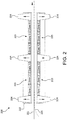
- Figure 2 schematically illustrates a portion of an exemplary 6 zone infra-red oven, described in detail infra.
- the temperature of each zone is determined by the particular polyamic acid, time of exposure, fiber diameter, emitter to emitter distance, residual solvent content, purge air temperature and flow, fiber web basis weight - (basis weight is the weight of the material in grams per square meter).
- conventional annealing range is 400-500 °C for PMDA/ODA, but is around 200 °C for BPDA/RODA; BPDA/RODA will decompose if heated to 400 °C.
- the fiber web is carried through the oven on a conveyor belt and goes through each zone for a total time in the range of 5 seconds to 5 minutes, set by the speed of the conveyor belt.
- the fiber web is not supported by a conveyor belt.
- the process of heating a polyamic acid fiber at a temperature in the range of the first temperature and the second temperature results in a degree of imidization (DOI) defined infra, of at least 0.51, preferably a DOI of at least 0.54, most preferably a DOI of at least 0.57.
- DOI degree of imidization
- analytical methods show that complete imidization is rarely achieved, even after long imidization times.
- complete imidization is achieved when the slope of the percentage imidization versus time curve approaches zero over some selected time interval to be determined according to the needs of the practitioner hereof.
- the polyamic acid fiber comprises a polyamic acid nanofiber.
- the polyamic acid nanofiber is in the form of a polyamic acid nanoweb.
- a polyamic acid nanoweb is calendered before the step of heating the polyamic acid at a temperature in the range of the first temperature to the second temperature for the conversion of the polyamic acid to the polyimide.
- Polyimides are typically referred to by the names of the condensation reactants that form the monomer unit. That practice will be followed herein.
- the polyimide formed from the monomer units: pyromellitic dianhydride (PMDA) and oxy-dianiline (ODA) and represented by the structure below is designated PMDA/ODA.
- the polyimide nanoweb consists essentially of polyimide nanofibers formed from the monomer units: pyromellitic dianhydride (PMDA) and oxy-dianiline (ODA), using the method described supra.
- the polyimide fiber of this invention comprises more than 80 weight% of one or more fully aromatic polyimides, more than 90 weight% of one or more fully aromatic polyimides, more than 95 weight% of one or more fully aromatic polyimides, more than 99 weight% of one or more fully aromatic polyimides, more than 99.9 weight% of one or more fully aromatic polyimides, or 100 weight% of one or more fully aromatic polyimides.
- the term "fully aromatic polyimide” refers specifically to polyimides in which the ratio of the imide C-N infrared absorbance at 1375 cm -1 to the p-substituted C-H infrared absorbance at 1500 cm -1 is greater than 0.51 and wherein at least 95% of the linkages between adjacent phenyl rings in the polymer backbone are effected either by a covalent bond or an ether linkage. Up to 25%, preferably up to 20%, most preferably up to 10%, of the linkages can be effected by aliphatic carbon, sulfide, sulfone, phosphide, or phosphone functionalities or a combination thereof.
- the aromatic rings making up the polymer backbone can have ring substituents of aliphatic carbon, sulfide, sulfone, phosphide, or phosphone.
- the fully aromatic polyimide suitable for use in the present contains no aliphatic carbon, sulfide, sulfone, phosphide, or phosphone.
- the infrared spectrum of a given sample was measured, and the ratio of the imide C-N absorbance at 1375 cm -1 to the p-substituted C-H absorbance at 1500 cm -1 was calculated. This ratio was taken as the degree of imidization (DOI). It has been found that a PMDA/ODA polyamic acid nanoweb that has been subject to imidization conditions for a time well in excess of that thought to be necessary to achieve maximum imidization exhibits a DOI of 0.57. By comparison, a PMDA/ODA film sample had a DOI of 0.65. The difference can be attributable to sample effects, such as orientation in the nanofibers in the nanoweb that is not present in the film.
- a fully imidized nanoweb is one in which the 1375/1500 cm -1 peak ratio (DOI) is greater than 0.51.
- the polyimide nanowebs hereof were analyzed by ATR-IR using a DuraSampl I R (ASI Applied Systems) accessory on a Nicolet Magna 560 FTIR (ThermoFisher Scientific). Spectra were collected from 4000-600 cm -1 and were corrected for the ATR effect (depth of penetration versus frequency).
- crystallinity index refers to a relative crystallinity parameter determined from Wide-Angle X-ray Diffraction (WAXD).
- WAXD Wide-Angle X-ray Diffraction
- X-ray diffraction data were collected with a PANalytical X'Pert MPD equipped with a Parabolic X-ray Mirror and Parallel Plate Collimator using Copper radiation.
- Samples for transmission geometry were prepared by stacking the thin films to a total thickness of approximately 0.7 mm. Data was collected over a range of two-theta of 3 to 45 degrees with a step size of 0.1 degree.
- Count time per data point was 10 seconds minimum with the sample rotating about the transmission axis at a rate of 0.1 revolutions per second.
- the WAXD scan so generated consisted of three contributions: 1) a background signal; 2) scattering from ordered but amorphous regions; and 3) scattering from crystalline regions.
- a polynomial background was fitted to the baseline of the diffraction data.
- the background function was chosen to be a third order polynomial in the two-theta diffraction angle variable.
- the background subtracted data was then least squares fitted with a series of Gaussian peaks which represented either ordered amorphous or crystalline components. Guided by experience with numerous samples of the same composition but widely differing in crystallinity, it was decided which peaks represented the crystalline regions.
- the ratio of the integral under the crystalline peaks so selected, to the integral under the overall scan curve with the background subtracted was the crystallinity index.
- Solution viscosity was determined using a Brookfield Engineering HADV-II+ Programmable Viscometer equipped with an RV/HA/HB-5 or - 6 spindle, and calibrated using NIST traceable silicone fluids.
- the spindle was immersed into the polymer solution at room temperature until the liquid level reached the indent on the spindle.
- the motor was turned on with the RPMs set to produce 10-20% nominal torque. For solutions of 40-70 poise, it was found that 10-20 rpm was appropriate with the RV/HA/HB-5 spindle and 20 rpm was appropriate for RV/HA/HB-6 spindle.
- Fiber diameter was determined using the following method.
- Electroblowing was introduced to overcome the productivity problem in electrospinning thin fibers.
- electroblowing a turbulent air flow is directed to the fibers as they are spun thereby forming a "cloud" of polymer fibers that is blown down onto the target surface as well as being electrostatically attracted.
- the combination of blowing and electrostatic forces greatly increases the productivity of the system. Electroblowing is described in detail in U.S. Published Patent Application No. 20050067732 .
- Nanowebs were prepared from the polyamic acid solutions prepared supra by electroblowing.
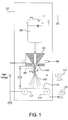
- Figure 1 depicts one embodiment of suitable electroblowing apparatus.
- the polymer solution was manually loaded using a syringe, not shown, into a 250 ml Hoke cylinder, 100 .
- a pressurized nitrogen supply, 101 was used to deliver the solution to a 10 cm wide spinneret, 102 , having 3 nozzles each with a diameter of 0.38 mm and length 3.8 mm, arranged 1 cm apart, centered in the spinneret.
- Heated, compressed air, 108 was fed to the spinneret and was ejected through slots, 106 .
- the fibers, 103 were both blown by the air and attracted by a DC voltage electric potential to a metallic plate collector, 110 which maintains the ground connection to a battery operated windup, 113 .
- a roll of scrim material, 114 was mounted on the end of the plate collector.
- the metallic plate collector, 110 , the battery operated windup, 113 , and the scrim material, 114 were removed and replaced with a rotating drum collector (not shown) connected to a ground .
- Heated, pressurized air, 115 was also blown into a Plexiglas® enclosure, 107 , containing the entire spinning apparatus.
- An exhaust blower, 116 was used to maintain atmospheric pressure inside the enclosure and to remove all evaporated solvent.
- PAA-2 - PAA-6 were employed in the preparation of nanowebs using the equipment and procedures employed in preparing NW-1. Specific conditions employed in preparing NW-1 to NW-6 are summarized in Table 18.
- FIG. 2 shows a schematic illustration of a portion of an infra-red oven, 200 .
- the oven enclosure, 222 contained four heating panels, 223 , each divided into three separate temperature zones. Zones facing each other in the panels, 223 , were controlled so that the temperature above and below the nanoweb, 221 was the same, thereby resulting in a total of 6 temperature zones in the oven, 200 .
- the total heated length within the oven, 200 was 48 inches.
- the oven, 200 also had optional support media, 225 , for the nanoweb, 221 , as shown in the Figure 2 .
- the nanowebs NW-1 and NW-2 were supported in the oven by a woven fiberglass fabric, 225 , which travelled with the nanowebs as a scrim or support material.
- the nanowebs NW-3, NM-4, and NW-5 were unsupported.
- the infrared oven, 200 also had an exhaust system to prevent solvent vapors from entering the laboratory. Room temperature air was pulled through entrance and exit openings of the oven, 200 , and vented through plenums, 224 . Temperatures of the emitters in each temperature zone and the total residence time of the nanowebs through the oven, 200 , are summarized in Table 5.
- nanoweb temperature can not be measured directly during the rapid heating method described above, it is reasonable to expect that it is below the temperature of the infrared emitters due to convective losses and incomplete infrared absorption.
- Table 6 shows that PI-NW-5 (1077 nm diameter) with a DOI of 0.57 can be imidized to similar extent as PI-NW-1 (660 nm diameter) with a DOI in the range of 0.53-0.59 when imidized for the same amount of time of 6 seconds. Furthermore, sub micron and micron sized fibers can be imidized at very short times, on the order of seconds. For example, PI-NW-5 was fully imidized at very short time of 6 seconds, even though with a mean fiber diameter of 1077 nm, PI-NW-5 had a distribution of fiber sizes with a small number of fibers as large as 2-3 microns and as small as 100 nm.
- a polyamic acid solution of PMDA, ODA, and phthalic anhydride in DMF was formed using 0.98 moles of PMDA, 1 mole of ODA, and 0.04 moles of phthalic anhydride.
- the polyamic acid solution with 22 weight % solids was spun into nanowebs using the apparatus of Figure 1 per the conditions shown below in Table 21: Table 7 Sample # Solution temp., oC Solution feed pressure , psi Process gas temp., oC Process gas flow, cfm Auxiliary air temp., oC Auxiliary air flow, cfm Calender pressure , pli NW-AA 24 90 25 17 102 14 1250 NW-BB 23 50 25 17 80 14 1500
- Nanowebs NW-AA and NW-BB were cut into hand sheets and calendered. Hand sheets were placed into a convection oven set to the temperatures for the times shown in Table 7. Samples were removed from the convection oven in between the various temperatures as the oven was allowed to heat up to the set temperature. The degree of imidization was then measured as described above.
Landscapes
- Engineering & Computer Science (AREA)
- Chemical & Material Sciences (AREA)
- Chemical Kinetics & Catalysis (AREA)
- Textile Engineering (AREA)
- Mechanical Engineering (AREA)
- Physics & Mathematics (AREA)
- Thermal Sciences (AREA)
- General Chemical & Material Sciences (AREA)
- Macromolecular Compounds Obtained By Forming Nitrogen-Containing Linkages In General (AREA)
- Artificial Filaments (AREA)
- Spinning Methods And Devices For Manufacturing Artificial Fibers (AREA)
Applications Claiming Priority (2)
| Application Number | Priority Date | Filing Date | Title |
|---|---|---|---|
| US12/899,770 US20110144297A1 (en) | 2009-12-15 | 2010-10-07 | Rapid thermal conversion of a polyamic acid fiber to a polyimide fiber |
| PCT/US2011/054863 WO2012047960A2 (en) | 2010-10-07 | 2011-10-05 | Rapid thermal conversion of a polyamic acid fiber to a polyimide fiber |
Publications (3)
| Publication Number | Publication Date |
|---|---|
| EP2625322A2 EP2625322A2 (en) | 2013-08-14 |
| EP2625322A4 EP2625322A4 (en) | 2017-04-19 |
| EP2625322B1 true EP2625322B1 (en) | 2019-01-09 |
Family
ID=45928587
Family Applications (1)
| Application Number | Title | Priority Date | Filing Date |
|---|---|---|---|
| EP11831496.2A Not-in-force EP2625322B1 (en) | 2010-10-07 | 2011-10-05 | Rapid thermal conversion of a polyamic acid fiber to a polyimide fiber |
Country Status (6)
| Country | Link |
|---|---|
| US (1) | US20110144297A1 (enExample) |
| EP (1) | EP2625322B1 (enExample) |
| JP (1) | JP6035632B2 (enExample) |
| KR (1) | KR20130115278A (enExample) |
| CN (1) | CN103154335B (enExample) |
| WO (1) | WO2012047960A2 (enExample) |
Families Citing this family (18)
| Publication number | Priority date | Publication date | Assignee | Title |
|---|---|---|---|---|
| CN102168317B (zh) * | 2011-03-11 | 2012-07-25 | 北京化工大学 | 一种聚酰亚胺纤维的制备方法 |
| US8679200B2 (en) | 2011-11-18 | 2014-03-25 | E I Du Pont De Nemours And Company | Method for reducing self discharge in an electrochemical cell |
| WO2013181333A1 (en) * | 2012-06-01 | 2013-12-05 | E. I. Du Pont De Nemours And Company | An electrochemical cell comprising a nanoweb comprising nanofibers of a cross-linked polyimide |
| US9090996B2 (en) * | 2012-08-15 | 2015-07-28 | E I Du Pont De Nemours And Company | Multizone electroblowing process |
| CN103337595B (zh) * | 2013-07-04 | 2016-04-06 | 上海和辉光电有限公司 | 柔性封装衬底及其制造方法和使用该衬底的oled封装方法 |
| JP5946565B1 (ja) * | 2015-06-23 | 2016-07-06 | 紘邦 張本 | 紡糸口金及び極細繊維製造装置 |
| CN105040276B (zh) * | 2015-06-23 | 2017-08-01 | 北京化工大学常州先进材料研究院 | 一种具有交联形貌的聚酰亚胺纤维膜及其制备方法 |
| WO2017007302A2 (en) * | 2015-07-06 | 2017-01-12 | Universiti Putra Malaysia | Post conditioning machine |
| CN105040512A (zh) * | 2015-09-09 | 2015-11-11 | 长春高琦聚酰亚胺材料有限公司 | 一种聚酰亚胺纸模塑制品及其制备方法 |
| US11077325B2 (en) | 2016-04-01 | 2021-08-03 | Dupont Safety & Construction, Inc. | Flame and particulate resistant knit article |
| CN105734710A (zh) * | 2016-05-06 | 2016-07-06 | 江苏奥神新材料股份有限公司 | 一种有色聚酰亚胺纤维的制备方法 |
| WO2018129244A1 (en) * | 2017-01-06 | 2018-07-12 | Sabic Global Technolgies B.V. | Apparatus for continuous needleless electrospinning a nanoscale or submicron scale polymer fiber web onto a substrate |
| CN106958047B (zh) * | 2017-04-06 | 2019-10-25 | 中国科学院长春应用化学研究所 | 一种热酰亚胺化制备聚酰亚胺纤维的方法 |
| US20190330766A1 (en) * | 2018-04-28 | 2019-10-31 | Dennis Joseph Steibel, JR. | Apparatus for removing moisture from a section of polymer filament |
| CN110681266B (zh) * | 2018-07-06 | 2021-11-30 | 中国石油化工股份有限公司 | 分离非质子极性溶剂中小分子溶剂的方法 |
| CN109509678A (zh) * | 2018-11-22 | 2019-03-22 | 漳州雅宝电子有限公司 | 一种熔点为236±2℃的耐高温热敏材料 |
| JP7504213B2 (ja) | 2020-09-25 | 2024-06-21 | 富士フイルム株式会社 | 硬化物の製造方法、積層体の製造方法、及び、半導体デバイスの製造方法 |
| CN119663548A (zh) * | 2024-12-17 | 2025-03-21 | 井冈山大学 | 一种萘基聚酰亚胺复合柔性纳米纤维材料及其制备方法和应用 |
Family Cites Families (31)
| Publication number | Priority date | Publication date | Assignee | Title |
|---|---|---|---|---|
| GB903272A (en) | 1959-04-01 | 1962-08-15 | Du Pont | Method of preparing polyimides |
| US3814719A (en) * | 1972-05-01 | 1974-06-04 | Ciba Geigy Corp | Zeta-triazine-imide copolymers |
| US4167620A (en) * | 1978-02-01 | 1979-09-11 | Standard Oil Company (Indiana) | Method for heat treating shaped articles of amide-imide or amic acid polymers |
| US4874368A (en) * | 1988-07-25 | 1989-10-17 | Micromedics, Inc. | Fibrin glue delivery system |
| CA2002147A1 (en) * | 1988-11-07 | 1990-05-07 | Shuichi Morikawa | Production process for polyimide fibers |
| JPH02234911A (ja) * | 1988-11-07 | 1990-09-18 | Mitsui Toatsu Chem Inc | ポリイミド繊維の製造方法 |
| JPH0314617A (ja) * | 1989-06-12 | 1991-01-23 | Asahi Chem Ind Co Ltd | 高強度、高弾性率ポリイミド成形物の製造方法 |
| US5374708A (en) * | 1989-12-22 | 1994-12-20 | Mitsui Toatsu Chemicals, Incorporated | Formed polyimide article |
| US5089360A (en) * | 1990-02-08 | 1992-02-18 | Tonen Chemical Corporation | High-strength non-woven fabric, method of producing same and battery separator constituted thereby |
| JP2626827B2 (ja) * | 1990-03-15 | 1997-07-02 | 宇部興産株式会社 | ポリイミド延伸成形体及びその製造法 |
| US5367046A (en) * | 1992-04-10 | 1994-11-22 | The United States Of America As Represented By The Administrator Of The National Aeronautics And Space Administration | Low dielectric polyimide fibers |
| US5518779A (en) * | 1992-12-16 | 1996-05-21 | Industrial Technology Research Institute | Forming copper clad laminates |
| KR0161313B1 (ko) * | 1994-10-31 | 1999-01-15 | 강박광 | 폴리이미드 아미 에스테르 화합물 및 그 제조방법 |
| EP0751168B1 (en) * | 1995-06-28 | 1999-02-10 | Mitsui Chemicals, Inc. | Linear polyamic acid, linear polyimide and thermoset polyimide |
| JPH11269268A (ja) * | 1998-03-20 | 1999-10-05 | Mitsui Chem Inc | 線状ポリアミド酸、線状ポリイミド及び熱硬化性ポリイミド |
| JP2000071268A (ja) * | 1998-08-31 | 2000-03-07 | Du Pont Toray Co Ltd | ポリイミドフィルムおよびその製造方法 |
| ATA49899A (de) * | 1999-03-19 | 2002-06-15 | Immuno Ag | Verfahren und vorrichtung zum mischen von komponenten |
| CN1216092C (zh) * | 1999-09-24 | 2005-08-24 | 液态空气-乔治克罗德方法研究监督及咨询股份有限公司 | 新的聚酰亚胺酰胺酸盐以及由此形成的聚酰亚胺膜 |
| US6599675B2 (en) * | 2000-04-28 | 2003-07-29 | Mitsui Chemicals, Inc. | Polyimides and polyamic acids |
| JP4390028B2 (ja) * | 2000-10-04 | 2009-12-24 | 日産化学工業株式会社 | ポジ型感光性ポリイミド樹脂組成物 |
| EP1229066A1 (en) * | 2001-02-05 | 2002-08-07 | Rolic AG | Photoactive polymer |
| US20040166311A1 (en) * | 2003-02-25 | 2004-08-26 | Clemson University | Electrostatic spinning of aromatic polyamic acid |
| JP2004308031A (ja) * | 2003-04-03 | 2004-11-04 | Teijin Ltd | ポリアミド酸不織布、それから得られるポリイミド不織布およびそれらの製造方法 |
| EP1796746B1 (en) * | 2004-10-07 | 2011-05-04 | E.I. Du Pont De Nemours And Company | Polysaccharide-based polymer tissue adhesive for medical use |
| JP2008002011A (ja) * | 2006-06-22 | 2008-01-10 | Toyobo Co Ltd | ポリイミド不織布およびその製造方法 |
| JP2009203314A (ja) * | 2008-02-27 | 2009-09-10 | Toyobo Co Ltd | ポリイミド繊維補強熱可塑性樹脂板状体およびその製造方法 |
| CA2640517A1 (en) * | 2008-05-19 | 2009-11-19 | Industry-University Cooperation Foundation, Hanyang University | Polyamic acids dope composition, preparation method of hollow fiber using the same and hollow fiber prepared therefrom |
| JP2010077565A (ja) * | 2008-09-26 | 2010-04-08 | Kaneka Corp | ポリイミド繊維及びその利用、並びに当該ポリイミド繊維の製造方法。 |
| JP5429101B2 (ja) * | 2009-11-25 | 2014-02-26 | 宇部興産株式会社 | 高耐熱性ポリイミド微細繊維の製造方法、高耐熱性ポリイミド微細繊維及び該ポリイミド微細繊維からなる不織布 |
| US20110139331A1 (en) * | 2009-12-15 | 2011-06-16 | E. I. Du Pont De Nemours And Company | Method for increasing the strength and solvent resistance of polyimide nanowebs |
| JP6003261B2 (ja) * | 2012-06-12 | 2016-10-05 | 宇部興産株式会社 | ポリイミド繊維の製造方法 |
-
2010
- 2010-10-07 US US12/899,770 patent/US20110144297A1/en not_active Abandoned
-
2011
- 2011-10-05 WO PCT/US2011/054863 patent/WO2012047960A2/en not_active Ceased
- 2011-10-05 EP EP11831496.2A patent/EP2625322B1/en not_active Not-in-force
- 2011-10-05 CN CN201180047942.XA patent/CN103154335B/zh not_active Expired - Fee Related
- 2011-10-05 JP JP2013532899A patent/JP6035632B2/ja not_active Expired - Fee Related
- 2011-10-05 KR KR1020137011698A patent/KR20130115278A/ko not_active Withdrawn
Non-Patent Citations (1)
| Title |
|---|
| None * |
Also Published As
| Publication number | Publication date |
|---|---|
| WO2012047960A2 (en) | 2012-04-12 |
| JP2013539824A (ja) | 2013-10-28 |
| KR20130115278A (ko) | 2013-10-21 |
| EP2625322A4 (en) | 2017-04-19 |
| US20110144297A1 (en) | 2011-06-16 |
| WO2012047960A3 (en) | 2012-08-02 |
| CN103154335A (zh) | 2013-06-12 |
| CN103154335B (zh) | 2016-08-24 |
| JP6035632B2 (ja) | 2016-11-30 |
| EP2625322A2 (en) | 2013-08-14 |
Similar Documents
| Publication | Publication Date | Title |
|---|---|---|
| US20110144297A1 (en) | Rapid thermal conversion of a polyamic acid fiber to a polyimide fiber | |
| US9394638B2 (en) | Polyimide nonwoven fabric and process for production thereof | |
| US9346927B2 (en) | Colored polyimide molded article, and process for production thereof | |
| KR840001609B1 (ko) | 가스분리재(gas separating material)의 제조방법 | |
| KR101796137B1 (ko) | 스트레칭 기구 및 이것을 사용한 폴리이미드 막의 제조 방법 | |
| US8980421B2 (en) | Porous polyimide membrane and process for production thereof | |
| CN101027345B (zh) | 新型聚酰亚胺膜以及使用其而得到的粘接膜、柔性覆金属层压板 | |
| TWI714971B (zh) | 聚醯亞胺膜、其製備方法、使用其製備的石墨片以及電子裝置 | |
| CN110944744A (zh) | 大孔结构的聚合物气凝胶 | |
| GB2102334A (en) | Producing aromatic polyimide membrane | |
| GB2104411A (en) | Aromatic polyimide composite separating membrane | |
| TWI580712B (zh) | 聚亞醯胺膜 | |
| KR20170076171A (ko) | 폴리(아미드-이미드) 코폴리머 필름, 및 이를 포함하는 표시 장치 | |
| TWI735550B (zh) | 聚醯胺酸、聚醯胺酸溶液、聚醯亞胺、及聚醯亞胺基板與其等之製造方法 | |
| JP5429101B2 (ja) | 高耐熱性ポリイミド微細繊維の製造方法、高耐熱性ポリイミド微細繊維及び該ポリイミド微細繊維からなる不織布 | |
| KR20130111951A (ko) | 폴리이미드 필름의 제조 방법, 폴리이미드 필름, 및 그 폴리이미드 필름을 사용하여 제조한 적층체 | |
| JP2023525572A (ja) | エアロゲル層を含む高温断熱積層体 | |
| EP0393638B1 (en) | Thermosetting resin compostion and thermosetting dry film | |
| JP4406764B2 (ja) | ガスバリアー性ポリイミドフィルムおよびそれを用いた金属積層体 | |
| KR20150115461A (ko) | 폴리이미드 복합기판의 제조방법 및 이로 제조된 폴리이미드 복합기판 | |
| JP5277680B2 (ja) | ポリイミドフィルムの製造方法 | |
| TWI741030B (zh) | 聚醯亞胺膜 | |
| CN100535036C (zh) | 新型聚酰亚胺膜 | |
| JP2011131456A (ja) | ガスバリアー性ポリイミドフィルムおよびそれを用いた金属積層体 | |
| US20170362385A1 (en) | Polyimide-forming compositions, methods of manufacture, and articles prepared therefrom |
Legal Events
| Date | Code | Title | Description |
|---|---|---|---|
| PUAI | Public reference made under article 153(3) epc to a published international application that has entered the european phase |
Free format text: ORIGINAL CODE: 0009012 |
|
| 17P | Request for examination filed |
Effective date: 20130329 |
|
| AK | Designated contracting states |
Kind code of ref document: A2 Designated state(s): AL AT BE BG CH CY CZ DE DK EE ES FI FR GB GR HR HU IE IS IT LI LT LU LV MC MK MT NL NO PL PT RO RS SE SI SK SM TR |
|
| DAX | Request for extension of the european patent (deleted) | ||
| A4 | Supplementary search report drawn up and despatched |
Effective date: 20170322 |
|
| RIC1 | Information provided on ipc code assigned before grant |
Ipc: B01D 71/64 20060101ALI20170316BHEP Ipc: D04H 1/4326 20120101ALI20170316BHEP Ipc: D04H 1/728 20120101ALI20170316BHEP Ipc: B01D 69/06 20060101ALI20170316BHEP Ipc: D04H 1/4342 20120101ALI20170316BHEP Ipc: D01F 6/60 20060101ALI20170316BHEP Ipc: D01D 10/02 20060101AFI20170316BHEP Ipc: D01F 6/80 20060101ALI20170316BHEP Ipc: D06C 7/00 20060101ALI20170316BHEP |
|
| STAA | Information on the status of an ep patent application or granted ep patent |
Free format text: STATUS: EXAMINATION IS IN PROGRESS |
|
| 17Q | First examination report despatched |
Effective date: 20171218 |
|
| GRAP | Despatch of communication of intention to grant a patent |
Free format text: ORIGINAL CODE: EPIDOSNIGR1 |
|
| STAA | Information on the status of an ep patent application or granted ep patent |
Free format text: STATUS: GRANT OF PATENT IS INTENDED |
|
| INTG | Intention to grant announced |
Effective date: 20180816 |
|
| GRAS | Grant fee paid |
Free format text: ORIGINAL CODE: EPIDOSNIGR3 |
|
| GRAA | (expected) grant |
Free format text: ORIGINAL CODE: 0009210 |
|
| STAA | Information on the status of an ep patent application or granted ep patent |
Free format text: STATUS: THE PATENT HAS BEEN GRANTED |
|
| AK | Designated contracting states |
Kind code of ref document: B1 Designated state(s): AL AT BE BG CH CY CZ DE DK EE ES FI FR GB GR HR HU IE IS IT LI LT LU LV MC MK MT NL NO PL PT RO RS SE SI SK SM TR |
|
| REG | Reference to a national code |
Ref country code: GB Ref legal event code: FG4D |
|
| REG | Reference to a national code |
Ref country code: CH Ref legal event code: EP Ref country code: AT Ref legal event code: REF Ref document number: 1087403 Country of ref document: AT Kind code of ref document: T Effective date: 20190115 |
|
| REG | Reference to a national code |
Ref country code: DE Ref legal event code: R096 Ref document number: 602011055646 Country of ref document: DE |
|
| REG | Reference to a national code |
Ref country code: IE Ref legal event code: FG4D |
|
| REG | Reference to a national code |
Ref country code: NL Ref legal event code: MP Effective date: 20190109 |
|
| REG | Reference to a national code |
Ref country code: LT Ref legal event code: MG4D |
|
| PG25 | Lapsed in a contracting state [announced via postgrant information from national office to epo] |
Ref country code: NL Free format text: LAPSE BECAUSE OF FAILURE TO SUBMIT A TRANSLATION OF THE DESCRIPTION OR TO PAY THE FEE WITHIN THE PRESCRIBED TIME-LIMIT Effective date: 20190109 |
|
| REG | Reference to a national code |
Ref country code: AT Ref legal event code: MK05 Ref document number: 1087403 Country of ref document: AT Kind code of ref document: T Effective date: 20190109 |
|
| PG25 | Lapsed in a contracting state [announced via postgrant information from national office to epo] |
Ref country code: PL Free format text: LAPSE BECAUSE OF FAILURE TO SUBMIT A TRANSLATION OF THE DESCRIPTION OR TO PAY THE FEE WITHIN THE PRESCRIBED TIME-LIMIT Effective date: 20190109 Ref country code: FI Free format text: LAPSE BECAUSE OF FAILURE TO SUBMIT A TRANSLATION OF THE DESCRIPTION OR TO PAY THE FEE WITHIN THE PRESCRIBED TIME-LIMIT Effective date: 20190109 Ref country code: LT Free format text: LAPSE BECAUSE OF FAILURE TO SUBMIT A TRANSLATION OF THE DESCRIPTION OR TO PAY THE FEE WITHIN THE PRESCRIBED TIME-LIMIT Effective date: 20190109 Ref country code: SE Free format text: LAPSE BECAUSE OF FAILURE TO SUBMIT A TRANSLATION OF THE DESCRIPTION OR TO PAY THE FEE WITHIN THE PRESCRIBED TIME-LIMIT Effective date: 20190109 Ref country code: NO Free format text: LAPSE BECAUSE OF FAILURE TO SUBMIT A TRANSLATION OF THE DESCRIPTION OR TO PAY THE FEE WITHIN THE PRESCRIBED TIME-LIMIT Effective date: 20190409 Ref country code: PT Free format text: LAPSE BECAUSE OF FAILURE TO SUBMIT A TRANSLATION OF THE DESCRIPTION OR TO PAY THE FEE WITHIN THE PRESCRIBED TIME-LIMIT Effective date: 20190509 Ref country code: ES Free format text: LAPSE BECAUSE OF FAILURE TO SUBMIT A TRANSLATION OF THE DESCRIPTION OR TO PAY THE FEE WITHIN THE PRESCRIBED TIME-LIMIT Effective date: 20190109 |
|
| PG25 | Lapsed in a contracting state [announced via postgrant information from national office to epo] |
Ref country code: GR Free format text: LAPSE BECAUSE OF FAILURE TO SUBMIT A TRANSLATION OF THE DESCRIPTION OR TO PAY THE FEE WITHIN THE PRESCRIBED TIME-LIMIT Effective date: 20190410 Ref country code: RS Free format text: LAPSE BECAUSE OF FAILURE TO SUBMIT A TRANSLATION OF THE DESCRIPTION OR TO PAY THE FEE WITHIN THE PRESCRIBED TIME-LIMIT Effective date: 20190109 Ref country code: BG Free format text: LAPSE BECAUSE OF FAILURE TO SUBMIT A TRANSLATION OF THE DESCRIPTION OR TO PAY THE FEE WITHIN THE PRESCRIBED TIME-LIMIT Effective date: 20190409 Ref country code: IS Free format text: LAPSE BECAUSE OF FAILURE TO SUBMIT A TRANSLATION OF THE DESCRIPTION OR TO PAY THE FEE WITHIN THE PRESCRIBED TIME-LIMIT Effective date: 20190509 Ref country code: HR Free format text: LAPSE BECAUSE OF FAILURE TO SUBMIT A TRANSLATION OF THE DESCRIPTION OR TO PAY THE FEE WITHIN THE PRESCRIBED TIME-LIMIT Effective date: 20190109 Ref country code: LV Free format text: LAPSE BECAUSE OF FAILURE TO SUBMIT A TRANSLATION OF THE DESCRIPTION OR TO PAY THE FEE WITHIN THE PRESCRIBED TIME-LIMIT Effective date: 20190109 |
|
| REG | Reference to a national code |
Ref country code: DE Ref legal event code: R097 Ref document number: 602011055646 Country of ref document: DE |
|
| PG25 | Lapsed in a contracting state [announced via postgrant information from national office to epo] |
Ref country code: AT Free format text: LAPSE BECAUSE OF FAILURE TO SUBMIT A TRANSLATION OF THE DESCRIPTION OR TO PAY THE FEE WITHIN THE PRESCRIBED TIME-LIMIT Effective date: 20190109 Ref country code: AL Free format text: LAPSE BECAUSE OF FAILURE TO SUBMIT A TRANSLATION OF THE DESCRIPTION OR TO PAY THE FEE WITHIN THE PRESCRIBED TIME-LIMIT Effective date: 20190109 Ref country code: EE Free format text: LAPSE BECAUSE OF FAILURE TO SUBMIT A TRANSLATION OF THE DESCRIPTION OR TO PAY THE FEE WITHIN THE PRESCRIBED TIME-LIMIT Effective date: 20190109 Ref country code: DK Free format text: LAPSE BECAUSE OF FAILURE TO SUBMIT A TRANSLATION OF THE DESCRIPTION OR TO PAY THE FEE WITHIN THE PRESCRIBED TIME-LIMIT Effective date: 20190109 Ref country code: SK Free format text: LAPSE BECAUSE OF FAILURE TO SUBMIT A TRANSLATION OF THE DESCRIPTION OR TO PAY THE FEE WITHIN THE PRESCRIBED TIME-LIMIT Effective date: 20190109 Ref country code: RO Free format text: LAPSE BECAUSE OF FAILURE TO SUBMIT A TRANSLATION OF THE DESCRIPTION OR TO PAY THE FEE WITHIN THE PRESCRIBED TIME-LIMIT Effective date: 20190109 Ref country code: IT Free format text: LAPSE BECAUSE OF FAILURE TO SUBMIT A TRANSLATION OF THE DESCRIPTION OR TO PAY THE FEE WITHIN THE PRESCRIBED TIME-LIMIT Effective date: 20190109 Ref country code: CZ Free format text: LAPSE BECAUSE OF FAILURE TO SUBMIT A TRANSLATION OF THE DESCRIPTION OR TO PAY THE FEE WITHIN THE PRESCRIBED TIME-LIMIT Effective date: 20190109 |
|
| PLBE | No opposition filed within time limit |
Free format text: ORIGINAL CODE: 0009261 |
|
| STAA | Information on the status of an ep patent application or granted ep patent |
Free format text: STATUS: NO OPPOSITION FILED WITHIN TIME LIMIT |
|
| PG25 | Lapsed in a contracting state [announced via postgrant information from national office to epo] |
Ref country code: SM Free format text: LAPSE BECAUSE OF FAILURE TO SUBMIT A TRANSLATION OF THE DESCRIPTION OR TO PAY THE FEE WITHIN THE PRESCRIBED TIME-LIMIT Effective date: 20190109 |
|
| 26N | No opposition filed |
Effective date: 20191010 |
|
| PG25 | Lapsed in a contracting state [announced via postgrant information from national office to epo] |
Ref country code: SI Free format text: LAPSE BECAUSE OF FAILURE TO SUBMIT A TRANSLATION OF THE DESCRIPTION OR TO PAY THE FEE WITHIN THE PRESCRIBED TIME-LIMIT Effective date: 20190109 |
|
| PG25 | Lapsed in a contracting state [announced via postgrant information from national office to epo] |
Ref country code: TR Free format text: LAPSE BECAUSE OF FAILURE TO SUBMIT A TRANSLATION OF THE DESCRIPTION OR TO PAY THE FEE WITHIN THE PRESCRIBED TIME-LIMIT Effective date: 20190109 |
|
| PG25 | Lapsed in a contracting state [announced via postgrant information from national office to epo] |
Ref country code: MC Free format text: LAPSE BECAUSE OF FAILURE TO SUBMIT A TRANSLATION OF THE DESCRIPTION OR TO PAY THE FEE WITHIN THE PRESCRIBED TIME-LIMIT Effective date: 20190109 |
|
| REG | Reference to a national code |
Ref country code: CH Ref legal event code: PL |
|
| PG25 | Lapsed in a contracting state [announced via postgrant information from national office to epo] |
Ref country code: LI Free format text: LAPSE BECAUSE OF NON-PAYMENT OF DUE FEES Effective date: 20191031 Ref country code: LU Free format text: LAPSE BECAUSE OF NON-PAYMENT OF DUE FEES Effective date: 20191005 Ref country code: CH Free format text: LAPSE BECAUSE OF NON-PAYMENT OF DUE FEES Effective date: 20191031 |
|
| REG | Reference to a national code |
Ref country code: BE Ref legal event code: MM Effective date: 20191031 |
|
| PG25 | Lapsed in a contracting state [announced via postgrant information from national office to epo] |
Ref country code: BE Free format text: LAPSE BECAUSE OF NON-PAYMENT OF DUE FEES Effective date: 20191031 |
|
| PG25 | Lapsed in a contracting state [announced via postgrant information from national office to epo] |
Ref country code: IE Free format text: LAPSE BECAUSE OF NON-PAYMENT OF DUE FEES Effective date: 20191005 |
|
| PG25 | Lapsed in a contracting state [announced via postgrant information from national office to epo] |
Ref country code: CY Free format text: LAPSE BECAUSE OF FAILURE TO SUBMIT A TRANSLATION OF THE DESCRIPTION OR TO PAY THE FEE WITHIN THE PRESCRIBED TIME-LIMIT Effective date: 20190109 |
|
| PG25 | Lapsed in a contracting state [announced via postgrant information from national office to epo] |
Ref country code: MT Free format text: LAPSE BECAUSE OF FAILURE TO SUBMIT A TRANSLATION OF THE DESCRIPTION OR TO PAY THE FEE WITHIN THE PRESCRIBED TIME-LIMIT Effective date: 20190109 Ref country code: HU Free format text: LAPSE BECAUSE OF FAILURE TO SUBMIT A TRANSLATION OF THE DESCRIPTION OR TO PAY THE FEE WITHIN THE PRESCRIBED TIME-LIMIT; INVALID AB INITIO Effective date: 20111005 |
|
| PG25 | Lapsed in a contracting state [announced via postgrant information from national office to epo] |
Ref country code: MK Free format text: LAPSE BECAUSE OF FAILURE TO SUBMIT A TRANSLATION OF THE DESCRIPTION OR TO PAY THE FEE WITHIN THE PRESCRIBED TIME-LIMIT Effective date: 20190109 |
|
| REG | Reference to a national code |
Ref country code: DE Ref legal event code: R081 Ref document number: 602011055646 Country of ref document: DE Owner name: DUPONT SAFETY & CONSTRUCTION, INC., WILMINGTON, US Free format text: FORMER OWNER: E.I. DU PONT DE NEMOURS AND CO., WILMINGTON, DEL., US |
|
| REG | Reference to a national code |
Ref country code: GB Ref legal event code: 732E Free format text: REGISTERED BETWEEN 20221027 AND 20221102 |
|
| P01 | Opt-out of the competence of the unified patent court (upc) registered |
Effective date: 20230528 |
|
| PGFP | Annual fee paid to national office [announced via postgrant information from national office to epo] |
Ref country code: GB Payment date: 20230831 Year of fee payment: 13 |
|
| PGFP | Annual fee paid to national office [announced via postgrant information from national office to epo] |
Ref country code: FR Payment date: 20230911 Year of fee payment: 13 |
|
| PGFP | Annual fee paid to national office [announced via postgrant information from national office to epo] |
Ref country code: DE Payment date: 20230830 Year of fee payment: 13 |
|
| REG | Reference to a national code |
Ref country code: DE Ref legal event code: R119 Ref document number: 602011055646 Country of ref document: DE |
|
| GBPC | Gb: european patent ceased through non-payment of renewal fee |
Effective date: 20241005 |
|
| PG25 | Lapsed in a contracting state [announced via postgrant information from national office to epo] |
Ref country code: DE Free format text: LAPSE BECAUSE OF NON-PAYMENT OF DUE FEES Effective date: 20250501 |
|
| PG25 | Lapsed in a contracting state [announced via postgrant information from national office to epo] |
Ref country code: GB Free format text: LAPSE BECAUSE OF NON-PAYMENT OF DUE FEES Effective date: 20241005 |
|
| PG25 | Lapsed in a contracting state [announced via postgrant information from national office to epo] |
Ref country code: FR Free format text: LAPSE BECAUSE OF NON-PAYMENT OF DUE FEES Effective date: 20241031 |