EP2432744B1 - Dünne substrate mit mechanisch widerstandsfähigen kanten - Google Patents
Dünne substrate mit mechanisch widerstandsfähigen kanten Download PDFInfo
- Publication number
- EP2432744B1 EP2432744B1 EP10724205.9A EP10724205A EP2432744B1 EP 2432744 B1 EP2432744 B1 EP 2432744B1 EP 10724205 A EP10724205 A EP 10724205A EP 2432744 B1 EP2432744 B1 EP 2432744B1
- Authority
- EP
- European Patent Office
- Prior art keywords
- substrate
- glass
- mol
- high strength
- sheet
- Prior art date
- Legal status (The legal status is an assumption and is not a legal conclusion. Google has not performed a legal analysis and makes no representation as to the accuracy of the status listed.)
- Not-in-force
Links
- 239000000758 substrate Substances 0.000 title claims description 90
- 239000011521 glass Substances 0.000 claims description 65
- 238000000034 method Methods 0.000 claims description 37
- 238000000576 coating method Methods 0.000 claims description 35
- 239000011248 coating agent Substances 0.000 claims description 30
- 238000003698 laser cutting Methods 0.000 claims description 16
- 238000005520 cutting process Methods 0.000 claims description 13
- 239000002344 surface layer Substances 0.000 claims description 13
- 239000010410 layer Substances 0.000 claims description 12
- 238000012360 testing method Methods 0.000 claims description 12
- 239000002241 glass-ceramic Substances 0.000 claims description 9
- 239000000919 ceramic Substances 0.000 claims description 6
- 230000007547 defect Effects 0.000 claims description 6
- 238000003286 fusion draw glass process Methods 0.000 claims description 5
- 238000004519 manufacturing process Methods 0.000 claims description 5
- 229920001296 polysiloxane Polymers 0.000 claims description 4
- 230000001681 protective effect Effects 0.000 claims description 4
- NIXOWILDQLNWCW-UHFFFAOYSA-M Acrylate Chemical compound [O-]C(=O)C=C NIXOWILDQLNWCW-UHFFFAOYSA-M 0.000 claims description 3
- 239000004593 Epoxy Substances 0.000 claims description 3
- JOYRKODLDBILNP-UHFFFAOYSA-N Ethyl urethane Chemical compound CCOC(N)=O JOYRKODLDBILNP-UHFFFAOYSA-N 0.000 claims description 3
- 239000006059 cover glass Substances 0.000 claims description 2
- 238000005304 joining Methods 0.000 claims description 2
- 238000000151 deposition Methods 0.000 claims 1
- VYPSYNLAJGMNEJ-UHFFFAOYSA-N Silicium dioxide Chemical compound O=[Si]=O VYPSYNLAJGMNEJ-UHFFFAOYSA-N 0.000 description 22
- KKCBUQHMOMHUOY-UHFFFAOYSA-N Na2O Inorganic materials [O-2].[Na+].[Na+] KKCBUQHMOMHUOY-UHFFFAOYSA-N 0.000 description 20
- 239000005358 alkali aluminosilicate glass Substances 0.000 description 16
- PNEYBMLMFCGWSK-UHFFFAOYSA-N aluminium oxide Inorganic materials [O-2].[O-2].[O-2].[Al+3].[Al+3] PNEYBMLMFCGWSK-UHFFFAOYSA-N 0.000 description 14
- 229910052593 corundum Inorganic materials 0.000 description 14
- 229910001845 yogo sapphire Inorganic materials 0.000 description 14
- MCMNRKCIXSYSNV-UHFFFAOYSA-N Zirconium dioxide Chemical compound O=[Zr]=O MCMNRKCIXSYSNV-UHFFFAOYSA-N 0.000 description 12
- 238000005342 ion exchange Methods 0.000 description 12
- 229910052681 coesite Inorganic materials 0.000 description 10
- 229910052906 cristobalite Inorganic materials 0.000 description 10
- 239000000377 silicon dioxide Substances 0.000 description 10
- 229910052682 stishovite Inorganic materials 0.000 description 10
- 229910052905 tridymite Inorganic materials 0.000 description 10
- FUJCRWPEOMXPAD-UHFFFAOYSA-N Li2O Inorganic materials [Li+].[Li+].[O-2] FUJCRWPEOMXPAD-UHFFFAOYSA-N 0.000 description 8
- XUCJHNOBJLKZNU-UHFFFAOYSA-M dilithium;hydroxide Chemical compound [Li+].[Li+].[OH-] XUCJHNOBJLKZNU-UHFFFAOYSA-M 0.000 description 8
- 238000007654 immersion Methods 0.000 description 8
- 150000002500 ions Chemical class 0.000 description 8
- 239000000463 material Substances 0.000 description 8
- 239000000203 mixture Substances 0.000 description 8
- 238000007730 finishing process Methods 0.000 description 7
- 238000000926 separation method Methods 0.000 description 7
- GOLCXWYRSKYTSP-UHFFFAOYSA-N Arsenious Acid Chemical compound O1[As]2O[As]1O2 GOLCXWYRSKYTSP-UHFFFAOYSA-N 0.000 description 6
- 230000000670 limiting effect Effects 0.000 description 6
- 150000003839 salts Chemical class 0.000 description 6
- XOLBLPGZBRYERU-UHFFFAOYSA-N tin dioxide Chemical compound O=[Sn]=O XOLBLPGZBRYERU-UHFFFAOYSA-N 0.000 description 6
- 238000010791 quenching Methods 0.000 description 5
- 230000000171 quenching effect Effects 0.000 description 5
- XLYOFNOQVPJJNP-UHFFFAOYSA-N water Substances O XLYOFNOQVPJJNP-UHFFFAOYSA-N 0.000 description 5
- GWEVSGVZZGPLCZ-UHFFFAOYSA-N Titan oxide Chemical compound O=[Ti]=O GWEVSGVZZGPLCZ-UHFFFAOYSA-N 0.000 description 4
- 239000006112 glass ceramic composition Substances 0.000 description 4
- 238000010438 heat treatment Methods 0.000 description 4
- 238000000879 optical micrograph Methods 0.000 description 4
- 238000003283 slot draw process Methods 0.000 description 4
- 238000005728 strengthening Methods 0.000 description 4
- 229910052783 alkali metal Inorganic materials 0.000 description 3
- -1 alkali metal cations Chemical class 0.000 description 3
- 239000005407 aluminoborosilicate glass Substances 0.000 description 3
- 238000005452 bending Methods 0.000 description 3
- 229910010293 ceramic material Inorganic materials 0.000 description 3
- 238000003280 down draw process Methods 0.000 description 3
- 230000003287 optical effect Effects 0.000 description 3
- 238000005498 polishing Methods 0.000 description 3
- 239000000853 adhesive Substances 0.000 description 2
- 230000001070 adhesive effect Effects 0.000 description 2
- 238000000137 annealing Methods 0.000 description 2
- ADCOVFLJGNWWNZ-UHFFFAOYSA-N antimony trioxide Inorganic materials O=[Sb]O[Sb]=O ADCOVFLJGNWWNZ-UHFFFAOYSA-N 0.000 description 2
- 239000005388 borosilicate glass Substances 0.000 description 2
- 150000001768 cations Chemical class 0.000 description 2
- CETPSERCERDGAM-UHFFFAOYSA-N ceric oxide Chemical compound O=[Ce]=O CETPSERCERDGAM-UHFFFAOYSA-N 0.000 description 2
- 229910000422 cerium(IV) oxide Inorganic materials 0.000 description 2
- 238000003426 chemical strengthening reaction Methods 0.000 description 2
- 238000013001 point bending Methods 0.000 description 2
- 230000002829 reductive effect Effects 0.000 description 2
- 239000006058 strengthened glass Substances 0.000 description 2
- 239000000126 substance Substances 0.000 description 2
- YEAUATLBSVJFOY-UHFFFAOYSA-N tetraantimony hexaoxide Chemical compound O1[Sb](O2)O[Sb]3O[Sb]1O[Sb]2O3 YEAUATLBSVJFOY-UHFFFAOYSA-N 0.000 description 2
- 238000011282 treatment Methods 0.000 description 2
- 238000005406 washing Methods 0.000 description 2
- WHXSMMKQMYFTQS-UHFFFAOYSA-N Lithium Chemical compound [Li] WHXSMMKQMYFTQS-UHFFFAOYSA-N 0.000 description 1
- 238000005299 abrasion Methods 0.000 description 1
- 230000002378 acidificating effect Effects 0.000 description 1
- 230000006978 adaptation Effects 0.000 description 1
- 229910001413 alkali metal ion Inorganic materials 0.000 description 1
- 150000001340 alkali metals Chemical class 0.000 description 1
- 230000003667 anti-reflective effect Effects 0.000 description 1
- 229910052787 antimony Inorganic materials 0.000 description 1
- WATWJIUSRGPENY-UHFFFAOYSA-N antimony atom Chemical compound [Sb] WATWJIUSRGPENY-UHFFFAOYSA-N 0.000 description 1
- 229910052785 arsenic Inorganic materials 0.000 description 1
- RQNWIZPPADIBDY-UHFFFAOYSA-N arsenic atom Chemical compound [As] RQNWIZPPADIBDY-UHFFFAOYSA-N 0.000 description 1
- 229910052788 barium Inorganic materials 0.000 description 1
- DSAJWYNOEDNPEQ-UHFFFAOYSA-N barium atom Chemical compound [Ba] DSAJWYNOEDNPEQ-UHFFFAOYSA-N 0.000 description 1
- 239000004568 cement Substances 0.000 description 1
- 238000003486 chemical etching Methods 0.000 description 1
- 239000005345 chemically strengthened glass Substances 0.000 description 1
- 150000003841 chloride salts Chemical class 0.000 description 1
- 239000008199 coating composition Substances 0.000 description 1
- 239000008119 colloidal silica Substances 0.000 description 1
- 238000004891 communication Methods 0.000 description 1
- 239000002131 composite material Substances 0.000 description 1
- 238000011109 contamination Methods 0.000 description 1
- 230000003247 decreasing effect Effects 0.000 description 1
- 238000009792 diffusion process Methods 0.000 description 1
- 238000007598 dipping method Methods 0.000 description 1
- 239000006185 dispersion Substances 0.000 description 1
- 230000009977 dual effect Effects 0.000 description 1
- 238000007688 edging Methods 0.000 description 1
- 230000000694 effects Effects 0.000 description 1
- 238000005530 etching Methods 0.000 description 1
- 239000006025 fining agent Substances 0.000 description 1
- 238000000227 grinding Methods 0.000 description 1
- 230000000977 initiatory effect Effects 0.000 description 1
- JEIPFZHSYJVQDO-UHFFFAOYSA-N iron(III) oxide Inorganic materials O=[Fe]O[Fe]=O JEIPFZHSYJVQDO-UHFFFAOYSA-N 0.000 description 1
- 229910052744 lithium Inorganic materials 0.000 description 1
- 238000010002 mechanical finishing Methods 0.000 description 1
- 230000005226 mechanical processes and functions Effects 0.000 description 1
- 238000012986 modification Methods 0.000 description 1
- 230000004048 modification Effects 0.000 description 1
- 229910052664 nepheline Inorganic materials 0.000 description 1
- 239000010434 nepheline Substances 0.000 description 1
- 150000002823 nitrates Chemical class 0.000 description 1
- 230000003647 oxidation Effects 0.000 description 1
- 238000007254 oxidation reaction Methods 0.000 description 1
- 238000010422 painting Methods 0.000 description 1
- 230000036961 partial effect Effects 0.000 description 1
- 238000012545 processing Methods 0.000 description 1
- 239000011253 protective coating Substances 0.000 description 1
- 239000005368 silicate glass Substances 0.000 description 1
- 238000005507 spraying Methods 0.000 description 1
- 150000003467 sulfuric acid derivatives Chemical class 0.000 description 1
- 238000005496 tempering Methods 0.000 description 1
- 238000013519 translation Methods 0.000 description 1
- 229910000500 β-quartz Inorganic materials 0.000 description 1
Images



Classifications
-
- C—CHEMISTRY; METALLURGY
- C03—GLASS; MINERAL OR SLAG WOOL
- C03C—CHEMICAL COMPOSITION OF GLASSES, GLAZES OR VITREOUS ENAMELS; SURFACE TREATMENT OF GLASS; SURFACE TREATMENT OF FIBRES OR FILAMENTS MADE FROM GLASS, MINERALS OR SLAGS; JOINING GLASS TO GLASS OR OTHER MATERIALS
- C03C17/00—Surface treatment of glass, not in the form of fibres or filaments, by coating
- C03C17/001—General methods for coating; Devices therefor
- C03C17/002—General methods for coating; Devices therefor for flat glass, e.g. float glass
-
- C—CHEMISTRY; METALLURGY
- C03—GLASS; MINERAL OR SLAG WOOL
- C03B—MANUFACTURE, SHAPING, OR SUPPLEMENTARY PROCESSES
- C03B33/00—Severing cooled glass
- C03B33/09—Severing cooled glass by thermal shock
- C03B33/091—Severing cooled glass by thermal shock using at least one focussed radiation beam, e.g. laser beam
-
- C—CHEMISTRY; METALLURGY
- C03—GLASS; MINERAL OR SLAG WOOL
- C03C—CHEMICAL COMPOSITION OF GLASSES, GLAZES OR VITREOUS ENAMELS; SURFACE TREATMENT OF GLASS; SURFACE TREATMENT OF FIBRES OR FILAMENTS MADE FROM GLASS, MINERALS OR SLAGS; JOINING GLASS TO GLASS OR OTHER MATERIALS
- C03C17/00—Surface treatment of glass, not in the form of fibres or filaments, by coating
- C03C17/28—Surface treatment of glass, not in the form of fibres or filaments, by coating with organic material
-
- C—CHEMISTRY; METALLURGY
- C04—CEMENTS; CONCRETE; ARTIFICIAL STONE; CERAMICS; REFRACTORIES
- C04B—LIME, MAGNESIA; SLAG; CEMENTS; COMPOSITIONS THEREOF, e.g. MORTARS, CONCRETE OR LIKE BUILDING MATERIALS; ARTIFICIAL STONE; CERAMICS; REFRACTORIES; TREATMENT OF NATURAL STONE
- C04B41/00—After-treatment of mortars, concrete, artificial stone or ceramics; Treatment of natural stone
- C04B41/009—After-treatment of mortars, concrete, artificial stone or ceramics; Treatment of natural stone characterised by the material treated
-
- C—CHEMISTRY; METALLURGY
- C04—CEMENTS; CONCRETE; ARTIFICIAL STONE; CERAMICS; REFRACTORIES
- C04B—LIME, MAGNESIA; SLAG; CEMENTS; COMPOSITIONS THEREOF, e.g. MORTARS, CONCRETE OR LIKE BUILDING MATERIALS; ARTIFICIAL STONE; CERAMICS; REFRACTORIES; TREATMENT OF NATURAL STONE
- C04B41/00—After-treatment of mortars, concrete, artificial stone or ceramics; Treatment of natural stone
- C04B41/45—Coating or impregnating, e.g. injection in masonry, partial coating of green or fired ceramics, organic coating compositions for adhering together two concrete elements
- C04B41/4572—Partial coating or impregnation of the surface of the substrate
-
- C—CHEMISTRY; METALLURGY
- C04—CEMENTS; CONCRETE; ARTIFICIAL STONE; CERAMICS; REFRACTORIES
- C04B—LIME, MAGNESIA; SLAG; CEMENTS; COMPOSITIONS THEREOF, e.g. MORTARS, CONCRETE OR LIKE BUILDING MATERIALS; ARTIFICIAL STONE; CERAMICS; REFRACTORIES; TREATMENT OF NATURAL STONE
- C04B41/00—After-treatment of mortars, concrete, artificial stone or ceramics; Treatment of natural stone
- C04B41/80—After-treatment of mortars, concrete, artificial stone or ceramics; Treatment of natural stone of only ceramics
- C04B41/81—Coating or impregnation
- C04B41/82—Coating or impregnation with organic materials
-
- C—CHEMISTRY; METALLURGY
- C03—GLASS; MINERAL OR SLAG WOOL
- C03C—CHEMICAL COMPOSITION OF GLASSES, GLAZES OR VITREOUS ENAMELS; SURFACE TREATMENT OF GLASS; SURFACE TREATMENT OF FIBRES OR FILAMENTS MADE FROM GLASS, MINERALS OR SLAGS; JOINING GLASS TO GLASS OR OTHER MATERIALS
- C03C2217/00—Coatings on glass
- C03C2217/70—Properties of coatings
- C03C2217/78—Coatings specially designed to be durable, e.g. scratch-resistant
-
- C—CHEMISTRY; METALLURGY
- C03—GLASS; MINERAL OR SLAG WOOL
- C03C—CHEMICAL COMPOSITION OF GLASSES, GLAZES OR VITREOUS ENAMELS; SURFACE TREATMENT OF GLASS; SURFACE TREATMENT OF FIBRES OR FILAMENTS MADE FROM GLASS, MINERALS OR SLAGS; JOINING GLASS TO GLASS OR OTHER MATERIALS
- C03C2218/00—Methods for coating glass
- C03C2218/30—Aspects of methods for coating glass not covered above
- C03C2218/365—Coating different sides of a glass substrate
-
- Y—GENERAL TAGGING OF NEW TECHNOLOGICAL DEVELOPMENTS; GENERAL TAGGING OF CROSS-SECTIONAL TECHNOLOGIES SPANNING OVER SEVERAL SECTIONS OF THE IPC; TECHNICAL SUBJECTS COVERED BY FORMER USPC CROSS-REFERENCE ART COLLECTIONS [XRACs] AND DIGESTS
- Y02—TECHNOLOGIES OR APPLICATIONS FOR MITIGATION OR ADAPTATION AGAINST CLIMATE CHANGE
- Y02P—CLIMATE CHANGE MITIGATION TECHNOLOGIES IN THE PRODUCTION OR PROCESSING OF GOODS
- Y02P40/00—Technologies relating to the processing of minerals
- Y02P40/50—Glass production, e.g. reusing waste heat during processing or shaping
- Y02P40/57—Improving the yield, e-g- reduction of reject rates
-
- Y—GENERAL TAGGING OF NEW TECHNOLOGICAL DEVELOPMENTS; GENERAL TAGGING OF CROSS-SECTIONAL TECHNOLOGIES SPANNING OVER SEVERAL SECTIONS OF THE IPC; TECHNICAL SUBJECTS COVERED BY FORMER USPC CROSS-REFERENCE ART COLLECTIONS [XRACs] AND DIGESTS
- Y10—TECHNICAL SUBJECTS COVERED BY FORMER USPC
- Y10T—TECHNICAL SUBJECTS COVERED BY FORMER US CLASSIFICATION
- Y10T428/00—Stock material or miscellaneous articles
- Y10T428/24—Structurally defined web or sheet [e.g., overall dimension, etc.]
- Y10T428/24777—Edge feature
Definitions
- Glass substrates are currently being used as protective covers or windows for display and touch sensor devices, as well as substrates for front and back planes of electronic devices. As such, these substrates are susceptible to mechanical failure originating at flaws at the edges of the substrate. Such flaws are either created during the cutting and edge finishing process or from contact damage occurring during handling and use.
- Edge finishing which includes grinding, polishing, and/or etching of the edges of the substrate, attempts to eliminate major flaws that are generated during the cutting process and minimize chipping due to contact damage.
- finishing processes have been focused on preventing damage due to edge impact from point sources. Finishing processes are generally capable of removing flaws generated during scribe and breaking processes and produce edge shapes that are more tolerant of edge impact. However, these finishing processes produce lower edge strength than is achievable.
- US 6,815,070 B1 discloses a glass-plastic composite film.
- DE 19810 325 A1 discloses a method for increasing the edge strength of a thin glass sheet.
- WO 2007/140978 A1 discloses a method in which a glass pane is surrounded by a covering at least in sections.
- US 6,120,908 discloses a method in which an oxide substrate is coated with a strengthening composition.
- a substrate comprising a sheet of either a glass, a glass ceramic, or a ceramic and having increased edge strength is provided as set out in claim 1.
- a method of making the substrate is provided, as set out in claim 9.
- the substrate has a thickness of up to about 0.6 mm.
- the substrate has a thickness of up to about 0.1 mm.
- the polymeric edge coating has a modulus of up to about 10 GPa.
- each of the at least two parallel high strength edges is slot-drawn, fusion-drawn, re-drawn, or laser cut.
- substrate comprises one of a borosilicate glass, an aluminoborosilicate glass, and an alkali aluminosilicate glass.
- the alkali aluminosilicate glass comprises: 60-70 mol% SiO 2 ; 6-14 mol% Al 2 O 3 ; 0-15 mol% B 2 O 3 ; 0-15 mol% Li 2 O; 0-20 mol% Na 2 O; 0-10 mol% K 2 O; 0-8 mol% MgO; 0-10 mol% CaO; 0-5 mol% ZrO 2 ; 0-1 mol% SnO 2 ; 0-1 mol% CeO 2 ; less than 50 ppm As 2 O 3 ; and less than 50 ppm Sb 2 O 3 ; wherein 12 mol% ⁇ Li 2 O + Na 2 O + K 2 O ⁇ 20 mol% and 0 mol% ⁇ MgO + CaO ⁇ 10 mol%.
- the alkali aluminosilicate glass comprises: 64 mol% ⁇ SiO 2 ⁇ 68 mol%; 12 mol% ⁇ Na 2 O ⁇ 16 mol%; 8 mol% ⁇ Al 2 O 3 ⁇ 12 mol%; 0 mol% ⁇ B 2 O 3 ⁇ 3 mol%; 2 mol% ⁇ K 2 O ⁇ 5 mol%; 4 mol% ⁇ MgO ⁇ 6 mol%; and 0 mol% ⁇ CaO ⁇ 5 mol%, wherein: 66 mol% ⁇ SiO 2 + B 2 O 3 + CaO ⁇ 69 mol%; Na 2 O + K 2 O + B 2 O 3 + MgO + CaO + SrO > 10 mol%; 5 mol% ⁇ MgO + CaO + SrO ⁇ 8 mol%; (Na 2 O + B 2 O 3 ) - Al 2 O 3 ⁇ 2 mol%; 2 mol% ⁇ Na 2 O - Al
- the alkali aluminosilicate glass comprises: 50-80 wt% SiO 2 ; 2-20 wt% Al 2 O 3 ; 0-15 wt% B 2 O 3 ; 1-20 wt% Na 2 O; 0-10 wt% Li 2 O; 0-10 wt% K 2 O; and 0-5 wt% (MgO + CaO + SrO + BaO); 0-3 wt% (SrO + BaO); and 0-5 wt% (ZrO 2 + TiO 2 ), wherein 0 ⁇ (Li 2 O + K 2 O)/Na 2 O ⁇ 0.5.
- the substrate has at least one strengthened surface layer extending from at least one of the first surface and the second surface to a depth of layer, wherein the strengthened surface layer is under a compressive stress.
- the strengthened surface layer is an ion-exchanged layer.
- the substrate further comprises at least one layer deposited on at least one of the first surface and the second surface.
- the substrate is a protective cover glass for at least one of a hand held electronic device, an information-related terminal, and a touch sensor device.
- the step of providing the sheet comprises forming a sheet by one of fusion-drawing, slot-drawing, and redrawing.
- the step of providing the sheet comprises laser cutting the sheet to form the at least two parallel high strength edges.
- Glass substrates are currently being used as protective covers for display and touch applications, such as, but not limited to, portable communication and entertainment devices such as telephones, music players, video players, or the like; and as display screens for information-related terminals (IT) (e.g., portable or laptop computers) devices; as well as in other applications, such as electronic paper front plane and back plane substrates.
- Such glass substrates are susceptible to mechanical failures and breakage originating from edge flaws that are created either during the cutting and edge finishing process or from contact damage during handling, device fabrication, and use.
- a substrate having increased edge strength is provided by eliminating the creation of strength limiting defects along the edges of the substrate and preserving the bend strength of the edge.
- the substrate comprises a sheet of either a glass, a glass ceramic, or a ceramic.
- the substrate may be referred to herein solely as a glass substrate, it is understood that the description is, unless otherwise specified, equally applicable to glass ceramic and ceramic materials, as well as multi-layer structures comprising discrete glass, glass-ceramic, and ceramic compositions.
- the sheet has a first surface, a second surface, and at least two parallel high strength edges joining the first and second surfaces.
- the sheet may further include a polymeric coating on the first surface, second surface, or both.
- Each of the two parallel high strength edges has a bend strength that is capable of less than about 2% failure probability at a stress level of 200 MPa over a test length of 50 mm.
- An edge coating of a polymeric material covers at least a portion of each of the high strength edges, preserving the high strength edges from subsequent damage and preventing contamination of the edge. For example, once applied to the edge, the edge coating prevents crack systems from forming on the edge.
- the surface coating and edge coating can have compositions that are different from each other, and may be applied to the substrate at different times and by different processes.
- the substrate has a thickness of up to about 0.6 mm and, in another embodiment, has a thickness of up to about 0.4 mm.
- the substrate in a third embodiment, has a thickness of up to about 0.1 mm. Due to their reduced contact area, substrates having thicknesses less than or equal to about 0.1 mm are particularly susceptible to breakage during edge impact, whether or not they have finished edges. Moreover, edge finishing using techniques such as polishing and the like are either ineffective or have not been demonstrated at thicknesses less than or equal to about 0.1 mm. It is therefore better to rely on a forming process and/or a cutting process that yields a high strength edge rather than use a finishing process to average the edge strength to a lower, uniform value.
- the at least two parallel high strength edges are created directly by a forming process.
- forming processes typically involve heating the glass to a temperature above the anneal point (i.e., the temperature at which the viscosity ⁇ of a glass equals 10 13 Poise; also referred to as the anneal temperature).
- anneal temperature i.e., the temperature at which the viscosity ⁇ of a glass equals 10 13 Poise; also referred to as the anneal temperature.
- Non-limiting examples of such forming processes include down-draw processes.
- Such down-draw processes are known in the art and include slot-draw processes, fusion-draw processes, re-draw processes, and the like.
- the high strength edges may be created by high strength cutting methods that include, but are not limited to, laser cutting techniques.
- laser cutting techniques include full-body laser separation using a CO 2 laser having a wavelength of 10.6 ⁇ m.
- a glass substrate is heated to a temperature that is near (i.e., ⁇ 50°C) the strain point of the glass to create a vent.
- the laser cutting of a glass substrate is described herein, it is understood that the laser cutting methods described herein may be used to cut or separate the other types of substrates (e.g., ceramics, glass ceramics) described herein).
- the glass is then rapidly quenched - typically with a water jet - after heating by the laser.
- Quenching produces a tensile force over the glass vent, opening the vent in the direction of the relative motion of the glass substrate. Quenching creates a tensile force on the side of the glass substrate irradiated by the laser (the laser side) that is strong enough to open up and propagate the vent in the glass. Since the tensile force on the laser side must be balanced over the thickness of the glass, a compressive force is generated on the side of the glass opposite the laser side (the back side), creating a bending momentum in the glass. Due to the bending momentum, edge quality is difficult to control. The laser-cut edge can behave differently, depending on whether tension is applied on the laser side or the back side of the glass substrate.
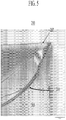
- FIG. 5 An optical micrograph of an edge 205 of a laser-cut glass substrate 200 having a twist hackle 210 is shown in FIG. 5 .
- twist hackle 210 runs from the back side 202 (top right in FIG. 5 ) to the bottom left of the glass substrate 200.
- High strength edges can be formed by CO 2 full body laser cutting by eliminating flaws such as twist hackles and the like. Such flaws can be eliminated in cutting regimes in which the temperature is balanced over the thickness of the substrate at suitable laser power densities.
- the median strength of such laser-cut edges is typically greater than about 400 MPa.
- FIGS. 3-9 are optical micrographs of laser-cut edges.
- the laser power and distance between the laser and water jet used on the samples shown in FIGS. 6-9 are: a) FIG. 6 : 26 W power, 14 mm distance; b) FIG. 7 : 26 W power, 24 mm distance; c) FIG.
- FIG. 9 35 W power, 24 mm distance.
- Hackles 310 were observed under the laser cutting conditions used in FIGS. 6-8 , whereas the conditions used to cut the edge shown in FIG. 9 produced an edge that is free of any visible hackles or other flaws.
- FIGS. 1-4 are schematic representations of side views of the substrates described herein, showing typical edge profile designs with FIGS 2 and 4 being designs not in accordance with the invention.
- Substrate 100 has a first surface 102, a second surface 104, and at least two parallel high strength edges 110, 112, one of which is shown in FIGS. 1-4 .
- each of the at least two parallel high strength edges has a rectangular profile 110 ( FIGS. 1 ).
- Rectangular edge profile 110 in one embodiment, is formed by a cutting process such as, but not limited to, the laser cutting in separation techniques described herein.
- each of the at least two parallel high strength edges has a rounded profile 112 ( FIGS. 3 ).
- Rounded edge profile 112 in one embodiment, is formed by a slot-draw process.
- Edge profiles 110, 112 have edge faces that are substantially free of visible defects and thus have a bend strength that is greater than edges formed by mechanical polishing methods.
- Edges that are finished by chemical methods, such as edging of the like, produce rounded edge profiles having edge strengths that are also greater than those achieved by mechanical finishing.
- chemical etching processes can be incompatible with the substrate or structures that are fabricated on the substrate.
- Each of the high strength edges 110, 112 of substrate 100 has a bend strength, such as a four-point bend edge strength, capable of less than 2% failure probability at a stress level of 200 MPa over a test length of 50 mm.
- edge coating 120 comprising a polymeric material ( FIGS. 1-4 ) such as, but not limited to, those flexible or elastic polymeric materials known in the art.
- the polymeric material comprises at least one of a silicone, an epoxy, an acrylate, a urethane, and combinations thereof having a modulus of less than about 10 GPa.
- Non-limiting examples of polymeric materials include UV curable optical adhesives or optical cements such as those manufactured by NorlandTM Optical Adhesives (NOA60.
- Edge coating 120 of the polymeric material has a thickness in a range from about 5 ⁇ m up to about 50 ⁇ m, and can be applied by those methods known in the art, such as dipping, painting, spraying, dispensing from a die, or the like. If the substrate is used for device manufacturing or if a patterned layer is formed on the substrate, the edge coating can be applied to the substrate either before or after device processing. Edge coating 120 primarily serves a mechanical function, preserving the high bend strength of the as-formed or cut high strength edges by protecting the substrate edge from further damage. In some embodiments, edge coating 120 need not be transparent.
- the at least two parallel high strength edges are unfinished; i.e., they are as-formed and not finished by mechanical or chemical means; i.e., they are neither ground nor etched.
- the combination of the at least two parallel high strength edges and edge coating 120 described herein does not require such finishing. Consequently, the number of process steps to make substrate 100 is decreased while overall substrate yield is increased.
- edge coating 120 coats at least a portion of each high strength edge. In some examples not in accordance with the invention shown in FIGS. 2 and 4 , edge coating additionally covers a portion of first and second surfaces 102, 104 adjacent to the high strength edge. However, in accordance with the invention substrate 100 does not have e protective coatings on first surface 102 and second surface 104.
- various coatings or films such as strengthening, anti-scratch, anti-reflective, anti-glare coatings or films, or the like, such as those are known in the art, may be applied to at least one of first surface 102 and second surface 104 of substrate 100.
- Edge coating 120 need not have the same composition of such coatings, nor does edge coating 120 have to be applied at the same time as any other surface coating that may be present.
- a coating may be applied to at least one of first surface 102 and second surface 104 immediately after substrate 100 is formed, whereas high strength edges can be cut into or otherwise formed on substrate 100 and edge coatings 120 applied to the high strength edges after a device is fabricated on substrate 120, or just before substrate 100 is incorporated into a device.
- the substrate 100 comprises, consists essentially of, or consists of a glass, a glass ceramic material, or a ceramic material suitable for applications such as thin (i.e., ⁇ 0.6 mm or, alternatively, ⁇ 0.4 mm).
- the substrate can have either a single, multiple, or graded composition, such as that produced by chemical strengthening of glass by ion exchange and, in one embodiment, is rollable (i.e., a continuous sheet of the substrate can be rolled up) or bendable.
- Non-limiting examples of such glass ceramic and ceramic materials include ⁇ -spogamene, ⁇ -quartz, nepheline, and the like.
- the substrate 100 comprises, consists essentially of, or consists of one of a borosilicate glass, an aluminoborosilicate glass, and an alkali aluminosilicate glass.
- the substrate is an alkali aluminosilicate glass comprising: 60-70 mol% SiO 2 ; 6-14 mol% Al 2 O 3 ; 0-15 mol% B 2 O 3 ; 0-15 mol% Li 2 O; 0-20 mol% Na 2 O; 0-10 mol% K 2 O; 0-8 mol% MgO; 0-10 mol% CaO; 0-5 mol% ZrO 2 ; 0-1 mol% SnO 2 ; 0-1 mol% CeO 2 ; less than 50 ppm As 2 O 3 ; and less than 50 ppm Sb 2 O 3 ; wherein 12 mol% ⁇ Li 2 O + Na 2 O + K 2 O ⁇ 20 mol% and 0 mol%
- the alkali aluminosilicate glass comprises 64 mol% ⁇ SiO 2 ⁇ 68 mol%; 12 mol% ⁇ Na 2 O ⁇ 16 mol%; 8 mol% ⁇ Al 2 O 3 ⁇ 12 mol%; 0 mol% ⁇ B 2 O 3 ⁇ 3 mol%; 2 mol% ⁇ K 2 O ⁇ 5 mol%; 4 mol% ⁇ MgO ⁇ 6 mol%; and 0 mol% ⁇ CaO ⁇ 5 mol%, wherein: 66 mol% ⁇ SiO 2 + B 2 O 3 + CaO ⁇ 69 mol%; Na 2 O + K 2 O + B 2 O 3 + MgO + CaO + SrO > 10 mol%; 5 mol% ⁇ MgO + CaO + SrO ⁇ 8 mol%; (Na 2 O + B 2 O 3 ) - Al 2 O 3 ⁇ 2 mol%; 2 mol% ⁇ Na 2 O - Al 2 O 3 mol%
- the alkali aluminosilicate glass comrpises 50-80 wt% SiO 2 ; 2-20 wt% Al 2 O 3 ; 0-15 wt% B 2 O 3 ; 1-20 wt% Na 2 O; 0-10 wt% Li 2 O; 0-10 wt% K 2 O; and 0-5 wt% (MgO + CaO + SrO + BaO); 0-3 wt% (SrO + BaO); and 0-5 wt% (ZrO 2 + TiO 2 ), wherein 0 ⁇ (Li 2 O + K 2 O)/Na 2 O ⁇ 0.5.
- the alkali aluminosilicate glass has the composition: 66.7 mol% SiO 2 ; 10.5 mol% Al 2 O 3 ; 0.64 mol% B 2 O 3 ; 13.8 mol% Na 2 O; 2.06 mol% K 2 O; 5.50 mol% MgO; 0.46 mol% CaO; 0.01 mol% ZrO 2 ; 0.34 mol% As 2 O 3 ; and 0.007 mol% composition: 66.4 mol% SiO 2 ; 10.3 mol% Al 2 O 3 ; 0.60 mol% B 2 O 3 ; 4.0 mol% Na 2 O; 2.10 mol% K 2 O; 5.76 mol% MgO; 0.58 mol% CaO; 0.01 mol% ZrO 2 ; 0.21 mol% SnO 2 ; and 0.007 mol% Fe 2 O 3 .
- the alkali aluminosilicate glass is, in some embodiments, substantially free of lithium, whereas in other embodiments, the alkali
- the alkali aluminosilicate glass in one embodiment, is down-drawable; i.e., formable by methods such as slot-draw or fusion-draw processes that are known in the art. In these instances, the glass has a liquidus viscosity of at least 130 kpoise.
- Non-limiting examples of such alkali aluminosilicate glasses are described in U.S. Patent Application No. 11/888,213, by Adam J. Ellison et al. , entitled “Down-Drawable, Chemically Strengthened Glass for Cover Plate,” filed on July 31, 2007, which claims priority from U.S. Provisional Patent Application 60/930,808, filed on May 22, 2007 , and having the same title; U.S. Patent Application No.
- substrate 100 comprises, consists essentially of, or consists of an alkali aluminosilicate glass that is either thermally or chemically strengthened.
- the strengthened alkali aluminosilicate glass has strengthened surface layers extending from first surface 102 and second surface 104 to a depth of layer below each surface.
- the strengthened surface layers are under compressive stress, whereas a central region of substrate 100 is under tension, or tensile stress, so as to balance forces within the glass.
- thermal strengthening also referred to herein as "thermal tempering”
- substrate 100 is heated up to a temperature that is greater than the strain point of the glass but below the softening point of the glass and rapidly cooled to a temperature below the strain point to create strengthened layers at the surfaces of the glass.
- substrate 100 can be strengthened chemically by a process known as ion exchange.
- ions in the surface layer of the glass are replaced by - or exchanged with - larger ions having the same valence or oxidation state.
- the ions in the surface layer and the larger ions are monovalent alkali metal cations, such as Li + (when present in the glass), Na + , K + , Rb + , and Cs + .
- monovalent cations in the surface layer may be replaced with monovalent cations other than alkali metal cations, such as Ag + or the like.
- Ion exchange processes are typically carried out by immersing glass in a molten salt bath containing the larger ions to be exchanged with the smaller ions in the glass.
- parameters for the ion exchange process including, but not limited to, bath composition and temperature, immersion time, the number of immersions of the glass in a salt bath (or baths), use of multiple salt baths, additional steps such as annealing, washing, and the like, are generally determined by the composition of the glass and the desired depth of layer and compressive stress of the glass as a result of the strengthening operation.
- ion exchange of alkali metal-containing glasses may be achieved by immersion in at least one molten bath containing a salt such as, but not limited to, nitrates, sulfates, and chlorides of the larger alkali metal ion.
- a salt such as, but not limited to, nitrates, sulfates, and chlorides of the larger alkali metal ion.
- the temperature of the molten salt bath typically is in a range from about 380°C up to about 450°C, while immersion times range from about 15 minutes up to about 16 hours. However, temperatures and immersion times different from those described above may also be used.
- Such ion exchange treatments typically result in strengthened alkali aluminosilicate glasses having depths of layer ranging from about 10 ⁇ m up to at least 50 ⁇ m with a compressive stress ranging from about 200 MPa up to about 800 MPa, and a central tension of less than about 100 MPa.
- Non-limiting examples of ion exchange processes are provided in the U.S. patent applications and provisional patent applications that have been previously referenced hereinabove.
- non-limiting examples of ion exchange processes in which glass is immersed in multiple ion exchange baths, with washing and/or annealing steps between immersions are described in U.S. Provisional Patent Application No. 61/079,995, by Douglas C. Allan et al. , entitled “Glass with Compressive Surface for Consumer Applications,” filed July 11, 2008, in which glass is strengthened by immersion in multiple, successive, ion exchange treatments in salt baths of different concentrations; and U.S. Provisional Patent Application No.61/084,398, by Christopher M. Lee et al.
- a method of making a substrate having increased edge strength is also provided.
- a sheet comprising at least one of a glass, glass ceramic, and a ceramic is first provided.
- the sheet has a first surface, a second surface, and at least two parallel high strength edges.
- the at least two parallel high strength edges are, in one embodiment, created directly by a forming process, such as down-draw processes, fusion-draw processes, slot-draw processes, re-drawing processes, and the like, that involves heating the sheet to a temperature above the anneal point of the sheet.
- the high strength edges may be created by high strength cutting methods that include, but are not limited to, the laser cutting techniques described herein.
- a polymeric edge coating is then deposited on at least a portion of each of the two parallel high strength edges to form the substrate.
- the polymeric edge coating in one embodiment, has a modulus of less than about 10 GPa, and comprises a polymeric material, such as those described hereinabove.
- Each of the high strength edges of the substrate has a bend strength, such as a four-point bend edge strength, capable of less than 2% failure probability at a stress level of 200 MPa over a test length of 50 mm.
- FIG. 10 is a Weibull plot of failure probabilities obtained for sets of samples having low strength edges (Data set 1 in Table 1 and groups 1 and 2 in FIG. 10 ), and having high strength laser-cut edges (Data set 2 and groups 3 and 4 in FIG. 10 ), as described herein.
- the samples classified as having low edge strength have full-body laser-cut edges that contain shear and twist defects and/or changes in fracture steps and/or planes that are known as "hackles" (see FIGS. 5-8 ). Such hackles lead to failure of the edge ( FIG. 5 ).
- the high strength edges are also the product of full-body laser cutting
- the laser cutting parameters e.g., speed of translation of the laser and quenching streams (if present) along the surface of the glass substrate, distance between the laser and the quenching stream, etc.
- speed of translation of the laser and quenching streams (if present) along the surface of the glass substrate, distance between the laser and the quenching stream, etc. have been optimized to eliminate hackles and other edge defects and thus produce a high strength edge ( FIG. 4 ).
- Edge strength testing was carried out up to a tensile stress of 280 MPa, The results of the edge strength testing are listed in Table 1, which lists the tensile stress at which individual samples failed.
- the term the "laser side,” refers to the surface of the sample exposed to the laser during the laser-cutting process, whereas the “backside” refers to the side of the sample opposite the laser side. If a sample did not fail at a tensile stress less than or equal to 280 MPa, the sample was deemed to have "passed” the edge strength test, as noted by "pass” in Table 1. Table 1. Results of edge strength testing. Sample No.
- backside and laser side data sets (Data set 1 in Table 1 and groups 1 and 2 in FIG. 10 ) of about 50 samples each, the failure probability at a stress level of 200 MPa ranged from 5% to 30%.
- Backside and laser side data sets for samples having high strength edges (Data set 2 in Table 1 and groups 3 and 4 in FIG. 10 ), each consisted of 27 samples. For this combined number of 54 samples, no failures occurred at stress levels of less than 200 MPa, and only two samples in each set failed below 280 MPa.
Landscapes
- Chemical & Material Sciences (AREA)
- Engineering & Computer Science (AREA)
- Ceramic Engineering (AREA)
- Materials Engineering (AREA)
- Organic Chemistry (AREA)
- Structural Engineering (AREA)
- General Chemical & Material Sciences (AREA)
- Chemical Kinetics & Catalysis (AREA)
- Life Sciences & Earth Sciences (AREA)
- Geochemistry & Mineralogy (AREA)
- Physics & Mathematics (AREA)
- Health & Medical Sciences (AREA)
- Optics & Photonics (AREA)
- Toxicology (AREA)
- Thermal Sciences (AREA)
- Surface Treatment Of Glass (AREA)
- Re-Forming, After-Treatment, Cutting And Transporting Of Glass Products (AREA)
- Glass Compositions (AREA)
- Manufacturing & Machinery (AREA)
Claims (11)
- Substrat (100), wobei das Substrat (100) Folgendes umfasst:a. eine Platte, die zumindest eines von einem Glas, einer Keramik und einer Glaskeramik umfasst, wobei die Platte eine erste Oberfläche (102), eine zweite Oberfläche (104) und mindestens zwei parallele hochfeste Ränder, die die erste Oberfläche (102) und die zweite Oberfläche (104) zusammenfügen, aufweist, wobei jeder der mindestens zwei parallelen hochfesten Ränder eine Biegefestigkeit aufweist, die zu weniger als 2% Ausfallwahrscheinlichkeit bei einem Beanspruchungsniveau von 200 MPa über eine Testlänge von 50 mm fähig ist; undb. eine Polymerrandbeschichtung (120), die zumindest einen Abschnitt von jedem der mindesten zwei parallelen hochfesten Ränder abdeckt, wobei die Polymerrandbeschichtung (120) eine Dicke in einem Bereich von 5 µm bis 50 µm aufweist und jeden der mindestens zwei parallelen hochfesten Ränder vor dem Einbringen von Defekten und Schaden schützt, dadurch gekennzeichnet, dass jeder der mindestens zwei parallelen hochfesten Ränder unfertig ist; dass die erste Oberfläche (102) der Platte und die zweite Oberfläche (104) der Platte jeweils vollständig frei von der Polymerrandbeschichtung (120) sind; und dass die Polymerrandbeschichtung (120) mindestens eines von einem Silikon, einem Epoxid, einem Akrylat, einem Urethan und Kombinationen davon umfasst.
- Substrat (100) nach Anspruch 1, wobei das Substrat (100) eine Dicke von bis zu 0,6 mm aufweist.
- Substrat (100) nach Anspruch 2, wobei das Substrat (100) eine Dicke von bis zu 0,1 mm aufweist.
- Substrat (100) nach einem der Ansprüche 1-3, wobei die Polymerrandbeschichtung (120) ein Modul von bis zu 10 GPa aufweist.
- Substrat (100) nach einem der Ansprüche 1-4, wobei das Substrat (100) mindestens eine verstärkte Oberflächenschicht aufweist, die sich von mindestens einer der ersten Oberfläche (102) und der zweiten Oberfläche (104) zu einer Schichttiefe erstreckt, wobei die verstärkte Oberflächenschicht unter einer Druckbeanspruchung ist.
- Substrat (100) nach Anspruch 5, wobei die verstärkte Oberflächenschicht eine ionenausgetauschte Schicht ist.
- Substrat (100) nach einem der Ansprüche 1-6, ferner umfassend mindestens eine Schicht, die auf mindestens eine der ersten Oberfläche (102) und der zweiten Oberfläche (104) abgeschieden ist.
- Substrat (100) nach einem der Ansprüche 1-7, wobei das Substrat (100) ein Schutzabdeckungsglas für mindestens eines von einem tragbaren elektronischen Gerät, einem informationsbezogenen Endgerät und einer Berührungssensorvorrichtung ist.
- Verfahren zum Herstellen eines Substrats (100), wobei das Verfahren folgende Schritte umfasst:a. Bereitstellen einer Platte, die zumindest eines von einem Glas, einer Glaskeramik und einer Keramik umfasst eine erste Oberfläche (102), eine zweite Oberfläche (104), die im Wesentlichen parallel zueinander sind, und mindestens zwei parallele hochfeste Ränder zwischen der ersten Oberfläche (102) und der zweiten Oberfläche (104) aufweist, wobei jeder der mindestens zwei parallelen Ränder eine Biegefestigkeit aufweist, die zu weniger als 2% Ausfallwahrscheinlichkeit bei einem Beanspruchungsniveau von 200 MPa über eine Testlänge von 50 mm fähig ist; undb. Abscheiden einer Polymerrandbeschichtung (120), auf zumindest einen Abschnitt von jedem der mindestens zwei parallelen hochfesten Ränder, um das Substrat (100) zu bilden, wobei die Polymerrandbeschichtung (120) eine Dicke in einem Bereich von 5 µm bis 50 µm aufweist, dadurch gekennzeichnet, dass jeder der mindestens zwei parallelen hochfesten Ränder unfertig ist; dass die erste Oberfläche (102) der Platte und die zweite Oberfläche (104) der Platte jeweils vollständig frei von der Polymerrandbeschichtung (120) sind; und dass die Polymerrandbeschichtung (120) mindestens eines von einem Silikon, einem Epoxid, einem Akrylat, einem Urethan und Kombinationen davon umfasst.
- Verfahren nach Anspruch 9, wobei der Schritt des Bereitstellens der Platte das Bilden einer Platte durch eines von Schmelzziehen, Düsenziehen und Wiederziehen umfasst.
- Verfahren nach Anspruch 9 oder Anspruch 10, wobei der Schritt des Schneidens der Platte das Laserschneiden der Platte umfasst, um die mindestens zwei parallelen hochfesten Ränder zu bilden.
Applications Claiming Priority (2)
| Application Number | Priority Date | Filing Date | Title |
|---|---|---|---|
| US18023009P | 2009-05-21 | 2009-05-21 | |
| PCT/US2010/035705 WO2010135614A1 (en) | 2009-05-21 | 2010-05-21 | Thin substrates having mechanically durable edges |
Publications (2)
| Publication Number | Publication Date |
|---|---|
| EP2432744A1 EP2432744A1 (de) | 2012-03-28 |
| EP2432744B1 true EP2432744B1 (de) | 2020-07-15 |
Family
ID=42537912
Family Applications (1)
| Application Number | Title | Priority Date | Filing Date |
|---|---|---|---|
| EP10724205.9A Not-in-force EP2432744B1 (de) | 2009-05-21 | 2010-05-21 | Dünne substrate mit mechanisch widerstandsfähigen kanten |
Country Status (7)
| Country | Link |
|---|---|
| US (1) | US9422188B2 (de) |
| EP (1) | EP2432744B1 (de) |
| JP (3) | JP2012527399A (de) |
| KR (1) | KR101631347B1 (de) |
| CN (1) | CN102438960B (de) |
| TW (1) | TWI558552B (de) |
| WO (1) | WO2010135614A1 (de) |
Cited By (1)
| Publication number | Priority date | Publication date | Assignee | Title |
|---|---|---|---|---|
| WO2023028036A1 (en) | 2021-08-23 | 2023-03-02 | Absolics Inc. | Substrate and package substrate comprising the same |
Families Citing this family (83)
| Publication number | Priority date | Publication date | Assignee | Title |
|---|---|---|---|---|
| TWI558552B (zh) | 2009-05-21 | 2016-11-21 | 康寧公司 | 具有機械耐久性邊緣的薄基材及其製造方法 |
| JP5532219B2 (ja) * | 2010-01-18 | 2014-06-25 | 日本電気硝子株式会社 | 板状ガラスの切断方法及びその切断装置 |
| US9302937B2 (en) | 2010-05-14 | 2016-04-05 | Corning Incorporated | Damage-resistant glass articles and method |
| CN102478727B (zh) * | 2010-11-28 | 2016-04-06 | 宸鸿科技(厦门)有限公司 | 触控显示装置的制造方法与显示装置、触控显示装置 |
| TW201228824A (en) * | 2011-01-06 | 2012-07-16 | Corning Inc | Fully integrated touch articles with polymer edge protection |
| WO2012169025A1 (ja) * | 2011-06-08 | 2012-12-13 | 日本電気硝子株式会社 | 板状ガラスの切断方法及びその切断装置 |
| TWI572480B (zh) | 2011-07-25 | 2017-03-01 | 康寧公司 | 經層壓及離子交換之強化玻璃疊層 |
| DE102011084129A1 (de) | 2011-10-07 | 2013-04-11 | Schott Ag | Glasfolie mit speziell ausgebildeter Kante |
| DE102011084128A1 (de) | 2011-10-07 | 2013-04-11 | Schott Ag | Verfahren zum Schneiden eines Dünnglases mit spezieller Ausbildung der Kante |
| DE102011084131A1 (de) * | 2011-10-07 | 2013-04-11 | Schott Ag | Glasfolie mit speziell ausgebildeter Kante |
| CN103203926A (zh) * | 2012-01-16 | 2013-07-17 | 晟铭电子科技股份有限公司 | 板材边缘保护结构及其制造方法 |
| CN104379532B9 (zh) | 2012-02-29 | 2021-08-24 | 康宁股份有限公司 | 可离子交换的低cte玻璃组合物以及包含该玻璃组合物的玻璃制品 |
| US9359251B2 (en) | 2012-02-29 | 2016-06-07 | Corning Incorporated | Ion exchanged glasses via non-error function compressive stress profiles |
| CN103304154A (zh) * | 2012-03-15 | 2013-09-18 | 铭旺科技股份有限公司 | 用于触控面板玻璃的强化方法及其结构 |
| CN104245615A (zh) * | 2012-04-10 | 2014-12-24 | 旭硝子株式会社 | 强化玻璃物品及触控传感器一体型保护玻璃 |
| US9199870B2 (en) | 2012-05-22 | 2015-12-01 | Corning Incorporated | Electrostatic method and apparatus to form low-particulate defect thin glass sheets |
| JP2015171954A (ja) * | 2012-07-11 | 2015-10-01 | 旭硝子株式会社 | 積層板の製造方法 |
| JP2015171953A (ja) * | 2012-07-11 | 2015-10-01 | 旭硝子株式会社 | 機能性基板の製造方法 |
| JP2015171955A (ja) * | 2012-07-11 | 2015-10-01 | 旭硝子株式会社 | 湾曲板の製造方法 |
| KR20140022238A (ko) * | 2012-08-13 | 2014-02-24 | 삼성디스플레이 주식회사 | 표시 장치 |
| KR102149213B1 (ko) | 2012-08-31 | 2020-08-31 | 코닝 인코포레이티드 | 강화된 얇은 유리-중합체 라미네이트 |
| TWI457309B (zh) * | 2012-09-17 | 2014-10-21 | Wistron Corp | 玻璃強化結構及其製程 |
| US8960014B2 (en) | 2012-09-21 | 2015-02-24 | Corning Incorporated | Methods of validating edge strength of a glass sheet |
| US20140087193A1 (en) * | 2012-09-26 | 2014-03-27 | Jeffrey Scott Cites | Methods for producing ion exchanged glass and resulting apparatus |
| US10202303B2 (en) * | 2012-10-04 | 2019-02-12 | Corning Incorporated | Compressively stressed laminated glass article via photosensitive glass and method of making the article |
| US9187364B2 (en) * | 2013-02-28 | 2015-11-17 | Corning Incorporated | Method of glass edge coating |
| US11079309B2 (en) | 2013-07-26 | 2021-08-03 | Corning Incorporated | Strengthened glass articles having improved survivability |
| US9573843B2 (en) | 2013-08-05 | 2017-02-21 | Corning Incorporated | Polymer edge-covered glass articles and methods for making and using same |
| TWI515620B (zh) * | 2013-10-15 | 2016-01-01 | 恆顥科技股份有限公司 | 增加面板邊緣強度的方法 |
| JP5622133B1 (ja) * | 2013-10-25 | 2014-11-12 | 大日本印刷株式会社 | カバーガラスの製造方法 |
| CN104635963B (zh) * | 2013-11-07 | 2018-02-23 | 群创光电股份有限公司 | 触控显示装置与其制造方法 |
| JP6183706B2 (ja) * | 2013-11-26 | 2017-08-23 | 大日本印刷株式会社 | カバーガラスおよびカバーガラス付き表示装置 |
| CN104699292A (zh) * | 2013-12-06 | 2015-06-10 | 胜华科技股份有限公司 | 强化基底的方法以及触控装置的基底 |
| JPWO2015083832A1 (ja) * | 2013-12-06 | 2017-03-16 | デンカ株式会社 | 端面保護された硬質基板およびその製造方法 |
| TW201523363A (zh) * | 2013-12-10 | 2015-06-16 | Wintek Corp | 覆蓋板及觸控面板 |
| US20150183179A1 (en) * | 2013-12-31 | 2015-07-02 | Saint-Gobain Ceramics & Plastics, Inc. | Article comprising a transparent body including a layer of a ceramic material and a method of forming the same |
| US9488857B2 (en) | 2014-01-10 | 2016-11-08 | Corning Incorporated | Method of strengthening an edge of a glass substrate |
| TWI658015B (zh) * | 2014-02-20 | 2019-05-01 | Corning Incorporated | 在撓性薄玻璃中切割多個半徑的方法和設備與以其製造之玻璃基板 |
| US10118858B2 (en) | 2014-02-24 | 2018-11-06 | Corning Incorporated | Strengthened glass with deep depth of compression |
| JP2015166300A (ja) * | 2014-03-04 | 2015-09-24 | 日立化成株式会社 | 樹脂付きガラス板の製造方法及びその製造方法を用いて得た樹脂付きガラス板 |
| CN106457475A (zh) * | 2014-03-14 | 2017-02-22 | 康宁股份有限公司 | 嵌入玻璃的传感器及其制造过程 |
| TW201537420A (zh) * | 2014-03-28 | 2015-10-01 | Ghitron Technology Co Ltd | 玻璃基板之黑色邊框強化結構 |
| TW201539267A (zh) * | 2014-04-10 | 2015-10-16 | Wintek Corp | 裝飾板與觸控面板 |
| WO2015166891A1 (ja) * | 2014-04-30 | 2015-11-05 | 旭硝子株式会社 | ガラス |
| JP6295846B2 (ja) * | 2014-06-17 | 2018-03-20 | 日産化学工業株式会社 | ガラス保護膜形成用組成物及びガラス保護膜 |
| JP6347160B2 (ja) | 2014-06-17 | 2018-06-27 | 日本電気硝子株式会社 | ガラス物品及びその製造方法 |
| TWI773291B (zh) | 2014-06-19 | 2022-08-01 | 美商康寧公司 | 無易碎應力分布曲線的玻璃 |
| JP2017152076A (ja) * | 2014-07-09 | 2017-08-31 | パナソニックIpマネジメント株式会社 | 有機el素子及び照明装置 |
| US9919958B2 (en) | 2014-07-17 | 2018-03-20 | Corning Incorporated | Glass sheet and system and method for making glass sheet |
| CN106573819A (zh) | 2014-08-20 | 2017-04-19 | 康宁股份有限公司 | 用于在切割挠性薄玻璃中产生高边缘强度的方法和设备 |
| DE102014113150A1 (de) | 2014-09-12 | 2016-03-17 | Schott Ag | Glaselement mit niedriger Bruchwahrscheinlichkeit |
| CN105438662B (zh) * | 2014-09-18 | 2018-06-29 | 旭硝子株式会社 | 带有圆滑性改善膜的玻璃板、其制造方法、玻璃板包装体、及玻璃板的包装方法 |
| TWI725945B (zh) | 2014-10-07 | 2021-05-01 | 美商康寧公司 | 具有已定應力輪廓的玻璃物件 |
| DE202015009997U1 (de) | 2014-10-08 | 2022-11-09 | Corning Incorporated | Gläser und Glaskeramiken mit einem Metalloxidkonzentrationsgradienten |
| US10150698B2 (en) | 2014-10-31 | 2018-12-11 | Corning Incorporated | Strengthened glass with ultra deep depth of compression |
| US20180009197A1 (en) * | 2014-11-04 | 2018-01-11 | Corning Incorporated | Bendable glass articles with alkali-free glass elements |
| EP4011843A3 (de) | 2014-11-04 | 2022-06-29 | Corning Incorporated | Tiefe unzerbrechliche belastungsprofile und verfahren zur herstellung |
| EP3215473A1 (de) * | 2014-11-05 | 2017-09-13 | Corning Incorporated | Glasartikel mit nichtplanaren merkmalen und alkalifreien glaselementen |
| DE102014119333A1 (de) * | 2014-12-22 | 2016-06-23 | Schott Ag | Hochfester Glasfilm mit besonderer Ausbildung der Kante sowie Verfahren zu dessen Herstellung |
| CN107771168A (zh) * | 2015-04-22 | 2018-03-06 | 康宁股份有限公司 | 对层压玻璃结构进行边缘精整的方法 |
| US10579106B2 (en) | 2015-07-21 | 2020-03-03 | Corning Incorporated | Glass articles exhibiting improved fracture performance |
| US11613103B2 (en) | 2015-07-21 | 2023-03-28 | Corning Incorporated | Glass articles exhibiting improved fracture performance |
| JP2018531203A (ja) * | 2015-07-31 | 2018-10-25 | コーニング インコーポレイテッド | 強化された非対称合わせガラス |
| TWI596071B (zh) * | 2015-08-25 | 2017-08-21 | 友達光電股份有限公司 | 顯示面板與其製作方法 |
| KR20180067577A (ko) | 2015-10-14 | 2018-06-20 | 코닝 인코포레이티드 | 결정된 응력 프로파일을 갖는 적층 유리 제품 및 그 제조방법 |
| DK3386930T3 (da) | 2015-12-11 | 2021-07-26 | Corning Inc | Fusionsformbare, glasbaserede artikler indbefattende en metaloxidkoncentrationsgradient |
| EP3429972A1 (de) | 2016-04-08 | 2019-01-23 | Corning Incorporated | Artikel auf glasbasis mit einem metalloxidkonzentrationsgradient |
| JP6902042B2 (ja) | 2016-04-08 | 2021-07-14 | コーニング インコーポレイテッド | 2つの領域を含む応力プロファイルを含むガラス系物品および製造方法 |
| WO2017195752A1 (ja) * | 2016-05-09 | 2017-11-16 | 日立化成株式会社 | 光硬化性樹脂組成物、光硬化性塗料、及び硬化物 |
| WO2018179336A1 (ja) * | 2017-03-31 | 2018-10-04 | 日立化成株式会社 | 硬化性樹脂組成物、ガラス部材、表示装置及び携帯端末 |
| CN107734113A (zh) * | 2017-10-31 | 2018-02-23 | 广东欧珀移动通信有限公司 | 曲面盖板及其制备方法、移动终端 |
| KR102491760B1 (ko) | 2017-12-04 | 2023-01-26 | 삼성디스플레이 주식회사 | 표시 장치 및 표시 장치의 제조 방법 |
| KR102579100B1 (ko) * | 2018-10-10 | 2023-09-14 | 쇼오트 글라스 테크놀로지스 (쑤저우) 코퍼레이션 리미티드. | 초박형 유리 세라믹 물품 및 초박형 유리 세라믹 물품의 제조 방법 |
| US11447416B2 (en) * | 2018-12-20 | 2022-09-20 | Apple Inc. | Strengthened covers for electronic devices |
| US20220102230A1 (en) * | 2019-02-21 | 2022-03-31 | Sony Semiconductor Solutions Corporation | Semiconductor substrate and semiconductor module |
| WO2020257034A1 (en) * | 2019-06-20 | 2020-12-24 | Corning Incorporated | Method and apparatus for edge finishing of high mechanical strength thin glass substrates |
| CN111393032B (zh) * | 2020-04-13 | 2022-07-08 | Oppo广东移动通信有限公司 | 微晶玻璃盖板、柔性屏组件、电子设备及微晶玻璃盖板加工方法 |
| WO2021247388A1 (en) * | 2020-06-04 | 2021-12-09 | Corning Incorporated | Method of treating a glass surface and treated glass articles |
| PL3990743T3 (pl) * | 2020-06-25 | 2024-04-08 | Hirschler Laszlo | Szklany panel termoizolacyjny |
| KR20220121306A (ko) * | 2021-02-24 | 2022-09-01 | 삼성디스플레이 주식회사 | 커버 윈도우, 커버 윈도우의 제조방법, 및 표시 장치 |
| CN116161867B (zh) * | 2023-02-27 | 2023-12-15 | 广州触沃电子有限公司 | 一种智能电容一体机 |
| KR20240140606A (ko) | 2023-03-17 | 2024-09-24 | 에이지씨 가부시키가이샤 | 수지층 부착 유리판, 수지층 부착 유리판을 구비하는 전자 디바이스, 수지층 부착 유리판을 구비하는 디스플레이 장치, 및 수지층 부착 유리판을 구비하는 반도체 기판 |
| CN119036963B (zh) * | 2024-08-24 | 2025-06-17 | 江苏德佳玻璃科技有限公司 | 一种多功能钢化夹层玻璃及其加工工艺 |
Family Cites Families (32)
| Publication number | Priority date | Publication date | Assignee | Title |
|---|---|---|---|---|
| US3577256A (en) * | 1969-06-26 | 1971-05-04 | Owens Illinois Inc | Scratch and abrasion resistant coatings for glass |
| US3986997A (en) | 1974-06-25 | 1976-10-19 | Dow Corning Corporation | Pigment-free coating compositions |
| JPS60251138A (ja) | 1984-05-28 | 1985-12-11 | Hoya Corp | ガラスの切断方法 |
| US5220358A (en) | 1991-07-15 | 1993-06-15 | Corning Incorporated | Edge coating for laminated lenses |
| US5674790A (en) | 1995-12-15 | 1997-10-07 | Corning Incorporated | Strengthening glass by ion exchange |
| JP3791962B2 (ja) | 1996-04-22 | 2006-06-28 | 竹松工業株式会社 | エッジプロテクターを有するガラス板およびその製造方法 |
| JP3395538B2 (ja) | 1996-09-17 | 2003-04-14 | 日本板硝子株式会社 | 耐衝撃ガラス |
| US6120908A (en) | 1997-09-08 | 2000-09-19 | Elf Atochem North America, Inc. | Strengthening flat glass by edge coating |
| DE19810325A1 (de) | 1998-03-11 | 1999-09-16 | Karl Otto Platz | Verfahren zur Erhöhung der Kantenfestigkeit der Glaskanten einer Dünnglasscheibe |
| JP4396953B2 (ja) * | 1998-08-26 | 2010-01-13 | 三星電子株式会社 | レーザ切断装置および切断方法 |
| EP1048628A1 (de) * | 1999-04-30 | 2000-11-02 | Schott Glas | Polymerbeschichtete Dünnglasfoliensubstrate |
| ATE248782T1 (de) * | 1999-01-11 | 2003-09-15 | Schott Displayglas Gmbh | Polymerbeschichtete dünnglasfoliensubstrate |
| JP2002054971A (ja) | 2000-08-08 | 2002-02-20 | Nidai Seiko:Kk | 灯油残量検出装置 |
| WO2005000762A1 (ja) | 2003-06-30 | 2005-01-06 | Nippon Sheet Glass Company, Limited | エッジ部保護部材及び該保護部材を備えるガラスパネル、並びにガラスパネルのエッジ部保護方法 |
| SG112980A1 (en) | 2003-12-19 | 2005-07-28 | Asahi Glass Co Ltd | Glass substrate for magnetic disks and process for its production |
| JP2005314198A (ja) * | 2004-04-26 | 2005-11-10 | Lemi Ltd | ガラス割断用レーザ装置 |
| JP3908236B2 (ja) | 2004-04-27 | 2007-04-25 | 株式会社日本製鋼所 | ガラスの切断方法及びその装置 |
| US7231786B2 (en) * | 2004-07-29 | 2007-06-19 | Corning Incorporated | Process and device for manufacturing glass sheet |
| JP4179314B2 (ja) | 2005-09-13 | 2008-11-12 | 株式会社レミ | 脆性材料のフルカット割断装置 |
| JP4524249B2 (ja) | 2005-12-28 | 2010-08-11 | 日本板硝子株式会社 | 車両用窓ガラス及びその製造方法 |
| DE202006020154U1 (de) * | 2006-06-02 | 2007-11-29 | Fraunhofer-Gesellschaft zur Förderung der angewandten Forschung e.V. | Glasscheibe |
| JP2008062489A (ja) | 2006-09-07 | 2008-03-21 | Systec Inoue Corp | 脆性材料の割断方法、および脆性材料の割断装置 |
| US8017220B2 (en) | 2006-10-04 | 2011-09-13 | Corning Incorporated | Electronic device and method of making |
| EP2094463B1 (de) | 2006-12-19 | 2016-07-27 | Dow Global Technologies LLC | Anordnung aus platte mit verkapselung und herstellungsverfahren dafür |
| WO2008136872A2 (en) | 2006-12-22 | 2008-11-13 | Adriani Paul M | Structures for low cost, reliable solar modules |
| JP2008183599A (ja) | 2007-01-31 | 2008-08-14 | Japan Steel Works Ltd:The | 高脆性非金属材料製の被加工物の加工方法及びその装置 |
| WO2008104825A1 (en) | 2007-02-28 | 2008-09-04 | Corning Incorporated | Strengthening glass using coatings |
| US7666511B2 (en) * | 2007-05-18 | 2010-02-23 | Corning Incorporated | Down-drawable, chemically strengthened glass for cover plate |
| JP5005612B2 (ja) * | 2008-05-24 | 2012-08-22 | 株式会社レミ | 脆性材料のフルカット割断方法 |
| KR20100070096A (ko) * | 2008-12-17 | 2010-06-25 | (주)엘지하우시스 | 생분해성 광고 소재 및 이의 제조방법 |
| US7998558B2 (en) * | 2009-02-27 | 2011-08-16 | Corning Incorporated | Glass sheet with protected edge, edge protector and method for making glass sheet using same |
| TWI558552B (zh) | 2009-05-21 | 2016-11-21 | 康寧公司 | 具有機械耐久性邊緣的薄基材及其製造方法 |
-
2010
- 2010-05-21 TW TW099116356A patent/TWI558552B/zh not_active IP Right Cessation
- 2010-05-21 US US13/266,548 patent/US9422188B2/en not_active Expired - Fee Related
- 2010-05-21 WO PCT/US2010/035705 patent/WO2010135614A1/en not_active Ceased
- 2010-05-21 EP EP10724205.9A patent/EP2432744B1/de not_active Not-in-force
- 2010-05-21 JP JP2012512053A patent/JP2012527399A/ja active Pending
- 2010-05-21 CN CN201080023222.5A patent/CN102438960B/zh not_active Expired - Fee Related
- 2010-05-21 KR KR1020117030519A patent/KR101631347B1/ko not_active Expired - Fee Related
-
2014
- 2014-10-01 JP JP2014202960A patent/JP2015071533A/ja active Pending
-
2016
- 2016-01-06 JP JP2016001040A patent/JP6227019B2/ja not_active Expired - Fee Related
Non-Patent Citations (1)
| Title |
|---|
| None * |
Cited By (2)
| Publication number | Priority date | Publication date | Assignee | Title |
|---|---|---|---|---|
| WO2023028036A1 (en) | 2021-08-23 | 2023-03-02 | Absolics Inc. | Substrate and package substrate comprising the same |
| EP4337567A4 (de) * | 2021-08-23 | 2025-07-16 | Absolics Inc | Substrat und verpackungssubstrat damit |
Also Published As
| Publication number | Publication date |
|---|---|
| TWI558552B (zh) | 2016-11-21 |
| JP6227019B2 (ja) | 2017-11-08 |
| US9422188B2 (en) | 2016-08-23 |
| JP2015071533A (ja) | 2015-04-16 |
| KR20120026098A (ko) | 2012-03-16 |
| CN102438960A (zh) | 2012-05-02 |
| JP2016128376A (ja) | 2016-07-14 |
| WO2010135614A1 (en) | 2010-11-25 |
| JP2012527399A (ja) | 2012-11-08 |
| KR101631347B1 (ko) | 2016-06-16 |
| TW201103744A (en) | 2011-02-01 |
| EP2432744A1 (de) | 2012-03-28 |
| US20120040146A1 (en) | 2012-02-16 |
| CN102438960B (zh) | 2015-06-24 |
Similar Documents
| Publication | Publication Date | Title |
|---|---|---|
| EP2432744B1 (de) | Dünne substrate mit mechanisch widerstandsfähigen kanten | |
| EP3517511B1 (de) | Alkali-aluminiumborsilikat-glaspartikel | |
| EP2323957B1 (de) | Verstärkte glasartikel und herstellungsverfahren dafür | |
| KR102302163B1 (ko) | 이온 교환 공정 및 이로부터 결과하는 화학적으로 강화된 유리 기판 | |
| CN103702952B (zh) | 层叠和离子交换强化的玻璃层叠件及其制备方法 | |
| KR101825276B1 (ko) | 화학 강인화 가요성 초박형 유리 | |
| EP2762460B1 (de) | Chemisch verstärkte glasplatte und herstellungsverfahren dafür | |
| KR102728430B1 (ko) | 높은 굽힘 강도의 박형 유리 기판 및 이의 제조 방법 | |
| WO2019055745A1 (en) | TEXTURED GLASS-BASED ARTICLES HAVING SCRATCH RESISTANCE AND METHODS OF MAKING THE SAME | |
| WO2018144554A1 (en) | Coated glass-based articles with engineered stress profiles | |
| WO2019108826A1 (en) | Method of increasing iox processability on glass articles with multiple thicknesses | |
| EP3519368A1 (de) | Artikel auf glasbasis mit manipulierten belastungsprofilen und verfahren zur herstellung davon |
Legal Events
| Date | Code | Title | Description |
|---|---|---|---|
| PUAI | Public reference made under article 153(3) epc to a published international application that has entered the european phase |
Free format text: ORIGINAL CODE: 0009012 |
|
| 17P | Request for examination filed |
Effective date: 20111027 |
|
| AK | Designated contracting states |
Kind code of ref document: A1 Designated state(s): AL AT BE BG CH CY CZ DE DK EE ES FI FR GB GR HR HU IE IS IT LI LT LU LV MC MK MT NL NO PL PT RO SE SI SK SM TR |
|
| DAX | Request for extension of the european patent (deleted) | ||
| STAA | Information on the status of an ep patent application or granted ep patent |
Free format text: STATUS: EXAMINATION IS IN PROGRESS |
|
| 17Q | First examination report despatched |
Effective date: 20161111 |
|
| GRAP | Despatch of communication of intention to grant a patent |
Free format text: ORIGINAL CODE: EPIDOSNIGR1 |
|
| STAA | Information on the status of an ep patent application or granted ep patent |
Free format text: STATUS: GRANT OF PATENT IS INTENDED |
|
| RIC1 | Information provided on ipc code assigned before grant |
Ipc: C03B 33/09 20060101ALI20190409BHEP Ipc: C04B 41/82 20060101ALI20190409BHEP Ipc: C04B 41/00 20060101ALI20190409BHEP Ipc: C04B 41/45 20060101ALI20190409BHEP Ipc: C03C 17/00 20060101AFI20190409BHEP Ipc: C04B 41/83 20060101ALI20190409BHEP Ipc: C03C 17/28 20060101ALI20190409BHEP |
|
| INTG | Intention to grant announced |
Effective date: 20190426 |
|
| GRAS | Grant fee paid |
Free format text: ORIGINAL CODE: EPIDOSNIGR3 |
|
| GRAJ | Information related to disapproval of communication of intention to grant by the applicant or resumption of examination proceedings by the epo deleted |
Free format text: ORIGINAL CODE: EPIDOSDIGR1 |
|
| GRAL | Information related to payment of fee for publishing/printing deleted |
Free format text: ORIGINAL CODE: EPIDOSDIGR3 |
|
| STAA | Information on the status of an ep patent application or granted ep patent |
Free format text: STATUS: EXAMINATION IS IN PROGRESS |
|
| INTC | Intention to grant announced (deleted) | ||
| GRAP | Despatch of communication of intention to grant a patent |
Free format text: ORIGINAL CODE: EPIDOSNIGR1 |
|
| STAA | Information on the status of an ep patent application or granted ep patent |
Free format text: STATUS: GRANT OF PATENT IS INTENDED |
|
| GRAS | Grant fee paid |
Free format text: ORIGINAL CODE: EPIDOSNIGR3 |
|
| INTG | Intention to grant announced |
Effective date: 20200515 |
|
| GRAA | (expected) grant |
Free format text: ORIGINAL CODE: 0009210 |
|
| STAA | Information on the status of an ep patent application or granted ep patent |
Free format text: STATUS: THE PATENT HAS BEEN GRANTED |
|
| AK | Designated contracting states |
Kind code of ref document: B1 Designated state(s): AL AT BE BG CH CY CZ DE DK EE ES FI FR GB GR HR HU IE IS IT LI LT LU LV MC MK MT NL NO PL PT RO SE SI SK SM TR |
|
| REG | Reference to a national code |
Ref country code: CH Ref legal event code: EP Ref country code: GB Ref legal event code: FG4D |
|
| REG | Reference to a national code |
Ref country code: IE Ref legal event code: FG4D |
|
| REG | Reference to a national code |
Ref country code: DE Ref legal event code: R096 Ref document number: 602010064914 Country of ref document: DE |
|
| REG | Reference to a national code |
Ref country code: AT Ref legal event code: REF Ref document number: 1290861 Country of ref document: AT Kind code of ref document: T Effective date: 20200815 |
|
| REG | Reference to a national code |
Ref country code: LT Ref legal event code: MG4D |
|
| REG | Reference to a national code |
Ref country code: AT Ref legal event code: MK05 Ref document number: 1290861 Country of ref document: AT Kind code of ref document: T Effective date: 20200715 |
|
| REG | Reference to a national code |
Ref country code: NL Ref legal event code: MP Effective date: 20200715 |
|
| PG25 | Lapsed in a contracting state [announced via postgrant information from national office to epo] |
Ref country code: ES Free format text: LAPSE BECAUSE OF FAILURE TO SUBMIT A TRANSLATION OF THE DESCRIPTION OR TO PAY THE FEE WITHIN THE PRESCRIBED TIME-LIMIT Effective date: 20200715 Ref country code: HR Free format text: LAPSE BECAUSE OF FAILURE TO SUBMIT A TRANSLATION OF THE DESCRIPTION OR TO PAY THE FEE WITHIN THE PRESCRIBED TIME-LIMIT Effective date: 20200715 Ref country code: PT Free format text: LAPSE BECAUSE OF FAILURE TO SUBMIT A TRANSLATION OF THE DESCRIPTION OR TO PAY THE FEE WITHIN THE PRESCRIBED TIME-LIMIT Effective date: 20201116 Ref country code: LT Free format text: LAPSE BECAUSE OF FAILURE TO SUBMIT A TRANSLATION OF THE DESCRIPTION OR TO PAY THE FEE WITHIN THE PRESCRIBED TIME-LIMIT Effective date: 20200715 Ref country code: SE Free format text: LAPSE BECAUSE OF FAILURE TO SUBMIT A TRANSLATION OF THE DESCRIPTION OR TO PAY THE FEE WITHIN THE PRESCRIBED TIME-LIMIT Effective date: 20200715 Ref country code: BG Free format text: LAPSE BECAUSE OF FAILURE TO SUBMIT A TRANSLATION OF THE DESCRIPTION OR TO PAY THE FEE WITHIN THE PRESCRIBED TIME-LIMIT Effective date: 20201015 Ref country code: FI Free format text: LAPSE BECAUSE OF FAILURE TO SUBMIT A TRANSLATION OF THE DESCRIPTION OR TO PAY THE FEE WITHIN THE PRESCRIBED TIME-LIMIT Effective date: 20200715 Ref country code: NO Free format text: LAPSE BECAUSE OF FAILURE TO SUBMIT A TRANSLATION OF THE DESCRIPTION OR TO PAY THE FEE WITHIN THE PRESCRIBED TIME-LIMIT Effective date: 20201015 Ref country code: GR Free format text: LAPSE BECAUSE OF FAILURE TO SUBMIT A TRANSLATION OF THE DESCRIPTION OR TO PAY THE FEE WITHIN THE PRESCRIBED TIME-LIMIT Effective date: 20201016 Ref country code: AT Free format text: LAPSE BECAUSE OF FAILURE TO SUBMIT A TRANSLATION OF THE DESCRIPTION OR TO PAY THE FEE WITHIN THE PRESCRIBED TIME-LIMIT Effective date: 20200715 |
|
| PG25 | Lapsed in a contracting state [announced via postgrant information from national office to epo] |
Ref country code: PL Free format text: LAPSE BECAUSE OF FAILURE TO SUBMIT A TRANSLATION OF THE DESCRIPTION OR TO PAY THE FEE WITHIN THE PRESCRIBED TIME-LIMIT Effective date: 20200715 Ref country code: LV Free format text: LAPSE BECAUSE OF FAILURE TO SUBMIT A TRANSLATION OF THE DESCRIPTION OR TO PAY THE FEE WITHIN THE PRESCRIBED TIME-LIMIT Effective date: 20200715 Ref country code: IS Free format text: LAPSE BECAUSE OF FAILURE TO SUBMIT A TRANSLATION OF THE DESCRIPTION OR TO PAY THE FEE WITHIN THE PRESCRIBED TIME-LIMIT Effective date: 20201115 |
|
| PG25 | Lapsed in a contracting state [announced via postgrant information from national office to epo] |
Ref country code: NL Free format text: LAPSE BECAUSE OF FAILURE TO SUBMIT A TRANSLATION OF THE DESCRIPTION OR TO PAY THE FEE WITHIN THE PRESCRIBED TIME-LIMIT Effective date: 20200715 |
|
| REG | Reference to a national code |
Ref country code: DE Ref legal event code: R097 Ref document number: 602010064914 Country of ref document: DE |
|
| PG25 | Lapsed in a contracting state [announced via postgrant information from national office to epo] |
Ref country code: SM Free format text: LAPSE BECAUSE OF FAILURE TO SUBMIT A TRANSLATION OF THE DESCRIPTION OR TO PAY THE FEE WITHIN THE PRESCRIBED TIME-LIMIT Effective date: 20200715 Ref country code: RO Free format text: LAPSE BECAUSE OF FAILURE TO SUBMIT A TRANSLATION OF THE DESCRIPTION OR TO PAY THE FEE WITHIN THE PRESCRIBED TIME-LIMIT Effective date: 20200715 Ref country code: IT Free format text: LAPSE BECAUSE OF FAILURE TO SUBMIT A TRANSLATION OF THE DESCRIPTION OR TO PAY THE FEE WITHIN THE PRESCRIBED TIME-LIMIT Effective date: 20200715 Ref country code: CZ Free format text: LAPSE BECAUSE OF FAILURE TO SUBMIT A TRANSLATION OF THE DESCRIPTION OR TO PAY THE FEE WITHIN THE PRESCRIBED TIME-LIMIT Effective date: 20200715 Ref country code: DK Free format text: LAPSE BECAUSE OF FAILURE TO SUBMIT A TRANSLATION OF THE DESCRIPTION OR TO PAY THE FEE WITHIN THE PRESCRIBED TIME-LIMIT Effective date: 20200715 Ref country code: EE Free format text: LAPSE BECAUSE OF FAILURE TO SUBMIT A TRANSLATION OF THE DESCRIPTION OR TO PAY THE FEE WITHIN THE PRESCRIBED TIME-LIMIT Effective date: 20200715 |
|
| PLBE | No opposition filed within time limit |
Free format text: ORIGINAL CODE: 0009261 |
|
| STAA | Information on the status of an ep patent application or granted ep patent |
Free format text: STATUS: NO OPPOSITION FILED WITHIN TIME LIMIT |
|
| PG25 | Lapsed in a contracting state [announced via postgrant information from national office to epo] |
Ref country code: AL Free format text: LAPSE BECAUSE OF FAILURE TO SUBMIT A TRANSLATION OF THE DESCRIPTION OR TO PAY THE FEE WITHIN THE PRESCRIBED TIME-LIMIT Effective date: 20200715 |
|
| 26N | No opposition filed |
Effective date: 20210416 |
|
| PG25 | Lapsed in a contracting state [announced via postgrant information from national office to epo] |
Ref country code: SK Free format text: LAPSE BECAUSE OF FAILURE TO SUBMIT A TRANSLATION OF THE DESCRIPTION OR TO PAY THE FEE WITHIN THE PRESCRIBED TIME-LIMIT Effective date: 20200715 |
|
| PG25 | Lapsed in a contracting state [announced via postgrant information from national office to epo] |
Ref country code: SI Free format text: LAPSE BECAUSE OF FAILURE TO SUBMIT A TRANSLATION OF THE DESCRIPTION OR TO PAY THE FEE WITHIN THE PRESCRIBED TIME-LIMIT Effective date: 20200715 |
|
| REG | Reference to a national code |
Ref country code: DE Ref legal event code: R119 Ref document number: 602010064914 Country of ref document: DE |
|
| REG | Reference to a national code |
Ref country code: CH Ref legal event code: PL |
|
| GBPC | Gb: european patent ceased through non-payment of renewal fee |
Effective date: 20210521 |
|
| PG25 | Lapsed in a contracting state [announced via postgrant information from national office to epo] |
Ref country code: MC Free format text: LAPSE BECAUSE OF FAILURE TO SUBMIT A TRANSLATION OF THE DESCRIPTION OR TO PAY THE FEE WITHIN THE PRESCRIBED TIME-LIMIT Effective date: 20200715 Ref country code: LI Free format text: LAPSE BECAUSE OF NON-PAYMENT OF DUE FEES Effective date: 20210531 Ref country code: LU Free format text: LAPSE BECAUSE OF NON-PAYMENT OF DUE FEES Effective date: 20210521 Ref country code: CH Free format text: LAPSE BECAUSE OF NON-PAYMENT OF DUE FEES Effective date: 20210531 |
|
| REG | Reference to a national code |
Ref country code: BE Ref legal event code: MM Effective date: 20210531 |
|
| PG25 | Lapsed in a contracting state [announced via postgrant information from national office to epo] |
Ref country code: IE Free format text: LAPSE BECAUSE OF NON-PAYMENT OF DUE FEES Effective date: 20210521 Ref country code: GB Free format text: LAPSE BECAUSE OF NON-PAYMENT OF DUE FEES Effective date: 20210521 Ref country code: DE Free format text: LAPSE BECAUSE OF NON-PAYMENT OF DUE FEES Effective date: 20211201 |
|
| PG25 | Lapsed in a contracting state [announced via postgrant information from national office to epo] |
Ref country code: FR Free format text: LAPSE BECAUSE OF NON-PAYMENT OF DUE FEES Effective date: 20210531 |
|
| PG25 | Lapsed in a contracting state [announced via postgrant information from national office to epo] |
Ref country code: BE Free format text: LAPSE BECAUSE OF NON-PAYMENT OF DUE FEES Effective date: 20210531 |
|
| PG25 | Lapsed in a contracting state [announced via postgrant information from national office to epo] |
Ref country code: HU Free format text: LAPSE BECAUSE OF FAILURE TO SUBMIT A TRANSLATION OF THE DESCRIPTION OR TO PAY THE FEE WITHIN THE PRESCRIBED TIME-LIMIT; INVALID AB INITIO Effective date: 20100521 Ref country code: CY Free format text: LAPSE BECAUSE OF FAILURE TO SUBMIT A TRANSLATION OF THE DESCRIPTION OR TO PAY THE FEE WITHIN THE PRESCRIBED TIME-LIMIT Effective date: 20200715 |
|
| PG25 | Lapsed in a contracting state [announced via postgrant information from national office to epo] |
Ref country code: MK Free format text: LAPSE BECAUSE OF FAILURE TO SUBMIT A TRANSLATION OF THE DESCRIPTION OR TO PAY THE FEE WITHIN THE PRESCRIBED TIME-LIMIT Effective date: 20200715 |
|
| PG25 | Lapsed in a contracting state [announced via postgrant information from national office to epo] |
Ref country code: TR Free format text: LAPSE BECAUSE OF FAILURE TO SUBMIT A TRANSLATION OF THE DESCRIPTION OR TO PAY THE FEE WITHIN THE PRESCRIBED TIME-LIMIT Effective date: 20200715 |
|
| PG25 | Lapsed in a contracting state [announced via postgrant information from national office to epo] |
Ref country code: MT Free format text: LAPSE BECAUSE OF FAILURE TO SUBMIT A TRANSLATION OF THE DESCRIPTION OR TO PAY THE FEE WITHIN THE PRESCRIBED TIME-LIMIT Effective date: 20200715 |