EP2258397B1 - Polymerkonjugat aus einem physiologisch aktiven stoff - Google Patents
Polymerkonjugat aus einem physiologisch aktiven stoff Download PDFInfo
- Publication number
- EP2258397B1 EP2258397B1 EP09722008.1A EP09722008A EP2258397B1 EP 2258397 B1 EP2258397 B1 EP 2258397B1 EP 09722008 A EP09722008 A EP 09722008A EP 2258397 B1 EP2258397 B1 EP 2258397B1
- Authority
- EP
- European Patent Office
- Prior art keywords
- group
- physiologically active
- molecular weight
- integer
- conjugate
- Prior art date
- Legal status (The legal status is an assumption and is not a legal conclusion. Google has not performed a legal analysis and makes no representation as to the accuracy of the status listed.)
- Not-in-force
Links
- LOQGVZXNLQMJMO-DQRPAVMISA-N CC([C@@](C[C@H](C(CC1O)OCC1O)c1c(c(C(c2c3cccc2)=O)c2C3=O)O)(Cc1c2O)N)=O Chemical compound CC([C@@](C[C@H](C(CC1O)OCC1O)c1c(c(C(c2c3cccc2)=O)c2C3=O)O)(Cc1c2O)N)=O LOQGVZXNLQMJMO-DQRPAVMISA-N 0.000 description 1
- NNYBQONXHNTVIJ-QGZVFWFLSA-N CC[C@]1(CC(O)=O)OCCc2c1[nH]c1c(CC)cccc21 Chemical compound CC[C@]1(CC(O)=O)OCCc2c1[nH]c1c(CC)cccc21 NNYBQONXHNTVIJ-QGZVFWFLSA-N 0.000 description 1
Images


Classifications
-
- A—HUMAN NECESSITIES
- A61—MEDICAL OR VETERINARY SCIENCE; HYGIENE
- A61K—PREPARATIONS FOR MEDICAL, DENTAL OR TOILETRY PURPOSES
- A61K31/00—Medicinal preparations containing organic active ingredients
- A61K31/33—Heterocyclic compounds
- A61K31/335—Heterocyclic compounds having oxygen as the only ring hetero atom, e.g. fungichromin
- A61K31/35—Heterocyclic compounds having oxygen as the only ring hetero atom, e.g. fungichromin having six-membered rings with one oxygen as the only ring hetero atom
- A61K31/352—Heterocyclic compounds having oxygen as the only ring hetero atom, e.g. fungichromin having six-membered rings with one oxygen as the only ring hetero atom condensed with carbocyclic rings, e.g. methantheline
-
- A—HUMAN NECESSITIES
- A61—MEDICAL OR VETERINARY SCIENCE; HYGIENE
- A61K—PREPARATIONS FOR MEDICAL, DENTAL OR TOILETRY PURPOSES
- A61K31/00—Medicinal preparations containing organic active ingredients
- A61K31/185—Acids; Anhydrides, halides or salts thereof, e.g. sulfur acids, imidic, hydrazonic or hydroximic acids
- A61K31/19—Carboxylic acids, e.g. valproic acid
- A61K31/195—Carboxylic acids, e.g. valproic acid having an amino group
- A61K31/197—Carboxylic acids, e.g. valproic acid having an amino group the amino and the carboxyl groups being attached to the same acyclic carbon chain, e.g. gamma-aminobutyric acid [GABA], beta-alanine, epsilon-aminocaproic acid or pantothenic acid
-
- A—HUMAN NECESSITIES
- A61—MEDICAL OR VETERINARY SCIENCE; HYGIENE
- A61K—PREPARATIONS FOR MEDICAL, DENTAL OR TOILETRY PURPOSES
- A61K31/00—Medicinal preparations containing organic active ingredients
- A61K31/33—Heterocyclic compounds
- A61K31/395—Heterocyclic compounds having nitrogen as a ring hetero atom, e.g. guanethidine or rifamycins
- A61K31/40—Heterocyclic compounds having nitrogen as a ring hetero atom, e.g. guanethidine or rifamycins having five-membered rings with one nitrogen as the only ring hetero atom, e.g. sulpiride, succinimide, tolmetin, buflomedil
- A61K31/403—Heterocyclic compounds having nitrogen as a ring hetero atom, e.g. guanethidine or rifamycins having five-membered rings with one nitrogen as the only ring hetero atom, e.g. sulpiride, succinimide, tolmetin, buflomedil condensed with carbocyclic rings, e.g. carbazole
- A61K31/404—Indoles, e.g. pindolol
- A61K31/405—Indole-alkanecarboxylic acids; Derivatives thereof, e.g. tryptophan, indomethacin
-
- A—HUMAN NECESSITIES
- A61—MEDICAL OR VETERINARY SCIENCE; HYGIENE
- A61K—PREPARATIONS FOR MEDICAL, DENTAL OR TOILETRY PURPOSES
- A61K31/00—Medicinal preparations containing organic active ingredients
- A61K31/33—Heterocyclic compounds
- A61K31/395—Heterocyclic compounds having nitrogen as a ring hetero atom, e.g. guanethidine or rifamycins
- A61K31/40—Heterocyclic compounds having nitrogen as a ring hetero atom, e.g. guanethidine or rifamycins having five-membered rings with one nitrogen as the only ring hetero atom, e.g. sulpiride, succinimide, tolmetin, buflomedil
- A61K31/407—Heterocyclic compounds having nitrogen as a ring hetero atom, e.g. guanethidine or rifamycins having five-membered rings with one nitrogen as the only ring hetero atom, e.g. sulpiride, succinimide, tolmetin, buflomedil condensed with other heterocyclic ring systems, e.g. ketorolac, physostigmine
-
- A—HUMAN NECESSITIES
- A61—MEDICAL OR VETERINARY SCIENCE; HYGIENE
- A61K—PREPARATIONS FOR MEDICAL, DENTAL OR TOILETRY PURPOSES
- A61K31/00—Medicinal preparations containing organic active ingredients
- A61K31/70—Carbohydrates; Sugars; Derivatives thereof
- A61K31/7028—Compounds having saccharide radicals attached to non-saccharide compounds by glycosidic linkages
- A61K31/7034—Compounds having saccharide radicals attached to non-saccharide compounds by glycosidic linkages attached to a carbocyclic compound, e.g. phloridzin
- A61K31/704—Compounds having saccharide radicals attached to non-saccharide compounds by glycosidic linkages attached to a carbocyclic compound, e.g. phloridzin attached to a condensed carbocyclic ring system, e.g. sennosides, thiocolchicosides, escin, daunorubicin
-
- A—HUMAN NECESSITIES
- A61—MEDICAL OR VETERINARY SCIENCE; HYGIENE
- A61K—PREPARATIONS FOR MEDICAL, DENTAL OR TOILETRY PURPOSES
- A61K47/00—Medicinal preparations characterised by the non-active ingredients used, e.g. carriers or inert additives; Targeting or modifying agents chemically bound to the active ingredient
- A61K47/50—Medicinal preparations characterised by the non-active ingredients used, e.g. carriers or inert additives; Targeting or modifying agents chemically bound to the active ingredient the non-active ingredient being chemically bound to the active ingredient, e.g. polymer-drug conjugates
-
- A—HUMAN NECESSITIES
- A61—MEDICAL OR VETERINARY SCIENCE; HYGIENE
- A61K—PREPARATIONS FOR MEDICAL, DENTAL OR TOILETRY PURPOSES
- A61K47/00—Medicinal preparations characterised by the non-active ingredients used, e.g. carriers or inert additives; Targeting or modifying agents chemically bound to the active ingredient
- A61K47/50—Medicinal preparations characterised by the non-active ingredients used, e.g. carriers or inert additives; Targeting or modifying agents chemically bound to the active ingredient the non-active ingredient being chemically bound to the active ingredient, e.g. polymer-drug conjugates
- A61K47/51—Medicinal preparations characterised by the non-active ingredients used, e.g. carriers or inert additives; Targeting or modifying agents chemically bound to the active ingredient the non-active ingredient being chemically bound to the active ingredient, e.g. polymer-drug conjugates the non-active ingredient being a modifying agent
- A61K47/56—Medicinal preparations characterised by the non-active ingredients used, e.g. carriers or inert additives; Targeting or modifying agents chemically bound to the active ingredient the non-active ingredient being chemically bound to the active ingredient, e.g. polymer-drug conjugates the non-active ingredient being a modifying agent the modifying agent being an organic macromolecular compound, e.g. an oligomeric, polymeric or dendrimeric molecule
- A61K47/59—Medicinal preparations characterised by the non-active ingredients used, e.g. carriers or inert additives; Targeting or modifying agents chemically bound to the active ingredient the non-active ingredient being chemically bound to the active ingredient, e.g. polymer-drug conjugates the non-active ingredient being a modifying agent the modifying agent being an organic macromolecular compound, e.g. an oligomeric, polymeric or dendrimeric molecule obtained otherwise than by reactions only involving carbon-to-carbon unsaturated bonds, e.g. polyureas or polyurethanes
- A61K47/60—Medicinal preparations characterised by the non-active ingredients used, e.g. carriers or inert additives; Targeting or modifying agents chemically bound to the active ingredient the non-active ingredient being chemically bound to the active ingredient, e.g. polymer-drug conjugates the non-active ingredient being a modifying agent the modifying agent being an organic macromolecular compound, e.g. an oligomeric, polymeric or dendrimeric molecule obtained otherwise than by reactions only involving carbon-to-carbon unsaturated bonds, e.g. polyureas or polyurethanes the organic macromolecular compound being a polyoxyalkylene oligomer, polymer or dendrimer, e.g. PEG, PPG, PEO or polyglycerol
-
- A—HUMAN NECESSITIES
- A61—MEDICAL OR VETERINARY SCIENCE; HYGIENE
- A61K—PREPARATIONS FOR MEDICAL, DENTAL OR TOILETRY PURPOSES
- A61K47/00—Medicinal preparations characterised by the non-active ingredients used, e.g. carriers or inert additives; Targeting or modifying agents chemically bound to the active ingredient
- A61K47/50—Medicinal preparations characterised by the non-active ingredients used, e.g. carriers or inert additives; Targeting or modifying agents chemically bound to the active ingredient the non-active ingredient being chemically bound to the active ingredient, e.g. polymer-drug conjugates
- A61K47/51—Medicinal preparations characterised by the non-active ingredients used, e.g. carriers or inert additives; Targeting or modifying agents chemically bound to the active ingredient the non-active ingredient being chemically bound to the active ingredient, e.g. polymer-drug conjugates the non-active ingredient being a modifying agent
- A61K47/62—Medicinal preparations characterised by the non-active ingredients used, e.g. carriers or inert additives; Targeting or modifying agents chemically bound to the active ingredient the non-active ingredient being chemically bound to the active ingredient, e.g. polymer-drug conjugates the non-active ingredient being a modifying agent the modifying agent being a protein, peptide or polyamino acid
- A61K47/64—Drug-peptide, drug-protein or drug-polyamino acid conjugates, i.e. the modifying agent being a peptide, protein or polyamino acid which is covalently bonded or complexed to a therapeutically active agent
- A61K47/645—Polycationic or polyanionic oligopeptides, polypeptides or polyamino acids, e.g. polylysine, polyarginine, polyglutamic acid or peptide TAT
-
- A—HUMAN NECESSITIES
- A61—MEDICAL OR VETERINARY SCIENCE; HYGIENE
- A61P—SPECIFIC THERAPEUTIC ACTIVITY OF CHEMICAL COMPOUNDS OR MEDICINAL PREPARATIONS
- A61P29/00—Non-central analgesic, antipyretic or antiinflammatory agents, e.g. antirheumatic agents; Non-steroidal antiinflammatory drugs [NSAID]
-
- A—HUMAN NECESSITIES
- A61—MEDICAL OR VETERINARY SCIENCE; HYGIENE
- A61P—SPECIFIC THERAPEUTIC ACTIVITY OF CHEMICAL COMPOUNDS OR MEDICINAL PREPARATIONS
- A61P35/00—Antineoplastic agents
-
- A—HUMAN NECESSITIES
- A61—MEDICAL OR VETERINARY SCIENCE; HYGIENE
- A61P—SPECIFIC THERAPEUTIC ACTIVITY OF CHEMICAL COMPOUNDS OR MEDICINAL PREPARATIONS
- A61P35/00—Antineoplastic agents
- A61P35/04—Antineoplastic agents specific for metastasis
-
- C—CHEMISTRY; METALLURGY
- C08—ORGANIC MACROMOLECULAR COMPOUNDS; THEIR PREPARATION OR CHEMICAL WORKING-UP; COMPOSITIONS BASED THEREON
- C08G—MACROMOLECULAR COMPOUNDS OBTAINED OTHERWISE THAN BY REACTIONS ONLY INVOLVING UNSATURATED CARBON-TO-CARBON BONDS
- C08G69/00—Macromolecular compounds obtained by reactions forming a carboxylic amide link in the main chain of the macromolecule
- C08G69/02—Polyamides derived from amino-carboxylic acids or from polyamines and polycarboxylic acids
- C08G69/08—Polyamides derived from amino-carboxylic acids or from polyamines and polycarboxylic acids derived from amino-carboxylic acids
- C08G69/10—Alpha-amino-carboxylic acids
-
- C—CHEMISTRY; METALLURGY
- C08—ORGANIC MACROMOLECULAR COMPOUNDS; THEIR PREPARATION OR CHEMICAL WORKING-UP; COMPOSITIONS BASED THEREON
- C08G—MACROMOLECULAR COMPOUNDS OBTAINED OTHERWISE THAN BY REACTIONS ONLY INVOLVING UNSATURATED CARBON-TO-CARBON BONDS
- C08G69/00—Macromolecular compounds obtained by reactions forming a carboxylic amide link in the main chain of the macromolecule
- C08G69/40—Polyamides containing oxygen in the form of ether groups
-
- C—CHEMISTRY; METALLURGY
- C08—ORGANIC MACROMOLECULAR COMPOUNDS; THEIR PREPARATION OR CHEMICAL WORKING-UP; COMPOSITIONS BASED THEREON
- C08G—MACROMOLECULAR COMPOUNDS OBTAINED OTHERWISE THAN BY REACTIONS ONLY INVOLVING UNSATURATED CARBON-TO-CARBON BONDS
- C08G69/00—Macromolecular compounds obtained by reactions forming a carboxylic amide link in the main chain of the macromolecule
- C08G69/48—Polymers modified by chemical after-treatment
-
- A—HUMAN NECESSITIES
- A61—MEDICAL OR VETERINARY SCIENCE; HYGIENE
- A61K—PREPARATIONS FOR MEDICAL, DENTAL OR TOILETRY PURPOSES
- A61K2121/00—Preparations for use in therapy
Definitions
- the present invention relates to a high-molecular weight conjugate of physiologically active substances in which a residue of the physiologically active substance having a carboxy group is bonded, through a specific linker, to a carboxy group of a block copolymer having a polyethylene glycol moiety and a polymer moiety having two or more carboxylic acid groups and the use thereof.
- the description also discloses a method for manufacturing the same, as well as conjugates wherein the residue of the physiologically active substance has an amino group.
- High-molecular weight conjugates obtained by bonding physiologically active substances such as an anticancer agent or an anti-inflammatory agent, especially a physiologically active substances with low solubility in water, to a high-molecular weight carrier have been studied extensively since the high-molecular weight conjugates improve the in vivo pharmacokinetics of the physiologically active substances themselves, the water solubility thereof and the like, and are expected to thus improve the efficacy of the substances as drugs.
- Particularly block copolymers in which a hydrophilic polymer and a hydrophobic polymer are bonded are characterized by being capable of maintaining the water solubility as the whole polymer even if the amount of a physiologically active substances carried thereon is increased, by forming a micelle having the hydrophobic polymer carrying the physiologically active substances as the inner shell and the hydrophilic polymer covering the surface.
- Patent Document 1 discloses a compound in which a drug is bonded to a block copolymer of a polyethylene glycol and a polyaspartic acid and which forms micelles and has water solubility.
- Patent Document 2 discloses a high-molecular weight derivative of camptothecins in which a side chain carboxy group of a block copolymer of a polyethylene glycol and a polyglutamic acid is bonded to a phenolic hydroxyl group of the camptothecins.
- Patent Document 3 discloses a compound in which a drug is bonded to a polyethylene glycol through a specific linker to cause a benzyl elimination reaction.
- Patent Document 4 discloses a compound in which a drug is bonded to a branched amino acid such as aspartic acid bonded to a polyethylene glycol, through a specific linker to cause a benzyl elimination reaction.
- EP 1 580 216 A1 teaches a high-molecular weight derivative of Camptothecin having a structure wherein a carboxylic acid group of a copolymer of polyethylene glycol and a polymer having a carboxylic acid group at the side chain, is combined with a phenolic hydroxyl group of Camptothecin via an ester bond.
- the phenolic hydroxyl group of Camptothecin is directly ester-bonded to a carboxylic acid group of a block copolymer without a linker in EP 1 580 216 A1 .
- EP 1 580 216 A1 does not disclose the feature that the carboxy group of the physiologically active substance is bound to the carboxylic acid group of the block copolymer via a specific linker.
- WO 02/065988 A2 discloses terminally-branched polymeric prodrug platform and more specifically a polymeric conjugate in which an amino group of a physiologically active substance is bonded to a polymer having a polyethylene glycol moiety and a single aspartic acid moiety through a specific linker.
- EP 2 042 195 A1 teaches a high-molecular weight derivative of Combretastatin having a structure wherein a carboxylic acid group of a copolymer of polyethylene glycol and a polymer having a carboxylic acid group at the side chain, is combined with a phenolic hydroxyl group of Combretastatin via an ester bond.
- the phenolic hydroxyl group of Combretastatin is directly ester-bonded to a carboxylic acid group of a block copolymer without a linker in EP 2 042 195 A1 .
- EP 2 042 195 A1 does not disclose the feature that the carboxy group of the physiologically active substance is bound to the carboxylic acid group of the block copolymer via a specific linker.
- EP 1 401 473 B1 discloses the reaction between the chloroacetate ester of 4- hydroxymethyl-2,6-dimethylphenol (compound 14i) and retinoid acid (compound 14ii) and the reaction occurs between the hydroxymethyl group of compound 14i and the carboxy group of compound 14ii.
- EP 1 401 473 B1 does not disclose the feature that the carboxy group of the physiologically active substance is bound to the carboxylic acid group of the block copolymer via a specific linker.
- the bonded drugs are sustainably released by selecting drugs having a phenolic hydroxyl group exhibiting a higher hydrolysis reactivity than ordinary phenolic hydroxyl groups and forming an ester of the phenolic hydroxyl group with a carboxylic acid group of polyglutamic acid.
- this method cannot be applied to drugs having an amino group or a carboxy group.
- a high-molecular weight conjugate disclosed in Patent Document 4 includes aspartic acid as a part of a block copolymer, and a linker is bonded to the aspartic acid.
- the bond between the aspartic acid and the linker of the high-molecular weight conjugate needs to be hydrolyzed by hydrolyzing enzymes in the body as in Patent Document 3, and therefore there is also a concern that release of the drug may vary among species as well as among individuals.
- the high-molecular weight conjugate disclosed in Patent Document 4 does not form a micelle, and then if the amount of the drug carried on the conjugate is increased, the water solubility may not be maintained.
- the polyaspartic acid or the polyglutamic acid may presumably form a 5- or 6-membered cyclic imide structure under physiological conditions, whereby an ester bond may be cleaved, and then, the benzyl elimination reaction proceeds to release the physiologically active substance.
- the present invention relates to the following (1) to (15):
- the high-molecular weight conjugate of physiologically active substances according to the present invention is a compound in which a residue of the physiologically active substance having a carboxy group is bonded to a side chain carboxy group of a block copolymer having a polyethylene glycol moiety and a polyaspartic acid moiety or a polyglutamic acid moiety through a specific linker to cause a benzyl elimination reaction.
- the high-molecular weight conjugate of the present invention is expected to achieve efficacious therapeutic effects of the physiologically active substance without being affected by differences among individuals.
- the release rate can be regulated suitably by using polyaspartic acid or polyglutamic acid which can be selected in accordance with the physiologically active substances.
- the block copolymer having a polyethylene glycol moiety and a polyaspartic acid moiety or a polyglutamic acid moiety in the high-molecular weight conjugate of physiologically active substances according to the present disclosure is preferably formed by bonding a polyethylene glycol moiety to a polymer in which aspartic acid or glutamic acid or a derivative thereof forms a polymer backbone through amido bonds and which has carboxy groups in the side chain.
- Ar includes aromatic hydrocarbon groups optionally having a substituent, or aromatic heterocyclic groups optionally having a substituent, and the substituents include a (C1 to C6) alkyl group, a (C1 to C6) alkoxy group, a nitro group and a halogen atom, and examples thereof include a methyl group, an ethyl group, a tert-butyl group, a methoxy group and a bromine atom.
- the number of substituents and the substitution positions of the substituents are not particularly limited.
- examples of -Ar- include the following groups. wherein N represents a nitrogen atom; and J represents an oxygen atom or a sulfur atom. According to the invention, -Ar- is represented by the following groups which are unsubstituted phenyl groups.
- R 15 and R 16 independently include a hydrogen atom or a (C1-C6) alkyl group optionally having a substituent
- examples of "the (C1-C6) alkyl group optionally having a substituent” include a methyl group, an ethyl group, an n-propyl group, an isopropyl group, an n-butyl group, an s-butyl group, an isobutyl group, an n-pentyl group and an n-hexyl group.
- substituents in "the (C1-C6) alkyl group optionally having a substituent” include an amino group, a methylamino group, a dimethylamino group, an ethylamino group and a diethylamino group.
- R 15 and R 16 are both a hydrogen atom.
- AH H is a hydrogen atom
- AH refers to a physiologically active substance having an amino group and is not particularly limited.
- an amino group of the physiologically active substance having the amino group is bonded through a carbonyl group to an alcoholic hydroxyl group of a hydroxybenzyl alcohol compound which is bonded to a side chain carboxy group of a block copolymer having a polyethylene glycol moiety and a polyaspartic acid moiety or a polyglutamic acid moiety. Therefore the physiologically active substance is preferably a physiologically active substance having a primary or secondary amino group.
- physiologically active substance having an amino group examples include anthracycline-based anticancer agents and cytidine-based anticancer agents.
- Particularly preferred aspects of the disclosure are doxorubicin, daunorubicin, epirubicin, pirarubicin, amrubicin, ethynyl cytidine, CNDAC (2'-cyano-2'-deoxy-1- ⁇ -D-arabinofuranosyl cytosine), gemcitabine and the like.
- the physiologically active substance in the general formula (I) may be physiologically active peptides.
- physiologically active peptides Using an amino group (reference) or a carboxy group at the terminals of the peptides or at other positions in the peptides, high-molecular weight conjugates carrying the peptides can be prepared.
- many of the peptides may not exhibit the effects in vivo because they may rapidly be degraded by hydrolyzing enzymes or other enzymes in vivo.
- Such peptides are expected to exhibit their effects even in vivo by being incorporated into the high-molecular weight conjugate according to the present invention.
- Examples of the peptides include bestatin and bestatin methyl ester shown below, and Glufanide, Ghrelin, Tertomotide, PR1, Octreotide, Lanreotide and Pasireotide.
- the physiologically active substance includes, but is not particularly limited to, nonsteroidal anti-inflammatory agents and anticancer agents, such as, for example, indomethacin, etodolac, mefenamic acid, diclofenac, flurbiprofen, ibuprofen, methotrexate and DMXAA.
- the high-molecular weight conjugate of physiologically active substances according to the present disclosure is preferably a compound represented by the aforementioned general formula (II), wherein R 1 represents a hydrogen atom or a (C1 to C6) alkyl group; R 2 represents a linkage group; R 3 represents a hydrogen atom or a (C1 to C6) acyl group;
- the (C1 to C6) alkyl group in R 1 in the general formula (II) includes (C1 to C6) straight chain or branched alkyl groups, and preferred are (C1 to C4) alkyl groups, including, for example, a methyl group, an ethyl group, an n-propyl group and an n-butyl group. Particularly preferred is a methyl group.
- the linkage group as R 2 in the general formula (II) is preferably a (C2 to C6) alkylene group, including, for example, an ethylene group, a trimethylene group and a tetramethylene group.
- a trimethylene group is particularly preferred.
- the Ar 1 in the general formula (III) as R 4 in the general formula (II) includes the same groups as Ar in the aforementioned general formula (I), and preferable groups thereof are also the same.
- R 17 and R 18 in the general formula (III) as R 4 in the general formula (II) include the same groups as the R 15 and R 16 in the aforementioned general formula (I), and preferable groups thereof are similarly a hydrogen atom.
- the group A in the general formula (III) as R 4 in the general formula (II) includes the same compounds as A in the aforementioned general formula (I), and preferable compounds thereof are also the same.
- the R 5 in the general formula (II) represents a group selected from the group consisting of a hydroxymethylphenoxy group optionally having a substituent, a (C1 to C30) alkoxy group, a (C1 to C30) aralkyloxy group, a (C1 to C30) alkylamino group, a di(C1 to C30) alkylamino group, an amino acid with a protected carboxy group, and - NR 6 CONHR 7 wherein R 6 and R 7 , which may be the same or different from each other, represent a (C3 to C6) cyclic alkyl group or a (C1 to C5) alkyl group which may be substituted with a tertiary amino group.
- the groups selected as R 5 in the general formula (II) may be the same or different in one molecule, and a block copolymer used in the high-molecular weight conjugate according to the present invention may include a single-type R5 or may exist as a mixture of compounds having different substituents as R 5 in each molecule.
- a 4-hydroxymethylphenoxy group, and a 2-hydroxymethylphenoxy group are preferred.
- the (C1 to C30) alkoxy group includes straight-chain or branched (C1 to C30) alkoxy groups, and preferred is a straight-chain or branched (C1 to C10) alkoxy group, including a methoxy group, an ethoxy group, an n-propoxy group, an i-propoxy group, an n-butoxy group and a t-butoxy group.
- Examples of the (C1 to C30) aralkyloxy group include straight-chain or branched (C1 to C30) aralkyloxy groups, and preferred is a straight-chain or branched (C1 to C12) aralkyloxy groups, including a 4-phenylbutoxy group.
- Examples of the (C1 to C30) alkylamino group or the di(C1 to C30) alkylamino group include straight-chain or branched (C1 to C30) alkylamino groups or a straight-chain or branched di(C1 to C30) alkylamino groups, and preferred is a straight-chain or branched (C1 to C20) alkylamino group or straight-chain or branched di(C1 to C20) alkylamino groups, including a methylamino group, an ethylamino group, an n-propylamino group, an i-propylamino group, an n-butylamino group, a t-butylamino group, a dimethylamino group, a diethylamino group and a di(n-butyl)amino group.
- amino acid with a protected carboxy group examples include an amino acid generally used in peptide synthesis, in which a carboxyl group is protected, including, for example, a phenylalanine benzyl ester.
- Examples of the group -NR 6 CONHR 7 as R 5 in the general formula (II) wherein R 6 and R 7 , which may be the same or different, represent a (C3 to C6) cyclic alkyl group or a (C1 to C5) alkyl group which may be substituted with a tertiary amino group, include, but are not particularly limited to, for example a cyclohexylaminocarbonyl-cyclohexylamino group and an isopropylaminocarbonylisopropylamino group.
- the polyaspartic acid moiety in the high-molecular weight conjugate of physiologically active substances represented by the aforementioned general formula (II) according to the present disclosure includes constituting units of ⁇ -amino acid type, ⁇ -amino acid type and cyclized type. These constituting units may be bonded in any order without any particular limitation, and each type of the amino acids may be bonded to form a block-type form or a random-type form.
- the total number of aspartic acid in the polyaspartic acid moiety in the high-molecular weight conjugate of physiologically active substances represented by the aforementioned general formula (II) is represented by "d + e + f + g + h + i + j".
- the total number of aspartic acids may be determined, for example, based on the amount of aspartic acid derivatives used in the preparation of the block copolymer and is about 2 to 200, preferably about 6 to 100, more preferably about 15 to 90.
- the proportion of the number of aspartic acid residues bonded to the physiologically active substance (d + e) based on the total number of aspartic acid (d + e + f + g + h + i + j) is 1 to 100%, preferably 1 to 90%, more preferably 2 to 60%.
- the number of aspartic acid residues (d + e) is about 1 to 200, preferably about 1 to 100, more preferably about 1 to 90.
- the proportion of the ⁇ -amino acid type (d +f + h) based on the total number of aspartic acid residues (d + e + f + g + h + i + j) is 10 to 100%, preferably 20 to 100%.
- the proportion of the ⁇ -amino acid type (e + g + i) is 0 to 90%, preferably 0 to 80%.
- the proportions can appropriately be changed, for example, by suitably selecting a deprotection condition for a protecting group in the polyaspartic acid.
- the molecular weight of the polyethylene glycol moiety in the aforementioned general formula (II) is about 300 to 500,000, preferably about 500 to 100,000, more preferably about 1,000 to 50,000.
- "a" in the aforementioned general formula (II) is an integer of about 5 to 11,500, preferably an integer of about 8 to 2,300, more preferably an integer of about 100 to 300.
- the (C1 to C6) alkyl group as R 8 in the general formula (IV) includes the same groups as in R 1 in the aforementioned general formula (II), and preferable groups thereof are the same, and a methyl group is particularly preferred.
- the linkage group as R 9 in the general formula (IV) is preferably a (C2 to C6) alkylene group, and examples thereof include an ethylene group, a trimethylene group and a tetramethylene group. Above all, a trimethylene group is particularly preferred.
- the (C1 to C6) acyl group as R 10 in the general formula (IV) includes the same groups as in R 3 in the aforementioned general formula (II), and preferable groups thereof are the same, and an acetyl group is particularly preferred.
- Ar 2 in the general formula (V) as R 11 in the general formula (IV) includes the same groups as Ar in the aforementioned general formula (I), and preferable groups thereof are the same.
- R 19 and R 20 in the general formula (V) as R 11 in the general formula (IV) include the same groups as R 15 and R 16 in the aforementioned general formula (I), and a preferable group thereof is similarly a hydrogen atom.
- a in the general formula (V) as R 11 in the general formula (IV) includes the same compounds as A in the aforementioned general formula (I), and preferable compounds thereof are also the same.
- the R 12 in the general formula (IV) represents a group selected from the group consisting of a hydroxymethylphenoxy group optionally having a substituent, a (C1 to C30) alkoxy group, a (C1 to C30) aralkyloxy group, a (C1 to C30) alkylamino group, a di(C1 to C30) alkylamino group, an amino acid with a protected carboxy group, and - NR 13 CONHR 14 wherein R 13 and R 14 , which may be the same or different from each other, represent a (C3 to C6) cyclic alkyl group or a (C1 to C5) alkyl group which may be substituted with a tertiary amino group.
- the groups selected as R 12 in the general formula (IV) may be the same or different in one molecule, and a block copolymer used in the high-molecular weight conjugate according to the present invention may include a single-type R 12 or may exist as a mixture of compounds having different substituents as R 12 in each molecule.
- the hydroxymethylphenoxy group optionally having a substituent includes the same groups as the hydroxymethylphenoxy group which may have a substituent in R 5 in the aforementioned general formula (II), and preferable groups thereof are the same.
- the (C1 to C30) alkoxy group, the (C1 to C30) aralkyloxy group, the (C1 to C30) alkylamino group and the di(C1 to C30) alkylamino group as R 12 in the general formula (IV) include the same groups as the (C1 to C30) alkoxy group, the (C1 to C30) aralkyloxy group, the (C1 to C30) alkylamino group and the di(C1 to C30) alkylamino group as R 5 in the aforementioned general formula (II).
- the amino acid with a protected carboxy group for R 12 in the general formula (IV) includes amino acids having a carboxy group protected, used in the common peptide synthesis, and examples thereof include phenylalanine benzyl ester.
- the group -NR 13 CONHR 14 wherein R 13 and R 14 , which may be the same or different from each other, represent a (C3 to C6) cyclic alkyl group or a (C1 to C5) alkyl group which may be substituted with a tertiary amino group, for R 12 in the general formula (IV) includes the same groups as the - NR 6 CONHR 7 as R 5 in the general formula (II), and preferable groups thereof are also the same.
- the total number of glutamic acid residues of the polyglutamic acid moiety in the high-molecular weight conjugate of physiologically active substances represented by the aforementioned general formula (IV) according to the present invention is represented by k + m + n and is about 2 to 200, preferably about 6 to 90, more preferably 6 to 60.
- the proportion of the number of glutamic acid residues (k) to which the physiologically active substance is bonded on the basis of the total number of glutamic acid residues (k + m + n) is 1 to 100%, preferably 3 to 90%, more preferably 4 to 60%.
- the number of glutamic acid residues (k) is 1 to 200, preferably about 1 to 90, more preferably about 2 to 30.
- Each constituting units of the glutamic acid moiety in the high-molecular weight conjugate of physiologically active substances represented by the aforementioned general formula (IV) may be bonded in any order, and amino acids of each type may be bonded to form a block-type form or a random-type form.
- "b” in the aforementioned general formula (IV) is an integer of about 5 to 11,500, preferably an integer of about 8 to 2,300, more preferably an integer of about 100 to 300.
- the molecular weight of the polyethylene glycol moiety in the aforementioned general formula (IV) is about 300 to 500,000, preferably about 500 to 100,000, more preferably about 1,000 to 50,000.
- the molecular weight of the high-molecular weight conjugate of physiologically active substances according to the present invention is about 500 to 600,000, preferably about 600 to 110,000, more preferably about 1,100 to 80,000.
- the term "molecular weight” refers to a weight average molecular weight determined by the GPC method.
- the high-molecular weight conjugate of physiologically active substances according to the present invention may form a micelle having a polyethylene glycol moiety as the outer shell in water.
- the high-molecular weight conjugate of physiologically active substances according to the present disclosure is obtained by ester-bonding a side chain carboxy group of a block copolymer having a polyethylene glycol moiety and a polyaspartic acid moiety or a polyglutamic acid moiety to a phenolic hydroxyl group of a hydroxybenzyl alcohol compound having an alcoholic hydroxyl group protected by using a dehydrating condensation agent in an organic solvent to form an ester compound, and deprotecting the protecting group, and then, bonding the alcoholic hydroxyl group of the ester compound to a carboxy group of the physiologically active substance having the carboxy group or bonding the alcoholic hydroxyl group of the ester compound to an amino group of the physiologically active substance having the amino group through a carbonyl group.
- the manufacturing method of the high-molecular weight conjugate according to the present invention is also included in the present disclosure.
- An intermediate to which the hydroxybenzyl alcohol compound is bonded is also included in the present disclosure. That is, the high-molecular weight conjugate of the present invention is obtained by a method described below.
- a block copolymer of a polyethylene glycol moiety and a polyaspartic acid prepared according to the method disclosed in Japanese Patent No.
- a hydroxybenzyl alcohol compound in which an alcoholic hydroxyl group and functional groups other than phenolic hydroxyl groups are protected as necessary are subjected to a reaction using a dehydrating condensation agent such as dicyclohexylcarbodiimide (DCC), diisopropylcarbodiimide (DIPC), 1-ethyl-3-(3-dimethylaminopropyl)carbodiimide hydrochloride salt (WSC) and 1-ethoxycarbonyl-2- ethoxy-1,2-dihydroxyquinolinone (EEDQ) at a temperature of 0 to 180°C, preferably 5 to 50°C in an organic solvent in which both of the block copolymer and the hydroxybenzyl alcohol compound are dissolved, preferably in an aprotic polar solvent such as N,N- dimehtylformamide (DMF), 1,3-dimethyl-2-imidazolidinone (DMI) and N-methylpyrrolidone (DMF), 1,
- the protecting group of the alcoholic hydroxyl group at the benzyl-position is deprotected, and then, the alcoholic hydroxyl group at the benzyl-position is ester-bonded to the carboxy group of the physiologically active substance in which functional groups other than the carboxy group have been protected as necessary by using the aforementioned dehydrating condensation agent in the aforementioned solvent, and the protecting groups are deprotected as necessary.
- the protecting group of the alcoholic hydroxyl group at the benzyl-position is deprotected, and thereafter, the alcoholic hydroxyl group at the benzyl-position is condensed through a carbonyl group with the amino group of the physiologically active substance in which functional groups other than the amino group have been protected as necessary by using disuccinyl carbonate, carbonyldiimidazole or the like in the aforementioned solvent at 0 to 30°C, and the protecting groups are deprotected as necessary.
- a block copolymer of a polyethylene glycol moiety and a polyglutamic acid prepared by the method according to Japanese Patent Laid-Open (Kokai) No. 5-955 may be used in place of the aforementioned block copolymer of a polyethylene glycol moiety and a polyaspartic acid.
- a reaction aid such as N,N-dimethylaminopyridine (DMAP) may be used.
- a high-molecular weight conjugate of physiologically active substances in which R 5 in the general formula (II) is the group -NR 6 CONHR 7 wherein R 6 and R 7 , which may be the same or different from each other, represent a (C3 to C6) cyclic alkyl group or a (C1 to C5) alkyl group which may be substituted with a tertiary amino group, or a high-molecular weight conjugate of a physiologically active substance in which R 12 in the general formula (IV) is the group -NR 13 CONHR 14 wherein R 13 and R 14 , which may be the same or different from each other, represent a (C3 to C6) cyclic alkyl group or a (C1 to C5) alkyl group which may be substituted with a tertiary amino group may also be obtained by a reaction using the aforementioned carbodiimides as a condensation agent.
- R 5 or R 12 in the compound is a (C1 to C30) alkoxy group, a (C1 to C30) aralkyloxy group, a (C1 to C30) alkylamino group, a di(C1 to C30) alkylamino group or an amino acid with a protected carboxy group
- a carboxy group of the block copolymer is first activated by a method used in an ordinary condensation reaction, and then reacted with a corresponding alcohol, a corresponding amine, a corresponding amino acid with a protected carboxy group in an amount to be introduced under basic conditions
- a method in which a corresponding alcohol, a corresponding amine, a corresponding amino acid with a protected carboxy group is first activated by a method used in an ordinary condensation reaction, and is then reacted with a polymer.
- the method for manufacturing the high-molecular weight conjugate of physiologically active substances according to the present invention is not limited to the aforementioned methods.
- the high-molecular weight conjugate of physiologically active substances according to the present invention can be used as a pharmaceutical product which is indicated for a disease for which the physiologically active substance carried on the conjugate have an efficacy.
- the pharmaceutical products include anticancer agents and anti-inflammatory agents.
- the high-molecular weight conjugate according to the present invention can be used in a dosage form which is conventionally used, including injections, tablets, and powders.
- pharmaceutically acceptable carriers which are conventionally used, for example, binding agents, lubricating agents, disintegrating agents, solvents, vehicles, solubilizing agents, dispersing agents, stabilizing agents, suspending agents, preservatives, soothing agents, colorants and flavors can also be used.
- the high-molecular weight conjugate of physiologically active substances according to the present invention is used preferably as an injection, and usually water, a physiological saline, a 5% glucose or mannitol liquid, a water-soluble organic solvent (for example, glycerol, ethanol, dimethylsulfoxide, N-methylpyrrolidone, polyethylene glycol, cremophor, and a mixture thereof) or a mixture of water and the water-soluble organic solvents can be used.
- a physiological saline for example, glycerol, ethanol, dimethylsulfoxide, N-methylpyrrolidone, polyethylene glycol, cremophor, and a mixture thereof
- a water-soluble organic solvent for example, glycerol, ethanol, dimethylsulfoxide, N-methylpyrrolidone, polyethylene glycol, cremophor, and a mixture thereof
- the dosage of the high-molecular weight conjugate of physiologically active substances according to the present invention can vary as a matter of course, depending on the physiologically active substance as well as the sexuality, ages, physiological conditions, pathological conditions and the like of patients.
- the conjugate is parenterally administered, typically at a dose of 0.01 to 500 mg/m 2 , preferably 0.1 to 250 mg/m 2 , as an active ingredient per day in an adult.
- the administration by injection is performed intravenously, intraarterially, or into an affected site (a tumor site, an inflammation site, and the like), for example.
- the Gaussian distribution analysis was conducted using a ZetaPotential/Particlesizer NICOMP 380ZLS (manufactured by Particle Sizing Systems Co.).
- the content of 4-(hydroxymethyl) phenol bonded in Compound 1 was determined by analyzing, by HPLC (high performance liquid chromatography), 4-(hydroxymethyl)phenol released by adding 1N sodium hydroxide aqueous solution to Compound 1, agitating the solution at 40°C for 1 hour and then adding acetic acid to neutralize the solution. As a result, the content of 4-(hydroxymethyl)phenol was determined as 9.1% (w/w), and the proportion of d + e based on d + e + f + g + h + i + j was 22.5%.
- an isopropylaminocarbonylisopropylamino group may be added as R 5 , and an existing ratio of the group could be determined by 1 H-NMR (hydrogen nuclear magnetic resonance spectrum) using Compound 1 dissolved in sodium deuteroxide/deuterium oxide/deuterated acetonitrile.
- the proportion of the isopropylaminocarbonylisopropylamino group in the polyaspartic acid that is, the proportion of f + g based on d + e + f + g + h + i + j was 7.6%.
- the remaining aspartic acid residues were in the form of a free carboxylic acid (h + i) or a cyclic structure (j).
- the content of doxorubicin bonded in Compound 2 was determined by analyzing by HPLC (high performance liquid chromatography) an aglycon (adriamycinone) of doxorubicin released by adding 1N hydrochloric acid (1 ml) to Compound 2 (3.38 mg) and agitating the mixture at 40°C for 1 hour, and comparing the analysis result with a calibration curve of the aglycon obtained by subjecting doxorubicin to the same treatment. As a result, the content of doxorubicin bonded was determined as 11.5% (w/w). In Compound 2, no free doxorubicin was detected.
- a methoxypolyethylene glycol-polyglutamic acid block copolymer (a polymerization number of glutamic acid: 23, 1.0 g) prepared by the method according to Japanese Patent Laid-Open No. 5-955 and 4-(tert-butyldimethylsilanyloxy-methyl)phenol (295 mg) prepared by the method according to Patent Document 4 were dissolved in DMF (15 ml), and DMAP (19 mg) and DIPC (0.485 ml) were added at 27°C. The mixture was stirred at the same temperature for 20 hours.
- the content of 4-(hydroxymethyl)phenol bonded in Compound 3 was determined by analyzing by HPLC (high performance liquid chromatography) 4-(hydroxymethyl)phenol released by adding a 1N sodium hydroxide aqueous solution to Compound 3, agitating the mixture at 40°C for 1 hour and then adding acetic acid to neutralize the solution. As a result, the content of 4-(hydroxymethyl)phenol was determined as 9.4% (w/w), and the proportion of k based on k + m + n was determined as 53.8%.
- an isopropylaminocarbonylisopropylamino group can be added as R 12 , and an existing ratio of the group could be determined by 1 H-NMR (hydrogen nuclear magnetic resonance spectrum) using Compound 3 dissolved in sodium deuteroxide/deuterium oxide/deuterated acetonitrile.
- the proportion of the isopropylaminocarbonylisopropylamino group to polyglutamic acid, that is, the proportion of m based on k + m + n was 32.0%.
- the remaining glutamic acid residues were in the form of a free carboxylic acid (n).
- the resulting solid was dissolved in DMF (25 ml), and doxorubicin hydrochloride (120 mg) and triethylamine (0.029 ml) dissolved in DMF (10 ml) were added at 15°C. The mixture was stirred for 2 hours. To the reaction solution, ethanol (100 ml) and diisopropyl ether (400 ml) were added, and the mixture was stirred at room temperature for 1 hour. The supernatant liquid was separated, and ethanol/diisopropyl ether (1/4 (v/v), 150 ml) was further added to the residue, and the mixture was stirred for 15 min. Thereafter, the supernatant liquid was again separated, and the residue was dried under reduced pressure.
- the content of doxorubicin bonded in Compound 4 was determined by analyzing by HPLC (high performance liquid chromatography) an aglycon (adriamycinone) of doxorubicin released by adding 1N hydrochloric acid (1 ml) to Compound 4 (3.13 mg) and agitating the mixture at 40°C for 1 hour, and comparing the analysis result with a calibration curve of the aglycon obtained by subjecting doxorubicin to the same treatment. As a result, the content of doxorubicin bonded was determined as 17.1% (w/w). In Compound 4, no free doxorubicin was detected.
- the content of bestatin methyl ester bonded in Compound 5 was determined by analyzing by HPLC (high performance liquid chromatography) bestatin methyl ester released by dissolving Compound 5 (4.89 mg) in a 1 mol/l sodium methoxide methanol solution (1 ml) and allowing a reaction at room temperature for 1 hour, and then comparing the analysis result with a calibration curve of bestatin methyl ester. As a result, the content of bestatin methyl ester bonded was determined as 14.6% (w/w). In Compound 5, no free bestatin methyl ester was detected.
- the resultant precipitate was dissolved in acetonitrile (3 ml) and water (0.3 ml), and then applied to a column of an ion exchange resin (0.5 ml of Dowex 50(H + ), manufactured by The Dow Chemical Co.) and eluted with acetonitrile/water (10/1 (v/v), 3 ml).
- an ion exchange resin 0.5 ml of Dowex 50(H + ), manufactured by The Dow Chemical Co.
- the content of etodolac bonded in Compound 6 was determined by analyzing by HPLC (high performance liquid chromatography) etodolac released by dissolving Compound 6 (10.57 mg) in a 1 mol/l sodium hydroxide aqueous solution (10 ml) and allowing the solution to react at room temperature for 1 hour to neutralize the solution with acetic acid, and comparing the analysis result with a calibration curve of etodolac. As a result, the content of etodolac bonded was determined as 11.6% (w/w). In Compound 6, no free etodolac was detected.
- the resultant precipitate was dissolved in acetonitrile (3 ml) and water (0.3 ml), and then applied to a column of an ion exchange resin (0.5 ml of Dowex 50(H + ), manufactured by The Dow Chemical Co.) and eluted with acetonitrile/water (10/1 (v/v), 3 ml).
- acetonitrile/water 10/1 (v/v), 3 ml.
- water (6 ml) was added, and then, acetonitrile was distilled off under reduced pressure. Thereafter, the resultant fraction was lyophilized to obtain Compound 7 (58 mg).
- the content of indomethacin bonded to Compound 7 was determined by analyzing by HPLC (high performance liquid chromatography) a decomposed substance (a 4-chlorobenzoic acid eliminated substance) of indomethacin released by dissolving Compound 7 (8.59 mg) in a 1 mol/l sodium hydroxide aqueous solution (10 ml), allowing the solution to react at room temperature for 1 hour and then neutralizing the solution with acetic acid, and comparing the analysis result with a calibration curve of the same decomposed substance obtained from indomethacin by the same treatment. As a result, the content of indomethacin bonded was determined as 13.3% (w/w). In Compound 7, no free indomethacin was detected.
- HPLC high performance liquid chromatography
- Comparative Compound 1 an amide conjugate of a block copolymer consisting of a methoxypolyethylene glycol moiety having a molecular weight of 5,000 and a polyaspartic acid moiety having a polymerization number of 30 and doxorubicin
- a methoxypolyethylene glycol-polyaspartic acid block copolymer (a polymerization number of aspartic acid: 30, 240 mg) prepared by the method according to Japanese Patent No. 3268913 was dissolved in DMF (10 ml), and N-hydroxysuccinic acid imide (197 mg) and DIPC (0.267 ml) were then added at 35°C and stirred for 30 min.
- ethyl acetate (20 ml) and diisopropyl ether (100 ml) were added, and the mixture was stirred at room temperature for 1 hour.
- the content of doxorubicin bonded in Comparative Compound 1 was determined by analyzing by HPLC (high performance liquid chromatography) an aglycon (adriamycinone) of doxorubicin released by adding 1N hydrochloric acid (1 ml) to Comparative Compound 1 (5.16 mg) and stirring the mixture at 40°C for 1 hour, and comparing the analysis result with a calibration curve of the aglycon obtained by subjecting doxorubicin to the same treatment. As a result, the content of doxorubicin bonded was determined as 31.6% (w/w). In Comparative Compound 1, no free doxorubicin was detected.
- Compound 2 and Compound 4 which are the high-molecular weight conjugates according to the present invention, and Comparative Compound 1 were each dissolved in a concentration of 1 mg/ml in PBS (phosphate-buffered physiological saline, pH: 7.1), and incubated at 37°C.
- Doxorubicin released from the high-molecular weight conjugate was analyzed and quantified by HPLC in comparison with a calibration curve. The proportion of the quantified value to the total amount of the drug determined from the content of the drug in the high-molecular weight conjugate is shown in Figure 1 .
- the high-molecular weight conjugates (Compound 2 and Compound 4) according to the present invention significantly released doxorubicin even in the absence of hydrolyzing enzymes.
- Particularly Compound 2 having a polyaspartic acid moiety released doxorubicin more rapidly than Compound 4 having a glutamic acid moiety.
- the amount of doxorubicin released after 24 hours appeared to be decreased probably because doxorubicin released into the solution was partially degraded in the solution.
- release of doxorubicin from Comparative Compound 1 having the amido bond was not confirmed even after 24 hours.
- Compound 5 which is a high-molecular weight conjugate according to the present invention was dissolved in PBS (phosphate-buffered physiological saline, pH: 7.1) at a concentration of 1 mg/ml and incubated at 37°C. Bestatin methyl ester released from the high-molecular weight conjugate was analyzed and quantified by HPLC in comparison with a standard curve. The proportion of the quantified value based on the total amount of the drug determined from the drug content in the high-molecular weight conjugate is shown in Figure 2 .
- PBS phosphate-buffered physiological saline, pH: 7.1
- the high-molecular weight conjugate according to the present invention significantly released bestatin methyl ester even without hydrolyzing enzymes. This result indicates the excellent drug release performance of the high-molecular weight conjugate according to the present invention in the absence of hydrolyzing enzymes.
- Mouse colon cancer Colon 26, maintained by serial subcutaneous subculture in mice, was minced into about 2-mm cubic fragments, and the fragments were subcutaneously transplanted on the dorsal part of female CDF1 mice with a trocar.
- the high-molecular weight conjugate according to the present invention (Compound 2 and Compound 4) or a control drug (Comparative Compound 1 and doxorubicin hydrochloride) was each administered once into the mouse tail vein in a way such that each mouse received the same dose per body weight in terms of doxorubicin.
- Each compound was dissolved in a 5% liquid glucose for injection and used.
- the major axis (L mm) and the minor axis (W mm) of the tumor were measured using a caliper, and the tumor volume was calculated by the formula (LxW 2 )/2.
- Table 1 shows the relative tumor based on the tumor volume on the day of administration.
- the lethal dose of doxorubicin used as the control drug was 30 mg/kg, and therefore doxorubicin was administered at a dose of 15 mg/kg to perform the antitumor test.
- the high-molecular weight conjugate according to the present invention had antitumor activity at a broadened range of the doses and exhibited a higher antitumor effect compared with doxorubicin.
- Comparative Compound 1 exhibited no antitumor effect at all even in a dose of 240 mg/kg.
Landscapes
- Health & Medical Sciences (AREA)
- Chemical & Material Sciences (AREA)
- Life Sciences & Earth Sciences (AREA)
- Medicinal Chemistry (AREA)
- General Health & Medical Sciences (AREA)
- Veterinary Medicine (AREA)
- Public Health (AREA)
- Pharmacology & Pharmacy (AREA)
- Animal Behavior & Ethology (AREA)
- Epidemiology (AREA)
- Organic Chemistry (AREA)
- Chemical Kinetics & Catalysis (AREA)
- Engineering & Computer Science (AREA)
- Bioinformatics & Cheminformatics (AREA)
- Polymers & Plastics (AREA)
- General Chemical & Material Sciences (AREA)
- Molecular Biology (AREA)
- Proteomics, Peptides & Aminoacids (AREA)
- Nuclear Medicine, Radiotherapy & Molecular Imaging (AREA)
- Rheumatology (AREA)
- Pain & Pain Management (AREA)
- Oncology (AREA)
- Medicinal Preparation (AREA)
- Pharmaceuticals Containing Other Organic And Inorganic Compounds (AREA)
- Polyamides (AREA)
- Medicines That Contain Protein Lipid Enzymes And Other Medicines (AREA)
Claims (15)
- Hochmolekulares Konjugat von physiologisch aktiven Substanzen, umfassend eine Struktur, in der eine Seitenketten-Carboxygruppe eines Blockcopolymers, das eine Polyethylenglykoleinheit und eine Polyasparaginsäureeinheit oder eine Polyglutaminsäureeinheit aufweist, an einen durch die allgemeine Formel (I) dargestellten Substituenten gebunden ist:
-Ar-CR15R16-O-C (=O) -A (I)
wobei Ar durch eine der folgenden Formeln dargestellt wird: R15 und R16 ein Wasserstoffatom darstellen; und 0-C(=0)-A einen Rest der physiologisch aktiven Substanz mit einer Carboxygruppe darstellt, wobei das Konjugat dargestellt ist durch die allgemeine Formel (II):oder wobei das Konjugat dargestellt ist durch die allgemeine Formel (IV):
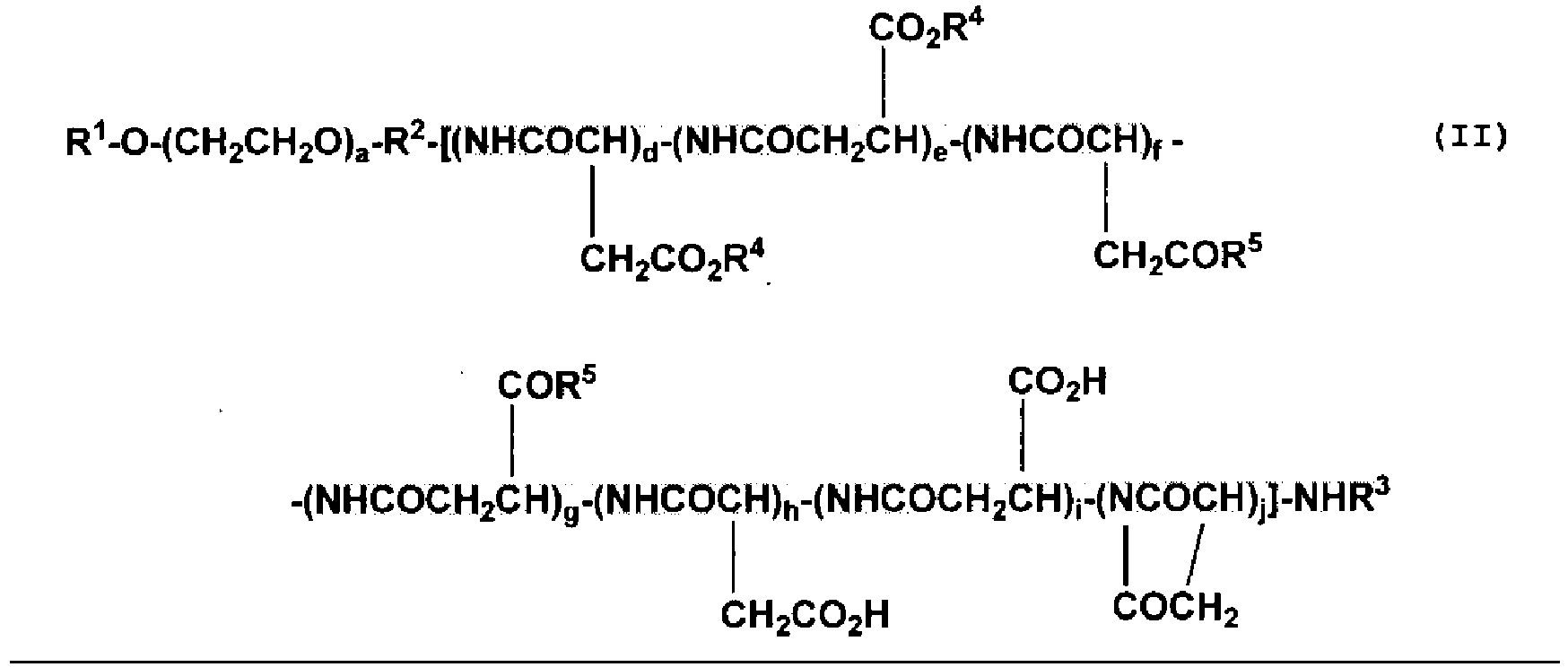 wobei R1 ein Wasserstoffatom oder eine (C1- bis C6-) Alkylgruppe darstellt; R2 eine Bindungsgruppe darstellt; R3 ein Wasserstoffatom oder eine (C1- bis C6-) Acylgruppe darstellt; R4 einen durch die allgemeine Formel (III) dargestellten Substituenten darstellt:
-Ar1-CR17R18-O-C (=O) -A (III)
wobei Ar1
durch eine der folgenden Formeln dargestellt wird: R5 einen Substituenten darstellt, der ausgewählt ist aus der Gruppe, bestehend aus einer Hydroxymethylphenoxygruppe, die gegebenenfalls einen Substituenten aufweist, einer (C1- bis C30-) Alkoxygruppe, einer (C1- bis C30-) Aralkyloxygruppe, einer (C1- bis C30-) Alkylaminogruppe, einer Di-(C1-bis C30-) Alkylaminogruppe, einer Aminosäure mit einer geschützten Carboxylgruppe und -NR6CONHR7, wobei R6 und R7, die gleich oder verschieden voneinander sein können, eine zyklische (C3- bis C6-) Alkylgruppe oder eine (C1- bis C5-) Alkylgruppe darstellen, die mit einer tertiären Aminogruppe substituiert sein kann; a eine ganze Zahl von 5 bis 11.500 darstellt; d, e, f, g, h, i und j jeweils eine ganze Zahl von 0 bis 200 darstellen; d + e eine ganze Zahl von 1 bis 200 darstellt; und d + e + f + g + h + i + j eine ganze Zahl von 2 bis 200 darstellt; und jeweilige Einheiten der Polyasparaginsäure in beliebiger Reihenfolge gebunden sind,
 wobei R8 ein Wasserstoffatom oder eine (C1- bis C6-) Alkylgruppe darstellt; R9 eine Bindungsgruppe darstellt; R10 ein Wasserstoffatom oder eine (C1- bis C6-) Acylgruppe darstellt; R11 einen durch die allgemeine Formel (V) dargestellten Substituenten darstellt:
-Ar2-CR19R20-O-C (=0) -A (V)
wobei Ar2
durch eine der folgenden Formeln dargestellt wird: R12 einen Substituenten darstellt, der ausgewählt ist aus der Gruppe, bestehend aus einer Hydroxymethylphenoxygruppe, die gegebenenfalls einen Substituenten aufweist, einer (C1- bis C30-) Alkoxygruppe, einer (C1- bis C30-) Aralkyloxygruppe, einer (C1- bis C30-) Alkylaminogruppe, einer Di-(C1-bis C30-) Alkylaminogruppe, einer Aminosäure mit einer geschützten Carboxygruppe und -NR13CONHR14, wobei R13 und R14, die gleich oder verschieden voneinander sein können, eine zyklische (C3- bis C6-) Alkylgruppe oder eine (C1- bis C5-) Alkylgruppe darstellen, die mit einer tertiären Aminogruppe substituiert sein kann; b eine ganze Zahl von 5 bis 11.500 darstellt; k eine ganze Zahl von 1 bis 200 darstellt; m und n jeweils eine ganze Zahl von 0 bis 200 darstellen; und k + m + n eine ganze Zahl von 2 bis 200 darstellt; und jeweilige Einheiten der Polyglutaminsäure in beliebiger Reihenfolge gebunden sind.
 - Hochmolekulares Konjugat von physiologisch aktiven Substanzen nach Anspruch 1, wobei R1 eine (C1- bis C3-) Alkylgruppe darstellt; R2 eine (C2- bis C6-) Alkylengruppe darstellt; R3 eine (C1- bis C3-) Acylgruppe darstellt; Ar1 in der allgemeinen Formel (III) von R4 eine Phenylgruppe darstellt, in der die Bindung von Ar1 mit einem Polymer in ortho- oder paraStellung zu der Bindung mit CR17R18 vorliegt; und a eine ganze Zahl von 100 bis 300 darstellt; d, e, f, g, h, i und j jeweils eine ganze Zahl von 0 bis 100 darstellen; d + e eine ganze Zahl von 1 bis 100 darstellt; und d + e + f + g + h + i + j eine ganze Zahl von 6 bis 100 darstellt.
- Hochmolekulares Konjugat von physiologisch aktiven Substanzen nach Anspruch 2, wobei R1 eine Methylgruppe darstellt; R2 eine Trimethylengruppe darstellt; R3 eine Acetylgruppe darstellt; und R5 -NR6CONHR7 darstellt, wobei R6 und R7 beide eine Cyclohexylgruppe oder eine Isopropylgruppe sind.
- Hochmolekulares Konjugat von physiologisch aktiven Substanzen nach Anspruch 6, wobei R8 eine (C1- bis C3-) Alkylgruppe darstellt; R9 eine (C2- bis C6-) Alkylengruppe darstellt; R10 eine (C1- bis C3-) Acylgruppe darstellt; Ar2 in der allgemeinen Formel (V) als R11 eine Phenylgruppe darstellt, in der die Bindung von Ar2 mit einem Polymer in ortho- oder paraStellung zu der Bindung mit CR19R20 vorliegt; und b eine ganze Zahl von 100 bis 300 darstellt; k eine ganze Zahl von 1 bis 90 darstellt, m und n jeweils eine ganze Zahl von 0 bis 90 darstellen; und k + m + n eine ganze Zahl von 6 bis 90 darstellt.
- Hochmolekulares Konjugat von physiologisch aktiven Substanzen nach Anspruch 4, wobei R8 eine Methylgruppe darstellt; R9 eine Trimethylengruppe darstellt; R10 eine Acetylgruppe darstellt; und R12 -NR13CONHR14 darstellt, wobei R13 und R14 beide eine Cyclohexylgruppe oder eine Isopropylgruppe sind.
- Hochmolekulares Konjugat von physiologisch aktiven Substanzen nach Anspruch 1, erhalten durch:Ester-Bindung einer Seitenketten-Carboxygruppe eines Blockcopolymers mit einer Polyethylenglykoleinheit und einer Polyasparaginsäureeinheit oder einer Polyglutaminsäureeinheit an eine phenolische Hydroxylgruppe einer Hydroxybenzylalkoholverbindung; undBindung einer alkoholischen Hydroxylgruppe der resultierenden Esterverbindung mit einer Carboxygruppe der physiologisch aktiven Substanz, welche die Carboxygruppe aufweist.
- Hochmolekulares Konjugat von physiologisch aktiven Substanzen nach Anspruch 1, wobei die physiologisch aktive Substanz ein Antikrebsmittel ist.
- Hochmolekulares Konjugat von physiologisch aktiven Substanzen nach Anspruch 1, wobei die physiologisch aktive Substanz ein physiologisch aktives Peptid ist.
- Hochmolekulares Konjugat von physiologisch aktiven Substanzen nach Anspruch 8, wobei das physiologisch aktive Peptid Bestatin ist.
- Hochmolekulares Konjugat von physiologisch aktiven Substanzen nach Anspruch 1, wobei die physiologisch aktive Substanz ein entzündungshemmendes Mittel ist.
- Hochmolekulares Konjugat von physiologisch aktiven Substanzen nach Anspruch 1, wobei die physiologisch aktive Substanz, die eine Carboxygruppe aufweist, Indomethacin, Etodolac, Mefenaminsäure, Diclofenac, Flurbiprofen, Ibuprofen, Methotrexat und DMXAA ist.
- Hochmolekulares Konjugat von physiologisch aktiven Substanzen nach Anspruch 1, wobei das hochmolekulare Konjugat in Wasser eine Mizelle bildet.
- Pharmazeutisches Produkt, umfassend ein hochmolekulares Konjugat von physiologisch aktiven Substanzen nach Anspruch 1 als Wirkstoff.
- Antikrebsmittel, umfassend ein hochmolekulares Konjugat von physiologisch aktiven Substanzen nach Anspruch 7 als Wirkstoff.
- Entzündungshemmendes Mittel, umfassend ein hochmolekulares Konjugat von physiologisch aktiven Substanzen nach Anspruch 10 als Wirkstoff.
Applications Claiming Priority (2)
| Application Number | Priority Date | Filing Date | Title |
|---|---|---|---|
| JP2008069067 | 2008-03-18 | ||
| PCT/JP2009/055115 WO2009116509A1 (ja) | 2008-03-18 | 2009-03-17 | 生理活性物質の高分子結合体 |
Publications (3)
| Publication Number | Publication Date |
|---|---|
| EP2258397A1 EP2258397A1 (de) | 2010-12-08 |
| EP2258397A4 EP2258397A4 (de) | 2013-06-26 |
| EP2258397B1 true EP2258397B1 (de) | 2017-10-11 |
Family
ID=41090910
Family Applications (1)
| Application Number | Title | Priority Date | Filing Date |
|---|---|---|---|
| EP09722008.1A Not-in-force EP2258397B1 (de) | 2008-03-18 | 2009-03-17 | Polymerkonjugat aus einem physiologisch aktiven stoff |
Country Status (6)
| Country | Link |
|---|---|
| US (1) | US8920788B2 (de) |
| EP (1) | EP2258397B1 (de) |
| JP (1) | JP5687899B2 (de) |
| KR (1) | KR101589582B1 (de) |
| CN (1) | CN101977631A (de) |
| WO (1) | WO2009116509A1 (de) |
Families Citing this family (26)
| Publication number | Priority date | Publication date | Assignee | Title |
|---|---|---|---|---|
| RU2324701C2 (ru) * | 2003-03-20 | 2008-05-20 | Ниппон Каяку Кабусики Кайся | Мицеллярный препарат, содержащий малорастворимый в воде противораковый агент, содержащее его противораковое средство и новый блок-сополимер |
| JP4820758B2 (ja) * | 2004-09-22 | 2011-11-24 | 日本化薬株式会社 | 新規ブロック共重合体、ミセル調製物及びそれを有効成分とする抗癌剤 |
| JP5249016B2 (ja) * | 2006-03-28 | 2013-07-31 | 日本化薬株式会社 | タキサン類の高分子結合体 |
| KR20090009241A (ko) * | 2006-05-18 | 2009-01-22 | 니폰 가야꾸 가부시끼가이샤 | 포도필로톡신류의 고분자 결합체 |
| ES2584840T3 (es) * | 2006-10-03 | 2016-09-29 | Nippon Kayaku Kabushiki Kaisha | Compuesto de un derivado de resorcinol con un polímero |
| WO2008056596A1 (fr) * | 2006-11-06 | 2008-05-15 | Nippon Kayaku Kabushiki Kaisha | Dérivé polymère d'un antagoniste métabolique d'acide nucléique |
| JP5548365B2 (ja) * | 2006-11-08 | 2014-07-16 | 日本化薬株式会社 | 核酸系代謝拮抗剤の高分子誘導体 |
| US8703878B2 (en) | 2007-09-28 | 2014-04-22 | Nippon Kayaku Kabushiki Kaisha | High-molecular weight conjugate of steroids |
| WO2009136572A1 (ja) | 2008-05-08 | 2009-11-12 | 日本化薬株式会社 | 葉酸若しくは葉酸誘導体の高分子結合体 |
| EP2431403B1 (de) | 2009-05-15 | 2016-09-28 | Nipponkayaku Kabushikikaisha | Polymerkonjugat aus einer bioaktiven substanz mit einer hydroxidgruppe |
| EP2641605B1 (de) * | 2010-11-17 | 2018-03-07 | Nippon Kayaku Kabushiki Kaisha | Polymerderivat für einen cytidinstoffwechselantagonisten |
| KR101849142B1 (ko) | 2011-09-11 | 2018-04-16 | 니폰 가야꾸 가부시끼가이샤 | 블록 공중합체의 제조방법 |
| US8962577B2 (en) * | 2012-03-16 | 2015-02-24 | The Johns Hopkins University | Controlled release formulations for the delivery of HIF-1 inhibitors |
| JP6138904B2 (ja) * | 2012-03-16 | 2017-05-31 | ザ・ジョンズ・ホプキンス・ユニバーシティー | 活性剤の送達のための非線状マルチブロックコポリマー薬物コンジュゲート |
| MY190370A (en) * | 2012-06-26 | 2022-04-18 | Polyactiva Pty Ltd | Polymer-nsaid conjugate |
| WO2014073447A1 (ja) * | 2012-11-08 | 2014-05-15 | 日本化薬株式会社 | カンプトテシン類と抗癌効果増強剤の結合した高分子化合物及びその用途 |
| EP2942348B1 (de) | 2014-05-07 | 2017-10-25 | Johannes Gutenberg-Universität Mainz | Thiol-geschützte Aminosäurederivate und ihre Verwendungen |
| EP3181136B1 (de) | 2014-08-11 | 2019-11-27 | The University of Tokyo | Mizelle mit epirubicin-komplexiertem blockcopolymer und antikrebsmittel und pharmazeutische zusammensetzungen mit dieser mizelle zur behandlung von krebs, resistentem krebs oder metastasierendem krebs |
| RU2732612C2 (ru) * | 2015-02-23 | 2020-09-21 | Ниппон Каяку Кабусики Каися | Блок-сополимерный конъюгат физиологически активного вещества |
| WO2017164334A1 (ja) * | 2016-03-23 | 2017-09-28 | 公益財団法人 川崎市産業振興財団 | ホウ素クラスター結合ペプチド化合物 |
| JPWO2018025699A1 (ja) * | 2016-08-02 | 2019-05-30 | 日本化薬株式会社 | アクティブターゲティング型高分子誘導体、その高分子誘導体を含む組成物、及びそれらの用途 |
| US11357861B2 (en) | 2017-09-29 | 2022-06-14 | Hanmi Pharm. Co., Ltd | Protein complex comprising non-peptidyl polymer-coupled fatty acid derivative compound as linker and preparation method therefor |
| CN111868093A (zh) * | 2018-01-30 | 2020-10-30 | 国立大学法人大阪大学 | 抗癌剂 |
| JP7289155B2 (ja) * | 2019-04-10 | 2023-06-09 | 国立大学法人 東京大学 | 妊婦又は妊娠可能性のある女性に対して投与するための医薬組成物 |
| CN110790923A (zh) * | 2019-10-12 | 2020-02-14 | 天津大学 | 一种γ-聚谷氨酸-接枝-吲哚结构伯胺及制备方法和应用 |
| KR20230043822A (ko) * | 2020-07-31 | 2023-03-31 | 도레이 카부시키가이샤 | 복합체에 포함되는 약물의 순도 평가 방법 및 복합체의 제조 방법 |
Citations (2)
| Publication number | Priority date | Publication date | Assignee | Title |
|---|---|---|---|---|
| EP2042195A1 (de) * | 2006-07-19 | 2009-04-01 | Nippon Kayaku Kabushiki Kaisha | Polymerkonjugat von combretastatin |
| EP1401473B1 (de) * | 2001-02-16 | 2009-07-29 | Cellgate Inc. | Transporter mit beabstandeten arginin-teilchen |
Family Cites Families (112)
| Publication number | Priority date | Publication date | Assignee | Title |
|---|---|---|---|---|
| GB1467587A (en) * | 1974-07-11 | 1977-03-16 | Nestle Sa | Preparation of an asparagine or a glutamine |
| GB8500209D0 (en) * | 1985-01-04 | 1985-02-13 | Ceskoslovenska Akademie Ved | Synthetic polymeric drugs |
| JPS6296088A (ja) | 1985-10-22 | 1987-05-02 | Kanebo Ltd | 抗腫瘍性物質の製法 |
| US4734512A (en) | 1985-12-05 | 1988-03-29 | Bristol-Myers Company | Intermediates for the production of podophyllotoxin and related compounds and processes for the preparation and use thereof |
| CH667874A5 (fr) * | 1985-12-19 | 1988-11-15 | Battelle Memorial Institute | Polypeptide synthetique biodegradable et son utilisation pour la preparation de medicaments. |
| JPS6310789A (ja) | 1986-07-01 | 1988-01-18 | Nippon Kayaku Co Ltd | 新規ポドフイロトキシン誘導体 |
| JPS6323884A (ja) | 1986-07-17 | 1988-02-01 | Nippon Kayaku Co Ltd | 新規ポドフイロトキシン誘導体 |
| JPS6461423A (en) | 1987-09-02 | 1989-03-08 | Nippon Kayaku Kk | Water-soluble polymeric carcinostatic agent |
| JPS6461422A (en) | 1987-09-02 | 1989-03-08 | Nippon Kayaku Kk | Water-soluble polymeric carcinostatic agent |
| US5182203A (en) * | 1989-03-29 | 1993-01-26 | E. I. Du Pont De Nemours And Company | Bifunctional compounds useful in catalyzed reporter deposition |
| JP2517760B2 (ja) * | 1989-05-11 | 1996-07-24 | 新技術事業団 | 水溶性高分子化医薬製剤 |
| US5543390A (en) * | 1990-11-01 | 1996-08-06 | State Of Oregon, Acting By And Through The Oregon State Board Of Higher Education, Acting For And On Behalf Of The Oregon Health Sciences University | Covalent microparticle-drug conjugates for biological targeting |
| JP3310000B2 (ja) | 1990-11-07 | 2002-07-29 | 靖久 桜井 | 水溶性高分子抗癌剤及び薬物担持用担体 |
| JPH05117385A (ja) | 1991-10-31 | 1993-05-14 | Res Dev Corp Of Japan | ブロツク共重合体の製造法、ブロツク共重合体及び水溶性高分子抗癌剤 |
| WO1993024476A1 (en) | 1992-06-04 | 1993-12-09 | Clover Consolidated, Limited | Water-soluble polymeric carriers for drug delivery |
| KR940003548U (ko) * | 1992-08-14 | 1994-02-21 | 김형술 | 세탁물 건조기 |
| US5614549A (en) * | 1992-08-21 | 1997-03-25 | Enzon, Inc. | High molecular weight polymer-based prodrugs |
| JP3270592B2 (ja) | 1992-10-26 | 2002-04-02 | 日本化薬株式会社 | ブロック共重合体−抗癌剤複合体医薬製剤 |
| JPH06206830A (ja) | 1992-10-27 | 1994-07-26 | Nippon Kayaku Co Ltd | ブロック共重合体−薬剤複合体及び高分子ブロック共重合体 |
| JP3268913B2 (ja) | 1992-10-27 | 2002-03-25 | 日本化薬株式会社 | 高分子担体 |
| FR2698543B1 (fr) * | 1992-12-02 | 1994-12-30 | Rhone Poulenc Rorer Sa | Nouvelles compositions à base de taxoides. |
| US5985548A (en) * | 1993-02-04 | 1999-11-16 | E. I. Du Pont De Nemours And Company | Amplification of assay reporters by nucleic acid replication |
| DE4307114A1 (de) * | 1993-03-06 | 1994-09-08 | Basf Ag | Verfahren zur Herstellung von Umsetzungsprodukten aus Polyasparaginsäureamid und Aminosäuren und ihre Verwendung |
| JP2894923B2 (ja) | 1993-05-27 | 1999-05-24 | 日立造船株式会社 | ウォータージェット式双胴船のジェット水吸込口部構造 |
| US5880131A (en) | 1993-10-20 | 1999-03-09 | Enzon, Inc. | High molecular weight polymer-based prodrugs |
| US5840900A (en) | 1993-10-20 | 1998-11-24 | Enzon, Inc. | High molecular weight polymer-based prodrugs |
| JPH0848766A (ja) | 1994-05-30 | 1996-02-20 | Mitsui Toatsu Chem Inc | 重合体及びその製造方法 |
| US5571889A (en) * | 1994-05-30 | 1996-11-05 | Mitsui Toatsu Chemicals, Inc. | Polymer containing monomer units of chemically modified polyaspartic acids or their salts and process for preparing the same |
| US5552517A (en) * | 1995-03-03 | 1996-09-03 | Monsanto Company | Production of polysuccinimide in an organic medium |
| SG50747A1 (en) | 1995-08-02 | 1998-07-20 | Tanabe Seiyaku Co | Comptothecin derivatives |
| JP2694923B2 (ja) | 1995-08-21 | 1997-12-24 | 科学技術振興事業団 | 水溶性高分子化医薬製剤 |
| DE69735057T2 (de) * | 1996-03-12 | 2006-08-31 | PG-TXL Co., L.P., Houston | Wasserlösliche paclitaxel-prodrogen |
| DE69734709D1 (de) * | 1996-04-15 | 2005-12-29 | Asahi Chemical Ind | Arzneimittelkomplexe enthaltend taxan-verbindungen oder steroiden |
| US5877205A (en) | 1996-06-28 | 1999-03-02 | Board Of Regents, The University Of Texas System | Parenteral paclitaxel in a stable non-toxic formulation |
| CA2259977C (en) * | 1996-07-15 | 2005-06-28 | Kabushiki Kaisha Yakult Honsha | Taxane derivatives and drugs containing the same |
| PT941066E (pt) | 1996-08-26 | 2004-03-31 | Transgene Sa | Complexos de lipido cationico - acido nucleico |
| GB9625895D0 (en) * | 1996-12-13 | 1997-01-29 | Riley Patrick A | Novel compound useful as therapeutic agents and assay reagents |
| DE59709788D1 (de) * | 1997-05-09 | 2003-05-15 | Deutsches Krebsforsch | Konjugat, umfassend einen Folsäureantagonisten und einen Träger |
| WO1999030727A1 (en) * | 1997-12-17 | 1999-06-24 | Enzon, Inc. | Polymeric prodrugs of amino- and hydroxyl-containing bioactive agents |
| US6153655A (en) * | 1998-04-17 | 2000-11-28 | Enzon, Inc. | Terminally-branched polymeric linkers and polymeric conjugates containing the same |
| US6824766B2 (en) * | 1998-04-17 | 2004-11-30 | Enzon, Inc. | Biodegradable high molecular weight polymeric linkers and their conjugates |
| JPH11335267A (ja) | 1998-05-27 | 1999-12-07 | Nano Career Kk | 水難溶性薬物を含有するポリマーミセル系 |
| IN191203B (de) * | 1999-02-17 | 2003-10-04 | Amarnath Prof Maitra | |
| US6207832B1 (en) * | 1999-04-09 | 2001-03-27 | University Of Pittsburgh | Camptothecin analogs and methods of preparation thereof |
| US20010041189A1 (en) * | 1999-04-13 | 2001-11-15 | Jingya Xu | Poly(dipeptide) as a drug carrier |
| JP2001131066A (ja) | 1999-08-25 | 2001-05-15 | Nippon Kayaku Co Ltd | アポトーシス増強剤 |
| US6380405B1 (en) | 1999-09-13 | 2002-04-30 | Nobex Corporation | Taxane prodrugs |
| US6713454B1 (en) | 1999-09-13 | 2004-03-30 | Nobex Corporation | Prodrugs of etoposide and etoposide analogs |
| US6623730B1 (en) | 1999-09-14 | 2003-09-23 | Tepha, Inc. | Therapeutic uses of polymers and oligomers comprising gamma-hydroxybutyrate |
| US6376470B1 (en) | 1999-09-23 | 2002-04-23 | Enzon, Inc. | Polymer conjugates of ara-C and ara-C derivatives |
| US20030054977A1 (en) * | 1999-10-12 | 2003-03-20 | Cell Therapeutics, Inc. | Manufacture of polyglutamate-therapeutic agent conjugates |
| NZ529789A (en) | 1999-10-12 | 2005-04-29 | Cell Therapeutics Inc | Manufacture of polyglutamate-20(S)-camptothecin conjugates |
| JP3523821B2 (ja) | 2000-02-09 | 2004-04-26 | ナノキャリア株式会社 | 薬物が封入されたポリマーミセルの製造方法および該ポリマーミセル組成物 |
| JP2003525238A (ja) | 2000-02-29 | 2003-08-26 | ジヤンセン・フアーマシユーチカ・ナームローゼ・フエンノートシヤツプ | 抗腫瘍性ポドフィロトキシン誘導体とのファルネシルタンパク質トランスフェラーゼ阻害剤組み合わせ剤 |
| KR20020082888A (ko) | 2000-03-17 | 2002-10-31 | 쎌세러퓨틱스,인코포레이티드 | 폴리글루탐산-캄프토테신 컨주게이트 및 제조 방법 |
| US20020161062A1 (en) * | 2001-11-06 | 2002-10-31 | Biermann Paul J. | Structure including a plurality of cells of cured resinous material, method of forming the structure and apparatus for forming the structure |
| ATE541587T1 (de) | 2000-06-02 | 2012-02-15 | Eidgenoess Tech Hochschule | Konjugat-additionsreaktionen zur kontrollierten abgabe von pharmazeutisch wirksamen substanzen |
| JP2002069184A (ja) | 2000-06-12 | 2002-03-08 | Mitsui Chemicals Inc | 重合体及びその製造方法 |
| AU2001296215A1 (en) * | 2000-07-17 | 2002-01-30 | Oxi-Gene, Inc. | Efficient method of synthesizing combretastatin a-4 prodrugs |
| US20020099013A1 (en) * | 2000-11-14 | 2002-07-25 | Thomas Piccariello | Active agent delivery systems and methods for protecting and administering active agents |
| AU2002251988A1 (en) | 2001-02-20 | 2002-09-04 | Enzon, Inc. | Terminally-branched polymeric linkers and polymeric conjugates containing the same |
| EP1361895B1 (de) | 2001-02-20 | 2007-11-14 | Enzon, Inc. | Endgruppenverzweigte polymere verbindungen und diese enthaltende polymere konjugate |
| EP1408066B1 (de) * | 2001-06-20 | 2010-03-31 | Nippon Kayaku Kabushiki Kaisha | Blockcopolymer mit verringertem verunreinigungsgehalt, polymerer träger, pharmazeutische zubereitungen in polymerer form und verfahren zur herstellung davon |
| CA2463902A1 (en) | 2001-10-26 | 2003-05-01 | Oxigene, Inc. | Functionalized stilbene derivatives as improved vascular targeting agents |
| EP1456180B1 (de) | 2001-12-21 | 2007-10-03 | Vernalis (Cambridge) Limited | 3-(2,4)dihydroxyphenyl-4-phenylpyrazole und deren medizinische verwendung |
| EP1487493B1 (de) * | 2002-03-01 | 2010-01-20 | The Administrators of The Tulane Educational Fund | Konjugate von zytotoxischen mitteln und biologisch aktiven peptiden |
| CN100475269C (zh) | 2002-03-05 | 2009-04-08 | 北京键凯科技有限公司 | 亲水性聚合物-谷氨酸寡肽与药物分子的结合物、包含该结合物的组合物及用途 |
| KR20040097237A (ko) * | 2002-03-26 | 2004-11-17 | 반유 세이야꾸 가부시끼가이샤 | 항종양성 인돌로피롤로카바졸 유도체와 기타 항암제의 병용 |
| US6596757B1 (en) * | 2002-05-14 | 2003-07-22 | Immunogen Inc. | Cytotoxic agents comprising polyethylene glycol-containing taxanes and their therapeutic use |
| JP2003342168A (ja) | 2002-05-24 | 2003-12-03 | Nano Career Kk | 注射用薬物含有ポリマーミセル製剤の製造方法 |
| JP2003342167A (ja) | 2002-05-24 | 2003-12-03 | Nano Career Kk | カンプトテシン誘導体の製剤およびその調製方法 |
| JP4270485B2 (ja) | 2002-05-28 | 2009-06-03 | 第一三共株式会社 | タキサン類の還元方法 |
| JP2004010479A (ja) * | 2002-06-03 | 2004-01-15 | Japan Science & Technology Corp | ブロック共重合体とアンスラサイクリン系抗癌剤を含む新規固型製剤及びその製造法 |
| EP1580216B1 (de) * | 2002-10-31 | 2014-05-14 | Nippon Kayaku Kabushiki Kaisha | Hochmolekulare camptothecinderivate |
| GB0228417D0 (en) | 2002-12-05 | 2003-01-08 | Cancer Rec Tech Ltd | Pyrazole compounds |
| GB0229618D0 (en) | 2002-12-19 | 2003-01-22 | Cancer Rec Tech Ltd | Pyrazole compounds |
| US7169892B2 (en) * | 2003-01-10 | 2007-01-30 | Astellas Pharma Inc. | Lipid-peptide-polymer conjugates for long blood circulation and tumor specific drug delivery systems |
| EA009919B1 (ru) | 2003-02-11 | 2008-04-28 | Вернэлис (Кембридж) Лимитед | Соединения изоксазола |
| RU2324701C2 (ru) * | 2003-03-20 | 2008-05-20 | Ниппон Каяку Кабусики Кайся | Мицеллярный препарат, содержащий малорастворимый в воде противораковый агент, содержащее его противораковое средство и новый блок-сополимер |
| EP1594482A1 (de) | 2003-03-26 | 2005-11-16 | LTT Bio-Pharma Co., Ltd. | Intravenöse nanoteilchen für die gezielte arzneimittelabgabe und verzögerte freisetzung von arzneimitteln |
| GB0309637D0 (en) | 2003-04-28 | 2003-06-04 | Cancer Rec Tech Ltd | Pyrazole compounds |
| GB0315111D0 (en) | 2003-06-27 | 2003-07-30 | Cancer Rec Tech Ltd | Substituted 5-membered ring compounds and their use |
| WO2005018674A1 (ja) | 2003-08-22 | 2005-03-03 | Kyowa Hakko Kogyo Co., Ltd. | イムノグロブリン遺伝子の転座を伴う疾患の治療薬 |
| EP1680073B1 (de) * | 2003-10-21 | 2013-01-02 | IGF Oncology, LLC | Verbindungen und verfahren zur behandlung von krebs |
| FR2862536B1 (fr) | 2003-11-21 | 2007-11-23 | Flamel Tech Sa | Formulations pharmaceutiques pour la liberation prolongee de principe(s) actif(s), ainsi que leurs applications notamment therapeutiques |
| US7176185B2 (en) * | 2003-11-25 | 2007-02-13 | Tsrl, Inc. | Short peptide carrier system for cellular delivery of agent |
| WO2005066214A1 (ja) | 2004-01-07 | 2005-07-21 | Seikagaku Corporation | ヒアルロン酸誘導体及びそれを含む薬剤 |
| JP4820758B2 (ja) * | 2004-09-22 | 2011-11-24 | 日本化薬株式会社 | 新規ブロック共重合体、ミセル調製物及びそれを有効成分とする抗癌剤 |
| WO2006055670A2 (en) | 2004-11-16 | 2006-05-26 | Hyperion Catalysis International, Inc. | Methods for preparing catalysts supported on carbon nanotube networks |
| WO2006055760A1 (en) | 2004-11-18 | 2006-05-26 | Synta Pharmaceuticals Corp. | Triazole compounds that modulate hsp90 activity |
| US8399464B2 (en) * | 2005-03-09 | 2013-03-19 | Nippon Kayaku Kabushiki Kaisha | HSP90 inhibitor |
| RU2007137133A (ru) | 2005-03-09 | 2009-04-20 | Ниппон Каяку Кабусики Кайся (Jp) | Новый ингибитор hsp90 |
| CA2600085A1 (en) * | 2005-03-09 | 2006-09-14 | Toray Industries, Inc. | Microparticle and pharmaceutical preparation |
| JP2008137894A (ja) | 2005-03-22 | 2008-06-19 | Nippon Kayaku Co Ltd | 新規なアセチレン誘導体 |
| WO2006115293A1 (ja) | 2005-04-22 | 2006-11-02 | The University Of Tokyo | pH応答性高分子ミセルの調製に用いる新規ブロック共重合体及びその製造法 |
| KR101312417B1 (ko) * | 2005-05-11 | 2013-09-27 | 니폰 가야꾸 가부시끼가이샤 | 시티딘계 대사길항제의 고분자 유도체 |
| JPWO2006120915A1 (ja) * | 2005-05-12 | 2008-12-18 | ニプロ株式会社 | 循環障害改善剤 |
| EP2382995A3 (de) * | 2005-08-19 | 2013-09-25 | Endocyte, Inc. | Ligandenkonjugate von Vincaalkaloiden, Analoga und Derivaten |
| CN1800238A (zh) | 2005-12-05 | 2006-07-12 | 中国科学院长春应用化学研究所 | 有生物功能的脂肪族聚酯—聚氨基酸共聚物及合成方法 |
| JP2007182407A (ja) | 2006-01-10 | 2007-07-19 | Medgel Corp | 徐放性ハイドロゲル製剤 |
| JP2007191643A (ja) | 2006-01-20 | 2007-08-02 | Mitsui Chemicals Inc | 生体への定着性が付与されたポリアミノ酸誘導体 |
| JP5249016B2 (ja) * | 2006-03-28 | 2013-07-31 | 日本化薬株式会社 | タキサン類の高分子結合体 |
| KR20090009241A (ko) * | 2006-05-18 | 2009-01-22 | 니폰 가야꾸 가부시끼가이샤 | 포도필로톡신류의 고분자 결합체 |
| ES2584840T3 (es) | 2006-10-03 | 2016-09-29 | Nippon Kayaku Kabushiki Kaisha | Compuesto de un derivado de resorcinol con un polímero |
| WO2008056596A1 (fr) | 2006-11-06 | 2008-05-15 | Nippon Kayaku Kabushiki Kaisha | Dérivé polymère d'un antagoniste métabolique d'acide nucléique |
| JP5548365B2 (ja) | 2006-11-08 | 2014-07-16 | 日本化薬株式会社 | 核酸系代謝拮抗剤の高分子誘導体 |
| US8703878B2 (en) * | 2007-09-28 | 2014-04-22 | Nippon Kayaku Kabushiki Kaisha | High-molecular weight conjugate of steroids |
| WO2009136572A1 (ja) * | 2008-05-08 | 2009-11-12 | 日本化薬株式会社 | 葉酸若しくは葉酸誘導体の高分子結合体 |
| DK2287230T3 (da) | 2008-05-23 | 2012-12-10 | Nanocarrier Co Ltd | Docetaxel polymer derivative, method for producing same and use of same |
| EP2431403B1 (de) | 2009-05-15 | 2016-09-28 | Nipponkayaku Kabushikikaisha | Polymerkonjugat aus einer bioaktiven substanz mit einer hydroxidgruppe |
| EP2641605B1 (de) * | 2010-11-17 | 2018-03-07 | Nippon Kayaku Kabushiki Kaisha | Polymerderivat für einen cytidinstoffwechselantagonisten |
| KR101849142B1 (ko) * | 2011-09-11 | 2018-04-16 | 니폰 가야꾸 가부시끼가이샤 | 블록 공중합체의 제조방법 |
-
2009
- 2009-03-17 WO PCT/JP2009/055115 patent/WO2009116509A1/ja not_active Ceased
- 2009-03-17 KR KR1020107020425A patent/KR101589582B1/ko not_active Expired - Fee Related
- 2009-03-17 US US12/922,747 patent/US8920788B2/en not_active Expired - Fee Related
- 2009-03-17 CN CN2009801100875A patent/CN101977631A/zh active Pending
- 2009-03-17 EP EP09722008.1A patent/EP2258397B1/de not_active Not-in-force
- 2009-03-17 JP JP2010503871A patent/JP5687899B2/ja not_active Expired - Fee Related
Patent Citations (2)
| Publication number | Priority date | Publication date | Assignee | Title |
|---|---|---|---|---|
| EP1401473B1 (de) * | 2001-02-16 | 2009-07-29 | Cellgate Inc. | Transporter mit beabstandeten arginin-teilchen |
| EP2042195A1 (de) * | 2006-07-19 | 2009-04-01 | Nippon Kayaku Kabushiki Kaisha | Polymerkonjugat von combretastatin |
Also Published As
| Publication number | Publication date |
|---|---|
| WO2009116509A1 (ja) | 2009-09-24 |
| JP5687899B2 (ja) | 2015-03-25 |
| US20110201754A1 (en) | 2011-08-18 |
| KR101589582B1 (ko) | 2016-01-28 |
| US8920788B2 (en) | 2014-12-30 |
| KR20100126378A (ko) | 2010-12-01 |
| EP2258397A1 (de) | 2010-12-08 |
| CN101977631A (zh) | 2011-02-16 |
| EP2258397A4 (de) | 2013-06-26 |
| JPWO2009116509A1 (ja) | 2011-07-21 |
Similar Documents
| Publication | Publication Date | Title |
|---|---|---|
| EP2258397B1 (de) | Polymerkonjugat aus einem physiologisch aktiven stoff | |
| US8808749B2 (en) | Polymer conjugate of bioactive substance having hydroxy group | |
| US8323669B2 (en) | Polymer conjugate of taxane | |
| US8940332B2 (en) | High-molecular weight conjugate of podophyllotoxins | |
| EP2042195A1 (de) | Polymerkonjugat von combretastatin | |
| EP1580216B1 (de) | Hochmolekulare camptothecinderivate | |
| US8703878B2 (en) | High-molecular weight conjugate of steroids |
Legal Events
| Date | Code | Title | Description |
|---|---|---|---|
| PUAI | Public reference made under article 153(3) epc to a published international application that has entered the european phase |
Free format text: ORIGINAL CODE: 0009012 |
|
| 17P | Request for examination filed |
Effective date: 20100917 |
|
| AK | Designated contracting states |
Kind code of ref document: A1 Designated state(s): AT BE BG CH CY CZ DE DK EE ES FI FR GB GR HR HU IE IS IT LI LT LU LV MC MK MT NL NO PL PT RO SE SI SK TR |
|
| AX | Request for extension of the european patent |
Extension state: AL BA RS |
|
| DAX | Request for extension of the european patent (deleted) | ||
| A4 | Supplementary search report drawn up and despatched |
Effective date: 20130524 |
|
| RIC1 | Information provided on ipc code assigned before grant |
Ipc: C08G 69/48 20060101ALI20130517BHEP Ipc: A61K 38/00 20060101ALI20130517BHEP Ipc: A61P 35/00 20060101ALI20130517BHEP Ipc: A61K 31/704 20060101ALI20130517BHEP Ipc: A61K 31/405 20060101ALI20130517BHEP Ipc: A61K 31/352 20060101ALI20130517BHEP Ipc: A61K 31/407 20060101ALI20130517BHEP Ipc: A61P 29/00 20060101ALI20130517BHEP Ipc: A61K 47/48 20060101AFI20130517BHEP Ipc: C08G 69/44 20060101ALI20130517BHEP |
|
| 17Q | First examination report despatched |
Effective date: 20160129 |
|
| REG | Reference to a national code |
Ref country code: DE Ref legal event code: R079 Ref document number: 602009048791 Country of ref document: DE Free format text: PREVIOUS MAIN CLASS: A61K0047480000 Ipc: A61K0047600000 |
|
| GRAP | Despatch of communication of intention to grant a patent |
Free format text: ORIGINAL CODE: EPIDOSNIGR1 |
|
| RIC1 | Information provided on ipc code assigned before grant |
Ipc: C08G 69/44 20060101ALI20170321BHEP Ipc: A61K 31/704 20060101ALI20170321BHEP Ipc: C08G 69/10 20060101ALI20170321BHEP Ipc: A61P 35/00 20060101ALI20170321BHEP Ipc: A61K 31/407 20060101ALI20170321BHEP Ipc: A61K 38/00 20060101ALI20170321BHEP Ipc: A61K 31/352 20060101ALI20170321BHEP Ipc: A61K 47/64 20170101ALI20170321BHEP Ipc: A61P 29/00 20060101ALI20170321BHEP Ipc: C08G 69/48 20060101ALI20170321BHEP Ipc: A61K 47/60 20170101AFI20170321BHEP Ipc: C08G 69/40 20060101ALI20170321BHEP Ipc: A61K 31/405 20060101ALI20170321BHEP |
|
| INTG | Intention to grant announced |
Effective date: 20170403 |
|
| GRAS | Grant fee paid |
Free format text: ORIGINAL CODE: EPIDOSNIGR3 |
|
| GRAJ | Information related to disapproval of communication of intention to grant by the applicant or resumption of examination proceedings by the epo deleted |
Free format text: ORIGINAL CODE: EPIDOSDIGR1 |
|
| GRAL | Information related to payment of fee for publishing/printing deleted |
Free format text: ORIGINAL CODE: EPIDOSDIGR3 |
|
| GRAR | Information related to intention to grant a patent recorded |
Free format text: ORIGINAL CODE: EPIDOSNIGR71 |
|
| RAP1 | Party data changed (applicant data changed or rights of an application transferred) |
Owner name: NIPPON KAYAKU KABUSHIKI KAISHA |
|
| GRAA | (expected) grant |
Free format text: ORIGINAL CODE: 0009210 |
|
| INTC | Intention to grant announced (deleted) | ||
| AK | Designated contracting states |
Kind code of ref document: B1 Designated state(s): AT BE BG CH CY CZ DE DK EE ES FI FR GB GR HR HU IE IS IT LI LT LU LV MC MK MT NL NO PL PT RO SE SI SK TR |
|
| INTG | Intention to grant announced |
Effective date: 20170901 |
|
| REG | Reference to a national code |
Ref country code: GB Ref legal event code: FG4D |
|
| REG | Reference to a national code |
Ref country code: CH Ref legal event code: EP |
|
| REG | Reference to a national code |
Ref country code: IE Ref legal event code: FG4D |
|
| REG | Reference to a national code |
Ref country code: AT Ref legal event code: REF Ref document number: 935443 Country of ref document: AT Kind code of ref document: T Effective date: 20171115 |
|
| REG | Reference to a national code |
Ref country code: DE Ref legal event code: R096 Ref document number: 602009048791 Country of ref document: DE |
|
| REG | Reference to a national code |
Ref country code: NL Ref legal event code: MP Effective date: 20171011 |
|
| REG | Reference to a national code |
Ref country code: LT Ref legal event code: MG4D |
|
| REG | Reference to a national code |
Ref country code: AT Ref legal event code: MK05 Ref document number: 935443 Country of ref document: AT Kind code of ref document: T Effective date: 20171011 |
|
| REG | Reference to a national code |
Ref country code: FR Ref legal event code: PLFP Year of fee payment: 10 |
|
| PG25 | Lapsed in a contracting state [announced via postgrant information from national office to epo] |
Ref country code: NL Free format text: LAPSE BECAUSE OF FAILURE TO SUBMIT A TRANSLATION OF THE DESCRIPTION OR TO PAY THE FEE WITHIN THE PRESCRIBED TIME-LIMIT Effective date: 20171011 |
|
| PG25 | Lapsed in a contracting state [announced via postgrant information from national office to epo] |
Ref country code: SE Free format text: LAPSE BECAUSE OF FAILURE TO SUBMIT A TRANSLATION OF THE DESCRIPTION OR TO PAY THE FEE WITHIN THE PRESCRIBED TIME-LIMIT Effective date: 20171011 Ref country code: LT Free format text: LAPSE BECAUSE OF FAILURE TO SUBMIT A TRANSLATION OF THE DESCRIPTION OR TO PAY THE FEE WITHIN THE PRESCRIBED TIME-LIMIT Effective date: 20171011 Ref country code: NO Free format text: LAPSE BECAUSE OF FAILURE TO SUBMIT A TRANSLATION OF THE DESCRIPTION OR TO PAY THE FEE WITHIN THE PRESCRIBED TIME-LIMIT Effective date: 20180111 Ref country code: FI Free format text: LAPSE BECAUSE OF FAILURE TO SUBMIT A TRANSLATION OF THE DESCRIPTION OR TO PAY THE FEE WITHIN THE PRESCRIBED TIME-LIMIT Effective date: 20171011 Ref country code: ES Free format text: LAPSE BECAUSE OF FAILURE TO SUBMIT A TRANSLATION OF THE DESCRIPTION OR TO PAY THE FEE WITHIN THE PRESCRIBED TIME-LIMIT Effective date: 20171011 |
|
| PG25 | Lapsed in a contracting state [announced via postgrant information from national office to epo] |
Ref country code: GR Free format text: LAPSE BECAUSE OF FAILURE TO SUBMIT A TRANSLATION OF THE DESCRIPTION OR TO PAY THE FEE WITHIN THE PRESCRIBED TIME-LIMIT Effective date: 20180112 Ref country code: AT Free format text: LAPSE BECAUSE OF FAILURE TO SUBMIT A TRANSLATION OF THE DESCRIPTION OR TO PAY THE FEE WITHIN THE PRESCRIBED TIME-LIMIT Effective date: 20171011 Ref country code: LV Free format text: LAPSE BECAUSE OF FAILURE TO SUBMIT A TRANSLATION OF THE DESCRIPTION OR TO PAY THE FEE WITHIN THE PRESCRIBED TIME-LIMIT Effective date: 20171011 Ref country code: BG Free format text: LAPSE BECAUSE OF FAILURE TO SUBMIT A TRANSLATION OF THE DESCRIPTION OR TO PAY THE FEE WITHIN THE PRESCRIBED TIME-LIMIT Effective date: 20180111 Ref country code: HR Free format text: LAPSE BECAUSE OF FAILURE TO SUBMIT A TRANSLATION OF THE DESCRIPTION OR TO PAY THE FEE WITHIN THE PRESCRIBED TIME-LIMIT Effective date: 20171011 Ref country code: IS Free format text: LAPSE BECAUSE OF FAILURE TO SUBMIT A TRANSLATION OF THE DESCRIPTION OR TO PAY THE FEE WITHIN THE PRESCRIBED TIME-LIMIT Effective date: 20180211 |
|
| REG | Reference to a national code |
Ref country code: DE Ref legal event code: R097 Ref document number: 602009048791 Country of ref document: DE |
|
| PG25 | Lapsed in a contracting state [announced via postgrant information from national office to epo] |
Ref country code: SK Free format text: LAPSE BECAUSE OF FAILURE TO SUBMIT A TRANSLATION OF THE DESCRIPTION OR TO PAY THE FEE WITHIN THE PRESCRIBED TIME-LIMIT Effective date: 20171011 Ref country code: EE Free format text: LAPSE BECAUSE OF FAILURE TO SUBMIT A TRANSLATION OF THE DESCRIPTION OR TO PAY THE FEE WITHIN THE PRESCRIBED TIME-LIMIT Effective date: 20171011 Ref country code: DK Free format text: LAPSE BECAUSE OF FAILURE TO SUBMIT A TRANSLATION OF THE DESCRIPTION OR TO PAY THE FEE WITHIN THE PRESCRIBED TIME-LIMIT Effective date: 20171011 Ref country code: CZ Free format text: LAPSE BECAUSE OF FAILURE TO SUBMIT A TRANSLATION OF THE DESCRIPTION OR TO PAY THE FEE WITHIN THE PRESCRIBED TIME-LIMIT Effective date: 20171011 |
|
| PLBE | No opposition filed within time limit |
Free format text: ORIGINAL CODE: 0009261 |
|
| STAA | Information on the status of an ep patent application or granted ep patent |
Free format text: STATUS: NO OPPOSITION FILED WITHIN TIME LIMIT |
|
| PG25 | Lapsed in a contracting state [announced via postgrant information from national office to epo] |
Ref country code: RO Free format text: LAPSE BECAUSE OF FAILURE TO SUBMIT A TRANSLATION OF THE DESCRIPTION OR TO PAY THE FEE WITHIN THE PRESCRIBED TIME-LIMIT Effective date: 20171011 Ref country code: IT Free format text: LAPSE BECAUSE OF FAILURE TO SUBMIT A TRANSLATION OF THE DESCRIPTION OR TO PAY THE FEE WITHIN THE PRESCRIBED TIME-LIMIT Effective date: 20171011 Ref country code: PL Free format text: LAPSE BECAUSE OF FAILURE TO SUBMIT A TRANSLATION OF THE DESCRIPTION OR TO PAY THE FEE WITHIN THE PRESCRIBED TIME-LIMIT Effective date: 20171011 |
|
| 26N | No opposition filed |
Effective date: 20180712 |
|
| REG | Reference to a national code |
Ref country code: CH Ref legal event code: PL |
|
| PG25 | Lapsed in a contracting state [announced via postgrant information from national office to epo] |
Ref country code: SI Free format text: LAPSE BECAUSE OF FAILURE TO SUBMIT A TRANSLATION OF THE DESCRIPTION OR TO PAY THE FEE WITHIN THE PRESCRIBED TIME-LIMIT Effective date: 20171011 Ref country code: MC Free format text: LAPSE BECAUSE OF FAILURE TO SUBMIT A TRANSLATION OF THE DESCRIPTION OR TO PAY THE FEE WITHIN THE PRESCRIBED TIME-LIMIT Effective date: 20171011 |
|
| REG | Reference to a national code |
Ref country code: BE Ref legal event code: MM Effective date: 20180331 |
|
| REG | Reference to a national code |
Ref country code: IE Ref legal event code: MM4A |
|
| PG25 | Lapsed in a contracting state [announced via postgrant information from national office to epo] |
Ref country code: LU Free format text: LAPSE BECAUSE OF NON-PAYMENT OF DUE FEES Effective date: 20180317 |
|
| REG | Reference to a national code |
Ref country code: DE Ref legal event code: R082 Ref document number: 602009048791 Country of ref document: DE Representative=s name: ETL IP PATENT- UND RECHTSANWALTSGESELLSCHAFT M, DE Ref country code: DE Ref legal event code: R082 Ref document number: 602009048791 Country of ref document: DE Representative=s name: ETL WABLAT & KOLLEGEN PATENT- UND RECHTSANWALT, DE |
|
| PG25 | Lapsed in a contracting state [announced via postgrant information from national office to epo] |
Ref country code: IE Free format text: LAPSE BECAUSE OF NON-PAYMENT OF DUE FEES Effective date: 20180317 |
|
| PG25 | Lapsed in a contracting state [announced via postgrant information from national office to epo] |
Ref country code: CH Free format text: LAPSE BECAUSE OF NON-PAYMENT OF DUE FEES Effective date: 20180331 Ref country code: LI Free format text: LAPSE BECAUSE OF NON-PAYMENT OF DUE FEES Effective date: 20180331 Ref country code: BE Free format text: LAPSE BECAUSE OF NON-PAYMENT OF DUE FEES Effective date: 20180331 |
|
| PG25 | Lapsed in a contracting state [announced via postgrant information from national office to epo] |
Ref country code: MT Free format text: LAPSE BECAUSE OF NON-PAYMENT OF DUE FEES Effective date: 20180317 |
|
| PG25 | Lapsed in a contracting state [announced via postgrant information from national office to epo] |
Ref country code: TR Free format text: LAPSE BECAUSE OF FAILURE TO SUBMIT A TRANSLATION OF THE DESCRIPTION OR TO PAY THE FEE WITHIN THE PRESCRIBED TIME-LIMIT Effective date: 20171011 |
|
| PG25 | Lapsed in a contracting state [announced via postgrant information from national office to epo] |
Ref country code: HU Free format text: LAPSE BECAUSE OF FAILURE TO SUBMIT A TRANSLATION OF THE DESCRIPTION OR TO PAY THE FEE WITHIN THE PRESCRIBED TIME-LIMIT; INVALID AB INITIO Effective date: 20090317 Ref country code: PT Free format text: LAPSE BECAUSE OF FAILURE TO SUBMIT A TRANSLATION OF THE DESCRIPTION OR TO PAY THE FEE WITHIN THE PRESCRIBED TIME-LIMIT Effective date: 20171011 |
|
| PG25 | Lapsed in a contracting state [announced via postgrant information from national office to epo] |
Ref country code: MK Free format text: LAPSE BECAUSE OF NON-PAYMENT OF DUE FEES Effective date: 20171011 Ref country code: CY Free format text: LAPSE BECAUSE OF FAILURE TO SUBMIT A TRANSLATION OF THE DESCRIPTION OR TO PAY THE FEE WITHIN THE PRESCRIBED TIME-LIMIT Effective date: 20171011 |
|
| REG | Reference to a national code |
Ref country code: DE Ref legal event code: R082 Ref document number: 602009048791 Country of ref document: DE Representative=s name: ETL IP PATENT- UND RECHTSANWALTSGESELLSCHAFT M, DE |
|
| PGFP | Annual fee paid to national office [announced via postgrant information from national office to epo] |
Ref country code: FR Payment date: 20210210 Year of fee payment: 13 |
|
| PGFP | Annual fee paid to national office [announced via postgrant information from national office to epo] |
Ref country code: DE Payment date: 20210302 Year of fee payment: 13 Ref country code: GB Payment date: 20210310 Year of fee payment: 13 |
|
| REG | Reference to a national code |
Ref country code: DE Ref legal event code: R119 Ref document number: 602009048791 Country of ref document: DE |
|
| GBPC | Gb: european patent ceased through non-payment of renewal fee |
Effective date: 20220317 |
|
| PG25 | Lapsed in a contracting state [announced via postgrant information from national office to epo] |
Ref country code: GB Free format text: LAPSE BECAUSE OF NON-PAYMENT OF DUE FEES Effective date: 20220317 Ref country code: FR Free format text: LAPSE BECAUSE OF NON-PAYMENT OF DUE FEES Effective date: 20220331 Ref country code: DE Free format text: LAPSE BECAUSE OF NON-PAYMENT OF DUE FEES Effective date: 20221001 |