EP2208773B2 - Flüssigkristallines Medium - Google Patents
Flüssigkristallines Medium Download PDFInfo
- Publication number
- EP2208773B2 EP2208773B2 EP10004670.5A EP10004670A EP2208773B2 EP 2208773 B2 EP2208773 B2 EP 2208773B2 EP 10004670 A EP10004670 A EP 10004670A EP 2208773 B2 EP2208773 B2 EP 2208773B2
- Authority
- EP
- European Patent Office
- Prior art keywords
- mpa
- liquid
- compounds
- crystalline medium
- medium according
- Prior art date
- Legal status (The legal status is an assumption and is not a legal conclusion. Google has not performed a legal analysis and makes no representation as to the accuracy of the status listed.)
- Expired - Lifetime
Links
- 0 *C(CC1)CCC1[C@@](Cc(c1c2F)ccc2F)C1(F)F Chemical compound *C(CC1)CCC1[C@@](Cc(c1c2F)ccc2F)C1(F)F 0.000 description 9
- LJRCMHAYJYFAOR-UHFFFAOYSA-N CC(C)(C)c1cc(CCC(NNC(CCc(cc2C(C)(C)C)cc(C(C)(C)C)c2O)=O)=O)cc2c1OC2(C)C Chemical compound CC(C)(C)c1cc(CCC(NNC(CCc(cc2C(C)(C)C)cc(C(C)(C)C)c2O)=O)=O)cc2c1OC2(C)C LJRCMHAYJYFAOR-UHFFFAOYSA-N 0.000 description 1
- BGYHLZZASRKEJE-UHFFFAOYSA-N CC(C)(C)c1cc(CCC(OCC(COC(CCc(cc2C(C)(C)C)cc(C(C)(C)C)c2O)=O)(COC(CCc(cc2C(C)(C)C)cc(C(C)(C)C)c2O)=O)COC(CCc(cc2C(C)(C)C)cc(C(C)(C)C)c2O)=O)=O)cc(C(C)(C)C)c1O Chemical compound CC(C)(C)c1cc(CCC(OCC(COC(CCc(cc2C(C)(C)C)cc(C(C)(C)C)c2O)=O)(COC(CCc(cc2C(C)(C)C)cc(C(C)(C)C)c2O)=O)COC(CCc(cc2C(C)(C)C)cc(C(C)(C)C)c2O)=O)=O)cc(C(C)(C)C)c1O BGYHLZZASRKEJE-UHFFFAOYSA-N 0.000 description 1
Classifications
-
- C—CHEMISTRY; METALLURGY
- C09—DYES; PAINTS; POLISHES; NATURAL RESINS; ADHESIVES; COMPOSITIONS NOT OTHERWISE PROVIDED FOR; APPLICATIONS OF MATERIALS NOT OTHERWISE PROVIDED FOR
- C09K—MATERIALS FOR MISCELLANEOUS APPLICATIONS, NOT PROVIDED FOR ELSEWHERE
- C09K19/00—Liquid crystal materials
- C09K19/02—Liquid crystal materials characterised by optical, electrical or physical properties of the components, in general
-
- C—CHEMISTRY; METALLURGY
- C09—DYES; PAINTS; POLISHES; NATURAL RESINS; ADHESIVES; COMPOSITIONS NOT OTHERWISE PROVIDED FOR; APPLICATIONS OF MATERIALS NOT OTHERWISE PROVIDED FOR
- C09K—MATERIALS FOR MISCELLANEOUS APPLICATIONS, NOT PROVIDED FOR ELSEWHERE
- C09K19/00—Liquid crystal materials
- C09K19/04—Liquid crystal materials characterised by the chemical structure of the liquid crystal components, e.g. by a specific unit
- C09K19/06—Non-steroidal liquid crystal compounds
- C09K19/08—Non-steroidal liquid crystal compounds containing at least two non-condensed rings
- C09K19/30—Non-steroidal liquid crystal compounds containing at least two non-condensed rings containing saturated or unsaturated non-aromatic rings, e.g. cyclohexane rings
- C09K19/3001—Cyclohexane rings
-
- C—CHEMISTRY; METALLURGY
- C09—DYES; PAINTS; POLISHES; NATURAL RESINS; ADHESIVES; COMPOSITIONS NOT OTHERWISE PROVIDED FOR; APPLICATIONS OF MATERIALS NOT OTHERWISE PROVIDED FOR
- C09K—MATERIALS FOR MISCELLANEOUS APPLICATIONS, NOT PROVIDED FOR ELSEWHERE
- C09K19/00—Liquid crystal materials
- C09K19/02—Liquid crystal materials characterised by optical, electrical or physical properties of the components, in general
- C09K19/0208—Twisted Nematic (T.N.); Super Twisted Nematic (S.T.N.); Optical Mode Interference (O.M.I.)
-
- C—CHEMISTRY; METALLURGY
- C09—DYES; PAINTS; POLISHES; NATURAL RESINS; ADHESIVES; COMPOSITIONS NOT OTHERWISE PROVIDED FOR; APPLICATIONS OF MATERIALS NOT OTHERWISE PROVIDED FOR
- C09K—MATERIALS FOR MISCELLANEOUS APPLICATIONS, NOT PROVIDED FOR ELSEWHERE
- C09K19/00—Liquid crystal materials
- C09K19/02—Liquid crystal materials characterised by optical, electrical or physical properties of the components, in general
- C09K19/0216—Super Birefringence Effect (S.B.E.); Electrically Controlled Birefringence (E.C.B.)
-
- C—CHEMISTRY; METALLURGY
- C09—DYES; PAINTS; POLISHES; NATURAL RESINS; ADHESIVES; COMPOSITIONS NOT OTHERWISE PROVIDED FOR; APPLICATIONS OF MATERIALS NOT OTHERWISE PROVIDED FOR
- C09K—MATERIALS FOR MISCELLANEOUS APPLICATIONS, NOT PROVIDED FOR ELSEWHERE
- C09K19/00—Liquid crystal materials
- C09K19/04—Liquid crystal materials characterised by the chemical structure of the liquid crystal components, e.g. by a specific unit
- C09K19/06—Non-steroidal liquid crystal compounds
- C09K19/08—Non-steroidal liquid crystal compounds containing at least two non-condensed rings
- C09K19/10—Non-steroidal liquid crystal compounds containing at least two non-condensed rings containing at least two benzene rings
- C09K19/12—Non-steroidal liquid crystal compounds containing at least two non-condensed rings containing at least two benzene rings at least two benzene rings directly linked, e.g. biphenyls
-
- C—CHEMISTRY; METALLURGY
- C09—DYES; PAINTS; POLISHES; NATURAL RESINS; ADHESIVES; COMPOSITIONS NOT OTHERWISE PROVIDED FOR; APPLICATIONS OF MATERIALS NOT OTHERWISE PROVIDED FOR
- C09K—MATERIALS FOR MISCELLANEOUS APPLICATIONS, NOT PROVIDED FOR ELSEWHERE
- C09K19/00—Liquid crystal materials
- C09K19/04—Liquid crystal materials characterised by the chemical structure of the liquid crystal components, e.g. by a specific unit
- C09K19/06—Non-steroidal liquid crystal compounds
- C09K19/08—Non-steroidal liquid crystal compounds containing at least two non-condensed rings
- C09K19/30—Non-steroidal liquid crystal compounds containing at least two non-condensed rings containing saturated or unsaturated non-aromatic rings, e.g. cyclohexane rings
- C09K19/3001—Cyclohexane rings
- C09K19/3003—Compounds containing at least two rings in which the different rings are directly linked (covalent bond)
-
- C—CHEMISTRY; METALLURGY
- C09—DYES; PAINTS; POLISHES; NATURAL RESINS; ADHESIVES; COMPOSITIONS NOT OTHERWISE PROVIDED FOR; APPLICATIONS OF MATERIALS NOT OTHERWISE PROVIDED FOR
- C09K—MATERIALS FOR MISCELLANEOUS APPLICATIONS, NOT PROVIDED FOR ELSEWHERE
- C09K19/00—Liquid crystal materials
- C09K19/04—Liquid crystal materials characterised by the chemical structure of the liquid crystal components, e.g. by a specific unit
- C09K19/06—Non-steroidal liquid crystal compounds
- C09K19/08—Non-steroidal liquid crystal compounds containing at least two non-condensed rings
- C09K19/30—Non-steroidal liquid crystal compounds containing at least two non-condensed rings containing saturated or unsaturated non-aromatic rings, e.g. cyclohexane rings
- C09K19/3001—Cyclohexane rings
- C09K19/3028—Cyclohexane rings in which at least two rings are linked by a carbon chain containing carbon to carbon single bonds
-
- C—CHEMISTRY; METALLURGY
- C09—DYES; PAINTS; POLISHES; NATURAL RESINS; ADHESIVES; COMPOSITIONS NOT OTHERWISE PROVIDED FOR; APPLICATIONS OF MATERIALS NOT OTHERWISE PROVIDED FOR
- C09K—MATERIALS FOR MISCELLANEOUS APPLICATIONS, NOT PROVIDED FOR ELSEWHERE
- C09K19/00—Liquid crystal materials
- C09K19/04—Liquid crystal materials characterised by the chemical structure of the liquid crystal components, e.g. by a specific unit
- C09K19/06—Non-steroidal liquid crystal compounds
- C09K19/08—Non-steroidal liquid crystal compounds containing at least two non-condensed rings
- C09K19/30—Non-steroidal liquid crystal compounds containing at least two non-condensed rings containing saturated or unsaturated non-aromatic rings, e.g. cyclohexane rings
- C09K19/3001—Cyclohexane rings
- C09K19/3048—Cyclohexane rings in which at least two rings are linked by a carbon chain containing carbon to carbon double bonds
-
- C—CHEMISTRY; METALLURGY
- C09—DYES; PAINTS; POLISHES; NATURAL RESINS; ADHESIVES; COMPOSITIONS NOT OTHERWISE PROVIDED FOR; APPLICATIONS OF MATERIALS NOT OTHERWISE PROVIDED FOR
- C09K—MATERIALS FOR MISCELLANEOUS APPLICATIONS, NOT PROVIDED FOR ELSEWHERE
- C09K19/00—Liquid crystal materials
- C09K19/04—Liquid crystal materials characterised by the chemical structure of the liquid crystal components, e.g. by a specific unit
- C09K19/06—Non-steroidal liquid crystal compounds
- C09K19/08—Non-steroidal liquid crystal compounds containing at least two non-condensed rings
- C09K19/30—Non-steroidal liquid crystal compounds containing at least two non-condensed rings containing saturated or unsaturated non-aromatic rings, e.g. cyclohexane rings
- C09K19/3001—Cyclohexane rings
- C09K19/3066—Cyclohexane rings in which the rings are linked by a chain containing carbon and oxygen atoms, e.g. esters or ethers
-
- C—CHEMISTRY; METALLURGY
- C09—DYES; PAINTS; POLISHES; NATURAL RESINS; ADHESIVES; COMPOSITIONS NOT OTHERWISE PROVIDED FOR; APPLICATIONS OF MATERIALS NOT OTHERWISE PROVIDED FOR
- C09K—MATERIALS FOR MISCELLANEOUS APPLICATIONS, NOT PROVIDED FOR ELSEWHERE
- C09K19/00—Liquid crystal materials
- C09K19/04—Liquid crystal materials characterised by the chemical structure of the liquid crystal components, e.g. by a specific unit
- C09K19/06—Non-steroidal liquid crystal compounds
- C09K19/08—Non-steroidal liquid crystal compounds containing at least two non-condensed rings
- C09K19/30—Non-steroidal liquid crystal compounds containing at least two non-condensed rings containing saturated or unsaturated non-aromatic rings, e.g. cyclohexane rings
- C09K19/3001—Cyclohexane rings
- C09K19/3066—Cyclohexane rings in which the rings are linked by a chain containing carbon and oxygen atoms, e.g. esters or ethers
- C09K19/3068—Cyclohexane rings in which the rings are linked by a chain containing carbon and oxygen atoms, e.g. esters or ethers chain containing -COO- or -OCO- groups
-
- C—CHEMISTRY; METALLURGY
- C09—DYES; PAINTS; POLISHES; NATURAL RESINS; ADHESIVES; COMPOSITIONS NOT OTHERWISE PROVIDED FOR; APPLICATIONS OF MATERIALS NOT OTHERWISE PROVIDED FOR
- C09K—MATERIALS FOR MISCELLANEOUS APPLICATIONS, NOT PROVIDED FOR ELSEWHERE
- C09K19/00—Liquid crystal materials
- C09K19/04—Liquid crystal materials characterised by the chemical structure of the liquid crystal components, e.g. by a specific unit
- C09K19/06—Non-steroidal liquid crystal compounds
- C09K19/08—Non-steroidal liquid crystal compounds containing at least two non-condensed rings
- C09K19/30—Non-steroidal liquid crystal compounds containing at least two non-condensed rings containing saturated or unsaturated non-aromatic rings, e.g. cyclohexane rings
- C09K19/3098—Unsaturated non-aromatic rings, e.g. cyclohexene rings
-
- C—CHEMISTRY; METALLURGY
- C09—DYES; PAINTS; POLISHES; NATURAL RESINS; ADHESIVES; COMPOSITIONS NOT OTHERWISE PROVIDED FOR; APPLICATIONS OF MATERIALS NOT OTHERWISE PROVIDED FOR
- C09K—MATERIALS FOR MISCELLANEOUS APPLICATIONS, NOT PROVIDED FOR ELSEWHERE
- C09K19/00—Liquid crystal materials
- C09K19/04—Liquid crystal materials characterised by the chemical structure of the liquid crystal components, e.g. by a specific unit
- C09K19/42—Mixtures of liquid crystal compounds covered by two or more of the preceding groups C09K19/06 - C09K19/40
- C09K19/44—Mixtures of liquid crystal compounds covered by two or more of the preceding groups C09K19/06 - C09K19/40 containing compounds with benzene rings directly linked
-
- C—CHEMISTRY; METALLURGY
- C09—DYES; PAINTS; POLISHES; NATURAL RESINS; ADHESIVES; COMPOSITIONS NOT OTHERWISE PROVIDED FOR; APPLICATIONS OF MATERIALS NOT OTHERWISE PROVIDED FOR
- C09K—MATERIALS FOR MISCELLANEOUS APPLICATIONS, NOT PROVIDED FOR ELSEWHERE
- C09K19/00—Liquid crystal materials
- C09K19/04—Liquid crystal materials characterised by the chemical structure of the liquid crystal components, e.g. by a specific unit
- C09K2019/0444—Liquid crystal materials characterised by the chemical structure of the liquid crystal components, e.g. by a specific unit characterized by a linking chain between rings or ring systems, a bridging chain between extensive mesogenic moieties or an end chain group
- C09K2019/0466—Liquid crystal materials characterised by the chemical structure of the liquid crystal components, e.g. by a specific unit characterized by a linking chain between rings or ring systems, a bridging chain between extensive mesogenic moieties or an end chain group the linking chain being a -CF2O- chain
-
- C—CHEMISTRY; METALLURGY
- C09—DYES; PAINTS; POLISHES; NATURAL RESINS; ADHESIVES; COMPOSITIONS NOT OTHERWISE PROVIDED FOR; APPLICATIONS OF MATERIALS NOT OTHERWISE PROVIDED FOR
- C09K—MATERIALS FOR MISCELLANEOUS APPLICATIONS, NOT PROVIDED FOR ELSEWHERE
- C09K19/00—Liquid crystal materials
- C09K19/04—Liquid crystal materials characterised by the chemical structure of the liquid crystal components, e.g. by a specific unit
- C09K19/06—Non-steroidal liquid crystal compounds
- C09K19/08—Non-steroidal liquid crystal compounds containing at least two non-condensed rings
- C09K19/10—Non-steroidal liquid crystal compounds containing at least two non-condensed rings containing at least two benzene rings
- C09K19/12—Non-steroidal liquid crystal compounds containing at least two non-condensed rings containing at least two benzene rings at least two benzene rings directly linked, e.g. biphenyls
- C09K2019/121—Compounds containing phenylene-1,4-diyl (-Ph-)
- C09K2019/122—Ph-Ph
-
- C—CHEMISTRY; METALLURGY
- C09—DYES; PAINTS; POLISHES; NATURAL RESINS; ADHESIVES; COMPOSITIONS NOT OTHERWISE PROVIDED FOR; APPLICATIONS OF MATERIALS NOT OTHERWISE PROVIDED FOR
- C09K—MATERIALS FOR MISCELLANEOUS APPLICATIONS, NOT PROVIDED FOR ELSEWHERE
- C09K19/00—Liquid crystal materials
- C09K19/04—Liquid crystal materials characterised by the chemical structure of the liquid crystal components, e.g. by a specific unit
- C09K19/06—Non-steroidal liquid crystal compounds
- C09K19/08—Non-steroidal liquid crystal compounds containing at least two non-condensed rings
- C09K19/10—Non-steroidal liquid crystal compounds containing at least two non-condensed rings containing at least two benzene rings
- C09K19/12—Non-steroidal liquid crystal compounds containing at least two non-condensed rings containing at least two benzene rings at least two benzene rings directly linked, e.g. biphenyls
- C09K2019/121—Compounds containing phenylene-1,4-diyl (-Ph-)
- C09K2019/123—Ph-Ph-Ph
-
- C—CHEMISTRY; METALLURGY
- C09—DYES; PAINTS; POLISHES; NATURAL RESINS; ADHESIVES; COMPOSITIONS NOT OTHERWISE PROVIDED FOR; APPLICATIONS OF MATERIALS NOT OTHERWISE PROVIDED FOR
- C09K—MATERIALS FOR MISCELLANEOUS APPLICATIONS, NOT PROVIDED FOR ELSEWHERE
- C09K19/00—Liquid crystal materials
- C09K19/04—Liquid crystal materials characterised by the chemical structure of the liquid crystal components, e.g. by a specific unit
- C09K19/06—Non-steroidal liquid crystal compounds
- C09K19/08—Non-steroidal liquid crystal compounds containing at least two non-condensed rings
- C09K19/10—Non-steroidal liquid crystal compounds containing at least two non-condensed rings containing at least two benzene rings
- C09K19/14—Non-steroidal liquid crystal compounds containing at least two non-condensed rings containing at least two benzene rings linked by a carbon chain
- C09K19/18—Non-steroidal liquid crystal compounds containing at least two non-condensed rings containing at least two benzene rings linked by a carbon chain the chain containing carbon-to-carbon triple bonds, e.g. tolans
- C09K2019/181—Ph-C≡C-Ph
-
- C—CHEMISTRY; METALLURGY
- C09—DYES; PAINTS; POLISHES; NATURAL RESINS; ADHESIVES; COMPOSITIONS NOT OTHERWISE PROVIDED FOR; APPLICATIONS OF MATERIALS NOT OTHERWISE PROVIDED FOR
- C09K—MATERIALS FOR MISCELLANEOUS APPLICATIONS, NOT PROVIDED FOR ELSEWHERE
- C09K19/00—Liquid crystal materials
- C09K19/04—Liquid crystal materials characterised by the chemical structure of the liquid crystal components, e.g. by a specific unit
- C09K19/06—Non-steroidal liquid crystal compounds
- C09K19/08—Non-steroidal liquid crystal compounds containing at least two non-condensed rings
- C09K19/10—Non-steroidal liquid crystal compounds containing at least two non-condensed rings containing at least two benzene rings
- C09K19/14—Non-steroidal liquid crystal compounds containing at least two non-condensed rings containing at least two benzene rings linked by a carbon chain
- C09K19/18—Non-steroidal liquid crystal compounds containing at least two non-condensed rings containing at least two benzene rings linked by a carbon chain the chain containing carbon-to-carbon triple bonds, e.g. tolans
- C09K2019/183—Ph-Ph-C≡C-Ph
-
- C—CHEMISTRY; METALLURGY
- C09—DYES; PAINTS; POLISHES; NATURAL RESINS; ADHESIVES; COMPOSITIONS NOT OTHERWISE PROVIDED FOR; APPLICATIONS OF MATERIALS NOT OTHERWISE PROVIDED FOR
- C09K—MATERIALS FOR MISCELLANEOUS APPLICATIONS, NOT PROVIDED FOR ELSEWHERE
- C09K19/00—Liquid crystal materials
- C09K19/04—Liquid crystal materials characterised by the chemical structure of the liquid crystal components, e.g. by a specific unit
- C09K19/06—Non-steroidal liquid crystal compounds
- C09K19/08—Non-steroidal liquid crystal compounds containing at least two non-condensed rings
- C09K19/30—Non-steroidal liquid crystal compounds containing at least two non-condensed rings containing saturated or unsaturated non-aromatic rings, e.g. cyclohexane rings
- C09K19/3001—Cyclohexane rings
- C09K19/3003—Compounds containing at least two rings in which the different rings are directly linked (covalent bond)
- C09K2019/3004—Cy-Cy
-
- C—CHEMISTRY; METALLURGY
- C09—DYES; PAINTS; POLISHES; NATURAL RESINS; ADHESIVES; COMPOSITIONS NOT OTHERWISE PROVIDED FOR; APPLICATIONS OF MATERIALS NOT OTHERWISE PROVIDED FOR
- C09K—MATERIALS FOR MISCELLANEOUS APPLICATIONS, NOT PROVIDED FOR ELSEWHERE
- C09K19/00—Liquid crystal materials
- C09K19/04—Liquid crystal materials characterised by the chemical structure of the liquid crystal components, e.g. by a specific unit
- C09K19/06—Non-steroidal liquid crystal compounds
- C09K19/08—Non-steroidal liquid crystal compounds containing at least two non-condensed rings
- C09K19/30—Non-steroidal liquid crystal compounds containing at least two non-condensed rings containing saturated or unsaturated non-aromatic rings, e.g. cyclohexane rings
- C09K19/3001—Cyclohexane rings
- C09K19/3003—Compounds containing at least two rings in which the different rings are directly linked (covalent bond)
- C09K2019/3009—Cy-Ph
-
- C—CHEMISTRY; METALLURGY
- C09—DYES; PAINTS; POLISHES; NATURAL RESINS; ADHESIVES; COMPOSITIONS NOT OTHERWISE PROVIDED FOR; APPLICATIONS OF MATERIALS NOT OTHERWISE PROVIDED FOR
- C09K—MATERIALS FOR MISCELLANEOUS APPLICATIONS, NOT PROVIDED FOR ELSEWHERE
- C09K19/00—Liquid crystal materials
- C09K19/04—Liquid crystal materials characterised by the chemical structure of the liquid crystal components, e.g. by a specific unit
- C09K19/06—Non-steroidal liquid crystal compounds
- C09K19/08—Non-steroidal liquid crystal compounds containing at least two non-condensed rings
- C09K19/30—Non-steroidal liquid crystal compounds containing at least two non-condensed rings containing saturated or unsaturated non-aromatic rings, e.g. cyclohexane rings
- C09K19/3001—Cyclohexane rings
- C09K19/3003—Compounds containing at least two rings in which the different rings are directly linked (covalent bond)
- C09K2019/301—Cy-Cy-Ph
-
- C—CHEMISTRY; METALLURGY
- C09—DYES; PAINTS; POLISHES; NATURAL RESINS; ADHESIVES; COMPOSITIONS NOT OTHERWISE PROVIDED FOR; APPLICATIONS OF MATERIALS NOT OTHERWISE PROVIDED FOR
- C09K—MATERIALS FOR MISCELLANEOUS APPLICATIONS, NOT PROVIDED FOR ELSEWHERE
- C09K19/00—Liquid crystal materials
- C09K19/04—Liquid crystal materials characterised by the chemical structure of the liquid crystal components, e.g. by a specific unit
- C09K19/06—Non-steroidal liquid crystal compounds
- C09K19/08—Non-steroidal liquid crystal compounds containing at least two non-condensed rings
- C09K19/30—Non-steroidal liquid crystal compounds containing at least two non-condensed rings containing saturated or unsaturated non-aromatic rings, e.g. cyclohexane rings
- C09K19/3001—Cyclohexane rings
- C09K19/3003—Compounds containing at least two rings in which the different rings are directly linked (covalent bond)
- C09K2019/3016—Cy-Ph-Ph
-
- C—CHEMISTRY; METALLURGY
- C09—DYES; PAINTS; POLISHES; NATURAL RESINS; ADHESIVES; COMPOSITIONS NOT OTHERWISE PROVIDED FOR; APPLICATIONS OF MATERIALS NOT OTHERWISE PROVIDED FOR
- C09K—MATERIALS FOR MISCELLANEOUS APPLICATIONS, NOT PROVIDED FOR ELSEWHERE
- C09K19/00—Liquid crystal materials
- C09K19/04—Liquid crystal materials characterised by the chemical structure of the liquid crystal components, e.g. by a specific unit
- C09K19/06—Non-steroidal liquid crystal compounds
- C09K19/08—Non-steroidal liquid crystal compounds containing at least two non-condensed rings
- C09K19/30—Non-steroidal liquid crystal compounds containing at least two non-condensed rings containing saturated or unsaturated non-aromatic rings, e.g. cyclohexane rings
- C09K19/3001—Cyclohexane rings
- C09K19/3003—Compounds containing at least two rings in which the different rings are directly linked (covalent bond)
- C09K2019/3021—Cy-Ph-Ph-Cy
-
- C—CHEMISTRY; METALLURGY
- C09—DYES; PAINTS; POLISHES; NATURAL RESINS; ADHESIVES; COMPOSITIONS NOT OTHERWISE PROVIDED FOR; APPLICATIONS OF MATERIALS NOT OTHERWISE PROVIDED FOR
- C09K—MATERIALS FOR MISCELLANEOUS APPLICATIONS, NOT PROVIDED FOR ELSEWHERE
- C09K19/00—Liquid crystal materials
- C09K19/04—Liquid crystal materials characterised by the chemical structure of the liquid crystal components, e.g. by a specific unit
- C09K19/06—Non-steroidal liquid crystal compounds
- C09K19/08—Non-steroidal liquid crystal compounds containing at least two non-condensed rings
- C09K19/30—Non-steroidal liquid crystal compounds containing at least two non-condensed rings containing saturated or unsaturated non-aromatic rings, e.g. cyclohexane rings
- C09K19/3001—Cyclohexane rings
- C09K19/3003—Compounds containing at least two rings in which the different rings are directly linked (covalent bond)
- C09K2019/3027—Compounds comprising 1,4-cyclohexylene and 2,3-difluoro-1,4-phenylene
-
- C—CHEMISTRY; METALLURGY
- C09—DYES; PAINTS; POLISHES; NATURAL RESINS; ADHESIVES; COMPOSITIONS NOT OTHERWISE PROVIDED FOR; APPLICATIONS OF MATERIALS NOT OTHERWISE PROVIDED FOR
- C09K—MATERIALS FOR MISCELLANEOUS APPLICATIONS, NOT PROVIDED FOR ELSEWHERE
- C09K19/00—Liquid crystal materials
- C09K19/04—Liquid crystal materials characterised by the chemical structure of the liquid crystal components, e.g. by a specific unit
- C09K19/06—Non-steroidal liquid crystal compounds
- C09K19/08—Non-steroidal liquid crystal compounds containing at least two non-condensed rings
- C09K19/30—Non-steroidal liquid crystal compounds containing at least two non-condensed rings containing saturated or unsaturated non-aromatic rings, e.g. cyclohexane rings
- C09K19/3001—Cyclohexane rings
- C09K19/3028—Cyclohexane rings in which at least two rings are linked by a carbon chain containing carbon to carbon single bonds
- C09K2019/303—Cy-C2H4-Cy
-
- C—CHEMISTRY; METALLURGY
- C09—DYES; PAINTS; POLISHES; NATURAL RESINS; ADHESIVES; COMPOSITIONS NOT OTHERWISE PROVIDED FOR; APPLICATIONS OF MATERIALS NOT OTHERWISE PROVIDED FOR
- C09K—MATERIALS FOR MISCELLANEOUS APPLICATIONS, NOT PROVIDED FOR ELSEWHERE
- C09K19/00—Liquid crystal materials
- C09K19/04—Liquid crystal materials characterised by the chemical structure of the liquid crystal components, e.g. by a specific unit
- C09K19/06—Non-steroidal liquid crystal compounds
- C09K19/08—Non-steroidal liquid crystal compounds containing at least two non-condensed rings
- C09K19/30—Non-steroidal liquid crystal compounds containing at least two non-condensed rings containing saturated or unsaturated non-aromatic rings, e.g. cyclohexane rings
- C09K19/3001—Cyclohexane rings
- C09K19/3028—Cyclohexane rings in which at least two rings are linked by a carbon chain containing carbon to carbon single bonds
- C09K2019/304—Cy-C2H4-Ph-Ph
-
- C—CHEMISTRY; METALLURGY
- C09—DYES; PAINTS; POLISHES; NATURAL RESINS; ADHESIVES; COMPOSITIONS NOT OTHERWISE PROVIDED FOR; APPLICATIONS OF MATERIALS NOT OTHERWISE PROVIDED FOR
- C09K—MATERIALS FOR MISCELLANEOUS APPLICATIONS, NOT PROVIDED FOR ELSEWHERE
- C09K19/00—Liquid crystal materials
- C09K19/04—Liquid crystal materials characterised by the chemical structure of the liquid crystal components, e.g. by a specific unit
- C09K19/06—Non-steroidal liquid crystal compounds
- C09K19/08—Non-steroidal liquid crystal compounds containing at least two non-condensed rings
- C09K19/30—Non-steroidal liquid crystal compounds containing at least two non-condensed rings containing saturated or unsaturated non-aromatic rings, e.g. cyclohexane rings
- C09K19/3001—Cyclohexane rings
- C09K19/3048—Cyclohexane rings in which at least two rings are linked by a carbon chain containing carbon to carbon double bonds
- C09K2019/305—Cy-CH=CH-Cy
Definitions
- the present invention relates to a liquid-crystalline medium and its application in liquid crystal displays, driven in particular by means of an active matrix liquid crystal displays (AMDs or AMLCDs for A ctive M atrix Addressed L iquid C rystal D isplays).
- AMDs or AMLCDs for A ctive M atrix Addressed L iquid C rystal D isplays.
- Such displays using an active matrix of thin film transistors (TFT T out F ilm T ransistors) or varistors are particularly preferred.
- Such AMDs can use various active electronic switching elements.
- the most widespread are displays that use three-pole switching elements. Examples of such three-pole switching elements are MOS (M etal O xide S ilicon) transistors or the already mentioned TFTs or varistors.
- MOS Metal etal O xide S ilicon
- Various semiconductor materials, mainly silicon or cadmium selenide, are used in TFTs.
- polycrystalline silicon or amorphous silicon is used.
- matrices made of two-pole switching elements such as MIM ( M etall I nsulator M etal) diodes, ring diodes or "back to back" diodes can also be used in AMDs.
- liquid crystal displays In such liquid crystal displays, the liquid crystals are used as dielectrics, the optical properties of which change reversibly when an electrical voltage is applied.
- Electro-optical displays that use liquid crystals as media are known to those skilled in the art. These liquid crystal displays use various electro-optical effects.
- TN T n Wisted Ematic, having a twisted nematic structure by about 90 °
- STN effect S uper t Wisted Ematic n
- SBE effect S uper t wisted b irefringence e ffect
- IPS effect I n P lane S witching
- dielectrically positive and also dielectrically negative liquid-like and "guest / host” so guest / host ads that dyes, depending on the display mode , can be used in either dielectrically positive or dielectrically negative media.
- a xially S ymmetric icrodomain M are (short ASM) displays, which are preferably controlled by means of plasma arrays (PA LCDs "P lasma A ddressed L iquid C rystal D isplays").
- liquid crystal media used in the liquid crystal displays mentioned above and utilizing all similar effects generally contain liquid crystal compounds with the corresponding dielectric anisotropy, i.e. in the case of dielectrically positive media from compounds with positive dielectric anisotropy and in the case of dielectrically negative media from compounds with negative dielectric anisotropy.
- the liquid-crystal media of the prior art have relatively unfavorable values for ⁇ n, which are often significantly less than 0.11 and in some cases less than 0.10.
- ⁇ n are often significantly less than 0.11 and in some cases less than 0.10.
- such small ⁇ n values are not particularly advantageous for VAN displays, for example, since they require the use of cells with relatively large layer thicknesses of 4 ⁇ m or more and thus lead to unacceptably long switching times for many applications.
- a d ⁇ ⁇ n of approximately 0.30 ⁇ m is used with an untwisted director orientation.
- ⁇ n values in the range from 0.075 to 0.15 are preferably desired. This applies to both ECB and IPS advertisements.
- LC phases are required which have to meet a large number of requirements.
- the chemical resistance to moisture, air and physical influences such as heat, radiation in the infrared, visible and ultraviolet range and electrical constant and alternating fields are particularly important here.
- a liquid-crystalline mesophase in a suitable temperature range and low viscosities are also required of industrially usable LC phases.
- the displays which are based on the ECB effect and possibly the IPS or PALCD effect, have hitherto required a targeted, complex adaptation of the liquid crystal mixtures to be used to the respective mode or the respective design, in particular the ⁇ n and ⁇ values as well as the Rotational and flow viscosities.
- liquid-crystalline mixtures with negative anisotropy which have a certain ratio of ⁇ 1 and ⁇ n or its square, do not have the disadvantages of the media from the prior art, or at least to a significantly reduced extent.
- the mixtures according to the invention are particularly suitable for VAN displays in the MVA and PVA designs, and also for IPS, FFS and PA LCD.
- the present invention thus provides a liquid-crystalline medium according to claim 1.
- the mixtures according to the invention are distinguished by their short switching times in ECB displays, a broad nematic phase and relatively high values for the voltage holding ratio (HR). Furthermore, the mixtures according to the invention with such a ⁇ 1 / ⁇ n 2 ratio show very favorable values for the capacitive threshold and, at the same time, very good low-temperature stability.
- the invention therefore also relates to the use of the liquid-crystalline mixtures, in particular for displays based on the ECB, PALCD and IPS effect, and the corresponding displays containing the mixtures according to the invention.
- the mixtures according to the invention preferably have a ⁇ 1 / ⁇ n 2 of 6-30, preferably 6-22.
- the mixtures according to the invention preferably have clearing points of 65 ° C, in particular 69 ° C.
- the thresholds V 0 are preferably in the range 1.8-2.3 V.
- the temperature stability is preferably at least 1000 h at temperatures of -20 ° C, in particular -30 ° C and very particularly preferably -40 ° C.
- the thresholds are preferably ⁇ 2.3 V, in particular in the range of 2.0-2.3 V. 2.
- Rotational viscosities ⁇ 1 0.08 ⁇ 0.005 ⁇ 140 mPas, preferably ⁇ 120 mPas 0.09 ⁇ 0.005 ⁇ 165 mPas, preferably ⁇ 145 mPas 0.10 ⁇ 0.005 ⁇ 185 mPas, preferably ⁇ 150 mPas 0.11 ⁇ 0.005 ⁇ 190 mPas, preferably ⁇ 160 mPas 0.12 ⁇ 0.005 ⁇ 195 mPas, preferably ⁇ 175 mPas 0.13 ⁇ 0.005 ⁇ 205 mPas, preferably ⁇ 180 mPas 0.15 ⁇ 0.01 ⁇ 220 mPas, preferably ⁇ 185 mPas
- the thresholds are preferably ⁇ 2.1 V, in particular in the range from 1.8 - 2.1 V. 3.
- ⁇ n values of 0.08 ⁇ 0.005 the value can also be in the range of 26-28.
- the thresholds are preferably ⁇ 1.9 V, in particular in the range from 1.7 - 1.8 V. 4.
- the thresholds are preferably ⁇ 2.6 V, in particular in the range of 2.30 - 2.55 V. 5.
- the thresholds are preferably ⁇ 2.25 V, in particular in the range of 2.00 - 2.25 V. 6. Clearing point 90 ° C ⁇ 5 ° C and ⁇ of -5.0 ⁇ 0.6 ⁇ n Rotational viscosities ⁇ 1 0.08 ⁇ 0.005 ⁇ 280 mPas, preferably ⁇ 265 mPas 0.09 ⁇ 0.005 ⁇ 275 mPas, preferably ⁇ 260 mPas 0.10 ⁇ 0.005 ⁇ 275 mPas, preferably ⁇ 260 mPas 0.11 ⁇ 0.005 ⁇ 275 mPas, preferably ⁇ 265 mPas 0.12 ⁇ 0.005 ⁇ 280 mPas, preferably ⁇ 265 mPas
- the value for the ratio of ⁇ 1 / ⁇ n 2 is preferably in the range from 18.0 to 25.0. With An values of 0.08 ⁇ 0.005, the value can also be in the range
- Mixtures according to the invention with clearing points of 75-85 ° C. have their ⁇ 1 / ⁇ n 2 values and ⁇ 1 values in each case between the above-specified limits for 70 ⁇ 5 ° C. and 90 ⁇ 5 ° C.
- the birefringence ⁇ n in the liquid-crystal mixture is generally between 0.07 and 0.16, preferably between 0.08 and 0.12.
- the mixtures according to the invention are suitable for all VA-TFT applications, such as, for example, VAN, MVA, (S) -PVA, ASV. Furthermore, they are for IPS (I n p lane s witching) - suitable and FFS (F rings f ield s witching) LCD applications having a negative ⁇ .
- the nematic liquid-crystal mixtures in the displays according to the invention generally contain two components A and B, which in turn consist of one or more individual compounds.
- Component A has a clearly negative dielectric anisotropy and gives the nematic phase a dielectric anisotropy of -2.3. It preferably contains compounds of the formulas IA and / or IB and II.
- the proportion of component A is preferably between 45 and 100%, in particular between 60 and 100%.
- Component B has a pronounced nematogenicity and a flow viscosity of not more than 30 mm 2 ⁇ s -1 , preferably not more than 25 mm 2 ⁇ s -1 , at 20.degree.
- Particularly preferred individual compounds of component B are extremely low-viscosity nematic liquid crystals with a flow viscosity of not more than 18, preferably not more than 12 mm 2 ⁇ s -1 , at 20 ° C.
- Component B is monotropic or enantiotropic nematic, has no smectic phases and can prevent the occurrence of smectic phases down to very low temperatures in liquid-crystal mixtures. If, for example, a smectic liquid crystal mixture is mixed with different materials with high nematogenicity, the nematogenicity of these materials can be compared through the degree of suppression of smectic phases achieved.
- suitable materials are known to the person skilled in the art from the literature.
- Compounds of the formula III, furthermore compounds of the formulas B-1 to B-4, O-1 and O-2 are particularly preferred.
- these liquid crystal phases can also contain more than 18 components, preferably 18 to 25 components.
- constituents can also be present, e.g. B. in an amount of up to 45% of the total mixture, but preferably up to 35%, in particular up to 10%.
- the other constituents are preferably selected from the nematic or nematogenic substances, in particular the known substances, from the classes of azoxybenzenes, benzylidene anilines, biphenyls, terphenyls, phenyl or cyclohexylbenzoates, phenyl or cyclohexyl cyclohexane esters, phenylcyclohexanes, cyclohexylbaphthalenes, cyclohexylbaphthalenes, 1,4-bis-cyclohexylbiphenyls or cyclohexylpyrimidines, phenyl- or cyclohexyldioxanes, optionally halogenated stilbenes, benzylphenyl ethers, tolanes and substituted cinnamic acids.
- R 9 and R 10 are different from one another, one of these radicals usually being an alkyl or alkoxy group.
- Other variants of the intended substituents are also common. Many such substances or mixtures thereof are commercially available. All of these substances can be produced by methods known from the literature.
- VA, IPS, FFS or PA LCD mixture according to the invention can also contain compounds in which, for example, H, N, O, Cl, F are replaced by the corresponding isotopes.
- the structure of the liquid-crystal displays according to the invention corresponds to the customary geometry, for example as shown in FIG EP-OS 0 240 379 is described.
- the mixtures according to the invention preferably contain one or more compounds of the compounds mentioned below.
- the liquid-crystal mixtures which can be used according to the invention are produced in a manner which is customary per se.
- the desired amount of the components used in a smaller amount is dissolved in the components making up the main constituent, expediently at an elevated temperature.
- dielectrically positive connections mean those connections with a ⁇ > 1.5, dielectrically neutral connections those with ⁇ 1.5 ⁇ 1.5 and dielectrically negative connections those with ⁇ ⁇ -1.5.
- the dielectric anisotropy of the compounds is determined by dissolving 10% of the compounds in a liquid-crystalline host and determining the capacity of this mixture in at least one test cell each with a 20 ⁇ m layer thickness with homeotropic and homogeneous surface orientation at 1 kHz.
- the measurement voltage is typically 0.5 V to 1.0 V, but always less than the capacitive threshold of the respective liquid crystal mixture.
- the host mixture used for dielectrically positive and dielectrically neutral connections is ZLI-4792 and for dielectrically negative connections ZLI-2857, both from Merck KGaA, Germany. From the change in the dielectric constant of the host mixture after addition of the compound to be investigated and extrapolation to 100% of the compound used, the values for the respective compounds to be investigated are obtained.
- threshold voltage usually refers to the optical threshold for 10% relative contrast (V 10 ), unless explicitly stated otherwise.
- threshold voltage for the capacitive threshold voltage V 0
- V 0 threshold voltage for the capacitive threshold voltage
- the threshold voltage is determined as the capacitive threshold V 0 (also called Freedericksz threshold) in test cells manufactured at Merck KGaA, Germany, with liquid crystal that is homeotropically oriented by the orientation layer SE 1211 from Nissan Chemicals.
- the dielectrics can also contain other additives known to those skilled in the art and described in the literature, such as.
- 0-15% pleochroic dyes can be added, as well as conductive salts, preferably ethyldimethyldodecylammonium 4-hexoxybenzoate, tetrabutylammonium tetraphenylboranate or complex salts of crown ethers (cf. Haller et al., Mol. Cryst. Liq. Cryst.
- the liquid-crystal media according to the invention can also contain chiral dopants in the usual amounts.
- the amount of these dopants used is a total of 0 to 10% based on the amount of the mixture as a whole, preferably 0.1 to 6%.
- the concentration of the individual compounds used is preferably 0.1 to 3%. The concentration of these and similar additives is not taken into account when specifying the concentrations and the concentration ranges of the liquid-crystal compounds in the liquid-crystal media.
- Table A shows possible dopants which can be added to the mixtures according to the invention.
- compositions consist of several compounds, preferably from 3 to 30, particularly preferably from 6 to 20 and very particularly preferably from 10 to 16 compounds, which are mixed in a conventional manner.
- the desired amount of the components used in a smaller amount is dissolved in the components making up the main constituent, expediently at an elevated temperature. If the selected temperature is above the clearing point of the main component, the completion of the dissolution process can be observed particularly easily.
- the liquid-crystal mixtures in other conventional ways, for example using Prepare premixes or from a so-called "Multi Bottle System".
- liquid crystal phases according to the invention can be modified in such a way that they can be used in any type of ECB, VAN, IPS, GH or ASM-PA LCD display known to date.
- the display for measuring the threshold voltage has two plane-parallel carrier plates at a distance of 20 ⁇ m and electrode layers with overlying orientation layers made of SE-1211 (Nissan Chemicals) on the inside of the carrier plates, which cause homeotropic orientation of the liquid crystals.
Landscapes
- Chemical & Material Sciences (AREA)
- Crystallography & Structural Chemistry (AREA)
- Engineering & Computer Science (AREA)
- Materials Engineering (AREA)
- Organic Chemistry (AREA)
- Liquid Crystal Substances (AREA)
- Liquid Crystal (AREA)
- Crystals, And After-Treatments Of Crystals (AREA)
Description
- Die vorliegende Erfindung betrifft ein flüssigkristallines Medium und dessen Anwendung in Flüssigkristallanzeigen, insbesondere mittels einer aktiven Matrix angesteuerte Flüssigkristallanzeigen (AMDs oder AMLCDs für Active Matrix addressed Liquid Crystal Displays). Besonders bevorzugt sind solche Anzeigen, die eine aktive Matrix aus Dünnfilmtransistoren (TFT = Thin Film Transistors) oder aus Varistoren verwenden. Derartige AMDs können verschiedene aktive elektronische Schaltelemente verwenden. Am weitesten verbreitet sind Anzeigen, die drei-polige Schaltelemente verwenden. Beispiele für derartige drei-polige Schaltelemente sind MOS (Metal Oxide Silicon)-Transistoren oder die bereits erwähnten TFTs oder Varistoren. Bei den TFTs werden verschiedene Halbleitermaterialien, überwiegend Silizium oder auch Cadmiumselenid, verwendet. Insbesondere wird polykristallines Silizium oder amorphes Silizium verwendet. Im Gegensatz zu den drei-poligen elektronischen Schaltelementen können in AMDs auch Matrizen aus zwei-poligen Schaltelementen, wie z.B. MIM (Metall Insulator Metal) Dioden, Ringdioden oder "Back to back"-Dioden eingesetzt werden.
- In derartigen Flüssigkristallanzeigen werden die Flüssigkristalle als Dielektrika verwendet, deren optische Eigenschaften sich bei Anlegen einer elektrischen Spannung reversibel ändern. Elektrooptische Anzeigen, die Flüssigkristalle als Medien verwenden, sind dem Fachmann bekannt. Diese Flüssigkristallanzeigen verwenden verschiedene elektrooptische Effekte.
- Die am weitesten verbreiteten konventionellen Anzeigen verwenden den TN-Effekt (Twisted nematic, mit einer um ca. 90° verdrillten nematischen Struktur), den STN-Effekt (Supertwisted nematic) oder den SBE-Effekt (Supertwisted birefringence effect). Bei diesen und ähnlichen elektrooptischen Effekten werden flüssigkristalline Medien mit positiver dielektrischer Anisotropie (Δε) verwendet.
- Im Gegensatz zu den genannten konventionellen Anzeigen, die Flüssigkristallmedien mit positiver dielektrischer Anisotropie benötigen, gibt es andere elektrooptische Effekte, welche Flüssigkristallmedien mit negativer dielektrischer Anisotropie verwenden, wie z.B. den ECB-Effekt (Electrically Controlled Birefringence) und seine Unterformen DAP (Deformation of Aligned Phases), VAN (Vertically Aligned Nematics), MVA (Multi Domain Vertical Alignment), ASV (Advanced Super View), PVA (Patterned Vertical Alignment) und CSH (Color Super Homeotropics).
- Das Prinzip der elektrisch kontrollierten Doppelbrechung, der ECB-Effekt (electrically controlled birefringence) oder auch DAP-Effekt (Deformation aufgerichteter Phasen) wurde erstmals 1971 beschrieben (M.F. Schieckel und K. Fahrenschon, "Deformation of nematic liquid crystals with vertical orientation in electrical fields", Appl. Phys. Lett. 19 (1971), 3912). Es folgten Arbeiten von J.F. Kahn (Appl. Phys. Lett. 20 (1972), 1193) und G. Labrunie und J. Robert (J. Appl. Phys. 44 (1973), 4869).
- Die Arbeiten von J. Robert und F. Clerc (SID 80 Digest Techn. Papers (1980), 30), J. Duchene (Displays 7 (1986), 3) und H. Schad (SID 82 Digest Techn. Papers (1982), 244) haben gezeigt, dass flüssigkristalline Phasen hohe Werte für das Verhältnis der elastischen Konstanten K3/K1, hohe Werte für die optische Anisotropie Δn und Werte für die dielektrische Anisotropie Δε von -0,5 bis -5 aufweisen müssen, um für hochinformative Anzeigeelemente basierend auf dem ECB-Effekt eingesetzt werden zu können. Auf dem ECB-Effekt basierende elektrooptische Anzeigeelemente weisen eine homöotrope Randorientierung auf.
- Der in letzter Zeit verstärkt eingesetzte IPS-Effekt (In Plane Switching) kann sowohl dielektrisch positive wie auch dielektrisch negative Flüssigkristallmedien verwenden, ähnlich wie auch "guest/host" also Gast/Wirt-Anzeigen, die Farbstoffe, je nach verwandtem Anzeigemodus, entweder in dielektrisch positiven oder in dielektrisch negativen Medien einsetzen können. Eine weitere vielversprechende Art von Flüssigkristallanzeigen sind sogenannte "Axially Symmetric Microdomain" (kurz ASM) -Anzeigen die bevorzugt mittels Plasmaarrays angesteuert werden (PA LCDs von "Plasma Addressed Liquid Crystal Displays").
- Die in den oben genannten und alle ähnlichen Effekte ausnutzenden Flüssigkristallanzeigen eingesetzten Flüssigkristallmedien, enthalten in der Regel Flüssigkristallverbindungen mit der entsprechenden dielektrischen Anisotropie, also bei dielektrisch positiven Medien aus Verbindungen mit positiver dielektrischer Anisotropie und bei dielektrisch negativen Medien aus Verbindungen mit negativer dielektrischer Anisotropie.
- Die Flüssigkristallmedien des Standes der Technik, wie z.B. in
DE 102 18 976 A1 ,US 2002/014613 A1 ,DE 101 12 955 A1 ,US 5,599,480 A ,US 6,217,953 B1 ,US 2001/010366 A1 ,US 2002/084443 A1 undUS 2003/006399 A1 offenbart, haben in der Regel relativ niedrige Doppelbrechungen, relativ hohe Betriebsspannungen (die Schwellenspannungen (V0) sind oft relativ hoch, teilweise größer als 2,3 V) und relativ große Schaltzeiten, die insbesondere für videofähige Anzeigen nicht ausreichend sind. Des weiteren sind sie meist nicht für hohe Betriebstemperaturen geeignet und/oder haben unzureichende Tieftemperaturstabilitäten (LTS = Low Temperature Stability). So reichen die nematischen Phasen oft nur hinab bis -20 °C und teilweise sogar nur bis -10 °C. - Zum größten Teil weisen die Flüssigkristallmedien des Standes der Technik relativ ungünstige Werte für Δn auf, die oft deutlich kleiner als 0,11 und teilweise kleiner als 0,10 sind. Derartig kleine Δn-Werte sind jedoch z.B. für VAN-Anzeigen nicht besonders vorteilhaft, da sie die Verwendung von Zellen mit relativ großen Schichtdicken, von 4 µm oder mehr, erfordern und somit für viele Anwendungen zu nicht akzeptablen großen Schaltzeiten führen. So wird beispielsweise ein d·Δn von ungefähr 0,30 µm bei unverdrillter Direktororientierung eingesetzt.
- Die Verwendung von Zellen mit sehr kleinen Schichtdicken führt jedoch häufig zu geringen Produktionsausbeuten bei den Anzeigen. Für schnell schaltende Anzeigen sind vorzugsweise Δn-Werte im Bereich von 0,075 bis 0,15 erwünscht. Dies gilt sowohl bei ECB- als auch bei IPS-Anzeigen.
- Da die Schaltzeiten der Anzeigen des Standes der Technik, wie bereits oben erwähnt, oft zu groß sind, müssen die Viskositäten der Flüssigkristallmedien verbessert und damit verringert werden. Dies gilt besonders für die Rotationsviskosität γ1 und ganz besonders für deren Wert bei niedrigen Temperaturen. Eine Verringerung der Fließviskosität ν20 führt insbesondere bei Anzeigen mit homöotroper Randorientierung der Flüssigkristalle (z. B. bei ECB- und VAN-Anzeigen) in der Regel zu einer sehr erwünschten Verkürzung der Schaltzeiten.
- Für die technische Anwendung dieses Effektes in elektrooptischen Anzeigeelementen werden FK-Phasen benötigt, die einer Vielzahl von Anforderungen genügen müssen. Besonders wichtig sind hier die chemische Beständigkeit gegenüber Feuchtigkeit, Luft und physikalischen Einflüssen wie Wärme, Strahlung im infraroten, sichtbaren und ultravioletten Bereich und elektrische Gleich- und Wechselfelder.
- Ferner wird von technisch verwendbaren FK-Phasen eine flüssigkristalline Mesophase in einem geeigneten Temperaturbereich und niedrige Viskositäten gefordert.
- In keiner der bisher bekannten Reihen von Verbindungen mit flüssigkristalliner Mesophase gibt es eine Einzelverbindung, die allen diesen Erfordernissen entspricht. Es werden daher in der Regel Mischungen von zwei bis 25, vorzugsweise drei bis 18, Verbindungen hergestellt, um als FK-Phasen verwendbare Substanzen zu erhalten. Optimale Phasen konnten jedoch auf diese Weise nicht leicht hergestellt werden, da bisher keine Flüssigkristallmaterialien mit deutlich negativer dielektrischer Anisotropie und ausreichender Langzeitstabilität zur Verfügung standen.
- Die Anzeigen, die auf dem ECB-Effekt und ggf. dem IPS- oder PALCD-Effekt beruhen, erfordern bislang eine gezielte aufwendige Anpassung der einzusetzenden Flüssigkristallmischungen an den jeweiligen Mode bzw. die jeweilige Bauform, insbesondere was Δn- und Δε-Werte sowie die Rotations- und Fließviskositäten, betrifft.
- Überraschenderweise wurde nun gefunden, dass flüssigkristalline Mischungen mit negativer Anisotropie, die ein bestimmtes Verhältnis von γ1 und Δn bzw. dessen Quadrat aufweisen, die Nachteile der Medien aus dem Stand der Technik nicht, oder zumindest in deutlich vermindertem Umfang, aufweisen. Mit dem vorliegenden erfindungsgemäßen Mischungskonzept ist es möglich für die unterschiedlichen Modes auf leichte Weise negative Mischungen zu konzipieren, die universell für den ECB-Effekt eingesetzt werden können. Die erfindungsgemäßen Mischungen sind insbesondere geeignet für VAN-Anzeigen in den Bauformen MVA und PVA, ferner für IPS, FFS und PA LCD.
- Gegenstand der vorliegenden Erfindung ist somit ein flüssigkristallines Medium gemäß Anspruch 1.
- Alle in dieser Anmeldung angegebenen Werte für das Verhältnis von γ1 / Δn2 besitzen die Einheit [Pa·s], sofern nicht anders angegeben.
- Die erfindungsgemäßen Mischungen zeichnen sich durch ihre geringe Schaltzeiten in ECB-Anzeigen, eine breite nematische Phase und relativ hohe Werte für die Voltage Holding Ratio (HR) aus. Weiterhin zeigen die erfindungsgemäßen Mischungen mit einem derartigen γ1 / Δn2-Verhältnis sehr günstige Werte für die kapazitive Schwelle und gleichzeitig eine sehr gute Tieftemperaturstabilität.
- Gegenstand der Erfindung ist daher auch die Verwendung der flüssigkristallinen Mischungen, insbesondere für Anzeigen basierend auf dem ECB-, PALCD- und IPS-Effekt, sowie die entsprechenden Anzeigen enthaltend die erfindungsgemäßen Mischungen.
- Nachfolgend sind bevorzugte Ausführungsformen des erfindungsgemäßen Mischungskonzeptes angegeben.
- Die erfindungsgemäßen Mischungen weisen vorzugsweise ein γ1 / Δn2 von 6-30, vorzugsweise von 6-22 auf.
- Die Werte für optische Anisotropie Δn liegen vorzugsweise im Bereich von 0,08 - 0,12. Insbesondere bevorzugt sind Mischungen mit einem An = 0,08 ± 0,01, ferner mit einem Δn = 0,10 ± 0,005 und Δn = 0,12 ± 0,01. Die erfindungsgemäßen Mischungen weisen vorzugsweise Klärpunkte von ≥ 65 °C, insbesondere von ≥ 69 °C auf.
- Die Schwellen V0 (kapazitiv) liegen vorzugsweise im Bereich von 1,8- 2,3 V.
- Die Temperaturstabilität (LTS) beträgt vorzugsweise mindestens 1000 h bei Temperaturen von ≤ -20 °C, insbesondere ≤ -30 °C und ganz besonders bevorzugt ≤ -40 °C.
- Mischungen, die das geforderte Verhältnis von γ1 / Δn2 erfüllen, besitzen in Abhängigkeit von Δn, Δε und dem Klärpunkt vorzugsweise folgende Rotationsviskositäten, wie nachfolgend tabellarisch aufgeführt:
1. Klärpunkt 70 °C ± 5 °C und Δε von -3,0 ± 0,6Δn Rotationsviskositäten γ1 0,08 ± 0,005 ≤ 125 mPa·s, vorzugsweise ≤ 105 mPa·s 0,09 ± 0,005 ≤ 130 mPa·s, vorzugsweise ≤ 105 mPa·s 0,10 ± 0,005 ≤ 135 mPa·s, vorzugsweise ≤ 110 mPa·s 0,11 ± 0,005 ≤ 145 mPa·s, vorzugsweise ≤ 120 mPa·s 0,12 ± 0,005 ≤ 150 mPa·s, vorzugsweise ≤ 125 mPa·s 0,13 ± 0,005 ≤ 160 mPa·s, vorzugsweise ≤ 135 mPa·s 0,15 ± 0,01 ≤ 170 mPa·s, vorzugsweise ≤ 145 mPa·s
2. Klärpunkt 70 °C ± 5 °C und Δε von -4,0 ± 0,4Δn Rotationsviskositäten γ1 0,08 ± 0,005 ≤ 140 mPa·s, vorzugsweise ≤ 120 mPa·s 0,09 ± 0,005 ≤ 165 mPa·s, vorzugsweise ≤ 145 mPa·s 0,10 ± 0,005 ≤ 185 mPa·s, vorzugsweise ≤ 150 mPa·s 0,11 ± 0,005 ≤ 190 mPa·s, vorzugsweise ≤ 160 mPa·s 0,12 ± 0,005 ≤ 195 mPa·s, vorzugsweise ≤ 175 mPa·s 0,13 ± 0,005 ≤ 205 mPa·s, vorzugsweise ≤ 180 mPa·s 0,15 ± 0,01 ≤ 220 mPa·s, vorzugsweise ≤ 185 mPa·s
3. Klärpunkt 70 °C ± 5 °C und Δε von -5,0 ± 0,6Δn Rotationsviskösitäten γ1 0,08 ± 0,005 ≤ 185 mPa·s, vorzugsweise ≤ 175 mPa·s 0,09 ± 0,005 ≤ 200 mPa·s, vorzugsweise ≤ 165 mPa·s 0,10 ± 0,005 ≤ 210 mPa·s, vorzugsweise ≤ 165 mPa·s 0,11 ± 0,005 ≤ 220 mPa·s, vorzugsweise ≤ 190 mPa·s 0,12 ± 0,005 ≤ 230 mPa·s, vorzugsweise ≤ 200 mPa·s 0,13 ± 0,005 ≤ 250 mPa·s, vorzugsweise ≤ 210 mPa·s 0,15 ± 0,01 ≤ 270 mPa·s, vorzugsweise ≤ 220 mPa·s
4. Klärpunkt 90 °C ± 5 °C und Δε von -3,0 ± 0,6Δn Rotationsviskositäten γ1 0,08 ± 0,005 ≤ 160 mPa·s, vorzugsweise ≤ 130 mPa·s 0,09 ± 0,005 ≤ 170 mPa·s, vorzugsweise ≤ 135 mPa·s 0,10 ± 0,005 ≤ 180 mPa·s, vorzugsweise ≤ 140 mPa·s 0,11 ± 0,005 ≤ 190 mPa·s, vorzugsweise ≤ 150 mPa·s 0,12 ± 0,005 ≤ 200 mPa·s, vorzugsweise ≤ 190 mPa·s 0,13 ± 0,005 ≤ 210 mPa·s, vorzugsweise ≤ 195 mPa·s 0,15 ± 0,01 ≤ 220 mPa·s, vorzugsweise ≤ 200 mPa·s
5. Klärpunkt 90 °C ± 5 °C und Δε von -4,0 ± 0,4Δn Rotationsviskositäten γ1 0,08 ± 0,005 ≤ 185 mPa·s, vorzugsweise ≤ 150 mPa·s 0,09 ± 0,005 ≤ 195 mPa·s, vorzugsweise ≤ 160 mPa·s 0,10 ± 0,005 ≤ 215 mPa·s, vorzugsweise ≤ 200 mPa·s 0,11 ± 0,005 ≤ 215 mPa·s, vorzugsweise ≤ 190 mPa·s 0,12 ± 0,005 ≤ 215 mPa·s, vorzugsweise ≤ 200 mPa·s 0,13 ± 0,005 ≤ 235 mPa·s, vorzugsweise ≤ 210 mPa·s 0,15 ± 0,01 ≤ 250 mPa·s, vorzugsweise ≤ 210 mPa·s
6. Klärpunkt 90 °C ± 5 °C und Δε von -5,0 ± 0,6Δn Rotationsviskositäten γ1 0,08 ± 0,005 ≤ 280 mPa·s, vorzugsweise ≤ 265 mPa·s 0,09 ± 0,005 ≤ 275 mPa·s, vorzugsweise ≤ 260 mPa·s 0,10 ± 0,005 ≤ 275 mPa·s, vorzugsweise ≤ 260 mPa·s 0,11 ± 0,005 ≤ 275 mPa·s, vorzugsweise ≤ 265 mPa·s 0,12 ± 0,005 ≤ 280 mPa·s, vorzugsweise ≤ 265 mPa·s - Erfindungsgemäße Mischungen mit Klärpunkten von 75 - 85 °C liegen mit ihren γ1 / Δn2-Werten bzw. γ1-Werten jeweils zwischen den oben angegebenen Grenzen für 70 ± 5 °C und 90 ± 5 °C.
- Bevorzugte Ausführungsformen der erfindungsgemäßen Mischungen bezüglich ihrer Zusammensetzung werden im folgenden genannt:
- a) Flüssigkristallines Medium, welches mindestens zwei Verbindungen der Formeln IA, IB und/oder II enthält,


- R1 und R2
- jeweils unabhängig voneinander H, einen unsubstituierten, einen einfach durch CN oder CF3 oder mindestens einfach durch Halogen substituierten Alkyl- oder Alkenylrest mit bis zu 15 C-Atomen, wobei in diesen Resten auch eine oder mehrere CH2-Gruppen durch -O-, -S-,
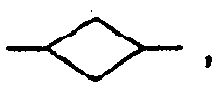
- v
- 1 bis 6
Bevorzugte Mischungen, insbesondere mit einem n-Wert von 0,08-0,09, enthalten insgesamt vier Verbindungen der Formeln

- b) Flüssigkristallines Medium, welches zusätzlich eine oder mehrere Verbindungen der Formel III enthält,

- R31 und R32
- jeweils unabhängig voneinander einen geradkettigen Alkyl-, Alkylalkoxy- oder Alkoxyrest mit bis zu 12 C-Atomen, und

- Z
- Einfachbindung, -C2H4-, -CH=CH-, -(CH2)4-, -(CH2)3O-, -O(CH2)3-, -CH=CHCH2CH2-, -CH2CH2CH=CH-, -CH2O-, -OCH2-, -CF2O-, -OCF2-, -COO-, -OCO-, -C2F4-, -CHFCF2-, -CF=CF-, -CH=CF-, -CF=CH-, -CH2-,
Die erfindungsgemäßen Mischungen können bis zu 50 Gew.% an neutralen Verbindungen enthalten, vorzugsweise ausgewählt aus den Verbindungen der Formel III. - c) Flüssigkristallines Medium, welches vier, fünf, sechs oder mehr, vorzugsweise zwei oder drei Verbindungen der Formeln IA und/oder IB enthält.
- d) Flüssigkristallines Medium, worin R1 und R2 in den Formeln IA und IB vorzugsweise folgende Bedeutungen hat: geradkettiges Alkyl, Vinyl, 1E-Alkenyl oder 3-Alkenyl.
Falls R1 und/oder R2 Alkenyl bedeutet, so ist es vorzugsweise CH2=CH, CH3-CH=CH, C3H7-CH=CH, CH2=CH-C2H4 oder CH3-CH=CH-C2H4.
In den Verbindungen IA, IB und II bedeutet v vorzugsweise 2, 3 oder 4. - e) Flüssigkristallines Medium, wobei der Anteil an Verbindungen der Formeln IA und/oder IB im Gesamtgemisch mindestens 10 Gew.%, vorzugsweise mindestens 25 Gew.%, und ganz besonders bevorzugt ≥ 30 Gew.% beträgt.
- f) Flüssigkristallines Medium, wobei der Anteil an Verbindungen der Formel II im Gesamtgemisch mindestens 10 Gew.% beträgt.
- g) Flüssigkristallines Medium enthaltend mindestens zwei, vorzugsweise drei, Verbindungen der Formel II, insbesondere der Formel

- R2
- bedeutet vorzugsweise Ethyl, Propyl oder Pentyl.
- h) Flüssigkristallines Medium, wobei der Anteil den Verbindungen der Formel III im Gesamtgemisch mindestens 5 Gew.-% beträgt.
- i) Flüssigkristallines Medium, welches zusätzlich eine Verbindung ausgewählt aus den Formeln IIIa bis IIIj enthält:




- Alkyl und Alkyl*
- jeweils unabhängig voneinander einen geradkettigen Alkylrest mit 1-6 C-Atomen, und
- Alkenyl und Alkenyl*
- jeweils unabhängig voneinander einen geradkettigen Alkenylrest mit 2-6 C-Atomen, vorzugsweise Vinyl, 1-E-Alkenyl oder 3-E-Alkenyl
Vorzugsweise enthält das erfindungsgemäße Medium mindestens eine Verbindung der Formel IIIa, Formel IIIb und/oder Formel IIIe, vorzugsweise in Mengen von > 5 Gew.-%, insbesondere > 10 Gew.-%, ganz besonders bevorzugt > 20 Gew.-%.
Besonders bevorzugte Verbindungen der Formeln IIIe und IIIf werden nachfolgend genannt:


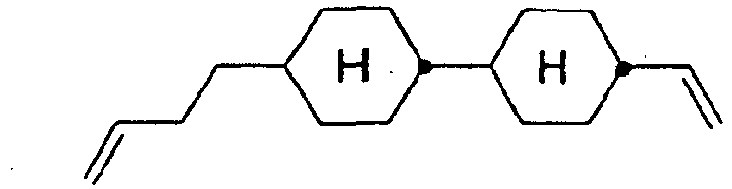


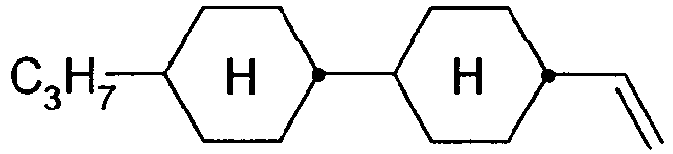
- j) Flüssigkristallines Medium, das mindestens drei Verbindungen der Formel IIIe enthält, vorzugsweise ausgewählt aus der Gruppe der Verbindungen


Weiterhin bevorzugt sind Medien, die die Verbindung der Formel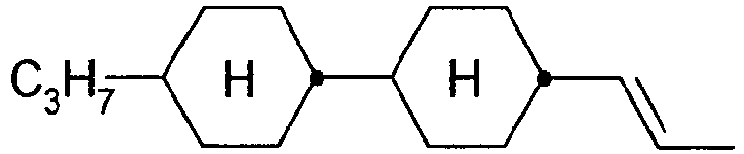

Letztere Verbindungen sind vorzugsweise in Mengen von 5-40 Gew.-% in der Mischung enthalten. - k) Flüssigkristallines Medium, welches im wesentlichen aus:
- 10-40 Gew.-% einer oder mehreren Verbindungen der Formeln IA und IB, und
- 10-40 Gew.-% einer oder mehreren Verbindungen der Formeln II
- l) Flüssigkristallines Medium, welches zusätzlich eine oder mehrere Vierkernverbindungen der Formeln,

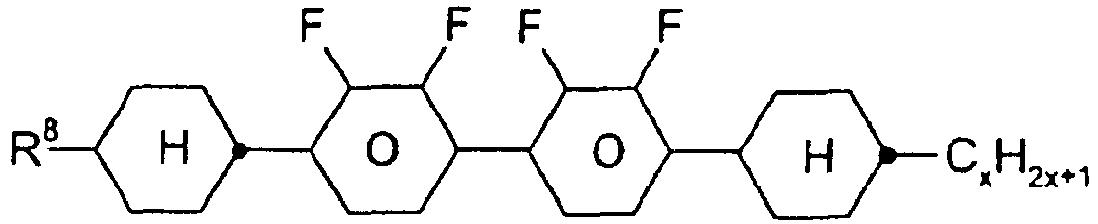
- R7 und R8
- jeweils unabhängig voneinander eine der in Anspruch 1 für R1 angegebenen Bedeutung haben, und
- w und x
- jeweils unabhängig voneinander 1 bis 6
enthält. - m) Besonders bevorzugte Medien enthalten eine oder mehrere Indan-Verbindungen ausgewählt aus der Gruppe der Verbindungen der Formeln In-a bis In-d:


- Alkyl und Alkyl*
- jeweils unabhängig voneinander einen geradkettigen Alkylrest mit 1-6 C-Atomen, und
- Alkenyl
- einen geradkettigen Alkenylrest mit 2-6 C-Atomen
Vorzugsweise bedeutet Alkyl* CH3, C2H5 oder n-C3H7.
Vorzugsweise enthalten die erfindungsgemäßen Mischungen eine Verbindung der Formel In-a oder In-b, insbesondere eine Verbindung der Formel In-a. Der Anteil der Indan-Verbindungen im Gesamtgemisch beträgt mindestens 5 Gew.-%, vorzugsweise mindestens 10 Gew.-%. - n) Flüssigkristallines Medium, welches zusätzlich eine oder mehrere Verbindungen der Formeln





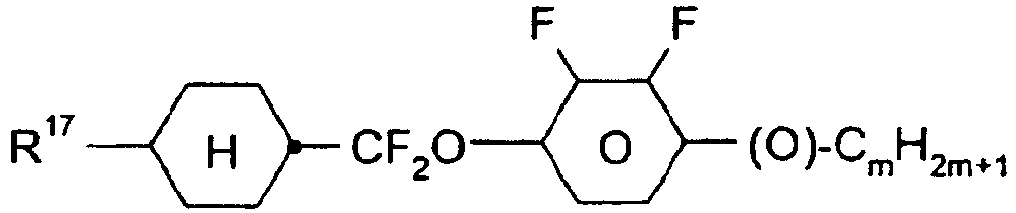


worin R13-R27 jeweils unabhängig voneinander, die für R1 angegebenen Bedeutungen haben, und z und m jeweils unabhängig voneinander 1-6 bedeuten. RE bedeutet H, CH3, C2H5 oder n-C3H7, x bedeutet 0,1,2 oder 3.
Die genannten Verbindungen sind vorzugsweise jeweils in Mengen von mindestens 5 Gew.-% in der Gesamtmischung enthalten.
Mischungen mit einem Δn im Bereich von 0,08 - 0,12 enthalten vorzugsweise Verbindungen der Formel
Derartige Mischungen enthalten weiterhin Verbindungen der Formel II in Mengen von ≥ 2 Gew.-%.
Die Verbindungen der Formel
- o) Flüssigkristallines Medium enthaltend zusätzlich ein oder mehrere fluorierte Terphenyle der Formeln T-1 bis T-22,





R die für R1 angegebenen Bedeutungen hat.
Vorzugsweise ist R geradkettiges Alkyl, Alkoxy oder Alkylalkoxy mit jeweils 1-6 C-Atomen, Alkenyl oder Alkenyloxy mit 2-6 C-atomen. Vorzugsweise bedeutet R Methyl, Ethyl, Propyl, Butyl, Pentyl, Hexyl Methoxy, Ethoxy, Propoxy, Butoxy, Pentoxy.
Das erfindungsgemäße Medium enthält die Terphenyle der Formeln T-1 bis T-22 vorzugsweise in Mengen von 2-30 Gew.-%, insbesondere von 5-20 Gew.-%.
Besonders bevorzugt sind Verbindungen der Formeln T-1, T-2, T-3 und T-22. In diesen Verbindungen bedeutet R vorzugsweise Alkyl, ferner Alkoxy jeweils mit 1-5 C-Atomen.
Vorzugsweise werden die Terphenyle in Mischungen mit einem Δn ≥ 0,10 in Kombination mit den Verbindungen der Formeln IA, IB und II eingesetzt. Bevorzugte Mischungen enthalten 2-20 Gew.-% Terphenyle und 5-30 Gew.-% der Verbindungen der Formel II. - p) Flüssigkristallines Medium enthaltend zusätzlich ein oder mehrere Biphenyle der Formeln B-1 bis B-4,



Der Anteil der Biphenyle der Formeln B-1 bis B-4 der Gesamtmischung beträgt vorzugsweise mindestens 3 Gew.-%, insbesondere ≥ 5 Gew.-%.
Von den Verbindungen der Formeln B-1 bis B-4 sind die Verbindungen der Formeln B-1 und B-4 insbesondere bevorzugt.
Bevorzugte Biphenyle sind ebenfalls


- q) Flüssigkristallines Medium enthaltend zusätzlich ein oder mehrere Ester der Formeln E-1 bis E-3,


Der Anteil der Ester in der Gesamtmischung beträgt vorzugsweise mindestens 10 Gew.-%, insbesondere ≥ 30 Gew.-%.
Von den Verbindungen E-1 bis E-3 ist die Verbindung E-1 insbesondere bevorzugt. - r) Flüssigkristallines Medium enthaltend zusätzlich ein oder mehrere Tolane der Formeln To-1 und To-2,


Der Anteil der Tolane To-1 und/oder To-2 in der Gesamtmischung beträgt vorzugsweise mindestens 5 Gew.-%, insbesondere ≥ 20
In den Verbindungen To-1 und To-2 bedeutet R vorzugsweise geradkettiges Alkyl oder Alkoxy. - s) Flüssigkristallines Medium enthaltend zusätzlich ein oder mehrere Nitrile der Formeln N-1 und N-2,


Der Anteil der Nitrile in der Gesamtmischung beträgt vorzugsweise mindestens 5 Gew.-%, insbesondere ≥ 25 Gew.-%. - t) Flüssigkristallines Medium enthaltend mindestens 10 Gew.-%, vorzugsweise ≥ 15 Gew.-%, insbesondere ≥ 20 Gew.-% an Verbindungen der Formel B-4. Derartige Verbindungen werden vorzugsweise in Mischungen mit einem Δn ≥ 0,12 verwendet. Vorzugsweise werden die Biphenyle der Fomel B-4 in Kombination mit Verbindungen der Formeln II und/oder B-1 eingesetzt.
Bevorzugte Mischungen mit einem Δn ≥ 0,12 enthalten neben den Verbindungen der Formel B-4 mindestens 15 Gew.-% an Verbindungen der Formel II und/oder ≥ 5 Gew.-% an Verbindungen der Formel B-1.
Weiterhin bevorzugt werden Verbindungen der Formel B-4 in Kombination mit Terphenylen eingesetzt, vorzugsweise mit T-1, T-2 und/oder T-3. - u) Flüssigkristallines Medium enthaltend mindestens eine Verbindung der Formeln Z-1 bis Z-10







vorzugsweise in Mengen von ≥ 5 Gew.-%, insbesondere ≥ 10 Gew.-%.
Insbesondere bevorzugt sind Medien, die eine, zwei oder mehr Verbindungen der Formeln Z-1 bis Z-7 enthalten und zusätzlich eine, zwei oder mehr Verbindungen der Formel II. Vorzugsweise enthalten derartige Mischungen ≥ 10 Gew.-% an Verbindungen der Formel II und gegebenenfalls auch Verbindungen der Formel IA. - v) Flüssigkristallines Medium enthaltend mindestens eine Verbindung der Formel,



- w) Flüssigkristallines Medium enthaltend mindestens eine Verbindung der Formel


- x) Flüssigkristallines Medium enthaltend mindestens eine Verbindung der Formel T-1 und mindestens eine Verbindung der Formel T-4.
- y) Flüssigkristallines Medium enthaltend mindestens eine Verbindung der Formel


Vorzugsweise weist die Flüssigkristallmischung einen nematischen Phasenbereich von mindestens 60 K und eine Fließviskosität ν20 von maximal 30 mm2·s-1, vorzugsweise < 25 mm2·s-1, bei 20 °C auf.
Die erfindungsgemäße Flüssigkristallmischung weist ein Δε von etwa -2,3 bis -8,0, insbesondere von etwa -3,0 bis -6,0 auf, ganz besonders bevorzugt von ≤ -3,0 bis -5,0.
Die Rotationsviskosität γ1 ist vorzugsweise < 200 mPa·s, insbesondere < 190 mPa·s. - z) Flüssigkristallines Medium enthaltend mindestens eine Verbindung der Formeln O-1 bis O-11,


Bevorzugte erfindungsgemäße flüssigkristalline Medien enthalten eine oder mehrere Substanzen mit einem Δε < 2,3, die eine Tetrahydronaphthyl- oder Naphthyl-Einheit aufweisen, wie z.B. die Verbindungen der Formeln N-1 bis N-5


bedeuten. - Die Doppelbrechung Δn in der Flüssigkristallmischung liegt, in der Regel, zwischen 0,07 und 0,16, vorzugsweise zwischen 0,08 und 0,12.
- Die erfindungsgemäßen Mischungen sind für alle VA-TFT-Anwendungen geeignet, wie z.B. VAN, MVA, (S)-PVA, ASV. Weiterhin sind sie für IPS (In plane switching)- und FFS (Fringe field switching)-LCD-Anwendungen mit negativem Δε geeignet.
- Die einzelnen Komponenten der Formeln IA, IB, II und III der erfindungsgemäßen Flüssigkristallphasen sind entweder bekannt oder ihre Herstellungsweisen sind für den einschlägigen Fachmann aus dem Stand der Technik ohne weiteres abzuleiten, da sie auf in der Literatur beschriebenen Standardverfahren basieren.
- Die nematischen Flüssigkristallmischungen in den erfindungsgemäßen Anzeigen enthalten in der Regel zwei Komponenten A und B, die ihrerseits aus einer oder mehreren Einzelverbindungen bestehen.
- Die Komponente A weist eine deutlich negative dielektrische Anisotropie auf und verleiht der nematischen Phase eine dielektrische Anisotropie von ≤ -2,3. Sie enthält bevorzugt Verbindungen der Formeln IA und/oder IB und II.
- Der Anteil der Komponente A liegt vorzugsweise zwischen 45 und 100 %, insbesondere zwischen 60 und 100 %.
- Für Komponente A wird vorzugsweise eine (oder mehrere) Einzelverbindung(en) gewählt, die einen Wert von Δε ≤ -0,8 haben. Dieser Wert muss umso negativer sein, je kleiner der Anteil A an der Gesamtmischung ist.
- Die Komponente B weist eine ausgeprägte Nematogenität und eine Fließviskosität von nicht mehr als 30 mm2· s-1, vorzugsweise nicht mehr als 25 mm2· s-1, bei 20 °C auf.
- Besonders bevorzugte Einzelverbindungen der Komponente B sind extrem niedrig viskose nematische Flüssigkristalle mit einer Fließviskosität von nicht mehr als 18, vorzugsweise nicht mehr als 12 mm2· s-1, bei 20 °C. Komponente B ist monotrop oder enantiotrop nematisch, weist keine smektischen Phasen auf und kann in Flüssigkristallmischungen das Auftreten von smektischen Phasen bis zu sehr tiefen Temperaturen verhindern. Versetzt man beispielsweise eine smektische Flüssigkristallmischung mit jeweils verschiedenen Materialien mit hoher Nematogenität, so kann durch den erzielten Grad der Unterdrückung smektischer Phasen die Nematogenität dieser Materialien verglichen werden. Dem Fachmann sind aus der Literatur eine Vielzahl geeigneter Materialien bekannt. Besonders bevorzugt sind Verbindungen der Formel III, ferner Verbindungen der Formeln B-1 bis B-4, O-1 und O-2.
- Daneben können diese Flüssigkristallphasen auch mehr als 18 Komponenten, vorzugsweise 18 bis 25 Komponenten, enthalten.
Vorzugsweise enthalten die Phasen 4 bis 15, insbesondere 5 bis 12, Verbindungen der Formeln IA und/oder IB, II und optional III. - Neben Verbindungen der Formeln IA und/oder IB, II und III können auch noch andere Bestandteile zugegen sein, z. B. in einer Menge von bis zu 45 % der Gesamtmischung, vorzugsweise jedoch bis zu 35 %, insbesondere bis zu 10 %.
- Die anderen Bestandteile werden vorzugsweise ausgewählt aus den nematischen oder nematogenen Substanzen, insbesondere den bekannten Substanzen, aus den Klassen der Azoxybenzole, Benzylidenaniline, Biphenyle, Terphenyle, Phenyl oder Cyclohexylbenzoate, Cyclohexan-carbonsäurephenyl- oder -cyclohexylester, Phenylcyclohexane, Cyclohexylbiphenyle, Cyclohexylcyclohexane, Cyclohexylnaphthaline, 1,4-Bis-cyclohexylbiphenyle oder Cylohexylpyrimidine, Phenyl- oder Cyclohexyldioxane, gegebenenfalls halogenierten Stilbene, Benzylphenylether, Tolane und substituierten Zimtsäuren.
- Die wichtigsten als Bestandteile derartiger Flüssigkristallphasen in Frage kommenden Verbindungen lassen sich durch die Formel IV charakterisieren,
R9-L-G-E-R10 IV
worin L und E je ein carbo- oder heterocyclisches Ringsystem aus der aus 1,4-disubstituierten Benzol- und Cyclohexanringen, 4,4'-disubstituierten Biphenyl-, Phenylcyclohexan- und Cyclohexylcyclohexansystemen, 2,5-disubstituierten Pyrimidin- und 1,3-Dioxanringen, 2,6-disubstituierten Naphthalin, Di- und Tetrahydronaphthalin, Chinazolin und Tetrahydrochinazolin gebildeten Gruppe,G -CH=CH- -N(O)=N- -CH-CQ- -CH=N(O)- -C≡C- -CH2-CH2- -CO-O- -CH2-O- -CO-S- -CH2-S- -CH=N- -COO-Phe-COO- -CF2O- -CF=CF- -OCF2 -OCH2- -(CH2)4- -(CH2)3O- - Bei den meisten dieser Verbindungen sind R9 und R10 voneinander verschieden, wobei einer dieser Reste meist eine Alkyl- oder Alkoxygruppe ist. Auch andere Varianten der vorgesehenen Substituenten sind gebräuchlich. Viele solcher Substanzen oder auch Gemische davon sind im Handel erhältlich. Alle diese Substanzen sind nach literaturbekannten Methoden herstellbar.
- Es versteht sich für den Fachmann von selbst, dass die erfindungsgemäße VA-, IPS-, FFS- oder PA LCD-Mischung auch Verbindungen enthalten kann, worin beispielsweise H, N, O, Cl, F durch die entsprechenden Isotope ersetzt sind.
- Der Aufbau der erfindungsgemäßen Flüssigkristallanzeigen entspricht der üblichen Geometrie, wie sie z.B. in
EP-OS 0 240 379 , beschrieben wird. - Vorzugsweise enthalten die erfindungsgemäßen Mischungen neben den Verbindungen der Formeln IA, IB, II und III eine oder mehrere Verbindungen der nachfolgend genannten Verbindungen.
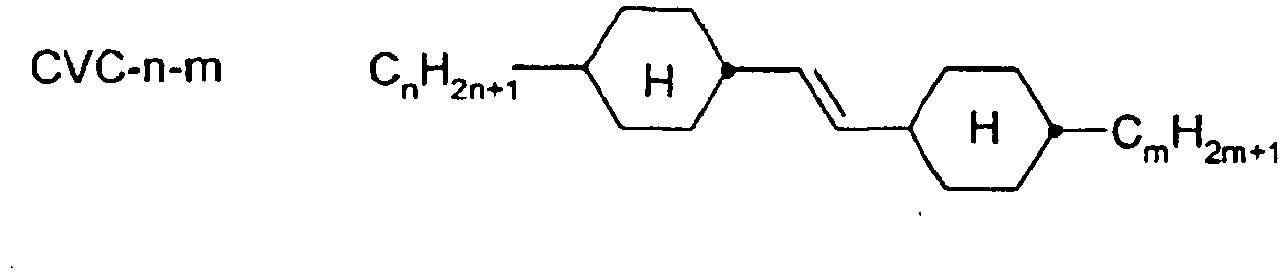
- Folgende Abkürzungen werden verwendet:
(n, m = 1-6; z = 1-6)
























- Die Herstellung der erfindungsgemäß verwendbaren Flüssigkristallmischungen erfolgt in an sich üblicher Weise. In der Regel wird die gewünschte Menge der in geringerer Menge verwendeten Komponenten in der den Hauptbestandteil ausmachenden Komponenten gelöst, zweckmäßig bei erhöhter Temperatur. Es ist auch möglich, Lösungen der Komponenten in einem organischen Lösungsmittel, z.B. in Aceton, Chloroform oder Methanol, zu mischen und das Lösungsmittel nach Durchmischung wieder zu entfernen, beispielsweise durch Destillation. In der vorliegenden Anmeldung bedeuten die Begriffe dielektrisch positive Verbindungen solche Verbindungen mit einem Δε > 1,5, dielektrisch neutrale Verbindungen solche mit -1,5 ≤ Δε ≤ 1,5 und dielektrisch negative Verbindungen solche mit Δε < -1,5. Hierbei wird die dielektrische Anisotropie der Verbindungen bestimmt, indem 10 % der Verbindungen in einem flüssigkristallinen Host gelöst werden und von dieser Mischung die Kapazität in mindestens jeweils einer Testzelle mit 20 µm Schichtdicke mit homöotroper und mit homogener Oberflächenorientierung bei 1 kHz bestimmt wird. Die Messspannung beträgt typischerweise 0,5 V bis 1,0 V, jedoch stets weniger als die kapazitive Schwelle der jeweiligen Flüssigkristallmischung.
- Als Hostmischung für dielektrisch positive und dielektrisch neutrale Verbindungen wird ZLI-4792 und für dielektrisch negative Verbindungen ZLI-2857, beide von Merck KGaA, Deutschland, verwendet. Aus der Änderung der Dielektrizitätskonstanten der Hostmischung nach Zugabe der zu untersuchenden Verbindung und Extrapolation auf 100 % der eingesetzten Verbindung werden die Werte für die jeweiligen zu untersuchenden Verbindungen erhalten.
- Der Begriff Schwellenspannung bezieht sich üblicher Weise auf die optische Schwelle für 10 % relativen Kontrast (V10), sofern nicht explizit anders angegeben.
- In der vorliegenden Anmeldung wird jedoch in Bezug auf die Flüssigkristallmischungen mit negativer dielektrischer Anisotropie der Begriff Schwellenspannung für die kapazitive Schwellenspannung (V0) auch Freedericksz-Schwelle genannt, verwendet, sofern nicht explizit anders angegeben.
- Alle Konzentrationen in dieser Anmeldung, soweit nicht explizit anders vermerkt, sind in Massenprozent angegeben und beziehen sich auf die entsprechende Mischung oder Mischungskomponente. Alle physikalischen Eigenschaften werden nach "Merck Liquid Crystals, Physical Properties of Liquid Crystals", Status Nov. 1997, Merck KGaA, Deutschland bestimmt und gelten für eine Temperatur von 20 °C, sofern nicht explizit anders angegeben. Δn wird bei 589 nm und Δε bei 1 kHz bestimmt.
- Bei den Flüssigkristallmedien mit negativer dielektrischer Anisotropie wird die Schwellenspannung als kapazitive Schwelle V0 (auch Freedericksz-Schwelle genannt) in bei Merck KGaA, Deutschland, hergestellten Testzellen mit durch die Orientierungsschicht SE 1211 der Fa. Nissan Chemicals homöotrop orientiertem Flüssigkristall bestimmt.
- Die Dielektrika können auch weitere, dem Fachmann bekannte und in der Literatur beschriebene Zusätze, wie z. B. UV-Absorber, Antioxidantien, Radikalfänger, enthalten. Beispielsweise können 0-15 % pleochroitische Farbstoffe zugesetzt werden, ferner Leitsalze, vorzugsweise Ethyldimethyldodecylammonium-4-hexoxybenzoat, Tetrabutylammoniumtetraphenylboranat oder Komplexsalze von Kronenethern (vgl. z.B. Haller et al., Mol. Cryst. Liq. Cryst. Band 24, Seiten 249- 258 (1973)) zur Verbesserung der Leitfähigkeit oder Substanzen zur Veränderung der dielektrischen Anisotropie, der Viskosität und/oder der Orientierung der nematischen Phasen. Derartige Substanzen sind z. B. in den
DE-OS 22 09 127 22 40 864 ,23 21 632 ,23 38 281 ,24 50 088 ,26 37 430 und28 53 728 beschrieben. - Die erfindungsgemäßen Flüssigkristallmedien können bei Bedarf auch chirale Dotierstoffe in den üblichen Mengen enthalten. Die eingesetzte Menge dieser Dotierstoffe beträgt insgesamt 0 bis 10 % bezogen auf die Menge der gesamten Mischung, bevorzugt 0,1 bis 6 %. Die Konzentrationen der einzelnen eingesetzten Verbindungen beträgt bevorzugt 0,1 bis 3 %. Die Konzentration dieser und ähnlicher Zusatzstoffe wird bei der Angabe der Konzentrationen sowie der Konzentrationsbereiche der Flüssigkristallverbindungen in den Flüssigkristallmedien nicht berücksichtigt.
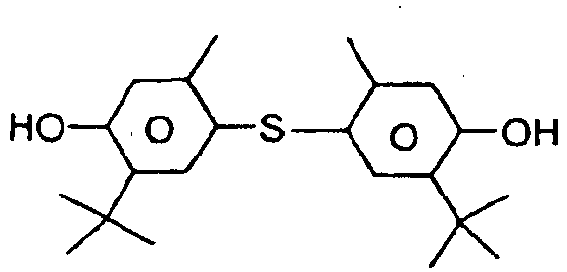
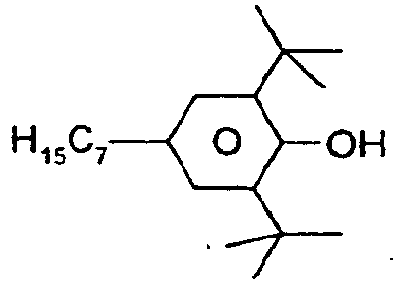
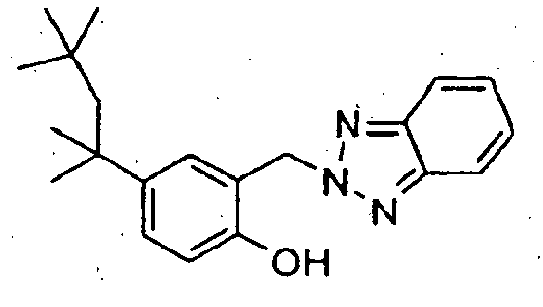
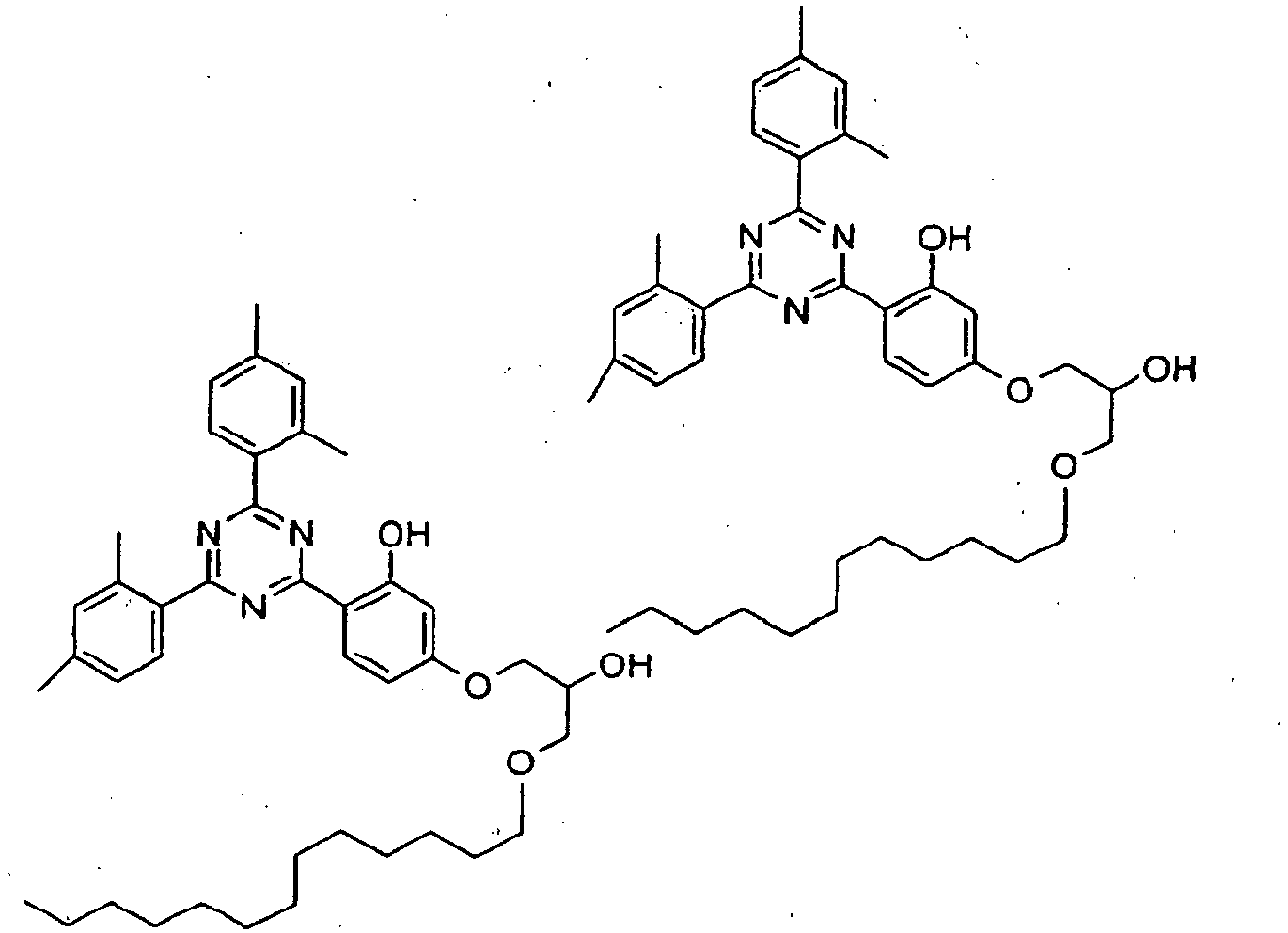
- In der Tabelle A werden mögliche Dotierstoffe angegeben, die den erfindungsgemäßen Mischungen zugesetzt werden können.

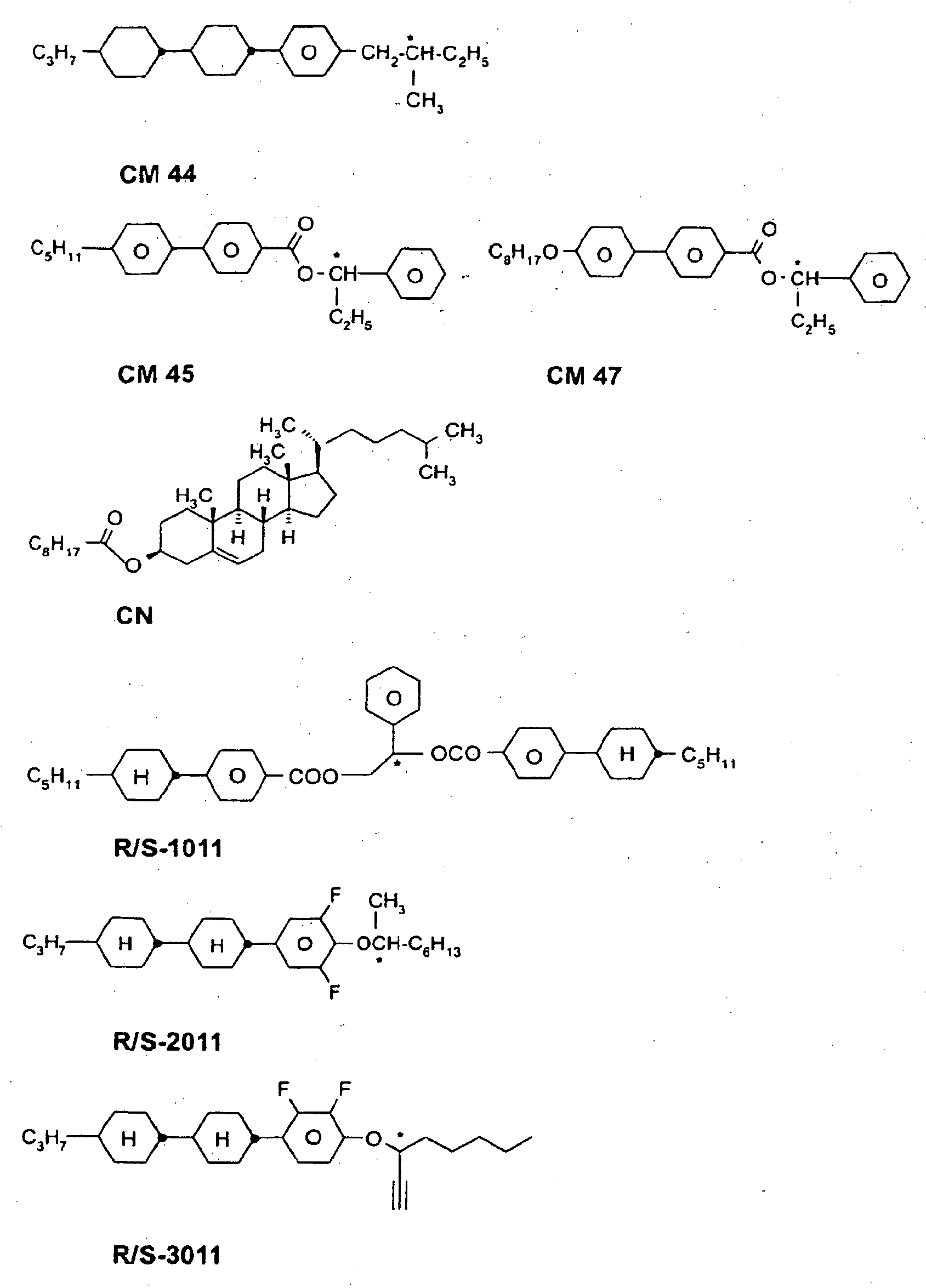

Tabelle B (n = 1-12) 








- Die Zusammensetzungen bestehen aus mehreren Verbindungen, bevorzugt aus 3 bis 30, besonders bevorzugt aus 6 bis 20 und ganz besonders bevorzugt aus 10 bis 16 Verbindungen, die auf herkömmliche Weise gemischt werden. In der Regel wird die gewünschte Menge der in geringerer Menge verwendeten Komponenten in den den Hauptbestandteil ausmachenden Komponenten gelöst, zweckmäßigerweise bei erhöhter Temperatur. Liegt die gewählte Temperatur über dem Klärpunkt des Hauptbestandteils, so ist die Vervollständigung des Lösungsvorgangs besonders leicht zu beobachten. Es ist jedoch auch möglich, die Flüssigkristallmischungen auf anderen üblichen Wegen, z.B. unter Verwendung von Vormischungen oder aus einem sogenannten "Multi Bottle Sytem" herzustellen.
- Mittels geeigneter Zusatzstoffe können die erfindungsgemäßen Flüssigkristallphasen derart modifiziert werden, dass sie in jeder bisher bekannt gewordenen Art von ECB-, VAN-, IPS-, GH- oder ASM-PA LCD-Anzeige einsetzbar sind.
- Zur Messung der Voltage Holding Ratio werden Zellen mit einer Orientierungsschicht aus AI-3046 verwendet.
- Die Anzeige zur Messung der Schwellenspannung weist zwei planparallele Trägerplatten im Abstand von 20 µm und Elektrodenschichten mit darüberliegenden Orientierungsschichten aus SE-1211 (Nissan Chemicals) auf den Innenseiten der Trägerplatten auf, welche eine homöotrope Orientierung der Flüssigkristalle bewirken.
Claims (19)
- Flüssigkristallines Medium auf der Basis eines Gemisches von polaren Verbindungen mit negativer dielektrischer Anisotropie (Δε), dadurch gekennzeichnet, dass das Medium bei einem Klärpunkt von > 60 °C und einem Δε von ≤ -2,3 einen Wert für das Verhältnis γ1 / Δn2 [Pa·s] im Bereich von 6 - 45 Pa·s aufweist und die Verbindung der Formel

- Flüssigkristallines Medium nach Anspruch 1, dadurch gekennzeichnet, dass das Medium einen Klärpunkt von 60 - 90 °C aufweist.
- Flüssigkristallines Medium nach Anspruch 1 oder 2, dadurch gekennzeichnet, dass das Medium einen Δε-Wert von -2,3 bis -5,5 aufweist.
- Flüssigkristallines Medium nach einem der Ansprüche 1 bis 3, dadurch gekennzeichnet, dass das Medium mit einem Klärpunkt von 70 °C ± 5 °C und Δε von -3,0 ± 0,6 bei einem definierten Δn-Wert folgende Rotationsviskositäten γ1 aufweist:
Δn γ1 0,08 ± 0,005 ≤ 125 mPa·s 0,09 ± 0,005 ≤ 130 mPa·s 0,10 ± 0,005 ≤ 135 mPa·s 0,11 ± 0,005 ≤ 145 mPa·s 0,12 ± 0,005 ≤ 150 mPa·s 0,13 ± 0,005 ≤ 160 mPa·s 0,15 ± 0,01 ≤ 170 mPa·s - Flüssigkristallines Medium nach einem der Ansprüche 1 bis 3, dadurch gekennzeichnet, dass das Medium mit einem Klärpunkt von 70 °C ± 5 °C und Δε von -4,0 ± 0,4 bei einem definierten Δn-Wert folgende Rotationsviskositäten γ1 aufweist:
Δn γ1 0,08 ± 0,005 ≤ 140 mPa·s 0,09 ± 0,005 ≤ 165 mPa·s 0,10 ± 0,005 ≤ 185 mPa·s 0,11 ± 0,005 ≤ 190 mPa·s 0,12 ± 0,005 ≤ 195 mPa·s 0,13 ± 0,005 ≤ 205 mPa·s 0,15 ± 0,01 ≤ 220 mPa·s - Flüssigkristallines Medium nach einem der Ansprüche 1 bis 3, dadurch gekennzeichnet, dass das Medium mit einem Klärpunkt von 70 °C ± 5 °C und Δε von -5,0 ± 0,6 bei einem definierten An-Wert folgende Rotationsviskositäten γ1 aufweist:
Δn γ1 0,08 ± 0,005 ≤ 185 mPa·s 0,09 ± 0,005 ≤ 200 mPa·s 0,10 ± 0,005 ≤ 210 mPa·s 0,11 ± 0,005 ≤ 220 mPa·s 0,12 ± 0,005 ≤ 230 mPa·s 0,13 ± 0,005 ≤ 250 mPa·s 0,15 ± 0,01 ≤ 270 mPa·s - Flüssigkristallines Medium nach einem der Ansprüche 1 bis 3, dadurch gekennzeichnet, dass das Medium mit einem Klärpunkt von 90 °C ± 5 °C und Δε von -3,0 ± 0,6 bei einem definierten An-Wert folgende Rotationsviskositäten γ1 aufweist:
Δn γ1 0,08 ± 0,005 ≤ 160 mPa·s 0,09 ± 0,005 ≤ 170 mPa·s 0,10 ± 0,005 ≤ 180 mPa·s 0,11 ± 0,005 ≤ 190 mPa·s 0,12 ± 0,005 ≤ 200 mPa·s 0,13 ± 0,005 ≤ 210 mPa·s 0,15 ± 0,01 ≤ 220 mPa·s - Flüssigkristallines Medium nach einem der Ansprüche 1 bis 3, dadurch gekennzeichnet, dass das Medium mit einem Klärpunkt von 90 °C ± 5 °C und Δε von -4,0 ± 0,4 bei einem definierten Δn-Wert folgende Rotationsviskositäten γ1 aufweist:
Δn γ1 0,08 ± 0,005 ≤ 185 mPa·s 0,09 + 0,005 ≤ 195 mPa·s 0,10 ± 0,005 ≤ 215 mPa·s 0,11 ± 0,005 ≤ 215 mPa·s 0,12 ± 0,005 ≤ 215 mPa·s 0,13 ± 0,005 ≤ 235 mPa·s 0,15 ± 0,01 ≤ 250 mPa·s - Flüssigkristallines Medium nach einem der Ansprüche 1 bis 3, dadurch gekennzeichnet, dass das Medium mit einem Klärpunkt von 90 °C ± 5 °C und Δε von -5,0 ± 0,6 bei einem definierten An-Wert folgende Rotationsviskositäten γ1 aufweist:
Δn γ1 0,08 ± 0,005 ≤ 280 mPa·s 0,09 ± 0,005 ≤ 275 mPa·s 0,10 ± 0,005 ≤ 275 mPa·s 0,11 ± 0,005 ≤ 275 mPa·s 0,12 ± 0,005 ≤ 280 mPa·s - Flüssigkristallines Medium nach einem oder mehreren der Ansprüche 1 bis 9, dadurch gekennzeichnet, dass das Medium Schwellen (kapazitiv) im Bereich von 1,8 - 2,3 V aufweist.
- Flüssigkristallines Medium nach einem oder mehreren der Ansprüche 1 bis 10, dadurch gekennzeichnet, dass es mindestens zwei Verbindungen der Formeln IA, IB und/oder II enthält,


 R1 und R2 jeweils unabhängig voneinander einen unsubstituierten, einen einfach durch CN oder CF3 oder einen mindestens einfach durch Halogen substituierten Alkyl- oder Alkenylrest mit bis zu 15 C-Atomen, wobei in diesen Resten auch eine oder mehrere CH2-Gruppen jeweils unabhängig voneinander durch -O-, -S-,
 v 1 bis 6bedeutet,
enthält. - Flüssigkristallines Medium nach einem oder mehreren der Ansprüche 1 bis 10, dadurch gekennzeichnet, dass es zusätzlich eine oder mehrere Verbindungen der Formel III,
 R31 und R32 jeweils unabhängig voneinander einen geradkettigen Alkyl-, Alkylalkoxy- oder Alkoxyrest mit bis zu 12 C-Atomen, und
 Z Einfachbindung, -C2H4-, -CH=CH-, -(CH2)4-, -(CH2)3O-, -O(CH2)3-, -CH=CHCH2CH2-, -CH2CH2CH=CH-, -CH2O-, -OCH2-, -CF2O-, -OCF2-, -COO-, -OCO-, -C2F4-, -CHFCF2-, -CF=CF-, -CH=CF-, -CF=CH-, -CH2-,bedeuten,
enthält. - Flüssigkristallines Medium nach einem oder mehreren der Ansprüche 1 bis 12, dadurch gekennzeichnet, dass es ein, zwei, drei, vier, fünf oder sechs Verbindungen der Formeln IA, IB und/oder II enthält.
- Flüssigkristallines Medium nach einem oder mehreren der Ansprüche 1 bis 13, dadurch gekennzeichnet, dass der Anteil an Verbindungen der Formel IA und/oder IB im Gesamtgemisch mindestens 10 Gew.-% beträgt.
- Flüssigkristallines Medium nach einem oder mehreren der Ansprüche 1 bis 14, dadurch gekennzeichnet, dass der Anteil an Verbindungen der Formeln II im Gesamtgemisch mindestens 10 Gew.-% beträgt.
- Flüssigkristallines Medium nach einem oder mehreren der Ansprüche 1 bis 15, dadurch gekennzeichnet, dass der Anteil an Verbindungen der Formel III im Gesamtgemisch mindestens 5 Gew.-% beträgt.
- Flüssigkristallines Medium nach einem oder mehreren der Ansprüche 1 bis 16, dadurch gekennzeichnet, dass es zusätzlich die Verbindung


- Flüssigkristallines Medium nach einem oder mehreren der Ansprüche 1 bis 17, dadurch gekennzeichnet, dass es zusätzlich ein oder mehrere fluorierte Terphenyle der Formeln T-1 bis T-22,




R die für R1 in Anspruch 11 angegebenen Bedeutungen hat und m 1-6 bedeutet,
enthält. - Elektrooptische Anzeige mit einer Aktivmatrix-Addressierung basierend auf dem ECB-, PA LCD-, FFS- oder dem IPS-Effekt, dadurch gekennzeichnet, dass sie als Dielektrikum ein flüssigkristallines Medium nach einem oder mehreren der Ansprüche 1 bis 18 enthält.
Applications Claiming Priority (3)
| Application Number | Priority Date | Filing Date | Title |
|---|---|---|---|
| DE102004032326 | 2004-07-02 | ||
| PCT/EP2005/007128 WO2006002952A1 (de) | 2004-07-02 | 2005-07-01 | Flüssigkristallines medium |
| EP05755652A EP1763570B1 (de) | 2004-07-02 | 2005-07-01 | Flüssigkristallines medium |
Related Parent Applications (2)
| Application Number | Title | Priority Date | Filing Date |
|---|---|---|---|
| EP05755652A Division EP1763570B1 (de) | 2004-07-02 | 2005-07-01 | Flüssigkristallines medium |
| EP05755652.4 Division | 2005-07-01 |
Publications (4)
| Publication Number | Publication Date |
|---|---|
| EP2208773A2 EP2208773A2 (de) | 2010-07-21 |
| EP2208773A3 EP2208773A3 (de) | 2010-12-08 |
| EP2208773B1 EP2208773B1 (de) | 2012-08-29 |
| EP2208773B2 true EP2208773B2 (de) | 2021-11-24 |
Family
ID=34981727
Family Applications (4)
| Application Number | Title | Priority Date | Filing Date |
|---|---|---|---|
| EP10004670.5A Expired - Lifetime EP2208773B2 (de) | 2004-07-02 | 2005-07-01 | Flüssigkristallines Medium |
| EP20100003550 Revoked EP2199363B1 (de) | 2004-07-02 | 2005-07-01 | Flüssigkristallines Medium |
| EP05755652A Expired - Lifetime EP1763570B1 (de) | 2004-07-02 | 2005-07-01 | Flüssigkristallines medium |
| EP10004671.3A Expired - Lifetime EP2208774B2 (de) | 2004-07-02 | 2005-07-01 | Flüssigkristallines Medium |
Family Applications After (3)
| Application Number | Title | Priority Date | Filing Date |
|---|---|---|---|
| EP20100003550 Revoked EP2199363B1 (de) | 2004-07-02 | 2005-07-01 | Flüssigkristallines Medium |
| EP05755652A Expired - Lifetime EP1763570B1 (de) | 2004-07-02 | 2005-07-01 | Flüssigkristallines medium |
| EP10004671.3A Expired - Lifetime EP2208774B2 (de) | 2004-07-02 | 2005-07-01 | Flüssigkristallines Medium |
Country Status (9)
| Country | Link |
|---|---|
| US (12) | US7989035B2 (de) |
| EP (4) | EP2208773B2 (de) |
| JP (13) | JP5259185B2 (de) |
| KR (1) | KR101216831B1 (de) |
| CN (4) | CN101864318B (de) |
| AT (2) | ATE480608T1 (de) |
| DE (1) | DE502005010229D1 (de) |
| TW (10) | TWI652334B (de) |
| WO (1) | WO2006002952A1 (de) |
Families Citing this family (70)
| Publication number | Priority date | Publication date | Assignee | Title |
|---|---|---|---|---|
| ATE480608T1 (de) | 2004-07-02 | 2010-09-15 | Merck Patent Gmbh | Flüssigkristallines medium |
| JP4876408B2 (ja) * | 2005-03-01 | 2012-02-15 | Jnc株式会社 | 液晶組成物および液晶表示素子 |
| KR101468828B1 (ko) * | 2005-08-09 | 2014-12-03 | 메르크 파텐트 게엠베하 | 액정 매질 |
| EP1958999B1 (de) * | 2007-02-13 | 2012-07-11 | Merck Patent GmbH | Flüssigkristallines Medium |
| KR101365111B1 (ko) * | 2007-05-02 | 2014-02-19 | 삼성디스플레이 주식회사 | 액정 조성물 및 이를 이용한 액정표시장치 |
| DE102008064171A1 (de) * | 2008-12-22 | 2010-07-01 | Merck Patent Gmbh | Flüssigkristallines Medium |
| TWI472598B (zh) * | 2009-09-24 | 2015-02-11 | Jnc Corp | 液晶組成物以及液晶顯示元件 |
| TWI560261B (en) | 2010-05-28 | 2016-12-01 | Jnc Corp | Liquid crystal composition and liquid crystal display element |
| KR101808888B1 (ko) | 2010-10-04 | 2017-12-13 | 제이엔씨 주식회사 | 액정 조성물 및 액정 표시 소자 |
| TWI515289B (zh) | 2010-10-20 | 2016-01-01 | 捷恩智股份有限公司 | 液晶組成物及液晶顯示元件 |
| US9873834B2 (en) * | 2010-12-10 | 2018-01-23 | Merck Patent Gmbh | Liquid-crystalline medium and electro-optical display |
| US9080101B2 (en) | 2010-12-24 | 2015-07-14 | Dic Corporation | Polymerizable compound-containing liquid crystal composition and liquid crystal display device using the same |
| US9023439B2 (en) | 2011-04-06 | 2015-05-05 | Dic Corporation | Nematic liquid crystal composition, liquid crystal display element using same |
| KR101522949B1 (ko) | 2011-09-27 | 2015-05-26 | 디아이씨 가부시끼가이샤 | 네마틱 액정 조성물 및 이것을 사용한 액정 표시 소자 |
| CN102517038B (zh) * | 2011-12-02 | 2016-08-17 | 江苏和成显示科技股份有限公司 | 液晶组合物以及包括该液晶组合物的液晶显示器件 |
| DE102012024126A1 (de) | 2011-12-20 | 2013-06-20 | Merck Patent Gmbh | Flüssigkristallines Medium |
| KR102084278B1 (ko) | 2012-02-23 | 2020-03-03 | 제이엔씨 주식회사 | 액정 조성물 및 액정 표시 소자 |
| TWI452122B (zh) | 2012-02-24 | 2014-09-11 | Dainippon Ink & Chemicals | 液晶組成物 |
| JP5696816B2 (ja) * | 2012-05-28 | 2015-04-08 | Dic株式会社 | 誘電率異方性が負である液晶組成物、及び該液晶組成物を用いた液晶表示素子 |
| WO2014000368A1 (zh) | 2012-06-29 | 2014-01-03 | 上海天马微电子有限公司 | 一种电容式触摸液晶显示面板 |
| CN103589437B (zh) * | 2012-06-29 | 2018-01-12 | 默克专利股份有限公司 | 液晶介质 |
| US9809747B2 (en) | 2012-10-12 | 2017-11-07 | Dic Corporation | Liquid crystal composition and liquid crystal display element using the same |
| EP2722381B1 (de) * | 2012-10-18 | 2018-01-03 | Merck Patent GmbH | Flüssigkristallines medium, methode zu seiner stabilisierung und flüssigkristallanzeige |
| EP2722380B1 (de) * | 2012-10-18 | 2018-02-21 | Merck Patent GmbH | Flüssigkristallines Medium, Methode zu seiner Stabilisierung und Flüssigkristallanzeige |
| CN104736670A (zh) * | 2012-10-23 | 2015-06-24 | Dic株式会社 | 液晶组合物、液晶显示元件以及液晶显示器 |
| US9181480B2 (en) | 2012-11-12 | 2015-11-10 | Dic Corporation | Liquid crystal composition, liquid crystal display element, and liquid crystal display |
| CN104837957B (zh) | 2012-12-12 | 2016-06-29 | Dic株式会社 | 向列液晶组合物及使用其的液晶显示元件 |
| JP5598742B1 (ja) * | 2013-01-31 | 2014-10-01 | Dic株式会社 | 液晶組成物及びそれを使用した液晶表示素子 |
| KR101545669B1 (ko) | 2013-02-12 | 2015-08-19 | 디아이씨 가부시끼가이샤 | 액정 조성물 및 그를 사용한 액정 표시 소자 |
| KR101595519B1 (ko) | 2013-03-21 | 2016-02-18 | 디아이씨 가부시끼가이샤 | 액정 조성물 및 그것을 사용한 액정 표시 소자 |
| CN105838387B (zh) * | 2013-03-26 | 2019-03-08 | Dic株式会社 | 液晶组合物、液晶显示元件和液晶显示器 |
| CN105733609A (zh) * | 2013-03-26 | 2016-07-06 | Dic株式会社 | 液晶组合物以及使用其的液晶显示元件 |
| KR102150931B1 (ko) | 2013-03-26 | 2020-09-02 | 디아이씨 가부시끼가이샤 | 액정 조성물 및 그것을 사용한 액정 표시 소자 |
| KR101483575B1 (ko) | 2013-03-26 | 2015-01-16 | 디아이씨 가부시끼가이샤 | 액정 조성물 및 그것을 사용한 액정 표시 소자 |
| JP5459450B1 (ja) | 2013-03-26 | 2014-04-02 | Dic株式会社 | 液晶組成物及びそれを使用した液晶表示素子 |
| CN105694910A (zh) * | 2013-03-26 | 2016-06-22 | Dic株式会社 | 液晶组合物以及使用其的液晶显示元件 |
| US9376618B2 (en) * | 2013-05-22 | 2016-06-28 | Dic Corporation | Liquid crystal display device |
| KR102068961B1 (ko) * | 2013-06-28 | 2020-01-22 | 엘지디스플레이 주식회사 | 액정 물질 및 이를 포함하는 액정표시장치 |
| CN103361074B (zh) * | 2013-07-01 | 2015-08-26 | 江苏和成新材料有限公司 | 包含多氟代不饱和茚环的液晶化合物及其组合物和应用 |
| CN104342165B (zh) * | 2013-07-31 | 2016-08-24 | 江苏和成显示科技股份有限公司 | 液晶组合物及其应用 |
| DE102014010908A1 (de) * | 2013-08-16 | 2015-03-12 | Merck Patent Gmbh | Flüssigkristallines Medium |
| KR20150030526A (ko) | 2013-09-12 | 2015-03-20 | 삼성디스플레이 주식회사 | 액정 표시 장치 |
| KR20150109543A (ko) * | 2014-03-19 | 2015-10-02 | 삼성디스플레이 주식회사 | 액정 조성물 및 이를 포함하는 액정 표시 장치 |
| KR20150116108A (ko) | 2014-04-04 | 2015-10-15 | 삼성디스플레이 주식회사 | 액정 조성물 및 액정 표시 장치 |
| JP6128394B2 (ja) * | 2014-06-24 | 2017-05-17 | Dic株式会社 | 液晶組成物及びそれを使用した液晶表示素子 |
| JP5920606B2 (ja) * | 2014-07-07 | 2016-05-18 | Jnc株式会社 | 液晶組成物および液晶表示素子 |
| CN104152155B (zh) * | 2014-07-17 | 2016-06-29 | 北京大学 | 一种高双折射率低粘度的高负介电各向异性液晶混合物及其应用 |
| WO2016017520A1 (ja) | 2014-07-29 | 2016-02-04 | Dic株式会社 | 液晶表示素子 |
| US10190048B2 (en) * | 2014-08-08 | 2019-01-29 | Merck Patent Gmbh | Liquid-crystalline medium and liquid-crystal display comprising the same |
| JP2015044998A (ja) * | 2014-09-16 | 2015-03-12 | Dic株式会社 | 液晶組成物、液晶表示素子および液晶ディスプレイ |
| JP2016079292A (ja) * | 2014-10-17 | 2016-05-16 | Jnc株式会社 | 液晶組成物および液晶表示素子 |
| KR102693588B1 (ko) * | 2014-11-25 | 2024-08-12 | 메르크 파텐트 게엠베하 | 액정 매질 |
| KR20160123974A (ko) * | 2015-04-15 | 2016-10-26 | 삼성디스플레이 주식회사 | 액정 표시 장치 및 이에 사용되는 액정 조성물 |
| JP6842069B2 (ja) | 2015-08-27 | 2021-03-17 | 国立大学法人京都大学 | 複合体及び光学素子 |
| CN107312549B (zh) * | 2015-09-02 | 2021-08-31 | 石家庄诚志永华显示材料有限公司 | 含有二甲基苯和二氟亚甲氧基连接基团的液晶化合物及其应用 |
| TW201723153A (zh) * | 2015-11-11 | 2017-07-01 | Dainippon Ink & Chemicals | 組成物及使用其之液晶顯示元件 |
| CN105331369B (zh) * | 2015-11-12 | 2018-06-12 | 石家庄诚志永华显示材料有限公司 | 含有2,4-二氟苯基团化合物的液晶介质及应用 |
| JP6565648B2 (ja) * | 2015-12-07 | 2019-08-28 | Dic株式会社 | 液晶表示素子 |
| CN108239547B (zh) * | 2016-12-23 | 2022-02-01 | 江苏和成显示科技有限公司 | 负介电各向异性的液晶组合物及其显示器件 |
| CN108239549B (zh) * | 2016-12-23 | 2021-09-07 | 江苏和成显示科技有限公司 | 负介电各向异性的液晶组合物及其显示器件 |
| CN108239539A (zh) * | 2016-12-23 | 2018-07-03 | 江苏和成显示科技有限公司 | 负介电各向异性的液晶组合物及其显示器件 |
| JP6822212B2 (ja) * | 2017-02-27 | 2021-01-27 | Jnc株式会社 | 液晶組成物および液晶表示素子 |
| CN108728116B (zh) * | 2017-04-18 | 2024-06-04 | 江苏和成显示科技有限公司 | 一种液晶组合物及其显示器件 |
| CN108728117B (zh) * | 2017-04-18 | 2024-05-07 | 江苏和成显示科技有限公司 | 一种液晶组合物及其显示器件 |
| JP2017214589A (ja) * | 2017-07-03 | 2017-12-07 | Dic株式会社 | 液晶組成物、液晶表示素子および液晶ディスプレイ |
| CN111094512B (zh) * | 2017-09-08 | 2024-01-09 | 默克专利股份有限公司 | 液晶介质和包含其的液晶显示器 |
| KR20190033679A (ko) | 2017-09-21 | 2019-04-01 | 삼성디스플레이 주식회사 | 액정 조성물 및 이를 포함하는 표시 장치 |
| US11634510B2 (en) | 2019-05-15 | 2023-04-25 | Shin-Etsu Chemical Co., Ltd. | Water-soluble cellulose ether and method for producing the same |
| KR102809435B1 (ko) * | 2019-11-22 | 2025-05-19 | 삼성디스플레이 주식회사 | 액정 조성물 및 이를 포함하는 표시 장치 |
| CN118511099A (zh) * | 2021-12-28 | 2024-08-16 | 富士胶片株式会社 | 层叠体、光学元件、导光元件 |
Citations (5)
| Publication number | Priority date | Publication date | Assignee | Title |
|---|---|---|---|---|
| JPH10287875A (ja) † | 1997-04-10 | 1998-10-27 | Chisso Corp | 液晶組成物および液晶表示素子 |
| EP1251160A1 (de) † | 2001-04-20 | 2002-10-23 | MERCK PATENT GmbH | Flüssigkristallines Medium |
| US20030017279A1 (en) † | 2000-12-20 | 2003-01-23 | Merck Patent Gmbh | Liquid-crystal medium, and electro-optical display containing same |
| EP1352943A1 (de) † | 2002-04-12 | 2003-10-15 | MERCK PATENT GmbH | Flüssigkristallmedium und dieses enthaltende elektrooptische Anzeige |
| US6642981B1 (en) † | 1996-09-30 | 2003-11-04 | Fujitsu Display Technologies Corporation | Liquid crystal display device operating in a vertically aligned mode including at least one retardation film |
Family Cites Families (62)
| Publication number | Priority date | Publication date | Assignee | Title |
|---|---|---|---|---|
| BE795849A (fr) | 1972-02-26 | 1973-08-23 | Merck Patent Gmbh | Phases nematiques modifiees |
| US3814700A (en) | 1972-08-03 | 1974-06-04 | Ibm | Method for controllably varying the electrical properties of nematic liquids and dopants therefor |
| DE2450088A1 (de) | 1974-10-22 | 1976-04-29 | Merck Patent Gmbh | Biphenylester |
| DE2637430A1 (de) | 1976-08-20 | 1978-02-23 | Merck Patent Gmbh | Fluessigkristallines dielektrikum |
| DE2853728A1 (de) | 1978-12-13 | 1980-07-17 | Merck Patent Gmbh | Fluessigkristalline carbonsaeureester, verfahren zu ihrer herstellung, diese enthaltende dielektrika und elektrooptisches anzeigeelement |
| FR2595157B1 (fr) | 1986-02-28 | 1988-04-29 | Commissariat Energie Atomique | Cellule a double couche de cristal liquide, utilisant l'effet de birefringence controlee electriquement et procede de fabrication d'un milieu uniaxe d'anisotropie optique negative utilisable dans cette cellule |
| US4917472A (en) * | 1988-03-14 | 1990-04-17 | Hughes Aircraft Company | Light valves with positive dielectric anisotropy liquid crystal and highly tilted off-perpendicular surface alignment, and associated operating method |
| GB9220750D0 (en) | 1992-10-02 | 1992-11-18 | Merck Patent Gmbh | Liquid crystalline material forming ananisotropic |
| US5599480A (en) * | 1994-07-28 | 1997-02-04 | Merck Patent Gesellschaft Mit Beschrankter Haftung | Liquid-crystalline medium |
| JP2875197B2 (ja) | 1995-11-06 | 1999-03-24 | 智行 乾 | 低級パラフィン系炭化水素の芳香族炭化水素への変換方法 |
| JP4003242B2 (ja) | 1995-11-29 | 2007-11-07 | 大日本インキ化学工業株式会社 | 新規液晶化合物、ネマチック液晶組成物及びこれを用いた液晶表示装置 |
| DE69739049D1 (de) | 1996-04-02 | 2008-11-27 | Chisso Corp | Flüssigkristallverbindungen, Flüssigkristalle enthaltende Zubereitungen, und aus diesen Verbindungen hergestellte Flüssigkristallanzeigen |
| JPH09291282A (ja) | 1996-04-26 | 1997-11-11 | Sumitomo Chem Co Ltd | 安定化した液晶材料およびこれを用いた液晶素子 |
| JP3944611B2 (ja) | 1996-06-07 | 2007-07-11 | 大日本インキ化学工業株式会社 | ジアルケニルビフェニル誘導体 |
| EP0959061A4 (de) | 1996-11-25 | 2000-08-23 | Chisso Corp | 3,3'-difluorobiphenylderivate, flüssigkristallzubereitungen, und flüssigkristallanzeigeelemente |
| DE69728561D1 (de) | 1996-11-28 | 2004-05-13 | Chisso Corp | Negative permittivitätsanisotropie aufweisende flüssigkristallverbindungen, flüssigkristallzusammensetzungen und flüssigkristallanzeigen |
| JP4102446B2 (ja) | 1996-12-16 | 2008-06-18 | チッソ株式会社 | ジフルオロフェニル誘導体、液晶性化合物および液晶組成物 |
| JP4712137B2 (ja) * | 1997-08-29 | 2011-06-29 | メルク パテント ゲゼルシャフト ミット ベシュレンクテル ハフツング | 液晶媒体 |
| WO1999021815A1 (en) | 1997-10-24 | 1999-05-06 | Chisso Corporation | 2,3-difluorophenyl derivatives having negative value of permittivity anisotropy, liquid-crystal composition, and liquid-crystal display element |
| DE69823857T2 (de) | 1997-10-24 | 2005-04-14 | Chisso Corp. | Flüssigkristalline verbindungen mit hoher negativer anisotroper durchlässigkeit, flüssigkristalline zubereitung und flüssigkristallines anzeigeelement |
| EP1072593A1 (de) | 1998-04-10 | 2001-01-31 | Chisso Corporation | Fluessigkristalline verbindung mit einem piperidinring, fluessigkristalline mischung und fluessigkristall-bildschirm element |
| JP4320824B2 (ja) * | 1998-06-02 | 2009-08-26 | チッソ株式会社 | Δεが負の値を有するアルケニル化合物、液晶組成物および液晶表示素子 |
| DE19927627B4 (de) * | 1998-06-30 | 2008-01-31 | Merck Patent Gmbh | Flüssigkristallines Medium |
| JP4505879B2 (ja) | 1999-06-01 | 2010-07-21 | Dic株式会社 | 液晶組成物及び液晶表示素子 |
| JP4701466B2 (ja) | 1999-07-15 | 2011-06-15 | Dic株式会社 | ネマチック液晶組成物及びこれを用いた液晶表示装置 |
| JP4352515B2 (ja) | 1999-07-21 | 2009-10-28 | チッソ株式会社 | 液晶組成物および液晶表示素子 |
| JP4654474B2 (ja) | 1999-10-13 | 2011-03-23 | チッソ株式会社 | 分岐メチル基を有する液晶性化合物、液晶組成物及び液晶表示素子 |
| JP4547742B2 (ja) † | 1999-10-13 | 2010-09-22 | チッソ株式会社 | 液晶組成物および液晶表示素子 |
| DE19959033A1 (de) * | 1999-12-08 | 2001-06-13 | Merck Patent Gmbh | Flüssigkristallines Medium |
| DE10107544A1 (de) * | 2000-03-24 | 2001-09-27 | Merck Patent Gmbh | Flüssigktistallmedium und dieses enthaltende elekrooptische Anzeige |
| DE10112955B4 (de) | 2000-04-14 | 2010-09-09 | Merck Patent Gmbh | Flüssigkristallines Medium und seine Verwendung |
| DE10141565A1 (de) * | 2000-09-22 | 2002-04-11 | Merck Patent Gmbh | Flüssigkristallverbindung, diese enthaltendes Flüssigkristallmedium und elektrooptische Flüssigkristallanzeige |
| JP2002156619A (ja) | 2000-11-21 | 2002-05-31 | Chisso Corp | 液晶表示素子 |
| JP5279975B2 (ja) | 2000-12-19 | 2013-09-04 | メルク パテント ゲゼルシャフト ミット ベシュレンクテル ハフツング | 負のdc異方性のアルケニル化合物と液晶性媒体 |
| JP5225531B2 (ja) * | 2000-12-19 | 2013-07-03 | メルク パテント ゲゼルシャフト ミット ベシュレンクテル ハフツング | 負のdc異方性の四環式化合物および液晶媒体 |
| JP3463806B2 (ja) * | 2000-12-22 | 2003-11-05 | 日本ピラー工業株式会社 | 燃料電池用セパレータ及びその製造方法 |
| DE10064995B4 (de) * | 2000-12-23 | 2009-09-24 | Merck Patent Gmbh | Flüssigkristallines Medium und seine Verwendung in einer elektrooptischen Anzeige |
| JP4655387B2 (ja) * | 2001-03-01 | 2011-03-23 | チッソ株式会社 | ケイ素化合物、液晶組成物および液晶表示素子 |
| TW584662B (en) | 2001-04-20 | 2004-04-21 | Merck Patent Gmbh | Liquid-crystalline medium |
| DE10218976A1 (de) | 2001-06-01 | 2002-12-05 | Merck Patent Gmbh | Flüssigkristallines Medium |
| DE10229828B4 (de) * | 2001-07-31 | 2011-12-01 | Merck Patent Gmbh | Flüssigkristallines Medium und seine Verwendung |
| DE10225427A1 (de) | 2002-06-07 | 2003-12-18 | Merck Patent Gmbh | Fluorierte Naphthaline, diese enthaltende Flüssigkristallmischungen und Flüssigkristallanzeigen |
| JP2004035698A (ja) | 2002-07-02 | 2004-02-05 | Chisso Corp | 液晶組成物および液晶表示素子 |
| ATE354623T1 (de) * | 2002-07-06 | 2007-03-15 | Merck Patent Gmbh | Flüssigkristallines medium |
| ATE495230T1 (de) * | 2002-11-22 | 2011-01-15 | Merck Patent Gmbh | Flüssigkristallines medium |
| KR20060003116A (ko) | 2003-05-21 | 2006-01-09 | 메르크 파텐트 게엠베하 | 액정 매질 |
| ATE480608T1 (de) | 2004-07-02 | 2010-09-15 | Merck Patent Gmbh | Flüssigkristallines medium |
| KR101468828B1 (ko) * | 2005-08-09 | 2014-12-03 | 메르크 파텐트 게엠베하 | 액정 매질 |
| EP1752510B1 (de) * | 2005-08-09 | 2008-11-26 | Merck Patent GmbH | Flüssigkristallines Medium |
| DE102005058541A1 (de) * | 2005-12-08 | 2007-06-14 | Merck Patent Gmbh | Flüssigkristallines Medium |
| EP1958999B1 (de) * | 2007-02-13 | 2012-07-11 | Merck Patent GmbH | Flüssigkristallines Medium |
| EP1959000B1 (de) * | 2007-02-19 | 2010-07-07 | MERCK PATENT GmbH | Flüssigkristallines Medium |
| EP2031040B1 (de) * | 2007-08-30 | 2011-10-26 | Merck Patent GmbH | Flüssigkristallines Medium |
| ATE528377T1 (de) | 2008-03-05 | 2011-10-15 | Merck Patent Gmbh | Flüssigkristallines medium und flüssigkristallanzeige mit verdrehtem garn |
| DE102008064171A1 (de) | 2008-12-22 | 2010-07-01 | Merck Patent Gmbh | Flüssigkristallines Medium |
| KR101808888B1 (ko) | 2010-10-04 | 2017-12-13 | 제이엔씨 주식회사 | 액정 조성물 및 액정 표시 소자 |
| EP2514800B2 (de) | 2011-04-21 | 2018-03-07 | Merck Patent GmbH | Verbindungen und flüssigkristallines Medium |
| JP6363997B2 (ja) * | 2012-06-02 | 2018-07-25 | メルク パテント ゲゼルシャフト ミット ベシュレンクテル ハフツングMerck Patent Gesellschaft mit beschraenkter Haftung | 液晶媒体 |
| EP2931836B1 (de) * | 2012-12-12 | 2020-03-18 | Merck Patent GmbH | Flüssigkristallines medium |
| EP2818531B1 (de) * | 2013-06-25 | 2017-07-26 | Merck Patent GmbH | Polymerisierbare Verbindungen und ihre Verwendung für Flüssigkristallanzeigen |
| CA2912915A1 (en) | 2013-06-28 | 2014-12-31 | Archer Daniels Midland Company | Tetrahydrofuran-2,5-dicarbaldehydes (diformyl-tetrahydrofuran, dfthf) and process for making the same |
| EP2990459B1 (de) * | 2014-08-25 | 2017-04-26 | Merck Patent GmbH | Polymerisierbare verbindungen und verwendung davon in flüssigkristallanzeigen |
-
2005
- 2005-07-01 AT AT05755652T patent/ATE480608T1/de active
- 2005-07-01 DE DE502005010229T patent/DE502005010229D1/de not_active Expired - Lifetime
- 2005-07-01 EP EP10004670.5A patent/EP2208773B2/de not_active Expired - Lifetime
- 2005-07-01 EP EP20100003550 patent/EP2199363B1/de not_active Revoked
- 2005-07-01 CN CN2010102032028A patent/CN101864318B/zh not_active Expired - Lifetime
- 2005-07-01 CN CN2010102032032A patent/CN101880532B/zh not_active Expired - Lifetime
- 2005-07-01 KR KR1020077000972A patent/KR101216831B1/ko not_active Expired - Lifetime
- 2005-07-01 AT AT10003550T patent/ATE546507T1/de active
- 2005-07-01 US US11/631,182 patent/US7989035B2/en not_active Expired - Lifetime
- 2005-07-01 JP JP2007519689A patent/JP5259185B2/ja not_active Expired - Fee Related
- 2005-07-01 WO PCT/EP2005/007128 patent/WO2006002952A1/de not_active Ceased
- 2005-07-01 CN CN2005800220890A patent/CN1977031B/zh not_active Expired - Lifetime
- 2005-07-01 EP EP05755652A patent/EP1763570B1/de not_active Expired - Lifetime
- 2005-07-01 EP EP10004671.3A patent/EP2208774B2/de not_active Expired - Lifetime
- 2005-07-01 CN CN201010203182.4A patent/CN101880533B/zh not_active Expired - Lifetime
- 2005-07-04 TW TW106108009A patent/TWI652334B/zh not_active IP Right Cessation
- 2005-07-04 TW TW105110628A patent/TWI653321B/zh not_active IP Right Cessation
- 2005-07-04 TW TW94122605A patent/TWI433910B/zh not_active IP Right Cessation
- 2005-07-04 TW TW101124512A patent/TWI555828B/zh not_active IP Right Cessation
- 2005-07-04 TW TW105127714A patent/TWI654286B/zh not_active IP Right Cessation
- 2005-07-04 TW TW106146565A patent/TWI662111B/zh not_active IP Right Cessation
- 2005-07-04 TW TW101124058A patent/TWI649409B/zh not_active IP Right Cessation
- 2005-07-04 TW TW108107501A patent/TWI753234B/zh not_active IP Right Cessation
- 2005-07-04 TW TW105112985A patent/TWI649410B/zh not_active IP Right Cessation
- 2005-07-04 TW TW101124513A patent/TWI553100B/zh not_active IP Right Cessation
-
2011
- 2011-06-28 US US13/170,398 patent/US8968840B2/en not_active Expired - Lifetime
- 2011-06-28 US US13/170,513 patent/US9340730B2/en not_active Expired - Lifetime
- 2011-06-28 US US13/170,411 patent/US8277907B2/en active Active
-
2012
- 2012-03-27 JP JP2012071842A patent/JP5449437B2/ja not_active Expired - Lifetime
- 2012-03-27 JP JP2012071840A patent/JP5562996B2/ja not_active Expired - Fee Related
- 2012-03-27 JP JP2012071843A patent/JP5795279B2/ja not_active Expired - Lifetime
- 2012-03-27 JP JP2012071838A patent/JP5449436B2/ja not_active Expired - Lifetime
- 2012-03-27 JP JP2012071839A patent/JP5452650B2/ja not_active Expired - Lifetime
- 2012-03-27 JP JP2012071841A patent/JP5675684B2/ja not_active Expired - Lifetime
- 2012-06-15 US US13/524,352 patent/US9267078B2/en not_active Expired - Lifetime
-
2013
- 2013-08-16 US US13/968,864 patent/US10533135B2/en not_active Expired - Lifetime
-
2015
- 2015-05-01 JP JP2015094331A patent/JP6104979B2/ja not_active Expired - Lifetime
- 2015-05-07 US US14/706,463 patent/US9701903B2/en not_active Expired - Lifetime
- 2015-10-23 US US14/921,603 patent/US10150917B2/en not_active Expired - Lifetime
-
2016
- 2016-11-08 US US15/345,655 patent/US10144870B2/en not_active Expired - Lifetime
- 2016-11-08 US US15/345,718 patent/US10160909B2/en not_active Expired - Lifetime
- 2016-12-13 JP JP2016241608A patent/JP2017057414A/ja active Pending
- 2016-12-13 JP JP2016241607A patent/JP6696892B2/ja not_active Expired - Lifetime
- 2016-12-13 JP JP2016241606A patent/JP6580024B2/ja not_active Expired - Lifetime
-
2017
- 2017-05-30 US US15/608,124 patent/US10435626B2/en not_active Expired - Lifetime
- 2017-08-15 US US15/677,292 patent/US10611963B2/en not_active Expired - Lifetime
-
2018
- 2018-07-25 JP JP2018139590A patent/JP2018204018A/ja active Pending
-
2019
- 2019-12-24 JP JP2019232213A patent/JP2020059857A/ja active Pending
Patent Citations (5)
| Publication number | Priority date | Publication date | Assignee | Title |
|---|---|---|---|---|
| US6642981B1 (en) † | 1996-09-30 | 2003-11-04 | Fujitsu Display Technologies Corporation | Liquid crystal display device operating in a vertically aligned mode including at least one retardation film |
| JPH10287875A (ja) † | 1997-04-10 | 1998-10-27 | Chisso Corp | 液晶組成物および液晶表示素子 |
| US20030017279A1 (en) † | 2000-12-20 | 2003-01-23 | Merck Patent Gmbh | Liquid-crystal medium, and electro-optical display containing same |
| EP1251160A1 (de) † | 2001-04-20 | 2002-10-23 | MERCK PATENT GmbH | Flüssigkristallines Medium |
| EP1352943A1 (de) † | 2002-04-12 | 2003-10-15 | MERCK PATENT GmbH | Flüssigkristallmedium und dieses enthaltende elektrooptische Anzeige |
Also Published As
Similar Documents
| Publication | Publication Date | Title |
|---|---|---|
| EP2208773B1 (de) | Flüssigkristallines Medium | |
| EP1724324B1 (de) | Flüssigkristallines Medium | |
| EP1752510B1 (de) | Flüssigkristallines Medium | |
| EP1673418B1 (de) | Flüssigkristallines medium enthaltend fluorierte indanverbindung | |
| DE10112955B4 (de) | Flüssigkristallines Medium und seine Verwendung | |
| DE10064995B4 (de) | Flüssigkristallines Medium und seine Verwendung in einer elektrooptischen Anzeige | |
| EP1876214B1 (de) | Flüssigkristallines Medium | |
| DE10229828B4 (de) | Flüssigkristallines Medium und seine Verwendung | |
| DE4027981A1 (de) | Matrix-fluessigkristallanzeige | |
| EP1352943A1 (de) | Flüssigkristallmedium und dieses enthaltende elektrooptische Anzeige | |
| EP1392792B1 (de) | Flüssigkristallines medium | |
| EP1106671B1 (de) | Flüssigkristallines Medium | |
| EP1861477B1 (de) | Flüssigkristallines medium | |
| DE102006036184A1 (de) | Flüssigkristallines Medium | |
| DE10340535B4 (de) | Flüssigkristallines Medium und seine Verwendung | |
| DE102005011823B4 (de) | Flüssigkristallines Medium und seine Verwendung | |
| DE102005031240A1 (de) | Flüssigkristallines Medium | |
| DE102006019812A1 (de) | Flüssigkristallines Medium | |
| DE102006010641A1 (de) | Flüssigkristallines Medium |
Legal Events
| Date | Code | Title | Description |
|---|---|---|---|
| PUAI | Public reference made under article 153(3) epc to a published international application that has entered the european phase |
Free format text: ORIGINAL CODE: 0009012 |
|
| 17P | Request for examination filed |
Effective date: 20100504 |
|
| AC | Divisional application: reference to earlier application |
Ref document number: 1763570 Country of ref document: EP Kind code of ref document: P |
|
| AK | Designated contracting states |
Kind code of ref document: A2 Designated state(s): AT BE BG CH CY CZ DE DK EE ES FI FR GB GR HU IE IS IT LI LT LU LV MC NL PL PT RO SE SI SK TR |
|
| PUAL | Search report despatched |
Free format text: ORIGINAL CODE: 0009013 |
|
| AK | Designated contracting states |
Kind code of ref document: A3 Designated state(s): AT BE BG CH CY CZ DE DK EE ES FI FR GB GR HU IE IS IT LI LT LU LV MC NL PL PT RO SE SI SK TR |
|
| RIC1 | Information provided on ipc code assigned before grant |
Ipc: C09K 19/12 20060101ALI20120110BHEP Ipc: C09K 19/30 20060101ALI20120110BHEP Ipc: C09K 19/02 20060101AFI20120110BHEP Ipc: G02F 1/13 20060101ALI20120110BHEP Ipc: C09K 19/44 20060101ALI20120110BHEP |
|
| GRAP | Despatch of communication of intention to grant a patent |
Free format text: ORIGINAL CODE: EPIDOSNIGR1 |
|
| GRAS | Grant fee paid |
Free format text: ORIGINAL CODE: EPIDOSNIGR3 |
|
| GRAA | (expected) grant |
Free format text: ORIGINAL CODE: 0009210 |
|
| AC | Divisional application: reference to earlier application |
Ref document number: 1763570 Country of ref document: EP Kind code of ref document: P |
|
| AK | Designated contracting states |
Kind code of ref document: B1 Designated state(s): AT BE BG CH CY CZ DE DK EE ES FI FR GB GR HU IE IS IT LI LT LU LV MC NL PL PT RO SE SI SK TR |
|
| REG | Reference to a national code |
Ref country code: GB Ref legal event code: FG4D Free format text: NOT ENGLISH |
|
| REG | Reference to a national code |
Ref country code: CH Ref legal event code: EP |
|
| REG | Reference to a national code |
Ref country code: AT Ref legal event code: REF Ref document number: 573097 Country of ref document: AT Kind code of ref document: T Effective date: 20120915 |
|
| REG | Reference to a national code |
Ref country code: IE Ref legal event code: FG4D Free format text: LANGUAGE OF EP DOCUMENT: GERMAN |
|
| REG | Reference to a national code |
Ref country code: DE Ref legal event code: R096 Ref document number: 502005013063 Country of ref document: DE Effective date: 20121025 |
|
| REG | Reference to a national code |
Ref country code: NL Ref legal event code: VDEP Effective date: 20120829 |
|
| REG | Reference to a national code |
Ref country code: LT Ref legal event code: MG4D Effective date: 20120801 |
|
| PG25 | Lapsed in a contracting state [announced via postgrant information from national office to epo] |
Ref country code: LT Free format text: LAPSE BECAUSE OF FAILURE TO SUBMIT A TRANSLATION OF THE DESCRIPTION OR TO PAY THE FEE WITHIN THE PRESCRIBED TIME-LIMIT Effective date: 20120829 Ref country code: FI Free format text: LAPSE BECAUSE OF FAILURE TO SUBMIT A TRANSLATION OF THE DESCRIPTION OR TO PAY THE FEE WITHIN THE PRESCRIBED TIME-LIMIT Effective date: 20120829 Ref country code: IS Free format text: LAPSE BECAUSE OF FAILURE TO SUBMIT A TRANSLATION OF THE DESCRIPTION OR TO PAY THE FEE WITHIN THE PRESCRIBED TIME-LIMIT Effective date: 20121229 Ref country code: CY Free format text: LAPSE BECAUSE OF FAILURE TO SUBMIT A TRANSLATION OF THE DESCRIPTION OR TO PAY THE FEE WITHIN THE PRESCRIBED TIME-LIMIT Effective date: 20120829 |
|
| PG25 | Lapsed in a contracting state [announced via postgrant information from national office to epo] |
Ref country code: SE Free format text: LAPSE BECAUSE OF FAILURE TO SUBMIT A TRANSLATION OF THE DESCRIPTION OR TO PAY THE FEE WITHIN THE PRESCRIBED TIME-LIMIT Effective date: 20120829 Ref country code: SI Free format text: LAPSE BECAUSE OF FAILURE TO SUBMIT A TRANSLATION OF THE DESCRIPTION OR TO PAY THE FEE WITHIN THE PRESCRIBED TIME-LIMIT Effective date: 20120829 Ref country code: LV Free format text: LAPSE BECAUSE OF FAILURE TO SUBMIT A TRANSLATION OF THE DESCRIPTION OR TO PAY THE FEE WITHIN THE PRESCRIBED TIME-LIMIT Effective date: 20120829 Ref country code: PT Free format text: LAPSE BECAUSE OF FAILURE TO SUBMIT A TRANSLATION OF THE DESCRIPTION OR TO PAY THE FEE WITHIN THE PRESCRIBED TIME-LIMIT Effective date: 20121231 Ref country code: GR Free format text: LAPSE BECAUSE OF FAILURE TO SUBMIT A TRANSLATION OF THE DESCRIPTION OR TO PAY THE FEE WITHIN THE PRESCRIBED TIME-LIMIT Effective date: 20121130 |
|
| PG25 | Lapsed in a contracting state [announced via postgrant information from national office to epo] |
Ref country code: EE Free format text: LAPSE BECAUSE OF FAILURE TO SUBMIT A TRANSLATION OF THE DESCRIPTION OR TO PAY THE FEE WITHIN THE PRESCRIBED TIME-LIMIT Effective date: 20120829 Ref country code: NL Free format text: LAPSE BECAUSE OF FAILURE TO SUBMIT A TRANSLATION OF THE DESCRIPTION OR TO PAY THE FEE WITHIN THE PRESCRIBED TIME-LIMIT Effective date: 20120829 Ref country code: ES Free format text: LAPSE BECAUSE OF FAILURE TO SUBMIT A TRANSLATION OF THE DESCRIPTION OR TO PAY THE FEE WITHIN THE PRESCRIBED TIME-LIMIT Effective date: 20121210 Ref country code: CZ Free format text: LAPSE BECAUSE OF FAILURE TO SUBMIT A TRANSLATION OF THE DESCRIPTION OR TO PAY THE FEE WITHIN THE PRESCRIBED TIME-LIMIT Effective date: 20120829 Ref country code: RO Free format text: LAPSE BECAUSE OF FAILURE TO SUBMIT A TRANSLATION OF THE DESCRIPTION OR TO PAY THE FEE WITHIN THE PRESCRIBED TIME-LIMIT Effective date: 20120829 Ref country code: DK Free format text: LAPSE BECAUSE OF FAILURE TO SUBMIT A TRANSLATION OF THE DESCRIPTION OR TO PAY THE FEE WITHIN THE PRESCRIBED TIME-LIMIT Effective date: 20120829 |
|
| PG25 | Lapsed in a contracting state [announced via postgrant information from national office to epo] |
Ref country code: SK Free format text: LAPSE BECAUSE OF FAILURE TO SUBMIT A TRANSLATION OF THE DESCRIPTION OR TO PAY THE FEE WITHIN THE PRESCRIBED TIME-LIMIT Effective date: 20120829 Ref country code: IT Free format text: LAPSE BECAUSE OF FAILURE TO SUBMIT A TRANSLATION OF THE DESCRIPTION OR TO PAY THE FEE WITHIN THE PRESCRIBED TIME-LIMIT Effective date: 20120829 Ref country code: PL Free format text: LAPSE BECAUSE OF FAILURE TO SUBMIT A TRANSLATION OF THE DESCRIPTION OR TO PAY THE FEE WITHIN THE PRESCRIBED TIME-LIMIT Effective date: 20120829 |
|
| PLBI | Opposition filed |
Free format text: ORIGINAL CODE: 0009260 |
|
| PLAX | Notice of opposition and request to file observation + time limit sent |
Free format text: ORIGINAL CODE: EPIDOSNOBS2 |
|
| 26 | Opposition filed |
Opponent name: DIC CORPORATION Effective date: 20130529 |
|
| PG25 | Lapsed in a contracting state [announced via postgrant information from national office to epo] |
Ref country code: BG Free format text: LAPSE BECAUSE OF FAILURE TO SUBMIT A TRANSLATION OF THE DESCRIPTION OR TO PAY THE FEE WITHIN THE PRESCRIBED TIME-LIMIT Effective date: 20121129 |
|
| REG | Reference to a national code |
Ref country code: DE Ref legal event code: R026 Ref document number: 502005013063 Country of ref document: DE Effective date: 20130529 |
|
| PLAF | Information modified related to communication of a notice of opposition and request to file observations + time limit |
Free format text: ORIGINAL CODE: EPIDOSCOBS2 |
|
| PLBB | Reply of patent proprietor to notice(s) of opposition received |
Free format text: ORIGINAL CODE: EPIDOSNOBS3 |
|
| BERE | Be: lapsed |
Owner name: MERCK PATENT G.M.B.H. Effective date: 20130731 |
|
| PG25 | Lapsed in a contracting state [announced via postgrant information from national office to epo] |
Ref country code: MC Free format text: LAPSE BECAUSE OF FAILURE TO SUBMIT A TRANSLATION OF THE DESCRIPTION OR TO PAY THE FEE WITHIN THE PRESCRIBED TIME-LIMIT Effective date: 20120829 |
|
| REG | Reference to a national code |
Ref country code: CH Ref legal event code: PL |
|
| REG | Reference to a national code |
Ref country code: IE Ref legal event code: MM4A |
|
| REG | Reference to a national code |
Ref country code: FR Ref legal event code: ST Effective date: 20140331 |
|
| PG25 | Lapsed in a contracting state [announced via postgrant information from national office to epo] |
Ref country code: BE Free format text: LAPSE BECAUSE OF NON-PAYMENT OF DUE FEES Effective date: 20130731 Ref country code: LI Free format text: LAPSE BECAUSE OF NON-PAYMENT OF DUE FEES Effective date: 20130731 Ref country code: CH Free format text: LAPSE BECAUSE OF NON-PAYMENT OF DUE FEES Effective date: 20130731 |
|
| PG25 | Lapsed in a contracting state [announced via postgrant information from national office to epo] |
Ref country code: FR Free format text: LAPSE BECAUSE OF NON-PAYMENT OF DUE FEES Effective date: 20130731 |
|
| PG25 | Lapsed in a contracting state [announced via postgrant information from national office to epo] |
Ref country code: IE Free format text: LAPSE BECAUSE OF NON-PAYMENT OF DUE FEES Effective date: 20130701 |
|
| PLAB | Opposition data, opponent's data or that of the opponent's representative modified |
Free format text: ORIGINAL CODE: 0009299OPPO |
|
| REG | Reference to a national code |
Ref country code: AT Ref legal event code: MM01 Ref document number: 573097 Country of ref document: AT Kind code of ref document: T Effective date: 20130701 |
|
| R26 | Opposition filed (corrected) |
Opponent name: DIC CORPORATION Effective date: 20130529 |
|
| PG25 | Lapsed in a contracting state [announced via postgrant information from national office to epo] |
Ref country code: AT Free format text: LAPSE BECAUSE OF NON-PAYMENT OF DUE FEES Effective date: 20130701 |
|
| PG25 | Lapsed in a contracting state [announced via postgrant information from national office to epo] |
Ref country code: TR Free format text: LAPSE BECAUSE OF FAILURE TO SUBMIT A TRANSLATION OF THE DESCRIPTION OR TO PAY THE FEE WITHIN THE PRESCRIBED TIME-LIMIT Effective date: 20120829 |
|
| PG25 | Lapsed in a contracting state [announced via postgrant information from national office to epo] |
Ref country code: HU Free format text: LAPSE BECAUSE OF FAILURE TO SUBMIT A TRANSLATION OF THE DESCRIPTION OR TO PAY THE FEE WITHIN THE PRESCRIBED TIME-LIMIT; INVALID AB INITIO Effective date: 20050701 Ref country code: LU Free format text: LAPSE BECAUSE OF NON-PAYMENT OF DUE FEES Effective date: 20130701 |
|
| APBM | Appeal reference recorded |
Free format text: ORIGINAL CODE: EPIDOSNREFNO |
|
| APBP | Date of receipt of notice of appeal recorded |
Free format text: ORIGINAL CODE: EPIDOSNNOA2O |
|
| APAH | Appeal reference modified |
Free format text: ORIGINAL CODE: EPIDOSCREFNO |
|
| PLAB | Opposition data, opponent's data or that of the opponent's representative modified |
Free format text: ORIGINAL CODE: 0009299OPPO |
|
| R26 | Opposition filed (corrected) |
Opponent name: DIC CORPORATION Effective date: 20130529 |
|
| APBQ | Date of receipt of statement of grounds of appeal recorded |
Free format text: ORIGINAL CODE: EPIDOSNNOA3O |
|
| PGFP | Annual fee paid to national office [announced via postgrant information from national office to epo] |
Ref country code: GB Payment date: 20200624 Year of fee payment: 16 |
|
| APBU | Appeal procedure closed |
Free format text: ORIGINAL CODE: EPIDOSNNOA9O |
|
| PUAH | Patent maintained in amended form |
Free format text: ORIGINAL CODE: 0009272 |
|
| STAA | Information on the status of an ep patent application or granted ep patent |
Free format text: STATUS: PATENT MAINTAINED AS AMENDED |
|
| 27A | Patent maintained in amended form |
Effective date: 20211124 |
|
| AK | Designated contracting states |
Kind code of ref document: B2 Designated state(s): AT BE BG CH CY CZ DE DK EE ES FI FR GB GR HU IE IS IT LI LT LU LV MC NL PL PT RO SE SI SK TR |
|
| REG | Reference to a national code |
Ref country code: DE Ref legal event code: R102 Ref document number: 502005013063 Country of ref document: DE |
|
| GBPC | Gb: european patent ceased through non-payment of renewal fee |
Effective date: 20210701 |
|
| PG25 | Lapsed in a contracting state [announced via postgrant information from national office to epo] |
Ref country code: GB Free format text: LAPSE BECAUSE OF NON-PAYMENT OF DUE FEES Effective date: 20210701 |
|
| P01 | Opt-out of the competence of the unified patent court (upc) registered |
Effective date: 20230518 |
|
| PGFP | Annual fee paid to national office [announced via postgrant information from national office to epo] |
Ref country code: DE Payment date: 20240604 Year of fee payment: 20 |
|
| REG | Reference to a national code |
Ref country code: DE Ref legal event code: R071 Ref document number: 502005013063 Country of ref document: DE |