EP2120264B1 - Method of manufacturing solid-state imaging device and method of manufacturing electronic apparatus - Google Patents
Method of manufacturing solid-state imaging device and method of manufacturing electronic apparatus Download PDFInfo
- Publication number
- EP2120264B1 EP2120264B1 EP09005639A EP09005639A EP2120264B1 EP 2120264 B1 EP2120264 B1 EP 2120264B1 EP 09005639 A EP09005639 A EP 09005639A EP 09005639 A EP09005639 A EP 09005639A EP 2120264 B1 EP2120264 B1 EP 2120264B1
- Authority
- EP
- European Patent Office
- Prior art keywords
- imaging device
- chip microlens
- opening
- state imaging
- chip
- Prior art date
- Legal status (The legal status is an assumption and is not a legal conclusion. Google has not performed a legal analysis and makes no representation as to the accuracy of the status listed.)
- Not-in-force
Links
Images






Classifications
-
- H—ELECTRICITY
- H10—SEMICONDUCTOR DEVICES; ELECTRIC SOLID-STATE DEVICES NOT OTHERWISE PROVIDED FOR
- H10F—INORGANIC SEMICONDUCTOR DEVICES SENSITIVE TO INFRARED RADIATION, LIGHT, ELECTROMAGNETIC RADIATION OF SHORTER WAVELENGTH OR CORPUSCULAR RADIATION
- H10F39/00—Integrated devices, or assemblies of multiple devices, comprising at least one element covered by group H10F30/00, e.g. radiation detectors comprising photodiode arrays
- H10F39/10—Integrated devices
- H10F39/12—Image sensors
-
- H—ELECTRICITY
- H10—SEMICONDUCTOR DEVICES; ELECTRIC SOLID-STATE DEVICES NOT OTHERWISE PROVIDED FOR
- H10F—INORGANIC SEMICONDUCTOR DEVICES SENSITIVE TO INFRARED RADIATION, LIGHT, ELECTROMAGNETIC RADIATION OF SHORTER WAVELENGTH OR CORPUSCULAR RADIATION
- H10F39/00—Integrated devices, or assemblies of multiple devices, comprising at least one element covered by group H10F30/00, e.g. radiation detectors comprising photodiode arrays
- H10F39/011—Manufacture or treatment of image sensors covered by group H10F39/12
- H10F39/026—Wafer-level processing
-
- H—ELECTRICITY
- H10—SEMICONDUCTOR DEVICES; ELECTRIC SOLID-STATE DEVICES NOT OTHERWISE PROVIDED FOR
- H10F—INORGANIC SEMICONDUCTOR DEVICES SENSITIVE TO INFRARED RADIATION, LIGHT, ELECTROMAGNETIC RADIATION OF SHORTER WAVELENGTH OR CORPUSCULAR RADIATION
- H10F39/00—Integrated devices, or assemblies of multiple devices, comprising at least one element covered by group H10F30/00, e.g. radiation detectors comprising photodiode arrays
- H10F39/011—Manufacture or treatment of image sensors covered by group H10F39/12
- H10F39/024—Manufacture or treatment of image sensors covered by group H10F39/12 of coatings or optical elements
-
- H—ELECTRICITY
- H10—SEMICONDUCTOR DEVICES; ELECTRIC SOLID-STATE DEVICES NOT OTHERWISE PROVIDED FOR
- H10F—INORGANIC SEMICONDUCTOR DEVICES SENSITIVE TO INFRARED RADIATION, LIGHT, ELECTROMAGNETIC RADIATION OF SHORTER WAVELENGTH OR CORPUSCULAR RADIATION
- H10F39/00—Integrated devices, or assemblies of multiple devices, comprising at least one element covered by group H10F30/00, e.g. radiation detectors comprising photodiode arrays
- H10F39/10—Integrated devices
- H10F39/12—Image sensors
- H10F39/199—Back-illuminated image sensors
-
- H—ELECTRICITY
- H10—SEMICONDUCTOR DEVICES; ELECTRIC SOLID-STATE DEVICES NOT OTHERWISE PROVIDED FOR
- H10F—INORGANIC SEMICONDUCTOR DEVICES SENSITIVE TO INFRARED RADIATION, LIGHT, ELECTROMAGNETIC RADIATION OF SHORTER WAVELENGTH OR CORPUSCULAR RADIATION
- H10F39/00—Integrated devices, or assemblies of multiple devices, comprising at least one element covered by group H10F30/00, e.g. radiation detectors comprising photodiode arrays
- H10F39/80—Constructional details of image sensors
- H10F39/805—Coatings
- H10F39/8053—Colour filters
-
- H—ELECTRICITY
- H10—SEMICONDUCTOR DEVICES; ELECTRIC SOLID-STATE DEVICES NOT OTHERWISE PROVIDED FOR
- H10F—INORGANIC SEMICONDUCTOR DEVICES SENSITIVE TO INFRARED RADIATION, LIGHT, ELECTROMAGNETIC RADIATION OF SHORTER WAVELENGTH OR CORPUSCULAR RADIATION
- H10F39/00—Integrated devices, or assemblies of multiple devices, comprising at least one element covered by group H10F30/00, e.g. radiation detectors comprising photodiode arrays
- H10F39/80—Constructional details of image sensors
- H10F39/806—Optical elements or arrangements associated with the image sensors
- H10F39/8063—Microlenses
-
- H—ELECTRICITY
- H10—SEMICONDUCTOR DEVICES; ELECTRIC SOLID-STATE DEVICES NOT OTHERWISE PROVIDED FOR
- H10W—GENERIC PACKAGES, INTERCONNECTIONS, CONNECTORS OR OTHER CONSTRUCTIONAL DETAILS OF DEVICES COVERED BY CLASS H10
- H10W20/00—Interconnections in chips, wafers or substrates
- H10W20/01—Manufacture or treatment
- H10W20/021—Manufacture or treatment of interconnections within wafers or substrates
- H10W20/023—Manufacture or treatment of interconnections within wafers or substrates the interconnections being through-semiconductor vias
-
- H—ELECTRICITY
- H10—SEMICONDUCTOR DEVICES; ELECTRIC SOLID-STATE DEVICES NOT OTHERWISE PROVIDED FOR
- H10W—GENERIC PACKAGES, INTERCONNECTIONS, CONNECTORS OR OTHER CONSTRUCTIONAL DETAILS OF DEVICES COVERED BY CLASS H10
- H10W20/00—Interconnections in chips, wafers or substrates
- H10W20/01—Manufacture or treatment
- H10W20/021—Manufacture or treatment of interconnections within wafers or substrates
- H10W20/023—Manufacture or treatment of interconnections within wafers or substrates the interconnections being through-semiconductor vias
- H10W20/0234—Manufacture or treatment of interconnections within wafers or substrates the interconnections being through-semiconductor vias comprising etching via holes that stop on pads or on electrodes
-
- H—ELECTRICITY
- H10—SEMICONDUCTOR DEVICES; ELECTRIC SOLID-STATE DEVICES NOT OTHERWISE PROVIDED FOR
- H10W—GENERIC PACKAGES, INTERCONNECTIONS, CONNECTORS OR OTHER CONSTRUCTIONAL DETAILS OF DEVICES COVERED BY CLASS H10
- H10W20/00—Interconnections in chips, wafers or substrates
- H10W20/01—Manufacture or treatment
- H10W20/021—Manufacture or treatment of interconnections within wafers or substrates
- H10W20/023—Manufacture or treatment of interconnections within wafers or substrates the interconnections being through-semiconductor vias
- H10W20/0242—Manufacture or treatment of interconnections within wafers or substrates the interconnections being through-semiconductor vias comprising etching via holes from the back sides of the chips, wafers or substrates
-
- H—ELECTRICITY
- H10—SEMICONDUCTOR DEVICES; ELECTRIC SOLID-STATE DEVICES NOT OTHERWISE PROVIDED FOR
- H10W—GENERIC PACKAGES, INTERCONNECTIONS, CONNECTORS OR OTHER CONSTRUCTIONAL DETAILS OF DEVICES COVERED BY CLASS H10
- H10W20/00—Interconnections in chips, wafers or substrates
- H10W20/20—Interconnections within wafers or substrates, e.g. through-silicon vias [TSV]
- H10W20/211—Through-semiconductor vias, e.g. TSVs
- H10W20/217—Through-semiconductor vias, e.g. TSVs comprising ring-shaped isolation structures outside of the via holes
-
- H—ELECTRICITY
- H10—SEMICONDUCTOR DEVICES; ELECTRIC SOLID-STATE DEVICES NOT OTHERWISE PROVIDED FOR
- H10F—INORGANIC SEMICONDUCTOR DEVICES SENSITIVE TO INFRARED RADIATION, LIGHT, ELECTROMAGNETIC RADIATION OF SHORTER WAVELENGTH OR CORPUSCULAR RADIATION
- H10F39/00—Integrated devices, or assemblies of multiple devices, comprising at least one element covered by group H10F30/00, e.g. radiation detectors comprising photodiode arrays
- H10F39/80—Constructional details of image sensors
- H10F39/807—Pixel isolation structures
Definitions
- the present invention relates to a method of manufacturing a solid-state imaging device, particularly a method of forming a pad part for leading out an electrode in the solid-state imaging device.
- the present invention also relates to a method of manufacturing an electronic apparatus using such a solid-state imaging device.
- the backside-illuminated solid-state imaging device includes photodiodes that serve as photoelectric conversion parts on a semiconductor substrate.
- the device includes pixel transistors, a plurality of wiring layers, and so on, constituting a signal circuit on the front side of the semiconductor substrate, while receiving incident light from the backside thereof.
- FIG. 1 is a schematic cross-sectional view of the main part of the backside-illuminated solid-state imaging device.
- FIG. 1 illustrates the cross section of an area on the backside of the backside-illuminated solid-state imaging device, including a pad part 60 formed on the periphery thereof.
- a backside-illuminated solid-state imaging device 70 includes an imaging region and peripheral circuits on a semiconductor substrate (for example, a monocrystal silicon layer) 53.
- the imaging region includes a plurality of pixels each having a photodiode (PD) 54 as a photoelectric conversion part and a plurality of pixel transistors (MOS transistors).
- the peripheral region on the backside of the semiconductor substrate includes a pad part connected to a necessary wiring of a plurality of wiring layers, or a so-called electrode lead-out pad part 60.
- the pixel transistors in the pixel are formed on the surface of the semiconductor substrate 53 but not shown in the figure.
- a plurality of wiring layers 51 which is constructed of layers of wirings 52 [521, 522, and 523], is formed on an insulating interlayer 50.
- a first-layer wiring 521, a second-layer wiring 522, and a third-layer wiring 523 are formed. Any of these wiring layers may be made of Cu wiring, Al wiring, or the like.
- At least a wiring 521a facing the pad part 60 is made of Al wiring.
- a supporting substrate 61 such as a silicon substrate, is adhered on the front side of the plurality of wiring layers 51 on a bonding layer 63.
- an insulating layer 55 as an antireflective coating, a passivation layer 56, and a planarizing film 57 that serves as a base-adhesive layer for an on-chip color filter are stacked in this order.
- the insulating layer 55 used as the antireflective coating is constructed of, for example, two layers, a SiN layer and a SiO 2 layer, which are stacked in this order.
- on-chip color filters 59 of red (R), green (G), and blue (B) are formed on the planarizing film 57 corresponding to pixels of the imaging region, that is, the respective photodiodes (PDs) 54.
- on-chip microlenses 58 are formed on the respective on-chip color filters 59.
- the imaging region includes an effective pixel area, and an optical black area on the outside of the effective pixel area.
- the optical black area specifies the black level of a pixel.
- the optical black area includes the pixels and color filters as those in the effective pixel area.
- a light-shielding film is formed all over the surface including other pixel transistors, and the peripheral circuit section, except for each of light-sensing parts of the effective pixel area, that is, the photodiodes (PDs) 54 and the pad part 60.
- An opening 62 is formed in the pad part 60. The opening 62 is provided for exposing desired wiring of the plurality of wiring layers 51, the wiring 521a in this example.
- JP 2006351761 shows a method of forming an electrode pad in a solid-state imaging device.
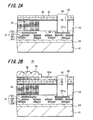
- FIGS. 2A and 2B illustrate an example method of forming the pad part 60.
- pixels each having a photodiode (PD) 54 and pixel transistors (not shown) are formed on a semiconductor substrate 53 and a plurality of wiring layers 51 is then formed on the front side of the semiconductor substrate 53, followed by bonding a supporting substrate 61 to the plurality of wiring layers 51 on a bonding layer 63.
- an insulating layer 55 as an antireflective coating, a passivation layer 56, and a planarizing film 57 that serves as a base-adhesive layer are stacked in this order on the backside of the semiconductor substrate 53.
- an opening 62 is formed by etching and removing the part, which corresponds to the pad part 60, of each of the planarizing film 57, the passivation layer 56, the insulating layer 55, the semiconductor substrate 53, and the insulating interlayer 50 up to the first wiring 521a of the plurality of wiring layers 51.
- an organic film that serves as an on-chip color filter member such as a resist film
- an organic film that serves as an on-chip color filter member is formed and then patterned.
- on-chip color filters 59 of, for example, red (R), green (G), and blue (B) are formed.
- an organic film that serves as an on-chip microlens member 58A, such as a resist film is formed and then subjected to a transfer method including an etch-back process to form on-chip microlenses 58.
- both the on-chip color filters 59 and the on-chip microlenses 58 are formed after the formation of the opening 62 of the pad part 60.
- the application of organic films provided as an on-chip color filter member and an on-chip microlens member, such as resist films may cause striations, or uneven coatings.
- a stepped portion with a height of 3 ⁇ m or more, for example, approximately 6 ⁇ m may be formed on the opening 62.
- a striation may occur from the stepped portion as the starting point.
- the striation leads to unevenness of the completed on-chip color filters 59 and on-chip microlens 58.
- variation in imaging characteristics of the solid-state imaging device may occur, leading to a decrease in reliability thereof.
- the present invention has been made in consideration of the foregoing and it is desirable to provide a method of manufacturing a backside-illuminated solid-state imaging device that retains high reliability without causing any variation in imaging characteristics while having the opening of a pad part on the light-incident backside. It is also desirable to provide a method of manufacturing an electronic apparatus having such a solid-state imaging device.
- a method of manufacturing a solid-state imaging device and a method of manufacturing an electronic apparatus, as defined in claims 1 and 8, respectively.
- a signal circuit is formed on an insulating interlayer on one side of a semiconductor substrate on which a photoelectric conversion part is formed, and light is incident on the photoelectric conversion part from the other side of the semiconductor substrate.
- Each of the methods includes the steps of forming an on-chip color filter and an on-chip microlens on the light-incident side, and subsequently forming an opening for a pad part on the light-incident side.
- the opening is formed for the pad part after forming an on-chip color filter and an on-chip microlens.
- organic films to be the on-chip color filter and on-chip microlens can be formed to a base surface substantially without any stepped portion. Therefore, such a method can prevent the applied organic film from generating any striation due to a stepped portion.
- the method of manufacturing a solid-state imaging device and the method of manufacturing an electronic apparatus according to the respective embodiments of the present invention can provide a backside-illuminated solid-state imaging device and an electronic apparatus with high reliability without any variation in imaging characteristics, because striations can be prevented from being generated in organic coating films.
- FIGS. 3 to 5 illustrate the schematic configuration of a solid-state imaging device according to an embodiment of the present invention. Such a configuration can also be applied to an electronic apparatus according to another embodiment of the present invention.
- the solid-state imaging device and the electronic apparatus are those of a backside-illuminated type.
- a solid-state imaging device 1 of the present embodiment includes an imaging region 3, peripheral circuits 6 and 7, and a plurality of pad parts 5 on the periphery thereof.
- the imaging region 3 includes an effective pixel area 3a and an optical black area 3b that specifies the black level of a pixel.
- the optical black area 3b also includes the same kind of pixels as those of the effective pixel area 3a.
- the pixels that constitute the optical black area 3b are arranged on the outside of the effective pixel area 3a.
- the whole surface of the solid-state imaging device 1 except for the photoelectric conversion parts (light-sensing parts) of the respective pixels in the effective pixel area 3a and the pad parts 5 is covered with a light-shielding film.
- each pixel includes a photoelectric conversion part, such as a photodiode (PD), and a plurality of pixel transistors (or MOS transistors).
- the plurality of pixel transistors may include, for example, four transistors: a transfer transistor, a reset transistor, an amplification transistor, and a selection transistor. Alternatively, it may include three transistors: a transfer transistor, a reset transistor, and an amplification transistor.
- the plurality of pixel transistors may be provided in different configurations.
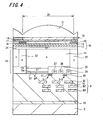
- FIG. 4 illustrates an example of cross-sectional structure of a unit pixel.
- a unit pixel 31 is formed as follows. First, a second conductivity type p-type pixel isolating region 32 is formed in a silicon semiconductor layer 10 that corresponds to a first conductivity type n-type semiconductor substrate. Then, the unit pixel 31 is completed by forming a photodiode (PD) 11 provided as a photoelectric conversion part and a plurality of pixel transistors Tr1 and Tr2 in each pixel region.
- the photodiode 11 includes an n-type semiconductor layer 10 and a p + -accumulation layers 33 and 34.
- the n-type semiconductor layer 10 is surrounded by a p-type pixel isolating region 32 and a comparatively deep p-type semiconductor well region 35 in which the plurality of pixel transistors Tr1 and Tr2 are formed.
- the p + -accumulation layers 33 and 34 are provided to suppress the generation of dark current on both front and back sides.
- the n-type semiconductor layer 10 forming the photodiode 11 includes a highly-doped n + -charge accumulation region 10a, which is located on the front side of the semiconductor layer 10, and a lightly-doped n-type region 10b, which is made of the semiconductor layer 10.
- the n-type region 10b extending to the backside of the semiconductor layer 10 is formed such that it extends below the p-type semiconductor well region 35, where the pixel transistors Tr1 and Tr2 are formed.
- the plurality of pixel transistors Tr1 and Tr2 may include, for example, four transistors as described above.
- Tr1 represents the transfer transistor and Tr2 represents any of the reset transistor, the amplification transistor, and the selection transistor.
- the pixel transistor Tr1 includes an n + -source/drain region 37 to be functioned as a floating diffusion (FD) portion, an n + -charge accumulation region 10a of the photodiode 11, and a gate electrode 41 formed on a gate insulating layer.
- the pixel transistor Tr2 includes a pair of source/drain regions 38 and 39 and a gate electrode 42 on the gate insulating layer.
- a plurality of wiring layers 9 that forms wiring layers M1 to M3 is provided on the insulating interlayer 14 on the front side of semiconductor layer 10. Furthermore, a supporting substrate 8, such as a silicon substrate, is bonded to the plurality of wiring layers 9 on a bonding layer 15.
- the first to third wiring layers M1 to M3 constitute a desired signal circuit and provided as Cu or Au wiring by a damascene process or the like.
- wiring at least facing the pad part for connecting to an Au wire at the time of wire bonding, corresponding to the first wiring layer M1 is made of Al wiring.
- the entire first wiring layer M1 is made of Al.
- the antireflective coating 45 includes, for example, a silicon nitride (SiN) layer 12 and a silicon oxide (SiO 2 ) layer 13 which are stacked in this order.
- a light-shielding layer 16 is formed on the entire antireflective coating 45 except a portion corresponding to the light-sensing part of the photodiode 11.
- a passivation layer 17 and a planarizing film 18 which serves as a base-adhesive layer for an on-chip color filter are formed in this order.
- the passivation layer 17 may be designed to serve as the above planarizing film.
- the light-shielding layer 16 is formed of a metal film.
- each of the peripheral circuits 6, 7 includes a vertical drive circuit, a column signal processing circuit, a horizontal drive circuit, an output circuit, a control circuit, and so on.
- the control circuit generates signals on the basis of a vertical synchronize signal, a horizontal synchronize signal and master clock.
- the generated signals include a clock signal and a control signal to be referenced when operating the vertical drive circuit, the column signal processing circuit, and the horizontal drive circuit. These signals are input from the control circuit to the vertical drive circuit, the column signal processing circuit, and the horizontal drive circuit, respectively.
- the vertical drive circuit which is constructed of a shift register or the like, sequentially performs selective scanning of the pixels in the imaging region one line at a time.
- the vertical drive circuit supplies a pixel signal to the column signal processing circuit through a vertical signal line.
- the pixel signal is based on a signal electric charge generated according to the amount of light received by the photoelectric conversion part of each pixel.
- the column signal processing circuit is provided, for example, every column of the pixels and carries out signal processing, such as noise removal and signal amplification, of a signal output from the pixels on one line with reference to a signal from a black reference pixel in the optical black area.
- a horizontal selection switch which is located between the column signal processing circuit and a horizontal signal line.
- the horizontal drive circuit which is constructed of a shift resister or the like, sequentially outputs horizontal scanning pulses, selecting the respective column signal processing circuits in order to output pixel signals thereof to the horizontal signal line.
- the output circuit carries out signal processing on signals sequentially supplied from the respective column signal processing circuits through the horizontal signal line and then outputs the processed signals.
- an opening 20 is formed in the pad part 5 on the periphery of the backside, where a primary on-chip microlens 21a (described later) is formed, and reaches the Al wiring from the surface of an on-chip microlens member 21A.
- Both the front and back sides of the Al wiring is covered with, for example, a TiN layer, a TiN/Ti layer, a TiN/Ti/TiN layer, or a Ti/TiN/Ti layer.
- an insulating isolation layer 27 or the like may be formed in the semiconductor layer 10 so that it can surround the opening 20 or the like to avoid a disadvantage of causing the Au wire to be electrically short circuited to the semiconductor layer 10 at the time of wire bonding with an Au wire.
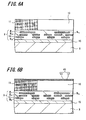
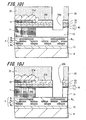
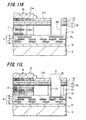
- FIGS. 6 to 11 a first example method of manufacturing a solid-state imaging device according to an embodiment of the present invention will be described. Any of these figures illustrates a cross-sectional view along the line A-A in FIG. 3 .
- the structure includes a semiconductor layer corresponding to a semiconductor substrate, such as a silicon semiconductor layer 10, a plurality of wiring layers 9 formed on the front side of the silicon semiconductor layer 10, and a supporting substrate 8 joined to the front side of the plurality of wiring layers 9 on a bonding layer 15.
- a semiconductor substrate such as a silicon semiconductor layer 10
- a plurality of wiring layers 9 formed on the front side of the silicon semiconductor layer 10
- a supporting substrate 8 joined to the front side of the plurality of wiring layers 9 on a bonding layer 15.
- a plurality of pixels is arranged in a matrix in a plane.
- the pixel includes a photodiode (PD) 11 used as a photoelectric conversion part and a plurality of pixel transistors.
- PD photodiode
- a plurality of pixels is formed on one side of a silicon semiconductor substrate and a plurality of wiring layers 9 is then formed on the same side thereof.
- a supporting substrate 8 of a silicon substrate or the like is bonded to the same side on a bonding layer 15.
- the silicon semiconductor substrate 10 is removed from the other side thereof to have a certain thickness of the silicon semiconductor layer 10.
- wirings M1-M3 of two or more layers including signal circuits and other wirings are formed on an insulating interlayer 14.
- the insulating interlayer 14 may be a silicon oxide (SiO 2 ) layer or the like.
- the plurality of wiring layers 9 as shown in FIG. 6A is an example configuration of wiring of three layers in total, a first layer of wiring M1, a second layer of wiring M2, and a third layer of wiring M3.
- the wiring M1, M2, and M3 can be made of Cu, Al, or the like.
- Wiring M1a of the wiring M1 is formed of, for example, Al wiring comparable with an Au wire, which can be bonded to the Au wire at the pad part for taking out an electrode as described layer. Both the front and back sides of the Al wiring are covered with barrier metal layers, but not shown in the figure, as described above.
- an insulating layer serving as an antireflective coating 45 is formed on the back side of the silicon semiconductor layer 10.
- This antireflective coating 45 is constructed of a silicon nitride (SiN) layer 12 and a silicon oxidization (SiO 2 ) layer 13 stacked in this order from the silicon semiconductor layer 10.
- a passivation layer 17 is formed on the antireflective coating 45, and as shown in FIG. 7D , a planarizing film 18 which serves as a base-adhesive layer for improving adhesion with an on-chip color filter is further formed on the passivation layer 17.
- a color filter 19 is formed on the planarizing film 18.
- the on-chip color filter 19 of this example is constructed of, for example, filters of primary colors, red (R), green (G), and blue (B).
- the on-chip color filter 19 can be formed as follows. An organic film such as a resist film for color filter of first color is applied to the smooth planarizing film 18 by a coater developer and then subjected to patterning, thereby forming a first color filter. Next, a resist film for color filter of second color is applied and then subjected to patterning, thereby forming a second color filter. Subsequently, a third color filter is formed similarly. Since the resist films for the respective color filters are formed on the planarizing film 18 without a stepped portion, the applied resist films are free of striation.
- an on-chip microlens member 21A is applied and formed on the whole area including the surface of the on-chip color filter 19 by a coater developer.
- the on-chip microlens member 21A may be an organic film, such as a negative resist film.
- lithographic and etching technologies are used for forming an opening 23 by selectively removing part of the on-chip microlens member 21A where a pad part will be formed.
- the on-chip microlens member 21A made of such a resist film is applied to a base surface before forming a large stepped portion, such as the opening of the pad part, that is, substantially without any stepped portion having been made. Thus, the applied on-chip microlens member 21A does not cause any striation.
- a lens-shaped member 24 with a desired curvature which corresponds to an on-chip lens for each of the pixels, is formed on the on-chip microlens member 21A, that is, at a position above the on-chip color filter 19.
- the lens-shaped member 24 is formed using a positive resist film. That is, the positive resist film is applied and then subjected to patterning for each of the pixels, followed by a reflow process.
- the whole-surface is etch-back.
- the lens shape of the lens-shaped member 24 is transferred to the on-chip microlens member 21A.
- the transfer process makes a primary on-chip microlens 21a but not the final on-chip microlens 21.
- a primary opening 20a is formed by etching and removing the portions of the planarizing film 18, passivation layer 17, and antireflective coating 45 and partially the silicon semiconductor layer 10 through the opening 23 of the on-chip microlens member 21A.
- the surface of the transferred primary on-chip microlens 21a and the surface of the other portion of the on-chip microlens member 21A are hardened.
- a resist mask 25 is formed on both the on-chip microlens member 21A and the primary on-chip microlens 21a, except the opening 23.
- a dry-etching process is carried out through the resist mask 25 to entirely remove the silicon semiconductor layer 10 from the bottom of the primary opening 20a, thereby forming a secondary opening 20b.
- the silicon semiconductor layer 10 is entirely removed from a portion extending from the plurality of wiring layers 9 to the insulating interlayer 14.
- the resist mask 25 used in this example may be any of those typically used in the known semiconductor process.
- the resist mask 25 is stripped and removed.
- the resist material of the on-chip microlens member 21A is different from that of the resist mask 25.
- both the surface of the on-chip microlens member 21A and the surface of the primary on-chip microlens 21a have been hardened as a result of the above etch-back process.
- the resist mask 25 can be readily stripped.
- FIG. 12 illustrates an example in which etching is carried out through a resist mask 101 up to an insulating interlayer 105 located between a silicon semiconductor 102 and Al wiring 104 of a plurality of wiring layers 103A for wire bonding.
- the undesired reaction product 106 may be mainly one generated as a result of etching a barrier metal layer (e.g., a TiN layer as described above) 107 on the surface of the Al wiring 104. If a large amount of the undesired reaction product 106 is adhered, it becomes difficult to strip the resist mask 101 with thinner, by ashing, or the like.
- etching is carried out only on the silicon semiconductor 10 with a gas mixture of SF 6 and O 2 , while it is not carried out to expose Al wiring M1a.
- a resist mask 25 can be readily stripped off after the etching.
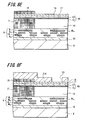
- the final on-chip microlens 21 is formed by carrying out a second whole-surface etch-back process under the same conditions as those of the first one for the formation of the primary on-chip microlens 21a.
- the insulating interlayer 14 located between the silicon semiconductor 10 and the Al wiring M1a for wire bonding is removed by etching, forming a final opening 20 from which the Al wiring can be exposed.
- a desired pad part 5 can be formed as a result of the formation of such an opening 20.
- an insulating isolation layer 27 is formed in advance in part of the silicon semiconductor layer 10, which corresponds to the circumference of the opening 20. Therefore, when a bonding wire, such as an Au wire, is bonded in the opening 20, the bonding wire can be prevented from being electrically short-circuited to the other part of the silicon semiconductor layer 10.
- both the method of manufacturing the solid-state imaging device and the method of manufacturing the electronic apparatus using such a device can include the step of applying organic films such as resist films for forming on-chip color filters and on-chip microlenses to the surface of the substrate (or base surface) substantially without any stepped portion before the formation of the opening 20 in the pad part 5.
- organic films such as resist films for forming on-chip color filters and on-chip microlenses to the surface of the substrate (or base surface) substantially without any stepped portion before the formation of the opening 20 in the pad part 5.
- the resist film can be prevented from generating any striation due to the presence of a stepped portion around the opening of the pad part.
- both the on-chip color filter 19 and the on-chip microlens 21 can be formed uniformly.
- a solid-state imaging device with high reliability without inconsistent imaging characteristics and an electronic apparatus having such a device can be manufactured.
- the primary opening 20a is formed by simultaneously etching the planarizing film 18, the passivation layer 17, the antireflective coating 45 and partially etching the silicon semiconductor layer 10.
- the etching step for the formation of the final opening 20 is simplified.
- an etching process using a typical dry etching technique can be complicated.
- the silicon semiconductor layer 10 is selectively etched and removed to form a secondary opening 20b.
- the silicon semiconductor layer 10 is dry-etched using a gas mixture of SF 6 and O 2 . Therefore, the generation of an undesired reaction product can be prevented. Thus, an efficiency of subsequent removal of the resist mask 25 can be improved.
- both the surface of the primary on-chip microlens 21a and the surface of the on-chip microlens member 21A are hardened by the etch-back process, so that only the resist mask 25 can be readily stripped off in the step of removing the resist mask.
- an organic solvent such as thinner or a combination of an ashing process and an organic solvent such as thinner is used, so that the resist mask 25 can be removed without causing abnormalities to the on-chip microlens 21a.
- the final on-chip microlens 21 is formed while removing the thin insulating interlayer 14 between the Al wiring M1a, the first layer of the signal circuit, and the silicon semiconductor layer 10, exposing the Al wiring M1a to be provided as an electrode lead-out part. Since the Al wiring M1a as an electrode leading-out part is exposed, the etching amount of the Al wiring M1a can be reduced.
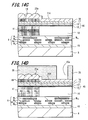
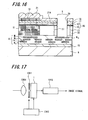
- FIG. 13 to FIG. 16 a second example method of manufacturing a solid-state imaging device and method of manufacturing an electronic apparatus using such a device according to an embodiment of the present invention will be described.
- Each of these figures corresponds to the cross-sectional view along the line A-A in FIG. 3 .
- the step shown in FIG. 13A follows the same preceding steps as those of FIG. 6A to FIG. 8 as described above.
- an organic film that serves as an on-chip microlens member 21A such as a negative resist film, is applied to the whole surface including the surface of the on-chip color filter 19 by a coater developer. Since this on-chip microlens member 21A is applied to the base surface substantially without any stepped portion just as in the case with the first example, any striation may not be generated in the applied on-chip microlens member 21A.
- a lens-shaped member 24 with a desired curvature which corresponds to an on-chip lens for each of the pixels, is formed on the on-chip microlens member 21A, that is, above the corresponding on-chip color filter 19.
- the lens-shaped member 24 is formed using a positive resist film. That is, the positive resist film is applied and then subjected to patterning for each of the pixels, followed by a reflow process.
- a whole-surface etch-back process is carried out on the whole area.
- the lens shape of the lens-shaped member 24 is transferred to the on-chip microlens member 21A.
- the transfer process makes a primary on-chip microlens 21a but not the final on-chip microlens 21.
- the surface of the transferred primary on-chip microlens 21a and the surface of the other portion of the on-chip microlens member 21A are hardened.
- a resist mask 25 having an opening 25a at a position where a pad part is formed is formed over the primary on-chip microlens 21a and the on-chip microlens member 21A.
- the resist mask 25 used in this example may be any of those typically used in the known semiconductor process.
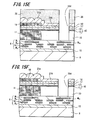
- dry etching is carried out from the surface of the on-chip microlens member 21A to the entire silicon semiconductor layer 10 through the resist mask 25 to form a primary opening 20d.
- the dry etching is carried out using different etching gases for etching the on-chip microlens member 21A, etching the planarizing film 18, passivation layer 17, and antireflective coating 45, and etching the silicon semiconductor layer 10.
- the resist mask 25 is stripped and removed using an organic solvent, such as thinner, or a combination of an ashing process and an organic solvent, such as thinner.
- an organic solvent such as thinner, or a combination of an ashing process and an organic solvent, such as thinner.
- the silicon semiconductor layer 10 is etched, but the Al wiring M1a is not exposed.
- the generation of an undesired reaction product can be prevented or the generation of an undesired product can be suppressed as much as possible. Accordingly, adhesion of the undesired reaction product to the surface of the resist mask can be decreased extremely. Therefore, only the resist mask 25 can be readily stripped and removed using an organic solvent, such as thinner, or a combination of an ashing process and an organic solvent, such as thinner without causing any abnormality to the primary on-chip microlens 21a.
- the final on-chip microlens 21 is formed by carrying out a second whole-surface etch-back process under the same conditions as those of the first one for the formation of the primary on-chip microlens 21.
- the insulating interlayer 14 located between the silicon semiconductor 10 and the Al wiring M1a for wire bonding is removed by etch-back, forming the final opening 20 where the Al wiring is exposed.
- a desired pad part 5 can be formed as a result of the formation of such an opening 20.
- an insulating isolation layer 27 is formed in advance in part of the silicon semiconductor layer 10, which corresponds to the circumference of the opening 20. Therefore, when a bonding wire, such as an Au wire, is bonded in the opening 20, the bonding wire can be prevented from being electrically short-circuited to the other part of the silicon semiconductor layer 10.
- the method of manufacturing the solid-state imaging device and the method of manufacturing the electronic apparatus using such a device includes the step of applying the organic film such as the resist film for forming an on-chip color filter and an on-chip microlens to the surface of the substrate (or base surface) substantially without any stepped portion before the formation of the opening 20 in the pad part 5.
- the resist film can be prevented from generating any striation due to the stepped portion in the opening of the pad part.
- both the on-chip color filter 19 and the on-chip microlens 21 can be formed uniformly.
- a solid-state imaging device with high reliability without inconsistent imaging characteristics and an electronic apparatus having such a device can be manufactured.
- the second whole surface etch-back process forms the final on-chip microlens 21 while exposing the Al wiring M1a on the pad part 5.
- the etching amount of the Al wiring M1a can be reduced.
- the solid-state imaging device having the characteristic features as described above can be employed as an imaging device in an electronic apparatus, such as a digital camera or a camcorder.
- FIG. 17 is a diagram illustrating an example configuration of an electronic apparatus including the solid-state imaging device according to an embodiment of the present invention.
- the electronic apparatus includes the solid-state imaging device 1 according to an embodiment as an imaging device, an optical system for introducing incident light into the pixel region of the imaging device (forming an object image), such as a lens 1001 for focusing incident light (image light) on an imaging surface, an optical diaphragm 1011, a drive circuit (DRV) 1012 for driving the imaging device, and a signalprocessing circuit (PRC) 1013 for processing a signal output from the imaging device.
- an optical system for introducing incident light into the pixel region of the imaging device (forming an object image) such as a lens 1001 for focusing incident light (image light) on an imaging surface
- an optical diaphragm 1011 such as a lens 1001 for focusing incident light (image light) on an imaging surface
- DDRV drive circuit
- PRC signalprocessing circuit
- the drive circuit 1012 includes a timing generator (not shown) that generates various kinds of timing signals, such as a start pulse and a clock pulse for driving circuits in the imaging device. Thus, the drive circuit 1012 drives the imaging device with a predetermined timing signal.
- the signal processing circuit 1013 performs signal processing such as CDS (Correlated Double Sampling) and ADC (Analog to Digital Conversion) on signals output from the imaging device.
- signal processing such as CDS (Correlated Double Sampling) and ADC (Analog to Digital Conversion) on signals output from the imaging device.
- Image signals processed by the signal processing circuit 1013 are stored in a recording medium such as a memory.
- the image data stored in the recording medium can be output in hard copy by a printer or the like.
- image signals processed by the signal processing circuit 1013 can be projected as video on a monitor such as a liquid crystal display.
- a high-precision camera can be realized by mounting the aforementioned solid-state imaging device 1 as an imaging device to an imaging apparatus, such as a digital still camera.
Landscapes
- Solid State Image Pick-Up Elements (AREA)
- Transforming Light Signals Into Electric Signals (AREA)
Applications Claiming Priority (1)
| Application Number | Priority Date | Filing Date | Title |
|---|---|---|---|
| JP2008125189A JP5422914B2 (ja) | 2008-05-12 | 2008-05-12 | 固体撮像装置の製造方法 |
Publications (3)
| Publication Number | Publication Date |
|---|---|
| EP2120264A2 EP2120264A2 (en) | 2009-11-18 |
| EP2120264A3 EP2120264A3 (en) | 2012-02-22 |
| EP2120264B1 true EP2120264B1 (en) | 2013-01-30 |
Family
ID=40637175
Family Applications (1)
| Application Number | Title | Priority Date | Filing Date |
|---|---|---|---|
| EP09005639A Not-in-force EP2120264B1 (en) | 2008-05-12 | 2009-04-22 | Method of manufacturing solid-state imaging device and method of manufacturing electronic apparatus |
Country Status (6)
| Country | Link |
|---|---|
| US (1) | US8076172B2 (enExample) |
| EP (1) | EP2120264B1 (enExample) |
| JP (1) | JP5422914B2 (enExample) |
| KR (1) | KR20090117982A (enExample) |
| CN (1) | CN101582393B (enExample) |
| TW (1) | TWI409969B (enExample) |
Families Citing this family (49)
| Publication number | Priority date | Publication date | Assignee | Title |
|---|---|---|---|---|
| JP5471117B2 (ja) | 2009-07-24 | 2014-04-16 | ソニー株式会社 | 固体撮像装置とその製造方法並びにカメラ |
| JP5644096B2 (ja) | 2009-11-30 | 2014-12-24 | ソニー株式会社 | 接合基板の製造方法及び固体撮像装置の製造方法 |
| JP5568969B2 (ja) * | 2009-11-30 | 2014-08-13 | ソニー株式会社 | 固体撮像装置とその製造方法、及び電子機器 |
| JP2011119558A (ja) * | 2009-12-07 | 2011-06-16 | Panasonic Corp | 固体撮像装置 |
| JP2011204797A (ja) * | 2010-03-24 | 2011-10-13 | Sony Corp | 固体撮像装置とその製造方法、及び電子機器 |
| JP5853351B2 (ja) | 2010-03-25 | 2016-02-09 | ソニー株式会社 | 半導体装置、半導体装置の製造方法、及び電子機器 |
| JP5663925B2 (ja) | 2010-03-31 | 2015-02-04 | ソニー株式会社 | 固体撮像装置、および、その製造方法、電子機器 |
| US8318580B2 (en) | 2010-04-29 | 2012-11-27 | Omnivision Technologies, Inc. | Isolating wire bonding in integrated electrical components |
| US8748946B2 (en) | 2010-04-29 | 2014-06-10 | Omnivision Technologies, Inc. | Isolated wire bond in integrated electrical components |
| US8532449B2 (en) * | 2010-05-06 | 2013-09-10 | Intel Corporation | Wafer integrated optical sub-modules |
| JP5644177B2 (ja) * | 2010-05-07 | 2014-12-24 | ソニー株式会社 | 固体撮像装置、および、その製造方法、電子機器 |
| JP6173410B2 (ja) * | 2010-06-30 | 2017-08-02 | キヤノン株式会社 | 固体撮像装置および固体撮像装置の製造方法 |
| JP5693060B2 (ja) * | 2010-06-30 | 2015-04-01 | キヤノン株式会社 | 固体撮像装置、及び撮像システム |
| JP5553693B2 (ja) | 2010-06-30 | 2014-07-16 | キヤノン株式会社 | 固体撮像装置及び撮像システム |
| JP5843475B2 (ja) | 2010-06-30 | 2016-01-13 | キヤノン株式会社 | 固体撮像装置および固体撮像装置の製造方法 |
| US8872298B2 (en) | 2010-07-01 | 2014-10-28 | Samsung Electronics Co., Ltd. | Unit pixel array of an image sensor |
| TWI463646B (zh) * | 2010-07-16 | 2014-12-01 | United Microelectronics Corp | 背照式影像感測器 |
| JP2012064703A (ja) * | 2010-09-15 | 2012-03-29 | Sony Corp | 撮像素子および撮像装置 |
| JP2012084608A (ja) * | 2010-10-07 | 2012-04-26 | Sony Corp | 固体撮像装置とその製造方法、並びに電子機器 |
| JP2012084609A (ja) * | 2010-10-07 | 2012-04-26 | Sony Corp | 固体撮像装置とその製造方法、及び電子機器 |
| JP5640630B2 (ja) * | 2010-10-12 | 2014-12-17 | ソニー株式会社 | 固体撮像装置、固体撮像装置の製造方法、及び電子機器 |
| JP5857399B2 (ja) * | 2010-11-12 | 2016-02-10 | ソニー株式会社 | 固体撮像装置及び電子機器 |
| JP5541137B2 (ja) | 2010-12-15 | 2014-07-09 | ソニー株式会社 | 撮像装置、電子機器、太陽電池、および、撮像装置の製造方法 |
| US9165970B2 (en) | 2011-02-16 | 2015-10-20 | Taiwan Semiconductor Manufacturing Company, Ltd. | Back side illuminated image sensor having isolated bonding pads |
| JP2012175078A (ja) | 2011-02-24 | 2012-09-10 | Sony Corp | 固体撮像装置、および、その製造方法、電子機器、半導体装置 |
| JP5826511B2 (ja) * | 2011-04-26 | 2015-12-02 | 株式会社東芝 | 固体撮像装置及びその製造方法 |
| CN102760742B (zh) * | 2011-04-26 | 2015-08-05 | 欣兴电子股份有限公司 | 电子装置及其制法 |
| US8710612B2 (en) * | 2011-05-20 | 2014-04-29 | Taiwan Semiconductor Manufacturing Company, Ltd. | Semiconductor device having a bonding pad and shield structure of different thickness |
| US8664736B2 (en) | 2011-05-20 | 2014-03-04 | Taiwan Semiconductor Manufacturing Company, Ltd. | Bonding pad structure for a backside illuminated image sensor device and method of manufacturing the same |
| US9013022B2 (en) | 2011-08-04 | 2015-04-21 | Taiwan Semiconductor Manufacturing Company, Ltd. | Pad structure including glue layer and non-low-k dielectric layer in BSI image sensor chips |
| JP5970826B2 (ja) * | 2012-01-18 | 2016-08-17 | ソニー株式会社 | 半導体装置、半導体装置の製造方法、固体撮像装置および電子機器 |
| US9721984B2 (en) * | 2012-04-12 | 2017-08-01 | Taiwan Semiconductor Manufacturing Company, Ltd. | Image sensor manufacturing methods |
| KR101934864B1 (ko) * | 2012-05-30 | 2019-03-18 | 삼성전자주식회사 | 관통 실리콘 비아 구조물 및 그 제조 방법, 이를 포함하는 이미지 센서 및 그 제조 방법 |
| JP6178561B2 (ja) * | 2012-11-15 | 2017-08-09 | キヤノン株式会社 | 固体撮像装置の製造方法 |
| KR102149772B1 (ko) * | 2013-11-14 | 2020-08-31 | 삼성전자주식회사 | 이미지 센서 및 이를 제조하는 방법 |
| US9324755B2 (en) * | 2014-05-05 | 2016-04-26 | Semiconductor Components Industries, Llc | Image sensors with reduced stack height |
| US20170271397A1 (en) * | 2014-08-08 | 2017-09-21 | X-Fab Semiconductor Foundries Ag | Anti-Reflective Treatment Of The Rear Side Of A Semiconductor Wafer |
| JP6048483B2 (ja) * | 2014-12-10 | 2016-12-21 | ソニー株式会社 | 固体撮像装置、および、その製造方法、電子機器 |
| TWI616692B (zh) * | 2014-12-29 | 2018-03-01 | 鴻海精密工業股份有限公司 | 光纖連接器及光耦合透鏡 |
| WO2016143288A1 (en) * | 2015-03-12 | 2016-09-15 | Sony Corporation | Imaging device, manufacturing method, and electronic device |
| US9806116B2 (en) * | 2015-10-28 | 2017-10-31 | Taiwan Semiconductor Manufacturing Co., Ltd. | Complementary metal grid and deep trench isolation in CIS application |
| JP6176313B2 (ja) * | 2015-12-02 | 2017-08-09 | ソニー株式会社 | 固体撮像装置、および、その製造方法、電子機器 |
| US10109666B2 (en) * | 2016-04-13 | 2018-10-23 | Taiwan Semiconductor Manufacturing Co., Ltd. | Pad structure for backside illuminated (BSI) image sensors |
| TWI800487B (zh) * | 2016-09-09 | 2023-05-01 | 日商索尼半導體解決方案公司 | 固體攝像元件及製造方法、以及電子機器 |
| JP6663887B2 (ja) * | 2017-07-11 | 2020-03-13 | ソニー株式会社 | 固体撮像装置、および、その製造方法、電子機器 |
| US20200144322A1 (en) * | 2017-07-18 | 2020-05-07 | Sony Semiconductor Solutions Corporation | Imaging apparatus and method of manufacturing imaging apparatus |
| JP7158846B2 (ja) * | 2017-11-30 | 2022-10-24 | キヤノン株式会社 | 半導体装置および機器 |
| JP2018078305A (ja) * | 2017-12-07 | 2018-05-17 | ソニー株式会社 | 固体撮像装置及び電子機器 |
| KR102890133B1 (ko) * | 2020-12-03 | 2025-11-21 | 삼성전자 주식회사 | Af 픽셀들을 포함하는 이미지 센서 |
Family Cites Families (23)
| Publication number | Priority date | Publication date | Assignee | Title |
|---|---|---|---|---|
| JPH0812904B2 (ja) * | 1990-11-30 | 1996-02-07 | 三菱電機株式会社 | 固体撮像素子の製造方法 |
| JPH06302794A (ja) * | 1993-04-19 | 1994-10-28 | Olympus Optical Co Ltd | 固体撮像素子の製法 |
| KR0147401B1 (ko) * | 1994-02-23 | 1998-08-01 | 구본준 | 고체촬상소자 및 그 제조방법 |
| KR100215878B1 (ko) * | 1996-12-28 | 1999-08-16 | 구본준 | 컬러 고체 촬상 소자의 제조 방법 |
| KR100310102B1 (ko) * | 1998-03-05 | 2001-12-17 | 윤종용 | 고체 컬러 이미지 소자 및 그의 제조 방법 |
| KR100388803B1 (ko) * | 1999-07-14 | 2003-07-12 | 주식회사 하이닉스반도체 | 고체 촬상 소자 및 그 제조방법 |
| JP2002176156A (ja) * | 2000-12-06 | 2002-06-21 | Sony Corp | 固体撮像素子の製造方法 |
| JP4421793B2 (ja) * | 2001-07-13 | 2010-02-24 | 富士フイルム株式会社 | ディジタルカメラ |
| JP3959710B2 (ja) * | 2002-02-01 | 2007-08-15 | ソニー株式会社 | 固体撮像装置の製造方法 |
| US7084472B2 (en) * | 2002-07-09 | 2006-08-01 | Toppan Printing Co., Ltd. | Solid-state imaging device and manufacturing method therefor |
| JP4383959B2 (ja) * | 2003-05-28 | 2009-12-16 | キヤノン株式会社 | 光電変換装置およびその製造方法 |
| JP2005347707A (ja) * | 2004-06-07 | 2005-12-15 | Sony Corp | 固体撮像素子及びその製造方法 |
| JP2005353631A (ja) * | 2004-06-08 | 2005-12-22 | Sony Corp | 固体撮像装置の製造方法 |
| JP4822683B2 (ja) * | 2004-10-08 | 2011-11-24 | パナソニック株式会社 | 固体撮像装置およびその製造方法 |
| TWI382455B (zh) * | 2004-11-04 | 2013-01-11 | 半導體能源研究所股份有限公司 | 半導體裝置和其製造方法 |
| JP2006147661A (ja) * | 2004-11-16 | 2006-06-08 | Matsushita Electric Ind Co Ltd | 受光装置とその製造方法およびカメラ |
| KR100672994B1 (ko) * | 2005-01-28 | 2007-01-24 | 삼성전자주식회사 | 이미지 센서 및 그 제조 방법 |
| JP2006351761A (ja) * | 2005-06-15 | 2006-12-28 | Fujifilm Holdings Corp | 固体撮像素子及びその製造方法 |
| US7553689B2 (en) * | 2005-07-13 | 2009-06-30 | Taiwan Semiconductor Manufacturing Co., Ltd. | Semiconductor device with micro-lens and method of making the same |
| US8013409B2 (en) * | 2005-09-27 | 2011-09-06 | Canon Kabushiki Kaisha | Photoelectric conversion device and fabrication method therefor |
| KR100801447B1 (ko) * | 2006-06-19 | 2008-02-11 | (주)실리콘화일 | 배면 광 포토다이오드를 이용한 이미지센서 및 그 제조방법 |
| KR100790288B1 (ko) * | 2006-08-31 | 2008-01-02 | 동부일렉트로닉스 주식회사 | 씨모스 이미지 센서 및 그 제조방법 |
| JP4486985B2 (ja) * | 2007-08-06 | 2010-06-23 | シャープ株式会社 | 固体撮像装置および電子情報機器 |
-
2008
- 2008-05-12 JP JP2008125189A patent/JP5422914B2/ja not_active Expired - Fee Related
-
2009
- 2009-04-14 TW TW098112380A patent/TWI409969B/zh not_active IP Right Cessation
- 2009-04-22 EP EP09005639A patent/EP2120264B1/en not_active Not-in-force
- 2009-04-24 CN CN2009101373395A patent/CN101582393B/zh not_active Expired - Fee Related
- 2009-04-28 KR KR1020090037075A patent/KR20090117982A/ko not_active Ceased
- 2009-05-11 US US12/463,791 patent/US8076172B2/en not_active Expired - Fee Related
Also Published As
| Publication number | Publication date |
|---|---|
| JP2009277732A (ja) | 2009-11-26 |
| CN101582393A (zh) | 2009-11-18 |
| EP2120264A2 (en) | 2009-11-18 |
| JP5422914B2 (ja) | 2014-02-19 |
| EP2120264A3 (en) | 2012-02-22 |
| TW201001739A (en) | 2010-01-01 |
| US8076172B2 (en) | 2011-12-13 |
| KR20090117982A (ko) | 2009-11-17 |
| TWI409969B (zh) | 2013-09-21 |
| US20090280596A1 (en) | 2009-11-12 |
| CN101582393B (zh) | 2012-10-17 |
Similar Documents
| Publication | Publication Date | Title |
|---|---|---|
| US8076172B2 (en) | Method of manufacturing solid-state imaging device and method of manufacturing electronic apparatus | |
| CN102130140B (zh) | 固体摄像装置 | |
| US7232698B2 (en) | Method for fabricating CMOS image sensor protecting low temperature oxide delamination | |
| JP4987917B2 (ja) | 固体撮像装置の製造方法 | |
| US8477223B2 (en) | Solid-state imaging device, method of manufacturing the same, and electronic apparatus | |
| KR101899595B1 (ko) | 고체 촬상 장치, 고체 촬상 장치의 제조 방법, 및 전자 기기 | |
| KR100504563B1 (ko) | 이미지 센서 제조 방법 | |
| KR20160028435A (ko) | 이미지 센서 제조 방법 | |
| KR20200091252A (ko) | 후면 조사형 이미지 센서 및 그 제조 방법 | |
| US7785916B2 (en) | Image sensor and method for manufacturing the same | |
| KR100648994B1 (ko) | 씨모스 이미지 센서의 제조방법 | |
| JP4905760B2 (ja) | カラーフィルタの製造方法、カラーフィルタ、固体撮像素子の製造方法およびこれを用いた固体撮像素子 | |
| US7883923B2 (en) | Method for manufacturing image sensor | |
| KR100640531B1 (ko) | 자기 정렬 이미지 센서 제조방법 | |
| CN102194836A (zh) | 图像感测元件的制造方法及其重新制作方法 | |
| KR100749365B1 (ko) | 이미지 센서 및 그 제조방법 | |
| KR100741920B1 (ko) | 씨모스(cmos) 이미지 센서의 제조 방법 | |
| US7763491B2 (en) | Method for manufacturing image sensor | |
| KR100780547B1 (ko) | 이미지 센서 및 이의 제조 방법 | |
| KR100855406B1 (ko) | 이미지 센서 제조방법 | |
| JP2006319133A (ja) | カラーフィルタの製造方法、固体撮像素子の製造方法、カラーフィルタ、固体撮像素子 |
Legal Events
| Date | Code | Title | Description |
|---|---|---|---|
| PUAI | Public reference made under article 153(3) epc to a published international application that has entered the european phase |
Free format text: ORIGINAL CODE: 0009012 |
|
| 17P | Request for examination filed |
Effective date: 20090422 |
|
| AK | Designated contracting states |
Kind code of ref document: A2 Designated state(s): AT BE BG CH CY CZ DE DK EE ES FI FR GB GR HR HU IE IS IT LI LT LU LV MC MK MT NL NO PL PT RO SE SI SK TR |
|
| PUAL | Search report despatched |
Free format text: ORIGINAL CODE: 0009013 |
|
| AK | Designated contracting states |
Kind code of ref document: A3 Designated state(s): AT BE BG CH CY CZ DE DK EE ES FI FR GB GR HR HU IE IS IT LI LT LU LV MC MK MT NL NO PL PT RO SE SI SK TR |
|
| AX | Request for extension of the european patent |
Extension state: AL BA RS |
|
| RIC1 | Information provided on ipc code assigned before grant |
Ipc: H01L 27/146 20060101AFI20120113BHEP |
|
| 17Q | First examination report despatched |
Effective date: 20120314 |
|
| REG | Reference to a national code |
Ref country code: DE Ref legal event code: R079 Ref document number: 602009013111 Country of ref document: DE Free format text: PREVIOUS MAIN CLASS: H01L0027146000 Ipc: H01L0021768000 |
|
| RIC1 | Information provided on ipc code assigned before grant |
Ipc: H01L 27/146 20060101ALI20120712BHEP Ipc: H01L 21/768 20060101AFI20120712BHEP |
|
| GRAP | Despatch of communication of intention to grant a patent |
Free format text: ORIGINAL CODE: EPIDOSNIGR1 |
|
| GRAS | Grant fee paid |
Free format text: ORIGINAL CODE: EPIDOSNIGR3 |
|
| GRAA | (expected) grant |
Free format text: ORIGINAL CODE: 0009210 |
|
| AK | Designated contracting states |
Kind code of ref document: B1 Designated state(s): AT BE BG CH CY CZ DE DK EE ES FI FR GB GR HR HU IE IS IT LI LT LU LV MC MK MT NL NO PL PT RO SE SI SK TR |
|
| REG | Reference to a national code |
Ref country code: GB Ref legal event code: FG4D |
|
| REG | Reference to a national code |
Ref country code: CH Ref legal event code: EP |
|
| REG | Reference to a national code |
Ref country code: AT Ref legal event code: REF Ref document number: 595848 Country of ref document: AT Kind code of ref document: T Effective date: 20130215 Ref country code: CH Ref legal event code: EP |
|
| REG | Reference to a national code |
Ref country code: IE Ref legal event code: FG4D |
|
| REG | Reference to a national code |
Ref country code: DE Ref legal event code: R096 Ref document number: 602009013111 Country of ref document: DE Effective date: 20130328 |
|
| REG | Reference to a national code |
Ref country code: NL Ref legal event code: T3 |
|
| REG | Reference to a national code |
Ref country code: AT Ref legal event code: MK05 Ref document number: 595848 Country of ref document: AT Kind code of ref document: T Effective date: 20130130 |
|
| REG | Reference to a national code |
Ref country code: LT Ref legal event code: MG4D |
|
| PG25 | Lapsed in a contracting state [announced via postgrant information from national office to epo] |
Ref country code: LT Free format text: LAPSE BECAUSE OF FAILURE TO SUBMIT A TRANSLATION OF THE DESCRIPTION OR TO PAY THE FEE WITHIN THE PRESCRIBED TIME-LIMIT Effective date: 20130130 Ref country code: SE Free format text: LAPSE BECAUSE OF FAILURE TO SUBMIT A TRANSLATION OF THE DESCRIPTION OR TO PAY THE FEE WITHIN THE PRESCRIBED TIME-LIMIT Effective date: 20130130 Ref country code: BG Free format text: LAPSE BECAUSE OF FAILURE TO SUBMIT A TRANSLATION OF THE DESCRIPTION OR TO PAY THE FEE WITHIN THE PRESCRIBED TIME-LIMIT Effective date: 20130430 Ref country code: ES Free format text: LAPSE BECAUSE OF FAILURE TO SUBMIT A TRANSLATION OF THE DESCRIPTION OR TO PAY THE FEE WITHIN THE PRESCRIBED TIME-LIMIT Effective date: 20130511 Ref country code: NO Free format text: LAPSE BECAUSE OF FAILURE TO SUBMIT A TRANSLATION OF THE DESCRIPTION OR TO PAY THE FEE WITHIN THE PRESCRIBED TIME-LIMIT Effective date: 20130430 Ref country code: AT Free format text: LAPSE BECAUSE OF FAILURE TO SUBMIT A TRANSLATION OF THE DESCRIPTION OR TO PAY THE FEE WITHIN THE PRESCRIBED TIME-LIMIT Effective date: 20130130 Ref country code: BE Free format text: LAPSE BECAUSE OF FAILURE TO SUBMIT A TRANSLATION OF THE DESCRIPTION OR TO PAY THE FEE WITHIN THE PRESCRIBED TIME-LIMIT Effective date: 20130130 Ref country code: IS Free format text: LAPSE BECAUSE OF FAILURE TO SUBMIT A TRANSLATION OF THE DESCRIPTION OR TO PAY THE FEE WITHIN THE PRESCRIBED TIME-LIMIT Effective date: 20130530 |
|
| PG25 | Lapsed in a contracting state [announced via postgrant information from national office to epo] |
Ref country code: GR Free format text: LAPSE BECAUSE OF FAILURE TO SUBMIT A TRANSLATION OF THE DESCRIPTION OR TO PAY THE FEE WITHIN THE PRESCRIBED TIME-LIMIT Effective date: 20130501 Ref country code: FI Free format text: LAPSE BECAUSE OF FAILURE TO SUBMIT A TRANSLATION OF THE DESCRIPTION OR TO PAY THE FEE WITHIN THE PRESCRIBED TIME-LIMIT Effective date: 20130130 Ref country code: LV Free format text: LAPSE BECAUSE OF FAILURE TO SUBMIT A TRANSLATION OF THE DESCRIPTION OR TO PAY THE FEE WITHIN THE PRESCRIBED TIME-LIMIT Effective date: 20130130 Ref country code: PL Free format text: LAPSE BECAUSE OF FAILURE TO SUBMIT A TRANSLATION OF THE DESCRIPTION OR TO PAY THE FEE WITHIN THE PRESCRIBED TIME-LIMIT Effective date: 20130130 Ref country code: PT Free format text: LAPSE BECAUSE OF FAILURE TO SUBMIT A TRANSLATION OF THE DESCRIPTION OR TO PAY THE FEE WITHIN THE PRESCRIBED TIME-LIMIT Effective date: 20130530 Ref country code: SI Free format text: LAPSE BECAUSE OF FAILURE TO SUBMIT A TRANSLATION OF THE DESCRIPTION OR TO PAY THE FEE WITHIN THE PRESCRIBED TIME-LIMIT Effective date: 20130130 |
|
| PG25 | Lapsed in a contracting state [announced via postgrant information from national office to epo] |
Ref country code: HR Free format text: LAPSE BECAUSE OF FAILURE TO SUBMIT A TRANSLATION OF THE DESCRIPTION OR TO PAY THE FEE WITHIN THE PRESCRIBED TIME-LIMIT Effective date: 20130130 |
|
| PG25 | Lapsed in a contracting state [announced via postgrant information from national office to epo] |
Ref country code: CZ Free format text: LAPSE BECAUSE OF FAILURE TO SUBMIT A TRANSLATION OF THE DESCRIPTION OR TO PAY THE FEE WITHIN THE PRESCRIBED TIME-LIMIT Effective date: 20130130 Ref country code: RO Free format text: LAPSE BECAUSE OF FAILURE TO SUBMIT A TRANSLATION OF THE DESCRIPTION OR TO PAY THE FEE WITHIN THE PRESCRIBED TIME-LIMIT Effective date: 20130130 Ref country code: SK Free format text: LAPSE BECAUSE OF FAILURE TO SUBMIT A TRANSLATION OF THE DESCRIPTION OR TO PAY THE FEE WITHIN THE PRESCRIBED TIME-LIMIT Effective date: 20130130 Ref country code: DK Free format text: LAPSE BECAUSE OF FAILURE TO SUBMIT A TRANSLATION OF THE DESCRIPTION OR TO PAY THE FEE WITHIN THE PRESCRIBED TIME-LIMIT Effective date: 20130130 Ref country code: EE Free format text: LAPSE BECAUSE OF FAILURE TO SUBMIT A TRANSLATION OF THE DESCRIPTION OR TO PAY THE FEE WITHIN THE PRESCRIBED TIME-LIMIT Effective date: 20130130 |
|
| PG25 | Lapsed in a contracting state [announced via postgrant information from national office to epo] |
Ref country code: CY Free format text: LAPSE BECAUSE OF FAILURE TO SUBMIT A TRANSLATION OF THE DESCRIPTION OR TO PAY THE FEE WITHIN THE PRESCRIBED TIME-LIMIT Effective date: 20130130 Ref country code: MC Free format text: LAPSE BECAUSE OF FAILURE TO SUBMIT A TRANSLATION OF THE DESCRIPTION OR TO PAY THE FEE WITHIN THE PRESCRIBED TIME-LIMIT Effective date: 20130130 |
|
| REG | Reference to a national code |
Ref country code: CH Ref legal event code: PL |
|
| PLBE | No opposition filed within time limit |
Free format text: ORIGINAL CODE: 0009261 |
|
| STAA | Information on the status of an ep patent application or granted ep patent |
Free format text: STATUS: NO OPPOSITION FILED WITHIN TIME LIMIT |
|
| GBPC | Gb: european patent ceased through non-payment of renewal fee |
Effective date: 20130430 |
|
| 26N | No opposition filed |
Effective date: 20131031 |
|
| REG | Reference to a national code |
Ref country code: IE Ref legal event code: MM4A |
|
| PG25 | Lapsed in a contracting state [announced via postgrant information from national office to epo] |
Ref country code: GB Free format text: LAPSE BECAUSE OF NON-PAYMENT OF DUE FEES Effective date: 20130430 Ref country code: CH Free format text: LAPSE BECAUSE OF NON-PAYMENT OF DUE FEES Effective date: 20130430 Ref country code: LI Free format text: LAPSE BECAUSE OF NON-PAYMENT OF DUE FEES Effective date: 20130430 |
|
| REG | Reference to a national code |
Ref country code: FR Ref legal event code: ST Effective date: 20131231 |
|
| REG | Reference to a national code |
Ref country code: DE Ref legal event code: R097 Ref document number: 602009013111 Country of ref document: DE Effective date: 20131031 |
|
| PG25 | Lapsed in a contracting state [announced via postgrant information from national office to epo] |
Ref country code: FR Free format text: LAPSE BECAUSE OF NON-PAYMENT OF DUE FEES Effective date: 20130430 |
|
| PG25 | Lapsed in a contracting state [announced via postgrant information from national office to epo] |
Ref country code: IE Free format text: LAPSE BECAUSE OF NON-PAYMENT OF DUE FEES Effective date: 20130422 |
|
| PGFP | Annual fee paid to national office [announced via postgrant information from national office to epo] |
Ref country code: IT Payment date: 20140422 Year of fee payment: 6 Ref country code: DE Payment date: 20140418 Year of fee payment: 6 Ref country code: NL Payment date: 20140418 Year of fee payment: 6 |
|
| PG25 | Lapsed in a contracting state [announced via postgrant information from national office to epo] |
Ref country code: MT Free format text: LAPSE BECAUSE OF FAILURE TO SUBMIT A TRANSLATION OF THE DESCRIPTION OR TO PAY THE FEE WITHIN THE PRESCRIBED TIME-LIMIT Effective date: 20130130 |
|
| PG25 | Lapsed in a contracting state [announced via postgrant information from national office to epo] |
Ref country code: TR Free format text: LAPSE BECAUSE OF FAILURE TO SUBMIT A TRANSLATION OF THE DESCRIPTION OR TO PAY THE FEE WITHIN THE PRESCRIBED TIME-LIMIT Effective date: 20130130 |
|
| PG25 | Lapsed in a contracting state [announced via postgrant information from national office to epo] |
Ref country code: MK Free format text: LAPSE BECAUSE OF FAILURE TO SUBMIT A TRANSLATION OF THE DESCRIPTION OR TO PAY THE FEE WITHIN THE PRESCRIBED TIME-LIMIT Effective date: 20130130 Ref country code: HU Free format text: LAPSE BECAUSE OF FAILURE TO SUBMIT A TRANSLATION OF THE DESCRIPTION OR TO PAY THE FEE WITHIN THE PRESCRIBED TIME-LIMIT; INVALID AB INITIO Effective date: 20090422 Ref country code: LU Free format text: LAPSE BECAUSE OF NON-PAYMENT OF DUE FEES Effective date: 20130422 |
|
| REG | Reference to a national code |
Ref country code: DE Ref legal event code: R119 Ref document number: 602009013111 Country of ref document: DE |
|
| REG | Reference to a national code |
Ref country code: NL Ref legal event code: MM Effective date: 20150501 |
|
| PG25 | Lapsed in a contracting state [announced via postgrant information from national office to epo] |
Ref country code: DE Free format text: LAPSE BECAUSE OF NON-PAYMENT OF DUE FEES Effective date: 20151103 Ref country code: IT Free format text: LAPSE BECAUSE OF NON-PAYMENT OF DUE FEES Effective date: 20150422 |
|
| PG25 | Lapsed in a contracting state [announced via postgrant information from national office to epo] |
Ref country code: NL Free format text: LAPSE BECAUSE OF NON-PAYMENT OF DUE FEES Effective date: 20150501 |