EP1588716B1 - Peg-uricase Konjugate und Verwendung davon - Google Patents
Peg-uricase Konjugate und Verwendung davon Download PDFInfo
- Publication number
- EP1588716B1 EP1588716B1 EP05011069A EP05011069A EP1588716B1 EP 1588716 B1 EP1588716 B1 EP 1588716B1 EP 05011069 A EP05011069 A EP 05011069A EP 05011069 A EP05011069 A EP 05011069A EP 1588716 B1 EP1588716 B1 EP 1588716B1
- Authority
- EP
- European Patent Office
- Prior art keywords
- uricase
- peg
- kda
- strands
- activity
- Prior art date
- Legal status (The legal status is an assumption and is not a legal conclusion. Google has not performed a legal analysis and makes no representation as to the accuracy of the status listed.)
- Expired - Lifetime
Links
- 229940005267 urate oxidase Drugs 0.000 title abstract description 5
- 108010092464 Urate Oxidase Proteins 0.000 claims abstract description 292
- 229920001223 polyethylene glycol Polymers 0.000 claims abstract description 170
- -1 poly(ethylene glycol) Polymers 0.000 claims abstract description 26
- LEHOTFFKMJEONL-UHFFFAOYSA-N Uric Acid Chemical compound N1C(=O)NC(=O)C2=C1NC(=O)N2 LEHOTFFKMJEONL-UHFFFAOYSA-N 0.000 claims description 31
- TVWHNULVHGKJHS-UHFFFAOYSA-N Uric acid Natural products N1C(=O)NC(=O)C2NC(=O)NC21 TVWHNULVHGKJHS-UHFFFAOYSA-N 0.000 claims description 24
- 229940116269 uric acid Drugs 0.000 claims description 24
- 239000008194 pharmaceutical composition Substances 0.000 claims description 7
- 210000001124 body fluid Anatomy 0.000 claims description 6
- 239000010839 body fluid Substances 0.000 claims description 6
- 239000003937 drug carrier Substances 0.000 claims description 2
- 102000004190 Enzymes Human genes 0.000 abstract description 38
- 108090000790 Enzymes Proteins 0.000 abstract description 38
- 229940088598 enzyme Drugs 0.000 abstract description 38
- 108010068701 Pegloticase Proteins 0.000 abstract description 35
- 230000001751 uricolytic effect Effects 0.000 abstract description 25
- 230000002163 immunogen Effects 0.000 abstract description 17
- 229920003171 Poly (ethylene oxide) Polymers 0.000 abstract description 2
- 230000000694 effects Effects 0.000 description 47
- 241000699670 Mus sp. Species 0.000 description 32
- 230000005847 immunogenicity Effects 0.000 description 28
- 238000005859 coupling reaction Methods 0.000 description 25
- 239000007924 injection Substances 0.000 description 24
- 238000002347 injection Methods 0.000 description 24
- 230000008878 coupling Effects 0.000 description 23
- 238000010168 coupling process Methods 0.000 description 23
- 238000002360 preparation method Methods 0.000 description 23
- 241000235646 Cyberlindnera jadinii Species 0.000 description 22
- 241001504519 Papio ursinus Species 0.000 description 19
- 238000000034 method Methods 0.000 description 19
- 230000002950 deficient Effects 0.000 description 18
- 230000003247 decreasing effect Effects 0.000 description 16
- 210000004185 liver Anatomy 0.000 description 16
- 230000021615 conjugation Effects 0.000 description 15
- 230000014759 maintenance of location Effects 0.000 description 15
- 230000006320 pegylation Effects 0.000 description 14
- 239000000872 buffer Substances 0.000 description 13
- 108090000623 proteins and genes Proteins 0.000 description 13
- 230000002829 reductive effect Effects 0.000 description 13
- 210000002966 serum Anatomy 0.000 description 13
- 238000011282 treatment Methods 0.000 description 13
- 241000228197 Aspergillus flavus Species 0.000 description 12
- 102000004169 proteins and genes Human genes 0.000 description 12
- 210000002700 urine Anatomy 0.000 description 12
- JYEUMXHLPRZUAT-UHFFFAOYSA-N 1,2,3-triazine Chemical compound C1=CN=NN=C1 JYEUMXHLPRZUAT-UHFFFAOYSA-N 0.000 description 11
- 235000001014 amino acid Nutrition 0.000 description 11
- 235000018102 proteins Nutrition 0.000 description 11
- 201000001431 Hyperuricemia Diseases 0.000 description 10
- CDBYLPFSWZWCQE-UHFFFAOYSA-L Sodium Carbonate Chemical compound [Na+].[Na+].[O-]C([O-])=O CDBYLPFSWZWCQE-UHFFFAOYSA-L 0.000 description 10
- 150000001413 amino acids Chemical class 0.000 description 10
- 125000003588 lysine group Chemical group [H]N([H])C([H])([H])C([H])([H])C([H])([H])C([H])([H])C([H])(N([H])[H])C(*)=O 0.000 description 10
- 230000000717 retained effect Effects 0.000 description 10
- 235000010469 Glycine max Nutrition 0.000 description 9
- 244000068988 Glycine max Species 0.000 description 9
- 229920000642 polymer Polymers 0.000 description 9
- 235000018977 lysine Nutrition 0.000 description 8
- 239000000203 mixture Substances 0.000 description 8
- 239000000243 solution Substances 0.000 description 8
- 125000003178 carboxy group Chemical group [H]OC(*)=O 0.000 description 7
- 230000007423 decrease Effects 0.000 description 7
- 238000000386 microscopy Methods 0.000 description 7
- 125000002924 primary amino group Chemical group [H]N([H])* 0.000 description 7
- XLYOFNOQVPJJNP-UHFFFAOYSA-N water Substances O XLYOFNOQVPJJNP-UHFFFAOYSA-N 0.000 description 7
- 241000124008 Mammalia Species 0.000 description 6
- 241001415846 Procellariidae Species 0.000 description 6
- FAPWRFPIFSIZLT-UHFFFAOYSA-M Sodium chloride Chemical compound [Na+].[Cl-] FAPWRFPIFSIZLT-UHFFFAOYSA-M 0.000 description 6
- 125000003277 amino group Chemical group 0.000 description 6
- 230000015572 biosynthetic process Effects 0.000 description 6
- 241000186074 Arthrobacter globiformis Species 0.000 description 5
- 241000699666 Mus <mouse, genus> Species 0.000 description 5
- 241000283973 Oryctolagus cuniculus Species 0.000 description 5
- 238000002835 absorbance Methods 0.000 description 5
- 125000003275 alpha amino acid group Chemical group 0.000 description 5
- 230000002255 enzymatic effect Effects 0.000 description 5
- 230000002538 fungal effect Effects 0.000 description 5
- 239000002502 liposome Substances 0.000 description 5
- 229910000029 sodium carbonate Inorganic materials 0.000 description 5
- 238000010561 standard procedure Methods 0.000 description 5
- 238000003786 synthesis reaction Methods 0.000 description 5
- 210000001519 tissue Anatomy 0.000 description 5
- FWMNVWWHGCHHJJ-SKKKGAJSSA-N 4-amino-1-[(2r)-6-amino-2-[[(2r)-2-[[(2r)-2-[[(2r)-2-amino-3-phenylpropanoyl]amino]-3-phenylpropanoyl]amino]-4-methylpentanoyl]amino]hexanoyl]piperidine-4-carboxylic acid Chemical compound C([C@H](C(=O)N[C@H](CC(C)C)C(=O)N[C@H](CCCCN)C(=O)N1CCC(N)(CC1)C(O)=O)NC(=O)[C@H](N)CC=1C=CC=CC=1)C1=CC=CC=C1 FWMNVWWHGCHHJJ-SKKKGAJSSA-N 0.000 description 4
- 238000002965 ELISA Methods 0.000 description 4
- 241000588724 Escherichia coli Species 0.000 description 4
- 201000005569 Gout Diseases 0.000 description 4
- 241001256151 Savoca Species 0.000 description 4
- 241000282898 Sus scrofa Species 0.000 description 4
- POJWUDADGALRAB-UHFFFAOYSA-N allantoin Chemical compound NC(=O)NC1NC(=O)NC1=O POJWUDADGALRAB-UHFFFAOYSA-N 0.000 description 4
- 238000003556 assay Methods 0.000 description 4
- 230000007547 defect Effects 0.000 description 4
- HNDVDQJCIGZPNO-UHFFFAOYSA-N histidine Natural products OC(=O)C(N)CC1=CN=CN1 HNDVDQJCIGZPNO-UHFFFAOYSA-N 0.000 description 4
- 238000004255 ion exchange chromatography Methods 0.000 description 4
- 230000000813 microbial effect Effects 0.000 description 4
- 230000004048 modification Effects 0.000 description 4
- 238000012986 modification Methods 0.000 description 4
- 230000002035 prolonged effect Effects 0.000 description 4
- 238000001542 size-exclusion chromatography Methods 0.000 description 4
- ZJIFDEVVTPEXDL-UHFFFAOYSA-N (2,5-dioxopyrrolidin-1-yl) hydrogen carbonate Chemical compound OC(=O)ON1C(=O)CCC1=O ZJIFDEVVTPEXDL-UHFFFAOYSA-N 0.000 description 3
- LOVPHSMOAVXQIH-UHFFFAOYSA-N (4-nitrophenyl) hydrogen carbonate Chemical compound OC(=O)OC1=CC=C([N+]([O-])=O)C=C1 LOVPHSMOAVXQIH-UHFFFAOYSA-N 0.000 description 3
- 241000186063 Arthrobacter Species 0.000 description 3
- 241000196324 Embryophyta Species 0.000 description 3
- PEDCQBHIVMGVHV-UHFFFAOYSA-N Glycerine Chemical compound OCC(O)CO PEDCQBHIVMGVHV-UHFFFAOYSA-N 0.000 description 3
- 241000282412 Homo Species 0.000 description 3
- 206010051364 Hyperuricosuria Diseases 0.000 description 3
- 239000004472 Lysine Substances 0.000 description 3
- KDXKERNSBIXSRK-UHFFFAOYSA-N Lysine Natural products NCCCCC(N)C(O)=O KDXKERNSBIXSRK-UHFFFAOYSA-N 0.000 description 3
- 201000005118 Nephrogenic diabetes insipidus Diseases 0.000 description 3
- 208000001647 Renal Insufficiency Diseases 0.000 description 3
- AYFVYJQAPQTCCC-UHFFFAOYSA-N Threonine Natural products CC(O)C(N)C(O)=O AYFVYJQAPQTCCC-UHFFFAOYSA-N 0.000 description 3
- 239000004473 Threonine Substances 0.000 description 3
- 150000001408 amides Chemical class 0.000 description 3
- 238000004458 analytical method Methods 0.000 description 3
- 238000010171 animal model Methods 0.000 description 3
- 230000000890 antigenic effect Effects 0.000 description 3
- 238000006243 chemical reaction Methods 0.000 description 3
- 201000010099 disease Diseases 0.000 description 3
- 208000037265 diseases, disorders, signs and symptoms Diseases 0.000 description 3
- 238000009472 formulation Methods 0.000 description 3
- 230000002068 genetic effect Effects 0.000 description 3
- 238000004128 high performance liquid chromatography Methods 0.000 description 3
- 239000007928 intraperitoneal injection Substances 0.000 description 3
- 238000005342 ion exchange Methods 0.000 description 3
- 201000006370 kidney failure Diseases 0.000 description 3
- 230000003211 malignant effect Effects 0.000 description 3
- 238000005259 measurement Methods 0.000 description 3
- 230000035772 mutation Effects 0.000 description 3
- 210000000056 organ Anatomy 0.000 description 3
- 125000000467 secondary amino group Chemical class [H]N([*:1])[*:2] 0.000 description 3
- 238000000926 separation method Methods 0.000 description 3
- 239000011780 sodium chloride Substances 0.000 description 3
- 239000002904 solvent Substances 0.000 description 3
- 239000000126 substance Substances 0.000 description 3
- 239000000758 substrate Substances 0.000 description 3
- OUYCCCASQSFEME-UHFFFAOYSA-N tyrosine Natural products OC(=O)C(N)CC1=CC=C(O)C=C1 OUYCCCASQSFEME-UHFFFAOYSA-N 0.000 description 3
- 229920003169 water-soluble polymer Polymers 0.000 description 3
- POJWUDADGALRAB-PVQJCKRUSA-N Allantoin Natural products NC(=O)N[C@@H]1NC(=O)NC1=O POJWUDADGALRAB-PVQJCKRUSA-N 0.000 description 2
- 239000004475 Arginine Substances 0.000 description 2
- 238000011725 BALB/c mouse Methods 0.000 description 2
- 241000255601 Drosophila melanogaster Species 0.000 description 2
- 241000255313 Drosophila pseudoobscura Species 0.000 description 2
- 206010020751 Hypersensitivity Diseases 0.000 description 2
- 206010025323 Lymphomas Diseases 0.000 description 2
- 241000288906 Primates Species 0.000 description 2
- MTCFGRXMJLQNBG-UHFFFAOYSA-N Serine Natural products OCC(N)C(O)=O MTCFGRXMJLQNBG-UHFFFAOYSA-N 0.000 description 2
- 239000012505 Superdex™ Substances 0.000 description 2
- 239000012670 alkaline solution Substances 0.000 description 2
- 229960000458 allantoin Drugs 0.000 description 2
- 238000012436 analytical size exclusion chromatography Methods 0.000 description 2
- 239000000427 antigen Substances 0.000 description 2
- 102000036639 antigens Human genes 0.000 description 2
- 108091007433 antigens Proteins 0.000 description 2
- ODKSFYDXXFIFQN-UHFFFAOYSA-N arginine Natural products OC(=O)C(N)CCCNC(N)=N ODKSFYDXXFIFQN-UHFFFAOYSA-N 0.000 description 2
- 238000000149 argon plasma sintering Methods 0.000 description 2
- 210000004369 blood Anatomy 0.000 description 2
- 239000008280 blood Substances 0.000 description 2
- 244000309464 bull Species 0.000 description 2
- OZMJXAQDMVDWBK-UHFFFAOYSA-N carbamic acid;ethyl carbamate Chemical compound NC(O)=O.CCOC(N)=O OZMJXAQDMVDWBK-UHFFFAOYSA-N 0.000 description 2
- 238000005119 centrifugation Methods 0.000 description 2
- 238000004587 chromatography analysis Methods 0.000 description 2
- MGNCLNQXLYJVJD-UHFFFAOYSA-N cyanuric chloride Chemical compound ClC1=NC(Cl)=NC(Cl)=N1 MGNCLNQXLYJVJD-UHFFFAOYSA-N 0.000 description 2
- 229940079919 digestives enzyme preparation Drugs 0.000 description 2
- 239000003085 diluting agent Substances 0.000 description 2
- 239000006185 dispersion Substances 0.000 description 2
- 229940079593 drug Drugs 0.000 description 2
- 239000003814 drug Substances 0.000 description 2
- 230000008030 elimination Effects 0.000 description 2
- 238000003379 elimination reaction Methods 0.000 description 2
- 238000005516 engineering process Methods 0.000 description 2
- 230000001900 immune effect Effects 0.000 description 2
- 230000028993 immune response Effects 0.000 description 2
- 238000000338 in vitro Methods 0.000 description 2
- 238000001727 in vivo Methods 0.000 description 2
- 230000000977 initiatory effect Effects 0.000 description 2
- 238000007918 intramuscular administration Methods 0.000 description 2
- 238000007912 intraperitoneal administration Methods 0.000 description 2
- 238000001990 intravenous administration Methods 0.000 description 2
- 210000003734 kidney Anatomy 0.000 description 2
- 208000017169 kidney disease Diseases 0.000 description 2
- 229920001427 mPEG Polymers 0.000 description 2
- 239000000463 material Substances 0.000 description 2
- 239000002609 medium Substances 0.000 description 2
- 125000001360 methionine group Chemical group N[C@@H](CCSC)C(=O)* 0.000 description 2
- 239000000546 pharmaceutical excipient Substances 0.000 description 2
- 230000036515 potency Effects 0.000 description 2
- 239000000047 product Substances 0.000 description 2
- 230000009145 protein modification Effects 0.000 description 2
- 238000000746 purification Methods 0.000 description 2
- 238000011084 recovery Methods 0.000 description 2
- 230000009467 reduction Effects 0.000 description 2
- 238000006722 reduction reaction Methods 0.000 description 2
- 238000003998 size exclusion chromatography high performance liquid chromatography Methods 0.000 description 2
- 239000007787 solid Substances 0.000 description 2
- 239000003381 stabilizer Substances 0.000 description 2
- 238000007920 subcutaneous administration Methods 0.000 description 2
- 238000006467 substitution reaction Methods 0.000 description 2
- 238000012360 testing method Methods 0.000 description 2
- 238000002054 transplantation Methods 0.000 description 2
- 125000001493 tyrosinyl group Chemical group [H]OC1=C([H])C([H])=C(C([H])=C1[H])C([H])([H])C([H])(N([H])[H])C(*)=O 0.000 description 2
- NXLNNXIXOYSCMB-UHFFFAOYSA-N (4-nitrophenyl) carbonochloridate Chemical compound [O-][N+](=O)C1=CC=C(OC(Cl)=O)C=C1 NXLNNXIXOYSCMB-UHFFFAOYSA-N 0.000 description 1
- NWUYHJFMYQTDRP-UHFFFAOYSA-N 1,2-bis(ethenyl)benzene;1-ethenyl-2-ethylbenzene;styrene Chemical compound C=CC1=CC=CC=C1.CCC1=CC=CC=C1C=C.C=CC1=CC=CC=C1C=C NWUYHJFMYQTDRP-UHFFFAOYSA-N 0.000 description 1
- IXPNQXFRVYWDDI-UHFFFAOYSA-N 1-methyl-2,4-dioxo-1,3-diazinane-5-carboximidamide Chemical compound CN1CC(C(N)=N)C(=O)NC1=O IXPNQXFRVYWDDI-UHFFFAOYSA-N 0.000 description 1
- KVGVQTOQSNJTJI-UHFFFAOYSA-N 8-azaxanthine Chemical compound O=C1NC(=O)NC2=C1NN=N2 KVGVQTOQSNJTJI-UHFFFAOYSA-N 0.000 description 1
- 229920000936 Agarose Polymers 0.000 description 1
- 108010088751 Albumins Proteins 0.000 description 1
- 102000009027 Albumins Human genes 0.000 description 1
- 241000271566 Aves Species 0.000 description 1
- 241000894006 Bacteria Species 0.000 description 1
- 241000283690 Bos taurus Species 0.000 description 1
- 108091003079 Bovine Serum Albumin Proteins 0.000 description 1
- 241000282836 Camelus dromedarius Species 0.000 description 1
- 241000222120 Candida <Saccharomycetales> Species 0.000 description 1
- 241000700199 Cavia porcellus Species 0.000 description 1
- 229920001661 Chitosan Polymers 0.000 description 1
- VEXZGXHMUGYJMC-UHFFFAOYSA-M Chloride anion Chemical compound [Cl-] VEXZGXHMUGYJMC-UHFFFAOYSA-M 0.000 description 1
- 102000008186 Collagen Human genes 0.000 description 1
- 108010035532 Collagen Proteins 0.000 description 1
- 108020004635 Complementary DNA Proteins 0.000 description 1
- 102000004127 Cytokines Human genes 0.000 description 1
- 108090000695 Cytokines Proteins 0.000 description 1
- 230000004544 DNA amplification Effects 0.000 description 1
- 241001198387 Escherichia coli BL21(DE3) Species 0.000 description 1
- JOYRKODLDBILNP-UHFFFAOYSA-N Ethyl urethane Chemical compound CCOC(N)=O JOYRKODLDBILNP-UHFFFAOYSA-N 0.000 description 1
- 241000233866 Fungi Species 0.000 description 1
- 241000287828 Gallus gallus Species 0.000 description 1
- 229920002148 Gellan gum Polymers 0.000 description 1
- 101000767315 Glycine max Uricase-2 isozyme 1 Proteins 0.000 description 1
- 101000767285 Glycine max Uricase-2 isozyme 2 Proteins 0.000 description 1
- 208000002250 Hematologic Neoplasms Diseases 0.000 description 1
- 241000238631 Hexapoda Species 0.000 description 1
- OUYCCCASQSFEME-QMMMGPOBSA-N L-tyrosine Chemical compound OC(=O)[C@@H](N)CC1=CC=C(O)C=C1 OUYCCCASQSFEME-QMMMGPOBSA-N 0.000 description 1
- 241001465754 Metazoa Species 0.000 description 1
- 241001529936 Murinae Species 0.000 description 1
- 102000008300 Mutant Proteins Human genes 0.000 description 1
- 108010021466 Mutant Proteins Proteins 0.000 description 1
- 125000000729 N-terminal amino-acid group Chemical group 0.000 description 1
- 108090000854 Oxidoreductases Proteins 0.000 description 1
- 102000004316 Oxidoreductases Human genes 0.000 description 1
- 241000282515 Papio hamadryas Species 0.000 description 1
- 102000015731 Peptide Hormones Human genes 0.000 description 1
- 108010038988 Peptide Hormones Proteins 0.000 description 1
- 108010085186 Peroxisomal Targeting Signals Proteins 0.000 description 1
- 229920000954 Polyglycolide Polymers 0.000 description 1
- 239000012614 Q-Sepharose Substances 0.000 description 1
- 108020004511 Recombinant DNA Proteins 0.000 description 1
- 102000019197 Superoxide Dismutase Human genes 0.000 description 1
- 108010012715 Superoxide dismutase Proteins 0.000 description 1
- 241000251539 Vertebrata <Metazoa> Species 0.000 description 1
- 230000001133 acceleration Effects 0.000 description 1
- 230000035508 accumulation Effects 0.000 description 1
- 238000009825 accumulation Methods 0.000 description 1
- 230000009471 action Effects 0.000 description 1
- 230000004913 activation Effects 0.000 description 1
- 239000011149 active material Substances 0.000 description 1
- 230000006978 adaptation Effects 0.000 description 1
- 230000002411 adverse Effects 0.000 description 1
- 208000026935 allergic disease Diseases 0.000 description 1
- 230000007815 allergy Effects 0.000 description 1
- 125000000539 amino acid group Chemical group 0.000 description 1
- 210000001557 animal structure Anatomy 0.000 description 1
- 239000003963 antioxidant agent Substances 0.000 description 1
- 238000013459 approach Methods 0.000 description 1
- 125000000637 arginyl group Chemical group N[C@@H](CCCNC(N)=N)C(=O)* 0.000 description 1
- 150000001540 azides Chemical class 0.000 description 1
- 230000001580 bacterial effect Effects 0.000 description 1
- 230000008901 benefit Effects 0.000 description 1
- 229960000074 biopharmaceutical Drugs 0.000 description 1
- 229910021538 borax Inorganic materials 0.000 description 1
- 150000001642 boronic acid derivatives Chemical class 0.000 description 1
- 229940098773 bovine serum albumin Drugs 0.000 description 1
- 239000007853 buffer solution Substances 0.000 description 1
- BPKIGYQJPYCAOW-FFJTTWKXSA-I calcium;potassium;disodium;(2s)-2-hydroxypropanoate;dichloride;dihydroxide;hydrate Chemical compound O.[OH-].[OH-].[Na+].[Na+].[Cl-].[Cl-].[K+].[Ca+2].C[C@H](O)C([O-])=O BPKIGYQJPYCAOW-FFJTTWKXSA-I 0.000 description 1
- 238000005251 capillar electrophoresis Methods 0.000 description 1
- 238000001818 capillary gel electrophoresis Methods 0.000 description 1
- 150000001732 carboxylic acid derivatives Chemical class 0.000 description 1
- 230000003197 catalytic effect Effects 0.000 description 1
- 230000008859 change Effects 0.000 description 1
- 238000012512 characterization method Methods 0.000 description 1
- 238000007385 chemical modification Methods 0.000 description 1
- 239000007795 chemical reaction product Substances 0.000 description 1
- 235000013330 chicken meat Nutrition 0.000 description 1
- 230000001684 chronic effect Effects 0.000 description 1
- 229920001436 collagen Polymers 0.000 description 1
- 239000002299 complementary DNA Substances 0.000 description 1
- 238000013270 controlled release Methods 0.000 description 1
- 238000007796 conventional method Methods 0.000 description 1
- 231100000433 cytotoxic Toxicity 0.000 description 1
- 230000001472 cytotoxic effect Effects 0.000 description 1
- 238000012217 deletion Methods 0.000 description 1
- 230000037430 deletion Effects 0.000 description 1
- 239000013578 denaturing buffer Substances 0.000 description 1
- 230000001419 dependent effect Effects 0.000 description 1
- 230000000994 depressogenic effect Effects 0.000 description 1
- 238000010790 dilution Methods 0.000 description 1
- 239000012895 dilution Substances 0.000 description 1
- 239000000539 dimer Substances 0.000 description 1
- 150000002009 diols Chemical class 0.000 description 1
- LOKCTEFSRHRXRJ-UHFFFAOYSA-I dipotassium trisodium dihydrogen phosphate hydrogen phosphate dichloride Chemical compound P(=O)(O)(O)[O-].[K+].P(=O)(O)([O-])[O-].[Na+].[Na+].[Cl-].[K+].[Cl-].[Na+] LOKCTEFSRHRXRJ-UHFFFAOYSA-I 0.000 description 1
- 230000008034 disappearance Effects 0.000 description 1
- 238000012377 drug delivery Methods 0.000 description 1
- 238000001962 electrophoresis Methods 0.000 description 1
- 238000010828 elution Methods 0.000 description 1
- 239000003995 emulsifying agent Substances 0.000 description 1
- 239000000839 emulsion Substances 0.000 description 1
- 238000005538 encapsulation Methods 0.000 description 1
- 238000001952 enzyme assay Methods 0.000 description 1
- 230000007717 exclusion Effects 0.000 description 1
- 239000013604 expression vector Substances 0.000 description 1
- 125000002485 formyl group Chemical class [H]C(*)=O 0.000 description 1
- 238000005194 fractionation Methods 0.000 description 1
- 238000004108 freeze drying Methods 0.000 description 1
- 230000005714 functional activity Effects 0.000 description 1
- 238000012818 gel-diffusion assay Methods 0.000 description 1
- 235000010492 gellan gum Nutrition 0.000 description 1
- 239000000216 gellan gum Substances 0.000 description 1
- 238000001631 haemodialysis Methods 0.000 description 1
- 230000000322 hemodialysis Effects 0.000 description 1
- 238000002513 implantation Methods 0.000 description 1
- 230000002779 inactivation Effects 0.000 description 1
- 238000011534 incubation Methods 0.000 description 1
- 230000006698 induction Effects 0.000 description 1
- 238000001802 infusion Methods 0.000 description 1
- 239000003112 inhibitor Substances 0.000 description 1
- 238000010253 intravenous injection Methods 0.000 description 1
- 239000012500 ion exchange media Substances 0.000 description 1
- 239000003456 ion exchange resin Substances 0.000 description 1
- 229920003303 ion-exchange polymer Polymers 0.000 description 1
- 125000005647 linker group Chemical group 0.000 description 1
- 239000007788 liquid Substances 0.000 description 1
- 238000012153 long-term therapy Methods 0.000 description 1
- 230000007774 longterm Effects 0.000 description 1
- 239000011159 matrix material Substances 0.000 description 1
- 239000000693 micelle Substances 0.000 description 1
- 244000005700 microbiome Species 0.000 description 1
- 238000002156 mixing Methods 0.000 description 1
- 108091005573 modified proteins Proteins 0.000 description 1
- 102000035118 modified proteins Human genes 0.000 description 1
- 238000010369 molecular cloning Methods 0.000 description 1
- 210000000885 nephron Anatomy 0.000 description 1
- 231100000252 nontoxic Toxicity 0.000 description 1
- 230000003000 nontoxic effect Effects 0.000 description 1
- 230000003647 oxidation Effects 0.000 description 1
- 238000007254 oxidation reaction Methods 0.000 description 1
- 238000007911 parenteral administration Methods 0.000 description 1
- 239000000813 peptide hormone Substances 0.000 description 1
- 230000000858 peroxisomal effect Effects 0.000 description 1
- 230000003285 pharmacodynamic effect Effects 0.000 description 1
- NMHMNPHRMNGLLB-UHFFFAOYSA-N phloretic acid Chemical compound OC(=O)CCC1=CC=C(O)C=C1 NMHMNPHRMNGLLB-UHFFFAOYSA-N 0.000 description 1
- 239000002953 phosphate buffered saline Substances 0.000 description 1
- 239000013612 plasmid Substances 0.000 description 1
- 229920000729 poly(L-lysine) polymer Polymers 0.000 description 1
- 229920000747 poly(lactic acid) Polymers 0.000 description 1
- 239000004633 polyglycolic acid Substances 0.000 description 1
- 239000004626 polylactic acid Substances 0.000 description 1
- 229920005862 polyol Polymers 0.000 description 1
- 150000003077 polyols Chemical class 0.000 description 1
- 229920001451 polypropylene glycol Polymers 0.000 description 1
- 238000011176 pooling Methods 0.000 description 1
- 239000000843 powder Substances 0.000 description 1
- 238000004237 preparative chromatography Methods 0.000 description 1
- 239000003755 preservative agent Substances 0.000 description 1
- 108090000765 processed proteins & peptides Proteins 0.000 description 1
- 102000004196 processed proteins & peptides Human genes 0.000 description 1
- 150000003212 purines Chemical class 0.000 description 1
- 239000000376 reactant Substances 0.000 description 1
- 239000011541 reaction mixture Substances 0.000 description 1
- 238000005932 reductive alkylation reaction Methods 0.000 description 1
- 238000011160 research Methods 0.000 description 1
- 230000004044 response Effects 0.000 description 1
- 238000012552 review Methods 0.000 description 1
- 239000000661 sodium alginate Substances 0.000 description 1
- 235000010413 sodium alginate Nutrition 0.000 description 1
- 229940005550 sodium alginate Drugs 0.000 description 1
- BEOOHQFXGBMRKU-UHFFFAOYSA-N sodium cyanoborohydride Chemical compound [Na+].[B-]C#N BEOOHQFXGBMRKU-UHFFFAOYSA-N 0.000 description 1
- 235000010339 sodium tetraborate Nutrition 0.000 description 1
- 238000001179 sorption measurement Methods 0.000 description 1
- 210000000952 spleen Anatomy 0.000 description 1
- 238000012289 standard assay Methods 0.000 description 1
- 239000000725 suspension Substances 0.000 description 1
- 230000002194 synthesizing effect Effects 0.000 description 1
- 230000008685 targeting Effects 0.000 description 1
- 238000002560 therapeutic procedure Methods 0.000 description 1
- 150000003918 triazines Chemical class 0.000 description 1
- BSVBQGMMJUBVOD-UHFFFAOYSA-N trisodium borate Chemical compound [Na+].[Na+].[Na+].[O-]B([O-])[O-] BSVBQGMMJUBVOD-UHFFFAOYSA-N 0.000 description 1
- 238000000108 ultra-filtration Methods 0.000 description 1
- 239000000080 wetting agent Substances 0.000 description 1
Images






Classifications
-
- C—CHEMISTRY; METALLURGY
- C12—BIOCHEMISTRY; BEER; SPIRITS; WINE; VINEGAR; MICROBIOLOGY; ENZYMOLOGY; MUTATION OR GENETIC ENGINEERING
- C12N—MICROORGANISMS OR ENZYMES; COMPOSITIONS THEREOF; PROPAGATING, PRESERVING, OR MAINTAINING MICROORGANISMS; MUTATION OR GENETIC ENGINEERING; CULTURE MEDIA
- C12N9/00—Enzymes; Proenzymes; Compositions thereof; Processes for preparing, activating, inhibiting, separating or purifying enzymes
- C12N9/0004—Oxidoreductases (1.)
- C12N9/0012—Oxidoreductases (1.) acting on nitrogen containing compounds as donors (1.4, 1.5, 1.6, 1.7)
- C12N9/0044—Oxidoreductases (1.) acting on nitrogen containing compounds as donors (1.4, 1.5, 1.6, 1.7) acting on other nitrogen compounds as donors (1.7)
- C12N9/0046—Oxidoreductases (1.) acting on nitrogen containing compounds as donors (1.4, 1.5, 1.6, 1.7) acting on other nitrogen compounds as donors (1.7) with oxygen as acceptor (1.7.3)
- C12N9/0048—Uricase (1.7.3.3)
-
- A—HUMAN NECESSITIES
- A61—MEDICAL OR VETERINARY SCIENCE; HYGIENE
- A61K—PREPARATIONS FOR MEDICAL, DENTAL OR TOILETRY PURPOSES
- A61K47/00—Medicinal preparations characterised by the non-active ingredients used, e.g. carriers or inert additives; Targeting or modifying agents chemically bound to the active ingredient
- A61K47/50—Medicinal preparations characterised by the non-active ingredients used, e.g. carriers or inert additives; Targeting or modifying agents chemically bound to the active ingredient the non-active ingredient being chemically bound to the active ingredient, e.g. polymer-drug conjugates
- A61K47/51—Medicinal preparations characterised by the non-active ingredients used, e.g. carriers or inert additives; Targeting or modifying agents chemically bound to the active ingredient the non-active ingredient being chemically bound to the active ingredient, e.g. polymer-drug conjugates the non-active ingredient being a modifying agent
- A61K47/56—Medicinal preparations characterised by the non-active ingredients used, e.g. carriers or inert additives; Targeting or modifying agents chemically bound to the active ingredient the non-active ingredient being chemically bound to the active ingredient, e.g. polymer-drug conjugates the non-active ingredient being a modifying agent the modifying agent being an organic macromolecular compound, e.g. an oligomeric, polymeric or dendrimeric molecule
- A61K47/59—Medicinal preparations characterised by the non-active ingredients used, e.g. carriers or inert additives; Targeting or modifying agents chemically bound to the active ingredient the non-active ingredient being chemically bound to the active ingredient, e.g. polymer-drug conjugates the non-active ingredient being a modifying agent the modifying agent being an organic macromolecular compound, e.g. an oligomeric, polymeric or dendrimeric molecule obtained otherwise than by reactions only involving carbon-to-carbon unsaturated bonds, e.g. polyureas or polyurethanes
- A61K47/60—Medicinal preparations characterised by the non-active ingredients used, e.g. carriers or inert additives; Targeting or modifying agents chemically bound to the active ingredient the non-active ingredient being chemically bound to the active ingredient, e.g. polymer-drug conjugates the non-active ingredient being a modifying agent the modifying agent being an organic macromolecular compound, e.g. an oligomeric, polymeric or dendrimeric molecule obtained otherwise than by reactions only involving carbon-to-carbon unsaturated bonds, e.g. polyureas or polyurethanes the organic macromolecular compound being a polyoxyalkylene oligomer, polymer or dendrimer, e.g. PEG, PPG, PEO or polyglycerol
-
- A—HUMAN NECESSITIES
- A61—MEDICAL OR VETERINARY SCIENCE; HYGIENE
- A61P—SPECIFIC THERAPEUTIC ACTIVITY OF CHEMICAL COMPOUNDS OR MEDICINAL PREPARATIONS
- A61P13/00—Drugs for disorders of the urinary system
- A61P13/12—Drugs for disorders of the urinary system of the kidneys
-
- A—HUMAN NECESSITIES
- A61—MEDICAL OR VETERINARY SCIENCE; HYGIENE
- A61P—SPECIFIC THERAPEUTIC ACTIVITY OF CHEMICAL COMPOUNDS OR MEDICINAL PREPARATIONS
- A61P19/00—Drugs for skeletal disorders
- A61P19/06—Antigout agents, e.g. antihyperuricemic or uricosuric agents
-
- A—HUMAN NECESSITIES
- A61—MEDICAL OR VETERINARY SCIENCE; HYGIENE
- A61P—SPECIFIC THERAPEUTIC ACTIVITY OF CHEMICAL COMPOUNDS OR MEDICINAL PREPARATIONS
- A61P3/00—Drugs for disorders of the metabolism
-
- C—CHEMISTRY; METALLURGY
- C12—BIOCHEMISTRY; BEER; SPIRITS; WINE; VINEGAR; MICROBIOLOGY; ENZYMOLOGY; MUTATION OR GENETIC ENGINEERING
- C12N—MICROORGANISMS OR ENZYMES; COMPOSITIONS THEREOF; PROPAGATING, PRESERVING, OR MAINTAINING MICROORGANISMS; MUTATION OR GENETIC ENGINEERING; CULTURE MEDIA
- C12N9/00—Enzymes; Proenzymes; Compositions thereof; Processes for preparing, activating, inhibiting, separating or purifying enzymes
- C12N9/0004—Oxidoreductases (1.)
- C12N9/0012—Oxidoreductases (1.) acting on nitrogen containing compounds as donors (1.4, 1.5, 1.6, 1.7)
- C12N9/0044—Oxidoreductases (1.) acting on nitrogen containing compounds as donors (1.4, 1.5, 1.6, 1.7) acting on other nitrogen compounds as donors (1.7)
- C12N9/0046—Oxidoreductases (1.) acting on nitrogen containing compounds as donors (1.4, 1.5, 1.6, 1.7) acting on other nitrogen compounds as donors (1.7) with oxygen as acceptor (1.7.3)
-
- C—CHEMISTRY; METALLURGY
- C12—BIOCHEMISTRY; BEER; SPIRITS; WINE; VINEGAR; MICROBIOLOGY; ENZYMOLOGY; MUTATION OR GENETIC ENGINEERING
- C12N—MICROORGANISMS OR ENZYMES; COMPOSITIONS THEREOF; PROPAGATING, PRESERVING, OR MAINTAINING MICROORGANISMS; MUTATION OR GENETIC ENGINEERING; CULTURE MEDIA
- C12N9/00—Enzymes; Proenzymes; Compositions thereof; Processes for preparing, activating, inhibiting, separating or purifying enzymes
- C12N9/0004—Oxidoreductases (1.)
- C12N9/0093—Oxidoreductases (1.) acting on CH or CH2 groups (1.17)
-
- C—CHEMISTRY; METALLURGY
- C12—BIOCHEMISTRY; BEER; SPIRITS; WINE; VINEGAR; MICROBIOLOGY; ENZYMOLOGY; MUTATION OR GENETIC ENGINEERING
- C12N—MICROORGANISMS OR ENZYMES; COMPOSITIONS THEREOF; PROPAGATING, PRESERVING, OR MAINTAINING MICROORGANISMS; MUTATION OR GENETIC ENGINEERING; CULTURE MEDIA
- C12N9/00—Enzymes; Proenzymes; Compositions thereof; Processes for preparing, activating, inhibiting, separating or purifying enzymes
- C12N9/96—Stabilising an enzyme by forming an adduct or a composition; Forming enzyme conjugates
-
- C—CHEMISTRY; METALLURGY
- C12—BIOCHEMISTRY; BEER; SPIRITS; WINE; VINEGAR; MICROBIOLOGY; ENZYMOLOGY; MUTATION OR GENETIC ENGINEERING
- C12Y—ENZYMES
- C12Y107/00—Oxidoreductases acting on other nitrogenous compounds as donors (1.7)
- C12Y107/03—Oxidoreductases acting on other nitrogenous compounds as donors (1.7) with oxygen as acceptor (1.7.3)
- C12Y107/03003—Factor-independent urate hydroxylase (1.7.3.3), i.e. uricase
-
- A—HUMAN NECESSITIES
- A61—MEDICAL OR VETERINARY SCIENCE; HYGIENE
- A61K—PREPARATIONS FOR MEDICAL, DENTAL OR TOILETRY PURPOSES
- A61K38/00—Medicinal preparations containing peptides
Definitions
- the present invention relates to chemical modification of proteins to prolong their circulating lifetimes and reduce their immunogenicity. More specifically, the invention relates to conjugation of poly(ethylene glycols) or poly(ethylene oxides) to urate oxidases, which substantially eliminates urate oxidase immunogenicity without compromising its uricolytic activity.
- Urate oxidases are enzymes that catalyze the oxidation of uric acid to a more soluble product, allantoin, a purine metabolite that is more readily excreted. Humans do not produce enzymatically active uricase, as a result of several mutations in the gene for uricase acquired during the evolution of higher primates. Wu, X, et al., (1992) J Mol Evol 34:78-84 .
- uricase is a foreign protein in humans, however, even the first injection of the unmodified protein from Aspergillus flavus has induced anaphylactic reactions in several percent of treated patients ( Pui, C-H, et al., (1997) Leukemia 11:1813-1816 ), and immunologic responses limit its utility for chronic or intermittent treatment, Donadio, D, et al., (1981) Nouv Presse Med 10:711-712 ; Leaustic, M, et al., (1983) Rev Rhum Mal Osteoartic 50:553-554 .
- Uricases derived from animal organs are nearly insoluble in solvents that are compatible with safe administration by injection.
- U.S. Patent 3,616,231 Certain uricases derived from plants or from microorganisms are more soluble in medically acceptable solvents.
- injection of the microbial enzymes quickly induces immunological responses that can lead to life-threatening allergic reactions or to inactivation and/or accelerated clearance of the uricase from the circulation.
- Patents 5,283,317 and 5.468,478 and for other types of proteins, e.g ., cytokines ( Saifer, MGP, et al., (1997) Polym Preprints 38:576-577 ; Sherman, MR, et al., (1997) in JM Harris, et al., (Eds.), Poly(ethylene glycol) Chemistry and Biological Applications. ACS Symposium Series 680 (pp. 155-169) Washington, DC: American Chemical Society ). Conjugates of uricase with polymers other than PEG have also been described. U.S. Patent 4,460,683 .
- Uricozyme ® injected uricase to catalyze the conversion of uric acid to allantoin in vivo. See Pui, et al., (1997). This is the basis for the use in France and Italy of uricase from the fungus Aspergillus flavus (Uricozyme ® ) to prevent or temporarily correct the hyperuricemia associated with cytotoxic therapy for hematologic malignancies and to transiently reduce severe hyperuricemia in patients with gout. Potaux, L, et al., (1975) Nouv Presse Méd 4:1109-1112 ; Legoux, R, et al., (1992) J Biol Chem 267:8565-8570 ; U.S. Patents 5,382,518 and 5,541,098 . Because of its short circulating lifetime, Uricozyme ® requires daily injections. Furthermore, it is not well suited for long-term therapy because of its immunogenicity.
- a single intravenous injection of a preparation of Candida utilis uricase coupled to 5 kDa PEG reduced serum urate to undetectable levels in five human subjects whose average pre-injection serum urate concentration was 6.2 mg/dL, which is within the normal range. Davis, et al., (1981). The subjects were given an additional injection four weeks later, but their responses were not reported. No antibodies to uricase were detected following the second (and last) injection, using a relatively insensitive gel diffusion assay. This reference reported no results from chronic or subchronic treatments of human patients or experimental animals.
- a preparation of uricase from Arthrobacter protoformiae coupled to 5 kDa PEG was used to temporarily control hyperuricemia in a single patient with lymphoma whose pre-injection serum urate concentration was 15 mg/dL. Chua, et al., (1988). Because of the critical condition of the patient and the short duration of treatment (four injections during 14 days), it was not possible to evaluate the long-term efficacy or safety of the conjugate.
- immunoreactivity refers to the induction of an immune response by an injected preparation of PEG-modified or unmodified uricase (the antigen), while “antigenicity” refers to the reaction of an antigen with preexisting antibodies.
- antigenicity and immunogenicity are referred to as “immunoreactivity.”
- immunoreactivity was assessed by a variety of methods, including: 1) the reaction in vitro of PEG-uricase with preformed antibodies; 2) measurements of induced antibody synthesis; and 3) accelerated clearance rates after repeated injections.
- the '337 patent discloses the coupling of either PEG or poly(propylene glycol) with molecular weights of 500 to 20,000 daltons, preferably about 500 to 5,000 daltons, to provide active, water-soluble, non-immunogenic conjugates of various polypeptide hormones and enzymes including oxidoreductases, of which uricase is one of three examples.
- the '337 patent emphasizes the coupling of 10 to 100 polymer strands per molecule of enzyme, and the retention of at least 40% of enzymatic activity. No test results were reported for the extent of coupling of PEG to the available amino groups of uricase, the residual specific uricolytic activity, or the immunoreactivity of the conjugate.
- Japanese Patent 3-148298 to A Sano, et al. discloses modified proteins, including uricase, derivatized with PEG having a molecular weight of 1-12 kDa that show reduced antigenicity and "improved prolonged” action, and methods of making such derivatized peptides.
- strand counts, enzyme assays, biological tests or the meaning of "improved prolonged” disclose uricase conjugates prepared with PEG-triazine or bis- PEG-triazine (denoted as PEG 2 in Table 1), respectively. See Nishimura, et al., (1979 and 1981).
- the molecular weights of the PEGs were 2 kDa and 5 kDa, while in the second, only 5 kDa PEG was used.
- Nishimura, et al., (1979) reported the recovery of 15% of the uricolytic activity after modification of 43% of the available lysines with linear 5 kDa PEG, while Nishimura, et al., (1981) reported the recovery of 31% or 45% of the uricolytic activity after modification of 46% or 36% of the lysines, respectively, with PEG 2 .
- the present invention provides a substantially non immunogenic PEG uricase that retains all or nearly all of the uricolytic activity of the unmodified enzyme.
- One embodiment of the present invention is a conjugate of urate oxidase (uricase) as defined in claim 1.
- the uricase of this aspect of the invention may be recombinant. Whether recombinant or not, the uricase may be of mammalian origin. In one aspect of this embodiment, the uricase may be porcine, bovine or ovine liver uricase. In another aspect of this embodiment, the uricase may be chimeric. The chimeric uricase may contain portions of porcine liver and/or baboon liver uricase.
- the chimeric uricase may be pig-baboon chimeric uricase (PBC uricase) or porcine uricase containing the mutations R291K and T301S (PKS uricase) (see sequences in Figure 6 and results of physiological and immunological studies in Figures 7-12 ).
- the uricase may be baboon liver uricase in which tyrosine 97 has been replaced by histidine, whereby the specific activity of the uricase may be increased by at least about 60%.
- the uricase of the invention, whatever the origin, may also be in a form that is truncated, either at the amino terminal, or at the carboxyl terminal, or at both terminals.
- the uricase may be fungal or microbial uricase.
- the fungal or microbial uricase may be a naturally occurring or recombinant form of uricase from Aspergillus flavus, Arthrobacter globiformis or Candida utilis.
- the uricase may be an invertebrate uricase, such as, for example, a naturally occurring or recombinant form of uricase from Drosophila melanogaster or Drosophila pseudoobscura.
- the uricase of the invention may also be a plant uricase, for example, a naturally occurring or recombinant form of uricase from soybean root nodule ( Glycine max ) .
- the PEG may have an average molecular weight between about 5 kDa and 100 kDa; preferably the PEG may have an average molecular weight between about 10 kDa and 60 kDa; more preferably, the PEG may have an average molecular weight between about 20 kDa and about 40 kDa, such as, for example, 30 kDa.
- the average number of covalently coupled strands of PEG may be 2 to 10 strands per uricase subunit; preferably, the average number of covalently coupled strands may be 3 to 8 per subunit; more preferably, the average number of strands of PEG may be 4 to 6 per subunit.
- the uricase may be tetrameric.
- the strands of PEG may be covalently linked to uricase via urethane (carbamate) linkages, secondary amine linkages, and/or amide linkages.
- urethane carbamate
- secondary amine linkages secondary amine linkages
- amide linkages urethane linkages
- the recombinant form may have substantially the sequence of the naturally occurring form.
- compositions as defined in claim 1 are pharmaceutical compositions as defined in claim 1.
- the composition may be stabilized by lyophilization and also may dissolve promptly upon reconstitution to provide solutions suitable for parenteral administration.
- PEG uricase for lowering uric acid levels in body fluids and tissues of a mammal.
- the use includes administering to a mammal an effective uric acid-lowering amount of PEG-uricase.
- the PEG-uricase may be a purified uricase of two or more subunits in which each subunit may be covalently linked to an average of 2 to 10 strands of linear or branched PEG, wherein each molecule of PEG may have a molecular weight between about 5 kDa and 100 kDa, in a pharmaceutically acceptable carrier.
- the mammal may be a human.
- the administering step may be, for example, injection by intravenous, intradermal, subcutaneous, intramuscular or intraperitoneal routes or inhalation of an aerosolized preparation.
- the elevated uric acid levels may be in blood, urine and/or other body fluids and tissues, and may be associated with gout, tophi, renal insufficiency, organ transplantation or malignant disease.
- a method may include the steps of: applying the solution to at least one separation column at a pH between about 9 and 10.5, such as, for example, 10.2; recovering fractions of the eluate and identifying those that may contain isolated tetrameric uricase, wherein the fractions are substantially free of uricase aggregates; and pooling the fractions of the isolated tetrameric uricase.
- the separation column may be based on ion exchange, size exclusion, or any other effective separation property.
- the method may also include analysis of the fractions to determine the presence of tetrameric uricase and/or the absence of uricase aggregates.
- such analysis may include high performance liquid chromatography (HPLC), other chromatographic methods, light scattering, centrifugation and/or electrophoresis.
- HPLC high performance liquid chromatography
- the purified tetrameric uricase may contain less than about 10% uricase aggregates.
- the present invention provides improved conjugates of water-soluble polymers, preferably poly(ethylene glycols) or poly(ethylene oxides), with uricases.
- the invention also provides pharmaceutical compositions of the improved conjugates. These conjugates are substantially non-immunogenic and retain at least 75%, preferably 85%, and more preferably 95% or more of the uricolytic activity of the unmodified enzyme.
- Uricases suitable for conjugation to water-soluble polymers include naturally occurring urate oxidases isolated from bacteria, fungi and the tissues of plants and animals, both vertebrates and invertebrates, as well as recombinant forms of uricase, including mutated, hybrid, and/or truncated enzymatically active variants of uricase.
- Water-soluble polymers suitable for use in the present invention include linear and branched poly(ethylene glycols) or poly(ethylene oxides), all commonly known as PEGs.
- Examples of branched PEG are the subject of U.S. Patent 5,643,575 .
- One preferred example of linear PEG is monomethoxyPEG, of the general structure CH 3 O-(CH 2 CH 2 O) n H. where n varies from about 100 to about 2,300.
- One preferred mammalian uricase is recombinant pig-baboon chimeric uricase, composed of portions of the sequences of pig liver and baboon liver uricase, both of which were first determined by Wu, et al., (1989).
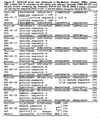
- a chimeric uricase contains the first 225 amino acids from the porcine uricase sequence (SEQ ID NO: 1) and the last 79 amino acids from the baboon uricase sequence (SEQ ID NO: 2) (pig-baboon uricase, or PBC uricase; see Figure 6 ).
- Another example of such a chimeric uricase contains residues 7-225 of the porcine sequence (SEQ ID NO.
- PBC-NT-CT residues 226-301 of the baboon sequence
- PBC-NT-CT residues 226-301 of the baboon sequence
- Another example of such a chimeric uricase contains the first 288 amino acids from the porcine sequence (SEQ ID NO: 1) and the last 16 amino acids from the baboon sequence (SEQ ID NO: 2). Since the latter sequence differs from the porcine sequence at only two positions, having a lysine (K) in place of arginine at residue 291 and a serine (S) in place of threonine at residue 301, this mutant is referred to as pig-K-S or PKS uricase.
- PKS, PBC and PBC-NT-CT uricases each have one more lysine residue and, hence, one more potential site of PEGylation than either the porcine or baboon sequence.
- the cDNAs for various mammalian uricases were subcloned and the optimal conditions were determined for expression in E . coli, using standard methods. See Erlich, HA, (Ed.) (1989) PCR Technology. Principles and Applications for DNA Amplification. New York: Stockton Press; Sambrook, J, et al., (1989) Molecular Cloning. A Laboratory Manual. Second Edition. Cold Spring Harbor, NY: Cold Spring Harbor Laboratory Press . The recombinant uricases were extracted, purified and their stability and activity were assessed using a modification of standard assays . See Fridovich, 1, (1965) J Biol Chem 240:2491-2494 ; Nishimura, et al., (1979), and Example 1.
- uricase may be conjugated via a biologically stable, nontoxic, covalent linkage to a relatively small number of strands of PEG.
- linkages may include urethane (carbamate) linkages, secondary amine linkages, and amide linkages.
- urethane (carbamate) linkages may include urethane (carbamate) linkages, secondary amine linkages, and amide linkages.
- Various activated PEGs suitable for such conjugation are available commercially from Shearwater Polymers, Huntsville, AL.
- urethane linkages to uricase may be formed by incubating uricase in the presence of the succinimidyl carbonate (SC) or 4-nitrophenyl carbonate (NPC) derivative of PEG.
- SC-PEG may be synthesized using the procedure described in U.S. Patent 5,612,460 , which is hereby incorporated by reference.
- NPC-PEG may be synthesized by reacting PEG with 4-nitrophenyl chloroformate according to methods described in Veronese. FM, et al., (1985) Appl Biochem Biotechnol 11 141-152 , and in U.S. Patent 5,286,637 , which is hereby incorporated by reference.
- Amide linkages to uricase may be obtained using an N-hydroxysuccinimide ester of a carboxylic acid derivative of PEG (Shearwater Polymers). Secondary amine linkages may be formed using 2,2,2-trifluoroethanesulfonyl PEG (tresyl PEG; Shearwater Polymers) or by reductive alkylation using PEG aldehyde (Shearwater Polymers) and sodium cyanoborohydride.
- the maximum number of strands of PEG that were coupled per subunit, while retaining at least 75% of the uricolytic activity of the unmodified enzyme ranged from an average of 2 strands for soybean uricase to more than 10 strands for PBC uricase ( see assay conditions in Example 1 and results in Figures 1A-5B ).
- the latter extent of PEGylation corresponds to approximately one third of the total amino groups.
- the average number of strands of PEG coupled per uricase subunit is between 2 and 10. In a preferred embodiment, the average number of strands of PEG coupled per uricase subunit is between 3 and 8.
- the average number of covalently linked strands of PEG per uricase subunit is between 4 and 6.
- the molecular weight of PEG used for the coupling reaction is between 5 kDa and 100 kDa, preferably between 10 kDa and 60 kDa, and more preferably between 20 kDa and 40 kDa, such as, for example 30 kDa.
- PEG conjugation rendered all of the tested uricases soluble and stable in buffers at physiological pH, without the addition of a substrate analog or inhibitor, such as 8-azaxanthine that is used as a stabilizer in the fungal uricase (Uricozyme®) sold by Sanofi Winthrop in France and Italy.
- a substrate analog or inhibitor such as 8-azaxanthine that is used as a stabilizer in the fungal uricase (Uricozyme®) sold by Sanofi Winthrop in France and Italy.
- PEG conjugates of PBC uricase were prepared from the purified tetrameric form of the enzyme (four 35 kDa subunits), they displayed profoundly reduced immunogenicity in mice ( Figure 7 ), in contrast to the moderate immunogenicity of PEG conjugates of larger forms of the enzyme ( e.g . octamers of the 35 kDa subunit; see Figure 12 ), and the very high immunogenicity of the unmodified enzyme.
- Repeated injections of uricase-deficient mice with PEG-uricase of the present invention eliminated their hyperuricemia for more than 2 months and protected the structure and function of their kidneys against uric acid-related damage ( Figures 8-11 ).
- Purified preparations of naturally occurring and recombinant uricases usually contain a mixture of aggregates of the enzyme, in addition to the tetrameric (140 kDa) form.
- the percentage of each uricase preparation that is in the tetrameric form generally varies from approximately 20% to 90%.
- unPEGylated aggregates of several other proteins are highly immunogenic (see, e.g., Moore, WV, et al., (1980) J Clin Endocrinol Metab 51:691-697 )
- previous studies of PEG-uricase do not describe any efforts to limit the content of aggregates, suggesting that the potential immunogenicity of the PEG-modified aggregates was not considered.
- the methods of uricase purification and PEGylation described herein permit the covalent attachment of as many as 10 strands of PEG per subunit while retaining more than 75% of the uricolytic activity, at least for certain uricases, e.g ., pig-baboon chimeric uricase and the enzyme from A. flavus ( see Figures 3A and 4A ).
- substantially all aggregates of the tetrameric form of the enzyme may be removed by ion-exchange or size-exclusion chromatography at a pH between about 9 and 10.5, preferably 10.2, prior to PEG conjugation of the resulting substantially tetrameric preparation of uricase.
- the molecular weight of the uricase in each fraction from the preparative column may be monitored by any size-dependent analytical technique, including, for example, HPLC, conventional size-exclusion chromatography, centrifugation, light scattering, capillary electrophoresis or gel electrophoresis in a non-denaturing buffer.
- fractions containing only the 140 kDa form of the enzyme may be pooled and used for conjugation to PEG.
- fractions from the ion-exchange column may be analyzed with respect to size to determine which fractions contain substantial amounts of the tetrameric form without detectable aggregates.
- the undesirable aggregates may thus constitute as little as about 10%, 5%, 2%, or less, of the total isolated uricase.
- the present invention expressly contemplates PEGylated uricase in non-tetrameric form, such as, for example, uricase dimers, so long as the preparations of such conjugated uricase retain at least about 75% of their uricolytic activity and are substantially non-immunogenic.
- a mutated baboon liver uricase of unexpectedly increased potency, relative to that of the unmutated enzyme is provided.
- This improved primate uricase was prepared by conventional recombinant DNA techniques. It was particularly unexpected that the substitution of a single amino acid residue (histidine for tyrosine at position 97) in baboon uricase would result in a substantial increase in specific enzymatic activity. When expressed in E . coli, this mutant protein was found to have at least 60% higher specific activity than the recombinant baboon enzyme from which it was derived.
- the specific activity is increased and/or the solubility of the unPEGylated enzyme is improved by expressing truncated variants of porcine or porcine-baboon chimeric uricases from which at least the first six amino acids at the amino terminal and/or at least the last three amino acids at the carboxyl terminal are deleted from the expressed proteins ( see Figure 6 ).
- Recombinant uricases with the carboxyl-terminal truncation may have improved solubility prior to PEGylation because of the removal of the peroxisomal targeting sequence. See Miura, S, et al., (1994) Eur J Biochem 223:141-146 .
- the PEG-uricase conjugates of the present invention are useful for lowering the levels of uric acid in the body fluids and tissues of mammals, preferably humans, and can thus be used for treatment of elevated uric acid levels associated with conditions including gout, tophi, renal insufficiency, organ transplantation and malignant disease.
- PEG-uricase conjugates may be injected into a mammal having excessive uric acid levels by any of a number of routes, including intravenous, subcutaneous, intradermal, intramuscular and intraperitoneal routes. Alternatively, they may be aerosolized and inhaled. See Patton, js, (1996) Adv Drug Delivery Rev 19:3-36 and U.S. Patent 5,458,135 .
- PEG-uricase of the present invention will depend on the level of uric acid and the size of the individual.
- PEG-uricase is administered in a pharmaceutically acceptable excipient or diluent in an amount ranging from about 10 ⁇ g to about 1 g. In a preferred embodiment, the amount administered is between about 100 ⁇ g and 500 mg. More preferably, the conjugated uricase is administered in an amount between 1 mg and 100 mg, such as, for example, 5 mg, 20 mg or 50 mg. Masses given for dosage amounts of the embodiments refer to the amount of protein in the conjugate.
- compositions containing PEG-uricase can be prepared by conventional techniques, e.g., as described in Gennaro, AR (Ed.) (1990) Remington's Pharmaceutical Sciences, 18th Edition Easton, PA: Mack Publishing Co.
- Suitable excipients for the preparation of injectable solutions include, for example, phosphate buffered saline, lactated Ringer's solution, water, polyols and glycerol.
- Pharmaceutical compositions for parenteral injection comprise pharmaceutically acceptable sterile aqueous or non-aqueous liquids, dispersions, suspensions, or emulsions as well as sterile powders for reconstitution into sterile injectable solutions or dispersions just prior to use.
- These formulations may contain additional components, such as, for example, preservatives, solubilizers, stabilizers, wetting agents, emulsifiers, buffers, antioxidants and diluents.
- PEG-uricase may also be provided as controlled-release compositions for implantation into an individual to continually control elevated uric acid levels in body fluids.
- polylactic acid, polyglycolic acid, regenerated collagen, poly-L-lysine, sodium alginate, gellan gum, chitosan, agarose, multilamellar liposomes and many other conventional depot formulations comprise bioerodible or biodegradable materials that can be formulated with biologically active compositions. These materials, when implanted or injected, gradually break down and release the active material to the surrounding tissue.
- one method of encapsulating PEG-uricase comprises the method disclosed in U.S. Patent 5,653,974 .
- bioerodible, biodegradable and other depot formulations is expressly contemplated in the present invention.
- infusion pumps and matrix entrapment systems for delivery of PEG-uricase is also within the scope of the present invention.
- PEG-uricase may also advantageously be enclosed in micelles or liposomes. Liposome encapsulation technology is well known in the art. See, e.g., Lasic, D , et al., (Eds.) (1995) Stealth Liposomes. Boca Raton, FL: CRC Press.
- the PEG-uricase pharmaceutical compositions of the invention will decrease the need for hemodialysis in patients at high risk of urate-induced renal failure, e.g ., organ transplant recipients ( see Venkataseshan, VS, et al., (1990) Nephron 56:317-321 ) and patients with some malignant diseases. In patients with large accumulations of crystalline urate (tophi), such pharmaceutical compositions will improve the quality of life more rapidly than currently available treatments.
- PEG-uricases prepared by coupling activated (i.e., electrophilic) PEG derivatives of several sizes and compositions with naturally occurring porcine, fungal or bacterial uricases, or with recombinant soybean, porcine or pig-baboon chimeric uricases. Results of activity, solubility, stability, pharmacokinetic, pharmacodynamic and immunological studies are included.
- the data in Figures 8-11 provide evidence of the ability of PEG-modified PBC uricase of this invention to correct hyperuricemia and hyperuricosuria and to preserve renal structure and function in an animal model in which hyperuricemia and hyperuricosuria occur and cause serious renal damage.
- the tetrameric form of uricase (molecular weight ca. 140 kDa) was purified from a solution of porcine liver uricase by preparative size-exclusion or ion-exchange chromatography, followed by analytical size-exclusion chromatography.
- Porcine liver uricase was obtained from Sigma-Aldrich, St. Louis, MO, catalog No. U2350 or U3377; or Boehringer Mannheim, Indianapolis, IN.
- Preparative and analytical size-exclusion chromatography were performed at pH 10-10.5, preferably 10.2, in 10 mM sodium carbonate buffer containing 0.1 M NaCl on Superdex 200 columns that had been previously calibrated with proteins of known molecular weight.
- Superdex was obtained from Amersham Pharmacia, Piscataway, NJ. Any buffer may be used that is capable of maintaining the desired pH and that is compatible with the chemistry to be used for subsequent PEG coupling. Such buffers are well known in the art.
- tetrameric forms of uricase can be isolated using other size-exclusion media such as, for example, Superose 12 (Amersham Pharmacia) or any other medium that is compatible with mildly alkaline solutions and that has an appropriate size fractionation range. Such media are readily available and are well known in the art.
- Ion-exchange chromatography was performed at pH 10-10.5, preferably 10.2, on Mono Q columns (Amersham Pharmacia, Piscataway, NJ) that had been equilibrated with 0.1 M sodium carbonate buffer.
- Any buffer that is compatible with the chemistry of PEG coupling and that is capable of maintaining the desired pH may be used at sufficiently low ionic strength to permit the adsorption of uricase to the column.
- buffers are well known in the art.
- the ultraviolet absorbance of the eluate was monitored at 280 nm during elution of the uricase from the ion-exchange resin by increasing the ionic strength of the applied buffer solution, e.g . by a linear gradient of 0 to 0.5 M NaCl in the sodium carbonate buffer.
- Size-exclusion HPLC was then used to identify the fractions of the eluate containing the desired tetrameric form of uricase, without detectable aggregates, for the synthesis of substantially non-immunogenic PEG-uricase.
- the tetrameric form of uricase can be isolated using other ion-exchange media, such as Q-Sepharose (Amersham Pharmacia) or any other medium that is compatible with mildly alkaline solutions. Such media are readily available and are well known in the art.
- Uricase activity was assayed using a modification of standard methods. See, e.g., Fridovich (1965); Nishimura, et al., (1979). Solutions of uric acid were prepared fresh daily in 50 mM sodium borate buffer, pH 9.2, to provide final concentrations in the assay of 6-150 ⁇ M. Uricase preparations were diluted in this borate buffer containing bovine serum albumin (Sigma-Aldrich, St. Louis, MO, catalog No. A-7030), so that the final concentration of albumin in the assay was 0.1 mg/mL.
- bovine serum albumin Sigma-Aldrich, St. Louis, MO, catalog No. A-7030
- IU international unit
- Figures 1A-5B Some of the data for relative uricase activities in Figures 1A-5B were obtained using 100 ⁇ M uric acid in the assay.
- V 100 100 ⁇ v max / K M + 100 where K M is expressed in micromolar units.
- the number of strands of PEG coupled per subunit of uricase was determined by an adaptation of the methods described by Kunitani, M, et al., (1991) J Chromatogr 588:125-137 ; Saifer, et al., (1997) and Sherman, et al., (1997). Briefly, aliquots of the PEGylation reaction mixtures or fractions from the preparative ion-exchange or size-exclusion columns were characterized by analytical size-exclusion HPLC on a TSK 5,000 P.W XL column at room temperature in 10 mM sodium carbonate buffer, pH 10.2, containing 0.1 M NaCl. The HPLC column was obtained from TosoHaas, Montgomeryville, PA.
- Proteins and PEGs were monitored by ultraviolet absorbance and refractive index detectors.
- the amount of protein in the conjugate was calculated from the ultraviolet absorbance relative to that of the appropriate unmodified uricase standard.
- the amount of PEG in the conjugate was then calculated from the area of the refractive index peak, corrected for the contribution of the protein to refractive index, relative to the area of the refractive index peak of the appropriate PEG standard.
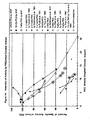
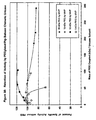
- Figure 2A shows the retention of activity by PEGylated porcine liver uricase as a function of the number of strands of PEG coupled per subunit.
- Data of the present inventors ( ⁇ , ⁇ ) are compared with those of Chen, et al., (1981).
- the data point within a large circle denotes a conjugate reported to be non-immunoreactive by Chen, et al., (1981).
- conjugates of tetrameric porcine uricase with up to 6 strands of 30 kDa PEG per subunit or up to 7 strands of 5 kDa PEG per subunit retained at least 75% of the activity of the unmodified enzyme.
- the apparent increase in specific activity with an increasing number of strands of 5 kDa or 30 kDa PEG may reflect the relative insolubility or instability of the unmodified enzyme compared to the conjugates.
- conjugates of porcine uricase with an average of more than 3 strands of 30 kDa PEG per subunit contain a greater mass of PEG than was found sufficient to preclude immunoreactivity by Chen, et al., (1981).
- Recombinant pig-baboon chimeric (PBC) uricase cDNA was subcloned into the pET3d expression vector (Novagen, Madison, WI) and the resultant plasmid construct was transformed into and expressed in a strain of Escherichia coli BL21(DE3)pLysS (Novagen). These procedures were carried out using methods well known in the art of molecular biology. See Erlich (1989); Sambrook, et al., (1989); Ausubel, F, et al., (Eds.), (1997) Short Protocols in Molecular Biology. New York: John Wiley & Sons.
- Figure 6 shows the deduced amino acid sequence of PBC uricase (amino acids 1-225 of SEQ ID NO: 1 and amino acids 226-304 of SEQ ID NO: 2), compared with the porcine (SEQ ID NO: 1) and baboon (SEQ ID NO: 2) sequences. Residues in the baboon sequence that differ from those in the porcine sequence are shown in bold type. The porcine and baboon sequences were first determined by Wu, et al., (1989) and were confirmed by the present inventors.
- SEQ ID NO. 1 is identical to Accession Number p16164 of GenBank, except for the absence of the initial methionyl residue in the GenBank sequence.
- SEQ ID NO. 1 is identical to Accession Number p16164 of GenBank, except for the absence of the initial methionyl residue in the GenBank sequence.
- SEQ ID NO. 1 is identical to Accession Number p16164 of GenBank, except for the absence of the initial methionyl residue in the Gen
- GenBank 2 is identical to Accession Number p25689 of GenBank, except for the absence of the initial methionyl residue and a change from histidine to threonine at residue 153 in the GenBank sequence (residue 154 in Figure 6 ).
- PBC uricase The tetrameric form of PBC uricase was isolated and coupled to PEGs of various molecular weights as described in Examples 1 and 2. Conjugates prepared with 5 kDa, 10 kDa, 19 kDa or 30 kDa PEG contained up to 10 strands of PEG per subunit. Those prepared with PEGs of at least 10 kDa retained more than 95% of the initial specific activity of the recombinant uricase ( Figures 3A-3B ).
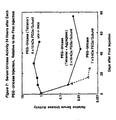
- Figure 7 shows the activity of PBC uricase in mouse serum 24 h after each of four or five intraperitoneal injections of PEG-uricase, relative to the value 24 h after the first injection.
- PEG conjugates were prepared from three different preparations of PBC uricase using two different techniques for PEG activation. One preparation ( ⁇ ) was tested in uricase-deficient ( uox -/-) mice; the other two ( ⁇ , ⁇ ) were tested in normal BALB/c mice. The most immunoreactive preparation ( ⁇ ) was prepared from purified PBC uricase containing an unknown quantity of uricase aggregates coupled to an average of 7 strands of 5 kDa PEG per subunit, using the succinimidyl carbonate derivative of PEG (SC-PEG).
- the moderately immunoreactive preparation ( ⁇ ) was prepared by coupling a PBC uricase preparation containing 11% aggregates to an average of 2 strands of 19 kDa PEG per subunit, using a 4-nitrophenyl carbonate derivative of PEG (NPC-PEG). Sherman, et al., (1997).
- the least immunoreactive conjugate ( ⁇ ) was prepared by coupling an average of 6 strands of 10 kDa NPC-PEG per subunit to a preparation of PBC uricase containing ⁇ 5% aggregated uricase.
- Figure 8 shows the inverse relationship between the concentrations of uric acid in the serum and urine and the activity of injected PEG-uricase in the serum of a uricase-deficient ( uox - / - ) mouse. Injections at zero time and after 72 h contained 0.43 IU of PBC uricase conjugated to an average of 6 strands of 10 kDa PEG per enzyme subunit.
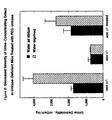
- Figure 9 shows that treatment of uricase-deficient mice with PEG-modified PBC uricase decreased the severity of a urine-concentrating defect.
- the mean and standard deviation of data for urine osmolality are shown for two mice containing one copy of the normal murine uricase gene ( uox + / - ) , six untreated homozygous uricase-deficient mice ( uox -/-) and six homozygous uricase-deficient mice that were injected ten times between the third and 72nd day of life with either 95 or 190 mIU of PEG-uricase. Mice of each genetic background either had received water ad libitum ( solid bars ) or had been deprived of water for 12 h ( hatched bars ) prior to collection of their urine.
- Figure 10 shows that treatment of uricase-deficient mice with PEG-modified PBC uricase decreased the severity of nephrogenic diabetes insipidus, characterized by abnormally high consumption of water and abnormally high urine output.
- the genetic backgrounds of the mice and treatment protocol were the same as in Figure 9 .
- the mean and standard deviation of the daily water consumption ( solid bars ) and urine output ( hatched bars ) are shown for three groups of six mice.
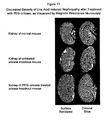
- Figure 11 shows that treatment of uricase-deficient mice with PEG-modified PBC uricase decreased the severity of uric acid-induced nephropathy, as visualized by magnetic resonance microscopy.
- the genetic backgrounds of the three groups of mice and the treatment protocol were the same as in Figures 9 and 10 .
- Magnetic resonance microscopy was performed at the Center for in vivo Microscopy, Duke University Medical Center, Durham, North Carolina.
- Uricase from Candida utilis was obtained from either Sigma-Aldrich (St. Louis, MO; catalog No. U1878) or Worthington Biochemical Corporation (Freehold, NJ; catalog No. URYW). Proceeding as described in Examples 1 and 2, the tetrameric form was isolated and PEG conjugates were synthesized with 5 kDa, 10 kDa or 30 kDa PEG ( Figures 1A-1B ).
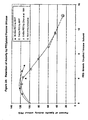
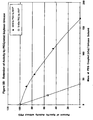
- Figure 1A shows the retention of activity by PEGylated uricase from Candida utilis as a function of the number of strands of PEG coupled per subunit.
- Figure 1B shows the retention of activity by PEGylated uricase from Candida utilis as a function of the total mass of PEG coupled per subunit. Data of the present inventors ( ⁇ , ⁇ , ⁇ ) are compared with those of the same reports as in Figure 1A . Data points within large circles have the same meaning as in Figure 1A .
- conjugates with an average of up to 6 strands of 5 kDa or 30 kDa PEG or 9 strands of 10 kDa PEG per subunit retained at least 75% of the activity of the unmodified enzyme.
- the apparent increase in specific activity as an increasing number of strands of 30 kDa PEG is attached may reflect the relative insolubility or instability of the unmodified enzyme compared to the conjugates.
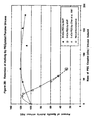
- Uricase from Aspergillus flavus was obtained from Sanofi Winthrop (Gentilly Cédex, France). Proceeding as described in Example 2, conjugates with PEGs of various molecular weights were synthesized ( Figures 4A-4B ). Conjugates prepared by coupling the enzyme from A. flavus with an average of up to 12 strands of 5 kDa PEG or up to 7 strands of 30 kDa PEG per subunit retained at least 75% of the initial specific activity of this fungal uricase.
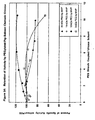
- Recombinant uricase from soybean root nodule (also called nodulin 35) was prepared and purified as described by Kahn and Tipton ( Kahn, K, et al., (1997) Biochemistry 36:4731-4738 ), and was provided by Dr. Tipton (University of Missouri, Columbia, MO). Proceeding as described in Examples 1 and 2, the tetrameric form was isolated and conjugates were prepared with PEGs of various molecular weights ( Figures 5A-5B ).
- soybean enzyme tolerated coupling of only approximately 2 strands of 5 kDa or 30 kDa PEG per subunit with retention of at least 75% of the initial uricolytic activity.
- Uricase from Arthrobacter globiformis was obtained from Sigma-Aldrich (catalog No. U7128). See Japanese Patent 9-154581 . Proceeding as described in Examples 1 and 2, the tetrameric form was isolated and conjugates with 5 kDa and 30 kDa PEG were prepared. While conjugates with an average of more than 3 strands of 5 kDa PEG per subunit retained less than 60% of the initial specific activity, conjugates with an average of approximately 2 strands of 30 kDa PEG per subunit retained at least 85% of the initial specific activity.
- Recombinant porcine and PBC uricases from which the first six amino acids at the amino terminal are deleted are expressed in and purified from E . coli by standard techniques, as described in Example 3. Proceeding as described in Examples 1 and 2, PEG conjugates of the amino-truncated uricases are synthesized to produce substantially non-immunogenic conjugates that retain at least 75% of the initial specific activity.
- Recombinant porcine and PBC uricases from which the last three amino acids at the carboxyl terminal are deleted are expressed in and purified from E. coli by standard techniques, as described in Example 3. This carboxyl-terminal deletion may enhance the solubility of the unmodified enzymes, since it removes the peroxisomal-targeting signal. See Miura, et al., (1994). Proceeding as described in Examples 1 and 2, PEG conjugates of the carboxyl-truncated uricases are synthesized to produce substantially non-immunogenic conjugates that retain at least 75% of the initial specific activity.
- Recombinant porcine uricases are prepared as described in Example 3, in which the potential number of sites of PEG attachment is increased by replacing one or more arginine residues with lysine. See Hershfield, MS, et al., (1991) Proc Natl Acad Sci USA 88:7185-7189 .
- recombinant baboon uricase is constructed having an amino acid substitution (histidine for tyrosine) at position 97 ( see baboon sequence in Figure 6 ). Proceeding as described in Examples 1 and 2, PEG conjugates of the tetrameric form of the recombinant baboon uricase mutant are synthesized to produce conjugates of substantially reduced immunogenicity that retain at least 75% of the initial specific activity of the recombinant uricase.
- Uricase from Candida utilis, Aspergillus flavus, and Arthrobacter globiformis are obtained as described in Examples 4, 5, and 7, respectively. Proceeding as described in Examples 1 and 2, PEG conjugates are synthesized with 5 kDa, 10 kDa, 20 kDa or 30 kDa PEG. The immunogenicity of these conjugates is substantially reduced or eliminated.
Landscapes
- Health & Medical Sciences (AREA)
- Chemical & Material Sciences (AREA)
- Life Sciences & Earth Sciences (AREA)
- Bioinformatics & Cheminformatics (AREA)
- Engineering & Computer Science (AREA)
- Organic Chemistry (AREA)
- Zoology (AREA)
- Wood Science & Technology (AREA)
- Genetics & Genomics (AREA)
- General Health & Medical Sciences (AREA)
- Medicinal Chemistry (AREA)
- General Engineering & Computer Science (AREA)
- Biochemistry (AREA)
- Molecular Biology (AREA)
- Microbiology (AREA)
- Biotechnology (AREA)
- Biomedical Technology (AREA)
- Animal Behavior & Ethology (AREA)
- Pharmacology & Pharmacy (AREA)
- Public Health (AREA)
- Veterinary Medicine (AREA)
- Chemical Kinetics & Catalysis (AREA)
- Nuclear Medicine, Radiotherapy & Molecular Imaging (AREA)
- General Chemical & Material Sciences (AREA)
- Epidemiology (AREA)
- Obesity (AREA)
- Hematology (AREA)
- Diabetes (AREA)
- Physical Education & Sports Medicine (AREA)
- Rheumatology (AREA)
- Pain & Pain Management (AREA)
- Urology & Nephrology (AREA)
- Medicines That Contain Protein Lipid Enzymes And Other Medicines (AREA)
- Enzymes And Modification Thereof (AREA)
- Medicinal Preparation (AREA)
- Medicines Containing Material From Animals Or Micro-Organisms (AREA)
- Peptides Or Proteins (AREA)
Claims (2)
- Konjugat umfassend aufgereinigte Urikase konjugiert an Poly(ethylenglykol) (PEG), wobei zumindest 90% der Urikase in tetramerer Form vorliegen.
- Pharmazeutische Zusammensetzung, die zur Absenkung der Hamsäurekonzentrationen in einer Körperflüssigkeit oder einem Gewebe geeignet ist, umfassend das Konjugat von Anspruch 1 und einen pharmazeutisch verträglichen Träger.
Priority Applications (5)
| Application Number | Priority Date | Filing Date | Title |
|---|---|---|---|
| DK09175303.8T DK2158923T3 (da) | 1998-08-06 | 1999-08-02 | Peg-uratoxidase-konjugater og anvendelse deraf |
| EP09175303A EP2158923B1 (de) | 1998-08-06 | 1999-08-02 | Peg-uricase Konjugate und Verwendung davon |
| EP10180672.7A EP2316475B1 (de) | 1998-08-06 | 1999-08-02 | Isolierte tetramere Uricase |
| CY20111100446T CY1112287T1 (el) | 1998-08-06 | 2011-05-09 | Συζευγματα peg ουρικης οξειδασης και χρηση αυτων |
| CY20181100001T CY1119848T1 (el) | 1998-08-06 | 2018-01-02 | Απομονωμενη τετραμερικη ουρικαση |
Applications Claiming Priority (3)
| Application Number | Priority Date | Filing Date | Title |
|---|---|---|---|
| US21931898P | 1998-08-06 | 1998-08-06 | |
| US219318P | 1998-08-06 | ||
| EP99937745A EP1100542B1 (de) | 1998-08-06 | 1999-08-02 | Peg-uricase konjugate und verwendung davon |
Related Parent Applications (1)
| Application Number | Title | Priority Date | Filing Date |
|---|---|---|---|
| EP99937745.0 Division | 1999-08-02 |
Related Child Applications (3)
| Application Number | Title | Priority Date | Filing Date |
|---|---|---|---|
| EP10180672.7A Division EP2316475B1 (de) | 1998-08-06 | 1999-08-02 | Isolierte tetramere Uricase |
| EP09175303.8 Division-Into | 2009-11-06 | ||
| EP10180672.7 Division-Into | 2010-09-28 |
Publications (2)
| Publication Number | Publication Date |
|---|---|
| EP1588716A1 EP1588716A1 (de) | 2005-10-26 |
| EP1588716B1 true EP1588716B1 (de) | 2011-02-16 |
Family
ID=22818799
Family Applications (3)
| Application Number | Title | Priority Date | Filing Date |
|---|---|---|---|
| EP10180672.7A Expired - Lifetime EP2316475B1 (de) | 1998-08-06 | 1999-08-02 | Isolierte tetramere Uricase |
| EP05011069A Expired - Lifetime EP1588716B1 (de) | 1998-08-06 | 1999-08-02 | Peg-uricase Konjugate und Verwendung davon |
| EP09175303A Expired - Lifetime EP2158923B1 (de) | 1998-08-06 | 1999-08-02 | Peg-uricase Konjugate und Verwendung davon |
Family Applications Before (1)
| Application Number | Title | Priority Date | Filing Date |
|---|---|---|---|
| EP10180672.7A Expired - Lifetime EP2316475B1 (de) | 1998-08-06 | 1999-08-02 | Isolierte tetramere Uricase |
Family Applications After (1)
| Application Number | Title | Priority Date | Filing Date |
|---|---|---|---|
| EP09175303A Expired - Lifetime EP2158923B1 (de) | 1998-08-06 | 1999-08-02 | Peg-uricase Konjugate und Verwendung davon |
Country Status (11)
| Country | Link |
|---|---|
| US (11) | US6576235B1 (de) |
| EP (3) | EP2316475B1 (de) |
| CN (3) | CN102161984B (de) |
| AT (2) | ATE298251T1 (de) |
| CA (2) | CA2338665C (de) |
| CY (2) | CY1112287T1 (de) |
| DE (2) | DE69925917T2 (de) |
| DK (4) | DK1100542T3 (de) |
| ES (4) | ES2245114T3 (de) |
| PT (4) | PT1588716E (de) |
| ZA (1) | ZA200101814B (de) |
Families Citing this family (83)
| Publication number | Priority date | Publication date | Assignee | Title |
|---|---|---|---|---|
| US6057287A (en) | 1994-01-11 | 2000-05-02 | Dyax Corp. | Kallikrein-binding "Kunitz domain" proteins and analogues thereof |
| US20060188971A1 (en) * | 1998-08-06 | 2006-08-24 | Duke University | Urate oxidase |
| JP2002524053A (ja) | 1998-08-06 | 2002-08-06 | デューク・ユニバーシティー | 尿酸オキシダーゼ |
| US6783965B1 (en) * | 2000-02-10 | 2004-08-31 | Mountain View Pharmaceuticals, Inc. | Aggregate-free urate oxidase for preparation of non-immunogenic polymer conjugates |
| ES2245114T3 (es) | 1998-08-06 | 2005-12-16 | Mountain View Pharmaceuticals, Inc. | Conjugados de peg-oxidasa de urato y su uso. |
| US6913915B2 (en) * | 2001-08-02 | 2005-07-05 | Phoenix Pharmacologics, Inc. | PEG-modified uricase |
| US7153829B2 (en) | 2002-06-07 | 2006-12-26 | Dyax Corp. | Kallikrein-inhibitor therapies |
| WO2003103475A2 (en) | 2002-06-07 | 2003-12-18 | Dyax Corp. | Prevention and reduction of blood loss |
| US8129330B2 (en) * | 2002-09-30 | 2012-03-06 | Mountain View Pharmaceuticals, Inc. | Polymer conjugates with decreased antigenicity, methods of preparation and uses thereof |
| US20040062748A1 (en) | 2002-09-30 | 2004-04-01 | Mountain View Pharmaceuticals, Inc. | Polymer conjugates with decreased antigenicity, methods of preparation and uses thereof |
| NZ541122A (en) * | 2002-12-26 | 2008-09-26 | Mountain View Pharmaceuticals | Polymer conjugates of cytokines, chemokines, growth factors, polypeptide hormones and antagonists thereof with preserved receptor-binding activity |
| EA008866B1 (ru) * | 2002-12-26 | 2007-08-31 | Маунтин Вью Фамэсьютикэлс, Инк. | ПОЛИМЕРНЫЙ КОНЪЮГАТ МОДИФИКАЦИЙ ИНТЕРФЕРОНА-β, ФАРМАЦЕВТИЧЕСКИЕ ПРОДУКТЫ НА ЕГО ОСНОВЕ И СПОСОБ ИХ ПОЛУЧЕНИЯ |
| SI1625156T1 (sl) * | 2003-05-12 | 2013-02-28 | Affymax, Inc. | Peptidi, ki se veĹľejo k eritropoetinskemu receptorju |
| JP2007530440A (ja) * | 2003-05-12 | 2007-11-01 | アフィーマックス・インコーポレイテッド | 新規ポリ(エチレングリコール)修飾化合物およびその用途 |
| WO2004100997A2 (en) | 2003-05-12 | 2004-11-25 | Affymax, Inc. | Spacer moiety for poly(ethylene glycol) -modified peptides |
| PT1663281E (pt) * | 2003-08-29 | 2014-03-17 | Dyax Corp | Inibidores de proteases poli-peguilados |
| RU2298560C2 (ru) * | 2004-04-30 | 2007-05-10 | Открытое Акционерное Общество "Верофарм" | Конъюгаты белка и производного полиэтиленгликоля, фармацевтическая композиция, способ борьбы с вирусной инфекцией |
| CA2567496A1 (en) * | 2004-05-21 | 2005-12-01 | Xencor, Inc. | C1q family member proteins with altered immunogenicity |
| WO2006010005A1 (en) * | 2004-06-21 | 2006-01-26 | University Of Florida Research Foundation, Inc. | Lowering uric acid to prevent or accelerate recovery of acute renal failure |
| US7235530B2 (en) | 2004-09-27 | 2007-06-26 | Dyax Corporation | Kallikrein inhibitors and anti-thrombolytic agents and uses thereof |
| EA200700990A1 (ru) * | 2004-11-11 | 2008-04-28 | Афимакс, Инк. | Новые пептиды, которые связывают рецептор эритропоэтина |
| WO2006062685A2 (en) * | 2004-11-11 | 2006-06-15 | Affymax, Inc. | Novel peptides that bind to the erythropoietin receptor |
| US8148123B2 (en) * | 2005-04-11 | 2012-04-03 | Savient Pharmaceuticals, Inc. | Methods for lowering elevated uric acid levels using intravenous injections of PEG-uricase |
| US20080159976A1 (en) * | 2005-04-11 | 2008-07-03 | Jacob Hartman | Methods for lowering elevated uric acid levels using intravenous injections of PEG-uricase |
| WO2006110761A2 (en) * | 2005-04-11 | 2006-10-19 | Savient Pharmaceuticals, Inc. | A variant form of urate oxidase and use thereof |
| HUE052976T2 (hu) | 2005-04-11 | 2021-06-28 | Horizon Pharma Rheumatology Llc | Urát-oxidáz variáns formái és azok alkalmazása |
| WO2006125452A1 (en) * | 2005-05-23 | 2006-11-30 | Universite De Geneve | Injectable superparamagnetic nanoparticles for treatment by hyperthermia and use for forming an hyperthermic implant |
| US7919461B2 (en) | 2005-06-03 | 2011-04-05 | Affymax, Inc. | Erythropoietin receptor peptide formulations and uses |
| US7550433B2 (en) * | 2005-06-03 | 2009-06-23 | Affymax, Inc. | Erythropoietin receptor peptide formulations and uses |
| US8324159B2 (en) * | 2005-06-03 | 2012-12-04 | Affymax, Inc. | Erythropoietin receptor peptide formulations and uses |
| CN101622270B (zh) * | 2006-04-12 | 2014-01-01 | 萨文特医药公司 | 用阳离子表面活性剂纯化蛋白质的方法 |
| CN101302501B (zh) * | 2007-05-10 | 2012-07-04 | 刘国安 | 聚乙二醇化尿酸氧化酶化合物及其制备方法和其制剂及应用 |
| CA2696208A1 (en) * | 2007-08-21 | 2009-02-26 | Genzyme Corporation | Treatment with kallikrein inhibitors |
| US8273561B2 (en) * | 2007-10-05 | 2012-09-25 | Nuron Biotech, Inc. | High pressure treatment of aggregated interferons |
| WO2009120707A1 (en) * | 2008-03-24 | 2009-10-01 | Altus Pharmaceuticals Inc. | Uricase compositions and methods of use |
| EP2165705A1 (de) | 2008-09-18 | 2010-03-24 | Centre National de la Recherche Scientifique (CNRS) | Verwendung einer Verbindung mit der Fähigkeit zur Senkung des Harnsäureniveaus zur Prävention und/oder Behandlung von Lungenentzündung und -fibrose |
| CA2744235A1 (en) | 2009-01-06 | 2010-07-15 | Dyax Corp. | Treatment of mucositis with kallikrein inhibitors |
| CN101875922B (zh) * | 2009-04-30 | 2012-02-22 | 重庆医科大学 | 一种重组苛求芽孢杆菌胞内尿酸酶及其聚乙二醇修饰与应用 |
| HUP1200205A3 (en) | 2009-06-25 | 2012-09-28 | Savient Pharmaceuticals | Method and kits for perdicting infusion reaction risk and antibody-mediated low of response by monitoring serum uric acid during pegylated uricare therapy |
| CN102051348B (zh) * | 2009-10-27 | 2012-10-03 | 重庆富进生物医药有限公司 | 人源化重组尿酸酶及其突变体 |
| EP3459564B1 (de) | 2010-01-06 | 2021-10-27 | Takeda Pharmaceutical Company Limited | Plasmakallikreinbindende proteine |
| CN101928704A (zh) * | 2010-03-04 | 2010-12-29 | 杭州北斗生物技术有限公司 | 黄曲霉尿酸氧化酶的聚乙二醇修饰物及其制备方法 |
| US8940861B2 (en) * | 2010-04-08 | 2015-01-27 | Georgia Tech Research Corporation | Variants of ancestral uricases and uses thereof |
| CA2823776A1 (en) | 2011-01-06 | 2012-07-12 | Dyax Corp. | Plasma kallikrein binding proteins |
| CN102634492B (zh) | 2011-02-14 | 2015-06-10 | 重庆富进生物医药有限公司 | 聚乙二醇化犬源尿酸氧化酶类似物及其制备方法和应用 |
| CN102757945B (zh) * | 2011-04-28 | 2015-03-18 | 杭州俊丰生物工程有限公司 | 人尿酸氧化酶蛋白及其制备方法和其聚乙二醇结合物 |
| CN102827073A (zh) | 2011-06-17 | 2012-12-19 | 安吉奥斯医药品有限公司 | 治疗活性组合物和它们的使用方法 |
| CN102260653B (zh) * | 2011-06-30 | 2013-04-03 | 荣俊 | 一种peg化重组猪-人尿酸氧化酶融合蛋白的制备及应用方法 |
| US9474779B2 (en) | 2012-01-19 | 2016-10-25 | Agios Pharmaceuticals, Inc. | Therapeutically active compositions and their methods of use |
| US10481164B2 (en) * | 2012-03-26 | 2019-11-19 | Amgen Inc. | Method for using light scattering in real time to directly monitor and control impurity removal in purification processes |
| WO2015003360A2 (en) | 2013-07-11 | 2015-01-15 | Agios Pharmaceuticals, Inc. | Therapeutically active compounds and their methods of use |
| CN105593215B (zh) | 2013-07-11 | 2019-01-15 | 安吉奥斯医药品有限公司 | 用于治疗癌症的作为idh2突变体抑制剂的2,4-或4,6-二氨基嘧啶化合物 |
| WO2015003355A2 (en) | 2013-07-11 | 2015-01-15 | Agios Pharmaceuticals, Inc. | Therapeutically active compounds and their methods of use |
| US9579324B2 (en) | 2013-07-11 | 2017-02-28 | Agios Pharmaceuticals, Inc | Therapeutically active compounds and their methods of use |
| US20150031627A1 (en) | 2013-07-25 | 2015-01-29 | Agios Pharmaceuticals, Inc | Therapeutically active compounds and their methods of use |
| KR20240010105A (ko) | 2014-03-14 | 2024-01-23 | 아지오스 파마슈티컬스 아이엔씨. | 치료적으로 활성인 화합물의 약제학적 조성물 |
| IL295414B2 (en) | 2014-03-27 | 2026-02-01 | Takeda Pharmaceuticals Co | Compositions and methods for treating macular edema due to diabetes |
| US10198063B1 (en) * | 2014-11-06 | 2019-02-05 | Avago Technologies International Sales Pte. Limited | Average power saving modes and power architecture for read channel product |
| CN107614007B (zh) * | 2015-05-15 | 2022-03-25 | 免疫医疗有限责任公司 | 改进的尿酸酶序列和治疗方法 |
| PT3362066T (pt) | 2015-10-15 | 2021-11-16 | Celgene Corp | Terapia de combinação para tratar malignidades |
| SG11201803088PA (en) | 2015-10-15 | 2018-05-30 | Agios Pharmaceuticals Inc | Combination therapy for treating malignancies |
| AU2016366557B2 (en) | 2015-12-11 | 2024-01-25 | Takeda Pharmaceutical Company Limited | Plasma kallikrein inhibitors and uses thereof for treating hereditary angioedema attack |
| CN105412942B (zh) * | 2015-12-23 | 2019-02-26 | 沈阳三生制药有限责任公司 | 聚乙二醇化的重组产朊假丝酵母尿酸氧化酶冻干注射剂 |
| US20200237881A1 (en) | 2019-01-30 | 2020-07-30 | Horizon Pharma Rheumatology Llc | Reducing immunogenicity to pegloticase |
| CN110234340A (zh) | 2016-11-11 | 2019-09-13 | 好利恩风湿病制药有限责任公司 | 泼尼松和尿酸酶分子的组合疗法及其用途 |
| CN108103079B (zh) * | 2017-06-20 | 2021-07-13 | 北京锦篮基因科技有限公司 | 一种高尿酸血症的基因治疗药物 |
| JP2020530282A (ja) | 2017-07-07 | 2020-10-22 | アレナ ファーマシューティカルズ, インコーポレイテッド | 組換えウリカーゼ酵素 |
| US10980788B2 (en) | 2018-06-08 | 2021-04-20 | Agios Pharmaceuticals, Inc. | Therapy for treating malignancies |
| WO2019241609A1 (en) * | 2018-06-15 | 2019-12-19 | Trustees Of Boston University | Polypeptide compositions and methods for site-specific targeting of therapeutic agents |
| US12121566B2 (en) | 2019-01-30 | 2024-10-22 | Horizon Therapeutics Usa, Inc. | Methods for treating gout |
| CN118497161A (zh) | 2019-05-10 | 2024-08-16 | 重庆派金生物科技有限公司 | 聚乙二醇修饰的尿酸氧化酶 |
| US12528880B2 (en) | 2020-01-13 | 2026-01-20 | Takeda Pharmaceutical Company Limited | Plasma kallikrein inhibitors and uses thereof for treating pediatric hereditary angioedema attack |
| CN113144174B (zh) * | 2020-01-22 | 2023-07-04 | 杭州远大生物制药有限公司 | 治疗高尿酸相关性疾病的药物 |
| MX2023001740A (es) | 2020-08-10 | 2023-04-05 | Horizon Therapeutics Usa Inc | Metodos de tratamiento de la gota. |
| EP4240423A1 (de) * | 2020-11-03 | 2023-09-13 | Protalix Ltd. | Modifizierte uricase und verwendungen davon |
| KR20220077590A (ko) | 2020-12-02 | 2022-06-09 | 주식회사 프로앱텍 | Candida Utilis 유래 요산산화효소-알부민 복합체 및 이의 제조 방법 |
| CN115197922B (zh) * | 2021-04-09 | 2024-05-14 | 派格生物医药(苏州)股份有限公司 | 尿酸酶或其同功异型物及其制备方法 |
| CN114262405B (zh) * | 2021-12-24 | 2023-02-07 | 浙江震东新材料有限公司 | 一种短链含氟防水防油剂共聚物及其制备方法 |
| CN114813998B (zh) * | 2022-03-24 | 2023-05-23 | 天津键凯科技有限公司 | 一种聚合物的检测方法 |
| CN116086924B (zh) * | 2022-12-30 | 2026-03-31 | 江苏尤里卡生物科技有限公司 | 一种制备尿激酶的尿液分离回收系统 |
| AU2024295314A1 (en) | 2023-07-11 | 2026-02-05 | Kriya Therapeutics, Inc. | Vector constructs for delivery of nucleic acids encoding uricase and methods of using the same |
| US12269875B2 (en) | 2023-08-03 | 2025-04-08 | Jeff R. Peterson | Gout flare prevention methods using IL-1BETA blockers |
| CN120137926B (zh) * | 2025-05-14 | 2025-09-05 | 杭州师范大学 | 一种嗜热毁丝霉尿酸酶突变体及其应用 |
Family Cites Families (108)
| Publication number | Priority date | Publication date | Assignee | Title |
|---|---|---|---|---|
| DE279486C (de) | ||||
| US3451996A (en) | 1968-02-12 | 1969-06-24 | Thompson Farms Co | Method for the preparation of heparin |
| US3616231A (en) | 1968-11-14 | 1971-10-26 | Boehringer Mannheim Gmbh | Process for the production of uricase |
| US3931399A (en) | 1970-12-22 | 1976-01-06 | Behringwerke Aktiengesellschaft | Process for isolating a fibrin-stabilizing factor |
| US4179337A (en) * | 1973-07-20 | 1979-12-18 | Davis Frank F | Non-immunogenic polypeptides |
| US4169764A (en) | 1975-08-13 | 1979-10-02 | Ajinomoto Co., Inc. | Process for production of urokinase |
| US4141973A (en) | 1975-10-17 | 1979-02-27 | Biotrics, Inc. | Ultrapure hyaluronic acid and the use thereof |
| US4064010A (en) | 1976-07-21 | 1977-12-20 | Eastman Kodak Company | Purification of uricase |
| US4301153A (en) | 1977-03-21 | 1981-11-17 | Riker Laboratories, Inc. | Heparin preparation |
| US4425431A (en) | 1978-04-20 | 1984-01-10 | Toyo Soda Manufacturing Co., Ltd. | Production of an allose-containing polysaccharide |
| US4312979A (en) | 1978-04-20 | 1982-01-26 | Toyo Soda Manufacturing Co., Ltd. | Polysaccharides containing allose |
| JPS6031472B2 (ja) | 1978-12-14 | 1985-07-22 | 協和醗酵工業株式会社 | 酸性ウリカ−ゼ |
| US4251431A (en) | 1979-01-16 | 1981-02-17 | Shell Oil Company | Lubricating greases |
| JPS5599189A (en) | 1979-01-22 | 1980-07-28 | Mihama Hisaharu | Modified uricase free from antigenicity and its preparation |
| JPS55135590A (en) | 1979-04-05 | 1980-10-22 | Mihama Hisaharu | Modified asparaginase and uricase and their preparation |
| DE2916711A1 (de) | 1979-04-25 | 1980-11-06 | Behringwerke Ag | Blutgerinnungsfaktoren und verfahren zu ihrer herstellung |
| FR2475900A1 (fr) | 1980-02-20 | 1981-08-21 | Fabre Sa Pierre | Complexe vaccinal contenant un antigene specifique et vaccin le contenant |
| CH657141A5 (de) | 1980-07-01 | 1986-08-15 | Hoffmann La Roche | Dns-sequenzen, rekombinante expressionsvektoren zur mikrobiellen herstellung von human-leukozyten-interferonen und transformierte mikroorganismen. |
| JPS5740503A (en) | 1980-08-22 | 1982-03-06 | Seikagaku Kogyo Co Ltd | Separation of saccharides |
| FR2497006A1 (fr) | 1980-12-24 | 1982-06-25 | Ind Electro Ste Gle | Contacts electriques pour cables coaxiaux et cables bifilaires |
| JPS57192435A (en) | 1981-05-20 | 1982-11-26 | Toyobo Co Ltd | Modified polypeptide |
| DE3126759A1 (de) | 1981-07-07 | 1983-01-27 | Boehringer Mannheim Gmbh, 6800 Mannheim | Loesliche leber-uricase, verfahren zu ihrer herstellung und verwendung |
| US4485176A (en) | 1982-06-28 | 1984-11-27 | E. I. Du Pont De Nemours & Company | Turbidimetric method for measuring protein in urine and cerebrospinal fluid |
| EP0109688A3 (de) | 1982-11-23 | 1986-12-03 | The Wellcome Foundation Limited | Komplexe, Verfahren zu deren Herstellung und diese Komplexe enthaltende Zusammensetzungen |
| US4732863A (en) | 1984-12-31 | 1988-03-22 | University Of New Mexico | PEG-modified antibody with reduced affinity for cell surface Fc receptors |
| JPH0671425B2 (ja) | 1985-06-05 | 1994-09-14 | サッポロビール株式会社 | ウリカ−ゼおよびその製造法 |
| US4917888A (en) | 1985-06-26 | 1990-04-17 | Cetus Corporation | Solubilization of immunotoxins for pharmaceutical compositions using polymer conjugation |
| DE3676670D1 (de) | 1985-06-26 | 1991-02-07 | Cetus Corp | Solubilisierung von proteinen fuer pharmazeutische zusammensetzungen mittels polymerkonjugierung. |
| US4766106A (en) | 1985-06-26 | 1988-08-23 | Cetus Corporation | Solubilization of proteins for pharmaceutical compositions using polymer conjugation |
| US4847079A (en) * | 1985-07-29 | 1989-07-11 | Schering Corporation | Biologically stable interferon compositions comprising thimerosal |
| AU597924B2 (en) | 1985-12-11 | 1990-06-14 | Natinco Nv | Solubilization of protein aggregates |
| DD279486A1 (de) | 1986-03-10 | 1990-06-06 | Akad Wissenschaften Ddr | Verfahren zur aktivierung von hydroxylgruppenhaltigen polymeren verbindungen |
| JPS6255079A (ja) | 1986-04-23 | 1987-03-10 | Mihama Hisaharu | 修飾ウリカ−ゼ |
| AU612133B2 (en) | 1987-02-20 | 1991-07-04 | Natinco Nv | Production of proteins in active forms |
| CA1305285C (en) | 1987-04-21 | 1992-07-14 | Malcolm Roy Brandon | Production of proteins in active forms |
| AU609824B2 (en) | 1987-06-15 | 1991-05-09 | Southern Cross Biotech Pty Ltd. | Production of proteins in active forms |
| US5080891A (en) | 1987-08-03 | 1992-01-14 | Ddi Pharmaceuticals, Inc. | Conjugates of superoxide dismutase coupled to high molecular weight polyalkylene glycols |
| US4847325A (en) | 1988-01-20 | 1989-07-11 | Cetus Corporation | Conjugation of polymer to colony stimulating factor-1 |
| JPH01216939A (ja) | 1988-02-24 | 1989-08-30 | Hoechst Japan Kk | 末熟児頭蓋内出血阻止剤 |
| US4945086A (en) | 1988-05-03 | 1990-07-31 | The Board Of Trustees Of The Leland Stanford Junior University | Smooth muscle cell growth inhibitor |
| US5955336A (en) | 1988-08-17 | 1999-09-21 | Toyo Boseki Kabushiki Kaisha | DNA sequence for uricase and manufacturing process of uricase |
| GB8824591D0 (en) | 1988-10-20 | 1988-11-23 | Royal Free Hosp School Med | Fractionation process |
| US5349052A (en) | 1988-10-20 | 1994-09-20 | Royal Free Hospital School Of Medicine | Process for fractionating polyethylene glycol (PEG)-protein adducts and an adduct for PEG and granulocyte-macrophage colony stimulating factor |
| JP3148208B2 (ja) | 1988-10-31 | 2001-03-19 | 富士ゼロックス株式会社 | マルチ出力トレイ付プリントサーバおよびプリントシステム |
| US5122614A (en) * | 1989-04-19 | 1992-06-16 | Enzon, Inc. | Active carbonates of polyalkylene oxides for modification of polypeptides |
| US5324844A (en) | 1989-04-19 | 1994-06-28 | Enzon, Inc. | Active carbonates of polyalkylene oxides for modification of polypeptides |
| US5010183A (en) | 1989-07-07 | 1991-04-23 | Macfarlane Donald E | Process for purifying DNA and RNA using cationic detergents |
| NZ234453A (en) | 1989-07-13 | 1993-01-27 | Sanofi Sa | Recombinant dna encoding urate oxidase, and vector, host, protein and pharmaceutical compositions associated therewith |
| US5382518A (en) | 1989-07-13 | 1995-01-17 | Sanofi | Urate oxidase activity protein, recombinant gene coding therefor, expression vector, micro-organisms and transformed cells |
| US5286637A (en) | 1989-08-07 | 1994-02-15 | Debiopharm, S.A. | Biologically active drug polymer derivatives and method for preparing same |
| ATE167230T1 (de) | 1989-08-23 | 1998-06-15 | Hadassah Med Org | Wundheilmittel enthaltend heparanase |
| JPH03148298A (ja) | 1989-11-01 | 1991-06-25 | Sumitomo Pharmaceut Co Ltd | 修飾ペプチドおよびその製造方法 |
| US5766897A (en) | 1990-06-21 | 1998-06-16 | Incyte Pharmaceuticals, Inc. | Cysteine-pegylated proteins |
| US5653974A (en) | 1990-10-18 | 1997-08-05 | Board Of Regents,The University Of Texas System | Preparation and characterization of liposomal formulations of tumor necrosis factor |
| DK0575545T3 (da) | 1991-03-15 | 2003-09-15 | Amgen Inc | Pegylering af polypeptider |
| WO1993000951A1 (en) | 1991-07-02 | 1993-01-21 | Inhale, Inc. | Method and device for delivering aerosolized medicaments |
| YU66892A (sh) | 1991-08-20 | 1995-10-24 | Hoechst Ag. | Fosfoinositolglikan - peptid sa delovanjem kao insulin |
| US5298643A (en) | 1992-12-22 | 1994-03-29 | Enzon, Inc. | Aryl imidate activated polyalkylene oxides |
| US5321095A (en) | 1993-02-02 | 1994-06-14 | Enzon, Inc. | Azlactone activated polyalkylene oxides |
| WO1994019007A1 (en) | 1993-02-16 | 1994-09-01 | Enzon, Inc. | Ribosome inactivating protein compositions having reduced antigenicity |
| JP3875730B2 (ja) | 1993-02-22 | 2007-01-31 | サノフィ・アベンティス株式会社 | 自己免疫疾患の予防治療剤 |
| US6385312B1 (en) | 1993-02-22 | 2002-05-07 | Murex Securities, Ltd. | Automatic routing and information system for telephonic services |
| US5298410A (en) | 1993-02-25 | 1994-03-29 | Sterling Winthrop Inc. | Lyophilized formulation of polyethylene oxide modified proteins with increased shelf-life |
| US5824641A (en) | 1993-04-09 | 1998-10-20 | Bio-Technology General Corp | Method of treating of preventing influenza |
| KR960701649A (ko) | 1993-04-09 | 1996-03-28 | 심파쓰 | Xa인자 억제활성을 가진 신규 폴리펩티드 |
| AU6586394A (en) | 1993-04-22 | 1994-11-08 | Celtrix Pharmaceuticals, Inc. | Conjugates of growth factor and bone resorption inhibitor |
| WO1995000162A1 (en) | 1993-06-21 | 1995-01-05 | Enzon, Inc. | Site specific synthesis of conjugated peptides |
| US5919455A (en) | 1993-10-27 | 1999-07-06 | Enzon, Inc. | Non-antigenic branched polymer conjugates |
| US5643575A (en) | 1993-10-27 | 1997-07-01 | Enzon, Inc. | Non-antigenic branched polymer conjugates |
| JPH09504174A (ja) | 1993-10-29 | 1997-04-28 | インサイト ファーマシューティカルズ,インク. | プロテアーゼネキシン1変異体を含むキメラ蛋白 |
| KR960705579A (ko) * | 1993-11-10 | 1996-11-08 | 에릭에스. 딕커 | 개선된 인터페론 중합체 결합체(Improved interferon polymer conjugates) |
| US5795776A (en) | 1994-03-22 | 1998-08-18 | Bio-Technology General Corp. | Expression plasmids regulated by an OSMB promoter |
| FI96317C (fi) | 1994-05-31 | 1996-06-10 | Exavena Oy | Menetelmä hienojakoisten ja muunnettujen tärkkelyksien valmistamiseksi |
| DE4423131A1 (de) | 1994-07-01 | 1996-01-04 | Bayer Ag | Neue hIL-4-Mutantenproteine als Antagonisten oder partielle Agonisten des humanen Interleukin 4 |
| US5633227A (en) | 1994-09-12 | 1997-05-27 | Miles, Inc. | Secretory leukocyte protease inhibitor as an inhibitor of tryptase |
| US5824784A (en) * | 1994-10-12 | 1998-10-20 | Amgen Inc. | N-terminally chemically modified protein compositions and methods |
| FI972443L (fi) | 1994-12-07 | 1997-06-09 | Novo Nordisk As | Polypeptidi, jonka allergeenisuus on vähentynyt |
| US5932462A (en) | 1995-01-10 | 1999-08-03 | Shearwater Polymers, Inc. | Multiarmed, monofunctional, polymer for coupling to molecules and surfaces |
| IL116696A (en) | 1995-01-25 | 1999-08-17 | Bio Technology General Corp | Production of enzymatically active recombinant carboxypeptidase b |
| TW426523B (en) * | 1995-04-06 | 2001-03-21 | Hoffmann La Roche | Interferon solution |
| FR2733914B1 (fr) * | 1995-05-11 | 1997-08-01 | Sanofi Sa | Composition de liquide stable contenant de l'urate oxydase et composition lyophilisee pour sa preparation |
| JPH09154581A (ja) | 1995-12-05 | 1997-06-17 | Asahi Chem Ind Co Ltd | ウリカーゼを生産する実質上純粋な微生物 |
| US6006753A (en) | 1996-08-30 | 1999-12-28 | Eli Lilly And Company | Use of GLP-1 or analogs to abolish catabolic changes after surgery |
| CA2277757C (en) | 1997-01-15 | 2008-09-16 | Phoenix Pharmacologics, Inc. | Modified tumor necrosis factor |
| KR100369838B1 (ko) | 1997-02-26 | 2003-09-29 | 주식회사 엘지생명과학 | 한국형c형간염바이러스의비구조단백질3에서유래한단백질분해효소단백질및그의제조방법 |
| US6821763B2 (en) | 1997-07-04 | 2004-11-23 | Ajinomoto Co., Inc. | Process for producing microbial transglutaminase |
| JPH1175876A (ja) | 1997-07-04 | 1999-03-23 | Ajinomoto Co Inc | 新規な微生物トランスグルタミナーゼの製造法 |
| EP1500661A1 (de) * | 1998-06-01 | 2005-01-26 | Genetech, Inc. | Trennung von Protein-Monomeren von Aggregaten mittels Ionaustausch-Chromatographie |
| US6783965B1 (en) * | 2000-02-10 | 2004-08-31 | Mountain View Pharmaceuticals, Inc. | Aggregate-free urate oxidase for preparation of non-immunogenic polymer conjugates |
| PL202799B1 (pl) | 1998-08-06 | 2009-07-31 | Mountain View Pharmaceuticals | Sposób izolowania urykazy w postaci tetramerycznej oraz wyizolowana tetrameryczna urykaza |
| US20060188971A1 (en) | 1998-08-06 | 2006-08-24 | Duke University | Urate oxidase |
| ES2245114T3 (es) * | 1998-08-06 | 2005-12-16 | Mountain View Pharmaceuticals, Inc. | Conjugados de peg-oxidasa de urato y su uso. |
| JP2002524053A (ja) | 1998-08-06 | 2002-08-06 | デューク・ユニバーシティー | 尿酸オキシダーゼ |
| US6425448B1 (en) * | 2001-01-30 | 2002-07-30 | Cdx Gas, L.L.P. | Method and system for accessing subterranean zones from a limited surface area |
| US20020068857A1 (en) | 2000-02-14 | 2002-06-06 | Iliff Edwin C. | Automated diagnostic system and method including reuse of diagnostic objects |
| US6913915B2 (en) * | 2001-08-02 | 2005-07-05 | Phoenix Pharmacologics, Inc. | PEG-modified uricase |
| KR20030043780A (ko) | 2001-11-28 | 2003-06-02 | 주식회사 바이오폴리메드 | 생체적합성 비항원성 공중합체와 그 결합체 및 이들의제조방법 |
| JP2006517415A (ja) | 2003-01-09 | 2006-07-27 | ジェネンテック・インコーポレーテッド | ポリペプチドの精製 |
| JP4273998B2 (ja) | 2004-02-26 | 2009-06-03 | 学校法人東海大学 | プロテオーム解析用試料の調製方法 |
| JP2008505656A (ja) | 2004-07-12 | 2008-02-28 | テンジェン バイオメディカル カンパニー | フラビウイルスワクチン |
| US8148123B2 (en) * | 2005-04-11 | 2012-04-03 | Savient Pharmaceuticals, Inc. | Methods for lowering elevated uric acid levels using intravenous injections of PEG-uricase |
| WO2006110761A2 (en) | 2005-04-11 | 2006-10-19 | Savient Pharmaceuticals, Inc. | A variant form of urate oxidase and use thereof |
| HUE052976T2 (hu) | 2005-04-11 | 2021-06-28 | Horizon Pharma Rheumatology Llc | Urát-oxidáz variáns formái és azok alkalmazása |
| US20080159976A1 (en) | 2005-04-11 | 2008-07-03 | Jacob Hartman | Methods for lowering elevated uric acid levels using intravenous injections of PEG-uricase |
| CN101622270B (zh) | 2006-04-12 | 2014-01-01 | 萨文特医药公司 | 用阳离子表面活性剂纯化蛋白质的方法 |
| US20080145876A1 (en) | 2006-11-21 | 2008-06-19 | University Of Southern California | Poly(ethylene glycol) anti-body detection assays and kits for performing thereof |
| HUP1200205A3 (en) | 2009-06-25 | 2012-09-28 | Savient Pharmaceuticals | Method and kits for perdicting infusion reaction risk and antibody-mediated low of response by monitoring serum uric acid during pegylated uricare therapy |
| JP5746101B2 (ja) | 2012-06-18 | 2015-07-08 | コスメディ製薬株式会社 | マイクロニードルの迅速溶解法 |
-
1999
- 1999-08-02 ES ES99937745T patent/ES2245114T3/es not_active Expired - Lifetime
- 1999-08-02 PT PT05011069T patent/PT1588716E/pt unknown
- 1999-08-02 EP EP10180672.7A patent/EP2316475B1/de not_active Expired - Lifetime
- 1999-08-02 ES ES09175303T patent/ES2404074T3/es not_active Expired - Lifetime
- 1999-08-02 CN CN201010565549.7A patent/CN102161984B/zh not_active Expired - Fee Related
- 1999-08-02 ES ES10180672.7T patent/ES2649840T3/es not_active Expired - Lifetime
- 1999-08-02 EP EP05011069A patent/EP1588716B1/de not_active Expired - Lifetime
- 1999-08-02 CN CNB998118451A patent/CN1264575C/zh not_active Expired - Fee Related
- 1999-08-02 DK DK99937745T patent/DK1100542T3/da active
- 1999-08-02 EP EP09175303A patent/EP2158923B1/de not_active Expired - Lifetime
- 1999-08-02 CN CN2006100841318A patent/CN1896231B/zh not_active Expired - Fee Related
- 1999-08-02 PT PT99937745T patent/PT1100542E/pt unknown
- 1999-08-02 DK DK10180672.7T patent/DK2316475T3/da active
- 1999-08-02 CA CA2338665A patent/CA2338665C/en not_active Expired - Fee Related
- 1999-08-02 DE DE69925917T patent/DE69925917T2/de not_active Expired - Lifetime
- 1999-08-02 PT PT101806727T patent/PT2316475T/pt unknown
- 1999-08-02 ES ES05011069T patent/ES2361190T3/es not_active Expired - Lifetime
- 1999-08-02 AT AT99937745T patent/ATE298251T1/de active
- 1999-08-02 CA CA2728907A patent/CA2728907C/en not_active Expired - Fee Related
- 1999-08-02 PT PT91753038T patent/PT2158923E/pt unknown
- 1999-08-02 DE DE69943205T patent/DE69943205D1/de not_active Expired - Lifetime
- 1999-08-02 DK DK05011069.1T patent/DK1588716T3/da active
- 1999-08-02 DK DK09175303.8T patent/DK2158923T3/da active
- 1999-08-02 AT AT05011069T patent/ATE498409T1/de active
- 1999-08-06 US US09/370,084 patent/US6576235B1/en not_active Expired - Lifetime
-
2001
- 2001-03-05 ZA ZA200101814A patent/ZA200101814B/en unknown
- 2001-04-19 US US09/839,946 patent/US7723089B2/en not_active Expired - Fee Related
-
2004
- 2004-08-30 US US10/928,370 patent/US20050014240A1/en not_active Abandoned
-
2007
- 2007-08-03 US US11/833,590 patent/US7927589B2/en not_active Expired - Fee Related
-
2010
- 2010-04-28 US US12/769,572 patent/US20100323423A1/en not_active Abandoned
- 2010-04-28 US US12/769,570 patent/US8067553B2/en not_active Expired - Fee Related
-
2011
- 2011-04-08 US US13/083,152 patent/US8618267B2/en not_active Expired - Fee Related
- 2011-05-09 CY CY20111100446T patent/CY1112287T1/el unknown
- 2011-11-29 US US13/306,336 patent/US20120149083A1/en not_active Abandoned
-
2014
- 2014-08-18 US US14/462,368 patent/US20140363414A1/en not_active Abandoned
-
2015
- 2015-07-22 US US14/806,494 patent/US9885024B2/en not_active Expired - Fee Related
-
2017
- 2017-08-17 US US15/679,401 patent/US20180223263A1/en not_active Abandoned
-
2018
- 2018-01-02 CY CY20181100001T patent/CY1119848T1/el unknown
Also Published As
Similar Documents
| Publication | Publication Date | Title |
|---|---|---|
| EP1588716B1 (de) | Peg-uricase Konjugate und Verwendung davon | |
| EP1100542B1 (de) | Peg-uricase konjugate und verwendung davon | |
| CA2398679C (en) | Aggregate-free urate oxidase for preparation of non-immunogenic polymer conjugates | |
| RU2443426C2 (ru) | Конъюгаты уратоксидазы, фармацевтическая композиция для снижения уровней мочевой кислоты и способ получения вышеупомянутых конъюгатов | |
| HK1141738B (en) | Peg-urate oxidase conjugates and use thereof | |
| HK1155080B (en) | Isolated tetrameric uricase | |
| HK1037330B (en) | Peg-urate oxidase conjugates and use thereof | |
| HK1155080A (en) | Isolated tetrameric uricase | |
| MXPA01001272A (en) | Peg-urate oxidase conjugates and use thereof |
Legal Events
| Date | Code | Title | Description |
|---|---|---|---|
| PUAI | Public reference made under article 153(3) epc to a published international application that has entered the european phase |
Free format text: ORIGINAL CODE: 0009012 |
|
| AC | Divisional application: reference to earlier application |
Ref document number: 1100542 Country of ref document: EP Kind code of ref document: P |
|
| AK | Designated contracting states |
Kind code of ref document: A1 Designated state(s): AT BE CH CY DE DK ES FI FR GB GR IE IT LI LU MC NL PT SE |
|
| 17P | Request for examination filed |
Effective date: 20060222 |
|
| AKX | Designation fees paid |
Designated state(s): AT BE CH CY DE DK ES FI FR GB GR IE IT LI LU MC NL PT SE |
|
| 17Q | First examination report despatched |
Effective date: 20060316 |
|
| 17Q | First examination report despatched |
Effective date: 20060316 |
|
| GRAP | Despatch of communication of intention to grant a patent |
Free format text: ORIGINAL CODE: EPIDOSNIGR1 |
|
| GRAS | Grant fee paid |
Free format text: ORIGINAL CODE: EPIDOSNIGR3 |
|
| RIN1 | Information on inventor provided before grant (corrected) |
Inventor name: HERSHFIELD, MICHAEL S. Inventor name: WILLIAMS, L., DAVID Inventor name: KELLY, SUSAN J. Inventor name: SHERMAN, MERRY R. Inventor name: SAIFER, MARK G. P. |
|
| RAP1 | Party data changed (applicant data changed or rights of an application transferred) |
Owner name: DUKE UNIVERSITY Owner name: MOUNTAIN VIEW PHARMACEUTICALS, INC. |
|
| GRAA | (expected) grant |
Free format text: ORIGINAL CODE: 0009210 |
|
| AC | Divisional application: reference to earlier application |
Ref document number: 1100542 Country of ref document: EP Kind code of ref document: P |
|
| AK | Designated contracting states |
Kind code of ref document: B1 Designated state(s): AT BE CH CY DE DK ES FI FR GB GR IE IT LI LU MC NL PT SE |
|
| REG | Reference to a national code |
Ref country code: GB Ref legal event code: FG4D |
|
| REG | Reference to a national code |
Ref country code: CH Ref legal event code: EP |
|
| REG | Reference to a national code |
Ref country code: IE Ref legal event code: FG4D |
|
| REF | Corresponds to: |
Ref document number: 69943205 Country of ref document: DE Date of ref document: 20110331 Kind code of ref document: P |
|
| REG | Reference to a national code |
Ref country code: DE Ref legal event code: R096 Ref document number: 69943205 Country of ref document: DE Effective date: 20110331 |
|
| REG | Reference to a national code |
Ref country code: CH Ref legal event code: NV Representative=s name: ISLER & PEDRAZZINI AG |
|
| REG | Reference to a national code |
Ref country code: SE Ref legal event code: TRGR |
|
| REG | Reference to a national code |
Ref country code: NL Ref legal event code: T3 |
|
| REG | Reference to a national code |
Ref country code: DK Ref legal event code: T3 |
|
| REG | Reference to a national code |
Ref country code: PT Ref legal event code: SC4A Free format text: AVAILABILITY OF NATIONAL TRANSLATION Effective date: 20110513 |
|
| REG | Reference to a national code |
Ref country code: ES Ref legal event code: FG2A Ref document number: 2361190 Country of ref document: ES Kind code of ref document: T3 Effective date: 20110614 |
|
| REG | Reference to a national code |
Ref country code: GR Ref legal event code: EP Ref document number: 20110401015 Country of ref document: GR Effective date: 20110614 |
|
| PLBE | No opposition filed within time limit |
Free format text: ORIGINAL CODE: 0009261 |
|
| STAA | Information on the status of an ep patent application or granted ep patent |
Free format text: STATUS: NO OPPOSITION FILED WITHIN TIME LIMIT |
|
| 26N | No opposition filed |
Effective date: 20111117 |
|
| REG | Reference to a national code |
Ref country code: DE Ref legal event code: R097 Ref document number: 69943205 Country of ref document: DE Effective date: 20111117 |
|
| REG | Reference to a national code |
Ref country code: FR Ref legal event code: PLFP Year of fee payment: 18 |
|
| REG | Reference to a national code |
Ref country code: DE Ref legal event code: R079 Ref document number: 69943205 Country of ref document: DE Free format text: PREVIOUS MAIN CLASS: A61K0047480000 Ipc: A61K0047500000 |
|
| REG | Reference to a national code |
Ref country code: FR Ref legal event code: PLFP Year of fee payment: 19 |
|
| PGFP | Annual fee paid to national office [announced via postgrant information from national office to epo] |
Ref country code: LU Payment date: 20170825 Year of fee payment: 19 Ref country code: NL Payment date: 20170826 Year of fee payment: 19 |
|
| PGFP | Annual fee paid to national office [announced via postgrant information from national office to epo] |
Ref country code: CH Payment date: 20170827 Year of fee payment: 19 Ref country code: GB Payment date: 20170829 Year of fee payment: 19 Ref country code: GR Payment date: 20170830 Year of fee payment: 19 Ref country code: ES Payment date: 20170901 Year of fee payment: 19 Ref country code: DE Payment date: 20170829 Year of fee payment: 19 Ref country code: FR Payment date: 20170825 Year of fee payment: 19 Ref country code: MC Payment date: 20170720 Year of fee payment: 19 Ref country code: FI Payment date: 20170829 Year of fee payment: 19 Ref country code: IT Payment date: 20170823 Year of fee payment: 19 |
|
| PGFP | Annual fee paid to national office [announced via postgrant information from national office to epo] |
Ref country code: DK Payment date: 20170825 Year of fee payment: 19 Ref country code: IE Payment date: 20170830 Year of fee payment: 19 Ref country code: BE Payment date: 20170828 Year of fee payment: 19 Ref country code: SE Payment date: 20170829 Year of fee payment: 19 Ref country code: AT Payment date: 20170719 Year of fee payment: 19 Ref country code: PT Payment date: 20170719 Year of fee payment: 19 |
|
| PGFP | Annual fee paid to national office [announced via postgrant information from national office to epo] |
Ref country code: CY Payment date: 20170728 Year of fee payment: 19 |
|
| REG | Reference to a national code |
Ref country code: DE Ref legal event code: R119 Ref document number: 69943205 Country of ref document: DE |
|
| REG | Reference to a national code |
Ref country code: DK Ref legal event code: EBP Effective date: 20180831 |
|
| PG25 | Lapsed in a contracting state [announced via postgrant information from national office to epo] |
Ref country code: MC Free format text: LAPSE BECAUSE OF NON-PAYMENT OF DUE FEES Effective date: 20180831 |
|
| REG | Reference to a national code |
Ref country code: CH Ref legal event code: PL |
|
| REG | Reference to a national code |
Ref country code: SE Ref legal event code: EUG |
|
| REG | Reference to a national code |
Ref country code: NL Ref legal event code: MM Effective date: 20180901 |
|
| REG | Reference to a national code |
Ref country code: AT Ref legal event code: MM01 Ref document number: 498409 Country of ref document: AT Kind code of ref document: T Effective date: 20180802 |
|
| GBPC | Gb: european patent ceased through non-payment of renewal fee |
Effective date: 20180802 |
|
| PG25 | Lapsed in a contracting state [announced via postgrant information from national office to epo] |
Ref country code: LU Free format text: LAPSE BECAUSE OF NON-PAYMENT OF DUE FEES Effective date: 20180802 Ref country code: FI Free format text: LAPSE BECAUSE OF NON-PAYMENT OF DUE FEES Effective date: 20180802 Ref country code: CH Free format text: LAPSE BECAUSE OF NON-PAYMENT OF DUE FEES Effective date: 20180831 Ref country code: LI Free format text: LAPSE BECAUSE OF NON-PAYMENT OF DUE FEES Effective date: 20180831 Ref country code: CY Free format text: LAPSE BECAUSE OF NON-PAYMENT OF DUE FEES Effective date: 20180802 Ref country code: AT Free format text: LAPSE BECAUSE OF NON-PAYMENT OF DUE FEES Effective date: 20180802 |
|
| REG | Reference to a national code |
Ref country code: BE Ref legal event code: MM Effective date: 20180831 |
|
| REG | Reference to a national code |
Ref country code: IE Ref legal event code: MM4A |
|
| PG25 | Lapsed in a contracting state [announced via postgrant information from national office to epo] |
Ref country code: GR Free format text: LAPSE BECAUSE OF NON-PAYMENT OF DUE FEES Effective date: 20190307 Ref country code: SE Free format text: LAPSE BECAUSE OF NON-PAYMENT OF DUE FEES Effective date: 20180803 Ref country code: PT Free format text: LAPSE BECAUSE OF NON-PAYMENT OF DUE FEES Effective date: 20190204 |
|
| PG25 | Lapsed in a contracting state [announced via postgrant information from national office to epo] |
Ref country code: NL Free format text: LAPSE BECAUSE OF NON-PAYMENT OF DUE FEES Effective date: 20180901 |
|
| PG25 | Lapsed in a contracting state [announced via postgrant information from national office to epo] |
Ref country code: DE Free format text: LAPSE BECAUSE OF NON-PAYMENT OF DUE FEES Effective date: 20190301 Ref country code: DK Free format text: LAPSE BECAUSE OF NON-PAYMENT OF DUE FEES Effective date: 20180831 Ref country code: IE Free format text: LAPSE BECAUSE OF NON-PAYMENT OF DUE FEES Effective date: 20180802 Ref country code: IT Free format text: LAPSE BECAUSE OF NON-PAYMENT OF DUE FEES Effective date: 20180802 |
|
| PG25 | Lapsed in a contracting state [announced via postgrant information from national office to epo] |
Ref country code: FR Free format text: LAPSE BECAUSE OF NON-PAYMENT OF DUE FEES Effective date: 20180831 Ref country code: BE Free format text: LAPSE BECAUSE OF NON-PAYMENT OF DUE FEES Effective date: 20180831 |
|
| REG | Reference to a national code |
Ref country code: ES Ref legal event code: FD2A Effective date: 20190918 |
|
| PG25 | Lapsed in a contracting state [announced via postgrant information from national office to epo] |
Ref country code: PT Free format text: LAPSE BECAUSE OF EXPIRATION OF PROTECTION Effective date: 20190809 Ref country code: ES Free format text: LAPSE BECAUSE OF NON-PAYMENT OF DUE FEES Effective date: 20180803 Ref country code: GB Free format text: LAPSE BECAUSE OF NON-PAYMENT OF DUE FEES Effective date: 20180802 |