EP1558582B1 - Diaryl and arylheteroaryl urea derivatives as modulators of the 5-ht2a serotonin receptor useful for the prophylaxis and treatment of disorders related thereto - Google Patents
Diaryl and arylheteroaryl urea derivatives as modulators of the 5-ht2a serotonin receptor useful for the prophylaxis and treatment of disorders related thereto Download PDFInfo
- Publication number
- EP1558582B1 EP1558582B1 EP04758159A EP04758159A EP1558582B1 EP 1558582 B1 EP1558582 B1 EP 1558582B1 EP 04758159 A EP04758159 A EP 04758159A EP 04758159 A EP04758159 A EP 04758159A EP 1558582 B1 EP1558582 B1 EP 1558582B1
- Authority
- EP
- European Patent Office
- Prior art keywords
- phenyl
- methyl
- pyrazol
- urea
- chloro
- Prior art date
- Legal status (The legal status is an assumption and is not a legal conclusion. Google has not performed a legal analysis and makes no representation as to the accuracy of the status listed.)
- Expired - Lifetime
Links
- 0 C*C(CCCC1)C1=O Chemical compound C*C(CCCC1)C1=O 0.000 description 13
- KTPSODYDBLJEAM-UHFFFAOYSA-N C1=C2N=NC=CC12 Chemical compound C1=C2N=NC=CC12 KTPSODYDBLJEAM-UHFFFAOYSA-N 0.000 description 1
- CVIKYDOHLONCGF-UHFFFAOYSA-O C[NH2+]C=NSC=C Chemical compound C[NH2+]C=NSC=C CVIKYDOHLONCGF-UHFFFAOYSA-O 0.000 description 1
- KSDZZRVQUYEGKV-UHFFFAOYSA-N O=C(CC1)CC1SI Chemical compound O=C(CC1)CC1SI KSDZZRVQUYEGKV-UHFFFAOYSA-N 0.000 description 1
Images





Classifications
-
- A—HUMAN NECESSITIES
- A61—MEDICAL OR VETERINARY SCIENCE; HYGIENE
- A61K—PREPARATIONS FOR MEDICAL, DENTAL OR TOILETRY PURPOSES
- A61K31/00—Medicinal preparations containing organic active ingredients
- A61K31/33—Heterocyclic compounds
- A61K31/395—Heterocyclic compounds having nitrogen as a ring hetero atom, e.g. guanethidine or rifamycins
- A61K31/41—Heterocyclic compounds having nitrogen as a ring hetero atom, e.g. guanethidine or rifamycins having five-membered rings with two or more ring hetero atoms, at least one of which being nitrogen, e.g. tetrazole
- A61K31/415—1,2-Diazoles
-
- A—HUMAN NECESSITIES
- A61—MEDICAL OR VETERINARY SCIENCE; HYGIENE
- A61K—PREPARATIONS FOR MEDICAL, DENTAL OR TOILETRY PURPOSES
- A61K31/00—Medicinal preparations containing organic active ingredients
- A61K31/33—Heterocyclic compounds
- A61K31/395—Heterocyclic compounds having nitrogen as a ring hetero atom, e.g. guanethidine or rifamycins
- A61K31/41—Heterocyclic compounds having nitrogen as a ring hetero atom, e.g. guanethidine or rifamycins having five-membered rings with two or more ring hetero atoms, at least one of which being nitrogen, e.g. tetrazole
- A61K31/415—1,2-Diazoles
- A61K31/4155—1,2-Diazoles non condensed and containing further heterocyclic rings
-
- A—HUMAN NECESSITIES
- A61—MEDICAL OR VETERINARY SCIENCE; HYGIENE
- A61K—PREPARATIONS FOR MEDICAL, DENTAL OR TOILETRY PURPOSES
- A61K31/00—Medicinal preparations containing organic active ingredients
- A61K31/33—Heterocyclic compounds
- A61K31/395—Heterocyclic compounds having nitrogen as a ring hetero atom, e.g. guanethidine or rifamycins
- A61K31/435—Heterocyclic compounds having nitrogen as a ring hetero atom, e.g. guanethidine or rifamycins having six-membered rings with one nitrogen as the only ring hetero atom
- A61K31/44—Non condensed pyridines; Hydrogenated derivatives thereof
- A61K31/445—Non condensed piperidines, e.g. piperocaine
- A61K31/4523—Non condensed piperidines, e.g. piperocaine containing further heterocyclic ring systems
- A61K31/454—Non condensed piperidines, e.g. piperocaine containing further heterocyclic ring systems containing a five-membered ring with nitrogen as a ring hetero atom, e.g. pimozide, domperidone
-
- A—HUMAN NECESSITIES
- A61—MEDICAL OR VETERINARY SCIENCE; HYGIENE
- A61K—PREPARATIONS FOR MEDICAL, DENTAL OR TOILETRY PURPOSES
- A61K31/00—Medicinal preparations containing organic active ingredients
- A61K31/33—Heterocyclic compounds
- A61K31/395—Heterocyclic compounds having nitrogen as a ring hetero atom, e.g. guanethidine or rifamycins
- A61K31/495—Heterocyclic compounds having nitrogen as a ring hetero atom, e.g. guanethidine or rifamycins having six-membered rings with two or more nitrogen atoms as the only ring heteroatoms, e.g. piperazine or tetrazines
- A61K31/496—Non-condensed piperazines containing further heterocyclic rings, e.g. rifampin, thiothixene or sparfloxacin
-
- A—HUMAN NECESSITIES
- A61—MEDICAL OR VETERINARY SCIENCE; HYGIENE
- A61K—PREPARATIONS FOR MEDICAL, DENTAL OR TOILETRY PURPOSES
- A61K31/00—Medicinal preparations containing organic active ingredients
- A61K31/33—Heterocyclic compounds
- A61K31/395—Heterocyclic compounds having nitrogen as a ring hetero atom, e.g. guanethidine or rifamycins
- A61K31/535—Heterocyclic compounds having nitrogen as a ring hetero atom, e.g. guanethidine or rifamycins having six-membered rings with at least one nitrogen and one oxygen as the ring hetero atoms, e.g. 1,2-oxazines
- A61K31/5375—1,4-Oxazines, e.g. morpholine
- A61K31/5377—1,4-Oxazines, e.g. morpholine not condensed and containing further heterocyclic rings, e.g. timolol
-
- A—HUMAN NECESSITIES
- A61—MEDICAL OR VETERINARY SCIENCE; HYGIENE
- A61P—SPECIFIC THERAPEUTIC ACTIVITY OF CHEMICAL COMPOUNDS OR MEDICINAL PREPARATIONS
- A61P1/00—Drugs for disorders of the alimentary tract or the digestive system
- A61P1/04—Drugs for disorders of the alimentary tract or the digestive system for ulcers, gastritis or reflux esophagitis, e.g. antacids, inhibitors of acid secretion, mucosal protectants
-
- A—HUMAN NECESSITIES
- A61—MEDICAL OR VETERINARY SCIENCE; HYGIENE
- A61P—SPECIFIC THERAPEUTIC ACTIVITY OF CHEMICAL COMPOUNDS OR MEDICINAL PREPARATIONS
- A61P1/00—Drugs for disorders of the alimentary tract or the digestive system
- A61P1/08—Drugs for disorders of the alimentary tract or the digestive system for nausea, cinetosis or vertigo; Antiemetics
-
- A—HUMAN NECESSITIES
- A61—MEDICAL OR VETERINARY SCIENCE; HYGIENE
- A61P—SPECIFIC THERAPEUTIC ACTIVITY OF CHEMICAL COMPOUNDS OR MEDICINAL PREPARATIONS
- A61P1/00—Drugs for disorders of the alimentary tract or the digestive system
- A61P1/14—Prodigestives, e.g. acids, enzymes, appetite stimulants, antidyspeptics, tonics, antiflatulents
-
- A—HUMAN NECESSITIES
- A61—MEDICAL OR VETERINARY SCIENCE; HYGIENE
- A61P—SPECIFIC THERAPEUTIC ACTIVITY OF CHEMICAL COMPOUNDS OR MEDICINAL PREPARATIONS
- A61P11/00—Drugs for disorders of the respiratory system
-
- A—HUMAN NECESSITIES
- A61—MEDICAL OR VETERINARY SCIENCE; HYGIENE
- A61P—SPECIFIC THERAPEUTIC ACTIVITY OF CHEMICAL COMPOUNDS OR MEDICINAL PREPARATIONS
- A61P11/00—Drugs for disorders of the respiratory system
- A61P11/06—Antiasthmatics
-
- A—HUMAN NECESSITIES
- A61—MEDICAL OR VETERINARY SCIENCE; HYGIENE
- A61P—SPECIFIC THERAPEUTIC ACTIVITY OF CHEMICAL COMPOUNDS OR MEDICINAL PREPARATIONS
- A61P13/00—Drugs for disorders of the urinary system
- A61P13/12—Drugs for disorders of the urinary system of the kidneys
-
- A—HUMAN NECESSITIES
- A61—MEDICAL OR VETERINARY SCIENCE; HYGIENE
- A61P—SPECIFIC THERAPEUTIC ACTIVITY OF CHEMICAL COMPOUNDS OR MEDICINAL PREPARATIONS
- A61P19/00—Drugs for skeletal disorders
- A61P19/02—Drugs for skeletal disorders for joint disorders, e.g. arthritis, arthrosis
-
- A—HUMAN NECESSITIES
- A61—MEDICAL OR VETERINARY SCIENCE; HYGIENE
- A61P—SPECIFIC THERAPEUTIC ACTIVITY OF CHEMICAL COMPOUNDS OR MEDICINAL PREPARATIONS
- A61P25/00—Drugs for disorders of the nervous system
-
- A—HUMAN NECESSITIES
- A61—MEDICAL OR VETERINARY SCIENCE; HYGIENE
- A61P—SPECIFIC THERAPEUTIC ACTIVITY OF CHEMICAL COMPOUNDS OR MEDICINAL PREPARATIONS
- A61P25/00—Drugs for disorders of the nervous system
- A61P25/02—Drugs for disorders of the nervous system for peripheral neuropathies
-
- A—HUMAN NECESSITIES
- A61—MEDICAL OR VETERINARY SCIENCE; HYGIENE
- A61P—SPECIFIC THERAPEUTIC ACTIVITY OF CHEMICAL COMPOUNDS OR MEDICINAL PREPARATIONS
- A61P25/00—Drugs for disorders of the nervous system
- A61P25/08—Antiepileptics; Anticonvulsants
-
- A—HUMAN NECESSITIES
- A61—MEDICAL OR VETERINARY SCIENCE; HYGIENE
- A61P—SPECIFIC THERAPEUTIC ACTIVITY OF CHEMICAL COMPOUNDS OR MEDICINAL PREPARATIONS
- A61P25/00—Drugs for disorders of the nervous system
- A61P25/14—Drugs for disorders of the nervous system for treating abnormal movements, e.g. chorea, dyskinesia
-
- A—HUMAN NECESSITIES
- A61—MEDICAL OR VETERINARY SCIENCE; HYGIENE
- A61P—SPECIFIC THERAPEUTIC ACTIVITY OF CHEMICAL COMPOUNDS OR MEDICINAL PREPARATIONS
- A61P25/00—Drugs for disorders of the nervous system
- A61P25/14—Drugs for disorders of the nervous system for treating abnormal movements, e.g. chorea, dyskinesia
- A61P25/16—Anti-Parkinson drugs
-
- A—HUMAN NECESSITIES
- A61—MEDICAL OR VETERINARY SCIENCE; HYGIENE
- A61P—SPECIFIC THERAPEUTIC ACTIVITY OF CHEMICAL COMPOUNDS OR MEDICINAL PREPARATIONS
- A61P25/00—Drugs for disorders of the nervous system
- A61P25/18—Antipsychotics, i.e. neuroleptics; Drugs for mania or schizophrenia
-
- A—HUMAN NECESSITIES
- A61—MEDICAL OR VETERINARY SCIENCE; HYGIENE
- A61P—SPECIFIC THERAPEUTIC ACTIVITY OF CHEMICAL COMPOUNDS OR MEDICINAL PREPARATIONS
- A61P25/00—Drugs for disorders of the nervous system
- A61P25/20—Hypnotics; Sedatives
-
- A—HUMAN NECESSITIES
- A61—MEDICAL OR VETERINARY SCIENCE; HYGIENE
- A61P—SPECIFIC THERAPEUTIC ACTIVITY OF CHEMICAL COMPOUNDS OR MEDICINAL PREPARATIONS
- A61P25/00—Drugs for disorders of the nervous system
- A61P25/22—Anxiolytics
-
- A—HUMAN NECESSITIES
- A61—MEDICAL OR VETERINARY SCIENCE; HYGIENE
- A61P—SPECIFIC THERAPEUTIC ACTIVITY OF CHEMICAL COMPOUNDS OR MEDICINAL PREPARATIONS
- A61P25/00—Drugs for disorders of the nervous system
- A61P25/28—Drugs for disorders of the nervous system for treating neurodegenerative disorders of the central nervous system, e.g. nootropic agents, cognition enhancers, drugs for treating Alzheimer's disease or other forms of dementia
-
- A—HUMAN NECESSITIES
- A61—MEDICAL OR VETERINARY SCIENCE; HYGIENE
- A61P—SPECIFIC THERAPEUTIC ACTIVITY OF CHEMICAL COMPOUNDS OR MEDICINAL PREPARATIONS
- A61P25/00—Drugs for disorders of the nervous system
- A61P25/30—Drugs for disorders of the nervous system for treating abuse or dependence
- A61P25/32—Alcohol-abuse
-
- A—HUMAN NECESSITIES
- A61—MEDICAL OR VETERINARY SCIENCE; HYGIENE
- A61P—SPECIFIC THERAPEUTIC ACTIVITY OF CHEMICAL COMPOUNDS OR MEDICINAL PREPARATIONS
- A61P27/00—Drugs for disorders of the senses
- A61P27/02—Ophthalmic agents
-
- A—HUMAN NECESSITIES
- A61—MEDICAL OR VETERINARY SCIENCE; HYGIENE
- A61P—SPECIFIC THERAPEUTIC ACTIVITY OF CHEMICAL COMPOUNDS OR MEDICINAL PREPARATIONS
- A61P29/00—Non-central analgesic, antipyretic or antiinflammatory agents, e.g. antirheumatic agents; Non-steroidal antiinflammatory drugs [NSAID]
-
- A—HUMAN NECESSITIES
- A61—MEDICAL OR VETERINARY SCIENCE; HYGIENE
- A61P—SPECIFIC THERAPEUTIC ACTIVITY OF CHEMICAL COMPOUNDS OR MEDICINAL PREPARATIONS
- A61P3/00—Drugs for disorders of the metabolism
- A61P3/08—Drugs for disorders of the metabolism for glucose homeostasis
-
- A—HUMAN NECESSITIES
- A61—MEDICAL OR VETERINARY SCIENCE; HYGIENE
- A61P—SPECIFIC THERAPEUTIC ACTIVITY OF CHEMICAL COMPOUNDS OR MEDICINAL PREPARATIONS
- A61P3/00—Drugs for disorders of the metabolism
- A61P3/08—Drugs for disorders of the metabolism for glucose homeostasis
- A61P3/10—Drugs for disorders of the metabolism for glucose homeostasis for hyperglycaemia, e.g. antidiabetics
-
- A—HUMAN NECESSITIES
- A61—MEDICAL OR VETERINARY SCIENCE; HYGIENE
- A61P—SPECIFIC THERAPEUTIC ACTIVITY OF CHEMICAL COMPOUNDS OR MEDICINAL PREPARATIONS
- A61P43/00—Drugs for specific purposes, not provided for in groups A61P1/00-A61P41/00
-
- A—HUMAN NECESSITIES
- A61—MEDICAL OR VETERINARY SCIENCE; HYGIENE
- A61P—SPECIFIC THERAPEUTIC ACTIVITY OF CHEMICAL COMPOUNDS OR MEDICINAL PREPARATIONS
- A61P7/00—Drugs for disorders of the blood or the extracellular fluid
- A61P7/02—Antithrombotic agents; Anticoagulants; Platelet aggregation inhibitors
-
- A—HUMAN NECESSITIES
- A61—MEDICAL OR VETERINARY SCIENCE; HYGIENE
- A61P—SPECIFIC THERAPEUTIC ACTIVITY OF CHEMICAL COMPOUNDS OR MEDICINAL PREPARATIONS
- A61P7/00—Drugs for disorders of the blood or the extracellular fluid
- A61P7/04—Antihaemorrhagics; Procoagulants; Haemostatic agents; Antifibrinolytic agents
-
- A—HUMAN NECESSITIES
- A61—MEDICAL OR VETERINARY SCIENCE; HYGIENE
- A61P—SPECIFIC THERAPEUTIC ACTIVITY OF CHEMICAL COMPOUNDS OR MEDICINAL PREPARATIONS
- A61P9/00—Drugs for disorders of the cardiovascular system
-
- A—HUMAN NECESSITIES
- A61—MEDICAL OR VETERINARY SCIENCE; HYGIENE
- A61P—SPECIFIC THERAPEUTIC ACTIVITY OF CHEMICAL COMPOUNDS OR MEDICINAL PREPARATIONS
- A61P9/00—Drugs for disorders of the cardiovascular system
- A61P9/10—Drugs for disorders of the cardiovascular system for treating ischaemic or atherosclerotic diseases, e.g. antianginal drugs, coronary vasodilators, drugs for myocardial infarction, retinopathy, cerebrovascula insufficiency, renal arteriosclerosis
-
- C—CHEMISTRY; METALLURGY
- C07—ORGANIC CHEMISTRY
- C07D—HETEROCYCLIC COMPOUNDS
- C07D231/00—Heterocyclic compounds containing 1,2-diazole or hydrogenated 1,2-diazole rings
- C07D231/02—Heterocyclic compounds containing 1,2-diazole or hydrogenated 1,2-diazole rings not condensed with other rings
- C07D231/10—Heterocyclic compounds containing 1,2-diazole or hydrogenated 1,2-diazole rings not condensed with other rings having two or three double bonds between ring members or between ring members and non-ring members
- C07D231/12—Heterocyclic compounds containing 1,2-diazole or hydrogenated 1,2-diazole rings not condensed with other rings having two or three double bonds between ring members or between ring members and non-ring members with only hydrogen atoms, hydrocarbon or substituted hydrocarbon radicals, directly attached to ring carbon atoms
-
- C—CHEMISTRY; METALLURGY
- C07—ORGANIC CHEMISTRY
- C07D—HETEROCYCLIC COMPOUNDS
- C07D231/00—Heterocyclic compounds containing 1,2-diazole or hydrogenated 1,2-diazole rings
- C07D231/02—Heterocyclic compounds containing 1,2-diazole or hydrogenated 1,2-diazole rings not condensed with other rings
- C07D231/10—Heterocyclic compounds containing 1,2-diazole or hydrogenated 1,2-diazole rings not condensed with other rings having two or three double bonds between ring members or between ring members and non-ring members
- C07D231/14—Heterocyclic compounds containing 1,2-diazole or hydrogenated 1,2-diazole rings not condensed with other rings having two or three double bonds between ring members or between ring members and non-ring members with hetero atoms or with carbon atoms having three bonds to hetero atoms with at the most one bond to halogen, e.g. ester or nitrile radicals, directly attached to ring carbon atoms
- C07D231/16—Halogen atoms or nitro radicals
-
- C—CHEMISTRY; METALLURGY
- C07—ORGANIC CHEMISTRY
- C07D—HETEROCYCLIC COMPOUNDS
- C07D401/00—Heterocyclic compounds containing two or more hetero rings, having nitrogen atoms as the only ring hetero atoms, at least one ring being a six-membered ring with only one nitrogen atom
- C07D401/02—Heterocyclic compounds containing two or more hetero rings, having nitrogen atoms as the only ring hetero atoms, at least one ring being a six-membered ring with only one nitrogen atom containing two hetero rings
- C07D401/12—Heterocyclic compounds containing two or more hetero rings, having nitrogen atoms as the only ring hetero atoms, at least one ring being a six-membered ring with only one nitrogen atom containing two hetero rings linked by a chain containing hetero atoms as chain links
-
- C—CHEMISTRY; METALLURGY
- C07—ORGANIC CHEMISTRY
- C07D—HETEROCYCLIC COMPOUNDS
- C07D405/00—Heterocyclic compounds containing both one or more hetero rings having oxygen atoms as the only ring hetero atoms, and one or more rings having nitrogen as the only ring hetero atom
- C07D405/02—Heterocyclic compounds containing both one or more hetero rings having oxygen atoms as the only ring hetero atoms, and one or more rings having nitrogen as the only ring hetero atom containing two hetero rings
- C07D405/12—Heterocyclic compounds containing both one or more hetero rings having oxygen atoms as the only ring hetero atoms, and one or more rings having nitrogen as the only ring hetero atom containing two hetero rings linked by a chain containing hetero atoms as chain links
Definitions
- the present invention relates to certain diaryl and arylheteroaryl urea derivatives of Formula (I) and pharmaceutical compositions thereof that modulate the activity of the 5-HT 2A serotonin receptor.
- Compounds and pharmaceutical compositions thereof are useful in the prophylaxis or treatment of platelet aggregation, coronary artery disease, myocardial infarction, transient ischemic attack, angina, stroke, atrial fibrillation, reducing the risk of blood clot formation, asthma or symptoms thereof, agitation or a symptom, behavioral disorders, drug induced psychosis, excitative psychosis, Gilles de la Tourette's syndrome, manic disorder, organic or NOS psychosis, psychotic disorder, psychosis, acute schizophrenia, chronic schizophrenia, NOS schizophrenia and related disorders, sleep disorders, and diabetic-related disorders.
- a dopamine D2 receptor antagonist such as haloperidol
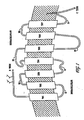
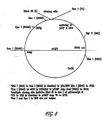
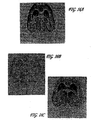
- G Protein coupled receptors share a common structural motif. All these receptors have seven sequences of between 22 to 24 hydrophobic amino acids that form seven alpha helices, each of which spans the membrane. The transmembrane helices are joined by strands of amino acids having a larger loop between the fourth and fifth transmembrane helix on the extracellular side of the membrane. Another larger loop, composed primarily of hydrophilic amino acids, joins transmembrane helices five and six on the intracellular side of the membrane. The carboxy terminus of the receptor lies intracellularly with the amino terminus in the extracellular space. It is thought that the loop joining helices five and six, as well as, the carboxy terminus, interact with the G protein. Currently, Gq, Gs, Gi and Go are G proteins that have been identified. The general structure of G protein coupled receptors is shown in Figure 1.
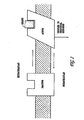
- G protein coupled receptors exist in the cell membrane in equilibrium between two different states or conformations: an "inactive" state and an “active” state. As shown schematically in Figure 2, a receptor in an inactive state is unable to link to the intracellular transduction pathway to produce a biological response. Changing the receptor conformation to the active state allows linkage to the transduction pathway and produces a biological response.
- a receptor may be stabilized in an active state by an endogenous ligand or an exogenous agonist ligand.
- Recent discoveries such as modifications to the amino acid sequence of the receptor provide means other than ligands to stabilize the active state conformation. These means effectively stabilize the receptor in an active state by simulating the effect of a ligand binding to the receptor. Stabilization by such ligand-independent means is termed "constitutive receptor activation.”
- Serotonin (5-hydroxytryptamine, 5-HT) are an important class of G protein coupled receptors. Serotonin is thought to play a role in processes related to learning and memory, sleep, thermoregulation, mood, motor activity, pain, sexual and aggressive behaviors, appetite, neurodegenerative regulation, and biological rhythms. Not surprisingly, serotonin is linked to pathophysiological conditions such as anxiety, depression, obsessive compulsive disorders, schizophrenia, suicide, autism, migraine, emesis, alcoholism, and neurodegenerative disorders.
- anti-psychotic treatment approaches focused on the serotonin receptors
- these types of therapeutics can generally be divided into two classes, the "typical” and the “atypical.” Both have anti-psychotic effects, but the typicals also include concomitant motor-related side effects (extra pyramidal syndromes, e.g. , lip-smacking, tongue darting, locomotor movement, etc).
- motor-related side effects extra pyramidal syndromes, e.g. , lip-smacking, tongue darting, locomotor movement, etc.
- Such side effects are thought to be associated with the compounds interacting with other receptors, such as the human dopamine D2 receptor in the nigro-striatal pathway. Therefore, an atypical treatment is preferred.
- Haloperidol is considered a typical anti-psychotic
- clozapine is considered an atypical anti-psychotic.
- Serotonin receptors are divided into seven subfamilies, referred to as 5-HT1 through 5-HT7, inclusive. These subfamilies are further divided into subtypes.
- the 5-HT2 subfamily is divided into three receptor subtypes: 5-HT 2A , 5-HT 2B , and 5-HT 2C .
- the human 5-HT 2C receptor was first isolated and cloned in 1987, and the human 5-HT 2A receptor was first isolated and cloned in 1990. These two receptors are thought to be the site of action of hallucinogenic drugs. Additionally, antagonists to the 5-HT 2A and 5-HT 2C receptors are believed to be useful in treating depression, anxiety, psychosis, and eating disorders.
- U.S. Patent Number 4,985,352 describes the isolation, characterization, and expression of a functional cDNA clone encoding the entire human 5-HT 1C receptor (now known as the 5-HT 2C receptor).
- U.S. Patent Numbers 5,661,024 and 6,541,209 describe the isolation, characterization, and expression of a functional cDNA clone encoding the entire human 5-HT 2A receptor.
- Casey describes a mutation of the cysteine residue at position 322 of the rat 5-HT 2A receptor to lysine (C322K), glutamine (C322Q), and arginine (C322R) which reportedly led to constitutive activation.
- Herrick-Davis 1 and Herrick-Davis 2 describe mutations of the serine residue at position 312 of the rat 5-HT 2C receptor to phenylalanine (S312F) and lysine (S312K), which reportedly led to constitutive activation.
- WO 02/076464 (Behan et al.; Arena Pharmaceuticals, Inc.), US 6,541,209 (Behan et al.; Arena Pharmaceuticals, Inc.), WO 01/29088 (Behan et al.; Arena Pharmaceuticals, Inc.), US 6,140,509 (Behan et al.; Arena Pharmaceuticals, Inc.), and WO 99/52927 (Behan et al.; Arena Pharmaceuticals, Inc.) describes certain non-endogenous, constitutively activated forms of the human 5-HT2A and/or human 5-HT2C receptors, and small molecule modulators thereof, including certain [2,4,5,6 -unsubstituted -3-(1H-pyrazol-3-yl)-phenyl]ureas and thioureas.
- WO 03/062206 (Teegarden et al.; Arena Pharmaceuticals, Inc.) describes small molecule modulators of the 5-HT2A serotonin receptor, including certain [5-substituted-2,4,6- unsubstituted -3-(1H-pyrazol-3-yl)-phenyl]ureas and thioureas. All of these compounds are, at least, unsubstituted at the 4-position, whereas the compounds claimed herein are all, at least, substituted at the 4-position.
- One aspect of the present invention pertains to certain diaryl and arylheteroaryl urea derivatives as shown in Formula ( I ): or a pharmaceutically acceptable salt, hydrate or solvate thereof; wherein:
- One aspect of the present invention pertains to pharmaceutical compositions comprising a compound of the present invention and a pharmaceutically acceptable carrier.
- Also described herein are methods for prophylaxis or treatment of platelet aggregation in an individual comprising administering to said individual in need thereof a therapeutically effective amount of a compound according to any of the embodiments described herein or a pharmaceutical composition.
- Also described herein are methods for prophylaxis or treatment of an indication selected from the group consisting of coronary artery disease, myocardial infarction, transient ischemic attack, angina, stroke, and atrial fibrillation in an individual comprising administering to said individual in need thereof a therapeutically effective amount of a compound according to any of the embodiments described herein or a pharmaceutical composition.
- Also described herein are methods for prophylaxis or treatment of reducing the risk of blood clot formation in an angioplasty or coronary bypass surgery individual comprising administering to said individual in need thereof a therapeutically effective amount of a compound according to any of the embodiments described herein or a pharmaceutical composition.
- Also described herein are methods for prophylaxis or treatment of asthma in an individual comprising administering to said individual in need thereof a therapeutically effective amount of a compound according to any of the embodiments described herein or a pharmaceutical composition.
- Also described herein are methods for prophylaxis or treatment of a symptom of asthma in an individual comprising administering to said individual in need thereof a therapeutically effective amount of a compound according to any of the embodiments described herein or a pharmaceutical composition.
- Also described herein are methods for prophylaxis or treatment of agitation or a symptom thereof in an individual comprising administering to said individual in need thereof a therapeutically effective amount of a compound according to any of the embodiments described herein or a pharmaceutical composition.
- the individual is a cognitively intact elderly individual.
- the dementia is due to a degenerative disease of the nervous system.
- the dementia is Alzheimers disease, Lewy Body, Parkinson's disease or Huntington's disease.
- the dementia is due to diseases that affect blood vessels.
- the dementia is due to stroke or multi-infarct dementia.
- Also described herein are methods for prophylaxis or treatment of an individual suffering from at least one of the indications selected from the group consisting of behavioral disorder, drug induced psychosis, excitative psychosis, Gilles de la Tourette's syndrome, manic disorder, organic or NOS psychosis, psychotic disorder, psychosis, acute schizophrenia, chronic schizophrenia and NOS schizophrenia comprising administering to said individual in need thereof a therapeutically effective amount of a dopamine D2 receptor antagonist and a compound according to any of the embodiments described herein or a pharmaceutical composition.
- the dopamine D2 receptor antagonist is haloperidol.
- Also described herein are methods for prophylaxis or treatment of an individual with infantile autism, Huntington's chorea, or nausea and vomiting from chemotherapy or chemotherapeutic antibodies comprising administering to said individual in need thereof a therapeutically effective amount of a dopamine D2 receptor antagonist and a compound according to any of the embodiments described herein or a pharmaceutical composition.
- the dopamine D2 receptor antagonist is haloperidol.
- Also described herein are methods for prophylaxis or treatment of schizophrenia in an individual comprising administering to said individual in need thereof a therapeutically effective amount of a dopamine D2 receptor antagonist and a compound according to any of the embodiments described herein or a pharmaceutical composition.
- the dopamine D2 receptor antagonist is haloperidol.
- the haloperidol and the compound or pharmaceutical composition are administered in separate dosage forms.
- the haloperidol and the compound or pharmaceutical composition are administered in a single dosage form.
- Also described herein are methods for prophylaxis or treatment of a sleep disorder in an individual comprising administering to said individual in need thereof a therapeutically effective amount of a compound according to any of the embodiments described herein or a pharmaceutical composition.
- the sleep disorder comprises a fragmented sleep architecture.
- the effective amount of a compound according to any of the embodiments described herein, or a pharmaceutical composition described herein promotes sleep consolidation.
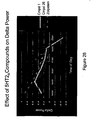
- the effective amount of a compound according to any of the embodiments described herein, or a pharmaceutical composition described herein increases delta power.
- the sleep disorder is a dyssomnia.
- the dyssomnia is selected from the group consisting of psychophysiological insomnia, sleep state misperception, idiopathic insomnia, obstructive sleep apnea syndrome, central sleep apnea syndrome, central alveolar hypoventilation syndrome, periodic limb movement disorder, restless leg syndrome, inadequate sleep hygiene, environmental sleep disorder, altitude insomnia, adjustment sleep disorder, insufficient sleep syndrome, limit-setting sleep disorder, sleep-onset association disorder, nocturnal eating or drinking syndrome, hypnotic dependent sleep disorder, stimulant-dependent sleep disorder, alcohol-dependent sleep disorder, toxin-induced sleep disorder, time zone change (jet lag) syndrome, shift work sleep disorder, irregular sleep-wake pattern, delayed sleep phase syndrome, advanced sleep phase syndrome and non-24-hour steep-wake disorder.
- the sleep disorder is a parasomnia.
- the parasomnia is selected from the group consisting of confusional arousals, sleepwalking and sleep terrors, rhythmic movement disorder, sleep starts, sleep talking and nocturnal leg cramps.
- the sleep disorder is associated with a medical or psychiatric disorder.
- the medical or psychiatric disorder is selected from the group consisting of psychoses, mood disorders, anxiety disorders, panic disorders, alcoholism, cerebral degenerative disorders, dementia, parkinsonism, fatal familial insomnia, sleep-related epilepsy, electrical status opilepticus of sleep, sleep-related headaches, sleeping sickness, nocturnal cardiac ischemia, chronic obstructive pulmonary disease, sleep-related asthma, sleep-related gastroesophageal reflux, peptic ulcer disease, fibrositis syndrome, osteoarthritis, rheumatoid arthritis, fibromyalgia and post-surgical sleep disorder.
- Also described herein are methods for prophylaxis or treatment of a diabetic-related disorder in an individual comprising administering to said individual in need thereof a therapeutically effective amount of a compound according to any of the embodiments described herein or a pharmaceutical composition.
- the diabetic-related disorder is diabetic peripheral neuropathy.
- the diabetic-related disorder is diabetic nephropathy.
- the diabetic-related disorder is diabetic retinopathy.
- One aspect of the present invention pertains to processes for preparing a composition comprising admixing a compound according any embodiments described herein and pharmaceutically acceptable carrier.
- One aspect of the present invention is the use of a compound for the production of a medicament for use in the prophylaxis or treatment of a 5HT 2A mediated disorder.
- One embodiment of the present invention is the use of a compound for the production of a medicament for use in the prophylaxis or treatment of a 5HT 2A mediated disorder wherein the disorder is platelet aggregation.
- One embodiment of the present invention is the use of a compound for the production of a medicament for use in the prophylaxis or treatment of a 5HT 2A mediated disorder wherein the disorder is selected from the group consisting of coronary artery disease, myocardial infarction, transient ischemic attack, angina, stroke, and atrial fibrillation.
- One embodiment of the present invention is the use of a compound for the production of a medicament for use in the prophylaxis or treatment of a 5HT 2A mediated disorder wherein the disorder is a blood clot formation in an angioplasty or coronary bypass surgery individual.
- One embodiment of the present invention is the use of a compound for the production of a medicament for use in the prophylaxis or treatment of a 5HT 2A mediated disorder wherein the disorder is a blood clot formation in an individual suffering from atrial fibrillation.
- One embodiment of the present invention is the use of a compound for the production of a medicament for use in the prophylaxis or treatment of a 5HT 2A mediated disorder wherein the disorder is asthma.
- One embodiment of the present invention is the use of a compound for the production of a medicament for use in the prophylaxis or treatment of a 5HT 2A mediated disorder wherein the disorder is a symptom of asthma.
- One embodiment of the present invention is the use of a compound for the production of a medicament for use in the prophylaxis or treatment of a 5HT 2A mediated disorder wherein the disorder is agitation or a symptom thereof in an individual.
- the individual is a cognitively intact elderly individual.
- One embodiment of the present invention is the use of a compound for the production of a medicament for use in the prophylaxis or treatment of a 5HT 2A mediated disorder wherein the disorder is agitation or a symptom thereof in an individual suffering from dementia.
- the dementia is due to a degenerative disease of the nervous system.
- the dementia is Alzheimers disease, Lewy Body, Parkinson's disease, or Huntington's disease.
- the dementia is due to diseases that affect blood vessels.
- the dementia is due to stroke or multi-infract dementia.
- One embodiment of the present invention is the use of a compound for the production of a medicament for use in the prophylaxis or treatment of a 5HT 2A mediated disorder further comprising a dopamine D2 receptor antagonist wherein the disorder is selected from the group consisting of a behavioral disorder, drug induced psychosis, excitative psychosis, Gilles de la Tourette's syndrome, manic disorder, organic or NOS psychosis, psychotic disorder, psychosis, acute schizophrenia, chronic schizophrenia and NOS schizophrenia.
- the dopamine D2 receptor antagonist is haloperidol.
- One embodiment of the present invention is the use of a compound for the production of a medicament for use in the prophylaxis or treatment of a 5HT 2A mediated disorder further comprising a dopamine D2 receptor antagonist wherein the disorder is infantile autism, Huntington's chorea, or nausea and vomiting from chemotherapy or chemotherapeutic antibodies.
- the dopamine D2 receptor antagonist is haloperidol.
- One embodiment of the present invention is the use of a compound for the production of a medicament for use in the prophylaxis or treatment of a 5HT 2A mediated disorder further comprising a dopamine D2 receptor antagonist wherein the disorder is schizophrenia.
- the dopamine D2 receptor antagonist is haloperidol.
- One embodiment of the present invention is the use of a compound for the production ofa medicament for use in the prophylaxis or treatment of a 5HT 2A mediated disorder wherein the disorder is a negative symptom or symptoms of schizophrenia induced by the administration of haloperidol.
- One embodiment of the present invention is the use of a compound for the production of a medicament for use in the prophylaxis or treatment of a 5HT 2A mediated disorder wherein the haloperidol and the compound or pharmaceutical composition are administered in separate dosage forms.
- One embodiment of the present invention is the use of a compound for the production of a medicament for use in the prophylaxis or treatment of a 5HT 2A mediated disorder wherein the haloperidol and the compound or pharmaceutical composition are administered in a single dosage form.
- One aspect of the present invention are compounds according to any of the embodiments described herein for use in a method of treatment of the human or animal body by therapy.
- One aspect of the present invention are compounds according to any of the embodiments described herein for use in a method for the prophylaxis or treatment of a 5HT 2A mediated disorder, as described herein, in the human or animal body by therapy.
- One aspect of the present invention are compounds according to any of the embodiments described herein for use in a method for the prophylaxis or treatment of a sleep disorder, as described herein, in the human or animal body by therapy.
- One aspect of the present invention are compounds according to any of the embodiments described herein for use in a method for the prophylaxis or treatment of platelet aggregation in the human or animal body by therapy.
- bold typeface indicates the location of the mutation in the non-endogenous, constitutively activated receptor relative to the corresponding endogenous receptor.
- AGONISTS shall mean moieties that interact and activate the receptor, such as the 5-HT 2A receptor, and initiates a physiological or pharmacological response characteristic of that receptor. For example, when moieties activate the intracellular response upon binding to the receptor, or enhance GTP binding to membranes.
- AMINO ACID ABBREVIATIONS used herein are set out in TABLE 1: TABLE 1 ALANINE ALA A ARGININE ARG R ASPARAGINE ASN N ASPARTIC ACID ASP D CYSTEINE CYS C GLUTAMIC ACID GLU E GLUTAMINE GLN Q GLYCINE GLY G HISTIDINE HIS H ISOLEUCINE ILE I LEUCINE LEU L LYSINE LYS K METHIONINE MET M PHENYLALANINE PHE F PROLINE PRO P SERINE SER S THREONINE THR T TRYPTOPHAN TRP W TYROSINE TYR Y VALINE VAL V
- ANTAGONISTS is intended to mean moieties that competitively bind to the receptor at the same site as agonists (for example, the endogenous ligand), but which do not activate the intracellular response initiated by the active form of the receptor, and can thereby inhibit the intracellular responses by agonists or partial agonists. Antagonists do not diminish the baseline intracellular response in the absence of an agonist or partial agonist.
- C 1-6 acyl denotes a C 1-6 alkyl radical attached to a carbonyl wherein the definition of alkyl has the same definition as described herein; some examples include acetyl, propionyl, n -butanoyl, iso -butanoyl, sec -butanoyl, t -butanoyl (i.e., pivaloyl), and pentanoyl.
- C 1-6 acyloxy denotes an acyl radical attached to an oxygen atom wherein acyl has the same definition has described herein; some examples include acetyloxy, propionyloxy, butanoyloxy, iso -butanoyloxy, sec -butanoyloxy, and t -butanoyloxy.
- C 2-6 alkenyl denotes a radical containing 2 to 6 carbons wherein at least one carbon-carbon double bond is present, some embodiments are 2 to 4 carbons, some embodiments are 2 to 3 carbons, and some embodiments have 2 carbons. Both E and Z isomers are embraced by the term “ alkenyl .” Furthermore, the term “ alkenyl " includes di- and tri-alkenyls. Accordingly, if more than one double bond is present then the bonds may be all E or Z or a mixtures of E and Z .
- alkenyl examples include vinyl, allyl, 2-butenyl, 3-butenyl, 2-pentenyl, 3-pentenyl, 4-pentenyl, 2-hexenyl, 3-hexenyl, 4-hexenyl, 5-hexanyl, and 2,4-hexadienyl.
- C 1-6 alkoxy denotes a radical alkyl, as defined herein, attached directly to an oxygen atom. Examples include methoxy, ethoxy, n -propoxy, iso -propoxy, n -butoxy, t -butoxy, iso -butoxy, and sec -butoxy.
- C 1-6 alkyl denotes a straight or branched carbon radical containing 1 to 8 carbons, some embodiments are 1 to 6 carbons, some embodiments are 1 to 4 carbons, some embodiments are 1 to 3 carbons, and some embodiments are 1 or 2 carbons.
- Examples of an alkyl include methyl, ethyl, n -propyl, iso -propyl, n -butyl, sec -butyl, iso -butyl, t -butyl, pentyl, iso -pentyl, t -pentyl, neo -pentyl, 1-methylbutyl [i.e., -CH(CH 3 )CH 2 CH 2 CH 3 ], 2-methylbutyl [i.e., -CH 2 CH(CH 3 )CH 2 CH 3 ], and n -hexyl.
- C 1-6 alkylcarboxamido or " C 1-6 alkylcarboxamide " denotes a single C 1-6 alkyl group attached to the nitrogen of an amide group, wherein alkyl has the same definition as found herein.
- the C 1-6 alkylcarboxamido may be represented by the following: Examples include N -methylcarboxamide, N -ethylcarboxamide, N-n -propylcarboxamide, N - iso -propylcarboxamide, N-n -butylcarboxamide, N - sec -butylcarboxamide, N-iso -butylcarboxamide, and N-t -butylcarboxamide.
- C 1-3 alkylene refers to a C 1-3 divalent straight carbon group.
- C 1-3 alkylene refers to, for example, -CH 2 -, -CH 2 CH 2 -, and -CH 2 CH 2 CH 2 -.
- C 1-3 alkylene refers to -CH-, - CHCH 2 -, and -CHCH 2 CH 2 -, wherein these examples relate generally to the variable or claim element " Q ".
- C 1-6 alkylsulfinyl denotes a C 1-6 alkyl radical attached to a sulfoxide radical of the formula: -S(O)- wherein the alkyl radical has the same definition as described herein. Examples include methylsulfinyl, ethylsulfinyl, n -propylsulfinyl, iso -propylsulfinyl, n -butylsulfinyl, sec- butylsulfinyl, iso -butylsulfinyl, and t -butylsulfinyl.
- C 1-6 alkylsulfonamide refers to the groups wherein C 1-6 alkyl has the same definition as described herein.
- C 1-6 alkylsulfonyl denotes a C 1-6 alkyl radical attached to a sulfone radical of the formula: -S(O) 2 - wherein the alkyl radical has the same definition as described herein. Examples include methylsulfonyl, ethylsulfonyl, n -propylsulfonyl, iso- propylsulfonyl, n -butylsulfonyl, sec -butylsulfonyl, iso -butylsulfonyl, and t -butylsulfonyl.
- C 1-6 alkylthio denotes a C 1-6 alkyl radical attached to a sulfide of the formula: -S-wherein the alkyl radical has the same definition as described herein. Examples include methylsulfanyl (i.e., CH 3 S-), ethylsulfanyl, n -propylsulfanyl, iso -propylsulfanyl, n -butylsulfanyl, sec -butylsulfanyl, iso -butylsulfanyl, and t -butylsulfanyl.
- C 1-6 alkylthiocarboxamide denotes a thioamide of the following formulae: wherein C 1-4 alkyl has the same definition as described herein.
- C 1-6 alkylthloureyl denotes the group of the formula: -NC(S)N- wherein one are both of the nitrogens are substituted with
- alkyl has the same definition as described herein.
- alkylthioureyl examples include CH 3 NHC(S)NH-, NH 2 C(S)NCH 3 -, (CH 3 ) 2 N(S)NH-, (CH 3 ) 2 N(S)NH-, (CH 3 ) 2 N(S)NCH 3 -, CH 3 CH 2 NHC(S)NH-, and CH 3 CH 2 NHC(S)NCH 3 -.
- C 1-6 alkylureyl denotes the group of the formula: -NC(O)N- wherein one are both of the nitrogens are substituted with the same or different C 1-6 alkyl group wherein alkyl has the same definition as described herein.
- alkylureyl examples include, CH 3 NHC(O)NH-, NH 2 C(O)NCH 3 -, (CH 3 ) 2 NC(O)NH-, (CH 3 ) 2 NC(O)NH-, (CH 3 ) 2 NC(O)NCH 3 -, CH 3 CH 2 NHC(O)NH-, and CH 3 CH 2 NHC(O)NCH 3 -.
- C 2-6 alkynyl denotes a radical containing 2 to 6 carbons and at least one carbon-carbon triple bond, some embodiments are 2 to 4 carbons, some embodiments are 2 to 3 carbons, and some embodiments have 2 carbons.
- alkynyl examples include ethynyl, 1-propynyl, 2-propynyl, 1-butynyl, 2-butynyl, 3-butynyl, 1-pentynyl, 2-pentynyl, 3-pentynyl, 4-pentynyl, 1-hexynyl, 2-hexynyl, 3-hexynyl, 4-hexynyl, and 5-hexynyl.
- alkynyl includes di- and tri-ynes.
- amino denotes the group -NH 2 .
- C 1-6 alkylamino denotes one alkyl radical attached to an amino radical wherein the alkyl radical has the same meaning as described herein. Some examples include, methylamino, ethylamino, n -propylamino, iso -propylamino, n -butylamino, sec -butylamino, iso -butylamino, and t -butylamino. Some embodiments are " C 1-2 alkylamino .”
- aryl denotes an aromatic ring radical containing 6 to 10 ring carbons. Examples include phenyl and naphthyl.
- arylalkyl defines a C 1 -C 4 alkylene, such as -CH 2 -, -CH 2 CH 2 -, which is further substituted with an aryl group.
- Examples of an “arylakyl include benzyl, and phenethylene.
- arylcarboxamido denotes a single aryl group attached to the nitrogen of an amide group, wherein aryl has the same definition as found herein.
- the example is N -phenylcarboxamide.
- arylureyl denotes the group -NC(O)N- where one of the nitrogens are substituted with an aryl.
- benzyl denotes the group -CH 2 C 6 H 5 .
- carbo-C 1-6 alkoxy refers to a C 1-6 alkyl ester of a carboxylic acid, wherein the alkyl group is as defined herein. Examples include carbomethoxy, carboethoxy, carbopropoxy, carboisopropoxy, carbobutoxy, carbo- sec -butoxy, carbo- iso -butoxy, carbo- t -butoxy, carbo- n -pentoxy, carbo- iso -pentoxy, carbo- t -pentoxy, carbo- neo -pentoxy, and carbo- n -hexyloxy.
- carboxamide refers to the group -CONH 2 .
- carboxy or " carboxyl” denotes the group -CO 2 H; also referred to as a carboxylic acid group.
- cyano denotes the group -CN.
- C 4-7 cycloalkenyl denotes a non-aromatic ring radical containing 4 to 7 ring carbons and at least one double bond; some embodiments contain 4 to 6 carbons; some embodiments contain 4 to 5 carbons; some embodiments contain 4 carbons. Examples include cyclobutenyl, cyclopentenyl, cyclopentenyl, and cyclohexenyl.
- C 3-7 cycloalkyl denotes a saturated ring radical containing 3 to 7 carbons; some embodiments contain 3 to 6 carbons; some embodiments contain 3 to 5 carbons; some embodiments contain 5 to 7 carbons; some embodiments contain 3 to 4 carbons. Examples include cyclopropyl, cyclobutyl, cyclopentyl, cyclopenyl, cyclohexyl, and cycloheptyl.
- C 2-8 dialkylamino denotes an amino substituted with two of the same or different C 1-4 alkyl radicals wherein alkyl radical has the same definition as described herein. Some examples include dimethylamino, methylethylamino, diethylamino, methylpropylamino, methylisopropylamino, ethylpropylamino, ethylisopropylamino, dipropylamino, and propylisopropylamino. Some embodiments are " C 2-4 dialkylamino .”
- C 2-8 dialkylcarboxamido or " C 2-8 dialkylcarboxamide " denotes two alkyl radicals, that are the same or different, attached to an amide group, wherein alkyl has the same definition as described herein.
- a C 2-8 dialkylcarboxamido may be represented by the following groups: wherein C 1-4 has the same definition as described herein.
- Examples of a dialkylcarboxamide include N,N -dimethylcarboxamide, N -methyl- N -ethylcarboxamide, N , N -diethylcarboxamide, and N -methyl- N -isopropylcarboxamide.
- C 2-8 dialkylsulfonamide refers to one of the following groups shown below: wherein C 1-4 has the same definition as described herein, for example methyl, ethyl, n -propyl, and isopropyl.
- C 2-8 dialkylthiocarboxamido or " C 2-8 dialkylthiocarbox-amide "denotes two alkyl radicals, that are the same or different, attached to a thioamide group, wherein alkyl has the same definition as described herein.
- a C 2-8 dialkylthiocarboxamido or C 2-8 dialkylthiocarboxamide may be represented by the following groups: Examples of a dialkylthiocarboxamide include N,N -dimethylthiocarboxamide, and N -methyl- N -ethylthiocarboxamide.
- ethynylene refers to the carbon-carbon triple bond group as represented below:
- C 1-6 haloalkoxy denotes a haloalkyl, as defined herein, which is directly attached to an oxygen atom. Examples include difluoromethoxy, trifluoromethoxy, 2,2,2-trifluoroethoxy, and pentafluoroethoxy.
- C 1-6 haloalkyl denotes an C 1-6 alkyl group, defined herein, wherein the alkyl is substituted with one halogen up to fully substituted and a fully substituted C 1-6 haloalkyl can be represented by the formula C n L 2n+1 wherein L is a halogen and "n" is 1, 2, 3 or 4; when more than one halogen is present then they may be the same or different and selected from the group consisting of F, Cl, Br and I, preferably F.
- Examples of C 1-4 haloalkyl groups include fluoromethyl, difluoromethyl, trifluoromethyl, chlorodifluoromethyl, 2,2,2-trifluoroethyl, and pentafluoroethyl.
- C 1-6 haloalkylcarboxamide denotes an alkylcarboxamide group, defined herein, wherein the alkyl is substituted with one halogen up to fully substituted represented by the formula C n L 2n+1 wherein L is a halogen and "n" is 1, 2, 3 or 4. When more than one halogen is present they may be the same or different and selected from the group consisting of F, Cl, Br and I, preferably F.
- C 1-6 haloalkylsufinyl denotes a haloalkyl radical attached to a sulfoxide group of the formula: -S(O)- wherein the haloalkyl radical has the same definition as described herein. Examples include trifluoromethylsulfinyl, 2,2,2-trifluoroethylsulfinyl, and 2,2-difluoroethylsulfinyl.
- C 1-6 haloalkylsulfonyl denotes a haloalkyl radical attached to a sulfone group of the formula: -S(O) 2 - wherein haloalkyl has the same definition as described herein. Examples include trifluoromethylsulfonyl, 2,2,2-trifluoroethylsulfonyl, and 2,2-difluoroethytsulfonyl.
- C 1-6 haloalkylthio denotes a haloalkyl radical directly attached to a sulfur wherein the haloalkyl has the same meaning as described herein. Examples include trifluoromethylthio (i.e., CF 3 S-, also referred to as trifluoramethylsulfanyl), 1,1-difluoromethylthio, and 2,2,2-trifluoroethylthio.
- halogen or " halo” denotes to a fluoro, chloro, bromo or iodo group.
- heteroaryl denotes an aromatic ring system that may be a single ring, two fused rings or three fused rings wherein at least one ring carbon is replaced with a heteroatom selected from the group consisting of O, S and N wherein the N can be optionally substituted with H, C 1-4 acyl or C 1-4 alkyl.
- heteroaryl groups include pyridyl, benzofuranyl, pyrazinyl, pyridazinyl, pyrimidinyl, triazinyl, quinoline, benzoxazole, benzothiazole, 1 H -benzimidazole, isoquinoline, quinazoline, and quinoxaline.
- the heteroaryl atom is O, S, NH
- examples include pyrrole, and indole.
- Other examples include those in TABLE 2, and TABLE 3.
- heterocyclic denotes a non-aromatic carbon ring (i.e., C 3-7 cycloalkyl or C 4-7 cycloalkenyl as defined herein) wherein one, two or three ring carbons are replaced by a heteroatom selected from the group consisting of O, S, N, wherein the N can be optionally substituted with H, C 1-4 acyl or C 1-4 alkyl, and ring carbon atoms optionally substituted with oxo or a thiooxo thus forming a carbonyl or thiocarbonyl group.
- the heterocyclic group is a 3-, 4-, 5-, 6- or 7-membered containing ring.
- heterocyclic group examples include aziridin-1-yl, aziridin-2-yl, azetidin-1-yl, azetidin-2-yl, azetidin-3-yl, piperidin-1-yl, piperidin-4-yl, morpholin-4-yl, piperzin-1-yl, piperzin-4-yl, pyrrolidin 1-yl, pyrrolidin-3-yl, and [1,3]-dioxolan-2-yl.
- heterocycliccarboxamido denotes a heterocyclic group, as defined herein, with a ring nitrogen where the ring nitrogen is bonded directly to the carbonyl forming an amide. Examples include
- heterocyclicsulfonyl denotes a heterocyclic group, as defined herein, with a ring nitrogen where the ring nitrogen is bonded directly to an -SO 2 -group forming an sulfonamide. Examples include
- hydroxyl refers to the group -OH.
- hydroxylamino refers to the group -NHOH.
- nitro refers to the group -NO 2 .
- C 4-7 oxo-cycloalkyl refers to a C 4-7 cycloalkyl, as defined herein, wherein one of the ring carbons is replaced with a carbonyl.
- Examples of C 4-7 oxo-cycloalkyl include 2-oxo-cyclobutyl, 3-oxo-cyclobutyl, 3-oxo-cyclopentyl, and 4-oxo-cyclohexyl, and represented by the following structures respectively:
- perfluoroalkyl denotes the group of the formula -C n F 2n+1 ; stated differently, a perfluoroalkyl is an alkyl as defined herein wherein the alkyl is fully substituted with fluorine atoms and is therefore considered a subset of haloalkyl.
- perfluoroalkyls include CF 3 , CF 2 CF 3 , CF 2 CF 2 CF 3 , CF(CF 3 ) 2 , CF 2 CF 2 CF 2 CF 3 , CF 2 CF(CF 3 ) 2 , and CF(CF 3 )CF 2 CF 3 .
- phenoxy refers to the group C 6 H 5 O-.
- phenyl refers to the group C 6 H 5 -.
- sulfonic acid refers to the group -SO 3 H.
- thiol denotes the group -SH.
- CODON shall mean a grouping of three nucleotides (or equivalents to nucleotides) which generally comprise a nucleoside [adenosine (A), guanosine (G), cytidine (C), uridine (U) and thymidine (T)] coupled to a phosphate group and which, when translated, encodes an amino acid.
- A adenosine
- G guanosine
- C cytidine
- U uridine
- T thymidine
- COMPOSITION shall mean a material comprising at least two compounds or two components; for example, and without limitation, a Pharmaceutical Composition is a Composition comprising a compound of the present invention and a pharmaceutically acceptable carrier.
- COMPOUND EFFICACY shall mean a measurement of the ability of a compound to inhibit or stimulate receptor functionality, as opposed to receptor binding affinity.
- CONSTITUTIVELY ACTIVATED RECEPTOR shall mean a receptor subject to constitutive receptor activation.
- CONSTITUTIVE RECEPTOR ACTIVATION shall mean stabilization of a receptor in the active state by means other than binding of the receptor with its endogenous ligand or a chemical equivalent thereof.
- CONTACT or CONTACTING shall mean bringing the indicated moieties together, whether in an in vitro system or an in vivo system.
- "contacting" a 5-HT 2A receptor with a compound of the invention includes the administration of a compound of the present invention to an individual, preferably a human, having a 5-HT 2A receptor, as well as, for example, introducing a compound of the invention into a sample containing a cellular or more purified preparation containing a 5-HT 2A receptor.
- ENDOGENOUS shall mean a material that a mammal naturally produces.
- ENDOGENOUS in reference to, for example and not limitation, the term "receptor" shall mean that which is naturally produced by a mammal (for example, and not limitation, a human) or a virus.
- NON-ENDOGENOUS in this context shall mean that which is not naturally produced by a mammal (for example, and not limitation, a human) or a virus.
- a receptor which is not constitutively active in its endogenous form, but when manipulated becomes constitutively active is most preferably referred to herein as a "non-endogenous, constitutively activated receptor.”
- Both terms can be utilized to describe both "in vivo" and "in vitro" systems.
- the endogenous or non-endogenous receptor may be in reference to an in vitro screening system.
- screening of a candidate compound by means of an in vivo system is viable.
- IN NEED OF PROPHYLAXIS OR TREATMENT refers to a judgment made by a caregiver (e.g. physician, nurse, nurse practitioner, etc. in the case of humans; veterinarian in the case of animals, including non-human mammals) that an individual or animal requires or will benefit from prophylaxis or treatment. This judgment is made based on a variety of factors that are in the realm of a caregiver's expertise, but that includes the knowledge that the individual or animal is ill, or will be ill, as the result of a disease, condition or disorder that is treatable by the compounds of the invention. In general, "in need of prophylaxis" refers to the judgment made by the caregiver that the individual will become ill.
- the compounds of the invention are used in a protective or preventive manner.
- "in need of treatment” refers to the judgment of the caregiver that the individual is already ill, therefore, the compounds of the present invention are used to alleviate, inhibit or ameliorate the disease, condition or disorder.
- INDIVIDUAL refers to any animal, including mammals, preferably mice, rats, other rodents, rabbits, dogs, cats, swine, cattle, sheep, horses, or primates, and most preferably humans.
- INHIBIT or INHIBITING in relationship to the term "response” shall mean that a response is decreased or prevented in the presence of a compound as opposed to in the absence of the compound.
- INVERSE AGONISTS shall mean moieties that bind the endogenous form of the receptor or to the constitutively activated form of the receptor, and which inhibit the baseline intracellular response initiated by the active form of the receptor below the normal base level of activity which is observed in the absence of agonists or partial agonists, or decrease GTP binding to membranes.
- the baseline intracellular response is inhibited in the presence of the inverse agonist by at least 30%, more preferably by at least 50%, and most preferably by at least 75%, as compared with the baseline response in the absence of the inverse agonist.
- LIGAND shall mean an endogenous, naturally occurring molecule specific for an endogenous, naturally occurring receptor.
- MODULATE or MODULATING shall mean to refer to an increase or decrease in the amount, quality, response or effect of a particular activity, function or molecule.
- PHARMACEUTICAL COMPOSITION shall mean a composition comprising at least one active ingredient; including salts, solvates and hydrates ofcompounds of Formula ( I ); whereby the composition is amenable to investigation for a specified, efficacious outcome in a mammal (for example, without limitation, a human).
- a mammal for example, without limitation, a human.
- THERAPEUTICALLY EFFECTIVE AMOUNT refers to the amount of active compound or pharmaceutical agent that elicits the biological or medicinal response in a tissue, system, animal, individual or human that is being sought by a researcher, veterinarian, medical doctor or other clinician, which includes one or more of the following:
- One aspect of the present invention pertains to certain diaryl and arylheteroaryl urea derivatives as shown in Formula ( I ): or a pharmaceutically acceptable salt, hydrate or solvate thereof; wherein R 1 , R 2 , R 3 , R 4 , R 5 , R 6a , R 6b , R 6c, R 7 , R 6 , X, and Q have the same definitions as described herein, supra and infra.
- Some embodiments of the present invention pertain to certain diaryl and arylheteroaryl urea derivatives as shown in the following Formula wherein:
- substituted indicates that at least one hydrogen atom of the chemical group is replaced by a non-hydrogen substituent or group, the non-hydrogen substituent or group can be monovalent or divalent When the substituent or group is divalent, then it is understood that this group is further substituted with another substituent or group.
- a chemical group herein when a chemical group herein is "substituted" it may have up to the full valance of substitution; for example, a methyl group can be substituted by 1, 2, or 3 substituents, a methylene group can be substituted by 1 or 2 substituents, a phenyl group can be substituted by 1,2,3,4, or 5 substituents, a naphthyl group can be substituted by 1,2,3,4, 5, 6, or 7 substituents.
- substituted with one or more substituents refers to the substitution of a group with one substituent up to the total number of substituents physically allowed by the group. Further, when a group is substituted with more than one group they can be identical or they can be different.
- Tautomeric forms can be in equilibrium or sterically locked into one form by appropriate substitution. It is understood that the various tautomeric forms are within the scope of the compounds of the present invention.
- Compounds of the invention can also include all isotopes of atoms occurring in the intermediates and/or final compounds.
- Isotopes include those atoms having the same atomic number but different mass numbers.
- isotopes of hydrogen include deuterium and tritium.
- compounds of the present invention may have one or more chiral centers, and therefore can exist as enantiomers and/or diastereomers.
- the invention is understood to extend to and embrace all such enantiomers, diastereomers and mixtures thereof, including racemates.
- some embodiments of the present invention pertain to compounds of the present invention that are R enantiomers.
- some embodiments of the present invention pertain to compounds of the present invention that are S enantiomers.
- some embodiments of the present invention include compounds that are RS or SR enantiomers.
- compounds of the present invention are RR or SS enantiomers. It is understood that compounds of the present invention are intended to represent all individual enantiomers and mixtures thereof; unless stated or shown otherwise.
- R 1 is aryl or heteroaryl each optionally substituted with R 9 , R 10 , R 11 , R 12 , R 13 , R 14 , and R 15 each selected independently from the group consisting of C 1-6 acyl C 1-6 acyloxy, C 2-6 alkenyl, C 1-6 alkoxy, C 1-6 alkyl, C 1-6 alkylcarboxamide, C 2-6 alkynyl, C 1-6 alkylsulfonamide, C 1-6 alkylsulfinyl, C 1-6 alkylsulfonyl, C 1-6 alkylthio, C 1-6 alkylureyl, amino, C 1-6 alkylamino, C 2-8 dialkylamino, C 1-6 alkylimino, carbo-C 1-6 -alkoxy, carboxamide, carboxy, cyano, C 3-7 cycloalkyl, C 2-8 dialkylcarboxamide, C 2-8 dialkylsulfonamide, hal
- R 1 is phenyl or naphthyl each optionally substituted with R 9 , R 10 , R 11 , R 12 , R 13 , R 14 , and R 15 each selected independently from the group consisting of C 1-6 acyl, C 1-6 alkoxy, C 1-6 alkyl, C 1-6 alkylsulfonyl, amino, C 1-6 alkylamino, C 2-8 dialkylamino, C 1-6 alkylimino, carbo-C 1-6 -alkoxy, carboxamide, carboxy, cyano, C 3-7 cycloalkyl, halogen, C 1-6 haloalkoxy, C 1-6 haloalkyl, heterocyclic, hydroxyl, nitro, and phenyl, or two adjacent R 9 , R 10 , R 11 , R 12 , R 13 , R 14 , and R 15 together with the atoms to which they are attached form a C 5-7 cycloal
- R 1 is phenyl optionally substituted with R 9 , R 10 , R 11 , R 12 , and R 13 each selected independently from the group consisting of C 1-6 acyl, C 1-6 alkoxy, C 1-6 alkyl, C 1-6 alkylsulfonyl, amino, C 1-6 alkylamino, C 2-8 dialkylamino, C 1-6 alkylimino, carbo-C 1-6 -alkoxy, carboxamide, carboxy, cyano, C 3-7 cycloalkyl, halogen, C 1-6 haloalkoxy, C 1-6 haloalkyl, heterocyclic, hydroxyl, nitro, and phenyl, or two adjacent R 9 , R 10 , R 11 , R 12 , and R 13 together with the atoms to which they are attached form a C 5-7 cycloalkyl group or heterocyclic group each optionally substituted with F; and wherein said C 1-6 acyl, C 1-6 alkoxy,
- R 1 is phenyl or naphthyl each optionally substituted with R 9 , R 10 , R 11 , R 12 , R 13 , R 14 , and R 15 each selected independently from the group consisting of C 1-6 acyl, C 1-6 alkoxy, C 1-6 alkyl, amino, C 1-6 alkylamino, C 2-8 dialkylamino, C 1-6 alkylimino, cyano, halogen, C 1-6 haloalkoxy, C 1-6 haloalkyl, heterocyclic, hydroxyl, nitro, and phenyl, or two adjacent R 9 , Rio, R 11 , R 12 , R 13 , R 14 , and R 15 together with the atoms to which they are attached form a C 5-7 cycloalkyl group or heterocyclic group each optionally substituted with F; and wherein said C 1-6 alkyl, C 1-6 alkylimino, and heterocyclic are each optionally
- R 1 is phenyl optionally substituted with R 9 , R 10 , R 11 , R 12 , and R 13 each selected independently from the group consisting of C 1-6 acyl, C 1-6 alkoxy, C 1-6 alkyl, amino, C 1-6 alkylamino, C 2-8 dialkylamino, C 1-6 alkylimino, cyano, halogen, C 1-6 haloalkoxy, C 1-6 haloalkyl, heterocyclic, hydroxyl, nitro, and phenyl, or two adjacent R 9 , R 10 , R 11 , R 12 , and R 13 together with the atoms to which they are attached form a C 5-7 cycloalkyl group or heterocyclic group each optionally substituted with F; and wherein said C 1-6 alkyl, C 1-6 alkylimino, and heterocyclic are each optionally substituted with 1 to 5 substituents selected independently from the group consisting of C 1-6 al
- R 1 is phenyl or naphthyl optionally substituted with R 9 , R 10 , R 11 , R 12 , R 13 , R 14 , and R 15 each selected independently from the group consisting of -OCH 3 , -CH 3 , cyano, -F, -Cl, -Br, -OCF 3 , and -CF 3 .
- R 1 is phenyl optionally substituted with R 9 , R 10 , R 11 , R 12 , and R 13 each selected independently from the group consisting of -OCH 3 , -CH 3 , cyano, -F, -Cl, -Br, -OCF 3 , and -CF 3 .
- R 1 is phenyl and can be represented by the Formula shown below: wherein each variable in the above formula has the same meaning as described herein, supra and infra.
- R 7 and R 8 are both -H, Q is a bond, and X is O.
- R 1 is phenyl and can be represented by Formula ( Ia ) as shown below: wherein:
- R 1 is phenyl optionally substituted with R 9 to R 13 substituents selected independently from the group consisting of C 1-6 acyl, C 1-6 alkoxy, C 1-6 alkyl, cyano, halogen, C 1-6 haloalkoxy, C 1-6 haloalkyl, nitro and phenyl; and wherein said phenyl can be optionally substituted with 1 to 5 substituents selected independently from the group consisting of C 1-6 alkoxy, C 1-6 alkyl, cyano, halogen, C 1-6 haloalkoxy, C 1-6 haloalkyl and nitro.
- R 1 is phenyl optionally substituted with R 9 to R 13 substituents selected independently from the group consisting of C 1-6 acyl, C 1-6 alkoxy, C 1-6 alkyl, cyano, halogen, C 1-6 haloalkoxy, C 1-6 haloalkyl, nitro and phenyl.
- R 1 is phenyl optionally substituted with R 9 to R 13 substituents selected independently from the group consisting of -C(O)CH 3 , -C(O)CH 2 CH 3 , -C(O)CH(CH 3 ) 2 , -C(O)CH 2 CH 2 CH 3 , -C(O)CH 2 CH(CH 3 ) 2 , -OCH 3 , -OCH 2 CH 3 , -OCH(CH 3 ) 2 , -OCH 2 CH 2 CH 3 , -OCH 2 CH(CH 3 ) 2 , -CH 3 , -CH 2 CH 3 , -CH(CH 3 ) 2 , -CH 2 CH 2 CH 3 , -CH 2 CH(CH 3 ) 2 , -CH 2 CH 2 CH 3 , cyano, F, Cl, Br, I, -OCF 3 , -OCHF 2 , -OCFH 2 , -OCF 2 CF
- R 1 is phenyl optionally substituted with R 9 , R 10 , R 11 , R 12 and R 13 substituents selected independently from the group consisting of -C(O)CH 3 , -OCH 3 , -CH 3 , cyano, -F, -Cl, -Br, -OCF 3 , -CF 3 , nitro and phenyl.
- R 1 is naphthyl optionally substituted with R 9 R 10 R 11 R 12 R 13 R 14 and R 15 substituents selected independently from the group consisting of C 1-6 acyl, C 1-6 acyloxy, C 1-6 alkoxy, C 1-6 alkyl, C 1-6 alkylcarboxamide, C 1-6 alkylsulfonamide, C 1-6 alkylsulfinyl, C 1-6 alkylsulfonyl, C 1-6 alkylthio, amino, C 1-6 alkylamino, C 2-8 dialkylamino, carbo-C 1-6 -alkoxy, carboxamide, carboxy, cyano, halogen, C 1-6 haloalkoxy, C 1-6 haloalkyl, hydroxyl and nitro; and wherein said C 1-6 alkyl can be optionally substituted with 1 to 5 substituents selected independently from the group consisting of C 1-6 alkoxy, C 1-6 alkyl
- R 1 is naphthyl optionally substituted with R 9 , R 10 , R 11 , R 12 , R 13 , R 14 and R 15 substituents selected independently from the group consisting of C 1-6 acyl, C 1-6 alkoxy, C 1-6 alkyl, cyano, halogen, C 1-6 haloalkoxy, C 1-6 haloalkyl and nitro.
- R 1 is naphthyl optionally substituted with R 9 , R 10 , R 11 , R 12 , R 13 , R 14 and R 15 substituents selected independently from the group consisting of -C(O)CH 3 , -C(O)CH 2 CH 3 , -C(O)CH(CH 3 ) 2 , -C(O)CH 2 CH 2 CH 3 , -C(O)CH 2 CH(CH 3 ) 2 , -OCH 3 , -OCH 2 CH 3 , -OCH(CH 3 ) 2 , -OCH 2 CH 2 CH 3 , -OCH 2 CH(CH 3 ) 2 , -CH 3 , -CH 2 CH 3 , -CH(CH 3 ) 2 , -CH 2 CH 3 , -CH(CH 3 ) 2 , -CH 2 CH 2 CH 3 , -CH 2 CH(CH 3 ) 2 , -CH 2 CH 2 CH 3 , cyano, -F
- R 1 is naphthyl optionally substituted with R 9 , R 10 , R 11 , R 12 , R 13 , R 14 and R 15 substituents selected independently from the group consisting of -C(O)CH 3 , -C(O)CH 2 CH 3 , -C(O)CH(CH 3 ) 2 , -C(O)CH 2 CH 2 CH 3 , -C(O)CH 2 CH(CH 3 ) 2 , -OCH 3 , -OCH 2 CH 3 , -OCH(CH 3 ) 2 , -OCH 2 CH 2 CH 3 , -OCH 2 CH(CH 3 ) 2 , -CH 3 , -CH 2 CH 3 , -CH(CH 3 ) 2 , -CH 2 CH 3 , -CH(CH 3 ) 2 , -CH 2 CH 2 CH 3 , -CH 2 CH(CH 3 ) 2 , -CH 2 CH 2 CH 3 , cyano, -F
- R 1 is naphthyl optionally substituted with R 9 , R 10 , R 11 , R 12 , R 13 , R 14 and R 15 substituents selected independently from the group consisting of -C(O)CH 3 , -OCH 3 , -CH 3 , cyano, -F, -Cl, -Br, -OCF 3 , -CF 3 and nitro.
- R 1 is heteroaryl optionally substituted with R 9 , R 10 , R 11 , R 12 , and R 13 each selected independently from the group consisting of C 1-6 acyl, C 1-6 alkoxy, C 1-6 alkyl, amino, C 1-6 alkylamino, C 2-8 dialkylamino, C 1-6 alkylimino, cyano, halogen, C 1-6 haloalkoxy, C 1-6 haloalkyl, heterocyclic, hydroxyl, nitro, and phenyl, or two adjacent R 9 , R 10 , R 11 , R 12 , R 13 , R 14 , and R 15 together with the atoms to which they are attached form a C 5-7 cycloalkyl group or heterocyclic group each optionally substituted with F; and wherein said C 1-6 alkyl, C 1-6 alkylimino, and heterocyclic are each optionally substituted with 1 to 5 substituents selected independently from the group
- R 1 is heteroaryl optionally substituted with R 9 , R 10 , R 11 , R 12 , and R 13 each selected independently from the group consisting of -OCH 3 , -CH 3 , cyano, -F, -Cl, -Br, -OCF 3 , and -CF 3 .
- R 1 is heteroaryl optionally substituted with R 9 , R 10 , R 11 , R 12 , and R 13 each selected independently from the group consisting of C 1-6 acyl, C 1-6 acyloxy, C 1-6 alkoxy, C 1-6 alkyl, C 1-6 alkylcarboxamide, C 1-6 alkylsulfonamide, C 1-6 alkylsulfinyl, C 1-6 alkylsulfonyl, C 1-6 alkylthio, amino, C 1-6 alkylamino, C 2-8 dialkylamino, carbo-C 1-6 -alkoxy, carboxamide, carboxy, cyano, halogen, C 1-6 haloalkoxy, C 1-6 haloalkyl, hydroxyl, nitro and phenyl, or two adjacent R 9 , R 10 , R 11 , R 12 , R 13 , R 14 , and R 15 together with the atoms to which they
- R 1 is heteroaryl optionally substituted with R 9 , R 10 , R 11 , R 12 and R 13 each selected independently from the group consisting of C 1-6 acyl, C 1-6 alkoxy, C 1-6 alkyl, cyano, halogen, C 1-6 haloalkoxy, C 1-6 haloalkyl, nitro and phenyl; and wherein said phenyl can be optionally substituted with 1 to 5 substituents selected independently from the group consisting of C 1-6 alkoxy, C 1-6 alkyl, cyano, halogen, C 1-6 haloalkoxy, C 1-6 haloalkyl and nitro.
- R 1 is heteroaryl optionally substituted with R 9 , R 10 , R 11 , R 12 and R 13 each selected independently from the group consisting of C 1-6 acyl, C 1-6 alkoxy, C 1-6 alkyl, cyano, halogen, C 1-6 haloalkoxy, C 1-6 haloalkyl, nitro and phenyl.
- R 1 is heteroaryl optionally substituted with R 9 , R 10 , R 11 , R 12 , and R 13 each selected independently from the group consisting of -C(O)CH 3 , -C(O)CH 2 CH 3 , -C(O)CH(CH 3 ) 2 , -C(O)CH 2 CH 2 CH 3 , -C(O)CH 2 CH(CH 3 ) 2 , -OCH 3 , -OCH 2 CH 3 , -OCH(CH 3 ) 2 , -OCH 2 CH 2 CH 3 , -OCH 2 CH(CH 3 ) 2 , -CH 3 , -CH 2 CH 3 , -CH(CH 3 ) 2 , -CH 2 CH 2 CH 3 , -CH(CH 3 ) 2 , -CH 2 CH 2 CH 3 , -CH 2 CH(CH 3 ) 2 , -CH 2 CH 2 CH 3 , cyano, -F, -Cl, -
- R 1 is heteroaryl optionally substituted with R 9 , R 10 , R 11 , R 12 , and R 13 each selected independently from the group consisting of -C(O)CH 3 , -OCH 3 , -CH 3 , cyano, -F, -Cl, -Br, -OCF 3 , -CF 3 , nitro and phenyl.
- R 1 is heteroaryl optionally substituted with R 9 , R 10 , R 11 , R 12 , and R 13 selected independently from the group consisting of H, -C(O)CH 3 , -OCH 3 , -CH 3 , cyano, -F, -Cl, -Br, -OCF 3 , -CF 3 , nitro and phenyl.
- R 1 is heteroaryl having 5-atoms in the aromatic ring examples of which are represented by the following formulae: wherein the 5-membered heteroaryl is bonded at any available position of the ring, for example, a imidazolyl ring can be bonded at one of the ring nitrogens (i.e., imidazol-1-yl group) or at one of the ring carbons (i.e., imidazol-2-yl, imidazol-4-yl or imiadazol-5-yl group).
- a imidazolyl ring can be bonded at one of the ring nitrogens (i.e., imidazol-1-yl group) or at one of the ring carbons (i.e., imidazol-2-yl, imidazol-4-yl or imiadazol-5-yl group).
- R 1 is a 6-membered heteroaryl, for example, a 6-membered heteroaryl as shown in TABLE 3: wherein the heteroaryl group is bonded at any ring carbon.
- R 1 is selected from the group consisting of pyridinyl, pyridazinyl, pyrimidinyl and pyrazinyl. In some embodiments, R 1 is pyridinyl.
- R 1 is a heteroaryl, for example those shown in TABLE 2 and 3 , optionally substituted with 1 to 3 substituents selected from the group consisting of C 1-6 acyl, C 1-6 acyloxy, C 2-6 alkenyl, C 1-6 alkoxy, C 1-6 alkyl C 1-6 alkylcarboxamide, C 2-6 alkynyl, C 1-6 alkylsulfonamide, C 1-6 alkylsulfinyl, C 1-6 alkylsulfonyl, C 1-6 alkylthio, C 1-6 alkylureyl, amino, C 1-6 alkylamino, C 2-8 dialkylamino, carbo-C 1-6 -alkoxy, carboxamide, carboxy, cyano, C 3-7 cycloalkyl, C 2-8 dialkylcarboxamide, C 2-8 dialkylsulfonamide, halogen, C 1-6 haloalkoxy, C 1-6 haloalkyl, C
- Some embodiments of the present invention pertain to compounds wherein R 2 is H or C 1-6 alkyl.
- R 2 is C 1-6 alkyl.
- R 2 is selected from the group consisting of -CH 3 , -CH 2 CH 3 , -CH(CH 3 ) 2 , -CH 2 CH 2 CH 3 , -CH 2 CH(CH 3 ) 2 and -CH 2 CH 2 CH 2 CH 3 .
- R 2 is -CH 3 or -CH(CH 3 ) 2 .
- Some embodiments of the present invention can be represented by Formulae (Ib) and (Ic) respectively as shown below: wherein each variable in Formulae ( Ib ) and ( Ic ) has the same meaning as described herein, supra and infra .
- Some embodiments of the present invention pertain to compounds wherein R 2 is H.
- R 2 is C 2-6 alkenyl.
- Some embodiments of the present invention pertain to compounds wherein R 2 is C 2-6 alkynyl.
- R 2 is C 3-7 cycloalkyl. In some embodiments, R 2 is cyclopropyl.
- R 3 is selected from the group consisting of H, C 2-6 alkenyl, C 1-6 alkyl, C 1-6 alkylcarboxamide, C 2-6 alkynyl, carbo-C 1-6 -alkoxy, carboxamide, carboxy, cyano, C 3-7 cycloalkyl, halogen, heteroaryl or phenyl; and wherein each of said C 2-6 allcenyl, C 1-6 alkyl, C 2-6 alkynyl, heteroaryl and phenyl groups can be optionally substituted with 1 to 5 substituents selected independently from the group consisting of C 1-6 alkylamino, C 2-8 dialkylamino, C 2-6 alkenyl, C 1-4 alkoxy, C 1-8 allcyl, C 2-6 alkynyl, amino, halogen, C 1-4 haloalkoxy and hydroxyl.
- R 3 is selected from the group consisting of H, C 2-6 alkenyl, C 1-6 alkyl, C 2-6 alkynyl, carbo-C 1-6 -alkoxy, carboxy, cyano, C 3-7 cycloalkyl, halogen, heteroaryl or phenyl; and wherein each of said C 2-6 allcenyl, C 1-6 alkyl, C 1-6 alkynyl and phenyl groups can be optionally substituted with 1 to 5 substituents selected independently from the group consisting of C 2-8 dialkylamino, C 2-6 alkenyl, C 1-4 alkoxy, C 2-6 alkynyl, halogen, C 1-4 haloalkoxy and hydroxyl.
- Some embodiments of the present invention pertain to compounds wherein R 3 is H or halogen.
- R 3 is H, F, Cl or Br.
- Some embodiments of the present invention pertain to compounds of Formula ( Ie ) as shown below: wherein each variable in Formula ( Ie ) has the same meaning as described herein, supra and infra .
- Some embodiments of the present invention pertain to compounds of Formula ( If ) as shown below: wherein each variable in Formula ( If ) has the same meaning as described herein, supra and infra.
- Some embodiments of the present invention pertain to compounds of Formula ( Ig ) as shown below: wherein each variable in Formula ( Ig ) has the same meaning as described herein, supra and infra .
- Some embodiments of the present invention pertain to compounds of Formula ( Ih ) as shown below: wherein each variable in Formula ( Ih ) has the same meaning as described herein, supra and infra.
- Some embodiments of the present invention pertain to compounds of Formula ( Ii ) as shown below: wherein each variable in Formula ( Ii ) has the same meaning as described herein, supra and infra.
- Some embodiments of the present invention pertain to compounds of Formula ( Ij ) as shown below: wherein each variable in Formula ( Ij ) has the same meaning as described herein, supra and infra.
- Some embodiments of the present invention pertain to compounds of Formula ( Ik ) as shown below: wherein each variable in Formula ( Ik ) has the same meaning as described herein, supra and infra.
- Some embodiments of the present invention pertain to compounds of Formula ( Ik' ) as shown below: wherein each variable in Formula ( Ik' ) has the same meaning as described herein, supra and infra.
- R 4 is selected from the group consisting ofH, C 1-6 alkyl and C 1-6 haloalkyl.
- R 4 is selected from the group consisting of H, -CH 3 , -CH 2 CH 3 , -CH(CH 3 ) 2 , -CH 2 CH 2 CH 3 , -CH 2 CH(CH 3 ) 2 , -CH 2 CH 2 CH 2 CH 3 , -CF 3 , -CHF 2 , -CFH 2 , -CF 2 CF 3 and -CH 2 CF 3.
- R 4 is selected from the group consisting of H or -CF 3 .
- Some embodiments of the present invention can be represented by Formulae ( Im ) and ( In ) as shown below: wherein each variable in Formulae ( Im ) and ( In ) has the same meaning as described herein, supra and infra.
- Some embodiments of the present invention can be represented by Formulae ( Io ) and ( Io' ) as shown below: wherein each variable in Formulae ( Io ) and ( Io' ) has the same meaning as described herein, supra and infra.
- R 5 is selected from the group consisting of C 1-6 alkoxy, C 1-6 alkylthio, amino, C 1-6 alkylamino, C 2-8 dialkylamino, halogen, C 1-6 haloalkoxy, and hydroxyl
- said C 1-6 alkoxy group can be optionally substituted with 1 to 5 substituents selected independently from the group consisting of amino, C 1-6 alkylamino, C 2-8 dialkylamino, amino, carbo-C 1-6 -alkoxy, carboxamide, carboxy, cyano, halogen, and phenyl, and wherein said amino and phenyl are each optionally substituted with 1 to 5 further substituents selected from the group consisting of halogen and carbo-C 1-6 -alkoxy.
- R 5 is C 1-6 alkoxy, or hydroxyl
- said C 1-6 alkoxy group can be optionally substituted with 1 to 5 substituents selected independently from the group consisting of C 1-4 alkoxy, C 1-6 alkylamino, C 2-8 dialkylamino, alkylsulfinyl, C 1-4 alkylsulfonyl, C 1-4 alkylthio, amino, halogen, C 1-4 haloalkoxy, C 1-4 haloalkyl, C 1-4 haloalkylsulfinyl, C 1-4 haloallcylsulfonyl, C 1-4 haloalkylthio, hydroxyl and phenyl, and wherein said phenyl is optionally substituted with 1 to 5 halogen atoms.
- R 5 is selected from the group consisting of C 1-6 alkoxy, C 1-6 haloalkoxy, and hydroxyl
- said C 1-6 alkoxy group can be optionally substituted with 1 to 5 substituents selected independently from the group consisting of amino, C 2-8 dialkylamino, carboxy, and phenyl, and wherein said amino and phenyl are each optionally substituted with 1 to 5 further substituents selected from the group consisting of halogen and carbo-C 1-6 -alkoxy.
- R 5 is C 1-6 alkoxy, or hydroxyl, and wherein said C 1-6 alkoxy group can be optionally substituted with 1 to 5 substituents selected independently from the group consisting of C 1-4 alkoxy, C 1-6 alkylamino, C 2-8 dialkylamino, amino, C 1-4 haloalkoxy, hydroxyl and phenyl, wherein said phenyl is optionally substituted with 1 to 5 halogen atoms.
- R 5 is selected from the group consisting of -OCH 3 , -OCH 2 CH 3 , -OCH(CH 3 ) 2 , -OCF 3 , hydroxyl, benzyloxy, 4-chloro-benzyloxy, phenethyloxy, 2-dimethylamino-ethoxy [i.e., -OCH 2 CH 2 N(CH 3 ) 2 ], 3-dimethylamino-propoxy [i.e., -OCH 2 CH 2 CH 2 N(CH 3 ) 2 ], carboxymethoxy [i.e., -OCHC(O)OH], and 2- tert -butoxycarbonylamino-ethoxy [i.e., -OCH 2 CH 2 NHC(O)OC(CH 3 ) 3 ].
- R 5 is selected from the group consisting of -OCH 3 , -OCH 2 CH 3 , -OCH(CH 3 ) 2 , -OCH 2 CH 2 CH 3 , -OCH 2 CH(CH 3 ) 2 , hydroxyl, -OCH 2 CH 2 OH, -OCH 2 CH 2 OCH 3 , -OCH 2 CH 2 OCH 2 CH 3 , -OCH 2 CH 2 OCH(CH 3 ) 2 , -OCH 2 CH 2 OCH 2 CH 2 CH 3 , -OCH 2 CH 2 OCH 2 CH(CH 3 ) 2 , -OCH 2 CH 2 NH 2 , -OCH 2 CH 2 NHCH 3 , -OCH 2 CH 2 N(CH 3 ) 2 , -OCH 2 CH 2 OCF 3 , -OCH 2 CH 2 OCHF 2 , -OCH 2 CH 2 OCFH 2 , -OCH 2 C 6 H 5 , -OCH 2 C 6 H 5
- R 5 is selected from the group consisting of -OCH 3 , -OCH 2 CH 3 , -OCH(CH 3 ) 2 , hydroxyl, -OCH 2 CH 2 N(CH 3 ) 2 , -OCH 2 C 6 H 5 , -OCH 2 CH 2 C 6 H 5 and -OCH 2 C 6 H 5 - p -Cl.
- R 5 is -OCH 3 .
- R 6 is selected from the group consisting of H, C 1-6 alkoxy, carbo-C 1-6 -alkoxy, carboxamide, carboxy, cyano, halogen and hydroxyl.
- R 6 is H.
- R 6a , R 6b , and R 6c are each independently selected from the group consisting ofH, C 1-6 alkoxy, C 1-6 alkyl, amino, C 1-6 alkylamino, C 2-8 dialkylamino, cyano, halogen, C 1-6 haloalkoxy, C 1-6 haloalkyl, hydroxyl, and nitro.
- R 6a , R 6b , and R 6c are each independently selected from the group consisting of H, -OCH 3 , -CH 3 , -N(CH 3 ) 2 , cyano, -F, -Cl, -Br, -OCF 3 , hydroxyl, and nitro.
- R 6a , R 6b , and R 6c are each independently selected from the group consisting of H, C 1-6 alkoxy, carbo-C 1-6 -alkoxy, carboxamide, carboxy, oyano, halogen and hydroxyl.
- Some embodiments of the present invention pertain to compounds wherein R 6a , R 6b , and R 6c are all H.
- Some embodiments of the present invention pertain to compounds wherein R 5 is C 1-6 alkoxy and R 6a , R 6b , and R 6c are all H.
- R 5 is -OCH 3 .
- Some embodiments of the present invention pertain to compounds represented by Formula ( Ip ) as shown below: wherein each variable in Formula ( Ip ) has the same meaning as described herein, supra and infra.
- compounds of the present invention have Formula ( Ip ) and Q is a bond.
- Some embodiments of the present invention pertain to compounds represented by Formula ( Iq ) as shown below: wherein each variable in Formula ( Iq ) has the same meaning as described herein, supra and infra.
- compounds of the present invention have Formula ( Iq ) and Q is a bond.
- Some embodiments of the present invention pertain to compounds wherein R 7 is H or C 1-8 alkyl.
- R 7 is selected from the group consisting of H, -CH 3 , -CH 2 CH 3 , -CH(CH 3 ) 2 , -CH 2 CH 2 CH 3 , -CH 2 CH(CH 3 ) 2 and -CH 2 CH 2 CH 2 CH 3 .
- R 7 is H.
- Some embodiments of the present invention pertain to compounds wherein R 8 is H or C 1-8 alkyl.
- R 8 is selected from the group consisting of H, -CH 3 , -CH 2 CH 3 , -CH(CH 3 ) 2 , -CH 2 CH 2 CH 3 , -CH 2 CH(CH 3 ) 2 and -CH 2 CH 2 CH 2 CH 3 .
- R 8 is H.
- Some embodiments of the present invention pertain to compounds wherein both R 7 and R 8 are H.
- Some embodiments of the present invention pertain to compounds represented by Formula ( Ir ) as shown below: wherein each variable in Formula ( Ir ) has the same meaning as described herein, supra and infra.
- Some embodiments of the present invention pertain to compounds represented by Formula ( Is ) as shown below: wherein each variable in Formula ( Is ) has the same meaning as described herein, supra and infra.
- Some embodiments of the present invention pertain to compounds wherein X is O (i.e., oxygen).
- Some embodiments of the present invention pertain to compounds wherein X is S (i.e., sulfur).
- Some embodiments of the present invention pertain to compounds wherein Q is C 1-3 alkylene optionally substituted with C 1-3 alkyl, C 1-3 haloalkyl, halogen and oxo.
- Some embodiments of the present invention pertain to compounds wherein Q is a C 1-3 alkylene optionally substituted with oxo.
- oxo refers to a double bonded oxygen.
- Q is -C(O)- (i.e., a carbonyl).
- Q is -CH 2 -.
- Some embodiments of the present invention pertain to compounds wherein Q is a bond.
- R 1 is phenyl and can be represented by Formula ( Iv ) as shown below: wherein each variable in Formula ( Iv ) has the same meaning as described herein, supra and infra.
- R 7 and R 8 are both H.
- X is O (i.e., oxygen).
- R 1 is phenyl and can be represented by Formula ( Iw ) as shown below: wherein each variable in Formula ( Iw ) has the same meaning as described herein, supra and infra.
- R 7 and R 8 are both H.
- X is O (i.e., oxygen).
- Some embodiments of the present invention pertain to compounds of Formula ( IIa ): wherein:
- Some embodiments of the present invention pertain to compounds of Formula ( IIa ): wherein:
- Some embodiments of the present invention pertain to compounds of Formula ( IIa ): wherein:
- Some embodiments of the present invention pertain to compounds of Formula ( IIa ): wherein:
- Some embodiments of the present invention include compounds illustrated in TABLE A as shown below:
- compounds of the present invention such as Formula ( I ) and related Formulae, encompass all pharmaceutically acceptable salts, solvates, and particularly hydrates, thereof.
- the compounds of the Formula ( I ) of the present invention may be prepared according to the general synthetic schemes in Figures 17 through 21 and Figures 29 through 33 as well as relevant published literature procedures that are used by one skilled in the art. Exemplary reagents and procedures for these reactions appear hereinafter in the working Examples. Protection and deprotection may be carried out by procedures generally known in the art (see, for example, Greene, T. W. and Wuts, P. G. M., Protecting Groups in Organic Synthesis, 3 rd Edition, 1999 [Wiley]).
- the present invention also pertains to diastereomers as well as optical isomers, e.g. mixtures of enantiomers including racemic mixtures, as well as individual enantiomers and diastereomers, which arise as a consequence of structural asymmetry in certain compounds of the invention. Separation of the individual isomers or selective synthesis of the individual isomers is accomplished by application of various methods which are well known to practitioners in the art.
- the compounds disclosed herein are believed to be useful in the treatment of several additional diseases and disorders, and in the amelioration of symptoms thereof. Without limitation, these include the following:
- Antiplatelet agents are prescribed for a variety of conditions. For example, in coronary artery disease they are used to help prevent myocardial infarction or stroke in patients who are at risk of developing obstructive blood clots (e.g., coronary thrombosis).
- obstructive blood clots e.g., coronary thrombosis
- heart attack In a myocardial infarction (heart attack), the heart muscle does not receive enough oxygen-rich blood as a result of a blockage in the coronary blood vessels. If taken while an attack is in progress or immediately afterward (preferably within 30 minutes), antiplatelets can reduce the damage to the heart.
- TIA transient ischemic attack
- mini-stroke a transient ischemic attack
- Antiplatelet drugs have been found to be effective in preventing TIAs.
- Angina is a temporary and often recurring chest pain, pressure or discomfort caused by inadequate oxygen-rich blood flow (ischemia) to some parts of the heart.
- ischemia oxygen-rich blood flow
- antiplatelet therapy can reduce the effects of angina and the risk of myocardial infarction.
- Stroke is an event in which the brain does not receive enough oxygen-rich blood, usually due to blockage of a cerebral blood vessel by a blood clot In high-risk patients, taking antiplatelets regularly has been found to prevent the formation blood clots that cause first or second strokes.
- Angioplasty is a catheter based technique used to open arteries obstructed by a blood clot. Whether or not stenting is performed immediately after this procedure to keep the artery open, antiplatelets can reduce the risk of forming additional blood clots following the procedure(s).
- Coronary bypass surgery is a surgical procedure in which an artery or vein is taken from elsewhere in the body and grafted to a blocked coronary artery, rerouting blood around the blockage and through the newly attached vessel. After the procedure, antiplatelets can reduce the risk of secondary blood clots.
- Atrial fibrillation is the most common type of sustained irregular heart rhythm (arrythmia). Atrial fibrillation affects about two million Americans every year. In atrial fibrillation, the atria (the heart's upper chambers) rapidly fire electrical signals that cause them to quiver rather than contract normally. The result is an abnormally fast and highly irregular heartbeat. When given after an episode of atrial fibrillation, antiplatelets can reduce the risk of blood clots forming in the heart and traveling to the brain (embolism).
- 5-HT 2A receptors are expressed on smooth muscle of blood vessels and 5-HT secreted by activated platelets causes vasoconstriction as well as activation of additional platelets during clotting.
- 5-HT 2A inverse agonist will inhibit platelet aggregation and thus be a potential treatment as an antiplatelet therapy (see Satimura, K, et al., Clin Cardiol 2002 Jan. 25 (1):28-32; and Wilson, H.C et al., Thromb Haemost 1991 Sep 2;66(3):355-60).
- the 5-HT 2A inverse agonists disclosed herein provide beneficial improvement in microcirculation to patients in need of antiplatelet therapy by antagonizing the vasoconstrictive products of the aggregating platelets in, for example and not limitation, the indications described above. Accordingly, in some embodiments, the present invention provides methods for reducing platelet aggregation in a patient in need thereof comprising administering to said patient a composition comprising a 5-HT 2A inverse agonist disclosed herein.
- the present invention provides methods for treating coronary artery disease, myocardial infarction, transient ischemic attack, angina, stroke, atrial fibrillation, or a symptom of any of the foregoing in a patient in need of said treatment, comprising administering to said patient a composition comprising a 5-HT 2A inverse agonist disclosed herein.
- Described herein are methods for reducing risk of blood clot formation in an angioplasty or coronary bypass surgery patient, or a patient suffering from atrial fibrillation, comprising administering to a said patient a composition comprising a 5-HT 2A inverse agonist disclosed herein at a time where such risk exists.
- 5-HT (5-hydroxytryptamine) plays a role in the pathophysiology of acute asthma (see Cazzola, M. and Matera, M.G., TIPS, 2000,21, 13; and De Bie, J.J. et al., British J. Pharm, 1998, 124, 857-864).
- the compounds of the present invention disclosed herein are useful in the treatment of asthma, and the treatment of the symptoms thereof. Accordingly, described herein are methods for treating asthma in a patient in need of said treatment, comprising administering to said patient a composition comprising a 5-HT 2A inverse agonist disclosed herein. Also described are methods are provided for treating a symptom of asthma in a patient in need of said treatment, comprising administering to said patient a composition comprising a 5-HT 2A inverse agonist disclosed herein.
- Alzheimer's disease is a common occurrence in the elderly and often associated with dementia such as those caused by Alzheimer's disease, Lewy Body, Parkinson's, and Huntington's, which are degenerative diseases of the nervous system and by diseases that affect blood vessels, such as stroke, or multi-infarct dementia, which is caused by multiple strokes in the brain can also induce dementia.
- Alzheimer's disease accounts for approximately 50 to 70% of all dementias (See Koss E, et al., (1997), Assessing patterns of agitation in Alzheimer's disease patients with the Cohen-Mansfield Agitation Inventory. The Alzheimer's Disease Cooperative Study. Alzheimer Dis Assoc Disord 11(suppl 2):S45-S50).
- Agitated behaviors can also be manifested in cognitively intact elderly people and by those with psychiatric disorders other than dementia.
- the compounds of the invention disclosed herein are useful for treating agitation and symptoms thereof. Described herein are methods for treating agitation in a patient in need of such treatment comprising administering to said patient a composition comprising a 5-HT 2A inverse agonist disclosed herein. In some embodiments, the agitation is due to a psychiatric disorder other than dementia. Also described herein are methods for treatment of agitation or a symptom thereof in a patient suffering from dementia comprising administering to said patient a composition comprising a 5-HT 2A inverse agonist disclosed herein.
- the dementia is due to a degenerative disease of the nervous system, for example and without limitation, Alzheimers disease, Lewy Body, Parkinson's disease, and Huntington's disease, or dementia due to diseases that affect blood vessels, including, without limitation, stroke and multi-infarct dementia.
- a degenerative disease of the nervous system for example and without limitation, Alzheimers disease, Lewy Body, Parkinson's disease, and Huntington's disease, or dementia due to diseases that affect blood vessels, including, without limitation, stroke and multi-infarct dementia.
- methods are provided for treating agitation or a symptom thereof in a patient in need of such treatment, where the patient is a cognitively intact elderly patient, comprising administering to said patient a composition comprising a 5-HT 2A inverse agonist disclosed herein.
- Schizophrenia is a psychopathic disorder of unknown origin, which usually appears for the first time in early adulthood and is marked by a number of characteristics, psychotic symptoms, progression, phasic development and deterioration in social behavior and professional capability in the region below the highest level ever attained.
- Characteristic psychotic symptoms are disorders of thought content (multiple, fragmentary, incoherent, implausible or simply delusional contents or ideas of doctrine) and of mentality (loss of association, flight of imagination, incoherence up to incomprehensibility), as well as disorders of perceptibility (hallucinations), of emotions (superficial or inadequate emotions), of self-perception, of intentions and impulses, of interhuman relationships, and finally psychomotoric disorders (such as catatonia). Other symptoms are also associated with this disorder. ( See , American Statistical and Diagnostic Handbook).
- Haloperidol is a potent dopamine D2 receptor antagonist. It is widely prescribed for acute schizophrenic symptoms, and is very effective for the positive symptoms of schizophrenia. However, Haldol is not effective for the negative symptoms of schizophrenia and may actually induce negative symptoms as well as cognitive dysfunction. Adding a 5-HT 2A inverse agonist concomitantly with Haldol will provide benefits including the ability to use a lower dose of Haldol without losing its effects on positive symptoms, while reducing or eliminating its inductive effects on negative symptoms, and prolonging relapse to the patient's next schizophrenic event.
- Haloperidol is used for treatment of a variety of behavioral disorders, drug induced psychosis, excitative psychosis, Gilles de la Tourette's syndrome, manic disorders, psychosis (organic and NOS), psychotic disorder, psychosis, schizophrenia (acute, chronic and NOS). Further uses include in the treatment of infantile autism, huntington's chorea, and nausea and vomiting from chemotherapy and chemotherapeutic antibodies. Administration of 5-HT 2A inverse agonists disclosed herein with haloperidol also will provide benefits in these indications.
- Described herein are methods for treating a behavioral disorder, drug induced psychosis, excitative psychosis, Gilles de la Tourette's syndrome, manic disorders, psychosis (organic and NOS), psychotic disorder, psychosis, schizophrenia (acute, chronic and NOS) comprising administering to said patient a dopamine D2 receptor antagonist and a 5-HT 2A inverse agonist disclosed herein.
- Also described herein are methods for treating infantile autism, huntington's chorea, or nausea and vomiting from chemotherapy or chemotherapeutic antibodies comprising administering to said patient a dopamine D2 receptor antagonist and a 5-HT 2A inverse agonist disclosed herein.
- Also described herein are methods for treating infantile autism, huntington's chorea, or nausea and vomiting from chemotherapy or chemotherapeutic antibodies comprising administering to said patient haloperidol and a 5-HT 2A inverse agonist disclosed herein.
- Also described herein are methods for treating schizophrenia in a patient in need of said treatment comprising administering to said patient a dopamine D2 receptor antagonist and a 5-HT 2A inverse agonist disclosed herein.
- the dopamine D2 receptor antagonist is haloperidol.
- the administration of the dopamine D2 receptor antagonist can be concomitant with administration of the 5-HT 2A inverse agonist, or they can be administered at different times. Those of skin in the art will easily be able to determine appropriate dosing regimes for the most efficacious reduction or elimination of deteterions haloperidol effects.
- haloperidol and the 5-HT 2A inverse agonist are administered in a single dosage form, and in other embodiments, they are administered in separate dosage forms.
- the normal sleep cycle and sleep architecture can be disrupted by a variety of organic causes as well as environmental influences. According to the International Classification of Sleep Disorders, there are over 80 recognized sleep disorders. Of these, compounds of the present invention are effective, for example, in any one or more of the following sleep disorders (ICSD - International Classification of Sleep Disorders: Diagnostic and Coding Manual. Diagnostic Classification Steering Committee, American Sleep Disorders Association, 1990):
- insomnia Sleep state misperception, Idiopathic insomnia, Obstructive sleep apnea syndrome, Central sleep apnea syndrome, Central alveolar hypoventilation syndrome, Periodic limb movement disorder, Restless leg syndrome and Intrinsic sleep disorder NOS.
- Inadequate sleep hygiene Environmental sleep disorder, Altitude insomnia, Adjustment sleep disorder, Insufficient sleep syndrome, Limit-setting sleep disorder, SleepOnset association disorder, Nocturnal eating (drinking) syndrome, Hypnotic dependent sleep disorder, Stimulant-dependent sleep disorder, Alcohol-dependent sleep disorder, Toxin-induced sleep disorder and Extrinsic sleep disorder NOS.
- Time zone change (jet lag) syndrome Shift work sleep disorder, Irregular sleep-wake pattern, Delayed sleep phase syndrome, Advanced sleep phase syndrome, Non-24-hour sleep-wake disorder and Circadian rhythm sleep disorder NOS.
- Cerebral degenerative disorders Dementia, Parkinsonism, Fatal familial insomnia, Sleep-related epilepsy, Electrical status epilepticus of sleep and Sleep-related headaches.
- benzodiazepines The most common class of medications for the majority of sleep disorders are the benzodiazepines, but the adverse effect profile of benzodiazepines include daytime sedation, diminished motor coordination, and cognitive impairments. Furthermore, the National Institutes of Health Consensus conference on Sleeping Pills and Insomnia in 1984 have developed guidelines discouraging the use of such sedative-hypnotics beyond 4-6 weeks because of concerns raised over drug misuse, dependency, withdrawal and rebound insomnia. Therefore, it is desirable to have a pharmacological agent for the treatment of insomnia, which is more effective and/or has fewer side effects than those currently used. In addition, benzodiazepines are used to induce sleep, but have little to no effect on the maintenance of sleep, sleep consolidation or slow wave sleep. Therefore, sleep maintenance disorders are not currently well treated.
- Some sleep disorders are sometimes found in conjunction with other conditions and accordingly those conditions are treatable by compounds of Formula ( I ).
- patients suffering from mood disorders typically suffer from a sleep disorder that can be treatable by compounds of Formula ( I ).
- Having one pharmacological agent which treats two or more existing or potential conditions, as does the present invention, is more cost effective, leads to better compliance and has fewer side effects than taking two or more agents.
- Compounds of the present invention described herein may be used alone or in combination with a mild sleep inducer (i.e. antihistamine).
- NREM sleep comprises two physiological states: Non rapid eye movement (NREM) and rapid eye movement (REM) sleep.
- NREM sleep consists of four stages, each of which is characterized by progressively slower brain wave patterns, with the slower patterns indicating deeper sleep. So called delta sleep, stages 3 and 4 of NREM sleep, is the deepest and most refreshing type of sleep. Many patients with sleep disorders are unable to adequately achieve the restorative sleep of stages 3 and 4. In clinical terms, patients' sleep patterns are described as fragmented, meaning the patient spends a lot of time alternating between stages 1 and 2 (semi-wakefulness) and being awake and very little time in deep sleep.
- fragmented sleep architecture means an individual, such as a sleep disorder patient, spends the majority of their sleep time in NREM sleep stages 1 and 2, lighter periods of sleep from which the individual can be easily aroused to a Waking state by limited external stimuli. As a result, the individual cycles through frequent bouts of light sleep interrupted by frequent awakenings throughout the sleep period. Many sleep disorders are characterized by a fragmented sleep architecture. For example, many elderly patients with sleep complaints have difficulty achieving long bouts of deep refreshing sleep (NREM stages 3 and 4) and instead spend the majority of their sleep time in NREM sleep stages 1 and 2.
- the term “sleep consolidation” means a state in which the number of NREM sleep bouts, particularly Stages 3 and 4, and the length of those sleep bouts are increased, while the number and length of waking bouts are decreased.
- the architecture of the sleep disorder patient is consolidated to a sleeping state with increased periods of sleep and fewer awakenings during the night and more time is spent in slow wave sleep (Stages 3 and 4) with fewer oscillation Stage 1 and 2 sleep.
- Compounds of the present invention as described are effective in consolidating sleep patterns so that the patient with previously fragmented sleep can now achieve restorative, delta-wave sleep for longer, more consistent periods of time.
- NREM sleep makes up about 75% of total sleep time; stage 1 accounting for 5-10% of total sleep time, stage 2 for about 45-50%, stage 3 approximately 12%, and stage 4 13-15%.
- stage 1 accounting for 5-10% of total sleep time
- stage 2 for about 45-50%
- stage 3 approximately 12%
- stage 4 13-15% about 90 minutes after sleep onset
- NREM sleep gives way to the first REM sleep episode of the night REM makes up approximately 25% of total sleep time.
- REM sleep is characterized by high pulse, respiration, and blood pressure, as well as other physiological patterns similar to those seen in the active waking stage.
- REM sleep is also known as "paradoxical sleep.” Sleep onset occurs during NREM sleep and takes 10-20 minutes in healthy young adults.
- the four stages of NREM sleep together with a REM phase form one complete sleep cycle that is repeated throughout the duration of sleep, usually four or five times.
- the cyclical nature of sleep is regular and reliable; a REM period occurs about every 90 minutes during the night.
- the first REM period tends to be the shortest, often lasting less than 10 minutes, whereas the later REM periods may last up to 40 minutes.
- the time between retiring and sleep onset increases and the total amount of night-time sleep decreases because of changes in sleep architecture that impair sleep maintenance as well as sleep quality. Both NREM (particularly stages 3 and 4) and REM sleep are reduced.
- stage 1 NREM sleep which is the lightest sleep, increases with age.
- delta power means a measure of the duration of EEG activity in the 0.5 to 3.5 Hz range during NREM sleep and is thought to be a measure of deeper, more refreshing sleep.
- Delta power is hypothesized to be a measure of a theoretical process called Process S and is thought to be inversely related to the amount of sleep an individual experiences during a given sleep period. Sleep is controlled by homeostatic mechanisms; therefore, the less one sleeps the greater the drive to sleep. It is believed that Process S builds throughout the wake period and is discharged most efficiently during delta power sleep. Delta power is a measure of the magnitude of Process S prior to the sleep period.
- onset, duration or quality of sleep e.g. non-restorative or restorative sleep
- One method is a subjective determination of the patient, e.g., do they feel drowsy or rested upon waking.
- Other methods involve the observation of the patient by another during sleep, e.g., how long it takes the patient to fall asleep, how many times does the patient wake up during the night, how restless is the patient during sleep, etc.
- Another method is to objectively measure the stages of sleep using polysomnography.
- Polysomnography is the monitoring of multiple electrophysiological parameters during sleep and generally includes measurement of EEG activity, electroculographic activity and electromyogcaphic activity, as well as other measurements. These results, along with observations, can measure not only sleep latency (the amount of time required to fall asleep), but also sleep continuity (overall balance of sleep and wakefulness) and sleep consolidation (percent of sleeping time spent in delta-wave or restorative sleep) which may be an indication of the quality of sleep.
- Stage 1 NREM sleep is a transition from wakefulness to sleep and occupies about 5% of time spent asleep in healthy adults.
- Stage 2 NREM sleep which is characterized by specific EEG waveforms (sleep spindles and K complexes), occupies about 50% of time spent asleep.
- Stages 3 and 4 NREM sleep (also known collectively as slow-wave sleep and delta-wave sleep) are the deepest levels of sleep and occupy about 10-20% of sleep time. REM sleep, during which the majority of vivid dreams occur, occupies about 20-25% of total sleep.
- NREM stages 3 and 4 have a characteristic temporal organization across the night NREM stages 3 and 4 tend to occur in the first one-third to one-half of the night and increase in duration in response to sleep deprivation.
- REM sleep occurs cyclically through the night. Alternating with NREM sleep about every 80-100 minutes. REM sleep periods increase in duration toward the morning. Human sleep also varies characteristically across the life span. After relative stability with large amounts of slow-wave sleep in childhood and early adolescence, sleep continuity and depth deteriorate across the adult age range. This deterioration is reflected by increased wakefulness and stage 1 sleep and decreased stages 3 and 4 sleep.
- the compounds of the invention can be useful for the treatment of the sleep disorders characterized by excessive daytime sleepiness such as narcolepsy.
- Inverse agonists at the serotonin 5HT 2A receptor improve the quality of sleep at nightime which can decrease excessive daytime sleepiness.
- compounds of the present invention are potent inverse agonists at the serotonin 5HT 2A receptor and are effective in the treatment of Sleep Disorders by promoting one or more of the following: reducing the sleep onset latency period (measure of sleep induction), reducing the number of nighttime awakenings, and prolonging the amount of time in delta-wave sleep (measure of sleep quality enhancement and sleep consolidation) without effecting REM sleep.
- compounds of the present invention are effective either as a monotherapy or in combination with sleep inducing agents, for example, antihistamines.
- DPN diabetic peripheral neuropathy
- DN diabetic nephropathy
- DR diabetic retinopathy
- Serotonin is believed to play a role in vasospasm and increased platelet aggregability. Improving microvascular blood flow is able to benefit diabetic complications.
- sarogrelate was evaluated for the prevention of the development or progression of diabetic nephropathy (Takahashi, T., et al., Diabetes Res Clin Pract. 2002 Nov; 58(2):123-9).
- sarpogrelate significantly reduced urinary albumin excretion level.
- Topical ocular administration of 5-HT2 receptor antagonists result in a decrease in intra ocular pressure (IOP) in monkeys (Chang et al., J. Ocul Pharmacol 1:137-147 (1985)) and humans (Mastropasqua et al., Acta Ophthalmol Scand Suppl 224:24-25 (1997)) indicating utility for similar compounds such as 5-HT2 A inverse agonists in the treatment of ocular hypertensin associated with glaucoma.
- IOP intra ocular pressure
- the 5-HT2 receptor antagonist ketanserin (Mastropasqua supra) and sarpogrelate (Takenaka et al., Investig ophthalmol Vis Sci 36:S734 (1995)) have been shown to significantly lower IOP in glaucoma patients.
- Described herein are methods for modulating the activity of a 5HT 2A serotonin receptor by contacting the receptor with a compound according to any of the embodiments described herein or a pharmaceutical composition.
- Also described herein are methods for prophylaxis or treatment of platelet aggregation in an individual comprising administering to said individual in need thereof a therapeutically effective amount of a compound according to any of the embodiments described herein or a pharmaceutical composition.
- Also described herein are methods for prophylaxis or treatment of an indication selected from the group consisting of coronary artery disease, myocardial infarction, transient ischemic attack, angina, stroke, and atrial fibrillation in an individual comprising administering to said individual in need thereof a therapeutically effective amount of a compound according to any of the embodiments described herein or a pharmaceutical composition.
- Also described herein are methods for prophylaxis or treatment of reducing the risk of blood clot formation in an angioplasty or coronary bypass surgery individual comprising administering to said individual in need thereof a therapeutically effective amount of a compound according to an of the embodiments described herein or a pharmaceutical composition.
- Also described herein are methods for prophylaxis or treatment of asthma in an individual comprising administering to said individual in need thereof a therapeutically effective amount of a compound according to any of the embodiments described herein or a pharmaceutical composition.
- Also described herein are methods for prophylaxis or treatment of a symptom of asthma in an individual comprising administering to said individual in need thereof a therapeutically effective amount of a compound according to any of the embodiments described herein or a pharmaceutical composition.
- Also described herein are methods for prophylaxis or treatment of agitation or a symptom thereof in an individual comprising administering to said individual in need thereof a therapeutically effective amount of a compound according to any of the embodiments described herein or a pharmaceutical composition.
- the individual is a cognitively intact elderly individual.
- the dementia is due to a degenerative disease of the nervous system.
- the dementia is Alzheimers disease, Lewy Body, Parkinson's disease or Huntington's disease.
- the dementia is due to diseases that affect blood vessels.
- the dementia is due to stroke or multi-infarct dementia.
- Also described herein are methods for prophylaxis or treatment of an individual suffering from at least one of the indications selected from the group consisting of behavioral disorder, drug induced psychosis, excitative psychosis, Gilles de la Tourette's syndrome, manic disorder, organic orNOS psychosis, psychotic disorder, psychosis, acute schizophrenia, chronic schizophrenia and NOS schizophrenia comprising administering to said individual in need thereof a therapeutically effective amount of a dopamine D2 receptor antagonist and a compound according to any of the embodiments described herein or a pharmaceutical composition.
- the dopamine D2 receptor antagonist is haloperidol.
- Also described herein are methods for prophylaxis or treatment of an individual with infantile autism, Huntington's chorea, or nausea and vomiting from chemotherapy or chemotherapeutic antibodies comprising administering to said individual in need thereof a therapeutically effective amount of a dopamine D2 receptor antagonist and a compound according to any of the embodiments described herein or a pharmaceutical composition.
- the dopamine D2 receptor antagonist is haloperidol.
- Also described herein are methods for prophylaxis or treatment of schizophrenia in an individual comprising administering to said individual in need thereof a therapeutically effective amount of a dopamine D2 receptor antagonist and a compound according to any of the embodiments described herein or a pharmaceutical composition.
- the dopamine D2 receptor antagonist is haloperidol.
- the haloperidol and the compound or pharmaceutical composition are administered in separate dosage forms.
- the haloperidol and the compound or pharmaceutical composition are administered in a single dosage form.
- Also described herein are methods for prophylaxis or treatment of a sleep disorder in an individual comprising administering to said individual in need thereof a therapeutically effective amount of a compound according to any of the embodiments described herein or a pharmaceutical composition.
- the sleep disorder is a dyssomnia.
- the dyssomnia is selected from the group consisting of psychophysiological insomnia, sleep state misperception, idiopathic insomnia, obstructive sleep apnea syndrome, central sleep apnea syndrome, central alveolar hypoventilation syndrome, periodic limb movement disorder, restless leg syndrome, inadequate sleep hygiene, environmental sleep disorder, altitude insomnia, adjustment sleep disorder, insufficient sleep syndrome, limit-setting sleep disorder, steep-onset association disorder, nocturnal eating or drinking syndrome, hypnotic dependent sleep disorder, stimulant-dependent sleep disorder, alcohol-dependent sleep disorder, toxin-induced sleep disorder, time zone change (jet lag) syndrome, shift work sleep disorder, irregular sleep-wake pattern, delayed sleep phase syndrome, advanced sleep phase syndrome, and non-24-hour sleep-wake disorder.
- the sleep disorder is a parasomnia.
- the parasomnia is selected from the group consisting of confusional arousals, sleepwalking and sleep terrors, rhythmic movement disorder, sleep starts, sleep talking and nocturnal leg cramps.
- the sleep disorder is characterized by excessive daytime sleepiness such as narcolepsy.
- the sleep disorder is associated with a medical or psychiatric disorder.
- the medical or psychiatric disorder is selected from the group consisting of psychoses, mood disorders, anxiety disorders, panic disorders, alcoholism, cerebral degenerative disorders, dementia, parkinsonism, fatal familial insomnia, sleep-related epilepsy, electrical status epilepticus of sleep, sleep-related headaches, sleeping sickness, nocturnal cardiac ischemia, chronic obstructive pulmonary disease, sleep-related asthma, sleep-related gastroesophageal reflux, peptic ulcer disease, fibrositis syndrome, osteoarthritis, rheumatoid arthritis, fibromyalgia and post-surgical sleep disorder.
- Also described herein are methods for prophylaxis or treatment of a diabetic-related disorder in an individual comprising administering to said individual in need thereof a therapeutically effective amount of a compound according to any of the embodiments described herein or a pharmaceutical composition.
- the diabetic-related disorder is diabetic peripheral neuropathy.
- the diabetic-related disorder is diabetic nephropathy.
- the diabetic-related disorder is diabetic retinopathy.
- One aspect of the present invention pertains to processes for preparing a composition comprising admixing a compound according any embodiments described herein and pharmaceutically acceptable carrier.
- One aspect of the present invention is the use of a compound for the production of a medicament for use in the prophylaxis or treatment of a 5HT 2A mediated disorder.
- One embodiment of the present invention is the use of a compound for the production of a medicament for use in the prophylaxis or treatment of a 5HT 2A mediated disorder wherein the disorder is platelet aggregation.
- One embodiment of the present invention is the use of a compound for the production of a medicament for use in the prophylaxis or treatment of a 5HT 2A mediated disorder wherein the disorder is selected from the group consisting of coronary artery disease, myocardial infarction, transient ischemic attack, angina, stroke, and atrial fibrillation.
- One embodiment of the present invention is the use of a compound for the production of a medicament for use in the prophylaxis or treatment of a 5HT 2A mediated disorder wherein the disorder is a blood clot formation in an angioplasty or coronary bypass surgery individual.
- One embodiment of the present invention is the use of a compound for the production of a medicament for use in the prophylaxis or treatment of a 5HT 2A mediated disorder wherein the disorder is a blood clot formation in an individual suffering from atrial fibrillation.
- One embodiment of the present invention is the use of a compound for the production of a medicament for use in the prophylaxis or treatment of a 5HT 2A mediated disorder wherein the disorder is asthma.
- One embodiment of the present invention is the use of a compound for the production of a medicament for use in the prophylaxis or treatment of a 5HT 2A mediated disorder wherein the disorder is a symptom of asthma.
- One embodiment of the present invention is the use of a compound for the production of a medicament for use in the prophylaxis or treatment of a 5HT 2A mediated disorder wherein the disorder is agitation or a symptom thereof in an individual.
- the individual is a cognitively intact elderly individual.
- One embodiment of the present invention is the use of a compound for the production of a medicament for use in the prophylaxis or treatment of a 5HT 2A mediated disorder wherein the disorder is agitation or a symptom thereof in an individual suffering from dementia.
- the dementia is due to a degenerative disease of the nervous system.
- the dementia is Alzheimers disease, Lewy Body, Parkinson's disease, or Huntington's disease.
- the dementia is due to diseases that affect blood vessels.
- the dementia is due to stroke or multi-infract dementia.
- One embodiment of the present invention is the use of a compound for the production of a medicament for use in the prophylaxis or treatment of a 5HT 2A mediated disorder further comprising a dopamine D2 receptor antagonist wherein the disorder is selected from the group consisting of a behavioral disorder, drug induced psychosis, excitative psychosis, Gilles de la Tourette's syndrome, manic disorder, organic or NOS psychosis, psychotic disorder, psychosis, acute schizophrenia, chronic schizophrenia and NOS schizophrenia.
- the dopamine D2 receptor antagonist is haloperidol.
- One embodiment of the present invention is the use of a compound for the production of a medicament for use in the prophylaxis or treatment of a 5HT 2A mediated disorder further comprising a dopamine D2 receptor antagonist wherein the disorder is infantile autism, Huntington's chorea, or nausea and vomiting from chemotherapy or chemotherapeutic antibodies.
- the dopamine D2 receptor antagonist is haloperidol.
- One embodiment of the present invention is the use of a compound for the production of a medicament for use in the prophylaxis or treatment of a 5HT 2A mediated disorder further comprising a dopamine D2 receptor antagonist wherein the disorder is schizophrenia.
- the dopamine D2 receptor antagonist is haloperidol.
- One embodiment of the present invention is the use of a compound for the production of a medicament for use in the prophylaxis or treatment of a 5HT 2A mediated disorder wherein the disorder is a negative symptom or symptoms of schizophrenia induced by the administration of haloperidol.
- One embodiment of the present invention is the use of a compound for the production of a medicament for use in the prophylaxis or treatment of a 5HT 2A mediated disorder wherein the haloperidol and the compound or pharmaceutical composition are administered in separate dosage forms.
- One embodiment of the present invention is the use of a compound for the production of a medicament for use in the prophylaxis or treatment of a 5HT 2A mediated disorder wherein the haloperidol and the compound or pharmaceutical composition are administered in a single dosage form.
- One aspect of the present invention are compounds according to any of the embodiments described herein for use in a method of treatment of the human or animal body by therapy.
- One aspect of the present invention are compounds according to any of the embodiments described herein for use in a method for the prophylaxis or treatment of a 5HT 2A mediated disorder, as described herein, in the human or animal body by therapy.
- One aspect of the present invention are compounds according to any of the embodiments described herein for use in a method for the prophylaxis or treatment of a sleep disorder, as described herein, in the human or animal body by therapy.
- One aspect of the present invention are compounds according to any of the embodiments described herein for use in a method for the prophylaxis or treatment of platelet aggregation in the human or animal body by therapy.
- a further aspect of the present invention pertains to pharmaceutical compositions comprising one or more compounds as described herein and one or more pharmaceutically acceptable carriers. Some embodiments pertain to pharmaceutical compositions comprising a compound of the present invention and a pharmaceutically acceptable carrier.
- Some embodiments of the present invention include a method of producing a pharmaceutical composition comprising admixing at least one compound according to any of the compound embodiments disclosed herein and a pharmaceutically acceptable carrier.
- Formulations may be prepared by any suitable method, typically by uniformly mixing the active compound(s) with liquids or finely divided solid carriers, or both, in the required proportions, and then, if necessary, forming the resulting mixture into a desired shape.
- Liquid preparations for oral administration may be in the form of solutions, emulsions, aqueous or oily suspensions, and syrups.
- the oral preparations may be in the form of dry powder that can be reconstituted with water or another suitable liquid vehicle before use. Additional additives such as suspending or emulsifying agents, non-aqueous vehicles (including edible oils), preservatives, and flavorings and colorants may be added to the liquid preparations.
- Parenteral dosage forms may be prepared by dissolving the compound of the invention in a suitable liquid vehicle and filter sterilizing the solution before filling and sealing an appropriate vial or ampoule. These are just a few examples of the many appropriate methods well known in the art for preparing dosage forms.
- a compound of the present invention can be formulated into pharmaceutical compositions using techniques well known to those in the art. Suitable pharmaceutically-acceptable carriers, outside those mentioned herein, are known in the art; for example, see Remington, The Science and Practice of Pharmacy, 20th Edition, 2000, Lippincott Williams & Wilkins, (Editors: Gennaro, A. R., et al.).
- a compound of the invention may, in an alternative use, be administered as a raw or pure chemical, it is preferable however to present the compound or active ingredient as a pharmaceutical formulation or composition further comprising a pharmaceutically acceptable carrier.
- the invention thus further provides pharmaceutical formulations comprising a compound of the invention or a pharmaceutically acceptable salt or derivative thereof together with one or more pharmaceutically acceptable carriers thereof and/or prophylactic ingredients.
- the carrier(s) must be "acceptable” in the sense of being compatible with the other ingredients of the formulation and not overly deleterious to the recipient thereof.
- Transdermal patches dispense a drug at a controlled rate by presenting the drug for absorption in an efficient manner with a minimum of degradation of the drug.
- transdermal patches comprise an impermeable backing layer, a single pressure sensitive adhesive and a removable protective layer with a release liner.
- the compounds of the invention may thus be placed into the form of pharmaceutical formulations and unit dosages thereof, and in such form may be employed as solids, such as tablets or filled capsules, or liquids such as solutions, suspensions, emulsions, elixirs, gels or capsules filled with the same, all for oral use, in the form of suppositories for rectal administration; or in the form of sterile injectable solutions for parenteral (including subcutaneous) use.
- Such pharmaceutical compositions and unit dosage forms thereof may comprise conventional ingredients in conventional proportions, with or without additional active compounds or principles, and such unit dosage forms may contain any suitable effective amount of the active ingredient commensurate with the intended daily dosage range to be employed.
- the pharmaceutical composition may be in the form of, for example, a tablet, capsule, suspension or liquid.
- the pharmaceutical composition is preferably made in the form of a dosage unit containing a particular amount of the active ingredient.
- dosage units are capsules, tablets, powders, granules or a suspension, with conventional additives such as lactose, mannitol, com starch or potato starch; with binders such as crystalline cellulose, cellulose derivatives, acacia, corn starch or gelatins; with disintegrators such as com starch, potato starch or sodium carboxymethyl-cellulose; and with lubricants such as talc or magnesium stearate.
- the active ingredient may also be administered by injection as a composition wherein, for example, saline, dextrose or water may be used as a suitable pharmaceutically acceptable carrier.
- active ingredient is defined in the context of a "pharmaceutical composition” and shall mean a component of a pharmaceutical composition that provides the primary pharmacological effect, as opposed to an "inactive ingredient” which would generally be recognized as providing no pharmaceutical benefit.
- the dose when using the compounds of the present invention can vary within wide limits, and as is customary and is known to the physician, it is to be tailored to the individual conditions in each individual case. It depends, for example, on the nature and severity of the illness to be treated, on the condition of the patient, on the compound employed or on whether an acute or chronic disease state is treated or prophylaxis is conducted or on whether further active compounds are administered in addition to the compounds of the present invention.
- Representative doses of the present invention include about 0.001 mg to about 5000 mg, about 0.001 mg to about 2500 mg, about 0.001 mg to about 1000 mg, 0.001 mg to about 500 mg, 0.001 mg to about 250 mg, about 0.001 mg to 100 mg, about 0.001 mg to about 50 mg, and about 0.001 mg to about 25 mg. Multiple doses may be administered during the day, especially when relatively large amounts are deemed to be needed, for example 2, 3 or 4, doses. Depending on the individual and as deemed appropriate from the patient's physician or care-giver it may be necessary to deviate upward or downward from the doses described herein.
- the amount of active ingredient, or an active salt or derivative thereof, required for use in treatment will vary not only with the particular salt selected but also with the route of administration, the nature of the condition being treated and the age and condition of the patient and will ultimately be at the discretion of the attendant physician or clinician.
- a model system typically an animal model
- these extrapolations may merely be based on the weight of the animal model in comparison to another, such as a mammal, preferably a human, however, more often, these extrapolations are not simply based on weights, but rather incorporate a variety of factors.
- compositions of this invention are selected in accordance with a variety factors as cited above.
- the actual dosage regimen employed may vary widely and therefore may deviate from a preferred dosage regimen and one skilled in the art will recognize that dosage and dosage regimen outside these typical ranges can be tested and, where appropriate, may be used in the methods of this invention.
- the desired dose may conveniently be presented in a single dose or as divided doses administered at appropriate intervals, for example, as two, three, four or more sub-doses per day.
- the sub-dose itself may be further divided, e.g., into a number of discrete loosely spaced administrations.
- the daily dose can be divided, especially when relatively large amounts are administered as deemed appropriate, into several, for example 2, 3 or 4, part administrations. If appropriate, depending on individual behavior, it may be necessary to deviate upward or downward from the daily dose indicated.
- the compounds of the present invention can be administrated in a wide variety of oral and parenteral dosage forms. It will be obvious to those skilled in the art that the following dosage forms may comprise, as the active component, either a compound of the invention or a pharmaceutically acceptable salt of a compound of the invention.
- a suitable pharmaceutically acceptable carrier can be either solid, liquid or a mixture of both.
- Solid form preparations include powders, tablets, pills, capsules, cachets, suppositories, and dispersible granules.
- a solid carrier can be one or more substances which may also act as diluents, flavouring agents, solubilizers, lubricants, suspending agents, binders, preservatives, tablet disintegrating agents, or an encapsulating material.
- the carrier is a finely divided solid which is in a mixture with the finely divided active component.
- the active component is mixed with the carrier having the necessary binding capacity in suitable proportions and compacted to the desire shape and size.
- the powders and tablets may contain varying percentage amounts of the active compound.
- a representative amount in a powder or tablet may contain from 0.5 to about 90 percent of the active compound; however, an artisan would know when amounts outside of this range are necessary.
- Suitable carriers for powders and tablets are magnesium carbonate, magnesium stearate, talc, sugar, lactose, pectin, dextrin, starch, gelatin, tragacanth, methylcellulose, sodium carboxymethylcellulose, a low melting wax, and cocoa butter.
- the term "preparation” is intended to include the formulation of the active compound with encapsulating material as carrier providing a capsule in which the active component, with or without carriers, is surrounded by a carrier, which is thus in association with it.
- cachets and lozenges are included. Tablets, powders, capsules, pills, cachets, and lozenges can be used as solid forms suitable for oral administration.
- a low melting wax such as an admixture of fatty acid glycerides or cocoa butter
- the active component is dispersed homogeneously therein, as by stirring.
- the molten homogenous mixture is then poured into convenient sized molds, allowed to cool, and thereby to solidify.
- Formulations suitable for vaginal administration may be presented as pessaries, tampons, creams, gels, pastes, foams or sprays containing in addition to the active ingredient such carriers as are known in the art to be appropriate.
- Liquid form preparations include solutions, suspensions, and emulsions, for example, water or water-propylene glycol solutions.
- parenteral injection liquid preparations can be formulated as solutions in aqueous polyethylene glycol solution.
- injectable preparations for example, sterile injectable aqueous or oleaginous suspensions may be formulated according to the known art using suitable dispersing or wetting agents and suspending agents.
- the sterile injectable preparation may also be a sterile injectable solution or suspension in a nontoxic parenterally acceptable diluent or solvent, for example, as a solution in 1,3-butanediol.
- Suitable vehicles and solvents that may be employed are water, Ringer's solution, and isotonic sodium chloride solution.
- sterile, fixed oils are conventionally employed as a solvent or suspending medium.
- any bland fixed oil may be employed including synthetic mono- or diglycerides.
- fatty acids such as oleic acid find use in the preparation of injectables.
- the compounds according to the present invention may thus be formulated for parenteral administration (e.g. by injection, for example bolus injection or continuous infusion) and may be presented in unit dose form in ampoules, pre-filled syringes, small volume infusion or in multi-dose containers with an added preservative.
- the pharmaceutical compositions may take such forms as suspensions, solutions, or emulsions in oily or aqueous vehicles, and may contain formulatory agents such as suspending, stabilizing and/or dispersing agents.
- the active ingredient may be in powder form, obtained by aseptic isolation of sterile solid or by lyophilization from solution, for constitution with a suitable vehicle, e.g. sterile, pyrogen-free water, before use.
- Aqueous formulations suitable for oral use can be prepared by dissolving or suspending the active component in water and adding suitable colorants, flavours, stabilizing and thickening agents, as desired.
- Aqueous suspensions suitable for oral use can be made by dispersing the finely divided active component in water with viscous material, such as natural or synthetic gums, resins, methylcellulose, sodium carboxymethylcellulose, or other well known suspending agents.
- viscous material such as natural or synthetic gums, resins, methylcellulose, sodium carboxymethylcellulose, or other well known suspending agents.
- solid form preparations which are intended to be converted, shortly before use, to liquid form preparations for oral administration.
- liquid forms include solutions, suspensions, and emulsions.
- These preparations may contain, in addition to the active component, colorants, flavors, stabilizers, buffers, artificial and natural sweeteners, dispersants, thickeners, and solubllizing agents.
- the compounds according to the invention may be formulated as ointments, creams or lotions, or as a transdermal patch.
- Ointments and creams may, for example, be formulated with an aqueous or oily base with the addition of suitable thickening and/or gelling agents.
- Lotions may be formulated with an aqueous or oily base and will in general also contain one or more emulsifying agents, stabilizing agents, dispersing agents, suspending agents, thickening agents, or coloring agents.
- Formulations suitable for topical administration in the mouth include lozenges comprising active agent in a flavored base, usually sucrose and acacia or tragacanth; pastilles comprising the active ingredient in an inert base such as gelatin and glycerin or sucrose and acacia; and mouthwashes comprising the active ingredient in a suitable liquid carrier.
- Solutions or suspensions are applied directly to the nasal cavity by conventional means, for example with a dropper, pipette or spray.
- the formulations may be provided in single or multi-dose form. In the latter case of a dropper or pipette, this may be achieved by the patient administering an appropriate, predetermined volume of the solution or suspension. In the case of a spray, this may be achieved for example by means of a metering atomizing spray pump.
- Administration to the respiratory tract may also be achieved by means of an aerosol formulation in which the active ingredient is provided in a pressurized pack with a suitable propellent.
- aerosol formulation in which the active ingredient is provided in a pressurized pack with a suitable propellent.
- the compounds of the present invention or pharmaceutical compositions comprising them are administered as aerosols, for example as nasal aerosols or by inhalation, this can be carried out, for example, using a spray, a nebulizer, a pump nebulizer, an inhalation apparatus, a metered inhaler or a dry powder inhaler.
- Pharmaceutical forms for administration of the compounds of the present invention as an aerosol can be prepared by processes well-known to the person skilled in the art.
- solutions or dispersions of the compounds of the present invention in water, water/alcohol mixtures or suitable saline solutions can be employed using customary additives, for example benzyl alcohol or other suitable preservatives, absorption enhancers for increasing the bioavailability, solubilizers, dispersants and others, and, if appropriate, customary propellants, for example include carbon dioxide, CFC's, such as, dichlorodifluoromethane, trichlorofluoromethane, or dichlorotetrafluoroethane.
- the aerosol may conveniently also contain a surfactant such as lecithin.
- the dose of drug may be controlled by provision of a metered valve.
- the compound In formulations intended for administration to the respiratory tract, including intranasal formulations, the compound will generally have a small particle size for example of the order of 10 microns or less. Such a particle size may be obtained by means known in the art, for example by micronization. When desired, formulations adapted to give sustained release of the active ingredient may be employed.
- the active ingredients may be provided in the form of a dry powder, for example, a powder mix of the compound in a suitable powder base such as lactose, starch, starch derivatives such as hydroxypropylmethyl cellulose and polyvinylpyrrolidone (PVP).
- a powder mix of the compound in a suitable powder base such as lactose, starch, starch derivatives such as hydroxypropylmethyl cellulose and polyvinylpyrrolidone (PVP).
- PVP polyvinylpyrrolidone
- the powder carrier will form a gel in the nasal cavity.
- the powder composition may be presented in unit dose form for example in capsules or cartridges of, e.g., gelatin, or blister packs from which the powder may be administered by means of an inhaler.
- the pharmaceutical preparations are preferably in unit dosage forms.
- the preparation is subdivided into unit doses containing appropriate quantities of the active component.
- the unit dosage form can be a packaged preparation, the package containing discrete quantities of preparation, such as packeted tablets, capsules, and powders in vials or ampoules.
- the unit dosage form can be a capsule, tablet, cachet, or lozenge itself, or it can be the appropriate number of any of these in packaged form.
- Tablets or capsules for oral administration and liquids for intravenous administration are preferred compositions.
- the compounds according to the invention may optionally exist as pharmaceutically acceptable salts including pharmaceutically acceptable acid addition salts prepared from pharmaceutically acceptable non-toxic acids including inorganic and organic acids.
- Representative acids include acetic, benzenesulfonic, benzoic, camphorsulfonic, citric, ethenesulfonic, dichloroacetic, formic, fumaric, gluconic, glutamic, hippuric, hydrobromic, hydrochloric, isethionic, lactic, maleic, malic, mandelic, methanesulfonic, mucic, nitric, oxalic, pamolc, pantothenic, phosphoric, succinic, sulfiric, tartaric, oxalic, and p-toluenesulfonic, such as those pharmaceutically acceptable salts listed in Journal of Pharmaceutical Science, 66,2 (1977).
- the acid addition salts may be obtained as the direct products of compound synthesis.
- the free base may be dissolved in a suitable solvent containing the appropriate acid, and the salt isolated by evaporating the solvent or otherwise separating the salt and solvent.
- the compounds of this invention may form solvates with standard low molecular weight solvents using methods known to the skilled artisan.
- Pro-drugs refers to compounds that have been modified with specific chemical groups known in the art and when administered into an individual these groups undergo biotransformation to give the parent compound. Pro-drugs can thus be viewed as compounds of the invention containing one or more specialized non-toxic protective groups used in a transient manner to alter or to eliminate a property of the compound. In one general aspect, the "pro-drug” approach is utilized to facilitate oral absorption.
- T. Higuchi and V. Stella "Pro-drugs as Novel Delivery Systems," Vol. 14 of the A.C.S. Symposium Series; and in Bioreversible carriers in Drug Design, ed. Edward B. Roche, American Pharmaceutical Association and Pergamon Press, 1987.
- Some embodiments of the present invention include a method of producing a pharmaceutical composition for "combination-therapy" comprising admixing at least one compound according to any of the compound embodiments disclosed herein, together with at least one known pharmaceutical agent as described herein and a pharmaceutically acceptable carrier.
- 5-HT 2A receptor modulators when utilized as active ingredients in a pharmaceutical composition, these are not intended for use only in humans, but in other non-human mammals as well. Indeed, recent advances in the area of animal health-care mandate that consideration be given for the use of active agents, such as 5-HT 2A receptor modulators, for the treatment of a 5-HT 2A mediated disease or disorder in domestic animals (e.g ., cats and dogs) and in other domestic animals ( e.g ., such as cows, chickens, fish, etc.). Those of ordinary skill in the art are readily credited with understanding the utility of such compounds in such settings.
- Another object of the present invention relates to radio-labeled compounds of the present invention that would be useful not only in radio-imaging but also in assays, both in vitro and in vivo , for localizing and quantitating the 5-HT 2A receptor in tissue samples, including human, and for identifying 5-HT 2A receptor ligands by inhibition binding of a radio-labeled compound. It is a further object of this invention to develop novel 5-HT 2A receptor assays of which comprise such radio-labeled compounds.
- the present invention embraces isotopically-labeled compounds of the present invention.
- An “isotopically” or “radio-labeled” compounds are those which are identical to compounds disclosed herein, but for the fact that one or more atoms are replaced or substituted by an atom having an atomic mass or mass number different from the atomic mass or mass number typically found in nature (i.e., naturally occurring).
- Suitable radionuclides that may be incorporated in compounds of the present invention include 2 H (also written as D for deuterium), 3 H (also written as T for tritium), 11 C, 13 C, 14 C, 13 N, 15 N, 15 O, 17 O, 18 O, 18 F, 35 S, 36 Cl, 82 Br, 75 Br, 76 Br, 77 Br, 123 I, 124 I, 125 I and 131 I.
- the radionuclide that is incorporated in the instant radio-labeled compounds will depend on the specific application of that radio-labeled compound. For example, for in vitro 5-HT 2A receptor labeling and competition assays, compounds that incorporate 3 H, 14 C, 82 Br, 125 I, 131 I, 35 S or will generally be most useful. For radio-imaging applications 11 C, 18 F, 125 I, 123 I, 124 I, 131 I, 75 Br, 76 Br or 77 Br will generally be most useful.
- a "radio-labeled” or “labeled compound” is a compound of Formula ( I ) that has incorporated at least one radionuclide; in some embodiments the radionuclide is selected from the group consisting of 3 H, 14 C, 125 I, 35 S and 82 Br. Certain isotopically-labeled compounds of the present invention are useful in compound and/or substrate tissue distribution assays. In some embodiments the radionuclide 3 H and/or 14 C isotopes are useful in these studies.
- isotopically labeled compounds of the present invention can generally be prepared by following procedures analogous to those disclosed in the Schemes supra and Examples infra, by substituting an isotopically labeled reagent for a non-isotopically labeled reagent. Other synthetic methods that are useful are discussed infra. Moreover, it should be understood that all of the atoms represented in the compounds of the invention can be either the most commonly occurring isotope of such atoms or the more scarce radio-isotope or nonradio-active isotope.
- Synthetic methods for incorporating radio-isotopes into organic compounds are applicable to compounds of the invention and are well known in the art. These synthetic methods, for example, incorporating activity levels of tritium into target molecules, are as follows:
- Synthetic methods for incorporating activity levels of 125 I into target molecules include:
- a radio-labeled 5-HT 2A receptor compound of Formula (I) can be used in a screening assay to identify/evaluate compounds.
- a newly synthesized or identified compound i.e., test compound
- test compound can be evaluated for its ability to reduce binding of the "radio-labeled compound of Formula (I)" to the 5-HT 2A receptor. Accordingly, the ability of a test compound to compete with the "radio-labeled compound of Formula (I)" for the binding to the 5-HT 2A receptor directly correlates to its binding affinity.
- the labeled compounds of the present invention bind to the 5-HT 2A receptor.
- the labeled compound has an IC 50 less than about 500 ⁇ M, in another embodiment the labeled compound has an IC 50 less than about 100 ⁇ M, in yet another embodiment the labeled compound has an IC 50 less than about 10 ⁇ M, in yet another embodiment the labeled compound has an IC 50 less than about 1 ⁇ M, and in still yet another embodiment the labeled inhibitor has an IC 50 less than about 0.1 ⁇ M.
- EXAMPLE 1 Syntheses of compounds of the present invention.
- TLC Thin-layer chromatography
- PK6F silica gel 60 A 1 mm plates (Whatman)
- column chromatography was carried out on a silica gel column using Kieselgel 60, 0.063-0.200 mm (Merck). Evaporation was done in vacuo on a Buchi rotary evaporator. Celite 545 ® was used during palladium filtrations.
- LCMS specs 1) PC: HPLC-pumps: LC-10AD VP, Shimadzu Inc.; HPLC system controller: SCL-10A VP , Shimadzu Inc; UV-Detector: SPD-10A VP , Shimadzu Inc; Autosampler: CTC HTS, PAL, Leap Scientific; Mass spectrometer: API 150EX with Turbo Ion Spray source, AB/MDS Sciex; Software: Analyst 1.2. 2) Mac: HPLC-pumps: LC-8A VP, Shimadzu Inc; HPLC system controller: SCL-10A VP , Shimadzu Inc.
- UV-Detector SPD-10A VP, Shimadzu Inc; Autosampler: 215 Liquid Handler, Gilson Inc; Mass spectrometer: API 150EX with Turbo Ion Spray source, AB/MDS Sciex Software: Masschrom 152.
- Example 1.2 Preparation of 1-[3-(4-Bromo-2-methyl-2H-pyrazol-3-yl)-4-methoxy-phenyl]-3-(4-chloro-2-trifluoromethyl-phenyl)-urea (Compound 9).
- Example 1.3 Preparation of 1-[3-(4-Bromo-2-methyl-2H-pyrazol-3-yl)-4-methoxy-phenyl]-3-(4-fluoro-phenyl)-urea (Compound 2).
- Example 1.4 Preparation of 1-[3-(4-Bromo-2-methyl-2H-pyrazol-3 yl)-4-methoxy-phenyl]-3-(2,4-dichloro-phenyl)-urea (Compound 3).
- Example 1.5 Preparation of 1-[3-(4-Bromo-2-methyl-2H-pyrazol-3-yl)-4-methoxy-phenyl]3-(4-methoxy-phenyl)-urea (Compound 4).
- Example 1.7 Preparation of 1-[3-(4-Bromo-2-methyl-2H-pyrazol-3-yl)4-methoxy-phenyl]-3-(4Chloro-3-trifluoromethyl-phenyl)urea (Compound 6).
- Example 1.8 Preparation of 1-[3-(4-Bromo-2-methyl-2H-pyrazol-3-yl)-4-methoxy-phenyl]-3-(3,5-difluoro-phenyl)-urea (Compound 7).
- Example 1.12 Preparation of 1-[3-(4-Bromo-2-methyl-2H-pyrazol-3-yl)-4-methoxy-phenyl]-3-(3,4-difluoro-phenyl)-urea (Compound 10).
- Example 1.14 Preparation of 1-[3-(4-Bromo-2-methyl-2H-pyrazol-3-yl)-4-methoxy-phenyl]-3-(3-trifluoromethyl-phenyl)-urea (Compound 11).
- Example 1.15 Preparation of 1-[3-(4-Bromo-2-methyl-2H-pyrazol-3-yl)-4-methoxy-phenyl]-3-(4-trifluoromethyl-phenyl)-urea (Compound 12).
- Example 1.16 Preparation of 1-[3-(4-Bromo-2-methyl-2H-pyrazol-3-yl)-4-methoxy-phenyl]-3-(4-Chloro-phenyl)-urea (Compound 1).
- Example 1.17 Preparation of 1-(3,5-Bis-trifluoromethyl-phenyl)-3-[3-(4-bromo-2-methyl-2H-pyrazol-3-yl)-4-methoxy-phenyl]-urea (Compound 13).
- Example 1.18 Preparation of 1-[3-(4-Bromo-2-methyl-2H-pyrazol-3-yl)-4-methoxy-phenyl]-3-(4-isopropyl-phenyl)-urea (Compound 23).
- Example 1.20 Preparation of 1-[3-(4-Bromo-2-methyl-2H-pyrazol-3-yl)4-methoxy-phenyl]-3-naphthalen-1-yl-area (Compound 24).
- Example 1.21 Preparation of 1-[3-(4-Bromo-2-methyl-2H-pyrazol-3-yl)-4-methoxy-phenyl]-3-(4-chloro-phenyl)-thiourea (Compound 71).
- Example 1.22 1-[3-(4-Bromo-2-methyl-2H-pyrazol-3-yl)-4-methoxy-phenyl]-3-(3-nitro-phenyl)-urea (Compound 15).
- Example 1.24 Preparation of 1-(3-Acetyl-phenyl)-3-[3-(4-bromo-2-methyl-2H-pyrazol-3-yl)-4-methoxy-phenyl]-urea (Compound 17).
- Example 1.25 Preparation of 1-[3-(4-Bromo-2-methyl-2H-pyrazol-3-yl)-4-methoxy-phenyl]-3-(3-methoxy-phenyl)-urea (Compound 72).
- Example 1.28 Preparation of 1-[3-(4-Bromo-2-methyl-2H-pyrazol-3-yl)-4-methoxy-phenyl]-3-(4-trifluoromethoxy-phenyl)-urea (Compound 19).
- Example 1.33 Preparation of 1-[3-(4-Bromo-2-methyl-2H-pyrazol-3-yl)-4-ethoxy-phenyl]-3-(4-fluoro-phenyl)-urea (Compound 68).
- Example 1.35 Preparation of 1-[3-(4-Bromo-2-methyl-2H-pyrazol-3-yl)-4-isopropoxy-phenyl]-3-(4-Chloro-phenyl)-urea (Compound 59).
- Example 1.36 Preparation of 1-[3-(4-Bromo-2-methyl-2H-pyrazol-3-yl)-4-isopropoxy-phenyl]-3-(4-fluoro-phenyl)-urea (Compound 60).
- Example 1.38 Preparation of 1-[4-Benzyloxy-3-(4-bromo-2-methyl-2H-pyrazol-3-yl)-phenyl]-3-(4-Chloro-phenyl)-urea (Compound 61).
- Example 1.41 Preparation of 1-[3-(4-Bromo-2-methyl-2H-pyrazol-3-yl)-4-(4-Chloro-benzyloxy)-phenyl]-3-(4-Chloro-phenyl)-urea (Compound 63).
- Example 1.42 Preparation of 1-[3-(4-Bromo-2-methyl-2H-pyrazol-3-yl)-4-(4-Chloro-benzyloxy)-phenyl]-3-(4-fluoro-phenyl)-urea (Compound 64).
- Example 1.44 Preparation of 1-[3-(4-Bromo-2-methyl-2H-pyrazol-3-yl)-4-phenethyloxy-phenyl]-3-(4-Chloro-phenyl)-urea (Compound 66).
- Example 1.47 Preparation of 1-[3-(4-Bromo-2-methyl-2H-pyrazol-3-yl)-4-(2-dimethylamino-ethoxy)-phenyl]-3-(4-Chloro-phenyl)-urea (Compound 69).
- Example 1.48 Preparation of 1-[3-(4-Bromo-2-methyl-2H-pyrazol-3-yl)-4-(2-dimethylamino-ethoxy)-phenyl]-3-(4-fluoro-phenyl)-urea (Compound 70).
- Example 1.49 Preparation of 1-[3-(4-Bromo-2-methyl-2H-pyrazol-3-yl)4-hydroxy-phenyl]-3-(4-chloro-phenyl)-urea (Compound 58).
- Example 1.55 Preparation of 1-[3-(4-Chloro-2-methyl-2H-pyrazol-3-yl)-4-methoxy-phenyl]-3-(2,4-difluoro-phenyl)-urea (Compound 29).
- Example 1.56 Preparation of 1-[3-(4-Chloro-2-methyl-2H-pyrazol-3-yl)-4-methoxy-phenyl]-3-(3-metboxy-phenyl)-urea (Compound 30).
- Example 1.57 Preparation of 1-[3-(4-Chloro-2-methyl-2H-pyrazol-3-yl)-4-methoxy-phenyl]-3-(2-trifluoromethoxy-phenyl)-urea (Compound 34).
- Example 1.58 Preparation of 1-(3-Acetyl-phenyl)-3-[3-(4-Chloro-2-methyl-2H-pyrazol-3-yl)-4-methoxy-phenyl]-urea (Compound 35).
- Example 1.60 Preparation of 1-[3-(4-Chloro-2-methyl-2H-pyrazol-3-yl)4-methoxy-phenyl]-3-(4-isopropyl-phenyl)-urea (Compound 76).
- Example 1.61 Preparation of 1-[3-(4-Chloro-2-methyl-2H-pyrazol-3-yl)-4-methoxy-phenyl]-3-(2,4-dichloro-phenyl)-urea (Compound 77).
- Example 1.62 Preparation of 1-[3-(4-Chloro-2-methyl-2H-pyrazol-3-yl)-4-methoxy-phenyl]-3-naphthalen-1-yl-urea (Compound 78).
- Example 1.65 Preparation of 1-(4-Bromo-phenyl)-3-[3-(4-chloro-2-methyl-2H-pyrazol-3-yl)4-methoxy-phenyl]-urea (Compound 81).
- Example 1.66 Preparation of 1-(3,5-Bis-trifluoromethyl-phenyl)-3-[3-(4-chloro-2-methyl-2H-pyrazol-3-yl)-4-methoxy-phenyl]-urea (Compound 82).
- Example 1.68 Preparation of 1-(4-Chloro-phenyl)-3-[3-(4-fluoro-2-methyl-2H-pyrazol-3-yl)-4-methoxy-phenyl]-urea (Compound 27).
- Example 1.69 Preparation of 1-[3-(4-Fluoro-2-methyl-2H-pyrazol-3-yl)-4-methoxy-phenyl]-3-(4-fluoro-phenyl)-urea (Compound 31).
- Example 1.70 Preparation of 1-(3,4-Difluoro-phenyl)-3-[3-(4-fluoro-2-methyl-2H-pyrazol-3-yl)-4-methoxy-phenyl]-urea (Compound 32).
- Example 1.71 Preparation of 1-[3-(4-Fluoro-2-methyl-2H-pyrazol-3-yl)-4-methoxy-phenyl]-3-(3-fluoro-phenyl)-urea (Compound 33).
- Example 1.72 Preparation of 1-(2,4-Difluoro-phenyl)-3-[3-(4-fluoro-2-methyl-2H-pyrazol-3-yl)-4-methoxy-phenyl]-urea (Compound 37).
- Example 1.73 Preparation of 1-(3-Chloro-phenyl)-3-[3-(4-fluoro-2-methyl-2H-pyrazol-3-yl)-4-methoxy-phenyl]-urea (Compound 83).
- Example 1.74 Preparation of 1-(4-Bromo-phenyl)-3-[3-(4-fluoro-2-methyl-2H-pyrazol-3-yl)-4-methoxy-phenyl]-urea (Compound 85).
- Example 1.75 Preparation of 1-[3-(4-Fluoro-2-methyl-2H-pyrazol-3-yl)-4-methoxy-phenyl]-3-(4-trifluoromethyl-phenyl)-thiourea (Compound 86).
- Example 1.76 Preparation of 1-(4-Chloro-3-trifluoromethyl-phenyl)-3-[3-(4-fluoro-2-methyl-2H-pyrazol-3-yl)-4-methoxy-phenyl]-urea (Compound 84).
- Example 1.77 Preparation of 1-[3-(4-Fluoro-2-methyl-2H-pyrazol-3-yl)4-methoxy-phenyl]-3-(4-methoxy-phenyl)-urea (Compound 87).
- Example 1.78 Preparation of 1-(3 Acetyl-phenyl)-3-[3-(4-fluoro-2-methyl-2H-pyrazol-3-yl)-4-methoxy-phenyl]-urea (Compound 88).
- Example 1.79 Preparation of 1-[3-(4-Fluoro-2-methyl-2H-pyrazol-3-yl)-4-methoxy-phenyl]-3-(4-trifluoromethyl-phenyl)-urea (Compound 89).
- Example 1.80 Preparation of 1-[3-(4-Fluoro-2-methyl-2H-pyrazol-3-yl)-4-methoxy-phenyl]-3-(3-trifluoromethyl-phenyl)-urea (Compound 90).
- Example 1.84 Preparation of 1-(4-Chloro-phenyl)-3-[3-(2-isopropyl-2H-pyrazol-3-yl)-4-methoxy-phenyl]-urea (Compound 43).
- Example 1.86 Preparation of 1-(3,4-Difluoro-phenyl)-3-[3-(2-isopropyl-2H-pyrazol-3-yl)-4-methoxy-phenyl]-uren (Compound 46).
- Example 1.90 Preparation of 1-[3-(4-Bromo-2-isopropyl-2H-pyrazol-3-yl)-4-methoxy-phenyl]-3-(4-fluoro-phenyl)-urea (Compound 50).
- Example 1.93 Preparation of 1-[3-(4-Bromo-2-isopropyl-2H-pyrazol-3-yl)-4-methoxy-phenyl] 3-(2Chloro-4-trifluoromethyl-phenyl)-urea (Compound 53).
- Example 1.98 Preparation of 1-[3-(4-Chloro-2-isopropyl-2H-pyrazol-3-yl)-4-methoxy-phenyl]-3-(2-Chloro-4-trifluoromethyl-phenyl)-urea (Compound 57).
- NCS (0.05 g, 0.37 mmol, 1.1 eq.) dissolved in DMF (2/3 mL) was added drop wise to a stirred solution of 5-(2-methoxy-5-nitro-phenyl)-1-methyl-3-trifluoromethyl-1H-pyrazole, see Example 1.99 (0.1 g, 0.33 mmol) in DMF (1 1/3 mL) at 0 °C.
- the reaction mixture was stirred 0°C and TLC indicated no product.
- An additional equivalent of NCS was added and the reaction mixture was stirred at 80 °C overnight which resulted in completion of the reaction.
- the DMF was removed under vacuum and the crude mixture was diluted with EtOAc (50 mL) and washed with brine (3 ⁇ 10 mL).
- Example 1.102 1-[3-(4-Bromo-2-methyl-5-trifluoromethyl-2H-pyrazol-3-yl)-4-methoxy-phenyl]-3-(4-chloro-phenyl)-urea (Compound 38).
- Example 1.103 1-[3-(4-Bromo-2-methyl-5-trifluoromethyl-2H-pyrazol-3-yl)-4-methoxy-phenyl]-3-(4-fluoro-phenyl)-urea (Compound 39).
- Example 1.104 1-[3-(4-Chloro-2-methyl-5-trifluoromethyl-2H-pyrazol-3-yl)-4-methoxy-phenyl]-3-(4-fluoro-phenyl)-urea (Compound 40).
- Example 1.105 1-[3-(4-Chloro-2-methyl-5-trifluoromethyl-2H-pyrazol-3-yl)-4-methoxy-phenyl]-3-(4-chloro-phenyl)-urea (Compound 41).
- Example 1.106 1-(4-Chloro-phenyl)-3-[4-methoxy-3-(2-methyl-5-trifluoromethyl-2H-pyrazol-3-yl)-phenyl]-urea (Compound 42).
- Step 1 Preparation of 6-amino-chromen-4-one.
- 6-nitrochromone 2.0 g, 10.5 mmol
- Methanol/Ethyl acetate 100 mL/20 mL
- 5%Pd/C Degussa-wet, 0.5g
- Hydrogen gas was bubbled through the slurry with stirring until (2hrs.) LCMS and TLC showed no starting material.
- the spent palladium catalyst was filtered off through a celite, and the solid was washed with methanol. The combined filtrate and washings were evaporated to produce 6-amino-chromen-4-one as a light yellow solid (1.58 g, 94%).
- Step 2 Preparation of 1-(4-chloro-phenyl)-3-(4-oxo-4H-chromen-6-yl)-urea.
- Example 1.109 Preparation of 1-(4-Chloro-phenyl)-3-[4-hydroxy-3-(1-methyl-1H-pyrazol-3-yl)-phenyl]-urea (Compound 154).
- Example 1.111 Preparation of 1-[3-(4-Chloro-2-methyl-2H-pyrazol-3-yl)-4-(3-dimethylamino-propoxy)-phenyl]-3-(4-chloro-phenyl)-urea (Compound 128).
- Example 1.112 Preparation of 1-[3-(4-Bromo-2-methyl-2H-pyrazol-3-yl)-4-(3-dimethylamino-propoxy)-phenyl]-3-(3,4-difluoro-phenyl)-urea (Compound 148).
- Example 1.113 Preparation of 1-[3-(4-Bromo-2-methyl-2H-pyrazol-3-yl)-4-(3-dimethylamino-propoxy)-phenyl]-3-(2-chloro-phenyl)-urea (Compound 149).
- Example 1.114 Preparation of 1-[3-(4-Bromo-2-methyl-2H-pyrazol-3-yl)-4-(3-dimethylamino-propoxy)-phenyl]-3-(2-fluoro-phenyl)-urea (Compound 150).
- Example 1.115 Preparation of 1-[3-(4-Bromo-2-methyl-2H-pyrazol-3-yl)-4-hydroxy-phenyl]-3-(2,4-difluoro-phenyl)-urea (Compound 103).
- Example 1.116 Preparation of 1-[3-(4-Bromo-2-methyl-2H-pyrazol-3-yl)-4-(2-dimethylamino-ethoxy)-phenyl]-3-(2,4-difluoro-phenyl)-urea (Compound 123).
- Example 1.117 Preparation of (2- ⁇ 2-(4-Bromo-2-methyl-2H-pyrazol-3-yl)-4-[3-(2,4-difluoro-phenyl)-ureido]-phenoxy ⁇ -ethyl)-carbamic acid tert-butyl ester (Compound 147).
- Example 1.118 Preparation of 1-[3-(4-bromo-2-methyl-2H-pyrazol-3-yl)-4-hydroxy-phenyl]-3-(4-chloro-phenyl)-urea (Compound 58).
- Example 1.119 Preparation of 1-[3-(4-Chloro-2-methyl-2H-pyrazol-3-yl)-4-methoxy-phenyl]-3-(3-chloro-phenyl)-urea (Compound 91).
- Example 1.120 Preparation of 1-[3-(4-Chloro-2-methyl-2H-pyrazol-3-yl)-4-methoxy-phenyl]-3-(3,4-difluoro-phenyl)-urea (Compound 92).
- Example 1.121 Preparation of 1-[3-(4-Chloro-2-methyl-2H-pyrazol-3-yl)-4-methoxy-phenyl]-3-(3,5-difluoro-phenyl)-urea (Compound 93).
- Example 1.123 Preparation of 1-[3-(4-chloro-2-methyl-2H-pyrazol-3-yl)-4-methoxy-phenyl]-3-(2-fluoro-phenyl)-urea (Compound 97).
- Example 1.124 Preparation of 1-[3-(4-Chloro-2-methyl-2H-pyrazol-3-yl)4-methoxy-phenyl]-3-(3-cyano-phenyl)-urea (Compound 109).
- Example 1.127 Preparation of 1-[3-(4-Bromo-2-methyl-2H-pyrazol-3-yl)-4-methoxy-phenyl]-3-[3-(1-hydroxy-ethyl)-phenyl]-urea (Compound 94).
- Example 1.128 Preparation of 1-[3-(4-Bromo-2-methyl-2H-pyrazol-3-yl)-4-methoxy-phenyl]-3-[3-(1-hydroxyimino-ethyl)-phenyl]-urea (Compound 96).
- Example 1.129 Preparation of 1-[3-(4-Bromo-2-methyl-2H-pyrazol-3-yl)-4-methoxy-phenyl]-3-(4-chloro-2-hydroxy-phenyl)-urea (Componnd 107).
- Example 1.130 Preparation of 1-[3-(4-Bromo-2-methyl-2H-pyrazol-3-yl)-4-methoxy-phenyl]-3-(2,2-difluoro-benzo[1,3]dioxol-5-yl)-urea (Compound 115).
- Step 1 Preparation of N -[4-Hydroxy-3-(2-methyl-2H-pyrazol-3-yl)-phenyl]-acetamide,
- Step 2 Preparation of N -[4-(2-dimethylamino-ethoxy)-3-(2-methyl-2H-pyrazol-3-yl)-phenyl]-acetamide.
- Step 3 Preparation of 4-(2-dimethylamino-ethoxy)-3-(2-methyl-2H-pyrazol-3-yl)-phenylamine.
- Example 1.132 Preparation of 1-(4-Chloro-phenyl)-3-[4-(2-dimethylamino-ethoxy)-3-(2-methyl-2H-pyrazol-3-yl)-phenyl]-urea (Compound 127).
- Example 1.134 Preparation of 1-(2,4-Difluoro-phenyl)-3-[4-(2-dimethylamino-ethoxy)-3-(2-methyl-2H-pyrazol-3-yl)-phenyl]-urea (Compound 141).
- Example 1.135 Preparation of 1-(3-Acetyl-phenyl)-3-[4-(2-dimethylamino-ethoxy)-3-(2-methyl-2H-pyrazol-3-yl)-phenyl]-urea (Compound 143).
- Example 1.137 Preparation of 1-(2,2-Difluoro-benzo[1,3]dioxol-5-yl)-3-[4-(2-dimethylamino-ethoxy)-3-(2-methyl-2H-pyrazol-3-yl)-phenyl]-urea (Compound 144).
- Example 1.138 Preparation of 1-[3-(4-Chloro-2-methyl 2H-pyrazol-3 yl)-4-hydroxy-phenyl]-3-(2,4-difluoro-phenyl)-urea (Compound 120).
- Example 1.139 Preparation of 1-[3-(4-Chloro-2-methyl-2H-pyrazol-3-yl)-4-(2-dimethylamino-ethoxy)-phenyl]-3-(2,4-difluoro-phenyl)-urea (Compound 132).
- Example 1.140 Preparation of 1-[3-(4-Chloro-2-methyl-2H-pyrazol-3-yl)-4-(3-dimethylamino-propoxy)-phenyl]-3-(2,4-difluoro-phenyl)-urea (Compound 133).
- Example 1.141 Preparation of 1-[3-(4-Bromo-2-methyl-2H-pyrazol-3-yl)-4-trifluoromethoxyphenyl]-3-(4-chloro-phenyl)-urea (Compound 108).
- Step A Preparation of (3-bromo-4-trifluoromethoxy-phenyl)-carbamic acid tert- butyl ester.
- Step B Preparation of [3-(2-methyl-2 H -pyrazol-3-yl)-4-trifluoromethoxy-phenyl]-carbamic acid tert -butyl ester.
- Step C Preparation of [3-(2-methyl-2 H -pyrazol-3-yl)-4-trifluoromethoxy-phenyl]-carbamic acid tert -butyl ester.
- Step D Preparation of 1-[3-(4-Bromo-2-methyl-2H-pyrazol-3-yl)-4-trifluoro-methoxy-phenyl]-3-(4-chloro-phenyl)-urea (Compound 108).
- Example 1.142 Preparation of 1-[3-(4-Bromo-2-methyl-2H-pyrazol-3-yl)-4-trifluoromethoxyphenyl]-3-(2,4-difluoro-phenyl)-urea (Compound 113).
- Example 1.143 Preparation of 1-(2,4-Difluoro-phenyl)-[4-(3-dimethylamino-propoxy)-3-(2-methyl-2H-pyrazol-3-yl)-phenyl]-urea (Compound 124).
- Example 1.144 Preparation of 1-[4-(3-Dimethylamino-propoxy)-3-(2-methyl-2H-pyrazol-3-yl)-phenyl]-3-(2-fluoro-phenyl)-urea (Compound 138).
- Example 1.145 Preparation of 1-[4-(3-Dimethylamino-propoxy)-3-(2-methyl-2H-pyrazol-3-yl)-phenyl]-3-(4-trifluoromethyl-phenyl)-urea (Compound 137).
- Example 1.146 Preparation of 1-[4-(3-Dimethylamino-propoxy)-3-(2-methyl-2H-pyrazol-3-yl)-phenyl]-3-(2-fluoro-5-methyl-phenyl)-urea (Compound 139).
- Example 1.147 Preparation of 1-(2-Chloro-phenyl)-3-[4-(3-dimethylamino-propoxy)-3-(2-methyl-2H-pyrazol-3-yl)-phenyl]-urea (Compound 140).
- Example 1.148 Preparation of 1-(3-Chloro-phenyl)-3-[4-(3-dimethylamino-propoxy)-3-(2-methyl-2H-pyrazol-3-yl)-phenyl]-urea (Compound 134).
- Example 1.149 Preparation of 1-[4-(3-Dimethylamino-propoxy)-3-(2-methyl-2H-pyrazol-3-yl)-phenyl]-3-(4-methoxy-phenyl)-urea (Compound 131).
- Example 1.150 Preparation of 1-[4-(3-Dimethylamino-propoxy)-3-(2-methyl-2H-pyrozol-3-yl)-phenyl]-3-p-tolyl-urea (Compound 130).
- Example 1.151 Preparation of 1-(3-Chloro-4-fluoro-phenyl)-3-[4-(3-dimethylamino-propoxy)-3-(2-methyl-2H-pyrazol-3-yl)-phenyl]-urea (Compound 135).
- Example 1.152 Preparation of 1-(3,4-Difluoro-phenyl)-3-[4-(3-dimethylamino-propoxy)-3-(2-methyl-2H pyrazol-3-yl)-phenyl]-urea (Compound 136).
- Example 1.154 Preparation of 1-[4-(3-Dimethylamino-propoxy)-3-(2-methyl-2H-pyrazol-3-yl)-phenyl]-3-(4-fluoro-phenyl)-urea (Compound 125).
- Example 1.155 Preparation of 1-(4-Chloro-benzyl)-3-[4-(3-dimethylamino-propoxy)-3-(2-methyl-2H-pyrazol-3-yl)-phenyl]-urea (Compound 126).
- Example 1.156 Preparation of 1-(2,2-Difluoro-benzo[1,3]dioxol-5-yl)-3-[4-(3-dimethylamino-propoxy)-3-(2-methyl-2H-pyrazol-3-yl)-phenyl]-urea (Compound 129).
Landscapes
- Health & Medical Sciences (AREA)
- Chemical & Material Sciences (AREA)
- Organic Chemistry (AREA)
- Life Sciences & Earth Sciences (AREA)
- Medicinal Chemistry (AREA)
- Pharmacology & Pharmacy (AREA)
- Animal Behavior & Ethology (AREA)
- General Health & Medical Sciences (AREA)
- Public Health (AREA)
- Veterinary Medicine (AREA)
- Bioinformatics & Cheminformatics (AREA)
- Engineering & Computer Science (AREA)
- Chemical Kinetics & Catalysis (AREA)
- General Chemical & Material Sciences (AREA)
- Nuclear Medicine, Radiotherapy & Molecular Imaging (AREA)
- Neurosurgery (AREA)
- Neurology (AREA)
- Biomedical Technology (AREA)
- Epidemiology (AREA)
- Diabetes (AREA)
- Hematology (AREA)
- Psychiatry (AREA)
- Pulmonology (AREA)
- Urology & Nephrology (AREA)
- Rheumatology (AREA)
- Cardiology (AREA)
- Heart & Thoracic Surgery (AREA)
- Hospice & Palliative Care (AREA)
- Pain & Pain Management (AREA)
- Psychology (AREA)
- Obesity (AREA)
- Endocrinology (AREA)
- Addiction (AREA)
- Emergency Medicine (AREA)
- Orthopedic Medicine & Surgery (AREA)
- Ophthalmology & Optometry (AREA)
- Anesthesiology (AREA)
- Physical Education & Sports Medicine (AREA)
- Immunology (AREA)
- Nutrition Science (AREA)
Priority Applications (3)
| Application Number | Priority Date | Filing Date | Title |
|---|---|---|---|
| EP05025004A EP1695966A1 (en) | 2003-07-22 | 2004-07-21 | Diaryl and arylheteroaryl urea derivatives as modulators of the 5-ht2a serotonin receptor useful for the prophylaxis and treatment of disorders related thereto |
| PL04758159T PL1558582T3 (pl) | 2003-07-22 | 2004-07-21 | Diarylowe i aryloheteroarylowe pochodne mocznika jako modulatory receptora serotoninowego 5-HT2A użyteczne w profilaktyce i w leczeniu zaburzeń związanych z tym receptorem |
| SI200430014T SI1558582T1 (sl) | 2003-07-22 | 2004-07-21 | Diaril in arilheteroaril secninski derivati kot modulatorji 5-HT2A serotoninskega receptorja, koristnega za profilakso in zdravljenje motenj, ki so znjim povezane |
Applications Claiming Priority (5)
| Application Number | Priority Date | Filing Date | Title |
|---|---|---|---|
| US48957203P | 2003-07-22 | 2003-07-22 | |
| US489572P | 2003-07-22 | ||
| US50358603P | 2003-09-16 | 2003-09-16 | |
| US503586P | 2003-09-16 | ||
| PCT/US2004/023488 WO2005012254A1 (en) | 2003-07-22 | 2004-07-21 | Diaryl and arylheteroaryl urea derivatives as modulators of the 5-ht2a serotonin receptor useful for the prophylaxis and treatment of disorders related therto |
Related Child Applications (1)
| Application Number | Title | Priority Date | Filing Date |
|---|---|---|---|
| EP05025004A Division EP1695966A1 (en) | 2003-07-22 | 2004-07-21 | Diaryl and arylheteroaryl urea derivatives as modulators of the 5-ht2a serotonin receptor useful for the prophylaxis and treatment of disorders related thereto |
Publications (2)
| Publication Number | Publication Date |
|---|---|
| EP1558582A1 EP1558582A1 (en) | 2005-08-03 |
| EP1558582B1 true EP1558582B1 (en) | 2005-12-21 |
Family
ID=34118806
Family Applications (1)
| Application Number | Title | Priority Date | Filing Date |
|---|---|---|---|
| EP04758159A Expired - Lifetime EP1558582B1 (en) | 2003-07-22 | 2004-07-21 | Diaryl and arylheteroaryl urea derivatives as modulators of the 5-ht2a serotonin receptor useful for the prophylaxis and treatment of disorders related thereto |
Country Status (29)
| Country | Link |
|---|---|
| US (9) | US8754238B2 (https=) |
| EP (1) | EP1558582B1 (https=) |
| JP (3) | JP4198733B2 (https=) |
| KR (1) | KR101157272B1 (https=) |
| CN (3) | CN101871931A (https=) |
| AR (1) | AR045069A1 (https=) |
| AT (1) | ATE313532T1 (https=) |
| AU (1) | AU2004261582C1 (https=) |
| BR (1) | BRPI0412263B1 (https=) |
| CA (1) | CA2533369C (https=) |
| DE (1) | DE602004000260T2 (https=) |
| DK (1) | DK1558582T3 (https=) |
| EA (1) | EA009732B1 (https=) |
| EC (1) | ECSP066269A (https=) |
| ES (1) | ES2258760T3 (https=) |
| HR (1) | HRP20060100T3 (https=) |
| IL (1) | IL172582A0 (https=) |
| IS (1) | IS2232B (https=) |
| MA (1) | MA28066A1 (https=) |
| MX (1) | MXPA06000795A (https=) |
| MY (1) | MY141862A (https=) |
| NO (1) | NO20060877L (https=) |
| NZ (1) | NZ544331A (https=) |
| PL (1) | PL1558582T3 (https=) |
| PT (1) | PT1558582E (https=) |
| RS (1) | RS20060035A (https=) |
| TN (1) | TNSN06017A1 (https=) |
| TW (1) | TW200523253A (https=) |
| WO (1) | WO2005012254A1 (https=) |
Cited By (10)
| Publication number | Priority date | Publication date | Assignee | Title |
|---|---|---|---|---|
| US8148417B2 (en) | 2006-05-18 | 2012-04-03 | Arena Pharmaceuticals, Inc. | Primary amines and derivatives thereof as modulators of the 5-HT2A serotonin receptor useful for the treatment of disorders related thereto |
| US8148418B2 (en) | 2006-05-18 | 2012-04-03 | Arena Pharmaceuticals, Inc. | Ethers, secondary amines and derivatives thereof as modulators of the 5-HT2A serotonin receptor useful for the treatment of disorders related thereto |
| US8785441B2 (en) | 2004-11-19 | 2014-07-22 | Arena Pharmaceuticals, Inc. | 3-phenyl-pyrazole derivatives as modulators of the 5-HT2A serotonin receptor useful for the treatment of disorders related thereto |
| US8980891B2 (en) | 2009-12-18 | 2015-03-17 | Arena Pharmaceuticals, Inc. | Crystalline forms of certain 3-phenyl-pyrazole derivatives as modulators of the 5-HT2A serotonin receptor useful for the treatment of disorders related thereto |
| US10022355B2 (en) | 2015-06-12 | 2018-07-17 | Axovant Sciences Gmbh | Diaryl and arylheteroaryl urea derivatives as modulators of the 5-HT2A serotonin receptor useful for the prophylaxis and treatment of REM sleep behavior disorder |
| US10034859B2 (en) | 2015-07-15 | 2018-07-31 | Axovant Sciences Gmbh | Diaryl and arylheteroaryl urea derivatives as modulators of the 5-HT2A serotonin receptor useful for the prophylaxis and treatment of hallucinations associated with a neurodegenerative disease |
| US10058549B2 (en) | 2007-08-15 | 2018-08-28 | Arena Pharmaceuticals, Inc. | Imidazo[1,2-α]pyridine derivatives as modulators of the 5-HT2A serotonin receptor useful for the treatment of disorders related thereto |
| US10071075B2 (en) | 2008-10-28 | 2018-09-11 | Arena Pharmaceuticals, Inc. | Processes useful for the preparation of 1-[3-(4-bromo-2-methyl-2H-pyrazol-3-yl)-4-methoxy-phenyl]-3-(2,4-difluoro-phenyl)-urea and crystalline forms related thereto |
| US10117851B2 (en) | 2008-10-28 | 2018-11-06 | Arena Pharmaceuticals, Inc. | Composition of a 5-HT2A serotonin receptor modulator useful for the treatment of disorders related thereto |
| US10787437B2 (en) | 2008-04-02 | 2020-09-29 | Arena Pharmaceuticals, Inc. | Processes for the preparation of pyrazole derivatives useful as modulators of the 5-HT2A serotonin receptor |
Families Citing this family (42)
| Publication number | Priority date | Publication date | Assignee | Title |
|---|---|---|---|---|
| DE602004000260T2 (de) | 2003-07-22 | 2006-08-24 | Arena Pharmaceuticals, Inc., San Diego | Diaryl- und arylheteroarylharnstoffderivate als modulatoren des 5-ht2a-serotoninrezeptors, die sich zur prophylaxe und behandlung von damit im zusammenhang stehenden erkrankungen eignen |
| ATE548353T1 (de) | 2004-03-23 | 2012-03-15 | Arena Pharm Inc | Verfahren zur herstellung von substituierte n- aryl-n'-ä3-(1h-pyrazol-5-yl)phenylü-harnstoffe and intermediate davon. |
| US20080015223A1 (en) * | 2004-12-03 | 2008-01-17 | Arena Pharmaceuticals, Inc. | Pyrazole Derivatives as Modulators of the 5-Ht2a Serotonin Receptor Useful for the Treatment of Disorders Related Thereto |
| US20080200530A1 (en) * | 2005-01-19 | 2008-08-21 | Unett David J | Diaryl and Arylheteroaryl Urea Derivatives as Modulators of 5-Ht2a Serotonin Receptor Useful for the Prophylaxis or Treatment of Progressive Multifocal Leukoencephalopathy |
| AR052886A1 (es) * | 2005-01-26 | 2007-04-11 | Arena Pharm Inc | Procedimientos para preparar fenilpirazol ureas sustituidas y para la obtencion de sus intermediarios de sintesis |
| WO2006089871A2 (en) * | 2005-02-23 | 2006-08-31 | Neurosearch A/S | Diphenylurea derivatives useful as erg channel openers for the treatment of cardiac arrhythmias |
| JP4559262B2 (ja) * | 2005-03-07 | 2010-10-06 | 学校法人関西医科大学 | 動脈硬化および糖尿病性腎障害の判定方法 |
| JP2009510115A (ja) * | 2005-09-29 | 2009-03-12 | アリーナ ファーマシューティカルズ, インコーポレイテッド | 5−ht2aセロトニン受容体に関連する疾患の治療に有用な5−ht2aセロトニン受容体モジュレーターの薬学的組成物 |
| WO2007136875A2 (en) * | 2006-05-18 | 2007-11-29 | Arena Pharmaceuticals, Inc. | Acetamide derivatives as modulators of the 5-ht2a serotonin receptor useful for the treatment of disorders related thereto |
| SG171681A1 (en) | 2006-05-18 | 2011-06-29 | Arena Pharm Inc | Crystalline forms and processes for the preparation of phenyl-pyrazoles useful as modulators of the 5-ht2a serotonin receptor |
| WO2008027483A1 (en) * | 2006-08-31 | 2008-03-06 | Arena Pharmaceuticals, Inc. | Benzofuran derivatives as modulators of the 5-ht2a receptor |
| TWI415845B (zh) | 2006-10-03 | 2013-11-21 | Arena Pharm Inc | 用於治療與5-ht2a血清素受體相關聯病症之作為5-ht2a血清素受體之調節劑的吡唑衍生物 |
| AU2008276278A1 (en) * | 2007-07-17 | 2009-01-22 | Allergan, Inc. | Methods for treating anxiety |
| WO2009076664A1 (en) | 2007-12-13 | 2009-06-18 | Vanda Pharmaceuticals Inc. | Method and composition for treating a serotonin receptor-mediated condition |
| EP2222301B1 (en) | 2007-12-13 | 2014-10-08 | Vanda Pharmaceuticals Inc. | Method and composition for treating an alpha adrenoceptor-mediated condition |
| FR2930552B1 (fr) * | 2008-04-24 | 2012-10-12 | Centre Nat Rech Scient | N-acylthiourees et n-acylurees inhibiteurs de la voie de signalisation des proteines hedgehog |
| EP2308866A1 (de) * | 2009-10-09 | 2011-04-13 | Bayer CropScience AG | Phenylpyri(mi)dinylpyrazole und ihre Verwendung als Fungizide |
| JP5692838B2 (ja) * | 2009-12-15 | 2015-04-01 | 公立大学法人横浜市立大学 | 感覚器障害モデル動物 |
| BR112013012719A2 (pt) | 2010-11-22 | 2019-09-24 | Allergan Inc | "compostos como moduladores de receptor com utilidade terapêutica". |
| US8461179B1 (en) | 2012-06-07 | 2013-06-11 | Deciphera Pharmaceuticals, Llc | Dihydronaphthyridines and related compounds useful as kinase inhibitors for the treatment of proliferative diseases |
| US20190046506A1 (en) * | 2017-08-10 | 2019-02-14 | Axovant Sciences Gmbh | Use of 5ht2a inverse agonists for treating psychosis |
| WO2019060298A1 (en) | 2017-09-19 | 2019-03-28 | Neuroenhancement Lab, LLC | METHOD AND APPARATUS FOR NEURO-ACTIVATION |
| WO2019099307A1 (en) * | 2017-11-17 | 2019-05-23 | Hepagene Therapeutics, Inc. | Urea derivatives as inhibitors of ask1 |
| US11717686B2 (en) | 2017-12-04 | 2023-08-08 | Neuroenhancement Lab, LLC | Method and apparatus for neuroenhancement to facilitate learning and performance |
| US11478603B2 (en) | 2017-12-31 | 2022-10-25 | Neuroenhancement Lab, LLC | Method and apparatus for neuroenhancement to enhance emotional response |
| US12280219B2 (en) | 2017-12-31 | 2025-04-22 | NeuroLight, Inc. | Method and apparatus for neuroenhancement to enhance emotional response |
| CN118416236A (zh) | 2018-01-31 | 2024-08-02 | 德西费拉制药有限责任公司 | 治疗胃肠道间质瘤的组合疗法 |
| IL276398B2 (en) | 2018-01-31 | 2026-03-01 | Deciphera Pharmaceuticals Llc | Combination therapy for mastocytosis |
| US11364361B2 (en) | 2018-04-20 | 2022-06-21 | Neuroenhancement Lab, LLC | System and method for inducing sleep by transplanting mental states |
| US11452839B2 (en) | 2018-09-14 | 2022-09-27 | Neuroenhancement Lab, LLC | System and method of improving sleep |
| US20210393621A1 (en) | 2018-10-26 | 2021-12-23 | The Research Foundation For The State University Of New York | Combination serotonin specific reuptake inhibitor and serotonin 1a receptor partial agonist for reducing l-dopa-induced dyskinesia |
| CN109705181A (zh) * | 2019-01-24 | 2019-05-03 | 南开大学 | 一种大环内酯类衍生物的制备方法 |
| WO2020185812A1 (en) | 2019-03-11 | 2020-09-17 | Teva Pharmaceuticals International Gmbh | Solid state forms of ripretinib |
| EP4013412B1 (en) | 2019-08-12 | 2026-01-28 | Deciphera Pharmaceuticals, LLC | Ripretinib for treating gastrointestinal stromal tumors |
| TWI878335B (zh) | 2019-08-12 | 2025-04-01 | 美商迪賽孚爾製藥有限公司 | 治療胃腸道基質瘤方法 |
| EP4084779B1 (en) | 2019-12-30 | 2024-10-09 | Deciphera Pharmaceuticals, LLC | Compositions of 1-(4-bromo-5-(1-ethyl-7-(methylamino)-2-oxo-1,2-dihydro-1,6-naphthyridin-3-yl)-2-fluorophenyl)-3-phenylurea |
| MX2022008103A (es) | 2019-12-30 | 2022-09-19 | Deciphera Pharmaceuticals Llc | Formulaciones de inhibidores de la cinasa amorfa y metodos de estas. |
| CN113855784B (zh) * | 2021-09-26 | 2025-04-15 | 深圳辰扬生物科技有限公司 | 多肽的抗抑郁、抗焦虑用途及复合体 |
| CA3240578A1 (en) * | 2021-12-10 | 2023-06-15 | GATC Health Corp | Methods of treating ptsd and neurological disorders |
| US11779572B1 (en) | 2022-09-02 | 2023-10-10 | Deciphera Pharmaceuticals, Llc | Methods of treating gastrointestinal stromal tumors |
| WO2024122617A1 (ja) | 2022-12-08 | 2024-06-13 | 塩野義製薬株式会社 | セロトニン受容体結合活性を有する含窒素複素環および炭素環誘導体 |
| WO2025140570A1 (zh) * | 2023-12-29 | 2025-07-03 | 北京普祺医药科技股份有限公司 | 一种nek7抑制剂、药物组合物及其用途 |
Family Cites Families (258)
| Publication number | Priority date | Publication date | Assignee | Title |
|---|---|---|---|---|
| DE1643310A1 (de) * | 1966-12-29 | 1971-06-03 | Dow Chemical Co | 4-Alkyl-2,5-dimethoxy-alpha-methyl-phenaethylamin und seine pharmakologisch vertraeglichen Salze |
| US4099012A (en) * | 1975-08-28 | 1978-07-04 | Ciba-Geigy Corporation | 2-pyrazolyl-benzophenones |
| DE2926517A1 (de) * | 1979-06-30 | 1981-01-15 | Beiersdorf Ag | Substituierte 3-aryl-pyrazole und 5-aryl-isoxazole und verfahren zu ihrer herstellung |
| DE2928485A1 (de) * | 1979-07-14 | 1981-01-29 | Bayer Ag | Verwendung von harnstoffderivaten als arzneimittel bei der behandlung von fettstoffwechselstoerungen |
| US4366158A (en) | 1979-11-30 | 1982-12-28 | Burroughs Wellcome Co. | 1-(8-Quinolyl)-2-pyrrolidone and its pharmaceutical compositions |
| IL61721A (en) | 1980-12-16 | 1984-03-30 | Blank Izhak | Nitroglycerin preparations |
| US4555399A (en) | 1983-11-18 | 1985-11-26 | Key Pharmaceuticals, Inc. | Aspirin tablet |
| US4985352A (en) * | 1988-02-29 | 1991-01-15 | The Trustees Of Columbia University In The City Of New York | DNA encoding serotonin 1C (5HT1c) receptor, isolated 5HT1c receptor, mammalian cells expressing same and uses thereof |
| IT1227626B (it) | 1988-11-28 | 1991-04-23 | Vectorpharma Int | Farmaci supportati aventi velocita' di dissoluzione aumentata e procedimento per la loro preparazione |
| JPH02262627A (ja) | 1988-12-08 | 1990-10-25 | Japan Synthetic Rubber Co Ltd | 有機非線形光学素子 |
| EP0412798A3 (en) | 1989-08-08 | 1992-07-01 | Merck Sharp & Dohme Ltd. | Substituted pyridines, their preparation, formulations and use in dementia |
| US5661024A (en) * | 1989-10-31 | 1997-08-26 | Synaptic Pharmaceutical Corporation | DNA encoding a human serotonic (5-HT2) receptor and uses thereof |
| US5077409A (en) * | 1990-05-04 | 1991-12-31 | American Cyanamid Company | Method of preparing bis-aryl amide and urea antagonists of platelet activating factor |
| US5128351A (en) * | 1990-05-04 | 1992-07-07 | American Cyanamid Company | Bis-aryl amide and urea antagonists of platelet activating factor |
| FR2682379B1 (fr) * | 1991-10-09 | 1994-02-11 | Rhone Poulenc Agrochimie | Nouveaux phenylpyrazoles fongicides. |
| FR2690440B1 (fr) * | 1992-04-27 | 1995-05-19 | Rhone Poulenc Agrochimie | Arylpyrazoles fongicides. |
| JP3318365B2 (ja) * | 1992-10-20 | 2002-08-26 | 富士通株式会社 | 定電圧回路 |
| GB9300147D0 (en) | 1993-01-06 | 1993-03-03 | Minnesota Mining & Mfg | Photothermographic materials |
| GB9311790D0 (en) | 1993-06-08 | 1993-07-28 | Minnesota Mining & Mfg | Photothermographic materials |
| US5905080A (en) * | 1993-08-20 | 1999-05-18 | Smithkline Beecham, P.L.C. | Amide and urea derivatives as 5HT1D receptor antagonists |
| US5596001A (en) | 1993-10-25 | 1997-01-21 | Pfizer Inc. | 4-aryl-3-(heteroarylureido)quinoline derivatves |
| DK122693D0 (da) | 1993-10-29 | 1993-10-29 | Hempels Skibsfarve Fab J C | Marin struktur |
| FR2722369B1 (fr) | 1994-07-13 | 1998-07-10 | Rhone Poulenc Agrochimie | Compositions fongicides a base de derives 3-phenyl-pyrazoles pour le traitement du materiel vegetal de multiplication, nouveaux derives 3-phenyl-pyrazoles et leurs applications fongicides |
| KR970706242A (ko) | 1994-10-04 | 1997-11-03 | 후지야마 아키라 | 우레아 유도체 및 ACAT-억제제로서 그의 용도(Urea derivatives and their use as ACAT-inhibitors) |
| CA2135253A1 (en) | 1994-11-07 | 1996-05-08 | Michael Dennis | Compound screening based on a window of chemical-messenger-independent activity |
| DK0808312T3 (da) | 1995-02-02 | 2001-02-12 | Smithkline Beecham Plc | Indolderivater som 5-HT-receptorantagonist |
| US6540981B2 (en) | 1997-12-04 | 2003-04-01 | Amersham Health As | Light imaging contrast agents |
| US5576338A (en) | 1995-02-15 | 1996-11-19 | Merck Frosst Canada, Inc. | Bis (biaryl) compounds as inhibitors of leukotriene biosynthesis |
| JPH11503110A (ja) * | 1995-02-17 | 1999-03-23 | スミスクライン・ビーチャム・コーポレイション | Il−8受容体拮抗剤 |
| US5856326A (en) | 1995-03-29 | 1999-01-05 | Merck & Co., Inc. | Inhibitors of farnesyl-protein transferase |
| ES2149471T3 (es) | 1995-04-20 | 2000-11-01 | Eurand Int | Compuesto con glicolato de almidon sodico como material soporte y productos a base de dicho compuesto. |
| US5861431A (en) | 1995-06-07 | 1999-01-19 | Iotek, Inc. | Incontinence treatment |
| AU6526896A (en) | 1995-07-22 | 1997-02-18 | Rhone-Poulenc Rorer Limited | Substituted aromatic compounds and their pharmaceutical use |
| US6054472A (en) * | 1996-04-23 | 2000-04-25 | Vertex Pharmaceuticals, Incorporated | Inhibitors of IMPDH enzyme |
| US6005008A (en) * | 1996-02-16 | 1999-12-21 | Smithkline Beecham Corporation | IL-8 receptor antagonists |
| AUPN842196A0 (en) | 1996-03-05 | 1996-03-28 | Fujisawa Pharmaceutical Co., Ltd. | New compound |
| GB9607219D0 (en) * | 1996-04-04 | 1996-06-12 | Smithkline Beecham Plc | Novel compounds |
| CA2255858C (en) * | 1996-05-24 | 2007-09-11 | Neurosearch A/S | Phenyl derivatives containing an acidic group, their preparation and their use as chloride channel blockers |
| EP0910358A1 (en) | 1996-05-24 | 1999-04-28 | Neurosearch A/S | Phenyl derivatives useful as blockers of chloride channels |
| US6271261B1 (en) * | 1996-06-27 | 2001-08-07 | Smithkline Beecham Corporation | IL-8 receptor antagonists |
| WO1998000016A1 (en) | 1996-07-01 | 1998-01-08 | Sepracor, Inc. | Methods and compositions for treating urinary incontinence using enantiomerically enriched (r,r)-glycopyrrolate |
| FR2750988B1 (fr) | 1996-07-11 | 1998-09-18 | Adir | Nouveaux derives de 2-(1h)-quinoleinone, leur procede de preparation et les compositions pharmaceutiques qui les contiennent |
| DE69735002T2 (de) | 1996-10-25 | 2006-10-26 | Shire Laboratories, Inc. | Osmotisches Verabreichungssystem für lösliche Dosen |
| JP2001508767A (ja) | 1996-12-02 | 2001-07-03 | 藤沢薬品工業株式会社 | 5―ht拮抗作用を有するインドール―ウレア誘導体 |
| DZ2376A1 (fr) | 1996-12-19 | 2002-12-28 | Smithkline Beecham Plc | Dérivés de sulfonamides nouveaux procédé pour leurpréparation et compositions pharmaceutiques les c ontenant. |
| US20010051719A1 (en) | 1996-12-19 | 2001-12-13 | Smithkline Beecham P.L.C. | Novel compounds |
| DE59803962D1 (de) | 1997-03-25 | 2002-06-06 | Ciba Sc Holding Ag | Polycyclische Verbindungen |
| US6420541B1 (en) * | 1998-04-14 | 2002-07-16 | Arena Pharmaceuticals, Inc. | Non-endogenous, constitutively activated human serotonin receptors and small molecule modulators thereof |
| US6541209B1 (en) * | 1997-04-14 | 2003-04-01 | Arena Pharmaceuticals, Inc. | Non-endogenous, constitutively activated human serotonin receptors and small molecule modulators thereof |
| US6297261B1 (en) * | 1997-04-22 | 2001-10-02 | Neurosearch A/S | Substituted phenyl derivatives, their preparation and use |
| US6696475B2 (en) * | 1997-04-22 | 2004-02-24 | Neurosearch A/S | Substituted phenyl derivatives, their preparation and use |
| DE69818248T2 (de) | 1997-04-22 | 2004-06-17 | Janssen Pharmaceutica N.V. | Chinolin- und chinazolin-derivate als crf antagonisten |
| SI0991628T1 (en) | 1997-05-28 | 2005-06-30 | Aventis Pharmaceuticals Inc | QUINOLINE AND QUINOXALINE COMPOUNDS WHICH INHIBIT PLATELET-DERIVED GROWTH FACTOR AND/OR P56lck TYROSINE KINASES |
| US6376670B1 (en) | 1997-06-19 | 2002-04-23 | Sepracor Inc. | Quinoline-indole antimicrobial agents, uses and compositions related thereto |
| US6103905A (en) | 1997-06-19 | 2000-08-15 | Sepracor, Inc. | Quinoline-indole antimicrobial agents, uses and compositions related thereto |
| US6172084B1 (en) | 1997-06-19 | 2001-01-09 | Sepracor, Inc. | Quinoline-indole antimicrobial agents, uses and compositions related thereto |
| US6207679B1 (en) | 1997-06-19 | 2001-03-27 | Sepracor, Inc. | Antimicrobial agents uses and compositions related thereto |
| EP0994862B1 (en) | 1997-07-11 | 2005-06-01 | SmithKline Beecham plc | Sulphonamide derivatives being 5-ht6 receptor antagonists and process for their preparation |
| US6028083A (en) | 1997-07-25 | 2000-02-22 | Hoechst Marion Roussel, Inc. | Esters of (+)-α-(2,3-dimethoxyphenyl)-1-[2-(4-fluorophenyl) ethyl]-4-piperidinemethanol |
| AU8673198A (en) | 1997-07-29 | 1999-02-22 | Smithkline Beecham Corporation | Il-8 receptor antagonists |
| CA2301304A1 (en) | 1997-08-27 | 1999-03-04 | Hexal Ag | New pharmaceutical compositions of meloxicam with improved solubility and bioavailability |
| PT1027328E (pt) * | 1997-10-31 | 2006-11-30 | Aventis Pharma Ltd | Anilidas substituídas |
| JPH11183942A (ja) | 1997-12-19 | 1999-07-09 | Nippon Mitsubishi Oil Corp | エレクトロクロミック素子 |
| CN1213022C (zh) | 1997-12-22 | 2005-08-03 | 拜尔有限公司 | 用对称和不对称的取代二苯脲抑制raf激酶 |
| WO1999032463A1 (en) | 1997-12-22 | 1999-07-01 | Bayer Corporation | INHIBITION OF p38 KINASE USING SYMMETRICAL AND UNSYMMETRICAL DIPHENYL UREAS |
| US7517880B2 (en) * | 1997-12-22 | 2009-04-14 | Bayer Pharmaceuticals Corporation | Inhibition of p38 kinase using symmetrical and unsymmetrical diphenyl ureas |
| GB9801392D0 (en) | 1998-01-22 | 1998-03-18 | Smithkline Beecham Plc | Novel compounds |
| GB9803411D0 (en) | 1998-02-18 | 1998-04-15 | Smithkline Beecham Plc | Novel compounds |
| US6100291A (en) | 1998-03-16 | 2000-08-08 | Allelix Biopharmaceuticals Inc. | Pyrrolidine-indole compounds having 5-HT6 affinity |
| US6107324A (en) * | 1998-04-14 | 2000-08-22 | Arena Pharmaceuticals Inc. | 5-HT2A receptor inverse agonists |
| US6251893B1 (en) | 1998-06-15 | 2001-06-26 | Nps Allelix Corp. | Bicyclic piperidine and piperazine compounds having 5-HT6 receptor affinity |
| US6140509A (en) * | 1998-06-26 | 2000-10-31 | Arena Pharmaceuticals, Inc. | Non-endogenous, constitutively activated human serotonin receptors and small molecule modulators thereof |
| GB9816263D0 (en) * | 1998-07-24 | 1998-09-23 | Merck Sharp & Dohme | Therapeutic agents |
| GB9818916D0 (en) | 1998-08-28 | 1998-10-21 | Smithkline Beecham Plc | Use |
| GB9819382D0 (en) | 1998-09-04 | 1998-10-28 | Cerebrus Ltd | Chemical compounds I |
| GB9819384D0 (en) | 1998-09-04 | 1998-10-28 | Cerebrus Ltd | Chemical compounds II |
| GB9820113D0 (en) | 1998-09-15 | 1998-11-11 | Merck Sharp & Dohme | Therapeutic agents |
| US6358698B1 (en) * | 1998-10-07 | 2002-03-19 | Acadia Pharmacueticals Inc. | Methods of identifying inverse agonists of the serotonin 2A receptor |
| PL198852B1 (pl) * | 1998-10-22 | 2008-07-31 | Neurosearch As | Podstawione pochodne fenylu, kompozycja farmaceutyczna je zawierająca oraz ich zastosowanie |
| US6403808B1 (en) | 1999-12-10 | 2002-06-11 | Virginia Commonwealth University | Selective 5-HT6 receptor ligands |
| US6150393A (en) * | 1998-12-18 | 2000-11-21 | Arena Pharmaceuticals, Inc. | Small molecule modulators of non-endogenous, constitutively activated human serotonin receptors |
| WO2000042026A1 (en) | 1999-01-15 | 2000-07-20 | Novo Nordisk A/S | Non-peptide glp-1 agonists |
| US6180138B1 (en) | 1999-01-29 | 2001-01-30 | Abbott Laboratories | Process for preparing solid formulations of lipid-regulating agents with enhanced dissolution and absorption |
| TW502019B (en) | 1999-03-26 | 2002-09-11 | Cocensys Inc | Aryl substituted pyrazoles, imidazoles, oxazoles, thiazoles and pyrroles, and the use thereof |
| AU4038000A (en) | 1999-03-29 | 2000-10-16 | Neurogen Corporation | 4-substituted quinoline derivatives as gaba receptor ligands |
| ATE375990T1 (de) | 1999-04-21 | 2007-11-15 | Nps Allelix Corp | Piperidin-indol derivate mit 5-ht6 affinität |
| GB9909409D0 (en) | 1999-04-24 | 1999-06-23 | Zeneca Ltd | Chemical compounds |
| US6469006B1 (en) | 1999-06-15 | 2002-10-22 | Bristol-Myers Squibb Company | Antiviral indoleoxoacetyl piperazine derivatives |
| IT1312115B1 (it) | 1999-06-24 | 2002-04-04 | Nicox Sa | Composti amorfi e relative composizioni farmaceutiche |
| CN1420882A (zh) | 1999-07-28 | 2003-05-28 | 阿温蒂斯药物公司 | 取代的氧代氮杂杂环基化合物 |
| US6566372B1 (en) | 1999-08-27 | 2003-05-20 | Ligand Pharmaceuticals Incorporated | Bicyclic androgen and progesterone receptor modulator compounds and methods |
| US6541477B2 (en) | 1999-08-27 | 2003-04-01 | Scios, Inc. | Inhibitors of p38-a kinase |
| MY125942A (en) | 1999-09-07 | 2006-09-29 | Upjohn Co | Aminoalkoxy carbazoles for the treatment of cns diseases |
| WO2001021160A2 (en) | 1999-09-23 | 2001-03-29 | Axxima Pharmaceuticals Aktiengesellschaft | Carboxymide and aniline derivatives as selective inhibitors of pathogens |
| GB9926302D0 (en) | 1999-11-05 | 2000-01-12 | Smithkline Beecham Plc | Novel compounds |
| WO2001032660A1 (en) | 1999-11-05 | 2001-05-10 | Nps Allelix Corp. | Compounds having 5-ht6 receptor antagonist activity |
| US6531291B1 (en) * | 1999-11-10 | 2003-03-11 | The Trustees Of Columbia University In The City Of New York | Antimicrobial activity of gemfibrozil and related compounds and derivatives and metabolites thereof |
| UA75055C2 (uk) | 1999-11-30 | 2006-03-15 | Пфайзер Продактс Інк. | Похідні бензоімідазолу, що використовуються як антипроліферативний засіб, фармацевтична композиція на їх основі |
| EP1108720A1 (en) | 1999-12-08 | 2001-06-20 | Basf Aktiengesellschaft | Herbicidal 2-Pyrazolyl-6-Aryloxy-Pyri(mi)dines |
| US20020025967A1 (en) | 1999-12-16 | 2002-02-28 | Smith Miles P. | N-alkylpiperdine analogs and uses thereof in treating addictions |
| WO2001046166A2 (en) | 1999-12-20 | 2001-06-28 | Neuromed Technologies, Inc. | Partially saturated calcium channel blockers |
| AU2001241927A1 (en) | 2000-02-28 | 2001-09-12 | Scios Inc. | Inhibitors of p38-alpha kinase |
| JP2001244773A (ja) | 2000-02-29 | 2001-09-07 | Miyota Kk | 表面実装型圧電振動子用樹脂ケース及び表面実装型圧電振動子、その製造方法 |
| US6310212B1 (en) | 2000-03-28 | 2001-10-30 | Neurogen Corporation | 4-substituted quinoline derivatives |
| PE20020063A1 (es) | 2000-06-20 | 2002-01-30 | Upjohn Co | Bis-arilsulfonas como ligandos del receptor de 5-ht |
| FR2810979B1 (fr) * | 2000-06-29 | 2002-08-23 | Adir | Nouveaux derives de diphenyluree, leur procede de preparation et les compositions pharmaceutiques qui les contiennent |
| SE0002754D0 (sv) | 2000-07-21 | 2000-07-21 | Pharmacia & Upjohn Ab | New pharmaceutical combination formulation and method of treatment with the combination |
| GB0021450D0 (en) | 2000-08-31 | 2000-10-18 | Smithkline Beecham Plc | Novel compounds |
| US6576644B2 (en) | 2000-09-06 | 2003-06-10 | Bristol-Myers Squibb Co. | Quinoline inhibitors of cGMP phosphodiesterase |
| GB0021885D0 (en) | 2000-09-06 | 2000-10-18 | Fujisawa Pharmaceutical Co | New use |
| CZ20031145A3 (cs) | 2000-10-02 | 2003-12-17 | Janssen Pharmaceutica N.V. | Antagonisté metabotropního glutamátového receptoru |
| KR100823908B1 (ko) | 2000-10-20 | 2008-04-21 | 바이오비트럼 에이비(피유비엘) | 2-, 3-, 4-, 또는 5-치환-n1-(벤젠술포닐)인돌 및 이의치료 용도 |
| DE10053813A1 (de) | 2000-10-30 | 2002-05-08 | Bayer Ag | Neue Verwendung von Sulfonamiden |
| JP4184077B2 (ja) | 2000-11-02 | 2008-11-19 | ワイス | 5−ヒドロキシトリプトアミン−6リガンドとしての1−アリールまたは1−アルキルスルホニル−ヘテロシクリルベンザゾール |
| WO2002039987A2 (en) | 2000-11-14 | 2002-05-23 | Neurosearch A/S | Use of malaria parasite anion channel blockers for treating malaria |
| US6849644B2 (en) | 2000-11-21 | 2005-02-01 | Smithkline Beecham P.L.C. | Isoquinoline derivatives useful in the treatment of CNS disorders |
| WO2002041889A2 (en) | 2000-11-24 | 2002-05-30 | Smithkline Beecham P.L.C. | Indolsulfonyl compounds useful in the treatment of cns disorders |
| ES2188344B1 (es) | 2000-11-29 | 2004-09-16 | Laboratorios Vita, S.A. | Compuestos derivados de benzotiofeno, su procedimiento de obtencion y utilizacion de los mismos. |
| AR035521A1 (es) | 2000-12-22 | 2004-06-02 | Lundbeck & Co As H | Derivados de 3-indolina y composicion farmaceutica que los comprende |
| JP2004520347A (ja) | 2001-01-15 | 2004-07-08 | グラクソ グループ リミテッド | Ldl−受容体発現のインデューサーとしてのアリールピペリジンおよびピペラジン誘導体 |
| US20020156068A1 (en) * | 2001-03-22 | 2002-10-24 | Behan Dominic P. | Anti-psychosis combination |
| DK1859798T3 (en) | 2001-03-29 | 2016-03-21 | Lilly Co Eli | N- (2-arylethyl) -BENZYLAMINER as antagonists of 5-HT6 receptor |
| GB0111186D0 (en) | 2001-05-08 | 2001-06-27 | Smithkline Beecham Plc | Novel compounds |
| BR0210929A (pt) | 2001-06-07 | 2004-06-08 | Hoffmann La Roche | Derivados de indol com afinidade para o receptor 5-ht6 |
| ES2268113T3 (es) | 2001-06-15 | 2007-03-16 | F. Hoffmann-La Roche Ag | Derivados de 4-piperazinilindol con afinidad al receptor 5-ht6. |
| ITRM20010356A1 (it) | 2001-06-21 | 2002-12-23 | Sigma Tau Ind Farmaceuti | "5-alogeno derivati della triptamina utili come ligandi del recettore5-ht6 e/o 5-ht7 della serotonina. |
| DE60223382T2 (de) | 2001-06-29 | 2008-09-11 | Eurand Pharmaceuticals Ltd., Bray | Verfahren für die thermodynamische aktivierung von wasserlöslichen arzneimitteln, die in vernetzten polymeren geladen sind |
| BR0211561A (pt) | 2001-08-03 | 2004-11-30 | Upjohn Co | Compostos e composições de 5-arilsulfonil indóis tendo afinidade para receptor 5-ht6 e seus usos |
| EP1414442A1 (en) | 2001-08-07 | 2004-05-06 | Smithkline Beecham Plc | 3-arylsulfonyl-7-piperazinyl- indoles, -benzofurans and -benzothiophenes with 5-ht6 receptor affinity for treating cns disorders |
| MXPA04001250A (es) | 2001-08-10 | 2004-05-27 | Hoffmann La Roche | Derivados de arilsulfonilo con afinidad receptora de 5-hidroxitriptamina6 (5-ht6). |
| JP4733877B2 (ja) | 2001-08-15 | 2011-07-27 | 富士通セミコンダクター株式会社 | 半導体装置 |
| JP2005504783A (ja) | 2001-08-31 | 2005-02-17 | ノバルティス アクチエンゲゼルシャフト | イロペリドン代謝産物の光学異性体 |
| CN104744461A (zh) * | 2001-09-21 | 2015-07-01 | 百时美施贵宝公司 | 含有内酰胺的化合物及其衍生物作为Xa因子的抑制剂 |
| DE60218194T2 (de) | 2001-10-23 | 2007-10-31 | Biovitrum Ab | Verwendung von indol- und indolin-derivaten bei der behandlung von adipositas oder zur reduzierung der nahrungsaufnahme |
| SE0103649D0 (sv) | 2001-11-01 | 2001-11-01 | Astrazeneca Ab | Therapeutic quinoline compounds |
| JP2005518414A (ja) | 2001-12-21 | 2005-06-23 | スミスクライン ビーチャム パブリック リミテッド カンパニー | ドーパミン受容体のモジュレーターとしての7−スルホニル−3−ベンゾアゼピン誘導体およびcns障害の治療のためのその使用 |
| EP1509505A2 (en) * | 2002-01-23 | 2005-03-02 | Arena Pharmaceuticals, Inc. | SMALL MOLECULE MODULATORS OF THE 5−HT2A SEROTONIN RECEPTOR USEFUL FOR THE PROPHYLAXIS AND TREATMENT OF DISORDERS RELATED THERETO |
| GB0202679D0 (en) | 2002-02-05 | 2002-03-20 | Glaxo Group Ltd | Novel compounds |
| AU2003244452A1 (en) | 2002-02-05 | 2003-09-02 | Glaxo Group Limited | Method of promoting neuronal growth |
| ATE323680T1 (de) | 2002-02-13 | 2006-05-15 | Glaxo Group Ltd | 7-arylsulfonamid-2,3,4,5-tetrahydro-1h- benzo¬däazepine mit 5-ht6 rezeptor affinität zur behandlung von zentralnervensystemerkrankungen |
| US20030220325A1 (en) | 2002-02-22 | 2003-11-27 | Tenbrink Ruth E. | Arylsulfone derivatives |
| US6743864B2 (en) | 2002-03-12 | 2004-06-01 | Basell Poliolefine Italia S.P.A. | Polyolefin compositions having high tenacity |
| WO2003080608A2 (en) | 2002-03-27 | 2003-10-02 | Glaxo Group Limited | Quinoline and aza-indole derivatives and their use as 5-ht6 ligands |
| RU2309154C9 (ru) | 2002-03-27 | 2016-09-27 | Глэксо Груп Лимитед | 3-фенилсульфонил-8-пиперазин-1-ил-хинолины, обладающие аффинностью к 5-нт6 рецептору, способы их получения (варианты) |
| PT1506179E (pt) | 2002-05-13 | 2006-06-30 | Hoffmann La Roche | Derivados de benzoxazina como moduladores de 5-ht6 e suas utilizacoes |
| WO2004034963A2 (en) | 2002-05-17 | 2004-04-29 | Eisai Co., Ltd. | Methods and compositions using cholinesterase inhibitors |
| CA2485725A1 (en) | 2002-06-05 | 2003-12-18 | F. Hoffmann-La Roche Ag | 1-sulfonyl-4-aminoalkoxy indole derivatives as 5-ht6-receptor modulators for the treatment of cns-disorders |
| JP4754821B2 (ja) | 2002-06-20 | 2011-08-24 | プロキシマゲン・リミテッド | 肥満症、ii型糖尿病およびcns障害の治療に有用な新規化合物 |
| WO2004000828A1 (en) | 2002-06-20 | 2003-12-31 | Biovitrum Ab | New compounds useful for the treatment of obesity, type ii diabetes and cns disorders |
| DK1587788T3 (da) | 2002-09-17 | 2007-09-24 | Hoffmann La Roche | 2,7-substituerede indoler og anvendelsen deraf som 5-HT6-modulatorer |
| EP1542973B1 (en) | 2002-09-17 | 2008-07-30 | F. Hoffmann-La Roche Ag | 2,4-substituted indoles and their use as 5-ht6 modulators |
| AU2003275093A1 (en) | 2002-09-24 | 2004-04-19 | Arena Pharmaceuticals, Inc. | Process of making phenylpyrazoles useful as selective 5ht2a modulators and intermediates thereof |
| US7635709B2 (en) | 2002-09-26 | 2009-12-22 | The United States Of America As Represented By The Department Of Veterans Affairs | Compositions and methods for bowel care in individuals with chronic intestinal pseudo-obstruction |
| RU2324693C2 (ru) | 2002-10-18 | 2008-05-20 | Ф.Хоффманн-Ля Рош Аг | 4-пиперазинилбензолсульфонилиндолы, характеризующиеся сродством к рецептору 5-нт6 |
| PL377770A1 (pl) | 2002-11-08 | 2006-02-20 | F. Hoffmann-La Roche Ag | Podstawione benzoksazynony i ich zastosowanie |
| TWI258934B (en) | 2002-11-08 | 2006-07-21 | Interdigital Tech Corp | Composite channel quality estimation techniques and systems for wireless receivers |
| WO2004046110A1 (ja) | 2002-11-15 | 2004-06-03 | Yamanouchi Pharmaceutical Co., Ltd. | メラニン凝集ホルモン受容体拮抗剤 |
| WO2004050085A1 (en) | 2002-12-03 | 2004-06-17 | F. Hoffmann-La Roche Ag | Aminoalkoxyindoles as 5-ht6-receptor ligands for the treatment of cns-disorders |
| WO2004058722A1 (en) | 2002-12-24 | 2004-07-15 | Arena Pharmaceuticals, Inc. | Diarylamine and arylheteroarylamine pyrazole derivatives as modulators of 5ht2a |
| EP1594512A4 (en) | 2003-02-11 | 2007-07-11 | Kemia Inc | COMPOUNDS FOR THE TREATMENT OF VIRUS INFECTIONS |
| CA2513716A1 (en) | 2003-02-14 | 2004-08-26 | Applied Research Systems Ars Holding N.V. | Piperazine-2-carboxamide derivatives |
| WO2004074286A1 (en) | 2003-02-14 | 2004-09-02 | Wyeth | Heterocyclyl-3-sulfonylazaindole or -azaindazole derivatives as 5-hydroxytryptamine-6 ligands |
| EP1592683A2 (en) | 2003-02-14 | 2005-11-09 | Wyeth | Heterocyclyl-3-sulfonylindazoles as 5-hydroxytryptamine-6 ligands |
| KR100751604B1 (ko) | 2003-03-03 | 2007-08-22 | 에프. 호프만-라 로슈 아게 | 5-ht6 조절자로서 사용되는 2,5- 및 2,6-치환된테트라하이드로아이소퀴놀린 |
| GB0305575D0 (en) | 2003-03-11 | 2003-04-16 | Glaxo Group Ltd | Novel compounds |
| TWI289141B (en) | 2003-03-11 | 2007-11-01 | Hoffmann La Roche F. Ag. | Quinolinone derivatives and uses thereof |
| WO2004085433A2 (en) | 2003-03-28 | 2004-10-07 | Pharmacia & Upjohn Company Llc | Positive allosteric modulators of the nicotinic acetylcholine receptor |
| GB0309781D0 (en) | 2003-04-29 | 2003-06-04 | Glaxo Group Ltd | Compounds |
| SI1558582T1 (sl) | 2003-07-22 | 2006-06-30 | Arena Pharm Inc | Diaril in arilheteroaril secninski derivati kot modulatorji 5-HT2A serotoninskega receptorja, koristnega za profilakso in zdravljenje motenj, ki so znjim povezane |
| DE602004000260T2 (de) * | 2003-07-22 | 2006-08-24 | Arena Pharmaceuticals, Inc., San Diego | Diaryl- und arylheteroarylharnstoffderivate als modulatoren des 5-ht2a-serotoninrezeptors, die sich zur prophylaxe und behandlung von damit im zusammenhang stehenden erkrankungen eignen |
| AU2004266233A1 (en) | 2003-08-13 | 2005-03-03 | Amgen, Inc. | Melanin concentrating hormone receptor antagonist |
| US7091236B1 (en) | 2003-08-20 | 2006-08-15 | Sciele Pharma, Inc. | Method for increasing the bioavailability of glycopyrrolate |
| GB0320320D0 (en) | 2003-08-29 | 2003-10-01 | Glaxo Group Ltd | Novel compounds |
| US20050054691A1 (en) * | 2003-08-29 | 2005-03-10 | St. Jude Children's Research Hospital | Carboxylesterase inhibitors |
| AU2004268918A1 (en) | 2003-09-03 | 2005-03-10 | Galapagos Nv | Imidazo(1,5-a)pyridine or imidazo(1,5-a)piperidine derivatives and their use for the preparation of medicament against 5-HT2A receptor-related disorders |
| GB0321473D0 (en) | 2003-09-12 | 2003-10-15 | Glaxo Group Ltd | Novel compounds |
| GB0322510D0 (en) | 2003-09-25 | 2003-10-29 | Glaxo Group Ltd | Novel compounds |
| GB0322629D0 (en) | 2003-09-26 | 2003-10-29 | Glaxo Group Ltd | Novel compound |
| SE0302760D0 (sv) | 2003-10-20 | 2003-10-20 | Biovitrum Ab | New compounds |
| WO2005066157A1 (en) | 2004-01-02 | 2005-07-21 | Suven Life Sciences | 3-(pyrolidin-3-l) indoles as 5-ht6 receptor modulators |
| WO2005077345A1 (en) | 2004-02-03 | 2005-08-25 | Astrazeneca Ab | Compounds for the treatment of gastro-esophageal reflux disease |
| US20070293539A1 (en) | 2004-03-18 | 2007-12-20 | Lansbury Peter T | Methods for the treatment of synucleinopathies |
| ATE548353T1 (de) | 2004-03-23 | 2012-03-15 | Arena Pharm Inc | Verfahren zur herstellung von substituierte n- aryl-n'-ä3-(1h-pyrazol-5-yl)phenylü-harnstoffe and intermediate davon. |
| GB0407025D0 (en) | 2004-03-29 | 2004-04-28 | Glaxo Group Ltd | Novel compounds |
| GB0411421D0 (en) | 2004-05-21 | 2004-06-23 | Glaxo Group Ltd | Novel compounds |
| KR20070034049A (ko) | 2004-06-09 | 2007-03-27 | 글락소 그룹 리미티드 | 피롤로피리딘 유도체 |
| US20060014705A1 (en) * | 2004-06-30 | 2006-01-19 | Howitz Konrad T | Compositions and methods for selectively activating human sirtuins |
| TW200616608A (en) | 2004-07-09 | 2006-06-01 | Forest Laboratories | Memantine as adjunctive treatment to atypical antipsychotics in schizophrenia patients |
| US20060172992A1 (en) | 2004-08-13 | 2006-08-03 | Eisai Co., Ltd. | Therapeutic agent for overactive bladder resulting from cerebral infarction |
| EP1786422A2 (en) | 2004-08-16 | 2007-05-23 | Prosidion Limited | Aryl urea derivatives for treating obesity |
| US20060063754A1 (en) * | 2004-09-21 | 2006-03-23 | Edgar Dale M | Methods of treating a sleep disorder |
| GB0422263D0 (en) | 2004-10-07 | 2004-11-10 | Glaxo Group Ltd | Novel compounds |
| WO2006045010A2 (en) * | 2004-10-20 | 2006-04-27 | Resverlogix Corp. | Stilbenes and chalcones for the prevention and treatment of cardiovascular diseases |
| WO2006049941A2 (en) | 2004-10-27 | 2006-05-11 | Neurogen Corporation | Diaryl ureas as cb1 antagonists |
| US7563785B2 (en) | 2004-10-29 | 2009-07-21 | Hypnion, Inc. | Quetiapine analogs and methods of use thereof |
| JP2008518935A (ja) | 2004-11-01 | 2008-06-05 | セオ ホン ユー | 筋萎縮性側索硬化症の神経退行を減少させるための方法及び組成物 |
| SA05260357B1 (ar) * | 2004-11-19 | 2008-09-08 | ارينا فارماسيتو تيكالز ، أنك | مشتقات 3_فينيل_بيرازول كمعدلات لمستقبل سيروتينين 5_ht2a مفيدة في علاج الاضطرابات المتعلقه به |
| GB0425548D0 (en) | 2004-11-19 | 2004-12-22 | Glaxo Group Ltd | Radiolabelled ligands |
| GB0426313D0 (en) | 2004-12-01 | 2005-01-05 | Merck Sharp & Dohme | Therapeutic agents |
| WO2006060654A2 (en) | 2004-12-01 | 2006-06-08 | Divergence, Inc. | Pesticidal compositions and methods |
| US20080015223A1 (en) * | 2004-12-03 | 2008-01-17 | Arena Pharmaceuticals, Inc. | Pyrazole Derivatives as Modulators of the 5-Ht2a Serotonin Receptor Useful for the Treatment of Disorders Related Thereto |
| DE102004061593A1 (de) | 2004-12-21 | 2006-06-22 | Abbott Gmbh & Co. Kg | Substituierte N-heterocyclische Verbindungen und ihre therapeutische Verwendung |
| WO2006070394A1 (en) | 2004-12-28 | 2006-07-06 | Council Of Scientific And Industrial Research | Substituted carbamic acid quinolin-6-yl esters useful as acetylcholinesterase inhibitors |
| EP1858877B1 (en) | 2005-01-14 | 2014-03-12 | Gilead Connecticut, Inc. | 1,3 substituted diaryl ureas as modulators of kinase activity |
| US20080200530A1 (en) * | 2005-01-19 | 2008-08-21 | Unett David J | Diaryl and Arylheteroaryl Urea Derivatives as Modulators of 5-Ht2a Serotonin Receptor Useful for the Prophylaxis or Treatment of Progressive Multifocal Leukoencephalopathy |
| DE602006014607D1 (de) | 2005-01-21 | 2010-07-15 | Teva Pharma | Stabile pharmazeutische Zusammensetzungen von Zonisamide und Verfahren zur deren Herstellung |
| AR052886A1 (es) | 2005-01-26 | 2007-04-11 | Arena Pharm Inc | Procedimientos para preparar fenilpirazol ureas sustituidas y para la obtencion de sus intermediarios de sintesis |
| CA2595170C (en) | 2005-01-27 | 2014-08-05 | Janssen Pharmaceutica N.V. | Heterocyclic tetracyclic tetrahydrofuran derivatives as 5ht2 inhibitors in the treatment of cns disorders |
| GT200600042A (es) | 2005-02-10 | 2006-09-27 | Aventis Pharma Inc | Compuestos de bis arilo y heteroarilo sustituido como antagonistas selectivos de 5ht2a |
| WO2006089871A2 (en) | 2005-02-23 | 2006-08-31 | Neurosearch A/S | Diphenylurea derivatives useful as erg channel openers for the treatment of cardiac arrhythmias |
| GB0504828D0 (en) | 2005-03-09 | 2005-04-13 | Merck Sharp & Dohme | Therapeutic agents |
| GB0505437D0 (en) | 2005-03-17 | 2005-04-20 | Merck Sharp & Dohme | Therapeutic agents |
| GB0505725D0 (en) | 2005-03-19 | 2005-04-27 | Merck Sharp & Dohme | Therapeutic agents |
| TWI320783B (en) | 2005-04-14 | 2010-02-21 | Otsuka Pharma Co Ltd | Heterocyclic compound |
| AU2006239302B2 (en) | 2005-04-26 | 2011-07-07 | Hypnion, Inc. | Benzisoxazole piperazine compounds and methods of use thereof |
| EP1734039A1 (en) | 2005-06-13 | 2006-12-20 | Esbatech AG | Aryl urea compounds as BETA-secretase inhibitors |
| BRPI0612287A8 (pt) | 2005-06-27 | 2019-01-22 | Exelixis Inc | composição para uso farmacêutico no tratamento de doenças através da medicina nuclear e métodos de uso e para modulação de atividade de receptor nuclear |
| US7754724B2 (en) | 2005-06-30 | 2010-07-13 | Dow Agrosciences Llc | N-substituted piperazines |
| US8093401B2 (en) * | 2005-08-04 | 2012-01-10 | Sirtris Pharmaceuticals, Inc. | Sirtuin modulating compounds |
| US7544685B2 (en) | 2005-08-17 | 2009-06-09 | H. Lundbeck A/S | 2,3-dihydroindole compounds |
| AR055203A1 (es) | 2005-08-31 | 2007-08-08 | Otsuka Pharma Co Ltd | Derivados de benzotiofeno con propiedades antipsicoticas |
| GB0519760D0 (en) | 2005-09-28 | 2005-11-09 | Glaxo Group Ltd | Novel compounds |
| GB0519765D0 (en) | 2005-09-28 | 2005-11-09 | Glaxo Group Ltd | Novel compounds |
| GB0519758D0 (en) | 2005-09-28 | 2005-11-09 | Glaxo Group Ltd | Novel process |
| JP2009510115A (ja) | 2005-09-29 | 2009-03-12 | アリーナ ファーマシューティカルズ, インコーポレイテッド | 5−ht2aセロトニン受容体に関連する疾患の治療に有用な5−ht2aセロトニン受容体モジュレーターの薬学的組成物 |
| PE20071143A1 (es) | 2006-01-13 | 2008-01-20 | Wyeth Corp | Composicion farmaceutica que comprende un inhibidor de acetilcolinesterasa y un antagonista 5-hidroxitriptamina-6 |
| EP2086515A2 (en) | 2006-03-02 | 2009-08-12 | Vaunnex, Inc. | Rate-controlled bioadhesive oral dosage formulations |
| WO2007120600A2 (en) | 2006-04-10 | 2007-10-25 | Arena Pharmaceuticals, Inc. | 3-pyridinyl-pyrazole derivatives as modulators of the 5-ht2a serotonin receptor useful for the treatment of disorders related thereto |
| GB0608655D0 (en) | 2006-05-03 | 2006-06-14 | Merck Sharp & Dohme | Therapeutic Treatment |
| CA2646076C (en) * | 2006-05-18 | 2015-06-30 | Arena Pharmaceuticals, Inc. | Ethers, secondary amines and derivatives thereof as modulators of the 5-ht2a serotonin receptor useful for the treatment of disorders related thereto |
| SG171681A1 (en) | 2006-05-18 | 2011-06-29 | Arena Pharm Inc | Crystalline forms and processes for the preparation of phenyl-pyrazoles useful as modulators of the 5-ht2a serotonin receptor |
| JP5406018B2 (ja) | 2006-05-18 | 2014-02-05 | アリーナ ファーマシューティカルズ, インコーポレイテッド | 5−ht2aセロトニンレセプターに関連する障害の処置に有用な5−ht2aセロトニンレセプターのモジュレーターとしての1級アミン、およびその誘導体 |
| WO2007136875A2 (en) | 2006-05-18 | 2007-11-29 | Arena Pharmaceuticals, Inc. | Acetamide derivatives as modulators of the 5-ht2a serotonin receptor useful for the treatment of disorders related thereto |
| WO2008027483A1 (en) | 2006-08-31 | 2008-03-06 | Arena Pharmaceuticals, Inc. | Benzofuran derivatives as modulators of the 5-ht2a receptor |
| TWI415845B (zh) | 2006-10-03 | 2013-11-21 | Arena Pharm Inc | 用於治療與5-ht2a血清素受體相關聯病症之作為5-ht2a血清素受體之調節劑的吡唑衍生物 |
| TW200823204A (en) * | 2006-10-17 | 2008-06-01 | Arena Pharm Inc | Biphenyl sulfonyl and phenyl-heteroaryl sulfonyl modulators of the histamine H3-receptor useful for the treatment of disorders related thereto |
| WO2008054748A2 (en) | 2006-10-31 | 2008-05-08 | Arena Pharmaceuticals, Inc. | Indazole derivatives as modulators of the 5-ht2a serotonin receptor useful for the treatment of disorders related thereto |
| US8969402B2 (en) | 2006-11-15 | 2015-03-03 | Steven A. Rich | Combined acetylcholinesterase inhibitor and quaternary ammonium antimuscarinic therapy to alter progression of cognitive diseases |
| US8097633B2 (en) | 2006-11-15 | 2012-01-17 | Rich Steven A | Uses for quaternary ammonium anticholinergic muscarinic receptor antagonists in patients being treated for cognitive impairment or acute delirium |
| US9034890B2 (en) | 2006-11-15 | 2015-05-19 | Steven A. Rich | Combined acetylcholinesterase inhibitor and quaternary ammonium antimuscarinic therapy to alter progression of cognitive diseases |
| KR20090094125A (ko) | 2006-12-08 | 2009-09-03 | 엑셀리시스, 인코포레이티드 | Lxr 및 fxr 조절자 |
| US20100041672A1 (en) | 2007-03-21 | 2010-02-18 | Glaxo Group Limited | Use of quinoline derivatives in the treatment of pain and irritable bowel syndrome |
| JP5393677B2 (ja) | 2007-08-15 | 2014-01-22 | アリーナ ファーマシューティカルズ, インコーポレイテッド | 5−HT2Aセロトニン受容体に関連した障害の治療のための5−HT2Aセロトニン受容体のモジュレーターとしてのイミダゾ[1,2−a]ピリジン誘導体 |
| EP2508177A1 (en) | 2007-12-12 | 2012-10-10 | Glaxo Group Limited | Combinations comprising 3-phenylsulfonyl-8-piperazinyl-1yl-quinoline |
| US20110021538A1 (en) | 2008-04-02 | 2011-01-27 | Arena Pharmaceuticals, Inc. | Processes for the preparation of pyrazole derivatives useful as modulators of the 5-ht2a serotonin receptor |
| CN102170884A (zh) | 2008-10-03 | 2011-08-31 | H.隆德贝克有限公司 | 口服制剂 |
| US9126946B2 (en) | 2008-10-28 | 2015-09-08 | Arena Pharmaceuticals, Inc. | Processes useful for the preparation of 1-[3-(4-bromo-2-methyl-2H-pyrazol-3-yl)-4-methoxy-phenyl]-3-(2,4-difluoro-phenyl)urea and crystalline forms related thereto |
| CA2741731A1 (en) | 2008-10-28 | 2010-06-03 | Arena Pharmaceuticals, Inc. | Compositions of a 5-ht2a serotonin receptor modulator useful for the treatment of disorders related thereto |
| GB201111712D0 (en) | 2011-07-08 | 2011-08-24 | Gosforth Ct Holdings Pty Ltd | Pharmaceutical compositions |
| WO2013055386A2 (en) | 2011-10-03 | 2013-04-18 | The University Of Utah Research Foundation | Application of 5-ht6 receptor antagonists for the alleviation of cognitive deficits of down syndrome |
| JO3459B1 (ar) | 2012-09-09 | 2020-07-05 | H Lundbeck As | تركيبات صيدلانية لعلاج مرض الزهايمر |
| CN112402421A (zh) | 2012-10-25 | 2021-02-26 | 大塚制药株式会社 | 含有依匹唑派或其盐的预防和/或治疗剂 |
| US9446037B2 (en) | 2012-11-27 | 2016-09-20 | Acadia Pharmaceuticals Inc. | Methods for the treatment of parkinson's disease psychosis using pimavanserin |
| KR101472682B1 (ko) | 2013-07-23 | 2014-12-15 | 고려대학교 산학협력단 | 메타물질 제조 방법, 이에 의해 제조된 메타물질 구조 필름 및 이를 이용한 광학 이미징 시스템 |
| US9478471B2 (en) | 2014-02-19 | 2016-10-25 | Taiwan Semiconductor Manufacturing Company, Ltd. | Apparatus and method for verification of bonding alignment |
| US20160324851A1 (en) | 2015-05-07 | 2016-11-10 | Axovant Sciences, Ltd. | Methods of treating a neurodegenerative disease |
| JP2018515607A (ja) | 2015-05-07 | 2018-06-14 | アクソファント サイエンシーズ ゲーエムベーハーAxovant Sciences Gmbh | 神経変性疾患を処置する組成物および方法 |
| BR112018000728A2 (pt) | 2015-07-15 | 2018-09-04 | Axovant Sciences Gmbh | resumo método para a profilaxia e/ou tratamento de alucinações visuais em um sujeito com necessidade do mesmo |
-
2004
- 2004-07-21 DE DE602004000260T patent/DE602004000260T2/de not_active Expired - Lifetime
- 2004-07-21 US US10/895,789 patent/US8754238B2/en active Active
- 2004-07-21 EA EA200600295A patent/EA009732B1/ru not_active IP Right Cessation
- 2004-07-21 AT AT04758159T patent/ATE313532T1/de active
- 2004-07-21 RS YUP-2006/0035A patent/RS20060035A/sr unknown
- 2004-07-21 BR BRPI0412263-1A patent/BRPI0412263B1/pt not_active IP Right Cessation
- 2004-07-21 JP JP2006521215A patent/JP4198733B2/ja not_active Expired - Fee Related
- 2004-07-21 AU AU2004261582A patent/AU2004261582C1/en not_active Ceased
- 2004-07-21 AR ARP040102586A patent/AR045069A1/es active IP Right Grant
- 2004-07-21 NZ NZ544331A patent/NZ544331A/en not_active IP Right Cessation
- 2004-07-21 CN CN201010200790A patent/CN101871931A/zh active Pending
- 2004-07-21 ES ES04758159T patent/ES2258760T3/es not_active Expired - Lifetime
- 2004-07-21 HR HR20060100T patent/HRP20060100T3/xx unknown
- 2004-07-21 PL PL04758159T patent/PL1558582T3/pl unknown
- 2004-07-21 MY MYPI20042936A patent/MY141862A/en unknown
- 2004-07-21 DK DK04758159T patent/DK1558582T3/da active
- 2004-07-21 CN CN2004800210095A patent/CN1826322B/zh not_active Expired - Fee Related
- 2004-07-21 MX MXPA06000795A patent/MXPA06000795A/es active IP Right Grant
- 2004-07-21 PT PT04758159T patent/PT1558582E/pt unknown
- 2004-07-21 TW TW093121725A patent/TW200523253A/zh unknown
- 2004-07-21 CN CN201010199162.4A patent/CN101875961B/zh not_active Expired - Fee Related
- 2004-07-21 EP EP04758159A patent/EP1558582B1/en not_active Expired - Lifetime
- 2004-07-21 WO PCT/US2004/023488 patent/WO2005012254A1/en not_active Ceased
- 2004-07-21 KR KR1020067001437A patent/KR101157272B1/ko not_active Expired - Fee Related
- 2004-07-21 CA CA002533369A patent/CA2533369C/en not_active Expired - Fee Related
-
2005
- 2005-12-14 IL IL172582A patent/IL172582A0/en unknown
-
2006
- 2006-01-05 EC EC2006006269A patent/ECSP066269A/es unknown
- 2006-01-17 MA MA28732A patent/MA28066A1/fr unknown
- 2006-01-19 TN TNP2006000017A patent/TNSN06017A1/en unknown
- 2006-01-19 IS IS8241A patent/IS2232B/is unknown
- 2006-02-22 NO NO20060877A patent/NO20060877L/no not_active Application Discontinuation
- 2006-09-06 JP JP2006242161A patent/JP2007039461A/ja not_active Withdrawn
- 2006-11-22 US US11/603,601 patent/US20070072857A1/en not_active Abandoned
- 2006-11-22 US US11/603,626 patent/US20070078134A1/en not_active Abandoned
-
2008
- 2008-01-10 JP JP2008003748A patent/JP2008143908A/ja not_active Withdrawn
-
2012
- 2012-09-14 US US13/619,137 patent/US8871797B2/en not_active Expired - Lifetime
-
2014
- 2014-07-15 US US14/332,207 patent/US9273035B2/en not_active Expired - Lifetime
-
2016
- 2016-02-02 US US15/013,057 patent/US9775829B2/en not_active Expired - Fee Related
-
2017
- 2017-09-13 US US15/703,688 patent/US20180169070A1/en not_active Abandoned
-
2020
- 2020-02-24 US US16/799,556 patent/US20200397755A1/en not_active Abandoned
-
2022
- 2022-12-13 US US18/079,941 patent/US20230277505A1/en active Pending
Cited By (19)
| Publication number | Priority date | Publication date | Assignee | Title |
|---|---|---|---|---|
| US8785441B2 (en) | 2004-11-19 | 2014-07-22 | Arena Pharmaceuticals, Inc. | 3-phenyl-pyrazole derivatives as modulators of the 5-HT2A serotonin receptor useful for the treatment of disorders related thereto |
| US9221755B2 (en) | 2006-05-18 | 2015-12-29 | Arena Pharmaceuticals, Inc. | Ethers, secondary amines and derivatives thereof as modulators of the 5-HT2A serotonin receptor useful for the treatment of disorders related thereto |
| US8680119B2 (en) | 2006-05-18 | 2014-03-25 | Arena Pharmaceuticals, Inc. | Ethers, secondary amines and derivatives thereof as modulators of the 5-HT2A serotonin receptor useful for the treatment of disorders related thereto |
| US8148418B2 (en) | 2006-05-18 | 2012-04-03 | Arena Pharmaceuticals, Inc. | Ethers, secondary amines and derivatives thereof as modulators of the 5-HT2A serotonin receptor useful for the treatment of disorders related thereto |
| USRE45336E1 (en) | 2006-05-18 | 2015-01-13 | Arena Pharmaceuticals, Inc. | Primary amines and derivatives thereof as modulators of the 5-HT2A serotonin receptor useful for the treatment of disorders related thereto |
| USRE45337E1 (en) | 2006-05-18 | 2015-01-13 | Arena Pharmaceuticals, Inc. | Ethers, secondary amines and derivatives thereof as modulators of the 5-HT2A serotonin receptor useful for the treatment of disorders related thereto |
| US8148417B2 (en) | 2006-05-18 | 2012-04-03 | Arena Pharmaceuticals, Inc. | Primary amines and derivatives thereof as modulators of the 5-HT2A serotonin receptor useful for the treatment of disorders related thereto |
| US8664258B2 (en) | 2006-05-18 | 2014-03-04 | Arena Pharmaceuticals, Inc. | Primary amines and derivatives thereof as modulators of the 5-HT2A serotonin receptor useful for the treatment of disorders related thereto |
| US9328107B2 (en) | 2006-05-18 | 2016-05-03 | Arena Pharmaceuticals, Inc. | Primary amines and derivatives thereof as modulators of the 5-HT2A serotonin receptor useful for the treatment of disorders related thereto |
| US9987252B2 (en) | 2006-05-18 | 2018-06-05 | Arena Pharmaceuticals, Inc. | Primary amines and derivitves thereof as modulators of the 5-HT2A serotonin receptor useful for the treatment of disorders related thereto |
| US10058549B2 (en) | 2007-08-15 | 2018-08-28 | Arena Pharmaceuticals, Inc. | Imidazo[1,2-α]pyridine derivatives as modulators of the 5-HT2A serotonin receptor useful for the treatment of disorders related thereto |
| US10787437B2 (en) | 2008-04-02 | 2020-09-29 | Arena Pharmaceuticals, Inc. | Processes for the preparation of pyrazole derivatives useful as modulators of the 5-HT2A serotonin receptor |
| US10071075B2 (en) | 2008-10-28 | 2018-09-11 | Arena Pharmaceuticals, Inc. | Processes useful for the preparation of 1-[3-(4-bromo-2-methyl-2H-pyrazol-3-yl)-4-methoxy-phenyl]-3-(2,4-difluoro-phenyl)-urea and crystalline forms related thereto |
| US10117851B2 (en) | 2008-10-28 | 2018-11-06 | Arena Pharmaceuticals, Inc. | Composition of a 5-HT2A serotonin receptor modulator useful for the treatment of disorders related thereto |
| US10543193B2 (en) | 2008-10-28 | 2020-01-28 | Arena Pharmaceuticals, Inc. | Processes useful for the preparation of 1-[3-(4-bromo-2-methyl-2H-pyrazol-3-yl)-4-methoxy-phenyl]-3-(2,4-difluoro-phenyl)-urea and crystalline forms related thereto |
| US10583122B2 (en) | 2008-10-28 | 2020-03-10 | Arena Pharmaceuticals, Inc. | Composition of a 5-HT2A serotonin receptor modulator useful for the treatment of disorders related thereto |
| US8980891B2 (en) | 2009-12-18 | 2015-03-17 | Arena Pharmaceuticals, Inc. | Crystalline forms of certain 3-phenyl-pyrazole derivatives as modulators of the 5-HT2A serotonin receptor useful for the treatment of disorders related thereto |
| US10022355B2 (en) | 2015-06-12 | 2018-07-17 | Axovant Sciences Gmbh | Diaryl and arylheteroaryl urea derivatives as modulators of the 5-HT2A serotonin receptor useful for the prophylaxis and treatment of REM sleep behavior disorder |
| US10034859B2 (en) | 2015-07-15 | 2018-07-31 | Axovant Sciences Gmbh | Diaryl and arylheteroaryl urea derivatives as modulators of the 5-HT2A serotonin receptor useful for the prophylaxis and treatment of hallucinations associated with a neurodegenerative disease |
Also Published As
Similar Documents
| Publication | Publication Date | Title |
|---|---|---|
| US20230277505A1 (en) | Diaryl and arylheteroaryl urea derivatives as modulators of the 5-ht2a serotonin receptor useful for the prophylaxis and treatment of disorders related thereto | |
| AU2004261582B2 (en) | Diaryl and arylheteroaryl urea derivatives as modulators of the 5-HT2A serotonin receptor useful for the prophylaxis and treatment of disorders related thereto | |
| JP2006528195A5 (https=) | ||
| US20210380537A1 (en) | Pyrazole derivatives as modulators of the 5-ht2a serotonin receptor useful for the treatment of disorders related thereto | |
| WO2003062206A2 (en) | Small molecule modulators of the 5-ht2a serotonin receptor useful for the prophylaxis and treatment of disorders related thereto | |
| WO2006060762A2 (en) | Pyrazole derivatives as modulators of the 5-ht2a serotonin receptor useful for the treatment of disorders related thereto | |
| EP1695966A1 (en) | Diaryl and arylheteroaryl urea derivatives as modulators of the 5-ht2a serotonin receptor useful for the prophylaxis and treatment of disorders related thereto | |
| HK1072943B (en) | Diaryl and arylheteroaryl urea derivatives as modulators of the 5-ht2a serotonin receptor useful for the prophylaxis and treatment of disorders related thereto | |
| HK1094205A (en) | Diaryl and arylheteroaryl urea derivatives as modulators of the 5-ht2a serotonin receptor useful for the prophylaxis and treatment of disorders related thereto | |
| ZA200600596B (en) | Diaryl and arylheteroaryl urea derivatives as modulators of the 5-HT2A serotonin receptor useful for the prophylaxis and treatment of disorders related thereto |
Legal Events
| Date | Code | Title | Description |
|---|---|---|---|
| PUAI | Public reference made under article 153(3) epc to a published international application that has entered the european phase |
Free format text: ORIGINAL CODE: 0009012 |
|
| 17P | Request for examination filed |
Effective date: 20041022 |
|
| AK | Designated contracting states |
Kind code of ref document: A1 Designated state(s): AT BE BG CH CY CZ DE DK EE ES FI FR GB GR HU IE IT LI LU MC NL PL PT RO SE SI SK TR |
|
| AX | Request for extension of the european patent |
Extension state: AL HR LT LV MK |
|
| GRAP | Despatch of communication of intention to grant a patent |
Free format text: ORIGINAL CODE: EPIDOSNIGR1 |
|
| GRAS | Grant fee paid |
Free format text: ORIGINAL CODE: EPIDOSNIGR3 |
|
| REG | Reference to a national code |
Ref country code: HK Ref legal event code: DE Ref document number: 1072943 Country of ref document: HK |
|
| GRAA | (expected) grant |
Free format text: ORIGINAL CODE: 0009210 |
|
| AK | Designated contracting states |
Kind code of ref document: B1 Designated state(s): AT BE BG CH CY CZ DE DK EE ES FI FR GB GR HU IE IT LI LU MC NL PL PT RO SE SI SK TR |
|
| AX | Request for extension of the european patent |
Extension state: AL HR LT LV MK |
|
| REG | Reference to a national code |
Ref country code: GB Ref legal event code: FG4D |
|
| REG | Reference to a national code |
Ref country code: CH Ref legal event code: EP |
|
| REG | Reference to a national code |
Ref country code: IE Ref legal event code: FG4D |
|
| REF | Corresponds to: |
Ref document number: 602004000260 Country of ref document: DE Date of ref document: 20060126 Kind code of ref document: P |
|
| REG | Reference to a national code |
Ref country code: HK Ref legal event code: GR Ref document number: 1072943 Country of ref document: HK |
|
| REG | Reference to a national code |
Ref country code: HR Ref legal event code: TUEP Ref document number: P20060100 Country of ref document: HR |
|
| REG | Reference to a national code |
Ref country code: RO Ref legal event code: EPE |
|
| REG | Reference to a national code |
Ref country code: SE Ref legal event code: TRGR |
|
| REG | Reference to a national code |
Ref country code: GR Ref legal event code: EP Ref document number: 20060400786 Country of ref document: GR |
|
| REG | Reference to a national code |
Ref country code: DK Ref legal event code: T3 |
|
| REG | Reference to a national code |
Ref country code: PT Ref legal event code: SC4A Effective date: 20060321 |
|
| REG | Reference to a national code |
Ref country code: EE Ref legal event code: FG4A Ref document number: E000345 Country of ref document: EE Effective date: 20060315 |
|
| REG | Reference to a national code |
Ref country code: HU Ref legal event code: AG4A Ref document number: E000437 Country of ref document: HU |
|
| ET | Fr: translation filed | ||
| REG | Reference to a national code |
Ref country code: ES Ref legal event code: FG2A Ref document number: 2258760 Country of ref document: ES Kind code of ref document: T3 |
|
| PLBE | No opposition filed within time limit |
Free format text: ORIGINAL CODE: 0009261 |
|
| STAA | Information on the status of an ep patent application or granted ep patent |
Free format text: STATUS: NO OPPOSITION FILED WITHIN TIME LIMIT |
|
| 26N | No opposition filed |
Effective date: 20060922 |
|
| REG | Reference to a national code |
Ref country code: HR Ref legal event code: T1PR Ref document number: P20060100 Country of ref document: HR |
|
| REG | Reference to a national code |
Ref country code: FR Ref legal event code: PLFP Year of fee payment: 13 |
|
| REG | Reference to a national code |
Ref country code: FR Ref legal event code: PLFP Year of fee payment: 14 |
|
| REG | Reference to a national code |
Ref country code: FR Ref legal event code: PLFP Year of fee payment: 15 |
|
| REG | Reference to a national code |
Ref country code: HR Ref legal event code: ODRP Ref document number: P20060100 Country of ref document: HR Payment date: 20190703 Year of fee payment: 16 |
|
| PGFP | Annual fee paid to national office [announced via postgrant information from national office to epo] |
Ref country code: LU Payment date: 20190729 Year of fee payment: 16 Ref country code: NL Payment date: 20190726 Year of fee payment: 16 |
|
| PGFP | Annual fee paid to national office [announced via postgrant information from national office to epo] |
Ref country code: EE Payment date: 20190704 Year of fee payment: 16 Ref country code: MC Payment date: 20190705 Year of fee payment: 16 Ref country code: SI Payment date: 20190703 Year of fee payment: 16 Ref country code: SK Payment date: 20190702 Year of fee payment: 16 Ref country code: TR Payment date: 20190704 Year of fee payment: 16 Ref country code: DK Payment date: 20190729 Year of fee payment: 16 Ref country code: IE Payment date: 20190729 Year of fee payment: 16 Ref country code: SE Payment date: 20190729 Year of fee payment: 16 Ref country code: CZ Payment date: 20190717 Year of fee payment: 16 Ref country code: RO Payment date: 20190704 Year of fee payment: 16 Ref country code: PT Payment date: 20190704 Year of fee payment: 16 Ref country code: FI Payment date: 20190729 Year of fee payment: 16 Ref country code: CY Payment date: 20190705 Year of fee payment: 16 |
|
| PGFP | Annual fee paid to national office [announced via postgrant information from national office to epo] |
Ref country code: HU Payment date: 20190710 Year of fee payment: 16 Ref country code: BE Payment date: 20190729 Year of fee payment: 16 Ref country code: PL Payment date: 20190703 Year of fee payment: 16 Ref country code: GR Payment date: 20190730 Year of fee payment: 16 Ref country code: BG Payment date: 20190723 Year of fee payment: 16 |
|
| PGFP | Annual fee paid to national office [announced via postgrant information from national office to epo] |
Ref country code: AT Payment date: 20190703 Year of fee payment: 16 |
|
| PGFP | Annual fee paid to national office [announced via postgrant information from national office to epo] |
Ref country code: CH Payment date: 20190801 Year of fee payment: 16 |
|
| REG | Reference to a national code |
Ref country code: HR Ref legal event code: PBON Ref document number: P20060100 Country of ref document: HR Effective date: 20200721 |
|
| REG | Reference to a national code |
Ref country code: EE Ref legal event code: MM4A Ref document number: E000345 Country of ref document: EE Effective date: 20200731 |
|
| REG | Reference to a national code |
Ref country code: FI Ref legal event code: MAE |
|
| PG25 | Lapsed in a contracting state [announced via postgrant information from national office to epo] |
Ref country code: MC Free format text: LAPSE BECAUSE OF NON-PAYMENT OF DUE FEES Effective date: 20200731 |
|
| REG | Reference to a national code |
Ref country code: CH Ref legal event code: PL |
|
| REG | Reference to a national code |
Ref country code: DK Ref legal event code: EBP Effective date: 20200731 |
|
| REG | Reference to a national code |
Ref country code: SE Ref legal event code: EUG |
|
| REG | Reference to a national code |
Ref country code: NL Ref legal event code: MM Effective date: 20200801 |
|
| REG | Reference to a national code |
Ref country code: AT Ref legal event code: MM01 Ref document number: 313532 Country of ref document: AT Kind code of ref document: T Effective date: 20200721 |
|
| REG | Reference to a national code |
Ref country code: SK Ref legal event code: MM4A Ref document number: E 564 Country of ref document: SK Effective date: 20200721 |
|
| REG | Reference to a national code |
Ref country code: BE Ref legal event code: MM Effective date: 20200731 |
|
| PG25 | Lapsed in a contracting state [announced via postgrant information from national office to epo] |
Ref country code: CY Free format text: LAPSE BECAUSE OF NON-PAYMENT OF DUE FEES Effective date: 20200721 Ref country code: CZ Free format text: LAPSE BECAUSE OF NON-PAYMENT OF DUE FEES Effective date: 20200721 Ref country code: CH Free format text: LAPSE BECAUSE OF NON-PAYMENT OF DUE FEES Effective date: 20200731 Ref country code: EE Free format text: LAPSE BECAUSE OF NON-PAYMENT OF DUE FEES Effective date: 20200731 Ref country code: LI Free format text: LAPSE BECAUSE OF NON-PAYMENT OF DUE FEES Effective date: 20200731 Ref country code: GR Free format text: LAPSE BECAUSE OF NON-PAYMENT OF DUE FEES Effective date: 20210210 Ref country code: HU Free format text: LAPSE BECAUSE OF NON-PAYMENT OF DUE FEES Effective date: 20200722 Ref country code: FI Free format text: LAPSE BECAUSE OF NON-PAYMENT OF DUE FEES Effective date: 20200721 Ref country code: RO Free format text: LAPSE BECAUSE OF NON-PAYMENT OF DUE FEES Effective date: 20200721 Ref country code: NL Free format text: LAPSE BECAUSE OF NON-PAYMENT OF DUE FEES Effective date: 20200801 Ref country code: LU Free format text: LAPSE BECAUSE OF NON-PAYMENT OF DUE FEES Effective date: 20200721 Ref country code: PT Free format text: LAPSE BECAUSE OF NON-PAYMENT OF DUE FEES Effective date: 20210222 |
|
| REG | Reference to a national code |
Ref country code: LT Ref legal event code: MM9D Effective date: 20200721 |
|
| PG25 | Lapsed in a contracting state [announced via postgrant information from national office to epo] |
Ref country code: SE Free format text: LAPSE BECAUSE OF NON-PAYMENT OF DUE FEES Effective date: 20200722 Ref country code: BG Free format text: LAPSE BECAUSE OF NON-PAYMENT OF DUE FEES Effective date: 20210131 Ref country code: BE Free format text: LAPSE BECAUSE OF NON-PAYMENT OF DUE FEES Effective date: 20200731 Ref country code: AT Free format text: LAPSE BECAUSE OF NON-PAYMENT OF DUE FEES Effective date: 20200721 Ref country code: SI Free format text: LAPSE BECAUSE OF NON-PAYMENT OF DUE FEES Effective date: 20200722 |
|
| PG25 | Lapsed in a contracting state [announced via postgrant information from national office to epo] |
Ref country code: SK Free format text: LAPSE BECAUSE OF NON-PAYMENT OF DUE FEES Effective date: 20200721 |
|
| PG25 | Lapsed in a contracting state [announced via postgrant information from national office to epo] |
Ref country code: IE Free format text: LAPSE BECAUSE OF NON-PAYMENT OF DUE FEES Effective date: 20200721 Ref country code: DK Free format text: LAPSE BECAUSE OF NON-PAYMENT OF DUE FEES Effective date: 20200731 |
|
| PG25 | Lapsed in a contracting state [announced via postgrant information from national office to epo] |
Ref country code: TR Free format text: LAPSE BECAUSE OF NON-PAYMENT OF DUE FEES Effective date: 20200721 |
|
| PGFP | Annual fee paid to national office [announced via postgrant information from national office to epo] |
Ref country code: IT Payment date: 20230720 Year of fee payment: 20 Ref country code: GB Payment date: 20230727 Year of fee payment: 20 Ref country code: ES Payment date: 20230804 Year of fee payment: 20 |
|
| PGFP | Annual fee paid to national office [announced via postgrant information from national office to epo] |
Ref country code: FR Payment date: 20230725 Year of fee payment: 20 Ref country code: DE Payment date: 20230727 Year of fee payment: 20 |
|
| REG | Reference to a national code |
Ref country code: DE Ref legal event code: R071 Ref document number: 602004000260 Country of ref document: DE |
|
| REG | Reference to a national code |
Ref country code: ES Ref legal event code: FD2A Effective date: 20240729 |
|
| REG | Reference to a national code |
Ref country code: GB Ref legal event code: PE20 Expiry date: 20240720 |
|
| PG25 | Lapsed in a contracting state [announced via postgrant information from national office to epo] |
Ref country code: GB Free format text: LAPSE BECAUSE OF EXPIRATION OF PROTECTION Effective date: 20240720 |
|
| PG25 | Lapsed in a contracting state [announced via postgrant information from national office to epo] |
Ref country code: ES Free format text: LAPSE BECAUSE OF EXPIRATION OF PROTECTION Effective date: 20240722 |
|
| PG25 | Lapsed in a contracting state [announced via postgrant information from national office to epo] |
Ref country code: GB Free format text: LAPSE BECAUSE OF EXPIRATION OF PROTECTION Effective date: 20240720 Ref country code: ES Free format text: LAPSE BECAUSE OF EXPIRATION OF PROTECTION Effective date: 20240722 |