EP1553141B1 - Polyamidharzzusammensetzung und herstellungsverfahren dafür - Google Patents
Polyamidharzzusammensetzung und herstellungsverfahren dafür Download PDFInfo
- Publication number
- EP1553141B1 EP1553141B1 EP03788013A EP03788013A EP1553141B1 EP 1553141 B1 EP1553141 B1 EP 1553141B1 EP 03788013 A EP03788013 A EP 03788013A EP 03788013 A EP03788013 A EP 03788013A EP 1553141 B1 EP1553141 B1 EP 1553141B1
- Authority
- EP
- European Patent Office
- Prior art keywords
- polyamide resin
- resin composition
- swelling mica
- measured
- weight
- Prior art date
- Legal status (The legal status is an assumption and is not a legal conclusion. Google has not performed a legal analysis and makes no representation as to the accuracy of the status listed.)
- Expired - Lifetime
Links
- 229920006122 polyamide resin Polymers 0.000 title claims abstract description 257
- 239000011342 resin composition Substances 0.000 title claims abstract description 151
- 238000000034 method Methods 0.000 title claims abstract description 54
- 230000008569 process Effects 0.000 title abstract description 11
- 239000010445 mica Substances 0.000 claims abstract description 155
- 229910052618 mica group Inorganic materials 0.000 claims abstract description 155
- 150000001875 compounds Chemical class 0.000 claims abstract description 75
- 239000004721 Polyphenylene oxide Substances 0.000 claims abstract description 45
- 229920000570 polyether Polymers 0.000 claims abstract description 45
- 239000002245 particle Substances 0.000 claims description 147
- 230000008961 swelling Effects 0.000 claims description 140
- PPBRXRYQALVLMV-UHFFFAOYSA-N Styrene Chemical compound C=CC1=CC=CC=C1 PPBRXRYQALVLMV-UHFFFAOYSA-N 0.000 claims description 97
- 229920005989 resin Polymers 0.000 claims description 90
- 239000011347 resin Substances 0.000 claims description 90
- 238000002156 mixing Methods 0.000 claims description 49
- 150000008064 anhydrides Chemical class 0.000 claims description 44
- 150000001722 carbon compounds Chemical class 0.000 claims description 44
- 239000000203 mixture Substances 0.000 claims description 38
- 229920000089 Cyclic olefin copolymer Polymers 0.000 claims description 36
- 125000004432 carbon atom Chemical group C* 0.000 claims description 30
- 150000002430 hydrocarbons Chemical group 0.000 claims description 13
- 150000001336 alkenes Chemical class 0.000 claims description 12
- OKTJSMMVPCPJKN-UHFFFAOYSA-N Carbon Chemical compound [C] OKTJSMMVPCPJKN-UHFFFAOYSA-N 0.000 claims description 9
- JRZJOMJEPLMPRA-UHFFFAOYSA-N olefin Natural products CCCCCCCC=C JRZJOMJEPLMPRA-UHFFFAOYSA-N 0.000 claims description 9
- 125000002947 alkylene group Chemical group 0.000 claims description 7
- 239000006229 carbon black Substances 0.000 claims description 7
- 235000019241 carbon black Nutrition 0.000 claims description 7
- 238000006243 chemical reaction Methods 0.000 claims description 7
- 238000007334 copolymerization reaction Methods 0.000 claims description 7
- 125000004435 hydrogen atom Chemical group [H]* 0.000 claims description 7
- 125000005843 halogen group Chemical group 0.000 claims description 6
- 125000002723 alicyclic group Chemical group 0.000 claims description 5
- 125000001118 alkylidene group Chemical group 0.000 claims description 5
- 229910021393 carbon nanotube Inorganic materials 0.000 claims description 4
- 239000002041 carbon nanotube Substances 0.000 claims description 4
- 125000005702 oxyalkylene group Chemical group 0.000 claims description 4
- 239000006230 acetylene black Substances 0.000 claims description 3
- 229910052799 carbon Inorganic materials 0.000 claims 2
- IISBACLAFKSPIT-UHFFFAOYSA-N bisphenol A Chemical group C=1C=C(O)C=CC=1C(C)(C)C1=CC=C(O)C=C1 IISBACLAFKSPIT-UHFFFAOYSA-N 0.000 abstract description 21
- 239000000463 material Substances 0.000 abstract description 15
- 238000000465 moulding Methods 0.000 abstract description 6
- 238000004898 kneading Methods 0.000 abstract description 2
- 239000010410 layer Substances 0.000 description 84
- -1 inorganic particles Chemical class 0.000 description 64
- XLYOFNOQVPJJNP-UHFFFAOYSA-N water Substances O XLYOFNOQVPJJNP-UHFFFAOYSA-N 0.000 description 47
- 229920001577 copolymer Polymers 0.000 description 39
- 230000000052 comparative effect Effects 0.000 description 37
- 239000000454 talc Substances 0.000 description 35
- 229910052623 talc Inorganic materials 0.000 description 35
- 238000010521 absorption reaction Methods 0.000 description 24
- 239000003365 glass fiber Substances 0.000 description 24
- 230000000704 physical effect Effects 0.000 description 19
- 238000006116 polymerization reaction Methods 0.000 description 19
- 229910000831 Steel Inorganic materials 0.000 description 18
- 239000010959 steel Substances 0.000 description 18
- 238000001746 injection moulding Methods 0.000 description 16
- 239000000178 monomer Substances 0.000 description 15
- 229920002554 vinyl polymer Polymers 0.000 description 15
- 229920002302 Nylon 6,6 Polymers 0.000 description 14
- 150000001732 carboxylic acid derivatives Chemical class 0.000 description 14
- 230000003014 reinforcing effect Effects 0.000 description 14
- 229920002292 Nylon 6 Polymers 0.000 description 13
- 239000004952 Polyamide Substances 0.000 description 13
- 229920000122 acrylonitrile butadiene styrene Polymers 0.000 description 13
- 239000004927 clay Substances 0.000 description 13
- 229920002647 polyamide Polymers 0.000 description 13
- 239000000126 substance Substances 0.000 description 13
- 230000015572 biosynthetic process Effects 0.000 description 11
- 239000006185 dispersion Substances 0.000 description 11
- 229920000578 graft copolymer Polymers 0.000 description 11
- 229920000126 latex Polymers 0.000 description 11
- 239000004816 latex Substances 0.000 description 11
- XYLMUPLGERFSHI-UHFFFAOYSA-N alpha-Methylstyrene Chemical compound CC(=C)C1=CC=CC=C1 XYLMUPLGERFSHI-UHFFFAOYSA-N 0.000 description 10
- 230000006866 deterioration Effects 0.000 description 10
- 229920003244 diene elastomer Polymers 0.000 description 10
- 239000002798 polar solvent Substances 0.000 description 10
- 238000012545 processing Methods 0.000 description 10
- 239000004677 Nylon Substances 0.000 description 9
- 229920000007 Nylon MXD6 Polymers 0.000 description 9
- 150000003863 ammonium salts Chemical class 0.000 description 9
- 230000007423 decrease Effects 0.000 description 9
- 229920001778 nylon Polymers 0.000 description 9
- KAKZBPTYRLMSJV-UHFFFAOYSA-N butadiene group Chemical group C=CC=C KAKZBPTYRLMSJV-UHFFFAOYSA-N 0.000 description 8
- 229920000642 polymer Polymers 0.000 description 8
- NLHHRLWOUZZQLW-UHFFFAOYSA-N Acrylonitrile Chemical compound C=CC#N NLHHRLWOUZZQLW-UHFFFAOYSA-N 0.000 description 7
- 229920003189 Nylon 4,6 Polymers 0.000 description 7
- 230000000694 effects Effects 0.000 description 7
- 229920001955 polyphenylene ether Polymers 0.000 description 7
- 125000001424 substituent group Chemical group 0.000 description 7
- UMPGNGRIGSEMTC-UHFFFAOYSA-N 4-[1-(4-hydroxyphenyl)-3,3,5-trimethylcyclohexyl]phenol Chemical compound C1C(C)CC(C)(C)CC1(C=1C=CC(O)=CC=1)C1=CC=C(O)C=C1 UMPGNGRIGSEMTC-UHFFFAOYSA-N 0.000 description 6
- 229920000049 Carbon (fiber) Polymers 0.000 description 6
- DGAQECJNVWCQMB-PUAWFVPOSA-M Ilexoside XXIX Chemical compound C[C@@H]1CC[C@@]2(CC[C@@]3(C(=CC[C@H]4[C@]3(CC[C@@H]5[C@@]4(CC[C@@H](C5(C)C)OS(=O)(=O)[O-])C)C)[C@@H]2[C@]1(C)O)C)C(=O)O[C@H]6[C@@H]([C@H]([C@@H]([C@H](O6)CO)O)O)O.[Na+] DGAQECJNVWCQMB-PUAWFVPOSA-M 0.000 description 6
- PXKLMJQFEQBVLD-UHFFFAOYSA-N bisphenol F Chemical compound C1=CC(O)=CC=C1CC1=CC=C(O)C=C1 PXKLMJQFEQBVLD-UHFFFAOYSA-N 0.000 description 6
- 239000004917 carbon fiber Substances 0.000 description 6
- 229920001971 elastomer Polymers 0.000 description 6
- 238000010438 heat treatment Methods 0.000 description 6
- 239000010954 inorganic particle Substances 0.000 description 6
- 238000009830 intercalation Methods 0.000 description 6
- 230000002687 intercalation Effects 0.000 description 6
- 239000000155 melt Substances 0.000 description 6
- 229920002857 polybutadiene Polymers 0.000 description 6
- 229920000098 polyolefin Polymers 0.000 description 6
- 229920000036 polyvinylpyrrolidone Polymers 0.000 description 6
- 239000001267 polyvinylpyrrolidone Substances 0.000 description 6
- 235000013855 polyvinylpyrrolidone Nutrition 0.000 description 6
- 239000012779 reinforcing material Substances 0.000 description 6
- 239000011734 sodium Substances 0.000 description 6
- 229910052708 sodium Inorganic materials 0.000 description 6
- 229920005992 thermoplastic resin Polymers 0.000 description 6
- 125000000391 vinyl group Chemical group [H]C([*])=C([H])[H] 0.000 description 6
- YAJYJWXEWKRTPO-UHFFFAOYSA-N 2,3,3,4,4,5-hexamethylhexane-2-thiol Chemical compound CC(C)C(C)(C)C(C)(C)C(C)(C)S YAJYJWXEWKRTPO-UHFFFAOYSA-N 0.000 description 5
- WHXSMMKQMYFTQS-UHFFFAOYSA-N Lithium Chemical compound [Li] WHXSMMKQMYFTQS-UHFFFAOYSA-N 0.000 description 5
- CERQOIWHTDAKMF-UHFFFAOYSA-N Methacrylic acid Chemical compound CC(=C)C(O)=O CERQOIWHTDAKMF-UHFFFAOYSA-N 0.000 description 5
- 239000005062 Polybutadiene Substances 0.000 description 5
- 239000004793 Polystyrene Substances 0.000 description 5
- 238000003917 TEM image Methods 0.000 description 5
- 230000002411 adverse Effects 0.000 description 5
- 125000000217 alkyl group Chemical group 0.000 description 5
- 238000013459 approach Methods 0.000 description 5
- 238000007796 conventional method Methods 0.000 description 5
- 238000007720 emulsion polymerization reaction Methods 0.000 description 5
- 238000001125 extrusion Methods 0.000 description 5
- 230000006872 improvement Effects 0.000 description 5
- 239000011256 inorganic filler Substances 0.000 description 5
- 229910003475 inorganic filler Inorganic materials 0.000 description 5
- 229910052744 lithium Inorganic materials 0.000 description 5
- FPYJFEHAWHCUMM-UHFFFAOYSA-N maleic anhydride Chemical compound O=C1OC(=O)C=C1 FPYJFEHAWHCUMM-UHFFFAOYSA-N 0.000 description 5
- 229920002223 polystyrene Polymers 0.000 description 5
- 239000005060 rubber Substances 0.000 description 5
- 238000003756 stirring Methods 0.000 description 5
- 230000003746 surface roughness Effects 0.000 description 5
- SMZOUWXMTYCWNB-UHFFFAOYSA-N 2-(2-methoxy-5-methylphenyl)ethanamine Chemical compound COC1=CC=C(C)C=C1CCN SMZOUWXMTYCWNB-UHFFFAOYSA-N 0.000 description 4
- NIXOWILDQLNWCW-UHFFFAOYSA-N 2-Propenoic acid Natural products OC(=O)C=C NIXOWILDQLNWCW-UHFFFAOYSA-N 0.000 description 4
- FRIBMENBGGCKPD-UHFFFAOYSA-N 3-(2,3-dimethoxyphenyl)prop-2-enal Chemical compound COC1=CC=CC(C=CC=O)=C1OC FRIBMENBGGCKPD-UHFFFAOYSA-N 0.000 description 4
- NIXOWILDQLNWCW-UHFFFAOYSA-M Acrylate Chemical compound [O-]C(=O)C=C NIXOWILDQLNWCW-UHFFFAOYSA-M 0.000 description 4
- NLXLAEXVIDQMFP-UHFFFAOYSA-N Ammonia chloride Chemical compound [NH4+].[Cl-] NLXLAEXVIDQMFP-UHFFFAOYSA-N 0.000 description 4
- KRHYYFGTRYWZRS-UHFFFAOYSA-M Fluoride anion Chemical compound [F-] KRHYYFGTRYWZRS-UHFFFAOYSA-M 0.000 description 4
- TWRXJAOTZQYOKJ-UHFFFAOYSA-L Magnesium chloride Chemical compound [Mg+2].[Cl-].[Cl-] TWRXJAOTZQYOKJ-UHFFFAOYSA-L 0.000 description 4
- BPQQTUXANYXVAA-UHFFFAOYSA-N Orthosilicate Chemical compound [O-][Si]([O-])([O-])[O-] BPQQTUXANYXVAA-UHFFFAOYSA-N 0.000 description 4
- 239000002253 acid Substances 0.000 description 4
- 230000008859 change Effects 0.000 description 4
- 238000004040 coloring Methods 0.000 description 4
- 239000002612 dispersion medium Substances 0.000 description 4
- 235000021189 garnishes Nutrition 0.000 description 4
- 239000003999 initiator Substances 0.000 description 4
- 239000003273 ketjen black Substances 0.000 description 4
- 238000005259 measurement Methods 0.000 description 4
- VNWKTOKETHGBQD-UHFFFAOYSA-N methane Chemical compound C VNWKTOKETHGBQD-UHFFFAOYSA-N 0.000 description 4
- 238000010557 suspension polymerization reaction Methods 0.000 description 4
- ZWEHNKRNPOVVGH-UHFFFAOYSA-N 2-Butanone Chemical compound CCC(C)=O ZWEHNKRNPOVVGH-UHFFFAOYSA-N 0.000 description 3
- QTBSBXVTEAMEQO-UHFFFAOYSA-N Acetic acid Chemical compound CC(O)=O QTBSBXVTEAMEQO-UHFFFAOYSA-N 0.000 description 3
- GVNWZKBFMFUVNX-UHFFFAOYSA-N Adipamide Chemical compound NC(=O)CCCCC(N)=O GVNWZKBFMFUVNX-UHFFFAOYSA-N 0.000 description 3
- IJGRMHOSHXDMSA-UHFFFAOYSA-N Atomic nitrogen Chemical compound N#N IJGRMHOSHXDMSA-UHFFFAOYSA-N 0.000 description 3
- RTZKZFJDLAIYFH-UHFFFAOYSA-N Diethyl ether Chemical compound CCOCC RTZKZFJDLAIYFH-UHFFFAOYSA-N 0.000 description 3
- LFQSCWFLJHTTHZ-UHFFFAOYSA-N Ethanol Chemical compound CCO LFQSCWFLJHTTHZ-UHFFFAOYSA-N 0.000 description 3
- LYCAIKOWRPUZTN-UHFFFAOYSA-N Ethylene glycol Chemical compound OCCO LYCAIKOWRPUZTN-UHFFFAOYSA-N 0.000 description 3
- PEEHTFAAVSWFBL-UHFFFAOYSA-N Maleimide Chemical compound O=C1NC(=O)C=C1 PEEHTFAAVSWFBL-UHFFFAOYSA-N 0.000 description 3
- OKKJLVBELUTLKV-UHFFFAOYSA-N Methanol Chemical compound OC OKKJLVBELUTLKV-UHFFFAOYSA-N 0.000 description 3
- VVQNEPGJFQJSBK-UHFFFAOYSA-N Methyl methacrylate Chemical compound COC(=O)C(C)=C VVQNEPGJFQJSBK-UHFFFAOYSA-N 0.000 description 3
- ZMXDDKWLCZADIW-UHFFFAOYSA-N N,N-Dimethylformamide Chemical compound CN(C)C=O ZMXDDKWLCZADIW-UHFFFAOYSA-N 0.000 description 3
- DNIAPMSPPWPWGF-UHFFFAOYSA-N Propylene glycol Chemical compound CC(O)CO DNIAPMSPPWPWGF-UHFFFAOYSA-N 0.000 description 3
- QAOWNCQODCNURD-UHFFFAOYSA-N Sulfuric acid Chemical compound OS(O)(=O)=O QAOWNCQODCNURD-UHFFFAOYSA-N 0.000 description 3
- XECAHXYUAAWDEL-UHFFFAOYSA-N acrylonitrile butadiene styrene Chemical compound C=CC=C.C=CC#N.C=CC1=CC=CC=C1 XECAHXYUAAWDEL-UHFFFAOYSA-N 0.000 description 3
- 239000004676 acrylonitrile butadiene styrene Substances 0.000 description 3
- 238000005275 alloying Methods 0.000 description 3
- 238000012662 bulk polymerization Methods 0.000 description 3
- 238000006555 catalytic reaction Methods 0.000 description 3
- 238000011161 development Methods 0.000 description 3
- 229910001873 dinitrogen Inorganic materials 0.000 description 3
- ILRSCQWREDREME-UHFFFAOYSA-N dodecanamide Chemical compound CCCCCCCCCCCC(N)=O ILRSCQWREDREME-UHFFFAOYSA-N 0.000 description 3
- 238000001035 drying Methods 0.000 description 3
- 125000001495 ethyl group Chemical group [H]C([H])([H])C([H])([H])* 0.000 description 3
- 229910052731 fluorine Inorganic materials 0.000 description 3
- 229920001519 homopolymer Polymers 0.000 description 3
- 238000010128 melt processing Methods 0.000 description 3
- 229910052751 metal Inorganic materials 0.000 description 3
- 239000002184 metal Substances 0.000 description 3
- 125000002496 methyl group Chemical group [H]C([H])([H])* 0.000 description 3
- 238000001000 micrograph Methods 0.000 description 3
- 230000003287 optical effect Effects 0.000 description 3
- 125000001436 propyl group Chemical group [H]C([*])([H])C([H])([H])C([H])([H])[H] 0.000 description 3
- 238000010992 reflux Methods 0.000 description 3
- 238000009877 rendering Methods 0.000 description 3
- 229910052701 rubidium Inorganic materials 0.000 description 3
- 230000002522 swelling effect Effects 0.000 description 3
- 238000012546 transfer Methods 0.000 description 3
- 238000004627 transmission electron microscopy Methods 0.000 description 3
- HCNHNBLSNVSJTJ-UHFFFAOYSA-N 1,1-Bis(4-hydroxyphenyl)ethane Chemical compound C=1C=C(O)C=CC=1C(C)C1=CC=C(O)C=C1 HCNHNBLSNVSJTJ-UHFFFAOYSA-N 0.000 description 2
- VPWNQTHUCYMVMZ-UHFFFAOYSA-N 4,4'-sulfonyldiphenol Chemical compound C1=CC(O)=CC=C1S(=O)(=O)C1=CC=C(O)C=C1 VPWNQTHUCYMVMZ-UHFFFAOYSA-N 0.000 description 2
- VWGKEVWFBOUAND-UHFFFAOYSA-N 4,4'-thiodiphenol Chemical compound C1=CC(O)=CC=C1SC1=CC=C(O)C=C1 VWGKEVWFBOUAND-UHFFFAOYSA-N 0.000 description 2
- JLBJTVDPSNHSKJ-UHFFFAOYSA-N 4-Methylstyrene Chemical compound CC1=CC=C(C=C)C=C1 JLBJTVDPSNHSKJ-UHFFFAOYSA-N 0.000 description 2
- AZZWZMUXHALBCQ-UHFFFAOYSA-N 4-[(4-hydroxy-3,5-dimethylphenyl)methyl]-2,6-dimethylphenol Chemical compound CC1=C(O)C(C)=CC(CC=2C=C(C)C(O)=C(C)C=2)=C1 AZZWZMUXHALBCQ-UHFFFAOYSA-N 0.000 description 2
- ODJUOZPKKHIEOZ-UHFFFAOYSA-N 4-[2-(4-hydroxy-3,5-dimethylphenyl)propan-2-yl]-2,6-dimethylphenol Chemical compound CC1=C(O)C(C)=CC(C(C)(C)C=2C=C(C)C(O)=C(C)C=2)=C1 ODJUOZPKKHIEOZ-UHFFFAOYSA-N 0.000 description 2
- YZYGDZRBLOLVDY-UHFFFAOYSA-N 4-[cyclohexyl-(4-hydroxyphenyl)methyl]phenol Chemical compound C1=CC(O)=CC=C1C(C=1C=CC(O)=CC=1)C1CCCCC1 YZYGDZRBLOLVDY-UHFFFAOYSA-N 0.000 description 2
- CSCPPACGZOOCGX-UHFFFAOYSA-N Acetone Chemical compound CC(C)=O CSCPPACGZOOCGX-UHFFFAOYSA-N 0.000 description 2
- WKBOTKDWSSQWDR-UHFFFAOYSA-N Bromine atom Chemical group [Br] WKBOTKDWSSQWDR-UHFFFAOYSA-N 0.000 description 2
- SOGAXMICEFXMKE-UHFFFAOYSA-N Butylmethacrylate Chemical compound CCCCOC(=O)C(C)=C SOGAXMICEFXMKE-UHFFFAOYSA-N 0.000 description 2
- IAZDPXIOMUYVGZ-UHFFFAOYSA-N Dimethylsulphoxide Chemical compound CS(C)=O IAZDPXIOMUYVGZ-UHFFFAOYSA-N 0.000 description 2
- 239000003109 Disodium ethylene diamine tetraacetate Substances 0.000 description 2
- ZGTMUACCHSMWAC-UHFFFAOYSA-L EDTA disodium salt (anhydrous) Chemical compound [Na+].[Na+].OC(=O)CN(CC([O-])=O)CCN(CC(O)=O)CC([O-])=O ZGTMUACCHSMWAC-UHFFFAOYSA-L 0.000 description 2
- JIGUQPWFLRLWPJ-UHFFFAOYSA-N Ethyl acrylate Chemical compound CCOC(=O)C=C JIGUQPWFLRLWPJ-UHFFFAOYSA-N 0.000 description 2
- YCKRFDGAMUMZLT-UHFFFAOYSA-N Fluorine atom Chemical compound [F] YCKRFDGAMUMZLT-UHFFFAOYSA-N 0.000 description 2
- VZCYOOQTPOCHFL-OWOJBTEDSA-N Fumaric acid Chemical compound OC(=O)\C=C\C(O)=O VZCYOOQTPOCHFL-OWOJBTEDSA-N 0.000 description 2
- VEXZGXHMUGYJMC-UHFFFAOYSA-N Hydrochloric acid Chemical compound Cl VEXZGXHMUGYJMC-UHFFFAOYSA-N 0.000 description 2
- MHAJPDPJQMAIIY-UHFFFAOYSA-N Hydrogen peroxide Chemical compound OO MHAJPDPJQMAIIY-UHFFFAOYSA-N 0.000 description 2
- KFZMGEQAYNKOFK-UHFFFAOYSA-N Isopropanol Chemical compound CC(C)O KFZMGEQAYNKOFK-UHFFFAOYSA-N 0.000 description 2
- JHWNWJKBPDFINM-UHFFFAOYSA-N Laurolactam Chemical compound O=C1CCCCCCCCCCCN1 JHWNWJKBPDFINM-UHFFFAOYSA-N 0.000 description 2
- 239000004594 Masterbatch (MB) Substances 0.000 description 2
- 229920009204 Methacrylate-butadiene-styrene Polymers 0.000 description 2
- BAPJBEWLBFYGME-UHFFFAOYSA-N Methyl acrylate Chemical compound COC(=O)C=C BAPJBEWLBFYGME-UHFFFAOYSA-N 0.000 description 2
- GYCMBHHDWRMZGG-UHFFFAOYSA-N Methylacrylonitrile Chemical compound CC(=C)C#N GYCMBHHDWRMZGG-UHFFFAOYSA-N 0.000 description 2
- 229920000571 Nylon 11 Polymers 0.000 description 2
- 229920000299 Nylon 12 Polymers 0.000 description 2
- 229920000305 Nylon 6,10 Polymers 0.000 description 2
- JUJWROOIHBZHMG-UHFFFAOYSA-N Pyridine Chemical compound C1=CC=NC=C1 JUJWROOIHBZHMG-UHFFFAOYSA-N 0.000 description 2
- VYPSYNLAJGMNEJ-UHFFFAOYSA-N Silicium dioxide Chemical compound O=[Si]=O VYPSYNLAJGMNEJ-UHFFFAOYSA-N 0.000 description 2
- WYURNTSHIVDZCO-UHFFFAOYSA-N Tetrahydrofuran Chemical compound C1CCOC1 WYURNTSHIVDZCO-UHFFFAOYSA-N 0.000 description 2
- 150000001252 acrylic acid derivatives Chemical class 0.000 description 2
- 125000003342 alkenyl group Chemical group 0.000 description 2
- 125000005907 alkyl ester group Chemical group 0.000 description 2
- 235000019270 ammonium chloride Nutrition 0.000 description 2
- 229920001400 block copolymer Polymers 0.000 description 2
- WERYXYBDKMZEQL-UHFFFAOYSA-N butane-1,4-diol Chemical compound OCCCCO WERYXYBDKMZEQL-UHFFFAOYSA-N 0.000 description 2
- 125000000484 butyl group Chemical group [H]C([*])([H])C([H])([H])C([H])([H])C([H])([H])[H] 0.000 description 2
- 239000003575 carbonaceous material Substances 0.000 description 2
- 229910052801 chlorine Inorganic materials 0.000 description 2
- 230000000593 degrading effect Effects 0.000 description 2
- 230000018044 dehydration Effects 0.000 description 2
- 238000006297 dehydration reaction Methods 0.000 description 2
- 235000019301 disodium ethylene diamine tetraacetate Nutrition 0.000 description 2
- 239000003995 emulsifying agent Substances 0.000 description 2
- 239000000839 emulsion Substances 0.000 description 2
- JBKVHLHDHHXQEQ-UHFFFAOYSA-N epsilon-caprolactam Chemical compound O=C1CCCCCN1 JBKVHLHDHHXQEQ-UHFFFAOYSA-N 0.000 description 2
- SUPCQIBBMFXVTL-UHFFFAOYSA-N ethyl 2-methylprop-2-enoate Chemical compound CCOC(=O)C(C)=C SUPCQIBBMFXVTL-UHFFFAOYSA-N 0.000 description 2
- 230000001747 exhibiting effect Effects 0.000 description 2
- 239000011790 ferrous sulphate Substances 0.000 description 2
- 235000003891 ferrous sulphate Nutrition 0.000 description 2
- 239000000835 fiber Substances 0.000 description 2
- 239000011737 fluorine Substances 0.000 description 2
- 229920005669 high impact polystyrene Polymers 0.000 description 2
- 239000004797 high-impact polystyrene Substances 0.000 description 2
- 229910052740 iodine Inorganic materials 0.000 description 2
- 238000005342 ion exchange Methods 0.000 description 2
- BAUYGSIQEAFULO-UHFFFAOYSA-L iron(2+) sulfate (anhydrous) Chemical compound [Fe+2].[O-]S([O-])(=O)=O BAUYGSIQEAFULO-UHFFFAOYSA-L 0.000 description 2
- 229910000359 iron(II) sulfate Inorganic materials 0.000 description 2
- 229910001629 magnesium chloride Inorganic materials 0.000 description 2
- 238000004519 manufacturing process Methods 0.000 description 2
- XKBGEWXEAPTVCK-UHFFFAOYSA-M methyltrioctylammonium chloride Chemical compound [Cl-].CCCCCCCC[N+](C)(CCCCCCCC)CCCCCCCC XKBGEWXEAPTVCK-UHFFFAOYSA-M 0.000 description 2
- 238000005192 partition Methods 0.000 description 2
- 239000008188 pellet Substances 0.000 description 2
- 125000001147 pentyl group Chemical group C(CCCC)* 0.000 description 2
- PNJWIWWMYCMZRO-UHFFFAOYSA-N pent‐4‐en‐2‐one Natural products CC(=O)CC=C PNJWIWWMYCMZRO-UHFFFAOYSA-N 0.000 description 2
- 229920001223 polyethylene glycol Polymers 0.000 description 2
- 229920005672 polyolefin resin Polymers 0.000 description 2
- USHAGKDGDHPEEY-UHFFFAOYSA-L potassium persulfate Chemical compound [K+].[K+].[O-]S(=O)(=O)OOS([O-])(=O)=O USHAGKDGDHPEEY-UHFFFAOYSA-L 0.000 description 2
- 229920005604 random copolymer Polymers 0.000 description 2
- XWGJFPHUCFXLBL-UHFFFAOYSA-M rongalite Chemical compound [Na+].OCS([O-])=O XWGJFPHUCFXLBL-UHFFFAOYSA-M 0.000 description 2
- 150000003839 salts Chemical class 0.000 description 2
- 239000012756 surface treatment agent Substances 0.000 description 2
- VZCYOOQTPOCHFL-UHFFFAOYSA-N trans-butenedioic acid Natural products OC(=O)C=CC(O)=O VZCYOOQTPOCHFL-UHFFFAOYSA-N 0.000 description 2
- 239000004711 α-olefin Substances 0.000 description 2
- KMOUUZVZFBCRAM-OLQVQODUSA-N (3as,7ar)-3a,4,7,7a-tetrahydro-2-benzofuran-1,3-dione Chemical compound C1C=CC[C@@H]2C(=O)OC(=O)[C@@H]21 KMOUUZVZFBCRAM-OLQVQODUSA-N 0.000 description 1
- BQTPKSBXMONSJI-UHFFFAOYSA-N 1-cyclohexylpyrrole-2,5-dione Chemical compound O=C1C=CC(=O)N1C1CCCCC1 BQTPKSBXMONSJI-UHFFFAOYSA-N 0.000 description 1
- PXHGXXBZBDGHTF-UHFFFAOYSA-N 1-phenylpenta-1,4-dien-3-one;prop-2-enenitrile Chemical compound C=CC#N.C=CC(=O)C=CC1=CC=CC=C1 PXHGXXBZBDGHTF-UHFFFAOYSA-N 0.000 description 1
- HIDBROSJWZYGSZ-UHFFFAOYSA-N 1-phenylpyrrole-2,5-dione Chemical compound O=C1C=CC(=O)N1C1=CC=CC=C1 HIDBROSJWZYGSZ-UHFFFAOYSA-N 0.000 description 1
- QEDJMOONZLUIMC-UHFFFAOYSA-N 1-tert-butyl-4-ethenylbenzene Chemical compound CC(C)(C)C1=CC=C(C=C)C=C1 QEDJMOONZLUIMC-UHFFFAOYSA-N 0.000 description 1
- 150000003923 2,5-pyrrolediones Chemical class 0.000 description 1
- JAHNSTQSQJOJLO-UHFFFAOYSA-N 2-(3-fluorophenyl)-1h-imidazole Chemical compound FC1=CC=CC(C=2NC=CN=2)=C1 JAHNSTQSQJOJLO-UHFFFAOYSA-N 0.000 description 1
- GOXQRTZXKQZDDN-UHFFFAOYSA-N 2-Ethylhexyl acrylate Chemical compound CCCCC(CC)COC(=O)C=C GOXQRTZXKQZDDN-UHFFFAOYSA-N 0.000 description 1
- DXCXWVLIDGPHEA-UHFFFAOYSA-N 2-[4-[2-(2,3-dihydro-1H-inden-2-ylamino)pyrimidin-5-yl]-3-[(4-ethylpiperazin-1-yl)methyl]pyrazol-1-yl]-1-(2,4,6,7-tetrahydrotriazolo[4,5-c]pyridin-5-yl)ethanone Chemical compound C1C(CC2=CC=CC=C12)NC1=NC=C(C=N1)C=1C(=NN(C=1)CC(=O)N1CC2=C(CC1)NN=N2)CN1CCN(CC1)CC DXCXWVLIDGPHEA-UHFFFAOYSA-N 0.000 description 1
- SBYMUDUGTIKLCR-UHFFFAOYSA-N 2-chloroethenylbenzene Chemical compound ClC=CC1=CC=CC=C1 SBYMUDUGTIKLCR-UHFFFAOYSA-N 0.000 description 1
- WDQMWEYDKDCEHT-UHFFFAOYSA-N 2-ethylhexyl 2-methylprop-2-enoate Chemical compound CCCCC(CC)COC(=O)C(C)=C WDQMWEYDKDCEHT-UHFFFAOYSA-N 0.000 description 1
- OMIGHNLMNHATMP-UHFFFAOYSA-N 2-hydroxyethyl prop-2-enoate Chemical compound OCCOC(=O)C=C OMIGHNLMNHATMP-UHFFFAOYSA-N 0.000 description 1
- JQXYBDVZAUEPDL-UHFFFAOYSA-N 2-methylidene-5-phenylpent-4-enoic acid Chemical compound OC(=O)C(=C)CC=CC1=CC=CC=C1 JQXYBDVZAUEPDL-UHFFFAOYSA-N 0.000 description 1
- CXJAFLQWMOMYOW-UHFFFAOYSA-N 3-chlorofuran-2,5-dione Chemical compound ClC1=CC(=O)OC1=O CXJAFLQWMOMYOW-UHFFFAOYSA-N 0.000 description 1
- AYKYXWQEBUNJCN-UHFFFAOYSA-N 3-methylfuran-2,5-dione Chemical compound CC1=CC(=O)OC1=O AYKYXWQEBUNJCN-UHFFFAOYSA-N 0.000 description 1
- IYMZEPRSPLASMS-UHFFFAOYSA-N 3-phenylpyrrole-2,5-dione Chemical compound O=C1NC(=O)C(C=2C=CC=CC=2)=C1 IYMZEPRSPLASMS-UHFFFAOYSA-N 0.000 description 1
- ZCYVEMRRCGMTRW-UHFFFAOYSA-N 7553-56-2 Chemical group [I] ZCYVEMRRCGMTRW-UHFFFAOYSA-N 0.000 description 1
- 101100148780 Caenorhabditis elegans sec-16A.1 gene Proteins 0.000 description 1
- UXVMQQNJUSDDNG-UHFFFAOYSA-L Calcium chloride Chemical compound [Cl-].[Cl-].[Ca+2] UXVMQQNJUSDDNG-UHFFFAOYSA-L 0.000 description 1
- BVKZGUZCCUSVTD-UHFFFAOYSA-L Carbonate Chemical compound [O-]C([O-])=O BVKZGUZCCUSVTD-UHFFFAOYSA-L 0.000 description 1
- ZAMOUSCENKQFHK-UHFFFAOYSA-N Chlorine atom Chemical group [Cl] ZAMOUSCENKQFHK-UHFFFAOYSA-N 0.000 description 1
- OIFBSDVPJOWBCH-UHFFFAOYSA-N Diethyl carbonate Chemical compound CCOC(=O)OCC OIFBSDVPJOWBCH-UHFFFAOYSA-N 0.000 description 1
- SNRUBQQJIBEYMU-UHFFFAOYSA-N Dodecane Natural products CCCCCCCCCCCC SNRUBQQJIBEYMU-UHFFFAOYSA-N 0.000 description 1
- 239000004593 Epoxy Substances 0.000 description 1
- 244000043261 Hevea brasiliensis Species 0.000 description 1
- WOBHKFSMXKNTIM-UHFFFAOYSA-N Hydroxyethyl methacrylate Chemical compound CC(=C)C(=O)OCCO WOBHKFSMXKNTIM-UHFFFAOYSA-N 0.000 description 1
- HEFNNWSXXWATRW-UHFFFAOYSA-N Ibuprofen Chemical compound CC(C)CC1=CC=C(C(C)C(O)=O)C=C1 HEFNNWSXXWATRW-UHFFFAOYSA-N 0.000 description 1
- 239000004724 Iupiace Substances 0.000 description 1
- HBBGRARXTFLTSG-UHFFFAOYSA-N Lithium ion Chemical compound [Li+] HBBGRARXTFLTSG-UHFFFAOYSA-N 0.000 description 1
- FXHOOIRPVKKKFG-UHFFFAOYSA-N N,N-Dimethylacetamide Chemical compound CN(C)C(C)=O FXHOOIRPVKKKFG-UHFFFAOYSA-N 0.000 description 1
- SECXISVLQFMRJM-UHFFFAOYSA-N N-Methylpyrrolidone Chemical compound CN1CCCC1=O SECXISVLQFMRJM-UHFFFAOYSA-N 0.000 description 1
- 229920000572 Nylon 6/12 Polymers 0.000 description 1
- 241000282320 Panthera leo Species 0.000 description 1
- 229920003171 Poly (ethylene oxide) Polymers 0.000 description 1
- 229930182556 Polyacetal Natural products 0.000 description 1
- 239000004698 Polyethylene Substances 0.000 description 1
- 229920000265 Polyparaphenylene Polymers 0.000 description 1
- 239000004734 Polyphenylene sulfide Substances 0.000 description 1
- 239000004743 Polypropylene Substances 0.000 description 1
- OFOBLEOULBTSOW-UHFFFAOYSA-N Propanedioic acid Natural products OC(=O)CC(O)=O OFOBLEOULBTSOW-UHFFFAOYSA-N 0.000 description 1
- 229920003776 Reny® Polymers 0.000 description 1
- FKNQFGJONOIPTF-UHFFFAOYSA-N Sodium cation Chemical compound [Na+] FKNQFGJONOIPTF-UHFFFAOYSA-N 0.000 description 1
- 229920003450 Stanyl® TS300 Polymers 0.000 description 1
- XTXRWKRVRITETP-UHFFFAOYSA-N Vinyl acetate Chemical compound CC(=O)OC=C XTXRWKRVRITETP-UHFFFAOYSA-N 0.000 description 1
- QYKIQEUNHZKYBP-UHFFFAOYSA-N Vinyl ether Chemical compound C=COC=C QYKIQEUNHZKYBP-UHFFFAOYSA-N 0.000 description 1
- 239000006096 absorbing agent Substances 0.000 description 1
- 238000009825 accumulation Methods 0.000 description 1
- 230000002378 acidificating effect Effects 0.000 description 1
- 150000008360 acrylonitriles Chemical class 0.000 description 1
- 239000000654 additive Substances 0.000 description 1
- 238000004220 aggregation Methods 0.000 description 1
- 230000002776 aggregation Effects 0.000 description 1
- 238000013019 agitation Methods 0.000 description 1
- 150000001298 alcohols Chemical class 0.000 description 1
- 125000001931 aliphatic group Chemical group 0.000 description 1
- 125000000304 alkynyl group Chemical group 0.000 description 1
- 239000000956 alloy Substances 0.000 description 1
- 229910045601 alloy Inorganic materials 0.000 description 1
- 229920005603 alternating copolymer Polymers 0.000 description 1
- PNEYBMLMFCGWSK-UHFFFAOYSA-N aluminium oxide Inorganic materials [O-2].[O-2].[O-2].[Al+3].[Al+3] PNEYBMLMFCGWSK-UHFFFAOYSA-N 0.000 description 1
- DIZPMCHEQGEION-UHFFFAOYSA-H aluminium sulfate (anhydrous) Chemical compound [Al+3].[Al+3].[O-]S([O-])(=O)=O.[O-]S([O-])(=O)=O.[O-]S([O-])(=O)=O DIZPMCHEQGEION-UHFFFAOYSA-H 0.000 description 1
- 125000003368 amide group Chemical group 0.000 description 1
- 150000001408 amides Chemical class 0.000 description 1
- 125000003277 amino group Chemical group 0.000 description 1
- ROOXNKNUYICQNP-UHFFFAOYSA-N ammonium peroxydisulfate Substances [NH4+].[NH4+].[O-]S(=O)(=O)OOS([O-])(=O)=O ROOXNKNUYICQNP-UHFFFAOYSA-N 0.000 description 1
- VAZSKTXWXKYQJF-UHFFFAOYSA-N ammonium persulfate Chemical compound [NH4+].[NH4+].[O-]S(=O)OOS([O-])=O VAZSKTXWXKYQJF-UHFFFAOYSA-N 0.000 description 1
- 229910001870 ammonium persulfate Inorganic materials 0.000 description 1
- 239000003963 antioxidant agent Substances 0.000 description 1
- 230000003078 antioxidant effect Effects 0.000 description 1
- 239000002216 antistatic agent Substances 0.000 description 1
- 239000012736 aqueous medium Substances 0.000 description 1
- 125000004429 atom Chemical group 0.000 description 1
- 230000005540 biological transmission Effects 0.000 description 1
- 238000000071 blow moulding Methods 0.000 description 1
- GDTBXPJZTBHREO-UHFFFAOYSA-N bromine Chemical group BrBr GDTBXPJZTBHREO-UHFFFAOYSA-N 0.000 description 1
- 229910052794 bromium Inorganic materials 0.000 description 1
- LKAVYBZHOYOUSX-UHFFFAOYSA-N buta-1,3-diene;2-methylprop-2-enoic acid;styrene Chemical compound C=CC=C.CC(=C)C(O)=O.C=CC1=CC=CC=C1 LKAVYBZHOYOUSX-UHFFFAOYSA-N 0.000 description 1
- CQEYYJKEWSMYFG-UHFFFAOYSA-N butyl acrylate Chemical compound CCCCOC(=O)C=C CQEYYJKEWSMYFG-UHFFFAOYSA-N 0.000 description 1
- 239000001110 calcium chloride Substances 0.000 description 1
- 229910001628 calcium chloride Inorganic materials 0.000 description 1
- 150000004650 carbonic acid diesters Chemical class 0.000 description 1
- 125000003178 carboxy group Chemical group [H]OC(*)=O 0.000 description 1
- 150000007942 carboxylates Chemical class 0.000 description 1
- 230000015556 catabolic process Effects 0.000 description 1
- 239000000460 chlorine Chemical group 0.000 description 1
- 125000001309 chloro group Chemical group Cl* 0.000 description 1
- 229920005556 chlorobutyl Polymers 0.000 description 1
- 239000004020 conductor Substances 0.000 description 1
- RWGFKTVRMDUZSP-UHFFFAOYSA-N cumene Chemical compound CC(C)C1=CC=CC=C1 RWGFKTVRMDUZSP-UHFFFAOYSA-N 0.000 description 1
- 125000004122 cyclic group Chemical group 0.000 description 1
- ILUAAIDVFMVTAU-UHFFFAOYSA-N cyclohex-4-ene-1,2-dicarboxylic acid Chemical compound OC(=O)C1CC=CCC1C(O)=O ILUAAIDVFMVTAU-UHFFFAOYSA-N 0.000 description 1
- 125000002704 decyl group Chemical group [H]C([H])([H])C([H])([H])C([H])([H])C([H])([H])C([H])([H])C([H])([H])C([H])([H])C([H])([H])C([H])([H])C([H])([H])* 0.000 description 1
- 230000007812 deficiency Effects 0.000 description 1
- 238000006731 degradation reaction Methods 0.000 description 1
- 238000013461 design Methods 0.000 description 1
- GUJOJGAPFQRJSV-UHFFFAOYSA-N dialuminum;dioxosilane;oxygen(2-);hydrate Chemical compound O.[O-2].[O-2].[O-2].[Al+3].[Al+3].O=[Si]=O.O=[Si]=O.O=[Si]=O.O=[Si]=O GUJOJGAPFQRJSV-UHFFFAOYSA-N 0.000 description 1
- 150000001991 dicarboxylic acids Chemical class 0.000 description 1
- IEJIGPNLZYLLBP-UHFFFAOYSA-N dimethyl carbonate Chemical compound COC(=O)OC IEJIGPNLZYLLBP-UHFFFAOYSA-N 0.000 description 1
- 230000003292 diminished effect Effects 0.000 description 1
- 235000019329 dioctyl sodium sulphosuccinate Nutrition 0.000 description 1
- YHAIUSTWZPMYGG-UHFFFAOYSA-L disodium;2,2-dioctyl-3-sulfobutanedioate Chemical compound [Na+].[Na+].CCCCCCCCC(C([O-])=O)(C(C([O-])=O)S(O)(=O)=O)CCCCCCCC YHAIUSTWZPMYGG-UHFFFAOYSA-L 0.000 description 1
- 239000012153 distilled water Substances 0.000 description 1
- 125000003438 dodecyl group Chemical group [H]C([H])([H])C([H])([H])C([H])([H])C([H])([H])C([H])([H])C([H])([H])C([H])([H])C([H])([H])C([H])([H])C([H])([H])C([H])([H])C([H])([H])* 0.000 description 1
- 239000000975 dye Substances 0.000 description 1
- 239000000806 elastomer Substances 0.000 description 1
- 229920006351 engineering plastic Polymers 0.000 description 1
- 238000005516 engineering process Methods 0.000 description 1
- 125000003700 epoxy group Chemical group 0.000 description 1
- 150000002148 esters Chemical class 0.000 description 1
- 150000002170 ethers Chemical class 0.000 description 1
- 239000005038 ethylene vinyl acetate Substances 0.000 description 1
- 229920006244 ethylene-ethyl acrylate Polymers 0.000 description 1
- 229920005680 ethylene-methyl methacrylate copolymer Polymers 0.000 description 1
- 238000011156 evaluation Methods 0.000 description 1
- 238000004299 exfoliation Methods 0.000 description 1
- 239000010408 film Substances 0.000 description 1
- 125000001153 fluoro group Chemical group F* 0.000 description 1
- 238000010528 free radical solution polymerization reaction Methods 0.000 description 1
- 239000001530 fumaric acid Substances 0.000 description 1
- 125000000524 functional group Chemical group 0.000 description 1
- VOZRXNHHFUQHIL-UHFFFAOYSA-N glycidyl methacrylate Chemical compound CC(=C)C(=O)OCC1CO1 VOZRXNHHFUQHIL-UHFFFAOYSA-N 0.000 description 1
- 150000002334 glycols Chemical class 0.000 description 1
- 238000010559 graft polymerization reaction Methods 0.000 description 1
- 238000000227 grinding Methods 0.000 description 1
- 150000004820 halides Chemical class 0.000 description 1
- 239000012760 heat stabilizer Substances 0.000 description 1
- 125000004051 hexyl group Chemical group [H]C([H])([H])C([H])([H])C([H])([H])C([H])([H])C([H])([H])C([H])([H])* 0.000 description 1
- 125000002887 hydroxy group Chemical group [H]O* 0.000 description 1
- 238000003384 imaging method Methods 0.000 description 1
- 230000001771 impaired effect Effects 0.000 description 1
- 238000010348 incorporation Methods 0.000 description 1
- 239000012770 industrial material Substances 0.000 description 1
- 229910052500 inorganic mineral Inorganic materials 0.000 description 1
- 239000011229 interlayer Substances 0.000 description 1
- 238000011835 investigation Methods 0.000 description 1
- 239000011630 iodine Chemical group 0.000 description 1
- 229920000554 ionomer Polymers 0.000 description 1
- QZUPTXGVPYNUIT-UHFFFAOYSA-N isophthalamide Chemical compound NC(=O)C1=CC=CC(C(N)=O)=C1 QZUPTXGVPYNUIT-UHFFFAOYSA-N 0.000 description 1
- 150000002576 ketones Chemical class 0.000 description 1
- 239000007788 liquid Substances 0.000 description 1
- 229910001416 lithium ion Inorganic materials 0.000 description 1
- 239000000314 lubricant Substances 0.000 description 1
- VZCYOOQTPOCHFL-UPHRSURJSA-N maleic acid Chemical compound OC(=O)\C=C/C(O)=O VZCYOOQTPOCHFL-UPHRSURJSA-N 0.000 description 1
- 239000011976 maleic acid Substances 0.000 description 1
- 150000002734 metacrylic acid derivatives Chemical class 0.000 description 1
- 229920003145 methacrylic acid copolymer Polymers 0.000 description 1
- 229940117841 methacrylic acid copolymer Drugs 0.000 description 1
- 125000005395 methacrylic acid group Chemical group 0.000 description 1
- LVHBHZANLOWSRM-UHFFFAOYSA-N methylenebutanedioic acid Natural products OC(=O)CC(=C)C(O)=O LVHBHZANLOWSRM-UHFFFAOYSA-N 0.000 description 1
- 239000011707 mineral Substances 0.000 description 1
- 235000010755 mineral Nutrition 0.000 description 1
- 239000012046 mixed solvent Substances 0.000 description 1
- 239000012778 molding material Substances 0.000 description 1
- 229910052901 montmorillonite Inorganic materials 0.000 description 1
- 125000004108 n-butyl group Chemical group [H]C([H])([H])C([H])([H])C([H])([H])C([H])([H])* 0.000 description 1
- SEEYREPSKCQBBF-UHFFFAOYSA-N n-methylmaleimide Chemical compound CN1C(=O)C=CC1=O SEEYREPSKCQBBF-UHFFFAOYSA-N 0.000 description 1
- 229920003052 natural elastomer Polymers 0.000 description 1
- 229920001194 natural rubber Polymers 0.000 description 1
- 125000002560 nitrile group Chemical group 0.000 description 1
- 150000002825 nitriles Chemical class 0.000 description 1
- 125000000449 nitro group Chemical group [O-][N+](*)=O 0.000 description 1
- 125000000018 nitroso group Chemical group N(=O)* 0.000 description 1
- 125000002347 octyl group Chemical group [H]C([*])([H])C([H])([H])C([H])([H])C([H])([H])C([H])([H])C([H])([H])C([H])([H])C([H])([H])[H] 0.000 description 1
- 125000000913 palmityl group Chemical group [H]C([*])([H])C([H])([H])C([H])([H])C([H])([H])C([H])([H])C([H])([H])C([H])([H])C([H])([H])C([H])([H])C([H])([H])C([H])([H])C([H])([H])C([H])([H])C([H])([H])C([H])([H])C([H])([H])[H] 0.000 description 1
- 238000005453 pelletization Methods 0.000 description 1
- 125000004817 pentamethylene group Chemical group [H]C([H])([*:2])C([H])([H])C([H])([H])C([H])([H])C([H])([H])[*:1] 0.000 description 1
- 150000002978 peroxides Chemical class 0.000 description 1
- 239000002530 phenolic antioxidant Substances 0.000 description 1
- 239000000049 pigment Substances 0.000 description 1
- 239000004014 plasticizer Substances 0.000 description 1
- 229920001200 poly(ethylene-vinyl acetate) Polymers 0.000 description 1
- 229920006111 poly(hexamethylene terephthalamide) Polymers 0.000 description 1
- 229920006128 poly(nonamethylene terephthalamide) Polymers 0.000 description 1
- 229920002285 poly(styrene-co-acrylonitrile) Polymers 0.000 description 1
- 229920002492 poly(sulfone) Polymers 0.000 description 1
- 229920001230 polyarylate Polymers 0.000 description 1
- 229920001083 polybutene Polymers 0.000 description 1
- 229920005668 polycarbonate resin Polymers 0.000 description 1
- 239000004431 polycarbonate resin Substances 0.000 description 1
- 229920000728 polyester Polymers 0.000 description 1
- 229920001225 polyester resin Polymers 0.000 description 1
- 239000004645 polyester resin Substances 0.000 description 1
- 229920000573 polyethylene Polymers 0.000 description 1
- 229920006123 polyhexamethylene isophthalamide Polymers 0.000 description 1
- 229920002503 polyoxyethylene-polyoxypropylene Polymers 0.000 description 1
- 229920006324 polyoxymethylene Polymers 0.000 description 1
- 229920000069 polyphenylene sulfide Polymers 0.000 description 1
- 229920001155 polypropylene Polymers 0.000 description 1
- 229920001451 polypropylene glycol Polymers 0.000 description 1
- 229920005990 polystyrene resin Polymers 0.000 description 1
- 239000000843 powder Substances 0.000 description 1
- HJWLCRVIBGQPNF-UHFFFAOYSA-N prop-2-enylbenzene Chemical compound C=CCC1=CC=CC=C1 HJWLCRVIBGQPNF-UHFFFAOYSA-N 0.000 description 1
- UMJSCPRVCHMLSP-UHFFFAOYSA-N pyridine Natural products COC1=CC=CN=C1 UMJSCPRVCHMLSP-UHFFFAOYSA-N 0.000 description 1
- 230000009467 reduction Effects 0.000 description 1
- 230000000717 retained effect Effects 0.000 description 1
- 229920006395 saturated elastomer Polymers 0.000 description 1
- 239000000377 silicon dioxide Substances 0.000 description 1
- 229910001415 sodium ion Inorganic materials 0.000 description 1
- 239000000243 solution Substances 0.000 description 1
- 239000002904 solvent Substances 0.000 description 1
- 239000003381 stabilizer Substances 0.000 description 1
- 150000003440 styrenes Chemical group 0.000 description 1
- 238000006467 substitution reaction Methods 0.000 description 1
- 229920003002 synthetic resin Polymers 0.000 description 1
- 239000000057 synthetic resin Substances 0.000 description 1
- MHSKRLJMQQNJNC-UHFFFAOYSA-N terephthalamide Chemical compound NC(=O)C1=CC=C(C(N)=O)C=C1 MHSKRLJMQQNJNC-UHFFFAOYSA-N 0.000 description 1
- YLQBMQCUIZJEEH-UHFFFAOYSA-N tetrahydrofuran Natural products C=1C=COC=1 YLQBMQCUIZJEEH-UHFFFAOYSA-N 0.000 description 1
- 229920002725 thermoplastic elastomer Polymers 0.000 description 1
- 229920006230 thermoplastic polyester resin Polymers 0.000 description 1
- 229920001187 thermosetting polymer Polymers 0.000 description 1
- 125000003396 thiol group Chemical group [H]S* 0.000 description 1
- 229920006337 unsaturated polyester resin Polymers 0.000 description 1
- 238000005406 washing Methods 0.000 description 1
- 238000001238 wet grinding Methods 0.000 description 1
- 150000007934 α,β-unsaturated carboxylic acids Chemical class 0.000 description 1
Classifications
-
- C—CHEMISTRY; METALLURGY
- C08—ORGANIC MACROMOLECULAR COMPOUNDS; THEIR PREPARATION OR CHEMICAL WORKING-UP; COMPOSITIONS BASED THEREON
- C08L—COMPOSITIONS OF MACROMOLECULAR COMPOUNDS
- C08L77/00—Compositions of polyamides obtained by reactions forming a carboxylic amide link in the main chain; Compositions of derivatives of such polymers
-
- C—CHEMISTRY; METALLURGY
- C08—ORGANIC MACROMOLECULAR COMPOUNDS; THEIR PREPARATION OR CHEMICAL WORKING-UP; COMPOSITIONS BASED THEREON
- C08K—Use of inorganic or non-macromolecular organic substances as compounding ingredients
- C08K9/00—Use of pretreated ingredients
- C08K9/08—Ingredients agglomerated by treatment with a binding agent
-
- C—CHEMISTRY; METALLURGY
- C08—ORGANIC MACROMOLECULAR COMPOUNDS; THEIR PREPARATION OR CHEMICAL WORKING-UP; COMPOSITIONS BASED THEREON
- C08L—COMPOSITIONS OF MACROMOLECULAR COMPOUNDS
- C08L77/00—Compositions of polyamides obtained by reactions forming a carboxylic amide link in the main chain; Compositions of derivatives of such polymers
- C08L77/02—Polyamides derived from omega-amino carboxylic acids or from lactams thereof
-
- C—CHEMISTRY; METALLURGY
- C08—ORGANIC MACROMOLECULAR COMPOUNDS; THEIR PREPARATION OR CHEMICAL WORKING-UP; COMPOSITIONS BASED THEREON
- C08L—COMPOSITIONS OF MACROMOLECULAR COMPOUNDS
- C08L77/00—Compositions of polyamides obtained by reactions forming a carboxylic amide link in the main chain; Compositions of derivatives of such polymers
- C08L77/06—Polyamides derived from polyamines and polycarboxylic acids
-
- C—CHEMISTRY; METALLURGY
- C08—ORGANIC MACROMOLECULAR COMPOUNDS; THEIR PREPARATION OR CHEMICAL WORKING-UP; COMPOSITIONS BASED THEREON
- C08L—COMPOSITIONS OF MACROMOLECULAR COMPOUNDS
- C08L23/00—Compositions of homopolymers or copolymers of unsaturated aliphatic hydrocarbons having only one carbon-to-carbon double bond; Compositions of derivatives of such polymers
- C08L23/02—Compositions of homopolymers or copolymers of unsaturated aliphatic hydrocarbons having only one carbon-to-carbon double bond; Compositions of derivatives of such polymers not modified by chemical after-treatment
- C08L23/04—Homopolymers or copolymers of ethene
- C08L23/08—Copolymers of ethene
-
- C—CHEMISTRY; METALLURGY
- C08—ORGANIC MACROMOLECULAR COMPOUNDS; THEIR PREPARATION OR CHEMICAL WORKING-UP; COMPOSITIONS BASED THEREON
- C08L—COMPOSITIONS OF MACROMOLECULAR COMPOUNDS
- C08L25/00—Compositions of, homopolymers or copolymers of compounds having one or more unsaturated aliphatic radicals, each having only one carbon-to-carbon double bond, and at least one being terminated by an aromatic carbocyclic ring; Compositions of derivatives of such polymers
- C08L25/02—Homopolymers or copolymers of hydrocarbons
- C08L25/04—Homopolymers or copolymers of styrene
- C08L25/06—Polystyrene
-
- C—CHEMISTRY; METALLURGY
- C08—ORGANIC MACROMOLECULAR COMPOUNDS; THEIR PREPARATION OR CHEMICAL WORKING-UP; COMPOSITIONS BASED THEREON
- C08L—COMPOSITIONS OF MACROMOLECULAR COMPOUNDS
- C08L25/00—Compositions of, homopolymers or copolymers of compounds having one or more unsaturated aliphatic radicals, each having only one carbon-to-carbon double bond, and at least one being terminated by an aromatic carbocyclic ring; Compositions of derivatives of such polymers
- C08L25/02—Homopolymers or copolymers of hydrocarbons
- C08L25/04—Homopolymers or copolymers of styrene
- C08L25/08—Copolymers of styrene
Definitions
- the present invention relates to polyamide resin compositions containing polyamide resins and swelling mica treated with particular polyether compounds.
- Polyamide resins have high resistance to heat, chemicals, and weathering and exhibits, for example, excellent mechanical and electrical properties. Polyamide resins are thus used in various industrial applications, such as injection molding materials, fibers, and films.
- polyamide resins are highly crystalline. When they are formed into a thin product, a complex-shaped product having nonuniform thickness, or the like by injection molding, the product suffers from problems such as warpage resulting in deformation of the product. In order to overcome such problems, in general, incorporation of various inorganic particles has been attempted for improvement. However, this approach also has a problem such as low surface appearance of the product or orientation of fibrous inorganic substances resulting in anisotropy and thus deformation of the product.
- Japanese Unexamined Patent Application Publication Nos. 62-74957 , 2-69562 , 6-80873 , 6-228435 , 11-349811 , 6-248176 , 8-283567 , 9-241505 , and 2001-2913 disclose polyamide resin compositions containing swelling clay compounds, i.e., inorganic particles, finely dispersed in polyamide resins.
- swelling clay compounds such as montmorillonite
- clay compounds increase the melt viscosity of the polymer, thereby causing agitation failure during the polymerization.
- the amounts of clay compounds that can be used in the polymerization process are as small as approximately several percent, and this has limited the scope of the product design.
- auxiliary materials such as a flame retarder and a stabilizer, additional steps are necessary or the process becomes complicated. An improvement as to these points is also desired.
- Japanese Unexamined Patent Application Publication Nos. 8-319417 , 2000-212432 , 2000-290500 , and 2001-302845 and International Publication No. 97-11998 disclose polyamide resin compositions containing swelling clay compounds finely dispersed in polyamide resins by extrusion.
- dispersion is insufficient, and thus the properties are not sufficiently improved.
- organic ammonium salts as a surface treatment agent for clay compounds may lead to deterioration during the processing and may degrade the properties such as mechanical properties or toughness.
- the invention set forth in Japanese Unexamined Patent Application Publication No. 2000-212432 requiring end-capped nylon and the invention set forth in International Publication No. 97-11998 requiring organic ammonium salts having bicyclo rings are not suitable for industrial applications.
- Japanese Unexamined Patent Application Publication No. 9-118518 discloses a technique for facilitating fine dispersion by rendering layers of swelling clay compounds readily cleavable.
- a polymeric compound such as polyvinylpyrrolidone
- this invention provides the intercalation compound, it does not provide a technique of cleaving the intercalation compound and finely dispersing the cleaved intercalation compound into a polyamide resin. It has been difficult to finely disperse a swelling clay compound into a polyamide resin.
- Japanese Unexamined Patent Application Publication Nos. 10-259016 and 10-310420 disclose that, in order to cleave a layered swelling clay compound so that it can be finely dispersed in a thermoplastic resin, it is particularly effective to treat the swelling clay compound with a water-soluble compound to convert the compound into an intercalation clay compound. According to this technique, the elastic modulus and heat resistance can be improved without impairing surface appearance. However, further improvements on various properties and on warpage that occurs during injection molding are strongly desired.
- polyamide resins are used in various fields.
- polyamide resins have high water absorption and thus tend to exhibit degraded properties once they absorb water.
- An approach for reducing the water absorption known in the art is to blend polyamide resins with less water-absorbing resins, such as polyolefin resins ( Japanese Unexamined Patent Application Publication Nos. 05-043794 and 06-136259 ; Fumio IDE, Kazumasa KAMATA, Akira HASEGAWA, "Kobunshi Kagaku [Macromolecular chemistry]" The Society of Polymer Science, Japan, February 25, 1968, vol. 25, no. 274, pp. 107-115 ).
- the polymer blending sometimes results in low heat resistance or lower stiffness.
- An approach for maintaining the stiffness known in the art is to add fibrous reinforcing materials or inorganic fillers ( Japanese Unexamined Patent Application Publication Nos. 06-200087 , 06-234896 , and 07-108619 ).
- fibrous reinforcing materials or inorganic fillers results in warpage or deformation of the product due to anisotropy, and addition of inorganic fillers results in low surface quality.
- An approach for maintaining the surface quality is to add swelling silicate treated with ammonium salts ( Japanese Unexamined Patent Application Publication Nos. 10-279752 and 11-181277 ).
- ammonium salts have low resistance to heat and thus undergo heat deterioration when subjected to heating for a long time at a temperature of processing polyamide resins, thereby resulting in deficiencies such as coloring.
- An object of the present invention is to overcome the above-described problems experienced in the conventional art by providing a polyamide resin composition having high dimensional stability, satisfactory mechanical properties, and high heat resistance.
- Another object of the present invention is to provide a thermoplastic resin composition having superior surface appearance (surface quality and low sink mark formation); a thermoplastic resin composition having low water absorption; or a thermoplastic resin composition having an antistatic property.
- the present inventors have conducted extensive investigations to achieve these objects and completed the invention by providing a polyamide resin composition with superior properties, in which swelling mica treated with a particular polyether compound is finely and homogeneously dispersed in a polyamide resin by extrusion.
- thermoplastic resin composition having superior properties, in which swelling mica treated with a particular polyether compound is finely and homogeneously dispersed, by extrusion, in a resin composition composed of a polyamide resin and a styrene resin.
- the present inventors have also found that a polyamide resin composition comprising anhydride-containing olefin copolymer and swelling mica treated with a particular polyether compound can exhibit excellent properties, and thus completed the present invention.
- the present inventors have also completed a polyamide resin composition having excellent properties, the polyamide resin composition containing a carbon compound and being prepared by finely and homogeneously dispersing, by extrusion, swelling mica treated with a particular polyether compound.
- the present invention provides a polyamide resin composition
- a polyamide resin composition comprising a polyamide resin and swelling mica treated with a polyether compound
- the polyether compound is represented by general formula (1): (wherein -A- represents -O-, -S-, -SO-, -SO 2 -, -CO-, an alkylene group having 1 to 20 carbon atoms, or alkylidene group having 6 to 20 carbon atoms; and R 1 , R 2 , R 3 , R 4 , R 5 , R 6 , R 7 , and R 8 may be the same or different and each represent a hydrogen atom, a halogen atom, or a monovalent hydrocarbon group having 1 to 5 carbon atoms).
- the present invention provides the polyamide resin composition further comprising at least one of a styrene resin, an anhydride-containing olefin copolymer, and a carbon compound.
- the present invention provides the polyamide resin composition further comprising a styrene resin.
- the present invention provides the polyamide resin composition further comprising an anhydride-containing olefin copolymer; the polyamide resin composition in which the anhydride-containing olefin copolymer is obtained by copolymerization or graft reaction of olefin or an olefin copolymer with an alicyclic dicarboxylic anhydride having a cis double bond in the ring or an ⁇ , ⁇ -unsaturated dicarboxylic anhydride; the polyamide resin composition in which the content of the anhydride-containing olefin copolymer in the polyamide resin composition is in the range of 1 to 30 percent by weight.
- the present invention also provides the polyamide resin composition further comprising a carbon compound; the polyamide resin in which the carbon compound is in the form of particles; and the polyamide resin in which the carbon compound is fibrous.
- the polyether compound is represented by general formula (2): (wherein A, R 1 , R 2 , R 3 , R 4 , R 5 , R 6 , R 7 , and R 8 are the same as above; R 9 and R 10 may be the same or different and each represent a divalent hydrocarbon group having 1 to 5 carbon atoms; R 11 and R 12 may be the same or different and each represent a hydrogen atom or a monovalent hydrocarbon group having 1 to 20 carbon atoms; m and n each represent the number of oxyalkylene repeating units; and 2 ⁇ m + n ⁇ 50).
- the ratio of the swelling mica having an equivalent circular diameter [D] of 300 nm or less in the composition is 20% or more.
- the average of the equivalent circular diameter [D] of the swelling mica in the polyamide resin composition is 500 nm or less.
- the average layer thickness of the swelling mica in the polyamide resin composition is 50 nm or less.
- the maximum layer thickness of the swelling mica in the polyamide resin composition is 200 nm or less.
- the number [N] of particles of the swelling mica in the polyamide resin composition is 30 or more per unit weight ratio.
- the average aspect ratio (layer length/layer thickness) of the swelling mica in the polyamide resin composition is 10 to 300.
- the content of the swelling mica in the polyamide resin composition is in the range of 0.5 to 30 percent by weight.
- the polyamide resin composition is prepared by mixing the components described above.
- the present invention also provides a method for making a polyamide resin composition, comprising melt-mixing the above-described components of the polyamide resin composition.
- the present invention also provides a molded resin article entirely or partially composed of the polyamide resin composition described above; and the molded resin article used in automobile parts.
- polyamide resins used are polymers that contain amide bonds (-NHCO-) in the main chains and melt by heating.
- polyamide resins include polycaproamide (nylon 6), polytetramethylene adipamide (nylon 46), polyhexamethylene adipamide (nylon 66), polyhexamethylene sebacamide (nylon 610), polyhexamethylene dodecamide (nylon 612), polyundecamethylene adipamide (nylon 116), polyundecanamide (nylon 11), polydodecaneamide (nylon 12), polytrimethylhexamethylene terephthalamide (nylon TMHT), polyhexamethylene isophthalamide (nylon 6I), polyhexamethylene terephthal/isophthalamide (nylon 6T/6I), polynonamethylene terephthalamide (nylon 9T), polybis(4-aminocyclohexyl)methane dodecamide (nylon PACM12), polybis(3-methyl-4-
- nylon 6, nylon 46, nylon 66, nylon 11, nylon 12, nylon 9T, nylon MXD6, and copolymers and mixtures of these polyamides are preferred from the standpoints of ready availability, handling ease, and the like.
- nylon 6, nylon 46, nylon 66, and nylon MXD6 are more preferable from the standpoints of strength, modulus of elasticity, cost, and the like.
- polyamide resins are not particularly limited. In general, polyamide resins having relative viscosities of 0.5 to 5.0 measured in conc. H 2 SO 4 at 25°C are preferred.
- polyamide resins may be used alone. Alternatively, two or more of these polyamide resins having different compositions or components and/or different relative viscosities may be used.
- polyamide resins may be produced by typical polymerization of polyamides, for example.
- polyether-treated swelling mica is used.
- the swelling mica can be finely dispersed in a polyamide resin composition by forming lamellae independent from one another.
- the swelling mica used in the present invention may be produced by heating a mixture of talc and a silicofluoride or fluoride of sodium and/or lithium.
- a specific production method is disclosed in Japanese Unexamined Patent Application Publication No. 2-149415 .
- talc is subjected to intercalation of a sodium ion and/or a lithium ion to obtain swelling mica.
- talc is mixed with a silicofluoride and/or a fluoride, and the resulting mixture is treated at approximately 700°C to 1,200°C to obtain swelling mica.
- swelling mica produced by this method is particularly preferable from the standpoints of purity and swelling property.
- sodium or lithium must be the metal contained in the silicofluoride or the fluoride. These may be used alone or in combination.
- the total content or the content of the silicofluoride and/or the fluoride mixed with talc is preferably 10 to 35 percent by weight of the entirety of the mixture.
- alumina Al 2 O 3
- swelling mica swells in water, polar solvents miscible with water at arbitrary ratios, and mixed solvents containing water and any of these polar solvents.
- swelling property refers to the property of mica to absorb polar molecules between the layers, thereby increasing the interlayer distance or to extensively swell, thus leading to cleaving.
- Examples of the polar solvents miscible with water at arbitrary ratios are the same as the examples of polar solvents described below.
- Examples of the swelling mica include lithium taeniolite, sodium taeniolite, lithium tetrasilicic mica, sodium tetrasilicic mica, substitution products thereof, derivatives thereof, and mixtures thereof. These can be produced by the method described above.
- the swelling mica in an initial aggregation state i.e., before swelling, has a basal-plane spacing of approximately 1 to 1.7 nm and an average particle diameter of approximately 100 to 100,000 nm.
- the polyether compound used in the present invention includes a structure represented by general formula (1) in the side chain and/or the main chain of a polyoxyalkylene compound such as polyoxyethylene or a polyoxyethylene-polyoxypropylene copolymer: (wherein -A- represents -O-, -S-, -SO-, -SO 2 -, -CO-, an alkylene group having 1 to 20 carbon atoms, or an alkylidene group having 6 to 20 carbon atoms; and R 1 , R 2 , R 3 , R 4 , R 5 , R 6 , R 7 , and R 8 may be the same or different and each represent a hydrogen atom, a halogen atom, or a monovalent hydrocarbon group having 1 to 5 carbon atoms).
- a polyoxyalkylene compound such as polyoxyethylene or a polyoxyethylene-polyoxypropylene copolymer:
- alkylene group having 1 to 20 carbon atoms represented by A above examples include methylene, ethylene, propylene, phenylmethylene, 1-methyl-1-phenylmethylene, and cyclohexylmethylene.
- Alkylene groups having 1 to 8 carbon atoms are preferred.
- alkylidene group having 6 to 20 carbon atoms represented by A examples include cyclohexylidene, methylcyclohexylidene, dimethylcyclohexylidene, and trimethylcyclohexylidene.
- Alkylidene groups having 6 to 9 carbon atoms are preferred.
- Examples of the halogen atom represented by R 1 to R 8 include a fluorine atom, a chlorine atom, a bromine atom, and an iodine atom.
- Examples of the monovalent hydrocarbon group having 1 to 5 carbon atoms represented by R 1 to R 8 include alkyl groups having 1 to 5 carbon atoms.
- Examples of the alkyl group having 1 to 5 carbon atoms include methyl, ethyl, propyl, butyl, and pentyl.
- Examples of the divalent hydrocarbon groups having 1 to 5 carbon atoms represented by R 9 and R 10 include alkylene groups having 1 to 5 carbon atoms.
- Examples of the alkylene groups having 1 to 5 carbon atoms include methylene, ethylene, propylene, butylene, and pentylene.
- Examples of the monovalent hydrocarbon groups having 1 to 20 carbon atoms represented by R 11 and R 12 include alkyl groups having 1 to 20 carbon atoms.
- Examples of the groups having 1 to 20 carbon atoms include methyl, ethyl, propyl, butyl, pentyl, hexyl, octyl, decyl, dodecyl, and hexadecyl.
- n and n each represent the number of oxyalkylene repeating units and satisfy the relationships: m ⁇ 1, n ⁇ 1, and 2 ⁇ m + n ⁇ 50.
- polyether compounds specifically include 2,2-bis(4-hydroxyphenyl)propane ("bisphenol A") containing a polyoxyethylene chain of 1 to 25 repeating units added to each of the termini; 2,2-bis(4-hydroxyphenyl)propane (“bisphenol A”) containing a polyoxypropylene chain of 1 to 25 repeating units added to each of the termini; bis(4-hydroxyphenyl)methane containing a polyoxyethylene chain of 1 to 25 repeating units added to each of the termini; bis(4-hydroxyphenyl)methane containing a polyoxypropylene chain of 1 to 25 repeating units added to each of the termini; 1,1-bis(4-hydroxyphenyl)ethane containing a polyoxyethylene chain of 1 to 25 repeating units added to each of the termini; 1,1-bis(4-hydroxyphenyl)ethane containing a polyoxypropylene chain of 1 to 25 repeating units added to each of the termini; 1,1-bis(4-hydroxyphenyl)e
- bisphenol A 2,2-bis(4-hydroxyphenyl)propane
- bisphenol A 2,2-bis(4-hydroxyphenyl)propane
- bisphenol A 2,2-bis(4-hydroxyphenyl)propane
- bisphenol TMC 1,1-bis(4-hydroxyphenyl)-3,3,5-trimethylcyclohexane
- bisphenol TMC 1,1-bis(4-hydroxyphenyl)-3,3,5-trimethylcyclohexane
- the above-described polyether compounds may contain a substituent or substituents.
- the divalent hydrocarbon groups having 1 to 5 carbon atoms represented by R 9 and R 10 may further contain a substituent or substituents.
- the substituents are not particularly limited but should not adversely affect the polyamide resins or the swelling mica described above. Examples of the substituents include saturated or unsaturated monovalent or multivalent aliphatic hydrocarbon groups (e.g.
- alkyl and alkenyl groups groups containing ester bonds (e.g., alkyl ester groups); an epoxy group; an amino group; a carboxyl group; carbonyl-terminated groups; an amide group; a mercapto group; groups containing sulfonyl bonds; groups containing sulfinyl bonds; a nitro group; a nitroso group; a nitrile group; halogen atoms (fluorine, chlorine, bromine, and iodine atoms); and a hydroxyl group.
- the polyether compounds may be substituted with one of these or two or more of these.
- the content of the substituent in the polyether compound is not particularly limited as long as the polyether compound is soluble in water or a polar solvent containing water.
- the solubility of the polyether compound is preferably 1 g or more, more preferably 2 g or more, yet more preferably 5 g or more, still more preferably 10 g or more, and most preferably 20 g or more in 100 g of water at room temperature.
- polar solvent examples include alcohols such as methanol, ethanol, and isopropanol; glycols such as ethylene glycol, propylene glycol, and 1,4-butanediol; ketones such as acetone and methyl ethyl ketone; ethers such as diethyl ether and tetrahydrofuran; amide compounds such as N,N-dimethylformamide and N,N-dimethylacetamide; carbonic acid diesters such as dimethyl carbonate and diethyl carbonate; pyridine; dimethylsulfoxide; and N-methylpyrrolidone. These polar solvents may be used alone or in combination.
- the amount of the polyether compound used can be adjusted to enhance the affinity between the swelling mica and the polyamide resin and to sufficiently improve the dispersibility of the swelling mica in the polyamide resin composition. If necessary, two or more polyether compounds having different functional groups may be used simultaneously. Thus, the amount of the polyether compound used cannot be limited by specific numerical values; however, from the standpoint of achieving fine dispersion of the swelling mica, the lower limit of the amount of the polyether compound to 100 parts by weight of the swelling mica is preferably 1 part by weight, more preferably 2 parts by weight, and most preferably 5 parts by weight.
- the upper limit of the amount of the polyether compound to 100 parts by weight of the swelling mica is not particularly limited but is preferably 200 parts by weight from the standpoint of achieving fine dispersion of the swelling mica.
- the process for treating the swelling mica with the polyether compound is not particularly limited.
- the method described below may be employed.
- the dispersion medium is either water or a polar solvent containing water.
- the polar solvent containing water are the same as those described above as the examples of the polar solvent.
- the method for mixing the swelling mica and the dispersion medium is not particularly limited.
- the mixing may be performed using a conventional wet mixer.
- the wet mixer include high performance mixers having mixing blades rotating at high speeds; wet mills for wet-milling samples in the gaps between rotors and stators at high shear rate; mechanical pulverizers for wet processes using hard media; impact pulverizers for wet processes, in which samples are collided at high speeds using jet nozzles and the like; and ultrasonic pulverizers for wet processes using ultrasonic waves.
- the number of revolutions for mixing may be increased to 1,000 rpm or more, preferably 1,500 rpm or more, and more preferably 2,000 rpm or more.
- the shear rate may be increased to 500 (1/s) or more, preferably 1,000 (1/s) or more, and more preferably 1,500 (1/s) or more.
- the upper limit of the number of revolutions is approximately 25,000 rpm, and the upper limit of the shear rate is approximately 500,000 (1/s). Since mixing or application of shear beyond the upper limits does not improve the mixing efficiency, there is no need to conduct mixing beyond the upper limits.
- the time taken for mixing is preferably 10 minutes or more.
- the polyether compound is added, and the mixing is further continued to thoroughly mix the components.
- the mixing may be performed with a conventional mixer.
- Mixers are classified into batch mixers and continuous mixers.
- Examples of the batch mixers include open-type rollers, closed-type banbury mixers, and kneader-type mixers.
- Examples of the continuous mixers include single-shaft rotor mixers, twin-shaft rotor mixers, single-shaft screw mixers, twin-shaft screw mixers, and multishaft screw mixers. After the mixing, drying and, if necessary, powdering may be performed.
- the lower limit of the ash content in the polyamide resin composition derived from the swelling mica is preferably adjusted to 0.5 percent by weight and more preferably 1.0 percent by weight to improve mechanical properties and reduce warpage.
- the upper limit of the ash content is preferably adjusted to 30 percent by weight, more preferably 25 percent by weight, yet more preferably 20 percent by weight, and most preferably 15 percent by weight from the standpoint of surface appearance of the resulting product.
- the ash content may be determined according to Japanese Industrial Standards K 7052.
- the ash content in the polyamide resin composition derived from the swelling mica corresponds to the weight ratio of the swelling mica to the polyamide resin composition (the weight of the polyether compound used in treating the swelling mica is not included).
- the structure of the swelling mica dispersed in the polyamide resin composition of the present invention is completely different from the structure of the swelling mica before use.
- the swelling mica before the use has micrometer-order aggregated structures consisting of many thin layers
- the swelling mica after treatment with the polyether forms independent fine segments as a result of cleaving of the layers. Consequently, the swelling mica becomes dispersed in the polyamide resin composition by forming significantly fine lamellae independent from one another.
- the number thereof is markedly larger than the number of the swelling mica particles before the use.
- Such a state of dispersion of the lamellar swelling mica can be expressed by the equivalent circular diameter [D], the number of dispersed particles, the maximum layer thickness, the average layer thickness, and the aspect ratio (layer length/layer thickness).
- the equivalent circular diameter [D] is defined as the diameter of a circle having the equivalent area as the particle of the swelling mica dispersed in various shapes observed in a micrograph or the like.
- those having an equivalent circular diameter [D] of 300 nm or less is preferably contained in an amount of 20% or more, more preferably 35% or more, yet more preferably 50% or more, and most preferably 65% or more from the standpoints of improving the mechanical properties of the polyamide resin composition and reducing the warpage.
- the upper limit is not particularly limited but is preferably 100%.
- the average of the equivalent circular diameters [D] of the swelling mica is preferably 500 nm or less, more preferably 450 nm or less, yet more preferably 400 nm or less, and most preferably 350 nm or less from the standpoint of improving the mechanical properties of the polyamide resin composition, warpage reduction, and surface appearance of the resulting product.
- the lower limit is not particularly limited. Since no improvement occurs below 10 nm, there is no need to adjust the average equivalent circular diameter to below 10 nm.
- the equivalent circular diameter [D] may be determined by obtaining a picture of a melt-mixed material, an injection-molded product, or a heat-pressed product using a microscope or the like, arbitrarily selecting from the picture a particular region containing 100 or more of layers of swelling mica, and performing image processing using an image processor or the like so as to allow computer processing for quantitative determination.
- the number of the dispersed particles per unit weight ratio of the swelling mica found in an area of 100 ⁇ m 2 of the polyamide resin composition is defined as [N] value.
- the [N] value of the swelling mica in the polyamide resin composition of the present invention is preferably 30 or more, more preferably 45 or more, and most preferably 60 or more.
- the upper limit is not particularly limited. However, the effect does not change at [N] values exceeding about 1,000; thus, there is no need to increase the [N] value to over 1,000.
- [N] values are determined as follows: From a polyamide resin composition, a very thin slice approximately 50 to 100 ⁇ m in thickness is cut. A picture of the slice is taken by transmission electron microscopy (TEM) or the like, and the number of particles of the swelling mica found in a desired 100 ⁇ m 2 region in the picture is counted. The number is divided by the weight ratio of the swelling mica used.
- the [N] value can be determined by selecting a desired region (whose area is measured in advance) containing more than 100 particles from a TEM micrograph, dividing the number of the swelling mica particles in that region by the weight ratio of the swelling mica used, and converting the obtained value to a 100 ⁇ m 2 equivalent so as to define this converted value as the [N] value.
- the [N] values can be determined by using TEM micrographs or the like of the polyamide resin composition.
- the average layer thickness is defined as the number-average value of the thickness of the layers of the dispersed lamellar swelling mica.
- the upper limit of the average thickness of the swelling mica in the polyamide resin composition is preferably 50 nm or less, more preferably, 45 nm or less, and most preferably 40 nm or less from the standpoint of improving the mechanical properties and the like of the polyamide resin composition.
- the lower limit of the average layer thickness is not particularly limited. However, since no change in effects occurs below 5 nm, there is no need to reduce the average layer thickness to 5 nm or less.
- the maximum layer thickness is defined as the maximum thickness of the layers of the lamellar swelling mica dispersed in the polyamide resin composition of the present invention.
- the upper limit of the maximum layer thickness is preferably 200 nm or less, more preferably 180 nm or less, and most preferably 150 nm or less from the standpoints of mechanical properties and surface appearance of the polyamide resin composition.
- the lower limit of the maximum layer thickness of the swelling mica is not particularly limited but is preferably at least 10 nm, more preferably at least 15 nm, and most preferably at least 20 nm.
- the average aspect ratio is defined as the number-average of the ratio, layer length/layer thickness, of the swelling mica dispersed in the resin.
- the lower limit of the average aspect ratio of the swelling mica in the polyamide resin composition of the present invention is preferably 10, more preferably 20, and most preferably 30 from the standpoint of improving mechanical properties and the like of the polyamide resin composition. Since the effect does not change at average aspect ratios exceeding 300, there is no need to increase the average aspect ratio to beyond 300. Thus, the preferable range of the average aspect ratio is 10 to 300.
- the layer thickness and the layer length can be determined from a micrograph or the like of a film prepared by heat-press-molding or draw-molding a polyamide resin composition of the present invention melted by heating or from a picture of a thin product prepared by injection-molding using a molten resin.
- a film prepared as above or an injection-molded thin, flat specimen having a thickness of approximately 0.5 to 2 mm is placed on the X-Y plane.
- a very thin slice having a thickness of approximately 50 to 100 ⁇ m is cut out along a plane parallel to the X-Z plane or the Y-Z plane, and this slice is observed at high magnifications of about x40,000 to 100,000 or more by transmission electron microscopy or the like to determine these values.
- these values can be determined by arbitrarily selecting a region containing 100 or more particles of the swelling mica from a TEM micrograph taken as in the above and performing the image processing to allow computer processing for quantitative determination.
- a ruler or the like may be used for the determination.
- the polyamide resin composition of the present invention may contain at least one of a styrene resin, an anhydride-containing olefin copolymer, and a carbon compound, in addition to the polyamide resin and the swelling mica treated with the polyether compound described above.
- the polyamide resin composition of the present invention containing a styrene resin in addition to the polyamide resin and the above-described swelling mica treated with the polyether compound will be described below. Addition of a styrene resin further improves the surface appearance (surface quality and low sink mark formation).
- styrene resins used in the present invention include, but are not limited to, polystyrene, rubber-modified polystyrene (HIPS resin), styreneacrylonitrile copolymers, and styrene-rubber polymer-acrylonitrile copolymers.
- styrene-rubber polymer-acrylonitrile copolymers examples include acrylonitrile-butadiene-styrene (ABS) resins, acrylonitrile-ethylene-propylene-diene-styrene (AES) resins, acrylonitrile-acrylstyrene (AAS) resins, and acrylonitrile-chlorinated polyethylene-styrene (ACS) resins. These resins may be used alone or in combination.
- ABS acrylonitrile-butadiene-styrene
- AES acrylonitrile-ethylene-propylene-diene-styrene
- AS acrylonitrile-acrylstyrene
- ACS acrylonitrile-chlorinated polyethylene-styrene
- the resins further include the above-described styrene resins having part of styrene and/or part or all of acrylonitrile substituted with a vinyl monomer copolymerizable with styrene.
- vinyl monomer copolymerizable with styrene include ⁇ -methylstyrene, p-methylstyrene, and p-tert-butylstyrene; (meth)acrylates such as methyl (meth)acrylate, ethyl (meth)acrylate, propyl (meth)acrylate, and n-butyl (meth)acrylate; maleimide monomers such as maleimide, N-methylmaleimide, N-cyclohexylmaleimide, and N-phenylmaleimide; unsaturated carboxylic monomers such as acrylic acid, methacrylic acid, maleic acid, fumaric acid, and itaconic acid. These resins may be used alone or
- ABS resins, polystyrenes, HIPS resins, AES resins, AAS resins, ACS resins, methacrylate-butadiene-styrene (MBS) resins, and the like are preferred.
- ABS resins and polystyrenes each having part of styrene substituted with an unsaturated carboxylic monomer are more preferred, and ABS resins and polystyrenes substituted with methacrylic acid are most preferred.
- the method of producing the styrene resins is not particularly limited.
- a conventional method such as mass polymerization, suspension polymerization, emulsion polymerization, or mass-suspension polymerization, may be employed.
- the styrene resin used in the present invention is not particularly limited as long as the effect of the present invention is not diminished.
- a particularly preferable example of the ABS resin modified by unsaturated carboxylic acid is one prepared by mixing an unsaturated carboxylic acid-containing copolymer, which contains 40 to 80 percent by weight of an aromatic vinyl compound, 15 to 50 percent by weight of a vinyl cyanide compound, 0.1 to 20 percent by weight of an unsaturated carboxylic compound, and 0 to 30 percent by weight of another copolymerizable vinyl compound, with 70 to 5 percent by weight of a graft-copolymerizable vinyl compound in the presence of 30 to 95 percent by weight of a diene rubber having an average particle diameter of 0.01 to 5.0 ⁇ m.
- the content of the aromatic vinyl compound in the unsaturated carboxylic acid-containing copolymer used in making the unsaturated carboxylic acid-modified ABS resin exceeds 80 percent by weight, resistance to chemicals and impacts may decrease. At a content less than 40 percent by weight, the formability may decrease.
- the thermal stability during forming may decrease or coloring may occur by heating. At a content less than 15 percent by weight, resistance to chemicals and impact may decrease.
- the thermal stability during forming may decrease or coloring may occur by heating.
- the compatibility with the polyamide cannot be easily achieved, and exfoliation may occur at the surface of the resulting product.
- the content of the other copolymerizable vinyl monomer exceeds 30 percent by weight, it may not be possible to achieve a satisfactory balance between the heat resistance and the impact resistance.
- Examples of the aromatic vinyl compound used in the unsaturated carboxylic acid-containing copolymer include styrene, ⁇ -methylstyrene, chlorostyrene, and methylstyrene. From the standpoint of improving the heat resistance, use of ⁇ -methylene is particularly preferable.
- Examples of the vinyl cyanide compound include acrylonitrile and methacrylonitrile.
- Examples of the unsaturated carboxylic acid compound include acrylic acid and methacrylic acid.
- Examples of the other copolymerizable vinyl compound include alkyl esters of methacrylic acid and acrylic acid, such as methyl methacrylate, ethyl methacrylate, methyl acrylate, and ethyl acrylate; and maleimide compounds such as maleimide and phenylmaleimide.
- alkyl esters of methacrylic acid and acrylic acid such as methyl methacrylate, ethyl methacrylate, methyl acrylate, and ethyl acrylate
- maleimide compounds such as maleimide and phenylmaleimide.
- the above-described aromatic vinyl compound, vinyl cyanide compound, unsaturated carboxylic acid compound, and other copolymerizable vinyl compound may each be used alone or in combination.
- the unsaturated carboxylic acid-containing copolymer can be produced as follows: First, ⁇ -methylstyrene, water, and an emulsifier are charged in advance to prepare an appropriate emulsion. To the emulsion, acrylonitrile and other monomers are continuously added dropwise in minute amounts so that there is always large excess of ⁇ -methylstyrene, i.e., at least 80 percent by weight and preferably at least 90 percent by weight of ⁇ -methylstyrene, in the polymerization system, thereby yielding a target copolymer.
- the unsaturated carboxylic compound may be charged in advance with ⁇ -methylstyrene or may be mixed with acrylonitrile and added.
- the amount of the ⁇ -methylstyrene charged in advance is preferably 50 to 90 percent by weight relative to 100 percent by weight of the entirety of the monomers from the standpoints of chemical resistance, impact resistance, and thermal deformation resistance.
- a graft copolymer prepared by graft-copolymerizing 70 to 5 percent by weight of a graft-copolymerizable vinyl compound in the presence of 30 to 95 percent by weight of a diene rubber having an average particle diameter in the range of 0.01 to 5.0 ⁇ m is suitable for use.
- Aromatic vinyl compounds, vinyl cyanide compounds, unsaturated carboxylic acid compounds, and other copolymerizable vinyl compounds may be used as the graft-copolymerizable vinyl compound. Examples of these are the same as those described above used in the unsaturated carboxylic acid-containing copolymer. These may be used alone or in combination.
- the impact resistance and the oil resistance may decrease.
- the impact resistance may decrease.
- An example of the diene rubber is butadiene.
- a diene rubber having an average particle diameter of 0.01 to 5.0 ⁇ m is preferably used in the graft copolymer from the standpoint of the impact resistance of the polyamide resin composition and the surface appearance of the resulting product.
- a diene rubber having an average particle diameter of 0.02 to 2.0 ⁇ m is particularly preferable.
- a diene rubber latex in which small-particle diene rubber latex is coagulated may be used to increase the impact strength.
- the small-particle diene rubber latex may be coagulated by a conventional method, for example, a method of adding an acidic substance ( Japanese Examined Patent Application Publication Nos. 42-3112 , 55-19246 , and 2-9601 and Japanese Unexamined Patent Application Publication Nos.
- the unsaturated carboxylic acid-containing copolymer and the graft copolymer are preferably produced by emulsion polymerization, but the method is not limited to emulsion polymerization.
- mass polymerization, suspension polymerization, solution polymerization, or any combination of these, i.e., emulsion-suspension polymerization or emulsion-mass polymerization may be employed.
- the emulsion polymerization may be conducted according to a conventional method. That is, the compounds described above may be reacted in an aqueous medium in the presence of a radical initiator. In such a case, the compounds may be used as a mixture or, if necessary, may be used separately.
- the compounds may be added in one step or may be consecutively added in portions, but the method of adding the compounds is not particularly limited.
- the radical initiator include water- or oil-soluble peroxides such as potassium persulfate, ammonium persulfate, cumen hydroperoxide, and paramethane hydroperoxide. These may be used alone or in combination. Appropriate polymerization accelerators, polymerization degree adjustors, and emulsifiers used in conventional emulsion polymerization may also be used.
- a conventional method may be employed to obtain a dry resin from the resulting latex.
- a dry resin may be obtained after mixing the unsaturated carboxylic acid-containing copolymer and the latex of the graft copolymer; alternatively, resins may be separately prepared and then mixed in the form of powder.
- a method for obtaining a resin from a latex a method in which an acid, such as hydrochloric acid, sulfuric acid, or acetic acid, or a metal salt, such as calcium chloride, magnesium chloride, or aluminum sulfate, is added to a latex to coagulate the latex, followed by dehydration and drying of the latex may be employed.
- the resulting mixed resin containing the unsaturated carboxylic acid-containing copolymer and the graft copolymer exhibits high compatibility with the polyamide resin while maintaining the inherent properties of the ABS resin.
- the ratio (parts by weight) of the polyamide resin to the styrene resin used in the present invention is not particularly limited. From the standpoint of achieving a balance between different properties such as heat resistance and impact resistance, the ratio of the polyamide resin to the styrene resin is preferably 95:5 to 5:95, more preferably, 90:10 to 30:70, and most preferably 85:15 to 45:55.
- the dispersion state of the swelling mica differs depending on the polarity of the polyamide resin and the styrene resin, the type of swelling mica, and the type of polyether compound.
- the number density of the swelling mica may be uniform among the respective resin phases, may be higher in the polyamide phase than in the styrene resin phase, or may be higher in the styrene resin phase than in the polyamide phase.
- the density of the dispersed swelling mica is preferably higher in the polyamide resin phase of the polyamide resin composition.
- the polyamide resin composition of the present invention may contain an anhydride-containing olefin copolymer in addition to the polyamide resin and the swelling mica treated with the polyether compound described above. According to this arrangement, for example, water absorption of the polyamide resin can be reduced.
- the anhydride-containing olefin copolymer is obtained by copolymerization or graft polymerization of olefin or an olefin copolymer with an alicyclic dicarboxylic anhydride having a cis double bond in the ring or an ⁇ -unsaturated dicarboxylic anhydride.
- olefin or olefin copolymer examples include homopolymers of olefins such as polyethylene, polypropylene, and polybutene; copolymers of different olefins such as ethylene-propylene copolymers, ethylene-butene copolymers, propylene-butene copolymers, and ethylene-propylene-diene copolymers; and copolymers of olefins and different monomers.
- Examples of the different monomers include ⁇ , ⁇ -unsaturated carboxylates, e.g., methacrylates such as methyl methacrylate, ethyl methacrylate, butyl methacrylate, 2-ethylhexyl methacrylate, and 2-hydroxyethyl methacrylate, and acrylates such as ethyl acrylate, butyl acrylate, 2-ethylhexyl acrylate, and 2-hydroxyethyl acrylate; styrenic compounds such as styrene, ⁇ -methylstyrene, and vinyltoluene; ⁇ , ⁇ -unsaturated nitriles such as acrylonitrile and methacrylonitrile; ⁇ , ⁇ -unsaturated carboxylic acids such as acrylic acid and methacrylic acid; vinyl acetate and vinyl ether; and mixtures of these. These may also be copolymerized if necessary.
- methacrylates such as
- the above-described copolymer may be a random copolymer, a block copolymer, a graft copolymer, or an alternating copolymer.
- an ethylene-propylene copolymer, an ethylene-butene copolymer, an ethylene-vinyl acetate copolymer, an ethylene-ethyl acrylate copolymer, an ethylene-methyl methacrylate copolymer, and an ethylene-propylene-diene copolymer are particularly preferable from the standpoints of yielding toughness, cost, and handling ease.
- the polyolefins described above may be used in combination of two or more.
- Examples of the alicyclic dicarboxylic anhydride having a cis double bond in the ring include anhydrides of cis-4-cyclohexene-1,2-dicarboxylic acid, endo-bicyclo-(2,2,1)-5-heptene-2,3-dicarboxylic acid, methyl-endo-cis-bicyclo-(2,2,1)-5-heptene-2,3-dicarboxylic acid, and endo-bicyclo-(2,2,1)-1,2,3,4,7,7-hexachloro-2-heptene-5,6-dicarboxylic acid.
- endo-bicyclo-(2,2,1)-5-heptene-2,3-dicarboxylic anhydride is preferred.
- their derivatives e.g., dicarboxylic acids, dicarboxylic metal salts, esters, amides, and acid halides, may be used.
- the ⁇ , ⁇ -unsaturated dicarboxylic anhydride is represented by general formula (4): (wherein Ra and Rb each represent a hydrogen atom, an alkyl group, an alkenyl group, an alkynyl group, or a halogen atom; Ra and Rb may form a cyclic group with the adjacent carbon atoms; and the bond between the adjacent atoms of Ra and Rb may be a single bond instead of a double bond).
- Examples of such compound include maleic anhydride, methylmaleic anhydride, chloromaleic anhydride, butynylsuccinic anhydride, and tetrahydrophthalic anhydride.
- the lower limit of the ratio of the alicyclic dicarboxylic anhydride having a cis double bond in the ring or the ⁇ , ⁇ -unsaturated dicarboxylic anhydride for copolymerization or graft reaction is preferably 0.05 mol%, more preferably 0.1 mol%, and most preferably 0.2 mol% to 100 mol% of the olefin or olefin copolymer from the standpoint of yielding toughness.
- the upper limit of the ratio for the copolymerization or the graft reaction is preferably 80 mol%, more preferably 50 mol%, and most preferably 30 mol% from the stand point of the processability.
- the anhydride-containing olefin copolymer may be produced by a typical conventional radical copolymerization. Alternatively, it may be produced by radical graft reaction of an olefin homopolymer or an olefin copolymer with at least one of the above-described different monomers in the presence of a radical generator and in the presence or absence of a solvent or a dispersion medium. In particular, when graft reaction is conducted in a molten state, the copolymer can be efficiently produced by using a melt mixer, such as an extruder or a kneader.
- a melt mixer such as an extruder or a kneader.
- the lower limit of the amount of the anhydride-containing olefin copolymer added to the 100 parts by weight of the polyamide resin is preferably 1 part by weight, more preferably 2 parts by weight, and most preferably 3 parts by weight from the standpoint of suppressing water absorption.
- the upper limit is preferably 50 parts by weight, more preferably 30 parts by weight, yet more preferably 20 parts by weight, and most preferably 15 parts by weight from the standpoints of formability and stiffness.
- the weight ratio of the anhydride-containing olefin copolymer in the polyamide resin composition is preferably in the range of 1 to 30 percent by weight.
- the polyamide resin composition of the present invention may contain a carbon compound in addition to the polyamide resin and the swelling mica treated with the polyether compound described above. In this manner, antistatic properties can be yielded.
- the carbon compound used in the present invention is not particularly limited and may be any commercially available product other than carbon fibers. From the standpoint of the surface quality, warpage, deformation, and the like of the resulting product, the carbon compound is preferably in the form of particles or fine fibrils. The carbon compound preferably has electric conductivity.
- Examples of the carbon compound in the form of particles include acetylene black and various furnace carbon blacks having electric conductivity. Various commercially available products may be used. An example is Ketjenblack (registered trade mark) produced by KetjenBlack International. Examples of the carbon compound in the form of fine fibrils include fibrous carbon compounds having a diameter of approximately 3.5 to 75 nm, a.k.a., carbon nanotubes. Various commercially available carbon nanotubes may be used. An example is Hyperion (registered trade mark) produced by Hyperion Catalysis International. These may be used alone or in combination.
- the lower limit of the amount of the carbon compound added to 100 parts by weight of the polyamide resin is preferably 0.5 parts by weight, more preferably 1.0 part by weight, and most preferably 1.5 parts by weight from the standpoint of conductivity.
- the upper limit of the carbon compound added is preferably 12 parts by weight, more preferably 11 parts by weight, and most preferably 10 parts by weight from the standpoint of pelletization of the resin composition by extrusion and mechanical strength.
- the method for producing the polyamide resin composition of the present invention is not particularly limited.
- the polyamide resin composition may be made by melt-mixing the polyamide resin and the swelling mica treated by the polyether compound using various types of conventional mixers.
- the components may be melt-mixed in the same manner to produce the polyamide resin composition.
- the temperature for the melt-mixing process is not particularly limited but is preferably 200°C to 360°C and more preferably 200°C to 300 °C.
- the mixer examples include single-shaft extruders, twin-shaft extruders, rollers, banbury mixers, and kneaders. Mixers having high shear efficiency are particularly preferable.
- the polyamide resin, the swelling mica treated with the polyether compound, and the individual components added as required may be simultaneously placed in the above-described mixer. Alternatively, the polyamide resin may be melted in advance and then melt-mixed with the swelling mica.
- the polyamide resin composition of the present invention may contain polybutadiene, a butadiene-styrene copolymer, acryl rubber, ionomer, an ethylene-propylene copolymer, an ethylene-propylene-diene copolymer, natural rubber, chlorinated butyl rubber, an ⁇ -olefin homopolymer, a copolymer of two or more ⁇ -olefins (the copolymer may be a random copolymer, a block copolymer, a graft copolymer, or the like, or may be a mixture of these), and an impact resistance improver such as an olefin elastomer.
- These may be modified by an acid compound such as maleic anhydride or an epoxy compound such as glycidyl methacrylate.
- thermoplastic resin or thermosetting resin examples thereof include unsaturated polyester resins, polyester carbonate resins, liquid crystalline polyester resins, polyolefin resins, thermoplastic polyester resins, rubber polymer-reinforced styrene resins, polyphenylene sulfide resins, polyphenylene ether resins, polyacetal resins, polysulfone resins, and polyarylate resins. These may be used alone or in combination.
- additives such as pigments and dyes, a heat stabilizer, an antioxidant, a UV absorber, a photostabilizer, a lubricant, a plasticizer, a flame retarder, and an antistatic agent, may be added.
- the polyamide resin composition of the present invention is suitable for injection molding and heat-press molding and can be used in blow molding.
- the resulting product has excellent appearance, satisfactory mechanical properties, and high resistance to thermal deformation.
- the composition is suitable for use in automobile parts, parts for home appliances, domestic houseware, wrapping materials, and other general industrial materials.
- the polyamide resin composition containing the anhydride-containing olefin copolymer is particularly suitable for products prepared by injection molding.
- the resulting products have excellent heat stability, surface quality, and stiffness, and do not greatly change their properties by water absorption.
- the composition is suitable for use in automobile exterior components such as a front fender, a rear fender, a hood bulge, a side garnish, a rear garnish, a backdoor panel, and a wheel cap.
- the composition is preferably used in sections that affect the appearance.
- the composition is preferably used in the entire wheel cap.
- the use of the composition is not limited to these.
- the polyamide resin composition containing the carbon compound is particularly suitable for use in a product made by injection molding.
- the resulting product has electric conductivity and antistatic property and suffers little from anisotropy that leads to mold shrinkage. Thus, warpage is small even when a complex-shaped product is made by injection molding. Moreover, the stiffness and the heat resistance are excellent without lowering the surface quality of the polyamide resin.
- composition is suitable for use in electrostatic recording sheets; housings for electronic devices; electrostatic containers; electrostatic films; floor coverings, wall materials, and partitions for clean rooms; covering materials for electronic devices; magazines for ICs and the like; head gimbal assembles; antistatic transfer trays for HDD internal components such as sliders and slider arms; HDD internal components such as containers for seeking arms; and antistatic transfer trays for other electronic components, for example.
- Dispersion state was determined using an ultrathin section 50 to 100 ⁇ m in thickness obtained by a frozen section technique. The section was observed with a transmission electron microscope (JEM-1200EX, product of JEOL) with an accelerating voltage of 80 kV at a magnification of 40,000 to 1,000,000 to obtain a microgram of the dispersion state of swelling mica. From this TEM micrograph, a region containing 100 or more of dispersed particles was arbitrarily selected. The layer thickness, the layer length, and the number of particles ([N] values) were determined either manually with a graduated ruler or by processing the microgram with Image Analyzer PIAS III produced by Inter Quest Co., Ltd.
- the equivalent circular diameter [D] was determined with Image Analyzer PIAS III produced by Inter Quest Co., Ltd.
- the [N] values were determined as follows. First, the number of particles of the swelling mica present in the selected region in the TEM micrograph was determined. The ash content of the resin composition derived from the swelling mica was separately determined. The number of the particles was divided by the ash content and the result was converted to a number per 100 ⁇ m 2 area. The number-average value of the layer thickness of the swelling mica was assumed as the average layer thickness; and the maximum value among the layer thickness of the swelling mica was assumed as the maximum layer thickness. A sample containing large dispersed particles and thus not suitable for observation by TEM was examined using an optical microscope (Optical microscope BH-2 produced by Olympus Optical Co., Ltd.), and the [N] values were determined as is described above.
- a sample was melted at 250°C to 270°C using Hotstage THM 600 produced by Linkam Scientific Instruments Ltd., and the state of the dispersed particle was observed in a molten state.
- the number-average value of the ratios of layer length to layer thickness of the individual swelling mica particles was assumed as the average aspect ratio.
- the aspect ratio was determined as the ratio, major axis/minor axis.
- a "major axis" is the long side of a hypothetic rectangle having the minimum area among hypothetic rectangles circumscribed with a target particle in a micrograph
- a “minor axis” is the short side of this hypothetic rectangle.
- the polyamide resin composition of the present invention was dried (90°C, 10 hours). Using an injection molding machine operating at a clamping pressure of 75 t, a specimen having dimensions of approximately 10 ⁇ 100 ⁇ 6 mm was formed by injection molding at a resin temperature in the range of 240°C to 300°C (Nylon 6: 240°C, Nylon 66: 260°C, Nylon MXD6: 280°C, Nylon 46: 300°C). The flexural strength and the flexural elastic modulus of the specimen were measured according to ASTM D-790.
- the deflection temperature under load was determined according to ASTM D-648 under a load of 1.86 MPa by using the same type of specimen used in determining the flexural properties.
- the polyamide resin composition of the present invention was dried (90°C, 10 hours).
- a tabular specimen having dimensions of approximately 120 ⁇ 120 ⁇ 1 mm was formed by injection molding at a resin temperature in the range of 240°C to 300°C (Nylon 6: 240°C, Nylon 66: 260°C, Nylon MXD6: 280°C, Nylon 46: 300°C).
- the tabular specimen was placed on a flat surface, and one of the four corners was held down. Of the remaining three corners, one most distant from the flat surface was determined by measuring the distance with a slide caliper. The same was repeated for every corner, and the obtained warpages were averaged.
- the polyamide resin composition of the present invention was dried (90°C, 10 hours).
- a tabular specimen having dimensions of approximately 120 ⁇ 120 ⁇ 2 mm was formed by injection molding at a resin temperature in the range of 240°C to 300°C (Nylon 6: 240°C, Nylon 66: 260°C, Nylon MXD6: 280°C, Nylon 46: 300°C).
- MD denotes the direction of the resin flow
- TD denotes a direction orthogonal to the resin flow
- the centerline average roughness was determined with surface analyzer Surfcom 1500A produced by Tokyo Seimitsu Co., Ltd., using the same type of specimen used in determining the mold shrinkage rate.
- the ash content of the polyamide resin composition derived from the swelling mica was determined according to JIS K 7052.
- the polyamide resin composition of the present invention was dried (90°C, 10 hours).
- the method B flows after 5 minutes and after 15 minutes were determined using a flow tester produced by Shimadzu Corporation at a temperature of 280°C under a load of 100 kg.
- the melt stability is higher when the difference between the flow after 5 minutes and the flow after 15 minutes is smaller.
- the polyamide resin composition of the present invention was dried (90°C, 10 hours). Injection molding was performed at a resin temperature in the range of 240°C to 280°C (Nylon 6: 240°C, Nylon 66: 260°C, Nylon MXD6: 280°C) to prepare a sample constituted from a circular plate having a diameter of approximately 100 mm and a thickness of approximately 2.5 mm and six ribs disposed on one face of the circular plate and arranged to radiate from the center of the circular plate, the six ribs respectively having dimensions of 0.8, 1.0, 1.2, 1.4, 1.6, and 1.8 ⁇ 35 ⁇ 10 mm.
- sink marks are recesses on the surface caused by thickness deviation and shrinkage of resin during molding and impair the surface appearance.
- the assessment was provided in terms of the thickness of the ribs that did not generate sink marks. The larger the thickness of the rib, the more likely that the sink marks will occur.
- the polyamide resin composition of the present invention was dried (90°C, 10 hours). Subsequently, an ASTM No. 1 dumbbell specimen was prepared at a resin temperature in the range of 240°C to 280°C (Nylon 6: 240°C, Nylon 66: 260°C, Nylon MXD6: 280°C). The specimen was placed in distilled water at 23°C for 24 hours, and the water absorption was measured according to the method set forth in JIS K7209.
- the polyamide resin composition of the present invention was dried (90°C, 10 hours). Subsequently, a tabular specimen having dimensions of approximately 120 ⁇ 120 ⁇ 1 mm was prepared by injection molding at a resin temperature in the range of 240°C to 260°C (Nylon 6: 240°C, Nylon 66: 260°C). After the specimen was placed in water at 23°C for 24 hours, the warpage was measured. The specimen was placed on a flat surface, and one of the four corners of the specimen was held down. Of the remaining three corners, one most distant from the flat surface was determined by measuring the distance with a slide caliper. The same was repeated for every corner, and the obtained values were averaged.
- the surface roughness of the specimen was measured with a three dimensional, imaging surface structure analyzer (Zygo New View 5030 produced by Zygo Corporation).
- the polyamide resin composition of the present invention was dried (90°C, 10 hours). Using a flow tester produced by Shimadzu Corporation, the Method B flows were measured after 5 minutes and after 15 minutes at 260°C under a load of 100 kg. Simultaneously, color development was visually observed. The smaller the difference between the flows after 5 minutes and 15 minutes, the higher the melt heat stability.
- the volume resistivity was determined with resistance meter R8340A produced by Advantest Corporation using the same type of specimen used in determining mold shrinkage rate. The volume resistivity was measured after the specimen was allowed to stand at 25°C and 50%RH for 24 hours.
- Ion-exchange water, polyether compounds, and swelling mica at the weight ratios set forth in Table 1 were mixed for 15 to 30 minutes. The mixture was then dried and powdered to prepare swelling mica (Clays J-1 to J-6) treated with the polyether compounds.
- Table 1 Clay J-1 Clay J-2 Clay J-3 Clay J-4 Clay J-5 Clay J-6 Water 100 100 100 100 100 100 100 Swelling mica E1 8 8 8 8 8 Polyether compound F1 4 1.6 0.8 0.8 Polyether compound F2 2.5 1.6 4 (unit: parts by weight)
- Polyamide resin A1 the swelling mica prepared in SYNTHETIC EXAMPLE 1, the swelling mica prepared in SYNTHETIC EXAMPLE 2, and swelling mica E1 at the weight ratios set forth in Table 3 were melt-mixed using a twin shaft extruder (TEX 44 produced by Japan Steel Works, Ltd.) while adjusting the temperature to the dies to 220°C to 250°C from the initial stage of the mixing.
- the physical properties of the resulting polyamide resin compositions were evaluated. The results are shown in Table 3.
- Table 3 shows that the swelling mica treated with PVP or ammonium salts did not exhibit sufficient reinforcing effect. Moreover, the warpage and the mold shrinkage were not significantly improved, and deterioration at the processing temperature was significant.
- Polyamide resin A1, talc, mica, and a glass fiber reinforcing material at the weight ratios set forth in Table 4 were melt-mixed as in EXAMPLE 1 to prepare polyamide resin compositions. The properties thereof were evaluated. The results are shown in Table 4.
- Table 4 COMPARATIVE EXAMPLES 6 7 8 Polyamide resin A1 Parts by weight 100 Talc 11 Mica 11 Glass fibers 11 Ash content wt% 10.0 9.9 9.9 Ratio of [D] ⁇ 300 % 0 0 Not measured nm Average [D] nm 2420 2580 Not measured Number of no./wt% 5 2 Not measured dispersed ⁇ 100 ⁇ m 2 particles [N] Average aspect - 1.5 (*1) 1.5 (*1) Not measured ratio Average layer nm App.
- Polyamide resin A1 and the swelling mica obtained in SYNTHETIC EXAMPLE 1 at the weight ratios set forth in Table 5 were melt-mixed using a twin shaft extruder (TEX 44 produced by Japan Steel Works, Ltd.) as in EXAMPLE 1 to obtain polyamide resin compositions. The properties of the compositions were evaluated, and the results are shown in Table 5.
- Polyamide resin A2 and the swelling mica obtained in SYNTHETIC EXAMPLE 1 at the weight ratios set forth in Table 6 were melt-mixed using a twin shaft extruder (TEX 44 produced by Japan Steel Works, Ltd.) while adjusting the temperature to the dies to 230°C to 260°C from the initial stage of the mixing.
- the physical properties of the resulting polyamide resin compositions were evaluated. The results are shown in Table 6.
- Polyamide resin A2, talc, mica, and a glass fiber reinforcing material at the weight ratios set forth in Table 7 were melt-mixed as in EXAMPLE 7 to prepare polyamide resin compositions. The physical properties thereof were evaluated, and the results are shown in Table 7.
- Polyamide resin A3 and the swelling mica prepared in SYNTHETIC EXAMPLE 1 or talc at the weight ratios set forth in Table 8 were melt-mixed using a twin shaft extruder (TEX 44 produced by Japan Steel Works, Ltd.) while adjusting the temperature to the die to 280°C to 300°C from the initial stage of mixing.
- the physical properties of the resulting polyamide resin compositions were evaluated, and the results are shown in Table 8.
- Table 8 shows that the talc conventionally used did not exhibit a sufficient reinforcing effect. Moreover, the warpage and the mold shrinkage were not significantly improved, and the surface quality was degraded.
- Polyamide resin A4 and the swelling mica prepared in SYNTHETIC EXAMPLE 1 or talc at the weight ratios set forth in Table 9 were melt-mixed using a twin shaft extruder (TEX 44 produced by Japan Steel Works, Ltd.) while adjusting the temperature to the dies to 250°C to 290°C from the initial stage of the mixing.
- the physical properties of the resulting polyamide resin compositions were evaluated, and the results are shown in Table 9.
- Table 9 shows that the talc conventionally used did not exhibit a sufficient reinforcing effect. Moreover, the warpage and the mold shrinkage were not significantly improved, and the surface quality was degraded.
- a reactor can equipped with a stirrer and a reflux condenser, the following substances were charged in a nitrogen gas stream: water (250 parts), sodium formaldehyde sulfoxylate (0.4 part), ferrous sulfate (0.0025 part), disodium ethylenediaminetetraacetate (0.01 part), and sodium dioctylsulfosuccinate (2.0 part).
- water 250 parts
- sodium formaldehyde sulfoxylate 0.4 part
- ferrous sulfate 0.0025 part
- disodium ethylenediaminetetraacetate 0.01 part
- sodium dioctylsulfosuccinate 2.0 part
- a reactor can equipped with a stirrer and a reflux condenser, the following substances were charged in a nitrogen gas stream: water (250 parts), potassium persulfate (0.5 part), butadiene (100 parts), tert-dodecyl mercaptan (0.3 part), and disproportionated sodium rosinate (3.0 parts).
- the polymerization was conducted at 60°C and terminated when the polymerization rate of butadiene reached 80%. Unreacted butadiene was removed to obtain a rubber polymer, i.e., polybutadiene latex (X).
- the average particle diameter of the polybutadiene rubber was 0.30 ⁇ m.
- a reactor can equipped with a stirrer and a reflux condenser, the following substances were charged in a nitrogen gas stream: water (250 parts), sodium formaldehyde sulfoxylate (0.4 part), ferrous sulfate (0.0025 part), disodium ethylenediaminetetraacetate (0.01 part), and polybutadiene (polybutadiene (X) prepared as in the above) in an amount set forth in Table 11.
- a monomer mixture having a composition set forth in Table 11, cumene hydroperoxide (initiator), and tert-dodecyl mercaptan (polymerization degree adjustor) were continuously added dropwise over 5 hours.
- graft copolymer (b) Table 11 Graft copolymer (b) Polybutadiene (X) (wt%) 70 Vinyl monomer (wt%) Styrene 10 Methyl methacrylate 20 Cumene hydroperoxide (parts by weight) 0.3 tert-Dodecyl mercaptan(parts by weight) 0.2
- Polyamide resin A1, styrene resins B1 and B2, a polyphenylene ether resin, the swelling mica prepared in SYNTHETIC EXAMPLE 1, and the swelling mica prepared in SYNTHETIC EXAMPLE 2 at the weight ratios set forth in Table 13 were melt-mixed using a twin shaft extruder (TEX 44 produced by Japan Steel Works, Ltd.) while adjusting the temperature to the dies to 220°C to 250°C from the initial stage of the mixing. The physical properties of the resulting polyamide resin compositions were evaluated. The results are shown in Table 13.
- Table 13 shows that a sufficient reinforcing effect was not achieved with the swelling mica treated with PVP or an ammonium salt. Moreover, the warpage was not substantially improved, and deterioration at the processing temperature was severe. With the untreated swelling mica, a sufficient reinforcing effect was not achieved, the warpage was not substantially improved, and the surface quality was significantly low.
- the compositions containing a styrene resin exhibited improved sink mark formation and water absorption compared to those without a styrene resin.
- the compositions containing a polyphenylene ether resin instead of a styrene resin could not achieve high surface quality.
- the compositions without a polyphenylene ether resin exhibited higher surface quality.
- Polyamide resin A1 styrene resin B1, talc, mica, and a glass fiber reinforcing material at the weight ratios set forth in Table 14 were melt-mixed as in EXAMPLE 14 to prepare polyamide resin compositions. The properties thereof were evaluated. The results are shown in Table 14.
- Polyamide resin A1, styrene resin B1, and the swelling mica obtained in SYNTHETIC EXAMPLE 1 at the weight ratios set forth in Table 15 were melt-mixed using a twin shaft extruder (TEX 44 produced by Japan Steel Works, Ltd.) while adjusting the temperature to the dies to 220°C to 250°C from the initial stage of the mixing. The physical properties of the resulting polyamide resin compositions were evaluated. The results are shown in Table 15.
- Polyamide resin A2, styrene resin B1, and the swelling mica obtained in SYNTHETIC EXAMPLE 1 at the weight ratios set forth in Table 16 were melt-mixed using a twin shaft extruder (TEX 44 produced by Japan Steel Works, Ltd.) while adjusting the temperature to the dies to 230°C to 260°C from the initial stage of the mixing. The physical properties of the resulting polyamide resin compositions were evaluated. The results are shown in Table 16.
- Polyamide resin A2 styrene resin B1, talc, mica, and a glass fiber reinforcing material at the weight ratios set forth in Table 17 were melt-mixed as in EXAMPLE 23. The physical properties of the resulting polyamide resin compositions were evaluated. The results are shown in Table 17.
- Table 17 shows that neither talc nor mica conventionally used exhibited a sufficient reinforcing effect or sufficiently improved the heat resistance and the warpage, thus severely degrading the surface quality. Although the reinforcing effect could be achieved by adding glass fibers, the warpage was not sufficiently improved and the surface quality was severely degraded. Thus, none of COMPARATIVE EXAMPLES 22 to 24 achieved a satisfactory balance.
- Polyamide resin A4, styrene resin B1, and the swelling mica obtained in SYNTHETIC EXAMPLE 1 or talc at the weight ratios set forth in Table 18 were melt-mixed using a twin shaft extruder (TEX 44 produced by Japan Steel Works, Ltd.) while adjusting the temperature to the dies to 280°C to 300°C from the initial stage of the mixing. The physical properties of the resulting polyamide resin compositions were evaluated. The results are shown in Table 18.
- Table 18 shows that the talc conventionally used did not exhibit a sufficient reinforcing effect or a sufficient warpage improvement. Thus, the surface quality was low.
- Polyamide resin A1 anhydride-containing olefin copolymer C2, an ethylene-propylene-diene copolymer (EP96 produced by JSR Corporation), the swelling mica obtained in SYNTHETIC EXAMPLE 1, the swelling mica obtained in SYNTHETIC EXAMPLE 2, glass fibers, and mica at the weight ratios set forth in Table 19 were melt-mixed using a twin shaft extruder (TEX 44 produced by Japan Steel Works, Ltd.) while adjusting the temperature to 240°C. The physical properties of the resulting polyamide resin compositions were evaluated. The results are shown in Table 19.
- Polyamide resin A1, anhydride-containing olefin copolymer C2, and the swelling mica obtained in SYNTHETIC EXAMPLES 1 at the weight ratios set forth in Table 20 were melt-mixed using a twin shaft extruder (TEX 44 produced by Japan Steel Works, Ltd.). The physical properties of the resulting polyamide resin compositions were evaluated. The results are shown in Table 20.
- Polyamide resin A1, anhydride-containing olefin copolymers C1 and C3, and the swelling mica obtained in SYNTHETIC EXAMPLES 1 at the weight ratios set forth in Table 21 were melt-mixed using a twin shaft extruder (TEX 44 produced by Japan Steel Works, Ltd.) at 240°C. The physical properties of the resulting polyamide resin compositions were evaluated. The results are shown in Table 21.
- Polyamide resin A2 anhydride-containing olefin copolymer C2, and the swelling mica obtained in SYNTHETIC EXAMPLES 1 at the weight ratios set forth in Table 22 were melt-mixed using a twin shaft extruder (TEX 44 produced by Japan Steel Works, Ltd.) at 260°C. The physical properties of the resulting polyamide resin compositions were evaluated. The results are shown in Table 22.
- Polyamide resin A1 the swelling mica obtained in SYNTHETIC EXAMPLES 1, and carbon compounds G1 and G2 at the weight ratios set forth in Table 23 were melt-mixed using a twin shaft extruder (TEX 44 produced by Japan Steel Works, Ltd.) while adjusting the temperature to the dies to 220°C to 250°C from the initial stage of the mixing.
- Thephysical properties of the resulting polyamide resin compositions were evaluated. The results are shown in Table 23.
- Polyamide resin A1, talc, mica, glass fibers, and carbon compound G1 at the weight ratios set forth in Table 24 were melt-mixed as in EXAMPLE 44.
- the physical properties of the resulting polyamide resin compositions were evaluated. The results are shown in Table 24.
- Polyamide resin A2 the swelling mica obtained in SYNTHETIC EXAMPLE 1, and carbon compounds G1 and G3 at the weight ratios set forth in Table 25 were melt-mixed using a twin shaft extruder (TEX 44 produced by Japan Steel Works, Ltd.) while adjusting the temperature to the dies to 230°C to 260°C from the initial stage of the mixing. The properties of the resulting compositions were evaluated, and the results are shown in Table 25.
- Polyamide resin A2, talc, mica, glass fibers, and carbon compound G1 at the weight ratios set forth in Table 26 were melt-mixed as in EXAMPLE 50. The physical properties of the resulting polyamide resin compositions were evaluated. The results are shown in Table 26.
- Polyamide resin A3, the swelling mica obtained in SYNTHETIC EXAMPLE 1, and carbon compounds G1 and G3 at the weight ratios set forth in Table 27 were melt-mixed using a twin shaft extruder (TEX 44 produced by Japan Steel Works, Ltd.) while adjusting the temperature to the dies to 280°C to 300°C from the initial stage of the mixing.
- the properties of the resulting polyamide resin compositions were evaluated, and the results are shown in Table 27.
- Polyamide resin A3, talc, mica, glass fibers, and carbon compound G1 at the weight ratios set forth in Table 28 were melt-mixed as in EXAMPLE 53.
- the physical properties of the resulting polyamide resin compositions were evaluated. The results are shown in Table 28.
- Polyamide resin A4 the swelling mica obtained in SYNTHETIC EXAMPLE 1, and carbon compounds G1 and G3 at the weight ratios set forth in Table 29 were melt-mixed using a twin shaft extruder (TEX 44 produced by Japan Steel Works, Ltd.) while adjusting the temperature to the dies to 280°C to 300°C from the initial stage of the mixing.
- the properties of the resulting polyamide resin compositions were evaluated, and the results are shown in Table 29.
- Polyamide resin A4, talc, mica, glass fibers, and carbon compound G1 at the weight ratios set forth in Table 30 were melt-mixed using a twin shaft extruder (TEX 44 produced by Japan Steel Works, Ltd.) as in EXAMPLE 56.
- the physical properties of the resulting polyamide resin compositions were evaluated. The results are shown in Table 30.
- EXAMPLES and COMPARATIVE EXAMPLES demonstrate that addition of carbon compounds to polyamide resins decreases the resistivity, but the balance between heat resistance and dimensional stability is not satisfactory.
- Addition of glass fibers can render heat resistance but causes anisotropic shrinkage, which leads to warpage, low dimensional stability, and low surface quality.
- the combination of talc and mica can render electric conductivity and dimensional stability but degrades surface quality. Accordingly, it is clear that none of the conventional techniques can provide a conductive material that can achieve satisfactory balance between electric conductivity, mechanical strength, heat resistance, surface quality of the product, mold shrinkage, and dimensional stability such as anisotropy and warpage.
- the swelling mica treated with the polyether compound according to the present invention achieves homogeneous, fine dispersion in the polyamide resin.
- a polyamide resin composition exhibiting low warpage, satisfactory dimensional stability, good surface appearance, improved mechanical properties, and high heat resistance can be obtained while achieving a satisfactory balance between these properties.
- addition of a styrene resin provides a polyamide resin composition that can exhibit superior surface appearance (surface quality and low sink mark formation) in addition to the above-described effects; addition of an anhydride-containing olefin copolymer provides a polyamide resin composition exhibiting low water absorption in addition to the above-described effects; and addition of a carbon compound can provide a polyamide resin composition having antistatic properties in addition to the above-described effects.
Landscapes
- Chemical & Material Sciences (AREA)
- Health & Medical Sciences (AREA)
- Chemical Kinetics & Catalysis (AREA)
- Medicinal Chemistry (AREA)
- Polymers & Plastics (AREA)
- Organic Chemistry (AREA)
- Compositions Of Macromolecular Compounds (AREA)
- Processes Of Treating Macromolecular Substances (AREA)
Claims (19)
- Polyamidharzzusammensetzung, umfassend Polyamidharz und einen mit einer Polyetherverbindung behandelten Quellglimmer, wobei die Polyetherverbindung durch die allgemeine Formel (1) wiedergegeben ist:

- Polyamidharzzusammensetzung gemäß Anspruch 1, weiterhin umfassend mindestens eines der folgenden: ein Styrolharz, ein Anhydrid enthaltendes Olefincopolymer, und mindestens eine Kohlenstoffverbindung, ausgewählt aus Acetylenruß, Carbon Black, Kohlenstoffnanoröhren, Kohlenstofffibrillen und Ofenrußen.
- Polyamidharzzusammensetzung gemäß Anspruch 1, weiterhin umfassend ein Styrolharz.
- Polyamidharzzusammensetzung gemäß Anspruch 1, weiterhin umfassend ein Anhydrid enthaltendes Olefincopolymer.
- Polyamidharzzusammensetzung gemäß Anspruch 4, wobei das Anhydrid enthaltende Olefincopolymer erhältlich ist durch Copolymerisation oder Pfropfreaktion eines Olefins oder eines Olefincopolymers mit einem alicyclischen Dicarboxylanhydrid mit einer cis-Doppelbindung im Ring oder einem α, β-ungesättigten Dicarboxylanhydrid.
- Polyamidharzzusammensetzung gemäß Anspruch 4, wobei der Gehalt des Anhydrid enthaltenden Olefincopolymers in der Polyamidharzzusammensetzung im Bereich von 1 bis 30 Gew.-% ist.
- Polyamidharzzusammensetzung gemäß Anspruch 1, weiterhin umfassend mindestens eine Kohlenstoffverbindung, ausgewählt aus Acetylenruß, Carbon Black, Kohlenstoffnanoröhren; Kohlenstofffibrillen und Ofenrußen.
- Polyamidharzzusammensetzung gemäß einem der Ansprüche 1 bis 7, wobei die Polyetherverbindung durch die allgemeine Formel (2) wiedergegeben ist:
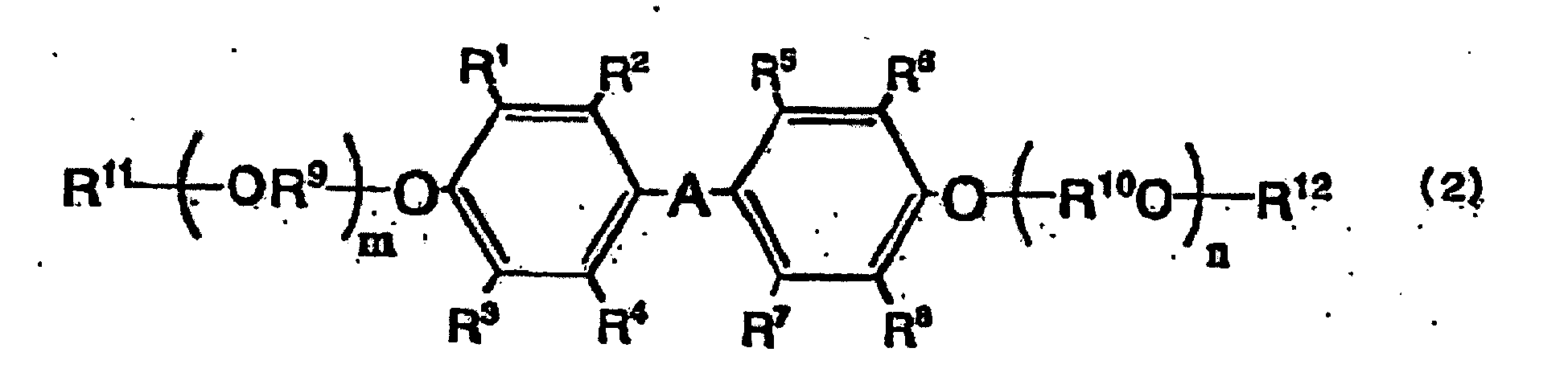
- Polyamidharzzusammensetzung gemäß einem der Ansprüche 1 bis 8, wobei das Verhältnis des Quellglimmers mit einem zirkulären Äquivalentdurchmesser [D] von 300 nm oder weniger in der Zusammensetzung 20% oder mehr ist.
- Polyamidharzzusammensetzung gemäß einem der Ansprüche 1 bis 9, wobei das Mittel des zirkulären Äquivalentdurchmessers [D] des Quellglimmers in der Polyamidharzzusammensetzung 500 nm oder weniger ist.
- Polyamidharzzusammensetzung gemäß einem der Ansprüche 1 bis 10, wobei die mittlere Schichtdicke des Quellglimmers in der Polyamidharzzusammensetzung 50 nm oder weniger ist.
- Polyamidharzzusammensetzung gemäß einem der Ansprüche 1 bis 11, wobei die maximale Schichtdicke des Quellglimmers in der Polyamidharzzusammensetzung 200 nm oder weniger ist.
- Polyamidharzzusammensetzung gemäß einem der Ansprüche 1 bis 12, wobei die Anzahl [N] an Teilchen pro Einheitsgewichtsverhältnis des Quellglimmers in der Polyamidharzzusammensetzung 30 oder mehr ist.
- Polyamidharzzusammensetzung gemäß einem der Ansprüche 1 bis 13, wobei das mittlere Seitenverhältnis (Schichtlänge/Schichtdicke) des Quellglimmers in der Polyamidharzzusammensetzung 10 bis 300 ist.
- Polyamidharzzusammensetzung gemäß einem der Ansprüche 1 bis 14, wobei der Gehalt des Quellglimmers in der Polyamidharzzusammensetzung im Bereich von 0,5 bis 30 Gew.-% ist.
- Polyamidharzzusammensetzung gemäß Anspruch 1 oder 2, erhältlich durch Mischen dieser Komponenten.
- Verfahren zur Herstellung einer Polyamidhaizzusammensetzung, umfassend das Schmelzmischen der Komponenten der Polyamidharzzusammensetzung gemäß Anspruch 1 oder 2.
- Harzformkörper, vollständig oder teilweise bestehend aus der Polyamidharzzusammensetzung gemäß einem der Ansprüche 1 bis 16.
- Automobilteil, umfassend den Harzformkörper gemäß Anspruch 18.
Applications Claiming Priority (9)
| Application Number | Priority Date | Filing Date | Title |
|---|---|---|---|
| JP2002214446 | 2002-07-23 | ||
| JP2002214446 | 2002-07-23 | ||
| JP2002301567 | 2002-10-16 | ||
| JP2002301567 | 2002-10-16 | ||
| JP2002303843 | 2002-10-18 | ||
| JP2002303843 | 2002-10-18 | ||
| JP2003047358 | 2003-02-25 | ||
| JP2003047358 | 2003-02-25 | ||
| PCT/JP2003/009306 WO2004016693A1 (ja) | 2002-07-23 | 2003-07-23 | ポリアミド樹脂組成物及びその製造方法 |
Publications (3)
| Publication Number | Publication Date |
|---|---|
| EP1553141A1 EP1553141A1 (de) | 2005-07-13 |
| EP1553141A4 EP1553141A4 (de) | 2005-09-21 |
| EP1553141B1 true EP1553141B1 (de) | 2008-05-28 |
Family
ID=31892180
Family Applications (1)
| Application Number | Title | Priority Date | Filing Date |
|---|---|---|---|
| EP03788013A Expired - Lifetime EP1553141B1 (de) | 2002-07-23 | 2003-07-23 | Polyamidharzzusammensetzung und herstellungsverfahren dafür |
Country Status (8)
| Country | Link |
|---|---|
| US (1) | US7259196B2 (de) |
| EP (1) | EP1553141B1 (de) |
| JP (1) | JP4542035B2 (de) |
| CN (1) | CN1313537C (de) |
| AU (1) | AU2003252236A1 (de) |
| CA (1) | CA2491746C (de) |
| DE (1) | DE60321370D1 (de) |
| WO (1) | WO2004016693A1 (de) |
Families Citing this family (8)
| Publication number | Priority date | Publication date | Assignee | Title |
|---|---|---|---|---|
| JP4001156B2 (ja) * | 2005-04-01 | 2007-10-31 | 東洋紡績株式会社 | ポリアミド系混合樹脂フィルムロール、およびその製造方法 |
| JP4750470B2 (ja) * | 2005-05-25 | 2011-08-17 | 住友ゴム工業株式会社 | インナーライナー用ゴム組成物 |
| JP3829864B1 (ja) * | 2005-06-22 | 2006-10-04 | 東洋紡績株式会社 | ポリアミド系混合樹脂積層フィルムロール、およびその製造方法 |
| FR2922552B1 (fr) * | 2007-10-19 | 2013-03-08 | Rhodia Operations | Composition polyamide chargee par des fibres |
| KR101863740B1 (ko) * | 2011-01-17 | 2018-06-01 | 주식회사 쿠라레 | 수지 조성물 및 그것을 포함하는 성형품 |
| US9902854B2 (en) | 2015-12-14 | 2018-02-27 | Hyundai Motor Company | Polyamide composite resin composition for fuel filler pipe |
| US11318532B2 (en) | 2017-07-19 | 2022-05-03 | Hewlett-Packard Development Company, L.P. | Three-dimensional (3D) printing |
| CN111621144B (zh) * | 2020-05-18 | 2022-09-13 | 中广核俊尔(浙江)新材料有限公司 | 一种耐氯化钙的尼龙复合材料及其制备方法 |
Family Cites Families (52)
| Publication number | Priority date | Publication date | Assignee | Title |
|---|---|---|---|---|
| US3134746A (en) * | 1961-06-09 | 1964-05-26 | Borg Warner | Blends of epsilon caprolactam polymer and graft copolymer alkenyl cyanide and alkenyl substituted aromatic hydrocarbon on polybutadiene |
| US3267175A (en) * | 1961-07-21 | 1966-08-16 | Borg Warner | Blends of epsilon caprolactam, low butadiene acrylonitrile-butadiene-styrene graft copolymer and high butadiene acrylonitrile-butadiene-styrene graft copolymer |
| US3218371A (en) * | 1961-07-31 | 1965-11-16 | Borg Warner | Blends of (1) epsilon caprolactam, (2) rubbery butadiene-acrylonitrile copolymers, and (3) resinous styrene-acrylonitrile copolymers |
| JPH0822946B2 (ja) | 1985-09-30 | 1996-03-06 | 株式会社豊田中央研究所 | 複合材料 |
| JPS63179957A (ja) | 1987-01-22 | 1988-07-23 | Toray Ind Inc | 熱可塑性樹脂組成物 |
| JPH0739540B2 (ja) | 1988-09-06 | 1995-05-01 | 宇部興産株式会社 | 液体または気体バリヤー性を有する成形品用材料 |
| JP3017233B2 (ja) * | 1990-01-19 | 2000-03-06 | 宇部興産株式会社 | 樹脂組成物 |
| JPH04120167A (ja) | 1990-09-11 | 1992-04-21 | Mitsubishi Rayon Co Ltd | 耐衝撃性、耐熱安定性に優れた熱可塑性樹脂組成物 |
| JPH04332758A (ja) | 1991-05-08 | 1992-11-19 | Mitsubishi Rayon Co Ltd | 耐衝撃性、耐熱安定性に優れた樹脂組成物 |
| JP3135298B2 (ja) | 1991-08-15 | 2001-02-13 | 旭化成工業株式会社 | 熱可塑性樹脂成形体 |
| JPH06200087A (ja) | 1992-02-26 | 1994-07-19 | Tonen Chem Corp | 繊維強化ポリマー組成物 |
| JPH0680873A (ja) | 1992-08-28 | 1994-03-22 | Ube Ind Ltd | フィルム用ポリアミド樹脂組成物 |
| JP3403433B2 (ja) | 1992-10-29 | 2003-05-06 | 旭化成株式会社 | ウエルド強度の改良された樹脂組成物及びその製法 |
| JP2941159B2 (ja) | 1992-12-29 | 1999-08-25 | ユニチカ株式会社 | 強化ポリアミド樹脂組成物およびその製造法 |
| JPH06228435A (ja) | 1993-02-02 | 1994-08-16 | Mitsubishi Kasei Corp | ポリアミド樹脂組成物及びその製造方法 |
| JPH06234896A (ja) | 1993-02-09 | 1994-08-23 | Showa Denko Kk | 強化ポリアミド樹脂組成物 |
| JP2821976B2 (ja) | 1993-06-30 | 1998-11-05 | 日工株式会社 | アスファルトプラントの印字記録による品質管理方法 |
| JPH07108619A (ja) | 1993-10-08 | 1995-04-25 | Tonen Chem Corp | 繊維強化ポリマー組成物及びそれを用いた樹脂製ラジエータタンク |
| CN1035771C (zh) * | 1993-12-23 | 1997-09-03 | 旭化成工业株式会社 | 聚酰胺树脂组合物 |
| JPH07205310A (ja) | 1994-01-18 | 1995-08-08 | Mitsubishi Rayon Co Ltd | 炭素繊維複合材料 |
| JPH08134345A (ja) * | 1994-03-28 | 1996-05-28 | Unitika Ltd | 樹脂組成物 |
| JPH07331029A (ja) | 1994-06-01 | 1995-12-19 | Mitsubishi Eng Plast Kk | ポリアセタール樹脂組成物 |
| JP3385103B2 (ja) | 1994-06-24 | 2003-03-10 | ユニチカ株式会社 | 樹脂組成物 |
| JPH08143768A (ja) | 1994-11-16 | 1996-06-04 | Kanegafuchi Chem Ind Co Ltd | 耐熱性熱可塑性樹脂組成物 |
| JPH08283567A (ja) | 1995-04-13 | 1996-10-29 | Unitika Ltd | ガスバリヤー性ポリアミド樹脂成形品 |
| JP3458528B2 (ja) | 1995-05-26 | 2003-10-20 | 三菱化学株式会社 | ポリアミド樹脂組成物、及びフィルム |
| US5760121A (en) | 1995-06-07 | 1998-06-02 | Amcol International Corporation | Intercalates and exfoliates formed with oligomers and polymers and composite materials containing same |
| JPH0912873A (ja) | 1995-07-05 | 1997-01-14 | Unitika Ltd | 熱可塑性樹脂組成物 |
| ES2208762T3 (es) | 1995-09-26 | 2004-06-16 | Ec-Showa Denko K.K. | Metodo de produccion de composicion de resina que contiene substancia de relleno inorganica. |
| JPH09217006A (ja) | 1996-02-10 | 1997-08-19 | Kanegafuchi Chem Ind Co Ltd | 耐熱性熱可塑性樹脂組成物 |
| JPH09241505A (ja) | 1996-03-04 | 1997-09-16 | Unitika Ltd | ポリアミド樹脂組成物 |
| JPH10237316A (ja) | 1997-02-27 | 1998-09-08 | Mitsubishi Eng Plast Kk | 導電性樹脂組成物 |
| JP3720161B2 (ja) * | 1997-03-18 | 2005-11-24 | 株式会社カネカ | 粘土層間化合物、粘土層間化合物と熱可塑性樹脂からなる熱可塑性樹脂組成物、およびそれらの製法 |
| JPH10279752A (ja) | 1997-04-03 | 1998-10-20 | Mitsui Chem Inc | 樹脂組成物 |
| JP3720164B2 (ja) * | 1997-05-01 | 2005-11-24 | 株式会社カネカ | 膨潤性雲母層間化合物およびそれを含む熱可塑性樹脂組成物 |
| JP4177554B2 (ja) * | 1997-10-30 | 2008-11-05 | 株式会社カネカ | ポリエステル樹脂組成物およびその製造方法 |
| JPH11181277A (ja) | 1997-12-17 | 1999-07-06 | Showa Denko Kk | ポリアミド系樹脂組成物 |
| JPH11310701A (ja) | 1998-04-28 | 1999-11-09 | Mitsubishi Eng Plast Corp | ポリアミド樹脂組成物 |
| JPH11349811A (ja) | 1998-06-10 | 1999-12-21 | Toyobo Co Ltd | ポリエステルアミドエラストマー組成物及びその製造方法 |
| JP3715813B2 (ja) | 1999-01-22 | 2005-11-16 | 日本エイアンドエル株式会社 | 車両用外装部品 |
| JP2000212432A (ja) | 1999-01-28 | 2000-08-02 | Toray Ind Inc | ポリアミド樹脂組成物およびその製造方法 |
| JP2000290500A (ja) | 1999-04-07 | 2000-10-17 | Mitsubishi Gas Chem Co Inc | ポリアミド成形物 |
| JP2001002913A (ja) | 1999-06-17 | 2001-01-09 | Unitika Ltd | ポリアミド樹脂組成物 |
| JP3365755B2 (ja) * | 2000-02-10 | 2003-01-14 | 正和電工株式会社 | 有機廃棄物の分解処理システム |
| ATE239057T1 (de) * | 2000-02-15 | 2003-05-15 | Asahi Chemical Ind | Polyamidzusammensetzung |
| JP2001302911A (ja) * | 2000-02-15 | 2001-10-31 | Asahi Kasei Corp | ポリアミド樹脂組成物 |
| FR2807761B1 (fr) * | 2000-04-12 | 2002-06-21 | Rhodia Engineering Plastics Sa | C0mpositions polymeriques thermoplastiques |
| JP2001302845A (ja) | 2000-04-20 | 2001-10-31 | Toray Ind Inc | ポリアミド樹脂組成物 |
| JP2001329150A (ja) * | 2000-05-22 | 2001-11-27 | Kanegafuchi Chem Ind Co Ltd | ポリエステル樹脂組成物 |
| CA2409858C (en) * | 2000-05-19 | 2010-03-30 | Kaneka Corporation | Polyester resin composition and process for the preparation thereof |
| DE60236091D1 (de) * | 2001-07-24 | 2010-06-02 | Kaneka Corp | Oberflächenbehandelte anorganische partikel |
| JP5085819B2 (ja) * | 2001-07-25 | 2012-11-28 | 株式会社カネカ | 表面処理層状化合物 |
-
2003
- 2003-07-23 EP EP03788013A patent/EP1553141B1/de not_active Expired - Lifetime
- 2003-07-23 CA CA2491746A patent/CA2491746C/en not_active Expired - Fee Related
- 2003-07-23 AU AU2003252236A patent/AU2003252236A1/en not_active Abandoned
- 2003-07-23 WO PCT/JP2003/009306 patent/WO2004016693A1/ja not_active Ceased
- 2003-07-23 CN CNB038173786A patent/CN1313537C/zh not_active Expired - Fee Related
- 2003-07-23 DE DE60321370T patent/DE60321370D1/de not_active Expired - Lifetime
- 2003-07-23 JP JP2005502024A patent/JP4542035B2/ja not_active Expired - Fee Related
- 2003-07-23 US US10/519,544 patent/US7259196B2/en not_active Expired - Fee Related
Also Published As
| Publication number | Publication date |
|---|---|
| WO2004016693A1 (ja) | 2004-02-26 |
| JPWO2004016693A1 (ja) | 2005-12-02 |
| JP4542035B2 (ja) | 2010-09-08 |
| CN1671797A (zh) | 2005-09-21 |
| US20060058424A1 (en) | 2006-03-16 |
| CA2491746A1 (en) | 2004-02-26 |
| CN1313537C (zh) | 2007-05-02 |
| CA2491746C (en) | 2010-09-28 |
| DE60321370D1 (de) | 2008-07-10 |
| EP1553141A4 (de) | 2005-09-21 |
| US7259196B2 (en) | 2007-08-21 |
| EP1553141A1 (de) | 2005-07-13 |
| AU2003252236A1 (en) | 2004-03-03 |
Similar Documents
| Publication | Publication Date | Title |
|---|---|---|
| JP5674257B2 (ja) | 高熱伝導性熱可塑性樹脂組成物 | |
| JP3705599B2 (ja) | 導電性マスターバッチ及び導電性樹脂組成物 | |
| JP3117030B2 (ja) | 低光沢の熱可塑性樹脂組成物 | |
| US7259196B2 (en) | Polyamide resin composition and process for producing the same | |
| JP5239664B2 (ja) | 自動車内装部品用熱可塑性樹脂組成物および成形品 | |
| JP2002146206A (ja) | 熱可塑性樹脂組成物 | |
| JP5397977B2 (ja) | 共連続構造を有する樹脂組成物 | |
| JP4786830B2 (ja) | 強化ポリエステル樹脂組成物 | |
| JP5450167B2 (ja) | 軋み音を低減した自動車内装部品 | |
| KR20140086738A (ko) | 수지 조성물 및 이를 포함한 성형품 | |
| JP3288911B2 (ja) | ポリカーボネート樹脂組成物及びその成形品 | |
| JP3306899B2 (ja) | 熱可塑性樹脂組成物及び樹脂成形品 | |
| JP5752505B2 (ja) | 熱可塑性樹脂組成物 | |
| JP3456416B2 (ja) | 樹脂組成物 | |
| JP5066310B2 (ja) | 導電性樹脂組成物 | |
| JP2011057719A (ja) | 高性能ポリフェニレンスルフィド系樹脂組成物およびその製造方法 | |
| JP2001172499A (ja) | 熱可塑性樹脂組成物 | |
| WO2005056678A1 (ja) | ポリエステル樹脂組成物および成形体 | |
| JPH03153757A (ja) | ポリフェニレンサルファイド系樹脂組成物 | |
| JP2004352816A (ja) | 導電性熱可塑性樹脂組成物 | |
| JP4001589B2 (ja) | 樹脂組成物の製造方法 | |
| JP5726977B2 (ja) | 軋み音を低減した自動車内装部品 | |
| EP4349912A1 (de) | Leitfähige harzzusammensetzung, verfahren zur herstellung davon und formprodukt damit | |
| JP2004269810A (ja) | 導電性熱可塑性樹脂組成物 | |
| JP3617716B2 (ja) | ポリカーボネート系樹脂組成物 |
Legal Events
| Date | Code | Title | Description |
|---|---|---|---|
| PUAI | Public reference made under article 153(3) epc to a published international application that has entered the european phase |
Free format text: ORIGINAL CODE: 0009012 |
|
| 17P | Request for examination filed |
Effective date: 20050210 |
|
| AK | Designated contracting states |
Kind code of ref document: A1 Designated state(s): AT BE BG CH CY CZ DE DK EE ES FI FR GB GR HU IE IT LI LU MC NL PT RO SE SI SK TR |
|
| AX | Request for extension of the european patent |
Extension state: AL LT LV MK |
|
| A4 | Supplementary search report drawn up and despatched |
Effective date: 20050810 |
|
| RIC1 | Information provided on ipc code assigned before grant |
Ipc: 7C 08K 9/08 B Ipc: 7C 08K 3/04 B Ipc: 7C 08L 77/06 B Ipc: 7C 08L 77/02 B Ipc: 7C 08K 9/04 B Ipc: 7C 08L 77/00 A Ipc: 7C 08K 7/06 B |
|
| DAX | Request for extension of the european patent (deleted) | ||
| RBV | Designated contracting states (corrected) |
Designated state(s): DE FR GB |
|
| 17Q | First examination report despatched |
Effective date: 20061212 |
|
| GRAP | Despatch of communication of intention to grant a patent |
Free format text: ORIGINAL CODE: EPIDOSNIGR1 |
|
| GRAS | Grant fee paid |
Free format text: ORIGINAL CODE: EPIDOSNIGR3 |
|
| GRAA | (expected) grant |
Free format text: ORIGINAL CODE: 0009210 |
|
| RIN1 | Information on inventor provided before grant (corrected) |
Inventor name: MEKATA, TETSUO Inventor name: ONO, YOSHITAKA Inventor name: MIYANO, ATSUSHI Inventor name: SUZUKI, NORIYUKI Inventor name: HARA, KAZUHIRO |
|
| AK | Designated contracting states |
Kind code of ref document: B1 Designated state(s): DE FR GB |
|
| REG | Reference to a national code |
Ref country code: GB Ref legal event code: FG4D |
|
| REF | Corresponds to: |
Ref document number: 60321370 Country of ref document: DE Date of ref document: 20080710 Kind code of ref document: P |
|
| PLBE | No opposition filed within time limit |
Free format text: ORIGINAL CODE: 0009261 |
|
| STAA | Information on the status of an ep patent application or granted ep patent |
Free format text: STATUS: NO OPPOSITION FILED WITHIN TIME LIMIT |
|
| 26N | No opposition filed |
Effective date: 20090303 |
|
| REG | Reference to a national code |
Ref country code: FR Ref legal event code: CA Effective date: 20130416 |
|
| PGFP | Annual fee paid to national office [announced via postgrant information from national office to epo] |
Ref country code: GB Payment date: 20130717 Year of fee payment: 11 |
|
| GBPC | Gb: european patent ceased through non-payment of renewal fee |
Effective date: 20140723 |
|
| PG25 | Lapsed in a contracting state [announced via postgrant information from national office to epo] |
Ref country code: GB Free format text: LAPSE BECAUSE OF NON-PAYMENT OF DUE FEES Effective date: 20140723 |
|
| REG | Reference to a national code |
Ref country code: FR Ref legal event code: PLFP Year of fee payment: 13 |
|
| PGFP | Annual fee paid to national office [announced via postgrant information from national office to epo] |
Ref country code: FR Payment date: 20150629 Year of fee payment: 13 |
|
| PG25 | Lapsed in a contracting state [announced via postgrant information from national office to epo] |
Ref country code: FR Free format text: LAPSE BECAUSE OF NON-PAYMENT OF DUE FEES Effective date: 20160801 |
|
| REG | Reference to a national code |
Ref country code: FR Ref legal event code: ST Effective date: 20170331 |
|
| PGFP | Annual fee paid to national office [announced via postgrant information from national office to epo] |
Ref country code: DE Payment date: 20170719 Year of fee payment: 15 |
|
| REG | Reference to a national code |
Ref country code: DE Ref legal event code: R119 Ref document number: 60321370 Country of ref document: DE |
|
| PG25 | Lapsed in a contracting state [announced via postgrant information from national office to epo] |
Ref country code: DE Free format text: LAPSE BECAUSE OF NON-PAYMENT OF DUE FEES Effective date: 20190201 |