EP1550707B1 - Metallorganische komplexe, organische elektrolumineszenzvorrichtungen und organische elektrolumineszenzdisplays - Google Patents
Metallorganische komplexe, organische elektrolumineszenzvorrichtungen und organische elektrolumineszenzdisplays Download PDFInfo
- Publication number
- EP1550707B1 EP1550707B1 EP03791337.3A EP03791337A EP1550707B1 EP 1550707 B1 EP1550707 B1 EP 1550707B1 EP 03791337 A EP03791337 A EP 03791337A EP 1550707 B1 EP1550707 B1 EP 1550707B1
- Authority
- EP
- European Patent Office
- Prior art keywords
- atom
- organic
- light
- rhenium
- coordinated
- Prior art date
- Legal status (The legal status is an assumption and is not a legal conclusion. Google has not performed a legal analysis and makes no representation as to the accuracy of the status listed.)
- Expired - Lifetime
Links
- FAPAYFVQRWGSEZ-XFLHRZQPSA-N C[C@H]1C23N(C4(C)C=CC(c(cc5)ccc5-[n]5c(cccc6)c6c6c5cccc6)=CC4)c(cccc4)c4C2=CC=CC13 Chemical compound C[C@H]1C23N(C4(C)C=CC(c(cc5)ccc5-[n]5c(cccc6)c6c6c5cccc6)=CC4)c(cccc4)c4C2=CC=CC13 FAPAYFVQRWGSEZ-XFLHRZQPSA-N 0.000 description 1
Images



Classifications
-
- C—CHEMISTRY; METALLURGY
- C07—ORGANIC CHEMISTRY
- C07F—ACYCLIC, CARBOCYCLIC OR HETEROCYCLIC COMPOUNDS CONTAINING ELEMENTS OTHER THAN CARBON, HYDROGEN, HALOGEN, OXYGEN, NITROGEN, SULFUR, SELENIUM OR TELLURIUM
- C07F13/00—Compounds containing elements of Groups 7 or 17 of the Periodic Table
- C07F13/005—Compounds without a metal-carbon linkage
-
- C—CHEMISTRY; METALLURGY
- C07—ORGANIC CHEMISTRY
- C07F—ACYCLIC, CARBOCYCLIC OR HETEROCYCLIC COMPOUNDS CONTAINING ELEMENTS OTHER THAN CARBON, HYDROGEN, HALOGEN, OXYGEN, NITROGEN, SULFUR, SELENIUM OR TELLURIUM
- C07F13/00—Compounds containing elements of Groups 7 or 17 of the Periodic Table
-
- C—CHEMISTRY; METALLURGY
- C09—DYES; PAINTS; POLISHES; NATURAL RESINS; ADHESIVES; COMPOSITIONS NOT OTHERWISE PROVIDED FOR; APPLICATIONS OF MATERIALS NOT OTHERWISE PROVIDED FOR
- C09K—MATERIALS FOR MISCELLANEOUS APPLICATIONS, NOT PROVIDED FOR ELSEWHERE
- C09K11/00—Luminescent materials, e.g. electroluminescent or chemiluminescent
- C09K11/06—Luminescent materials, e.g. electroluminescent or chemiluminescent containing organic luminescent materials
-
- H—ELECTRICITY
- H05—ELECTRIC TECHNIQUES NOT OTHERWISE PROVIDED FOR
- H05B—ELECTRIC HEATING; ELECTRIC LIGHT SOURCES NOT OTHERWISE PROVIDED FOR; CIRCUIT ARRANGEMENTS FOR ELECTRIC LIGHT SOURCES, IN GENERAL
- H05B33/00—Electroluminescent light sources
- H05B33/12—Light sources with substantially two-dimensional [2D] radiating surfaces
-
- H—ELECTRICITY
- H05—ELECTRIC TECHNIQUES NOT OTHERWISE PROVIDED FOR
- H05B—ELECTRIC HEATING; ELECTRIC LIGHT SOURCES NOT OTHERWISE PROVIDED FOR; CIRCUIT ARRANGEMENTS FOR ELECTRIC LIGHT SOURCES, IN GENERAL
- H05B33/00—Electroluminescent light sources
- H05B33/12—Light sources with substantially two-dimensional [2D] radiating surfaces
- H05B33/14—Light sources with substantially two-dimensional [2D] radiating surfaces characterised by the chemical or physical composition or the arrangement of the electroluminescent material, or by the simultaneous addition of the electroluminescent material in or onto the light source
-
- H—ELECTRICITY
- H10—SEMICONDUCTOR DEVICES; ELECTRIC SOLID-STATE DEVICES NOT OTHERWISE PROVIDED FOR
- H10K—ORGANIC ELECTRIC SOLID-STATE DEVICES
- H10K85/00—Organic materials used in the body or electrodes of devices covered by this subclass
- H10K85/30—Coordination compounds
- H10K85/341—Transition metal complexes, e.g. Ru(II)polypyridine complexes
-
- H—ELECTRICITY
- H10—SEMICONDUCTOR DEVICES; ELECTRIC SOLID-STATE DEVICES NOT OTHERWISE PROVIDED FOR
- H10K—ORGANIC ELECTRIC SOLID-STATE DEVICES
- H10K85/00—Organic materials used in the body or electrodes of devices covered by this subclass
- H10K85/30—Coordination compounds
- H10K85/341—Transition metal complexes, e.g. Ru(II)polypyridine complexes
- H10K85/346—Transition metal complexes, e.g. Ru(II)polypyridine complexes comprising platinum
-
- H—ELECTRICITY
- H10—SEMICONDUCTOR DEVICES; ELECTRIC SOLID-STATE DEVICES NOT OTHERWISE PROVIDED FOR
- H10K—ORGANIC ELECTRIC SOLID-STATE DEVICES
- H10K85/00—Organic materials used in the body or electrodes of devices covered by this subclass
- H10K85/60—Organic compounds having low molecular weight
- H10K85/649—Aromatic compounds comprising a hetero atom
- H10K85/656—Aromatic compounds comprising a hetero atom comprising two or more different heteroatoms per ring
- H10K85/6565—Oxadiazole compounds
-
- C—CHEMISTRY; METALLURGY
- C09—DYES; PAINTS; POLISHES; NATURAL RESINS; ADHESIVES; COMPOSITIONS NOT OTHERWISE PROVIDED FOR; APPLICATIONS OF MATERIALS NOT OTHERWISE PROVIDED FOR
- C09K—MATERIALS FOR MISCELLANEOUS APPLICATIONS, NOT PROVIDED FOR ELSEWHERE
- C09K2211/00—Chemical nature of organic luminescent or tenebrescent compounds
- C09K2211/10—Non-macromolecular compounds
-
- C—CHEMISTRY; METALLURGY
- C09—DYES; PAINTS; POLISHES; NATURAL RESINS; ADHESIVES; COMPOSITIONS NOT OTHERWISE PROVIDED FOR; APPLICATIONS OF MATERIALS NOT OTHERWISE PROVIDED FOR
- C09K—MATERIALS FOR MISCELLANEOUS APPLICATIONS, NOT PROVIDED FOR ELSEWHERE
- C09K2211/00—Chemical nature of organic luminescent or tenebrescent compounds
- C09K2211/10—Non-macromolecular compounds
- C09K2211/1003—Carbocyclic compounds
- C09K2211/1007—Non-condensed systems
-
- C—CHEMISTRY; METALLURGY
- C09—DYES; PAINTS; POLISHES; NATURAL RESINS; ADHESIVES; COMPOSITIONS NOT OTHERWISE PROVIDED FOR; APPLICATIONS OF MATERIALS NOT OTHERWISE PROVIDED FOR
- C09K—MATERIALS FOR MISCELLANEOUS APPLICATIONS, NOT PROVIDED FOR ELSEWHERE
- C09K2211/00—Chemical nature of organic luminescent or tenebrescent compounds
- C09K2211/10—Non-macromolecular compounds
- C09K2211/1003—Carbocyclic compounds
- C09K2211/1011—Condensed systems
-
- C—CHEMISTRY; METALLURGY
- C09—DYES; PAINTS; POLISHES; NATURAL RESINS; ADHESIVES; COMPOSITIONS NOT OTHERWISE PROVIDED FOR; APPLICATIONS OF MATERIALS NOT OTHERWISE PROVIDED FOR
- C09K—MATERIALS FOR MISCELLANEOUS APPLICATIONS, NOT PROVIDED FOR ELSEWHERE
- C09K2211/00—Chemical nature of organic luminescent or tenebrescent compounds
- C09K2211/10—Non-macromolecular compounds
- C09K2211/1018—Heterocyclic compounds
- C09K2211/1022—Heterocyclic compounds bridged by heteroatoms, e.g. N, P, Si or B
-
- C—CHEMISTRY; METALLURGY
- C09—DYES; PAINTS; POLISHES; NATURAL RESINS; ADHESIVES; COMPOSITIONS NOT OTHERWISE PROVIDED FOR; APPLICATIONS OF MATERIALS NOT OTHERWISE PROVIDED FOR
- C09K—MATERIALS FOR MISCELLANEOUS APPLICATIONS, NOT PROVIDED FOR ELSEWHERE
- C09K2211/00—Chemical nature of organic luminescent or tenebrescent compounds
- C09K2211/10—Non-macromolecular compounds
- C09K2211/1018—Heterocyclic compounds
- C09K2211/1025—Heterocyclic compounds characterised by ligands
- C09K2211/1029—Heterocyclic compounds characterised by ligands containing one nitrogen atom as the heteroatom
-
- C—CHEMISTRY; METALLURGY
- C09—DYES; PAINTS; POLISHES; NATURAL RESINS; ADHESIVES; COMPOSITIONS NOT OTHERWISE PROVIDED FOR; APPLICATIONS OF MATERIALS NOT OTHERWISE PROVIDED FOR
- C09K—MATERIALS FOR MISCELLANEOUS APPLICATIONS, NOT PROVIDED FOR ELSEWHERE
- C09K2211/00—Chemical nature of organic luminescent or tenebrescent compounds
- C09K2211/10—Non-macromolecular compounds
- C09K2211/1018—Heterocyclic compounds
- C09K2211/1025—Heterocyclic compounds characterised by ligands
- C09K2211/1029—Heterocyclic compounds characterised by ligands containing one nitrogen atom as the heteroatom
- C09K2211/1037—Heterocyclic compounds characterised by ligands containing one nitrogen atom as the heteroatom with sulfur
-
- C—CHEMISTRY; METALLURGY
- C09—DYES; PAINTS; POLISHES; NATURAL RESINS; ADHESIVES; COMPOSITIONS NOT OTHERWISE PROVIDED FOR; APPLICATIONS OF MATERIALS NOT OTHERWISE PROVIDED FOR
- C09K—MATERIALS FOR MISCELLANEOUS APPLICATIONS, NOT PROVIDED FOR ELSEWHERE
- C09K2211/00—Chemical nature of organic luminescent or tenebrescent compounds
- C09K2211/10—Non-macromolecular compounds
- C09K2211/1018—Heterocyclic compounds
- C09K2211/1025—Heterocyclic compounds characterised by ligands
- C09K2211/1044—Heterocyclic compounds characterised by ligands containing two nitrogen atoms as heteroatoms
-
- C—CHEMISTRY; METALLURGY
- C09—DYES; PAINTS; POLISHES; NATURAL RESINS; ADHESIVES; COMPOSITIONS NOT OTHERWISE PROVIDED FOR; APPLICATIONS OF MATERIALS NOT OTHERWISE PROVIDED FOR
- C09K—MATERIALS FOR MISCELLANEOUS APPLICATIONS, NOT PROVIDED FOR ELSEWHERE
- C09K2211/00—Chemical nature of organic luminescent or tenebrescent compounds
- C09K2211/10—Non-macromolecular compounds
- C09K2211/1018—Heterocyclic compounds
- C09K2211/1025—Heterocyclic compounds characterised by ligands
- C09K2211/1088—Heterocyclic compounds characterised by ligands containing oxygen as the only heteroatom
-
- C—CHEMISTRY; METALLURGY
- C09—DYES; PAINTS; POLISHES; NATURAL RESINS; ADHESIVES; COMPOSITIONS NOT OTHERWISE PROVIDED FOR; APPLICATIONS OF MATERIALS NOT OTHERWISE PROVIDED FOR
- C09K—MATERIALS FOR MISCELLANEOUS APPLICATIONS, NOT PROVIDED FOR ELSEWHERE
- C09K2211/00—Chemical nature of organic luminescent or tenebrescent compounds
- C09K2211/10—Non-macromolecular compounds
- C09K2211/1018—Heterocyclic compounds
- C09K2211/1025—Heterocyclic compounds characterised by ligands
- C09K2211/1092—Heterocyclic compounds characterised by ligands containing sulfur as the only heteroatom
-
- C—CHEMISTRY; METALLURGY
- C09—DYES; PAINTS; POLISHES; NATURAL RESINS; ADHESIVES; COMPOSITIONS NOT OTHERWISE PROVIDED FOR; APPLICATIONS OF MATERIALS NOT OTHERWISE PROVIDED FOR
- C09K—MATERIALS FOR MISCELLANEOUS APPLICATIONS, NOT PROVIDED FOR ELSEWHERE
- C09K2211/00—Chemical nature of organic luminescent or tenebrescent compounds
- C09K2211/18—Metal complexes
- C09K2211/185—Metal complexes of the platinum group, i.e. Os, Ir, Pt, Ru, Rh or Pd
-
- C—CHEMISTRY; METALLURGY
- C09—DYES; PAINTS; POLISHES; NATURAL RESINS; ADHESIVES; COMPOSITIONS NOT OTHERWISE PROVIDED FOR; APPLICATIONS OF MATERIALS NOT OTHERWISE PROVIDED FOR
- C09K—MATERIALS FOR MISCELLANEOUS APPLICATIONS, NOT PROVIDED FOR ELSEWHERE
- C09K2211/00—Chemical nature of organic luminescent or tenebrescent compounds
- C09K2211/18—Metal complexes
- C09K2211/187—Metal complexes of the iron group metals, i.e. Fe, Co or Ni
-
- C—CHEMISTRY; METALLURGY
- C09—DYES; PAINTS; POLISHES; NATURAL RESINS; ADHESIVES; COMPOSITIONS NOT OTHERWISE PROVIDED FOR; APPLICATIONS OF MATERIALS NOT OTHERWISE PROVIDED FOR
- C09K—MATERIALS FOR MISCELLANEOUS APPLICATIONS, NOT PROVIDED FOR ELSEWHERE
- C09K2211/00—Chemical nature of organic luminescent or tenebrescent compounds
- C09K2211/18—Metal complexes
- C09K2211/188—Metal complexes of other metals not provided for in one of the previous groups
-
- H—ELECTRICITY
- H10—SEMICONDUCTOR DEVICES; ELECTRIC SOLID-STATE DEVICES NOT OTHERWISE PROVIDED FOR
- H10K—ORGANIC ELECTRIC SOLID-STATE DEVICES
- H10K2101/00—Properties of the organic materials covered by group H10K85/00
- H10K2101/10—Triplet emission
-
- H—ELECTRICITY
- H10—SEMICONDUCTOR DEVICES; ELECTRIC SOLID-STATE DEVICES NOT OTHERWISE PROVIDED FOR
- H10K—ORGANIC ELECTRIC SOLID-STATE DEVICES
- H10K50/00—Organic light-emitting devices
- H10K50/10—OLEDs or polymer light-emitting diodes [PLED]
- H10K50/11—OLEDs or polymer light-emitting diodes [PLED] characterised by the electroluminescent [EL] layers
-
- H—ELECTRICITY
- H10—SEMICONDUCTOR DEVICES; ELECTRIC SOLID-STATE DEVICES NOT OTHERWISE PROVIDED FOR
- H10K—ORGANIC ELECTRIC SOLID-STATE DEVICES
- H10K59/00—Integrated devices, or assemblies of multiple devices, comprising at least one organic light-emitting element covered by group H10K50/00
- H10K59/30—Devices specially adapted for multicolour light emission
- H10K59/38—Devices specially adapted for multicolour light emission comprising colour filters or colour changing media [CCM]
-
- H—ELECTRICITY
- H10—SEMICONDUCTOR DEVICES; ELECTRIC SOLID-STATE DEVICES NOT OTHERWISE PROVIDED FOR
- H10K—ORGANIC ELECTRIC SOLID-STATE DEVICES
- H10K85/00—Organic materials used in the body or electrodes of devices covered by this subclass
- H10K85/10—Organic polymers or oligomers
- H10K85/111—Organic polymers or oligomers comprising aromatic, heteroaromatic, or aryl chains, e.g. polyaniline, polyphenylene or polyphenylene vinylene
-
- H—ELECTRICITY
- H10—SEMICONDUCTOR DEVICES; ELECTRIC SOLID-STATE DEVICES NOT OTHERWISE PROVIDED FOR
- H10K—ORGANIC ELECTRIC SOLID-STATE DEVICES
- H10K85/00—Organic materials used in the body or electrodes of devices covered by this subclass
- H10K85/30—Coordination compounds
- H10K85/321—Metal complexes comprising a group IIIA element, e.g. Tris (8-hydroxyquinoline) gallium [Gaq3]
- H10K85/324—Metal complexes comprising a group IIIA element, e.g. Tris (8-hydroxyquinoline) gallium [Gaq3] comprising aluminium, e.g. Alq3
-
- H—ELECTRICITY
- H10—SEMICONDUCTOR DEVICES; ELECTRIC SOLID-STATE DEVICES NOT OTHERWISE PROVIDED FOR
- H10K—ORGANIC ELECTRIC SOLID-STATE DEVICES
- H10K85/00—Organic materials used in the body or electrodes of devices covered by this subclass
- H10K85/60—Organic compounds having low molecular weight
-
- H—ELECTRICITY
- H10—SEMICONDUCTOR DEVICES; ELECTRIC SOLID-STATE DEVICES NOT OTHERWISE PROVIDED FOR
- H10K—ORGANIC ELECTRIC SOLID-STATE DEVICES
- H10K85/00—Organic materials used in the body or electrodes of devices covered by this subclass
- H10K85/60—Organic compounds having low molecular weight
- H10K85/615—Polycyclic condensed aromatic hydrocarbons, e.g. anthracene
-
- H—ELECTRICITY
- H10—SEMICONDUCTOR DEVICES; ELECTRIC SOLID-STATE DEVICES NOT OTHERWISE PROVIDED FOR
- H10K—ORGANIC ELECTRIC SOLID-STATE DEVICES
- H10K85/00—Organic materials used in the body or electrodes of devices covered by this subclass
- H10K85/60—Organic compounds having low molecular weight
- H10K85/631—Amine compounds having at least two aryl rest on at least one amine-nitrogen atom, e.g. triphenylamine
-
- H—ELECTRICITY
- H10—SEMICONDUCTOR DEVICES; ELECTRIC SOLID-STATE DEVICES NOT OTHERWISE PROVIDED FOR
- H10K—ORGANIC ELECTRIC SOLID-STATE DEVICES
- H10K85/00—Organic materials used in the body or electrodes of devices covered by this subclass
- H10K85/60—Organic compounds having low molecular weight
- H10K85/649—Aromatic compounds comprising a hetero atom
Definitions
- the present invention relates to an organometallic complex which exhibits phosphorescent, luminescence and is suitable as a luminescent material and color conversion material, etc., an organic EL element using the organometallic complex, and an organic EL display using the organometallic complex or organic EL element.
- An organic electroluminescent (EL) element has a structure in which one or a plurality of thin organic material layers is interposed between a negative electrode and a positive electrode.
- a hole and an electron are injected into the organic material layer from the positive electrode and the negative electrode, respectively, the recombination energy, which is generated when the hole and electron is recombined in the organic material layer, causes the emission center of the luminescent material in the organic material layer excited, and when electrons in the luminescent material falls from an excited state to a ground state, light is emitted.
- the organic EL is a light-emitting element which uses this emitted light.
- the organic EL element has features such as self-luminousness and rapid response, exhibits satisfactory visual properties, is super-slim and lightweight, and is excellent in rapid response and movie display. Thus, it receives high expectations to be applied to flat panel displays.
- a two-layer (multi-layer) organic EL element comprising an organic thin film having positive hole transport properties (positive hole transport layer) and an organic thin film having electron transport properties (electron transport layer) has been reported ( C. W. Tang and S. A. VanSlyke, Applied Physics Letters vol.51, p. 913 (1987 )
- organic EL elements have recently been attracting attention as a large area light-emitting element which emits light at a low voltage of 10V or less.
- the third method for example, a method in which emission from an organic EL element emitting blue light is converted into green (G) light and red (R) light by a color conversion layer using fluorescence ( JP-A No. 03-152897 ).
- a blue organic EL element is formed over the entire surface of the substrate, at blue pixels, emission is taken out without any conversion, and, at green pixels and red pixels, emission is taken out by converting the wavelength of light-emitting light from the blue organic EL element, display can be efficiently manufactured and theoretical value of light-emitting efficiency is expected to be high.
- fluorescent material is generally used, for example, when blue light-emitting light emitted by blue organic EL element are converted into red light by a color conversion layer, it is required that the luminescent material contained in the color conversion layer efficiently absorb blue light-emitting emitted from the blue organic EL element and conversion into red light is carried out at high quantum efficiency.
- red fluorescent material having a luminescence peak in red-light wavelength region 600 to 650nm
- green-light wavelength region 500 to 600nm
- a host material which efficiently absorbs blue light is used in combination with the red fluorescent material.
- blue light is converted in color to red light as follows. Specifically, the host material becomes an excited state by absorbing the blue light and when the host material returns to ground state from the excited state, energy, is emitted. The energy is absorbed by the red fluorescent material to thereby become an excited state and when the red fluorescent material returns to ground state from the excited state, red light is released.
- red fluorescent material in the color conversion layer where the red fluorescent material is used in combination with the host material, most of the red fluorescent material forms association state called excimer when it is dispersed in the host material at high concentration so that emitted light is remarkably weakened (concentration quenching) and light having a different wavelength from that of the original emitted light.
- concentration quenching concentration quenching
- red fluorescent material in order to obtain original emitted light, it is required that the red fluorescent material be dispersed in the host material at low concentration.
- the red fluorescent material in the host material at some level of high concentration.
- organic EL elements deteriorate according to various factors, for example, thermal factors, electrochemical factors, factors due to interface phenomena, etc.
- various kinds of organic EL element has been proposed in the related art ( JP-A No. 2002-334787 )
- an organic EL element which exhibits satisfactory light-emitting efficiency, lifetime and stability, etc. simultaneously has not been provided yet.
- luminescent material in the organic EL element the use of material exhibiting phosphorescent luminescence ( JP-A No. 2002-334787 ).
- aromatic dithiol is used as a ligand and when the ligand is used as a luminescent material, there is a problem that not only PL quantum efficiency is reduced but also light-emitting efficiency is reduced and half-brightness lifetime is extremely shortened due to decrease of resistance to light.
- the present invention was carried out in view of the current situation and has an object to solve conventional problems and to provide an organometallic complex exhibiting phosphorescent luminescence suitable for use as a luminescent material, color conversion material, etc. in an organic EL element, an organic EL element which has excellent lifetime, light emission efficiency, thermal and electrical stability, color conversion efficiency, etc. and is suitable for lighting units, display devices, etc., and an organic EL display using the organometallic complex or the organic EL element, which has high performance and long lifetime and is suitable for a color display in which a constant average driving current can be achieved regardless of light-emitting pixels and color balance is satisfactory without changing light-emitting area.
- organometallic complex exhibiting phosphorescent luminescence is suitable as a luminescent material and color conversion material in an organic EL element and an organic EL element and an organic EL display using the organometallic complex, for example, as a luminescent material, color conversion material, etc. have excellent lifetime and light-emitting efficiency, thermal and electrical stability, etc. and high performance.
- the present invention provides an organic EL element comprising: a positive electrode, a negative electrode, and an organic thin film layer disposed between the positive electrode and the negative electrode; wherein the organic thin film layer comprises an organometallic complex, wherein the organometallic complex comprises: a rhenium (Re) atom, one ligand which comprises a coordinated nitrogen atom and a coordinated oxygen atom, each coordinated with the rhenium (Re) atom, and comprises at least one n conjugation part, and the other ligand coordinated with the rhenium (Re) atom in such a way that the ligand saturates the coordination number of the rhenium (Re) atom and the charge of the whole organometallic complex is neutral; and wherein the organometallic complex is represented by a formula which is selected from the following formulas (1), (2) and (3): in which, in the formulas (1), (2) and (3), R 1 to R 4 may be the same or different, and each represent a hydrogen atom or a substituent
- the organic EL element comprises a color conversion layer, and the color conversion layer is capable of emitting phosphorescence and is capable of converting incident light into light having a wavelength longer than the wavelength thereof by 100 nm or more.
- the color conversion layer is capable of converting incident light into light having a wavelength longer than the wavelength thereof by 150 nm or more.
- the color conversion layer is capable of converting light in the wavelength range of ultraviolet light to blue light into red light.
- the color conversion layer comprises at least one selected from (1) an organometallic complex which comprises à rhenium (Re) atom; one ligand which comprises a coordinated nitrogen atom and a coordinated oxygen atom, each coordinated with the rhenium (Re) atom, and comprises at least one n conjugation part; and the other ligand coordinated with the rhenium (Re) atom in such a way that the 30 ligand saturates the coordination number of the rhenium (Re) atom and the charge of the whole organometallic complex is neutral, (2) an organometallic complex which comprises an rhenium (Re) atom; one ligand which comprises a coordinated nitrogen atom, a coordinated carbon atom, each coordinated with the rhenium (Re) atom, and 35 comprises at least one n conjugation part; and the other ligand coordinated with the rhenium (Re) atom in such a way that the ligand saturate the coordination number of the rhenium (Re) atom and the charge
- the organic EL element according to the above first aspect is used for lighting units.
- the present invention provides an organometallic complex which is represented by a formula which is selected from the following formulas (1), (2) and (3): in which, in the formulas (1), (2) and (3), R 1 to R 4 may be the same or different, and each represent a hydrogen atom or a substituent group; "i", “j", “k” and “l” are integers; Cy 1 represents one ring structure containing a coordinated nitrogen atom which is coordinated with a rhenium (Re) atom, and two carbon atoms which are bonded to the nitrogen atom and are shared with Cy 2 ; Cy 2 represents the other ring structure which is bonded to the oxygen atom bonded to a rhenium (Re) atom and contains the two carbon atoms shared with Cy 1 ; Cy 3 represents one ring structure containing a coordinated nitrogen atom which is coordinated with a rhenium (Re) atom, and a carbon atom which is bonded to the nitrogen atom and to a carbon atom in Cy 4 ; Cy 4 represents
- the organometallic complex is used as at least one of a luminescent material and a color conversion material.
- the present invention provides an organic EL display which comprises the organic EL element according to the above first aspect.
- the organic EL display further comprises:
- the EL display further comprises:
- the organic EL display further comprises:
- emission from organic substance is classified into fluorescence and phosphorescence by the properties of the excited state, but from the reason that organic substance does not generally generate phosphorescence, fluorescent materials have been conventionally used as a luminescent materials, color conversion material, etc. in an organic EL element.
- fluorescent materials have been conventionally used as a luminescent materials, color conversion material, etc. in an organic EL element.
- phosphorescent luminescence state is generated 4 times as much as the luminescence state, therefore, it is effective to apply a heavy metal complex generating phosphorescent luminescence at room temperature to a luminescent material for high efficiency of EL element and such complex has attracted attention in recent years.
- the organometallic complexes from the first organometallic complex to the third organometallic complex since phosphorescent luminescence is generated, high light-emitting efficiency of 100% at maximum can be achieved theoretically compared to the internal quantum efficiency of 25% at maximum of the EL element using fluorescent material.
- the organometallic complex is suitable as a luminescent material, color conversion material, etc. in an organic EL element, etc.
- organometallic complexes from the first organometallic complex to the third organometallic complex is used as a color conversion material of color conversion layer in the organic EL element, etc., it is not required to use a host material together in the color conversion layer and, for example, ultraviolet light or blue light can be directly converted into red light using only the organometallic complex.
- the color of the emitted light can be modified by varying the skeletal structure or substituents of the one ligand, or the other ligand.
- the metal center is rhenium (Re), which is a heavy metal with very high melting point and boiling point, the whole organometallic complex has excellent thermal and electrical stability.
- the one ligand is a bidentate ligand.
- a nitrogen atom and oxygen atom in the bidentate ligand are directly bonded to the rhenium (Re) atom.
- the one ligand (the bidentate ligand) exhibits strong interaction with the rhenium (Re) atom.
- an organic EL element or the like where the organometallic complex is used as luminescent material, color conversion material, etc. when electric field is applied to the organic EL element, strong interaction between the one ligand and the rhenium (Re) atom effectively prevents singlet and triplet excitons that are generated in the organic rhenium complex from deactivating as thermal energy, rotational energy or the like without radiation, and the energy is efficiently changed into light energy as fluorescence and phosphorescence.
- the organometallic complex is, for example, used as a luminescent material, color conversion material, etc. in an organic EL element, emission having excellent lifetime, high light-emitting efficiency, color conversion efficiency, etc. is obtained.
- a first organic EL element of the present invention includes an organic thin film layer disposed between a positive electrode and a negative electrode.
- the organic thin film layer includes any one of the organometallic complexes of Formula (1)-(3) as a luminescent material.
- the first organic EL element contains the organometallic complex of the present invention, it is excellent in lifetime and light-emitting efficiency, durability, etc.
- a second organic EL element of the present invention includes a color conversion layer, wherein, the color conversion layer includes any one of the organometallic complexes of Formula (1)-(3) as a color conversion material.
- the second organic EL element as the color conversion layer includes the organometallic complex of the present invention as a color conversion material, the second organic EL element is excellent in lifetime and color conversion efficiency, and by using only the organometallic complex without using host material together, for example, ultraviolet light or blue light can be directly converted into red light.
- organic EL elements of the present invention are, for example, particularly suitable for lighting units, display devices, etc.
- the organic EL display of the present invention uses at least one of the organic EL elements from the first organic EL element to the second organic EL of the present invention.
- the organic EL display uses the organic EL element of the present invention, it is excellent in lifetime and light-emitting efficiency, color conversion efficiency, etc.
- An organometallic complex of the present invention is an organic rhenium complex and comprises a rhenium (Re) atom; one ligand which has a coordinated nitrogen atom and a coordinated oxygen atom, each coordinated with the rhenium (Re) atom, and has at least one ⁇ conjugation part; and the other ligand coordinated with the rhenium (Re) atom in such a way that the ligand saturates the coordination number of the rhenium (Re) atom and the charge of the whole organic rhenium complex is neutral.
- the organic rhenium complex is represented by the following formulae (1) to (3):
- R 1 and R 2 may be the same or different, and each represent a hydrogen atom or a substituent group.
- substituent group may be selected according to the purpose, for example, a halogen atom, an alkoxy group, an amino group, an alkyl group, a cycloalkyl group, an aryl group which may contain a nitrogen atom or a sulfur atom, or an aryloxy group which may contain a nitrogen atom or a sulfur atom, and these themselves may be substituted.
- R 1 and R 2 may be joined together to form an aromatic ring which contains a nitrogen atom, a sulphur atom or an oxygen atom, and the aromatic ring may themselves be substituted by any substituent known in the art.
- Cy 1 is a ring having a coordinated nitrogen atom which is coordinated with a rhenium (Re) atom, and two carbon atoms which are bonded to this coordinated nitrogen and are shared with Cy 2 .
- Cy 2 is a ring which is bonded to the oxygen atom bonded to a rhenium (Re) atom and contains the two carbon atoms shared with Cy 1 .
- Cy 1 or Cy 2 there is no particular limitation on the ring represented by the Cy 1 or Cy 2 , and may be selected according to the purpose, suitable examples being 5-membered rings and 6-membered rings, and these rings may contain a carbon atom, a nitrogen atom, an oxygen atom or a sulfur atom.
- n is 1, 2, or 3, representing a coordination number of the one ligand coordinated with the rhenium (Re) atom bidentately, the one ligand comprising Cy 1 and Cy 2 .
- each of the one ligands may be the same or different.
- the letter "L” represents the other ligand which saturates the coordination number of the rhenium (Re) atom, and neutralizes the charge of the whole complex.
- the wavelength of the light emitted by the organic rhenium complex can be varied or adjusted as desired; such that a red light-emitting material, a green light-emitting material or a blue light-emitting material can be obtained.
- the other ligand provided that it saturates the coordination number of the rhenium (Re) atom and neutralizes the charge of the whole complex, and it may be selected according to the purpose, but suitable example is a group selected from a halogen atom, a carbonyl group, a cyano group, a hydroxyaryl group, a phenylisocyanide group, a pyridine group, an acetylacetonato group, a 2,2'-bipyridyl group, a 1,10-phenanthroline group, a cyclometalate and ligand group, and a triphenylphosphine group represented as follow.
- These groups may also be substituted by any substituents known in the art.
- Ar represents an aromatic ring or aromatic heterocyclic ring and these may also be substituted by any substituents.
- m represents an integer of 0 to 4. It is preferable to select "m” so that the coordination number of the rhenium (Re) atom in the organic rhenium complex is 6, which is a stable coordination number. If n is 1, m is preferably 4, if n is 2, m is preferably 2, and if n is 3, m is preferably 0.
- R 3 and R 4 is the same as R 1 and R 2 in the formula (1). Moreover, “i” and “j”, “n”, and, “L” and “m” are the same as those in the formula (1).
- the Cy 3 is a ring having a coordinated nitrogen atom which is coordinated with a rhenium (Re) atom, and a carbon atom which is bonded to this coordinated nitrogen and a carbon atom in Cy 4 .
- the Cy 4 is a ring having a carbon atom which is bonded to the oxygen atom bonded to a rhenium (Re) atom and a carbon atom which is bonded to carbon atom in Cy 3 .
- Cy 3 and Cy 4 there is no particular limitation on the ring represented by the Cy 3 and Cy 4 , and may be selected according to the purpose, suitable examples being 5-membered rings and 6-membered rings, and these rings may contain a carbon atom, a nitrogen atom, an oxygen atom or a sulfur atom.
- R 1 to R 4 may be the same or different, represent a hydrogen atom or substituent group and are the same as R 1 and R 2 in the formula (1).
- Cy 1 is a ring having a coordinated nitrogen atom which is coordinated with a rhenium (Re) atom and two carbon atoms which are bonded to this coordinated nitrogen and are shared with Cy 2 , and is the same as the Cy 1 in the formula (1).
- Cy 2 is a ring which is bonded to the oxygen atom bonded to a rhenium (Re) atom and which contains the two carbon atoms shared with Cy 1 , and is the same as the Cy 2 in the formula (1).
- Cy 3 is a ring having a coordinated nitrogen atom which is coordinated with a rhenium (Re) atom and a carbon atom which is bonded to this coordinated nitrogen and carbon atom in Cy 4 , and is the same as the Cy 3 in the formula (2).
- Cy 4 is a ring having carbon atom which is bonded to the oxygen atom bonded to a rhenium (Re) atom and carbon atom which is bounded to carbon atom in Cy 3 , and is the same as the Cy 4 in the formula (2).
- the letter “L” represents the other ligand which saturates the coordination of the rhenium (Re) atom, and neutralizes the charge of the whole organic rhenium complex, and is the same as the "L” in the formula (1).
- organic rhenium complex examples include the following formulae (5) to (7):
- the number of the one ligand can be set to 2 when Re(CO) 5 Cl is used, and can be set to 3 when ReCl 3 is used.
- the organometallic complex can be suitably used in a variety of field, but can be particularly suitably used as a luminescent materials, color conversion material, etc. in an organic EL element.
- any one of the organometallic complexes is used as a luminescent material of the light-emitting layer in the organic EL element, red light emission having high luminance and purity can be obtained. Further, when any one of the organometallic complexes is used as a color conversion material of the color conversion layer in the organic EL element, for example, blue light emission of the light-emitting layer can be efficiently converted into green light emission or red light emission, and a full color display having high performance and durability, etc. can be designed.
- the first organic EL element of the present invention comprises an organic thin film layer disposed between a positive electrode and a negative electrode.
- the organic thin film layer contains any one of the organometallic complexes at least as a luminescent material.
- the organic EL element further comprises other layers such as a color conversion layer.
- the second organic EL element of the present invention comprises a color conversion layer.
- the color conversion layer contains any one of the organometallic complexes as a color conversion material.
- the organic EL element further comprises a positive electrode, an organic thin film layer such as a light-emitting layer, a negative electrode.
- the organometallic complex when at least any one of the organometallic complexes of the present invention is used as a luminescent material, the organometallic complex is contained in the organic thin film layer where the organometallic complex may be contained in the light-emitting layer or may be contained in the light-emitting and electron transport layer, light-emitting and positive hole transport layer, etc. Further, when the organometallic complex is used in the light-emitting layer or color conversion layer, the light-emitting layer or color conversion layer may be formed of the organometallic complex alone as a film and may be formed using other materials such as a host material together in addition to the organometallic complex.
- the light-emitting layer, light-emitting and electron transport layer, light-emitting and positive hole transport layer, or the like in the organic thin film layer may comprise the organometallic complex of the present invention as a guest material, and in addition to the guest material comprise a host material having an emission wavelength near an absorption wavelength of the guest material.
- the host material is preferably contained in the light-emitting layer, but may also be contained in a positive hole transport layer or an electron transport layer.
- the host material is excited first. Since the emission wavelength of the host material and the absorption wavelength of the guest material (the organometallic complex) overlap, excitation energy is efficiently transferred from the host material to the guest material, and since the host material returns to the ground state without emitting light and only the guest material which is in an excited state emits excitation energy as light, the light-emitting efficiency and color purity are excellent.
- the luminescent molecules are so close to each other that they interact, and a so-called "concentration quenching" effect occurs wherein the light-emitting efficiency declines.
- the organometallic complex which is the guest compound is dispersed at relatively low concentration in the host compound, so the "concentration quenching" effect is effectively suppressed and an excellent light-emitting efficiency is obtained.
- the use of the two materials in combination is therefore advantageous.
- the guest material together with the host material in the light-emitting layer as the host material generally has excellent film-forming properties, the combination has excellent film-forming properties while maintaining luminescent properties.
- the host material there is no particular limitation on the host material, and may be suitably selected according to the purpose, but its emission wavelength is preferably near the optical absorption wavelength of the guest material.
- n represents an integer of 2 or 3.
- Ar represents a divalent or trivalent aromatic group, or heterocyclic aromatic group.
- R 16 and R 17 may be the same or different, and each represent a monovalent aromatic group or heterocyclic aromatic group. There is no particular limitation on the monovalent aromatic group or heterocyclic aromatic group, and can be selected according to the purpose.
- NPD N,N'-dinaphthyl-N,N'-diphenyl-[1,1'-biphenyl]-4,4'-diamine
- main emission wavelength 430nm
- Ar is a divalent or trivalent group containing an aromatic ring as shown below, or a divalent or trivalent group containing a heterocyclic aromatic ring.
- R represents a linking group, the examples of which are shown below.
- R 18 and R 19 each independently represent a hydrogen atom, a halogen atom, an alkyl group, an aralkyl group, an alkenyl group, an aryl group, a cyano group, an amino group, an acyl group, an alkoxy carbonyl group, a carboxyl group, an alkoxy group, an alkyl sulfonyl group, a hydroxyl group, an amide group, an aryloxy group, an aromatic hydrocarbon ring or an aromatic heterocyclic group, and these may be further substituted by substituents.
- n represents an integer, and 2 and 3 are preferred.
- CBP 4,4'-bis (9-carbazolyl)-biphenyl
- R 21 to R 24 may be the same or different, and represent a hydrogen atom or substituent group.
- the substituent may for example be an alkyl group, cycloalkyl group or aryl group, and these may be further substituted by a substituent.
- the amount of the organometallic complex in the layer containing the organometallic complex is preferably 0.1 to 50 % by mass, and more preferably 0.5 to 20 % by mass.
- the light-emitting layer in the organic EL element of the present invention may be injected with positive holes from the positive electrode, a positive hole injection layer, the positive hole transport layer or the like and with electrons from the negative electrode, an electron injection layer, the electron transport layer or the like-when an electric field is applied; offers a site for recombination of positive holes and electrons; and has a function to allow the luminescent organometallic complex (luminous material, luminous molecule) to emit light using recombination energy generated by the recombination, the light-emitting layer may contain a luminescent material other than the organometallic complex so long as it does not adversely affect the light emission.
- the light-emitting layer can be formed according to known methods, for example, vapor deposition method, wet film forming method, molecular beam epitaxy (MBE) method, cluster ion beam method, molecule laminating method, Langmuir-Brodgett (LB) method, printing method, transfer method, and the like.
- vapor deposition method wet film forming method
- MBE molecular beam epitaxy
- cluster ion beam method molecule laminating method
- LB Langmuir-Brodgett
- printing method transfer method, and the like.
- the light-emitting layer is preferred from the viewpoint that no organic solvent is used so there is no problem of waste fluid treatment, and that manufacture is low cost, simple and efficient.
- the wet film forming method is also preferred.
- the vapor deposition method which can be conveniently chosen from known methods according to the purpose, for example vacuum vapor deposition, resistance heating vapor deposition, chemical vapor deposition and physical vapor deposition.
- Examples of chemical vapor deposition are plasma CVD, laser CVD, heat CVD and gas source CVD.
- the light-emitting layer may for example be formed by vacuum vapor deposition of the organometallic complex, or when the light-emitting layer comprises the host material in addition to the organometallic complex, by simultaneous vacuum vapor deposition of the organometallic complex and host material. In the former case, manufacture is easier as co-deposition is not required.
- wet film forming method which can be conveniently chosen from known methods according to the purpose, for example the ink-jet method, spin coating method, kneader coat method, bar coating method, blade coating method, casting method, dip coating method, curtain coating method and the like.
- a solution may be used (applied) wherein the material of the light-emitting layer is dissolved or dispersed together with a resin component.
- the resin component are polyvinyl carbazole, polycarbonate, polyvinyl chloride, polystyrene, polymethyl methacrylate, polyester, polysulfone, polyphenylene oxide, polybutadiene, a hydrocarbon resin, a ketone resin, a phenoxy resin, polyamide, ethyl cellulose, vinyl acetate, an acrylonitrile butadiene styrene (ABS) resin, polyurethane, a melamine resin, an unsaturated polyester resin, an alkyd resin, an epoxy resin and a silicone resin.
- ABS acrylonitrile butadiene styrene
- the light-emitting layer may be preferably formed, for example, by using (applying and drying) a solution (coating solution) in which the organometallic complex and, if needed, the resin component are dissolved in a solvent, or when the light-emitting layer comprises the host material in addition to the organometallic complex, by using (applying and drying) a solution (coating solution) in which the organometallic complex, host material and, if needed, the resin component are dissolved in a solvent.
- the thickness of the light-emitting layer is preferably 1 to 50nm, more preferably 3 to 20nm.
- the thickness of the light-emitting layer is within the above preferred numerical range, light-emitting efficiency, emission luminance and color purity of the light emitted by the organic EL element are sufficient, and if it is within the more preferred numerical range, these effects are more pronounced.
- the organic EL element of the present invention comprises an organic thin film layer containing a light-emitting layer interposed between a positive electrode and a negative electrode, but it may have other layers such as a protective layer, according to the purpose.
- the organic thin film layer comprises at least the light-emitting layer, and may also have a positive hole injection layer, positive hole transport layer, positive hole blocking layer, electron transport layer and the like as necessary.
- the positive electrode supplies positive holes (carriers) to the organic thin film layer, specifically, to a light-emitting layer when the organic thin film layer comprises only the light-emitting layer; to a positive hole transport layer when the organic thin film layer further comprises the positive hole transport layer; or to a positive hole injection layer when the organic thin film layer further comprises the positive hole injection layer.
- the material of the positive electrode can be conveniently chosen according to the purpose, for example, a metal, an alloy, a metal oxide, an electrically conducting compound, mixtures thereof and the like, but among these, materials having a work function of 4eV or more are preferred.
- the material of the positive electrode include electrically conducting metal oxides such as tin oxide, zinc oxide, indium oxide, indium tin oxide (ITO), metals such as gold, silver, chromium, and nickel, mixtures or laminates of these metals and electrically conducting metal oxides, inorganic electrically conducting substances such as copper iodide and copper sulfide, organic electrically conducting materials such as polyaniline, polythiophene and polypyrrole, and laminates of these with ITO. These may be used singly, or two or more may be used in combination. Of these, electrically conducting metal oxides are preferred, and ITO is particularly preferred from the viewpoints of productivity, high conductivity and transparency.
- electrically conducting metal oxides such as tin oxide, zinc oxide, indium oxide, indium tin oxide (ITO), metals such as gold, silver, chromium, and nickel, mixtures or laminates of these metals and electrically conducting metal oxides
- inorganic electrically conducting substances such as copper iodide and
- the thickness of the positive electrode there is no particular limitation on the thickness of the positive electrode, and may be determined according to the material, but 1 to 5,000nm is preferred and 20 to 200nm is more preferred.
- the positive electrode is typically formed on a substrate such as glass, e.g., soda lime glass or non-alkali glass, or a transparent resin.
- a substrate such as glass, e.g., soda lime glass or non-alkali glass, or a transparent resin.
- non-alkali glass or soda lime glass with a barrier layer of silica or the like are preferred from the viewpoint that they lessen transport of ions from the glass.
- the thickness of the substrate there is no particular limitation on the thickness of the substrate provided that it is sufficient to maintain mechanical strength.
- glass When using glass as the substrate, it is typically 0.2mm or more, and 0.7mm or more is preferred.
- the positive electrode can be conveniently formed by known methods such as vapor deposition method, wet film forming method, electron beam method, sputtering method, reactive sputtering method, molecular beam epitaxy (MBE) method, cluster ion beam method, ion plating method, plasma polymerization method (high frequency excitation ion plating method), molecule laminating method, Langmuir-Brodgett (LB) method, printing method, transfer method and the method of applying a dispersion of ITO by a chemical reaction method (sol - gel process etc.).
- MBE molecular beam epitaxy
- the driving voltage of the organic EL element can be reduced, and the light-emitting efficiency can also be increased.
- other treatment include, when the material of the positive electrode is ITO, UV ozonization, plasma processing, and the like.
- the negative electrode supplies electrons to the organic thin film layer, specifically, to a light-emitting layer when the organic thin film layer comprises only the light-emitting layer or to an electron transport layer when the organic thin film layer further comprises the electron transport layer, or to an electron injection layer when the electron injection layer is present between the organic thin film layer and the negative electrode.
- the material of the negative electrode can be conveniently chosen according to adhesion properties with the layers or molecules adjoining the negative electrode, such as the electron transport layer and light-emitting layer, and according to ionization potential, stability and the like.
- Examples include a metal, an alloy, a metal oxide, an electrically conducting compound and a mixture thereof.
- Examples of the material of the negative electrode include alkali metals (e.g., Li, Na, K, Cs), alkaline earth metals (e.g., Mg, Ca), gold, silver, lead, aluminum, sodium-potassium alloys or mixtures thereof, lithium-aluminum alloys or mixtures thereof, magnesium-silver alloys or mixtures thereof, rare earth metals such as indium and ytterbium, and alloys thereof.
- alkali metals e.g., Li, Na, K, Cs
- alkaline earth metals e.g., Mg, Ca
- gold silver, lead, aluminum, sodium-potassium alloys or mixtures thereof, lithium-aluminum alloys or mixtures thereof, magnesium-silver alloys or mixtures thereof, rare earth metals such as indium and ytterbium, and alloys thereof.
- the thickness of the negative electrode may be determined according to the material of the negative electrode and the like, but 1 to 10,000nm is preferred and 20 to 200nm is more preferred.
- the negative electrode can be conveniently formed by known methods such as the vapor deposition method, wet film forming method, electron beam method, sputtering method, reactive sputtering method, molecular beam epitaxy (MBE) method, cluster ion beam method, ion plating method, plasma polymerization method (high frequency excitation ion plating method), molecule laminating method, Langmuir-Brodgett (LB) method, printing method and transfer method.
- MBE molecular beam epitaxy
- the materials When two or more materials are used together as the material of the negative electrode, the materials may be vapor-deposited simultaneously to form an alloy electrode or the like, or a pre-prepared alloy may be made to vapor-deposit so as to form an alloy electrode or the like.
- the resistances of the positive electrode and negative electrode are preferably low, and it is preferred that they are not more than several hundred ohms per square.
- the positive hole injection layer can be chosen according to the purpose, but it is preferred that it has the function of, for example, injecting positive holes from the positive electrode when an electric field is applied.
- the material of the positive hole injection layer which can be conveniently chosen according to the purpose. Suitable examples include starburst amine (4,4', 4"-tris[3-methylphenyl(phenyl) amino] triphenylamine: m-MTDATA) represented by the following formula, copper phthalocyanine and polyaniline.
- the thickness of the positive hole injection layer which can be chosen according to the purpose, e.g., about 1 to 100nm is preferred, and 5 to 50nm is more preferred.
- the positive hole injection layer can be conveniently formed by known methods such as the vapor deposition method, wet film forming method, electron beam method, sputtering method, reactive sputtering method, molecular beam epitaxy (MBE) method, cluster ion beam method, ion plating method, plasma polymerization method (high frequency excitation ion plating method), molecule laminating method, Langmuir-Brodgett (LB) method, printing method and transfer method.
- MBE molecular beam epitaxy
- the positive hole transport layer can be chosen according to the purpose, but for example; a layer having the function to convey positive holes from the positive electrode when an electric field is applied, is preferred.
- the material of the positive hole transport layer can conveniently be chosen according to the purpose.
- examples include aromatic amine compounds, carbazole, imidazole, triazole, oxazole, oxadiazole, polyarylalkane, pyrazoline, pyrazolone, phenylene diamine, arylamine, amino-substituted chalcone, styryl anthracene, fluorenone, hydrazone, stilbene, silazane, styryl amine, aromatic dimethylidene compounds, porphyrin compounds, electrically conducting oligomers and polymers such as polysilane compounds, poly(N-vinyl carbazole), aniline copolymers, thiophene oligomers and polymers and polythiophene, and carbon films. If the material of the positive hole transport layer is mixed with the material of the light-emitting layer to form a film, a positive hole transport and light-emitting layer can be formed.
- aromatic amine compounds are preferred.
- TPD N, N'-diphenyl-N, N'-bis (3-methylphenyl)-[1, 1'-biphenyl]-4,4'-diamine
- NPD N, N'-dinaphthyl-N, N'-diphenyl-[1,1'-biphenyl]-4,4'-diamine
- the thickness of the positive hole transport layer may be chosen according to the purpose, but is typically in the range of 1 to 500nm, and preferably 10 to 100nm.
- the positive hole transport layer can be conveniently formed known methods such as the vapor deposition method, wet film forming method, electron beam method, sputtering method, reactive sputtering method, molecular beam epitaxy (MBE) method, cluster ion beam method, ion plating method, plasma polymerization method (high frequency excitation ion plating method), molecule laminating method, Langmuir-Brodgett (LB) method, printing method and transfer method.
- MBE molecular beam epitaxy
- the positive hole blocking layer may be chosen according to the purpose, but a layer having for example the function of a barrier to positive holes injected from the positive electrode, is preferred.
- the material of the positive hole blocking layer there is no particular limitation on the material of the positive hole blocking layer, and can be conveniently chosen according to the purpose.
- the organic EL element comprises a positive hole blocking layer
- positive holes conveyed from the positive electrode side are blocked by the positive hole blocking layer, and electrons conveyed from the negative electrode are transmitted through this positive hole blocking layer to reach the light-emitting layer.
- recombination of electrons and positive holes occurs efficiently in the light-emitting layer, and recombination of positive holes and electrons in the organic thin film layer other than the light-emitting layer can be prevented.
- the luminescence from the organic rhenium complex which is the target luminescent material, is obtained efficiently, and this is advantageous in respect of color purity.
- the positive hole blocking layer is preferably disposed between the light-emitting layer and the electron transport layer.
- the thickness of the positive hole blocking layer which can be conveniently determined according to the purpose, for example it is typically about 1 to 500nm, and preferably 10 to 50nm.
- the positive hole blocking layer may be a single layer structure, or may be a laminated structure.
- the positive hole blocking layer can be conveniently formed by known methods such as the vapor deposition method, wet film forming method, electron beam method, sputtering method, reactive sputtering method, molecular beam epitaxy (MBE) method, cluster ion beam method, ion plating method, plasma polymerization method (high frequency excitation ion plating method), molecule laminating method, Langmuir-Brodgett (LB) method, printing method or transfer method.
- MBE molecular beam epitaxy
- the electron transport layer may conveniently be chosen according to the purpose, but for example a layer having the function to convey electrons from the negative electrode, or the function to act as a barrier to positive holes injected from the positive electrode, is preferred.
- the electron transport layer can be selected according to the purpose.
- examples include a quinoline derivative such as the aluminum quinoline complex (Alq), an oxadiazole derivative, a triazole derivative, a phenanthroline derivative, a perylene derivative, a pyridine derivative, a pyrimidine derivative, a quinoxaline derivative, a diphenylquinone derivative and a nitro-substituted fluorene derivative.
- an electron transport and light-emitting layer can be formed, and if a material for the positive hole transport layer is also mixed to form a film, an electron transport, positive hole transport and light-emitting layer can be formed.
- a polymer such as polyvinyl carbazole or polycarbonate can be used.
- the thickness of the electron transport layer can be conveniently chosen according to the purpose, for example it is typically about 1 to 500nm, and preferably 10 to 50nm.
- the electron transport layer may be a single layer structure, or may be a laminated structure.
- an electron transport material used for the electron transport layer adjacent to the light-emitting layer has an optical absorption edge at a shorter wavelength than that of the organic rhenium complex so that it limits the luminescence region in the organic EL element to the light-emitting layer and prevents unwanted luminescence from the electron transport layer.
- the electron transport material having an optical absorption edge at a shorter wavelength than the organic rhenium complex include a phenanthroline derivative, an oxadiazole derivative and a triazole derivative.
- Preferable examples include 2,9-dimethyl-4,7-diphenyl-1,10-phenanthroline (BCP) represented by the following formula (68) and the compounds shown below.
- the electron transport layer can be conveniently formed by known methods such as the vapor deposition method, wet film forming method, electron beam method, sputtering method, reactive sputtering method, molecular beam epitaxy (MBE) method, cluster ion beam method, ion plating method, plasma polymerization method (high frequency excitation ion plating method), molecule laminating method, Langmuir-Brodgett (LB) method, printing method or transfer method.
- MBE molecular beam epitaxy
- the organic EL element of the present invention may comprise other layers suitably selected according to the purpose. Suitable examples of such other layers are a color conversion layer, or a protective layer.
- the color conversion layer is essential layer and preferably comprises a phosphorescent material, more preferably at least one of the organic rhenium organometallic complexes of the present invention.
- the color conversion layer may be formed of the organometallic complex alone and may further comprise other materials.
- the color conversion layer at least any one of the organometallic complexes may be used alone, or two or more may be used in combination.
- the organic molecule excited by light having a certain wavelength loses a part of the excitation energy in the form of thermal energy non-radiatively due to interaction within the molecule or with other molecule before the organic molecule makes transition from excited state to ground state, so the wavelength of the excitation light does not correspond to that of emission light.
- the energy difference between the excitation light and emission light is called Stokes shift.
- the fluorescent material has a small stokes shift ( ⁇ 100nm) and emission is seen in the longer wavelength region adjacent to the strongest absorption band, for example, blue-line emission cannot be efficiently absorbed to be converted into red-line color.
- at least one of the organometallic complexes is a phosphorescent material, when singlet excitation state is generated due to excitation by certain wavelength light, phosphorescent luminescence can be yielded by transiting to a triplet excitation state which is lower energy state.
- the phosphorescent material has larger stokes shift than a fluorescent material (in a case of normal organic material, it is known that a triplet state has lower energy by about 0.1 to 2 eV than singlet excitation state).
- the color conversion layer where a phosphorescent material is used has higher absorption rate of blue light than the layer where a fluorescent material is used, thus led to higher rate of color conversion per molecule.
- the color conversion layer where the fluorescent material is used absorbs less blue light, more blue light transmit the color conversion layer.
- a color conversion layer may be thickened without changing dispersion concentration, which enables the increase of absorption of blue light and strength of red light.
- the color conversion layer is as thin as possible.
- the color conversion layer where a luminescent material is used low absorption rate of a guest is covered by using host which absorbs blue light together.
- materials serving as a host are not necessarily required to be used together, even in the case where a luminescent material is used alone, high color conversion efficiency, can be achieved.
- the phosphorescent material When the phosphorescent material is used in a powder state, it is effective from the viewpoint that inhibition of deterioration of the color conversion layer can be achieved.
- the color conversion layer since it is constantly light-exposed in the lithography step at the time of manufacturing a substrate, ITO patterning step and process of color conversion as an element, there is a problem that color conversion efficiency is reduced due to deterioration by light.
- luminescent material dispersed in the color conversion layer is used, the material deteriorates extremely rapidly because the luminescent material itself alone is exposed to light and it is extremely difficult to prevent the deterioration.
- the color conversion layer in which a phosphorescent material in a power state is used, is exposed to light as a bulk, color conversion layer in which deterioration is reduced, a long lifetime is achieved and conversion efficiency does not change.
- the position where the color conversion layer is provided can be conveniently chosen according to the purpose, for example, it is preferably provided on the pixels when full color display is conducted.
- the color conversion layer is capable of converting incident light into light having a wavelength longer than the wavelength thereof by 100nm or more and is preferably capable of converting incident light into light having a wavelength longer than the wavelength thereof by 150nm or more.
- the color conversion layer is preferably capable of converting incident light into light having a wavelength longer than the wavelength thereof by 100nm or more and is more preferably capable of converting incident light into light having a wavelength longer than the wavelength thereof by 150nm or more.
- the color conversion layer is preferably capable of converting light in the wavelength of ultraviolet light to blue light into red light.
- color conversion layer there is no particular limitation on the method of forming the color conversion layer, and may be conveniently chosen according to the purpose, but for example, vapor deposition and coating method are preferred.
- the color conversion layer is not necessarily essential and may be provided if required. There is no particular limitation on the color conversion layer and may be conveniently chosen according to the purpose. It is preferable that the color conversion layer is formed using at least one of the organometallic complexes of the present invention but color filter, etc. known in the art may be used.
- the protective layer may be conveniently chosen according to the purpose, but for example a layer which can prevent molecules or substances which promote deterioration of the organic EL element, such as moisture and oxygen, from penetrating the organic EL element, is preferred.
- Examples of the material of the protective layer are metals such as In, Sn, Pb, Au, Cu, Ag, Al, Ti and Ni, metal oxides such as MgO, SiO, SiO 2 , Al 2 O 3 , GeO, NiO, CaO, BaO, Fe 2 O3, Y 2 O 3 and TiO 2 , nitrides such as SiN and SiN x O y , metal fluorides such as MgF 2 , LiF, AlF 3 , CaF 2 , polyethylene, polypropylene, polymethyl methacrylate, polyimide, polyurea, polytetrafluoroethylene, polychlorotrifluoroethylene, polydichlorodifluoroethylene, a copolymer of chlorotrifluoroethylene and dichlorodifluoroethylene, a copolymer obtained by copolymerizing a monomer mixture comprising tetrafluoroethylene and at least one comonomer, a fluorine-containing copoly
- the protection layer can be conveniently formed by known methods such as the vapor deposition method, wet film forming method, sputtering method, reactive sputtering method, molecular beam epitaxy (MBE) method, cluster ion beam method, ion plating method, plasma polymerization method (high frequency excitation ion plating method), printing method and transfer method.
- vapor deposition method wet film forming method
- sputtering method reactive sputtering method
- MBE molecular beam epitaxy
- cluster ion beam method ion plating method
- ion plating method ion plating method
- plasma polymerization method high frequency excitation ion plating method
- organic EL element of the present invention there is no particular limitation on the structure of the organic EL element of the present invention, and may be chosen according to the purpose. Suitable examples include the following layer compositions (1) to (13):
- the organic EL element has a positive hole blocking layer
- layer compositions wherein the positive hole blocking layer is disposed between the light-emitting layer and electron transport layer are also suitable.
- An organic EL element 10 has a layer composition comprising an positive electrode 14 (for example, an ITO electrode) formed on a glass substrate 12, a positive hole transport layer 16, a light-emitting layer 18, an electron transport layer 20, and a negative electrode 22 (for example, an Al-Li electrode) laminated in this order.
- the positive electrode 14 (for example, an ITO electrode) and the negative electrode 22 (for example, an Al-Li electrode) are interconnected through a power supply.
- An organic thin film layer 24 which emits red light is formed by the positive hole transport layer 16, light-emitting layer 18 and electron transport layer 20.
- the luminescence peak wavelength of the organic EL element of the present invention is preferably 600 to 650nm.
- the organic EL element of the present invention emits red light at a voltage of 10V or less, preferably at a voltage of 7V or less, and more preferably at a voltage of 5V or less.
- the emission luminance of the organic EL element of the present invention is 100 cd/m 2 or more, more preferably 500 cd/m 2 or more, and particularly preferably 1,000 cd/m 2 or more.
- the organic EL element of the present invention is especially useful in various fields such as lighting units, computers, vehicle-mounted display devices, field-ready display devices, home apparatuses, industrial apparatuses, household electric appliances, traffic display devices, clock display devices, calendar display units, luminescent screens and audio equipment, and is particularly suitable for lighting units and the organic EL display of the present invention, described below.
- organic EL display of the present invention can be chosen from known compositions, except that it uses the organic EL element of the present invention.
- the organic EL display may be a monochrome, a multicolor, or a full color type.
- the organic EL display may be made a full color type using several methods including those disclosed in " Monthly Display (published by Techno Times Co., Ltd. of Japan)", September 2000, pages 33-37 , i.e., (a) the three color light emitting method wherein three types of organic EL elements which, respectively, emit light corresponding to the three primary colors (blue (B), green (G), red (R)) are disposed on a substrate; (b) the white light method wherein white light from an organic EL element for white light emission is divided into the three primary colors via color filters; (c) and the color conversion method wherein blue light emitted by an organic EL element which emits blue light is converted into red (R) and green (G) via a fluorescent pigment layer.
- the organic EL element of the invention emits red light
- the three color light emitting method and color conversion method can be used, the three color light emitting method being particularly suitable.
- the color conversion method can particularly preferably be used.
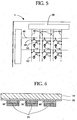
- organic EL display of the present invention using the color conversion method includes the organic EL display as shown in FIG. 8 .
- This organic EL display comprises electrodes 25 arranged so as to correspond to pixels and an organic thin film layer 30 for blue light provided over the electrodes, further comprises a transparent electrode 20 thereon.
- a transparent electrode 20 Over the transparent electrode 20, a laminate of color conversion layer for red color 65 and red color filter 60, and a laminate of color conversion layer for green color 80 and green color filter 70 are arranged via a protective layer (planarizing layer) 15, and a glass substrate 10 is provided thereon.
- the organic thin film layer 30 for blue light emission emits blue light A part of this blue light-emitting light transmits the transparent electrode 20, further transmits the protective layer 15 and glass substrate 10 without conversion, and radiated outside.
- the blue light-emitting light is converted into red or green in these color conversion layers and further transmits the red color filter 65 or green color filter 70, thus transmitting the glass substrate 10 as red light-emitting light or green light-emitting light.
- a full display can be achieved in the organic EL display.
- FIG. 6 is a view describing an example of the structure of an organic EL display according to the three color light emitting method.
- FIG. 7 is a view describing an example of the structure of an organic EL display according to the white light method.
- the reference character in FIGS. 6 and 7 refers to the same reference number in FIG. 8 .
- the organic EL element of the present invention is used for red light emission, and besides, an organic EL element for green light emission and organic EL element for blue light emission are required.
- organic EL element used for blue light emission which may be selected from among those known in the art, but suitable laminar constructions include ITO (positive electrode)/NPD/Al-Li (negative electrode).
- organic EL element used for green light emission which may selected from among those known in the art, but suitable laminar constructions include ITO (positive electrode)/NPD/Alq/Al-Li (negative electrode).
- organic EL display There is no particular limitation on the aspects of the organic EL display, and may be chosen according to the purpose. Examples include a passive matrix panel and active matrix panel disclosed in Nikkei Electronics (published by Nikkei Business Publications Inc. of Japan), No. 765, March 13, 2000, pages 55-62 .
- the passive matrix panel for example has belt-like positive electrodes 14 (for example, ITO electrodes) arranged parallel to each other on a glass substrate 12 as shown in FIG. 2 .
- positive electrodes 14 for example, ITO electrodes
- belt-like organic thin film layers 24 for red light emission, organic thin film layers 26 for blue light emission and organic thin film layers 28 for green light emission are arranged sequentially in parallel and substantially perpendicular to the positive electrodes 14.
- Each of the organic thin film layers has negative electrodes 22 of identical shape thereon.
- positive electrode lines 30 comprising a plurality of positive electrodes 14, and negative electrode lines 32 comprising a plurality of negative electrodes 22, for example intersect substantially at right angles to form a circuit, as shown in FIG. 3 .
- Each of the Organic thin film layers 24, 26, and 28 for red light emission, blue light emission and green light emission situated at each intersection point functions as a pixel, there being a plurality of organic EL elements 34 corresponding to each pixel.
- scanning lines, data lines and current supply lines are arranged in a grid pattern on a glass substrate 12, as shown in FIG. 4 .
- a TFT circuit 40 connected to the scanning lines and the like forming the grid pattern is disposed in each grid, and an positive electrode 14 (for example, an ITO electrode) disposed in each grid can be driven by the TFT circuit 40.
- a negative electrode 22 is further arranged so as to cover each of the organic thin film layer 24 for red light emission, organic thin film layer 26 for blue light emission and organic thin film layer 28 for green light emission.
- the organic thin film layer 24 for red light emission, organic thin film layer 26 for blue light emission and organic thin film layer 28 for green light emission respectively, comprise a positive hole transport layer 16, light-emitting layer 18 and electron transport layer 20.
- a plurality of scanning lines 46 are arranged in parallel to each other intersecting in substantially right angles with a plurality of data lines 42 and current supply lines 44, which are parallel to each other, to form grids, and a switching TFT 48 and driver TFT 50 are connected to each grid to form a circuit. If a current is applied from a driver circuit 38, the switching TFT 48 and driver TFT 50 can be driven for each grid.
- the organic thin film elements 24, 26, and 28 for blue light emission, green light emission and red light emission function as a pixel.
- the organic EL display of the present invention may be conveniently used in fields of various kinds such as computers, vehicle-mounted display devices, field-ready display devices, home apparatuses, industrial apparatuses, household electric appliances, traffic display devices, clock display devices, calendar display units, luminescent screens and audio equipment.
- Re(CO) 4 (8-quinolinate) was synthesized using Re(CO) 5 Cl and 8-quinolinate as raw materials according to the method described in Inorg. Chem.1993,1, 32, 398-401 . Specifically, as shown in the following reaction equation, Re(CO) 5 Cl and 8-quinoline had been reacted in toluene with stirring under reflux until generation of the HCl gas stopped. The toluene was evaporated and diethyl ether was added to let the solution cool. A yellow precipitate was filtrated and obtained precipitate was washed with diethyl ether. Then, recrystallization was performed twice using mixed solvent of acetone and diethyl ether to thereby synthesize Re(CO) 4 (8-quinolinate) as an objective substance.
- Re(CO) 2 (8-quinolinate)(2-(2'-pyridyl)phenol) was synthesized as in Example 1, except that Re(CO) 5 Cl was replaced by Re(CO) 4 Cl 2 and 8-quinolinate serving as was replaced by 8-quinolinate and 2-(2'-pyridyl)phenol (1:1). Obtained crude product was separated by column. The yield was 10 %.
- Re(8-quinolinate)(2-(2'-pyridyl)phenol)(7,8-benzoquinoline) was synthesized as in Example 1, except that Re(CO) 5 Cl was replaced by ReCl 3 , 8-quinolinate serving as ligand was replaced by 8-quinolinate, 2-(2'-pyridyl)phenol and 7,8-benzoquinoline and these were subsequently coordinated with Re.
- Product was separated by column with respect to coordination of each ligand. The total yield was about 2%.
- laminated organic EL elements comprising a light-emitting layer which comprises one of the organic rhenium complexes as a luminescent material, were produced as follows.
- the organic rhenium complexes respectively synthesized in Examples 1 to 7 were vapor deposited to a thickness of 20nm to form a light-emitting layer on this TPD positive hole transport layer.
- a vapor deposit of 2,9-dimethyl-4,7-diphenyl-1,10-phenanthroline (BCP) was then formed to a thickness of 10nm as a first electron transport layer on the light-emitting layer.
- Alq aluminum quinoline complex
- Example 5 Seven kinds of organic EL elements were manufactured as in Example 5, except that whereas in Example 5 the light-emitting layer was formed of only the organic rhenium complex, in this example the organic rhenium complex and 4,4'-bis(9-carbazolyl)-biphenyl (CBP) represented by the formula (13) were simultaneously deposited in such a way that there were 99 molecules (99 moles) of CBP for one molecule (1 mole) of organic rhenium complex to form the light-emitting layer.
- CBP 4,4'-bis(9-carbazolyl)-biphenyl
- organic rhenium complexes (phosphorescent material) was synthesized (RE-002 to 004).
- the emission wavelength of the synthesized organic rhenium complexes (RE-001 to 004) in powder form is shown in Table 10.
- the wavelength shows the peak wavelength of the emission spectrum observed after irradiating 365nm of excitation light.
- Table 10 Complex name Emission wavelength (nm) RE-001 615 nm RE-002 532 nm RE-003 530 nm RE-004 653 nm
- the present invention which can solve the conventional problems, provides an organometallic complex exhibiting phosphorescent luminescence suitable for use as a luminescent material, color conversion material, etc. in an organic EL element, an organic EL element having excellent lifetime, light-emitting efficiency, thermal and electrical stability, color conversion efficiency, etc., and a high performance, long lifetime organic EL display using the organometallic complex or the organic EL element, which organic EL display is suitable for a color display in which a constant average driving current can be achieved regardless of light-emitting pixels and color balance is satisfactory without changing light emitting area, etc.
- the organometallic complex of the present invention exhibits phosphorescent luminescence and can be suitably used as a luminescent material, color conversion material, etc. in an organic EL element. Since the organic EL element of the present invention uses the organometallic complex, the organic EL element is excellent in lifetime, light emission efficiency, thermal and electrical stability, color conversion efficiency, etc., and can be suitably used for an organic EL display. Since the organic EL display of the present invention uses the organic EL element, the organic EL display has high performance and a long lifetime, and can be suitably used for display screens of televisions, mobile-phones, computers, etc.
Landscapes
- Chemical & Material Sciences (AREA)
- Organic Chemistry (AREA)
- Engineering & Computer Science (AREA)
- Materials Engineering (AREA)
- Crystallography & Structural Chemistry (AREA)
- Inorganic Chemistry (AREA)
- Physics & Mathematics (AREA)
- Spectroscopy & Molecular Physics (AREA)
- Electroluminescent Light Sources (AREA)
- Thiazole And Isothizaole Compounds (AREA)
- Other In-Based Heterocyclic Compounds (AREA)
- Pyridine Compounds (AREA)
- Heterocyclic Carbon Compounds Containing A Hetero Ring Having Nitrogen And Oxygen As The Only Ring Hetero Atoms (AREA)
- Plural Heterocyclic Compounds (AREA)
- Nitrogen Condensed Heterocyclic Rings (AREA)
Claims (12)
- Ein organisches EL Element umfassend:eine positive Elektrode,eine negative Elektrode, undeine organische Dünnfilmschicht, angeordnet zwischen der positiven Elektrode und der negativen Elektrode;wobei die organische Dünnfilmschicht einen metallorganischen Komplex umfasst,
wobei der metallorganische Komplex folgende Bestandteile umfasst:ein Rhenium (Re) Atom;einen Liganden, welcher ein koordiniertes Stickstoffatom und ein koordiniertes Sauerstoffatom, welche jeweils mit dem Rhenium (Re) Atom koordiniert sind, und zumindest einen π-konjugierten Abschnitt umfasst, und der andere Ligand mit dem Rhenium (Re) Atom in einer solchen Weise koordiniert ist, dass der Ligand die Koordinationszahl des Rhenium (Re) Atoms absättigt und die Ladung des gesamten,metallorganischen Komplexes neutral ist; undwobei der metallorganische Komplex dargestellt wird durch eine Formel ausgewählt aus den folgenden Formeln (1), (2) und (3):

 in den Formeln (1), (2) und (3), R1 bis R4 gleich oder unterschiedlich sein können, und jeweils ein Wasserstoffatom oder eine Substituentengruppe darstellen;"i", "j", "k" und "l" Ganzzahlen sind;Cy1 eine cyclische Struktur darstellt, enthaltend ein koordiniertes Stickstoffatom, welches mit einem Rhenium (Re) Atom koordiniert ist, und zwei Kohlenstoffatome, welche an das Stickstoffatom gebunden sind und mit Cy2 geteilt werden;Cy2 die andere cyclische Struktur darstellt, welche an das Sauerstoffatom gebunden ist, dass an ein Rhenium (Re) Atom gebunden ist und die zwei Kohlenstoffe enthält, die mit Cy1 geteilt werden;Cy3 eine cyclische Struktur darstellt, enthaltend ein koordiniertes Stickstoffatom, welches koordiniert ist mit einem Rhenium (Re) Atom, und ein Kohlenstoffatom, welches gebunden ist an das Stickstoffatom und ein Kohlenstoffatom in Cy4;Cy4 die andere cyclische Struktur darstellt, enthaltend ein Kohlenstoffatom, welches an das Sauerstoffatom gebunden ist, dass an ein Rhenium (Re) Atom gebunden ist, und ein Kohlenstoffatom, welches an ein Kohlenstoffatom in Cy3 gebunden ist;der Buchstabe "L" den anderen Liganden darstellt, welcher die Koordinationszahl des Rhenium (Re) Atoms absättigt, und die Ladung des gesamten Komplexes neutralisiert;"m" 1 oder 2 darstellt;"n" 1, 2, oder 3 darstellt.
 - Ein organisches EL Element gemäß Anspruch 1, wobei das organische EL Element eine Farbumwandlungsschicht umfasst, und die Farbumwandlungsschicht fähig ist, Phosphoreszenz zu emittieren, und fähig ist einfallendes Licht in Licht mit einer Wellenlänge zu konvertieren, die um 100 nm oder mehr größer ist, als die Wellenlänge des einfallenden Lichts.
- Ein organisches EL Element gemäß Anspruch 2, wobei die Farbumwandlungsschicht fähig ist, einfallendes Licht in Licht mit einer Wellenlänge zu konvertieren, die um 150 nm oder mehr größer ist, als die Wellenlänge des einfallenden Lichts.
- Ein organisches EL Element gemäß einem der Ansprüche 2 und 3, wobei die Farbumwandlungsschicht fähig ist, Licht in dem Wellenlängenbereich von ultraviolettem Licht bis blauem Licht, in rotes Licht zu konvertieren.
- Ein organisches EL Element gemäß einem der Ansprüche 2 bis 4, wobei die Farbkonversionsschicht zumindest einem, ausgewählt aus den folgenden umfasst:(1) ein metallorganischer Komplex umfassendein Rhenium (Re) Atom;einen Liganden umfassend ein koordiniertes Stickstoffatom und ein koordiniertes Sauerstoffatom, welche jeweils mit dem Rhenium (Re) Atom koordiniert sind, umfassend zumindest einem π-konjugierten Abschnitt;und der andere Ligand mit dem Rhenium (Re) Atom in einer solchen Weise koordiniert ist, dass der Ligand die Koordinationszahl des Rhenium (Re) Atoms absättigt, und die Ladung des gesamten, metallorganischen Komplexes neutral ist;(2) ein metallorganischer Komplex, umfassendein Rhenium (Re) Atom;ein Ligand umfassend ein koordiniertes Stickstoffatom, ein koordiniertes Kohlenstoffatom, jeweils koordiniert mit dem Rhenium (Re) Atom, und zumindest ein π-konjungierten Abschnitt;und der andere Ligand mit dem Rhenium (Re) Atom in einer solchen Weise koordiniert ist, dass der Ligand die Koordinationszahl des Rhenium (Re) Atoms absättigt und die Ladung des gesamten metallorganischen Komplexes neutral ist,und(3) ein metallorganischer Komplex umfassendzumindest eines von Gruppe 8 Metallatomen, ausgewählt aus Gruppe 8 Metallelement;ein Ligand welcher zumindest einen π-konjungierten Abschnitt aufweist und mit dem Gruppe 8 Metallatom koordiniert ist;und einen Dithiolat-Ligand, ausgewählt aus einem aliphatischen Dithiolat-Liganden und einem heteroaromatischen Dithiolat-Liganden, der mit dem Gruppe 8 Metallatom koordiniert ist.
- Ein organisches EL Element gemäß einem der Ansprüche 1 bis 5, welches für Beleuchtungsvorrichtungen verwendet wird.
- Ein metallorganischer Komplex gemäß einer Formel ausgewählt aus den folgenden Formeln (1), (2) und (3):


 in den Formeln (1), (2) und (3), R1 bis R4 gleich oder unterschiedlich sein können, und jeweils ein Wasserstoffatom oder eine Substituentengruppe darstellen;"i", "j", "k" und "l" Ganzzahlen sind;Cy1 eine cyclische Struktur darstellt, enthaltend ein koordiniertes Stickstoffatom, welches mit einem Rhenium (Re) Atom koordiniert ist, und zwei Kohlenstoffatome, welche an das Stickstoffatom gebunden sind und mit Cy2 geteilt werden;Cy2 die andere cyclische Struktur darstellt, welche an das Sauerstoffatom gebunden ist, dass an ein Rhenium (Re) Atom gebunden ist und die zwei Kohlenstoffe enthält die mit Cy1 geteilt werden;Cy3 eine cyclische Struktur darstellt, enthaltend ein koordiniertes Stickstoffatom, welches koordiniert ist mit einem Rhenium (Re) Atom, und ein Kohlenstoffatom, welches gebunden ist an das Stickstoffatom und ein Kohlenstoffatom in Cy4;Cy4 die andere cyclische Struktur darstellt, enthaltend ein Kohlenstoffatom, welches an das Sauerstoffatom gebunden ist, dass an ein Rhenium (Re) Atom gebunden ist, und ein Kohlenstoffatom, welches an ein Kohlenstoffatom in Cy3 gebunden ist;der Buchstabe "L" den anderen Liganden darstellt, welcher die Koordinationszahl des Rhenium (Re) Atoms absättigt, und die Ladung des gesamten Komplexes neutralisiert;"m" 1 oder 2 darstellt;"n" 1, 2, oder 3 darstellt.
 - Ein metallorganischer Komplex gemäß Anspruch 7, welcher verwendet wird als zumindest eines von einem Lumineszenzmaterial und einem Farbkonversionsmaterial.
- Ein organisches EL Display, umfassend das organische EL Element gemäß einem der Ansprüche 1 bis 6.
- Ein organisches EL Display gemäß Anspruch 9, weiterhin umfassend:ein Elektrodenpaar;eine organische Dünnfilmschicht angeordnet zwischen dem Elektrodenpaar, welche fähig ist EL Licht zu emittieren; undeine Farbkonversionsschicht,wobei zumindest eine Elektrode des Elektrodenpaars transparent ist und zumindest eine Elektrode des Elektrodenpaares Pixeln entspricht,
wobei die Farbumwandlungsschicht auf zumindest einem grünen Pixel und einem roten Pixel in den Pixeln angeordnet ist. - Ein organisches EL Display gemäß einem der Ansprüche 9 und 10 weiterhin umfassend:eine Farbumwandlungsschicht angeordnet auf einem blauen Pixel; undeine Farbumwandlungsschicht angeordnet auf einem roten Pixel,wobei das durch EL Lumineszenz emittierte Licht weiß ist, und
die auf einem roten Pixel angeordnete Farbkonversionsschicht zumindest einen der metallorganischen Komplexe gemäß Anspruch 7 umfasst. - Ein organisches EL Display gemäß einem der Ansprüche 9 und 10, weiterhin umfassend:eine Farbkonversionsschicht angeordnet auf einem roten Pixel;wobei das durch EL Lumineszenz emittierte Licht blau ist, und die die auf einem roten Pixel angeordnete Farbkonversionsschicht zumindest einem der metallorganischen Komplexe gemäß einem der Ansprüche 7 oder 8 umfasst.
Priority Applications (2)
| Application Number | Priority Date | Filing Date | Title |
|---|---|---|---|
| EP10184109A EP2264122A3 (de) | 2002-08-27 | 2003-08-27 | Organometallkomplexe, organische elektronische Vorrichtungen und organische Elektrolumineszenzdisplays |
| EP10182429A EP2261301A1 (de) | 2002-08-27 | 2003-08-27 | Organometallkomplexe, organische elektronische Vorrichtungen und organische Elektrolumineszenzdisplays |
Applications Claiming Priority (7)
| Application Number | Priority Date | Filing Date | Title |
|---|---|---|---|
| JP2002247816 | 2002-08-27 | ||
| JP2002247815 | 2002-08-27 | ||
| JP2002247816 | 2002-08-27 | ||
| JP2002247815 | 2002-08-27 | ||
| JP2003037329 | 2003-02-14 | ||
| JP2003037329 | 2003-02-14 | ||
| PCT/JP2003/010847 WO2004020549A1 (ja) | 2002-08-27 | 2003-08-27 | 有機金属錯体、有機el素子及び有機elディスプレイ |
Related Child Applications (2)
| Application Number | Title | Priority Date | Filing Date |
|---|---|---|---|
| EP10184109A Division-Into EP2264122A3 (de) | 2002-08-27 | 2003-08-27 | Organometallkomplexe, organische elektronische Vorrichtungen und organische Elektrolumineszenzdisplays |
| EP10182429A Division-Into EP2261301A1 (de) | 2002-08-27 | 2003-08-27 | Organometallkomplexe, organische elektronische Vorrichtungen und organische Elektrolumineszenzdisplays |
Publications (3)
| Publication Number | Publication Date |
|---|---|
| EP1550707A1 EP1550707A1 (de) | 2005-07-06 |
| EP1550707A4 EP1550707A4 (de) | 2006-04-12 |
| EP1550707B1 true EP1550707B1 (de) | 2016-03-23 |
Family
ID=31982121
Family Applications (3)
| Application Number | Title | Priority Date | Filing Date |
|---|---|---|---|
| EP03791337.3A Expired - Lifetime EP1550707B1 (de) | 2002-08-27 | 2003-08-27 | Metallorganische komplexe, organische elektrolumineszenzvorrichtungen und organische elektrolumineszenzdisplays |
| EP10182429A Withdrawn EP2261301A1 (de) | 2002-08-27 | 2003-08-27 | Organometallkomplexe, organische elektronische Vorrichtungen und organische Elektrolumineszenzdisplays |
| EP10184109A Withdrawn EP2264122A3 (de) | 2002-08-27 | 2003-08-27 | Organometallkomplexe, organische elektronische Vorrichtungen und organische Elektrolumineszenzdisplays |
Family Applications After (2)
| Application Number | Title | Priority Date | Filing Date |
|---|---|---|---|
| EP10182429A Withdrawn EP2261301A1 (de) | 2002-08-27 | 2003-08-27 | Organometallkomplexe, organische elektronische Vorrichtungen und organische Elektrolumineszenzdisplays |
| EP10184109A Withdrawn EP2264122A3 (de) | 2002-08-27 | 2003-08-27 | Organometallkomplexe, organische elektronische Vorrichtungen und organische Elektrolumineszenzdisplays |
Country Status (7)
| Country | Link |
|---|---|
| US (2) | US20050244673A1 (de) |
| EP (3) | EP1550707B1 (de) |
| JP (1) | JP4313308B2 (de) |
| KR (1) | KR100686268B1 (de) |
| CN (1) | CN100439469C (de) |
| AU (1) | AU2003261758A1 (de) |
| WO (1) | WO2004020549A1 (de) |
Families Citing this family (662)
| Publication number | Priority date | Publication date | Assignee | Title |
|---|---|---|---|---|
| US20060238702A1 (en) | 1999-04-30 | 2006-10-26 | Advanced Medical Optics, Inc. | Ophthalmic lens combinations |
| US6645246B1 (en) * | 1999-09-17 | 2003-11-11 | Advanced Medical Optics, Inc. | Intraocular lens with surrounded lens zone |
| US7763069B2 (en) | 2002-01-14 | 2010-07-27 | Abbott Medical Optics Inc. | Accommodating intraocular lens with outer support structure |
| EP1398363B1 (de) * | 2002-08-29 | 2016-03-23 | UDC Ireland Limited | Licht-Emittierende Vorrichtung und Iridium-Komplex |
| US7662180B2 (en) | 2002-12-05 | 2010-02-16 | Abbott Medical Optics Inc. | Accommodating intraocular lens and method of manufacture thereof |
| US20050131535A1 (en) | 2003-12-15 | 2005-06-16 | Randall Woods | Intraocular lens implant having posterior bendable optic |
| JP2005243549A (ja) * | 2004-02-27 | 2005-09-08 | Sony Corp | 表示素子および表示装置並びに撮像装置 |
| JP2008502102A (ja) * | 2004-06-04 | 2008-01-24 | コーニンクレッカ フィリップス エレクトロニクス エヌ ヴィ | エレクトロルミネッセント構造、及びel構造を有するled |
| JP4328704B2 (ja) * | 2004-10-14 | 2009-09-09 | キヤノン株式会社 | 有機エレクトロルミネッセンス素子及びこれを用いた表示装置 |
| US9070884B2 (en) | 2005-04-13 | 2015-06-30 | Universal Display Corporation | Hybrid OLED having phosphorescent and fluorescent emitters |
| US9051344B2 (en) | 2005-05-06 | 2015-06-09 | Universal Display Corporation | Stability OLED materials and devices |
| US8586204B2 (en) | 2007-12-28 | 2013-11-19 | Universal Display Corporation | Phosphorescent emitters and host materials with improved stability |
| US8007927B2 (en) | 2007-12-28 | 2011-08-30 | Universal Display Corporation | Dibenzothiophene-containing materials in phosphorescent light emitting diodes |
| US9636213B2 (en) | 2005-09-30 | 2017-05-02 | Abbott Medical Optics Inc. | Deformable intraocular lenses and lens systems |
| CN101415718B (zh) | 2006-02-10 | 2013-05-29 | 通用显示公司 | 环金属化的咪唑并[1,2-f]菲啶和二咪唑并[1,2-a:1',2'-c]喹唑啉配位体和其等电子和苯并环化类似物的金属络合物 |
| US8778508B2 (en) | 2006-12-08 | 2014-07-15 | Universal Display Corporation | Light-emitting organometallic complexes |
| US20080166472A1 (en) * | 2006-12-13 | 2008-07-10 | Universal Display Corporation | Evaporation process for solid phase materials |
| US20080161914A1 (en) | 2006-12-29 | 2008-07-03 | Advanced Medical Optics, Inc. | Pre-stressed haptic for accommodating intraocular lens |
| TWI510598B (zh) | 2007-03-08 | 2015-12-01 | Universal Display Corp | 磷光材料 |
| US9130177B2 (en) | 2011-01-13 | 2015-09-08 | Universal Display Corporation | 5-substituted 2 phenylquinoline complexes materials for light emitting diode |
| US20130032785A1 (en) | 2011-08-01 | 2013-02-07 | Universal Display Corporation | Materials for organic light emitting diode |
| CN103601609B (zh) | 2007-08-08 | 2017-07-28 | 通用显示公司 | 在磷光性发光二极管中的单苯并[9,10]菲生色团 |
| KR20160086983A (ko) | 2007-08-08 | 2016-07-20 | 유니버셜 디스플레이 코포레이션 | 트리페닐렌기를 포함하는 벤조 융합 티오펜 또는 벤조 융합 푸란 화합물 |
| KR100946409B1 (ko) * | 2008-03-19 | 2010-03-09 | 다우어드밴스드디스플레이머티리얼 유한회사 | 신규한 유기 발광 화합물 및 이를 발광재료로서 채용하고있는 유기 전계 발광 소자 |
| US8034108B2 (en) | 2008-03-28 | 2011-10-11 | Abbott Medical Optics Inc. | Intraocular lens having a haptic that includes a cap |
| JP5591800B2 (ja) | 2008-06-30 | 2014-09-17 | ユニバーサル・ディスプレイ・コーポレーション | トリフェニレンを含有するホール輸送材料 |
| WO2010027583A1 (en) | 2008-09-03 | 2010-03-11 | Universal Display Corporation | Phosphorescent materials |
| US9034483B2 (en) | 2008-09-16 | 2015-05-19 | Universal Display Corporation | Phosphorescent materials |
| WO2010036765A1 (en) | 2008-09-25 | 2010-04-01 | Universal Display Corporation | Organoselenium materials and their uses in organic light emitting devices |
| EP2362889B1 (de) * | 2008-11-11 | 2018-12-26 | Universal Display Corporation | Phosphoreszierende strahler |
| US8815415B2 (en) | 2008-12-12 | 2014-08-26 | Universal Display Corporation | Blue emitter with high efficiency based on imidazo[1,2-f] phenanthridine iridium complexes |
| US9067947B2 (en) | 2009-01-16 | 2015-06-30 | Universal Display Corporation | Organic electroluminescent materials and devices |
| US11910700B2 (en) | 2009-03-23 | 2024-02-20 | Universal Display Corporation | Heteroleptic iridium complexes as dopants |
| US8722205B2 (en) | 2009-03-23 | 2014-05-13 | Universal Display Corporation | Heteroleptic iridium complex |
| US8709615B2 (en) | 2011-07-28 | 2014-04-29 | Universal Display Corporation | Heteroleptic iridium complexes as dopants |
| TWI730274B (zh) | 2009-04-28 | 2021-06-11 | 美商環球展覽公司 | 具有甲基-d3取代之銥錯合物 |
| US8586203B2 (en) | 2009-05-20 | 2013-11-19 | Universal Display Corporation | Metal complexes with boron-nitrogen heterocycle containing ligands |
| US8486142B2 (en) | 2009-06-26 | 2013-07-16 | Abbott Medical Optics Inc. | Accommodating intraocular lenses |
| WO2011017322A1 (en) | 2009-08-03 | 2011-02-10 | Abbott Medical Optics Inc. | Intraocular lens for providing accomodative vision |
| US8545996B2 (en) | 2009-11-02 | 2013-10-01 | The University Of Southern California | Ion-pairing soft salts based on organometallic complexes and their applications in organic light emitting diodes |
| US8580394B2 (en) | 2009-11-19 | 2013-11-12 | Universal Display Corporation | 3-coordinate copper(I)-carbene complexes |
| US8288187B2 (en) | 2010-01-20 | 2012-10-16 | Universal Display Corporation | Electroluminescent devices for lighting applications |
| US9156870B2 (en) * | 2010-02-25 | 2015-10-13 | Universal Display Corporation | Phosphorescent emitters |
| US9175211B2 (en) * | 2010-03-03 | 2015-11-03 | Universal Display Corporation | Phosphorescent materials |
| US8963132B2 (en) | 2010-03-25 | 2015-02-24 | Universal Display Corporation | Solution processable doped triarylamine hole injection materials |
| US8968887B2 (en) | 2010-04-28 | 2015-03-03 | Universal Display Corporation | Triphenylene-benzofuran/benzothiophene/benzoselenophene compounds with substituents joining to form fused rings |
| JP5646733B2 (ja) | 2010-04-28 | 2014-12-24 | ユニバーサル ディスプレイ コーポレイション | 予備混合した材料の堆積 |
| US8673458B2 (en) | 2010-06-11 | 2014-03-18 | Universal Display Corporation | Delayed fluorescence OLED |
| US8742657B2 (en) | 2010-06-11 | 2014-06-03 | Universal Display Corporation | Triplet-Triplet annihilation up conversion (TTA-UC) for display and lighting applications |
| US9435021B2 (en) | 2010-07-29 | 2016-09-06 | University Of Southern California | Co-deposition methods for the fabrication of organic optoelectronic devices |
| US9954180B2 (en) | 2010-08-20 | 2018-04-24 | Universal Display Corporation | Bicarbazole compounds for OLEDs |
| US8932734B2 (en) | 2010-10-08 | 2015-01-13 | Universal Display Corporation | Organic electroluminescent materials and devices |
| US8269317B2 (en) | 2010-11-11 | 2012-09-18 | Universal Display Corporation | Phosphorescent materials |
| US20120138906A1 (en) | 2010-12-07 | 2012-06-07 | The University of Southern California USC Stevens Institute for Innovation | Capture agents for unsaturated metal complexes |
| US10008677B2 (en) | 2011-01-13 | 2018-06-26 | Universal Display Corporation | Materials for organic light emitting diode |
| US8415031B2 (en) | 2011-01-24 | 2013-04-09 | Universal Display Corporation | Electron transporting compounds |
| US8563737B2 (en) | 2011-02-23 | 2013-10-22 | Universal Display Corporation | Methods of making bis-tridentate carbene complexes of ruthenium and osmium |
| WO2012116231A2 (en) | 2011-02-23 | 2012-08-30 | Universal Display Corporation | Novel tetradentate platinum complexes |
| US8748011B2 (en) | 2011-02-23 | 2014-06-10 | Universal Display Corporation | Ruthenium carbene complexes for OLED material |
| US9005772B2 (en) | 2011-02-23 | 2015-04-14 | Universal Display Corporation | Thioazole and oxazole carbene metal complexes as phosphorescent OLED materials |
| US8492006B2 (en) | 2011-02-24 | 2013-07-23 | Universal Display Corporation | Germanium-containing red emitter materials for organic light emitting diode |
| US8883322B2 (en) | 2011-03-08 | 2014-11-11 | Universal Display Corporation | Pyridyl carbene phosphorescent emitters |
| US8580399B2 (en) | 2011-04-08 | 2013-11-12 | Universal Display Corporation | Substituted oligoazacarbazoles for light emitting diodes |
| US8927308B2 (en) | 2011-05-12 | 2015-01-06 | Universal Display Corporation | Method of forming bus line designs for large-area OLED lighting |
| US8432095B2 (en) | 2011-05-11 | 2013-04-30 | Universal Display Corporation | Process for fabricating metal bus lines for OLED lighting panels |
| US8564192B2 (en) | 2011-05-11 | 2013-10-22 | Universal Display Corporation | Process for fabricating OLED lighting panels |
| US9212197B2 (en) | 2011-05-19 | 2015-12-15 | Universal Display Corporation | Phosphorescent heteroleptic phenylbenzimidazole dopants |
| US8795850B2 (en) | 2011-05-19 | 2014-08-05 | Universal Display Corporation | Phosphorescent heteroleptic phenylbenzimidazole dopants and new synthetic methodology |
| US8748012B2 (en) | 2011-05-25 | 2014-06-10 | Universal Display Corporation | Host materials for OLED |
| US10158089B2 (en) | 2011-05-27 | 2018-12-18 | Universal Display Corporation | Organic electroluminescent materials and devices |
| US10079349B2 (en) | 2011-05-27 | 2018-09-18 | Universal Display Corporation | Organic electroluminescent materials and devices |
| JP2013016464A (ja) * | 2011-06-07 | 2013-01-24 | Canon Inc | 表示装置 |
| EP3473634B1 (de) | 2011-06-08 | 2020-07-22 | Universal Display Corporation | Heteroleptische iridium-carben-komplexe und lichtemittierende vorrichtung zur verwendung davon |
| US8659036B2 (en) | 2011-06-17 | 2014-02-25 | Universal Display Corporation | Fine tuning of emission spectra by combination of multiple emitter spectra |
| US8884316B2 (en) | 2011-06-17 | 2014-11-11 | Universal Display Corporation | Non-common capping layer on an organic device |
| US9023420B2 (en) | 2011-07-14 | 2015-05-05 | Universal Display Corporation | Composite organic/inorganic layer for organic light-emitting devices |
| WO2013009708A1 (en) | 2011-07-14 | 2013-01-17 | Universal Display Corporation | Inorganic hosts in oleds |
| US9397310B2 (en) | 2011-07-14 | 2016-07-19 | Universal Display Corporation | Organice electroluminescent materials and devices |
| US9783564B2 (en) | 2011-07-25 | 2017-10-10 | Universal Display Corporation | Organic electroluminescent materials and devices |
| US8409729B2 (en) | 2011-07-28 | 2013-04-02 | Universal Display Corporation | Host materials for phosphorescent OLEDs |
| US8926119B2 (en) | 2011-08-04 | 2015-01-06 | Universal Display Corporation | Extendable light source with variable light emitting area |
| US8552420B2 (en) | 2011-08-09 | 2013-10-08 | Universal Display Corporation | OLED light panel with controlled brightness variation |
| US9493698B2 (en) | 2011-08-31 | 2016-11-15 | Universal Display Corporation | Organic electroluminescent materials and devices |
| US8652656B2 (en) | 2011-11-14 | 2014-02-18 | Universal Display Corporation | Triphenylene silane hosts |
| US9193745B2 (en) | 2011-11-15 | 2015-11-24 | Universal Display Corporation | Heteroleptic iridium complex |
| US9217004B2 (en) | 2011-11-21 | 2015-12-22 | Universal Display Corporation | Organic light emitting materials |
| US9512355B2 (en) | 2011-12-09 | 2016-12-06 | Universal Display Corporation | Organic light emitting materials |
| US20130146875A1 (en) | 2011-12-13 | 2013-06-13 | Universal Display Corporation | Split electrode for organic devices |
| US8987451B2 (en) | 2012-01-03 | 2015-03-24 | Universal Display Corporation | Synthesis of cyclometallated platinum(II) complexes |
| US9461254B2 (en) | 2012-01-03 | 2016-10-04 | Universal Display Corporation | Organic electroluminescent materials and devices |
| US9163174B2 (en) | 2012-01-04 | 2015-10-20 | Universal Display Corporation | Highly efficient phosphorescent materials |
| KR102012047B1 (ko) | 2012-01-06 | 2019-08-19 | 유니버셜 디스플레이 코포레이션 | 효율이 큰 인광 물질 |
| US8969592B2 (en) | 2012-01-10 | 2015-03-03 | Universal Display Corporation | Heterocyclic host materials |
| US10211413B2 (en) | 2012-01-17 | 2019-02-19 | Universal Display Corporation | Organic electroluminescent materials and devices |
| JP5978843B2 (ja) | 2012-02-02 | 2016-08-24 | コニカミノルタ株式会社 | イリジウム錯体化合物、有機エレクトロルミネッセンス素子材料、有機エレクトロルミネッセンス素子、照明装置及び表示装置 |
| US9118017B2 (en) | 2012-02-27 | 2015-08-25 | Universal Display Corporation | Host compounds for red phosphorescent OLEDs |
| US9386657B2 (en) | 2012-03-15 | 2016-07-05 | Universal Display Corporation | Organic Electroluminescent materials and devices |
| US9054323B2 (en) | 2012-03-15 | 2015-06-09 | Universal Display Corporation | Secondary hole transporting layer with diarylamino-phenyl-carbazole compounds |
| US8723209B2 (en) | 2012-04-27 | 2014-05-13 | Universal Display Corporation | Out coupling layer containing particle polymer composite |
| US9084674B2 (en) | 2012-05-02 | 2015-07-21 | Abbott Medical Optics Inc. | Intraocular lens with shape changing capability to provide enhanced accomodation and visual acuity |
| US9184399B2 (en) | 2012-05-04 | 2015-11-10 | Universal Display Corporation | Asymmetric hosts with triaryl silane side chains |
| US9773985B2 (en) | 2012-05-21 | 2017-09-26 | Universal Display Corporation | Organic electroluminescent materials and devices |
| US9670404B2 (en) | 2012-06-06 | 2017-06-06 | Universal Display Corporation | Organic electroluminescent materials and devices |
| US9502672B2 (en) | 2012-06-21 | 2016-11-22 | Universal Display Corporation | Organic electroluminescent materials and devices |
| US9725476B2 (en) | 2012-07-09 | 2017-08-08 | Universal Display Corporation | Silylated metal complexes |
| US9231218B2 (en) | 2012-07-10 | 2016-01-05 | Universal Display Corporation | Phosphorescent emitters containing dibenzo[1,4]azaborinine structure |
| US9059412B2 (en) | 2012-07-19 | 2015-06-16 | Universal Display Corporation | Transition metal complexes containing substituted imidazole carbene as ligands and their application in OLEDs |
| US9540329B2 (en) | 2012-07-19 | 2017-01-10 | Universal Display Corporation | Organic electroluminescent materials and devices |
| US9663544B2 (en) | 2012-07-25 | 2017-05-30 | Universal Display Corporation | Organic electroluminescent materials and devices |
| US9318710B2 (en) | 2012-07-30 | 2016-04-19 | Universal Display Corporation | Organic electroluminescent materials and devices |
| WO2014030666A1 (ja) | 2012-08-24 | 2014-02-27 | コニカミノルタ株式会社 | 透明電極、電子デバイス、および透明電極の製造方法 |
| US9978958B2 (en) | 2012-08-24 | 2018-05-22 | Universal Display Corporation | Phosphorescent emitters with phenylimidazole ligands |
| US8952362B2 (en) | 2012-08-31 | 2015-02-10 | The Regents Of The University Of Michigan | High efficiency and brightness fluorescent organic light emitting diode by triplet-triplet fusion |
| US10957870B2 (en) | 2012-09-07 | 2021-03-23 | Universal Display Corporation | Organic light emitting device |
| US9287513B2 (en) | 2012-09-24 | 2016-03-15 | Universal Display Corporation | Organic electroluminescent materials and devices |
| US9312505B2 (en) | 2012-09-25 | 2016-04-12 | Universal Display Corporation | Organic electroluminescent materials and devices |
| US9252363B2 (en) | 2012-10-04 | 2016-02-02 | Universal Display Corporation | Aryloxyalkylcarboxylate solvent compositions for inkjet printing of organic layers |
| US8692241B1 (en) | 2012-11-08 | 2014-04-08 | Universal Display Corporation | Transition metal complexes containing triazole and tetrazole carbene ligands |
| US9748500B2 (en) | 2015-01-15 | 2017-08-29 | Universal Display Corporation | Organic light emitting materials |
| US9685617B2 (en) | 2012-11-09 | 2017-06-20 | Universal Display Corporation | Organic electronuminescent materials and devices |
| US9634264B2 (en) | 2012-11-09 | 2017-04-25 | Universal Display Corporation | Organic electroluminescent materials and devices |
| US8946697B1 (en) | 2012-11-09 | 2015-02-03 | Universal Display Corporation | Iridium complexes with aza-benzo fused ligands |
| US9190623B2 (en) | 2012-11-20 | 2015-11-17 | Universal Display Corporation | Organic electroluminescent materials and devices |
| US10069090B2 (en) | 2012-11-20 | 2018-09-04 | Universal Display Corporation | Organic electroluminescent materials and devices |
| US9512136B2 (en) | 2012-11-26 | 2016-12-06 | Universal Display Corporation | Organic electroluminescent materials and devices |
| US9166175B2 (en) | 2012-11-27 | 2015-10-20 | Universal Display Corporation | Organic electroluminescent materials and devices |
| US9196860B2 (en) | 2012-12-04 | 2015-11-24 | Universal Display Corporation | Compounds for triplet-triplet annihilation upconversion |
| US8716484B1 (en) | 2012-12-05 | 2014-05-06 | Universal Display Corporation | Hole transporting materials with twisted aryl groups |
| US9209411B2 (en) | 2012-12-07 | 2015-12-08 | Universal Display Corporation | Organic electroluminescent materials and devices |
| US9653691B2 (en) | 2012-12-12 | 2017-05-16 | Universal Display Corporation | Phosphorescence-sensitizing fluorescence material system |
| US10400163B2 (en) | 2013-02-08 | 2019-09-03 | Universal Display Corporation | Organic electroluminescent materials and devices |
| US10367154B2 (en) | 2013-02-21 | 2019-07-30 | Universal Display Corporation | Organic electroluminescent materials and devices |
| US8927749B2 (en) | 2013-03-07 | 2015-01-06 | Universal Display Corporation | Organic electroluminescent materials and devices |
| US9419225B2 (en) | 2013-03-14 | 2016-08-16 | Universal Display Corporation | Organic electroluminescent materials and devices |
| US9997712B2 (en) | 2013-03-27 | 2018-06-12 | Universal Display Corporation | Organic electroluminescent materials and devices |
| EP2980878B1 (de) | 2013-03-29 | 2019-05-01 | Konica Minolta, Inc. | Organisches elektrolumineszenzelement sowie beleuchtungsvorrichtung und anzeigevorrichtung damit |
| US9537106B2 (en) | 2013-05-09 | 2017-01-03 | Universal Display Corporation | Organic electroluminescent materials and devices |
| US9735373B2 (en) | 2013-06-10 | 2017-08-15 | Universal Display Corporation | Organic electroluminescent materials and devices |
| US9673401B2 (en) | 2013-06-28 | 2017-06-06 | Universal Display Corporation | Organic electroluminescent materials and devices |
| US10199581B2 (en) | 2013-07-01 | 2019-02-05 | Universal Display Corporation | Organic electroluminescent materials and devices |
| US10121975B2 (en) | 2013-07-03 | 2018-11-06 | Universal Display Corporation | Organic electroluminescent materials and devices |
| US9761807B2 (en) | 2013-07-15 | 2017-09-12 | Universal Display Corporation | Organic light emitting diode materials |
| US9553274B2 (en) | 2013-07-16 | 2017-01-24 | Universal Display Corporation | Organic electroluminescent materials and devices |
| US9324949B2 (en) | 2013-07-16 | 2016-04-26 | Universal Display Corporation | Organic electroluminescent materials and devices |
| US9224958B2 (en) | 2013-07-19 | 2015-12-29 | Universal Display Corporation | Organic electroluminescent materials and devices |
| US20150028290A1 (en) | 2013-07-25 | 2015-01-29 | Universal Display Corporation | Heteroleptic osmium complex and method of making the same |
| US9831437B2 (en) | 2013-08-20 | 2017-11-28 | Universal Display Corporation | Organic electroluminescent materials and devices |
| US10074806B2 (en) | 2013-08-20 | 2018-09-11 | Universal Display Corporation | Organic electroluminescent materials and devices |
| US9932359B2 (en) | 2013-08-30 | 2018-04-03 | University Of Southern California | Organic electroluminescent materials and devices |
| US10199582B2 (en) | 2013-09-03 | 2019-02-05 | University Of Southern California | Organic electroluminescent materials and devices |
| US9735378B2 (en) | 2013-09-09 | 2017-08-15 | Universal Display Corporation | Organic electroluminescent materials and devices |
| US9748503B2 (en) | 2013-09-13 | 2017-08-29 | Universal Display Corporation | Organic electroluminescent materials and devices |
| US10003034B2 (en) | 2013-09-30 | 2018-06-19 | Universal Display Corporation | Organic electroluminescent materials and devices |
| US9831447B2 (en) | 2013-10-08 | 2017-11-28 | Universal Display Corporation | Organic electroluminescent materials and devices |
| US9293712B2 (en) | 2013-10-11 | 2016-03-22 | Universal Display Corporation | Disubstituted pyrene compounds with amino group containing ortho aryl group and devices containing the same |
| US9853229B2 (en) | 2013-10-23 | 2017-12-26 | University Of Southern California | Organic electroluminescent materials and devices |
| US20150115250A1 (en) | 2013-10-29 | 2015-04-30 | Universal Display Corporation | Organic electroluminescent materials and devices |
| US9306179B2 (en) | 2013-11-08 | 2016-04-05 | Universal Display Corporation | Organic electroluminescent materials and devices |
| US9647218B2 (en) | 2013-11-14 | 2017-05-09 | Universal Display Corporation | Organic electroluminescent materials and devices |
| US10033000B2 (en) | 2013-11-15 | 2018-07-24 | Universal Display Corporation | Organic electroluminescent materials and devices |
| US10056565B2 (en) | 2013-11-20 | 2018-08-21 | Universal Display Corporation | Organic electroluminescent materials and devices |
| US10644251B2 (en) | 2013-12-04 | 2020-05-05 | Universal Display Corporation | Organic electroluminescent materials and devices |
| US9876173B2 (en) | 2013-12-09 | 2018-01-23 | Universal Display Corporation | Organic electroluminescent materials and devices |
| US10355227B2 (en) | 2013-12-16 | 2019-07-16 | Universal Display Corporation | Metal complex for phosphorescent OLED |
| US9847496B2 (en) | 2013-12-23 | 2017-12-19 | Universal Display Corporation | Organic electroluminescent materials and devices |
| US10135008B2 (en) | 2014-01-07 | 2018-11-20 | Universal Display Corporation | Organic electroluminescent materials and devices |
| US9978961B2 (en) | 2014-01-08 | 2018-05-22 | Universal Display Corporation | Organic electroluminescent materials and devices |
| US9755159B2 (en) | 2014-01-23 | 2017-09-05 | Universal Display Corporation | Organic materials for OLEDs |
| US9935277B2 (en) | 2014-01-30 | 2018-04-03 | Universal Display Corporation | Organic electroluminescent materials and devices |
| US9590194B2 (en) | 2014-02-14 | 2017-03-07 | Universal Display Corporation | Organic electroluminescent materials and devices |
| US10003033B2 (en) | 2014-02-18 | 2018-06-19 | Universal Display Corporation | Organic electroluminescent materials and devices |
| US9847497B2 (en) | 2014-02-18 | 2017-12-19 | Universal Display Corporation | Organic electroluminescent materials and devices |
| US10707423B2 (en) | 2014-02-21 | 2020-07-07 | Universal Display Corporation | Organic electroluminescent materials and devices |
| US9647217B2 (en) | 2014-02-24 | 2017-05-09 | Universal Display Corporation | Organic electroluminescent materials and devices |
| US9502656B2 (en) | 2014-02-24 | 2016-11-22 | Universal Display Corporation | Organic electroluminescent materials and devices |
| US10403825B2 (en) | 2014-02-27 | 2019-09-03 | Universal Display Corporation | Organic electroluminescent materials and devices |
| US9181270B2 (en) | 2014-02-28 | 2015-11-10 | Universal Display Corporation | Method of making sulfide compounds |
| US9673407B2 (en) | 2014-02-28 | 2017-06-06 | Universal Display Corporation | Organic electroluminescent materials and devices |
| US9590195B2 (en) | 2014-02-28 | 2017-03-07 | Universal Display Corporation | Organic electroluminescent materials and devices |
| US9190620B2 (en) | 2014-03-01 | 2015-11-17 | Universal Display Corporation | Organic electroluminescent materials and devices |
| US9397309B2 (en) | 2014-03-13 | 2016-07-19 | Universal Display Corporation | Organic electroluminescent devices |
| US10208026B2 (en) | 2014-03-18 | 2019-02-19 | Universal Display Corporation | Organic electroluminescent materials and devices |
| US9748504B2 (en) | 2014-03-25 | 2017-08-29 | Universal Display Corporation | Organic electroluminescent materials and devices |
| US9929353B2 (en) | 2014-04-02 | 2018-03-27 | Universal Display Corporation | Organic electroluminescent materials and devices |
| US9691993B2 (en) | 2014-04-09 | 2017-06-27 | Universal Display Corporation | Organic electroluminescent materials and devices |
| US9847498B2 (en) | 2014-04-14 | 2017-12-19 | Universal Display Corporation | Organic electroluminescent materials and devices |
| US10008679B2 (en) | 2014-04-14 | 2018-06-26 | Universal Display Corporation | Organic electroluminescent materials and devices |
| US10256427B2 (en) | 2014-04-15 | 2019-04-09 | Universal Display Corporation | Efficient organic electroluminescent devices |
| US9450198B2 (en) | 2014-04-15 | 2016-09-20 | Universal Display Corporation | Organic electroluminescent materials and devices |
| US9741941B2 (en) | 2014-04-29 | 2017-08-22 | Universal Display Corporation | Organic electroluminescent materials and devices |
| US10457699B2 (en) | 2014-05-02 | 2019-10-29 | Universal Display Corporation | Organic electroluminescent materials and devices |
| US10636983B2 (en) | 2014-05-08 | 2020-04-28 | Universal Display Corporation | Organic electroluminescent materials and devices |
| US10403830B2 (en) | 2014-05-08 | 2019-09-03 | Universal Display Corporation | Organic electroluminescent materials and devices |
| US10301338B2 (en) | 2014-05-08 | 2019-05-28 | Universal Display Corporation | Organic electroluminescent materials and devices |
| EP3473635B1 (de) | 2014-05-08 | 2020-07-22 | Universal Display Corporation | Stabilisierte imidazophenanthridinmaterialien |
| US9997716B2 (en) | 2014-05-27 | 2018-06-12 | Universal Display Corporation | Organic electroluminescent materials and devices |
| US10461260B2 (en) | 2014-06-03 | 2019-10-29 | Universal Display Corporation | Organic electroluminescent materials and devices |
| US9911931B2 (en) | 2014-06-26 | 2018-03-06 | Universal Display Corporation | Organic electroluminescent materials and devices |
| US10297762B2 (en) | 2014-07-09 | 2019-05-21 | Universal Display Corporation | Organic electroluminescent materials and devices |
| US10566546B2 (en) | 2014-07-14 | 2020-02-18 | Universal Display Corporation | Organic electroluminescent materials and devices |
| US9929357B2 (en) | 2014-07-22 | 2018-03-27 | Universal Display Corporation | Organic electroluminescent materials and devices |
| US10411200B2 (en) | 2014-08-07 | 2019-09-10 | Universal Display Corporation | Electroluminescent (2-phenylpyridine)iridium complexes and devices |
| US11108000B2 (en) | 2014-08-07 | 2021-08-31 | Unniversal Display Corporation | Organic electroluminescent materials and devices |
| US10135007B2 (en) | 2014-09-29 | 2018-11-20 | Universal Display Corporation | Organic electroluminescent materials and devices |
| US10043987B2 (en) | 2014-09-29 | 2018-08-07 | Universal Display Corporation | Organic electroluminescent materials and devices |
| US10749113B2 (en) | 2014-09-29 | 2020-08-18 | Universal Display Corporation | Organic electroluminescent materials and devices |
| US10361375B2 (en) | 2014-10-06 | 2019-07-23 | Universal Display Corporation | Organic electroluminescent materials and devices |
| US9397302B2 (en) | 2014-10-08 | 2016-07-19 | Universal Display Corporation | Organic electroluminescent materials and devices |
| US10854826B2 (en) | 2014-10-08 | 2020-12-01 | Universal Display Corporation | Organic electroluminescent compounds, compositions and devices |
| US10950803B2 (en) | 2014-10-13 | 2021-03-16 | Universal Display Corporation | Compounds and uses in devices |
| US9484541B2 (en) | 2014-10-20 | 2016-11-01 | Universal Display Corporation | Organic electroluminescent materials and devices |
| US10868261B2 (en) | 2014-11-10 | 2020-12-15 | Universal Display Corporation | Organic electroluminescent materials and devices |
| US10411201B2 (en) | 2014-11-12 | 2019-09-10 | Universal Display Corporation | Organic electroluminescent materials and devices |
| US10038151B2 (en) | 2014-11-12 | 2018-07-31 | Universal Display Corporation | Organic electroluminescent materials and devices |
| US9882151B2 (en) | 2014-11-14 | 2018-01-30 | Universal Display Corporation | Organic electroluminescent materials and devices |
| US9871212B2 (en) | 2014-11-14 | 2018-01-16 | Universal Display Corporation | Organic electroluminescent materials and devices |
| US9761814B2 (en) | 2014-11-18 | 2017-09-12 | Universal Display Corporation | Organic light-emitting materials and devices |
| US10381569B2 (en) | 2014-11-25 | 2019-08-13 | Universal Display Corporation | Organic electroluminescent materials and devices |
| US9444075B2 (en) | 2014-11-26 | 2016-09-13 | Universal Display Corporation | Emissive display with photo-switchable polarization |
| US9450195B2 (en) | 2014-12-17 | 2016-09-20 | Universal Display Corporation | Organic electroluminescent materials and devices |
| US10253252B2 (en) | 2014-12-30 | 2019-04-09 | Universal Display Corporation | Organic electroluminescent materials and devices |
| US10636978B2 (en) | 2014-12-30 | 2020-04-28 | Universal Display Corporation | Organic electroluminescent materials and devices |
| US9312499B1 (en) | 2015-01-05 | 2016-04-12 | Universal Display Corporation | Organic electroluminescent materials and devices |
| US9406892B2 (en) | 2015-01-07 | 2016-08-02 | Universal Display Corporation | Organic electroluminescent materials and devices |
| US9711730B2 (en) | 2015-01-25 | 2017-07-18 | Universal Display Corporation | Organic electroluminescent materials and devices |
| US10418569B2 (en) | 2015-01-25 | 2019-09-17 | Universal Display Corporation | Organic electroluminescent materials and devices |
| US10418562B2 (en) | 2015-02-06 | 2019-09-17 | Universal Display Corporation | Organic electroluminescent materials and devices |
| US10644247B2 (en) | 2015-02-06 | 2020-05-05 | Universal Display Corporation | Organic electroluminescent materials and devices |
| US10355222B2 (en) | 2015-02-06 | 2019-07-16 | Universal Display Corporation | Organic electroluminescent materials and devices |
| US10177316B2 (en) | 2015-02-09 | 2019-01-08 | Universal Display Corporation | Organic electroluminescent materials and devices |
| US10144867B2 (en) | 2015-02-13 | 2018-12-04 | Universal Display Corporation | Organic electroluminescent materials and devices |
| JP5831654B1 (ja) | 2015-02-13 | 2015-12-09 | コニカミノルタ株式会社 | 芳香族複素環誘導体、それを用いた有機エレクトロルミネッセンス素子、照明装置及び表示装置 |
| US10680183B2 (en) | 2015-02-15 | 2020-06-09 | Universal Display Corporation | Organic electroluminescent materials and devices |
| US9929361B2 (en) | 2015-02-16 | 2018-03-27 | Universal Display Corporation | Organic electroluminescent materials and devices |
| US11056657B2 (en) | 2015-02-27 | 2021-07-06 | University Display Corporation | Organic electroluminescent materials and devices |
| US10600966B2 (en) | 2015-02-27 | 2020-03-24 | Universal Display Corporation | Organic electroluminescent materials and devices |
| US10686143B2 (en) | 2015-03-05 | 2020-06-16 | Universal Display Corporation | Organic electroluminescent materials and devices |
| US10270046B2 (en) | 2015-03-06 | 2019-04-23 | Universal Display Corporation | Organic electroluminescent materials and devices |
| US9780316B2 (en) | 2015-03-16 | 2017-10-03 | Universal Display Corporation | Organic electroluminescent materials and devices |
| US9911928B2 (en) | 2015-03-19 | 2018-03-06 | Universal Display Corporation | Organic electroluminescent materials and devices |
| US9871214B2 (en) | 2015-03-23 | 2018-01-16 | Universal Display Corporation | Organic electroluminescent materials and devices |
| US10529931B2 (en) | 2015-03-24 | 2020-01-07 | Universal Display Corporation | Organic Electroluminescent materials and devices |
| US10297770B2 (en) | 2015-03-27 | 2019-05-21 | Universal Display Corporation | Organic electroluminescent materials and devices |
| US20160293855A1 (en) | 2015-04-06 | 2016-10-06 | Universal Display Corporation | Organic Electroluminescent Materials and Devices |
| US11818949B2 (en) | 2015-04-06 | 2023-11-14 | Universal Display Corporation | Organic electroluminescent materials and devices |
| US11495749B2 (en) | 2015-04-06 | 2022-11-08 | Universal Display Corporation | Organic electroluminescent materials and devices |
| US10403826B2 (en) | 2015-05-07 | 2019-09-03 | Universal Display Corporation | Organic electroluminescent materials and devices |
| US10777749B2 (en) | 2015-05-07 | 2020-09-15 | Universal Display Corporation | Organic electroluminescent materials and devices |
| US9478758B1 (en) | 2015-05-08 | 2016-10-25 | Universal Display Corporation | Organic electroluminescent materials and devices |
| US9859510B2 (en) | 2015-05-15 | 2018-01-02 | Universal Display Corporation | Organic electroluminescent materials and devices |
| US10109799B2 (en) | 2015-05-21 | 2018-10-23 | Universal Display Corporation | Organic electroluminescent materials and devices |
| US10256411B2 (en) | 2015-05-21 | 2019-04-09 | Universal Display Corporation | Organic electroluminescent materials and devices |
| US10033004B2 (en) | 2015-06-01 | 2018-07-24 | Universal Display Corporation | Organic electroluminescent materials and devices |
| US10418568B2 (en) | 2015-06-01 | 2019-09-17 | Universal Display Corporation | Organic electroluminescent materials and devices |
| US10818853B2 (en) | 2015-06-04 | 2020-10-27 | University Of Southern California | Organic electroluminescent materials and devices |
| US11925102B2 (en) | 2015-06-04 | 2024-03-05 | Universal Display Corporation | Organic electroluminescent materials and devices |
| US12514110B2 (en) | 2021-08-06 | 2025-12-30 | Universal Display Corporation | Organic electroluminescent materials and devices |
| US10825997B2 (en) | 2015-06-25 | 2020-11-03 | Universal Display Corporation | Organic electroluminescent materials and devices |
| US10873036B2 (en) | 2015-07-07 | 2020-12-22 | Universal Display Corporation | Organic electroluminescent materials and devices |
| US9978956B2 (en) | 2015-07-15 | 2018-05-22 | Universal Display Corporation | Organic electroluminescent materials and devices |
| US11127905B2 (en) | 2015-07-29 | 2021-09-21 | Universal Display Corporation | Organic electroluminescent materials and devices |
| US11018309B2 (en) | 2015-08-03 | 2021-05-25 | Universal Display Corporation | Organic electroluminescent materials and devices |
| US11522140B2 (en) | 2015-08-17 | 2022-12-06 | Universal Display Corporation | Organic electroluminescent materials and devices |
| US10522769B2 (en) | 2015-08-18 | 2019-12-31 | Universal Display Corporation | Organic electroluminescent materials and devices |
| US10181564B2 (en) | 2015-08-26 | 2019-01-15 | Universal Display Corporation | Organic electroluminescent materials and devices |
| US10361381B2 (en) | 2015-09-03 | 2019-07-23 | Universal Display Corporation | Organic electroluminescent materials and devices |
| US11706972B2 (en) | 2015-09-08 | 2023-07-18 | Universal Display Corporation | Organic electroluminescent materials and devices |
| US11302872B2 (en) | 2015-09-09 | 2022-04-12 | Universal Display Corporation | Organic electroluminescent materials and devices |
| US10770664B2 (en) | 2015-09-21 | 2020-09-08 | Universal Display Corporation | Organic electroluminescent materials and devices |
| US20170092880A1 (en) | 2015-09-25 | 2017-03-30 | Universal Display Corporation | Organic electroluminescent materials and devices |
| US10847728B2 (en) | 2015-10-01 | 2020-11-24 | Universal Display Corporation | Organic electroluminescent materials and devices |
| US10593892B2 (en) | 2015-10-01 | 2020-03-17 | Universal Display Corporation | Organic electroluminescent materials and devices |
| US10991895B2 (en) | 2015-10-06 | 2021-04-27 | Universal Display Corporation | Organic electroluminescent materials and devices |
| US10388892B2 (en) | 2015-10-29 | 2019-08-20 | Universal Display Corporation | Organic electroluminescent materials and devices |
| US10388893B2 (en) | 2015-10-29 | 2019-08-20 | Universal Display Corporation | Organic electroluminescent materials and devices |
| US10177318B2 (en) | 2015-10-29 | 2019-01-08 | Universal Display Corporation | Organic electroluminescent materials and devices |
| US10998507B2 (en) | 2015-11-23 | 2021-05-04 | Universal Display Corporation | Organic electroluminescent materials and devices |
| US10476010B2 (en) | 2015-11-30 | 2019-11-12 | Universal Display Corporation | Organic electroluminescent materials and devices |
| KR102153447B1 (ko) * | 2015-12-01 | 2020-09-08 | 엘티소재주식회사 | 헤테로고리 화합물 및 이를 이용한 유기 발광 소자 |
| US10957861B2 (en) | 2015-12-29 | 2021-03-23 | Universal Display Corporation | Organic electroluminescent materials and devices |
| US11024808B2 (en) | 2015-12-29 | 2021-06-01 | Universal Display Corporation | Organic electroluminescent materials and devices |
| US10135006B2 (en) | 2016-01-04 | 2018-11-20 | Universal Display Corporation | Organic electroluminescent materials and devices |
| JP6788314B2 (ja) | 2016-01-06 | 2020-11-25 | コニカミノルタ株式会社 | 有機エレクトロルミネッセンス素子、有機エレクトロルミネッセンス素子の製造方法、表示装置及び照明装置 |
| US10707427B2 (en) | 2016-02-09 | 2020-07-07 | Universal Display Corporation | Organic electroluminescent materials and devices |
| US10457864B2 (en) | 2016-02-09 | 2019-10-29 | Universal Display Corporation | Organic electroluminescent materials and devices |
| US20170229663A1 (en) | 2016-02-09 | 2017-08-10 | Universal Display Corporation | Organic electroluminescent materials and devices |
| US10600967B2 (en) | 2016-02-18 | 2020-03-24 | Universal Display Corporation | Organic electroluminescent materials and devices |
| US11094891B2 (en) | 2016-03-16 | 2021-08-17 | Universal Display Corporation | Organic electroluminescent materials and devices |
| US10276809B2 (en) | 2016-04-05 | 2019-04-30 | Universal Display Corporation | Organic electroluminescent materials and devices |
| US10236456B2 (en) | 2016-04-11 | 2019-03-19 | Universal Display Corporation | Organic electroluminescent materials and devices |
| US10566552B2 (en) | 2016-04-13 | 2020-02-18 | Universal Display Corporation | Organic electroluminescent materials and devices |
| US11228003B2 (en) | 2016-04-22 | 2022-01-18 | Universal Display Corporation | Organic electroluminescent materials and devices |
| US11228002B2 (en) | 2016-04-22 | 2022-01-18 | Universal Display Corporation | Organic electroluminescent materials and devices |
| US11081647B2 (en) | 2016-04-22 | 2021-08-03 | Universal Display Corporation | Organic electroluminescent materials and devices |
| US20170324049A1 (en) | 2016-05-05 | 2017-11-09 | Universal Display Corporation | Organic Electroluminescent Materials and Devices |
| US10840458B2 (en) | 2016-05-25 | 2020-11-17 | Universal Display Corporation | Organic electroluminescent materials and devices |
| US10468609B2 (en) | 2016-06-02 | 2019-11-05 | Universal Display Corporation | Organic electroluminescent materials and devices |
| US10672997B2 (en) | 2016-06-20 | 2020-06-02 | Universal Display Corporation | Organic electroluminescent materials and devices |
| US10727423B2 (en) | 2016-06-20 | 2020-07-28 | Universal Display Corporation | Organic electroluminescent materials and devices |
| US10686140B2 (en) | 2016-06-20 | 2020-06-16 | Universal Display Corporation | Organic electroluminescent materials and devices |
| US10651403B2 (en) | 2016-06-20 | 2020-05-12 | Universal Display Corporation | Organic electroluminescent materials and devices |
| US11482683B2 (en) | 2016-06-20 | 2022-10-25 | Universal Display Corporation | Organic electroluminescent materials and devices |
| US10862054B2 (en) | 2016-06-20 | 2020-12-08 | Universal Display Corporation | Organic electroluminescent materials and devices |
| US10957866B2 (en) | 2016-06-30 | 2021-03-23 | Universal Display Corporation | Organic electroluminescent materials and devices |
| US9929360B2 (en) | 2016-07-08 | 2018-03-27 | Universal Display Corporation | Organic electroluminescent materials and devices |
| US10566547B2 (en) | 2016-07-11 | 2020-02-18 | Universal Display Corporation | Organic electroluminescent materials and devices |
| US10720587B2 (en) | 2016-07-19 | 2020-07-21 | Universal Display Corporation | Organic electroluminescent materials and devices |
| US10153443B2 (en) | 2016-07-19 | 2018-12-11 | Universal Display Corporation | Organic electroluminescent materials and devices |
| US10205105B2 (en) | 2016-08-15 | 2019-02-12 | Universal Display Corporation | Organic electroluminescent materials and devices |
| US10608186B2 (en) | 2016-09-14 | 2020-03-31 | Universal Display Corporation | Organic electroluminescent materials and devices |
| US10505127B2 (en) | 2016-09-19 | 2019-12-10 | Universal Display Corporation | Organic electroluminescent materials and devices |
| US10680187B2 (en) | 2016-09-23 | 2020-06-09 | Universal Display Corporation | Organic electroluminescent materials and devices |
| US11081658B2 (en) | 2016-10-03 | 2021-08-03 | Universal Display Corporation | Organic electroluminescent materials and devices |
| US11189804B2 (en) | 2016-10-03 | 2021-11-30 | Universal Display Corporation | Organic electroluminescent materials and devices |
| US11127906B2 (en) | 2016-10-03 | 2021-09-21 | Universal Display Corporation | Organic electroluminescent materials and devices |
| US11196010B2 (en) | 2016-10-03 | 2021-12-07 | Universal Display Corporation | Organic electroluminescent materials and devices |
| US11183642B2 (en) | 2016-10-03 | 2021-11-23 | Universal Display Corporation | Organic electroluminescent materials and devices |
| US11011709B2 (en) | 2016-10-07 | 2021-05-18 | Universal Display Corporation | Organic electroluminescent materials and devices |
| US11239432B2 (en) | 2016-10-14 | 2022-02-01 | Universal Display Corporation | Organic electroluminescent materials and devices |
| US10608185B2 (en) | 2016-10-17 | 2020-03-31 | Univeral Display Corporation | Organic electroluminescent materials and devices |
| US10236458B2 (en) | 2016-10-24 | 2019-03-19 | Universal Display Corporation | Organic electroluminescent materials and devices |
| US12317745B2 (en) | 2016-11-09 | 2025-05-27 | Universal Display Corporation | Organic electroluminescent materials and devices |
| US10340464B2 (en) | 2016-11-10 | 2019-07-02 | Universal Display Corporation | Organic electroluminescent materials and devices |
| US10680188B2 (en) | 2016-11-11 | 2020-06-09 | Universal Display Corporation | Organic electroluminescent materials and devices |
| US10897016B2 (en) | 2016-11-14 | 2021-01-19 | Universal Display Corporation | Organic electroluminescent materials and devices |
| US10964893B2 (en) | 2016-11-17 | 2021-03-30 | Universal Display Corporation | Organic electroluminescent materials and devices |
| US10662196B2 (en) | 2016-11-17 | 2020-05-26 | Universal Display Corporation | Organic electroluminescent materials and devices |
| US10833276B2 (en) | 2016-11-21 | 2020-11-10 | Universal Display Corporation | Organic electroluminescent materials and devices |
| US10153445B2 (en) | 2016-11-21 | 2018-12-11 | Universal Display Corporation | Organic electroluminescent materials and devices |
| US11555048B2 (en) | 2016-12-01 | 2023-01-17 | Universal Display Corporation | Organic electroluminescent materials and devices |
| US11545636B2 (en) | 2016-12-15 | 2023-01-03 | Universal Display Corporation | Organic electroluminescent materials and devices |
| US11548905B2 (en) | 2016-12-15 | 2023-01-10 | Universal Display Corporation | Organic electroluminescent materials and devices |
| US10490753B2 (en) | 2016-12-15 | 2019-11-26 | Universal Display Corporation | Organic electroluminescent materials and devices |
| US10811618B2 (en) | 2016-12-19 | 2020-10-20 | Universal Display Corporation | Organic electroluminescent materials and devices |
| US11152579B2 (en) | 2016-12-28 | 2021-10-19 | Universal Display Corporation | Organic electroluminescent materials and devices |
| US20180190915A1 (en) | 2017-01-03 | 2018-07-05 | Universal Display Corporation | Organic electroluminescent materials and devices |
| US11201298B2 (en) | 2017-01-09 | 2021-12-14 | Universal Display Corporation | Organic electroluminescent materials and devices |
| US11780865B2 (en) | 2017-01-09 | 2023-10-10 | Universal Display Corporation | Organic electroluminescent materials and devices |
| US10804475B2 (en) | 2017-01-11 | 2020-10-13 | Universal Display Corporation | Organic electroluminescent materials and devices |
| US11545637B2 (en) | 2017-01-13 | 2023-01-03 | Universal Display Corporation | Organic electroluminescent materials and devices |
| US10629820B2 (en) | 2017-01-18 | 2020-04-21 | Universal Display Corporation | Organic electroluminescent materials and devices |
| US10964904B2 (en) | 2017-01-20 | 2021-03-30 | Universal Display Corporation | Organic electroluminescent materials and devices |
| US11053268B2 (en) | 2017-01-20 | 2021-07-06 | Universal Display Corporation | Organic electroluminescent materials and devices |
| US11765968B2 (en) | 2017-01-23 | 2023-09-19 | Universal Display Corporation | Organic electroluminescent materials and devices |
| US11050028B2 (en) | 2017-01-24 | 2021-06-29 | Universal Display Corporation | Organic electroluminescent materials and devices |
| US12089486B2 (en) | 2017-02-08 | 2024-09-10 | Universal Display Corporation | Organic electroluminescent materials and devices |
| US10978647B2 (en) | 2017-02-15 | 2021-04-13 | Universal Display Corporation | Organic electroluminescent materials and devices |
| US10844084B2 (en) | 2017-02-22 | 2020-11-24 | Universal Display Corporation | Organic electroluminescent materials and devices |
| US10745431B2 (en) | 2017-03-08 | 2020-08-18 | Universal Display Corporation | Organic electroluminescent materials and devices |
| US10741780B2 (en) | 2017-03-10 | 2020-08-11 | Universal Display Corporation | Organic electroluminescent materials and devices |
| US10672998B2 (en) | 2017-03-23 | 2020-06-02 | Universal Display Corporation | Organic electroluminescent materials and devices |
| US10873037B2 (en) | 2017-03-28 | 2020-12-22 | Universal Display Corporation | Organic electroluminescent materials and devices |
| US10910577B2 (en) | 2017-03-28 | 2021-02-02 | Universal Display Corporation | Organic electroluminescent materials and devices |
| US11158820B2 (en) | 2017-03-29 | 2021-10-26 | Universal Display Corporation | Organic electroluminescent materials and devices |
| US11056658B2 (en) | 2017-03-29 | 2021-07-06 | Universal Display Corporation | Organic electroluminescent materials and devices |
| US10844085B2 (en) | 2017-03-29 | 2020-11-24 | Universal Display Corporation | Organic electroluminescent materials and devices |
| US10862046B2 (en) | 2017-03-30 | 2020-12-08 | Universal Display Corporation | Organic electroluminescent materials and devices |
| US11276829B2 (en) | 2017-03-31 | 2022-03-15 | Universal Display Corporation | Organic electroluminescent materials and devices |
| US11139443B2 (en) | 2017-03-31 | 2021-10-05 | Universal Display Corporation | Organic electroluminescent materials and devices |
| CN116456742A (zh) | 2017-04-07 | 2023-07-18 | 株式会社半导体能源研究所 | 发光元件、显示装置、电子设备以及照明装置 |
| US10777754B2 (en) | 2017-04-11 | 2020-09-15 | Universal Display Corporation | Organic electroluminescent materials and devices |
| US11038117B2 (en) | 2017-04-11 | 2021-06-15 | Universal Display Corporation | Organic electroluminescent materials and devices |
| US11101434B2 (en) | 2017-04-21 | 2021-08-24 | Universal Display Corporation | Organic electroluminescent materials and devices |
| US11084838B2 (en) | 2017-04-21 | 2021-08-10 | Universal Display Corporation | Organic electroluminescent materials and device |
| US10975113B2 (en) | 2017-04-21 | 2021-04-13 | Universal Display Corporation | Organic electroluminescent materials and devices |
| US10910570B2 (en) | 2017-04-28 | 2021-02-02 | Universal Display Corporation | Organic electroluminescent materials and devices |
| US11038137B2 (en) | 2017-04-28 | 2021-06-15 | Universal Display Corporation | Organic electroluminescent materials and devices |
| US11117897B2 (en) | 2017-05-01 | 2021-09-14 | Universal Display Corporation | Organic electroluminescent materials and devices |
| US10941170B2 (en) | 2017-05-03 | 2021-03-09 | Universal Display Corporation | Organic electroluminescent materials and devices |
| US11201299B2 (en) | 2017-05-04 | 2021-12-14 | Universal Display Corporation | Organic electroluminescent materials and devices |
| US10862055B2 (en) | 2017-05-05 | 2020-12-08 | Universal Display Corporation | Organic electroluminescent materials and devices |
| US10870668B2 (en) | 2017-05-05 | 2020-12-22 | Universal Display Corporation | Organic electroluminescent materials and devices |
| US10930864B2 (en) | 2017-05-10 | 2021-02-23 | Universal Display Corporation | Organic electroluminescent materials and devices |
| US10822362B2 (en) | 2017-05-11 | 2020-11-03 | Universal Display Corporation | Organic electroluminescent materials and devices |
| US10944060B2 (en) | 2017-05-11 | 2021-03-09 | Universal Display Corporation | Organic electroluminescent materials and devices |
| RU2657497C1 (ru) * | 2017-05-12 | 2018-06-14 | Сиа Эволед | Способ получения эмиссионного слоя на основе соединений редкоземельных элементов и органический светоизлучающий диод |
| US10934293B2 (en) | 2017-05-18 | 2021-03-02 | Universal Display Corporation | Organic electroluminescent materials and devices |
| US10840459B2 (en) | 2017-05-18 | 2020-11-17 | Universal Display Corporation | Organic electroluminescent materials and devices |
| US10790455B2 (en) | 2017-05-18 | 2020-09-29 | Universal Display Corporation | Organic electroluminescent materials and devices |
| US11038115B2 (en) | 2017-05-18 | 2021-06-15 | Universal Display Corporation | Organic electroluminescent materials and device |
| US10944062B2 (en) | 2017-05-18 | 2021-03-09 | Universal Display Corporation | Organic electroluminescent materials and devices |
| US10930862B2 (en) | 2017-06-01 | 2021-02-23 | Universal Display Corporation | Organic electroluminescent materials and devices |
| US10968226B2 (en) | 2017-06-23 | 2021-04-06 | Universal Display Corporation | Organic electroluminescent materials and devices |
| US11802136B2 (en) | 2017-06-23 | 2023-10-31 | Universal Display Corporation | Organic electroluminescent materials and devices |
| US12098157B2 (en) | 2017-06-23 | 2024-09-24 | Universal Display Corporation | Organic electroluminescent materials and devices |
| US11608321B2 (en) | 2017-06-23 | 2023-03-21 | Universal Display Corporation | Organic electroluminescent materials and devices |
| US11678565B2 (en) | 2017-06-23 | 2023-06-13 | Universal Display Corporation | Organic electroluminescent materials and devices |
| US12577268B2 (en) | 2017-06-23 | 2026-03-17 | Universal Display Corporation | Organic electroluminescent materials and devices |
| US11174259B2 (en) | 2017-06-23 | 2021-11-16 | Universal Display Corporation | Organic electroluminescent materials and devices |
| US11552261B2 (en) | 2017-06-23 | 2023-01-10 | Universal Display Corporation | Organic electroluminescent materials and devices |
| US11725022B2 (en) | 2017-06-23 | 2023-08-15 | Universal Display Corporation | Organic electroluminescent materials and devices |
| US11814403B2 (en) | 2017-06-23 | 2023-11-14 | Universal Display Corporation | Organic electroluminescent materials and devices |
| US11832510B2 (en) | 2017-06-23 | 2023-11-28 | Universal Display Corporation | Organic electroluminescent materials and devices |
| US11758804B2 (en) | 2017-06-23 | 2023-09-12 | Universal Display Corporation | Organic electroluminescent materials and devices |
| US12598905B2 (en) | 2017-06-23 | 2026-04-07 | Universal Display Corporation | Organic electroluminescent materials and devices |
| US11495757B2 (en) | 2017-06-23 | 2022-11-08 | Universal Display Corporation | Organic electroluminescent materials and devices |
| US11469382B2 (en) | 2017-07-12 | 2022-10-11 | Universal Display Corporation | Organic electroluminescent materials and devices |
| US11239433B2 (en) | 2017-07-26 | 2022-02-01 | Universal Display Corporation | Organic electroluminescent materials and devices |
| US11917843B2 (en) | 2017-07-26 | 2024-02-27 | Universal Display Corporation | Organic electroluminescent materials and devices |
| US11765970B2 (en) | 2017-07-26 | 2023-09-19 | Universal Display Corporation | Organic electroluminescent materials and devices |
| US11968883B2 (en) | 2017-07-26 | 2024-04-23 | Universal Display Corporation | Organic electroluminescent materials and devices |
| US11322691B2 (en) | 2017-07-26 | 2022-05-03 | Universal Display Corporation | Organic electroluminescent materials and devices |
| US11228010B2 (en) | 2017-07-26 | 2022-01-18 | Universal Display Corporation | Organic electroluminescent materials and devices |
| US11744141B2 (en) | 2017-08-09 | 2023-08-29 | Universal Display Corporation | Organic electroluminescent materials and devices |
| US11744142B2 (en) | 2017-08-10 | 2023-08-29 | Universal Display Corporation | Organic electroluminescent materials and devices |
| US11349083B2 (en) | 2017-08-10 | 2022-05-31 | Universal Display Corporation | Organic electroluminescent materials and devices |
| US11508913B2 (en) | 2017-08-10 | 2022-11-22 | Universal Display Corporation | Organic electroluminescent materials and devices |
| US11910699B2 (en) | 2017-08-10 | 2024-02-20 | Universal Display Corporation | Organic electroluminescent materials and devices |
| US11462697B2 (en) | 2017-08-22 | 2022-10-04 | Universal Display Corporation | Organic electroluminescent materials and devices |
| US11723269B2 (en) | 2017-08-22 | 2023-08-08 | Universal Display Corporation | Organic electroluminescent materials and devices |
| US11437591B2 (en) | 2017-08-24 | 2022-09-06 | Universal Display Corporation | Organic electroluminescent materials and devices |
| US10935842B2 (en) * | 2017-08-25 | 2021-03-02 | Nanosys, Inc. | Nanostructure based display devices |
| US11605791B2 (en) | 2017-09-01 | 2023-03-14 | Universal Display Corporation | Organic electroluminescent materials and devices |
| US11696492B2 (en) | 2017-09-07 | 2023-07-04 | Universal Display Corporation | Organic electroluminescent materials and devices |
| US11424420B2 (en) | 2017-09-07 | 2022-08-23 | Universal Display Corporation | Organic electroluminescent materials and devices |
| US11444249B2 (en) | 2017-09-07 | 2022-09-13 | Universal Display Corporation | Organic electroluminescent materials and devices |
| US10608188B2 (en) | 2017-09-11 | 2020-03-31 | Universal Display Corporation | Organic electroluminescent materials and devices |
| EP3681438A1 (de) | 2017-09-11 | 2020-07-22 | AMO Groningen B.V. | Verfahren und vorrichtungen zur erhöhung der positionsstabilität von intraokularlinsen |
| US11778897B2 (en) | 2017-09-20 | 2023-10-03 | Universal Display Corporation | Organic electroluminescent materials and devices |
| US12389791B2 (en) | 2017-09-21 | 2025-08-12 | Universal Display Corporation | Organic electroluminescent materials and devices |
| US12459946B2 (en) | 2017-10-05 | 2025-11-04 | Universal Display Corporation | Organic host materials for electroluminescent devices |
| US11910702B2 (en) | 2017-11-07 | 2024-02-20 | Universal Display Corporation | Organic electroluminescent devices |
| US11214587B2 (en) | 2017-11-07 | 2022-01-04 | Universal Display Corporation | Organic electroluminescent materials and devices |
| US11183646B2 (en) | 2017-11-07 | 2021-11-23 | Universal Display Corporation | Organic electroluminescent materials and devices |
| US11168103B2 (en) | 2017-11-17 | 2021-11-09 | Universal Display Corporation | Organic electroluminescent materials and devices |
| US12180230B2 (en) | 2017-11-28 | 2024-12-31 | University Of Southern California | Carbene compounds and organic electroluminescent devices |
| US11825735B2 (en) | 2017-11-28 | 2023-11-21 | Universal Display Corporation | Organic electroluminescent materials and devices |
| EP3492480B1 (de) | 2017-11-29 | 2021-10-20 | Universal Display Corporation | Organische elektrolumineszente materialien und vorrichtungen |
| US11937503B2 (en) | 2017-11-30 | 2024-03-19 | Universal Display Corporation | Organic electroluminescent materials and devices |
| US11233205B2 (en) | 2017-12-14 | 2022-01-25 | Universal Display Corporation | Organic electroluminescent materials and devices |
| US11233204B2 (en) | 2017-12-14 | 2022-01-25 | Universal Display Corporation | Organic electroluminescent materials and devices |
| US10971687B2 (en) | 2017-12-14 | 2021-04-06 | Universal Display Corporation | Organic electroluminescent materials and devices |
| US12075690B2 (en) | 2017-12-14 | 2024-08-27 | Universal Display Corporation | Organic electroluminescent materials and devices |
| US11700765B2 (en) | 2018-01-10 | 2023-07-11 | Universal Display Corporation | Organic electroluminescent materials and devices |
| US11081659B2 (en) | 2018-01-10 | 2021-08-03 | Universal Display Corporation | Organic electroluminescent materials and devices |
| US11271177B2 (en) | 2018-01-11 | 2022-03-08 | Universal Display Corporation | Organic electroluminescent materials and devices |
| US11515493B2 (en) | 2018-01-11 | 2022-11-29 | Universal Display Corporation | Organic electroluminescent materials and devices |
| US11542289B2 (en) | 2018-01-26 | 2023-01-03 | Universal Display Corporation | Organic electroluminescent materials and devices |
| US11367840B2 (en) | 2018-01-26 | 2022-06-21 | Universal Display Corporation | Organic electroluminescent materials and devices |
| US11845764B2 (en) | 2018-01-26 | 2023-12-19 | Universal Display Corporation | Organic electroluminescent materials and devices |
| US12029055B2 (en) | 2018-01-30 | 2024-07-02 | The University Of Southern California | OLED with hybrid emissive layer |
| US11342509B2 (en) | 2018-02-09 | 2022-05-24 | Universal Display Corporation | Organic electroluminescent materials and devices |
| US11957050B2 (en) | 2018-02-09 | 2024-04-09 | Universal Display Corporation | Organic electroluminescent materials and devices |
| US11180519B2 (en) | 2018-02-09 | 2021-11-23 | Universal Display Corporation | Organic electroluminescent materials and devices |
| US11239434B2 (en) | 2018-02-09 | 2022-02-01 | Universal Display Corporation | Organic electroluminescent materials and devices |
| US11217757B2 (en) | 2018-03-12 | 2022-01-04 | Universal Display Corporation | Host materials for electroluminescent devices |
| US11279722B2 (en) | 2018-03-12 | 2022-03-22 | Universal Display Corporation | Organic electroluminescent materials and devices |
| US11165028B2 (en) | 2018-03-12 | 2021-11-02 | Universal Display Corporation | Organic electroluminescent materials and devices |
| US11142538B2 (en) | 2018-03-12 | 2021-10-12 | Universal Display Corporation | Organic electroluminescent materials and devices |
| US11557733B2 (en) | 2018-03-12 | 2023-01-17 | Universal Display Corporation | Organic electroluminescent materials and devices |
| US11882759B2 (en) | 2018-04-13 | 2024-01-23 | Universal Display Corporation | Organic electroluminescent materials and devices |
| US12522608B2 (en) | 2018-04-13 | 2026-01-13 | Universal Display Corporation | Host materials for electroluminescent devices |
| US11390639B2 (en) | 2018-04-13 | 2022-07-19 | Universal Display Corporation | Organic electroluminescent materials and devices |
| US11616203B2 (en) | 2018-04-17 | 2023-03-28 | Universal Display Corporation | Organic electroluminescent materials and devices |
| US11342513B2 (en) | 2018-05-04 | 2022-05-24 | Universal Display Corporation | Organic electroluminescent materials and devices |
| US11515494B2 (en) | 2018-05-04 | 2022-11-29 | Universal Display Corporation | Organic electroluminescent materials and devices |
| US11753427B2 (en) | 2018-05-04 | 2023-09-12 | Universal Display Corporation | Organic electroluminescent materials and devices |
| US11793073B2 (en) | 2018-05-06 | 2023-10-17 | Universal Display Corporation | Host materials for electroluminescent devices |
| US11459349B2 (en) | 2018-05-25 | 2022-10-04 | Universal Display Corporation | Organic electroluminescent materials and devices |
| US11450822B2 (en) | 2018-05-25 | 2022-09-20 | Universal Display Corporation | Organic electroluminescent materials and devices |
| US11716900B2 (en) | 2018-05-30 | 2023-08-01 | Universal Display Corporation | Host materials for electroluminescent devices |
| US11296283B2 (en) | 2018-06-04 | 2022-04-05 | Universal Display Corporation | Organic electroluminescent materials and devices |
| US11925103B2 (en) | 2018-06-05 | 2024-03-05 | Universal Display Corporation | Organic electroluminescent materials and devices |
| US11339182B2 (en) | 2018-06-07 | 2022-05-24 | Universal Display Corporation | Organic electroluminescent materials and devices |
| US11228004B2 (en) | 2018-06-22 | 2022-01-18 | Universal Display Corporation | Organic electroluminescent materials and devices |
| US11261207B2 (en) | 2018-06-25 | 2022-03-01 | Universal Display Corporation | Organic electroluminescent materials and devices |
| US11753425B2 (en) | 2018-07-11 | 2023-09-12 | Universal Display Corporation | Organic electroluminescent materials and devices |
| US12378197B2 (en) | 2018-07-13 | 2025-08-05 | Universal Display Corporation | Organic electroluminescent materials and devices |
| US12453279B2 (en) | 2018-08-22 | 2025-10-21 | Universal Display Corporation | Organic electroluminescent materials and devices |
| US11233203B2 (en) | 2018-09-06 | 2022-01-25 | Universal Display Corporation | Organic electroluminescent materials and devices |
| US12171137B2 (en) | 2018-09-10 | 2024-12-17 | Universal Display Corporation | Organic electroluminescent materials and devices |
| US11485706B2 (en) | 2018-09-11 | 2022-11-01 | Universal Display Corporation | Organic electroluminescent materials and devices |
| US11718634B2 (en) | 2018-09-14 | 2023-08-08 | Universal Display Corporation | Organic electroluminescent materials and devices |
| US11903305B2 (en) | 2018-09-24 | 2024-02-13 | Universal Display Corporation | Organic electroluminescent materials and devices |
| US11469383B2 (en) | 2018-10-08 | 2022-10-11 | Universal Display Corporation | Organic electroluminescent materials and devices |
| US11495752B2 (en) | 2018-10-08 | 2022-11-08 | Universal Display Corporation | Organic electroluminescent materials and devices |
| US11476430B2 (en) | 2018-10-15 | 2022-10-18 | Universal Display Corporation | Organic electroluminescent materials and devices |
| US11515482B2 (en) | 2018-10-23 | 2022-11-29 | Universal Display Corporation | Deep HOMO (highest occupied molecular orbital) emitter device structures |
| US11469384B2 (en) | 2018-11-02 | 2022-10-11 | Universal Display Corporation | Organic electroluminescent materials and devices |
| US11825736B2 (en) | 2018-11-19 | 2023-11-21 | Universal Display Corporation | Organic electroluminescent materials and devices |
| US11963441B2 (en) | 2018-11-26 | 2024-04-16 | Universal Display Corporation | Organic electroluminescent materials and devices |
| US11706980B2 (en) | 2018-11-28 | 2023-07-18 | Universal Display Corporation | Host materials for electroluminescent devices |
| US11690285B2 (en) | 2018-11-28 | 2023-06-27 | Universal Display Corporation | Electroluminescent devices |
| US11889708B2 (en) | 2019-11-14 | 2024-01-30 | Universal Display Corporation | Organic electroluminescent materials and devices |
| US11672176B2 (en) | 2018-11-28 | 2023-06-06 | Universal Display Corporation | Host materials for electroluminescent devices |
| US11716899B2 (en) | 2018-11-28 | 2023-08-01 | Universal Display Corporation | Organic electroluminescent materials and devices |
| US11672165B2 (en) | 2018-11-28 | 2023-06-06 | Universal Display Corporation | Organic electroluminescent materials and devices |
| US11623936B2 (en) | 2018-12-11 | 2023-04-11 | Universal Display Corporation | Organic electroluminescent materials and devices |
| US12281129B2 (en) | 2018-12-12 | 2025-04-22 | Universal Display Corporation | Organic electroluminescent materials and devices |
| US11834459B2 (en) | 2018-12-12 | 2023-12-05 | Universal Display Corporation | Host materials for electroluminescent devices |
| US11737349B2 (en) | 2018-12-12 | 2023-08-22 | Universal Display Corporation | Organic electroluminescent materials and devices |
| US12167673B2 (en) | 2018-12-19 | 2024-12-10 | Universal Display Corporation | Organic electroluminescent materials and devices |
| US11812624B2 (en) | 2019-01-30 | 2023-11-07 | The University Of Southern California | Organic electroluminescent materials and devices |
| US11780829B2 (en) | 2019-01-30 | 2023-10-10 | The University Of Southern California | Organic electroluminescent materials and devices |
| US12477890B2 (en) | 2019-02-01 | 2025-11-18 | Universal Display Corporation | Organic electroluminescent materials and devices |
| US11325932B2 (en) | 2019-02-08 | 2022-05-10 | Universal Display Corporation | Organic electroluminescent materials and devices |
| US11370809B2 (en) | 2019-02-08 | 2022-06-28 | Universal Display Corporation | Organic electroluminescent materials and devices |
| US12137605B2 (en) | 2019-02-08 | 2024-11-05 | Universal Display Corporation | Organic electroluminescent materials and devices |
| US11773320B2 (en) | 2019-02-21 | 2023-10-03 | Universal Display Corporation | Organic electroluminescent materials and devices |
| US11871653B2 (en) | 2019-02-22 | 2024-01-09 | Universal Display Corporation | Organic electroluminescent materials and devices |
| US11758807B2 (en) | 2019-02-22 | 2023-09-12 | Universal Display Corporation | Organic electroluminescent materials and devices |
| US12250872B2 (en) | 2019-02-22 | 2025-03-11 | Universal Display Corporation | Organic electroluminescent materials and devices |
| US11512093B2 (en) | 2019-03-04 | 2022-11-29 | Universal Display Corporation | Compound used for organic light emitting device (OLED), consumer product and formulation |
| US11739081B2 (en) | 2019-03-11 | 2023-08-29 | Universal Display Corporation | Organic electroluminescent materials and devices |
| US11637261B2 (en) | 2019-03-12 | 2023-04-25 | Universal Display Corporation | Nanopatch antenna outcoupling structure for use in OLEDs |
| US11569480B2 (en) | 2019-03-12 | 2023-01-31 | Universal Display Corporation | Plasmonic OLEDs and vertical dipole emitters |
| JP2020158491A (ja) | 2019-03-26 | 2020-10-01 | ユニバーサル ディスプレイ コーポレイション | 有機エレクトロルミネセンス材料及びデバイス |
| US11963438B2 (en) | 2019-03-26 | 2024-04-16 | The University Of Southern California | Organic electroluminescent materials and devices |
| US12122793B2 (en) | 2019-03-27 | 2024-10-22 | Universal Display Corporation | Organic electroluminescent materials and devices |
| US12240865B2 (en) | 2019-03-27 | 2025-03-04 | Universal Display Corporation | Organic electroluminescent materials and devices |
| US11639363B2 (en) | 2019-04-22 | 2023-05-02 | Universal Display Corporation | Organic electroluminescent materials and devices |
| US11613550B2 (en) | 2019-04-30 | 2023-03-28 | Universal Display Corporation | Organic electroluminescent materials and devices comprising benzimidazole-containing metal complexes |
| US12075691B2 (en) | 2019-04-30 | 2024-08-27 | Universal Display Corporation | Organic electroluminescent materials and devices |
| US11560398B2 (en) | 2019-05-07 | 2023-01-24 | Universal Display Corporation | Organic electroluminescent materials and devices |
| US11495756B2 (en) | 2019-05-07 | 2022-11-08 | Universal Display Corporation | Organic electroluminescent materials and devices |
| US12103942B2 (en) | 2019-05-13 | 2024-10-01 | Universal Display Corporation | Organic electroluminescent materials and devices |
| US11827651B2 (en) | 2019-05-13 | 2023-11-28 | Universal Display Corporation | Organic electroluminescent materials and devices |
| US11634445B2 (en) | 2019-05-21 | 2023-04-25 | Universal Display Corporation | Organic electroluminescent materials and devices |
| US12010859B2 (en) | 2019-05-24 | 2024-06-11 | Universal Display Corporation | Organic electroluminescent materials and devices |
| US11647667B2 (en) | 2019-06-14 | 2023-05-09 | Universal Display Corporation | Organic electroluminescent compounds and organic light emitting devices using the same |
| US12077550B2 (en) | 2019-07-02 | 2024-09-03 | Universal Display Corporation | Organic electroluminescent materials and devices |
| US11920070B2 (en) | 2019-07-12 | 2024-03-05 | The University Of Southern California | Luminescent janus-type, two-coordinated metal complexes |
| US11685754B2 (en) | 2019-07-22 | 2023-06-27 | Universal Display Corporation | Heteroleptic organic electroluminescent materials |
| US11926638B2 (en) | 2019-07-22 | 2024-03-12 | Universal Display Corporation | Organic electroluminescent materials and devices |
| US12281128B2 (en) | 2019-07-30 | 2025-04-22 | Universal Display Corporation | Organic electroluminescent materials and devices |
| US11708355B2 (en) | 2019-08-01 | 2023-07-25 | Universal Display Corporation | Organic electroluminescent materials and devices |
| US12295251B2 (en) | 2019-08-01 | 2025-05-06 | Universal Display Corporation | Organic electroluminescent materials and devices |
| US11985888B2 (en) | 2019-08-12 | 2024-05-14 | The Regents Of The University Of Michigan | Organic electroluminescent device |
| US11374181B2 (en) | 2019-08-14 | 2022-06-28 | Universal Display Corporation | Organic electroluminescent materials and devices |
| US12227525B2 (en) | 2019-08-14 | 2025-02-18 | Universal Display Corporation | Organic electroluminescent materials and devices |
| US11930699B2 (en) | 2019-08-15 | 2024-03-12 | Universal Display Corporation | Organic electroluminescent materials and devices |
| US12139501B2 (en) | 2019-08-16 | 2024-11-12 | Universal Display Corporation | Organic electroluminescent materials and devices |
| US12234249B2 (en) | 2019-08-21 | 2025-02-25 | Universal Display Corporation | Organic electroluminescent materials and devices |
| US11925105B2 (en) | 2019-08-26 | 2024-03-05 | Universal Display Corporation | Organic electroluminescent materials and devices |
| US11937494B2 (en) | 2019-08-28 | 2024-03-19 | Universal Display Corporation | Organic electroluminescent materials and devices |
| US11600787B2 (en) | 2019-08-30 | 2023-03-07 | Universal Display Corporation | Organic electroluminescent materials and devices |
| CN112457349B (zh) | 2019-09-06 | 2024-10-15 | 环球展览公司 | 有机电致发光材料和装置 |
| US11820783B2 (en) | 2019-09-06 | 2023-11-21 | Universal Display Corporation | Organic electroluminescent materials and devices |
| US12144244B2 (en) | 2019-09-10 | 2024-11-12 | Universal Display Corporation | Organic electroluminescent materials and devices |
| US12331065B2 (en) | 2019-09-26 | 2025-06-17 | Universal Display Corporation | Organic electroluminescent materials and devices |
| US11999886B2 (en) | 2019-09-26 | 2024-06-04 | Universal Display Corporation | Organic electroluminescent materials and devices |
| US12486296B2 (en) | 2019-10-02 | 2025-12-02 | Universal Display Corporation | Organic electroluminescent materials and devices |
| US11864458B2 (en) | 2019-10-08 | 2024-01-02 | Universal Display Corporation | Organic electroluminescent materials and devices |
| US11950493B2 (en) | 2019-10-15 | 2024-04-02 | Universal Display Corporation | Organic electroluminescent materials and devices |
| US11697653B2 (en) | 2019-10-21 | 2023-07-11 | Universal Display Corporation | Organic electroluminescent materials and devices |
| US12577202B2 (en) | 2021-02-26 | 2026-03-17 | Universal Display Corporation | Organic electroluminescent materials and devices |
| US12522565B2 (en) | 2019-10-25 | 2026-01-13 | Universal Display Corporation | Organic electroluminescent materials and devices |
| US12545690B2 (en) | 2019-10-25 | 2026-02-10 | Universal Display Corporation | Organic electroluminescent materials and devices |
| US11919914B2 (en) | 2019-10-25 | 2024-03-05 | Universal Display Corporation | Organic electroluminescent materials and devices |
| CN120463729A (zh) | 2019-10-25 | 2025-08-12 | 环球展览公司 | 有机电致发光材料和装置 |
| US11765965B2 (en) | 2019-10-30 | 2023-09-19 | Universal Display Corporation | Organic electroluminescent materials and devices |
| US20210135130A1 (en) | 2019-11-04 | 2021-05-06 | Universal Display Corporation | Organic electroluminescent materials and devices |
| US12538698B2 (en) | 2020-01-06 | 2026-01-27 | Universal Display Corporation | Organic electroluminescent materials and devices |
| US12187751B2 (en) | 2020-01-08 | 2025-01-07 | Universal Display Corporation | Organic electroluminescent materials and devices |
| US12201013B2 (en) | 2020-01-08 | 2025-01-14 | Universal Display Corporation | Organic electroluminescent materials and devices |
| US11778895B2 (en) | 2020-01-13 | 2023-10-03 | Universal Display Corporation | Organic electroluminescent materials and devices |
| US11917900B2 (en) | 2020-01-28 | 2024-02-27 | Universal Display Corporation | Organic electroluminescent materials and devices |
| US12426495B2 (en) | 2020-01-28 | 2025-09-23 | Universal Display Corporation | Organic electroluminescent materials and devices |
| US11932660B2 (en) | 2020-01-29 | 2024-03-19 | Universal Display Corporation | Organic electroluminescent materials and devices |
| US12623919B2 (en) | 2020-02-03 | 2026-05-12 | Universal Display Corporation | Organic electroluminescent materials and devices |
| US12245502B2 (en) | 2020-02-03 | 2025-03-04 | Universal Display Corporation | Organic electroluminescent materials and devices |
| US12156463B2 (en) | 2020-02-07 | 2024-11-26 | Universal Display Corporation | Organic electroluminescent materials and devices |
| US12084465B2 (en) | 2020-02-24 | 2024-09-10 | Universal Display Corporation | Organic electroluminescent materials and devices |
| US12324348B2 (en) | 2020-02-28 | 2025-06-03 | Universal Display Corporation | Organic electroluminescent materials and devices |
| US12234251B2 (en) | 2020-03-04 | 2025-02-25 | Universal Display Corporation | Organic electroluminescent materials and devices |
| US12018035B2 (en) | 2020-03-23 | 2024-06-25 | Universal Display Corporation | Organic electroluminescent materials and devices |
| US12598906B2 (en) | 2020-03-31 | 2026-04-07 | Universal Display Corporation | Organic electroluminescent materials and devices |
| US12129269B2 (en) | 2020-04-13 | 2024-10-29 | Universal Display Corporation | Organic electroluminescent materials and devices |
| US11970508B2 (en) | 2020-04-22 | 2024-04-30 | Universal Display Corporation | Organic electroluminescent materials and devices |
| US12279520B2 (en) | 2020-04-22 | 2025-04-15 | Universal Display Corporation | Organic electroluminescent materials and devices |
| US12466844B2 (en) | 2020-05-13 | 2025-11-11 | Universal Display Corporation | Organic electroluminescent materials and devices |
| US12286410B2 (en) | 2020-05-18 | 2025-04-29 | Universal Display Corporation | Organic electroluminescent materials and devices |
| US12035613B2 (en) | 2020-05-26 | 2024-07-09 | Universal Display Corporation | Organic electroluminescent materials and devices |
| US12275747B2 (en) | 2020-06-02 | 2025-04-15 | Universal Display Corporation | Organic electroluminescent materials and devices |
| US12247043B2 (en) | 2020-06-11 | 2025-03-11 | Universal Display Corporation | Organic electroluminescent material and formulations, and its various uses as hosts, fluorescent dopants, and acceptors in organic light emitting diodes |
| US12279516B2 (en) | 2020-06-17 | 2025-04-15 | Universal Display Corporation | Organic electroluminescent materials and devices |
| US12419188B2 (en) | 2020-06-30 | 2025-09-16 | Universal Display Corporation | Organic electroluminescent materials and devices |
| US12336427B2 (en) | 2020-07-09 | 2025-06-17 | Universal Display Corporation | Organic electroluminescent materials and devices |
| EP3937268B1 (de) | 2020-07-10 | 2025-05-07 | Universal Display Corporation | Plasmonische oleds und vertikale dipolstrahler |
| US12157748B2 (en) | 2020-07-30 | 2024-12-03 | Universal Display Corporation | Organic electroluminescent materials and devices |
| US12369487B2 (en) | 2020-08-05 | 2025-07-22 | Universal Display Corporation | Organic electroluminescent materials and devices |
| US12617806B2 (en) | 2020-08-05 | 2026-05-05 | The University Of Southern California | Organic electroluminescent materials and devices |
| US12065451B2 (en) | 2020-08-19 | 2024-08-20 | Universal Display Corporation | Organic electroluminescent materials and devices |
| US12289986B2 (en) | 2020-08-25 | 2025-04-29 | Universal Display Corporation | Organic electroluminescent materials and devices |
| US12543492B2 (en) | 2020-09-09 | 2026-02-03 | Universal Display Corporation | Organic electroluminescent materials and devices |
| US12369488B2 (en) | 2020-09-09 | 2025-07-22 | Universal Display Corporation | Organic electroluminescent materials and devices |
| US12486295B2 (en) | 2020-09-14 | 2025-12-02 | Universal Display Corporation | Organic electroluminescent materials and devices |
| EP4672933A3 (de) | 2020-09-18 | 2026-03-11 | Samsung Display Co., Ltd. | Organische elektrolumineszente vorrichtung |
| US12221455B2 (en) | 2020-09-24 | 2025-02-11 | Universal Display Corporation | Organic electroluminescent materials and devices |
| US12252499B2 (en) | 2020-09-29 | 2025-03-18 | Universal Display Corporation | Organic electroluminescent materials and devices |
| US12598908B2 (en) | 2020-09-30 | 2026-04-07 | Universal Display Corporation | Organic electroluminescent materials and devices |
| US12497420B2 (en) | 2020-10-02 | 2025-12-16 | Universal Display Corporation | Organic electroluminescent materials and devices |
| US12460128B2 (en) | 2020-10-02 | 2025-11-04 | Universal Display Corporation | Organic electroluminescent materials and devices |
| US12610732B2 (en) | 2020-10-02 | 2026-04-21 | Universal Display Corporation | Organic electroluminescent materials and devices |
| US12583878B2 (en) | 2020-10-02 | 2026-03-24 | Universal Display Corporation | Organic electroluminescent materials and devices |
| US12435102B2 (en) | 2020-10-02 | 2025-10-07 | Universal Display Corporation | Organic electroluminescent materials and devices |
| US12486451B2 (en) | 2020-10-02 | 2025-12-02 | Universal Display Corporation | Organic electroluminescent materials and devices |
| US12286447B2 (en) | 2020-10-06 | 2025-04-29 | Universal Display Corporation | Organic electroluminescent materials and devices |
| US12520713B2 (en) | 2020-10-08 | 2026-01-06 | Universal Display Corporation | Organic electroluminescent materials and devices |
| US12486288B2 (en) | 2020-10-12 | 2025-12-02 | University Of Southern California | Fast phosphors utilizing HP2H ligands |
| US12312365B2 (en) | 2020-10-12 | 2025-05-27 | Universal Display Corporation | Organic electroluminescent materials and devices |
| US12137606B2 (en) | 2020-10-20 | 2024-11-05 | Universal Display Corporation | Organic electroluminescent materials and devices |
| US12391873B2 (en) | 2020-10-26 | 2025-08-19 | Universal Display Corporation | Organic electroluminescent materials and devices |
| US12247042B2 (en) | 2020-10-26 | 2025-03-11 | Universal Display Corporation | Organic electroluminescent materials and devices |
| US12187748B2 (en) | 2020-11-02 | 2025-01-07 | Universal Display Corporation | Organic electroluminescent materials and devices |
| US12262631B2 (en) | 2020-11-10 | 2025-03-25 | Universal Display Corporation | Organic electroluminescent materials and devices |
| US20220158096A1 (en) | 2020-11-16 | 2022-05-19 | Universal Display Corporation | Organic electroluminescent materials and devices |
| US12528833B2 (en) | 2020-11-18 | 2026-01-20 | Universal Display Corporation | Organic electroluminescent materials and devices |
| US12325717B2 (en) | 2020-11-24 | 2025-06-10 | Universal Display Corporation | Organic electroluminescent materials and devices |
| US12534485B2 (en) | 2020-11-24 | 2026-01-27 | Universal Display Corporation | Organic electroluminescent materials and devices |
| US20220165967A1 (en) | 2020-11-24 | 2022-05-26 | Universal Display Corporation | Organic electroluminescent materials and devices |
| US12516078B2 (en) | 2020-11-24 | 2026-01-06 | Universal Display Corporation | Organic electroluminescent materials and devices |
| US12331064B2 (en) | 2020-12-09 | 2025-06-17 | University Of Southern California | Tandem carbene phosphors |
| US12342716B2 (en) | 2020-12-09 | 2025-06-24 | University Of Southern California | Tandem-carbene phosphors |
| US12466848B2 (en) | 2020-12-10 | 2025-11-11 | Universal Display Corporation | Organic electroluminescent materials and devices |
| US12600739B2 (en) | 2021-01-05 | 2026-04-14 | Universal Display Corporation | Organic electroluminescent materials and devices |
| US12398164B2 (en) | 2021-02-01 | 2025-08-26 | Universal Display Corporation | Organic electroluminescent materials and devices |
| US12459966B2 (en) | 2021-02-02 | 2025-11-04 | Universal Display Corporation | Organic electroluminescent materials and devices |
| US12575316B2 (en) | 2021-02-03 | 2026-03-10 | Universal Display Corporation | Organic electroluminescent materials and devices |
| US12497419B2 (en) | 2021-02-22 | 2025-12-16 | Universal Display Corporation | Organic electroluminescent materials and devices |
| US12484437B2 (en) | 2021-02-26 | 2025-11-25 | Universal Display Corporation | Organic electroluminescent materials and devices |
| EP4060758A3 (de) | 2021-02-26 | 2023-03-29 | Universal Display Corporation | Organische elektrolumineszente materialien und vorrichtungen |
| EP4059915B1 (de) | 2021-02-26 | 2025-12-24 | Universal Display Corporation | Organische elektrolumineszente materialien und vorrichtungen |
| US12624055B2 (en) | 2021-03-01 | 2026-05-12 | Universal Display Corporation | Organic electroluminescent materials and devices |
| US12606582B2 (en) | 2021-03-05 | 2026-04-21 | Universal Display Corporation | Organic electroluminescent materials and devices |
| US12428599B2 (en) | 2021-03-09 | 2025-09-30 | Universal Display Corporation | Organic electroluminescent materials and devices |
| US20220298190A1 (en) | 2021-03-12 | 2022-09-22 | Universal Display Corporation | Organic electroluminescent materials and devices |
| US12421262B2 (en) | 2021-03-15 | 2025-09-23 | Universal Display Corporation | Organic electroluminescent materials and devices |
| US20220340607A1 (en) | 2021-04-05 | 2022-10-27 | Universal Display Corporation | Organic electroluminescent materials and devices |
| US12480042B2 (en) | 2021-04-09 | 2025-11-25 | Universal Display Corporation | Organic electroluminescent materials and devices |
| EP4075531A1 (de) | 2021-04-13 | 2022-10-19 | Universal Display Corporation | Plasmonische oleds und vertikale dipolstrahler |
| US20220352478A1 (en) | 2021-04-14 | 2022-11-03 | Universal Display Corporation | Organic eletroluminescent materials and devices |
| US12600902B2 (en) | 2021-04-16 | 2026-04-14 | Univerals Display Corporation | Organic electroluminescent materials and devices |
| US12628547B2 (en) | 2021-04-23 | 2026-05-12 | Universal Display Corporation | Organic electroluminescent materials and devices |
| US20230006149A1 (en) | 2021-04-23 | 2023-01-05 | Universal Display Corporation | Organic electroluminescent materials and devices |
| US20220407020A1 (en) | 2021-04-23 | 2022-12-22 | Universal Display Corporation | Organic electroluminescent materials and devices |
| US12473317B2 (en) | 2021-06-04 | 2025-11-18 | Universal Display Corporation | Organic electroluminescent materials and devices |
| US20230133787A1 (en) | 2021-06-08 | 2023-05-04 | University Of Southern California | Molecular Alignment of Homoleptic Iridium Phosphors |
| US12495715B2 (en) | 2021-06-29 | 2025-12-09 | Universal Display Corporation | Organic electroluminescent materials and devices |
| US12520715B2 (en) | 2021-07-16 | 2026-01-06 | University Of Southern California | Organic electroluminescent materials and devices |
| US12507586B2 (en) | 2021-07-21 | 2025-12-23 | Universal Display Corporation | Organic electroluminescent materials and devices |
| US12550611B2 (en) | 2021-08-03 | 2026-02-10 | Universal Display Corporation | Organic electroluminescent materials and devices |
| EP4151699A1 (de) | 2021-09-17 | 2023-03-22 | Universal Display Corporation | Organische elektrolumineszente materialien und vorrichtungen |
| US12473318B2 (en) | 2021-10-08 | 2025-11-18 | Universal Display Corporation | Organic electroluminescent materials and devices |
| US12581848B2 (en) | 2021-10-14 | 2026-03-17 | Universal Display Corporation | Organic electroluminescent materials and devices |
| US12509628B2 (en) | 2021-12-16 | 2025-12-30 | Universal Display Corporation | Organic electroluminescent materials and devices |
| US12414433B2 (en) | 2022-02-11 | 2025-09-09 | Universal Display Corporation | Organic electroluminescent devices |
| EP4231804A3 (de) | 2022-02-16 | 2023-09-20 | Universal Display Corporation | Organische elektrolumineszente materialien und vorrichtungen |
| US20230292592A1 (en) | 2022-03-09 | 2023-09-14 | Universal Display Corporation | Organic electroluminescent materials and devices |
| US20230337516A1 (en) | 2022-04-18 | 2023-10-19 | Universal Display Corporation | Organic electroluminescent materials and devices |
| US20230389421A1 (en) | 2022-05-24 | 2023-11-30 | Universal Display Corporation | Organic electroluminescent materials and devices |
| EP4293001A1 (de) | 2022-06-08 | 2023-12-20 | Universal Display Corporation | Organische elektrolumineszente materialien und vorrichtungen |
| US20240016051A1 (en) | 2022-06-28 | 2024-01-11 | Universal Display Corporation | Organic electroluminescent materials and devices |
| US20240107880A1 (en) | 2022-08-17 | 2024-03-28 | Universal Display Corporation | Organic electroluminescent materials and devices |
| US20240188316A1 (en) | 2022-10-27 | 2024-06-06 | Universal Display Corporation | Organic electroluminescent materials and devices |
| US20240188419A1 (en) | 2022-10-27 | 2024-06-06 | Universal Display Corporation | Organic electroluminescent materials and devices |
| US20240188319A1 (en) | 2022-10-27 | 2024-06-06 | Universal Display Corporation | Organic electroluminescent materials and devices |
| US20240196730A1 (en) | 2022-10-27 | 2024-06-13 | Universal Display Corporation | Organic electroluminescent materials and devices |
| US20240180025A1 (en) | 2022-10-27 | 2024-05-30 | Universal Display Corporation | Organic electroluminescent materials and devices |
| US20240247017A1 (en) | 2022-12-14 | 2024-07-25 | Universal Display Corporation | Organic electroluminescent materials and devices |
| US20250204238A1 (en) | 2023-12-15 | 2025-06-19 | Universal Display Corporation | Organic electroluminscent materials and devices |
| US20250204239A1 (en) | 2023-12-15 | 2025-06-19 | Universal Display Corporation | Organic electroluminescent materials and devices |
Family Cites Families (18)
| Publication number | Priority date | Publication date | Assignee | Title |
|---|---|---|---|---|
| ATE259064T1 (de) * | 1987-11-04 | 2004-02-15 | Igen Int Inc | Lumineszente rhenium-komplexe und verfahren zur herstellung |
| JP2795932B2 (ja) | 1989-11-09 | 1998-09-10 | 出光興産株式会社 | エレクトロルミネッセンス素子 |
| JPH0319485A (ja) | 1989-06-15 | 1991-01-28 | Matsushita Electric Ind Co Ltd | 磁気記録再生装置 |
| JPH03214593A (ja) | 1990-01-17 | 1991-09-19 | Fuji Xerox Co Ltd | フルカラーel表示パネル |
| US5707745A (en) * | 1994-12-13 | 1998-01-13 | The Trustees Of Princeton University | Multicolor organic light emitting devices |
| JP3475620B2 (ja) * | 1995-12-25 | 2003-12-08 | 東洋インキ製造株式会社 | 有機エレクトロルミネッセンス素子材料およびそれを使用した有機エレクトロルミネッセンス素子 |
| JPH1039791A (ja) | 1996-07-22 | 1998-02-13 | Mitsubishi Electric Corp | 有機エレクトロルミネッセンス表示装置 |
| US6125226A (en) * | 1997-04-18 | 2000-09-26 | The Trustees Of Princeton University | Light emitting devices having high brightness |
| JP3929690B2 (ja) * | 1999-12-27 | 2007-06-13 | 富士フイルム株式会社 | オルトメタル化イリジウム錯体からなる発光素子材料、発光素子および新規イリジウム錯体 |
| JP2001284049A (ja) * | 2000-03-31 | 2001-10-12 | Fuji Photo Film Co Ltd | 色変換膜及びそれを用いた発光装置 |
| CN101924190B (zh) * | 2000-08-11 | 2012-07-04 | 普林斯顿大学理事会 | 有机金属化合物和发射转换有机电致磷光 |
| JP4505162B2 (ja) * | 2000-09-21 | 2010-07-21 | 富士フイルム株式会社 | 発光素子および新規レニウム錯体 |
| JP3855675B2 (ja) * | 2000-11-30 | 2006-12-13 | 三菱化学株式会社 | 有機電界発光素子 |
| JP4154145B2 (ja) * | 2000-12-01 | 2008-09-24 | キヤノン株式会社 | 金属配位化合物、発光素子及び表示装置 |
| JP2002203678A (ja) * | 2000-12-27 | 2002-07-19 | Fuji Photo Film Co Ltd | 発光素子 |
| JP2002334787A (ja) | 2001-03-09 | 2002-11-22 | Sony Corp | 有機電界発光素子 |
| JP2002334786A (ja) * | 2001-03-09 | 2002-11-22 | Sony Corp | 有機電界発光素子 |
| JPWO2003076549A1 (ja) * | 2002-03-08 | 2005-07-07 | キヤノン株式会社 | 金属配位化合物を用いた電界発光素子 |
-
2003
- 2003-08-27 JP JP2004532728A patent/JP4313308B2/ja not_active Expired - Lifetime
- 2003-08-27 EP EP03791337.3A patent/EP1550707B1/de not_active Expired - Lifetime
- 2003-08-27 WO PCT/JP2003/010847 patent/WO2004020549A1/ja not_active Ceased
- 2003-08-27 CN CNB038201852A patent/CN100439469C/zh not_active Expired - Lifetime
- 2003-08-27 KR KR1020057003269A patent/KR100686268B1/ko not_active Expired - Lifetime
- 2003-08-27 EP EP10182429A patent/EP2261301A1/de not_active Withdrawn
- 2003-08-27 AU AU2003261758A patent/AU2003261758A1/en not_active Abandoned
- 2003-08-27 EP EP10184109A patent/EP2264122A3/de not_active Withdrawn
-
2005
- 2005-02-25 US US11/066,315 patent/US20050244673A1/en not_active Abandoned
-
2008
- 2008-10-01 US US12/243,695 patent/US20090121620A1/en not_active Abandoned
Also Published As
| Publication number | Publication date |
|---|---|
| EP2264122A3 (de) | 2011-05-11 |
| US20090121620A1 (en) | 2009-05-14 |
| JP4313308B2 (ja) | 2009-08-12 |
| EP1550707A4 (de) | 2006-04-12 |
| KR20050059121A (ko) | 2005-06-17 |
| EP1550707A1 (de) | 2005-07-06 |
| JPWO2004020549A1 (ja) | 2005-12-15 |
| KR100686268B1 (ko) | 2007-02-28 |
| AU2003261758A1 (en) | 2004-03-19 |
| CN100439469C (zh) | 2008-12-03 |
| EP2264122A2 (de) | 2010-12-22 |
| EP2261301A1 (de) | 2010-12-15 |
| CN1678712A (zh) | 2005-10-05 |
| US20050244673A1 (en) | 2005-11-03 |
| WO2004020549A1 (ja) | 2004-03-11 |
Similar Documents
| Publication | Publication Date | Title |
|---|---|---|
| JP4313308B2 (ja) | 有機金属錯体、有機el素子及び有機elディスプレイ | |
| US20200388773A1 (en) | Phenyl and Fluorenyl Substituted Phenyl-Pyrazole Complexesof Ir | |
| US7279232B2 (en) | Electroluminescent stability | |
| US7601436B2 (en) | Carbene metal complexes as OLED materials | |
| US7655323B2 (en) | OLEDs utilizing macrocyclic ligand systems | |
| JP5243684B2 (ja) | 有機金属錯体、発光性固体、有機el素子及び有機elディスプレイ | |
| JP4880450B2 (ja) | 有機金属錯体、発光性固体、有機el素子及び有機elディスプレイ | |
| JP4786917B2 (ja) | 有機金属錯体、発光性固体、有機el素子及び有機elディスプレイ | |
| JP2006069936A (ja) | 金属錯体、発光性固体、有機el素子及び有機elディスプレイ | |
| US20050164031A1 (en) | Dual emitting dyads of heavy metal complexes as broad band emitters for organic LEDs | |
| CN101272645A (zh) | 有机金属配位化合物、有机el元件及有机el显示器 |
Legal Events
| Date | Code | Title | Description |
|---|---|---|---|
| PUAI | Public reference made under article 153(3) epc to a published international application that has entered the european phase |
Free format text: ORIGINAL CODE: 0009012 |
|
| 17P | Request for examination filed |
Effective date: 20050324 |
|
| AK | Designated contracting states |
Kind code of ref document: A1 Designated state(s): AT BE BG CH CY CZ DE DK EE ES FI FR GB GR HU IE IT LI LU MC NL PT RO SE SI SK TR |
|
| AX | Request for extension of the european patent |
Extension state: AL LT LV MK |
|
| DAX | Request for extension of the european patent (deleted) | ||
| RBV | Designated contracting states (corrected) |
Designated state(s): DE FR GB |
|
| RIC1 | Information provided on ipc code assigned before grant |
Ipc: C09K 11/06 20060101AFI20040317BHEP Ipc: H05B 33/14 20060101ALI20051221BHEP |
|
| A4 | Supplementary search report drawn up and despatched |
Effective date: 20060301 |
|
| RAP1 | Party data changed (applicant data changed or rights of an application transferred) |
Owner name: FUJI PHOTO FILM CO., LTD. |
|
| 17Q | First examination report despatched |
Effective date: 20061205 |
|
| RAP1 | Party data changed (applicant data changed or rights of an application transferred) |
Owner name: FUJIFILM CORPORATION |
|
| RAP1 | Party data changed (applicant data changed or rights of an application transferred) |
Owner name: UDC IRELAND LIMITED |
|
| GRAP | Despatch of communication of intention to grant a patent |
Free format text: ORIGINAL CODE: EPIDOSNIGR1 |
|
| INTG | Intention to grant announced |
Effective date: 20150617 |
|
| GRAP | Despatch of communication of intention to grant a patent |
Free format text: ORIGINAL CODE: EPIDOSNIGR1 |
|
| INTG | Intention to grant announced |
Effective date: 20150925 |
|
| GRAS | Grant fee paid |
Free format text: ORIGINAL CODE: EPIDOSNIGR3 |
|
| GRAA | (expected) grant |
Free format text: ORIGINAL CODE: 0009210 |
|
| AK | Designated contracting states |
Kind code of ref document: B1 Designated state(s): DE FR GB |
|
| REG | Reference to a national code |
Ref country code: GB Ref legal event code: FG4D |
|
| REG | Reference to a national code |
Ref country code: DE Ref legal event code: R096 Ref document number: 60348718 Country of ref document: DE |
|
| RAP2 | Party data changed (patent owner data changed or rights of a patent transferred) |
Owner name: UDC IRELAND LIMITED |
|
| REG | Reference to a national code |
Ref country code: DE Ref legal event code: R097 Ref document number: 60348718 Country of ref document: DE |
|
| PLBE | No opposition filed within time limit |
Free format text: ORIGINAL CODE: 0009261 |
|
| STAA | Information on the status of an ep patent application or granted ep patent |
Free format text: STATUS: NO OPPOSITION FILED WITHIN TIME LIMIT |
|
| 26N | No opposition filed |
Effective date: 20170102 |
|
| GBPC | Gb: european patent ceased through non-payment of renewal fee |
Effective date: 20160827 |
|
| REG | Reference to a national code |
Ref country code: FR Ref legal event code: ST Effective date: 20170428 |
|
| PG25 | Lapsed in a contracting state [announced via postgrant information from national office to epo] |
Ref country code: GB Free format text: LAPSE BECAUSE OF NON-PAYMENT OF DUE FEES Effective date: 20160827 Ref country code: FR Free format text: LAPSE BECAUSE OF NON-PAYMENT OF DUE FEES Effective date: 20160831 |
|
| PGFP | Annual fee paid to national office [announced via postgrant information from national office to epo] |
Ref country code: DE Payment date: 20220629 Year of fee payment: 20 |
|
| P01 | Opt-out of the competence of the unified patent court (upc) registered |
Effective date: 20230421 |
|
| REG | Reference to a national code |
Ref country code: DE Ref legal event code: R071 Ref document number: 60348718 Country of ref document: DE |