EP1534884B1 - Verfahren zur herstellung einer bahn, die in wenigstens einer richtung dehnbar ist - Google Patents
Verfahren zur herstellung einer bahn, die in wenigstens einer richtung dehnbar ist Download PDFInfo
- Publication number
- EP1534884B1 EP1534884B1 EP03791603A EP03791603A EP1534884B1 EP 1534884 B1 EP1534884 B1 EP 1534884B1 EP 03791603 A EP03791603 A EP 03791603A EP 03791603 A EP03791603 A EP 03791603A EP 1534884 B1 EP1534884 B1 EP 1534884B1
- Authority
- EP
- European Patent Office
- Prior art keywords
- fibers
- web
- component
- stretched
- fiber
- Prior art date
- Legal status (The legal status is an assumption and is not a legal conclusion. Google has not performed a legal analysis and makes no representation as to the accuracy of the status listed.)
- Expired - Lifetime
Links
- 238000004519 manufacturing process Methods 0.000 title description 3
- 239000000835 fiber Substances 0.000 claims description 283
- 238000000034 method Methods 0.000 claims description 40
- 238000011084 recovery Methods 0.000 claims description 28
- 238000010791 quenching Methods 0.000 claims description 11
- 239000013536 elastomeric material Substances 0.000 claims description 10
- 238000009825 accumulation Methods 0.000 claims description 9
- 229920000098 polyolefin Polymers 0.000 claims description 3
- 238000000151 deposition Methods 0.000 claims 2
- 230000000087 stabilizing effect Effects 0.000 claims 1
- 239000000463 material Substances 0.000 description 35
- 239000003570 air Substances 0.000 description 28
- 239000007787 solid Substances 0.000 description 19
- -1 ether amide Chemical class 0.000 description 16
- 230000002745 absorbent Effects 0.000 description 14
- 239000002250 absorbent Substances 0.000 description 14
- 229920005989 resin Polymers 0.000 description 14
- 239000011347 resin Substances 0.000 description 14
- 239000004743 Polypropylene Substances 0.000 description 9
- 229920003171 Poly (ethylene oxide) Polymers 0.000 description 8
- 229920001155 polypropylene Polymers 0.000 description 8
- 210000001124 body fluid Anatomy 0.000 description 7
- 239000010839 body fluid Substances 0.000 description 7
- 239000000126 substance Substances 0.000 description 7
- 239000012768 molten material Substances 0.000 description 6
- 229920000570 polyether Polymers 0.000 description 6
- 229920002635 polyurethane Polymers 0.000 description 6
- 239000004814 polyurethane Substances 0.000 description 6
- 239000004721 Polyphenylene oxide Substances 0.000 description 5
- 239000000203 mixture Substances 0.000 description 5
- 229920000728 polyester Polymers 0.000 description 5
- 229920000642 polymer Polymers 0.000 description 5
- 239000004372 Polyvinyl alcohol Substances 0.000 description 4
- 229920006167 biodegradable resin Polymers 0.000 description 4
- 238000005520 cutting process Methods 0.000 description 4
- 229920001971 elastomer Polymers 0.000 description 4
- 239000000806 elastomer Substances 0.000 description 4
- 238000001125 extrusion Methods 0.000 description 4
- 239000000155 melt Substances 0.000 description 4
- 238000002844 melting Methods 0.000 description 4
- 230000008018 melting Effects 0.000 description 4
- 229920003023 plastic Polymers 0.000 description 4
- 239000004033 plastic Substances 0.000 description 4
- 229920005672 polyolefin resin Polymers 0.000 description 4
- 229920002451 polyvinyl alcohol Polymers 0.000 description 4
- VGGSQFUCUMXWEO-UHFFFAOYSA-N Ethene Chemical compound C=C VGGSQFUCUMXWEO-UHFFFAOYSA-N 0.000 description 3
- 239000005977 Ethylene Substances 0.000 description 3
- 229920002633 Kraton (polymer) Polymers 0.000 description 3
- 229920000034 Plastomer Polymers 0.000 description 3
- 239000004952 Polyamide Substances 0.000 description 3
- 239000004698 Polyethylene Substances 0.000 description 3
- 230000008859 change Effects 0.000 description 3
- 230000008602 contraction Effects 0.000 description 3
- 229920001577 copolymer Polymers 0.000 description 3
- 239000007788 liquid Substances 0.000 description 3
- 239000005014 poly(hydroxyalkanoate) Substances 0.000 description 3
- 229920002647 polyamide Polymers 0.000 description 3
- 229920000573 polyethylene Polymers 0.000 description 3
- 229920000903 polyhydroxyalkanoate Polymers 0.000 description 3
- 229920005604 random copolymer Polymers 0.000 description 3
- 239000004094 surface-active agent Substances 0.000 description 3
- 229920002614 Polyether block amide Polymers 0.000 description 2
- 125000001931 aliphatic group Chemical group 0.000 description 2
- 229920003232 aliphatic polyester Polymers 0.000 description 2
- 230000009286 beneficial effect Effects 0.000 description 2
- 229920002988 biodegradable polymer Polymers 0.000 description 2
- 239000004621 biodegradable polymer Substances 0.000 description 2
- 230000015572 biosynthetic process Effects 0.000 description 2
- 230000000694 effects Effects 0.000 description 2
- 230000005484 gravity Effects 0.000 description 2
- 230000002209 hydrophobic effect Effects 0.000 description 2
- 230000003993 interaction Effects 0.000 description 2
- 239000002648 laminated material Substances 0.000 description 2
- 229920006285 olefinic elastomer Polymers 0.000 description 2
- 239000002245 particle Substances 0.000 description 2
- 239000008188 pellet Substances 0.000 description 2
- 229920002961 polybutylene succinate Polymers 0.000 description 2
- 239000004631 polybutylene succinate Substances 0.000 description 2
- 229920009537 polybutylene succinate adipate Polymers 0.000 description 2
- 239000004630 polybutylene succinate adipate Substances 0.000 description 2
- 230000008569 process Effects 0.000 description 2
- 230000000171 quenching effect Effects 0.000 description 2
- 230000003252 repetitive effect Effects 0.000 description 2
- 238000000926 separation method Methods 0.000 description 2
- 229920006132 styrene block copolymer Polymers 0.000 description 2
- 210000002700 urine Anatomy 0.000 description 2
- 239000011800 void material Substances 0.000 description 2
- KWKAKUADMBZCLK-UHFFFAOYSA-N 1-octene Chemical compound CCCCCCC=C KWKAKUADMBZCLK-UHFFFAOYSA-N 0.000 description 1
- 229920001634 Copolyester Polymers 0.000 description 1
- 206010021639 Incontinence Diseases 0.000 description 1
- 239000012080 ambient air Substances 0.000 description 1
- 125000003118 aryl group Chemical group 0.000 description 1
- 230000008901 benefit Effects 0.000 description 1
- 229920001400 block copolymer Polymers 0.000 description 1
- 239000008280 blood Substances 0.000 description 1
- 210000004369 blood Anatomy 0.000 description 1
- 210000000988 bone and bone Anatomy 0.000 description 1
- 239000003054 catalyst Substances 0.000 description 1
- 239000001913 cellulose Substances 0.000 description 1
- 229920002678 cellulose Polymers 0.000 description 1
- 238000005056 compaction Methods 0.000 description 1
- 238000009826 distribution Methods 0.000 description 1
- 210000004177 elastic tissue Anatomy 0.000 description 1
- 229920001198 elastomeric copolymer Polymers 0.000 description 1
- 238000005516 engineering process Methods 0.000 description 1
- 150000002148 esters Chemical class 0.000 description 1
- RTZKZFJDLAIYFH-UHFFFAOYSA-N ether Substances CCOCC RTZKZFJDLAIYFH-UHFFFAOYSA-N 0.000 description 1
- 239000005038 ethylene vinyl acetate Substances 0.000 description 1
- 210000003608 fece Anatomy 0.000 description 1
- 230000036541 health Effects 0.000 description 1
- 229920001519 homopolymer Polymers 0.000 description 1
- 230000013011 mating Effects 0.000 description 1
- 230000007246 mechanism Effects 0.000 description 1
- 210000004914 menses Anatomy 0.000 description 1
- 229920001778 nylon Polymers 0.000 description 1
- 229920001610 polycaprolactone Polymers 0.000 description 1
- 239000004632 polycaprolactone Substances 0.000 description 1
- 229920013716 polyethylene resin Polymers 0.000 description 1
- 239000004626 polylactic acid Substances 0.000 description 1
- 238000006116 polymerization reaction Methods 0.000 description 1
- 229920003225 polyurethane elastomer Polymers 0.000 description 1
- QQONPFPTGQHPMA-UHFFFAOYSA-N propylene Natural products CC=C QQONPFPTGQHPMA-UHFFFAOYSA-N 0.000 description 1
- 125000004805 propylene group Chemical group [H]C([H])([H])C([H])([*:1])C([H])([H])[*:2] 0.000 description 1
- 230000009467 reduction Effects 0.000 description 1
- 238000009987 spinning Methods 0.000 description 1
- 229920002994 synthetic fiber Polymers 0.000 description 1
- 239000012209 synthetic fiber Substances 0.000 description 1
- 229920001897 terpolymer Polymers 0.000 description 1
- 229920001169 thermoplastic Polymers 0.000 description 1
- 229920002725 thermoplastic elastomer Polymers 0.000 description 1
- 239000012815 thermoplastic material Substances 0.000 description 1
- 239000004416 thermosoftening plastic Substances 0.000 description 1
- 238000011144 upstream manufacturing Methods 0.000 description 1
- 229920003169 water-soluble polymer Polymers 0.000 description 1
Images


Classifications
-
- D—TEXTILES; PAPER
- D01—NATURAL OR MAN-MADE THREADS OR FIBRES; SPINNING
- D01F—CHEMICAL FEATURES IN THE MANUFACTURE OF ARTIFICIAL FILAMENTS, THREADS, FIBRES, BRISTLES OR RIBBONS; APPARATUS SPECIALLY ADAPTED FOR THE MANUFACTURE OF CARBON FILAMENTS
- D01F8/00—Conjugated, i.e. bi- or multicomponent, artificial filaments or the like; Manufacture thereof
- D01F8/04—Conjugated, i.e. bi- or multicomponent, artificial filaments or the like; Manufacture thereof from synthetic polymers
- D01F8/12—Conjugated, i.e. bi- or multicomponent, artificial filaments or the like; Manufacture thereof from synthetic polymers with at least one polyamide as constituent
-
- D—TEXTILES; PAPER
- D01—NATURAL OR MAN-MADE THREADS OR FIBRES; SPINNING
- D01D—MECHANICAL METHODS OR APPARATUS IN THE MANUFACTURE OF ARTIFICIAL FILAMENTS, THREADS, FIBRES, BRISTLES OR RIBBONS
- D01D5/00—Formation of filaments, threads, or the like
- D01D5/22—Formation of filaments, threads, or the like with a crimped or curled structure; with a special structure to simulate wool
-
- D—TEXTILES; PAPER
- D01—NATURAL OR MAN-MADE THREADS OR FIBRES; SPINNING
- D01D—MECHANICAL METHODS OR APPARATUS IN THE MANUFACTURE OF ARTIFICIAL FILAMENTS, THREADS, FIBRES, BRISTLES OR RIBBONS
- D01D5/00—Formation of filaments, threads, or the like
- D01D5/28—Formation of filaments, threads, or the like while mixing different spinning solutions or melts during the spinning operation; Spinnerette packs therefor
- D01D5/30—Conjugate filaments; Spinnerette packs therefor
- D01D5/34—Core-skin structure; Spinnerette packs therefor
-
- D—TEXTILES; PAPER
- D01—NATURAL OR MAN-MADE THREADS OR FIBRES; SPINNING
- D01F—CHEMICAL FEATURES IN THE MANUFACTURE OF ARTIFICIAL FILAMENTS, THREADS, FIBRES, BRISTLES OR RIBBONS; APPARATUS SPECIALLY ADAPTED FOR THE MANUFACTURE OF CARBON FILAMENTS
- D01F8/00—Conjugated, i.e. bi- or multicomponent, artificial filaments or the like; Manufacture thereof
- D01F8/04—Conjugated, i.e. bi- or multicomponent, artificial filaments or the like; Manufacture thereof from synthetic polymers
- D01F8/06—Conjugated, i.e. bi- or multicomponent, artificial filaments or the like; Manufacture thereof from synthetic polymers with at least one polyolefin as constituent
-
- D—TEXTILES; PAPER
- D01—NATURAL OR MAN-MADE THREADS OR FIBRES; SPINNING
- D01F—CHEMICAL FEATURES IN THE MANUFACTURE OF ARTIFICIAL FILAMENTS, THREADS, FIBRES, BRISTLES OR RIBBONS; APPARATUS SPECIALLY ADAPTED FOR THE MANUFACTURE OF CARBON FILAMENTS
- D01F8/00—Conjugated, i.e. bi- or multicomponent, artificial filaments or the like; Manufacture thereof
- D01F8/04—Conjugated, i.e. bi- or multicomponent, artificial filaments or the like; Manufacture thereof from synthetic polymers
- D01F8/14—Conjugated, i.e. bi- or multicomponent, artificial filaments or the like; Manufacture thereof from synthetic polymers with at least one polyester as constituent
-
- D—TEXTILES; PAPER
- D01—NATURAL OR MAN-MADE THREADS OR FIBRES; SPINNING
- D01F—CHEMICAL FEATURES IN THE MANUFACTURE OF ARTIFICIAL FILAMENTS, THREADS, FIBRES, BRISTLES OR RIBBONS; APPARATUS SPECIALLY ADAPTED FOR THE MANUFACTURE OF CARBON FILAMENTS
- D01F8/00—Conjugated, i.e. bi- or multicomponent, artificial filaments or the like; Manufacture thereof
- D01F8/04—Conjugated, i.e. bi- or multicomponent, artificial filaments or the like; Manufacture thereof from synthetic polymers
- D01F8/16—Conjugated, i.e. bi- or multicomponent, artificial filaments or the like; Manufacture thereof from synthetic polymers with at least one other macromolecular compound obtained otherwise than by reactions only involving carbon-to-carbon unsaturated bonds as constituent
-
- D—TEXTILES; PAPER
- D04—BRAIDING; LACE-MAKING; KNITTING; TRIMMINGS; NON-WOVEN FABRICS
- D04H—MAKING TEXTILE FABRICS, e.g. FROM FIBRES OR FILAMENTARY MATERIAL; FABRICS MADE BY SUCH PROCESSES OR APPARATUS, e.g. FELTS, NON-WOVEN FABRICS; COTTON-WOOL; WADDING ; NON-WOVEN FABRICS FROM STAPLE FIBRES, FILAMENTS OR YARNS, BONDED WITH AT LEAST ONE WEB-LIKE MATERIAL DURING THEIR CONSOLIDATION
- D04H3/00—Non-woven fabrics formed wholly or mainly of yarns or like filamentary material of substantial length
- D04H3/018—Non-woven fabrics formed wholly or mainly of yarns or like filamentary material of substantial length characterised by the shape
-
- D—TEXTILES; PAPER
- D04—BRAIDING; LACE-MAKING; KNITTING; TRIMMINGS; NON-WOVEN FABRICS
- D04H—MAKING TEXTILE FABRICS, e.g. FROM FIBRES OR FILAMENTARY MATERIAL; FABRICS MADE BY SUCH PROCESSES OR APPARATUS, e.g. FELTS, NON-WOVEN FABRICS; COTTON-WOOL; WADDING ; NON-WOVEN FABRICS FROM STAPLE FIBRES, FILAMENTS OR YARNS, BONDED WITH AT LEAST ONE WEB-LIKE MATERIAL DURING THEIR CONSOLIDATION
- D04H3/00—Non-woven fabrics formed wholly or mainly of yarns or like filamentary material of substantial length
- D04H3/02—Non-woven fabrics formed wholly or mainly of yarns or like filamentary material of substantial length characterised by the method of forming fleeces or layers, e.g. reorientation of yarns or filaments
-
- D—TEXTILES; PAPER
- D04—BRAIDING; LACE-MAKING; KNITTING; TRIMMINGS; NON-WOVEN FABRICS
- D04H—MAKING TEXTILE FABRICS, e.g. FROM FIBRES OR FILAMENTARY MATERIAL; FABRICS MADE BY SUCH PROCESSES OR APPARATUS, e.g. FELTS, NON-WOVEN FABRICS; COTTON-WOOL; WADDING ; NON-WOVEN FABRICS FROM STAPLE FIBRES, FILAMENTS OR YARNS, BONDED WITH AT LEAST ONE WEB-LIKE MATERIAL DURING THEIR CONSOLIDATION
- D04H3/00—Non-woven fabrics formed wholly or mainly of yarns or like filamentary material of substantial length
- D04H3/08—Non-woven fabrics formed wholly or mainly of yarns or like filamentary material of substantial length characterised by the method of strengthening or consolidating
- D04H3/14—Non-woven fabrics formed wholly or mainly of yarns or like filamentary material of substantial length characterised by the method of strengthening or consolidating with bonds between thermoplastic yarns or filaments produced by welding
Definitions
- nonwoven webs are useful in disposable absorbent articles for absorbing body fluids and/or excrement, such as urine, fecal matter, menses, blood, perspiration, etc.
- Three dimensional fibers are also useful in forming materials that can be stretched in the machine direction, cross direction or in both directions to form webs that can be made into bodyside covers, facings and liners. Manufacturers of such articles are always looking for new materials and ways to construct or use such new materials in their articles to make them more functional for the application they are designed to accomplish.
- a web of 3-dimensional, bicomponent fibers wherein the fibers are formed from at least one elastomeric material that can extend in at least one direction can be very beneficial.
- an infant diaper containing an absorbent layer formed from cellulose pulp fibers interspersed into a web of 3-dimensional nonwoven fibers will allow the absorbent layer to retain a larger quantity of body fluid if the 3-dimensional fibers can expand.
- Such an absorbent layer can provide better leakage protection for the wearer and may not have to be changed as often.
- a spunbond nonwoven facing or liner formed from a plurality of 3-dimensional fibers can provide improved stretch and controllable retraction. Such facings or liners can provide improved fit and better comfort for the wearer of absorbent articles.
- a web formed from such 3-dimensional fibers can provide one or more of the following attributes: improved fit, improved loft, better comfort, greater void volume, softer feel, improved resiliency, better stretch and controlled retraction.
- the invention is characterized as set out in claim 1.
- this invention relates to a method of forming bicomponent fibers into a web.
- the method includes the steps of co-extruding a first, elastomeric component and a second component.
- the first component has a recovery percentage R 1 and the second component has a recovery percentage R 2 , wherein R 1 is higher than R 2 .
- the first and second components are directed through a spin pack to form a plurality of continuous molten, bicomponent fibers each having a predetermined diameter.
- the plurality of molten fibers is then routed through a quenching chamber to form a plurality of cooled fibers.
- the plurality of cooled fibers is then routed through a drawing unit to form a plurality of solid, linear fibers each having a smaller diameter than the molten fibers.
- the linear fibers are then deposited onto a moving support, such as a forming wire, to form an accumulation of fibers.
- the accumulation of fibers are stabilized and bonded to form a web.
- the web is then stretched at an elevated temperature in the range of from about 50°C to about 90°C by at least 50% in either the machine direction, the cross direction or in both directions before the web is allowed to relax.
- the relaxation of the web allows the fibers to acquire a 3-dimensional, coiled configuration which provides the web with extensibility in at least one direction.
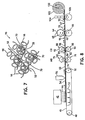
- the method includes the steps of co-extruding a first component 10 and a second component 12.
- the first and second components, 10 and 12 respectively, can be in the form of solid resin pellets or small particles.
- the first component 10 is positioned in a hopper 14 from which it can be metered and routed through a conduit 16 to a first extruder 18.
- the second component 12 is positioned in a hopper 20 from which it can be metered and routed through a conduit 22 to a second extruder 24.
- the first component 10 is a material that can be spun or otherwise formed into a continuous fiber. When the first component 10 is formed into a fiber, the fiber must be capable of being stretched and has a high recovery percentage R 1 .
- the "recovery percentage R 1 " is defined as the percent the first component 10 can recover after it has been stretched at least 50% of its initial length and upon removal of the force applied to stretch it.
- the first component 10 is an elastomeric material.
- Suitable elastomeric materials that can be used for the first component 10 include a melt extrudable thermoplastic elastomer such as a polyurethane elastomer, a copolyether ester, a polyether block polyamide copolymer, an ethylene vinyl acetate (EVA) elastomer, a styrenic block copolymer, an ether amide block copolymer, an olefinic elastomer, as well as other elastomers known to those skilled in the polymer art.
- a melt extrudable thermoplastic elastomer such as a polyurethane elastomer, a copolyether ester, a polyether block polyamide copolymer, an ethylene vinyl acetate (EVA) elastomer, a styrenic block copolymer, an ether amide block copolymer, an olefinic elastomer, as well as other elastomers
- MORTHANE® is a registered trademark of Huntsman Polyurethanes having an office in Chicago, Illinois 60606.
- ESTANE® a registered trademark of Noveon, Inc. having an office in Cleveland, Ohio 44141.
- PEARLTHANE® a registered trademark of Merquinsa having an office in Boxford, Massachusetts 01921.
- PEBAX® polyether block polyamide copolymer which is commercially available in various grades under the trade designation PEBAX®.
- PEBAX® is a registered trademark of Atofina Chemicals, Inc. having an office in Birdsboro, Pennsylvania 19508.
- a second elastomeric material is a copolyether-ester sold under the trade designation ARNITEL®.
- ARNITEL® is a registered trademark of DSM having an office at Het Overloon 1, NL-6411 TE Heerlen, Netherlands.
- the third elastomeric material is a copolyether-ester sold under the trade designation HYTREL®.
- HYTREL® is a registered trademark of E.I. DuPont de Nemours having an office in Wilmington, Delaware 19898.
- the first component 10 can also be formed from a styrenic block copolymer such as KRATON®.
- KRATON® is a registered trademark of Kraton Polymers having an office in Houston, Texas.
- the first component 10 can further be formed from a biodegradable elastomeric material such as polyester aliphatic polyurethanes or polyhydroxyalkanoates.
- the first component 10 can be formed from an olefinic elastomeric material, such as elastomers and plastomers.
- a plastomer is an ethylene-based resin or polymer sold under the trade designation AFFINITY®.
- AFFINITY® is a registered trademark of Dow Chemical Company having an office in Freeport, Texas.
- AFFINITY® resin is an elastomeric copolymer of ethylene and octene produced using Dow Chemical Company's INSITETM constrained geometry catalyst technology.
- EXACT® Another plastomer is sold under the trade designation EXACT® which includes single site catalyzed derived copolymers and terpolymers.
- EXACT® is a registered trademark of Exxon Mobil Corporation having an office at 5959 Las Colinas Boulevard, Irving, Texas 75039-2298.
- Other suitable olefinic elastomers that can be used to form the first component 10 include polypropylene-derived elastomers.
- the second component 12 is a material that can be spun or otherwise formed into a continuous fiber.
- the linear fiber When the second component 12 is formed into a linear fiber, the linear fiber must be capable of being stretched and has a recovery percentage R 2 , wherein R 1 is higher than R 2 .
- the "recovery percentage R 2 " is defined as the percent the component can recover after it has been stretched at least 50% of its initial length and upon removal of the force applied to stretch it.
- the first and second components, 10 and 12 respectively are formed into a linear fiber, the fiber must be capable of retracting or contracting from a stretched condition in order for the linear fiber to be useful in an absorbent article.
- the term “retracting” means the same thing as "contracting”.
- the ratio of R 1 /R 2 ranges from at least about 2 to about 100. Most desirably, the ratio of R 1 /R 2 ranges from at least about 2 to about 50.
- the reason for making R 1 greater than R 2 in a linear fiber is that upon retraction or contraction of the first and second components, 10 and 12 respectively, the 3-dimensional fiber will exhibit a very desirable, predetermined structural configuration. This structural configuration of the 3-dimensional fiber will display exceptional elongation properties in at least one direction.
- the linear fiber further obtains some of its unique properties when the first component 10 makes up a volume percent of from about 30% to about 95% of the linear fiber and the second component 12 makes up a volume percent of from about 5% to about 70% of the linear fiber.
- the first component 10 makes up a volume percent from about 40% to about 80% of the linear fiber and the second component 12 makes up a volume percent of from about 20% to about 60% of the linear fiber.
- volume percents for the first component 10 and for the second component 12 allow the linear fiber to be stretched at least 50% to form a stretched linear fiber.
- the volume percent of each of the first and second components, 10 and 12 respectively also plays a vital role in the retraction or contraction of the stretched fiber to a retracted length.
- volume percent of each of the first and second components, 10 and 12 respectively By varying the volume percent of each of the first and second components, 10 and 12 respectively, one can manufacture a linear fiber that can be stretched and then retracted to a predetermined configuration and with certain desirable characteristics.
- the contact with a body fluid will cause the absorbent article to swell which will allow the fibers to elongate in at least one direction before the fiber becomes linear.
- the fibers elongate they can expand and allow the absorbent structure to receive and store additional body fluids.
- the first and second components, 10 and 12 respectively are chemically, mechanically and/or physically adhered or joined to one another to prevent the fiber from splitting when the fiber is stretched and then allowed to relax.
- the relaxed fiber will retract in length.
- the first component 10 will be strongly adhered to the second component 12.
- the mechanical adhesion between the first and second components, 10 and 12 respectively will compliment any chemical and/or physical adhesion that is present and aid in preventing splitting or separation of the first component 10 from the second component 12. This splitting or separation occurs because one component is capable of retracting to a greater extent than the other component. If a strong mutual adhesion is not present, especially during retraction, the two components can split apart and this is not desirable.
- a strong chemical and/or physical adhesion will prevent the first component 10 from splitting or separating from the second component 12.
- the second component 12 can be formed from polyolefins, such as polyethylene, polypropylene, a polyester or a polyether.
- the second component 12 can also be a polyolefin resin, such as a fiber grade polyethylene resin sold under the trade designation ASPUN® 6811A.
- ASPUN® is a registered trademark of Dow Chemical Company having an office in Midland, Michigan 48674.
- the second component 12 can also be a polyolefin resin, such as a homopolymer polypropylene such as Himont PF 304, and PF 308, available from Basell North America, Inc. having an office at Three Little Falls Centre, 2801 Centerville Road, Wilmington, DE. 19808.
- polystyrene resin from which the second component 12 can be formed is polypropylene PP 3445 available from Exxon Mobil Corporation having an office at 5959 Las Colinas Boulevard, Irving, Texas 75039-2298.
- suitable polyolefinic materials that can be used for the second component 12 include random copolymers, such as a random copolymer containing propylene and ethylene.
- One such random copolymer is sold under the trade designation Exxon 9355, available from Exxon Mobil Corporation having an office at 5959 Las Colinas Boulevard, Irving, Texas 75039-2298.
- the second component 12 can also be formed from a melt extrudable thermoplastic material that provides sufficient permanent deformation upon stretching. Such materials include, but are not limited to, aliphatic and aromatic polyesters, polyethers, polyolefins such as polypropylene or polyethylene, blends or copolymers thereof, polyamides and nylons.
- the second component 12 can further be formed from biodegradable resins, such as aliphatic polyesters.
- One such aliphatic polyester is polylactic acid (PLA).
- Other biodegradable resins include polycaprolactone, polybutylene succinate adipate and polybutylene succinate.
- Polybutylene succinate adipate and polybutylene succinate resins are sold under the trade designation BIONOLLE® which is a registered trademark of Showa High Polymers having a sales office in New York, New York 10017.
- Additional biodegradable resins include copolyester resin sold under the trade designation EASTAR BIO®.
- EASTAR BIO® is a registered trademark of Eastman Chemical Company having an office in Kingsport, Tennessee 37662.
- Still other biodegradable resins that can be used for the second component 12 include polyhydroxyalkanoates (PHA) of varying composition and structure, and copolymers, blends and mixtures of the foregoing polymers.
- PHA polyhydroxyalkanoates
- suitable biodegradable polymer resins include BIONOLLE® 1003, 1020, 3020 and 3001 resins commercially available from Itochu International.
- BIONOLLE® is a registered trademark of Showa High Polymers having an office in New York, New York 10017.
- the second component 12 can also be formed from a water-soluble and swellable resin.
- water-soluble and swellable resins include polyethylene oxide (PEO) and polyvinyl alcohol (PVOH). Grafted polyethylene oxide (gPEO) or chemically modified PEO can also be used.
- the water-soluble polymer can be blended with a biodegradable polymer to provide for better processing, performance, and interactions with liquids.
- the PEO resin can be chemically modified by reactive extrusion, grafting, block polymerization or branching to improve its processability.
- the PEO resin can be modified by reactive extrusion or grafting as described in U.S. Patent No. 6,172,177 issued to Wang et al. on January 9, 2001 .
- the second component 12 has a lower recovery percentage R 2 than the first component 10.
- the second component 12 can be formed from a material that exhibits a low elastic recovery. Materials from which the second component 12 can be formed include, but are not limited to polyolefin resins, polypropylene, polyethylene, polyethylene oxide (PEO), polyvinyl alcohol (PVOH), polyester and polyether.
- the second component 12 can be treated or modified with hydrophilic or hydrophobic surfactants. Treatment of the second component 12 with a hydrophilic surfactant will form a wettable surface for increasing interaction with a body fluid or liquid. For example, when the surface of the second component 12 is treated to be hydrophilic, it will become more wettable when contacted by a body fluid, especially urine. Treatment of the second component 12 with a hydrophobic surfactant will cause it to shed a body fluid or liquid.
- the first and second components, 10 and 12 respectively are separately co-extruded in the two extruders 18 and 24.
- the first and second extruders, 18 and 24 respectively function in a manner that is well known to those skilled in the extrusion art.
- the solid resin pellets or small particles are heated up above their melting temperature and advanced along a path by a rotating auger.
- the first component 10 is routed through a conduit 26 while the second component 12 is simultaneously routed through a conduit 28 and both flow streams are directed into a spin pack 30.
- a melt pump, not shown, can be positioned across one or both of the conduits 26 and 28 to regulate volumetric distribution, if needed.
- the spin pack 30 is a device for making synthetic fibers.
- the spin pack 30 includes a bottom plate having a plurality of holes or openings through which the extruded material flows.
- the number of openings per square inch in the spin pack 30 can range from about 5 to about 500 openings per square inch (6.45 cm 2 ). Desirably, the number of openings per square inch (6.45 cm 2 ) in the spin pack 30 is from about 25 to about 250. More desirably, the number of openings per square inch in the spin pack 30 is from about 125 to about 225.
- the size of each of the openings in the spin pack 30 can vary. A typical size opening can range from about 0.1 millimeter (mm) to about 2.0 mm in diameter.
- the size of each of the openings in the spin pack 30 can range from about 0.3 mm to about 1.0 mm in diameter. More desirably, the size of each of the openings in the spin pack 30 can range from about 0.4 mm to about 0.8 mm in diameter.
- openings in the spin pack 30 do not have to be round or circular in cross-section but can have a bilobal, trilobal, square, triangular, rectangular, oval or any other geometrical cross-sectional configuration that is desired.
- the first and second components, 10 and 12 respectively, are directed into the spin pack 30 and are routed through the openings formed in the bottom plate in such a fashion that the first component 10 will form a core 32 while the second component 12 will form a sheath 34 which surrounds the outside circumference of the core 32. It should be noted that the first component 10 could form the sheath while the second component 12 could form the core, if desired.
- This core/sheath arrangement produces one configuration of a linear, bicomponent fiber 36.
- Bicomponent fibers having other cross-sectional configurations can also be produced using the spin pack 30.
- the bicomponent fiber can have a side by side configuration or a core/sheath design where the core is offset coaxially from the sheath.
- One bicomponent fiber 36 will be formed for each opening formed in the plate within the spin pack 30. This enables a plurality of continuous molten fibers 36, each having a predetermined diameter, to simultaneously exit the spin pack 30 at a first speed. Each linear, bicomponent fiber 36 will be spaced apart and be separated from the adjacent fibers 36. The diameter of each bicomponent fiber 36 will be dictated by the size of the openings formed in the bottom plate of the spin pack 30. For example, as stated above, if the diameter of the holes or openings in the bottom plate range from about 0.1 mm to about 2.0 mm, then each of the molten fibers 36 can have a diameter which ranges from about 0.1 mm to about 2.0 mm. There is a tendency for the molten fibers 36 to sometimes swell in cross-sectional area once they exit the opening formed in the plate but this expansion is relatively small.
- the plurality of continuous molten fibers 36 are routed through a quench chamber 38 to form a plurality of cooled linear fibers 40.
- the molten fibers 36 are directed downward from the spin pack 30 into the quench chamber 38.
- the reason for directing the molten fibers 36 downward is that gravity can be used to assist in moving the molten fibers 36.
- the vertical downward movement can aid in keeping the fibers 36 separated from one another.
- the continuous molten fibers 36 are contacted by one or more streams of air.
- the temperature of the continuous molten fibers 36 exiting the spin pack 30 and entering the quench chamber 38 will be in the range of from about 150°C to about 250°C.
- the actual temperature of the molten fibers 36 will depend on the material from which they are constructed, the melting temperature of such material, the amount of heat applied during the extrusion process, as well as other factors.
- the continuous molten fibers 36 are contacted and surrounded by lower temperature air.
- the temperature of the air can range from about 0°C to about 120°C. Desirably, the air is cooled or chilled so as to quickly cool the molten fibers 36.
- the air is cooled or chilled to a temperature of from about 0°C to about 40°C. More desirably, the air is cooled or chilled to a temperature of from about 15°C to about 30°C.
- the lower temperature air can be directed toward the molten fibers 36 at various angles but a horizontal or downward angle seems to work best.
- the velocity of the incoming air can be maintained or adjusted so as to efficiently cool the molten fibers 36.
- the cooled or chilled air will cause the continuous molten fibers 36 to crystallize, assume a crystalline structure or phase separate and form a plurality of continuous cooled fibers 40.
- the cooled fibers 40 are still linear in configuration at this time.
- the temperature of the cooled fibers 40 can range from about 15°C to about 100°C. Desirably, the temperature of the cooled fibers 40 will range from about 20°C to about 80°C. Most desirably, the temperature of the cooled fibers 40 will range from about 25°C to about 60°C.
- the cooled fibers 40 will be at a temperature below the melting temperature of the first and second components, 10 and 12 respectively, from which the fibers 40 were formed.
- the cooled fibers 40 may have a soft plastic consistency at this stage.
- the plurality of continuous cooled fibers 40 are then routed to a draw unit 42.
- the draw unit 42 can be vertically located below the quenching chamber 38 so as to take advantage of gravity.
- the draw unit 42 should have sufficient height to provide an adequate distance over which the cooled fibers 40 can be drawn.
- Drawing involves subjecting the cooled fibers 40 to pressurized air that will pull or draw the molten material exiting the spin pack 30 downward.
- the air pressure can range from about 3 pounds per square inch (psi) (20.7 Kpa) to about 100 psi (689 Kpa). Desirably, the air pressure can range from about 4 psi (27.6 Kpa) to about 50 psi (344 Kpa).
- the air pressure can range from about 5 psi (34.4 Kpa) to about 20 psi (13.8 Kpa).
- the velocity of the pressurized air can be maintained or adjusted so as to efficiently draw the cooled fibers 40.
- the pressurized air can be at ambient temperature of about 25°C or the pressurized air can be either hotter or colder depending upon one's preference.
- the cooled fibers 40 are drawn down mainly from the molten state and not from the cooled state.
- the downward force of the pressurized air in the draw unit 42 will cause the molten material to be lengthened and elongated into solid fibers 44. Lengthening of the molten material will usually shape, narrow, distort, or otherwise change the cross-sectional area of the solid fibers 44. For example, if the molten material has a round or circular cross-sectional area upon exiting the spin pack 30, the outside diameter of the solid fibers 44 will be reduced.
- the amount that the diameter of the solid linear fibers 44 are reduced will depend upon several factors, including the amount the molten material is drawn, the distance over which the fibers are drawn, the pressure and temperature of the air used to draw the fibers, the spin line tension, etc. Desirably, the diameter of the solid linear fibers 44 will range from about 5 microns to about 100 microns. More desirably, the diameter of the solid linear fibers 44 will range from about 10 microns to about 50 microns. Most desirably, the diameter of the solid linear fibers 44 will range from about 10 microns to about 30 microns.
- the cooled fibers 40 will be pulled at a second speed that is faster than the first speed displayed by the continuous molten fibers 36 exiting the spin pack 30. This change in speed between the continuous molten fibers 36 and the continuous cooled fibers 40 enables the molten material to be lengthened and also to be reduced in cross-sectional area.
- the cooled fibers 40 Upon exiting the draw unit 42, the cooled fibers 40 will be solid fibers 44.
- the solid, linear fibers 44 exiting the draw unit 42 are then deposited onto a moving support or forming surface 46.
- the moving support 46 can be a continuous forming wire or belt that is driven by a drive roll 48 while revolving about a guide roll 50. One or more guide rolls can be utilized if needed. Other types of moving supports known to those skilled in the art can also be utilized.
- the moving support 46 can be constructed as a fine, medium or coarse mesh having either no openings or a plurality of openings formed therein.
- the moving support 46 can have a configuration similar to a standard window screen or it can be tightly woven to resemble a wire or felt used by the paper industry in the formation of paper.
- a vacuum chamber 52 can optionally be positioned below the moving support 46 to facilitate accumulation of the solid, linear fibers 44 onto the moving support 46.
- the continuous linear fibers 44 accumulate on the moving support 46 in a random orientation and form a nonwoven mat 54.
- the nonwoven mat 54 is simply an accumulation of the continuous linear fibers 44 at this point and does not contain any melt points or bonds which would stabilize the fibers 44 into a web.
- the thickness and basis weight of the mat 54 will be dictated by the speed of the moving support 46, the number and diameter of the continuous linear fibers 44 deposited onto the moving support 46, as well as the speed at which the fibers 44 are being deposited onto the moving support 46.
- the nonwoven mat 54 is then routed under a hot air knife 56 that directs one or more jets or streams of hot air against the mat 54.
- hot air air that it has been heated to a predetermined elevated temperature. The exact temperature used will be determined based on the material used to form the bicomponent fibers 44. The hot air should be of a sufficient temperature to melt some of the fibers 44 at points where such fibers 44 contact, intersect or overlap adjacent fibers 44. The hot air causes some of the fibers 44 to melt and adhere to adjacent fibers 44 at a plurality of melt points 58.
- the melt points 58 are bonds formed at the intersection of two or more continuous fibers 44.
- the number of melt points 58 formed can vary and will be determined by a number of factors: including the speed of the mat 54, the temperature of the hot air, the composition of the bicomponent fibers 44, the degree to which the continuous linear fibers 44 are entangled, the basis weight of the mat 54, etc. For example, one could form from about 10 to about 10,000 melt points per square inch (6.45 cm 2 ).
- the continuous linear fibers 44 adhered by the plurality of melt points 58 forms a stabilized web 60. Alternatively, compaction rolls can also be used to form a stabilized web.
- the web 60 can be an airlaid web, a coform web, a wet laid wet, etc.
- the stabilized web 60 is routed through a nip 62 formed by a bond roll 64 and a anvil roll 66.
- the bond roll 64 and the anvil roll 66 are typically heated to an elevated temperature.
- the bond roll 64 contains one or more outwardly projecting nubs or protuberances 68.
- the nubs or protuberances 68 extend outward from the outer circumference of the bond roll 64 and are sized and shaped to create a plurality of bonds 70 in the stabilized web 60.
- the stabilized web 60 Once the stabilized web 60 has the bonds 70 formed therein, it becomes a bonded web 72.
- the bond roll 64 and the anvil roll 66 can be rotated as the stabilized web 60 passes through the nip 62.
- the nubs or protuberances 68 will penetrate a predetermined depth into the stabilized web 60 and form the bonds 70.
- the bonded web 72 can be a spunbond nonwoven web. Spunbond is a nonwoven material made by extruding molten thermoplastics into fibers having a relatively small diameter. The exact number and location of the bonds 70 in the bonded web 72 will be dictated by the position and configuration of the nubs or protuberances 68 formed on the outer circumference of the bond roll 64. Desirably, at least one bond per square inch is formed in the bonded web 72. More desirably, from about 20 to about 500 bonds per square inch 6.45 cm 2 are formed in the bonded web 72. Most desirably, at least about 30 bonds per square inch 6.45 cm 2 are formed in the bonded web 72. Typically, the percent bonded area varies from about 10% to about 30% of the total area of the web 72.
- the bonded web 72 is then stretched in at least one direction, and desirably, in two directions.
- the bonded web 72 can be stretched in either the machine direction, the cross direction or in both directions.
- the bonded web 72 is routed to a nip 74 formed between a pair of rotating rolls 76 and 78.
- Each of the rolls 76 and 78 has a configured surface, 80 and 82 respectively.
- the configured surfaces 80 and 82 are sized and configured to mate with one another and cause the bonded web 72 to be stretched in the machine direction as it advances through the nip 74.
- the bonded web 72 will be stretched in the machine direction into a lengthened web 84.
- Another option is to use a series of rotating rolls to stretch the web in the machine direction. The rolls can be driven at different speeds, if desired.
- This lengthened web 84 can then be routed through a nip 86 formed between a pair of rotating rolls 88 and 90.
- Each of the rolls 88 and 90 has a configured surface, 92 and 94 respectively.
- the configured surfaces 92 and 94 are sized and configured to mate with one another and cause the width or cross direction of the web 84 to be increased as it passes through the nip 86 into a wider web 96.
- Other mechanisms known to those skilled in the art can be used to stretch the web in either one or two directions.
- One such option is to use grippers that attach to the side edges of the web and stretch the web in the cross direction.
- a second option is to use a tenter frame to stretch the web. The stretching occurs at an elevated temperature in the range of from about 50°C to about 90°C.
- the fibers 44 are stretched by at least 50% in at least one direction.
- stretched it is meant that the continuous fibers 44 are lengthened or elongated while in the cooled or solid state. The stretching is caused by axial tension exerted on the fibers 44. As the fibers 44 are stretched, the cross-sectional area of the fibers 44 will be reduced.
- the amount of stretch imparted into some of the fibers 44 forming the web 96 can range from about 50% to about 500%. More desirably, the amount of stretch imparted into some of the fibers 44 forming the web 96 can range from about 50% to about 250%.
- the amount of stretch imparted into some of the fibers 44 forming the web 96 can range from about 75% to about 200%. It should be noted that a plurality of several pairs of mating rollers can be used to gradually increase the percentage of stretch in the web 96, if desired. As some of the fibers 44 are stretched, the thickness of the web 96 will be reduced. The thickness of the web 96 can range from about 2 mils (0.005 cm) to about 15 mils (0.038 cm) and the stretching will reduce this thickness.
- the stretching will cause the cross-sectional area of some of the fibers 44 to be reduced from about 5% to about 90%. Desirably, the cross-sectional area of some of the fibers 44 are reduced from about 10% to about 60%. More desirably, the cross-sectional area of some of the fibers 44 are reduced from about 20% to about 50%.
- the stretched, bicomponent continuous fibers 44 will be relatively small in diameter or cross-sectional area. Desirably, the diameter of the stretched, continuous fibers 44 will range from about 5 microns to about 50 microns. More desirably, the diameter of the stretched fibers 44 will range from about 5 microns to about 30 microns. Most desirably, the diameter of the stretched fibers 44 will range from about 10 microns to about 20 microns.
- the continuous bicomponent fibers 44 should have a definite configuration before being stretched so that the stretched fibers exhibit the ability to retract or contract once the stretching force is removed.
- retract it is meant the ability to be shortened, take back, draw back or recover to an earlier state.
- the stretched web 96 is allowed to relax after passing through the nip 86.
- This relaxation allows the stretched fibers 44 forming the web 96 to retract.
- This relaxation enables some of the fibers 44 to retract or contract into a plurality of continuous 3-dimensional, bicomponent fibers 98.
- the thickness of the relaxed web 96 will be greater than the thickness of the bonded web 72. This increase in thickness will result in a higher loft web as well as a softer web.
- a portion of a continuous 3-dimensional, bicomponent fiber 98 is depicted in the shape of a helix or helical coil that has a longitudinal central axis x-x.
- 3-dimensional fiber it is meant a fiber having an x, y and z component that is formed by virtue of coils and/or curves regularly or irregularly spaced and whose extremities in the x, y and z planes form a locus of points which define a volume greater than a linear fiber.
- the continuous 3-dimensional fibers 98 will have a generally helical configuration.
- the helical configuration can extend along the entire length L of each of the continuous 3-dimensional fibers 98 or it can occur over a portion of the continuous length of the 3-dimensional fibers 98.
- the coiled configuration extends over at least half of the length of each of the continuous 3-dimensional fibers 98.
- the coiled configuration extends from about 50% to about 90% of the length of each of the continuous 3-dimensional fibers 98. Most desirably, the coiled configuration extends from about 90% to about 100% of the length of each of the continuous 3-dimensional fibers 98. It should be noted that the coils can be formed in the clockwise or counterclockwise directions along at least a potion of the length of the continuous 3-dimensional fibers 98. It should also be noted that the configuration of each coil can vary along the length of each of the continuous 3-dimensional fibers 98.
- the fibers 98 will have a coil configuration with coils that circumscribes 360 degrees.
- the helical coils can be continuous or non-continuous over either a portion of or over the entire length of the continuous 3-dimensional fiber 98.
- the continuous 3-dimensional fibers 98 exhibit a continuous helical coil.
- the continuous 3-dimensional fiber 98 differs from a 2-dimensional fiber in that a 2-dimensional fiber has only two components, for example, an "x" and a "y” component; an "x" and a "z” component, or a "y” and a "z” component.
- the continuous 3-dimensional fiber 98 has three components, an "x” component, a "y” component and a "z” component.
- a crimped fiber is typically a fiber that has been pressed or pinched into small, regular folds or ridges.
- a crimped fiber usually has a bend along its length.
- the continuous 3-dimensional fiber 98 has a non-linear configuration when it forms a helical coil.
- the continuous 3-dimensional fiber 98 also has an amplitude "A" that is measured perpendicular to a portion of its length L.
- the amplitude "A” of the continuous 3-dimensional fiber 98 can range from about 10 microns to about 5,000 microns. Desirably, the amplitude "A" of the continuous 3-dimensional fiber 98 ranges from about 30 microns to about 1,000 microns. Most desirably, the amplitude "A” of the continuous 3-dimensional fiber 98 ranges from about 50 microns to about 500 microns.
- the continuous 3-dimensional fiber 98 further has a frequency "F" measured at two locations separated by 360 degrees between adjacent helical coils.
- the frequency “F” is used to denote the number of coils or curls formed in each inch of the coiled fiber length.
- the frequency “F” can range from about 10 to about 1,000 coils per inch (2.54 cm). Desirably, the frequency “F” can range from about 50 to about 500 coils per inch (2.54 cm).
- the amplitude "A” and/or the frequency “F” can vary or remain constant along at least a portion of the length L, or over the entire length, of the continuous3-dimensional fiber 98. Desirably, the amplitude "A” and the frequency “F” will remain constant over a majority of the length L.
- the amplitude "A" of the continuous 3-dimensional fiber 98 and the frequency “F” of the helical coils forming the continuous 3-dimensional fiber 98 affect the overall reduction in the length of the continuous 3-dimensional fiber 98 from it's stretched condition.
- first and second components, 10 and 12 respectively will affect the configuration and size of the helical coils developed as the stretched fibers retracts into the continuous 3-dimensional fiber 98.
- the continuous 3-dimensional fiber 98 is able to obtain a coiled configuration after being stretched due to the characteristics and properties of the first and second components, 10 and 12 respectively, from which it is formed.
- the first and second components, 10 and 12 respectively are adhered together in the spin pack 30 to form a continuous bicomponent fiber 36.
- the first component 10 in the linear fiber 44 has an elongation of at least about 50% deformation.
- the first component 10 is able to recover at least about 20% of the stretch deformation imparted thereto, based on its length after deformation. Desirably, the first component 10 in the linear fiber 44 is able to recover at least about 50% of its stretch deformation.
- the recovery or relaxation power may not be sufficient to activate helical coiling of the 3-dimensional fiber 98.
- Repetitive helical coils in the retracted 3-dimensional fiber 98 are most desirable.
- a higher elongation than at least about 50% for the first component 10 is desirable. For example, an elongation of at least about 100% is good, an elongation exceeding 300% is better, and an elongation exceeding 400% is even better.
- the second component 12 in the linear fiber 44 has a total deformation which includes a permanent unrecoverable deformation value and a recoverable deformation value.
- the permanent unrecoverable deformation value in a solid state as a result of stretching, plastic yielding and/or drawing, is at least about 40%.
- the recoverable deformation value is at least about 0.1 %.
- a higher elongation than at least about 50% for the second component 12 is desirable.
- An elongation of at least about 100% is good and an elongation exceeding about 300% is even better.
- Plastic yielding and drawing results in thinning of a second component 12.
- the second component 12 has a deformation up to about 700% or more when the linear fiber 44 is stretched in a solid state.
- Stretching in a solid state means that the second component 12 is stretched below its melting temperature. If the total deformation of the second component 12 is below at least about 50%, the second component 12 will fail and break during the stretching process. Also, at low deformation, the second component 12 does not provide a sufficient level of permanent plastic yielding and thinning which is desired for the formation of the repetitive helical coils in the 3-dimensional fiber 98. Stretching should not occur at very low temperatures because the fibers may be brittle and could break. Likewise, the fibers should not be stretched very quickly because this might cause the fibers to break before reaching the desired percent of elongation.
- the percent elongation of the length of the continuous, 3-dimensional coiled fiber 98 is defined as the percent change in length by which the continuous, 3-dimensional coiled fiber 98 can be stretched before becoming straight or linear.
- the retracted 3-dimensional fiber 98 has the ability to be subsequently elongated to at least 100% of its retracted length. Most desirably, the retracted 3-dimensional fiber 98 can be subsequently elongated from about 150% to about 900% of its retracted length. Even more desirably, the retracted 3-dimensional fiber 98 can be subsequently elongated from about 250% to about 500% of its retracted length. Still more desirably, the retracted 3-dimensional fiber 98 can be subsequently elongated from about 300% to about 400% of its retracted length.
- the continuous 3-dimensional fiber 98 exhibits exceptional elongation properties in at least one direction before the fiber becomes linear. Elongation is defined as the percent length by which the 3-dimensional fiber 98 can be stretched before it becomes straight or linear.
- the direction of the elongation property of the 3-dimensional fiber 98 is normally in the same direction as the linear fiber 44 was stretched. In other words, the direction that the retracted fiber 98 is able to subsequently elongate will be opposite to the direction of its retraction. It is possible for the retracted fiber 98 to have elongation properties in two or more directions. For example, the retracted fiber 98 can subsequently be elongated in both the x and y directions.
- the continuous 3-dimensional fibers 98 are obtained once the stretched web 96 is allowed to relax or retract. Some of the continuous 3-dimensional fibers 98 are able to acquire a helical profile by the difference in recovery percentage R 1 of the first component 10 compared to the recovery percentage R 2 of the second component 12. For example, since the first component 10 has a higher recovery percentage R 1 than the recovery percentage R 2 of the second component 12, the first component 10 will want to retract to a greater degree than the second component 12. However, both the first and second components, 10 and 12 respectively, will retract or contract the same amount since they are physically, chemically or mechanically adhered or joined to one another. The combination of the volume percent and the recovery percent of the first and second components, 10 and 12 respectively, creates the unique 3-dimensional configuration of the fiber 98.
- the amount of coiling obtained, as well as the shape and location of the coiling, can be controlled by the selection of materials that are used to construct the linear fiber 44. These three variables, the amount of coiling, the shape of the coiling and the location of the coiling, can also be controlled by the volume of each component, as well as the amount each of the linear fibers 44 are stretched.
- the time and temperature conditions under which the linear fibers 44 are stretched and allowed to retract can also affect the finish profile of the retracted fiber 98.
- the first component 10 has a higher recovery percentage R 1 than the recovery percentage R 2 of the second component 12 and therefore the material from which the first component 10 is formed tends to be more tacky and elastic. For this reason, the material with the higher recovery percentage R 1 is used to form the inner core while the material having a lower recovery percentage R 2 tends to be used to form the outer sheath.
- the first and second components, 10 and 12 respectively, try to retract from the stretched condition; the outer sheath will retract or contract less. This means that the first component 10 will not be able to retract fully to an amount that it could if it was by itself. This pent up force creates the twist or helical coil effect in the retracted fiber 98.
- Table 1 shows the recovery percent of individual materials that have been stretched to varying percentages.
- the material forming each sample was cut out from a thin sheet of a particular thickness in the shape of a dogbone or dumbbell.
- the dogbone shaped sample had an initial length of 63 millimeters (mm) measured from a first enlarged end to a second enlarged end. In between the two oppositely aligned, enlarged ends was a narrow section having a length of 18 mm and a width of 3 mm.
- the material was then placed in a tensile tester and stretched at a rate of 5 inches (12.7 cm) per minute, in the machine direction of the material. This stretching caused the narrow section of the sample to elongate.
- the dogbone shaped sample had a narrow section I 1 located between its first and second enlarged ends.
- Each of the enlarged ends of the dog bone sample was secured in a tensile tester and a force was applied causing the material to be stretched, in the machine direction of the material, a predetermined amount at a specific temperature.
- the narrow section is stretched to a length I 2 .
- the length I 2 is greater than the initial length I 1 .
- the force exerted on the sample was then removed and the sample was allowed to retract such that the narrow section is shortened to a length I 3 .
- the retracted length I 3 is smaller than the stretched length I 2 but is greater than the initial length I 1 .
- a portion of the web 96 is shown after the linear fibers 44 have been stretched and the fibers have relaxed into a coiled configuration. At this point, the web 96 of coiled fibers 98 is formed and is a stable web.
- the web 96 formed from the plurality of 3-dimensional fibers 98 is routed to a take up roll 100 where it can accumulate into a large supply roll 102.
- the web 96 can be cut using a cutting knife 104 and a cooperating anvil 106.
- Other means for cutting or severing the web 96 at a desired time can also be utilized. Such cutting means are well known to those skilled in the art.
- Fig. 8 an alternative method of forming a web of coiled fibers 98 is depicted.
- the method is identical to that depicted in Fig. 1 up to the point where a stabilized web 60 is formed by the hot air knife 56. Because of this, the equipment utilized upstream of the draw unit 42 is not shown.
- the stabilized web 60 is formed, it is routed to the through the nip 74 formed by the pair of roller 76 and 78.
- the stabilized web 60 is stretched in the machine direction to form a lengthened web 84.
- the lengthened web 84 is then routed through the nip 86 formed by the pair of roller 88 and 90 and is stretched in the cross direction.
- the stretched fibers forming the web 96 are allowed to relax. This relaxation causes some of the stretched fibers to retract and form coiled fibers 98.
- the resulting web 96 is made up of a plurality of the coiled fibers 98.
- the web 96 is routed through the nip 62 formed by the pair of rollers 64 and 66 which forms a plurality of bonds 70 in the web 96 thereby establishing a bonded web 97.
- the bonded web 97 is then routed to a take up roll 100 where it can accumulate into a large supply roll 102. When the supply roll 102 reaches a desired outside diameter, the bonded web 97 can be cut using a cutting knife 104 and a cooperating anvil 106.
- the webs 96 or 97 formed by either of the two methods described above, will have a number of unique properties.
- the webs 96 or 97 will be extensible in at least one direction, and desirably, in two directions.
- the webs 96 or 97 will also exhibit controlled retraction, high loft and greater void volume than a web formed from a plurality of non-stretched and then relaxed fibers.
- the webs 96 or 97 will have a high degree of softness which is a very desirable property when the web material is utilized as a bodyside cover on a disposable absorbent article.
- the webs 96 or 97 can have an elongation of up to about 400% in at least one direction, the machine direction, the cross direction or they can have an elongation in both directions. Desirably, the webs 96 or 97 will have an elongation of up to about 200% in the machine direction, the cross direction or in both directions. More desirably, the webs 96 or 97 will have an elongation of up to about 100% in the machine direction, the cross direction or in both directions.
- the webs 96 or 97 can be elongated and then the webs have the ability to retract to approximately their original length when the elongation force is removed.
- the extensible webs 96 or 97 can be laminated to a stretchable material, an elastic film or elastic fibers to form a thin, non-absorbent material.
- This laminate material can be used as the bodyside cover or facing layer on a disposable absorbent article such as a diaper, training pant, incontinence garment, sanitary napkin, etc.
- This laminate material can also be used in health care products such as wound dressings, surgical gowns, gloves, etc.
Landscapes
- Engineering & Computer Science (AREA)
- Textile Engineering (AREA)
- Chemical & Material Sciences (AREA)
- Chemical Kinetics & Catalysis (AREA)
- General Chemical & Material Sciences (AREA)
- Mechanical Engineering (AREA)
- Nonwoven Fabrics (AREA)
- Multicomponent Fibers (AREA)
- Yarns And Mechanical Finishing Of Yarns Or Ropes (AREA)
- Spinning Methods And Devices For Manufacturing Artificial Fibers (AREA)
Claims (25)
- Ein Verfahren zum Bilden einer Bahn aus Fasern, welches die Schritte umfasst:a) Koextrudieren einer ersten (10) und zweiten (12) Komponente, wobei die erste Komponente einen Wiederherstellungsprozentsatz R1 aufweist und eine zweite Komponente einen Wiederherstellungsprozentsatz R2 aufweist, wobei R1 größer ist als R2;b) Lenken der ersten und zweiten Komponente durch ein Spinnpaket (30), um eine Vielzahl von kontinuierlichen geschmolzenen Fasern (36) zu bilden, von welchen jede einen vorbestimmten Durchmesser aufweist;c) Leiten der Vielzahl von geschmolzenen Fasern durch eine Quenchkammer (38), um eine Vielzahl abgekühlter Fasern zu bilden;d) Leiten der Vielzahl von abgekühlten Fasern durch eine Zugeinheit (42), um eine Vielzahl von linearen Fasern (44) zu bilden, von welchen jede einen kleineren Durchmesser aufweist als die geschmolzenen Fasern;e) Ablegen der linearen Fasern auf eine sich bewegenden Auflage (46), um eine Anhäufung von Fasern zu bilden;f) Stabilisieren und Binden der Fasern, um eine Bahn (72) zu bilden; gekennzeichnet dadurch, dass:g) die erste Komponente ein elastomeres Material ist; und dadurch, dass das Verfahren umfasst:h) Strecken der Bahn bei einer erhöhten Temperatur in einem Bereich von ungefähr 50°C bis ungefähr 90°C in mindestens einer Richtung um mindestens 50 Prozent; undi) Ermöglichen, dass sich die gestreckte Bahn entspannt, und wobei die Fasern eine 3-dimensionale, gewickelte Konfiguration annehmen, welche die Bahn mit einer Dehnbarkeit in mindestens einer Richtung ausstattet.
- Das Verfahren gemäß Anspruch 1, wobei die Fasern (44) Zweikomponentenfasern sind.
- Das Verfahren gemäß Anspruch 2, wobei jede der Zweikomponentenfasern (44) eine Kern/Mantel-Querschnittskonfiguration aufweist.
- Das Verfahren gemäß Anspruch 3, wobei jede der Zweikomponentenfasern (44) in der Kern/Mantel-Querschnittskonfiguration mechanisch miteinander zusammenhängt.
- Das Verfahren gemäß Anspruch 3, wobei jede der Zweikomponentenfasern (44) in der Kern/Mantel-Querschnittskonfiguration chemisch miteinander zusammenhängt.
- Das Verfahren gemäß Anspruch 3, wobei jede der Zweikomponentenfasern (44) in der Kern/Mantel-Querschnittskonfiguration physikalisch miteinander zusammenhängt.
- Das Verfahren gemäß einem der vorherigen Ansprüche, wobei die Bahn (72) eine Spinnvliesbahn ist.
- Das Verfahren gemäß einem der vorherigen Ansprüche, wobei das Volumenprozent der ersten Komponente (10) in der Bahn von ungefähr 40% bis ungefähr 80% beträgt.
- Das Verfahren gemäß einem der vorherigen Ansprüche, welches das Lenken der ersten und zweiten Komponente durch das Spinnpaket (30) umfasst mit einer ersten Geschwindigkeit und Leiten der Vielzahl von abgekühlten Fasern durch die Zugeinheit mit einer zweiten Geschwindigkeit, wobei die zweite Geschwindigkeit größer ist als die erste Geschwindigkeit, Lenken von heißer Luft auf die Anhäufung von Fasern, um stabilisierte Fasern zu bilden, Binden der stabilisierten Fasern an die Bahn (72), Strecken der Bahn sowohl in einer Maschinenrichtung als auch in einer Querrichtung um mindestens 50 Prozent, und Ermöglichen, dass die gestreckte Bahn entspannt, wobei die Fasern eine 3-dimensionale, gewickelte Konfiguration annehmen, welche die Bahn mit einer Dehnbarkeit in zwei Richtungen ausstattet.
- Das Verfahren gemäß einem der vorherigen Ansprüche, wobei mindestens eine Bindung pro Quadratzoll (6,45 cm2) in der Bahn gebildet wird.
- Das Verfahren gemäß einem der vorherigen Ansprüche, wobei mindestens 30 Bindungen pro Quadratzoll (6,45 cm2) in der Bahn gebildet wird.
- Das Verfahren gemäß einem der vorherigen Ansprüche, wobei die Bahn von 50 Prozent bis ungefähr 500 Prozent gestreckt wird.
- Das Verfahren gemäß Anspruch 12, wobei die Bahn von 50 Prozent bis ungefähr 250 Prozent gestreckt wird.
- Das Verfahren gemäß einem der vorherigen Ansprüche, wobei jede der geschmolzenen Fasern einen vorbestimmten Durchmesser von ungefähr 0,1 Millimeter bis ungefähr 2,0 Millimeter aufweist.
- Das Verfahren gemäß einem der vorherigen Ansprüche, welches des Weiteren das Einwirken auf die Anhäufung von Fasern mit einer Vielzahl heißer Luftströme umfasst, um die Fasern zu stabilisieren.
- Das Verfahren gemäß einem der vorherigen Ansprüche, wobei die zweite Komponente Polyolefin ist.
- Ein Verfahren zum Bilden einer Bahn aus Zweikomponentenfasern, welches die Schritte umfasst:a) Koextrudieren einer ersten (10) und zweiten (12) Komponente, wobei die erste Komponente einen Wiederherstellungsprozentsatz R1 aufweist und eine zweite Komponente einen Wiederherstellungsprozentsatz R2 aufweist, wobei R1 größer ist als R2;b) Lenken der ersten und zweiten Komponente durch ein Spinnpaket (30) bei einer ersten Geschwindigkeit, um eine Vielzahl von kontinuierlichen geschmolzenen Fasern (36) zu bilden, von welchen jede einen vorbestimmten Durchmesser aufweist;c) Leiten der Vielzahl von geschmolzenen Fasern durch eine Quenchkammer (38), um eine Vielzahl von abgekühlten Fasern zu bilden;d) Leiten der Vielzahl von abgekühlten Fasern durch eine Zugeinheit (42) bei einer zweiten Geschwindigkeit, wobei die zweite Geschwindigkeit größer ist als die erste Geschwindigkeit, um eine Vielzahl von linearen Fasern (44) zu bilden, von welchen jede einen kleineren Durchmesser aufweist als die geschmolzenen Fasern;e) Ablegen der linearen Fasern auf eine sich bewegenden Auflage (46), um eine Anhäufung von Fasern zu bilden;f) Lenken von heißer Luft auf die Anhäufung von Fasern, um ein stabilisierte Bahn (60) zu bilden; gekennzeichnet dadurch, dass:g) die erste Komponente ein elastomeres Material ist;h) Strecken der stabilisierten Bahn bei einer erhöhten Temperatur in einem Bereich von ungefähr 50°C bis ungefähr 90°C in mindestens einer Richtung um mindestens 50 Prozent;i) Ermöglichen, dass sich die gestreckte Bahn entspannt, und wobei die Fasern eine 3-dimensionale, gewickelte Konfiguration annehmen; undj) Binden der gestreckten Bahn um eine Bahn (97) zu bilden, welche eine Dehnbarkeit in mindestens einer Richtung aufweist.
- Das Verfahren gemäß Anspruch 17, wobei etwas der stabilisierten Bahn in zwei Richtungen gestreckt wird.
- Das Verfahren gemäß Anspruch 18, wobei die stabilisierte Bahn zuerst in einer Maschinenrichtung gestreckt wird und dann in einer Querrichtung.
- Das Verfahren gemäß Anspruch 17, 18 oder 19, wobei mindestens eine Bindung pro Quadratzoll (6,45 cm2) in der Bahn gebildet wird.
- Das Verfahren gemäß einem der Ansprüche 17 bis 20, wobei mindestens 30 Bindungen pro Quadratzoll (6,45 cm2) in der Bahn gebildet wird.
- Das Verfahren gemäß einem der vorherigen Ansprüche, wobei die Bahn eine Verlängerung um bis zu 100% in mindestens einer Richtung aufweist.
- Das Verfahren gemäß einem der Ansprüche 1 bis 21, wobei die Bahn eine Verlängerung um bis zu 200% in mindestens einer Richtung aufweist.
- Das Verfahren gemäß einem der Ansprüche 1 bis 21, wobei die Bahn eine Verlängerung um bis zu 400% in mindestens einer Richtung aufweist.
- Das Verfahren gemäß Anspruch 24, wobei die Bahn eine Verlängerung um bis zu 400% in zwei Richtungen aufweist.
Applications Claiming Priority (3)
| Application Number | Priority Date | Filing Date | Title |
|---|---|---|---|
| US232057 | 2002-08-30 | ||
| US10/232,057 US6896843B2 (en) | 2002-08-30 | 2002-08-30 | Method of making a web which is extensible in at least one direction |
| PCT/US2003/023149 WO2004020711A1 (en) | 2002-08-30 | 2003-07-24 | Method of making a web which is extensible in at least one direction |
Publications (2)
| Publication Number | Publication Date |
|---|---|
| EP1534884A1 EP1534884A1 (de) | 2005-06-01 |
| EP1534884B1 true EP1534884B1 (de) | 2010-01-06 |
Family
ID=31976898
Family Applications (1)
| Application Number | Title | Priority Date | Filing Date |
|---|---|---|---|
| EP03791603A Expired - Lifetime EP1534884B1 (de) | 2002-08-30 | 2003-07-24 | Verfahren zur herstellung einer bahn, die in wenigstens einer richtung dehnbar ist |
Country Status (10)
| Country | Link |
|---|---|
| US (1) | US6896843B2 (de) |
| EP (1) | EP1534884B1 (de) |
| JP (1) | JP4533749B2 (de) |
| KR (1) | KR101007479B1 (de) |
| AR (1) | AR040877A1 (de) |
| AU (1) | AU2003254150A1 (de) |
| BR (1) | BR0313445A (de) |
| DE (1) | DE60330873D1 (de) |
| MX (1) | MXPA05001640A (de) |
| WO (1) | WO2004020711A1 (de) |
Families Citing this family (44)
| Publication number | Priority date | Publication date | Assignee | Title |
|---|---|---|---|---|
| EP1573107B1 (de) * | 2002-10-24 | 2009-12-02 | Dow Global Technologies Inc. | Elastomere mehrkomponentenfasern,vliesbahnen und vliesstoffe |
| CN1768169A (zh) * | 2003-04-03 | 2006-05-03 | 苏拉有限及两合公司 | 用来制造膨化变形长丝的方法和装置 |
| US7220478B2 (en) | 2003-08-22 | 2007-05-22 | Kimberly-Clark Worldwide, Inc. | Microporous breathable elastic films, methods of making same, and limited use or disposable product applications |
| US7270723B2 (en) * | 2003-11-07 | 2007-09-18 | Kimberly-Clark Worldwide, Inc. | Microporous breathable elastic film laminates, methods of making same, and limited use or disposable product applications |
| US7186317B2 (en) * | 2003-12-12 | 2007-03-06 | Kimberly-Clark Worldwide, Inc. | Method for producing soft bulky tissue |
| WO2005073309A1 (en) * | 2004-01-26 | 2005-08-11 | The Procter & Gamble Company | Fibers and nonwovens comprising polypropylene blends and mixtures |
| CA2554101C (en) * | 2004-01-26 | 2009-11-24 | The Procter & Gamble Company | Fibers and nonwovens comprising polyethylene blends and mixtures |
| US8198200B2 (en) * | 2004-03-29 | 2012-06-12 | The Procter & Gamble Company | Web materials having both plastic and elastic properties |
| US20050215972A1 (en) * | 2004-03-29 | 2005-09-29 | Roe Donald C | Disposable absorbent articles with zones comprising elastomeric components |
| US7820875B2 (en) | 2004-03-29 | 2010-10-26 | The Procter & Gamble Company | Disposable absorbent articles being adaptable to wearer's anatomy |
| EP1773582A4 (de) * | 2004-08-03 | 2008-05-14 | Advanced Design Concept Gmbh | Gedehnte elastische fliesstoffe |
| JP4566142B2 (ja) * | 2005-03-09 | 2010-10-20 | 花王株式会社 | 不織布 |
| US20060216506A1 (en) * | 2005-03-22 | 2006-09-28 | Jian Xiang | Multicomponent fibers having elastomeric components and bonded structures formed therefrom |
| US20060216491A1 (en) * | 2005-03-22 | 2006-09-28 | Ward Bennett C | Bonded structures formed form multicomponent fibers having elastomeric components for use as ink reservoirs |
| US20060237375A1 (en) * | 2005-03-22 | 2006-10-26 | Jian Xiang | Bonded fiber structures for use in blood separation |
| US20070098953A1 (en) * | 2005-10-27 | 2007-05-03 | Stabelfeldt Sara J | Fastening systems utilizing combinations of mechanical fasteners and foams |
| US20070099531A1 (en) * | 2005-10-27 | 2007-05-03 | Efremova Nadezhda V | Foam fastening system that includes a surface modifier |
| US8034430B2 (en) * | 2005-10-27 | 2011-10-11 | Kimberly-Clark Worldwide, Inc. | Nonwoven fabric and fastening system that include an auto-adhesive material |
| JP5179384B2 (ja) | 2006-02-21 | 2013-04-10 | ファイバーウェブ・シンプソンヴィル,インコーポレイテッド | 伸張性吸収性複合材 |
| US8235963B2 (en) | 2006-06-07 | 2012-08-07 | The Procter & Gamble Company | Disposable wearable absorbent articles with anchoring systems |
| US20070287983A1 (en) * | 2006-06-07 | 2007-12-13 | Richard Worthington Lodge | Absorbent article having an anchored core assembly |
| EP1930492B1 (de) * | 2006-12-06 | 2010-09-29 | Reifenhäuser GmbH & Co. KG Maschinenfabrik | Verfahren und Vorrichtung zur Herstellung eines Spinnvlieses |
| US20080187751A1 (en) * | 2007-02-02 | 2008-08-07 | Ward Bennett C | Porous Reservoirs Formed From Side-By-Side Bicomponent Fibers |
| US8597268B2 (en) | 2007-09-07 | 2013-12-03 | The Procter & Gamble Company | Disposable wearable absorbent articles with anchoring subsystems |
| US8945079B2 (en) | 2007-09-07 | 2015-02-03 | The Procter & Gamble Company | Disposable wearable absorbent articles with anchoring subsystems |
| US9060900B2 (en) | 2007-09-07 | 2015-06-23 | The Proctor & Gamble Company | Disposable wearable absorbent articles with anchoring subsystems |
| US8790325B2 (en) | 2007-09-07 | 2014-07-29 | The Procter & Gamble Company | Disposable wearable absorbent articles with anchoring subsystems |
| US8668679B2 (en) | 2007-09-07 | 2014-03-11 | The Procter & Gamble Company | Disposable wearable absorbent articles with anchoring subsystems |
| US9056031B2 (en) | 2007-09-07 | 2015-06-16 | The Procter & Gamble Company | Disposable wearable absorbent articles with anchoring subsystems |
| US8858523B2 (en) | 2007-09-07 | 2014-10-14 | The Procter & Gamble Company | Disposable wearable absorbent articles with anchoring subsystems |
| WO2010038732A1 (ja) * | 2008-09-30 | 2010-04-08 | Kbセーレン株式会社 | ストッキング用複合繊維 |
| KR101383665B1 (ko) * | 2010-09-03 | 2014-04-09 | 에스케이이노베이션 주식회사 | 다층필름 |
| US9763837B2 (en) | 2011-12-01 | 2017-09-19 | Sca Hygiene Products Ab | Absorbent article having fluid flow control member |
| US20130143019A1 (en) * | 2011-12-01 | 2013-06-06 | 3M Innovative Properties Company | Method of making coiled-filament nonwoven web and articles |
| US9498384B2 (en) | 2011-12-01 | 2016-11-22 | Leigh E. Wood | Assembled intermediate comprising staple fiber nonwoven web and articles |
| US20130255103A1 (en) | 2012-04-03 | 2013-10-03 | Nike, Inc. | Apparel And Other Products Incorporating A Thermoplastic Polymer Material |
| FR3019493B1 (fr) | 2014-04-08 | 2017-11-10 | Aplix Sa | Procede pour impartir du developpe agrippant a un stratifie et stratifie obtenu par le procede |
| JP2016125163A (ja) * | 2014-12-29 | 2016-07-11 | 株式会社クラレ | ポリエーテルイミド系繊維およびポリエーテルイミド系繊維集合体 |
| US10741519B2 (en) | 2016-07-11 | 2020-08-11 | Laird Technologies, Inc. | Systems of applying materials to components |
| CN110636823A (zh) | 2017-05-17 | 2019-12-31 | 贝瑞全球有限公司 | 弹性非织造物层压方法和设备 |
| US11141823B2 (en) | 2018-04-28 | 2021-10-12 | Laird Technologies, Inc. | Systems and methods of applying materials to components |
| EP4039118B1 (de) | 2019-08-02 | 2025-05-14 | NIKE Innovate C.V. | Laufsohle für einen schuhartikel |
| EP4041944B1 (de) | 2019-11-18 | 2023-01-25 | Nike Innovate C.V. | Gestricktes bauteil mit einer schaumstoffoberfläche |
| US20210148010A1 (en) | 2019-11-18 | 2021-05-20 | Nike, Inc. | Foamable and foamed textiles, the process of manufacturing the same, and articles incorporating the same |
Family Cites Families (298)
| Publication number | Priority date | Publication date | Assignee | Title |
|---|---|---|---|---|
| CA803714A (en) | 1969-01-14 | Johnson And Johnson | Continuous filament fabric | |
| US3988883A (en) | 1957-04-05 | 1976-11-02 | E. I. Dupont De Nemours And Company | Stretch-resistant bulked yarn |
| US3338992A (en) | 1959-12-15 | 1967-08-29 | Du Pont | Process for forming non-woven filamentary structures from fiber-forming synthetic organic polymers |
| DK97537C (da) | 1961-06-09 | 1963-12-09 | Ole-Bendt Rasmussen | Fremgangsmåde ved lægdestrækning i kold tilstand af et orienterbart foliemateriale. |
| US3502763A (en) | 1962-02-03 | 1970-03-24 | Freudenberg Carl Kg | Process of producing non-woven fabric fleece |
| NL297313A (de) | 1962-08-30 | 1900-01-01 | ||
| US3502538A (en) | 1964-08-17 | 1970-03-24 | Du Pont | Bonded nonwoven sheets with a defined distribution of bond strengths |
| US3383449A (en) | 1964-10-01 | 1968-05-14 | Muller Paul Adolf | Method for producing an endless filter string |
| US3341394A (en) | 1966-12-21 | 1967-09-12 | Du Pont | Sheets of randomly distributed continuous filaments |
| US3542615A (en) | 1967-06-16 | 1970-11-24 | Monsanto Co | Process for producing a nylon non-woven fabric |
| GB1292301A (en) | 1968-11-06 | 1972-10-11 | Monsanto Co | A helically crimped bicomponent polyamidepolyurethane filament |
| US3849241A (en) | 1968-12-23 | 1974-11-19 | Exxon Research Engineering Co | Non-woven mats by melt blowing |
| US3676242A (en) | 1969-08-13 | 1972-07-11 | Exxon Research Engineering Co | Method of making a nonwoven polymer laminate |
| DE2048006B2 (de) | 1969-10-01 | 1980-10-30 | Asahi Kasei Kogyo K.K., Osaka (Japan) | Verfahren und Vorrichtung zur Herstellung einer breiten Vliesbahn |
| DE1950669C3 (de) | 1969-10-08 | 1982-05-13 | Metallgesellschaft Ag, 6000 Frankfurt | Verfahren zur Vliesherstellung |
| CA948388A (en) | 1970-02-27 | 1974-06-04 | Paul B. Hansen | Pattern bonded continuous filament web |
| US3839240A (en) | 1971-03-18 | 1974-10-01 | Celanese Corp | High melt index microporous films |
| CH526276A (de) | 1971-05-13 | 1972-08-15 | Celfil Co | Verfahren und Einrichtung zur Herstellung von Filtermaterialbahnen für Tabakwarenfilter, insbesondere Zigarettenfilter |
| JPS481471A (de) * | 1971-06-01 | 1973-01-10 | ||
| US3880966A (en) | 1971-09-23 | 1975-04-29 | Celanese Corp | Corona treated microporous film |
| US3761348A (en) | 1972-02-17 | 1973-09-25 | Monsanto Co | Bicomponent filament |
| US3870593A (en) | 1972-06-06 | 1975-03-11 | Minnesota Mining & Mfg | Stretch-oriented porous films and preparation and use thereof |
| US3844865A (en) | 1972-06-06 | 1974-10-29 | Minnesota Mining & Mfg | Method of making stretch-oriented porous films |
| GB1453447A (en) | 1972-09-06 | 1976-10-20 | Kimberly Clark Co | Nonwoven thermoplastic fabric |
| US4100324A (en) | 1974-03-26 | 1978-07-11 | Kimberly-Clark Corporation | Nonwoven fabric and method of producing same |
| GB1526722A (en) | 1974-07-05 | 1978-09-27 | Rasmussen O | Method for producing a laminated high strength sheet |
| US4039364A (en) | 1974-07-05 | 1977-08-02 | Rasmussen O B | Method for producing a laminated high strength sheet |
| DE2441781C3 (de) | 1974-08-31 | 1980-12-04 | Hoechst Ag, 6000 Frankfurt | Verfahren zur Verbesserung der Wasseraufnahme und Saugfähigkeit von Fasermaterialien |
| US3998883A (en) * | 1974-09-23 | 1976-12-21 | Pfizer Inc. | Process for preparing 6-chloro-2-chloromethyl-4-phenylquinazoline-3-oxide and intermediates therefor |
| US4793885A (en) | 1974-12-11 | 1988-12-27 | Rasmussen O B | Method of laminating and stretching film material and apparatus for said method |
| DE2503775A1 (de) | 1975-01-30 | 1976-08-05 | Reifenhaeuser Kg | Verfahren und vorrichtung zur querreckung von kunststoffolien aus thermoplastischem kunststoff |
| US4124673A (en) | 1975-03-26 | 1978-11-07 | Bayer Aktiengesellschaft | Process for the production of bifilar acrylic fibres |
| DE2513251C3 (de) | 1975-03-26 | 1978-09-07 | Bayer Ag, 5090 Leverkusen | Verfahren zur Herstellung von bifilaren Acrylfasern |
| US4144008A (en) | 1975-03-31 | 1979-03-13 | Biax-Fiberfilm Corporation | Apparatus for stretching a tubularly-formed sheet of thermoplastic material |
| US4285100A (en) | 1975-03-31 | 1981-08-25 | Biax Fiberfilm Corporation | Apparatus for stretching a non-woven web or an orientable polymeric material |
| US4223059A (en) | 1975-03-31 | 1980-09-16 | Biax Fiberfilm Corporation | Process and product thereof for stretching a non-woven web of an orientable polymeric fiber |
| US4116892A (en) | 1975-03-31 | 1978-09-26 | Biax-Fiberfilm Corporation | Process for stretching incremental portions of an orientable thermoplastic substrate and product thereof |
| US4153751A (en) | 1975-03-31 | 1979-05-08 | Biax-Fiberfilm Corporation | Process for stretching an impregnated film of material and the microporous product produced thereby |
| US4289832A (en) | 1975-03-31 | 1981-09-15 | Biax Fiberfilm Corp. | Chemically-impregnated microporous films |
| US4336638A (en) | 1975-05-23 | 1982-06-29 | Netlon Limited | Apparatus for stretching plastic webs |
| GB1526723A (en) | 1975-08-27 | 1978-09-27 | Rasmussen O | Co-extruded sheet with properties resembling a cross-laminate and method of producing said sheet |
| GB1526724A (en) | 1975-08-27 | 1978-09-27 | Rasmussen O | Method of forming a laminate |
| US4138459A (en) | 1975-09-08 | 1979-02-06 | Celanese Corporation | Process for preparing a microporous polymer film |
| DE2641533A1 (de) | 1975-09-17 | 1977-03-31 | Biax Fiberfilm Corp | Verfahren zum strecken eines thermoplastischen materials |
| GB1553102A (en) | 1976-05-06 | 1979-09-19 | Rasmussen O B | Extrusion method and apparatus |
| US4153664A (en) | 1976-07-30 | 1979-05-08 | Sabee Reinhardt N | Process for pattern drawing of webs |
| CA1123566A (en) | 1977-02-09 | 1982-05-18 | Eckhard C.A. Schwarz | Process and apparatus for stretching a tubularly-formed sheet of a thermoplastic material and the product produced thereby |
| US5153254A (en) | 1977-03-17 | 1992-10-06 | Applied Elastomerics, Inc. | Reusable lint remover |
| DE2812263A1 (de) | 1977-03-22 | 1978-09-28 | Biax Fiberfilm Corp | Verfahren zum strecken eines thermoplastischen materials |
| US4350655A (en) | 1977-05-05 | 1982-09-21 | Biax Fiberfilm | Process for producing highly porous thermoplastic films |
| US4368565A (en) | 1978-03-28 | 1983-01-18 | Biax-Fiberfilm Corporation | Grooved roller assembly for laterally stretching film |
| US4251585A (en) | 1978-05-01 | 1981-02-17 | Biax Fiberfilm Corporation | Product and process for stretching a tubularly formed sheet of orientable thermoplastic material |
| JPS5598915A (en) | 1979-01-16 | 1980-07-28 | Japan Exlan Co Ltd | Production of fiber swelling with water |
| US4243802A (en) | 1979-06-06 | 1981-01-06 | Hercules Incorporated | Surfactant-soluble cellulose derivatives |
| US4301102A (en) | 1979-07-16 | 1981-11-17 | E. I. Du Pont De Nemours And Company | Self-crimping polyamide fibers |
| US4438167A (en) | 1979-10-15 | 1984-03-20 | Biax Fiberfilm Corporation | Novel porous fabric |
| US4340563A (en) | 1980-05-05 | 1982-07-20 | Kimberly-Clark Corporation | Method for forming nonwoven webs |
| US4464815A (en) | 1980-12-31 | 1984-08-14 | Mobil Oil Corporation | Multidirectional orientation apparatus |
| JPS57117951A (en) | 1981-01-16 | 1982-07-22 | Mitsubishi Rayon Co | Porous polyethylene film and its manufacture |
| US4422892A (en) | 1981-05-04 | 1983-12-27 | Scott Paper Company | Method of making a bonded corrugated nonwoven fabric and product made thereby |
| JPS57205520A (en) | 1981-06-05 | 1982-12-16 | Teijin Ltd | Conjugate fiber |
| US4472328A (en) | 1981-06-09 | 1984-09-18 | Mitsubishi Chemical Industries, Ltd. | Process for producing porous film or sheet |
| US4559938A (en) | 1981-08-12 | 1985-12-24 | Smith And Nephew Associated Companies P.L.C. | Adhesive dressing and components |
| US4374888A (en) | 1981-09-25 | 1983-02-22 | Kimberly-Clark Corporation | Nonwoven laminate for recreation fabric |
| US4424257A (en) | 1981-11-12 | 1984-01-03 | Monsanto Company | Self-crimping multi-component polyamide filament wherein the components contain differing amounts of polyolefin |
| US4475971A (en) | 1981-12-30 | 1984-10-09 | Mobil Oil Corporation | Method for forming strong cross-laminated films |
| US4443513A (en) | 1982-02-24 | 1984-04-17 | Kimberly-Clark Corporation | Soft thermoplastic fiber webs and method of making |
| DE3306843A1 (de) | 1982-03-02 | 1983-09-15 | Kao Corp., Tokyo | Absorbierendes erzeugnis |
| DK150793C (da) | 1982-03-26 | 1988-01-04 | Rasmussen Polymer Dev Rpd | Fremgangsmaade og apparat til fremstilling af et ark- eller baneformet plastmateriale med stor styrke |
| US4517714A (en) | 1982-07-23 | 1985-05-21 | The Procter & Gamble Company | Nonwoven fabric barrier layer |
| US4795668A (en) | 1983-10-11 | 1989-01-03 | Minnesota Mining And Manufacturing Company | Bicomponent fibers and webs made therefrom |
| FR2555102B1 (fr) | 1983-11-21 | 1986-09-26 | Prouvost Sa | Procede de fabrication en continu d'un complexe souple de permeabilite controlee pour, notamment, le tenturage mural et une installation de mise en oeuvre du procede |
| US4613643A (en) | 1984-02-09 | 1986-09-23 | Tokuyama Soda Kabushiki Kaisha | Porous sheet |
| US4590124A (en) | 1984-05-10 | 1986-05-20 | W. R. Grace & Co., Cryovac Div. | Storm window film |
| US4521484A (en) | 1984-06-07 | 1985-06-04 | E. I. Du Pont De Nemours And Company | Self-crimping polyamide filaments |
| US4818464A (en) | 1984-08-30 | 1989-04-04 | Kimberly-Clark Corporation | Extrusion process using a central air jet |
| US4820590A (en) | 1985-05-08 | 1989-04-11 | Exxon Chemical Patents Inc. | Oriented elastomeric film and method of manufacture |
| US4663220A (en) | 1985-07-30 | 1987-05-05 | Kimberly-Clark Corporation | Polyolefin-containing extrudable compositions and methods for their formation into elastomeric products including microfibers |
| US4720415A (en) | 1985-07-30 | 1988-01-19 | Kimberly-Clark Corporation | Composite elastomeric material and process for making the same |
| US4698372A (en) | 1985-09-09 | 1987-10-06 | E. I. Du Pont De Nemours And Company | Microporous polymeric films and process for their manufacture |
| JPS6278214A (ja) * | 1985-09-26 | 1987-04-10 | Nippon Ester Co Ltd | ポリエステル複合繊維 |
| US4701432A (en) | 1985-11-15 | 1987-10-20 | Exxon Chemical Patents Inc. | Supported polymerization catalyst |
| US4806300A (en) | 1985-12-09 | 1989-02-21 | Richard R. Walton | Method for softening a nonwoven web |
| JPS62170509A (ja) | 1986-01-20 | 1987-07-27 | Teijin Ltd | 伸縮性合成繊維糸条およびその製造方法 |
| US4789699A (en) | 1986-10-15 | 1988-12-06 | Kimberly-Clark Corporation | Ambient temperature bondable elastomeric nonwoven web |
| IN167421B (de) | 1987-01-16 | 1990-10-27 | Rasmussen O B | |
| US4777073A (en) | 1987-03-11 | 1988-10-11 | Exxon Chemical Patents Inc. | Breathable films prepared from melt embossed polyolefin/filler precursor films |
| US4833172A (en) | 1987-04-24 | 1989-05-23 | Ppg Industries, Inc. | Stretched microporous material |
| USH1558H (en) | 1987-06-19 | 1996-07-02 | Goulait; David J. K. | Method for manufacturing and an absorbent article having elastically extensible portions |
| US5380313A (en) | 1987-06-19 | 1995-01-10 | The Proctor & Gamble Company | Loop fastening material for fastening device and method of making same |
| DE3726067A1 (de) | 1987-08-06 | 1989-02-16 | Hoechst Ag | Verfahren zur herstellung von 1-olefinpolymeren |
| DE3726325A1 (de) | 1987-08-07 | 1989-02-16 | Hoechst Ag | Verfahren zur herstellung eines olefinpolymers |
| FI97300C (fi) | 1987-08-27 | 1996-11-25 | Mitsubishi Chemical Mkv Compan | Huokoinen kalvo sekä imukykyiset saniteettituotteet |
| US4867881A (en) | 1987-09-14 | 1989-09-19 | Minnesota Minning And Manufacturing Company | Orientied microporous film |
| US5162074A (en) | 1987-10-02 | 1992-11-10 | Basf Corporation | Method of making plural component fibers |
| US4880682A (en) | 1988-03-22 | 1989-11-14 | Exxon Chemical Patents Inc. | Low gloss film and process of manufacture (FP 1323) |
| DK245488D0 (da) | 1988-05-05 | 1988-05-05 | Danaklon As | Syntetisk fiber samt fremgangsmaade til fremstilling deraf |
| US5256231A (en) | 1988-05-13 | 1993-10-26 | Minnesota Mining And Manufacturing Company | Method for making a sheet of loop material |
| AU622171B2 (en) | 1988-05-13 | 1992-04-02 | Minnesota Mining And Manufacturing Company | Sheet material for forming the loop portion for hook and loop fasteners |
| US5380578A (en) | 1988-06-30 | 1995-01-10 | Arlington Fabrics Corporation | Elastic fabric having a grooved outer surface and garments made therefrom |
| US4994335A (en) | 1988-09-10 | 1991-02-19 | Ube Industries, Ltd. | Microporous film, battery separator employing the same, and method of producing them |
| US5226992A (en) | 1988-09-23 | 1993-07-13 | Kimberly-Clark Corporation | Process for forming a composite elastic necked-bonded material |
| US4981747A (en) | 1988-09-23 | 1991-01-01 | Kimberly-Clark Corporation | Composite elastic material including a reversibly necked material |
| US4965122A (en) | 1988-09-23 | 1990-10-23 | Kimberly-Clark Corporation | Reversibly necked material |
| US5514470A (en) | 1988-09-23 | 1996-05-07 | Kimberly-Clark Corporation | Composite elastic necked-bonded material |
| US4863785A (en) | 1988-11-18 | 1989-09-05 | The James River Corporation | Nonwoven continuously-bonded trilaminate |
| US4877679A (en) | 1988-12-19 | 1989-10-31 | Ppg Industries, Inc. | Multilayer article of microporous and porous materials |
| US5069970A (en) | 1989-01-23 | 1991-12-03 | Allied-Signal Inc. | Fibers and filters containing said fibers |
| EP0379763B1 (de) | 1989-01-27 | 1994-12-21 | Polymer Processing Research Institute Limited | Kreuzgelegter, gestreckter Vliesstoff und Verfahren zur Herstellung desselben |
| JP2682130B2 (ja) | 1989-04-25 | 1997-11-26 | 三井石油化学工業株式会社 | 柔軟な長繊維不織布 |
| US5108827A (en) | 1989-04-28 | 1992-04-28 | Fiberweb North America, Inc. | Strong nonwoven fabrics from engineered multiconstituent fibers |
| CA2020731C (en) | 1989-07-19 | 1994-10-18 | David John Kenneth Goulait | Method for manufacturing a laminate having at least one pleated lamina |
| US5188885A (en) | 1989-09-08 | 1993-02-23 | Kimberly-Clark Corporation | Nonwoven fabric laminates |
| US5064802A (en) | 1989-09-14 | 1991-11-12 | The Dow Chemical Company | Metal complex compounds |
| US5501679A (en) | 1989-11-17 | 1996-03-26 | Minnesota Mining And Manufacturing Company | Elastomeric laminates with microtextured skin layers |
| US5120594A (en) | 1989-11-20 | 1992-06-09 | Minnesota Mining And Manufacturing Company | Microporous polyolefin shaped articles with patterned surface areas of different porosity |
| US5238623A (en) | 1989-11-20 | 1993-08-24 | Minnesota Mining And Manufacturing Company | Method for preparing microporous polyolefin shaped articles |
| US5114781A (en) | 1989-12-15 | 1992-05-19 | Kimberly-Clark Corporation | Multi-direction stretch composite elastic material including a reversibly necked material |
| US5116662A (en) | 1989-12-15 | 1992-05-26 | Kimberly-Clark Corporation | Multi-direction stretch composite elastic material |
| US5057368A (en) | 1989-12-21 | 1991-10-15 | Allied-Signal | Filaments having trilobal or quadrilobal cross-sections |
| JP2839923B2 (ja) | 1989-12-21 | 1998-12-24 | 東燃化学株式会社 | 微多孔エラストマーフィルムの製造方法 |
| US5260126A (en) | 1990-01-10 | 1993-11-09 | Kimberly-Clark Corporation | Low stress relaxation elastomeric nonwoven webs and fibers |
| US5169706A (en) | 1990-01-10 | 1992-12-08 | Kimberly-Clark Corporation | Low stress relaxation composite elastic material |
| US5202173A (en) | 1990-02-12 | 1993-04-13 | Clopay Corporation | Ultra soft cloth-like embossed plastic film having post-embossed stretched areas |
| CA2029491C (en) | 1990-03-30 | 2001-12-18 | David C. Strack | Flat laminations of textiles and nonwoven elastomeric webs |
| US5429856A (en) | 1990-03-30 | 1995-07-04 | Minnesota Mining And Manufacturing Company | Composite materials and process |
| US5093422A (en) | 1990-04-23 | 1992-03-03 | Shell Oil Company | Low stress relaxation extrudable elastomeric composition |
| US5352518A (en) | 1990-06-22 | 1994-10-04 | Kanebo, Ltd. | Composite elastic filament with rough surface, production thereof, and textile structure comprising the same |
| US5117540A (en) | 1990-09-24 | 1992-06-02 | Richard R. Walton | Longitudinal compressive treatment of web materials |
| US5145727A (en) | 1990-11-26 | 1992-09-08 | Kimberly-Clark Corporation | Multilayer nonwoven composite structure |
| US5149576A (en) | 1990-11-26 | 1992-09-22 | Kimberly-Clark Corporation | Multilayer nonwoven laminiferous structure |
| US5156793A (en) | 1991-02-28 | 1992-10-20 | The Procter & Gamble Company | Method for incrementally stretching zero strain stretch laminate web in a non-uniform manner to impart a varying degree of elasticity thereto |
| US5143679A (en) | 1991-02-28 | 1992-09-01 | The Procter & Gamble Company | Method for sequentially stretching zero strain stretch laminate web to impart elasticity thereto without rupturing the web |
| US5167897A (en) | 1991-02-28 | 1992-12-01 | The Procter & Gamble Company | Method for incrementally stretching a zero strain stretch laminate web to impart elasticity thereto |
| US5405887A (en) | 1991-04-26 | 1995-04-11 | Mitsui Toatsu Chemicals, Inc. | Porous film |
| DK132191D0 (da) | 1991-07-05 | 1991-07-05 | Danaklon As | Fibre og fremstilling deraf |
| US5169712A (en) | 1991-08-23 | 1992-12-08 | Amoco Corporation | Porous film composites |
| CA2077744C (en) | 1991-09-30 | 2003-04-15 | Edwar Shoukri Shamshoum | Homogeneous-heterogeneous catalyst system for polyolefins |
| US5238733A (en) * | 1991-09-30 | 1993-08-24 | Minnesota Mining And Manufacturing Company | Stretchable nonwoven webs based on multi-layer blown microfibers |
| US5250612A (en) | 1991-10-07 | 1993-10-05 | The Dow Chemical Company | Polyethylene films exhibiting low blocking force |
| US5277976A (en) | 1991-10-07 | 1994-01-11 | Minnesota Mining And Manufacturing Company | Oriented profile fibers |
| US6448355B1 (en) | 1991-10-15 | 2002-09-10 | The Dow Chemical Company | Elastic fibers, fabrics and articles fabricated therefrom |
| US6194532B1 (en) | 1991-10-15 | 2001-02-27 | The Dow Chemical Company | Elastic fibers |
| US5514634A (en) | 1991-11-06 | 1996-05-07 | Mobil Oil Corporation | High activity polyethylene catalysts |
| US5256417A (en) | 1992-01-31 | 1993-10-26 | Air Products And Chemicals, Inc. | Water dispersible towelette impregnated with non-aqueous lotion formulations |
| US5470639A (en) | 1992-02-03 | 1995-11-28 | Fiberweb North America, Inc. | Elastic nonwoven webs and method of making same |
| US5997989A (en) | 1992-02-03 | 1999-12-07 | Bba Nonwovens Simpsonville, Inc. | Elastic nonwoven webs and method of making same |
| US5451450A (en) | 1992-02-19 | 1995-09-19 | Exxon Chemical Patents Inc. | Elastic articles and a process for their production |
| USRE35206E (en) | 1992-03-26 | 1996-04-16 | The University Of Tennessee Research Corporation | Post-treatment of nonwoven webs |
| US5374696A (en) | 1992-03-26 | 1994-12-20 | The Dow Chemical Company | Addition polymerization process using stabilized reduced metal catalysts |
| US5376430A (en) | 1992-06-19 | 1994-12-27 | Minnesota Mining And Manufacturing Company | Elastic film laminate |
| US5382400A (en) | 1992-08-21 | 1995-01-17 | Kimberly-Clark Corporation | Nonwoven multicomponent polymeric fabric and method for making same |
| US5336552A (en) | 1992-08-26 | 1994-08-09 | Kimberly-Clark Corporation | Nonwoven fabric made with multicomponent polymeric strands including a blend of polyolefin and ethylene alkyl acrylate copolymer |
| US5405682A (en) | 1992-08-26 | 1995-04-11 | Kimberly Clark Corporation | Nonwoven fabric made with multicomponent polymeric strands including a blend of polyolefin and elastomeric thermoplastic material |
| PT586168E (pt) | 1992-09-04 | 2000-12-29 | Bp Chem Int Ltd | Composicoes cataliticas e processo para a preparacao de olefinas |
| CA2101833A1 (en) | 1992-12-14 | 1994-06-15 | Kimberly-Clark Worldwide, Inc. | Stretchable meltblown fabric with barrier properties |
| US5599420A (en) | 1993-04-06 | 1997-02-04 | Kimberly-Clark Corporation | Patterned embossed nonwoven fabric, cloth-like liquid barrier material and method for making same |
| CA2101865C (en) | 1993-04-12 | 2007-11-13 | Richard Joseph Kamps | Method for making soft tissue |
| JPH072922A (ja) | 1993-04-13 | 1995-01-06 | Quantum Chem Corp | 分子特性を高めるための有機金属変性ポリオレフィン触媒 |
| US5643846A (en) | 1993-04-28 | 1997-07-01 | Fina Technology, Inc. | Process for a isotactic/syndiotactic polymer blend in a single reactor |
| US5804524A (en) | 1993-04-28 | 1998-09-08 | Fina Technology, Inc. | Process for a isotactic/syndiotactic polymer blend in a single reactor |
| US5424025A (en) | 1993-05-03 | 1995-06-13 | Minnesota Mining And Manufacturing Company | Process of making zone orientated continuous web |
| US5411636A (en) | 1993-05-21 | 1995-05-02 | Kimberly-Clark | Method for increasing the internal bulk of wet-pressed tissue |
| US5332613A (en) | 1993-06-09 | 1994-07-26 | Kimberly-Clark Corporation | High performance elastomeric nonwoven fibrous webs |
| JP3254050B2 (ja) | 1993-07-15 | 2002-02-04 | ユニ・チャーム株式会社 | 体液吸収性物品の吸収体、およびその製造方法 |
| US5518801A (en) | 1993-08-03 | 1996-05-21 | The Procter & Gamble Company | Web materials exhibiting elastic-like behavior |
| US5422172A (en) | 1993-08-11 | 1995-06-06 | Clopay Plastic Products Company, Inc. | Elastic laminated sheet of an incrementally stretched nonwoven fibrous web and elastomeric film and method |
| US5472775A (en) | 1993-08-17 | 1995-12-05 | The Dow Chemical Company | Elastic materials and articles therefrom |
| US6169045B1 (en) | 1993-11-16 | 2001-01-02 | Kimberly-Clark Worldwide, Inc. | Nonwoven filter media |
| DE9317616U1 (de) | 1993-11-19 | 1995-03-16 | Beloit Technologies, Inc., Wilmington, Del. | Wickelmaschine |
| CA2116081C (en) | 1993-12-17 | 2005-07-26 | Ann Louise Mccormack | Breathable, cloth-like film/nonwoven composite |
| US5439626A (en) | 1994-03-14 | 1995-08-08 | E. I. Du Pont De Nemours And Company | Process for making hollow nylon filaments |
| ES2150529T3 (es) | 1994-04-07 | 2000-12-01 | Bp Chem Int Ltd | Procedimiento de polimerizacion. |
| JP3470393B2 (ja) | 1994-06-20 | 2003-11-25 | 東ソー株式会社 | エチレン/α−オレフィン共重合体の製造方法 |
| US5468702A (en) | 1994-07-07 | 1995-11-21 | Exxon Chemical Patents Inc. | Method for making a catalyst system |
| JP3569972B2 (ja) | 1994-08-11 | 2004-09-29 | チッソ株式会社 | 熱融着性複合繊維および熱融着不織布 |
| US5695376A (en) | 1994-09-09 | 1997-12-09 | Kimberly-Clark Worldwide, Inc. | Thermoformable barrier nonwoven laminate |
| US5498468A (en) | 1994-09-23 | 1996-03-12 | Kimberly-Clark Corporation | Fabrics composed of ribbon-like fibrous material and method to make the same |
| CN1079811C (zh) | 1994-11-21 | 2002-02-27 | 旭化成株式会社 | 高分子复合材料 |
| US5651853A (en) | 1994-12-02 | 1997-07-29 | P.L.G. Research Limited | Mesh structure/fabric laminate |
| US5539124A (en) | 1994-12-19 | 1996-07-23 | Occidental Chemical Corporation | Polymerization catalysts based on transition metal complexes with ligands containing pyrrolyl ring |
| ZA9510604B (en) | 1994-12-20 | 1996-07-03 | Kimberly Clark Co | Low gauge films and film/nonwoven laminates |
| US6309736B1 (en) | 1994-12-20 | 2001-10-30 | Kimberly-Clark Worldwide, Inc. | Low gauge films and film/nonwoven laminates |
| US5707468A (en) | 1994-12-22 | 1998-01-13 | Kimberly-Clark Worldwide, Inc. | Compaction-free method of increasing the integrity of a nonwoven web |
| FR2728906A1 (fr) | 1994-12-30 | 1996-07-05 | Enichem Polymeres France | Procede continu de (co) polymerisation de l'ethylene |
| US5540976A (en) | 1995-01-11 | 1996-07-30 | Kimberly-Clark Corporation | Nonwoven laminate with cross directional stretch |
| US5554775A (en) | 1995-01-17 | 1996-09-10 | Occidental Chemical Corporation | Borabenzene based olefin polymerization catalysts |
| US5624427A (en) | 1995-01-18 | 1997-04-29 | The Procter & Gamble Company | Female component for refastenable fastening device |
| US5527752A (en) | 1995-03-29 | 1996-06-18 | Union Carbide Chemicals & Plastics Technology Corporation | Catalysts for the production of polyolefins |
| WO1996034741A1 (en) | 1995-05-02 | 1996-11-07 | Kimberly-Clark Worldwide, Inc. | Nonwoven-film laminates |
| EP0747521B1 (de) | 1995-06-06 | 2004-03-03 | Chisso Corporation | Endlosfaservliesstoff und Verfahren zur Herstellung |
| US5767031A (en) | 1995-06-07 | 1998-06-16 | Fina Technology, Inc. | Ziegler-Natta catalysts modified with metallocenes |
| KR19990028528A (ko) | 1995-06-30 | 1999-04-15 | 로날드 디. 맥크레이 | 부직포 및 필름의 주름잡힌 라미네이트 |
| US5814390A (en) | 1995-06-30 | 1998-09-29 | Kimberly-Clark Worldwide, Inc. | Creased nonwoven web with stretch and recovery |
| US6114024A (en) | 1995-08-01 | 2000-09-05 | Kimberly-Clark Worldwide, Inc. | Multilayer breathable film |
| US5763334A (en) | 1995-08-08 | 1998-06-09 | Hercules Incorporated | Internally lubricated fiber, cardable hydrophobic staple fibers therefrom, and methods of making and using the same |
| US5628097A (en) | 1995-09-29 | 1997-05-13 | The Procter & Gamble Company | Method for selectively aperturing a nonwoven web |
| DE69637544D1 (de) | 1995-10-27 | 2008-07-10 | Kao Corp | Saugfähiger artikel |
| US5614281A (en) | 1995-11-29 | 1997-03-25 | Kimberly-Clark Corporation | Creped nonwoven laminate loop fastening material for mechanical fastening systems |
| US5793398A (en) | 1995-11-29 | 1998-08-11 | Levi Strauss & Co. | Hot melt ink jet shademarking system for use with automatic fabric spreading apparatus |
| JPH09241961A (ja) * | 1996-03-07 | 1997-09-16 | Unitika Ltd | 面ファスナー用不織布およびその製造方法 |
| US5770531A (en) | 1996-04-29 | 1998-06-23 | Kimberly--Clark Worldwide, Inc. | Mechanical and internal softening for nonwoven web |
| US6355200B1 (en) | 1996-05-28 | 2002-03-12 | The Procter & Gamble Company | Method for making fluid distribution materials |
| JP2000511125A (ja) | 1996-05-29 | 2000-08-29 | イー・アイ・デユポン・ドウ・ヌムール・アンド・カンパニー | 通気性の複合シート構造物及び、それを使用している吸収製品 |
| US5814567A (en) | 1996-06-14 | 1998-09-29 | Kimberly-Clark Worldwide, Inc. | Durable hydrophilic coating for a porous hydrophobic substrate |
| US6054002A (en) | 1996-06-27 | 2000-04-25 | Kimberly-Clark Worldwide, Inc. | Method of making a seamless tubular band |
| US5843057A (en) | 1996-07-15 | 1998-12-01 | Kimberly-Clark Worldwide, Inc. | Film-nonwoven laminate containing an adhesively-reinforced stretch-thinned film |
| US5783503A (en) | 1996-07-22 | 1998-07-21 | Fiberweb North America, Inc. | Meltspun multicomponent thermoplastic continuous filaments, products made therefrom, and methods therefor |
| US6776947B2 (en) | 1996-07-31 | 2004-08-17 | Exxonmobil Chemical Company | Process of adjusting WVTR of polyolefin film |
| US6258308B1 (en) | 1996-07-31 | 2001-07-10 | Exxon Chemical Patents Inc. | Process for adjusting WVTR and other properties of a polyolefin film |
| USH1955H1 (en) | 1996-07-31 | 2001-04-03 | Exxon Chemical Patents Inc. | Polyolefin/filler films having increased WVTR and method for making |
| USH2000H1 (en) | 1996-08-01 | 2001-11-06 | Exxon Chemical Patents, Inc. | Method for making polyolefin/filler films having increased WVTR |
| US6017832A (en) | 1996-09-04 | 2000-01-25 | Kimberly-Clark Worldwide, Inc. | Method and composition for treating substrates for wettability |
| US6028016A (en) | 1996-09-04 | 2000-02-22 | Kimberly-Clark Worldwide, Inc. | Nonwoven Fabric Substrates Having a Durable Treatment |
| US6204208B1 (en) | 1996-09-04 | 2001-03-20 | Kimberly-Clark Worldwide, Inc. | Method and composition for treating substrates for wettability and skin wellness |
| US5846365A (en) | 1996-09-20 | 1998-12-08 | The Procter & Gamble Company | Method of making disposable absorbent article with integral landing zone |
| US5735840A (en) | 1996-09-20 | 1998-04-07 | The Procter & Gamble Company | Disposable diaper with integral backsheet landing zone |
| US5885908A (en) | 1996-10-04 | 1999-03-23 | Minnesota Mining And Manufacturing Co. | Anisotropic elastic films |
| US5733628A (en) | 1996-10-10 | 1998-03-31 | Tredegar Industries, Inc. | Breathable elastic polymeric film laminates |
| US5789065A (en) | 1996-10-11 | 1998-08-04 | Kimberly-Clark Worldwide, Inc. | Laminated fabric having cross-directional elasticity and method for producing same |
| US5695377A (en) | 1996-10-29 | 1997-12-09 | Kimberly-Clark Worldwide, Inc. | Nonwoven fabrics having improved fiber twisting and crimping |
| TW526066B (en) | 1996-12-27 | 2003-04-01 | Kimberly Clark Co | Stable and breathable films of improved toughness, their products, and the method of making the same |
| US6111163A (en) | 1996-12-27 | 2000-08-29 | Kimberly-Clark Worldwide, Inc. | Elastomeric film and method for making the same |
| US6015764A (en) | 1996-12-27 | 2000-01-18 | Kimberly-Clark Worldwide, Inc. | Microporous elastomeric film/nonwoven breathable laminate and method for making the same |
| CN1117809C (zh) | 1996-12-30 | 2003-08-13 | 金伯利-克拉克环球有限公司 | 拉伸变薄的、防血液及病毒透过的透气性薄膜 |
| US5910136A (en) | 1996-12-30 | 1999-06-08 | Kimberly-Clark Worldwide, Inc. | Oriented polymeric microporous films with flexible polyolefins |
| SE513081C2 (sv) | 1997-01-21 | 2000-07-03 | Sca Hygiene Prod Ab | Absorberande struktur med förbättrade absorptionsegenskaper och absorberande alster innefattande nämnda absoberande struktur |
| US5723546A (en) | 1997-03-24 | 1998-03-03 | Rexene Corporation | Low- and high-molecular weight amorphous polyalphaolefin polymer blends having high melt viscosity, and products thereof |
| US5914084A (en) | 1997-04-04 | 1999-06-22 | The Procter & Gamble Company | Method of making a stabilized extensible nonwoven web |
| US6383431B1 (en) | 1997-04-04 | 2002-05-07 | The Procter & Gamble Company | Method of modifying a nonwoven fibrous web for use as component of a disposable absorbent article |
| US6129801A (en) | 1997-04-23 | 2000-10-10 | The Procter & Gamble Company | Method for making a stable web having enhanced extensibility in multiple directions |
| US6287756B1 (en) | 1997-05-05 | 2001-09-11 | Ludwig Institute For Cancer Research | Methods for determining presence of cancer in a sample by determining expression of an SSX gene |
| USH2042H1 (en) | 1997-05-09 | 2002-08-06 | The Procter & Gamble Company | Method for forming a breathable film |
| US6179939B1 (en) | 1997-05-12 | 2001-01-30 | Kimberly-Clark Worldwide, Inc. | Methods of making stretched filled microporous films |
| US5883028A (en) | 1997-05-30 | 1999-03-16 | Kimberly-Clark Worldwide, Inc. | Breathable elastic film/nonwoven laminate |
| US5853635A (en) | 1997-06-18 | 1998-12-29 | Kimberly-Clark Worldwide, Inc. | Method of making heteroconstituent and layered nonwoven materials |
| US5853638A (en) | 1997-06-27 | 1998-12-29 | Samsung General Chemicals Co., Ltd. | Process for producing stretched porous film |
| US5888607A (en) | 1997-07-03 | 1999-03-30 | Minnesota Mining And Manufacturing Co. | Soft loop laminate and method of making |
| DE19733493C2 (de) * | 1997-08-01 | 1999-05-12 | Corovin Gmbh | Verfahren zur Herstellung eines Spinnvlieses aus thermobondierten gekräuselten Bikomponentenfasern |
| US6096668A (en) | 1997-09-15 | 2000-08-01 | Kimberly-Clark Worldwide, Inc. | Elastic film laminates |
| US6045900A (en) | 1997-09-15 | 2000-04-04 | Kimberly-Clark Worldwide, Inc. | Breathable filled film laminate |
| US5932497A (en) | 1997-09-15 | 1999-08-03 | Kimberly-Clark Worldwide, Inc. | Breathable elastic film and laminate |
| US5997981A (en) | 1997-09-15 | 1999-12-07 | Kimberly-Clark Worldwide, Inc. | Breathable barrier composite useful as an ideal loop fastener component |
| US6072005A (en) | 1997-10-31 | 2000-06-06 | Kimberly-Clark Worldwide, Inc. | Breathable films and process for producing them |
| US6242041B1 (en) | 1997-11-10 | 2001-06-05 | Mohammad W. Katoot | Method and composition for modifying the surface of an object |
| JP3389968B2 (ja) | 1997-11-26 | 2003-03-24 | 東洋紡績株式会社 | 潜在捲縮発現性を有する湿式不織布用ポリエステル短繊維とその製造方法 |
| US6203654B1 (en) | 1998-02-20 | 2001-03-20 | The Procter & Gamble Company | Method of making a slitted or particulate absorbent material |
| US6586354B1 (en) | 1998-12-28 | 2003-07-01 | Kimberly-Clark Worldwide, Inc. | Microlayer breathable hybrid films of degradable polymers and thermoplastic elastomers |
| US6172177B1 (en) | 1997-12-31 | 2001-01-09 | Kimberly-Clark Worldwide, Inc. | Grafted poly(ethylene oxide) compositions |
| US6506329B1 (en) | 1998-01-23 | 2003-01-14 | The Procter & Gamble Company | Method for making a stable nonwoven web having enhanced extensibility in multiple direction |
| US6106956A (en) | 1998-01-26 | 2000-08-22 | Exxon Chemical Patents, Inc. | Breathable extruded polymer films |
| US5972502A (en) | 1998-03-04 | 1999-10-26 | Optimer, Inc. | Self-crimping fibers and methods for their preparation |
| CN1117118C (zh) | 1998-03-18 | 2003-08-06 | 金伯利-克拉克环球有限公司 | 分段贴合的透气薄膜 |
| EP1068853A4 (de) | 1998-03-30 | 2005-09-21 | Kao Corp | Bedeckender film für haut und haare |
| US6268062B1 (en) | 1998-04-06 | 2001-07-31 | Applied Extrusion Technologies, Inc. | Polypropylene blends and films prepared therewith |
| JP3946867B2 (ja) * | 1998-05-15 | 2007-07-18 | 三井化学株式会社 | 高伸長性不織布の製造方法 |
| US6069109A (en) | 1998-07-01 | 2000-05-30 | Union Carbide Chemicals & Plastics Technology Corporation | Process for the production of half-sandwich transition metal based catalyst precursors |
| US6265045B1 (en) | 1998-07-29 | 2001-07-24 | Clopay Plastic Products Company, Inc. | Method and apparatus for pin-hole prevention in zone laminates |
| EP1102683A1 (de) | 1998-08-03 | 2001-05-30 | Foto-Wear, Inc. | Transferierbare farbmittel sowie verfahren zum aufbringen eines bildes auf ein empfangselement |
| US6225243B1 (en) * | 1998-08-03 | 2001-05-01 | Bba Nonwovens Simpsonville, Inc. | Elastic nonwoven fabric prepared from bi-component filaments |
| US6037417A (en) | 1998-08-18 | 2000-03-14 | Montell Technology Company Bv | Polypropylene composition useful for making solid state oriented film |
| CA2346455A1 (en) | 1998-10-16 | 2000-04-27 | John H. Mackay | Process for producing polyolefin microporous breathable film |
| WO2000023509A1 (en) | 1998-10-16 | 2000-04-27 | Exxon Chemical Patents Inc. | Polyolefin microporous breathable film having improved tear, impact strength, and softness and method of making same |
| US6454989B1 (en) | 1998-11-12 | 2002-09-24 | Kimberly-Clark Worldwide, Inc. | Process of making a crimped multicomponent fiber web |
| TW479087B (en) | 1998-11-13 | 2002-03-11 | Kimberly Clark Co | Pulp-modified bicomponent continuous filament nonwoven webs and articles |
| US6368444B1 (en) | 1998-11-17 | 2002-04-09 | Kimberly-Clark Worldwide, Inc. | Apparatus and method for cross-directional stretching of polymeric film and other nonwoven sheet material and materials produced therefrom |
| DE19908394A1 (de) | 1999-02-26 | 2000-08-31 | Degussa | Katalysatormaterial und Verfahren zu seiner Herstellung |
| US6242084B1 (en) | 1999-02-25 | 2001-06-05 | Mobil Oil Corporation | Opaque film with a core layer of metallocene-catalyzed polypropylene |
| US6270912B1 (en) | 1999-02-25 | 2001-08-07 | Mobil Oil Corporation | Multi-layer films with core layer of metallocene-catalyzed polypropylene |
| US6214274B1 (en) | 1999-05-14 | 2001-04-10 | Kimberly-Clark Worldwide, Inc. | Process for compressing a web which contains superabsorbent material |
| SE514213C2 (sv) | 1999-05-28 | 2001-01-22 | Sca Hygiene Prod Ab | Absorberande alster med förbättrad vätskehanteringsförmåga och innefattande sidobarriärfickor |
| SE514214C2 (sv) | 1999-05-28 | 2001-01-22 | Sca Hygiene Prod Ab | Absorberande alster med förbättrad vätskehanteringsförmåga |
| US6461457B1 (en) | 1999-06-30 | 2002-10-08 | Kimberly-Clark Worldwide, Inc. | Dimensionally stable, breathable, stretch-thinned, elastic films |
| JP3492245B2 (ja) | 1999-07-06 | 2004-02-03 | ユニ・チャーム株式会社 | 弾性複合シート製造装置および弾性複合シート製造方法 |
| DE19938886C1 (de) | 1999-08-17 | 2001-02-01 | Dupont Automotive Coatings Gmb | Reinigungsmittel und Verfahren zur Reinigung von Ultrafiltrationsmembranen in Elektrotauchlackierungsanlagen |
| AU6931200A (en) | 1999-08-24 | 2001-03-19 | Procter & Gamble Company, The | Durably wettable liquid pervious webs prepared using a radiation curing process |
| WO2001016219A1 (fr) | 1999-08-31 | 2001-03-08 | Nitto Denko Corporation | Film microporeux |
| CN1209404C (zh) | 1999-09-01 | 2005-07-06 | 埃克森化学专利公司 | 透气膜及其制备方法 |
| WO2001019592A1 (en) | 1999-09-14 | 2001-03-22 | Clopay Plastic Products Company, Inc. | High speed method of making plastic film and nonwoven laminates |
| US6605172B1 (en) | 1999-09-30 | 2003-08-12 | The Procter & Gamble Company | Method of making a breathable and liquid impermeable web |
| US6479154B1 (en) | 1999-11-01 | 2002-11-12 | Kimberly-Clark Worldwide, Inc. | Coextruded, elastomeric breathable films, process for making same and articles made therefrom |
| CN1308138C (zh) | 1999-11-01 | 2007-04-04 | 金伯利-克拉克环球有限公司 | 苯乙烯嵌段共聚物可透气弹性体薄膜及其生产方法 |
| FR2801612B1 (fr) | 1999-11-29 | 2002-08-30 | Aplix Sa | Fibre a ame elastique et tissu non tisse elastique |
| WO2001040358A1 (en) | 1999-12-03 | 2001-06-07 | Applied Extrusion Technologies, Inc. | Polypropylene blends and films prepared therewith |
| FR2802849B1 (fr) | 1999-12-28 | 2002-03-01 | Trioplanex France | Film multicouche microporeux et procede de production |
| US6399531B1 (en) | 1999-12-28 | 2002-06-04 | Union Carbide Chemicals & Plastics Technology Corporation | Hybrid ziegler-natta and cycloalkadienyl catalysts for the production of polyolefins |
| JP4540858B2 (ja) | 2000-01-12 | 2010-09-08 | 三井化学株式会社 | 多孔性フィルム及びその製造方法 |
| US20030045844A1 (en) | 2000-04-14 | 2003-03-06 | Taylor Jack Draper | Dimensionally stable, breathable, stretch-thinned, elastic films |
| FR2808470B1 (fr) | 2000-05-03 | 2003-04-11 | Trioplanex France | Film multicouche microporeux respirable a impermeabilite renforcee aux liquides et procede de production |
| JP4225674B2 (ja) | 2000-08-30 | 2009-02-18 | 花王株式会社 | 吸収性物品 |
| JP4558924B2 (ja) | 2000-11-17 | 2010-10-06 | Jx日鉱日石エネルギー株式会社 | 伸縮性複合シートおよびその製造方法 |
| US6709623B2 (en) | 2000-12-22 | 2004-03-23 | Kimberly-Clark Worldwide, Inc. | Process of and apparatus for making a nonwoven web |
| ES2291509T3 (es) | 2001-06-12 | 2008-03-01 | Velcro Industries B.V. | Materiales de bucle para cierre por contacto. |
| GB0114691D0 (en) | 2001-06-15 | 2001-08-08 | Rasmussen O B | Laminates of films and methods and apparatus for their manufacture |
| JP4146192B2 (ja) | 2001-09-11 | 2008-09-03 | ユニ・チャーム株式会社 | 吸収性物品 |
| US6887423B2 (en) | 2001-09-26 | 2005-05-03 | E. I. Du Pont De Nemours And Company | Process for making a stretchable nonwoven web |
| WO2003027366A1 (en) | 2001-09-28 | 2003-04-03 | E. I. Du Pont De Nemours And Company | Stretchable nonwoven web and method therefor |
| AR038590A1 (es) | 2002-02-22 | 2005-01-19 | Clopay Plastic Prod Co | Hoja laminada de pelicula y metodos para su fabricacion |
-
2002
- 2002-08-30 US US10/232,057 patent/US6896843B2/en not_active Expired - Lifetime
-
2003
- 2003-07-24 MX MXPA05001640A patent/MXPA05001640A/es active IP Right Grant
- 2003-07-24 JP JP2004532822A patent/JP4533749B2/ja not_active Expired - Fee Related
- 2003-07-24 BR BR0313445-8A patent/BR0313445A/pt not_active Application Discontinuation
- 2003-07-24 KR KR1020057002209A patent/KR101007479B1/ko not_active Expired - Fee Related
- 2003-07-24 WO PCT/US2003/023149 patent/WO2004020711A1/en not_active Ceased
- 2003-07-24 DE DE60330873T patent/DE60330873D1/de not_active Expired - Lifetime
- 2003-07-24 AU AU2003254150A patent/AU2003254150A1/en not_active Abandoned
- 2003-07-24 EP EP03791603A patent/EP1534884B1/de not_active Expired - Lifetime
- 2003-08-15 AR AR20030102977A patent/AR040877A1/es unknown
Also Published As
| Publication number | Publication date |
|---|---|
| BR0313445A (pt) | 2005-07-12 |
| AR040877A1 (es) | 2005-04-20 |
| DE60330873D1 (de) | 2010-02-25 |
| KR20050056960A (ko) | 2005-06-16 |
| WO2004020711A1 (en) | 2004-03-11 |
| JP2005537405A (ja) | 2005-12-08 |
| MXPA05001640A (es) | 2005-04-25 |
| JP4533749B2 (ja) | 2010-09-01 |
| EP1534884A1 (de) | 2005-06-01 |
| KR101007479B1 (ko) | 2011-01-12 |
| US20040041308A1 (en) | 2004-03-04 |
| AU2003254150A1 (en) | 2004-03-19 |
| US6896843B2 (en) | 2005-05-24 |
Similar Documents
| Publication | Publication Date | Title |
|---|---|---|
| US6896843B2 (en) | Method of making a web which is extensible in at least one direction | |
| EP1532299B1 (de) | Verfahren zum verformen einer dreidimensionellen faser zu einer bahn | |
| KR100236628B1 (ko) | 폴리올레핀 및 엘라스토머성 열가소성 물질의 블렌드를 함유하는 다성분 중합체 스트랜드로부터 제조된 부직포 | |
| JP4599366B2 (ja) | メルトフローレートの高い繊維を含有する柔軟で伸張性のある不織布ウェブ | |
| KR100309231B1 (ko) | 부텐 중합체를 포함하는 다성분 중합체 스트랜드및그로제조한부직포및제품 | |
| KR20050053615A (ko) | 제어된 수축력을 갖는 신장성 부직 재료 및 그의 제조 방법 | |
| KR100522644B1 (ko) | 개선된 유연성 및 차단성 특성을 갖는 부직물 및 이의 제조 방법 | |
| KR101219249B1 (ko) | 피트성과 소프트한 촉감을 가지는 장섬유 탄성 부직포 및 그 제조방법 | |
| JP2010536605A (ja) | 伸縮性弾性不織布ラミネート | |
| EP2677074A1 (de) | Spinnvliesfaser | |
| JPH05179558A (ja) | 積層不織布及びその製造方法 | |
| WO1997006945A1 (en) | Composite nonwoven fabrics | |
| JP2004532939A (ja) | 大きなデニールの分割可能な繊維から作られた伸長可能な繊維及び不織布 | |
| WO1995003443A1 (en) | Composite elastic nonwoven fabric | |
| US6677038B1 (en) | 3-dimensional fiber and a web made therefrom | |
| US20040043214A1 (en) | Method of forming a 3-dimensional fiber and a web formed from such fibers | |
| JP3816269B2 (ja) | 伸縮性弾性ネットおよびそれを用いた複合弾性不織布 | |
| JP4447758B2 (ja) | 捲縮繊維および解繊糸集合体並びにウェブ | |
| JP2000080553A (ja) | 複合弾性不織布 |
Legal Events
| Date | Code | Title | Description |
|---|---|---|---|
| PUAI | Public reference made under article 153(3) epc to a published international application that has entered the european phase |
Free format text: ORIGINAL CODE: 0009012 |
|
| 17P | Request for examination filed |
Effective date: 20050308 |
|
| AK | Designated contracting states |
Kind code of ref document: A1 Designated state(s): AT BE BG CH CY CZ DE DK EE ES FI FR GB GR HU IE IT LI LU MC NL PT RO SE SI SK TR |
|
| AX | Request for extension of the european patent |
Extension state: AL LT LV MK |
|
| DAX | Request for extension of the european patent (deleted) | ||
| RBV | Designated contracting states (corrected) |
Designated state(s): DE GB |
|
| 17Q | First examination report despatched |
Effective date: 20070522 |
|
| GRAP | Despatch of communication of intention to grant a patent |
Free format text: ORIGINAL CODE: EPIDOSNIGR1 |
|
| GRAS | Grant fee paid |
Free format text: ORIGINAL CODE: EPIDOSNIGR3 |
|
| GRAA | (expected) grant |
Free format text: ORIGINAL CODE: 0009210 |
|
| AK | Designated contracting states |
Kind code of ref document: B1 Designated state(s): DE GB |
|
| REG | Reference to a national code |
Ref country code: GB Ref legal event code: FG4D |
|
| REF | Corresponds to: |
Ref document number: 60330873 Country of ref document: DE Date of ref document: 20100225 Kind code of ref document: P |
|
| PLBE | No opposition filed within time limit |
Free format text: ORIGINAL CODE: 0009261 |
|
| STAA | Information on the status of an ep patent application or granted ep patent |
Free format text: STATUS: NO OPPOSITION FILED WITHIN TIME LIMIT |
|
| 26N | No opposition filed |
Effective date: 20101007 |
|
| PGFP | Annual fee paid to national office [announced via postgrant information from national office to epo] |
Ref country code: DE Payment date: 20180727 Year of fee payment: 16 |
|
| PGFP | Annual fee paid to national office [announced via postgrant information from national office to epo] |
Ref country code: GB Payment date: 20180727 Year of fee payment: 16 |
|
| REG | Reference to a national code |
Ref country code: DE Ref legal event code: R119 Ref document number: 60330873 Country of ref document: DE |
|
| GBPC | Gb: european patent ceased through non-payment of renewal fee |
Effective date: 20190724 |
|
| PG25 | Lapsed in a contracting state [announced via postgrant information from national office to epo] |
Ref country code: DE Free format text: LAPSE BECAUSE OF NON-PAYMENT OF DUE FEES Effective date: 20200201 Ref country code: GB Free format text: LAPSE BECAUSE OF NON-PAYMENT OF DUE FEES Effective date: 20190724 |