EP1354016B1 - Adhesive composition - Google Patents
Adhesive composition Download PDFInfo
- Publication number
- EP1354016B1 EP1354016B1 EP02714094A EP02714094A EP1354016B1 EP 1354016 B1 EP1354016 B1 EP 1354016B1 EP 02714094 A EP02714094 A EP 02714094A EP 02714094 A EP02714094 A EP 02714094A EP 1354016 B1 EP1354016 B1 EP 1354016B1
- Authority
- EP
- European Patent Office
- Prior art keywords
- block
- polymer
- adhesive composition
- polymer block
- range
- Prior art date
- Legal status (The legal status is an assumption and is not a legal conclusion. Google has not performed a legal analysis and makes no representation as to the accuracy of the status listed.)
- Expired - Lifetime
Links
- 239000000203 mixture Substances 0.000 title claims abstract description 92
- 230000001070 adhesive effect Effects 0.000 title claims abstract description 58
- 239000000853 adhesive Substances 0.000 title claims abstract description 47
- 229920005989 resin Polymers 0.000 claims abstract description 23
- 239000011347 resin Substances 0.000 claims abstract description 23
- 239000004014 plasticizer Substances 0.000 claims abstract description 12
- 229920006132 styrene block copolymer Polymers 0.000 claims abstract description 10
- 229920000642 polymer Polymers 0.000 claims description 87
- 229920001400 block copolymer Polymers 0.000 claims description 53
- KAKZBPTYRLMSJV-UHFFFAOYSA-N Butadiene Chemical compound C=CC=C KAKZBPTYRLMSJV-UHFFFAOYSA-N 0.000 claims description 51
- RRHGJUQNOFWUDK-UHFFFAOYSA-N Isoprene Chemical compound CC(=C)C=C RRHGJUQNOFWUDK-UHFFFAOYSA-N 0.000 claims description 45
- 239000000178 monomer Substances 0.000 claims description 22
- PPBRXRYQALVLMV-UHFFFAOYSA-N Styrene Chemical compound C=CC1=CC=CC=C1 PPBRXRYQALVLMV-UHFFFAOYSA-N 0.000 claims description 19
- 229920002554 vinyl polymer Polymers 0.000 claims description 17
- 125000003118 aryl group Chemical group 0.000 claims description 15
- 239000004793 Polystyrene Substances 0.000 claims description 14
- -1 aromatic vinyl compound Chemical class 0.000 claims description 14
- 229920002223 polystyrene Polymers 0.000 claims description 14
- 239000007822 coupling agent Substances 0.000 claims description 10
- 229920001519 homopolymer Polymers 0.000 claims description 10
- 125000000391 vinyl group Chemical group [H]C([*])=C([H])[H] 0.000 claims description 7
- 230000009477 glass transition Effects 0.000 claims description 6
- 238000005160 1H NMR spectroscopy Methods 0.000 claims description 3
- 229920000359 diblock copolymer Polymers 0.000 claims description 2
- 238000007639 printing Methods 0.000 claims description 2
- 238000009472 formulation Methods 0.000 description 43
- 238000000034 method Methods 0.000 description 21
- 239000013032 Hydrocarbon resin Substances 0.000 description 18
- 229920006270 hydrocarbon resin Polymers 0.000 description 18
- 238000012360 testing method Methods 0.000 description 15
- 239000004820 Pressure-sensitive adhesive Substances 0.000 description 14
- 238000001228 spectrum Methods 0.000 description 13
- 229920006271 aliphatic hydrocarbon resin Polymers 0.000 description 11
- 229920000346 polystyrene-polyisoprene block-polystyrene Polymers 0.000 description 11
- 239000000126 substance Substances 0.000 description 11
- 239000002655 kraft paper Substances 0.000 description 10
- 239000012943 hotmelt Substances 0.000 description 9
- 239000003921 oil Substances 0.000 description 9
- 235000019198 oils Nutrition 0.000 description 9
- 229920001577 copolymer Polymers 0.000 description 8
- 230000008878 coupling Effects 0.000 description 8
- 238000010168 coupling process Methods 0.000 description 8
- 238000005859 coupling reaction Methods 0.000 description 8
- 230000008569 process Effects 0.000 description 8
- 239000004698 Polyethylene Substances 0.000 description 7
- 125000001931 aliphatic group Chemical group 0.000 description 7
- 239000003963 antioxidant agent Substances 0.000 description 7
- 235000006708 antioxidants Nutrition 0.000 description 7
- 238000005227 gel permeation chromatography Methods 0.000 description 7
- 229920002633 Kraton (polymer) Polymers 0.000 description 6
- 229910052799 carbon Inorganic materials 0.000 description 6
- 239000000463 material Substances 0.000 description 6
- 238000004806 packaging method and process Methods 0.000 description 6
- 229920000468 styrene butadiene styrene block copolymer Polymers 0.000 description 6
- 230000000052 comparative effect Effects 0.000 description 5
- 239000007788 liquid Substances 0.000 description 5
- 238000003860 storage Methods 0.000 description 5
- XDTMQSROBMDMFD-UHFFFAOYSA-N Cyclohexane Chemical compound C1CCCCC1 XDTMQSROBMDMFD-UHFFFAOYSA-N 0.000 description 4
- 239000005062 Polybutadiene Substances 0.000 description 4
- 230000032683 aging Effects 0.000 description 4
- 230000015572 biosynthetic process Effects 0.000 description 4
- 239000004148 curcumin Substances 0.000 description 4
- 230000007423 decrease Effects 0.000 description 4
- 238000004519 manufacturing process Methods 0.000 description 4
- 229920002857 polybutadiene Polymers 0.000 description 4
- 238000002360 preparation method Methods 0.000 description 4
- 239000000243 solution Substances 0.000 description 4
- 229910001220 stainless steel Inorganic materials 0.000 description 4
- 239000010935 stainless steel Substances 0.000 description 4
- 238000010998 test method Methods 0.000 description 4
- 238000001644 13C nuclear magnetic resonance spectroscopy Methods 0.000 description 3
- YMWUJEATGCHHMB-UHFFFAOYSA-N Dichloromethane Chemical compound ClCCl YMWUJEATGCHHMB-UHFFFAOYSA-N 0.000 description 3
- LFQSCWFLJHTTHZ-UHFFFAOYSA-N Ethanol Chemical compound CCO LFQSCWFLJHTTHZ-UHFFFAOYSA-N 0.000 description 3
- 239000004831 Hot glue Substances 0.000 description 3
- 241000765083 Ondina Species 0.000 description 3
- 229910000831 Steel Inorganic materials 0.000 description 3
- QNRMTGGDHLBXQZ-UHFFFAOYSA-N buta-1,2-diene Chemical compound CC=C=C QNRMTGGDHLBXQZ-UHFFFAOYSA-N 0.000 description 3
- 230000015556 catabolic process Effects 0.000 description 3
- 238000006731 degradation reaction Methods 0.000 description 3
- 238000002156 mixing Methods 0.000 description 3
- 239000002904 solvent Substances 0.000 description 3
- 239000010959 steel Substances 0.000 description 3
- APQIUTYORBAGEZ-UHFFFAOYSA-N 1,1-dibromoethane Chemical compound CC(Br)Br APQIUTYORBAGEZ-UHFFFAOYSA-N 0.000 description 2
- MYRTYDVEIRVNKP-UHFFFAOYSA-N 1,2-Divinylbenzene Chemical compound C=CC1=CC=CC=C1C=C MYRTYDVEIRVNKP-UHFFFAOYSA-N 0.000 description 2
- WQONPSCCEXUXTQ-UHFFFAOYSA-N 1,2-dibromobenzene Chemical compound BrC1=CC=CC=C1Br WQONPSCCEXUXTQ-UHFFFAOYSA-N 0.000 description 2
- YBYIRNPNPLQARY-UHFFFAOYSA-N 1H-indene Chemical compound C1=CC=C2CC=CC2=C1 YBYIRNPNPLQARY-UHFFFAOYSA-N 0.000 description 2
- QRLSTWVLSWCGBT-UHFFFAOYSA-N 4-((4,6-bis(octylthio)-1,3,5-triazin-2-yl)amino)-2,6-di-tert-butylphenol Chemical compound CCCCCCCCSC1=NC(SCCCCCCCC)=NC(NC=2C=C(C(O)=C(C=2)C(C)(C)C)C(C)(C)C)=N1 QRLSTWVLSWCGBT-UHFFFAOYSA-N 0.000 description 2
- IJGRMHOSHXDMSA-UHFFFAOYSA-N Atomic nitrogen Chemical compound N#N IJGRMHOSHXDMSA-UHFFFAOYSA-N 0.000 description 2
- HEDRZPFGACZZDS-UHFFFAOYSA-N Chloroform Chemical compound ClC(Cl)Cl HEDRZPFGACZZDS-UHFFFAOYSA-N 0.000 description 2
- 239000004593 Epoxy Substances 0.000 description 2
- PEDCQBHIVMGVHV-UHFFFAOYSA-N Glycerine Chemical compound OCC(O)CO PEDCQBHIVMGVHV-UHFFFAOYSA-N 0.000 description 2
- 238000005481 NMR spectroscopy Methods 0.000 description 2
- 239000002174 Styrene-butadiene Substances 0.000 description 2
- BGYHLZZASRKEJE-UHFFFAOYSA-N [3-[3-(3,5-ditert-butyl-4-hydroxyphenyl)propanoyloxy]-2,2-bis[3-(3,5-ditert-butyl-4-hydroxyphenyl)propanoyloxymethyl]propyl] 3-(3,5-ditert-butyl-4-hydroxyphenyl)propanoate Chemical compound CC(C)(C)C1=C(O)C(C(C)(C)C)=CC(CCC(=O)OCC(COC(=O)CCC=2C=C(C(O)=C(C=2)C(C)(C)C)C(C)(C)C)(COC(=O)CCC=2C=C(C(O)=C(C=2)C(C)(C)C)C(C)(C)C)COC(=O)CCC=2C=C(C(O)=C(C=2)C(C)(C)C)C(C)(C)C)=C1 BGYHLZZASRKEJE-UHFFFAOYSA-N 0.000 description 2
- NIXOWILDQLNWCW-UHFFFAOYSA-N acrylic acid group Chemical group C(C=C)(=O)O NIXOWILDQLNWCW-UHFFFAOYSA-N 0.000 description 2
- 238000004458 analytical method Methods 0.000 description 2
- 229920006272 aromatic hydrocarbon resin Polymers 0.000 description 2
- 229920005601 base polymer Polymers 0.000 description 2
- 230000008901 benefit Effects 0.000 description 2
- 239000011230 binding agent Substances 0.000 description 2
- IISBACLAFKSPIT-UHFFFAOYSA-N bisphenol A Chemical compound C=1C=C(O)C=CC=1C(C)(C)C1=CC=C(O)C=C1 IISBACLAFKSPIT-UHFFFAOYSA-N 0.000 description 2
- MTAZNLWOLGHBHU-UHFFFAOYSA-N butadiene-styrene rubber Chemical compound C=CC=C.C=CC1=CC=CC=C1 MTAZNLWOLGHBHU-UHFFFAOYSA-N 0.000 description 2
- 150000001721 carbon Chemical group 0.000 description 2
- 239000011248 coating agent Substances 0.000 description 2
- 238000000576 coating method Methods 0.000 description 2
- 150000001875 compounds Chemical class 0.000 description 2
- BYLOHCRAPOSXLY-UHFFFAOYSA-N dichloro(diethyl)silane Chemical compound CC[Si](Cl)(Cl)CC BYLOHCRAPOSXLY-UHFFFAOYSA-N 0.000 description 2
- 229920001971 elastomer Polymers 0.000 description 2
- 239000011521 glass Substances 0.000 description 2
- 238000010438 heat treatment Methods 0.000 description 2
- 229930195733 hydrocarbon Natural products 0.000 description 2
- 150000002430 hydrocarbons Chemical class 0.000 description 2
- 239000003999 initiator Substances 0.000 description 2
- WGOPGODQLGJZGL-UHFFFAOYSA-N lithium;butane Chemical compound [Li+].CC[CH-]C WGOPGODQLGJZGL-UHFFFAOYSA-N 0.000 description 2
- 238000005259 measurement Methods 0.000 description 2
- 230000007246 mechanism Effects 0.000 description 2
- 238000002844 melting Methods 0.000 description 2
- 230000008018 melting Effects 0.000 description 2
- VNWKTOKETHGBQD-UHFFFAOYSA-N methane Chemical compound C VNWKTOKETHGBQD-UHFFFAOYSA-N 0.000 description 2
- OJMIONKXNSYLSR-UHFFFAOYSA-N phosphorous acid Chemical class OP(O)O OJMIONKXNSYLSR-UHFFFAOYSA-N 0.000 description 2
- 230000000704 physical effect Effects 0.000 description 2
- 229920001195 polyisoprene Polymers 0.000 description 2
- 230000009257 reactivity Effects 0.000 description 2
- 238000005096 rolling process Methods 0.000 description 2
- 239000005060 rubber Substances 0.000 description 2
- 239000011115 styrene butadiene Substances 0.000 description 2
- 229920003048 styrene butadiene rubber Polymers 0.000 description 2
- 238000003786 synthesis reaction Methods 0.000 description 2
- LFQCEHFDDXELDD-UHFFFAOYSA-N tetramethyl orthosilicate Chemical compound CO[Si](OC)(OC)OC LFQCEHFDDXELDD-UHFFFAOYSA-N 0.000 description 2
- PCPYTNCQOSFKGG-ONEGZZNKSA-N (1e)-1-chlorobuta-1,3-diene Chemical compound Cl\C=C\C=C PCPYTNCQOSFKGG-ONEGZZNKSA-N 0.000 description 1
- AONKGGMHQHWMSM-UHFFFAOYSA-N 1,1,1-tribromopropane Chemical compound CCC(Br)(Br)Br AONKGGMHQHWMSM-UHFFFAOYSA-N 0.000 description 1
- UOCLXMDMGBRAIB-UHFFFAOYSA-N 1,1,1-trichloroethane Chemical compound CC(Cl)(Cl)Cl UOCLXMDMGBRAIB-UHFFFAOYSA-N 0.000 description 1
- AVGQTJUPLKNPQP-UHFFFAOYSA-N 1,1,1-trichloropropane Chemical compound CCC(Cl)(Cl)Cl AVGQTJUPLKNPQP-UHFFFAOYSA-N 0.000 description 1
- SCYULBFZEHDVBN-UHFFFAOYSA-N 1,1-Dichloroethane Chemical compound CC(Cl)Cl SCYULBFZEHDVBN-UHFFFAOYSA-N 0.000 description 1
- ATWLRNODAYAMQS-UHFFFAOYSA-N 1,1-dibromopropane Chemical compound CCC(Br)Br ATWLRNODAYAMQS-UHFFFAOYSA-N 0.000 description 1
- QLLUAUADIMPKIH-UHFFFAOYSA-N 1,2-bis(ethenyl)naphthalene Chemical compound C1=CC=CC2=C(C=C)C(C=C)=CC=C21 QLLUAUADIMPKIH-UHFFFAOYSA-N 0.000 description 1
- KNKRKFALVUDBJE-UHFFFAOYSA-N 1,2-dichloropropane Chemical compound CC(Cl)CCl KNKRKFALVUDBJE-UHFFFAOYSA-N 0.000 description 1
- NVZWEEGUWXZOKI-UHFFFAOYSA-N 1-ethenyl-2-methylbenzene Chemical compound CC1=CC=CC=C1C=C NVZWEEGUWXZOKI-UHFFFAOYSA-N 0.000 description 1
- IGGDKDTUCAWDAN-UHFFFAOYSA-N 1-vinylnaphthalene Chemical compound C1=CC=C2C(C=C)=CC=CC2=C1 IGGDKDTUCAWDAN-UHFFFAOYSA-N 0.000 description 1
- KUBDPQJOLOUJRM-UHFFFAOYSA-N 2-(chloromethyl)oxirane;4-[2-(4-hydroxyphenyl)propan-2-yl]phenol Chemical compound ClCC1CO1.C=1C=C(O)C=CC=1C(C)(C)C1=CC=C(O)C=C1 KUBDPQJOLOUJRM-UHFFFAOYSA-N 0.000 description 1
- PNLQPWWBHXMFCA-UHFFFAOYSA-N 2-chloroprop-1-ene Chemical compound CC(Cl)=C PNLQPWWBHXMFCA-UHFFFAOYSA-N 0.000 description 1
- ROGIWVXWXZRRMZ-UHFFFAOYSA-N 2-methylbuta-1,3-diene;styrene Chemical class CC(=C)C=C.C=CC1=CC=CC=C1 ROGIWVXWXZRRMZ-UHFFFAOYSA-N 0.000 description 1
- BTOVVHWKPVSLBI-UHFFFAOYSA-N 2-methylprop-1-enylbenzene Chemical compound CC(C)=CC1=CC=CC=C1 BTOVVHWKPVSLBI-UHFFFAOYSA-N 0.000 description 1
- JLBJTVDPSNHSKJ-UHFFFAOYSA-N 4-Methylstyrene Chemical compound CC1=CC=C(C=C)C=C1 JLBJTVDPSNHSKJ-UHFFFAOYSA-N 0.000 description 1
- VXEGSRKPIUDPQT-UHFFFAOYSA-N 4-[4-(4-methoxyphenyl)piperazin-1-yl]aniline Chemical compound C1=CC(OC)=CC=C1N1CCN(C=2C=CC(N)=CC=2)CC1 VXEGSRKPIUDPQT-UHFFFAOYSA-N 0.000 description 1
- RSWGJHLUYNHPMX-UHFFFAOYSA-N Abietic-Saeure Natural products C12CCC(C(C)C)=CC2=CCC2C1(C)CCCC2(C)C(O)=O RSWGJHLUYNHPMX-UHFFFAOYSA-N 0.000 description 1
- PNEYBMLMFCGWSK-UHFFFAOYSA-N Alumina Chemical compound [O-2].[O-2].[O-2].[Al+3].[Al+3] PNEYBMLMFCGWSK-UHFFFAOYSA-N 0.000 description 1
- 229920002799 BoPET Polymers 0.000 description 1
- 101150041968 CDC13 gene Proteins 0.000 description 1
- OKTJSMMVPCPJKN-UHFFFAOYSA-N Carbon Chemical compound [C] OKTJSMMVPCPJKN-UHFFFAOYSA-N 0.000 description 1
- 239000004215 Carbon black (E152) Substances 0.000 description 1
- OKTJSMMVPCPJKN-OUBTZVSYSA-N Carbon-13 Chemical compound [13C] OKTJSMMVPCPJKN-OUBTZVSYSA-N 0.000 description 1
- 239000005041 Mylar™ Substances 0.000 description 1
- IGFHQQFPSIBGKE-UHFFFAOYSA-N Nonylphenol Natural products CCCCCCCCCC1=CC=C(O)C=C1 IGFHQQFPSIBGKE-UHFFFAOYSA-N 0.000 description 1
- JKIJEFPNVSHHEI-UHFFFAOYSA-N Phenol, 2,4-bis(1,1-dimethylethyl)-, phosphite (3:1) Chemical compound CC(C)(C)C1=CC(C(C)(C)C)=CC=C1OP(OC=1C(=CC(=CC=1)C(C)(C)C)C(C)(C)C)OC1=CC=C(C(C)(C)C)C=C1C(C)(C)C JKIJEFPNVSHHEI-UHFFFAOYSA-N 0.000 description 1
- KHPCPRHQVVSZAH-HUOMCSJISA-N Rosin Natural products O(C/C=C/c1ccccc1)[C@H]1[C@H](O)[C@@H](O)[C@@H](O)[C@@H](CO)O1 KHPCPRHQVVSZAH-HUOMCSJISA-N 0.000 description 1
- ATJFFYVFTNAWJD-UHFFFAOYSA-N Tin Chemical compound [Sn] ATJFFYVFTNAWJD-UHFFFAOYSA-N 0.000 description 1
- 229910021626 Tin(II) chloride Inorganic materials 0.000 description 1
- 229910021627 Tin(IV) chloride Inorganic materials 0.000 description 1
- HEDRZPFGACZZDS-MICDWDOJSA-N Trichloro(2H)methane Chemical compound [2H]C(Cl)(Cl)Cl HEDRZPFGACZZDS-MICDWDOJSA-N 0.000 description 1
- 239000007983 Tris buffer Substances 0.000 description 1
- 230000006978 adaptation Effects 0.000 description 1
- 239000000654 additive Substances 0.000 description 1
- 239000002313 adhesive film Substances 0.000 description 1
- 239000002998 adhesive polymer Substances 0.000 description 1
- 150000001335 aliphatic alkanes Chemical class 0.000 description 1
- 150000001336 alkenes Chemical class 0.000 description 1
- XYLMUPLGERFSHI-UHFFFAOYSA-N alpha-Methylstyrene Chemical compound CC(=C)C1=CC=CC=C1 XYLMUPLGERFSHI-UHFFFAOYSA-N 0.000 description 1
- 238000010539 anionic addition polymerization reaction Methods 0.000 description 1
- 230000003078 antioxidant effect Effects 0.000 description 1
- 238000013459 approach Methods 0.000 description 1
- 150000001491 aromatic compounds Chemical class 0.000 description 1
- 239000011324 bead Substances 0.000 description 1
- 230000009286 beneficial effect Effects 0.000 description 1
- WPYMKLBDIGXBTP-UHFFFAOYSA-N benzoic acid group Chemical group C(C1=CC=CC=C1)(=O)O WPYMKLBDIGXBTP-UHFFFAOYSA-N 0.000 description 1
- 229940106691 bisphenol a Drugs 0.000 description 1
- 238000010504 bond cleavage reaction Methods 0.000 description 1
- DBKNQKMXXOSIOX-UHFFFAOYSA-N butyl(dichloro)silane Chemical compound CCCC[SiH](Cl)Cl DBKNQKMXXOSIOX-UHFFFAOYSA-N 0.000 description 1
- FYDLBBUBQFJOJT-UHFFFAOYSA-L butyl(dichloro)tin Chemical compound CCCC[Sn](Cl)Cl FYDLBBUBQFJOJT-UHFFFAOYSA-L 0.000 description 1
- 238000001460 carbon-13 nuclear magnetic resonance spectrum Methods 0.000 description 1
- 238000012668 chain scission Methods 0.000 description 1
- 230000008859 change Effects 0.000 description 1
- 238000010382 chemical cross-linking Methods 0.000 description 1
- 238000006243 chemical reaction Methods 0.000 description 1
- XEHUIDSUOAGHBW-UHFFFAOYSA-N chromium;pentane-2,4-dione Chemical compound [Cr].CC(=O)CC(C)=O.CC(=O)CC(C)=O.CC(=O)CC(C)=O XEHUIDSUOAGHBW-UHFFFAOYSA-N 0.000 description 1
- 230000015271 coagulation Effects 0.000 description 1
- 238000005345 coagulation Methods 0.000 description 1
- 238000013329 compounding Methods 0.000 description 1
- 238000010276 construction Methods 0.000 description 1
- 230000000875 corresponding effect Effects 0.000 description 1
- 238000004132 cross linking Methods 0.000 description 1
- 238000005520 cutting process Methods 0.000 description 1
- LIQOCGKQCFXKLF-UHFFFAOYSA-N dibromo(dimethyl)silane Chemical compound C[Si](C)(Br)Br LIQOCGKQCFXKLF-UHFFFAOYSA-N 0.000 description 1
- XKBAVCUSVIEVHR-UHFFFAOYSA-N dibromo(methyl)silane Chemical compound C[SiH](Br)Br XKBAVCUSVIEVHR-UHFFFAOYSA-N 0.000 description 1
- FJBFPHVGVWTDIP-UHFFFAOYSA-N dibromomethane Chemical compound BrCBr FJBFPHVGVWTDIP-UHFFFAOYSA-N 0.000 description 1
- VJIYRPVGAZXYBD-UHFFFAOYSA-N dibromosilane Chemical compound Br[SiH2]Br VJIYRPVGAZXYBD-UHFFFAOYSA-N 0.000 description 1
- NJKDOKBDBHYMAH-UHFFFAOYSA-N dibutyl(dichloro)silane Chemical compound CCCC[Si](Cl)(Cl)CCCC NJKDOKBDBHYMAH-UHFFFAOYSA-N 0.000 description 1
- QSHZUFRQHSINTB-UHFFFAOYSA-L dibutyltin(2+);dibromide Chemical compound CCCC[Sn](Br)(Br)CCCC QSHZUFRQHSINTB-UHFFFAOYSA-L 0.000 description 1
- YFAXVVMIXZAKSR-UHFFFAOYSA-L dichloro(diethyl)stannane Chemical compound CC[Sn](Cl)(Cl)CC YFAXVVMIXZAKSR-UHFFFAOYSA-L 0.000 description 1
- NRAYZPGATNMOSB-UHFFFAOYSA-N dichloro(dihexyl)silane Chemical compound CCCCCC[Si](Cl)(Cl)CCCCCC NRAYZPGATNMOSB-UHFFFAOYSA-N 0.000 description 1
- PKKGKUDPKRTKLJ-UHFFFAOYSA-L dichloro(dimethyl)stannane Chemical compound C[Sn](C)(Cl)Cl PKKGKUDPKRTKLJ-UHFFFAOYSA-L 0.000 description 1
- PFMKUUJQLUQKHT-UHFFFAOYSA-N dichloro(ethyl)silicon Chemical compound CC[Si](Cl)Cl PFMKUUJQLUQKHT-UHFFFAOYSA-N 0.000 description 1
- SYAXPJDYXAPBDK-UHFFFAOYSA-L dichloro(ethyl)tin Chemical compound CC[Sn](Cl)Cl SYAXPJDYXAPBDK-UHFFFAOYSA-L 0.000 description 1
- NYKYPUSQZAJABL-UHFFFAOYSA-N dichloro(hexyl)silane Chemical compound CCCCCC[SiH](Cl)Cl NYKYPUSQZAJABL-UHFFFAOYSA-N 0.000 description 1
- NENHTYKSUUMRCM-UHFFFAOYSA-L dichloro(hexyl)tin Chemical compound CCCCCC[Sn](Cl)Cl NENHTYKSUUMRCM-UHFFFAOYSA-L 0.000 description 1
- KTQYJQFGNYHXMB-UHFFFAOYSA-N dichloro(methyl)silicon Chemical compound C[Si](Cl)Cl KTQYJQFGNYHXMB-UHFFFAOYSA-N 0.000 description 1
- BQWHLOCBVNERCO-UHFFFAOYSA-L dichloro(methyl)tin Chemical compound C[Sn](Cl)Cl BQWHLOCBVNERCO-UHFFFAOYSA-L 0.000 description 1
- MROCJMGDEKINLD-UHFFFAOYSA-N dichlorosilane Chemical compound Cl[SiH2]Cl MROCJMGDEKINLD-UHFFFAOYSA-N 0.000 description 1
- 238000007607 die coating method Methods 0.000 description 1
- 150000001993 dienes Chemical class 0.000 description 1
- 238000000113 differential scanning calorimetry Methods 0.000 description 1
- GYZLOYUZLJXAJU-UHFFFAOYSA-N diglycidyl ether Chemical compound C1OC1COCC1CO1 GYZLOYUZLJXAJU-UHFFFAOYSA-N 0.000 description 1
- LIKFHECYJZWXFJ-UHFFFAOYSA-N dimethyldichlorosilane Chemical compound C[Si](C)(Cl)Cl LIKFHECYJZWXFJ-UHFFFAOYSA-N 0.000 description 1
- 238000009826 distribution Methods 0.000 description 1
- 238000001035 drying Methods 0.000 description 1
- 230000009977 dual effect Effects 0.000 description 1
- 239000000839 emulsion Substances 0.000 description 1
- 150000002148 esters Chemical class 0.000 description 1
- 125000001495 ethyl group Chemical group [H]C([H])([H])C([H])([H])* 0.000 description 1
- 230000005284 excitation Effects 0.000 description 1
- 239000000945 filler Substances 0.000 description 1
- 239000012530 fluid Substances 0.000 description 1
- 235000011187 glycerol Nutrition 0.000 description 1
- 239000004615 ingredient Substances 0.000 description 1
- 239000010410 layer Substances 0.000 description 1
- 239000011159 matrix material Substances 0.000 description 1
- 239000004200 microcrystalline wax Substances 0.000 description 1
- 235000019808 microcrystalline wax Nutrition 0.000 description 1
- 239000012764 mineral filler Substances 0.000 description 1
- 229910052757 nitrogen Inorganic materials 0.000 description 1
- 239000012299 nitrogen atmosphere Substances 0.000 description 1
- SNQQPOLDUKLAAF-UHFFFAOYSA-N nonylphenol Chemical compound CCCCCCCCCC1=CC=CC=C1O SNQQPOLDUKLAAF-UHFFFAOYSA-N 0.000 description 1
- 238000000655 nuclear magnetic resonance spectrum Methods 0.000 description 1
- JRZJOMJEPLMPRA-UHFFFAOYSA-N olefin Natural products CCCCCCCC=C JRZJOMJEPLMPRA-UHFFFAOYSA-N 0.000 description 1
- 239000003973 paint Substances 0.000 description 1
- 239000000123 paper Substances 0.000 description 1
- 239000012188 paraffin wax Substances 0.000 description 1
- 235000019809 paraffin wax Nutrition 0.000 description 1
- LGOPTUPXVVNJFH-UHFFFAOYSA-N pentadecanethioic s-acid Chemical compound CCCCCCCCCCCCCCC(O)=S LGOPTUPXVVNJFH-UHFFFAOYSA-N 0.000 description 1
- 235000019271 petrolatum Nutrition 0.000 description 1
- 150000002989 phenols Chemical class 0.000 description 1
- 239000000049 pigment Substances 0.000 description 1
- 239000002985 plastic film Substances 0.000 description 1
- 229920006255 plastic film Polymers 0.000 description 1
- 229920001083 polybutene Polymers 0.000 description 1
- 229920000573 polyethylene Polymers 0.000 description 1
- 150000003097 polyterpenes Chemical class 0.000 description 1
- 238000012545 processing Methods 0.000 description 1
- 239000002516 radical scavenger Substances 0.000 description 1
- 239000011541 reaction mixture Substances 0.000 description 1
- 230000007017 scission Effects 0.000 description 1
- 239000000565 sealant Substances 0.000 description 1
- AIFMYMZGQVTROK-UHFFFAOYSA-N silicon tetrabromide Chemical compound Br[Si](Br)(Br)Br AIFMYMZGQVTROK-UHFFFAOYSA-N 0.000 description 1
- 239000005049 silicon tetrachloride Substances 0.000 description 1
- 238000005507 spraying Methods 0.000 description 1
- 230000006641 stabilisation Effects 0.000 description 1
- 238000011105 stabilization Methods 0.000 description 1
- 230000000087 stabilizing effect Effects 0.000 description 1
- 235000011150 stannous chloride Nutrition 0.000 description 1
- 150000003440 styrenes Chemical class 0.000 description 1
- 239000000758 substrate Substances 0.000 description 1
- 238000005979 thermal decomposition reaction Methods 0.000 description 1
- 229920002725 thermoplastic elastomer Polymers 0.000 description 1
- AXZWODMDQAVCJE-UHFFFAOYSA-L tin(II) chloride (anhydrous) Chemical compound [Cl-].[Cl-].[Sn+2] AXZWODMDQAVCJE-UHFFFAOYSA-L 0.000 description 1
- HPGGPRDJHPYFRM-UHFFFAOYSA-J tin(iv) chloride Chemical compound Cl[Sn](Cl)(Cl)Cl HPGGPRDJHPYFRM-UHFFFAOYSA-J 0.000 description 1
- KHPCPRHQVVSZAH-UHFFFAOYSA-N trans-cinnamyl beta-D-glucopyranoside Natural products OC1C(O)C(O)C(CO)OC1OCC=CC1=CC=CC=C1 KHPCPRHQVVSZAH-UHFFFAOYSA-N 0.000 description 1
- 230000007704 transition Effects 0.000 description 1
- YFRLQYJXUZRYDN-UHFFFAOYSA-K trichloro(methyl)stannane Chemical compound C[Sn](Cl)(Cl)Cl YFRLQYJXUZRYDN-UHFFFAOYSA-K 0.000 description 1
- 235000015112 vegetable and seed oil Nutrition 0.000 description 1
- 239000008158 vegetable oil Substances 0.000 description 1
- XLYOFNOQVPJJNP-UHFFFAOYSA-N water Substances O XLYOFNOQVPJJNP-UHFFFAOYSA-N 0.000 description 1
Images

Classifications
-
- C—CHEMISTRY; METALLURGY
- C09—DYES; PAINTS; POLISHES; NATURAL RESINS; ADHESIVES; COMPOSITIONS NOT OTHERWISE PROVIDED FOR; APPLICATIONS OF MATERIALS NOT OTHERWISE PROVIDED FOR
- C09J—ADHESIVES; NON-MECHANICAL ASPECTS OF ADHESIVE PROCESSES IN GENERAL; ADHESIVE PROCESSES NOT PROVIDED FOR ELSEWHERE; USE OF MATERIALS AS ADHESIVES
- C09J153/00—Adhesives based on block copolymers containing at least one sequence of a polymer obtained by reactions only involving carbon-to-carbon unsaturated bonds; Adhesives based on derivatives of such polymers
- C09J153/02—Vinyl aromatic monomers and conjugated dienes
-
- C—CHEMISTRY; METALLURGY
- C08—ORGANIC MACROMOLECULAR COMPOUNDS; THEIR PREPARATION OR CHEMICAL WORKING-UP; COMPOSITIONS BASED THEREON
- C08F—MACROMOLECULAR COMPOUNDS OBTAINED BY REACTIONS ONLY INVOLVING CARBON-TO-CARBON UNSATURATED BONDS
- C08F297/00—Macromolecular compounds obtained by successively polymerising different monomer systems using a catalyst of the ionic or coordination type without deactivating the intermediate polymer
- C08F297/02—Macromolecular compounds obtained by successively polymerising different monomer systems using a catalyst of the ionic or coordination type without deactivating the intermediate polymer using a catalyst of the anionic type
- C08F297/04—Macromolecular compounds obtained by successively polymerising different monomer systems using a catalyst of the ionic or coordination type without deactivating the intermediate polymer using a catalyst of the anionic type polymerising vinyl aromatic monomers and conjugated dienes
- C08F297/044—Macromolecular compounds obtained by successively polymerising different monomer systems using a catalyst of the ionic or coordination type without deactivating the intermediate polymer using a catalyst of the anionic type polymerising vinyl aromatic monomers and conjugated dienes using a coupling agent
-
- C—CHEMISTRY; METALLURGY
- C08—ORGANIC MACROMOLECULAR COMPOUNDS; THEIR PREPARATION OR CHEMICAL WORKING-UP; COMPOSITIONS BASED THEREON
- C08L—COMPOSITIONS OF MACROMOLECULAR COMPOUNDS
- C08L2666/00—Composition of polymers characterized by a further compound in the blend, being organic macromolecular compounds, natural resins, waxes or and bituminous materials, non-macromolecular organic substances, inorganic substances or characterized by their function in the composition
- C08L2666/02—Organic macromolecular compounds, natural resins, waxes or and bituminous materials
- C08L2666/24—Graft or block copolymers according to groups C08L51/00, C08L53/00 or C08L55/02; Derivatives thereof
Definitions
- An adhesive composition comprising (i) one or more styrenic block copolymers, (ii) one or more tackifier resins, and (iii) optionally one or more plasticizers.
- Adhesive compositions based on styrenic block copolymers as thermoplastic elastomer components are well known in the art. These compositions are for instance used as PSA (pressure sensitive adhesive) for industrial tapes, packaging tapes and labels, and in multipurpose hot-melt adhesive compositions which may be used to bond or construct articles in the manufacture of disposable soft goods, such as diapers, feminine care articles and surgical drapes.
- PSA pressure sensitive adhesive
- Styrene-isoprene-styrene block copolymers ('S-I-S') and styrene-butadiene-styrene block copolymers ('S-B-S') are widely used in these adhesive compositions. Both classes of block copolymers give the adhesive compositions specific properties related to the respective inherent characteristics of these block copolymers. For example, the softness of S-I-S makes this polymer the material of choice for pressure sensitive applications in tapes and labels. Alternatively, the elevated cohesion of S-B-S makes this material attractive for construction adhesives for disposable soft goods.
- S-I-S polymers When compounded into hot melt adhesives S-I-S polymers degrade by a chain scission mechanism; molecular weight is reduced and the cohesive strength of the adhesive is lowered. S-B-S polymers on the other hand tend to degrade by further chemical cross-linking increasing the cohesive strength of the adhesive, but also increasing the elastic modulus, forming a too hard and non-tacky adhesive. The thermal decomposition of both S-I-S and S-B-S based adhesives can ruin the utility of the adhesive product. It would be an advantage to the hot melt adhesive industry if polymers with less tendency to either fall apart (scission) or cross-link would be developed.
- styrenic block copolymer is a block copolymer of an S-B-I-S type, an (S-B-I) n -X type or an (S-I-B) n -X type, wherein S represents a polystyrene block, B represents a polybutadiene block and I represents an isoprene block.
- S represents a polystyrene block
- B represents a polybutadiene block
- I represents an isoprene block.
- an adhesive composition is described based on an elastomeric component comprising (I) an SIS block copolymer and (II) an SBS block copolymer, and on a tackifying component comprising (III) a first hydrocarbon resin compatible with said SIS block copolymer and (IV) a second hydrocarbon resin compatible with said SBS block copolymer.
- a tackifying component comprising (III) a first hydrocarbon resin compatible with said SIS block copolymer and (IV) a second hydrocarbon resin compatible with said SBS block copolymer.
- an adhesive composition is described based on 100 part of a non hydrogenated block copolymer A-B-A where A is polystyrene and B a block made of a mixture of Butadiene and Isoprene; from 25 to 300 part of a tackifier resin; from 5 to 200 part of a plasticiser, and some additional additives.
- the tackifier resin is a mixture of resins, as is illustrated in the example (50 parts of a glycerine rosin ester ("FLORAL” 85, a trademark) and 50 parts of a synthetic polyterpene resin ("WINGTACK” 95, a trademark)). This mixture appears to be required to be reasonably compatible with the base adhesive polymer.
- an adhesive composition comprising (i) one or more styrenic block copolymers, (ii) a tackifier resin, and (iii) one or more plasticizers, wherein the or one of the styrenic block copolymers is of the general structure A-C-A (1), or (A-C) n -X (2), wherein each A independently is a polymer block of an aromatic vinyl compound, and C is a mixed polymer block (B/I) of butadiene (B) and isoprene (I) in a weight ratio B:I in the range of 30:70 to 70:30, and said polymer block C has a glass transition temperature (Tg) of at most -50 °C (determined according to ASTM E-1356-98), n is an integer equal to or greater than 2, and X is the residue of a coupling agent, and wherein the tackifier resin is an aromatic hydrocarbon resin.
- Tg glass transition temperature
- the block copolymers used in the composition of the present invention is a block copolymer having a structure represented by the following general formulae A-C-A (1), or (A-C) n -X (2), wherein each A independently is a polymer block of an aromatic vinyl compound, and C is a mixed polymer block (B/I) of butadiene (B) and isoprene (I) in a weight ratio B:I in the range of 30:70 to 70:30, and said polymer block C has a glass transition temperature (Tg) of at most -50 °C (determined according to ASTM E-1356-98), n is an integer equal to or greater than 2, and X is the residue of a coupling agent.
- A-C-A (1), or (A-C) n -X (2) wherein each A independently is a polymer block of an aromatic vinyl compound, and C is a mixed polymer block (B/I) of butadiene (B) and isoprene (I) in a weight
- styrene As an example of the aromatic vinyl compound useful in the practice of the present invention, may be mentioned styrene, alpha-methylstyrene, p-methylstyrene, o-methylstyrene, p-tert.butylstyrene, dimethylstyrene, and vinyl naphthalene.
- styrene is particularly preferred from the viewpoints of easy availability, reactivity, and physical properties of the resulting block copolymers.
- the A polymer block may contain minor amounts of comonomers other than an aromatic vinyl compound, e.g., up to 5 wt% of a copolymerizable monomer such as butadiene and/or isoprene (based on the weight of the total block).
- These polymer blocks A preferably have a true molecular weight in the range from 9,500 to 25,000.
- the mixed polymer midblock (B) is made of butadiene and isoprene as copolymerizing monomers, although it too may contain minor amounts of comonomers, e.g. up to 5 wt% of a copolymerizable monomer such as styrene (based on the weight of the total block).
- the proportion of bound aromatic vinyl compound is in the range of 10-50 wt%, preferably 15-45 wt% based on the total block copolymer.
- the proportion of bound butadiene is 15-65 wt%, preferably 20-60 wt% in total.
- the proportion of bound isoprene is 15-65 wt%, preferably 20-60 wt%.
- the block copolymers according to the present invention each preferably have a weight average molecular weight (Mw, expressed in terms of polystyrene) ranging from 100,000 to 500,000, preferably from 150,000 to 250,000 as determined by gel permeation chromatography (GPC, using the method described hereinafter).
- Mw weight average molecular weight
- the block copolymers according to the present invention each preferably contain 1,2-vinyl bonds and/or 3,4-vinyl bonds in a proportion of at most 15 wt%, based on the weight of conjugated diene.
- the block copolymers according to the present invention preferably each have a storage modulus (G') of 1 to 300 MPa in a viscoelasticity measurement in a temperature range of from 0 to 50 °C, and only one peak on loss tangent (tan ⁇ ) attributable to the mixed butadiene/isoprene polymer block at a temperature of -50 °C or below.
- polymers having a blocky midblock structure wherein at least 95 wt% of each monomer is part of a homopolymer block
- polymers having a mixed midblock structure wherein no significant single homopolymer block formation has occurred.
- polymers having mixed midblocks may be defined as having average homopolymer block lengths of less than 100 monomer units; preferably less than 50 monomer units, more preferably less than 20 monomer units.
- Average homopolymer block length may be determined by various methods. The method used in the present application is based on carbon-13 NMR (this method is described in detail in the experimental section).
- the block copolymers according to the present invention can be made e.g. by coupling living diblock copolymer prepared by anionic polymerization with a coupling agent.
- tin coupling agents such as tin dichloride, monomethyltin dichloride, dimethyltin dichloride, monoethyltin dichloride, diethyltin dichloride, methyltin trichloride, monobutyltin dichloride, dibutyltin dibromide, monohexyltin dichloride and tin tetrachloride; halogenated silicon coupling agents such as dichlorosilane, monomethyldichlorosilane, dimethyldichlorosilane, monoethyldichlorosilane, diethyldichlorosilane, monobutyldichlorosilane, dibutyldichlorosilane, monohexyldichlorosilane, dihexyldichlorosilane, dibromosilane, monomethyldibromosilane, dimethyldibromosilane, silicon t
- Component (i) may hence comprise a mixture of the coupled polymer according to the general formulae (1) or (2) and of the intermediate diblock, e.g. in a weight ratio of 100/0 to 30/70.
- the block copolymers according to general formulae (1) and (2) can be made by mere adaptation of common processes used for the preparation of S-B-S type block copolymers and/or S-I-S type block copolymers, using a mixture of butadiene/isoprene instead.
- Of importance in the preparation of the block copolymers according to the present invention is to avoid homopolymer block formation, ensure appropriate B/I ratio, and to produce a polymer block wherein the random midblock has a Tg of - 50 °C or less.
- composition according to the present invention preferably comprises 100 parts by weight of at least one block copolymer selected from the block copolymers (1) and (2).
- Suitable aromatic hydrocarbon resins as tackifiers are those having a relative percentage of aromaticity (based on aromatic protons relative to the total number of protons in the molecule as determined by H-NMR) in the range of 4 to 14%.
- Suitable tackifier resins may be selected from the type generally referred to as mixed aliphatic/aromatic resins or so-called heat reactive hydrocarbon resins. These hydrocarbon resins have a mixed aromatic and aliphatic composition. The streams used to produce these resins contain C-9 components (indene and styrene) and various other C-5 monomers or C-5 dimers.
- Suitable mixed aliphatic/aromatic resins and heat reactive hydrocarbons include 'EXCOREZ” 2101 (Exxon Chemicals); “Wingtack ET and “Wingtack” 86 (Goodyear Chemicals); “Piccotac” MBG 222, 223 and HERCOTAC” 205 (Eastman) (trademarks).
- the preferred tackifier resin is Wingtack ET, in particular as its color is very light pale.
- composition according to the present invention preferably comprises from 50 to 400 parts by weight, more preferably from 100 to 300 parts by weight of a tackifier.
- Suitable plasticizers include plasticizing oils like low aromatic content hydrocarbon oils that are paraffinic or naphthenic in character (carbon aromatic distribution ⁇ 5%, preferably ⁇ 2%, more preferably 0% as determined according to DIN 51378). Those products are commercially available from the Royal Dutch/Shell Group of companies, like SHELLFLEX, CATENEX, and ONDINA oils. Other oils include KAYDOL oil from Witco, or TUFFLO oils from Arco. Other plasticizers include compatible liquid tackifying resins like REGALREZ R-1018. (SHELLFLEX, CATENEX, ONDINA, KAYDOL, TUFFLO and REGALREZ are trademarks).
- plasticizers may also be added, like olefin oligomers; low molecular weight polymers ( ⁇ 30,000 g/mol) like liquid polybutene, liquid polyisoprene copolymers, liquid styrene/isoprene copolymers or liquid hydrogenated styrene/conjugated diene copolymers; vegetable oils and their derivatives; or paraffin and microcrystalline waxes.
- composition according to the present invention may, but need not, contain a plasticizer. If it does, then the composition comprises up to 200 parts by weight, preferably 5 to 150 parts by weight, more preferably 10 to 130 parts by weight of a plasticizer. Indeed, the or each block copolymer (i) may be pre-blended with a small amount of plasticizer by the manufacturer of said copolymer.
- Rubber components may be incorporated into the adhesive compositions according to the present invention. It is also known in the art that various other components can be added to modify the tack, the odor, the color of the adhesives. Antioxidants and other stabilizing ingredients can also be added to protect the adhesive from degradation induced by heat, light and processing or during storage.
- antioxidants can be used, either primary antioxidants like hindered phenols or secondary antioxidants like phosphite derivatives or blends thereof.
- examples of commercially available antioxidants are IRGANOX 565 from Ciba-Geigy (2.4-bis-(n-octylthio)-6-(4-hydroxy-3,5-di-tertiary-butyl anilino)-1,3,5-triazine), IRGANOX 1010 from Ciba-Geigy (tetrakis-ethylene-(3,5-di-tertiary-butyl-4-hydroxyhydrocinnamate)methane) and POLYGARD HR from Uniroyal (tris-(2,4-di-tertiary-butyl-phenyl)phosphite).
- antioxidants developed to protect the gelling of the polybutadiene segments can also be use, like the SUMILIZER GS from Sumitomo (2[1-(2-hydroxy-3,5-di-ter-pentylphenyl)ethyl)]-4,6-di-tert-pentylphenylacrylate); SUMILIZER T-PD from Sumitomo (pentaerythrythyltetrakis(3-dodecylthiopropionate)); or mixtures thereof. (IRGANOX, POLYGARD and SUMILIZER are trademarks).
- any process such as a mechanically mixing process making use of rolls, a Banbury mixer or a Dalton kneader, a hot-melt process characterized in that heating and mixing are conducted by using a melting kettle equipped with a stirrer, like a high shear Z-blade mixer or a single- or twin-screw extruder, or a solvent process in which the compounding components are poured in a suitable solvent and stirred, thereby obtaining an intimate solution of the pressure sensitive adhesive composition.
- a mechanically mixing process making use of rolls a Banbury mixer or a Dalton kneader
- a hot-melt process characterized in that heating and mixing are conducted by using a melting kettle equipped with a stirrer, like a high shear Z-blade mixer or a single- or twin-screw extruder, or a solvent process in which the compounding components are poured in a suitable solvent and stirred, thereby obtaining an intimate solution of the pressure sensitive adhesive composition.
- PSA compositions according to the present invention may be applied without using any solvent (e.g., hot-melt) or in the form of their solutions to a base material such as paper or a plastic film by means of a proper coater, thereby producing various kinds of pressure sensitive adhesive tapes or sheets. It may also be used as an adhesive or a sealant without applying to a base material.
- solvent e.g., hot-melt
- base material such as paper or a plastic film
- the block copolymers according to the present invention are excellent in heat stability and hence scarcely undergo a change of melt viscosity with time upon heating and melting them. Therefore, the present adhesion compositions are particularly useful, with good flowability at elevated temperatures, as a hot-melt type pressure sensitive adhesive composition.
- a laminate of a face stock, pressure sensitive adhesive layer and a release liner is passed through an apparatus which converts the laminate into commercially useful labels and label stock.
- the process involves, amongst others, die-cutting and matrix stripping to leave labels on an a release liner.
- From US 5,663,228 it is known that good convertibility may be achieved, using blends of S-I-S and S-B or S-B-S block copolymers. The same convertibility may be achieved with the block copolymers of the present invention.
- the block copolymer with mixed midblock may find additional uses.
- these mixed polydiene midblock copolymers may be used in Road Marking Paint (RMP) formulations applied on roads as coating, strips and marking signs to improve the traffic safety.
- RMP's usually consist of a binder (hydrocarbon resins, polymers, plasticisers) and fillers (pigments, mineral fillers and reflective glass beads).
- the role of the block copolymer in the binder is to provide strength, flexibility, creep resistance but also low temperature properties.
- the present block copolymers significantly improve the low temperature properties of such RMP's.
- S-I-S block copolymers give the require flexibility and conformability but have a relatively slow reactivity when exposed to UV light.
- S-B-S block copolymers are harder, but cross-link faster and more efficiently when irradiated by UV light.
- Mixed S-B/I-S block copolymers combine nicely in one molecule the advantages of each individual grade.
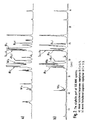
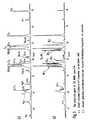
- Figures 1 and 2 are NMR spectra used to explain the method by which the average homopolymer block length of block copolymers with a mixed midblock may be determined by 13C NMR Spectroscopy.
- Figure 3 compares the C13 NMR spectra of the polymer according to the prior art ( EP-669350 ; US-A-5583182 ) and the polymer of the present invention
- Figure 1a shows the aliphatic region of a typical S-B block copolymer.
- the polystyrene peaks present between 45 and 38 ppm do not disturb the polybutadiene ("pB") spectrum.
- the S-B polymer contains a rather high amount of vinyl units, as a result of which the spectrum contains peaks that are evidence of the presence of two vinyl units next to each other.
- Figure 1b shows the aliphatic region of a typical S-I-S block copolymer. Here the vinyl content (“V I ”) in the polyisoprene block (“pI”) is much smaller.
- Figure 1c shows the result of adding the two above mentioned spectra electronically. In this spectrum all typical peaks of a pB block and a pI block are present.
- Cis and trans configurations are given in subscript by “c” and “t” respectively.
- the small letters “b” and “i” refer to the adjacent monomer, which influences the chemical shift of the monomer under discussion (given in capital letter).
- Figure 2a and b show the aliphatic region of two mixed butadiene/isoprene copolymers, that are used as model polymers, with butadiene/isoprene ratios of 4/1 and 1/3 respectively.
- some extra peaks are seen which clearly are due to the presence of a 1,4-butadiene monomer next to a 1,4-isopropene monomer and reverse. These peaks are characteristic for mixed butadiene/isoprene copolymers and are marked in Figure 2a .
- Figure 3a is the spectrum of a block copolymer according to the prior art, with blocks in the midblock.
- Fig 3c is the spectrum of a block copolymer according to the present invention, with a mixed mid-block. Although this spectrum closely resembles the composed spectrum 1c, it differs in that the characteristic peaks due to the presence of two 1,2-butadiene monomers next to each other are replaced by the characteristic peaks for a mixed polymer block.
- Isoprene block length i c ⁇ I 1 ⁇ t + i t ⁇ I 1 ⁇ t + i c ⁇ I 1 ⁇ c + i t ⁇ I 1 ⁇ c + I 4 ⁇ i 1 2 x sub + 1
- Butadiene block length bB t ⁇ b + bB c ⁇ B 2 x sub + 1 wherein "sub" corresponds to: i 4 ⁇ B t + i 4 ⁇ B c + I 4 ⁇ b + B t ⁇ i + B c ⁇ i + bI 1 ⁇ t + bI 1 ⁇ c 4
- Cyclohexane, styrene, butadiene and isoprene were purified by activated aluminumoxide and stored at 4 °C under a nitrogen atmosphere.
- Dibromoethane (EDB) obtained from Aldrich was used as coupling agent.
- EDB Dibromoethane
- a monomer mixture of butadiene and isoprene was prepared and stored under nitrogen at 4 °C. This mixture was used as such.
- reaction mixture was cooled to 40 °C, transported to a blending vessel and a stabilization package was added (comprising IRGANOX 565 and tris(nonylphenol)phosphite 0.08/0.35 phr as a cyclohexane solution) and stirred at RT. Dry rubber was obtained by steam coagulation finishing, followed by drying in an oven.
- a stabilization package comprising IRGANOX 565 and tris(nonylphenol)phosphite 0.08/0.35 phr as a cyclohexane solution
- Table 1 lists the amounts in which the components have been used.
- Table 2 also contains the corresponding properties of a comparative polymer A: an S-I-B-S block copolymer containing an I-B block copolymer midblock with an I/B weight ratio of 50/50, prepared as described in EP-0669350 .
- D-1160 NS KRATON D-1160 NS is a linear styrene-isoprene-styrene block copolymer with 19% polystyrene content, a total molecular weight of 178 000 and a coupling efficiency of 100%.
- D-1161 NS KRATON D-1161 NS is a linear Styrene-Isoprene-Styrene block copolymer with 15% polystyrene content, a total molecular weight of 220 000 and a coupling efficiency of 81%.
- D-1165 NS KRATON D-1165 NS is a linear styrene-isoprene-styrene block copolymer with 30% polystyrene content, a total molecular weight of 141 000 and a coupling efficiency of 81%.
- D-1122 KRATON D-1122 is a multi-arm styrene-butadiene-styrene block copolymer with 37% polystyrene content, a total molecular weight of 143 000 and a coupling efficiency of 90%.
- R-1090 REGALITE R-1090 is a fully hydrogenated aromatic resin with a softening point of 88 °C, an aromaticity of 1.8 %, manufactured by Hercules B.V.
- REGALITE S-5100 is a 50% hydrogenated aromatic resin with a softening point of 100 °C, an aromaticity of 16 %, manufactured by Hercules B.V.
- R-7100 REGALITE R-7100 is a 70% hydrogenated aromatic resin with a softening point of 102 °C, an aromaticity of 11.2 %, manufactured by Hercules B.V.
- MBG 212 MBG 212 is an experimental aliphatic hydrocarbon resin with a softening point of 95 °C, an aromaticity of 0 %, developed by Hercules B.V.
- MBG 222 is an experimental aliphatic hydrocarbon resin with a softening point of 85 °C, an aromaticity of 3.8 %, developed by Hercules B.V.
- MBG 223 MBG 223 is an experimental aliphatic hydrocarbon resin with a softening point of 88 °C, an aromaticity of 11.3 %, developed by Hercules B.V.
- P-95 PICCOTAC 95 is a C5 aliphatic hydrocarbon resin with a softening point of 95 °C, an aromaticity of 0 %, manufactured by Hercules B.V.
- E-2203 ESCOREZ 2203 a modified aliphatic hydrocarbon resin with a softening point of 93 °C, an aromaticity of 2.2 %, manufactured by Exxon Chemicals E-2101 ESCOREZ 2101, a modified aliphatic hydrocarbon resin with a softening point of 93 °C, an aromaticity of 13.15 %, manufactured by Exxon Chemicals W Extra WINGTACK EXTRA, a modified aliphatic hydrocarbon resin with a softening point of 97 °C, an aromaticity of 2.5 %, manufactured by GOODYEAR Chemicals W ET WINGTACK ET, a modified aliphatic hydrocarbon resin with a softening point of 94 °C, an aromaticity of 4.2 %, manufactured by GOODYEAR Chemicals W 86 WINGTACK 86, a modified aliphatic hydrocarbon resin with a softening point of 86 °C, an aromaticity of 9.6 %, manufactured by GOODYEAR Chemicals H-205 HERCOTAC
- C-925 CATENEX 925 is a naphthenic oil from Deutsche Shell Aktiengesellschaft C-956
- CATENEX 956 is a naphthenic oil from Deutsche Shell Aktiengesellschaft O-N68 ONDINA N68 is a medicinal naphthenic white oil from Deutsche Shell Aktiengesellschaft I 1010
- IRGANOX 1010 is an anti-oxidant from Ciba-Geigy
- Comparative formulation 1 is based on polymer A ( EP-0669350 ).
- Formulation 2 is based on polymer B.
- Comparative formulation 3 is based on D-1161NS.
- Table 5 shows the results for an adhesive formulation containing 45% of polymer as used in packaging tape adhesive application.
- Polymers in Formulations CF4 and F5 are equivalent to those in formulations CF1 and F2 described in the previous example.
- the formulation CF1 and Formulation F2 from Example 1 were placed in a Brookfield Thermocell for 24 Hours at 177 °C. Afterward, the adhesives were analysed by GPC to evaluate the polymer stability.
- Table 7 shows the adhesive properties of formulations based on styrene-butadiene/isoprene-styrene block copolymers with different B/I weight ratios.
- Polymers B, C, D and KRATON D-1161NS have been targeted to have the same molecular parameters, namely % polystyrene content, total molecular weight and coupling efficiency.
- the increase of butadiene in the mid-block decreases the glass transition temperature Tg of the polymer and this has a marked influence on the adhesive properties.
- the Rolling ball tack decreases (improves because of lower values); the Holding Power on chromed stainless steel decreases; the hot-melt viscosity increases and the formulation glass temperature Tg decreases when the butadiene level in the midblock increases.
- Table 8 shows the adhesive properties of formulations based on styrene-butadiene/isoprene-styrene block copolymers in packaging tape formulations.
- CF16 is a packaging tape based on a water based acrylic emulsion.
- Polymer B and Polymer C of the present invention can be compounded with a multitude of other components, e.g., with one or two hydrocarbon resins, with different types of hydrocarbon resins, with different polymer content.
- the resulting formulations give a wide range of properties with good packaging tape adhesive properties. They outperform also waterbased acrylic tapes in adhesive properties.
- Table 8 packaging Tape formulations Formulation CF11 F12 F13 F14 CF15 CP16 D-1160 100 Polymer B 100 Polymer E 100 100 100 MBG 212 110 60 55 MBG 223 110 P-95 55 H-205 60 55 MBG 222 55 C-956 10 10 20 10 10 I 1010 1 3 3 3 3 3 RBT 23 °C (cm) 29 5.5 18 17 >30 5 Flap Test (min) 3800 610 1000 3000 1700 250 HP Kraft 40 °C (min) 360 90 45 500 600 100 LT ss (N/25 mm) 10 11.5 10 12 6 PA 180° ss (N/25 mm) 21 11 16 13 12 HP ss 2 kg (h) >1000 200 >150 >150 >150 SAFT (°C) - 99 97 102 - HMV 190 °C (Pa.s) 56 82 62 90 70
- Table 9 shows the adhesive properties obtained in assembly adhesive in disposable diapers, in sanitary napkins care and elastic attachments.
- Formulations F18 and F19 have outstanding Tack, Peel and Holding power on PE. Both outperform S-I-S or S-B-S based formulation (CF17, CF20). Polymer F can be compounded with either S-I-S compatible resins, or S-B-S compatible resins or both, offering a large palette of adhesive properties in function of the end use application. Formulations based on polymer F displayed very low formulation hot-melt viscosities indicating that these formulations can be easily applied with the different techniques, like spiral spray coating, roll coating, die-coating.
- Table 9 adhesive properties in assembly adhesives Formulation CF17 F18 F19 CF20 D-1165 100 POLYMER F 100 100 D-1122 100 R-1090 250 125 R-7100 250 220 S-5100 125 O N68 50 50 50 80 I 1010 3 3 3 3 LT on PE (N/25 mm) 0.9 3.5 2 0 PA PE (N/25 mm) 11.5 14.5 15 2.5 HP PE 40 °C (h) 21 14 3 0.3 LT ss (N/25 mm) 15 31 10 4.5 PA ss (N/25 mm) 33 31.5 25 21 HP ss 2 kg (h) 55 62 110 92 SAFT (°C) 91 95 87 84 HMV 177°C Pas 2.2 5.18 3.86 2.88
- Table 10 provides a comparison of adhesive performance of S-I-S and a polymer of the present invention with an isoprene compatible hydrocarbon resin (HCR).
- HCR isoprene compatible hydrocarbon resin
- Formulation 25 is made with a blend of SIS and SBS block copolymers, similar to the formulations given in WO/00/14170 .
- this formulation needs two HCR, namely one that is compatible with isoprene (MBG 212) and one that is compatible with the butadiene (MBG 223).
- block copolymers with a (B/I) midblock can be compounded with a dual HCR system, namely with an isoprene compatible HCR (P-95 and P-212) and a butadiene compatible HCR (MBG 223 and H-205).
- Formulations F28 to F31 show that MBG 223, E-2101, W ET and W 86. with a medium level of aromatic structure, are all giving high performance adhesive.
- Formulation F34 with H-205 gives lower performance adhesive, although still acceptable.
- Table 12 Formulation F28 F29 F30 F31 CF32 CF33 F34 POLYMER E 100 100 100 100 100 100 100 100 MBG 223 110 E-2101 110 W ET 110 W 86 110 W Extra 110 E-2203 110 H-205 110 C-956 15 15 15 15 15 10 I 1010 3 3 3 3 3 3 3 3 RBT 23 °C (cm) 4 >20 12 5 - - 7
- hydrocarbon resins with the highest level of aromatic H - 13.5 % - gives low cohesion to the formulation, although the general performance are still good.
- aromatic modified aliphatic hydrocarbon resins need to have a % of aromatic H between 3 to 18, preferably 3.5 to 14 % to develop the best adhesive properties with a block copolymer having a mixed (B/I) midblock.
Landscapes
- Chemical & Material Sciences (AREA)
- Chemical Kinetics & Catalysis (AREA)
- Organic Chemistry (AREA)
- Inorganic Chemistry (AREA)
- Health & Medical Sciences (AREA)
- Medicinal Chemistry (AREA)
- Polymers & Plastics (AREA)
- Adhesives Or Adhesive Processes (AREA)
- Graft Or Block Polymers (AREA)
- Compositions Of Macromolecular Compounds (AREA)
Applications Claiming Priority (3)
| Application Number | Priority Date | Filing Date | Title |
|---|---|---|---|
| US26255401P | 2001-01-18 | 2001-01-18 | |
| US262554P | 2001-01-18 | ||
| PCT/EP2002/000525 WO2002057386A2 (en) | 2001-01-18 | 2002-01-17 | Adhesive composition |
Publications (2)
| Publication Number | Publication Date |
|---|---|
| EP1354016A2 EP1354016A2 (en) | 2003-10-22 |
| EP1354016B1 true EP1354016B1 (en) | 2010-03-03 |
Family
ID=22997994
Family Applications (1)
| Application Number | Title | Priority Date | Filing Date |
|---|---|---|---|
| EP02714094A Expired - Lifetime EP1354016B1 (en) | 2001-01-18 | 2002-01-17 | Adhesive composition |
Country Status (11)
| Country | Link |
|---|---|
| US (1) | US7202297B2 (enExample) |
| EP (1) | EP1354016B1 (enExample) |
| JP (2) | JP2004520465A (enExample) |
| KR (2) | KR100856603B1 (enExample) |
| CN (2) | CN100378135C (enExample) |
| AT (1) | ATE459697T1 (enExample) |
| AU (1) | AU2002246042A1 (enExample) |
| BR (1) | BR0206601B1 (enExample) |
| DE (1) | DE60235523D1 (enExample) |
| TW (1) | TWI248460B (enExample) |
| WO (1) | WO2002057386A2 (enExample) |
Families Citing this family (46)
| Publication number | Priority date | Publication date | Assignee | Title |
|---|---|---|---|---|
| US7202297B2 (en) * | 2001-01-18 | 2007-04-10 | Kraton Polymers Llc | Adhesive composition |
| EP1348737A1 (en) * | 2002-03-28 | 2003-10-01 | KRATON Polymers Research B.V. | Bituminous composition |
| CN100460430C (zh) | 2002-06-04 | 2009-02-11 | 克拉通聚合物研究有限公司 | 偶联嵌段共聚物组合物的制备方法以及所制备的组合物 |
| EP1426411A1 (en) | 2002-12-06 | 2004-06-09 | KRATON Polymers Research B.V. | Styrenic block copolymer compositions to be used for the manufacture of transparent, gel free films |
| EP1431349A1 (en) | 2002-12-20 | 2004-06-23 | KRATON Polymers Research B.V. | Bituminous compositions |
| EP1493790A1 (en) * | 2003-06-30 | 2005-01-05 | KRATON Polymers Research B.V. | Label stock with improved die-cutting performance |
| EP1873221B1 (en) * | 2003-02-21 | 2009-09-16 | Kraton Polymers Research B.V. | Label stock with improved die-cutting performance |
| DE602004003224T2 (de) | 2003-02-21 | 2007-03-29 | Kraton Polymers Research B.V. | Klebstoff sowie darauf basierende bänder und etiketten |
| EP1473595A1 (en) * | 2003-04-29 | 2004-11-03 | KRATON Polymers Research B.V. | Photopolymerizable compositions and flexographic printing plates derived therefrom |
| CA2521512C (en) | 2003-05-02 | 2009-12-22 | Canon Kabushiki Kaisha | Aqueous fluorescent ink, image recording method and recorded image |
| CN1860412B (zh) * | 2003-09-25 | 2010-06-16 | 日本瑞翁株式会社 | 感光性柔性版用嵌段共聚物组合物 |
| US7037980B2 (en) | 2003-11-10 | 2006-05-02 | Chevron Phillips Chemical Company, Lp | Monovinylarene/conjugated diene copolymers having lower glass transition temperatures |
| WO2005066270A1 (en) | 2003-12-22 | 2005-07-21 | Kraton Polymers Research B.V. | Adhesive formulations from radial (s-i/b)x polymers |
| EP1553149A1 (en) * | 2003-12-31 | 2005-07-13 | Kraton Polymers Research B.V. | Low viscosity, hot-melt stable adhesive compositions |
| CN100341910C (zh) * | 2004-01-17 | 2007-10-10 | 中国石化北京燕化石油化工股份有限公司 | 苯乙烯-异戊二烯/丁二烯-苯乙烯三元嵌段共聚物混合物、其制备方法及其应用 |
| EP1566423A1 (en) * | 2004-02-19 | 2005-08-24 | Kraton Polymers Research B.V. | Low viscosity hot-melt adhesive composition for non-wovens |
| US7307124B2 (en) * | 2004-02-19 | 2007-12-11 | Kraton Polymers U.S. Llc | Hot-melt adhesive composition for non-wovens |
| EP1566411B1 (en) * | 2004-02-19 | 2007-03-28 | Kraton Polymers Research B.V. | Coloured roofing felt |
| US8039553B2 (en) | 2004-08-05 | 2011-10-18 | Japan Elastomer Co., Ltd. | Pressure-sensitive adhesive composition |
| CN1305986C (zh) * | 2004-11-17 | 2007-03-21 | 湖南神力实业有限公司 | 一种高强度环保型喷胶以及制备方法 |
| US20060205876A1 (en) * | 2005-03-11 | 2006-09-14 | Kraton Polymers U.S. Llc | Block copolymers comprising a mixed block derived from isoprene and butadiene and compositions comprising them |
| US20060205877A1 (en) * | 2005-03-11 | 2006-09-14 | Kraton Polymers U.S. Llc | Adhesive compositions comprising mixtures of block copolymers |
| US7872065B2 (en) | 2005-03-11 | 2011-01-18 | Kraton Polymers U.S. Llc | Adhesive compositions comprising mixtures of block copolymers |
| TW200707468A (en) * | 2005-04-06 | 2007-02-16 | Toagosei Co Ltd | Conductive paste, circuit board, circuit article and method for manufacturing such circuit article |
| CN101198670A (zh) * | 2005-06-23 | 2008-06-11 | 艾利丹尼森公司 | 压敏胶粘剂 |
| US20070117934A1 (en) * | 2005-11-21 | 2007-05-24 | National Starch And Chemical Investment Holding Company | Adhesive containing block copolymers |
| US7737216B2 (en) | 2006-01-26 | 2010-06-15 | Chevron Phillips Chemical Company Lp | Monovinylarene conjugated diene block copolymer compositions for shrinkable films |
| CN100415846C (zh) * | 2006-05-31 | 2008-09-03 | 刘小虎 | 环保型水性多功能粘合剂及其制备方法 |
| US20100213403A1 (en) * | 2006-06-21 | 2010-08-26 | Katsuro Hasegawa | Thermally conductive thermoplastic pressure sensitive adhesive composition |
| DE102006037627A1 (de) * | 2006-08-10 | 2008-02-14 | Tesa Ag | Selbstklebemasse aus hydrierten Blockcopolymeren und daraus hergestellte Schutzfolie für glatte und raue Oberflächen |
| US20100075132A1 (en) * | 2006-12-07 | 2010-03-25 | 3M Innovative Properties Company | Blends of block copolymer and acrylic adhesives |
| US9458359B2 (en) * | 2006-12-07 | 2016-10-04 | 3M Innovative Properties Company | Block copolymer blend adhesives with multiple tackifiers |
| US20080153971A1 (en) * | 2006-12-21 | 2008-06-26 | Kraton Polymers U.S. Llc | Solvent sprayable contact adhesive formulations from (S-I/B)x polymers |
| DE102008025983A1 (de) * | 2008-05-30 | 2009-12-03 | Tesa Se | Klebeband mit viskoelastischem Polyolefinträger |
| CN102361931B (zh) * | 2009-03-31 | 2013-11-13 | 日本瑞翁株式会社 | 伸缩性膜用组合物 |
| US8324309B2 (en) | 2010-04-27 | 2012-12-04 | Kraton Polymers Us Llc | High melt flow block copolymers for non-woven adhesives |
| KR101362881B1 (ko) | 2010-12-31 | 2014-02-14 | 제일모직주식회사 | 디스플레이용 광학 점착제 조성물 |
| KR101932166B1 (ko) | 2011-02-14 | 2018-12-24 | 쿠라레이 아메리카 인코포레이티드 | 막 및 시트에 유용한 엘라스토머 제형 |
| KR101393860B1 (ko) * | 2011-10-11 | 2014-05-14 | (주)엘지하우시스 | 자동차용 점착테이프 |
| JP6001493B2 (ja) * | 2013-04-23 | 2016-10-05 | ヘンケルジャパン株式会社 | ホットメルト接着剤 |
| TWI630253B (zh) * | 2014-01-06 | 2018-07-21 | 科騰聚合物美國有限責任公司 | 包含具有高乙烯基及高二嵌段之苯乙烯-丁二烯聚合物之熱熔壓敏性黏著劑及熱固物 |
| CN106029811B (zh) | 2014-01-17 | 2021-09-14 | 波士胶公司 | 热熔性定位粘合剂 |
| CN108395511A (zh) * | 2018-02-27 | 2018-08-14 | 宁波金海晨光化学股份有限公司 | 一种苯乙烯类热塑性弹性体的制备方法 |
| CN109942916B (zh) * | 2018-08-21 | 2020-11-06 | 广西沙沙岛实业有限公司 | 粘弹泥及制备方法和应用 |
| WO2022215039A1 (en) * | 2021-04-08 | 2022-10-13 | 3M Innovative Properties Company | Hand tape applicator and system including same |
| US20250109286A1 (en) * | 2023-09-28 | 2025-04-03 | The Goodyear Tire & Rubber Company | All-season tire tread |
Family Cites Families (54)
| Publication number | Priority date | Publication date | Assignee | Title |
|---|---|---|---|---|
| DE2942128A1 (de) * | 1979-10-18 | 1981-04-30 | Basf Ag, 6700 Ludwigshafen | Schmelzhaftkleber auf basis von nichthydrierten, linearen blockcopolymerisaten a-b-a |
| DE3265276D1 (en) * | 1981-11-23 | 1985-09-12 | Agfa Gevaert Nv | Method for the preparation of stable aqueous dispersions of polymer beads and the use of these dispersions in photographic elements |
| US4717749A (en) | 1985-01-22 | 1988-01-05 | The Dow Chemical Company | Pressure sensitive adhesives containing block copolymer |
| US4704110A (en) * | 1986-06-20 | 1987-11-03 | National Starch And Chemical Corporation | Hot melt pressure sensitive positioning adhesives |
| JPS63207875A (ja) * | 1987-02-25 | 1988-08-29 | Asahi Chem Ind Co Ltd | 衛生材料用ホツトメルト粘着剤組成物 |
| US5143961A (en) | 1987-06-29 | 1992-09-01 | H. B. Fuller Licensing & Financing Inc. | Hot melt adhesive comprising water soluble polyalkyloxazoline and water insoluble polymer |
| AU611161B2 (en) | 1987-06-29 | 1991-06-06 | H.B. Fuller Licensing And Financing Inc. | Hot melt adhesive comprising water soluble polyalkyloxazoline and water insoluble polymer |
| US4987194A (en) * | 1988-10-07 | 1991-01-22 | Kuraray Company, Limited | Block copolymers and composition containing the same |
| JP2733267B2 (ja) * | 1988-11-16 | 1998-03-30 | 株式会社クラレ | 制振性能に優れた組成物 |
| JP2703288B2 (ja) | 1988-10-07 | 1998-01-26 | 株式会社クラレ | 制振性能に優れたブロック共重合体及びそれを含有する組成物 |
| US5057571A (en) | 1988-11-07 | 1991-10-15 | H. B. Fuller Licensing & Financing Inc. | Disposable article construction adhesive |
| US5399627A (en) | 1989-08-11 | 1995-03-21 | The Dow Chemical Company | Radial styrene-isoprene-butadiene multi-armed block copolymers and compositions and articles containing block copolymers |
| US5292819A (en) | 1989-08-11 | 1994-03-08 | The Dow Chemical Company | Radial block copolymers containing butadiene endblock |
| GB9111872D0 (en) | 1991-06-03 | 1991-07-24 | Shell Int Research | Polymer process |
| JPH0570699A (ja) | 1991-09-13 | 1993-03-23 | Kuraray Co Ltd | 熱可塑性樹脂組成物 |
| EP0535399B1 (en) * | 1991-09-30 | 1995-12-27 | Gisulfo Baccini | Device to process electrical circuits |
| JP3066146B2 (ja) | 1991-10-22 | 2000-07-17 | 株式会社クラレ | 音響機材用樹脂組成物 |
| DE69218238T2 (de) | 1991-12-02 | 1997-10-09 | Fuller H B Licensing Financ | Thermoplastische klebestoff-zusammensetzung und entsprechender artikel |
| DE4139827A1 (de) | 1991-12-03 | 1993-06-09 | Basf Ag, 6700 Ludwigshafen, De | Thermoplastische formmasse |
| JPH05163444A (ja) | 1991-12-12 | 1993-06-29 | Kuraray Co Ltd | 接着剤組成物 |
| DE4202332A1 (de) | 1992-01-29 | 1993-08-05 | Basf Lacke & Farben | Lichtempfindliches gemisch zur herstellung von relief- und druckformen |
| EP0640115B1 (en) | 1992-05-13 | 1998-07-29 | Raychem Limited | Gels |
| JP3657279B2 (ja) * | 1992-06-15 | 2005-06-08 | 株式会社クラレ | 粘・接着剤組成物 |
| JP3309438B2 (ja) * | 1992-09-04 | 2002-07-29 | 日本ゼオン株式会社 | ブロック共重合体 |
| US5393818A (en) | 1993-04-06 | 1995-02-28 | Shell Oil Company | Solvent-free laminating adhesive composition from epoxidized block polymer |
| JP2698810B2 (ja) * | 1993-11-30 | 1998-01-19 | 日本ゼオン株式会社 | 粘着剤組成物 |
| JP3387612B2 (ja) * | 1994-02-28 | 2003-03-17 | 日本ゼオン株式会社 | ブロック共重合体組成物および粘着剤組成物 |
| JP3388011B2 (ja) * | 1994-02-28 | 2003-03-17 | 日本ゼオン株式会社 | ブロック共重合体組成物および粘着剤組成物 |
| JP3339170B2 (ja) * | 1994-02-28 | 2002-10-28 | 日本ゼオン株式会社 | ブロック共重合体および粘着剤組成物 |
| US5532319A (en) * | 1994-02-28 | 1996-07-02 | Nippon Zeon Co., Ltd. | Block copolymer composition and pressure sensitive adhesive composition |
| DE69523099T2 (de) | 1994-06-30 | 2002-05-16 | Toda Kogyo Corp., Hiroshima | Material mit Dämpfungseigenschaften und Masterbatch-Pellets daraus |
| US5552493A (en) | 1995-05-30 | 1996-09-03 | Shell Oil Company | Method for producing asymmetric radial polymers |
| IT1276142B1 (it) * | 1995-11-16 | 1997-10-27 | Atohaas Holding Cv | Processo in sospensione per preparare polimeri acrilici |
| JP2001504519A (ja) * | 1996-02-23 | 2001-04-03 | アト・フインドリイ・インコーポレイテツド | 改良された感圧ラベル接着剤 |
| ES2139969T3 (es) * | 1996-03-06 | 2000-02-16 | Hercules Inc | Resinas alifaticas basadas en petroleo, metodo para controlar su punto de ablandamiento y peso molecular y adhesivo sensible a la presion fundida caliente que las contiene. |
| US5916959A (en) | 1996-03-29 | 1999-06-29 | H.B. Fuller Licensing & Financing, Inc. | Radial styrene-isoprene-styrene based hot melt pressure sensitive adhesive |
| DE69630362D1 (de) * | 1996-04-15 | 2003-11-20 | Eastman Chemical Resins Inc | Heissschmelzklebstoff auf der Basis von styrolhaltigen Blockcopolymeren |
| DE19631422A1 (de) | 1996-08-06 | 1998-02-12 | Beiersdorf Ag | Selbstklebend ausgerüstete Trägermaterialien |
| DE19639767A1 (de) * | 1996-09-27 | 1998-04-02 | Du Pont Deutschland | Flexographische Druckformen für UV härtbare Druckfarben |
| CN1048262C (zh) | 1996-10-09 | 2000-01-12 | 北京燕山石油化工公司研究院 | 丁二烯、异戊二烯、苯乙烯嵌段共聚物及其制备方法 |
| DE69714410T2 (de) | 1997-05-16 | 2003-04-03 | Advanced Elastomer Systems, L.P. | Verfahren zum Hochfrekwenzschweissen von nichtpolaren thermoplastischen Elastomeren |
| US6380305B1 (en) | 1997-12-19 | 2002-04-30 | Basf Corporation | High impact resistant, high gloss, and high environmental stress crack resistant polymeric compositions |
| DE69902039T2 (de) | 1998-04-23 | 2002-12-19 | Advanced Elastomer Systems, L.P. | Metallverstärkte thermoplastische elastomere |
| EP1115807A1 (en) | 1998-09-04 | 2001-07-18 | ExxonMobil Chemical Patents Inc. | Hot melt pressure sensitive adhesive composition |
| DE19857768A1 (de) | 1998-12-07 | 2000-06-08 | Taiwan Synthetic Rubber Corp | Verknüpfte Polymere und Verfahren zur Herstellung dieser |
| JP2000239635A (ja) | 1999-02-24 | 2000-09-05 | Kuraray Co Ltd | 接着剤 |
| US6657000B1 (en) * | 1999-06-25 | 2003-12-02 | Kraton Polymers U.S. Llc | Hot melt pressure sensitive positioning adhesive (III) |
| US6455627B1 (en) * | 1999-06-25 | 2002-09-24 | Kraton Polymers Us Llc | Hot melt pressure sensitive positions adhesive (II) |
| US6465557B1 (en) * | 1999-06-25 | 2002-10-15 | Kraton Polymers U.S. Llc | Hot melt pressure sensitive positioning adhesive |
| JP2001100397A (ja) | 1999-09-30 | 2001-04-13 | Toyobo Co Ltd | 水現像型フレキソ印刷原版 |
| JP2001100396A (ja) | 1999-09-30 | 2001-04-13 | Toyobo Co Ltd | 水現像型感光性フレキソ印刷原版 |
| US7202297B2 (en) * | 2001-01-18 | 2007-04-10 | Kraton Polymers Llc | Adhesive composition |
| JP2002239032A (ja) | 2001-02-19 | 2002-08-27 | Sumitomo Rubber Ind Ltd | ゴルフボール |
| JP4641636B2 (ja) | 2001-03-06 | 2011-03-02 | 旭化成ケミカルズ株式会社 | ブロック共重合体組成物 |
-
2002
- 2002-01-17 US US10/466,590 patent/US7202297B2/en not_active Expired - Lifetime
- 2002-01-17 WO PCT/EP2002/000525 patent/WO2002057386A2/en not_active Ceased
- 2002-01-17 AT AT02714094T patent/ATE459697T1/de not_active IP Right Cessation
- 2002-01-17 DE DE60235523T patent/DE60235523D1/de not_active Expired - Lifetime
- 2002-01-17 EP EP02714094A patent/EP1354016B1/en not_active Expired - Lifetime
- 2002-01-17 BR BRPI0206601-7A patent/BR0206601B1/pt not_active IP Right Cessation
- 2002-01-17 CN CNB2005100847428A patent/CN100378135C/zh not_active Expired - Lifetime
- 2002-01-17 CN CNB028051904A patent/CN1271103C/zh not_active Expired - Lifetime
- 2002-01-17 AU AU2002246042A patent/AU2002246042A1/en not_active Abandoned
- 2002-01-17 KR KR1020037009584A patent/KR100856603B1/ko not_active Expired - Lifetime
- 2002-01-17 JP JP2002558445A patent/JP2004520465A/ja not_active Withdrawn
- 2002-01-17 KR KR1020087009702A patent/KR100856602B1/ko not_active Expired - Lifetime
- 2002-01-18 TW TW091100748A patent/TWI248460B/zh not_active IP Right Cessation
-
2009
- 2009-07-10 JP JP2009163253A patent/JP4746115B2/ja not_active Expired - Lifetime
Also Published As
| Publication number | Publication date |
|---|---|
| CN1271103C (zh) | 2006-08-23 |
| CN1706875A (zh) | 2005-12-14 |
| US7202297B2 (en) | 2007-04-10 |
| BR0206601A (pt) | 2004-02-10 |
| KR20040030492A (ko) | 2004-04-09 |
| CN100378135C (zh) | 2008-04-02 |
| EP1354016A2 (en) | 2003-10-22 |
| JP4746115B2 (ja) | 2011-08-10 |
| ATE459697T1 (de) | 2010-03-15 |
| TWI248460B (en) | 2006-02-01 |
| US20040116582A1 (en) | 2004-06-17 |
| WO2002057386A3 (en) | 2003-01-23 |
| KR20080041304A (ko) | 2008-05-09 |
| KR100856603B1 (ko) | 2008-09-03 |
| KR100856602B1 (ko) | 2008-09-03 |
| WO2002057386A2 (en) | 2002-07-25 |
| DE60235523D1 (de) | 2010-04-15 |
| BR0206601B1 (pt) | 2012-09-18 |
| JP2004520465A (ja) | 2004-07-08 |
| CN1516729A (zh) | 2004-07-28 |
| AU2002246042A1 (en) | 2002-07-30 |
| JP2009280824A (ja) | 2009-12-03 |
Similar Documents
| Publication | Publication Date | Title |
|---|---|---|
| US7202297B2 (en) | Adhesive composition | |
| EP0730617B1 (en) | Radial styrene-isoprene-butadiene multi-armed block copolymers and compositions and articles containing block copolymers | |
| EP0726927B1 (en) | Multiblock hydrogenated polymers for adhesives | |
| US7651765B2 (en) | Adhesive composition and tapes and labels derived therefrom | |
| KR100984578B1 (ko) | 블록 공중합체의 혼합물을 함유하는 접착제 조성물 | |
| JPH0593176A (ja) | ホツトメルト型粘着剤組成物 | |
| EP1702017B1 (en) | Low viscosity, hot-melt stable adhesive compositions | |
| EP1566423A1 (en) | Low viscosity hot-melt adhesive composition for non-wovens | |
| EP1331258A1 (en) | Pressure sensitive adhesive compositions | |
| US20060070543A1 (en) | Adhesive composition | |
| CN100577764C (zh) | 粘合剂组合物和由它们衍生的胶带和标签 | |
| US7872065B2 (en) | Adhesive compositions comprising mixtures of block copolymers | |
| US20060205876A1 (en) | Block copolymers comprising a mixed block derived from isoprene and butadiene and compositions comprising them |
Legal Events
| Date | Code | Title | Description |
|---|---|---|---|
| PUAI | Public reference made under article 153(3) epc to a published international application that has entered the european phase |
Free format text: ORIGINAL CODE: 0009012 |
|
| AK | Designated contracting states |
Kind code of ref document: A2 Designated state(s): AT BE CH CY DE DK ES FI FR GB GR IE IT LI LU MC NL PT SE TR |
|
| AX | Request for extension of the european patent |
Extension state: AL LT LV MK RO SI |
|
| 17P | Request for examination filed |
Effective date: 20030818 |
|
| RIN1 | Information on inventor provided before grant (corrected) |
Inventor name: DE KEYZER, NOEL, RAYMOND, MAURICE Inventor name: SOUTHWICK, JEFFREY, GEORGE Inventor name: VAN DIJK, MARTIN |
|
| RAP1 | Party data changed (applicant data changed or rights of an application transferred) |
Owner name: KRATON POLYMERS RESEARCH B.V. |
|
| GRAP | Despatch of communication of intention to grant a patent |
Free format text: ORIGINAL CODE: EPIDOSNIGR1 |
|
| GRAS | Grant fee paid |
Free format text: ORIGINAL CODE: EPIDOSNIGR3 |
|
| GRAA | (expected) grant |
Free format text: ORIGINAL CODE: 0009210 |
|
| AK | Designated contracting states |
Kind code of ref document: B1 Designated state(s): AT BE CH CY DE DK ES FI FR GB GR IE IT LI LU MC NL PT SE TR |
|
| REG | Reference to a national code |
Ref country code: GB Ref legal event code: FG4D |
|
| REG | Reference to a national code |
Ref country code: CH Ref legal event code: EP |
|
| REG | Reference to a national code |
Ref country code: IE Ref legal event code: FG4D |
|
| REF | Corresponds to: |
Ref document number: 60235523 Country of ref document: DE Date of ref document: 20100415 Kind code of ref document: P |
|
| REG | Reference to a national code |
Ref country code: NL Ref legal event code: T3 |
|
| PG25 | Lapsed in a contracting state [announced via postgrant information from national office to epo] |
Ref country code: AT Free format text: LAPSE BECAUSE OF FAILURE TO SUBMIT A TRANSLATION OF THE DESCRIPTION OR TO PAY THE FEE WITHIN THE PRESCRIBED TIME-LIMIT Effective date: 20100303 Ref country code: FI Free format text: LAPSE BECAUSE OF FAILURE TO SUBMIT A TRANSLATION OF THE DESCRIPTION OR TO PAY THE FEE WITHIN THE PRESCRIBED TIME-LIMIT Effective date: 20100303 |
|
| PG25 | Lapsed in a contracting state [announced via postgrant information from national office to epo] |
Ref country code: SE Free format text: LAPSE BECAUSE OF FAILURE TO SUBMIT A TRANSLATION OF THE DESCRIPTION OR TO PAY THE FEE WITHIN THE PRESCRIBED TIME-LIMIT Effective date: 20100303 Ref country code: GR Free format text: LAPSE BECAUSE OF FAILURE TO SUBMIT A TRANSLATION OF THE DESCRIPTION OR TO PAY THE FEE WITHIN THE PRESCRIBED TIME-LIMIT Effective date: 20100604 Ref country code: ES Free format text: LAPSE BECAUSE OF FAILURE TO SUBMIT A TRANSLATION OF THE DESCRIPTION OR TO PAY THE FEE WITHIN THE PRESCRIBED TIME-LIMIT Effective date: 20100614 Ref country code: CY Free format text: LAPSE BECAUSE OF FAILURE TO SUBMIT A TRANSLATION OF THE DESCRIPTION OR TO PAY THE FEE WITHIN THE PRESCRIBED TIME-LIMIT Effective date: 20100303 Ref country code: BE Free format text: LAPSE BECAUSE OF FAILURE TO SUBMIT A TRANSLATION OF THE DESCRIPTION OR TO PAY THE FEE WITHIN THE PRESCRIBED TIME-LIMIT Effective date: 20100303 |
|
| PLBE | No opposition filed within time limit |
Free format text: ORIGINAL CODE: 0009261 |
|
| STAA | Information on the status of an ep patent application or granted ep patent |
Free format text: STATUS: NO OPPOSITION FILED WITHIN TIME LIMIT |
|
| PG25 | Lapsed in a contracting state [announced via postgrant information from national office to epo] |
Ref country code: PT Free format text: LAPSE BECAUSE OF FAILURE TO SUBMIT A TRANSLATION OF THE DESCRIPTION OR TO PAY THE FEE WITHIN THE PRESCRIBED TIME-LIMIT Effective date: 20100705 Ref country code: DK Free format text: LAPSE BECAUSE OF FAILURE TO SUBMIT A TRANSLATION OF THE DESCRIPTION OR TO PAY THE FEE WITHIN THE PRESCRIBED TIME-LIMIT Effective date: 20100303 |
|
| 26N | No opposition filed |
Effective date: 20101206 |
|
| PG25 | Lapsed in a contracting state [announced via postgrant information from national office to epo] |
Ref country code: MC Free format text: LAPSE BECAUSE OF NON-PAYMENT OF DUE FEES Effective date: 20110131 |
|
| REG | Reference to a national code |
Ref country code: CH Ref legal event code: PL |
|
| REG | Reference to a national code |
Ref country code: IE Ref legal event code: MM4A |
|
| PG25 | Lapsed in a contracting state [announced via postgrant information from national office to epo] |
Ref country code: LI Free format text: LAPSE BECAUSE OF NON-PAYMENT OF DUE FEES Effective date: 20110131 Ref country code: CH Free format text: LAPSE BECAUSE OF NON-PAYMENT OF DUE FEES Effective date: 20110131 |
|
| PG25 | Lapsed in a contracting state [announced via postgrant information from national office to epo] |
Ref country code: IE Free format text: LAPSE BECAUSE OF NON-PAYMENT OF DUE FEES Effective date: 20110117 |
|
| PG25 | Lapsed in a contracting state [announced via postgrant information from national office to epo] |
Ref country code: LU Free format text: LAPSE BECAUSE OF NON-PAYMENT OF DUE FEES Effective date: 20110117 |
|
| PG25 | Lapsed in a contracting state [announced via postgrant information from national office to epo] |
Ref country code: TR Free format text: LAPSE BECAUSE OF FAILURE TO SUBMIT A TRANSLATION OF THE DESCRIPTION OR TO PAY THE FEE WITHIN THE PRESCRIBED TIME-LIMIT Effective date: 20100303 |
|
| REG | Reference to a national code |
Ref country code: FR Ref legal event code: PLFP Year of fee payment: 15 |
|
| REG | Reference to a national code |
Ref country code: FR Ref legal event code: PLFP Year of fee payment: 16 |
|
| REG | Reference to a national code |
Ref country code: FR Ref legal event code: PLFP Year of fee payment: 17 |
|
| PGFP | Annual fee paid to national office [announced via postgrant information from national office to epo] |
Ref country code: GB Payment date: 20180129 Year of fee payment: 17 |
|
| GBPC | Gb: european patent ceased through non-payment of renewal fee |
Effective date: 20190117 |
|
| PG25 | Lapsed in a contracting state [announced via postgrant information from national office to epo] |
Ref country code: GB Free format text: LAPSE BECAUSE OF NON-PAYMENT OF DUE FEES Effective date: 20190117 |
|
| PGFP | Annual fee paid to national office [announced via postgrant information from national office to epo] |
Ref country code: FR Payment date: 20210121 Year of fee payment: 20 Ref country code: NL Payment date: 20210120 Year of fee payment: 20 |
|
| PGFP | Annual fee paid to national office [announced via postgrant information from national office to epo] |
Ref country code: DE Payment date: 20210120 Year of fee payment: 20 |
|
| PGFP | Annual fee paid to national office [announced via postgrant information from national office to epo] |
Ref country code: IT Payment date: 20210121 Year of fee payment: 20 |
|
| REG | Reference to a national code |
Ref country code: DE Ref legal event code: R071 Ref document number: 60235523 Country of ref document: DE |
|
| REG | Reference to a national code |
Ref country code: NL Ref legal event code: MK Effective date: 20220116 |