EP0324274B1 - Improved expression and secretion of heterologous proteins in yeast employing truncated alpha-factor leader sequences - Google Patents
Improved expression and secretion of heterologous proteins in yeast employing truncated alpha-factor leader sequences Download PDFInfo
- Publication number
- EP0324274B1 EP0324274B1 EP88312306A EP88312306A EP0324274B1 EP 0324274 B1 EP0324274 B1 EP 0324274B1 EP 88312306 A EP88312306 A EP 88312306A EP 88312306 A EP88312306 A EP 88312306A EP 0324274 B1 EP0324274 B1 EP 0324274B1
- Authority
- EP
- European Patent Office
- Prior art keywords
- yeast
- factor
- encodes
- protein
- precursor
- Prior art date
- Legal status (The legal status is an assumption and is not a legal conclusion. Google has not performed a legal analysis and makes no representation as to the accuracy of the status listed.)
- Expired - Lifetime
Links
- 240000004808 Saccharomyces cerevisiae Species 0.000 title claims abstract description 94
- 108090000623 proteins and genes Proteins 0.000 title claims abstract description 49
- 102000004169 proteins and genes Human genes 0.000 title claims abstract description 26
- 230000028327 secretion Effects 0.000 title claims abstract description 25
- IXKSXJFAGXLQOQ-XISFHERQSA-N WHWLQLKPGQPMY Chemical compound C([C@@H](C(=O)N[C@@H](CC=1C2=CC=CC=C2NC=1)C(=O)N[C@@H](CC(C)C)C(=O)N[C@@H](CCC(N)=O)C(=O)N[C@@H](CC(C)C)C(=O)N1CCC[C@H]1C(=O)NCC(=O)N[C@@H](CCC(N)=O)C(=O)N[C@@H](CC(O)=O)C(=O)N1CCC[C@H]1C(=O)N[C@@H](CCSC)C(=O)N[C@@H](CC=1C=CC(O)=CC=1)C(O)=O)NC(=O)[C@@H](N)CC=1C2=CC=CC=C2NC=1)C1=CNC=N1 IXKSXJFAGXLQOQ-XISFHERQSA-N 0.000 title claims description 100
- 108090000765 processed proteins & peptides Proteins 0.000 claims abstract description 55
- 108020004414 DNA Proteins 0.000 claims abstract description 52
- 229920001184 polypeptide Polymers 0.000 claims abstract description 50
- 102000004196 processed proteins & peptides Human genes 0.000 claims abstract description 50
- 239000002243 precursor Substances 0.000 claims abstract description 47
- 238000012545 processing Methods 0.000 claims abstract description 43
- 230000013595 glycosylation Effects 0.000 claims abstract description 40
- 238000006206 glycosylation reaction Methods 0.000 claims abstract description 40
- 108010058643 Fungal Proteins Proteins 0.000 claims abstract description 38
- 108010076181 Proinsulin Proteins 0.000 claims abstract description 29
- 108091026890 Coding region Proteins 0.000 claims abstract description 23
- 102000053602 DNA Human genes 0.000 claims abstract description 20
- 150000001413 amino acids Chemical class 0.000 claims abstract description 18
- 108010076504 Protein Sorting Signals Proteins 0.000 claims abstract description 15
- 238000003776 cleavage reaction Methods 0.000 claims abstract description 15
- 230000007017 scission Effects 0.000 claims abstract description 15
- 102000004877 Insulin Human genes 0.000 claims abstract description 14
- 108090001061 Insulin Proteins 0.000 claims abstract description 14
- 241000235070 Saccharomyces Species 0.000 claims abstract description 13
- 101150045458 KEX2 gene Proteins 0.000 claims abstract description 12
- 108010059378 Endopeptidases Proteins 0.000 claims abstract description 10
- 102000005593 Endopeptidases Human genes 0.000 claims abstract description 10
- 238000001727 in vivo Methods 0.000 claims abstract description 10
- 230000005026 transcription initiation Effects 0.000 claims abstract description 9
- 230000005030 transcription termination Effects 0.000 claims abstract description 8
- 210000005253 yeast cell Anatomy 0.000 claims abstract description 8
- 108010016626 Dipeptides Proteins 0.000 claims abstract description 4
- 125000000729 N-terminal amino-acid group Chemical group 0.000 claims abstract description 3
- 101000976075 Homo sapiens Insulin Proteins 0.000 claims abstract 4
- PBGKTOXHQIOBKM-FHFVDXKLSA-N insulin (human) Chemical compound C([C@@H](C(=O)N[C@@H](CC(C)C)C(=O)N[C@H]1CSSC[C@H]2C(=O)N[C@H](C(=O)N[C@@H](CO)C(=O)N[C@H](C(=O)N[C@H](C(N[C@@H](CO)C(=O)N[C@@H](CC(C)C)C(=O)N[C@@H](CC=3C=CC(O)=CC=3)C(=O)N[C@@H](CCC(N)=O)C(=O)N[C@@H](CC(C)C)C(=O)N[C@@H](CCC(O)=O)C(=O)N[C@@H](CC(N)=O)C(=O)N[C@@H](CC=3C=CC(O)=CC=3)C(=O)N[C@@H](CSSC[C@H](NC(=O)[C@H](C(C)C)NC(=O)[C@H](CC(C)C)NC(=O)[C@H](CC=3C=CC(O)=CC=3)NC(=O)[C@H](CC(C)C)NC(=O)[C@H](C)NC(=O)[C@H](CCC(O)=O)NC(=O)[C@H](C(C)C)NC(=O)[C@H](CC(C)C)NC(=O)[C@H](CC=3NC=NC=3)NC(=O)[C@H](CO)NC(=O)CNC1=O)C(=O)NCC(=O)N[C@@H](CCC(O)=O)C(=O)N[C@@H](CCCNC(N)=N)C(=O)NCC(=O)N[C@@H](CC=1C=CC=CC=1)C(=O)N[C@@H](CC=1C=CC=CC=1)C(=O)N[C@@H](CC=1C=CC(O)=CC=1)C(=O)N[C@@H]([C@@H](C)O)C(=O)N1[C@@H](CCC1)C(=O)N[C@@H](CCCCN)C(=O)N[C@@H]([C@@H](C)O)C(O)=O)C(=O)N[C@@H](CC(N)=O)C(O)=O)=O)CSSC[C@@H](C(N2)=O)NC(=O)[C@H](CCC(N)=O)NC(=O)[C@H](CCC(O)=O)NC(=O)[C@H](C(C)C)NC(=O)[C@@H](NC(=O)CN)[C@@H](C)CC)[C@@H](C)CC)[C@@H](C)O)NC(=O)[C@H](CCC(N)=O)NC(=O)[C@H](CC(N)=O)NC(=O)[C@@H](NC(=O)[C@@H](N)CC=1C=CC=CC=1)C(C)C)C1=CN=CN1 PBGKTOXHQIOBKM-FHFVDXKLSA-N 0.000 claims abstract 4
- 239000013612 plasmid Substances 0.000 claims description 52
- 210000004027 cell Anatomy 0.000 claims description 24
- 101000599951 Homo sapiens Insulin-like growth factor I Proteins 0.000 claims description 13
- 238000000034 method Methods 0.000 claims description 13
- 210000000349 chromosome Anatomy 0.000 claims description 6
- 238000004519 manufacturing process Methods 0.000 claims description 2
- 238000011084 recovery Methods 0.000 claims 1
- NOESYZHRGYRDHS-UHFFFAOYSA-N insulin Chemical compound N1C(=O)C(NC(=O)C(CCC(N)=O)NC(=O)C(CCC(O)=O)NC(=O)C(C(C)C)NC(=O)C(NC(=O)CN)C(C)CC)CSSCC(C(NC(CO)C(=O)NC(CC(C)C)C(=O)NC(CC=2C=CC(O)=CC=2)C(=O)NC(CCC(N)=O)C(=O)NC(CC(C)C)C(=O)NC(CCC(O)=O)C(=O)NC(CC(N)=O)C(=O)NC(CC=2C=CC(O)=CC=2)C(=O)NC(CSSCC(NC(=O)C(C(C)C)NC(=O)C(CC(C)C)NC(=O)C(CC=2C=CC(O)=CC=2)NC(=O)C(CC(C)C)NC(=O)C(C)NC(=O)C(CCC(O)=O)NC(=O)C(C(C)C)NC(=O)C(CC(C)C)NC(=O)C(CC=2NC=NC=2)NC(=O)C(CO)NC(=O)CNC2=O)C(=O)NCC(=O)NC(CCC(O)=O)C(=O)NC(CCCNC(N)=N)C(=O)NCC(=O)NC(CC=3C=CC=CC=3)C(=O)NC(CC=3C=CC=CC=3)C(=O)NC(CC=3C=CC(O)=CC=3)C(=O)NC(C(C)O)C(=O)N3C(CCC3)C(=O)NC(CCCCN)C(=O)NC(C)C(O)=O)C(=O)NC(CC(N)=O)C(O)=O)=O)NC(=O)C(C(C)CC)NC(=O)C(CO)NC(=O)C(C(C)O)NC(=O)C1CSSCC2NC(=O)C(CC(C)C)NC(=O)C(NC(=O)C(CCC(N)=O)NC(=O)C(CC(N)=O)NC(=O)C(NC(=O)C(N)CC=1C=CC=CC=1)C(C)C)CC1=CN=CN1 NOESYZHRGYRDHS-UHFFFAOYSA-N 0.000 abstract description 24
- 102100037852 Insulin-like growth factor I Human genes 0.000 abstract description 13
- 229940125396 insulin Drugs 0.000 abstract description 12
- 108090000723 Insulin-Like Growth Factor I Proteins 0.000 abstract description 6
- 235000014680 Saccharomyces cerevisiae Nutrition 0.000 description 75
- 239000012634 fragment Substances 0.000 description 47
- 108020004705 Codon Proteins 0.000 description 20
- 108020004445 glyceraldehyde-3-phosphate dehydrogenase Proteins 0.000 description 19
- 102100031181 Glyceraldehyde-3-phosphate dehydrogenase Human genes 0.000 description 18
- 239000013598 vector Substances 0.000 description 16
- 108091028043 Nucleic acid sequence Proteins 0.000 description 15
- 239000000463 material Substances 0.000 description 14
- OXCMYAYHXIHQOA-UHFFFAOYSA-N potassium;[2-butyl-5-chloro-3-[[4-[2-(1,2,4-triaza-3-azanidacyclopenta-1,4-dien-5-yl)phenyl]phenyl]methyl]imidazol-4-yl]methanol Chemical compound [K+].CCCCC1=NC(Cl)=C(CO)N1CC1=CC=C(C=2C(=CC=CC=2)C2=N[N-]N=N2)C=C1 OXCMYAYHXIHQOA-UHFFFAOYSA-N 0.000 description 11
- 238000012217 deletion Methods 0.000 description 10
- 230000037430 deletion Effects 0.000 description 10
- 102000004190 Enzymes Human genes 0.000 description 9
- 108090000790 Enzymes Proteins 0.000 description 9
- 125000000539 amino acid group Chemical group 0.000 description 9
- 238000003556 assay Methods 0.000 description 9
- 241000588724 Escherichia coli Species 0.000 description 8
- 239000002609 medium Substances 0.000 description 8
- 238000013519 translation Methods 0.000 description 8
- 108091029865 Exogenous DNA Proteins 0.000 description 7
- NPBGTPKLVJEOBE-IUCAKERBSA-N Lys-Arg Chemical compound NCCCC[C@H](N)C(=O)N[C@H](C(O)=O)CCCNC(N)=N NPBGTPKLVJEOBE-IUCAKERBSA-N 0.000 description 7
- 238000010367 cloning Methods 0.000 description 7
- 239000013604 expression vector Substances 0.000 description 7
- 239000002773 nucleotide Substances 0.000 description 7
- 125000003729 nucleotide group Chemical group 0.000 description 7
- 230000035897 transcription Effects 0.000 description 7
- 238000013518 transcription Methods 0.000 description 7
- 108700005078 Synthetic Genes Proteins 0.000 description 6
- 239000013605 shuttle vector Substances 0.000 description 6
- 102100031795 All-trans-retinol dehydrogenase [NAD(+)] ADH4 Human genes 0.000 description 5
- 101000775437 Homo sapiens All-trans-retinol dehydrogenase [NAD(+)] ADH4 Proteins 0.000 description 5
- 101000690750 Peromyscus maniculatus Alcohol dehydrogenase 6 Proteins 0.000 description 5
- 101000928111 Scheffersomyces stipitis (strain ATCC 58785 / CBS 6054 / NBRC 10063 / NRRL Y-11545) Alcohol dehydrogenase 1 Proteins 0.000 description 5
- 230000000694 effects Effects 0.000 description 5
- 230000010076 replication Effects 0.000 description 5
- 108091034117 Oligonucleotide Proteins 0.000 description 4
- 102000004160 Phosphoric Monoester Hydrolases Human genes 0.000 description 4
- 108090000608 Phosphoric Monoester Hydrolases Proteins 0.000 description 4
- 108091081024 Start codon Proteins 0.000 description 4
- 238000005119 centrifugation Methods 0.000 description 4
- 230000001404 mediated effect Effects 0.000 description 4
- 108020004999 messenger RNA Proteins 0.000 description 4
- 239000003016 pheromone Substances 0.000 description 4
- 230000001105 regulatory effect Effects 0.000 description 4
- 108091008146 restriction endonucleases Proteins 0.000 description 4
- 102000004163 DNA-directed RNA polymerases Human genes 0.000 description 3
- 108090000626 DNA-directed RNA polymerases Proteins 0.000 description 3
- 108700007698 Genetic Terminator Regions Proteins 0.000 description 3
- WQZGKKKJIJFFOK-GASJEMHNSA-N Glucose Natural products OC[C@H]1OC(O)[C@H](O)[C@@H](O)[C@@H]1O WQZGKKKJIJFFOK-GASJEMHNSA-N 0.000 description 3
- 102000004218 Insulin-Like Growth Factor I Human genes 0.000 description 3
- 241000235649 Kluyveromyces Species 0.000 description 3
- 102000007056 Recombinant Fusion Proteins Human genes 0.000 description 3
- 108010008281 Recombinant Fusion Proteins Proteins 0.000 description 3
- HEMHJVSKTPXQMS-UHFFFAOYSA-M Sodium hydroxide Chemical compound [OH-].[Na+] HEMHJVSKTPXQMS-UHFFFAOYSA-M 0.000 description 3
- JLCPHMBAVCMARE-UHFFFAOYSA-N [3-[[3-[[3-[[3-[[3-[[3-[[3-[[3-[[3-[[3-[[3-[[5-(2-amino-6-oxo-1H-purin-9-yl)-3-[[3-[[3-[[3-[[3-[[3-[[5-(2-amino-6-oxo-1H-purin-9-yl)-3-[[5-(2-amino-6-oxo-1H-purin-9-yl)-3-hydroxyoxolan-2-yl]methoxy-hydroxyphosphoryl]oxyoxolan-2-yl]methoxy-hydroxyphosphoryl]oxy-5-(5-methyl-2,4-dioxopyrimidin-1-yl)oxolan-2-yl]methoxy-hydroxyphosphoryl]oxy-5-(6-aminopurin-9-yl)oxolan-2-yl]methoxy-hydroxyphosphoryl]oxy-5-(6-aminopurin-9-yl)oxolan-2-yl]methoxy-hydroxyphosphoryl]oxy-5-(6-aminopurin-9-yl)oxolan-2-yl]methoxy-hydroxyphosphoryl]oxy-5-(6-aminopurin-9-yl)oxolan-2-yl]methoxy-hydroxyphosphoryl]oxyoxolan-2-yl]methoxy-hydroxyphosphoryl]oxy-5-(5-methyl-2,4-dioxopyrimidin-1-yl)oxolan-2-yl]methoxy-hydroxyphosphoryl]oxy-5-(4-amino-2-oxopyrimidin-1-yl)oxolan-2-yl]methoxy-hydroxyphosphoryl]oxy-5-(5-methyl-2,4-dioxopyrimidin-1-yl)oxolan-2-yl]methoxy-hydroxyphosphoryl]oxy-5-(5-methyl-2,4-dioxopyrimidin-1-yl)oxolan-2-yl]methoxy-hydroxyphosphoryl]oxy-5-(6-aminopurin-9-yl)oxolan-2-yl]methoxy-hydroxyphosphoryl]oxy-5-(6-aminopurin-9-yl)oxolan-2-yl]methoxy-hydroxyphosphoryl]oxy-5-(4-amino-2-oxopyrimidin-1-yl)oxolan-2-yl]methoxy-hydroxyphosphoryl]oxy-5-(4-amino-2-oxopyrimidin-1-yl)oxolan-2-yl]methoxy-hydroxyphosphoryl]oxy-5-(4-amino-2-oxopyrimidin-1-yl)oxolan-2-yl]methoxy-hydroxyphosphoryl]oxy-5-(6-aminopurin-9-yl)oxolan-2-yl]methoxy-hydroxyphosphoryl]oxy-5-(4-amino-2-oxopyrimidin-1-yl)oxolan-2-yl]methyl [5-(6-aminopurin-9-yl)-2-(hydroxymethyl)oxolan-3-yl] hydrogen phosphate Polymers Cc1cn(C2CC(OP(O)(=O)OCC3OC(CC3OP(O)(=O)OCC3OC(CC3O)n3cnc4c3nc(N)[nH]c4=O)n3cnc4c3nc(N)[nH]c4=O)C(COP(O)(=O)OC3CC(OC3COP(O)(=O)OC3CC(OC3COP(O)(=O)OC3CC(OC3COP(O)(=O)OC3CC(OC3COP(O)(=O)OC3CC(OC3COP(O)(=O)OC3CC(OC3COP(O)(=O)OC3CC(OC3COP(O)(=O)OC3CC(OC3COP(O)(=O)OC3CC(OC3COP(O)(=O)OC3CC(OC3COP(O)(=O)OC3CC(OC3COP(O)(=O)OC3CC(OC3COP(O)(=O)OC3CC(OC3COP(O)(=O)OC3CC(OC3COP(O)(=O)OC3CC(OC3COP(O)(=O)OC3CC(OC3COP(O)(=O)OC3CC(OC3CO)n3cnc4c(N)ncnc34)n3ccc(N)nc3=O)n3cnc4c(N)ncnc34)n3ccc(N)nc3=O)n3ccc(N)nc3=O)n3ccc(N)nc3=O)n3cnc4c(N)ncnc34)n3cnc4c(N)ncnc34)n3cc(C)c(=O)[nH]c3=O)n3cc(C)c(=O)[nH]c3=O)n3ccc(N)nc3=O)n3cc(C)c(=O)[nH]c3=O)n3cnc4c3nc(N)[nH]c4=O)n3cnc4c(N)ncnc34)n3cnc4c(N)ncnc34)n3cnc4c(N)ncnc34)n3cnc4c(N)ncnc34)O2)c(=O)[nH]c1=O JLCPHMBAVCMARE-UHFFFAOYSA-N 0.000 description 3
- 238000002835 absorbance Methods 0.000 description 3
- 238000010276 construction Methods 0.000 description 3
- 239000008103 glucose Substances 0.000 description 3
- 230000002209 hydrophobic effect Effects 0.000 description 3
- 238000000338 in vitro Methods 0.000 description 3
- 239000002054 inoculum Substances 0.000 description 3
- 230000002797 proteolythic effect Effects 0.000 description 3
- 238000003127 radioimmunoassay Methods 0.000 description 3
- 108020003175 receptors Proteins 0.000 description 3
- 125000006850 spacer group Chemical group 0.000 description 3
- 101150078509 ADH2 gene Proteins 0.000 description 2
- 229930024421 Adenine Natural products 0.000 description 2
- GFFGJBXGBJISGV-UHFFFAOYSA-N Adenine Chemical compound NC1=NC=NC2=C1N=CN2 GFFGJBXGBJISGV-UHFFFAOYSA-N 0.000 description 2
- 102100034044 All-trans-retinol dehydrogenase [NAD(+)] ADH1B Human genes 0.000 description 2
- 101710193111 All-trans-retinol dehydrogenase [NAD(+)] ADH4 Proteins 0.000 description 2
- OMLWNBVRVJYMBQ-YUMQZZPRSA-N Arg-Arg Chemical compound NC(N)=NCCC[C@H](N)C(=O)N[C@@H](CCCN=C(N)N)C(O)=O OMLWNBVRVJYMBQ-YUMQZZPRSA-N 0.000 description 2
- IJGRMHOSHXDMSA-UHFFFAOYSA-N Atomic nitrogen Chemical compound N#N IJGRMHOSHXDMSA-UHFFFAOYSA-N 0.000 description 2
- 108010075254 C-Peptide Proteins 0.000 description 2
- 241000222120 Candida <Saccharomycetales> Species 0.000 description 2
- 102400001368 Epidermal growth factor Human genes 0.000 description 2
- 101800003838 Epidermal growth factor Proteins 0.000 description 2
- 102100031939 Erythropoietin Human genes 0.000 description 2
- 241000233866 Fungi Species 0.000 description 2
- 108091092195 Intron Proteins 0.000 description 2
- ROHFNLRQFUQHCH-YFKPBYRVSA-N L-leucine Chemical compound CC(C)C[C@H](N)C(O)=O ROHFNLRQFUQHCH-YFKPBYRVSA-N 0.000 description 2
- FFEARJCKVFRZRR-BYPYZUCNSA-N L-methionine Chemical compound CSCC[C@H](N)C(O)=O FFEARJCKVFRZRR-BYPYZUCNSA-N 0.000 description 2
- ROHFNLRQFUQHCH-UHFFFAOYSA-N Leucine Natural products CC(C)CC(N)C(O)=O ROHFNLRQFUQHCH-UHFFFAOYSA-N 0.000 description 2
- 101710163270 Nuclease Proteins 0.000 description 2
- 108010038807 Oligopeptides Proteins 0.000 description 2
- 102000015636 Oligopeptides Human genes 0.000 description 2
- 102000035195 Peptidases Human genes 0.000 description 2
- 108091005804 Peptidases Proteins 0.000 description 2
- 241000235648 Pichia Species 0.000 description 2
- 241000235346 Schizosaccharomyces Species 0.000 description 2
- 102000013275 Somatomedins Human genes 0.000 description 2
- IQFYYKKMVGJFEH-XLPZGREQSA-N Thymidine Chemical compound O=C1NC(=O)C(C)=CN1[C@@H]1O[C@H](CO)[C@@H](O)C1 IQFYYKKMVGJFEH-XLPZGREQSA-N 0.000 description 2
- 101150050575 URA3 gene Proteins 0.000 description 2
- 241000700605 Viruses Species 0.000 description 2
- 229960000643 adenine Drugs 0.000 description 2
- 108010068380 arginylarginine Proteins 0.000 description 2
- 230000004071 biological effect Effects 0.000 description 2
- 239000012620 biological material Substances 0.000 description 2
- 230000000052 comparative effect Effects 0.000 description 2
- 239000002299 complementary DNA Substances 0.000 description 2
- 239000012228 culture supernatant Substances 0.000 description 2
- OPTASPLRGRRNAP-UHFFFAOYSA-N cytosine Chemical compound NC=1C=CNC(=O)N=1 OPTASPLRGRRNAP-UHFFFAOYSA-N 0.000 description 2
- 230000029087 digestion Effects 0.000 description 2
- 230000008030 elimination Effects 0.000 description 2
- 238000003379 elimination reaction Methods 0.000 description 2
- 229940116977 epidermal growth factor Drugs 0.000 description 2
- 238000002474 experimental method Methods 0.000 description 2
- 230000002068 genetic effect Effects 0.000 description 2
- 239000001963 growth medium Substances 0.000 description 2
- UYTPUPDQBNUYGX-UHFFFAOYSA-N guanine Chemical compound O=C1NC(N)=NC2=C1N=CN2 UYTPUPDQBNUYGX-UHFFFAOYSA-N 0.000 description 2
- 238000009396 hybridization Methods 0.000 description 2
- 238000012423 maintenance Methods 0.000 description 2
- 229930182817 methionine Natural products 0.000 description 2
- 244000005700 microbiome Species 0.000 description 2
- 239000000203 mixture Substances 0.000 description 2
- 238000010369 molecular cloning Methods 0.000 description 2
- 150000007523 nucleic acids Chemical class 0.000 description 2
- 230000037361 pathway Effects 0.000 description 2
- 238000012809 post-inoculation Methods 0.000 description 2
- 230000008569 process Effects 0.000 description 2
- 239000000523 sample Substances 0.000 description 2
- 238000012216 screening Methods 0.000 description 2
- 230000003248 secreting effect Effects 0.000 description 2
- 241000894007 species Species 0.000 description 2
- 238000010561 standard procedure Methods 0.000 description 2
- VBEQCZHXXJYVRD-GACYYNSASA-N uroanthelone Chemical compound C([C@@H](C(=O)N[C@H](C(=O)N[C@@H](CS)C(=O)N[C@@H](CC(N)=O)C(=O)N[C@@H](CS)C(=O)N[C@H](C(=O)N[C@@H]([C@@H](C)CC)C(=O)NCC(=O)N[C@@H](CC=1C=CC(O)=CC=1)C(=O)N[C@@H](CO)C(=O)NCC(=O)N[C@@H](CC(O)=O)C(=O)N[C@@H](CCCNC(N)=N)C(=O)N[C@@H](CS)C(=O)N[C@@H](CCC(N)=O)C(=O)N[C@@H]([C@@H](C)O)C(=O)N[C@@H](CCCNC(N)=N)C(=O)N[C@@H](CC(O)=O)C(=O)N[C@@H](CC(C)C)C(=O)N[C@@H](CCCNC(N)=N)C(=O)N[C@@H](CC=1C2=CC=CC=C2NC=1)C(=O)N[C@@H](CC=1C2=CC=CC=C2NC=1)C(=O)N[C@@H](CCC(O)=O)C(=O)N[C@@H](CC(C)C)C(=O)N[C@@H](CCCNC(N)=N)C(O)=O)C(C)C)[C@@H](C)O)NC(=O)[C@H](CO)NC(=O)[C@H](CC(O)=O)NC(=O)[C@H](CC(C)C)NC(=O)[C@H](CO)NC(=O)[C@H](CCC(O)=O)NC(=O)[C@@H](NC(=O)[C@H](CC=1NC=NC=1)NC(=O)[C@H](CCSC)NC(=O)[C@H](CS)NC(=O)[C@@H](NC(=O)CNC(=O)CNC(=O)[C@H](CC(N)=O)NC(=O)[C@H](CC(C)C)NC(=O)[C@H](CS)NC(=O)[C@H](CC=1C=CC(O)=CC=1)NC(=O)CNC(=O)[C@H](CC(O)=O)NC(=O)[C@H](CC=1C=CC(O)=CC=1)NC(=O)[C@H](CO)NC(=O)[C@H](CO)NC(=O)[C@H]1N(CCC1)C(=O)[C@H](CS)NC(=O)CNC(=O)[C@H]1N(CCC1)C(=O)[C@H](CC=1C=CC(O)=CC=1)NC(=O)[C@H](CO)NC(=O)[C@@H](N)CC(N)=O)C(C)C)[C@@H](C)CC)C1=CC=C(O)C=C1 VBEQCZHXXJYVRD-GACYYNSASA-N 0.000 description 2
- GZCWLCBFPRFLKL-UHFFFAOYSA-N 1-prop-2-ynoxypropan-2-ol Chemical compound CC(O)COCC#C GZCWLCBFPRFLKL-UHFFFAOYSA-N 0.000 description 1
- VOUAQYXWVJDEQY-QENPJCQMSA-N 33017-11-7 Chemical compound OC(=O)CC[C@H](N)C(=O)N[C@@H](C)C(=O)N[C@@H](CCC(O)=O)C(=O)N[C@@H](CC(O)=O)C(=O)N[C@@H](CC(C)C)C(=O)N[C@@H](CCC(N)=O)C(=O)N[C@@H](C(C)C)C(=O)NCC(=O)N[C@@H](CCC(N)=O)C(=O)N[C@@H](C(C)C)C(=O)N[C@@H](CCC(O)=O)C(=O)N[C@@H](CC(C)C)C(=O)NCC(=O)NCC(=O)NCC(=O)N1CCC[C@H]1C(=O)NCC(=O)N[C@@H](C)C(=O)NCC(=O)N[C@@H](CO)C(=O)N[C@@H](CC(C)C)C(=O)N[C@@H](CCC(N)=O)C(=O)N1[C@H](C(=O)N[C@@H](CC(C)C)C(=O)N[C@@H](C)C(=O)N[C@@H](CC(C)C)C(=O)N[C@@H](CCC(O)=O)C(=O)NCC(=O)N[C@@H](CO)C(=O)N[C@@H](CC(C)C)C(=O)N[C@@H](CCC(N)=O)C(O)=O)CCC1 VOUAQYXWVJDEQY-QENPJCQMSA-N 0.000 description 1
- 102000013563 Acid Phosphatase Human genes 0.000 description 1
- 108010051457 Acid Phosphatase Proteins 0.000 description 1
- 102000007698 Alcohol dehydrogenase Human genes 0.000 description 1
- 108010021809 Alcohol dehydrogenase Proteins 0.000 description 1
- JQFZHHSQMKZLRU-IUCAKERBSA-N Arg-Lys Chemical compound NCCCC[C@@H](C(O)=O)NC(=O)[C@@H](N)CCCN=C(N)N JQFZHHSQMKZLRU-IUCAKERBSA-N 0.000 description 1
- DWRXFEITVBNRMK-UHFFFAOYSA-N Beta-D-1-Arabinofuranosylthymine Natural products O=C1NC(=O)C(C)=CN1C1C(O)C(O)C(CO)O1 DWRXFEITVBNRMK-UHFFFAOYSA-N 0.000 description 1
- 102400000748 Beta-endorphin Human genes 0.000 description 1
- 101800005049 Beta-endorphin Proteins 0.000 description 1
- 241000235172 Bullera Species 0.000 description 1
- 108060001064 Calcitonin Proteins 0.000 description 1
- 102400000113 Calcitonin Human genes 0.000 description 1
- 102000007644 Colony-Stimulating Factors Human genes 0.000 description 1
- 108010071942 Colony-Stimulating Factors Proteins 0.000 description 1
- 108091035707 Consensus sequence Proteins 0.000 description 1
- 241000490729 Cryptococcaceae Species 0.000 description 1
- 241000221199 Cryptococcus <basidiomycete yeast> Species 0.000 description 1
- 230000004543 DNA replication Effects 0.000 description 1
- 238000001712 DNA sequencing Methods 0.000 description 1
- 230000006820 DNA synthesis Effects 0.000 description 1
- 101710089839 Dipeptidyl aminopeptidase A Proteins 0.000 description 1
- 108010065372 Dynorphins Proteins 0.000 description 1
- 108010092674 Enkephalins Proteins 0.000 description 1
- 108090000394 Erythropoietin Proteins 0.000 description 1
- 108700039887 Essential Genes Proteins 0.000 description 1
- 108060002716 Exonuclease Proteins 0.000 description 1
- 241000221207 Filobasidium Species 0.000 description 1
- 102000012673 Follicle Stimulating Hormone Human genes 0.000 description 1
- 108010079345 Follicle Stimulating Hormone Proteins 0.000 description 1
- 108010051696 Growth Hormone Proteins 0.000 description 1
- 102000018997 Growth Hormone Human genes 0.000 description 1
- 101150113978 ILM1 gene Proteins 0.000 description 1
- 108060003951 Immunoglobulin Proteins 0.000 description 1
- 102000014150 Interferons Human genes 0.000 description 1
- 108010050904 Interferons Proteins 0.000 description 1
- 102000000588 Interleukin-2 Human genes 0.000 description 1
- 108010002350 Interleukin-2 Proteins 0.000 description 1
- 241001138401 Kluyveromyces lactis Species 0.000 description 1
- 125000000769 L-threonyl group Chemical group [H]N([H])[C@]([H])(C(=O)[*])[C@](O[H])(C([H])([H])[H])[H] 0.000 description 1
- QIVBCDIJIAJPQS-VIFPVBQESA-N L-tryptophane Chemical compound C1=CC=C2C(C[C@H](N)C(O)=O)=CNC2=C1 QIVBCDIJIAJPQS-VIFPVBQESA-N 0.000 description 1
- 241000235087 Lachancea kluyveri Species 0.000 description 1
- URLZCHNOLZSCCA-VABKMULXSA-N Leu-enkephalin Chemical compound C([C@@H](C(=O)N[C@@H](CC(C)C)C(O)=O)NC(=O)CNC(=O)CNC(=O)[C@@H](N)CC=1C=CC(O)=CC=1)C1=CC=CC=C1 URLZCHNOLZSCCA-VABKMULXSA-N 0.000 description 1
- 241000221479 Leucosporidium Species 0.000 description 1
- 102000009151 Luteinizing Hormone Human genes 0.000 description 1
- 108010073521 Luteinizing Hormone Proteins 0.000 description 1
- 102000008072 Lymphokines Human genes 0.000 description 1
- 108010074338 Lymphokines Proteins 0.000 description 1
- NVGBPTNZLWRQSY-UWVGGRQHSA-N Lys-Lys Chemical compound NCCCC[C@H](N)C(=O)N[C@H](C(O)=O)CCCCN NVGBPTNZLWRQSY-UWVGGRQHSA-N 0.000 description 1
- 244000292688 Micromeria chamissonis Species 0.000 description 1
- 230000004988 N-glycosylation Effects 0.000 description 1
- 101100494726 Neurospora crassa (strain ATCC 24698 / 74-OR23-1A / CBS 708.71 / DSM 1257 / FGSC 987) pep-4 gene Proteins 0.000 description 1
- 101800000989 Oxytocin Proteins 0.000 description 1
- 102400000050 Oxytocin Human genes 0.000 description 1
- XNOPRXBHLZRZKH-UHFFFAOYSA-N Oxytocin Natural products N1C(=O)C(N)CSSCC(C(=O)N2C(CCC2)C(=O)NC(CC(C)C)C(=O)NCC(N)=O)NC(=O)C(CC(N)=O)NC(=O)C(CCC(N)=O)NC(=O)C(C(C)CC)NC(=O)C1CC1=CC=C(O)C=C1 XNOPRXBHLZRZKH-UHFFFAOYSA-N 0.000 description 1
- 101150012394 PHO5 gene Proteins 0.000 description 1
- 102000001105 Phosphofructokinases Human genes 0.000 description 1
- 108010069341 Phosphofructokinases Proteins 0.000 description 1
- 102000009569 Phosphoglucomutase Human genes 0.000 description 1
- 102000012288 Phosphopyruvate Hydratase Human genes 0.000 description 1
- 108010022181 Phosphopyruvate Hydratase Proteins 0.000 description 1
- 108091000080 Phosphotransferase Proteins 0.000 description 1
- 102100024622 Proenkephalin-B Human genes 0.000 description 1
- 108010057464 Prolactin Proteins 0.000 description 1
- 102000003946 Prolactin Human genes 0.000 description 1
- 102000001253 Protein Kinase Human genes 0.000 description 1
- 108020004511 Recombinant DNA Proteins 0.000 description 1
- 108090000783 Renin Proteins 0.000 description 1
- 102100028255 Renin Human genes 0.000 description 1
- 241000223252 Rhodotorula Species 0.000 description 1
- 244000206963 Saccharomyces cerevisiae var. diastaticus Species 0.000 description 1
- 241001407717 Saccharomyces norbensis Species 0.000 description 1
- 241001123227 Saccharomyces pastorianus Species 0.000 description 1
- 241000235344 Saccharomycetaceae Species 0.000 description 1
- 241000235343 Saccharomycetales Species 0.000 description 1
- 238000002105 Southern blotting Methods 0.000 description 1
- 241000228389 Sporidiobolus Species 0.000 description 1
- 241000222068 Sporobolomyces <Sporidiobolaceae> Species 0.000 description 1
- KDYFGRWQOYBRFD-UHFFFAOYSA-N Succinic acid Natural products OC(=O)CCC(O)=O KDYFGRWQOYBRFD-UHFFFAOYSA-N 0.000 description 1
- AYFVYJQAPQTCCC-UHFFFAOYSA-N Threonine Natural products CC(O)C(N)C(O)=O AYFVYJQAPQTCCC-UHFFFAOYSA-N 0.000 description 1
- 239000004473 Threonine Substances 0.000 description 1
- 102000011923 Thyrotropin Human genes 0.000 description 1
- 108010061174 Thyrotropin Proteins 0.000 description 1
- 108700009124 Transcription Initiation Site Proteins 0.000 description 1
- 102000005924 Triose-Phosphate Isomerase Human genes 0.000 description 1
- 108700015934 Triose-phosphate isomerases Proteins 0.000 description 1
- QIVBCDIJIAJPQS-UHFFFAOYSA-N Tryptophan Natural products C1=CC=C2C(CC(N)C(O)=O)=CNC2=C1 QIVBCDIJIAJPQS-UHFFFAOYSA-N 0.000 description 1
- GXBMIBRIOWHPDT-UHFFFAOYSA-N Vasopressin Natural products N1C(=O)C(CC=2C=C(O)C=CC=2)NC(=O)C(N)CSSCC(C(=O)N2C(CCC2)C(=O)NC(CCCN=C(N)N)C(=O)NCC(N)=O)NC(=O)C(CC(N)=O)NC(=O)C(CCC(N)=O)NC(=O)C1CC1=CC=CC=C1 GXBMIBRIOWHPDT-UHFFFAOYSA-N 0.000 description 1
- 108010004977 Vasopressins Proteins 0.000 description 1
- 102000002852 Vasopressins Human genes 0.000 description 1
- 108020005202 Viral DNA Proteins 0.000 description 1
- 239000002253 acid Substances 0.000 description 1
- 150000007513 acids Chemical class 0.000 description 1
- 238000007792 addition Methods 0.000 description 1
- AVKUERGKIZMTKX-NJBDSQKTSA-N ampicillin Chemical compound C1([C@@H](N)C(=O)N[C@H]2[C@H]3SC([C@@H](N3C2=O)C(O)=O)(C)C)=CC=CC=C1 AVKUERGKIZMTKX-NJBDSQKTSA-N 0.000 description 1
- 229960000723 ampicillin Drugs 0.000 description 1
- 108010062796 arginyllysine Proteins 0.000 description 1
- KBZOIRJILGZLEJ-LGYYRGKSSA-N argipressin Chemical compound C([C@H]1C(=O)N[C@@H](CCC(N)=O)C(=O)N[C@@H](CC(N)=O)C(=O)N[C@@H](CSSC[C@@H](C(N[C@@H](CC=2C=CC(O)=CC=2)C(=O)N1)=O)N)C(=O)N1[C@@H](CCC1)C(=O)N[C@@H](CCCN=C(N)N)C(=O)NCC(N)=O)C1=CC=CC=C1 KBZOIRJILGZLEJ-LGYYRGKSSA-N 0.000 description 1
- IQFYYKKMVGJFEH-UHFFFAOYSA-N beta-L-thymidine Natural products O=C1NC(=O)C(C)=CN1C1OC(CO)C(O)C1 IQFYYKKMVGJFEH-UHFFFAOYSA-N 0.000 description 1
- WOPZMFQRCBYPJU-NTXHZHDSSA-N beta-endorphin Chemical compound C([C@@H](C(=O)N[C@@H](CCCCN)C(=O)N[C@@H](CC(N)=O)C(=O)N[C@@H](C)C(=O)N[C@@H]([C@@H](C)CC)C(=O)N[C@@H]([C@@H](C)CC)C(=O)N[C@@H](CCCCN)C(=O)N[C@@H](CC(N)=O)C(=O)N[C@@H](C)C(=O)N[C@@H](CC=1C=CC(O)=CC=1)C(=O)N[C@@H](CCCCN)C(=O)N[C@@H](CCCCN)C(=O)NCC(=O)N[C@@H](CCC(N)=O)C(O)=O)NC(=O)[C@H](CC(C)C)NC(=O)[C@@H](NC(=O)[C@@H](NC(=O)[C@H](CC(C)C)NC(=O)[C@H]1N(CCC1)C(=O)[C@@H](NC(=O)[C@H](CCC(N)=O)NC(=O)[C@H](CO)NC(=O)[C@H](CCCCN)NC(=O)[C@H](CCC(N)=O)NC(=O)[C@H](CO)NC(=O)[C@@H](NC(=O)[C@H](CCSC)NC(=O)[C@H](CC=1C=CC=CC=1)NC(=O)CNC(=O)CNC(=O)[C@@H](N)CC=1C=CC(O)=CC=1)[C@@H](C)O)[C@@H](C)O)C(C)C)[C@@H](C)O)C1=CC=CC=C1 WOPZMFQRCBYPJU-NTXHZHDSSA-N 0.000 description 1
- 230000033228 biological regulation Effects 0.000 description 1
- 230000015572 biosynthetic process Effects 0.000 description 1
- 238000006664 bond formation reaction Methods 0.000 description 1
- KDYFGRWQOYBRFD-NUQCWPJISA-N butanedioic acid Chemical compound O[14C](=O)CC[14C](O)=O KDYFGRWQOYBRFD-NUQCWPJISA-N 0.000 description 1
- 229960004015 calcitonin Drugs 0.000 description 1
- BBBFJLBPOGFECG-VJVYQDLKSA-N calcitonin Chemical compound N([C@H](C(=O)N[C@@H](CC(C)C)C(=O)NCC(=O)N[C@@H](CCCCN)C(=O)N[C@@H](CC(C)C)C(=O)N[C@@H](CO)C(=O)N[C@@H](CCC(N)=O)C(=O)N[C@@H](CCC(O)=O)C(=O)N[C@@H](CC(C)C)C(=O)N[C@@H](CC=1NC=NC=1)C(=O)N[C@@H](CCCCN)C(=O)N[C@@H](CC(C)C)C(=O)N[C@@H](CCC(N)=O)C(=O)N[C@@H]([C@@H](C)O)C(=O)N[C@@H](CC=1C=CC(O)=CC=1)C(=O)N1[C@@H](CCC1)C(=O)N[C@@H](CCCNC(N)=N)C(=O)N[C@@H]([C@@H](C)O)C(=O)N[C@@H](CC(N)=O)C(=O)N[C@@H]([C@@H](C)O)C(=O)NCC(=O)N[C@@H](CO)C(=O)NCC(=O)N[C@@H]([C@@H](C)O)C(=O)N1[C@@H](CCC1)C(N)=O)C(C)C)C(=O)[C@@H]1CSSC[C@H](N)C(=O)N[C@@H](CO)C(=O)N[C@@H](CC(N)=O)C(=O)N[C@@H](CC(C)C)C(=O)N[C@@H](CO)C(=O)N[C@@H]([C@@H](C)O)C(=O)N1 BBBFJLBPOGFECG-VJVYQDLKSA-N 0.000 description 1
- 150000001720 carbohydrates Chemical class 0.000 description 1
- 125000003178 carboxy group Chemical group [H]OC(*)=O 0.000 description 1
- 230000010261 cell growth Effects 0.000 description 1
- 210000002421 cell wall Anatomy 0.000 description 1
- 230000008859 change Effects 0.000 description 1
- 239000003795 chemical substances by application Substances 0.000 description 1
- 238000004587 chromatography analysis Methods 0.000 description 1
- 239000013611 chromosomal DNA Substances 0.000 description 1
- 229940047120 colony stimulating factors Drugs 0.000 description 1
- 238000004440 column chromatography Methods 0.000 description 1
- 238000012875 competitive assay Methods 0.000 description 1
- 230000000295 complement effect Effects 0.000 description 1
- 239000003636 conditioned culture medium Substances 0.000 description 1
- 230000001276 controlling effect Effects 0.000 description 1
- ATDGTVJJHBUTRL-UHFFFAOYSA-N cyanogen bromide Chemical compound BrC#N ATDGTVJJHBUTRL-UHFFFAOYSA-N 0.000 description 1
- 229940104302 cytosine Drugs 0.000 description 1
- 230000003247 decreasing effect Effects 0.000 description 1
- 239000005547 deoxyribonucleotide Substances 0.000 description 1
- 125000002637 deoxyribonucleotide group Chemical group 0.000 description 1
- 238000010586 diagram Methods 0.000 description 1
- 238000000502 dialysis Methods 0.000 description 1
- 238000001962 electrophoresis Methods 0.000 description 1
- 230000002255 enzymatic effect Effects 0.000 description 1
- 229940105423 erythropoietin Drugs 0.000 description 1
- 102000013165 exonuclease Human genes 0.000 description 1
- 229940028334 follicle stimulating hormone Drugs 0.000 description 1
- 108020001507 fusion proteins Proteins 0.000 description 1
- 102000037865 fusion proteins Human genes 0.000 description 1
- 102000018146 globin Human genes 0.000 description 1
- 108060003196 globin Proteins 0.000 description 1
- 102000006602 glyceraldehyde-3-phosphate dehydrogenase Human genes 0.000 description 1
- 230000034659 glycolysis Effects 0.000 description 1
- 230000002414 glycolytic effect Effects 0.000 description 1
- 230000012010 growth Effects 0.000 description 1
- 239000000122 growth hormone Substances 0.000 description 1
- 229940088597 hormone Drugs 0.000 description 1
- 239000005556 hormone Substances 0.000 description 1
- 210000001822 immobilized cell Anatomy 0.000 description 1
- 102000018358 immunoglobulin Human genes 0.000 description 1
- 229940072221 immunoglobulins Drugs 0.000 description 1
- 230000006698 induction Effects 0.000 description 1
- 230000001939 inductive effect Effects 0.000 description 1
- 230000000977 initiatory effect Effects 0.000 description 1
- 238000003780 insertion Methods 0.000 description 1
- 230000037431 insertion Effects 0.000 description 1
- 230000002608 insulinlike Effects 0.000 description 1
- 229940047124 interferons Drugs 0.000 description 1
- 238000002955 isolation Methods 0.000 description 1
- 229940040129 luteinizing hormone Drugs 0.000 description 1
- 108010054155 lysyllysine Proteins 0.000 description 1
- 230000014759 maintenance of location Effects 0.000 description 1
- 238000013507 mapping Methods 0.000 description 1
- 230000013011 mating Effects 0.000 description 1
- 230000011278 mitosis Effects 0.000 description 1
- 230000004048 modification Effects 0.000 description 1
- 238000012986 modification Methods 0.000 description 1
- 230000000869 mutational effect Effects 0.000 description 1
- 229910052757 nitrogen Inorganic materials 0.000 description 1
- 238000007899 nucleic acid hybridization Methods 0.000 description 1
- 102000039446 nucleic acids Human genes 0.000 description 1
- 108020004707 nucleic acids Proteins 0.000 description 1
- 235000015097 nutrients Nutrition 0.000 description 1
- 238000002515 oligonucleotide synthesis Methods 0.000 description 1
- 229960001723 oxytocin Drugs 0.000 description 1
- XNOPRXBHLZRZKH-DSZYJQQASA-N oxytocin Chemical compound C([C@H]1C(=O)N[C@H](C(N[C@@H](CCC(N)=O)C(=O)N[C@@H](CC(N)=O)C(=O)N[C@@H](CSSC[C@H](N)C(=O)N1)C(=O)N1[C@@H](CCC1)C(=O)N[C@@H](CC(C)C)C(=O)NCC(N)=O)=O)[C@@H](C)CC)C1=CC=C(O)C=C1 XNOPRXBHLZRZKH-DSZYJQQASA-N 0.000 description 1
- 230000036961 partial effect Effects 0.000 description 1
- 108091000115 phosphomannomutase Proteins 0.000 description 1
- 102000020233 phosphotransferase Human genes 0.000 description 1
- 125000002924 primary amino group Chemical group [H]N([H])* 0.000 description 1
- 229940097325 prolactin Drugs 0.000 description 1
- 108060006633 protein kinase Proteins 0.000 description 1
- 230000006337 proteolytic cleavage Effects 0.000 description 1
- 238000009790 rate-determining step (RDS) Methods 0.000 description 1
- 230000009257 reactivity Effects 0.000 description 1
- 230000000717 retained effect Effects 0.000 description 1
- 238000012163 sequencing technique Methods 0.000 description 1
- 238000012807 shake-flask culturing Methods 0.000 description 1
- 238000000638 solvent extraction Methods 0.000 description 1
- 239000000126 substance Substances 0.000 description 1
- 239000013595 supernatant sample Substances 0.000 description 1
- 238000003786 synthesis reaction Methods 0.000 description 1
- 238000012360 testing method Methods 0.000 description 1
- 229940104230 thymidine Drugs 0.000 description 1
- 230000009466 transformation Effects 0.000 description 1
- 230000032258 transport Effects 0.000 description 1
- 238000011144 upstream manufacturing Methods 0.000 description 1
- 229960003726 vasopressin Drugs 0.000 description 1
Images




Classifications
-
- C—CHEMISTRY; METALLURGY
- C12—BIOCHEMISTRY; BEER; SPIRITS; WINE; VINEGAR; MICROBIOLOGY; ENZYMOLOGY; MUTATION OR GENETIC ENGINEERING
- C12N—MICROORGANISMS OR ENZYMES; COMPOSITIONS THEREOF; PROPAGATING, PRESERVING, OR MAINTAINING MICROORGANISMS; MUTATION OR GENETIC ENGINEERING; CULTURE MEDIA
- C12N15/00—Mutation or genetic engineering; DNA or RNA concerning genetic engineering, vectors, e.g. plasmids, or their isolation, preparation or purification; Use of hosts therefor
- C12N15/09—Recombinant DNA-technology
- C12N15/63—Introduction of foreign genetic material using vectors; Vectors; Use of hosts therefor; Regulation of expression
- C12N15/79—Vectors or expression systems specially adapted for eukaryotic hosts
- C12N15/80—Vectors or expression systems specially adapted for eukaryotic hosts for fungi
- C12N15/81—Vectors or expression systems specially adapted for eukaryotic hosts for fungi for yeasts
-
- C—CHEMISTRY; METALLURGY
- C07—ORGANIC CHEMISTRY
- C07K—PEPTIDES
- C07K14/00—Peptides having more than 20 amino acids; Gastrins; Somatostatins; Melanotropins; Derivatives thereof
- C07K14/37—Peptides having more than 20 amino acids; Gastrins; Somatostatins; Melanotropins; Derivatives thereof from fungi
- C07K14/39—Peptides having more than 20 amino acids; Gastrins; Somatostatins; Melanotropins; Derivatives thereof from fungi from yeasts
-
- C—CHEMISTRY; METALLURGY
- C07—ORGANIC CHEMISTRY
- C07K—PEPTIDES
- C07K14/00—Peptides having more than 20 amino acids; Gastrins; Somatostatins; Melanotropins; Derivatives thereof
- C07K14/435—Peptides having more than 20 amino acids; Gastrins; Somatostatins; Melanotropins; Derivatives thereof from animals; from humans
- C07K14/575—Hormones
- C07K14/62—Insulins
-
- C—CHEMISTRY; METALLURGY
- C07—ORGANIC CHEMISTRY
- C07K—PEPTIDES
- C07K14/00—Peptides having more than 20 amino acids; Gastrins; Somatostatins; Melanotropins; Derivatives thereof
- C07K14/435—Peptides having more than 20 amino acids; Gastrins; Somatostatins; Melanotropins; Derivatives thereof from animals; from humans
- C07K14/575—Hormones
- C07K14/65—Insulin-like growth factors, i.e. somatomedins, e.g. IGF-1, IGF-2
-
- C—CHEMISTRY; METALLURGY
- C07—ORGANIC CHEMISTRY
- C07K—PEPTIDES
- C07K2319/00—Fusion polypeptide
- C07K2319/01—Fusion polypeptide containing a localisation/targetting motif
- C07K2319/02—Fusion polypeptide containing a localisation/targetting motif containing a signal sequence
Definitions
- the present invention relates to the production of recombinant proteins in yeast. More particularly, the present invention is directed to an improved ⁇ -factor expression system which provides for the secretion of heterologous proteins from yeast host cells.
- Kurjan et al. (1982) Cell 30 :933-943 discloses the first cloning and sequencing of a gene encoding a yeast ⁇ -factor precursor gene. Kurjan et al., U.S. Patent No. 4,546,082, also reports the cloning of this gene, and suggests that the ⁇ -factor leader sequence can be employed to direct the secretion of heterologous proteins in yeast. The patent, however, does not contain data which would indicate that the patentees ever successfully employed the ⁇ -factor leader to express and secrete a heterologous protein in yeast.
- EPO Publication No. 116,201 discloses the first successful application of the ⁇ -factor leader to direct the expression and secretion of an heterologous protein, epidermal growth factor, from a transformed yeast. Subsequent to this work, there have been additional reports of the expression of heterologous proteins in yeast employing the ⁇ -factor leader. See, e.g., Elliott et al. (1983) Proc. Nat'l Acad. Sci. USA 80 :7080-7084; Bitter et al. (1984) Proc. Nat'l Acad. Sci. USA 81 :5330-5334; Smith et al. (1985) Science 229 :1219-1229; EPO Publication Nos.
- a truncated form of the ⁇ -factor leader sequence can efficiently direct the expression and secretion of heterologous polypeptides in yeast.
- truncated ⁇ -factor leader sequences can substantially improve the efficiency of expression of such heterologous proteins in relation to expression systems using the full-length ⁇ -factor leader; i.e., higher levels of correct N-terminal processing, secretion of heterologous proteins wherein a greater percentage of the molecules are biologically active, etc.
- the present invention provides, therefore, for alternative ⁇ -factor-based expression constructs, which are particularly useful for the expression of heterologous polypeptides which are either inefficiently expressed by full-length ⁇ -factor leader constructs, or are not expressed at all by such full-length constructs.
- the present invention is directed to a yeast cell comprising a DNA construct that provides for the expression and secretion of a non-yeast protein, said DNA construct comprising a coding sequence under the control of yeast-recognized transcription initiation and termination sequences, said coding sequence encoding a precursor polypeptide comprised of a leader sequence and said non-yeast protein linked by a processing site that provides for the cleavage of said non-yeast protein from said precursor polypeptide, wherein said leader sequence is about 25 to about 50 N-terminal residues of said precursor polypeptide and comprises the signal peptide of a Saccharomyces or Kluveromyces ⁇ -factor precursor and a single glycosylation site.
- the present invention is directed to a double-stranded DNA molecule comprising a region encoding a precursor polypeptide secretable by a yeast host, said region, with reference to one of the DNA strands, having the structure: 5'-AF-CHO-X n -S-Gene*-3' wherein AF-CHO-X n comprises a single functional glycosylation site in which :
- the present invention is also directed to methods of employing the above cells and DNA constructs to produce recombinant proteins, as well as the compositions of recombinant proteins produced by the above methods.
- Other embodiments will also be readily apparent to those of ordinary skill in the art.
- Figure 1 is a flow diagram showing the construction of pYBCA5, and both the nucleotide and amino acid sequences of the synthetic proinsulin gene employed in Example I.
- the various synthetic oligonucleotides used in construct are delineated by black dots. Arrows above the sequence show the beginning and end of the B, C and A proinsulin chains. The boxes mark the dibasic processing sites.
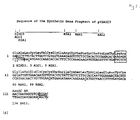
- Figure 2 is the nucleotide and amino acid sequence of a synthetic oligonucleotide encoding a modified ⁇ -factor leader and the first 13 amino acids of the proinsulin gene used to construct pYGAI3 in Example I.
- the modified a-factor leader has had the glycosylation sites removed by changing the codons for Asn 23,57,67 to encode Gln (boxed).
- the arrow denotes the junction between the sequence encoding the KEX2 endopeptidase site and the N-terminus of human proinsulin.
- Figure 3 shows the synthetic gene of fragment pYGAIC3 encoding the proinsulin analog, where a KEX2 endopeptidase site has replaced the C peptide (boxed).
- the synthetic 133 bp fragment referred to in Example II is defined by the vertical and horizontal lines through the nucleotide sequence.
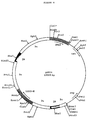
- Figure 4 is a restriction map of yeast shuttle vector pAB24.
- Figure 5 shows the DNA sequence of the synthetic gene encoding IGF1 described in Example III.
- Figure 6 is a restriction map of pYLUIGF1-55, an expression vector described in Example III encoding IGF1 under the control of a truncated ⁇ -factor leader.
- Figure 7 is a restriction map of pYLUIGF1-24, an expression vector described in Example III encoding IGF1 under the control of a full-length ⁇ -factor leader with three glycosylation sites.
- a “replicon” is any genetic element (e.g., plasmid, cosmid, chromosome, virus) that functions as an autonomous unit of DNA replication in vivo--i.e., capable of replication under its own control.
- a "vector” is a replicon such as a plasmid, phage, or cosmid to which another DNA segment may be attached so as to bring about the replication of the attached segment.
- double-stranded DNA molecule refers to the polymeric form of deoxyribonucleotides (adenine, guanine, thymidine, or cytosine) in its normal, double-stranded helix. This term refers only to the primary and secondary structure of the molecule, and does not limit it to any particular tertiary forms. Thus, this term includes double-stranded DNA found, inter alia, in linear DNA molecules (e.g., restriction fragments), viruses, plasmids, and chromosomes.
- linear DNA molecules e.g., restriction fragments
- viruses e.g., plasmids, and chromosomes.
- sequences will be described herein according to the normal convention of giving only the sequence in the 5′ to 3′ direction along the nontranscribed strand of DNA, i.e., the strand having a sequence homologous to the mRNA produced from a particular coding sequence.
- a DNA "coding sequence” is DNA sequence which can be transcribed and translated into a polypeptide in vivo when placed under the control of appropriate regulatory sequences. The boundaries of the coding sequence are determined by and include the translation start codon at the 5′ (amino) terminus, and a translation stop codon at the 3′ (carboxy) terminus.
- a coding sequence can include, but is not limited to, procaryotic DNA sequences, viral DNA sequences, cDNA or genomic DNA sequences from eucaryotic sources (e.g., mammalian), and even synthetic DNA sequences.
- yeast-recognized transcription initiation and termination sequences refer to DNA regulatory regions which flank a coding sequence and are responsible for the transcription in yeast of an mRNA homologous to the coding sequence which can then be translated into the polypeptide encoded by the coding sequence.
- Transcription initiation sequences include yeast promoter sequences, which are DNA regulatory sequences capable of binding yeast RNA polymerase in a cell and initiating transcription of a downstream (3' direction) coding sequence.
- the promoter sequence is bounded (and excludes) at its 3' terminus by the translation start codon of a coding sequence and extends upstream (5' direction) to include the minimum number of nucleotides or elements necessary to initiate transcription at levels detectable above background.
- Promoters useful in the present invention include the wild-type ⁇ -factor promoter, as well as other yeast promoters.
- promoters involved with the enzymes in the glycolytic pathway e.g., phosphoglucoisomerase, phosphofructokinase, phosphotrioseisomerase, phosphoglucomutase, enolase, pyruvic kinase, glyceraldehyde-3-phosphate dehydrogenase, alcohol dehydrogenase, as well as hybrids of these promoters.
- Transcription initiation sequences can also include other regulatory regions responsible for promoter regulation or enhancement.
- a transcription terminator sequence located 3' to the translation stop codon can be either the wild-type a-factor transcription termination sequence, or another yeast-recognized termination sequence, such as those from the genes for the above glycolytic enzymes.
- a coding sequence is "under the control" of transcription initiation and termination sequences when RNA polymerase binds the transcription initiation sequence and transcribes the coding sequence into mRNA terminating at the transcription termination sequence, and the mRNA is then translated into the polypeptide encoded by the coding sequence (i.e., "expression").
- the precursor polypeptide encoded by the coding sequences of the present invention is "secreted” when at least a portion (usually the non-yeast protein in the absence of the leader sequence) is transported extracellularly where it is found in the cell growth medium. Usually, only the portion of precursor protein downstream from the leader sequence is secreted, and this downstream portion may also be subjected to additional processing during secretion, such as proteolytic cleavage, glycosylation, folding, disulfide bond formation, etc.
- a cell has been "transformed” by exogenous DNA when such exogenous DNA has been introduced inside the cell wall.
- Exogenous DNA may or may not be integrated (covalently linked) to chromosomal DNA making up the genome of the cell.
- the exogenous DNA may be maintained extrachromosomally on a replicon such as a plasmid.
- a replicon such as a plasmid.
- a cell which has been transformed by exogenous DNA which is integrated into the chromosome is referred to as a "stably" transformed cell.
- a "clone” or “clonal population” is a population of cells derived from a single cell or common ancestor by mitosis.
- Two DNA sequences are "substantially homologous" when at least about 60% (preferably at least about 75%, and most preferably at least about 90%) of the nucleotides match over a defined length of the molecules. Sequences that are substantially homologous can be identified in a Southern hybridization experiment under conditions of a selected stringency as defined for that particular system. Defining appropriate hybridization conditions is within the skill of the art. See, e.g., Maniatis et al., supra ; DNA Cloning , supra ; Nucleic Acid Hybridization , supra .
- a "heterologous region" of a DNA molecule is an identifiable segment of DNA within a larger DNA molecule that is not found in association with the larger molecule in nature.
- the heterologous region when the heterologous region encodes a mammalian protein, the heterologous region will usually be flanked by DNA that does not flank the mammalian DNA sequence in the genome of the source organism.
- Another example of a heterologous coding sequence is a construct where the coding sequence itself is not found in nature (e.g., a cDNA where the genomic coding sequence contains introns, or synthetic sequences having codons different from organisms which encode the same or similar protein). Allelic variations or naturally occurring mutational events do not give rise to a "heterologous" region of DNA as used herein.
- yeast includes ascosporogenous yeasts (Endomycetales), basidiosporogenous yeasts and yeast belonging to the Fungi imperfecti (Blastomycetes).
- the ascosporogenous yeasts are divided into two families, Spermophthoraceae and Saccharomycetaceae. The latter is comprised of four subfamilies, Schizosaccharomycoideae (e.g., genus Schizosaccharomyces), Nadsonioideae, Lipomycoideae and Saccharomycoideae (e.g., genera Pichia, Kluyveromyces and Saccharomyces).
- the basidiosporogenous yeasts include the genera Leucosporidium, Rhodosporidium, Sporidiobolus, Filobasidium and Filobasidiella.
- Yeast belonging to the Fungi Imperfecti are divided into two families, Sporobolomycetaceae (e.g., genera Sporobolomyces, Bullera) and Cryptococcaceae (e.g., genus Candida).
- Sporobolomycetaceae e.g., genera Sporobolomyces, Bullera
- Cryptococcaceae e.g., genus Candida
- species within the genera Pichia, Kluyveromyces, Saccharomyces, Schizosaccharomyces and Candida Of particular interest are the Saccharomyces species S. cerevisiae , S. carlsbergensis , S. diastaticus , S.
- yeast shall be defined as described in Biology and Activities of Yeast (F.A. Skinner, S.M. Passmore & R.R. Davenport eds. 1980) (Soc. App. Bacteriol. Symp. Series No. 9). In addition to the foregoing, those of ordinary skill in the art are presumably familiar with the biology of yeast and the manipulation of yeast genetics. See, e.g., Biochemistry and Genetics of Yeast (M.
- the present invention employs truncated leader sequences from a yeast ⁇ -factor gene.
- ⁇ -factor is an oligopeptide mating pheromone about 13 residues in length produced from a large precursor polypeptide between about 100 and 200 residues (typically about 120-160) in length (prepro-a-factor).
- the precursor is comprised of a hydrophobic "signal sequence" of about 20 residues (e.g., about 19-23, typically about 20-22) followed by an additional leader region of about 60 hydrophilic residues (the "pro” region), which is then linked to several tandem repeats of the mature pheromone sequence (typically about 2-6) separated by short oligopeptide spacer regions (typically about 6-8 residues) which provide for proteolytic processing to the mature pheromone.
- a hydrophobic "signal sequence” of about 20 residues (e.g., about 19-23, typically about 20-22) followed by an additional leader region of about 60 hydrophilic residues (the "pro” region), which is then linked to several tandem repeats of the mature pheromone sequence (typically about 2-6) separated by short oligopeptide spacer regions (typically about 6-8 residues) which provide for proteolytic processing to the mature pheromone.
- ⁇ -factor may also be purified from a yeast species, sequenced and probes designed to clone the prepro- ⁇ -factor gene. See, e.g., McCullough et al. (1979) J. Bacteriol. 138 :146-154; Sato et al. (1981) Agric. Biol. Chem. 44 :1451-1453; Singh et al. (1983), supra . It has also been determined that the ⁇ -factor leader sequence from one yeast species can be functional in another yeast species. See, e.g., U.S.S.N. 078,551 (EP-A-301669), supra .
- the present invention contemplates not only the use of ⁇ -factor leader sequences from yeast in general, but the use of such leader sequences in heterologous yeast species.
- the invention will be discussed in terms of the prepro- ⁇ -factor gene MFa1 from S. cerevisiae . See, e.g., Kurjan et al., U.S. Patent No. 4,546,083; Singh et al. (1983), supra .
- the present invention employs chimeric DNA constructs encoding hybrid precursor polypeptides comprised of a leader sequence and a non-yeast polypeptide.
- the leader sequence DNA is defined as beginning at the N-terminal start codon (methionine) of the precursor polypeptide through the codon encoding the last amino acid residue before the processing site that intervenes between the leader sequence and the sequence encoding the non-yeast protein.
- the leader sequence of the present invention is comprised of a truncated form of a yeast ⁇ -factor leader sequence, typically about 25 to about 50 amino acid residues in length. Thus, the leader sequence of the present invention is approximately 30 amino acid residues shorter than the typical full-length ⁇ -factor leader.
- MF ⁇ 1 for example, contains a leader sequence of 83 amino acid residues followed by a hexapeptide spacer sequence which is cleaved by yeast processing enzymes. In making deletions from the leader sequence, it is important that at least one glycosylation site (-Asn-Y-Thr/Ser-) is retained to provide for efficient secretion.
- the leader retain a functional ⁇ -factor signal sequence.
- the signal peptide is usually about 20 amino acids in length, and characteristic features including a hydrophobic core. See, e.g., von Heijne, (1984) J. Mol. Biol. 173 :243-251. All of the prepro- ⁇ -factor sequences examined today encode for a hydrophobic peptide of about 20 residues in length. While the exact length of a signal peptide necessary to direct the precursor polypeptide to the secretory pathway is not defined, it will usually require between about 19 and about 23 residues, the minimum sequence required being readily definable by the testing of deletion mutants.
- deletions within the range of about 30 to about 60 residues, typically between about 33 and about 58 residues, and more typically between about 48 and about 58 residues, are contemplated by the present invention. These deletions will generally occur in the region between and including residues 26 through 83. It is preferred that the deletions include the glycosylation sites at residues 57-59 and 67-69.
- the deleted ⁇ -factor leader sequences may be replaced, in part, by non- ⁇ -factor leader sequences, if desired.
- sequences should generally encode hydrophilic amino acid residues, should not encode glycosylation or processing sites, and preferably should be selected to maintain the overall length of the leader to be about 50 residues or less, preferably about 23 to 40 residues, and most preferably about 25 to 35 residues.
- the leader sequence of the present invention has immediately 3' thereto a processing site which allows for the cleavage of the leader from the non-yeast protein sequence to which it is fused in the precursor polypeptide.
- the processing site employed in the present invention is defined as the codons defining the minimum number of amino acid residues which are specifically recognized for cleavage by the selected process (e.g., chemical, enzymatic, etc.).
- Various processing sites are known in the art, including both those active in vivo and in vitro.
- the processing site may provide for in vitro processing by encoding a cleavage site for a proteolytic enzyme which does not occur in the yeast host.
- the recovered precursor polypeptide would then be treated with the enzyme to cleave the non-yeast protein from the precursor.
- Another in vitro processing site is a methionine codon which can be cleaved by post-expression treatment with cyanogen bromide. See, e.g., U.S. Patent No. 4,366,246.
- In vivo processing sites can be selected from any peptide signals recognized by a yeast proteolytic enzyme which will provide for expression of the desired non-yeast protein sequence. Particularly preferred processing sites are those for the enzymes involved in processing of native prepro- ⁇ -factor. For example, dipeptidyl aminopeptidase A (DPAPase A) removes terminal -X-Ala- sequences, where X is Glu or Asp. See, e.g., Julius et al. (1983) Cell 32 :839-852.
- DPAPase A dipeptidyl aminopeptidase A
- the endopeptidase encoded by the KEX2 gene cleaves basic dipeptides comprised of Lys and Arg residues; i.e., Lys-Arg, Arg-Arg, Arg-Lys and Lys-Lys. Fuller et al., Microbiology 1986 , pp. 273-278 (1986).
- yeast the ⁇ -factor precursor is first cleaved by the KEX2 endopeptidase, and then the N-termini are trimmed by DPAPase A to provide mature ⁇ -factor pheromone.
- the leader sequence will be joined to the non-yeast protein sequence by the dibasic peptide recognition site for KEX2 endopeptidase, such as Lys-Arg or Arg-Arg.
- the carboxy-terminal portion of the precursor polypeptide of the present invention is a non-yeast protein.
- the DNA sequence encoding this portion is defined herein as beginning with the first codon downstream (3' direction) from the last codon of the processing site through to the translation stop codon which defines the carboxy-terminal of the precursor polypeptide.
- This DNA sequence will be considered to encode a "non-yeast protein" when, over its entire sequence, it defines a polypeptide that is not substantially homologous to a polypeptide expressed by yeast.
- the preferred non-yeast proteins will be mammalian protein sequence (including their analogs; i.e., "muteins", fragments, etc.).
- non-yeast proteins can include, therefore, a fusion protein comprised of mammalian and yeast sequences, as well as "pro" forms of the mature mammalian protein.
- DNA sequences encoding the non-yeast proteins can be sequences cloned from non-yeast organisms, or they can be synthetic sequences, usually prepared using yeast-preferred codons.
- the non-yeast proteins will be at least about 8 amino acids in length and can include polypeptides up to about 100,000 daltons or higher.
- the non-yeast polypeptide sequence will be less than about 300,000 daltons, and more usually less than about 150,000 daltons. Of particular interest are polypeptides of from about 5,000 to about 150,000 daltons, more particularly of about 5,000 to about 100,000 daltons.
- Illustrative non-yeast proteins of interest include hormones and factors, such as growth hormone, somatomedins, epidermal growth factor, luteinizing hormone, thyroid-stimulating hormone, oxytocin, insulin, vasopressin, renin, calcitonin, follicle-stimulating hormone, prolactin, erythropoietin, colony-stimulating factors, lymphokines such as interleukin-2, globins, immunoglobulins, interferons (e.g., ⁇ , ⁇ or ⁇ ), enzymes, ⁇ -endorphin, enkephalin, dynorphin, insulin-like growth factors, etc.
- hormones and factors such as growth hormone, somatomedins, epidermal growth factor, luteinizing hormone, thyroid-stimulating hormone, oxytocin, insulin, vasopressin, renin, calcitonin, follicle-stimulating hormone, prolactin,
- DNA constructs encoding the above-described precursor polypeptides have the structure: 5'-AF-CHO-X n -S-Gene*-3' wherein AF encodes a yeast alpha-factor signal peptide; CHO encodes a glycosylation site; X n encodes a polypeptide of n amino acids in length that does not contain a glycosylation site or processing site that will cause the precursor polypeptide to be cleaved in vivo by the yeast host; n is an integer from 0 to about 30; Gene* encodes a non-yeast protein; and S encodes a processing site that provides for cleavage of said precursor polypeptide.
- the signal peptide encoded by AF is the same ⁇ -factor signal peptide described above. It is approximately 20 residues in length (e.g., about 19-23) and is of sufficient length to direct the precursor polypeptide into the yeast secretory pathway. The precise minimum or maximum length can be determined for a particular ⁇ -factor by screening a series of deletion constructs.
- the DNA sequence defined by CHO encodes a glycosylation site. It will generally be nine nucleotides in length, including three codons for the amino acids Asn-Y-Y'-, wherein Y is any amino acid residue, and Y' is Thr or Ser.
- X n encodes, for example, portions of the ⁇ -factor leader which are not deleted or unrelated amino acid sequences.
- X n if present, not contain any functional glycosylation sites or processing sites recognized and cleaved by the yeast host. Further, when departing from sequences found in an ⁇ -factor leader, it is preferred to select hydrophilic amino acid residues. It is possible that the length of X n will affect the efficiency of expression and secretion of the non-yeast protein. Selection of the appropriate length of X n to optimize expression can be done through screening constructs of various sizes.
- the non-yeast protein encoded by Gene* and the processing site encoded by S are as described above.
- the DNA constructs of the present invention will normally be maintained in a replicon capable of stable maintenance in a host, particularly a yeast host.
- the replicons usually plasmids, will include one or more replication systems, desirably two replication systems, allowing for maintenance of the replicon in both a yeast host for expression, and in a procaryotic host for cloning.
- yeast-bacteria shuttle vectors include YEp24 [Botstein et al. (1979) Gene 8 :17-24], pC1/1 [Brake et al. (1984) Proc. Natl. Acad. Sci. USA 81 :4642-4646], and YRpl7 [Stnichomb et al.
- a plasmid expression vector may be a high or low copy number plasmid, the copy number generally ranging from about 1 to about 200.
- high copy number yeast vectors there will generally be at least 10, preferably at least 20, and usually not exceeding about 150 copies in a single host.
- either a high or low copy number vector may be desirable, depending upon the effect of the vector and the foreign protein on the host. See, e.g., Brake et al., supra .
- DNA constructs of present invention can also be integrated into the yeast genome by an integrating vector. Examples of such vectors are known in the art. See, e.g., Botstein et al., supra .
- suitable yeast and other microorganism hosts for the practice of the present invention is within the skill of the art.
- suitable hosts may include those shown to have, inter alia, good secretion capacity, low proteolytic activity, and overall robustness.
- Yeast and other microorganisms are generally available from a variety of sources, including the Yeast Genetic Stock Center, Department of Biophysics and Medical Physics, University of California, Berkeley, California; and the American Type Culture Collection, Rockville, Maryland.
- yeast hosts Methods of introducing exogenous DNA into yeast hosts are well known in the art.
- spheroplast transformation is taught, for example, by Hinnen et al. (1978) Proc. Natl. Acad. Sci. USA 75 :1919-1933, and Stinchcomb et al., EPO Publication No. 45,573.
- Transformants are grown in an appropriate nutrient medium, and, where appropriate, maintained under selective pressure to insure retention of endogenous DNA. Where expression is inducible, growth can be permitted of the yeast host to yield a high density of cells, and then expression is induced.
- the secreted, processed non-yeast protein can be harvested by any conventional means, and purified by chromatography, electrophoresis, dialysis, solvent-solvent extraction, and the like.
- the following example provides a comparison of the levels of expression and secretion obtained with modified ⁇ -factor constructs used to express human proinsulin.
- Three constructs employ full-length ⁇ -factor leaders; one having ⁇ -factor leader with the three native glycosylation sites, one having all three of the glycosylation sites eliminated, and one having all of the sites, except the one at Asn23, removed.
- the fourth construct is a truncated ⁇ -factor leader which retains a single glycosylation site at Asn23.
- This plasmid encodes an ⁇ -factor leader [Brake et al. (1984) Proc. Natl. Acad. Sci. USA 81 :4642-4646; EPO Publication No. 116,201] linked to human proinsulin.
- the proinsulin is encoded by a synthetic gene made with yeast preferred codons ( Figure 1).
- the ⁇ -factor leader sequence, the synthetic proinsulin gene and the ⁇ -factor terminator sequence are from pYBCA5, the construction of which is shown in Figure 1. Transcription is mediated by the 404 bp BamHI-NcoI GAPDH promoter fragment. Travis et al. (1985) J. Biol. Chem. 260 :4384-4389.
- the 1206 bp BamHI expression cassette consisting of the GAPDH promoter, the sequence encoding the ⁇ -factor leader linked to proinsulin and the ⁇ -factor terminator was cloned into the unique BamHI site of the yeast shuttle vector pAB24 (below) or pC1/1 such that the GAPDH promoter sequence was proximal to the SalI site of the vector to give the plasmids pYGAI1-AB24 or pYGAI1-C1/1, respectively.
- the 1206 bp BamHI expression cassette was also subcloned into the unique BamHI site of a derivative of pBR322 [pBR322(WEcoRI-SalI)BamHI; Travis et al. supra .] This plasmid was called pGAI1.
- Plasmid pAB24 ( Figure 4) is a yeast shuttle vector which contains the complete 2 ⁇ m sequence [Broach, in: Molecular Biology of the Yeast Saccharomyces , Vol., 1, p. 445 (1981)] and pBR322 sequences. It also contains the yeast URA3 gene derived from plasmid YEp24 [Botstein et al. (1979) Gene 8 :17) and the yeast LEU2d gene derived from plasmid pC1/1. EPO Publication No. 116,201. Plasmid pAB24 was constructed by digesting YEp24 with EcoRI and religating the vector to remove the partial 2m sequences.
- the resulting plasmid, YEp24WRI was linearized by digestion with ClaI and ligated with the complete 2m plasmid which had been linearized with ClaI.
- the resulting plasmid, pCBou was then digested with XbaI and the 8605 bp vector fragment was gel isolated. This isolated XbaI fragment was ligated with a 4460 bp XbaI fragment containing the LEU2d gene isolated from pC1/1; the orientation of the LEU2d gene is in the same direction as the URA3 gene.
- Plasmid pYGAI3 differs from pYGAI1 in that it encodes a modified ⁇ -factor leader wherein the codons for Asn at residues 23, 57 and 67 have been changed to encode Gln, thereby eliminating all three signals for N-linked glycosylation.
- the ⁇ -factor leader and the N-terminal 13 amino acids of proinsulin encoded by this plasmid were constructed by ligation of synthetic oligonucleotides to give a 294 bp fragment with a 5' NcoI overhang and a 3' HindIII overhang, the sequence which is shown in Figure 2.
- the sequence of appropriate oligonucleotides was altered during the synthesis so that codons which specified Asn at positions 23, 57 and 67 of the natural ⁇ -factor leader now specified Gln at the same positions.
- the DNA sequence specifying the N-terminal 13 amino acids of proinsulin was identical to that in pYGAI1.
- the 294 bp synthetic DNA (NcoI-HindIII) fragment was substituted for the comparable fragment of pGAI1 and pYGAI1-C1/1 which gave the plasmids pGAI3 and pYGAI3, respectively.
- Plasmid pYGAI8 contains DNA encoding an ⁇ -factor leader which eliminates two of the three glycosylation sites. Asn 57,67 have been modified to Gln 57,67 . The resulting plasmid has only a single glycosylation site at position Asn23. pYGAI8 was prepared as follows.
- a 5' fragment was isolated from the expression cassette of pGAI1 by cutting with HpaII, followed by cutting with BamHI, and then gel isolating a 504 bp fragment containing the GAPDH promoter and the sequence encoding residues 1-33 of the ⁇ -factor leader.
- plasmid pYGAI3 encoding an ⁇ -factor leader lacking glycosylation sites was also sequentially cut with HpaII and BamHI, and a 702 bp fragment isolated containing sequences encoding modified ⁇ -factor leader residues 34-83, the LysArg processing site, the proinsulin sequence and the a-factor termination sequence. This fragment was then ligated to the 504 bp fragment from pGAI1, cut with BamHI and a 1206 bp fragment isolated.
- the 1.2 kb expression cassette from pGAI8 was removed by cutting with BamHI and then gel isolating the fragment. It was ligated into BamHI-cut and phosphatase-treated yeast shuttle vector pAB24. Insertion of the expression cassette was in the unique BamHI site of the pBR322 sequences such that the GAPDH promoter was proximal to the unique SalI site of the vector. This plasmid was pYGAI8.
- Plasmid pYGAI7 contains the DNA encoding a truncated ⁇ -factor leader and the synthetic gene for human proinsulin.
- the ⁇ -factor leader has been truncated so that it encodes only amino acids 1-35 of the ⁇ -factor leader and therefore contains a single site for glycosylation at Asn23.
- This yeast expression vector was constructed as follows.
- HpaII-HindIII linker was added of the following structure: After adding the linker, the linearized plasmid was cut with BamHI, and a 558 bp HpaII-BamHI fragment was gel isolated. This fragment contains the codons for residues 34-35 of the ⁇ -factor leader linked directly to a Lys-Arg processing site and the proinsulin sequence. There are no intervening sequences between the codon for residue 35 of the ⁇ -factor leader and the processing site directly adjacent to the proinsulin sequence.
- pGAI1 was cut with HpaII and BamHI, and a 504 bp fragment gel isolated.
- This fragment contains the GAPDH promoter and nucleotides encoding amino acids 1-33 of the ⁇ -factor leader, the 3' end terminating in an HpaII overhand complementary to the 5' end of the above-described 558 bp HpaII-BamHI fragment.
- These two fragments were ligated together and cut with BamHI to provide an expression cassette containing the GAPDH promoter, sequences encoding a modified ⁇ -factor leader containing residues 1-35 directly linked to a Lys-Arg processing site, the proinsulin gene, and the ⁇ -factor terminator.
- the cassette was then ligated into a BamHI site of pBR322(WEcoRI-SalI)BamHI, as described above, to give plasmid pGAI7 and cloned in E.coli .
- pGAI7 was then cut with BamHI, and the 1062 bp expression cassette gel isolated. The expression cassette was then ligated into the BamHI site of pAB24 to give plasmid pYGAI7.
- Plasmids pYGAI1-C1/1, pYGAI3, pYGAI1-AB24, pYGAI7 and pYGAI8 were transformed into Saccharomyces cerevisiae strain AB103.1 ( Mat a, leu2 -3,112, ura3 -52, his4 -580, pep4 -3[cir°]) essentially as described by Hinnen et al. (1978) Proc. Natl. Acad. Sci. USA 75 :1929-1933. Transformants of pYGAI1-C1/1 and pYGAI3 were selected for leucine prototrophy, transformants of the other plasmids were selected for ura prototrophy.
- Table 1 compares secretion of proinsulin mediated by the natural ⁇ -factor leader (pYGAI1-C1/1) or the a-factor leader with Gln substituted for Asn at positions 23, 57 and 67 (pYGAI3).
- Inoculum cultures (.2 ml of individual transformants) were grown for 48 hr in synthetic complete medium lacking leucine [SD-leu; Sherman et al., Methods in Yeast Genetics , p. 62 (Cold Spring Harbor Laboratory, 1982)] and diluted 20-fold into the same medium.
- Table 2 compares transformants of pYGAI1-pAB24 (full-length native ⁇ -factor leader, pYGAI8 (full-length ⁇ -factor leader with only one glycosylation site at Asn23) and pYGAI7 (truncated ⁇ -factor leader containing a single glycosylation site at Asn23) for their ability to secrete insulin-like-material.
- Inoculum cultures of the indicated transformants (.2 ml) in SD-Leu grown for .48 hr at 30°C were pelleted by centrifugation, washed and diluted 20-50 fold into ura ⁇ medium.
- This medium contains 0.67% yeast nitrogen base, 1% succinic acid, 0.35% NaOH, 0.5% casamino acids, 2% glucose, 0.005% adenine, 0.01% tryptophan and 0.02% threonine. Cultures were grown at 30°C for 48-72 hr, and culture supernatants prepared and assayed as described above. Data presented in Table 2 show that the transformants carrying the construct employing the truncated ⁇ -factor leader retaining a single glycosylation site at Asn23 secreted generally more immunoreactive insulin-like-material than did transformants bearing the construct with the full-length native ⁇ -factor leader.
- This example compares the expression of a full-length ⁇ -factor leader construct, retaining all glycosylation sites, to an expression construct employing a truncated ⁇ -factor sequence retaining only a single glycosylation site at Asn23.
- the non-yeast protein employed in this example is a human proinsulin analog wherein the connecting "C" peptide has been replaced by a yeast KEX2 endopeptidase cleavage site.
- the plasmid pGAIC3 was made by replacing the 231 bp HindIII-SalI fragment of pGAI1 which encodes amino acids 14 through 30 of the B chain, the C-peptide, the A chain and 2 translation stop codons with a 132 bp synthetic HindIII-SalI gene fragment (shown in Figure 3) which encodes amino acids 14 through 30 of the B chain, a Lys-Arg KEX2 endopeptidase cleavage site, the A chain, and translation stop codons.
- the plasmid pYGAIC3 was prepared from pGAIC3 as follows.
- Plasmid pGAIC3 was digested with BamHI, and the 1107 bp BamHI expression cassette containing the GAPDH promoter, the sequence encoding ⁇ -factor leader linked to proinsulin analog, and the ⁇ -factor transcription terminator was isolated and ligated into BamHI digested and phosphatase-treated pAB24, and then cloned in E. coli . Plasmid pYGAIC3 was obtained, in which the expression cassette was oriented such that the GAPDH promoter was proximal to the unique SalI site of the vector.
- Plasmid pYaF L 7C3 contains DNA encoding the truncated a-factor leader described above for pYGAI7 linked to the sequence for the proinsulin analog, also described above (pYGAIC3). This plasmid was constructed as follows.
- pGAIC3 was cut with HindIII and SalI, and a 132 bp fragment was gel isolated. This fragment contains sequences encoding all but the first 12 codons of the proinsulin analog. It was ligated into a gel isolated 4640 bp fragment from HindIII- and SalI-digested pGAI7 to provide plasmid paf L 7C3. After cloning in E. coli , this plasmid was cut with BamHI and a 1062 bp BamHI fragment was gel isolated. This expression cassette contains the truncated ⁇ -factor leader construct of pGAI7 with the proinsulin analog in place of the normal proinsulin sequence. The expression cassette was then ligated into the BamHI site of pAB24, as described above, to give pYaf L 7C3.
- Strain AB103.1 has been described in Example I.
- Strain AB110-4 is a derivative of Saccharomyces cerevisiae strain AB110 ( Mat a, leu2 , ura3 -52, pep4 -3 his4 -580[cir°]) in which a deletion has been engineered into the pep4 gene.
- These strains were transformed as described above with plasmids pYGAIC3 and pYaf L 7C3, and ura prototrophs were selected.
- Inoculum cultures were grown in SD-leu [Sherman et al., supra .] at 30°C for 24-48 hours then pelleted by centrifugation, washed and diluted 20 fold into ura ⁇ medium (described above) and grown for 48-72 hours at 30°C.
- Cell-free conditioned culture medium was prepared by centrifugation for assay in a competition insulin radioimmune assay.
- Table 3 Secretion of ILM from a Proinsulin Analog Construct Mediated by a Truncated a-Factor Leader or Natural a-Factor Leader Transformant No. of Tests1 ILM2 mg/ml mg/ml, OD650 Range Mean Std. dev. Range Mean Std. dev.
- This example described the construction of a truncated a-factor expression vector which mediates increased expression levels of active insulin-like growth factor-1.
- a DNA sequence encoding a truncated a-factor leader and a coding sequence for IGF1 was prepared.
- a synthetic sequence was prepared by standard procedures employing an Applied Biosystems 380A DNA synthesis machine according to manufacturer's direction. Fourteen DNA sequences were synthesized ranging from 22 to 57 bases in length, purified by PAGE, and phosphorylated individually by T4 kinase in the presence of ATP. The sequences were then annealed and ligated by standard procedures.
- the sequence of the synthetic gene is shown in Figure 5.
- the purified synthetic gene fragment was cloned into NcoI/SalI digested pBS100 (described below).
- the resulting plasmid was called pBS100 Taf L IGF1.
- Plasmid pBS100 contains a yeast expression cassette cloned into a pBR322 derivative, pAB12.
- the expression cassette contains the hybrid ADH-2/GAPDH promoter and the GAPDH terminator flanking a non-essential gene segment.
- the ADH-2/GADPH promoter is a 1200 bp BamHI-NcoI fragment isolated from pJS103 (see below) and the GAPDH terminator is a 900 bp SalI-BamHI fragment isolated from plasmid pPAG1. EPO Publication No. 164,556.
- Plasmid pBS100 also contains a non-essential fragment between NcoI and SalI sites which is replaced by gene fragments of interest.
- the expression cassette can be removed from pBS100 by digestion with BamHI and cloned into yeast shuttle vectors for introduction into yeast cells.
- Plasmid pJS103 which contains the hybrid ADH-2/GAPDH promoter employed above, was constructed as follows.
- the ADH-2 portion of the promoter was constructed by cutting a plasmid containing the wild-type ADH2 gene from plasmid pADR2 [Beier et al. (1982) Nature 300 :724-728] with restriction enzyme EcoR5, which cuts at position +66 relative to the ATG start codon, as well as in two other sites in pADR2, outside of the ADH2 region.
- the resulting mixture of a vector fragment and two smaller fragments was reacted with Bal31 exonuclease to remove about 300 bp.
- Synthetic XhoI linkers were ligated onto the Bal31-treated DNA.
- the resulting DNA linker vector fragment (about 5 kb) was separated from the linkers by column chromatography, cut with restriction enzyme XhoI, religated, and used to transform E. coli to ampicillin resistance.
- the positions of the XhoI linker were determined by DNA sequencing.
- One plasmid which contained an XhoI linker within the 5' nontranscribed region of the ADH2 gene (position -232 from ATG) was cut with the restriction enzyme XhoI, treated with nuclease Sl, and subsequently treated with the restriction enzyme EcoRI to create a linear vector molecule having 1 blunt end at the site of the XhoI linker and an EcoRI end.
- the GAPDH portion of the promoter was constructed by cutting plasmid pPGAP [EPO Publication No. 164,556] with the enzymes BamHI and EcoRI, followed by the isolation of the 0.4 Kbp DNA fragment. This purified fragment was then completely digested with the enzyme AluI and an approximately 200 bp fragment was isolated. This GAPDH promoter fragment was ligated to the ADH-2 fragment present on the linear vector described above to give plasmid pJS103.
- a BamHI fragment was then isolated from pBS100 Ta fL IGF1. This fragment contains the ADH2/GAPDH promoter, a truncated ⁇ -factor leader (AA 1-25, 81-83) a LysArg processing site, a coding sequence for IGF1, and the GAPDH terminator sequence. This BamHI fragment was then cloned into pAB24, previously digested with BamHI. A positive clone was selected, and while initially called plasmid 18.5, it was subsequently named pYLUIGF1-55 . (See Figure 6.)
- a second expression vector, pYLUIGF1-24 was also prepared by analogous methods.
- a restriction map is shown in Figure 7. This vector is similar to pYLUIGF1-55, except that it has a full-length ⁇ -factor leader directing secretion with three glycosylation sites (compare Example I.A.) and the ⁇ -factor terminator.
- Yeast strain AB110 (EPO Publication No. 164,556) was transformed with pYLUIGF1-55 and pYLUIGF1-24 by conventional spheroplasting techniques [Hinnen et al. (1978) Proc. Natl. Acad. Sci. USA 75 :1919-1933], and expression compared.
- IGF1 from AB110 (pYLUIGF1-55) and AB110 (pYLUIGF1-24) is non-constitutive. Induction of IGF1 expression was achieved by bringing about a low concentration of glucose in the growth medium. Under standard conditions, shake flask cultures (25 ml) fully utilize the glucose in the medium by 18-24 hours post inoculation. Thus, 25 ml cultures of AB110 (pYLUIGF1-55) and AB110 (pXLUIGF1-24) were grown under standard conditions for 72 hours. Supernatant samples were taken at 49 and 72 hours post inoculation and assayed for IGF1 biological activity (RRA) and for immunoreactivity (RIA) with anti-IGF1 antibodies.
- RRA IGF1 biological activity
- RIA immunoreactivity
- pYLUIGF1-55 secreted protein of which a substantially greater fraction was biologically active.
- pYLUIGF1-24 secreted more protein that showed reactivity with IGF1 antibodies, relatively little of this protein was biologically active.
- the radioreceptor assay measures the ability of IGF-1 to bind to its receptor. This is a measure of the biological activity of recombinant polypeptide since it is believed that IGF-1 exerts all of its activity through its receptor.
- the receptor assay is described in Marshall et al. (1974) J. Clin. Endorinol. Metab. 19 :283-292.
- the radioimmunoassay (RIA) is a competitive assay that measures the amount of protein antigenically cross-reactive with native IGF-1, whether or not it is biologically active. The assay is described in Zapf et al. (1981) J. Clin. Invest. 68 :1321-1330.
Landscapes
- Health & Medical Sciences (AREA)
- Life Sciences & Earth Sciences (AREA)
- Chemical & Material Sciences (AREA)
- Organic Chemistry (AREA)
- Genetics & Genomics (AREA)
- Biochemistry (AREA)
- Biophysics (AREA)
- General Health & Medical Sciences (AREA)
- Zoology (AREA)
- Molecular Biology (AREA)
- Mycology (AREA)
- Gastroenterology & Hepatology (AREA)
- Medicinal Chemistry (AREA)
- Proteomics, Peptides & Aminoacids (AREA)
- Engineering & Computer Science (AREA)
- Diabetes (AREA)
- General Engineering & Computer Science (AREA)
- Endocrinology (AREA)
- Wood Science & Technology (AREA)
- Microbiology (AREA)
- Biomedical Technology (AREA)
- Biotechnology (AREA)
- Toxicology (AREA)
- Bioinformatics & Cheminformatics (AREA)
- Plant Pathology (AREA)
- Physics & Mathematics (AREA)
- Micro-Organisms Or Cultivation Processes Thereof (AREA)
- Preparation Of Compounds By Using Micro-Organisms (AREA)
- Peptides Or Proteins (AREA)
- Enzymes And Modification Thereof (AREA)
Applications Claiming Priority (2)
| Application Number | Priority Date | Filing Date | Title |
|---|---|---|---|
| US13968287A | 1987-12-30 | 1987-12-30 | |
| US139682 | 1987-12-30 |
Publications (2)
| Publication Number | Publication Date |
|---|---|
| EP0324274A1 EP0324274A1 (en) | 1989-07-19 |
| EP0324274B1 true EP0324274B1 (en) | 1993-11-18 |
Family
ID=22487825
Family Applications (1)
| Application Number | Title | Priority Date | Filing Date |
|---|---|---|---|
| EP88312306A Expired - Lifetime EP0324274B1 (en) | 1987-12-30 | 1988-12-23 | Improved expression and secretion of heterologous proteins in yeast employing truncated alpha-factor leader sequences |
Country Status (15)
| Country | Link |
|---|---|
| US (2) | US5602034A (enExample) |
| EP (1) | EP0324274B1 (enExample) |
| JP (1) | JP2793215B2 (enExample) |
| AT (1) | ATE97441T1 (enExample) |
| AU (1) | AU616228B2 (enExample) |
| CA (1) | CA1340772C (enExample) |
| DE (1) | DE3885728T2 (enExample) |
| DK (2) | DK175910B1 (enExample) |
| ES (1) | ES2059547T3 (enExample) |
| FI (1) | FI100995B (enExample) |
| HK (1) | HK139994A (enExample) |
| IE (1) | IE62087B1 (enExample) |
| IL (1) | IL88802A0 (enExample) |
| NO (1) | NO178829C (enExample) |
| PT (1) | PT89367B (enExample) |
Cited By (9)
| Publication number | Priority date | Publication date | Assignee | Title |
|---|---|---|---|---|
| RU2167939C2 (ru) * | 1994-06-16 | 2001-05-27 | Ново Нордиск А/С | Способ продуцирования полипептида в дрожжах |
| US7632924B2 (en) | 2004-06-18 | 2009-12-15 | Ambrx, Inc. | Antigen-binding polypeptides and their uses |
| US7638299B2 (en) | 2004-07-21 | 2009-12-29 | Ambrx, Inc. | Biosynthetic polypeptides utilizing non-naturally encoded amino acids |
| EP2258855A1 (en) | 2009-05-28 | 2010-12-08 | Universität für Bodenkultur Wien | Expression sequences |
| US9434778B2 (en) | 2014-10-24 | 2016-09-06 | Bristol-Myers Squibb Company | Modified FGF-21 polypeptides comprising an internal deletion and uses thereof |
| US9567386B2 (en) | 2010-08-17 | 2017-02-14 | Ambrx, Inc. | Therapeutic uses of modified relaxin polypeptides |
| EP3130598A2 (en) | 2012-10-29 | 2017-02-15 | Lonza Ltd | Expression sequences |
| WO2020106600A1 (en) | 2018-11-19 | 2020-05-28 | Basf Se | Leader sequence for yeast |
| WO2026009000A1 (en) | 2024-07-04 | 2026-01-08 | Solasta Bio Limited | Methods for production of insecticidal neuropeptides |
Families Citing this family (93)
| Publication number | Priority date | Publication date | Assignee | Title |
|---|---|---|---|---|
| JPS5170964A (ja) * | 1974-12-16 | 1976-06-19 | Hohnen Oil | Haisuinoshoriho |
| NZ207842A (en) | 1983-04-25 | 1988-02-12 | Chiron Corp | Production of human insulin-like growth factor (igf) using cdna |
| US5010182A (en) * | 1987-07-28 | 1991-04-23 | Chiron Corporation | DNA constructs containing a Kluyveromyces alpha factor leader sequence for directing secretion of heterologous polypeptides |
| US5612198A (en) * | 1990-09-04 | 1997-03-18 | The Salk Institute | Production of insulin-like growth factor-1 in methylotrophic yeast cells |
| EP0548267A4 (en) * | 1990-09-04 | 1994-11-23 | Salk Inst Biotech Ind | Production of insulin-like growth factor-1 in methylotrophic yeast cells |
| WO1992005198A1 (en) * | 1990-09-14 | 1992-04-02 | Chiron Corporation | EXPRESSION OF MACROPHAGE INDUCIBLE PROTEINS (MIPs) IN YEAST CELLS |
| DK0574402T3 (da) | 1990-11-26 | 1998-05-18 | Chiron Corp | Ekspression af PACE i værtsceller og fremgangsmåder til anvendelse deraf |
| DK300090D0 (da) * | 1990-12-19 | 1990-12-19 | Novo Nordisk As | Fremgangsmaade til fremstilling af leadersekvenser |
| JPH06506117A (ja) * | 1991-04-01 | 1994-07-14 | メルク エンド カンパニー インコーポレーテッド | ピキア(Pichia)蛋白質分解活性に影響する遺伝子およびその使用 |
| US6348327B1 (en) | 1991-12-06 | 2002-02-19 | Genentech, Inc. | Non-endocrine animal host cells capable of expressing variant proinsulin and processing the same to form active, mature insulin and methods of culturing such cells |
| WO1994018330A1 (en) * | 1993-02-10 | 1994-08-18 | Unilever N.V. | Immobilized proteins with specific binding capacities and their use in processes and products |
| US5538863A (en) * | 1993-07-01 | 1996-07-23 | Immunex Corporation | Expression system comprising mutant yeast strain and expression vector encoding synthetic signal peptide |
| US6623942B2 (en) | 1994-03-08 | 2003-09-23 | Human Genome Sciences, Inc. | Macrophage inflammatory protein-4 (MIP-4) polynucleotides |
| US6495129B1 (en) | 1994-03-08 | 2002-12-17 | Human Genome Sciences, Inc. | Methods of inhibiting hematopoietic stem cells using human myeloid progenitor inhibitory factor-1 (MPIF-1) (Ckbeta-8/MIP-3) |
| US5629167A (en) * | 1994-04-19 | 1997-05-13 | Biocine S.P.A. | Detection of antibodies against Chlamydia trachomatis pgp3 antigen in patient sera by enzyme-linked immunosorbent assay |
| US5639642A (en) * | 1994-06-16 | 1997-06-17 | Novo Nordisk A/S | Synthetic leader peptide sequences |
| IL114160A (en) * | 1994-06-17 | 2006-12-31 | Novo Nordisk As | Dna constructs encoding heterologous proteins and processes for the heterologous protein production in yeast |
| US6500645B1 (en) | 1994-06-17 | 2002-12-31 | Novo Nordisk A/S | N-terminally extended proteins expressed in yeast |
| HRP940432B1 (en) * | 1994-08-05 | 2003-10-31 | Pliva Pharm & Chem Works | Dna sequences encoding biosynthetic insulin precursors and process for preparation of insulin |
| EP0779927A1 (en) * | 1994-09-08 | 1997-06-25 | Chiron Corporation | A method of improved production of insulin-like growth factor |
| GB9513967D0 (en) * | 1995-07-08 | 1995-09-06 | Univ Leicester | Insulin |
| ZA9610456B (en) * | 1995-12-20 | 1997-06-20 | Novo Nordisk As | N-terminally extended proteins expressed in yeast |
| AU733007B2 (en) * | 1996-09-24 | 2001-05-03 | Cadus Pharmaceutical Corporation | Methods and compositions for identifying receptor effectors |
| US6197545B1 (en) | 1996-09-25 | 2001-03-06 | Vanderbilt University | Genetically engineered yeast with modified signal peptidase complex |
| US6083910A (en) | 1996-12-13 | 2000-07-04 | Chiron Corporation | Therapeutic uses of resolved intact or clipped native-sequence PDGF-BB dimers |
| KR100381494B1 (ko) * | 1997-06-30 | 2003-07-22 | 바이오 테크놀로지 제네랄 코오포레이션 | 인간인슐린의제조방법 |
| US6068993A (en) * | 1997-07-02 | 2000-05-30 | Biobras Sa | Vector for expression of heterologous protein and methods for extracting recombinant protein and for purifying isolated recombinant insulin |
| JP2001512684A (ja) | 1997-08-05 | 2001-08-28 | カイロン コーポレイション | 新規のpichiapastoris遺伝子配列およびそれらの使用方法 |
| DE69841807D1 (de) | 1997-11-06 | 2010-09-16 | Novartis Vaccines & Diagnostic | Neisseriale antigene |
| ATE446368T1 (de) | 1998-01-14 | 2009-11-15 | Novartis Vaccines & Diagnostic | Antigene aus neisseria meningitidis |
| EP1049790A1 (en) * | 1998-01-23 | 2000-11-08 | Novo Nordisk A/S | Process for making desired polypeptides in yeast |
| GB9808932D0 (en) | 1998-04-27 | 1998-06-24 | Chiron Spa | Polyepitope carrier protein |
| CA2650642A1 (en) | 1998-05-01 | 1999-11-11 | Chiron Corporation | Neisseria meningitidis antigens and compositions |
| WO2000005389A2 (en) * | 1998-07-20 | 2000-02-03 | Unilever N.V. | Production of proteins |
| JP4444506B2 (ja) | 1998-08-21 | 2010-03-31 | イミュネックス・コーポレーション | ヒトil−1エプシロンdnaおよびポリペプチド |
| EP2278007B1 (en) | 1999-04-30 | 2014-04-16 | Novartis Vaccines and Diagnostics S.r.l. | Conserved neisserial antigens |
| GB9911683D0 (en) | 1999-05-19 | 1999-07-21 | Chiron Spa | Antigenic peptides |
| GB9916529D0 (en) | 1999-07-14 | 1999-09-15 | Chiron Spa | Antigenic peptides |
| EP2275552B1 (en) | 1999-10-29 | 2015-09-09 | GlaxoSmithKline Biologicals SA | Neisserial antigenic peptides |
| DK1897555T3 (da) | 2000-01-17 | 2014-10-13 | Novartis Vaccines & Diagnostic | Kompletteret OMV-vaccine mod meningococcus |
| ES2266187T3 (es) | 2000-03-24 | 2007-03-01 | Genentech, Inc. | Uso de la insulina para el tratamiento de trastornos del cartilago. |
| US6605450B1 (en) | 2000-05-25 | 2003-08-12 | Chiron Corporation | Iron regulation of the PpSEC10 transcriptional regulatory region of Pichia pastoris and methods of use |
| WO2002012509A1 (en) * | 2000-07-26 | 2002-02-14 | Korea Research Institute Of Bioscience And Biotechnology | Novel cell wall anchor proteins derived from yeast, genes thereof and cell surface expression systems using the same |
| WO2002034771A2 (en) | 2000-10-27 | 2002-05-02 | Chiron Srl | Nucleic acids and proteins from streptococcus groups a & b |
| GB0107658D0 (en) | 2001-03-27 | 2001-05-16 | Chiron Spa | Streptococcus pneumoniae |
| GB0107661D0 (en) | 2001-03-27 | 2001-05-16 | Chiron Spa | Staphylococcus aureus |
| EP1405912B8 (en) * | 2001-07-06 | 2012-10-24 | The Chemo-Sero-Therapeutic Research Institute | Genetically modified ecarin and process for producing the same |
| ATE406912T1 (de) | 2001-12-12 | 2008-09-15 | Novartis Vaccines & Diagnostic | Immunisierung gegen chlamydia tracheomatis |
| CA2485703A1 (en) * | 2002-05-24 | 2003-12-04 | Fred W. Wagner | Method for enzymatic production of glp-2(1-33) and glp-2-(1-34) peptides |
| EP1521767B1 (en) * | 2002-05-24 | 2009-12-16 | Restoragen Inc. | Methods and constructs for high yield expression of clostripain |
| CA2498017C (en) | 2002-09-13 | 2016-06-14 | Cornell Research Foundation, Inc. | Using mutations to improve aspergillus phytases |
| EP2279746B1 (en) | 2002-11-15 | 2013-10-02 | Novartis Vaccines and Diagnostics S.r.l. | Surface proteins in neisseria meningitidis |
| GB0308198D0 (en) | 2003-04-09 | 2003-05-14 | Chiron Srl | ADP-ribosylating bacterial toxin |
| EP1648935A2 (en) | 2003-07-25 | 2006-04-26 | Amgen Inc. | Antagonists and agonists of ldcam and methods of use |
| ME01366B (me) * | 2003-11-21 | 2013-12-20 | Nps Allelix Corp | POSTUPAK ZA PROIZVODNJU PEPTIDA 2 NALIK NA GLUKAGON l NJIHOVIH ANALOGA |
| EP2497478A3 (en) | 2003-12-05 | 2012-11-07 | Children's Hospital Medical Center | Oligosaccaride compositions and use thereof in the treatment of infection |
| WO2005074650A2 (en) * | 2004-02-02 | 2005-08-18 | Ambrx, Inc. | Modified human four helical bundle polypeptides and their uses |
| CN103290084A (zh) | 2004-12-22 | 2013-09-11 | Ambrx公司 | 表达和纯化重组人类生长激素的方法 |
| KR101252835B1 (ko) * | 2004-12-22 | 2013-04-10 | 암브룩스, 인코포레이티드 | 아미노아실-tRNA 합성효소의 조성물 및 그것의 용도 |
| KR101423769B1 (ko) | 2004-12-22 | 2014-07-30 | 암브룩스, 인코포레이티드 | 비-천연 아미노산 및 폴리펩티드를 함유하는 조성물, 그와관련된 방법 및 그의 용도 |
| JP2008525473A (ja) * | 2004-12-22 | 2008-07-17 | アンブレツクス・インコーポレイテツド | 修飾されたヒト成長ホルモン |
| SG161209A1 (en) | 2004-12-22 | 2010-05-27 | Ambrx Inc | Formulations of human growth hormone comprising a non-naturally encoded amino acid |
| US7825231B2 (en) | 2005-06-01 | 2010-11-02 | Darren P. Wolfe | Method of amidated peptide biosynthesis and delivery in vivo: endomorphin-2 for pain therapy |
| AU2006255122B2 (en) * | 2005-06-03 | 2010-10-21 | Ambrx, Inc. | Improved human interferon molecules and their uses |
| JP4829969B2 (ja) | 2005-08-18 | 2011-12-07 | アンブルックス,インコーポレイテッド | tRNA組成物、およびその使用 |
| DK1954710T3 (da) * | 2005-11-08 | 2011-06-27 | Ambrx Inc | Acceleratorer til modifikation af unaturlige aminosyrer og unaturlige aminosyrepolypeptider |
| PT2339014E (pt) | 2005-11-16 | 2015-10-13 | Ambrx Inc | Métodos e composições compreendendo aminoácidos não-naturais |
| CN105384807A (zh) * | 2005-12-14 | 2016-03-09 | Ambrx公司 | 含有非天然氨基酸和多肽的组合物、涉及非天然氨基酸和多肽的方法以及非天然氨基酸和多肽的用途 |
| EP2035035A2 (en) | 2006-06-09 | 2009-03-18 | Novartis AG | Immunogenic compositions for streptococcus agalactiae |
| KR20090051227A (ko) * | 2006-09-08 | 2009-05-21 | 암브룩스, 인코포레이티드 | 척추동물 세포를 위한 하이브리드 서프레서 tRNA |
| US8618257B2 (en) | 2006-09-08 | 2013-12-31 | Ambrx, Inc. | Modified human plasma polypeptide or Fc scaffolds and their uses |
| NZ574960A (en) * | 2006-09-08 | 2012-02-24 | Ambrx Inc | Suppressor trna transcription in vertebrate cells |
| JPWO2008032659A1 (ja) * | 2006-09-14 | 2010-01-21 | 独立行政法人産業技術総合研究所 | 効率向上型分泌シグナルペプチド及びそれらを利用したタンパク質生産方法 |
| BRPI0809583B1 (pt) | 2007-03-30 | 2022-02-22 | Ambrx, Inc | Polipeptídeo fgf-21 modificado, composição compreendendo o mesmo, método para produzir o referido polipetídeo fgf-21 e célula compreendendo um polinucleotídeo |
| WO2008137471A2 (en) | 2007-05-02 | 2008-11-13 | Ambrx, Inc. | Modified interferon beta polypeptides and their uses |
| WO2009067636A2 (en) | 2007-11-20 | 2009-05-28 | Ambrx, Inc. | Modified insulin polypeptides and their uses |
| SG188143A1 (en) | 2008-02-08 | 2013-03-28 | Ambrx Inc | Modified leptin polypeptides and their uses |
| UA103774C2 (uk) | 2008-07-23 | 2013-11-25 | Амбркс, Інк. | Модифіковані поліпептиди бичачого гранулоцитарного колонієстимулювального фактора (g-csf) та їх застосування |
| UA106731C2 (uk) * | 2008-09-26 | 2014-10-10 | Амбркс, Інк. | Модифіковані поліпептиди еритропоетину тварин та їх застосування |
| BRPI0919031A2 (pt) | 2008-09-26 | 2014-09-23 | Ambrx Inc | Micro-organismos e vacinas dependentes de replicação através do uso de aminoácidos não naturais |
| EP2494050A4 (en) * | 2009-10-30 | 2013-10-30 | Merck Sharp & Dohme | GRANULOCYTIC COLONY STIMULATING FACTOR MADE IN GLYCOENGINEERED PICHIA PASTORIS |
| EA201290541A1 (ru) | 2009-12-21 | 2013-05-30 | Амбркс, Инк. | Модифицированные бычьи соматотропиновые полипептиды и их применение |
| PE20121799A1 (es) | 2009-12-21 | 2013-01-02 | Ambrx Inc | Polipeptidos de somatotropina porcina modificados y sus usos |
| CA2808596C (en) | 2010-08-17 | 2020-12-15 | Ambrx, Inc. | Modified relaxin polypeptides and their uses |
| TWI480288B (zh) | 2010-09-23 | 2015-04-11 | Lilly Co Eli | 牛顆粒細胞群落刺激因子及其變體之調配物 |
| WO2013016220A1 (en) | 2011-07-22 | 2013-01-31 | Amgen Inc. | Il-17 receptor a is required for il-17c biology |
| CN105658663A (zh) | 2013-04-30 | 2016-06-08 | 唐纳德丹佛斯植物科学中心 | 抗真菌植物蛋白质、肽和使用方法 |
| CN106029688A (zh) | 2014-02-28 | 2016-10-12 | 诺和诺德股份有限公司 | 交配因子α原肽变体 |
| EP3580232B1 (en) | 2017-02-08 | 2023-09-20 | Bristol-Myers Squibb Company | Modified relaxin polypeptides comprising a pharmacokinetic enhancer and uses thereof |
| WO2019154311A1 (zh) * | 2018-02-09 | 2019-08-15 | 江苏恒瑞医药股份有限公司 | 一种密码子优化的人胰岛素类似物前体基因和信号肽基因 |
| CN110028562B (zh) * | 2019-04-25 | 2023-03-03 | 福州量衍科技有限公司 | 优化的Komagataella pastoris酵母α-factor信号肽及应用 |
| US12331302B2 (en) | 2019-11-08 | 2025-06-17 | The Regents Of The University Of California | Fungal autoinducible expression system |
| BR102019026867A2 (pt) * | 2019-12-16 | 2021-06-29 | Petróleo Brasileiro S.A. - Petrobras | Microrganismos geneticamente modificados que realizam a produção heteróloga de versões modificadas da proteína surfactante lv-ranaspumina-1 (lv-rsn-1), as versões modificadas dessa proteína surfactante, os genes sintéticos que codificam essa proteína surfactante, os cassetes de expressão contendo esses genes sintéticos, e os vetores de expressão contendo esses genes sintéticos |
Family Cites Families (19)
| Publication number | Priority date | Publication date | Assignee | Title |
|---|---|---|---|---|
| US4366246A (en) | 1977-11-08 | 1982-12-28 | Genentech, Inc. | Method for microbial polypeptide expression |
| IL63270A0 (en) | 1980-08-05 | 1981-10-30 | Univ Leland Stanford Junior | Eukaryotic autonomously replicating segment |
| US4775622A (en) * | 1982-03-08 | 1988-10-04 | Genentech, Inc. | Expression, processing and secretion of heterologous protein by yeast |
| US4546082A (en) * | 1982-06-17 | 1985-10-08 | Regents Of The Univ. Of California | E. coli/Saccharomyces cerevisiae plasmid cloning vector containing the alpha-factor gene for secretion and processing of hybrid proteins |
| EP0116201B1 (en) | 1983-01-12 | 1992-04-22 | Chiron Corporation | Secretory expression in eukaryotes |
| CA1341116C (en) | 1983-02-22 | 2000-10-17 | Rae Lyn Burke | Yeast expression systems with vectors having gapdh or pyk promoters and synthesis or foreign protein |
| JPS60501140A (ja) * | 1983-04-22 | 1985-07-25 | アムジエン | 酵母による外因性ポリペプチドの分泌 |
| US4546083A (en) | 1983-04-22 | 1985-10-08 | Stolle Research & Development Corporation | Method and device for cell culture growth |
| NZ207842A (en) * | 1983-04-25 | 1988-02-12 | Chiron Corp | Production of human insulin-like growth factor (igf) using cdna |
| NZ207926A (en) * | 1983-04-25 | 1988-04-29 | Genentech Inc | Use of yeast #a#-factor to assist in expression of proteins heterologus to yeast |
| US4870008A (en) * | 1983-08-12 | 1989-09-26 | Chiron Corporation | Secretory expression in eukaryotes |
| ATE102250T1 (de) | 1984-05-11 | 1994-03-15 | Chiron Corp | Erhoehte hefetranskription unter verwendung einer hybridkonstruktion der promotorregion. |
| JPS6156078A (ja) * | 1984-07-27 | 1986-03-20 | Suntory Ltd | 酵母を宿主とする分泌発現ベクタ− |
| JPS62500103A (ja) * | 1984-08-29 | 1987-01-16 | チロン コ−ポレイシヨン | ヒト結合組織アクチベ−タ−及び関連ペプチドの発現 |
| DK129385A (da) * | 1985-03-22 | 1986-09-23 | Novo Industri As | Peptider og fremstilling deraf |
| AU5912586A (en) | 1985-06-20 | 1986-12-24 | Salk Institute Biotechnology/Industrial Associates, Inc., The | Alpha-factor leader peptide-facilitated secretion from transformed s cerevisiae |
| PH25772A (en) * | 1985-08-30 | 1991-10-18 | Novo Industri As | Insulin analogues, process for their preparation |
| US5010182A (en) | 1987-07-28 | 1991-04-23 | Chiron Corporation | DNA constructs containing a Kluyveromyces alpha factor leader sequence for directing secretion of heterologous polypeptides |
| DE68925893T2 (de) * | 1988-07-23 | 1996-08-08 | Delta Biotechnology Ltd | Sekretorische leader-sequenzen |
-
1988
- 1988-12-22 CA CA000586916A patent/CA1340772C/en not_active Expired - Fee Related
- 1988-12-23 ES ES88312306T patent/ES2059547T3/es not_active Expired - Lifetime
- 1988-12-23 AT AT88312306T patent/ATE97441T1/de not_active IP Right Cessation
- 1988-12-23 DE DE88312306T patent/DE3885728T2/de not_active Expired - Lifetime
- 1988-12-23 EP EP88312306A patent/EP0324274B1/en not_active Expired - Lifetime
- 1988-12-26 IL IL88802A patent/IL88802A0/xx unknown
- 1988-12-28 FI FI886008A patent/FI100995B/fi not_active IP Right Cessation
- 1988-12-28 NO NO885786A patent/NO178829C/no unknown
- 1988-12-29 DK DK198807285A patent/DK175910B1/da not_active IP Right Cessation
- 1988-12-30 AU AU27650/88A patent/AU616228B2/en not_active Expired
- 1988-12-30 JP JP63335685A patent/JP2793215B2/ja not_active Expired - Lifetime
- 1988-12-30 PT PT89367A patent/PT89367B/pt not_active IP Right Cessation
- 1988-12-30 IE IE389688A patent/IE62087B1/en not_active IP Right Cessation
-
1994
- 1994-09-27 US US08/313,540 patent/US5602034A/en not_active Ceased
- 1994-12-08 HK HK139994A patent/HK139994A/en not_active IP Right Cessation
-
1998
- 1998-08-27 US US09/140,858 patent/USRE37343E1/en not_active Expired - Lifetime
-
2005
- 2005-01-27 DK DK200500130A patent/DK176075B1/da not_active IP Right Cessation
Non-Patent Citations (2)
| Title |
|---|
| Embo Journal, vol. 6, no.11, November 1987, pages 3455-3463, Oxford, UK, J.A. Rothblatt et al "Secretion in yeast : structural features influencing the post-translational translocation of prepro-alpha-factor in vitro" * |
| Gene, vol. 54, 1987, pages 175-184, Amsterdam, NL, R.S. Sidhu et al "Analysis of alpha-factor secretion signals by fusing with acid phosphatase of yeast" * |
Cited By (12)
| Publication number | Priority date | Publication date | Assignee | Title |
|---|---|---|---|---|
| RU2167939C2 (ru) * | 1994-06-16 | 2001-05-27 | Ново Нордиск А/С | Способ продуцирования полипептида в дрожжах |
| US7632924B2 (en) | 2004-06-18 | 2009-12-15 | Ambrx, Inc. | Antigen-binding polypeptides and their uses |
| US9175083B2 (en) | 2004-06-18 | 2015-11-03 | Ambrx, Inc. | Antigen-binding polypeptides and their uses |
| US7638299B2 (en) | 2004-07-21 | 2009-12-29 | Ambrx, Inc. | Biosynthetic polypeptides utilizing non-naturally encoded amino acids |
| EP2258855A1 (en) | 2009-05-28 | 2010-12-08 | Universität für Bodenkultur Wien | Expression sequences |
| US9567386B2 (en) | 2010-08-17 | 2017-02-14 | Ambrx, Inc. | Therapeutic uses of modified relaxin polypeptides |
| EP3130598A2 (en) | 2012-10-29 | 2017-02-15 | Lonza Ltd | Expression sequences |
| US10160988B2 (en) | 2012-10-29 | 2018-12-25 | Lonza Ltd | Expression sequences |
| US11359223B2 (en) | 2012-10-29 | 2022-06-14 | Lonza Ltd | Expression sequences |
| US9434778B2 (en) | 2014-10-24 | 2016-09-06 | Bristol-Myers Squibb Company | Modified FGF-21 polypeptides comprising an internal deletion and uses thereof |
| WO2020106600A1 (en) | 2018-11-19 | 2020-05-28 | Basf Se | Leader sequence for yeast |
| WO2026009000A1 (en) | 2024-07-04 | 2026-01-08 | Solasta Bio Limited | Methods for production of insecticidal neuropeptides |
Also Published As
| Publication number | Publication date |
|---|---|
| US5602034A (en) | 1997-02-11 |
| DK200500130A (da) | 2005-01-27 |
| JPH022339A (ja) | 1990-01-08 |
| NO178829B (no) | 1996-03-04 |
| FI886008L (fi) | 1989-07-01 |
| PT89367A (pt) | 1989-12-29 |
| AU2765088A (en) | 1989-07-06 |
| HK139994A (en) | 1994-12-16 |
| FI100995B (fi) | 1998-03-31 |
| JP2793215B2 (ja) | 1998-09-03 |
| DK176075B1 (da) | 2006-04-10 |
| IE883896L (en) | 1989-06-30 |
| NO885786L (no) | 1989-07-03 |
| ES2059547T3 (es) | 1994-11-16 |
| NO885786D0 (no) | 1988-12-28 |
| AU616228B2 (en) | 1991-10-24 |
| DE3885728D1 (de) | 1993-12-23 |
| EP0324274A1 (en) | 1989-07-19 |
| CA1340772C (en) | 1999-09-28 |
| DK728588A (da) | 1989-07-01 |
| NO178829C (no) | 1996-06-12 |
| USRE37343E1 (en) | 2001-08-28 |
| IL88802A0 (en) | 1989-07-31 |
| DE3885728T2 (de) | 1994-03-10 |
| DK175910B1 (da) | 2005-06-13 |
| PT89367B (pt) | 1993-09-30 |
| DK728588D0 (da) | 1988-12-29 |
| ATE97441T1 (de) | 1993-12-15 |
| IE62087B1 (en) | 1994-12-14 |
Similar Documents
| Publication | Publication Date | Title |
|---|---|---|
| USRE37343E1 (en) | Expression and secretion of heterologous proteins in yeast employing truncated alpha-factor leader sequences | |
| JP2708518B2 (ja) | 合成酵母リーダーペプチド | |
| EP1365028B1 (en) | Method for expression of PDGF or IGF proteins in yeast | |
| EP0340986B1 (en) | High level expression of proteins in yeast | |
| JP2523562B2 (ja) | 外来タンパク質を分泌することを目的としたbar1の使用法 | |
| US5674706A (en) | High level expression of proteins in yeast | |
| EP0427296B1 (en) | Insulin precursors | |
| US6642029B1 (en) | Hybrid DNA synthesis of mature insulin-like growth factors | |
| US6410264B1 (en) | Pichia pastoris gene sequences and methods for their use | |
| CN105308067B (zh) | 制备成熟胰岛素多肽的方法 | |
| DE69735242T2 (de) | N-terminal verlängerte proteine exprimiert in hefe | |
| EP0220689B1 (en) | Method of using bar1 for secreting foreign proteins | |
| CA2155451A1 (en) | Dna sequences encoding novel biosynthetic insulin precursors and process for preparation of insulin | |
| Egel-Mitani et al. | Competitive expression of two heterologous genes inserted into one plasmid in Saccharomyces cerevisiae | |
| JPH10513353A (ja) | タンパク質の製造法 |
Legal Events
| Date | Code | Title | Description |
|---|---|---|---|
| PUAI | Public reference made under article 153(3) epc to a published international application that has entered the european phase |
Free format text: ORIGINAL CODE: 0009012 |
|
| AK | Designated contracting states |
Kind code of ref document: A1 Designated state(s): AT BE CH DE ES FR GB GR IT LI LU NL SE |
|
| 17P | Request for examination filed |
Effective date: 19891215 |
|
| 17Q | First examination report despatched |
Effective date: 19920312 |
|
| GRAA | (expected) grant |
Free format text: ORIGINAL CODE: 0009210 |
|
| AK | Designated contracting states |
Kind code of ref document: B1 Designated state(s): AT BE CH DE ES FR GB GR IT LI LU NL SE |
|
| REF | Corresponds to: |
Ref document number: 97441 Country of ref document: AT Date of ref document: 19931215 Kind code of ref document: T |
|
| REF | Corresponds to: |
Ref document number: 3885728 Country of ref document: DE Date of ref document: 19931223 |
|
| EPTA | Lu: last paid annual fee | ||
| ET | Fr: translation filed | ||
| ITF | It: translation for a ep patent filed | ||
| REG | Reference to a national code |
Ref country code: GR Ref legal event code: FG4A Free format text: 3010797 |
|
| PLBE | No opposition filed within time limit |
Free format text: ORIGINAL CODE: 0009261 |
|
| STAA | Information on the status of an ep patent application or granted ep patent |
Free format text: STATUS: NO OPPOSITION FILED WITHIN TIME LIMIT |
|
| 26N | No opposition filed | ||
| REG | Reference to a national code |
Ref country code: ES Ref legal event code: FG2A Ref document number: 2059547 Country of ref document: ES Kind code of ref document: T3 |
|
| EAL | Se: european patent in force in sweden |
Ref document number: 88312306.9 |
|
| REG | Reference to a national code |
Ref country code: GB Ref legal event code: IF02 |
|
| PGFP | Annual fee paid to national office [announced via postgrant information from national office to epo] |
Ref country code: LU Payment date: 20071231 Year of fee payment: 20 Ref country code: NL Payment date: 20071125 Year of fee payment: 20 |
|
| PGFP | Annual fee paid to national office [announced via postgrant information from national office to epo] |
Ref country code: CH Payment date: 20071213 Year of fee payment: 20 Ref country code: AT Payment date: 20071212 Year of fee payment: 20 |
|
| REG | Reference to a national code |
Ref country code: CH Ref legal event code: PFA Owner name: NOVARTIS VACCINES & DIAGNOSTICS, INC. Free format text: CHIRON CORPORATION#4560 HORTON STREET#EMERYVILLE/CA (US) -TRANSFER TO- NOVARTIS VACCINES & DIAGNOSTICS, INC.#4560 HORTON STREET#EMERYVILLE, CA 94608-2916 (US) |
|
| PGFP | Annual fee paid to national office [announced via postgrant information from national office to epo] |
Ref country code: SE Payment date: 20071205 Year of fee payment: 20 |
|
| PGFP | Annual fee paid to national office [announced via postgrant information from national office to epo] |
Ref country code: ES Payment date: 20080118 Year of fee payment: 20 Ref country code: FR Payment date: 20071210 Year of fee payment: 20 Ref country code: GB Payment date: 20071219 Year of fee payment: 20 |
|
| NLT1 | Nl: modifications of names registered in virtue of documents presented to the patent office pursuant to art. 16 a, paragraph 1 |
Owner name: NOVARTIS VACCINES AND DIAGNOSTICS, INC. |
|
| PGFP | Annual fee paid to national office [announced via postgrant information from national office to epo] |
Ref country code: GR Payment date: 20071116 Year of fee payment: 20 Ref country code: DE Payment date: 20071220 Year of fee payment: 20 Ref country code: IT Payment date: 20071228 Year of fee payment: 20 |
|
| REG | Reference to a national code |
Ref country code: FR Ref legal event code: CD |
|
| PGFP | Annual fee paid to national office [announced via postgrant information from national office to epo] |
Ref country code: BE Payment date: 20080314 Year of fee payment: 20 |
|
| BE20 | Be: patent expired |
Owner name: NOVARTIS VACCINES & DIAGNOSTICS INC. Effective date: 20081223 |
|
| REG | Reference to a national code |
Ref country code: CH Ref legal event code: PL |
|
| REG | Reference to a national code |
Ref country code: GB Ref legal event code: PE20 Expiry date: 20081222 |
|
| PG25 | Lapsed in a contracting state [announced via postgrant information from national office to epo] |
Ref country code: NL Free format text: LAPSE BECAUSE OF EXPIRATION OF PROTECTION Effective date: 20081223 |
|
| EUG | Se: european patent has lapsed | ||
| NLV7 | Nl: ceased due to reaching the maximum lifetime of a patent |
Effective date: 20081223 |
|
| REG | Reference to a national code |
Ref country code: ES Ref legal event code: FD2A Effective date: 20081224 |
|
| PG25 | Lapsed in a contracting state [announced via postgrant information from national office to epo] |
Ref country code: ES Free format text: LAPSE BECAUSE OF EXPIRATION OF PROTECTION Effective date: 20081224 |
|
| PG25 | Lapsed in a contracting state [announced via postgrant information from national office to epo] |
Ref country code: GB Free format text: LAPSE BECAUSE OF EXPIRATION OF PROTECTION Effective date: 20081222 |