EP0316704B1 - Fluorcytidinderivate, deren Herstellung und Arzneimittel, die diese Derivate enthalten - Google Patents
Fluorcytidinderivate, deren Herstellung und Arzneimittel, die diese Derivate enthalten Download PDFInfo
- Publication number
- EP0316704B1 EP0316704B1 EP88118515A EP88118515A EP0316704B1 EP 0316704 B1 EP0316704 B1 EP 0316704B1 EP 88118515 A EP88118515 A EP 88118515A EP 88118515 A EP88118515 A EP 88118515A EP 0316704 B1 EP0316704 B1 EP 0316704B1
- Authority
- EP
- European Patent Office
- Prior art keywords
- deoxy
- fluoro
- fluorocytidine
- cytidine
- formula
- Prior art date
- Legal status (The legal status is an assumption and is not a legal conclusion. Google has not performed a legal analysis and makes no representation as to the accuracy of the status listed.)
- Expired - Lifetime
Links
- 0 CC(C(C1O*)O)OC1N(C=C(C(C)=N1)F)C1=O Chemical compound CC(C(C1O*)O)OC1N(C=C(C(C)=N1)F)C1=O 0.000 description 2
Classifications
-
- C—CHEMISTRY; METALLURGY
- C07—ORGANIC CHEMISTRY
- C07H—SUGARS; DERIVATIVES THEREOF; NUCLEOSIDES; NUCLEOTIDES; NUCLEIC ACIDS
- C07H19/00—Compounds containing a hetero ring sharing one ring hetero atom with a saccharide radical; Nucleosides; Mononucleotides; Anhydro-derivatives thereof
- C07H19/02—Compounds containing a hetero ring sharing one ring hetero atom with a saccharide radical; Nucleosides; Mononucleotides; Anhydro-derivatives thereof sharing nitrogen
- C07H19/04—Heterocyclic radicals containing only nitrogen atoms as ring hetero atom
- C07H19/06—Pyrimidine radicals
- C07H19/067—Pyrimidine radicals with ribosyl as the saccharide radical
-
- C—CHEMISTRY; METALLURGY
- C07—ORGANIC CHEMISTRY
- C07H—SUGARS; DERIVATIVES THEREOF; NUCLEOSIDES; NUCLEOTIDES; NUCLEIC ACIDS
- C07H19/00—Compounds containing a hetero ring sharing one ring hetero atom with a saccharide radical; Nucleosides; Mononucleotides; Anhydro-derivatives thereof
- C07H19/02—Compounds containing a hetero ring sharing one ring hetero atom with a saccharide radical; Nucleosides; Mononucleotides; Anhydro-derivatives thereof sharing nitrogen
- C07H19/04—Heterocyclic radicals containing only nitrogen atoms as ring hetero atom
- C07H19/06—Pyrimidine radicals
-
- A—HUMAN NECESSITIES
- A61—MEDICAL OR VETERINARY SCIENCE; HYGIENE
- A61P—SPECIFIC THERAPEUTIC ACTIVITY OF CHEMICAL COMPOUNDS OR MEDICINAL PREPARATIONS
- A61P35/00—Antineoplastic agents
-
- Y—GENERAL TAGGING OF NEW TECHNOLOGICAL DEVELOPMENTS; GENERAL TAGGING OF CROSS-SECTIONAL TECHNOLOGIES SPANNING OVER SEVERAL SECTIONS OF THE IPC; TECHNICAL SUBJECTS COVERED BY FORMER USPC CROSS-REFERENCE ART COLLECTIONS [XRACs] AND DIGESTS
- Y02—TECHNOLOGIES OR APPLICATIONS FOR MITIGATION OR ADAPTATION AGAINST CLIMATE CHANGE
- Y02P—CLIMATE CHANGE MITIGATION TECHNOLOGIES IN THE PRODUCTION OR PROCESSING OF GOODS
- Y02P20/00—Technologies relating to chemical industry
- Y02P20/50—Improvements relating to the production of bulk chemicals
- Y02P20/55—Design of synthesis routes, e.g. reducing the use of auxiliary or protecting groups
Definitions
- the present invention relates to new 5'-deoxy-5-fluorocytidine derivatives, a process for the preparation thereof and antitumor agents based on these derivatives.
- R1, R2 and R3 independently of one another are hydrogen or a group which can be easily split off under physiological conditions, with the proviso that at least one of R1, R2 and R3 is a group which can be easily split off under physiological conditions, and hydrates or solvates of the compounds of the formula I, the easily hydrolyzable groups R 1, R 2 and R 3 in the formula I being one of the formula R4CO-, R5OCO- or R6SCO- wherein R4 is hydrogen, alkyl, cycloalkyl, oxoalkyl, alkenyl, aralkyl or aryl and R5 and R6 are alkyl or aralkyl.
- alkyl denotes a straight-chain or branched chain with 1-19 C atoms, e.g. Methyl, ethyl, propyl, isopropyl, butyl, isobutyl, sec-butyl, t-butyl, pentyl, isopentyl, neopentyl, hexyl, isohexyl, heptyl, octyl, nonyl, decyl, undecyl, dodecyl, tridecyl, tetradecyl, pentadecyl, hexadecyl , Heptadecyl or nonadecyl.
- Cycloalkyl means e.g. Cyclopropyl, cyclobutyl, cyclopentyl, cyclohexyl or adamantyl.
- Oxoalkyl denotes e.g. Acetyl, propionyl, butyryl, 2-oxopropyl or 3-oxobutyl.
- Alkenyl denotes optionally substituted alkenyl with 3-19 C atoms, such as allyl, butenyl, 3-methyl-2-butenyl, 1-methyl-2-propenyl, hexenyl, decenyl, undecenyl, tridecenyl, pentadecenyl, heptadecenyl, heptadecadienyl, Heptadecatrienyl, nonadecenyl, nonadecadienyl, nonadecatetraenyl or 2-phenylvinyl.
- Aralkyl means optionally substituted aralkyl, such as benzyl, 1-phenylethyl, methyl, fluorine, chlorine, methoxy, dimethoxy or nitrobenzyl, phenethyl, picolyl or 3-indolylmethyl.
- Aryl denotes optionally substituted aryl, such as phenyl, tolyl, xylyl, mesityl, cumenyl, ethyl, fluorine, chlorine, bromine, iodine, difluoro, dichloro, methoxy, dimethoxy, trimethoxy, ethoxy -, diethoxy-, triethoxy-, propoxy-, methylenedioxy-, methylthio-, nitro-, cyano-, acetyl- or carbamoylphenyl, methoxycarbonylphenyl, naphthyl, biphenylyl, thienyl, methylthienyl, furyl, nitrofuryl, pyrrolyl, methylpyrrolyl, pyazololylyl, imidazolylylzrazyl Pyridyl, methylpyridyl or pyrazinyl.
- aryl such as phenyl, to
- Particularly preferred compounds of formula I are the following: N4-acetyl-5'-deoxy-5-fluorocytidine, 5'-deoxy-5-fluoro-N4-propionylcytidine, N4-butyryl-5'-deoxy-5-fluorocytidine, 5'-deoxy-5-fluoro-N4-isobutyrylcytidine, 5'-deoxy-5-fluoro-N4- (2-methylbutyryl) cytidine, 5'-deoxy-N4- (2-ethylbutyryl) -5-fluorocytidine, 5'-deoxy-N4- (3,3-dimethylbutyryl) -5-fluorocytidine, 5'-deoxy-5-fluoro-N4-pivaloylcytidine, 5'-deoxy-5-fluoro-N4-valerylcytidine, 5'-deoxy-5-fluoro-N4-isovalerylcytidine
- the compounds of formula I and the hydrates and solvates thereof can be prepared by using a compound of the general formula wherein R7 is hydrogen or an amino protecting group, R8 and R9 are independently hydrogen or a hydroxy protecting group or R8 and R9 together are a cyclic hydroxy protecting group, with a compound of the general formula XCOR4, wherein X is a leaving group and R4 is hydrogen, alkyl, cycloalkyl, oxoalkyl, alkenyl, Aralkyl or aryl, or with a compound of the general formula YCOR10, wherein Y halogen and R10 is a group of the formula R5O- or R6S-, in which R5 and R6 are alkyl or aralkyl, and an existing protective group is split off.
- amino protecting groups are benzyloxycarbonyl, phenoxycarbonyl, 2,2-trichloroethoxycarbonyl, ethoxycarbonyl, t-butoxycarbonyl and trifluoroacetyl.
- hydroxyl protective groups are benzyl, methoxybenzyl, trimethylsilyl, triethylsilyl, isopropyldimethylsilyl, t-butyldimethylsilyl, t-butyldiphenylsilyl, thexyldimethylsilyl, allyl, methoxymethyl, (2-methoxyethoxy) methyl and tetrahydropyranyl.
- cyclic hydroxyl protecting groups are cyclic acetals, ketals, carbonates or orthoesters or cyclic 1,3- (1,1,3,3-tetraisopropyl) disiloxane diyl derivatives.
- leaving groups are halogens, acyloxy, alkyloxycarbonyloxy, succinimidoxy, phthalimidoxy, 4-nitrophenyl, azido, 2,4,6-triisopropylbenzenesulfonyl and diethoxyphosphoryloxy.
- Halogen means chlorine, bromine or iodine.
- 5'-Deoxy-5-fluorocytidine is known from the compounds of the formula II [J. Med. Chem., 22 , (1979) 1330].
- the other compounds of the formula II can be prepared in a manner known per se [Chem. Pharm. Bull., 33 , (1985) 2575] starting from 5'-deoxy-5-fluorocytidine or from 5'-deoxy-5-fluorouridine.
- the compounds of formula XCOR4 used in the above process are acid halides, acid anhydrides, mixed anhydrides (prepared by reaction of R4COOH with 2,4,6-triisopropylbenzenesulfonyl chloride or diethyl chlorophosphate, in which R4 has the above meaning) activated esters, such as N-hydroxysuccinimide esters, N- Hydroxyphthalimide ester or 4-nitrophenyl ester; Acylazide or mixed carboxylic anhydrides.
- the compounds of formula YCOR10 are alkoxycarbonyl halides, aralkoxycarbonyl halides, alkylthiocarbonyl halides or aralkylthiocarbonyl halides.
- the reaction of a compound of formula II with a compound of formula XCOR4 or YCOR10 can be carried out in a solvent such as pyridine, dioxane, tetrahydrofuran, acetonitrile, chloroform, dichloromethane, methanol, ethanol or water or mixtures thereof, in the presence of an acid acceptor, such as Triethylamine, pyridine, picoline, dimethylaminopyridine, lutidine, N, N-dimethylaniline or an alkali metal hydroxide, carbonate or phosphate.
- the reaction can be carried out in a wide temperature range, but expediently between about 0 and 120 ° C, preferably between 0 and 50 ° C. For 1 mole of a compound of formula II 1, 2 or 3 moles or an excess of a compound of formula XCOR4 or YCOR10 are used.
- a protective group can be split off in a manner known per se.
- the compounds of the present invention can be isolated and purified in a manner known per se, e.g. by evaporation, filtration, extraction, waste, chromatography and / or recrystallization.
- the compounds of formula I can exist as solvates, in particular as hydrates.
- the hydrogenation can take place during production or as a result of the hygroscopic properties of an originally anhydrous product.
- a completely or partially anhydrous product e.g. exposed to a humid atmosphere at around 10 to 40 ° C.
- Solvates with pharmaceutically acceptable solvents such as ethanol can e.g. arise during crystallization.
- the compounds of formula I as well as the hydrates and solvates thereof are active against Sarcoma 180, Meth A fibrosarcoma and Lewis lung carcinoma in mice over a wide dosage range both orally and parenterally and can be used as anti-tumor agents.
- 5-fluorouracil and its derivatives have the disadvantage of intestinal and immunosuppressive toxicity, which drastically limits their use.
- the present compounds of formula I are much less toxic in the intestinal tract and to the immune system than 5-fluorouracil (JACS 79, 1957, 4559) and the precursors thereof, such as tegafur: uracil, 1: 4 (UFT) and 5 '-Deoxy-5-fluorouridine (US 4071680).
- the compounds of formula I can therefore be used in the treatment of various tumors in humans.
- the invention also relates to pharmaceutical preparations which contain one or more compounds of the formula I and to the use of these compounds for the production of medicaments for the treatment of tumors.
- the compounds of formula I can be administered orally or non-orally to humans, optionally with the addition of a compatible carrier material.
- a compatible carrier material can be an organic or inorganic inert substance suitable for enteral, percutaneous or parenteral administration, such as water, gelatin, gum arabic, lactose, starch, magnesium stearate, talc, vegetable oils or polyalkylene glycols.
- the pharmaceutical preparations can be in solid form as tablets, dragees, granules, capsules, suppositories or as enterally administrable tablets, granules or capsules; are in semi-solid form as ointments or in liquid form as solutions, suspensions or emulsions.
- auxiliaries such as preservatives or stabilizers, emulsifiers, fragrances, salts for changing the osmotic pressure or buffers. They can be produced in a manner known per se.
- the compounds of formula I can be used individually or as mixtures of two or more, the active ingredient content being in the range from about 0.1 to 99.5%, preferably 0.5 to 95%, of the total weight of the preparation.
- the preparations can also contain other pharmaceutically active substances.
- the daily dose of the compounds of formula I depends on the weight of the patient and the disease to be treated, but is generally in the range from 0.5 to 700, preferably from about 3 to 500 mg / kg body weight.
- the antitumor activity of the compounds of the formula I is illustrated in the following experiments:
- Meth A Fibrosarcoma cells (2 x 10⁵ cells) are implanted subcutaneously in mice (21-22 g). The test against Meth A fibrosarcoma and the determination of the inhibition of tumor growth was carried out in a similar manner to the test against Sarcoma 180. The results are shown in Table 2.
- the antitumor activity of the compound of Example 3 was compared to that of 5'-deoxy-5-fluorouridine.
- the results are shown in Table 3.
- the faeces were observed on day 8 of the experiment.
- the results show that the compound of Example 3 has higher anti-tumor activity and lower toxicity than 5'-deoxy-5-fluorouridine.
- the compound of Example 3 did not cause diarrhea, the latter being the dose limiting factor of 5'-deoxy-5-fluorouridine.
- the antitumor activity of the compound of Example 1 was compared to that of 5'-deoxy-5-fluorouridine and the combination preparation, UFT (Tegafur: uracil, 1: 4).
- Mice were subcutaneously inoculated with Lewis lung carcinoma (106 cells) on day 0.
- the compounds were administered orally 14 times a day from day 1.
- the effective dose (ED50) at which tumor growth was inhibited by 50% and the toxic doses were determined.
- the therapeutic index (toxic dose / ED50) are given in Table 4.
- the results show that the compound of Example 1 has a higher therapeutic index than the classic precursors of 5-fluorouracil, 5'-deoxy-5-fluorouridine and UFT. It is less toxic in the intestinal tract (diarrhea) and in those responsible for immunity Organs (thymus and bone marrow) and therefore has a higher level of security.
- the antitumor activity of the compound of Example 1 was compared in three murine tumor models with that of 5'-deoxy-5-fluorouridine and 5'-deoxy-5-fluorocytidine.
- Mice were inoculated subcutaneously on day 0 with Sarcoma 180, Meth A Fibrosarcoma and UV 2237 Fibrosarcoma. From day 1, the test substances were administered orally to the mice 7 times. Efficacy was measured as a therapeutic index (ED max / ED50) on day 14 after tumor inoculation. ED max is the dose at which tumor growth inhibition is maximal. The results are shown in Table 5.
- the acute toxicity (LD50) of the compounds of the present examples 1, 5, 9, 24, 34, 46 and 47 is more than 2000 mg / kg when administered orally to mice.
- Gelatin capsules of the following composition are produced in a manner known per se: N4-butyryl-5'-deoxy-5-fluorocytidine 100 mg Cornstarch 20 mg Titanium dioxide 385 mg Magnesium stearate 5 mg Movie 20 mg PEG 6000 3 mg Talk 10 mg total weight 543 mg
- a sterile aqueous solvent such as water for injection or isotonic sodium chloride solution or 5% dextrose ⁇ for parenteral administration is added to the above dry dosage forms.
Landscapes
- Chemical & Material Sciences (AREA)
- Organic Chemistry (AREA)
- Health & Medical Sciences (AREA)
- General Health & Medical Sciences (AREA)
- Life Sciences & Earth Sciences (AREA)
- Biotechnology (AREA)
- Engineering & Computer Science (AREA)
- Molecular Biology (AREA)
- Genetics & Genomics (AREA)
- Biochemistry (AREA)
- Veterinary Medicine (AREA)
- Public Health (AREA)
- Nuclear Medicine, Radiotherapy & Molecular Imaging (AREA)
- General Chemical & Material Sciences (AREA)
- Animal Behavior & Ethology (AREA)
- Chemical Kinetics & Catalysis (AREA)
- Medicinal Chemistry (AREA)
- Pharmacology & Pharmacy (AREA)
- Pharmaceuticals Containing Other Organic And Inorganic Compounds (AREA)
- Saccharide Compounds (AREA)
Description
- Die vorliegende Erfindung betrifft neue 5′-Deoxy-5-fluorcytidinderivate, ein Verfahren zur Herstellung davon und Antitumormittel auf der Basis dieser Derivate.
- Letztere haben die allgemeine Formel
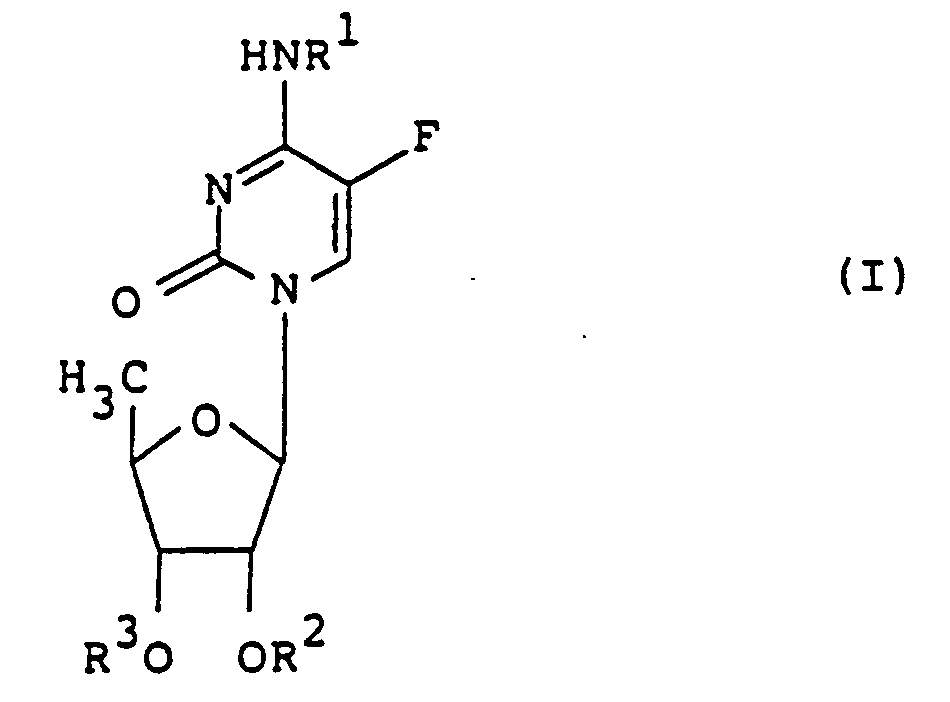
worin R¹, R² und R³ unabhängig voneinander Wasserstoff oder eine unter physiologischen Bedingungen leicht abspaltbare Gruppe sind, mit der Bedingung, dass zumindest eines von R¹, R² und R³ eine unter physiologischen Bedingungen leicht abspaltbare Gruppe ist, sowie Hydrate oder Solvate der Verbindungen der Formel I, wobei die leicht hydrolysierbaren Gruppen R¹, R² und R³ in der Formel I eine der Formel
R⁴CO-, R⁵OCO- oder R⁶SCO-
worin R⁴ Wasserstoff, Alkyl, Cycloalkyl, Oxoalkyl, Alkenyl, Aralkyl oder Aryl und R⁵ und R⁶ Alkyl oder Aralkyl sind. - Im Rahmen der vorliegenden Erfindung bezeichnet "Alkyl" eine geradkettige oder verzweigte Kette mit 1-19 C-Atomen, z.B. Methyl, Aethyl, Propyl, Isopropyl, Butyl, Isobutyl, sek.-Butyl, t-Butyl, Pentyl, Isopentyl, Neopentyl, Hexyl, Isohexyl, Heptyl, Octyl, Nonyl, Decyl, Undecyl, Dodecyl, Tridecyl, Tetradecyl, Pentadecyl, Hexadecyl, Heptadecyl oder Nonadecyl. "Cycloalkyl" bedeutet z.B. Cyclopropyl, Cyclobutyl, Cyclopentyl, Cyclohexyl oder Adamantyl. "Oxoalkyl" bezeichnet z.B. Acetyl, Propionyl, Butyryl, 2-Oxopropyl oder 3-Oxobutyl. "Alkenyl" bezeichnet gegebenenfalls substituiertes Alkenyl mit 3-19 C-Atome, wie Allyl, Butenyl, 3-Methyl-2-butenyl, 1-Methyl-2-propenyl, Hexenyl, Decenyl, Undecenyl, Tridecenyl, Pentadecenyl, Heptadecenyl, Heptadecadienyl, Heptadecatrienyl, Nonadecenyl, Nonadecadienyl, Nonadecatetraenyl oder 2-Phenylvinyl. "Aralkyl" bedeutet gegebenenfalls substituiertes Aralkyl, wie Benzyl, 1-Phenyläthyl, Methyl-, Fluor-, Chlor-, Methoxy-, Dimethoxy- oder Nitrobenzyl, Phenäthyl, Picolyl oder 3-Indolylmethyl. "Aryl" bezeichnet gegebenenfalls substituiertes Aryl, wie Phenyl, Tolyl, Xylyl, Mesityl, Cumenyl, Aethyl-, Fluor-, Chlor-, Brom-, Jod-, Difluor-, Dichlor-, Methoxy-, Dimethoxy-, Trimethoxy-, Aethoxy-, Diäthoxy-, Triäthoxy-, Propoxy-, Methylendioxy-, Methylthio-, Nitro-, Cyan-, Acetyl- oder Carbamoylphenyl, Methoxycarbonylphenyl, Naphthyl, Biphenylyl, Thienyl, Methylthienyl, Furyl, Nitrofuryl, Pyrrolyl, Methylpyrrolyl, Imidazolyl, Pyrazolyl, Pyridyl, Methylpyridyl oder Pyrazinyl.
- Besonders bevorzugte Verbindungen der Formel I sind die folgenden:
N⁴-Acetyl-5'-deoxy-5-fluorcytidin,
5'-Deoxy-5-fluor-N⁴-propionylcytidin,
N⁴-Butyryl-5'-deoxy-5-fluorcytidin,
5'-Deoxy-5-fluor-N⁴-isobutyrylcytidin,
5'-Deoxy-5-fluor-N⁴-(2-methylbutyryl)cytidin,
5'-Deoxy-N⁴-(2-äthylbutyryl)-5-fluorcytidin,
5'-Deoxy-N⁴-(3,3-dimethylbutyryl)-5-fluorcytidin,
5'-Deoxy-5-fluor-N⁴-pivaloylcytidin,
5'-Deoxy-5-fluor-N⁴-valerylcytidin,
5'-Deoxy-5-fluor-N⁴-isovalerylcytidin,
5'-Deoxy-5-fluor-N⁴-(2-methylvaleryl)cytidin,
5'-Deoxy-5-fluor-N⁴-(3-methylvaleryl)cytidin,
5'-Deoxy-5-fluor-N⁴-(4-methylvaleryl)cytidin,
5'-Deoxy-5-fluor-N⁴-hexanoylcytidin,
5'-Deoxy-5-fluor-N⁴-heptanoylcytidin,
5'-Deoxy-5-fluor-N⁴-octanoylcytidin,
5'-Deoxy-5-fluor-N⁴-nonanoylcytidin,
5'-Deoxy-5-fluor-N⁴-hexadecanoylcytidin,
N⁴-Benzoyl-5'-deoxy-5-fluorcytidin,
5'-Deoxy-5-fluor-N⁴-(4-methylbenzoyl)cytidin,
5'-Deoxy-5-fluor-N⁴-(3-methylbenzoyl)cytidin,
5'-Deoxy-5-fluor-N⁴-(2-methylbenzoyl)cytidin,
5'-Deoxy-N⁴-(4-äthylbenzoyl)-5-fluorcytidin,
5'-Deoxy-N⁴-(3,4-dimethylbenzoyl)-5-fluorcytidin,
5'-Deoxy-N⁴-(3,5-dimethylbenzoyl)-5-fluorcytidin,
5'-Deoxy-5-fluor-N⁴-(4-methoxybenzoyl)cytidin,
5'-Deoxy-N⁴-(3,4-dimethoxybenzoyl)-5-fluorcytidin,
5'-Deoxy-N⁴-(3,5-dimethoxybenzoyl)-5-fluorcytidin,
5'-Deoxy-5-fluor-N⁴-(3,4,5-trimethoxybenzoyl)cytidin,
5'-Deoxy-5-fluor-N⁴-(3,4,5-triäthoxybenzoyl)cytidin,
5'-Deoxy-N⁴-(4-äthoxybenzoyl)-5-fluorcytidin,
5'-Deoxy-5-fluor-N⁴-(4-propoxybenzoyl)cytidin,
5'-Deoxy-N⁴-(3,5-diäthoxybenzoyl)-5-fluorcytidin,
N⁴-(4-Chlorbenzoyl)-5'-deoxy-5-fluorcytidin,
5'-Deoxy-N⁴-(3,4-dichlorbenzoyl)-5-fluorcytidin,
5'-Deoxy-N⁴-(3,5-dichlorbenzoyl)-5-fluorcytidin,
5'-Deoxy-5-fluor-N⁴-(4-nitrobenzoyl)cytidin,
5'-Deoxy-5-fluor-N⁴-(4-methoxycarbonylbenzoyl)cytidin,
N⁴-(4-Acetylbenzoyl)-5'-deoxy-5-fluorcytidin,
5'-Deoxy-5-fluor-N⁴-(phenylacetyl)cytidin,
5'-Deoxy-5-fluor-N⁴-(4-methoxyphenylacetyl)cytidin,
5'-Deoxy-5-fluor-N⁴-nicotinoylcytidin,
5'-Deoxy-5-fluor-N⁴-isonicotinoylcytidin,
5'-Deoxy-5-fluor-N⁴-picolinoylcytidin,
5'-Deoxy-5-fluor-N⁴-(2-furoyl)cytidin,
5'-Deoxy-5-fluor-N⁴-(5-nitro-2-furoyl)cytidin,
5'-Deoxy-5-fluor-N⁴-(2-thenoyl)cytidin,
5'-Deoxy-5-fluor-N⁴-(5-methyl-2-thenoyl)cytidin,
5'-Deoxy-5-fluor-N⁴-(1-methyl-2-pyrrolcarbonyl)cytidin,
5'-Deoxy-5-fluor-N⁴-(3-indolylacetyl)cytidin,
N⁴-(3-Butenoyl)-5'-deoxy-5-fluorcytidin,
3'-O-Benzoyl-5'-deoxy-5-fluorcytidin,
N⁴,3'-O-Dibenzoyl-5'-deoxy-5-fluorcytidin und
5'-Deoxy-N⁴-(äthylthio)carbonyl-5-fluorcytidin. - Weitere bevorzugte Verbindungen der Formel I sind die folgenden:
5'-Deoxy-5-fluor-N⁴-octadecanoylcytidin,
N⁴-Cyclopropancarbonyl-5'-deoxy-5-fluorcytidin,
N⁴-Cyclohexancarbonyl-5'-deoxy-5-fluorcytidin,
N⁴-(1-Adamantancarbonyl)-5'-deoxy-5-fluorcytidin,
5'-Deoxy-5-fluor-N⁴-(2-methoxybenzoyl)cytidin,
5'-Deoxy-N⁴-(2,4-dimethoxybenzoyl)-5-fluorcytidin,
5'-Deoxy-5-fluor-N⁴-piperonyloylcytidin,
5'-Deoxy-5-fluor-N⁴-(4-fluorbenzoyl)cytidin,
N⁴-(2-Chlorbenzoyl)-5'-deoxy-5-fluorcytidin,
N⁴-(3-Chlorbenzoyl)-5'-deoxy-5-fluorcytidin,
5'-Deoxy-5-fluor-N⁴-(3-nitrobenzoyl)cytidin,
5'-Deoxy-5-fluor-N⁴-[4-(methylthio)benzoyl]cytidin,
5'-Deoxy-5-fluor-N⁴-(2-naphthoyl)cytidin,
5'-Deoxy-5-fluor-N⁴-(3-furoyl)cytidin,
5'-Deoxy-5-fluor-N⁴-(3-phenylpropionyl)cytidin,
N⁴-Cinnamoyl-5'-deoxy-5-fluorcytidin,
2',3'-di-O-Benzoyl-5'-deoxy-5-fluorcytidin,
N⁴,2'-0,3'-O-Tribenzoyl-5′-deoxy-5-fluorcytidin,
5'-Deoxy-5-fluor-N⁴-(octyloxycarbonyl)cytidin,
N⁴-(Benzyloxycarbonyl)-5′-deoxy-5-fluorcytidin und
5'-Deoxy-5-fluor-N⁴-formylcytidin. - Die Verbindungen der Formel I und die Hydrate und Solvate davon können dadurch hergestellt werden, dass man eine Verbindung der allgemeinen Formel

worin R⁷ Wasserstoff oder eine Aminoschutzgruppe, R⁸ und R⁹ unabhängig voneinander Wasserstoff oder eine Hydroxyschutzgruppe oder R⁸ und R⁹ zusammen eine cyclische Hydroxyschutzgruppe sind, mit einer Verbindung der allgemeinen Formel XCOR⁴, worin X eine Abgangsgruppe und R⁴ Wasserstoff, Alkyl, Cycloalkyl, Oxoalkyl, Alkenyl, Aralkyl oder Aryl ist, oder mit einer Verbindung der allgemeinen Formel YCOR¹⁰, worin Y Halogen und R¹⁰ eine Gruppe der Formel R⁵O- oder R⁶S-, in der R⁵ und R⁶ Alkyl oder Aralkyl sind, umsetzt und eine vorhandene Schutzgruppe abspaltet. - Beispiele von Aminoschutzgruppen sind Benzyloxycarbonyl, Phenoxycarbonyl, 2,2-Trichloräthoxycarbonyl, Aethoxycarbonyl, t-Butoxycarbonyl und Trifluoracetyl. Beispiele von Hydroxyschutzgruppen sind Benzyl, Methoxybenzyl, Trimethylsilyl, Triäthylsilyl, Isopropyldimethylsilyl, t-Butyldimethylsilyl, t-Butyldiphenylsilyl, Thexyldimethylsilyl, Allyl, Methoxymethyl, (2-Methoxyäthoxy)methyl und Tetrahydropyranyl. Beispiele von cyclischen Hydroxyschutzgruppen sind cyclische Acetale, Ketale, Carbonate oder Orthoester oder cyclische 1,3-(1,1,3,3-Tetraisopropyl)disiloxandiyl-Derivate. Beispiele von Abgangsgruppen sind Halogene, Acyloxy, Alkyloxycarbonyloxy, Succinimidoxy, Phthalimidoxy, 4-Nitrophenyl, Azido, 2,4,6-Triisopropylbenzolsulfonyl und Diäthoxyphosphoryloxy. "Halogen" bezeichnet Chlor, Brom oder Jod.
- Unter den Verbindungen der Formel II ist 5'-Deoxy-5-fluorcytidin bekannt [J. Med. Chem., 22, (1979) 1330]. Die anderen Verbindungen der Formel II können in an sich bekannter Weise [Chem. Pharm. Bull., 33, (1985) 2575] ausgehend von 5'-Deoxy-5-fluorcytidin oder von 5'-Deoxy-5-fluoruridin hergestellt werden.
- Die im obigen Verfahren verwendete Verbindungen der Formel XCOR⁴ sind Säurehalogenide, Säureanhydride, gemischte Anhydride (hergestellt durch Reaktion von R⁴COOH mit 2,4,6-Triisopropylbenzolsulfonylchlorid oder Diäthylchlorphosphat, worin R⁴ die obige Bedeutung hat) aktivierte Ester, wie N-Hydroxysuccinimidester, N-Hydroxyphthalimidester oder 4-Nitrophenylester; Acylazide oder gemischte Carbonsäureanhydride. Die Verbindungen der Formel YCOR¹⁰ sind Alkoxycarbonylhalogenide, Aralkoxycarbonylhalogenide, Alkylthiocarbonylhalogenide oder Aralkylthiocarbonylhalogenide.
- Die Reaktion einer Verbindung der Formel II mit einer Verbindung der Formel XCOR⁴ oder YCOR¹⁰ kann man in einem Lösungsmittel, wie Pyridin, Dioxan, Tetrahydrofuran, Acetonitril, Chloroform, Dichlormethan, Methanol, Aethanol oder Wasser oder Gemische davon durchführen, in Gegenwart eines Säureakzeptors, wie Triäthylamin, Pyridin, Picolin, Dimethylaminopyridin, Lutidin, N,N-Dimethylanilin oder eines Alkalimetallhydroxids, -carbonats oder -phosphats. Die Reaktion kann in einem breiten Temperaturbereich durchgeführt werden, zweckmässig jedoch zwischen etwa 0 und 120°C, vorzugsweise zwischen 0 und 50°C. Für 1 Mol einer Verbindung der Formel II werden 1, 2 oder 3 Mol oder ein Ueberschuss einer Verbindung der Formel XCOR⁴ oder YCOR¹⁰ verwendet.
- Die Abspaltung einer Schutzgruppe kann in an sich bekannter Weise durchgeführt werden.
- Die Verbindungen der vorliegenden Erfindung können in an sich bekannter Weise isoliert und gereinigt werden, z.B. durch Abdampfen, Filtrierung, Extraktion, Abfällen, Chromatographie und/oder Umkristallisation.
- Die Verbindungen der Formel I können als Solvate, insbesondere als Hydrate vorliegen. Die Hydrierung kann im Laufe der Herstellung oder als Resultat der hygroskopischen Eigenschaften eines ursprünglich wasserfreien Produktes erfolgen. Zur Herstellung eines Hydrats kann ein vollständig oder teilweise wasserfreies Produkt, z.B. bei etwa 10 bis 40°C einer feuchten Atmosphäre ausgesetzt werden. Solvate mit pharmazeutisch anwendbaren Lösungsmitteln, wie Aethanol, können z.B. während einer Kristallisation entstehen.
- Die Verbindungen der Formel I sowie die Hydrate und Solvate davon sind gegen Sarcoma 180, Meth A Fibrosarcoma und Lewis Lungenkarzinom bei Mäusen über einen breiten Dosierungsbereich sowohl oral wie parenteral wirksam und können als Antitumormittel Verwendung finden. 5-Fluoruracil und seine Derivate haben den Nachteil der intestinalen und immunosuppressiven Toxizität, was ihre Verwendung drastisch limitiert. Bei oraler Verabreichung sind die vorliegenden Verbindungen der Formel I viel weniger toxisch im intestinalen Trakt und für das Immunsystem als 5-Fluoruracil (J.A.C.S. 79, 1957, 4559) und die Vorläufer davon, wie Tegafur: Uracil, 1:4 (UFT) und 5′-Deoxy-5-fluoruridin (US 4071680). Daher können die Verbindungen der Formel I bei der Behandlung von verschiedenen Tumoren beim Menschen Verwendung finden.
- Die Erfindung betrifft ebenfalls pharmazeutische Präparate, die eine oder mehrere Verbindungen der Formel I enthalten, sowie die Verwendung dieser Verbindungen zur Herstellung von Arzneimitteln zur Behandlung von Tumoren.
- Die Verbindungen der Formel I kann man dem Menschen oral oder nicht oral verabreichen, gegebenenfalls unter Zusatz eines verträglichen Trägermaterials. Letzteres kann eine für die enterale, perkutane oder parenterale Verabreichung geeignete organische oder anorganische inerte Substanz sein, wie Wasser, Gelatine, Gummi arabicum, Lactose, Stärke, Magnesiumstearat, Talk, pflanzliche Oele oder Polyalkylenglykole. Die pharmazeutischen Präparate können in fester Form als Tabletten, Dragées, Granulate, Kapseln, Suppositorien oder als enteral verabreichbare Tabletten, Granulate oder Kapseln; in halbfester Form als Salben oder in flüssiger Form als Lösungen, Suspensionen oder Emulsionen vorliegen. Sie können sterilisiert sein und/oder weitere Hilfsmittel, wie Konservierungs- oder Stabilisierungsmittel, Emulgatoren, Riechstoffe, Salze zur Veränderung des osmotischen Druckes oder Puffer enthalten. Sie können in an sich bekannter Weise hergestellt werden.
- Die Verbindungen der Formel I können einzeln oder als Gemische von zwei oder mehr Verwendung finden, wobei der Gehalt an Wirkstoff im Bereich von etwa 0,1 bis 99,5%, vorzugsweise 0,5 bis 95% des Gesamtgewichts des Präparats, liegt. Die Präparate können auch weitere pharmazeutisch wirksame Substanzen enthalten.
- Die tägliche Dosis der Verbindungen der Formel I hängt von dem Gewicht des Patienten und der zu behandelnden Krankheit ab, liegt jedoch im allgemeinen im Bereich von 0,5 bis 700, vorzugsweise von etwa 3 bis 500 mg/kg Körpergewicht. Die Antitumorwirksamkeit der Verbindungen der Formel I wird in den folgenden Versuchen veranschaulicht:
- Sarcoma 180 Zellen (2 x 10⁶ Zellen) werden am Tag 0 Mäusen (20-22 g) subkutan implantiert. Die Testsubstanzen werden täglich vom Tag 1 bis zum Tag 7 oral verabreicht. Die Tiere werden am Tag 14 getötet und die Tumoren werden herausgenommen und gewogen. Die in der nachfolgenden angegebene Hemmung des Tumorwachstums in Tabelle 1 wird wie folgt ermittelt:

T = Gewicht der Tumoren der behandelten Gruppe
C = Gewicht der Tumoren der Kontrollgruppe.Tabelle 1 Antitumorwirksamkeit gegen Sarcoma 180 bei Mäusen Verbindung (Beispiel-Nr.) Dosis x 7 (mMol/kg/Tag) Hemmung (%) 1 1,1 56 2,2 83 2 1,5 84 3,0 91 5 1,1 62 2,2 82 6 0,5 28 1,5 76 7 1,4 57 2,7 84 8 1,4 20 2,7 77 9 1,4 76 2,7 96 10 1,5 74 3,0 97 11 0,8 69 1,5 90 12 0,8 40 1,5 73 13 0,8 28 1,5 66 15 0,8 47 1,5 62 17 1,3 75 2,6 92 24 1,5 63 3,0 94 41 0,5 -18 1,5 36 42 0,5 0 1,5 36 - Meth A Fibrosarcoma Zellen (2 x 10⁵ Zellen) werden Mäusen (21-22 g) subkutan implantiert. Der Versuch gegen Meth A Fibrosarcoma und die Ermittlung der Hemmung des Tumorwachstums wurde in ähnlicher Weise wie beim Versuch gegen Sarcoma 180 durchgeführt. Die Resultate sind in der Tabelle 2 angegeben.
- In ähnlicher Weise wurde die Antitumorwirksamkeit der Verbindung des vorliegenden Beispiels 3 mit derjenigen von 5′-Deoxy-5-fluoruridin verglichen. Die Resultate sind in der Tabelle 3 angegeben. Am Tag 8 des Versuchs wurde der Kot beobachtet. Die Resultate zeigen, dass die Verbindung des Beispiels 3 höhere eine Antitumorwirksamkeit und eine niedrigere Toxizität als 5′-Deoxy-5-fluoruridin aufweist. Im gleichen Experiment verursachte die Verbindung des Beispiels 3 keine Diarrhea während letztere der die Dosis limitierende Faktor von 5′-Deoxy-5-fluoruridin darstellt.


Tabelle 3 Antitumorwirksamkeit gegen Meth A Fibrosarcoma bei Mäusen und Beobachtung des Kots am Tag 8 Verbindung (Beisp.-Nr.) Dosis x 7 (mMol/kg/Tag) Hemmung (%) Fekale Beobachtung* 3 0.4 -27 N 0.8 20 N 1.5 86 N 3.0 79 N 5'-Deoxy-5-fluoruridin 0.4 34 N 0.8 31 N 1.5 66 L - D 3.0 toxisch D * Fekale Beobachtung
N: normaler Kot
L: loser Kot
D: Diarrhea - Die Antitumorwirksamkeit der Verbindung des vorliegenden Beispiels 1 wurde mit derjenigen von 5'-Deoxy-5-fluoruridin und des Kombinationspräparats, UFT (Tegafur: Uracil, 1:4) verglichen. Mäusen wurde am Tag 0 Lewis-Lungenkarzinom (10⁶ Zellen) subkutan inokuliert. Die Verbindungen wurden täglich 14 mal ab Tag 1 oral verabreicht. Die effektive Dosis (ED₅₀), bei der das Wachstum des Tumors um 50% gehemmt wurde und die toxischen Dosen wurden ermittelt. Der therapeutische Index (toxische Dose/ED₅₀) sind in der Tabelle 4 angegeben. Die Resultate zeigen, dass die Verbindung des Beispiels 1 einen höheren therapeutischen Index hat als die klassischen Vorläufer von 5-Fluoruracil, 5'-Deoxy-5-fluoruridin und UFT. Sie ist weniger toxisch im intestinalen Trakt (Diarrhea) und in den für die Immunität verantwortlichen Organe (Thymus und Knochenmark) und weist daher einen höheren Sicherheitsgrad auf.

- Die Antitumorwirksamkeit der Verbindung des vorliegenden Beispiels 1 wurde in drei Murintumormodellen mit derjenigen von 5′-Deoxy-5-fluoruridin und 5′-Deoxy-5-fluorcytidin verglichen. Mäuse wurden am Tag 0 subkutan mit Sarcoma 180, Meth A Fibrosarcoma und UV 2237 Fibrosarcoma inokuliert. Ab Tag 1 wurden die Versuchssubstanzen 7 mal den Mäusen oral verabreicht. Die Wirksamkeit wurde als therapeutischer Index (EDmax/ED₅₀) am Tag 14 nach Tumorinokulation gemessen. EDmax ist die Dosis, bei der die Hemmung des Tumorwachstums maximal ist. Die Resultate sind in der Tabelle 5 angegeben.
Tabelle 5 Wirksamkeit gegen Sarcom 180, Meth A Fibrosarcoma und UV 2237 Fibrosarcoma Verbindung (Beisp.-Nr.) Therapeutischer Index S 180 Meth A UV 2237 1 2.3 2.0 4.8 5′-Deoxy-5-fluorcytidin 2.0 1.2 1.0 5′-Deoxy-5-fluoruridin 2.4 1.1 1.6 - Die akute Toxizität (LD₅₀) der Verbindungen der vorliegenden Beispiele 1, 5, 9, 24, 34, 46 und 47 beträgt mehr als 2000 mg/kg bei oraler Verabreichung an Mäusen.
- Die folgenden Beispiele veranschaulichen die Erfindung.
-
- a) 245 mg 5′-Deoxy-5-fluorcytidin, 354 mg t-Butyldimethylsilylchlorid und 284 mg Imidazol werden in 1,5 ml Dimethylformamid gelöst und 18 Stunden unter Stickstoff gerührt. Das Gemisch wird dann in Wasser geschüttet und mit Aethylacetat extrahiert. Der Extrakt wird mit Wasser gewaschen, über Natriumsulfat getrocknet und unter vermindertem Druck eingeengt. Man erhält 431 mg 2′,3′-Bis-O-(t-butyldimethylsilyl)-5′-deoxy-5-fluorcytidin, MS 473 (M⁺).
- b) Eine Lösung von 490 mg 5′-Deoxy-5-fluorcytidin, 418 mg p-Toluolsulfonsäure-monohydrat und 984 »l 2,2-Dimethoxypropan in 10 ml Aceton wird 1,5 Stunden gerührt. Der Lösung werden 900 mg Natriumbicarbonat zugesetzt und das Gemisch wird 4 Stunden gerührt. Der Niederschlag wird abfiltriert und mit Aceton gewaschen. Die Filtrate werden unter vermindertem Druck eingeengt. Der Rückstand wird über Silicagel mit Dichlormethan-Methanol gereinigt. Man erhält 570 mg 5′-Deoxy-5-fluor-2′,3′-O-isopropylidencytidin, MS 286 (MH⁺), Smp. des Picrats 169-171°C.
-
- 1(a) 9,46 g 2′,3′-Bis-O-(t-butyldimethylsilyl)-5′-deoxy-5-fluorcytidin, hergestellt nach Referenzbeispiel a), 3,48 g n-Buttersäureanhydrid und 2,93 g 4-Dimethylaminopyridin werden in 150 ml Methylenchlorid gelöst und über Nacht gerührt, dann mit Wasser gewaschen, über Natriumsulfat getrocknet und unter vermindertem Druck eingeengt. Man erhält 9,75 g N⁴-Butyryl-2′,3′-bis-O-(t-butyldimethylsilyl)-5′-deoxy-5-fluorcytidin¸ MS 544 (MH⁺).
- 1(b) 9,75 g des Produkts von Beispiel 1(a) werden in 80 ml Tetrahydrofuran enthaltend 80 mMol Tetrabutylammoniumfluorid gelöst und 1,5 Stunden gerührt. Nach Entfernung des Lösungsmittels unter vermindertem Druck wird der Rückstand über Silicagel mit Aethylacetat-Methanol gefolgt durch Umkristallisation aus Methanol gereinigt. Man erhält 4,5 g N⁴-Butyryl-5'-deoxy-5-fluorcytidin, Smp. 156-157°C; MS 316 (MH⁺).
- Die folgenden Verbindungen wurden in ähnlicher Weise wie in Beispiel 1 erhalten:


-
- 4(a) Einer Lösung von 14,19 g 2',3'-Bis-O-(t-butyldimethylsilyl)-5'-deoxy-5-fluorcytidin in 150 ml trockenem Pyridin werden 3,84 g n-Butyrylchlorid unter Rühren zugetropft. Das Gemisch wird über Nacht gerührt. Pyridin wird unter vermindertem Druck entfernt und der Rückstand wird zwischen Wasser und Aethylacetat verteilt. Die Aethylacetatschicht wird mit Wasser gewaschen, über Natriumsulfat getrocknet und unter vermindertem Druck eingeengt. Der Rückstand wird über Silicagel mit n-Hexan-Aethylacetat gereinigt. Man erhält 15,32 g N⁴-Butyryl-2',3'-bis-O-(t-butyldimethylsilyl)-5'-deoxy-5-fluorcytidin.
- 4(b) Das Produkt des Beispiels 4(a) wird in Analogie zu Beispiel 1(b) behandelt. Man erhält farblose Kristalle von N⁴-Butyryl-5′-deoxy-5-fluorcytidin.
- Die folgenden Verbindungen werden analog Beispiel 4 hergestellt:

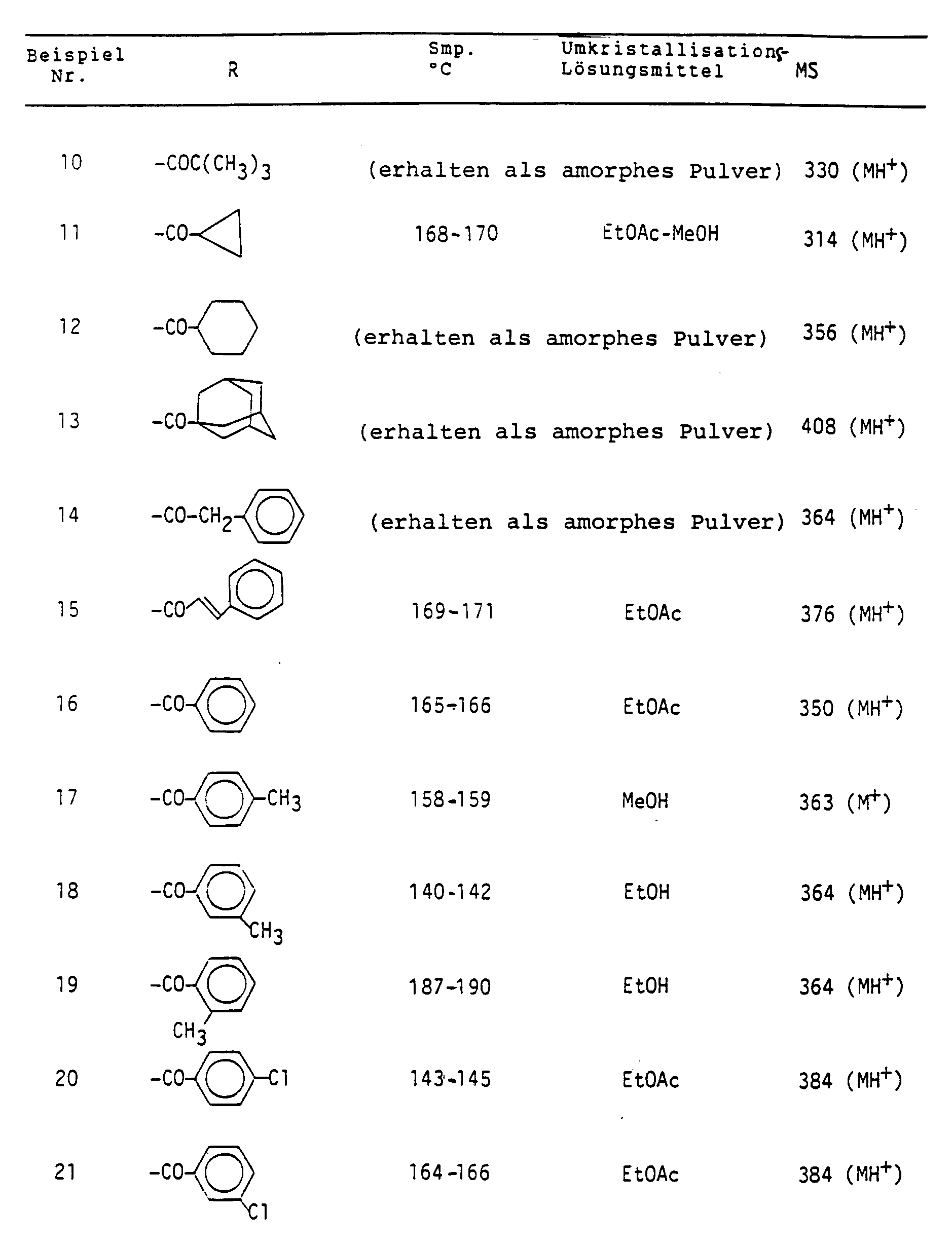


- 735 mg 5′-Deoxy-5-fluorcytidin und 1,04 g Buttersäureanhydrid werden in 20 ml 75% wässrigem Dioxan gelöst und 18 Stunden gerührt. Nach Entfernung des Lösungsmittel wird der Rückstand durch Chromatographie über Silicagel gereinigt. Man erhält 420 mg N⁴-Butyryl-5′-deoxy-5-fluorcytidin, Smp. 156-157°C; MS 316 (MH⁺).
-
- (1) 4,9 g 5′-Deoxy-5-fluorcytidin und 5,58 ml Trimethylsilylchlorid werden in 50 ml trockenem Pyridin gelöst und 2 Stunden gerührt. Dem Reaktionsgemisch werden 2,09 ml Aethylchlorthioformat zugesetzt. Nach 2,5-stündigem Rühren wird das Pyridin unter vermindertem Druck abgedampft. Der Rückstand wird zwischen Wasser und Aethylacetat verteilt. Die organische Schicht wird mit Wasser gewaschen¸ über Natriumsulfat getrocknet und unter vermindertem Druck eingeengt. Dem Rückstand werden 5 g Zitronensäure und 80 ml Methanol zugesetzt. Das Gemisch wird 1 Stunde gerührt. Nach Entfernen des Lösungsmittels unter vermindertem Druck wird der Rückstand über Silicagel mit Methanol-Dichlormethan gefolgt durch Umkristallisation aus Dichlormethan gereinigt. Man erhält 2,66 g 5′-Deoxy-N⁴-[(äthylthio)carbonyl]-5-fluorcytidin, Smp. 138-139°C (Zers.); MS 334 (MH⁺).
- (2)
- (a) Einer Lösung von 1 g 5′-Deoxy-5-fluor-2′,3′-O-isopropylidencytidin erhalten nach Referenzbeispiel b) in 8 ml Pyridin werden 365 »l Aethylchlorthioformat bei 0°C unter Rühren zugesetzt und das Gemisch wird über Nacht gerührt. Das Reaktionsgemisch wird unter vermindertem Druck eingeengt und der Rückstand wird zwischen Aethylacetat und Wasser verteilt. Die organische Schicht wird mit einer Natriumbicarbonatlösung und Wasser gewaschen und über Natriumsulfat getrocknet. Nach Entfernung des Lösungsmittels wird der Rückstand über Silicagel mit CHCl₃ gereinigt. Man erhält 510 mg 5′-Deoxy-N⁴--[(äthylthio)carbonyl]-5-fluor -2',3'-O-isopropylidencytidin, MS 374 (MH⁺).
- (b) Einer Lösung von 150 mg des Produkts von Beispiel 44(2)(a) in 50% wässrigem Aethanol werden 150 mg Dowex 50 (H⁺) zugesetzt und das Gemisch wird 4 Stunden unter Rühren bei 50-60°C erhitzt. Das Dowex 50 wird abfiltriert und das Filtrat wird unter vermindertem Druck zur Trockene eingedampft. Der Rückstand wird über Silicagel mit CHCl₃-Aceton und dann durch Umkristallisation aus Dichlormethan gereinigt. Man erhält 5'-Deoxy-N⁴-[(äthylthio)carbonyl]-5-fluorcytidin, Smp. 138-139°C (Zers.); MS 334 (MH⁺).
- Die folgenden Verbindungen werden in Analogie zu Beispiel 44(1) erhalten:
Beispiel Nr. R Smp. °C Umkristallisations-Lösungsmittel MS 45 -COCH₂CH₃ 119-120 EtOAc-Et₂O 302 (MH⁺) 46 -CO(CH₂)₃CH₃ 150-151 EtOAc 330 (MH⁺) 47 -COCH₂CH(CH₃)₂ 142-143 EtOAc 330 (MH⁺) - Eine Lösung von 0.42 g Piperonylsäure in trockenem Acetonitril (5 ml) enthaltend 0,36 ml Triäthylamin wird mit 0,37 ml Diäthylchlorphosphat l Stunde gerührt. Dem Reaktionsgemisch werden 1,0 g 2',3'-Bis-O-(t-butyldimethylsilyl)-5'--deoxy-5-fluorcytidin, hergestellt nach Beispiel a), 0,36 ml Triäthylamin und 0,05 g 4-Dimethylaminopyridin zugesetzt. Nach 12-stündigem Rühren wird das Acetonitril unter vermindertem Druck abgedampft. Der Rückstand wird zwischen Wasser und Aether verteilt. Die organische Schicht wird mit Wasser gewaschen, über Natriumsulfat getrocknet und unter vermindertem Druck eingeengt. Das erhaltene Pulver wird in 6,3 ml Tetrahydrofuran enthaltend 1,65 g Tetrabutylammoniumfluorid gelöst und das Reaktionsgemisch wird 1 Stunde gerührt. Nach Entfernung des Lösungsmittels unter vermindertem Druck wird der Rückstand über Silicagel mit Isopropanol-Dichlormethan und dann Umkristallisation aus Aethylacetat gereinigt. Man erhält 0,5 g 5′-Deoxy-5-fluor-N⁴-piperonyloylcytidin, Smp. 124-125°C, MS 394 (MH⁺).
- Die folgende Verbindung wird in Analogie zu Beispiel 48 erhalten:

- 0,355 g 3-Furancarbonsäure und 0,96 g 2,4,6-Triisopropylbenzolsulfonsäurechlorid werden in 5 ml trockenem Pyridin gelöst. Das Gemisch wird 1 Stunde gerührt. Dem Gemisch werden 1 g 2′,3′-Bis-O-(t-butyldimethylsilyl)-5′-deoxy-5-fluorcytidin, erhalten im Referenzbeispiel a), und 0,80 g 4-Dimethylaminopyridin zugesetzt. Nach 12 Stunden Rühren wird das Pyridin unter vermindertem Druck abgedampft. Nach Behandlung des Rückstands wie im Beispiel 48 erhält man 0,55 g 5′-Deoxy-5-fluor-N⁴-(3-furoyl)cytidin, Smp. 173-174°C (Aethanol); MS 340 (MH⁺).
- Die folgenden Verbindungen werden analog Beispiel 50 hergestellt:

-
- (a) Einer Lösung von 24,6 g 5′-Deoxy-5-fluoruridin in 150 ml trockenem Pyridin werden 24,5 ml Benzoylchlorid über 10 Minuten bei 0°C Rühren zugetropft und das Gemisch wird 5 Stunden bei Raumtemperatur gerührt. Nach Entfernen des Pyridins unter vermindertem Druck wird der Rückstand zwischen Wasser und Aethylacetat verteilt. Die organische Schicht wird mit gesättigter Natriumbicarbonatlösung und Wasser gewaschen, über Natriumsulfat getrocknet und unter vermindertem Druck eingeengt. Der Rückstand wird aus Aethylacetat-n-Hexan umkristallisiert und man erhält 38,9 g 2′,3′-Di-O-benzoyl-5′-deoxy-5-fluoruridin, MS 455 (MH⁺).
- (b) Einem Gemisch von 0,8 ml N-Methylimidazol und 0,28 ml Phosphorylchlorid in 20 ml Acetonitril werden 500 mg 2′,3′-Di-O-benzoyl-5′-deoxy-5-fluoruridin bei 0°C zugesetzt. Nach 1,5-stündigem Rühren werden 2,5 ml 28% Ammoniumhydroxid bei 0°C zugesetzt und das Gemisch wird 1 Stunde bei Raumtemperatur gerührt. Das Acetonitril und das Ammoniak werden unter vermindertem Druck entfernt. Der Rückstand wird mit 1N HCl angesäuert und dann mit Aethylacetat extrahiert. Die organische Schicht wird mit Wasser gewaschen, über Natriumsulfat getrocknet und unter vermindertem Druck eingeengt. Der Rückstand wird aus Aethylacetat umkristallisiert. Man erhält 155 mg 2′,3′-Di-O-benzoyl-5′-deoxy-5-fluorcytidin, Smp. 192-194°C; MS 476 (M+Na)⁺.
-
- (a) 0,57 ml eisgekühltem Essigsäureanhydrid werden 286 »l 99% Ameisensäure zugetropft. Die Lösung wird 15 Minuten bei 0°C und 50 Minuten bei 50°C gerührt und dann auf 0°C abgekühlt. Der Lösung werden 473 mg 2′,3′-Bis-O-(t-butyldimethylsilyl)-5′-deoxy-5-fluorcytidin hergestellt nach Referenzbeispiel a) in 5 ml trockenem Pyridin bei 0°C zugefügt. Das Reaktionsgemisch wird 10 Minuten bei 0°C und 26 Stunden bei Raumtemperatur gerührt. Nach Entfernen des Lösungsmittels unter vermindertem Druck wird der Rückstand zwischen Wasser und Aethylacetat aufgeteilt. Die organische Schicht wird mit gesättiger Natriumbicarbonatlösung und Wasser gewaschen und über Natriumsulfat getrocknet. Das Aethylacetat wird unter vermindertem Druck abgedampft und der Rückstand wird über Silicagel mit n-Hexan-Aethylacetat und dann durch Umkristallisation aus n-Hexan-Aethylacetat gereinigt. Man erhält 144 mg 2′,3′-Bis-O-(t-butyldimethylsilyl)-5′-deoxy-5-fluor -N⁴-formylcytidin¸ Smp. 188°C (Zers.); MS 502 (MH⁺).
- (b) Das Produkt des Beispiels 58(a) wird behandelt in Analogie zu Beispiel 1(b). Man erhält amorphes 5′-Deoxy-5-fluor-N⁴-formylctidin¸ MS 274 (MH⁺).
- Einer Lösung von 245 mg 5′-Deoxy-5-fluorcytidin in 5 ml trockenem Pyridin werden unter Rühren bei 0°C 130 »l Benzoylchlorid zugesetzt. Das Gemisch wird 1 Stunde bei 0°C gerührt. Nach Entfernen des Lösungsmittels unter vermindertem Druck wird der Rückstand über Silicagel mit Dichlormethan-Methanol und dann durch Umkristallisation aus Aethylacetat gereinigt. Man erhält 51 mg 3′-O-Benzoyl-5′-deoxy-5-fluorcytidin, Smp. 127-129°C; MS 350 (MH⁺).
- Einer Lösung von 35 mg des Produkts von Beispiel 59 in 0,5 ml trockenem Pyridin werden 13,8 »l Trimethylsilylchlorid und nach 2-stündigem Rühren 12,6 »l Benzoylchlorid zugesetzt. Das Gemisch wird 1 Stunde gerührt. Nach Entfernen des Lösungsmittels unter vermindertem Druck wird der Rückstand in 0,5 ml Methanol gelöst. Der Lösung werden 15 mg Kaliumcarbonat zugesetzt und das Reaktionsgemisch wird 30 Minuten bei 0°C gerührt. Nach Entfernen des Lösungsmittels unter vermindertem Druck wird der Rückstand zwischen Wasser und Aethylacetat aufgeteilt. Die organische Schicht wird über Magnesiumsulfat getrocknet und unter vermindertem Druck eingeengt. Der Rückstand wird über Silicagel mit Dichlormethan-Methanol gereinigt. Man erhält 15 mg amorphes N⁴,3′-O-Dibenzoyl-5′-deoxy-5-fluorcytidin, MS 454 (MH⁺).
- 245 mg 5′-Deoxy-5-fluorcytidin, 400 »l Benzoylchlorid und 122 mg 4-Dimethylaminopyridin werden in 5 ml trockenem Pyridin gelöst. Nach 3-stündigem Rühren wird das Pyridin unter vermindertem Druck entfernt. Der Rückstand wird zwischen Aethylacetat und Wasser verteilt. Die Aethylacetatschicht wird über Magnesiumsulfat getrocknet und unter vermindertem Druck eingeengt. Der Rückstand wird aus Methanol umkristallisiert. Man erhält 280 mg N⁴,2′-0,3′-O-Tribenzoyl-5′-deoxy-5-fluorcytidin, Smp. 158-160°C; MS 558 (MH⁺).
- Die nachfolgenden Beispiele veranschaulichen pharmazeutische Präparate auf der Basis einer Verbindung nach der vorliegenden Erfindung.
- Es werden in an sich bekannter Weise Gelatinesteckkapseln folgender Zusammensetzung hergestellt:
N⁴-Butyryl-5′-deoxy-5-fluorcytidin 100 mg Maisstärke 20 mg Titaniumdioxid 385 mg Magnesiumstearat 5 mg Film 20 mg PEG 6000 3 mg Talk 10 mg Gesamtgewicht 543 mg - Es werden in an sich bekannter Weise Tabletten folgender Zusammensetzung hergestellt:
N⁴-Butyryl-5′-deoxy-5-fluorcytidin 100 mg Lactose 25 mg Maisstärke 20,2 mg Hydroxypropylmethylcellulose 4 mg Magnesiumstearat 0,8 mg Film 10 mg PEG 6000 1,5 mg Talk 4,5 mg Gesamtgewicht 166 mg -
- (1) 5 g N⁴-Butyryl-5′-deoxy-5-fluorcytidin werden in 75 ml destilliertem Wasser gelöst. Die Lösung wird einer bakteriologischen Filtration unterworfen und dann aseptisch in 10 sterilen Fläschchen geschüttet. Die Lösung wird dann trocken gefroren, sodass jedes Fläschchen 500 mg sterilen trockenen Feststoff enthält.
- (2) Reines N⁴-Butyryl-5′-deoxy-5-fluorcytidin in einer Menge von mg pro Fläschchen oder Ampulle wird versiegelt und heiss sterilisiert.
- Vor der Verwendung werden den obigen trockenen Dosierungsformen ein steriles wässriges Lösungsmittel, wie Wasser für Injektion oder isotonische Natriumchloridlösung oder 5% Dextrose¸ für parenterale Verabreichung zugesetzt.
Claims (7)
- 5'-Deoxy-5-fluorcytidinderivate der allgemeinen Formel

R⁴CO-, R⁵OCO- oder R⁶SCO-
worin R⁴ Wasserstoff, Alkyl, Cycloalkyl, Oxoalkyl, Alkenyl, Aralkyl oder Aryl und R⁵ und R⁶ Alkyl oder Aralkyl sind. - Verbindungen nach Anspruch 1 aus der Gruppe der folgenden:
N⁴-Acetyl-5'-deoxy-5-fluorcytidin,
5'-Deoxy-5-fluor-N⁴-propionylcytidin,
N⁴-Butyryl-5'-deoxy-5-fluorcytidin,
5'-Deoxy-5-fluor-N⁴-isobutyrylcytidin,
5'-Deoxy-5-fluor-N⁴-(2-methylbutyryl)cytidin,
5'-Deoxy-N⁴-(2-äthylbutyryl)-5-fluorcytidin,
5'-Deoxy-N⁴-(3,3-dimethylbutyryl)-5-fluorcytidin,
5'-Deoxy-5-fluor-N⁴-pivaloylcytidin,
5'-Deoxy-5-fluor-N⁴-valerylcytidin,
5'-Deoxy-5-fluor-N⁴-isovalerylcytidin,
5'-Deoxy-5-fluor-N⁴-(2-methylvaleryl)cytidin,
5'-Deoxy-5-fluor-N⁴-(3-methylvaleryl)cytidin,
5'-Deoxy-5-fluor-N⁴-(4-methylvaleryl)cytidin,
5'-Deoxy-5-fluor-N⁴-hexanoylcytidin,
5'-Deoxy-5-fluor-N⁴-heptanoylcytidin,
5'-Deoxy-5-fluor-N⁴-octanoylcytidin,
5'-Deoxy-5-fluor-N⁴-nonanoylcytidin,
5'-Deoxy-5-fluor-N⁴-hexadecanoylcytidin,
N⁴-Benzoyl-5'-deoxy-5-fluorcytidin,
5'-Deoxy-5-fluor-N⁴-(4-methylbenzoyl)cytidin,
5'-Deoxy-5-fluor-N⁴-(3-methylbenzoyl)cytidin,
5'-Deoxy-5-fluor-N⁴-(2-methylbenzoyl)cytidin,
5'-Deoxy-N⁴-(4-äthylbenzoyl)-5-fluorcytidin,
5'-Deoxy-N⁴-(3,4-dimethylbenzoyl)-5-fluorcytidin,
5'-Deoxy-N⁴-(3,5-dimethylbenzoyl)-5-fluorcytidin,
5'-Deoxy-5-fluor-N⁴-(4-methoxybenzoyl)cytidin,
5'-Deoxy-N⁴-(3,4-dimethoxybenzoyl)-5-fluorcytidin,
5'-Deoxy-N⁴-(3,5-dimethoxybenzoyl)-5-fluorcytidin,
5'-Deoxy-5-fluor-N⁴-(3,4,5-trimethoxybenzoyl)cytidin,
5'-Deoxy-5-fluor-N⁴-(3,4,5-triäthoxybenzoyl)cytidin,
5'-Deoxy-N⁴-(4-äthoxybenzoyl)-5-fluorcytidin,
5'-Deoxy-5-fluor-N⁴-(4-propoxybenzoyl)cytidin,
5'-Deoxy-N⁴-(3,5-diäthoxybenzoyl)-5-fluorcytidin,
N⁴-(4-Chlorbenzoyl)-5'-deoxy-5-fluorcytidin,
5'-Deoxy-N⁴-(3,4-dichlorbenzoyl)-5-fluorcytidin,
5'-Deoxy-N⁴-(3,5-dichlorbenzoyl)-5-fluorcytidin,
5'-Deoxy-5-fluor-N⁴-(4-nitrobenzoyl)cytidin,
5'-Deoxy-5-fluor-N⁴-(4-methoxycarbonylbenzoyl)cytidin,
N⁴-(4-Acetylbenzoyl)-5'-deoxy-5-fluorcytidin,
5'-Deoxy-5-fluor-N⁴-(phenylacetyl)cytidin,
5'-Deoxy-5-fluor-N⁴-(4-methoxyphenylacetyl)cytidin,
5'-Deoxy-5-fluor-N⁴-nicotinoylcytidin,
5'-Deoxy-5-fluor-N⁴-isonicotinoylcytidin,
5'-Deoxy-5-fluor-N⁴-picolinoylcytidin,
5'-Deoxy-5-fluor-N⁴-(2-furoyl)cytidin,
5'-Deoxy-5-fluor-N⁴-(5-nitro-2-furoyl)cytidin,
5'-Deoxy-5-fluor-N⁴-(2-thenoyl)cytidin,
5'-Deoxy-5-fluor-N⁴-(5-methyl-2-thenoyl)cytidin,
5'-Deoxy-5-fluor-N⁴-(1-methyl-2-pyrrolcarbonyl)cytidin,
5'-Deoxy-5-fluor-N⁴-(3-indolylacetyl)cytidin,
N⁴-(3-Butenoyl)-5'-deoxy-5-fluorcytidin,
3'-O-Benzoyl-5'-deoxy-5-fluorcytidin,
N⁴,3'-O-Dibenzoyl-5'-deoxy-5-fluorcytidin und
5'-Deoxy-N⁴-(äthylthio)carbonyl-5-fluorcytidin. - 5'-Deoxy-5-fluorcytidin-Derivate nach Anspruch 1 oder 2 aus der Gruppe der folgenden:
5'-Deoxy-5-fluor-N⁴-octadecanoylcytidin,
N⁴-Cyclopropancarbonyl-5'-deoxy-5-fluorcytidin,
N⁴-Cyclohexancarbonyl-5'-deoxy-5-fluorcytldin,
N⁴-(1-Adamantancarbonyl)-5'-deoxy-5-fluorcytidin,
5'-Deoxy-5-fluor-N⁴-(2-methoxybenzoyl)cytidin,
5'-Deoxy-N⁴-(2,4-dimethoxybenzoyl)-5-fluorcytidin,
5'-Deoxy-5-fluor-N⁴-piperonyloylcytidin,
5'-Deoxy-5-fluor-N⁴-(4-fluorbenzoyl)cytidin,
N⁴-(2-Chlorbenzoyl)-5'-deoxy-5-fluorcytidin,
N⁴-(3-Chlorbenzoyl)-5'-deoxy-5-fluorcytidin,
5'-Deoxy-5-fluor-N⁴-(3-nitrobenzoyl)cytidin,
5'-Deoxy-5-fluor-N⁴-[4-(methylthio)benzoyl]cytidin,
5'-Deoxy-5-fluor-N⁴-(2-naphthoyl)cytidin,
5'-Deoxy-5-fluor-N⁴-(3-furoyl)cytidin,
5'-Deoxy-5-fluor-N⁴-(3-phenylpropionyl)cytidin,
N⁴-Cinnamoyl-5'-deoxy-5-fluorcytidin,
2',3'-di-O-Benzoyl-5'-deoxy-5-fluorcytidin,
N⁴,2'-0,3'-O-Tribenzoyl-5'-deoxy-5-fluorcytidin,
5'-Deoxy-5-fluor-N⁴-(octyloxycarbonyl)cytidin,
N⁴-(Benzyloxycarbonyl)-5'-deoxy-5-fluorcytidin und
5'-Deoxy-5-fluor-N⁴-formylcytidin. - Die Verbindungen gemäss den Ansprüchen 1-3 zur Verwendung als Heilmittel, insbesondere als Antitumormittel.
- Verfahren zur Herstellung der Verbindungen nach einem der Ansprüche 1-3, dadurch gekennzeichnet, dass man eine Verbindung der allgemeinen Formel

mit einer Verbindung der allgemeinen Formel XCOR⁴, worin X eine Abgangsgruppe und R⁴ Wasserstoff, Alkyl, Cycloalkyl, Oxoalkyl, Alkenyl, Aralkyl oder Aryl ist, oder mit einer Verbindung der allgemeinen Formel YCOR¹⁰, worin Y Halogen und R¹⁰ eine Gruppe der Formel R⁵O- oder R⁶S-, in der R⁵ und R⁶ Alkyl oder Aralkyl sind, umsetzt und eine vorhandene Schutzgruppe abspaltet. - Pharmazeutische, insbesondere antitumor-wirksame Präparate auf der Basis einer Verbindung nach einem der Ansprüche 1-3.
- Verwendung einer Verbindung nach einem der Ansprüche 1-3 zur Herstellung von Arzneimitteln zur Behandlung von Tumoren.
Priority Applications (2)
| Application Number | Priority Date | Filing Date | Title |
|---|---|---|---|
| EP88118515A EP0316704B1 (de) | 1987-11-17 | 1988-11-07 | Fluorcytidinderivate, deren Herstellung und Arzneimittel, die diese Derivate enthalten |
| NL300045C NL300045I2 (nl) | 1987-11-17 | 2001-05-17 | Fluorcytidine-derivaten, de bereiding daarvan en geneesmiddelen die deze derivaten bevatten. |
Applications Claiming Priority (3)
| Application Number | Priority Date | Filing Date | Title |
|---|---|---|---|
| EP87116926 | 1987-11-17 | ||
| EP87116926 | 1987-11-17 | ||
| EP88118515A EP0316704B1 (de) | 1987-11-17 | 1988-11-07 | Fluorcytidinderivate, deren Herstellung und Arzneimittel, die diese Derivate enthalten |
Publications (3)
| Publication Number | Publication Date |
|---|---|
| EP0316704A2 EP0316704A2 (de) | 1989-05-24 |
| EP0316704A3 EP0316704A3 (en) | 1990-11-22 |
| EP0316704B1 true EP0316704B1 (de) | 1995-07-12 |
Family
ID=8197450
Family Applications (1)
| Application Number | Title | Priority Date | Filing Date |
|---|---|---|---|
| EP88118515A Expired - Lifetime EP0316704B1 (de) | 1987-11-17 | 1988-11-07 | Fluorcytidinderivate, deren Herstellung und Arzneimittel, die diese Derivate enthalten |
Country Status (34)
| Country | Link |
|---|---|
| US (1) | US4966891A (de) |
| EP (1) | EP0316704B1 (de) |
| JP (1) | JPH0678350B2 (de) |
| KR (1) | KR970000241B1 (de) |
| CN (1) | CN1022688C (de) |
| AR (1) | AR247217A1 (de) |
| AT (1) | ATE124951T1 (de) |
| AU (1) | AU619220B2 (de) |
| CA (1) | CA1327358C (de) |
| CS (1) | CS274486B2 (de) |
| DE (2) | DE10199027I2 (de) |
| DK (1) | DK170893B1 (de) |
| DZ (1) | DZ1270A1 (de) |
| ES (1) | ES2074429T3 (de) |
| FI (1) | FI89804C (de) |
| GR (1) | GR3017686T3 (de) |
| HU (1) | HU199866B (de) |
| IE (1) | IE883430L (de) |
| IL (1) | IL88363A0 (de) |
| IS (1) | IS1895B (de) |
| LT (1) | LT2185B (de) |
| LU (1) | LU90769I2 (de) |
| LV (1) | LV5624A3 (de) |
| MC (1) | MC1992A1 (de) |
| MX (1) | MX173347B (de) |
| NL (1) | NL300045I2 (de) |
| NO (2) | NO171167C (de) |
| NZ (1) | NZ226923A (de) |
| PH (1) | PH25641A (de) |
| PT (1) | PT89009B (de) |
| SU (1) | SU1736342A3 (de) |
| UA (1) | UA19333A (de) |
| YU (1) | YU47122B (de) |
| ZA (1) | ZA888428B (de) |
Cited By (8)
| Publication number | Priority date | Publication date | Assignee | Title |
|---|---|---|---|---|
| US7365188B2 (en) | 2003-12-22 | 2008-04-29 | Roche Colorado Corporation | Process for producing N4-Acyl-5′-deoxy-5-fluorocytidine |
| US7390908B2 (en) | 2001-08-17 | 2008-06-24 | Astrazeneca Ab | Compounds effecting glucokinase |
| US7964725B2 (en) | 2006-10-26 | 2011-06-21 | Astrazeneca Ab | Heteroarylbenzamide derivatives for use in the treatment of diabetes |
| US8071585B2 (en) | 2009-04-09 | 2011-12-06 | Astrazeneca Ab | Therapeutic agents |
| US8076481B2 (en) | 2009-02-13 | 2011-12-13 | Astrazeneca Ab | Chemical process 632 |
| US8093252B2 (en) | 2009-02-13 | 2012-01-10 | Astrazeneca Ab | Crystalline polymorphic form of glucokinase activator |
| US8143263B2 (en) | 2008-08-04 | 2012-03-27 | Astrazeneca Ab | Therapeutic agents |
| US8603999B2 (en) | 2008-12-05 | 2013-12-10 | Commonwealth Scientific And Industrial Research Organisation | Amphiphile prodrugs |
Families Citing this family (83)
| Publication number | Priority date | Publication date | Assignee | Title |
|---|---|---|---|---|
| US6258360B1 (en) * | 1989-05-04 | 2001-07-10 | Igen International, Inc. | Prodrugs activated by targeted catalytic proteins |
| US5527782A (en) * | 1990-03-13 | 1996-06-18 | Acic (Canada) Inc. | 5-halo-2,3'-O-cyclocytidines |
| TW254946B (de) * | 1992-12-18 | 1995-08-21 | Hoffmann La Roche | |
| AU671491B2 (en) * | 1992-12-18 | 1996-08-29 | F. Hoffmann-La Roche Ag | N-oxycarbonyl substituted 5'-deoxy-5-fluorcytidines |
| US5476932A (en) * | 1994-08-26 | 1995-12-19 | Hoffmann-La Roche Inc. | Process for producing N4-acyl-5'-deoxy-5-fluorocytidine derivatives |
| IT1291983B1 (it) * | 1997-05-23 | 1999-01-25 | Pro Bio Sint Srl | Prodcedimento per la preparazione di un derivato della desossiuridina |
| NZ330360A (en) * | 1997-06-02 | 1999-03-29 | Hoffmann La Roche | 5'-deoxy-cytidine derivatives, their manufacture and use as antitumoral agents |
| EP0882734B1 (de) * | 1997-06-02 | 2009-08-26 | F. Hoffmann-La Roche Ag | 5-Deoxy-Cytidin-Derivate |
| US6005098A (en) * | 1998-02-06 | 1999-12-21 | Hoffmann-La Roche Inc. | 5'deoxycytidine derivatives |
| US20080113025A1 (en) * | 1998-11-02 | 2008-05-15 | Elan Pharma International Limited | Compositions comprising nanoparticulate naproxen and controlled release hydrocodone |
| US20010051348A1 (en) * | 2000-01-28 | 2001-12-13 | Lee Chee Wee | Novel ligands and methods for preparing same |
| IL163666A0 (en) | 2002-02-22 | 2005-12-18 | New River Pharmaceuticals Inc | Active agent delivery systems and methods for protecting and administering active agents |
| US6774758B2 (en) * | 2002-09-11 | 2004-08-10 | Kalyan P. Gokhale | Low harmonic rectifier circuit |
| GB0226930D0 (en) | 2002-11-19 | 2002-12-24 | Astrazeneca Ab | Chemical compounds |
| CA2525973A1 (en) * | 2003-05-20 | 2004-12-09 | Aronex Pharmaceuticals, Inc. | Combination chemotherapy comprising capecitabine and a liposomal platinum complex |
| ATE426597T1 (de) * | 2004-02-18 | 2009-04-15 | Astrazeneca Ab | Benzamidderivate und deren verwendung als glucokinaseaktivierende mittel |
| BRPI0507734A (pt) * | 2004-02-18 | 2007-07-10 | Astrazeneca Ab | composto ou um sal, pró-droga ou solvato do mesmo, método de tratar doenças mediadas por glk, e, processo para a preparação de um composto |
| CN100383128C (zh) * | 2004-02-23 | 2008-04-23 | 上海迪赛诺医药发展有限公司 | N4-氧羰基胞嘧啶衍生物及制备方法与应用 |
| TW200600086A (en) | 2004-06-05 | 2006-01-01 | Astrazeneca Ab | Chemical compound |
| KR101061850B1 (ko) | 2004-09-08 | 2011-09-02 | 삼성전자주식회사 | 박막 트랜지스터 표시판 및 그 제조방법 |
| GB0421294D0 (en) * | 2004-09-24 | 2004-10-27 | Angiogene Pharm Ltd | Bioreductively-activated prodrugs |
| GB0423043D0 (en) * | 2004-10-16 | 2004-11-17 | Astrazeneca Ab | Compounds |
| KR20070085371A (ko) | 2004-10-16 | 2007-08-27 | 아스트라제네카 아베 | 페녹시 벤즈아미드 화합물의 제조 방법 |
| ZA200706804B (en) | 2005-02-03 | 2008-10-29 | Gen Hospital Corp | Method for treating gefitinib resistant cancer |
| NO322682B1 (no) * | 2005-03-18 | 2006-11-27 | Clavis Pharma Asa | Anvendelse av gemcitabinderivater for fremstilling av orale doseringsformer ved kreftbehandling, samt slike orale doseringsformer |
| AU2006228581A1 (en) * | 2005-04-01 | 2006-10-05 | F. Hoffmann-La Roche Ag | Method for administration of capecitabine |
| EP1891069A1 (de) * | 2005-05-24 | 2008-02-27 | AstraZeneca AB | 2-phenylsubstituierte imidazol[4,5b]pyridin/pyrazin- und purinderivate als glucokinasemodulatoren |
| TW200714597A (en) | 2005-05-27 | 2007-04-16 | Astrazeneca Ab | Chemical compounds |
| EP2027113A1 (de) * | 2005-07-09 | 2009-02-25 | AstraZeneca AB | Heteroarylbenzamidderivate zur verwendung als glk-aktivatoren bei der behandlung von diabetes |
| US7642259B2 (en) | 2005-07-09 | 2010-01-05 | Astrazeneca Ab | Heteroaryl benzamide derivatives for use as GLK activators in the treatment of diabetes |
| JP2009500442A (ja) * | 2005-07-09 | 2009-01-08 | アストラゼネカ アクチボラグ | 2型糖尿病を処置するためのグルコキナーゼのモジュレーターとしての2−ヘテロシクリルオキシベンゾイルアミノヘテロシクリル化合物 |
| CN100569790C (zh) * | 2005-07-15 | 2009-12-16 | 上海奥锐特国际贸易有限公司 | 合成n4-酰基-5'-脱氧-5-氟胞苷衍生物的方法 |
| JP2009501734A (ja) * | 2005-07-21 | 2009-01-22 | ヌボ・リサーチ・インコーポレイテッド | 癌の治療方法 |
| US9202182B2 (en) * | 2005-08-11 | 2015-12-01 | International Business Machines Corporation | Method and system for analyzing business architecture |
| KR101354828B1 (ko) | 2005-11-04 | 2014-02-18 | 와이어쓰 엘엘씨 | mTOR 저해자, 헤르셉틴, 및/또는 HKI-272의항신생물성 조합 |
| TW200738621A (en) | 2005-11-28 | 2007-10-16 | Astrazeneca Ab | Chemical process |
| US20080085310A1 (en) * | 2006-10-06 | 2008-04-10 | Maria Oksana Bachynsky | Capecitabine rapidly disintegrating tablets |
| TW200825063A (en) | 2006-10-23 | 2008-06-16 | Astrazeneca Ab | Chemical compounds |
| CN100425617C (zh) * | 2006-10-31 | 2008-10-15 | 浙江海正药业股份有限公司 | 一种含氟嘧啶类化合物烷氧羰酰化的方法 |
| TW200833339A (en) | 2006-12-21 | 2008-08-16 | Astrazeneca Ab | Novel crystalline compound |
| ITMI20070435A1 (it) | 2007-03-05 | 2008-09-06 | Innovate Biotechnology Srl | 2',3'-di-o-acil-5-fluoronucleosidi |
| BRPI0810067A2 (pt) * | 2007-04-20 | 2014-10-21 | Reddys Lab Ltd Dr | Processo para a preparação de capecitabina |
| WO2008145403A1 (en) * | 2007-06-01 | 2008-12-04 | Synthon B.V. | Processes related to making capecitabine |
| US8741858B2 (en) | 2007-09-21 | 2014-06-03 | Zhongxu Ren | Oligomer-nucleoside phosphate conjugates |
| US8022216B2 (en) | 2007-10-17 | 2011-09-20 | Wyeth Llc | Maleate salts of (E)-N-{4-[3-chloro-4-(2-pyridinylmethoxy)anilino]-3-cyano-7-ethoxy-6-quinolinyl}-4-(dimethylamino)-2-butenamide and crystalline forms thereof |
| US20090209754A1 (en) * | 2008-01-03 | 2009-08-20 | Macdonald Peter Lindsay | Process for the preparation of capecitabine |
| CA2725598C (en) | 2008-06-17 | 2013-10-08 | Wyeth Llc | Antineoplastic combinations containing hki-272 and vinorelbine |
| MX2011001318A (es) * | 2008-08-04 | 2011-03-04 | Wyeth Llc | Combinaciones antineoplasicas de 4-anilino-3-cianoquinolinas y capecitabina. |
| EP2370414A4 (de) * | 2008-12-02 | 2012-11-14 | Reddys Lab Ltd Dr | Herstellung von capecitabin |
| CN101787066B (zh) * | 2009-01-23 | 2013-07-31 | 高峰 | 阿糖胞苷衍生物及其在抗癌抗肿瘤中的用途 |
| EP2416774B1 (de) | 2009-04-06 | 2015-11-04 | Wyeth LLC | Behandlungsschema mit neratinib gegen brustkrebs |
| AR076221A1 (es) * | 2009-04-09 | 2011-05-26 | Astrazeneca Ab | Derivado de pirazol [4,5-e] pirimidina y su uso para tratar diabetes y obesidad |
| CN101875680B (zh) * | 2009-04-28 | 2012-07-25 | 上海信旗医药科技有限公司 | 一种核苷类化合物及其制备方法和应用 |
| CN102858791A (zh) * | 2009-07-23 | 2013-01-02 | 台湾神隆股份有限公司 | 制备氟胞苷衍生物的方法 |
| US8911736B2 (en) | 2010-03-12 | 2014-12-16 | Genzyme Corporation | Combination therapy for treating breast cancer |
| HK1206612A1 (en) | 2012-04-02 | 2016-01-15 | Moderna Therapeutics, Inc. | Modified polynucleotides for the production of secreted proteins |
| EP2834259A4 (de) | 2012-04-02 | 2016-08-24 | Moderna Therapeutics Inc | Modifizierte polynukleotide |
| JP6666147B2 (ja) * | 2012-09-26 | 2020-03-13 | エフ・ホフマン−ラ・ロシュ・アクチェンゲゼルシャフト | 環状エーテルピラゾール−4−イル−ヘテロシクリル−カルボキサミド化合物と使用方法 |
| CN104955458A (zh) * | 2012-11-07 | 2015-09-30 | Z·索 | 取代的吉西他滨芳基酰胺类似物和使用所述类似物的治疗方法 |
| US10000521B2 (en) | 2013-03-15 | 2018-06-19 | Nucorion Pharmaceuticals, Inc. | Substituted gemcitabine bicyclic amide analogs and treatment methods using same |
| EP3578663A1 (de) | 2013-03-15 | 2019-12-11 | ModernaTX, Inc. | Herstellungsverfahren zur herstellung von rna-transkripten |
| EP3041938A1 (de) | 2013-09-03 | 2016-07-13 | Moderna Therapeutics, Inc. | Kreisförmige polynukleotide |
| AU2014315287A1 (en) | 2013-09-03 | 2015-03-12 | Moderna Therapeutics, Inc. | Chimeric polynucleotides |
| CN103450301B (zh) * | 2013-09-09 | 2015-09-09 | 南通大学 | 法尼基硫代水杨酸-核苷缀合物、其制备方法及其医药用途 |
| EP3052521A1 (de) | 2013-10-03 | 2016-08-10 | Moderna Therapeutics, Inc. | Polynukleotide zur codierung von low-density-lipoprotein-rezeptor |
| AU2017286852B2 (en) * | 2016-06-28 | 2021-05-06 | Cellix Bio Private Limited | Compositions and methods for the treatment of cancer |
| EP4046989A1 (de) | 2017-01-09 | 2022-08-24 | Shuttle Pharmaceuticals, Inc. | Selektive histondeacetylaseinhibitoren zur behandlung von menschlichen erkrankungen |
| US11584733B2 (en) | 2017-01-09 | 2023-02-21 | Shuttle Pharmaceuticals, Inc. | Selective histone deacetylase inhibitors for the treatment of human disease |
| BR112019022470A2 (pt) | 2017-04-26 | 2020-05-12 | I. Kalman Thomas | Composto, composição, e, método para tratamento de um indivíduo com câncer. |
| US10435429B2 (en) | 2017-10-03 | 2019-10-08 | Nucorion Pharmaceuticals, Inc. | 5-fluorouridine monophosphate cyclic triester compounds |
| US11407723B2 (en) | 2018-01-09 | 2022-08-09 | Shuttle Pharmaceuticals, Inc. | Selective histone deacetylase inhibitors for the treatment of human disease |
| KR102708995B1 (ko) | 2018-01-10 | 2024-09-23 | 누코리온 파마슈티컬스, 인코포레이티드. | 포스포르(포스포론)아미다타세탈 및 포스프(온)아탈세탈 화합물 |
| US11427550B2 (en) | 2018-01-19 | 2022-08-30 | Nucorion Pharmaceuticals, Inc. | 5-fluorouracil compounds |
| CN111801339B (zh) * | 2018-01-19 | 2025-06-24 | 纽科利制药公司 | 5-氟尿嘧啶化合物 |
| CA3108362A1 (en) * | 2018-08-03 | 2020-02-06 | Cellix Bio Private Limited | Compositions and methods for the treatment of cancer |
| CN109651467A (zh) * | 2019-01-15 | 2019-04-19 | 齐鲁天和惠世制药有限公司 | 一种卡培他滨杂质及其制备方法 |
| AU2020315394A1 (en) | 2019-07-17 | 2022-02-17 | Nucorion Pharmaceuticals, Inc. | Cyclic deoxyribonucleotide compounds |
| EP4143199B1 (de) | 2020-04-21 | 2025-11-19 | Ligand Pharmaceuticals, Inc. | Nukleotid-prodrug-verbindungen |
| CN115768778A (zh) | 2020-04-21 | 2023-03-07 | 配体药物公司 | 苄氧基磷酸(膦酸)酯化合物 |
| US20230295257A1 (en) | 2020-07-24 | 2023-09-21 | Strand Therapeutics Inc. | Lipid nanoparticle comprising modified nucleotides |
| KR20230129479A (ko) | 2021-01-08 | 2023-09-08 | 스트랜드 세러퓨틱스 인코포레이티드 | 발현 구성체 및 이의 용도 |
| IL316186A (en) | 2022-04-26 | 2024-12-01 | Strand Therapeutics Inc | Lipid nanoparticles containing Venezuelan equine encephalitis (VEE) replicon and uses thereof |
| WO2025193628A2 (en) | 2024-03-09 | 2025-09-18 | Aadigen, Llc | Compositions for treating cancer with kras mutations and uses thereof |
Family Cites Families (7)
| Publication number | Priority date | Publication date | Assignee | Title |
|---|---|---|---|---|
| US3404144A (en) * | 1965-12-23 | 1968-10-01 | Research Corp | 1-beta-d-arabinofuranosyl-5-fluorocytosine compounds |
| GB1379410A (en) * | 1971-06-08 | 1975-01-02 | Upjohn Co | 1-beta-d-arabino-furanosyl-n4-alpha-aminoacylcytosines |
| JPS52153977A (en) * | 1976-06-11 | 1977-12-21 | Daikin Ind Ltd | Synthesis of 5-fluorouracil and its derivatives |
| US4071680A (en) * | 1976-12-20 | 1978-01-31 | Hoffmann-La Roche Inc. | 5'-Deoxy-5-fluoropyrimidine nucleosides |
| CH633810A5 (en) * | 1978-01-01 | 1982-12-31 | Hoffmann La Roche | Novel nucleosides and process for their preparation |
| FR2528311B1 (fr) * | 1982-06-14 | 1985-06-14 | Synthelabo | Compositions pharmaceutiques a base de xylosides et lyxosides de bases puriques et pyrimidiques |
| JPS61112093A (ja) * | 1984-11-05 | 1986-05-30 | Wakunaga Seiyaku Kk | ヌクレオチド誘導体 |
-
1988
- 1988-11-02 CA CA000581964A patent/CA1327358C/en not_active Expired - Lifetime
- 1988-11-07 ES ES88118515T patent/ES2074429T3/es not_active Expired - Lifetime
- 1988-11-07 EP EP88118515A patent/EP0316704B1/de not_active Expired - Lifetime
- 1988-11-07 DE DE2001199027 patent/DE10199027I2/de active Active
- 1988-11-07 DE DE3854148T patent/DE3854148D1/de not_active Expired - Lifetime
- 1988-11-07 AT AT88118515T patent/ATE124951T1/de active
- 1988-11-08 US US07/268,437 patent/US4966891A/en not_active Expired - Lifetime
- 1988-11-10 YU YU209188A patent/YU47122B/sh unknown
- 1988-11-10 NZ NZ226923A patent/NZ226923A/xx unknown
- 1988-11-10 ZA ZA888428A patent/ZA888428B/xx unknown
- 1988-11-11 IL IL88363A patent/IL88363A0/xx not_active IP Right Cessation
- 1988-11-14 MC MC882015A patent/MC1992A1/fr unknown
- 1988-11-14 HU HU885799A patent/HU199866B/hu unknown
- 1988-11-14 JP JP63285940A patent/JPH0678350B2/ja not_active Expired - Lifetime
- 1988-11-15 CS CS747588A patent/CS274486B2/cs not_active IP Right Cessation
- 1988-11-15 KR KR1019880014983A patent/KR970000241B1/ko not_active Expired - Lifetime
- 1988-11-16 SU SU884356869A patent/SU1736342A3/ru active
- 1988-11-16 NO NO885106A patent/NO171167C/no not_active IP Right Cessation
- 1988-11-16 AU AU25168/88A patent/AU619220B2/en not_active Expired
- 1988-11-16 IE IE883430A patent/IE883430L/xx not_active IP Right Cessation
- 1988-11-16 UA UA4356869A patent/UA19333A/uk unknown
- 1988-11-16 PH PH37820A patent/PH25641A/en unknown
- 1988-11-16 DZ DZ880179A patent/DZ1270A1/fr active
- 1988-11-16 IS IS3412A patent/IS1895B/is unknown
- 1988-11-16 CN CN88107886A patent/CN1022688C/zh not_active Expired - Lifetime
- 1988-11-16 AR AR88312471A patent/AR247217A1/es active
- 1988-11-16 PT PT89009A patent/PT89009B/pt not_active IP Right Cessation
- 1988-11-16 DK DK640388A patent/DK170893B1/da not_active IP Right Cessation
- 1988-11-17 MX MX013836A patent/MX173347B/es unknown
- 1988-11-17 FI FI885329A patent/FI89804C/fi not_active IP Right Cessation
-
1993
- 1993-06-08 LV LV930507A patent/LV5624A3/xx unknown
- 1993-07-20 LT LTRP802A patent/LT2185B/xx not_active IP Right Cessation
-
1995
- 1995-10-10 GR GR950402791T patent/GR3017686T3/el unknown
-
2001
- 2001-05-02 LU LU90769C patent/LU90769I2/fr unknown
- 2001-05-17 NL NL300045C patent/NL300045I2/nl unknown
- 2001-07-17 NO NO2001013C patent/NO2001013I2/no unknown
Cited By (8)
| Publication number | Priority date | Publication date | Assignee | Title |
|---|---|---|---|---|
| US7390908B2 (en) | 2001-08-17 | 2008-06-24 | Astrazeneca Ab | Compounds effecting glucokinase |
| US7365188B2 (en) | 2003-12-22 | 2008-04-29 | Roche Colorado Corporation | Process for producing N4-Acyl-5′-deoxy-5-fluorocytidine |
| US7964725B2 (en) | 2006-10-26 | 2011-06-21 | Astrazeneca Ab | Heteroarylbenzamide derivatives for use in the treatment of diabetes |
| US8143263B2 (en) | 2008-08-04 | 2012-03-27 | Astrazeneca Ab | Therapeutic agents |
| US8603999B2 (en) | 2008-12-05 | 2013-12-10 | Commonwealth Scientific And Industrial Research Organisation | Amphiphile prodrugs |
| US8076481B2 (en) | 2009-02-13 | 2011-12-13 | Astrazeneca Ab | Chemical process 632 |
| US8093252B2 (en) | 2009-02-13 | 2012-01-10 | Astrazeneca Ab | Crystalline polymorphic form of glucokinase activator |
| US8071585B2 (en) | 2009-04-09 | 2011-12-06 | Astrazeneca Ab | Therapeutic agents |
Also Published As
Similar Documents
| Publication | Publication Date | Title |
|---|---|---|
| EP0316704B1 (de) | Fluorcytidinderivate, deren Herstellung und Arzneimittel, die diese Derivate enthalten | |
| DE69302360T2 (de) | N-Oxycarbonyl substitutierte 5'-Deoxy-5-Fluorocytidin | |
| DE2220246A1 (de) | 1,2,4 Tnazol Nukleoside | |
| DD203052A5 (de) | Verfahren zur herstellung von 9-(1,3-dihydroxy-2-propoxy-methyl)-guanin, dessen salzen und bestimmten benzylderivaten desselben | |
| DE2923368C2 (de) | ||
| DE3044740C2 (de) | ||
| DE68923913T2 (de) | Neplanocinderivate. | |
| DE69431304T2 (de) | Nukleoside und nukleotide mit vergrösserten ringen | |
| GB2073752A (en) | 2,6-diaminobularines | |
| DE2858078C2 (de) | 2-Chlorethylnitrosoharnstoffe, Verfahren zu ihrer Herstellung und diese Verbindungen enthaltende pharmazeutische Zubereitungen | |
| DE2365719A1 (de) | Arabinofuranosyl-6-azacytosine und verfahren zu ihrer herstellung | |
| DE2100263A1 (de) | Neue Glykosidyl pteridine und Ver fahren zu ihrer Herstellung | |
| DE2708828A1 (de) | Purine, verfahren zu ihrer herstellung und pharmazeutische zubereitungen | |
| DE1793336C3 (de) | D-Glucofuranoside, Verfahren zu deren Herstellung und diese enthaltende pharmazeutische Präparate | |
| DE68917060T2 (de) | 2'-Methylidenpyrimidin-Nukleoside, ihre Verwendung und Verfahren zu ihrer Herstellung. | |
| DE69533856T2 (de) | L-pyranosyl-nukleoside | |
| DD283401A5 (de) | Verfahren zur herstellung von epipodophyllotoxinglucosid-4'-acyl-derivaten | |
| DE69008085T2 (de) | Oxetanocinderivate, ihre Salze und ihre Verwendung. | |
| DE69007775T2 (de) | 5'-alkylphosphonylnukleoside als antivirale verbindungen. | |
| EP0313935A2 (de) | Enolether von 6-Chlor-4-hydroxy-2-methyl-N-(2-pyridyl)-2H-thieno(2,3-e)-1,2-thiazin-3-carbonsäureamid-1,1-dioxid, ein Verfahren zu ihrer Herstellung sowie ihre Verwendung | |
| DE2511829C2 (de) | ||
| DE2921844A1 (de) | Neue nitrosoharnstoff-verbindungen, ein verfahren zu deren herstellung sowie therapeutische zubereitung | |
| CH646715A5 (de) | 2'-desoxy-3',5'-di-o-alkylcarbonyl-5-fluoruridin-derivate, verfahren zu ihrer herstellung und antitumormittel. | |
| DE2650366A1 (de) | Antitumor - praeparat | |
| CH640867A5 (de) | Nitrosoharnstoffverbindungen, verfahren zu deren herstellung und arzneimittel, welche diese enthalten. |
Legal Events
| Date | Code | Title | Description |
|---|---|---|---|
| PUAI | Public reference made under article 153(3) epc to a published international application that has entered the european phase |
Free format text: ORIGINAL CODE: 0009012 |
|
| 17P | Request for examination filed |
Effective date: 19881107 |
|
| AK | Designated contracting states |
Kind code of ref document: A2 Designated state(s): AT BE CH DE ES FR GB GR IT LI LU NL SE |
|
| RAP1 | Party data changed (applicant data changed or rights of an application transferred) |
Owner name: F. HOFFMANN-LA ROCHE AG |
|
| PUAL | Search report despatched |
Free format text: ORIGINAL CODE: 0009013 |
|
| AK | Designated contracting states |
Kind code of ref document: A3 Designated state(s): AT BE CH DE ES FR GB GR IT LI LU NL SE |
|
| 17Q | First examination report despatched |
Effective date: 19920514 |
|
| GRAA | (expected) grant |
Free format text: ORIGINAL CODE: 0009210 |
|
| AK | Designated contracting states |
Kind code of ref document: B1 Designated state(s): AT BE CH DE ES FR GB GR IT LI LU NL SE |
|
| REF | Corresponds to: |
Ref document number: 124951 Country of ref document: AT Date of ref document: 19950715 Kind code of ref document: T |
|
| REF | Corresponds to: |
Ref document number: 3854148 Country of ref document: DE Date of ref document: 19950817 |
|
| ITF | It: translation for a ep patent filed | ||
| REG | Reference to a national code |
Ref country code: ES Ref legal event code: FG2A Ref document number: 2074429 Country of ref document: ES Kind code of ref document: T3 |
|
| ET | Fr: translation filed | ||
| GBT | Gb: translation of ep patent filed (gb section 77(6)(a)/1977) |
Effective date: 19951107 |
|
| REG | Reference to a national code |
Ref country code: GR Ref legal event code: FG4A Free format text: 3017686 |
|
| PLBE | No opposition filed within time limit |
Free format text: ORIGINAL CODE: 0009261 |
|
| STAA | Information on the status of an ep patent application or granted ep patent |
Free format text: STATUS: NO OPPOSITION FILED WITHIN TIME LIMIT |
|
| 26N | No opposition filed | ||
| REG | Reference to a national code |
Ref country code: DE Ref legal event code: 8364 Ref document number: 3854148 Country of ref document: DE Kind code of ref document: A |
|
| REG | Reference to a national code |
Ref country code: CH Ref legal event code: SPCF Free format text: CHSPCFIKS-NR. 54657/19980610, 19980717 |
|
| REG | Reference to a national code |
Ref country code: CH Ref legal event code: SPCG Free format text: IKS-NR. 54657/19980610, 19980717, EXPIRES: 20130610 |
|
| REG | Reference to a national code |
Ref country code: DE Ref legal event code: V448 Ref document number: 3854148 Country of ref document: DE Free format text: PRODUCT NAME: CAPECITABINE; REGISTRATION NO/DATE: EU/1/00/163/001, EU/1/00/163/002; 20010202 Spc suppl protection certif: 101 99 027 Filing date: 20010430 |
|
| REG | Reference to a national code |
Ref country code: GB Ref legal event code: CTFF Free format text: GBCTFFSPC/GB2001/015: 20010403 |
|
| REG | Reference to a national code |
Ref country code: FR Ref legal event code: CP Free format text: PRODUCT NAME: CAPECITABINE; REGISTRATION NO/DATE: EU/1/00/163/001 20010202 Spc suppl protection certif: 01C0022 Filing date: 20010702 Ref country code: LU Ref legal event code: CCP Free format text: LUCCP 90769, EXPIRES: 20131107 |
|
| REG | Reference to a national code |
Ref country code: NL Ref legal event code: AC1 Free format text: NLAC1 300045, 20010517 |
|
| REG | Reference to a national code |
Ref country code: FR Ref legal event code: CR Free format text: FRCR 01C0022, 20010702 |
|
| REG | Reference to a national code |
Ref country code: SE Ref legal event code: SPCF Free format text: 0190021-6, 20010202 |
|
| CCPV | Be: grant of a complementary protection certificate |
Free format text: 2001C/021, EXPIRES: 20130610 |
|
| REG | Reference to a national code |
Ref country code: DE Ref legal event code: V457 Ref document number: 3854148 Country of ref document: DE Free format text: PRODUCT NAME: CAPECITABINE; REGISTRATION NO/DATE: EU/1/00/163/001, EU/1/00/163/002; 20010202 Spc suppl protection certif: 101 99 027 Filing date: 20010430 |
|
| REG | Reference to a national code |
Ref country code: FR Ref legal event code: CP |
|
| REG | Reference to a national code |
Ref country code: GB Ref legal event code: IF02 |
|
| REG | Reference to a national code |
Ref country code: NL Ref legal event code: KC1 Free format text: NLKC1 300045, 20081107, EXPIRES: 20131106 |
|
| REG | Reference to a national code |
Ref country code: AT Ref legal event code: ESZA Ref document number: 88118515 Country of ref document: AT Kind code of ref document: T Free format text: PRODUCT NAME: CAPECITABIN Spc suppl protection certif: SZ 14/2001 Filing date: 20010606 |
|
| REG | Reference to a national code |
Ref country code: AT Ref legal event code: EEZF Ref document number: 88118515 Country of ref document: AT Kind code of ref document: T Free format text: PRODUCT NAME: CAPECITABIN Spc suppl protection certif: SZ 14/2001 Filing date: 20010606 Extension date: 20131107 Effective date: 20020405 |
|
| REG | Reference to a national code |
Ref country code: FR Ref legal event code: CY Free format text: FRCY 01C0022, 20010702, EXPIRES: 20131106 |
|
| REG | Reference to a national code |
Ref country code: SE Ref legal event code: SPCG Free format text: 0190021-6, 20010202 Spc suppl protection certif: 0190021-6 Filing date: 20010202 Ref country code: SE Ref legal event code: SPCG Free format text: 0190021-6 Spc suppl protection certif: 0190021-6 |
|
| REG | Reference to a national code |
Ref country code: GB Ref legal event code: CTFG Free format text: SPC/GB01/015: 20050707, EXPIRES: 20130609 Spc suppl protection certif: SPC/GB01/015 Filing date: 20050707 Expiry date: 20130609 |
|
| REG | Reference to a national code |
Ref country code: FR Ref legal event code: AV Spc suppl protection certif: 2001C0022 Ref country code: FR Ref legal event code: AV |
|
| PGFP | Annual fee paid to national office [announced via postgrant information from national office to epo] |
Ref country code: DE Payment date: 20071130 Year of fee payment: 20 Ref country code: NL Payment date: 20071010 Year of fee payment: 20 Ref country code: ES Payment date: 20071119 Year of fee payment: 20 |
|
| PGFP | Annual fee paid to national office [announced via postgrant information from national office to epo] |
Ref country code: AT Payment date: 20071008 Year of fee payment: 20 Ref country code: IT Payment date: 20071116 Year of fee payment: 20 Ref country code: CH Payment date: 20071009 Year of fee payment: 20 |
|
| PGFP | Annual fee paid to national office [announced via postgrant information from national office to epo] |
Ref country code: BE Payment date: 20071212 Year of fee payment: 20 Ref country code: SE Payment date: 20071105 Year of fee payment: 20 |
|
| PGFP | Annual fee paid to national office [announced via postgrant information from national office to epo] |
Ref country code: FR Payment date: 20071105 Year of fee payment: 20 Ref country code: GB Payment date: 20071005 Year of fee payment: 20 |
|
| PGFP | Annual fee paid to national office [announced via postgrant information from national office to epo] |
Ref country code: GR Payment date: 20071025 Year of fee payment: 20 |
|
| PGFP | Annual fee paid to national office [announced via postgrant information from national office to epo] |
Ref country code: LU Payment date: 20080401 Year of fee payment: 20 |
|
| REG | Reference to a national code |
Ref country code: CH Ref legal event code: PL |
|
| REG | Reference to a national code |
Ref country code: GB Ref legal event code: PE20 Expiry date: 20081106 |
|
| BE20 | Be: patent expired |
Owner name: F. *HOFFMANN-LA ROCHE A.G. Effective date: 20081107 |
|
| REG | Reference to a national code |
Ref country code: GB Ref legal event code: CTFE Spc suppl protection certif: SPC/GB01/015 Filing date: 20010403 Expiry date: 20081107 Extension date: 20130609 |
|
| NLV7 | Nl: ceased due to reaching the maximum lifetime of a patent |
Effective date: 20081107 |
|
| PG25 | Lapsed in a contracting state [announced via postgrant information from national office to epo] |
Ref country code: NL Free format text: LAPSE BECAUSE OF EXPIRATION OF PROTECTION Effective date: 20081107 |
|
| REG | Reference to a national code |
Ref country code: AT Ref legal event code: EELA Ref document number: 124951 Country of ref document: AT Kind code of ref document: T |
|
| PG25 | Lapsed in a contracting state [announced via postgrant information from national office to epo] |
Ref country code: GB Free format text: LAPSE BECAUSE OF EXPIRATION OF PROTECTION Effective date: 20081106 |
|
| REG | Reference to a national code |
Ref country code: ES Ref legal event code: FD2A Effective date: 20120206 |
|
| PG25 | Lapsed in a contracting state [announced via postgrant information from national office to epo] |
Ref country code: ES Free format text: LAPSE BECAUSE OF EXPIRATION OF PROTECTION Effective date: 20081108 |
|
| REG | Reference to a national code |
Ref country code: DE Ref legal event code: R431 Ref document number: 3854148 Country of ref document: DE Free format text: PRODUCT NAME: WIRKSTOFF DES ARZNEIMITTELS XELODA IN ALLEN DEM SCHUTZ DES GRUNDPATENTS UNTERLIEGENDEN FORMEN; REGISTRATION NO/DATE: EU/1/00/163/001-002 20010202 Spc suppl protection certif: 10199027 Filing date: 20010430 Expiry date: 20081108 Extension date: 20130610 |
|
| REG | Reference to a national code |
Ref country code: DE Ref legal event code: R432 Ref document number: 3854148 Country of ref document: DE Free format text: PRODUCT NAME: WIRKSTOFF DES ARZNEIMITTELS XELODA IN ALLEN DEM SCHUTZ DES GRUNDPATENTS UNTERLIEGENDEN FORMEN; REGISTRATION NO/DATE: EU/1/00/163/001-002 20010202 Spc suppl protection certif: 10199027 Filing date: 20010430 Expiry date: 20081108 Extension date: 20130610 Effective date: 20120831 |
|
| REG | Reference to a national code |
Ref country code: NL Ref legal event code: SPCX Free format text: PRODUCT NAME: CAPECITABINE,DESGEWENST IN DE VORM VAN EEN SOLVAAT; NATL REGISTRATION NO/DATE: EU/1/00/163/001-002 20010202; FIRST REGISTRATION: CH 54657 19980610 Spc suppl protection certif: C300045 Filing date: 20010517 Expiry date: 20081107 Extension date: 20130609 |
|
| REG | Reference to a national code |
Ref country code: CH Ref legal event code: SPCL Spc suppl protection certif: C00316704/01 |
|
| REG | Reference to a national code |
Ref country code: BE Ref legal event code: CCRE Owner name: F. *HOFFMANN-LA ROCHE A.G. Free format text: PRODUCT NAME: CAPECITABINE, NATL REGISTRATION NO/DATE: EU/1/00/163/001 20010205; FIRST REGISTRATION: CH 54657 19980610 Spc suppl protection certif: 2001C/021 Filing date: 20010521 Expiry date: 20081107 Extension date: 20130610 Effective date: 20130610 |
|
| REG | Reference to a national code |
Ref country code: GB Ref legal event code: SPCE Free format text: PRODUCT NAME: CAPECITABINE AND HYDRATES AND SOLVATES THEREOF; REGISTERED: CH 54657 19980610; UK EU/1/00/163/001-002 20010202 Spc suppl protection certif: SPC/GB01/015 Filing date: 20010403 Expiry date: 20081107 Extension date: 20130609 |
|
| REG | Reference to a national code |
Ref country code: DE Ref legal event code: R071 Ref document number: 3854148 Country of ref document: DE Free format text: PRODUCT NAME: WIRKSTOFF DES ARZNEIMITTELS XELODA IN ALLEN DEM SCHUTZ DES GRUNDPATENTS UNTERLIEGENDEN FORMEN; REGISTRATION NO/DATE: EU/1/00/163/001-002 20010202 Spc suppl protection certif: 10199027 Filing date: 20010430 Expiry date: 20081108 Extension date: 20130610 Effective date: 20130611 |
|
| REG | Reference to a national code |
Ref country code: AT Ref legal event code: SPCX Ref document number: 124951 Country of ref document: AT Kind code of ref document: T Free format text: PRODUCT NAME: CAPECITABIN; NAT. REGISTRATION NO/DATE: - 20010202; FIRST REGISTRATION: EU EU/1/00/163/001, EU/1/00/163/002 20010202 Spc suppl protection certif: 14/2001 Filing date: 20010606 Expiry date: 20081107 Extension date: 20130610 Effective date: 20130610 |