WO2022254568A1 - 回転電機の固定子鉄心、回転電機の固定子、回転電機、回転電機の固定子鉄心の製造方法、および、回転電機の製造方法 - Google Patents
回転電機の固定子鉄心、回転電機の固定子、回転電機、回転電機の固定子鉄心の製造方法、および、回転電機の製造方法 Download PDFInfo
- Publication number
- WO2022254568A1 WO2022254568A1 PCT/JP2021/020782 JP2021020782W WO2022254568A1 WO 2022254568 A1 WO2022254568 A1 WO 2022254568A1 JP 2021020782 W JP2021020782 W JP 2021020782W WO 2022254568 A1 WO2022254568 A1 WO 2022254568A1
- Authority
- WO
- WIPO (PCT)
- Prior art keywords
- core
- electric machine
- adhesive
- stator
- rotary electric
- Prior art date
- Legal status (The legal status is an assumption and is not a legal conclusion. Google has not performed a legal analysis and makes no representation as to the accuracy of the status listed.)
- Ceased
Links
Images












Classifications
-
- H—ELECTRICITY
- H02—GENERATION; CONVERSION OR DISTRIBUTION OF ELECTRIC POWER
- H02K—DYNAMO-ELECTRIC MACHINES
- H02K1/00—Details of the magnetic circuit
- H02K1/06—Details of the magnetic circuit characterised by the shape, form or construction
- H02K1/12—Stationary parts of the magnetic circuit
- H02K1/14—Stator cores with salient poles
- H02K1/146—Stator cores with salient poles consisting of a generally annular yoke with salient poles
- H02K1/148—Sectional cores
-
- B—PERFORMING OPERATIONS; TRANSPORTING
- B32—LAYERED PRODUCTS
- B32B—LAYERED PRODUCTS, i.e. PRODUCTS BUILT-UP OF STRATA OF FLAT OR NON-FLAT, e.g. CELLULAR OR HONEYCOMB, FORM
- B32B37/00—Methods or apparatus for laminating, e.g. by curing or by ultrasonic bonding
- B32B37/12—Methods or apparatus for laminating, e.g. by curing or by ultrasonic bonding characterised by using adhesives
-
- H—ELECTRICITY
- H02—GENERATION; CONVERSION OR DISTRIBUTION OF ELECTRIC POWER
- H02K—DYNAMO-ELECTRIC MACHINES
- H02K1/00—Details of the magnetic circuit
- H02K1/06—Details of the magnetic circuit characterised by the shape, form or construction
- H02K1/12—Stationary parts of the magnetic circuit
- H02K1/18—Means for mounting or fastening magnetic stationary parts on to, or to, the stator structures
-
- H—ELECTRICITY
- H02—GENERATION; CONVERSION OR DISTRIBUTION OF ELECTRIC POWER
- H02K—DYNAMO-ELECTRIC MACHINES
- H02K15/00—Processes or apparatus specially adapted for manufacturing, assembling, maintaining or repairing of dynamo-electric machines
- H02K15/02—Processes or apparatus specially adapted for manufacturing, assembling, maintaining or repairing of dynamo-electric machines of stator or rotor bodies
-
- H—ELECTRICITY
- H02—GENERATION; CONVERSION OR DISTRIBUTION OF ELECTRIC POWER
- H02K—DYNAMO-ELECTRIC MACHINES
- H02K15/00—Processes or apparatus specially adapted for manufacturing, assembling, maintaining or repairing of dynamo-electric machines
- H02K15/02—Processes or apparatus specially adapted for manufacturing, assembling, maintaining or repairing of dynamo-electric machines of stator or rotor bodies
- H02K15/021—Magnetic cores
- H02K15/022—Magnetic cores with salient poles
-
- H—ELECTRICITY
- H02—GENERATION; CONVERSION OR DISTRIBUTION OF ELECTRIC POWER
- H02K—DYNAMO-ELECTRIC MACHINES
- H02K21/00—Synchronous motors having permanent magnets; Synchronous generators having permanent magnets
- H02K21/12—Synchronous motors having permanent magnets; Synchronous generators having permanent magnets with stationary armatures and rotating magnets
- H02K21/14—Synchronous motors having permanent magnets; Synchronous generators having permanent magnets with stationary armatures and rotating magnets with magnets rotating within the armatures
- H02K21/16—Synchronous motors having permanent magnets; Synchronous generators having permanent magnets with stationary armatures and rotating magnets with magnets rotating within the armatures having annular armature cores with salient poles
-
- H—ELECTRICITY
- H02—GENERATION; CONVERSION OR DISTRIBUTION OF ELECTRIC POWER
- H02K—DYNAMO-ELECTRIC MACHINES
- H02K2201/00—Specific aspects not provided for in the other groups of this subclass relating to the magnetic circuits
- H02K2201/09—Magnetic cores comprising laminations characterised by being fastened by caulking
Definitions
- This application relates to a stator core of a rotating electrical machine, a stator of a rotating electrical machine, a rotating electrical machine, a method of manufacturing a stator core of a rotating electrical machine, and a method of manufacturing a rotating electrical machine.
- Patent Document 1 a method of fixing electromagnetic steel sheets by adhesion is known (see, for example, Patent Document 1).
- a thermosetting adhesive is impregnated between the electromagnetic steel sheets, and the outer peripheral edge of the core is , the inner periphery and the inside of the core are permeated with adhesive and hardened to fix the core.
- the adhesive adheres to the outer peripheral surface of the laminated core.
- Another problem is that when the mounting frame is shrink-fitted or press-fitted to the outer periphery of the core, the shape accuracy of the core after assembly is lowered due to the adhesive on the outer peripheral surface.
- the present application discloses a technique for solving the above-described problems, and provides a stator core and a rotor core for a rotating electric machine that prevent deterioration of assembly accuracy and productivity even when an adhesive is used.
- An object of the present invention is to provide a stator for an electric machine, a rotating electric machine, a method for manufacturing a stator core for the electric rotating machine, and a method for manufacturing a rotating electric machine.
- the stator core of the rotary electric machine disclosed in the present application is A laminated core configured by axially laminating a plurality of core pieces each having a core back portion and tooth portions protruding radially inward from a core inner peripheral surface radially inside the core back portion.
- an adhesive portion is formed on the core piece continuously or intermittently in the axial direction.
- stator of the rotary electric machine disclosed in the present application is In the stator core of the rotary electric machine described above, All of the core pieces are axially continuous or intermittent on at least one of the surfaces forming the slot region surrounded by the tooth portions and the core back portion of the laminated core. A bond is formed at An insulator is formed on a surface of the laminated core forming the slot region of the stator core of the rotating electric machine described above, the bonding portion is formed between the insulator and the laminated core without being bonded to the insulator; A coil is formed in the slot region through the insulator.
- the rotating electric machine disclosed in the present application is A rotating electric machine includes a stator for the above-described rotating electric machine, and a rotor arranged to face the stator with a gap therebetween.
- the method for manufacturing a stator core for a rotating electric machine disclosed in the present application includes: In a method for manufacturing a stator core for a rotary electric machine, the core pieces on one end side in the axial direction of the laminated core are formed with projections projecting toward the one end side in the axial direction, a punching step of sequentially punching the core pieces from a plate material while forming the convex portion for each predetermined number of laminated cores; an alignment step of axially stacking and aligning the punched core pieces; an applying step of applying the adhesive to all the core pieces continuously or intermittently in the axial direction in the recess; A curing step of curing the adhesive; A splitting step is provided for splitting the plurality of laminated cores, which are continuously bonded in the axial direction with the adhesive, by cutting the adhesive
- the method for manufacturing a rotating electric machine disclosed in the present application includes: An insulator and a coil are installed on a stator core of a rotating electrical machine manufactured by the above-described method for manufacturing a stator core of a rotating electrical machine to form a stator, and a rotor is arranged to face the stator with a gap therebetween. It is something that makes
- stator core of a rotating electrical machine the stator of a rotating electrical machine, the rotating electrical machine, the method of manufacturing the stator core of the rotating electrical machine, and the method of manufacturing the rotating electrical machine disclosed in the present application. Even if an adhesive is used, it is possible to prevent deterioration of assembly accuracy and productivity.
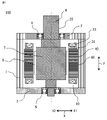
- FIG. 1 is a cross-sectional view showing a configuration of a rotating electric machine according to Embodiment 1;
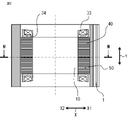
- FIG. 2 is a cross-sectional view showing the configuration of the stator of the rotary electric machine shown in FIG. 1;
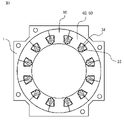
- FIG. FIG. 3 is a cross-sectional view of the stator shown in FIG. 2 taken along line MM;
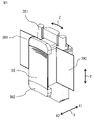
- FIG. 2 is a perspective view showing a configuration of the rotating electrical machine shown in FIG. 1 , in which the insulator of the stator is installed and before the coil is installed; 1. It is a perspective view which shows the other structure before coil installation in which the insulator of the stator of the rotary electric machine shown in FIG. 1 is installed.
- FIG. 1 is a cross-sectional view showing a configuration of a rotating electric machine according to Embodiment 1
- FIG. 2 is a cross-sectional view showing the configuration of the stator of the rotary electric machine shown in FIG. 1
- FIG. 3 is a cross-sectional view of the stator shown
- FIG. 2 is a plan view showing the configuration of core pieces of the stator of the rotary electric machine shown in FIG. 1; 2 is a perspective view showing the configuration of a laminated core of the stator of the rotary electric machine shown in FIG. 1;
- FIG. FIG. 7 is a plan view showing a state in which the core piece shown in FIG. 6 is formed with an adhesive portion;
- FIG. 7 is a plan view showing another state in which the core piece shown in FIG. 6 is formed with an adhesive portion;
- FIG. 7 is a plan view showing a state in which a bonding portion is formed in the modified example of the core piece shown in FIG. 6 ;
- 8 is a flow chart showing a method of manufacturing the laminated core shown in FIG.
- FIG. 7 4 is a flow chart showing a method for manufacturing a rotating electric machine according to Embodiment 1.
- FIG. 4A to 4C are diagrams showing a method of manufacturing the laminated core according to Embodiment 1.
- FIG. FIG. 14 is a plan view showing the configuration of the alignment guide in the alignment step of the method of manufacturing the laminated core shown in FIG. 13; 14 is a diagram showing the configuration of a coating device for coating an adhesive in the coating step of the method for manufacturing the laminated core shown in FIG. 13;
- FIG. 16 is a plan view showing the configuration of the nozzle of the coating device shown in FIG. 15;
- FIG. 16 is a side view showing the configuration of the nozzle of the coating device shown in FIG. 15;
- FIG. 16 is a plan view showing another configuration of nozzles of the coating device shown in FIG. 15.
- FIG. 16 is a side view showing the positional relationship between the nozzles shown in FIG. 15 and the laminated core;
- FIG. FIG. 14 is a view showing a separation step in the method of manufacturing the laminated core shown in FIG. 13;
- FIG. 14 is a view showing a separation step in the method of manufacturing the laminated core shown in FIG. 13;
- FIG. 14 is a view showing a separation step in the method of manufacturing the laminated core shown in FIG. 13;
- FIG. 14 is a view showing a separation step in the method of manufacturing the laminated core shown in FIG. 13;
- FIG. 14 is a view showing a separation step in the method of manufacturing the laminated core shown in FIG. 13;
- FIG. 14 is a view showing a separation step in the method of manufacturing the laminated core shown in FIG.
- FIG. 13; 4 is a plan view showing the configuration of core pieces formed at separation positions between laminated cores in Embodiment 1.
- FIG. 4 is a plan view showing another configuration of core pieces formed at separation positions between laminated cores in Embodiment 1.
- FIG. 4 is a plan view showing another configuration of core pieces formed at separation positions between laminated cores in Embodiment 1.
- FIG. 7 is a plan view showing a state in which a bonding portion is formed in the modified example of the core piece shown in FIG. 6 ;
- FIG. 7 is a plan view showing a state in which a bonding portion is formed in the modified example of the core piece shown in FIG. 6 ;
- FIG. 7 is a plan view showing a state in which a bonding portion is formed in the modified example of the core piece shown in FIG. 6 ;
- each direction in the rotating electrical machine 100 is indicated as a circumferential direction Z, an axial direction Y, a radial direction X, an outer side X1 in the radial direction X, and an inner side X2 in the radial direction X. Therefore, the directions of the stator 10 and the rotor 20 as well as other portions are the same, and each direction will be described with reference to that direction. Further, in Embodiment 1, a configuration in which the stator is divided for each tooth portion in the circumferential direction Z is shown as an example. Therefore, even a single stator divided in the circumferential direction Z may be indicated as a stator in some cases.
- FIG. 1 is a cross-sectional view showing the configuration of a rotating electric machine according to Embodiment 1.
- FIG. FIG. 2 is a cross-sectional view showing the configuration of the stator of the rotary electric machine shown in FIG.
- FIG. 3 is a cross-sectional view of the stator shown in FIG. 2, taken along line MM.
- FIG. 4 is a perspective view showing the configuration of the stator of the rotary electric machine shown in FIG. 1 after the insulator is installed and before the coil is installed.
- FIG. 5 is a perspective view showing another configuration in which the insulator of the stator of the rotary electric machine shown in FIG. 1 is installed and before the coil is installed.
- FIG. 6 is a plan view showing the configuration of core pieces of the stator of the rotary electric machine shown in FIG.
- FIG. 7 is a perspective view showing the configuration of the laminated core of the stator of the rotary electric machine shown in FIG.
- FIG. 8 is a plan view showing a state in which the core pieces shown in FIG. 6 are formed with adhesive portions.
- FIG. 9 is a plan view showing another state in which the core pieces shown in FIG. 6 are formed with adhesive portions.
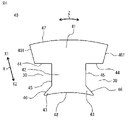
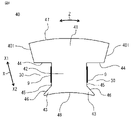
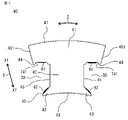
- 10, 28, 29, and 30 are plan views showing the state in which the bonded portion is formed in the modified example of the core piece shown in FIG.
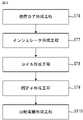
- FIG. 11 is a flow chart showing a method of manufacturing the laminated core shown in FIG.
- FIG. 12 is a flow chart showing a method for manufacturing a rotating electric machine according to the first embodiment.
- 13A and 13B are diagrams showing a method of manufacturing a laminated core according to Embodiment 1.
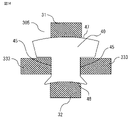
- FIG. 14 is a plan view showing the configuration of the alignment guide in the alignment step of the method of manufacturing the laminated core shown in FIG. 13.
- FIG. 14 is a plan view showing the configuration of the alignment guide in the alignment step of the method of manufacturing the laminated core shown in FIG. 13.
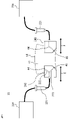
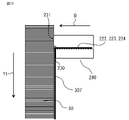
- FIG. 15 is a diagram showing the configuration of a coating device for coating the adhesive in the coating step of the method for manufacturing the laminated core shown in FIG. 16 is a plan view showing the structure of the nozzle of the coating device shown in FIG. 15.
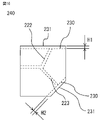
- FIG. 17 is a side view showing the structure of the nozzle of the coating device shown in FIG. 15.
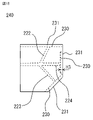
- FIG. 18 is a plan view showing another configuration of nozzles of the coating apparatus shown in FIG. 15.
- FIG. 19 is a side view showing the positional relationship between the nozzle and the laminated core shown in FIG. 15.
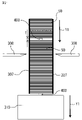
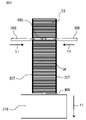
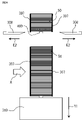
- FIG. 20 to 24 are diagrams showing the separation process of the manufacturing method of the laminated core shown in FIG. 13.
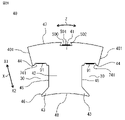
- FIG. 25 is a plan view showing the configuration of core pieces formed at separation positions between laminated cores in Embodiment 1.
- FIG. 26 is a plan view showing another configuration of core pieces formed at separation positions between laminated cores in Embodiment 1.
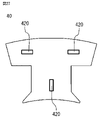
- FIG. 27 is a plan view showing another configuration of the core pieces formed at the separation positions of the laminated cores in Embodiment 1.
- FIG. 25 is a plan view showing the configuration of core pieces formed at separation positions between laminated cores in Embodiment 1.
- FIG. 26 is a plan view showing another configuration of core pieces formed at separation positions between laminated cores in Embodiment 1.
- FIG. 27 is a plan view showing another configuration of the core pieces formed at the separation positions of the laminated cores in Embodiment 1.
- a rotating electrical machine 100 includes a cylindrical frame 1, an upper bracket 2 and a lower bracket 3 that close an opening in the frame 1, a stator 10 as an armature housed in a cylindrical portion of the frame 1, It is arranged in the axial direction Y through bearings 4 and 5 at the axial positions of the upper bracket 2 and the lower bracket 3 of the frame 1, and is fixed to a rotating shaft 6 that is rotatably supported.
- a rotor 20 that is rotatably disposed on the inner peripheral side of the inner side X2 and that generates a magnetic field is provided.
- the rotor 20 includes a rotor core 7 fixed to a rotating shaft 6 inserted at an axial position, and a rotor core 7 attached to the outer peripheral surface side of the rotor core 7 and arranged at a pitch set in the circumferential direction Z. , and a plurality of permanent magnets 8 forming magnetic poles.
- the rotor 20 is not limited to a permanent magnet type rotor, and is a squirrel cage rotor in which non-insulated rotor conductors are accommodated in slots of the rotor iron core and both sides are short-circuited by short-circuit rings, or insulated rotors.
- a wound rotor in which conductor wires are mounted in slots of a rotor core may also be used.
- the stator 10 is annularly formed and fixed within the frame 1 .
- the stator 10 is composed of a laminated core 50 as a stator iron core formed by laminating a predetermined number of core pieces 40 in the axial direction Y, and a magnet wire having an insulating coating on the surface of a wire such as copper or aluminum.
- a coil 33 formed thereon and an insulator 34 having a function of electrically insulating between the laminated core 50 and the coil 33 and a function of holding the coil 33 are provided.
- the resin material of the insulator 34 is, for example, nylon, polyphenylene sulfide (PPS), liquid crystal polymer (LCP), polybutylene terephthalate (PBT), or the like.
- the insulator 34 of Embodiment 1 is formed integrally with the laminated core 50 as shown in FIG.
- the insulator 34 has a structure in which both end surfaces of the laminated core 50 in the axial direction Y and surfaces forming slot regions 30 described later are all covered with resin, and the strength and rigidity of the laminated core 50 can be improved by the insulator 34. .
- the insulator 34 is not limited to this example, and as another example, insulators 381 and 382 are attached to both end surfaces of the laminated core 50 in the axial direction Y, respectively, as shown in FIG. Insulators 391 and 392 made of insulating sheets are attached to the surfaces forming the region 30 to ensure insulation between the coil 33 and the laminated core 50 .
- the insulators 391 and 392 made of insulating sheets are, for example, insulating sheets made by sandwiching a polyphenylene sulfide (PPS) film between aramid papers, or made by sandwiching polyethylene terephthalate (PET) between PPS. It can be formed by press-molding an insulating sheet.
- PPS polyphenylene sulfide
- PET polyethylene terephthalate
- the case of using the insulators 391 and 392 of FIG. can be reduced, and there is an effect of improving the heat dissipation of the heat generated by the coil 33 .
- a laminated core 50 is obtained by laminating a large number of core pieces 40 punched in the same shape from a belt-like electromagnetic steel sheet in the axial direction Y and integrating them.
- the core piece 40 includes a core back portion 41 , tooth portions 42 and shoe portions 43 .
- the core back portion 41 is formed in an arc shape.
- the tooth portion 42 is formed extending from the center portion in the circumferential direction Z of the core inner peripheral surface 44 on the inner side X2 in the radial direction X of the core back portion 41 to the inner side X2 in the radial direction X.
- the shoe portion 43 is formed extending from the inner X2 end in the radial direction X of the tooth portion 42 toward both sides in the circumferential direction Z. As shown in FIG.
- the surface along the axial direction Y on the outer side X1 in the radial direction X of the core back portion 41 is defined as the core outer peripheral surface 47, and the inner side X2 in the radial direction X of the core back portion 41 in the axial direction Y.
- a core inner circumferential surface 44 is defined as a surface along the .
- the surfaces along the axial direction Y at both ends in the circumferential direction Z of the core back portion 41 are defined as core side surfaces 401 .
- the surfaces of the core pieces 40 and the laminated core 50 along the axial direction Y at both ends in the circumferential direction Z of the tooth portions 42 are tooth side surfaces 45 .
- a surface along the axial direction Y of the tip of the inner side X2 in the radial direction X of the tooth portion 42 is defined as a tip surface 48 .
- a shoe outer peripheral surface 46 is defined as a surface along the axial direction Y on the outer side X1 in the radial direction X of the shoe portion 43 in the core pieces 40 and the laminated core 50 .
- a region surrounded by the core back portion 41, the teeth portion 42, and the shoe portion 43 of the core piece 40 becomes the slot region 30 in which the coil 33 is arranged. Accordingly, the surfaces of the core piece 40 forming the slot region 30 are the core inner peripheral surface 44 of the core back portion 41 , the tooth side surface 45 of the tooth portion 42 , and the shoe outer peripheral surface 46 of the shoe portion 43 .
- the core pieces 40 and the laminated core 50 are divided for each tooth portion 42 in the circumferential direction Z.
- the magnetic steel sheet forming the core piece 40 is made of a material with high magnetic permeability and is coated with an insulating coating on its surface. Therefore, even if these are laminated in the axial direction Y, the core pieces 40 adjacent to each other in the axial direction Y are insulated and do not conduct.
- an adhesive is applied to any one of the core inner peripheral surface 44, the tooth side surface 45, and the shoe outer peripheral surface 46, which are the surfaces forming the slot regions 30 of the laminated core 50.
- a bonding portion 9, which will be described later, is formed to fix the core pieces 40 in the axial direction Y between the laminations.
- the fixation of the bonding portion 9 maintains the insulation between the layers of the core pieces 40 in the axial direction Y, thereby suppressing the eddy current and improving the efficiency of the rotating electric machine.
- the bonding portion 9 is attached to at least one of the core inner peripheral surfaces 44, the tooth side surfaces 45, and the shoe outer peripheral surfaces 46 of all the core pieces 40 stacked in the axial direction Y. is continuously or intermittently straddled in the axial direction Y and formed.
- the insulators 34 , 391 , 392 which are formed of insulating members, are arranged on the core inner peripheral surface 44 , tooth side surface 45 and shoe outer peripheral surface 46 of the core piece 40 .
- the bonded portion 9 is not bonded to the insulators 34 , 391 , 392 but is formed between the insulators 34 , 391 , 392 and the laminated core 50 .
- an adhesive is applied to the core inner peripheral surface 44 of the core back portion 41 and the shoe outer peripheral surface 46 of the shoe portion 43 to form adhesive portions 91 and 92, respectively. . If the adhesive strength is sufficient for the required strength, the adhesive is applied to such positions to form the adhesive portions 91 and 92. By doing so, the slot for winding the coil 33 is made larger than in the case shown in FIG. The space of the region 30 can be expanded, the space factor of the coil 33 can be increased, and the efficiency of the rotating electric machine 100 can be improved.
- the recess 741 is defined by the end face of the outer edge of the core-back portion 41 of the laminated core 50 (the "end face of the outer edge of the core-back portion 41" means excluding both ends of the core-back portion 41 in the axial direction Y). It is formed on the outer edge of the core back portion 41 and indicates a surface formed along the axial direction Y).
- the magnetic path on the side of the core back portion 41 has a magnetic margin with respect to the amount of magnetic flux passing through the laminated core 50, by providing the concave portion 741 for the margin, the space of the slot region 30 is not narrowed. , the application space for the bonding portion 91 can be secured, and the space factor of the coil 33 can be increased.
- a recess 500 (corresponding to a first recess) recessed in the direction X2 and extending in the axial direction Y is further formed. Accordingly, the recess 500 is formed on the end surface of the outer edge of the core back portion 41 of the laminated core 50 . Then, the adhesive portion 91 and the adhesive portion 501 are configured to fit in the recess 500 and the recess 741, respectively. Furthermore, limited here, the bonding portion 91 and the bonding portion 501 are formed only on the bottom side of the recess 741 and the recess 500 opposite to the opening 502 on the outer edge side. The bonding portion 91 and the bonding portion 501 are not formed on the side surfaces of the recess 500 and the recess 741 .
- the bonding portion 501 inside the recessed portion 500 of the core outer peripheral surface 47, since the bonding portion 501 does not protrude outside X1 in the radial direction X from the core outer peripheral surface 47, the laminated core 50 is fixed as shown in FIG. Since it does not interfere with the frame 1, the assembling process such as press-fitting and shrink-fitting is facilitated.
- the bonding portion 501 and the bonding portion 91 are provided in both the concave portion 500 of the core outer peripheral surface 47 and the concave portion 741 of the core inner peripheral surface 44 of the core back portion 41, the total bonding area can be increased. 50 can be improved, and the quality can be improved.
- FIG. 1 Another example is shown in FIG.
- a concave portion 600 extending in the axial direction Y and recessed outward in the radial direction X is formed in the tip surface 48 of the tooth portion 42 . Therefore, the concave portion 600 is defined by the end surface of the outer edge portion of the tooth portion 42 of the laminated core 50 ("the end surface of the outer edge portion of the tooth portion 42" means the tooth portion 42 excluding both ends of the tooth portion 42 in the axial direction Y). which refers to the surface formed along the axial direction Y). Then, it is configured such that the bonding portion 501 and the bonding portion 601 are accommodated in the recess 500 and the recess 600, respectively. The adhesive portions 501 and 601 are configured to fit in the respective grooves.
- the bonding portion 601 does not protrude from the concave portion 600 of the tip surface 48 of the tooth portion 42 to the inner side X2 in the radial direction X, the rotor 20 of the rotating electric machine 100 and the rotor 20 of the rotating electric machine 100 as shown in FIG. can prevent interference and stabilize the motor performance.
- the bonding portion 501 and the bonding portion 601 are provided in both the recessed portion 500 of the core outer peripheral surface 47 and the recessed portion 600 of the tip end surface 48, the total bonding area can be increased, so that the bonding strength of the laminated core 50 can be improved. , can improve quality.
- Fig. 30 shows another example.
- the recess 741 of the core inner peripheral surface 44 of the core back portion 41 and the recess 600 of the tip surface 48 of the tooth portion 42 are provided.
- the adhesive portion 91 and the adhesive portion 601 are configured to fit in the recess 741 and the recess 600, respectively.
- the total bonding area can be increased, the bonding strength of the laminated core 50 can be improved, and the quality can be improved.
- the recessed portion 500 of the core outer peripheral surface 47 since it is not formed on the side surface of the recessed portion 500 and the recessed portion 741, a jig for fixing the laminated core 50 during coil winding is placed on the side surface of the recessed portion 500 and the recessed portion 741. It can be abutted and fixed, and a stable winding can be realized.
- each recess may be arranged in a part of the laminated core 50 in the axial direction Y.
- the laminated core pieces are fastened in the axial direction Y by fastening the core pieces in the axial direction Y by a method other than gluing, such as caulking.
- each recess may be formed extending in the axial direction Y in all the core pieces 40 .
- each bonding portion may be continuous or intermittent in the axial direction Y in each concave portion and may be formed on the core piece 40 as a whole.
- the core pieces 40 can be fastened in the axial direction Y only by the adhesive portions, and deformation of the core pieces 40 due to fastening such as caulking can be prevented, and magnetic deterioration of the core pieces 40 can be prevented.
- the bonding portions 9, 91, 92, 501, and 601 are collectively referred to.
- the present invention is not limited to this, and it is also conceivable to form the adhesive portion so as to fit in the recess. That is, the adhesive portion is formed extending from the bottom of the recess to the side wall. By forming in this way, the adhesion by the adhesion portion is ensured.
- a two-liquid curing adhesive may be used as the adhesive that forms the adhesive portion 9.
- a two-liquid curing type adhesive consists of a main agent and a curing accelerator, and as the main agent, an epoxy adhesive, an acrylic adhesive, or the like is used. In such a configuration, since there is no heating process, the configuration of the manufacturing equipment can be made compact, and heat energy can be reduced, so that there is an effect of energy saving.
- a heat-curable adhesive such as an epoxy-based adhesive may be used.
- the adhesive adhering to the manufacturing apparatus can be removed simply by wiping it off before thermal curing, thereby improving maintainability.
- the heat-curable adhesive has a higher heat-resistant temperature than the room-temperature-curable adhesive, the heat resistance of the laminated core 50 is improved.
- an ultraviolet curable adhesive may be used as the adhesive that forms the adhesive portion 9.
- an ultraviolet curable adhesive may be used as the adhesive that forms the adhesive portion 9.
- the adhesive is not applied to the outer peripheral surface 47 of the core. Therefore, after the plurality of laminated cores 50 having the insulators 34 and the coils 33 formed thereon are arranged in an annular shape, the inner peripheral surface of the mounting frame 1 is baked on the core outer peripheral surface 47 on the outer side X1 in the radial direction X of the laminated core 50. Since there is no adhesive on the outer peripheral surface 47 of the core even if it is fitted or press-fitted, the shape accuracy of the assembled stator 10 can be improved.
- the stator 10 when the stator 10 is assembled by annularly arranging the plurality of laminated cores 50 having the insulators 34 and the coils 33 formed thereon, the core side surfaces 401 of the laminated cores 50 adjacent in the circumferential direction Z are brought into contact with each other. Since no adhesive is applied to the core side surface 401 of the laminated core 50, the assembly accuracy of the stator 10 is stabilized and the shape accuracy of the stator 10 is improved. This improves the performance of the rotary electric machine, such as reducing torque ripple.
- the core pieces 40 shown in FIG. 6 are laminated in the axial direction Y to form the laminated core 50 as shown in FIG.
- the core inner peripheral surface 44 of the core back portion 41 that forms the slot region 30 the tooth side surface 45 of the tooth portion 42, and the shoe outer peripheral surface 46 of the shoe portion 43.
- adhesive portions 9 are formed on all the core pieces 40 continuously or intermittently in the axial direction Y of the laminated core 50 .
- the insulator 34 is formed on the laminated core 50, and is constructed as shown in FIG. Since the bonding portion 9 has already been hardened by the insulator forming step, it is not bonded to the insulator 34 and is formed between the insulator 34 and the laminated core 50 .
- the coil forming step of step ST8 in FIG. 12 magnet wires are wound around the teeth 42 of the divided laminated core 50 to form the coils 33 .
- step ST9 of FIG. 47 is fixed.
- step ST10 of FIG. 12 in the rotating electric machine forming process, the rotating shaft 6 of the rotor 20 is rotatably supported by the upper bracket 2 and the lower bracket 3 by the bearings 4 and 5, and the rotor 20 is rotated.
- a rotary electric machine 100 is formed by arranging the stator 10 so as to face the stator 10 with a gap therebetween.
- the electromagnetic steel sheet 301 as a band-shaped plate material wound into a reel is pulled out by an uncoiler and fed into a hydraulic or electric press by a feeding device.
- a predetermined shape of the core piece 40 is punched out by the die 302 and the first punch 303 in the press machine.
- a convex portion 400 (see FIG. 25) projecting in the axial direction Y is formed on the electromagnetic steel sheet 301 by the second punch 304 for every specified number of sheets.
- Each of the punches 303 and 304 can be moved in and out of the mold by a cam mechanism mounted in the mold and an air cylinder or a servomotor. is taken in and out by controlling the
- step ST2 in FIGS. 11 and 13 the punched core pieces 40 are aligned by the alignment guides 305 and stacked in the stacking direction Y to form the laminated core 50 .
- the stacking direction Y and the axial direction Y shown above are the same direction. 11 and 13, in the coating process of step ST3 of Figs.
- the adhesive 307 is continuously applied in the axial direction Y.
- step ST4 in FIGS. 11 and 13 the adhesive 307 is heated by the heater 306 to be cured to form the bonding portion 9. As shown in FIG. Note that the alignment guide 305 continues to restrain the laminated core 50 from the alignment process to the curing process.
- step ST5 in FIGS. 11 and 13 the bonding portion 9 is cut by the cutter 308 at the position in the axial direction Y where the convex portion 400 of the laminated core 50 continuous in the axial direction Y is formed. Then, each laminated core 50 is divided.
- the adhesive 307 will be described as the adhesive 307 regardless of whether the adhesive 307 is cured and formed as the adhesive portion 9 or the adhesive 307 before being cured.
- the alignment guide 305 used in the alignment process includes the first restricting portion 31 that presses the core outer peripheral surface 47 of the core back portion 41 of the core piece 40 shown in FIG. and a third restricting portion 333 that presses the tooth side surface 45 of the tooth portion 42 .
- the alignment guide 305 regulates the positions of the core pieces 40 and aligns the plurality of core pieces 40 in the stacking direction Y. As shown in FIG.
- the first restricting portion 31, the second restricting portion 32, and the third restricting portion 333 are separated from each other. may be configured. Moreover, it is not necessary to provide all the restricting portions 31, 32, and 333, and it is sufficient if the core pieces 40 can be aligned in the stacking direction Y. For example, it is conceivable that only the first restricting portion 31 and the second restricting portion 32 are provided and the third restricting portion 333 is not provided. In this case, since the third restricting portion 333 located in the slot region 30 does not exist, it is possible to easily proceed to the subsequent step of applying the adhesive 307 .
- the applicator 22 for the adhesive 307 includes a nozzle 240 having passages 222 and 223 connected to a syringe 221 containing the adhesive 307 via a dispenser control device 220 for feeding the adhesive 307. It has As shown in FIGS. 15 and 16, the nozzle 240 is provided inside the nozzle 240 when the adhesive 307 is applied to the core inner peripheral surface 44 of the core back portion 41 and the shoe outer peripheral surface 46 of the shoe portion 43, for example. After the adhesive 307 sent from the dispenser control device 220 flows into the nozzle 240, it is branched into two and passes through the paths 222 and 223 to the core of the core back portion 41. The inner peripheral surface 44 and the shoe outer peripheral surface 46 of the shoe portion 43 are coated simultaneously.
- the nozzle 240 is formed with a positioning portion 231, and the positioning portion 231 is brought into contact with the application surface of the laminated core 50.
- the coating surfaces are the core inner peripheral surface 44 of the core back portion 41 forming the slot region 30, the tooth side surface 45 of the tooth portion 42, and the shoe outer peripheral surface of the shoe portion 43. 46 is shown on at least one side, and the description thereof will be omitted below.
- the adhesive 307 is injected in the introduction direction D from the nozzle 240 .
- the nozzle 240 has a leveling surface 230 for the adhesive 307 at positions separated from the coating surface of the laminated core 50 by certain distances H1, H2, and H3 (the distance H3 will be described later).
- the adhesive 307 is leveled. Since this leveling surface 230 is formed in advance on surfaces separated by predetermined distances H1, H2, and H3 from the coated surface of the core piece 40, the thickness of the adhesive 307 after leveling is the same as that of the leveling surface 230. The thickness is made uniform according to the distances H1, H2, and H3 from the application surface of the core piece 40. As shown in FIG.
- the core inner peripheral surface 44 of the core back portion 41 and the shoe outer peripheral surface 46 of the shoe portion 43 are shown as examples of surfaces to which the adhesive 307 is applied, the core back portion 41 is not limited to this.
- the adhesive 307 may also be applied to the tooth side surface 45 of the tooth portion 42 . In that case, like a nozzle 240 shown in FIG. , the thickness of the adhesive 307 can be made uniform. Furthermore, when the thickness of the adhesive 307 is changed for each application surface of the adhesive 307, the predetermined distance can be varied by setting the distances H1, H2, and H3 from the positioning portion 231 of the nozzle 240 to the leveling surface 230, respectively. can.
- the nozzle 240 is supported by a guide mechanism (not shown) so as to be movable in the vertical direction E and the stacking direction Y shown in FIG. This makes it possible to keep the thickness of the adhesive 307 constant for each mold against the dimensional variation of the core pieces 40 due to the difference in molds. Also, the nozzles 240 may be installed independently. As a result, the distances H1, H2, and H3 from the core piece 40 to the leveling surface 230 can be changed for each application portion, and the dimensions of each portion when punching out the core piece 40 using a plurality of types of molds. The thickness of the adhesive 307 can be stabilized by adjusting individually according to variations, and variations in adhesive strength can be reduced.
- the adhesive to be used is of the heat curing type
- a heater 306 for heating is installed to apply heat to the adhesive to cure it.
- the heat of the heater 306 is suppressed from being transmitted to the alignment guide 305, the dimensional change due to the thermal expansion of the alignment guide 305 is suppressed, and the core Deterioration of alignment accuracy of the piece 40 can be prevented.
- an ultraviolet irradiation device is installed instead of the heater 306 to irradiate and cure the adhesive with ultraviolet rays.
- an ultraviolet curable adhesive since heat is not applied compared to a heat curable adhesive, there is no need to install a heat insulating mechanism as described above, and manufacturing equipment can be simplified and downsized.
- each adhesive need not be completely cured within the manufacturing equipment. Therefore, in the curing step, it is sufficient that the stator 10 is fixed to such an extent that the space between the laminations of the stator 10 in the axial direction Y is not cracked or separated during transportation after it is removed from the manufacturing facility.
- a heat curing type may be completely cured by adding a heating process
- an ultraviolet curing type may be completely cured by further irradiation with ultraviolet rays.
- the adhesive shrinks during complete curing, which causes a change in lamination accuracy. Therefore, it is better to guide the laminated core 50 with a jig or the like before curing.
- a support portion 310 is provided on the discharge side of the laminated core 50 to support the laminated core 50 from below.
- the supporting portion 310 is arranged upward with respect to the lowest portion of the laminated core 50 so as not to create a gap between the laminated cores 50 in which the core pieces 40 are laminated in the axial direction Y until the splitting step.
- It has a mechanism that can apply a load F2.
- an air cylinder or a hydraulic cylinder is used as an actuator for the support portion 310 to drive the stacking direction Y up and down.
- the cutter 308 is movable with respect to the laminated core 50 in the lamination direction Y and in the vertical direction E shown in FIG.
- the magnitude of the press load F1 when the core piece 40 is punched out by the pressing machine is set so that F1>F2 when compared with the load F2 of the support portion 310.
- FIG. When the core piece 40 is pressed by this press load F1 and punched out and pushed in the advancing direction Y1, the load F2 on the support portion 310 side loses the pressing load F1 and is pushed in the advancing direction Y1 side.
- the press load F1 and the load F2 are loads that sandwich the laminated core 50 in the axial direction Y. As shown in FIG.
- core pieces 40 punched into a predetermined core piece 40 shape are stacked in the stacking direction Y as described above.
- a convex portion 400 is formed at a stage before the core piece 40 is punched. Therefore, the core piece 40 with the projection 400 formed thereon and the core piece 40 without the projection 400 are sequentially punched out and laminated.
- the core piece 40 on which the convex portion 400 is formed is formed every predetermined number of core pieces 40 of the laminated core 50 .
- a gap T corresponding to the height of the protrusion 400 is formed between the core piece 40 having the protrusion 400 formed thereon and the core piece 40 punched one ahead (on the direction Y1 side).
- the adhesive 307 is applied continuously in the lamination direction Y, and the continuous laminated cores 50 separated by the gaps T formed by the protrusions 400 are separated from each other by the adhesive 307 that is continuous in the axial direction Y. It will be in a connected state (Fig. 21). After that, the laminated cores 50 freed from the alignment guide 305 through the curing process are ejected from the alignment guide 305 while being supported by the supporting portions 310 (FIG. 22).
- the cutter 308 for cutting the adhesive 307 is moved in the inner direction E1 of the laminated core 50 from both sides with respect to the gap T created between the laminated cores 50 by the convex portion 400, thereby The adhesive 307 connecting the 50 is cut (FIG. 23).
- the cutter 308 is moved in the outward direction E ⁇ b>2 of the laminated core 50 .
- the supporting portion 310 is lowered in the traveling direction Y1 to separate the laminated cores 50 from each other.
- the laminated core 50 is pushed out from the supporting portion 310 by a cylinder or the like, or is picked up by a robot and discharged in the discharge direction A (FIG. 24).
- the cutting device 308 is installed on a driving device that can move up and down in the stacking direction Y so as to follow the movement in the advancing direction Y1, and is controlled so that it can move in synchronization with the movement of the core pieces 40. be done.
- a method of mounting the cutter 308 on the above-described support portion 310 is also conceivable.
- the vertical position in the stacking direction Y is controlled by a servomotor or the like so that the position of the cutter 308 can be corrected.
- the position of the cutter 308 can be corrected, so that stable cutting can be performed.
- the convex portion 400 formed on the core piece 40 is not limited to this.
- You may A plurality of protrusions 410 may be provided in this manner.
- a plurality of protrusions 410 such as three, the force on the core piece 40 on the Y1 side that was removed in the previous step is equalized, so that the core piece 40 on the Y1 side is stably removed. can be pressed.
- three square-shaped protrusions 420 protruding in the axial direction Y may be formed on the core piece 40 .
- the case of the core piece 40 formed with the shoe portion 43 is shown, but the present invention is not limited to this, and the core piece without the shoe portion 43, that is, the core piece A core piece in which only the core back portion 41 and the tooth portion 42 are formed on 40 can also be manufactured in the same manner.
- the slot region 30 is a region surrounded by the core back portion 41 and the tooth portions 42 , and the surfaces forming the slot region 30 are the core inner peripheral surface 44 of the core back portion 41 and the tooth side surfaces of the tooth portions 42 . 45, and a laminated core can be formed or manufactured in the same manner as in the first embodiment.
- the laminated core 50 divided for each tooth portion 42 in the circumferential direction Z is shown as an example of the stator core, but the stator core is not limited to this.
- both ends in the circumferential direction Z of the core piece 40 shown in FIG. 6 and the laminated core 50 shown in FIG. It can be formed or manufactured in the same manner as Form 1.
- the stator core of the rotary electric machine according to Embodiment 1, which is configured as described above, A laminated core configured by axially laminating a plurality of core pieces each having a core back portion and tooth portions protruding radially inward from a core inner peripheral surface radially inside the core back portion.
- the assembly accuracy of the stator is stabilized, the shape accuracy of the stator is improved, torque ripple is reduced, and the performance of the rotating electric machine is improved.
- the number of laminated cores is several hundred, it is not necessary to impregnate all of the core pieces in the axial direction with the adhesive, which improves productivity.
- the space factor of the core pieces is improved, and the output density of the rotating electric machine is improved.
- the core outer peripheral surface of the core back portion is shrink-fitted or press-fitted into the frame, no adhesive is present on the core outer peripheral surface of the core back portion, so that the shape accuracy of the stator after assembly can be improved.
- stator core of the rotary electric machine configured as described above is
- the recesses extend in the axial direction in all of the core pieces on at least one of the end faces of the outer edge portions of the tooth portions of the laminated core and the end faces of the outer edge portions of the core back portion. formed by Since the bonding portion is formed in all the core pieces continuously or intermittently in the axial direction in the concave portion, The eddy current generated between the core pieces in the axial direction can be reliably suppressed to reduce the loss.
- stator core of the rotary electric machine according to the first embodiment configured as described above is Since the bonding portion formed in the concave portion is accommodated in the concave portion, It is possible to reliably obtain adhesion by the adhesion portion.
- stator core of the rotary electric machine configured as described above is Since the first recess is formed in all of the core pieces on the outer peripheral surface of the core on the radially outer side of the core back portion, which is the end surface of the outer edge of the core back portion, The eddy current generated between the core pieces in the axial direction can be reliably suppressed to reduce the loss.
- stator core of the rotary electric machine according to the first embodiment configured as described above is Since the bonding portion is formed on the bottom portion side of the concave portion opposite to the opening portion side on the outer edge portion side and is not formed on the opening portion side, It is possible to prevent the adhesion part from causing trouble in other parts.
- stator core of the rotary electric machine is A laminated core configured by axially laminating a plurality of core pieces each having a core back portion and tooth portions protruding radially inward from a core inner peripheral surface radially inside the core back portion.
- All of the core pieces are axially continuous or intermittent on at least one of the surfaces forming the slot region surrounded by the tooth portions and the core back portion of the laminated core.
- stator core of the rotary electric machine is A core-back portion, teeth protruding radially inward from a core inner peripheral surface radially inside the core-back portion, and shoe portions extending circumferentially from radially inner ends of the teeth.
- a laminated core configured by laminating a plurality of core pieces in the axial direction, continuous or discontinuous in the axial direction on at least one of the surfaces forming the slot region surrounded by the tooth portion, the core back portion, and the shoe portion of the laminated core; Since the bonded portion is formed on the core piece of Further, the stator of the rotary electric machine according to Embodiment 1 configured as described above is An insulator is formed on a surface of the laminated core forming the slot region of the stator core of the rotating electric machine, the bonding portion is formed between the insulator and the laminated core without being bonded to the insulator; Since a coil is formed in the slot region through the insulator, Further, the rotating electrical machine of Embodiment 1 configured as described above is Since the stator of the rotating electric machine and the rotor arranged opposite to the stator with a gap therebetween are provided, Since the core pieces are axially fixed to form a laminated core by adhesives formed on the faces forming the slot regions of the core pieces, rather
- the assembly accuracy of the stator is stabilized, the shape accuracy of the stator is improved, torque ripple is reduced, and the performance of the rotating electric machine is improved.
- the number of laminated cores is several hundred, it is not necessary to impregnate all of the core pieces in the axial direction with the adhesive, which improves productivity.
- the space factor of the core pieces is improved, and the output density of the rotating electric machine is improved.
- the core outer peripheral surface of the core back portion is shrink-fitted or press-fitted into the frame, no adhesive is present on the core outer peripheral surface of the core back portion, so that the shape accuracy of the stator after assembly can be improved.
- the stator core of the rotary electric machine configured as described above, Since the laminated core is formed by dividing each tooth portion in the circumferential direction, Since the adhesive does not adhere to both ends of the laminated core in the circumferential direction when the divided laminated cores are brought into contact with each other in the circumferential direction and arranged in an annular shape, the assembly accuracy of the stator is stabilized. shape accuracy is improved. This improves the performance of the rotary electric machine, such as reducing torque ripple.
- the adhesive portion is disposed thereon. Since the adhesive portion is arranged in the concave portion, the slot area can be configured without narrowing, the space factor of the coil is improved, and the efficiency of the rotating electric machine is improved.
- the adhesive part is composed of an ultraviolet curable adhesive that is cured by irradiation with ultraviolet rays,
- the laminated core can be fixed in a short time, and productivity is improved.
- the adhesive portion is composed of an anaerobic adhesive, Since equipment for curing the adhesive is not required, the cost is low.
- the adhesive part is composed of a thermosetting adhesive, The heat resistance of the laminated core can be improved.
- the stator of the rotary electric machine of Embodiment 1 configured as described above, Since the insulator is integrally formed with the laminated core, The laminated core can be firmly fixed.
- the stator core of the rotary electric machine according to the first embodiment configured as described above Since the core piece on one end side of the laminated core in the axial direction is formed with a convex portion protruding toward the one end side in the axial direction, Further, according to the method for manufacturing the stator core of the rotary electric machine according to the first embodiment configured as described above, a punching step of sequentially punching the core pieces from a plate material while forming the convex portion for each predetermined number of laminated cores; an alignment step of axially stacking and aligning the punched core pieces; an applying step of applying the adhesive to all the core pieces continuously or intermittently in the axial direction in the recess; A curing step of curing the adhesive; The splitting step is provided for splitting the plurality of laminated cores, which are continuously bonded in the axial direction with the adhesive, by cutting the adhesive at positions of the convex portions in the axial direction, Further, according to the manufacturing method of the rotating electrical machine of the first embodiment configured as described above,
- the coating step since the adhesive is leveled in a direction away from the coating surface of the adhesive by a certain distance after the adhesive is coated, The thickness of the adhesive can be made uniform, and variations in the strength of the laminated core can be reduced.
- the application step the application of the adhesive is performed while positioning the application position of the adhesive and the laminated core. It is possible to improve the application position accuracy of the adhesive.
- the applying step since the constant distance from the application surface of the adhesive for leveling the adhesive is varied to a predetermined distance, By changing the constant distance with respect to the dimensional variation of the laminated core, the outer shape position of the adhesive can be kept constant, and the strength variation of the laminated core can be reduced.
- the stator core of the rotary electric machine according to the first embodiment configured as described above, During the period from the coating step to the curing step, a load is applied to sandwich the laminated core in the axial direction. Variation in the position of the laminated core in the axial direction can be suppressed.
- aligning step alignment is performed by guiding the radially outer core outer peripheral surface of the core back portion and the radially inner tip surface of the tooth portion. Without using the slot area as a guide, the coating process can be easily started while aligning the laminated cores.
- the coating step using the ultraviolet curable adhesive, Since ultraviolet rays are irradiated in the curing step, By using an ultraviolet curable adhesive, the laminated core can be fixed in a short time, and the productivity of the laminated core is improved.
Landscapes
- Engineering & Computer Science (AREA)
- Power Engineering (AREA)
- Manufacturing & Machinery (AREA)
- Iron Core Of Rotating Electric Machines (AREA)
- Manufacture Of Motors, Generators (AREA)
Priority Applications (7)
| Application Number | Priority Date | Filing Date | Title |
|---|---|---|---|
| CN202180096072.9A CN117321895A (zh) | 2021-06-01 | 2021-06-01 | 旋转电机的定子铁心、旋转电机的定子、旋转电机、旋转电机的定子铁心的制造方法及旋转电机的制造方法 |
| PCT/JP2021/020782 WO2022254568A1 (ja) | 2021-06-01 | 2021-06-01 | 回転電機の固定子鉄心、回転電機の固定子、回転電機、回転電機の固定子鉄心の製造方法、および、回転電機の製造方法 |
| DE112021007750.3T DE112021007750T5 (de) | 2021-06-01 | 2021-06-01 | Statorkern einer rotierenden elektrischen Maschine, Stator einer rotierenden elektrischen Maschine, rotierende elektrische Maschine, Verfahren zum Herstellen eines Statorkerns einer rotierenden elektrischen Maschine und Verfahren zum Herstellen einer rotierenden elektrischen Maschine |
| JP2023525207A JP7531705B2 (ja) | 2021-06-01 | 2021-06-01 | 回転電機の固定子鉄心、回転電機の固定子、回転電機、回転電機の固定子鉄心の製造方法、および、回転電機の製造方法 |
| KR1020237034434A KR102874643B1 (ko) | 2021-06-01 | 2021-06-01 | 회전 전기의 고정자 철심, 회전 전기의 고정자, 회전 전기, 회전 전기의 고정자 철심의 제조 방법, 및 회전 전기의 제조 방법 |
| US18/563,381 US20240275219A1 (en) | 2021-06-01 | 2021-06-01 | Stator core of rotating electric machine, stator of rotating electric machine, rotating electric machine, method for manufacturing stator core of rotating electric machine, and method for manufacturing rotating electric machine |
| TW110123516A TWI780795B (zh) | 2021-06-01 | 2021-06-28 | 旋轉電機的定子鐵心、旋轉電機的定子、旋轉電機、旋轉電機的定子鐵心的製造方法及旋轉電機的製造方法 |
Applications Claiming Priority (1)
| Application Number | Priority Date | Filing Date | Title |
|---|---|---|---|
| PCT/JP2021/020782 WO2022254568A1 (ja) | 2021-06-01 | 2021-06-01 | 回転電機の固定子鉄心、回転電機の固定子、回転電機、回転電機の固定子鉄心の製造方法、および、回転電機の製造方法 |
Publications (1)
| Publication Number | Publication Date |
|---|---|
| WO2022254568A1 true WO2022254568A1 (ja) | 2022-12-08 |
Family
ID=84323990
Family Applications (1)
| Application Number | Title | Priority Date | Filing Date |
|---|---|---|---|
| PCT/JP2021/020782 Ceased WO2022254568A1 (ja) | 2021-06-01 | 2021-06-01 | 回転電機の固定子鉄心、回転電機の固定子、回転電機、回転電機の固定子鉄心の製造方法、および、回転電機の製造方法 |
Country Status (7)
| Country | Link |
|---|---|
| US (1) | US20240275219A1 (https=) |
| JP (1) | JP7531705B2 (https=) |
| KR (1) | KR102874643B1 (https=) |
| CN (1) | CN117321895A (https=) |
| DE (1) | DE112021007750T5 (https=) |
| TW (1) | TWI780795B (https=) |
| WO (1) | WO2022254568A1 (https=) |
Cited By (2)
| Publication number | Priority date | Publication date | Assignee | Title |
|---|---|---|---|---|
| WO2025041547A1 (ja) * | 2023-08-21 | 2025-02-27 | 吉川工業株式会社 | 分割コアの製造方法及び製造装置 |
| WO2025211090A1 (ja) * | 2024-04-03 | 2025-10-09 | 三菱電機株式会社 | 固定子、回転電機、固定子の製造方法、および回転電機の製造方法 |
Families Citing this family (1)
| Publication number | Priority date | Publication date | Assignee | Title |
|---|---|---|---|---|
| JP7474278B2 (ja) * | 2022-03-24 | 2024-04-24 | 本田技研工業株式会社 | ステータ組立装置及びステータ組立方法 |
Citations (3)
| Publication number | Priority date | Publication date | Assignee | Title |
|---|---|---|---|---|
| JP2012120299A (ja) * | 2010-11-30 | 2012-06-21 | Mitsubishi Electric Corp | ステータコア、回転電機およびステータコアの製造方法 |
| JP2019187056A (ja) * | 2018-04-09 | 2019-10-24 | 三菱電機株式会社 | 回転電機のコア、および回転電機のコアの製造方法 |
| JP2020089202A (ja) * | 2018-11-30 | 2020-06-04 | 三菱電機株式会社 | 積層コア、固定子および回転子 |
Family Cites Families (97)
| Publication number | Priority date | Publication date | Assignee | Title |
|---|---|---|---|---|
| US1538196A (en) * | 1921-12-06 | 1925-05-19 | Safety Car Heating & Lighting | Construction for dynamo-electric machines |
| CH632877A5 (de) * | 1978-12-14 | 1982-10-29 | Bbc Brown Boveri & Cie | Lamellierter pol fuer eine elektrische maschine mit ausgepraegten polen. |
| US4616151A (en) * | 1984-12-07 | 1986-10-07 | General Motors Corporation | Armature with quiet core construction |
| US4700098A (en) * | 1984-12-28 | 1987-10-13 | Sanyo Electric Co., Ltd. | D.C. motors with unequal pole spacing |
| US4847526A (en) * | 1985-07-11 | 1989-07-11 | Nippon Ferrofluidics Corporation | Variant-pole electric motor |
| US5331245A (en) * | 1986-01-13 | 1994-07-19 | Papst Licensing Gmbh | Permanent magnet excited electric motor with improved torque ripple |
| US5107159A (en) * | 1989-09-01 | 1992-04-21 | Applied Motion Products, Inc. | Brushless DC motor assembly with asymmetrical poles |
| US5448119A (en) * | 1991-03-29 | 1995-09-05 | Nagano Nidec Corporation | Spindle motor |
| US5142178A (en) * | 1991-04-12 | 1992-08-25 | Emerson Electric Co. | Apparatus for aligning stacked laminations of a dynamoelectric machine |
| JPH0614481A (ja) * | 1992-06-25 | 1994-01-21 | Mitsubishi Electric Corp | 電機子鉄心 |
| JP2569215Y2 (ja) * | 1992-12-16 | 1998-04-22 | 株式会社三協精機製作所 | モータの積層コア |
| JPH08223830A (ja) * | 1995-02-10 | 1996-08-30 | Toshiba Corp | 回転電機用の鉄心および突極形回転子鉄心 |
| JP2905119B2 (ja) * | 1995-06-30 | 1999-06-14 | 株式会社東芝 | 洗濯機 |
| TW411653B (en) * | 1997-04-11 | 2000-11-11 | Toshiba Corp | Stator for dynamoelectric machine and method of making the same |
| DE19728172C2 (de) * | 1997-07-02 | 2001-03-29 | Wolfgang Hill | Elektrische Maschine mit weichmagnetischen Zähnen und Verfahren zu ihrer Herstellung |
| JPH11252832A (ja) * | 1998-03-06 | 1999-09-17 | Asmo Co Ltd | コア・シート、コアおよび電機子の製造方法 |
| JP3279279B2 (ja) * | 1998-06-30 | 2002-04-30 | 三菱電機株式会社 | 鉄心装置 |
| JP3383251B2 (ja) * | 1999-12-27 | 2003-03-04 | 三菱電機株式会社 | 車両用交流発電機の固定子 |
| JP2001251828A (ja) * | 2000-03-02 | 2001-09-14 | Moric Co Ltd | 内燃機関用多極磁石式発電機 |
| JP3490659B2 (ja) * | 2000-02-29 | 2004-01-26 | 三菱電機株式会社 | 交流発電機 |
| JP3474824B2 (ja) * | 2000-02-24 | 2003-12-08 | 三菱電機株式会社 | 車両用交流発電機 |
| JP2002252953A (ja) * | 2001-02-23 | 2002-09-06 | Alps Electric Co Ltd | インナーロータモータおよびディスク装置 |
| JP4747423B2 (ja) * | 2001-03-02 | 2011-08-17 | パナソニック株式会社 | 電動機 |
| EP1241773B1 (en) * | 2001-03-14 | 2012-09-12 | Nissan Motor Co., Ltd. | Rotating electrical machine with air-gap sleeve |
| JP2002320350A (ja) * | 2001-04-20 | 2002-10-31 | Mitsuba Corp | 電動モータ |
| JP4018885B2 (ja) * | 2001-05-25 | 2007-12-05 | 株式会社三井ハイテック | 積層鉄心 |
| JP3594003B2 (ja) * | 2001-08-28 | 2004-11-24 | 日産自動車株式会社 | 回転電機及びその製造方法 |
| ATE311030T1 (de) * | 2002-03-22 | 2005-12-15 | Ebm Papst St Georgen Gmbh & Co | Innenläufermotor |
| JP2003324869A (ja) | 2002-05-08 | 2003-11-14 | Daikin Ind Ltd | 電動機及び圧縮機 |
| JP3791492B2 (ja) * | 2002-12-25 | 2006-06-28 | 株式会社日立製作所 | 回転電機及び電動車両並びに樹脂のインサート成形方法 |
| JP4631298B2 (ja) * | 2004-03-17 | 2011-02-16 | Jfeスチール株式会社 | 回転機の設計方法及び回転機の製造方法 |
| JP2006025552A (ja) * | 2004-07-08 | 2006-01-26 | Mitsubishi Electric Corp | 回転電機及び回転電機の回転子の製造方法 |
| JP4548049B2 (ja) * | 2004-09-01 | 2010-09-22 | 株式会社日立製作所 | 回転電機 |
| JP4712465B2 (ja) * | 2005-07-20 | 2011-06-29 | ヤマハ発動機株式会社 | 回転電機及び電動車椅子 |
| DE102005034486A1 (de) * | 2005-07-20 | 2007-02-01 | Vacuumschmelze Gmbh & Co. Kg | Verfahren zur Herstellung eines weichmagnetischen Kerns für Generatoren sowie Generator mit einem derartigen Kern |
| JP2007053896A (ja) * | 2005-08-17 | 2007-03-01 | Minebea Co Ltd | ステータユニット及びその製造方法 |
| JP4236056B2 (ja) * | 2006-02-08 | 2009-03-11 | 三菱電機株式会社 | 磁石発電機 |
| KR100808194B1 (ko) * | 2006-05-19 | 2008-02-29 | 엘지전자 주식회사 | 아우터 로터 타입 모터의 스테이터 |
| WO2008044740A1 (en) * | 2006-10-13 | 2008-04-17 | Mitsui High-Tec, Inc. | Laminated iron core, and its manufacturing method |
| JP4896664B2 (ja) * | 2006-10-30 | 2012-03-14 | 三菱電機株式会社 | 回転電機用回転子 |
| JP2008169439A (ja) * | 2007-01-12 | 2008-07-24 | Toyota Motor Corp | 磁性粉末、圧粉磁心、電動機およびリアクトル |
| ITMI20070508A1 (it) * | 2007-03-14 | 2008-09-15 | Corrada Spa | Articolo laminare per uso elettrico procedimento e macchine per realizzare detto articolo laminare |
| JP5129810B2 (ja) * | 2007-05-09 | 2013-01-30 | 株式会社三井ハイテック | 積層鉄心及びその製造方法 |
| DE102007032872A1 (de) * | 2007-07-12 | 2009-01-15 | Ipgate Ag | Stator für Elektromotor |
| US8274182B2 (en) * | 2007-10-04 | 2012-09-25 | Mitsubishi Electric Corporation | Linear motor including extended tooth tips |
| JP5211651B2 (ja) * | 2007-11-15 | 2013-06-12 | パナソニック株式会社 | モータおよびそれを用いた電子機器 |
| JP2010028943A (ja) * | 2008-07-17 | 2010-02-04 | Toshiba Mitsubishi-Electric Industrial System Corp | 電界緩和用半導電性ワニス及びテープ並びに回転電機の固定子 |
| CN101741157A (zh) * | 2008-11-21 | 2010-06-16 | 德昌电机(深圳)有限公司 | 电机及其转子 |
| JP2010239691A (ja) * | 2009-03-30 | 2010-10-21 | Denso Corp | 回転電機の固定子及び回転電機 |
| JP5363255B2 (ja) * | 2009-09-18 | 2013-12-11 | 株式会社ミツバ | ステータの製造方法、およびステータ |
| US8436504B2 (en) * | 2010-01-11 | 2013-05-07 | Ford Global Technologies, Llc | Stator for an electric machine |
| JP5459110B2 (ja) * | 2010-06-30 | 2014-04-02 | 株式会社デンソー | 回転電機の固定子 |
| JP5150743B2 (ja) * | 2011-03-23 | 2013-02-27 | 川崎重工業株式会社 | キャンド型の回転電機 |
| DE102011006682A1 (de) * | 2011-04-01 | 2012-10-04 | Aloys Wobben | Polschuh |
| US8847460B2 (en) * | 2011-05-09 | 2014-09-30 | GM Global Technology Operations LLC | Asymmetric stator teeth in an electric motor |
| DE102011079843A1 (de) * | 2011-07-26 | 2013-01-31 | Siemens Aktiengesellschaft | Elektrische Maschine mit massenarmer Bauart in magnetisch aktiven Teilen |
| JP2014014231A (ja) * | 2012-07-04 | 2014-01-23 | Mitsubishi Heavy Ind Ltd | 電動モータ |
| US9325056B2 (en) * | 2012-09-11 | 2016-04-26 | Alcatel Lucent | Radiation efficient integrated antenna |
| US20140139067A1 (en) * | 2012-10-18 | 2014-05-22 | L.H. Carbide Corporation | Die assembly and method for manufacturing wound motor laminated article |
| KR101539849B1 (ko) * | 2013-09-23 | 2015-07-28 | 뉴모텍(주) | 절연 코팅에 적합한 구조를 갖는 모터의 적층 코어 |
| JP6248711B2 (ja) * | 2014-03-06 | 2017-12-20 | 株式会社デンソー | 回転電機の固定子 |
| JP6403982B2 (ja) * | 2014-04-30 | 2018-10-10 | マブチモーター株式会社 | ブラシレスモータ |
| JP6383202B2 (ja) * | 2014-07-24 | 2018-08-29 | 株式会社三井ハイテック | 積層鉄心の製造方法及び積層鉄心 |
| JP6303978B2 (ja) * | 2014-10-27 | 2018-04-04 | トヨタ自動車株式会社 | 回転電機のステータ |
| WO2016113876A1 (ja) * | 2015-01-15 | 2016-07-21 | 三菱電機株式会社 | 回転電機 |
| US10587172B2 (en) * | 2015-03-16 | 2020-03-10 | Kuroda Precision Industries Ltd. | Manufacturing method for laminated iron core and manufacturing device for laminated iron core |
| JP6495092B2 (ja) * | 2015-05-07 | 2019-04-03 | 株式会社三井ハイテック | 分割型積層鉄心及びその製造方法 |
| JP2016226170A (ja) * | 2015-05-29 | 2016-12-28 | トヨタ自動車株式会社 | 電動機用積層コア |
| WO2017033229A1 (ja) * | 2015-08-21 | 2017-03-02 | 三菱電機株式会社 | 永久磁石埋込型モータ、圧縮機、および冷凍空調装置 |
| JP6191801B1 (ja) * | 2015-10-07 | 2017-09-06 | 大日本印刷株式会社 | 接着シートセットおよび物品の製造方法 |
| GB2550593A (en) * | 2016-05-24 | 2017-11-29 | Vacuumschmelze Gmbh & Co Kg | Soft magnetic laminated core, method of producing a laminated core for a stator and/or rotor of an electric machine |
| JP6376706B2 (ja) * | 2016-08-29 | 2018-08-22 | 本田技研工業株式会社 | 積層鋼板の製造方法および製造装置 |
| WO2018043429A1 (ja) * | 2016-09-01 | 2018-03-08 | 三菱電機株式会社 | 積層鉄心、積層鉄心の製造方法、および積層鉄心を用いた電機子 |
| US10971975B2 (en) * | 2016-12-14 | 2021-04-06 | American Axle & Manufacturing, Inc. | System and method for stator slot encapsulation using injected polymer |
| FR3062970B1 (fr) * | 2017-02-13 | 2021-07-23 | Valeo Equip Electr Moteur | Stator de machine electrique tournante |
| CN110637408B (zh) * | 2017-05-23 | 2022-11-15 | 三键有限公司 | 层叠钢板及制造方法、发动机及层叠钢板用胶粘剂组合物 |
| JP6787257B2 (ja) * | 2017-06-06 | 2020-11-18 | 株式会社デンソー | 回転電機 |
| US11616407B2 (en) * | 2017-08-25 | 2023-03-28 | Mitsubishi Electric Corporation | Segment-core coupled body and method of manufacturing armature |
| DE102017010685A1 (de) * | 2017-11-16 | 2019-05-16 | Wieland-Werke Ag | Kurzschlussläufer und Verfahren zur Herstellung eines Kurzschlussläufers |
| JP2019106756A (ja) * | 2017-12-08 | 2019-06-27 | トヨタ自動車株式会社 | ステータの製造方法 |
| JP6992652B2 (ja) * | 2018-03-30 | 2022-01-13 | 日本製鉄株式会社 | 電磁鋼板、及び、電磁鋼板の製造方法 |
| JP6826566B2 (ja) * | 2018-08-06 | 2021-02-03 | 本田技研工業株式会社 | 回転電機用ステータコアおよび回転電機 |
| WO2020072734A1 (en) * | 2018-10-04 | 2020-04-09 | Montana Technologies, Llc | Rotor and stator for high speed axial flux machine |
| US11362552B2 (en) * | 2018-10-09 | 2022-06-14 | Ford Global Technologies, Llc | Electric machine component and method to fabricate |
| CA3120375A1 (en) * | 2018-11-20 | 2020-05-28 | Crs Holdings, Inc. | A method of making a multi-material segmented stator for a rotating electric machine and a stator made by said method |
| JP7151438B2 (ja) * | 2018-12-06 | 2022-10-12 | 三菱電機株式会社 | 固定子、この固定子を用いる回転電機、および固定子の製造方法 |
| TWI744743B (zh) * | 2018-12-17 | 2021-11-01 | 日商日本製鐵股份有限公司 | 積層鐵芯及旋轉電機 |
| CN113169594B (zh) * | 2018-12-17 | 2025-08-12 | 日本制铁株式会社 | 层叠铁芯以及旋转电机 |
| PL3902105T3 (pl) * | 2018-12-17 | 2024-12-02 | Nippon Steel Corporation | Laminowany rdzeń oraz wirująca maszyna elektryczna |
| WO2020168137A1 (en) * | 2019-02-13 | 2020-08-20 | Linear Labs, Inc. | A method of manufacturing a three-dimensional flux structure for circumferential flux machines |
| DE102019107422A1 (de) * | 2019-03-22 | 2020-09-24 | Vacuumschmelze Gmbh & Co. Kg | Band aus einer Kobalt-Eisen-Legierung, Blechpaket und Verfahren zum Herstellen eines Bands aus einer Kobalt-Eisen-Legierung |
| EP3748816A1 (en) * | 2019-06-03 | 2020-12-09 | Hamilton Sundstrand Corporation | Electrical machines |
| DE102019125862A1 (de) * | 2019-09-25 | 2021-03-25 | Vacuumschmelze Gmbh & Co. Kg | Mehrteiliger Stator, elektrische Maschine sowie Verfahren zur Herstellung eines mehrteiligen Stators und einer elektrischen Maschine |
| WO2021064883A1 (ja) * | 2019-10-02 | 2021-04-08 | 三菱電機株式会社 | 回転電機 |
| JP7418216B2 (ja) | 2020-01-06 | 2024-01-19 | 三菱電機株式会社 | 回転電機の固定子鉄心、回転電機の固定子、回転電機、回転電機の固定子鉄心の製造方法、および、回転電機の製造方法 |
| US11705625B2 (en) * | 2020-06-04 | 2023-07-18 | Tdk Corporation | Antenna device |
| DE102020125897A1 (de) * | 2020-10-02 | 2022-04-07 | Vacuumschmelze Gmbh & Co. Kg | Blechpaket, elektrische Maschine und Verfahren zum Herstellen eines Blechpakets |
-
2021
- 2021-06-01 CN CN202180096072.9A patent/CN117321895A/zh active Pending
- 2021-06-01 DE DE112021007750.3T patent/DE112021007750T5/de active Pending
- 2021-06-01 KR KR1020237034434A patent/KR102874643B1/ko active Active
- 2021-06-01 WO PCT/JP2021/020782 patent/WO2022254568A1/ja not_active Ceased
- 2021-06-01 JP JP2023525207A patent/JP7531705B2/ja active Active
- 2021-06-01 US US18/563,381 patent/US20240275219A1/en active Pending
- 2021-06-28 TW TW110123516A patent/TWI780795B/zh active
Patent Citations (3)
| Publication number | Priority date | Publication date | Assignee | Title |
|---|---|---|---|---|
| JP2012120299A (ja) * | 2010-11-30 | 2012-06-21 | Mitsubishi Electric Corp | ステータコア、回転電機およびステータコアの製造方法 |
| JP2019187056A (ja) * | 2018-04-09 | 2019-10-24 | 三菱電機株式会社 | 回転電機のコア、および回転電機のコアの製造方法 |
| JP2020089202A (ja) * | 2018-11-30 | 2020-06-04 | 三菱電機株式会社 | 積層コア、固定子および回転子 |
Cited By (2)
| Publication number | Priority date | Publication date | Assignee | Title |
|---|---|---|---|---|
| WO2025041547A1 (ja) * | 2023-08-21 | 2025-02-27 | 吉川工業株式会社 | 分割コアの製造方法及び製造装置 |
| WO2025211090A1 (ja) * | 2024-04-03 | 2025-10-09 | 三菱電機株式会社 | 固定子、回転電機、固定子の製造方法、および回転電機の製造方法 |
Also Published As
| Publication number | Publication date |
|---|---|
| TWI780795B (zh) | 2022-10-11 |
| JP7531705B2 (ja) | 2024-08-09 |
| KR102874643B1 (ko) | 2025-10-22 |
| KR20230154983A (ko) | 2023-11-09 |
| DE112021007750T5 (de) | 2024-04-11 |
| JPWO2022254568A1 (https=) | 2022-12-08 |
| US20240275219A1 (en) | 2024-08-15 |
| TW202249391A (zh) | 2022-12-16 |
| CN117321895A (zh) | 2023-12-29 |
Similar Documents
| Publication | Publication Date | Title |
|---|---|---|
| US11496029B2 (en) | Laminated core, laminated core manufacturing method, and armature that uses a laminated core | |
| JP7418216B2 (ja) | 回転電機の固定子鉄心、回転電機の固定子、回転電機、回転電機の固定子鉄心の製造方法、および、回転電機の製造方法 | |
| JP7344807B2 (ja) | コイルボビン、分布巻ラジアルギャップ型回転電機の固定子コア及び分布巻ラジアルギャップ型回転電機 | |
| US11616407B2 (en) | Segment-core coupled body and method of manufacturing armature | |
| JP7531705B2 (ja) | 回転電機の固定子鉄心、回転電機の固定子、回転電機、回転電機の固定子鉄心の製造方法、および、回転電機の製造方法 | |
| JP6044488B2 (ja) | コイルインシュレータの固定方法および固定構造、ステータ、ならびに、回転電機 | |
| JP6818900B2 (ja) | 回転電機の固定子および固定子の製造方法 | |
| US20200366171A1 (en) | Armature manufacturing method and armature | |
| CN112737166B (zh) | 旋转电机和旋转电机的制造方法 | |
| JP7394216B2 (ja) | 回転電機の固定子及びその組立て方法 | |
| JP2016086508A (ja) | 電機子鉄心及び電機子鉄心の製造方法 | |
| JP7784537B2 (ja) | 回転電機の固定子、回転電機の回転子及び回転電機の製造方法 | |
| JP2019187056A (ja) | 回転電機のコア、および回転電機のコアの製造方法 | |
| JP7151438B2 (ja) | 固定子、この固定子を用いる回転電機、および固定子の製造方法 | |
| US20220344981A1 (en) | Laminated core of electric machine, electric machine, method for manufacturing laminated core of electric machine, and method for manufacturing electric machine | |
| JP2022048726A (ja) | 回転電機のコア部 | |
| CN111146882A (zh) | 旋转电机的电枢 | |
| WO2023132183A1 (ja) | 回転電機の固定子、回転電機、回転電機の固定子の製造方法、および回転電機の製造方法 | |
| JP5991011B2 (ja) | モータの固定子構造及びその製作方法 | |
| JP2019097306A (ja) | 回転電機のステータコイルの形成方法 | |
| WO2025211090A1 (ja) | 固定子、回転電機、固定子の製造方法、および回転電機の製造方法 | |
| JP7402761B2 (ja) | 回転電機の固定子の製造方法 | |
| JP2018117440A (ja) | 回転電機 | |
| JP2021083229A (ja) | 回転電機の分割コア、回転電機、回転電機の分割コアの製造方法、および、回転電機の製造方法 |
Legal Events
| Date | Code | Title | Description |
|---|---|---|---|
| 121 | Ep: the epo has been informed by wipo that ep was designated in this application |
Ref document number: 21944075 Country of ref document: EP Kind code of ref document: A1 |
|
| ENP | Entry into the national phase |
Ref document number: 2023525207 Country of ref document: JP Kind code of ref document: A |
|
| WWE | Wipo information: entry into national phase |
Ref document number: 202180096072.9 Country of ref document: CN |
|
| WWE | Wipo information: entry into national phase |
Ref document number: 202347064549 Country of ref document: IN |
|
| ENP | Entry into the national phase |
Ref document number: 20237034434 Country of ref document: KR Kind code of ref document: A |
|
| WWE | Wipo information: entry into national phase |
Ref document number: 1020237034434 Country of ref document: KR |
|
| WWE | Wipo information: entry into national phase |
Ref document number: 18563381 Country of ref document: US |
|
| WWE | Wipo information: entry into national phase |
Ref document number: 112021007750 Country of ref document: DE |
|
| 122 | Ep: pct application non-entry in european phase |
Ref document number: 21944075 Country of ref document: EP Kind code of ref document: A1 |
|
| WWG | Wipo information: grant in national office |
Ref document number: 202347064549 Country of ref document: IN |