WO2022049972A1 - 自動倉庫 - Google Patents
自動倉庫 Download PDFInfo
- Publication number
- WO2022049972A1 WO2022049972A1 PCT/JP2021/028800 JP2021028800W WO2022049972A1 WO 2022049972 A1 WO2022049972 A1 WO 2022049972A1 JP 2021028800 W JP2021028800 W JP 2021028800W WO 2022049972 A1 WO2022049972 A1 WO 2022049972A1
- Authority
- WO
- WIPO (PCT)
- Prior art keywords
- arm
- delivered
- baggage
- width
- shelf
- Prior art date
- Legal status (The legal status is an assumption and is not a legal conclusion. Google has not performed a legal analysis and makes no representation as to the accuracy of the status listed.)
- Ceased
Links
Images









Classifications
-
- B—PERFORMING OPERATIONS; TRANSPORTING
- B65—CONVEYING; PACKING; STORING; HANDLING THIN OR FILAMENTARY MATERIAL
- B65G—TRANSPORT OR STORAGE DEVICES, e.g. CONVEYORS FOR LOADING OR TIPPING, SHOP CONVEYOR SYSTEMS OR PNEUMATIC TUBE CONVEYORS
- B65G1/00—Storing articles, individually or in orderly arrangement, in warehouses or magazines
- B65G1/02—Storage devices
- B65G1/04—Storage devices mechanical
- B65G1/06—Storage devices mechanical with means for presenting articles for removal at predetermined position or level
- B65G1/065—Storage devices mechanical with means for presenting articles for removal at predetermined position or level with self propelled cars
-
- B—PERFORMING OPERATIONS; TRANSPORTING
- B65—CONVEYING; PACKING; STORING; HANDLING THIN OR FILAMENTARY MATERIAL
- B65G—TRANSPORT OR STORAGE DEVICES, e.g. CONVEYORS FOR LOADING OR TIPPING, SHOP CONVEYOR SYSTEMS OR PNEUMATIC TUBE CONVEYORS
- B65G1/00—Storing articles, individually or in orderly arrangement, in warehouses or magazines
- B65G1/02—Storage devices
- B65G1/04—Storage devices mechanical
- B65G1/0407—Storage devices mechanical using stacker cranes
- B65G1/0435—Storage devices mechanical using stacker cranes with pulling or pushing means on either stacking crane or stacking area
-
- B—PERFORMING OPERATIONS; TRANSPORTING
- B65—CONVEYING; PACKING; STORING; HANDLING THIN OR FILAMENTARY MATERIAL
- B65G—TRANSPORT OR STORAGE DEVICES, e.g. CONVEYORS FOR LOADING OR TIPPING, SHOP CONVEYOR SYSTEMS OR PNEUMATIC TUBE CONVEYORS
- B65G1/00—Storing articles, individually or in orderly arrangement, in warehouses or magazines
- B65G1/02—Storage devices
- B65G1/04—Storage devices mechanical
- B65G1/0492—Storage devices mechanical with cars adapted to travel in storage aisles
-
- B—PERFORMING OPERATIONS; TRANSPORTING
- B65—CONVEYING; PACKING; STORING; HANDLING THIN OR FILAMENTARY MATERIAL
- B65G—TRANSPORT OR STORAGE DEVICES, e.g. CONVEYORS FOR LOADING OR TIPPING, SHOP CONVEYOR SYSTEMS OR PNEUMATIC TUBE CONVEYORS
- B65G1/00—Storing articles, individually or in orderly arrangement, in warehouses or magazines
- B65G1/02—Storage devices
- B65G1/04—Storage devices mechanical
- B65G1/137—Storage devices mechanical with arrangements or automatic control means for selecting which articles are to be removed
- B65G1/1373—Storage devices mechanical with arrangements or automatic control means for selecting which articles are to be removed for fulfilling orders in warehouses
-
- B—PERFORMING OPERATIONS; TRANSPORTING
- B65—CONVEYING; PACKING; STORING; HANDLING THIN OR FILAMENTARY MATERIAL
- B65G—TRANSPORT OR STORAGE DEVICES, e.g. CONVEYORS FOR LOADING OR TIPPING, SHOP CONVEYOR SYSTEMS OR PNEUMATIC TUBE CONVEYORS
- B65G1/00—Storing articles, individually or in orderly arrangement, in warehouses or magazines
- B65G1/02—Storage devices
- B65G1/04—Storage devices mechanical
- B65G1/137—Storage devices mechanical with arrangements or automatic control means for selecting which articles are to be removed
- B65G1/1373—Storage devices mechanical with arrangements or automatic control means for selecting which articles are to be removed for fulfilling orders in warehouses
- B65G1/1375—Storage devices mechanical with arrangements or automatic control means for selecting which articles are to be removed for fulfilling orders in warehouses the orders being assembled on a commissioning stacker-crane or truck
-
- B—PERFORMING OPERATIONS; TRANSPORTING
- B65—CONVEYING; PACKING; STORING; HANDLING THIN OR FILAMENTARY MATERIAL
- B65G—TRANSPORT OR STORAGE DEVICES, e.g. CONVEYORS FOR LOADING OR TIPPING, SHOP CONVEYOR SYSTEMS OR PNEUMATIC TUBE CONVEYORS
- B65G2203/00—Indexing code relating to control or detection of the articles or the load carriers during conveying
- B65G2203/04—Detection means
- B65G2203/042—Sensors
Definitions
- the present invention relates to an automated warehouse including a shelf composed of a plurality of stages and a trolley having a transfer device arranged for each stage and transferring luggage between the shelves by a pair of arms.
- an automated warehouse equipped with a shelf composed of a plurality of shelves and a trolley having a transfer device for transferring luggage between the shelves by a pair of arms arranged for each shelf has been known. Further, in this automated warehouse, a sensor provided on the trolley can detect two ends of the luggage to be transferred, and the width of the luggage to be transferred can be calculated based on the detection result of the ends of the luggage. It is known (see, for example, Patent Document 1).
- An object of the present invention is to reduce the time required for transferring luggage from a shelf to a trolley after the trolley is stopped in an automated warehouse equipped with a trolley having a transfer device for transferring luggage between the shelves and a shelf by a pair of arms. To do.
- the automated warehouse according to the seemingly present invention includes a shelf composed of a plurality of stages, a trolley arranged for each stage and traveling along an extension direction of the shelves to transport luggage, and a lower controller for controlling the trolley.
- the dolly has a transfer device, a first sensor, and a second sensor.
- the transfer device has a first arm and a second arm for transferring luggage to and from the shelves.
- the first sensor is provided on the side of the first arm and detects the load placed on the shelf.
- the second sensor is provided on the second arm side and detects the load placed on the shelf.
- the lower controller is used when the cargo is delivered.
- the first sensor or the second sensor existing on the front side of the traveling direction in which the dolly travels due to the warehousing is used. Measure the width of the delivered baggage and The first arm and / or the second arm is moved based on the measurement result of the width of the cargo to be delivered, and the arm distance between the first arm and the second arm is adjusted to be larger than the width of the cargo to be delivered by a predetermined amount.
- the control of moving the first arm and the second arm forward and backward while maintaining the adjusted arm spacing is executed to pull in the delivered luggage.
- the lower controller measures the width of the cargo to be delivered using the sensor existing on the front side in the traveling direction of the trolley, and the arm is based on the measurement result. Adjust the interval so that it is larger than the width of the goods to be shipped by a predetermined amount. Furthermore, after the dolly reaches the position corresponding to the loading position of the delivered luggage, the lower controller executes control to move the first arm and the second arm forward and backward while maintaining the adjusted arm spacing to pull in the leaving luggage. ing.
- the arm spacing is set before the dolly reaches the transfer position, and the arm spacing is not changed after that, so the time required to transfer the luggage at the time of delivery, which is executed after the dolly is stopped. Can be shortened. In the past, when the goods to be shipped were delivered, the arm was moved to sandwich the goods to be shipped, and the arm was moved again to secure a gap between the luggage to be shipped and the arm. This is because no complicated operation is required.
- the automated warehouse may be further equipped with a host controller.
- the host controller sends a transport command containing information about the width of the goods to be shipped to the host controller.
- the lower controller adjusts the arm spacing to the first spacing, which is a predetermined amount larger than the value indicated in the information regarding the width of the cargo to be delivered included in the transport command, at the start of the delivery run, and then the arm spacing. Is adjusted to the first interval, and then the control is executed to adjust the arm interval so as to be larger than the width of the delivered cargo indicated in the measurement result by a predetermined amount.
- the arm spacing is set to a value higher than the value shown in the measurement result.
- the time from the completion of the measurement of the width of the delivered cargo to the stop of the trolley is shortened.
- the second arm can be moved in the extension direction of the shelf, and the second sensor may be provided on the second arm.
- the lower controller issues the warehousing based on the information on the position of the dolly and the information on the position of the second arm on the dolly when the second sensor is on the front side in the traveling direction of the dolly during the unloading run. Measure the width of your luggage.
- the width of the delivered luggage is measured by the second sensor whose position on the trolley changes due to the movement of the second arm.
- the width of the delivered baggage can be accurately measured in consideration of the position of the second sensor on the trolley.
- the difference between the information on the width of the unloading baggage included in the transport command and the measurement result of the width of the unloading baggage is the first. If the value is less than or equal to the predetermined value and the loading position of the cargo to be shipped on the shelf is deviated from the predetermined position in the extension direction of the shelf, the stop position of the trolley is determined based on the amount of deviation of the cargo to be shipped from the predetermined position. You may.
- the width of the goods to be shipped is within the expected range
- the goods to be shipped are placed on the shelf at a position offset from the expected position in the extension direction of the shelf, the position of the goods to be shipped will be displaced.
- the dolly can be stopped at the stop position determined in consideration, and the cargo to be delivered can be accurately pulled into the dolly by the first arm and the second arm.
- the difference between the information on the width of the unloading baggage included in the transport command and the measurement result of the width of the unloading baggage is the first. If the value is less than or equal to the predetermined value and the loading position of the cargo to be shipped on the shelf is deviated from the predetermined position in the extension direction of the shelf, the position of the cargo to be delivered on the trolley of the second arm is based on the amount of deviation from the predetermined position. May be determined.
- the width of the goods to be shipped is within the expected range, if the goods to be shipped are placed on the shelf at a position offset from the expected position in the extension direction of the shelf, the position of the goods to be shipped will be displaced.
- the second arm can be moved to a position determined in consideration, and the cargo to be delivered can be accurately pulled into the trolley by the first arm and the second arm without moving the trolley according to the above deviation amount.
- the lower controller causes the trolley to remeasure the width of the goods to be shipped. Control may be performed.
- the first arm may be fixed to the first direction side, which is one of the extension directions of the shelves, in the dolly.
- the lower controller performs a remeasurement of the width of the unloaded cargo placed closer to the first-way end of the shelf than to the second-way end, which is the other end of the shelf extension direction.
- the dolly is driven by the first distance in the second direction from the end side of the second direction opposite to the first direction of the delivered luggage.
- the trolley is set to the first direction of the shelves when the goods to be shipped are remeasured. It is possible to remeasure the width of the goods to be delivered while avoiding further movement toward the end of the baggage. As a result, it is not necessary to provide a traveling path on the end side in the first direction more than the area on the shelf where the luggage can be placed (the area corresponding to the traveling path of the trolley) for the remeasurement of the delivered luggage.
- the first distance is a distance corresponding to the distance that the first sensor exists on the second direction side of the end on the second direction side of the delivered baggage when the trolley is moved in the second direction. good.
- the first sensor can reliably detect the two ends of the cargo to be delivered, and the width of the cargo to be delivered can be accurately measured in the remeasurement of the width of the cargo to be delivered.
- the second arm may be provided so as to be movable in the extension direction of the shelf at the end on the second direction side of the dolly.
- the lower controller sets the trolley to the end of the goods to be shipped in the first direction. From to the first direction, only the sum of the information on the width of the delivered cargo included in the transport command and the first distance is traveled.
- the dolly is moved to the second direction of the shelves when the goods to be shipped are remeasured. It is possible to remeasure the width of the goods to be delivered while avoiding further movement toward the end of the baggage. As a result, it is not necessary to provide a traveling path on the end side in the second direction more than the area on the shelf where the luggage can be placed (the area corresponding to the traveling path of the trolley) for the remeasurement of the delivered luggage.
- the time required to transfer the luggage from the shelf to the trolley by the transfer device that transfers the luggage to and from the shelf with a pair of arms can be shortened.
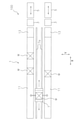
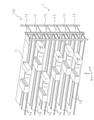
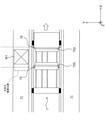
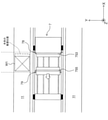
- Top view of automated warehouse Perspective view of the bogie and rack.
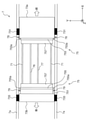
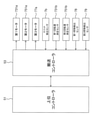
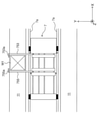
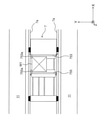
- Top view of the traveling bogie A functional block diagram showing the control configuration of an automated warehouse.
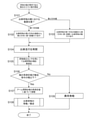
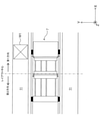
- a flowchart showing the operation of unloading luggage The figure which shows an example of the state which the traveling trolley has reached the position corresponding to the loading position of the leaving baggage.
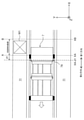
- the figure which shows an example of the state which the leaving baggage is pulled into a traveling trolley.
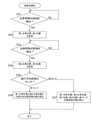
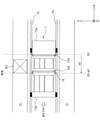
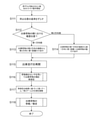
- a flowchart showing the measurement operation of the width of the delivered cargo The figure which shows an example which detected the rear end of the outgoing baggage by the 2nd baggage detection sensor.
- FIG. 1 is a top view of the automated warehouse 100
- FIG. 2 is a perspective view of a traveling carriage 7 and a rack 1.
- the left-right direction of FIG. 1 is referred to as the X direction
- the vertical direction of FIG. 1, that is, the direction orthogonal to the X direction and the horizontal direction is referred to as the Y direction
- FIG. 2 is perpendicular to the X direction and the Y direction.
- the vertical direction of is called the Z direction.
- the automated warehouse 100 includes a rack 1, an elevating / conveying device 3, an entry / exit station 5, a plurality of traveling carriages 7, and rails 7a.
- Rack 1 stores luggage W.
- the rack 1 has a plurality of shelves 11.
- the plurality of shelves 11 extend in the X direction and are arranged side by side at predetermined intervals in the Z direction. That is, the rack 1 is composed of a plurality of shelves 11.
- the luggage W is placed and stored on any of the plurality of shelves 11.
- a relay conveyor 13 is provided on each shelf 11.
- the relay conveyor 13 is provided in the vicinity of the elevating and transporting device 3, and the cargo W to be stored is transferred from the elevating and transporting device 3.
- the cargo W to be delivered is transferred from the traveling carriage 7.
- the rack 1 is arranged on both sides in the Y direction with respect to the traveling carriage 7 (rail 7a).
- the present invention is not limited to this, and the rack 1 may be arranged only on one side in the Y direction with respect to the traveling carriage 7 (rail 7a).
- the elevating transfer device 3 is arranged between the rack 1 and the warehousing / delivery station 5 and has an elevating table.
- the elevating table can be elevated and lowered in the Z direction in the elevating and lowering transfer device 3 while supporting a plurality of loads.
- the lift has, for example, a conveyor for transferring the luggage W between the warehousing / delivery station 5 and the relay conveyor 13 of the rack 1.
- the warehousing / delivery station 5 transports the cargo W stored (warehousing) on the shelf 11 of the rack 1 from the outside to the vicinity of the lifting / lowering transport device 3. Further, the warehousing / delivery station 5 transports the luggage W conveyed by the elevating / lowering transport device 3 for warehousing toward the outside.
- the warehousing / delivery station 5 is a transport device such as a belt conveyor.
- the rail 7a is a member provided on each shelf 11 of the rack 1 and extending in the X direction.
- the traveling carriage 7 provided on each shelf 11 is guided by the rail 7a provided on the corresponding shelf 11 and travels along the extension direction (X direction) of the shelf 11.
- the rail 7a is provided with a slit along the extension direction (X direction) of the rail 7a. This slit is detected by the slit detection sensor 7b (FIG. 4) provided on the traveling carriage 7.
- the slit detection sensor 7b is, for example, a photoelectric sensor or the like.
- traveling carriage (2-1) Outline of traveling carriage
- the traveling carriage 7 travels along the X direction at a height corresponding to the height of each shelf 11.
- the traveling carriage 7 travels along the X direction by being laid at a height corresponding to each shelf 11 and being guided by a rail 7a extending in the X direction.
- the traveling carriage 7 has a transfer device 75 (FIG. 3) for transferring the luggage W between the relay conveyor 13 of the rack 1 and the shelf 11.
- the traveling carriage 7 can carry the held luggage W in the X direction by traveling in the X direction along the shelf 11 with the luggage W held. Further, the luggage W can be transferred between the traveling carriage 7 and the relay conveyor 13 and between the traveling carriage 7 and the shelf 11 by using the transfer device provided on the traveling carriage 7.
- the traveling carriage 7 moves in the X direction to the target position of the shelf 11.
- the luggage W is transferred from the traveling carriage 7 to the shelf 11 at the target position.
- the traveling carriage 7 travels to a target position (referred to as warehousing travel) corresponding to the placement position on the shelf 11 of the luggage W (referred to as warehousing luggage W1) to be warehousing, and at the destination position.
- the luggage W is transferred from the shelf 11 to the traveling carriage 7.
- the traveling carriage 7 moves along the X direction to the arrangement position of the relay conveyor 13, and the luggage W is transferred from the traveling carriage 7 to the relay conveyor 13.
- FIG. 3 is a top view of the traveling carriage 7.
- the right side of the paper in FIG. 3 is defined as the positive direction of the X-axis (in FIG. 3, the direction of the arrow of the X-axis), and the opposite is defined as the negative direction of the X-axis.
- the positive side of the X-axis of the traveling carriage 7 is defined as the front side of the traveling carriage 7, and the negative direction side of the X-axis of the traveling carriage 7 is defined as the rear side of the traveling carriage 7.
- the traveling carriage 7 includes a pair of guide members 71, a first main body portion 73a, a second main body portion 73b, and a transfer device 75.
- the pair of guide members 71 are long members in the X direction arranged at predetermined intervals in the Y direction, and guide the movement of the frame 751 (second arm 755) of the transfer device 75.
- the first main body portion 73a is provided at the end of the pair of guide members 71 on the positive direction side of the X axis, and constitutes the main body of the traveling carriage 7 on the positive direction side in the X direction.
- Wheels 731 are provided at both ends of the first main body portion 73a in the Y direction. The wheels 731 rotate by the rotation of the first motor 731a (FIG. 4), so that the traveling carriage 7 travels along the rail 7a.
- the first motor 731a is provided with a first rotation amount measuring sensor 731b (FIG. 4) that measures the rotation amount of the wheel 731.
- the first rotation amount measuring sensor 731b is, for example, an encoder.
- the second main body portion 73b is provided at the end of the pair of guide members 71 on the negative direction side in the X direction, and constitutes the main body on the negative direction side in the X direction of the traveling carriage 7.
- a driven wheel 733 is provided at both ends of the second main body portion 73b in the Y direction. The driven wheel 733 rotates on the rail 7a as the traveling carriage 7 travels.
- the transfer device 75 is a device for transferring the luggage W between the traveling carriage 7 and the relay conveyor 13 and between the traveling carriage 7 and the shelf 11. Is. In the present embodiment, the transfer device 75 is provided between the first main body portion 73a and the second main body portion 73b in the upper part of the pair of guide members 71 of the traveling carriage 7.
- the transfer device 75 includes a frame 751, a first arm 753, a second arm 755, and a pair of mounting members 757.
- the frame 751 is slidably provided on the pair of guide members 71, and is movable in the X direction between the first main body portion 73a and the second main body portion 73b. Specifically, a ball screw 76 having a thread formed over almost the entire area in the X direction is screwed into the frame 751.
- the traveling carriage 7 is provided with a second motor 751a (FIG. 4) for rotating the ball screw 76.
- the second motor 751a (FIG. 4) can move the frame 751 along the X direction (extension direction of the shelf 11) by rotating the ball screw 76.
- the second motor 751a is provided with a second rotation amount measuring sensor 751b (FIG. 4) that measures the rotation amount of the ball screw 76.
- the second rotation amount measuring sensor 751b is, for example, an encoder.
- the first arm 753 expands and contracts in the Y direction with respect to the first main body 73a by an arm rail (not shown) provided on the first main body 73a.
- the first arm 753 is fixed on the first main body portion 73a side (front side of the traveling carriage 7) and is immovable in the X direction.
- the first arm 753 is provided with a member (not shown) that meshes with the spline of the spline member 77 extending in the X direction.
- the traveling carriage 7 is provided with a third motor 77a (FIG. 4) for rotating the spline member 77. By rotating the spline member 77, the third motor 77a can move (expand / contract) the first arm 753 in the Y direction.
- the first arm 753 can be expanded and contracted in the positive direction of the Y axis (the direction of the arrow on the Y axis in FIG. 3) and the opposite negative direction. As a result, the transfer device 75 can transfer the luggage W to and from any of the shelves 11 arranged across the rail 7a.
- Hooks 753a are rotatably provided around an axis extending in the Y direction at both ends of the first arm 753 in the Y direction.
- the hook 753a rotates with respect to the first arm 753 so that its length direction is directed to the X direction, and hooks the luggage W from behind the first arm 753.
- the hook 753a is in a state where its length direction is directed to the Z direction, as shown in FIG.
- the second arm 755 is provided on the frame 751 and moves along the X direction according to the movement of the frame 751 along the X direction. That is, the second arm 755 can move along the X direction on the second main body portion 73b side, that is, on the rear side of the traveling carriage 7.
- the second arm 755 expands and contracts in the Y direction with respect to the frame 751 by an arm rail (not shown) provided on the frame 751.
- the second arm 755 is provided with a member (not shown) that meshes with the spline of the spline member 77 extending in the X direction.
- the spline member 77 is used as a third motor 77a (FIG. By rotating according to 4), the second arm 755 can be moved (expanded / contracted) in the Y direction together with the first arm 753.
- Hooks 755a are rotatably provided around an axis extending in the Y direction at both ends of the second arm 755 in the Y direction.
- the hook 755a rotates with respect to the second arm 755 so that its length direction is directed to the X direction, and hooks the luggage W from behind the second arm 755.
- the hook 755a is in a state where its length direction is directed to the Z direction, as shown in FIG.
- One of the pair of mounting members 757 is arranged on the first arm 753 side and the other is arranged on the second arm 755 side on the pair of guide members 71.
- the pair of mounting members 757 are members for mounting the luggage W transferred to the transfer device 75.
- the second arm 755 is moved in the X direction based on the width of the luggage W to be transferred, and the first arm 753 and the first arm 753 are transferred.
- the distance between the two arms 755 (referred to as the arm distance) is adjusted, and then the length directions of the hooks 753a and 755a are directed to the X direction. That is, the hooks 753a and 755a are closed.
- the luggage W is present between the first arm 753 and the second arm 755, the hooks 753a and 755a are closed, and the first arm 753 and the second arm 755 are both pulled into the transfer device 75 side. Can be reprinted.
- the traveling carriage 7 further includes a sensor for measuring the width of the delivered baggage W1 in the X direction when executing a warehousing run for the delivered baggage W1 to be delivered from the shelf 11. .
- the traveling carriage 7 has a first baggage detection sensor 78 (an example of a first sensor) for detecting a baggage W placed on a shelf 11 and a second baggage detection sensor 79 (an example of a second sensor). And further prepare.
- the first baggage detection sensor 78 is provided on the first arm 753 side. Specifically, the first baggage detection sensor 78 is attached to a position adjacent to the first arm 753 in the first main body portion 73a. In the present embodiment, the first baggage detection sensor 78 is provided at both ends of the first main body portion 73a in the Y direction, and the baggage placed on any of the pair of shelves 11 arranged across the rail 7a. W can be detected.
- the first baggage detection sensor 78 is an optical reflection type sensor such as a photoelectric sensor.
- the first baggage detection sensor 78 detects the baggage W by emitting visible light or infrared light in the Y direction and receiving the reflected light from the baggage W. If the light does not hit the luggage W, the first luggage detection sensor 78 does not receive the reflected light.
- the second baggage detection sensor 79 is provided on the second arm 755 side. Specifically, the second baggage detection sensor 79 is attached to the frame 751 at a position adjacent to the second arm 755, and can move in the X direction together with the second arm 755. In the present embodiment, the second baggage detection sensor 79 is provided at both ends of the first main body portion 73a in the Y direction, and the baggage placed on any of the pair of shelves 11 arranged across the rail 7a. W can be detected.
- the second baggage detection sensor 79 is an optical reflection type sensor such as a photoelectric sensor.
- the second baggage detection sensor 79 detects the baggage W by emitting visible light or infrared light in the Y direction and receiving the reflected light from the baggage W, for example. If the light does not hit the luggage W, the second luggage detection sensor 79 does not receive the reflected light.
- FIG. 4 is a functional block diagram showing a control configuration of the automated warehouse 100.
- the automated warehouse 100 has an upper controller 51 and a transfer controller 53 (an example of a lower controller).
- the upper controller 51 is a controller that manages the storage and loading / unloading of the luggage W in the automated warehouse 100.
- the host controller 51 transmits, for example, a transport command for instructing the traveling carriage 7 to transport the cargo W to the transport controller 53 based on a schedule for managing the loading and unloading of the cargo W.
- the transport command includes information on the width of the cargo W to be loaded and unloaded in the X direction, information on the placement position of the cargo W on the shelf 11, and the like.
- the host controller 51 has a processor (for example, a CPU), a storage device (for example, ROM, RAM, HDD, SSD, etc.), and various interfaces (for example, an A / D converter, a D / A converter, a communication interface, etc.). It is a computer system.
- the host controller 51 may perform control operations in various places by executing a program stored in the storage unit (corresponding to a part or all of the storage area of the storage device), or may perform some control operations on these controllers. It may be realized by the included hardware.
- the host controller 51 may be realized by one computer system, or each may be realized by an individual computer system.
- the transport controller 53 is a device provided on each traveling carriage 7 and controls the traveling carriage 7 based on a transport command from the host controller 51. Communication between the host controller 51 and the carrier controller 53 is performed via wireless communication.
- the first motor 731a of the traveling carriage 7, the second motor 751a of the transfer device 75, and the third motor 77a of the transfer device 75 are connected to the transfer controller 53.
- the transfer controller 53 can control these motors based on the transfer command.
- the slit detection sensor 7b and the first rotation amount measurement sensor 731b are connected to the transport controller 53.
- the transport controller 53 can receive output signals from these sensors.
- the transport controller 53 determines the position of the traveling carriage 7 in the X direction based on the detection result of the slit detected by the slit detection sensor 7b and the rotation amount of the wheel 731 measured by the first rotation amount measurement sensor 731b. To grasp.
- the second rotation amount measuring sensor 751b is connected to the transport controller 53.
- the transfer controller 53 can receive the output signal from the second rotation amount measuring sensor 751b.
- the transport controller 53 grasps the position of the frame 751 (second arm 755) on the traveling carriage 7 based on the rotation amount of the ball screw 76 measured by the second rotation amount measuring sensor 751b.
- the first baggage detection sensor 78 and the second baggage detection sensor 79 are connected to the transport controller 53.
- the transport controller 53 can receive output signals from these sensors.
- the transport controller 53 calculates the width of the luggage W based on the detection result of the luggage W by the first luggage detection sensor 78 or the second luggage detection sensor 79 and the position of the traveling carriage 7 in the X direction.
- the transfer controller 53 has a processor (for example, a CPU), a storage device (for example, ROM, RAM, HDD, SSD, etc.), and various interfaces (for example, an A / D converter, a D / A converter, a communication interface, etc.). It is a computer system.
- the transfer controller 53 may perform each control operation by executing a program stored in the storage unit (corresponding to a part or all of the storage area of the storage device), or may perform some control operations on these controllers. It may be realized by the included hardware.
- the transport controller 53 may be realized by one computer system, or each may be realized by an individual computer system.
- control configuration of the automated warehouse 100 is provided with an individual controller that connects the elevating transfer device 3 and the warehousing / delivery station 5 and controls them. Further, although not shown, a sensor and a switch for detecting the state of each device and an information input device are connected to the host controller 51 and / or the transport controller 53.
- the transport controller 53 is not provided on the traveling carriage 7, and may be a computer system separate from the traveling carriage 7.
- a motor controller for controlling the first motor 731a, the second motor 751a, and the third motor 77a is provided on the traveling trolley 7, and each sensor of the transport controller 53 and the traveling trolley 7 and the motor controller are provided via wireless communication. You may send and receive signals to and from.
- FIG. 5 is a flowchart showing the delivery operation of the cargo W.
- the transport command for instructing the delivery of the luggage W is transmitted from the upper controller 51 to the transport controller 53 of the traveling carriage 7 provided corresponding to the shelf 11 on which the leaving luggage W1 is placed, the traveling is concerned.
- the dolly 7 starts the warehousing operation.
- the transport controller 53 causes the traveling trolley 7 to unload the trolley 7 to a position corresponding to the placement position on the shelf 11 of the warehousing baggage W1 in step S1.
- the position corresponding to the loading position of the delivered luggage W1 on the shelf 11 is the stop position of the traveling carriage 7 at the time of warehousing of the delivered luggage W1, and is the X direction of the first arm 753 (first luggage detection sensor 78). It is determined by the positional relationship between the position in the box and the end of the delivered baggage W1 on the positive direction side in the X direction.
- the transport controller 53 which has received the transport command when starting the delivery travel, moves the second arm 755 in the X direction based on the information regarding the width of the delivery baggage W1 included in the received transport command in step S2. , The arm spacing between the first arm 753 and the second arm 755 is changed.
- the transfer controller 53 moves the second arm 755 so that the arm spacing is larger than the value shown in the information regarding the width of the delivered luggage W1 by a predetermined amount.
- Information on the width of the goods to be delivered W1 may be obtained, for example, by extracting the information on the width of the goods to be delivered W1 from the master data including the information on the width of each luggage W, or the width of the goods to be delivered W1 at the time of warehousing. It may be obtained by diverting the information about.
- the predetermined amount of the arm spacing is a size that causes a slight gap between the delivery baggage W1 and the arm, and can be set to, for example, 15 mm.
- the transport controller 53 measures the width of the warehousing baggage W1 using either the first baggage detection sensor 78 or the second baggage detection sensor 79 in step S3.
- the measurement of the width of the delivered baggage W1 is performed by using the baggage detection sensor existing on the front side of the first baggage detection sensor 78 and the second baggage detection sensor 79 in the traveling direction in which the trolley travels due to the unloading travel. The measurement of the width of the delivered baggage W1 will be described in detail later.
- the transport controller 53 After measuring the width of the delivered baggage W1, the transport controller 53 uses the measured value of the width of the delivered baggage W1 measured by the baggage detection sensor in step S4 as the information regarding the width of the delivered baggage W1 included in the transport command. Determine if there is a large deviation from the indicated width value.
- the first predetermined value is, for example, a value such that the first arm 753 and / or the second arm 755 does not interfere with the cargo W adjacent to the cargo W1 and / or the pillar of the shelf 11, or a few percent of the cargo W1. It can be a value of degree.
- the transport controller 53 When the absolute value of the difference is larger than the first predetermined value (“No” in step S4), the transport controller 53 has the measured value of the width of the delivered baggage W1 as the width shown in the information regarding the width of the delivered baggage W1. It is judged that there is a large deviation from the value. In this case, the delivery operation of the delivery baggage W1 proceeds to the retry operation in step S10. As will be described later, in the retry operation, a remeasurement of the width of the delivered baggage W1 and a predetermined operation based on the remeasurement result are executed.
- step S4 when the absolute value of the difference between the measured value of the width of the goods to be delivered W1 and the width value shown in the information regarding the width of the goods to be shipped W1 is equal to or less than the first predetermined value (“Yes” in step S4), the transport is carried out.
- the controller 53 determines that the measured value of the width of the delivered baggage W1 is close to the width value shown in the information regarding the width of the delivered baggage W1.
- the transport controller 53 When it is determined that the measured value of the width of the delivered baggage W1 is close to the width value shown in the information regarding the width of the delivered baggage W1, the transport controller 53 actually mounts the delivered baggage W1 on the shelf 11 in step S5. It is determined whether or not the placement position is deviated from a predetermined position (for example, the placement position on the shelf 11 of the delivered baggage W1 indicated in the transport command).
- Whether or not the actual loading position of the delivered baggage W1 is deviated from the predetermined position is determined by, for example, the position in the X direction of the baggage detection sensor on the front side in the traveling direction at the timing when the rear end of the delivered baggage W1 is detected. It can be determined by whether or not the position of the front end of the delivered baggage W1 calculated based on the information included in the transport command deviates from the position in the X direction.
- step S5 When it is determined that the actual loading position of the delivery baggage W1 on the shelf 11 is deviated from the predetermined position (“Yes” in step S5), the delivery operation of the delivery baggage W1 proceeds to the retry operation of step S10.
- the measured value of the width of the delivered baggage W1 is close to the width value shown in the information regarding the width of the delivered baggage W1 (“Yes” in step S4), and the actual placement position of the delivered baggage W1 on the shelf 11 is When it is determined that the position does not deviate from the predetermined position (“No” in step S5), the delivery baggage W1 is transferred from the shelf 11 to the traveling carriage 7.
- FIG. 6A is a diagram showing an example of a state in which the traveling carriage 7 has reached a position corresponding to the loading position of the delivery baggage W1.
- FIG. 6B is a diagram showing an example of a state in which the first arm 753 and the second arm 755 are extended toward the delivery baggage W1.
- FIG. 6C is a diagram showing an example of a state in which the hooks 753a and 755a are operated.
- FIG. 6D is a diagram showing an example of a state in which the delivery baggage W1 is pulled into the traveling carriage 7.
- the transport controller 53 executes the above step S2 in step S6 to adjust the current arm spacing. And, while maintaining the positions of the first arm 753 and the second arm 755, the first arm 753 and the second arm 755 are extended toward the delivery baggage W1. In the example shown in FIG. 6A, the first arm 753 and the second arm 755 are extended in the positive direction of the Y axis.
- the warehousing position and the unloading position of the luggage W are determined based on the fixed first arm 753. Therefore, whether or not the traveling carriage 7 has reached the position corresponding to the loading position of the delivered luggage W1 is determined by the position of the first arm 753 in the X direction.
- the transfer controller 53 After extending the first arm 753 and the second arm 755 in the positive direction of the Y axis, the transfer controller 53 sets the hooks 753a and 755a in the length direction of the hooks 753a and 755a with the first arm 753 and the second arm 755 in step S7.
- the hooks 753a and 755a are closed as shown in FIG. 6C toward the direction of the space between them.
- the transfer controller 53 pulls the first arm 753 and the second arm 755 toward the traveling carriage 7 in step S8, thereby pushing the delivery baggage W1 by the hooks 753a and 755a. Pull in toward the traveling carriage 7.
- the delivery baggage W1 can be transferred to the traveling carriage 7 (transfer device 75).
- the transport controller 53 causes the traveling carriage 7 on which the delivery baggage W1 is placed to travel along the X direction to the arrangement position of the relay conveyor 13 in step S9 to relay.
- the delivery baggage W1 is conveyed to the arrangement position of the conveyor 13.
- the transfer device 75 transfers the delivery baggage W1 from the traveling carriage 7 to the relay conveyor 13, so that the delivery baggage W1 is delivered.
- the arm distance between the first arm 753 and the second arm 755 is first adjusted to be larger than the width of the delivery baggage W1 by a predetermined amount. After that, the delivery baggage W1 is pulled in by moving the first arm 753 and the second arm 755 forward and backward in the Y direction while maintaining the adjusted arm spacing. This eliminates the need to move the arm to sandwich the delivery baggage W1 when the delivery baggage W1 is to be delivered, and to move the arm again to secure a gap between the delivery baggage W1 and the arm. Therefore, it is possible to shorten the time required for transferring the delivery baggage W1 at the time of delivery.
- the width of the delivered luggage W1 is measured by using the luggage detection sensor on the front side in the traveling direction of the traveling carriage 7 while the traveling carriage 7 is traveling to the position corresponding to the loading position of the leaving luggage W1. Will be executed.
- the traveling direction of the traveling carriage 7 refers to the direction in which the traveling carriage 7 travels by leaving the warehouse. Specifically, when the delivery baggage W1 is on the positive direction side of the X axis with respect to the current position of the traveling carriage 7, the traveling direction is the positive direction of the X axis. On the other hand, when the delivery baggage W1 is on the negative direction side of the X axis with respect to the current position of the traveling carriage 7, the traveling direction is the negative direction of the X axis.
- Whether the traveling direction becomes the positive direction or the negative direction of the X-axis as a result of the warehousing travel is determined by, for example, the position of the unloading baggage W1 included in the transport command relative to the traveling trolley 7, and the wheels during the warehousing travel. It can be determined based on the rotation direction of 731.
- the luggage detection sensor on the front side of the traveling vehicle 7 in the traveling direction is the first luggage detection sensor 78.
- the luggage detection sensor on the front side of the traveling vehicle 7 in the traveling direction is the second luggage detection sensor 79.
- FIG. 7 is a flowchart showing a measurement operation of the width of the delivered baggage W1.
- the transport controller 53 determines in step S31 whether or not the luggage detection sensor existing on the front side in the traveling direction due to the traveling out of the garage has detected the rear end of the outbound cargo W1.
- the rear end of the warehousing baggage W1 is an end existing on the opposite side of the traveling direction of the traveling trolley 7 due to the unloading traveling when viewed from the traveling trolley 7 during the unloading traveling. Therefore, when the cargo to be delivered W1 is detected by the cargo detection sensor existing on the front side in the traveling direction, the rear end of the cargo to be delivered W1 is detected first.
- the timing at which the baggage detection sensor existing on the front side in the traveling direction first detects the reflected light from the delivery baggage W1 is the delivery baggage. It is the timing when the rear end of W1 is detected.
- the rising timing of the output signal from the baggage detection sensor is the timing at which the rear end of the delivered baggage W1 is detected.
- the transport controller 53 runs at the timing when the rear end of the delivered cargo W1 is detected in step S32.
- the position of the carriage 7 (referred to as the first carriage position) and the position of the second arm 755 in the traveling carriage 7 (referred to as the first position) at the relevant timing are acquired.
- the transport controller 53 further determines in step S33 whether or not the cargo detection sensor existing on the front side in the traveling direction has detected the front end of the delivered cargo W1.
- the front end of the delivery baggage W1 is an end existing on the traveling direction side of the traveling carriage 7 due to the leaving traveling when viewed from the traveling carriage 7 during the leaving travel. Therefore, when the cargo to be delivered W1 is detected by the luggage detection sensor existing on the front side in the traveling direction, the front end of the cargo to be delivered W1 is detected last.
- the timing at which the baggage detection sensor existing on the front side in the traveling direction stops detecting the reflected light from the delivery baggage W1 is the time when the delivery baggage is not detected. It is the timing when the rear end of W1 is detected. More specifically, for example, the falling timing of the output signal from the baggage detection sensor is the timing at which the front end of the delivered baggage W1 is detected.
- the transport controller 53 detects the front end of the delivered baggage W1 in step S34.
- Position (referred to as the second carriage position) and the position of the second arm 755 in the traveling carriage 7 (referred to as the second position) at the relevant timing.
- the transport controller 53 After acquiring the first trolley position and the first position at the timing when the rear end of the warehousing baggage W1 is detected and the second dolly position and the second position at the timing when the front end of the unloading baggage W1 is detected, the transport controller 53 uses these.
- the width of the delivered baggage W1 is calculated using the position information.
- the transport controller 53 determines in step S35 whether the baggage detection sensor existing on the front side in the traveling direction is the first baggage detection sensor 78 or the second baggage detection sensor 79. judge.
- the position of the first baggage detection sensor 78 on the traveling carriage 7 does not change, so that after the delivered baggage W1.
- the distance traveled by the traveling carriage 7 from the detection of the end to the detection of the front end coincides with the distance from the rear end to the front end of the delivered luggage W1, that is, the width of the delivered luggage W1.
- the transport controller 53 determines the delivered baggage W1 in step S36.
- the distance traveled by the traveling carriage 7 from the detection of the rear end to the detection of the front end, that is, the difference between the position of the first carriage and the position of the second carriage is calculated as the width of the delivered baggage W1.
- the position of the first baggage detection sensor 78 on the traveling carriage 7 can change, so that the baggage to be delivered is delivered.
- the distance traveled by the traveling carriage 7 from the detection of the rear end of W1 to the detection of the front end does not necessarily match the width of the delivered luggage W1.
- the transport controller 53 uses the first trolley in step S37.
- the position (first position) of the second arm 755 in the traveling trolley 7 when the rear end of the unloading baggage W1 is detected, and the front end of the unloading baggage W1 are detected.
- the width of the delivered luggage W1 is calculated in consideration of the position (second position) of the second arm 755 on the traveling carriage 7.
- the reference position of the traveling carriage 7 is the mounting position of the first luggage detection sensor 78
- the position of the second arm 755 in the traveling carriage 7 is the X direction (X) of the second luggage detection sensor 79 with respect to the reference position. It is defined as the position in the negative direction of the axis)
- the reference position of the traveling carriage 7 (first carriage position) is X1
- the position of the second arm 755 in the traveling carriage 7 (first position) the reference position of the traveling carriage 7.
- the position of the rear end of the delivered baggage W1 in the X direction can be calculated as X1-a1.
- FIG. 8A is a diagram showing an example of a state in which the rear end of the delivered baggage W1 is detected by the second baggage detection sensor 79.
- FIG. 8B is a diagram showing an example of a state in which the front end of the delivered baggage W1 is detected by the second baggage detection sensor 79.
- the width of the delivered baggage W1 can be calculated as the difference between the position of the front end and the position of the rear end of the delivered baggage W1. Therefore, the width of the delivered baggage W1 in the case shown in FIGS. 8A and 8B can be calculated as an absolute value of (X2-a2)-(X1-a1).
- the formula (X2-a2)-(X1-a1) representing the width of the delivered baggage W1 can be rewritten as (X2-X1)-(a2-a1).
- X2-X1 corresponds to the amount of movement of the traveling carriage 7 from the detection of the rear end of the delivered luggage W1 to the detection of the front end.
- a2-a1 corresponds to the amount of movement of the second arm 755 from the detection of the rear end of the delivered luggage W1 to the detection of the front end. Therefore, the width of the delivered luggage W1 can also be expressed as the difference between the moving amount of the traveling carriage 7 and the moving amount of the second arm 755 from the detection of the rear end of the delivered luggage W1 to the detection of the front end.
- the width of the delivered luggage W1 can be measured even when the distance between the and is changed.
- the distance from the start of the warehousing run to the start of the measurement of the warehousing baggage W1 completes the movement of the second arm 755 in the X direction.
- the width of the delivered baggage W1 is used by using the first baggage detection sensor 78 or the second baggage detection sensor 79 existing on the front side in the traveling direction in which the traveling carriage 7 travels by leaving the garage. Can be measured accurately.
- the traveling direction of the traveling carriage 7 is known at the stage before measuring the width of the delivered luggage W1, the first luggage detection sensor 78 or the second luggage detection sensor 79 is used before measuring the width of the leaving luggage W1. It can be determined which one is used to measure the width of the delivered baggage W1. Therefore, if it is determined that the width of the delivered baggage W1 is measured by using the first baggage detection sensor 78 before the width of the delivered baggage W1 is measured, the transport controller 53 determines the first position in the above step S32. It is not necessary to acquire the second position in the above step S34 without acquiring it.
- the retry operation executed in step S10 of FIG. 5 will be described in detail.
- the retry operation is executed when there is a discrepancy between the result of measuring the width of the delivered cargo W1 using the baggage detection sensor and the information indicated in the transport command.
- the retry operation includes a remeasurement of the width of the delivered baggage W1 and a predetermined operation based on the remeasurement result.
- the retry operation when the measurement result of the width of the delivered baggage W1 deviates from the width value indicated in the transport command and the retry operation when the load deviation is detected will be described separately.
- FIG. 9 is a flowchart showing a retry operation when the measurement result of the width of the delivered baggage W1 deviates from the width value indicated in the transport command.
- the positive direction of the X axis as shown in FIG. 3 is referred to as a "first direction”
- the negative direction of the X axis opposite to the first direction is referred to as a "second direction”.
- the retry operation starts from the remeasurement of the width of the delivered baggage W1.
- the transport controller 53 moves the traveling carriage 7 to a position outside the loading position of the delivered baggage W1 for which the width is re-measured.
- the delivery baggage W1 for re-measuring the width is in the second direction of the shelf 11 with respect to the layout center of the entire shelf 11 (for example, an intermediate position in the extension direction of the shelf 11) as shown in FIG. 10A. Is it placed closer to the first-direction end of the shelf 11 than the side end, or as shown in FIG. 10B, the shelf 11 is closer to the first-direction end of the shelf 11.
- FIG. 10A is a diagram showing an example of a state in which the delivery baggage W1 is placed closer to the end of the shelf 11 on the first direction side than the end of the shelf 11 on the second direction side.
- FIG. 10B is a diagram showing an example of a state in which the delivery baggage W1 is placed closer to the end of the shelf 11 on the second direction side than the end of the shelf 11 on the first direction side.
- step S101 the transport controller 53 first refers to the transport command, and the delivery baggage W1 for which the width is remeasured is the end portion of the shelf 11 on the second direction side with respect to the layout center of the entire shelf 11. Is it placed closer to the end of the shelf 11 on the first direction side, or is it placed closer to the end on the second direction side than the end of the shelf 11 on the first direction side? Is determined.
- the transport controller 53 causes the traveling carriage 7 to travel in the second direction by the first distance d1 from the end side of the leaving luggage W1 in the second direction in step S102.
- the first distance d1 may be any distance as long as the baggage detection sensor used for re-measuring the width of the delivered baggage W1 is located outside the delivered baggage W1. Further, the position (XA) in the X direction of the boundary A on the second direction side of the scanning detection range of the delivered baggage W1 may coincide with the position in the X direction of the baggage detection sensor used for remeasurement.
- FIG. 11A is a diagram showing an example of a state in which the traveling carriage 7 is traveled in the second direction when the width of the delivered luggage W1 is remeasured.
- the position in the X direction of the boundary A on the second direction side of the scanning detection range of the delivered baggage W1 is XA
- the position in the X direction of the first baggage detection sensor 78 in the X direction of the traveling carriage 7.
- the traveling carriage 7 is driven in the second direction until the position) becomes XA-d1.
- the scanning detection range of the luggage W is defined as the range of the position of the traveling carriage 7 in which the luggage W can be detected by the luggage detection sensor.
- the luggage W of the same size category is placed on one shelf 11. Further, since the scanning detection range is determined by the size classification of the luggage W placed on the shelf 11, the scanning detection range of the same range is defined for one shelf 11.
- the first baggage detection sensor 78 detects scanning of the delivered baggage W1. It is arranged at a position separated in the second direction by the first distance d1 from the boundary A on the second direction side of the range. As a result, the first baggage detection sensor 78 is located at a position further shifted to the second direction side from the end portion of the delivered baggage W1 on the second direction side. That is, the first distance d1 is the distance at which the first baggage detection sensor 78 exists on the second direction side from the end on the second direction side of the delivered baggage W1 when the traveling carriage 7 is moved in the second direction. Corresponds to.
- the transport controller 53 relates the traveling carriage 7 to the width of the delivered luggage W1 included in the transport command in the first direction from the end side of the first direction of the delivered luggage W1 in step S103. Only the distance corresponding to the sum of the width value shown in the information and the above-mentioned first distance d1 is traveled.
- FIG. 11B is a diagram showing an example of a state in which the traveling carriage 7 is traveled in the first direction when the width of the delivered luggage W1 is remeasured.
- the traveling carriage 7 is driven in the first direction to a position where the position in the X direction of the first baggage detection sensor 78 (the position in the X direction of the traveling carriage 7) is XB + d1 + d2.
- the traveling carriage 7 moves in the first direction until the position of the first baggage detection sensor 78 in the X direction becomes XB + d1 + d2, the second baggage detection sensor 79 is in the scanning detection range of the delivered baggage W1.
- the packaged goods W1 exists at a position further shifted to the first direction side from the end portion on the first direction side. It will be.
- the transport controller 53 While traveling in the first direction of the traveling carriage 7, the transport controller 53 moves the second arm 755, and the arm distance between the first arm 753 and the second arm 755 is included in the transport command. Match the width value shown in the information about the width of the goods to be delivered W1.
- the traveling carriage 7 can be moved in the direction opposite to the end side of the shelf 11 on which the delivered luggage W1 is placed.
- the width of the delivered luggage W1 can be remeasured while preventing the traveling carriage 7 from further moving toward the other end of the shelf 11.
- the traveling carriage 7 is used for the remeasurement. Assuming that the shelves are moved in one direction, as shown in FIG. 12, the traveling carriage 7 travels beyond the end portion of the shelf 11 on the first direction side. In this case, the area where the luggage W on the shelf 11 can be placed (the end on the first direction side) so that the traveling carriage 7 can further travel in the first direction beyond the end on the first direction side of the shelf 11. ), It is necessary to provide a rail 7a that extends further in the first direction. FIG.
- the transport controller 53 moves the traveling carriage 7 from that position to the position corresponding to the loading position of the delivered luggage W1 in step S104. Run 7 out of the warehouse.
- the delivery run executed in step S104 is executed at a lower running speed than the normal delivery run executed in step S3.
- the traveling carriage 7 is further placed from the end on the second direction side of the delivery baggage W1. Since it exists on the second direction side, the traveling carriage 7 travels out of the warehouse with the first direction as the traveling direction.
- the traveling carriage 7 is further placed from the end of the delivery baggage W1 on the first direction side. Since it exists on the first direction side, the traveling carriage 7 travels out of the warehouse with the second direction as the traveling direction.
- step S104 While the delivery is running in step S104, the transport controller 53 executes the above steps S31 to S37 in step S105 to remeasure the width of the delivery baggage W1 using the baggage detection sensor.
- the traveling carriage 7 travels with the first direction as the traveling direction. 1
- the width of the delivered baggage W1 is remeasured using the baggage detection sensor 78.
- the traveling bogie 7 travels with the second direction as the traveling direction. 2
- the width of the delivered baggage W1 is remeasured using the baggage detection sensor 79.
- the transport controller 53 executes a predetermined operation based on the remeasurement result of the width of the delivered baggage W1. Specifically, the transport controller 53 executes different processing depending on whether the remeasured value of the width of the delivered package W1 is larger or smaller than the width value shown in the information regarding the width of the delivered package W1 included in the transport command. Therefore, after executing the remeasurement of the width of the delivered baggage W1, the transfer controller 53 determines in step S106 that the remeasured value of the width of the delivered baggage W1 is the width value indicated in the information regarding the width of the delivered baggage W1 included in the transport command. Determine if it is larger or smaller.
- the transport controller 53 adjusts the arm spacing to the first spacing by a predetermined amount larger than the value shown in the information regarding the width of the delivered baggage W1 by executing the above step S2 in step S107. Then, the second arm 755 is moved to adjust the arm distance between the first arm 753 and the second arm 755 so as to be larger than the width of the remeasured delivery baggage W1 by the above-mentioned predetermined amount.
- step S108 the transfer controller 53 executes the above steps S6 to S9, and maintains the arm spacing between the first arm 753 and the second arm 755 at the spacing adjusted in step S107, while the delivery load W1 Is pulled into the traveling trolley 7 side and reprinted.
- step S2 of FIG. 5 is executed and the arm spacing is set to the first spacing which is larger than the value shown in the information regarding the width of the unloading baggage W1 included in the transport command by a predetermined amount. Then, from the state where the arm spacing is adjusted to the first spacing, the arm spacing is adjusted to be larger than the width of the delivered baggage W1 shown in the remeasurement result by a predetermined amount, so that the remeasurement result is obtained. Based on this, the moving distance of the second arm 755 when adjusting the arm spacing can be shortened.
- the time from the completion of the measurement of the width of the delivered luggage W1 to the stop of the traveling carriage 7 is shortened.
- the delivery baggage W1 can be transferred immediately after the traveling carriage 7 is stopped. This is because by shortening the moving distance of the second arm 755, the time from the completion of the remeasurement of the width of the delivered luggage W1 to the completion of the adjustment of the arm spacing can be shortened.
- the transfer controller 53 issues an abnormality in step S109.
- the transport controller 53 issues an abnormality by, for example, turning on an alarm lamp, generating a warning sound, or displaying a warning on a predetermined display screen.
- the processing differs depending on whether the actual width of the delivered baggage W1 by remeasurement is larger or smaller than the width indicated in the transport command for the following reasons.
- the arm spacing is adjusted according to the remeasured value of the width of the delivered baggage W1 and the first is directed toward the delivered baggage W1. Even if the 1st arm 753 and the 2nd arm 755 are extended, the 1st arm 753 and the 2nd arm 755 do not interfere with the other luggage W placed adjacent to the delivery luggage W1. Therefore, the delivery baggage W1 can be safely transferred from the shelf 11 to the traveling carriage 7.
- the arm spacing is adjusted according to the remeasured value of the width of the delivered baggage W1 toward the delivered baggage W1.
- the first arm 753 and the second arm 755 may interfere with other luggage W placed adjacent to the delivery luggage W1. Therefore, it is not possible to safely transfer the delivery baggage W1 from the shelf 11 to the traveling carriage 7. Therefore, by issuing an abnormality when the actual width of the delivered baggage W1 by remeasurement is larger than the width indicated in the transport command, for example, whether or not a large baggage W is erroneously placed or not, the baggage.
- the user can check whether or not an abnormality has occurred in the detection sensor.
- the transport controller 53 increases the arm spacing by a predetermined amount from the width of the delivered luggage W1 (width by remeasurement) without notifying the abnormality, and executes the transfer of the delivered luggage W1. May be good.
- FIG. 13 is a flowchart showing a retry operation when a load misalignment is detected.
- the transfer controller 53 sets the reference of the stop position of the traveling carriage 7 when executing the transfer of the delivered baggage W1 in step S111 to the detected delivered baggage W1. Shift by a certain amount in the shift direction.
- the reference of the stop position when executing the transfer of the delivery baggage W1 is the end on the first direction side of the delivery baggage W1 placed at an appropriate position on the shelf 11 and the first arm 753 (first baggage detection sensor). It is determined by the positional relationship with 78).
- the first arm 753 (first baggage detection sensor 78) is located at an appropriate position on the shelf 11 rather than the end portion of the delivered baggage W1 in the first direction. Further, it exists on the first direction side, and the width of the delivered baggage W1 in the X direction is included between the position of the first baggage detection sensor 78 in the X direction and the position of the second baggage detection sensor 79 in the X direction.
- the stop position of the traveling carriage 7 at that time can be defined as a reference.
- FIG. 14 is a diagram schematically showing the definition of the reference of the stop position.
- the transport controller 53 After shifting the reference of the stop position in the deviation direction of the leaving baggage W1, the transport controller 53 again, for example, runs the traveling carriage 7 to detect the rear end of the leaving baggage W1 by the baggage detection sensor on the front side in the traveling direction. , It is determined whether or not the actual placement position of the delivered baggage W1 on the shelf 11 is deviated from the predetermined position. The determination of whether or not the delivery baggage W1 is deviated from the predetermined position is executed at a lower running speed than the normal delivery running.
- the transport controller 53 sends the measurement result of the width of the delivered baggage W1 to the transport command in steps S112 to S114.
- the traveling carriage 7 is moved in either the first direction or the second direction by a predetermined distance.
- the transfer controller 53 is set in step S112.
- the traveling trolley 7 is driven by the first distance d1 in the second direction from the end side of the leaving baggage W1 in the second direction.
- the transport controller 53 uses the traveling carriage 7 in step S113.
- the transport controller 53 uses the traveling carriage 7 in step S113.
- the transport controller 53 After moving the traveling carriage 7 to an appropriate position by executing steps S111 to S114, the transport controller 53 causes the traveling carriage 7 to leave and travel from that position to a position corresponding to the loading position of the delivery baggage W1 in step S115. ..
- the delivery run executed in step S115 is executed at a lower running speed than the normal delivery run executed in step S3 above.
- step S115 the transport controller 53 executes the above steps S31 to S37 in step S116, and remeasures the width of the delivered luggage W1 using the luggage detection sensor on the front side in the traveling direction.
- the transfer controller 53 After executing the remeasurement of the width of the delivered baggage W1, the transfer controller 53 adjusts the positions of the first arm 753 and the second arm 755 based on the result of the remeasurement of the width of the delivered baggage W1 in step S117.
- the width value and the warehousing indicated in the information regarding the width of the unloading baggage W1 included in the transport command is present on the front side in the traveling direction of the traveling carriage 7 during the warehousing travel.
- the leaving luggage W1 Based on the amount of deviation from the predetermined position, it is determined that the stop position of the traveling carriage 7 for transferring the delivery baggage W1 is shifted in the positive direction of the X-axis from the above-mentioned reference of the stop position.
- the amount of deviation of the delivered baggage W1 from the predetermined position is, for example, the first arm 753 (the first arm 753) when the end on the first direction side is detected by the first baggage detection sensor 78 when the delivered baggage W1 is in the predetermined position.
- 1st arm 753 (1st arm 753) when the position of the 1st baggage detection sensor 78) and the end of the delivered baggage W1 on the first direction side are detected by the 1st baggage detection sensor 78 when the width of the delivered baggage W1 is remeasured. It can be determined based on the difference between the position of the first baggage detection sensor 78) and.
- the delivery baggage W1 is displaced in the positive direction of the X-axis from the original loading position, and the traveling carriage 7 corresponds to the original loading position of the delivery baggage W1 (reference stop). If it is assumed that the first baggage detection sensor 78 detects the delivered baggage W1 when stopped at the position), the transport controller 53 is at a position where the first baggage detection sensor 78 does not detect the delivered baggage W1 as shown in FIG. 15B.
- the traveling carriage 7 is driven in the positive direction of the X axis, and the stop position of the traveling carriage 7 for transfer is shifted from the reference stop position in the positive direction of the X axis.
- FIG. 15A is a diagram showing an example of a state in which the delivery baggage W1 is loaded so as to be displaced in the positive direction of the X axis from the original loading position.
- FIG. 15B is a diagram schematically showing a method of adjusting the positions of the first arm 753 and the second arm 755 when the delivery baggage W1 is displaced in the positive direction of the X axis from the original loading position.
- the second baggage detection sensor 79 when the second baggage detection sensor 79 is present on the front side in the traveling direction of the traveling carriage 7 during the warehousing travel, the information regarding the width of the unloading baggage W1 included in the transport command and the measurement result of the width of the unloading baggage are obtained.
- the difference is equal to or less than the first predetermined value and the placement position of the delivered luggage W1 on the shelf 11 deviates from the predetermined position in the negative direction of the X-axis, the deviation amount of the delivered luggage W1 from the predetermined position is used.
- It is determined that the position of the second arm 755 for transferring the delivery baggage W1 on the traveling carriage 7 is shifted in the negative direction of X from the original position.
- the transport controller 53 moves the second arm 755 on the X-axis to a position where the second baggage detection sensor 79 does not detect the delivered baggage W1 as shown in FIG. 16B.
- the position of the second arm 755 for transfer is shifted in the negative direction of X from the original position.
- FIG. 16A is a diagram showing an example of a state in which the delivery baggage W1 is loaded so as to be displaced in the negative direction of the X-axis from the original loading position.
- FIG. 16B is a diagram schematically showing a method of adjusting the positions of the first arm 753 and the second arm 755 when the delivery baggage W1 is displaced in the negative direction of the X axis from the original loading position.
- the transfer controller 53 executes the above steps S6 to S9 in step S118 to obtain an arm spacing between the first arm 753 and the second arm 755. While maintaining the position at the interval and position adjusted in step S117, the delivery baggage W1 is pulled into the traveling carriage 7 side and transferred.
- the delivered baggage W1 is placed on the shelf 11 at a position shifted in the X direction from the assumed position.
- the traveling carriage 7 (when the X-axis is deviated in the positive direction) or the second arm 755 (when the X-axis is deviated in the negative direction) to the position determined in consideration of the misalignment of the delivered luggage W1.
- the delivery baggage W1 can be accurately pulled into the traveling carriage 7 and transferred.
- the second arm 755 is moved and the delivery baggage W1 is moved between the first arm 753 and the second arm 755.
- this makes it possible to transfer the unloaded luggage W1 between the first arm 753 and the second arm 755 without moving the traveling carriage 7 because the amount of deviation in the negative direction in the X direction is small. Because. Therefore, if it is assumed that the delivered luggage W1 cannot be hooked by the hook 753a of the first arm 753 because the amount of deviation in the negative direction in the X direction is excessively large, the traveling carriage 7 is moved in the negative direction in the X direction.
- the first arm 753 may be brought closer to the delivery baggage W1 and the second arm 755 may be moved as necessary.
- the automated warehouse (for example, the automated warehouse 100) has a shelf consisting of a plurality of stages (for example, a shelf 11) and luggage (for example, luggage) by traveling along an extension direction (for example, X direction) of the shelves arranged for each stage.
- a trolley for transporting W) (for example, a traveling trolley 7) and a lower controller for controlling the trolley (for example, a transport controller 53) are provided.
- the dolly has a transfer device (for example, a transfer device 75), a first sensor (for example, a first baggage detection sensor 78), and a second sensor (for example, a second baggage detection sensor 79).
- the transfer device has a first arm (eg, first arm 753) and a second arm (eg, second arm 755) for transferring luggage to and from the shelves.
- the first sensor is provided on the side of the first arm and detects the load placed on the shelf.
- the second sensor is provided on the second arm side and detects the load placed on the shelf.
- At least one of the first arm and the second arm can move in the extension direction of the shelf with respect to the trolley.
- the lower controller is used when the cargo is delivered.
- the dolly travels to a position corresponding to the placement position on the shelf of the warehousing baggage (for example, warehousing baggage W1) to be warehousing, the first dolly exists in front of the traveling direction in which the dolly travels due to the unloading run.
- the first arm and / or the second arm is moved based on the measurement result of the width of the cargo to be delivered, and the arm distance between the first arm and the second arm is adjusted to be larger than the width of the cargo to be delivered by a predetermined amount.
- the control of moving the first arm and the second arm forward and backward while maintaining the adjusted arm spacing is executed to pull in the delivered luggage.
- the lower controller measures the width of the cargo to be delivered using the sensor existing on the front side in the traveling direction of the trolley, and the arm is based on the measurement result. Adjust the interval so that it is larger than the width of the goods to be shipped by a predetermined amount. Furthermore, after the dolly reaches the position corresponding to the loading position of the delivered luggage, the lower controller executes control to move the first arm and the second arm forward and backward while maintaining the adjusted arm spacing to pull in the leaving luggage. ing. In this way, the arm spacing is set before the dolly reaches the transfer position, and the arm spacing is not changed after that, so the time required to transfer the luggage at the time of delivery, which is executed after the dolly is stopped. Can be shortened. In the past, when the goods to be shipped were delivered, the arm was moved to sandwich the goods to be shipped, and the arm was moved again to secure a gap between the luggage to be shipped and the arm. This is because no complicated operation is required.
- the first arm 753 is immovable in the X direction on the front side of the traveling carriage 7, while the second arm 755 is behind the traveling carriage 7. It is possible to move in the X direction on the side.
- the present invention is not limited to this, and both the first arm 753 and the second arm 755 may be movable in the X direction.
- the position of the traveling carriage 7 in the X direction is grasped by measuring the detection result of the slit provided in the rail 7a and the rotation amount of the wheel 731 by the first rotation amount measuring sensor 731b. It was based on the results and.
- the present invention is not limited to this, for example, the identification information indicated by the bar code provided along the X direction, the predetermined reference position by the distance sensor (for example, the end of the rail 7a in the X direction), and the traveling carriage 7.
- the position of the traveling carriage 7 in the X direction may be grasped based on the measurement result of the distance between the two.
- the position of the second arm 755 on the traveling carriage 7 is grasped based on the measurement result of the rotation amount of the ball screw 76 by the second rotation amount measurement sensor 751b.
- the present invention is not limited to this, and for example, the identification information indicated on the bar code provided on the traveling carriage 7 and the predetermined reference position of the traveling carriage 7 by the distance sensor (for example, the first main body portion 73a and / or the second main body).
- the position of the second arm 755 on the traveling carriage 7 may be grasped based on the measurement result of the distance between the end portion of the portion 73b and the second arm 755.
- step S5 If it is determined in step S5 that the actual loading position of the delivered baggage W1 on the shelf 11 is deviated from the predetermined position, it is determined again whether or not the delivered baggage W1 is deviated from the predetermined position. Instead, the traveling carriage 7 may be immediately moved in either the first direction or the second direction by a predetermined distance.
Landscapes
- Engineering & Computer Science (AREA)
- Mechanical Engineering (AREA)
- Warehouses Or Storage Devices (AREA)
- Control Of Position, Course, Altitude, Or Attitude Of Moving Bodies (AREA)
Priority Applications (5)
| Application Number | Priority Date | Filing Date | Title |
|---|---|---|---|
| KR1020237007547A KR102872692B1 (ko) | 2020-09-04 | 2021-08-03 | 자동 창고 |
| US18/024,297 US12479662B2 (en) | 2020-09-04 | 2021-08-03 | Automated warehouse |
| JP2022546177A JP7396506B2 (ja) | 2020-09-04 | 2021-08-03 | 自動倉庫 |
| EP21864030.8A EP4209432A4 (en) | 2020-09-04 | 2021-08-03 | AUTOMATED WAREHOUSE |
| CN202180053382.2A CN115989184B (zh) | 2020-09-04 | 2021-08-03 | 自动仓库 |
Applications Claiming Priority (2)
| Application Number | Priority Date | Filing Date | Title |
|---|---|---|---|
| JP2020149188 | 2020-09-04 | ||
| JP2020-149188 | 2020-09-04 |
Publications (1)
| Publication Number | Publication Date |
|---|---|
| WO2022049972A1 true WO2022049972A1 (ja) | 2022-03-10 |
Family
ID=80492007
Family Applications (1)
| Application Number | Title | Priority Date | Filing Date |
|---|---|---|---|
| PCT/JP2021/028800 Ceased WO2022049972A1 (ja) | 2020-09-04 | 2021-08-03 | 自動倉庫 |
Country Status (7)
| Country | Link |
|---|---|
| US (1) | US12479662B2 (https=) |
| EP (1) | EP4209432A4 (https=) |
| JP (1) | JP7396506B2 (https=) |
| KR (1) | KR102872692B1 (https=) |
| CN (1) | CN115989184B (https=) |
| TW (1) | TWI849334B (https=) |
| WO (1) | WO2022049972A1 (https=) |
Cited By (2)
| Publication number | Priority date | Publication date | Assignee | Title |
|---|---|---|---|---|
| JP7448894B1 (ja) | 2022-12-28 | 2024-03-13 | 京セラドキュメントソリューションズ株式会社 | 無人搬送車両システム、及び無人搬送車両 |
| WO2026070288A1 (ja) * | 2024-09-24 | 2026-04-02 | 京セラドキュメントソリューションズ株式会社 | 無人搬送車両 |
Families Citing this family (2)
| Publication number | Priority date | Publication date | Assignee | Title |
|---|---|---|---|---|
| WO2021220686A1 (ja) * | 2020-04-30 | 2021-11-04 | 村田機械株式会社 | 走行台車、及び、自動倉庫 |
| WO2025238922A1 (ja) * | 2024-05-15 | 2025-11-20 | 村田機械株式会社 | 自動倉庫システム |
Citations (5)
| Publication number | Priority date | Publication date | Assignee | Title |
|---|---|---|---|---|
| JP2005187158A (ja) * | 2003-12-25 | 2005-07-14 | Toyota Industries Corp | 移載装置 |
| JP2013237562A (ja) | 2012-05-17 | 2013-11-28 | Daifuku Co Ltd | 物品搬送設備 |
| JP2016023024A (ja) * | 2014-07-17 | 2016-02-08 | 株式会社ダイフク | 物品収納設備 |
| JP2018016434A (ja) * | 2016-07-26 | 2018-02-01 | 株式会社ダイフク | 物品収納設備 |
| JP2019104588A (ja) * | 2017-12-12 | 2019-06-27 | 村田機械株式会社 | 搬送装置 |
Family Cites Families (22)
| Publication number | Priority date | Publication date | Assignee | Title |
|---|---|---|---|---|
| JPH04192006A (ja) | 1990-11-27 | 1992-07-10 | Toshiba Corp | 無人搬送車システム |
| JP2002114317A (ja) | 2000-10-05 | 2002-04-16 | Kito Corp | 移載装置 |
| JP3927933B2 (ja) | 2003-07-31 | 2007-06-13 | 株式会社ダイフク・ロジスティック・テクノロジー | 搬送物のセンタリング装置 |
| JP2005219833A (ja) | 2004-02-03 | 2005-08-18 | Toyota Industries Corp | 自動倉庫の制御装置 |
| JP4438736B2 (ja) * | 2005-11-04 | 2010-03-24 | 村田機械株式会社 | 搬送装置 |
| JP4844824B2 (ja) * | 2006-06-08 | 2011-12-28 | 株式会社ダイフク | 物品保管設備 |
| JP5436747B2 (ja) | 2006-07-25 | 2014-03-05 | 株式会社Ihi | 物品移載装置 |
| JP4756367B2 (ja) * | 2006-08-17 | 2011-08-24 | 株式会社ダイフク | 物品収納設備 |
| JP4855865B2 (ja) * | 2006-08-17 | 2012-01-18 | 株式会社岡村製作所 | 荷移載装置及び荷移載方法 |
| JP5088101B2 (ja) * | 2007-11-08 | 2012-12-05 | 株式会社豊田自動織機 | 移載装置及びその制御方法 |
| ITMO20080036A1 (it) * | 2008-02-04 | 2009-08-05 | S I T I Di Basso S R L | Dispositivo di carico e scarico per un apparato trasloelevatore |
| JP5549868B2 (ja) | 2010-06-30 | 2014-07-16 | 株式会社ダイフク | 物品収納設備 |
| WO2012029339A1 (ja) * | 2010-08-31 | 2012-03-08 | 村田機械株式会社 | 搬送車及び搬送方法 |
| JP5895620B2 (ja) | 2012-03-12 | 2016-03-30 | 村田機械株式会社 | 移載装置 |
| JP6332324B2 (ja) * | 2016-04-27 | 2018-05-30 | 村田機械株式会社 | 搬送車 |
| JP6729491B2 (ja) * | 2017-05-25 | 2020-07-22 | 株式会社ダイフク | 物品移載装置 |
| JP7338708B2 (ja) * | 2020-01-30 | 2023-09-05 | 村田機械株式会社 | 自動倉庫、自動倉庫の制御方法、プログラム、及び、自動倉庫システム |
| JP7334633B2 (ja) * | 2020-01-31 | 2023-08-29 | 株式会社ダイフク | 物品搬送装置 |
| JP7222382B2 (ja) * | 2020-07-27 | 2023-02-15 | 株式会社ダイフク | 物品収納設備 |
| JP7298589B2 (ja) * | 2020-12-15 | 2023-06-27 | 株式会社ダイフク | 物品収容設備 |
| CN113788263B (zh) * | 2021-10-14 | 2023-05-02 | 北京京东乾石科技有限公司 | 立体库存储物巡检方法以及系统 |
| US12024363B2 (en) * | 2021-12-13 | 2024-07-02 | Intelligrated Headquarters, Llc | Automated shuttle apparatus and methods of using the same |
-
2021
- 2021-08-03 JP JP2022546177A patent/JP7396506B2/ja active Active
- 2021-08-03 EP EP21864030.8A patent/EP4209432A4/en active Pending
- 2021-08-03 WO PCT/JP2021/028800 patent/WO2022049972A1/ja not_active Ceased
- 2021-08-03 US US18/024,297 patent/US12479662B2/en active Active
- 2021-08-03 KR KR1020237007547A patent/KR102872692B1/ko active Active
- 2021-08-03 CN CN202180053382.2A patent/CN115989184B/zh active Active
- 2021-09-01 TW TW110132455A patent/TWI849334B/zh active
Patent Citations (5)
| Publication number | Priority date | Publication date | Assignee | Title |
|---|---|---|---|---|
| JP2005187158A (ja) * | 2003-12-25 | 2005-07-14 | Toyota Industries Corp | 移載装置 |
| JP2013237562A (ja) | 2012-05-17 | 2013-11-28 | Daifuku Co Ltd | 物品搬送設備 |
| JP2016023024A (ja) * | 2014-07-17 | 2016-02-08 | 株式会社ダイフク | 物品収納設備 |
| JP2018016434A (ja) * | 2016-07-26 | 2018-02-01 | 株式会社ダイフク | 物品収納設備 |
| JP2019104588A (ja) * | 2017-12-12 | 2019-06-27 | 村田機械株式会社 | 搬送装置 |
Non-Patent Citations (1)
| Title |
|---|
| See also references of EP4209432A4 |
Cited By (3)
| Publication number | Priority date | Publication date | Assignee | Title |
|---|---|---|---|---|
| JP7448894B1 (ja) | 2022-12-28 | 2024-03-13 | 京セラドキュメントソリューションズ株式会社 | 無人搬送車両システム、及び無人搬送車両 |
| WO2024143093A1 (ja) * | 2022-12-28 | 2024-07-04 | 京セラドキュメントソリューションズ株式会社 | 無人搬送車両システム、及び無人搬送車両 |
| WO2026070288A1 (ja) * | 2024-09-24 | 2026-04-02 | 京セラドキュメントソリューションズ株式会社 | 無人搬送車両 |
Also Published As
| Publication number | Publication date |
|---|---|
| US12479662B2 (en) | 2025-11-25 |
| KR20230044306A (ko) | 2023-04-03 |
| TW202222659A (zh) | 2022-06-16 |
| CN115989184A (zh) | 2023-04-18 |
| TWI849334B (zh) | 2024-07-21 |
| JP7396506B2 (ja) | 2023-12-12 |
| JPWO2022049972A1 (https=) | 2022-03-10 |
| EP4209432A4 (en) | 2024-08-28 |
| CN115989184B (zh) | 2026-02-10 |
| KR102872692B1 (ko) | 2025-10-17 |
| EP4209432A1 (en) | 2023-07-12 |
| US20230312247A1 (en) | 2023-10-05 |
Similar Documents
| Publication | Publication Date | Title |
|---|---|---|
| WO2022049972A1 (ja) | 自動倉庫 | |
| KR101461000B1 (ko) | 물품 수납 설비와 그 제어 방법 | |
| US10431485B2 (en) | Article transport facility | |
| KR20110050650A (ko) | 물품 수납 설비와 그 작동 방법 | |
| CN113727922B (zh) | 运送装置 | |
| WO2020031562A1 (ja) | 自動倉庫、及び、搬送装置 | |
| CN102388444B (zh) | 具有无限驱动介质的搬送系统及搬送方法 | |
| JP7143145B2 (ja) | 自動倉庫システム | |
| US20060051190A1 (en) | Article storage system | |
| CN102460673B (zh) | 具有传送载体的搬送系统及其中的物品的交接方法 | |
| JP4505743B2 (ja) | 物品搬送設備 | |
| JP3879554B2 (ja) | 物品移載方法およびその装置 | |
| JP5445399B2 (ja) | 移載装置および先入品判断方法 | |
| JP6954076B2 (ja) | 搬送装置 | |
| JP3562437B2 (ja) | 荷積みシステム | |
| US12528647B2 (en) | Cart alignment device, delivery system, and control method | |
| JP2003081410A (ja) | 無人搬送システム | |
| JP2004035150A (ja) | 物品保管設備 | |
| JP4798429B2 (ja) | 物品搬送設備 | |
| JP7456266B2 (ja) | 自動倉庫 | |
| JP2001301984A (ja) | 荷積みシステム | |
| TWI487652B (zh) | Automatic warehouse and item confirmation control method | |
| JP3531721B2 (ja) | 物品保管設備 | |
| JPS63180605A (ja) | 在庫確認方法 | |
| JP2001301987A (ja) | 荷積みシステム |
Legal Events
| Date | Code | Title | Description |
|---|---|---|---|
| 121 | Ep: the epo has been informed by wipo that ep was designated in this application |
Ref document number: 21864030 Country of ref document: EP Kind code of ref document: A1 |
|
| ENP | Entry into the national phase |
Ref document number: 2022546177 Country of ref document: JP Kind code of ref document: A |
|
| ENP | Entry into the national phase |
Ref document number: 20237007547 Country of ref document: KR Kind code of ref document: A |
|
| NENP | Non-entry into the national phase |
Ref country code: DE |
|
| ENP | Entry into the national phase |
Ref document number: 2021864030 Country of ref document: EP Effective date: 20230404 |
|
| WWG | Wipo information: grant in national office |
Ref document number: 18024297 Country of ref document: US |