WO2020162605A1 - 無アルカリガラス - Google Patents
無アルカリガラス Download PDFInfo
- Publication number
- WO2020162605A1 WO2020162605A1 PCT/JP2020/004848 JP2020004848W WO2020162605A1 WO 2020162605 A1 WO2020162605 A1 WO 2020162605A1 JP 2020004848 W JP2020004848 W JP 2020004848W WO 2020162605 A1 WO2020162605 A1 WO 2020162605A1
- Authority
- WO
- WIPO (PCT)
- Prior art keywords
- less
- alkali
- glass
- free glass
- mgo
- Prior art date
- Legal status (The legal status is an assumption and is not a legal conclusion. Google has not performed a legal analysis and makes no representation as to the accuracy of the status listed.)
- Ceased
Links
Classifications
-
- C—CHEMISTRY; METALLURGY
- C03—GLASS; MINERAL OR SLAG WOOL
- C03C—CHEMICAL COMPOSITION OF GLASSES, GLAZES OR VITREOUS ENAMELS; SURFACE TREATMENT OF GLASS; SURFACE TREATMENT OF FIBRES OR FILAMENTS MADE FROM GLASS, MINERALS OR SLAGS; JOINING GLASS TO GLASS OR OTHER MATERIALS
- C03C3/00—Glass compositions
- C03C3/04—Glass compositions containing silica
- C03C3/076—Glass compositions containing silica with 40% to 90% silica, by weight
- C03C3/11—Glass compositions containing silica with 40% to 90% silica, by weight containing halogen or nitrogen
- C03C3/112—Glass compositions containing silica with 40% to 90% silica, by weight containing halogen or nitrogen containing fluorine
- C03C3/115—Glass compositions containing silica with 40% to 90% silica, by weight containing halogen or nitrogen containing fluorine containing boron
- C03C3/118—Glass compositions containing silica with 40% to 90% silica, by weight containing halogen or nitrogen containing fluorine containing boron containing aluminium
-
- C—CHEMISTRY; METALLURGY
- C03—GLASS; MINERAL OR SLAG WOOL
- C03C—CHEMICAL COMPOSITION OF GLASSES, GLAZES OR VITREOUS ENAMELS; SURFACE TREATMENT OF GLASS; SURFACE TREATMENT OF FIBRES OR FILAMENTS MADE FROM GLASS, MINERALS OR SLAGS; JOINING GLASS TO GLASS OR OTHER MATERIALS
- C03C3/00—Glass compositions
- C03C3/04—Glass compositions containing silica
- C03C3/076—Glass compositions containing silica with 40% to 90% silica, by weight
- C03C3/089—Glass compositions containing silica with 40% to 90% silica, by weight containing boron
- C03C3/091—Glass compositions containing silica with 40% to 90% silica, by weight containing boron containing aluminium
-
- B—PERFORMING OPERATIONS; TRANSPORTING
- B60—VEHICLES IN GENERAL
- B60J—WINDOWS, WINDSCREENS, NON-FIXED ROOFS, DOORS, OR SIMILAR DEVICES FOR VEHICLES; REMOVABLE EXTERNAL PROTECTIVE COVERINGS SPECIALLY ADAPTED FOR VEHICLES
- B60J1/00—Windows; Windscreens; Accessories therefor
-
- C—CHEMISTRY; METALLURGY
- C03—GLASS; MINERAL OR SLAG WOOL
- C03B—MANUFACTURE, SHAPING, OR SUPPLEMENTARY PROCESSES
- C03B17/00—Forming molten glass by flowing-out, pushing-out, extruding or drawing downwardly or laterally from forming slits or by overflowing over lips
- C03B17/06—Forming glass sheets
-
- C—CHEMISTRY; METALLURGY
- C03—GLASS; MINERAL OR SLAG WOOL
- C03B—MANUFACTURE, SHAPING, OR SUPPLEMENTARY PROCESSES
- C03B18/00—Shaping glass in contact with the surface of a liquid
- C03B18/02—Forming sheets
-
- C—CHEMISTRY; METALLURGY
- C03—GLASS; MINERAL OR SLAG WOOL
- C03B—MANUFACTURE, SHAPING, OR SUPPLEMENTARY PROCESSES
- C03B5/00—Melting in furnaces; Furnaces so far as specially adapted for glass manufacture
- C03B5/16—Special features of the melting process; Auxiliary means specially adapted for glass-melting furnaces
- C03B5/225—Refining
-
- C—CHEMISTRY; METALLURGY
- C03—GLASS; MINERAL OR SLAG WOOL
- C03C—CHEMICAL COMPOSITION OF GLASSES, GLAZES OR VITREOUS ENAMELS; SURFACE TREATMENT OF GLASS; SURFACE TREATMENT OF FIBRES OR FILAMENTS MADE FROM GLASS, MINERALS OR SLAGS; JOINING GLASS TO GLASS OR OTHER MATERIALS
- C03C15/00—Surface treatment of glass, not in the form of fibres or filaments, by etching
-
- C—CHEMISTRY; METALLURGY
- C03—GLASS; MINERAL OR SLAG WOOL
- C03C—CHEMICAL COMPOSITION OF GLASSES, GLAZES OR VITREOUS ENAMELS; SURFACE TREATMENT OF GLASS; SURFACE TREATMENT OF FIBRES OR FILAMENTS MADE FROM GLASS, MINERALS OR SLAGS; JOINING GLASS TO GLASS OR OTHER MATERIALS
- C03C3/00—Glass compositions
- C03C3/04—Glass compositions containing silica
- C03C3/076—Glass compositions containing silica with 40% to 90% silica, by weight
- C03C3/083—Glass compositions containing silica with 40% to 90% silica, by weight containing aluminium oxide or an iron compound
- C03C3/085—Glass compositions containing silica with 40% to 90% silica, by weight containing aluminium oxide or an iron compound containing an oxide of a divalent metal
- C03C3/087—Glass compositions containing silica with 40% to 90% silica, by weight containing aluminium oxide or an iron compound containing an oxide of a divalent metal containing calcium oxide, e.g. common sheet or container glass
-
- C—CHEMISTRY; METALLURGY
- C03—GLASS; MINERAL OR SLAG WOOL
- C03C—CHEMICAL COMPOSITION OF GLASSES, GLAZES OR VITREOUS ENAMELS; SURFACE TREATMENT OF GLASS; SURFACE TREATMENT OF FIBRES OR FILAMENTS MADE FROM GLASS, MINERALS OR SLAGS; JOINING GLASS TO GLASS OR OTHER MATERIALS
- C03C3/00—Glass compositions
- C03C3/04—Glass compositions containing silica
- C03C3/076—Glass compositions containing silica with 40% to 90% silica, by weight
- C03C3/089—Glass compositions containing silica with 40% to 90% silica, by weight containing boron
- C03C3/091—Glass compositions containing silica with 40% to 90% silica, by weight containing boron containing aluminium
- C03C3/093—Glass compositions containing silica with 40% to 90% silica, by weight containing boron containing aluminium containing zinc or zirconium
-
- C—CHEMISTRY; METALLURGY
- C03—GLASS; MINERAL OR SLAG WOOL
- C03C—CHEMICAL COMPOSITION OF GLASSES, GLAZES OR VITREOUS ENAMELS; SURFACE TREATMENT OF GLASS; SURFACE TREATMENT OF FIBRES OR FILAMENTS MADE FROM GLASS, MINERALS OR SLAGS; JOINING GLASS TO GLASS OR OTHER MATERIALS
- C03C3/00—Glass compositions
- C03C3/04—Glass compositions containing silica
- C03C3/076—Glass compositions containing silica with 40% to 90% silica, by weight
- C03C3/097—Glass compositions containing silica with 40% to 90% silica, by weight containing phosphorus, niobium or tantalum
-
- C—CHEMISTRY; METALLURGY
- C03—GLASS; MINERAL OR SLAG WOOL
- C03C—CHEMICAL COMPOSITION OF GLASSES, GLAZES OR VITREOUS ENAMELS; SURFACE TREATMENT OF GLASS; SURFACE TREATMENT OF FIBRES OR FILAMENTS MADE FROM GLASS, MINERALS OR SLAGS; JOINING GLASS TO GLASS OR OTHER MATERIALS
- C03C3/00—Glass compositions
- C03C3/04—Glass compositions containing silica
- C03C3/076—Glass compositions containing silica with 40% to 90% silica, by weight
- C03C3/11—Glass compositions containing silica with 40% to 90% silica, by weight containing halogen or nitrogen
- C03C3/112—Glass compositions containing silica with 40% to 90% silica, by weight containing halogen or nitrogen containing fluorine
-
- G—PHYSICS
- G02—OPTICS
- G02F—OPTICAL DEVICES OR ARRANGEMENTS FOR THE CONTROL OF LIGHT BY MODIFICATION OF THE OPTICAL PROPERTIES OF THE MEDIA OF THE ELEMENTS INVOLVED THEREIN; NON-LINEAR OPTICS; FREQUENCY-CHANGING OF LIGHT; OPTICAL LOGIC ELEMENTS; OPTICAL ANALOGUE/DIGITAL CONVERTERS
- G02F1/00—Devices or arrangements for the control of the intensity, colour, phase, polarisation or direction of light arriving from an independent light source, e.g. switching, gating or modulating; Non-linear optics
- G02F1/01—Devices or arrangements for the control of the intensity, colour, phase, polarisation or direction of light arriving from an independent light source, e.g. switching, gating or modulating; Non-linear optics for the control of the intensity, phase, polarisation or colour
- G02F1/13—Devices or arrangements for the control of the intensity, colour, phase, polarisation or direction of light arriving from an independent light source, e.g. switching, gating or modulating; Non-linear optics for the control of the intensity, phase, polarisation or colour based on liquid crystals, e.g. single liquid crystal display cells
- G02F1/133—Constructional arrangements; Operation of liquid crystal cells; Circuit arrangements
- G02F1/1333—Constructional arrangements; Manufacturing methods
-
- G—PHYSICS
- G02—OPTICS
- G02F—OPTICAL DEVICES OR ARRANGEMENTS FOR THE CONTROL OF LIGHT BY MODIFICATION OF THE OPTICAL PROPERTIES OF THE MEDIA OF THE ELEMENTS INVOLVED THEREIN; NON-LINEAR OPTICS; FREQUENCY-CHANGING OF LIGHT; OPTICAL LOGIC ELEMENTS; OPTICAL ANALOGUE/DIGITAL CONVERTERS
- G02F1/00—Devices or arrangements for the control of the intensity, colour, phase, polarisation or direction of light arriving from an independent light source, e.g. switching, gating or modulating; Non-linear optics
- G02F1/01—Devices or arrangements for the control of the intensity, colour, phase, polarisation or direction of light arriving from an independent light source, e.g. switching, gating or modulating; Non-linear optics for the control of the intensity, phase, polarisation or colour
- G02F1/13—Devices or arrangements for the control of the intensity, colour, phase, polarisation or direction of light arriving from an independent light source, e.g. switching, gating or modulating; Non-linear optics for the control of the intensity, phase, polarisation or colour based on liquid crystals, e.g. single liquid crystal display cells
- G02F1/133—Constructional arrangements; Operation of liquid crystal cells; Circuit arrangements
- G02F1/1333—Constructional arrangements; Manufacturing methods
- G02F1/133302—Rigid substrates, e.g. inorganic substrates
-
- G—PHYSICS
- G03—PHOTOGRAPHY; CINEMATOGRAPHY; ANALOGOUS TECHNIQUES USING WAVES OTHER THAN OPTICAL WAVES; ELECTROGRAPHY; HOLOGRAPHY
- G03F—PHOTOMECHANICAL PRODUCTION OF TEXTURED OR PATTERNED SURFACES, e.g. FOR PRINTING, FOR PROCESSING OF SEMICONDUCTOR DEVICES; MATERIALS THEREFOR; ORIGINALS THEREFOR; APPARATUS SPECIALLY ADAPTED THEREFOR
- G03F1/00—Originals for photomechanical production of textured or patterned surfaces, e.g., masks, photo-masks, reticles; Mask blanks or pellicles therefor; Containers specially adapted therefor; Preparation thereof
- G03F1/60—Substrates
-
- G—PHYSICS
- G06—COMPUTING OR CALCULATING; COUNTING
- G06F—ELECTRIC DIGITAL DATA PROCESSING
- G06F17/00—Digital computing or data processing equipment or methods, specially adapted for specific functions
- G06F17/10—Complex mathematical operations
- G06F17/18—Complex mathematical operations for evaluating statistical data, e.g. average values, frequency distributions, probability functions, regression analysis
-
- G—PHYSICS
- G11—INFORMATION STORAGE
- G11B—INFORMATION STORAGE BASED ON RELATIVE MOVEMENT BETWEEN RECORD CARRIER AND TRANSDUCER
- G11B5/00—Recording by magnetisation or demagnetisation of a record carrier; Reproducing by magnetic means; Record carriers therefor
- G11B5/62—Record carriers characterised by the selection of the material
- G11B5/73—Base layers, i.e. all non-magnetic layers lying under a lowermost magnetic recording layer, e.g. including any non-magnetic layer in between a first magnetic recording layer and either an underlying substrate or a soft magnetic underlayer
-
- H—ELECTRICITY
- H01—ELECTRIC ELEMENTS
- H01Q—ANTENNAS, i.e. RADIO AERIALS
- H01Q1/00—Details of, or arrangements associated with, antennas
- H01Q1/36—Structural form of radiating elements, e.g. cone, spiral, umbrella; Particular materials used therewith
- H01Q1/38—Structural form of radiating elements, e.g. cone, spiral, umbrella; Particular materials used therewith formed by a conductive layer on an insulating support
Definitions
- the present invention is used as a substrate glass for various displays, photomasks, electronic device supports, information recording media, planar antennas, dimming laminates, vehicle window glasses, acoustic diaphragms, and the like. It relates to a suitable alkali-free glass.
- the following ( Characteristics such as 1) to (4) are required.
- the glass contains an alkali metal oxide, the glass does not substantially contain the alkali metal ion because the alkali metal ion diffuses into the thin film and deteriorates the film characteristics of the thin film.
- the glass plate When the glass plate is exposed to a high temperature in the thin film forming step, it has a high strain point so as to minimize the contraction (compaction) due to the deformation of the glass plate and the structural stabilization of the glass.
- buffered hydrofluoric acid (BHF: a mixed solution of hydrofluoric acid and ammonium fluoride) for etching SiO x and SiN x
- BHF buffered hydrofluoric acid
- ITO organic solvent
- various acids used for etching metal electrodes Durability against nitric acid, sulfuric acid, etc.
- alkali of resist stripping solution There are no defects (foam, striae, inclusions, pits, scratches, etc.) inside and on the surface.
- a glass having a small average coefficient of thermal expansion is required in order to increase the temperature rising/falling rate of heat treatment in manufacturing a display or the like to improve productivity and thermal shock resistance.
- the average coefficient of thermal expansion of the glass is too small, the warp of the glass becomes large when the number of various film forming steps such as the gate metal film and the gate insulating film during the production of the display becomes large, and There are problems such as defects such as cracks and scratches occurring during transportation, and large shifts in the exposure pattern.
- glass having a high specific elastic modulus Youngng's modulus/density
- Japanese Patent No. 5702888 International Publication No. 2013/183626 Japanese Patent No. 5489965 Japanese Patent No. 5712922
- the strain point or devitrification temperature is high, it becomes difficult to manufacture glass, but it is also found that the high crystal growth rate is also a problem that makes glass manufacturing difficult. That is, if the crystal growth rate is high, crystals precipitated during long-term production will be mixed into the glass to be produced, resulting in foreign matter defects. Even if the defect of foreign matter mixed in the glass is extremely small, it may become a starting point of damage to the substrate, for example, when handling a substrate having a large size. Therefore, it is important to reduce the crystal growth rate. Is. The inventors of the present application have found that there is no correlation between the crystal growth rate and the devitrification temperature, and the crystal growth rate is a characteristic independent of the devitrification temperature. Therefore, even if the glass has a low devitrification temperature, if the crystal growth rate is high, it becomes difficult to obtain alkali-free glass with high productivity and excellent quality.
- the present invention is capable of suppressing deformation of a glass substrate such as warp of the glass substrate, has excellent moldability, has a low load on manufacturing equipment, has a low crystal growth rate, and is further excellent in productivity and quality. For the purpose of providing.
- the present invention provides SiO 2 63 to 75% in terms of mol% based on oxide, Al 2 O 3 10-16%, B 2 O 3 0-5%, MgO 0.1-15%, CaO 0.1-12%, SrO 0-8%, Containing 0-6% BaO, [MgO]/[CaO] is 1.5 or less, Formula (A) is 1.131[SiO 2 ]+1.933[Al 2 O 3 ]+0.362[B 2 O 3 ]+2.049[MgO]+1.751[CaO]+1.471[SrO]+1.
- Formula (C) is ⁇ 9.01 [SiO 2 ]+36.36 [Al 2 O 3 ]+5.7 [B 2 O 3 ]+5.13 [MgO]+17.25 [CaO]+7.65 [SrO]+10 .58 [BaO], the value of the formula (C) is 100 or less, Formula (D) is ⁇ -0.731 [SiO 2 ]+1.461 [Al 2 O 3 ]-0.157 [B 2 O 3 ]+1.904 [MgO]+3.36 [CaO]+3.411 [SrO] ]+1.723[BaO]+(-3.318[MgO][CaO]-1.675[MgO][SrO]+1.757[MgO][BaO]+4.72[CaO][SrO]+2.094 [CaO][BaO]
- the alkali-free glass (1) of the present invention has the formula (E) of 4.379 [SiO 2 ]+5.043 [Al 2 O 3 ]+4.805 [B 2 O 3 ]+4.828 [MgO]+4.968. [CaO]+5.051[SrO]+5.159[BaO]-453, and the value of the formula (E) is preferably 1.50 to 5.50.
- the alkali-free glass (1) of the present invention preferably has a strain point of 690°C or higher.
- the alkali-free glass (1) of the present invention preferably has a density of 2.8 g/cm 3 or less and an average coefficient of thermal expansion at 50 to 350° C. of 30 ⁇ 10 ⁇ 7 /° C. to 45 ⁇ 10 ⁇ 7 /° C.
- the temperature T 2 at which the glass viscosity is 10 2 dPa ⁇ s is preferably 1800° C. or lower, and the temperature T 4 at which the glass viscosity is 10 4 dPa ⁇ s is preferably 1400° C. or lower.
- the internal devitrification temperature of the alkali-free glass (1) of the present invention is preferably 1320°C or lower.
- the alkali-free glass (1) of the present invention preferably has an internal devitrification viscosity ⁇ d of 10 4.4 dPa ⁇ s or more.
- the crystal growth rate of the alkali-free glass (1) of the present invention is preferably 100 ⁇ m/hr or less.
- the alkali-free glass (1) of the present invention contains at least one selected from the group consisting of Li 2 O, Na 2 O and K 2 O in a total amount of 0.2% or less in terms of oxide mol%. May be.
- the present invention is based on the oxide and expressed in mol% of SiO 2 50 to 80%, Al 2 O 3 8-20%, Li 2 O+Na 2 O+K 2 O 0-0.2%, P 2 O 5 0 to 1%, [MgO]/[CaO] is 1.5 or less, Young's modulus of 83 GPa or more, The strain point is 690°C or higher, The temperature T 4 at which the glass viscosity is 10 4 dPa ⁇ s is 1400° C. or lower, The temperature T 2 at which the glass viscosity becomes 10 2 dPa ⁇ s is 1800° C.
- Internal devitrification temperature is below 1320°C
- the internal devitrification viscosity ⁇ d is 10 4.4 dPa ⁇ s or more
- the surface devitrification viscosity ⁇ c is 10 4.2 dPa ⁇ s or more
- the crystal growth rate is 100 ⁇ m/hr or less
- Average coefficient of thermal expansion at 50-350°C is 30 ⁇ 10 -7 /°C-45 ⁇ 10 -7 /°C
- a non-alkali glass (2) is provided.
- the alkali-free glass (2) of the present invention preferably contains 0 to 5% of B 2 O 3 in terms of mol% based on oxide.
- the alkali-free glass (2) of the present invention is represented by mol% based on oxide, and is 0.1 to 15% for MgO, 0.1 to 12% for CaO, 0 to 8% for SrO, and 0 to 6 for BaO. % Is preferable.
- the alkali-free glass (2) of the present invention is 0 to 5% of B 2 O 3 , 0.1 to 15% of MgO, 0.1 to 12% of CaO and SrO in terms of mol% based on oxide. It is preferable to contain 0 to 8% and BaO to 0 to 6%.
- the alkali-free glass (2) of the present invention has the formula (A) of 1.131 [SiO 2 ]+1.933 [Al 2 O 3 ]+0.362 [B 2 O 3 ]+2.049 [MgO]+1.751. [CaO]+1.471[SrO]+1.039[BaO] ⁇ 48.25, and the value of the formula (A) is preferably 82.5 or more.
- the alkali-free glass (2) of the present invention has the formula (B) of 35.59 [SiO 2 ]+37.34 [Al 2 O 3 ]+24.59 [B 2 O 3 ]+31.13 [MgO]+31.26. [CaO]+30.78[SrO]+31.98[BaO]-2761 and the value of the formula (B) is preferably 690 or more and 800 or less.
- the alkali-free glass (2) of the present invention has a formula (C) of ⁇ 9.01 [SiO 2 ]+36.36 [Al 2 O 3 ]+5.7 [B 2 O 3 ]+5.13 [MgO]+17. 25[CaO]+7.65[SrO]+10.58[BaO], and the value of the formula (C) is preferably 100 or less.
- the alkali-free glass (2) of the present invention has a formula (D) of ⁇ -0.731[SiO 2 ]+1.461[Al 2 O 3 ]-0.157[B 2 O 3 ]+1.904[MgO]. +3.36[CaO]+3.411[SrO]+1.723[BaO]+(-3.318[MgO][CaO]-1.675[MgO][SrO]+1.757[MgO][BaO]+4 .72[CaO][SrO]+2.094[CaO][BaO]+1.086[SrO][BaO]) ⁇ /([MgO]+[CaO]+[SrO]+[BaO])
- the value of (D) is preferably 20 or less.
- the alkali-free glass (2) of the present invention has the formula (E) of 4.379 [SiO 2 ]+5.043 [Al 2 O 3 ]+4.805 [B 2 O 3 ]+4.828 [MgO]+4.968. [CaO]+5.051[SrO]+5.159[BaO]-453, and the value of the formula (E) is preferably 1.50 to 5.50.
- the alkali-free glass (1) and (2) of the present invention may contain F in an amount of 1.5 mol% or less.
- the alkali-free glasses (1) and (2) of the present invention may contain SnO 2 in an amount of 0.5% or less in terms of mol% based on the oxide.
- the alkali-free glasses (1) and (2) of the present invention may contain ZrO 2 in an amount of 0.09% or less in terms of mol% based on the oxide.
- the ⁇ -OH value of the glass is preferably 0.01 mm -1 or more and 0.5 mm -1 or less.
- the alkali-free glass (1), (2) of the present invention preferably has an annealing point of 850°C or lower.
- the alkali-free glass (1) and (2) of the present invention preferably has a compaction of 150 ppm or less before and after holding at 600° C. for 80 minutes.
- the alkali-free glasses (1) and (2) of the present invention preferably have an equivalent cooling rate of 5°C/min or more and 800°C/min or less.
- the alkali-free glass (1) and (2) of the present invention preferably has a sludge volume of 30 ml or less during etching treatment.
- the photoelastic constant of the alkali-free glasses (1) and (2) of the present invention is preferably 31 nm/MPa/cm or less.
- a glass plate containing the alkali-free glass (1) or (2) of the present invention, and a glass plate having at least one side of 2400 mm or more and a thickness of 1.0 mm or less is preferable.
- the glass plate of the present invention is preferably manufactured by the float method or the fusion method.
- the present invention also provides a display panel having the alkali-free glass (1), (2) of the present invention.
- the present invention also provides a semiconductor device having the alkali-free glass (1), (2) of the present invention.
- the present invention also provides an information recording medium having the alkali-free glass (1), (2) of the present invention.
- the present invention also provides a planar antenna having the alkali-free glass (1), (2) of the present invention.
- the present invention also provides a light control laminated body having the alkali-free glass (1), (2) of the present invention.
- the present invention also provides a vehicle window glass including the alkali-free glass (1), (2) of the present invention.
- the present invention also provides an acoustic diaphragm having the alkali-free glass (1), (2) of the present invention.
- the present invention is capable of suppressing deformation of a glass substrate such as warp of the glass substrate, has excellent moldability, has a low load on manufacturing equipment, has a low crystal growth rate, and is further excellent in productivity and quality. Can be provided.
- the alkali-free glass of the present invention will be described.
- the composition range of each component of the glass is expressed in mol% based on the oxide.
- the respective components in the formulas (A) to (E) are calculated by setting the total amount of the seven components of SiO 2 , Al 2 O 3 , B 2 O 3 , MgO, CaO, SrO, and BaO as 100 mol %.
- the numerical range indicated by “numerical value A to numerical value B” indicates a range including numerical value A and numerical value B as the minimum value and the maximum value, respectively, and means numerical value A or more and numerical value B or less.
- the content of SiO 2 is 50% or more, preferably 55% or more, preferably 60% or more, more preferably 63% or more, more preferably 64% or more, more preferably 65% or more, further preferably 66% or more, particularly preferably 66.5% or more, most preferably 67% or more. If the content of SiO 2 exceeds 80%, the solubility of glass tends to be low, the Young's modulus tends to be low, and the devitrification temperature tends to rise.
- the content of SiO 2 is 80% or less, preferably 75% or less, more preferably 74% or less, more preferably 73% or less, further preferably 72% or less, particularly preferably 71.5% or less, Most preferably it is 71% or less.
- Al 2 O 3 increases the Young's modulus to suppress the flexure, suppresses the phase separation property of the glass, improves the fracture toughness value, and increases the glass strength.
- the content of Al 2 O 3 is less than 8%, these effects are difficult to appear, and other components that increase the average thermal expansion coefficient are relatively increased, and as a result, the average thermal expansion coefficient is increased. Tends to grow. Therefore, the content of Al 2 O 3 is 8% or more, preferably 8.5% or more, preferably 9% or more, more preferably 9.5% or more, further preferably 10% or more, further preferably 10% or more.
- the content of Al 2 O 3 is 20% or less, preferably 18% or less, preferably 17% or less, preferably 16.5% or less, more preferably 16% or less, more preferably 15.5%. Or less, more preferably 15% or less, further preferably 14.7% or less, particularly preferably 14.5% or less, and most preferably 14.3% or less.
- B 2 O 3 improves the BHF resistance, improves the melting reactivity of the glass, and lowers the devitrification temperature.
- the content of B 2 O 3 is preferably 4.5% or less, preferably 4% or less, preferably 3.5% or less, preferably 3% or less, preferably 2.8% or less, more preferably 2. It is 6% or less, more preferably 2.5% or less, particularly preferably 2.4% or less, preferably 2.3% or less, and most preferably 2% or less.
- the content of B 2 O 3 is preferably 0.1% or more, more preferably 0.4% or more, still more preferably 0.7% or more, particularly preferably 1% in order to achieve the above-mentioned effects. As described above, most preferably it is 1.2% or more.
- MgO increases Young's modulus without increasing specific gravity, the problem of bending can be reduced by increasing the specific elastic modulus, and MgO can be contained in order to improve the fracture toughness value and increase the glass strength. MgO also improves the solubility. If the content of MgO is less than 0.1%, these effects are less likely to be exhibited, and the thermal expansion coefficient may be too low. Therefore, the content of MgO is preferably 0.1% or more.
- the content of MgO is more preferably 4% or more, more preferably 5% or more, further preferably 5.5% or more, further preferably 6% or more, particularly preferably 6.2% or more, and most preferably 6.5. % Or more.
- the content of MgO is preferably 15% or less, more preferably 14% or less, more preferably 13% or less, more preferably 12% or less, more preferably 11.5% or less, more preferably 11% or less, It is more preferably 10.5% or less, particularly preferably 10% or less, and most preferably 9.5% or less.
- CaO has a characteristic that it has the second highest specific elastic modulus in alkaline earth metals next to MgO and does not excessively lower the strain point, and improves solubility as well as MgO. Further, it can be contained because it has a characteristic that it is difficult to raise the devitrification temperature as compared with MgO.
- the content of CaO is preferably 0.1% or more.
- the content of CaO is more preferably 3% or more, more preferably 3.5% or more, more preferably 4% or more, further preferably 4.5% or more, particularly preferably 5% or more. , Particularly preferably 5.5% or more, particularly preferably 6% or more, most preferably 7% or more.
- the content of CaO is preferably 12% or less, more preferably 11% or less, more preferably 10% or less, further preferably 9% or less, particularly preferably 8.5% or less, and most preferably 8% or less. is there.
- SrO can be contained in order to improve the solubility without increasing the devitrification temperature of the glass.
- the content of SrO is preferably 0.1% or more, more preferably 0.5% or more, further preferably 1% or more, particularly preferably 1.2% or more, most preferably 1.3% or more.
- SrO has a lower effect than BaO, and if SrO is excessively increased, the specific gravity is rather increased and the average thermal expansion coefficient is excessively increased. Therefore, the SrO content is preferably 8% or less, more preferably 6% or less, further preferably 5% or less, particularly preferably 4% or less, and most preferably 3% or less.
- BaO can be contained in order to improve the solubility without increasing the devitrification temperature of the glass.
- the content of BaO is preferably 0.1% or more, more preferably 0.3% or more, further preferably 0.5% or more, particularly preferably 0.8% or more, most preferably 1% or more. Is. If a large amount of BaO is contained, the specific gravity becomes large, the Young's modulus tends to decrease, and the average thermal expansion coefficient tends to become too large. Therefore, in the alkali-free glass of the present invention, the BaO content is preferably 6% or less, more preferably 5.5% or less, still more preferably 5% or less, particularly preferably 4.5% or less, most preferably 4% or less. % Or less.
- [MgO]/[CaO] is 1.5 or less.
- [MgO]/[CaO] is preferably 1.4 or less, more preferably 1.3 or less, still more preferably 1.2 or less, still more preferably 1.1 or less, still more preferably 1 or less.
- [MgO]/[CaO] is preferably 0.008 or more.
- the description with [metal oxide] in the formula, for example, [MgO] and the like, represents mol% of the metal oxide component.
- the alkali-free glass of the present invention is substantially free of alkali metal oxides such as Li 2 O, Na 2 O and K 2 O.
- substantially not containing an alkali metal oxide means that it is not contained except for inevitable impurities mixed from raw materials, that is, it is intentionally not contained.
- an alkali metal oxide may be contained in a predetermined amount for the purpose of obtaining a specific action and effect (lowering strain point, lowering Tg, lowering annealing point, etc.).
- at least one selected from the group consisting of Li 2 O, Na 2 O and K 2 O may be contained in a total amount of 0.2% or less in terms of mol% based on the oxide.
- At least one selected from the group consisting of Li 2 O, Na 2 O and K 2 O may be contained in a total amount of 0.001% or more in terms of mol% based on the oxide.
- the alkali-free glass of the present invention substantially contains P 2 O 5 in order to prevent deterioration of the characteristics of a thin film such as a metal or an oxide provided on the surface of the glass plate when the alkali-free glass plate is used for display manufacture.
- “not containing P 2 O 5 substantially” means, for example, 1% or less, preferably 0.5% or less, and more preferably 0.1% or less.
- the alkali-free glass of the present invention does not substantially contain PbO, As 2 O 3 , and Sb 2 O 3 .
- substantially free of PbO, As 2 O 3 and Sb 2 O 3 means that the contents of PbO, As 2 O 3 and Sb 2 O 3 are each 0.01% or less, It is preferably 0.005% or less.
- the total amount of at least one of As 2 O 3 and Sb 2 O 3 is 1% or less, preferably 0.5% or less, more preferably May be contained in an amount of 0.3% or less, more preferably 0.2% or less, further preferably 0.15% or less, further preferably 0.1% or less.
- the alkali-free glass of the present invention contains one of ZrO 2 , ZnO, Fe 2 O 3 , SO 3 , F, Cl, and SnO 2.
- the above may be contained in a total amount of 2% or less, preferably 1% or less, more preferably 0.5% or less.
- the content of F is preferably 1.5% or less (0.43% by mass or less), more preferably 1% or less, It is more preferably 0.5% or less, further preferably 0.3% or less, further preferably 0.1% or less, particularly preferably 0.05% or less, and most preferably 0.01% or less.
- the content of F is not the amount added to the glass raw material, but the amount remaining in the molten glass. This also applies to the content of Cl described below.
- the content of SnO 2 is preferably 0.5% or less (1.1% by mass or less).
- ZrO 2 may be contained in an amount of 0.001% or more (0.001% by mass or more) in order to lower the glass melting temperature, increase Young's modulus, and improve chemical resistance. However, if the ZrO 2 content is too high, the devitrification temperature may be increased, the dielectric constant ⁇ may be increased, and the glass may be non-uniform.
- the content of ZrO 2 is preferably 0.09% or less (0.09 mass% or less), more preferably 0.08% or less (0.08 mass% or less), and further preferably 0.07% or less (0. 07% by mass or less), more preferably 0.06% or less (0.06% by mass or less), further preferably 0.05% or less (0.05% by mass or less), further preferably 0.04% or less (0 0.04% by mass or less), particularly preferably 0.03% or less (0.03% by mass or less), and most preferably substantially not contained.
- Substantially free of ZrO 2 means that it does not contain any impurities other than the unavoidable impurities that are mixed in from the raw materials, that is, that they do not intentionally contain.
- Fe 2 O 3 may be contained in an amount of 0.001% or more and 0.05% or less in order to improve the solubility of glass.
- the infrared absorption amount by Fe 2+ is lowered in the melting step, and as a result, the thermal conductivity of the glass is increased.
- the temperature distribution of the molten glass becomes small, the convection velocity of the molten glass decreases, and the foam quality and homogeneity of the glass product are reduced. May get worse. Clarity and homogeneity depend on sufficient convection of the molten glass.
- the glass transmittance may decrease.
- Fe 3+ has absorption in a wavelength range of 300 nm or less, and thus the ultraviolet transmittance of glass may be low.
- the Fe content (calculated as Fe 2 O 3 ) is preferably 0.05% or less, and more preferably 0.04% or less.
- the Fe content (calculated as Fe 2 O 3 ) is preferably 0.001% or more, more preferably 0.002% or more, still more preferably 0.005% or more. It is preferably 0.008% or more, more preferably 0.01% or more, still more preferably 0.02% or more, still more preferably 0.03% or more, and particularly preferably 0.04% or more.
- Cl may be contained in an amount of 0.1 to 1.0% in order to improve the clarity of the glass. If the Cl content is less than 0.1%, the fining action at the time of melting the glass raw material may be deteriorated.
- the Cl content is preferably 0.15% or more, more preferably 0.2% or more, even more preferably 0.25% or more, and particularly preferably 0.3% or more. If the Cl content exceeds 1.0%, the effect of suppressing the enlargement of the foam layer during glass production may be reduced. It is preferably 0.8% or less, more preferably 0.6% or less.
- the alkali-free glass of the present invention contains Se 2
- the total amount of one or more of O 3 , TeO 2 , Ga 2 O 3 , In 2 O 3 , GeO 2 , CdO, BeO and Bi 2 O 3 is 2% or less, preferably 1% or less, more preferably 0.
- the content may be 0.5% or less, more preferably 0.3% or less, further preferably 0.1% or less, particularly preferably 0.05% or less, and most preferably 0.01% or less.
- the GeO 2 content is preferably less than 0.1%, more preferably 0.08% or less, further preferably 0.05% or less, particularly preferably 0.03% or less, most preferably 0.01% or less, Most preferably, it does not contain substantially. “Substantially free of GeO 2 ” means that it is not contained except for the unavoidable impurities mixed from the raw materials, that is, it is intentionally not contained.
- the alkali-free glass of the present invention may contain a rare earth oxide or a transition metal oxide in order to improve the solubility, clarification property, moldability, etc. of the glass and the hardness of the glass, for example, the Young's modulus.
- the alkali-free glass of the present invention contains Sc 2 O 3 , Y 2 O 3 , La 2 O 3 , Ce 2 O 3 , CeO 2 , Pr 2 O 3 , Nd 2 O 3 and Pm 2 O 3 as rare earth oxides. , Sm 2 O 3 , Eu 2 O 3 , Gd 2 O 3 , Tb 2 O 3 , Dy 2 O 3 , Ho 2 O 3 , Er 2 O 3 , Tm 2 O 3 , Yb 2 O 3 and Lu 2 O 3 2% or less, preferably 1% or less, more preferably 0.5% or less, further preferably 0.3% or less, still more preferably 0.1% or less, particularly preferably 0% or more.
- the content may be 0.05% or less, and most preferably 0.01% or less.
- the La 2 O 3 content is preferably less than 1%, more preferably 0.5% or less, further preferably 0.3% or less, particularly preferably 0.1% or less, most preferably 0.05% or less, Most preferably, it does not contain substantially.
- “Substantially free of La 2 O 3” means that it does not contain any impurities other than the unavoidable impurities mixed from the raw materials, that is, it does not contain intentionally.
- the alkali-free glass of the present invention contains, as a transition metal oxide, one or more of V 2 O 5 , Ta 2 O 3 , Nb 2 O 5 , WO 3 , MoO 3 and HfO 2 in a total amount of 2% or less, Preferably 1% or less, more preferably 0.5% or less, further preferably 0.3% or less, further preferably 0.1% or less, particularly preferably 0.05% or less, most preferably 0.01% or less. May be included.
- the alkali-free glass of the present invention contains an actinide oxide, ThO 2 , of 2% or less, preferably 1% or less, more preferably 0.5% or less, and further preferably 0%.
- the content may be 0.3% or less, more preferably 0.1% or less, particularly preferably 0.05% or less, particularly preferably 0.01% or less, and most preferably 0.005% or less.
- the alkali-free glass of the present invention preferably has a ⁇ -OH value (mm -1 ) of 0.01 mm -1 or more and 0.5 mm -1 or less.
- the ⁇ -OH value is an index of the water content in the glass, and the absorbance of a glass sample with respect to light having a wavelength of 2.75 to 2.95 ⁇ m is measured, and the maximum value ⁇ max of the absorbance is taken as the thickness (mm) of the sample. ) Divide by. If the ⁇ -OH value is 0.5 mm -1 or less, it is easy to achieve compaction before and after holding at 600° C. for 80 minutes, which will be described later.
- the ⁇ -OH value is more preferably 0.45 mm -1 or less, more preferably 0.4 mm -1 or less, more preferably 0.35 mm -1 or less, further preferably 0.3 mm -1 or less, further preferably 0.28 mm -1 or less, more preferably 0.25 mm -1 or less, more preferably 0.23 mm -1 or less, more preferably 0.2 mm -1 or less, more preferably 0.15 mm -1 or less, further It is preferably 0.1 mm -1 or less, particularly preferably 0.08 mm -1 or less, and most preferably 0.06 mm -1 or less.
- the ⁇ -OH value is 0.01 mm -1 or more, the strain point of the glass described later can be easily achieved.
- the ⁇ -OH value is more preferably 0.05 mm -1 or more, more preferably 0.08 mm -1 or more, more preferably 0.1 mm -1 or more, further preferably 0.13 mm -1. More preferably, it is 0.15 mm ⁇ 1 or more, and most preferably 0.18 mm ⁇ 1 or more.
- the alkali-free glass of the present invention preferably has a value represented by the following formula (A) of 82.5 or more. 1.131 [SiO 2 ]+1.933 [Al 2 O 3 ]+0.362 [B 2 O 3 ]+2.049 [MgO]+1.751 [CaO]+1.471 [SrO]+1.039 [BaO]- 48.25...
- Formula (A) The value represented by the formula (A) is an index of the Young's modulus in the alkali-free glass of the present invention, and if this value is less than 82.5, the Young's modulus tends to be low.
- the value represented by the formula (A) is preferably 83 or more, more preferably 83.5 or more, further preferably 84 or more, particularly 84.5 or more. It is preferably 85 or more, and most preferably 85 or more.
- the alkali-free glass of the present invention preferably has a value represented by the following formula (B) of 690 or more and 800 or less. 35.59 [SiO 2 ]+37.34 [Al 2 O 3 ]+24.59 [B 2 O 3 ]+31.13 [MgO]+31.26 [CaO]+30.78 [SrO]+31.98 [BaO]- 2761...
- the value represented by the formula (B) is an index of the strain point in the alkali-free glass of the present invention, and if this value exceeds 800, the strain point tends to be high. When the value represented by the formula (B) is 800 or less, the load on the manufacturing equipment can be reduced.
- the surface temperature of the roll used for forming glass can be lowered, the life of the equipment can be extended, and the productivity can be improved.
- the value represented by the formula (B) is more preferably 760 or less, further preferably 750 or less, particularly preferably 745 or less, and most preferably 740 or less. If this value is less than 690, compaction may become too large, and therefore it is 690 or more.
- the value represented by the formula (B) is preferably 695 or more, more preferably 700 or more, further preferably 710 or more, particularly preferably 715 or more, further preferably 720 or more, further preferably 725 or more, most preferably 730 or more. ..
- the alkali-free glass of the present invention preferably has a value represented by the following formula (C) of 100 or less. -9.01 [SiO 2 ] + 36.36 [Al 2 O 3 ] + 5.7 [B 2 O 3 ] + 5.13 [MgO] + 17.25 [CaO] + 7.65 [SrO] + 10.58 [BaO] ...Formula (C)
- the value represented by the formula (C) is an index of the crystal growth rate in the alkali-free glass of the present invention, and when the value is 100 or less, the crystal growth rate becomes low.
- the value represented by the formula (C) is preferably 95 or less, more preferably 90 or less, further preferably 85 or less, 80 The following is particularly preferable, and 75 or less is most preferable.
- the inventors of the present application have found that there is no correlation between the crystal growth rate and the devitrification temperature, and the crystal growth rate is a characteristic independent of the devitrification temperature. Even with a glass having a low devitrification temperature, if the crystal growth rate is high, it becomes difficult to obtain an alkali-free glass having high productivity and excellent quality.
- the glass plate may be subjected to etching treatment (hereinafter referred to as “etching treatment”) with an etching solution containing hydrofluoric acid (HF), for example. Therefore, the glass plate is required to have good workability during the etching process. That is, it is required that the etching rate is within a realistic range, that the amount of sludge during etching is small, and that the sludge generated during etching is unlikely to gel.
- the alkali-free glass of the present invention preferably has a value represented by the following formula (D) of 20 or less.
- Equation (D) The value represented by the formula (D) is an index of the sludge volume during the etching treatment in the alkali-free glass of the present invention, and when this value is 20 or less, the sludge volume during the hydrofluoric acid etching treatment is small.
- the value represented by the formula (D) is more preferably 18 or less, further preferably 16 or less, further preferably 15 or less, further preferably 14 or less, further preferably 13.5 or less, further preferably 12 or less, 11
- the following is more preferable, 10 or less is particularly preferable, and 9 or less is most preferable.
- the glass plate may be etched. Glass is required to exhibit an appropriate etching rate during the etching process.
- the alkali-free glass of the present invention preferably has a value represented by the following formula (E) of 1.50 to 5.50. 4.379[SiO 2 ]+5.043[Al 2 O 3 ]+4.805[B 2 O 3 ]+4.828[MgO]+4.968[CaO]+5.051[SrO]+5.159[BaO]- 453...
- Formula (E) The value represented by the formula (E) is an index of the etching treatment rate in the alkali-free glass of the present invention, and when this value is 1.50 or more, the etching treatment rate falls within a practical range. However, if the etching rate is too fast, it becomes difficult to control the etching process, which may cause problems such as deterioration of the surface roughness of the glass plate. If this value is 5.50 or less, such a problem does not occur.
- the value represented by the formula (E) is more preferably 1.90 or more, more preferably 2.00 or more, further preferably 2.50 or more, further preferably 3.00 or more, further preferably 3.20 or more.
- the value represented by the formula (E) is more preferably 5.00 or less, more preferably 4.80 or less, and further preferably 4.60 or less.
- the Young's modulus of the alkali-free glass of the present invention is 83 GPa or more.
- the Young's modulus is in the above range, the deformation of the substrate against external stress is suppressed.
- warpage of the substrate when a gate metal film such as copper or a gate insulating film such as silicon nitride is formed on the surface of the substrate is suppressed. Further, for example, the bending when the size of the substrate is increased is suppressed. Further, it is possible to prevent the substrate from being damaged when handling a substrate having a large size.
- the Young's modulus is more preferably 83.5 GPa or more, more preferably 84 GPa or more, further preferably 84.5 GPa or more, particularly preferably 85 GPa or more, and most preferably more than 85 GPa.
- Young's modulus can be measured by an ultrasonic method.
- the Young's modulus is preferably 115 GPa or less.
- the strain point of the alkali-free glass of the present invention is preferably 690°C or higher.
- the strain point is preferably 700° C. or higher, more preferably 710° C. or higher, further preferably 720° C. or higher, particularly preferably 725° C. or higher, most preferably 730° C. or higher.
- the strain point is too high, it is necessary to raise the temperature of the slow cooling device accordingly, and the life of the slow cooling device tends to be shortened.
- the strain point is preferably 780°C or lower, more preferably 760°C or lower, further preferably 750°C or lower, particularly preferably 745°C or lower, and most preferably 740°C or lower.
- the temperature T 4 at which the glass viscosity is 10 4 dPa ⁇ s is preferably 1400° C. or lower.
- the moldability of glass is excellent.
- by lowering the temperature at the time of glass molding it is possible to reduce volatilized substances in the atmosphere around the glass, thereby reducing the defects of the glass. Since glass can be molded at a low temperature, the burden on manufacturing equipment can be reduced. For example, the life of equipment such as a float bath for molding glass can be extended, and productivity can be improved.
- T 4 is preferably 1350 ° C. or less, more preferably 1340 ° C. or less, more preferably 1330 ° C.
- T 4 can be determined as the temperature at which 10 4 dPa ⁇ s is obtained by measuring the viscosity using a rotational viscometer according to the method specified in ASTM C 965-96 (2017). In the examples described later, NBS710 and NIST717a were used as reference samples for device calibration.
- the temperature T 2 at which the glass viscosity becomes 10 2 dPa ⁇ s is preferably 1800° C. or lower.
- T 2 is 1800° C. or less, the melting property of glass is excellent, and the burden on manufacturing equipment can be reduced. For example, the life of equipment such as a kiln for melting glass can be extended and productivity can be improved. Further, it is possible to reduce defects (for example, spot defects and Zr defects) derived from the kiln.
- T 2 is more preferably 1770° C. or lower, more preferably 1750° C. or lower, further preferably 1740° C. or lower, further preferably 1730° C. or lower, further preferably 1720° C. or lower, further preferably 1710° C. or lower, further preferably 1700° C. or lower. It is particularly preferably 1690°C or lower, and most preferably 1680°C or lower.
- the alkali-free glass of the present invention preferably has an internal devitrification temperature of 1320°C or lower.
- the internal devitrification temperature is more preferably 1310°C or lower, further preferably 1300°C or lower, further preferably 1280°C or lower, particularly preferably 1260°C or lower, and most preferably lower than 1240°C.
- the internal devitrification temperature in the present invention can be determined as follows.
- the crushed glass particles are put in a platinum dish and heat-treated for 17 hours in an electric furnace controlled at a constant temperature. After the heat treatment, an optical microscope is used to determine the maximum temperature at which crystals precipitate inside the glass. The minimum temperature at which crystals do not precipitate is observed, and the average value is taken as the internal devitrification temperature.
- the alkali-free glass of the present invention preferably has a glass internal devitrification viscosity ⁇ d of 10 4.4 dPa ⁇ s or more.
- a glass internal devitrification viscosity ⁇ d of 10 4.4 dPa ⁇ s or more.
- It is more preferably at least 10 4.5 dPa ⁇ s, even more preferably at least 10 4.6 dPa ⁇ s, particularly preferably at least 10 4.7 dPa ⁇ s, and most preferably at least 10 4.8 dPa ⁇ s.
- the internal devitrification viscosity ⁇ d in the present invention can be obtained as follows.
- the internal devitrification temperature of the glass is determined by the above-described method, the viscosity ⁇ d of the glass at the internal devitrification temperature of the glass is measured, and the internal devitrification viscosity ( ⁇ d ) of the glass is determined.
- the alkali-free glass of the present invention preferably has a surface devitrification temperature of 1370°C or lower.
- the surface devitrification temperature is more preferably 1360° C. or lower, further preferably 1350° C. or lower, further preferably 1340° C. or lower, further preferably 1330° C. or lower, further preferably 1320° C. or lower, further preferably 1310° C. or lower, 1300° C.
- the surface devitrification temperature in the present invention can be determined as follows. That is, the crushed glass particles are put in a platinum dish, heat-treated for 17 hours in an electric furnace controlled at a constant temperature, and after heat treatment, the maximum temperature at which crystals precipitate on the surface of the glass is determined by using an optical microscope. The minimum temperature at which crystals do not precipitate is observed, and the average value is taken as the surface devitrification temperature.
- the alkali-free glass of the present invention has a glass surface devitrification viscosity ⁇ c of 10 4.2 dPa ⁇ s or more. As a result, foreign matter defects due to devitrification are less likely to occur during molding by the fusion method or the float method. It is preferably 10 4.3 dPa ⁇ s or more, more preferably 10 4.4 dPa ⁇ s or more, further preferably 10 4.5 dPa ⁇ s or more, and particularly preferably 10 4.6 dPa ⁇ s or more.
- the glass surface devitrification viscosity ⁇ c in the present invention can be determined as follows.
- the glass surface devitrification temperature is obtained by the above-mentioned method, the viscosity ⁇ c of the glass at the glass surface devitrification temperature is measured, and the glass surface devitrification viscosity ( ⁇ c ) is obtained.
- the alkali-free glass of the present invention preferably has a crystal growth rate of 100 ⁇ m/hr or less.
- a crystal growth rate 100 ⁇ m/hr or less.
- the defect of foreign matter mixed in the glass may be a starting point of damage to the substrate when handling a substrate having a large size, for example, a substrate having one side of 2400 mm or more, even if the size is extremely small.
- the crystal growth rate in the present invention can be determined as follows.
- a crushed glass particle was placed in a platinum dish and heat-treated for 17 hours in an electric furnace controlled to a temperature near the surface devitrification temperature to deposit a fine crystal primary crystal on the surface of the glass.
- the produced primary crystal sample is held at 20° C. intervals for 1 to 4 hours in a temperature range where the glass viscosity is 10 4 to 10 6 dPa ⁇ s, and crystals are grown at each holding temperature. Measure the longest part of the crystal grains before and after holding at each holding temperature, find the difference in crystal size before and after holding at each holding temperature, divide the difference in crystal size by the holding time, and hold each Determine the crystal growth rate at temperature.
- the maximum value of the growth rate in the temperature range where the glass viscosity is 10 4 dPa ⁇ s to 10 6 dPa ⁇ s is defined as the crystal growth rate.
- the crystal growth rate is more preferably 80 ⁇ m/hr or less, further preferably 65 ⁇ m/hr or less, particularly preferably 50 ⁇ m/hr or less, and most preferably 40 ⁇ m/hr or less.
- the alkali-free glass of the present invention preferably has a density of 2.8 g/cm 3 or less. As a result, the deflection due to its own weight is reduced and the handling of a large substrate becomes easier. In addition, the weight of the device using glass can be reduced. Density is more preferably 2.7 g / cm 3 or less, more preferably 2.68 g / cm 3 or less, more preferably 2.65 g / cm 3 or less, more preferably 2.63 g / cm 3 or less, 2.6 g / Especially preferred is less than cm 3 .
- the large substrate is a substrate having at least one side of 2400 mm or more, for example.
- the alkali-free glass of the present invention preferably has a glass specific elastic modulus (Young's modulus/density) of 31 or more.
- a glass specific elastic modulus (Young's modulus/density) of 31 or more By increasing the specific elastic modulus (Young's modulus/density) of the glass, it is possible to prevent the large and thin glass substrate from bending and causing defects in the device manufacturing line.
- the specific elastic modulus (Young's modulus/density) of the glass is preferably 31.5 or more, more preferably 32 or more, further preferably 32.2 or more, further preferably 32.4 or more, further preferably 32.6 or more, 32.8 or more is particularly preferable, and 33 or more is most preferable.
- the alkali-free glass of the present invention preferably has an average coefficient of thermal expansion at 50 to 350° C. of 30 ⁇ 10 ⁇ 7 /° C. or more.
- the average coefficient of thermal expansion at 50 to 350° C. is less than 30 ⁇ 10 ⁇ 7 /° C.
- a gate metal film such as copper, silicon nitride or the like on non-alkali glass, silicon nitride , Etc. may be sequentially stacked, but the difference in thermal expansion from the gate metal film such as copper formed on the substrate surface becomes large, causing problems such as warping of the substrate and film peeling. There is a risk.
- the average coefficient of thermal expansion at 50 to 350° C. is preferably 43 ⁇ 10 ⁇ 7 /° C. or higher, more preferably 35 ⁇ 10 ⁇ 7 /° C. or higher, further preferably 36 ⁇ 10 ⁇ 7 /° C. or higher, particularly preferably 37 It is not less than ⁇ 10 -7 /°C, most preferably not less than 38 ⁇ 10 -7 /°C.
- the average coefficient of thermal expansion at 50 to 350° C. exceeds 45 ⁇ 10 ⁇ 7 /° C. or less.
- the average coefficient of thermal expansion at 50 to 350° C. is preferably 43 ⁇ 10 ⁇ 7 /° C.
- the alkali-free glass of the present invention preferably has a compaction of 150 ppm or less before and after holding at 600° C. for 80 minutes.
- the compaction is a glass heat shrinkage ratio caused by relaxation of the glass structure during heat treatment.
- the compaction can be measured by the following procedure. A glass plate sample (100 mm in length ⁇ 10 mm in width ⁇ 1 mm in thickness mirror-polished with cerium oxide) is held at a temperature of glass transition point+120° C.
- the total length (length direction) L1 of the sample is measured. After that, the sample is heated at 100° C./hour to 600° C., kept at 600° C. for 80 minutes, cooled to room temperature at 100° C./hour, and the total length L2 of the sample is measured again.
- the ratio (L1-L2)/L1 of the difference in the total length before and after the heat treatment at 600° C. (L1 ⁇ L2) and the total length L1 of the sample before the heat treatment at 600° C. is taken as the compaction value.
- the compaction is more preferably 100 ppm or less, more preferably 90 ppm or less, further preferably 80 ppm or less, further preferably 75 ppm or less, particularly preferably 70 ppm or less, most preferably 65 ppm or less.
- the absolute value of compaction is preferably close to 0 ppm. The smaller the absolute value of compaction is, the less the glass thermal shrinkage occurs, which is preferable.
- the alkali-free glass of the present invention preferably has an equivalent cooling rate of 800° C./min or less.
- the definition and evaluation method of the equivalent cooling rate are as follows.
- the glass processed into a rectangular parallelepiped of 10 mm ⁇ 10 mm ⁇ 1 mm is held at a glass transition point of +120° C. for 5 minutes using an infrared heating electric furnace, and then the glass is cooled to room temperature (25° C.). At this time, a plurality of glass samples with different cooling rates in the range of 1°C/min to 1000°C/min are prepared.
- the refractive index n d of the d line (wavelength 587.6 nm) of these samples is measured by the V block method.
- the resulting n d by plotting Bok against the logarithm of the cooling speed to obtain a calibration curve of the n d with respect to the cooling rate.
- the n d of the glass actually melted in an electric furnace, shaped, and cooled is measured by the above-described measuring method.
- the corresponding cooling rate (referred to as the equivalent cooling rate in the present invention) corresponding to the obtained n d can be obtained from the calibration curve.
- the equivalent cooling rate is preferably 5° C./min or more and 800° C./min or less from the viewpoint of the compaction and the balance of productivity. From the viewpoint of productivity, the equivalent cooling rate is more preferably 10° C./min or higher, further preferably 15° C./min or higher, particularly preferably 20° C./min or higher, and most preferably 25° C./min or higher. From the viewpoint of compaction, the equivalent cooling rate is more preferably 500°C/min or less, more preferably 300°C/min or less, further preferably 200°C/min or less, particularly preferably 150°C/min or less, and 100°C/min. The following are the most preferable.
- the alkali-free glass of the present invention preferably has a sludge volume of 30 ml or less during etching treatment.
- a sludge volume of 30 ml or less during etching treatment.
- the sludge volume is more preferably 20 ml or less, more preferably 15 ml or less, further preferably 12 ml or less, particularly preferably 10 ml or less, most preferably 8 ml or less.
- the sludge volume during the etching treatment in the present invention can be obtained as follows.
- the 0.5 mm t alkali-free glass substrate 1 cut into 20 mm ⁇ 30 mm is washed, dried, and then the mass is measured.
- An aqueous solution (chemical solution) adjusted to be 5% by mass of hydrofluoric acid and 2% by mass of hydrochloric acid was placed in a container made of Teflon (registered trademark), and the chemical solution was kept at 40° C. by using a thermostat, and the non-alkali glass substrate 1 The whole is immersed in a chemical solution to completely dissolve the alkali-free glass substrate 1.
- the chemical solution in which the non-alkali glass substrate is dissolved is kept for one day (24 hours) while being stirred by a magnetic stirrer to generate sludge which is an insoluble substance in the chemical solution.
- a lid made of Teflon (registered trademark) is used during the test in order to prevent evaporation of the chemical liquid.
- the chemical solution and sludge in the Teflon (registered trademark) container are transferred to a graduated cylinder, the sludge is allowed to settle for 24 hours, and then the volume of the sludge is measured by the scale of the graduated cylinder, which is taken as the sludge volume.
- the alkali-free glass of the present invention preferably has an etching rate during etching of 5.5 ⁇ m/min or less. If the etching rate is too fast, it may be difficult to control the etching, and problems such as deterioration of the surface roughness of the glass plate may occur.
- the etching rate is more preferably 5.0 ⁇ m/min or less, further preferably 4.5 ⁇ m/min or less, particularly preferably 4.2 ⁇ m/min or less, and most preferably 4.0 ⁇ m/min or less.
- the etching rate during the etching treatment is preferably 2.40 ⁇ m/min or more. When the etching rate during the etching process is within the above range, the etching process rate is within a realistic range.
- the etching rate during the etching treatment is more preferably 2.50 ⁇ m/min or more, further preferably 2.70 ⁇ m/min or more, particularly preferably 2.90 ⁇ m/min or more, and most preferably 3.00 ⁇ m/min or more.
- the etching rate during the etching treatment in the present invention can be obtained as follows. A 0.5 mmt non-alkali glass substrate cut into 20 mm ⁇ 30 mm is washed, dried, and then the mass is measured. An aqueous solution (chemical solution) adjusted to have 5% by mass of hydrofluoric acid and 2% by mass of hydrochloric acid was placed in a container made of Teflon (registered trademark), and the chemical solution was kept at 40° C.
- the alkali-free glass substrate after immersion is washed with pure water, dried, and then the mass is measured.
- the surface area is calculated from the sample size, the value obtained by dividing the mass reduction amount by the density is divided by the surface area, and further divided by the immersion time to calculate the etching rate per unit time.
- the annealing point of the alkali-free glass of the present invention is preferably 850°C or lower. If the annealing point is 850° C. or lower, the burden on the manufacturing equipment can be reduced. For example, the surface temperature of the roll used for forming glass can be lowered, the life of the equipment can be extended, and the productivity can be improved.
- the annealing point is more preferably 820°C or lower, more preferably 810°C or lower, further preferably 800°C or lower, particularly preferably 790°C or lower, and most preferably 780°C or lower.
- the annealing point is preferably 700° C. or higher.
- the glass transition point of the alkali-free glass of the present invention is preferably 850°C or lower.
- the load on the manufacturing equipment can be reduced.
- the surface temperature of the roll used for forming glass can be lowered, the life of the equipment can be extended, and the productivity can be improved.
- the glass transition point is more preferably 820°C or lower, more preferably 810°C or lower, further preferably 800°C or lower, particularly preferably 790°C or lower, and most preferably 780°C or lower.
- the glass transition point is more preferably 690° C. or higher.
- the alkali-free glass of the present invention preferably has a photoelastic constant of 31 nm/MPa/cm or less. Due to stress generated during the liquid crystal display panel manufacturing process or during use of the liquid crystal display device, the glass substrate may have birefringence, black display may become gray, and the contrast of the liquid crystal display may deteriorate. If the photoelastic constant is 31 nm/MPa/cm or less, this phenomenon can be suppressed.
- the photoelastic constant is more preferably 30 nm/MPa/cm or less, further preferably 29 nm/MPa/cm or less, further preferably 28.5 nm/MPa/cm or less, and particularly preferably 28 nm/MPa/cm or less.
- the photoelastic constant is preferably 23 nm/MPa/cm or more, more preferably 25 nm/MPa/cm or more.
- the photoelastic constant can be measured by a disk compression method at a measurement wavelength of 546 nm.
- the alkali-free glass of the present invention preferably has a high Young's modulus of at least 82.5 GPa, deformation of the substrate due to external stress is suppressed, the crystal growth rate is low, and foreign substances that become the starting point of substrate damage are mixed into the glass. Since it is suppressed, it is suitable for a glass plate used as a large substrate.
- the large substrate is, for example, a glass plate having at least one side of 2400 mm or more, and a specific example is a glass plate having a long side of 2400 mm or more and a short side of 2000 mm or more.
- the alkali-free glass of the present invention is preferably a glass plate having at least one side of 2400 mm or more, for example, a glass plate having a long side of 2400 mm or more and a short side of 2100 mm or more, and a glass plate having at least one side of 3000 mm or more, for example, a long side of 3000 mm or more, More preferably a glass plate having a short side of 2800 mm or more, at least one side having a length of 3200 mm or more, for example, a glass plate having a long side of 3200 mm or more and a short side of 2900 mm or more, and a glass plate having at least one side of 3300 mm or more, for example, long Most preferred is a glass plate having a side of 3300 mm or more and a short side of 2950 mm or more.
- the glass plate of the present invention preferably has a thickness of 1.0 mm or less because weight reduction can be achieved.
- the alkali-free glass of the present invention preferably has a thickness of 0.7 mm or less, more preferably 0.65 mm or less, still more preferably 0.55 mm or less, still more preferably 0.45 mm or less, and most preferably 0.4 mm or less. is there.
- the thickness can be 0.1 mm or less, or 0.05 mm or less. However, the thickness is preferably 0.1 mm or more, and more preferably 0.2 mm or more, from the viewpoint of preventing the self-weight deflection.
- the glass plate containing the alkali-free glass of the present invention can be manufactured, for example, by the following procedure.
- Raw materials for the above respective components are prepared in a glass composition so as to have a target content, which is put into a melting furnace and heated at 1500 to 1800° C. to be melted to obtain a molten glass.
- the obtained molten glass is formed into a glass ribbon having a predetermined plate thickness by a forming device, and the glass ribbon is gradually cooled and cut to obtain a glass plate.
- the alkali-free glass of the present invention can incorporate a manufacturing method for reducing compaction.
- the equivalent cooling rate is preferably 500° C./min or less.
- the definition and evaluation method of the equivalent cooling rate are as follows.
- the glass processed into a rectangular parallelepiped of 10 mm ⁇ 10 mm ⁇ 1 mm is held at a glass transition point of +120° C. for 5 minutes using an infrared heating electric furnace, and then the glass is cooled to room temperature (25° C.). At this time, a plurality of glass samples with different cooling rates in the range of 1°C/min to 1000°C/min are prepared.
- the refractive index n d of the d line (wavelength 587.6 nm) of these samples is measured by the V block method.
- the resulting n d by plotting Bok against the logarithm of the cooling speed to obtain a calibration curve of the n d with respect to the cooling rate.
- the corresponding cooling rate (referred to as the equivalent cooling rate in the present invention) corresponding to the obtained n d can be obtained from the calibration curve.
- the equivalent cooling rate during slow cooling of the glass ribbon is preferably 5° C./min or more and 500° C./min or less from the viewpoint of the balance between compaction and productivity, and more preferably 10° C./min or more and 300° C./min or less. 15° C./min or more and 100° C./min or less is more preferable.
- the molten glass into a glass plate by the float method, the fusion method, or the like.
- the display panel of the present invention has the above-mentioned alkali-free glass of the present invention as a glass substrate.
- the display panel is not particularly limited as long as it has the alkali-free glass of the present invention, and may be various display panels such as a liquid crystal display panel, an organic EL display panel, and an LED (Light Emitting Diode) display panel.
- the glass substrate of the alkali-free glass of the present invention may have, for example, a driving circuit or a scanning circuit using a thin film transistor (TFT; Thin Film Transistor).
- TFT Thin Film Transistor
- a display surface electrode substrate having a gate electrode line and a gate insulating oxide layer formed on the surface thereof, and further having a pixel electrode formed on the oxide layer surface.
- Array substrate and a color filter substrate having an RGB color filter and a counter electrode formed on the surface thereof, and a liquid crystal material is sandwiched between the array substrate and the color filter substrate forming a pair.
- a cell is constructed.
- the liquid crystal display panel includes other elements such as peripheral circuits in addition to such cells.
- the alkali-free glass of the present invention is used for at least one of a pair of substrates constituting a cell.
- the semiconductor device of the present invention has the above-described alkali-free glass of the present invention as a glass substrate.
- the alkali-free glass of the present invention is used as a glass substrate for an image sensor such as MEMS, CMOS, or CIS.
- it has the alkali-free glass of the present invention as a cover glass for a display device for projection use, for example, a cover glass of LCOS (Liquid Crystal ON Silicon).
- LCOS Liquid Crystal ON Silicon
- the information recording medium of the present invention has the above-mentioned alkali-free glass of the present invention as a glass substrate.
- the alkali-free glass of the present invention is used as a glass substrate for magnetic recording media and optical disks.
- the magnetic recording medium include an energy assist type magnetic recording medium and a perpendicular magnetic recording type magnetic recording medium.
- the planar antenna of the present invention has the above-described alkali-free glass of the present invention as a glass substrate.
- the alkali-free glass of the present invention is used as a glass substrate for a flat liquid crystal antenna having a planar shape such as a liquid crystal antenna or a microstrip antenna (patch antenna) as an antenna having good directivity and reception sensitivity. ..
- the liquid crystal antenna is disclosed in, for example, International Publication No. 2018/016398.
- the patch antenna is disclosed in, for example, Japanese Patent Publication No. 2017-509266 and Japanese Patent Laid-Open No. 2017-063255.
- the alkali-free glass of the present invention is, for example, a substrate for antenna installation or a protective material in a planar antenna.
- the protective material can prevent deterioration of the antenna function due to ultraviolet rays, moisture (water vapor), and water, and damage or destruction of the antenna function due to mechanical contact.
- the planar antenna having the alkali-free glass of the present invention can prevent a decrease in radiation efficiency due to an alkaline component, has a high Young's modulus, and can prevent damage/destroy, and thus is suitable for an antenna that transmits and receives radio waves in a high frequency band. ..
- the radio wave in the high frequency band is, for example, a radio wave in a high frequency band (for example, 0.3 GHz to 300 GHz) such as a microwave or a millimeter wave, and is a high frequency band for the fifth generation mobile communication system (5 G) (for example, 3.6 to 29. including 3.7 GHz band (3.6 to 4.2 GHz), 4.5 GHz band (4.4 to 4.9 GHz), 28 GHz band (27.5 to 29.5 GHz)). Radio waves in the 5 GHz frequency band) are included.
- Antennas capable of receiving radio waves in the high frequency band are disclosed in, for example, WO 2009/026963 and WO 2019/107514.
- the light control laminated body of the present invention has the above-mentioned alkali-free glass of the present invention as a glass substrate.
- the light control laminated body is, for example, a light control laminated body (also referred to as a light control device or light control glass) including a light control functional material that controls a light transmission state by electrical control.
- the dimming laminate can block or open the user's field of view and control the inflow of infrared rays by controlling the light transmission state. It can be used for display screens.
- the light control laminate is disclosed in, for example, International Publication No. 2017/213191 and Japanese Patent Laid-Open No. 2017-90617.
- the vehicle window glass of the present invention has the above-described alkali-free glass of the present invention as a glass plate.
- the vehicle window glass having the alkali-free glass of the present invention, as described above, is capable of stably transmitting and receiving radio waves in the high frequency band, and is not easily damaged or destroyed. Therefore, it is suitable for vehicle windows for autonomous driving. ..
- the acoustic diaphragm of the present invention has the above-described alkali-free glass of the present invention as a glass substrate.
- the alkali-free glass of the present invention has a high Young's modulus and is suitable for acoustics.
- the acoustic diaphragm is disclosed in, for example, International Publication No. 2019/070007, International Publication No. 2018/181626, and Japanese Unexamined Patent Publication No. 2019-68368.
- Examples will be described below, but the present invention is not limited to these examples.
- Examples 1 to 12 and Examples 17 to 24 are examples, and Examples 13 to 16 are comparative examples.
- the raw materials of the respective components were prepared so that the glass compositions would be the target compositions (unit: mol %) shown in Examples 1 to 24, and they were melted at 1600° C. for 1 hour using a platinum crucible. After melting, the melt was poured out onto a carbon plate, held at a temperature of (glass transition point+30° C.) for 60 minutes, and then cooled to room temperature (25° C.) at 1° C./min to obtain a plate glass. This was mirror-polished to obtain a glass plate, and various evaluations were performed. The results are shown in Tables 1 to 3. In Tables 1 to 3, the values shown in parentheses are calculated values or estimated values. In Tables 1 to 3, RO represents the total amount of alkaline earth metal oxides.
- T 2 According to the method specified in ASTM C 965-96 (2017), the viscosity was measured using a rotational viscometer, and the temperature T 2 (° C.) when 10 2 dPa ⁇ s was reached was measured.
- T 4 According to the method specified in ASTM C 965-96 (2017), the viscosity was measured using a rotational viscometer, and the temperature T 4 (° C.) when it reached 10 4 dPa ⁇ s was measured.
- the glass was crushed and classified using a test sieve so that the particle diameter was in the range of 2 to 4 mm.
- the obtained glass cullet is ultrasonically cleaned in isopropyl alcohol for 5 minutes, washed with ion-exchanged water, dried, put in a platinum dish, and heat-treated for 17 hours in an electric furnace controlled at a constant temperature. I went.
- the heat treatment temperature was set at 10° C. intervals. After the heat treatment, the glass was removed from the platinum dish, and the maximum temperature at which crystals were deposited on the surface of the glass and the minimum temperature at which crystals were not deposited were observed using an optical microscope.
- the maximum temperature at which crystals were deposited on the surface of the glass and the minimum temperature at which crystals were not deposited were measured once. If it is difficult to determine the precipitation of crystals, it may be measured twice. The average value was determined using the measured values of the maximum temperature at which crystals were precipitated on the glass surface and the minimum temperature at which crystals were not precipitated, and the glass surface devitrification temperature ( Tc ) was obtained.
- the glass surface devitrification temperature (T c ) was determined by the above-described method, the viscosity of the glass at the glass surface devitrification temperature (T c ) was measured, and the glass surface devitrification viscosity ( ⁇ c ) was determined.
- the maximum temperature at which crystals were precipitated inside the glass and the minimum temperature at which crystals were not precipitated were measured once. If it is difficult to determine the precipitation of crystals, it may be measured twice. The average value was determined using the measured values of the maximum temperature at which crystals precipitate inside the glass and the minimum temperature at which crystals did not precipitate, and the glass internal devitrification temperature (T d ).
- T d glass internal devitrification temperature
- the glass internal devitrification temperature (T d ) was determined by the method described above, and the glass viscosity at the glass internal devitrification temperature (T d ) was measured to determine the glass internal devitrification viscosity ( ⁇ d ).
- Crystal growth rate Put crushed glass particles in a platinum dish and heat-treat for 17 hours in an electric furnace controlled to a temperature near the surface devitrification temperature to deposit a small number of primary crystal samples on the glass surface. Create.
- the prepared primary crystal sample is held at 20° C. intervals for 1 to 4 hours in a temperature range where the glass viscosity is 10 4 dPa ⁇ s to 10 6 dPa ⁇ s, and crystals are grown at each holding temperature. Measure the longest part of the crystal grains before and after holding at each holding temperature, find the difference in crystal size before and after holding at each holding temperature, divide the difference in crystal size by the holding time, and hold each The growth rate at temperature was determined.
- the maximum value of the growth rate in the temperature range where the glass viscosity was 10 4 dPa ⁇ s to 10 6 dPa ⁇ s was defined as the crystal growth rate.
- the alkali-free glass substrate 1 used for calculating the etching rate was again immersed in the chemical solution at 40° C. to completely dissolve the alkali-free glass substrate 1.
- the chemical solution was kept for one day (24 hours) while being stirred by a magnetic stirrer to generate sludge which was an insoluble substance in the chemical solution.
- a lid made of Teflon (registered trademark) was used during the test in order to prevent evaporation of the chemical liquid.
- the mixed chemical solution and sludge in the Teflon (registered trademark) container were transferred to a graduated cylinder, the sludge was allowed to settle for 24 hours, and then the volume of the sludge was measured by the scale of the graduated cylinder, which was defined as the sludge volume.
- the Young's modulus of Examples 1 to 12 and Examples 17 to 24 in which the value of the formula (A) was 82.5 or more was 83 GPa or more. On the other hand, in Example 13 in which the value of the formula (A) was less than 82.5, the Young's modulus was less than 83 GPa.
- the strain points of Examples 1 to 12 and Examples 17 to 24 in which the value of the formula (B) was 690 or more were 690° C. or more. On the other hand, in Example 14 in which the value of the formula (B) was less than 690, the strain point was less than 690°C. In Examples 1 to 12 and Examples 17 to 24 in which the value of the formula (C) was 100 or less, the crystal growth rate was 100 ⁇ m/hr or less.
- Example 15 in which the value of the formula (C) was more than 100, the crystal growth rate was more than 100 ⁇ m/hr.
- Example 1 to 12 and Examples 17 to 24 in which the value of the formula (D) was 20 or less the sludge volume was 30 ml or less.
- Example 16 in which the value of formula (D) was more than 20 the sludge volume was more than 30 ml.
- the surface devitrification viscosity ⁇ c was 10 4.2 dPa ⁇ s or more.
- Example 14 the surface devitrification viscosity ⁇ c was less than 10 4.2 dPa ⁇ s.
- the alkali-free glass of the present invention having the above-mentioned characteristics is a display substrate, a photomask substrate, an electronic device supporting substrate, an information recording medium substrate, a planar antenna substrate, a light control laminated body substrate, a vehicle window. It is suitable for applications such as glass and acoustic diaphragms.
Landscapes
- Chemical & Material Sciences (AREA)
- Engineering & Computer Science (AREA)
- Organic Chemistry (AREA)
- Materials Engineering (AREA)
- Physics & Mathematics (AREA)
- Life Sciences & Earth Sciences (AREA)
- General Chemical & Material Sciences (AREA)
- Chemical Kinetics & Catalysis (AREA)
- Geochemistry & Mineralogy (AREA)
- General Physics & Mathematics (AREA)
- Nonlinear Science (AREA)
- Mathematical Physics (AREA)
- Optics & Photonics (AREA)
- Crystallography & Structural Chemistry (AREA)
- Data Mining & Analysis (AREA)
- Ceramic Engineering (AREA)
- Pure & Applied Mathematics (AREA)
- Theoretical Computer Science (AREA)
- Computational Mathematics (AREA)
- Mathematical Optimization (AREA)
- Mathematical Analysis (AREA)
- Software Systems (AREA)
- Operations Research (AREA)
- Probability & Statistics with Applications (AREA)
- Bioinformatics & Cheminformatics (AREA)
- Algebra (AREA)
- Databases & Information Systems (AREA)
- Evolutionary Biology (AREA)
- General Engineering & Computer Science (AREA)
- Bioinformatics & Computational Biology (AREA)
- Mechanical Engineering (AREA)
- Inorganic Chemistry (AREA)
- Glass Compositions (AREA)
- Liquid Crystal (AREA)
Abstract
Description
(1)ガラスがアルカリ金属酸化物を含有している場合、アルカリ金属イオンが上記薄膜中に拡散して薄膜の膜特性を劣化させるため、ガラスが実質的にアルカリ金属イオンを含まないこと。
(2)薄膜形成工程でガラス板が高温にさらされる際に、ガラス板の変形およびガラスの構造安定化に伴う収縮(コンパクション)を最小限に抑えうるように歪点が高いこと。
(4)内部および表面に欠点(泡、脈理、インクルージョン、ピット、キズ等)がないこと。
(5)ディスプレイ等において軽量化が要求され、ガラス自身も比重の小さいガラスが望まれる。
(6)ディスプレイ等において軽量化が要求され、ガラス板の薄板化が望まれる。
(7)これまでのアモルファスシリコン(a-Si)タイプの液晶ディスプレイに加え、熱処理温度の高い多結晶シリコン(p-Si)タイプの液晶ディスプレイが作製されるようになってきた(a-Siの耐熱性:約350℃、p-Siの耐熱性:350~550℃)ため、耐熱性が望まれる。
(9)また、近年、ガラス基板の大板化・薄板化に伴い、比弾性率(ヤング率/密度)が高いガラスが求められている。
しかし、特許文献3,4のような高ヤング率となるガラスは歪点が高く、ガラス粘度が104dPa・sとなる温度T4に比べて失透温度が高くなる傾向にある。その結果、ガラスの成型が難しくなり、製造設備への負荷が大きくなり生産コストの増加が懸念される。
SiO2 63~75%、
Al2O3 10~16%、
B2O3 0~5%、
MgO 0.1~15%、
CaO 0.1~12%、
SrO 0~8%、
BaO 0~6%を含み、
[MgO]/[CaO]が1.5以下であり、
式(A)は1.131[SiO2]+1.933[Al2O3]+0.362[B2O3]+2.049[MgO]+1.751[CaO]+1.471[SrO]+1.039[BaO]-48.25であり、式(A)の値が82.5以上、
式(B)は35.59[SiO2]+37.34[Al2O3]+24.59[B2O3]+31.13[MgO]+31.26[CaO]+30.78[SrO]+31.98[BaO]-2761であり、式(B)の値が690以上、800以下、
式(C)は-9.01[SiO2]+36.36[Al2O3]+5.7[B2O3]+5.13[MgO]+17.25[CaO]+7.65[SrO]+10.58[BaO]であり、式(C)の値が100以下、
式(D)は{-0.731[SiO2]+1.461[Al2O3]-0.157[B2O3]+1.904[MgO]+3.36[CaO]+3.411[SrO]+1.723[BaO]+(-3.318[MgO][CaO]-1.675[MgO][SrO]+1.757[MgO][BaO]+4.72[CaO][SrO]+2.094[CaO][BaO]+1.086[SrO][BaO])}/([MgO]+[CaO]+[SrO]+[BaO])であり、式(D)の値が20以下であり、
ヤング率が83GPa以上であり、表面失透粘度ηcが104.2dPa・s以上である、無アルカリガラス(1)を提供する。
SiO2 50~80%、
Al2O3 8~20%、
Li2O+Na2O+K2O 0~0.2%、
P2O5 0~1%、
[MgO]/[CaO]が1.5以下、
ヤング率が83GPa以上、
歪点が690℃以上、
ガラス粘度が104dPa・sとなる温度T4が1400℃以下、
ガラス粘度が102dPa・sとなる温度T2が1800℃以下、
内部失透温度が1320℃以下、
内部失透粘度ηdは104.4dPa・s以上、
表面失透粘度ηcが104.2dPa・s以上、
結晶成長速度が100μm/hr以下、
密度が2.8g/cm3以下、
50~350℃での平均熱膨張係数が30×10-7/℃~45×10-7/℃
である、無アルカリガラス(2)を提供する。
以下において、ガラスの各成分の組成範囲は、酸化物基準のモル%で表示する。
但し、式(A)~式(E)における各成分は、SiO2、Al2O3、B2O3、MgO、CaO、SrO、BaOの7成分の総量を100モル%として算出した各成分のモル%とする。
以下において、「数値A~数値B」で示された数値範囲は、数値Aおよび数値Bをそれぞれ最小値および最大値として含む範囲を示し、数値A以上、数値B以下を意味する。
SiO2の含有量が80%超では、ガラスの溶解性が低下し、ヤング率が低下し、失透温度が上昇する傾向がある。そのため、SiO2の含有量は80%以下であり、好ましくは75%以下、より好ましくは74%以下、より好ましくは73%以下、さらに好ましくは72%以下、特に好ましくは71.5%以下、最も好ましくは71%以下である。
Al2O3の含有量が20%超ではガラスの溶解性が悪くなる、歪点を上昇させる、失透温度を上昇させるおそれがある。そのため、Al2O3の含有量は20%以下であり、好ましくは18%以下、好ましくは17%以下、好ましくは16.5%以下、より好ましくは16%以下、より好ましくは15.5%以下、より好ましくは15%以下、さらに好ましくは14.7%以下、特に好ましくは14.5%以下、最も好ましくは14.3%以下である。
しかし、MgO含有量が多すぎると、失透温度が上昇しやすくなる。そのため、MgOの含有量は15%以下が好ましく、14%以下がより好ましく、13%以下がより好ましく、12%以下がより好ましく、11.5%以下がより好ましく、11%以下がより好ましく、さらに好ましくは10.5%以下、特に好ましくは10%以下、最も好ましくは9.5%以下である。
CaOの含有量が12%超では平均熱膨張係数が高くなりすぎ、また失透温度が高くなってガラスの製造時に失透が問題となりやすくなる。そのため、CaOの含有量は12%以下が好ましく、より好ましくは11%以下、より好ましくは10%以下、さらに好ましくは9%以下、特に好ましくは8.5%以下、最も好ましくは8%以下である。
SrOは上記効果がBaOよりも低く、SrOを多くしすぎるとむしろ比重が大きくなり、平均熱膨張係数も高くなりすぎる。そのため、SrOの含有量は8%以下が好ましく、より好ましくは6%以下であり、さらに好ましくは5%以下、特に好ましくは4%以下、最も好ましくは3%以下である。
BaOは多く含有すると比重が大きくなり、ヤング率が下がり、平均熱膨張係数が大きくなりすぎる傾向がある。そのため、本発明の無アルカリガラスは、BaOの含有量は6%以下が好ましく、より好ましくは5.5%以下、さらに好ましくは5%以下、特に好ましくは4.5%以下、最も好ましくは4%以下である。
これらの中で、ガラスの溶解性、清澄性を改善するためFを含有させる場合、Fの含有量は1.5%以下(0.43質量%以下)が好ましく、より好ましくは1%以下、さらに好ましくは0.5%以下、さらに好ましくは0.3%以下、さらに好ましくは0.1%以下、特に好ましくは0.05%以下、最も好ましくは0.01%以下である。なお、Fの含有量は、ガラス原料における投入量ではなく、溶融ガラス中に残存する量である。この点については、後述するClの含有量についても同様である。
これらの中で、ガラスの溶解性、清澄性を改善するためSnO2を含有させる場合、SnO2の含有量は0.5%以下(1.1質量%以下)が好ましい。
ZrO2は、ガラス溶融温度を低下させる、ヤング率を上げる、耐薬品性を向上させるために、0.001%以上(0.001質量%以上)含有させてもよい。
但し、ZrO2含有量が多すぎると、失透温度を高くする、誘電率εが高くなる、ガラスが不均一になるおそれがある。また、半導体デバイスに適用した場合、α線による故障を生じさせるおそれがある。ZrO2の含有量は0.09%以下(0.09質量%以下)が好ましく、より好ましくは0.08%以下(0.08質量%以下)、さらに好ましくは0.07%以下(0.07質量%以下)、さらに好ましくは0.06%以下(0.06質量%以下)、さらに好ましくは0.05%以下(0.05質量%以下)、さらに好ましくは0.04%以下(0.04質量%以下)、特に好ましくは0.03%以下(0.03質量%以下)、実質的に含有しないことが最も好ましい。ZrO2を実質的に含有しないとは、原料等から混入する不可避的不純物以外には含有しないこと、すなわち、意図的に含有させないことを意味する。
ガラスの鉄量が多くなると、鉄はガラス中でFe2+もしくはFe3+として存在し、ガラスの透過率が低下するおそれがある。特にFe3+は波長300nm以下の範囲に吸収を持つため、ガラスの紫外線透過率が低くなるおそれがある。板厚0.5mmで波長300nmにおける透過率が20%以上のガラスとするためには、Fe含有量(Fe2O3換算)は、0.05%以下が好ましく、0.04%以下がより好ましく、0.03%以下がさらに好ましく、0.02%以下がさらに好ましく、0.01%以下がさらに好ましく、0.008%以下がさらに好ましく、0.006%以下がさらに好ましく、0.004%以下がさらに好ましく、0.002%以下が特に好ましい。
一方、ガラスの溶解性を向上させたい場合には、Fe含有量(Fe2O3換算)は、0.001%以上が好ましく、0.002%以上がより好ましく、0.005%以上がさらに好ましく、0.008%以上がさらに好ましく、0.01%以上がさらに好ましく、0.02%以上がさらに好ましく、0.03%以上がさらに好ましく、0.04%以上が特に好ましい。
Cl含有量が1.0%超だと、ガラス製造時に泡層の肥大化を抑制する作用が低下するおそれがある。好ましくは0.8%以下、より好ましくは0.6%以下である。
β-OH値は、ガラス中の水分含有量の指標であり、ガラス試料について波長2.75~2.95μmの光に対する吸光度を測定し、吸光度の最大値βmaxを該試料の厚さ(mm)で割ることで求める。β-OH値が0.5mm-1以下であると、後述する600℃80min保持前後のコンパクションを達成しやすい。β-OH値は0.45mm-1以下がより好ましく、より好ましくは0.4mm-1以下であり、より好ましくは0.35mm-1以下であり、さらに好ましくは0.3mm-1以下、さらに好ましくは0.28mm-1以下、さらに好ましくは0.25mm-1以下、さらに好ましくは0.23mm-1以下、さらに好ましくは0.2mm-1以下、さらに好ましくは0.15mm-1以下、さらに好ましくは0.1mm-1以下、特に好ましくは0.08mm-1以下、最も好ましくは0.06mm-1以下である。一方、β-OH値が0.01mm-1以上であると、後述するガラスの歪点を達成しやすい。そのような場合、β-OH値は0.05mm-1以上がより好ましく、より好ましくは0.08mm-1以上、より好ましくは0.1mm-1以上であり、さらに好ましくは0.13mm-1以上、特に好ましくは0.15mm-1以上、最も好ましくは0.18mm-1以上である。
1.131[SiO2]+1.933[Al2O3]+0.362[B2O3]+2.049[MgO]+1.751[CaO]+1.471[SrO]+1.039[BaO]-48.25・・・式(A)
式(A)で表される値は、本発明の無アルカリガラスにおけるヤング率の指標であり、この値が82.5未満であるとヤング率が低くなりやすい。本発明の無アルカリガラスにおいてヤング率を高くするには、式(A)で表される値は83以上が好ましく、83.5以上がより好ましく、84以上がさらに好ましく、84.5以上が特に好ましく、85以上が最も好ましい。
35.59[SiO2]+37.34[Al2O3]+24.59[B2O3]+31.13[MgO]+31.26[CaO]+30.78[SrO]+31.98[BaO]-2761・・・式(B)
式(B)で表される値は、本発明の無アルカリガラスにおける歪点の指標であり、この値が800超であると歪点が高くなりやすい。式(B)で表される値が800以下であれば、製造設備への負担を低くできる。例えば、ガラスの成形に用いるロールの表面温度を低くすることができ、設備の寿命を延ばすことができ、生産性を向上できる。本発明の無アルカリガラスにおいて歪点を低くするには、式(B)で表される値が760以下がより好ましく、750以下がさらに好ましく、745以下が特に好ましく、740以下が最も好ましい。
この値が690未満であると、コンパクションが大きくなり過ぎるおそれがあるため、690以上である。式(B)で表される値が695以上が好ましく、700以上がより好ましく、710以上がさらに好ましく、715以上が特に好ましく、720以上がさらに好ましく、725以上がさらに好ましく、730以上が最も好ましい。
-9.01[SiO2]+36.36[Al2O3]+5.7[B2O3]+5.13[MgO]+17.25[CaO]+7.65[SrO]+10.58[BaO]・・・式(C)
式(C)で表される値は、本発明の無アルカリガラスにおける結晶成長速度の指標であり、この値が100以下であると結晶成長速度が低くなる。本発明の無アルカリガラスにおいて溶融ガラスの流路における結晶成長速度を低くするには、式(C)で表される値が95以下が好ましく、90以下がより好ましく、85以下がさらに好ましく、80以下が特に好ましく、75以下が最も好ましい。
なお、本願発明者らは、結晶成長速度と失透温度とは相関性が無いことを見出しており、結晶成長速度は失透温度とは独立した特性である。失透温度が低いガラスであっても、結晶成長速度が速いと、高い生産性で品質に優れる無アルカリガラスを得ることが難しくなる。
本発明の無アルカリガラスは、下記式(D)で表される値が20以下であることが好ましい。
{-0.731[SiO2]+1.461[Al2O3]-0.157[B2O3]+1.904[MgO]+3.36[CaO]+3.411[SrO]+1.723[BaO]+(-3.318[MgO][CaO]-1.675[MgO][SrO]+1.757[MgO][BaO]+4.72[CaO][SrO]+2.094[CaO][BaO]+1.086[SrO][BaO])}/([MgO]+[CaO]+[SrO]+[BaO])・・・式(D)
式(D)で表される値は、本発明の無アルカリガラスにおけるエッチング処理時のスラッジ体積の指標であり、この値が20以下であると、例えばフッ酸エッチング処理時のスラッジ体積が少ない。そのため、エッチング処理時に発生したスラッジがガラス表面に再付着することが抑制され、表面を均一に処理することができ、表面粗さ、表面平坦性に優れたガラス製品を得ることができる。また、表面清浄性に優れたガラス製品を提供できる。式(D)で表される値が、18以下がより好ましく、16以下がさらに好ましく、15以下がさらに好ましく、14以下がさらに好ましく、13.5以下がさらに好ましく、12以下がさらに好ましく、11以下がさらに好ましく、10以下が特に好ましく、9以下が最も好ましい。
本発明の無アルカリガラスは、下記式(E)で表される値が1.50~5.50であることが好ましい。
4.379[SiO2]+5.043[Al2O3]+4.805[B2O3]+4.828[MgO]+4.968[CaO]+5.051[SrO]+5.159[BaO]-453・・・式(E)
式(E)で表される値は本発明の無アルカリガラスにおけるエッチング処理速度の指標であり、この値が1.50以上であるとエッチング処理速度が現実的な範囲となる。但し、エッチング処理速度が速すぎると、エッチング処理の制御が困難になり、ガラス板の表面粗さの悪化等の問題が生じるおそれがある。この値が5.50以下であれば、このような問題が生じるおそれがない。式(E)で表される値が、1.90以上がより好ましく、2.00以上がより好ましく、2.50以上がさらに好ましく、3.00以上がさらに好ましく、3.20以上がさらに好ましく、3.50以上がさらに好ましく、4.00以上が特に好ましく、4.30以上が最も好ましい。式(E)で表される値は、5.00以下がより好ましく、4.80以下がより好ましく、4.60以下がさらに好ましい。
T4はASTM C 965-96(2017年)に規定されている方法に従い、回転粘度計を用いて粘度を測定し、104dPa・sとなるときの温度として求めることができる。なお、後述する実施例では、装置校正用の参照試料としてNBS710およびNIST717aを使用した。
内部失透温度は、1310℃以下がより好ましく、1300℃以下がさらに好ましく、1280℃以下がさらに好ましく、1260℃以下が特に好ましく、1240℃未満が最も好ましい。
本発明における内部失透温度は、下記のように求めることができる。すなわち、白金製の皿に粉砕されたガラス粒子を入れ、一定温度に制御された電気炉中で17時間熱処理を行い、熱処理後に光学顕微鏡を用いて、ガラスの内部に結晶が析出する最高温度と結晶が析出しない最低温度とを観察し、その平均値を内部失透温度とする。
本発明における内部失透粘度ηdは、下記のように求めることができる。すなわち、前述の方法により、ガラス内部失透温度を求め、ガラス内部失透温度におけるガラスの粘度ηdを測定して、ガラス内部失透粘度(ηd)を求める。
表面失透温度は、1360℃以下がより好ましく、1350℃以下がさらに好ましく、1340℃以下がさらに好ましく、1330℃以下がさらに好ましく、1320℃以下がさらに好ましく、1310℃以下がさらに好ましく、1300℃以下がさらに好ましく、1290℃以下がさらに好ましく、1280℃以下が特に好ましく、1270℃以下が最も好ましい。
本発明における表面失透温度は、下記のように求めることができる。すなわち、白金製の皿に粉砕されたガラス粒子を入れ、一定温度に制御された電気炉中で17時間熱処理を行い、熱処理後に光学顕微鏡を用いて、ガラスの表面に結晶が析出する最高温度と結晶が析出しない最低温度とを観察し、その平均値を表面失透温度とする。
本発明におけるガラス表面失透粘度ηcは、下記のように求めることができる。すなわち、前述の方法により、ガラス表面失透温度を求め、ガラス表面失透温度におけるガラスの粘度ηcを測定して、ガラス表面失透粘度(ηc)を求める。
本発明における結晶成長速度は、下記のように求めることができる。すなわち、白金製の皿に粉砕されたガラス粒子を入れ、表面失透温度付近に制御された電気炉中で17時間熱処理を行い、ガラスの表面に微小な結晶初晶を析出させた初晶サンプルを複数作製する。作製した初晶サンプルをガラス粘度が104~106dPa・sとなる温度範囲で、20℃間隔で1~4時間保持し、各保持温度において結晶を成長させる。各保持温度で保持する前と後の結晶粒において最も長い部分を測長し、各保持温度で保持する前と後の結晶サイズの差分を求め、結晶サイズの差分を保持時間で割り、各保持温度における結晶成長速度を求める。本発明において、ガラス粘度が104dPa・s~106dPa・sとなる温度範囲における成長速度の最大値を結晶成長速度とする。
結晶成長速度は、80μm/hr以下がより好ましく、65μm/hr以下がさらに好ましく、50μm/hr以下が特に好ましく、40μm/hr以下が最も好ましい。
50~350℃での平均熱膨張係数は33×10-7/℃以上が好ましく、35×10-7/℃以上がより好ましく、36×10-7/℃以上がさらに好ましく、特に好ましくは37×10-7/℃以上、最も好ましくは38×10-7/℃以上である。
一方、50~350℃での平均熱膨張係数が45×10-7/℃超だと、ディスプレイなどの製品製造工程でガラスが割れるおそれがある。そのため、45×10-7/℃以下が好ましい。
50~350℃での平均熱膨張係数は43×10-7/℃以下が好ましく、42×10-7/℃以下がより好ましく、41.5×10-7/℃以下がより好ましく、41×10-7/℃以下がさらに好ましく、40.5×10-7/℃以下が特に好ましく、40.3×10-7/℃以下が最も好ましい。
なお、コンパクションは次の手順で測定できる。ガラス板試料(酸化セリウムで鏡面研磨した長さ100mm×幅10mm×厚さ1mmの試料)をガラス転移点+120℃の温度で5分間保持した後、毎分40℃で室温まで冷却する。ここで試料の全長(長さ方向)L1を計測する。その後、毎時100℃で600℃まで加熱し、600℃で80分間保持し、毎時100℃で室温まで冷却し、再度試料の全長L2を計測する。600℃での熱処理前後での全長の差(L1-L2)と、600℃での熱処理前の試料全長L1と、の比(L1-L2)/L1をコンパクションの値とする。上記評価方法において、コンパクションはより好ましくは100ppm以下、より好ましくは90ppm以下、さらに好ましくは80ppm以下、さらに好ましくは75ppm以下、特に好ましくは70ppm以下、最も好ましくは65ppm以下である。コンパクションの絶対値は0ppmに近いことが好ましい。コンパクションの絶対値が小さいほど、ガラス熱収縮が生じないので好ましい。
等価冷却速度は、5℃/min以上、800℃/min以下がコンパクションと、生産性のバランスの観点から好ましい。生産性の観点から、等価冷却速度は、10℃/min以上がより好ましく、15℃/min以上がさらに好ましく、20℃/min以上が特に好ましく、25℃/min以上が最も好ましい。コンパクションの観点から、等価冷却速度は、500℃/min以下がより好ましく、300℃/min以下がより好ましく、200℃/min以下がさらに好ましく、150℃/min以下が特に好ましく、100℃/min以下が最も好ましい。
本発明におけるエッチング処理時のスラッジ体積は、下記のように求めることができる。
20mm×30mmに切断した0.5mmtの無アルカリガラス基板1を洗浄後、乾燥した後に質量を測定する。フッ酸5質量%、塩酸2質量%となるように調整した水溶液(薬液)をテフロン(登録商標)製の容器に入れ、恒温槽を用いて薬液を40℃に保持し、無アルカリガラス基板1全体を薬液中に浸漬し、無アルカリガラス基板1を完全に溶解させる。エッチングによるフッ酸の消費量を補うため、上記薬液に50質量%フッ酸を1.8ml添加し、サイズが20mm×30mm×0.5mmtの新しい無アルカリガラス基板2を薬液に浸漬し、新しい無アルカリガラス基板2も完全に溶解させる。さらに上記薬液に50質量%フッ酸を1.8ml添加し、同様の手順でサイズが20mm×30mm×0.5mmtの新しい無アルカリガラス基板3を薬液に完全に溶解させる。無アルカリガラス基板を溶解した薬液をマグネットスターラーで撹拌したまま一昼夜(24時間)保持し、薬液中に不溶物であるスラッジを生成させる。なお、薬液の蒸発を防ぐため、試験中はテフロン(登録商標)製のフタをする。その後、テフロン(登録商標)容器内の薬液とスラッジをメスシリンダーに移し、24時間おいてスラッジを沈降させた後、スラッジの体積をメスシリンダーの目盛りで計測し、これをスラッジ体積とする。
エッチング処理時のエッチングレートは2.40μm/min以上が好ましい。エッチング処理時のエッチングレートが上記範囲であると、エッチング処理速度が現実的な範囲となる。エッチング処理時のエッチングレートは、2.50μm/min以上がより好ましく、2.70μm/min以上がさらに好ましく、2.90μm/min以上が特に好ましく、3.00μm/min以上が最も好ましい。
本発明におけるエッチング処理時のエッチングレートは、下記のように求めることができる。
20mm×30mmに切断した0.5mmtの無アルカリガラス基板を洗浄後、乾燥した後に質量を測定する。フッ酸5質量%、塩酸2質量%となるように調整した水溶液(薬液)をテフロン(登録商標)製の容器に入れ、恒温槽を用いて薬液を40℃に保持し、無アルカリガラス基板全体を薬液中に20分間浸漬する。浸漬後の無アルカリガラス基板を純水で洗浄し、乾燥した後に質量を測定する。サンプル寸法から表面積を算出し、質量減少量を密度で割った値を表面積で割り、さらに浸漬時間で割ることで、単位時間当たりのエッチングレートを算出する。
液晶ディスプレイパネル製造工程や液晶ディスプレイ装置使用時に発生した応力により、ガラス基板が複屈折性を有し、黒の表示がグレーになり、液晶ディスプレイのコントラストが低下することがある。光弾性定数が31nm/MPa/cm以下であれば、この現象を抑制できる。光弾性定数はより好ましくは30nm/MPa/cm以下、さらに好ましくは29nm/MPa/cm以下、さらに好ましくは28.5nm/MPa/cm以下、特に好ましくは28nm/MPa/cm以下である。
他の物性確保の容易性を考慮すると、光弾性定数が23nm/MPa/cm以上が好ましく、より好ましくは25nm/MPa/cm以上である。なお、光弾性定数は円盤圧縮法により測定波長546nmにて測定できる。
本発明の無アルカリガラスは、少なくとも一辺が2400mm以上のガラス板、例えば、長辺2400mm以上、短辺2100mm以上のガラス板により好ましく、少なくとも一辺が3000mm以上のガラス板、例えば、長辺3000mm以上、短辺2800mm以上のガラス板にさらに好ましく、少なくとも一辺が3200mm以上のガラス板、例えば、長辺3200mm以上、短辺2900mm以上のガラス板に特に好ましく、少なくとも一辺が3300mm以上のガラス板、例えば、長辺3300mm以上、短辺2950mm以上のガラス板に最も好ましい。
本発明のガラス板は、厚みが1.0mm以下が軽量化が達成できるため好ましい。本発明の無アルカリガラスは、厚みが0.7mm以下がより好ましく、0.65mm以下がさらに好ましく、0.55mm以下がさらに好ましく、0.45mm以下がさらに好ましく、最も好ましくは0.4mm以下である。厚みを0.1mm以下、あるいは0.05mm以下とすることもできる。ただし、自重たわみを防ぐ観点からは、厚みは0.1mm以上が好ましく、0.2mm以上がより好ましい。
上記各成分の原料をガラス組成中で目標含有量となるように調合し、これを溶解炉に投入し、1500~1800℃に加熱して溶解して溶融ガラスを得る。得られた溶融ガラスを成形装置にて、所定の板厚のガラスリボンに成形し、このガラスリボンを徐冷後、切断することによってガラス板が得られる。
本発明の無アルカリガラスは、コンパクションを低減させるための製造方法を取り入れることができる。具体的には、例えば、等価冷却速度が500℃/min以下が好ましい。ここで、等価冷却速度の定義ならびに評価方法は以下のとおりである。10mm×10mm×1mmの直方体に加工したガラスを、赤外線加熱式電気炉を用い、ガラス転移点+120℃にて5分間保持し、その後、ガラスを室温(25℃)まで冷却する。このとき、冷却速度を1℃/minから1000℃/minの範囲で変更した複数のガラスサンプルを作製する。島津デバイス社製の精密屈折計KPR-2000を用いて、これらのサンプルのd線(波長587.6nm)の屈折率ndを、Vブロック法により測定する。得られたndを、前記冷却速度の対数に対してプロッ卜することにより、前記冷却速度に対するndの検量線を得る。次に、実際に生産ラインにて溶解、成形、冷却等の工程を経て製造されたガラスのndを、上記測定方法により測定する。得られたndに対応する対応冷却速度(本発明において等価冷却速度という)を、前記検量線より求めることができる。
ガラスリボンの徐冷時の等価冷却速度は、5℃/min以上、500℃/min以下がコンパクションと、生産性のバランスの観点から好ましく、10℃/min以上、300℃/min以下がより好ましく、15℃/min以上、100℃/min以下がさらに好ましい。
本発明のディスプレイパネルは、上述した本発明の無アルカリガラスをガラス基板として有する。本発明の無アルカリガラスを有する限り、ディスプレイパネルは特に限定されず、液晶ディスプレイパネル、有機ELディスプレイパネル、LED(Light Emitting Diode)ディスプレイパネルなど、各種ディスプレイパネルであってよい。各種ディスプレイパネルにおいて、本発明の無アルカリガラスのガラス基板は、例えば、薄膜トランジスタ(TFT;Thin Film Transistor)を用いた駆動回路または走査回路などを有してもよい。
薄膜トランジスタ液晶ディスプレイ(TFT-LCD)の場合を例にとると、その表面にゲート電極線およびゲート絶縁用酸化物層が形成され、さらに該酸化物層表面に画素電極が形成されたディスプレイ面電極基板(アレイ基板)と、その表面にRGBのカラーフィルタおよび対向電極が形成されたカラーフィルタ基板とを有し、互いに対をなす該アレイ基板と該カラーフィルタ基板との間に液晶材料が挟み込まれてセルが構成される。液晶ディスプレイパネルは、このようなセルに加えて、周辺回路等の他の要素を含む。本発明の液晶ディスプレイパネルは、セルを構成する1対の基板のうち、少なくとも一方に本発明の無アルカリガラスが使用されている。
本発明の無アルカリガラスを有する平面型アンテナは、アルカリ成分による放射効率の低下を防止でき、ヤング率が高く損傷・破壊が防止できるため、高周波の周波数帯域の電波を送受信するアンテナにより好適である。
高周波の周波数帯域の電波とは、例えば、マイクロ波やミリ波等の高周波帯(例えば、0.3GHz~300GHz)の電波であり、第5世代移動通信システム(5G) 用の高周波数帯(例えば、3.7GHz帯(3.6~4.2GHz)、4.5GHz帯(4.4~4.9GHz)、28GHz帯(27.5~29.5GHz))を包含する3.6~29.5GHzの周波数帯)の電波を含む。
高周波の周波数帯域の電波を受信可能なアンテナについては、例えば、国際公開第2019/026963号や、国際公開第2019/107514号に開示されている。
ガラス組成が例1~24に示す目標組成(単位:モル%)になるように、各成分の原料を調合し、白金坩堝を用いて1600℃で1時間溶解した。溶解後、溶融液をカーボン板上に流し出し、(ガラス転移点+30℃)の温度にて60分保持後、毎分1℃で室温(25℃)まで冷却して板状ガラスを得た。これを鏡面研磨し、ガラス板を得て、各種評価を行った。結果を表1~3に示す。なお、表1~3において、括弧内に示す値は計算値または推定値である。表1~3において、ROはアルカリ土類金属酸化物の合量を表す。
(平均熱膨張係数)
JIS R3102(1995年)に規定されている方法に従い、示差熱膨張計(TMA)を用いて測定した。測定温度範囲は室温~400℃以上とし、50~350℃における平均熱膨張係数を、単位を10-7/℃として表した。
(密度)
JIS Z 8807(2012年)に規定されている方法に従い、泡を含まない約20gのガラス塊を液中ひょう量法によって測定した。
JIS R3103-2(2001年)に規定されている方法に従い、繊維引き伸ばし法により測定した。
(徐冷点)
JIS R3103-2(2001年)に規定されている方法に従い、繊維引き伸ばし法により測定した。
(ガラス転移点)
JIS R3103-3(2001年)に規定されている方法に従い、熱膨張法により測定した。
(ヤング率)
JIS R 1602(1995年)に規定されている方法に従い、厚さ1.0~10mmのガラスについて、超音波パルス法により測定した。
ASTM C 965-96(2017年)に規定されている方法に従い、回転粘度計を用いて粘度を測定し、102dPa・sとなるときの温度T2(℃)を測定した。
(T4)
ASTM C 965-96(2017年)に規定されている方法に従い、回転粘度計を用いて粘度を測定し、104dPa・sとなるときの温度T4(℃)を測定した。
ガラスを粉砕し、試験用篩を用いて粒径が2~4mmの範囲となるように分級した。得られたガラスカレットをイソプロピルアルコール中で超音波洗浄を5分間行い、イオン交換水で洗浄した後、乾燥させ、白金製の皿に入れ、一定温度に制御された電気炉中で17時間の熱処理を行った。熱処理の温度は10℃間隔で設定した。
熱処理後、白金皿よりガラスを取り外し、光学顕微鏡を用いて、ガラスの表面に結晶が析出する最高温度と結晶が析出しない最低温度とを観察した。
ガラスの表面に結晶が析出する最高温度と結晶が析出しない最低温度は、それぞれ1回測定した。なお、結晶析出の判断が難しい場合、2回測定することもある。
ガラス表面に結晶が析出する最高温度と結晶が析出しない最低温度との測定値を用いて平均値を求め、ガラス表面失透温度(Tc)とした。
(表面失透粘度ηc)
前述の方法により、ガラス表面失透温度(Tc)を求め、ガラス表面失透温度(Tc)におけるガラスの粘度を測定して、ガラス表面失透粘度(ηc)を求めた。
ガラスを粉砕し、試験用篩を用いて粒径が2~4mmの範囲となるように分級した。得られたガラスカレットをイソプロピルアルコール中で超音波洗浄を5分間行い、イオン交換水で洗浄した後、乾燥させ、白金製の皿に入れ、一定温度に制御された電気炉中で17時間の熱処理を行った。熱処理の温度は10℃間隔で設定した。
熱処理後、白金皿よりガラスを取り外し、光学顕微鏡を用いて、ガラスの表面に結晶が析出する最高温度と結晶が析出しない最低温度とを観察した。
ガラスの内部に結晶が析出する最高温度と結晶が析出しない最低温度は、それぞれ1回測定した。なお、結晶析出の判断が難しい場合、2回測定することもある。
ガラス内部に結晶が析出する最高温度と結晶が析出しない最低温度との測定値を用いて平均値を求め、ガラス内部失透温度(Td)とした。
(内部失透粘度ηd)
前述の方法により、ガラス内部失透温度(Td)を求め、ガラス内部失透温度(Td)におけるガラスの粘度を測定して、ガラス内部失透粘度(ηd)を求めた。
白金製の皿に粉砕されたガラス粒子を入れ、表面失透温度付近に制御された電気炉中で17時間熱処理を行い、ガラスの表面に微小な結晶初晶を析出させた初晶サンプルを複数作製する。作製した初晶サンプルをガラス粘度が104dPa・s~106dPa・sとなる温度範囲で、20℃間隔で1~4時間保持し、各保持温度において結晶を成長させる。各保持温度で保持する前と後の結晶粒において最も長い部分を測長し、各保持温度で保持する前と後の結晶サイズの差分を求め、結晶サイズの差分を保持時間で割り、各保持温度における成長速度を求めた。ガラス粘度が104dPa・s~106dPa・sとなる温度範囲における成長速度の最大値を結晶成長速度とした。
各成分の原料を、表1~3に示す目標組成になるように調合し、電気炉にて溶解、清澄を行い、無アルカリガラス母材を得た。無アルカリガラス母材を鏡面研磨し、20mm×30mmに切断して得た0.5mmtの無アルカリガラス基板1を洗浄後、乾燥した後に質量を測定した。
フッ酸5質量%、塩酸2質量%となるように調整した水溶液(薬液)をテフロン(登録商標)製の容器に入れ、恒温槽を用いて薬液を40℃に保持し、無アルカリガラス基板全体を薬液中に20分間浸漬した。浸漬後の無アルカリガラス基板を純水で洗浄し、乾燥した後に質量を測定した。
サンプル寸法から表面積を算出し、質量減少量を密度で割った値を表面積で割り、さらに浸漬時間で割ることで、単位時間当たりのエッチングレートを算出した。
(スラッジ体積)
エッチングレートの算出に用いた無アルカリガラス基板1を再度40℃の薬液に浸漬し、無アルカリガラス基板1を完全に溶解させた。エッチングによるフッ酸の消費量を補うため、上記薬液に50質量%フッ酸を1.8ml添加し、サイズが20mm×30mm×0.5mmtの新しい無アルカリガラス基板2を薬液に浸漬し、新しい無アルカリガラス基板2も完全に溶解させた。さらに上記薬液に50質量%フッ酸を1.8ml添加し、同様の手順でサイズが20mm×30mm×0.5mmtの新しい無アルカリガラス基板3を薬液に完全に溶解させた。無アルカリガラス基板3を溶解した後、薬液をマグネットスターラーで撹拌したまま一昼夜(24時間)保持し、薬液中に不溶物であるスラッジを生成させた。なお、薬液の蒸発を防ぐため、試験中はテフロン(登録商標)製のフタをした。その後、テフロン(登録商標)容器内の混合薬液とスラッジをメスシリンダーに移し、24時間おいてスラッジを沈降させた後、スラッジの体積をメスシリンダーの目盛りで計測し、これをスラッジ体積とした。
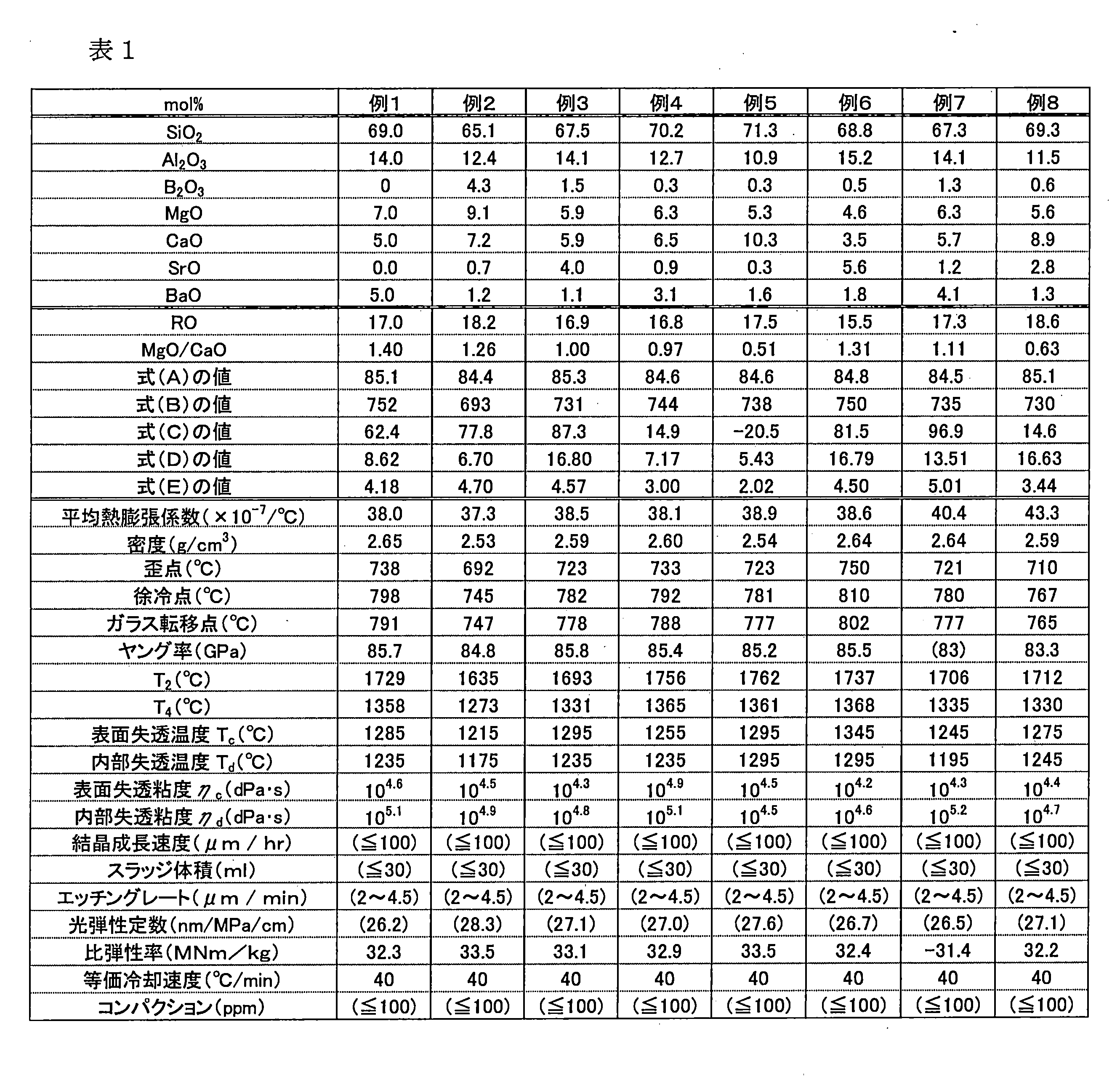

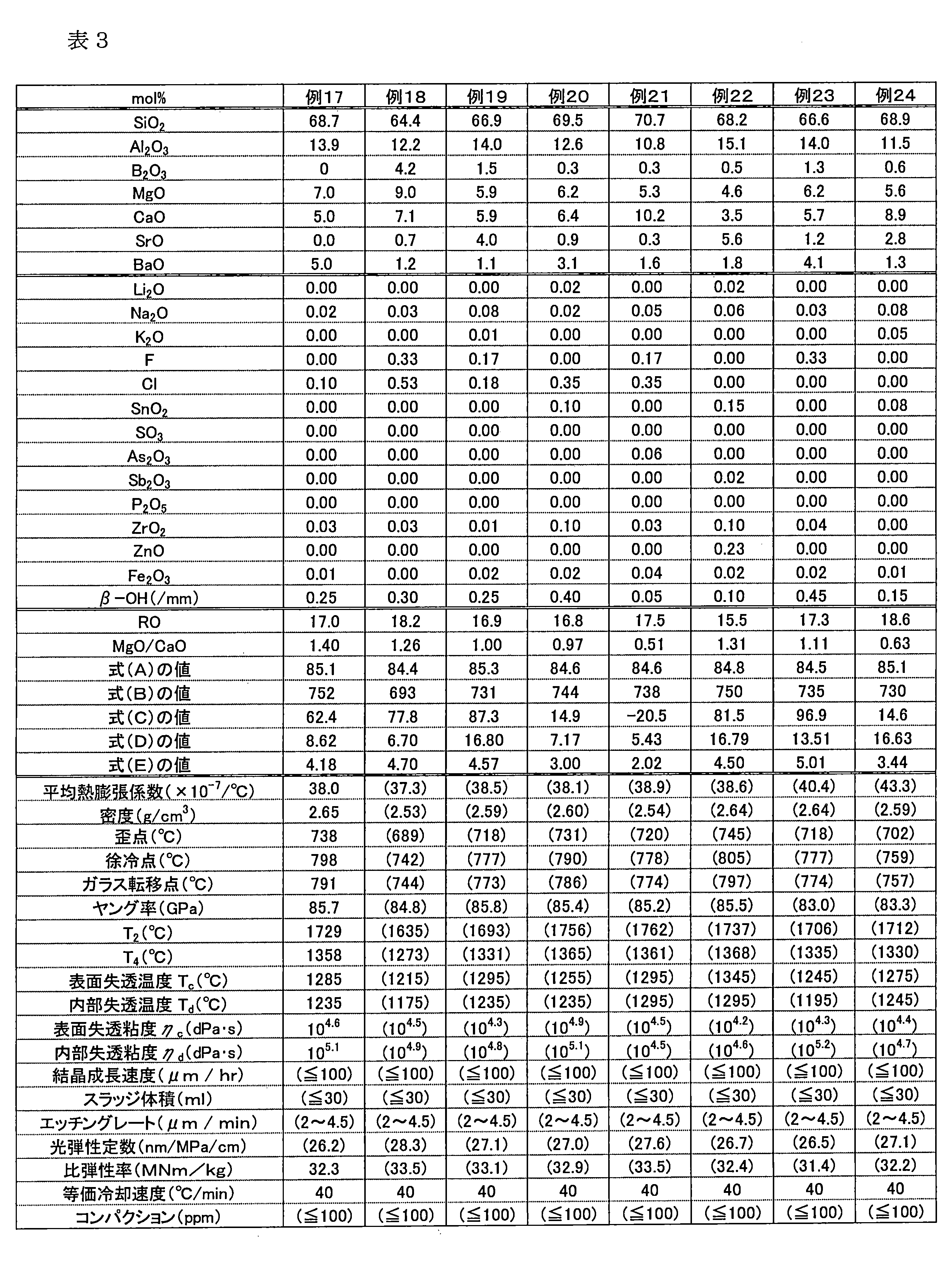
式(B)の値が690以上の例1~12、例17~24は歪点が690℃以上であった。一方、式(B)の値が690未満の例14は歪点が690℃未満であった。
式(C)の値が100以下の例1~12、例17~24は結晶成長速度が100μm/hr以下であった。一方、式(C)の値が100超の例15は結晶成長速度が100μm/hr超であった。
式(D)の値が20以下の例1~12、例17~24はスラッジ体積が30ml以下であった。一方、式(D)の値が20超の例16はスラッジ体積が30ml超であった。
例1~12は、表面失透粘度ηcが104.2dPa・s以上であった。例14は、表面失透粘度ηcが104.2dPa・s未満であった。
本出願は、2019年2月7日出願の日本特許出願2019-20257、2019年3月19日出願の日本特許出願2019-51570、2019年7月31日出願の日本特許出願2019-141422、2019年10月10日出願の日本特許出願2019-186805、および2020年2月5日出願の日本特許出願2020-17691に基づくものであり、その内容はここに参照として取り込まれる。
Claims (36)
- 酸化物基準のモル%表示で
SiO2 63~75%、
Al2O3 10~16%、
B2O3 0~5%、
MgO 0.1~15%、
CaO 0.1~12%、
SrO 0~8%、
BaO 0~6%を含み、
[MgO]/[CaO]が1.5以下であり、
式(A)は1.131[SiO2]+1.933[Al2O3]+0.362[B2O3]+2.049[MgO]+1.751[CaO]+1.471[SrO]+1.039[BaO]-48.25であり、式(A)の値が82.5以上、
式(B)は35.59[SiO2]+37.34[Al2O3]+24.59[B2O3]+31.13[MgO]+31.26[CaO]+30.78[SrO]+31.98[BaO]-2761であり、式(B)の値が690以上、800以下、
式(C)は-9.01[SiO2]+36.36[Al2O3]+5.7[B2O3]+5.13[MgO]+17.25[CaO]+7.65[SrO]+10.58[BaO]であり、式(C)の値が100以下、
式(D)は{-0.731[SiO2]+1.461[Al2O3]-0.157[B2O3]+1.904[MgO]+3.36[CaO]+3.411[SrO]+1.723[BaO]+(-3.318[MgO][CaO]-1.675[MgO][SrO]+1.757[MgO][BaO]+4.72[CaO][SrO]+2.094[CaO][BaO]+1.086[SrO][BaO])}/([MgO]+[CaO]+[SrO]+[BaO])であり、式(D)の値が20以下であり、
ヤング率が83GPa以上であり、表面失透粘度ηcが104.2dPa・s以上である、無アルカリガラス。 - 式(E)は4.379[SiO2]+5.043[Al2O3]+4.805[B2O3]+4.828[MgO]+4.968[CaO]+5.051[SrO]+5.159[BaO]-453であり、式(E)の値が1.50~5.50である、請求項1に記載の無アルカリガラス。
- 歪点が690℃以上である、請求項1または2に記載の無アルカリガラス。
- 密度が2.8g/cm3以下、50~350℃での平均熱膨張係数が30×10-7/℃~45×10-7/℃である、請求項1~3のいずれか1項に記載の無アルカリガラス。
- ガラス粘度が102dPa・sとなる温度T2が1800℃以下、ガラス粘度が104dPa・sとなる温度T4が1400℃以下である、請求項1~4のいずれか1項に記載の無アルカリガラス。
- 内部失透温度が1320℃以下である、請求項1~5のいずれか1項に記載の無アルカリガラス。
- 内部失透粘度ηdが104.4dPa・s以上である、請求項1~6のいずれか1項に記載の無アルカリガラス。
- 結晶成長速度が100μm/hr以下である、請求項1~7のいずれか1項に記載の無アルカリガラス。
- Li2O、Na2OおよびK2Oからなる群から選択される少なくとも1つを、酸化物基準のモル%表示で合計0.2%以下含有する、請求項1~8のいずれか1項に記載の無アルカリガラス。
- 酸化物基準のモル%表示で
SiO2 50~80%、
Al2O3 8~20%、
Li2O+Na2O+K2O 0~0.2%、
P2O5 0~1%、
[MgO]/[CaO]が1.5以下、
ヤング率が83GPa以上、
歪点が690℃以上、
ガラス粘度が104dPa・sとなる温度T4が1400℃以下、
ガラス粘度が102dPa・sとなる温度T2が1800℃以下、
内部失透温度が1320℃以下、
内部失透粘度ηdが104.4dPa・s以上、
表面失透粘度ηcが104.2dPa・s以上、
結晶成長速度が100μm/hr以下、
密度が2.8g/cm3以下、
50~350℃での平均熱膨張係数が30×10-7/℃~45×10-7/℃
である、無アルカリガラス。 - 酸化物基準のモル%表示で、B2O3を0~5%含む、請求項10に記載の無アルカリガラス。
- 酸化物基準のモル%表示で、MgOを0.1~15%、CaOを0.1~12%、SrOを0~8%、BaOを0~6%含む、請求項10に記載の無アルカリガラス。
- 酸化物基準のモル%表示で、B2O3を0~5%、MgOを0.1~15%、CaOを0.1~12%、SrOを0~8%、BaOを0~6%含む、請求項10に記載の無アルカリガラス。
- 式(A)は1.131[SiO2]+1.933[Al2O3]+0.362[B2O3]+2.049[MgO]+1.751[CaO]+1.471[SrO]+1.039[BaO]-48.25であり、式(A)の値が82.5以上である、請求項10~13のいずれか1項に記載の無アルカリガラス。
- 式(B)は35.59[SiO2]+37.34[Al2O3]+24.59[B2O3]+31.13[MgO]+31.26[CaO]+30.78[SrO]+31.98[BaO]-2761であり、式(B)の値が690以上、800以下である、請求項10~14のいずれか1項に記載の無アルカリガラス。
- 式(C)は-9.01[SiO2]+36.36[Al2O3]+5.7[B2O3]+5.13[MgO]+17.25[CaO]+7.65[SrO]+10.58[BaO]であり、式(C)の値が100以下である、請求項10~15のいずれか1項に記載の無アルカリガラス。
- 式(D)は{-0.731[SiO2]+1.461[Al2O3]-0.157[B2O3]+1.904[MgO]+3.36[CaO]+3.411[SrO]+1.723[BaO]+(-3.318[MgO][CaO]-1.675[MgO][SrO]+1.757[MgO][BaO]+4.72[CaO][SrO]+2.094[CaO][BaO]+1.086[SrO][BaO])}/([MgO]+[CaO]+[SrO]+[BaO])であり、式(D)の値が20以下である、請求項10~16のいずれか1項に記載の無アルカリガラス。
- 式(E)は4.379[SiO2]+5.043[Al2O3]+4.805[B2O3]+4.828[MgO]+4.968[CaO]+5.051[SrO]+5.159[BaO]-453であり、式(E)の値が1.50~5.50である、請求項10~17のいずれか1項に記載の無アルカリガラス。
- Fを1.5モル%以下含有する、請求項1~18のいずれか1項に記載の無アルカリガラス。
- 酸化物基準のモル%表示で、SnO2を0.5%以下含有する、請求項1~19のいずれか1項に記載の無アルカリガラス。
- 酸化物基準のモル%表示で、ZrO2を0.09%以下含有する、請求項1~20のいずれか1項に記載の無アルカリガラス。
- ガラスのβ-OH値が0.01mm-1以上、0.5mm-1以下である、請求項1~21のいずれか1項に記載の無アルカリガラス。
- 徐冷点が850℃以下である、請求項1~22のいずれか1項に記載の無アルカリガラス。
- 600℃、80minでの保持前後のコンパクションが150ppm以下である請求項1~23のいずれか1項に記載の無アルカリガラス。
- 等価冷却速度が5℃/min以上、800℃/min以下である、請求項1~24のいずれか1項に記載の無アルカリガラス。
- エッチング処理時のスラッジ体積が30ml以下である、請求項1~25のいずれか1項に記載の無アルカリガラス。
- 光弾性定数が31nm/MPa/cm以下である、請求項1~26のいずれか1項に記載の無アルカリガラス。
- 請求項1~27のいずれか1項に記載の無アルカリガラスを含むガラス板であり、少なくとも一辺が2400mm以上、厚みが1.0mm以下であるガラス板。
- フロート法又はフュージョン法で製造される、請求項28に記載のガラス板。
- 請求項1~27のいずれか1項に記載の無アルカリガラスを有するディスプレイパネル。
- 請求項1~27のいずれか1項に記載の無アルカリガラスを有する半導体デバイス。
- 請求項1~27のいずれか1項に記載の無アルカリガラスを有する情報記録媒体。
- 請求項1~27のいずれか1項に記載の無アルカリガラスを有する平面型アンテナ。
- 請求項1~27のいずれか1項に記載の無アルカリガラスを有する調光積層体。
- 請求項1~27のいずれか1項に記載の無アルカリガラスを有する車両用窓ガラス。
- 請求項1~27のいずれか1項に記載の無アルカリガラスを有する音響用振動板。
Priority Applications (9)
| Application Number | Priority Date | Filing Date | Title |
|---|---|---|---|
| KR1020257017826A KR20250084982A (ko) | 2019-02-07 | 2020-02-07 | 무알칼리 유리 |
| CN202080013068.7A CN113412243A (zh) | 2019-02-07 | 2020-02-07 | 无碱玻璃 |
| JP2020571297A JP7593109B2 (ja) | 2019-02-07 | 2020-02-07 | 無アルカリガラス |
| CN202410473145.7A CN118420219A (zh) | 2019-02-07 | 2020-02-07 | 无碱玻璃 |
| KR1020217024796A KR102816277B1 (ko) | 2019-02-07 | 2020-02-07 | 무알칼리 유리 |
| CN202410474346.9A CN118420220A (zh) | 2019-02-07 | 2020-02-07 | 无碱玻璃 |
| US17/396,277 US12540096B2 (en) | 2019-02-07 | 2021-08-06 | Alkali-free glass |
| JP2024203036A JP2025019174A (ja) | 2019-02-07 | 2024-11-21 | 無アルカリガラス |
| US19/436,825 US20260125308A1 (en) | 2019-02-07 | 2025-12-30 | Alkali-free glass |
Applications Claiming Priority (10)
| Application Number | Priority Date | Filing Date | Title |
|---|---|---|---|
| JP2019-020257 | 2019-02-07 | ||
| JP2019020257 | 2019-02-07 | ||
| JP2019-051570 | 2019-03-19 | ||
| JP2019051570 | 2019-03-19 | ||
| JP2019-141422 | 2019-07-31 | ||
| JP2019141422 | 2019-07-31 | ||
| JP2019-186805 | 2019-10-10 | ||
| JP2019186805 | 2019-10-10 | ||
| JP2020-017691 | 2020-02-05 | ||
| JP2020017691 | 2020-02-05 |
Related Child Applications (1)
| Application Number | Title | Priority Date | Filing Date |
|---|---|---|---|
| US17/396,277 Continuation US12540096B2 (en) | 2019-02-07 | 2021-08-06 | Alkali-free glass |
Publications (1)
| Publication Number | Publication Date |
|---|---|
| WO2020162605A1 true WO2020162605A1 (ja) | 2020-08-13 |
Family
ID=71946981
Family Applications (1)
| Application Number | Title | Priority Date | Filing Date |
|---|---|---|---|
| PCT/JP2020/004848 Ceased WO2020162605A1 (ja) | 2019-02-07 | 2020-02-07 | 無アルカリガラス |
Country Status (6)
| Country | Link |
|---|---|
| US (2) | US12540096B2 (ja) |
| JP (2) | JP7593109B2 (ja) |
| KR (2) | KR20250084982A (ja) |
| CN (3) | CN118420219A (ja) |
| TW (3) | TWI911149B (ja) |
| WO (1) | WO2020162605A1 (ja) |
Families Citing this family (9)
| Publication number | Priority date | Publication date | Assignee | Title |
|---|---|---|---|---|
| EP3770129B1 (en) * | 2018-03-20 | 2023-07-12 | Agc Inc. | Glass substrate, liquid crystal antenna and high-frequency device |
| KR20230056017A (ko) | 2020-08-27 | 2023-04-26 | 에이지씨 가부시키가이샤 | 무알칼리 유리 및 유리판 |
| WO2023037951A1 (ja) * | 2021-09-07 | 2023-03-16 | Agc株式会社 | 無アルカリガラス |
| CN115806391B (zh) * | 2022-12-15 | 2024-03-29 | 清远忠信世纪电子材料有限公司 | 一种低膨胀系数玻璃纤维及其制备方法 |
| CN116282902A (zh) * | 2023-01-21 | 2023-06-23 | 武汉理工大学 | 一种无碱基板玻璃 |
| CN117164230A (zh) * | 2023-04-20 | 2023-12-05 | 湖南兆湘光电高端装备研究院有限公司 | 玻璃基板用组合物、高世代无碱玻璃基板及其制备方法和应用 |
| CN117447074A (zh) * | 2023-10-23 | 2024-01-26 | 中建材玻璃新材料研究院集团有限公司 | 无碱高弹性模量硼硅酸盐玻璃组合物及其制备方法和应用 |
| CN119461844A (zh) * | 2024-09-29 | 2025-02-18 | 彩虹显示器件股份有限公司 | 耐热稳定高析晶裕度的无碱硼铝硅酸盐玻璃及其制备方法 |
| CN120794329A (zh) * | 2025-07-16 | 2025-10-17 | 成都光明光电股份有限公司 | 高模量玻璃 |
Citations (4)
| Publication number | Priority date | Publication date | Assignee | Title |
|---|---|---|---|---|
| WO2013172307A1 (ja) * | 2012-05-16 | 2013-11-21 | 旭硝子株式会社 | 板ガラスの製造方法 |
| WO2013180220A1 (ja) * | 2012-05-31 | 2013-12-05 | 旭硝子株式会社 | 無アルカリガラス基板、および、無アルカリガラス基板の薄板化方法 |
| WO2013183569A1 (ja) * | 2012-06-05 | 2013-12-12 | 旭硝子株式会社 | 磁気ディスクの製造方法および情報記録媒体用ガラス基板 |
| JP2016029001A (ja) * | 2014-07-18 | 2016-03-03 | 旭硝子株式会社 | 無アルカリガラス |
Family Cites Families (52)
| Publication number | Priority date | Publication date | Assignee | Title |
|---|---|---|---|---|
| DE19916296C1 (de) | 1999-04-12 | 2001-01-18 | Schott Glas | Alkalifreies Aluminoborosilicatglas und dessen Verwendung |
| KR100977699B1 (ko) | 2005-07-06 | 2010-08-24 | 아사히 가라스 가부시키가이샤 | 무알칼리 유리의 제조 방법 및 무알칼리 유리판 |
| CN101448753B (zh) * | 2006-05-25 | 2012-07-25 | 日本电气硝子株式会社 | 无碱玻璃及无碱玻璃基板 |
| CN101489944A (zh) * | 2006-07-13 | 2009-07-22 | 旭硝子株式会社 | 无碱玻璃基板及其制造方法以及液晶显示面板 |
| JP5470853B2 (ja) | 2007-01-31 | 2014-04-16 | 旭硝子株式会社 | ガラス製造方法および減圧脱泡装置 |
| KR101577492B1 (ko) | 2009-07-02 | 2015-12-14 | 아사히 가라스 가부시키가이샤 | 무알칼리 유리 및 그의 제조 방법 |
| CN102666408A (zh) | 2009-12-25 | 2012-09-12 | 旭硝子株式会社 | 熔融玻璃的减压脱泡方法及玻璃制品的制造方法 |
| EP2650262A1 (en) | 2010-12-07 | 2013-10-16 | Asahi Glass Company, Limited | Alkali free glass and method for producing alkali free glass |
| JP5817737B2 (ja) * | 2010-12-27 | 2015-11-18 | 旭硝子株式会社 | 無アルカリガラスおよび無アルカリガラスの製造方法 |
| JP5831838B2 (ja) * | 2011-03-08 | 2015-12-09 | 日本電気硝子株式会社 | 無アルカリガラス |
| US8785336B2 (en) | 2011-03-14 | 2014-07-22 | Nippon Electric Glass Co., Ltd. | Alkali-free glass |
| JP5935471B2 (ja) | 2011-04-25 | 2016-06-15 | 日本電気硝子株式会社 | 液晶レンズ |
| US9029280B2 (en) | 2011-07-01 | 2015-05-12 | Avanstrate Inc. | Glass substrate for flat panel display and method for manufacturing same |
| CN104271526B (zh) | 2012-04-27 | 2016-12-07 | 旭硝子株式会社 | 无碱玻璃及其制造方法 |
| EP2842919A1 (en) | 2012-04-27 | 2015-03-04 | Asahi Glass Company, Limited | Non-alkali glass and method for producing same |
| EP2857367A1 (en) | 2012-06-05 | 2015-04-08 | Asahi Glass Company, Limited | Alkali-free glass and method for producing same |
| KR20150029633A (ko) * | 2012-06-05 | 2015-03-18 | 아사히 가라스 가부시키가이샤 | 무알칼리 유리 및 그 제조 방법 |
| WO2013183681A1 (ja) | 2012-06-07 | 2013-12-12 | 旭硝子株式会社 | 無アルカリガラスおよびこれを用いた無アルカリガラス板 |
| WO2014087971A1 (ja) | 2012-12-05 | 2014-06-12 | 旭硝子株式会社 | 無アルカリガラス基板 |
| JP2016084242A (ja) | 2013-02-19 | 2016-05-19 | 旭硝子株式会社 | 無アルカリガラスおよびその製造方法 |
| JP2016188148A (ja) * | 2013-08-30 | 2016-11-04 | 旭硝子株式会社 | 無アルカリガラスおよびその製造方法 |
| JP2017007870A (ja) | 2013-11-13 | 2017-01-12 | 旭硝子株式会社 | 板ガラスの製造方法 |
| CN106463834A (zh) | 2014-03-26 | 2017-02-22 | 天线国际有限责任公司 | 贴片天线、制造和使用此天线的方法和天线系统 |
| JP2015224150A (ja) * | 2014-05-27 | 2015-12-14 | 旭硝子株式会社 | 無アルカリガラスの製造方法 |
| JP6575223B2 (ja) | 2014-08-27 | 2019-09-18 | Agc株式会社 | 無アルカリガラス |
| KR20250048598A (ko) * | 2014-10-23 | 2025-04-09 | 에이지씨 가부시키가이샤 | 무알칼리 유리 |
| KR102559221B1 (ko) * | 2014-10-31 | 2023-07-25 | 코닝 인코포레이티드 | 치수적으로 안정한 급속 에칭 유리 |
| WO2016084952A1 (ja) * | 2014-11-28 | 2016-06-02 | 旭硝子株式会社 | 液晶ディスプレイパネル |
| JP6955321B2 (ja) | 2014-12-16 | 2021-10-27 | 日本電気硝子株式会社 | 珪酸塩ガラスの製造方法、珪酸塩ガラス及び珪酸塩ガラス用シリカ原料 |
| JP6802966B2 (ja) | 2014-12-17 | 2020-12-23 | 日本電気硝子株式会社 | 支持ガラス基板及びこれを用いた積層体 |
| JP2017063255A (ja) | 2015-09-24 | 2017-03-30 | ミツミ電機株式会社 | アンテナ装置及びアンテナ装置の製造方法 |
| JP2017090617A (ja) | 2015-11-09 | 2017-05-25 | 旭硝子株式会社 | 調光機能付きスクリーンガラスおよび映像表示システム |
| CN114751643A (zh) | 2016-04-27 | 2022-07-15 | Agc株式会社 | 无碱玻璃 |
| WO2017213191A1 (ja) | 2016-06-08 | 2017-12-14 | 旭硝子株式会社 | 調光積層体および複層ガラス |
| WO2018016398A1 (ja) | 2016-07-19 | 2018-01-25 | シャープ株式会社 | 液晶パネル、及び走査アンテナ |
| WO2018025727A1 (ja) * | 2016-08-05 | 2018-02-08 | 旭硝子株式会社 | 無アルカリガラス基板、積層基板、およびガラス基板の製造方法 |
| CN115557695B (zh) | 2016-08-23 | 2024-10-29 | Agc株式会社 | 无碱玻璃 |
| JP7333159B2 (ja) | 2016-12-26 | 2023-08-24 | 日本電気硝子株式会社 | 無アルカリガラス基板の製造方法 |
| JP6927290B2 (ja) | 2017-03-29 | 2021-08-25 | Agc株式会社 | ガラス板構成体 |
| JP2018177556A (ja) * | 2017-04-05 | 2018-11-15 | 日本電気硝子株式会社 | ガラス基板 |
| CN107129142B (zh) * | 2017-04-18 | 2021-02-09 | 东旭光电科技股份有限公司 | 无碱玻璃基板及其制备方法 |
| JP7001987B2 (ja) * | 2017-04-27 | 2022-01-20 | 日本電気硝子株式会社 | ガラス基板 |
| WO2018198804A1 (ja) | 2017-04-27 | 2018-11-01 | 日本電気硝子株式会社 | ガラス基板 |
| WO2019026963A1 (ja) | 2017-08-02 | 2019-02-07 | Agc株式会社 | ガラス用アンテナユニット、アンテナ付きガラス板、およびガラス用アンテナユニットの製造方法 |
| KR102532702B1 (ko) | 2017-09-05 | 2023-05-12 | 니폰 덴키 가라스 가부시키가이샤 | 무알칼리 유리 기판의 제조 방법 및 무알칼리 유리 기판 |
| CN111164991B (zh) | 2017-10-04 | 2021-08-24 | Agc株式会社 | 玻璃板结构体和振动板 |
| JP2019068368A (ja) | 2017-10-04 | 2019-04-25 | Agc株式会社 | ガラス振動板構成体及び開口部材 |
| WO2019107514A1 (ja) | 2017-12-01 | 2019-06-06 | Agc株式会社 | アンテナユニット、およびアンテナ付きガラス板 |
| TWI809029B (zh) * | 2018-01-15 | 2023-07-21 | 美商康寧公司 | 尺度上穩定快速地蝕刻玻璃 |
| JP7418947B2 (ja) * | 2018-01-31 | 2024-01-22 | 日本電気硝子株式会社 | ガラス |
| JP7389400B2 (ja) * | 2018-10-15 | 2023-11-30 | 日本電気硝子株式会社 | 無アルカリガラス板 |
| WO2020162604A1 (ja) | 2019-02-07 | 2020-08-13 | Agc株式会社 | 無アルカリガラス |
-
2020
- 2020-02-07 TW TW109103946A patent/TWI911149B/zh active
- 2020-02-07 WO PCT/JP2020/004848 patent/WO2020162605A1/ja not_active Ceased
- 2020-02-07 CN CN202410473145.7A patent/CN118420219A/zh active Pending
- 2020-02-07 TW TW114130325A patent/TW202547805A/zh unknown
- 2020-02-07 KR KR1020257017826A patent/KR20250084982A/ko active Pending
- 2020-02-07 KR KR1020217024796A patent/KR102816277B1/ko active Active
- 2020-02-07 TW TW113119294A patent/TW202500523A/zh unknown
- 2020-02-07 CN CN202410474346.9A patent/CN118420220A/zh active Pending
- 2020-02-07 CN CN202080013068.7A patent/CN113412243A/zh active Pending
- 2020-02-07 JP JP2020571297A patent/JP7593109B2/ja active Active
-
2021
- 2021-08-06 US US17/396,277 patent/US12540096B2/en active Active
-
2024
- 2024-11-21 JP JP2024203036A patent/JP2025019174A/ja active Pending
-
2025
- 2025-12-30 US US19/436,825 patent/US20260125308A1/en active Pending
Patent Citations (4)
| Publication number | Priority date | Publication date | Assignee | Title |
|---|---|---|---|---|
| WO2013172307A1 (ja) * | 2012-05-16 | 2013-11-21 | 旭硝子株式会社 | 板ガラスの製造方法 |
| WO2013180220A1 (ja) * | 2012-05-31 | 2013-12-05 | 旭硝子株式会社 | 無アルカリガラス基板、および、無アルカリガラス基板の薄板化方法 |
| WO2013183569A1 (ja) * | 2012-06-05 | 2013-12-12 | 旭硝子株式会社 | 磁気ディスクの製造方法および情報記録媒体用ガラス基板 |
| JP2016029001A (ja) * | 2014-07-18 | 2016-03-03 | 旭硝子株式会社 | 無アルカリガラス |
Also Published As
| Publication number | Publication date |
|---|---|
| JP7593109B2 (ja) | 2024-12-03 |
| JP2025019174A (ja) | 2025-02-06 |
| CN118420219A (zh) | 2024-08-02 |
| US20210380466A1 (en) | 2021-12-09 |
| TW202500523A (zh) | 2025-01-01 |
| KR102816277B1 (ko) | 2025-06-09 |
| JPWO2020162605A1 (ja) | 2021-12-09 |
| US20260125308A1 (en) | 2026-05-07 |
| KR20250084982A (ko) | 2025-06-11 |
| TW202039390A (zh) | 2020-11-01 |
| US12540096B2 (en) | 2026-02-03 |
| TW202547805A (zh) | 2025-12-16 |
| CN113412243A (zh) | 2021-09-17 |
| KR20210121074A (ko) | 2021-10-07 |
| TWI911149B (zh) | 2026-01-11 |
| CN118420220A (zh) | 2024-08-02 |
Similar Documents
| Publication | Publication Date | Title |
|---|---|---|
| US12540096B2 (en) | Alkali-free glass | |
| US12448319B2 (en) | Alkali-free glass | |
| US12448320B2 (en) | Alkali-free glass | |
| JP7396413B2 (ja) | ガラス | |
| JP7747082B2 (ja) | 無アルカリガラス |
Legal Events
| Date | Code | Title | Description |
|---|---|---|---|
| 121 | Ep: the epo has been informed by wipo that ep was designated in this application |
Ref document number: 20752030 Country of ref document: EP Kind code of ref document: A1 |
|
| ENP | Entry into the national phase |
Ref document number: 2020571297 Country of ref document: JP Kind code of ref document: A |
|
| NENP | Non-entry into the national phase |
Ref country code: DE |
|
| 122 | Ep: pct application non-entry in european phase |
Ref document number: 20752030 Country of ref document: EP Kind code of ref document: A1 |
|
| WWP | Wipo information: published in national office |
Ref document number: 1020257017826 Country of ref document: KR |