WO2017079999A1 - 合金催化剂用于碳水化合物催化制备低碳二元醇的方法 - Google Patents
合金催化剂用于碳水化合物催化制备低碳二元醇的方法 Download PDFInfo
- Publication number
- WO2017079999A1 WO2017079999A1 PCT/CN2015/095590 CN2015095590W WO2017079999A1 WO 2017079999 A1 WO2017079999 A1 WO 2017079999A1 CN 2015095590 W CN2015095590 W CN 2015095590W WO 2017079999 A1 WO2017079999 A1 WO 2017079999A1
- Authority
- WO
- WIPO (PCT)
- Prior art keywords
- metal
- tin
- catalyst
- reaction
- cobalt
- Prior art date
- Legal status (The legal status is an assumption and is not a legal conclusion. Google has not performed a legal analysis and makes no representation as to the accuracy of the status listed.)
- Ceased
Links
Images
Classifications
-
- C—CHEMISTRY; METALLURGY
- C07—ORGANIC CHEMISTRY
- C07C—ACYCLIC OR CARBOCYCLIC COMPOUNDS
- C07C29/00—Preparation of compounds having hydroxy or O-metal groups bound to a carbon atom not belonging to a six-membered aromatic ring
- C07C29/132—Preparation of compounds having hydroxy or O-metal groups bound to a carbon atom not belonging to a six-membered aromatic ring by reduction of an oxygen containing functional group
-
- B—PERFORMING OPERATIONS; TRANSPORTING
- B01—PHYSICAL OR CHEMICAL PROCESSES OR APPARATUS IN GENERAL
- B01J—CHEMICAL OR PHYSICAL PROCESSES, e.g. CATALYSIS OR COLLOID CHEMISTRY; THEIR RELEVANT APPARATUS
- B01J23/00—Catalysts comprising metals or metal oxides or hydroxides, not provided for in group B01J21/00
- B01J23/38—Catalysts comprising metals or metal oxides or hydroxides, not provided for in group B01J21/00 of noble metals
- B01J23/54—Catalysts comprising metals or metal oxides or hydroxides, not provided for in group B01J21/00 of noble metals combined with metals, oxides or hydroxides provided for in groups B01J23/02 - B01J23/36
- B01J23/56—Platinum group metals
- B01J23/62—Platinum group metals with gallium, indium, thallium, germanium, tin or lead
- B01J23/622—Platinum group metals with gallium, indium, thallium, germanium, tin or lead with germanium, tin or lead
- B01J23/626—Platinum group metals with gallium, indium, thallium, germanium, tin or lead with germanium, tin or lead with tin
-
- B—PERFORMING OPERATIONS; TRANSPORTING
- B01—PHYSICAL OR CHEMICAL PROCESSES OR APPARATUS IN GENERAL
- B01J—CHEMICAL OR PHYSICAL PROCESSES, e.g. CATALYSIS OR COLLOID CHEMISTRY; THEIR RELEVANT APPARATUS
- B01J23/00—Catalysts comprising metals or metal oxides or hydroxides, not provided for in group B01J21/00
- B01J23/70—Catalysts comprising metals or metal oxides or hydroxides, not provided for in group B01J21/00 of the iron group metals or copper
- B01J23/76—Catalysts comprising metals or metal oxides or hydroxides, not provided for in group B01J21/00 of the iron group metals or copper combined with metals, oxides or hydroxides provided for in groups B01J23/02 - B01J23/36
- B01J23/835—Catalysts comprising metals or metal oxides or hydroxides, not provided for in group B01J21/00 of the iron group metals or copper combined with metals, oxides or hydroxides provided for in groups B01J23/02 - B01J23/36 with germanium, tin or lead
-
- B—PERFORMING OPERATIONS; TRANSPORTING
- B01—PHYSICAL OR CHEMICAL PROCESSES OR APPARATUS IN GENERAL
- B01J—CHEMICAL OR PHYSICAL PROCESSES, e.g. CATALYSIS OR COLLOID CHEMISTRY; THEIR RELEVANT APPARATUS
- B01J23/00—Catalysts comprising metals or metal oxides or hydroxides, not provided for in group B01J21/00
- B01J23/70—Catalysts comprising metals or metal oxides or hydroxides, not provided for in group B01J21/00 of the iron group metals or copper
- B01J23/89—Catalysts comprising metals or metal oxides or hydroxides, not provided for in group B01J21/00 of the iron group metals or copper combined with noble metals
- B01J23/892—Nickel and noble metals
-
- B—PERFORMING OPERATIONS; TRANSPORTING
- B01—PHYSICAL OR CHEMICAL PROCESSES OR APPARATUS IN GENERAL
- B01J—CHEMICAL OR PHYSICAL PROCESSES, e.g. CATALYSIS OR COLLOID CHEMISTRY; THEIR RELEVANT APPARATUS
- B01J23/00—Catalysts comprising metals or metal oxides or hydroxides, not provided for in group B01J21/00
- B01J23/70—Catalysts comprising metals or metal oxides or hydroxides, not provided for in group B01J21/00 of the iron group metals or copper
- B01J23/89—Catalysts comprising metals or metal oxides or hydroxides, not provided for in group B01J21/00 of the iron group metals or copper combined with noble metals
- B01J23/8933—Catalysts comprising metals or metal oxides or hydroxides, not provided for in group B01J21/00 of the iron group metals or copper combined with noble metals also combined with metals, or metal oxides or hydroxides provided for in groups B01J23/02 - B01J23/36
- B01J23/8966—Catalysts comprising metals or metal oxides or hydroxides, not provided for in group B01J21/00 of the iron group metals or copper combined with noble metals also combined with metals, or metal oxides or hydroxides provided for in groups B01J23/02 - B01J23/36 with germanium, tin or lead
-
- B—PERFORMING OPERATIONS; TRANSPORTING
- B01—PHYSICAL OR CHEMICAL PROCESSES OR APPARATUS IN GENERAL
- B01J—CHEMICAL OR PHYSICAL PROCESSES, e.g. CATALYSIS OR COLLOID CHEMISTRY; THEIR RELEVANT APPARATUS
- B01J25/00—Catalysts of the Raney type
- B01J25/02—Raney nickel
-
- B—PERFORMING OPERATIONS; TRANSPORTING
- B01—PHYSICAL OR CHEMICAL PROCESSES OR APPARATUS IN GENERAL
- B01J—CHEMICAL OR PHYSICAL PROCESSES, e.g. CATALYSIS OR COLLOID CHEMISTRY; THEIR RELEVANT APPARATUS
- B01J33/00—Protection of catalysts, e.g. by coating
-
- B—PERFORMING OPERATIONS; TRANSPORTING
- B01—PHYSICAL OR CHEMICAL PROCESSES OR APPARATUS IN GENERAL
- B01J—CHEMICAL OR PHYSICAL PROCESSES, e.g. CATALYSIS OR COLLOID CHEMISTRY; THEIR RELEVANT APPARATUS
- B01J37/00—Processes, in general, for preparing catalysts; Processes, in general, for activation of catalysts
- B01J37/02—Impregnation, coating or precipitation
- B01J37/0201—Impregnation
-
- B—PERFORMING OPERATIONS; TRANSPORTING
- B01—PHYSICAL OR CHEMICAL PROCESSES OR APPARATUS IN GENERAL
- B01J—CHEMICAL OR PHYSICAL PROCESSES, e.g. CATALYSIS OR COLLOID CHEMISTRY; THEIR RELEVANT APPARATUS
- B01J37/00—Processes, in general, for preparing catalysts; Processes, in general, for activation of catalysts
- B01J37/02—Impregnation, coating or precipitation
- B01J37/0236—Drying, e.g. preparing a suspension, adding a soluble salt and drying
-
- B—PERFORMING OPERATIONS; TRANSPORTING
- B01—PHYSICAL OR CHEMICAL PROCESSES OR APPARATUS IN GENERAL
- B01J—CHEMICAL OR PHYSICAL PROCESSES, e.g. CATALYSIS OR COLLOID CHEMISTRY; THEIR RELEVANT APPARATUS
- B01J37/00—Processes, in general, for preparing catalysts; Processes, in general, for activation of catalysts
- B01J37/16—Reducing
- B01J37/18—Reducing with gases containing free hydrogen
-
- B—PERFORMING OPERATIONS; TRANSPORTING
- B01—PHYSICAL OR CHEMICAL PROCESSES OR APPARATUS IN GENERAL
- B01J—CHEMICAL OR PHYSICAL PROCESSES, e.g. CATALYSIS OR COLLOID CHEMISTRY; THEIR RELEVANT APPARATUS
- B01J2235/00—Indexing scheme associated with group B01J35/00, related to the analysis techniques used to determine the catalysts form or properties
- B01J2235/15—X-ray diffraction
-
- B—PERFORMING OPERATIONS; TRANSPORTING
- B01—PHYSICAL OR CHEMICAL PROCESSES OR APPARATUS IN GENERAL
- B01J—CHEMICAL OR PHYSICAL PROCESSES, e.g. CATALYSIS OR COLLOID CHEMISTRY; THEIR RELEVANT APPARATUS
- B01J35/00—Catalysts, in general, characterised by their form or physical properties
- B01J35/30—Catalysts, in general, characterised by their form or physical properties characterised by their physical properties
-
- Y—GENERAL TAGGING OF NEW TECHNOLOGICAL DEVELOPMENTS; GENERAL TAGGING OF CROSS-SECTIONAL TECHNOLOGIES SPANNING OVER SEVERAL SECTIONS OF THE IPC; TECHNICAL SUBJECTS COVERED BY FORMER USPC CROSS-REFERENCE ART COLLECTIONS [XRACs] AND DIGESTS
- Y02—TECHNOLOGIES OR APPLICATIONS FOR MITIGATION OR ADAPTATION AGAINST CLIMATE CHANGE
- Y02P—CLIMATE CHANGE MITIGATION TECHNOLOGIES IN THE PRODUCTION OR PROCESSING OF GOODS
- Y02P20/00—Technologies relating to chemical industry
- Y02P20/50—Improvements relating to the production of bulk chemicals
- Y02P20/52—Improvements relating to the production of bulk chemicals using catalysts, e.g. selective catalysts
Definitions
- the present invention relates to an alloy catalyst for the catalytic conversion of carbohydrates to lower carbon diols, and more particularly to the process by which carbohydrates are catalytically produced under hydrothermal conditions to produce ethylene glycol.
- Low-carbon glycols such as ethylene glycol are important energy liquid fuels and are also very important raw materials for polyester synthesis.
- Ethylene glycol is mainly used in the synthesis of polyethylene terephthalate (PET) and polyethylene naphthalate (PEN). It can also be used as antifreeze, lubricant, plasticizer and surfactant.
- PET polyethylene terephthalate
- PEN polyethylene naphthalate
- ethylene glycol is mainly based on the petroleum raw material route, that is, ethylene is epoxidized to obtain ethylene oxide, and then hydrated to obtain ethylene glycol.
- Document 1 Cui Huaweing, development of ethylene glycol production at home and abroad, chemistry Industry, 2007, 25, (4), 15-21.
- Document 2 Process for preparing ethanediol by catalyzing epoxyethane hydration, Patent No. CN1463960-A; CN1204103-C].
- the synthesis method of ethylene glycol depends on non-renewable petroleum resources, and the production process includes selective oxidation or epoxidation steps, which is technically difficult, low in efficiency, high in by-products, high in energy consumption and serious in pollution.
- the use of renewable biomass to produce ethylene glycol can reduce human dependence on fossil energy materials and contribute to environmentally friendly and economically sustainable development.
- Carbohydrates such as cellulose are the most abundant renewable resources on the planet. The sources are very rich and the cost of use is very low.
- the use of carbohydrates such as cellulose to produce ethylene glycol not only opens up new synthetic pathways, but also achieves products of high economic value from inexpensive carbohydrates. Moreover, since some carbohydrates such as cellulose cannot be eaten by humans, they do not affect human food security.
- xylose is obtained by hydrolysis of corn cob
- a mixture of ethylene glycol, propylene glycol and glycerol can also be obtained by catalytic hydrocracking [Document 4: CN 101704710 A corncob catalytic conversion to ethylene glycol, propylene glycol, C Method of triol]. This method achieves a selectivity of 30% ethylene glycol and propylene glycol.
- the method provided by the invention uses carbohydrate as a raw material and water as a reaction medium, and under the action of an alloy catalyst, high-efficiency conversion of carbohydrates into low-carbon diol can be achieved through a one-step reaction process.
- the method is not only simple in operation, low in cost, but also has a very low catalyst loss, good cycleability and easy recovery.
- the method has the advantages of simple operation, low cost, extremely low catalyst loss, good cycleability and easy recovery.
- the alloy catalyst contains metallic tin, and the remaining metal elements are one or more of transition metal iron, cobalt, ruthenium, rhodium, palladium, iridium, platinum, and copper.
- the weight ratio of metal tin to other metals in the alloy catalyst is 0.01. -100 range between;
- the catalyst is composed of a composite precursor before use, wherein one of the precursors is one or more of a simple substance or a compound of tin, and the remaining metal precursors are transition metal iron, cobalt, ruthenium, rhodium, palladium, iridium. , one or more of a simple substance or a compound in platinum or copper, forming an alloy during the reaction, and the weight ratio of the metal tin to the remaining metal in the alloy catalyst is in the range of 0.01-100;
- the catalyst is a framework metal catalyst composed of a metal tin and a metal nickel alloy
- the reaction is carried out in a closed batch, continuous or semi-continuous high pressure autoclave; the reactor is filled with hydrogen before the reaction, the reaction temperature is ⁇ 120 ° C, the reaction time is not less than 5 minutes, or the liquid reaction space velocity is not more than 20 h - 1 .
- the weight concentration of the alloy catalyst is from 0.1% to 50% of the total mass of the reactants and the reaction solvent.
- the reaction vessel Before the reaction, the reaction vessel is filled with hydrogen gas.
- the initial pressure of hydrogen gas at room temperature is 1-12 MPa; the reaction temperature is ⁇ 120 ° C, and the upper temperature limit is based on the thermal decomposition of the reaction product.
- the reaction temperature is 200-280 ° C
- the hydrogen pressure in the reactor is 3-7 MPa at room temperature
- the reaction time for the closed batch reactor is 0.5-5 h
- the reaction space velocity GWSV is 0.1- 50h -1
- GWSV represents the ratio of the dry basis weight of the reactants entering the reactor per hour to the weight of the catalyst in the reactor.
- the alloy catalyst is an unsupported catalyst, that is, a framework metal catalyst using an alloy metal as a catalyst skeleton, and the weight ratio of the metal tin to the remaining metal in the framework metal catalyst is in the range of 0.1-10, and the weight of the alloy skeleton catalyst in the reaction vessel The concentration is from 1% to 30%.
- the weight ratio of the metal tin to the remaining metal in the framework metal catalyst is in the range of 0.5-2, and the weight concentration of the alloy catalyst in the reaction system is 2%-20%.
- the alloy catalyst is a supported catalyst, and the metal tin component is co-supported on the same carrier with one or more of the metal components of iron, cobalt, ruthenium, rhodium, palladium, iridium, platinum, and copper.
- the carrier is activated carbon, aluminum oxide, silicon oxide, silicon carbide, zirconium oxide, zinc oxide, titanium dioxide or a composite carrier of two or more kinds.
- the content of the alloy on the catalyst is 0.01-50wt%, and the weight of the metal tin and the remaining metal is The ratio is between 0.1-10.
- the preferred content of the alloy on the catalyst is from 1 to 35 wt%, and the weight ratio of the metal tin to the remaining metal is preferably in the range of from 0.5 to 2.
- One or two or more of the transition metal iron, cobalt, rhodium, ruthenium, palladium, iridium, platinum, and copper are supported as one or more of the simple substance or compound of tin as a carrier.
- the elemental or compound of tin as a carrier, the content of the transition metal on the catalyst is 0.01-50% by weight;
- transition metal iron cobalt, ruthenium, rhodium, palladium, iridium, platinum, and copper, or one or more of them, and one or more of the simple substance or compound of tin.
- the content of tin on the catalyst is 0.01 to 50% by weight on a simple substance or a combination of the transition metal iron, cobalt, ruthenium, rhodium, palladium, iridium, platinum, and copper as a carrier.
- the amount of the reaction raw material and water may be partially or completely liquid under the reaction conditions;
- the carbohydrate is cellulose, starch, hemicellulose, Jerusalem artichoke, sucrose, glucose, mannose, fructose, fructan, wood One or more of sugar, arabinose, soluble xylooligosaccharide, erythrose, chitosan;
- the element or compound of tin is metal tin, stannous fluoride, stannous chloride, stannous bromide, stannous iodide, tin fluoride, tin chloride, tin bromide, tin iodide, tin hydroxide, hydrogen.
- stannous oxide, stannous oxide, tin dioxide, stannous sulfate, tin acetate, stannous oxalate, sodium stannate, potassium stannate, calcium stannate, tin phosphide, tin pyrophosphate is metal tin, stannous fluoride, stannous chloride, stannous bromide, stannous iodide, tin fluoride, tin chloride, tin bromide, tin iodide, tin hydroxide, hydrogen.
- the elemental or compound of transition metal iron, cobalt, ruthenium, rhodium, palladium, iridium, platinum, copper is metal iron, metal cobalt, metal ruthenium, metal ruthenium, metal palladium, metal ruthenium, metal platinum, metal copper, lanthanite , Rani Cobalt, Lenny Copper, Ferric Nitrate, Cobalt Nitrate, Barium Nitrate, Barium Nitrate, Palladium Nitrate, Barium Nitrate, Platinum Nitrate, Copper Nitrate, Iron Chloride, Cobalt Chloride, Barium Chloride, Barium Chloride, Chlorine Palladium, ruthenium chloride, platinum chloride, copper chloride, ferric oxide, ferric oxide, ferrous oxide, iron sulfate, cobalt oxide, cobalt sulphate, cobalt trioxide, cobalt sulfate, nickel sulfate, oxidation Copper, sulfuric acid One or more of
- the reaction process provided by the invention does not consume fossil resources, has the advantages of renewable raw material resources, meets the requirements of sustainable development, and utilizes waste, It is of great significance for farmers to increase their income.
- the alloy catalyst has a stable structure and the amount of metal loss is extremely low.
- the catalyst Under the condition of stable use of the catalyst, the catalyst is neutral or weakly alkaline, so the long-term use is less corrosive to the reaction device, which can greatly save equipment investment and has good industrial application prospects.
- the alloy catalyst is easily separated from the reaction liquid and has good cycle performance.
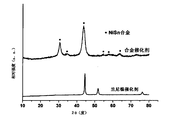
- Figure 1 is an XRD pattern of a hydrothermally prepared skeletal nickel-tin alloy catalyst.
- Preparation of supported alloy catalyst one or more of activated carbon, alumina, silica, silicon carbide, zirconia, zinc oxide, and titanium dioxide are used as carriers, and a metal salt solution of tin and transition metal iron, cobalt, nickel, and rhodium
- a metal salt solution of tin and transition metal iron, cobalt, nickel, and rhodium An aqueous solution of a metal salt of ruthenium, palladium, rhodium, and platinum was co-loaded onto the support by an equal volume impregnation method, and dried at 120 ° C overnight. It was reduced with hydrogen at 300 ° C for 2 h and passivated in a 1% O 2 /N 2 (V/V) atmosphere for 4 h.
- Preparation of tin dioxide-supported nickel catalyst Weigh 1.5g of SnO 2 , 1.8g of Ni(NO 3 ) 2 ⁇ 6H 2 O, dissolve barium chloride in 20ml of water, and then add SnO 2 to the dissolved complete barium chloride solution. In the 25 ° C water bath, stirring for 12 h until the solution was completely evaporated. It was dried in an oven at 120 ° C for 8 h, calcined in a N 2 atmosphere at 300 ° C for 2 h, and then reduced in an H 2 atmosphere at 300 ° C for 2 h.
- metal hydrogenation catalyst one or more of activated carbon, alumina, silica, silicon carbide, zirconia, zinc oxide, and titanium dioxide are used as carriers, and chloroplatinic acid, palladium chloride, ruthenium chloride, ruthenium chloride An aqueous solution of cerium chloride, nickel nitrate, iron nitrate, cobalt nitrate, and copper nitrate was separately loaded onto the carrier by an equal volume impregnation method, and dried at 120 ° C overnight.
- the above catalysts supporting noble metals such as ruthenium, rhodium, palladium, iridium, platinum, etc., need to be hydrogenated at 250 ° C for 2 h before use, passivated for 4 h in 1% O 2 /N 2 (V / V) atmosphere;
- the catalysts of non-precious metals such as iron, cobalt and copper are reduced by hydrogen at 450 ° C for 2 h and passivated for 4 h in a 1% O 2 /N 2 (V/V) atmosphere before use.
- In-situ preparation of the alloy catalyst one or more of the elemental or compound of tin is added to the reaction vessel together with the metal hydrogenation catalyst or the framework metal catalyst, and the reactant and solvent water are added according to the reaction conditions of Example 7. Hydrogen is charged, and the reaction is started at the reaction temperature to form an alloy catalyst in situ in the reaction.
- Preparation of framework type alloy catalyst a hydrothermal preparation method is employed. 0.6 g of metal tin and 1.0 g of framework metal catalyst Raney nickel were added together to a hydrothermal synthesis kettle, 10-100 mL of water was added as a solvent, and hydrogen gas was charged at 7 MPa, and hydrothermally treated at 250 ° C for 3 h to filter. The catalyst was obtained to dry at 120 ° C overnight. It can be seen from Fig. 1 that the prepared alloy catalyst was confirmed by XRD to form a nickel-tin alloy.
- Catalytic conversion experiment 0.25 g of carbohydrate, a certain mass of composite catalyst and 25 ml of water were added to a 75 ml reaction vessel, and then six times of gas was replaced by hydrogen gas, and then hydrogen gas was charged to 5 MPa, and the temperature was raised to a certain temperature for 30-240 minutes. After the reaction was completed, the temperature was lowered to room temperature, and the supernatant liquid after centrifugation was taken and analyzed by high performance liquid chromatography. Only the target products ethylene glycol, propylene glycol, and hexahydric alcohol (including sorbitol, mannitol) were calculated in the product yield.
- the supported alloy catalyst has a promoting effect on the formation of ethylene glycol. Comparing the yields of ethylene glycol and hexahydric alcohol on the alloy catalyst and the single transition metal hydrogenation catalyst, it can be seen that the formation of the alloy promotes the formation of ethylene. The yield of alcohol is significantly improved, and the yield of hexahydric alcohol is significantly reduced.
- the unsupported alloy catalyst also promotes the formation of ethylene glycol. Compared with the yield of ethylene glycol and hexavalent alcohol on the alloy catalyst and the Lanney single metal catalyst, it can be seen that the formation of the alloy promotes the formation of ethylene. The yield of alcohol is significantly improved, and the yield of hexahydric alcohol is significantly reduced.
- the alloy catalyst was a supported alloy catalyst RuSn/AC, the mass ratio of Sn to Ru was 1:3.5, and the loading of Ru on the catalyst was 5%.
- the reaction conditions were the same as in Example 7, and the catalytic conversion results of the catalyst on different carbohydrates (Table 3).
- the total selectivity of RuSn alloy catalyst to ethylene glycol and propylene glycol during carbohydrate conversion is higher than that of sorbitol, indicating that the alloy catalyst has good fracture carbon for carbohydrates with unsaturated chemical bonds.
- the role of carbon bonds The yield of ethylene glycol obtained from cellulose as a raw material is higher than that of other carbohydrates.
- the relative selectivity of ethylene glycol and propylene glycol has a certain relationship with the kind of the raw material. When the raw material contains fructose or can be isomeric as fructose, the yield of propylene glycol is improved.
- the alloy catalyst has very low catalytic activity on sorbitol, and cannot selectively break the carbon-carbon bond in sorbitol to form ethylene glycol and propylene glycol, and similarly, the conversion effect on xylitol and glycerol is also poor.
- the alloy catalyst was the catalytic conversion result of cellulose under different reaction time of supported alloy catalyst PtSn/AC (0.5%Sn, 5%Pt) (Table 4).
- the reaction conditions were the same as in Example 7 except that the reaction time was different.
- the alloy catalyst system has a good ethylene glycol yield in a certain time range.
- the preferred time is from 1 h to 2.5 h.
- the alloy catalyst was a supported alloy catalyst 5% Ir3.5%Sn/AC, and the catalytic conversion results of cellulose at different reaction temperatures (Table 5), the reaction conditions were the same as in Example 7.
- the alloy catalyst system has a good ethylene glycol yield in a certain temperature range.
- the preferred temperature is 230-260 °C.
- the alloy catalyst was a supported alloy catalyst IrSn/AC, and the cellulose catalytic conversion results were obtained under different Sn/Ir mass ratios (Table 6), and the reaction conditions were the same as those in Example 7.
- the alloy catalyst system has a good ethylene glycol yield within a certain range of tin-bismuth mass ratio.
- the preferred mass ratio of tin antimony in the alloy catalyst is from 0.6 to 1.8.
- the alloy catalyst was a supported alloy catalyst 5% Ir4% Sn/AC, and the effects of different liquid space velocities were examined (Table 7).
- the reaction conditions were the same as in Example 7.
- the alloy catalyst system has a good total yield of ethylene glycol and propylene glycol in a certain liquid space velocity range.
- the preferred liquid reaction space velocity in the continuous reaction is 0.8 h -1 .
- the alloy catalyst was an unsupported Raney nickel tin catalyst (magnesium tin mass ratio of 3:1) and activated carbon supported 5% Ni3%Sn/AC, 5% Ir3%Sn/AC catalyst, and the cycleability of the catalyst was examined. VIII) The reaction conditions are the same as in Example 7.
- the framework type alloy catalyst Lanney nickel tin can obtain a higher ethylene glycol yield in the first four cycles.
- the results of ion analysis in the solution after the reaction showed that the concentration of nickel and tin ions in the reaction solution obtained by using the Raney nickel tin catalyst for each cycle was less than 1 ppm, and the amount of loss of the active component of the catalyst was extremely low.
- the noble metal Ir and tin alloy catalysts also exhibit very good selectivity and stability.
- the yield and stability of ethylene glycol of the activated carbon-supported nickel-tin catalyst NiSn/AC were significantly worse than those of the skeleton type catalyst.
- the skeleton type nickel tin catalyst has a relatively superior catalytic effect.
- the alloy catalyst system of the present invention can achieve efficient conversion of carbohydrates to ethylene glycol and propylene glycol.
- the method is not only simple in operation, low in cost, but also has the advantages of extremely low catalyst loss, good cycleability, and easy recovery.
Landscapes
- Chemical & Material Sciences (AREA)
- Organic Chemistry (AREA)
- Engineering & Computer Science (AREA)
- Materials Engineering (AREA)
- Chemical Kinetics & Catalysis (AREA)
- Catalysts (AREA)
- Organic Low-Molecular-Weight Compounds And Preparation Thereof (AREA)
Abstract
Description


| 催化剂 | 循环次数 | 乙二醇收率% | 丙二醇收率% | 六元醇收率% |
| 兰尼镍锡 | 第一次 | 60.4 | 13.2 | 4.6. |
| 兰尼镍锡 | 第二次 | 59.8 | 10.9 | 4.2 |
| 兰尼镍锡 | 第三次 | 54.9 | 11.1 | 5.8 |
| 兰尼镍锡 | 第四次 | 53.7 | 13.6 | 2.9 |
| NiSn/AC | 第一次 | 38.7 | 9.5 | 6.1 |
| NiSn/AC | 第二次 | 28.5 | 8.2 | 5.4 |
| NiSn/AC | 第三次 | 20.3 | 6.5 | 4.5 |
| NiSn/AC | 第四次 | 14.4 | 4.2 | 3.1 |
| IrSn/AC | 第一次 | 54.4 | 13.2 | 4.6 |
| IrSn/AC | 第二次 | 52.3 | 13.0 | 4.0 |
| IrSn/AC | 第四次 | 50.1 | 12.0 | 4.7 |
Claims (10)
- 合金催化剂用于碳水化合物催化制备低碳二元醇的方法,其特征在于:其以碳水化合物为反应原料,在高压反应釜内,于水中进行催化加氢反应;所采用的合金催化剂由至少两种以上的金属组成;合金催化剂中含有金属锡和其余金属元素,其余金属元素为过渡金属铁、钴、钌、铑、钯、铱、铂、铜中的一种或二种以上,合金催化剂中金属锡与其余金属的重量比在0.01-100范围之间;或,催化剂使用前由金属锡前驱体和其余金属元素前驱体构成,其中一种前驱体为锡的单质或化合物中的一种或二种以上,其余金属元素前驱体为过渡金属铁、钴、钌、铑、钯、铱、铂、铜中的单质或化合物中一种或二种以上,反应过程中金属锡和其余金属元素形成合金,合金催化剂中金属锡与其余金属的重量比在0.01-100范围之间;反应于密闭间歇式、连续式或半连续式高压反应釜中搅拌进行;反应前反应釜中充填氢气,反应温度≥120℃,反应时间不少于5分钟,或液体反应空速不大于20h-1;在使用过程中,合金催化剂的重量浓度为反应物与反应溶剂质量总和的0.1%-50%;所述低碳二元醇为乙二醇或1,2-丙二醇中的一种或二种。
- 按照权利要求1所述的方法,其特征在于:反应前反应釜中充填氢气,室温时氢气的初始压力为1-12MPa;反应温度≥120℃,温度上限以反应产物不发生热分解为准。
- 按照权利要求1所述的方法,其特征在于:反应温度为200-280℃,室温下反应釜中氢气压力3-7MPa,对于密闭间歇式反应釜的反应时间为0.5-5h,对于半连续或连续式高压反应釜,反应空速GWSV为0.1-50h-1,GWSV代表流动状态下反应物每小时进入反应器的干基重量与反应器中催化剂重量的比值。
- 按照权利要求1所述的方法,其特征在于:所述合金催化剂为非负载型催化剂,其以合金金属作为催化剂骨架的骨架金属催化剂;优选催化剂为锡镍合金构成的骨架金属催化剂;骨架金属催化剂中金属锡与其余金属元素的重量比在0.1-10范围之间,反应釜中合金骨架催化剂的重量浓度为反应物与反应溶剂质量总和的1%-30%。
- 按照权利要求4所述的方法,其特征在于:所述骨架金属催化剂中金属锡与其余金属元素的重量比在0.5-2范围之间,反应体系中合金催化剂的重量浓度在2%-20%。
- 按照权利要求1所述的方法,其特征在于:所述合金催化剂为负载型催化剂,将金属锡组分与金属组分铁、钴、钌、铑、钯、铱、铂、铜中的一种或两种以上共同负载在同一载体上,所述载体为活性炭、氧化铝、氧化硅、碳化硅、氧化锆、氧化锌、二氧化钛一种载体或二种以上的复合载体,合金于催化剂上的含量在0.01-50wt%,金属锡与其余金属的重量比在0.1-10范围之间。
- 按照权利要求6所述的方法,其特征在于:合金于催化剂上的含量在1-35wt%,金属锡与其余金属的重量比在0.5-2范围之间。
- 按照权利要求1所述的方法,其特征在于:将锡的单质或化合物中的一种或二种以上作为载体,将过渡金属铁、钴、钌、铑、钯、铱、铂、铜中的单质或化合物中一种或二种以上担载在作为载体的锡的单质或化合物上,过渡金属于催化剂上的含量在0.01-50wt%;或,将过渡金属铁、钴、钌、铑、钯、铱、铂、铜中的单质或化合物中一种或二种以上作为载体,将锡的单质或化合物中的一种或二种以上担载在作为载体的过渡金属铁、钴、钌、铑、钯、铱、铂、铜中的单质或化合上,锡于催化剂上的含量在0.01-50wt%。
- 按照权利要求1所述的方法,其特征在于:反应原料与水的用量以反应条件下反应物料部分或完全为液态即可;所述碳水化合物为纤维素、淀粉、半纤维素、菊芋、蔗糖、葡萄糖、甘露糖、果糖、果聚糖、木糖、阿拉伯糖、可溶性低聚木糖、赤藓糖、壳聚糖、中的一种或二种以上。
- 按照权利要求1所述的方法,其特征在于:锡的单质或化合物为金属锡、氟化亚锡、氯化亚锡、溴化亚锡、碘化亚锡、氟化锡、氯化锡、溴化锡、碘化锡、氢氧化锡、氢氧化亚锡、氧化亚锡、二氧化锡、硫酸亚锡、醋酸锡、草酸亚锡、锡酸钠、锡酸钾、锡酸钙、磷化锡、焦磷酸锡中的一种或二种以上;过渡金属铁、钴、钌、铑、钯、铱、铂、铜中的单质或化合物为金属铁、金属钴、金属钌、金属铑、金属钯、金属铱、金属铂、金属铜、兰尼铁、兰尼钴、兰尼铜、硝酸铁、硝酸钴、硝酸钌、硝酸铑、硝酸钯、硝酸铱、硝酸铂、硝酸铜、氯化铁、氯化钴、氯化钌、氯化铑、氯化钯、氯化铱、氯化铂、氯化铜、三氧化二铁、四氧化三铁、氧化亚铁、硫酸铁、氧化亚钴、三氧化二钴、四氧化三钴、硫酸钴、硫酸镍、氧化铜、硫酸铜中的一种或二种以上。
Priority Applications (3)
| Application Number | Priority Date | Filing Date | Title |
|---|---|---|---|
| MYPI2017704732A MY187313A (en) | 2015-11-12 | 2015-11-26 | A method of catalytic conversion of carbohydrates to low-carbon diols by using alloy catalysts |
| CA2988448A CA2988448C (en) | 2015-11-12 | 2015-11-26 | A method of catalytic conversion of carbohydrates to low-carbon diols by using alloy catalysts |
| US15/735,190 US10654781B2 (en) | 2015-11-12 | 2015-11-26 | Method of catalytic conversion of carbohydrates to low-carbon diols by using alloy catalysts |
Applications Claiming Priority (2)
| Application Number | Priority Date | Filing Date | Title |
|---|---|---|---|
| CN201510770769.6A CN106694009B (zh) | 2015-11-12 | 2015-11-12 | 合金催化剂用于碳水化合物催化制备低碳二元醇的方法 |
| CN201510770769.6 | 2015-11-12 |
Publications (1)
| Publication Number | Publication Date |
|---|---|
| WO2017079999A1 true WO2017079999A1 (zh) | 2017-05-18 |
Family
ID=58694608
Family Applications (1)
| Application Number | Title | Priority Date | Filing Date |
|---|---|---|---|
| PCT/CN2015/095590 Ceased WO2017079999A1 (zh) | 2015-11-12 | 2015-11-26 | 合金催化剂用于碳水化合物催化制备低碳二元醇的方法 |
Country Status (5)
| Country | Link |
|---|---|
| US (1) | US10654781B2 (zh) |
| CN (1) | CN106694009B (zh) |
| CA (1) | CA2988448C (zh) |
| MY (1) | MY187313A (zh) |
| WO (1) | WO2017079999A1 (zh) |
Cited By (2)
| Publication number | Priority date | Publication date | Assignee | Title |
|---|---|---|---|---|
| CN111203252A (zh) * | 2020-03-24 | 2020-05-29 | 新疆兵团现代绿色氯碱化工工程研究中心(有限公司) | 一种用于草酸酯制乙二醇及乙醇的铜催化剂及其制备方法 |
| CN117486694A (zh) * | 2023-12-29 | 2024-02-02 | 山东新和成药业有限公司 | 一种藜芦醛的连续化制备方法 |
Families Citing this family (9)
| Publication number | Priority date | Publication date | Assignee | Title |
|---|---|---|---|---|
| CN109107581A (zh) * | 2017-06-22 | 2019-01-01 | 长春美禾科技发展有限公司 | 一种耐酸合金催化剂 |
| CN107337580B (zh) * | 2017-07-24 | 2021-01-08 | 中国石油大学(华东) | 一种低温自产氢-自加氢制备二元醇的方法 |
| CN107573213A (zh) * | 2017-08-11 | 2018-01-12 | 厦门大学 | 一种生物质制乙醇和乙二醇的化学方法 |
| CN109225329B (zh) * | 2018-09-26 | 2021-08-17 | 浙江恒澜科技有限公司 | 一种用于甘油氢解制备1,3-丙二醇的催化剂及其应用 |
| CN110586100A (zh) * | 2019-10-08 | 2019-12-20 | 扬州大学 | Fe2O3/FeO异质结构及其制备方法及应用 |
| CN111085195B (zh) * | 2019-12-30 | 2022-12-27 | 宁波中科科创新能源科技有限公司 | 金属合金催化剂及其制备方法 |
| CN112934235B (zh) * | 2021-03-05 | 2024-04-02 | 河北思动环保科技有限公司 | 一种新能源燃料电池的氢气净化用催化剂 |
| KR102619058B1 (ko) * | 2021-11-02 | 2023-12-28 | 한국화학연구원 | 1,3-프로판디올 제조용 촉매 및 이를 이용한 1,3-프로판디올의 제조방법 |
| CN116726937B (zh) * | 2023-06-02 | 2025-12-09 | 安徽理工大学 | 一种类石墨烯碳壳层包裹过渡双金属催化剂及从纤维素催化氢解制备羟基丙酮的方法 |
Citations (5)
| Publication number | Priority date | Publication date | Assignee | Title |
|---|---|---|---|---|
| CN101199930A (zh) * | 2006-12-14 | 2008-06-18 | 马波 | 一种高碳多元醇加氢裂解催化剂,其制备方法和应用 |
| JP2013060379A (ja) * | 2011-09-12 | 2013-04-04 | Chiba Univ | アルコールを製造する方法及びアルコール製造用触媒 |
| CN104119203A (zh) * | 2013-04-26 | 2014-10-29 | 中国科学院大连化学物理研究所 | 一种在氮气氛下高碳多元醇催化裂解制备二元醇的方法 |
| CN104119207A (zh) * | 2013-04-26 | 2014-10-29 | 中国科学院大连化学物理研究所 | 一种碳水化合物催化转化制备乙二醇的方法 |
| CN104710277A (zh) * | 2013-12-17 | 2015-06-17 | 中国科学院大连化学物理研究所 | 一种糖及糖醇氢解制备低碳醇的方法 |
Family Cites Families (10)
| Publication number | Priority date | Publication date | Assignee | Title |
|---|---|---|---|---|
| CN1204103C (zh) | 2002-06-12 | 2005-06-01 | 中国石油化工股份有限公司 | 环氧乙烷催化水合制备乙二醇的方法 |
| CN101723802B (zh) * | 2008-10-24 | 2013-06-19 | 中国科学院大连化学物理研究所 | 一种纤维素制乙二醇的方法 |
| CN101704710B (zh) | 2009-08-24 | 2013-04-03 | 江苏索普(集团)有限公司 | 一种玉米芯催化转化制取乙二醇、丙二醇和丙三醇的方法 |
| KR20120124427A (ko) * | 2009-12-30 | 2012-11-13 | 바이렌트, 아이엔씨. | 폴리올의 산소환원 수소처리를 위한 개선된 촉매 |
| CN102190562B (zh) * | 2010-03-17 | 2014-03-05 | 中国科学院大连化学物理研究所 | 一种多羟基化合物制乙二醇的方法 |
| FR2969602B1 (fr) * | 2010-12-22 | 2013-03-29 | IFP Energies Nouvelles | Procede de transformation de biomasse lignocellulosique ou de cellulose par des catalyseurs a base d'oxyde d'etain et/ou d'oxyde d'antimoine et d'un metal choisi dans les groupes 8 a 11 |
| CN102675045B (zh) * | 2011-03-15 | 2015-04-01 | 中国科学院大连化学物理研究所 | 一种糖溶液制备乙二醇、1,2-丙二醇的方法 |
| PL2720991T3 (pl) * | 2011-06-14 | 2015-12-31 | Shell Int Research | Współwytwarzanie biopaliw i glikoli |
| AU2013284470B2 (en) * | 2012-06-28 | 2015-11-19 | Shell Internationale Research Maatschappij B.V. | Methods for hydrothermal digestion of cellulosic biomass solids in the presence of a distributed slurry catalyst |
| CN105523890B (zh) * | 2014-09-28 | 2021-04-16 | 长春美禾科技发展有限公司 | 一种制备二元醇的方法 |
-
2015
- 2015-11-12 CN CN201510770769.6A patent/CN106694009B/zh active Active
- 2015-11-26 CA CA2988448A patent/CA2988448C/en active Active
- 2015-11-26 MY MYPI2017704732A patent/MY187313A/en unknown
- 2015-11-26 WO PCT/CN2015/095590 patent/WO2017079999A1/zh not_active Ceased
- 2015-11-26 US US15/735,190 patent/US10654781B2/en active Active
Patent Citations (5)
| Publication number | Priority date | Publication date | Assignee | Title |
|---|---|---|---|---|
| CN101199930A (zh) * | 2006-12-14 | 2008-06-18 | 马波 | 一种高碳多元醇加氢裂解催化剂,其制备方法和应用 |
| JP2013060379A (ja) * | 2011-09-12 | 2013-04-04 | Chiba Univ | アルコールを製造する方法及びアルコール製造用触媒 |
| CN104119203A (zh) * | 2013-04-26 | 2014-10-29 | 中国科学院大连化学物理研究所 | 一种在氮气氛下高碳多元醇催化裂解制备二元醇的方法 |
| CN104119207A (zh) * | 2013-04-26 | 2014-10-29 | 中国科学院大连化学物理研究所 | 一种碳水化合物催化转化制备乙二醇的方法 |
| CN104710277A (zh) * | 2013-12-17 | 2015-06-17 | 中国科学院大连化学物理研究所 | 一种糖及糖醇氢解制备低碳醇的方法 |
Cited By (4)
| Publication number | Priority date | Publication date | Assignee | Title |
|---|---|---|---|---|
| CN111203252A (zh) * | 2020-03-24 | 2020-05-29 | 新疆兵团现代绿色氯碱化工工程研究中心(有限公司) | 一种用于草酸酯制乙二醇及乙醇的铜催化剂及其制备方法 |
| CN111203252B (zh) * | 2020-03-24 | 2023-07-14 | 新疆至臻化工工程研究中心有限公司 | 一种用于草酸酯制乙二醇及乙醇的铜催化剂及其制备方法 |
| CN117486694A (zh) * | 2023-12-29 | 2024-02-02 | 山东新和成药业有限公司 | 一种藜芦醛的连续化制备方法 |
| CN117486694B (zh) * | 2023-12-29 | 2024-03-26 | 山东新和成药业有限公司 | 一种藜芦醛的连续化制备方法 |
Also Published As
| Publication number | Publication date |
|---|---|
| MY187313A (en) | 2021-09-21 |
| CN106694009B (zh) | 2019-12-13 |
| US20180178201A1 (en) | 2018-06-28 |
| CA2988448C (en) | 2019-11-19 |
| CN106694009A (zh) | 2017-05-24 |
| US10654781B2 (en) | 2020-05-19 |
| CA2988448A1 (en) | 2017-05-18 |
Similar Documents
| Publication | Publication Date | Title |
|---|---|---|
| CN106694009B (zh) | 合金催化剂用于碳水化合物催化制备低碳二元醇的方法 | |
| CN107365287B (zh) | 一种合成2,5-呋喃二甲酸的方法 | |
| CN107365286B (zh) | 一种合成2,5-呋喃二甲酸的方法 | |
| CN102731257B (zh) | 一种含糖化合物选择性制丙二醇的方法 | |
| CN104998659B (zh) | 一种用于催化糠醛或糠醇重排加氢制备环戊醇的催化剂及其制备方法和应用方法 | |
| CN102019185B (zh) | 一种负载催化剂及其在木糖醇加氢裂解反应中的应用 | |
| CN103420797B (zh) | 低金属负载量催化剂用于碳水化合物制备乙二醇的方法 | |
| CN102731258B (zh) | 一种碳水化合物内循环催化转化制备低碳多元醇的方法 | |
| WO2011113281A1 (zh) | 一种多羟基化合物制乙二醇的方法 | |
| CN104711007A (zh) | 一种航空煤油或柴油范围液态烷烃的制备方法 | |
| CN110711588A (zh) | 一种水滑石基催化剂在高浓度糖转化到1,2-丙二醇中的应用 | |
| CN104119207B (zh) | 一种碳水化合物催化转化制备乙二醇的方法 | |
| CN103420795B (zh) | 一种低沸点有机相中由碳水化合物生产二元醇的方法 | |
| CN101444740A (zh) | 一种生物油水蒸气重整制氢催化剂及其制备方法 | |
| CN101422739B (zh) | 催化氢解甘油制备二元醇的负载型催化剂及其制备方法 | |
| CN101372444A (zh) | 一种丙三醇加氢裂解的方法 | |
| CN106540701B (zh) | 一种草酸酯加氢催化剂及其制备方法 | |
| CN110845301B (zh) | 一种1,2-戊二醇的生产方法 | |
| CN108114716A (zh) | 一类制γ-戊内酯的催化剂及制备和应用 | |
| CN103848720B (zh) | 一种制备乙二醇的方法 | |
| CN103159587A (zh) | 一种催化剂在生物多元醇加氢裂解中的应用 | |
| CN101462051A (zh) | 用于气相巴豆醛选择性加氢生成巴豆醇的催化剂及其制备方法 | |
| CN106866374B (zh) | 一种由木糖或低聚木糖生产1,2-丙二醇和乙二醇的方法 | |
| CN102070422B (zh) | 丙三醇脱水、加氢制备丙酮醇及1,2-丙二醇的方法 | |
| CN111054339B (zh) | 制乙二醇的催化剂组合物 |
Legal Events
| Date | Code | Title | Description |
|---|---|---|---|
| 121 | Ep: the epo has been informed by wipo that ep was designated in this application |
Ref document number: 15908129 Country of ref document: EP Kind code of ref document: A1 |
|
| ENP | Entry into the national phase |
Ref document number: 2988448 Country of ref document: CA |
|
| WWE | Wipo information: entry into national phase |
Ref document number: 15735190 Country of ref document: US |
|
| NENP | Non-entry into the national phase |
Ref country code: DE |
|
| 122 | Ep: pct application non-entry in european phase |
Ref document number: 15908129 Country of ref document: EP Kind code of ref document: A1 |