WO2017057588A1 - リチウム二次電池用又はリチウムイオンキャパシタ用非水電解液及びそれを用いたリチウム二次電池又はリチウムイオンキャパシタ - Google Patents
リチウム二次電池用又はリチウムイオンキャパシタ用非水電解液及びそれを用いたリチウム二次電池又はリチウムイオンキャパシタ Download PDFInfo
- Publication number
- WO2017057588A1 WO2017057588A1 PCT/JP2016/078843 JP2016078843W WO2017057588A1 WO 2017057588 A1 WO2017057588 A1 WO 2017057588A1 JP 2016078843 W JP2016078843 W JP 2016078843W WO 2017057588 A1 WO2017057588 A1 WO 2017057588A1
- Authority
- WO
- WIPO (PCT)
- Prior art keywords
- lithium
- volume
- carbonate
- aqueous electrolyte
- aqueous
- Prior art date
- Legal status (The legal status is an assumption and is not a legal conclusion. Google has not performed a legal analysis and makes no representation as to the accuracy of the status listed.)
- Ceased
Links
Classifications
-
- H—ELECTRICITY
- H01—ELECTRIC ELEMENTS
- H01M—PROCESSES OR MEANS, e.g. BATTERIES, FOR THE DIRECT CONVERSION OF CHEMICAL ENERGY INTO ELECTRICAL ENERGY
- H01M10/00—Secondary cells; Manufacture thereof
- H01M10/05—Accumulators with non-aqueous electrolyte
- H01M10/056—Accumulators with non-aqueous electrolyte characterised by the materials used as electrolytes, e.g. mixed inorganic/organic electrolytes
- H01M10/0564—Accumulators with non-aqueous electrolyte characterised by the materials used as electrolytes, e.g. mixed inorganic/organic electrolytes the electrolyte being constituted of organic materials only
- H01M10/0566—Liquid materials
- H01M10/0569—Liquid materials characterised by the solvents
-
- H—ELECTRICITY
- H01—ELECTRIC ELEMENTS
- H01G—CAPACITORS; CAPACITORS, RECTIFIERS, DETECTORS, SWITCHING DEVICES, LIGHT-SENSITIVE OR TEMPERATURE-SENSITIVE DEVICES OF THE ELECTROLYTIC TYPE
- H01G11/00—Hybrid capacitors, i.e. capacitors having different positive and negative electrodes; Electric double-layer [EDL] capacitors; Processes for the manufacture thereof or of parts thereof
- H01G11/04—Hybrid capacitors
- H01G11/06—Hybrid capacitors with one of the electrodes allowing ions to be reversibly doped thereinto, e.g. lithium ion capacitors [LIC]
-
- H—ELECTRICITY
- H01—ELECTRIC ELEMENTS
- H01G—CAPACITORS; CAPACITORS, RECTIFIERS, DETECTORS, SWITCHING DEVICES, LIGHT-SENSITIVE OR TEMPERATURE-SENSITIVE DEVICES OF THE ELECTROLYTIC TYPE
- H01G11/00—Hybrid capacitors, i.e. capacitors having different positive and negative electrodes; Electric double-layer [EDL] capacitors; Processes for the manufacture thereof or of parts thereof
- H01G11/54—Electrolytes
- H01G11/58—Liquid electrolytes
- H01G11/60—Liquid electrolytes characterised by the solvent
-
- H—ELECTRICITY
- H01—ELECTRIC ELEMENTS
- H01G—CAPACITORS; CAPACITORS, RECTIFIERS, DETECTORS, SWITCHING DEVICES, LIGHT-SENSITIVE OR TEMPERATURE-SENSITIVE DEVICES OF THE ELECTROLYTIC TYPE
- H01G11/00—Hybrid capacitors, i.e. capacitors having different positive and negative electrodes; Electric double-layer [EDL] capacitors; Processes for the manufacture thereof or of parts thereof
- H01G11/54—Electrolytes
- H01G11/58—Liquid electrolytes
- H01G11/62—Liquid electrolytes characterised by the solute, e.g. salts, anions or cations therein
-
- H—ELECTRICITY
- H01—ELECTRIC ELEMENTS
- H01M—PROCESSES OR MEANS, e.g. BATTERIES, FOR THE DIRECT CONVERSION OF CHEMICAL ENERGY INTO ELECTRICAL ENERGY
- H01M10/00—Secondary cells; Manufacture thereof
- H01M10/05—Accumulators with non-aqueous electrolyte
- H01M10/052—Li-accumulators
-
- H—ELECTRICITY
- H01—ELECTRIC ELEMENTS
- H01M—PROCESSES OR MEANS, e.g. BATTERIES, FOR THE DIRECT CONVERSION OF CHEMICAL ENERGY INTO ELECTRICAL ENERGY
- H01M10/00—Secondary cells; Manufacture thereof
- H01M10/05—Accumulators with non-aqueous electrolyte
- H01M10/052—Li-accumulators
- H01M10/0525—Rocking-chair batteries, i.e. batteries with lithium insertion or intercalation in both electrodes; Lithium-ion batteries
-
- H—ELECTRICITY
- H01—ELECTRIC ELEMENTS
- H01M—PROCESSES OR MEANS, e.g. BATTERIES, FOR THE DIRECT CONVERSION OF CHEMICAL ENERGY INTO ELECTRICAL ENERGY
- H01M4/00—Electrodes
- H01M4/02—Electrodes composed of, or comprising, active material
- H01M4/36—Selection of substances as active materials, active masses, active liquids
- H01M4/362—Composites
- H01M4/364—Composites as mixtures
-
- H—ELECTRICITY
- H01—ELECTRIC ELEMENTS
- H01M—PROCESSES OR MEANS, e.g. BATTERIES, FOR THE DIRECT CONVERSION OF CHEMICAL ENERGY INTO ELECTRICAL ENERGY
- H01M4/00—Electrodes
- H01M4/02—Electrodes composed of, or comprising, active material
- H01M4/36—Selection of substances as active materials, active masses, active liquids
- H01M4/48—Selection of substances as active materials, active masses, active liquids of inorganic oxides or hydroxides
- H01M4/50—Selection of substances as active materials, active masses, active liquids of inorganic oxides or hydroxides of manganese
- H01M4/505—Selection of substances as active materials, active masses, active liquids of inorganic oxides or hydroxides of manganese of mixed oxides or hydroxides containing manganese for inserting or intercalating light metals, e.g. LiMn2O4 or LiMn2OxFy
-
- H—ELECTRICITY
- H01—ELECTRIC ELEMENTS
- H01M—PROCESSES OR MEANS, e.g. BATTERIES, FOR THE DIRECT CONVERSION OF CHEMICAL ENERGY INTO ELECTRICAL ENERGY
- H01M4/00—Electrodes
- H01M4/02—Electrodes composed of, or comprising, active material
- H01M4/36—Selection of substances as active materials, active masses, active liquids
- H01M4/48—Selection of substances as active materials, active masses, active liquids of inorganic oxides or hydroxides
- H01M4/52—Selection of substances as active materials, active masses, active liquids of inorganic oxides or hydroxides of nickel, cobalt or iron
- H01M4/525—Selection of substances as active materials, active masses, active liquids of inorganic oxides or hydroxides of nickel, cobalt or iron of mixed oxides or hydroxides containing iron, cobalt or nickel for inserting or intercalating light metals, e.g. LiNiO2, LiCoO2 or LiCoOxFy
-
- H—ELECTRICITY
- H01—ELECTRIC ELEMENTS
- H01G—CAPACITORS; CAPACITORS, RECTIFIERS, DETECTORS, SWITCHING DEVICES, LIGHT-SENSITIVE OR TEMPERATURE-SENSITIVE DEVICES OF THE ELECTROLYTIC TYPE
- H01G11/00—Hybrid capacitors, i.e. capacitors having different positive and negative electrodes; Electric double-layer [EDL] capacitors; Processes for the manufacture thereof or of parts thereof
- H01G11/22—Electrodes
- H01G11/30—Electrodes characterised by their material
- H01G11/32—Carbon-based
-
- H—ELECTRICITY
- H01—ELECTRIC ELEMENTS
- H01G—CAPACITORS; CAPACITORS, RECTIFIERS, DETECTORS, SWITCHING DEVICES, LIGHT-SENSITIVE OR TEMPERATURE-SENSITIVE DEVICES OF THE ELECTROLYTIC TYPE
- H01G11/00—Hybrid capacitors, i.e. capacitors having different positive and negative electrodes; Electric double-layer [EDL] capacitors; Processes for the manufacture thereof or of parts thereof
- H01G11/22—Electrodes
- H01G11/30—Electrodes characterised by their material
- H01G11/50—Electrodes characterised by their material specially adapted for lithium-ion capacitors, e.g. for lithium-doping or for intercalation
-
- H—ELECTRICITY
- H01—ELECTRIC ELEMENTS
- H01M—PROCESSES OR MEANS, e.g. BATTERIES, FOR THE DIRECT CONVERSION OF CHEMICAL ENERGY INTO ELECTRICAL ENERGY
- H01M10/00—Secondary cells; Manufacture thereof
- H01M10/05—Accumulators with non-aqueous electrolyte
- H01M10/056—Accumulators with non-aqueous electrolyte characterised by the materials used as electrolytes, e.g. mixed inorganic/organic electrolytes
- H01M10/0564—Accumulators with non-aqueous electrolyte characterised by the materials used as electrolytes, e.g. mixed inorganic/organic electrolytes the electrolyte being constituted of organic materials only
- H01M10/0566—Liquid materials
- H01M10/0567—Liquid materials characterised by the additives
-
- H—ELECTRICITY
- H01—ELECTRIC ELEMENTS
- H01M—PROCESSES OR MEANS, e.g. BATTERIES, FOR THE DIRECT CONVERSION OF CHEMICAL ENERGY INTO ELECTRICAL ENERGY
- H01M10/00—Secondary cells; Manufacture thereof
- H01M10/05—Accumulators with non-aqueous electrolyte
- H01M10/056—Accumulators with non-aqueous electrolyte characterised by the materials used as electrolytes, e.g. mixed inorganic/organic electrolytes
- H01M10/0564—Accumulators with non-aqueous electrolyte characterised by the materials used as electrolytes, e.g. mixed inorganic/organic electrolytes the electrolyte being constituted of organic materials only
- H01M10/0566—Liquid materials
- H01M10/0568—Liquid materials characterised by the solutes
-
- H—ELECTRICITY
- H01—ELECTRIC ELEMENTS
- H01M—PROCESSES OR MEANS, e.g. BATTERIES, FOR THE DIRECT CONVERSION OF CHEMICAL ENERGY INTO ELECTRICAL ENERGY
- H01M2220/00—Batteries for particular applications
- H01M2220/20—Batteries in motive systems, e.g. vehicle, ship, plane
-
- H—ELECTRICITY
- H01—ELECTRIC ELEMENTS
- H01M—PROCESSES OR MEANS, e.g. BATTERIES, FOR THE DIRECT CONVERSION OF CHEMICAL ENERGY INTO ELECTRICAL ENERGY
- H01M2300/00—Electrolytes
- H01M2300/0017—Non-aqueous electrolytes
- H01M2300/0025—Organic electrolyte
- H01M2300/0028—Organic electrolyte characterised by the solvent
- H01M2300/0034—Fluorinated solvents
-
- H—ELECTRICITY
- H01—ELECTRIC ELEMENTS
- H01M—PROCESSES OR MEANS, e.g. BATTERIES, FOR THE DIRECT CONVERSION OF CHEMICAL ENERGY INTO ELECTRICAL ENERGY
- H01M2300/00—Electrolytes
- H01M2300/0017—Non-aqueous electrolytes
- H01M2300/0025—Organic electrolyte
- H01M2300/0028—Organic electrolyte characterised by the solvent
- H01M2300/0037—Mixture of solvents
- H01M2300/0042—Four or more solvents
-
- H—ELECTRICITY
- H01—ELECTRIC ELEMENTS
- H01M—PROCESSES OR MEANS, e.g. BATTERIES, FOR THE DIRECT CONVERSION OF CHEMICAL ENERGY INTO ELECTRICAL ENERGY
- H01M4/00—Electrodes
- H01M4/02—Electrodes composed of, or comprising, active material
- H01M4/36—Selection of substances as active materials, active masses, active liquids
- H01M4/38—Selection of substances as active materials, active masses, active liquids of elements or alloys
- H01M4/386—Silicon or alloys based on silicon
-
- H—ELECTRICITY
- H01—ELECTRIC ELEMENTS
- H01M—PROCESSES OR MEANS, e.g. BATTERIES, FOR THE DIRECT CONVERSION OF CHEMICAL ENERGY INTO ELECTRICAL ENERGY
- H01M4/00—Electrodes
- H01M4/02—Electrodes composed of, or comprising, active material
- H01M4/36—Selection of substances as active materials, active masses, active liquids
- H01M4/38—Selection of substances as active materials, active masses, active liquids of elements or alloys
- H01M4/387—Tin or alloys based on tin
-
- H—ELECTRICITY
- H01—ELECTRIC ELEMENTS
- H01M—PROCESSES OR MEANS, e.g. BATTERIES, FOR THE DIRECT CONVERSION OF CHEMICAL ENERGY INTO ELECTRICAL ENERGY
- H01M4/00—Electrodes
- H01M4/02—Electrodes composed of, or comprising, active material
- H01M4/36—Selection of substances as active materials, active masses, active liquids
- H01M4/48—Selection of substances as active materials, active masses, active liquids of inorganic oxides or hydroxides
- H01M4/485—Selection of substances as active materials, active masses, active liquids of inorganic oxides or hydroxides of mixed oxides or hydroxides for inserting or intercalating light metals, e.g. LiTi2O4 or LiTi2OxFy
-
- H—ELECTRICITY
- H01—ELECTRIC ELEMENTS
- H01M—PROCESSES OR MEANS, e.g. BATTERIES, FOR THE DIRECT CONVERSION OF CHEMICAL ENERGY INTO ELECTRICAL ENERGY
- H01M4/00—Electrodes
- H01M4/02—Electrodes composed of, or comprising, active material
- H01M4/36—Selection of substances as active materials, active masses, active liquids
- H01M4/58—Selection of substances as active materials, active masses, active liquids of inorganic compounds other than oxides or hydroxides, e.g. sulfides, selenides, tellurides, halogenides or LiCoFy; of polyanionic structures, e.g. phosphates, silicates or borates
- H01M4/5825—Oxygenated metallic salts or polyanionic structures, e.g. borates, phosphates, silicates, olivines
-
- H—ELECTRICITY
- H01—ELECTRIC ELEMENTS
- H01M—PROCESSES OR MEANS, e.g. BATTERIES, FOR THE DIRECT CONVERSION OF CHEMICAL ENERGY INTO ELECTRICAL ENERGY
- H01M4/00—Electrodes
- H01M4/02—Electrodes composed of, or comprising, active material
- H01M4/36—Selection of substances as active materials, active masses, active liquids
- H01M4/58—Selection of substances as active materials, active masses, active liquids of inorganic compounds other than oxides or hydroxides, e.g. sulfides, selenides, tellurides, halogenides or LiCoFy; of polyanionic structures, e.g. phosphates, silicates or borates
- H01M4/583—Carbonaceous material, e.g. graphite-intercalation compounds or CFx
- H01M4/587—Carbonaceous material, e.g. graphite-intercalation compounds or CFx for inserting or intercalating light metals
-
- Y—GENERAL TAGGING OF NEW TECHNOLOGICAL DEVELOPMENTS; GENERAL TAGGING OF CROSS-SECTIONAL TECHNOLOGIES SPANNING OVER SEVERAL SECTIONS OF THE IPC; TECHNICAL SUBJECTS COVERED BY FORMER USPC CROSS-REFERENCE ART COLLECTIONS [XRACs] AND DIGESTS
- Y02—TECHNOLOGIES OR APPLICATIONS FOR MITIGATION OR ADAPTATION AGAINST CLIMATE CHANGE
- Y02E—REDUCTION OF GREENHOUSE GAS [GHG] EMISSIONS, RELATED TO ENERGY GENERATION, TRANSMISSION OR DISTRIBUTION
- Y02E60/00—Enabling technologies; Technologies with a potential or indirect contribution to GHG emissions mitigation
- Y02E60/10—Energy storage using batteries
-
- Y—GENERAL TAGGING OF NEW TECHNOLOGICAL DEVELOPMENTS; GENERAL TAGGING OF CROSS-SECTIONAL TECHNOLOGIES SPANNING OVER SEVERAL SECTIONS OF THE IPC; TECHNICAL SUBJECTS COVERED BY FORMER USPC CROSS-REFERENCE ART COLLECTIONS [XRACs] AND DIGESTS
- Y02—TECHNOLOGIES OR APPLICATIONS FOR MITIGATION OR ADAPTATION AGAINST CLIMATE CHANGE
- Y02E—REDUCTION OF GREENHOUSE GAS [GHG] EMISSIONS, RELATED TO ENERGY GENERATION, TRANSMISSION OR DISTRIBUTION
- Y02E60/00—Enabling technologies; Technologies with a potential or indirect contribution to GHG emissions mitigation
- Y02E60/13—Energy storage using capacitors
-
- Y—GENERAL TAGGING OF NEW TECHNOLOGICAL DEVELOPMENTS; GENERAL TAGGING OF CROSS-SECTIONAL TECHNOLOGIES SPANNING OVER SEVERAL SECTIONS OF THE IPC; TECHNICAL SUBJECTS COVERED BY FORMER USPC CROSS-REFERENCE ART COLLECTIONS [XRACs] AND DIGESTS
- Y02—TECHNOLOGIES OR APPLICATIONS FOR MITIGATION OR ADAPTATION AGAINST CLIMATE CHANGE
- Y02T—CLIMATE CHANGE MITIGATION TECHNOLOGIES RELATED TO TRANSPORTATION
- Y02T10/00—Road transport of goods or passengers
- Y02T10/60—Other road transportation technologies with climate change mitigation effect
- Y02T10/70—Energy storage systems for electromobility, e.g. batteries
Definitions
- the present invention relates to a non-aqueous electrolyte or lithium ion capacitor for a lithium secondary battery that is excellent in battery performance such as withstand voltage without solidifying the non-aqueous electrolyte even at an extremely low temperature of ⁇ 40 ° C.
- the present invention relates to a nonaqueous electrolytic solution for use, and a lithium secondary battery or a lithium ion capacitor using the same.
- lithium secondary batteries or lithium ion capacitors have been widely used not only for small electronic devices such as mobile phones and laptop computers, but also for in-vehicle power sources for electric vehicles and idling stops, and for power storage. I came. In order to extend the cruising range of these electric vehicles, further development of higher voltage and higher energy density storage devices is being carried out. As a result, electric vehicles have long travel distances and may be used in a wide range of temperatures from extremely hot regions such as the tropics to extremely cold regions. Therefore, these lithium secondary batteries and lithium ion capacitors may be 60 ° C. or higher in a car under hot weather. In addition, the nonaqueous electrolyte solution may be solidified at an extremely low temperature of -40 ° C. or lower.
- the lithium secondary battery is mainly composed of a positive electrode and a negative electrode containing a material capable of occluding and releasing lithium, a non-aqueous electrolyte composed of a lithium salt and a non-aqueous solvent, and the non-aqueous solvent includes ethylene carbonate (EC), Carbonates such as dimethyl carbonate (DMC) are used.
- EC ethylene carbonate
- DMC dimethyl carbonate
- the non-aqueous solvent is composed of a mixed solvent containing one or more cyclic esters and one or more chain esters, the mixed solvents are compatible with each other, and at least one chain ester is
- Patent Document 2 discloses that a nonaqueous solvent is a fluorinated chain carboxylic acid ester, and a film-forming compound that is decomposed in a range of +1.0 to 3.0 V with reference to the equilibrium potential of lithium metal and lithium ions.
- Patent Document 3 discloses an electrolytic solution for a lithium ion battery containing 2,2-difluoroethyl acetate containing 50 to 90% of a nonaqueous solvent, and improves cycle characteristics at high voltage under high temperature conditions. It is shown.
- Patent Document 4 includes a mixture containing 20 to 35% by volume of ethylene carbonate, 35 to 45% by volume of ethyl methyl carbonate, 15 to 35% by volume of dimethyl carbonate, and 3 to 15% by volume of diethyl carbonate or propylene carbonate. It is disclosed that the cycle characteristics at room temperature and ⁇ 30 ° C. are improved in a lithium secondary battery using a non-aqueous electrolyte composed of a solvent.
- LiPF 6 is dissolved in a solvent in which ethylene carbonate, dimethyl carbonate, ethyl methyl carbonate, and methyl propionate are mixed at a volume ratio of 3: 3: 3: 1 so as to be 1 M, and vinylene carbonate is obtained. It is disclosed that the output characteristics at ⁇ 30 ° C. are improved in a lithium secondary battery using a nonaqueous electrolytic solution to which 2% by mass is added.
- the present invention is a lithium secondary that can be used while maintaining a liquid state in a “wide temperature range with a temperature range as high as 100 ° C.” without solidifying even at ⁇ 40 ° C. or less, and exhibiting excellent battery performance.
- An object is to provide a non-aqueous electrolyte for a battery or a lithium ion capacitor, and a lithium secondary battery and a lithium ion capacitor using the same.
- the present inventors have found that a lithium salt is dissolved in an amount of 0.8 to 1.5 M (mol / L) in a nonaqueous solvent.
- the non-aqueous solvent is 5 to 25% by volume of ethylene carbonate, 5 to 25% by volume of propylene carbonate, 20 to 30% by volume of dimethyl carbonate, and 10 to 20% by volume with respect to the whole non-aqueous solvent.
- a mixed solvent containing various carbonates and fluorinated chain esters in a specific ratio it does not solidify even at -40 ° C. or less, and “a wide temperature range of 100 ° C.
- the present inventors have dissolved lithium salt in a non-aqueous solvent in an amount of 0.9 to 1.5 M (mol / L).
- the non-aqueous solvent is 5 to 25% by volume of ethylene carbonate, 5 to 25% by volume of propylene carbonate, 20 to 30% by volume of dimethyl carbonate, 20 to 40% with respect to the whole non-aqueous solvent.
- the present invention provides the following (1) to (4).
- a non-aqueous electrolyte in which a lithium salt is dissolved in a non-aqueous solvent in an amount of 0.8 to 1.5 M (mol / L),
- the non-aqueous solvent is 5 to 25% by volume of ethylene carbonate, 5 to 25% by volume of propylene carbonate, 20 to 30% by volume of dimethyl carbonate, and 10 to 20% by volume of fluorinated chain based on the whole non-aqueous solvent.
- An ester and 20 to 40% by volume of methyl ethyl carbonate In the non-aqueous solvent, the total content of ethylene carbonate and propylene carbonate is 20 to 30% by volume, the total content of dimethyl carbonate and fluorinated chain ester is 30 to 40% by volume, A non-aqueous electrolyte for a lithium secondary battery or a lithium ion capacitor, wherein the flash point of the non-aqueous electrolyte is 20 ° C. or higher.
- non-aqueous electrolyte in which a lithium salt is dissolved in a non-aqueous solvent in an amount of 0.9 to 1.5 M (mol / L),
- the non-aqueous solvent is 5 to 25% by volume of ethylene carbonate, 5 to 25% by volume of propylene carbonate, 20 to 30% by volume of dimethyl carbonate, and 20 to 40% by volume of methyl ethyl carbonate with respect to the whole non-aqueous solvent.
- ethyl propionate In the non-aqueous solvent, the total content of ethylene carbonate and propylene carbonate is 20 to 30% by volume, the total content of dimethyl carbonate and ethyl propionate is 30 to 40% by volume, A non-aqueous electrolyte for a lithium secondary battery or a lithium ion capacitor, wherein the flash point of the non-aqueous electrolyte is 20 ° C. or higher.
- a lithium secondary battery including a positive electrode, a negative electrode, and a non-aqueous electrolyte solution in which an electrolyte salt is dissolved in a non-aqueous solvent
- the non-aqueous electrolyte solution is the non-aqueous solution described in (1) or (2).
- a lithium ion capacitor comprising a positive electrode, a negative electrode, and a non-aqueous electrolyte in which an electrolyte salt is dissolved in a non-aqueous solvent
- the non-aqueous electrolyte is the non-aqueous electrolysis described in (1) or (2)
- the non-aqueous electrolyte of the present invention has a lithium salt concentration in a specific range and a specific solvent mixed at a specific ratio, thereby having excellent withstand voltage and having a high flash point (20 ° C. or higher). Moreover, it has a low freezing point and does not solidify at ⁇ 40 ° C., and exhibits high electrical conductivity. Therefore, according to the non-aqueous electrolyte of the present invention, it has excellent characteristics in a wide temperature range from high temperature to very low temperature.
- the lithium secondary battery or lithium ion capacitor shown can be provided.
- the present invention relates to a non-aqueous electrolyte for a lithium secondary battery or a lithium ion capacitor, and a lithium secondary battery or a lithium ion capacitor using the same.
- the nonaqueous electrolytic solution according to the first aspect of the present invention is a nonaqueous electrolytic solution in which a lithium salt is dissolved in a nonaqueous solvent in an amount of 0.8 to 1.5 M (mol / L).
- the non-aqueous solvent is 5 to 25% by volume of ethylene carbonate, 5 to 25% by volume of propylene carbonate, 20 to 30% by volume of dimethyl carbonate, and 10 to 20% by volume of fluorinated chain based on the whole non-aqueous solvent.
- the non-aqueous electrolyte for a lithium secondary battery or lithium ion capacitor is characterized in that the flash point of the non-aqueous electrolyte is 20 ° C. or higher.
- the nonaqueous electrolytic solution according to the second aspect of the present invention is a nonaqueous electrolytic solution in which a lithium salt is dissolved in a nonaqueous solvent in an amount of 0.9 to 1.5 M (mol / L).
- the non-aqueous solvent is 5 to 25% by volume of ethylene carbonate, 5 to 25% by volume of propylene carbonate, 20 to 30% by volume of dimethyl carbonate, and 20 to 40% by volume of methyl ethyl carbonate with respect to the whole non-aqueous solvent.
- the non-aqueous electrolyte for a lithium secondary battery or lithium ion capacitor is characterized in that the flash point of the non-aqueous electrolyte is 20 ° C. or higher.
- lithium salt used in the non-aqueous electrolyte solution according to the first aspect of the present invention and the non-aqueous electrolyte solution according to the second aspect include the following.
- the lithium salt include inorganic lithium salts such as LiPF 6 , LiPO 2 F 2 , and LiBF 4 , LiN (SO 2 F) 2 [LiFSI], LiN (SO 2 CF 3 ) 2 , LiN (SO 2 C 2 F 5 ).
- LiPF 6 LiPO 2 F 2 , LiN (SO 2 F) 2 , lithium methyl sulfate, lithium ethyl sulfate, or lithium difluorobis (oxalato) phosphate
- LiPF 6 LiPO 2 F 2 , LiN (SO 2 F) 2 , lithium methyl sulfate, lithium ethyl sulfate, or lithium difluorobis (oxalato) phosphate
- the concentration of the lithium salt is 0.8 M (mol / L) or more, preferably 1.0 M or more, and 1.1 M with respect to the non-aqueous solvent. The above is more preferable.
- the upper limit is 1.5M or less, 1.45M or less is preferable and 1.4M or less is more preferable.
- the concentration of the lithium salt in the nonaqueous electrolytic solution according to the second aspect is 0.9 M (mol / L) or more, preferably 1.0 M or more, relative to the nonaqueous solvent. 1M or more is more preferable, 1.15M or more is further preferable, and 1.2M or more is particularly preferable.
- the upper limit is 1.5M or less, 1.45M or less is preferable and 1.4M or less is more preferable.
- electrolyte salts those containing at least LiPF 6 are preferable, those containing at least LiPF 6 and LiN (SO 2 F) 2 are more preferable, and in addition to LiPF 6 and LiN (SO 2 F) 2 Those containing lithium salts other than these are more preferred.
- the ratio of the lithium salt other than LiPF 6 and / or LiN (SO 2 F) 2 for example, LiPO 2 F 2 in the non-aqueous solvent in the “wide temperature range extending to 100 ° C.” is 0.001M. If it is above, the battery characteristics in a wide temperature range are improved, and if it is 0.3 M or less, there is little concern that the effect of improving the battery characteristics in a wide temperature range is reduced, which is preferable.
- it is 0.01M or more, Especially preferably, it is 0.03M or more, Most preferably, it is 0.04M or more.
- the upper limit is preferably 0.3M or less, more preferably 0.25M or less, and particularly preferably 0.2M or less.
- the proportion of the lithium salt having an oxalic acid skeleton and the lithium salt having an S ⁇ O group in the non-aqueous solvent is preferably 0.001M or more and 0.5M or less. Within this range, the effect of improving electrochemical characteristics over a wide temperature range is further exhibited. Preferably it is 0.01M or more, More preferably, it is 0.03M or more, Most preferably, it is 0.04M or more. The upper limit is more preferably 0.4M or less, and particularly preferably 0.2M or less.
- Nonaqueous solvent As the non-aqueous solvent used in the non-aqueous electrolyte solution according to the first aspect of the present invention and the non-aqueous electrolyte solution according to the second aspect, from the viewpoint that the electrochemical characteristics are synergistically improved over a wide temperature range. , A mixed solvent containing a cyclic carbonate, a chain carbonate, and a chain ester is used.
- cyclic carbonate at least ethylene carbonate and propylene carbonate are used.
- the content of ethylene carbonate is 5% by volume or more, preferably 7% by volume or more, more preferably 9% by volume or more with respect to the entire non-aqueous solvent from the viewpoint of improving electrical conductivity.
- the upper limit of the content of ethylene carbonate is 25% by volume or less, preferably 22% by volume or less, more preferably 20% by volume or less, further preferably from the viewpoint of lowering the freezing point. Is 17% by volume or less, particularly preferably 15% by volume or less.
- the content of propylene carbonate is 5% by volume or more, preferably 7% by volume or more, and more preferably 9% by volume or more with respect to the whole non-aqueous solvent, from the viewpoint of improving electrochemical characteristics under a high temperature environment.
- the upper limit of the content of propylene carbonate is 25% by volume or less, preferably 20% by volume or less, more preferably 17% by volume or less, and still more preferably, based on the whole nonaqueous solvent from the viewpoint of improving electrical conductivity. Is 15% by volume or less.
- the total content of ethylene carbonate and propylene carbonate is 20% by volume or more, preferably 22% by volume or more, based on the whole non-aqueous solvent, from the viewpoint of improving electrical conductivity.
- Examples of the “other cyclic carbonates” include 4-fluoro-1,3-dioxolane-2-one, vinylene carbonate, 2-propynyl 2-oxo-1,3-dioxolane-4-carboxylate, and 4-ethynyl.
- One or more selected from -1,3-dioxolan-2-one is more preferred.
- the “other cyclic carbonates” when at least one of unsaturated carbonates such as carbon-carbon double bonds or carbon-carbon triple bonds or cyclic carbonates having fluorine atoms is used, It is preferable because electrochemical characteristics are further improved, and it is more preferable to include both a cyclic carbonate having an unsaturated bond such as a carbon-carbon double bond or a carbon-carbon triple bond and a cyclic carbonate having a fluorine atom.
- the content of the cyclic carbonate having an unsaturated bond such as a carbon-carbon double bond or a carbon-carbon triple bond is preferably 0.07% by volume or more, more preferably 0.2% by volume with respect to the whole non-aqueous solvent. % Or more, more preferably 0.7% by volume or more, and the upper limit thereof is preferably 7% by volume or less, more preferably 4% by volume or less, still more preferably 2.5% by volume or less. This is preferable because electrochemical characteristics in a wider temperature range can be further increased without impairing the Li ion permeability.
- the content of the cyclic carbonate having a fluorine atom is preferably 0.07% by volume or more, more preferably 0.3% by volume or more, still more preferably 0.7% by volume or more based on the whole non-aqueous solvent.
- the upper limit is preferably 10% by volume or less, more preferably 7% by volume or less, and further 5% by volume or less, which improves electrochemical characteristics in a wider temperature range without impairing Li ion permeability. This is preferable.
- the total content when a cyclic carbonate having an unsaturated bond such as a carbon-carbon double bond or carbon-carbon triple bond and a cyclic carbonate having a fluorine atom is used in combination is 0.3% by volume based on the whole non-aqueous solvent.
- the above is preferable, and 0.7 volume% or more is more preferable.
- 7 volume% or less is preferable and 5 volume% or less is more preferable.
- methyl ethyl carbonate it is 40 volume% or less with respect to the whole nonaqueous solvent from a viewpoint of an electrical conductivity improvement, Preferably it is 37 volume% or less.
- the content of dimethyl carbonate is 20% by volume or more, preferably 23% by volume or more with respect to the entire non-aqueous solvent, from the viewpoint of improving electrical conductivity.
- the upper limit of the dimethyl carbonate content is 30% by volume or less, preferably 27% by volume or less, based on the whole non-aqueous solvent, from the viewpoint of improving electrochemical characteristics in a high temperature environment.
- chain carbonates other than methyl ethyl carbonate and dimethyl carbonate are included. May be included.
- Other chain carbonates include one or more asymmetric chain carbonates selected from methyl propyl carbonate (MPC), methyl isopropyl carbonate (MIPC), methyl butyl carbonate, and ethyl propyl carbonate, diethyl carbonate (DEC).
- MPC methyl propyl carbonate
- MIPC methyl isopropyl carbonate
- DEC diethyl carbonate
- One or two or more kinds of symmetrical linear carbonates selected from dimethyl carbonate, dipropyl carbonate, and dibutyl carbonate are preferable.
- the nonaqueous electrolytic solution according to the first aspect of the present invention contains a fluorinated chain ester as the chain ester.
- the fluorinated chain ester used in the present invention include those in which any carbon atom of the chain ester is substituted with a fluorine atom.
- Particularly preferred are compounds in which the carbon atom of the alkyloxy group of the chain ester is substituted with a fluorine atom.
- fluorinated chain ester examples include compounds represented by the following general formula (I).
- R 1 is CF m H 3-m or OCF m H 3-m
- R 2 is CH 3, C 2 H 5, or CH 2 CF n H 3-n
- m Is an integer from 0 to 3
- n represents 2 or 3, provided that either R 1 or R 2 is substituted with at least one fluorine atom.
- fluorinated chain ester represented by the general formula (I) examples include 2,2-difluoroethyl acetate (DFEA), 2,2,2-trifluoroethyl acetate (TFEA), 2 , 2-difluoroethyl methyl carbonate (DFEMC), 2,2,2-tri-orloethyl methyl carbonate (TFEMC), methyl trifluoroacetate, ethyl trifluoroacetate, 2,2-difluoroethyl trifluoroacetate, and 2,2 One or more selected from the group consisting of 1,2-trifluoroethyl trifluoroacetate is preferable.
- 2,2,2-trifluoroethyl methyl carbonate, 2,2-difluoroethyl methyl carbonate, 2,2,2-trifluoroethyl acetate, or 2,2 from the viewpoint of improving electrochemical characteristics under high temperature environment -Difluoroethyl acetate is more preferred.
- the content of the fluorinated chain ester is 10% by volume or more based on the whole non-aqueous solvent from the viewpoint of improving the withstand voltage and improving the electrochemical properties in a high temperature environment. Preferably it is 12 volume% or more. Moreover, as an upper limit of content of fluorinated chain
- nonaqueous solvent used in the nonaqueous electrolytic solution according to the first aspect of the present invention may contain other chain esters other than the fluorinated chain ester.
- chain esters include one or more selected from methyl pivalate (MPv), ethyl pivalate, propyl pivalate, methyl propionate (MP), propyl propionate, methyl acetate, and ethyl acetate.
- a chain carboxylic acid ester is preferable.
- methyl pivalate MPv
- ethyl pivalate ethyl pivalate
- propyl pivalate which is a chain ester in which all of the ⁇ -position carbon hydrogen atoms of the ester are substituted with a methyl group
- the low temperature characteristics are further improved.
- the total content of the chain carbonate and the fluorinated chain ester is not particularly limited, but is in the range of 70 to 80% by volume with respect to the entire nonaqueous solvent. Is preferably used. If the content is 70% by volume or more, the viscosity of the non-aqueous electrolyte does not become too high, and if it is 80% by volume or less, the electrical conductivity of the non-aqueous electrolyte decreases and electrochemical characteristics in a wide temperature range. The above range is preferable because there is little risk of decrease.
- the nonaqueous electrolytic solution according to the second aspect of the present invention contains ethyl propionate as a chain ester.
- the content of ethyl propionate is 10% by volume or more, preferably 12% by volume, based on the whole non-aqueous solvent, from the viewpoint of improving electrical conductivity. That's it.
- an upper limit of content of ethyl propionate it is 20 volume% or less from a viewpoint of the electrochemical characteristic improvement in a high temperature environment, Preferably it is 18 volume% or less.
- nonaqueous solvent used in the nonaqueous electrolytic solution according to the second aspect of the present invention may contain other chain esters other than ethylpropionate.
- chain esters include one or more selected from methyl pivalate (MPv), ethyl pivalate, propyl pivalate, methyl propionate (MP), propyl propionate, methyl acetate, and ethyl acetate.
- a chain carboxylic acid ester is preferable.
- methyl pivalate MPv
- ethyl pivalate ethyl pivalate
- propyl pivalate which is a chain ester in which all of the ⁇ -position carbon hydrogen atoms of the ester are substituted with a methyl group
- the low temperature characteristics are further improved.
- the total content of dimethyl carbonate and ethyl propionate is 30% by volume or more based on the whole non-aqueous solvent from the viewpoint of improving the electrical conductivity. , Preferably 32% by volume or more.
- the upper limit of the total content of dimethyl carbonate and ethyl propionate is 40% by volume or less, preferably 37% by volume or less, based on the total amount of the non-aqueous solvent, from the viewpoint of improving electrochemical properties in a high temperature environment. It is.
- the total content of the chain carbonate and ethyl propionate is not particularly limited, but is in the range of 70 to 80% by volume with respect to the whole non-aqueous solvent. It is preferable to use it. If the content is 70% by volume or more, the viscosity of the non-aqueous electrolyte does not become too high, and if it is 80% by volume or less, the electrical conductivity of the non-aqueous electrolyte decreases and electrochemical characteristics in a wide temperature range. The above range is preferable because there is little risk of decrease.
- the proportion of the volume occupied by the asymmetric chain carbonate in the chain carbonate is preferably 50% by volume or more, 52 Volume% or more is more preferable.
- the upper limit is more preferably 80% by volume or less, and still more preferably 78% by volume or less. The above case is preferable because electrochemical characteristics in a wider temperature range are improved.
- the ratio of the cyclic carbonate, the chain carbonate, and the chain ester is the viewpoint of improving the electrochemical characteristics at high temperature. Therefore, the cyclic carbonate: chain carbonate: chain ester (volume ratio) is preferably (20-30) :( 50-60) :( 10-20). The above case is preferable because electrochemical characteristics in a wider temperature range are improved.
- nonaqueous solvent used in the non-aqueous electrolyte solution according to the first aspect of the present invention and the non-aqueous electrolyte solution according to the second aspect other than cyclic carbonate, chain carbonate, and chain ester
- Other nonaqueous solvents include cyclic ethers such as tetrahydrofuran, 2-methyltetrahydrofuran and 1,4-dioxane, chains such as 1,2-dimethoxyethane, 1,2-diethoxyethane and 1,2-dibutoxyethane.
- Preferable examples include one or two or more selected from amides such as cyclic ethers, amides such as dimethylformamide, sulfones such as sulfolane, and lactones such as ⁇ -butyrolactone (GBL), ⁇ -valerolactone, and ⁇ -angelicalactone.
- amides such as cyclic ethers, amides such as dimethylformamide, sulfones such as sulfolane, and lactones such as ⁇ -butyrolactone (GBL), ⁇ -valerolactone, and ⁇ -angelicalactone.
- the content of the other nonaqueous solvent is usually 1% by volume or more, preferably 2% by volume or more, and usually 20% by volume or less, preferably 10% by volume or less, more preferably, based on the whole nonaqueous solvent. 5% by volume or less.
- additives may be added to the non-aqueous electrolyte according to the first aspect and the non-aqueous electrolyte according to the second aspect of the present invention.
- other additives include the following (A) S ⁇ O group-containing compound or (B) lithium salt compound.
- cyclic or chain S ⁇ O group-containing compounds selected from the group consisting of sultone, cyclic sulfite, cyclic sulfate, sulfonic acid ester, and vinyl sulfone, 1,3-propane sultone, 1,4- Butane sultone, 2,4-butane sultone, 2,2-dioxide-1,2-oxathiolan-4-yl acetate, and 5,5-dimethyl-1,2-oxathiolan-4-one 2,2-dioxide, ethylene sulfate, Tetrahydro-4H-cyclopenta [d] [1,3,2] dioxathiol-2,2-dioxide, [4,4′-bi (1,3,2-dioxathiolane)] 2,2 ′, 2′- Tetraoxide, (2,2-dioxide-1,3,2-dioxathiolan-4-yl) methyl methanesulfonate,
- methanesulfonate are more preferable, ethylene sulfate, tetrahydro-4H-cyclopenta [d] [1,3,2] dioxathiol-2,2- From dioxide and [4,4′-bi (1,3,2-dioxathiolane)] 2,2 ′, 2′-tetraoxide
- the content of the S ⁇ O group-containing compound is preferably 0.001 to 5 mass% in the non-aqueous electrolyte. In this range, the film is sufficiently formed without becoming too thick, and the electrochemical characteristics in a wider temperature range are enhanced.
- the content is more preferably 0.01% by mass or more, more preferably 0.1% by mass or more in the non-aqueous electrolyte, and the upper limit thereof is more preferably 3% by mass or less, and further preferably 2% by mass or less. .
- (B) 1 selected from 2,5,8,11-tetraoxadodecane (hereinafter also referred to as “TOD”) and 2,5,8,11,14-pentaoxapentadecane (hereinafter also referred to as “POP”)
- Examples of the lithium salt compound represented by the following general formula (II) or (III) include a lithium cation having a kind of ether compound as a ligand and a difluorophosphate anion.
- bis (difluorophosphoryl) (2,5,8,11-tetraoxadodecane) dilithium (TOD complex) represented by the above general formula (II) is more preferable from the viewpoint of improving electrochemical characteristics in a wide temperature range. .
- the content of the lithium salt compound represented by the general formula (II) or (III) is preferably 0.01 to 5% by mass in the non-aqueous electrolyte. In this range, the film is sufficiently formed without becoming too thick, and the electrochemical characteristics in a wider temperature range are enhanced.
- the content is more preferably 0.05% by mass or more, more preferably 0.1% by mass or more in the non-aqueous electrolyte, and the upper limit thereof is more preferably 4% by mass or less, further preferably 3% by mass or less. .
- the non-aqueous electrolyte solution according to the first aspect of the present invention and the non-aqueous electrolyte solution according to the second aspect include, for example, the non-aqueous solvent mixed therein, and the lithium salt and the non-aqueous electrolyte solution. It can be obtained by adding the additive. At this time, it is preferable that the additive added to the non-aqueous solvent and the non-aqueous electrolyte to be used is one that is purified in advance and has as few impurities as possible within a range that does not significantly reduce the productivity.
- the non-aqueous electrolyte solution according to the first aspect of the present invention and the non-aqueous electrolyte solution according to the second aspect can be used for the following lithium secondary battery or lithium ion capacitor. Not only those that are gelled but also those that are gelled can be used. Furthermore, the non-aqueous electrolyte solution according to the first aspect of the present invention and the non-aqueous electrolyte solution according to the second aspect can also be used for a solid polymer electrolyte. Among these, it is more preferable to use for a lithium secondary battery.
- the non-aqueous electrolyte solution according to the first aspect of the present invention and the non-aqueous electrolyte solution according to the second aspect contain the above-described components at the above-described ratios, and therefore have a flash point of 20 ° C. or higher.
- the temperature is preferably 20.5 ° C. or more, and is excellent in stability under a high temperature environment.
- the freezing point is preferably ⁇ 45.
- the non-aqueous electrolyte solution according to the first aspect of the present invention and the non-aqueous electrolyte solution according to the second aspect contain the above-mentioned components in the above-described proportions, so that the electric conduction at 25 ° C.
- the rate is preferably 8 mS / cm or more, more preferably 8.1 mS / cm or more, even more preferably 8.3 mS / cm or more, still more preferably 9 mS / cm or more, and particularly preferably 9.1 mS.
- the non-aqueous electrolyte solution according to the first aspect of the present invention and the non-aqueous electrolyte solution according to the second aspect are used particularly as a non-aqueous electrolyte solution for a lithium secondary battery or a lithium ion capacitor in a wide temperature range. It can be suitably used as a non-aqueous electrolyte for lithium secondary batteries or lithium ion capacitors.
- the lithium secondary battery of the present invention includes a nonaqueous electrolyte solution according to the first aspect of the present invention and a nonaqueous electrolyte solution according to the second aspect in which a lithium salt is dissolved in a positive electrode, a negative electrode, and a nonaqueous solvent.
- a lithium salt is dissolved in a positive electrode, a negative electrode, and a nonaqueous solvent.
- Components other than the non-aqueous electrolyte, such as a positive electrode and a negative electrode, can be used without particular limitation.
- the positive electrode active material for a lithium secondary battery a composite metal oxide with lithium containing one or more selected from the group consisting of cobalt, manganese, and nickel, or iron, cobalt, nickel, and A lithium-containing olivine-type phosphate containing one or more selected from manganese is used.
- These positive electrode active materials can be used alone or in combination of two or more.
- Some of these complex metal oxides with lithium or lithium-containing olivine-type phosphates may be substituted with other elements, and some of cobalt, nickel, manganese, and iron may be replaced with Co, Mn, Ni, Mg, Al , B, Ti, V, Nb, Cu, Zn, Mo, Ca, Sr, W, and a compound or carbon material containing one or more elements selected from Zr, or containing these other elements Can also be coated.
- the positive electrode potential is preferably 4.3 V (vs. Li / Li + ) or more, more preferably 4.35 V (vs. Li / Li + ) or more. 4 V (vs. Li / Li + ) or more is particularly preferable.
- the catalytic action of Ni causes decomposition of the nonaqueous solvent on the surface of the positive electrode, and the battery resistance tends to increase.
- the electrochemical characteristics in a high temperature environment tend to be deteriorated.
- the lithium secondary battery according to the present invention is preferable because it can suppress the deterioration of these electrochemical characteristics.
- the above effect is significant, and more preferably 20 atomic% or more. 30 atomic% or more is particularly preferable.
- LiCo 1/3 Ni 1/3 Mn 1/3 O 2 LiNi 0.5 Mn 0.3 Co 0.2 Mn 0.3 O 2 , LiNi 0.8 Mn 0.1 Co 0.
- Preferable examples include 1 O 2 and LiNi 0.8 Co 0.15 Al 0.05 O 2 .
- Examples of the positive electrode for a lithium primary battery include metal oxides such as MnO 2 , sulfur compounds such as SOCl 2 , and fluorocarbon (fluorinated graphite) represented by the general formula (CF x ) n .
- metal oxides such as MnO 2
- sulfur compounds such as SOCl 2
- fluorocarbon (fluorinated graphite) represented by the general formula (CF x ) n are preferable.
- the positive electrode conductive agent is not particularly limited as long as it is an electron conductive material that does not cause a chemical change.
- Examples thereof include graphite such as natural graphite (such as flake graphite) and artificial graphite, carbon black such as acetylene black, ketjen black, channel black, furnace black, lamp black, and thermal black. Further, graphite and carbon black may be appropriately mixed and used.
- the addition amount of the conductive agent to the positive electrode mixture is preferably 1 to 10% by mass, and particularly preferably 2 to 5% by mass.
- the positive electrode active material is a conductive agent such as acetylene black or carbon black, polytetrafluoroethylene (PTFE), polyvinylidene fluoride (PVDF), a copolymer of styrene and butadiene (SBR), carboxymethylcellulose (CMC). And a high-boiling solvent such as 1-methyl-2-pyrrolidone and kneaded to make a positive electrode mixture slurry, which is then placed on the aluminum foil of the current collector
- the positive electrode mixture layer can be formed by coating, drying and pressurization.
- the density of the part except the collector of the positive electrode is usually at 1.5 g / cm 3 or more, for further increasing the capacity of the battery, it is preferably 2 g / cm 3 or more, more preferably, 3 g / cm 3 It is above, More preferably, it is 3.6 g / cm 3 or more.
- the upper limit is preferably 4 g / cm 3 or less.
- Examples of the negative electrode active material for a lithium secondary battery include lithium metal, lithium alloy, and a carbon material capable of occluding and releasing lithium (easily graphitized carbon and a (002) plane spacing of 0.37 nm or more).
- tin (single), tin compounds such as SnO x (1 ⁇ x ⁇ 2), silicon (single), SiO x ( A silicon compound such as 1 ⁇ x ⁇ 2) or a lithium titanate compound such as Li 4 Ti 5 O 12 can be used alone or in combination of two or more.
- the lattice spacing ( 002 ) has an interplanar spacing (d 002 ) of 0.1. It is more preferable to use a carbon material having a graphite type crystal structure of 340 nm (nanometer) or less, particularly 0.335 to 0.337 nm.
- the peak intensity I (110) of the (110) plane of the graphite crystal obtained from the X-ray diffraction measurement of the negative electrode sheet when the density of the portion excluding the current collector of the negative electrode is pressed to a density of 1.5 g / cm 3 or more.
- the (004) plane peak intensity I (004) ratio I (110) / I (004) is preferably 0.01 or more because the electrochemical characteristics in a wider temperature range are further improved. More preferably, it is more preferably 0.1 or more.
- the upper limit of the peak intensity ratio I (110) / I (004) is preferably 0.5 or less. 3 or less is more preferable.
- the highly crystalline carbon material (core material) is coated with a carbon material having lower crystallinity than the core material because electrochemical characteristics in a wide temperature range are further improved. The crystallinity of the carbon material of the coating can be confirmed by TEM.
- the negative electrode is kneaded using the same conductive agent, binder, and high-boiling solvent as in the preparation of the positive electrode, and then mixed into a negative electrode mixture slurry. It can be produced by pressurizing to form a positive electrode mixture layer.
- the density of the portion excluding the current collector of the negative electrode is usually 1.1 g / cm 3 or more, and is preferably 1.5 g / cm 3 or more, more preferably 1.7 g in order to further increase the battery capacity. / Cm 3 or more.
- the upper limit is preferably 2 g / cm 3 or less.
- lithium metal or a lithium alloy is preferably exemplified.
- the battery separator is not particularly limited, and a single layer or laminated microporous film, woven fabric, nonwoven fabric or the like of polyolefin such as polypropylene or polyethylene can be used.
- the lithium secondary battery according to the present invention has excellent electrochemical characteristics in a wide temperature range even when the end-of-charge voltage is 4.2 V or more, particularly 4.3 V or more, and the characteristics are also good at 4.4 V or more. is there.
- the end-of-discharge voltage is usually 2.8 V or higher, and more preferably 2.5 V or higher, but the lithium secondary battery in the present invention can be 2.0 V or higher.
- the current value is not particularly limited, but is usually used in the range of 0.1 to 30C.
- the lithium battery in the present invention can be charged and discharged at ⁇ 40 to 100 ° C., preferably ⁇ 20 to 80 ° C.
- the lithium ion capacitor of the present invention is an electricity storage device that stores energy by utilizing lithium ion intercalation into a carbon material such as graphite as a negative electrode.
- the lithium ion capacitor of the present invention comprises the nonaqueous electrolyte solution according to the first aspect of the present invention and the nonaqueous electrolyte solution according to the second aspect in which a lithium salt is dissolved in a positive electrode, a negative electrode, and a nonaqueous solvent. . It is called a lithium ion capacitor (LIC).
- Examples of the positive electrode include those using an electric double layer between an activated carbon electrode and an electrolytic solution, and those using a ⁇ -conjugated polymer electrode doping / dedoping reaction.
- the electrolytic solution contains at least a lithium salt such as LiPF 6 .
- a negative electrode the thing similar to the lithium secondary battery mentioned above can be used.
- non-aqueous electrolyte of the present invention examples of the non-aqueous electrolyte of the present invention will be shown below, but the present invention is not limited to these examples.
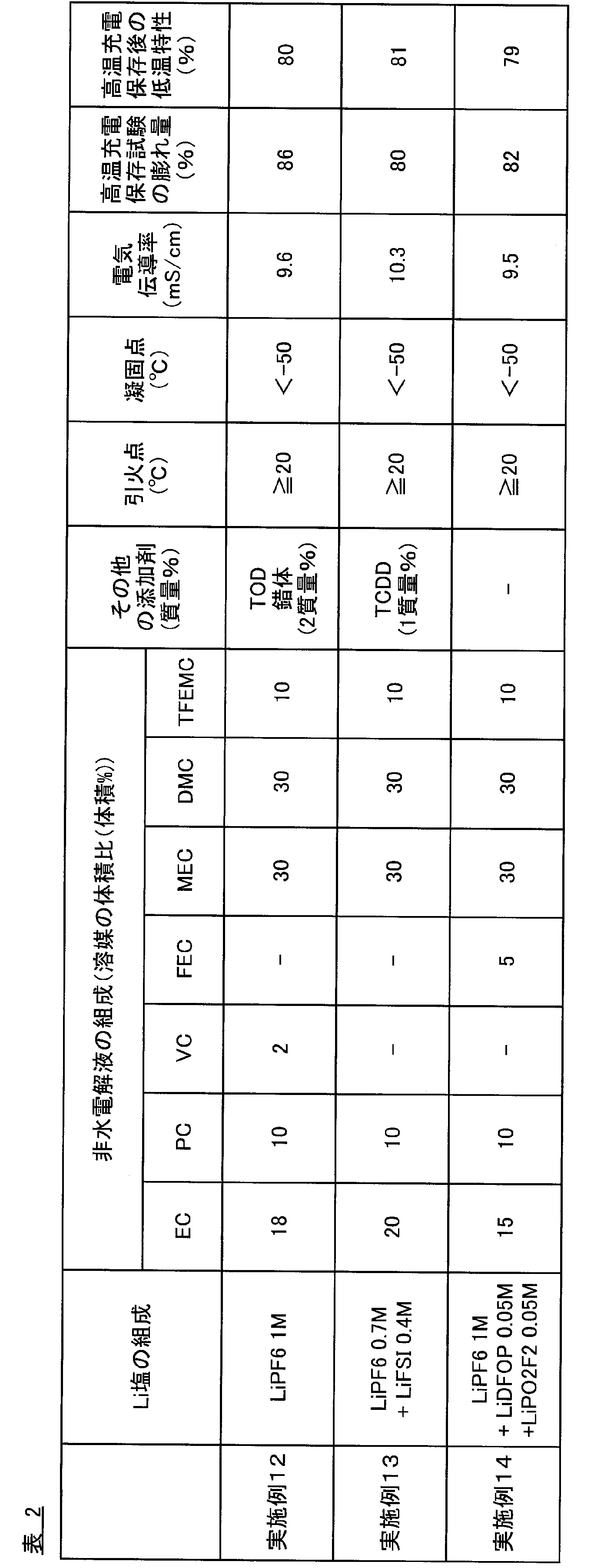
- Examples 1 to 14 and Comparative Examples 1 to 8 [Measurement of physical properties of non-aqueous electrolyte] ⁇ Measurement of flash point> Measure flash points of non-aqueous electrolytes listed in Tables 1 and 2 based on JIS K-2265 standards using a tag-closed flash point tester (Tanaka Scientific Equipment Manufacturing Co., Ltd .; Model ATG-7) did. ⁇ Measurement of freezing point> The freezing points of the non-aqueous electrolytes listed in Tables 1 and 2 were measured based on JIS K-0065 standards using an automatic freezing point meter (manufactured by Electrochemical Systems Co., Ltd .; model CP-2BX).
- LiNi 0.5 Mn 0.3 Co 0.2 O 2 92% by mass, acetylene black (conductive agent); 5% by mass were mixed in advance, and polyvinylidene fluoride (binder);
- a positive electrode mixture paste was prepared by adding to the solution dissolved in -2-pyrrolidone and mixing. This positive electrode mixture paste was applied to one side of an aluminum foil (current collector), dried and pressurized, and cut into a predetermined size to produce a positive electrode sheet. The density of the portion excluding the current collector of the positive electrode was 3.6 g / cm 3 .
- This negative electrode mixture paste was applied to one side of a copper foil (current collector), dried and pressurized, and cut into a predetermined size to produce a negative electrode sheet.
- the density of the portion excluding the current collector of the negative electrode was 1.6 g / cm 3 .
- the ratio of the peak intensity I (110) of the (110) plane of the graphite crystal to the peak intensity I (004) of the (004) plane [I (110) / I (004)] was 0.1.
- a positive electrode sheet, a separator made of a microporous polyethylene film, and a negative electrode sheet were laminated in this order, and a non-aqueous electrolyte solution having the composition shown in Table 1 or Table 2 was added to produce a laminated battery.
- EC is ethylene carbonate
- PC propylene carbonate
- DMC is dimethyl carbonate
- EP is ethyl propionate
- MEC is methyl ethyl carbonate
- TFEMC 2,2,2-trifluoroethyl methyl carbonate
- DFEA is 2,2-difluoroethyl acetate
- TFEA is 2,2,2-trifluoroethyl acetate
- DFEMC 2,2-difluoroethyl methyl Carbonate
- VC is vinylene carbonate
- FEC is 4-fluoro-1,3-dioxolan-2-one
- TCDD is tetrahydro-4H-cyclopenta [d] [1,3,2] dioxathiol- 2,2-dioxide
- TOD complex is bis (difluorophosphoryl) (2,5,5 8,11-tetraoxado
- Examples 15 to 25 and Comparative Examples 9 to 16 [Production of lithium ion capacitors]
- a positive electrode mixture paste was prepared by adding to and mixing with the solution dissolved in pyrrolidone. This positive electrode mixture paste was applied to one side of an aluminum foil (current collector), dried and pressurized, and cut into a predetermined size to produce a positive electrode sheet.
- the ratio of the peak intensity I (110) of the (110) plane of the graphite crystal to the peak intensity I (004) of the (004) plane [I (110) / I (004)] was 0.1.
- the positive electrode and the negative electrode prepared as described above were heated and vacuum-dried, lithium ions having an amount of electricity of 372 mAh / g per unit mass of the negative electrode active material were electrochemically occluded.
- a positive electrode sheet, a separator made of a microporous polyethylene film, and a negative electrode sheet were laminated in this order, and a nonaqueous electrolytic solution having the composition shown in Table 3 was added to produce a laminated battery.
- the battery was checked for swelling immediately after removal from the thermostat. Specifically, the relative value when the thickness change before and after storage of the laminate battery of Comparative Example 11 was set to 100 was obtained. Then, it put in the thermostat of 25 degreeC, and discharged once to the final voltage 3V under the constant current of 10C. ⁇ Discharge capacity after storage at high temperature> Thereafter, in the same manner as the measurement of the initial discharge capacity, the cell capacity at ⁇ 20 ° C. after storage at high temperature was obtained.
- any of the lithium secondary batteries of Examples 1 to 14 described above is a lithium of Comparative Examples 1 to 8 when a nonaqueous electrolyte containing a nonaqueous solvent mixed with a composition ratio different from that of the nonaqueous electrolyte of the present invention is used.
- the electrochemical characteristics in a wide temperature range are remarkably improved. From the above, it has been found that the effect of the present invention is a unique effect when the non-aqueous electrolyte solution having a specific composition of the present invention is used. Further, from the comparison of Examples 15 to 25 and Comparative Examples 9 to 16, it was found that the same effect was obtained when a lithium capacitor was used.
- the nonaqueous electrolytic solution according to the first aspect of the present invention also has an effect of improving discharge characteristics in a wide temperature range in a wide temperature range of the lithium primary battery.
- LiNi 0.33 Mn 0.33 Co 0.34 O 2 93% by mass, acetylene black (conductive agent); 4% by mass are mixed, and polyvinylidene fluoride (binder);
- a positive electrode mixture paste was prepared by adding to the solution dissolved in -2-pyrrolidone and mixing. This positive electrode mixture paste was applied to one side of an aluminum foil (current collector), dried and pressurized, and cut into a predetermined size to produce a positive electrode sheet. The density of the portion excluding the current collector of the positive electrode was 3.6 g / cm 3 .
- silicon single substance
- acetylene black conductive agent
- Adhesive 5% by mass was added to and mixed with a solution in which 1-methyl-2-pyrrolidone was dissolved to prepare a negative electrode mixture paste.
- This negative electrode mixture paste was applied to one side of a copper foil (current collector), dried and pressurized, and cut into a predetermined size to produce a negative electrode sheet.
- the density of the portion excluding the current collector of the negative electrode was 1.6 g / cm 3 .
- the ratio of the peak intensity I (110) of the (110) plane of the graphite crystal to the peak intensity I (004) of the (004) plane [I (110) / I (004)] was 0.1. Then, a positive electrode sheet, a separator made of a microporous polyethylene film, and a negative electrode sheet were laminated in this order, and a non-aqueous electrolyte solution having the composition shown in Tables 4 and 5 was added to prepare a laminated battery.
- the battery was checked for swelling immediately after removal from the thermostat. Specifically, when the thickness of the laminated battery before storage is 100%, the thickness after storage is 110% or more. Then, it put into the thermostat of 25 degreeC, and discharged once to the final voltage 2.75V under the constant current of 1C. ⁇ Discharge capacity after storage at high temperature> Thereafter, in the same manner as the measurement of the initial discharge capacity, the discharge capacity at ⁇ 20 ° C. after storage at high temperature was obtained.
- EC is ethylene carbonate
- PC propylene carbonate
- DMC dimethyl carbonate
- EP is ethyl propionate
- MEC is methyl ethyl carbonate
- MP is Methylpropionate
- VC vinylene carbonate
- FEC is 4-fluoro-1,3-dioxolan-2-one
- TCDD tetrahydro-4H-cyclopenta [d] [1,3,2] di Oxathiol-2,2-dioxide
- TOD complex is an abbreviation for bis (difluorophosphoryl) (2,5,8,11-tetraoxadodecane) dilithium.
- Examples 34 to 37, Comparative Examples 25 to 32 [Production of lithium ion capacitors]
- a positive electrode mixture paste was prepared by adding to and mixing with the solution dissolved in pyrrolidone. This positive electrode mixture paste was applied to one side of an aluminum foil (current collector), dried and pressurized, punched out to a predetermined size, and a positive electrode sheet was produced.
- the ratio of the peak intensity I (110) of the (110) plane of the graphite crystal to the peak intensity I (004) of the (004) plane [I (110) / I (004)] was 0.1.
- the positive electrode and the negative electrode prepared as described above were heated and vacuum-dried, lithium ions having an amount of electricity of 372 mAh / g per unit mass of the negative electrode active material were electrochemically occluded.
- a positive electrode sheet, a separator made of a microporous polyethylene film, and a negative electrode sheet were laminated in this order, and a nonaqueous electrolytic solution having a composition shown in Table 6 was added thereto to produce a laminated battery.
- the battery was checked for swelling immediately after removal from the thermostat. Specifically, when the thickness of the laminated battery before storage is 100%, the thickness after storage is 110% or more. Then, it put in the thermostat of 25 degreeC, and discharged once to the final voltage 3V under the constant current of 10C. ⁇ Discharge capacity after storage at high temperature> Thereafter, in the same manner as the measurement of the initial discharge capacity, the cell capacity at ⁇ 20 ° C. after storage at high temperature was obtained.
- the lithium secondary batteries of Examples 26 to 33 are all lithium of Comparative Examples 17 to 24 when a nonaqueous electrolyte containing a nonaqueous solvent mixed at a composition ratio different from that of the nonaqueous electrolyte of the present invention is used. Compared to the secondary battery, the electrochemical characteristics in a wide temperature range are remarkably improved. From the above, it has been found that the effect of the present invention is a unique effect when the non-aqueous electrolyte solution having a specific composition of the present invention is used. Further, it was found from the comparison between Examples 34 to 37 and Comparative Examples 25 to 32 that the same effect was obtained when a lithium capacitor was used.
- nonaqueous electrolytic solution according to the second aspect of the present invention also has an effect of improving discharge characteristics in a wide temperature range of the lithium primary battery.
- a non-aqueous electrolyte for power storage devices such as lithium secondary batteries mounted on hybrid electric vehicles, plug-in hybrid electric vehicles, battery electric vehicles, etc.
- lithium A secondary battery or a lithium ion capacitor can be obtained.
Landscapes
- Chemical & Material Sciences (AREA)
- Engineering & Computer Science (AREA)
- Chemical Kinetics & Catalysis (AREA)
- Electrochemistry (AREA)
- Power Engineering (AREA)
- General Chemical & Material Sciences (AREA)
- Microelectronics & Electronic Packaging (AREA)
- Manufacturing & Machinery (AREA)
- Inorganic Chemistry (AREA)
- Materials Engineering (AREA)
- Composite Materials (AREA)
- Physics & Mathematics (AREA)
- Condensed Matter Physics & Semiconductors (AREA)
- General Physics & Mathematics (AREA)
- Secondary Cells (AREA)
Abstract
Description
このような非水溶媒を含む非水電解液を4.2V以上の高電圧で使用する場合、溶媒の一部が分解されてしまうことがある。60℃以上の高温から-40℃以下の極低温の「温度幅が100℃にもおよぶ広い温度範囲」で使用する場合、引火点、凝固点、電気伝導率、あるいは粘度などの物性が電池特性に大きな影響を与えてしまうことが分かり、上記課題の改善が求められていた。
特許文献2には、非水溶媒がフッ素化鎖状カルボン酸エステルと、金属リチウムとリチウムイオンとの平衡電位を基準として+1.0~3.0Vの範囲で分解される被膜生成化合物と、を含む二次電池用非水電解液が開示されており、高温条件下において電池容量の低下を抑制することが示されている。
また特許文献3には、非水溶媒が50~90%の2,2-ジフルオロエチルアセテートを含むリチウムイオン電池用電解液が開示されており、高温条件下、高電圧においてサイクル特性が向上することが示されている。
また特許文献5には、エチレンカーボネートとジメチルカーボネートとエチルメチルカーボネートとプロピオン酸メチルを容積比で3:3:3:1で混合した溶媒に、LiPF6を1Mになるように溶解し、ビニレンカーボネートを2質量%添加した非水電解液を用いたリチウム二次電池において、-30℃での出力特性が向上することが開示されている。
そこで、本発明者らは、上記課題を解決するために鋭意研究を重ねた結果、非水溶媒にリチウム塩が0.8~1.5M(mol/L)の量にて溶解されている非水電解液において、前記非水溶媒が、非水溶媒全体に対して、5~25体積%のエチレンカーボネート、5~25体積%のプロピレンカーボネート、20~30体積%のジメチルカーボネート、10~20体積%のフッ素化鎖状エステル、及び20~40体積%のメチルエチルカーボネートを含有し、前記非水溶媒中における、エチレンカーボネートとプロピレンカーボネートとの合計含有量が20~30体積%であり、ジメチルカーボネートとフッ素化鎖状エステルとの合計含有量が30~40体積%であり、このことにより、前記非水電解液の引火点は20℃以上となり、かつ、電気伝導率が8mS/cm以上となることを見出した。しかも、各種カーボネートと、フッ素化鎖状エステルと、を特定の比率で含有する混合溶媒を用いることにより、-40℃以下であっても凝固することなく、「温度幅が100℃にもおよぶ広い温度範囲」で液体状態を維持したまま使用でき、優れた電池性能を示す耐電圧も向上することも見出し、本発明を完成した。なお、このような作用効果は、前記特許文献1~5の技術では全くなしえなかったものであり、また、前記特許文献1~5にはまったく示唆されていないものである。
(1)非水溶媒にリチウム塩が0.8~1.5M(mol/L)の量にて溶解されている非水電解液において、
前記非水溶媒が、非水溶媒全体に対して、5~25体積%のエチレンカーボネート、5~25体積%のプロピレンカーボネート、20~30体積%のジメチルカーボネート、10~20体積%のフッ素化鎖状エステル、及び20~40体積%のメチルエチルカーボネートを含有し、
前記非水溶媒中における、エチレンカーボネートとプロピレンカーボネートとの合計含有量が20~30体積%であり、ジメチルカーボネートとフッ素化鎖状エステルとの合計含有量が30~40体積%であり、
前記非水電解液の引火点が20℃以上であることを特徴とするリチウム二次電池用又はリチウムイオンキャパシタ用非水電解液。
前記非水溶媒が、非水溶媒全体に対して、5~25体積%のエチレンカーボネート、5~25体積%のプロピレンカーボネート、20~30体積%のジメチルカーボネート、20~40体積%のメチルエチルカーボネート、および10~20体積%のエチルプロピオネートを含有し、
前記非水溶媒中における、エチレンカーボネートとプロピレンカーボネートとの合計含有量が20~30体積%であり、ジメチルカーボネートとエチルプロピオネートとの合計含有量が30~40体積%であり、
前記非水電解液の引火点が20℃以上であることを特徴とするリチウム二次電池用又はリチウムイオンキャパシタ用非水電解液。
本発明の第1の観点に係る非水電解液は、非水溶媒にリチウム塩が0.8~1.5M(mol/L)の量にて溶解されている非水電解液において、
前記非水溶媒が、非水溶媒全体に対して、5~25体積%のエチレンカーボネート、5~25体積%のプロピレンカーボネート、20~30体積%のジメチルカーボネート、10~20体積%のフッ素化鎖状エステル、及び20~40体積%のメチルエチルカーボネートを含有し、
前記非水溶媒中における、エチレンカーボネートとプロピレンカーボネートとの合計含有量が20~30体積%であり、ジメチルカーボネートとフッ素化鎖状エステルとの合計含有量が30~40体積%であり、
前記非水電解液の引火点が20℃以上であることを特徴とするリチウム二次電池用又はリチウムイオンキャパシタ用非水電解液である。
前記非水溶媒が、非水溶媒全体に対して、5~25体積%のエチレンカーボネート、5~25体積%のプロピレンカーボネート、20~30体積%のジメチルカーボネート、20~40体積%のメチルエチルカーボネート、および10~20体積%のエチルプロピオネートを含有し、
前記非水溶媒中における、エチレンカーボネートとプロピレンカーボネートとの合計含有量が20~30体積%であり、ジメチルカーボネートとエチルプロピオネートとの合計含有量が30~40体積%であり、
前記非水電解液の引火点が20℃以上であることを特徴とするリチウム二次電池用又はリチウムイオンキャパシタ用非水電解液である。
本発明の第1の観点に係る非水電解液および第2の観点に係る非水電解液に使用されるリチウム塩としては、下記のものが好適に挙げられる。
リチウム塩としては、LiPF6、LiPO2F2、LiBF4等の無機リチウム塩、LiN(SO2F)2〔LiFSI〕、LiN(SO2CF3)2、LiN(SO2C2F5)2等の鎖状のフッ化アルキル基を含有するリチウム塩、リチウム メチルサルフェート〔LMS〕、リチウムエチルサルフェート〔LES〕、又はFSO3LiなどのS=O基を有するリチウム塩、及びリチウム ビス(オキサラト)ボレート〔LiBOB〕、リチウム ジフルオロ(オキサラト)ボレート〔LiDFOB〕、リチウム テトラフルオロ(オキサラト)ホスフェート〔LiTFOP〕、又はリチウム ジフルオロビス(オキサラト)ホスフェート〔LiDFOP〕などのシュウ酸骨格を有するリチウム塩が好適に挙げられ、これらの中から選ばれる少なくとも1種又は2種以上を混合して使用することができる。
これらの中でも、LiPF6、LiPO2F2、LiN(SO2F)2、リチウム メチルサルフェート、リチウムエチルサルフェート、又はリチウム ジフルオロビス(オキサラト)ホスフェートを用いることがより好ましく、最も好ましくは、LiPF6、LiPO2F2、LiN(SO2F)2、リチウム メチルサルフェート、又はリチウムエチルサルフェートである。リチウム塩の濃度は、第1の観点に係る非水電解液においては、前記の非水溶媒に対して、0.8M(mol/L)以上であり、1.0M以上が好ましく、1.1M以上がより好ましい。またその上限は、1.5M以下であり、1.45M以下が好ましく、1.4M以下がより好ましい。また、第2の観点に係る非水電解液における、リチウム塩の濃度は、前記の非水溶媒に対して、0.9M(mol/L)以上であり、1.0M以上が好ましく、1.1M以上がより好ましく、1.15M以上がさらに好ましく、1.2M以上が特に好ましい。またその上限は、1.5M以下であり、1.45M以下が好ましく、1.4M以下がより好ましい。
また、これらの電解質塩としては、LiPF6を少なくとも含むものが好ましく、LiPF6とLiN(SO2F)2とを少なくとも含むものがより好ましく、LiPF6とLiN(SO2F)2とに加えて、これら以外のリチウム塩を含むものがさらに好ましい。「温度幅が100℃にもおよぶ広い温度範囲」で、LiPF6及び/又はLiN(SO2F)2以外のリチウム塩、例えばLiPO2F2が非水溶媒中に占める割合は、0.001M以上であると、広い温度範囲での電池特性が向上し、0.3M以下であると広い温度範囲での電池特性の向上効果が低下する懸念が少ないので好ましい。好ましくは0.01M以上、特に好ましくは0.03M以上、最も好ましくは0.04M以上である。その上限は、好ましくは0.3M以下、さらに好ましくは0.25M以下、特に好ましくは0.2M以下である。
本発明の第1の観点に係る非水電解液および第2の観点に係る非水電解液に使用される非水溶媒としては、広い温度範囲で電気化学特性が相乗的に向上するという観点より、環状カーボネート、鎖状カーボネート、及び鎖状エステルを含有する混合溶媒を用いる。
エチレンカーボネートの含有量は、電気伝導率向上の観点より、非水溶媒全体に対して、5体積%以上、好ましくは7体積%以上、より好ましくは9体積%以上である。また、エチレンカーボネートの含有量の上限としては、凝固点を低くするという観点より、非水溶媒全体に対して、25体積%以下、好ましくは22体積%以下、より好ましくは20体積%以下、さらに好ましくは17体積%以下、特に好ましくは15体積%以下である。
プロピレンカーボネートの含有量は、高温環境下での電気化学特性向上の観点より、非水溶媒全体に対して、5体積%以上、好ましくは7体積%以上、より好ましくは9体積%以上である。また、プロピレンカーボネートの含有量の上限としては、電気伝導率向上の観点より、非水溶媒全体に対して、25体積%以下、好ましくは20体積%以下、より好ましくは17体積%以下、更に好ましくは15体積%以下である。
更に、エチレンカーボネートとプロピレンカーボネートの合計含有量は、電気伝導率向上の観点より、非水溶媒全体に対して、20体積%以上、好ましくは22体積%以上である。また、エチレンカーボネートとプロピレンカーボネートの合計含有量の上限としては、高温環境下での電気化学特性向上の観点より、非水溶媒全体に対して、30体積%以下、好ましくは27体積%以下である。
前記「その他の環状カーボネート」としては、特に4-フルオロ-1,3-ジオキソラン-2-オン、ビニレンカーボネート、2-プロピニル 2-オキソ-1,3-ジオキソラン-4-カルボキシレート、及び4-エチニル-1,3-ジオキソラン-2-オンから選ばれる1種又は2種以上がより好適である。
メチルエチルカーボネートの含有量は、高温環境下での電気化学特性向上の観点より、非水溶媒全体に対して、20体積%以上、好ましくは23体積%以上、より好ましくは30体積%以上、特に好ましくは33体積%以上である。また、メチルエチルカーボネートの含有量の上限としては、電気伝導率向上の観点より、非水溶媒全体に対して、40体積%以下、好ましくは37体積%以下である。
ジメチルカーボネートの含有量は、電気伝導率向上の観点より、非水溶媒全体に対して、20体積%以上、好ましくは23体積%以上である。また、ジメチルカーボネートの含有量の上限としては、高温環境下での電気化学特性向上の観点より、非水溶媒全体に対して、30体積%以下、好ましくは27体積%以下である。

中でも高温環境下での電気化学特性向上の観点より、2,2,2-トリフルオロエチルメチルカーボネート、2,2-ジフルオロエチルメチルカーボネート、2,2,2-トリフルオロエチルアセテート、又は2,2-ジフルオロエチルアセテートがより好ましい。
本発明の第2の観点に係る非水電解液において、エチルプロピオネートの含有量は、電気伝導率向上の観点より、非水溶媒全体に対して、10体積%以上、好ましくは12体積%以上である。また、エチルプロピオネートの含有量の上限としては、高温環境下での電気化学特性向上の観点より、20体積%以下、好ましくは18体積%以下である。
その他の添加剤の具体例としては、以下の(A)S=O基含有化合物又は(B)リチウム塩化合物が好適に挙げられる。


本発明の第1の観点に係る非水電解液および第2の観点に係る非水電解液は、例えば、前記の非水溶媒を混合し、これに前記のリチウム塩及び該非水電解液にその他の添加剤を添加することにより得ることができる。
この際、用いる非水溶媒及び非水電解液に加える添加剤は、生産性を著しく低下させない範囲内で、予め精製して、不純物が極力少ないものを用いることが好ましい。
さらに、本発明の第1の観点に係る非水電解液および第2の観点に係る非水電解液は、上記各成分を上記した割合にて含有するものであるため、凝固点が好ましくは-45℃以下であり、より好ましくは-48℃以下、更に好ましくは-50℃以下であり、低温環境下における電気特性にも優れたものである。
加えて、本発明の第1の観点に係る非水電解液および第2の観点に係る非水電解液は、上記各成分を上記した割合にて含有するものであるため、25℃における電気伝導率が好ましくは8mS/cm以上であり、より好ましくは8.1mS/cm以上、更に好ましくは8.3mS/cm以上であり、更により好ましくは9mS/cm以上であり、特に好ましくは9.1mS/cm以上、最も好ましくは9.3mS/cm以上であり、電気伝導率にも優れたものである。
そのため、本発明の第1の観点に係る非水電解液および第2の観点に係る非水電解液は、リチウム二次電池又はリチウムイオンキャパシタの非水電解液として、特に、幅広い温度範囲使用されるリチウム二次電池又はリチウムイオンキャパシタの非水電解液として、好適に用いられるものである。
本明細書において、リチウム二次電池という用語は、いわゆるリチウムイオン二次電池も含む概念として用いる。
本発明のリチウム二次電池は、正極、負極及び非水溶媒にリチウム塩が溶解されている前記本発明の第1の観点に係る非水電解液および第2の観点に係る非水電解液からなる。非水電解液以外の正極、負極等の構成部材は特に制限なく使用できる。
例えば、リチウム二次電池用正極活物質としては、コバルト、マンガン、及びニッケルからなる群より選ばれる1種又は2種以上を含有するリチウムとの複合金属酸化物、又は、鉄、コバルト、ニッケル及びマンガンから選ばれる一種又は二種以上を含むリチウム含有オリビン型リン酸塩が使用される。これらの正極活物質は、1種単独で用いるか又は2種以上を組み合わせて用いることができる。
このようなリチウム複合金属酸化物としては、例えば、LiCoO2、LiMn2O4、LiNiO2、LiCo1-xNixO2(0.01<x<1)、LiNixMnyCozO2(x+y+z=1)、Li2MnO3とLiMO2(Mは、Co、Ni、Mn、Fe等の遷移金属)との固溶体、LiNi1/2Mn3/2O4、LiFePO4、LiMnPO4、及びLiMn1-xFexPO4(0.01<x<1)から選ばれる1種以上が好適に挙げられ、2種以上がより好適である。これらのリチウムとの複合金属酸化物又はリチウム含有オリビン型リン酸塩の一部は他元素で置換してもよく、コバルト、ニッケル、マンガン、鉄の一部をCo、Mn、Ni、Mg、Al、B、Ti、V、Nb、Cu、Zn、Mo、Ca、Sr、W、及びZrから選ばれる一種又は二種以上の元素で置換したり、又はこれらの他元素を含有する化合物や炭素材料で被覆することもできる。
充電時の電圧としては、高電圧化の観点から、正極電位が4.3V(vs.Li/Li+)以上が好ましく、4.35V(vs.Li/Li+)以上がより好ましく、4.4V(vs.Li/Li+)以上が特に好ましい。
更にNiを含む正極活物質の場合にNiの触媒作用により正極表面での非水溶媒の分解が起き、電池の抵抗が増加しやすい傾向にある。特に高温環境下での電気化学特性が低下しやすい傾向にあるが、本発明に係るリチウム二次電池ではこれらの電気化学特性の低下を抑制することができるので好ましい。特に、正極活物質中の全遷移金属元素の原子濃度に対するNiの原子濃度の割合が、10atomic%を超える正極活物質を用いた場合に上記効果が顕著になるので好ましく、20atomic%以上が更に好ましく、30atomic%以上が特に好ましい。具体的には、LiCo1/3Ni1/3Mn1/3O2、LiNi0.5Mn0.3Co0.2Mn0.3O2、LiNi0.8Mn0.1Co0.1O2、LiNi0.8Co0.15Al0.05O2等が好適に挙げられる。
正極の集電体を除く部分の密度は、通常は1.5g/cm3以上であり、電池の容量をさらに高めるため、好ましくは2g/cm3以上であり、より好ましくは、3g/cm3以上であり、更に好ましくは、3.6g/cm3以上である。なお、その上限としては、4g/cm3以下が好ましい。
これらの中では、リチウムイオンの吸蔵及び放出能力において、人造黒鉛や天然黒鉛等の高結晶性の炭素材料を使用することがより好ましく、格子面(002)の面間隔(d002)が0.340nm(ナノメータ)以下、特に0.335~0.337nmである黒鉛型結晶構造を有する炭素材料を使用することが更に好ましい。
負極の集電体を除く部分の密度を1.5g/cm3以上の密度に加圧成形したときの負極シートのX線回折測定から得られる黒鉛結晶の(110)面のピーク強度I(110)と(004)面のピーク強度I(004)の比I(110)/I(004)が0.01以上となると一段と広い温度範囲での電気化学特性が向上するので好ましく、0.05以上となることがより好ましく、0.1以上となることが更に好ましい。また、過度に処理し過ぎて結晶性が低下し電池の放電容量が低下する場合があるので、ピーク強度の比I(110)/I(004)の上限は0.5以下が好ましく、0.3以下がより好ましい。
また、高結晶性の炭素材料(コア材)はコア材よりも低結晶性の炭素材料によって被膜されていると、広い温度範囲での電気化学特性が一段と良好となるので好ましい。被覆の炭素材料の結晶性は、TEMにより確認することができる。
高結晶性の炭素材料を使用すると、充電時において非水電解液と反応し、界面抵抗の増加によって低温もしくは高温における電気化学特性を低下させる傾向があるが、本発明に係るリチウム二次電池では広い温度範囲での電気化学特性が良好となる。
負極の集電体を除く部分の密度は、通常は1.1g/cm3以上であり、電池の容量をさらに高めるため、好ましくは1.5g/cm3以上であり、より好ましくは1.7g/cm3以上である。なお、その上限としては、2g/cm3以下が好ましい。
電池用セパレータとしては、特に制限はないが、ポリプロピレン、ポリエチレン等のポリオレフィンの単層もしくは積層の微多孔性フィルム、織布、又は不織布等を使用できる。
本発明のリチウムイオンキャパシタは、負極であるグラファイト等の炭素材料へのリチウムイオンのインターカレーションを利用してエネルギーを貯蔵する蓄電デバイスである。本発明のリチウムイオンキャパシタは、正極、負極及び非水溶媒にリチウム塩が溶解されている前記本発明の第1の観点に係る非水電解液および第2の観点に係る非水電解液からなる。リチウムイオンキャパシタ(LIC)と呼ばれる。正極は、例えば活性炭電極と電解液との間の電気二重層を利用したものや、π共役高分子電極のドープ/脱ドープ反応を利用したもの等が挙げられる。電解液には少なくともLiPF6等のリチウム塩が含まれる。また、負極としては、上述したリチウム二次電池と同様なものを用いることができる。
〔非水電解液の物性測定〕
<引火点の測定>
表1、表2に記載の非水電解液の引火点をタグ密閉式の引火点試験機(田中科学機器製作株式会社製;型式ATG-7)を用いてJIS K-2265の規格に基づき測定した。
<凝固点の測定>
表1、表2に記載の非水電解液の凝固点を自動凝固点計(株式会社電気化学システムズ製;型式CP-2BX)を用いてJIS K-0065の規格に基づき測定した。
<電気伝導率の測定>
表1、表2に記載の非水電解液の電気伝導率を電気伝導率計(東亜ディーケーケー株式会社製;型式CM-30R)を用いて25℃の環境下で測定した。
各物性値を表1~2に示す。
LiNi0.5Mn0.3Co0.2O2;92質量%、アセチレンブラック(導電剤);5質量%を混合し、予めポリフッ化ビニリデン(結着剤);3質量%を1-メチル-2-ピロリドンに溶解させておいた溶液に加えて混合し、正極合剤ペーストを調製した。この正極合剤ペーストをアルミニウム箔(集電体)上の片面に塗布し、乾燥、加圧処理して所定の大きさに裁断し、正極シートを作製した。正極の集電体を除く部分の密度は3.6g/cm3であった。また、ケイ素(単体);7質量%、人造黒鉛(d002=0.335nm、負極活物質);85質量%、アセチレンブラック(導電剤);5質量%を混合し、予めポリフッ化ビニリデン(結着剤);5質量%を1-メチル-2-ピロリドンに溶解させておいた溶液に加えて混合し、負極合剤ペーストを調製した。この負極合剤ペーストを銅箔(集電体)上の片面に塗布し、乾燥、加圧処理して所定の大きさに裁断し、負極シートを作製した。負極の集電体を除く部分の密度は1.6g/cm3であった。また、この電極シートを用いてX線回折測定した結果、黒鉛結晶の(110)面のピーク強度I(110)と(004)面のピーク強度I(004)の比〔I(110)/I(004)〕は0.1であった。そして、正極シート、微多孔性ポリエチレンフィルム製セパレータ、負極シートの順に積層し、表1又は表2に記載の組成の非水電解液を加えて、ラミネート電池を作製した。
<初期の放電容量>
上記の方法で作製したラミネート電池を用いて、25℃の恒温槽中、1Cの定電流及び定電圧で、終止電圧4.4V(正極の充電電位が4.5V(vs.Li/Li+))まで3時間充電し、-20℃に恒温槽の温度を下げ、1Cの定電流下終止電圧2.75Vまで放電して、初期の-20℃の放電容量を求めた。
<高温充電保存試験>
次に、このラミネート電池を85℃の恒温槽中、1Cの定電流及び定電圧で終止電圧4.4Vまで3時間充電し、4.4Vに保持した状態で2日間保存を行った。2日間の保存後、恒温槽から取り出した直後に電池膨れを確認した。具体的には、比較例3のラミネート電池の保存前後の厚み変化を100とした場合の相対値を求めた。その後、25℃の恒温槽に入れ、一旦1Cの定電流下終止電圧2.75Vまで放電した。
<高温充電保存後の放電容量>
更にその後、初期の放電容量の測定と同様にして、高温充電保存後の-20℃の放電容量を求めた。
<高温充電保存後の低温特性>
高温充電保存後の低温特性を下記の-20℃放電容量の維持率より求めた。
高温充電保存後の-20℃放電容量維持率(%)=(高温充電保存後の-20℃の放電容量/初期の-20℃の放電容量)×100
電池特性を表1~2に示す。
なお、表1~3中、「EC」はエチレンカーボネート、「PC」はプロピレンカーボネート、「DMC」はジメチルカーボネート、「EP」はエチルプロピオネート、「MEC」はメチルエチルカーボネート、「TFEMC」は2,2,2-トリフルオロエチルメチルカーボネート、「DFEA」は2,2-ジフルオロエチルアセテート、「TFEA」は2,2,2-トリフルオロエチルアセテート、「DFEMC」は2,2-ジフルオロエチルメチルカーボネート、「VC」はビニレンカーボネート、「FEC」は4-フルオロ-1,3-ジオキソラン-2-オン、「TCDD」はテトラヒドロ-4H-シクロペンタ[d][1,3,2]ジオキサチオール-2,2-ジオキシド、「TOD錯体」はビス(ジフルオロホスホリル)(2,5,8,11-テトラオキサドデカン)ジリチウムの略称である。

〔リチウムイオンキャパシタの作製〕
比表面積600~3000m2/gの活性炭粉末;92質量%、アセチレンブラック(導電剤);5質量%を混合し、予めポリフッ化ビニリデン(結着剤);3質量%を1-メチル-2-ピロリドンに溶解させておいた溶液に加えて混合し、正極合剤ペーストを調製した。この正極合剤ペーストをアルミニウム箔(集電体)上の片面に塗布し、乾燥、加圧処理して所定の大きさに裁断し、正極シートを作製した。また、人造黒鉛(d002=0.335nm、負極活物質)95質量%を、予めポリフッ化ビニリデン(結着剤)5質量%を1-メチル-2-ピロリドンに溶解させておいた溶液に加えて混合し、負極合剤ペーストを調製した。この負極合剤ペーストを銅箔(集電体)上の片面に塗布し、乾燥、加圧処理して所定の大きさに裁断し負極シートを作製した。負極の集電体を除く部分の密度は1.5g/cm3であった。また、この電極シートを用いてX線回折測定した結果、黒鉛結晶の(110)面のピーク強度I(110)と(004)面のピーク強度I(004)の比〔I(110)/I(004)〕は0.1であった。上記のように作成得られた正極と負極を加熱真空乾燥した後、負極については、負極活物質の単位質量あたり372mAh/gの電気量となるリチウムイオンを、電気化学的に吸蔵させた。そして、正極シート、微多孔性ポリエチレンフィルム製セパレータ、負極シートの順に積層し、表3に記載の組成の非水電解液を加えて、ラミネート電池を作製した。
<初期の放電容量>
上記の方法で作製したラミネート電池を用いて、25℃の恒温槽中、1Cの定電流及び定電圧で、終止電圧4.3V(正極の充電電位が4.4V(vs.Li/Li+))Vまで3時間充電し、-20℃に恒温槽の温度を下げ、10Cの定電流下終止電圧3Vまで放電して、初期の-20℃のセル容量を求めた。
<高温充電保存試験>
次に、このラミネート電池を85℃の恒温槽中、1Cの定電流及び定電圧で終止電圧4.3Vまで3時間充電し、4.3Vに保持した状態で2日間保存を行った。2日間の保存後、恒温槽から取り出した直後に電池膨れの有無を確認した。具体的には、比較例11のラミネート電池の保存前後の厚み変化を100とした場合の相対値を求めた。その後、25℃の恒温槽に入れ、一旦10Cの定電流下終止電圧3Vまで放電した。
<高温充電保存後の放電容量>
更にその後、初期の放電容量の測定と同様にして、高温充電保存後の-20℃のセル容量を求めた。
<高温充電保存後の低温特性>
高温充電保存後の低温特性を下記の-20℃セル容量の維持率より求めた。
高温充電保存後の-20℃セル容量維持率(%)=(高温充電保存後の-20℃のセル容量/初期の-20℃のセル容量)×100
キャパシタ特性を表3に示す。
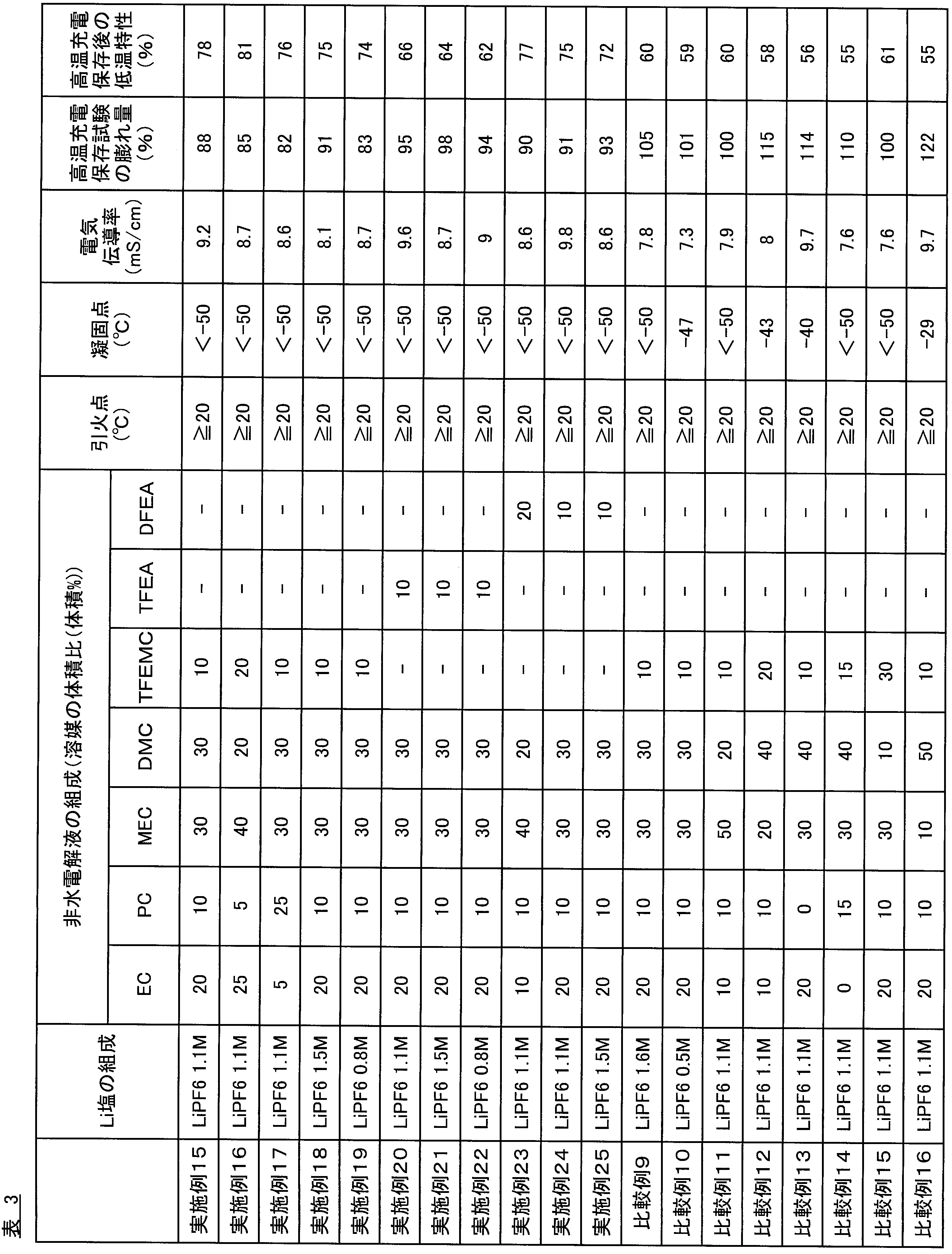
上記実施例1~14のリチウム二次電池は何れも、本願発明の非水電解液と異なる組成比で混合した非水溶媒を含む非水電解液を用いた場合の比較例1~8のリチウム二次電池に比べ、広い温度範囲での電気化学特性が顕著に向上している。以上より、本発明の効果は、本願発明の特定の組成の非水電解液を用いた場合に特有の効果であることが判明した。
また、実施例15~25と比較例9~16の対比からリチウムキャパシタを用いた場合にも同様な効果であることが判明した。
〔非水電解液の物性測定〕
<引火点の測定>
表4、表5に記載の非水電解液の引火点をタグ密閉式の引火点試験機(田中科学機器製作株式会社製;型式ATG-7)を用いてJIS K-2265の規格に基づき測定した。
<凝固点の測定>
表4、表5に記載の非水電解液の凝固点を自動凝固点計(株式会社電気化学システムズ製;型式CP-2BX)を用いてJIS K-0065の規格に基づき測定した。
<電気伝導率の測定>
表4、表5に記載の非水電解液の電気伝導率を電気伝導率計(東亜ディーケーケー株式会社製;型式CM-30R)を用いて25℃の環境下で測定した。
各物性値を表4~5に示す。
LiNi0.33Mn0.33Co0.34O2;93質量%、アセチレンブラック(導電剤);4質量%を混合し、予めポリフッ化ビニリデン(結着剤);3質量%を1-メチル-2-ピロリドンに溶解させておいた溶液に加えて混合し、正極合剤ペーストを調製した。この正極合剤ペーストをアルミニウム箔(集電体)上の片面に塗布し、乾燥、加圧処理して所定の大きさに裁断し、正極シートを作製した。正極の集電体を除く部分の密度は3.6g/cm3であった。また、ケイ素(単体);5質量%、人造黒鉛(d002=0.335nm、負極活物質);85質量%、アセチレンブラック(導電剤);5質量%を混合し、予めポリフッ化ビニリデン(結着剤);5質量%を1-メチル-2-ピロリドンに溶解させておいた溶液に加えて混合し、負極合剤ペーストを調製した。この負極合剤ペーストを銅箔(集電体)上の片面に塗布し、乾燥、加圧処理して所定の大きさに裁断し、負極シートを作製した。負極の集電体を除く部分の密度は1.6g/cm3であった。また、この電極シートを用いてX線回折測定した結果、黒鉛結晶の(110)面のピーク強度I(110)と(004)面のピーク強度I(004)の比〔I(110)/I(004)〕は0.1であった。そして、正極シート、微多孔性ポリエチレンフィルム製セパレータ、負極シートの順に積層し、表4、表5に記載の組成の非水電解液を加えて、ラミネート電池を作製した。
<初期の放電容量>
上記の方法で作製したラミネート電池を用いて、25℃の恒温槽中、1Cの定電流及び定電圧で、終止電圧4.35Vまで3時間充電し、-20℃に恒温槽の温度を下げ、1Cの定電流下終止電圧2.75Vまで放電して、初期の-20℃の放電容量を求めた。
<高温充電保存試験>
次に、このラミネート電池を60℃の恒温槽中、1Cの定電流及び定電圧で終止電圧4.3Vまで3時間充電し、4.35Vに保持した状態で14日間保存を行った。14日間の保存後、恒温槽から取り出した直後に電池膨れの有無を確認した。具体的には、保存前のラミネート電池の厚みを100%とした場合に保存後の厚みが110%以上を膨れ有りとした。その後、25℃の恒温槽に入れ、一旦1Cの定電流下終止電圧2.75Vまで放電した。
<高温充電保存後の放電容量>
更にその後、初期の放電容量の測定と同様にして、高温充電保存後の-20℃の放電容量を求めた。
<高温充電保存後の低温特性>
高温充電保存後の低温特性を下記の-20℃放電容量の維持率より求めた。
高温充電保存後の-20℃放電容量維持率(%)=(高温充電保存後の-20℃の放電容量/初期の-20℃の放電容量)×100
電池特性を表4~5に示す。
なお、表4~6中、「EC」はエチレンカーボネート、「PC」はプロピレンカーボネート、「DMC」はジメチルカーボネート、「EP」はエチルプロピオネート、「MEC」はメチルエチルカーボネート、「MP」はメチルプロピオネート、「VC」はビニレンカーボネート、「FEC」は4-フルオロ-1,3-ジオキソラン-2-オン、「TCDD」はテトラヒドロ-4H-シクロペンタ[d][1,3,2]ジオキサチオール-2,2-ジオキシド、「TOD錯体」はビス(ジフルオロホスホリル)(2,5,8,11-テトラオキサドデカン)ジリチウムの略称である。

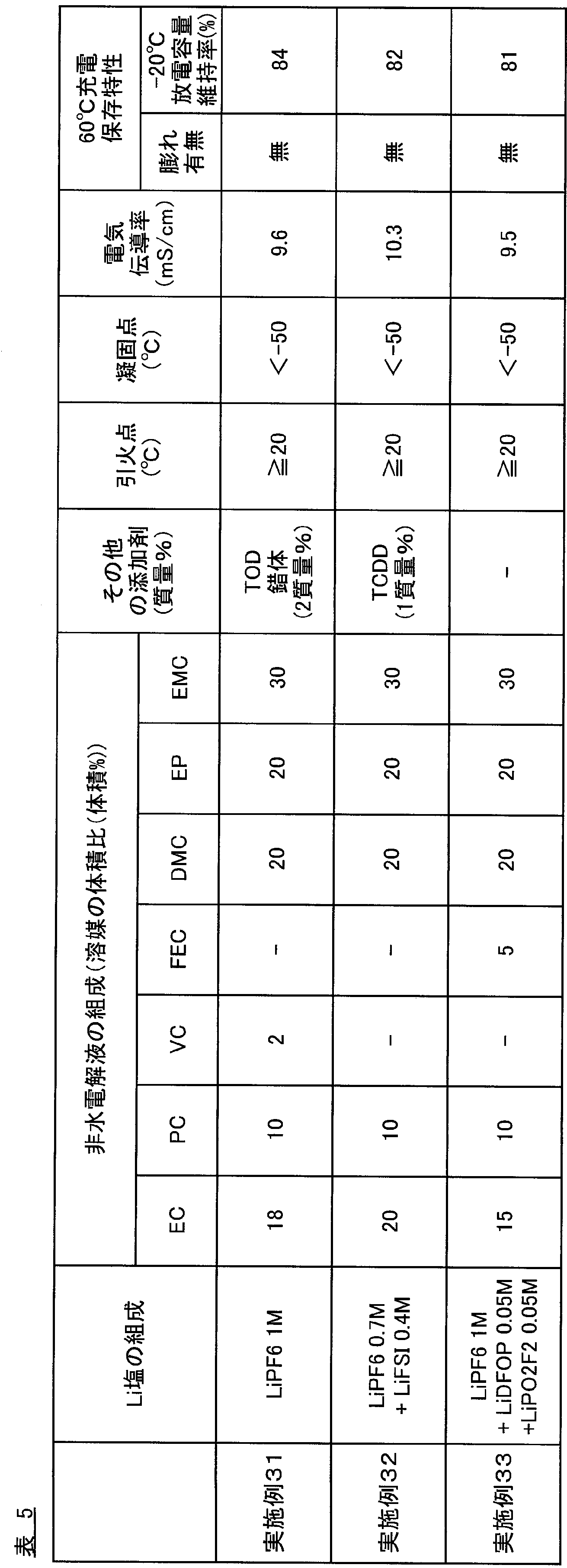
〔リチウムイオンキャパシタの作製〕
比表面積600~3000m2/gの活性炭粉末;92質量%、アセチレンブラック(導電剤);5質量%を混合し、予めポリフッ化ビニリデン(結着剤);3質量%を1-メチル-2-ピロリドンに溶解させておいた溶液に加えて混合し、正極合剤ペーストを調製した。この正極合剤ペーストをアルミニウム箔(集電体)上の片面に塗布し、乾燥、加圧処理して所定の大きさに打ち抜き、正極シートを作製した。また、人造黒鉛(d002=0.335nm、負極活物質)95質量%を、予めポリフッ化ビニリデン(結着剤)5質量%を1-メチル-2-ピロリドンに溶解させておいた溶液に加えて混合し、負極合剤ペーストを調製した。この負極合剤ペーストを銅箔(集電体)上の片面に塗布し、乾燥、加圧処理して所定の大きさに裁断し負極シートを作製した。負極の集電体を除く部分の密度は1.5g/cm3であった。また、この電極シートを用いてX線回折測定した結果、黒鉛結晶の(110)面のピーク強度I(110)と(004)面のピーク強度I(004)の比〔I(110)/I(004)〕は0.1であった。上記のように作成得られた正極と負極を加熱真空乾燥した後、負極については、負極活物質の単位質量あたり372mAh/gの電気量となるリチウムイオンを、電気化学的に吸蔵させた。そして、正極シート、微多孔性ポリエチレンフィルム製セパレータ、負極シートの順に積層し、表6に記載の組成の非水電解液を加えて、ラミネート電池を作製した。
<初期の放電容量>
上記の方法で作製したラミネート電池を用いて、25℃の恒温槽中、1Cの定電流及び定電圧で、終止電圧4.2Vまで3時間充電し、-20℃に恒温槽の温度を下げ、10Cの定電流下終止電圧3Vまで放電して、初期の-20℃のセル容量を求めた。
<高温充電保存試験>
次に、このラミネート電池を60℃の恒温槽中、1Cの定電流及び定電圧で終止電圧4.3Vまで3時間充電し、4.3Vに保持した状態で7日間保存を行った。14日間の保存後、恒温槽から取り出した直後に電池膨れの有無を確認した。具体的には、保存前のラミネート電池の厚みを100%とした場合に保存後の厚みが110%以上を膨れ有りとした。その後、25℃の恒温槽に入れ、一旦10Cの定電流下終止電圧3Vまで放電した。
<高温充電保存後の放電容量>
更にその後、初期の放電容量の測定と同様にして、高温充電保存後の-20℃のセル容量を求めた。
<高温充電保存後の低温特性>
高温充電保存後の低温特性を下記の-20℃セル容量の維持率より求めた。
高温充電保存後の-20℃セル容量維持率(%)=(高温充電保存後の-20℃のセル容量/初期の-20℃のセル容量)×100
キャパシタ特性を表6に示す。
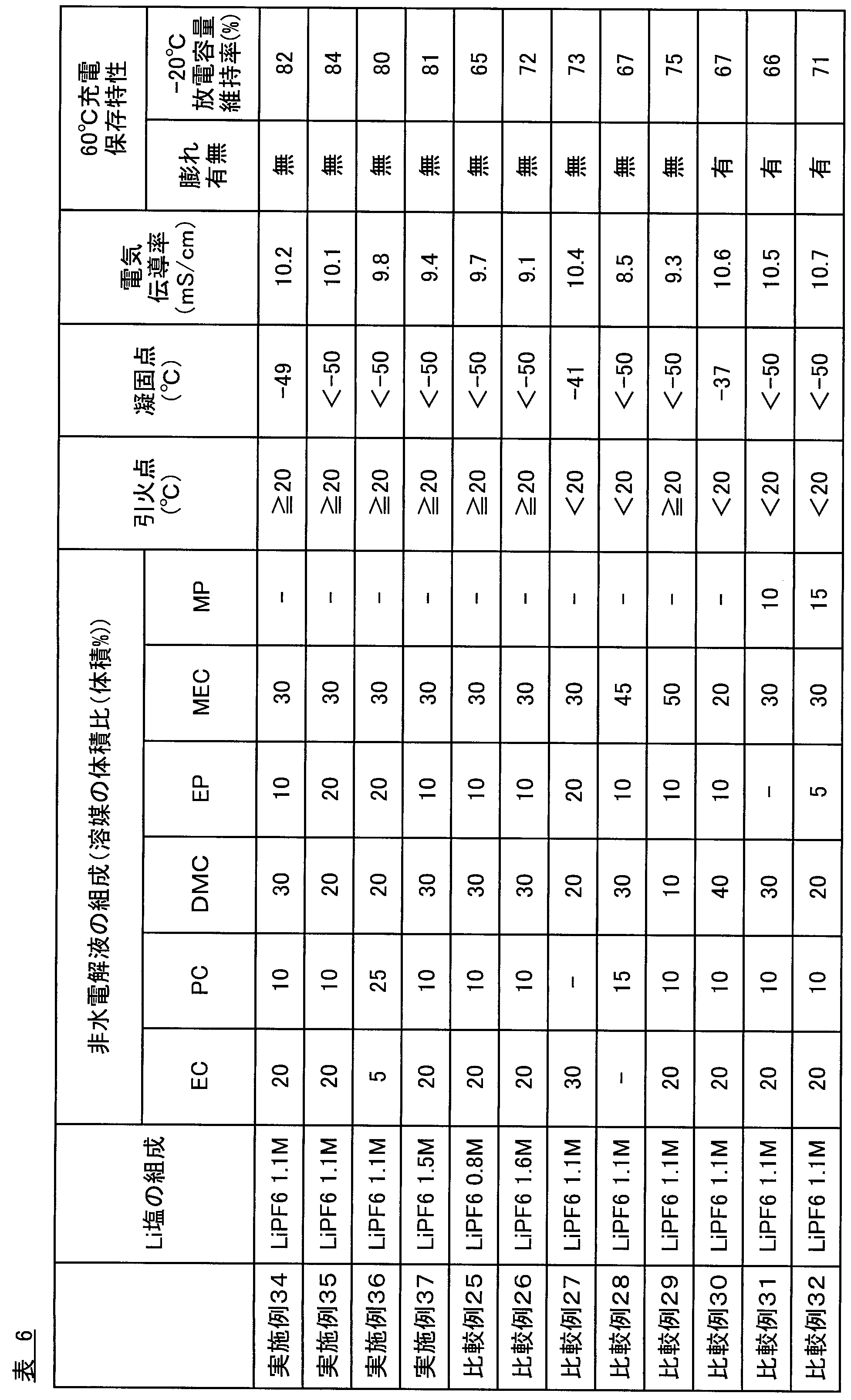
上記実施例26~33のリチウム二次電池は何れも、本願発明の非水電解液と異なる組成比で混合した非水溶媒を含む非水電解液を用いた場合の比較例17~24のリチウム二次電池に比べ、広い温度範囲での電気化学特性が顕著に向上している。以上より、本発明の効果は、本願発明の特定の組成の非水電解液を用いた場合に特有の効果であることが判明した。
また、実施例34~37と比較例25~32の対比からリチウムキャパシタを用いた場合にも同様な効果であることが判明した。
Claims (13)
- 非水溶媒にリチウム塩が0.8~1.5M(mol/L)の量にて溶解されている非水電解液において、
前記非水溶媒が、非水溶媒全体に対して、5~25体積%のエチレンカーボネート、5~25体積%のプロピレンカーボネート、20~30体積%のジメチルカーボネート、20~40体積%のメチルエチルカーボネート、及び10~20体積%のフッ素化鎖状エステルを含有し、
前記非水溶媒中における、エチレンカーボネートとプロピレンカーボネートとの合計含有量が20~30体積%であり、ジメチルカーボネートとフッ素化鎖状エステルとの合計含有量が30~40体積%であり、
前記非水電解液の引火点が20℃以上であることを特徴とするリチウム二次電池用又はリチウムイオンキャパシタ用非水電解液。 - 非水溶媒にリチウム塩が0.9~1.5M(mol/L)の量にて溶解されている非水電解液において、
前記非水溶媒が、非水溶媒全体に対して、5~25体積%のエチレンカーボネート、5~25体積%のプロピレンカーボネート、20~30体積%のジメチルカーボネート、20~40体積%のメチルエチルカーボネート、および10~20体積%のエチルプロピオネートを含有し、
前記非水溶媒中における、エチレンカーボネートとプロピレンカーボネートとの合計含有量が20~30体積%であり、ジメチルカーボネートとエチルプロピオネートとの合計含有量が30~40体積%であり、
前記非水電解液の引火点が20℃以上であることを特徴とするリチウム二次電池用又はリチウムイオンキャパシタ用非水電解液。 - 前記フッ素化鎖状エステルが、2,2-ジフルオロエチルアセテート(DFEA)、2,2,2-トリフルオロエチルアセテート(TFEA)、2,2-ジフルオロエチルメチルカーボネート(DFEMC)、2,2,2-トリルオロエチルメチルカーボネート(TFEMC)、メチルトリフルオロアセテート、エチルトリフルオロアセテート、2,2-ジフルオロエチルトリフルオロアセテート、及び2,2,2-トリフルオロエチルトリフルオロアセテートからなる群より選ばれる1種以上であることを特徴とする請求項1に記載の非水電解液。
- 前記非水電解液の凝固点が-45℃以下である請求項1または2に記載のリチウム二次電池用又はリチウムイオンキャパシタ用非水電解液。
- さらに、非水溶媒全体に対し0.1~5体積%の量にてビニレンカーボネートを含むことを特徴とする請求項1~4のいずれか一項に記載の非水電解液。
- さらに、非水溶媒全体に対し1~10体積%の量にてフルオロエチレンカーボネートを含むことを特徴とする請求項1~5のいずれか一項に記載の非水電解液。
- 前記リチウム塩が、LiPF6、(FSO2)2NLi、LiPO2F2、リチウム メチルサルフェート、リチウム エチルサルフェート、FSO3Li、リチウム ジフルオロ(オキサラト)ボレート、リチウム テトラフルオロ(オキサラト)ホスフェート、リチウム ジフルオロビス(オキサラト)ホスフェート、及びリチウム ビス(オキサラト)ボレートからなる群より選ばれる1種以上を含むことを特徴とする請求項1~6のいずれか一項に記載の非水電解液。
- 正極、負極、及び非水溶媒に電解質塩が溶解されている非水電解液を備えたリチウム二次電池において、該非水電解液が請求項1~7のいずれか一項に記載の非水電解液であることを特徴とするリチウム二次電池。
- 前記正極が、正極活物質として、リチウム複合金属酸化物およびリチウム含有オリビン型リン酸塩から選択される少なくとも1種を含むことを特徴とする請求項8に記載のリチウム二次電池。
- 前記負極が、負極活物質として、リチウム金属、リチウム合金、リチウムを吸蔵および放出可能な炭素材料、スズ(単体)、スズ化合物、ケイ素(単体)、ケイ素化合物、ならびに、チタン酸リチウム化合物から選択される少なくとも1種を含むことを特徴とする請求項8または9に記載のリチウム二次電池。
- 正極、負極、及び非水溶媒に電解質塩が溶解されている非水電解液を備えたリチウムイオンキャパシタにおいて、該非水電解液が請求項1~7のいずれか一項に記載の非水電解液であることを特徴とするリチウムイオンキャパシタ。
- 前記正極が、正極活物質として、活性炭を含むことを特徴とする請求項11に記載のリチウムイオンキャパシタ。
- 前記負極が、負極活物質として、リチウム金属、リチウム合金、リチウムを吸蔵および放出可能な炭素材料、スズ(単体)、スズ化合物、ケイ素(単体)、ケイ素化合物、ならびに、チタン酸リチウム化合物から選択される少なくとも1種を含むことを特徴とする請求項11または12に記載のリチウムイオンキャパシタ。
Priority Applications (4)
| Application Number | Priority Date | Filing Date | Title |
|---|---|---|---|
| JP2017543567A JP6766818B2 (ja) | 2015-12-22 | 2016-09-29 | リチウム二次電池用又はリチウムイオンキャパシタ用非水電解液及びそれを用いたリチウム二次電池又はリチウムイオンキャパシタ |
| CN201680058014.6A CN108140895B (zh) | 2015-10-01 | 2016-09-29 | 锂二次电池用或锂离子电容器用非水电解液及使用了其的锂二次电池或锂离子电容器 |
| US15/765,068 US10868336B2 (en) | 2015-10-01 | 2016-09-29 | Non-aqueous electrolytic solution for lithium secondary battery or lithium ion capacitor, and lithium secondary battery or lithium ion capacitor using the same |
| DE112016004508.5T DE112016004508T5 (de) | 2015-10-01 | 2016-09-29 | Nicht-wässrige Elektrolyt-Lösung für eine Lithium-Sekundärbatterie oder einen Lithium-Ionen-Kondensator, und eine Lithium-Sekundärbatterie oder ein Lithium-Ionen-Kondensator, die diese verwenden |
Applications Claiming Priority (4)
| Application Number | Priority Date | Filing Date | Title |
|---|---|---|---|
| JP2015195929A JP6083459B1 (ja) | 2015-10-01 | 2015-10-01 | リチウム二次電池用又はリチウムイオンキャパシタ用非水電解液及びそれを用いたリチウム二次電池又はリチウムイオンキャパシタ |
| JP2015-195929 | 2015-10-01 | ||
| JP2015-249792 | 2015-12-22 | ||
| JP2015249792 | 2015-12-22 |
Publications (1)
| Publication Number | Publication Date |
|---|---|
| WO2017057588A1 true WO2017057588A1 (ja) | 2017-04-06 |
Family
ID=58423665
Family Applications (1)
| Application Number | Title | Priority Date | Filing Date |
|---|---|---|---|
| PCT/JP2016/078843 Ceased WO2017057588A1 (ja) | 2015-10-01 | 2016-09-29 | リチウム二次電池用又はリチウムイオンキャパシタ用非水電解液及びそれを用いたリチウム二次電池又はリチウムイオンキャパシタ |
Country Status (4)
| Country | Link |
|---|---|
| US (1) | US10868336B2 (ja) |
| CN (1) | CN108140895B (ja) |
| DE (1) | DE112016004508T5 (ja) |
| WO (1) | WO2017057588A1 (ja) |
Cited By (17)
| Publication number | Priority date | Publication date | Assignee | Title |
|---|---|---|---|---|
| US20170345582A1 (en) * | 2016-05-30 | 2017-11-30 | Taiyo Yuden Co., Ltd. | Lithium ion capacitor |
| WO2018047656A1 (ja) * | 2016-09-08 | 2018-03-15 | マクセルホールディングス株式会社 | リチウムイオン二次電池およびその製造方法 |
| KR20180083801A (ko) * | 2017-01-13 | 2018-07-23 | 도요타지도샤가부시키가이샤 | 비수 전해액 이차 전지 |
| WO2019009177A1 (ja) * | 2017-07-04 | 2019-01-10 | マクセルホールディングス株式会社 | リチウムイオン二次電池およびその製造方法 |
| WO2019105840A1 (en) * | 2017-11-30 | 2019-06-06 | Gs Yuasa International Ltd. | Energy storage device |
| KR20190131721A (ko) * | 2018-05-17 | 2019-11-27 | 주식회사 엘지화학 | 리튬 이차 전지용 전해질 및 이를 포함하는 리튬 이차 전지 |
| JP2019536239A (ja) * | 2017-07-03 | 2019-12-12 | エルジー・ケム・リミテッド | 電解質添加剤およびそれを含むリチウム二次電池用非水電解液 |
| US10535867B2 (en) | 2017-01-13 | 2020-01-14 | Toyota Jidosha Kabushiki Kaisha | Non-aqueous electrolyte secondary battery |
| WO2020017515A1 (ja) | 2018-07-18 | 2020-01-23 | 旭化成株式会社 | リチウムイオン二次電池 |
| JP2020042990A (ja) * | 2018-09-11 | 2020-03-19 | 三井化学株式会社 | 電池用非水電解液及びリチウム二次電池 |
| US20200259215A1 (en) * | 2019-02-07 | 2020-08-13 | Saft America | Electrolyte for low temperature operation of lithium titanate electrode, graphite electrodes, and lithium-ion batteries |
| JP2020533753A (ja) * | 2017-09-12 | 2020-11-19 | シラ ナノテクノロジーズ インク | 高容量、ミクロンスケール、体積変化アノード粒子を有する金属イオン電池セルのための電解質 |
| US20210036367A1 (en) * | 2018-01-31 | 2021-02-04 | Panasonic Intellectual Property Management Co., Ltd. | Non-aqueous electrolyte secondary battery, electrolyte solution, and method for producing non-aqueous electrolyte secondary battery |
| JP2023536669A (ja) * | 2021-06-25 | 2023-08-28 | エルジー エナジー ソリューション リミテッド | リチウム二次電池用電解液及びこれを含むリチウム二次電池 |
| JP2024517532A (ja) * | 2022-03-29 | 2024-04-23 | 寧徳時代新能源科技股▲分▼有限公司 | 電解液及びその二次電池、電池モジュール、電池パック及び電力消費装置 |
| EP4365991A1 (en) * | 2022-11-03 | 2024-05-08 | SK On Co., Ltd. | Lithium secondary battery |
| US12620574B2 (en) | 2022-11-04 | 2026-05-05 | Lg Energy Solution, Ltd. | Lithium secondary battery |
Families Citing this family (16)
| Publication number | Priority date | Publication date | Assignee | Title |
|---|---|---|---|---|
| WO2017060151A1 (en) * | 2015-10-09 | 2017-04-13 | Basf Se | Electrolyte composition containing methyl 2-methyl-1,3-dioxolane-2-carboxylate, and electrochemical cells comprising the same |
| CN111066192B (zh) | 2017-08-10 | 2026-03-03 | 三菱化学株式会社 | 非水系电解液二次电池 |
| CN109036872B (zh) * | 2018-07-20 | 2021-06-01 | 安徽旭峰电容器有限公司 | 一种低内阻的电容器电解液 |
| US12359025B2 (en) | 2019-11-04 | 2025-07-15 | Solvay Specialty Polymers Usa, Llc | Poly(arylene sulfide) polymers and corresponding polymer compositions and articles |
| CN115136377A (zh) * | 2020-02-20 | 2022-09-30 | 株式会社丰田自动织机 | 锂离子二次电池 |
| WO2021174421A1 (zh) * | 2020-03-03 | 2021-09-10 | 宁德新能源科技有限公司 | 电解液和使用其的电化学装置 |
| EP4207356A4 (en) * | 2020-08-31 | 2025-04-02 | Panasonic Intellectual Property Management Co., Ltd. | SECONDARY BATTERY WITH NON-AQUEOUS ELECTROLYTE |
| CN112582674B (zh) * | 2020-09-30 | 2022-02-11 | 骆驼集团新能源电池有限公司 | 一种12v启停锂离子电池电解液 |
| US20220140398A1 (en) * | 2020-11-05 | 2022-05-05 | Nanyang Technological University | Electrolytes for Low Temperature Applications |
| WO2022169347A1 (ko) * | 2021-02-08 | 2022-08-11 | 충남대학교산학협력단 | 난연성 또는 불연성 전해액 및 이를 포함하는 리튬이차전지 |
| WO2022217065A1 (en) * | 2021-04-08 | 2022-10-13 | Wildcat Discovery Technologies, Inc. | Lithium metal battery |
| CN113921910B (zh) * | 2021-10-11 | 2024-05-03 | 河北圣泰材料股份有限公司 | 三氟乙氧基磷酸乙烯酯于电池电解液中的应用 |
| CN114024021B (zh) * | 2021-10-25 | 2022-08-30 | 珠海冠宇电池股份有限公司 | 一种电池 |
| TWI790095B (zh) * | 2022-01-14 | 2023-01-11 | 亞福儲能股份有限公司 | 鋁電池的負極結構 |
| US20250183370A1 (en) * | 2023-12-01 | 2025-06-05 | GM Global Technology Operations LLC | Fluorinated electrolyte for battery cell including cathode electrode with lithium- and manganese-rich (lmr) active |
| CN120878974B (zh) * | 2025-09-28 | 2025-12-30 | 深圳新宙邦科技股份有限公司 | 一种锂离子电池 |
Citations (18)
| Publication number | Priority date | Publication date | Assignee | Title |
|---|---|---|---|---|
| JPH0574488A (ja) * | 1991-09-13 | 1993-03-26 | Matsushita Electric Ind Co Ltd | 非水電解液二次電池 |
| JP2002530838A (ja) * | 1998-11-20 | 2002-09-17 | ヴェイランス・テクノロジー・インコーポレーテッド | 改善された低温性能を有する電解質 |
| JP2003217659A (ja) * | 2002-01-24 | 2003-07-31 | Sanyo Electric Co Ltd | リチウム二次電池 |
| JP2005259708A (ja) * | 2005-04-13 | 2005-09-22 | Ube Ind Ltd | 非水二次電池 |
| JP2008293812A (ja) * | 2007-05-25 | 2008-12-04 | Hitachi Vehicle Energy Ltd | リチウムイオン二次電池 |
| US20090253046A1 (en) * | 2008-04-08 | 2009-10-08 | California Institute Of Technology | Lithium ion electrolytes and lithium ion cells with good low temperature performance |
| JP2009289557A (ja) * | 2008-05-28 | 2009-12-10 | Gs Yuasa Corporation | 非水電解液二次電池 |
| WO2011118387A1 (ja) * | 2010-03-26 | 2011-09-29 | Necエナジーデバイス株式会社 | 非水電解液二次電池 |
| JP2012043628A (ja) * | 2010-08-18 | 2012-03-01 | Mitsubishi Chemicals Corp | 非水系電解液二次電池 |
| WO2012117852A1 (ja) * | 2011-02-28 | 2012-09-07 | 昭和電工株式会社 | 二次電池用非水電解液および非水電解液二次電池 |
| WO2012132060A1 (ja) * | 2011-03-28 | 2012-10-04 | 日本電気株式会社 | 二次電池および電解液 |
| JP2012238608A (ja) * | 2012-08-06 | 2012-12-06 | Nec Corp | 電解液および非水電解液二次電池 |
| JP2012253032A (ja) * | 1999-09-30 | 2012-12-20 | Ube Ind Ltd | 非水電解液およびそれを用いたリチウム二次電池 |
| JP2013084598A (ja) * | 2011-10-11 | 2013-05-09 | Samsung Sdi Co Ltd | リチウム2次電池 |
| JP2013539606A (ja) * | 2010-09-06 | 2013-10-24 | オーユー スケルトン テクノロジーズ | 高比容量およびエネルギー密度のスーパーキャパシタおよび前記スーパーキャパシタの構造 |
| US20140205913A1 (en) * | 2013-01-23 | 2014-07-24 | Samsung Sdi Co., Ltd. | Electrolyte for rechargeable lithium battery, and rechargeable lithium battery including same |
| JP2014170624A (ja) * | 2013-03-01 | 2014-09-18 | Asahi Kasei Corp | 非水電解液及びリチウム二次電池 |
| WO2014165748A1 (en) * | 2013-04-04 | 2014-10-09 | E. I. Du Pont De Nemours And Company | Nonaqueous electrolyte compositions |
Family Cites Families (16)
| Publication number | Priority date | Publication date | Assignee | Title |
|---|---|---|---|---|
| US5256504A (en) | 1991-09-13 | 1993-10-26 | Matsushita Electric Industrial Co., Ltd. | Monaqueous electrolyte secondary batteries |
| US5474862A (en) | 1991-09-13 | 1995-12-12 | Matsushita Electric Industrial Co., Ltd. | Nonaqueous electrolyte secondary batteries |
| JPH1140195A (ja) | 1997-07-18 | 1999-02-12 | Hitachi Ltd | 非水電解液二次電池 |
| JP3558007B2 (ja) | 1999-09-30 | 2004-08-25 | 宇部興産株式会社 | 非水電解液およびそれを用いたリチウム二次電池 |
| JP5121127B2 (ja) | 2004-05-11 | 2013-01-16 | 株式会社デンソー | 非水電解液組成物及び該組成物を用いた非水電解液二次電池 |
| US20070148555A1 (en) | 2004-05-11 | 2007-06-28 | Adeka Corporation | Nonaqueous electrolyte composition and nonaqueous electrolyte secondary battery using the same |
| JP2006172775A (ja) | 2004-12-14 | 2006-06-29 | Hitachi Ltd | エネルギー貯蔵デバイスとそのモジュール及びそれを用いた自動車 |
| WO2008102493A1 (ja) | 2007-02-20 | 2008-08-28 | Sanyo Electric Co., Ltd. | 二次電池用非水電解液及び非水電解液二次電池 |
| US9293773B2 (en) | 2008-04-08 | 2016-03-22 | California Institute Of Technology | Electrolytes for wide operating temperature lithium-ion cells |
| JP6178317B2 (ja) | 2011-09-02 | 2017-08-09 | イー・アイ・デュポン・ドウ・ヌムール・アンド・カンパニーE.I.Du Pont De Nemours And Company | リチウムイオン電池 |
| CN103959544A (zh) | 2011-09-02 | 2014-07-30 | 纳幕尔杜邦公司 | 氟化电解质组合物 |
| IN2014CN03536A (ja) * | 2011-10-17 | 2015-09-04 | Ube Industries | |
| CN102646847B (zh) * | 2012-02-17 | 2017-07-25 | 深圳新宙邦科技股份有限公司 | 锂离子二次电池及其电解液 |
| US10074874B2 (en) | 2012-06-01 | 2018-09-11 | Solvay Sa | Additives to improve electrolyte performance in lithium ion batteries |
| US9947960B2 (en) * | 2014-02-05 | 2018-04-17 | Johnson Controls Technology Company | Electrolytes for low impedance, wide operating temperature range lithium-ion battery module |
| US20160149263A1 (en) * | 2014-11-26 | 2016-05-26 | Johnson Controls Technology Company | Lithium ion electrolytes with lifsi for improved wide operating temperature range |
-
2016
- 2016-09-29 WO PCT/JP2016/078843 patent/WO2017057588A1/ja not_active Ceased
- 2016-09-29 US US15/765,068 patent/US10868336B2/en active Active
- 2016-09-29 CN CN201680058014.6A patent/CN108140895B/zh active Active
- 2016-09-29 DE DE112016004508.5T patent/DE112016004508T5/de active Pending
Patent Citations (18)
| Publication number | Priority date | Publication date | Assignee | Title |
|---|---|---|---|---|
| JPH0574488A (ja) * | 1991-09-13 | 1993-03-26 | Matsushita Electric Ind Co Ltd | 非水電解液二次電池 |
| JP2002530838A (ja) * | 1998-11-20 | 2002-09-17 | ヴェイランス・テクノロジー・インコーポレーテッド | 改善された低温性能を有する電解質 |
| JP2012253032A (ja) * | 1999-09-30 | 2012-12-20 | Ube Ind Ltd | 非水電解液およびそれを用いたリチウム二次電池 |
| JP2003217659A (ja) * | 2002-01-24 | 2003-07-31 | Sanyo Electric Co Ltd | リチウム二次電池 |
| JP2005259708A (ja) * | 2005-04-13 | 2005-09-22 | Ube Ind Ltd | 非水二次電池 |
| JP2008293812A (ja) * | 2007-05-25 | 2008-12-04 | Hitachi Vehicle Energy Ltd | リチウムイオン二次電池 |
| US20090253046A1 (en) * | 2008-04-08 | 2009-10-08 | California Institute Of Technology | Lithium ion electrolytes and lithium ion cells with good low temperature performance |
| JP2009289557A (ja) * | 2008-05-28 | 2009-12-10 | Gs Yuasa Corporation | 非水電解液二次電池 |
| WO2011118387A1 (ja) * | 2010-03-26 | 2011-09-29 | Necエナジーデバイス株式会社 | 非水電解液二次電池 |
| JP2012043628A (ja) * | 2010-08-18 | 2012-03-01 | Mitsubishi Chemicals Corp | 非水系電解液二次電池 |
| JP2013539606A (ja) * | 2010-09-06 | 2013-10-24 | オーユー スケルトン テクノロジーズ | 高比容量およびエネルギー密度のスーパーキャパシタおよび前記スーパーキャパシタの構造 |
| WO2012117852A1 (ja) * | 2011-02-28 | 2012-09-07 | 昭和電工株式会社 | 二次電池用非水電解液および非水電解液二次電池 |
| WO2012132060A1 (ja) * | 2011-03-28 | 2012-10-04 | 日本電気株式会社 | 二次電池および電解液 |
| JP2013084598A (ja) * | 2011-10-11 | 2013-05-09 | Samsung Sdi Co Ltd | リチウム2次電池 |
| JP2012238608A (ja) * | 2012-08-06 | 2012-12-06 | Nec Corp | 電解液および非水電解液二次電池 |
| US20140205913A1 (en) * | 2013-01-23 | 2014-07-24 | Samsung Sdi Co., Ltd. | Electrolyte for rechargeable lithium battery, and rechargeable lithium battery including same |
| JP2014170624A (ja) * | 2013-03-01 | 2014-09-18 | Asahi Kasei Corp | 非水電解液及びリチウム二次電池 |
| WO2014165748A1 (en) * | 2013-04-04 | 2014-10-09 | E. I. Du Pont De Nemours And Company | Nonaqueous electrolyte compositions |
Cited By (36)
| Publication number | Priority date | Publication date | Assignee | Title |
|---|---|---|---|---|
| US20170345582A1 (en) * | 2016-05-30 | 2017-11-30 | Taiyo Yuden Co., Ltd. | Lithium ion capacitor |
| US10580589B2 (en) * | 2016-05-30 | 2020-03-03 | Taiyo Yuden Co., Ltd. | Lithium ion capacitor |
| JPWO2018047656A1 (ja) * | 2016-09-08 | 2019-06-27 | マクセルホールディングス株式会社 | リチウムイオン二次電池およびその製造方法 |
| JP7012647B2 (ja) | 2016-09-08 | 2022-01-28 | マクセル株式会社 | リチウムイオン二次電池およびその製造方法 |
| WO2018047656A1 (ja) * | 2016-09-08 | 2018-03-15 | マクセルホールディングス株式会社 | リチウムイオン二次電池およびその製造方法 |
| US10535867B2 (en) | 2017-01-13 | 2020-01-14 | Toyota Jidosha Kabushiki Kaisha | Non-aqueous electrolyte secondary battery |
| KR20180083801A (ko) * | 2017-01-13 | 2018-07-23 | 도요타지도샤가부시키가이샤 | 비수 전해액 이차 전지 |
| KR102150913B1 (ko) * | 2017-01-13 | 2020-09-02 | 도요타지도샤가부시키가이샤 | 비수 전해액 이차 전지 |
| JP7034404B2 (ja) | 2017-07-03 | 2022-03-14 | エルジー エナジー ソリューション リミテッド | 電解質添加剤およびそれを含むリチウム二次電池用非水電解液 |
| US11063296B2 (en) | 2017-07-03 | 2021-07-13 | Lg Chem, Ltd. | Electrolyte additive and non-aqueous electrolyte solution for lithium secondary battery comprising the same |
| JP2019536239A (ja) * | 2017-07-03 | 2019-12-12 | エルジー・ケム・リミテッド | 電解質添加剤およびそれを含むリチウム二次電池用非水電解液 |
| JPWO2019009177A1 (ja) * | 2017-07-04 | 2020-04-30 | マクセルホールディングス株式会社 | リチウムイオン二次電池およびその製造方法 |
| WO2019009177A1 (ja) * | 2017-07-04 | 2019-01-10 | マクセルホールディングス株式会社 | リチウムイオン二次電池およびその製造方法 |
| JP7260530B2 (ja) | 2017-09-12 | 2023-04-18 | シラ ナノテクノロジーズ インク | 高容量、ミクロンスケール、体積変化アノード粒子を有する金属イオン電池セルのための電解質 |
| JP2020533753A (ja) * | 2017-09-12 | 2020-11-19 | シラ ナノテクノロジーズ インク | 高容量、ミクロンスケール、体積変化アノード粒子を有する金属イオン電池セルのための電解質 |
| CN111316466A (zh) * | 2017-11-30 | 2020-06-19 | 株式会社杰士汤浅国际 | 能量储存装置 |
| US12119439B2 (en) | 2017-11-30 | 2024-10-15 | Gs Yuasa International Ltd. | Energy storage device |
| WO2019105840A1 (en) * | 2017-11-30 | 2019-06-06 | Gs Yuasa International Ltd. | Energy storage device |
| US12119445B2 (en) * | 2018-01-31 | 2024-10-15 | Panasonic Intellectual Property Management Co., Ltd. | Non-aqueous electrolyte secondary battery, electrolyte solution, and method for producing non-aqueous electrolyte secondary battery |
| US20210036367A1 (en) * | 2018-01-31 | 2021-02-04 | Panasonic Intellectual Property Management Co., Ltd. | Non-aqueous electrolyte secondary battery, electrolyte solution, and method for producing non-aqueous electrolyte secondary battery |
| KR20190131721A (ko) * | 2018-05-17 | 2019-11-27 | 주식회사 엘지화학 | 리튬 이차 전지용 전해질 및 이를 포함하는 리튬 이차 전지 |
| KR102447199B1 (ko) * | 2018-05-17 | 2022-09-26 | 주식회사 엘지에너지솔루션 | 리튬 이차 전지용 전해질 및 이를 포함하는 리튬 이차 전지 |
| WO2020017515A1 (ja) | 2018-07-18 | 2020-01-23 | 旭化成株式会社 | リチウムイオン二次電池 |
| KR20200039742A (ko) | 2018-07-18 | 2020-04-16 | 아사히 가세이 가부시키가이샤 | 리튬 이온 2 차 전지 |
| US11923541B2 (en) | 2018-07-18 | 2024-03-05 | Asahi Kasei Kabushiki Kaisha | Lithium ion secondary battery |
| JP7259196B2 (ja) | 2018-09-11 | 2023-04-18 | 三井化学株式会社 | 電池用非水電解液及びリチウム二次電池 |
| JP2020042990A (ja) * | 2018-09-11 | 2020-03-19 | 三井化学株式会社 | 電池用非水電解液及びリチウム二次電池 |
| US20200259215A1 (en) * | 2019-02-07 | 2020-08-13 | Saft America | Electrolyte for low temperature operation of lithium titanate electrode, graphite electrodes, and lithium-ion batteries |
| US11302965B2 (en) * | 2019-02-07 | 2022-04-12 | Saft America | Electrolyte including low molecular weight ester and non-fluorinated carbonate for low temperature operation of lithium titanate and graphite electrodes, and lithium-ion batteries |
| JP2023536669A (ja) * | 2021-06-25 | 2023-08-28 | エルジー エナジー ソリューション リミテッド | リチウム二次電池用電解液及びこれを含むリチウム二次電池 |
| JP7522300B2 (ja) | 2021-06-25 | 2024-07-24 | エルジー エナジー ソリューション リミテッド | リチウム二次電池用電解液及びこれを含むリチウム二次電池 |
| JP2024517532A (ja) * | 2022-03-29 | 2024-04-23 | 寧徳時代新能源科技股▲分▼有限公司 | 電解液及びその二次電池、電池モジュール、電池パック及び電力消費装置 |
| JP7611401B2 (ja) | 2022-03-29 | 2025-01-09 | 香港時代新能源科技有限公司 | 電解液及びその二次電池、電池モジュール、電池パック及び電力消費装置 |
| US12308390B2 (en) | 2022-03-29 | 2025-05-20 | Contemporary Amperex Technology (Hong Kong) Limited | Electrolyte solution, and secondary battery, battery module, battery pack and electrical apparatus thereof |
| EP4365991A1 (en) * | 2022-11-03 | 2024-05-08 | SK On Co., Ltd. | Lithium secondary battery |
| US12620574B2 (en) | 2022-11-04 | 2026-05-05 | Lg Energy Solution, Ltd. | Lithium secondary battery |
Also Published As
| Publication number | Publication date |
|---|---|
| DE112016004508T5 (de) | 2018-07-12 |
| CN108140895A (zh) | 2018-06-08 |
| US10868336B2 (en) | 2020-12-15 |
| CN108140895B (zh) | 2021-04-30 |
| US20180277900A1 (en) | 2018-09-27 |
Similar Documents
| Publication | Publication Date | Title |
|---|---|---|
| CN108140895B (zh) | 锂二次电池用或锂离子电容器用非水电解液及使用了其的锂二次电池或锂离子电容器 | |
| KR102391374B1 (ko) | 비수전해액 전지용 전해액, 및 이것을 이용한 비수전해액 전지 | |
| JP6024670B2 (ja) | 非水電解液及びそれを用いた蓄電デバイス | |
| US8673508B2 (en) | Nonaqueous electrolyte for lithium battery and lithium battery using same | |
| US9583788B2 (en) | Nonaqueous electrolytic solution and energy storage device using same | |
| US8865353B2 (en) | Nonaqueous electrolyte and lithium cell using the same | |
| JP6035684B2 (ja) | 非水電解液及びそれを用いた電気化学素子 | |
| US9793576B2 (en) | Nonaqueous electrolytic solution and energy storage device using same | |
| CN106471664A (zh) | 非水电解液以及使用了该非水电解液的蓄电设备 | |
| WO2009110490A1 (ja) | 非水電解質電池 | |
| US20150318578A1 (en) | Nonaqueous electrolyte solution and electrical storage device employing same | |
| CN103891036A (zh) | 非水电解液及使用了该非水电解液的蓄电设备 | |
| JP6737280B2 (ja) | 蓄電デバイス用非水電解液及びそれを用いた蓄電デバイス | |
| KR20190014711A (ko) | 리튬 전지용 전해액 및 이를 포함하는 리튬 전지 | |
| EP2650958A1 (en) | Nonaqueous electrolyte and electrochemical element using same | |
| JP6083459B1 (ja) | リチウム二次電池用又はリチウムイオンキャパシタ用非水電解液及びそれを用いたリチウム二次電池又はリチウムイオンキャパシタ | |
| JP6766818B2 (ja) | リチウム二次電池用又はリチウムイオンキャパシタ用非水電解液及びそれを用いたリチウム二次電池又はリチウムイオンキャパシタ | |
| JP2018170217A (ja) | 電池用非水電解液及びリチウム二次電池 | |
| JP2013069512A (ja) | 非水電解液、リチウムイオン二次電池、及び、モジュール | |
| KR20190036216A (ko) | 리튬이온 이차전지용 비수성 전해액 및 이를 포함하는 리튬이온 이차전지 |
Legal Events
| Date | Code | Title | Description |
|---|---|---|---|
| 121 | Ep: the epo has been informed by wipo that ep was designated in this application |
Ref document number: 16851759 Country of ref document: EP Kind code of ref document: A1 |
|
| ENP | Entry into the national phase |
Ref document number: 2017543567 Country of ref document: JP Kind code of ref document: A |
|
| WWE | Wipo information: entry into national phase |
Ref document number: 15765068 Country of ref document: US |
|
| WWE | Wipo information: entry into national phase |
Ref document number: 112016004508 Country of ref document: DE |
|
| 122 | Ep: pct application non-entry in european phase |
Ref document number: 16851759 Country of ref document: EP Kind code of ref document: A1 |