WO2016166979A1 - ポリエーテル-ポリシロキサンブロック共重合体組成物、それを含む界面活性剤、整泡剤、ポリウレタン発泡体形成組成物、化粧料およびその製造方法 - Google Patents
ポリエーテル-ポリシロキサンブロック共重合体組成物、それを含む界面活性剤、整泡剤、ポリウレタン発泡体形成組成物、化粧料およびその製造方法 Download PDFInfo
- Publication number
- WO2016166979A1 WO2016166979A1 PCT/JP2016/002004 JP2016002004W WO2016166979A1 WO 2016166979 A1 WO2016166979 A1 WO 2016166979A1 JP 2016002004 W JP2016002004 W JP 2016002004W WO 2016166979 A1 WO2016166979 A1 WO 2016166979A1
- Authority
- WO
- WIPO (PCT)
- Prior art keywords
- polyether
- block copolymer
- polysiloxane block
- foam
- group
- Prior art date
- Legal status (The legal status is an assumption and is not a legal conclusion. Google has not performed a legal analysis and makes no representation as to the accuracy of the status listed.)
- Ceased
Links
Classifications
-
- C—CHEMISTRY; METALLURGY
- C08—ORGANIC MACROMOLECULAR COMPOUNDS; THEIR PREPARATION OR CHEMICAL WORKING-UP; COMPOSITIONS BASED THEREON
- C08L—COMPOSITIONS OF MACROMOLECULAR COMPOUNDS
- C08L83/00—Compositions of macromolecular compounds obtained by reactions forming in the main chain of the macromolecule a linkage containing silicon with or without sulfur, nitrogen, oxygen or carbon only; Compositions of derivatives of such polymers
- C08L83/10—Block- or graft-copolymers containing polysiloxane sequences
- C08L83/12—Block- or graft-copolymers containing polysiloxane sequences containing polyether sequences
-
- A—HUMAN NECESSITIES
- A61—MEDICAL OR VETERINARY SCIENCE; HYGIENE
- A61K—PREPARATIONS FOR MEDICAL, DENTAL OR TOILETRY PURPOSES
- A61K8/00—Cosmetics or similar toiletry preparations
- A61K8/02—Cosmetics or similar toiletry preparations characterised by special physical form
- A61K8/04—Dispersions; Emulsions
- A61K8/046—Aerosols; Foams
-
- A—HUMAN NECESSITIES
- A61—MEDICAL OR VETERINARY SCIENCE; HYGIENE
- A61K—PREPARATIONS FOR MEDICAL, DENTAL OR TOILETRY PURPOSES
- A61K8/00—Cosmetics or similar toiletry preparations
- A61K8/18—Cosmetics or similar toiletry preparations characterised by the composition
- A61K8/72—Cosmetics or similar toiletry preparations characterised by the composition containing organic macromolecular compounds
- A61K8/84—Cosmetics or similar toiletry preparations characterised by the composition containing organic macromolecular compounds obtained by reactions otherwise than those involving only carbon-carbon unsaturated bonds
- A61K8/87—Polyurethanes
-
- A—HUMAN NECESSITIES
- A61—MEDICAL OR VETERINARY SCIENCE; HYGIENE
- A61K—PREPARATIONS FOR MEDICAL, DENTAL OR TOILETRY PURPOSES
- A61K8/00—Cosmetics or similar toiletry preparations
- A61K8/18—Cosmetics or similar toiletry preparations characterised by the composition
- A61K8/72—Cosmetics or similar toiletry preparations characterised by the composition containing organic macromolecular compounds
- A61K8/84—Cosmetics or similar toiletry preparations characterised by the composition containing organic macromolecular compounds obtained by reactions otherwise than those involving only carbon-carbon unsaturated bonds
- A61K8/89—Polysiloxanes
- A61K8/891—Polysiloxanes saturated, e.g. dimethicone, phenyl trimethicone, C24-C28 methicone or stearyl dimethicone
- A61K8/894—Polysiloxanes saturated, e.g. dimethicone, phenyl trimethicone, C24-C28 methicone or stearyl dimethicone modified by a polyoxyalkylene group, e.g. cetyl dimethicone copolyol
-
- A—HUMAN NECESSITIES
- A61—MEDICAL OR VETERINARY SCIENCE; HYGIENE
- A61Q—SPECIFIC USE OF COSMETICS OR SIMILAR TOILETRY PREPARATIONS
- A61Q19/00—Preparations for care of the skin
-
- C—CHEMISTRY; METALLURGY
- C08—ORGANIC MACROMOLECULAR COMPOUNDS; THEIR PREPARATION OR CHEMICAL WORKING-UP; COMPOSITIONS BASED THEREON
- C08G—MACROMOLECULAR COMPOUNDS OBTAINED OTHERWISE THAN BY REACTIONS ONLY INVOLVING UNSATURATED CARBON-TO-CARBON BONDS
- C08G18/00—Polymeric products of isocyanates or isothiocyanates
- C08G18/06—Polymeric products of isocyanates or isothiocyanates with compounds having active hydrogen
- C08G18/08—Processes
- C08G18/14—Manufacture of cellular products
-
- C—CHEMISTRY; METALLURGY
- C08—ORGANIC MACROMOLECULAR COMPOUNDS; THEIR PREPARATION OR CHEMICAL WORKING-UP; COMPOSITIONS BASED THEREON
- C08G—MACROMOLECULAR COMPOUNDS OBTAINED OTHERWISE THAN BY REACTIONS ONLY INVOLVING UNSATURATED CARBON-TO-CARBON BONDS
- C08G18/00—Polymeric products of isocyanates or isothiocyanates
- C08G18/06—Polymeric products of isocyanates or isothiocyanates with compounds having active hydrogen
- C08G18/08—Processes
- C08G18/16—Catalysts
- C08G18/18—Catalysts containing secondary or tertiary amines or salts thereof
- C08G18/1808—Catalysts containing secondary or tertiary amines or salts thereof having alkylene polyamine groups
-
- C—CHEMISTRY; METALLURGY
- C08—ORGANIC MACROMOLECULAR COMPOUNDS; THEIR PREPARATION OR CHEMICAL WORKING-UP; COMPOSITIONS BASED THEREON
- C08G—MACROMOLECULAR COMPOUNDS OBTAINED OTHERWISE THAN BY REACTIONS ONLY INVOLVING UNSATURATED CARBON-TO-CARBON BONDS
- C08G18/00—Polymeric products of isocyanates or isothiocyanates
- C08G18/06—Polymeric products of isocyanates or isothiocyanates with compounds having active hydrogen
- C08G18/08—Processes
- C08G18/16—Catalysts
- C08G18/22—Catalysts containing metal compounds
- C08G18/222—Catalysts containing metal compounds metal compounds not provided for in groups C08G18/225 - C08G18/26
-
- C—CHEMISTRY; METALLURGY
- C08—ORGANIC MACROMOLECULAR COMPOUNDS; THEIR PREPARATION OR CHEMICAL WORKING-UP; COMPOSITIONS BASED THEREON
- C08G—MACROMOLECULAR COMPOUNDS OBTAINED OTHERWISE THAN BY REACTIONS ONLY INVOLVING UNSATURATED CARBON-TO-CARBON BONDS
- C08G18/00—Polymeric products of isocyanates or isothiocyanates
- C08G18/06—Polymeric products of isocyanates or isothiocyanates with compounds having active hydrogen
- C08G18/28—Polymeric products of isocyanates or isothiocyanates with compounds having active hydrogen characterised by the compounds used containing active hydrogen
- C08G18/2805—Compounds having only one group containing active hydrogen
- C08G18/2815—Monohydroxy compounds
- C08G18/283—Compounds containing ether groups, e.g. oxyalkylated monohydroxy compounds
- C08G18/2835—Compounds containing ether groups, e.g. oxyalkylated monohydroxy compounds having less than 5 ether groups
-
- C—CHEMISTRY; METALLURGY
- C08—ORGANIC MACROMOLECULAR COMPOUNDS; THEIR PREPARATION OR CHEMICAL WORKING-UP; COMPOSITIONS BASED THEREON
- C08G—MACROMOLECULAR COMPOUNDS OBTAINED OTHERWISE THAN BY REACTIONS ONLY INVOLVING UNSATURATED CARBON-TO-CARBON BONDS
- C08G18/00—Polymeric products of isocyanates or isothiocyanates
- C08G18/06—Polymeric products of isocyanates or isothiocyanates with compounds having active hydrogen
- C08G18/28—Polymeric products of isocyanates or isothiocyanates with compounds having active hydrogen characterised by the compounds used containing active hydrogen
- C08G18/40—High-molecular-weight compounds
- C08G18/48—Polyethers
- C08G18/4829—Polyethers containing at least three hydroxy groups
-
- C—CHEMISTRY; METALLURGY
- C08—ORGANIC MACROMOLECULAR COMPOUNDS; THEIR PREPARATION OR CHEMICAL WORKING-UP; COMPOSITIONS BASED THEREON
- C08G—MACROMOLECULAR COMPOUNDS OBTAINED OTHERWISE THAN BY REACTIONS ONLY INVOLVING UNSATURATED CARBON-TO-CARBON BONDS
- C08G18/00—Polymeric products of isocyanates or isothiocyanates
- C08G18/06—Polymeric products of isocyanates or isothiocyanates with compounds having active hydrogen
- C08G18/28—Polymeric products of isocyanates or isothiocyanates with compounds having active hydrogen characterised by the compounds used containing active hydrogen
- C08G18/40—High-molecular-weight compounds
- C08G18/48—Polyethers
- C08G18/50—Polyethers having heteroatoms other than oxygen
- C08G18/5096—Polyethers having heteroatoms other than oxygen containing silicon
-
- C—CHEMISTRY; METALLURGY
- C08—ORGANIC MACROMOLECULAR COMPOUNDS; THEIR PREPARATION OR CHEMICAL WORKING-UP; COMPOSITIONS BASED THEREON
- C08G—MACROMOLECULAR COMPOUNDS OBTAINED OTHERWISE THAN BY REACTIONS ONLY INVOLVING UNSATURATED CARBON-TO-CARBON BONDS
- C08G18/00—Polymeric products of isocyanates or isothiocyanates
- C08G18/06—Polymeric products of isocyanates or isothiocyanates with compounds having active hydrogen
- C08G18/28—Polymeric products of isocyanates or isothiocyanates with compounds having active hydrogen characterised by the compounds used containing active hydrogen
- C08G18/40—High-molecular-weight compounds
- C08G18/63—Block or graft polymers obtained by polymerising compounds having carbon-to-carbon double bonds on to polymers
-
- C—CHEMISTRY; METALLURGY
- C08—ORGANIC MACROMOLECULAR COMPOUNDS; THEIR PREPARATION OR CHEMICAL WORKING-UP; COMPOSITIONS BASED THEREON
- C08G—MACROMOLECULAR COMPOUNDS OBTAINED OTHERWISE THAN BY REACTIONS ONLY INVOLVING UNSATURATED CARBON-TO-CARBON BONDS
- C08G18/00—Polymeric products of isocyanates or isothiocyanates
- C08G18/06—Polymeric products of isocyanates or isothiocyanates with compounds having active hydrogen
- C08G18/28—Polymeric products of isocyanates or isothiocyanates with compounds having active hydrogen characterised by the compounds used containing active hydrogen
- C08G18/40—High-molecular-weight compounds
- C08G18/63—Block or graft polymers obtained by polymerising compounds having carbon-to-carbon double bonds on to polymers
- C08G18/638—Block or graft polymers obtained by polymerising compounds having carbon-to-carbon double bonds on to polymers characterised by the use of compounds having carbon-to-carbon double bonds other than styrene and/or olefinic nitriles
-
- C—CHEMISTRY; METALLURGY
- C08—ORGANIC MACROMOLECULAR COMPOUNDS; THEIR PREPARATION OR CHEMICAL WORKING-UP; COMPOSITIONS BASED THEREON
- C08G—MACROMOLECULAR COMPOUNDS OBTAINED OTHERWISE THAN BY REACTIONS ONLY INVOLVING UNSATURATED CARBON-TO-CARBON BONDS
- C08G18/00—Polymeric products of isocyanates or isothiocyanates
- C08G18/06—Polymeric products of isocyanates or isothiocyanates with compounds having active hydrogen
- C08G18/70—Polymeric products of isocyanates or isothiocyanates with compounds having active hydrogen characterised by the isocyanates or isothiocyanates used
- C08G18/72—Polyisocyanates or polyisothiocyanates
- C08G18/74—Polyisocyanates or polyisothiocyanates cyclic
- C08G18/76—Polyisocyanates or polyisothiocyanates cyclic aromatic
- C08G18/7657—Polyisocyanates or polyisothiocyanates cyclic aromatic containing two or more aromatic rings
- C08G18/7664—Polyisocyanates or polyisothiocyanates cyclic aromatic containing two or more aromatic rings containing alkylene polyphenyl groups
-
- C—CHEMISTRY; METALLURGY
- C08—ORGANIC MACROMOLECULAR COMPOUNDS; THEIR PREPARATION OR CHEMICAL WORKING-UP; COMPOSITIONS BASED THEREON
- C08G—MACROMOLECULAR COMPOUNDS OBTAINED OTHERWISE THAN BY REACTIONS ONLY INVOLVING UNSATURATED CARBON-TO-CARBON BONDS
- C08G18/00—Polymeric products of isocyanates or isothiocyanates
- C08G18/06—Polymeric products of isocyanates or isothiocyanates with compounds having active hydrogen
- C08G18/70—Polymeric products of isocyanates or isothiocyanates with compounds having active hydrogen characterised by the isocyanates or isothiocyanates used
- C08G18/72—Polyisocyanates or polyisothiocyanates
- C08G18/77—Polyisocyanates or polyisothiocyanates having heteroatoms in addition to the isocyanate or isothiocyanate nitrogen and oxygen or sulfur
- C08G18/78—Nitrogen
- C08G18/79—Nitrogen characterised by the polyisocyanates used, these having groups formed by oligomerisation of isocyanates or isothiocyanates
- C08G18/797—Nitrogen characterised by the polyisocyanates used, these having groups formed by oligomerisation of isocyanates or isothiocyanates containing carbodiimide and/or uretone-imine groups
-
- C—CHEMISTRY; METALLURGY
- C08—ORGANIC MACROMOLECULAR COMPOUNDS; THEIR PREPARATION OR CHEMICAL WORKING-UP; COMPOSITIONS BASED THEREON
- C08G—MACROMOLECULAR COMPOUNDS OBTAINED OTHERWISE THAN BY REACTIONS ONLY INVOLVING UNSATURATED CARBON-TO-CARBON BONDS
- C08G65/00—Macromolecular compounds obtained by reactions forming an ether link in the main chain of the macromolecule
- C08G65/02—Macromolecular compounds obtained by reactions forming an ether link in the main chain of the macromolecule from cyclic ethers by opening of the heterocyclic ring
- C08G65/32—Polymers modified by chemical after-treatment
- C08G65/329—Polymers modified by chemical after-treatment with organic compounds
- C08G65/336—Polymers modified by chemical after-treatment with organic compounds containing silicon
-
- C—CHEMISTRY; METALLURGY
- C08—ORGANIC MACROMOLECULAR COMPOUNDS; THEIR PREPARATION OR CHEMICAL WORKING-UP; COMPOSITIONS BASED THEREON
- C08G—MACROMOLECULAR COMPOUNDS OBTAINED OTHERWISE THAN BY REACTIONS ONLY INVOLVING UNSATURATED CARBON-TO-CARBON BONDS
- C08G77/00—Macromolecular compounds obtained by reactions forming a linkage containing silicon with or without sulfur, nitrogen, oxygen or carbon in the main chain of the macromolecule
- C08G77/42—Block-or graft-polymers containing polysiloxane sequences
- C08G77/46—Block-or graft-polymers containing polysiloxane sequences containing polyether sequences
-
- C—CHEMISTRY; METALLURGY
- C08—ORGANIC MACROMOLECULAR COMPOUNDS; THEIR PREPARATION OR CHEMICAL WORKING-UP; COMPOSITIONS BASED THEREON
- C08J—WORKING-UP; GENERAL PROCESSES OF COMPOUNDING; AFTER-TREATMENT NOT COVERED BY SUBCLASSES C08B, C08C, C08F, C08G or C08H
- C08J9/00—Working-up of macromolecular substances to porous or cellular articles or materials; After-treatment thereof
- C08J9/16—Making expandable particles
-
- C—CHEMISTRY; METALLURGY
- C08—ORGANIC MACROMOLECULAR COMPOUNDS; THEIR PREPARATION OR CHEMICAL WORKING-UP; COMPOSITIONS BASED THEREON
- C08K—Use of inorganic or non-macromolecular organic substances as compounding ingredients
- C08K5/00—Use of organic ingredients
- C08K5/04—Oxygen-containing compounds
- C08K5/05—Alcohols; Metal alcoholates
-
- C—CHEMISTRY; METALLURGY
- C08—ORGANIC MACROMOLECULAR COMPOUNDS; THEIR PREPARATION OR CHEMICAL WORKING-UP; COMPOSITIONS BASED THEREON
- C08K—Use of inorganic or non-macromolecular organic substances as compounding ingredients
- C08K5/00—Use of organic ingredients
- C08K5/04—Oxygen-containing compounds
- C08K5/06—Ethers; Acetals; Ketals; Ortho-esters
-
- C—CHEMISTRY; METALLURGY
- C08—ORGANIC MACROMOLECULAR COMPOUNDS; THEIR PREPARATION OR CHEMICAL WORKING-UP; COMPOSITIONS BASED THEREON
- C08L—COMPOSITIONS OF MACROMOLECULAR COMPOUNDS
- C08L71/00—Compositions of polyethers obtained by reactions forming an ether link in the main chain; Compositions of derivatives of such polymers
- C08L71/02—Polyalkylene oxides
-
- C—CHEMISTRY; METALLURGY
- C08—ORGANIC MACROMOLECULAR COMPOUNDS; THEIR PREPARATION OR CHEMICAL WORKING-UP; COMPOSITIONS BASED THEREON
- C08L—COMPOSITIONS OF MACROMOLECULAR COMPOUNDS
- C08L75/00—Compositions of polyureas or polyurethanes; Compositions of derivatives of such polymers
- C08L75/04—Polyurethanes
-
- C—CHEMISTRY; METALLURGY
- C08—ORGANIC MACROMOLECULAR COMPOUNDS; THEIR PREPARATION OR CHEMICAL WORKING-UP; COMPOSITIONS BASED THEREON
- C08L—COMPOSITIONS OF MACROMOLECULAR COMPOUNDS
- C08L75/00—Compositions of polyureas or polyurethanes; Compositions of derivatives of such polymers
- C08L75/04—Polyurethanes
- C08L75/06—Polyurethanes from polyesters
-
- C—CHEMISTRY; METALLURGY
- C08—ORGANIC MACROMOLECULAR COMPOUNDS; THEIR PREPARATION OR CHEMICAL WORKING-UP; COMPOSITIONS BASED THEREON
- C08L—COMPOSITIONS OF MACROMOLECULAR COMPOUNDS
- C08L83/00—Compositions of macromolecular compounds obtained by reactions forming in the main chain of the macromolecule a linkage containing silicon with or without sulfur, nitrogen, oxygen or carbon only; Compositions of derivatives of such polymers
- C08L83/04—Polysiloxanes
-
- C—CHEMISTRY; METALLURGY
- C11—ANIMAL OR VEGETABLE OILS, FATS, FATTY SUBSTANCES OR WAXES; FATTY ACIDS THEREFROM; DETERGENTS; CANDLES
- C11D—DETERGENT COMPOSITIONS; USE OF SINGLE SUBSTANCES AS DETERGENTS; SOAP OR SOAP-MAKING; RESIN SOAPS; RECOVERY OF GLYCEROL
- C11D3/00—Other compounding ingredients of detergent compositions covered in group C11D1/00
- C11D3/0005—Other compounding ingredients characterised by their effect
- C11D3/0026—Low foaming or foam regulating compositions
-
- C—CHEMISTRY; METALLURGY
- C11—ANIMAL OR VEGETABLE OILS, FATS, FATTY SUBSTANCES OR WAXES; FATTY ACIDS THEREFROM; DETERGENTS; CANDLES
- C11D—DETERGENT COMPOSITIONS; USE OF SINGLE SUBSTANCES AS DETERGENTS; SOAP OR SOAP-MAKING; RESIN SOAPS; RECOVERY OF GLYCEROL
- C11D3/00—Other compounding ingredients of detergent compositions covered in group C11D1/00
- C11D3/16—Organic compounds
- C11D3/37—Polymers
- C11D3/3703—Macromolecular compounds obtained otherwise than by reactions only involving carbon-to-carbon unsaturated bonds
- C11D3/373—Macromolecular compounds obtained otherwise than by reactions only involving carbon-to-carbon unsaturated bonds containing silicones
- C11D3/3738—Alkoxylated silicones
-
- A—HUMAN NECESSITIES
- A61—MEDICAL OR VETERINARY SCIENCE; HYGIENE
- A61K—PREPARATIONS FOR MEDICAL, DENTAL OR TOILETRY PURPOSES
- A61K2800/00—Properties of cosmetic compositions or active ingredients thereof or formulation aids used therein and process related aspects
- A61K2800/10—General cosmetic use
-
- C—CHEMISTRY; METALLURGY
- C08—ORGANIC MACROMOLECULAR COMPOUNDS; THEIR PREPARATION OR CHEMICAL WORKING-UP; COMPOSITIONS BASED THEREON
- C08G—MACROMOLECULAR COMPOUNDS OBTAINED OTHERWISE THAN BY REACTIONS ONLY INVOLVING UNSATURATED CARBON-TO-CARBON BONDS
- C08G18/00—Polymeric products of isocyanates or isothiocyanates
- C08G18/06—Polymeric products of isocyanates or isothiocyanates with compounds having active hydrogen
- C08G18/08—Processes
- C08G18/0838—Manufacture of polymers in the presence of non-reactive compounds
- C08G18/0842—Manufacture of polymers in the presence of non-reactive compounds in the presence of liquid diluents
- C08G18/0847—Manufacture of polymers in the presence of non-reactive compounds in the presence of liquid diluents in the presence of solvents for the polymers
- C08G18/0852—Manufacture of polymers in the presence of non-reactive compounds in the presence of liquid diluents in the presence of solvents for the polymers the solvents being organic
-
- C—CHEMISTRY; METALLURGY
- C08—ORGANIC MACROMOLECULAR COMPOUNDS; THEIR PREPARATION OR CHEMICAL WORKING-UP; COMPOSITIONS BASED THEREON
- C08G—MACROMOLECULAR COMPOUNDS OBTAINED OTHERWISE THAN BY REACTIONS ONLY INVOLVING UNSATURATED CARBON-TO-CARBON BONDS
- C08G18/00—Polymeric products of isocyanates or isothiocyanates
- C08G18/06—Polymeric products of isocyanates or isothiocyanates with compounds having active hydrogen
- C08G18/28—Polymeric products of isocyanates or isothiocyanates with compounds having active hydrogen characterised by the compounds used containing active hydrogen
- C08G18/40—High-molecular-weight compounds
- C08G18/48—Polyethers
- C08G18/4833—Polyethers containing oxyethylene units
-
- C—CHEMISTRY; METALLURGY
- C08—ORGANIC MACROMOLECULAR COMPOUNDS; THEIR PREPARATION OR CHEMICAL WORKING-UP; COMPOSITIONS BASED THEREON
- C08G—MACROMOLECULAR COMPOUNDS OBTAINED OTHERWISE THAN BY REACTIONS ONLY INVOLVING UNSATURATED CARBON-TO-CARBON BONDS
- C08G2110/00—Foam properties
- C08G2110/0025—Foam properties rigid
-
- C—CHEMISTRY; METALLURGY
- C08—ORGANIC MACROMOLECULAR COMPOUNDS; THEIR PREPARATION OR CHEMICAL WORKING-UP; COMPOSITIONS BASED THEREON
- C08G—MACROMOLECULAR COMPOUNDS OBTAINED OTHERWISE THAN BY REACTIONS ONLY INVOLVING UNSATURATED CARBON-TO-CARBON BONDS
- C08G2110/00—Foam properties
- C08G2110/0083—Foam properties prepared using water as the sole blowing agent
-
- C—CHEMISTRY; METALLURGY
- C08—ORGANIC MACROMOLECULAR COMPOUNDS; THEIR PREPARATION OR CHEMICAL WORKING-UP; COMPOSITIONS BASED THEREON
- C08G—MACROMOLECULAR COMPOUNDS OBTAINED OTHERWISE THAN BY REACTIONS ONLY INVOLVING UNSATURATED CARBON-TO-CARBON BONDS
- C08G77/00—Macromolecular compounds obtained by reactions forming a linkage containing silicon with or without sulfur, nitrogen, oxygen or carbon in the main chain of the macromolecule
- C08G77/04—Polysiloxanes
- C08G77/12—Polysiloxanes containing silicon bound to hydrogen
-
- C—CHEMISTRY; METALLURGY
- C08—ORGANIC MACROMOLECULAR COMPOUNDS; THEIR PREPARATION OR CHEMICAL WORKING-UP; COMPOSITIONS BASED THEREON
- C08L—COMPOSITIONS OF MACROMOLECULAR COMPOUNDS
- C08L2203/00—Applications
- C08L2203/14—Applications used for foams
Definitions
- the present invention comprises (A) a polyether-polysiloxane block copolymer having a specific structure, and (B) a specific monool organic compound that is liquid at 5 ° C.
- the present invention relates to a novel polyether-polysiloxane block copolymer composition which does not contain more than mass and a method for producing the same.
- the present invention also relates to a surfactant, a foam stabilizer (including functions as a bubble control agent and a bubble stabilizer, the same applies hereinafter), a cosmetic raw material and a cosmetic containing the composition.
- this invention relates to the polyurethane foam formation composition containing the said composition, and the polyurethane foam obtained from it.
- Patent Document 1 The linear organopolysiloxane-polyether block copolymer obtained by hydrosilylation reaction between (1) both-end SiH group-containing organopolysiloxane and (2) both-end methallyl group-containing polyether is (AB) n-type polyether It is known as a modified silicone (Patent Document 1). Furthermore, Patent Document 2 reports a method for producing a polyurethane foam using a non-hydrolyzable linear organopolysiloxane-polyether block copolymer having a high degree of polymerization as a foam stabilizer.
- composition containing the block copolymer was a toluene solution obtained as a result of carrying out the hydrosilylation reaction in a toluene solvent.
- Toluene is removed from the product system by stripping treatment under heating or reduced pressure conditions because of its high hazard risk such as its toxicity and flammability.
- a xylene solution containing the block copolymer is known and commercialized, but there is also a problem that it contains a flammable and harmful organic solvent.
- Patent Documents 3 to 8 Some reports have been made on the application of the (AB) n-type polyether-modified silicone (Patent Documents 3 to 8).
- Patent Documents 3 and 4 relate to cosmetics containing the (AB) n-type polyether-modified silicone. After the synthesis of the modified silicone in toluene as in Patent Documents 1 and 2, the toluene was removed. Examples are disclosed which are incorporated into several cosmetic formulations. In the text, it is stated that the copolymer is used alone or dissolved in water or various organic solvents. Similarly, in Patent Document 5 and Patent Document 6, the (AB) n-type polyether-modified silicone synthesized in an organic solvent such as toluene is used as a foam stabilizer (bubble stabilizer) for urethane foam.
- an organic solvent such as toluene
- Patent Document 6 discloses an example in which after the synthesis of the copolymer in toluene, polypropylene glycol as a diluent was added, and toluene was further removed by a stripping operation. It is mentioned that polyols used in urethane foam formulations can also be used as the agent. Furthermore, as a comparative example, a commercial foam stabilizer using a long-chain alkylbenzene as a reaction solvent is taken up.
- Patent Document 6 after hydrosilylation in toluene, after addition of polypropylene glycol or its derivative as a diluent and solvent exchange in which toluene is removed by vacuum stripping, the above (AB) Since the n-type polyether-modified silicone is excellent in bubble stability, the bubbles involved by stirring are fine and very stable, and bubble breakage is suppressed. The upper space of the reactor is immediately filled with bubbles, The decompression operation has to proceed very slowly. That is, this manufacturing method is disadvantageous in industrial mass production.
- Patent Document 6 discloses that a foam stabilizer is synthesized in a long-chain alkylbenzene and used as it is, but such a non-reactive solvent remains in the urethane foam and is finally used. There is a problem of migration from the product.
- references 1 to 6 not only describe or suggest the use of a specific monool organic compound as a solvent for the (AB) n-type polyether-modified silicone, and the benefits thereof.
- a specific monool organic compound as a solvent for the (AB) n-type polyether-modified silicone, and the benefits thereof.
- Patent Document 7 particularly relates to a hair cosmetic containing a specific structure having a high molecular weight among the (AB) n-type polyether-modified silicone.
- Patent Document 8 discloses a fiber thread-like material comprising a specific structure having a high molecular weight among the (AB) n-type polyether-modified silicone and a base oil composed of at least one selected from diorganopolysiloxane and mineral oil. It relates to a straight oil for processing.
- Patent Document 9 discloses that (AB) n-type polyether-modified silicone or a similar structure, particularly a high molecular weight copolymer can be produced stably without causing thickening or gelation.
- the technique for doing is disclosed.
- the copolymer is synthesized in fluid isoparaffin (hydrogenated polyisobutene), and then low-boiling substances such as unreacted substances are distilled off by stripping (under heating and decompression conditions).
- several organic solvents and dimethylpolysiloxane are exemplified as solvents that can be used in the hydrosilylation reaction step for synthesizing the copolymer.
- compositions disclosed in Patent Documents 1 to 9 are compositions that cannot be used as surfactants or foam stabilizers for urethane foam, or are obtained by synthesis in a highly toxic organic solvent such as toluene.
- a highly toxic organic solvent such as toluene.
- propylene glycol or the like there is inevitably disadvantageous in industrial production, or there is a problem in the performance as a foam stabilizer, leaving room for improvement in performance and production cost. It was. Therefore, these compositions are not fully satisfactory in terms of their usefulness as surfactants and foam stabilizers, and have a problem that their widespread use is hindered due to performance and cost problems. It was.
- the n-type polyether-modified silicone can be designed with an average molecular weight of the copolymer, and the interface can be increased by introducing EO% and size of the polyether part, and introducing a hydroxyl group or a hydrophobic group into the terminal part of the copolymer.
- the ability to control activity and affinity for urethane foam systems can be controlled, so all foam foam formulations other than high resilience foam (High Resilience ⁇ Foam) that require low molecular weight foam stabilizers are used for cell control or cell stability. It is considered that an excellent effect can be exerted as a surfactant for use. In particular, it is extremely useful in controlling the open cell rate required in recent years.
- the present invention has been made to solve the above-mentioned problems, and in the fields of high-density microcellular foam by mechanical foaming, other hard foams and flexible foams, control of the open cell rate is not limited to simple bubble stabilizers.
- a new polyether-polysiloxane block copolymer composition that is excellent in homogeneity and stability of the premix solution and also has excellent compatibility with various components in the emulsion composition for foam formation It is an object to provide a product, a surfactant containing the product, and a foam stabilizer containing the product. Similarly, it aims at providing the cosmetic raw material containing the said composition, and cosmetics.
- Another object of the present invention is to provide a polyurethane foam-forming composition containing the polyether-polysiloxane block copolymer composition, and a polyurethane foam prepared thereby.
- an object of the present invention is to provide a method for producing the polyether-polysiloxane block copolymer composition, which can be supplied to the market in a large amount at a lower cost than before.
- a polyether-polysiloxane block copolymer which is one or more functional groups selected from a monovalent hydrocarbon group having no hetero atom, a hydroxyl group or an alkoxy group
- (B) (B1) the terminal hydrogen is a carbon number Glycol substituted with a hydrocarbon group of 1 to 8 and having a secondary alcoholic hydroxyl group at the other end and having a repeating number of oxyalkylene units of 2 to 4 carbon atoms in the range of 1 to 3 It is liquid at 5 ° C.
- the present inventors have found that the above-mentioned problems can be solved by using a polyether-polysiloxane block copolymer composition that does not contain dimethylpolysiloxane in the amount of component (A) or more.
- the present inventors further (C) are liquid at 25 ° C., and one of the terminal hydroxyl groups may be substituted with a hydrocarbon group having 1 to 8 carbon atoms selected from alkyl, aralkyl and aryl groups.
- a hydrocarbon group having 1 to 8 carbon atoms selected from alkyl, aralkyl and aryl groups One or more selected from polyalkylene glycols having 2 to 4 carbon number repeating oxyalkylene units in the range of 4 to 50 or derivatives thereof in 100 parts by mass of the sum of component (A) and component (B)
- a polyether-polysiloxane block copolymer composition containing in the range of 10 to 300 parts by mass and having a viscosity at 25 ° C. of the entire composition in the range of 100 to 35,000 mm 2 / s, Has been found to be suitably solved, and the present invention has been achieved.
- the present inventors have found that the above-mentioned problems can be suitably solved by using a surfactant, a foam stabilizer, a polyurethane foam-forming composition, a cosmetic raw material or a cosmetic containing the composition. Reached. Moreover, it discovered that the said subject could be solved suitably by the polyurethane foam obtained by the said polyurethane foam formation composition, and reached
- the present inventors conducted a hydrosilylation reaction between a specific both-end SiH group-containing organopolysiloxane and a specific both-end methallyl group-containing polyether, (1) substantially in the absence of solvent, (2) From the step of starting or proceeding in the presence of the monool organic compound as the component (B) or (3) in the presence of a volatile organic solvent (B ′) different from the component (B).
- a polyether-polysiloxane block copolymer comprising at least a step of performing solvent exchange with the monool organic compound as the component (B)
- the present inventors have found that the above problem can be suitably solved by a method for producing a combined composition, and have reached the present invention.
- the object of the present invention is to [1]
- No polyether-polysiloxane block copolymer composition (A) The following general formula (1): (In the formula, each R independently represents a monovalent hydrocarbon group having 1 to 9 carbon atoms which does not have an aliphatic unsaturated bond, x is a number from 2 to 4, and a is a number from 1 to 200.
- y is a number such that the molecular weight of the polyether moiety represented by (CxH2xO) y is in the range of 400 to 5000, and n is a number of at least 2.
- the terminal group (-Z) is Z 1 : an alkenyl group, hydroxyl group, alkoxy group or acetoxy group bonded to the polyether moiety; and Z 2 : a monovalent hydrocarbon group bonded to a silicon atom and having no hetero atom, a hydroxyl group or an alkoxy group.
- Polyether-polysiloxane block copolymer which is a functional group of more than one kind, (B) It is liquid at 5 ° C.
- (B1) or (B2) has 1 alcoholic hydroxyl group in the molecule, and does not contain heteroatoms other than oxygen, Species or two or more monool organic compounds:
- B1 The number of repeating oxyalkylene units having 2 to 4 carbon atoms in which the terminal hydrogen is substituted with a hydrocarbon group having 1 to 8 carbon atoms and a secondary alcoholic hydroxyl group is present at the other terminal is 1 to A glycol ether compound having a number in the range of 3, (B2) A higher alcohol compound having a branched alkyl group having 12 or more carbon atoms.
- the terminal group (—Z) may not contain an epoxy group, and a part thereof may be a residue of a monool organic compound derived from the component (B).
- the polyether-polysiloxane block copolymer composition according to [1] which is a polyether-polysiloxane block copolymer.
- the object of the present invention is solved by the following composition.
- a is a number in the range of 10 to 45
- y is a molecular weight of the polyether moiety represented by (CxH2xO) y in the range of 2000 to 5000
- the polyether-poly (1) polyether having a mass ratio of oxyethylene (C 2 H 4 O) units constituting the entire polyether portion in the range of 35 to 90% on average.
- Siloxane block copolymer composition [3] Both ends SiH group-containing organopolysiloxane represented by the general formula (2) is represented by the general formula (2): (Wherein R is the same group as described above, and a is the same number as described above).
- the polyether-polysiloxane block copolymer composition of [1] or [2], which is a polyether-polysiloxane block copolymer having a structural unit represented by [4] The polyether-polysiloxane block copolymer composition according to any one of [1] to [3], wherein the component (B) is a monool organic compound having a boiling point that can be purified by distillation or distillation.
- Component (B) is propylene glycol monobutyl ether, dipropylene glycol monobutyl ether, tripropylene glycol monobutyl ether, propylene glycol monomethyl ether, dipropylene glycol monomethyl ether, tripropylene glycol monomethyl ether, propylene glycol mono (iso) propyl Ether, dipropylene glycol mono (iso) propyl ether, tripropylene glycol mono (iso) propyl ether, propylene glycol monoethyl ether, dipropylene glycol monoethyl ether, tripropylene glycol monoethyl ether, 2-butyl-1-octanol, 2-hexyl-1-decanol, 2-octyl-1-dodecanol, isostearyl alcohol
- polyether-polysiloxane block copolymer of any one of [1] to [5], wherein the mass ratio of the component (A) and the component (B) is in the range of 20/80 to 70/30 Combined composition.
- (C) is liquid at 25 ° C., and one of the terminal hydroxyl groups may be substituted with a hydrocarbon group having 1 to 8 carbon atoms selected from alkyl, aralkyl and aryl groups.
- the polyether-polysiloxane block copolymer composition according to any one of [1] to [6].
- the component (C) is one or more selected from polyalkylene glycols having 2 to 4 carbon atoms having a number of repeating oxyalkylene units in the range of 6 to 20 or derivatives thereof, Polyether-polysiloxane block copolymer composition.
- the object of the present invention is solved by the following invention containing the composition.
- a surfactant comprising the polyether-polysiloxane block copolymer composition according to any one of [1] to [7].
- a foam stabilizer comprising the polyether-polysiloxane block copolymer composition according to any one of [1] to [7].
- a polyurethane foam-forming composition comprising the polyether-polysiloxane block copolymer composition according to any one of [1] to [7].
- a cosmetic raw material comprising the polyether-polysiloxane block copolymer composition according to any one of [1] to [7].
- a cosmetic comprising the polyether-polysiloxane block copolymer composition according to any one of [1] to [7].
- the object of the present invention is preferably solved by the following production method.
- the hydrosilylation reaction between the SiH group-containing organopolysiloxane represented by the general formula (2) and the both-end methallyl group-containing polyether represented by the general formula (3) is substantially solvent-free. And at least a step of diluting or accelerating the reaction by adding the component (B) monool organic compound, [1] A method for producing the polyether-polysiloxane block copolymer composition according to any one of [7].
- the present invention in the field of high-density microcellular foam by mechanical foaming, other hard foams and flexible foams, it is possible to control the open cell ratio in addition to simple bubble stabilizers. It is possible to provide a novel polyether-polysiloxane block copolymer composition which is excellent in homogeneity and stability and excellent in compatibility with various components in the foam-forming emulsion composition. Moreover, the surfactant and foam stabilizer containing the composition can be provided. Similarly, a cosmetic raw material containing the composition and a cosmetic can be provided. In particular, the foam stabilizer containing the novel polyether-polysiloxane block copolymer composition of the present invention is extremely useful from the above advantages.
- a polyurethane foam-forming composition containing the polyether-polysiloxane block copolymer composition, and a polyurethane foam prepared thereby can be provided.
- a polyurethane foam obtained by using the polyether-polysiloxane block copolymer composition of the present invention as a foam stabilizer is extremely useful.
- the present invention can provide a method for producing the polyether-polysiloxane block copolymer composition, which can be supplied to the market in a large amount at a lower cost than before.
- the novel polyether-polysiloxane block copolymer composition can be sufficiently spread in the market and used as a high-performance raw material.
- the component (A) is a main component of the composition of the present invention, and the following general formula (1):
- each R independently represents a monovalent hydrocarbon group having 1 to 9 carbon atoms which does not have an aliphatic unsaturated bond
- x is a number from 2 to 4
- a is a number from 1 to 200.
- y is a number such that the molecular weight of the polyether moiety represented by (CxH2xO) y is in the range of 400 to 5000
- n is a number of at least 2.
- the terminal group (-Z) is Z 1 : an alkenyl group, hydroxyl group, alkoxy group or acetoxy group bonded to the polyether moiety; and Z 2 : a monovalent hydrocarbon group bonded to a silicon atom and having no hetero atom, a hydroxyl group or an alkoxy group. It is a polyether-polysiloxane block copolymer which is a functional group of more than one kind.
- the component (A) has the above-mentioned specific structural unit, and the terminal group (—Z) is a polyether-polysiloxane block in which one or more kinds of functional groups selected from Z 1 and Z 2 are used. It is a copolymer.
- the terminal group (—Z) is preferably an alkenyl group, a hydroxyl group, an alkoxy group or an acetoxy group bonded to the polyether moiety, and particularly preferably a methallyl group.
- a polyether-polysiloxane block copolymer having one or both ends blocked with a functional group containing a polyether moiety is obtained by using a polyether raw material having a methallyl group or the like at both ends as a SiH group-containing organopolyester. Hydrosilylation reaction by adding an amount such that the amount of methallyl group in the polyether raw material is equal to or less than the silicon atom-bonded hydrogen atom in the SiH group-containing organopolysiloxane with respect to siloxane Can be easily synthesized.
- the terminal group (-Z) needs to contain no reactive functional group having a hetero atom, It is necessary to contain no ring-opening reactive functional groups or amine groups which are epoxy groups.
- a part of terminal SiH may react with a monool organic compound described later.
- a part of the component (A) of the present invention may be a residue of a monool organic compound in which a part of the terminal group (—Z) is derived from the component (B).
- a is a number in the range of 10 to 45
- y is a polyether (polyoxyalkylene) moiety.
- the molecular weight is in the range of 2000 to 4500, and the mass ratio of oxyethylene (C 2 H 4 O) units constituting the entire polyether portion is on average 35 to 90%. Is particularly preferred.
- the hydrophilicity of the polyether-polysiloxane block copolymer is particularly improved, and a certain amount of oxypropylene units or oxybutylene units is necessarily contained, so that a polyurethane foam-forming composition is used.
- the function as a surfactant or foam stabilizer and the handling properties during or after synthesis are also improved.
- each R is independently a monovalent hydrocarbon group having 1 to 9 carbon atoms that does not have an aliphatic unsaturated bond, and examples thereof include an alkyl group having 1 to 9 carbon atoms. Preferably, it is a methyl group or an ethyl group. Industrially, a methyl group is particularly preferable.
- Such a polyether-polysiloxane block copolymer is obtained by adding a polyether raw material having a carbon-carbon double bond such as a methallyl group at both ends of a molecular chain and an SiH group-containing organopolysiloxane in both solvents. It can be synthesized by hydrosilylation reaction in the absence or absence. As described above, it is preferable that one end or both ends are blocked with a functional group containing a polyether moiety at both ends, and the amount of methallyl group in the polyether raw material is It is particularly preferable that the synthesis is carried out by adding an equivalent amount or a slight excess amount to the silicon atom-bonded hydrogen atom in the siloxane to cause a hydrosilylation reaction.
- the polyether-polysiloxane block copolymer as the component (A) of the present invention is a SiH group-containing organopolysiloxane represented by the following general formula (2): (Where a is the same number as above) And the both-end methallyl group containing polyether general formula (3) shown in the following general formula (3): (Wherein x and y are the same numbers as above)
- a polyether-polysiloxane block copolymer obtained by hydrosilylation reaction with is particularly preferred.
- Component (B) is a characteristic component of the composition of the present invention, is liquid at 5 ° C. selected from the following (B1) or (B2), has one alcoholic hydroxyl group in the molecule, One or two or more kinds of specific monool organic compounds characterized by not containing heteroatoms other than oxygen.
- Such component (B) is a solvent of the polyether-polysiloxane block copolymer, and may be introduced into the composition as a solvent in the synthesis reaction, and in the presence or absence of another solvent, the polyether-polysiloxane After the synthesis reaction of the siloxane block copolymer, it may be introduced into the composition in the form of solvent substitution or solvent addition into the system.
- the component (B) is preferably a monool organic compound having a boiling point capable of being purified by distillation or distillation.
- Component (B1) has a repeating number of oxyalkylene units having 2 to 4 carbon atoms in which the terminal hydrogen is replaced by a hydrocarbon group having 1 to 8 carbon atoms and a secondary alcoholic hydroxyl group is present at the other end.
- a glycol ether compound in which the number is in the range of 1 to 3, the number of repeating oxyalkylene units is in the range of 1 to 3, the degree of polymerization is relatively low, and one terminal is a hydrocarbon group It is necessary to have a secondary alcoholic hydroxyl group at the other end.
- Examples of such compounds are propylene glycol monobutyl ether, dipropylene glycol monobutyl ether, tripropylene glycol monobutyl ether, propylene glycol monomethyl ether, dipropylene glycol monomethyl ether, tripropylene glycol monomethyl ether, propylene glycol mono (iso) propyl Examples include ether, dipropylene glycol mono (iso) propyl ether, tripropylene glycol mono (iso) propyl ether, propylene glycol monoethyl ether, dipropylene glycol monoethyl ether, tripropylene glycol monoethyl ether, and the like.
- Component (B2) is a higher alcohol compound having a branched alkyl group having 12 or more carbon atoms.
- examples of such compounds include 2-butyl-1-octanol, 2-hexyl-1-decanol, and 2-octyl.
- Examples include 1-dodecanol, isostearyl alcohol, 2-decyl-1-tetradecanol and the like.
- higher alcohol compounds having a linear alkyl group when used, they have a high melting point, so that they easily solidify and precipitate, and also have compatibility with the polyether-polysiloxane block copolymer. It is inadequate in that the technical effect of the present invention cannot be sufficiently achieved due to the inferior tendency of the mixture to cause separation.
- the component (B) is a component that functions as a solvent (dispersion medium) for the component (A).
- these components have a mass ratio of (A) / (B) of 10 / It is important that the composition is in the range of 90 to 90/10 from the viewpoint of the performance, quality, convenience during use, handling workability (handling), etc. of the composition, and preferably (A) / (B ) Is in the range of 20/80 to 70/30.
- the polyether-polysiloxane block copolymer composition of the present invention containing the component (A) and the component (B) has a viscosity at 25 ° C. in the range of 100 to 60,000 mm 2 / s. This is important in terms of convenience and handling.
- the polyether-polysiloxane block copolymer composition of the present invention is mainly a foam stabilizer or a surfactant and contains dimethylpolysiloxane exceeding the same amount as the mass of the component (A).
- dimethylpolysiloxane is not substantially contained.
- Dimethylpolysiloxane is a hydrophobic silicone-based oil.
- the polyether-polysiloxane block copolymer composition of the present invention is an organic silicon compound other than dimethylpolysiloxane, such as other polyether-modified silicones and the like, as long as the technical characteristics of the present invention are not impaired. Modified silicones and silanes may also be included. In that case, the content of the organosilicon compound other than these dimethylpolysiloxanes is preferably in a range not exceeding the same amount relative to the mass of the component (A) in the entire composition. Alternatively, from the viewpoint of the function as a surfactant, the polyether-polysiloxane block copolymer composition of the present invention may be a composition substantially free of other organosilicon compounds.
- the polyether-polysiloxane block copolymer composition of the present invention further comprises (C) a carbonized carbon atom having 1 to 8 carbon atoms which is liquid at 25 ° C., and one of the terminal hydroxyl groups is selected from alkyl, aralkyl and aryl groups.
- a carbonized carbon atom having 1 to 8 carbon atoms which is liquid at 25 ° C.
- one of the terminal hydroxyl groups is selected from alkyl, aralkyl and aryl groups.
- One or more kinds selected from polyalkylene glycols or derivatives thereof in which the number of repeating oxyalkylene units having 2 to 4 carbon atoms, which may be substituted with a hydrogen group, is in the range of 4 to 50 may be included.
- the viscosity of the composition of the present invention is adjusted without adversely affecting the function as a foam stabilizer or surfactant, and convenience during use and handling workability (handling) There is an advantage that can be improved.
- Component (C) is added to the polyether-polysiloxane block copolymer composition for the purpose of adjusting the hydroxyl value in the polyurethane foam-forming composition, that is, for controlling various physical properties such as the crosslinking density and strength of the polyurethane foam. There is an advantage that can be used additionally.
- the component (C) may be one or more selected from the following components (C1) and (C2) depending on whether one of the terminal hydroxyl groups is substituted, and the component (C1) and It may be a mixture of the component (C2).
- Component (C1) is a polyalkylene glycol having a repeating number of oxyalkylene units having 2 to 4 carbon atoms (ie, the degree of polymerization of the polyoxyalkylene moiety) of 4 to 50 and having hydroxyl groups at both ends of the molecular chain.
- Such a compound is preferably in a liquid state, and typical examples include polypropylene glycol having various degrees of polymerization.
- the number of repeating oxyalkylene units having 2 to 4 carbon atoms is preferably 4 to 35, particularly preferably 6 to 20.
- one of the terminal hydroxyl groups is substituted with a hydrocarbon group having 1 to 8 carbon atoms selected from alkyl, aralkyl and aryl groups, and the other is an unsubstituted hydroxyl group.
- a hydrocarbon group having 1 to 8 carbon atoms selected from alkyl, aralkyl and aryl groups is substituted with a hydrocarbon group having 1 to 8 carbon atoms selected from alkyl, aralkyl and aryl groups, and the other is an unsubstituted hydroxyl group.
- It is a polyalkylene glycol derivative composed of an oxyalkylene unit having 4 to 50 repeats (wherein the oxyalkylene is arbitrarily selected from those having 2 to 4 carbon atoms).
- Such a compound is preferably in a liquid state, and typical examples thereof include polypropylene glycol monobutyl ether having various degrees of polymerization.
- the number of repeating oxyalkylene units having 2 to 4 carbon atoms is
- the content of component (C) in the composition of the present invention is in the range of 10 to 300 parts by mass and in the range of 15 to 200 parts by mass with respect to 100 parts by mass of the sum of component (A) and component (B). May be.
- the viscosity of the entire composition at 25 ° C. is preferably in the range of 100 to 35,000 mm 2 / s.
- the contents of C), component (A) and component (B) can be adjusted.
- the polyether-polysiloxane block copolymer composition of the present invention may contain water-soluble alcohols other than the component (B) and the component (C) as long as the technical effect is not impaired.
- water-soluble alcohol include alcohols having 1 to 4 carbon atoms or glycols such as ethanol, ethylene glycol, propylene glycol, butylene glycol, dipropylene glycol, tripropylene glycol, diethylene glycol or isopropanol.
- the polyether-polysiloxane block copolymer composition of the present invention is gradually oxidized and denatured by oxygen in the air.
- an antioxidant such as phenols, hydroquinones, benzoquinones, aromatic amines, or vitamins can be added to increase the oxidation stability and is preferable.
- an antioxidant for example, BHT (2,6-di-t-butyl-p-cresol), vitamin C, vitamin E and the like can be used.
- the amount of the antioxidant used is in the range of 10 to 1000 ppm, preferably 50 to 500 ppm, based on the mass of the polyether-polysiloxane block copolymer.
- the content of the low-molecular siloxane having 20 or less silicon atoms is preferably 5000 ppm (weight) or less, particularly preferably 2000 ppm (weight) or less.
- this value exceeds 5000 ppm, especially when the polyether-polysiloxane block copolymer composition of the present invention is used as a foam stabilizer such as polyurethane foam, the surrounding members where the polyurethane foam is installed are contaminated. Or cause contact failure of electrical / electronic devices.
- Such low-molecular siloxanes include cyclic and linear siloxanes, for example, a cyclic represented by the formula [(CH3) 2SiO] n (wherein n is an integer of 3 to 10).
- low molecular siloxanes include octamethyltetrasiloxane, decamethylpentacyclosiloxane, and trimethylsiloxy group-blocked dimethylsiloxane oligomers at both ends.
- the content of such a low molecular siloxane can be measured, for example, by adding an organic solvent to the composition of the present invention, extracting the low molecular siloxane with a solvent, and analyzing the extract using a gas chromatography analyzer.
- Such reduction of low molecular siloxane is produced, for example, by removing low molecular siloxane from the composition of the present invention obtained by the method described in JP-A No. 2000-313730.
- There are many methods for removing this low molecular siloxane For example, a method in which an inert gas such as argon gas or nitrogen gas is blown into a silicone-based foam stabilizer in a small amount at a high temperature and under a high vacuum, and the composition of the present invention is thinned, for example, 0.5 mm or less.
- an organic solvent that dissolves a low molecular siloxane and does not dissolve a high molecular siloxane in a silicone-based foam stabilizer, such as methanol, ethanol, etc.
- a silicone-based foam stabilizer such as methanol, ethanol, etc.
- an antioxidant that does not affect the composition of the present invention can be added in advance.
- the polyether-polysiloxane block copolymer composition of the present invention comprises a SiH group-containing organopolysiloxane represented by the general formula (2) and both molecular chains represented by the general formula (3). It is preferable to obtain a polyether-polysiloxane block copolymer as the component (A) by subjecting a polyether having a methallyl group to a hydrosilylation reaction. At this time, the step of initiating or advancing the hydrosilylation reaction may be performed in the absence of a solvent, or may be performed in the presence of the monool organic compound as the component (B), and the component (B) and You may carry out in presence of a different volatile organic solvent (B '). In the absence of solvent / in the presence of a volatile organic solvent (B ′) different from component (B), when the hydrosilylation reaction for obtaining component (A) is started or advanced, component (B) Is necessary.
- the hydrosilylation reaction catalyst is not limited to a specific one as long as the hydrosilylation reaction can be promoted.
- Many metals and compounds have been known as hydrosilylation reaction catalysts so far, and they can be appropriately selected from them and used in the present invention.
- hydrosilylation reaction catalysts specifically, finely divided platinum adsorbed on silica fine powder or carbon powder support, chloroplatinic acid, alcohol-modified chloroplatinic acid, olefin complexes of chloroplatinic acid, chloroplatinic acid and Mention may be made of vinylsiloxane coordination compounds, platinum black, palladium and rhodium catalysts.
- the amount of the hydrosilylation reaction catalyst used is not particularly limited as long as it is an effective amount and can accelerate the polymerization reaction of the polyether-polysiloxane block copolymer composition of the present invention.
- the sum of the SiH group-containing organopolysiloxane represented by the general formula (2) and the polyether having a methallyl group at both ends of the molecular chain represented by the general formula (3) ( The total amount of the metal atoms in the catalyst is 0.01 to 1,000 ppm, preferably the platinum metal atoms are in the range of 0.1 to 500 ppm. is there.
- the content of the hydrosilylation reaction catalyst is less than the lower limit of the above range, the copolymerization reaction may be insufficient, and if the content exceeds the upper limit of the above range, it is uneconomical and obtained.
- the coloring of the composition of the present invention may adversely affect transparency.
- the component (A) of the present invention is a polyether blocked at one or both ends with a functional group containing a polyether moiety.
- a polysiloxane block copolymer preferably a polyether raw material having methallyl groups at both ends, the amount of methallyl group in the polyether raw material relative to the SiH group-containing organopolysiloxane at both ends, It is preferable to carry out the hydrosilylation reaction by adding an equivalent amount or a slight excess amount with respect to silicon-bonded hydrogen atoms in the SiH group-containing organopolysiloxane at both ends.
- the conditions for the hydrosilylation reaction can be arbitrarily selected according to the raw materials and the presence or absence of a solvent described later, but a small amount of an antioxidant such as tocopherol (vitamin E) or BHT (butylated hydroxytoluene) is added, and nitrogen is added.
- the mixture can be obtained by heating and stirring at room temperature to 200 ° C., preferably 70 to 150 ° C. in an inert gas atmosphere.
- the reaction time can be selected according to the reaction scale, the amount of catalyst used, and the reaction temperature, and is generally in the range of several minutes to several hours.
- the reaction may be performed under reduced pressure for the purpose of improving the quality.
- the reaction conditions proposed in Japanese Patent Application Laid-Open No. 11-116670 can be applied without particular limitation.
- the end point of the hydrosilylation reaction can be confirmed by the disappearance of Si—H bond absorption by infrared spectroscopy (IR) or the disappearance of hydrogen gas by the following alkali decomposition gas generation method.
- the amount of hydrogen gas generated can also be specified by analyzing silicon atom-bonded hydrogen atoms (Si—H) in the SiH group-containing organopolysiloxane, which is the reaction raw material, by the same method.
- ⁇ Alkaline decomposition gas generation method A solution in which a sample is dissolved in toluene or IPA and an ethanol / water mixed solution of 28.5% by mass caustic potash are reacted at room temperature, and the generated hydrogen gas is collected in a collection tube and its volume is reduced. How to measure>
- an alkali metal carboxylate such as potassium acetate or potassium propionate is added for the purpose of suppressing side reactions. can do.
- the polyether-polysiloxane block copolymer composition of the present invention comprises a SiH group-containing organopolysiloxane represented by the general formula (2) and a molecular chain represented by the general formula (3).
- the step of starting hydrosilylation with a polyether having a methallyl group (R Vi ) in a substantially solvent-free manner, and the addition of the monool organic compound as the component (B) after the reaction is completed or during the reaction In addition, it can be suitably produced by a production method including at least a step of promoting the reaction.
- the component (B) can be added and diluted, or the reaction in the absence of a solvent can be completed by adding the component (B) from the middle stage.
- this manufacturing method does not require a stripping step.
- the polyether-polysiloxane block copolymer of the present invention has excellent performance as a foam stabilizer, foam stabilization tends to occur. For this reason, if the reaction is carried out in the presence of a solvent such as toluene, if the vacuum removal (striping) is performed to remove toluene or the like, the generated bubbles will not be broken and will cover up to the top of the reaction kettle.
- the cycle time for industrial production increases, which may be disadvantageous.
- the problem in industrial production may be solved.
- the reaction is started in the absence of a solvent, and after the reaction has progressed to some extent, the increase in viscosity accompanying copolymerization is suppressed by adding the monool organic compound as component (B), and the stirring efficiency and reactivity are increased. It can also be improved.
- the method described in JP-A No. 01-101333 may be used as a method described in JP-A No. 01-101333.
- the polyether-polysiloxane block copolymer composition of the present invention comprises a SiH group-containing organopolysiloxane represented by the general formula (2) and a molecular chain represented by the general formula (3).
- the hydrosilylation with a polyether having a methallyl group can be suitably produced by a production method including at least a step of starting or advancing in the presence of the monool organic compound as the component (B). In this production method, a solvent or diluent other than component (B) can be present at the same time, but if not, a stripping step is not required.
- a stripping step is necessary only when it is necessary to remove them after the reaction is completed.
- the method has almost no problem of foaming and industrial production efficiency in the above production process, and when no solvent other than the component (B) is used, it is not necessary to perform an additional step such as solvent exchange, Since the viscosity of the resulting composition is suppressed, the stirring efficiency and the reaction efficiency are excellent, and the quality and function of the resulting polyether-polysiloxane block copolymer composition as a surfactant or foam stabilizer are improved. It can be significantly improved.
- the polyether-polysiloxane block copolymer composition of the present invention comprises a SiH group-containing organopolysiloxane represented by the general formula (2) and a molecular chain represented by the general formula (3).
- a production method including at least a step of performing solvent exchange with the monool organic compound as the component (B).
- the volatile organic solvent (B ′) used in the method is not particularly limited as long as it is different from the component (B) and has a lower boiling point than the component (B). Those having a temperature of less than 200 ° C. are preferably used.
- the volatile organic solvent (B ′) is removed by stripping or the like, and then the solvent is exchanged with the monool organic compound as the component (B). It can be performed.
- a volatile organic solvent (B ′) such as toluene
- bubbles generated during stirring are stabilized due to the polymerized polyether-polysiloxane block copolymer. Therefore, in the industrial production process, it is preferable to appropriately control the degree of vacuum during stripping, the heating temperature, and the stirring speed.
- the reaction can be started from a state where the pressure is reduced to some extent in advance.
- the method used for solvent exchange is not particularly limited.
- a volatile organic solvent (B ′) such as toluene
- the method described in JP-A-08-156143 is used.
- the solvent may be exchanged with the monool organic compound as the component (B).
- the liquid polyether-polysiloxane block copolymer according to the present invention can be produced by a plurality of methods.
- a process that substantially does not include the stripping process is desirable.
- Particularly preferred is a process for initiating a hydrosilylation reaction in the presence of component (B).
- composition of the present invention has hydrophilic silicone parts and polyether parts different from each other in the molecule, it is particularly suitable for the use of conventionally known polyether-polysiloxane block copolymers. It can be used without limitation, and can be used without particular limitation for surfactants, foam stabilizers, fiber lubricity imparting agents, reactive raw materials for other polymer materials, and the like.
- the polyether-polysiloxane block copolymer composition of the present invention is useful as an industrial or cosmetic surfactant, and is formulated into paints, coating agents, building materials, cosmetics, and hydrophilicity imparting agents.
- foamable resin compositions which are not particularly limited. Further, it is derived from the function as a surfactant, and is particularly useful as a paint additive, an emulsifier, a solubilizer, a foam stabilizer for polyurethane foams, and a cosmetic raw material.
- composition of the present invention can be suitably used as a surfactant for foam control or foam stabilization, particularly as a foam stabilizer, in the production of foamable resins, particularly polyurethane foams.
- the composition according to the present invention is capable of controlling the open cell ratio, not just the bubble stabilizer, and is excellent in the homogeneity and stability of the premix liquid, and various components in the emulsion composition for foam formation.
- it has an advantage that it is excellent in compatibility with the liquid crystal and has excellent bubble retention in microcellular applications.
- the polyether-polysiloxane block copolymer composition of the present invention includes both ends SiH group-containing organopolysiloxane represented by the general formula (2) and both ends alkenyl represented by the general formula (3).
- the average molecular weight of the copolymer can be designed by adjusting the molar ratio with the group-containing polyether.
- the EO% and size of the polyether part, and the introduction of a hydroxyl group or a hydrophobic group at the terminal part of the copolymer can also control the surface activity and affinity for the urethane foam system.
- the modified silicone is excellent as a surfactant for foam control or foam stabilization in all polyurethane foam formulations except high elastic foam (High Resilience Foam), which requires a design with a very low molecular weight of the foam stabilizer. It can be effective.
- the polyether-polysiloxane block copolymer composition of the present invention has a wide range of choices in the production process, and even if a desired copolymer is designed, the problem of foam control that occurs in the production process is eliminated. Since it does not occur or can be easily resolved, it has excellent productivity and solves the manufacturing problems and application problems that are directly linked to industrial production costs, and is a new polyether-poly A foam stabilizer containing a siloxane block copolymer composition can be sufficiently spread in the market and used as a high-performance raw material.
- the foam stabilizer is used for producing polyurethane foam. Therefore, the polyurethane foam-forming composition of the present invention is particularly applicable to the type, characteristics, and application as long as it includes the above-described foam stabilizer, the polyether-polysiloxane block copolymer composition of the present invention. There are no restrictions on the type of prescription.
- Form type Generally, there are hard and soft polyurethane foams, and the details are roughly divided into soft urethane foam, high-elasticity urethane foam, rigid urethane foam, and special foam. Since the polyurethane foam-forming composition of the present invention is excellent in molecular weight design, handling workability (handling), etc., it can be used in all polyurethane foam formulations other than highly elastic foams that generally require a low molecular weight foam stabilizer. It can exhibit excellent effects as a foaming agent.
- Flexible urethane foam is widely used as a cushion material for sofas and beds, and seats for automobiles. Since the viscosity of the raw material system of the soft slab foam is relatively low and the expansion ratio is high, stabilization of the cell film during cell growth is a key.
- a foam stabilizer polyether-modified silicone
- having a relatively high molecular weight is well suited for this system.
- a type in which a polyether having a relatively high propylene oxide ratio is graft-modified is widely applied.
- the modified polyether end-uncapped (hydroxyl) type has the effect of enhancing the cell's self-foaming properties, so the polyether end-capped type (mostly methoxy cap) is widely used to connect the cell membrane. Helps to make it easier.
- the polyether-polysiloxane block copolymer composition of the present invention is a foam stabilizer composed of a relatively high molecular weight surfactant and a specific monool organic compound, and can be suitably used in this system.
- the soft hot mold prescription consists of a urethane stock solution system that is quite similar to the soft slab prescription, which is fast in reactivity and packed in the mold, ensuring high breathability. Is important.
- the polyether-polysiloxane block copolymer composition of the present invention can achieve high air permeability and can be used in the formulation.
- the flame retardant foam-type foam stabilizer is defined as a type that can reduce the number of flame retardant additions in the formulation and a type that reduces the adverse effects on the physical properties of the foam caused by the addition of the flame retardant.
- silicone foam stabilizers are positioned as combustion aids. This is because when the foam is melted into a liquid state by heat, the silicone foam stabilizer gathers on the liquid surface due to the surface activity effect and prevents carbonization. Therefore, a foam stabilizer having a relatively low silicone content and a low foam regulating activity is suitable for the flame retardant foam.
- the polyether-polysiloxane block copolymer composition of the present invention may be used as a foam stabilizer for flame retardant foam.
- HR Foam Highly elastic foam
- HR foam has a high system viscosity and high reactivity
- cell membrane stabilization is relatively easy.
- a cell opening property foam stabilizer having a very weak foam regulating power is generally widely applied. This type has a design in which the molecular weight of the foam stabilizer is very small, and it has the feature that the initial raw material component emulsification can be achieved, but the cell membrane retention force is very weak.
- a relatively low molecular weight dimethylpolysiloxane not modified with a polyether is also applied.
- these function as foam stabilizers that give stable foam-controlling activity (moldability), and adjust the strength of cell-opening and foam-controlling power by optimizing molecular weight distribution. be able to.
- Rigid urethane foam is widely used as a heat insulating material for building materials and refrigerators because it is lightweight and has excellent heat insulation and high productivity.
- the foam stabilizer that enhances the emulsifying power in the initial stirring is optimal.
- the foam tends to shrink as the cell becomes finer. In this case, the effect of preventing shrinkage is enhanced by prescribing a type having relatively low foam regulating activity and increasing the cell size.
- Polyisocyanurate foams having excellent flame retardancy are also classified as one of rigid urethane foams.
- HCFC141b which has been used as a foaming agent in the past, is regulated from the viewpoint of the global environment, and the alternative HFC compound is also being regulated in the near future.
- the foaming agent has a great influence on the urethane foam formulation, and it is necessary to select an optimum foam stabilizer depending on the type.
- the initial emulsifying power is reduced as compared with the HCFC-141b formulation that was compatible with the urethane stock solution system. Therefore, it can be expected that a good cell can be obtained by formulating a foam stabilizer having high foam regulating activity.
- premix compatibility is calculated
- the polyether-polysiloxane block copolymer composition of the present invention is a foam stabilizer composed of a relatively high molecular weight surfactant and a specific monool organic compound suitable for this system. Since the property, molecular weight, and terminal functional group can be adjusted, the rigid urethane foam and water formulation can be blended without any particular limitation.
- Special foams include, for example, semi-rigid foams, which are intermediate materials between soft foams and rigid foams, low resilience foams that are derived from soft foams but have a unique application and status due to their unique viscoelastic behavior, shoes Examples thereof include high-density foam called integral skin used for the bottom and the like, microcellular foam produced by a mechanical foaming method, and the like.
- ester foams foams produced using polyester-type polyols rather than general polyether-type polyols as raw material polyols for urethane foams are called ester foams, and these are also classified according to the above foam characteristics. is there.
- Rigid foams often require heat insulation in many applications, so closed cell foams with a high foam rate are usually required, but in some applications, dimensional stability is more important and partial
- the selection of surfactants and the formulation of foam compositions have been devised so as to create open cells.
- the formation of polyurethane structure by reaction of polyol and isocyanate, and foam bulge by reaction heat and foaming agent stop at the moment when the structure stops by increasing the strength due to the progress of crosslinking.
- the prescription design is such that all cell (bubble) membranes in the structure are torn (open) and communicated (continuously ventilated).
- the formulation of the low resilience foam is similar to the formulation of a general flexible foam, but the invention is devised to incorporate structural elements having viscoelasticity into the raw material polyol. For this reason, the degree of difficulty of cell communication has increased, and the importance of surfactants having a high open cell effect has increased. Furthermore, in the field of high-density microcellular foams by HR and mechanical foaming methods, various applications are born by controlling the open cell rate.
- the polyether-polysiloxane block copolymer composition of the present invention is a foam stabilizer suitable for controlling the open cell ratio, such as high-density microcellular foam by mechanical foaming method, other rigid foam and flexible foam. Even in the field, it is possible to control the open cell rate in addition to simple bubble stabilizers.
- the polyurethane foam-forming composition of the present invention comprises: (A) polyol, (B) polyisocyanate, (C) a catalyst, (D) a foam stabilizer containing the polyether-polysiloxane block copolymer composition according to any one of claims 1 to 7, and (e) optionally, a foam stabilizer other than the component (d), a foaming agent , Diluents, chain extenders, crosslinkers, water, non-aqueous foaming agents, fillers, reinforcing agents, pigments, dyes, colorants, flame retardants, antioxidants, anti-ozone agents, UV stabilizers, antistatic agents And at least one additive component selected from the group consisting of bactericides and antibacterial agents.
- each component is outlined.
- polyether polyol examples include polyether polyol and polyester polyol.
- Polyether polyol is obtained by adding alkylene oxide to polyhydric alcohol, saccharide, phenol, phenol derivative, aromatic amine, etc., for example, glycerin, propylene glycol, dipropylene glycol, ethylene glycol, diethylene glycol. , Trimethylolpropane, pentaerythritol, sucrose, sorbitol, novolak, nonylphenol, bisphenol A, bisphenol F, tolylenediamine, diphenylmethanediamine, and the like obtained by adding an alkylene oxide to one or more. .
- Polyester polyol is a polycondensation of polyfunctional carboxylic acids such as adipic acid, phthalic acid and succinic acid with polyfunctional hydroxyl compounds such as glycerin, propylene glycol, dipropylene glycol, ethylene glycol, diethylene glycol, trimethylolpropane and pentaerythritol.
- polyfunctional carboxylic acids such as adipic acid, phthalic acid and succinic acid
- polyfunctional hydroxyl compounds such as glycerin, propylene glycol, dipropylene glycol, ethylene glycol, diethylene glycol, trimethylolpropane and pentaerythritol.
- the polyol which has a hydroxyl group at the terminal manufactured by is mentioned.
- a polyol may be used individually by 1 type, or may use 2 or more types together.
- Suitable polyols for preparing the polyurethane foams of the present invention are those having 2 to 8 hydroxyl groups per molecule and having a number average molecular weight of 200 to 10,000, preferably 500 to 7,500.
- useful polyether polyols include products of Voranol 220-028, Voranol 220-094, Voranol 225, Voranol 270, Voranol 490 and Voranol 800 (Dow Chemical Company), and Arcol 11-34 (Bayer Material Science).
- Polyols such as polyether polyols and polyester polyols, usually have a hydroxyl number (hydroxyl number) in the range of about 15 to about 700.
- the hydroxyl number is preferably about 20-60 for flexible foam, about 100-300 for semi-soft (or semi-rigid) foam, and about 250-700 for rigid foam.
- the preferred functionality ie, the average number of hydroxyl groups per polyol molecule of the polyol, is from about 2 to 4%, and most preferably from about 2.3 to about 3.5.
- the preferred functionality is from about 2 to about 8, most preferably from about 3 to about 5%.
- the foam stabilizer of the present invention can be used as a foam stabilizer suitable for most polyurethane foams.
- the blending amount is 0.5 to 8.0 parts by mass of (A) polyether-polysiloxane block copolymer in the polyether-polysiloxane block copolymer composition with respect to 100 parts by mass of polyol.
- the range is preferably 0.5 to 4.0 parts by mass, and more preferably 1.0 to 2.0 parts by mass.
- TDI tolylene diisocyanate
- MDI diphenylmethane diisocyanate
- Crude TDI containing functional tar can also be used.
- MDI in addition to a pure product mainly composed of 4,4′-diphenylmethane diisocyanate, a polymeric MDI containing a polynuclear body of 3 or more nuclei can be used.
- MDI is usually used for producing rigid polyurethane foam
- TDI is usually used for producing flexible polyurethane foam
- the isocyanate prepolymer of MDI is made from a reaction of MDI with a polyol, a modification such as a uretonimine modification, and any ratio combination of the MDI derivatives described above.
- TDI toluene diisocyanate
- 2,4 and 2,6 isomers and the TDI isocyanate prepolymers made from the reaction of TDI with polyols, and other aromatic or aliphatic poly
- modifications including isocyanates and uretonimine modified polyisocyanates and their prepolymers.
- mixtures of polyisocyanates are within the scope of the present invention.
- the blending amount of polyisocyanate relative to the amount of other materials in the formulation is represented by “isocyanate index”.
- the “isocyanate index” is a value obtained by dividing the actual amount of polyisocyanate used by the stoichiometric amount of polyisocyanate required for reaction with all active hydrogen in the reaction mixture and multiplying by 100. .
- the isocyanate index in the polyurethane foam-forming composition used in the method of the present invention is generally 60-140.
- the isocyanate index is generally 85 to 120 for flexible TDI foams, typically 90 to 105 for molded TDI foams that are high elasticity (HR) foams, usually 70 to 90 for molded MDI foams, and generally for rigid MDI foams. 90-130.
- HR high elasticity
- tertiary amine urethane catalyst such as triethylenediamine, bis (dimethylaminoethyl) ether, imidazole derivative, carboxylic acid quaternary ammoni
- amine-based catalysts are preferable for the production of rigid polyurethane foams, and combined use of amine-based catalysts and tin-based catalysts is preferable for the production of flexible polyurethane foams.
- the polyether-polysiloxane block copolymer composition of the present invention is as described above. In general, the compatibility of silicones containing a polyether moiety, which is a foam stabilizer, and the type of foamed resin. If there is a correlation between the foam suitable for low molecular weight and the foam suitable for high molecular weight, High elastic foam ⁇ hard foam ⁇ flexible foam ⁇ microcellular foam.
- the structure of the polyether part also has a large effect on the foam size, etc. If you want to reduce the cell size by reducing the air permeability, select a polyether structure with a high EO content or stabilize the bubbles. ⁇ In cases where retention is desired, select a polyether with a large molecular weight, expand the process range, use multiple polyethers with different molecular weights and structures as raw materials to ensure compatibility with a wide range of applications and formulations, etc. There are methods such as widening the molecular weight distribution of the polyether moiety, and the method can also be applied to the polyether-polysiloxane block copolymer composition of the present invention.
- polyol which is one of the main raw materials of polyurethane
- polyether-modified silicone since the polyol, which is one of the main raw materials of polyurethane, has a PPG structure part, PO (propyleneoxy) chain is also added to the polyether part in the polyether-modified silicone from the viewpoint of compatibility in the foam formulation. It is often desirable to make it contain.
- optional components (e) in the polyurethane foam-forming composition are water and non-aqueous blowing agents.
- Water acts as a chemical blowing agent by reacting with the polyisocyanate to produce carbon dioxide gas.
- one or more non-aqueous blowing agents of physical and / or chemical type can be included in the reaction mixture.
- water may not be used depending on the prescription.
- These blowing agents include hydrofluorofluorocarbons such as HFC-245fa and HFC-134a, hydrofluoroolefins such as HFO and HCFO, and low boiling hydrocarbons such as iso-, cyclo- and n-pentane, Supercritical carbon dioxide, formic acid, etc. may be included.
- Water is frequently used as a reactive foaming agent in both flexible foam and rigid foam.
- water can generally be used at a concentration of, for example, 2 to 6.5 parts per 100 parts of polyol, typically 3.5 to 5.5 parts.
- HR high elasticity
- the water content in the TDI mold foam is typically 3 to 4.5 parts, for example.
- the amount of water is typically 2.5 to 5 parts, for example.
- the water content of the rigid foam is, for example, 0.5 to 5 parts, and typically 0.5 to 1 part.
- blowing agents such as blowing agents based on volatile hydrocarbons or halogenated hydrocarbons or other non-reactive gases can also be used in the production of polyurethane foams according to the present invention.
- the rigid insulation foam produced is foamed with volatile or halogenated hydrocarbons in a significant proportion, with the preferred blowing agents being hydrochlorofluorocarbon (HCFC) and the volatile hydrocarbons pentane and cyclopentane.
- Hydrofluoroolefins HFO, HCFO
- water is the main foaming agent, but other foaming agents can be used as auxiliary foaming agents.
- the preferred auxiliary blowing agents are carbon dioxide and dichloromethane.
- Highly elastic (HR) foams generally do not use an inert auxiliary blowing agent, and in any event, the amount of auxiliary blowing agent is less than slab foam. However, in some mold technologies, the use of carbon dioxide is most important.
- the amount of blowing agent varies depending on the desired foam density and foam hardness.
- the amount of hydrocarbon-type blowing agent used is, for example, from trace amounts to 50 parts per 100 parts of polyol, and CO2 is, for example, from about 1 to about 10%.
- polyurethane foam by chemical foaming that uses water, hydrofluorocarbons, low boiling point hydrocarbons, etc. as a foaming agent is too low in hardness, making it difficult to obtain the dimensional accuracy required for the final product.
- mechanical strength such as tensile strength and abrasion resistance is insufficient
- a high-density foam by mechanical foaming is usually produced. That is, here, air or nitrogen gas or the like that is entrained by mechanical stirring mainly constitutes the core of the bubble.
- polyol a), polyisocyanate b), catalyst c), polyether-polysiloxane block copolymer composition d) of the present invention, and optional component e) that can be included in the polyurethane foam-forming composition can vary over a wide range, for example as shown below. The reason for allowing a wide range is that the formulation of the polyurethane foam-forming composition must be adjusted according to the required foam properties, application, foam type, equipment, etc.
- polysiloxane block copolymer composition d 6 to 85 parts by weight of polyol a), 10 to 80 parts by weight of polyisocyanate b), 0.01 to 5.0 parts by weight of catalyst c), 0.1 to 20 parts by weight of the polyether of the present invention
- Polysiloxane block copolymer composition d 6 to 85 parts by weight of polyol a), 10 to 80 parts by weight of polyisocyanate b), 0.01 to 5.0 parts by weight of catalyst c), 0.1 to 20 parts by weight of the polyether of the present invention
- Polysiloxane block copolymer composition d) 6 to 85 parts by weight of polyol a), 10 to 80 parts by weight of polyisocyanate b), 0.01 to 5.0 parts by weight of catalyst c), 0.1 to 20 parts by weight of the polyether of the present invention
- Polysiloxane block copolymer composition d 6 to 85 parts by weight of polyol a), 10 to 80 parts by weight of polyiso
- the mass of water that can be contained in the polyurethane foam-forming composition is preferably in the range of 0 to 10% relative to the mass of the polyol.
- Other optional components e) are other polymers and / or copolymers, diluents, chain extenders, crosslinkers, fillers, reinforcing agents, pigments, dyes, colorants, flame retardants, antioxidants, antiozonants Any known and known in the art such as UV stabilizers, antistatic agents, bactericides and antibacterial agents may be included within their normal content.
- the optional component e) may contain a polyhydroxyl-terminated compound with 2 to 8 hydroxyl groups and a molecular weight of 62 to 500 per molecule acting as a crosslinker or chain extender.
- Crosslinkers having 3 to 8 hydroxyl groups include glycerin, trimethylolpropane, pentaerythritol, mannitol, sorbitol and the like.
- Examples of useful chain extenders with two hydroxyl groups are dipropylene glycol, tripropylene glycol, propylene glycol, diethylene glycol, triethylene glycol, 1,4-butanediol, ethylene glycol, 2,3-butanediol, 2-methyl-1,3-propanediol, 1,2-propanediol, 1,3-propanediol, neopentyl glycol and the like.
- Diethanolamine and monoethanolamine can also be used.
- Optional component e) may also include a filler, such as an inorganic filler or a combination of fillers.
- a filler such as an inorganic filler or a combination of fillers.
- Fillers for density modification, physical performance such as mechanical performance or sound absorption, flame retardancy, or other benefits including those including improved economics such as calcium carbonate Or other fillers that reduce the cost of foam production, aluminum hydroxide or other flame retardant fillers, barium sulfate or other high density fillers used for sound absorption, glass or further reducing foam density Includes microspheres of materials such as polymers.
- High aspect ratio fillers or reinforcements used to modify mechanical performance such as foam rigid or flexible modules are artificial fibers such as ground glass fibers or graphite fibers; such as wollastonite Natural mineral fibers; natural animals such as wool or plant fibers such as cotton; artificial plate fibers such as crushed glass; natural mineral plate fillers such as mica.
- artificial fibers such as ground glass fibers or graphite fibers; such as wollastonite Natural mineral fibers; natural animals such as wool or plant fibers such as cotton; artificial plate fibers such as crushed glass; natural mineral plate fillers such as mica.
- the present invention relates to an organic flame retardant, anti-ozone agent, antioxidant; heat or thermo-oxygen degradation inhibitor, UV stabilizer, UV absorber or foam produced when added to a foam-forming composition.
- any other additive that avoids or inhibits the thermal, light and / or chemical degradation of is contemplated.
- any known and conventional antistatic agents, bactericides, antibacterial agents, and gas fading inhibitors are also contemplated for use herein.
- the polyurethane foam obtained from the polyurethane foam-forming composition of the present invention is preferably a rigid foam, a semi-rigid foam, a flexible foam, or a microcellular foam.
- a polyurethane foam can be manufactured using a one-shot foaming method, a quasi-prepolymer method and a prepolymer method.
- Common flexible foam is usually industrially produced as slab foam.
- Some slab foams are manufactured by injecting a reactant mixture into a large box (a discontinuous process called box foam), while ordinary slab stock foam is continuously produced by discharging the reaction mixture onto a conveyor with a paper liner. To be manufactured. As the conveyor advances, the foam foams and hardens, and the foam is cut into large blocks as it exits the foaming machine.
- spray foam is a method in which a polyurethane foam-forming composition is spray foamed and hardened at a site such as a construction site.
- laminate board is mainly used as a heat insulating material for prefabricated buildings, but is sometimes called “insulation board” or “continuous lamination board stock”.
- the foam-forming composition that is continuously fed through the rollers between the face materials facing each other up and down is cured while flowing, and finally becomes a plate-like foam with a thickness of about 10 cm. The body is obtained.
- the so-called “appliance” is a form exclusively for heat insulation for refrigerators, and is produced in a fully automatic process in a factory by an injection molding method. However, in this case, the foam-forming composition is injected into the mold, foamed and cured, and the process is completed, and the foam is not taken out from the mold.
- the prescription characteristic of the refrigerator foam is that water is not used as a foaming agent because the heat insulating property is important (since carbon dioxide has a property of easily transferring heat).
- What is called “in-situ injection” has a literal meaning, but is a method in which a foam-forming composition is injected into a mold on the site and foamed and cured to finish, and refers to other than refrigerator use.
- Microcellular which is one of the special foams, uniform and fine high-density foams are manufactured by a mechanical foaming system called a mechanical floss system.
- a so-called foaming agent is not used, and air or nitrogen gas or the like that is entrained by mechanical stirring mainly constitutes the core of the bubble.
- the low-resilience foam which is one of special foams or flexible foams, is manufactured in a slab or mold format similar to general flexible foams or HR foams.
- the mixed stock solution is poured onto a continuous conveyor, and after a continuous foaming of a cross section with a width of 1 to 2 m and a height of 0.2 to 0.6 m in a square or square shape, it is usually a predetermined length (1 to 2 m in many cases). Cut into a bread shape.
- Mold products are those in which a stock solution is injected into a plastic or metal mold (mold), foamed, and then taken out from the mold, so that even a complex shaped product can be molded in large quantities with high dimensional accuracy.
- the method for producing individual polyurethane foams can be selected as appropriate.
- the polyether-polysiloxane block copolymer composition of the present invention is described in detail in the following patent publications or patent publications:
- the silicone foam stabilizer, the silicone surfactant, and the silicone copolymer surfactant can be replaced and applied suitably.
- Polyurethane foams obtained by applying the polyether-polysiloxane block copolymer composition of the present invention to the production method of the above-mentioned patent publications are included in the scope of the present invention. Needless to say, the scope of the invention of the polyurethane foam using the polyether-polysiloxane block copolymer composition of the present invention is not limited thereto.
- the polyether-polysiloxane block copolymer composition of the present invention is useful as a raw material for cosmetics. Further, as described above, it can be produced at a relatively low cost in an industrial production process. It has the advantage that it can be supplied at a price.
- the present invention also relates to a cosmetic containing the polyether-polysiloxane block copolymer composition.
- cosmetics include cosmetics containing known polyether-modified silicones, glycerin-modified silicones or polyether-polysiloxane block copolymers, and combinations and uses of the same ingredients as the cosmetic raw material components described therein. It can be illustrated.
- the form of the skin cosmetic according to the present invention is not particularly limited as long as it contains the polyether-polysiloxane block copolymer composition according to the present invention, but is in the form of a solution, cream, solid, or semisolid.
- Gel-like, water-in-oil type or oil-in-water type emulsion composition may be used.
- the skin cosmetic according to the present invention is a basic cosmetic such as lotion, emulsion, cream, sunscreen milk, sunscreen, hand cream, cleansing, massage, cleaning agent, antiperspirant, deodorant and the like.
- Makeup cosmetics such as foundation, makeup base, blusher, lipstick, eye shadow, eyeliner, mascara, nail enamel and the like.
- the hair cosmetic composition according to the present invention can be used in various forms as long as it contains the polyether-polysiloxane block copolymer composition according to the present invention.
- they may be used by dissolving or dispersing them in alcohols, hydrocarbons, volatile cyclic silicones, and the like, or they may be used in the form of an emulsion by being dispersed in water using an emulsifier.
- a propellant such as propane, butane, trichloromonofluoromethane, dichlorodifluoromethane, dichlorotetrafluoroethane, carbon dioxide gas or nitrogen gas can be used as a spray. In these forms, it can be used as a shampoo, rinse, set lotion, hair spray, permanent wave, mousse, hair dye and the like.
- the cosmetics of the present invention are components used in normal cosmetics, water, powder or colorants, alcohols, water-soluble polymers, film forming agents, oils, oil-soluble gelling agents, organically modified clay minerals, Surfactant, resin, UV absorber, moisturizer, antiseptic, antibacterial agent, fragrance, salt, antioxidant, pH adjuster, chelating agent, refreshing agent, anti-inflammatory agent, skin beautifying agent (whitening agent, cell activation Agents, rough skin improving agents, blood circulation promoters, skin astringents, antiseborrheic agents, etc.), vitamins, amino acids, nucleic acids, hormones, inclusion compounds, etc., physiologically active substances, fragrances can be optionally added,
- the polyether-polysiloxane block according to the present invention can be applied to various formulations of cosmetics in which conventionally known polyether-modified silicone, glycerin-modified silicone, sugar-modified silicone, polyether-polysiloxane block copolymer, and the like are blended.
- Patent Document 11 International Patent Publication No. WO2011 / 049248
- the polyether-polysiloxane block copolymer composition according to the present invention can be used for various external preparations and cosmetics.
- Specific examples of the prescription include silicone-based interfaces in various cosmetics and external preparations disclosed in Examples described in Patent Document 11 (International Patent Publication WO2011 / 049248).
- An appropriate component corresponding to the activator is replaced with the above-mentioned polyether-polysiloxane block copolymer composition according to the present invention, as a formulation example of the cosmetic / external preparation according to the present invention. It is included in the range.
- formulation examples of cosmetics and external preparations according to the present invention are not limited to these, and conventionally known silicone surfactants (polyether-modified silicone, glycerin-modified silicone or polyether-polysiloxane block copolymer)
- silicone surfactants polyether-modified silicone, glycerin-modified silicone or polyether-polysiloxane block copolymer
- the cosmetic silicone-based surfactant in the cosmetic is replaced with the polyether-polysiloxane block copolymer composition according to the present invention. It is included in the scope of the invention.
- Me 3 SiO group (or Me 3 Si group) is represented as “M”, Me 2 SiO group as “D”, MeHSiO group as “M H ”, and methyl in M and D the units modified by any substituent groups denoted as M R and D R.
- IPA is isopropanol.
- BDPG dipropylene glycol monobutyl ether
- some Si—H groups can undergo a dehydrogenative condensation reaction with the hydroxyl group of IPA or BDPG, so that a part of the copolymer terminal is SiO-iPr or SiO—R 1 (R 1 is BDPG Residue) structure.
- the polyether portion is a random adduct of ethylene oxide and propylene oxide.
- Example 1-2 The experiment was performed in the same manner as in Example 1-1 except that BDPG was replaced with propylene glycol monobutyl ether (BPG).
- BPG propylene glycol monobutyl ether
- methylhydrogenpolysiloxane 85.55g represented by the average composition formula M H D 20 M H
- the average composition formula CH 2 C (CH 3) CH 2 -O (C 2 H 4 O) 33 164.45 g of bismethallyl polyether represented by (C 3 H 6 O) 25 —CH 2 —C (CH 3 ) ⁇ CH 2 , 250 g of dipropylene glycol monobutyl ether (BDPG), 0.25 g of natural vitamin E
- BDPG dipropylene glycol monobutyl ether
- terminal functional group is a methallyl group bonded to a polyether.
- some Si—H groups can undergo a dehydrogenative condensation reaction with the hydroxyl group of IPA or BDPG, so that a part of the copolymer terminal is SiO-iPr or SiO—R 1 (R 1 is BDPG Residue) structure.
- the polyether portion is a random adduct of ethylene oxide and propylene oxide.
- Example 2-2 The experiment was performed in the same manner as in Example 2-1, except that BDPG was replaced with propylene glycol monobutyl ether (BPG).
- BPG propylene glycol monobutyl ether
- IPA solution Pt concentration 0.45wt% of platinum-2,4,6,8-tetramethyl-2,4,6,8-tetravinyltetrasiloxane complex and react for 2.5 hours As a result, it changed to a very viscous liquid.
- 1 g of the reaction solution was sampled, diluted with toluene to reduce the viscosity, and the reaction rate was confirmed by an alkali decomposition gas generation method. As a result, the reaction was judged to be almost complete because the gas generation amount was traced.
- 250 g of dipropylene glycol monobutyl ether (BDPG) was added to the reaction solution, and the mixture was homogenized for 1 hour, and then sampled again to investigate the reaction rate.
- BDPG dipropylene glycol monobutyl ether
- terminal functional group is a methallyl group bonded to a polyether.
- some Si—H groups can undergo a dehydrogenative condensation reaction with the hydroxyl group of IPA or BDPG, so that a part of the copolymer terminal is SiO-iPr or SiO—R 1 (R 1 is BDPG Residue) structure.
- the polyether portion is a random adduct of ethylene oxide and propylene oxide.
- the copolymer terminal contains a structure of SiO—iPr.
- the polyether portion is a random adduct of ethylene oxide and propylene oxide.
- Example 2-5 An experiment was conducted in the same manner as in Example 2-1 described above except that BDPG was changed to 2-hexyl-1-decanol (HDL). The behavior such as reactivity in the synthesis reaction of the linear organopolysiloxane-polyether block copolymer was the same as in Example 2-1.
- a liquid polyether-polysiloxane block copolymer composition containing a linear organopolysiloxane-polyether block copolymer containing at least the structural unit represented by the formula (B) and BDPG in a ratio of 67:33 was obtained.
- the polyether portion is a random adduct of ethylene oxide and propylene oxide.
- some Si—H groups may undergo a dehydrogenative condensation reaction with the hydroxyl group of IPA or BPG, so that a part of the copolymer terminal may be SiO-iPr or SiO—R 1 (R 1 is a BPG group). Residue) structure.
- the polyether portion is a random adduct of ethylene oxide and propylene oxide.
- a liquid polyether-polysiloxane block copolymer composition containing a linear organopolysiloxane-polyether block copolymer containing at least the structural unit represented by BDPG in a ratio of 50:50 was obtained.
- the polyether portion is a random adduct of ethylene oxide and propylene oxide.
- Example 4-2 The experiment was performed in the same manner as in Example 4-1, except that BDPG was replaced with propylene glycol monobutyl ether (BPG).
- BPG propylene glycol monobutyl ether
- Example 5-3 40 g of the polyether-polysiloxane block copolymer composition obtained in Example 2-4 described above and 40 g of polypropylene glycol (PPG-7) represented by HO (C 3 H 6 O) 7 —H
- PPG-7 polypropylene glycol
- a liquid polyether-polysiloxane block copolymer composition containing at least a structural unit represented by the formula (1) and containing a linear organopolysiloxane-polyether block copolymer and HG in a ratio of 50:50 was obtained.
- the average composition formula is simply expressed, the molar ratio of the C ⁇ C group and the Si—H group of the raw material is about 7: 6, so that both ends of the copolymer are blocked with polyether. It has become.
- the polyether portion is a random adduct of ethylene oxide and propylene oxide.
- Comparative Example 1-2 Propylene glycol (PG) Comparative Example 1-3: Dipropylene glycol (DPG) Comparative Example 1-4: Tripropylene glycol (TPG) Comparative Example 1-5: 1,2-butylene glycol (1,2-BG) Comparative Example 1-6: 1,3-butylene glycol (1,3-BG)
- PG Propylene glycol
- DPG Dipropylene glycol
- TPG Tripropylene glycol
- Comparative Example 1-5 1,2-butylene glycol (1,2-BG)
- Comparative Example 1-6 1,3-butylene glycol (1,3-BG)
- a liquid polyether-polysiloxane block copolymer composition containing a linear organopolysiloxane-polyether block copolymer containing at least a structural unit represented by the formula: BPPG-13 in a ratio of 50:50 is obtained. It was. Although the average composition formula is simply expressed, the molar ratio of the C ⁇ C group and the Si—H group of the raw material is about 7: 6, so that both ends of the copolymer are blocked with polyether. It has become.
- the copolymer terminal contains a structure of SiO—iPr.
- the polyether portion is a random adduct of ethylene oxide and propylene oxide.
- a liquid polyether-polysiloxane block copolymer composition containing a linear organopolysiloxane-polyether block copolymer containing at least the structural unit represented by formula (II) and HG in a ratio of 50:50 was obtained.
- the average composition formula is simply expressed, the molar ratio of the C ⁇ C group and the Si—H group of the raw material is about 7: 6, so that both ends of the copolymer are blocked with polyether. It has become.
- the polyether portion is a random adduct of ethylene oxide and propylene oxide.
- compositions other than Comparative Examples 1-7 and 1-8 that could not be synthesized at all contained the following linear organopolysiloxane-polyether block copolymer as component (A).
- polyglycols conventionally used as a diluent for (AB) n-type polyether-polysiloxane block copolymer cannot be used as a synthetic solvent for the copolymer. This is because the hydrosilylation reaction does not proceed at all. This is because polyglycols have a large molecular weight, so that both ends SiH group-containing organopolysiloxane and both ends methallyl group-containing polyether are compatibilized, and the viscosity of the reaction system is lowered to allow both to contact. The point which lacks the effect which increases the opportunity to mix is mentioned.
- glycol ethers having a low molecular weight and a small number of repeating units are generally sold by distillation and purification, there is no problem in inhibiting hydrosilylation due to impurities, and the molecular structure also includes terminal SiH groups. It is thought that it was useful as a reaction solvent and diluent for the (AB) n-type polyether-polysiloxane block copolymer because of its high ability to compatibilize the organopolysiloxane containing both ends and methallyl group-containing polyether. .
- the glycol ether which is the component (B) of the present invention and has a low molecular weight and a small number of repeating units Cases where the class is said to be useful have not been reported to the extent investigated by the inventors.
- glycol ethers having a low molecular weight and a small number of repeating units are often treated collectively as so-called “glycol ethers” because of their relatively similar structures and properties.
- glycol ethers As a result of a detailed investigation as a reaction solvent and residual diluent for the (AB) n-type polyether-polysiloxane block copolymer, it was found that the EO derivative glycol ether and the PO derivative glycol ether were useful. It turns out that there is a big difference.
- Example 2-5 A liquid higher alcohol compound having a branched alkyl group having 12 to 24 carbon atoms and benzyl alcohol were taken up and tested. As a result, it was surprisingly found that only the former case (Example 2-5) has an effect of achieving the object.
- Table 4 below shows the results of GPC measurement of the polyether-polysiloxane block copolymer composition according to the present invention (Example 2-5) thus obtained under the same conditions as described above.
- Example 1-1 was used as the polyether-polysiloxane block copolymer composition of the present invention, and (AB) n-type polyether according to the prior art (Patent Document 6: JP-A-08-156143).
- Comparative Example 2-1 was taken up as a polysiloxane block copolymer, and a miscibility test with water of both was performed. The test method is shown below.
- the polyether-polysiloxane block copolymer composition of the present invention has a hydrogel formation problem due to contact with water which the conventional (AB) n-type polyether-polysiloxane block copolymer has. It was proved that it completely solved the problem. Also, it became clear that the formation of the composition by the combined use of the polyether-polysiloxane block copolymer (A) and the component (B) according to the present invention was the key to solving this problem. It was. Therefore, the polyether-polysiloxane block copolymer composition of the present invention can be widely used for urethane foam formulations (for example, flexible foams) whose open cell rate is desired to be adjusted or made open cell.
- urethane foam formulations for example, flexible foams
- the present inventors carried out a foaming test by blending several picked-up samples into a rigid urethane foam formulation based on the knowledge of the type of polyurethane foam and the tendency of the molecular weight of the polyether-modified silicone compatible therewith.
- the polyether-polysiloxane block copolymer composition (sample) according to the present invention one having a relatively small molecular weight is selected, and the conventional technology (Patent Document 6: Japanese Patent Laid-Open No. 08-156143) (AB) Comparison was made with Comparative Example 2-1 which is an n-type polyether-polysiloxane block copolymer composition.
- the tested rigid foam formulations are shown below.
- Polyol, water, catalyst and surfactant were accurately weighed in a 200 ml polycup and stirred at 3500 rpm for 15 seconds with a disc blade type disper mixer.
- the isocyanate was then added to the premixed premix solution described above and mixed for 7 seconds at 3500 rpm using the same blade.
- the uniformly mixed urethane foam-forming composition was poured into a 1 L paper cup over 8 seconds to allow free foaming. It was allowed to stand for 40 to 60 minutes in a constant temperature room. After 2 hours, each foam was cut in half from the top, and the foam height and the cell structure of the cut surface were observed and recorded.
- the polyether-polysiloxane block copolymer composition according to the present invention has an excellent effect as a cell stabilizer or a surfactant for rigid polyurethane foam.
- Table 8 shows foam formulation examples of the microcellular polyurethane foam-forming composition, and the production process is briefly shown.
- Example of manufacturing process 1) The premix solution and isocyanate (the amount that gives an isocyanate index of 107) are stirred and mixed by a dynamic mixer for 1 minute while feeding nitrogen gas, and poured into a mold as it is. 2) After primary curing at 160 ° C. for 30 minutes, secondary curing is performed at 110 ° C. for 4 hours. 3) Thereafter, a metal shaft is press-fitted and bonded to this, and the end is cut and the surface is polished to obtain a microcellular polyurethane foam.
- the polyurethane foam according to the present invention does not contain a residual substance such as non-reactive dodecylbenzene in the foam stabilizer (cell stabilizer), the obtained microcellular foam has a problem of migration (exudation). It is hard to wake up. Since the diluent (B) component contained in the foam stabilizer of the present invention has appropriate volatility and reactivity in the urethane foam formulation, for example, in the formulation examples 1 and 2, an increase in cell opening action associated with the volatilization effect (Formation of a highly breathable and flexible foam) is expected.
Landscapes
- Chemical & Material Sciences (AREA)
- Health & Medical Sciences (AREA)
- Chemical Kinetics & Catalysis (AREA)
- Organic Chemistry (AREA)
- Polymers & Plastics (AREA)
- Medicinal Chemistry (AREA)
- Life Sciences & Earth Sciences (AREA)
- Animal Behavior & Ethology (AREA)
- General Health & Medical Sciences (AREA)
- Veterinary Medicine (AREA)
- Public Health (AREA)
- Epidemiology (AREA)
- Birds (AREA)
- Engineering & Computer Science (AREA)
- Dermatology (AREA)
- Oil, Petroleum & Natural Gas (AREA)
- Wood Science & Technology (AREA)
- Manufacturing & Machinery (AREA)
- Dispersion Chemistry (AREA)
- Materials Engineering (AREA)
- General Chemical & Material Sciences (AREA)
- Compositions Of Macromolecular Compounds (AREA)
- Silicon Polymers (AREA)
- Polyurethanes Or Polyureas (AREA)
- Cosmetics (AREA)
Abstract
Description
(A)特定の構成単位を有し、その末端基(-Z)が、Z1:ポリエーテル部分に結合したアルケニル基、水酸基、アルコキシ基またはアセトキシ基、およびZ2:ケイ素原子に結合し、ヘテロ原子を有しない一価の炭化水素基、水酸基またはアルコキシ基から選ばれる1種類以上の官能基である、ポリエーテル-ポリシロキサンブロック共重合体、および
(B)(B1)末端水素が炭素数1~8の炭化水素基により置換され、かつ、他の末端に、2級のアルコール性水酸基を有する、炭素数2~4のオキシアルキレン単位の繰り返し数が1~3の範囲の数であるグリコールエーテル化合物または(B2)炭素数12以上の分岐アルキル基を有する高級アルコール化合物から選ばれる、5℃で液状であり、分子内に1のアルコール性水酸基を有し、酸素以外のヘテロ原子を含有しないことを特徴とする、1種または2種類以上のモノオール有機化合物を(A)/(B)=10/90~90/10の質量比で含有し、かつ、ジメチルポリシロキサンを成分(A)の質量以上含有しない、ポリエーテル-ポリシロキサンブロック共重合体組成物により、上記課題を解決できることを見出し、本発明に到達した。また、本発明者らは、さらに(C)25℃で液状であり、末端水酸基の一方がアルキル、アラルキル、アリール基から選択される炭素数1~8の炭化水素基により置換されていてもよい、炭素数2~4のオキシアルキレン単位の繰り返し数が4~50の範囲であるポリアルキレングリコールまたはその誘導体から選ばれる1種類以上を、成分(A)および成分(B)の和100質量部に対し、10~300質量部の範囲で含有し、組成物全体の25℃における粘度が100~35,000mm2/s の範囲にある、ポリエーテル-ポリシロキサンブロック共重合体組成物により、上記課題を好適に解決できることを見出し、本発明に到達した。
(1)実質的に無溶媒下、
(2)前記(B)成分であるモノオール有機化合物の存在下、または
(3)前記成分(B)と異なる揮発性有機溶媒(B´)の存在下
のいずれかにおいて開始ないし進行させる工程から選ばれる工程を少なくとも含み、前記の(1)または(3)の場合にはさらに、前記成分(B)であるモノオール有機化合物と溶媒交換を行う工程を少なくとも含むポリエーテル-ポリシロキサンブロック共重合体組成物の製造方法により上記課題を好適に解決できることを見出し、本発明に到達した。
[1]下記成分(A)および成分(B)を(A)/(B)=10/90~90/10の質量比で含有し、かつ、ジメチルポリシロキサンを成分(A)の質量以上含有しない、ポリエーテル-ポリシロキサンブロック共重合体組成物:
(A) 下記一般式(1):

で表される構成単位を分子内に有し、その末端基(-Z)が、
Z1:ポリエーテル部分に結合したアルケニル基、水酸基、アルコキシ基またはアセトキシ基;および
Z2:ケイ素原子に結合し、ヘテロ原子を有しない一価の炭化水素基、水酸基またはアルコキシ基
から選ばれる1種類以上の官能基である、ポリエーテル-ポリシロキサンブロック共重合体、
(B) 以下の(B1)または(B2)から選ばれる、5℃で液状であり、分子内に1のアルコール性水酸基を有し、酸素以外のヘテロ原子を含有しないことを特徴とする、1種または2種類以上のモノオール有機化合物:
(B1)末端水素が炭素数1~8の炭化水素基により置換され、かつ、他の末端に、2級のアルコール性水酸基を有する、炭素数2~4のオキシアルキレン単位の繰り返し数が1~3の範囲の数であるグリコールエーテル化合物、
(B2)炭素数12以上の分岐アルキル基を有する高級アルコール化合物。
[1-1]成分(A)において、上記末端基(-Z)がエポキシ基を含まず、その一部が上記の成分(B)に由来するモノオール有機化合物の残基であってもよいポリエーテル-ポリシロキサンブロック共重合体である、[1]のポリエーテル-ポリシロキサンブロック共重合体組成物。
[1-2]実質的にジメチルポリシロキサンを含有しない、[1]のポリエーテル-ポリシロキサンブロック共重合体組成物。
により解決される。
[2]成分(A)が、前記の一般式(1)において、aが10~45の範囲の数であり、y は(CxH2xO)yで示されるポリエーテル部分の分子量が2000~5000の範囲となる数であり、当該ポリエーテル部分全体を構成するオキシエチレン(C2H4O)単位の質量比が、平均して35~90%の範囲内にある、[1]のポリエーテル-ポリシロキサンブロック共重合体組成物。
[3]成分(A)が、一般式(2)で表される両末端SiH基含有オルガノポリシロキサン
一般式(2):
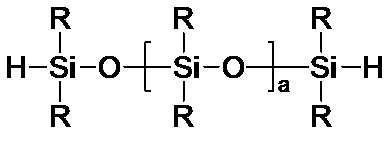
、および
下記一般式(3):

に示す両末端メタリル基含有ポリエーテルとのヒドロシリル化反応により得られ、
一般式(1):

で表される構成単位を分子内に有するポリエーテル-ポリシロキサンブロック共重合体である、[1]または[2]のポリエーテル-ポリシロキサンブロック共重合体組成物。
[4]成分(B)が、蒸留または蒸留による精製が可能な沸点を有するモノオール有機化合物である、[1]~[3]のいずれかのポリエーテル-ポリシロキサンブロック共重合体組成物。
[5]成分(B)が、プロピレングリコールモノブチルエーテル、ジプロピレングリコールモノブチルエーテル、トリプロピレングリコールモノブチルエーテル、プロピレングリコールモノメチルエーテル、ジプロピレングリコールモノメチルエーテル、トリプロピレングリコールモノメチルエーテル、プロピレングリコールモノ(イソ)プロピルエーテル、ジプロピレングリコールモノ(イソ)プロピルエーテル、トリプロピレングリコールモノ(イソ)プロピルエーテル、プロピレングリコールモノエチルエーテル、ジプロピレングリコールモノエチルエーテル、トリプロピレングリコールモノエチルエーテル、2-ブチル-1-オクタノール、2-ヘキシル-1-デカノール、2-オクチル-1-ドデカノール、イソステアリルアルコール、および2-デシル-1-テトラデカノールから選ばれる1種または2種類以上のモノオール有機化合物である、[1]~[4]のいずれかのポリエーテル-ポリシロキサンブロック共重合体組成物。
[6]前記の成分(A)および成分(B)の質量比が20/80~70/30の範囲内である、[1]~[5]のいずれかのポリエーテル-ポリシロキサンブロック共重合体組成物。
[7]さらに、(C)25℃で液状であり、末端水酸基の一方がアルキル、アラルキル、アリール基から選択される炭素数1~8の炭化水素基により置換されていてもよい、炭素数2~4のオキシアルキレン単位の繰り返し数が4~50の範囲であるポリアルキレングリコールまたはその誘導体から選ばれる1種類以上を、
成分(A)および成分(B)の和100質量部に対し、10~300質量部の範囲で含有し、組成物全体の25℃における粘度が100~35,000mm2/s の範囲にある、[1]~[6]のいずれかのポリエーテル-ポリシロキサンブロック共重合体組成物。
[7-1]成分(C)が、炭素数2~4のオキシアルキレン単位の繰り返し数が6~20の範囲であるポリアルキレングリコールまたはその誘導体から選ばれる1種類以上である、[7]のポリエーテル-ポリシロキサンブロック共重合体組成物。
[8][1]~[7]のいずれかのポリエーテル-ポリシロキサンブロック共重合体組成物を含有する、界面活性剤。
[9][1]~[7]のいずれかのポリエーテル-ポリシロキサンブロック共重合体組成物を含有する、整泡剤。
[10][1]~[7]のいずれかのポリエーテル-ポリシロキサンブロック共重合体組成物を含有する、ポリウレタン発泡体形成組成物。
[11](a)ポリオール、
(b)ポリイソシアナート、
(c)触媒、
(d)[1]~[7]のいずれかのポリエーテル-ポリシロキサンブロック共重合体組成物を含有する整泡剤、および
(e)任意選択で、(d)成分以外の整泡剤、発泡剤、希釈剤、鎖伸長剤、架橋剤、水、非水性発泡剤、充填剤、強化剤、顔料、染料、着色剤、難燃剤、抗酸化剤、抗オゾン剤、紫外線安定化剤、静電気防止剤、殺菌剤および抗菌剤からなる群より選択される、少なくとも一つの添加成分
を含有する、ポリウレタン発泡体形成組成物。
[12](a)ポリオール 100質量部に対して、[1]~[7]のいずれかのポリエーテル-ポリシロキサンブロック共重合体組成物中の(A)ポリエーテル-ポリシロキサンブロック共重合体を0.5~8.0質量部となる範囲で含有する、[10]または[11]に記載のポリウレタン発泡体形成組成物。
[13][10]~[12]のいずれかのポリウレタン発泡体形成組成物により得られるポリウレタン発泡体。
[14]硬質フォーム、半硬質フォーム、軟質フォーム、又はマイクロセルラーフォームである、[13]に記載のポリウレタン発泡体。
[15][1]~[7]のいずれかのポリエーテル-ポリシロキサンブロック共重合体組成物を含有する、化粧料原料。
[16][1]~[7]のいずれかのポリエーテル-ポリシロキサンブロック共重合体組成物を含有する、化粧料。
[17]前記一般式(2)で表される両末端SiH基含有オルガノポリシロキサンと前記一般式(3)で表される両末端メタリル基含有ポリエーテルとのヒドロシリル化反応を実質的に無溶媒下で開始する工程;および
前記成分(B)であるモノオール有機化合物を加えて希釈ないし反応促進させる工程を少なくとも含む、
[1]~[7]のいずれかのポリエーテル-ポリシロキサンブロック共重合体組成物の製造方法。
[18]前記一般式(2)で表される両末端SiH基含有オルガノポリシロキサンと前記一般式(3)で表される両末端メタリル基含有ポリエーテルとのヒドロシリル化反応を、前記(B)成分であるモノオール有機化合物の存在下で開始ないし進行させる工程を少なくとも含む、
[1]~[7]のいずれかのポリエーテル-ポリシロキサンブロック共重合体組成物の製造方法。
[19]前記一般式(2)で表される両末端SiH基含有オルガノポリシロキサンと前記一般式(3)で表される両末端メタリル基含有ポリエーテルとのヒドロシリル化反応を前記成分(B)と異なる揮発性有機溶媒(B´)の存在下において開始ないし進行させる工程;および
当該成分(B)と異なる揮発性有機溶媒(B´)を、前記成分(B)であるモノオール有機化合物と溶媒交換を行う工程を少なくとも含む、
[1]~[7]のいずれかのポリエーテル-ポリシロキサンブロック共重合体組成物の製造方法。
[20]ストリッピング工程を実質的に有しない、[17]または[18]に記載のポリエーテル-ポリシロキサンブロック共重合体組成物の製造方法。
(A)成分は、本発明組成物の主成分であり、下記一般式(1):

で表される構成単位を分子内に有し、その末端基(-Z)が、
Z1:ポリエーテル部分に結合したアルケニル基、水酸基、アルコキシ基またはアセトキシ基;および
Z2:ケイ素原子に結合し、ヘテロ原子を有しない一価の炭化水素基、水酸基またはアルコキシ基
から選ばれる1種類以上の官能基である、ポリエーテル-ポリシロキサンブロック共重合体である。
一般式(2):

および、下記一般式(3)に示す両末端メタリル基含有ポリエーテル
一般式(3):
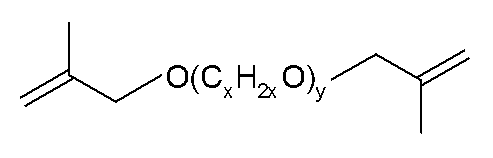
とのヒドロシリル化反応により得られたポリエーテル-ポリシロキサンブロック共重合体であることが特に好ましい。
成分(B)は、本発明組成物の特徴的な成分であり、以下の(B1)または(B2)から選ばれる、5℃で液状であり、分子内に1のアルコール性水酸基を有し、酸素以外のヘテロ原子を含有しないことを特徴とする、1種または2種類以上の特定のモノオール有機化合物である。かかる成分(B)は、ポリエーテル-ポリシロキサンブロック共重合体の溶媒であり、合成反応における溶媒として組成物に導入されてもよく、他の溶媒の存在下または不存在下においてポリエーテル-ポリシロキサンブロック共重合体の合成反応を行った後に系中に溶媒置換あるいは溶媒添加の形で組成物に導入されてもよい。
本発明のポリエーテル-ポリシロキサンブロック共重合体組成物は、さらに、(C)25℃で液状であり、末端水酸基の一方がアルキル、アラルキル、アリール基から選択される炭素数1~8の炭化水素基により置換されていてもよい、炭素数2~4のオキシアルキレン単位の繰り返し数が4~50の範囲であるポリアルキレングリコールまたはその誘導体から選ばれる1種類以上を含んでもよい。かかる成分(C)を用いることで、整泡剤または界面活性剤としての機能に悪影響を及ぼすことなく、本発明の組成物の粘度等を調整し、使用時の利便性、取扱作業性(ハンドリング)を改善できる利点がある。また、成分(C)は、ポリウレタン発泡体形成組成物における水酸基価の調整、すなわちポリウレタン発泡体の架橋密度や強度など各種物性コントロールの目的で、前記ポリエーテル-ポリシロキサンブロック共重合体組成物に追加して使用できる利点がある。
本発明のポリエーテル-ポリシロキサンブロック共重合体組成物は、ケイ素原子数が20以下の低分子シロキサンの含有量が5000ppm(重量)以下であることが好ましく、2000ppm(重量)以下が特に好ましい。この値が5000ppmを超えると、特に本発明のポリエーテル-ポリシロキサンブロック共重合体組成物をポリウレタン発泡体等の整泡剤として用いた場合、ポリウレタンフォームが設置された場所の周辺の部材を汚染したり、電気・電子装置の接点障害を引き起こす場合がある。かかる低分子シロキサンとしては、環状のものと直鎖状のものがあり、例えば、式、[(CH3)2SiO]n(式中、nは3~10の整数である。)で表される環状ジメチルシロキサン、および式、CH3[(CH3)2SiO]mSi(CH3)3(式中、mは1~10の整数である。)で表される直鎖状ジメチルシロキサンオリゴマーがあり、また、これらのメチル基の一部が他の有機基で置換されたものがある。かかる低分子シロキサンのより具体的な例としては、オクタメチルテトラシロキサン、デカメチルペンタシクロシロキサン、両末端トリメチルシロキシ基封鎖ジメチルシロキサンオリゴマーが例示される。かかる低分子シロキサンの含有量は、例えば、本発明組成物に有機溶媒を加えて低分子シロキサンを溶媒抽出し、その抽出液をガスクロマトグラフィ分析装置を用いて、分析することにより測定できる。
本発明のポリエーテル-ポリシロキサンブロック共重合体組成物は、前記一般式(2)で表される両末端SiH基含有オルガノポリシロキサンと前記一般式(3)で表される、分子鎖の両末端にメタリル基を有するポリエーテルとを、ヒドロシリル化反応させることにより成分(A)であるポリエーテル-ポリシロキサンブロック共重合体を得ることが好ましい。このとき、ヒドロシリル化反応を開始、あるいは進行させる工程は、無溶媒下で行ってもよく、前記(B)成分であるモノオール有機化合物の存在下で行ってもよく、前記成分(B)と異なる揮発性有機溶媒(B´)の存在下で行ってもよい。なお、無溶媒下/成分(B)と異なる揮発性有機溶媒(B´)の存在下で成分(A)を得るためのヒドロシリル化反応を開始、あるいは進行させた場合、さらに、(B)成分を添加する工程が必要である。
<アルカリ分解ガス発生法:試料をトルエン又はIPAに溶解した溶液と、28.5質量%苛性カリのエタノール/水混合溶液を室温で反応させ、発生する水素ガスを捕集管に集めてその体積を測定する方法>
さらに、本発明のポリエーテル-ポリシロキサンブロック共重合体の用途に応じ、粗製品の精製や低臭化が求められる場合には、水素添加、酸性物質との接触および生成するアルデヒド類を除去する等の公知の精製方法を用いてもよい。これらの方法は、例えば、特開2007-186557号公報の段落0031等で提案された精製方法1および精製方法2や、特開2000-327785号公報等で提案された匂いの低減方法、本件出願人が特開2011-116902号公報で提案した酸性無機塩を用いた処理方法等から特に制限なく選択することができる。特に、これらの精製方法を行うことで、ポリウレタン発泡体に配合された場合であっても経時で発生する有害なアルデヒド類の量が極めて少なくなり、建築用材料、自動車工業(例えば、自動車内装材料)、ベッド、ソファー等の家具類、寝具、衣類等に適用されるポリウレタン発泡体の整泡剤として有用であるほか、化粧料原料としての有用性がさらに改善される利点がある。
本発明のポリエーテル-ポリシロキサンブロック共重合体組成物は、前記一般式(2)で表される両末端SiH基含有オルガノポリシロキサンと前記一般式(3)で表される分子鎖両末端にメタリル基(RVi)を有するポリエーテルとのヒドロシリル化を実質的に無溶媒下で開始する工程、および、反応終了後あるいは反応中に前記成分(B)であるモノオール有機化合物を加えて希釈ないし反応促進させる工程を少なくとも含む製造法により、好適に製造することができる。無溶媒下で反応を完了させた後に成分(B)を加えて希釈する事もできるし、無溶媒下の反応が途中の段階から成分(B)を加えて反応を完了させる事もできる。本製造方法は、原則として、ストリピング工程を必要としない。また、本発明のポリエーテル-ポリシロキサンブロック共重合体は、整泡剤としての性能に優れるので泡の安定化が起き易い。このため、トルエンのような溶媒存在下で反応を行うと、トルエン等の除去のために減圧除去(ストリピング)を行うと、発生した泡が破泡せず、反応釜上部まで覆い尽くしてしまうために工業的生産上のサイクルタイムが増大し、不利になる場合があるが、無溶媒下で反応を開始することで、かかる工業生産上の問題を解消できる場合がある。なお、無溶媒下で反応を開始し、ある程度反応が進んでから前記成分(B)であるモノオール有機化合物を添加することで、共重合に伴う粘度上昇を抑制し、攪拌効率および反応性を改善することもできる。なお、無溶媒下におけるポリエーテル-ポリシロキサンブロック共重合体の合成方法として、特開平01-101333号公報に記載の方法等を用いてもよい。
本発明のポリエーテル-ポリシロキサンブロック共重合体組成物は、前記一般式(2)で表される両末端SiH基含有オルガノポリシロキサンと前記一般式(3)で表される分子鎖両末端にメタリル基を有するポリエーテルとのヒドロシリル化を前記成分(B)であるモノオール有機化合物の存在下で開始ないし進行させる工程を少なくとも含む製造法により、好適に製造することができる。本製造方法では、成分(B)以外の溶媒又は希釈剤が同時に存在している事もできるが、そうでない場合にはストリピング工程を必要としない。一方成分(B)以外の溶媒又は希釈剤を同時に存在させた場合は、反応終了後にそれらを除く必要がある場合に限りストリピング工程が必要となる。当該方法は、上記の製造工程における発泡と工業的生産効率の悪化の問題が殆どなく、成分(B)以外の溶媒を用いない場合には、溶媒交換等の追加の工程を行う必要がなく、反応開始~得られる組成物の粘度が抑制されるために攪拌効率および反応効率に優れ、得られるポリエーテル-ポリシロキサンブロック共重合体組成物の界面活性剤または整泡剤としての品質及び機能を著しく改善しうるものである。
本発明のポリエーテル-ポリシロキサンブロック共重合体組成物は、前記一般式(2)で表される両末端SiH基含有オルガノポリシロキサンと前記一般式(3)で表される分子鎖両末端にメタリル基を有するポリエーテルとのヒドロシリル化を前記成分(B)と異なる揮発性有機溶媒(B´)の存在下において開始ないし進行させる工程;および当該成分(B)と異なる揮発性有機溶媒(B´)を、前記成分(B)であるモノオール有機化合物と溶媒交換を行う工程を少なくとも含む製造法により、好適に製造することができる。
本発明のポリエーテル-ポリシロキサンブロック共重合体組成物は、分子内に親水性の互いに異なるシリコーン部位とポリエーテル部位を有するので、従来公知のポリエーテル-ポリシロキサンブロック共重合体の用途に特に制限なく使用することができ、界面活性剤、整泡剤、繊維の潤滑性付与剤、他の高分子材料の反応性原料等に特に制限なく用いることができる。本発明のポリエーテル-ポリシロキサンブロック共重合体組成物は、工業用または化粧品用の界面活性剤として有用であり、その配合先は、塗料、コーティング剤、建築材料、化粧料、親水性付与剤、表面処理剤、発泡性樹脂組成物等であり、特に制限されない。また、界面活性剤としての機能に由来して、特に、塗料用添加剤、乳化剤、可溶化剤、ポリウレタン発泡体用の整泡剤や化粧料原料として有用である。
本発明のポリエーテル-ポリシロキサンブロック共重合体組成物は、発泡性樹脂、特に、ポリウレタン発泡体の製造時に、気泡コントロール或いは気泡安定用の界面活性剤、特に、整泡剤として好適に使用できる。特に本発明にかかる組成物は、単なる気泡安定剤に留まらずオープンセル率のコントロールが可能であり、プレミックス液の均質性や安定性に優れ、またフォーム形成用エマルション組成物中での各種成分との相溶性にも優れ、しかもマイクロセルラー用途での気泡保持性にも優れるという利点を有する。
上記整泡剤は、ポリウレタンフォームの製造に使用される。従って、本発明のポリウレタン発泡体形成組成物は、上記の整泡剤である本発明のポリエーテル-ポリシロキサンブロック共重合体組成物を含むものであれば、特にその種類、特性、適用される処方の種類において制限されるものではない。
一般的に、ポリウレタンフォームには、硬質のものと軟質のものがあり、詳細には、軟質ウレタンフォーム、高弾性ウレタンフォーム、硬質ウレタンフォーム、特殊フォームに大別される。本発明のポリウレタン発泡体形成組成物は、分子量設計、取扱作業性(ハンドリング)等に優れるので、分子量の小さい整泡剤が一般的に求められる高弾性フォーム以外の全てのポリウレタンフォーム処方で、整泡剤として優れた効果を発揮できるものである。
(a)ポリオール、
(b)ポリイソシアナート、
(c)触媒、
(d)請求項1~7のいずれかのポリエーテル-ポリシロキサンブロック共重合体組成物を含有する整泡剤、および
(e)任意選択で、(d)成分以外の整泡剤、発泡剤、希釈剤、鎖伸長剤、架橋剤、水、非水性発泡剤、充填剤、強化剤、顔料、染料、着色剤、難燃剤、抗酸化剤、抗オゾン剤、紫外線安定化剤、静電気防止剤、殺菌剤および抗菌剤からなる群より選択される、少なくとも一つの添加成分
を含有するものである。以下、各成分を概説する。
ポリオールとしては、例えば、ポリエーテルポリオール、ポリエステルポリオール等が挙げられる。ポリエーテルポリオールとしては、多価アルコール、糖類、フェノール類、フェノール誘導体、芳香族アミン等にアルキレンオキサイドを付加して得られるものであり、例えば、グリセリン、プロピレングリコール、ジプロピレングリコール、エチレングリコール、ジエチレングリコール、トリメチロールプロパン、ペンタエリスリトール、シュークロース、ソルビトール、ノボラック、ノニルフェノール、ビスフェノールA、ビスフェノールF、トリレンジアミン、ジフェニルメタンジアミン等の1種または2種以上にアルキレンオキサイドを付加して得られるものが挙げられる。ポリエステルポリオールとしては、アジピン酸、フタル酸、コハク酸等の多官能カルボン酸とグリセリン、プロピレングリコール、ジプロピレングリコール、エチレングリコール、ジエチレングリコール、トリメチロールプロパン、ペンタエリスリトール等の多官能ヒドロキシル化合物との縮重合により製造される末端に水酸基を有するポリオールが挙げられる。ポリオールは、一種単独で用いても二種以上を併用してもよい。
ポリイソシアナートとしては、有機ポリイソシアネートとして公知のものが全て使用できるが、最も一般的なものはトリレンジイソシアネート(以下、「TDI」と略す。)およびジフェニルメタンジイソシアネート(以下、「MDI」と略す。)である。TDIは、異性体の混合、即ち、2,4-体100%品、2,4-体/2,6-体=80/20,65/35(それぞれ質量比)等のものはもちろん、多官能性のタールを含有する粗TDIも使用できる。MDIとしては、4,4'-ジフェニルメタンジイソシアネートを主成分とする純品のほか、3核体以上の多核体を含有するポリメリックMDIが使用できる。
ニッケルアセトアセトナート、鉄アセトアセトナート、スズ系触媒、ビスマス系触媒、亜鉛系触媒、チタニウム系触媒、アルミニウム錯体、ジルコニウム錯体、オクチル酸カリウム、酢酸カリウム、酢酸ナトリウム、オクチル酸ナトリウム、表面に固体酸点を有する金属酸化物粒子、トリエチレンジアミン、ビス(ジメチルアミノエチル)エーテルのような第三級アミンウレタン触媒、イミダゾール誘導体、カルボン酸四級アンモニウム塩、遅効性三級アミン触媒、一般型三級アミン触媒、低エミッション三級アミン触媒、ノンエミッション三級アミン触媒、および例えばAir ProductsからのDABCO(登録商標)触媒を含む。
本発明のポリエーテル-ポリシロキサンブロック共重合体組成物は前記のとおりであるが、一般的に、整泡剤であるポリエーテル部分を含有するシリコーン類と、発泡樹脂の種類の適合性には相関があり、低分子量体が適するフォームから高分子量体が適するフォームまでを順に並べると、
高弾性フォーム<硬質フォーム<軟質フォーム<マイクロセルラーフォーム
となる。
ポリウレタンフォーム形成組成物における任意選択の成分(e)の中で特に重要なものは、水および非水性発泡剤である。水はポリイソシアナートと反応して二酸化炭素ガスを生成することによって、化学的発泡剤として作用する。この他に、物理的および/もしくは化学的な型の一つもしくはそれ以上の非水性発泡剤を反応混合物の中に含ませることが出来る。また、処方によって水を使わない場合もある。これらの発泡剤は、HFC-245faおよびHFC-134aのようなハイロドフルオロカーボン類、HFOおよびHCFOのようなハイドロフルオロオレフィン類、ならびにiso-、cyclo-およびn-ペンタンのような低沸点炭化水素、超臨界炭酸ガス、蟻酸等を含み得る。
・特表2005-534770号公報、特表2005-534770号公報、特表2010-535931号公報に記載されたポリウレタン発泡体の製造方法;
・特表2010-539280号公報に記載された開放セルポリウレタンの製造プロセス
・特開2012-246397号公報、特開2009-265425号公報等に記載されたウレタンフォームを含むシール材
・特開2012-082273号公報、特開2010-247532号公報、特開2010-195870号公報、特開2002-137234号公報等に記載されたウレタンフォームの製造
本発明のポリエーテル-ポリシロキサンブロック共重合体組成物は、化粧料原料として有用であり、さらに、前記のとおり、工業的生産工程において比較的低コストに生産可能であり、高付加価値かつ低価格で供給できるという利点を有する。
本発明に係るポリエーテル-ポリシロキサンブロック共重合体組成物は、様々な外用剤、化粧料に用いることができる。その具体的な処方例としては、出願人らが特許文献11(国際公開特許 WO2011/049248号公報)に記載した実施例等に開示された各種化粧料・外用剤の処方例中のシリコーン系界面活性剤に相当する適当な成分を、上記の本発明に係るポリエーテル-ポリシロキサンブロック共重合体組成物で置き換えたものは、本願発明に係る化粧料・外用剤の処方例として、本願発明の範囲に包含されるものである。言うまでもなく、本発明にかかる化粧料・外用剤の処方例はこれに限られるものではなく、従来公知のシリコーン系界面活性剤(ポリエーテル変性シリコーン、グリセリン変性シリコーンまたはポリエーテル-ポリシロキサンブロック共重合体)を含有する化粧料のシリコーン系界面活性剤を本発明に係るポリエーテル-ポリシロキサンブロック共重合体組成物で置き換えたものは、本願発明に係る化粧料・外用剤の処方例として、本願発明の範囲に包含される。
1L反応器に、平均組成式 MHD20MH で表されるメチルハイドロジェンポリシロキサン75.25g、平均組成式CH2=C(CH3)CH2-O(C2H4O)33(C3H6O)25-CH2-C(CH3)=CH2 で表されるビスメタリルポリエーテル174.75g、ジプロピレングリコールモノブチルエーテル(BDPG)250g、天然ビタミンEを0.25g仕込み、窒素流通下で攪拌しながら80~90℃まで加温した。白金-2,4,6,8-テトラメチル-2,4,6,8-テトラビニルテトラシロキサン錯体のIPA溶液(Pt濃度0.45wt%)を0.56g添加し、2.5時間反応を行なった。次いで反応液を1g採取し、アルカリ分解ガス発生法により確認したところ反応は完結していた。これにより、平均組成式

で表される構成単位を少なくとも含有する直鎖状オルガノポリシロキサン-ポリエーテルブロックコポリマーとBDPGとを50:50の比率で含む、液状のポリエーテル-ポリシロキサンブロック共重合体組成物を得た。なお、平均組成式を簡易に表記したが、原料のC=C基とSi-H基のモル比はおよそ7:6であるため、共重合体の両末端はポリエーテルで封鎖された形(=末端官能基はポリエーテルに結合したメタリル基)となっている。また、反応中に一部のSi-H基はIPA或いはBDPGの水酸基と脱水素縮合反応を起こし得るので、共重合体末端の一部はSiO-iPr或いはSiO-R1(R1はBDPGの残基)の構造を含むと考えられる。なお、ここでポリエーテル部分は、エチレンオキサイドとプロピレンオキサイドのランダム付加体である。
BDPGをプロピレングリコールモノブチルエーテル(BPG)に置き換えた他は、実施例1-1と同様にして実験を行った。直鎖状オルガノポリシロキサン-ポリエーテルブロックコポリマーの合成反応における反応性などの挙動は、実施例1-1と同様であった。
1L反応器に、平均組成式 MHD20MH で表されるメチルハイドロジェンポリシロキサン85.55g、平均組成式CH2=C(CH3)CH2-O(C2H4O)33(C3H6O)25-CH2-C(CH3)=CH2 で表されるビスメタリルポリエーテル164.45g、ジプロピレングリコールモノブチルエーテル(BDPG)250g、天然ビタミンEを0.25g仕込み、窒素流通下で攪拌しながら80~90℃まで加温した。白金-2,4,6,8-テトラメチル-2,4,6,8-テトラビニルテトラシロキサン錯体のIPA溶液(Pt濃度4.5wt%)を0.056g添加し、3時間反応を行なった。次いで反応液を1g採取し、アルカリ分解ガス発生法により確認したところ反応は完結していた。これにより、平均組成式

で表される構成単位を少なくとも含有する直鎖状オルガノポリシロキサン-ポリエーテルブロックコポリマーとBDPGとを50:50の比率で含む、液状のポリエーテル-ポリシロキサンブロック共重合体組成物を得た。なお、平均組成式を簡易に表記したが、原料のC=C基とSi-H基のモル比はおよそ1:1であり、若干ポリエーテル過剰のため共重合体の両末端はポリエーテルで封鎖された形(=末端官能基はポリエーテルに結合したメタリル基)となっている。また、反応中に一部のSi-H基はIPA或いはBDPGの水酸基と脱水素縮合反応を起こし得るので、共重合体末端の一部はSiO-iPr或いはSiO-R1(R1はBDPGの残基)の構造を含むと考えられる。なお、ここでポリエーテル部分は、エチレンオキサイドとプロピレンオキサイドのランダム付加体である。
BDPGをプロピレングリコールモノブチルエーテル(BPG)に置き換えた他は、実施例2-1と同様にして実験を行った。直鎖状オルガノポリシロキサン-ポリエーテルブロックコポリマーの合成反応における反応性などの挙動は、実施例2-1と同様であった。
1L反応器に、平均組成式 MHD20MH で表されるメチルハイドロジェンポリシロキサン84.25g、平均組成式CH2=C(CH3)CH2-O(C2H4O)33(C3H6O)25-CH2-C(CH3)=CH2 で表されるビスメタリルポリエーテル165.75g、天然ビタミンEを0.25g仕込み、窒素流通下で攪拌しながら85~95℃まで加温した。白金-2,4,6,8-テトラメチル-2,4,6,8-テトラビニルテトラシロキサン錯体のIPA溶液(Pt濃度0.45wt%)を0.56g添加し、2.5時間反応を行なったところ、非常に高粘度の液に変化した。次いで反応液を1g採取し、トルエンで希釈して低粘度化したのちアルカリ分解ガス発生法により反応率を確認したところ、ガス発生量がトレースであったため反応がほぼ完結したものと判断した。次いで、ジプロピレングリコールモノブチルエーテル(BDPG)250gを反応液に添加して1時間の混合均質化を行なったのち、念のため再度サンプリングを行なって反応率を調査したところ、約36ppm相当のケイ素結合水素原子が検出された。そこで85~95℃で3.5時間の熟成を行なったところ、反応が完結した。これにより、平均組成式

で表される構成単位を少なくとも含有する直鎖状オルガノポリシロキサン-ポリエーテルブロックコポリマーとBDPGとを50:50の比率で含む、液状のポリエーテル-ポリシロキサンブロック共重合体組成物を得た。なお、平均組成式を簡易に表記したが、原料のC=C基とSi-H基のモル比はおよそ1:1であり、若干ポリエーテル過剰のため共重合体の両末端はポリエーテルで封鎖された形(=末端官能基はポリエーテルに結合したメタリル基)となっている。また、反応中に一部のSi-H基はIPA或いはBDPGの水酸基と脱水素縮合反応を起こし得るので、共重合体末端の一部はSiO-iPr或いはSiO-R1(R1はBDPGの残基)の構造を含むと考えられる。なお、ここでポリエーテル部分は、エチレンオキサイドとプロピレンオキサイドのランダム付加体である。
1L反応器に、平均組成式 MHD20MH で表されるメチルハイドロジェンポリシロキサン84.25g、平均組成式CH2=C(CH3)CH2-O(C2H4O)33(C3H6O)25-CH2-C(CH3)=CH2 で表されるビスメタリルポリエーテル165.75g、トルエン250g、天然ビタミンEを0.25g仕込み、窒素流通下で攪拌しながら80~90℃まで加温した。白金-2,4,6,8-テトラメチル-2,4,6,8-テトラビニルテトラシロキサン錯体のIPA溶液(Pt濃度0.45wt%)を0.56g添加し、2時間反応を行なった。次いで反応液を1g採取し、アルカリ分解ガス発生法により確認したところ反応は完結していた。反応系を徐々に減圧しながら更に125℃まで加熱して、泡立ちによる突沸に注意しつつトルエンを少しずつ留去した。約3/4のトルエンが除かれた段階で復圧し、250gのジプロピレングリコールモノブチルエーテル(BDPG)を反応系に加えたのち、再度減圧して残存するトルエンを注意深く留去した。トルエンの留出が終わった時点で共重合体とBDPGの重量比は50:50であったが、この段階で内容物は非常に高粘度であり、攪拌が困難な状況であった。そこで、更にBDPG 250g×2回を追加投入して希釈を行った。これにより、平均組成式

で表される構成単位を少なくとも含有する直鎖状オルガノポリシロキサン-ポリエーテルブロックコポリマーとBDPGとを33:67の比率で含む、液状のポリエーテル-ポリシロキサンブロック共重合体組成物を得た。翌朝フラスコ内容物を確認したところ、室温下では依然として粘度が非常に高く、ハンドリングし難いことが分かった。そこで、フラスコ内容物60gを200mlガラス瓶に小分けし、これに更にBDPGを20g添加して、ホモディスパーミキサーにて1600rpm×5分間の混合を行なった。これにより、上記平均組成式で表される構成単位を少なくとも含有する直鎖状オルガノポリシロキサン-ポリエーテルブロックコポリマーとBDPGとを25:75の比率で含む、液状のポリエーテル-ポリシロキサンブロック共重合体組成物を得た。なお、平均組成式を簡易に表記したが、原料のC=C基とSi-H基のモル比はおよそ1:1であり、若干ポリエーテル過剰のため共重合体の両末端はポリエーテルで封鎖された形(=末端官能基はポリエーテルに結合したメタリル基)となっている。また、反応中に一部のSi-H基はIPAの水酸基と脱水素縮合反応を起こし得るので、共重合体末端の一部はSiO-iPrの構造を含むと考えられる。なお、ここでポリエーテル部分は、エチレンオキサイドとプロピレンオキサイドのランダム付加体である。
前述の実施例2-1に倣って、但しBDPGを2-ヘキシル-1-デカノール(HDL)に変更して実験を行った。直鎖状オルガノポリシロキサン-ポリエーテルブロックコポリマーの合成反応における反応性などの挙動は、実施例2-1と同様であった。
1L反応器に、平均組成式 MHD20MH で表されるメチルハイドロジェンポリシロキサン102.15g、平均組成式CH2=C(CH3)CH2-O(C2H4O)33(C3H6O)25-CH2-C(CH3)=CH2 で表されるビスメタリルポリエーテル231.2g、BDPGを166.7g、天然ビタミンEを0.25g仕込み、窒素流通下で攪拌しながら100~110℃まで加温した。白金-2,4,6,8-テトラメチル-2,4,6,8-テトラビニルテトラシロキサン錯体のIPA溶液(Pt濃度0.45wt%)を0.74g添加し、3時間反応を行なった。次いで、反応液を1g採取しアルカリ分解ガス発生法により確認したところ、反応は完結していた。これにより、平均組成式

で表される構成単位を少なくとも含有する直鎖状オルガノポリシロキサン-ポリエーテルブロックコポリマーとBDPGとを67:33の比率で含む、液状のポリエーテル-ポリシロキサンブロック共重合体組成物を得た。なお、平均組成式を簡易に表記したが、原料のC=C基とSi-H基のモル比はおよそ7:6であるため、共重合体の両末端はポリエーテルで封鎖された形(=末端官能基はポリエーテルに結合したメタリル基)となっている。また、反応中に一部のSi-H基はIPA或いはBDPGの水酸基と脱水素縮合反応を起こし得るので、共重合体末端の一部はSiO-iPr或いはSiO-R1(R1はBDPGの残基)の構造を含むと考えられる。なお、ここでポリエーテル部分は、エチレンオキサイドとプロピレンオキサイドのランダム付加体である。
1L反応器に、平均組成式 MHD20MH で表されるメチルハイドロジェンポリシロキサン112.9g、平均組成式CH2=C(CH3)CH2-O(C2H4O)33(C3H6O)25-CH2-C(CH3)=CH2 で表されるビスメタリルポリエーテル262.1g、プロピレングリコールモノブチルエーテル(BPG)を125g、天然ビタミンEを0.25g仕込み、窒素流通下で攪拌しながら90℃まで加温した。白金-2,4,6,8-テトラメチル-2,4,6,8-テトラビニルテトラシロキサン錯体のIPA溶液(Pt濃度0.45wt%)を0.83g添加し、100℃で3時間反応を行なった。次いで、反応液を1g採取しアルカリ分解ガス発生法により確認したところ、反応は完結していた。これにより、平均組成式

で表される構成単位を少なくとも含有する直鎖状オルガノポリシロキサン-ポリエーテルブロックコポリマーとBPGとを75:25の比率で含む、液状のポリエーテル-ポリシロキサンブロック共重合体組成物を得た。なお、平均組成式を簡易に表記したが、原料のC=C基とSi-H基のモル比はおよそ7:6であるため、共重合体の両末端はポリエーテルで封鎖された形(=末端官能基はポリエーテルに結合したメタリル基)となっている。また、反応中に一部のSi-H基はIPA或いはBPGの水酸基と脱水素縮合反応を起こし得るので、共重合体末端の一部はSiO-iPr或いはSiO-R1(R1はBPGの残基)の構造を含むと考えられる。なお、ここでポリエーテル部分は、エチレンオキサイドとプロピレンオキサイドのランダム付加体である。
1L反応器に、平均組成式 MHD20MH で表されるメチルハイドロジェンポリシロキサン76.75g、平均組成式CH2=C(CH3)CH2-O(C2H4O)52(C3H6O)10-CH2-C(CH3)=CH2 で表されるビスメタリルポリエーテル173.25g、BDPGを250g、天然ビタミンEを0.25g仕込み、窒素流通下で攪拌しながら85~95℃まで加温した。白金-2,4,6,8-テトラメチル-2,4,6,8-テトラビニルテトラシロキサン錯体のIPA溶液(Pt濃度0.45wt%)を0.56g添加し、2時間反応を行なった。次いで反応液を1g採取し、アルカリ分解ガス発生法により確認したところ、反応は完結していた。これにより、平均組成式

で表される構成単位を少なくとも含有する直鎖状オルガノポリシロキサン-ポリエーテルブロックコポリマーとBDPGとを50:50の比率で含む、液状のポリエーテル-ポリシロキサンブロック共重合体組成物を得た。なお、平均組成式を簡易に表記したが、原料のC=C基とSi-H基のモル比はおよそ7:6であるため、共重合体の両末端はポリエーテルで封鎖された形(=末端官能基はポリエーテルに結合したメタリル基)となっている。また、反応中に一部のSi-H基はIPA或いはBDPGの水酸基と脱水素縮合反応を起こし得るので、共重合体末端の一部はSiO-iPr或いはSiO-R1(R1はBDPGの残基)の構造を含むと考えられる。なお、ここでポリエーテル部分は、エチレンオキサイドとプロピレンオキサイドのランダム付加体である。
BDPGをプロピレングリコールモノブチルエーテル(BPG)に置き換えた他は、実施例4-1と同様にして実験を行った。直鎖状オルガノポリシロキサン-ポリエーテルブロックコポリマーの合成反応における反応性などの挙動は、実施例4-1と同様であった。
前述の実施例3-1で得られたポリエーテル-ポリシロキサンブロック共重合体組成物60gと、n-BuO(C3H6O)13-Hで表されるポリプロピレングリコールモノブチルエーテル{BPPG-13}20gとを200mlガラス瓶に仕込み、室温下にホモディスパーミキサーにて1600rpm×5分間の混合を行なった。これにより、共重合体:BDPG:{BPPG-13}=2:1:1の存在比である液状のポリエーテル-ポリシロキサンブロック共重合体組成物を得た。
前述の比較例3-1で得られたガム状のポリエーテル-ポリシロキサンブロック共重合体組成物60gと、n-BuO(C3H6O)13-Hで表されるポリプロピレングリコールモノブチルエーテル{BPPG-13}100gとを200mlガラス瓶に仕込み、栓をして60℃恒温槽内での加温および振り混ぜ操作を繰り返し、ガムを部分的に溶解させた。その後、ホモディスパーミキサーにて室温1600rpm×5分間の混合を行ない、均質化した。これにより、共重合体:BDPG:{BPPG-13}=2:1:5の存在比である液状のポリエーテル-ポリシロキサンブロック共重合体組成物を得た。
前述の実施例2-4で得られたポリエーテル-ポリシロキサンブロック共重合体組成物40gと、HO(C3H6O)7-Hで表されるポリプロピレングリコール(PPG-7)40gとを200mlガラス瓶に仕込み、室温下にホモディスパーミキサーにて1600rpm×5分間の混合を行なった。これにより、共重合体:BDPG:{PPG-7}=1:3:4の存在比である液状のポリエーテル-ポリシロキサンブロック共重合体組成物を得た。
前述の実施例3-2で得られたポリエーテル-ポリシロキサンブロック共重合体組成物40gと、ドデシルベンゼン(DB)35gとを200mlガラス瓶に仕込み、室温下にホモディスパーミキサーにて1600rpm×5分間の混合を行なった。これにより、共重合体:BPG:DB=3:1:3.5の存在比である液状のポリエーテル-ポリシロキサンブロック共重合体組成物を得た。
1L反応器に、平均組成式 MHD20MH で表されるメチルハイドロジェンポリシロキサン75.25g、平均組成式CH2=C(CH3)CH2-O(C2H4O)33(C3H6O)25-CH2-C(CH3)=CH2 で表されるビスメタリルポリエーテル174.75g、ヘキシレングリコール(HG,別名2-メチルペンタン-2,4-ジオール)250g、天然ビタミンEを0.25g仕込み、窒素流通下で攪拌しながら80~90℃まで加温した。白金-2,4,6,8-テトラメチル-2,4,6,8-テトラビニルテトラシロキサン錯体のIPA溶液(Pt濃度0.45wt%)を0.56g添加し、1.5~2時間反応を行なった。次いで反応液を1g採取し、アルカリ分解ガス発生法(残存したSi-H基をKOHのエタノール/水溶液によって分解し、発生した水素ガスの体積から反応率を計算する)により反応率を確認したところ、反応が遅く完結していないことが分かった。そこで、反応液を115~120℃まで加熱して2~3時間反応を継続した結果、反応が完結した。これにより、平均組成式

で表される構成単位を少なくとも含有する、直鎖状オルガノポリシロキサン-ポリエーテルブロックコポリマーとHGとを50:50の比率で含む、液状のポリエーテル-ポリシロキサンブロック共重合体組成物を得た。なお、平均組成式を簡易に表記したが、原料のC=C基とSi-H基のモル比はおよそ7:6であるため、共重合体の両末端はポリエーテルで封鎖された形となっている。また、反応中に一部のSi-H基はIPA或いはHGの水酸基と脱水素縮合反応を起こし得るので、共重合体末端の一部はSiO-iPr或いはSiO-R1(R1はHGの残基)の構造を含むと考えられる。なお、ここでポリエーテル部分は、エチレンオキサイドとプロピレンオキサイドのランダム付加体である。
HGを別の以下の低分子量ジオール化合物に変更したほかは、比較例1-1と同様にして、実験を行った。
比較例1-2:プロピレングリコール(PG)
比較例1-3:ジプロピレングリコール(DPG)
比較例1-4:トリプロピレングリコール(TPG)
比較例1-5:1,2-ブチレングリコール(1,2-BG)
比較例1-6:1,3-ブチレングリコール(1,3-BG)
上記の実験において、直鎖状オルガノポリシロキサン-ポリエーテルブロックコポリマーの合成反応における反応性などの挙動は、比較例1-1と同様であった。
1L反応器に、平均組成式 MHD20MH で表されるメチルハイドロジェンポリシロキサン75.25g、平均組成式CH2=C(CH3)CH2-O(C2H4O)33(C3H6O)25-CH2-C(CH3)=CH2 で表されるビスメタリルポリエーテル174.75g、HO(C3H6O)7-Hで表されるポリプロピレングリコール(PPG-7)250g、天然ビタミンEを0.25g仕込み、窒素流通下で攪拌しながら80~90℃まで加温した。白金-2,4,6,8-テトラメチル-2,4,6,8-テトラビニルテトラシロキサン錯体のIPA溶液(Pt濃度0.45wt%)を0.56g添加し、1.5~2時間反応を行なった。次いで反応液を1g採取し、アルカリ分解ガス発生法により反応率を確認したところ、全く反応が進行していないことが分かった。そこで、更に2倍量の触媒を追加して反応液を115~120℃まで加熱して2~3時間反応を継続し、同様に反応率を確認したが、全く反応が進行していなかった。加熱攪拌を停止して一夜間静置したのちフラスコ内容物を確認すると、シロキサン層とポリエーテル層の二層に分離しており、この条件下では共重合体の合成が不可能である事が分かった。
前述の比較例1-7に倣って、但しPPG-7をn-BuO(C3H6O)13-Hで表されるポリプロピレングリコールモノブチルエーテルに変更して実験を行った。しかし、同様に全くヒドロシリル化反応が進行せず、シロキサン層とポリエーテル層の二層分離が確認され、共重合体の合成が不可能であることが分かった。
1L反応器に、平均組成式 MHD20MH で表されるメチルハイドロジェンポリシロキサン75.25g、平均組成式CH2=C(CH3)CH2-O(C2H4O)33(C3H6O)25-CH2-C(CH3)=CH2 で表されるビスメタリルポリエーテル174.75g、ジエチレンングリコールモノブチルエーテル(BDEG)250g、天然ビタミンEを0.25g仕込み、窒素流通下で攪拌しながら80~90℃まで加温した。白金-2,4,6,8-テトラメチル-2,4,6,8-テトラビニルテトラシロキサン錯体のIPA溶液(Pt濃度0.45wt%)を0.56g添加し、3時間反応を行なった。次いで反応液を1g採取しアルカリ分解ガス発生法により確認したところ、反応は完結していた。これにより、比較例1と同様に、直鎖状オルガノポリシロキサン-ポリエーテルブロックコポリマーとBDEGとを50:50の比率で含む、液状のポリエーテル-ポリシロキサンブロック共重合体組成物を得ることができた。
1L反応器に、平均組成式 MHD20MH で表されるメチルハイドロジェンポリシロキサン75.25g、平均組成式CH2=C(CH3)CH2-O(C2H4O)33(C3H6O)25-CH2-C(CH3)=CH2 で表されるビスメタリルポリエーテル174.75g、トルエン375g、天然ビタミンEを0.25g仕込み、窒素流通下で攪拌しながら70~80℃まで加温した。塩化白金酸の10%IPA溶液(Pt濃度3.8wt%)を0.05g添加し、2時間反応を行なった。次いで反応液を1g採取し、アルカリ分解ガス発生法により確認したところ反応は完結していた。反応系を徐々に減圧しながら更に125℃まで加熱して、泡立ちによる突沸に注意しつつトルエンを少しずつ留去した。約3/4のトルエンが除かれた段階で復圧し、125gのn-BuO(C3H6O)13-Hで表されるポリプロピレングリコールモノブチルエーテル{BPPG-13}を反応系に加えたのち、再度減圧して残存するトルエンを注意深く留去した。復圧して125gのBPPG-13を添加し、混合均質化した。これにより、平均組成式

で表される構成単位を少なくとも含有する直鎖状オルガノポリシロキサン-ポリエーテルブロックコポリマーとBPPG-13とを50:50の比率で含む、液状のポリエーテル-ポリシロキサンブロック共重合体組成物を得た。なお、平均組成式を簡易に表記したが、原料のC=C基とSi-H基のモル比はおよそ7:6であるため、共重合体の両末端はポリエーテルで封鎖された形となっている。また、反応中に一部のSi-H基はIPAの水酸基と脱水素縮合反応を起こし得るので、共重合体末端の一部はSiO-iPrの構造を含むと考えられる。なお、ここでポリエーテル部分は、エチレンオキサイドとプロピレンオキサイドのランダム付加体である。
1L反応器に、平均組成式 MHD20MH で表されるメチルハイドロジェンポリシロキサン84.25g、平均組成式CH2=C(CH3)CH2-O(C2H4O)33(C3H6O)25-CH2-C(CH3)=CH2 で表されるビスメタリルポリエーテル165.75g、ベンジルアルコール(BZL)250g、天然ビタミンEを0.25g仕込み、窒素流通下で攪拌しながら80~90℃まで加温した。白金-2,4,6,8-テトラメチル-2,4,6,8-テトラビニルテトラシロキサン錯体のIPA溶液(Pt濃度0.45wt%)を0.56g添加して1.5時間反応を行なったが、外観は強く白濁し反応が進行している様子は認められなかった。そこで、反応温度を100℃として更に2時間熟成を行ったが、反応率にも外観にも変化は無かった。触媒を同量追加して、反応温度120-125℃までアップして更に7時間の熟成を行なったにもかかわらず反応が完結しなかったため、実験を中止した。
1L反応器に、平均組成式 MHD20MH で表されるメチルハイドロジェンポリシロキサン76.75g、平均組成式CH2=C(CH3)CH2-O(C2H4O)52(C3H6O)10-CH2-C(CH3)=CH2 で表されるビスメタリルポリエーテル173.25g、ヘキシレングリコール(HG,別名2-メチルペンタン-2,4-ジオール)250g、天然ビタミンEを0.25g仕込み、窒素流通下で攪拌しながら85~110℃まで加温した。白金-2,4,6,8-テトラメチル-2,4,6,8-テトラビニルテトラシロキサン錯体のIPA溶液(Pt濃度0.45wt%)を0.56g添加し、2時間反応を行なった。次いで反応液を1g採取し、アルカリ分解ガス発生法により反応率を確認したところ、反応が遅く完結していないことが分かった。そこで、反応液を120℃まで加熱して7時間反応を継続した結果、反応が完結した。これにより、平均組成式

で表される構成単位を少なくとも含有する直鎖状オルガノポリシロキサン-ポリエーテルブロックコポリマーとHGとを50:50の比率で含む、液状のポリエーテル-ポリシロキサンブロック共重合体組成物を得た。なお、平均組成式を簡易に表記したが、原料のC=C基とSi-H基のモル比はおよそ7:6であるため、共重合体の両末端はポリエーテルで封鎖された形となっている。また、反応中に一部のSi-H基はIPA或いはHGの水酸基と脱水素縮合反応を起こし得るので、共重合体末端の一部はSiO-iPr或いはSiO-R1(R1はHGの残基)の構造を含むと考えられる。なお、ここでポリエーテル部分は、エチレンオキサイドとプロピレンオキサイドのランダム付加体である。
HGをジエチレングリコールモノブチルエーテル(BDEG)に置き換えた他は、比較例3-1と同様にして実験を行った。しかしながら、合成実験時の反応性は悪く、比較例3-1と同様であった。
上記実施例1-1~1-2、実施例2-1~2-5、実施例3-1~3-2、実施例4-1~4-2、実施例5-1~5-3、比較例1-1~1-9、比較例2-1~2-2、比較例3-1~3-2について、得られた各組成物の設計構造、内容、外観、25℃における動粘度(mm2/s)等を下表1および表2に示す。


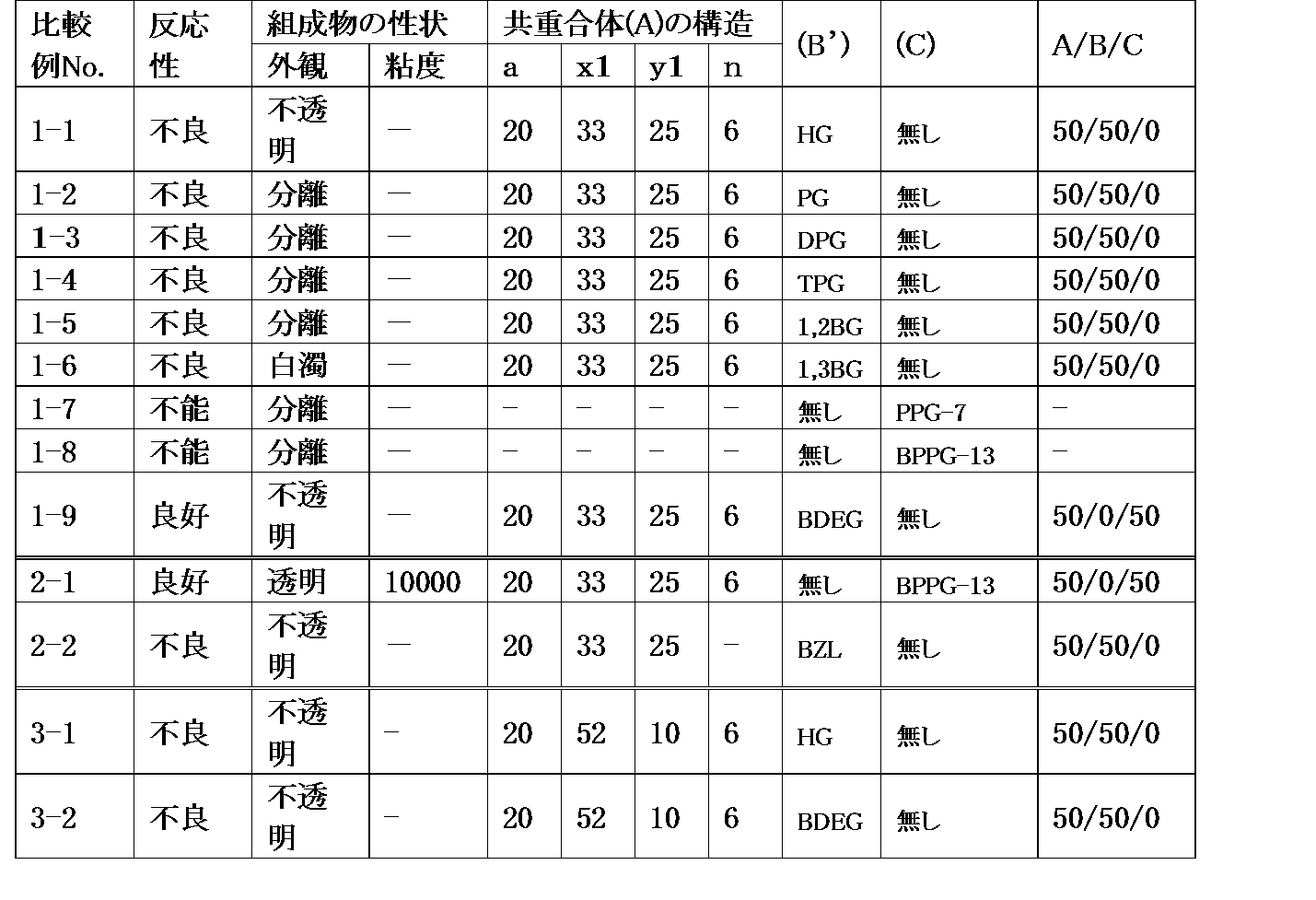

「GPC測定条件」
溶離液: クロロホルム(試薬特級)
測定温度: 40℃
検出器: 屈折率計(プラス側にピーク検出)
流速: 1.0mL/min
校正: 標準ポリスチレンにより実施
サンプル溶液の注入量: 100μL (試料濃度1重量%)
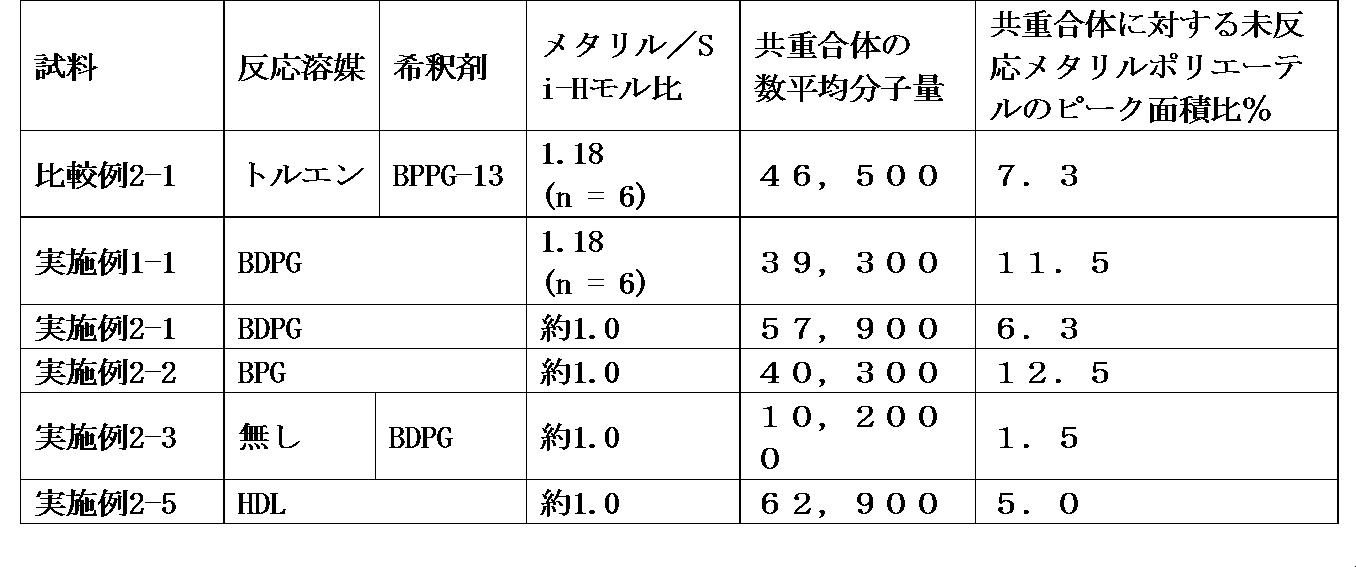


合計量が、表6の16.7%であるようなスケールで、本発明のポリウレタンフォーム形成組成物の調製およびポリウレタンフォーム発泡体の形成を行った。なお、作業はおよそ25℃の恒温室内で行ない、原料も全て恒温に達している状態から使用した。
その後、イソシアナートを前述の予め混合されたプレミックス液へと添加し、同じブレードを用いて7秒間、3500rpmで混合した。
均一に混合されたウレタンフォーム形成組成物を、8秒間かけて1Lペーパーカップへと注ぎ、フリー発泡させた。
そのまま、恒温室内で40~60分間静置した。
2時間後、それぞれの発泡体を上部より半分に切断し、フォーム高さ及び切断面のセル構造を観察し、記録した。

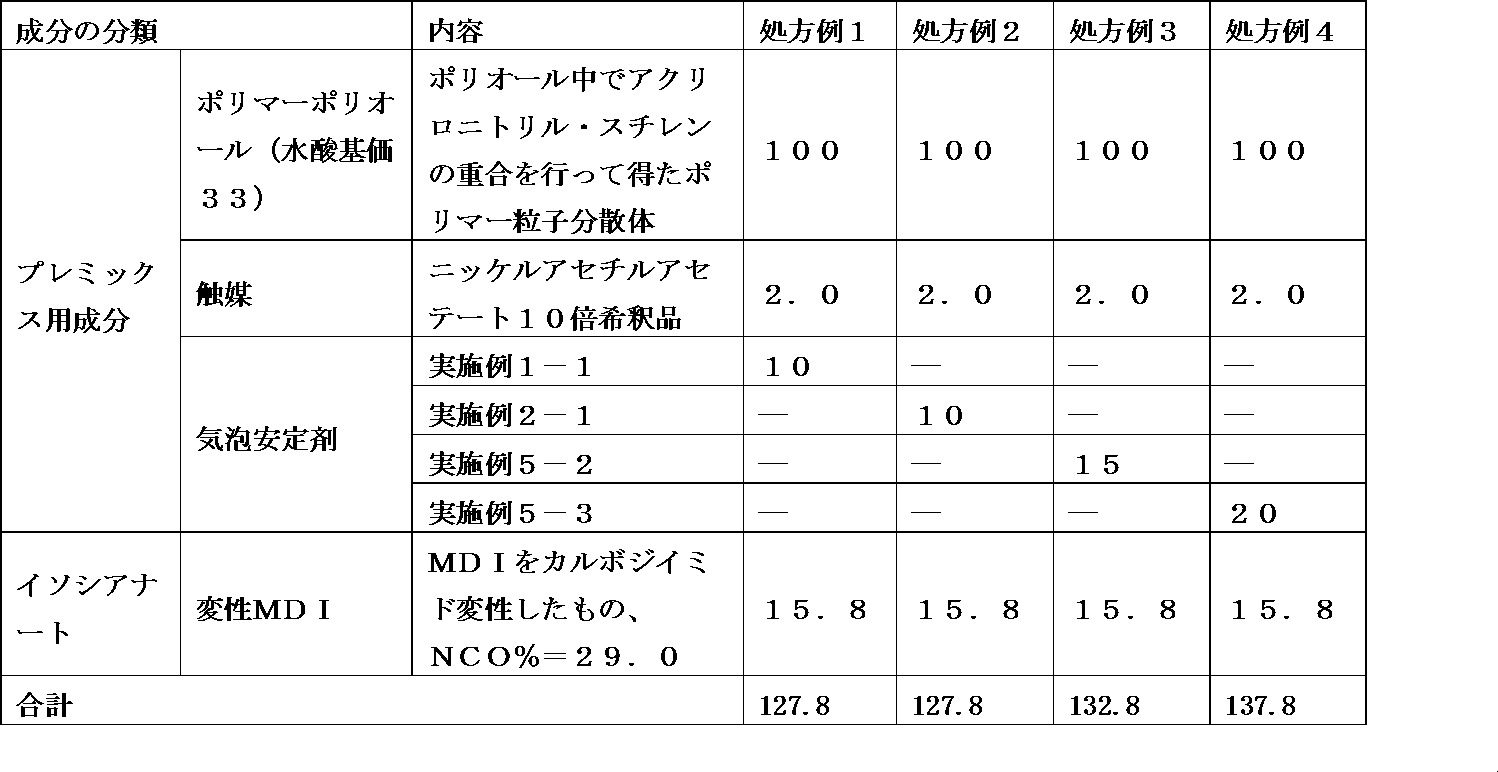
1)プレミックス液と、イソシアナート(イソシアネートインデックスが107となる量)を、窒素ガスを送りながらダイナミックミキサーによって1分間攪拌混合し、そのまま型に注入する。
2)160℃で30分間一次硬化させた後、110℃で4時間二次硬化させる。
3)その後、このものに金属製のシャフトを圧入接着し、端部のカット、表面の研磨等を行ってマイクロセルラーポリウレタン発泡体を得る。
本発明に係るポリウレタンフォームは、整泡剤(気泡安定剤)中に、非反応性のドデシルベンゼンのような残留性物質を含まないため、得られたマイクロセルラーフォームはマイグレーション(滲み出し)の問題を起こし難い。本発明の気泡安定剤中に含まれる希釈剤:(B)成分は、ウレタンフォーム処方において適度な揮発性と反応性を有するため、例えば処方例1,2では揮発効果に伴うセルオープニング作用の増大(高通気性で柔軟な発泡体の形成)が期待される。また、(B)成分の使用量を減らして不揮発性のPPG-7を配合した気泡安定剤を用いた処方例4では、フォームの架橋密度アップに貢献するため低通気性で強度に優れた発泡体の形成が期待される。処方例3では、先の2つの中間的なバランスの取れた物性の発泡体の形成が期待される。
Claims (20)
- 下記成分(A)および成分(B)を(A)/(B)=10/90~90/10の質量比で含有し、かつ、ジメチルポリシロキサンを成分(A)の質量以上含有しない、ポリエーテル-ポリシロキサンブロック共重合体組成物:
(A) 下記一般式(1):

で表される構成単位を分子内に有し、その末端基(-Z)が、
Z1:ポリエーテル部分に結合したアルケニル基、水酸基、アルコキシ基またはアセトキシ基;および
Z2:ケイ素原子に結合し、ヘテロ原子を有しない一価の炭化水素基、水酸基またはアルコキシ基
から選ばれる1種類以上の官能基である、ポリエーテル-ポリシロキサンブロック共重合体、
(B) 以下の(B1)または(B2)から選ばれる、5℃で液状であり、分子内に1のアルコール性水酸基を有し、酸素以外のヘテロ原子を含有しないことを特徴とする、1種または2種類以上のモノオール有機化合物:
(B1)末端水素が炭素数1~8の炭化水素基により置換され、かつ、他の末端に、2級のアルコール性水酸基を有する、炭素数2~4のオキシアルキレン単位の繰り返し数が1~3の範囲の数であるグリコールエーテル化合物、
(B2)炭素数12以上の分岐アルキル基を有する高級アルコール化合物。 - 成分(A)が、前記の一般式(1)において、aが10~45の範囲の数であり、y は(CxH2xO)yで示されるポリエーテル部分の分子量が2000~5000の範囲となる数であり、当該ポリエーテル部分全体を構成するオキシエチレン(C2H4O)単位の質量比が、平均して35~90%の範囲内にある、請求項1のポリエーテル-ポリシロキサンブロック共重合体組成物。
- 成分(A)が、一般式(2)で表される両末端SiH基含有オルガノポリシロキサン
一般式(2):
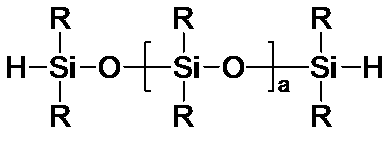
、および
下記一般式(3):
(式中、x、yは前記同様の数)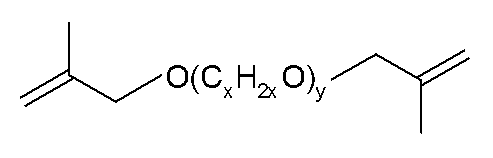
に示す両末端メタリル基含有ポリエーテルとのヒドロシリル化反応により得られ、
一般式(1):
(式中、Rは前記同様の基、x、a、y、nは前記同様の数)
で表される構成単位を分子内に有するポリエーテル-ポリシロキサンブロック共重合体である、請求項1または請求項2のポリエーテル-ポリシロキサンブロック共重合体組成物。 - 成分(B)が、蒸留または蒸留による精製が可能な沸点を有するモノオール有機化合物である、請求項1~3のいずれかのポリエーテル-ポリシロキサンブロック共重合体組成物。
- 成分(B)が、プロピレングリコールモノブチルエーテル、ジプロピレングリコールモノブチルエーテル、トリプロピレングリコールモノブチルエーテル、プロピレングリコールモノメチルエーテル、ジプロピレングリコールモノメチルエーテル、トリプロピレングリコールモノメチルエーテル、プロピレングリコールモノ(イソ)プロピルエーテル、ジプロピレングリコールモノ(イソ)プロピルエーテル、トリプロピレングリコールモノ(イソ)プロピルエーテル、プロピレングリコールモノエチルエーテル、ジプロピレングリコールモノエチルエーテル、トリプロピレングリコールモノエチルエーテル、2-ブチル-1-オクタノール、2-ヘキシル-1-デカノール、2-オクチル-1-ドデカノール、イソステアリルアルコール、および2-デシル-1-テトラデカノールから選ばれる1種または2種類以上のモノオール有機化合物である、請求項1~4のいずれかのポリエーテル-ポリシロキサンブロック共重合体組成物。
- 前記の成分(A)および成分(B)の質量比が20/80~70/30の範囲内である、請求項1~5のいずれかのポリエーテル-ポリシロキサンブロック共重合体組成物。
- さらに、(C)25℃で液状であり、末端水酸基の一方がアルキル、アラルキル、アリール基から選択される炭素数1~8の炭化水素基により置換されていてもよい、炭素数2~4のオキシアルキレン単位の繰り返し数が4~50の範囲であるポリアルキレングリコールまたはその誘導体から選ばれる1種類以上を、
成分(A)および成分(B)の和100質量部に対し、10~300質量部の範囲で含有し、組成物全体の25℃における粘度が100~35,000mm2/s の範囲にある、請求項1~6のいずれかのポリエーテル-ポリシロキサンブロック共重合体組成物。 - 請求項1~7のいずれかのポリエーテル-ポリシロキサンブロック共重合体組成物を含有する、界面活性剤。
- 請求項1~7のいずれかのポリエーテル-ポリシロキサンブロック共重合体組成物を含有する、整泡剤。
- 請求項1~7のいずれかのポリエーテル-ポリシロキサンブロック共重合体組成物を含有する、ポリウレタン発泡体形成組成物。
- (a)ポリオール、
(b)ポリイソシアナート、
(c)触媒、
(d)請求項1~7のいずれかのポリエーテル-ポリシロキサンブロック共重合体組成物を含有する整泡剤、および
(e)任意選択で、(d)成分以外の整泡剤、発泡剤、希釈剤、鎖伸長剤、架橋剤、水、非水性発泡剤、充填剤、強化剤、顔料、染料、着色剤、難燃剤、抗酸化剤、抗オゾン剤、紫外線安定化剤、静電気防止剤、殺菌剤および抗菌剤からなる群より選択される、少なくとも一つの添加成分
を含有する、ポリウレタン発泡体形成組成物。 - (a)ポリオール 100質量部に対して、請求項1~7のいずれかのポリエーテル-ポリシロキサンブロック共重合体組成物中の(A)ポリエーテル-ポリシロキサンブロック共重合体を0.5~8.0質量部となる範囲で含有する、請求項10または請求項11に記載のポリウレタン発泡体形成組成物。
- 請求項10~12のいずれかのポリウレタン発泡体形成組成物により得られるポリウレタン発泡体。
- 硬質フォーム、半硬質フォーム、軟質フォーム、又はマイクロセルラーフォームである、請求項13に記載のポリウレタン発泡体。
- 請求項1~7のいずれかのポリエーテル-ポリシロキサンブロック共重合体組成物を含有する、化粧料原料。
- 請求項1~7のいずれかのポリエーテル-ポリシロキサンブロック共重合体組成物を含有する、化粧料。
- 前記一般式(2)で表される両末端SiH基含有オルガノポリシロキサンと前記一般式(3)で表される両末端メタリル基含有ポリエーテルとのヒドロシリル化反応を実質的に無溶媒下で開始する工程;および
前記成分(B)であるモノオール有機化合物を加えて希釈ないし反応促進させる工程を少なくとも含む、
請求項1~7のいずれかのポリエーテル-ポリシロキサンブロック共重合体組成物の製造方法。 - 前記一般式(2)で表される両末端SiH基含有オルガノポリシロキサンと前記一般式(3)で表される両末端にメタリル基を有するポリエーテルとのヒドロシリル化反応を、前記(B)成分であるモノオール有機化合物の存在下で開始ないし進行させる工程を少なくとも含む、
請求項1~7のいずれかのポリエーテル-ポリシロキサンブロック共重合体組成物の製造方法。 - 前記一般式(2)で表される両末端SiH基含有オルガノポリシロキサンと前記一般式(3)で表される両末端メタリル基含有ポリエーテルとのヒドロシリル化反応を前記成分(B)と異なる揮発性有機溶媒(B´)の存在下において開始ないし進行させる工程;および
当該成分(B)と異なる揮発性有機溶媒(B´)を、前記成分(B)であるモノオール有機化合物と溶媒交換を行う工程を少なくとも含む、
請求項1~7のいずれかのポリエーテル-ポリシロキサンブロック共重合体組成物の製造方法。 - ストリピング工程を実質的に有しない、請求項17または請求項18に記載のポリエーテル-ポリシロキサンブロック共重合体組成物の製造方法。
Priority Applications (4)
| Application Number | Priority Date | Filing Date | Title |
|---|---|---|---|
| JP2017512201A JP6655066B2 (ja) | 2015-04-14 | 2016-04-13 | ポリエーテル−ポリシロキサンブロック共重合体組成物、それを含む界面活性剤、整泡剤、ポリウレタン発泡体形成組成物、化粧料およびその製造方法 |
| US15/566,112 US10717872B2 (en) | 2015-04-14 | 2016-04-13 | Polyether-polysiloxane block copolymer composition, surfactant and foam stabilizer including same, polyurethane foam-forming composition, cosmetic, and preparation method thereof |
| KR1020177031576A KR102518024B1 (ko) | 2015-04-14 | 2016-04-13 | 폴리에테르-폴리실록산 블록 공중합체 조성물, 이를 포함하는 계면활성제, 정포제, 폴리우레탄 발포체 형성 조성물, 화장료 및 이의 제조 방법 |
| CN201680021990.4A CN107922740B (zh) | 2015-04-14 | 2016-04-13 | 聚醚-聚硅氧烷嵌段共聚物组合物、含有其的表面活性剂、稳泡剂、形成聚氨酯泡沫的组合物、化妆品及其制造方法 |
Applications Claiming Priority (2)
| Application Number | Priority Date | Filing Date | Title |
|---|---|---|---|
| JP2015-082742 | 2015-04-14 | ||
| JP2015082742 | 2015-04-14 |
Publications (1)
| Publication Number | Publication Date |
|---|---|
| WO2016166979A1 true WO2016166979A1 (ja) | 2016-10-20 |
Family
ID=57126439
Family Applications (1)
| Application Number | Title | Priority Date | Filing Date |
|---|---|---|---|
| PCT/JP2016/002004 Ceased WO2016166979A1 (ja) | 2015-04-14 | 2016-04-13 | ポリエーテル-ポリシロキサンブロック共重合体組成物、それを含む界面活性剤、整泡剤、ポリウレタン発泡体形成組成物、化粧料およびその製造方法 |
Country Status (6)
| Country | Link |
|---|---|
| US (1) | US10717872B2 (ja) |
| JP (1) | JP6655066B2 (ja) |
| KR (1) | KR102518024B1 (ja) |
| CN (1) | CN107922740B (ja) |
| TW (1) | TWI680158B (ja) |
| WO (1) | WO2016166979A1 (ja) |
Cited By (16)
| Publication number | Priority date | Publication date | Assignee | Title |
|---|---|---|---|---|
| WO2018074257A1 (ja) * | 2016-10-18 | 2018-04-26 | 東レ・ダウコーニング株式会社 | ポリエーテル変性シリコーン組成物、それを含む界面活性剤、整泡剤、ポリウレタン発泡体形成組成物、化粧料およびその製造方法 |
| WO2018097141A1 (ja) | 2016-11-28 | 2018-05-31 | 旭硝子株式会社 | ポリテトラフルオロエチレン水性分散液 |
| JPWO2018221373A1 (ja) * | 2017-05-31 | 2019-06-27 | 東レ株式会社 | ブロック共重合体とその製造方法、エポキシ樹脂組成物、およびその硬化物ならびに半導体封止材 |
| WO2020003971A1 (ja) * | 2018-06-28 | 2020-01-02 | 信越化学工業株式会社 | シリコーン組成物及びそれを用いた繊維処理剤 |
| WO2020067139A1 (ja) * | 2018-09-25 | 2020-04-02 | 積水化学工業株式会社 | 混合液剤、ポリウレタン組成物、ポリウレタンフォーム、スプレー缶、及び混合システム |
| WO2020263379A1 (en) * | 2019-06-24 | 2020-12-30 | Dow Silicones Corporation | Silicone polyether foam control agent |
| WO2021131378A1 (ja) * | 2019-12-25 | 2021-07-01 | ダウ・東レ株式会社 | ポリエーテル-ポリシロキサンブロック共重合体組成物、整泡剤およびポリウレタン発泡体の製造方法 |
| JP2021517179A (ja) * | 2018-03-05 | 2021-07-15 | エボニック オペレーションズ ゲーエムベーハー | 架橋ポリエーテルシロキサンブロックコポリマー及びポリウレタンフォームを作製するためのその使用 |
| CN113265035A (zh) * | 2020-02-14 | 2021-08-17 | 赢创运营有限公司 | Pu泡沫的制备 |
| JP2022092612A (ja) * | 2020-12-10 | 2022-06-22 | エボニック オペレーションズ ゲーエムベーハー | ポリウレタンフォームを製造するためのポリエーテル-シロキサンブロックコポリマー |
| WO2022255356A1 (ja) | 2021-06-04 | 2022-12-08 | ダウ・東レ株式会社 | ポリエーテル-ポリシロキサンブロック共重合体組成物の製造方法、ポリエーテル-ポリシロキサンブロック共重合体組成物およびその用途 |
| WO2022255357A1 (ja) * | 2021-06-04 | 2022-12-08 | ダウ・東レ株式会社 | 泡増強性が改善されたポリエーテル-ポリシロキサンブロック共重合体含有組成物、その使用および製造方法 |
| JP2022186644A (ja) * | 2021-06-04 | 2022-12-15 | ダウ・東レ株式会社 | ポリエーテル-ポリシロキサンブロック共重合体組成物の製造方法 |
| JP2022186643A (ja) * | 2021-06-04 | 2022-12-15 | ダウ・東レ株式会社 | ポリエーテル-ポリシロキサンブロック共重合体組成物の製造方法 |
| CN115873580A (zh) * | 2021-09-29 | 2023-03-31 | 中国石油化工股份有限公司 | 一种耐高温缓释泡排剂及其制备方法与应用 |
| WO2023120361A1 (ja) * | 2021-12-21 | 2023-06-29 | ダウ・東レ株式会社 | アリル基含有不純物の含有量が低減されたオキシプロピレン基含有グリコールエーテル類の製造方法 |
Families Citing this family (21)
| Publication number | Priority date | Publication date | Assignee | Title |
|---|---|---|---|---|
| CN108707233B (zh) * | 2018-04-27 | 2021-06-15 | 建德市聚合新材料有限公司 | 一种有机硅改性聚醚的制备方法 |
| EP3794060A1 (de) * | 2018-05-17 | 2021-03-24 | Evonik Operations GmbH | Lineare polydimethylsiloxan-polyoxyalkylen-blockcopolymere des strukturtyps aba |
| US11952491B2 (en) * | 2018-10-09 | 2024-04-09 | Dow Global Technologies Llc | Rigid polyurethane foam formulation and foam made therefrom |
| WO2020144003A1 (de) * | 2019-01-07 | 2020-07-16 | Evonik Operations Gmbh | Herstellung von polyurethanhartschaum |
| EP3744745A1 (de) * | 2019-05-28 | 2020-12-02 | Evonik Operations GmbH | Herstellung von pu-schaumstoffen |
| JP7222875B2 (ja) * | 2019-11-15 | 2023-02-15 | 信越化学工業株式会社 | 水系塗料添加剤、水系塗料組成物およびコーティング剤 |
| CA3159433A1 (en) | 2019-11-27 | 2021-06-03 | Brett Tyler SHERREN | Foamed polyurethane compositions |
| CN111019140B (zh) * | 2019-12-30 | 2022-05-27 | 江苏美思德化学股份有限公司 | 超支化有机硅匀泡剂及其制备方法与应用 |
| JP7426283B2 (ja) * | 2020-04-28 | 2024-02-01 | 信越化学工業株式会社 | ポリエーテル/ポリシロキサン架橋ゴム球状粒子及びこれを製造する方法、並びにポリエーテル/ポリシロキサン架橋複合粒子及びこれを製造する方法 |
| CN112375603B (zh) * | 2020-11-02 | 2022-07-22 | 罗必润油品(上海)有限公司 | 一种高闪点压缩机润滑油泡沫抑制剂及其制备方法 |
| KR102577410B1 (ko) | 2021-02-03 | 2023-09-13 | 주식회사 풍산 | 겔화반응 시간 조절을 통한 상온에서의 폴리우레탄 폼 합성방법 |
| CN113234227A (zh) * | 2021-05-06 | 2021-08-10 | 上海麦豪新材料科技有限公司 | 一种聚醚改性有机硅表面活性剂的制备方法 |
| CN114106336A (zh) * | 2021-11-24 | 2022-03-01 | 南京美思德新材料有限公司 | 一种有机硅聚醚共聚物及其制备方法与应用 |
| CN119343389A (zh) | 2022-06-08 | 2025-01-21 | 赢创运营有限公司 | 用于生产聚氨酯泡沫的聚醚-硅氧烷嵌段共聚物 |
| CN115181275B (zh) * | 2022-07-04 | 2024-02-13 | 山东共聚有机硅技术研究院有限公司 | 发泡聚醚硅油及其制备方法和含该发泡聚醚硅油和玻尿酸的免洗酒精洗手液及其制备方法 |
| CN120584146A (zh) * | 2023-02-07 | 2025-09-02 | 美国陶氏有机硅公司 | 线性硅酮-聚醚共聚物以及共聚物的制备方法和用途 |
| CN117819873B (zh) * | 2024-03-01 | 2024-05-07 | 上海海砌建材有限公司 | 一种稳泡剂、制备方法以及含有其的加气混凝土 |
| CN119019696B (zh) * | 2024-08-14 | 2025-01-28 | 广东君禾科技有限公司 | 一种低泡表面活性剂的制备方法及清洗剂 |
| CN120059197A (zh) * | 2025-02-28 | 2025-05-30 | 扬州晨化新材料股份有限公司 | 一种硅烷封端聚醚及其制备方法 |
| CN120005562A (zh) * | 2025-04-18 | 2025-05-16 | 苏州添易朗科技有限公司 | 一种高粘结强度的有机硅导热胶黏剂及其制备方法 |
| CN121172135B (zh) * | 2025-09-05 | 2026-03-17 | 湖南聚锂新能源科技有限公司 | 一种低反弹膨胀材料及其制备方法和应用 |
Citations (5)
| Publication number | Priority date | Publication date | Assignee | Title |
|---|---|---|---|---|
| JPH0790102A (ja) * | 1993-09-22 | 1995-04-04 | Nippon Unicar Co Ltd | ウレタンフォームの製造方法 |
| JPH07316010A (ja) * | 1994-05-26 | 1995-12-05 | L'oreal Sa | ポリシロキサン−ポリオキシアルキレン直鎖型ブロック共重合体と不揮発性の不溶性コンディショニング剤と水溶性アルコールとを含有する化粧品組成物およびその使用方法 |
| JPH11116670A (ja) * | 1997-08-08 | 1999-04-27 | Osi Specialties Inc | シロキサン−ポリオキシアルキレンコポリマーの製造法 |
| JP2012153802A (ja) * | 2011-01-26 | 2012-08-16 | Fujifilm Corp | シリコーン分散物及びその製造方法 |
| JP2013194218A (ja) * | 2012-03-22 | 2013-09-30 | Shin-Etsu Chemical Co Ltd | 新規オルガノポリシロキサン、これを含む化粧料及びオルガノポリシロキサンの製造方法 |
Family Cites Families (32)
| Publication number | Priority date | Publication date | Assignee | Title |
|---|---|---|---|---|
| US4150048A (en) * | 1978-03-28 | 1979-04-17 | Union Carbide Corporation | Nonhydrolyzable siloxane block copolymers of organosiloxanes and organic ethers |
| US4242466A (en) | 1979-01-16 | 1980-12-30 | Union Carbide Corporation | Polyurethanes and their preparation |
| US4520160A (en) * | 1983-12-27 | 1985-05-28 | Dow Corning Corporation | Organopolysiloxane emulsifier compositions and method therefor |
| US4847398A (en) | 1987-09-09 | 1989-07-11 | Union Carbide Corporation | Process for the preparation of siloxane-oxyalkylene copolymers |
| US5472686A (en) | 1990-12-28 | 1995-12-05 | Nippon Unicar Company Limited | Cosmetic formulations |
| JP3061434B2 (ja) | 1990-05-07 | 2000-07-10 | 日本ユニカー株式会社 | 毛髪化粧料 |
| JP3071222B2 (ja) | 1990-12-28 | 2000-07-31 | 日本ユニカー株式会社 | 皮膚化粧料 |
| US5430097A (en) * | 1993-12-23 | 1995-07-04 | Dow Corning Corporation | Production of organopolysiloxane copolymers with a phenyl ether solvent |
| JPH08156143A (ja) | 1994-11-30 | 1996-06-18 | Rojiyaasu Inoatsuku:Kk | 電子写真装置用転写ローラ |
| US5648444A (en) * | 1995-11-15 | 1997-07-15 | Witco Corporation | Hydrosilation in esters without hydroxyl moieties |
| FR2755998B1 (fr) | 1996-11-21 | 1999-01-22 | Somfy | Dispositif d'arret automatique d'un moteur entrainant un tube d'enroulement d'un volet roulant |
| JP2000313730A (ja) | 1999-04-30 | 2000-11-14 | Dow Corning Toray Silicone Co Ltd | ポリウレタンフォーム用シリコーン系整泡剤 |
| US6162888A (en) | 1999-05-17 | 2000-12-19 | Dow Corning Corporation | Method of making silicone polyether copolymers having reduced odor |
| JP4621947B2 (ja) | 2000-11-06 | 2011-02-02 | 株式会社イノアックコーポレーション | 発泡体及び発泡体層を有する成形品の製造方法並びに製造装置 |
| US6818675B2 (en) | 2002-08-06 | 2004-11-16 | General Electric Company | Process for preparing polyurethane foam |
| US8114391B2 (en) | 2002-12-26 | 2012-02-14 | Dow Corning Toray Company, Ltd. | Hair care composition |
| JP2005060876A (ja) | 2003-08-11 | 2005-03-10 | Nippon Unicar Co Ltd | 繊維糸状物処理用のストレート油剤 |
| WO2005103118A1 (en) * | 2004-04-20 | 2005-11-03 | Dow Corning Corporation | Aqueous dispersions of silicone polyether block copolymers |
| JP4875314B2 (ja) | 2005-03-31 | 2012-02-15 | 東レ・ダウコーニング株式会社 | 有機変性シリコーンの製造方法 |
| US20080226708A1 (en) * | 2005-11-01 | 2008-09-18 | Shaow Burn Lin | Silicone Vesicles Containing Actives |
| JP2007186557A (ja) | 2006-01-12 | 2007-07-26 | Shin Etsu Chem Co Ltd | ポリウレタンフォーム用整泡剤及びポリウレタンフォームの製造方法 |
| JP4150048B2 (ja) | 2006-07-07 | 2008-09-17 | 恭子 横▲濱▼ | ドアストッパ |
| PL2183301T3 (pl) | 2007-08-10 | 2016-03-31 | Momentive Performance Mat Inc | Silikonowe surfaktanty kopolimerowe do zastosowania w piankach poliuretanowych |
| US8436064B2 (en) | 2007-09-11 | 2013-05-07 | Momentive Performance Materials Inc. | Open-cell polyurethane foam and process for its manufacture |
| JP5308704B2 (ja) | 2008-04-25 | 2013-10-09 | 株式会社イノアックコーポレーション | トナーシール部材 |
| JP2010144157A (ja) * | 2008-12-22 | 2010-07-01 | Dow Corning Toray Co Ltd | 乳化物、その製造方法および該乳化物からなる化粧料原料 |
| JP5408772B2 (ja) | 2009-02-23 | 2014-02-05 | 株式会社イノアックコーポレーション | インソール |
| JP5479174B2 (ja) | 2009-03-24 | 2014-04-23 | 株式会社イノアックコーポレーション | ポリウレタンフォーム積層体及びその製造方法並びにガスケット |
| US8784787B2 (en) | 2009-10-23 | 2014-07-22 | Dow Corning Toray Co., Ltd. | Co-modified organopolysiloxane |
| JP5491152B2 (ja) | 2009-12-04 | 2014-05-14 | 東レ・ダウコーニング株式会社 | 無臭化したポリオキシアルキレン変性ポリシロキサン組成物の製造方法、それを含有してなる化粧料原料および化粧料 |
| JP5555121B2 (ja) | 2010-10-08 | 2014-07-23 | 株式会社イノアックコーポレーション | 難燃性ポリウレタン発泡体、及びその製造方法 |
| JP5660975B2 (ja) | 2011-05-27 | 2015-01-28 | 株式会社イノアックコーポレーション | シール材およびその製造方法 |
-
2016
- 2016-04-13 KR KR1020177031576A patent/KR102518024B1/ko active Active
- 2016-04-13 CN CN201680021990.4A patent/CN107922740B/zh active Active
- 2016-04-13 JP JP2017512201A patent/JP6655066B2/ja active Active
- 2016-04-13 US US15/566,112 patent/US10717872B2/en active Active
- 2016-04-13 WO PCT/JP2016/002004 patent/WO2016166979A1/ja not_active Ceased
- 2016-04-14 TW TW105111703A patent/TWI680158B/zh not_active IP Right Cessation
Patent Citations (5)
| Publication number | Priority date | Publication date | Assignee | Title |
|---|---|---|---|---|
| JPH0790102A (ja) * | 1993-09-22 | 1995-04-04 | Nippon Unicar Co Ltd | ウレタンフォームの製造方法 |
| JPH07316010A (ja) * | 1994-05-26 | 1995-12-05 | L'oreal Sa | ポリシロキサン−ポリオキシアルキレン直鎖型ブロック共重合体と不揮発性の不溶性コンディショニング剤と水溶性アルコールとを含有する化粧品組成物およびその使用方法 |
| JPH11116670A (ja) * | 1997-08-08 | 1999-04-27 | Osi Specialties Inc | シロキサン−ポリオキシアルキレンコポリマーの製造法 |
| JP2012153802A (ja) * | 2011-01-26 | 2012-08-16 | Fujifilm Corp | シリコーン分散物及びその製造方法 |
| JP2013194218A (ja) * | 2012-03-22 | 2013-09-30 | Shin-Etsu Chemical Co Ltd | 新規オルガノポリシロキサン、これを含む化粧料及びオルガノポリシロキサンの製造方法 |
Cited By (25)
| Publication number | Priority date | Publication date | Assignee | Title |
|---|---|---|---|---|
| WO2018074257A1 (ja) * | 2016-10-18 | 2018-04-26 | 東レ・ダウコーニング株式会社 | ポリエーテル変性シリコーン組成物、それを含む界面活性剤、整泡剤、ポリウレタン発泡体形成組成物、化粧料およびその製造方法 |
| US11066534B2 (en) | 2016-10-18 | 2021-07-20 | Dow Toray Co., Ltd. | Polyether-modified silicone composition, surfactant, foam stabilizer, polyurethane foam forming composition, and cosmetic preparation including said composition, and method for producing said composition |
| WO2018097141A1 (ja) | 2016-11-28 | 2018-05-31 | 旭硝子株式会社 | ポリテトラフルオロエチレン水性分散液 |
| JPWO2018221373A1 (ja) * | 2017-05-31 | 2019-06-27 | 東レ株式会社 | ブロック共重合体とその製造方法、エポキシ樹脂組成物、およびその硬化物ならびに半導体封止材 |
| JP2019210486A (ja) * | 2017-05-31 | 2019-12-12 | 東レ株式会社 | ブロック共重合体とその製造方法、エポキシ樹脂組成物、およびその硬化物ならびに半導体封止材 |
| CN110637047A (zh) * | 2017-05-31 | 2019-12-31 | 东丽株式会社 | 嵌段共聚物及其制造方法、环氧树脂组合物及其固化物及半导体密封材料 |
| JP2021517179A (ja) * | 2018-03-05 | 2021-07-15 | エボニック オペレーションズ ゲーエムベーハー | 架橋ポリエーテルシロキサンブロックコポリマー及びポリウレタンフォームを作製するためのその使用 |
| WO2020003971A1 (ja) * | 2018-06-28 | 2020-01-02 | 信越化学工業株式会社 | シリコーン組成物及びそれを用いた繊維処理剤 |
| JPWO2020067139A1 (ja) * | 2018-09-25 | 2021-08-30 | 積水化学工業株式会社 | 混合液剤、ポリウレタン組成物、ポリウレタンフォーム、スプレー缶、及び混合システム |
| JP7339888B2 (ja) | 2018-09-25 | 2023-09-06 | 積水化学工業株式会社 | 混合液剤、ポリウレタン組成物、ポリウレタンフォーム、スプレー缶、及び混合システム |
| WO2020067139A1 (ja) * | 2018-09-25 | 2020-04-02 | 積水化学工業株式会社 | 混合液剤、ポリウレタン組成物、ポリウレタンフォーム、スプレー缶、及び混合システム |
| WO2020263379A1 (en) * | 2019-06-24 | 2020-12-30 | Dow Silicones Corporation | Silicone polyether foam control agent |
| US11383182B2 (en) | 2019-06-24 | 2022-07-12 | Dow Silicones Corporation | Linear silicone polyether foam control agent |
| WO2021131378A1 (ja) * | 2019-12-25 | 2021-07-01 | ダウ・東レ株式会社 | ポリエーテル-ポリシロキサンブロック共重合体組成物、整泡剤およびポリウレタン発泡体の製造方法 |
| US12371537B2 (en) | 2019-12-25 | 2025-07-29 | Dow Toray Co., Ltd. | Polyether-polysiloxane block copolymer composition, foam stabilizer and method for producing polyurethane foam |
| CN113265035A (zh) * | 2020-02-14 | 2021-08-17 | 赢创运营有限公司 | Pu泡沫的制备 |
| JP2022092612A (ja) * | 2020-12-10 | 2022-06-22 | エボニック オペレーションズ ゲーエムベーハー | ポリウレタンフォームを製造するためのポリエーテル-シロキサンブロックコポリマー |
| JP2022186644A (ja) * | 2021-06-04 | 2022-12-15 | ダウ・東レ株式会社 | ポリエーテル-ポリシロキサンブロック共重合体組成物の製造方法 |
| JP2022186643A (ja) * | 2021-06-04 | 2022-12-15 | ダウ・東レ株式会社 | ポリエーテル-ポリシロキサンブロック共重合体組成物の製造方法 |
| WO2022255357A1 (ja) * | 2021-06-04 | 2022-12-08 | ダウ・東レ株式会社 | 泡増強性が改善されたポリエーテル-ポリシロキサンブロック共重合体含有組成物、その使用および製造方法 |
| KR20240016412A (ko) | 2021-06-04 | 2024-02-06 | 다우 도레이 캄파니 리미티드 | 폴리에테르-폴리실록산 블록 공중합체 조성물의 제조방법, 폴리에테르-폴리실록산 블록 공중합체 조성물 및 그의 용도 |
| KR20240028338A (ko) | 2021-06-04 | 2024-03-05 | 다우 도레이 캄파니 리미티드 | 향상된 발포 특성을 갖는 폴리에테르-폴리실록산 블록 공중합체 함유 조성물, 이의 용도 및 이의 제조 방법 |
| WO2022255356A1 (ja) | 2021-06-04 | 2022-12-08 | ダウ・東レ株式会社 | ポリエーテル-ポリシロキサンブロック共重合体組成物の製造方法、ポリエーテル-ポリシロキサンブロック共重合体組成物およびその用途 |
| CN115873580A (zh) * | 2021-09-29 | 2023-03-31 | 中国石油化工股份有限公司 | 一种耐高温缓释泡排剂及其制备方法与应用 |
| WO2023120361A1 (ja) * | 2021-12-21 | 2023-06-29 | ダウ・東レ株式会社 | アリル基含有不純物の含有量が低減されたオキシプロピレン基含有グリコールエーテル類の製造方法 |
Also Published As
| Publication number | Publication date |
|---|---|
| US10717872B2 (en) | 2020-07-21 |
| KR102518024B1 (ko) | 2023-04-06 |
| CN107922740A (zh) | 2018-04-17 |
| CN107922740B (zh) | 2021-01-12 |
| JPWO2016166979A1 (ja) | 2018-03-15 |
| US20190233646A1 (en) | 2019-08-01 |
| TW201704350A (zh) | 2017-02-01 |
| JP6655066B2 (ja) | 2020-02-26 |
| KR20170132306A (ko) | 2017-12-01 |
| TWI680158B (zh) | 2019-12-21 |
Similar Documents
| Publication | Publication Date | Title |
|---|---|---|
| JP6655066B2 (ja) | ポリエーテル−ポリシロキサンブロック共重合体組成物、それを含む界面活性剤、整泡剤、ポリウレタン発泡体形成組成物、化粧料およびその製造方法 | |
| US11066534B2 (en) | Polyether-modified silicone composition, surfactant, foam stabilizer, polyurethane foam forming composition, and cosmetic preparation including said composition, and method for producing said composition | |
| CN101508780B (zh) | 基于可再生原料制备的泡沫稳定剂用于制备聚氨酯泡沫的用途 | |
| TW426705B (en) | Hydrosilation in high boiling natural vegetable oils | |
| EP2178941B1 (en) | Polyurethane foam containing synergistic surfactant combinations and process for making same | |
| JP7575181B2 (ja) | ポリエーテル-ポリシロキサンブロック共重合体組成物、整泡剤およびポリウレタン発泡体の製造方法 | |
| US20110306694A1 (en) | Method of producing cold foams | |
| JP2020002382A (ja) | 整泡剤およびそれを含むポリウレタン発泡体形成組成物 | |
| CN103003334B (zh) | 具有通过烯丙基缩水甘油醚连接的侧链烷基的硅氧烷共聚物及其相关化合物,以及其作为稳定剂用于制备软质聚氨酯泡沫的应用 | |
| EP2261273A1 (de) | Zusammensetzungen enthaltend Polyether-Polysiloxan-Copolymere | |
| JP2002167418A (ja) | 軟質ポリウレタンフォームの製造における有機官能基変性ポリシロキサンと分枝状アルコールとの混合物の使用 | |
| CN101503571A (zh) | 硅氧烷组合物 | |
| WO2009023116A1 (en) | Silicone copolymer surfactants for use in polyurethane foams | |
| CA2011178A1 (en) | Reduction of firmness in flexible polyurethane foam by addition of monofunctional alcohols, polyesters and polyethers | |
| AU728709B2 (en) | Integral skin foams | |
| JP2008209736A (ja) | 電子複写機のクリーニングブレード用ポリウレタンエラストマー | |
| JP7497949B2 (ja) | 泡増強剤、これを含むプレミックス溶液、これらを含むポリウレタン発泡体形成用組成物、および疎水性が改善されたポリウレタン発泡体 |
Legal Events
| Date | Code | Title | Description |
|---|---|---|---|
| 121 | Ep: the epo has been informed by wipo that ep was designated in this application |
Ref document number: 16779773 Country of ref document: EP Kind code of ref document: A1 |
|
| ENP | Entry into the national phase |
Ref document number: 2017512201 Country of ref document: JP Kind code of ref document: A |
|
| NENP | Non-entry into the national phase |
Ref country code: DE |
|
| ENP | Entry into the national phase |
Ref document number: 20177031576 Country of ref document: KR Kind code of ref document: A |
|
| 122 | Ep: pct application non-entry in european phase |
Ref document number: 16779773 Country of ref document: EP Kind code of ref document: A1 |