WO2014155784A1 - フッ素含有電解液の処理方法 - Google Patents
フッ素含有電解液の処理方法 Download PDFInfo
- Publication number
- WO2014155784A1 WO2014155784A1 PCT/JP2013/076083 JP2013076083W WO2014155784A1 WO 2014155784 A1 WO2014155784 A1 WO 2014155784A1 JP 2013076083 W JP2013076083 W JP 2013076083W WO 2014155784 A1 WO2014155784 A1 WO 2014155784A1
- Authority
- WO
- WIPO (PCT)
- Prior art keywords
- fluorine
- electrolytic solution
- calcium
- gas
- organic solvent
- Prior art date
- Legal status (The legal status is an assumption and is not a legal conclusion. Google has not performed a legal analysis and makes no representation as to the accuracy of the status listed.)
- Ceased
Links
Images
Classifications
-
- H—ELECTRICITY
- H01—ELECTRIC ELEMENTS
- H01M—PROCESSES OR MEANS, e.g. BATTERIES, FOR THE DIRECT CONVERSION OF CHEMICAL ENERGY INTO ELECTRICAL ENERGY
- H01M10/00—Secondary cells; Manufacture thereof
- H01M10/54—Reclaiming serviceable parts of waste accumulators
-
- C—CHEMISTRY; METALLURGY
- C01—INORGANIC CHEMISTRY
- C01F—COMPOUNDS OF THE METALS BERYLLIUM, MAGNESIUM, ALUMINIUM, CALCIUM, STRONTIUM, BARIUM, RADIUM, THORIUM, OR OF THE RARE-EARTH METALS
- C01F11/00—Compounds of calcium, strontium, or barium
- C01F11/20—Halides
- C01F11/22—Fluorides
-
- C—CHEMISTRY; METALLURGY
- C10—PETROLEUM, GAS OR COKE INDUSTRIES; TECHNICAL GASES CONTAINING CARBON MONOXIDE; FUELS; LUBRICANTS; PEAT
- C10L—FUELS NOT OTHERWISE PROVIDED FOR; NATURAL GAS; SYNTHETIC NATURAL GAS OBTAINED BY PROCESSES NOT COVERED BY SUBCLASSES C10G OR C10K; LIQUIFIED PETROLEUM GAS; USE OF ADDITIVES TO FUELS OR FIRES; FIRE-LIGHTERS
- C10L1/00—Liquid carbonaceous fuels
- C10L1/02—Liquid carbonaceous fuels essentially based on components consisting of carbon, hydrogen, and oxygen only
-
- C—CHEMISTRY; METALLURGY
- C10—PETROLEUM, GAS OR COKE INDUSTRIES; TECHNICAL GASES CONTAINING CARBON MONOXIDE; FUELS; LUBRICANTS; PEAT
- C10L—FUELS NOT OTHERWISE PROVIDED FOR; NATURAL GAS; SYNTHETIC NATURAL GAS OBTAINED BY PROCESSES NOT COVERED BY SUBCLASSES C10G OR C10K; LIQUIFIED PETROLEUM GAS; USE OF ADDITIVES TO FUELS OR FIRES; FIRE-LIGHTERS
- C10L2290/00—Fuel preparation or upgrading, processes or apparatus therefore, comprising specific process steps or apparatus units
- C10L2290/06—Heat exchange, direct or indirect
-
- C—CHEMISTRY; METALLURGY
- C10—PETROLEUM, GAS OR COKE INDUSTRIES; TECHNICAL GASES CONTAINING CARBON MONOXIDE; FUELS; LUBRICANTS; PEAT
- C10L—FUELS NOT OTHERWISE PROVIDED FOR; NATURAL GAS; SYNTHETIC NATURAL GAS OBTAINED BY PROCESSES NOT COVERED BY SUBCLASSES C10G OR C10K; LIQUIFIED PETROLEUM GAS; USE OF ADDITIVES TO FUELS OR FIRES; FIRE-LIGHTERS
- C10L2290/00—Fuel preparation or upgrading, processes or apparatus therefore, comprising specific process steps or apparatus units
- C10L2290/54—Specific separation steps for separating fractions, components or impurities during preparation or upgrading of a fuel
-
- C—CHEMISTRY; METALLURGY
- C10—PETROLEUM, GAS OR COKE INDUSTRIES; TECHNICAL GASES CONTAINING CARBON MONOXIDE; FUELS; LUBRICANTS; PEAT
- C10L—FUELS NOT OTHERWISE PROVIDED FOR; NATURAL GAS; SYNTHETIC NATURAL GAS OBTAINED BY PROCESSES NOT COVERED BY SUBCLASSES C10G OR C10K; LIQUIFIED PETROLEUM GAS; USE OF ADDITIVES TO FUELS OR FIRES; FIRE-LIGHTERS
- C10L2290/00—Fuel preparation or upgrading, processes or apparatus therefore, comprising specific process steps or apparatus units
- C10L2290/54—Specific separation steps for separating fractions, components or impurities during preparation or upgrading of a fuel
- C10L2290/541—Absorption of impurities during preparation or upgrading of a fuel
-
- H—ELECTRICITY
- H01—ELECTRIC ELEMENTS
- H01M—PROCESSES OR MEANS, e.g. BATTERIES, FOR THE DIRECT CONVERSION OF CHEMICAL ENERGY INTO ELECTRICAL ENERGY
- H01M2300/00—Electrolytes
- H01M2300/0017—Non-aqueous electrolytes
- H01M2300/0025—Organic electrolyte
- H01M2300/0028—Organic electrolyte characterised by the solvent
- H01M2300/0034—Fluorinated solvents
-
- Y—GENERAL TAGGING OF NEW TECHNOLOGICAL DEVELOPMENTS; GENERAL TAGGING OF CROSS-SECTIONAL TECHNOLOGIES SPANNING OVER SEVERAL SECTIONS OF THE IPC; TECHNICAL SUBJECTS COVERED BY FORMER USPC CROSS-REFERENCE ART COLLECTIONS [XRACs] AND DIGESTS
- Y02—TECHNOLOGIES OR APPLICATIONS FOR MITIGATION OR ADAPTATION AGAINST CLIMATE CHANGE
- Y02W—CLIMATE CHANGE MITIGATION TECHNOLOGIES RELATED TO WASTEWATER TREATMENT OR WASTE MANAGEMENT
- Y02W30/00—Technologies for solid waste management
- Y02W30/50—Reuse, recycling or recovery technologies
- Y02W30/84—Recycling of batteries or fuel cells
Definitions
- the present invention relates to a safe treatment method for non-aqueous electrolytes used in lithium ion batteries and the like.
- This application claims priority based on Japanese Patent Application No. 2013-071367 filed in Japan on March 29, 2013, the contents of which are incorporated herein by reference.
- Electrolytic solutions used in lithium ion batteries and the like contain a fluorine compound (LiPF 6 , LiBF 4, etc.) serving as an electrolyte and a volatile organic solvent, and the organic solvents are mainly carbonates. It is a flammable substance. Moreover, when LiPF 6 reacts with water, it hydrolyzes to generate toxic hydrogen fluoride. For this reason, a safe processing method is required.
- a fluorine compound LiPF 6 , LiBF 4, etc.
- the following treatment methods are known as a treatment method for a lithium ion battery and its electrolytic solution.
- a processing method in which a lithium ion battery or the like is frozen below the melting point of the electrolytic solution, the battery is disassembled and crushed, the electrolytic solution is separated from the crushed material in an organic solvent, and the extracted electrolytic solution is distilled to separate it into an electrolyte and an organic solvent (For example, refer to Patent Document 1).
- a processing method of roasting a used lithium battery, crushing the roasted product, separating it into a magnetic material and a non-magnetic material, and recovering a large amount of useful metals such as aluminum and copper for example, see Patent Document 2.
- a treatment method in which a lithium battery is opened with ultra-high pressure water and an electrolytic solution is recovered using an organic solvent see, for example, Patent Document 3).
- the processing method for dismantling and crushing the lithium battery under refrigeration requires refrigeration equipment and is difficult to implement. Further, in the method of roasting a lithium battery, fluorine is treated as a combustion gas, so that it cannot be recovered as a highly pure fluorine component and cannot be reused. In the processing method of recovering the electrolytic solution using an organic solvent, the processing of the recovered electrolytic solution becomes a problem. As pointed out earlier, the electrolyte contains a flammable organic solvent, and the fluorine compound in the electrolyte reacts with water to generate toxic hydrogen fluoride. It is done.
- the present invention has solved the above problems in the conventional processing method, a method for safely processing the electrolyte containing volatile fluorine compound (LiPF 6 or the like) and an organic solvent.
- This invention provides the processing method of the fluorine-containing electrolyte solution which consists of the following structures.
- a method for treating an electrolytic solution containing a volatile fluorine compound and an organic solvent, wherein the electrolytic solution is heated under reduced pressure to vaporize a volatile component, and a fluorine component contained in the vaporized gas A fluorine fixing step of reacting calcium with calcium fluoride to fix it as calcium fluoride, and an organic solvent component recovery step of recovering the organic solvent component contained in the vaporized gas.
- the method for treating a fluorine-containing electrolytic solution of the present invention includes a vaporizing step of heating and vaporizing a volatile component of an electrolytic solution containing a fluorine compound under reduced pressure, and reacting a fluorine component contained in the vaporized gas with calcium to produce calcium fluoride. And a fluorine fixing step of fixing the organic solvent, and an organic solvent recovery step of recovering an organic solvent component contained in the vaporized gas.
- Electrolytic solutions used in lithium ion batteries and the like contain an electrolyte fluorine compound and an organic solvent.
- the fluorine compound is mainly lithium hexafluorophosphate (LiPF 6 )
- the organic solvent is dimethyl carbonate (DMC), ethyl methyl carbonate (EMC), diethyl carbonate (DEC), propylene carbonate (PC), ethylene carbonate (EC).
- DMC dimethyl carbonate
- EMC ethyl methyl carbonate
- DEC diethyl carbonate
- PC propylene carbonate
- EC ethylene carbonate
- the packaging sheet is peeled off, and the electrolyte is evaporated under reduced pressure using a safety valve.
- a lithium ion battery is provided with a safety valve in order to reduce the excessive internal pressure of the battery.
- the safety valve is opened, and a pipe 12 is connected to the opening 11 as shown in FIG. 1, the battery is heated under reduced pressure to vaporize volatile components of the electrolyte, and the generated gas is treated through the pipe 12. Guide to the process.
- the boiling point of DMC is 90 ° C
- the boiling point of EMC is 109 ° C
- the boiling point of DEC is 127 ° C
- the boiling point of PC is 240 ° C
- the boiling point of EC is 244 ° C.
- the volatile components (DMC, EMC, DEC, PC, EC, etc.) are vaporized at a temperature higher than these boiling points. LiPF 6 is decomposed by heating or hydrolysis, and the fluorine component is vaporized.
- electrolytes at 0 ° C., 10 ° C., 20 ° C., 80 ° C., and 150 ° C. at atmospheric pressure (101.3 kPa) are respectively used under reduced pressure conditions of 15 kPa, 10 kPa, 5 kPa, 1 kPa, and 0.1 kPa. It becomes the atmospheric pressure conversion temperature state shown in Table 1. Therefore, DMC, EMC, DEC, PC, EC, and the like can be volatilized by heating the electrolyte so that the atmospheric pressure conversion temperature of the electrolyte is, for example, 244 ° C. or higher under the selected decompression condition. .
- the electrolyte solution becomes a state of 170 ° C. to 251 ° C. in terms of atmospheric pressure, so DMC, EMC, DEC, PC, EC, and pyrolyzed fluorine compounds can be volatilized.
- the pressure may be lower than 5 kPa, for example, reduced to 1 kPa to 0.1 kPa, and heated to 80 ° C. to 120 ° C.
- LiPF 6 reacts sequentially with water as shown in the following formula to react with phosphoric acid and fluoride. because hydrolyzed to hydrogen, can be accelerated vaporization by decomposition of LiPF 6.
- a large amount of fluorine can be vaporized as HF. Further, as shown in the above formula, fluorine vaporizes as HF, but phosphorus remains as a solution as H 3 PO 4 , so that the separation efficiency of fluorine and phosphorus is good.
- the amount of water added is preferably 5% to 20% with respect to the weight of the electrolyte.
- the form of water to be added may be either liquid or gas (water vapor).
- the method for adding water may be a method of adding to the electrolytic solution in advance, a method of adding sequentially during the reaction, a method of supplying continuously, or a method combining these.
- the decomposition of LiPF 6 can be similarly promoted by adding a small amount of a dilute mineral acid (inorganic acid) aqueous solution to the electrolytic solution.
- a dilute mineral acid inorganic acid
- the mineral acid sulfuric acid, hydrochloric acid, nitric acid, and a mixture of two or more of these can be used.
- the concentration of the mineral acid in the mineral acid aqueous solution is suitably 0.1 M to 5 M, and the addition amount of the mineral acid aqueous solution is desirably 5% to 20% with respect to the weight of the electrolyte.
- mineral acid aqueous solution has a higher concentration than this, or if the amount added is large, sulfuric acid, hydrochloric acid and nitric acid will be volatilized and recovered at the same time when distilled under reduced pressure. Detrimental effects such as lowering.
- Vaporized volatile component gas is introduced into a wet treatment process or a dry treatment process, fluorine is fixed as calcium fluoride, and an organic solvent (oil phase) is recovered.
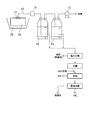
- FIG. 10 An example of wet processing (water-cooled collection) is shown in FIG.
- the battery 10 is housed in a heating facility 15, and a conduit 12 extending from the opening 11 of the battery 10 is connected to a vacuum pump 13 via a cooler 16 and a water-cooled trap 14.
- a two-stage water-cooled trap is provided. Water is put in the water-cooled trap, and the water temperature is kept at 0 ° C. to 10 ° C.
- the battery 10 is heated by the heating equipment 15, and the electrolyte solution is vaporized in a state where the pressure is reduced by the vacuum pump 13.
- the water-cooled trap 14 collects the fluorine compound (HF or the like) and the organic solvent component (organic component: DMC, EMC, DEC, PC, EC, etc.) in a water-cooled manner.
- the water-cooled trap 14 collects the organic solvent and hydrogen fluoride, which are separated into an aqueous phase and an organic phase.
- the separated aqueous phase is recovered.
- This aqueous phase contains a fluorine component in the vaporized gas.
- the water-cooled trap 14 may be installed in a plurality of stages in series or in parallel, or a combination of both.
- Water phase (fluorine-containing water) is acidic water having a pH of 2 or less.
- Calcium compounds (calcium carbonate, slaked lime, quicklime, etc.) are added to the fluorine-containing water to neutralize the pH to 5.5 to 7.0, and the fluoride and calcium in the liquid are reacted to precipitate calcium fluoride.
- the calcium fluoride is recovered by solid-liquid separation.
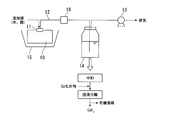
- FIG. 10 Another example (condensation collection) of the wet processing step is shown in FIG.
- the battery 10 is housed in a heating facility 15, and a conduit 12 extending from the opening 11 of the battery 10 is connected to a vacuum pump 13 through a cooler 16 and a trap 14.
- the battery 10 is heated by the heating equipment 15, and the electrolyte solution is vaporized in a state where the pressure is reduced by the vacuum pump 13.
- the vaporized gas is sucked into the vacuum pump 13 and led to the cooler 16 through the pipe 12, where it is cooled to become a condensed liquid, and the condensed liquid is led to the trap 14.
- the trap 14 collects fluorine compounds (HF, etc.) and organic solvent components (organic components: DMC, EMC, DEC, PC, EC, etc.).
- the liquid recovered by the trap 14 is mainly composed of organic solvent components. When water or an aqueous mineral acid solution is added first, it also contains water, but this organic solvent component is highly soluble in water, and a small amount of water dissolves in the organic solvent component, so the aqueous phase does not separate. Only the organic phase is obtained.
- the liquid recovered by the trap 14 is a fluorine-containing liquid (water + organic solvent) having a pH of 2 or lower.
- a calcium compound (slaked lime, quicklime, etc.) is added to the fluorine-containing liquid to neutralize to pH 5.5 to 7.0, and the fluorine and calcium in the liquid are reacted to precipitate calcium fluoride. This is subjected to solid-liquid separation to recover a liquid organic solvent and solid calcium fluoride.
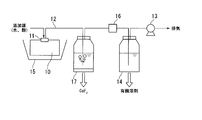
- FIG. 10 Another example of wet processing step (calcium absorption collection) is shown in FIG.
- the battery 10 is housed in a heating facility 15, and a pipe line 12 extending from the opening 11 of the battery 10 is connected to a vacuum pump 13 via a Ca mixture container 17, a cooler 16 and a trap 14.
- the battery 10 is heated by the heating equipment 15, and the electrolyte solution is vaporized in a state where the pressure is reduced by the vacuum pump 13.
- the vaporized gas is sucked into the vacuum pump 13 and led to the Ca mixed solution container 17 through the pipe 12 where the fluorine component is absorbed into the Ca mixed solution and reacts with the calcium compound to be fixed as calcium fluoride.
- the vaporized gas that has passed through the container 17 is led to the cooler 16, cooled to become a condensed liquid, and led to the trap 14.
- the trap 14 collects organic solvent components (organic components: DMC, EMC, DEC, PC, EC, etc.).
- the fluorine component reacts with the calcium compound to generate calcium fluoride.
- Calcium carbonate, calcium hydroxide, calcium oxide, calcium sulfate, calcium chloride, and calcium nitrate can be used as the calcium compound in the Ca mixed solution, but calcium carbonate is preferable because it enables the granulation of the recovered calcium fluoride to be inexpensive.
- As the liquid of the Ca mixed solution water or an organic solvent can be used.
- an electrolyte component (DMC, EMC, DEC, PC, EC, etc.) may be used.
- the organic solvent of the electrolytic solution is used, a part of the vaporized gas may be cooled and condensed and collected in the Ca mixed solution container 17. In this case, there is a merit in cost.
- the Ca mixed solution container 17 may be installed in a plurality of stages in series or in parallel, or in combination of series and parallel.
- Calcium fluoride produced in the Ca mixed solution container 17 can be recovered by volatilizing the liquid and drying the solid or by separating the suspension into solid and liquid.
- the liquid from which the fluorine has been removed can be replenished with a new calcium compound and used again as a Ca mixture.
- the organic solvent is collected in the trap 14.
- the liquid recovered by the trap 14 is mainly composed of organic solvent components. When water or dilute sulfuric acid is added first, it also contains water, but this organic solvent component is highly soluble in water, and a small amount of water can be dissolved, so the water phase does not separate and the organic phase Only.
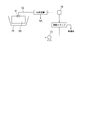
- the dry treatment process is shown in FIG.
- vaporized gas is passed through a packed bed of calcium compounds to react fluorine in the gas with calcium to produce calcium fluoride.
- This calcium fluoride is extracted from the packed bed and used by replenishing the packed bed with a new calcium compound.
- the gas that has passed through the packed bed is led to a condensation trap to recover the organic solvent component.
- the packed bed of calcium compounds may be installed in multiple stages in series or in parallel or a combination of both.
- the dry processing coagulation trap water is unnecessary, and the collected gas condenses into an organic solvent phase, which can be used as a fuel or a combustion aid for combustion equipment. Also, the dry process is easy to operate and does not require waste water treatment.
- the vaporized gas when vaporization is performed at a pressure higher than the vapor pressure of water, the vaporized gas can be guided to a wet treatment step or a dry treatment step for treatment.
- a wet treatment step or a dry treatment step for treatment On the other hand, when vaporized at a pressure lower than the vapor pressure of water, water-cooled collection is not suitable, and the vaporized gas is introduced into the dry treatment process for treatment.
- the cooler 16 is cooled to a reduced pressure of about 5 kPa, and when the vaporized gas is generated by heating the electrolyte in a stronger reduced pressure state, for example, a reduced pressure state of 1 kPa or 0.1 kPa, the cooler Even if it cools to 10 degreeC by 16, since it is lower than the vapor pressure of water, a water-cooled trap is not suitable. In this case, the vaporized gas is introduced into the dry treatment process.
- the vaporizer gas is wet-treated because it is higher than the vapor pressure of water if cooled to 10 ° C. or lower by the cooler 16. It can be led to the process and processed. In addition, you may introduce
- fluorine is recovered from the electrolyte as high-purity calcium fluoride, so that it can be recycled as a raw material for producing hydrofluoric acid or a raw material for cement.
- calcium fluoride having a purity of 80% or more can be obtained.
- the organic solvent of the electrolytic solution can be recovered and used as a fuel or an alternative fuel. Since the organic solvent component recovered by the treatment method of the present invention is separated from fluorine, no harmful substances such as hydrogen fluoride are generated when used as a fuel and can be used safely.
- the battery since the electrolyte is vaporized and taken out from the battery, the battery can be made harmless without being frozen or burned at a high temperature, so that material recycling in the subsequent stage is performed safely and efficiently. be able to.
- Examples of the present invention are shown below.
- the component of the organic phase liquid was analyzed with a gas chromatograph mass spectrometer.
- the pH of the liquid was analyzed by the glass electrode method.
- the fluorine concentration was analyzed by the fluoride ion electrode method.
- Example 1 Water-cooled collection
- a large battery cell lithium ion battery, 1.66 kg for automobiles was discharged, the packaging sheet was peeled off, the safety valve was opened, and 18 g of water was added. Then, a pipe line was connected to the opening of the safety valve, the pressure was reduced to 5 kPa by a vacuum pump, and the large battery cell was heated at 150 ° C. for 2 hours by being immersed in an oil heater. The generated gas was collected in the order of a cooling pipe (4 ° C.) and a water-cooled trap (liquid amount: 300 mL). This was left at room temperature to separate into an aqueous phase and an organic phase.
- aqueous phase 340 mL and organic phase 120 mL were recovered.
- the fluorine concentration of this aqueous phase was 10 g / L and pH2.
- 6.0 g of slaked lime was added to form a precipitate.
- the recovered precipitate was analyzed by powder X-ray diffraction and confirmed to be calcium fluoride.
- the recovered amount of calcium fluoride was 6.3 g and the purity was 80%.
- the components of the solution were DMC, EMC, DEC, and EC.
- Example 2 Water-cooled collection
- Add 21.5 g of 1.5 mol / L sulfuric acid aqueous solution to 100 mL of electrolyte, connect pipe, reduce pressure to 5 kPa with a vacuum pump, immerse in oil heater and heat large battery cell at 120 ° C. for 2 hours did.
- the generated gas was collected in the order of a cooling pipe (4 ° C.) and a water-cooled trap (liquid amount 200 mL). This was allowed to stand at room temperature and separated into an aqueous phase and an organic phase, and 230 mL of the aqueous phase and 35 mL of the organic phase were recovered.
- the fluorine concentration of this aqueous phase was 43 g / L and pH2.
- the aqueous phase was recovered and 18 g of slaked lime was added to form a precipitate.
- the recovered precipitate was analyzed by powder X-ray diffraction and confirmed to be calcium fluoride.
- the recovered amount of calcium fluoride was 20 g and the purity was 92%, and it was found that it could be used as a raw material for producing hydrofluoric acid.
- the components of the solution were DMC, EMC, DEC, and EC.
- Example 3 Aggregation collection
- 21.5 g of water was added to 100 mL of the electrolytic solution, a pipe line was connected, the pressure was reduced to 5 kPa by a vacuum pump, and the large battery cell was heated at 120 ° C. for 2 hours by being immersed in an oil heater.
- the generated gas was condensed by a cooling pipe (4 ° C.) and collected in a collection bottle.
- the recovered liquid was 95 mL, and only the organic phase was recovered.
- the fluorine concentration of the recovered liquid was 87 g / L and pH2.
- 15 g of slaked lime was added to form a precipitate.
- the recovered precipitate was analyzed by powder X-ray diffraction and confirmed to be calcium fluoride.
- the recovered amount of calcium fluoride was 14 g, the purity was 93%, and it could be used as a raw material for producing hydrofluoric acid.
- the components of the solution were DMC, EMC, DEC, and EC.
- Example 4 Aggregation collection
- 21.5 g of water was added to 100 mL of the electrolytic solution, a pipe line was connected, and it was immersed in an oil heater at 120 ° C. Reduce the pressure to 20 kPa with a vacuum pump and hold it for 10 minutes. After that, stop the vacuum pump and return the inside of the tube to atmospheric pressure. Then, operate the vacuum pump again to reduce the pressure to 20 kPa. The operation of stopping and returning to atmospheric pressure was repeated for 2 hours.
- the generated gas was condensed by a cooling pipe (4 ° C.) and collected in a collection bottle.
- the recovered liquid was 101 mL, and only the organic phase was recovered.
- This recovered solution had a fluorine concentration of 93 g / L and a pH of 1.9. To this, 17 g of slaked lime was added to form a precipitate. The recovered precipitate was analyzed by powder X-ray diffraction and confirmed to be calcium fluoride. The recovered amount of calcium fluoride was 19 g and the purity was 88%, which could be used as a raw material for producing hydrofluoric acid. When the organic phase was analyzed, the components of the solution were DMC, EMC, DEC, and EC.
- Example 5 Ca absorption collection
- 21.5 g of water was added to 100 mL of the electrolytic solution, a pipe line was connected, the pressure was reduced to 15 kPa by a vacuum pump, and the large battery cell was heated at 120 ° C. for 2 hours by being immersed in an oil heater.
- the generated gas was passed through a calcium suspension (calcium carbonate 30 g, water 100 mL, adjusted at 30 ° C. to 60 ° C.) to absorb the vaporized fluorine and immobilized as calcium fluoride.
- the organic solvent and the like were condensed by a subsequent cooler (4 ° C.) and collected in a collection bottle.
- the precipitate recovered in the calcium suspension was analyzed by powder X-ray diffraction and confirmed to be a mixture of calcium fluoride and calcium carbonate.
- the recovered liquid condensed by the cooler was 80 mL, and only the organic phase.
- the recovered solution had a fluorine concentration of 5 mg / L and a pH of 6.2, and contained almost no fluorine.
- the components of the solution were DMC, EMC, DEC, and EC.
- Example 6 Dry treatment
- a large battery cell lithium ion battery, 1.66 kg for automobiles is discharged, the packaging sheet is peeled off, a safety valve is opened, 18 g of water is added, a pipe line is connected, and the pressure is reduced to 5 kPa with a vacuum pump.
- the large battery cells were immersed in a heater and heated at 150 ° C. for 2 hours.
- the generated gas was introduced into the packed bed of calcium carbonate. After passing through the gas, the packed layer of calcium carbonate was taken out and the components were analyzed by powder X-ray diffraction. As a result, they were unreacted calcium carbonate and calcium fluoride.
- the gas that passed through the packed bed was led to a condensation trap (0 ° C.) and stored.
- the components of the condensate were analyzed, the components of the recovered liquid were DMC, EMC, DEC, and EC, and the fluorine concentration was 30 mg / L.
- fluorine is recovered from the electrolyte as high-purity calcium fluoride, so that it can be recycled as a raw material for producing hydrofluoric acid or a raw material for cement.
- the organic solvent of the electrolytic solution can be recovered and used as fuel or alternative fuel. Since the organic solvent component recovered by the treatment method of the present invention is separated from fluorine, no harmful substances such as hydrogen fluoride are generated when used as a fuel and can be used safely.
- the electrolyte solution is vaporized and taken out from the battery, so that the battery can be made harmless without being frozen or burned at high temperature, so that material recycling can be performed safely and efficiently. it can. Therefore, it has industrial applicability.
Landscapes
- Chemical & Material Sciences (AREA)
- Chemical Kinetics & Catalysis (AREA)
- General Chemical & Material Sciences (AREA)
- Engineering & Computer Science (AREA)
- Organic Chemistry (AREA)
- Manufacturing & Machinery (AREA)
- Electrochemistry (AREA)
- Oil, Petroleum & Natural Gas (AREA)
- Life Sciences & Earth Sciences (AREA)
- Geology (AREA)
- Inorganic Chemistry (AREA)
- Secondary Cells (AREA)
- Primary Cells (AREA)
Abstract
Description
本願は、2013年3月29日に日本で出願された特願2013-071367号に基づき優先権を主張し、それらの内容をここに援用する。
1.リチウムイオン電池などを電解液の融点以下に冷凍して電池を解体破砕し、破砕体から有機溶媒中で電解液を分離し、抽出した電解液を蒸留して電解質と有機溶媒に分離する処理方法(例えば特許文献1参照)。
2.使用済みリチウム電池を焙焼し、その焙焼物を破砕して磁性物と非磁性物に分別し、アルミニウムや銅などの有用金属量の多いものを回収する処理方法(例えば特許文献2参照)。
3.リチウム電池を超高圧水で開口し、有機溶媒を用いて電解液を回収する処理方法(例えば特許文献3参照)。
〔1〕揮発性のフッ素化合物および有機溶媒を含む電解液を処理する方法であって、前記電解液を減圧下で加熱して揮発成分を気化させる気化工程と、気化したガスに含まれるフッ素成分をカルシウムと反応させてフッ化カルシウムとして固定するフッ素固定工程と、気化ガスに含まれる前記有機溶媒成分を回収する有機溶媒成分回収工程と、を有する。
〔2〕上記[1]に記載するフッ素含有電解液の処理方法であって、前記気化工程において、電解液に水または鉱酸水溶液を添加した後に減圧下で加熱して電解液の揮発成分を気化させる上記[1]に記載するフッ素含有電解液の処理方法。
〔3〕上記[1]または上記[2]に記載するフッ素含有電解液の処理方法であって、電解液の揮発成分が気化したガスを湿式処理工程に導き、該湿式処理工程において、ガスに含まれるフッ素成分と有機溶媒成分を水冷捕集し、捕集した液を油水分離し、有機溶媒成分を回収する一方、分離した水相にカルシウム化合物を添加して水相中のフッ素とカルシウムを反応させてフッ化カルシウムを生成させる。
〔4〕上記[1]または上記[2]に記載するフッ素含有電解液の処理方法であって、電解液の揮発成分が気化したガスを湿式処理工程に導き、該湿式処理工程において、ガスに含まれるフッ素成分と有機溶媒成分を凝縮して捕集し、捕集した液にカルシウム化合物を添加してフッ素とカルシウムを反応させてフッ化カルシウムを生成させる。
〔5〕上記[1]または上記[2]に記載するフッ素含有電解液の処理方法であって、電解液の揮発成分が気化したガスを湿式処理工程に導き、該湿式処理工程において、カルシウム化合物混合液と接触させてガス中のフッ素を該混合液に吸収させるとともにフッ素とカルシウムを反応させてフッ化カルシウムを生成させ、さらに該混合液を通過したガスを凝縮して有機溶媒成分を回収する。
〔6〕上記[1]または上記[2]に記載するフッ素含有電解液の処理方法であって、電解液の揮発成分が気化したガスを乾式処理工程に導き、該乾式処理工程において、気化ガスをカルシウム化合物の充填層に通じてガス中のフッ素とカルシウムを反応させてフッ化カルシウムを生成させ、さらに該充填層を通過したガスを凝縮して有機溶媒成分を回収する。
〔7〕上記[3]~上記[6]の何れかに記載するフッ素含有電解液の処理方法であって、5kPa~常圧の減圧下、80~150℃に電解液を加熱して揮発成分を気化させ、気化したガスを上記湿式処理工程または上記乾式処理工程に導く。
〔8〕上記[1]に記載するフッ素含有電解液の処理方法であって、1kPa以下の減圧下、80~150℃に電解液を加熱して揮発成分を気化させ、気化したガスを上記乾式処理工程に導く。
〔9〕上記[1]~上記[8]の何れかに記載するフッ素含有電解液の処理方法であって、フッ化カルシウムを回収して再資源化し、また、回収した有機溶媒成分を燃料または代替燃料として利用する。
〔10〕上記[1]~上記[9]の何れかに記載するフッ素含有電解液の処理方法であって、フッ素化合物を含む電解液を含有する使用済み電池の開口部に管路を接続し、使用済み電池を減圧下で加熱して電解液の揮発成分を気化させ、気化したガスを、上記管路を通じてフッ素固定工程および有機溶媒回収工程に導いて処理する。
〔11〕上記[10]に記載するフッ素含有電解液の処理方法であって、使用済みリチウムイオン電池の安全弁を開口し、該開口に管路を接続し、減圧下で加熱して電解液の揮発成分を気化する。
〔12〕上記[10]に記載するフッ素含有電解液の処理方法であって、複数個の使用済みリチウムイオン電池の安全弁を開口し、これらの電池を密閉容器に収納して該容器に管路を接続し、減圧下で加熱して電解液の揮発成分を気化する。
〔13〕電解液に添加する水または鉱酸水溶液が、電解液の重量に対して5%~20%である上記[2]に記載するフッ素含有電解液の処理方法。
以下、本発明を具体的に説明する。なお、下記の「%」は「質量%」を示している。
本発明のフッ素含有電解液の処理方法は、フッ素化合物を含む電解液の揮発成分を減圧下で加熱して気化させる気化工程、気化したガスに含まれるフッ素成分をカルシウムと反応させてフッ化カルシウムとして固定するフッ素固定工程、気化ガスに含まれる有機溶媒成分を回収する有機溶媒回収工程を有することを特徴としている。
電解液に含まれる有機溶媒のうち、DMCの沸点は90℃、EMCの沸点は109℃、DECの沸点は127℃、PCの沸点は240℃、ECの沸点は244℃であり、電解液をこれらの沸点より高い温度状態にして上記揮発成分(DMC、EMC、DEC、PC、EC等)を気化させる。LiPF6は、加熱あるいは加水分解されることによって分解し、フッ素成分が気化する。

POF3+H2O → HPO2F2+HF(↑)
HPO2F2+H2O → H2PO3F+HF(↑)
H2PO3F+H2O → H3PO4+HF(↑)
湿式処理工程の一例(水冷捕集)を図1に示す。図示するように、電池10は、加温設備15に収納されており、電池10の開口11から延びる管路12は冷却器16および水冷トラップ14を経て真空ポンプ13に接続されている。図示する例では、二段の水冷トラップが設けられている。水冷トラップには水が入れられており、水温が0℃~10℃に保たれている。加温設備15によって電池10が加温され、さらに真空ポンプ13によって減圧された状態で電解液が気化する。この気化ガスは真空ポンプ13に吸引されて管路12を通じて冷却器16に導かれ、ここで冷却されて凝縮液になり、さらに水冷トラップ14に導かれる。このとき、管内の減圧条件は一定圧力で維持してもよく、または定速度で圧力を下げ、あるいは一定時間ごとに大気圧と減圧を交互に繰り返すなどの変化をさせてもよい。減圧度の調整は真空ポンプの稼動を制御することによって容易に行うことができる。水冷トラップ14でフッ素化合物(HF等)と有機溶媒成分(有機成分:DMC、EMC、DEC、PC、EC等)が水冷捕集される。
湿式処理工程の他の例(凝縮捕集)を図2に示す。図示するように、電池10は、加温設備15に収納されており、電池10の開口11から延びる管路12は冷却器16およびトラップ14を経て真空ポンプ13に接続されている。加温設備15によって電池10が加温され、さらに真空ポンプ13によって減圧された状態で電解液が気化する。この気化ガスは真空ポンプ13に吸引されて管路12を通じて冷却器16に導かれ、ここで冷却されて凝縮液になり、この凝縮液はトラップ14に導かれる。このトラップ14でフッ素化合物(HF等)と有機溶媒成分(有機成分:DMC、EMC、DEC、PC、EC等)が捕集される。
乾式処理工程を図4に示す。図示するように、気化ガスをカルシウム化合物の充填層に通じてガス中のフッ素をカルシウムと反応させてフッ化カルシウムを生成させる。このフッ化カルシウムは充填層から抜き出し,新しいカルシウム化合物を充填層に補充して使用する。一方、該充填層を通過したガスを凝縮トラップに導いて有機溶媒成分を回収する。カルシウム化合物の充填層は複数段を直列にあるいは並列にまたはその両方を組み合わせて設置してよい。
自動車用の大型電池セル(リチウムイオン電池、1.66kg)を放電して包装シートを剥離し、安全弁を開いて水を18g添加した。そして、安全弁の開口に管路を接続し、真空ポンプによって5kPaに減圧してオイルヒーターに浸漬して大型電池セルを150℃で2時間加熱した。発生したガスを冷却管(4℃)、水冷トラップ(液量300mL)の順に導いて捕集した。これを室温に静置して水相と有機相に分離した。分離した水相340mLと、有機相120mLとを回収した。この水相のフッ素濃度は10g/L、pH2であった。これに消石灰6.0gを加えて沈澱を生成させた。回収した沈澱を粉末X線回折によって分析し、フッ化カルシウムであることを確認した。フッ化カルシウムの回収量は6.3gであり、純度80%であった。一方、分離した有機相を回収し、成分を分析したところ、溶液の成分はDMC、EMC、DEC、ECであった。
100mLの電解液に1.5mol/Lの硫酸水溶液を21.5g添加し、管路を接続し、真空ポンプにより5kPaに減圧してオイルヒーターに浸漬して大型電池セルを120℃で2時間加熱した。発生したガスを冷却管(4℃)、水冷トラップ(液量200mL)の順に導いて捕集した。これを室温に静置して水相と有機相に分離し、水相230mLと、有機相35mLとを回収した。この水相のフッ素濃度は43g/L、pH2であった。水相を回収し、消石灰18gを加えて沈澱を生成させた。回収した沈澱を粉末X線回折によって分析し、フッ化カルシウムであることを確認した。フッ化カルシウムの回収量は20g、純度92%であり,フッ酸製造原料として活用できることがわかった。一方、分離した有機相を回収し、成分を分析したところ、溶液の成分はDMC、EMC、DEC、ECであった。
100mLの電解液に水を21.5g添加し、管路を接続し、真空ポンプにより5kPaに減圧してオイルヒーターに浸漬して大型電池セルを120℃で2時間加熱した。発生したガスを冷却管(4℃)で凝縮させ、捕集瓶に捕集した。回収液は95mLであり、有機相のみ回収された。回収液のフッ素濃度は87g/L、pH2であった。これに消石灰15gを加えて沈澱を生成させた。回収した沈澱を粉末X線回折によって分析し、フッ化カルシウムであることを確認した。フッ化カルシウムの回収量は14gであり、純度93%であり、フッ酸製造原料として利用できるものであった。有機相を分析したところ、溶液の成分はDMC、EMC、DEC、ECであった。
100mLの電解液に水を21.5g添加し、管路を接続し、120℃のオイルヒーターに浸漬した。真空ポンプにより20kPaに減圧して10分保持し、その後、真空ポンプを停止して管内を大気圧に戻した後に、再度、真空ポンプを作動して20kPaに減圧し、10分経過後に真空ポンプを停止して大気圧に戻す操作を2時間繰り返した。発生したガスを冷却管(4℃)で凝縮させ、捕集瓶に捕集した。回収液は101mLであり,有機相のみ回収された。この回収液のフッ素濃度は93g/L、pH1.9であった。これに消石灰17gを加えて沈澱を生成させた。回収した沈澱を粉末X線回折によって分析し、フッ化カルシウムであることを確認した。フッ化カルシウムの回収量は19g、純度88%であり、フッ酸製造原料として利用できるものであった。有機相を分析したところ、溶液の成分はDMC、EMC、DEC、ECであった。
100mLの電解液に水を21.5g添加し、管路を接続し、真空ポンプにより15kPaに減圧してオイルヒーターに浸漬して大型電池セルを120℃で2時間加熱した。発生したガスをカルシウム懸濁液(炭酸カルシウム30g、水100mL、30℃~60℃で調整)に通し、気化したフッ素を吸収し、フッ化カルシウムとして固定化した。有機溶媒等は、その後の冷却器(4℃)で凝縮させ、捕集瓶に捕集した。カルシウム懸濁液で回収した沈殿は、粉末X線回折によって分析し、フッ化カルシウムと炭酸カルシウムの混合物であることを確認した。冷却器により凝縮された回収液は80mLであり,有機相のみであった。回収液のフッ素濃度は5mg/L、pH6.2であり、ほとんどフッ素を含まないものであった。有機相を分析したところ、溶液の成分はDMC、EMC、DEC、ECであった。
自動車用の大型電池セル(リチウムイオン電池、1.66kg)を放電して包装シートを剥離し、安全弁を開いて水を18g添加し、管路を接続し、真空ポンプにより5kPaに減圧してオイルヒーターに浸漬して大型電池セルを150℃で2時間加熱した。発生したガスを炭酸カルシウムの充填層に導入した。
ガス通過後、炭酸カルシウムの充填層を取り出して成分を粉末X線回折によって分析したところ、未反応の炭酸カルシウムとフッ化カルシウムであった。一方、充填層を通過したガスを凝縮トラップ(0℃)に導いて貯留した。凝縮液の成分を分析したところ、回収液の成分はDMC、EMC、DEC、ECであり,フッ素濃度は30mg/Lであった。
Claims (13)
- 揮発性のフッ素化合物および有機溶媒を含む電解液を処理する方法であって、
前記電解液を減圧下で加熱して揮発成分を気化させる気化工程と、
気化したガスに含まれるフッ素成分をカルシウムと反応させてフッ化カルシウムとして固定するフッ素固定工程と、
気化ガスに含まれる前記有機溶媒成分を回収する有機溶媒成分回収工程と、を有する
フッ素含有電解液の処理方法。 - 前記気化工程において、電解液に水または鉱酸水溶液を添加した後に減圧下で加熱して電解液の揮発成分を気化させる請求項1に記載するフッ素含有電解液の処理方法。
- 電解液の揮発成分が気化したガスを湿式処理工程に導き、該湿式処理工程において、ガスに含まれるフッ素成分と有機溶媒成分を水冷捕集し、捕集した液を油水分離し、有機溶媒成分を回収する一方、分離した水相にカルシウム化合物を添加して水相中のフッ素とカルシウムを反応させてフッ化カルシウムを生成させる請求項1または請求項2に記載するフッ素含有電解液の処理方法。
- 電解液の揮発成分が気化したガスを湿式処理工程に導き、該湿式処理工程において、ガスに含まれるフッ素成分と有機溶媒成分を凝縮して捕集し、捕集した液にカルシウム化合物を添加してフッ素とカルシウムを反応させてフッ化カルシウムを生成させる請求項1または請求項2に記載するフッ素含有電解液の処理方法。
- 電解液の揮発成分が気化したガスを湿式処理工程に導き、該湿式処理工程において、カルシウム化合物混合液と接触させてガス中のフッ素を該混合液に吸収させるとともにフッ素とカルシウムを反応させてフッ化カルシウムを生成させ、さらに該混合液を通過したガスを凝縮して有機溶媒成分を回収する請求項1または請求項2に記載するフッ素含有電解液の処理方法。
- 電解液の揮発成分が気化したガスを乾式処理工程に導き、該乾式処理工程において、気化ガスをカルシウム化合物の充填層に通じてガス中のフッ素とカルシウムを反応させてフッ化カルシウムを生成させ、さらに該充填層を通過したガスを凝縮して有機溶媒成分を回収する請求項1または請求項2に記載するフッ素含有電解液の処理方法。
- 5kPa~常圧の減圧下、80~150℃に電解液を加熱して揮発成分を気化させ、気化したガスを上記湿式処理工程または上記乾式処理工程に導く請求項3~請求項6の何れかに記載するフッ素含有電解液の処理方法。
- 1kPa以下の減圧下、80~150℃に電解液を加熱して揮発成分を気化させ、気化したガスを上記乾式処理工程に導く請求項6に記載するフッ素含有電解液の処理方法。
- フッ化カルシウムを回収して再資源化し、また、回収した有機溶媒成分を燃料または代替燃料として利用する請求項1~請求項8の何れかに記載するフッ素含有電解液の処理方法。
- フッ素化合物を含む電解液を含有する使用済み電池の開口部に管路を接続し、使用済み電池を減圧下で加熱して電解液の揮発成分を気化させ、気化したガスを、上記管路を通じてフッ素固定工程および有機溶媒回収工程に導いて処理する請求項1~請求項9の何れかに記載するフッ素含有電解液の処理方法。
- 使用済みリチウムイオン電池の安全弁を開口し、該開口に管路を接続し、減圧下で加熱して電解液の揮発成分を気化する請求項10に記載するフッ素含有電解液の処理方法。
- 複数個の使用済みリチウムイオン電池の安全弁を開口し、これらの電池を密閉容器に収納して該容器に管路を接続し、減圧下で加熱して電解液の揮発成分を気化する請求項10に記載するフッ素含有電解液の処理方法。
- 前記電解液に添加する水または鉱酸水溶液が、前記電解液の重量に対して5%~20%である請求項2に記載するフッ素含有電解液の処理方法。
Priority Applications (3)
| Application Number | Priority Date | Filing Date | Title |
|---|---|---|---|
| KR1020157026328A KR102041004B1 (ko) | 2013-03-29 | 2013-09-26 | 불소 함유 전해액의 처리 방법 |
| US14/778,701 US9843077B2 (en) | 2013-03-29 | 2013-09-26 | Method for processing fluorine-containing electrolyte solution |
| CN201380074377.5A CN105144464B (zh) | 2013-03-29 | 2013-09-26 | 含氟电解液的处理方法 |
Applications Claiming Priority (2)
| Application Number | Priority Date | Filing Date | Title |
|---|---|---|---|
| JP2013071367A JP6124001B2 (ja) | 2012-03-30 | 2013-03-29 | フッ素含有電解液の処理方法 |
| JP2013-071367 | 2013-03-29 |
Publications (1)
| Publication Number | Publication Date |
|---|---|
| WO2014155784A1 true WO2014155784A1 (ja) | 2014-10-02 |
Family
ID=51625711
Family Applications (1)
| Application Number | Title | Priority Date | Filing Date |
|---|---|---|---|
| PCT/JP2013/076083 Ceased WO2014155784A1 (ja) | 2013-03-29 | 2013-09-26 | フッ素含有電解液の処理方法 |
Country Status (4)
| Country | Link |
|---|---|
| US (1) | US9843077B2 (ja) |
| KR (1) | KR102041004B1 (ja) |
| CN (1) | CN105144464B (ja) |
| WO (1) | WO2014155784A1 (ja) |
Cited By (1)
| Publication number | Priority date | Publication date | Assignee | Title |
|---|---|---|---|---|
| EP3306736A4 (en) * | 2015-07-03 | 2018-05-16 | Honda Motor Co., Ltd. | Lithium ion battery electrolyte elimination method |
Families Citing this family (18)
| Publication number | Priority date | Publication date | Assignee | Title |
|---|---|---|---|---|
| DE102015207843B4 (de) | 2015-04-28 | 2018-06-07 | Duesenfeld Gmbh | Verfahren zum Behandeln gebrauchter Batterien und Batterie-Verarbeitungsanlage |
| US10707531B1 (en) | 2016-09-27 | 2020-07-07 | New Dominion Enterprises Inc. | All-inorganic solvents for electrolytes |
| DE102016120046A1 (de) | 2016-10-20 | 2018-04-26 | Duesenfeld Gmbh | Recycling-Verfahren zum Behandeln gebrauchter Batterien, insbesondere wieder aufladbarer Batterien und Batterie-Verarbeitungsanlage |
| CN107910610B (zh) * | 2017-11-16 | 2019-06-28 | 江苏智泰新能源科技有限公司 | 一种锂电池的正极及电解液混合回收方法 |
| CN108682914B (zh) * | 2018-04-09 | 2021-02-23 | 惠州亿纬锂能股份有限公司 | 废旧锂离子电池电解液的回收处理方法 |
| CN108392962A (zh) * | 2018-04-26 | 2018-08-14 | 长沙理工大学 | 一种锂电池电池液专用分离器 |
| CN108808156B (zh) * | 2018-08-24 | 2020-10-16 | 广西师范大学 | 一种废旧锂离子电池中电解液的回收方法 |
| CN109672002B (zh) * | 2018-10-22 | 2020-10-16 | 天齐锂业(江苏)有限公司 | 一种电池电芯粉末中六氟磷酸锂的高效去除方法 |
| CN109449525B (zh) * | 2018-12-21 | 2023-09-26 | 中南大学 | 废旧锂电池电解液的无害化回收处理方法及装置 |
| CN110391478B (zh) * | 2019-08-02 | 2020-09-11 | 湖南科技大学 | 一种锂电池安全装置 |
| CN111087005A (zh) * | 2019-12-25 | 2020-05-01 | 洛阳森蓝化工材料科技有限公司 | 一种防止氟气纯化剂烧结变色的方法 |
| CN113390301A (zh) * | 2020-03-13 | 2021-09-14 | 湖南艾华集团股份有限公司 | 一种基于电阻的电子鞭炮单体 |
| CN111934041B (zh) * | 2020-07-06 | 2021-09-21 | 界首市南都华宇电源有限公司 | 一种废旧锂离子电池电解液回收及再利用方法 |
| JP7769630B2 (ja) * | 2020-10-19 | 2025-11-13 | 関東電化工業株式会社 | リチウムの回収方法 |
| CN112421143A (zh) * | 2020-11-30 | 2021-02-26 | 湖南金源新材料股份有限公司 | 一种废锂电池电解液的综合回收方法 |
| CN113363610B (zh) * | 2021-06-18 | 2022-11-22 | 郑州中科新兴产业技术研究院 | 一种退役锂离子电池电解液的无害化处理方法 |
| CN113611939A (zh) * | 2021-08-03 | 2021-11-05 | 中南大学 | 一种废旧锂离子电池电解液的再生方法 |
| KR20230042933A (ko) * | 2021-09-23 | 2023-03-30 | 에스케이이노베이션 주식회사 | 리튬 이차 전지로부터 리튬 전구체의 회수 방법 |
Citations (2)
| Publication number | Priority date | Publication date | Assignee | Title |
|---|---|---|---|---|
| JP2005026089A (ja) * | 2003-07-02 | 2005-01-27 | Toyota Motor Corp | リチウム電池、その製造方法ならびに処理方法 |
| JP2006004884A (ja) * | 2004-06-21 | 2006-01-05 | Toyota Motor Corp | リチウム電池処理方法 |
Family Cites Families (8)
| Publication number | Priority date | Publication date | Assignee | Title |
|---|---|---|---|---|
| JP2721467B2 (ja) | 1993-02-25 | 1998-03-04 | キヤノン株式会社 | リチウム電池材回収方法 |
| JP3079285B2 (ja) | 1996-09-02 | 2000-08-21 | 日鉱金属株式会社 | 使用済みリチウム電池からの有価物回収方法 |
| JP3935594B2 (ja) | 1997-03-14 | 2007-06-27 | 三菱重工業株式会社 | 非水溶媒系電池の処理方法 |
| JP4492222B2 (ja) | 2004-06-21 | 2010-06-30 | トヨタ自動車株式会社 | リチウム電池処理方法 |
| CN100369317C (zh) * | 2006-01-10 | 2008-02-13 | 东南大学 | 一种废旧锂离子电池的资源化分离方法 |
| JP5440095B2 (ja) * | 2009-10-22 | 2014-03-12 | 栗田工業株式会社 | フッ素含有水の処理方法および処理装置 |
| JP5703884B2 (ja) | 2011-03-23 | 2015-04-22 | トヨタ自動車株式会社 | 電池パックのリサイクル方法及び処理装置 |
| US9923232B2 (en) * | 2012-05-25 | 2018-03-20 | Lanxess Deutschland Gmbh | Production of high-purity lithium fluoride |
-
2013
- 2013-09-26 US US14/778,701 patent/US9843077B2/en not_active Expired - Fee Related
- 2013-09-26 KR KR1020157026328A patent/KR102041004B1/ko not_active Expired - Fee Related
- 2013-09-26 CN CN201380074377.5A patent/CN105144464B/zh not_active Expired - Fee Related
- 2013-09-26 WO PCT/JP2013/076083 patent/WO2014155784A1/ja not_active Ceased
Patent Citations (2)
| Publication number | Priority date | Publication date | Assignee | Title |
|---|---|---|---|---|
| JP2005026089A (ja) * | 2003-07-02 | 2005-01-27 | Toyota Motor Corp | リチウム電池、その製造方法ならびに処理方法 |
| JP2006004884A (ja) * | 2004-06-21 | 2006-01-05 | Toyota Motor Corp | リチウム電池処理方法 |
Cited By (2)
| Publication number | Priority date | Publication date | Assignee | Title |
|---|---|---|---|---|
| EP3306736A4 (en) * | 2015-07-03 | 2018-05-16 | Honda Motor Co., Ltd. | Lithium ion battery electrolyte elimination method |
| US10581057B2 (en) | 2015-07-03 | 2020-03-03 | Honda Motor Co., Ltd. | Lithium ion battery electrolyte elimination method |
Also Published As
| Publication number | Publication date |
|---|---|
| US20160049699A1 (en) | 2016-02-18 |
| US9843077B2 (en) | 2017-12-12 |
| KR102041004B1 (ko) | 2019-11-05 |
| CN105144464A (zh) | 2015-12-09 |
| CN105144464B (zh) | 2018-03-27 |
| KR20150135304A (ko) | 2015-12-02 |
Similar Documents
| Publication | Publication Date | Title |
|---|---|---|
| WO2014155784A1 (ja) | フッ素含有電解液の処理方法 | |
| JP6124001B2 (ja) | フッ素含有電解液の処理方法 | |
| JP6311877B2 (ja) | フッ素含有電解液の処理方法 | |
| JP6315198B2 (ja) | フッ素含有電解液の処理方法 | |
| CN102105394A (zh) | 五氟化磷和六氟磷酸盐的制造方法 | |
| JP2015092466A (ja) | フッ素含有電解液の処理方法 | |
| CN101787537B (zh) | 微负压-负压蒸发、结晶工艺回收不锈钢退火酸洗废硝酸氢氟酸 | |
| WO2010146710A1 (ja) | 四フッ化ホウ酸塩の製造方法 | |
| JP5032143B2 (ja) | 塩化水素の回収方法 | |
| US9731968B2 (en) | Process for producing fluoride gas | |
| CN115207506A (zh) | 一种废旧锂离子电池电解液回收方法 | |
| CN112421143A (zh) | 一种废锂电池电解液的综合回收方法 | |
| WO2025119175A1 (zh) | 一种锂离子电池电解液回收方法和系统 | |
| WO2014097861A1 (ja) | リチウム電池及び/又はリチウムイオン電池の電解質用リチウム塩の製造方法及び製造装置 | |
| JP2009155129A (ja) | 六フッ化リン酸塩の製造方法 | |
| CN106829908B (zh) | 一种二氟磷酸锂的制备方法及含有二氟磷酸锂的锂离子电池非水电解液 | |
| JP6311882B2 (ja) | フッ素含有電解液の処理方法 | |
| JP5252908B2 (ja) | 四フッ化ホウ酸塩の製造方法 | |
| KR101266719B1 (ko) | 오불화인 제조방법 | |
| TW202349783A (zh) | 一種廢棄鋰離子電池的電解質的去除及安全處置方法 |
Legal Events
| Date | Code | Title | Description |
|---|---|---|---|
| WWE | Wipo information: entry into national phase |
Ref document number: 201380074377.5 Country of ref document: CN |
|
| 121 | Ep: the epo has been informed by wipo that ep was designated in this application |
Ref document number: 13880222 Country of ref document: EP Kind code of ref document: A1 |
|
| WWE | Wipo information: entry into national phase |
Ref document number: 14778701 Country of ref document: US |
|
| ENP | Entry into the national phase |
Ref document number: 20157026328 Country of ref document: KR Kind code of ref document: A |
|
| NENP | Non-entry into the national phase |
Ref country code: DE |
|
| 122 | Ep: pct application non-entry in european phase |
Ref document number: 13880222 Country of ref document: EP Kind code of ref document: A1 |