WO2014084185A1 - ヘキサフルオロイソプロパノール基を含むジアミン、それを用いたポリイミドおよびポリアミド、その環化物、並びにその製造方法 - Google Patents
ヘキサフルオロイソプロパノール基を含むジアミン、それを用いたポリイミドおよびポリアミド、その環化物、並びにその製造方法 Download PDFInfo
- Publication number
- WO2014084185A1 WO2014084185A1 PCT/JP2013/081698 JP2013081698W WO2014084185A1 WO 2014084185 A1 WO2014084185 A1 WO 2014084185A1 JP 2013081698 W JP2013081698 W JP 2013081698W WO 2014084185 A1 WO2014084185 A1 WO 2014084185A1
- Authority
- WO
- WIPO (PCT)
- Prior art keywords
- group
- ring
- formula
- independently
- bond
- Prior art date
- Legal status (The legal status is an assumption and is not a legal conclusion. Google has not performed a legal analysis and makes no representation as to the accuracy of the status listed.)
- Ceased
Links
- 0 OC(C(F)(F)F)(C(F)(F)F)c1cccc(*c2ccccc2)c1 Chemical compound OC(C(F)(F)F)(C(F)(F)F)c1cccc(*c2ccccc2)c1 0.000 description 13
- HIMYAKKZMNXEED-UHFFFAOYSA-N Cc(cc(c(C(C(F)(F)F)(C(F)(F)F)O)c1)N)c1-c(cc1C(C(F)(F)F)(C(F)(F)F)O)c(C)cc1N Chemical compound Cc(cc(c(C(C(F)(F)F)(C(F)(F)F)O)c1)N)c1-c(cc1C(C(F)(F)F)(C(F)(F)F)O)c(C)cc1N HIMYAKKZMNXEED-UHFFFAOYSA-N 0.000 description 2
- IXYBOKSJYGRUSJ-UHFFFAOYSA-N Cc(cc(Cc(cc1C)cc(C(C(F)(F)F)(C(F)(F)F)O)c1N)cc1C(C(F)(F)F)(C(F)(F)F)O)c1N Chemical compound Cc(cc(Cc(cc1C)cc(C(C(F)(F)F)(C(F)(F)F)O)c1N)cc1C(C(F)(F)F)(C(F)(F)F)O)c1N IXYBOKSJYGRUSJ-UHFFFAOYSA-N 0.000 description 1
- ANSXAPJVJOKRDJ-UHFFFAOYSA-N O=C(c(c1c2)cc(C(O3)=O)c2C3=O)OC1=O Chemical compound O=C(c(c1c2)cc(C(O3)=O)c2C3=O)OC1=O ANSXAPJVJOKRDJ-UHFFFAOYSA-N 0.000 description 1
Classifications
-
- C—CHEMISTRY; METALLURGY
- C08—ORGANIC MACROMOLECULAR COMPOUNDS; THEIR PREPARATION OR CHEMICAL WORKING-UP; COMPOSITIONS BASED THEREON
- C08G—MACROMOLECULAR COMPOUNDS OBTAINED OTHERWISE THAN BY REACTIONS ONLY INVOLVING UNSATURATED CARBON-TO-CARBON BONDS
- C08G73/00—Macromolecular compounds obtained by reactions forming a linkage containing nitrogen with or without oxygen or carbon in the main chain of the macromolecule, not provided for in groups C08G12/00 - C08G71/00
- C08G73/06—Polycondensates having nitrogen-containing heterocyclic rings in the main chain of the macromolecule
-
- C—CHEMISTRY; METALLURGY
- C07—ORGANIC CHEMISTRY
- C07C—ACYCLIC OR CARBOCYCLIC COMPOUNDS
- C07C215/00—Compounds containing amino and hydroxy groups bound to the same carbon skeleton
- C07C215/68—Compounds containing amino and hydroxy groups bound to the same carbon skeleton having amino groups bound to carbon atoms of six-membered aromatic rings and hydroxy groups bound to acyclic carbon atoms or to carbon atoms of rings other than six-membered aromatic rings of the same carbon skeleton
-
- C—CHEMISTRY; METALLURGY
- C07—ORGANIC CHEMISTRY
- C07C—ACYCLIC OR CARBOCYCLIC COMPOUNDS
- C07C215/00—Compounds containing amino and hydroxy groups bound to the same carbon skeleton
- C07C215/68—Compounds containing amino and hydroxy groups bound to the same carbon skeleton having amino groups bound to carbon atoms of six-membered aromatic rings and hydroxy groups bound to acyclic carbon atoms or to carbon atoms of rings other than six-membered aromatic rings of the same carbon skeleton
- C07C215/70—Compounds containing amino and hydroxy groups bound to the same carbon skeleton having amino groups bound to carbon atoms of six-membered aromatic rings and hydroxy groups bound to acyclic carbon atoms or to carbon atoms of rings other than six-membered aromatic rings of the same carbon skeleton with rings other than six-membered aromatic rings being part of the carbon skeleton
-
- C—CHEMISTRY; METALLURGY
- C07—ORGANIC CHEMISTRY
- C07C—ACYCLIC OR CARBOCYCLIC COMPOUNDS
- C07C217/00—Compounds containing amino and etherified hydroxy groups bound to the same carbon skeleton
- C07C217/78—Compounds containing amino and etherified hydroxy groups bound to the same carbon skeleton having amino groups and etherified hydroxy groups bound to carbon atoms of six-membered aromatic rings of the same carbon skeleton
- C07C217/80—Compounds containing amino and etherified hydroxy groups bound to the same carbon skeleton having amino groups and etherified hydroxy groups bound to carbon atoms of six-membered aromatic rings of the same carbon skeleton having amino groups and etherified hydroxy groups bound to carbon atoms of non-condensed six-membered aromatic rings
- C07C217/82—Compounds containing amino and etherified hydroxy groups bound to the same carbon skeleton having amino groups and etherified hydroxy groups bound to carbon atoms of six-membered aromatic rings of the same carbon skeleton having amino groups and etherified hydroxy groups bound to carbon atoms of non-condensed six-membered aromatic rings of the same non-condensed six-membered aromatic ring
- C07C217/90—Compounds containing amino and etherified hydroxy groups bound to the same carbon skeleton having amino groups and etherified hydroxy groups bound to carbon atoms of six-membered aromatic rings of the same carbon skeleton having amino groups and etherified hydroxy groups bound to carbon atoms of non-condensed six-membered aromatic rings of the same non-condensed six-membered aromatic ring the oxygen atom of at least one of the etherified hydroxy groups being further bound to a carbon atom of a six-membered aromatic ring, e.g. amino-diphenylethers
-
- C—CHEMISTRY; METALLURGY
- C07—ORGANIC CHEMISTRY
- C07C—ACYCLIC OR CARBOCYCLIC COMPOUNDS
- C07C225/00—Compounds containing amino groups and doubly—bound oxygen atoms bound to the same carbon skeleton, at least one of the doubly—bound oxygen atoms not being part of a —CHO group, e.g. amino ketones
- C07C225/22—Compounds containing amino groups and doubly—bound oxygen atoms bound to the same carbon skeleton, at least one of the doubly—bound oxygen atoms not being part of a —CHO group, e.g. amino ketones having amino groups bound to carbon atoms of six-membered aromatic rings of the carbon skeleton
-
- C—CHEMISTRY; METALLURGY
- C07—ORGANIC CHEMISTRY
- C07C—ACYCLIC OR CARBOCYCLIC COMPOUNDS
- C07C317/00—Sulfones; Sulfoxides
- C07C317/26—Sulfones; Sulfoxides having sulfone or sulfoxide groups and nitrogen atoms, not being part of nitro or nitroso groups, bound to the same carbon skeleton
- C07C317/32—Sulfones; Sulfoxides having sulfone or sulfoxide groups and nitrogen atoms, not being part of nitro or nitroso groups, bound to the same carbon skeleton with sulfone or sulfoxide groups bound to carbon atoms of six-membered aromatic rings of the carbon skeleton
- C07C317/34—Sulfones; Sulfoxides having sulfone or sulfoxide groups and nitrogen atoms, not being part of nitro or nitroso groups, bound to the same carbon skeleton with sulfone or sulfoxide groups bound to carbon atoms of six-membered aromatic rings of the carbon skeleton having sulfone or sulfoxide groups and amino groups bound to carbon atoms of six-membered aromatic rings being part of the same non-condensed ring or of a condensed ring system containing that ring
- C07C317/36—Sulfones; Sulfoxides having sulfone or sulfoxide groups and nitrogen atoms, not being part of nitro or nitroso groups, bound to the same carbon skeleton with sulfone or sulfoxide groups bound to carbon atoms of six-membered aromatic rings of the carbon skeleton having sulfone or sulfoxide groups and amino groups bound to carbon atoms of six-membered aromatic rings being part of the same non-condensed ring or of a condensed ring system containing that ring with the nitrogen atoms of the amino groups bound to hydrogen atoms or to carbon atoms
-
- C—CHEMISTRY; METALLURGY
- C07—ORGANIC CHEMISTRY
- C07C—ACYCLIC OR CARBOCYCLIC COMPOUNDS
- C07C323/00—Thiols, sulfides, hydropolysulfides or polysulfides substituted by halogen, oxygen or nitrogen atoms, or by sulfur atoms not being part of thio groups
- C07C323/23—Thiols, sulfides, hydropolysulfides or polysulfides substituted by halogen, oxygen or nitrogen atoms, or by sulfur atoms not being part of thio groups containing thio groups and nitrogen atoms, not being part of nitro or nitroso groups, bound to the same carbon skeleton
- C07C323/31—Thiols, sulfides, hydropolysulfides or polysulfides substituted by halogen, oxygen or nitrogen atoms, or by sulfur atoms not being part of thio groups containing thio groups and nitrogen atoms, not being part of nitro or nitroso groups, bound to the same carbon skeleton having the sulfur atom of at least one of the thio groups bound to a carbon atom of a six-membered aromatic ring of the carbon skeleton
- C07C323/33—Thiols, sulfides, hydropolysulfides or polysulfides substituted by halogen, oxygen or nitrogen atoms, or by sulfur atoms not being part of thio groups containing thio groups and nitrogen atoms, not being part of nitro or nitroso groups, bound to the same carbon skeleton having the sulfur atom of at least one of the thio groups bound to a carbon atom of a six-membered aromatic ring of the carbon skeleton having at least one of the nitrogen atoms bound to a carbon atom of the same non-condensed six-membered aromatic ring
- C07C323/35—Thiols, sulfides, hydropolysulfides or polysulfides substituted by halogen, oxygen or nitrogen atoms, or by sulfur atoms not being part of thio groups containing thio groups and nitrogen atoms, not being part of nitro or nitroso groups, bound to the same carbon skeleton having the sulfur atom of at least one of the thio groups bound to a carbon atom of a six-membered aromatic ring of the carbon skeleton having at least one of the nitrogen atoms bound to a carbon atom of the same non-condensed six-membered aromatic ring the thio group being a sulfide group
- C07C323/37—Thiols, sulfides, hydropolysulfides or polysulfides substituted by halogen, oxygen or nitrogen atoms, or by sulfur atoms not being part of thio groups containing thio groups and nitrogen atoms, not being part of nitro or nitroso groups, bound to the same carbon skeleton having the sulfur atom of at least one of the thio groups bound to a carbon atom of a six-membered aromatic ring of the carbon skeleton having at least one of the nitrogen atoms bound to a carbon atom of the same non-condensed six-membered aromatic ring the thio group being a sulfide group the sulfur atom of the sulfide group being further bound to a carbon atom of a six-membered aromatic ring
-
- C—CHEMISTRY; METALLURGY
- C07—ORGANIC CHEMISTRY
- C07D—HETEROCYCLIC COMPOUNDS
- C07D209/00—Heterocyclic compounds containing five-membered rings, condensed with other rings, with one nitrogen atom as the only ring hetero atom
- C07D209/02—Heterocyclic compounds containing five-membered rings, condensed with other rings, with one nitrogen atom as the only ring hetero atom condensed with one carbocyclic ring
- C07D209/44—Iso-indoles; Hydrogenated iso-indoles
- C07D209/48—Iso-indoles; Hydrogenated iso-indoles with oxygen atoms in positions 1 and 3, e.g. phthalimide
-
- C—CHEMISTRY; METALLURGY
- C07—ORGANIC CHEMISTRY
- C07D—HETEROCYCLIC COMPOUNDS
- C07D487/00—Heterocyclic compounds containing nitrogen atoms as the only ring hetero atoms in the condensed system, not provided for by groups C07D451/00 - C07D477/00
- C07D487/02—Heterocyclic compounds containing nitrogen atoms as the only ring hetero atoms in the condensed system, not provided for by groups C07D451/00 - C07D477/00 in which the condensed system contains two hetero rings
- C07D487/04—Ortho-condensed systems
-
- C—CHEMISTRY; METALLURGY
- C08—ORGANIC MACROMOLECULAR COMPOUNDS; THEIR PREPARATION OR CHEMICAL WORKING-UP; COMPOSITIONS BASED THEREON
- C08G—MACROMOLECULAR COMPOUNDS OBTAINED OTHERWISE THAN BY REACTIONS ONLY INVOLVING UNSATURATED CARBON-TO-CARBON BONDS
- C08G69/00—Macromolecular compounds obtained by reactions forming a carboxylic amide link in the main chain of the macromolecule
- C08G69/02—Polyamides derived from amino-carboxylic acids or from polyamines and polycarboxylic acids
- C08G69/26—Polyamides derived from amino-carboxylic acids or from polyamines and polycarboxylic acids derived from polyamines and polycarboxylic acids
- C08G69/32—Polyamides derived from amino-carboxylic acids or from polyamines and polycarboxylic acids derived from polyamines and polycarboxylic acids from aromatic diamines and aromatic dicarboxylic acids with both amino and carboxylic groups aromatically bound
-
- C—CHEMISTRY; METALLURGY
- C08—ORGANIC MACROMOLECULAR COMPOUNDS; THEIR PREPARATION OR CHEMICAL WORKING-UP; COMPOSITIONS BASED THEREON
- C08G—MACROMOLECULAR COMPOUNDS OBTAINED OTHERWISE THAN BY REACTIONS ONLY INVOLVING UNSATURATED CARBON-TO-CARBON BONDS
- C08G69/00—Macromolecular compounds obtained by reactions forming a carboxylic amide link in the main chain of the macromolecule
- C08G69/42—Polyamides containing atoms other than carbon, hydrogen, oxygen, and nitrogen
-
- C—CHEMISTRY; METALLURGY
- C08—ORGANIC MACROMOLECULAR COMPOUNDS; THEIR PREPARATION OR CHEMICAL WORKING-UP; COMPOSITIONS BASED THEREON
- C08G—MACROMOLECULAR COMPOUNDS OBTAINED OTHERWISE THAN BY REACTIONS ONLY INVOLVING UNSATURATED CARBON-TO-CARBON BONDS
- C08G73/00—Macromolecular compounds obtained by reactions forming a linkage containing nitrogen with or without oxygen or carbon in the main chain of the macromolecule, not provided for in groups C08G12/00 - C08G71/00
- C08G73/06—Polycondensates having nitrogen-containing heterocyclic rings in the main chain of the macromolecule
- C08G73/10—Polyimides; Polyester-imides; Polyamide-imides; Polyamide acids or similar polyimide precursors
- C08G73/1039—Polyimides; Polyester-imides; Polyamide-imides; Polyamide acids or similar polyimide precursors comprising halogen-containing substituents
-
- C—CHEMISTRY; METALLURGY
- C08—ORGANIC MACROMOLECULAR COMPOUNDS; THEIR PREPARATION OR CHEMICAL WORKING-UP; COMPOSITIONS BASED THEREON
- C08G—MACROMOLECULAR COMPOUNDS OBTAINED OTHERWISE THAN BY REACTIONS ONLY INVOLVING UNSATURATED CARBON-TO-CARBON BONDS
- C08G73/00—Macromolecular compounds obtained by reactions forming a linkage containing nitrogen with or without oxygen or carbon in the main chain of the macromolecule, not provided for in groups C08G12/00 - C08G71/00
- C08G73/06—Polycondensates having nitrogen-containing heterocyclic rings in the main chain of the macromolecule
- C08G73/10—Polyimides; Polyester-imides; Polyamide-imides; Polyamide acids or similar polyimide precursors
- C08G73/1067—Wholly aromatic polyimides, i.e. having both tetracarboxylic and diamino moieties aromatically bound
-
- C—CHEMISTRY; METALLURGY
- C09—DYES; PAINTS; POLISHES; NATURAL RESINS; ADHESIVES; COMPOSITIONS NOT OTHERWISE PROVIDED FOR; APPLICATIONS OF MATERIALS NOT OTHERWISE PROVIDED FOR
- C09K—MATERIALS FOR MISCELLANEOUS APPLICATIONS, NOT PROVIDED FOR ELSEWHERE
- C09K11/00—Luminescent materials, e.g. electroluminescent or chemiluminescent
- C09K11/06—Luminescent materials, e.g. electroluminescent or chemiluminescent containing organic luminescent materials
-
- C—CHEMISTRY; METALLURGY
- C07—ORGANIC CHEMISTRY
- C07C—ACYCLIC OR CARBOCYCLIC COMPOUNDS
- C07C2601/00—Systems containing only non-condensed rings
- C07C2601/12—Systems containing only non-condensed rings with a six-membered ring
- C07C2601/14—The ring being saturated
-
- C—CHEMISTRY; METALLURGY
- C09—DYES; PAINTS; POLISHES; NATURAL RESINS; ADHESIVES; COMPOSITIONS NOT OTHERWISE PROVIDED FOR; APPLICATIONS OF MATERIALS NOT OTHERWISE PROVIDED FOR
- C09K—MATERIALS FOR MISCELLANEOUS APPLICATIONS, NOT PROVIDED FOR ELSEWHERE
- C09K2211/00—Chemical nature of organic luminescent or tenebrescent compounds
- C09K2211/14—Macromolecular compounds
- C09K2211/1441—Heterocyclic
- C09K2211/1466—Heterocyclic containing nitrogen as the only heteroatom
Definitions
- the present invention relates to a diamine containing a hexafluoroisopropanol group (—C (CF 3 ) 2 OH group), a polyimide or polyamide using the diamine, a cyclized product thereof, and a production method thereof.
- a diamine containing a hexafluoroisopropanol group (—C (CF 3 ) 2 OH group) a polyimide or polyamide using the diamine, a cyclized product thereof, and a production method thereof.
- the polyimides and polyamides containing hexafluoroisopropanol groups of the present invention and their cyclized products are soluble in organic solvents, have heat resistance and strength, and can be used as optical materials or the like as fluorescent materials or organic light-emitting elements.
- the film can be formed by a wet process such as a spin coating method, a dip method, or an ink jet method, and the film thickness can be easily adjusted during film formation.
- ⁇ -conjugated polymer compounds such as poly-p-phenylene and polyphenylene vinylene are generally known.
- a ⁇ -conjugated polymer compound is easily soluble in an organic solvent, but has a problem that long-term stability of fluorescence characteristics such as heat resistance, fluorescence intensity, and emission spectrum is not sufficient.
- Polyimide and polyamide have excellent heat resistance, strength, and electrical properties, but unlike the light-emitting polymer compound, the fluorescence properties are low.
- Non-Patent Document 1 it is known that polyimide emits only a small amount of fluorescence in response to ultraviolet irradiation, and its luminous efficiency is extremely low.
- the emission quantum yield which is an index of luminous efficiency and is the ratio of the number of photons emitted by fluorescence to the number of photons absorbed by the fluorescent molecules by excitation, is 0.01% or less in wholly aromatic polyimide.
- the very low luminous efficiency of polyimide is due to the charge transfer complex formed between the electron donating diamine moiety and the electron accepting acid anhydride moiety in the molecular structure.
- Non-Patent Document 2 the fluorescence of polyimide obtained by condensation polymerization of pyromellitic anhydride, which is a typical polyimide, and 4,4′-diaminophenyl ether has a fluorescence quantum yield of 9.7 ⁇ 10. It is known that a normal fluorescence spectrometer of -7 % emits so weak fluorescence that it is difficult to measure.
- Patent Document 1 and Non-Patent Document 3 disclose a fluorescent material composed of a self-supporting film or a nanofiber assembly, and an alicyclic diamine is used as a raw material to give steric hindrance, thereby providing an electron-donating diamine moiety. It is said that polyimide having a high light emission efficiency of about 10% of light emission quantum yield can be synthesized by eliminating intermolecular charge transfer between polyimides.
- the polyimide described in Patent Document 1 and Non-Patent Document 3 is a polyimide using alicyclic diamine or alicyclic acid dianhydride as a raw material, and one is a semi-alicyclic polyimide combined with an aromatic ring.
- alicyclic diamine or alicyclic acid dianhydride as a raw material
- one is a semi-alicyclic polyimide combined with an aromatic ring.
- Non-Patent Document 4 describes a polyimide that exhibits blue light emission by introducing a fluorescent furyl group into the main chain or side chain.
- Patent Document 2 discloses an organic EL device using a polymer thin film having at least one of a light emitting layer function, a charge transport function, or a charge injection function, and polyimide is used for the polymer thin film.
- Patent Document 3 discloses an organic light-emitting device having a light-emitting layer and a charge transport layer, in which the charge transport layer is made of a specific polymer, and polyimide is used as the polymer.
- Patent Document 4 the fluorescence emission of polyimide described in Non-Patent Document 4, Patent Document 2 and Patent Document 3 is due to the fluorescent substituent introduced into the main chain or side chain of the polyimide, and the fluorescent substituent was introduced.
- the light intensity of polyimide is generated by a strong charge transfer between the imide moiety and the fluorescent substituent.
- Polyimide When polyimide is used for a device, there is a problem that it is difficult to dissolve in an organic solvent.
- Polyimide is obtained by polymerizing tetracarboxylic dianhydride and diamine in a polar solvent to produce a polyamic acid that is soluble in the polar solvent, and subjecting the polyamic acid to heat treatment or using a dehydrating agent. It is obtained by imidization by dehydration by a mechanical dehydration treatment.
- Polyamide acid which is a precursor, is easy to form and process, but when it is made into a polyimide after forming a film in the form of polyamic acid, the chemical change of the polyamic acid, which is a component before imidization, does not occur uniformly, and defects are There was a problem that many films were easily formed.
- Patent Documents 4 to 6 disclose an aromatic diamine containing a hexafluoroisopropanol group having a hydroxy group as a fluorine-containing polymerizable monomer, and a polymer compound using the aromatic diamine, for example, an aromatic polyimide.
- Group polyimides are readily soluble in organic solvents. However, there has been no report on an aromatic polyimide having excellent fluorescence, which is a property of emitting fluorescence.
- JP 2009-149787 A Japanese Patent Laid-Open No. 03-274663 Japanese Patent Laid-Open No. 04-93389 JP 2007-119503 A JP 2007-119504 A JP 2008-150534 A
- the object of the present invention is to make the optical device easily soluble in an organic solvent so that it can be formed by a wet process, and when used as a film, it has heat resistance and strength, and also has excellent fluorescence characteristics. It is an object to provide a functional polyimide and a fluorescent polyamide. Moreover, it aims at providing the diamine which is the raw material of the said fluorescent polyimide and fluorescent polyamide.
- the present inventors synthesized a novel diamine containing an aromatic ring having a hexafluoroisopropanol group and an alkyl group or a halogen group.
- diamine as a raw material compound and polymerizing with tetracarboxylic dianhydride or dicarboxylic acid and derivatives thereof, polyimide, polyamide, or amide part of the polyamide having a hexafluoroisopropanol group and an alkyl group is cyclized.
- the polyamic acid which is the precursor of the said polyimide is also the category of this invention.
- the resulting polyimide, polyamide, or polymer formed by cyclization of the amide moiety of the polyamide is easily soluble in an organic solvent. Furthermore, when it is used as a film, it has strength as well as heat resistance.
- the alkyl group or halogen group which is a fluoro group (—F), a chloro group (—Cl), a bromo group (—Br) or an iodo group (—I). Since the strong electrostatic repulsion of the fluorine atom of the HFIP group can effectively suppress intermolecular charge transfer and exhibits fluorescence characteristics, it can be used as a fluorescent material or an organic light emitting element in an optical device or the like.
- a polyimide, polyamide, or a polymer formed by cyclization of the amide portion of polyamide synthesized from the diamine as a raw material compound is usually organic because it has a bulky hexafluoroisopropanol group and an alkyl group or a halogen group.
- action which makes the polyimide which is hardly soluble in a solvent easily soluble in an organic solvent.
- an alkyl group and a halogen group as compared with the polyimide and polyamide using diamine containing only the hexafluoroisopropanol group disclosed in the prior art such as Patent Documents 4 to 6 as raw material compounds
- Polyimide, polyamide, or a polymer formed by cyclization of the amide portion of polyamide using diamine containing diamine as a raw material compound has useful effects as described above.
- the present invention includes inventions 1 to 20.
- A is a single bond, an ether bond, a sulfide bond, CO, CH 2 , SO, SO 2 , C (CH 3 ) 2 , NHCO, or C (CF 3 ) 2 , an alicyclic ring, a heterocyclic ring, or R 1 is a divalent group having an aromatic ring, R 1 is independently an alkyl group having 1 to 4 carbon atoms or a halogen group, and a and b each independently represent an integer of 0 to 2. 1 ⁇ a + b ⁇ 4)).
- Invention 5 The diamine of Invention 3 or Invention 4, wherein A is a single bond or CH 2 and R 1 is a methyl group.
- A is independently a single bond, ether bond, sulfide bond, CO, CH 2, SO, SO 2, C (CH 3) 2, NHCO or C (CF 3) 2 or alicyclic,
- a divalent group having a heterocyclic ring or an aromatic ring R 1 is independently an alkyl group having 1 to 4 carbon atoms or a halogen group
- R 2 is an alicyclic ring, a heterocyclic ring, an aromatic ring or A tetravalent organic group containing at least one group selected from the group consisting of linear or branched aliphatic hydrocarbon groups, wherein some of the hydrogen atoms in the organic group are alkyl groups, fluoroalkyl groups , A carboxyl group, a hydroxy group, a cyano group, or a halogen group, a and b are each independently an integer of 0 to 2, and 1 ⁇ a + b ⁇ 4.
- A is independently a single bond, ether bond, sulfide bond, CO, CH 2, SO, SO 2, C (CH 3) 2, NHCO or C (CF 3) 2 or alicyclic, , A divalent group having a heterocyclic ring or an aromatic ring, R 1 is independently an alkyl group having 1 to 4 carbon atoms or a halogen group, and R 2 is an alicyclic ring, a heterocyclic ring, an aromatic ring or A tetravalent organic group containing at least one selected from the group consisting of linear or branched aliphatic hydrocarbon groups, wherein some of the hydrogen atoms in the organic group are alkyl groups, fluoroalkyl groups, carboxyls A group, a hydroxy group, a cyano group, or a halogen group, and a and b are each independently an integer of 0 to 2, and 1 ⁇ a + b ⁇ 4.
- Invention 13 A fluorescent material containing any one of the polyimides of Inventions 10 to 12 and having a light emission quantum yield of 0.1% or more.
- A is a single bond, an ether bond, a sulfide bond, CO, CH 2 , SO, SO 2 , C (CH 3 ) 2 , NHCO, or C (CF 3 ) 2 , an alicyclic ring, a heterocyclic ring, or R 1 is a divalent group having an aromatic ring, R 1 is each independently an alkyl group having 1 to 4 carbon atoms or a halogen group, and a and b each independently represent an integer of 0 to 2.
- R 2 is a tetravalent organic group containing at least one selected from the group consisting of an alicyclic ring, a heterocyclic ring, an aromatic ring, or a linear or branched aliphatic hydrocarbon group, (Part of the hydrogen atoms therein may be substituted with an alkyl group, a fluoroalkyl group, a carboxyl group, a hydroxy group, a cyano group, or a halogen group.)
- the tetracarboxylic dianhydride represented by General formula (6) In the formula, A is a single bond, an ether bond, a sulfide bond, CO, CH 2 , SO, SO 2 , C (CH 3 ) 2 , NHCO, or C (CF 3 ) 2 , or an alicyclic ring, a heterocyclic ring or an aromatic ring.
- a divalent group having a ring each R 1 is independently an alkyl group having 1 to 4 carbon atoms or a halogen group
- R 2 is an alicyclic ring, a heterocyclic ring, an aromatic ring, a straight chain or a
- A is independently a single bond, ether bond, sulfide bond, CO, CH 2, SO, SO 2, C (CH 3) 2
- Formula (12) (A is a single bond, ether bond, sulfide bond, CO, CH 2 , SO, SO 2 , C (CH 3 ) 2 , NHCO, or C (CF 3 ) 2 , or an alicyclic ring, heterocyclic ring or aromatic ring.
- R 1 is independently an alkyl group having 1 to 4 carbon atoms or a halogen group
- R 5 is an alicyclic ring, a heterocyclic ring, an aromatic ring, or a linear or branched chain.
- a polyamide comprising a repeating unit represented by:
- a fluorescent material comprising the polyamide of the invention 15 and having an emission quantum yield of 0.1% or more.
- A is a single bond, an ether bond, a sulfide bond, CO, CH 2 , SO, SO 2 , C (CH 3 ) 2 , NHCO, or C (CF 3 ) 2 , an alicyclic ring, a heterocyclic ring, or R 1 is a divalent group having an aromatic ring, R 1 is independently an alkyl group having 1 to 4 carbon atoms or a halogen group, and a and b each independently represent an integer of 0 to 2.
- a diamine represented by Formula (13) (Wherein R 5 is a divalent organic group containing at least one selected from the group consisting of an alicyclic ring, a heterocyclic ring, an aromatic ring, or a linear or branched aliphatic hydrocarbon group, A part of the hydrogen atoms therein may be substituted with an alkyl group, a fluoroalkyl group, a carboxyl group, a hydroxy group, a cyano group, or a halogen group, and each R 6 independently represents a hydrogen atom, a carbon number of 1 to 10 And at least one group selected from an alkyl group or a benzyl group.)
- a dicarboxylic acid represented by Or general formula (14) (Wherein R 5 is a divalent organic group containing at least one selected from the group consisting of an alicyclic ring, a heterocyclic ring, an aromatic ring, or a linear or branched aliphatic hydrocarbon
- Polycondensation, Formula (12) (A is a single bond, ether bond, sulfide bond, CO, CH 2 , SO, SO 2 , C (CH 3 ) 2 , NHCO, or C (CF 3 ) 2 , or an alicyclic ring, heterocyclic ring or aromatic ring.
- R 1 is independently an alkyl group having 1 to 4 carbon atoms or a halogen group
- R 5 is an alicyclic ring, a heterocyclic ring, an aromatic ring, or a linear or branched chain.
- A is a single bond, an ether bond, a sulfide bond, CO, CH 2 , SO, SO 2 , C (CH 3 ) 2 , NHCO, or C (CF 3 ) 2 , an alicyclic ring, a heterocyclic ring, or R 1 is a divalent group having an aromatic ring, each R 1 is independently an alkyl group having 1 to 4 carbon atoms, or a halogen group, and R 5 is an alicyclic ring, a heterocyclic ring, an aromatic ring or a straight chain or A divalent organic group containing at least one selected from the group consisting of branched aliphatic hydrocarbon groups, wherein some of the hydrogen atoms in the organic group are alkyl groups, fluoroalkyl groups, carboxyl groups, hydroxy groups , May be substituted with a cyano group or a halogen group.) Including a repeating unit represented by Polymer.
- a fluorescent material comprising the polymer of the invention 18 and having an emission quantum yield of 0.1% or more.
- A is a single bond, an ether bond, a sulfide bond, CO, CH 2 , SO, SO 2 , C (CH 3 ) 2 , NHCO, or C (CF 3 ) 2 , an alicyclic ring, a heterocyclic ring, or R 1 is a divalent group having an aromatic ring, each R 1 is independently an alkyl group having 1 to 4 carbon atoms, or a halogen group, and R 5 is an alicyclic ring, a heterocyclic ring, an aromatic ring or a straight chain or A divalent organic group containing at least one selected from the group consisting of branched aliphatic hydrocarbon groups, wherein some of the hydrogen atoms in the organic group are alkyl groups, fluoroalkyl groups, carboxyl groups, hydroxy groups , A cyano group, or a halogen group, a and b each independently represents an integer of 0 to 2, and 1 ⁇
- A is a single bond, an ether bond, a sulfide bond, CO, CH 2 , SO, SO 2 , C (CH 3 ) 2 , NHCO, or C (CF 3 ) 2 , an alicyclic ring, a heterocyclic ring, or R 1 is a divalent group having an aromatic ring, each R 1 is independently an alkyl group having 1 to 4 carbon atoms, or a halogen group, and R 5 is an alicyclic ring, a heterocyclic ring, an aromatic ring or a straight chain or A divalent organic group containing at least one selected from the group consisting of branched aliphatic hydrocarbon groups, wherein some of the hydrogen atoms in the organic group are alkyl groups, fluoroalkyl groups, carboxyl groups, hydroxy groups , May be substituted with a cyano group or a
- Polyimide, polyamide, or a polymer formed by cyclization of the amide portion of the polyamide, which is obtained by polymerizing the hexafluoroisopropanol group of the present invention and a diamine containing an alkyl group or a halogen group as a raw material compound, can be used as an organic solvent. It has a heat resistance that can be used as an organic light emitting device, and has a strength that allows a free-standing film to be obtained. Further, those exhibiting fluorescence characteristics can be used as an organic light emitting element in an optical device or the like.
- the hexafluoroisopropanol group (1,1,1,3,3,3-hexafluoro-2-hydroxy-2-propyl group is —C (CF 3 ) 2 OH in chemical formula.
- a polyimide containing a hexafluoroisopropanol group may be called a HFIP group-containing polyimide
- a polyamide containing a hexafluoroisopropanol group may be called a HFIP group-containing polyamide.
- the halogen group is a fluoro group, a chloro group, a bromo group or an iodo group.
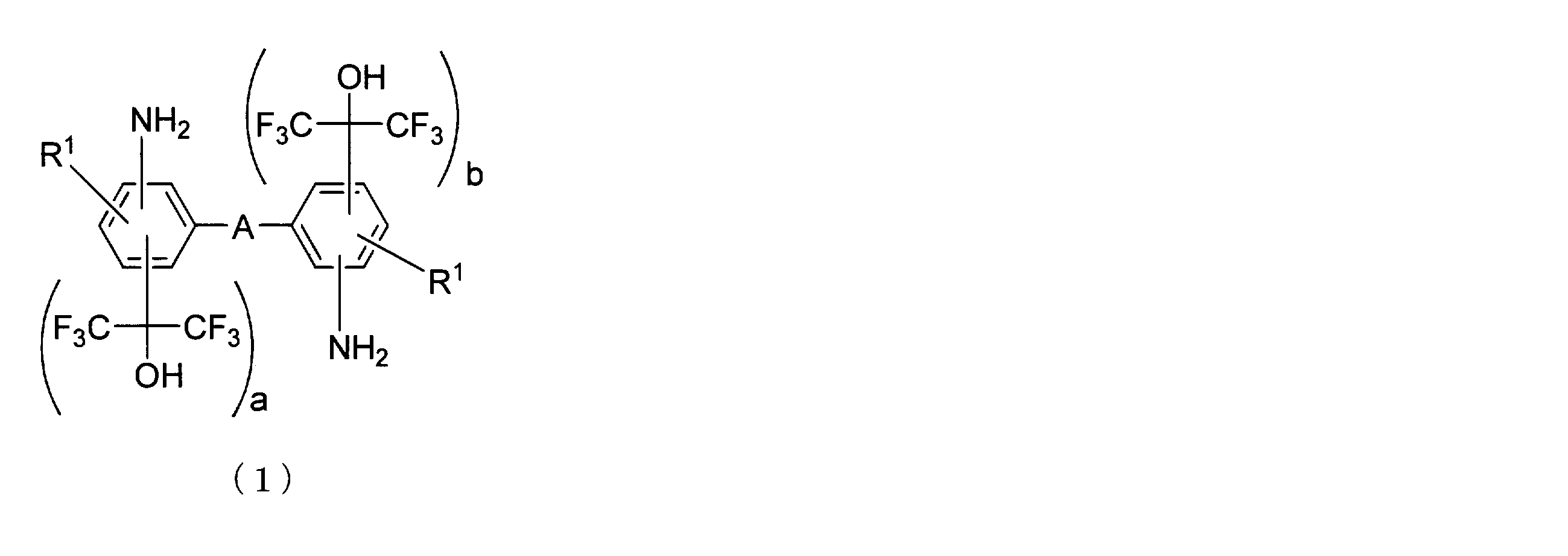
- HFIP group-containing diamine [HFIP group-containing diamine represented by formula (1)]
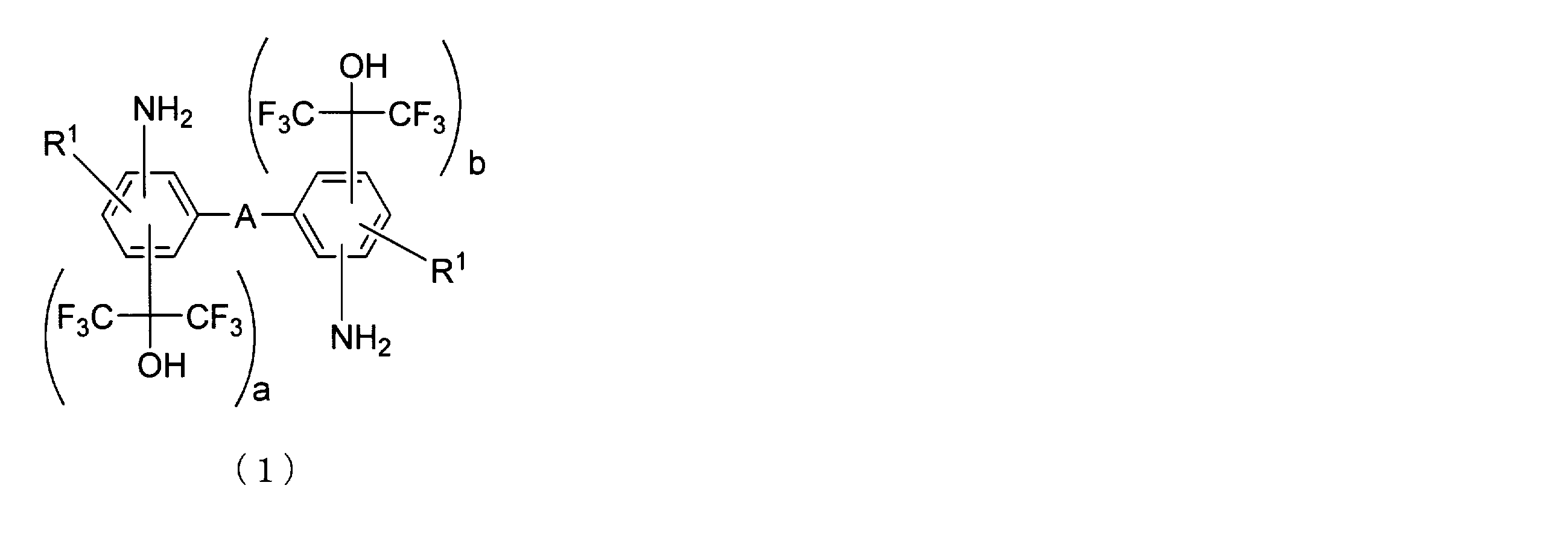
- the present invention is an HFIP group-containing diamine represented by the general formula (1).
- A is a single bond, an ether bond, a sulfide bond, CO, CH 2 , SO, SO 2 , C (CH 3 ) 2 , NHCO, or C (CF 3 ) 2 , an alicyclic ring, a heterocyclic ring, or A divalent group having an aromatic ring
- each R 1 independently represents an alkyl group having 1 to 4 carbon atoms, or a halogen group
- a and b each independently represent an integer of 0 to 2; 1 ⁇ a + b ⁇ 4.
- Examples of the alkyl group having 1 to 4 carbon atoms include a methyl group (—CH 3 , hereinafter sometimes referred to as —Me), an ethyl group (—C 2 H 5 , hereinafter referred to as — Et)),
- an HFIP group-containing diamine in which a and b are 1 is easy to synthesize, and preferably an HFIP group-containing diamine represented by the following general formula (2) is there.
- an HFIP group-containing diamine represented by the following general formula (3) or general formula (4) is preferable because it is easy to synthesize.
- Examples of HFIP group-containing diamines represented by general formula (3) include the following compounds.
- an HFIP group-containing diamine in which A is a single bond or CH 2 and R 1 is a methyl group is easy to synthesize.
- the emission quantum yield is 0.1%. It is possible to obtain the above.
- Examples of HFIP group-containing diamines represented by the general formula (4) include the following compounds.
- an HFIP group-containing diamine in which A is a single bond and R 1 is a methyl group is easy to synthesize.
- the diamine represented by the general formula (1) is obtained by reacting the diamine represented by the formula (5) which is a raw material compound with hexafluoroacetone or hexafluoroacetone trihydrate. be able to.
- the amount of hexafluoroacetone or hexafluoroacetone trihydrate used in this reaction is preferably 2 mol or more and 10 mol or less with respect to 1 mol of the diamine represented by the general formula (5) as a raw material compound, More preferably, it is 2.5 mol or more and 5 mol or less. If the amount is less than 2 mol, the yield of the diamine represented by the general formula (1), which is the target compound, is low, and the reaction proceeds even if it is used in excess of 10 mol, but it is not necessary to use it.
- This reaction is usually carried out in the range of 20 ° C. or higher and 180 ° C. or lower, preferably 50 ° C. or higher and 150 ° C. or lower, particularly preferably 90 ° C. or higher and 140 ° C. or lower.
- the temperature is lower than 20 ° C., the reaction hardly proceeds, which is not preferable.
- the reaction can be carried out without using a catalyst, it is preferable to promote the reaction by using an acid catalyst.
- the acid catalyst to be used include Lewis acids such as aluminum chloride, iron (III) chloride, boron fluoride and the like, organic sulfonic acids such as benzenesulfonic acid, camphorsulfonic acid (CAS), methanesulfonic acid, p- Examples thereof include toluenesulfonic acid (pTsOH), p-toluenesulfonic acid monohydrate (pTsOH.H 2 O), and pyridinium p-toluenesulfonic acid (PPTS).
- Lewis acids such as aluminum chloride, iron (III) chloride, boron fluoride and the like
- organic sulfonic acids such as benzenesulfonic acid, camphorsulfonic acid (CAS), methanesulfonic acid, p- Examples thereof include toluenesulfonic acid (pTs
- the catalyst amount is expressed in mol% with respect to the diamine represented by the general formula (5) which is a raw material compound, and is preferably 1 mol% or more and 50 mol% or less, more preferably 3 mol% or more and 40 mol% or less. . When the amount is less than 1 mol%, the reaction does not proceed and it is not necessary to use more than 50 mol%.
- This reaction can be carried out without using a solvent, but a solvent can also be used.
- the solvent to be used is not particularly limited as long as it does not participate in the reaction, and aromatic hydrocarbon solvents such as benzene, toluene, xylene, nitrobenzene or benzonitrile, or water can be used. There is no restriction
- the operation differs depending on whether hexafluoroacetone or hexafluoroacetone trihydrate is used.
- hexafluoroacetone first, an HFIP group-containing diamine represented by the general formula (5) and an acid catalyst and a solvent as necessary are charged into the reaction vessel, and then the internal pressure of the reaction vessel does not exceed a predetermined pressure. In this manner, hexafluoroacetone is successively added and reacted while the temperature is raised as described above to obtain the HFIP group-containing diamine represented by the general formula (1).
- a HFIP group-containing diamine represented by the general formula (5) and a required amount of hexafluoroacetone trihydrate may be charged into the reactor. Further, if necessary, the reaction is carried out by adding an acid catalyst and a solvent into the reaction vessel to obtain an HFIP group-containing diamine represented by the general formula (1).
- the reaction time of this reaction is preferably 8 hours or more and 48 hours or less, and within this range, the preferable reaction time varies depending on the temperature, the amount of solvent used, and the like. Therefore, it is preferable to carry out the reaction while confirming the progress of the reaction by means of analysis such as gas chromatography, and to terminate the reaction after confirming that the raw material compound is sufficiently consumed in the reaction.
- the diamine represented by the general formula (1) can be obtained by means such as extraction, distillation or precipitation. Moreover, it can also refine
- HFIP group-containing polyamic acid The HFIP group-containing polyamic acid of the present invention can be synthesized by reacting with a tetracarboxylic acid using the HFIP group-containing diamine of the present invention.
- the present invention relates to a general formula (6) (In the formula, A is independently a single bond, ether bond, sulfide bond, CO, CH 2, SO, SO 2, C (CH 3) 2, NHCO or C (CF 3) 2 or alicyclic, , A divalent group having a heterocyclic ring or an aromatic ring, R 1 is independently an alkyl group having 1 to 4 carbon atoms or a halogen group, and R 2 is an alicyclic ring, a heterocyclic ring, an aromatic ring or a direct ring A tetravalent organic group containing at least one group selected from the group consisting of a chain or branched aliphatic hydrocarbon group, wherein a part of the hydrogen atoms is an alkyl group, a fluoroalkyl group, a carboxyl group, a hydroxy group A group, a cyano group, or a halogen group may be substituted, and a and b are each independently an integer of 0 to
- the present invention also provides a general formula (7) of the invention 8. (Wherein Me is a methyl group, R 3 is independently Is a divalent group. )
- HFIP group-containing polyamic acid represented by the general formula (7) of the invention 8 include compounds containing the following repeating units.
- the present invention provides a compound represented by the general formula (8) (Wherein Me is a methyl group, R 4 is It is. )
- the HFIP group containing polyamic acid of the invention 9 containing the repeating unit represented by these.
- HFIP group-containing polyamic acid (8) of the invention 9 include compounds containing the following repeating units.
- the HFIP group-containing polyamic acid of the present invention preferably has a weight average molecular weight (Mw) of 10,000 or more and 500,000 or less in terms of polystyrene.
- Mw weight average molecular weight
- the strength of the obtained HFIP group-containing polyimide is low and it is difficult to form a self-supporting film, and when it is larger than 500,000, the obtained HFIP group-containing polyimide is inferior in solubility.
- Mw weight average molecular weight
- the HFIP group-containing polyimide of the present invention can be obtained by imidizing the HFIP group-containing polyamic acid.
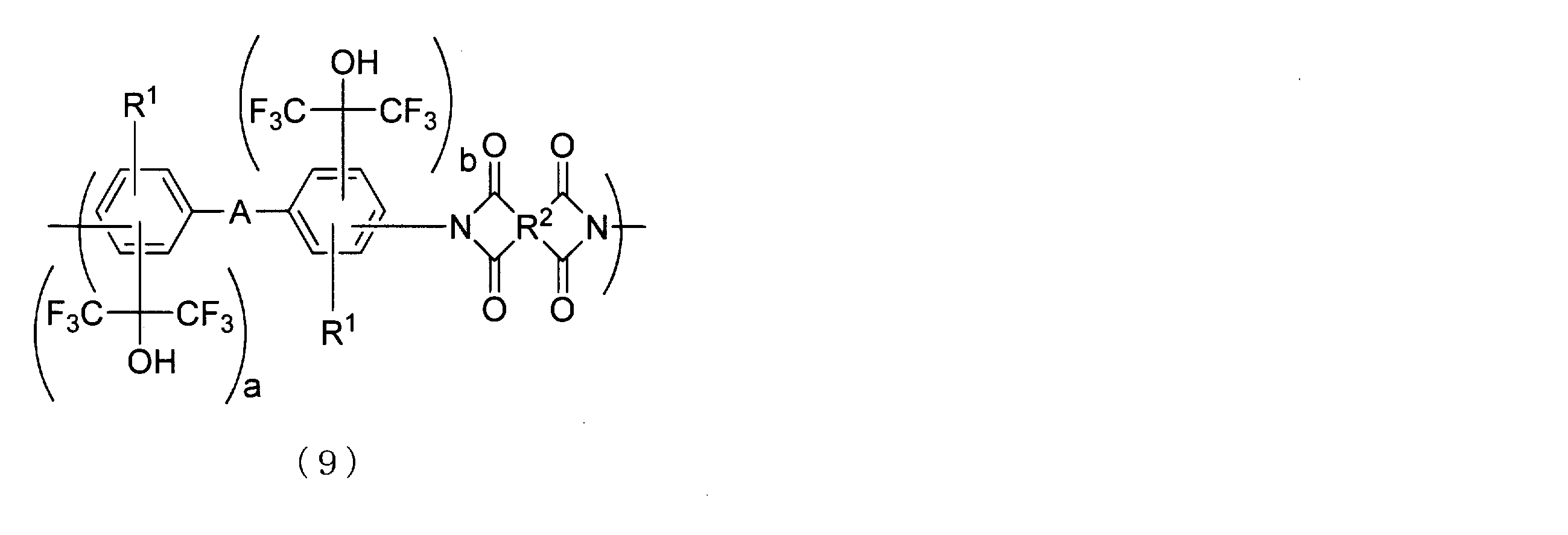
- the present invention relates to a general formula (9) (In the formula, A is independently a single bond, ether bond, sulfide bond, CO, CH 2, SO, SO 2, C (CH 3) 2, NHCO or C (CF 3) 2 or alicyclic, , A divalent group having a heterocyclic ring or an aromatic ring, R 1 is each independently an alkyl group having 1 to 4 carbon atoms or a halogen group, and R 2 is an alicyclic ring, a heterocyclic ring, an aromatic ring or a straight chain.
- the HFIP group containing polyimide of the invention 10 containing the repeating unit represented by these.
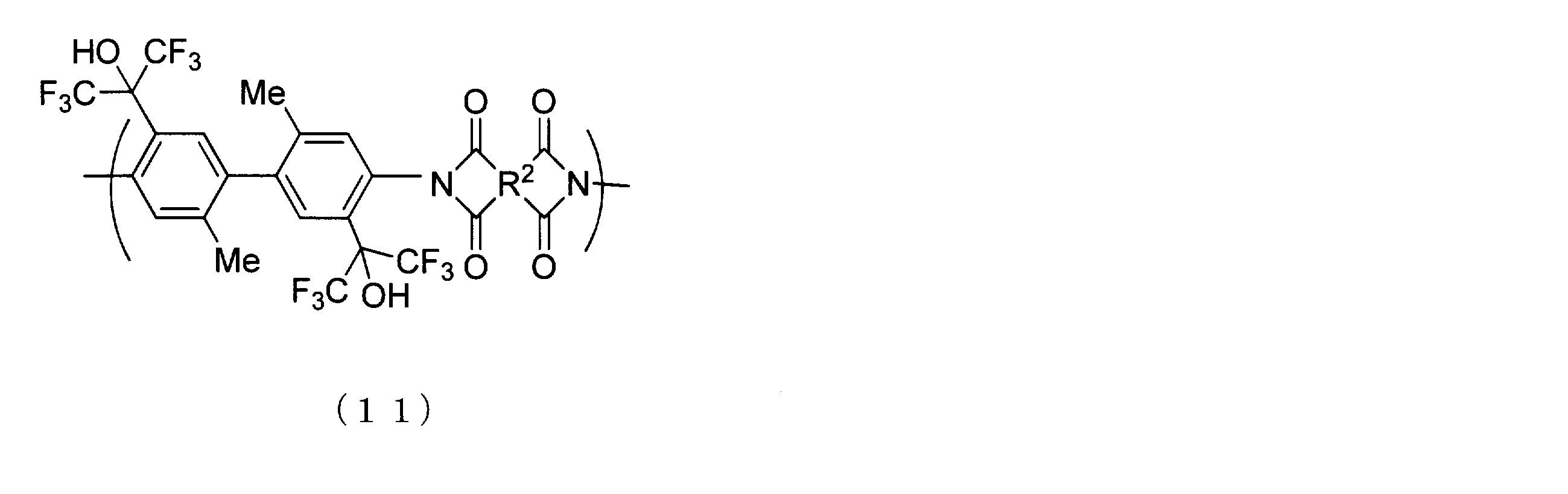
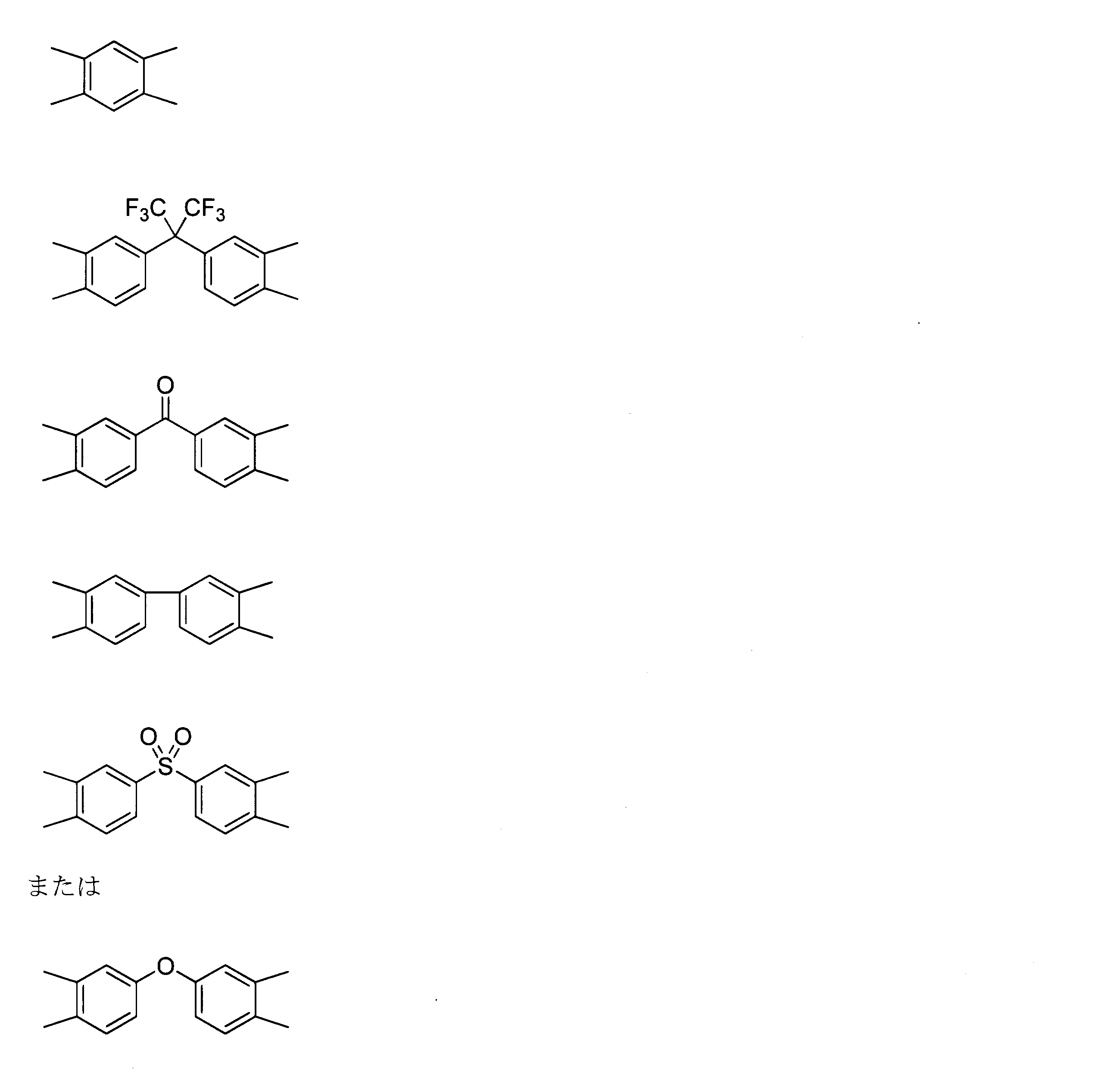
- the present invention provides a compound represented by the general formula (10) (Wherein Me is a methyl group, R 2 is It is. ) It is a HFIP group containing polyimide of the invention 11 containing the repeating unit represented by these.
- HFIP group-containing polyimide of the invention 11 include compounds containing the following repeating units.
- the present invention also provides a compound represented by the general formula (11) (Wherein Me is a methyl group, R 2 is It is. )
- the HFIP group containing polyimide of the invention 12 containing the repeating unit represented by these.
- the HFIP group-containing polyimide of the invention 12 is specifically a HFIP group-containing polyimide containing the following repeating units.
- the HFIP group-containing polyimide of the present invention preferably has a weight average molecular weight (Mw) of 10,000 or more and 500,000 or less in terms of polystyrene.
- Mw weight average molecular weight
- the strength of the HFIP group-containing polyimide is low and it is difficult to form a self-supporting film, and when it is more than 500,000, the HFIP group-containing polyimide is inferior in solubility.
- Mw weight average molecular weight
- Mw weight average molecular weight
- Method for producing HFIP group-containing polyimide General formula (1) (In the formula, A is a single bond, an ether bond, a sulfide bond, CO, CH 2 , SO, SO 2 , C (CH 3 ) 2 , NHCO, or C (CF 3 ) 2 , an alicyclic ring, a heterocyclic ring, or R 1 is a divalent group having an aromatic ring; R 1 is an alkyl group having 1 to 4 carbon atoms or a halogen group; a and b each independently represent an integer of 0 to 2; 1 ⁇ a + b ⁇ 4)
- An HFIP group-containing diamine represented by: Formula (11) (In the formula, R 2 is a tetravalent organic group containing at least one selected from the group consisting of an alicyclic ring, a heterocyclic ring, an aromatic ring, or a linear or branched aliphatic hydrocarbon group; May be substituted with an alkyl group,
- a HFIP group-containing polyamic acid is produced and the polyamic acid is dehydrated.
- A, R 1 and R 2 are the same as those in formula (1), formula (6), formula (11), a and b are each independently an integer of 0 to 2, and 1 ⁇ a + b ⁇ 4.
- the HFIP group-containing polyamic acid of the inventions 7 to 9 is obtained by reacting the HFIP group-containing diamine of the inventions 1 to 5 with the tetracarboxylic dianhydride represented by the general formula (11).
- the HFIP group-containing polyimides of Inventions 10 to 12 are obtained.
- the HFIP group-containing polyamic acid of the present invention is obtained by reacting methane and pyromellitic anhydride in dimethylacetamide (hereinafter sometimes referred to as DMAc).
- the tetracarboxylic dianhydride represented by the general formula (11) can be used without particular limitation as long as it is generally known as a polyamic acid or polyimide raw material compound.
- tetracarboxylic dianhydrides examples include benzenetetracarboxylic dianhydride (pyromellitic dianhydride) (hereinafter sometimes referred to as PMDA), trifluoromethylbenzenetetracarboxylic dianhydride, bistrihydrate.
- PMDA benzenetetracarboxylic dianhydride
- PMDA trifluoromethylbenzenetetracarboxylic dianhydride
- Two or more of these tetracarboxylic dianhydrides may be used in combination.
- PMDA, BPDA, 6FDA, BTDA, ODPA, and DSDA are preferably used because they are easily available, excellent in heat resistance, and easily soluble in solvents.
- HFIP group-containing polyamic acid can be polymerized from the HFIP group-containing diamine and the tetracarboxylic dianhydride represented by the general formula (11).
- a method in which the HFIP group-containing diamine and tetracarboxylic dianhydride are reacted in an organic solvent at a temperature of ⁇ 20 ° C. or higher and 80 ° C. or lower can be given.
- the organic solvent to be used is only required to dissolve the HFIP group-containing diamine and tetracarboxylic dianhydride, and amide solvents such as N, N-dimethylformamide, N, N-dimethylacetamide, N, N-dimethylformamide, Hexamethylphosphoric triamide, N-methyl-2-pyrrolidone, etc., aromatic solvents such as benzene, anisole, diphenyl ether, nitrobenzene or benzonitrile, halogenated solvents such as chloroform, dichloromethane, 1,2-dichloroethane, or 1 1,2,2,2-tetrachloroethane, or lactone solvents such as ⁇ -butyllactone, ⁇ -valerolactone, ⁇ -caprolactone, ⁇ -caprolactone, ⁇ -methyl- ⁇ -butyllactone, and the like.
- an acid acceptor such as pyridine or triethylamine
- the HFIP group-containing diamine of the present invention may be a copolymer of a polyamic acid combined with another diamine having no HFIP group or dihydroxyamine.
- Examples of the diamine compound that can be used in combination include 3,5-diaminobenzotrifluoride.
- the HFIP group-containing polyamic acid represented by the general formula (6) described above is dehydrated within the compound by heat treatment or reaction with a dehydrating reagent, and an imide ring is formed, and is represented by the general formula (9).
- An HFIP group-containing polyimide can be synthesized.
- an imide ring is formed at a reaction temperature of 80 ° C. or higher and 350 ° C. or lower, and a HFIP group-containing polyimide represented by the general formula (9) can be synthesized.
- it can.
- it is 150 degreeC or more, More preferably, it is 200 degreeC or more.
- the reaction temperature is less than 80 ° C.
- the imidization ratio is insufficient, and when the polyimide is used as a coating film, the film strength may be impaired, or the water absorption may be increased.
- the reaction temperature exceeds 350 ° C., a part of the polyimide is thermally decomposed, and when the polyimide is used as a coating film, the film strength may be lost or the film may be colored.
- the addition amount of the dehydrating reagent is 2 mol or more and 10 mol or less and the addition amount of the base is 2 mol or more and 10 mol or less with respect to 1 mol of acid dianhydride as the raw material of the polyamic acid.
- the HFIP group-containing polyimide of the present invention can be used in a varnish state, a powder state, a film state, or a solid state dissolved in an organic solvent.
- an additive such as an oxidation stabilizer, a filler, a silane coupling agent, a photosensitizer, a photopolymerization initiator, or a sensitizer may be added to the obtained HFIP group-containing polyimide as necessary.
- an additive such as an oxidation stabilizer, a filler, a silane coupling agent, a photosensitizer, a photopolymerization initiator, or a sensitizer may be added to the obtained HFIP group-containing polyimide as necessary.
- a varnish it can be applied on a glass, silicon wafer, metal, metal oxide, ceramics or resin by a known method such as spin coating, spray coating, flow coating, impregnation coating or brush coating. .
- the present invention relates to a HFIP group-containing polyamide and a polymerization method thereof.
- A is a single bond, ether bond, sulfide bond, CO, CH 2 , SO, SO 2 , C (CH 3 ) 2 , NHCO, or C (CF 3 ) 2 , or an alicyclic ring, heterocyclic ring or aromatic ring.
- R 1 independently represents an alkyl group having 1 to 4 carbon atoms or a halogen group
- R 5 represents an alicyclic ring, a heterocyclic ring, an aromatic ring, or a linear or branched chain.
- the HFIP group-containing polyamide of the invention 15 comprising a repeating unit represented by:
- the present invention provides a general formula (1) (In the formula, A is a single bond, an ether bond, a sulfide bond, CO, CH 2 , SO, SO 2 , C (CH 3 ) 2 , NHCO, or C (CF 3 ) 2 , an alicyclic ring, a heterocyclic ring, or R 1 is a divalent group having an aromatic ring, R 1 is independently an alkyl group having 1 to 4 carbon atoms or a halogen group, and a and b each independently represent an integer of 0 to 2.
- R 5 is a divalent organic group containing at least one selected from the group consisting of an alicyclic ring, a heterocyclic ring, an aromatic ring or a linear or branched aliphatic hydrocarbon group, May be substituted with an alkyl group, a fluoroalkyl group, a carboxyl group, a hydroxy group, a cyano group, or a halogen group, and each R 6 independently represents a hydrogen atom, an alkyl group having 1 to 10 carbon atoms, or It is at least one group selected from benzyl groups.
- Dicarboxylic acid or derivative thereof, or general formula (14) (Wherein R 5 is a divalent organic group containing at least one selected from the group consisting of an alicyclic ring, a heterocyclic ring, an aromatic ring, or a linear or branched aliphatic hydrocarbon group, A part
- polyamide is obtained by polymerizing the raw material compound with the HFIP group-containing diamine of the present invention and the dicarboxylic acid represented by the general formula (13) or a derivative thereof, or the compound represented by the general formula (14). It is done.
- dicarboxylic acid dihalide, dicarboxylic acid monoester, and dicarboxylic acid diester can be used.
- dicarboxylic acid represented by the general formula (13) examples include aliphatic carboxylic acids such as oxalic acid, malonic acid, succinic acid, glutaric acid, adipic acid, pimelic acid, suberic acid, azelaic acid, An example is sebacic acid.
- aromatic dicarboxylic acids phthalic acid, isophthalic acid, terephthalic acid, 4,4'-dicarboxybiphenyl, 3,3'-dicarboxybiphenyl, 3,3'-dicarboxyldiphenyl ether, 3,4'-dicarboxyl Diphenyl ether, 4,4′-dicarboxyldiphenyl ether, 3,3′-dicarboxyldiphenylmethane, 3,4′-dicarboxyldiphenylmethane, 4,4′-dicarboxyldiphenylmethane, 4,4′-dicarboxyldiphenylmethane, 3,3′-dicarboxyldiphenyldifluoromethane, 3, , 4′-dicarboxyldiphenyldifluoromethane, 4,4′-dicarboxyldiphenyldifluoromethane, 3,3′-dicarboxyldiphenylsulfone, 3,4
- Polymerization reaction method and conditions are not particularly limited. For example, a method in which the component and the amide-forming derivative of the dicarboxylic acid are melted (melted) at 150 ° C. or higher and lower than 250 ° C. and reacted in a solvent-free manner, or in an organic solvent at ⁇ 20 ° C. to 80 ° C. Can be illustrated.
- the organic solvent that can be used it is sufficient that the diamine as the raw material compound and the carboxylic acid represented by the general formula (13), its derivative, or the compound represented by the general formula (14) are dissolved together.
- aromatic solvents such as benzene, anisole, diphenyl ether, nitrobenzene, benzonitrile
- Halogen solvents such as chloroform, dichloromethane, 1,2-dichloroethane or 1,1,2,2-tetrachloroethane, or lactone solvents such as ⁇ -butyllactone, ⁇ -valerolactone, ⁇ -caprolactone, ⁇ -caprolactone Or ⁇ -methyl- Examples thereof include ⁇ -butyl lactone.
- the HFIP group-containing polyamide of the present invention preferably has a weight average molecular weight (Mw) of 10,000 or more and 500,000 or less in terms of polystyrene.
- Mw weight average molecular weight
- the strength of the obtained HFIP group-containing polyamide is low and it is difficult to form a self-supporting film, and when it is larger than 500,000, the obtained HFIP group-containing polyamide is inferior in solubility.
- Mw weight average molecular weight
- Mw weight average molecular weight
- HFIP group-containing polymer and method for producing the same (In the formula, A is a single bond, an ether bond, a sulfide bond, CO, CH 2 , SO, SO 2 , C (CH 3 ) 2 , NHCO, or C (CF 3 ) 2 , an alicyclic ring, a heterocyclic ring, or A divalent group having an aromatic ring, each R 1 is independently an alkyl group having 1 to 4 carbon atoms or a halogen group, and R 5 is an alicyclic ring, heterocyclic ring, aromatic ring, linear or branched It is a divalent organic group containing at least one selected from the group consisting of branched aliphatic hydrocarbon groups, and part of the hydrogen atoms in the organic group is an alkyl group, a fluoroalkyl group, a carboxyl group, a hydroxy group, (It may be substituted with a cyano group or a halogen group.) It is
- the polymer compound represented by the general formula (12) of the present invention can be made into a polymer compound represented by the general formula (15) by cyclization.
- the cyclization reaction can be performed by heating, or can be performed by a method of promoting dehydration such as heating by adding an acid catalyst.
- the HFIP group-containing polyamic acid represented by the general formula (12) described above undergoes dehydration in the compound by heat treatment or reaction with a dehydrating reagent, and a ring structure is formed.
- a ring structure is formed.
- a polymer represented by the general formula (15) can be synthesized. More preferably, it is 300 degreeC or more and 380 degreeC or less.
- the reaction temperature is lower than 250 ° C.
- the cyclization does not proceed sufficiently, and there is a possibility that the film strength is impaired or the water absorption is increased when the polymer is used as a coating film.
- the reaction temperature exceeds 400 ° C.
- a part of the polymer may be thermally decomposed, and when the polymer is used as a coating film, the film strength may be impaired or the film may be colored.
- cyclization is performed by dehydrating in the polyamic acid using a dehydrating reagent, acetic anhydride is added as a dehydrating reagent, a base such as pyridine or triethylamine is further added, and the reaction is performed with the polyamic acid.
- the polymer can be synthesized by cyclization by dehydration in an acid.
- the polymer preferably has a weight average molecular weight (Mw) of 10,000 or more and 500,000 or less in terms of polystyrene.
- Mw weight average molecular weight
- the strength of the polymer is low and it is difficult to form a self-supporting film, and when it is larger than 500,000, the polymer is inferior in solubility.
- they are 50000 or more and 150,000 or less.
- Fluorescent material By including the HFIP group-containing polyimides of the inventions 10 to 12, the HFIP group-containing polyamide of the invention 15 and the HFIP group-containing polymer of the invention 18, a fluorescent material having an emission quantum yield of 0.1% or more can be obtained. . Fluorescence having an emission peak at a wavelength of 400 nm to 550 nm is emitted by irradiation with visible light or ultraviolet light.
- Fluorescence emission wavelength and emission quantum yield for the HFIP group-containing polyimides of the present invention obtained in Examples 1, 3, 6, and 8, the conventional polyimides of Comparative Examples 1 to 5, and the polyimides containing only the HFIP groups of Reference Example 1. The ratio was measured, and the fluorescence characteristics were compared and evaluated.
- Example 1 ⁇ Synthesis of HFIP group-containing diamic acid> As shown in the following formula, bis (4-amino-3- (1,1,1,3,3,3-hexafluoro-2-hydroxy-2) synthesized in ⁇ Synthesis of HFIP group-containing diamine 1> HFIP group-containing polyamic acid was synthesized by polymerization reaction of (propyl) -5-methylphenyl) methane and pyromellitic anhydride (PMDA).
- PMDA pyromellitic anhydride
- n represents the degree of polymerization, and the same applies hereinafter.
- the solution was continuously heated at 130 ° C. for 30 minutes, 180 ° C. for 30 minutes, and 200 ° C. for 3 hours while gradually increasing the temperature on the glass substrate.
- a membrane was obtained.
- the film thickness was 21 ⁇ m.
- IR infrared absorption
- Example 2 ⁇ Synthesis of HFIP group-containing amic acid> As shown in the following formula, bis (4-amino-3- (1,1,1,3,3,3-hexafluoro-2-hydroxy-2) synthesized in ⁇ Synthesis of HFIP group-containing diamine 1> HFIP group-containing polyamic acid was synthesized by a polymerization reaction of (propyl) -5-methylphenyl) methane and the following carboxylic anhydride (6FDA).
- 6FDA carboxylic anhydride
- the solution is applied onto a glass substrate using a spin coater, and continuously heated at 130 ° C. for 30 minutes, 180 ° C. for 30 minutes, and 200 ° C. for 3 hours with stepwise temperature increase, and a film is formed on the glass substrate.
- the film thickness was 18 ⁇ m.
- the film was composed of the above-mentioned HFIP group-containing polyimide having absorption specific to imide groups at 1790 cm ⁇ 1 and 1717 cm ⁇ 1 .
- Example 3 ⁇ Synthesis of HFIP group-containing diamic acid> As shown in the following formula, 3,3′-bis (1,1,1,3,3,3-hexafluoro-2-hydroxy-2-propyl synthesized in ⁇ Synthesis of HFIP group-containing diamine 2> ) A HFIP group-containing polyamic acid was synthesized by the polymerization reaction of -5,5'-dimethylbenzidine and pyromellitic anhydride.
- the film is continuously heated at 130 ° C. for 30 minutes, 180 ° C. for 30 minutes, and 200 ° C. for 3 hours while gradually increasing the temperature to form a film on the glass substrate. Obtained.
- the film thickness was 13 ⁇ m. From the IR spectrum measurement results, it was confirmed that the films were composed of the above-mentioned HFIP group-containing polyimides having absorptions specific to imide groups at 1723 cm ⁇ 1 and 1789 cm ⁇ 1 .
- Example 4 ⁇ Synthesis of HFIP group-containing diamic acid> As shown in the following formula, 3,3′-bis (1,1,1,3,3,3-hexafluoro-2-hydroxy-2-propyl synthesized in ⁇ Synthesis of HFIP group-containing diamine 2> ) A HFIP group-containing polyamic acid was synthesized by a polymerization reaction of -5,5'-dimethylbenzidine and tetracarboxylic dianhydride (6FDA).
- HFIP group-containing polyamic acid is added to the above HFIP group-containing polyamic acid solution in the order of pyridine, 2.92 g and acetic anhydride 3.76 g and stirred at room temperature (20 ° C.) for 4 hours.
- Mw was 42,000.
- the solution After the solution is applied on a glass substrate using a spin coater, it is continuously heated at 130 ° C. for 30 minutes, 180 ° C. for 30 minutes, and 200 ° C. for 3 hours while being heated stepwise to form a film on the glass substrate. Got. The film thickness was 28 ⁇ m. From the IR spectrum measurement results, it was confirmed that 1791 cm ⁇ 1 and 1726 cm ⁇ 1 had absorptions specific to imide groups and were films made of the above HFIP group-containing polyimide.
- Example 5 ⁇ Synthesis of HFIP group-containing diamic acid> As shown in the following formula, 3,3′-bis (1,1,1,3,3,3-hexafluoro-2-hydroxy-2-propyl synthesized in ⁇ Synthesis of HFIP group-containing diamine 2> ) HFIP group-containing polyamic acid was synthesized by a polymerization reaction of -5,5'-dimethylbenzidine and tetracarboxylic dianhydride (BTDA).
- BTDA tetracarboxylic dianhydride
- reaction liquid was a solution of the HFIP group containing polyamic acid represented by said formula.
- Mw was 48,000.
- the HFIP group-containing polyamic acid solution is added with pyridine, 2.94 g and acetic anhydride (3.77 g) in this order, and stirred at room temperature (20 ° C.) for 4 hours, thereby containing an HFIP group-containing solution.
- Polyamic acid was imidized to obtain a solution containing HFIP group-containing polyimide.
- Mw was 50500.
- the film is continuously heated at 130 ° C. for 30 minutes, 180 ° C. for 30 minutes, and 200 ° C. for 3 hours while gradually increasing the temperature to form a film on the glass substrate. Obtained.
- the film thickness was 60 ⁇ m. From the IR spectrum measurement results, it was confirmed that the films were composed of the above HFIP group-containing polyimides, which had absorption specific to imide groups at 1723 cm ⁇ 1 and 1791 cm ⁇ 1 .
- Example 6 ⁇ Synthesis of HFIP group-containing diamic acid> 3,3′-bis (1,1,1,3,3,3-hexafluoro-2-hydroxy-2-propyl) -synthesized in ⁇ Synthesis of HFIP group-containing diamine 2> shown in the following formula
- An HFIP group-containing polyamic acid was synthesized by a polymerization reaction of 5,5′-dimethylbenzidine and tetracarboxylic dianhydride (BPDA).
- HFIP group-containing polyamic acid is added to the HFIP group-containing polyamic acid solution in the order of 2.92 g of pyridine and acetic anhydride (3.77 g) and stirred at room temperature (20 ° C.) for 4 hours.
- acetic anhydride 3.77 g
- Mw 98,000.
- the film is continuously heated at 130 ° C. for 30 minutes, 180 ° C. for 30 minutes, and 200 ° C. for 3 hours while gradually increasing the temperature to form a film on the glass substrate. Obtained.
- the film thickness was 51 ⁇ m. From the measurement results of the IR spectrum, it was confirmed that the film was composed of the FIP group-containing polyimide, with absorption inherent to imide groups at 1717 cm ⁇ 1 and 1781 cm ⁇ 1 .
- Example 7 ⁇ Synthesis of HFIP group-containing diamic acid> As shown in the following formula, 3,3′-bis (1,1,1,3,3,3-hexafluoro-2-hydroxy-2-propyl synthesized in ⁇ Synthesis of HFIP group-containing diamine 2> ) HFIP group-containing polyamic acid was synthesized by a polymerization reaction of -5,5'-dimethylbenzidine and tetracarboxylic dianhydride (DSDA). Specifically, 3,3′-bis (1,1,1,3,3,3-hexafluoro-2-hydroxy-2-propyl) as HFIP group-containing diamine was added to a 300 mL solution container.
- DSDA tetracarboxylic dianhydride
- a solution containing HFIP group-containing polyimide is added to the above HFIP group-containing polyamic acid solution in the order of 2.94 g of pyridine and 3.76 g of acetic anhydride and stirred at room temperature (20 ° C.) for 4 hours.
- Mw was 26500.
- the film is continuously heated at 130 ° C. for 30 minutes, 180 ° C. for 30 minutes, and 200 ° C. for 3 hours while gradually increasing the temperature to form a film on the glass substrate. Obtained.
- the film thickness was 33 ⁇ m. From the IR spectrum measurement results, it was confirmed that 1731 cm ⁇ 1 and 1791 cm ⁇ 1 had absorption specific to imide groups and were films made of the above HFIP group-containing polyimide.
- Example 8 ⁇ Synthesis of HFIP group-containing diamic acid> As shown in the following formula, 3,3′-bis (1,1,1,3,3,3-hexafluoro-2-hydroxy-2-propyl synthesized in ⁇ Synthesis of HFIP group-containing diamine 2> ) HFIP group-containing polyamic acid was synthesized by a polymerization reaction of -5,5'-dimethylbenzidine and tetracarboxylic dianhydride (ODPA).
- ODPA tetracarboxylic dianhydride
- the HFIP group-containing polyamic acid solution is added with pyridine, 2.92 g and 3.76 g of acetic anhydride in this order, and stirred at room temperature (20 ° C.) for 4 hours to contain the HFIP group-containing polyimide. A solution was obtained. As a result of GPC measurement of the solution, Mw was 47000.
- the film is continuously heated at 130 ° C. for 30 minutes, 180 ° C. for 30 minutes, and 200 ° C. for 3 hours while gradually increasing the temperature to form a film on the glass substrate. Obtained.
- the film thickness was 55 ⁇ m. From the IR spectrum measurement results, it was confirmed that the films were made of the above-mentioned HFIP group-containing polyimide, with absorptions specific to imide groups at 1719 cm ⁇ 1 and 1786 cm ⁇ 1 .
- Comparative Examples 1 to 5 and Reference Example 1 Polyimides of Comparative Examples 1 to 5 and Reference Example 1 shown in Table 1 that do not belong to the category of the present invention were synthesized.
- a polyimide shown in Table 1 was obtained by polymerizing diamine and tetracarboxylic dianhydride to synthesize polyamic acid, and then cyclizing by dehydrating in polyamic acid.
- each diamine and tetracarboxylic dianhydride shown in Table 1 were mixed at a molar ratio of 1: 1 in a reaction vessel having a volume of 300 mL, N, N-dimethylacetamide was added as a solvent, and a nitrogen atmosphere was added. Under stirring at room temperature (20 ° C.) for 20 hours, a solution containing polyimide acid was obtained. Next, pyridine and acetic anhydride were added to the solution in this order, and the mixture was stirred at room temperature (20 ° C.) for 4 hours and dehydrated in polyamic acid to cyclize to obtain respective solutions containing the polyimides shown in the table.
- each of the obtained solutions was applied onto a glass substrate using a spin coater, and then continuously heated at 130 ° C. for 30 minutes, 180 ° C. for 30 minutes, and 200 ° C. for 3 hours while gradually raising the temperature.
- a film made of each polyimide was obtained. From the measurement results of IR spectrum, there is an imido group-specific absorption around 1720 cm -1 and near 1780 cm -1, it was confirmed that the film made from each of the imide shown in Table 1.
- Example 1 Each polyimide is shown in Table 2 and Table 3.
- the polyimide in Example 1, Comparative Example 1, Comparative Example 2, and Comparative Example 3 has the same polyimide skeleton.
- Table 4 shows the measurement results of the fluorescence emission wavelength and the emission quantum yield, measured with ultraviolet light and excitation light having a wavelength of 365 nm, using a fluorescence spectrometer (trade name, FluoroMax-4, manufactured by Horiba, Ltd.).
- the fluorescence spectrum was measured using a polyimide film formed on a quartz substrate.
- the light emission quantum yield was measured by attaching an integrating sphere to a fluorescence spectrometer using a single polyimide film.
- the HFIP group-containing aromatic polyimide containing methyl groups of Examples 1, 3, 6, and 8 of the present invention has fluorescence characteristics that generate fluorescence, and the emission quantum yield is 0.1% or more. Met.
- the polyimides in Example 1, Comparative Example 1, Comparative Example 2, and Reference Example 1 have the same main polyimide skeleton. In the polyimides containing no HFIP groups in Comparative Examples 1 and 2, no luminescence could be detected regardless of the presence or absence of methyl groups. In the polyimides having HFIP groups of Example 1 and Reference Example 1, light emission was observed.
- the polyimide of the present invention containing both the HFIP group and the methyl group of Example 1 showed an extremely high emission quantum yield that was twice or more that of the polyimide containing only the HFIP group of Reference Example 1.
Landscapes
- Chemical & Material Sciences (AREA)
- Organic Chemistry (AREA)
- Health & Medical Sciences (AREA)
- Chemical Kinetics & Catalysis (AREA)
- Medicinal Chemistry (AREA)
- Polymers & Plastics (AREA)
- Engineering & Computer Science (AREA)
- Materials Engineering (AREA)
- Macromolecular Compounds Obtained By Forming Nitrogen-Containing Linkages In General (AREA)
- Electroluminescent Light Sources (AREA)
- Organic Low-Molecular-Weight Compounds And Preparation Thereof (AREA)
- Polyamides (AREA)
Abstract
開示されているのは、以下の一般式で表されるジアミンおよびそれを原料とするポリイミドおよびポリアミドその環化物、並びにその製造方法である。式中、Aは、単結合、エーテル結合、スルフィド結合、CO、CH2、SO、SO2、C(CH3)2、NHCO、もしくはC(CF3)2、または脂環、複素環もしくは芳香環を有する2価の基であり、R1は、炭素数1~4のアルキル基、またはハロゲン基であり、aとbは、それぞれ独立に、0~2の整数を表し、1≦a+b≦4である。前記ポリイミド及びポリアミドは、光デバイスにする際にウエットプロセスにより成膜可能な程に有機溶媒に易溶であり、膜とした際は耐熱性とともに強度を有し、且つ優れた蛍光特性を併せ持つ蛍光性ポリイミドおよび蛍光性ポリアミドである。
Description
本発明は、ヘキサフルオロイソプロパノール基(-C(CF3)2OH基)を含むジアミン、それを用いたポリイミドまたはポリアミド、その環化物、並びにその製造方法に関する。
本発明のヘキサフルオロイソプロパノール基を含むポリイミドおよびポリアミド、その環化物は、有機溶剤に可溶であり、耐熱性および強度があり、蛍光材料または有機発光素子として光デバイス等に利用できる。
近年、有機エレクトロルミネッセンス(EL)素子、発光型の光変換素子または波長変換素子等に使用される有機発光素子等の光デバイスとして、様々な発光性高分子化合物が開発されている。
高分子化合物が有機溶媒に可溶であるならば、スピンコート法、ディップ法またはインクジェット法等のウエットプロセスにより成膜でき、成膜時の膜厚の調整が容易である。
光デバイスを製造する際に、このような高分子化合物を用いウエットプロセスで成膜を行うことは、金属薄膜または低分子有機薄膜を成膜する際に真空装置を必要とする蒸着プロセスに比べて、光デバイスの製造コストが安価となる。そのため、耐熱性および強度に加え、有機溶媒に可溶であり、光デバイスに使用可能な、蛍光を発する発光性高分子化合物が求められている。
このような発光性高分子化合物としては、ポリ-p-フェニレンやポリフェニレンビニレン等のπ共役高分子化合物が一般的に知られている。しかし、このようなπ共役高分子化合物は、有機溶媒に対し易溶であるが、耐熱性、蛍光強度および発光スペクトル等の蛍光特性の長期安定性が十分でないという問題があった。
ポリイミドおよびポリアミドは、優れた耐熱性、強度および電気特性を有しているが、上記発光性高分子化合物と異なり、蛍光特性は低い。
例えば、非特許文献1に記載のように、ポリイミドは紫外線照射に対して僅かな蛍光しか発しなく、発光効率が極めて低いことが知られている。発光効率の指標であり、励起によって蛍光分子に吸収された光子数に対する蛍光によって放出された光子数の割合である、発光量子収率は、全芳香族ポリイミドにおいて、0.01%以下である。ポリイミドの非常に低い発光効率は、分子構造中の電子供与性のジアミン部位と電子受容性の酸無水物部位の間で形成される電荷移動錯体に起因する。非特許文献2に記載のように、代表的なポリイミドであるピロメリット酸無水物と4,4’-ジアミノフェニルエーテルが縮重合してなるポリイミドの蛍光は、蛍光量子収率9.7×10⁻⁷%という通常の蛍光分光計では測定が困難なほどに弱い蛍光しか発しないことが知られている。
ゆえに、ポリイミドの発光効率を上げるために様々な分子設計がなされている。
例えば、特許文献1および非特許文献3には、自立膜またはナノファイバー集積体からなる蛍光材料が開示されており、原料に脂環式ジアミンを用い立体障害を持たせ、電子供与性のジアミン部位をなくし、ポリイミド間の分子間電荷移動を防ぐことで発光量子収率10%程度の高い発光効率を有するポリイミドを合成できるとされている。
しかしながら、特許文献1および非特許文献3に記載のポリイミドは原料に脂環式ジアミンまたは脂環式酸二無水物を用いたポリイミドである、一方は芳香環と組み合わせた半脂環式ポリイミドであり、耐熱性や強度に優れているとは言い難いと言う問題があった。また、耐熱性および強度に優れた全芳香族ポリイミドにおいては、高い発光特性は達成されていないと言う問題があった。
ポリイミドに発光性を得るために、蛍光性を発現する化学構造を有する側鎖を導入する研究が行われている。
例えば、非特許文献4には、主鎖や側鎖に蛍光性のフリル基を導入して青色の発光を示すポリイミドが記載されている。特許文献2には、発光層機能または電荷輸送機能または電荷注入機能の少なくとも一つを有する重合体薄膜を用いたことを特徴とする有機EL素子が開示され、重合体薄膜にポリイミドが使用されている。特許文献3には、発光層と電荷輸送層とを有する有機発光素子において、電荷輸送層が特定の高分子よりなる有機発光素子が開示され、当該高分子としてポリイミドが使用されている。
しかしながら、非特許文献4、特許文献2および特許文献3に記載のポリイミドの蛍光発光は、ポリイミドの主鎖または側鎖に導入された蛍光性置換基によるものであり、蛍光性置換基を導入したポリイミドの光強度はイミド部位と蛍光性置換基の強い電荷移動によって発するものである。しかしながら、蛍光性置換基を導入したポリイミドと同一の蛍光性置換基を有する低分子化合物の蛍光強度に比べると非常に低いものであるという問題があった。
ポリイミドをデバイスに用いる場合、有機溶媒に対し溶解し難いという問題がある。ポリイミドは、テトラカルボン酸二無水物とジアミンとを極性溶媒中で重合反応させることにより、極性溶媒に可溶なポリアミド酸を生成させ、当該ポリアミド酸を加熱処理または、脱水剤を用いる等の化学的脱水処理により、脱水させることでイミド化して得られる。前駆体であるポリアミド酸は成膜および加工し易いが、ポリアミド酸の状態で成膜した後にポリイミドにした場合、イミド化前の成分であるポリアミド酸の化学変化が均質には起こらず、欠陥の多い膜となり易いという問題があった。
そのため、ポリイミドの状態で、成膜することが望ましい。このように、溶解性の高い構造のポリイミドが求められている。
ポリイミドに、有機溶媒に対する溶解性を付与するためには、ヒドロキシ基、カルボキシル基またはアミノ基等の極性基を導入することが有効である。特許文献4~6には、含フッ素重合性単量体としてヒドロキシ基を有するヘキサフルオロイソプロパノール基を含む芳香族ジアミン、およびそれを用いた高分子化合物、例えば、芳香族ポリイミドが開示され、当該芳香族ポリイミドは有機溶媒に易溶とされる。しかしながら、蛍光を発する性質である蛍光性に優れた芳香族ポリイミドについて報告された例はない。
M.Hasegawa and K. Horie, Progress in Polymer Science,26,259-335(2001)
G.Arjavalingam et al.,Polymer,31,840-844(1990)
J.Wakita et.al.,The Journal Physical Chemistry B 2009,113,15212-15224.
S.M.Pyo et.al.,Polymer,40,125-130(1999)
前述のように、蛍光を発する蛍光性ポリイミドとして、種々のポリイミドが報告されている。しかしながら、有機溶媒に易溶であり、膜とした際に耐熱性とともに強度を有し、且つ高い発光量子収率を示す蛍光性ポリイミドは知られていないという問題があった。
本発明の目的は、光デバイスにする際にウエットプロセスにより成膜可能な程に有機溶媒に易溶であり、膜とした際は耐熱性とともに強度を有し、且つ優れた蛍光特性を併せ持つ蛍光性ポリイミドおよび蛍光性ポリアミドを提供することを目的とする。また、当該蛍光性ポリイミドおよび蛍光性ポリアミドの原料であるジアミンを提供することを目的とする。
本発明者らは、鋭意検討した結果、ヘキサフルオロイソプロパノール基と、アルキル基またはハロゲン基を有する芳香環を含む新規ジアミンを合成した。次いで、当該ジアミンを原料化合物とし、テトラカルボン酸二無水物またはジカルボン酸およびその誘導体と重合させることで、ヘキサフルオロイソプロパノール基およびアルキル基を有する、ポリイミド、ポリアミド、または当該ポリアミドのアミド部位が環化してなる重合体を得た。尚、当該ポリイミドの前駆体であるポリアミド酸も本発明の範疇である。
得られたポリイミド、ポリアミド、または当該ポリアミドのアミド部位が環化してなる重合体は、有機溶剤に易溶である。さらに、膜とした際に耐熱性とともに強度を有する。また、ヘキサフルオロイソプロパノール基と、アルキル基またはハロゲン基である、フルオロ基(-F)、クロロ基(-Cl)、ブロモ基(-Br)もしくはヨード基(-I)との立体障害に加えて、HFIP基のフッ素原子の強い静電反発により、効率的に分子間電荷移動が抑制でき、蛍光特性を示すことから、蛍光材料または有機発光素子として光デバイス等に利用可能である。
さらに、前記ジアミンを原料化合物とし合成したポリイミド、ポリアミド、またはポリアミドのアミド部位が環化してなる重合体は、嵩高い、ヘキサフルオロイソプロパノール基と、アルキル基またはハロゲン基を有することから、通常は有機溶媒に難溶なポリイミドを有機溶媒に易溶とする作用がある。特許文献4~6等の従来技術に開示されるヘキサフルオロイソプロパノール基のみを含有するジアミンを原料化合物とするポリイミドおよびポリアミドに比較して、本発明のヘキサフルオロイソプロパノール基に加え、アルキル基およびハロゲン基を含むジアミンを原料化合物としてなるポリイミド、ポリアミド、またはポリアミドのアミド部位が環化してなる重合体は、前述のように有用な作用効果を奏する。
本発明は、発明1~20を含む。
[発明1]
一般式(1)

(式中、Aは、単結合、エーテル結合、スルフィド結合、CO、CH2、SO、SO2、C(CH3)2、NHCO、もしくはC(CF3)2、または脂環、複素環もしくは芳香環を有する2価の基であり、R1は、それぞれ独立に、炭素数1~4のアルキル基、またはハロゲン基であり、aとbは、それぞれ独立に、0~2の整数を表し、1≦a+b≦4である。)で表されるジアミン。
一般式(1)
[発明2]
一般式(2)
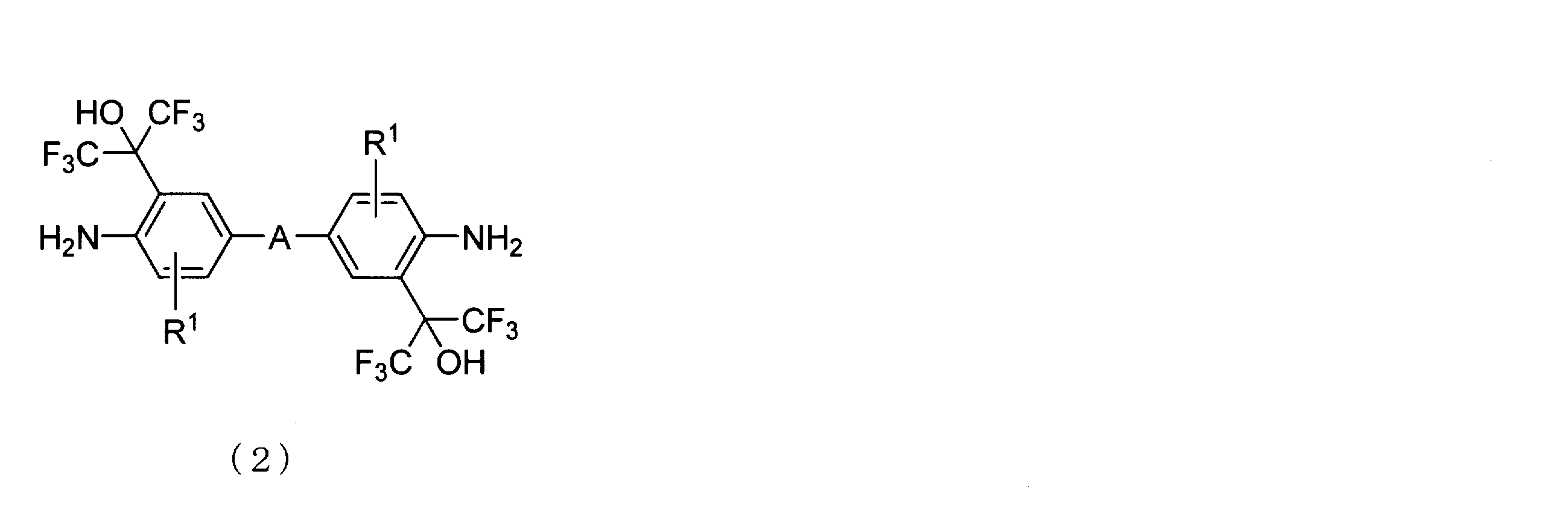
(式中、Aは、単結合、エーテル結合、スルフィド結合、CO、CH2、SO、SO2、C(CH3)2、NHCO、もしくはC(CF3)2、または脂環、複素環もしくは芳香環を有する2価の基であり、R1は、それぞれ独立に、炭素数1~4のアルキル基またはハロゲン基である。)
で表される、発明1のジアミン。
一般式(2)
で表される、発明1のジアミン。
[発明3]
一般式(3)
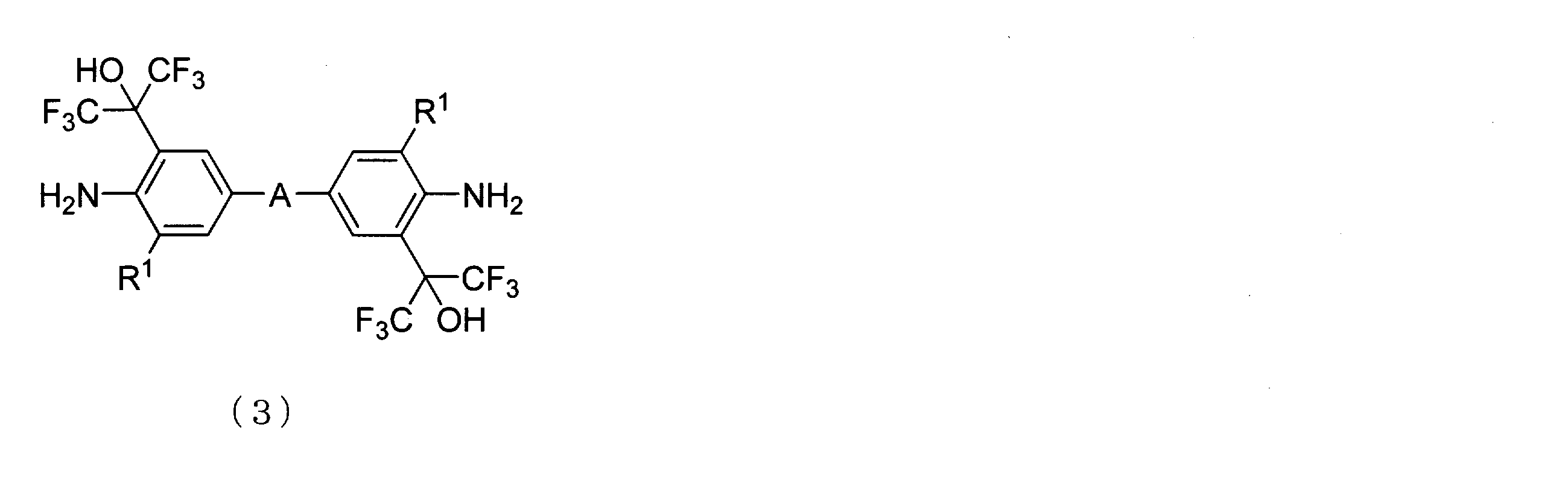
(式中、Aは、単結合、エーテル結合、スルフィド結合、CO、CH2、SO、SO2、C(CH3)2、NHCO、もしくはC(CF3)2、または脂環、複素環もしくは芳香環を有する2価の基であり、R1は、それぞれ独立に、炭素数1~4のアルキル基、またはハロゲン基である。)
で表される、発明2のジアミン。
一般式(3)
で表される、発明2のジアミン。
[発明4]
一般式(4)

(式中、Aは、単結合、エーテル結合、スルフィド結合、CO、CH2、SO、SO2、C(CH3)2、NHCOもしくはC(CF3)2、または脂環、複素環もしくは芳香環を有する2価の基であり、R1は、それぞれ独立に、炭素数1~4のアルキル基、またはハロゲン基である。)
で表される、発明2のジアミン。
一般式(4)
で表される、発明2のジアミン。
[発明5]
Aが単結合またはCH2、R1がメチル基である、発明3または発明4のジアミン。
Aが単結合またはCH2、R1がメチル基である、発明3または発明4のジアミン。
[発明6]
一般式(5)

(式中、Aは、単結合、エーテル結合、スルフィド結合、CO、CH2、SO、SO2、C(CH3)2、NHCO、もしくはC(CF3)2、または脂環、複素環もしくは芳香環を有する2価の基あり、R1は、それぞれ独立に、炭素数1~4のアルキル基、またはハロゲン基であり、aとbは、それぞれ独立に、0~2の整数を表し、1≦a+b≦4である。)
で表わされるジアミンと、
ヘキサフルオロアセトンまたはその水和物を反応させることを含む、
一般式(1)
(式中、Aは、単結合、エーテル結合、スルフィド結合、CO、CH2、SO、SO2、C(CH3)2、NHCO、もしくはC(CF3)2、または脂環、複素環もしくは芳香環を有する2価の基あり、R1は、それぞれ独立に、炭素数1~4のアルキル基、またはハロゲン基であり、aとbは、それぞれ独立に、0~2の整数を表し、1≦a+b≦4である。)で表される、
ジアミンの製造方法。
一般式(5)
で表わされるジアミンと、
ヘキサフルオロアセトンまたはその水和物を反応させることを含む、
一般式(1)
ジアミンの製造方法。
[発明7]
一般式(6)
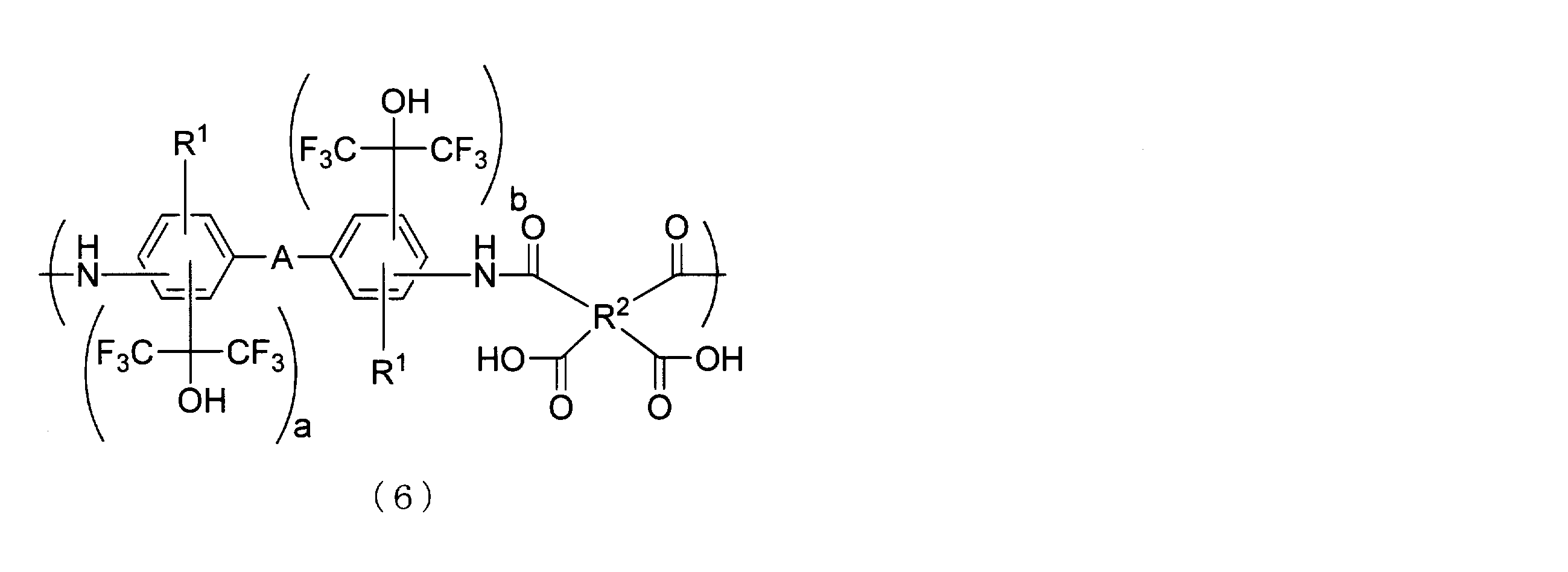
(式中、Aは、それぞれ独立に、単結合、エーテル結合、スルフィド結合、CO、CH2、SO、SO2、C(CH3)2、NHCO、もしくはC(CF3)2、または脂環、複素環もしくは芳香環を有する2価の基であり、R1は、それぞれ独立に、炭素数1~4のアルキル基、またはハロゲン基であり、R2は脂環、複素環、芳香環または直鎖状もしくは分枝鎖状脂肪族炭化水素基からなる群から選ばれた少なくとも一種の基を含む4価の有機基であり、有機基中の水素原子の一部がアルキル基、フルオロアルキル基、カルボキシル基、ヒドロキシ基、シアノ基、またはハロゲン基で置換されてもよく、aとbは、それぞれ独立に、0~2の整数であり、1≦a+b≦4である。)
で表わされる繰り返し単位を含む、
ポリアミド酸。
一般式(6)
で表わされる繰り返し単位を含む、
ポリアミド酸。
[発明8]
一般式(7)

(式中、Meはメチル基であり、
R3は、それぞれ独立に
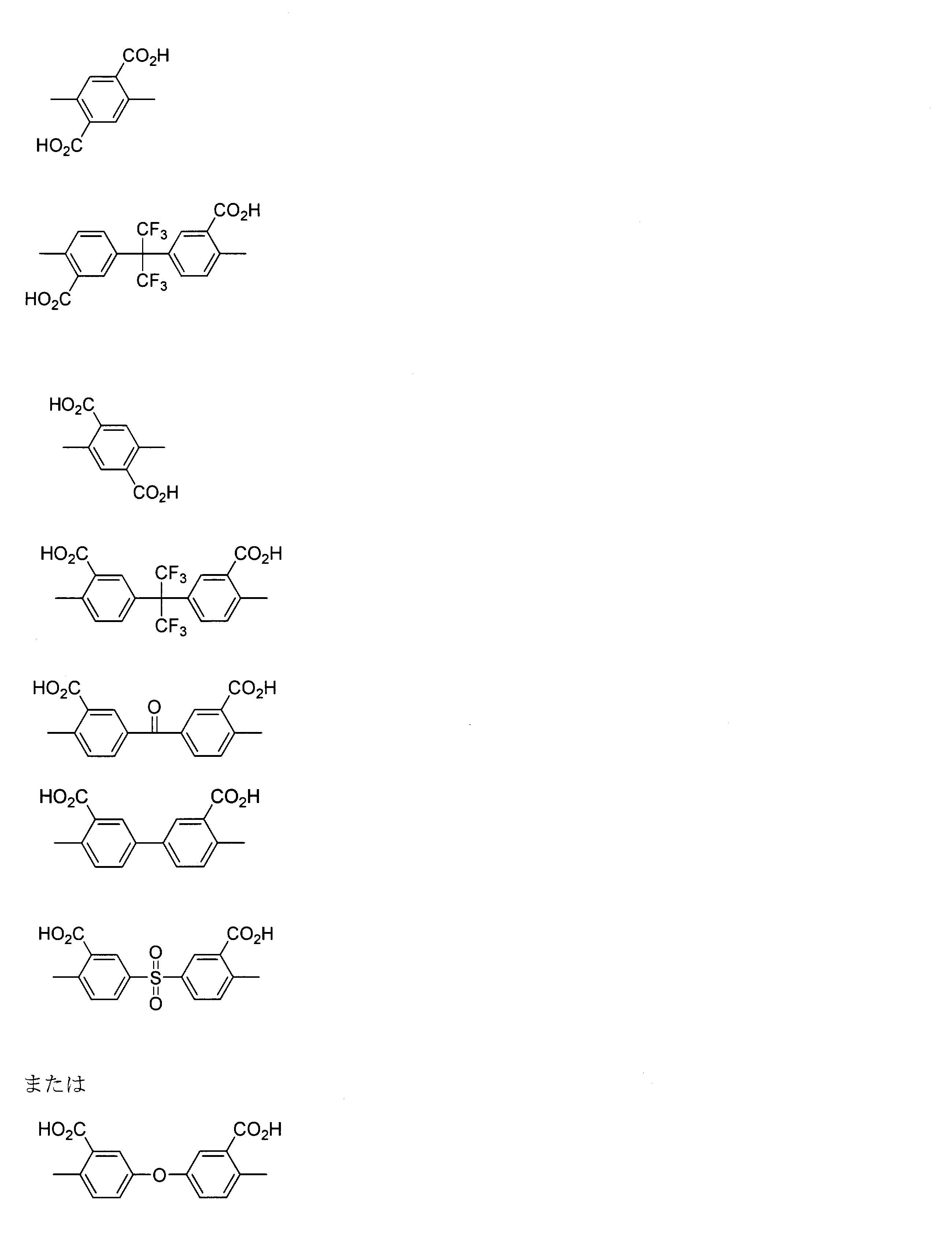
である2価の基である。)
で表わされる繰り返し単位を含む、発明7のポリアミド酸。
一般式(7)
R3は、それぞれ独立に
で表わされる繰り返し単位を含む、発明7のポリアミド酸。
[発明9]
一般式(8)
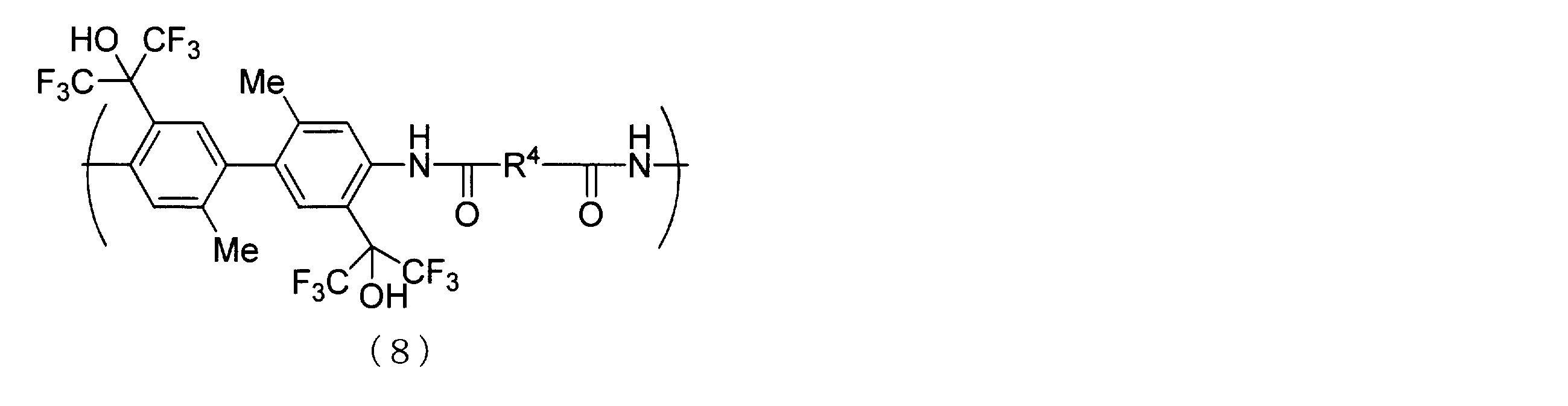
(式中、Meはメチル基であり、
R4は、

である。)
で表わされる繰り返し単位を含む、発明7のポリアミド酸。
一般式(8)
R4は、
で表わされる繰り返し単位を含む、発明7のポリアミド酸。
[発明10]
一般式(9)
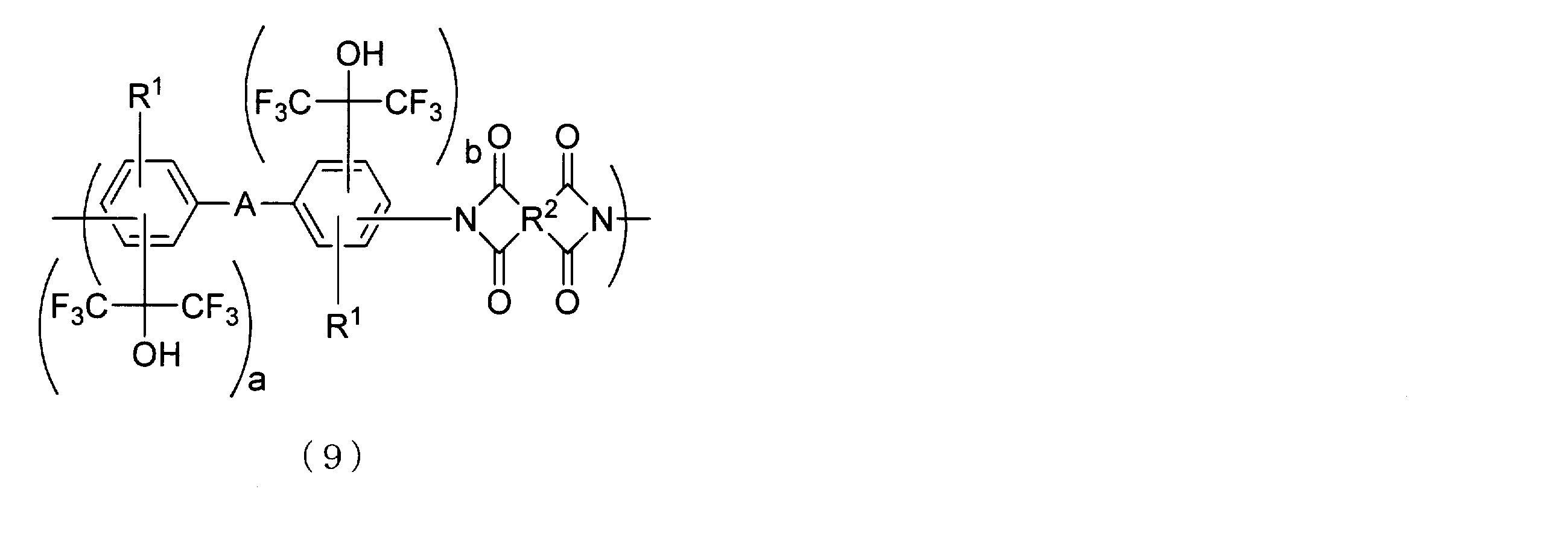
(式中、Aは、それぞれ独立に、単結合、エーテル結合、スルフィド結合、CO、CH2、SO、SO2、C(CH3)2、NHCO、もしくはC(CF3)2、または脂環、複素環または芳香環を有する2価の基であり、R1は、それぞれ独立に、炭素数1~4のアルキル基、またはハロゲン基であり、R2は脂環、複素環、芳香環または直鎖状もしくは分枝鎖状脂肪族炭化水素基からなる群から選ばれた少なくとも一種を含む4価の有機基であり、有機基中の水素原子の一部がアルキル基、フルオロアルキル基、カルボキシル基、ヒドロキシ基、シアノ基、またはハロゲン基で置換されてもよく、aとbは、それぞれ独立に、0~2の整数であり、1≦a+b≦4である。)
で表わされる繰り返し単位を含む、ポリイミド。
一般式(9)
で表わされる繰り返し単位を含む、ポリイミド。
[発明11]
一般式(10)
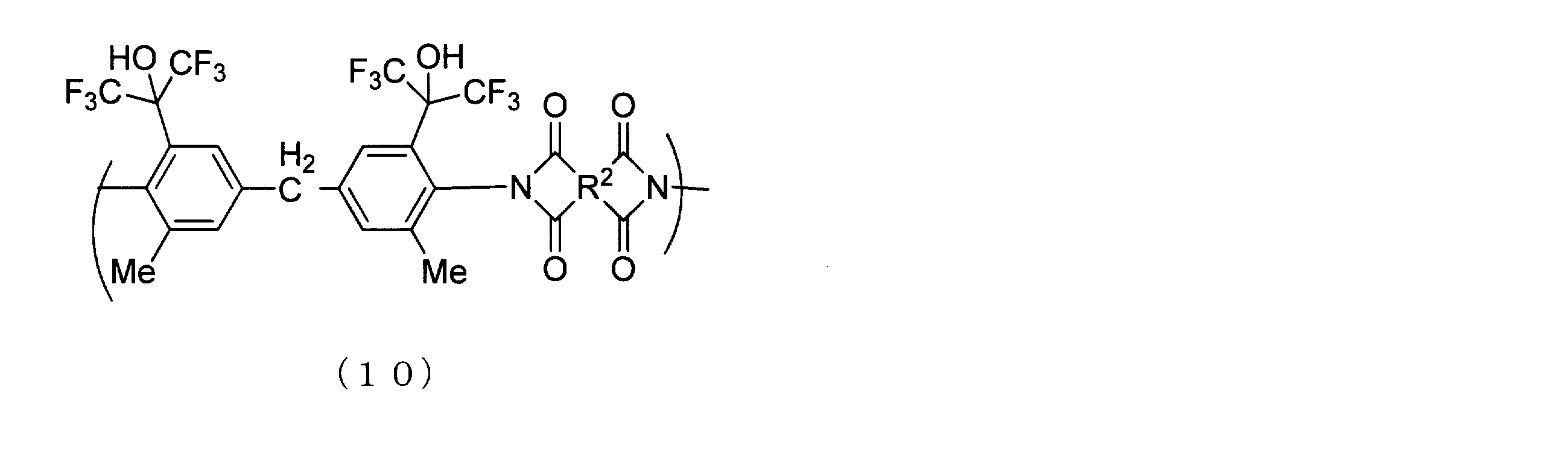
(式中、Meはメチル基であり、
R2は、

である。)
で表わされる繰り返し単位を含む、発明10のポリイミド。
一般式(10)
R2は、
で表わされる繰り返し単位を含む、発明10のポリイミド。
[発明12]
一般式(11)
(式中、Meはメチル基であり、
R2は、
である。)
で表わされる繰り返し単位を含む、発明10のポリイミド。
一般式(11)
R2は、
で表わされる繰り返し単位を含む、発明10のポリイミド。
[発明13]
発明10~12のポリイミドのいずれか一つを含む、発光量子収率0.1%以上の蛍光材料。
発明10~12のポリイミドのいずれか一つを含む、発光量子収率0.1%以上の蛍光材料。
[発明14]
一般式(1)
(式中、Aは、単結合、エーテル結合、スルフィド結合、CO、CH2、SO、SO2、C(CH3)2、NHCO、もしくはC(CF3)2、または脂環、複素環もしくは芳香環を有する2価の基であり、R1は、それぞれ独立に、炭素数1~4のアルキル基、またはハロゲン基であり、aとbは、それぞれ独立に、0~2の整数を表し、1≦a+b≦4である。)
で表されるジアミンと、
一般式(11)

(式中、R2は脂環、複素環、芳香環または直鎖状もしくは分枝鎖状脂肪族炭化水素基からなる群から選ばれた少なくとも一種を含む4価の有機基であり、有機基中の水素原子の一部がアルキル基、フルオロアルキル基、カルボキシル基、ヒドロキシ基、シアノ基、またはハロゲン基で置換されてもよい。)
で表されるテトラカルボン酸二無水物を重合させて、
一般式(6)

(式中、Aは単結合、エーテル結合、スルフィド結合、CO、CH2、SO、SO2、C(CH3)2、NHCO、もしくはC(CF3)2、または脂環、複素環もしくは芳香環を有する2価の基であり、R1は、それぞれ独立に、炭素数1~4のアルキル基、またはハロゲン基であり、R2は脂環、複素環、芳香環または直鎖状もしくは分枝鎖状脂肪族炭化水素基からなる群から選ばれた少なくとも一種を含む4価の有機基であり、有機基中の水素原子の一部がアルキル基、フルオロアルキル基、カルボキシル基、ヒドロキシ基、シアノ基、またはハロゲン基で置換されてもよく、aとbは、それぞれ独立に、0~2の整数であり、1≦a+b≦4である。)
で表わされる繰り返し単位を含む、
ポリアミド酸を生成させ、該ポリアミド酸を脱水させることからなる、
一般式(9)
(式中、Aは、それぞれ独立に、単結合、エーテル結合、スルフィド結合、CO、CH2、SO、SO2、C(CH3)2、NHCO、もしくはC(CF3)2、または脂環、複素環もしくは芳香環を有する2価の基であり、R1は、それぞれ独立に、炭素数1~4のアルキル基、またはハロゲン基であり、R2は脂環、複素環、芳香環または直鎖状もしくは分枝鎖状脂肪族炭化水素基からなる群から選ばれた少なくとも一種を含む4価の有機基であり、有機基中の水素原子の一部がアルキル基、フルオロアルキル基、カルボキシル基、ヒドロキシ基、シアノ基、またはハロゲン基で置換されてもよく、aとbは、それぞれ独立に、0~2の整数であり、1≦a+b≦4である。)
で表わされる繰り返し単位を含むポリイミドを得る、
ポリイミドの製造方法。
一般式(1)
で表されるジアミンと、
一般式(11)
で表されるテトラカルボン酸二無水物を重合させて、
一般式(6)
で表わされる繰り返し単位を含む、
ポリアミド酸を生成させ、該ポリアミド酸を脱水させることからなる、
一般式(9)
で表わされる繰り返し単位を含むポリイミドを得る、
ポリイミドの製造方法。
[発明15]
一般式(12)
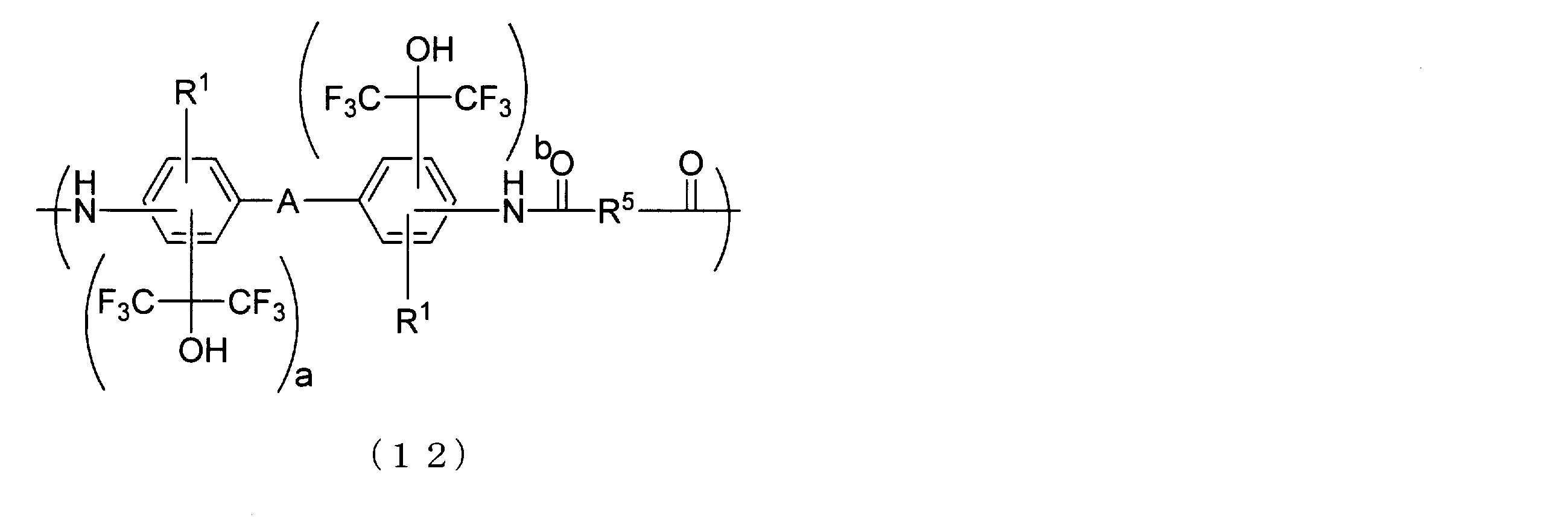
(Aは、単結合、エーテル結合、スルフィド結合、CO、CH2、SO、SO2、C(CH3)2、NHCO、もしくはC(CF3)2、または脂環、複素環もしくは芳香環を有する2価の基であり、R1は、それぞれ独立に、炭素数1~4のアルキル基、またはハロゲン基であり、R5は脂環、複素環、芳香環または直鎖状もしくは分枝鎖状脂肪族炭化水素基からなる群から選ばれた少なくとも一種を含む2価の有機基であり、有機基中の水素原子の一部がアルキル基、フルオロアルキル基、カルボキシル基、ヒドロキシ基、シアノ基、またはハロゲン基で置換されてもよく、aとbは、それぞれ独立に、0~2の整数を表し、1≦a+b≦4である。)
で表わされる繰り返し単位を含む、ポリアミド。
一般式(12)
で表わされる繰り返し単位を含む、ポリアミド。
[発明16]
発明15のポリアミドを含む、発光量子収率0.1%以上の蛍光材料。
発明15のポリアミドを含む、発光量子収率0.1%以上の蛍光材料。
[発明17]
一般式(1)
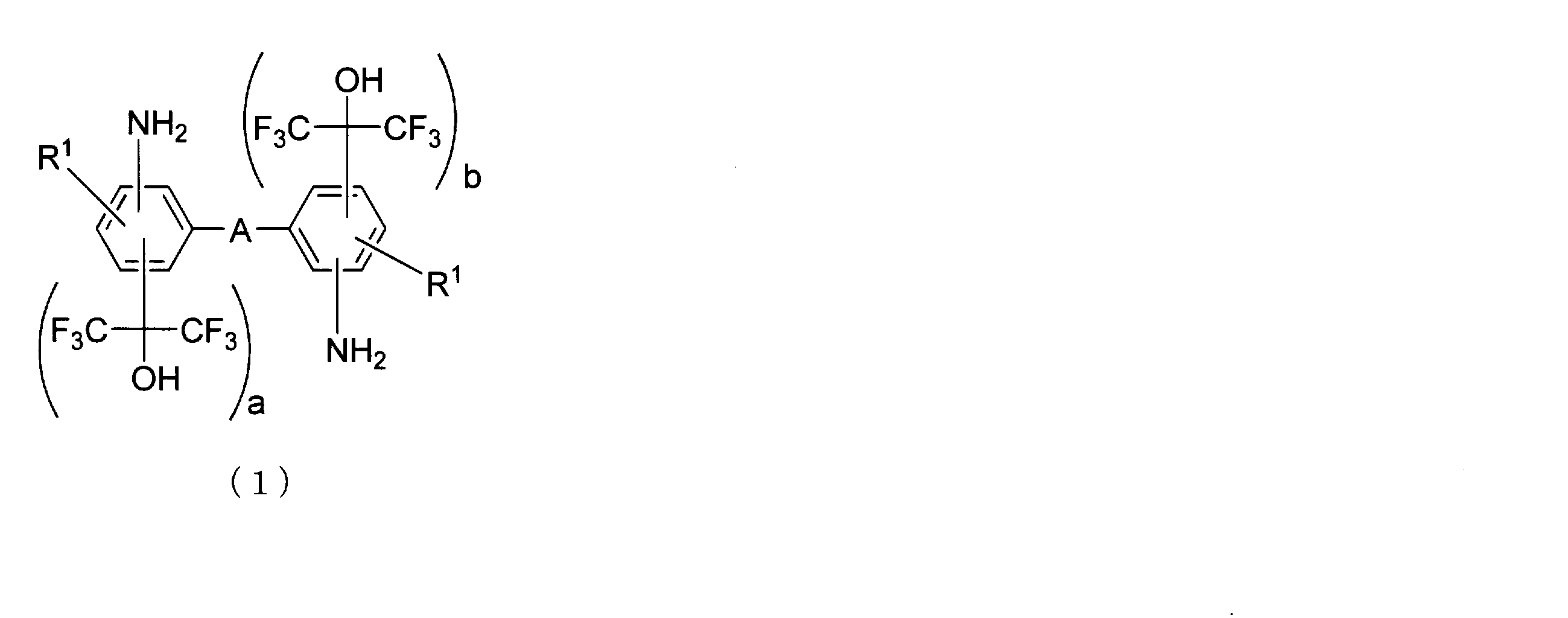
(式中、Aは、単結合、エーテル結合、スルフィド結合、CO、CH2、SO、SO2、C(CH3)2、NHCO、もしくはC(CF3)2、または脂環、複素環もしくは芳香環を有する2価の基であり、R1は、それぞれ独立に、炭素数1~4のアルキル基、またはハロゲン基であり、aとbは、それぞれ独立に、0~2の整数を表し、1≦a+b≦4である。)
で表されるジアミンと、
一般式(13)
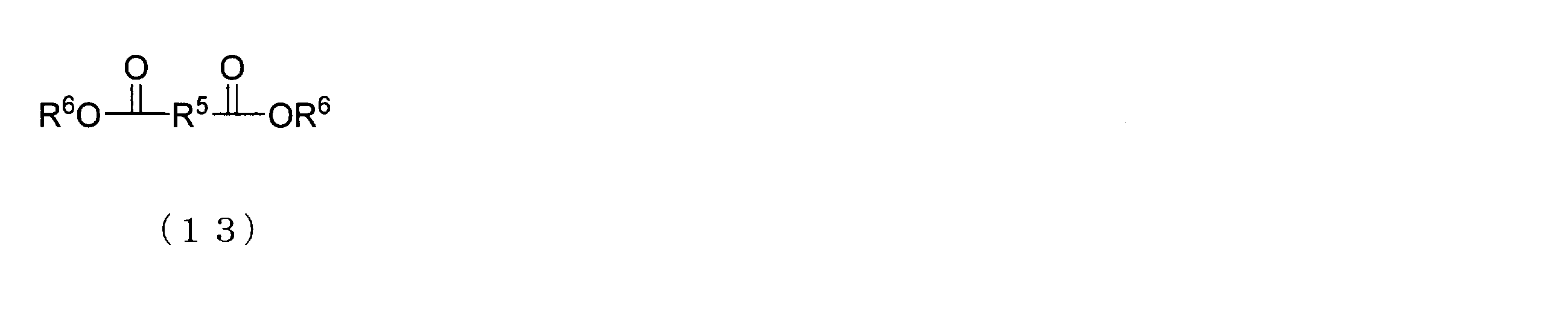
(式中、R5は脂環、複素環、芳香環または直鎖状もしくは分枝鎖状脂肪族炭化水素基からなる群から選ばれた少なくとも一種を含む2価の有機基であり、有機基中の水素原子の一部がアルキル基、フルオロアルキル基、カルボキシル基、ヒドロキシ基、シアノ基、またはハロゲン基で置換されてもよく、R6は、それぞれ独立に、水素原子、炭素数1~10のアルキル基またはベンジル基から選ばれた少なくとも一種の基である。)
で表わされるジカルボン酸もしくはその誘導体、
または、一般式(14)

(式中、R5は脂環、複素環、芳香環または直鎖状もしくは分枝鎖状脂肪族炭化水素基からなる群から選ばれた少なくとも一種を含む2価の有機基であり、有機基中の水素原子の一部がアルキル基、フルオロアルキル基、カルボキシル基、ヒドロキシ基、シアノ基、またはハロゲン基で置換されてもよく、Xは、ハロゲン基である。)で表わされるジカルボン酸誘導体を縮重合させる、
一般式(12)
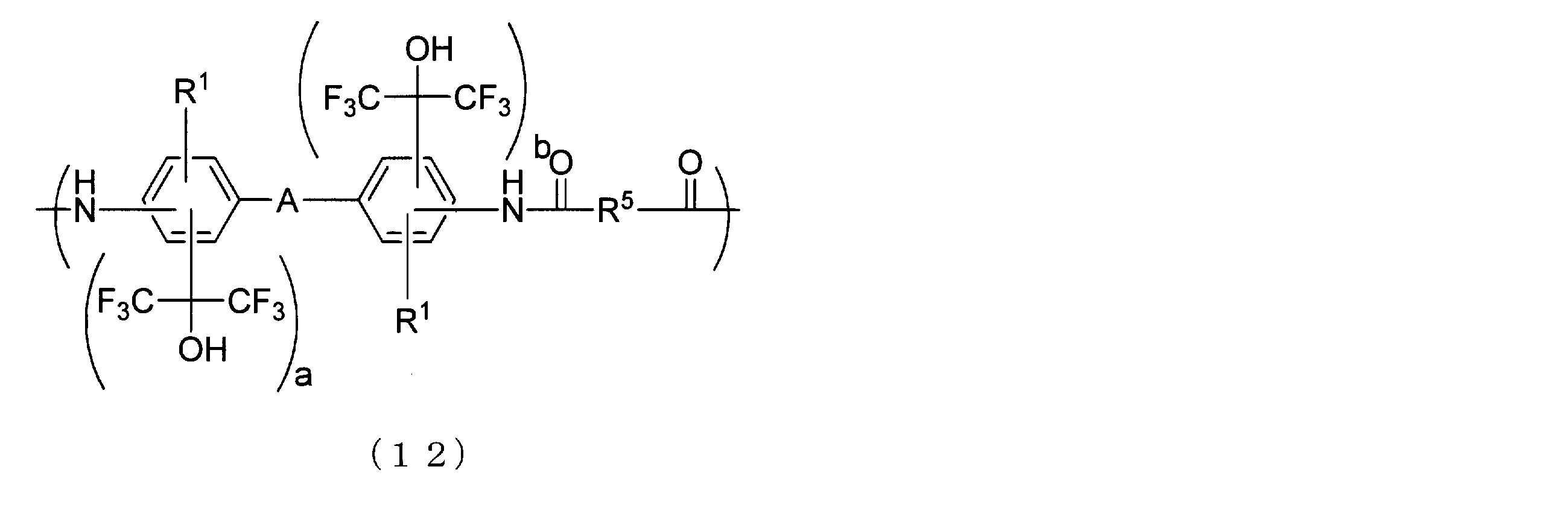
(Aは、単結合、エーテル結合、スルフィド結合、CO、CH2、SO、SO2、C(CH3)2、NHCO、もしくはC(CF3)2、または脂環、複素環もしくは芳香環を有する2価の基であり、R1は、それぞれ独立に、炭素数1~4のアルキル基、またはハロゲン基であり、R5は脂環、複素環、芳香環または直鎖状もしくは分枝鎖状脂肪族炭化水素基からなる群から選ばれた少なくとも一種を含む2価の有機基であり、有機基中の水素原子の一部がアルキル基、フルオロアルキル基、カルボキシル基、ヒドロキシ基、シアノ基、またはハロゲン基で置換されてもよく、aとbは、それぞれ独立に、0~2の整数を表し、1≦a+b≦4である。)
で表わされる繰り返し単位を含む、
ポリアミドの製造方法。
一般式(1)
で表されるジアミンと、
一般式(13)
で表わされるジカルボン酸もしくはその誘導体、
または、一般式(14)
一般式(12)
で表わされる繰り返し単位を含む、
ポリアミドの製造方法。
[発明18]
一般式(15)

(式中、Aは、単結合、エーテル結合、スルフィド結合、CO、CH2、SO、SO2、C(CH3)2、NHCO、もしくはC(CF3)2、または脂環、複素環もしくは芳香環を有する2価の基であり、R1は、それぞれ独立に、炭素数1~4のアルキル基、またはハロゲン基であり、R5は脂環、複素環、芳香環または直鎖状もしくは分枝鎖状脂肪族炭化水素基からなる群から選ばれた少なくとも一種を含む2価の有機基であり、有機基中の水素原子の一部がアルキル基、フルオロアルキル基、カルボキシル基、ヒドロキシ基、シアノ基、またはハロゲン基で置換されてもよい。)
で表わされる繰り返し単位を含む、
重合体。
一般式(15)
で表わされる繰り返し単位を含む、
重合体。
[発明19]
発明18の重合体を含む、発光量子収率0.1%以上の蛍光材料。
発明18の重合体を含む、発光量子収率0.1%以上の蛍光材料。
[発明20]
一般式(12)
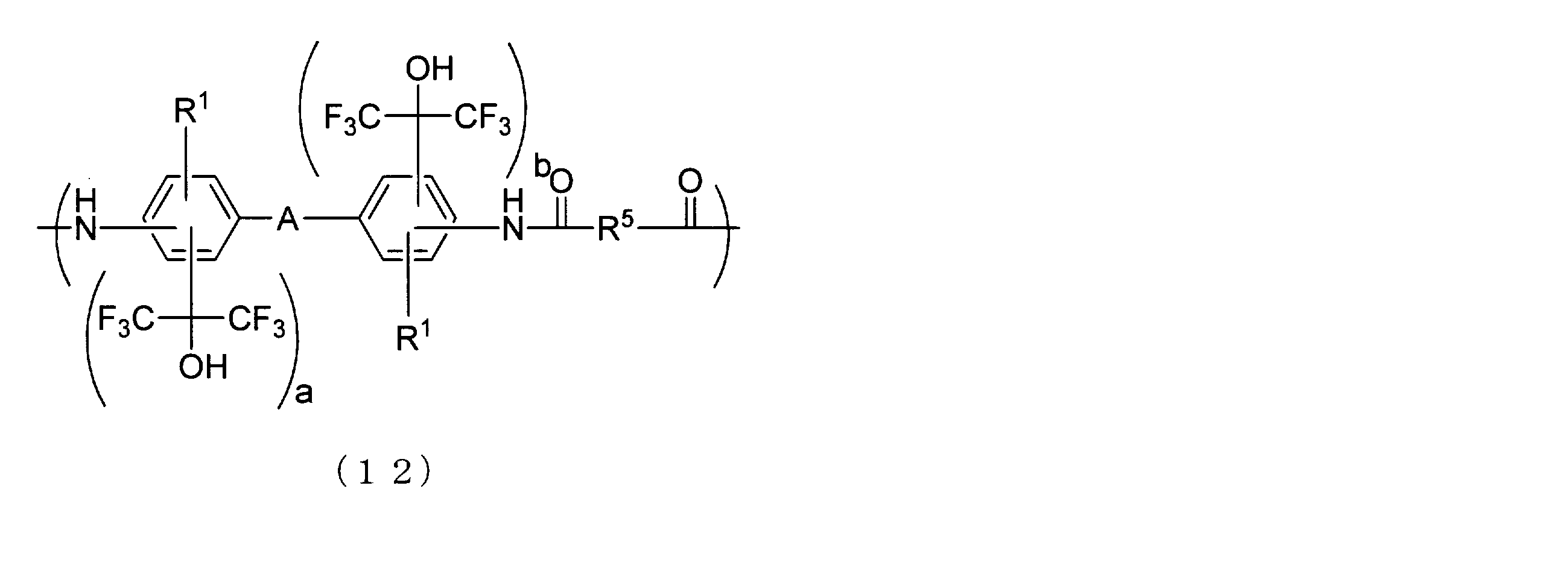
(式中、Aは、単結合、エーテル結合、スルフィド結合、CO、CH2、SO、SO2、C(CH3)2、NHCO、もしくはC(CF3)2、または脂環、複素環もしくは芳香環を有する2価の基であり、R1は、それぞれ独立に、炭素数1~4のアルキル基、またはハロゲン基であり、R5は脂環、複素環、芳香環または直鎖状もしくは分枝鎖状脂肪族炭化水素基からなる群から選ばれた少なくとも一種を含む2価の有機基であり、有機基中の水素原子の一部がアルキル基、フルオロアルキル基、カルボキシル基、ヒドロキシ基、シアノ基、またはハロゲン基で置換されてもよく、aとbは、それぞれ独立に、0~2の整数を表し、1≦a+b≦4である。)
で表わされる繰り返し単位を含む、
ポリアミドを環化縮合させることを含む、
一般式(15)
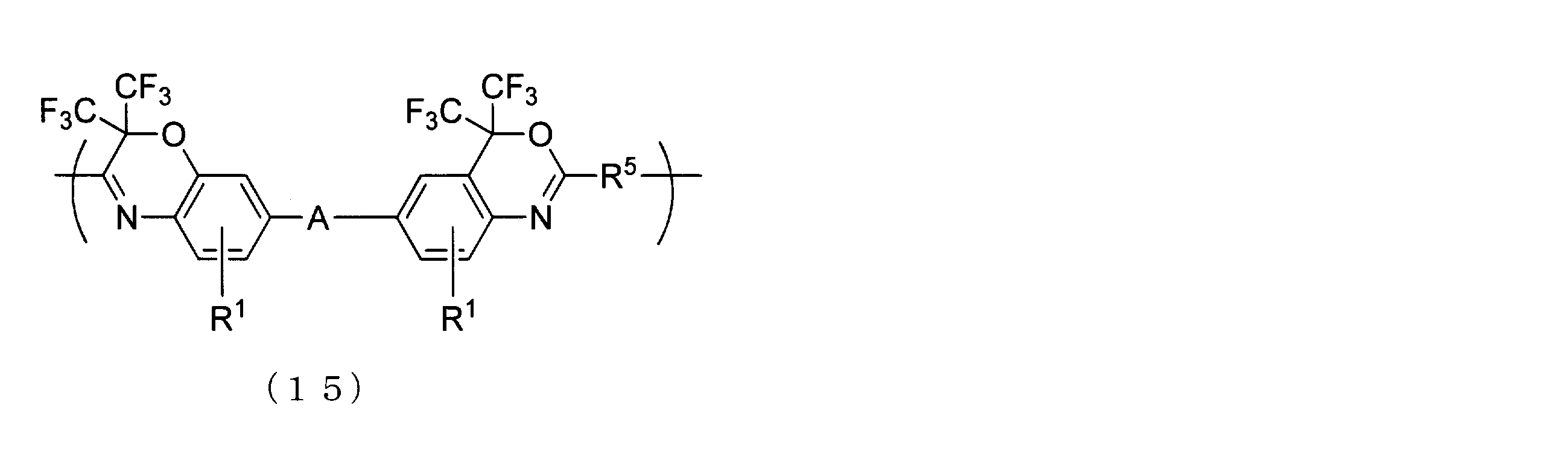
(式中、Aは、単結合、エーテル結合、スルフィド結合、CO、CH2、SO、SO2、C(CH3)2、NHCO、もしくはC(CF3)2、または脂環、複素環もしくは芳香環を有する2価の基であり、R1は、それぞれ独立に、炭素数1~4のアルキル基、またはハロゲン基であり、R5は脂環、複素環、芳香環または直鎖状もしくは分枝鎖状脂肪族炭化水素基からなる群から選ばれた少なくとも一種を含む2価の有機基であり、有機基中の水素原子の一部がアルキル基、フルオロアルキル基、カルボキシル基、ヒドロキシ基、シアノ基、またはハロゲン基で置換されてもよい。)
で表わされる、
重合体の製造方法。
一般式(12)
で表わされる繰り返し単位を含む、
ポリアミドを環化縮合させることを含む、
一般式(15)
で表わされる、
重合体の製造方法。
本発明のヘキサフルオロイソプロパノール基と、アルキル基またはハロゲン基を含むジアミンを原料化合物に用い重合してなる、ポリイミド、ポリアミド、または当該ポリアミドのアミド部位が環化してなる重合体は、有機溶剤に可溶であり、有機発光素子として使用可能な耐熱性、膜とした際に自立膜が得られる程度の強度がある。さらに蛍光特性を示すものは、有機発光素子として光デバイス等に利用可能である。
以下、本発明を詳細に説明する。
尚、本発明において、ヘキサフルオロイソプロパノール基(1,1,1,3,3,3-ヘキサフルオロ-2-ヒドロキシ-2-プロピル基は、化学式で表せば-C(CF3)2OHであり、以下、HFIP基と呼ぶことがある。また、ヘキサフルオロイソプロパノール基を含むポリイミドをHFIP基含有ポリイミド、ヘキサフルオロイソプロパノール基を含むポリアミドをHFIP基含有ポリアミドと呼ぶことがある。尚、本発明おいてハロゲン基とは、フルオロ基、クロロ基、ブロモ基またはヨード基である。
1.HFIP基含有ジアミン
[一般式(1)で表されるHFIP基含有ジアミン]
本発明は、一般式(1)で表されるHFIP基含有ジアミンである。
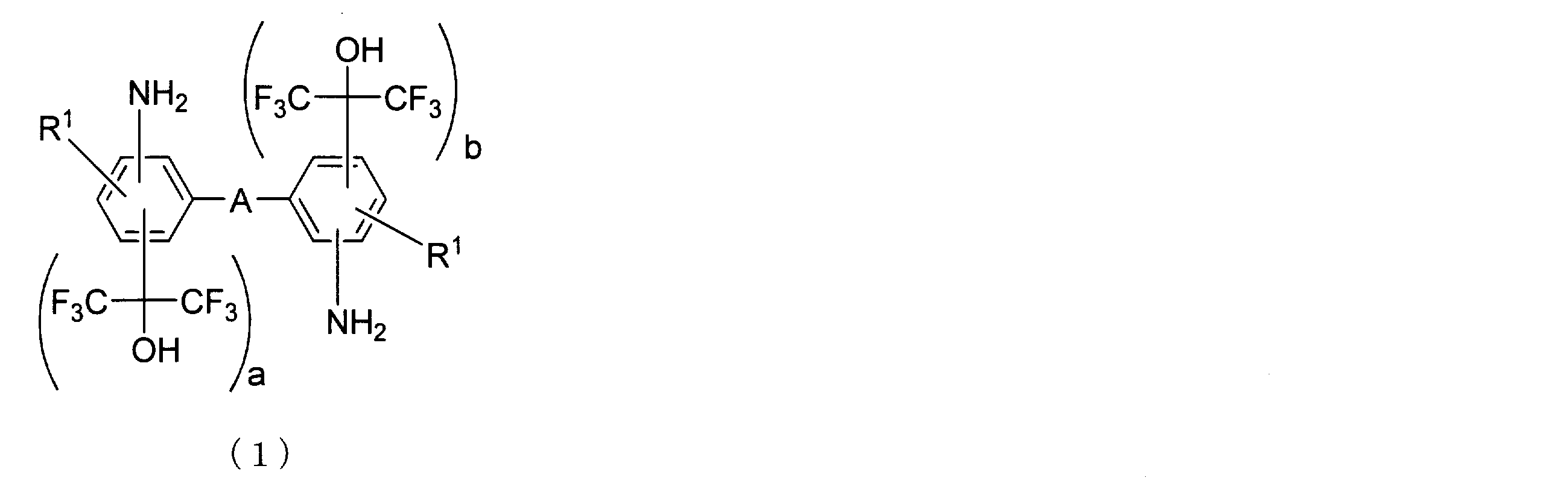
(式中、Aは、単結合、エーテル結合、スルフィド結合、CO、CH2、SO、SO2、C(CH3)2、NHCO、もしくはC(CF3)2、または脂環、複素環もしくは芳香環を有する2価の基あり、R1は、それぞれ独立に、炭素数1~4のアルキル基、またはハロゲン基であり、aとbは、それぞれ独立に、0~2の整数を表し、1≦a+b≦4である。) 炭素数1~4のアルキル基としては、メチル基(-CH3、以下、-Meと表わすことがある)、エチル基(-C2H5、以下、-Etと表わすことがある)、n-プロピル基(―C3H7)イソプロピル基(-CH(CH3)2)、n-ブチル基(-nC4H9)、ターシャリブチル基(-tC4H9)を例示することができるが、メチル基、またはエチル基であることが好ましい。
[一般式(1)で表されるHFIP基含有ジアミン]
本発明は、一般式(1)で表されるHFIP基含有ジアミンである。
一般式(1)で表されるHFIP基含有ジアミンにおいて、aおよびbが1であるHFIP基含有ジアミンが合成しやすく、好ましくは、以下の一般式(2)で表されるHFIP基含有ジアミンである。
[一般式(2)で表されるHFIP基含有ジアミン]
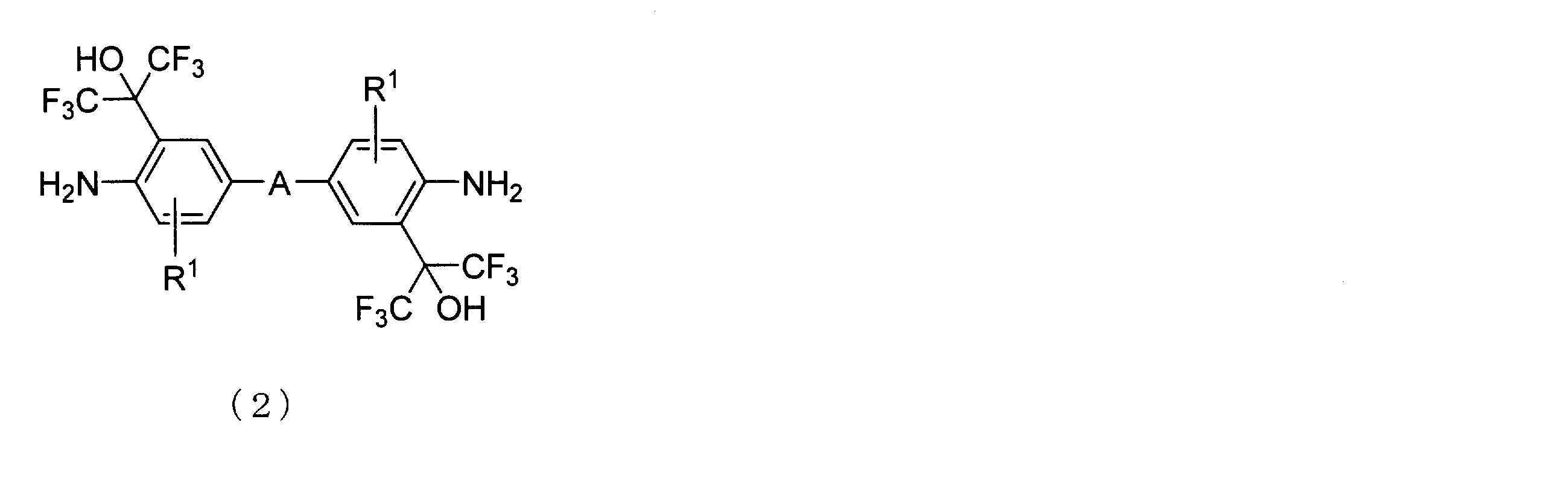
(式中、AおよびR1は一般式(1)と同じ。)
で表されるHFIP基含有ジアミン。
で表されるHFIP基含有ジアミン。
特に、以下の一般式(3)または一般式(4)で表されるHFIP基含有ジアミンが合成しやすく好ましい。
[一般式(3)で表されるHFIP基含有ジアミン]

(式中、AおよびR1は一般式(1)と同じ。)
[一般式(3)で表されるHFIP基含有ジアミンの例示]
一般式(3)で表されるHFIP基含有ジアミンには、以下の化合物を例示することができる。

一般式(3)で表されるHFIP基含有ジアミンには、以下の化合物を例示することができる。
特に、一般式(3)で表されるHFIP基含有ジアミンにおいて、Aが単結合またはCH2、R1がメチル基であるHFIP基含有ジアミンが合成しやすく好ましい。本発明において、特に、以下に示すHFIP基含有ジアミンを、使用することが好ましい。
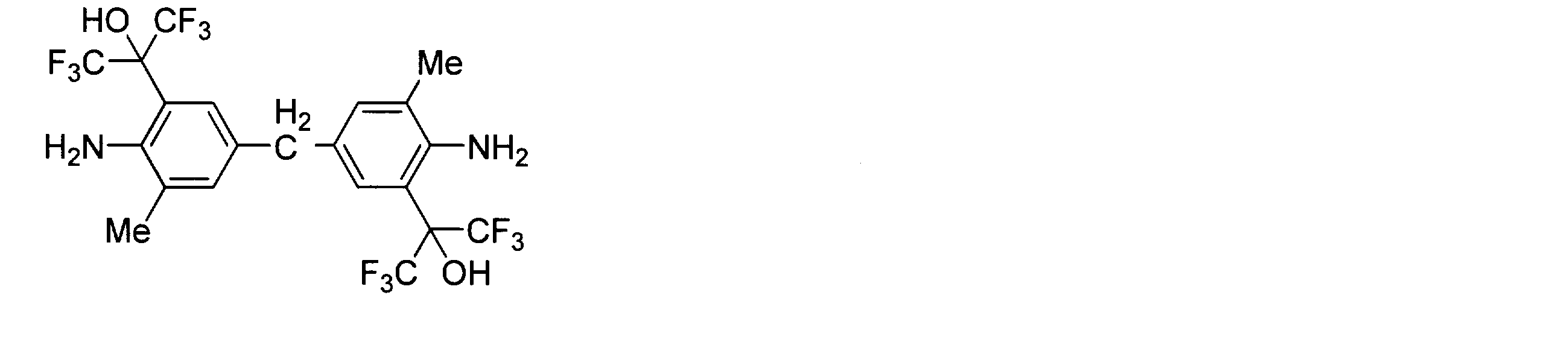
ビス(4-アミノ-3-(1,1,1,3,3,3-ヘキサフルオロ-2-ヒドロキシ-2-プロピル)-5-メチルフェニル)メタン。
3,3’-ビス(1,1,1,3,3,3-ヘキサフルオロ-2-ヒドロキシ-2-プロピル)-5,5’-ジメチルベンジジン。
また、これらHFIP基含有ジアミンから得られる、HFIP基含有ポリイミド、HFIP基含有ポリアミド、またはHFIP基含有ポリアミドのアミド部位が環化してなるHFIP基含有重合体においては、発光量子収率0.1%以上を得ることが可能である。
[一般式(4)で表されるHFIP基含有ジアミン]

(式中、AおよびR1は一般式(1)と同じ。)
[一般式(4)で表されるHFIP基含有ジアミンの例示]
一般式(4)で表されるHFIP基含有ジアミンには以下の化合物を例示することができる。
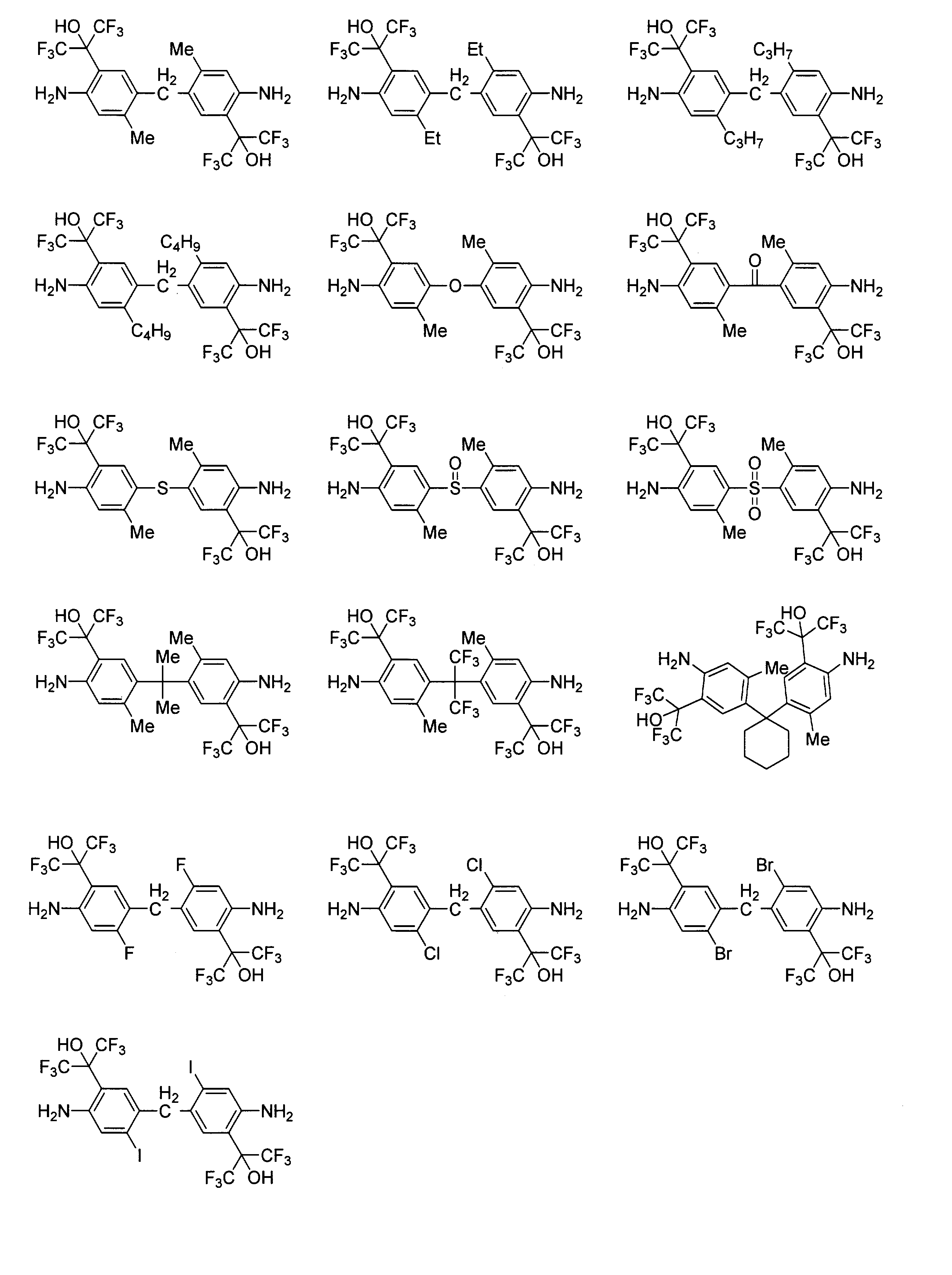
一般式(4)で表されるHFIP基含有ジアミンには以下の化合物を例示することができる。
特に、一般式(4)で表されるHFIP基含有ジアミンにおいて、Aが単結合、R1がメチル基であるHFIP基含有ジアミンが合成しやすく好ましい。本発明において、特に、以下に示すHFIP基含有ジアミンを、使用することが好ましい。
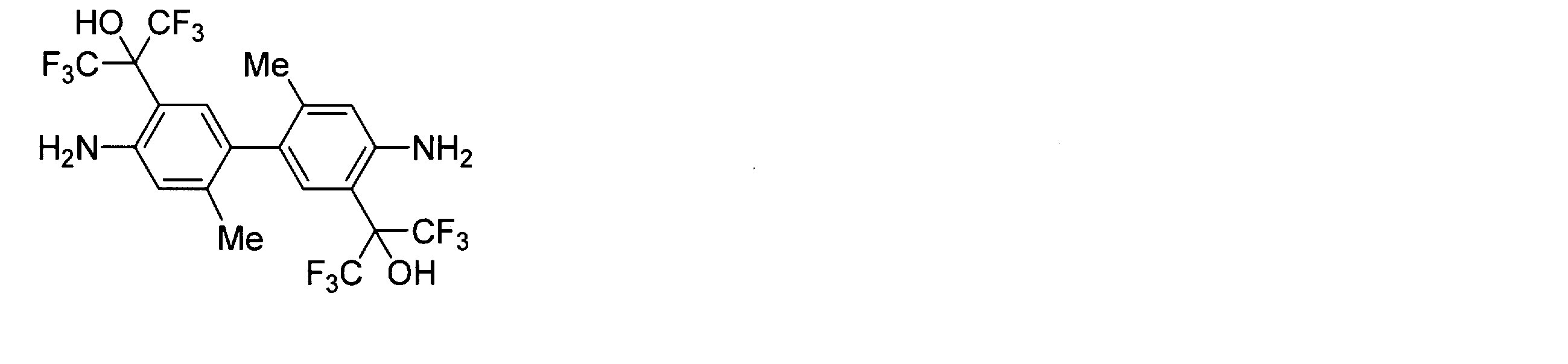
5,5’-ビス(1,1,1,3,3,3-ヘキサフルオロ-2-ヒドロキシ-2-プロピル)-2,2’-ジメチルベンジジン。
2.HFIP基含有ジアミンの製造方法
[一般式(1)で表わされるHFIP基含有ジアミンの合成]
一般式(1)
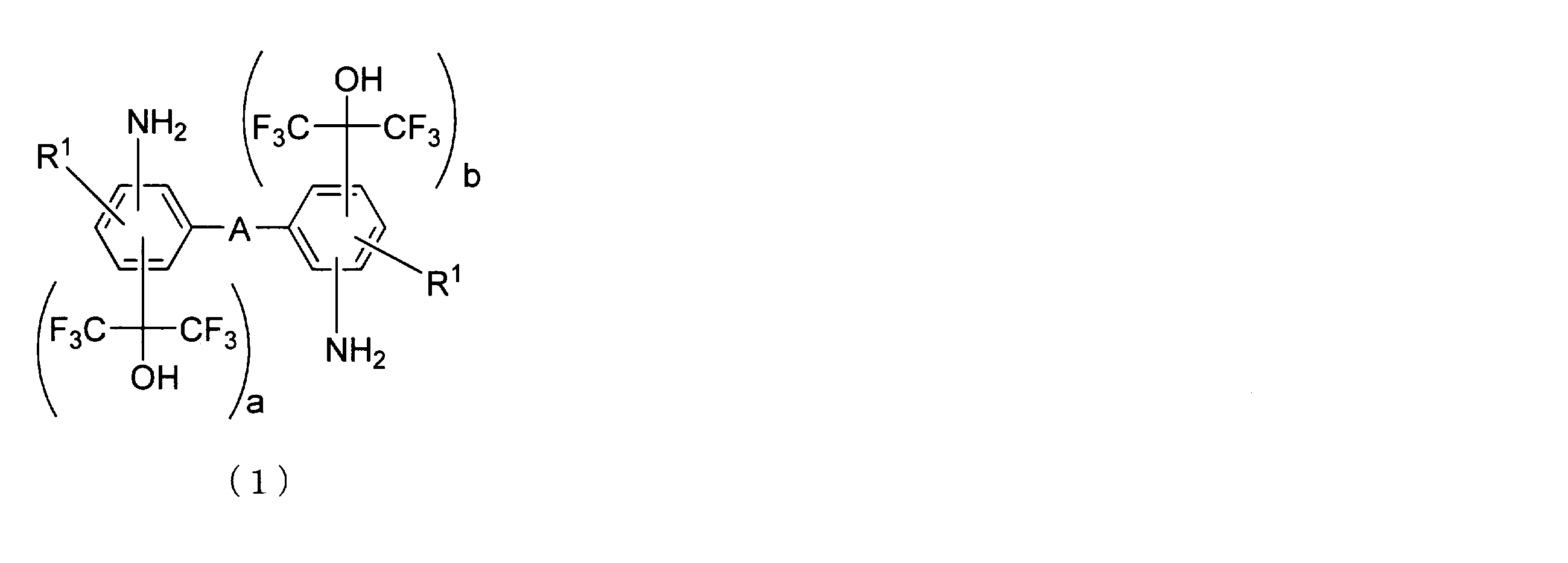
(式中、Aは、単結合、エーテル結合、スルフィド結合、CO、CH2、SO、SO2、C(CH3)2、NHCO、もしくはC(CF3)2、または脂環、複素環もしくは芳香環を有する2価の基あり、R1は、それぞれ独立に、炭素数1~4のアルキル基、またはハロゲン基であり、aとbは、それぞれ独立に、0~2の整数を表し、1≦a+b≦4である。)で表されるHFIP基含有ジアミンの製造方法について説明する。
[一般式(1)で表わされるHFIP基含有ジアミンの合成]
一般式(1)
以下の式に示すように、一般式(1)で表わされるジアミンは、原料化合物である式(5)で表わされるジアミンと、ヘキサフルオロアセトンまたはヘキサフルオロアセトン3水和物を反応させることで得ることができる。

本反応に使用するヘキサフルオロアセトンまたはヘキサフルオロアセトン3水和物の量は、原料化合物である一般式(5)で表わされるジアミン、1モルに対して、2モル以上、10モル以下が好ましく、さらには好ましくは2.5モル以上、5モル以下である。2モルより少ないと、目的化合物である一般式(1)で表わされるジアミンの収率が低く、10モルより多く使用しても反応は進行するが、使用する必要性はない。
本反応は、通常、20℃以上、180℃以下の範囲内で行われるが、50℃以上、150℃以下が好ましく、特に90℃以上、140℃以下が好ましい。20℃より低いと反応が進行し難いので好ましくない。
本反応は、触媒を使用しなくても行うことができるが、酸触媒を利用することで反応を促進させることが好ましい。使用される酸触媒としては、ルイス酸、例えば、塩化アルミニウム、塩化鉄(III)、フッ化硼素等、有機スルホン酸、例えば、ベンゼンスルホン酸、カンファースルホン酸(CAS)、メタンスルホン酸、p-トルエンスルホン酸(pTsOH)、p-トルエンスルホン酸・1水和物(pTsOH・H2O)またはピリジニウムp-トルエンスルホン酸(PPTS)等を例示することができる。触媒量は、原料化合物である一般式(5)で表わされるジアミンに対しモル%で表わして、1モル%以上、50モル%以下好ましく、さらに好ましくは3モル%以上、40モル%以下である。1モル%より少ないと反応は進行せず、50モル%より多く使用する必要はない。
本反応は、溶媒を使用せずに反応を行うことができるが、溶媒を使用することもできる。使用される溶媒としては、反応に関与しないものであれば特に制限はないが、芳香族炭化水素類溶媒、例えばベンゼン、トルエン、キシレン、ニトロベンゼンまたはベンゾニトリル、あるいは、水を使用することができる。使用する溶媒の量には特に制限はない。
本反応をオートクレーブ等の密封反応容器で行う場合、ヘキサフルオロアセトンとヘキサフルオロアセトン3水和物のいずれを用いるかで操作が異なる。ヘキサフルオロアセトンを用いる場合、最初に一般式(5)で表されるHFIP基含有ジアミンと必要に応じて酸触媒および溶媒を反応容器内に仕込み、次いで、反応容器内圧が所定の圧力を越えないように昇温しつつ、ヘキサフルオロアセトンを逐次添加して反応させ、一般式(1)で表わされるHFIP基含有ジアミンを得る。
ヘキサフルオロアセトン3水和物を用いる場合には、初めに、最初に一般式(5)で表されるHFIP基含有ジアミンと必要量のヘキサフルオロアセトン3水和物を反応器内に仕込むことができ、さらに必要に応じて酸触媒及び溶媒を反応容器内に仕込むことで反応を行い、一般式(1)で表わされるHFIP基含有ジアミンを得る。
本反応の反応時間は8時間以上、48時間以下であることが好ましく、この範囲内で、温度や用いる溶媒の量等に依存して好ましい反応時間は異なる。従って、ガスクロマトグラフィー等の分析手段により、反応の進行を確認しつつ反応を実施し、原料化合物が十分に反応に消費されたことを確認した後、反応を終了することが好ましい。反応終了後、抽出、蒸留または析出等の手段により、一般式(1)で表わされるジアミンを得ることができる。また、必要に応じてカラムクロマトグラフィーあるいは再結晶等により精製することもできる。
3.HFIP基含有ポリアミド酸
上記、本発明のHFIP基含有ジアミンを用い、テトラカルボン酸と反応させることで、本発明のHFIP基含有ポリアミド酸を合成することができる。
上記、本発明のHFIP基含有ジアミンを用い、テトラカルボン酸と反応させることで、本発明のHFIP基含有ポリアミド酸を合成することができる。
本発明は、一般式(6)

(式中、Aは、それぞれ独立に、単結合、エーテル結合、スルフィド結合、CO、CH2、SO、SO2、C(CH3)2、NHCO、もしくはC(CF3)2、または脂環、複素環もしくは芳香環を有する2価の基であり、R1は、それぞれ独立に、炭素数1~4のアルキル基またはハロゲン基であり、R2は脂環、複素環、芳香環または直鎖状もしくは分枝鎖状脂肪族炭化水素基からなる群から選ばれた少なくとも一種の基を含む4価の有機基であり、水素原子の一部がアルキル基、フルオロアルキル基、カルボキシル基、ヒドロキシ基、シアノ基、またはハロゲン基で置換されてもよく、aとbは、それぞれ独立に、0~2の整数であり、1≦a+b≦4である。)
で表わされる繰り返し単位を含む、発明7の一般式(6)で表わされるHFIP基含有ポリアミド酸である。
で表わされる繰り返し単位を含む、発明7の一般式(6)で表わされるHFIP基含有ポリアミド酸である。
また、本発明は、発明8の一般式(7)

(式中、Meはメチル基であり、
R3は、それぞれ独立に

である2価の基である。)
で表わされる繰り返し単位を含む、発明8のHFIP基含有ポリアミド酸である。
R3は、それぞれ独立に
で表わされる繰り返し単位を含む、発明8のHFIP基含有ポリアミド酸である。
発明8の一般式(7)で表わされるHFIP基含有ポリアミド酸として、具体的には、以下の繰り返し単位を含む化合物を例示することができる。
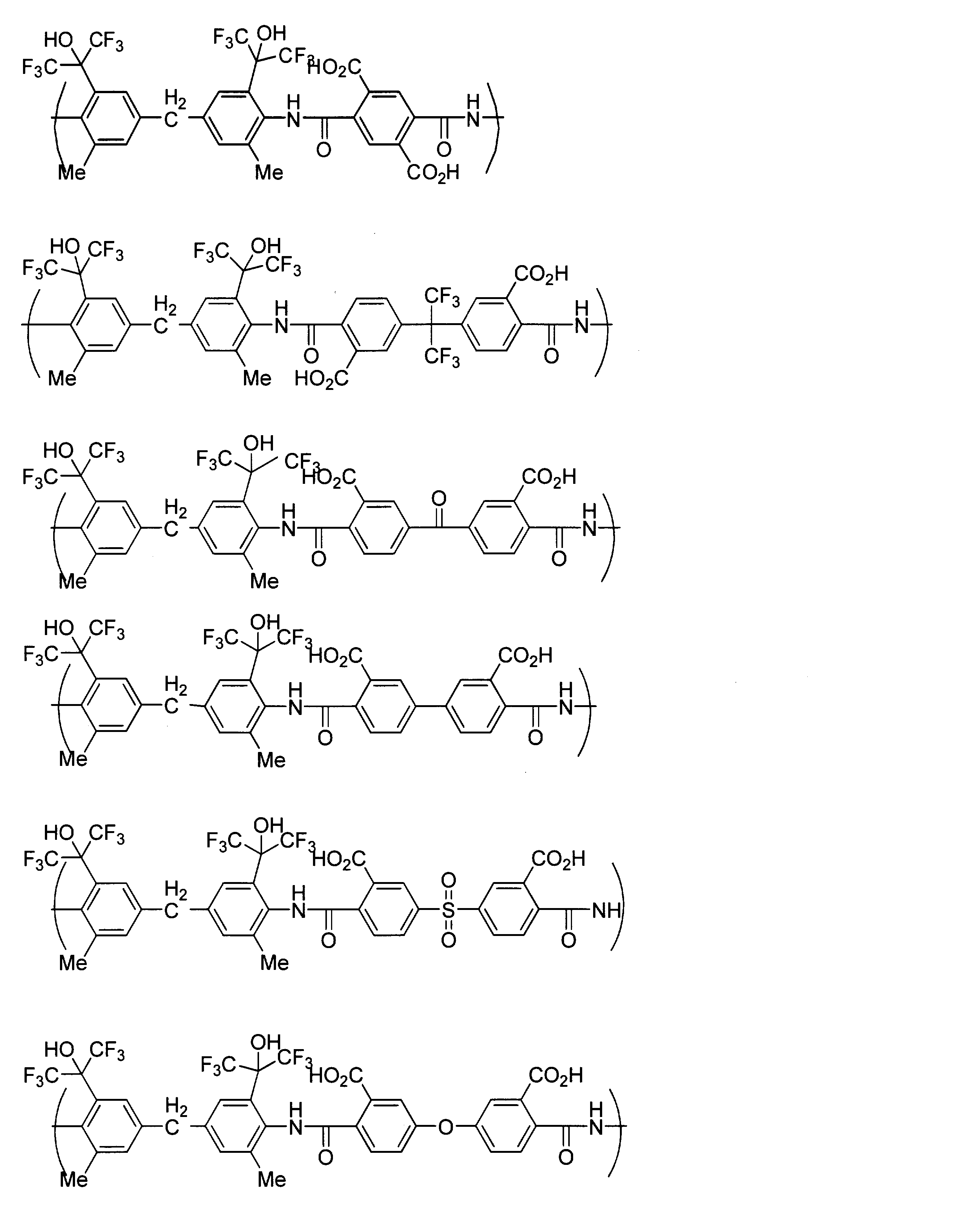
また、本発明は、一般式(8)
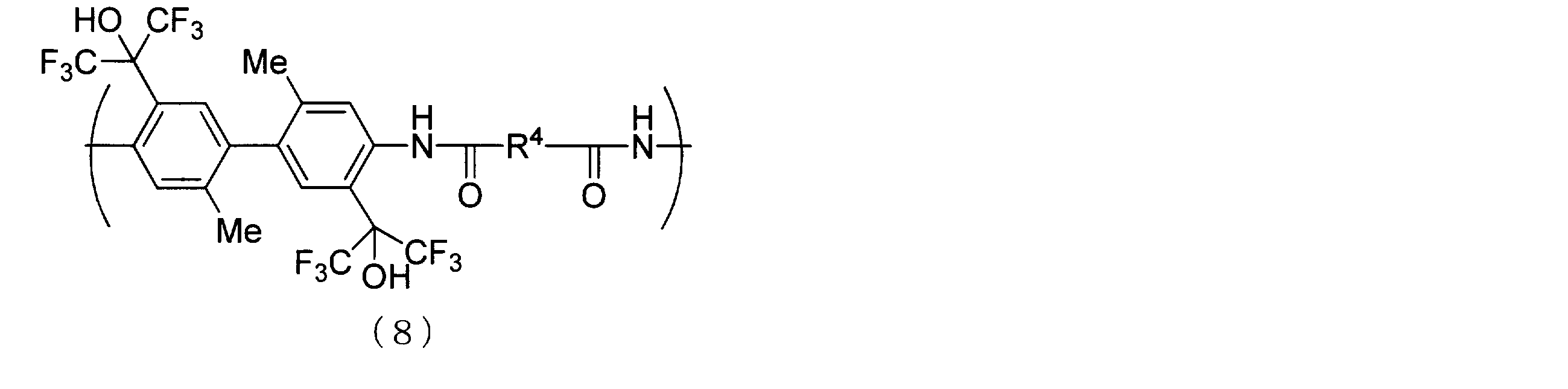
(式中、Meはメチル基であり、
R4は、

である。)
で表わされる繰り返し単位を含む、発明9のHFIP基含有ポリアミド酸である。
R4は、
で表わされる繰り返し単位を含む、発明9のHFIP基含有ポリアミド酸である。
発明9のHFIP基含有ポリアミド酸(8)として、具体的には、以下の繰り返し単位を含む化合物を例示することができる。

本発明のHFIP基含有ポリアミド酸は、ポリスチレン換算で重量平均分子量(Mw)が10000以上、500000以下であることが好ましい。Mwが10000より小さいと、得られるHFIP基含有ポリイミドの強度が低く自立膜ができにくく、500000より大きいと得られるHFIP基含有ポリイミドは溶解性に劣る。特に好ましくは、50000以上、150000以下である。
上記HFIP基含有ポリアミド酸をイミド化することで、本発明のHFIP基含有ポリイミドが得られる。
本発明は、一般式(9)
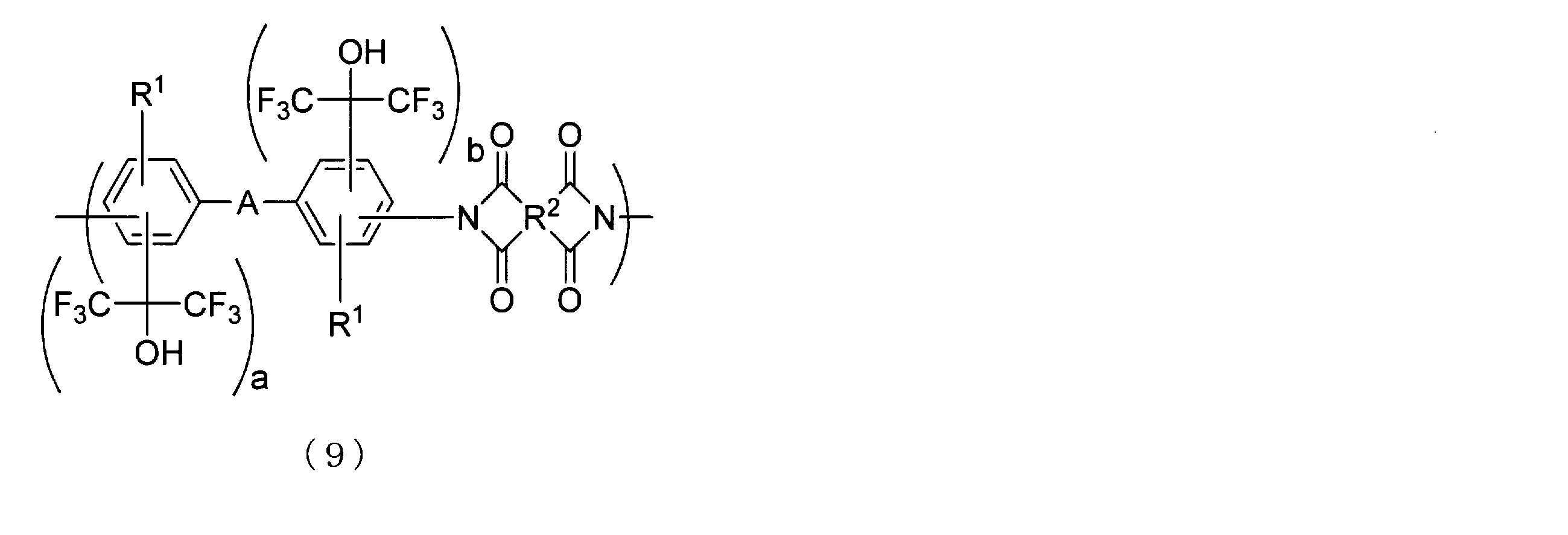
(式中、Aは、それぞれ独立に、単結合、エーテル結合、スルフィド結合、CO、CH2、SO、SO2、C(CH3)2、NHCO、もしくはC(CF3)2、または脂環、複素環または芳香環を有する2価の基であり、R1は、それぞれ独立に、炭素数1~4のアルキル基またはハロゲン基であり、R2は脂環、複素環、芳香環または直鎖状もしくは分枝鎖状脂肪族炭化水素基からなる群から選ばれた少なくとも一種を含む4価の有機基であり、有機基中の水素原子の一部がアルキル基、フルオロアルキル基、カルボキシル基、ヒドロキシ基、シアノ基、またはハロゲン基で置換されてもよく、aとbは、それぞれ独立に、0~2の整数であり、1≦a+b≦4である。)
で表わされる繰り返し単位を含む、発明10のHFIP基含有ポリイミドである。
で表わされる繰り返し単位を含む、発明10のHFIP基含有ポリイミドである。
また、本発明は、一般式(10)
(式中、Meはメチル基であり、
R2は、
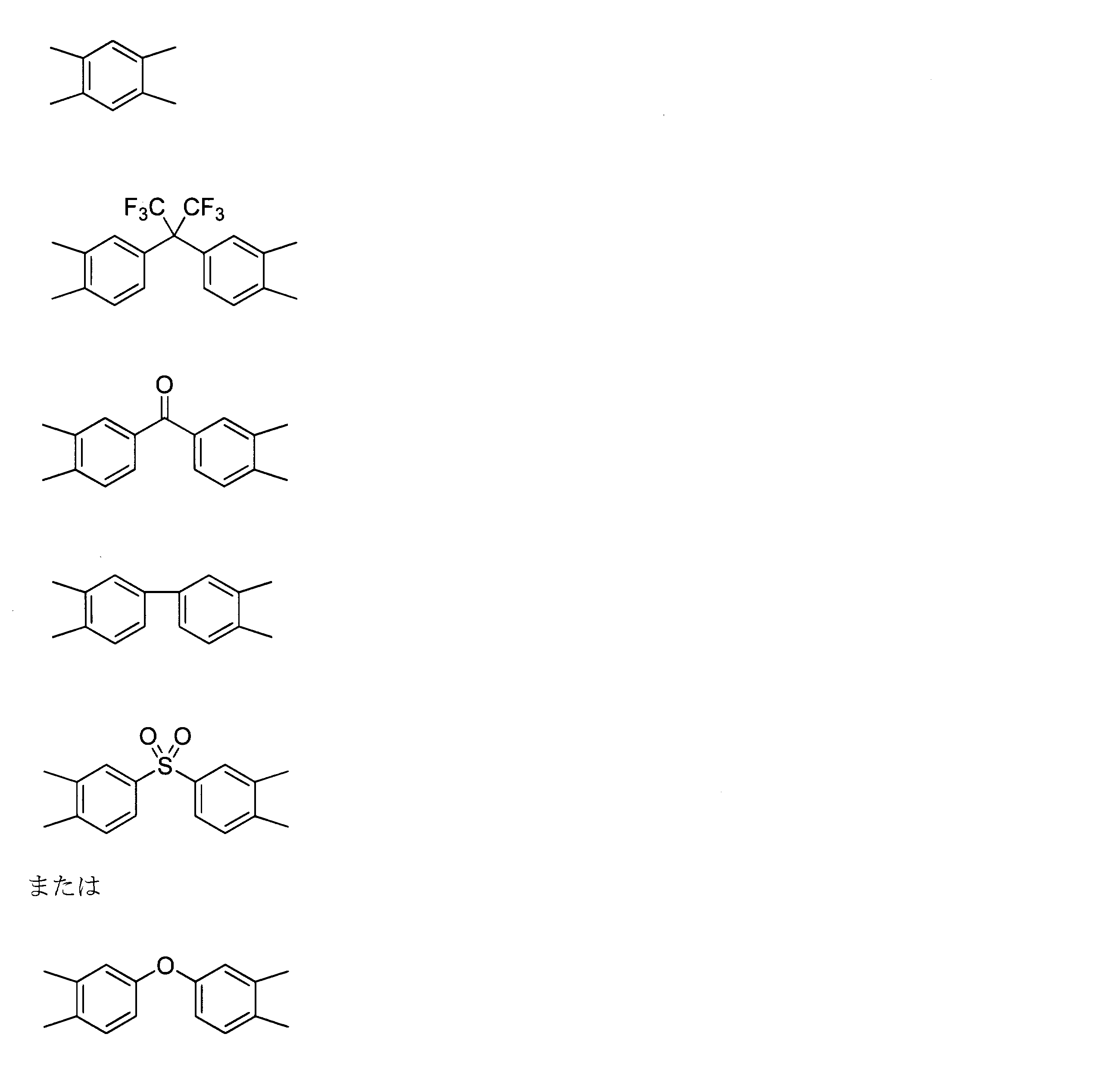
である。)
で表わされる繰り返し単位を含む、発明11のHFIP基含有ポリイミドである。
R2は、
で表わされる繰り返し単位を含む、発明11のHFIP基含有ポリイミドである。
発明11のHFIP基含有ポリイミドとして、具体的には、以下の繰り返し単位を含む化合物を例示することができる。

また、本発明は、一般式(11)

(式中、Meはメチル基であり、
R2は、
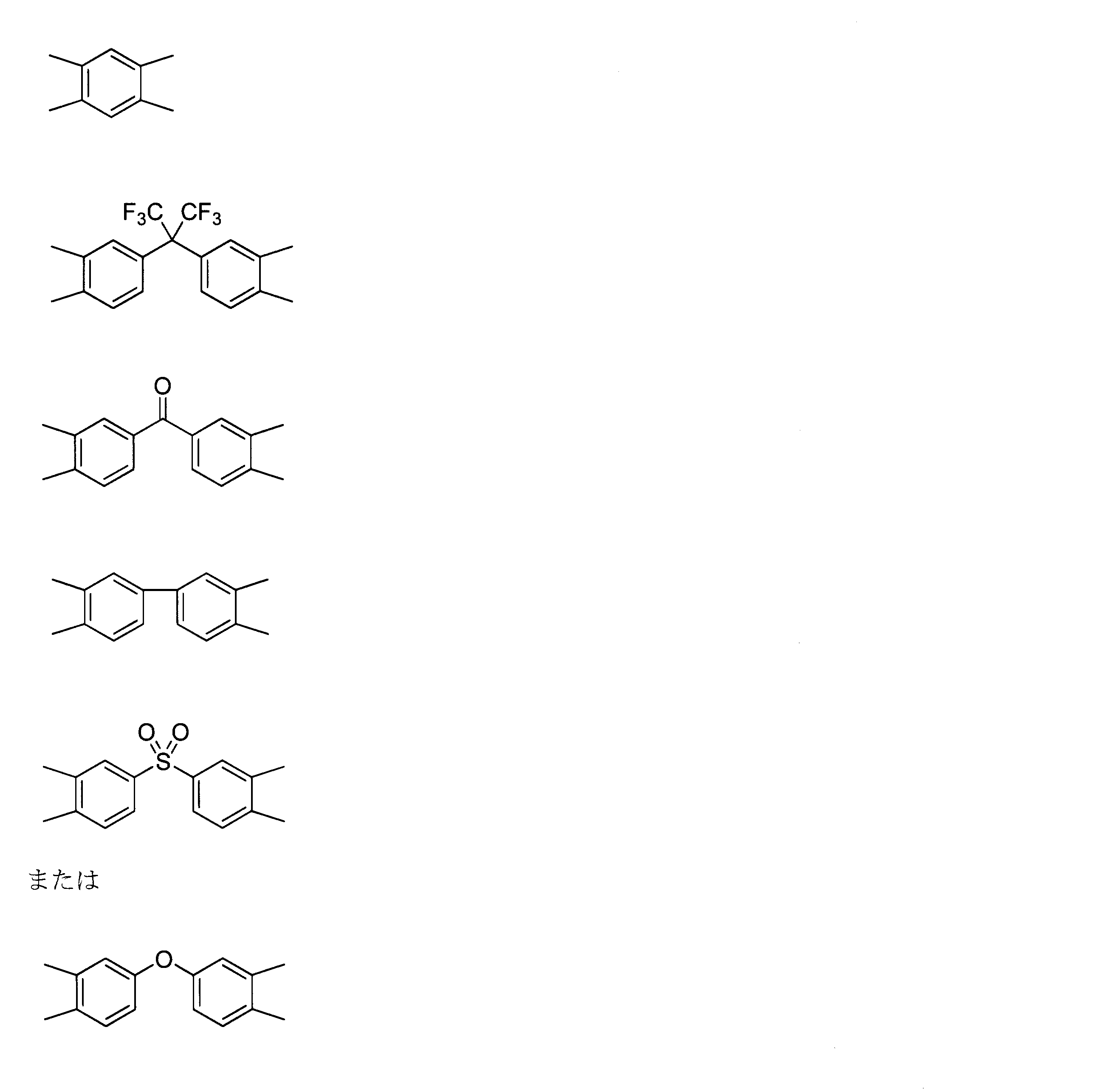
である。)
で表わされる繰り返し単位を含む、発明12のHFIP基含有ポリイミドである。
R2は、
で表わされる繰り返し単位を含む、発明12のHFIP基含有ポリイミドである。
発明12のHFIP基含有ポリイミドは、具体的には、以下の繰り返し単位を含むHFIP基含有ポリイミドである。

本発明のHFIP基含有ポリイミドは、ポリスチレン換算で重量平均分子量(Mw)が10000以上、500000以下であることが好ましい。Mwが10000より小さいと、HFIP基含有ポリイミドの強度が低く自立膜ができにくく、500000より大きいとHFIP基含有ポリイミドは溶解性に劣る。特に好ましくは、50000以上、150000以下である、
4.HFIP基含有ポリイミドの製造方法
本発明は、
一般式(1)

(式中、Aは、単結合、エーテル結合、スルフィド結合、CO、CH2、SO、SO2、C(CH3)2、NHCO、もしくはC(CF3)2、または脂環、複素環もしくは芳香環を有する2価の基であり、R1は炭素数1~4のアルキル基、またはハロゲン基であり、aとbは、それぞれ独立に、0~2の整数を表し、1≦a+b≦4である。)
で表されるHFIP基含有ジアミンと、
一般式(11)
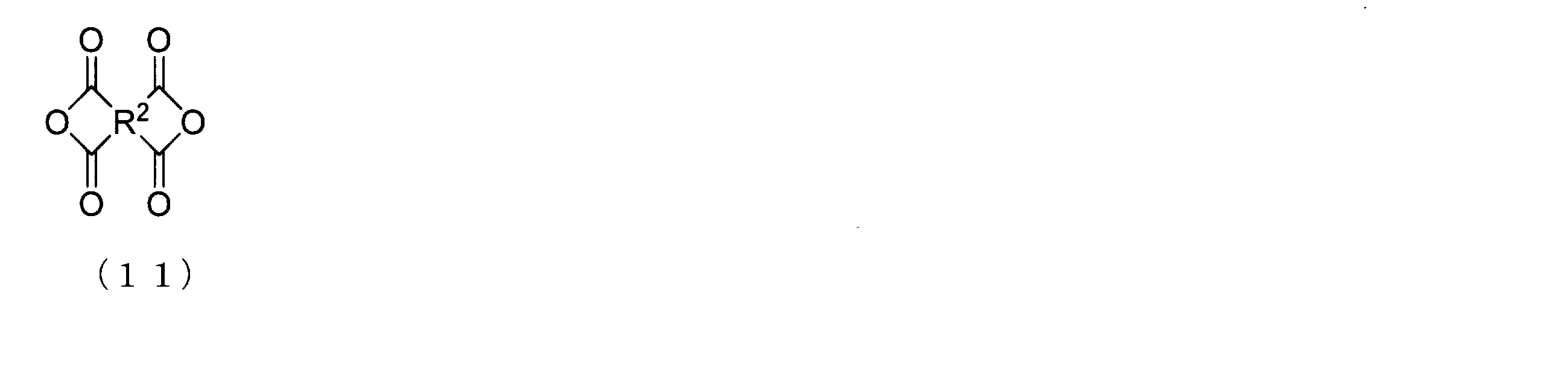
(式中、R2は脂環、複素環、芳香環または直鎖状もしくは分枝鎖状脂肪族炭化水素基からなる群から選ばれた少なくとも一種を含む4価の有機基であり、水素原子の一部がアルキル基、フルオロアルキル基、カルボキシル基、ヒドロキシ基、シアノ基、またはハロゲン基で置換されてもよい。)
で表されるテトラカルボン酸二無水物を縮重合させて、
一般式(6)
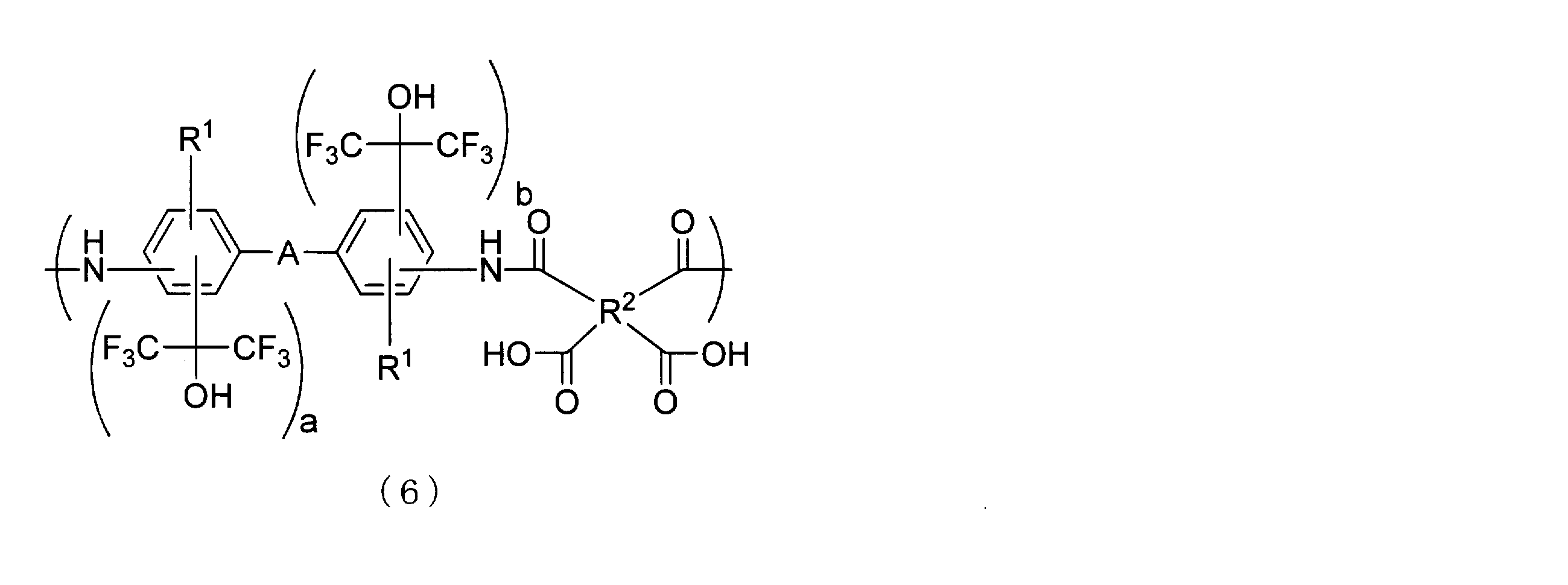
(式中、A、R1およびR2は、前記式(1)および式(11)と同じ、aとbは、それぞれ独立に、0~2の整数であり、1≦a+b≦4である。)
で表わされる繰り返し単位を含む、
HFIP基含有ポリアミド酸を生成させ、該ポリアミド酸を脱水させることからなる、一般式(9)

(式中、A、R1およびR2は、前記式(1)、式(6)式(11)と同じ、aとbは、それぞれ独立に、0~2の整数であり、1≦a+b≦4である。)
で表わされる繰り返し単位を含む、HFIP基含有ポリイミドを得る、
発明14のHFIP基含有ポリイミドの製造方法である。
本発明は、
一般式(1)
で表されるHFIP基含有ジアミンと、
一般式(11)
で表されるテトラカルボン酸二無水物を縮重合させて、
一般式(6)
で表わされる繰り返し単位を含む、
HFIP基含有ポリアミド酸を生成させ、該ポリアミド酸を脱水させることからなる、一般式(9)
で表わされる繰り返し単位を含む、HFIP基含有ポリイミドを得る、
発明14のHFIP基含有ポリイミドの製造方法である。
即ち、発明1~5のHFIP基含有ジアミンと、前記一般式(11)で表わされるテトラカルボン酸二無水物を反応させることで、発明7~9のHFIP基含有ポリアミド酸が得られる。発明7~9のHFIP基含有ポリアミド酸をイミド化することで、発明10~12のHFIP基含有ポリイミドが得られる。
例えば、以下の式に示すように、本発明のビス(4-アミノ-3-(1,1,1,3,3,3-ヘキサフルオロ-2-ヒドロキシ-2-プロピル)-5-メチルフェニル)メタンとピロメリット酸無水物をジメチルアセトアミド(以下、DMAcと呼ぶことがある)中で反応させることで、本発明のHFIP基含有ポリアミド酸が得られる。

一般式(11)で表わされるテトラカルボン二無水物は、ポリアミド酸またはポリイミドの原料化合物として一般的に知られている物であれば、特に制限なく使用できる。
このようなテトラカルボン酸二無水物としては、ベンゼンテトラカルボン酸二無水物(ピロメリット酸二無水物)(以下、PMDAと呼ぶことがある)、トリフルオロメチルベンゼンテトラカルボン酸二無水物、ビストリフルオロメチルベンゼンテトラカルボン酸二無水物、ジフルオロベンゼンテトラカルボン酸二無水物、ナフタレンテトラカルボン酸二無水化物、ビフェニルテトラカルボン酸二無水物(以下、BPDAと呼ぶことがある)、ターフェニルテトラカルボン酸二無水物、1,1-ビス(3,4-ジカルボキシフェニル)ケトン酸二無水物(以下、BTDAと呼ぶことがある)、オキシジフタル酸二無水物(以下、ODPAと略する)、ビシクロ(2,2,2)オクト-7-エン-2,3,5,6-テトラカルボン酸二無水物、2,2-ビス(3,4-ジカルボキシフェニル)ヘキサフルオロプロパン酸二無水物(以下、6FDAとと呼ぶことがある)、2,3,4,5-チオフェンテトラカルボン酸二無水化物、2,2’,5,5’,6,6’-ヘキサフルオロ-3,3’,4,4’-ビフェニルテトラカルボン酸二無水物、ビス(3,4-ジカルボキシフェニル)スルホン酸二無水化物(以下、DSDAと呼ぶことがある)または3,4,9,10-ペリレンテトラカルボン酸二無水化物を例示することができる。これらテトラカルボン二無水物の中から2種以上併用してもよい。入手が容易であること、耐熱性に優れること、溶剤に易溶であることから、特に、PMDA、BPDA、6FDA、BTDA、ODPA、DSDAを用いることが好ましい。
HFIP基含有ジアミンと一般式(11)で表わされるテトラカルボン酸二無水物とから、HFIP基含有ポリアミド酸を重合できる。例えば、前記HFIP基含有ジアミンとテトラカルボン酸二無水物を、-20℃以上、80℃以下の温度にて有機溶媒中で反応させる方法が挙げられる。
使用する有機溶媒は、前記HFIP基含有ジアミンとテトラカルボン酸二無水物が溶解すればよく、アミド系溶媒、例えばN,N-ジメチルホルムアミド、N,N-ジメチルアセトアミド、N,N-ジメチルホルムアミド、ヘキサメチルリン酸トリアミド、N-メチル-2-ピロリドン等、芳香族性溶媒、例えばベンゼン、アニソール、ジフェニルエーテル、ニトロベンゼンまたはベンゾニトリル等、ハロゲン系溶媒、例えばクロロホルム、ジクロロメタン、1,2-ジクロロエタン、または1,1,2,2-テトラクロロエタン、あるいはラクトン系溶媒、例えばγ-ブチルラクトン、γ-バレロラクトン、γ-カプロラクトン、ε-カプロラクトンまたはα-メチル-γ-ブチルラクトン等を例示することができる。上記のアミド系溶媒とともに、酸受容体、例えば、ピリジンまたはトリエチルアミン等を共存させて反応を行えば、高重合度のポリアミド酸を得ることができる。
本発明のHFIP基含有ジアミンと、HFIP基を有さない他のジアミン、ジヒドロキシアミンを併用したポリアミド酸との共重合体としてもよく、併用できるジアミン化合物としては、3,5-ジアミノベンゾトリフルオリド、2,5-ジアミノベンゾトリフルオリド、3,3’-ビストリフルオロメチル-4,4’-ジアミノビフェニル、2,2’-ビストリフルオロメチル-4,4’-ジアミノビフェニル、3,3’-ビストリフルオロメチル-5,5’-ジアミノビフェニル、ビス(トリフルオロメチル)-4,4’-ジアミノビフェニル、ビス(フッ素化アルキル)-4,4’-ジアミノビフェニル、ジクロロ-4,4’-ジアミノビフェニル、ジブロモ-4,4’-ジアミノビフェニル、ビス(フッ素化アルコキシ)-4,4’-ジアミノビフェニル、ジフェニル-4,4’-ジアミノビフェニル、4,4’-ビス(4-アミノテトラフルオロフェノキシ)テトラフルオロベンゼン、4,4’-ビス(4-アミノテトラフルオロフェノキシ)オクタフルオロビフェニル、4,4’-ビナフチルアミン、o-フェニレンジアミン、m-フェニレンジアミン、p-フェニレンジアミン、2,4-ジアミノトルエン、2,5-ジアミノトルエン、2,4-ジアミノキシレン、2,4-ジアミノジュレン、1,4-キシリレンジアミン、ジメチル-4,4’-ジアミノビフェニル、ジアルキル-4,4’-ジアミノビフェニル、2,2’-ジメチル-4,4’-ジアミノビフェニル、3,3’-ジメチル-4,4’-ジアミノビフェニル、ジメトキシ-4,4’-ジアミノビフェニル、ジエトキシ-4,4’-ジアミノビフェニル、4,4’-ジアミノジフェニルメタン、3,4’-ジアミノジフェニルメタン、2,4’-ジアミノジフェニルメタン、3,3’-ジメチルージアミノジフェニルメタン、3,3’-ジエチルージアミノジフェニルメタン、9、9-ビス(4-アミノフェニル)フルオレン、4,4’-ジアミノジフェニルエーテル、3,4’-ジアミノジフェニルエーテル、2,4’-ジアミノジフェニルエーテル、4,4’-ジアミノジフェニルスルフィド、3,4’-ジアミノジフェニルスルフィド、4,4’-ジアミノジフェニルスルホン、3,3’-ジアミノジフェニルスルホン、4,4’-ジアミノベンゾフェノン、3,3’-ジアミノベンゾフェノン、1,3-ビス(3-アミノフェノキシ)ベンゼン、1,3-ビス(4-アミノフェノキシ)ベンゼン、1,4-ビス(4-アミノフェノキシ)ベンゼン、4,4’-ビス(4-アミノフェノキシ)ビフェニル、ビス(4-(3-アミノフェノキシ)フェニル)スルホン、ビス(4-(4-アミノフェノキシ)フェニル)スルホン、2,2-ビス(4-(4-アミノフェノキシ)フェニル)プロパン、2,2-ビス(4-(4-アミノフェノキシ)フェニル)ヘキサフルオロプロパン、2,2-ビス(4-(3-アミノフェノキシ)フェニル)プロパン、2,2-ビス(4-(3-アミノフェノキシ)フェニル)ヘキサフルオロプロパン、2,2-ビス(4-(4-アミノ-2-トリフルオロメチルフェノキシ)フェニル)ヘキサフルオロプロパン、2,2-ビス(4-(3-アミノ-5-トリフルオロメチルフェノキシ)フェニル)ヘキサフルオロプロパン、2,2-ビス(4-アミノフェニル)ヘキサフルオロプロパン、2,2-ビス(3-アミノフェニル)ヘキサフルオロプロパン、2,2-ビス(3-アミノ-4-ヒドロキシフェニル)ヘキサフルオロプロパン、2,2-ビス(3-アミノ-4-メチルフェニル)ヘキサフルオロプロパン、4,4’-ビス(4-アミノフェノキシ)オクタフルオロビフェニルまたは4,4’-ジアミノベンズアニリドを例示することができる。これらHFIP基を有さないジアミンを2種以上併用してもよい。
前述した一般式(6)で表されるHFIP基含有ポリアミド酸は、加熱処理または脱水試薬との反応によって、化合物内で脱水が起こり、イミド環が形成され、一般式(9)で表されるHFIP基含有ポリイミドを合成することができる。加熱処理によりポリアミド酸内で脱水してイミド化を行う場合、反応温度80℃以上、350℃以下でイミド環が形成され、一般式(9)で表されるHFIP基含有ポリイミドを合成することができる。好ましくは、150℃以上、さらに好ましくは200℃以上である。反応温度が80℃未満の場合はイミド化率が不十分で、前記ポリイミドをコーティング膜にした際に膜強度が損なわれる、または吸水性が高くなる虞がある。一方、反応温度が350℃を超える場合はポリイミドの一部が熱分解する等して、前記ポリイミドをコーティング膜にした際に膜強度が損なわれる、または着色する虞がある。また、脱水試薬を用いて前記ポリアミド酸内で脱水してイミド化を行う場合、脱水試薬として無水酢酸を添加し、さらにピリジンまたはトリエチルアミン等の塩基を添加し、前記ポリアミド酸と反応させ、前記ポリアミド酸内で脱水することで前記ポリイミドを合成することも可能である。この際、ポリアミド酸の原料の酸二無水物1モルに対し、脱水試薬の添加量は2モル以上、10モル以下、塩基の添加量は2モル以上、10モル以下であることが好ましい。
本発明のHFIP基含有ポリイミドは、有機溶媒に溶解したワニス状態、粉末状態、フィルム状態、固体状態で使用に供することが可能である。その際、得られたHFIP基含有ポリイミド中には必要に応じて、酸化安定化剤、フィラー、シランカップリング剤、感光剤、光重合開始剤または増感剤等の添加剤を加えてもよい。ワニスで使用する場合は、ガラス、シリコンウェハー、金属、金属酸化物、セラミックスまたは樹脂等の上にスピンコート、スプレーコート、フローコート、含浸コート、ハケ塗り等の公知の方法で塗布することができる。
5.HFIP基含有ポリアミドおよびその重合方法
本発明は、一般式(12)
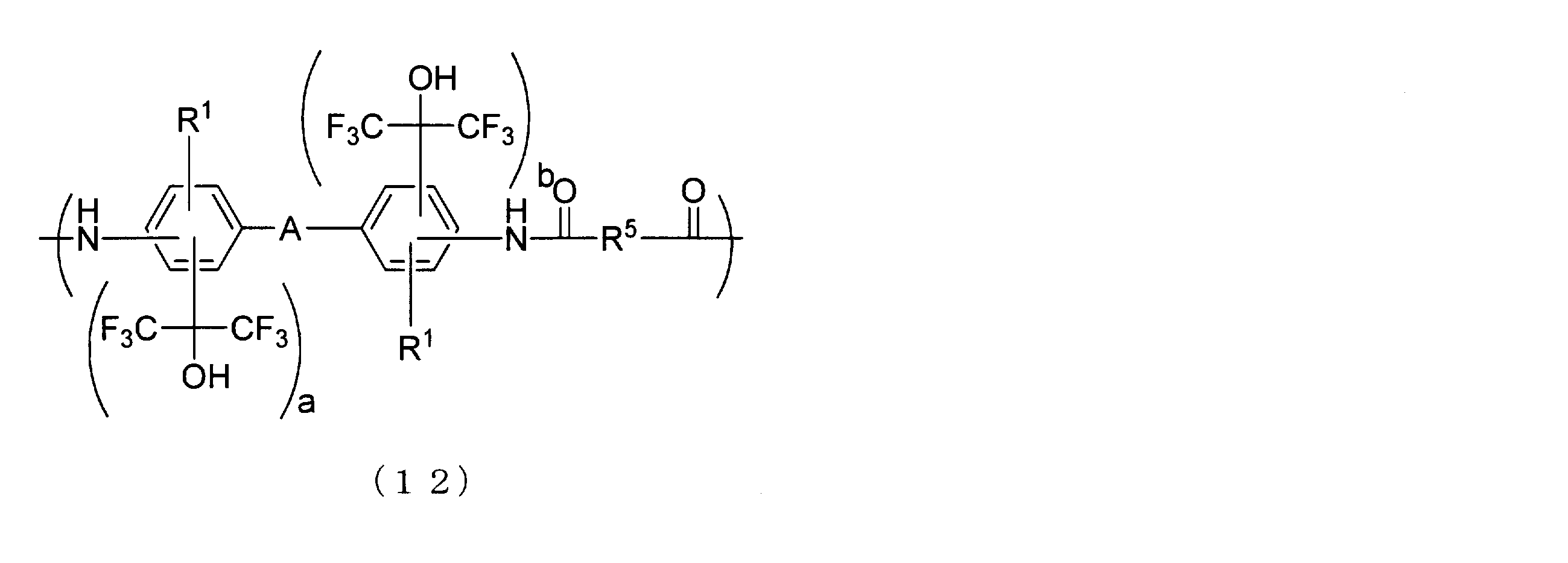
(Aは、単結合、エーテル結合、スルフィド結合、CO、CH2、SO、SO2、C(CH3)2、NHCO、もしくはC(CF3)2、または脂環、複素環もしくは芳香環を有する2価の基であり、R1は、それぞれ独立に、炭素数1~4のアルキル基またはハロゲン基であり、R5は脂環、複素環、芳香環または直鎖状もしくは分枝鎖状脂肪族炭化水素基からなる群から選ばれた少なくとも一種を含む2価の有機基であり、有機基中の水素原子の一部がアルキル基、フルオロアルキル基、カルボキシル基、ヒドロキシ基、シアノ基、またはハロゲン基で置換されてもよく、aとbは、それぞれ独立に、0~2の整数を表し、1≦a+b≦4である。)
で表わされる繰り返し単位を含む、発明15のHFIP基含有ポリアミドである。
本発明は、一般式(12)
で表わされる繰り返し単位を含む、発明15のHFIP基含有ポリアミドである。
また、本発明は、一般式(1)

(式中、Aは、単結合、エーテル結合、スルフィド結合、CO、CH2、SO、SO2、C(CH3)2、NHCO、もしくはC(CF3)2、または脂環、複素環もしくは芳香環を有する2価の基であり、R1は、それぞれ独立に、炭素数1~4のアルキル基、またはハロゲン基であり、aとbは、それぞれ独立に、0~2の整数を表し、1≦a+b≦4である。)
で表されるHFIP基含有ジアミンと、
一般式(13)
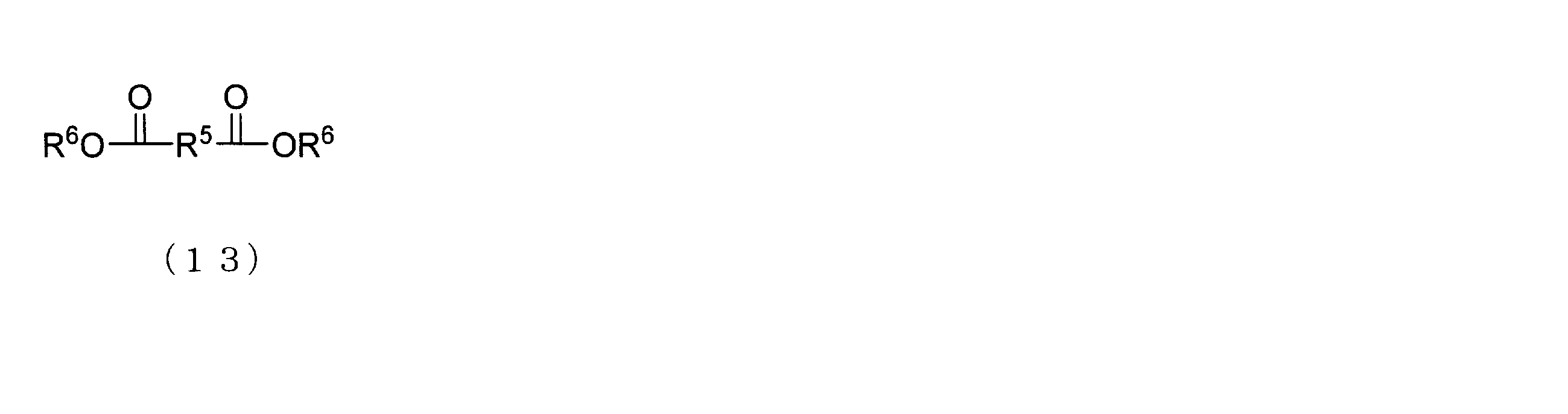
(式中、R5は脂環、複素環、芳香環または直鎖状もしくは分枝鎖状脂肪族炭化水素基からなる群から選ばれた少なくとも一種を含む2価の有機基であり、水素原子の一部がアルキル基、フルオロアルキル基、カルボキシル基、ヒドロキシ基、シアノ基、またはハロゲン基で置換されてもよく、R6は、それぞれ独立に、水素原子、炭素数1~10のアルキル基またはベンジル基から選ばれた少なくとも一種の基である。)
ジカルボン酸もしくはその誘導体
または、一般式(14)

(式中、R5は脂環、複素環、芳香環または直鎖状もしくは分枝鎖状脂肪族炭化水素基からなる群から選ばれた少なくとも一種を含む2価の有機基であり、有機基中の水素原子の一部がアルキル基、フルオロアルキル基、カルボキシル基、ヒドロキシ基、シアノ基、またはハロゲン基で置換されてもよく、Xは、ハロゲン基である。)で表わされる化合物を縮重合させる、
上記の一般式(12)で表わされるくり返し単位を含む、
発明15のHFIP基含有ポリアミドの製造方法である。
で表されるHFIP基含有ジアミンと、
一般式(13)
ジカルボン酸もしくはその誘導体
または、一般式(14)
上記の一般式(12)で表わされるくり返し単位を含む、
発明15のHFIP基含有ポリアミドの製造方法である。
このように、原料化合物に本発明のHFIP基含有ジアミンと一般式(13)で表わされるジカルボン酸またはその誘導体、あるいは一般式(14)で表わされる化合物を用いて重合させることで、ポリアミドが得られる。誘導体としては、ジカルボン酸ジハライド、ジカルボン酸モノエステル、ジカルボン酸ジエステルを用いることができる。
本発明で使用できる一般式(13)で表わされるジカルボン酸を例示すると、脂肪族カルボン酸においては、シュウ酸、マロン酸、コハク酸、グルタル酸、アジピン酸、ピメリン酸、スベリン酸、アゼライン酸、セバシン酸を例示することができる。芳香族ジカルボン酸においては、フタル酸、イソフタル酸、テレフタル酸、4,4’-ジカルボキシビフェニル、3,3’-ジカルボキシビフェニル、3,3’-ジカルボキシルジフェニルエーテル、3,4’-ジカルボキシルジフェニルエーテル、4,4’-ジカルボキシルジフェニルエーテル、3,3’-ジカルボキシルジフェニルメタン、3,4’-ジカルボキシルジフェニルメタン、4,4’-ジカルボキシルジフェニルメタン、3,3’-ジカルボキシルジフェニルジフルオロメタン、3,4’-ジカルボキシルジフェニルジフルオロメタン、4,4’-ジカルボキシルジフェニルジフルオロメタン、3,3’-ジカルボキシルジフェニルスルホン、3,4’-ジカルボキシルジフェニルスルホン、4,4’-ジカルボキシルジフェニルスルホン、3,3’-ジカルボキシルジフェニルスルフィド、3,4’-ジカルボキシルジフェニルスルフィド、4,4’-ジカルボキシルジフェニルスルフィド、3,3’-ジカルボキシルジフェニルケトン、3,4’-ジカルボキシルジフェニルケトン、4,4’-ジカルボキシルジフェニルケトン、2,2-ビス(3-カルボキシフェニル)プロパン、2,2-ビス(3,4’-ジカルボキシフェニル)プロパン、2,2-ビス(4-カルボキシフェニル)プロパン、2,2-ビス(3-カルボキシフェニル)ヘキサフルオロプロパン、2,2-ビス(3,4’-ジカルボキシフェニル)ヘキサフルオロプロパン、2,2-ビス(4-カルボキシフェニル)ヘキサフルオロプロパン、1,3-ビス(3-カルボキシフェノキシ)ベンゼン、1,4-ビス(3-カルボキシフェノキシ)ベンゼン、1,4-ビス(4-カルボキシフェノキシ)ベンゼン、3,3’-(1,4-フェニレンビス(1-メチルエチリデン))ビス安息香酸、3,4’-(1,4-フェニレンビス(1-メチルエチリデン))ビス安息香酸、4,4’-(1,4-フェニレンビス(1-メチルエチリデン))ビス安息香酸、2,2-ビス(4-(3-カルボキシフェノキシ)フェニル)プロパン、2,2-ビス(4-(4-カルボキシフェノキシ)フェニル)プロパン、2,2-ビス(4-(3-カルボキシフェノキシ)フェニル)ヘキサフルオロプロパン、2,2-ビス(4-(4-カルボキシフェノキシ)フェニル)ヘキサフルオロプロパン、ビス(4-(3-カルボキシフェノキシ)フェニル)スルフィド、ビス(4-(4-カルボキシフェノキシ)フェニル)スルフィド、ビス(4-(3-カルボキシフェノキシ)フェニル)スルホンまたはビス(4-(4-カルボキシフェノキシ)フェニル)スルホン、パーフルオロノネニルオキシ基含有のジカルボン酸である5-(パーフルオロノネニルオキシ)イソフタル酸、4-(パーフルオロノネニルオキシ)フタル酸、2-(パーフルオロノネニルオキシ)テレフタル酸または4-メトキシ-5-(パーフルオロノネニルオキシ)イソフタル酸、パーフルオロヘキセニルオキシ基含有のジカルボン酸である、5-(パーフルオロヘキセニルオキシ)イソフタル酸、4-(パーフルオロヘキセニルオキシ)フタル酸、2-(パーフルオロヘキセニルオキシ)テレフタル酸または4-メトキシ-5-(パーフルオロヘキセニルオキシ)イソフタル酸、2,2’-ジートリフルオロメチル-4,4’-ジカルボキシビフェニル等を例示することができる。ジカルボン酸誘導体は、これらカルボン酸のカルボキシル基を保護基で保護したものであり、一般式(13)または一般式(14)で表わしたものである。
重合反応の方法、条件については特に制限されない。例えば、前記成分と前記ジカルボン酸のアミド形成誘導体を150℃以上250℃未満で相互に溶融(融解)させて無溶媒で反応させる方法、また-20℃~80℃の有機溶媒中で反応させる方法を例示することができる。
使用できる有機溶媒としては原料化合物であるジアミンと、一般式(13)で表わされるカルボン酸、その誘導体、または一般式(14)で表わされる化合物がともに溶解すればよく、アミド系溶媒、例えばN,N-ジメチルホルムアミド、N,N-ジメチルアセトアミド、N-メチルホルムアミド、ヘキサメチルリン酸トリアミドまたはN-メチル-2-、ピロリドン等、芳香族性溶媒、例えばベンゼン、アニソール、ジフェニルエーテル、ニトロベンゼン、ベンゾニトリル、ハロゲン系溶媒クロロホルム、ジクロロメタン、1,2-ジクロロエタンまたは1,1,2,2-テトラクロロエタン等、あるいは、ラクトン系溶媒、例えばγ-ブチルラクトン、γ-バレロラクトン、γ-カプロラクトン、ε-カプロラクトンまたはα-メチル-γ-ブチルラクトン等を例示することができる。これら溶媒とともに、酸受容体、例えば、ピリジン、トリエチルアミン等などを共存させて反応を行うと、より効果的である。特に上記のアミド系溶媒を用いるとこれらの溶媒自身が酸受容体となり高重合度のポリアミドを得ることができる。
尚、本発明のHFIP基含有ポリアミドは、ポリスチレン換算で重量平均分子量(Mw)が10000以上、500000以下であることが好ましい。Mwが10000より小さいと、得られるHFIP基含有ポリアミドの強度が低く自立膜ができにくく、500000より大きいと得られるHFIP基含有ポリアミドは溶解性に劣る。特に好ましくは、50000以上、150000以下である。
6.HFIP基含有重合体およびその製造方法
本発明は、一般式(15)
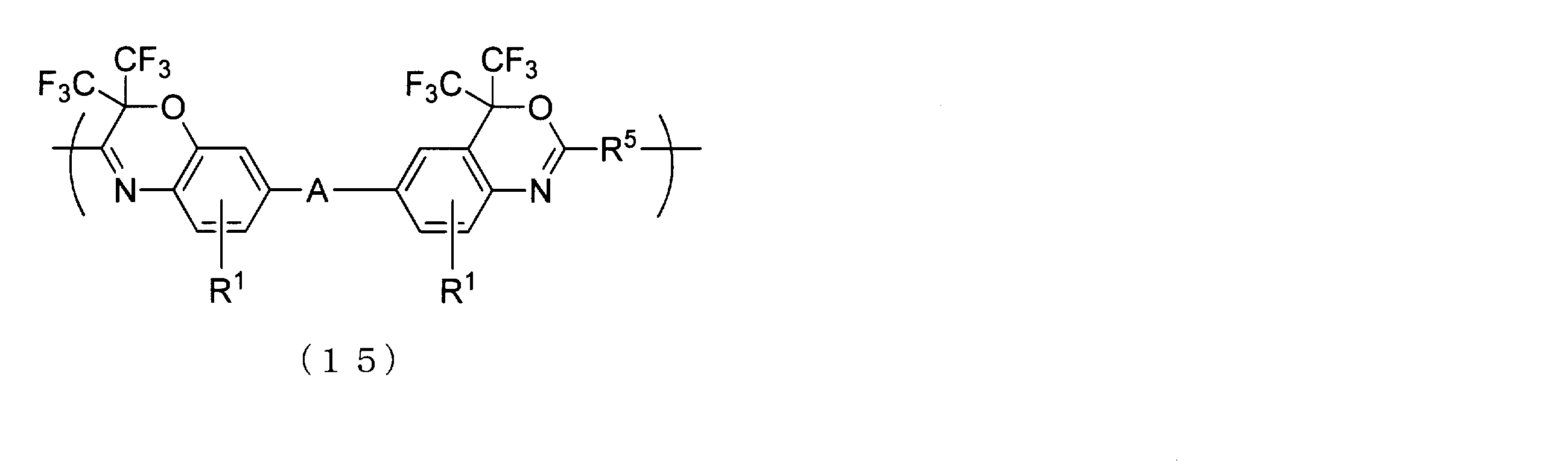
(式中、Aは、単結合、エーテル結合、スルフィド結合、CO、CH2、SO、SO2、C(CH3)2、NHCO、もしくはC(CF3)2、または脂環、複素環もしくは芳香環を有する2価の基であり、R1は、それぞれ独立に、炭素数1~4のアルキル基またはハロゲン基であり、R5は脂環、複素環、芳香環または直鎖状もしくは分枝鎖状脂肪族炭化水素基からなる群から選ばれた少なくとも一種を含む2価の有機基であり、有機基中の水素原子の一部がアルキル基、フルオロアルキル基、カルボキシル基、ヒドロキシ基、シアノ基、またはハロゲン基で置換されてもよい。)
で表わされる繰り返し単位を含む、発明18のHFIP基含有重合体である。
本発明は、一般式(15)
で表わされる繰り返し単位を含む、発明18のHFIP基含有重合体である。
本発明の一般式(12)で表される高分子化合物は環化させることにより、一般式(15)で表される高分子化合物にすることができる。環化反応は、加熱して行うことができ、また酸触媒を加え加熱する等の脱水を促進する方法で行うことができる。
具体的には、前述した一般式(12)で表されるHFIP基含有ポリアミド酸は、加熱処理または脱水試薬との反応によって、化合物内で脱水が起こり、環構造が形成され、一般式(15)で表される重合体を合成することができる。加熱処理によりポリアミド酸内で脱水して環化を行う場合、250℃以上、400℃以下の反応温度で環が形成され、一般式(15)で表される重合体を合成することができる。より好ましくは、300℃以上、380℃以下である。反応温度が250℃より低いと環化が十分に進行せず、前記重合体をコーティング膜にした際に膜強度が損なわれる、または吸水性が高くなる虞がある。一方、反応温度が400℃を超えると、重合体の一部が熱分解する等して、前記重合体をコーティング膜にした際に膜強度が損なわれる、または着色する虞がある。また、脱水試薬を用いて前記ポリアミド酸内で脱水して環化を行う場合、脱水試薬として無水酢酸を添加し、さらにピリジンまたはトリエチルアミン等の塩基を添加し、前記ポリアミド酸と反応させ、前記ポリアミド酸内で脱水することで環化して、前記重合体を合成することも可能である。
尚、前記重合体は、ポリスチレン換算で重量平均分子量(Mw)が10000以上、500000以下であることが好ましい。Mwが10000より小さいと、重合体の強度が低く自立膜ができにくく、500000より大きいと重合体は溶解性に劣る。特に好ましくは、50000以上、150000以下である。
7.蛍光材料
発明10~12のHFIP基含有ポリイミド、発明15のHFIP基含有ポリアミドおよび発明18のHFIP基含有重合体を含むことで 、発光量子収率0.1%以上の蛍光材料を得ることができる。可視光または紫外光の照射により、波長400nm~550nmに発光ピークを有する蛍光を発する。
発明10~12のHFIP基含有ポリイミド、発明15のHFIP基含有ポリアミドおよび発明18のHFIP基含有重合体を含むことで 、発光量子収率0.1%以上の蛍光材料を得ることができる。可視光または紫外光の照射により、波長400nm~550nmに発光ピークを有する蛍光を発する。
次に本発明を実施例によりさらに詳細に説明するが、本発明は以下の実施例により限定されるものではない。
初めに、2種類のHFIP基含有ジアミンの合成を行った。
次いで、合成したHFIP基含有ジアミンに種類の異なる複数のテトラカルボン酸二無水物を反応させ、HFIP基含有ポリアミド酸を得た後、種類の異なるHFIP基含有ポリイミド(実施例1~8)を得た。
実施例1、3、6、8で得た本発明のHFIP基含有ポリイミド、比較例1~5の従来のポリイミド、参考例1のHFIP基のみを含有するポリイミドについて蛍光の発光波長および発光量子収率の測定を行い、蛍光特性の比較および評価を行った。
[HFIP基含有ジアミンの合成実施例]
初めに、2種類のHFIP基含有ジアミンの合成を行った。以下詳細に示す。
初めに、2種類のHFIP基含有ジアミンの合成を行った。以下詳細に示す。
<HFIP基含有ジアミンの合成 その1>
(ビス(4-アミノ-3-(1,1,1,3,3,3-ヘキサフルオロ-2-ヒドロキシ-2-プロピル)-5-メチルフェニル)メタンの合成
以下の式で表わされる、目的化合物であるHFIP基含有ジアミンに属するビス(4-アミノ-3-(1,1,1,3,3,3-ヘキサフルオロ-2-ヒドロキシ-2-プロピル)-5-メチルフェニル)メタンの合成を行った。
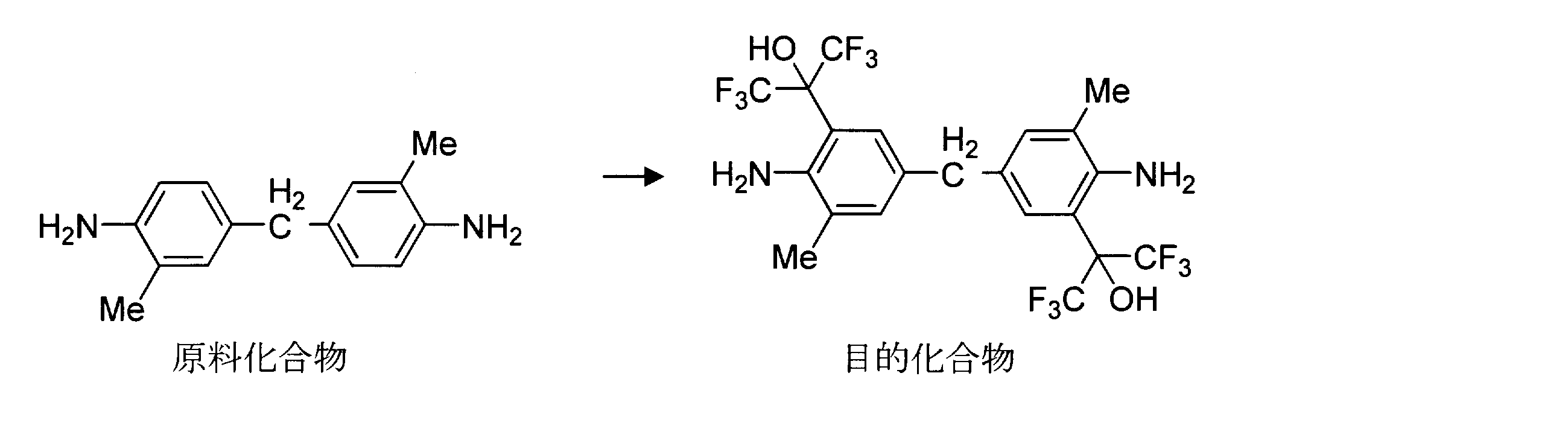
(ビス(4-アミノ-3-(1,1,1,3,3,3-ヘキサフルオロ-2-ヒドロキシ-2-プロピル)-5-メチルフェニル)メタンの合成
以下の式で表わされる、目的化合物であるHFIP基含有ジアミンに属するビス(4-アミノ-3-(1,1,1,3,3,3-ヘキサフルオロ-2-ヒドロキシ-2-プロピル)-5-メチルフェニル)メタンの合成を行った。
300mLオートクレーブに原料化合物である4,4’-ジアミノ-3,3’-ジメチルジフェニルメタン75g(0.33mol)、溶媒としてのトルエン200g、触媒としてのパラトルエンスルホン酸一水和物3.1gを加え、雰囲気を窒素置換した後に密閉した。オートクレーブをオイルバスにて110℃に加熱し、オートクレーブのガス注入口からヘキサフルオロアセトン(HFA)115gを加え攪拌した。18時間撹拌後、オートクレーブを室温(20℃)に冷却し濾過した。クロロホルムを用い洗浄した後、減圧乾燥して目的化合物であるビス(4-アミノ-3-(1,1,1,3,3,3-ヘキサフルオロ-2-ヒドロキシ-2-プロピル)-5-メチルフェニル)メタンの白色粉末75.1g(0.14mol)を収率41%で得た。核磁気共鳴スペクトル(NMR)で測定したデータを以下に示す。
1H-NMR(ジメチルスルホキシド(DMSO)-d6):δ11.13(brs,2H),6.98(s,2H)、6.93(s,2H),5.12(brs, 4H),3.66(s, 2H),2.10(s, 6H). 19F-NMR(DMSO-d6):δ-72.97(s).
<HFIP基含有ジアミンの合成 その2>
3,3’-ビス(1,1,1,3,3,3-ヘキサフルオロ-2-ヒドロキシ-2-プロピル)-5,5’-ジメチルベンジジンの合成
以下の式で表わされる、目的化合物であるHFIP基含有ジアミンに属する3,3’-ビス(1,1,1,3,3,3-ヘキサフルオロ-2-ヒドロキシ-2-プロピル)-5,5’-ジメチルベンジジンの合成を行った。
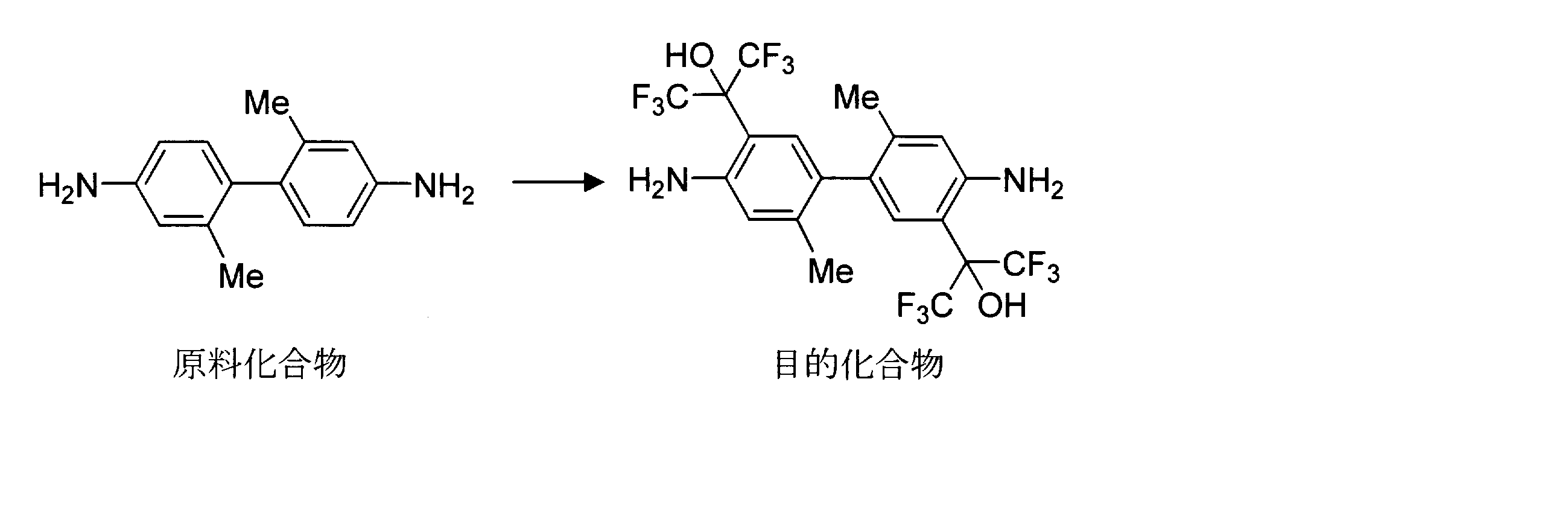
3,3’-ビス(1,1,1,3,3,3-ヘキサフルオロ-2-ヒドロキシ-2-プロピル)-5,5’-ジメチルベンジジンの合成
以下の式で表わされる、目的化合物であるHFIP基含有ジアミンに属する3,3’-ビス(1,1,1,3,3,3-ヘキサフルオロ-2-ヒドロキシ-2-プロピル)-5,5’-ジメチルベンジジンの合成を行った。
300mLオートクレーブに原料化合物であるm-トリジン42.4g(0.200mol)、ヘキサフルオロアセトン三水和物220g(1.00mol)、触媒としてのパラトルエンスルホン酸一水和物1.9g(10mmol)を加え、雰囲気を窒素置換した後に密閉した。オートクレーブを、オイルバスにて135℃に加熱した後に攪拌した。22時間撹拌し続けた後、オートクレーブを室温(20℃)に冷却後、開放し、内容物を濾過した。濾別回収して得られた粉末をジイソプロピルエーテルで洗浄し、減圧乾燥することで3,3’-ビス(1,1,1,3,3,3-ヘキサフルオロ-2-ヒドロキシ-2-プロピル)-5,5’-ジメチルベンジジンの白色粉末75.0g(0.138mol)を収率69%で得た。NMR測定データを以下に示す。
1H-NMR(DMSO-d6):δ9.27(brs,2H),6.80(s,2H)、6.65(s,2H),5.54(brs, 4H),1.88(s, 6H). 19F-NMR(DMSO-d6):δ-72.78(s).
[HFIP基含有ポリイミドの製造実施例]
次いで、実施例1~8において、合成した2種類のHFIP基含有ジアミンに、種類の異なるテトラカルボン酸二無水物を反応させ、HFIP基含有ポリアミド酸を得た後でイミド化することで、異なる複数の種類のHFIP基含有ポリイミドによる膜を得た。
次いで、実施例1~8において、合成した2種類のHFIP基含有ジアミンに、種類の異なるテトラカルボン酸二無水物を反応させ、HFIP基含有ポリアミド酸を得た後でイミド化することで、異なる複数の種類のHFIP基含有ポリイミドによる膜を得た。
実施例1
<HFIP基含有ジアミド酸の合成>
以下の式に示すように、<HFIP基含有ジアミンの合成 その1>で合成したビス(4-アミノ-3-(1,1,1,3,3,3-ヘキサフルオロ-2-ヒドロキシ-2-プロピル)-5-メチルフェニル)メタンとピロメリット酸無水物(PMDA)の重合反応によるHFIP基含有ポリアミド酸を合成した。
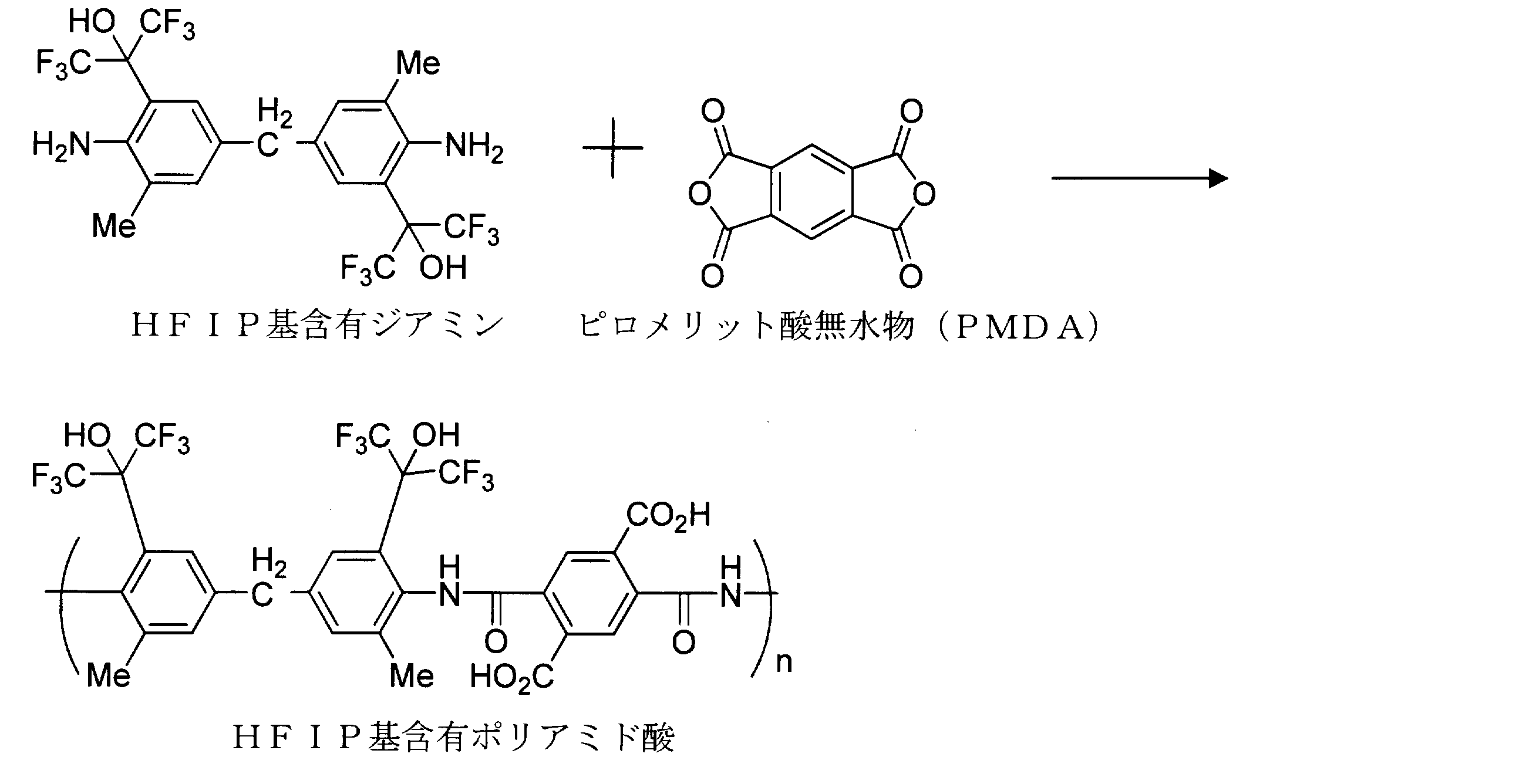
<HFIP基含有ジアミド酸の合成>
以下の式に示すように、<HFIP基含有ジアミンの合成 その1>で合成したビス(4-アミノ-3-(1,1,1,3,3,3-ヘキサフルオロ-2-ヒドロキシ-2-プロピル)-5-メチルフェニル)メタンとピロメリット酸無水物(PMDA)の重合反応によるHFIP基含有ポリアミド酸を合成した。
尚、式中のnは重合度を表す、以下同じ。
具体的には、容積300mLの反応容器中に、HFIP基含有ジアミンとして、ビス(4-アミノ-3-(1,1,1,3,3,3-ヘキサフルオロ-2-ヒドロキシ-2-プロピル)-5-メチルフェニル)メタン、20.01g、およびピロメリット酸無水物7.813g、溶媒としてのN,N-ジメチルアセトアミド、64.92gを加え、窒素雰囲気下、室温(20℃)にて19時間撹拌し反応させ反応液を得た。尚、後段反応のポリイミド化後、IR測定を行い、反応液は、上記の式で表わされるHFIP基含有ポリアミド酸の溶液であることを確認した。当該溶液のゲル浸透クロマトグラフィー(GPC)測定の結果、重量平均分子量(Mw)は14000であった。
<HFIP基含有ポリイミドの合成および成膜>
次いで、ガラス基板上に、以下の式に示すHFIP基含有ポリイミドからなる膜を成膜した。
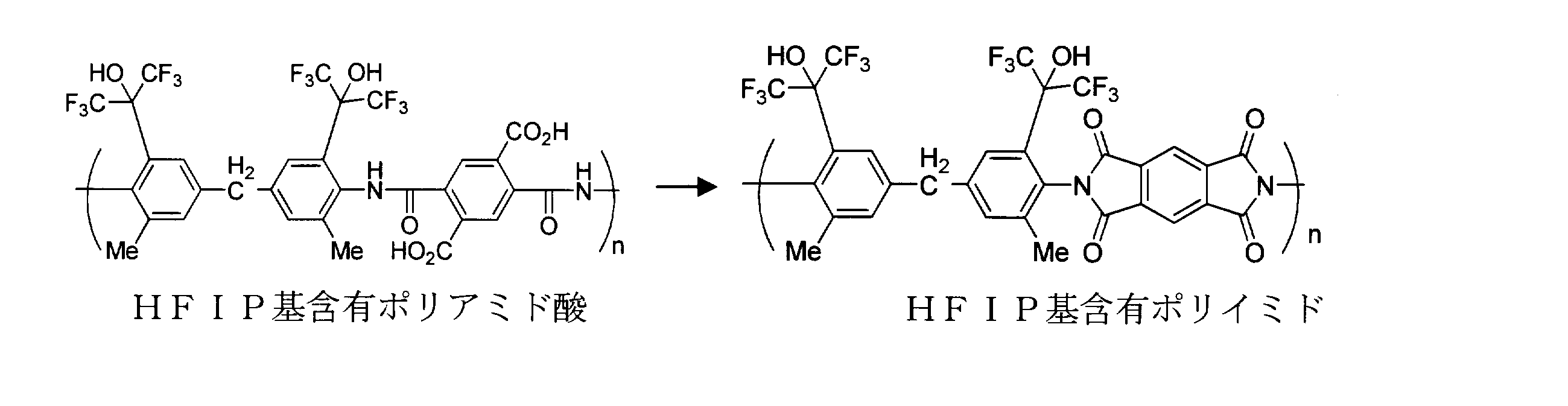
次いで、ガラス基板上に、以下の式に示すHFIP基含有ポリイミドからなる膜を成膜した。
具体的には、上記HFIP基含有ポリアミド酸の溶液に、ピリジン5.66g、無水酢酸7.34gの順で加え、室温(20℃)にて4時間攪拌することで、HFIP基含有ポリアミド酸をイミド化し、上記HFIP基含有ポリイミドを含む溶液を得た。当該溶液のGPC測定の結果、Mwは13000であった。
次いで、当該溶液をガラス基板上にスピンコーターを用いて塗布した後、130℃で30分、180℃で30分、200℃で3時間、段階的昇温しつつ連続加熱し、ガラス基板上に膜を得た。膜厚は、21μmであった。赤外吸収(IR)スペクトルの測定結果において、1777cm-1、1722cm-1にイミド基固有の吸収があり、上記HFIP基含有ポリイミドからなる膜であることを確認した。
実施例2
<HFIP基含有アミド酸の合成>
以下の式に示すように、<HFIP基含有ジアミンの合成 その1>で合成したビス(4-アミノ-3-(1,1,1,3,3,3-ヘキサフルオロ-2-ヒドロキシ-2-プロピル)-5-メチルフェニル)メタンと以下のカルボン酸無水物(6FDA)の重合反応によりHFIP基含有ポリアミド酸を合成した。

<HFIP基含有アミド酸の合成>
以下の式に示すように、<HFIP基含有ジアミンの合成 その1>で合成したビス(4-アミノ-3-(1,1,1,3,3,3-ヘキサフルオロ-2-ヒドロキシ-2-プロピル)-5-メチルフェニル)メタンと以下のカルボン酸無水物(6FDA)の重合反応によりHFIP基含有ポリアミド酸を合成した。
具体的には、容積300mLの反応容器中に、HFIP基含有ジアミンとしてのビス(4-アミノ-3-(1,1,1,3,3,3-ヘキサフルオロ-2-ヒドロキシ-2-プロピル)-5-メチルフェニル)メタン、9.999g、および上記カルボン酸無水物7.956g、溶媒としてのN,N-ジメチルアセトアミド、41.90gを加え、窒素雰囲気下、室温(20℃)にて22時間撹拌し反応液を得た。尚、後段反応のポリイミド化後、IR測定を行い、反応液は、上記の式で表わされるHFIP基含有ポリアミド酸の溶液であることを確認した。当該溶液のGPC測定の結果、Mwは13000であった。
<HFIP基含有ポリイミドの合成および成膜>
次いで、ガラス基板上に、以下の式に示すHFIP基含有ポリイミドからなる膜を成膜した。
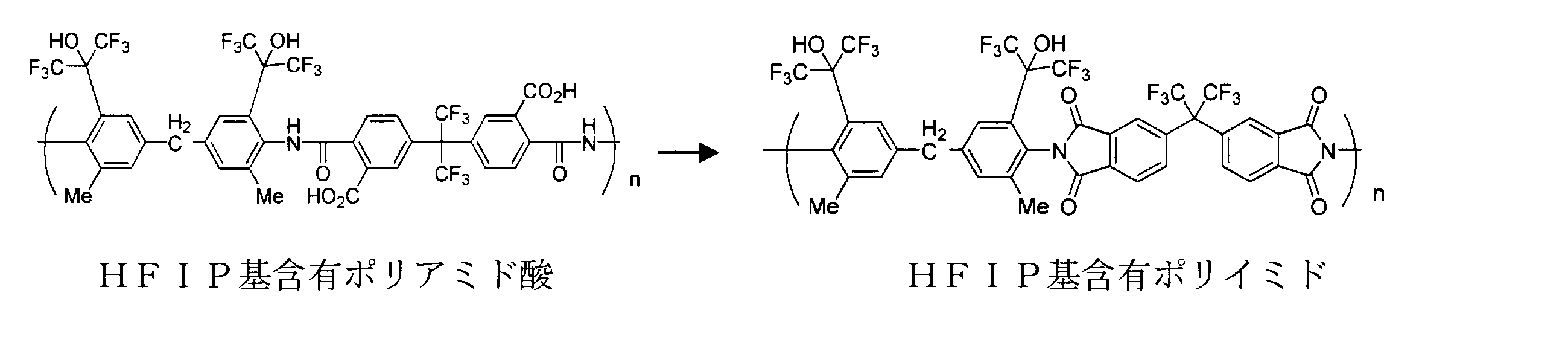
次いで、ガラス基板上に、以下の式に示すHFIP基含有ポリイミドからなる膜を成膜した。
HFIP基含有ポリアミド酸の溶液に、ピリジン2.85g、無水酢酸(3.656g)を順番に投入し、室温(20℃)にて4時間攪拌することで、HFIP基含有ポリアミド酸をイミド化し、上記HFIP基含有ポリイミドを含む溶液を得た。当該溶液のGPC測定の結果、Mwは11500であった。
次いで、当該溶液をガラス基板上にスピンコーターを用いて塗布し、130℃で30分、180℃で30分、200℃で3時間、段階的昇温しつつ連続加熱し、ガラス基板上に膜を得た。膜厚は、18μmであった。IRスペクトルの測定結果において、1790cm-1よび1717cm-1にイミド基固有の吸収があり、上記HFIP基含有ポリイミドからなる膜であることを確認した。
実施例3
<HFIP基含有ジアミド酸の合成>
以下の式に示すように、<HFIP基含有ジアミンの合成 その2>で合成した3,3’-ビス(1,1,1,3,3,3-ヘキサフルオロ-2-ヒドロキシ-2-プロピル)-5,5’-ジメチルベンジジンとピロメリット酸無水物の重合反応によるHFIP基含有ポリアミド酸を合成した。

<HFIP基含有ジアミド酸の合成>
以下の式に示すように、<HFIP基含有ジアミンの合成 その2>で合成した3,3’-ビス(1,1,1,3,3,3-ヘキサフルオロ-2-ヒドロキシ-2-プロピル)-5,5’-ジメチルベンジジンとピロメリット酸無水物の重合反応によるHFIP基含有ポリアミド酸を合成した。
具体的には、容積300mLの反応容器中に、HFIP基含有ジアミンとして、3,3’-ビス(1,1,1,3,3,3-ヘキサフルオロ-2-ヒドロキシ-2-プロピル)-5,5’-ジメチルベンジジン、10.00g、およびピロメリット酸無水物4.005g、溶媒としてのN,N-ジメチルアセトアミド32.71gを加え、窒素雰囲気下、室温(20℃)にて19時間撹拌し反応させ反応液を得た。尚、後段反応のポリイミド化後、IR測定を行い、反応液は、上記の式で表わされるHFIP基含有ポリアミド酸の溶液であることを確認した。GPC測定の結果、Mwは72500であった。
<HFIP基含有ポリイミドの合成および成膜>
次いで、ガラス基板上に、以下のHFIP基含有ポリイミドからなる膜を成膜した。

次いで、ガラス基板上に、以下のHFIP基含有ポリイミドからなる膜を成膜した。
具体的には、上記HFIP基含有ポリアミド酸の溶液に、ピリジン2.90g、無水酢酸3.66gの順で加え、室温(20℃)にて4時間攪拌することで、HFIP基含有ポリアミド酸をイミド化し、HFIP基含有ポリイミドを含む溶液を得た。当該溶液のGPC測定の結果、Mwは70500であった。
当該溶液をガラス基板上にスピンコーターを用いて塗布した後、130℃で30分、180℃で30分、200℃で3時間、段階的昇温しつつ連続加熱し、ガラス基板上に膜を得た。膜厚は、13μmであった。IRスペクトルの測定結果から、1723cm-1および1789cm-1にイミド基固有の吸収があり、上記HFIP基含有ポリイミドからなる膜であることを確認した。
実施例4
<HFIP基含有ジアミド酸の合成>
以下の式に示すように、<HFIP基含有ジアミンの合成 その2>で合成した3,3’-ビス(1,1,1,3,3,3-ヘキサフルオロ-2-ヒドロキシ-2-プロピル)-5,5’-ジメチルベンジジンとテトラカルボン酸二無水物(6FDA)の重合反応によるHFIP基含有ポリアミド酸を合成した。
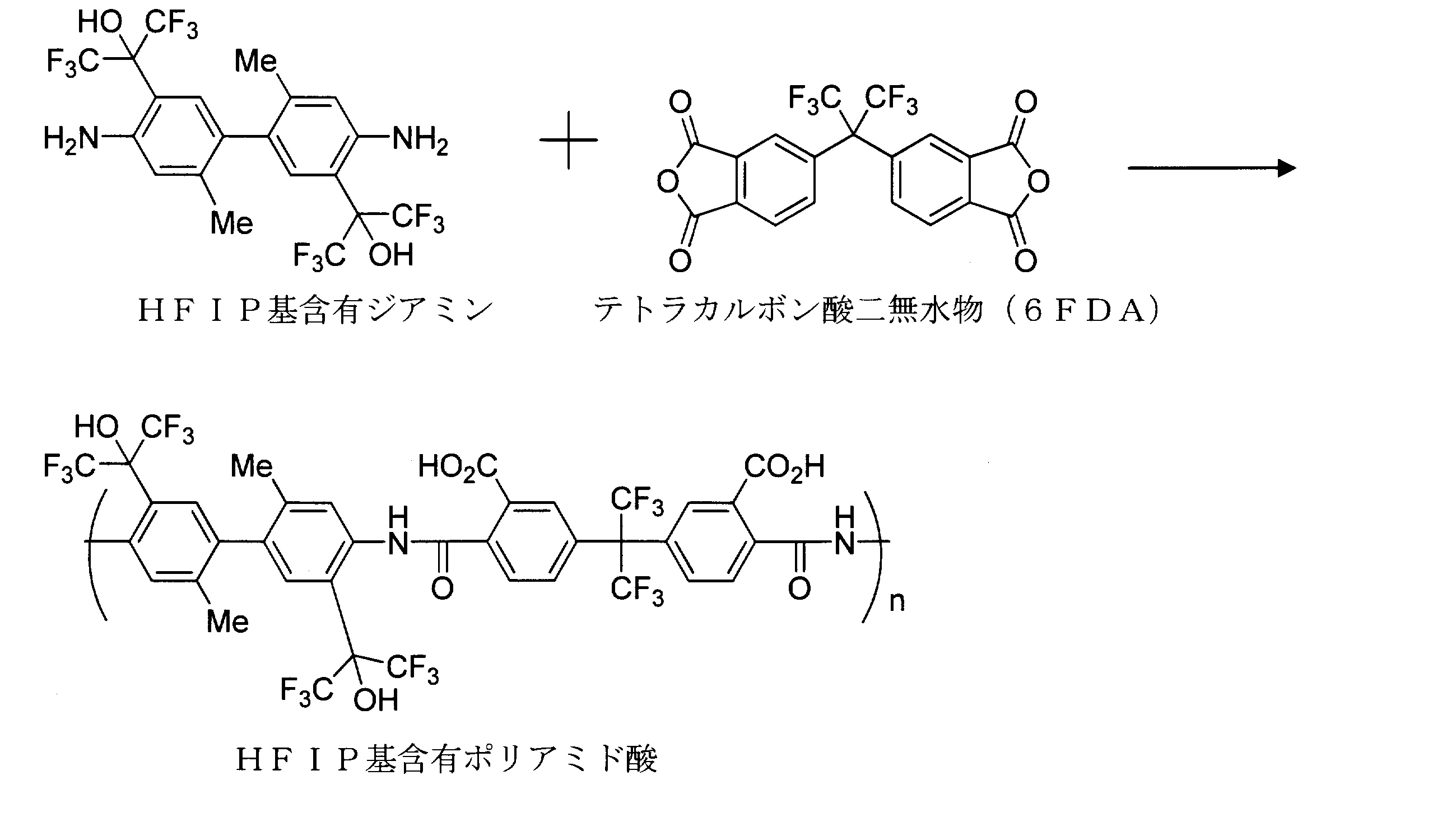
<HFIP基含有ジアミド酸の合成>
以下の式に示すように、<HFIP基含有ジアミンの合成 その2>で合成した3,3’-ビス(1,1,1,3,3,3-ヘキサフルオロ-2-ヒドロキシ-2-プロピル)-5,5’-ジメチルベンジジンとテトラカルボン酸二無水物(6FDA)の重合反応によるHFIP基含有ポリアミド酸を合成した。
具体的には、容積300mLの反応容器中に、HFIP基含有ジアミンとして3,3’-ビス(1,1,1,3,3,3-ヘキサフルオロ-2-ヒドロキシ-2-プロピル)-5,5’-ジメチルベンジジン、9.999g、およびテトラカルボン酸二無水物8.154g、溶媒としてのN,N-ジメチルアセトアミド65.80gを加え、窒素雰囲気下、室温(20℃)にて17時間撹拌し反応液を得た。尚、後段反応のポリイミド化後、IR測定を行い、反応液は、上記の式で表わされるHFIP基含有ポリアミド酸の溶液であることを確認した。当該溶液のGPC測定の結果、Mwは43000であった。
<HFIP基含有ポリイミドの合成および成膜>
次いで、ガラス基板上に、以下のフッ素ポリイミドからなる膜を成膜した。
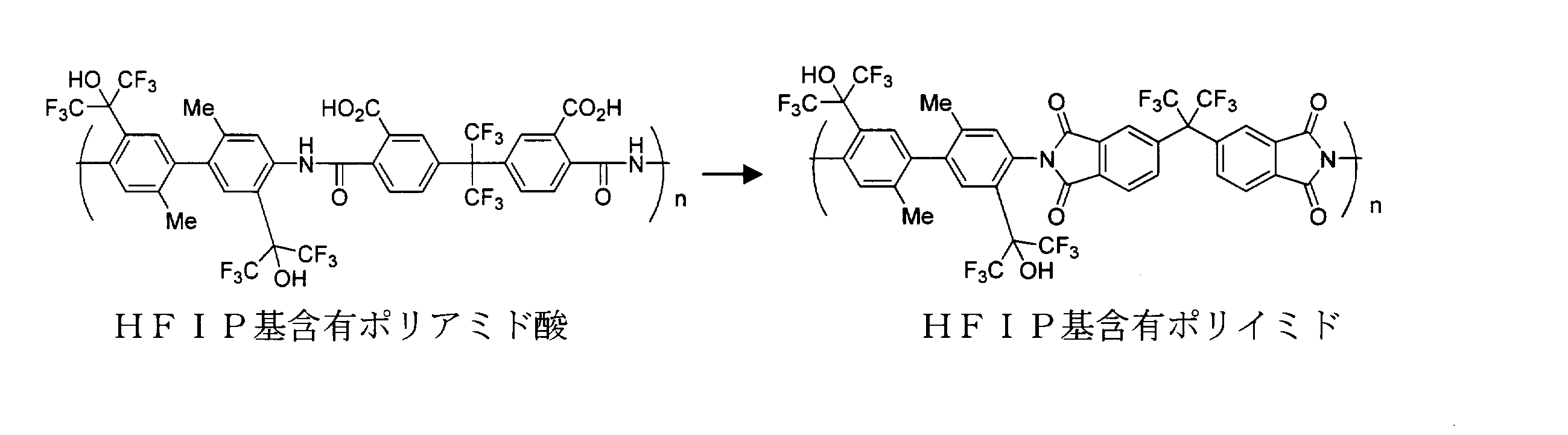
次いで、ガラス基板上に、以下のフッ素ポリイミドからなる膜を成膜した。
具体的には、上記HFIP基含有ポリアミド酸の溶液に、ピリジン、2.92g、無水酢酸3.76gの順で加え、室温(20℃)にて4時間攪拌することで、HFIP基含有ポリアミド酸をイミド化し、HFIP基含有ポリイミドの溶液を得た。当該溶液のGPC測定の結果、Mwは42000であった。
当該溶液をガラス基板上にスピンコーターを用いて塗布した後、130℃で30分、180℃で30分、200℃で3時間、段階的に昇温しつつ連続加熱し、ガラス基板上に膜を得た。膜厚は、28μmであった。IRスペクトルの測定結果から、1791cm-1および1726cm-1にイミド基固有の吸収があり、上記HFIP基含有ポリイミドからなる膜であることを確認した。
実施例5
<HFIP基含有ジアミド酸の合成>
以下の式に示すように、<HFIP基含有ジアミンの合成 その2>で合成した3,3’-ビス(1,1,1,3,3,3-ヘキサフルオロ-2-ヒドロキシ-2-プロピル)-5,5’-ジメチルベンジジンとテトラカルボン酸二無水物(BTDA)の重合反応により、HFIP基含有ポリアミド酸を合成した。
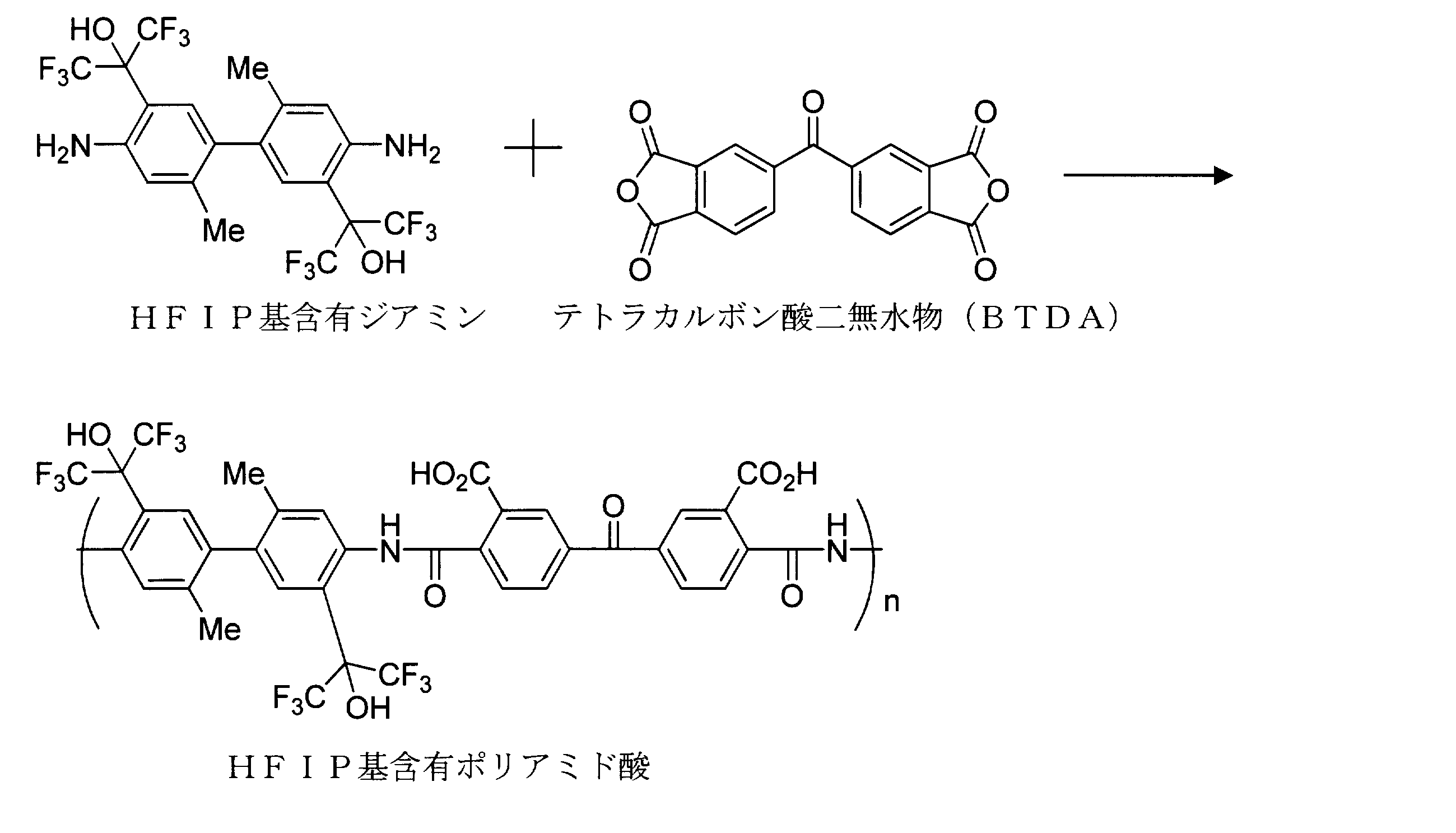
<HFIP基含有ジアミド酸の合成>
以下の式に示すように、<HFIP基含有ジアミンの合成 その2>で合成した3,3’-ビス(1,1,1,3,3,3-ヘキサフルオロ-2-ヒドロキシ-2-プロピル)-5,5’-ジメチルベンジジンとテトラカルボン酸二無水物(BTDA)の重合反応により、HFIP基含有ポリアミド酸を合成した。
具体的には、容積300mLの反応容器中に、HFIP基含有ジアミンとして3,3’-ビス(1,1,1,3,3,3-ヘキサフルオロ-2-ヒドロキシ-2-プロピル)-5,5’-ジメチルベンジジン、20.01g、および上記テトラカルボン酸二無水物5.919g、溶媒としてのN,N-ジメチルアセトアミド37.14gを加え、窒素雰囲気下、室温(20℃)にて22時間撹拌し反応液を得た。尚、後段反応のポリイミド化後、IR測定を行い、反応液は、上記の式で表わされるHFIP基含有ポリアミド酸の溶液であることを確認した。当該溶液のGPC測定の結果、Mwは48000であった。
<HFIP基含有ポリイミドの合成および成膜>
次いで、ガラス基板上に、以下HFIP基含有ポリイミドからなる膜を成膜した。
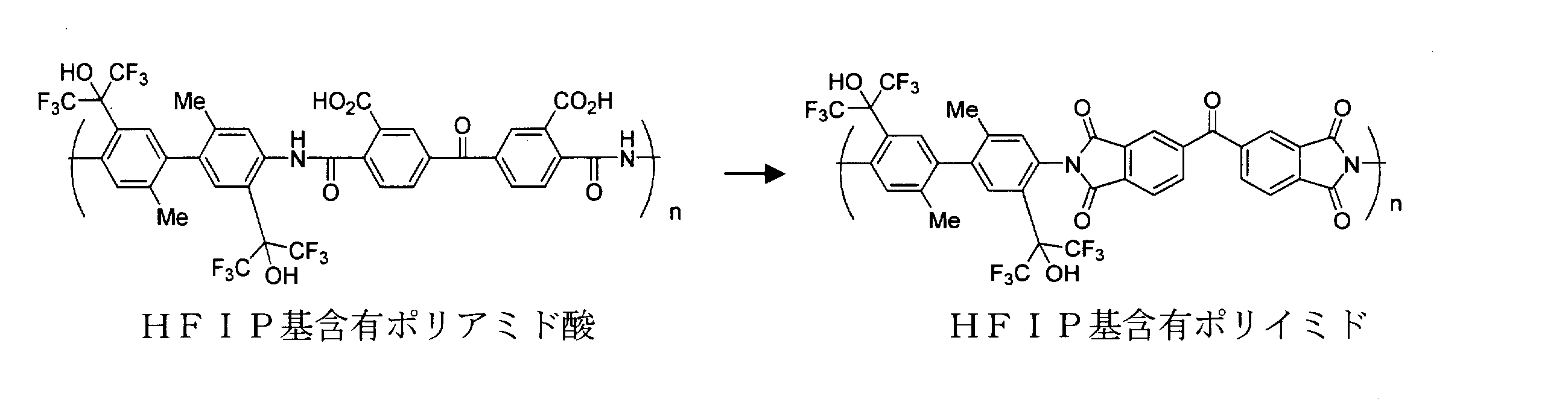
次いで、ガラス基板上に、以下HFIP基含有ポリイミドからなる膜を成膜した。
具体的には、上記HFIP基含有ポリアミド酸の溶液に、ピリジン、2.94g、無水酢酸(3.77g)の順で加え、室温(20℃)にて4時間攪拌させることで、HFIP基含有ポリアミド酸をイミド化し、HFIP基含有ポリイミドを含む溶液を得た。当該溶液のGPC測定の結果、Mwは50500であった。
当該溶液をガラス基板上にスピンコーターを用いて塗布した後、130℃で30分、180℃で30分、200℃で3時間、段階的昇温しつつ連続加熱し、ガラス基板上に膜を得た。膜厚は、60μmであった。IRスペクトルの測定結果から、1723cm-1および1791cm-1にイミド基固有の吸収があり、上記HFIP基含有ポリイミドからなる膜であることを確認した。
実施例6
<HFIP基含有ジアミド酸の合成>
以下の式に示す、<HFIP基含有ジアミンの合成 その2>で合成した3,3’-ビス(1,1,1,3,3,3-ヘキサフルオロ-2-ヒドロキシ-2-プロピル)-5,5’-ジメチルベンジジンとテトラカルボン酸二無水物(BPDA)の重合反応により、HFIP基含有ポリアミド酸を合成した。

<HFIP基含有ジアミド酸の合成>
以下の式に示す、<HFIP基含有ジアミンの合成 その2>で合成した3,3’-ビス(1,1,1,3,3,3-ヘキサフルオロ-2-ヒドロキシ-2-プロピル)-5,5’-ジメチルベンジジンとテトラカルボン酸二無水物(BPDA)の重合反応により、HFIP基含有ポリアミド酸を合成した。
具体的には、容積300mLの反応容器中に、HFIP基含有ジアミンとして3,3’-ビス(1,1,1,3,3,3-ヘキサフルオロ-2-ヒドロキシ-2-プロピル)-5,5’-ジメチルベンジジン、10.00g、およびテトラカルボン酸二無水物、5.404g、溶媒としてN,N-ジメチルアセトアミド36.00gを加え、窒素雰囲気下、室温(20℃)にて23時間撹拌し反応液を得た。尚、後段反応のポリイミド化後、IR測定を行い、反応液は、上記の式で表わされるHFIP基含有ポリアミド酸の溶液であることを確認した。当該溶液のGPC測定の結果、Mwは90000であった。
<HFIP基含有ポリイミドの合成および成膜>
次いで、ガラス基板上に、以下のHFIP基含有ポリイミドからなる膜を得た。
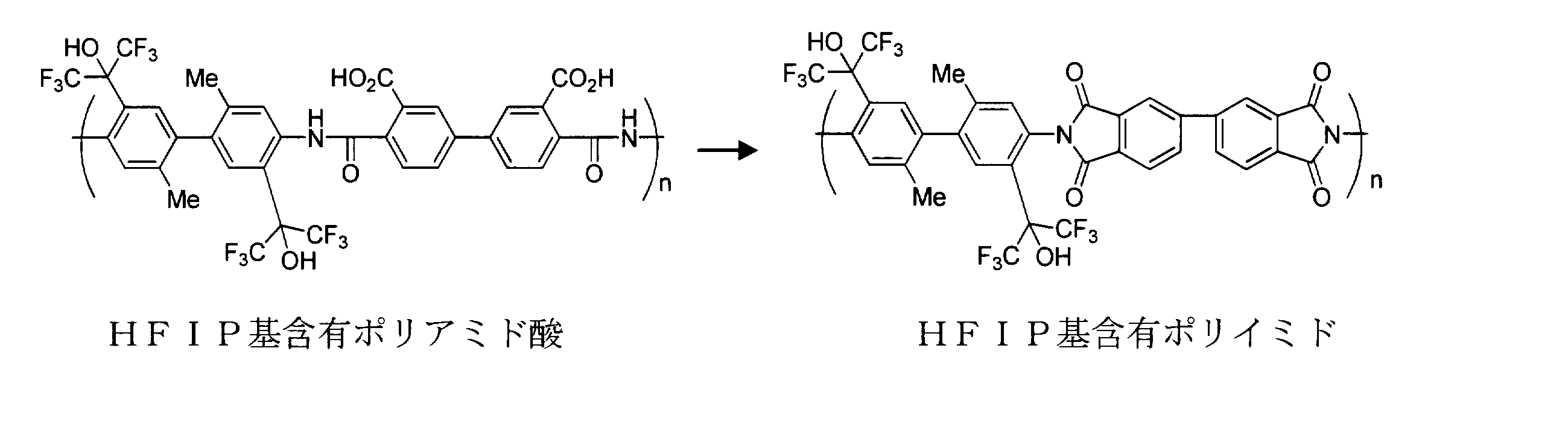
次いで、ガラス基板上に、以下のHFIP基含有ポリイミドからなる膜を得た。
具体的には、上記HFIP基含有ポリアミド酸溶液に、ピリジン2.92g、無水酢酸(3.77g)の順で加え、室温(20℃)にて4時間攪拌させることで、HFIP基含有ポリアミド酸をイミド化し、上記HFIP基含有ポリイミドの溶液を得た。当該溶液のGPC測定の結果、Mwは98000であった。
当該溶液をガラス基板上にスピンコーターを用いて塗布した後、130℃で30分、180℃で30分、200℃で3時間、段階的昇温しつつ連続加熱し、ガラス基板上に膜を得た。膜厚は、51μmであった。IRスペクトルの測定結果から、1717cm-1および1781cm-1に、イミド基固有の吸収があり、上記FIP基含有ポリイミドからなる膜であることを確認した。
実施例7
<HFIP基含有ジアミド酸の合成>
以下の式に示すように、<HFIP基含有ジアミンの合成 その2>で合成した3,3’-ビス(1,1,1,3,3,3-ヘキサフルオロ-2-ヒドロキシ-2-プロピル)-5,5’-ジメチルベンジジンとテトラカルボン酸二無水物(DSDA)の重合反応によるHFIP基含有ポリアミド酸を合成した。

具体的には、溶液300mLの反応容器中に、HFIP基含有ジアミンとしての、3,3’-ビス(1,1,1,3,3,3-ヘキサフルオロ-2-ヒドロキシ-2-プロピル)-5,5’-ジメチルベンジジン10.02g、およびテトラカルボン酸二無水物6.583g、N,N-ジメチルアセトアミド39.0gを加え、窒素雰囲気下、室温(20℃)にて27時間撹拌し反応液を得た。尚、後段反応のポリイミド化後、IR測定を行い、反応液は、上記の式で表わされるHFIP基含有ポリアミド酸の溶液であることを確認した。当該溶液のGPC測定の結果、Mwは27000であった。
<HFIP基含有ジアミド酸の合成>
以下の式に示すように、<HFIP基含有ジアミンの合成 その2>で合成した3,3’-ビス(1,1,1,3,3,3-ヘキサフルオロ-2-ヒドロキシ-2-プロピル)-5,5’-ジメチルベンジジンとテトラカルボン酸二無水物(DSDA)の重合反応によるHFIP基含有ポリアミド酸を合成した。
<HFIP基含有ポリイミドの合成および成膜>
次いで、ガラス基板上に、以下の式に示すHFIP基含有ポリイミドからなる膜を得た。
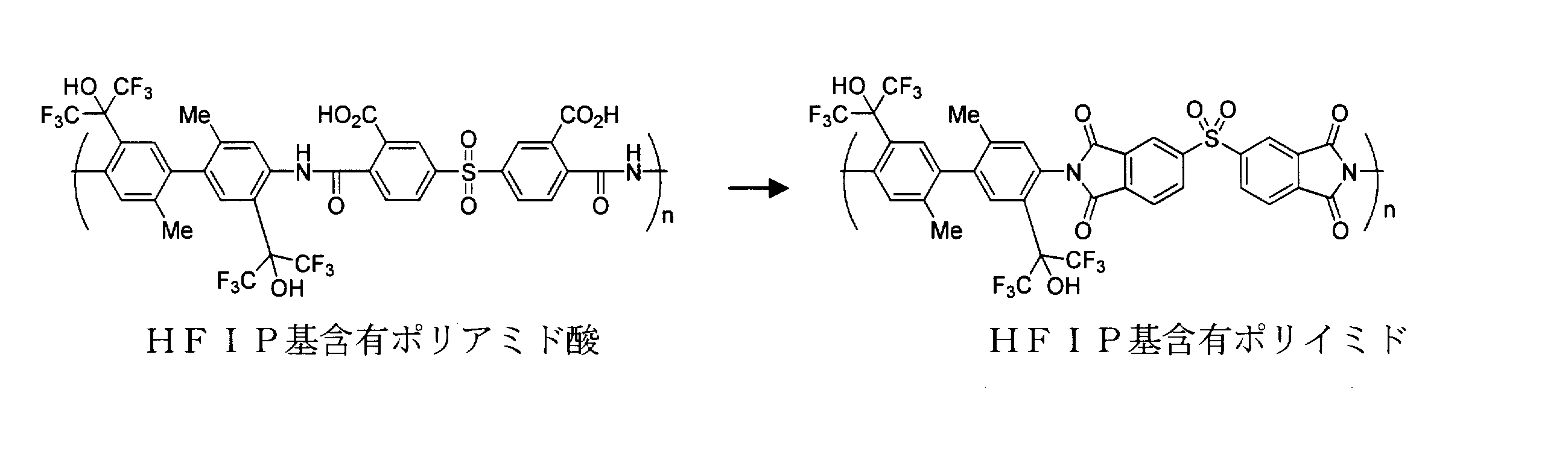
次いで、ガラス基板上に、以下の式に示すHFIP基含有ポリイミドからなる膜を得た。
具体的には、上記HFIP基含有ポリアミド酸溶液に、ピリジン2.94g、無水酢酸3.76gの順で加え、室温(20℃)にて4時間攪拌させることで、HFIP基含有ポリイミドを含む溶液を得た。当該溶液のGPC測定の結果、Mwは26500であった。
当該溶液をガラス基板上にスピンコーターを用いて塗布した後、130℃で30分、180℃で30分、200℃で3時間、段階的昇温しつつ連続加熱し、ガラス基板上に膜を得た。膜厚は、33μmであった。IRスペクトルの測定結果から、1731cm-1および1791cm-1、にイミド基固有の吸収があり、上記HFIP基含有ポリイミドからなる膜であることを確認した。
実施例8
<HFIP基含有ジアミド酸の合成>
以下の式に示すように、<HFIP基含有ジアミンの合成 その2>で合成した3,3’-ビス(1,1,1,3,3,3-ヘキサフルオロ-2-ヒドロキシ-2-プロピル)-5,5’-ジメチルベンジジンとテトラカルボン酸二無水物(ODPA)の重合反応により、HFIP基含有ポリアミド酸を合成した。
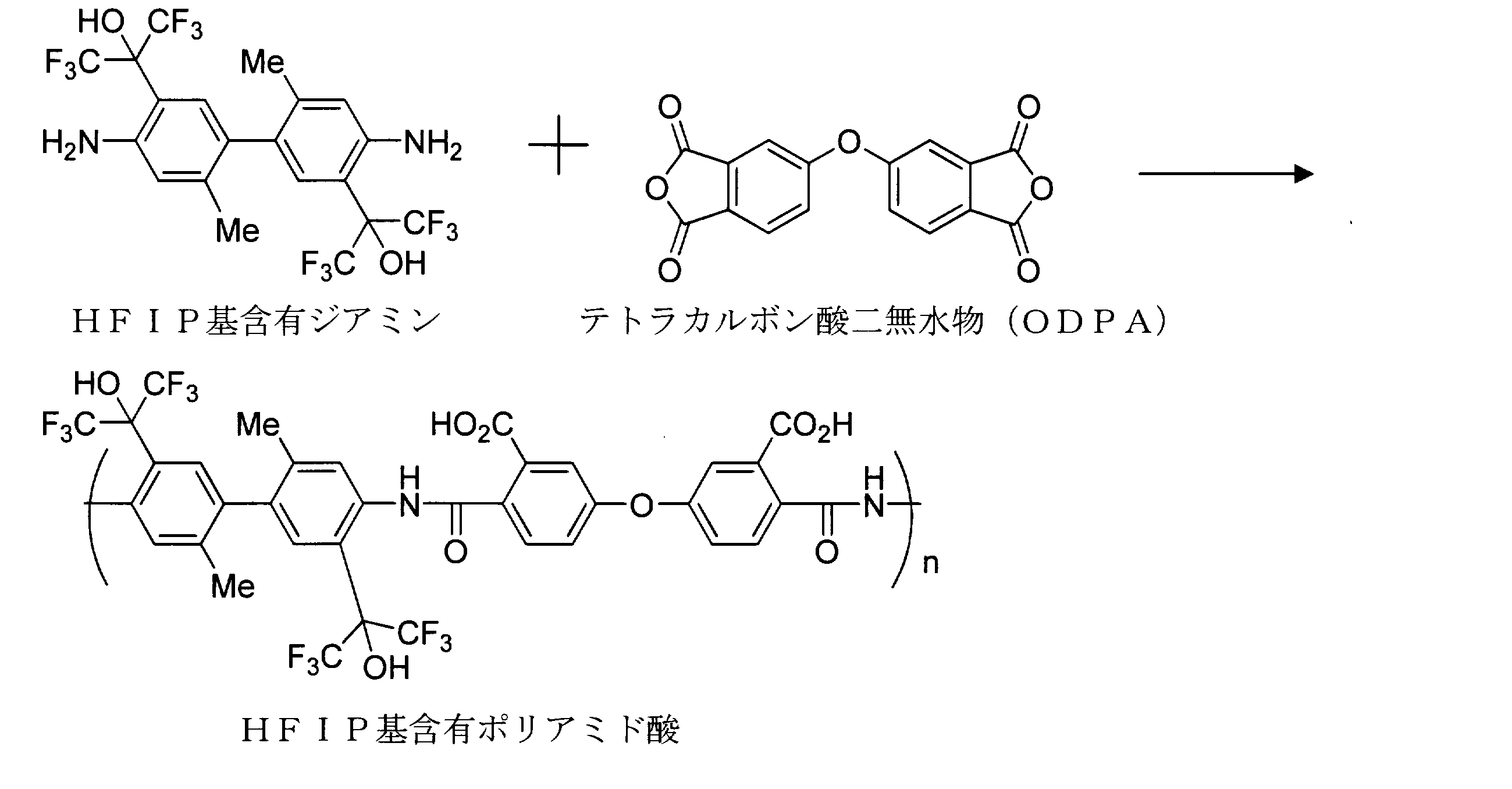
<HFIP基含有ジアミド酸の合成>
以下の式に示すように、<HFIP基含有ジアミンの合成 その2>で合成した3,3’-ビス(1,1,1,3,3,3-ヘキサフルオロ-2-ヒドロキシ-2-プロピル)-5,5’-ジメチルベンジジンとテトラカルボン酸二無水物(ODPA)の重合反応により、HFIP基含有ポリアミド酸を合成した。
具体的には、容積300mLの反応容器中にHFIP基含有ジアミンとしての、3,3’-ビス(1,1,1,3,3,3-ヘキサフルオロ-2-ヒドロキシ-2-プロピル)-5,5’-ジメチルベンジジン、10.00g、およびテトラカルボン酸二無水物(ODPA)、5.701g、溶媒としてN,N-ジメチルアセトアミド(36.9g)を加え、窒素雰囲気下、室温(20℃)にて20時間撹拌し反応液を得た。尚、後段反応のポリイミド化後、IR測定を行い、反応液は、上記の式で表わされるHFIP基含有ポリアミド酸の溶液であることを間接的に確認した。当該溶液のGPC測定の結果、Mwは40000であった。
<HFIP基含有ポリイミドの合成および成膜>
次いで、ガラス基板上に、以下の式に示すHFIP基含有ポリイミドからなる膜を得た。

次いで、ガラス基板上に、以下の式に示すHFIP基含有ポリイミドからなる膜を得た。
具体的には、上記HFIP基含有ポリアミド酸溶液に、ピリジン、2.92g、無水酢酸3.76gの順で加え、室温(20℃)にて4時間攪拌させることで、HFIP基含有ポリイミドを含む溶液を得た。当該溶液のGPC測定の結果、Mwは47000であった。
当該溶液をガラス基板上にスピンコーターを用いて塗布した後、130℃で30分、180℃で30分、200℃で3時間、段階的昇温しつつ連続加熱し、ガラス基板上に膜を得た。膜厚は、55μmであった。IRスペクトルの測定結果から、1719cm-1および1786cm-1にイミド基固有の吸収があり、上記HFIP基含有ポリイミドからなる膜であることを確認した。
比較例1~5および参考例1
本発明の範疇に属さない、表1に示す比較例1~5および参考例1のポリイミドを合成した。
本発明の範疇に属さない、表1に示す比較例1~5および参考例1のポリイミドを合成した。
即ち、ジアミンとテトラカルボン酸二無水物を重合しポリアミド酸を合成し、次いでポリアミド酸内で脱水することで環化することにより、表1のポリイミドを得た。
具体的には、容積300mLの反応容器中に、表1に示す各々のジアミンおよびテトラカルボン酸二無水物をモル比1:1で混合し、溶媒としてN,N-ジメチルアセトアミドを加え、窒素雰囲気下、室温(20℃)にて20時間撹拌しポリイミド酸を含む溶液を得た。次いで当該溶液にピリジン、無水酢酸の順で加え、室温(20℃)にて4時間攪拌させ、ポリアミド酸内で脱水することで環化させて、表に示すポリイミドを含む各々溶液を得た。
次いで、得られた各々の溶液をガラス基板上にスピンコーターを用いて塗布した後、130℃で30分、180℃で30分、200℃で3時間、段階的に昇温しつつ連続加熱し、各々のポリイミドからなる膜を得た。IRスペクトルの測定結果から、1720cm-1付近および1780cm-1付近にイミド基固有の吸収があり、表1に示す各々のイミドからなる膜であることを確認した。
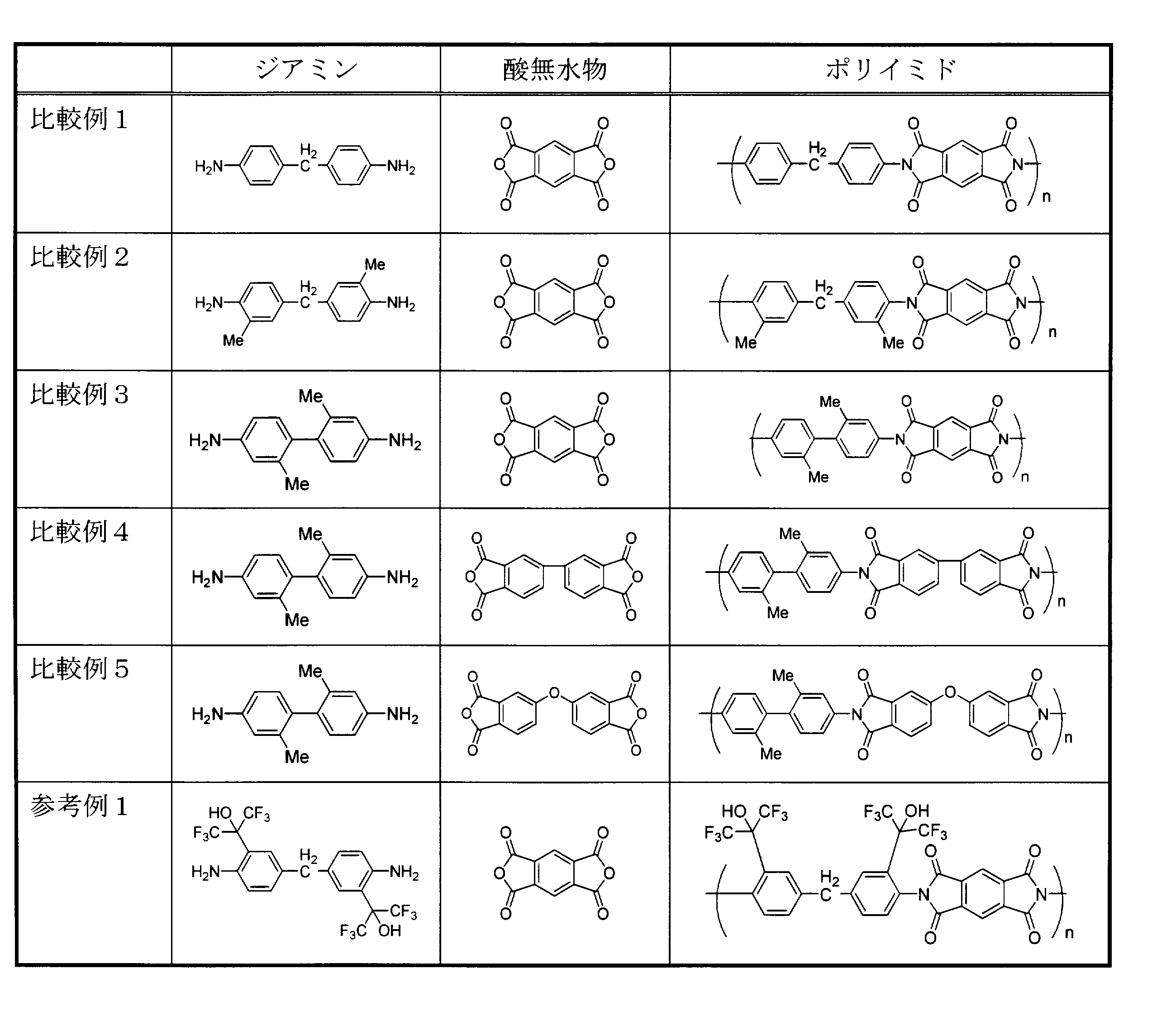
[蛍光の発光波長および発光量子収率の測定および評価]
実施例1、3、6、8で得た本発明のHFIP基含有ポリイミド、本発明の範疇にない、比較例1~3の従来のポリイミドおよび参考例1のHFIP基のみを含有するポリイミドについて、蛍光の発光波長および発光量子収率の測定を行い、蛍光特性の評価を行った。
実施例1、3、6、8で得た本発明のHFIP基含有ポリイミド、本発明の範疇にない、比較例1~3の従来のポリイミドおよび参考例1のHFIP基のみを含有するポリイミドについて、蛍光の発光波長および発光量子収率の測定を行い、蛍光特性の評価を行った。
各々のポリイミドを表2および表3に示す。実施例1、比較例1、比較例2および比較例3におけるポリイミドは、主となるポリイミド骨格は同一である。

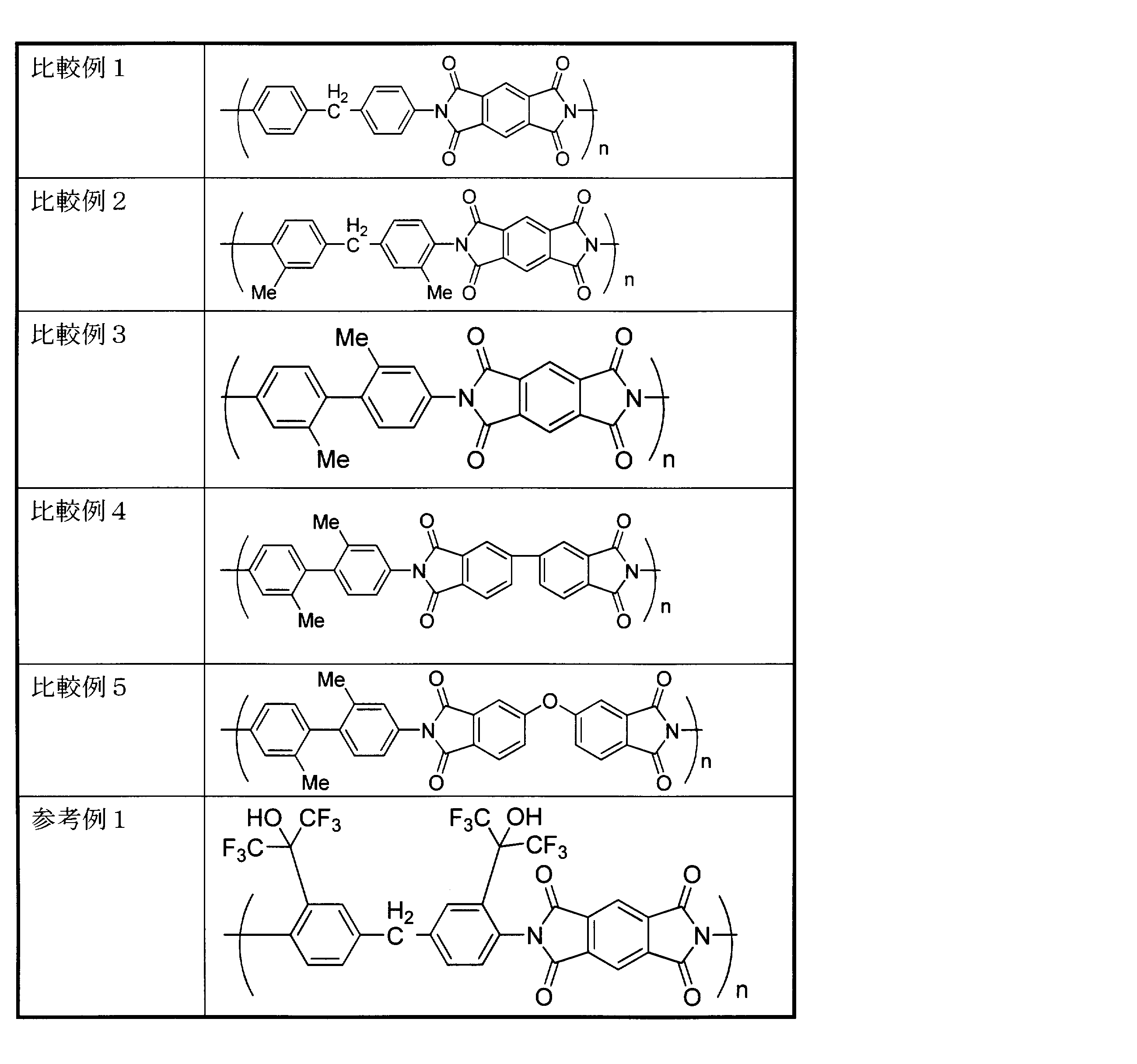
蛍光分光装置(株式会社堀場製作所製、商品名、FluoroMax-4)による、紫外光、波長365nmの励起光で測定した蛍光の発光波長および発光量子収率の測定結果を表4に示す。尚、蛍光スペクトルは、石英基板に製膜したポリイミドを用い測定した。また、発光量子収率は、単独のポリイミドフィルムを用いて、蛍光分光装置に積分球を取り付けて測定した。

表4に示すように、本発明の実施例1、3、6、8のメチル基を含むHFIP基含有芳香ポリイミドは、蛍光を発生する蛍光特性があり、発光量子収率が0.1%以上であった。
実施例1、比較例1、比較例2および参考例1におけるポリイミドは、主となるポリイミド骨格が等しい。比較例1と比較例2のHFIP基を含まないポリイミドにおいては、メチル基の有無にかかわらず、発光を検出することはできなかった。実施例1と参考例1のHFIP基を有するポリイミドにおいては、発光が観測された。実施例1のHFIP基とメチル基の両方を含む本発明のポリイミドは、参考例1のHFIP基のみを含むポリイミドの2倍以上の極めて高い発光量子収率を示した。また、比較例3~5のポリイミドにおいては発光を検出することができなかったが、実施例3、6、8の同じ主骨格でHFIP基とメチル基の両方を有する本発明のポリイミドにおいては、可視光領域において、0.1%以上の高い発光量子収率を示した。
Claims (20)
- 一般式(1)

で表されるジアミン。 - 一般式(2)

で表される、請求項1に記載のジアミン。 - 一般式(3)
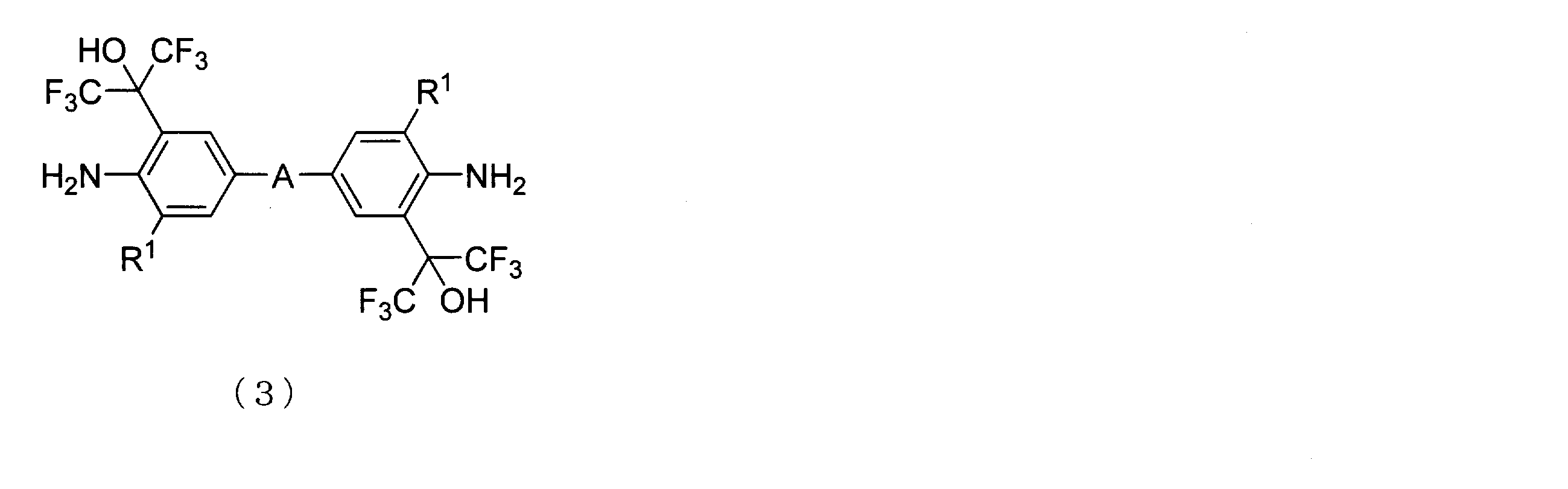
で表される、請求項2に記載のジアミン。 - 一般式(4)
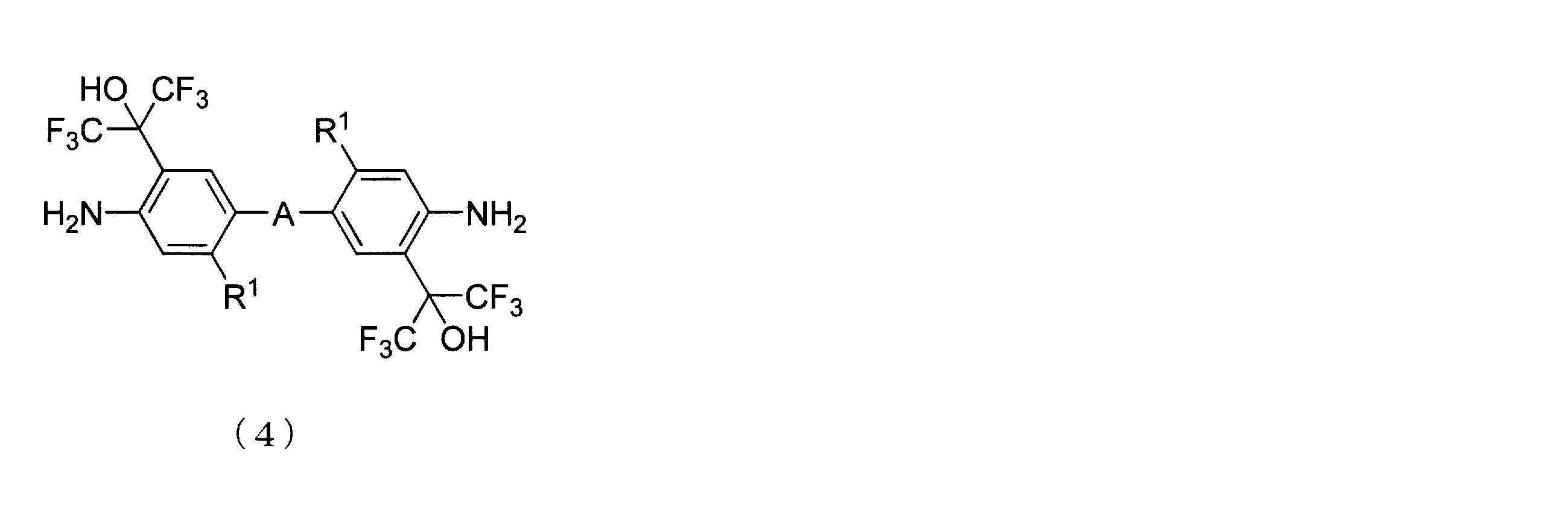
で表される、請求項2に記載のジアミン。 - Aが単結合またはCH2、R1がメチル基である、請求項3または請求項4に記載のジアミン。
- 一般式(5)
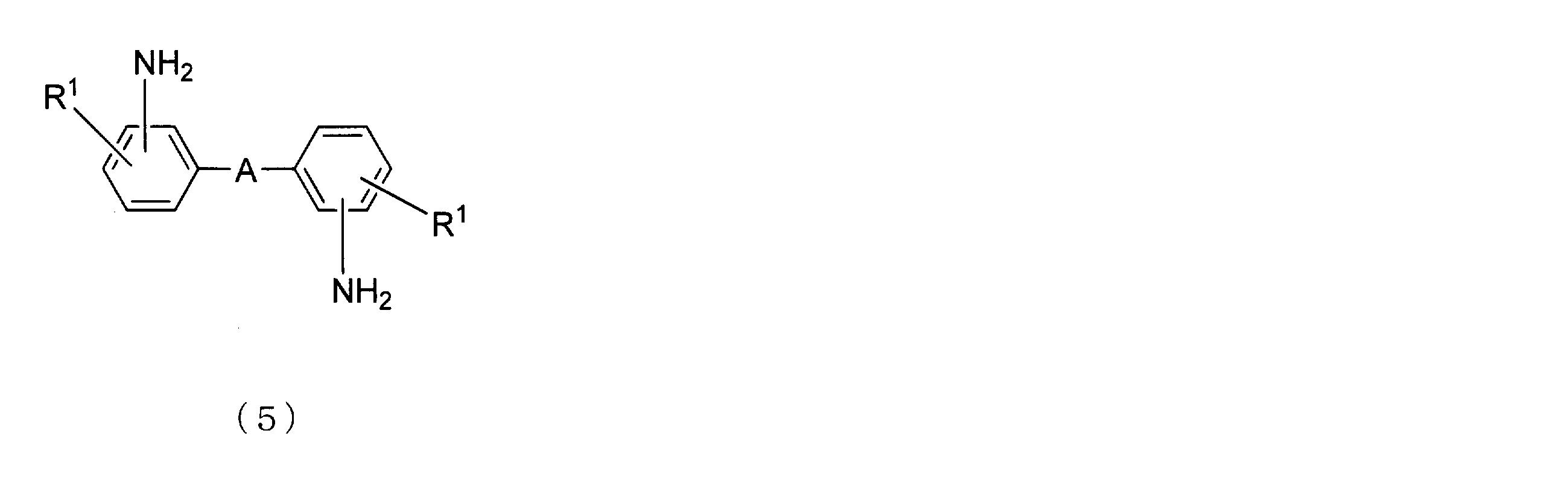
で表わされるジアミンと、
ヘキサフルオロアセトンまたはその水和物を反応させることを含む、
一般式(1)

で表される、
ジアミンの製造方法。 - 一般式(6)
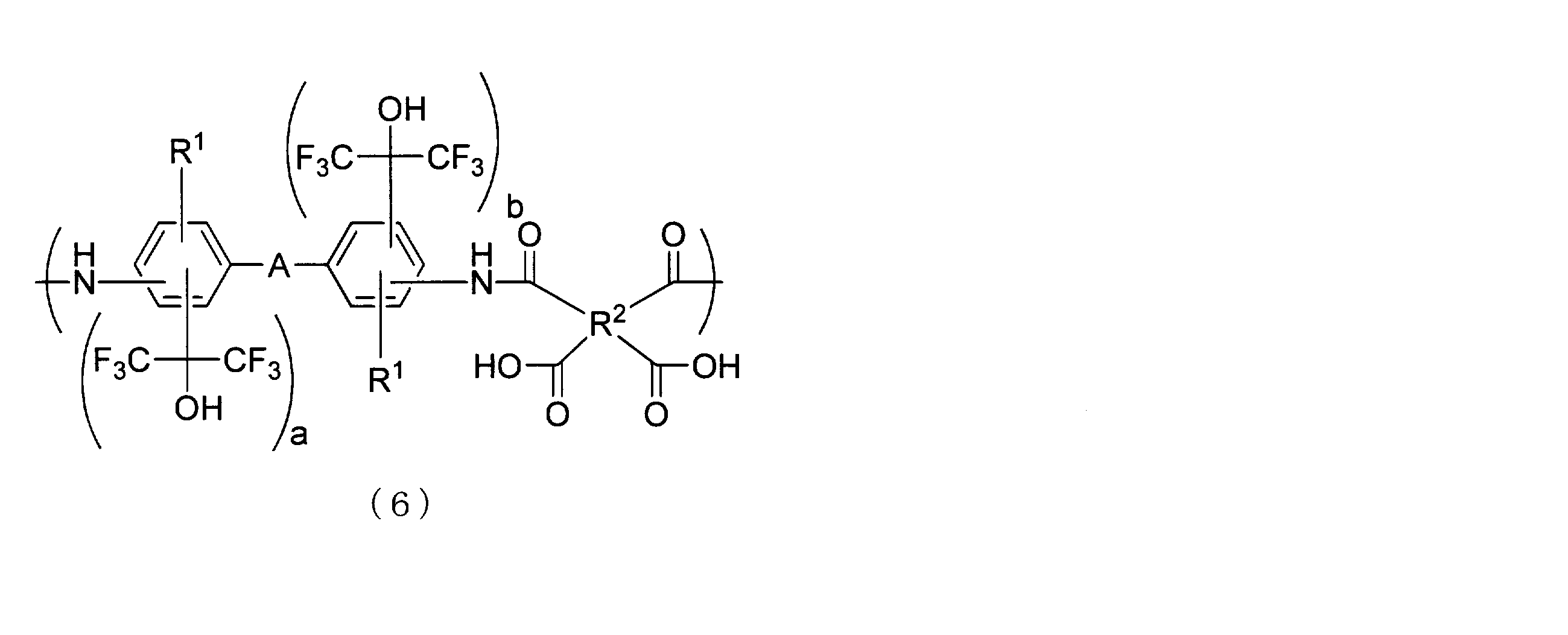
で表わされる繰り返し単位を含む、
ポリアミド酸。 - 一般式(7)

R3は、
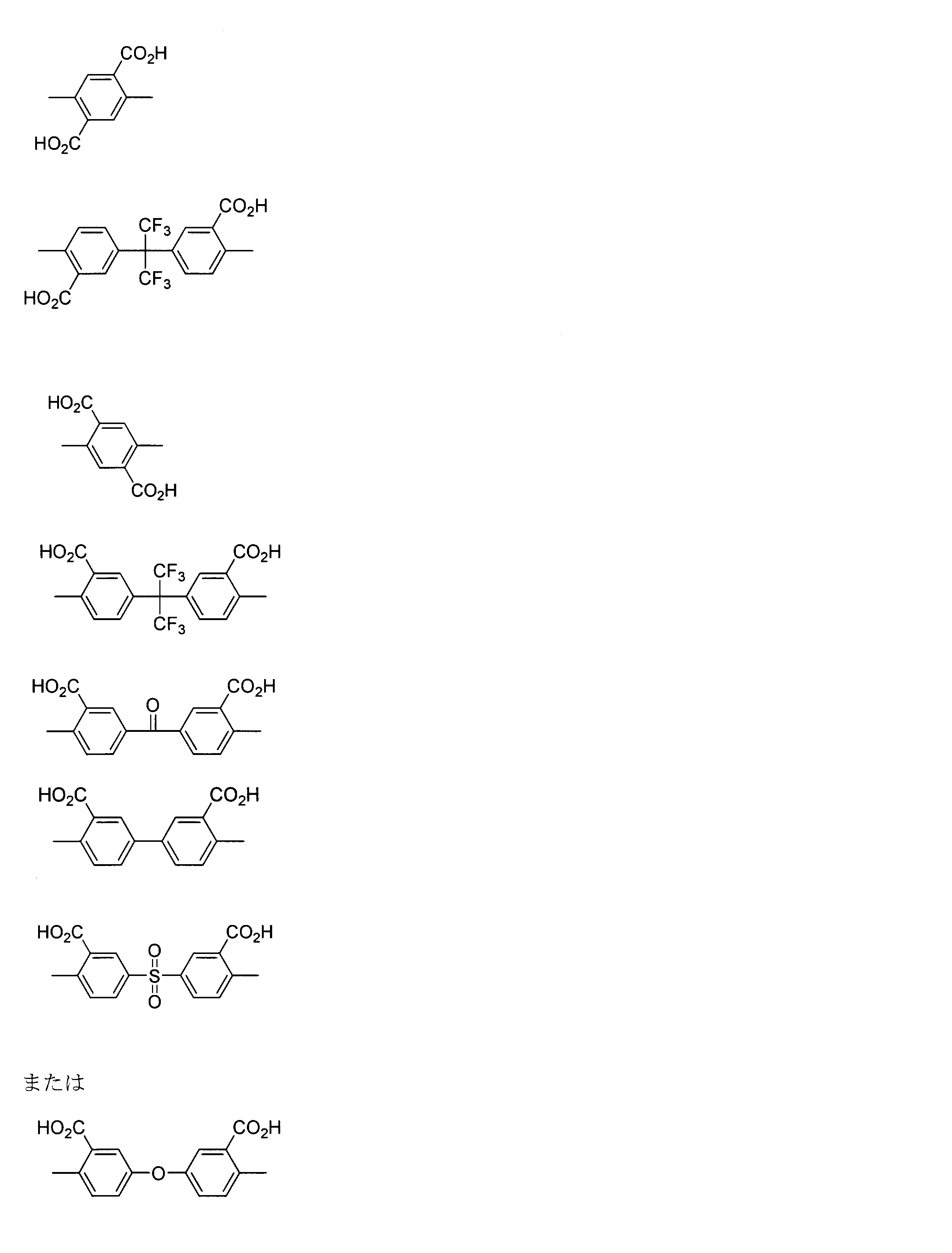
で表わされる繰り返し単位を含む、請求項7に記載のポリアミド酸。 - 一般式(8)

R4は、
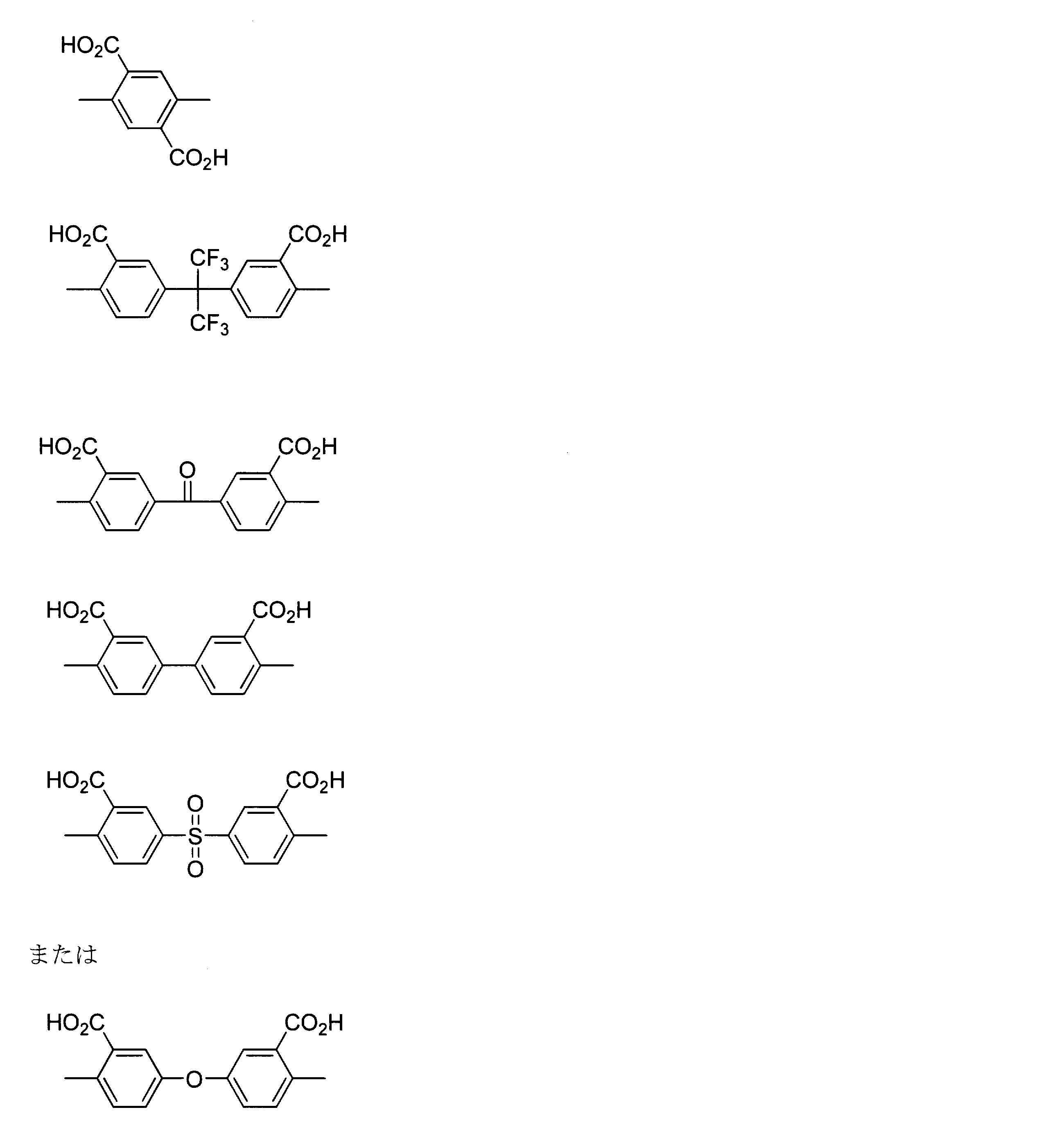
で表わされる繰り返し単位を含む、請求項7に記載のポリアミド酸。 - 一般式(9)

で表わされる繰り返し単位を含む、ポリイミド。 - 一般式(10)

R2は、
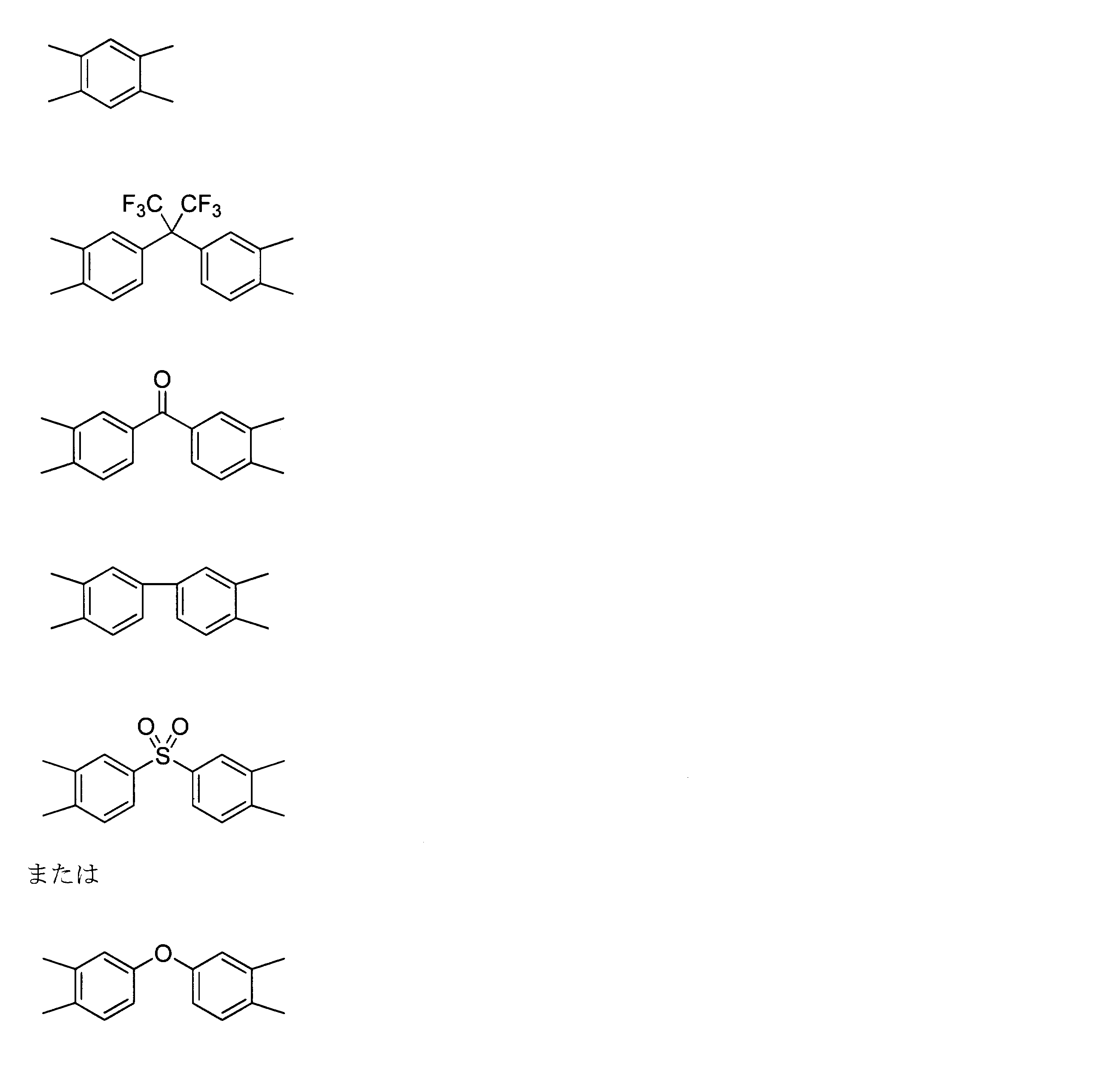
で表わされる繰り返し単位を含む、請求項10に記載のポリイミド。 - 一般式(11)
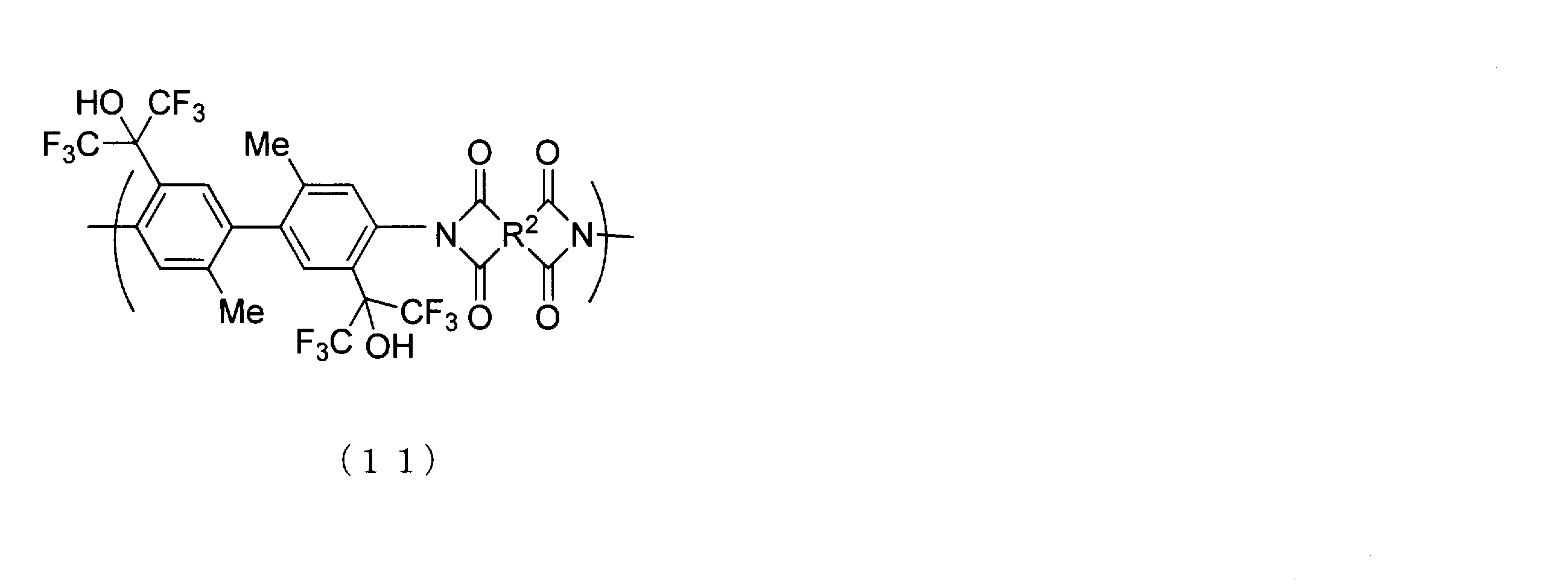
R2は、
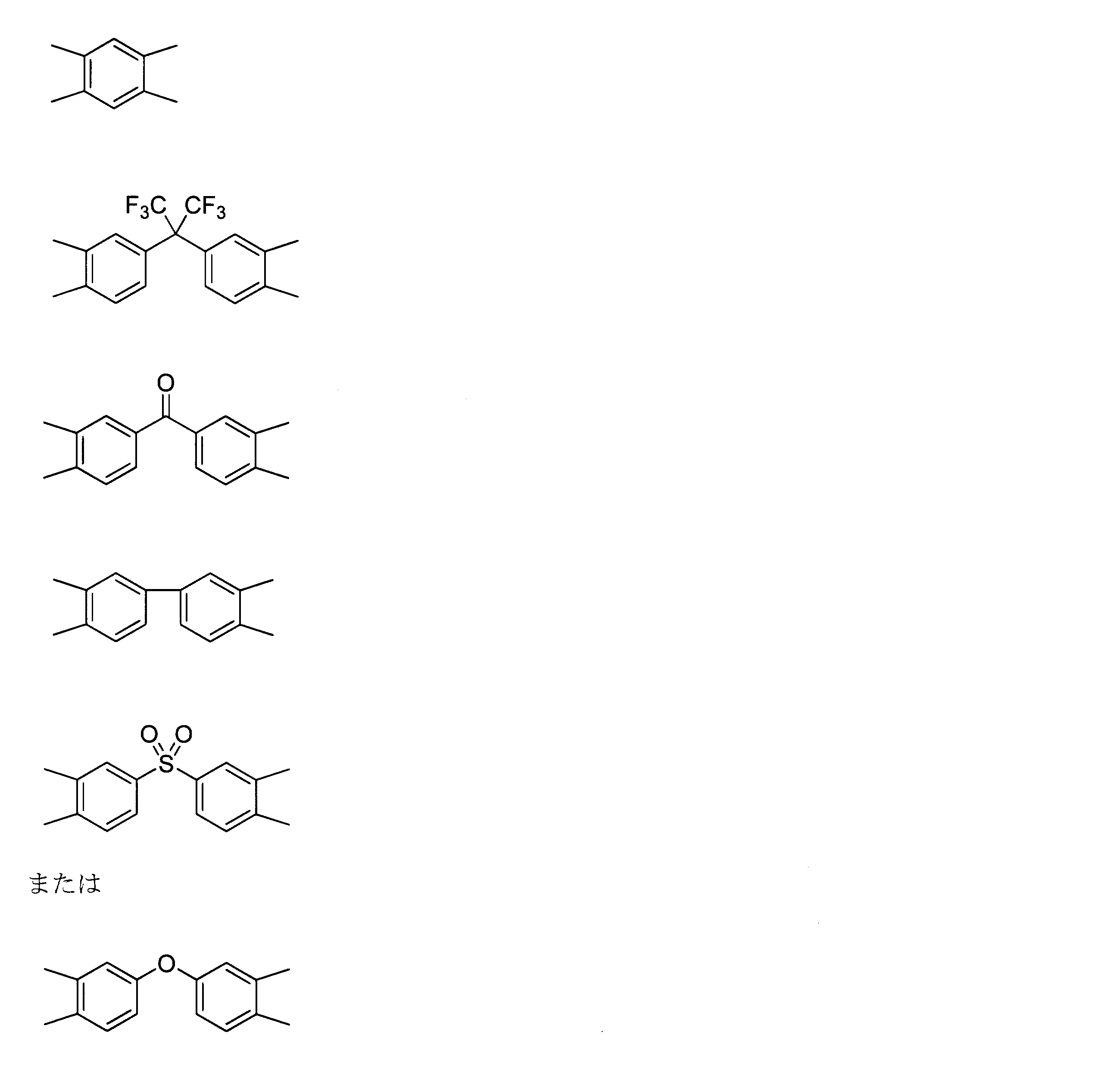
で表わされる繰り返し単位を含む、請求項10に記載のポリイミド。 - 請求項10乃至請求項12のいずれか1項に記載のポリイミドを含む、発光量子収率0.1%以上の蛍光材料。
- 一般式(1)
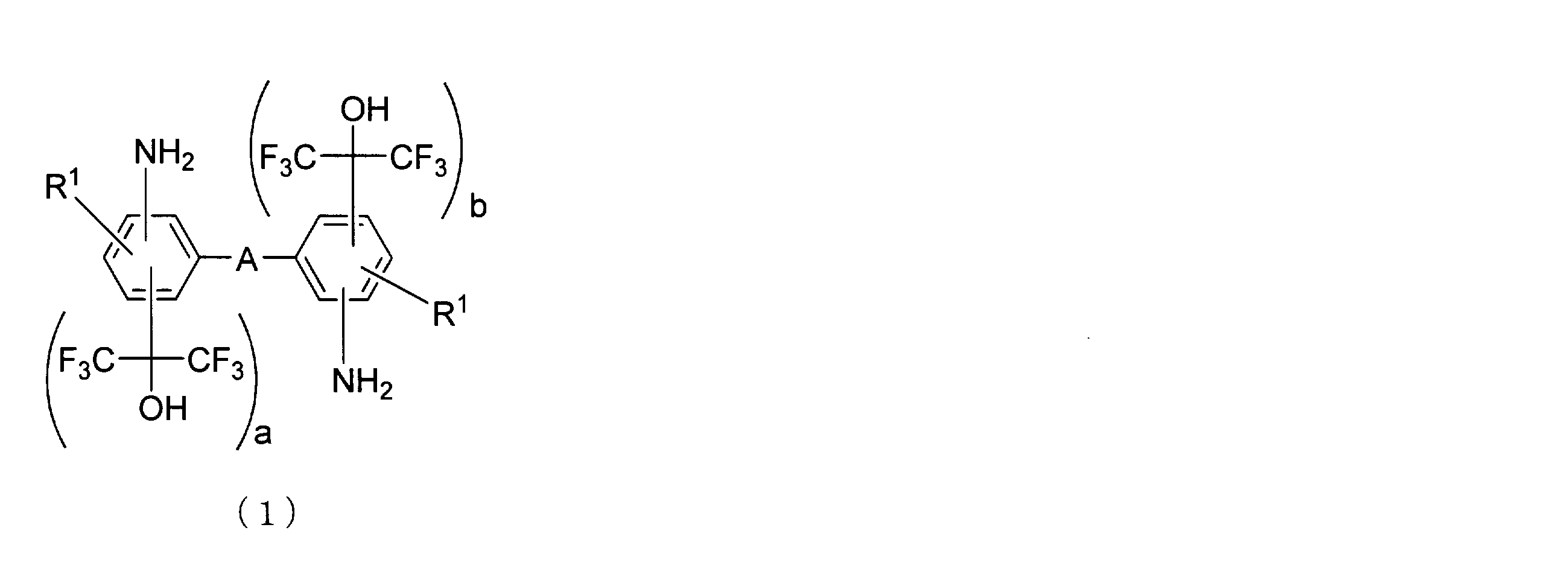
で表されるジアミンと、
一般式(11)
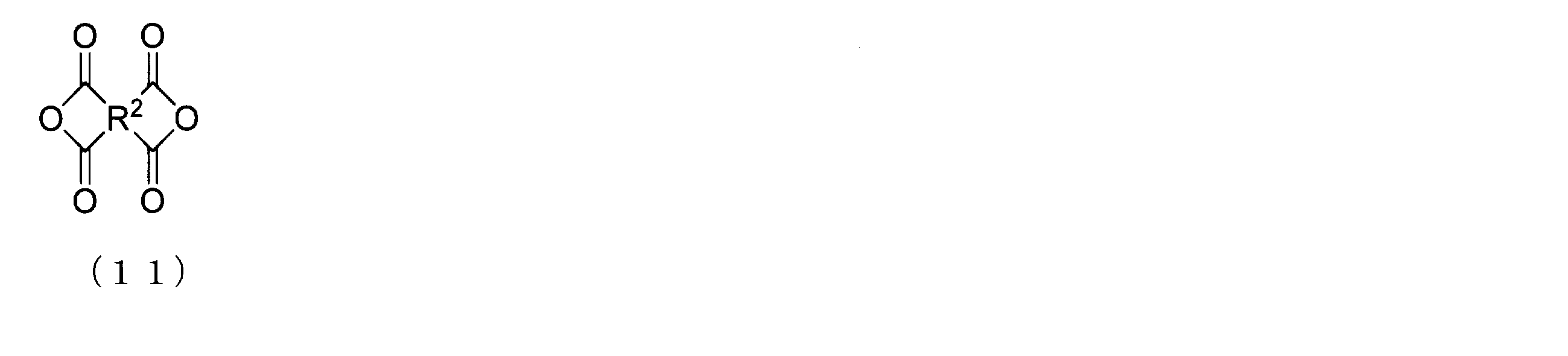
で表されるテトラカルボン酸二無水物を重合させて、
一般式(6)

で表わされる繰り返し単位を含む、
ポリアミド酸を生成させ、該ポリアミド酸を脱水させることからなる、
一般式(9)

で表わされる繰り返し単位を含むポリイミドを得る、
ポリイミドの製造方法。 - 一般式(12)
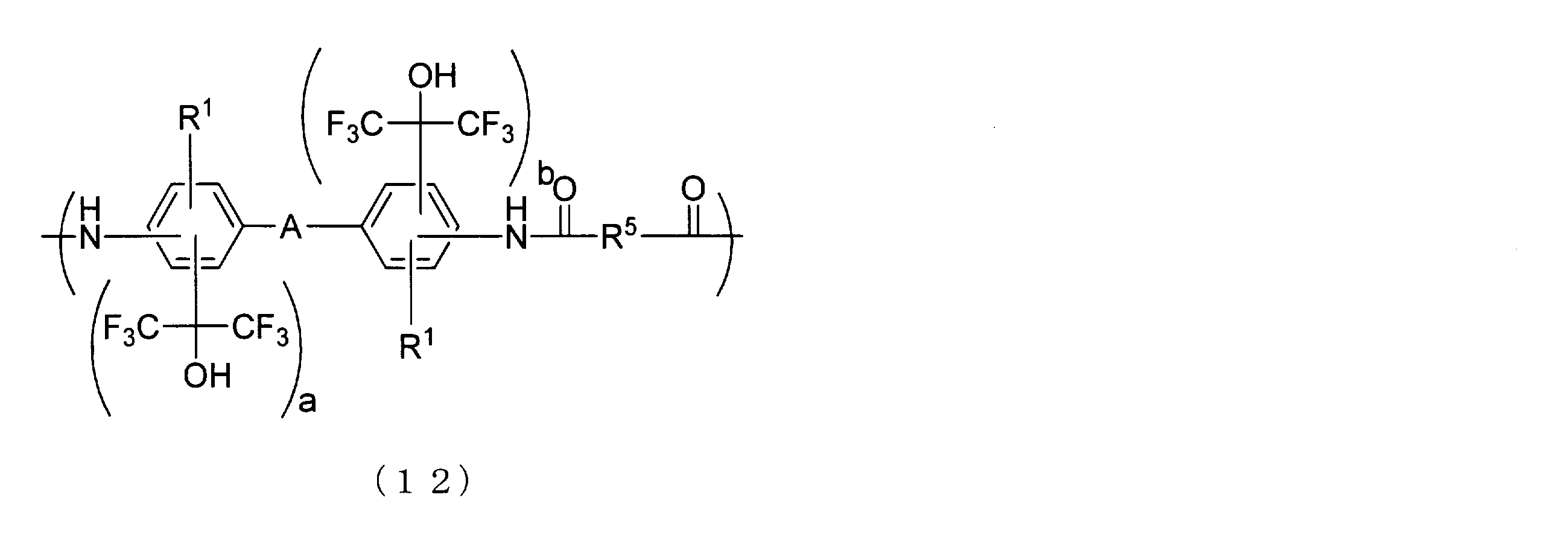
で表わされる繰り返し単位を含む、ポリアミド。 - 請求項15記載のポリアミドを含む、発光量子収率0.1%以上の蛍光材料。
- 一般式(1)

で表されるジアミンと、
一般式(13)

で表わされるジカルボン酸もしくはその誘導体、
または、一般式(14)

一般式(12)

ポリアミドの製造方法。 - 一般式(15)

で表わされる繰り返し単位を含む、
重合体。 - 請求項18に記載の重合体を含む、発光量子収率0.1%以上の蛍光材料。
- 一般式(12)

で表わされる繰り返し単位を含む、
ポリアミドを環化縮合させることを含む、
一般式(15)

で表わされる、
重合体の製造方法。
Priority Applications (1)
| Application Number | Priority Date | Filing Date | Title |
|---|---|---|---|
| CN201380062274.7A CN104837809B (zh) | 2012-11-28 | 2013-11-26 | 包含六氟异丙醇基的二胺、使用其的聚酰亚胺和聚酰胺、其环化物、及其制造方法 |
Applications Claiming Priority (4)
| Application Number | Priority Date | Filing Date | Title |
|---|---|---|---|
| JP2012260188 | 2012-11-28 | ||
| JP2012-260188 | 2012-11-28 | ||
| JP2013239531A JP6225659B2 (ja) | 2012-11-28 | 2013-11-20 | ヘキサフルオロイソプロパノール基を含むジアミン、それを用いたポリイミドおよびポリアミド、その環化物、並びにその製造方法 |
| JP2013-239531 | 2013-11-20 |
Publications (1)
| Publication Number | Publication Date |
|---|---|
| WO2014084185A1 true WO2014084185A1 (ja) | 2014-06-05 |
Family
ID=50827821
Family Applications (1)
| Application Number | Title | Priority Date | Filing Date |
|---|---|---|---|
| PCT/JP2013/081698 Ceased WO2014084185A1 (ja) | 2012-11-28 | 2013-11-26 | ヘキサフルオロイソプロパノール基を含むジアミン、それを用いたポリイミドおよびポリアミド、その環化物、並びにその製造方法 |
Country Status (3)
| Country | Link |
|---|---|
| JP (1) | JP6225659B2 (ja) |
| CN (1) | CN104837809B (ja) |
| WO (1) | WO2014084185A1 (ja) |
Cited By (6)
| Publication number | Priority date | Publication date | Assignee | Title |
|---|---|---|---|---|
| WO2016052312A1 (ja) * | 2014-10-02 | 2016-04-07 | セントラル硝子株式会社 | 有機エレクトロルミネッセンス用基板およびそれを用いた有機エレクトロルミネッセンスディスプレイ |
| WO2016052311A1 (ja) * | 2014-10-02 | 2016-04-07 | セントラル硝子株式会社 | 有機エレクトロルミネッセンス用基板およびそれを用いた有機エレクトロルミネッセンスディスプレイ |
| JP2016076480A (ja) * | 2014-10-02 | 2016-05-12 | セントラル硝子株式会社 | 有機エレクトロルミネッセンス用基板およびそれを用いた有機エレクトロルミネッセンスディスプレイ |
| JP2016076481A (ja) * | 2014-10-02 | 2016-05-12 | セントラル硝子株式会社 | 有機エレクトロルミネッセンス用基板およびそれを用いた有機エレクトロルミネッセンスディスプレイ |
| EP3235803A1 (en) * | 2016-04-19 | 2017-10-25 | Shin-Etsu Chemical Co., Ltd. | Tetracarboxylic acid diester compound, polyimide precursor polymer and method for producing the same, negative photosensitive resin composition, positive photosensitive resin composition, patterning process, and method for forming cured film |
| JP2019199459A (ja) * | 2018-05-11 | 2019-11-21 | セントラル硝子株式会社 | 含フッ素芳香族ジアミンの製造方法 |
Families Citing this family (7)
| Publication number | Priority date | Publication date | Assignee | Title |
|---|---|---|---|---|
| JP2017132845A (ja) * | 2016-01-26 | 2017-08-03 | セントラル硝子株式会社 | ポリイミド成形体の製造方法 |
| KR102565210B1 (ko) | 2018-01-31 | 2023-08-09 | 도레이 카부시키가이샤 | 폴리아릴렌설피드 공중합체 및 그 제조 방법 |
| CN109321198A (zh) * | 2018-09-05 | 2019-02-12 | 上海天洋热熔粘接材料股份有限公司 | 一种聚酰胺热熔胶的制备方法 |
| WO2021065540A1 (ja) * | 2019-10-03 | 2021-04-08 | 太陽ホールディングス株式会社 | 感光性樹脂組成物、ドライフィルム、硬化物および電子部品 |
| CN111302944B (zh) * | 2020-03-31 | 2021-01-15 | 上海如鲲新材料有限公司 | 一种双(3-氨基-4-羟基苯基)六氟丙烷的制备方法 |
| KR20230047168A (ko) | 2020-08-05 | 2023-04-06 | 샌트랄 글래스 컴퍼니 리미티드 | 함불소 디아민 또는 그 염, 함불소 디아민 또는 그 염의 제조 방법, 폴리아미드, 폴리아미드의 제조 방법, 폴리아미드 용액, 폴리아미드 환화체, 폴리아미드 환화체의 제조 방법, 고주파 전자 부품용 절연재, 고주파 전자 부품용 절연재의 제조 방법, 고주파 전자 부품, 고주파기기 및 고주파 전자 부품 제조용 절연 재료 |
| CN116332814A (zh) * | 2022-12-29 | 2023-06-27 | 上海邃铸科技有限公司 | 芳香胺卤化物及其合成方法 |
Citations (7)
| Publication number | Priority date | Publication date | Assignee | Title |
|---|---|---|---|---|
| JP2000143804A (ja) * | 1998-11-17 | 2000-05-26 | Sumitomo Bakelite Co Ltd | ポリベンゾオキサゾール前駆体及び樹脂 |
| JP2007119504A (ja) * | 2004-10-20 | 2007-05-17 | Central Glass Co Ltd | 含フッ素重合性単量体及びそれを用いた高分子化合物 |
| JP2010215904A (ja) * | 2009-02-20 | 2010-09-30 | Central Glass Co Ltd | 含フッ素ジカルボン酸誘導体およびそれを用いた高分子化合物 |
| JP2012020281A (ja) * | 2010-07-15 | 2012-02-02 | Internatl Business Mach Corp <Ibm> | 複層活性層を有する複合膜 |
| CN102527265A (zh) * | 2010-12-15 | 2012-07-04 | 华东理工大学 | 含六氟异丙醇基团的膜功能单体及其纳滤膜制备方法 |
| JP2012518710A (ja) * | 2009-02-20 | 2012-08-16 | インターナショナル・ビジネス・マシーンズ・コーポレーション | フルオロアルコール含有ポリアミドを製造するための界面重合 |
| WO2012165455A1 (ja) * | 2011-05-30 | 2012-12-06 | セントラル硝子株式会社 | 気体分離膜 |
Family Cites Families (4)
| Publication number | Priority date | Publication date | Assignee | Title |
|---|---|---|---|---|
| US7629434B2 (en) * | 2004-10-13 | 2009-12-08 | Central Glass Company, Limited | Fluorine-containing polymerizable monomer and polymer compound using same |
| JP4679328B2 (ja) * | 2004-10-13 | 2011-04-27 | セントラル硝子株式会社 | 含フッ素重合性単量体及びそれを用いた高分子化合物 |
| US7754724B2 (en) * | 2005-06-30 | 2010-07-13 | Dow Agrosciences Llc | N-substituted piperazines |
| JP5233457B2 (ja) * | 2007-07-17 | 2013-07-10 | セントラル硝子株式会社 | 新規な含フッ素ジカルボン酸およびそれを用いた新規な高分子化合物 |
-
2013
- 2013-11-20 JP JP2013239531A patent/JP6225659B2/ja active Active
- 2013-11-26 WO PCT/JP2013/081698 patent/WO2014084185A1/ja not_active Ceased
- 2013-11-26 CN CN201380062274.7A patent/CN104837809B/zh active Active
Patent Citations (7)
| Publication number | Priority date | Publication date | Assignee | Title |
|---|---|---|---|---|
| JP2000143804A (ja) * | 1998-11-17 | 2000-05-26 | Sumitomo Bakelite Co Ltd | ポリベンゾオキサゾール前駆体及び樹脂 |
| JP2007119504A (ja) * | 2004-10-20 | 2007-05-17 | Central Glass Co Ltd | 含フッ素重合性単量体及びそれを用いた高分子化合物 |
| JP2010215904A (ja) * | 2009-02-20 | 2010-09-30 | Central Glass Co Ltd | 含フッ素ジカルボン酸誘導体およびそれを用いた高分子化合物 |
| JP2012518710A (ja) * | 2009-02-20 | 2012-08-16 | インターナショナル・ビジネス・マシーンズ・コーポレーション | フルオロアルコール含有ポリアミドを製造するための界面重合 |
| JP2012020281A (ja) * | 2010-07-15 | 2012-02-02 | Internatl Business Mach Corp <Ibm> | 複層活性層を有する複合膜 |
| CN102527265A (zh) * | 2010-12-15 | 2012-07-04 | 华东理工大学 | 含六氟异丙醇基团的膜功能单体及其纳滤膜制备方法 |
| WO2012165455A1 (ja) * | 2011-05-30 | 2012-12-06 | セントラル硝子株式会社 | 気体分離膜 |
Cited By (11)
| Publication number | Priority date | Publication date | Assignee | Title |
|---|---|---|---|---|
| WO2016052312A1 (ja) * | 2014-10-02 | 2016-04-07 | セントラル硝子株式会社 | 有機エレクトロルミネッセンス用基板およびそれを用いた有機エレクトロルミネッセンスディスプレイ |
| WO2016052311A1 (ja) * | 2014-10-02 | 2016-04-07 | セントラル硝子株式会社 | 有機エレクトロルミネッセンス用基板およびそれを用いた有機エレクトロルミネッセンスディスプレイ |
| JP2016076480A (ja) * | 2014-10-02 | 2016-05-12 | セントラル硝子株式会社 | 有機エレクトロルミネッセンス用基板およびそれを用いた有機エレクトロルミネッセンスディスプレイ |
| JP2016076481A (ja) * | 2014-10-02 | 2016-05-12 | セントラル硝子株式会社 | 有機エレクトロルミネッセンス用基板およびそれを用いた有機エレクトロルミネッセンスディスプレイ |
| CN106797683A (zh) * | 2014-10-02 | 2017-05-31 | 中央硝子株式会社 | 有机电致发光用基板及使用其的有机电致发光显示器 |
| CN107079540A (zh) * | 2014-10-02 | 2017-08-18 | 中央硝子株式会社 | 有机电致发光用基板及使用其的有机电致发光显示器 |
| CN107079540B (zh) * | 2014-10-02 | 2018-11-20 | 中央硝子株式会社 | 有机电致发光用基板及使用其的有机电致发光显示器 |
| EP3235803A1 (en) * | 2016-04-19 | 2017-10-25 | Shin-Etsu Chemical Co., Ltd. | Tetracarboxylic acid diester compound, polyimide precursor polymer and method for producing the same, negative photosensitive resin composition, positive photosensitive resin composition, patterning process, and method for forming cured film |
| US10457779B2 (en) | 2016-04-19 | 2019-10-29 | Shin-Etsu Chemical Co., Ltd. | Tetracarboxylic acid diester compound, polyimide precursor polymer and method for producing the same, negative photosensitive resin composition, positive photosensitive resin composition, patterning process, and method for forming cured film |
| JP2019199459A (ja) * | 2018-05-11 | 2019-11-21 | セントラル硝子株式会社 | 含フッ素芳香族ジアミンの製造方法 |
| JP7093008B2 (ja) | 2018-05-11 | 2022-06-29 | セントラル硝子株式会社 | 含フッ素芳香族ジアミンの製造方法 |
Also Published As
| Publication number | Publication date |
|---|---|
| JP6225659B2 (ja) | 2017-11-08 |
| CN104837809A (zh) | 2015-08-12 |
| CN104837809B (zh) | 2017-07-07 |
| JP2014129340A (ja) | 2014-07-10 |
Similar Documents
| Publication | Publication Date | Title |
|---|---|---|
| JP6225659B2 (ja) | ヘキサフルオロイソプロパノール基を含むジアミン、それを用いたポリイミドおよびポリアミド、その環化物、並びにその製造方法 | |
| US20140148548A1 (en) | Fluorine-Containing Polymerizable Monomer And Polymer Compound Using Same | |
| US7932348B2 (en) | Fluorine-containing polymerizable monomer and polymer compound using same | |
| JP4679328B2 (ja) | 含フッ素重合性単量体及びそれを用いた高分子化合物 | |
| US20150045481A1 (en) | Asymmetric Diamine Compounds Containing Two Functional Groups and Polymers Therefrom | |
| KR101290226B1 (ko) | 함불소 디카르본산 유도체 및 그것을 사용한 고분자 화합물 | |
| US20090292104A1 (en) | Fluorine-Containing Polymerizable Monomer and Polymer Compound Using Same | |
| JP4940623B2 (ja) | 含フッ素重合性単量体及びそれを用いた高分子化合物 | |
| JP2014125455A (ja) | 含フッ素非対称ジアミン化合物を用いた高分子化合物とその製造方法 | |
| JP2023168343A (ja) | ポリイミド及びポリイミドフィルム | |
| JP6768234B2 (ja) | ポリイミド及びポリイミドフィルム | |
| US9793483B2 (en) | Hexafluoroisopropanol group-containing diamine, polyimide and polyamide using same, cyclized product thereof, and method for producing same | |
| JP6268959B2 (ja) | 含フッ素重合性単量体およびそれを用いた高分子化合物 | |
| TWI577069B (zh) | An organic electroluminescent substrate, and an organic electroluminescent display using the same | |
| JP4679357B2 (ja) | 含フッ素ジアミンおよびそれを用いた重合体 | |
| JP2019119829A (ja) | ポリイミドフィルムおよびそれを用いた光学部材 | |
| JP5028626B2 (ja) | 蛍光材料 | |
| JP2019199459A (ja) | 含フッ素芳香族ジアミンの製造方法 | |
| KR20240063858A (ko) | 폴리이미드, 폴리아미드, 수지조성물, 폴리이미드 필름, 표시장치, 전자재료용 기판, 폴리아미드의 제조방법 및 폴리이미드의 제조방법 | |
| TW201619241A (zh) | 有機電致發光用基板及使用其之有機電致發光顯示器 | |
| TW201335126A (zh) | 4,4’-磺醯基二苯酯型酸二酐,其製造方法及聚醯亞胺 | |
| JP2018110105A (ja) | 有機エレクトロルミネッセンス用基板およびそれを用いた有機エレクトロルミネッセンスディスプレイ | |
| Dămăceanu et al. | polymers containing 1, 3, 4-oxadiazole rings for advanced materials | |
| JP2008274165A (ja) | 蛍光材料 | |
| WO2016052312A1 (ja) | 有機エレクトロルミネッセンス用基板およびそれを用いた有機エレクトロルミネッセンスディスプレイ |
Legal Events
| Date | Code | Title | Description |
|---|---|---|---|
| 121 | Ep: the epo has been informed by wipo that ep was designated in this application |
Ref document number: 13858964 Country of ref document: EP Kind code of ref document: A1 |
|
| NENP | Non-entry into the national phase |
Ref country code: DE |
|
| 122 | Ep: pct application non-entry in european phase |
Ref document number: 13858964 Country of ref document: EP Kind code of ref document: A1 |