WO2014034601A1 - 複合菓子 - Google Patents
複合菓子 Download PDFInfo
- Publication number
- WO2014034601A1 WO2014034601A1 PCT/JP2013/072716 JP2013072716W WO2014034601A1 WO 2014034601 A1 WO2014034601 A1 WO 2014034601A1 JP 2013072716 W JP2013072716 W JP 2013072716W WO 2014034601 A1 WO2014034601 A1 WO 2014034601A1
- Authority
- WO
- WIPO (PCT)
- Prior art keywords
- mass
- oil
- fats
- oils
- fat
- Prior art date
- Legal status (The legal status is an assumption and is not a legal conclusion. Google has not performed a legal analysis and makes no representation as to the accuracy of the status listed.)
- Ceased
Links
Classifications
-
- A—HUMAN NECESSITIES
- A23—FOODS OR FOODSTUFFS; TREATMENT THEREOF, NOT COVERED BY OTHER CLASSES
- A23G—COCOA; COCOA PRODUCTS, e.g. CHOCOLATE; SUBSTITUTES FOR COCOA OR COCOA PRODUCTS; CONFECTIONERY; CHEWING GUM; ICE-CREAM; PREPARATION THEREOF
- A23G3/00—Sweetmeats; Confectionery; Marzipan; Coated or filled products
- A23G3/34—Sweetmeats, confectionery or marzipan; Processes for the preparation thereof
- A23G3/346—Finished or semi-finished products in the form of powders, paste or liquids
-
- A—HUMAN NECESSITIES
- A23—FOODS OR FOODSTUFFS; TREATMENT THEREOF, NOT COVERED BY OTHER CLASSES
- A23D—EDIBLE OILS OR FATS, e.g. MARGARINES, SHORTENINGS OR COOKING OILS
- A23D9/00—Other edible oils or fats, e.g. shortenings or cooking oils
-
- A—HUMAN NECESSITIES
- A21—BAKING; EDIBLE DOUGHS
- A21D—TREATMENT OF FLOUR OR DOUGH FOR BAKING, e.g. BY ADDITION OF MATERIALS; BAKING; BAKERY PRODUCTS
- A21D2/00—Treatment of flour or dough by adding materials thereto before or during baking
- A21D2/08—Treatment of flour or dough by adding materials thereto before or during baking by adding organic substances
- A21D2/14—Organic oxygen compounds
- A21D2/16—Fatty acid esters
-
- A—HUMAN NECESSITIES
- A21—BAKING; EDIBLE DOUGHS
- A21D—TREATMENT OF FLOUR OR DOUGH FOR BAKING, e.g. BY ADDITION OF MATERIALS; BAKING; BAKERY PRODUCTS
- A21D2/00—Treatment of flour or dough by adding materials thereto before or during baking
- A21D2/08—Treatment of flour or dough by adding materials thereto before or during baking by adding organic substances
- A21D2/14—Organic oxygen compounds
- A21D2/16—Fatty acid esters
- A21D2/165—Triglycerides
-
- A—HUMAN NECESSITIES
- A23—FOODS OR FOODSTUFFS; TREATMENT THEREOF, NOT COVERED BY OTHER CLASSES
- A23G—COCOA; COCOA PRODUCTS, e.g. CHOCOLATE; SUBSTITUTES FOR COCOA OR COCOA PRODUCTS; CONFECTIONERY; CHEWING GUM; ICE-CREAM; PREPARATION THEREOF
- A23G1/00—Cocoa; Cocoa products, e.g. chocolate; Substitutes therefor
- A23G1/30—Cocoa products, e.g. chocolate; Substitutes therefor
- A23G1/32—Cocoa products, e.g. chocolate; Substitutes therefor characterised by the composition containing organic or inorganic compounds
- A23G1/36—Cocoa products, e.g. chocolate; Substitutes therefor characterised by the composition containing organic or inorganic compounds characterised by the fats used
-
- A—HUMAN NECESSITIES
- A23—FOODS OR FOODSTUFFS; TREATMENT THEREOF, NOT COVERED BY OTHER CLASSES
- A23G—COCOA; COCOA PRODUCTS, e.g. CHOCOLATE; SUBSTITUTES FOR COCOA OR COCOA PRODUCTS; CONFECTIONERY; CHEWING GUM; ICE-CREAM; PREPARATION THEREOF
- A23G3/00—Sweetmeats; Confectionery; Marzipan; Coated or filled products
- A23G3/34—Sweetmeats, confectionery or marzipan; Processes for the preparation thereof
- A23G3/36—Sweetmeats, confectionery or marzipan; Processes for the preparation thereof characterised by the composition containing organic or inorganic compounds
- A23G3/40—Sweetmeats, confectionery or marzipan; Processes for the preparation thereof characterised by the composition containing organic or inorganic compounds characterised by the fats used
-
- A—HUMAN NECESSITIES
- A23—FOODS OR FOODSTUFFS; TREATMENT THEREOF, NOT COVERED BY OTHER CLASSES
- A23G—COCOA; COCOA PRODUCTS, e.g. CHOCOLATE; SUBSTITUTES FOR COCOA OR COCOA PRODUCTS; CONFECTIONERY; CHEWING GUM; ICE-CREAM; PREPARATION THEREOF
- A23G3/00—Sweetmeats; Confectionery; Marzipan; Coated or filled products
- A23G3/34—Sweetmeats, confectionery or marzipan; Processes for the preparation thereof
- A23G3/50—Sweetmeats, confectionery or marzipan; Processes for the preparation thereof characterised by shape, structure or physical form, e.g. products with supported structure
- A23G3/54—Composite products, e.g. layered, coated, filled
-
- A—HUMAN NECESSITIES
- A23—FOODS OR FOODSTUFFS; TREATMENT THEREOF, NOT COVERED BY OTHER CLASSES
- A23V—INDEXING SCHEME RELATING TO FOODS, FOODSTUFFS OR NON-ALCOHOLIC BEVERAGES AND LACTIC OR PROPIONIC ACID BACTERIA USED IN FOODSTUFFS OR FOOD PREPARATION
- A23V2002/00—Food compositions, function of food ingredients or processes for food or foodstuffs
-
- A—HUMAN NECESSITIES
- A23—FOODS OR FOODSTUFFS; TREATMENT THEREOF, NOT COVERED BY OTHER CLASSES
- A23V—INDEXING SCHEME RELATING TO FOODS, FOODSTUFFS OR NON-ALCOHOLIC BEVERAGES AND LACTIC OR PROPIONIC ACID BACTERIA USED IN FOODSTUFFS OR FOOD PREPARATION
- A23V2200/00—Function of food ingredients
- A23V2200/20—Ingredients acting on or related to the structure
- A23V2200/209—Barrier agent, e.g. layer
Definitions
- the present invention relates to a composite confectionery in which whitening of a baked confectionery portion and blooming of a chocolate portion that occur with time are suppressed in a composite confectionery in which baked confectionery and chocolate are combined.
- Baked confectionery such as biscuits and cookies is used not only for baked confectionery but also for composite confectionery combined with chocolate.
- the composite confectionery can be produced, for example, by combining a pre-baked baked confectionery with a pre-prepared chocolate, or baking a pre-prepared chocolate dispersed or wrapped in a baked confectionery dough. it can.
- Composite confectionery that combines baked confectionery and chocolate is known to migrate (transfer) the fats and oils contained in the baked confectionery and chocolate during distribution and storage (the fats and oils contained in the baked confectionery are contained in the chocolate) The oil and fat contained in the chocolate is transferred into the baked confectionery.)
- the baked confectionery portion of the composite confectionery may cause whitening of the surface by wiping white powder, and the chocolate portion of the composite confectionery May cause bloom.
- the composite confectionery loses its commercial value.
- a specific SFC is added to the kneaded fat mixed in the baked confectionery. It has been proposed to use oils and fats (Patent Document 1) and to use specific triglycerides (Patent Document 2). In addition, it has been proposed to use a chocolate containing a special type of triacylglycerol whose constituent fatty acid is a saturated fatty acid having 20 to 24 carbon atoms (Patent Document 3).
- JP 2004-16096 A Japanese Patent Laid-Open No. 9-37705 JP-A-7-264983
- An object of the present invention is to provide a composite confectionery in which whitening of a baked confectionery portion and blooming of a chocolate portion that occur with time are suppressed in a composite confectionery in which baked confectionery and chocolate are combined.
- the present inventors combined baked confectionery using fats and oils satisfying a specific triacylglycerol composition and chocolates and fats and fats satisfying a specific triacylglycerol composition. As a result, it was found that whitening of the baked confectionery portion and blooming of the chocolate portion that occur over time in the composite confectionery are suppressed, and the present invention has been completed.
- the baked confectionery using the fats and oils that satisfy the following conditions (a), (b), and (c) and the fats and oils in the chocolate are the following (A) and (B): It is a composite confectionery combined with chocolate that satisfies the above conditions.
- CN40-46 content is 2-30% by mass
- B The total content of S2U and SU2 (S2U + SU2) is 45 to 85% by mass
- Mass ratio of SU2 to S2U + SU2 (SU2 / (S2U + SU2)) is 0.50 or more
- SOS content is 40 to 90% by mass
- B The total content of SU2 and U3 (SU2 + U3) is 10-40% by mass
- CN 40 to 46, S, U, O, S2U, SU2, SOS, and U3 respectively indicate the following.
- Triacylglycerol in which the total number of carbon atoms of fatty acid residues constituting triacylglycerol is 40 to 46
- S Saturated fatty acid having 16 or more carbon atoms
- U Unsaturated fatty acid having 16 or more carbon atoms
- O Oleic acid
- S2U Triacylglycerol with two molecules of S and one molecule of U bound
- SU2 Triacylglycerol with one molecule of S and two molecules of U bound SOS: S in the 1st and 3rd positions and O in the 2nd position
- U3 Triacylglycerol in which three U molecules are bonded
- the fats and oils used in the baked confectionery satisfy the following conditions (d) and (e): It is a composite confectionery.
- S3 Triacylglycerol in which three molecules of S are bonded
- the fat used in the baked confectionery is a composite confectionery satisfying the following condition (f).
- F The mass ratio (USU / SU2) of USU to SU2 is 0.02 or more.
- USU indicates the following.
- USU Triacylglycerol in which U is bonded to the 1st and 3rd positions, and S is bonded to the 2nd position.
- the fats and oils used in the baked confectionery are lauric fats and non-lauric fats 4 to 60% by mass of the transesterified oil and 40 to 96% by mass of the low melting point portion obtained by fractionating the non-lauric oil and fat.
- the transesterified oil of the lauric fat and the non-lauric fat is a transesterified oil composed of one or more selected from the following fat A and fat B. is there.
- Fat and oil A All the constituent fatty acids contain 15% by mass or less of unsaturated fatty acids, 20 to 60% by mass of saturated fatty acids having 12 to 14 carbon atoms, and 40 to 80% by mass of saturated fatty acids having 16 to 18 carbon atoms, and Fats and oils obtained by transesterification Fat and oil B: 25 to 45 mass% of unsaturated fatty acids, 15 to 35 mass% of saturated fatty acids having 12 to 14 carbon atoms, and saturated fatty acids having 16 to 18 carbon atoms in all the constituent fatty acids
- the low melting point portion obtained by fractionating the non-lauric oil has an iodine value of 62 or more.
- a low melting point part containing 50 mass% or more of StU2 It is a composite confectionery that is an oil and fat consisting of one or more selected from.
- St and StU2 indicate the following.
- the fat and oil in the chocolate satisfies the following condition (C). is there.
- (C) Mass ratio (SU2 / U3) of SU2 and U3 contained in fats and oils is 1 or more Moreover, as a preferable aspect of the present invention, the fats and oils in the chocolate satisfy the following condition (D). .
- StOSt content of 27 mass% to 65 mass%
- StOSt indicates the following.
- StOSt Triacylglycerol in which St is bonded to the 1st and 3rd positions and O is bonded to the 2nd position.
- the fats and oils in the chocolate are 60 to 95% by mass of fats and oils rich in SOS, A composite confectionery containing 5 to 40% by mass of a low melting point portion obtained by fractionating non-lauric fats and oils.
- the SOS-rich oil / fat is a composite confectionery containing 20 to 100% by mass of StOSt oil / fat.
- the present invention in a composite confectionery in which baked confectionery and chocolate are combined, it is possible to provide a composite confectionery in which whitening of the baked confectionery portion and blooming of the chocolate portion that occur with time are suppressed.
- the present invention is described in detail below.
- the baked confectionery constituting the composite confectionery of the present invention is a baked confectionery that uses fats and oils that satisfy the following conditions (a), (b), and (c).
- (A) CN40-46 content is 2-30% by mass
- the content of CN 40 to 46 is 2 to 30% by mass, preferably 3 to 25% by mass, more preferably 4 ⁇ 20% by weight.
- CN 40 to 46 means triacylglycerol in which the total number of carbon atoms of fatty acid residues constituting triacylglycerol is 40 to 46.
- Examples of the triacylglycerol having a fatty acid residue having a total carbon number of 40 include, for example, a fatty acid residue composed of lauric acid (carbon number 12), lauric acid (carbon number 12), and palmitic acid (carbon number 16).
- Examples of the triacylglycerol having a fatty acid residue having 42 total carbon atoms include, for example, a fatty acid residue composed of lauric acid (carbon number 12), myristic acid (carbon number 14), and palmitic acid (carbon number 16). Examples include triacylglycerol.
- Examples of the triacylglycerol having a fatty acid residue having a total carbon number of 44 include, for example, a fatty acid residue composed of lauric acid (carbon number 12), palmitic acid (carbon number 16), and palmitic acid (carbon number 16).
- Examples include triacylglycerol.
- Examples of the triacylglycerol having a fatty acid residue having 46 total carbon atoms include, for example, a fatty acid residue composed of lauric acid (carbon number 12), palmitic acid (carbon number 16), and stearic acid (carbon number 18).
- triacylglycerol may be described as TAG.
- the total content of S2U and SU2 (S2U + SU2) (condition (b)) is 45 to 85% by mass, more preferably 50 to 85% by mass. More preferably, it is 50 to 80% by mass.
- S means a saturated fatty acid having 16 or more carbon atoms
- U means an unsaturated fatty acid having 16 or more carbon atoms.
- S2U means that two fatty acid residues constituting triacylglycerol are saturated fatty acid residues having 16 or more carbon atoms, and one of the constituting fatty acid residues is an unsaturated fatty acid residue having 16 or more carbon atoms.
- SU2 is a saturated fatty acid residue in which one of the fatty acid residues constituting triacylglycerol is 16 or more carbon atoms, and two of the constituting fatty acid residues are 16 or more unsaturated fatty acid residues.
- S is preferably a saturated fatty acid having 16 to 18 carbon atoms
- U is preferably an unsaturated fatty acid having 18 carbon atoms.
- SU2 / (S2U + SU2) which is the mass ratio of SU2 and S2U + SU2 (condition (c))
- the upper limit is not particularly defined, but it is difficult to make it 1.0, and 0.9 is appropriate.
- the fats and oils used for the baked confectionery which comprises the composite confectionery of this invention it is preferable that S3 content (condition (d)) is 15 mass% or less, and is 13 mass% or less. More preferred is 0 to 11% by mass.
- the U3 content (condition (e)) is preferably 18% by mass or less, more preferably 16% by mass or less, and 0 More preferably, it is ⁇ 14% by mass.
- S3 means triacylglycerol in which three fatty acid residues constituting triacylglycerol are saturated fatty acid residues having 16 or more carbon atoms.
- U3 means triacylglycerol in which three fatty acid residues constituting triacylglycerol are unsaturated fatty acid residues having 16 or more carbon atoms.
- USU / SU2 which is mass ratio (condition (f)) of USU and SU2 is 0.02 or more. It is preferably 0.06 or more, more preferably 0.1 or more. Although the upper limit is not particularly specified, it is difficult to actually make 1.0, 0.9 is appropriate, and 0.6 is more appropriate.
- USU / SU2 mass ratio of USU to SU2
- USU means triacylglycerol in which an unsaturated fatty acid residue having 16 or more carbon atoms is bonded to the 1-position and the 3-position, and a saturated fatty acid residue having 16 or more carbon atoms is bonded to the 2-position. To do.
- the fats and oils used for the baked confectionery which comprises the composite confectionery of this invention contain StU2 as SU2.
- the StU2 content of the fat is preferably 10% by mass or more, more preferably 20% by mass or more, and further preferably 30 to 60% by mass.
- St means stearic acid
- U means an unsaturated fatty acid having 16 or more carbon atoms.
- StU2 means triacylglycerol in which one of the fatty acid residues constituting triacylglycerol is a stearic acid residue and two of the constituting fatty acid residues are unsaturated fatty acid residues having 16 or more carbon atoms. Means.
- the fat used in the baked confectionery constituting the composite confectionery of the present invention does not substantially contain a trans fatty acid.
- the trans fatty acid content is preferably 5% by mass or less, more preferably 2% by mass or less, and still more preferably 1% by mass or less. Since the fats and oils used in the baked confectionery constituting the composite confectionery of the present invention can be produced without using partially hydrogenated oil containing a large amount of trans fatty acids, it is substantially free of trans fatty acids. be able to.
- the fats and oils used in the baked confectionery constituting the composite confectionery of the present invention are not particularly limited as long as the conditions (a), (b) and (c) are satisfied, and ordinary edible fats and oils (soybean oil, rapeseed oil) , Corn oil, sunflower oil, safflower oil, sesame oil, cottonseed oil, rice oil, olive oil, peanut oil, linseed oil, palm oil, palm kernel oil, coconut oil, cacao butter, milk fat and mixed oils of these oils, these Oils and fats or mixed oils (such as transesterified oil, fractionated oil, hydrogenated oil) can be used.
- ordinary edible fats and oils such asybean oil, rapeseed oil
- Corn oil sunflower oil, safflower oil, sesame oil, cottonseed oil, rice oil, olive oil, peanut oil, linseed oil, palm oil, palm kernel oil, coconut oil, cacao butter, milk fat and mixed oils of these oils, these Oils and fats or mixed oils (such as trans
- fats and oils used in the baked confectionery constituting the composite confectionery of the present invention include a transesterified oil of lauric fats and non-lauric fats and a low melting point portion obtained by fractionating non-lauric fats and oils.
- examples include fats and oils.
- the transesterified oil of the lauric fat and non-lauric fat is preferably contained in the fat in an amount of 4 to 60% by mass, more preferably 6 to 50% by mass, and more preferably 8 to 40% by mass. More preferably.
- the low melting point portion obtained by fractionating the non-lauric oil is preferably contained in the oil in an amount of 40 to 96% by mass, more preferably 50 to 94% by mass, and 60 to 92% by mass. More preferably.
- the transesterified oil of the lauric fat and non-lauric fat and oil more specifically includes fat A and fat B described below.
- lauric fats and oils are fats and oils which contain 30 mass% or more (preferably 40 mass% or more) of lauric acids in all the constituent fatty acids.
- specific examples of lauric oils and fats include palm kernel oil, coconut oil, mixed oils thereof, processed oils and fats of these oils or mixed oils (transesterified oil, fractionated oil, hydrogenated oil, etc.).
- the non-lauric fats and oils are fats and oils containing 90% by mass or more of fatty acids having 16 or more carbon atoms in all constituent fatty acids.
- non-lauric oils and fats include soybean oil, rapeseed oil, cottonseed oil, sunflower oil, safflower oil, corn oil, palm oil, mixed oils thereof, processed oils of these oils or mixed oils (transesterified oil, fractionation) Oil, hydrogenated oil, etc.).
- the transesterified oil of the lauric fat and the non-lauric fat contains the fat A as one aspect.
- the fat and oil A means 15% by mass or less of unsaturated fatty acids, 20 to 60% by mass of saturated fatty acids having 12 to 14 carbon atoms, and 40 to 80% by mass of saturated fatty acids having 16 to 18 carbon atoms in the total constituent fatty acids. It is a fat and oil obtained by transesterification.
- the unsaturated fatty acid content in the total constituent fatty acids is 15% by mass or less, preferably 10% by mass or less, more preferably 5% by mass or less, and most preferably 0 to 2% by mass.
- the content of saturated fatty acids having 12 to 14 carbon atoms in the total constituent fatty acids is 20 to 60% by mass, preferably 25 to 40% by mass, and more preferably 28 to 35%. % By mass, and most preferably 28 to 33% by mass.
- the content of saturated fatty acids having 16 to 18 carbon atoms in all the constituent fatty acids is 40 to 80% by mass, preferably 46 to 70% by mass, and more preferably 52 It is -68 mass%, Most preferably, it is 61-68 mass%.
- a mixed oil of a lauric fat and a palm fat that is a non-lauric fat is transesterified, and then hydrogenated until the iodine value becomes 10 or less (iodine value 2 or less). It is preferable that the fats and oils obtained by doing this.
- the lauric oil and palm oil are separately hydrogenated so that the iodine value is 10 or less (preferably having an iodine value of 2 or less), and then these mixed oils are transesterified. Examples of oils and fats that can be used.
- palm-based fats and oils are palm oil itself and processed oils and fats of palm oil (transesterified oil, fractionated oil, hydrogenated oil, etc.).
- Specific examples of palm oils include palm oil, palm olein, palm mid fraction, palm stearin and the like.
- the lauric fat and palm oil and fat which are the raw oil and fat of the fat A used in the present invention
- palm kernel and palm oil, palm kernel olein and palm stearin, palm kernel stearin and hard stearin are preferable.
- the mixing ratio of lauric fats and palm fats and oils is a mass ratio of lauric fats and palms and palm fats and oils, preferably 30:70 to 70:30, more preferably 40:60. ⁇ 60: 40.
- transesterification reaction for preparing the fats and oils A used by this invention Non-selective transesterification (random transesterification) which is transesterification reaction with low regioselectivity, transesterification with high regioselectivity Either selective transesterification (regiospecific transesterification) which is a reaction may be used, but non-selective transesterification is preferable.
- limiting in particular as a method of transesterification for preparing the fats and oils A used by this invention Both methods of chemical transesterification and enzymatic transesterification may be sufficient, However, It is chemical transesterification. preferable.
- the chemical transesterification is performed using a chemical catalyst such as sodium methylate as a catalyst, and the reaction becomes non-selective transesterification with low regioselectivity.
- a chemical catalyst such as sodium methylate as a catalyst
- the raw oil and fat is sufficiently dried, and 0.1 to 1% by mass of the catalyst is added to the raw oil and fat.
- the reaction can be carried out with stirring for 1 hour.
- the catalyst is washed away by washing with water, and then the decolorization and deodorization treatments performed in a normal edible oil refining process can be performed.
- the transesterified oil of the lauric fat and the non-lauric fat contains the fat B as one aspect.
- the fat / oil B means 25 to 45 mass% of unsaturated fatty acid, 15 to 35 mass% of saturated fatty acid having 12 to 14 carbon atoms, and 25 to 45 saturated fatty acid having 16 to 18 carbon atoms in all the constituent fatty acids. Fat and oil contained by mass exchange and obtained by transesterification.
- the unsaturated fatty acid content in the total constituent fatty acids is 25 to 45% by mass, preferably 28 to 42% by mass, more preferably 30 to 40% by mass, and most preferably Is 32 to 38% by mass.
- the content of saturated fatty acids having 12 to 14 carbon atoms in the total constituent fatty acids is 15 to 35% by mass, preferably 18 to 32% by mass, and more preferably 20 to 30%. % By mass, most preferably 22-28% by mass.
- the content of saturated fatty acids having 16 to 18 carbon atoms in all the constituent fatty acids is 25 to 45% by mass, preferably 28 to 42% by mass, more preferably 30 to 40%. % By mass, most preferably 32 to 38% by mass.
- the fat B used in the present invention include transesterified oil of lauric fat and palm fat.
- a lauric fat and a palm fat that are raw oils and fats of the fat B used in the present invention
- palm kernel oil and palm oil, palm kernel olein and palm oil, palm kernel olein and palm stearin are preferable.
- the mixing ratio of lauric fat and palm fat is a mass ratio of lauric fat: palm fat, preferably 30: 70-60: 40, more preferably 35:65 to 50:50, and most preferably 35:65 to 45:55.
- the transesterification reaction for preparing the oil B used in the present invention is not particularly limited and may be either non-selective transesterification or selective transesterification, but non-selective transesterification is preferred. Moreover, there is no restriction
- the transesterified oil of lauric fat and non-lauric fat preferably contains 10 to 100% by weight of fat A and 0 to 90% by weight of fat B, and 60 to 100% in total of fat A and fat B. %, Preferably 80 to 100% by mass.
- the low melting point portion obtained by fractionating the non-lauric oil and fat is selected from transesterified oils having an iodine value of 62 or more and containing palm oil and fat as raw materials.
- the low melting point portion obtained by fractionating one or more types of oils and fats preferably a low melting point portion containing 50 mass% or more of StU2.
- the low melting-point part which fractionated the said non-lauric oil and fat satisfy
- the low melting point portion obtained by fractionating the non-lauric oil and fat includes oil and fat C, oil and fat D, and oil and fat E described below.
- the low melting point portion obtained by fractionating the non-lauric oil and fat it is preferable to contain the oil and fat C as one of its embodiments.
- the fat C is a low melting point part having an iodine value of 62 or more obtained by fractionating palm oil, palm fractionated oil, or a mixed oil thereof.
- the low melting point portion having an iodine value of 62 or more is preferably a low melting point portion (palm super olein) obtained by fractionating palm oil twice or more.
- the fractionation method dry fractionation, emulsification fractionation (wet fractionation), solvent fractionation, etc., which are usually used for fractionation of palm oils and fats, can be used as appropriate.
- the low melting point portion obtained by fractionating the non-lauric oil and fat it is preferable to contain the oil and fat D as one of its embodiments.
- the fat and oil D means a low melting point part having an iodine value of 62 or more obtained by fractionating a transesterified fat and oil containing 40% by mass or more of palm oil or fat as a raw material, or 40 to 90% by mass of the transesterified fat and oil and palm fat or oil.
- a low melting point portion having an iodine value of 62 or more obtained by fractionating a mixed oil of 10 to 60% by mass is preferable.
- the separation method a method similar to the above can be used as appropriate.
- the oil E is an oil containing 50% by mass or more of StU2.
- St represents stearic acid
- U represents an unsaturated fatty acid having 16 or more carbon atoms
- StU2 represents triacylglycerol in which one molecule of St and two molecules of U are bonded.
- Specific examples of the fat E include StOSt (1,3-distearoyl-2--, which is a raw fat / oil for cacao substitute fats, such as monkey fat, shea fat, mora fat, mango kernel oil, alambrackia fat, pentadesma fat, etc.
- the low melting point part which fractionated the fat and oil containing 30 mass% of oleoylglycerol is mentioned.
- fats and oils containing 30 mass% of StOSt based on a known method, a mixture of high oleic sunflower oil and stearic acid ethyl ester is subjected to a transesterification reaction using a 1,3-position selective lipase preparation. Further, it may be an oil obtained by removing fatty acid ethyl ester by distillation.
- the separation method a method similar to the above can be used as appropriate. It is preferable that the fat E has an iodine value of 62 or more.
- the fats and oils used in the baked confectionery constituting the composite confectionery of the present invention is selected from 4 to 60% by mass of one or more fats and oils selected from the fats and oils A and B, and the fats and oils C, fats and oils D and fats and oils E are selected. It is preferable to contain 40 to 96% by mass of one or more types of fats and oils.
- the fats and oils used in the baked confectionery constituting the composite confectionery of the present invention may be blended with other components other than fats and oils to form an oil and fat composition.
- Other ingredients include water, emulsifiers, thickening stabilizers, salting agents such as salt and potassium chloride, acidulants such as acetic acid, lactic acid and gluconic acid, sugars, sugar alcohols, sweeteners such as stevia and aspartame, ⁇ -Colorants such as carotene, caramel, and red yeast rice pigment, tocopherols, tea extracts (catechin, etc.), antioxidants such as rutin, plant proteins such as wheat protein and soy protein, eggs, processed eggs, flavorings, whole fat powder Dairy products such as milk, skim milk powder, whey protein, seasonings, pH adjusters, food preservatives, fruits, fruit juices, coffee, nut paste, spices, cacao mass, cocoa powder, cereals, beans, vegetables, meat, seafood Food materials such as foods and food additive
- the oil / fat composition preferably contains 40% by mass or more, more preferably 60% by mass or more, and more preferably 80% by mass or more of the oil / fat used in the baked confectionery constituting the composite confectionery of the present invention.
- the content is preferably 90 to 100% by mass.
- the baked confectionery constituting the composite confectionery of the present invention is obtained by baking a baked confectionery dough mainly composed of flour.
- the cereal flour is a product obtained by grinding and pulverizing cereal, and can be used without particular limitation as long as it is usually blended into a baked confectionery dough.
- Specific examples of the flour include wheat flour (strong flour, medium flour, thin flour, etc.), barley flour, rice flour, corn flour, rye flour, buckwheat flour, soybean flour and the like.
- the fats and oils used in the baked confectionery constituting the composite confectionery of the present invention can be used particularly for kneading confectionery dough or for coating.
- an oil or fat composition containing other ingredients other than oil or fat is a plastic oil or plastic oil composition that is plasticized by heat-melting and then rapidly cooling and kneading by a conventional method. It is preferable to knead and use the dough.
- the fat composition containing oil or other ingredients other than fat is heated and melted, and then coated on the baked confectionery by spraying, brushing, pickling, etc. It is preferable.
- the amount of fats and oils used for the baked confectionery constituting the composite confectionery of the present invention varies depending on the type of baked confectionery and is not particularly limited.
- the net amount of fat is preferably 0.5 to 200 parts by weight, more preferably 2 to 150 parts by weight, and most preferably 5 to 100 parts by weight with respect to 100 parts by weight of flour blended in the dough. It is.
- the amount is preferably 0.5 to 50 parts by weight, more preferably 1 to 30 parts by weight, and most preferably 2 to 20 parts by weight with respect to the baked confectionery. is there.
- the baked confectionery constituting the composite confectionery of the present invention can be blended with no particular limitation as long as it is usually blended with baked confectionery in addition to fats and oils and flour. Moreover, these compounding quantities can also be mix
- the baked confectionery constituting the composite confectionery of the present invention can be produced by known production conditions and production methods except that the fats and oils used for the baked confectionery constituting the composite confectionery of the present invention are used.
- butter cakes in addition to general baked confectionery such as biscuits, cookies, crackers, dry bread, pretzel, cut bread, wafer, sable, Langdosha, macaroon
- Pound cake fruit cake, Madeleine, Baumkuchen, Castella, etc.
- sponge cakes short cake, roll cake, torte, decoration cake, chiffon cake, etc.
- choux pastry fermented confectionery, pie, waffle etc.
- breads such as French bread, Stollen, Panettone, Brioche, Donut, Danish, Croissant.
- the chocolate constituting the composite confectionery of the present invention is a chocolate in which the fats and oils in the chocolate satisfy the following conditions (A) and (B).
- the SOS content is 40 to 90% by mass, preferably 50 to 85% by mass, more preferably 60 to 80% by mass. It is.
- SOS content of the fats and oils in the chocolate is within the above range, tempering is easy to take, and whitening of the baked confectionery portion and blooming of the chocolate portion that occur with time in the composite confectionery can be suppressed.
- SOS is a triacylglycerol in which oleic acid is bonded at the 2-position and a saturated fatty acid having 16 or more carbon atoms is bonded at the 1,3-position, and is bonded to a triacylglycerol molecule.
- the two saturated fatty acids S may be the same saturated fatty acid or different saturated fatty acids.
- the total content of SU2 and U3 (SU2 + U3) (condition (B)) is 10 to 40% by mass, preferably 11 to 34% by mass, more preferably Is from 12 to 28% by mass, more preferably from 13 to 24% by mass.
- (SU2 + U3) content of the fats and oils in the chocolate is in the above range, whitening of the baked confectionery portion and blooming of the chocolate portion that occur with time in the composite confectionery can be suppressed.
- the mass ratio (SU2 / U3) (condition (C)) of SU2 and U3 is preferably 1 or more, and more Preferably it is 2 or more, More preferably, it is 4 or more. Although the upper limit is not particularly defined, it is difficult to actually make it 12 and 10 is appropriate.
- the mass ratio between SU2 and U3 is in the above range, whitening of the baked confectionery portion and blooming of the chocolate portion that occur with time in the composite confectionery can be effectively suppressed.
- one of SOSs, oleic acid is bonded to the 2-position and stearic acid is bonded to the 1,3-position.
- the acylglycerol (StOSt) content is preferably 27 to 65% by mass, more preferably 34 to 60% by mass, still more preferably 37 to 60% by mass, and most preferably Is 40 to 55% by mass.
- the fats and oils in the chocolate which comprises the composite confectionery of this invention are trans fatty acids as a constituent fatty acid, Preferably it is 5 mass% or less, More preferably, it is 2 mass% or less, More preferably, it is 1 mass. % Or less. If the trans fatty acid content is in the above range, it is nutritionally preferable.
- the chocolate constituting the composite confectionery of the present invention has a fat content in the chocolate of 20 to 80% by mass, preferably 25 to 70% by mass, more preferably 30 to 60% by mass.
- cacao mass it contains about 55 mass% of cocoa butter
- whole milk powder it contains about 25 mass% of milk fat
- Oils and fats contained in oil-containing raw materials such as these are also included.
- the fats and oils in the chocolate constituting the composite confectionery of the present invention use any fat raw material and processing method as raw fats and oils as long as the above conditions (A) and (B) are satisfied. May be.
- the natural fat / oil raw material may be used alone or in combination of two or more.
- the fats and oils which performed processing, such as fractionation, transesterification, and hydrogenation, may be sufficient.
- a preferable fat raw material used for the above fats and oils for example, as a source of SOS, cocoa butter, palm oil, palm fractionated oil, shea fat, shea fractionated oil, monkey fat, monkey fractionated oil, iripe fat, coconut fat, Examples thereof include mango fat, mango fractionated oil, and fats and oils rich in SOS produced by transesterification.
- At least one of animal and vegetable oils and processed oils such as soybean oil, rapeseed oil, cottonseed oil, safflower oil, sunflower oil, rice oil, corn oil, sesame oil, olive oil, beef tallow, lard, and milk May be used in combination.
- the fat and oil rich in SOS contains SOS in an amount of preferably 50% by mass or more, more preferably 60 to 90% by mass, and still more preferably 75 to 90% by mass.
- the fats and oils rich in SOS can be used as a source of SOS contained in the fats and oils in the chocolate constituting the composite confectionery of the present invention.
- the fats and oils in the chocolate constituting the composite confectionery of the present invention preferably have a StOSt content of 50 to 90% by mass, more preferably 60 to 80% as part of the fats and oils rich in SOS. It is preferable to contain StOSt fat which is mass%.
- the ratio of the StOSt fat / oil in the fat / oil rich in SOS is preferably 20 to 100 mass%, more preferably 30 to 90 mass%.
- the StOSt oil / fat preferably contains the oil / fat F as one aspect.
- Fats and oils F are rich in triacylglycerols with oleic acid bonded to the 2-position (for example, high oleic sunflower oil) and stearic acid or stearic acid lower alkyl ester, and have 1,3-position selectivity. It can be produced by obtaining a transesterified oil by performing a transesterification reaction by a known method using an enzyme agent, further subjecting the transesterified oil to a fractionation treatment, and fractionating a middle melting point portion. . In the present invention, conventionally known methods can be used for the treatments such as fractionation, transesterification, and hydrogenation. Although the method of transesterification is not particularly limited, it can be performed by a known method. For example, either chemical transesterification using a synthetic catalyst such as sodium methoxide or enzymatic transesterification using lipase as a catalyst can be performed.
- a synthetic catalyst such as sodium methoxide or enzymatic transesterification using lipase as a
- palm fractionated oil is preferable to use as the fat in the chocolate constituting the composite confectionery of the present invention.
- the palm fractionated oil for example, both an olein part (liquid part) and a stearin part (solid fat part) obtained by subjecting palm oil to dry fractionation, solvent fractionation or emulsion fractionation can be used.
- Middle melting point parts of palm oil such as an olein part obtained by further separating the palm stearin part and a stearin part obtained by further separating the palm olein part can be used as a supply source of the SOS contained in the above fats and oils.
- the olein part (palm super olein) which further fractionated the palm olein part is a kind of low melting-point part which fractionated non-lauric oil and fat, and can be used as a supply source of SU2 + U3.
- the fats and oils in the chocolate constituting the composite confectionery of the present invention preferably contain a low melting point part obtained by fractionating the fats and oils rich in SOS and the non-lauric fats and oils.
- the fats and oils in the chocolate constituting the composite confectionery of the present invention preferably contain 60 to 95% by mass, more preferably 70 to 95% by mass, and more preferably 80 to 90% by mass of the above SOS-rich fats and oils. More preferably.
- the fats and oils in the chocolate constituting the composite confectionery of the present invention preferably contains 5 to 40% by mass of the low melting point part obtained by fractionating the non-lauric fats and oils, and preferably 5 to 30% by mass. More preferably, the content is 10 to 20% by mass.
- the chocolate constituting the composite confectionery of the present invention is not limited by the “Fair Competition Rules for the Display of Chocolates” (National Chocolate Fair Trade Council) or the provisions of laws and regulations, but edible fats and sugars are the main raw materials. If necessary, add cacao ingredients (cocoa mass, cocoa powder, etc.), dairy products, fragrances, emulsifiers, etc., and part of the normal chocolate manufacturing process (mixing process, atomization process, scouring process, molding process, cooling process, etc.) It is manufactured through the whole process.
- the chocolate in the present invention includes white chocolate and color chocolate in addition to dark chocolate and milk chocolate.
- the chocolate according to the embodiment of the present invention is preferably a tempering chocolate.
- the chocolate which comprises the composite confectionery of this invention will not be specifically limited if it is a foodstuff normally used when manufacturing chocolate as raw materials other than fats and oils,
- a conventionally well-known foodstuff can be used.
- sucrose sucrose (sugar, powdered sugar), lactose, glucose, fructose, maltose, reduced starch saccharified, liquid sugar, enzyme-converted starch syrup, isomerized liquid sugar, sucrose-bound starch syrup, reduced sugar polydextrose, oligosaccharide, sorbitol , Reduced lactose, trehalose, xylose, xylitol, saccharides such as maltitol, erythritol, mannitol, raffinose, dextrin, dairy products such as whole milk powder, skim milk powder, cacao mass, cocoa powder, soy flour, soy protein, fruit processed product, Examples include processed vegetables, various powders such as matcha powder and coffee powder, gum
- any additive that is usually used for chocolate can be used.
- additives include emulsifiers (lecithin, lysolecithin, enzymatically decomposed lecithin, sucrose fatty acid ester, polyglycerin condensed ricinoleic acid ester, polyglycerin fatty acid ester, sorbitan fatty acid ester, etc.), antioxidants, coloring agents, and flavors ( Vanilla flavoring etc.).
- the chocolate constituting the composite confectionery of the present invention preferably contains 20 to 80% by mass of saccharide, more preferably 30 to 75% by mass, and still more preferably 40 to 70% by mass.
- the shape of the chocolate constituting the composite confectionery of the present invention is not particularly limited, and examples of the shape of the chocolate include a plate shape, a block shape, a chip shape, a chunk shape, a granular shape, and a coating shape.
- the method for producing chocolate constituting the composite confectionery of the present invention is not particularly limited, and a conventionally known method can be used.
- raw material fats and oils the fats and oils rich in SOS, the low melting point portion obtained by fractionating the non-lauric fats and oils, cocoa butter, etc.
- cacao mass the fats and oils rich in SOS, the low melting point portion obtained by fractionating the non-lauric fats and oils, cocoa butter, etc.
- the composite confectionery of the present invention is characterized by combining the baked confectionery constituting the composite confectionery of the present invention and the chocolate constituting the composite confectionery of the present invention.
- the composite confectionery of the present invention is not particularly limited as long as the baked confectionery of the present invention is brought into contact with the chocolate, but the combination method includes adhesion, coating, sandwiching, pouring, burying, topping and the like. Can be mentioned.
- the composite confectionery of this invention can be manufactured by the same method as manufacture of a normal composite confectionery except using the baked confectionery of this invention, and chocolate.
- pre-baked baked confectionery and pre-prepared chocolate are combined by bonding, coating, sandwiching, pouring, topping, etc., or pre-prepared chocolate is dispersed in baked confectionery dough, wrapped, covered, and topped It can manufacture by baking the thing made to equalize.
- the composite confectionery of the present invention is a composite confectionery in which whitening of the baked confectionery portion and blooming of the chocolate portion that occur with time are suppressed.
- ⁇ Measurement method> Each fatty acid content, each triacylglycerol content, and iodine value of the fats and oils shown below were measured by the following methods. Each fatty acid content was measured by gas chromatography. Each triacylglycerol content was measured by gas chromatography. The symmetry of triacylglycerol was measured by silver ion column chromatography. The iodine value was measured according to “2.3.4.1-1996 Iodine value (Wiis-cyclohexane method)” of “Standard oil analysis test method” edited by Japan Oil Chemists' Society.
- fat B-1 a saturated fatty acid content of 12 to 14 carbon atoms, 26.0% by mass, 16 to 16 carbon atoms.
- 18 saturated fatty acid content 33.6 mass%, unsaturated fatty acid content 37.6 mass%, iodine value 39.0).
- Palm super olein manufactured by Nisshin Oillio Group, iodine value 65.2, S3 content 0.1 mass%, S2U content 29.9 mass%, SU2 content 57.0 mass%, U3 content 8.4 mass% , StU2 content of 5.5% by mass
- fat C-1 was designated as fat C-1.
- transesterified oil d-2 60 parts by mass of palm stearin (iodine value 36.1) and 40 parts by mass of palm oil (iodine value 52.0) were mixed.
- the obtained mixed oil was sufficiently dried by heating to 120 ° C. under reduced pressure, 0.1% by mass of sodium methylate against the oil was added, and the mixture was stirred at 110 ° C. for 0.5 hour under reduced pressure.
- the transesterification reaction was carried out to obtain a transesterified oil d-2.
- the obtained mixed oil was subjected to dry fractionation at 36 to 38 ° C., and the high melting point portion was removed to obtain a low melting point portion.
- the obtained low melting point portion was subjected to solvent fractionation (using acetone) at 0 to 2 ° C., and the high melting point portion was removed to obtain a low melting point portion.
- the obtained low melting point portion was decolorized and deodorized according to a conventional purification method to obtain oil D-1 (iodine number 64.4, S3 content 0.1% by mass, S2U content 28.4% by mass, SU2 content 55.4 mass%, U3 content 10.9 mass%, StU2 content 11.7 mass%).
- the lipase preparation was removed by filtration treatment, the resulting reaction product was subjected to thin film distillation, and the fatty acid ethyl ester was removed from the reaction product to obtain a distillation residue.
- a high melting point portion was removed from the obtained distillation residue by dry fractionation, and a second high melting point portion was removed from the obtained low melting point portion by acetone fractionation to obtain a low melting point portion.
- the obtained low melting point portion was subjected to acetone removal, decolorization, and deodorization treatment by a conventional method to obtain oil E-1 (iodine number 63.9, S3 content 0.3% by mass, S2U content 11.6% by mass, SU2 content 67 8 mass%, U3 content 17.5 mass%, StU2 content 61.9 mass%).
- the lipase preparation was removed by filtration treatment, the resulting reaction product was subjected to thin film distillation, and the fatty acid ethyl ester was removed from the reaction product to obtain a distillation residue.
- a high melting point portion was removed from the obtained distillation residue by dry fractionation, and a second low melting point portion was removed from the obtained low melting point portion by acetone fractionation to obtain an intermediate melting point portion.
- the obtained middle melting point portion was subjected to acetone removal, decolorization, and deodorization treatment by a conventional method to obtain fat and oil F-1 (SOS content 82.4% by mass, StOSt content 67.3% by mass, SU2 content 8.8% by mass, U3 A content of 1.2% by mass was obtained.
- transesterified oil I Palm olein (Iodine number 56, manufactured by Nisshin Oillio Group Co., Ltd.) was sufficiently dried by heating to 120 ° C. under reduced pressure, then 0.1% by mass sodium methylate for oil was added, and the pressure was reduced. The transesterification was carried out with stirring at 110 ° C. for 0.5 hour. After completion of the reaction, sodium methylate was removed by washing with water, followed by decolorization and deodorization treatment according to a conventional purification method to obtain transesterified oil I (iodine number 56).
- Palm olein Palm olein (iodine value 56, manufactured by Nisshin Oillio Group, Inc.) was used.
- Rapeseed oil Rapeseed white squeezed oil (manufactured by Nisshin Oillio Group, Inc.) was used.
- oils and fats for baked confectionery of Examples 1 to 8 were prepared, and 0.6 parts by mass of an emulsifier was added to 99.4 parts by mass of each fat and oil.
- Each of the oil and fat compositions (shortening) of Examples 1 to 8 was prepared by quenching plasticization using Cookies having the composition shown in Table 3 were prepared using the shortenings of Examples 1 to 8. That is, each whitening made soft was added with sucrose and rubbed together. The whole egg was added to the rubbed in several portions and mixed so as not to separate. A dough was prepared by adding sieved flour to the mixture and mixing.
- the dough After the dough is rested, it is stretched to a thickness of 3 mm with a roller, and is cut out in a circular shape with a diameter of 3 cm, and baked in an oven at 180 ° C. for the upper fire and 160 ° C. for the lower heat for 8 minutes. Got each cookie.
- oils for baked confectionery of Examples 27 to 30 were prepared.
- the fats and oils for baked confectionery of Examples 27 to 30 were heated and melted and spray-coated with 10% by mass with respect to the biscuits to obtain biscuits of Examples 27 to 30.
- Biscuits were prepared according to the formulation in Table 10. That is, flour, sugar, salt, and flavor were mixed, and further commercially available shortening was added and rubbed together.
- the dough was prepared by adding the whole egg and water containing sodium bicarbonate to the rubbed material and mixing them until the powder disappeared. After the dough was rested, it was stretched to a thickness of 3 mm with a roller, cut out in a circular shape having a diameter of 3 cm, and baked in an oven at 200 ° C. and 180 ° C. for 8 minutes.
- the chocolates of Examples 31 and 32 were prepared. That is, fats and oils and other raw materials were mixed at the blending ratio shown in Table 11. Subsequently, refining, conching, and tempering (seeding) were performed according to a conventional method to obtain chocolates of Examples 31 and 32 that were formed into a shape of 36.5 mm in length, 38 mm in width, and 3 mm in thickness.
Landscapes
- Chemical & Material Sciences (AREA)
- Life Sciences & Earth Sciences (AREA)
- Engineering & Computer Science (AREA)
- Food Science & Technology (AREA)
- Polymers & Plastics (AREA)
- Inorganic Chemistry (AREA)
- Oil, Petroleum & Natural Gas (AREA)
- Confectionery (AREA)
- Edible Oils And Fats (AREA)
- Bakery Products And Manufacturing Methods Therefor (AREA)
Description
しかし、特許文献1及び特許文献2に記載の焼菓子に配合する練り込み油脂は、いずれもトランス脂肪酸を多く含む部分水素添加油を使用するものであり、近年のトランス脂肪酸問題から、時代に対応したものではなかった。また、特許文献3のトリアシルグリセロールは高価である上、融点が高いのでチョコレートの口どけを損なうという難点があった。そして、これらの焼菓子かチョコレートかのどちらかを改良するという試みでは、効果の点で満足がゆくものではなかった。
そこで、より効果的で時代に対応した、焼菓子部分の白色化やチョコレート部分のブルームが抑制された複合菓子を提供するための手法が望まれていた。
(a)CN40~46含量が2~30質量%
(b)S2UとSU2の合計(S2U+SU2)含量が45~85質量%
(c)SU2とS2U+SU2の質量比(SU2/(S2U+SU2))が0.50以上
(A)SOSの含量が40~90質量%
(B)SU2とU3の合計(SU2+U3)含量が10~40質量%
ただし、CN40~46、S、U、O、S2U、SU2、SOS及びU3はそれぞれ以下のものを示す。
CN40~46:トリアシルグリセロールを構成する脂肪酸残基の総炭素数が40~46であるトリアシルグリセロール
S:炭素数16以上の飽和脂肪酸
U:炭素数16以上の不飽和脂肪酸
O:オレイン酸
S2U:Sが2分子、Uが1分子結合しているトリアシルグリセロール
SU2:Sが1分子、Uが2分子結合しているトリアシルグリセロール
SOS:1位と3位にS、2位にOが結合しているトリアシルグリセロール
U3:Uが3分子結合しているトリアシルグリセロール
また、本発明の好ましい態様としては、上記焼菓子に使用する油脂が以下の条件(d)、(e)を満たす複合菓子である。
(d)S3含量が15質量%以下
(e)U3含量が18質量%以下
ただし、S3は以下のものを示す。
S3:Sが3分子結合しているトリアシルグリセロール
また、本発明の好ましい態様としては、上記焼菓子に使用する油脂が以下の条件(f)を満たす複合菓子である。
(f)USUとSU2の質量比(USU/SU2)が0.02以上
ただし、USUは以下のものを示す。
USU:1位と3位にU、2位にSが結合しているトリアシルグリセロール
また、本発明の好ましい態様としては、上記焼菓子に使用する油脂が、ラウリン系油脂と非ラウリン系油脂とのエステル交換油を4~60質量%、非ラウリン系油脂を分別処理した低融点部を40~96質量%含む、複合菓子である。
また、本発明の好ましい態様としては、上記ラウリン系油脂と非ラウリン系油脂とのエステル交換油が、以下の油脂A、油脂Bから選ばれる1種以上からなるエステル交換油である、複合菓子である。
油脂A:全構成脂肪酸中に不飽和脂肪酸を15質量%以下、炭素数12~14の飽和脂肪酸を20~60質量%、炭素数16~18の飽和脂肪酸を40~80質量%含有し、かつ、エステル交換することにより得られる油脂
油脂B:全構成脂肪酸中に不飽和脂肪酸を25~45質量%、炭素数12~14の飽和脂肪酸を15~35質量%、炭素数16~18の飽和脂肪酸を25~45質量%含有し、かつ、エステル交換することにより得られる油脂
また、本発明の好ましい態様としては、上記非ラウリン系油脂を分別処理した低融点部が、ヨウ素価が62以上であって、
パーム系油脂、パーム系油脂を原料として含有するエステル交換油から選ばれる1種以上からなる油脂を分別処理した低融点部、
StU2を50質量%以上含有する低融点部、
から選ばれる1種以上からなる油脂である、複合菓子である。
ただし、St及びStU2は以下のものを示す。
St:ステアリン酸
StU2:Stが1分子、Uが2分子結合しているトリアシルグリセロール
また、本発明の好ましい態様としては、上記チョコレート中の油脂が以下の条件(C)を満たす、複合菓子である。
(C)油脂に含まれるSU2とU3の質量比(SU2/U3)が1以上
また、本発明の好ましい態様としては、上記チョコレート中の油脂が以下の条件(D)を満たす、複合菓子である。
(D)StOSt含量が27質量%~65質量%
ただし、StOStは以下のものを示す。
StOSt:1位と3位にSt、2位にOが結合しているトリアシルグリセロール
また、本発明の好ましい態様としては、上記チョコレート中の油脂が、SOSに富む油脂を60~95質量%、非ラウリン系油脂を分別処理した低融点部を5~40質量%含む、複合菓子である。
また、本発明の好ましい態様としては、上記SOSに富む油脂が、StOSt油脂を20~100質量%含む、複合菓子である。
I.焼菓子
本発明の複合菓子を構成する焼菓子は、以下の(a)、(b)、(c)の条件を満たす油脂を使用した焼菓子である。
(a)CN40~46含量が2~30質量%
(b)S2UとSU2の合計(S2U+SU2)含量が45~85質量%
(c)SU2とS2U+SU2の質量比(SU2/(S2U+SU2))が0.50以上
なお、本発明において、CN40~46とは、トリアシルグリセロールを構成する脂肪酸残基の総炭素数が40~46であるトリアシルグリセロールを意味する。脂肪酸残基の総炭素数が40であるトリアシルグリセロールとしては、例えば、脂肪酸残基がラウリン酸(炭素数12)、ラウリン酸(炭素数12)、パルミチン酸(炭素数16)から構成されるトリアシルグリセロール等が挙げられる。脂肪酸残基の総炭素数が42であるトリアシルグリセロールとしては、例えば、脂肪酸残基がラウリン酸(炭素数12)、ミリスチン酸(炭素数14)、パルミチン酸(炭素数16)から構成されるトリアシルグリセロール等が挙げられる。脂肪酸残基の総炭素数が44であるトリアシルグリセロールとしては、例えば、脂肪酸残基がラウリン酸(炭素数12)、パルミチン酸(炭素数16)、パルミチン酸(炭素数16)から構成されるトリアシルグリセロール等が挙げられる。また、脂肪酸残基の総炭素数が46であるトリアシルグリセロールとしては、例えば、脂肪酸残基がラウリン酸(炭素数12)、パルミチン酸(炭素数16)、ステアリン酸(炭素数18)から構成されるトリアシルグリセロール等が挙げられる。
以後、トリアシルグリセロールはTAGと記載することがある。
なお、本発明において、Sは炭素数16以上の飽和脂肪酸を意味し、Uは炭素数16以上の不飽和脂肪酸を意味する。よって、本発明において、S2Uとは、トリアシルグリセロールを構成する脂肪酸残基の2つが炭素数16以上の飽和脂肪酸残基、構成する脂肪酸残基の1つが炭素数16以上の不飽和脂肪酸残基であるトリアシルグリセロールを意味する。また、本発明において、SU2とは、トリアシルグリセロールを構成する脂肪酸残基の1つが炭素数16以上の飽和脂肪酸残基、構成する脂肪酸残基の2つが炭素数16以上の不飽和脂肪酸残基であるトリアシルグリセロールを意味する。
本発明において、Sは炭素数16~18の飽和脂肪酸であることが好ましく、Uは炭素数18の不飽和脂肪酸であることが好ましい。
なお、本発明において、S3とは、トリアシルグリセロールを構成する脂肪酸残基の3つが炭素数16以上の飽和脂肪酸残基であるトリアシルグリセロールを意味する。また、本発明において、U3とは、トリアシルグリセロールを構成する脂肪酸残基の3つが炭素数16以上の不飽和脂肪酸残基であるトリアシルグリセロールを意味する。
なお、本発明において、Stはステアリン酸を意味し、Uは炭素数16以上の不飽和脂肪酸を意味する。よって、本発明において、StU2とは、トリアシルグリセロールを構成する脂肪酸残基の1つがステアリン酸残基、構成する脂肪酸残基の2つが炭素数16以上の不飽和脂肪酸残基であるトリアシルグリセロールを意味する。
また、本発明で用いる油脂Aにおいて、全構成脂肪酸中の炭素数12~14の飽和脂肪酸含量は、20~60質量%であり、好ましくは25~40質量%であり、更に好ましくは28~35質量%であり、最も好ましくは28~33質量%である。
また、本発明で用いる油脂Aにおいて、全構成脂肪酸中の炭素数炭素数16~18の飽和脂肪酸含量は、40~80質量%であり、好ましくは46~70質量%であり、更に好ましくは52~68質量%であり、最も好ましくは61~68質量%である。
本発明で用いる油脂Aにおいて、ラウリン系油脂とパーム系油脂の混合比は、ラウリン系油脂:パーム系油脂の質量比で、好ましくは30:70~70:30であり、より好ましくは40:60~60:40である。
化学的エステル交換は、例えば、常法に従って、原料油脂を十分に乾燥させ、触媒を原料油脂に対して0.1~1質量%添加した後、減圧下、80~120℃で0.5~1時間攪拌しながら反応を行うことができる。エステル交換反応終了後は、水洗にて触媒を洗い流した後、通常の食用油の精製工程で行われる脱色、脱臭処理を施すことができる。
また、本発明で用いる油脂Aを調製するための水素添加の方法としては、特に制限はなく、通常の方法により行うことができる。水素添加は、例えば、ニッケル触媒の下、水素圧0.02~0.3Mpa、160~200℃の条件にて行うことができる。
また、本発明で用いる油脂Bにおいて、全構成脂肪酸中の炭素数12~14の飽和脂肪酸含量は、15~35質量%であり、好ましくは18~32質量%であり、更に好ましくは20~30質量%であり、最も好ましくは22~28質量%である。
また、本発明で用いる油脂Bにおいて、全構成脂肪酸中の炭素数16~18の飽和脂肪酸含量は、25~45質量%であり、好ましくは28~42質量%であり、更に好ましくは30~40質量%であり、最も好ましくは32~38質量%である。
本発明で用いるラウリン系油脂とパーム系油脂とのエステル交換油において、ラウリン系油脂とパーム系油脂の混合比は、ラウリン系油脂:パーム系油脂の質量比で、好ましくは30:70~60:40であり、より好ましくは35:65~50:50であり、最も好ましくは35:65~45:55である。
(α)S3含量が5質量%以下
(β)S2U含量が10~40質量%
(γ)SU2含量が45~75質量%
(δ)U3含量が5~20質量%
上記非ラウリン系油脂を分別処理した低融点部としては、より具体的には、次に説明する油脂C、油脂D、油脂Eが挙げられる。
本発明の複合菓子を構成するチョコレートは、チョコレート中の油脂が、以下の(A)、(B)の条件を満たすチョコレートである。
(A)SOSの含量が40~90質量%
(B)SU2とU3の合計(SU2+U3)含量が10~40質量%
なお、本発明において、SOSとは、2位にオレイン酸が結合し、1、3位に炭素数16以上の飽和脂肪酸が結合したトリアシルグリセロールであり、トリアシルグリセロール分子に結合している2つの飽和脂肪酸Sは、同一の飽和脂肪酸であってもよいし、異なる飽和脂肪酸であってもよい。
上記SOSに富む油脂は、SOSを、好ましくは50質量%以上、より好ましくは60~90質量%、さらに好ましくは75~90質量%含むものである。SOSに富む油脂は、本発明の複合菓子を構成するチョコレート中の油脂に含有されるSOSの供給源とすることができる。
なお、本発明において、分別、エステル交換、および水素添加等の処理は、従来公知の方法を用いることができる。エステル交換処理の方法は、特に限定されないが、公知の方法により行うことができる。例えば、ナトリウムメトキシド等の合成触媒を使用した化学的エステル交換や、リパーゼを触媒とした酵素的エステル交換のどちらの方法でも行うことができる。
本発明の複合菓子を構成するチョコレートは、糖類を、20~80質量%含有することが好ましく、30~75質量%含有することがより好ましく、40~70質量%含有することが更に好ましい。
本発明の複合菓子は、上記の本発明の複合菓子を構成する焼菓子と上記の本発明の複合菓子を構成するチョコレートとを組み合わせたことを特徴とする。本発明の複合菓子は、本発明の焼菓子とチョコレートとを接触させたものであれば、組み合わせ方法は特に制限されないが、組み合わせ方法としては、接着、被覆、挟む、注入、埋没、トッピング等が挙げられる。本発明の複合菓子は、本発明の焼菓子とチョコレートとを使用することを除けば、通常の複合菓子の製造と同様の方法により製造できる。例えば、予め焼成した焼菓子と、予め調製したチョコレートとを、接着、被覆、挟む、注入、トッピング等して組み合わせることや、予め調製したチョコレートを焼菓子の生地に分散、包餡、被覆、トッピング等させたものを焼成すること等により製造することができる。
本発明の複合菓子は、経時的に発生する焼菓子部分の白色化やチョコレート部分のブルームが抑制された複合菓子である。
以下に示す油脂の各脂肪酸含量、各トリアシルグリセロール含量、ヨウ素価の測定は以下の方法により測定した。
各脂肪酸含量は、ガスクロマトグラフィー法により測定した。
各トリアシルグリセロール含量は、ガスクロマトグラフィー法により測定した。トリアシルグリセロールの対称性は、銀イオンカラムクロマトグラフィー法により測定した。
ヨウ素価は、社団法人日本油化学会編、「基準油脂分析試験法」の「2.3.4.1-1996 ヨウ素価(ウィイス-シクロヘキサン法)」に準じて測定した。
パームステアリン(日清オイリオグループ株式会社製造品)50質量部とパーム核オレイン(日清オイリオグループ株式会社製造品)50質量部とを混合した混合油を、減圧下120℃に加熱することにより十分に乾燥させた後、対油0.1質量%のナトリウムメチラートを添加し、減圧下、110℃で0.5時間攪拌しながらエステル交換反応を行った。反応終了後、ナトリウムメチラートを水洗除去し、脱色した後、ニッケル触媒を用いて160~200℃にて水素添加を行い、ヨウ素価を2以下に調整した。ヨウ素価が2以下になったのを確認した後、温度を100℃以下に下げ、ニッケル触媒をろ過により除去し、常法の精製方法に従って、脱色、脱臭して、油脂A-1(炭素数12~14の飽和脂肪酸含量31.0質量%、炭素数16~18の飽和脂肪酸含量64.7質量%、不飽和脂肪酸含量1.4質量%、ヨウ素価0.1)を得た。
パーム核油(日清オイリオグループ株式会社製造品)40質量部とパーム油(日清オイリオグループ株式会社製造品)60質量部とを混合した混合油を、減圧下120℃に加熱することにより十分に乾燥させた後、対油0.2質量%のナトリウムメチラートを添加し、減圧下、110℃で0.5時間攪拌しながらエステル交換反応を行った。反応終了後、ナトリウムメチラートを水洗除去し、常法の精製方法に従って、脱色、脱臭処理して、油脂B-1(炭素数12~14の飽和脂肪酸含量26.0質量%、炭素数16~18の飽和脂肪酸含量33.6質量%、不飽和脂肪酸含量37.6質量%、ヨウ素価39.0)を得た。
パームスーパーオレイン(日清オイリオグループ株式会社製造品、ヨウ素価65.2、S3含量0.1質量%、S2U含量29.9質量%、SU2含量57.0質量%、U3含量8.4質量%、StU2含量5.5質量%)を油脂C-1とした。
(エステル交換油d-1の調製)
ハイオレイックヒマワリ油22質量部とパームステアリン(沃素価36.1)31質量部と大豆油の極度硬化油47質量部を混合した。得られた混合油を、減圧下120℃に加熱することにより十分に乾燥させた後、対油0.1質量%のナトリウムメチラートを添加し、減圧下、110℃で0.5時間攪拌しながらエステル交換反応を行い、エステル交換油d-1を得た。
(エステル交換油d-2の調製)
パームステアリン(沃素価36.1)60質量部とパーム油(沃素価52.0)40質量部を混合した。得られた混合油を、減圧下120℃に加熱することにより十分に乾燥させた後、対油0.1質量%のナトリウムメチラートを添加し、減圧下、110℃で0.5時間攪拌しながらエステル交換反応を行い、エステル交換油d-2を得た。
(エステル交換油の分別)
40質量部のエステル交換油d-1と60質量部のエステル交換油d-2を混合した。得られた混合油を36~38℃でドライ分別し、高融点部を除去することで低融点部を得た。得られた低融点部を0~2℃で溶剤分別(アセトン使用)し、高融点部を除去することで、低融点部を得た。得られた低融点部を常法の精製方法に従って、脱色、脱臭処理して、油脂D-1(ヨウ素価64.4、S3含量0.1質量%、S2U含量28.4質量%、SU2含量55.4質量%、U3含量10.9質量%、StU2含量11.7質量%)を得た。
ハイオレイックヒマワリ油40質量部に、ステアリン酸エチルエステル60質量部を混合し、1,3位選択性リパーゼ製剤を添加してエステル交換反応を行った。ろ過処理によりリパーゼ製剤を除去し、得られた反応物を薄膜蒸留にかけ、反応物から脂肪酸エチルエステルを除去して蒸留残渣を得た。得られた蒸留残渣を乾式分別により高融点部を除去し、得られた低融点部からアセトン分別により2段目の高融点部を除去して低融点部を得た。得られた低融点部を常法によりアセトン除去及び脱色、脱臭処理して、油脂E-1(ヨウ素価63.9、S3含量0.3質量%、S2U含量11.6質量%、SU2含量67.8質量%、U3含量17.5質量%、StU2含量61.9質量%)を得た。
ハイオレイックヒマワリ油40質量部に、ステアリン酸エチルエステル60質量部を混合し、1,3位選択性リパーゼ製剤を添加してエステル交換反応を行った。ろ過処理によりリパーゼ製剤を除去し、得られた反応物を薄膜蒸留にかけ、反応物から脂肪酸エチルエステルを除去して蒸留残渣を得た。得られた蒸留残渣を乾式分別により高融点部を除去し、得られた低融点部からアセトン分別により2段目の低融点部を除去して中融点部を得た。得られた中融点部を常法によりアセトン除去及び脱色、脱臭処理して、油脂F-1(SOS含量82.4質量%、StOSt含量67.3質量%、SU2含量8.8質量%、U3含量1.2質量%)を得た。
(エステル交換油Iの調製)
パームオレイン(ヨウ素価56、日清オイリオグループ株式会社製造品)を、減圧下120℃に加熱することにより十分に乾燥させた後、対油0.1質量%のナトリウムメチラートを添加し、減圧下、110℃で0.5時間攪拌しながらエステル交換反応を行った。反応終了後、ナトリウムメチラートを水洗除去し、常法の精製方法に従って、脱色、脱臭処理して、エステル交換油I(ヨウ素価56)を得た。
(パームオレイン)
パームオレイン(ヨウ素価56、日清オイリオグループ株式会社製造品)を使用した。
(パームステアリン)
パームステアリン(ヨウ素価35、日清オイリオグループ株式会社製造品)を使用した。
(パーム極度硬化油)
パーム極度硬化油(ヨウ素価2以下、横関油脂工業株式会社製造品)を使用した。
(菜種油)
菜種白絞油(日清オイリオグループ株式会社製造品)を使用した。
(ココアバター)
ココアバター(大東カカオ株式会社製造品)を使用した。
表1、2の原料油脂配合に従って、例1~8の各焼菓子用油脂を調製し、各油脂99.4質量部に対して乳化剤0.6質量部添加し、溶解混合した後、オンレーターを用いて急冷可塑化することで、例1~8の各油脂組成物(ショートニング)を調製した。
例1~8の各ショートニングを用いて表3の配合のクッキーを作製した。すなわち、軟らかくした各ショートニングに、上白糖を加えて、すり合わせた。すり合わせたものに、全卵を数回に分けて加え、分離しないように混ぜ合わせた。混ぜ合わせたものに、篩った薄力粉を加えて混ぜ合わせることで、生地を調製した。生地を休ませた後、ローラーで厚さ3mmにのばして直径3cmの円型で型抜きし、オーブンにて、上火180℃、下火160℃で8分間焼成することで、例1~8の各クッキーを得た。
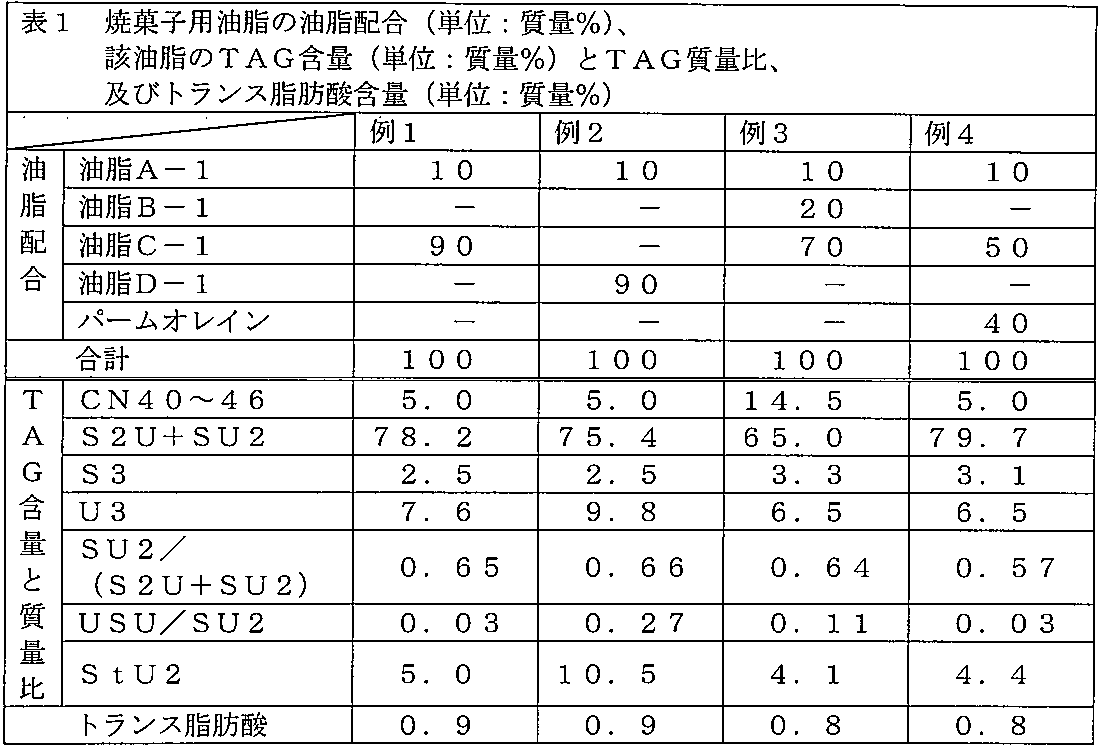
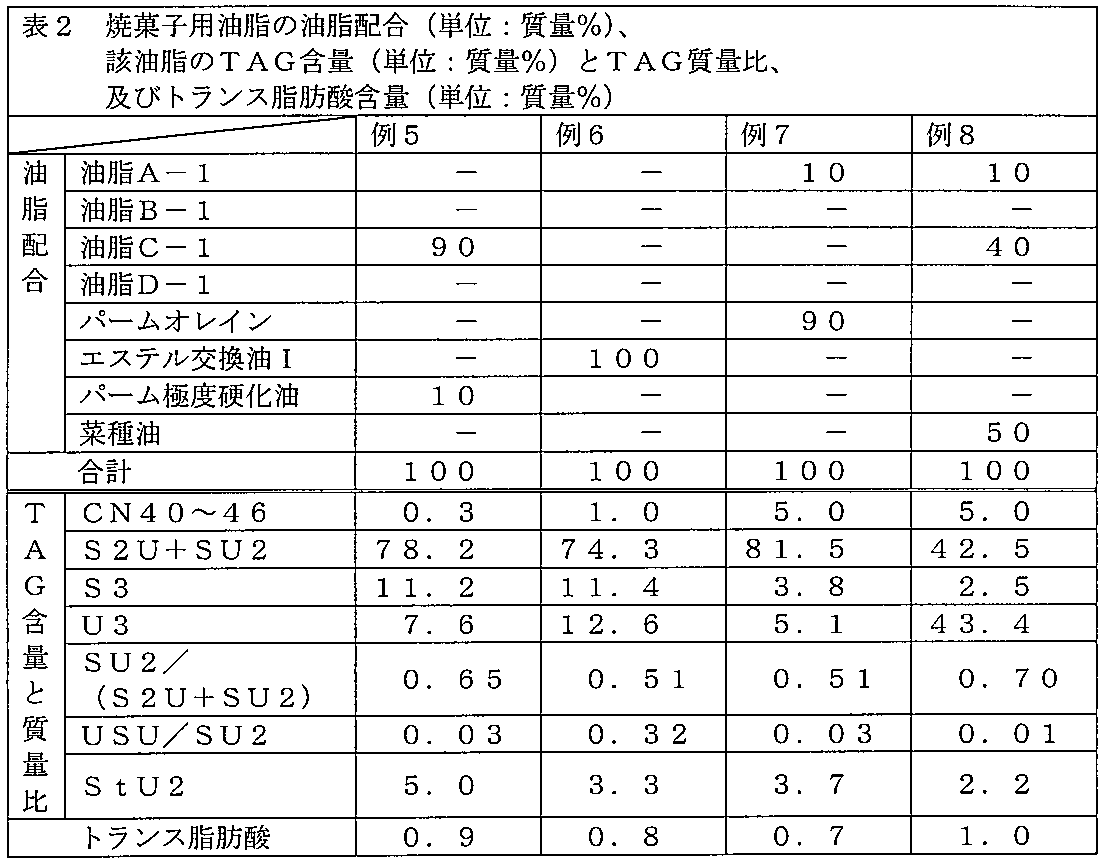
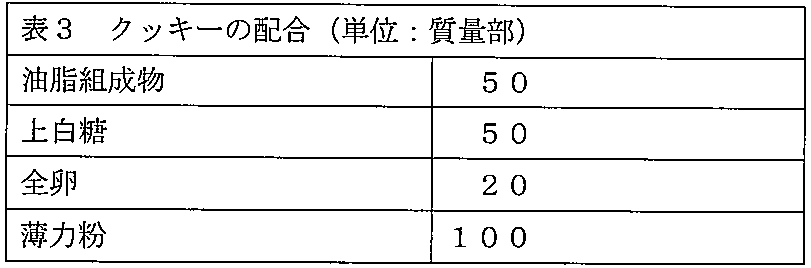
表4の配合に従って、例9、10のチョコレートを調製した。すなわち、表4に示される配合割合で油脂および他の原料を混合した。続いて、常法に従って、リファイニング、コンチング、テンパリングを行って、縦36.5mm、横38mm、厚さ3mmの形状に成形した例9、10のチョコレートを得た。
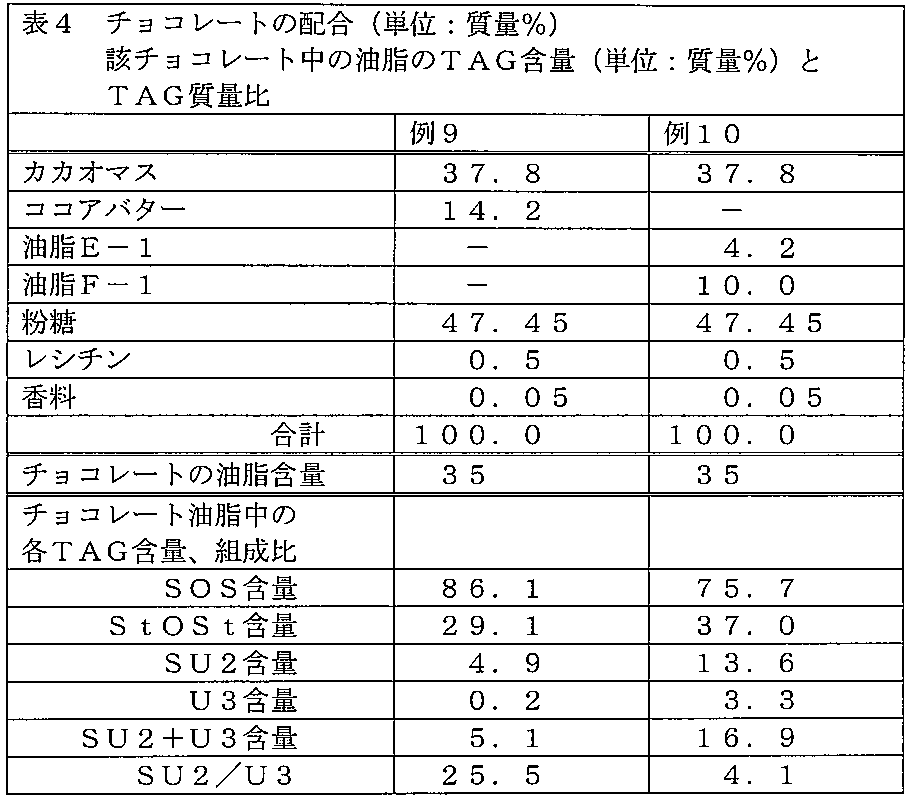
例1~8のクッキー(焼菓子)それぞれと、例9、10のチョコレートそれぞれとを、クッキーを板状に成形したチョコレートの上に置き、クッキーの底面とチョコレートとを接着させることで、例11~26の複合菓子を得た。得られた複合菓子は、30℃で2週間保存した。保存終了後の複合菓子におけるクッキーの白色化及びチョコレートのブルームを、目視にて以下の評価基準により評価した。白色化及びブルームの評価は、◎又は○の場合を良好であるとした。評価結果を表5~8に示した。例11~18、23、24及び26は比較例である。
◎ :白色化なし
○ :白色化はないが表面にやや色ムラあり
△ :一部白色化
× :白色化あり
◎ :ブルームなし
○ :ブルームはないがやや艶がない
△ :一部ブルームあり
× :ブルームあり
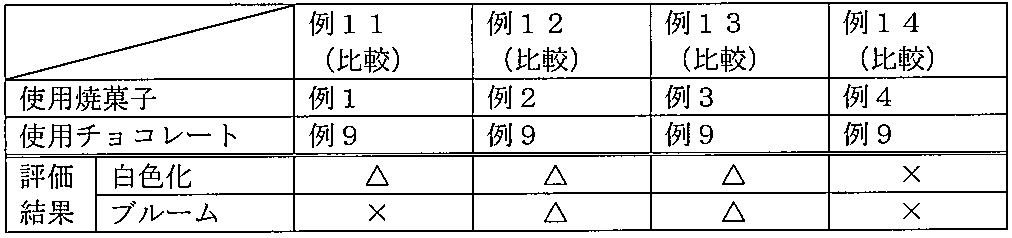
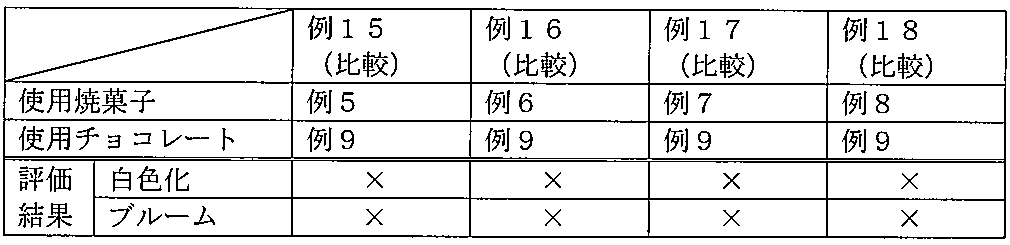
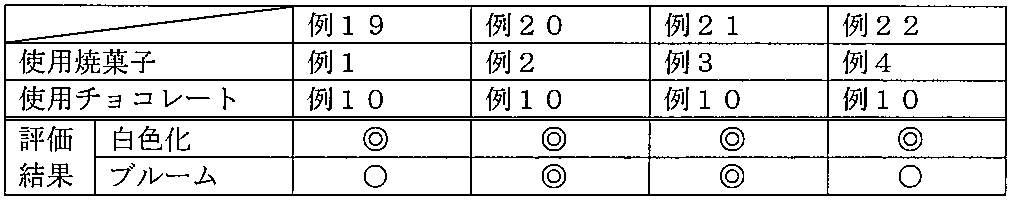

表9の原料油脂配合に従って、例27~30の各焼菓子用油脂を調製した。
例27~30の各焼菓子用油脂を加熱融解して、ビスケットに対して10質量%スプレーコーティングし、例27~30のビスケットを得た。ビスケットは表10の配合に従って作製した。すなわち、小麦粉、砂糖、食塩、香料を混合し、さらに市販のショートニングを加えてすり合わせた。すり合わせたものに、全卵、重曹を溶かした水を加え、粉気がなくなるまで混ぜ合わせることで生地を調製した。生地を休ませた後、ローラーで厚さ3mmにのばして直径3cmの円型で型抜きし、オーブンにて、上火200℃、下火180℃で8分間焼成することで得た。
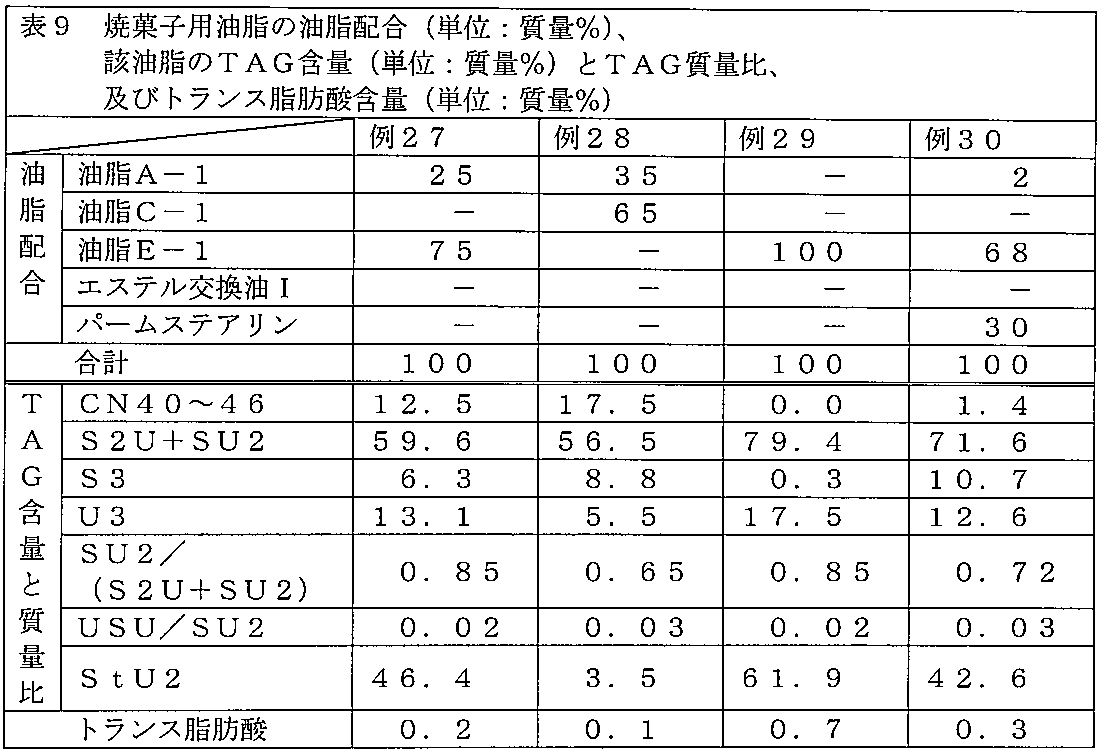

表11の配合に従って、例31、32のチョコレートを調製した。すなわち、表11に示される配合割合で油脂および他の原料を混合した。続いて、常法に従って、リファイニング、コンチング、テンパリング(シーディング)を行って、縦36.5mm、横38mm、厚さ3mmの形状に成形した例31、32のチョコレートを得た。

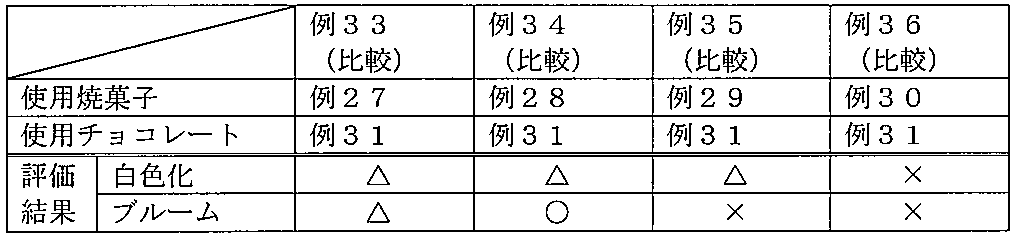
例27~30のビスケット(焼菓子)それぞれと、例31、32のチョコレートそれぞれとを、ビスケットを板状に成形したチョコレートの上に置き、ビスケットの底面とチョコレートとを接着させることで、例33~40の複合菓子を得た。得られた複合菓子は、37℃12時間と20℃12時間を1サイクルとして3サイクル保存した。保存終了後の複合菓子におけるクッキーの白色化及びチョコレートのブルームを、目視にて以下の評価基準により評価した。白色化及びブルームの評価は、◎又は○の場合を良好であるとした。評価結果を表12~13に示した。例33~36、39及び40は比較例である。
◎ :白色化なし
○ :白色化はないが表面にやや色ムラあり
△ :一部白色化
× :白色化あり
◎ :ブルームなし
○ :ブルームはないがやや艶がない
△ :一部ブルームあり
× :ブルームあり

Claims (10)
- 以下の(a)、(b)、(c)の条件を満たす油脂を使用した焼菓子と、チョコレート中の油脂が以下の(A)、(B)の条件を満たすチョコレートとを組み合わせた複合菓子。
(a)CN40~46含量が2~30質量%
(b)S2UとSU2の合計(S2U+SU2)含量が45~85質量%
(c)SU2とS2U+SU2の質量比(SU2/(S2U+SU2))が0.50以上
(A)SOSの含量が40~90質量%
(B)SU2とU3の合計(SU2+U3)含量が10~40質量%
ただし、CN40~46、S、U、O、S2U、SU2、SOS及びU3はそれぞれ以下のものを示す。
CN40~46:トリアシルグリセロールを構成する脂肪酸残基の総炭素数が40~46であるトリアシルグリセロール
S:炭素数16以上の飽和脂肪酸
U:炭素数16以上の不飽和脂肪酸
O:オレイン酸
S2U:Sが2分子、Uが1分子結合しているトリアシルグリセロール
SU2:Sが1分子、Uが2分子結合しているトリアシルグリセロール
SOS:1位と3位にS、2位にOが結合しているトリアシルグリセロール
U3:Uが3分子結合しているトリアシルグリセロール - 上記焼菓子に使用する油脂が以下の条件(d)、(e)を満たす、請求項1に記載の複合菓子。
(d)S3含量が15質量%以下
(e)U3含量が18質量%以下
ただし、S3は以下のものを示す。
S3:Sが3分子結合しているトリアシルグリセロール - 上記焼菓子に使用する油脂が以下の条件(f)を満たす、請求項1または2に記載の複合菓子。
(f)USUとSU2の質量比(USU/SU2)が0.02以上
ただし、USUは以下のものを示す。
USU:1位と3位にU、2位にSが結合しているトリアシルグリセロール - 上記焼菓子に使用する油脂が、ラウリン系油脂と非ラウリン系油脂とのエステル交換油を4~60質量%、非ラウリン系油脂を分別処理した低融点部を40~96質量%含む、請求項1~3の何れか一項に記載の複合菓子。
- 上記ラウリン系油脂と非ラウリン系油脂とのエステル交換油が、以下の油脂A、油脂Bから選ばれる1種以上からなるエステル交換油である、請求項4に記載の複合菓子。
油脂A:全構成脂肪酸中に不飽和脂肪酸を15質量%以下、炭素数12~14の飽和脂肪酸を20~60質量%、炭素数16~18の飽和脂肪酸を40~80質量%含有し、かつ、エステル交換することにより得られる油脂
油脂B:全構成脂肪酸中に不飽和脂肪酸を25~45質量%、炭素数12~14の飽和脂肪酸を15~35質量%、炭素数16~18の飽和脂肪酸を25~45質量%含有し、かつ、エステル交換することにより得られる油脂 - 上記非ラウリン系油脂を分別処理した低融点部が、ヨウ素価が62以上であって、
パーム系油脂、パーム系油脂を原料として含有するエステル交換油から選ばれる1種以上からなる油脂を分別処理した低融点部、
StU2を50質量%以上含有する低融点部、
から選ばれる1種以上からなる油脂である、請求項4または5に記載の複合菓子。
ただし、St及びStU2は以下のものを示す。
St:ステアリン酸
StU2:Stが1分子、Uが2分子結合しているトリアシルグリセロール - 上記チョコレート中の油脂が以下の条件(C)を満たす、請求項1~6の何れか一項に記載の複合菓子。
(C)油脂に含まれるSU2とU3の質量比(SU2/U3)が1以上 - 上記チョコレート中の油脂が以下の条件(D)を満たす、請求項1~7の何れか一項に記載の複合菓子。
(D)StOSt含量が27質量%~65質量% - 上記チョコレート中の油脂が、SOSに富む油脂を60~95質量%、非ラウリン系油脂を分別処理した低融点部を5~40質量%含む、請求項1~8の何れか一項に記載の複合菓子。
- 上記SOSに富む油脂が、StOSt油脂を20~100質量%含む、請求項9に記載の複合菓子。
Priority Applications (4)
| Application Number | Priority Date | Filing Date | Title |
|---|---|---|---|
| JP2014512969A JP5681836B2 (ja) | 2012-08-29 | 2013-08-26 | 複合菓子 |
| KR1020157003713A KR101984347B1 (ko) | 2012-08-29 | 2013-08-26 | 복합 과자 |
| US14/422,805 US20150223482A1 (en) | 2012-08-29 | 2013-08-26 | Combined confectionery |
| CN201380043190.9A CN104582499B (zh) | 2012-08-29 | 2013-08-26 | 复合糕点 |
Applications Claiming Priority (2)
| Application Number | Priority Date | Filing Date | Title |
|---|---|---|---|
| JP2012-189078 | 2012-08-29 | ||
| JP2012189078 | 2012-08-29 |
Publications (1)
| Publication Number | Publication Date |
|---|---|
| WO2014034601A1 true WO2014034601A1 (ja) | 2014-03-06 |
Family
ID=50183413
Family Applications (1)
| Application Number | Title | Priority Date | Filing Date |
|---|---|---|---|
| PCT/JP2013/072716 Ceased WO2014034601A1 (ja) | 2012-08-29 | 2013-08-26 | 複合菓子 |
Country Status (6)
| Country | Link |
|---|---|
| US (1) | US20150223482A1 (ja) |
| JP (2) | JP5681836B2 (ja) |
| KR (1) | KR101984347B1 (ja) |
| CN (1) | CN104582499B (ja) |
| MY (1) | MY164818A (ja) |
| WO (1) | WO2014034601A1 (ja) |
Cited By (14)
| Publication number | Priority date | Publication date | Assignee | Title |
|---|---|---|---|---|
| WO2014175192A1 (ja) * | 2013-04-22 | 2014-10-30 | 株式会社明治 | 焼成油性菓子およびその製造方法 |
| JP2015532931A (ja) * | 2012-09-07 | 2015-11-16 | エイエイケイ、アクチボラグAakab | 加工済み植物性脂肪の分離方法 |
| JP2015202099A (ja) * | 2014-04-16 | 2015-11-16 | 株式会社Adeka | 複合菓子用油脂組成物 |
| JP2017136013A (ja) * | 2016-02-03 | 2017-08-10 | 森永製菓株式会社 | チョコレート菓子及びチョコレート菓子の製造方法 |
| US20180077943A1 (en) * | 2015-04-02 | 2018-03-22 | Barilla G. E R. Fratelli S.P.A. | Process for the production of a chocolate snack and snack which can be obtained using this process |
| JP6463878B1 (ja) * | 2017-08-01 | 2019-02-06 | 日清オイリオグループ株式会社 | 油脂組成物及び該油脂組成物を含む油性食品 |
| JP2019129796A (ja) * | 2018-02-02 | 2019-08-08 | 日清オイリオグループ株式会社 | チョコレート |
| JP2020156415A (ja) * | 2019-03-27 | 2020-10-01 | 不二製油株式会社 | ブルーム抑制用油脂組成物及びこれを使用した油脂性菓子 |
| JP2020534846A (ja) * | 2017-10-27 | 2020-12-03 | ジェネラル ビスケット | ブルーミングしない可食製品 |
| WO2021181931A1 (ja) * | 2020-03-11 | 2021-09-16 | 不二製油グループ本社株式会社 | 複合菓子に適するチョコレート類用油脂 |
| WO2022138398A1 (ja) * | 2020-12-22 | 2022-06-30 | 日清オイリオグループ株式会社 | 油脂組成物 |
| JP7544171B1 (ja) | 2023-03-29 | 2024-09-03 | 不二製油株式会社 | チョコレート類用油脂 |
| JP7544170B1 (ja) | 2023-03-29 | 2024-09-03 | 不二製油株式会社 | チョコレート類用油脂 |
| WO2024203270A1 (ja) * | 2023-03-29 | 2024-10-03 | 不二製油グループ本社株式会社 | チョコレート類用油脂 |
Families Citing this family (4)
| Publication number | Priority date | Publication date | Assignee | Title |
|---|---|---|---|---|
| CN106689308A (zh) * | 2017-01-04 | 2017-05-24 | 焦作汇力康食品有限公司 | 一种调温软牛轧糖混合糕点及其加工方法 |
| EP3357341A1 (en) * | 2017-02-03 | 2018-08-08 | Generale Biscuit | Non-bloom comestible product |
| JP6947516B2 (ja) * | 2017-03-15 | 2021-10-13 | 株式会社Adeka | 製菓用油脂組成物 |
| JP7529169B2 (ja) * | 2022-03-29 | 2024-08-06 | 不二製油株式会社 | プレート状油性食品 |
Citations (9)
| Publication number | Priority date | Publication date | Assignee | Title |
|---|---|---|---|---|
| JPS63126457A (ja) * | 1986-11-17 | 1988-05-30 | Kao Corp | 焼菓子用油脂のマイグレ−シヨン抑制剤及びそれを用いる複合焼菓子類の製造法 |
| JPH0471441A (ja) * | 1990-07-12 | 1992-03-06 | Kanegafuchi Chem Ind Co Ltd | 焼菓子用練り込み油脂組成物及びそれを用いた複合菓子の製造方法 |
| JPH06105655A (ja) * | 1991-03-04 | 1994-04-19 | Fuji Oil Co Ltd | チョコレート及びチョコレート利用食品 |
| JPH07264983A (ja) * | 1994-03-31 | 1995-10-17 | Fuji Oil Co Ltd | 吸油膨潤防止機能性油脂、複合菓子用チョコレート及び複合菓子 |
| JPH10108624A (ja) * | 1996-08-13 | 1998-04-28 | Fuji Oil Co Ltd | チョコレート組成物及びこれで被覆した複合食品 |
| JP2001131574A (ja) * | 1999-11-02 | 2001-05-15 | Asahi Denka Kogyo Kk | 油脂組成物及びその製造方法 |
| JP2001197858A (ja) * | 2000-01-17 | 2001-07-24 | Bourbon Corp | 油脂組成物含有複合菓子 |
| JP2002065162A (ja) * | 2000-09-01 | 2002-03-05 | Asahi Denka Kogyo Kk | 油脂組成物及びこれを用いて製造されたチョコレート複合菓子類 |
| WO2012063629A1 (ja) * | 2010-11-11 | 2012-05-18 | 日清オイリオグループ株式会社 | 油脂組成物及び当該油脂組成物を用いたベーカリー食品、並びに当該ベーカリー食品を用いた複合食品 |
Family Cites Families (18)
| Publication number | Priority date | Publication date | Assignee | Title |
|---|---|---|---|---|
| JPH0811799B2 (ja) * | 1986-02-28 | 1996-02-07 | 花王株式会社 | カカオバタ−代用脂の製造方法 |
| JP2504987B2 (ja) * | 1987-04-03 | 1996-06-05 | 不二製油株式会社 | ハ−ドバタ−組成物 |
| US6022577A (en) * | 1990-12-07 | 2000-02-08 | Nabisco Technology Company | High stearic acid soybean oil blends |
| KR100218231B1 (ko) * | 1991-03-04 | 1999-09-01 | 야스이 기치지 | 초콜렛 및 초콜렛 이용 식품 |
| JP2811147B2 (ja) * | 1993-12-09 | 1998-10-15 | 花王株式会社 | 固形食品 |
| JP3378356B2 (ja) * | 1994-06-10 | 2003-02-17 | 豊年リーバ株式会社 | 複合菓子類の製造方法 |
| JP3461062B2 (ja) | 1995-07-31 | 2003-10-27 | 旭電化工業株式会社 | 製菓用油脂組成物及び菓子類の製造方法 |
| ID27667A (id) * | 1998-10-08 | 2001-04-19 | Fuji Oil Co Ltd | Komposisi coklat dan pemakaiannya |
| CN1315393C (zh) * | 2002-01-23 | 2007-05-16 | 株式会社艾迪科 | 油脂组合物 |
| JP4785324B2 (ja) | 2002-06-17 | 2011-10-05 | 株式会社Adeka | 油脂性素材配合ベーカリー食品におけるブルーム、白色化及び油脂性素材固化現象の抑制緩和方法 |
| JP2005350660A (ja) * | 2004-05-10 | 2005-12-22 | Asahi Denka Kogyo Kk | 可塑性油脂組成物 |
| CA2641706C (en) * | 2006-02-08 | 2014-12-23 | Fuji Oil Company, Limited | Edible products with low content of saturated and trans unsaturated fats |
| US20100015295A1 (en) * | 2008-07-21 | 2010-01-21 | Haas Olav M | Method of preventing staling in baked goods |
| JP5295672B2 (ja) * | 2008-07-23 | 2013-09-18 | グローリー株式会社 | 硬貨処理機および硬貨処理方法 |
| JP5758377B2 (ja) * | 2010-03-19 | 2015-08-05 | 日清オイリオグループ株式会社 | 油脂組成物及び該油脂組成物を使ったチョコレート製品 |
| WO2012002373A1 (ja) * | 2010-06-30 | 2012-01-05 | 不二製油株式会社 | 非ラウリン、非トランス、非テンパリング型製菓用油脂及びその製造法 |
| US8435592B2 (en) * | 2010-09-13 | 2013-05-07 | General Mills, Inc. | Shortening particle compositions and dough products made therefrom |
| WO2012114914A1 (ja) * | 2011-02-22 | 2012-08-30 | 日清オイリオグループ株式会社 | チョコレート類およびその製造方法 |
-
2013
- 2013-08-26 MY MYPI2015700427A patent/MY164818A/en unknown
- 2013-08-26 US US14/422,805 patent/US20150223482A1/en not_active Abandoned
- 2013-08-26 CN CN201380043190.9A patent/CN104582499B/zh active Active
- 2013-08-26 KR KR1020157003713A patent/KR101984347B1/ko not_active Expired - Fee Related
- 2013-08-26 JP JP2014512969A patent/JP5681836B2/ja active Active
- 2013-08-26 WO PCT/JP2013/072716 patent/WO2014034601A1/ja not_active Ceased
-
2014
- 2014-11-28 JP JP2014240908A patent/JP2015037434A/ja active Pending
Patent Citations (9)
| Publication number | Priority date | Publication date | Assignee | Title |
|---|---|---|---|---|
| JPS63126457A (ja) * | 1986-11-17 | 1988-05-30 | Kao Corp | 焼菓子用油脂のマイグレ−シヨン抑制剤及びそれを用いる複合焼菓子類の製造法 |
| JPH0471441A (ja) * | 1990-07-12 | 1992-03-06 | Kanegafuchi Chem Ind Co Ltd | 焼菓子用練り込み油脂組成物及びそれを用いた複合菓子の製造方法 |
| JPH06105655A (ja) * | 1991-03-04 | 1994-04-19 | Fuji Oil Co Ltd | チョコレート及びチョコレート利用食品 |
| JPH07264983A (ja) * | 1994-03-31 | 1995-10-17 | Fuji Oil Co Ltd | 吸油膨潤防止機能性油脂、複合菓子用チョコレート及び複合菓子 |
| JPH10108624A (ja) * | 1996-08-13 | 1998-04-28 | Fuji Oil Co Ltd | チョコレート組成物及びこれで被覆した複合食品 |
| JP2001131574A (ja) * | 1999-11-02 | 2001-05-15 | Asahi Denka Kogyo Kk | 油脂組成物及びその製造方法 |
| JP2001197858A (ja) * | 2000-01-17 | 2001-07-24 | Bourbon Corp | 油脂組成物含有複合菓子 |
| JP2002065162A (ja) * | 2000-09-01 | 2002-03-05 | Asahi Denka Kogyo Kk | 油脂組成物及びこれを用いて製造されたチョコレート複合菓子類 |
| WO2012063629A1 (ja) * | 2010-11-11 | 2012-05-18 | 日清オイリオグループ株式会社 | 油脂組成物及び当該油脂組成物を用いたベーカリー食品、並びに当該ベーカリー食品を用いた複合食品 |
Cited By (26)
| Publication number | Priority date | Publication date | Assignee | Title |
|---|---|---|---|---|
| JP2015532931A (ja) * | 2012-09-07 | 2015-11-16 | エイエイケイ、アクチボラグAakab | 加工済み植物性脂肪の分離方法 |
| WO2014175192A1 (ja) * | 2013-04-22 | 2014-10-30 | 株式会社明治 | 焼成油性菓子およびその製造方法 |
| JP2015202099A (ja) * | 2014-04-16 | 2015-11-16 | 株式会社Adeka | 複合菓子用油脂組成物 |
| US10201166B2 (en) * | 2015-04-02 | 2019-02-12 | Barilla G. E R. Fratelli S.P.A. | Process for the production of a chocolate snack and snack which can be obtained using this process |
| US20180077943A1 (en) * | 2015-04-02 | 2018-03-22 | Barilla G. E R. Fratelli S.P.A. | Process for the production of a chocolate snack and snack which can be obtained using this process |
| JP2017136013A (ja) * | 2016-02-03 | 2017-08-10 | 森永製菓株式会社 | チョコレート菓子及びチョコレート菓子の製造方法 |
| WO2019026670A1 (ja) * | 2017-08-01 | 2019-02-07 | 日清オイリオグループ株式会社 | 油脂組成物及び該油脂組成物を含む油性食品 |
| JP6463878B1 (ja) * | 2017-08-01 | 2019-02-06 | 日清オイリオグループ株式会社 | 油脂組成物及び該油脂組成物を含む油性食品 |
| JP2020534846A (ja) * | 2017-10-27 | 2020-12-03 | ジェネラル ビスケット | ブルーミングしない可食製品 |
| US12329178B2 (en) | 2017-10-27 | 2025-06-17 | Generale Biscuit | Non-bloom comestible product |
| JP7083019B2 (ja) | 2017-10-27 | 2022-06-09 | ジェネラル ビスケット | ブルーミングしない可食製品 |
| JP2019129796A (ja) * | 2018-02-02 | 2019-08-08 | 日清オイリオグループ株式会社 | チョコレート |
| JP7076895B2 (ja) | 2018-02-02 | 2022-05-30 | 日清オイリオグループ株式会社 | チョコレート |
| JP7085146B2 (ja) | 2019-03-27 | 2022-06-16 | 不二製油株式会社 | ブルーム抑制用油脂組成物及びこれを使用した油脂性菓子 |
| JP2020156415A (ja) * | 2019-03-27 | 2020-10-01 | 不二製油株式会社 | ブルーム抑制用油脂組成物及びこれを使用した油脂性菓子 |
| JP6969708B1 (ja) * | 2020-03-11 | 2021-11-24 | 不二製油株式会社 | 複合菓子に適するチョコレート類用油脂 |
| WO2021181931A1 (ja) * | 2020-03-11 | 2021-09-16 | 不二製油グループ本社株式会社 | 複合菓子に適するチョコレート類用油脂 |
| WO2022138398A1 (ja) * | 2020-12-22 | 2022-06-30 | 日清オイリオグループ株式会社 | 油脂組成物 |
| JPWO2022138398A1 (ja) * | 2020-12-22 | 2022-06-30 | ||
| JP7280451B2 (ja) | 2020-12-22 | 2023-05-23 | 日清オイリオグループ株式会社 | 油脂組成物 |
| CN116546889A (zh) * | 2020-12-22 | 2023-08-04 | 日清奥利友集团株式会社 | 油脂组合物 |
| JP7544171B1 (ja) | 2023-03-29 | 2024-09-03 | 不二製油株式会社 | チョコレート類用油脂 |
| JP7544170B1 (ja) | 2023-03-29 | 2024-09-03 | 不二製油株式会社 | チョコレート類用油脂 |
| WO2024203270A1 (ja) * | 2023-03-29 | 2024-10-03 | 不二製油グループ本社株式会社 | チョコレート類用油脂 |
| JP2024141369A (ja) * | 2023-03-29 | 2024-10-10 | 不二製油株式会社 | チョコレート類用油脂 |
| JP2024141370A (ja) * | 2023-03-29 | 2024-10-10 | 不二製油株式会社 | チョコレート類用油脂 |
Also Published As
| Publication number | Publication date |
|---|---|
| CN104582499B (zh) | 2018-11-06 |
| JP2015037434A (ja) | 2015-02-26 |
| JPWO2014034601A1 (ja) | 2016-08-08 |
| US20150223482A1 (en) | 2015-08-13 |
| MY164818A (en) | 2018-01-30 |
| KR20150045434A (ko) | 2015-04-28 |
| CN104582499A (zh) | 2015-04-29 |
| JP5681836B2 (ja) | 2015-03-11 |
| KR101984347B1 (ko) | 2019-05-30 |
Similar Documents
| Publication | Publication Date | Title |
|---|---|---|
| JP5681836B2 (ja) | 複合菓子 | |
| JP5913121B2 (ja) | 油脂組成物及び当該油脂組成物を用いたベーカリー食品、並びに当該ベーカリー食品を用いた複合食品の各製造方法 | |
| JP5291847B1 (ja) | 油脂組成物及び当該油脂組成物を用いたベーカリー食品、並びに当該ベーカリー食品を用いた複合食品 | |
| JP5628366B2 (ja) | 油脂組成物及び当該油脂組成物を用いたベーカリー食品 | |
| JP6585346B2 (ja) | 可塑性油脂組成物及びその製造方法 | |
| JP2016116486A (ja) | 油脂組成物及び該油脂組成物を使用した油性食品 | |
| WO2015159794A1 (ja) | 油脂含有食品 | |
| JP6113942B1 (ja) | 油性食品 | |
| JP2020058253A (ja) | 焼菓子用油脂組成物 | |
| JP6727389B1 (ja) | 焼き菓子用生地及び焼き菓子 | |
| JP2019054750A (ja) | 被覆チョコレート用油脂組成物 | |
| JP2021040658A (ja) | チョコレート | |
| JP6830570B1 (ja) | 可塑性油脂組成物及び該可塑性油脂組成物を使用してなる複合菓子 | |
| JP6811911B1 (ja) | チョコレート | |
| JP7387226B2 (ja) | バタークリーム用油脂組成物 | |
| WO2021044949A1 (ja) | 可塑性油脂組成物及び該可塑性油脂組成物を使用してなる複合菓子 | |
| JP2016093204A (ja) | 油脂含有食品 |
Legal Events
| Date | Code | Title | Description |
|---|---|---|---|
| ENP | Entry into the national phase |
Ref document number: 2014512969 Country of ref document: JP Kind code of ref document: A |
|
| 121 | Ep: the epo has been informed by wipo that ep was designated in this application |
Ref document number: 13832472 Country of ref document: EP Kind code of ref document: A1 |
|
| ENP | Entry into the national phase |
Ref document number: 20157003713 Country of ref document: KR Kind code of ref document: A |
|
| WWE | Wipo information: entry into national phase |
Ref document number: 14422805 Country of ref document: US |
|
| NENP | Non-entry into the national phase |
Ref country code: DE |
|
| 122 | Ep: pct application non-entry in european phase |
Ref document number: 13832472 Country of ref document: EP Kind code of ref document: A1 |