WO2013084836A1 - シート状カバリング剤、カバリング方法又は電子デバイスの製造方法 - Google Patents
シート状カバリング剤、カバリング方法又は電子デバイスの製造方法 Download PDFInfo
- Publication number
- WO2013084836A1 WO2013084836A1 PCT/JP2012/081247 JP2012081247W WO2013084836A1 WO 2013084836 A1 WO2013084836 A1 WO 2013084836A1 JP 2012081247 W JP2012081247 W JP 2012081247W WO 2013084836 A1 WO2013084836 A1 WO 2013084836A1
- Authority
- WO
- WIPO (PCT)
- Prior art keywords
- polymer
- covering agent
- temperature
- sheet
- meth
- Prior art date
- Legal status (The legal status is an assumption and is not a legal conclusion. Google has not performed a legal analysis and makes no representation as to the accuracy of the status listed.)
- Ceased
Links
Images


Classifications
-
- H—ELECTRICITY
- H10—SEMICONDUCTOR DEVICES; ELECTRIC SOLID-STATE DEVICES NOT OTHERWISE PROVIDED FOR
- H10W—GENERIC PACKAGES, INTERCONNECTIONS, CONNECTORS OR OTHER CONSTRUCTIONAL DETAILS OF DEVICES COVERED BY CLASS H10
- H10W74/00—Encapsulations, e.g. protective coatings
- H10W74/40—Encapsulations, e.g. protective coatings characterised by their materials
- H10W74/47—Encapsulations, e.g. protective coatings characterised by their materials comprising organic materials, e.g. plastics or resins
Definitions
- the present invention provides a sheet-like covering agent (or covering sheet, sealing sheet, etc.) useful for protecting an element (such as a semiconductor element) formed on a substrate and bonding optical members constituting a display device (such as a display device with a touch panel). And a covering method (or sealing method) or an electronic device manufacturing method using the same.
- Functional elements such as semiconductor elements, organic electroluminescence (EL) elements, liquid crystal elements (liquid crystal cells), photoelectric conversion elements (solar cells, etc.), these functional element packages, the functional elements or printed boards on which the packages are mounted, etc.
- These precision parts are usually sealed with a resin and protected from external influences (especially humidity).
- a sealing method a method is known in which a precision part is placed in a mold cavity, and a thermosetting resin having low viscosity and high fluidity is injected and sealed.
- additives such as a crosslinking agent are added to the thermosetting resin, not only the pot life is short, but a relatively long time is required for curing in the mold cavity. Productivity is low.
- thermoplastic resin As a method with high productivity, it is also known to seal a precision part by injection molding a thermoplastic resin. However, in this method, since a high-temperature thermoplastic resin is injection-molded, the substrate and the electronic component mounted on the substrate are easily damaged by heat.
- Patent Document 1 Japanese Patent Application Laid-Open No. 2008-282906 relates to a method of manufacturing a solar cell module in which a solar cell is sealed with a resin between a substrate and a film, and the substrate between the substrate and the solar cell. A first encapsulating resin sheet covering the entire surface of the substrate is disposed, and a second encapsulating resin sheet covering the entire surface of the substrate is disposed between the film and the solar battery cell to produce a laminated body. Are stacked, and a backing plate is arranged outside the film of the uppermost laminate, and air between the substrate and the film is discharged, heated to melt the resin, cooled, and sealed.
- Patent Document 2 Japanese Unexamined Patent Application Publication No. 2009-99417
- Patent Document 2 includes a barrier film for sealing an organic electronic device formed on a substrate, and a hot melt type member is provided between the organic electronic device and the barrier film.
- Disposed organic electronic device sealing panels are disclosed.
- these film-like encapsulants are inferior in conformity to the uneven portions of the device (or element), and thus effective in devices with few uneven portions, but tightly seal the details of devices with many uneven portions. Is difficult.
- Temporarily it is possible to increase the sealing temperature to increase the fluidity of the resin and increase the followability to the uneven portion of the device. In this case, however, the possibility that the device is damaged by heat increases.
- sealing at high temperatures increases the fluidity and adhesiveness of the resin, so the film-like sealant may flow out of the predetermined sealing site, reducing work efficiency, or preventing the designed sealing. There is also.
- Patent Document 3 (A) epoxy (meth) acrylate having a non-flowability at 25 ° C. and a flowability in the range of 50 to 100 ° C. and (B) initiation of photopolymerization are disclosed.
- a sheet-shaped encapsulant comprising a photocurable resin layer containing an agent and a light-transmitting film layer is bonded to a substrate having an organic EL element by crimping the sheet-form encapsulant with a heated pressure-bonding roll. It is described that a primary coating serving as a base of an inorganic film is formed by a step of combining and a step of curing a photocurable resin layer by light irradiation.
- this method requires a crimping step, a photocuring step, and a peeling step of the transparent film layer using a laminated sheet provided with a photocurable resin layer, and the formation of the primary coating is complicated.
- the photocurable resin contracts with photocuring, a contraction stress acts on the device, and the contraction stress remains in the primary film, which may adversely affect the device.
- a photoinitiator and its decomposition product remain in a photocurable resin layer in a primary film, there is a possibility of adversely affecting the device.
- an object of the present invention is to provide a sheet-like covering agent (a coating agent or a sealing agent) that can effectively cover (or seal) a portion to be processed (a portion to be sealed) of a member to be processed such as an electronic device at a relatively low temperature. Agent), a covering method (or sealing method) using the same, or a method of manufacturing an electronic device.
- Another object of the present invention is a sheet-like covering agent (or sealing agent) that has fluidity (or followability to a stepped surface, etc.) at low temperatures and can effectively relieve residual stress, and a covering method ( Or providing a method of manufacturing an electronic device.
- Still another object of the present invention is to use a sheet-like covering agent (or encapsulant) that can cover (or seal) an object to be processed such as an electronic device at a low temperature and whose fluidity is reduced at a high temperature.
- the object is to provide a covering method (or sealing method) or a method for manufacturing an electronic device.
- Another object of the present invention is to provide a sheet-like covering agent that can effectively protect the member to be treated even under high temperature and high humidity, and does not impair the visibility to the device, a covering method using the same, or a method for manufacturing an electronic device. is there.
- Still another object of the present invention is to provide a transparent pressure-sensitive adhesive sheet that can achieve both step following ability and peelability (reworkability) after sticking, and a method for producing the same.
- Another object of the present invention is to provide a transparent pressure-sensitive adhesive sheet that can adhere both adherends without gaps even when the gap between adherends is large, and a method for producing the same.
- Still another object of the present invention is to provide a transparent pressure-sensitive adhesive sheet having excellent durability and capable of preventing bubbles from being generated at the interface with the adherend even under high temperature and high humidity, and a method for producing the same.
- Another object of the present invention is to provide a transparent adhesive sheet excellent in punching workability and a method for producing the same.
- Still another object of the present invention is to provide a transparent pressure-sensitive adhesive sheet which is excellent in optical isotropy and does not impair visibility even when used for bonding optical members constituting a display device, and a method for producing the same.
- the present inventors have made a sheet of a polymer that softly crosslinks a polymer that softens at low temperatures, has a large molecular weight between crosslinking points, and has a predetermined storage modulus at low and high temperatures.
- a sheet of a polymer that softly crosslinks a polymer that softens at low temperatures has a large molecular weight between crosslinking points, and has a predetermined storage modulus at low and high temperatures.
- covering covering (sealing or sealing)
- it has fluidity at low temperature (or followability to the surface of a step, etc.) and has high stress relaxation properties, which only relieves residual stress.
- the present invention has been completed by finding that electronic components can be effectively covered (or sealed) at a relatively low temperature without flowing at a high temperature, and has heat resistance against deformation.
- the covering agent (covering agent or sealing agent) of the present invention contains a polymer and has a sheet-like form.
- the polymer has a storage elastic modulus at a temperature of 25 ° C. of 100 to 5000 MPa, a storage elastic modulus at 80 ° C. of 0.01 to 10 MPa, a molecular weight between crosslinking points of 8000 to 30000, and after 10 seconds to 20 seconds after stopping the strain.
- the stress relaxation rate is 0.5 to 30% at a temperature of 80 ° C.
- the polymer has a storage elastic modulus at 60 ° C. of about 0.05 to 100 MPa.
- Such a polymer is formed of a loosely cross-linked polymer having a low-temperature softening property. Since the polymer having the above characteristics has a high storage elastic modulus at 25 ° C., it has a high mechanical strength at room temperature and a low storage elastic modulus at 60 ° C. and 80 ° C. Temperature) and shows high followability to the surface of the step. Therefore, even if the step is very small, it can be effectively covered or sealed. Moreover, since the molecular weight between cross-linking points is large, fluidity at low temperatures is not impaired, but at high temperatures (for example, temperatures exceeding 100 ° C.), flow and deformation are restricted by cross-linking and show heat resistance against deformation. Furthermore, since the molecular weight between cross-linking points is large and the stress relaxation rate is large, even if it shrinks as it solidifies, the residual stress is quickly relaxed and no strain remains.
- the glass transition temperature of the polymer may be about 10 to 100 ° C.
- the linear expansion coefficient of the polymer at 20 to 100 ° C. is about 500 to 5000 ppm / K.
- the tensile stress of the polymer at 100% elongation at room temperature (for example, a temperature of 23 ° C.) may be about 15 to 100 MPa.
- the total light transmittance of the polymer may be about 89 to 95%
- the haze value may be about 0.1 to 1.5%
- the in-plane retardation of the polymer at a wavelength of 590 nm is 10 nm. It may be the following.
- the gas barrier property of the polymer is high.
- the water vapor barrier property of the polymer at a thickness of 100 ⁇ m may be about 0.1 to 10 g / m 2 / day.
- Such a polymer can be composed of polymers having various low-temperature softening properties, for example, non-crystalline olefin polymers (or non-crystalline olefin copolymers).
- the covering agent of the present invention can be used to cover (or cover) various members in a sheet form, and is useful as, for example, a sheet-like sealant for sealing an electronic device (component).
- the present invention includes a transparent pressure-sensitive adhesive sheet comprising a core film formed of the covering agent (or containing the polymer) and a pressure-sensitive adhesive layer formed on at least one surface of the core film.
- the surface of the core material film may be subjected to corona treatment or plasma treatment.
- the surface tension of the core film may be about 40 to 70 mN / m.
- the thickness of the core film may be about 20 to 400 ⁇ m.
- the core material film may be formed by extruding the polymer.
- Such a transparent adhesive sheet can be suitably used for bonding two panels selected from a touch panel, a liquid crystal display panel, and a protective panel.
- the present invention also includes a covering method (or sealing method). That is, in this method, the sheet-like covering agent (or sealant) is brought into contact with the site to be treated (or the site to be sealed), and the covering agent (or sealant) is heated (or the polymer). After being flowed), it is cooled, and the site to be treated is covered (covered or sealed) with a covering agent (or sealant).
- the present invention also includes a method for manufacturing an electronic device. In this method, an electronic device is used as the adherend. That is, the sheet-like covering agent (or sealant) is brought into contact with the electronic device, the covering agent (or sealant) is heated (or the polymer is made to flow), and then cooled to cool the electronic device. An electronic device is manufactured by covering (covering or sealing) with a covering agent (or sealing agent). In these methods, the heating temperature may be, for example, a temperature not lower than the glass transition temperature of the polymer and not higher than 100 ° C.
- a crosslinked polymer having a predetermined molecular weight between crosslinking points may be simply referred to as “polymer”.
- Acrylic monomers and methacrylic monomers are collectively referred to as (meth) acrylic monomers.
- Low temperature softening means softening at a temperature of about 30 to 80 ° C., and the elastic modulus after softening becomes 1/100 or less of that before softening.
- sheet and “film” may be used synonymously.
- the upper limit and the lower limit of the numerical range can be arbitrarily combined.
- a portion to be treated (such as a portion to be sealed) of a member to be treated such as an electronic device is covered (covered or sealed) with a sheet-like covering agent (coating agent or sealant) containing a specific polymer. Therefore, it can be effectively covered (or sealed) at a relatively low temperature. In addition to high fluidity at low temperatures (or followability to the surface of a step, etc.), it has high stress relaxation properties and can effectively relieve residual stress. Therefore, it is effective and tight with a sheet-like covering agent (or sealant). Can be covered or sealed. In particular, even a minute step portion (uneven portion) can be accurately sealed.
- a processing target member such as an electronic device at a low temperature
- it has heat resistance against deformation at a high temperature and can regulate the flow of the polymer. Sealing).
- the covering agent (or sealing agent) using a highly transparent polymer does not impair the visibility to the device, the covering or covering state can be easily confirmed, and the occurrence of defective products can be prevented.
- a covering agent (or sealant) having a high gas barrier property is used, the member to be treated can be effectively protected even under high temperature and high humidity. Therefore, it is effective for covering (covering or sealing) various members, particularly precision parts (or electronic devices).
- the transparent adhesive sheet of the present invention has an adhesive layer on at least one surface of a core film containing a specific polymer, it softens at the bonding processing temperature and follows the uneven surface shape of the adherend. In addition, it has a high elastic modulus at room temperature and does not break even when a large stress is applied during peeling, and therefore has excellent reworkability. Further, even if the thickness of the transparent pressure-sensitive adhesive sheet is large, the followability to the surface of the step is excellent, so that both adherends can be bonded without gap even if the gap between the adherends is large. Furthermore, it is excellent in durability and it is possible to effectively prevent bubbles from being generated at the interface with the adherend even under severe conditions (such as under high temperature and high humidity). Moreover, since it has a specific core material film, it is excellent in punching workability. Furthermore, it is excellent in optical isotropy, and does not impair the display performance of the display device even when used for bonding optical members constituting the display device.
- FIG. 1 is a graph showing the relationship between the storage elastic modulus and temperature of the test pieces of Comparative Examples 1 and 2 and Example 3.
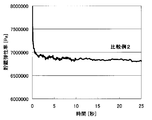
- FIG. 2 is a stress relaxation graph showing the relationship between time and storage elastic modulus in the test piece of Comparative Example 2.
- FIG. 3 is a stress relaxation graph showing the relationship between time and storage elastic modulus of the test piece of Example 3.
- the covering agent (or sealant) of the present invention has a sheet-like form and contains a specific crosslinked polymer.
- This crosslinked polymer has a structure in which a low-temperature softening polymer is loosely crosslinked, has a high storage elastic modulus at room temperature, and a low storage elastic modulus at processing temperature (covering or sealing temperature). Has a special color.
- the storage elastic modulus of the polymer at a temperature of 25 ° C. can be selected from the range of 100 to 5000 MPa, for example, 100 to 4000 MPa, preferably 500 to 3000 MPa (for example, 750 to 2500 MPa), more preferably 1000 to 2000 MPa (for example, About 1200 to 1800 MPa), about 500 to 5000 MPa, preferably about 800 to 4000 MPa, and more preferably about 1000 to 3000 MPa.
- the storage elastic modulus of the polymer at a temperature of 60 ° C. is, for example, about 0.05 to 100 MPa, preferably about 0.1 to 50 MPa, and more preferably about 0.5 to 30 MPa (eg, 1 to 10 MPa).
- the storage elastic modulus of the polymer at a temperature of 80 ° C. is 0.01 to 10 MPa, preferably 0.1 to 8 MPa (eg 0.5 to 7.5 MPa), more preferably 1 to 7 MPa (eg 2 to 7 MPa).
- a polymer having such characteristics has high mechanical strength near room temperature (about 20 to 25 ° C.), and can effectively protect the adherend, and can flow around the processing temperature (such as covering or sealing temperature).
- the adherend can be coated or covered uniformly and tightly.
- the storage elastic modulus at 25 ° C. with respect to the storage elastic modulus at 60 ° C. is, for example, 50-5 ⁇ 10 5 (for example, 60-1 ⁇ 10 4 ), preferably about 70 to 1000 (for example, 80 to 500), more preferably about 90 to 300 (for example, 100 to 280).
- the storage elastic modulus at 80 ° C. is “1”
- the storage elastic modulus of the polymer can be measured by the method described in Examples.
- the crosslinked polymer has a feature that the molecular weight between crosslinking points is large.
- the molecular weight between crosslink points of the polymer is about 8000 to 30000, preferably about 9000 to 25000 (for example, 9500 to 20000), more preferably about 10,000 to 18000 (for example, 10,000 to 16000).
- Such a large molecular weight between cross-linking points indicates that the polymer has a loosely cross-linked structure with a low cross-linking density. For this reason, when heated, the polymer behaves and flows like a thermoplastic resin, but when the temperature rises above a predetermined temperature, the flow and deformation of the polymer are regulated by crosslinking, and unlike the thermoplastic resin, it has heat resistance.
- the molecular weight between crosslinking points of the polymer can be determined by a conventional method, for example, a typical method using the rubber elasticity theory. In this method, the molecular weight between crosslinking points can be calculated by the following formula.
- G ( ⁇ RT) / M X (Wherein, G is the shear modulus (unit Pa), [rho is the density (g / m 3), R is the gas constant (8.314J / K / mol), T is the absolute temperature (K), the M X cross (Indicates molecular weight between points (g / mol))
- the shear elastic modulus G can be measured by a storage elastic modulus in a rubber-like flat region (for example, 140 ° C., angular frequency 0.1 Hz) (the storage elastic modulus is measured in the same manner as described above).
- the density ⁇ can be measured by the Archimedes method, and the density of the polymer described in the book “Polymer Engineering and Science, MID-JULY, 1990, Vol. 30, No. 13, P753-761” can also be referred to.
- the stress relaxation rate after 10 seconds to 20 seconds after strain stop (load removal) is about 0.5 to 30, preferably 1 to 25, more preferably about 1.5 to 22% at a temperature of 80 ° C. is there.
- the stress relaxation rate can be calculated by measuring by the method described in the examples.
- a polymer having a high elongation at room temperature is preferred.
- the tensile stress of the polymer at 100% elongation at room temperature (temperature 15 to 25 ° C., for example 23 ° C.) is, for example, about 15 to 100 MPa, preferably 17 to 80 MPa, and more preferably about 20 to 60 MPa.
- the tensile stress can be measured by the method described in the examples using JIS No. 2 dumbbell pieces (width 6 mm, thickness 100 ⁇ m).
- the glass transition temperature Tg (or melting point Tm for crystalline polymers) of the polymer is, for example, 10 to 100 ° C. (eg 15 to 90 ° C.), preferably 20 to 80 ° C. (eg 25 to 75 ° C.), Preferably, it is about 25 to 70 ° C. (eg, 25 to 60 ° C., preferably 30 to 50 ° C.), and may be about 15 to 50 ° C. (eg, 20 to 40 ° C., preferably 25 to 35 ° C.). 25 to 50 ° C. (for example, more than 30 ° C. and 50 ° C.
- the glass transition temperature Tg and the melting point Tm can be measured using a differential scanning calorimeter (DSC) at a heating rate of 10 ° C./min.
- the linear expansion coefficient (linear thermal expansion coefficient) of the polymer is, for example, 500 to 5000 ppm / K, preferably 1000 to 3500 ppm / K (for example, 1200 to 3000 ppm / K) in a temperature range of 20 to 100 ° C. Preferably, it is about 1700-2700 ppm / K (for example, 1500-2500 ppm / K).
- the linear expansion coefficient is too small, the heat resistance is poor, and when the linear expansion coefficient is too large, the covering property is lowered.
- the polymer has an appropriate linear thermal expansion coefficient, does not melt even at high temperatures, regulates melt flow, and has heat resistance against deformation.
- the linear expansion coefficient of a polymer can be measured by the method as described in an Example.
- the degree of crosslinking of the polymer can be indicated by the gel fraction.
- the gel fraction of the polymer may be, for example, 5% by weight or more (for example, 10 to 99% by weight), 30 to 98% by weight, preferably 50 to 97% by weight, more preferably 80 to 95% by weight. % (For example, 85 to 93% by weight).
- the cross-linked polymer is excellent in heat resistance and durability, and retains moderate flexibility.
- the gel fraction of the polymer can be measured by the measuring method described in the examples.
- the total light transmittance of the polymer may be about 80 to 99%, more preferably 85 to 98% (especially 90 to 95%) at a thickness of 100 ⁇ m, and usually 89 to 95%, preferably 90 to 90%. It is about 94%, more preferably about 91 to 93%.
- the total light transmittance can be measured according to JIS K7105.
- the haze value (cloudiness value) of the polymer is 5% or less (preferably 2% or less (for example, 0 to 2%)) at a thickness of 100 ⁇ m, and usually 1.5% or less, for example, 0.1 to 1.5%, preferably about 0.1 to 1% (for example, 0.2 to 0.7%), more preferably about 0.1 to 0.5% (for example, 0.2 to 0.4%) It is. Haze can be measured according to JIS K7105.
- a polymer excellent in optical isotropy is preferable in order to prevent the display property from being impaired even if the optical member constituting the display device is covered or sealed.
- the in-plane retardation of the polymer at a wavelength of 590 nm is, for example, 10 nm or less (for example, 0.1 to 5 nm), preferably 0.5 to 3 nm (for example, 1 to 3 nm), more preferably 1. It is about 5 to 2.5 nm. In-plane retardation can be measured using a conventional phase difference measuring device.
- the polymer preferably has a high gas barrier property, particularly a water vapor barrier property.
- the water vapor permeability (unit: g / m 2 / day) of the polymer is 0.1 to 10 (eg 0.2 to 8), preferably 0.5 to 5 (eg 0.7 to 4), more preferably about 1 to 3.
- the water vapor transmission rate can be measured by the method described in the Examples, and can be obtained as a water vapor transmission rate per 1 m 2 for 24 hours.
- the sheet-like covering agent (sealing agent) exhibits high fluidity even when the thickness is large, the sheet-like covering agent (sealing agent) has high followability to the surface shape, and can uniformly cover or cover the uneven portions and the step portions on the surface. Therefore, the thickness of the sheet covering agent (sealing agent) is not particularly limited as long as it can be covered or sealed, and is, for example, 20 to 400 ⁇ m, preferably 30 to 350 ⁇ m, more preferably 40 to 300 ⁇ m (for example, 50 To about 200 ⁇ m), 100 ⁇ m or more (for example, 100 to 400 ⁇ m), preferably about 150 ⁇ m or more (for example, 200 to 350 ⁇ m).
- Such a polymer can be formed by crosslinking an uncrosslinked polymer.
- the uncrosslinked polymer can be selected from polymers having a glass transition temperature (Tg) of about ⁇ 130 ° C. to 100 ° C. (eg, ⁇ 50 ° C. to 90 ° C.), for example, 10 to 90 ° C., preferably 20 to It may be about 80 ° C. (for example, 25 to 75 ° C.).
- the glass transition temperature (Tg) of the uncrosslinked polymer is usually about 15 to 50 ° C. (eg, 20 to 40 ° C.), preferably (eg, about 25 to 35 ° C.).
- Such an uncrosslinked polymer is often a polymer having a low temperature softening property, and the uncrosslinked polymer is a copolymer of a monomer having a low Tg and a monomer having a high Tg. Often combined.
- the uncrosslinked polymer is characterized by a relatively large molecular weight.
- the number average molecular weight of the uncrosslinked polymer is, for example, 3000 to 500,000 (for example, 5000 to 400,000), preferably 7,000 to 300,000 (for example, 10,000 to 200,000) in terms of polystyrene in gel permeation chromatography (GPC).
- GPC gel permeation chromatography
- it is about 15000 to 100,000 (for example, 20000 to 90000).
- a polymer having a low temperature softening property usually has a low glass transition temperature as described above and a low temperature fluidity, but has a low heat resistance, and it is difficult to achieve both low temperature fluidity and heat resistance.
- moderate low-temperature softening properties and heat resistance can be achieved by crosslinking an uncrosslinked polymer having low-temperature softening properties (especially, loose crosslinking to achieve a predetermined molecular weight between crosslinking points).
- the uncrosslinked polymer may be a polymer that can be crosslinked by a crosslinking agent, or a polymer that can be crosslinked by irradiation with active energy rays.
- the latter polymer may be a polymer having an ⁇ , ⁇ -ethylenically unsaturated bond, and does not require an ⁇ , ⁇ -ethylenically unsaturated bond when a high energy beam is used.
- a wide range of polymers can be used.
- the type of the uncrosslinked polymer is not particularly limited.
- a typical polymer that can be crosslinked by a crosslinking agent a polymer that forms a crosslinked structure using a reactive functional group.
- examples include (meth) acrylic polymers, aliphatic polyester polymers, aliphatic polyamide polymers, unsaturated polyester polymers, and the like.
- Representative examples of the polymer that can be cross-linked by irradiation with active energy rays include, for example, olefin polymers, polyurethane (meth) acrylate polymers, polyester (meth) acrylate polymers, and unsaturated polyesters. Examples thereof include a system polymer.
- the (meth) acrylic polymer includes a polymer having a (meth) acrylic monomer as a polymerization component.
- (Meth) acrylic monomers include (meth) acrylic acid; methyl (meth) acrylate, ethyl (meth) acrylate, propyl (meth) acrylate, isopropyl (meth) acrylate, (meth) acrylic acid (Meth) acrylic acid C 1-12 alkyl esters such as butyl, isobutyl (meth) acrylate, hexyl (meth) acrylate, octyl (meth) acrylate, 2-ethylhexyl (meth) acrylate; (meth) acrylic acid 2-hydroxyethyl, (meth) acrylic acid hydroxy C 2-6 alkyl esters such as 2-hydroxypropyl (meth) acrylate; glycidyl (meth) acrylate; C 5-10 cycloalkyl
- Preferred (meth) acrylic monomers include monomers that form a homopolymer having a glass transition temperature of about 20 to 105 ° C. (preferably 30 to 100 ° C.). That is, (meth) acrylic monomer, at least methacrylic monomers (e.g., methacrylic acid, methyl methacrylate, ethyl methacrylate, propyl methacrylate, butyl methacrylate, methacrylic acid and methacrylic acid hexyl C 1- 10 alkyl esters, hydroxy C2-4 alkyl esters of methacrylic acid, glycidyl methacrylate, etc.). These methacrylic monomers can be used alone or in combination of two or more. Preferred methacrylic monomers contain methacrylic acid C 1-6 alkyl esters.
- the methacrylic monomer is an acrylic monomer (acrylic acid; methyl acrylate, ethyl acrylate, propyl acrylate, Acrylic acid C 1-12 alkyl esters such as isopropyl acrylate, butyl acrylate, isobutyl acrylate, hexyl acrylate, octyl acrylate, 2-ethylhexyl acrylate; hydroxy C 2 -acrylate such as 2-hydroxyethyl acrylate 6 alkyl esters; glycidyl acrylate, etc.), organic acid vinyl esters (eg, C 2-6 alkane carboxylic acid vinyl esters such as vinyl acetate, vinyl propionate, etc.), chain olefins ( ⁇ -C 2 such as ethylene, propylene, etc.) -4 olefins, etc.) other, aromatic Vinyl monomers (styrene, etc.
- Acrylic acid C 1-12 alkyl esters such as isopropyl
- monomers can also be used alone or in combination of two or more.
- Preferred monomers are the above acrylic monomers (particularly acrylic acid, acrylic acid C 1-8 alkyl ester, acrylic acid hydroxy C 2-4 alkyl ester, glycidyl acrylate, etc.) It is.
- the (meth) acrylic polymer has a reactive functional group (for example, a side chain hydroxyl group, carboxyl group, glycidyl group, etc.) with a crosslinking agent by copolymerization with a monomer having a reactive functional group.
- a reactive functional group for example, a side chain hydroxyl group, carboxyl group, glycidyl group, etc.
- examples of the monomer having a reactive functional group include (meth) acrylic acid hydroxy C 2-6 alkyl ester, (meth) acrylic acid, glycidyl (meth) acrylate, and the like. Or it can be used in combination of two or more.
- the use amount of the monomer having a reactive functional group can be selected from the range of about 0.1 to 100 mol% with respect to the whole monomer, and is usually 1 to 30 mol%, preferably 3 to 25 mol. %, More preferably about 5 to 20 mol%.
- the (meth) acrylic polymer may be prepared by using a solution transfer method, a suspension polymerization method, a bulk polymerization method (bulk polymerization method), etc., if necessary, using a chain transfer agent such as mercaptans.
- the molecular weight can be adjusted.
- Aliphatic polyester polymers are produced by reaction of diol component and dicarboxylic acid component, reaction of hydroxycarboxylic acid component and / or lactone component, reaction of diol component and dicarboxylic acid component, and hydroxycarboxylic acid component and / or lactone component. Obtainable. Of these components, at least one of the aliphatic diol component and the aliphatic dicarboxylic acid component (particularly the dicarboxylic acid component) is often an aliphatic dicarboxylic acid component, and the aliphatic diol component and the aliphatic dicarboxylic acid component. And a lactone component are often used.
- aliphatic dicarboxylic acid component examples include an alkane dicarboxylic acid component (eg, C 4-12 alkane dicarboxylic acid such as adipic acid, sebacic acid, decanedicarboxylic acid, etc.), cycloalkane dicarboxylic acid (eg, 1,4-cyclohexane dicarboxylic acid, etc.) C 5-10 cycloalkane-dicarboxylic acid such as acid), ester-forming derivatives thereof and the like.
- alkane dicarboxylic acid component eg, C 4-12 alkane dicarboxylic acid such as adipic acid, sebacic acid, decanedicarboxylic acid, etc.
- cycloalkane dicarboxylic acid eg, 1,4-cyclohexane dicarboxylic acid, etc.
- C 5-10 cycloalkane-dicarboxylic acid such as acid
- ester-forming derivatives thereof and the like
- the aliphatic dicarboxylic acid component may be used in combination with an aromatic dicarboxylic acid component in order to adjust the glass transition temperature and the like.
- aromatic dicarboxylic acid component include terephthalic acid, isophthalic acid, phthalic acid, naphthalenedicarboxylic acid (for example, 1,5-naphthalenedicarboxylic acid, 1,6-naphthalenedicarboxylic acid), biphenyldicarboxylic acid, and ester formation properties thereof. Derivatives and the like.
- ester-forming derivative examples include C 1-4 alkyl esters (particularly C 1-2 alkyl esters) such as methyl esters and ethyl esters, acid halides (acid chlorides, etc.), acid anhydrides, and the like. .
- the dicarboxylic acid component often contains at least C 6-12 alkanedicarboxylic acid in order to form a soft polyester resin.
- the proportion of C 6-12 alkanedicarboxylic acid used may be about 50 to 100 mol%, preferably about 60 to 80 mol%, based on the entire dicarboxylic acid component.
- aliphatic diol component examples include alkanediols (ethylene glycol, 1,2-propanediol, 1,3-propanediol, 1,4-butanediol, 1,2-butanediol, 1,3-butanediol, 1,4-pentanediol, 1,5-pentanediol, 1,3-pentanediol, C 2-10 alkanediol such as neopentyl glycol, preferably C 2-6 alkane diol), poly alkanediol (e.g., diethylene glycol And poly C 2-4 alkane diols such as dipropylene glycol, triethylene glycol, polytetramethylene ether glycol and the like) and cycloalkane diols (eg, cyclohexane diol, cyclohexane dimethanol and the like). These aliphatic diol components may be al
- the aliphatic diol component may be used in combination with an aromatic diol component.
- aromatic diol component examples include hydroquinone, resorcinol, 1,4-benzenedimethanol, biphenol, bisphenols (for example, bisphenol compounds such as bisphenol A and bisphenol fluorene, and alkylene oxides of this bisphenol compound).
- the hydroxycarboxylic acid and / or lactone component can be used in place of the aliphatic dicarboxylic acid component and the aliphatic diol component or together with the aliphatic dicarboxylic acid component and the aliphatic diol component.
- the lactone component include C 3-10 lactones such as ⁇ -butyrolactone (GBL), ⁇ -valerolactone, ⁇ -valerolactone, ⁇ -caprolactone, enanthlactone (7-hydroxyheptanoic acid lactone), and the like. These lactone components can be used alone or in combination of two or more. Of these lactone components, C 4-8 lactones such as valerolactone and caprolactone are preferred.
- the lactone component may be used as a diol component in the form of a polymer obtained by ring-opening polymerization of a lactone as an initiator.
- the initiator include water, the aliphatic diol component [alkylene glycol such as ethylene glycol, propylene glycol, 1,4-butanediol, 1,6-hexamethylene glycol, polyethylene glycol (PEG), polypropylene glycol (PPG ), Polyalkylene glycols such as polytetramethylene ether glycol (PTMG)], aromatic diol components, diamines such as ethylenediamine, hexamethylenediamine, hydrazine, xylylenediamine, and isophoronediamine, and polyamines such as diethylenetriamine.
- alkylene glycol such as ethylene glycol, propylene glycol, 1,4-butanediol, 1,6-hexamethylene glycol, polyethylene glycol (PEG), polypropy
- alkylene glycol for example, C 2-6 alkylene glycol
- polyalkylene glycol for example, polytetramethylene ether glycol
- the diol component may contain an alkane polyol (eg, glycerin, trimethylolpropane, pentaerythritol, etc.), and the dicarboxylic acid component is a polycarboxylic acid (eg, trimellitic anhydride). And a compound such as pyromellitic anhydride).
- a plurality of reactive functional groups may be introduced at the terminal by reaction between the terminal hydroxyl group and / or carboxyl group and the alkane polyol and / or polycarboxylic acid.
- the polyester polymer can be prepared by a conventional method such as a solution polymerization method, a melt polymerization method, or an interfacial polymerization method.
- Such a polyester-based polymer has a hydroxyl group and / or a carboxyl group at the terminal, and can form a crosslinked structure using such a reactive functional group.
- the aliphatic polyamide-based polymer includes a polymer produced by a reaction between a dicarboxylic acid component and a diamine component.
- the dicarboxylic acid component include the above aliphatic dicarboxylic acid components, and the dicarboxylic acid component usually contains at least one component selected from a long-chain alkane dicarboxylic acid (such as C 6-12 alkane carboxylic acid) and a dimer acid.
- the diamine component include alkylene diamines (C 6-12 alkylene diamines such as hexamethylene diamine) and the like, and usually include polyether diamines (polytetramethylene ether diamines) and the like. Many.
- the dicarboxylic acid component may contain a polycarboxylic acid (for example, a compound such as trimellitic anhydride or pyromellitic anhydride), and the diamine component is an alkane polyamine (for example, diethylenetriamine). , Triethylenetetramine, etc.).
- a polycarboxylic acid for example, a compound such as trimellitic anhydride or pyromellitic anhydride
- the diamine component is an alkane polyamine (for example, diethylenetriamine). , Triethylenetetramine, etc.).
- the polyamide polymer can be prepared by a conventional method, for example, a solution polymerization method, a melt polymerization method, an interfacial polymerization method or the like.
- Such a polyamide-based polymer has a carboxyl group and / or an amino group at the terminal, and can form a crosslinked structure using such a reactive functional group.
- the unsaturated polyester polymer uses a polymerizable unsaturated dicarboxylic acid or an acid anhydride thereof (maleic anhydride, fumaric acid, etc.) as part of the dicarboxylic acid component of the aliphatic polyester resin, and is polymerizable in the main chain. It can be prepared by introducing unsaturated bonds.
- the amount of polymerizable unsaturated dicarboxylic acid or its acid anhydride used is considerably smaller than the amount used in ordinary unsaturated polyester resins, for example, the entire dicarboxylic acid component The amount may be about 0.1 to 5 mol% (for example, 0.2 to 2.5%).
- vinyl alcohol polymers polyvinyl alcohol (saponified polyvinyl acetate), ethylene-vinyl alcohol copolymer (saponified ethylene-vinyl acetate copolymer)] vinyl Examples include acetalized products of alcohol polymers (polyvinyl formal, polyvinyl butyral, etc.).
- the uncrosslinked polymer is a hydroxyl group, a carboxyl group, or a soft polymer such as a (meth) acrylic polymer, an aliphatic polyester polymer, an aliphatic polyamide polymer, or an olefin polymer described below.
- a monomer having a reactive functional group such as a polymerizable polyvalent carboxylic acid such as the (meth) acrylic monomer having a glycidyl group, maleic acid or an acid anhydride thereof, or fumaric acid. It may be.
- the number average molecular weight of these uncrosslinked polymers usually corresponds to the molecular weight between the crosslinking points in many cases and is, for example, 5000 to 30000 (for example, 7500 to 27000) in terms of polystyrene in GPC, preferably It may be about 8000 to 25000 (for example, 9000 to 23000), more preferably about 10,000 to 20000 (for example, 12000 to 17000).
- the uncrosslinked polymer having a reactive functional group can form a crosslinked structure by crosslinking with a crosslinking agent having a crosslinking reactive group reactive to the reactive functional group.
- crosslinking agent for the polymer having a hydroxyl group examples include an isocyanate crosslinking agent, an acid anhydride crosslinking agent, a silane crosslinking agent, and a melamine crosslinking agent.
- isocyanate-based crosslinking agent examples include aliphatic polyisocyanates (C 4-16 alkane diisocyanates such as tetramethylene diisocyanate and hexamethylene diisocyanate (HDI), C 6-20 alkane triisocyanates such as lysine ester triisocyanate), fats, and the like.
- Cyclic polyisocyanates diisocyanates such as isophorone diisocyanate (IPDI), 4,4′-methylenebis (cyclohexyl isocyanate), hydrogenated xylylene diisocyanate, norbornane diisocyanate, 1,3,5-trimethylisocyanatocyclohexane, 2- (3- Isocyanatopropyl) -2,5-di (isocyanatomethyl) -bicyclo [2.2.1] heptane, etc.), aromatic aliphatic polyiso Anates (diisocyanates such as xylylene diisocyanate (XDI) and tetramethylxylylene diisocyanate, triisocyanates such as 1,3,5-triisocyanatomethylbenzene), aromatic polyisocyanates (phenylene diisocyanate, 1,5-naphthylene diene) Diisocyanates such as isocyanate (NDI), dipheny
- Examples of the derivative include dimer, trimer (trimer having an isocyanurate ring), biuret, and allophanate of the polyisocyanate.
- isocyanate-based crosslinking agents can be used alone or in combination of two or more.
- aliphatic diisocyanates such as HDI
- alicyclic diisocyanates such as IPDI and hydrogenated XDI
- araliphatic diisocyanates such as XDI
- aromatic diisocyanates such as TDI, MDI and NDI, etc.
- acid anhydride crosslinking agents examples include aromatic dicarboxylic acid anhydrides (such as phthalic anhydride), alicyclic dicarboxylic acid anhydrides (such as tetrahydrophthalic anhydride, het acid anhydride, and hymic anhydride), and aliphatic dicarboxylic acid anhydrides.
- aromatic dicarboxylic acid anhydrides such as phthalic anhydride
- alicyclic dicarboxylic acid anhydrides such as tetrahydrophthalic anhydride, het acid anhydride, and hymic anhydride
- aliphatic dicarboxylic acid anhydrides aliphatic dicarboxylic acid anhydrides.
- Products succinic anhydride, maleic anhydride, etc.
- polyvalent carboxylic acid anhydrides eg trimellitic anhydride, pyromellitic anhydride, etc.
- silane-based crosslinking agents include dimethyldimethoxysilane, dimethyldiethoxysilane, methyltrimethoxysilane, methyltriethoxysilane, tetramethoxysilane, tetraethoxysilane, and other alkoxysilanes.
- examples of the melamine crosslinking agent include hexamethoxymethyl melamine.
- crosslinking agent for the polymer having a carboxyl group examples include an epoxy crosslinking agent, an isocyanate crosslinking agent and a silane crosslinking agent similar to those described above.
- epoxy-based crosslinking agent examples include glycidyl ether type epoxy resins such as bisphenol A type epoxy resins, novolak type epoxy resins, hydrogenated bisphenol A type epoxy resins, propylene glycol diglycidyl ether, pentaerythritol tetraglycidyl ether, and triglycidyl isocyanurate. Examples thereof include glycidyl ester type epoxy resins, alicyclic epoxy resins, glycidyl amine type epoxy resins, and long-chain aliphatic epoxy resins.
- crosslinking agent for a polymer having a glycidyl group examples include a polyamine crosslinking agent and the same acid anhydride crosslinking agent as described above.
- examples of the polyamine crosslinking agent include ethylenediamine, diethylenetriamine, triethylenediamine, and tetraethylenepentamine.
- aliphatic polyamines such as hexamethylene diamine, isophorone diamine, alicyclic polyamines such as 1,3-bis (aminomethyl) cyclohexane, and aromatic polyamines such as xylene diamine.
- crosslinking agent for the polymer having an amino group examples include the same isocyanate crosslinking agents and acid anhydride crosslinking agents as described above.
- an isocyanate crosslinking agent hexamethylene diisocyanate, tolylene diisocyanate, etc.
- a polymer having a hydroxyl group at a predetermined ratio
- the mixture is heated and mixed to cause an addition reaction, thereby depending on the amount of the isocyanate crosslinking agent added.
- a crosslinked product can be produced.
- This crosslinking reaction may be carried out in a reaction solvent in order to increase the reaction efficiency.
- crosslinking is performed even if the ratio of the crosslinking reactive group (isocyanate group, etc.) of the crosslinking agent is increased with respect to 1 mol of the reactive functional group.
- the ratio of the cross-linking reactive group (isocyanate group, etc.) of the cross-linking agent is increased with respect to 1 mol of the reactive functional group.
- the molecular weight of the polymer per reactive functional group may be a molecular weight corresponding to the molecular weight between the crosslinking points or less.
- the amount of the crosslinking agent used can be selected according to the concentration of the reactive functional group of the polymer, and is usually 1 mol or less (for example, 0.01 to 0) of the crosslinking reactive group per 1 mol of the reactive functional group. 0.7 mol, preferably 0.05 to 0.5 mol).
- the amount of the crosslinking agent used may be about 0.1 to 10 parts by weight, preferably about 0.5 to 5 parts by weight with respect to 100 parts by weight of the polymer.
- the crosslinked polymer includes a polymer having a hydroxyl group and / or a carboxyl group (or an acid anhydride group thereof) and a crosslinking agent that can be cured at a low temperature (eg, room temperature to 100 ° C., preferably about 30 to 70 ° C.). It is often prepared in combination with (isocyanate-based crosslinking agent and / or silane-based crosslinking agent, etc.). In particular, it is useful to crosslink a polymer having a hydroxyl group and / or a carboxyl group (for example, (meth) acrylic polymer, aliphatic polyester polymer, etc.) with an isocyanate crosslinking agent.
- a polymer having a hydroxyl group and / or a carboxyl group for example, (meth) acrylic polymer, aliphatic polyester polymer, etc.
- Examples of the olefin polymer include a chain olefin homopolymer or a copolymer, a copolymer of a chain olefin and a copolymerizable monomer, a copolymer of a chain olefin and a cyclic olefin, and the like.
- Examples of the chain olefin include chain C such as ethylene, propylene, 1-butene, isobutene, 1-pentene, 3-methyl-1-pentene, 4-methyl-1-pentene, 1-hexene and 1-octene. And 2-10 olefins.
- chain olefins can be used alone or in combination of two or more.
- ⁇ -C 2-8 olefins eg, ⁇ -C 2-4 olefins
- ethylene is preferred.
- chain olefin homopolymer or copolymer examples include polyethylene (low, medium or high density polyethylene, linear low density polyethylene, etc.), ethylene-propylene copolymer, ethylene-propylene-butene-1 copolymer, ethylene Examples thereof include ethylene resins such as -butene-1 copolymer, propylene resins (propylene-ethylene copolymer, etc.), and the like.
- the organic acid vinyl ester such as vinyl acetate
- the (meth) acrylic monomer ((meth) acrylic acid; (meth) acrylic acid C such as methyl (meth) acrylate) 1-12 alkyl ester; (meth) acrylic acid hydroxy C 2-6 alkyl ester; (meth) acrylic acid glycidyl and the like.
- These copolymerizable monomers can be used alone or in combination of two or more.
- At least acrylic monomers for example, acrylic acid C 2-10 alkyl esters such as ethyl acrylate, butyl acrylate, hexyl acrylate, octyl acrylate, 2-ethylhexyl acrylate
- acrylic acid C 2-10 alkyl esters such as ethyl acrylate, butyl acrylate, hexyl acrylate, octyl acrylate, 2-ethylhexyl acrylate
- Examples of the copolymer of a chain olefin and a copolymerizable monomer include, for example, an ethylene-vinyl acetate copolymer, an ethylene-acrylic acid C 2-10 alkyl ester copolymer, and an ethylene-propylene-acrylic acid C 2. Examples thereof include a -10 alkyl ester copolymer.
- the cyclic olefin may be any polymerizable cyclic olefin having an ethylenic double bond in the hydrocarbon ring, and may be a monocyclic olefin (for example, a cyclic C 4-12 cycloolefin such as cyclobutene, cyclopentene, cycloheptene, cyclooctene, etc.
- Polycyclic olefins (such as bicyclic to tetracyclic olefins) are preferable.
- Representative polycyclic olefins include, for example, norbornene (2-norbornene), norbornene having a substituent, and a multimer of cyclopentadiene. (Dicyclopentadiene and the like), and cyclopentadiene multimers having a substituent.
- the substituent include an alkyl group, an alkenyl group, an aryl group, a hydroxyl group, an alkoxy group, a carboxyl group, an alkoxycarbonyl group, an acyl group, a cyano group, an amide group, and a halogen atom. These substituents may be used alone or in combination of two or more.
- examples of the polycyclic olefin include 2-norbornene; 1-methyl-2-norbornene (2-bornene), 5-methyl-2-norbornene, 5,5-dimethyl-2-norbornene, 5- Norbornenes having an alkyl group such as ethyl-2-norbornene, 5-butyl-2-norbornene, 7,7-dimethyl-2-norbornene; norbornenes having an alkenyl group such as 5-ethylidene-2-norbornene; Norbornenes having an alkoxycarbonyl group such as methoxycarbonyl-2-norbornene and 5-methyl-5-methoxycarbonyl-2-norbornene; norbornenes having a cyano group such as 5-cyano-2-norbornene; 5-phenyl-2 -Norbornene, 5-phenyl-5-methyl-2-norbol Norbornenes having an aryl group such as benzene; dicyclopentad
- cyclic olefins can be used alone or in combination of two or more.
- polycyclic olefins such as norbornenes are preferred.
- the chain olefin-cyclic olefin copolymer is preferably an ⁇ -C 2-4 olefin (particularly at least ethylene), and the cyclic olefin is a polycyclic olefin such as norbornene (norbornene, dicyclopentadiene, etc.) And a bicyclic olefin having about 7 to 10 carbon atoms in the hydrocarbon ring.
- the ratio (molar ratio) of the cyclic olefin is 15 to 50 mol% (for example, 16 to 45 mol%), preferably based on the total of the chain olefin and the cyclic olefin. May be about 15 to 40 mol% (for example, 17 to 40 mol%, preferably 17 to 35 mol%). If the ratio of the cyclic olefin is too small, the crystallinity is increased, and the low temperature softening property is lowered by generating a melting point.
- the ratio (molar ratio) of the cyclic olefin exceeds 15 mol% with respect to the total of the chain olefin and the cyclic olefin from the point of improving the crosslinkability (the point where active energy ray crosslinking can be performed without heating). And 40 mol% or less, for example, 16 to 35 mol% (for example, 16 to 30 mol%), preferably about 17 to 25 mol% (for example, 18 to 22 mol%).
- the glass transition temperature is adjusted to a desired temperature, and by adjusting the crosslinking density, the melt fluidity is reduced, and the balance between flexibility at low temperature and heat resistance is excellent. A polymer is obtained.
- the chain olefin-cyclic olefin copolymer includes other copolymerizable monomers such as the vinyl ester monomers exemplified above (for example, vinyl acetate), (meth) acrylic monomers (for example, A copolymer with (meth) acrylic acid, (meth) acrylic acid ester, etc.) may be used. These other copolymerizable monomers may be used alone or in combination of two or more. Content of a copolymerizable monomer is 5 mol% or less with respect to a copolymer, for example, Preferably it is 1 mol% or less.
- the chain olefin-cyclic olefin copolymer may be an addition polymer or a ring-opening polymer (such as a ring-opening metathesis polymer).
- the polymer obtained by ring-opening metathesis polymerization may be a hydrogenated hydrogenated resin.
- conventional methods such as ring-opening metathesis polymerization using a metathesis polymerization catalyst, addition polymerization using a Ziegler type catalyst, addition polymerization using a metallocene catalyst (usually) , Ring-opening metathesis polymerization using a metathesis polymerization catalyst) can be used.
- the chain olefin-cyclic olefin copolymer may be combined with other crosslinkable resin components.
- the other resin component is usually a resin or elastomer that is compatible or cross-linked with the chain olefin-cyclic olefin copolymer, and may be a chain olefin resin and / or a cyclic olefin resin.
- the crosslinking density can be adjusted to control flexibility and heat resistance.
- chain olefin-based resin examples include, for example, the chain olefins exemplified above [for example, ⁇ -C 2-4 olefins such as ethylene and propylene (particularly ethylene) and the like] and, if necessary, copolymerizable monomers [for example, Examples thereof include polymers having a polymerization component such as the above exemplified vinyl ester monomers, diene monomers, (meth) acrylic monomers, and the like].
- Typical chain olefin resins are polyethylene resins, polypropylene resins, and the like. These chain olefin resins can be used alone or in combination of two or more. Of these chain olefin resins, polyethylene resins such as low, medium or high density polyethylene, and linear low density polyethylene are preferred.
- a copolymer having a large cyclic olefin ratio is a chain olefin (for example, , Ethylene) and cyclic olefins (for example, norbornenes) in a proportion exceeding 40 mol%, for example, 50 to 100 mol%, preferably about 60 to 90 mol% copolymer).
- the glass transition temperature of the resin component can be selected from a range of about ⁇ 150 ° C. to 200 ° C., and the glass transition temperature is higher than that of a chain olefin-cyclic olefin copolymer.
- Resin having a high glass temperature for example, a resin having a glass transition temperature exceeding 100 ° C., for example, a resin having a temperature of about 120 to 200 ° C.
- a resin having a glass transition temperature lower than that of a chain olefin-cyclic olefin copolymer for example, glass A resin having a transition temperature of less than 10 ° C.
- the resin having a low glass transition temperature may be a polyethylene resin, and the glass transition temperature of the resin component (polyethylene resin or the like) is ⁇ 150 ° C. to 10 ° C. (for example, ⁇ 110 to 0 ° C.), preferably ⁇ It may be about 80 to -5 ° C (eg, -50 to -10 ° C).
- the number average molecular weight of other resin components is, for example, 5000 to 300,000, preferably 10,000 to 200,000 in terms of polystyrene in gel permeation chromatography (GPC). More preferably, it may be about 15000 to 150,000.
- the ratio of other resin components is 0.01 to 100 parts by weight (for example, 0.05 to 50 parts by weight) with respect to 100 parts by weight of the chain olefin-cyclic olefin copolymer.
- the amount may preferably be about 0.1 to 30 parts by weight, or 25 parts by weight or less (eg, about 0.01 to 20 parts by weight, preferably about 0.1 to 10 parts by weight).
- the other resin component is a chain olefin resin, if the content is too large, the transparency is lowered.
- the polyurethane (meth) acrylate polymer generates a polymer (prepolymer) having a terminal isocyanate group by the reaction of a polymer polyol and a polyisocyanate, and the reaction between the terminal isocyanate group and the (meth) acrylic acid hydroxyalkyl ester.
- this polyurethane (meth) acrylate polymer By irradiating this polyurethane (meth) acrylate polymer with active energy rays, a polymer having a crosslinked structure having a predetermined molecular weight between crosslinking points can be obtained.
- J Polym Sci Part B, Vol 37, No 9 and Page 919-937 J Polym Sci Part B, Vol 37, No 9 and Page 919-937 can be referred to.
- the polymer polyol may be polyester polyol, polyether polyol, polyether ester polyol, polycarbonate polyol, polyester amide polyol, acrylic polymer polyol, or the like.
- the polymer polyol is usually a polymer diol in many cases.
- the polyester polyol is, for example, a diol component (for example, an aliphatic diol component such as C 2-10 alkane diol) and a dicarboxylic acid component (for example, C 6-16 alkane dicarboxylic acid) as in the case of the aliphatic polyester resin.
- a diol component for example, an aliphatic diol component such as C 2-10 alkane diol
- a dicarboxylic acid component for example, C 6-16 alkane dicarboxylic acid
- Reaction of aliphatic dicarboxylic acid component reaction of hydroxycarboxylic acid component and / or lactone component (eg, lactone component such as C 4-8 lactone), diol component and dicarboxylic acid component, and hydroxycarboxylic acid component and / or lactone It can be obtained by reaction with the components.
- the polyester polyol is an aliphatic polyester having a terminal hydroxyl group (aliphatic polyester) prepared by using the same aliphatic component as described above, for example, the aliphatic diol component, the aliphatic dicarboxylic acid component and / or the lactone component. Diol etc.) in many cases.
- polyether polyol examples include polyethylene glycol, polypropylene glycol, and polytetramethylene ether glycol. Usually, polytetramethylene ether glycol is used.
- polyether ester polyol examples include a polymer of the polyether polyol and the dicarboxylic acid component (aliphatic dicarboxylic acid, alicyclic dicarboxylic acid, aromatic dicarboxylic acid, etc.) or a reactive derivative thereof. Can be illustrated.
- polycarbonate polyol examples include glycols (alkane diols such as ethylene glycol, propylene glycol, 1,4-butanediol, 1,5-pentanediol, 1,6-hexanediol, neopentyl glycol; diethylene glycol, dipropylene glycol).
- (Poly) oxyalkylene glycols such as: 1,4-cyclohexanediol, 1,4-cyclohexanedimethanol, hydrogenated bisphenol A and other alicyclic diols; bisphenols such as bisphenol A, alkylene oxide adducts of bisphenols, etc.
- a terminal carboxyl group-containing polyester and a diamine for example, an aliphatic group having an amino group such as ethylenediamine, propylenediamine, hexamethylenediamine, etc. It can be prepared by reaction with a diamine or the like).
- the acrylic polyol includes a polymerizable monomer having a hydroxyl group (for example, the (meth) acrylic acid hydroxy C 2-4 alkyl ester) and a (meth) acrylic monomer having no hydroxyl group (for example, (Meth) acrylic acid or its ester).
- a polymerizable monomer having a hydroxyl group for example, the (meth) acrylic acid hydroxy C 2-4 alkyl ester
- a (meth) acrylic monomer having no hydroxyl group for example, (Meth) acrylic acid or its ester
- polyester polyols polyester polyols, polyether polyols, and polycarbonate polyols are preferable.
- polymer diols aliphatic polyester diols such as polyethylene adipate, polybutylene adipate, and polybutylene sebacate, and polytetramethylene ether glycol
- Ether diols are used.
- alkanediol ethylene glycol, propylene glycol, trimethylene glycol, 1,3-butylene glycol, 1,4-butylene glycol, 1,5-pentanediol, neopentyl glycol, 1,6-hexane Diol etc.
- triols glycol, trimethylolethane, trimethylolpropane, triethanolamine etc.
- tetraols penentaerythritol etc.
- polyisocyanate a compound corresponding to the isocyanate-based crosslinking agent can be used.
- polyisocyanates aliphatic diisocyanates such as HDI, IPDI, alicyclic diisocyanates such as hydrogenated XDI, araliphatic diisocyanates such as XDI, aromatic diisocyanates such as TDI, MDI, and NDI are often used.
- a non-yellowing type diisocyanate or a polyisocyanate derivative such as a trimer having an isocyanurate ring
- These polyisocyanates may be used alone or in combination of two or more.
- the polyisocyanate is usually a diisocyanate or a trimer having an isocyanurate ring (such as a trimer of an aliphatic diisocyanate).
- triisocyanate tetraisocyanate, etc. may be used in combination.
- the polymer having a terminal isocyanate group can be prepared by using an excess mole of polyisocyanate with respect to the hydroxyl group of the polymer polyol. Further, the reaction between the terminal isocyanate group and the (meth) acrylic acid hydroxyalkyl ester (such as (meth) acrylic acid hydroxy C 2-6 alkyl ester) can be easily carried out using a conventional urethanization reaction.
- this polyurethane (meth) acrylate polymer By irradiating this polyurethane (meth) acrylate polymer with active energy rays, a polymer having a crosslinked structure having a predetermined molecular weight between crosslinking points can be obtained.
- the polyester (meth) acrylate polymer introduces a (meth) acryloyl group by a reaction between the terminal hydroxyl group of the polyester polyol and (meth) acrylic acid or a reactive derivative thereof ((meth) acrylic acid chloride or the like). Can be prepared. Further, in the preparation of the aliphatic polyester-based resin, a polyester having a terminal carboxyl group is prepared by using an excessive amount of a dicarboxylic acid component relative to the diol component, and this terminal carboxyl group and hydroxy (meth) acrylate C 2- You may prepare by introduce
- the same unsaturated polyester polymer as described above unsaturated polyester polymer in which the amount of polymerizable unsaturated dicarboxylic acid or its acid anhydride is small
- unsaturated polyester polymer in which the amount of polymerizable unsaturated dicarboxylic acid or its acid anhydride is small
- the number average molecular weight of the uncrosslinked polymer may correspond to the molecular weight between the crosslinking points, or may correspond to a molecular weight larger than the molecular weight between the crosslinking points.
- the number average molecular weight of the uncrosslinked polymer is, for example, 3000 to 150,000 (for example, 5000 to 120,000), preferably 8000 to 100,000 (for example, 10,000 to 100,000), more preferably 20,000 to 90,000 (in terms of polystyrene) in GPC. For example, it may be about 25000 to 90000).
- the uncrosslinked polymer may contain a polymerization initiator or may not contain a polymerization initiator.
- the polymerization initiator may be a thermal polymerization initiator (a thermal radical generator such as a peroxide such as benzoyl peroxide), but is preferably a photopolymerization initiator (a photo radical generator).
- photopolymerization initiator examples include benzoins (benzoin, benzoin alkyl ethers, etc.), phenyl ketones [eg, acetophenones (eg, acetophenone, 2-hydroxy-2-methyl-1-phenylpropan-1-one) Alkylphenyl ketones such as 2,2-dimethoxy-2-phenylacetophenone, 2,2-diethoxy-2-phenylacetophenone, 1,1-dichloroacetophenone), 2-hydroxy-2-methylpropiophenone; -Cycloalkyl phenyl ketones such as hydroxycyclohexyl phenyl ketone], aminoacetophenones ⁇ 2-methyl-1- [4- (methylthio) phenyl] -2-morpholinoaminopropanone-1,2-benzyl-2-dimethyl Amino-1- (4- Ruphorinophenyl) -butanone-1 ⁇ , anthraquinones (anthraquinone,
- photopolymerization initiators can be used alone or in combination of two or more.
- the ratio of the polymerization initiator is about 0.01 to 10 parts by weight, preferably 0.05 to 5 parts by weight, and more preferably about 0.1 to 2.5 parts by weight with respect to 100 parts by weight of the polymer. May be.
- the photopolymerization initiator may be combined with a photosensitizer.
- the photosensitizer include conventional components such as tertiary amines [for example, trialkylamine, trialkanolamine (such as triethanolamine), ethyl N, N-dimethylaminobenzoate, N, N-dimethyl.
- Dialkylaminobenzoic acid alkyl esters such as amyl aminobenzoic acid, bis (dialkylamino) benzophenones such as 4,4-bis (dimethylamino) benzophenone (Michler's ketone)], phosphines such as triphenylphosphine, N, N-dimethyl Toluidines such as toluidine, and anthracene such as 9,10-dimethoxyanthracene and 2-ethyl-9,10-diethoxyanthracene.
- the photosensitizers may be used alone or in combination of two or more.
- the amount of the photosensitizer used may be, for example, about 0.1 to 100 parts by weight, preferably about 1 to 80 parts by weight with respect to 100 parts by weight of the photopolymerization initiator.
- An uncrosslinked polymer containing a photopolymerization initiator may be crosslinked by irradiation with active energy rays such as ultraviolet rays, and if necessary, active high energy rays such as radiation ( ⁇ rays, X rays, etc.) and electron beams. You may make it bridge
- active energy rays such as ultraviolet rays
- active high energy rays such as radiation ( ⁇ rays, X rays, etc.) and electron beams.
- a Deep UV lamp a low-pressure mercury lamp, a high-pressure mercury lamp, an ultrahigh-pressure mercury lamp, a halogen lamp, a laser light source (light source such as helium-cadmium laser or excimer laser), or the like can be used.
- Irradiation light amount varies depending on the thickness of the sheet-like covering material, for example, 50 ⁇ 10000mJ / cm 2, preferably 70 ⁇ 7000mJ / cm 2, even more preferably from 100 ⁇ 5000mJ / cm 2 of about Good.
- the crosslinked structure is formed without the need for an additive (or auxiliary agent) such as a polymerization initiator.
- Active high energy rays that can be introduced [for example, active radiation such as radiation ( ⁇ rays, X-rays, etc.), electron beams, etc.], particularly electron beams, can be used.
- active radiation such as radiation ( ⁇ rays, X-rays, etc.), electron beams, etc.
- electron beams particularly electron beams
- room temperature for example, a temperature of about 10 to 30 ° C.
- the irradiation amount (dose) of a high energy beam can be selected according to the type of uncrosslinked polymer, and can be selected from a range of, for example, about 100 to 500 kGy (gray) (for example, 150 to 400 kGy). It may be about 150 to 500 kGy (for example, 170 to 450 kGy), preferably about 200 to 430 kGy (for example, 250 to 400 kGy).
- the acceleration voltage of the high energy beam can be selected from a range of, for example, about 10 to 1000 kV (for example, 100 to 500 kV), and is about 150 kV or more (for example, 160 to 400 kV, preferably 170 to 300 kV, more preferably 180 to 250 kV). It may be.
- the irradiation of active energy rays may be performed in the air, and may be performed in an inert gas (for example, nitrogen gas, argon gas, helium gas) atmosphere if necessary.
- an inert gas for example, nitrogen gas, argon gas, helium gas
- the uncrosslinked polymer may be crystalline, but is often non-crystalline.
- Typical non-crystalline uncrosslinked polymers include, for example, non-crystalline olefin polymers (copolymers of chain olefins and cyclic olefins (such as copolymers of ethylene and norponenes)), (meta )
- An acrylic polymer can be exemplified.
- the degree of crystallinity of the amorphous polymer (a polymer such as a chain olefin-cyclic olefin copolymer) is usually 10% or less, for example, 0 to 10%, preferably 0 to 5%, more preferably 0. It is about 3% (especially 0-1%).
- the crystallinity can be calculated by using an X-ray diffraction method, fitting a crystalline part (peak) and an amorphous part (halo), and substituting each integral intensity into the following equation.
- X represents the crystalline scattering integrated intensity (scattering integrated intensity derived from the crystalline part)
- Y represents the amorphous scattering integrated intensity (scattering integrated intensity derived from the amorphous part).
- the refractive index of the uncrosslinked polymer is, for example, 1.45 to 1.6, preferably 1.48 to 1 at 23 ° C. and a wavelength of 589 nm. 58, more preferably about 1.5 to 1.56 (for example, 1.51 to 1.55). If the refractive index is in such a range, the difference in refractive index with an optical member (such as a glass plate) constituting the display device can be reduced. Therefore, even when used for covering or bonding the optical member, The reflection of the light can be effectively prevented, and the display performance of the display device is not impaired.
- the sheet-like covering agent should just contain the said uncrosslinked polymer, and if necessary, contains the resin component, for example, the said olefin resin, acrylic resin, polyester resin, etc. May be.
- the sheet-like covering agent (or sealant) may be a conventional additive, for example, a crosslinking agent, a crosslinking accelerator, a crosslinking aid, an antioxidant, a heat stabilizer, a light stabilizer, an ultraviolet absorber, if necessary. And other stabilizers, plasticizers, antistatic agents, flame retardants, colorants and the like. These additives can be used alone or in combination of two or more.
- the sheet covering agent substantially contains a crosslinking agent, a crosslinking accelerator, and a crosslinking assistant when a polymer crosslinked with an active energy ray (such as active radiation such as an electron beam) is used. It may not be necessary, and a component (such as an oligomer or a resin) having a crosslinkable group (for example, a group having an ethylenically unsaturated bond) may not be substantially contained.
- the sheet-like covering agent is obtained by subjecting an uncrosslinked polymer (or a composition containing an uncrosslinked polymer and a crosslinking agent or a polymerization initiator) to a conventional molding method such as a casting method, an extrusion molding method, or a blow molding method. It can be obtained by forming a sheet with a predetermined thickness and then crosslinking.
- Crosslinking may be performed by heating a sheet containing a crosslinking agent as described above (for example, heating at room temperature to 100 ° C., particularly about 30 to 70 ° C.), or may contain a polymerization initiator (In particular, it may be carried out by irradiating an active energy ray (radiation, electron beam, etc.) to a sheet that does not contain a crosslinking agent, a polymerization initiator or the like. Vulcanization by irradiation with active energy rays is effective for crosslinking an uncrosslinked polymer having a low glass transition temperature because the sheet molded body can be crosslinked without heating.
- the sheet-like molded body may be subjected to a surface treatment such as a corona treatment or a plasma treatment before or after the crosslinking treatment, or may be uniaxially or biaxially stretched at a predetermined magnification.
- a surface treatment such as a corona treatment or a plasma treatment before or after the crosslinking treatment, or may be uniaxially or biaxially stretched at a predetermined magnification.
- FIG. 1 is a graph showing the relationship between the storage elastic modulus and temperature of the test pieces of Comparative Example 1, Comparative Example 2 and Example 3.
- the storage elastic modulus starts to decrease (melt flow starts) at a predetermined temperature T1, and the temperature is higher than the temperature T1. Increases, the storage elastic modulus is greatly reduced to form a melt flow region.
- an uncrosslinked polymer shows a tendency that the storage elastic modulus decreases as the temperature rises even at a temperature higher than the temperature T2.
- a crosslinked polymer having a small molecular weight between crosslinking points exhibits a flat storage elastic modulus at a temperature lower than the temperature T2.
- the sheet-like molded product of the present invention containing a polymer having a low glass transition temperature has high fluidity at a relatively low temperature (processing temperature such as covering or sealing temperature) and can follow the surface step even if the thickness is large. Even if the member to be processed has a minute stepped portion, it can be coated or sealed uniformly and tightly. Moreover, since the stress relaxation property is high, even if the covering agent is solidified, the residual strain is quickly released, and the residual stress does not act on the member to be processed. Moreover, at high temperatures, the melt fluidity is regulated by the cross-linked structure, and heat resistance is obtained. Therefore, the said sheet-like molded object is useful as a sheet-like covering agent (or sealing agent) of various to-be-processed members.
- processing temperature such as covering or sealing temperature
- the present invention also includes a covering method for covering or covering a member to be processed.
- the treated site can be covered or covered with the covering agent by bringing the sheet-like covering agent into contact with the treated site, heating the covering agent to flow the polymer, and then cooling.
- the member to be processed is a precision part (sealing part) such as an electronic device
- the precision part can be sealed using a sheet-like covering agent as the sheet-like sealing agent.
- the sheet-like covering agent may be in contact with at least a portion to be treated (point, line, or surface contact) of the member to be treated, and at least the portion to be treated (or the member to be treated) is often covered with the sheet-like covering agent.
- at least a portion to be treated point, line, or surface contact
- the heating temperature can be selected from the temperature of the flow region of the polymer. However, in order to avoid damage to the member to be treated due to heat, in precision parts such as electronic devices, the temperature is usually higher than the glass transition temperature of the polymer. However, it is often heated at a temperature of 100 ° C. or lower. A preferable heating temperature may be about 40 to 80 ° C. (for example, 45 to 75 ° C., particularly 45 to 65 ° C.). If necessary, it may be heated at normal pressure or under pressure.
- a member in which at least a portion to be treated is coated (or covered) can be obtained by melting and flowing the polymer to coat (or cover) a predetermined portion of the member to be treated and then cooling to solidify the polymer. it can.
- the sealing part by which the predetermined part was sealed with the polymer can be obtained. Therefore, this invention also includes the manufacturing method of the electronic device which seals or covers an electronic device with a covering agent.
- the surface of the member to be processed may be flat, or may have a stepped portion such as an uneven portion (or mounted component). In the present invention, even a minute step portion (uneven portion) can be effectively covered or sealed, so the height of the step portion is not particularly limited.
- the step of the minute step portion is 1 ⁇ m to 30 mm (for example, 2 ⁇ m to 25 mm), preferably about 3 ⁇ m to 20 mm (for example, 5 ⁇ m to 15 mm).
- step-difference part (uneven part) is large, it can coat
- the transparent pressure-sensitive adhesive sheet includes a core film containing the polymer (or formed with the covering agent) and a pressure-sensitive adhesive layer formed on at least one surface of the core film.
- the adhesive sheet double-sided adhesive sheet which has an adhesive layer on both surfaces of a core film is useful as an OCA (Optical Clear Adhesive) tape.
- the core material film only needs to contain the polymer. From the viewpoint of optical properties (low birefringence, transparency, etc.), heat resistance, etc., a crosslinked product of a chain olefin-cyclic olefin copolymer (for example, radiation Or a cross-linked electron beam).
- the core film may be subjected to surface treatment (corona treatment, plasma treatment, etc.) from the viewpoint of effectively preventing the generation of bubbles and lifting off.
- the surface energy (or surface tension) of the core film is, for example, 30 to 80 mN / m, preferably 35 to 75 mN / m, more preferably 40 to 70 mN / m (for example 45 to 45), in accordance with JIS K 768. 65 mN / m).
- the adhesiveness with the pressure-sensitive adhesive layer is excellent.
- the thickness of the core film can be selected from the same range as the thickness of the sheet covering agent (sealing agent), and may be, for example, about 20 to 400 ⁇ m, or 100 ⁇ m or more (for example, about 100 to 400 ⁇ m). May be. Even if the thickness of the core material film is large, the core film has an appropriate flexibility at the bonding processing temperature. Therefore, even if the gap between both adherends is large, the core film can be bonded without a gap.
- the core film can be formed by a conventional film forming method such as a casting method, an extrusion method, or a blow molding method.
- a conventional film forming method such as a casting method, an extrusion method, or a blow molding method.
- the core film contains the chain olefin-cyclic olefin copolymer, high optical isotropy can be obtained even if the film is formed by an extrusion method.
- the pressure-sensitive adhesive layer is not particularly limited as long as it has adhesiveness to an adherend (such as an optical member) and is transparent.
- the pressure-sensitive adhesive layer contains a conventional pressure-sensitive adhesive such as an acrylic pressure-sensitive adhesive, a urethane pressure-sensitive adhesive, a silicone pressure-sensitive adhesive, and a rubber-based pressure-sensitive adhesive. These pressure-sensitive adhesives may be used alone or in combination of two or more. Of these pressure-sensitive adhesives, acrylic pressure-sensitive adhesives are widely used.
- the polymer etc. which use a (meth) acrylic monomer as a polymerization component can be illustrated.
- the (meth) acrylic monomer include monomers exemplified in the section of “polymer crosslinkable with a crosslinking agent”, for example, linear or branched C 1-12 alkyl (meth) acrylate, C And 5-10 cycloalkyl (meth) acrylate, bridged cyclic (meth) acrylate, C 6-10 aryl (meth) acrylate, and the like.
- the (meth) acrylic monomer includes a (meth) acrylic monomer having a crosslinkable group. Examples of the crosslinkable group include a hydroxyl group, a carboxyl group, and an epoxy group.
- Examples of (meth) acrylic monomers having a hydroxyl group include hydroxy C 2-6 alkyl (meth) acrylates such as 2-hydroxyethyl (meth) acrylate; (poly) ethylene glycol mono (meth) acrylate and the like (poly ) C 2-4 alkylene glycol mono (meth) acrylate; glycerin di (meth) acrylate, trimethylolethane di (meth) acrylate, trimethylolpropane di (meth) acrylate, pentaerythritol di or tri (meth) acrylate, dipenta Examples include erythritol di to penta (meth) acrylate.
- Examples of the (meth) acrylic monomer having a carboxyl group include (meth) acrylic acid; a carboxy C 2-6 alkyl (meth) acrylate such as ⁇ -carboxyethyl (meth) acrylate; a dicarboxylic acid and a hydroxyl group ( Examples thereof include monoesters with (meth) acrylic monomers.
- Examples of the (meth) acrylic monomer having an epoxy group include glycidyl (meth) acrylate.
- acrylic monomers may be used alone or in combination of two or more.
- Preferred (meth) acrylic monomers include at least acrylic monomers such as alkyl acrylates (eg, C 1-10 alkyl acrylates such as methyl acrylate, ethyl acrylate, butyl acrylate, 2-ethylhexyl acrylate).
- alkyl acrylates eg, C 1-10 alkyl acrylates such as methyl acrylate, ethyl acrylate, butyl acrylate, 2-ethylhexyl acrylate.
- an acrylic monomer having an alkyl acrylate and a crosslinkable group for example, an acrylic monomer having a hydroxyl group and / or an acrylic monomer having a carboxyl group
- combinations with hydroxyl C 2-6 alkyl acrylates are preferred.
- the ratio is about 5 / 0.5, more preferably about 90/10 to 99/1.
- the (meth) acrylic monomer may be combined with other copolymerizable monomers.
- copolymerizable monomers include organic acid vinyl esters (eg, C 2-6 alkanecarboxylic acid vinyl esters such as vinyl acetate and vinyl propionate), chain olefins ( ⁇ -C such as ethylene and propylene). 2-4 olefins), aromatic vinyl monomers (styrene, etc.), halogen-containing vinyl monomers (vinyl chloride, etc.) and the like.
- organic acid vinyl esters eg, C 2-6 alkanecarboxylic acid vinyl esters such as vinyl acetate and vinyl propionate
- chain olefins ⁇ -C such as ethylene and propylene
- aromatic vinyl monomers styrene, etc.
- halogen-containing vinyl monomers vinyl chloride, etc.
- the glass transition temperature of the pressure-sensitive adhesive is, for example, about ⁇ 80 ° C. to 100 ° C., preferably ⁇ 70 ° C. to 50 ° C., more preferably about ⁇ 60 ° C. to 30 ° C. (eg, ⁇ 50 ° C. to 10 ° C.).
- the pressure-sensitive adhesive layer may further contain a conventional additive such as a crosslinking agent, a tackifier, a stabilizer, a plasticizer, a flame retardant, and a silane coupling agent.
- a conventional additive such as a crosslinking agent, a tackifier, a stabilizer, a plasticizer, a flame retardant, and a silane coupling agent.
- crosslinking agents and tackifiers are widely used.
- crosslinking agent examples include the crosslinking agents exemplified in the section “Polymer crosslinkable with crosslinking agent”, for example, an isocyanate crosslinking agent, an acid anhydride crosslinking agent, a silane crosslinking agent, and the like. These crosslinking agents can be used alone or in combination of two or more. Of these crosslinking agents, isocyanate-based crosslinking agents such as araliphatic polyisocyanates (xylylene diisocyanate modified with alkane polyols such as xylylene diisocyanate and trimethylol propane) are preferred.
- araliphatic polyisocyanates xylylene diisocyanate modified with alkane polyols such as xylylene diisocyanate and trimethylol propane
- the ratio of the crosslinking agent is 0.001 to 10 parts by weight, preferably 0.005 to 5 parts by weight, and more preferably 0.01 to 1 part by weight with respect to 100 parts by weight of the pressure-sensitive adhesive (acrylic pressure-sensitive adhesive, etc.). Degree.
- tackifier examples include rosin resins (such as tall rosin, gum rosin, and wood rosin), terpene resins (such as monoterpenes, sesquiterpenes, diterpenes, sesterterpenes, triterpenes, and tetraterpenes), styrene resins (such as Polystyrene, a copolymer of styrene and acrylonitrile, etc.), methacrylic resins [methacrylic monomers (for example, C 1-10 such as methyl methacrylate, ethyl methacrylate, propyl methacrylate, butyl methacrylate, isobutyl methacrylate, 2-ethylhexyl methacrylate, etc.) Examples thereof include alkyl methacrylate and the like) or a copolymer thereof. These tackifiers can be used alone or in combination of two or more.
- terpene resins such
- the ratio of the tackifier is, for example, about 0.1 to 50 parts by weight, preferably 1 to 40 parts by weight, and more preferably about 5 to 30 parts by weight with respect to 100 parts by weight of the adhesive.
- the thickness of the pressure-sensitive adhesive layer (when the pressure-sensitive adhesive layer is formed on both sides, the thickness of each layer) is, for example, about 5 to 100 ⁇ m, preferably 10 to 90 ⁇ m, more preferably 20 to 80 ⁇ m (for example, 30 to 70 ⁇ m). .
- the pressure-sensitive adhesive layer can be formed by applying a pressure-sensitive adhesive composition containing a pressure-sensitive adhesive and, if necessary, an additive and a solvent, to the peelable substrate or the core material film.
- a pressure-sensitive adhesive composition containing a pressure-sensitive adhesive and, if necessary, an additive and a solvent
- examples of the coating method include spin coating, spray coating, bar coating, knife coating, roll coating, blade coating, die coating, gravure coating, and part coating.
- coating it dries as needed, and when a crosslinking agent is included, it is bridge
- the transparent pressure-sensitive adhesive sheet only needs to have a core film and a pressure-sensitive adhesive layer, and other arbitrary layers (functional layers) may be laminated.
- the transparent pressure-sensitive adhesive sheet is a release sheet [for example, paper or paper that may be surface-treated with a release agent (such as a silicone resin) on the pressure-sensitive adhesive layer in order to prevent adhesion to members other than the adherend. Plastic sheets etc.] may be laminated.
- the transparent adhesive sheet has a protective layer [glass plate, transparent plastic film (polyester resin film, acrylic resin film, etc.), hard coat film, etc.], optical layer [antiglare film ( AG film), antireflection film (AR film), polarizing film, retardation film, optical isotropic film, transparent conductive film (ITO film), electromagnetic prevention film (EMI film), viewing angle control film, etc.] You may laminate.
- the transparent adhesive sheet may have two or more lamination units (repeating unit) comprised by the adhesive layer, the protective layer, and / or the optical layer.
- the transparent adhesive sheet is excellent in transparency, adhesiveness, and reworkability, it is useful for bonding optical members.
- a display device equipped with a touch panel 2 selected from a touch panel, a display panel, and a protective panel. It can be suitably used for bonding two panels.
- the transparent adhesive sheet is also excellent in step followability, it can be suitably used for bonding members having convex portions on the surface (such as convex portions having side surfaces that rise substantially perpendicularly from a flat surface).
- a member include an optical member (such as a protective panel) on which a printed layer (such as a black printed layer) is formed.
- the present invention also includes an electronic device in which an optical member is bonded with a transparent adhesive sheet (double-sided adhesive sheet), for example, a display device provided with a touch panel (resistance film type, capacitance type, etc.).
- a transparent adhesive sheet double-sided adhesive sheet
- a display device provided with a touch panel (resistance film type, capacitance type, etc.).
- a typical display device includes a first laminated unit having a hard coat layer / transparent adhesive sheet / hard coat layer / transparent conductive layer in this order, and a transparent conductive layer / hard coat layer / transparent adhesive sheet / transparent resin layer.
- Examples include a laminate obtained by laminating / transparent adhesive sheet / second laminate unit having a display layer in this order with each transparent conductive layer facing each other.
- a glass plate, a transparent conductive layer, a glass plate, and a display layer are usually bonded via a transparent adhesive sheet.
- a laminate having a glass plate / transparent adhesive sheet / transparent conductive layer / glass plate / transparent adhesive sheet / transparent conductive layer / glass plate / transparent adhesive sheet / display layer in this order can be exemplified. .
- the bonding temperature is not particularly limited as long as the pressure-sensitive adhesive layer can express the adhesive force, and is, for example, 40 to 60 ° C., preferably 45 to 55 ° C. Degree. Bonding is often performed under normal pressure or under pressure (for example, about 1.5 to 5 MPa, preferably about 2 to 4 MPa).
- the density ⁇ (g / m 3 ) was 1.02.
- Stress relaxation rate The stress relaxation rate was obtained by cutting a sample into a width of 5 mm and a length of 50 mm, and using a dynamic viscoelasticity measuring device (RSA-III, manufactured by TA Instruments Japan Co., Ltd.) at a temperature of 80 ° C. and between chucks.
- the storage elastic modulus after 10 seconds and the storage elastic modulus after 20 seconds are measured immediately after the distance of 20 mm and 5% extension (strain stop), and can be calculated by the following formula.
- A indicates the storage elastic modulus after 10 seconds of strain stop
- B indicates the storage elastic modulus after 20 seconds of strain stop.
- Total light transmittance About the test piece of an Example and a comparative example, the total light transmittance was measured based on JISK7105.
- the linear expansion coefficient is calculated by using TMA (EXSTA TMA / SS7100, manufactured by SII Nanotechnology Co., Ltd.), with a temperature increase rate of 5 ° C / min, and an expansion coefficient per 1 ° C temperature increase from 20 ° C to 100 ° C. did.
- TMA EXSTA TMA / SS7100, manufactured by SII Nanotechnology Co., Ltd.
- a temperature increase rate of 5 ° C / min
- an expansion coefficient per 1 ° C temperature increase from 20 ° C to 100 ° C. did.
- the sample whose linear expansion coefficient is within 3000 ppm / K has high heat resistance (thermal deformation property), exceeds the measurement limit, and the sample subjected to melt fracture is inferior in heat resistance.
- test piece of the example and the comparative example was pressed once and reciprocally with a 2 kg roller against a regular square flat glass plate (length and length 5 cm), and autoclaved (50 ° C., 3 Mpa). 30 minutes). When peeled from the glass plate in the direction of 150 ° at a speed of 500 mm / min, there was no adhesive residue. If it did not break, it passed ( ⁇ ).
- an ultraviolet irradiation device (produced by Eye Graphics Co., Ltd.) in a nitrogen atmosphere (ECS-4011GX, high pressure mercury lamp) was irradiated with ultraviolet rays at a lamp output of 4 kW and a conveying speed of 4 m / min to obtain a cured product having a thickness of 76 ⁇ m.
- ECS-4011GX high pressure mercury lamp
- Example 1 The film obtained in Comparative Example 1 was subjected to electron beam irradiation at an acceleration voltage of 200 kV and a dose of 150 kGy using an electron beam irradiation apparatus (“TYPE: CB250 / 15 / 180L” manufactured by Iwasaki Electric Co., Ltd.) in a nitrogen atmosphere at room temperature. Were cross-linked to produce a film-like test piece having a thickness of 100 ⁇ m.
- Example 2 The film obtained in Comparative Example 1 was irradiated with an electron beam at an accelerating voltage of 200 kV and a dose of 250 kGy using an electron beam irradiation apparatus (“TYPE: CB250 / 15 / 180L” manufactured by Iwasaki Electric Co., Ltd.) in a nitrogen atmosphere at room temperature. Were cross-linked to produce a film-like test piece having a thickness of 100 ⁇ m.
- Example 3 The film obtained in Comparative Example 1 was irradiated with an electron beam at an acceleration voltage of 200 kV and a dose of 350 kGy using an EB irradiation apparatus (“TYPE; CB250 / 15 / 180L” manufactured by Iwasaki Electric Co., Ltd.) in a nitrogen atmosphere at room temperature. Then, a film-like test piece having a thickness of 100 ⁇ m was produced.
- TYPE CB250 / 15 / 180L manufactured by Iwasaki Electric Co., Ltd.
- Example 4 The resin used in Example 3 is a cyclic olefin resin (made by Topas Advanced Polymers GmbH, trade name “TOPAS9506”, number average molecular weight 66000, glass transition temperature 70 ° C., norbornene content 32 mol%), 40 parts by weight, cyclic olefin resin A film was produced in the same manner as in Example 3 except that a mixture of 60 parts by weight of resin (made by Topas Advanced Polymers GmbH, trade name “TOPAS 9903”, number average molecular weight 69000, glass transition temperature 33 ° C., norbornene content 20 mol%) was used. A test specimen was prepared.
- Example 3 As is clear from Table 1, the examples showed higher step following ability and heat resistance than the comparative examples. As is clear from FIG. 1, the test piece of Example 3 exhibited a unique viscoelastic behavior compared to the test pieces of Comparative Example 1 and Comparative Example 2.
- Example 5 Using the film obtained in Example 3 as a core material, the pressure-sensitive adhesive layer obtained in Preparation Example 1 was bonded to both surfaces of the core material to prepare a transparent pressure-sensitive adhesive sheet.
- Example 6 Using a corona treatment device (manufactured by Kasuga Denki Co., Ltd.) whose electrodes were covered with ceramic on both surfaces of the film obtained in Example 3, discharge treatment was performed twice under the conditions of an output of 300 W and a conveyance speed of 5 m / min. Using the obtained film as a core material, the pressure-sensitive adhesive layer obtained in Preparation Example 1 was bonded to both surfaces of the core material to prepare a transparent pressure-sensitive adhesive sheet.
- a corona treatment device manufactured by Kasuga Denki Co., Ltd.
- Example 7 A film having a thickness of 200 ⁇ m was prepared in the same manner as in Comparative Example 1, cross-linked with an electron beam in the same manner as in Example 3, and discharged in the same manner as in Example 6. Using the obtained film as a core material, the pressure-sensitive adhesive layer obtained in Preparation Example 1 was bonded to both surfaces of the core material to prepare a transparent pressure-sensitive adhesive sheet.
- the step absorbability and the reworkability can be achieved in the embodiment as compared with the comparative example.
- floating and peeling can be prevented even under high temperature and high humidity, and the generation of bubbles is remarkably suppressed.
- in-plane retardation is small and it is excellent in optical isotropy.
- it has moderate surface energy and is excellent also in adhesiveness with an adhesive layer.
- the present invention is effective for covering or covering various members to be processed.
- various functional elements such as semiconductor elements, organic EL elements, liquid crystal elements (liquid crystal cells), photoelectric conversion elements (solar battery cells, etc.), piezoelectric elements, devices such as these functional element packages (semiconductor packages, etc.) (or This is effective for sealing (especially sealing at a low temperature) precision components such as electronic devices) and the functional elements or printed boards mounted with the packages.
- the present invention is effective for bonding various members (for example, a member having a convex portion on the surface) because it is excellent in step following ability and reworkability.
- the present invention is an optical member such as an optical glass, an optical lens, an optical film (a hard coat film, an antiglare film, an antireflection film, a polarizing film, a retardation film, an optical isotropic film, a transparent conductive film. , Anti-electromagnetic prevention film, viewing angle control film, etc.).
- an electronic device including the optical member for example, a display device [for example, a display device having a flat panel display (liquid crystal display, plasma display, organic EL, etc.), a touch panel (optical method, ultrasonic method, capacitance method). It is useful as a constituent member of a display device provided with a resistive film method.
- a display device for example, a display device having a flat panel display (liquid crystal display, plasma display, organic EL, etc.), a touch panel (optical method, ultrasonic method, capacitance method). It is useful as a constituent member of a display device provided with a resistive film method.
Landscapes
- Laminated Bodies (AREA)
- Sealing Material Composition (AREA)
- Electroluminescent Light Sources (AREA)
- Manufacture Of Macromolecular Shaped Articles (AREA)
- Treatments Of Macromolecular Shaped Articles (AREA)
- Structures Or Materials For Encapsulating Or Coating Semiconductor Devices Or Solid State Devices (AREA)
- Encapsulation Of And Coatings For Semiconductor Or Solid State Devices (AREA)
Abstract
比較的低温で電子デバイスなどの被処理部材を有効にカバリング(又は封止)できるシート状カバリング剤を提供する。 軟質重合体を緩く架橋し、架橋点間分子量が大きく、低温及び高温で所定の貯蔵弾性率を有し、応力緩和率が0.5~30%である重合体をシート状の形態とし、電子部品などのカバリング(又は封止)に用いる。前記重合体は、温度25℃での貯蔵弾性率100~5000MPa、80℃での貯蔵弾性率0.01~10MPa、架橋点間分子量8000~30000を有している。
Description
本発明は、基板上に形成された素子(半導体素子など)の保護、表示装置(タッチパネル付き表示装置など)を構成する光学部材の貼り合わせなどに有用なシート状カバリング剤(又はカバリングシート、封止剤)及びそれを用いたカバリング方法(又は封止方法)若しくは電子デバイスの製造方法に関する。
半導体素子、有機エレクトロルミネッセンス(EL)素子、液晶素子(液晶セル)、光電変換素子(太陽電池セルなど)などの機能素子、これらの機能素子パッケージや前記機能素子又はそのパッケージを実装したプリント基板などの精密部品(又は電子デバイス)は、通常、樹脂で封止し、外的影響(特に、湿度)から保護されている。封止方法として、精密部品を金型キャビティ内に配置し、低粘度で流動性の高い熱硬化性樹脂を注入して封止する方法が知られている。しかし、熱硬化性樹脂には、架橋剤などの添加剤が添加されるため、可使時間(ポットライフ)が短いだけでなく、金型キャビティ内での硬化に比較的長時間を要し、生産性が低い。また、生産性が高い方法としては、熱可塑性樹脂を射出成形して精密部品を封止することも知られている。しかし、この方法では高温の熱可塑性樹脂を射出成形するため、基板や基板上に実装された電子部品が熱により損傷しやすい。
一方、フィルム状封止剤を用いてデバイスを封止することも知られている。特開2008-282906号公報(特許文献1)には、基板とフィルムとの間に太陽電池セルが樹脂で封止された太陽電池モジュールの製造方法に関し、基板と太陽電池セルとの間に基板の全面を覆う第1封止樹脂シートを配置し、前記フィルムと前記太陽電池セルとの間に前記基板の全面を覆う第2封止樹脂シートを配置して積層体を作製し、この積層体を複数段積み重ねるとともに、最上段の積層体のフィルムの外側に当て板を配置し、前記基板と前記フィルムとの間の空気を排出し、加熱して樹脂を溶融させて冷却して封止することが開示されている。特開2009-99417号公報(特許文献2)には、基板上に形成された有機電子デバイスを封止するバリアフィルムを含み、前記有機電子デバイスと前記バリアフィルムとの間にホットメルト型部材が配置された有機電子デバイス封止パネルが開示されている。しかし、これらのフィルム状封止剤ではデバイス(又は素子)の凹凸部に対する追従性が劣るため、凹凸部が少ないデバイスにおいては有効ではあるが、凹凸部が多いデバイスの細部を緊密に封止することが困難である。仮に、封止温度を高めて樹脂の流動性を高め、デバイスの凹凸部に対する追従性を高めることも可能であるが、この場合は、熱によりデバイスが損傷する可能性が高くなる。さらに、高温での封止では、樹脂の流動性及び粘着性が大きくなるため、フィルム状封止剤が所定の封止部位から流れ出し、作業効率を低下させたり、設計した封止ができない可能性もある。
特許第4419012号公報(特許文献3)には、25℃では非流動性を有し、かつ50~100℃の範囲では流動性を有する(A)エポキシ(メタ)アクリレートと(B)光重合開始剤を含有する光硬化性樹脂層、および光透過性フィルム層からなるシート状封止材により、有機EL素子を有する基板に該シート状封止材を保温された圧着ロールにて圧着して貼合せる工程と、光照射により光硬化性樹脂層を硬化する工程とで、無機膜の下地となる一次被膜を形成することが記載されている。しかし、この方法では光硬化性樹脂層を備えた積層シートを用い圧着工程と光硬化工程と透明性フィルム層の剥離工程とを必要とし、一次被膜の形成が煩雑である。また、光硬化に伴って光硬化性樹脂が収縮するため、デバイスに収縮応力が作用するとともに、この収縮応力が一次被膜に残存し、デバイスに悪影響を及ぼすおそれがある。さらに、一次被膜には光重合開始剤とその分解物が光硬化性樹脂層に残存するため、デバイスに悪影響を及ぼすおそれもある。
従って、本発明の目的は、比較的低温で電子デバイスなどの被処理部材の被処理部位(被封止部位など)を有効にカバリング(又は封止)できるシート状カバリング剤(被覆剤又は封止剤)、それを用いたカバリング方法(又は封止方法)若しくは電子デバイスの製造方法を提供することにある。
本発明の他の目的は、低温で流動性(又は段差表面などに対する追従性)を有し、残留応力を有効に緩和できるシート状カバリング剤(又は封止剤)、それを用いたカバリング方法(又は封止方法)若しくは電子デバイスの製造方法を提供することにある。
本発明のさらに他の目的は、低温で電子デバイスなどの被処理部材をカバリング(又は封止)でき、かつ高温では流動性が低下したシート状カバリング剤(又は封止剤)、それを用いたカバリング方法(又は封止方法)若しくは電子デバイスの製造方法を提供することにある。
本発明の別の目的は、高温多湿下でも被処理部材を有効に保護でき、デバイスに対する視認性を損なわないシート状カバリング剤、それを用いたカバリング方法若しくは電子デバイスの製造方法を提供することにある。
本発明のさらに別の目的は、段差追従性と、貼付後の剥離性(リワーク性)とを両立できる透明粘着シート及びその製造方法を提供することにある。
本発明の他の目的は、被着体同士の間隙が大きくても両被着体を隙間なく接着できる透明粘着シート及びその製造方法を提供することにある。
本発明のさらに他の目的は、耐久性に優れ、高温多湿下でも被着体との界面に気泡が生成するのを防止できる透明粘着シート及びその製造方法を提供することにある。
本発明の別の目的は、打ち抜き加工性に優れた透明粘着シート及びその製造方法を提供することにある。
本発明のさらに別の目的は、光学等方性に優れ、表示装置を構成する光学部材の貼り合わせに用いても視認性を損なわない透明粘着シート及びその製造方法を提供することにある。
本発明者らは、前記課題を達成するため鋭意検討した結果、低温で軟化する重合体を緩く架橋し、架橋点間分子量が大きく、低温及び高温で所定の貯蔵弾性率を有する重合体をシート状の形態で電子部品などのカバリング(被覆又は封止)に用いると、低温で流動性(又は段差表面などに対する追従性)を有するとともに、応力緩和性が高く、残留応力が緩和されるだけでなく、高温では流動することなく、比較的低温で電子部品などを有効にカバリング(又は封止)できるとともに、変形に対する耐熱性を有することを見いだし、本発明を完成した。
すなわち、本発明のカバリング剤(被覆剤又は封止剤)は、重合体を含み、シート状の形態を有している。前記重合体は、温度25℃での貯蔵弾性率が100~5000MPa、80℃での貯蔵弾性率が0.01~10MPa、架橋点間分子量が8000~30000、歪み停止10秒後から20秒後の応力緩和率が、温度80℃において、0.5~30%である。また、前記重合体は、60℃での貯蔵弾性率が0.05~100MPa程度である。
このような重合体は、緩く架橋した低温軟化性を有する重合体で形成されている。前記特性を有する重合体は、25℃での貯蔵弾性率が高いため、室温では機械的強度が大きく、60℃及び80℃での貯蔵弾性率が低いため、加熱により低温(例えば、100℃以下の温度)で流動し、段差表面に対して高い追従性を示す。そのため、段差が微少であっても有効に被覆又は封止できる。また、架橋点間分子量が大きいため、低温での流動性を損なうことがないものの、高温(例えば、100℃を超える温度)では架橋により流動及び変形が規制され、変形に対する耐熱性を示す。さらに、架橋点間分子量が大きく、応力緩和率が大きいため、固化に伴って収縮しても、残留応力が速やかに緩和され、歪みが残存することがない。
このようなカバリング剤(又は封止剤)において、重合体のガラス転移温度は10~100℃程度であってもよく、20~100℃での重合体の線膨張率は500~5000ppm/K程度であってもよく、室温(例えば、温度23℃)での100%伸長時の重合体の引張応力は15~100MPa程度であってもよい。また、厚み100μmにおいて、重合体の全光線透過率は89~95%程度、ヘイズ値は0.1~1.5%程度であってもよく、波長590nmでの重合体の面内レタデーションは10nm以下であってもよい。
さらに、前記重合体のガスバリア性は高く、例えば、厚み100μmでの重合体の水蒸気バリア性は、0.1~10g/m2/day程度であってもよい。
このような重合体は種々の低温軟化性を有する重合体、例えば、非結晶性オレフィン系重合体(又は非結晶性オレフィン系共重合体など)で構成できる。本発明のカバリング剤は、シート状の形態で種々の部材を被覆(又はカバー)するために利用でき、例えば、電子デバイス(部品)を封止するためのシート状封止剤として有用である。
本発明は、前記カバリング剤で形成された(又は前記重合体を含む)芯材フィルムと、この芯材フィルムの少なくとも一方の面に形成された粘着剤層とを備えた透明粘着シートを包含する。芯材フィルムの表面はコロナ処理又はプラズマ処理されていてもよい。芯材フィルムの表面張力は40~70mN/m程度であってもよい。芯材フィルムの厚みは20~400μm程度であってもよい。芯材フィルムは、前記重合体を押出成形することにより成膜されていてもよい。このような透明粘着シートは、タッチパネル、液晶表示パネル及び保護パネルから選択された2つのパネルを貼り合わせるために好適に利用できる。
本発明は、カバリング方法(又は封止方法)も包含する。すなわち、この方法では、被処理部位(又は被封止部位)に前記シート状カバリング剤(又は封止剤)を接触させ、前記カバリング剤(又は封止剤)を加熱した後(又は重合体を流動させた後)、冷却し、被処理部位をカバリング剤(又は封止剤)でカバー(被覆又は封止)する。また、本発明は、電子デバイスの製造方法も包含する。この方法では、前記被着体として電子デバイスが使用される。すなわち、電子デバイスに前記シート状カバリング剤(又は封止剤)を接触させ、前記カバリング剤(又は封止剤)を加熱した後(又は重合体を流動させた後)、冷却し、電子デバイスをカバリング剤(又は封止剤)でカバー(被覆又は封止)することにより、電子デバイスを製造する。これらの方法において、加熱温度は、例えば、重合体のガラス転移温度以上の温度であって100℃以下の温度であってもよい。
なお、本明細書中、特に断りのない限り、所定の架橋点間分子量を有する架橋した重合体を単に「重合体」という場合がある。また、アクリル系単量体とメタクリル系単量体を(メタ)アクリル系単量体と総称する。低温軟化性とは、30~80℃程度の温度で軟化し、軟化後の弾性率が軟化前に比べて100分の1以下になることを意味する。さらに、「シート」と「フィルム」とを同義に用いる場合がある。なお、本明細書中、数値範囲の上限及び下限は任意に組み合わせることができる。
本発明では、特定の重合体を含むシート状カバリング剤(被覆剤又は封止剤)で電子デバイスなどの被処理部材の被処理部位(被封止部位など)をカバリング(被覆又は封止)するため、比較的低温で有効にカバリング(又は封止)できる。また、低温で流動性(又は段差表面などに対する追従性)が高いだけでなく、応力緩和性が高く、残留応力を有効に緩和できるため、シート状カバリング剤(又は封止剤)で有効かつ緊密にカバリング又は封止できる。特に、微少な段差部(凹凸部)であっても精度よく封止できる。さらに、低温で電子デバイスなどの被処理部材をカバリング(又は封止)できるだけでなく、高温では変形に対する耐熱性を有し、重合体の流動を規制できるため、高い生産性で精度よくカバリング(又は封止)できる。また、透明性の高い重合体を用いたカバリング剤(又は封止剤)では、デバイスに対する視認性を損なうことがないため、カバリング又は被覆状態を容易に確認でき、不良品の発生を防止できる。さらには、ガスバリア性の高いカバリング剤(又は封止剤)を用いると、高温多湿下でも被処理部材を有効に保護できる。そのため、種々の部材、特に精密部品(又は電子デバイス)のカバリング(被覆又は封止)に有効である。
本発明の透明粘着シートは、特定の重合体を含む芯材フィルムの少なくとも一方の面に粘着剤層を有しているため、貼り合わせ加工温度で軟化して被着体の表面凹凸形状に追従できるとともに、室温では弾性率が高く、引き剥がし時に大きな応力を作用しても破断しないため、リワーク性にも優れている。また、透明粘着シートの厚みが大きくても段差表面に対する追従性に優れるため、被着体同士の間隙が大きくても両被着体を隙間なく接着できる。さらに、耐久性に優れ、過酷な条件下(高温多湿下など)にあっても、被着体との界面に気泡が生成するのを有効に防止できる。また、特定の芯材フィルムを有するため、打ち抜き加工性にも優れている。さらには、光学等方性に優れ、表示装置を構成する光学部材の貼り合わせに用いても、表示装置の表示性を阻害しない。
本発明のカバリング剤(又は封止剤)は、シート状の形態を有しており、特定の架橋重合体を含んでいる。この架橋重合体は、低温軟化性を有する重合体が緩く架橋した構造を有しており、室温での貯蔵弾性率が高く、加工温度(カバリング又は封止温度)での貯蔵弾性率が低いという特色を有している。
温度25℃での重合体の貯蔵弾性率は、100~5000MPaの範囲から選択でき、例えば、100~4000MPa、好ましくは500~3000MPa(例えば、750~2500MPa)、さらに好ましくは1000~2000MPa(例えば、1200~1800MPa)程度であってもよく、500~5000MPa、好ましくは800~4000MPa、さらに好ましくは1000~3000MPa程度であってもよい。温度60℃での重合体の貯蔵弾性率は、例えば、0.05~100MPa、好ましくは0.1~50MPa、さらに好ましくは0.5~30MPa(例えば、1~10MPa)程度である。温度80℃での重合体の貯蔵弾性率は、0.01~10MPa、好ましくは0.1~8MPa(例えば、0.5~7.5MPa)、さらに好ましくは1~7MPa(例えば、2~7MPa)程度である。このような特性を有する重合体は、室温付近(20~25℃程度)では、機械的強度が大きく、被着体を有効に保護でき、加工温度付近(カバリング又は封止温度など)では、流動性が高く、被着体を均一かつ緊密に被覆又はカバーできる。
なお、60℃での貯蔵弾性率を「1」としたとき、60℃での貯蔵弾性率に対して25℃での貯蔵弾性率は、例えば、50~5×10⁵(例えば、60~1×10⁴)、好ましくは70~1000(例えば、80~500)、さらに好ましくは90~300(例えば、100~280)程度である。80℃での貯蔵弾性率を「1」としたとき、80℃での貯蔵弾性率に対して25℃での貯蔵弾性率は、例えば、0.05×10³~10×103(例えば、0.1×10³~5×10³、好ましくは0.2×10³~1×10³、さらに好ましくは0.3×10³~0.7×10³程度)である。上記貯蔵弾性率の比率が小さすぎると、表面形状の凹凸部などに対する追従性、カバリング又は封止後の剥離性(リワーク性)が低下し、大きすぎると、流動性が高くなり、カバリング性及び封止性が低下しやすい。重合体の貯蔵弾性率は、実施例に記載の方法で測定できる。
また、前記架橋重合体は、架橋点間分子量が大きいという特色がある。重合体の架橋点間分子量は、8000~30000、好ましくは9000~25000(例えば、9500~20000)、さらに好ましくは10000~18000(例えば、10000~16000)程度である。このような大きな架橋点間分子量は、重合体が低い架橋密度で緩く架橋した構造を有していることを示している。そのため、加熱すると重合体は熱可塑性樹脂のように挙動して流動するものの、所定の温度以上になると重合体の流動及び変形が架橋により規制され、熱可塑性樹脂と異なり耐熱性を有する。そのため、架橋点間分子量が小さすぎると、流動性が低下し、凹凸表面形状に対する追従性が低下し、架橋点間分子量が大きすぎると、流動変形に対する耐熱性が低下する。なお、重合体の架橋点間分子量は、慣用の方法、例えば、ゴム弾性理論を利用した代表的な方法により求めることができる。この方法では、下記式により架橋点間分子量を算出できる。
G=(ρRT)/MX
(式中、Gは剪断弾性率(単位Pa)、ρは密度(g/m3)、Rはガス定数(8.314J/K/mol)、Tは絶対温度(K)、MXは架橋点間分子量(g/mol)を示す)
上記剪断弾性率Gはゴム状平坦域(例えば、140℃、角周波数0.1Hz)における貯蔵弾性率により測定できる(貯蔵弾性率の測定方法は上記と同様である)。また、密度ρはアルキメデス法で測定でき、成書「Polymer Engineering and Science, MID-JULY, 1990, Vol.30, No13, P753-761」に記載された重合体の密度を参照することもできる。
(式中、Gは剪断弾性率(単位Pa)、ρは密度(g/m3)、Rはガス定数(8.314J/K/mol)、Tは絶対温度(K)、MXは架橋点間分子量(g/mol)を示す)
上記剪断弾性率Gはゴム状平坦域(例えば、140℃、角周波数0.1Hz)における貯蔵弾性率により測定できる(貯蔵弾性率の測定方法は上記と同様である)。また、密度ρはアルキメデス法で測定でき、成書「Polymer Engineering and Science, MID-JULY, 1990, Vol.30, No13, P753-761」に記載された重合体の密度を参照することもできる。
歪み停止(荷重を除去)して10秒後から20秒後の応力緩和率は、温度80℃において、0.5~30、好ましくは1~25、さらに好ましくは1.5~22%程度である。応力緩和率は、実施例に記載の方法で測定して算出できる。
カバリング又は封止後の剥離性を向上するため、室温で伸度の高い重合体が好ましい。室温(温度15~25℃、例えば23℃)での100%伸長時の重合体の引張応力は、例えば、15~100MPa、好ましくは17~80MPa、さらに好ましくは20~60MPa程度である。引張応力は、JIS2号ダンベル片(幅6mm、厚み100μm)を用いて実施例に記載の方法により測定できる。
重合体のガラス転移温度Tg(又は結晶性重合体では融点Tm)は、例えば、10~100℃(例えば、15~90℃)、好ましくは20~80℃(例えば、25~75℃)、さらに好ましくは25~70℃(例えば、25~60℃、好ましくは30~50℃)程度であり、15~50℃(例えば、20~40℃、好ましくは25~35℃)程度であってもよく、25~50℃(例えば、30℃を超えて50℃以下、例えば、31~50℃、好ましくは32~45℃、さらに好ましくは33~40℃)程度であってもよい。ガラス転移温度が低すぎると、カバリング性(又は封止性)が低下し、高すぎると、低温でのカバリング性(又は封止性)が低下し易い。前記重合体は架橋していても高い柔軟性を保持している。なお、上記異なる温度で上記貯蔵弾性率の挙動を示す重合体は、通常、25~80℃の範囲内にガラス転移温度を有する場合が多い。また、結晶性重合体の場合には、25~80℃の範囲内に融点を有していてもよい。ガラス転移温度Tg及び融点Tmは、実施例に記載のように、示差走査熱量計(DSC)を用いて、昇温速度10℃/分で測定できる。
さらに、重合体の線膨張率(線熱膨張係数)は、温度範囲20~100℃において、例えば、500~5000ppm/K、好ましくは1000~3500ppm/K(例えば、1200~3000ppm/K)、さらに好ましくは1700~2700ppm/K(例えば、1500~2500ppm/K)程度である。線膨張率が小さすぎると、耐熱性に乏しく、線膨張率が大きすぎると、カバリング性が低下する。前記重合体は、適度な線熱膨張係数を有しており、高温でも溶融することがなく、溶融流動を規制し、変形に対する耐熱性を有している。なお、重合体の線膨張率は、実施例に記載の方法で測定できる。
重合体の架橋の程度は、ゲル分率で示すことができる。重合体のゲル分率は、例えば、5重量%以上(例えば、10~99重量%)であってもよく、30~98重量%、好ましくは50~97重量%、さらに好ましくは80~95重量%(例えば、85~93重量%)程度であってもよい。ゲル分率が小さすぎると、高温での溶融流動を規制できず、大きすぎると、流動性が低下し、カバリング性及び封止性が低下しやすい。前記架橋重合体は、耐熱性及び耐久性に優れるとともに、適度な柔軟性を保持している。重合体のゲル分率は、実施例に記載の測定方法で測定できる。
さらに、カバリング又は封止状態を評価(又は欠点・異物の存在や封止を検査)できる点、光学部材をカバリング又は封止しても光学性能を保持できる点などから、透明性の高い重合体が好ましい。重合体の全光線透過率は、厚み100μmにおいて、80~99%、さらに好ましくは85~98%(特に90~95%)程度であってもよく、通常、89~95%、好ましくは90~94%、さらに好ましくは91~93%程度である。全光線透過率は、JIS K 7105に準じて測定できる。重合体のヘーズ値(曇価)は、厚み100μmにおいて、5%以下(好ましくは2%以下(例えば、0~2%))であり、通常、1.5%以下、例えば、0.1~1.5%、好ましくは0.1~1%(例えば、0.2~0.7%)、さらに好ましくは0.1~0.5%(例えば、0.2~0.4%)程度である。ヘーズは、JIS K 7105に準じて測定できる。
表示装置を構成する光学部材をカバリング又は封止しても、表示性が損なわれるのを防ぐため、光学等方性に優れる重合体が好ましい。波長590nmでの重合体の面内レタデーションは、厚み100μmにおいて、例えば、10nm以下(例えば、0.1~5nm)、好ましくは0.5~3nm(例えば、1~3nm)、さらに好ましくは1.5~2.5nm程度である。面内レタデーションは、慣用の位相差測定装置を用いて測定できる。
封止性を高めるため、重合体はガスバリア性、特に、水蒸気バリア性が高いのが好ましい。重合体の水蒸気透過度(単位g/m2/day)は、厚み100μmにおいて、0.1~10(例えば、0.2~8)、好ましくは0.5~5(例えば、0.7~4)、さらに好ましくは1~3程度である。水蒸気透過度は、実施例に記載の方法で測定でき、24時間、1m2あたりの水蒸気透過量として求めることができる。
シート状カバリング剤(封止剤)は、厚みが大きくても高い流動性を示すため、表面形状に対する追従性が高く、表面の凹凸部や段差部を均一にカバー又は被覆できる。そのため、シート状カバリング剤(封止剤)の厚みは、カバリング又は封止可能である限り特に制限されず、例えば、20~400μm、好ましくは30~350μm、さらに好ましくは40~300μm(例えば、50~200μm)程度であってもよく、100μm以上(例えば、100~400μm)、好ましくは150μm以上(例えば、200~350μm)程度であってもよい。
このような重合体は、未架橋重合体を架橋させることにより形成できる。未架橋重合体としては、例えば、ガラス転移温度(Tg)が、-130℃~100℃(例えば、-50℃~90℃)程度の重合体から選択でき、10~90℃、好ましくは20~80℃(例えば、25~75℃)程度であってもよい。未架橋重合体のガラス転移温度(Tg)は、通常、15~50℃(例えば、20~40℃)、好ましくは(例えば、25~35℃)程度である。このような未架橋重合体は低温軟化性を有する重合体である場合が多く、未架橋重合体は、単独重合体が低いTgを有する単量体と高いTgを有する単量体との共重合体である場合が多い。
未架橋重合体は比較的分子量が大きいという特色がある。未架橋重合体の数平均分子量は、ゲルパーミエーションクロマトグラフィ(GPC)において、ポリスチレン換算で、例えば、3000~500000(例えば、5000~400000)、好ましくは7000~300000(例えば、10000~200000)、さらに好ましくは15000~100000(例えば、20000~90000)程度である。
低温軟化性を有する重合体は、通常、上記のようにガラス転移温度が低く、低温での流動性はあるものの耐熱性が低く、低温流動性と耐熱性とを両立させることは困難である。本発明では、低温軟化性を持つ未架橋重合体を架橋(特に、所定の架橋点間分子量とするため緩く架橋)することにより、適度な低温軟化性と耐熱性とを両立できる。
未架橋重合体は、架橋剤により架橋可能な重合体、活性エネルギー線の照射により架橋可能な重合体であってもよい。なお、後者の重合体は、α,β-エチレン性不飽和結合を有する重合体であってもよく、高エネルギー線を利用する場合には、α,β-エチレン性不飽和結合を必要とせず、広範囲の重合体が利用できる。
前記未架橋重合体の種類は特に制限されないが、前記未架橋重合体のうち、架橋剤により架橋可能な重合体(反応性官能基を利用して架橋構造を形成する重合体)の代表的な例としては、例えば、(メタ)アクリル系重合体、脂肪族ポリエステル系重合体、脂肪族ポリアミド系重合体、不飽和ポリエステル系重合体などが例示できる。また、活性エネルギー線の照射により架橋可能な重合体の代表的な例としては、例えば、オレフィン系重合体、ポリウレタン(メタ)アクリレート系重合体、ポリエステル(メタ)アクリレート系重合体、前記不飽和ポリエステル系重合体などが例示できる。
[架橋剤により架橋可能な重合体]
(メタ)アクリル系重合体には、(メタ)アクリル系単量体を重合成分とする重合体が含まれる。(メタ)アクリル系単量体としては、(メタ)アクリル酸;(メタ)アクリル酸メチル、(メタ)アクリル酸エチル、(メタ)アクリル酸プロピル、(メタ)アクリル酸イソプロピル、(メタ)アクリル酸ブチル、(メタ)アクリル酸イソブチル、(メタ)アクリル酸ヘキシル、(メタ)アクリル酸オクチル、(メタ)アクリル酸2-エチルヘキシルなどの(メタ)アクリル酸C1-12アルキルエステル;(メタ)アクリル酸2-ヒドロキシエチル、(メタ)アクリル酸2-ヒドロキシプロピルなどの(メタ)アクリル酸ヒドロキシC2-6アルキルエステル;(メタ)アクリル酸グリシジル;シクロヘキシル(メタ)アクリレートなどのC5-10シクロアルキル(メタ)アクリレート;イソボルニル(メタ)アクリレートなどの橋架け環式(メタ)アクリレート;フェニル(メタ)アクリレートなどのC6-10アリール(メタ)アクリレートなどが例示できる。これらの単量体は単独で又は二種以上組み合わせて使用できる。好ましい(メタ)アクリル系単量体は、ガラス転移温度が20~105℃(好ましくは30~100℃)程度の単独重合体を形成する単量体を含んでいる。すなわち、(メタ)アクリル系単量体は、少なくともメタクリル系単量体(例えば、メタクリル酸、メタクリル酸メチル、メタクリル酸エチル、メタクリル酸プロピル、メタクリル酸ブチル、メタクリル酸ヘキシルなどのメタクリル酸C1-10アルキルエステル、メタクリル酸ヒドロキシC2-4アルキルエステル、メタクリル酸グリシジルなど)を含んでいる。これらのメタクリル系単量体は単独で又は二種以上組み合わせて使用できる。好ましいメタクリル系単量体は、メタクリル酸C1-6アルキルエステルを含んでいる。
(メタ)アクリル系重合体には、(メタ)アクリル系単量体を重合成分とする重合体が含まれる。(メタ)アクリル系単量体としては、(メタ)アクリル酸;(メタ)アクリル酸メチル、(メタ)アクリル酸エチル、(メタ)アクリル酸プロピル、(メタ)アクリル酸イソプロピル、(メタ)アクリル酸ブチル、(メタ)アクリル酸イソブチル、(メタ)アクリル酸ヘキシル、(メタ)アクリル酸オクチル、(メタ)アクリル酸2-エチルヘキシルなどの(メタ)アクリル酸C1-12アルキルエステル;(メタ)アクリル酸2-ヒドロキシエチル、(メタ)アクリル酸2-ヒドロキシプロピルなどの(メタ)アクリル酸ヒドロキシC2-6アルキルエステル;(メタ)アクリル酸グリシジル;シクロヘキシル(メタ)アクリレートなどのC5-10シクロアルキル(メタ)アクリレート;イソボルニル(メタ)アクリレートなどの橋架け環式(メタ)アクリレート;フェニル(メタ)アクリレートなどのC6-10アリール(メタ)アクリレートなどが例示できる。これらの単量体は単独で又は二種以上組み合わせて使用できる。好ましい(メタ)アクリル系単量体は、ガラス転移温度が20~105℃(好ましくは30~100℃)程度の単独重合体を形成する単量体を含んでいる。すなわち、(メタ)アクリル系単量体は、少なくともメタクリル系単量体(例えば、メタクリル酸、メタクリル酸メチル、メタクリル酸エチル、メタクリル酸プロピル、メタクリル酸ブチル、メタクリル酸ヘキシルなどのメタクリル酸C1-10アルキルエステル、メタクリル酸ヒドロキシC2-4アルキルエステル、メタクリル酸グリシジルなど)を含んでいる。これらのメタクリル系単量体は単独で又は二種以上組み合わせて使用できる。好ましいメタクリル系単量体は、メタクリル酸C1-6アルキルエステルを含んでいる。
また、(メタ)アクリル系重合体のガラス転移温度及び柔軟性などを調整するため、メタクリル系単量体は、アクリル系単量体(アクリル酸;アクリル酸メチル、アクリル酸エチル、アクリル酸プロピル、アクリル酸イソプロピル、アクリル酸ブチル、アクリル酸イソブチル、アクリル酸ヘキシル、アクリル酸オクチル、アクリル酸2-エチルヘキシルなどのアクリル酸C1-12アルキルエステル;アクリル酸2-ヒドロキシエチルなどのアクリル酸ヒドロキシC2-6アルキルエステル;アクリル酸グリシジルなど)、有機酸ビニルエステル(例えば、酢酸ビニル、プロピオン酸ビニルなどのC2-6アルカンカルボン酸ビニルエステルなど)、鎖状オレフィン(エチレン、プロピレンなどのα-C2-4オレフィンなど)の他、芳香族ビニル単量体(スチレンなど)、ハロゲン含有ビニル単量体(塩化ビニルなど)などとの共重合体であってもよい。これらの単量体(共重合性単量体)も単独で又は二種以上組み合わせて使用できる。好ましい単量体(共重合性単量体)は、上記アクリル系単量体(特に、アクリル酸、アクリル酸C1-8アルキルエステル、アクリル酸ヒドロキシC2-4アルキルエステル、アクリル酸グリシジルなど)である。
(メタ)アクリル系重合体は、反応性官能基を有する単量体との共重合により、架橋剤との反応性官能基(例えば、側鎖のヒドロキシル基、カルボキシル基、グリシジル基など)を有している。反応性官能基を有する単量体としては、(メタ)アクリル酸ヒドロキシC2-6アルキルエステル、(メタ)アクリル酸、(メタ)アクリル酸グリシジルなどが例示でき、これらの単量体は単独で又は二種以上組み合わせて使用できる。反応性官能基を有する単量体の使用量は、単量体全体に対して、0.1~100モル%程度の範囲から選択でき、通常、1~30モル%、好ましくは3~25モル%、さらに好ましくは5~20モル%程度であってもよい。
(メタ)アクリル系重合体は、溶液重合法、懸濁重合法、塊状重合法(バルク重合法)などを利用して、必要であれば、メルカプタン類などの連鎖移動剤を用いて前記所定の分子量に調整できる。
脂肪族ポリエステル系重合体は、ジオール成分及びジカルボン酸成分の反応、ヒドロキシカルボン酸成分及び/又はラクトン成分の反応、ジオール成分及びジカルボン酸成分と、ヒドロキシカルボン酸成分及び/又はラクトン成分との反応により得ることができる。これらの成分のうち、脂肪族ジオール成分及び脂肪族ジカルボン酸成分のうち少なくとも一方の成分(特にジカルボン酸成分)が脂肪族ジカルボン酸成分である場合が多く、脂肪族ジオール成分及び脂肪族ジカルボン酸成分とラクトン成分とを用いる場合も多い。
脂肪族ジカルボン酸成分として、例えば、アルカンジカルボン酸成分(例えば、アジピン酸、セバシン酸、デカンジカルボン酸などのC4-12アルカンジカルボン酸など)、シクロアルカンジカルボン酸(例えば、1,4-シクロヘキサンジカルボン酸などのC5-10シクロアルカン-ジカルボン酸など)、これらのエステル形成性誘導体などが挙げられる。これらのジカルボン酸成分は、単独で又は二種以上組み合わせてもよい。
脂肪族ジカルボン酸成分は、ガラス転移温度などを調整するため、芳香族ジカルボン酸成分と組み合わせて使用してもよい。芳香族ジカルボン酸成分としては、テレフタル酸、イソフタル酸、フタル酸、ナフタレンジカルボン酸(例えば、1,5-ナフタレンジカルボン酸、1,6-ナフタレンジカルボン酸)、ビフェニルジカルボン酸、およびそれらのエステル形成性誘導体などが挙げられる。
なお、前記エステル形成性誘導体としては、例えば、メチルエステル、エチルエステルなどのC1-4アルキルエステル(特にC1-2アルキルエステル)、酸ハライド(酸クロライドなど)、酸無水物などが挙げられる。
ジカルボン酸成分は、軟質ポリエステル系樹脂を形成するため、少なくともC6-12アルカンジカルボン酸を含んでいる場合が多い。C6-12アルカンジカルボン酸の使用割合は、ジカルボン酸成分全体に対して、50~100モル%、好ましくは60~80モル%程度であってもよい。
脂肪族ジオール成分としては、例えば、アルカンジオール(エチレングリコール、1,2-プロパンジオール、1,3-プロパンジオール、1,4-ブタンジオール、1,2-ブタンジオール、1,3-ブタンジオール、1,4-ペンタンジオール、1,5-ペンタンジオール、1,3-ペンタンジオール、ネオペンチルグリコールなどのC2-10アルカンジオール、好ましくはC2-6アルカンジオール)、ポリアルカンジオール(例えば、ジエチレングリコール、ジプロピレングリコール、トリエチレングリコール、ポリテトラメチレンエーテルグリコールなどなどのポリC2-4アルカンジオールなど)、シクロアルカンジオール(例えば、シクロヘキサンジオール、シクロヘキサンジメタノールなど)が挙げられる。これらの脂肪族ジオール成分は、単独で又は二種以上組み合わせてもよい。
脂肪族ジオール成分は、芳香族ジオール成分と組み合わせて使用してもよい。芳香族ジオール成分としては、ハイドロキノン、レゾルシノール、1,4-ベンゼンジメタノール、ビフェノール、ビスフェノール類(例えば、ビスフェノールA、ビスフェノールフルオレンなどのビスフェノール化合物、このビスフェノール化合物のアルキレンオキサイド体など)などが例示できる。
なお、ヒドロキシカルボン酸及び/又はラクトン成分は、脂肪族ジカルボン酸成分及び脂肪族ジオール成分に代えて、又は脂肪族ジカルボン酸成分及び脂肪族ジオール成分とともに使用できる。ラクトン成分としては、例えば、γ-ブチロラクトン(GBL)、γ-バレロラクトン、δ-バレロラクトン、ε-カプロラクトン、エナントラクトン(7-ヒドロキシヘプタン酸ラクトン)などのC3-10ラクトンなどが挙げられる。これらのラクトン成分は単独で又は二種以上組み合わせて使用できる。これらのラクトン成分のうち、バレロラクトンやカプロラクトンなどのC4-8ラクトンが好ましい。
ラクトン成分は、開始剤にラクトンが開環重合した重合体の形態でジオール成分として使用してもよい。開始剤としては、例えば、水、前記脂肪族ジオール成分[エチレングリコール、プロピレングリコール、1,4-ブタンジオール、1,6-ヘキサメチレングリコールなどのアルキレングリコール、ポリエチレングリコール(PEG)、ポリプロピレングリコール(PPG)、ポリテトラメチレンエーテルグリコール(PTMG)などのポリアルキレングリコールなど]、前記芳香族ジオール成分、エチレンジアミン、ヘキサメチレンジアミン、ヒドラジン、キシリレンジアミン、イソホロンジアミンなどのジアミン、ジエチレントリアミンなどのポリアミンなどが挙げられる。これらの開始剤は単独で又は二種以上組み合わせて使用できる。開始剤としては、アルキレングリコール(例えば、C2-6アルキレングリコールなど)、ポリアルキレングリコール(例えば、ポリテトラメチレンエーテルグリコールなど)が汎用される。
さらに、分岐構造を導入するため、ジオール成分は、アルカンポリオール(例えば、グリセリン、トリメチロールプロパン、ペンタエリスリトールなど)を含んでいてもよく、ジカルボン酸成分は、ポリカルボン酸(例えば、無水トリメリット酸、無水ピロメリット酸などの化合物)を含んでいてもよい。また、所定の分子量に重合した後、末端のヒドロキシル基及び/又はカルボキシル基と、上記アルカンポリオール及び/又はポリカルボン酸との反応により、末端に複数の反応性官能基を導入してもよい。
ポリエステル系重合体は、慣用の方法、例えば、溶液重合法、溶融重合法、界面重合法などで調製できる。
このようなポリエステル系重合体は、末端にヒドロキシル基及び/又はカルボキシル基を有しており、このような反応性官能基を利用して架橋構造を形成できる。
脂肪族ポリアミド系重合体は、ジカルボン酸成分とジアミン成分との反応により生成する重合体が含まれる。ジカルボン酸成分としては、前記脂肪族ジカルボン酸成分が例示でき、通常、長鎖アルカンジカルボン酸(C6-12アルカンカルボン酸など)及びダイマー酸から選択された少なくとも一方の成分を含んでいる場合が多い。また、ジアミン成分としては、例えば、アルキレンジアミン(ヘキサメチレンジアミンなどのC6-12アルキレンジアミンなど)などが例示でき、通常、ポリエーテルジアミン(ポリテトラメチレンエーテルジアミンなど)などを含んでいる場合が多い。
さらに、分岐構造を導入するため、ジカルボン酸成分は、ポリカルボン酸(例えば、無水トリメリット酸、無水ピロメリット酸などの化合物)を含んでいてもよく、ジアミン成分は、アルカンポリアミン(例えば、ジエチレントリアミン、トリエチレンテトラミンなど)を含んでいてもよい。
ポリアミド系重合体は、慣用の方法、例えば、溶液重合法、溶融重合法、界面重合法などで調製できる。
このようなポリアミド系重合体は、末端にカルボキシル基及び/又はアミノ基を有しており、このような反応性官能基を利用して架橋構造を形成できる。
不飽和ポリエステル系重合体は、前記脂肪族ポリエステル系樹脂のジカルボン酸成分の一部として重合性不飽和ジカルボン酸又はその酸無水物(無水マレイン酸、フマル酸など)を用い、主鎖に重合性不飽和結合を導入することにより調製できる。なお、架橋点間分子量を大きくするため、重合性不飽和ジカルボン酸又はその酸無水物の使用量は、通常の不飽和ポリエステル系樹脂での使用量に比べてかなり少なく、例えば、ジカルボン酸成分全体に対して0.1~5モル%(例えば、0.2~2.5%)程度であってもよい。
さらに、未架橋重合体としては、ビニルアルコール系重合体[ポリビニルアルコール(ポリ酢酸ビニルの鹸化物)、エチレン-ビニルアルコール共重合体(エチレン-酢酸ビニル共重合体の鹸化物)]、これらのビニルアルコール系重合体のアセタール化物(ポリビニルホルマール、ポリビニルブチラールなど)なども例示できる。さらには、未架橋重合体は、(メタ)アクリル系重合体、脂肪族ポリエステル系重合体、脂肪族ポリアミド系重合体、下記オレフィン系重合体などの軟質重合体に、ヒドロキシル基、カルボキシル基、又はグリシジル基を有する前記(メタ)アクリル系単量体、マレイン酸又はその酸無水物、フマル酸などの重合性多価カルボン酸などの反応性官能基を有する単量体がグラフト重合したグラフト重合体であってもよい。
これらの未架橋重合体の数平均分子量は、通常、前記架橋点間分子量に対応している場合が多く、GPCにおいて、ポリスチレン換算で、例えば、5000~30000(例えば、7500~27000)、好ましくは8000~25000(例えば、9000~23000)、さらに好ましくは10000~20000(例えば、12000~17000)程度であってもよい。
前記反応性官能基を有する未架橋重合体は、反応性官能基に対して反応性の架橋反応性基を有する架橋剤により架橋させることにより架橋構造を形成できる。
ヒドロキシル基を有する重合体に対する架橋剤としては、イソシアネート系架橋剤、酸無水物系架橋剤、シラン系架橋剤、メラミン系架橋剤などが例示できる。イソシアネート系架橋剤としては、例えば、脂肪族ポリイソシアネート(テトラメチレンジイソシアネート、ヘキサメチレンジイソシアネート(HDI)などのC4-16アルカンジイソシアネート、リジンエステルトリイソシアネートなどのC6-20アルカントリイソシアネートなど)、脂環族ポリイソシアネート(イソホロンジイソシアネート(IPDI)、4,4’-メチレンビス(シクロヘキシルイソシアネート)、水添キシリレンジイソシアネート、ノルボルナンジイソシアネートなどのジイソシアネート、1,3,5-トリメチルイソシアナトシクロヘキサン、2-(3-イソシアナトプロピル)-2,5-ジ(イソシアナトメチル)-ビシクロ[2.2.1]ヘプタンなどのトリイソシアネートなど)、芳香脂肪族ポリイソシアネート(キシリレンジイソシアネート(XDI)、テトラメチルキシリレンジイソシアネートなどのジイソシアネート、1,3,5-トリイソシアナトメチルベンゼンなどのトリイソシアネートなど)、芳香族ポリイソシアネート(フェニレンジイソシアネート、1,5-ナフチレンジイソシアネート(NDI)、ジフェニルメタンジイソシアネート(MDI)、トリレンジイソシアネート(TDI)、4,4’-トルイジンジイソシアネートなどのジイソシアネート、トリフェニルメタン-4,4’,4’’-トリイソシアネートなどのトリイソシアネート、4,4’-ジフェニルメタン-2,2’,5,5’-テトライソシアネートなどのテトライソシアネートなど)、複素環式ポリイソシアネート、これらのポリイソシアネートの誘導体などが挙げられる。前記誘導体としては、例えば、前記ポリイソシアネートのダイマー、トリマー(イソシアヌレート環を有する三量体)、ビウレット、アロファネートなどが挙げられる。これらイソシアネート系架橋剤は、単独で又は二種以上組み合わせて使用できる。これらのイソシアネート系架橋剤のうち、HDIなどの脂肪族ジイソシアネート、IPDI、水添XDIなどの脂環族ジイソシアネート、XDIなどの芳香脂肪族ジイソシアネート、TDI、MDI、NDIなどの芳香族ジイソシアネートなどを用いる場合が多い。
酸無水物系架橋剤としては、芳香族ジカルボン酸無水物(無水フタル酸など)、脂環族ジカルボン酸無水物(テトラヒドロ無水フタル酸、無水ヘット酸、無水ハイミック酸など)、脂肪族ジカルボン酸無水物(無水コハク酸、無水マレイン酸など)、多価カルボン酸無水物(例えば、無水トリメリット酸、無水ピロメリット酸など)などが例示できる。
シラン系架橋剤としては、ジメチルジメトキシシラン、ジメチルジエトキシシラン、メチルトリメトキシシラン、メチルトリエトキシシラン、テトラメトキシシラン、テトラエトキシシランなどのアルコキシシランなどが例示できる。メラミン系架橋剤としては、ヘキサメトキシメチルメラミンなどが例示できる。
カルボキシル基を有する重合体に対する架橋剤としては、エポキシ系架橋剤、前記と同様のイソシアネート系架橋剤及びシラン系架橋剤などが例示できる。エポキシ系架橋剤としては、例えば、ビスフェノールA型エポキシ樹脂、ノボラック型エポキシ樹脂、水添ビスフェノールA型エポキシ樹脂、プロピレングリコールジグリシジルエーテル、ペンタエリスリトールテトラグリシジルエーテル、トリグリシジルイソシアヌレートなどグリシジルエーテル型エポキシ樹脂、グリシジルエステル型エポキシ樹脂、脂環式エポキシ樹脂、グリシジルアミン型エポキシ樹脂、長鎖脂肪族エポキシ樹脂などが例示できる。
グリシジル基を有する重合体に対する架橋剤としては、ポリアミン系架橋剤、前記と同様の酸無水物系架橋剤などが例示でき、ポリアミン系架橋剤としては、エチレンジアミン、ジエチレントリアミン、トリエチレンジアミン、テトラエチレンペンタミン、ヘキサメチレンジアミンなどの脂肪族ポリアミン、イソホロンジアミン、1,3-ビス(アミノメチル)シクロヘキサンなどの脂環族ポリアミン、キシレンジアミンなどの芳香族ポリアミンなどが例示できる。
アミノ基を有する重合体に対する架橋剤としては、前記と同様のイソシアネート系架橋剤及び酸無水物系架橋剤などが例示できる。
未架橋重合体の架橋及び架橋点間分子量に調整については、例えば、「木材学会誌」1985年31巻3号185頁~192頁などを参照できる。例えば、ヒドロキシル基を有する重合体に所定の割合でイソシアネート系架橋剤(ヘキサメチレンジイソシアネート、トリレンジイソシアネートなど)を添加し、加熱混合して付加反応させることにより、イソシアネート系架橋剤の添加量に応じた架橋体を生成できる。この架橋反応は、反応効率を高めるため、反応溶媒中で行ってもよい。
なお、ヒドロキシル基やカルボキシル基など反応性官能基の濃度の低い重合体では、反応性官能基1モルに対して架橋剤の架橋反応性基(イソシアネート基など)の割合を多くしても、架橋点間分子量の大きな架橋重合体が生成し、反応性官能基の濃度が高く低分子量の重合体では、反応性官能基1モルに対して架橋剤の架橋反応性基(イソシアネート基など)の割合を多くすると、架橋点間分子量の小さな架橋重合体が生成する。そのため、反応性官能基当たりの重合体の分子量(反応性官能基当量)は、前記架橋点間分子量に対応する分子量又はそれ以下であってもよい。また、架橋剤の使用量は、重合体の反応性官能基の濃度などに応じて選択でき、通常、反応性官能基1モル当たり、架橋反応性基1モル以下(例えば、0.01~0.7モル、好ましくは0.05~0.5モル)程度の範囲から選択してもよい。また、重合体100重量部に対して、架橋剤の使用量は、0.1~10重量部、好ましくは0.5~5重量部程度であってもよい。
架橋した重合体は、ヒドロキシル基及び/又はカルボキシル基(又はその酸無水物基)を有する重合体と、低温(例えば、室温~100℃、好ましくは30~70℃程度)で硬化可能な架橋剤(イソシアネート系架橋剤及び/又はシラン系架橋剤など)とを組み合わせて調製する場合が多い。特に、ヒドロキシル基及び/又はカルボキシル基を有する重合体(例えば、(メタ)アクリル系重合体、脂肪族ポリエステル系重合体など)を、イソシアネート系架橋剤で架橋するのが有用である。
[活性エネルギー線の照射により架橋可能な重合体]
オレフィン系重合体としては、鎖状オレフィンの単独又は共重合体、鎖状オレフィンと共重合性単量体との共重合体、鎖状オレフィンと環状オレフィンとの共重合体などが例示できる。鎖状オレフィンとしては、例えば、エチレン、プロピレン、1-ブテン、イソブテン、1-ペンテン、3-メチル-1-ペンテン、4-メチル-1-ペンテン、1-ヘキセン、1-オクテンなどの鎖状C2-10オレフィン類などが挙げられる。これらの鎖状オレフィンは、単独で又は二種以上組み合わせて使用できる。これらの鎖状オレフィンのうち、α-C2-8オレフィン類(例えば、α-C2-4オレフィン類)、特に、エチレンが好ましい。
オレフィン系重合体としては、鎖状オレフィンの単独又は共重合体、鎖状オレフィンと共重合性単量体との共重合体、鎖状オレフィンと環状オレフィンとの共重合体などが例示できる。鎖状オレフィンとしては、例えば、エチレン、プロピレン、1-ブテン、イソブテン、1-ペンテン、3-メチル-1-ペンテン、4-メチル-1-ペンテン、1-ヘキセン、1-オクテンなどの鎖状C2-10オレフィン類などが挙げられる。これらの鎖状オレフィンは、単独で又は二種以上組み合わせて使用できる。これらの鎖状オレフィンのうち、α-C2-8オレフィン類(例えば、α-C2-4オレフィン類)、特に、エチレンが好ましい。
鎖状オレフィンの単独又は共重合体としては、ポリエチレン(低、中又は高密度ポリエチレン、直鎖状低密度ポリエチレンなど)、エチレン-プロピレン共重合体、エチレン-プロピレン-ブテン-1共重合体、エチレン-ブテン-1共重合体などのエチレン系樹脂、プロピレン系樹脂(プロピレン-エチレン共重合体など)などが例示できる。
共重合性単量体としては、前記有機酸ビニルエステル(酢酸ビニルなど)、前記(メタ)アクリル系単量体((メタ)アクリル酸;(メタ)アクリル酸メチルなどの(メタ)アクリル酸C1-12アルキルエステル;(メタ)アクリル酸ヒドロキシC2-6アルキルエステル;(メタ)アクリル酸グリシジルなど)などが例示できる。これらの共重合性単量体は単独で又は二種以上組み合わせて使用できる。共重合性単量体のうち、少なくともアクリル系単量体(例えば、アクリル酸エチル、アクリル酸ブチル、アクリル酸ヘキシル、アクリル酸オクチル、アクリル酸2-エチルヘキシルなどのアクリル酸C2-10アルキルエステル)が好ましい。
鎖状オレフィンと共重合性単量体との共重合体としては、例えば、エチレン-酢酸ビニル共重合体、エチレン-アクリル酸C2-10アルキルエステル共重合体、エチレン-プロピレン-アクリル酸C2-10アルキルエステル共重合体などが例示できる。
環状オレフィンは、炭化水素環内にエチレン性二重結合を有する重合性の環状オレフィンであればよく、単環式オレフィン(例えば、シクロブテン、シクロペンテン、シクロヘプテン、シクロオクテンなどの環状C4-12シクロオレフィン類など)であってもよいが、多環式オレフィン(二環式~四環式オレフィンなど)が好ましい。
代表的な多環式オレフィン(例えば、炭化水素環の炭素数が7~10程度の二環式オレフィン)としては、例えば、ノルボルネン(2-ノルボルネン)、置換基を有するノルボルネン、シクロペンタジエンの多量体(ジシクロペンタジエンなど)、置換基を有するシクロペンタジエンの多量体などが例示できる。前記置換基としては、アルキル基、アルケニル基、アリール基、ヒドロキシル基、アルコキシ基、カルボキシル基、アルコキシカルボニル基、アシル基、シアノ基、アミド基、ハロゲン原子などが例示できる。これらの置換基は単独で又は二種以上組み合わせてもよい。
具体的に、多環式オレフィンとしては、例えば、2-ノルボルネン;1-メチル-2-ノルボルネン(2-ボルネン)、5-メチル-2-ノルボルネン、5,5-ジメチル-2-ノルボルネン、5-エチル-2-ノルボルネン、5-ブチル-2-ノルボルネン、7,7-ジメチル-2-ノルボルネンなどのアルキル基を有するノルボルネン類;5-エチリデン-2-ノルボルネンなどのアルケニル基を有するノルボルネン類;5-メトキシカルボニル-2-ノルボルネン、5-メチル-5-メトキシカルボニル-2-ノルボルネンなどのアルコキシカルボニル基を有するノルボルネン類;5-シアノ-2-ノルボルネンなどのシアノ基を有するノルボルネン類;5-フェニル-2-ノルボルネン、5-フェニル-5-メチル-2-ノルボルネンなどのアリール基を有するノルボルネン類;ジシクロペンタジエン;2,3-ジヒドロジシクロペンタジエン、メタノオクタヒドロフルオレン、ジメタノオクタヒドロナフタレン、ジメタノシクロペンタジエノナフタレン、メタノオクタヒドロシクロペンタジエノナフタレンなどの誘導体;6-エチル-オクタヒドロナフタレンなどの置換基を有する誘導体;シクロペンタジエンとテトラヒドロインデンなどとの付加物、シクロペンタジエンの3~4量体などが例示できる。
これらの環状オレフィンは単独で又は二種以上組み合わせて使用できる。これらの環状オレフィンのうち、ノルボルネン類などの多環式オレフィンが好ましい。
鎖状オレフィン-環状オレフィン共重合体において、鎖状オレフィンとしてはα-C2-4オレフィン(特に少なくともエチレン)が好ましく、環状オレフィンとしてはノルボルネン類などの多環式オレフィン(ノルボルネン、ジシクロペンタジエンなどの炭化水素環の炭素数が7~10程度の二環式オレフィンなど)が好ましい。
鎖状オレフィン-環状オレフィン共重合体において、環状オレフィンの割合(モル比)は、鎖状オレフィンと環状オレフィンとの合計に対して、15~50モル%(例えば、16~45モル%)、好ましくは15~40モル%(例えば、17~40モル%、好ましくは17~35モル%)程度であってもよい。環状オレフィンの割合が小さすぎると、結晶性が高くなり、融点を生じることにより低温軟化性が低下し、環状オレフィンの割合が大きすぎるとガラス転移点が高くなり、ガラス転移温度未満で封止することになり、柔軟性が低下する。即ち、低温軟化性を失う。架橋性を向上させる点(加温することなく活性エネルギー線架橋できる点)などから、環状オレフィンの割合(モル比)は、鎖状オレフィンと環状オレフィンとの合計に対して、15モル%を超え、かつ40モル%以下、例えば、16~35モル%(例えば、16~30モル%)、好ましくは17~25モル%(例えば、18~22モル%)程度であってもよい。環状オレフィンの割合を調整することにより、ガラス転移温度を所望する温度に調整するとともに、架橋密度を調整することにより、溶融流動性を減少させ、低温での柔軟性と耐熱性とのバランスに優れる重合体が得られる。
鎖状オレフィン-環状オレフィン共重合体は、他の共重合性単量体、例えば、前記例示のビニルエステル系単量体(例えば、酢酸ビニルなど)、(メタ)アクリル系単量体(例えば、(メタ)アクリル酸、(メタ)アクリル酸エステルなど)との共重合体であってもよい。これらの他の共重合性単量体は単独で又は二種以上組み合わせてもよい。共重合性単量体の含有量は、共重合体に対して、例えば、5モル%以下、好ましくは1モル%以下である。
鎖状オレフィン-環状オレフィン共重合体は、付加重合体であってもよく、開環重合体(開環メタセシス重合体など)であってもよい。また、開環メタセシス重合により得られた重合体は、水素添加された水添樹脂であってもよい。鎖状オレフィン-環状オレフィン共重合体の重合には、慣用の方法、例えば、メタセシス重合触媒を用いた開環メタセシス重合、チーグラー型触媒を用いた付加重合、メタロセン系触媒を用いた付加重合(通常、メタセシス重合触媒を用いた開環メタセシス重合)などが利用できる。
鎖状オレフィン-環状オレフィン共重合体は、架橋可能な他の樹脂成分と組み合わせてもよい。他の樹脂成分は、通常、鎖状オレフィン-環状オレフィン共重合体に相溶又は架橋する樹脂又はエラストマーであり、鎖状オレフィン系樹脂及び/又は環状オレフィン系樹脂などであってもよい。このようなオレフィン系樹脂を用いることにより、架橋密度を調整して柔軟性や耐熱性を制御できる。鎖状オレフィン系樹脂としては、例えば、前記例示の鎖状オレフィン[例えば、エチレンやプロピレンなどのα-C2-4オレフィン(特にエチレン)など]と、必要により共重合性単量体[例えば、前記例示のビニルエステル系単量体、ジエン系単量体、(メタ)アクリル系単量体など]とを重合成分とする重合体などが例示できる。代表的な鎖状オレフィン系樹脂は、ポリエチレン系樹脂、ポリプロピレン系樹脂などである。これらの鎖状オレフィン系樹脂は、単独で又は二種以上組み合わせて使用できる。これらの鎖状オレフィン系樹脂のうち、低、中又は高密度ポリエチレン、直鎖状低密度ポリエチレンなどのポリエチレン系樹脂が好ましい。
環状オレフィン系樹脂としては、前記環状オレフィンの単独重合体、前記鎖状オレフィン-環状オレフィン共重合体において、環状オレフィンの割合が大きな共重合体(例えば、環状オレフィンの割合が、鎖状オレフィン(例えば、エチレン)と環状オレフィン(例えば、ノルボルネン類)との合計に対して40モル%を超える割合、例えば、50~100モル%、好ましくは60~90モル%程度の共重合体)などが例示できる。
前記樹脂成分(鎖状オレフィン系樹脂及び/又は環状オレフィン系樹脂など)のガラス転移温度は、-150℃~200℃程度の範囲から選択でき、鎖状オレフィン-環状オレフィン共重合体よりもガラス転移温度の高い樹脂(例えば、ガラス転移温度が100℃を超える樹脂、例えば、120~200℃程度の樹脂)や、鎖状オレフィン-環状オレフィン共重合体よりもガラス転移温度の低い樹脂(例えば、ガラス転移温度が10℃未満(例えば、-110~0℃)、好ましくは-80~-5℃(例えば、-50~-10℃)程度の樹脂)などを用いてもよい。ガラス転移温度の低い樹脂はポリエチレン系樹脂であってもよく、前記樹脂成分(ポリエチレン系樹脂など)のガラス転移温度は、-150℃~10℃(例えば、-110~0℃)、好ましくは-80~-5℃(例えば、-50~-10℃)程度であってもよい。
他の樹脂成分(鎖状オレフィン系樹脂及び/又は環状オレフィン系樹脂など)の数平均分子量は、ゲルパーミエーションクロマトグラフィ(GPC)において、ポリスチレン換算で、例えば、5000~300000、好ましくは10000~200000、さらに好ましくは15000~150000程度であってもよい。
他の樹脂成分(鎖状オレフィン系樹脂など)の割合は、鎖状オレフィン-環状オレフィン共重合体100重量部に対して、0.01~100重量部(例えば、0.05~50重量部)、好ましくは0.1~30重量部程度であってもよく、25重量部以下(例えば、0.01~20重量部、好ましくは0.1~10重量部程度)であってもよい。なお、他の樹脂成分が鎖状オレフィン系樹脂であるとき、含有量が多すぎると透明性が低下する。
ポリウレタン(メタ)アクリレート系重合体は、ポリマーポリオールとポリイソシアネートとの反応により末端イソシアネート基を有するポリマー(プレポリマー)を生成させ、この末端イソシアネート基と前記(メタ)アクリル酸ヒドロキシアルキルエステルとの反応により(メタ)アクリロイル基を導入することにより調製でき、ポリマーポリオールの分子量、(メタ)アクリロイル基の導入濃度などを調製することにより、所定分子量を有するポリウレタン(メタ)アクリレート系重合体を得ることができる。このポリウレタン(メタ)アクリレート系重合体に活性エネルギー線を照射することにより、所定の架橋点間分子量を有する架橋構造の重合体を得ることができる。ポリウレタン(メタ)アクリレート系重合体の調製と、架橋点間分子量の調整には、J Polym Sci Part B, Vol.37, No.9, Page 919-937などを参照できる。
より詳細には、前記ポリマーポリオールは、ポリエステルポリオール、ポリエーテルポリオール、ポリエーテルエステルポリオール、ポリカーボネートポリオール、ポリエステルアミドポリオール、アクリル系ポリマーポリオールなどであってもよい。ポリマーポリオールは、通常、ポリマージオールである場合が多い。
前記ポリエステルポリオールは、例えば、前記脂肪族ポリエステル系樹脂と同様に、ジオール成分(例えば、C2-10アルカンジオールなどの脂肪族ジオール成分)及びジカルボン酸成分(例えば、C6-16アルカンジカルボン酸などの脂肪族ジカルボン酸成分)の反応、ヒドロキシカルボン酸成分及び/又はラクトン成分(例えば、C4-8ラクトンなどラクトン成分)の反応、ジオール成分及びジカルボン酸成分と、ヒドロキシカルボン酸成分及び/又はラクトン成分との反応による得ることができる。なお、ポリエステルポリオールは、前記と同様の脂肪族成分、例えば、前記脂肪族ジオール成分、脂肪族ジカルボン酸成分及び/又はラクトン成分を用いて調製した、末端ヒドロキシル基を有する脂肪族ポリエステル(脂肪族ポリエステルジオールなど)である場合が多い。
前記ポリエーテルポリオールとしては、例えば、ポリエチレングリコール、ポリプロピレングリコール、ポリテトラメチレンエーテルグリコールなどが挙げられる。通常、ポリテトラメチレンエーテルグリコールが使用される。また、前記ポリエーテルエステルポリオールとしては、例えば、前記ポリエーテルポリオールと、前記ジカルボン酸成分(脂肪族ジカルボン酸、脂環族ジカルボン酸、芳香族ジカルボン酸など)又はこれらの反応性誘導体との重合体が例示できる。
前記ポリカーボネートポリオールとしては、例えば、グリコール(エチレングリコール、プロピレングリコール、1,4-ブタンジオール、1,5-ペンタンジオール、1,6-ヘキサンジオール、ネオペンチルグリコールなどのアルカンジオール;ジエチレングリコール、ジプロピレングリコールなどの(ポリ)オキシアルキレングリコール;1,4-シクロヘキサンジオール、1,4-シクロヘキサンジメタノール、水添ビスフェノールAなどの脂環族ジオール;ビスフェノールAなどのビスフェノール類、ビスフェノール類のアルキレンオキサイド付加体などの芳香族ジオールから選択された少なくとも一種のグリコール)とカーボネート(ジメチルカーボネート、エチレンカーボネート、ジフェニルカーボネートなど)又はホスゲンなどとの重合体などが挙げられる。前記ポリエステルアミドポリオールとしては、前記ポリエステルポリオールの反応(ジカルボン酸とジオールとの重合など)において、末端カルボキシル基含有ポリエステルとジアミン(例えば、エチレンジアミン、プロピレンジアミン、ヘキサメチレンジアミンなどのアミノ基を有する脂肪族ジアミンなど)との反応により調製できる。
前記アクリルポリオールは、ヒドロキシル基を有する重合性単量体(例えば、前記(メタ)アクリル酸ヒドロキシC2-4アルキルエステルなど)と、ヒドロキシル基を含まない(メタ)アクリル系単量体(例えば、(メタ)アクリル酸、又はそのエステル)との重合により調製できる。
これらのポリマーポリオールのうち、ポリエステルポリオール、ポリエーテルポリオール、ポリカーボネートポリオールが好ましく、通常、ポリマージオール(ポリエチレンアジペート、ポリブチレンアジペート、ポリブチレンセバケートなどの脂肪族ポリエステルジオール、ポリテトラメチレンエーテルグリコールなどのポリエーテルジオール)が使用される。
なお、必要であれば、アルカンジオール(エチレングリコール、プロピレングリコール、トリメチレングリコール、1,3-ブチレングリコール、1,4-ブチレングリコール、1,5-ペンタンジオール、ネオペンチルグリコール、1,6-ヘキサンジオールなど)などを併用してもよく、分岐鎖を導入するため、必要であれば、トリオール類(グリセリン、トリメチロールエタン、トリメチロールプロパン、トリエタノールアミンなど)、テトラオール類(ペンタエリスリトールなど)などを併用してもよい。
前記ポリイソシアネートとしては、前記イソシアネート系架橋剤に相当する化合物が使用できる。ポリイソシアネートのうち、HDIなどの脂肪族ジイソシアネート、IPDI、水添XDIなどの脂環族ジイソシアネート、XDIなどの芳香脂肪族ジイソシアネート、TDI、MDI、NDIなどの芳香族ジイソシアネートなどを用いる場合が多く、前記のように、無黄変タイプのジイソシアネート、ポリイソシアネートの誘導体(イソシアヌレート環を有するトリマーなど)を用いてもよい。これらポリイソシアネートは、単独で又は二種以上組み合わせて使用してもよい。ポリイソシアネートは、通常、ジイソシアネート、イソシアヌレート環を有する三量体(脂肪族ジイソシアネートの三量体など)である場合が多い。
なお、必要であれば、トリイソシアネート、テトライソシアネートなどを併用してもよい。
末端イソシアネート基を有するポリマー(プレポリマー)は、ポリマーポリオールのヒドロキシル基に対してポリイソシアネートを過剰モル使用することにより調製できる。また、末端イソシアネート基と前記(メタ)アクリル酸ヒドロキシアルキルエステル((メタ)アクリル酸ヒドロキシC2-6アルキルエステルなど)との反応は慣用のウレタン化反応を利用して容易に行うことができる。
このポリウレタン(メタ)アクリレート系重合体に活性エネルギー線を照射することにより、所定の架橋点間分子量を有する架橋構造の重合体を得ることができる。
ポリエステル(メタ)アクリレート系重合体は、前記ポリエステルポリオールの末端ヒドロキシル基と、(メタ)アクリル酸又はその反応性誘導体((メタ)アクリル酸クロライドなど)との反応により(メタ)アクリロイル基を導入することにより調製できる。また、前記脂肪族ポリエステル系樹脂の調製において、ジオール成分に対して過剰量のジカルボン酸成分を用いて末端カルボキシル基を有するポリエステルを調製し、この末端カルボキシル基と(メタ)アクリル酸ヒドロキシC2-6アルキルエステルや(メタ)アクリル酸グリシジルとの反応により(メタ)アクリロイル基を導入することにより調製してもよい。
不飽和ポリエステル系重合体は、前記と同様の不飽和ポリエステル系重合体(重合性不飽和ジカルボン酸又はその酸無水物の使用量が少ない不飽和ポリエステル系重合体)が使用できる。
活性エネルギー線の照射では重合体の重合だけでなく重合体の分解(分子鎖の開裂)が生じる場合がある。そのため、未架橋重合体の数平均分子量は、前記架橋点間分子量に対応していてもよく、前記架橋点間分子量よりも大きな分子量に対応していてもよい。未架橋重合体の数平均分子量は、GPCにおいて、ポリスチレン換算で、例えば、3000~150000(例えば、5000~120000)、好ましくは8000~100000(例えば、10000~100000)、さらに好ましくは20000~90000(例えば、25000~90000)程度であってもよい。
重合体及び活性エネルギー線の種類に応じて、未架橋重合体は、重合開始剤を含有していてもよく、重合開始剤を含んでいなくてもよい。重合開始剤は、熱重合開始剤(ベンゾイルパーオキサイドなどの過酸化物などの熱ラジカル発生剤)であってもよいが、光重合開始剤(光ラジカル発生剤)であるのが好ましい。光重合開始剤としては、例えば、ベンゾイン類(ベンゾイン、ベンゾインアルキルエーテル類など)、フェニルケトン類[例えば、アセトフェノン類(例えば、アセトフェノン、2-ヒドロキシ-2-メチル-1-フェニルプロパン-1-オン、2,2-ジメトキシ-2-フェニルアセトフェノン、2,2-ジエトキシ-2-フェニルアセトフェノン、1,1-ジクロロアセトフェノンなど)、2-ヒドロキシ-2-メチルプロピオフェノンなどのアルキルフェニルケトン類;1-ヒドロキシシクロヘキシルフェニルケトンなどのシクロアルキルフェニルケトン類など]、アミノアセトフェノン類{2-メチル-1-[4-(メチルチオ)フェニル]-2-モルホリノアミノプロパノン-1、2-ベンジル-2-ジメチルアミノ-1-(4-モルホリノフェニル)-ブタノン-1など}、アントラキノン類(アントラキノン、2-エチルアントラキノン、2-t-ブチルアントラキノン、1-クロロアントラキノンなど)、チオキサントン類(2,4-ジメチルチオキサントン、2,4-ジエチルチオキサントン、2-クロロチオキサントンなど)、ケタール類(アセトフェノンジメチルケタール、ベンジルジメチルケタールなど)、ベンゾフェノン類(ベンゾフェノンなど)、キサントン類、ホスフィンオキサイド類(例えば、2,4,6-トリメチルベンゾイルジフェニルホスフィンオキサイドなど)などが例示できる。これらの光重合開始剤は単独で又は二種以上組み合わせて使用できる。重合開始剤の割合は、重合体100重量部に対して0.01重量部~10重量部、好ましくは0.05~5重量部、さらに好ましくは0.1~2.5重量部程度であってもよい。
光重合開始剤は光増感剤と組み合わせてもよい。光増感剤としては、慣用の成分、例えば、第3級アミン類[例えば、トリアルキルアミン、トリアルカノールアミン(トリエタノールアミンなど)、N,N-ジメチルアミノ安息香酸エチル、N,N-ジメチルアミノ安息香酸アミルなどのジアルキルアミノ安息香酸アルキルエステル、4,4-ビス(ジメチルアミノ)ベンゾフェノン(ミヒラーズケトン)などのビス(ジアルキルアミノ)ベンゾフェノンなど]、トリフェニルホスフィンなどのホスフィン類、N,N-ジメチルトルイジンなどのトルイジン類、9,10-ジメトキシアントラセン、2-エチル-9,10-ジエトキシアントラセンなどのアントラセン類などが挙げられる。光増感剤は、単独で又は二種以上組み合わせてもよい。光増感剤の使用量は、前記光重合開始剤100重量部に対して、例えば、0.1~100重量部、好ましくは1~80重量部程度であってもよい。
光重合開始剤を含む未架橋重合体は、紫外線などの活性エネルギー線の照射により架橋させてもよく、必要であれば、放射線(γ線、X線など)、電子線などの活性高エネルギー線の照射により架橋させてもよい。紫外線の照射では、Deep UVランプ、低圧水銀ランプ、高圧水銀ランプ、超高圧水銀ランプ、ハロゲンランプ、レーザー光源(ヘリウム-カドミウムレーザー、エキシマレーザーなどの光源)などが利用できる。照射光量(照射エネルギー)は、シート状カバリング剤の厚みにより異なるが、例えば、50~10000mJ/cm2、好ましくは70~7000mJ/cm2、さらに好ましくは100~5000mJ/cm2程度であってもよい。
架橋剤や重合開始剤などの添加剤(又は助剤)による被処理部材の汚染を回避するため、好ましい態様では、重合開始剤などの添加剤(又は助剤)を必要とせずに架橋構造を導入できる活性高エネルギー線[例えば、放射線(γ線、X線など)、電子線などの活性放射線]、特に電子線が利用できる。高エネルギー線(電子線などの活性放射線)を利用すると、ガラス転移温度の低い未架橋重合体であっても、加熱することなく、常温(例えば、10~30℃程度の温度)で架橋できる。
高エネルギー線(電子線など)の照射量(線量)は、未架橋重合体の種類に応じて選択でき、例えば、100~500kGy(グレイ)(例えば、150~400kGy)程度の範囲から選択でき、150~500kGy(例えば、170~450kGy)、好ましくは200~430kGy(例えば、250~400kGy)程度であってもよい。高エネルギー線の加速電圧は、例えば、10~1000kV(例えば、100~500kV)程度の範囲から選択でき、150kV以上(例えば、160~400kV、好ましくは170~300kV、さらに好ましくは180~250kV)程度であってもよい。
なお、活性エネルギー線の照射は、空気中で行ってもよく、必要であれば、不活性ガス(例えば、窒素ガス、アルゴンガス、ヘリウムガスなど)雰囲気中で行ってもよい。
前記未架橋重合体は結晶性であってもよいが、非結晶性である場合が多い。代表的な非結晶性未架橋重合体としては、例えば、非結晶性オレフィン系重合体(鎖状オレフィンと環状オレフィンとの共重合体(エチレンとノルポルネン類との共重合体など))、(メタ)アクリル系重合体などが例示できる。非晶性重合体(鎖状オレフィン-環状オレフィン共重合体などの重合体)の結晶化度は、通常、10%以下、例えば、0~10%、好ましくは0~5%、さらに好ましくは0~3%(特に0~1%)程度である。なお、結晶化度はX線回折法を用い、結晶質部分(ピーク)と非晶質部分(ハロー)のフィッティングを行い、各積分強度を以下の式に代入して結晶化度を算出できる。なお、式中、Xは結晶性散乱積分強度(結晶質部分に由来する散乱積分強度)を示し、Yは非晶性散乱積分強度(非晶質部分に由来する散乱積分強度を示す。
結晶化度(%)=[X/(X+Y)]×100
前記未架橋重合体(鎖状オレフィン-環状オレフィン共重合体などの重合体)の屈折率は、23℃、波長589nmにおいて、例えば、1.45~1.6、好ましくは1.48~1.58、さらに好ましくは1.5~1.56(例えば、1.51~1.55)程度である。屈折率がこのような範囲にあると、表示装置を構成する光学部材(ガラス板など)との屈折率差を低減できるため、前記光学部材のカバリング又は貼り合わせに利用しても、接着面での光の反射を有効に防止でき、表示装置の表示性を損なうことがない。
前記未架橋重合体(鎖状オレフィン-環状オレフィン共重合体などの重合体)の屈折率は、23℃、波長589nmにおいて、例えば、1.45~1.6、好ましくは1.48~1.58、さらに好ましくは1.5~1.56(例えば、1.51~1.55)程度である。屈折率がこのような範囲にあると、表示装置を構成する光学部材(ガラス板など)との屈折率差を低減できるため、前記光学部材のカバリング又は貼り合わせに利用しても、接着面での光の反射を有効に防止でき、表示装置の表示性を損なうことがない。
なお、シート状カバリング剤(又は封止剤)は、前記未架橋重合体を含んでいればよく、必要により、樹脂成分、例えば、前記オレフィン系樹脂、アクリル系樹脂、ポリエステル系樹脂などを含んでいてもよい。また、シート状カバリング剤(又は封止剤)は、必要により、慣用の添加剤、例えば、架橋剤、架橋促進剤、架橋助剤、酸化防止剤、熱安定剤、光安定剤、紫外線吸収剤などの安定化剤、可塑剤、帯電防止剤、難燃剤、着色剤などを含有していてもよい。これらの添加剤は、単独で又は二種以上組み合わせて使用できる。なお、シート状カバリング剤(又は封止剤)は、活性エネルギー線(電子線などの活性放射線など)で架橋した重合体を用いる場合、架橋剤、架橋促進剤、架橋助剤を実質的に含んでいなくてもよく、架橋性基(例えば、エチレン性不飽和結合を有する基など)を有する成分(オリゴマーや樹脂など)を実質的に含んでいなくてもよい。
シート状カバリング剤は、未架橋重合体(又は未架橋重合体と架橋剤や重合開始剤などを含む組成物)を慣用の成形方法、例えば、流延法、押出成形法、ブロー成形法などにより、所定厚みにシート状に成形した後、架橋することにより得ることができる。架橋は、前記のように架橋剤を含むシートを加熱(例えば、室温~100℃、特に30~70℃程度で加熱)して行ってもよく、重合開始剤を含有していてもよいシート(特に、架橋剤、重合開始剤などを含有しないシート)に活性エネルギー線(放射線、電子線など)を照射することにより行ってもよい。活性エネルギー線の照射による加硫は、シート成形体を加熱することなく架橋できるため、ガラス転移温度の低い未架橋重合体の架橋に有効である。
なお、必要であれば、シート状成形体は、架橋処理前又は架橋処理後に、コロナ処理やプラズマ処理などの表面処理を施してもよく、所定の倍率で一軸又は二軸延伸してもよい。
このような架橋した重合体を含むシート状成形体は、未架橋重合体を含むシート状成形体とは粘弾性の挙動が大きく異なる。図1は比較例1,比較例2及び実施例3の試験片の貯蔵弾性率と温度との関係を示すグラフである。この図1に示されるように、本発明のシート状成形体(実線で示す)を加熱すると、所定の温度T1で貯蔵弾性率が低下し始めて(溶融流動が開始)し、温度T1よりも温度が高くなると、貯蔵弾性率が大きく低下して溶融流動域を形成する。そして、さらに温度を高くしても、所定の温度T2よりも高い温度では、貯蔵弾性率の低下(流動)が抑制され、平坦な貯蔵弾性率を示す。なお、未架橋の重合体(□印で示す)は、温度T2よりも高い温度でも、温度上昇とともに貯蔵弾性率が低下する傾向を示す。また、架橋点間分子量の小さな架橋重合体(△印で示す)では、温度T2よりも低い温度で平坦な貯蔵弾性率を示す。
そのため、ガラス転移温度の低い重合体を含む本発明のシート状成形体は、比較的低温(カバリング又は封止温度などの加工温度)での流動性が高く、厚みが大きくても表面段差に対する追従性が高く、被処理部材が微少な段差部を有していても均一かつ緊密に被覆又は封止できる。また、応力緩和性が高いため、カバリング剤が固化しても残留歪みが迅速に解放され、残留応力が被処理部材に作用することがない。しかも、高温では架橋構造により溶融流動性が規制され、耐熱性を有する。そのため、前記シート状成形体は、種々の被処理部材のシート状カバリング剤(又は封止剤)として有用である。
本発明は、被処理部材を被覆又はカバーするためのカバリング方法も包含する。この方法では、被処理部位にシート状カバリング剤を接触させ、前記カバリング剤を加熱して重合体を流動させた後、冷却することにより、被処理部位をカバリング剤でカバー又は被覆できる。また、被処理部材が電子デバイスなどの精密部品(封止部品)である場合には、シート状カバリング剤をシート状封止剤として用い、精密部品を封止することもできる。
シート状カバリング剤は、被処理部材の少なくとも被処理部位と接触(点、線、又は面接触)させればよく、少なくとも被処理部位(又は被処理部材)をシート状カバリング剤で覆う場合が多い。なお、被処理部材に対して密着させるため、シート状カバリング剤は、必要であれば、減圧下で被処理部材と接触させてもよい。
加熱温度は、前記重合体の流動域の温度から選択できるが、被処理部材が熱により損傷を受けるのを避けるため、電子デバイスなどの精密部品では、通常、重合体のガラス転移温度以上の温度であって100℃以下の温度で加熱する場合が多い。好ましい加熱温度は、40~80℃(例えば、45~75℃、特に45~65℃)程度であってもよい。必要であれば、常圧又は加圧下で加熱してもよい。
重合体を溶融流動させて被処理部材の所定部を被覆(又はカバー)した後、冷却して重合体を固化させることにより、少なくとも被処理部位が被覆(又はカバー)された部材を得ることができる。また、電子デバイスなどの精密部品では、所定部が重合体で封止された封止部品を得ることができる。そのため、本発明は、電子デバイスをカバリング剤で封止又はカバーする電子デバイスの製造方法も包含する。なお、被処理部材の表面は平坦であってもよく、凹凸部(又は実装部品)などによる段差部を有していてもよい。本発明では微少な段差部(凹凸部)であっても有効に被覆又は封止できるため、段差部の高さは特に制限されず、例えば、微少段差部の段差は、1μm~30mm(例えば、2μm~25mm)、好ましくは3μm~20mm(例えば、5μm~15mm)程度であってもよい。なお、本発明では、段差部(凹凸部)の段差が大きくても有効に被覆又は封止できる。
[透明粘着シート]
透明粘着シートは、前記重合体を含む(又は前記カバリング剤で形成された)芯材フィルムと、この芯材フィルムの少なくとも一方の面に形成された粘着剤層とを備えている。なお、芯材フィルムの両面に粘着剤層を有する粘着シート(両面粘着シート)は、OCA(Optical Clear Adhesive)テープとして有用である。
透明粘着シートは、前記重合体を含む(又は前記カバリング剤で形成された)芯材フィルムと、この芯材フィルムの少なくとも一方の面に形成された粘着剤層とを備えている。なお、芯材フィルムの両面に粘着剤層を有する粘着シート(両面粘着シート)は、OCA(Optical Clear Adhesive)テープとして有用である。
(芯材フィルム)
芯材フィルムは、前記重合体を含んでいればよく、光学特性(低複屈折、透明性など)、耐熱性などの点から、鎖状オレフィン-環状オレフィン共重合体の架橋体(例えば、放射線又は電子線架橋体)を含んでいるのが好ましい。なお、芯材フィルムは、気泡の生成や浮き剥がれを有効に防止する点から、表面処理(コロナ処理、プラズマ処理など)を施してもよい。
芯材フィルムは、前記重合体を含んでいればよく、光学特性(低複屈折、透明性など)、耐熱性などの点から、鎖状オレフィン-環状オレフィン共重合体の架橋体(例えば、放射線又は電子線架橋体)を含んでいるのが好ましい。なお、芯材フィルムは、気泡の生成や浮き剥がれを有効に防止する点から、表面処理(コロナ処理、プラズマ処理など)を施してもよい。
芯材フィルムの表面エネルギー(又は表面張力)は、JIS K 6768に準拠して、例えば、30~80mN/m、好ましくは35~75mN/m、さらに好ましくは40~70mN/m(例えば、45~65mN/m)程度である。芯材フィルムが適度な表面エネルギーを有していると、粘着剤層との接着性に優れる。
芯材フィルムの厚みは、シート状カバリング剤(封止剤)の厚みと同様の範囲から選択でき、例えば、20~400μm程度であってもよく、100μm以上(例えば、100~400μm程度)であってもよい。芯材フィルムの厚みが大きくても、貼り合わせ加工温度で適度な柔軟性を有するため、両被着体の間隙が大きくても隙間なく接着できる。
芯材フィルムは、慣用のフィルム成膜法、例えば、流延法、押出成形法、ブロー成形法などにより成膜できる。なお、芯材フィルムが前記鎖状オレフィン-環状オレフィン共重合体を含む場合、押出成形法により成膜しても高い光学等方性が得られる。
(粘着剤層)
粘着剤層は、被着体(光学部材など)に対して粘着性を有し、かつ透明である限り、特に制限されない。粘着剤層は、慣用の粘着剤、例えば、アクリル系粘着剤、ウレタン系粘着剤、シリコーン系粘着剤、ゴム系粘着剤などを含んでいる。これらの粘着剤は、単独で又は二種以上組み合わせてもよい。これらの粘着剤のうち、アクリル系粘着剤が汎用される。
粘着剤層は、被着体(光学部材など)に対して粘着性を有し、かつ透明である限り、特に制限されない。粘着剤層は、慣用の粘着剤、例えば、アクリル系粘着剤、ウレタン系粘着剤、シリコーン系粘着剤、ゴム系粘着剤などを含んでいる。これらの粘着剤は、単独で又は二種以上組み合わせてもよい。これらの粘着剤のうち、アクリル系粘着剤が汎用される。
アクリル系粘着剤としては、(メタ)アクリル系単量体を重合成分とする重合体などが例示できる。(メタ)アクリル系単量体としては、「架橋剤により架橋可能な重合体」の項で例示した単量体、例えば、直鎖状又は分岐鎖状C1-12アルキル(メタ)アクリレート、C5-10シクロアルキル(メタ)アクリレート、橋架け環式(メタ)アクリレート、C6-10アリール(メタ)アクリレートなど)などが例示できる。なお、(メタ)アクリル系単量体には、架橋性基を有する(メタ)アクリル系単量体も含まれる。架橋性基としては、ヒドロキシル基、カルボキシル基、エポキシ基などが例示できる。
ヒドロキシル基を有する(メタ)アクリル系単量体としては、2-ヒドロキシエチル(メタ)アクリレートなどのヒドロキシC2-6アルキル(メタ)アクリレート;(ポリ)エチレングリコールモノ(メタ)アクリレートなどの(ポリ)C2-4アルキレングリコールモノ(メタ)アクリレート;グリセリンジ(メタ)アクリレート、トリメチロールエタンジ(メタ)アクリレート、トリメチロールプロパンジ(メタ)アクリレート、ペンタエリスリトールジ又はトリ(メタ)アクリレート、ジペンタエリスリトールジ乃至ペンタ(メタ)アクリレートなどが例示できる。
カルボキシル基を有する(メタ)アクリル系単量体としては、(メタ)アクリル酸;β-カルボキシエチル(メタ)アクリレートなどのカルボキシC2-6アルキル(メタ)アクリレート;ジカルボン酸とヒドロキシル基を有する(メタ)アクリル系単量体とのモノエステルなどが例示できる。エポキシ基を有する(メタ)アクリル系単量体としては、グリシジル(メタ)アクリレートなどが例示できる。
これらの(メタ)アクリル系単量体は、単独で又は二種以上組み合わせてもよい。好ましい(メタ)アクリル系単量体は、少なくともアクリル系単量体、例えば、アルキルアクリレート(例えば、メチルアクリレート、エチルアクリレート、ブチルアクリレート、2-エチルヘキシルアクリレートなどのC1-10アルキルアクリレート)を含んでいる。特に、(メタ)アクリル系単量体としては、アルキルアクリレートと架橋性基を有するアクリル系単量体(例えば、ヒドロキシル基を有するアクリル系単量体及び/又はカルボキシル基を有するアクリル系単量体、特に、ヒドロキシルC2-6アルキルアクリレート)との組み合わせが好ましい。なお、アルキルアクリレートと架橋性基を有するアクリル系単量体との割合(重量比)は、例えば、前者/後者=70/30~99.9/0.1、好ましくは80/20~99.5/0.5、さらに好ましくは90/10~99/1程度である。
(メタ)アクリル系重合体の粘着性を阻害しない限り、(メタ)アクリル系単量体は他の共重合性単量体と組み合わせてもよい。他の共重合性単量体としては、有機酸ビニルエステル(例えば、酢酸ビニル、プロピオン酸ビニルなどのC2-6アルカンカルボン酸ビニルエステルなど)、鎖状オレフィン(エチレン、プロピレンなどのα-C2-4オレフィンなど)、芳香族ビニル単量体(スチレンなど)、ハロゲン含有ビニル単量体(塩化ビニルなど)などが例示できる。これらの共重合性単量体も単独で又は二種以上組み合わせて使用できる。
粘着剤のガラス転移温度は、例えば、-80℃~100℃、好ましくは-70℃~50℃、さらに好ましくは-60℃~30℃(例えば、-50℃~10℃)程度である。
粘着剤層は、さらに慣用の添加剤、例えば、架橋剤、粘着付与剤、安定剤、可塑剤、難燃剤、シランカップリング剤などを含んでいてもよい。これらの添加剤は、単独で又は二種以上組み合わせて使用できる。これらの添加剤のうち、架橋剤、粘着付与剤が汎用される。
架橋剤としては、「架橋剤により架橋可能な重合体」の項で例示した架橋剤、例えば、イソシアネート系架橋剤、酸無水物系架橋剤、シラン系架橋剤などが例示できる。これらの架橋剤は、単独で又は二種以上組み合わせて使用できる。これらの架橋剤のうち、イソシアネート系架橋剤、例えば、芳香脂肪族ポリイソシアネート(キシリレンジイソシアネート、トリメチロールプロパンなどのアルカンポリオールで変性されたキシリレンジイソシアネートなど)が好ましい。
架橋剤の割合は、粘着剤(アクリル系粘着剤など)100重量部に対して、0.001~10重量部、好ましくは0.005~5重量部、さらに好ましくは0.01~1重量部程度である。
粘着付与剤(タッキファイヤー)としては、例えば、ロジン系樹脂(トールロジン、ガムロジン、ウッドロジンなど)、テルペン系樹脂(モノテルペン、セスキテルペン、ジテルペン、セスタテルペン、トリテルペン、テトラテルペンなど)、スチレン系樹脂(ポリスチレン、スチレンとアクリロニトリルとの共重合体など)、メタクリル系樹脂[メタクリル系単量体(例えば、メチルメタクリレート、エチルメタクリレート、プロピルメタクリレート、ブチルメタクリレート、イソブチルメタクリレート、2-エチルヘキシルメタクリレートなどのC1-10アルキルメタクリレートなど)の単独又は共重合体など]などが例示できる。これらの粘着付与剤は、単独で又は二種以上組み合わせて使用できる。
粘着付与剤の割合は、粘着剤100重量部に対して、例えば、0.1~50重量部、好ましくは1~40重量部、さらに好ましくは5~30重量部程度である。
粘着剤層の厚み(両面に粘着剤層を形成する場合、各層の厚み)は、例えば、5~100μm、好ましくは10~90μm、さらに好ましくは20~80μm(例えば、30~70μm)程度である。
芯材フィルムの厚みと粘着剤層の厚み(両面に粘着剤層を形成する場合、各層の厚み)との比率は、段差追従性及びリワーク性を両立する点から、例えば、前者/後者=1/10~10/1、好ましくは1/2~8/1、さらに好ましくは1/1~5/1程度である。
粘着剤層は、慣用の方法、例えば、粘着剤と、必要により添加剤と溶媒とを含む粘着剤組成物を剥離性基材又は前記芯材フィルムに塗布することにより形成できる。塗布方法としては、スピンコート、スプレーコート、バーコート、ナイフコート、ロールコート、ブレードコート、ダイコート、グラビアコート法、パートコート法などが例示できる。なお、塗布後は、必要に応じて乾燥し、架橋剤を含む場合は「架橋剤により架橋可能な重合体」の項で例示した方法などにより架橋される。
透明粘着シートは、芯材フィルムと粘着剤層とを備えていればよく、他の任意の層(機能層)を積層してもよい。例えば、透明粘着シートは、被着体以外の部材への接着を防止するため、粘着剤層の上に剥離シート[例えば、離型剤(シリコーン樹脂など)で表面処理されていてもよい紙又はプラスチックシートなど]を積層してもよい。
また、透明粘着シートは、粘着剤層の上に、保護層[ガラス板、透明プラスチックフィルム(ポリエステル系樹脂フィルム、アクリル系樹脂フィルムなど)、ハードコートフィルムなど]、光学層[防眩性フィルム(AGフィルム)、反射防止フィルム(ARフィルム)、偏光フィルム、位相差フィルム、光学等方性フィルム、透明導電性フィルム(ITOフィルム)、電磁防止フィルム(EMIフィルム)、視野角制御フィルムなど]などを積層してもよい。なお、透明粘着シートは、粘着剤層と保護層及び/又は光学層とで構成された積層単位(繰り返し単位)を複数有していてもよい。
透明粘着シートは、透明性、粘着性及びリワーク性に優れるため、光学部材の貼り合わせに有用であり、例えば、タッチパネルを備えた表示装置の場合、タッチパネル、表示パネル及び保護パネルから選択された2つのパネルの貼り合わせに好適に利用できる。
また、透明粘着シートは、段差追従性にも優れるため、表面に凸部(フラットな表面から略直角に立ち上がる側面を有する凸部など)を有する部材の貼り合わせにも好適に利用できる。このような部材としては、例えば、印刷層(黒色印刷層など)が形成された光学部材(保護パネルなど)が挙げられる。
本発明は、透明粘着シート(両面粘着シート)で光学部材を貼り合わせた電子デバイス、例えば、タッチパネル(抵抗膜式、静電容量式など)を備えた表示装置も包含する。
抵抗膜式タッチパネルを備えた表示装置では、通常、透明粘着シートを介して、ハードコート層同士、ハードコート層及び透明樹脂層、透明樹脂層及び表示層(液晶表示素子(LCD)モジュール)が接着される。代表的な上記表示装置としては、ハードコート層/透明粘着シート/ハードコート層/透明導電層をこの順に有する第1の積層単位と、透明導電層/ハードコート層/透明粘着シート/透明樹脂層/透明粘着シート/表示層をこの順に有する第2の積層単位とを、各々の透明導電層を対向させて積層した積層体などが例示できる。
静電容量式のタッチパネルを備えた表示装置では、通常、透明粘着シートを介して、ガラス板及び透明導電層、ガラス板及び表示層が接着される。代表的な上記表示装置としては、ガラス板/透明粘着シート/透明導電層/ガラス板/透明粘着シート/透明導電層/ガラス板/透明粘着シート/表示層をこの順に有する積層体などが例示できる。
透明粘着シートを介した被着体の貼り合わせにおいて、貼り合わせ温度は、粘着剤層が粘着力を発現できる温度であれば特に制限されず、例えば、40~60℃、好ましくは45~55℃程度である。また、貼り合わせは、常圧又は加圧下(例えば、1.5~5MPa、好ましくは2~4MPa程度)で行う場合が多い。
以下に、実施例に基づいて本発明をより詳細に説明するが、本発明はこれらの実施例によって限定されるものではない。なお、実施例及び比較例で得られた試験片の特性は、以下の方法で測定した。
[粘弾性測定]
実施例及び比較例の試験片について、幅5mm、長さ50mmに切り出し、動的粘弾性測定装置(ティー・エイ・インスツルメント・ジャパン(株)製、RSA-III)を用い、チャック間距離20mmm、昇温速度5℃/分及び角周波数10Hzの条件で、貯蔵弾性率(E’)を測定した。
実施例及び比較例の試験片について、幅5mm、長さ50mmに切り出し、動的粘弾性測定装置(ティー・エイ・インスツルメント・ジャパン(株)製、RSA-III)を用い、チャック間距離20mmm、昇温速度5℃/分及び角周波数10Hzの条件で、貯蔵弾性率(E’)を測定した。
[架橋点間分子量]
架橋点間分子量は、前記粘弾性測定で得られた温度140℃、角周波数0.1Hzでのデータを、前記架橋点間分子量の算出式(G=(ρRT)/MX)に代入して算出した。なお、密度ρ(g/m3)は1.02とした。
架橋点間分子量は、前記粘弾性測定で得られた温度140℃、角周波数0.1Hzでのデータを、前記架橋点間分子量の算出式(G=(ρRT)/MX)に代入して算出した。なお、密度ρ(g/m3)は1.02とした。
[ゲル分率]
500mgの試験片を精秤し、冷却管を備えた100mlのナス型フラスコに入れ、さらにトルエン50mlを加えて、還流温度にて3時間攪拌した。その後、混合液を濾過し、濾過残渣を減圧乾燥後、計量してゲル分率を求めた。
500mgの試験片を精秤し、冷却管を備えた100mlのナス型フラスコに入れ、さらにトルエン50mlを加えて、還流温度にて3時間攪拌した。その後、混合液を濾過し、濾過残渣を減圧乾燥後、計量してゲル分率を求めた。
[応力緩和率]
応力緩和率は、サンプルを幅5mm、長さ50mmに切り出し、動的粘弾性測定装置(ティー・エイ・インスツルメント・ジャパン(株)製、RSA-III)を用い、温度80℃、チャック間距離20mm、5%伸ばした直後(歪み停止)から10秒後の貯蔵弾性率と20秒後の貯蔵弾性率とを測定し、下記式により算出できる。なお、式中、Aは歪み停止10秒後の貯蔵弾性率を示し、Bは歪み停止20秒後の貯蔵弾性率を示す。
応力緩和率は、サンプルを幅5mm、長さ50mmに切り出し、動的粘弾性測定装置(ティー・エイ・インスツルメント・ジャパン(株)製、RSA-III)を用い、温度80℃、チャック間距離20mm、5%伸ばした直後(歪み停止)から10秒後の貯蔵弾性率と20秒後の貯蔵弾性率とを測定し、下記式により算出できる。なお、式中、Aは歪み停止10秒後の貯蔵弾性率を示し、Bは歪み停止20秒後の貯蔵弾性率を示す。
応力緩和率=[(A-B)/A]×100
[100%伸度応力]
実施例及び比較例の試験片について、流れ(MD)方向にJIS2号ダンベル片(幅6mm)を打ち抜き、23℃、50%RH、引張速度500mm/分の条件で測定を行った。
[100%伸度応力]
実施例及び比較例の試験片について、流れ(MD)方向にJIS2号ダンベル片(幅6mm)を打ち抜き、23℃、50%RH、引張速度500mm/分の条件で測定を行った。
[ガラス転移点及び融点]
示差走査熱量計(セイコー電子工業(株)製「DSC6200」)を用い、窒素気流下、昇温速度10℃/分で測定を行った。
示差走査熱量計(セイコー電子工業(株)製「DSC6200」)を用い、窒素気流下、昇温速度10℃/分で測定を行った。
[表面エネルギー]
実施例及び比較例の試験片について、JIS K 6768に準拠して、表面エネルギー(濡れ張力)を測定した。
実施例及び比較例の試験片について、JIS K 6768に準拠して、表面エネルギー(濡れ張力)を測定した。
[水蒸気バリア性]
実施例及び比較例の試験片について、水蒸気透過度(WVTR)を、MOCON水蒸気透過率測定装置(mocon社製「AQUATRAN」)で測定した。なお、測定は40℃、相対湿度90%RHの条件で行い、24時間、1m2あたりの水蒸気透過量を求めた。
実施例及び比較例の試験片について、水蒸気透過度(WVTR)を、MOCON水蒸気透過率測定装置(mocon社製「AQUATRAN」)で測定した。なお、測定は40℃、相対湿度90%RHの条件で行い、24時間、1m2あたりの水蒸気透過量を求めた。
[面内レタデーション]
実施例及び比較例の試験片について、位相差測定装置(王子計測器社製、KOBRA-WPR)を用いて波長590nmにおいて測定した。
実施例及び比較例の試験片について、位相差測定装置(王子計測器社製、KOBRA-WPR)を用いて波長590nmにおいて測定した。
[全光線透過率]
実施例及び比較例の試験片について、JIS K 7105に準拠して、全光線透過率を測定した。
実施例及び比較例の試験片について、JIS K 7105に準拠して、全光線透過率を測定した。
[ヘーズ]
実施例及び比較例の試験片について、JIS K 7136に準拠して、ヘーズメーター(日本電色工業(株)製、NDH-500)を用いて、ヘーズを測定した。
実施例及び比較例の試験片について、JIS K 7136に準拠して、ヘーズメーター(日本電色工業(株)製、NDH-500)を用いて、ヘーズを測定した。
[凹凸追従性A]
正四角形のガラス板(厚み5mm、縦及び横の長さ10cm)の中央部に黒色インキで印刷した正四角形の印刷層(厚み5μm、縦及び横の長さ5cm)を形成した。この段差つきガラス板の全面を、実施例及び比較例の試験片で覆い、上記と同様の正四角形のガラス板を重ね、オートクレーブ処理(60℃、3Mpa、30分)した。そして、黒色印刷部の空気溜りの有無を目視にて観察し、空気層がなく緊密に被覆されているときは合格(○)、浮き(空気層)が少しでも確認できたときは不合格(×)とした。
正四角形のガラス板(厚み5mm、縦及び横の長さ10cm)の中央部に黒色インキで印刷した正四角形の印刷層(厚み5μm、縦及び横の長さ5cm)を形成した。この段差つきガラス板の全面を、実施例及び比較例の試験片で覆い、上記と同様の正四角形のガラス板を重ね、オートクレーブ処理(60℃、3Mpa、30分)した。そして、黒色印刷部の空気溜りの有無を目視にて観察し、空気層がなく緊密に被覆されているときは合格(○)、浮き(空気層)が少しでも確認できたときは不合格(×)とした。
[凹凸追従性B]
平坦なガラス板に長さ50mm、幅5mm、厚さ10μmの直線状の黒色印刷を行い、段差を形成した。この段差つきガラス板の全面を、実施例及び比較例の試験片で覆い、空気が入らないように2kgローラーで一往復圧着し、オートクレーブ処理(50℃、3Mpa、30分)した。そして、黒色印刷部の空気溜りの有無を目視にて観察し、空気層がなく緊密に被覆されているときは合格(○)、浮き(空気層)が少しでも確認できたときは不合格(×)とした。
平坦なガラス板に長さ50mm、幅5mm、厚さ10μmの直線状の黒色印刷を行い、段差を形成した。この段差つきガラス板の全面を、実施例及び比較例の試験片で覆い、空気が入らないように2kgローラーで一往復圧着し、オートクレーブ処理(50℃、3Mpa、30分)した。そして、黒色印刷部の空気溜りの有無を目視にて観察し、空気層がなく緊密に被覆されているときは合格(○)、浮き(空気層)が少しでも確認できたときは不合格(×)とした。
[線膨張率]
線膨張率はTMA(エスアイアイ・ナノテクノロジー(株)製、EXSTA TMA/SS7100)を用いて、昇温速度5℃/分、20℃から100℃にかけての1℃昇温あたりの膨張率を算出した。なお、線膨張率が3000ppm/K以内のサンプルは耐熱性(熱変形性)が高く、測定限界を超え、溶融破断したサンプルは耐熱性が劣ると評価できる。
線膨張率はTMA(エスアイアイ・ナノテクノロジー(株)製、EXSTA TMA/SS7100)を用いて、昇温速度5℃/分、20℃から100℃にかけての1℃昇温あたりの膨張率を算出した。なお、線膨張率が3000ppm/K以内のサンプルは耐熱性(熱変形性)が高く、測定限界を超え、溶融破断したサンプルは耐熱性が劣ると評価できる。
[耐発泡性]
正四角形の平坦なガラス板(縦及び横の長さ5cm)と正四角形の平坦なPETフィルム(縦及び横の長さ5cm)との間に、実施例及び比較例の試験片を介在させ、空気が入らないように2kgローラーで一往復圧着し、オートクレーブ処理(50℃、3Mpa、30分)し、気泡が抜けたことを確認した。上記一体型のサンプルを85℃、85%湿度の恒温恒湿下の環境で150時間放置した。評価はPETフィルム側からサンプルを目視にて観察した際に、1mmφ以上の気泡がない状態を良好(○)、1mmφ以上の気泡(4個未満)が存在する状態を可(△)、1mmφ以上の気泡(4個以上)が存在する場合を不可(×)とした。
正四角形の平坦なガラス板(縦及び横の長さ5cm)と正四角形の平坦なPETフィルム(縦及び横の長さ5cm)との間に、実施例及び比較例の試験片を介在させ、空気が入らないように2kgローラーで一往復圧着し、オートクレーブ処理(50℃、3Mpa、30分)し、気泡が抜けたことを確認した。上記一体型のサンプルを85℃、85%湿度の恒温恒湿下の環境で150時間放置した。評価はPETフィルム側からサンプルを目視にて観察した際に、1mmφ以上の気泡がない状態を良好(○)、1mmφ以上の気泡(4個未満)が存在する状態を可(△)、1mmφ以上の気泡(4個以上)が存在する場合を不可(×)とした。
[加工性]
実施例及び比較例の試験片を5枚重ねてNTカッターでA4サイズに裁断した。目視にて観察し、端部からの糊染み出しがなく、端部変形がなければ合格(○)、糊染み出し、端部変形があれば不合格(×)とした。
実施例及び比較例の試験片を5枚重ねてNTカッターでA4サイズに裁断した。目視にて観察し、端部からの糊染み出しがなく、端部変形がなければ合格(○)、糊染み出し、端部変形があれば不合格(×)とした。
[リワーク性]
正四角形の平坦なガラス板(縦及び横の長さ5cm)に対して、実施例及び比較例の試験片を空気が入らないように2kgローラーで一往復圧着し、オートクレーブ処理(50℃、3Mpa、30分)した。ガラス板から150度方向に500mm/分の速度で剥がした際に、糊残りがなく、破断しなければ合格(○)、糊残りがあり、破断すれば不合格(×)とした。
正四角形の平坦なガラス板(縦及び横の長さ5cm)に対して、実施例及び比較例の試験片を空気が入らないように2kgローラーで一往復圧着し、オートクレーブ処理(50℃、3Mpa、30分)した。ガラス板から150度方向に500mm/分の速度で剥がした際に、糊残りがなく、破断しなければ合格(○)、糊残りがあり、破断すれば不合格(×)とした。
[比較例1]
環状オレフィン系樹脂(Topas Advanced Polymers GmbH社製、商品名「TOPAS9903」、数平均分子量69000、ガラス転移温度33℃、ノルボルネン含量20モル%)を小型押出機((株)プラスチック工学研究所製、20mmφ、L/D=25)に幅150mmのTダイを取り付け、引取速度を調整し、厚み100μmのフィルム状試験片を作製した。
環状オレフィン系樹脂(Topas Advanced Polymers GmbH社製、商品名「TOPAS9903」、数平均分子量69000、ガラス転移温度33℃、ノルボルネン含量20モル%)を小型押出機((株)プラスチック工学研究所製、20mmφ、L/D=25)に幅150mmのTダイを取り付け、引取速度を調整し、厚み100μmのフィルム状試験片を作製した。
[比較例2]
ウレタンアクリレート(EBECRYL8402)75重量部、アクリルモノマー(ポリエチレングリコール変性アクリレート,「M-225」)25重量部、光重合開始剤(チバ・ジャパン(株)製、「イルガキュア(Irgacure)184」)2重量部を秤量して遮光瓶に入れて混合した。ワイヤーバー#55を用いて、基材フィルム(PETフィルム、T-60、東洋紡(株)製、厚み75μm)上に流延した後、窒素雰囲気下、紫外線照射装置(アイグラフィックス(株)製、「ECS-4011GX」、高圧水銀ランプ)を用いて、ランプ出力:4kW、搬送速度4m/分で紫外線を照射し、厚み76μmの硬化物を得た。得られた硬化物を基材フィルムから剥がして、フィルム状試験片を得た。
ウレタンアクリレート(EBECRYL8402)75重量部、アクリルモノマー(ポリエチレングリコール変性アクリレート,「M-225」)25重量部、光重合開始剤(チバ・ジャパン(株)製、「イルガキュア(Irgacure)184」)2重量部を秤量して遮光瓶に入れて混合した。ワイヤーバー#55を用いて、基材フィルム(PETフィルム、T-60、東洋紡(株)製、厚み75μm)上に流延した後、窒素雰囲気下、紫外線照射装置(アイグラフィックス(株)製、「ECS-4011GX」、高圧水銀ランプ)を用いて、ランプ出力:4kW、搬送速度4m/分で紫外線を照射し、厚み76μmの硬化物を得た。得られた硬化物を基材フィルムから剥がして、フィルム状試験片を得た。
[実施例1]
比較例1で得られたフィルムを窒素雰囲気中、常温で、電子線照射装置(岩崎電気(株)製「TYPE:CB250/15/180L」)を用いて、加速電圧200kV、線量150kGyで電子線を照射して架橋し、厚み100μmのフィルム状試験片を作製した。
比較例1で得られたフィルムを窒素雰囲気中、常温で、電子線照射装置(岩崎電気(株)製「TYPE:CB250/15/180L」)を用いて、加速電圧200kV、線量150kGyで電子線を照射して架橋し、厚み100μmのフィルム状試験片を作製した。
[実施例2]
比較例1で得られたフィルムを窒素雰囲気中、常温で、電子線照射装置(岩崎電気(株)製「TYPE;CB250/15/180L」)を用いて、加速電圧200kV、線量250kGyで電子線を照射して架橋し、厚み100μmのフィルム状試験片を作製した。
比較例1で得られたフィルムを窒素雰囲気中、常温で、電子線照射装置(岩崎電気(株)製「TYPE;CB250/15/180L」)を用いて、加速電圧200kV、線量250kGyで電子線を照射して架橋し、厚み100μmのフィルム状試験片を作製した。
[実施例3]
比較例1で得られたフィルムを窒素雰囲気中、常温で、EB照射装置(岩崎電気(株)製「TYPE;CB250/15/180L」を用いて、加速電圧200kV、線量350kGyで電子線を照射して架橋し、厚み100μmのフィルム状試験片を作製した。
比較例1で得られたフィルムを窒素雰囲気中、常温で、EB照射装置(岩崎電気(株)製「TYPE;CB250/15/180L」を用いて、加速電圧200kV、線量350kGyで電子線を照射して架橋し、厚み100μmのフィルム状試験片を作製した。
[実施例4]
実施例3で使用した樹脂を環状オレフィン系樹脂(Topas Advanced Polymers GmbH社製、商品名「TOPAS9506」、数平均分子量66000、ガラス転移温度70℃、ノルボルネン含量32モル%)40重量部、環状オレフィン系樹脂(Topas Advanced Polymers GmbH社製、商品名「TOPAS9903」、数平均分子量69000、ガラス転移温度33℃、ノルボルネン含量20モル%)60重量部の混合物を用いる以外は実施例3と同様にして、フィルム状試験片を作製した。
実施例3で使用した樹脂を環状オレフィン系樹脂(Topas Advanced Polymers GmbH社製、商品名「TOPAS9506」、数平均分子量66000、ガラス転移温度70℃、ノルボルネン含量32モル%)40重量部、環状オレフィン系樹脂(Topas Advanced Polymers GmbH社製、商品名「TOPAS9903」、数平均分子量69000、ガラス転移温度33℃、ノルボルネン含量20モル%)60重量部の混合物を用いる以外は実施例3と同様にして、フィルム状試験片を作製した。
結果を表1に示す。

表1から明らかなように、比較例に比べ、実施例では高い段差追従性を示すともに、耐熱性を示した。また、図1から明らかなように、比較例1及び比較例2の試験片に対して、実施例3の試験片は特異な粘弾性挙動を示した。
[調製例1]
アクリル酸n-ブチル79重量部、アクリル酸メチル20重量部、アクリル酸ヒドロキシエチル1重量部を共重合して得たアクリル酸エステル共重合体(分子量:100万)100重量部にトルエン及びキシリレンジイソシアネート系3官能性アダクト体(綜研化学社製、製品名「TD-75」濃度75重量%)を0.1重量部添加し、混合して、固形分25重量%の粘着剤層用塗工液を調製した。剥離フィルムにダイコーターを用いて乾燥後の膜厚が50μmになるように前記塗工液を塗布し、120℃で1分乾燥して粘着剤層を得た。
アクリル酸n-ブチル79重量部、アクリル酸メチル20重量部、アクリル酸ヒドロキシエチル1重量部を共重合して得たアクリル酸エステル共重合体(分子量:100万)100重量部にトルエン及びキシリレンジイソシアネート系3官能性アダクト体(綜研化学社製、製品名「TD-75」濃度75重量%)を0.1重量部添加し、混合して、固形分25重量%の粘着剤層用塗工液を調製した。剥離フィルムにダイコーターを用いて乾燥後の膜厚が50μmになるように前記塗工液を塗布し、120℃で1分乾燥して粘着剤層を得た。
[実施例5]
実施例3で得られたフィルムを芯材として、芯材の両面に、調製例1で得られた粘着剤層を貼り合わせて透明粘着シートを作製した。
実施例3で得られたフィルムを芯材として、芯材の両面に、調製例1で得られた粘着剤層を貼り合わせて透明粘着シートを作製した。
[実施例6]
実施例3で得られたフィルムの両面に、電極がセラミックに覆われたコロナ処理装置(春日電機(株)製)を用い、出力300W、搬送速度5m/分の条件で2回放電処理した。得られたフィルムを芯材として、芯材の両面に、調製例1で得られた粘着剤層を貼り合わせて透明粘着シートを作製した。
実施例3で得られたフィルムの両面に、電極がセラミックに覆われたコロナ処理装置(春日電機(株)製)を用い、出力300W、搬送速度5m/分の条件で2回放電処理した。得られたフィルムを芯材として、芯材の両面に、調製例1で得られた粘着剤層を貼り合わせて透明粘着シートを作製した。
[実施例7]
比較例1と同様に操作して厚み200μmのフィルムを調製し、実施例3と同様に電子線架橋し、実施例6と同様に放電処理した。得られたフィルムを芯材として、芯材の両面に、調製例1で得られた粘着剤層を貼り合わせて透明粘着シートを作製した。
比較例1と同様に操作して厚み200μmのフィルムを調製し、実施例3と同様に電子線架橋し、実施例6と同様に放電処理した。得られたフィルムを芯材として、芯材の両面に、調製例1で得られた粘着剤層を貼り合わせて透明粘着シートを作製した。
[比較例3]
PETフィルム(東洋紡績(株)社製、コスモシャインA4300、厚み100μm)を芯材として、芯材の両面に、調製例1で得られた粘着剤層を貼り合わせて透明粘着シートを作製した。
PETフィルム(東洋紡績(株)社製、コスモシャインA4300、厚み100μm)を芯材として、芯材の両面に、調製例1で得られた粘着剤層を貼り合わせて透明粘着シートを作製した。
[比較例4]
無黄変ポリウレタンフィルム(ATT(株)社製、RP95UN-XP、厚み100μm)を芯材として、芯材の両面に、調製例1で得られた粘着剤層を貼り合わせて透明粘着シートを作製した。
無黄変ポリウレタンフィルム(ATT(株)社製、RP95UN-XP、厚み100μm)を芯材として、芯材の両面に、調製例1で得られた粘着剤層を貼り合わせて透明粘着シートを作製した。
[比較例5]
芯材を用いることなく、調製例1で得られた粘着剤層を二枚貼り合わせて透明粘着シートを作製した。
芯材を用いることなく、調製例1で得られた粘着剤層を二枚貼り合わせて透明粘着シートを作製した。
結果を表2に示す。
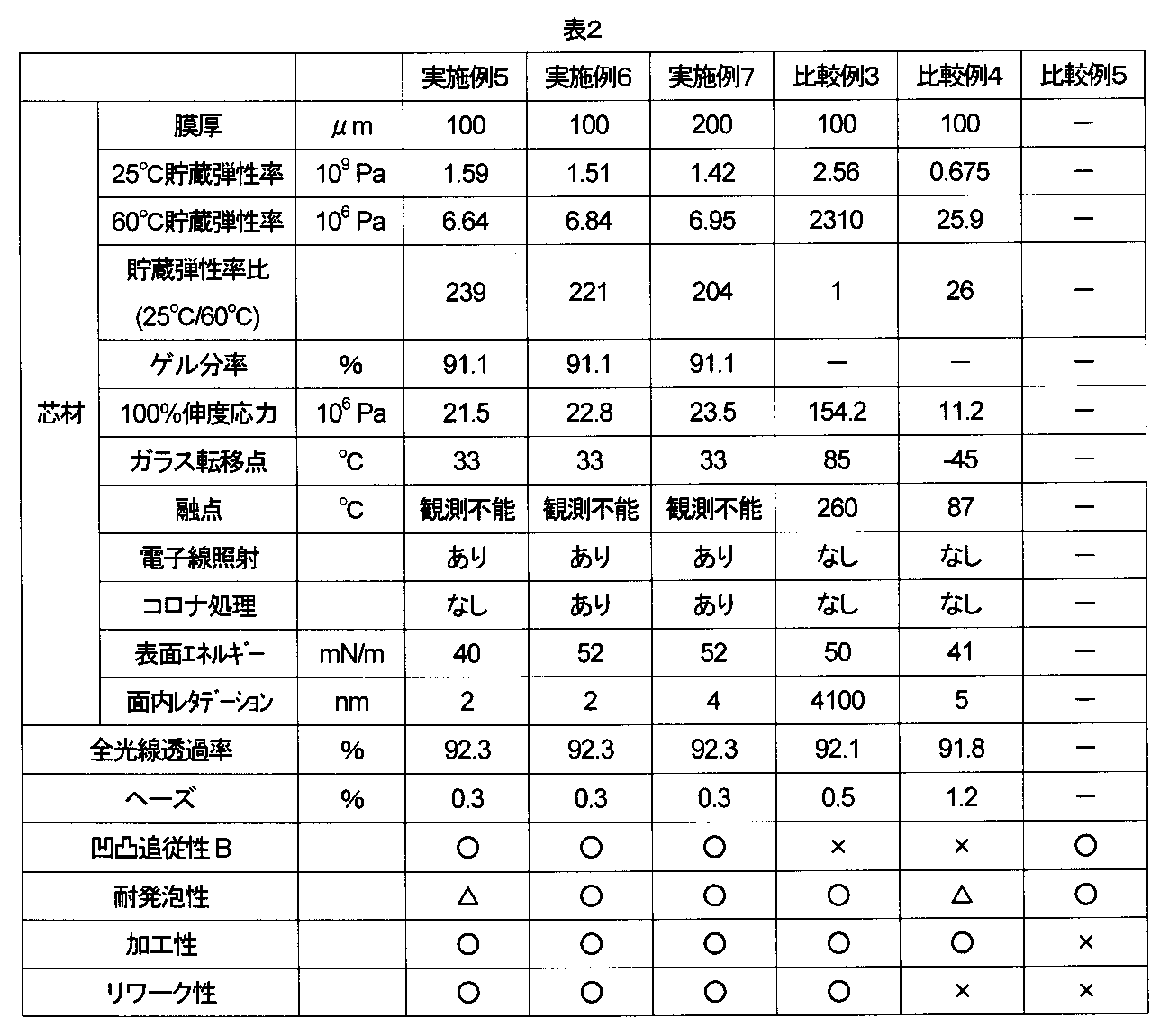
表2から明らかなように、比較例に比べ、実施例では、段差吸収性とリワーク性とを両立できる。特に、実施例6及び7では、高温多湿下でも浮き剥がれを防止でき、気泡の生成が著しく抑制されている。また、実施例では、面内レタデーションが小さく、光学等方性に優れる。さらに、実施例では、適度な表面エネルギーを有し、粘着剤層との接着性にも優れる。
本発明は、種々の被処理部材を被覆又はカバーするのに有効である。特に、半導体素子、有機EL素子、液晶素子(液晶セル)、光電変換素子(太陽電池セルなど)、圧電素子などの種々の機能素子、これらの機能素子パッケージ(半導体パッケージなど)などのデバイス(又は電子デバイス)、前記機能素子又はそのパッケージを実装したプリント基板などの精密部品を封止(特に、低温で封止)するのに有効である。
また、本発明は、段差追従性及びリワーク性に優れるため、各種部材(例えば、表面に凸部を有する部材)の貼り合わせに有効である。特に、本発明は、光学部材、例えば、光学ガラス、光学レンズ、光学フィルム(ハードコートフィルム、防眩性フィルム、反射防止フィルム、偏光フィルム、位相差フィルム、光学等方性フィルム、透明導電性フィルム、電磁防止フィルム、視野角制御フィルムなど)などの貼り合わせに有効である。そのため、上記光学部材を備えた電子デバイス、例えば、表示装置[例えば、フラットパネルディスプレイ(液晶ディスプレイ、プラズマディスプレイ、有機ELなど)を有する表示装置、タッチパネル(光学方式、超音波方式、静電容量方式、抵抗膜方式など)を備えた表示装置など]の構成部材として有用である。
Claims (18)
- 重合体を含み、シート状の形態を有するカバリング剤であって、温度25℃での貯蔵弾性率100~5000MPa、80℃での貯蔵弾性率0.01~10MPa、架橋点間分子量8000~30000、歪み停止10秒後から20秒後の応力緩和率が、温度80℃において、0.5~30%である重合体を含むカバリング剤。
- 60℃での重合体の貯蔵弾性率が0.05~100MPaである請求項1記載のカバリング剤。
- 重合体のガラス転移温度が10~100℃である請求項1又は2記載のカバリング剤。
- 20~100℃の重合体の線膨張率が500~5000ppm/Kである請求項1~3のいずれかに記載のカバリング剤。
- 室温での100%伸長時の重合体の引張応力が15~100MPaである請求項1~4のいずれかに記載のカバリング剤。
- 厚み100μmにおいて、重合体の全光線透過率が89~95%、ヘイズ値が0.1~1.5%である請求項1~5のいずれかに記載のカバリング剤。
- 厚み100μmにおいて、波長590nmでの重合体の面内レタデーションが10nm以下である請求項1~6のいずれかに記載のカバリング剤。
- 厚み100μmでの重合体の水蒸気バリア性が、0.1~10g/m2/dayである請求項1~7のいずれかに記載のカバリング剤。
- 重合体が非結晶性オレフィン系重合体である請求項1~8のいずれかに記載のカバリング剤。
- 電子デバイスを封止するためのシート状封止剤である請求項1~9のいずれかに記載のカバリング剤。
- 請求項1~10のいずれかに記載のカバリング剤で形成された芯材フィルムと、この芯材フィルムの少なくとも一方の面に形成された粘着剤層とを備えた透明粘着シート。
- 芯材フィルムの表面がコロナ処理又はプラズマ処理されている請求項11記載の透明粘着シート。
- 芯材フィルムの表面張力が40~70mN/mである請求項11又は12記載のカバリング剤。
- 芯材フィルムの厚みが20~400μmである請求項11~13のいずれかに記載の透明粘着シート。
- 芯材フィルムが、重合体を押出成形することにより成膜されている請求項11~14のいずれかに記載の透明粘着シート。
- タッチパネル、液晶表示パネル及び保護パネルから選択された2つのパネルを貼り合わせるために用いられる請求項11~15のいずれかに記載の透明粘着シート。
- 被処理部位に請求項1~10のいずれかに記載のシート状カバリング剤を接触させ、前記カバリング剤を加熱して重合体を軟化させた後、冷却し、被処理部位をカバリング剤でカバーするカバリング方法。
- 重合体のガラス転移温度以上の温度であって100℃以下の温度で加熱する請求項17記載の方法。
Priority Applications (2)
| Application Number | Priority Date | Filing Date | Title |
|---|---|---|---|
| KR1020147018040A KR20140101829A (ko) | 2011-12-06 | 2012-12-03 | 시트 형상 커버링제, 커버링 방법 또는 전자 디바이스의 제조 방법 |
| CN201280069144.1A CN104105748B (zh) | 2011-12-06 | 2012-12-03 | 片状覆盖剂、覆盖方法或电子器件的制造方法 |
Applications Claiming Priority (2)
| Application Number | Priority Date | Filing Date | Title |
|---|---|---|---|
| JP2011267278A JP2013120804A (ja) | 2011-12-06 | 2011-12-06 | シート状カバリング剤、カバリング方法又は電子デバイスの製造方法 |
| JP2011-267278 | 2011-12-06 |
Publications (2)
| Publication Number | Publication Date |
|---|---|
| WO2013084836A1 true WO2013084836A1 (ja) | 2013-06-13 |
| WO2013084836A4 WO2013084836A4 (ja) | 2013-11-07 |
Family
ID=48574203
Family Applications (1)
| Application Number | Title | Priority Date | Filing Date |
|---|---|---|---|
| PCT/JP2012/081247 Ceased WO2013084836A1 (ja) | 2011-12-06 | 2012-12-03 | シート状カバリング剤、カバリング方法又は電子デバイスの製造方法 |
Country Status (5)
| Country | Link |
|---|---|
| JP (1) | JP2013120804A (ja) |
| KR (1) | KR20140101829A (ja) |
| CN (1) | CN104105748B (ja) |
| TW (1) | TW201329193A (ja) |
| WO (1) | WO2013084836A1 (ja) |
Cited By (7)
| Publication number | Priority date | Publication date | Assignee | Title |
|---|---|---|---|---|
| WO2015099079A1 (ja) * | 2013-12-26 | 2015-07-02 | 日本ゼオン株式会社 | 封止フィルム、有機エレクトロルミネッセンス表示装置及び有機半導体デバイス |
| WO2015129308A1 (ja) * | 2014-02-28 | 2015-09-03 | 富士フイルム株式会社 | タッチパネル用積層体、および、粘着シート |
| WO2015152334A1 (ja) * | 2014-04-03 | 2015-10-08 | 積水化学工業株式会社 | タッチパネル用層間充填材料及び積層体 |
| JP2017021527A (ja) * | 2015-07-09 | 2017-01-26 | 積水化学工業株式会社 | タッチパネル用層間充填材料キット、積層体、及び、積層体の製造方法 |
| WO2017038916A1 (ja) * | 2015-09-01 | 2017-03-09 | リンテック株式会社 | 粘着シート |
| JP2019133852A (ja) * | 2018-01-31 | 2019-08-08 | 日本ゼオン株式会社 | 電子デバイス用材料及び有機エレクトロルミネッセンス装置 |
| JP2021145002A (ja) * | 2020-03-10 | 2021-09-24 | 住友ベークライト株式会社 | 機能層貼付用フィルムセットおよび絶縁フィルム |
Families Citing this family (24)
| Publication number | Priority date | Publication date | Assignee | Title |
|---|---|---|---|---|
| KR20150016878A (ko) | 2013-08-05 | 2015-02-13 | 주식회사 엘지화학 | 점착제 조성물, 점착 필름 및 이를 이용한 유기전자장치의 봉지방법 |
| JP6069142B2 (ja) * | 2013-09-11 | 2017-02-01 | デクセリアルズ株式会社 | アンダーフィル材、及びこれを用いた半導体装置の製造方法 |
| JP2015137333A (ja) * | 2014-01-23 | 2015-07-30 | 三井化学株式会社 | シート状封止材、及びこれを含む封止用シート |
| WO2015147097A1 (ja) * | 2014-03-27 | 2015-10-01 | リンテック株式会社 | 封止材、封止シート、有機デバイスの封止方法及び有機el素子 |
| JP6347975B2 (ja) * | 2014-03-31 | 2018-06-27 | リンテック株式会社 | シート状封止材、封止シート及び電子デバイス |
| WO2016047134A1 (ja) * | 2014-09-26 | 2016-03-31 | 東芝ホクト電子株式会社 | 発光モジュール及び発光モジュールの製造方法 |
| JP6471602B2 (ja) * | 2015-04-28 | 2019-02-20 | 三菱ケミカル株式会社 | 透明封止材 |
| KR102742974B1 (ko) * | 2015-05-28 | 2024-12-13 | 세키스이가가쿠 고교가부시키가이샤 | 터치 패널용 층간 충전 재료 및 적층체 |
| KR20240125695A (ko) * | 2015-10-07 | 2024-08-19 | 세키스이가가쿠 고교가부시키가이샤 | 터치 패널용 층간 충전 재료 및 터치 패널 적층체 |
| JP6686429B2 (ja) * | 2015-12-25 | 2020-04-22 | 大日本印刷株式会社 | 太陽電池モジュール用の封止材シート、及びそれを用いた太陽電池モジュール |
| JP2017126595A (ja) * | 2016-01-12 | 2017-07-20 | ポリマテック・ジャパン株式会社 | 封止材および封止材組成物 |
| WO2018047868A1 (ja) * | 2016-09-07 | 2018-03-15 | リンテック株式会社 | 接着剤組成物、封止シート、及び封止体 |
| WO2018047919A1 (ja) * | 2016-09-07 | 2018-03-15 | リンテック株式会社 | 接着剤組成物、封止シート、及び封止体 |
| JP6940224B2 (ja) * | 2016-09-07 | 2021-09-22 | リンテック株式会社 | ガスバリア性積層体、及び封止体 |
| CN109715753B (zh) * | 2016-09-15 | 2021-12-07 | 三菱化学株式会社 | 粘合片层叠体、赋形粘合片层叠体及其制造方法 |
| JP6625079B2 (ja) * | 2017-02-14 | 2019-12-25 | アイカ工業株式会社 | 封止樹脂組成物 |
| KR102612177B1 (ko) * | 2018-10-31 | 2023-12-08 | 미쓰이 가가쿠 가부시키가이샤 | 벤더블 배선 기판, 신축할 수 있는 배선 기판 및 그들에 의한 전자 디바이스 |
| US12613552B2 (en) | 2018-12-05 | 2026-04-28 | Bando Chemical Industries, Ltd. | Surface protection film for flexible display and method of producing thereof |
| CN113165366B (zh) * | 2018-12-05 | 2023-08-22 | 阪东化学株式会社 | 可挠性显示器用表面保护膜及其制造方法 |
| KR102240907B1 (ko) * | 2020-02-28 | 2021-04-15 | (주)이녹스첨단소재 | 디스플레이용 점착 시트 |
| JP7473408B2 (ja) * | 2020-06-17 | 2024-04-23 | 日東電工株式会社 | 封止用樹脂シート |
| JP7767088B2 (ja) * | 2021-09-30 | 2025-11-11 | 株式会社ジェイエスピー | 吸音材 |
| US20240199834A1 (en) * | 2021-04-05 | 2024-06-20 | Jsp Corporation | Porous body and sound-absorbing material |
| JPWO2023054074A1 (ja) | 2021-09-30 | 2023-04-06 |
Citations (7)
| Publication number | Priority date | Publication date | Assignee | Title |
|---|---|---|---|---|
| JPS6234924A (ja) * | 1985-08-08 | 1987-02-14 | Mitsui Petrochem Ind Ltd | 環状オレフイン共重合体の架橋方法 |
| JP2010226040A (ja) * | 2009-03-25 | 2010-10-07 | Asahi Kasei E-Materials Corp | 太陽電池モジュール |
| JP2010260880A (ja) * | 2009-04-09 | 2010-11-18 | Dic Corp | 両面粘着テープ |
| WO2010140343A1 (ja) * | 2009-06-01 | 2010-12-09 | 三井化学株式会社 | エチレン系樹脂組成物、太陽電池封止材およびそれを用いた太陽電池モジュール |
| JP2011128512A (ja) * | 2009-12-21 | 2011-06-30 | Sony Corp | 光学体およびその製造方法 |
| JP2011205087A (ja) * | 2010-03-02 | 2011-10-13 | Mitsubishi Plastics Inc | 太陽電池封止材及びそれを用いて作製された太陽電池モジュール |
| WO2012144644A1 (ja) * | 2011-04-21 | 2012-10-26 | 株式会社ダイセル | 環状オレフィン系樹脂の架橋体及びその製造方法 |
Family Cites Families (2)
| Publication number | Priority date | Publication date | Assignee | Title |
|---|---|---|---|---|
| JP2000273149A (ja) * | 1999-03-19 | 2000-10-03 | Sumitomo Bakelite Co Ltd | 液状エポキシ樹脂組成物 |
| JP5143020B2 (ja) * | 2006-12-04 | 2013-02-13 | パナソニック株式会社 | 封止材料及び実装構造体 |
-
2011
- 2011-12-06 JP JP2011267278A patent/JP2013120804A/ja active Pending
-
2012
- 2012-12-03 KR KR1020147018040A patent/KR20140101829A/ko not_active Ceased
- 2012-12-03 WO PCT/JP2012/081247 patent/WO2013084836A1/ja not_active Ceased
- 2012-12-03 CN CN201280069144.1A patent/CN104105748B/zh not_active Expired - Fee Related
- 2012-12-05 TW TW101145596A patent/TW201329193A/zh unknown
Patent Citations (7)
| Publication number | Priority date | Publication date | Assignee | Title |
|---|---|---|---|---|
| JPS6234924A (ja) * | 1985-08-08 | 1987-02-14 | Mitsui Petrochem Ind Ltd | 環状オレフイン共重合体の架橋方法 |
| JP2010226040A (ja) * | 2009-03-25 | 2010-10-07 | Asahi Kasei E-Materials Corp | 太陽電池モジュール |
| JP2010260880A (ja) * | 2009-04-09 | 2010-11-18 | Dic Corp | 両面粘着テープ |
| WO2010140343A1 (ja) * | 2009-06-01 | 2010-12-09 | 三井化学株式会社 | エチレン系樹脂組成物、太陽電池封止材およびそれを用いた太陽電池モジュール |
| JP2011128512A (ja) * | 2009-12-21 | 2011-06-30 | Sony Corp | 光学体およびその製造方法 |
| JP2011205087A (ja) * | 2010-03-02 | 2011-10-13 | Mitsubishi Plastics Inc | 太陽電池封止材及びそれを用いて作製された太陽電池モジュール |
| WO2012144644A1 (ja) * | 2011-04-21 | 2012-10-26 | 株式会社ダイセル | 環状オレフィン系樹脂の架橋体及びその製造方法 |
Cited By (16)
| Publication number | Priority date | Publication date | Assignee | Title |
|---|---|---|---|---|
| WO2015099079A1 (ja) * | 2013-12-26 | 2015-07-02 | 日本ゼオン株式会社 | 封止フィルム、有機エレクトロルミネッセンス表示装置及び有機半導体デバイス |
| JPWO2015099079A1 (ja) * | 2013-12-26 | 2017-03-23 | 日本ゼオン株式会社 | 封止フィルム、有機エレクトロルミネッセンス表示装置及び有機半導体デバイス |
| WO2015129308A1 (ja) * | 2014-02-28 | 2015-09-03 | 富士フイルム株式会社 | タッチパネル用積層体、および、粘着シート |
| JP2015179498A (ja) * | 2014-02-28 | 2015-10-08 | 富士フイルム株式会社 | タッチパネル用積層体、および、粘着シート |
| KR102326103B1 (ko) * | 2014-04-03 | 2021-11-12 | 세키스이가가쿠 고교가부시키가이샤 | 터치 패널용 층간 충전 재료 및 적층체 |
| WO2015152334A1 (ja) * | 2014-04-03 | 2015-10-08 | 積水化学工業株式会社 | タッチパネル用層間充填材料及び積層体 |
| CN105934736A (zh) * | 2014-04-03 | 2016-09-07 | 积水化学工业株式会社 | 触控面板用层间填充材料及层叠体 |
| KR20160141706A (ko) * | 2014-04-03 | 2016-12-09 | 세키스이가가쿠 고교가부시키가이샤 | 터치 패널용 층간 충전 재료 및 적층체 |
| JP6046811B2 (ja) * | 2014-04-03 | 2016-12-21 | 積水化学工業株式会社 | タッチパネル用層間充填材料及び積層体 |
| JP2017075312A (ja) * | 2014-04-03 | 2017-04-20 | 積水化学工業株式会社 | タッチパネル用層間充填材料及び積層体 |
| CN117624813A (zh) * | 2014-04-03 | 2024-03-01 | 积水化学工业株式会社 | 触控面板用层间填充材料及层叠体 |
| JP2017021527A (ja) * | 2015-07-09 | 2017-01-26 | 積水化学工業株式会社 | タッチパネル用層間充填材料キット、積層体、及び、積層体の製造方法 |
| WO2017038916A1 (ja) * | 2015-09-01 | 2017-03-09 | リンテック株式会社 | 粘着シート |
| JPWO2017038916A1 (ja) * | 2015-09-01 | 2018-06-14 | リンテック株式会社 | 粘着シート |
| JP2019133852A (ja) * | 2018-01-31 | 2019-08-08 | 日本ゼオン株式会社 | 電子デバイス用材料及び有機エレクトロルミネッセンス装置 |
| JP2021145002A (ja) * | 2020-03-10 | 2021-09-24 | 住友ベークライト株式会社 | 機能層貼付用フィルムセットおよび絶縁フィルム |
Also Published As
| Publication number | Publication date |
|---|---|
| KR20140101829A (ko) | 2014-08-20 |
| CN104105748B (zh) | 2017-09-01 |
| JP2013120804A (ja) | 2013-06-17 |
| WO2013084836A4 (ja) | 2013-11-07 |
| CN104105748A (zh) | 2014-10-15 |
| TW201329193A (zh) | 2013-07-16 |
Similar Documents
| Publication | Publication Date | Title |
|---|---|---|
| WO2013084836A1 (ja) | シート状カバリング剤、カバリング方法又は電子デバイスの製造方法 | |
| TWI485215B (zh) | 光學用黏合劑組合物、光學用黏合劑及光學膜 | |
| JP6229208B2 (ja) | 粘着剤組成物 | |
| CN107502211B (zh) | 透明双面粘接片、用于构成图像显示装置的叠层体、该叠层体的制造方法及图像显示装置 | |
| JP6201330B2 (ja) | 透明両面接着性シート | |
| JP6126857B2 (ja) | 画像表示装置構成用積層体の製造方法、及びこの積層体を用いてなる画像表示装置 | |
| JP7054348B2 (ja) | 粘着シート、構成体およびその製造方法 | |
| US20140356618A1 (en) | Multilayer film and optical sheet | |
| JP7602858B2 (ja) | 粘着シートおよび光学積層体 | |
| JP5897392B2 (ja) | 粘着シート及び剥離方法 | |
| JP6471602B2 (ja) | 透明封止材 | |
| JP2018127561A (ja) | 粘着シート | |
| JP2013067737A (ja) | 透明粘着シート | |
| JP2021088697A (ja) | 粘着シート、積層シート、フレキシブル画像表示装置部材及びフレキシブル画像表示装置 | |
| JP2006152072A (ja) | 半導体製造用帯電防止性フィルムおよびその製造方法 | |
| JP6246791B2 (ja) | 両面粘着シート | |
| JP6356844B1 (ja) | 光学積層体 | |
| KR20250040997A (ko) | 점착 시트 및 광학 적층체 | |
| KR20250169203A (ko) | 광학 적층체 및 화상 표시 장치 | |
| JP7334416B2 (ja) | 離型フィルム | |
| KR102564149B1 (ko) | 공정용 보호필름 | |
| JP7833580B2 (ja) | 光学積層体 | |
| KR20250039450A (ko) | 점착 시트 및 광학 적층체 | |
| CN120958095A (zh) | 粘着片及显示体 | |
| JP5545836B2 (ja) | 基材レス両面粘着シート |
Legal Events
| Date | Code | Title | Description |
|---|---|---|---|
| 121 | Ep: the epo has been informed by wipo that ep was designated in this application |
Ref document number: 12855996 Country of ref document: EP Kind code of ref document: A1 |
|
| NENP | Non-entry into the national phase |
Ref country code: DE |
|
| ENP | Entry into the national phase |
Ref document number: 20147018040 Country of ref document: KR Kind code of ref document: A |
|
| 122 | Ep: pct application non-entry in european phase |
Ref document number: 12855996 Country of ref document: EP Kind code of ref document: A1 |