WO2012132540A1 - 脱硝触媒の調製方法 - Google Patents
脱硝触媒の調製方法 Download PDFInfo
- Publication number
- WO2012132540A1 WO2012132540A1 PCT/JP2012/052346 JP2012052346W WO2012132540A1 WO 2012132540 A1 WO2012132540 A1 WO 2012132540A1 JP 2012052346 W JP2012052346 W JP 2012052346W WO 2012132540 A1 WO2012132540 A1 WO 2012132540A1
- Authority
- WO
- WIPO (PCT)
- Prior art keywords
- powder
- ammonium metavanadate
- denitration catalyst
- particle size
- vanadium
- Prior art date
- Legal status (The legal status is an assumption and is not a legal conclusion. Google has not performed a legal analysis and makes no representation as to the accuracy of the status listed.)
- Ceased
Links
Images

Classifications
-
- B—PERFORMING OPERATIONS; TRANSPORTING
- B01—PHYSICAL OR CHEMICAL PROCESSES OR APPARATUS IN GENERAL
- B01J—CHEMICAL OR PHYSICAL PROCESSES, e.g. CATALYSIS OR COLLOID CHEMISTRY; THEIR RELEVANT APPARATUS
- B01J23/00—Catalysts comprising metals or metal oxides or hydroxides, not provided for in group B01J21/00
- B01J23/16—Catalysts comprising metals or metal oxides or hydroxides, not provided for in group B01J21/00 of arsenic, antimony, bismuth, vanadium, niobium, tantalum, polonium, chromium, molybdenum, tungsten, manganese, technetium or rhenium
- B01J23/24—Chromium, molybdenum or tungsten
- B01J23/30—Tungsten
-
- B—PERFORMING OPERATIONS; TRANSPORTING
- B01—PHYSICAL OR CHEMICAL PROCESSES OR APPARATUS IN GENERAL
- B01D—SEPARATION
- B01D53/00—Separation of gases or vapours; Recovering vapours of volatile solvents from gases; Chemical or biological purification of waste gases, e.g. engine exhaust gases, smoke, fumes, flue gases, aerosols
- B01D53/34—Chemical or biological purification of waste gases
- B01D53/74—General processes for purification of waste gases; Apparatus or devices specially adapted therefor
- B01D53/86—Catalytic processes
- B01D53/8621—Removing nitrogen compounds
- B01D53/8625—Nitrogen oxides
- B01D53/8628—Processes characterised by a specific catalyst
-
- B—PERFORMING OPERATIONS; TRANSPORTING
- B01—PHYSICAL OR CHEMICAL PROCESSES OR APPARATUS IN GENERAL
- B01D—SEPARATION
- B01D53/00—Separation of gases or vapours; Recovering vapours of volatile solvents from gases; Chemical or biological purification of waste gases, e.g. engine exhaust gases, smoke, fumes, flue gases, aerosols
- B01D53/34—Chemical or biological purification of waste gases
- B01D53/92—Chemical or biological purification of waste gases of engine exhaust gases
- B01D53/94—Chemical or biological purification of waste gases of engine exhaust gases by catalytic processes
-
- B—PERFORMING OPERATIONS; TRANSPORTING
- B01—PHYSICAL OR CHEMICAL PROCESSES OR APPARATUS IN GENERAL
- B01J—CHEMICAL OR PHYSICAL PROCESSES, e.g. CATALYSIS OR COLLOID CHEMISTRY; THEIR RELEVANT APPARATUS
- B01J21/00—Catalysts comprising the elements, oxides, or hydroxides of magnesium, boron, aluminium, carbon, silicon, titanium, zirconium, or hafnium
- B01J21/06—Silicon, titanium, zirconium or hafnium; Oxides or hydroxides thereof
- B01J21/063—Titanium; Oxides or hydroxides thereof
-
- B—PERFORMING OPERATIONS; TRANSPORTING
- B01—PHYSICAL OR CHEMICAL PROCESSES OR APPARATUS IN GENERAL
- B01J—CHEMICAL OR PHYSICAL PROCESSES, e.g. CATALYSIS OR COLLOID CHEMISTRY; THEIR RELEVANT APPARATUS
- B01J23/00—Catalysts comprising metals or metal oxides or hydroxides, not provided for in group B01J21/00
- B01J23/16—Catalysts comprising metals or metal oxides or hydroxides, not provided for in group B01J21/00 of arsenic, antimony, bismuth, vanadium, niobium, tantalum, polonium, chromium, molybdenum, tungsten, manganese, technetium or rhenium
- B01J23/20—Vanadium, niobium or tantalum
- B01J23/22—Vanadium
-
- B—PERFORMING OPERATIONS; TRANSPORTING
- B01—PHYSICAL OR CHEMICAL PROCESSES OR APPARATUS IN GENERAL
- B01J—CHEMICAL OR PHYSICAL PROCESSES, e.g. CATALYSIS OR COLLOID CHEMISTRY; THEIR RELEVANT APPARATUS
- B01J35/00—Catalysts, in general, characterised by their form or physical properties
- B01J35/40—Catalysts, in general, characterised by their form or physical properties characterised by dimensions, e.g. grain size
-
- B—PERFORMING OPERATIONS; TRANSPORTING
- B01—PHYSICAL OR CHEMICAL PROCESSES OR APPARATUS IN GENERAL
- B01J—CHEMICAL OR PHYSICAL PROCESSES, e.g. CATALYSIS OR COLLOID CHEMISTRY; THEIR RELEVANT APPARATUS
- B01J37/00—Processes, in general, for preparing catalysts; Processes, in general, for activation of catalysts
- B01J37/02—Impregnation, coating or precipitation
-
- B—PERFORMING OPERATIONS; TRANSPORTING
- B01—PHYSICAL OR CHEMICAL PROCESSES OR APPARATUS IN GENERAL
- B01D—SEPARATION
- B01D2251/00—Reactants
- B01D2251/20—Reductants
- B01D2251/206—Ammonium compounds
- B01D2251/2062—Ammonia
-
- B—PERFORMING OPERATIONS; TRANSPORTING
- B01—PHYSICAL OR CHEMICAL PROCESSES OR APPARATUS IN GENERAL
- B01D—SEPARATION
- B01D2255/00—Catalysts
- B01D2255/20—Metals or compounds thereof
- B01D2255/207—Transition metals
- B01D2255/20707—Titanium
-
- B—PERFORMING OPERATIONS; TRANSPORTING
- B01—PHYSICAL OR CHEMICAL PROCESSES OR APPARATUS IN GENERAL
- B01D—SEPARATION
- B01D2255/00—Catalysts
- B01D2255/20—Metals or compounds thereof
- B01D2255/207—Transition metals
- B01D2255/20723—Vanadium
-
- B—PERFORMING OPERATIONS; TRANSPORTING
- B01—PHYSICAL OR CHEMICAL PROCESSES OR APPARATUS IN GENERAL
- B01D—SEPARATION
- B01D2255/00—Catalysts
- B01D2255/90—Physical characteristics of catalysts
- B01D2255/92—Dimensions
- B01D2255/9202—Linear dimensions
-
- B—PERFORMING OPERATIONS; TRANSPORTING
- B01—PHYSICAL OR CHEMICAL PROCESSES OR APPARATUS IN GENERAL
- B01D—SEPARATION
- B01D2257/00—Components to be removed
- B01D2257/40—Nitrogen compounds
- B01D2257/404—Nitrogen oxides other than dinitrogen oxide
-
- B—PERFORMING OPERATIONS; TRANSPORTING
- B01—PHYSICAL OR CHEMICAL PROCESSES OR APPARATUS IN GENERAL
- B01D—SEPARATION
- B01D2258/00—Sources of waste gases
- B01D2258/02—Other waste gases
- B01D2258/0283—Flue gases
Definitions
- the present invention relates to a method for preparing a denitration catalyst for treating nitrogen oxides contained in exhaust gas discharged from, for example, a power generation gas turbine or a coal-fired boiler.
- a denitration catalyst used for treating nitrogen oxides contained in exhaust gas is one in which vanadium is supported on titania.
- Conventional denitration catalysts have been devised to increase the amount of catalyst supported and the vanadium concentration in the catalyst in order to improve the denitration performance.
- the present inventors impregnate vanadium by supporting titania on a ceramic fiber sheet or a carrier obtained by forming the ceramic fiber sheet and processing it into a honeycomb, and immersing it in a vanadium solution.
- a denitration catalyst has been prepared by supporting the support or a slurry prepared by adding vanadium to titania slurry in which titania powder is suspended in silica sol.
- An object of the present invention is to provide a method for preparing a denitration catalyst that can solve the above-mentioned problems of the prior art, improve the catalyst activity, and does not increase the production cost of the catalyst. .
- the present inventors have achieved catalytic performance by using a material containing fine particles as a precursor powder made of a metal compound that is an active component of a catalyst.
- the present inventors have found that it can be improved and have completed the present invention.
- the invention of the method for preparing a denitration catalyst according to claim 1 is a denitration catalyst used when nitrogen oxide is reacted with ammonia as a reducing agent to decompose into nitrogen and water, and the catalyst
- the precursor of vanadium is an ammonium metavanadate powder
- the ammonium metavanadate powder has a cumulative content of particles having a particle size of 10 ⁇ m or less. It is characterized by containing 20% or more.
- the ammonium metavanadate powder contains particles having a particle size of 10 ⁇ m or less in a cumulative content of 25% or more.
- the invention of claim 2 is the method for preparing a denitration catalyst of claim 1, characterized in that the ammonium metavanadate powder is a regenerated product obtained by recovering vanadium from petroleum combustion ash such as heavy oil ash.
- the method for preparing a denitration catalyst of the present invention is a denitration catalyst used when nitrogen oxide is reacted with ammonia as a reducing agent to decompose into nitrogen and water, and the catalytically active components are titanium oxide, vanadium, and tungsten.
- the vanadium precursor is an ammonium metavanadate powder
- the ammonium metavanadate powder contains particles having a particle size of 10 ⁇ m or less in a cumulative content of 20% or more.
- the catalytic activity of the denitration catalyst can be improved, and there is an effect that the production cost of the catalyst is not increased.
- the invention according to claim 2 is the method for preparing a denitration catalyst according to claim 1, wherein the ammonium metavanadate powder is a recycled product obtained by recovering vanadium from petroleum combustion ash such as heavy oil ash. Therefore, according to the invention of claim 2, the catalyst activity of the denitration catalyst can be improved, and the ammonium metavanadate powder is a recovered and recycled product, so that the production cost of the catalyst is very low. There is an effect.
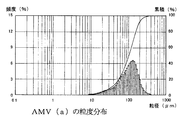
- FIG. 1 is a graph showing the results of particle size distribution measurement of ammonium metavanadate / AMV (a) powder used in the production of a conventional denitration catalyst.
- FIG. 2 is a graph showing the results of particle size distribution measurement of ammonium metavanadate / AMV (b) powder used in the production of the denitration catalyst of the present invention.
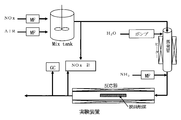
- FIG. 3 is a flow sheet of a denitration experiment apparatus for evaluating the performance of the denitration catalyst.
- the method for preparing a denitration catalyst according to the present invention is a denitration catalyst used when nitrogen oxide is reacted with ammonia as a reducing agent to decompose it into nitrogen and water, and the catalytic active components are titanium oxide, vanadium, and tungsten.
- the ammonium metavanadate powder contains particles having a particle size of 10 ⁇ m or less in a cumulative content of 25% or more.
- ammonium metavanadate powder is a recycled product obtained by recovering vanadium from petroleum combustion ash such as heavy oil ash.
- titanium oxide and vanadium mainly have a denitration catalytic action, and tungsten serves as a promoter.
- FIG. 1 and FIG. 2 show the measurement results of the particle size distribution of two types of ammonium metavanadate (hereinafter referred to as AMV) powder.
- the AMV (a) powder shown in FIG. 1 is an ammonium metavanadate powder used in a conventional method for preparing a denitration catalyst having a large particle size, and hardly contains particles having a particle size of 10 ⁇ m or less.
- the AMV (b) powder shown in FIG. 2 is an ammonium metavanadate powder used in the method for preparing a denitration catalyst of the present invention having a small particle size, and particles having a particle size of 10 ⁇ m or less have a cumulative content rate.
- particles having a particle size of more than 10 ⁇ m and a particle size of 27 ⁇ m or less are included in a cumulative content of 25%
- particles having a particle size of more than 27 ⁇ m and a particle size of 60 ⁇ m or less are included in a cumulative content of 30%.
- 20% of particles having a particle size of more than 60 ⁇ m and a particle size of 250 ⁇ m or less are included.
- the particle size of 103.4 ⁇ m is used for the AMV (a) powder used in the conventional method of preparing a denitration catalyst.
- the AMV (b) powder used in the method of preparing the denitration catalyst of the present invention has a particle size of 26.41 ⁇ m
- the AMV (b) powder used in the method of preparing the denitration catalyst of the present invention It can be seen that the particle size is finer than the particle size of the AMV (a) powder used in the conventional method.
- the AMV (b) powder used in the method for preparing a denitration catalyst of the present invention is an ammonium metavanadate powder used in the method for preparing a denitration catalyst of the present invention having a small particle size, and particles having a particle size of 10 ⁇ m or less are used. And a cumulative content of 20 to 30%, preferably 23 to 27%, and particles having a particle size of more than 10 ⁇ m and a particle size of 27 ⁇ m or less are contained in a cumulative content of 20 to 30%, preferably 23 to 27%.
- particles having a particle size of more than 27 ⁇ m and a particle size of 60 ⁇ m or less have a cumulative content of 25 to 35%, preferably 28 to 32%, and particles having a particle size of more than 60 ⁇ m and a particle size of 250 ⁇ m or less have a cumulative content of 15 It is preferably contained in an amount of ⁇ 25%, preferably 17 to 23%.
- the AMV (b) powder used in the method for preparing the denitration catalyst of the present invention having a small particle size is a recycled product obtained by recovering vanadium from petroleum combustion ash such as heavy oil ash (for example, manufactured by Kashima Kita Kyodo Power Co., Ltd.). ).
- the catalyst using the AMV (b) powder used in the method for preparing the denitration catalyst of the present invention with a fine particle size is the other conventional one. It was found that the denitration performance was about 10% higher than the AMV (a) powder used in the method.
- AMV (b) powder in the preparation of a denitration catalyst reduces the size of ammonium metavanadate powder particles adsorbed on titania and improves dispersibility. It is thought that the denitration performance is improved.
- the catalyst performance could be improved without increasing the material to be used.
- AMV (b) powder having a small particle size commercially available chemicals pulverized to a predetermined particle size may be used, but as described above, recycled products from petroleum-based combustion ash such as heavy oil ash are used. It is more preferable to use it because it not only saves the trouble of pulverization but also is a recovered and recycled product, so that the production cost of the catalyst is very low.
- particles having a particle size of 10 ⁇ m or less in the ammonium metavanadate powder are adsorbed to titania if the cumulative content is less than 20%. This is not preferable because the amount of ammonium metavanadate powder particles is small and sufficient catalytic activity cannot be obtained.
- particles having a particle size of 10 ⁇ m or less in the ammonium metavanadate powder exceed 30% in cumulative content, the amount of the ammonium metavanadate powder having a small particle size is large. This is not preferable because the powder is less likely to sink into the slurry and mixing takes time.
- ammonium metavanadate powder having a small particle diameter as described above not only the ammonium metavanadate powder having a small particle diameter as described above but also the ammonium metavanadate powder having a relatively large particle diameter is used.
- ammonium metavanadate powder particles having a small particle size that is, a particle size of 10 ⁇ m or less
- ammonium metavanadate powder particles having a particle size of more than 10 ⁇ m and 27 ⁇ m or less a particle size of 27 ⁇ m
- ammonium metavanadate powder particles having a particle size of more than 60 ⁇ m and a particle size of 250 ⁇ m or less must be included within the above-mentioned range of cumulative content.
- titania (titanium oxide) powder is added to a mixture of silica sol and water at a predetermined ratio to prepare a slurry.
- ammonium metavanadate / AMV (b) powder having a small particle size and containing 20% or more of particles having a particle size of 10 ⁇ m or less was added to the slurry at a predetermined ratio, and after stirring, And adsorb ammonium metavanadate to titania.
- an aqueous solution of ammonium metatungstate hereinafter referred to as AMT is added to the slurry at a predetermined ratio, and the mixture is allowed to stand after stirring.
- a honeycomb structure in which a ceramic fiber sheet is formed is immersed in the slurry thus prepared, the denitration catalyst precursor material in the slurry is supported on the honeycomb structure, the honeycomb structure taken out from the slurry is dried, and then fired.
- a honeycomb structure having a denitration catalyst is prepared.
- a titania (titanium oxide) powder is added to the mixed solution of silica sol and water at a predetermined ratio to prepare a slurry.
- a honeycomb structure formed with a ceramic fiber sheet is immersed in this slurry, and the titania powder in the slurry is supported on the honeycomb structure, and the honeycomb structure taken out from the slurry is dried and fired.
- the honeycomb structure loaded with the titania powder is immersed in an aqueous solution of ammonium metavanadate / AMV (b) powder having a small particle size and containing 20% or more of particles having a particle size of 10 ⁇ m or less.
- the honeycomb structure is further loaded with AMV (b), and the honeycomb structure taken out from the aqueous solution is dried and fired. Further, the honeycomb structure carrying titania powder and ammonium metavanadate / AMV (b) was dipped in an aqueous solution of ammonium metatungstate (AMT), and the honeycomb structure was further loaded with ammonium metatungstate and taken out. The structure is dried and then fired to prepare a honeycomb structure having a denitration catalyst.
- AMT ammonium metatungstate
- Example 1 A denitration catalyst was prepared by the method of the present invention as follows. First, a titania (titanium oxide) powder (trade name DT-51, Millennium) is mixed with silica sol [trade name Snowtex O (O), manufactured by Nissan Chemical Co., Ltd.] and water (mixing weight ratio, 100 parts: 40 parts). 80 parts by weight of 100 parts by weight of silica sol was added to prepare a slurry. Next, 4.8 parts by weight of a small particle size ammonium metavanadate / AMV (b) powder having the particle size distribution shown in FIG. 2 was added to 100 parts by weight of the silica sol, and the mixture was stirred at room temperature for 1 minute. Thereafter, the mixture was allowed to stand for 2 hours to adsorb ammonium metavanadate to titania.
- a titania (titanium oxide) powder (trade name DT-51, Millennium) is mixed with silica sol [trade name Snowtex O (O), manufactured by Nissan Chemical Co., Ltd.] and
- AMV (b) powder a recycled product (manufactured by Kashima Kita Kyodo Power Co., Ltd.) obtained by recovering vanadium from petroleum combustion ash such as heavy oil ash was used.
- the ammonium metavanadate powder has a cumulative content of 25% particles having a particle size of 10 ⁇ m or less, a particle content of more than 10 ⁇ m and a particle size of 27 ⁇ m or less is 25%, a particle content of more than 27 ⁇ m and a particle size of 60 ⁇ m.
- the following particles contain 30% cumulative content, and particles having a particle size of more than 60 ⁇ m and a particle size of 250 ⁇ m or less, 20% cumulative content.
- ammonium metatungstate (AMT) solution [WO 3 50 wt% aqueous solution at the exchange (trade name MW-2, Nippon Inorganic Color & Chemical Co., Ltd.)] and silica sol 100
- AMT ammonium metatungstate
- a honeycomb structure (manufactured by NICHIAS) formed with a ceramic fiber sheet is immersed in the slurry thus prepared for 10 minutes, and the honeycomb structure is loaded with the denitration catalyst precursor material in the slurry. And dried at a temperature of 110 ° C. for 1 hour. The dried honeycomb structure was fired at a temperature of 400 ° C. for 1 hour to prepare a honeycomb structure having a denitration catalyst.
- Comparative Example 1 For comparison, a denitration catalyst is prepared in the same manner as in the case of Example 1 above. Here, the difference from the case of Example 1 is that the conventional particle size distribution shown in FIG. Of ammonium metavanadate / AMV (a) powder (manufactured by Taiyo Mining Co., Ltd.).
- Example 2 A denitration catalyst was prepared by the method of the present invention as follows. First, a titania (titanium oxide) powder (trade name DT-51, Millennium) is mixed with silica sol [trade name Snowtex O (O), manufactured by Nissan Chemical Co., Ltd.] and water (mixing weight ratio, 100 parts: 40 parts). 80 parts by weight of 100 parts by weight of silica sol was added to prepare a slurry. Next, a honeycomb structure (manufactured by Nichias Co., Ltd.) formed with a ceramic fiber sheet is immersed in this slurry for 10 minutes. Dry at 1 ° C. for 1 hour. The dried honeycomb structure was fired at a temperature of 500 ° C. for 1 hour.
- a titania (titanium oxide) powder (trade name DT-51, Millennium) is mixed with silica sol [trade name Snowtex O (O), manufactured by Nissan Chemical Co., Ltd.] and water (mixing weight ratio, 100 parts: 40 parts). 80 parts by weight of 100
- the above honeycomb structure on which titania powder is supported is an aqueous solution of an ammonium metavanadate / AMV (b) powder having a particle size distribution shown in FIG. (B)
- AMV (b) is further supported on the honeycomb structure, and the honeycomb structure taken out from the aqueous solution is heated to 110 ° C. Then, the honeycomb structure was fired at a temperature of 220 ° C. for 1 hour.
- a honeycomb structure supporting the titania powder and the ammonium metavanadate ⁇ AMV (b), meta aqueous solution of ammonium tungstate [terms of WO 3 with 50 wt% aqueous solution (trade name MW-2, Nippon Inorganic Color & Chemical Co., Ltd. ) was added to an aqueous solution in which 9.47 parts by weight of water was added to 100 parts by weight of water], and the honeycomb structure was further supported with ammonium metatungstate, and the removed honeycomb structure was dried at 110 ° C. for 1 hour. The dried honeycomb structure was fired at a temperature of 400 ° C. for 1 hour to prepare a honeycomb structure having a denitration catalyst.
- Comparative Example 2 For comparison, a denitration catalyst is prepared in the same manner as in the case of Example 2. Here, the difference from the case of Example 2 is that the conventional particle size distribution shown in FIG. Of ammonium metavanadate / AMV (a) powder (manufactured by Taiyo Mining Co., Ltd.).
- nitrogen oxide (NOx) gas and air (AIR) were supplied to a mixing tank (Mix tank) at a predetermined ratio by a flow meter (MF) and stirred.
- a mixing tank Mix tank
- MF flow meter
- the amount of gas actually flowing from the mixing tank to the reactor (reactor) was quantified and flowed into the evaporation pipe to be heated by a heater.
- the nitrogen oxide (NOx) concentration was measured with a nitrogen oxide (NOx) meter as a part of the inlet gas concentration. At this time, the nitrogen oxide (NOx) concentration in the mixed gas was 100 ppm.
- a constant flow rate of water was sent by a metering pump to make 10% by volume of water vapor and added to the mix gas.
- Ammonia (NH 3 ) gas is added to the mixed gas that has passed through the evaporation pipe at a predetermined ratio by a flow meter (MF), and these mixed gases are introduced into a reactor equipped with a denitration catalyst, and the reaction temperature is 400 ° C.
- the catalyst area velocity (AV) is 50 m / h, and nitrogen oxide (NOx) is reacted with ammonia (NH 3 ) as a reducing agent to decompose into nitrogen (N 2 ) and water (H 2 O). Carried out.
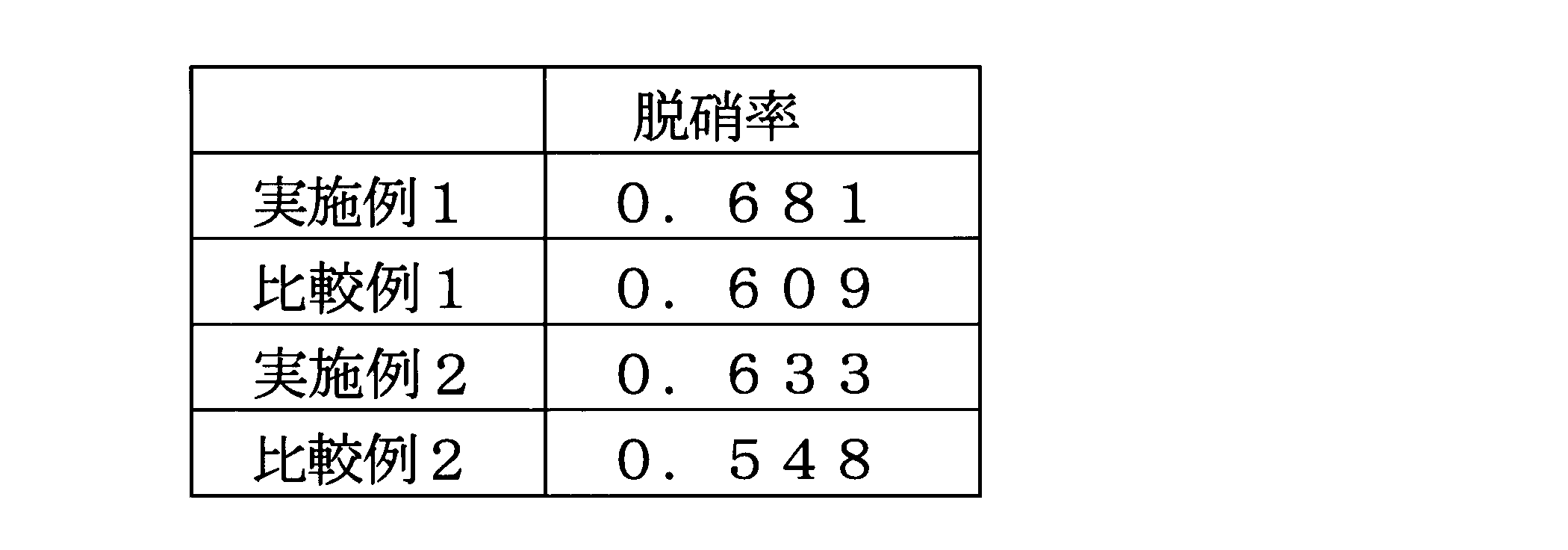
- the amount of nitrogen oxide (NOx) in the gas discharged from the reactor was measured with a nitrogen oxide (NOx) meter and a gas chromatograph (GC), and the obtained results are summarized in Table 1 below. .
- the denitration rate is about 10% higher than the denitration catalysts prepared in Comparative Examples 1 and 2. showed that.
- the catalytic activity could be improved by using the ammonium metavanadate / AMV (b) powder having a small particle size.
- AMV (b) powder a regenerated product obtained by recovering vanadium from petroleum-based combustion ash such as heavy oil ash was used, and the production cost of the denitration catalyst was not increased.
Landscapes
- Chemical & Material Sciences (AREA)
- Engineering & Computer Science (AREA)
- Chemical Kinetics & Catalysis (AREA)
- Materials Engineering (AREA)
- Organic Chemistry (AREA)
- Environmental & Geological Engineering (AREA)
- Health & Medical Sciences (AREA)
- Biomedical Technology (AREA)
- Analytical Chemistry (AREA)
- General Chemical & Material Sciences (AREA)
- Oil, Petroleum & Natural Gas (AREA)
- Combustion & Propulsion (AREA)
- Exhaust Gas Treatment By Means Of Catalyst (AREA)
- Catalysts (AREA)
Abstract
Description
本発明の方法により脱硝触媒をつぎのようにして調製した。まず、シリカゾル〔商品名スノーテックスO(オー)、日産化学社製〕と水の混合液(混合重量比、100部:40部)に、チタニア(酸化チタン)粉末(商品名DT-51、ミレニアム社製)を、シリカゾル100重量部に対し80重量部加え、スラリーを調製した。ついで、このスラリーに、上記図2に示す粒度分布を有する粒径の小さいメタバナジン酸アンモニウム・AMV(b)粉末を、シリカゾル100重量部に対し4.8重量部添加し、常温で1分間撹拌した後、2時間静置し、チタニアにメタバナジン酸アンモニウムを吸着させた。
比較のために、上記実施例1の場合と同様にして脱硝触媒を調製するが、ここで、上記実施例1の場合と異なる点は、上記図1に示す粒度分布を有する粒径の大きい従来のメタバナジン酸アンモニウム・AMV(a)粉末(太陽鉱工社製)を使用した点にある。
本発明の方法により脱硝触媒をつぎのようにして調製した。まず、シリカゾル〔商品名スノーテックスO(オー)、日産化学社製〕と水の混合液(混合重量比、100部:40部)に、チタニア(酸化チタン)粉末(商品名DT-51、ミレニアム社製)を、シリカゾル100重量部に対し80重量部加え、スラリーを調製した。ついで、このスラリーに、セラミックス繊維シートを成形したハニカム構造体(ニチアス社製)を10分間浸漬し、ハニカム構造体にスラリー中のチタニア粉末を担持させ、スラリーより取り出したハニカム構造体を、温度110℃で1時間乾燥した。乾燥後のハニカム構造体を、温度500℃で1時間焼成した。
比較のために、上記実施例2の場合と同様にして脱硝触媒を調製するが、ここで、上記実施例2の場合と異なる点は、上記図1に示す粒度分布を有する粒径の大きい従来のメタバナジン酸アンモニウム・AMV(a)粉末(太陽鉱工社製)を使用した点にある。
つぎに、上記実施例1と2および比較例1と2でそれぞれ調製した各種脱硝触媒について、図3にフローシートを示す脱硝実験装置を用いて、触媒の脱硝性能を評価した。
Claims (2)
- 窒素酸化物を還元剤であるアンモニアと共に反応させて窒素と水に分解する際に用いる脱硝触媒で、かつ触媒有効成分が酸化チタン、バナジウム、およびタングステンである脱硝触媒の調製方法において、バナジウムの前駆体がメタバナジン酸アンモニウム粉末であり、該メタバナジン酸アンモニウム粉末は、粒径10μm以下の粒子が、累積含有率で20%以上含まれているものであることを特徴とする、脱硝触媒の調製方法。
- メタバナジン酸アンモニウム粉末が、重油灰等の石油系燃焼灰からバナジウムを回収した再生品であることを特徴とする、請求項1に記載の脱硝触媒の調製方法。
Priority Applications (3)
| Application Number | Priority Date | Filing Date | Title |
|---|---|---|---|
| US14/007,084 US9399207B2 (en) | 2011-03-25 | 2012-02-02 | Preparation method of denitration catalyst |
| KR1020137025041A KR101892973B1 (ko) | 2011-03-25 | 2012-02-02 | 탈질촉매의 조제방법 |
| CN201280014891.5A CN103442802B (zh) | 2011-03-25 | 2012-02-02 | 脱硝催化剂的制备方法 |
Applications Claiming Priority (2)
| Application Number | Priority Date | Filing Date | Title |
|---|---|---|---|
| JP2011067082A JP5723646B2 (ja) | 2011-03-25 | 2011-03-25 | 脱硝触媒の調製方法 |
| JP2011-067082 | 2011-03-25 |
Publications (1)
| Publication Number | Publication Date |
|---|---|
| WO2012132540A1 true WO2012132540A1 (ja) | 2012-10-04 |
Family
ID=46930307
Family Applications (1)
| Application Number | Title | Priority Date | Filing Date |
|---|---|---|---|
| PCT/JP2012/052346 Ceased WO2012132540A1 (ja) | 2011-03-25 | 2012-02-02 | 脱硝触媒の調製方法 |
Country Status (5)
| Country | Link |
|---|---|
| US (1) | US9399207B2 (ja) |
| JP (1) | JP5723646B2 (ja) |
| KR (1) | KR101892973B1 (ja) |
| CN (1) | CN103442802B (ja) |
| WO (1) | WO2012132540A1 (ja) |
Cited By (2)
| Publication number | Priority date | Publication date | Assignee | Title |
|---|---|---|---|---|
| KR20160087808A (ko) * | 2013-11-18 | 2016-07-22 | 히다치 조센 가부시키가이샤 | 탈질촉매 및 그 제조방법 |
| CN106179324A (zh) * | 2016-07-06 | 2016-12-07 | 无锡市华东电力设备有限公司 | 一种蜂窝式铈锆钨钛基脱硝催化剂及其制备方法 |
Families Citing this family (4)
| Publication number | Priority date | Publication date | Assignee | Title |
|---|---|---|---|---|
| US10994954B2 (en) | 2016-06-30 | 2021-05-04 | Sandbox Enterprises, Llc | Bulk material shipping container unloader |
| JP7631229B2 (ja) * | 2019-05-06 | 2025-02-18 | ビーエーエスエフ モバイル エミッションズ カタリスツ エルエルシー | 選択的触媒還元の懸濁液 |
| CN113731159A (zh) * | 2021-09-13 | 2021-12-03 | 江苏新中金环保科技股份有限公司 | 钙基颗粒同步脱硫脱硝剂的制备方法 |
| CN114887409B (zh) * | 2022-04-26 | 2024-07-05 | 成都易态科技有限公司 | 一种将高温烟气余热利用、除尘及脱硝高效结合的方法 |
Citations (2)
| Publication number | Priority date | Publication date | Assignee | Title |
|---|---|---|---|---|
| JP2008296100A (ja) * | 2007-05-30 | 2008-12-11 | Hitachi Zosen Corp | 脱硝触媒製造用スラリー、そのスラリーを用いた脱硝触媒の製造方法およびその方法により製造された脱硝触媒 |
| WO2009130934A1 (ja) * | 2008-04-22 | 2009-10-29 | 日立造船株式会社 | 脱硝触媒製造用スラリー、同スラリーの製造方法、同スラリーを用いる脱硝触媒の製造方法および同方法により製造された脱硝触媒 |
Family Cites Families (11)
| Publication number | Priority date | Publication date | Assignee | Title |
|---|---|---|---|---|
| JPS58210849A (ja) * | 1982-06-03 | 1983-12-08 | Babcock Hitachi Kk | アンモニア接触還元用脱硝触媒 |
| JPH08141398A (ja) | 1994-11-21 | 1996-06-04 | Catalysts & Chem Ind Co Ltd | アンモニア分解触媒 |
| DE19635893A1 (de) | 1996-09-04 | 1998-03-05 | Basf Ag | Katalysatorzusammensetzung und Verfahren zu selektiven Reduktion von NO¶x¶ bei gleichzeitiger weitgehender Vermeidung der Oxidation von SO¶x¶ in sauerstoffhaltigen Verbrennungsabgasen |
| WO2001096016A1 (en) * | 2000-06-15 | 2001-12-20 | Asahi Kasei Kabushiki Kaisha | Catalyst for vapor-phase catalytic oxidation or vapor-phase catalytic ammoxidation of propane or isobutane |
| JP4264642B2 (ja) * | 2003-09-18 | 2009-05-20 | 日立造船株式会社 | 熱的劣化触媒の再生方法 |
| JP5156173B2 (ja) | 2004-05-11 | 2013-03-06 | バブコック日立株式会社 | 窒素酸化物除去用触媒の製造法 |
| JP2006223959A (ja) | 2005-02-16 | 2006-08-31 | Babcock Hitachi Kk | 排ガス脱硝触媒の製造方法 |
| DE102007011471B4 (de) * | 2006-03-09 | 2021-09-30 | Shell Internationale Research Maatschappij B.V. | Katalysatorkombination für die hydrierende Verarbeitung von Vakuumgasölen und/oder Visbreakergasölen |
| JP2008012379A (ja) | 2006-07-03 | 2008-01-24 | Babcock Hitachi Kk | 脱硝触媒の製造方法 |
| JP4881716B2 (ja) | 2006-12-25 | 2012-02-22 | 日立造船株式会社 | 脱硝触媒の製造方法 |
| CN101428215B (zh) * | 2008-12-18 | 2012-02-15 | 哈尔滨工业大学 | 一种烟气脱硝催化剂的制备方法及由该方法制备的烟气脱硝催化剂 |
-
2011
- 2011-03-25 JP JP2011067082A patent/JP5723646B2/ja active Active
-
2012
- 2012-02-02 CN CN201280014891.5A patent/CN103442802B/zh not_active Expired - Fee Related
- 2012-02-02 KR KR1020137025041A patent/KR101892973B1/ko not_active Expired - Fee Related
- 2012-02-02 WO PCT/JP2012/052346 patent/WO2012132540A1/ja not_active Ceased
- 2012-02-02 US US14/007,084 patent/US9399207B2/en not_active Expired - Fee Related
Patent Citations (2)
| Publication number | Priority date | Publication date | Assignee | Title |
|---|---|---|---|---|
| JP2008296100A (ja) * | 2007-05-30 | 2008-12-11 | Hitachi Zosen Corp | 脱硝触媒製造用スラリー、そのスラリーを用いた脱硝触媒の製造方法およびその方法により製造された脱硝触媒 |
| WO2009130934A1 (ja) * | 2008-04-22 | 2009-10-29 | 日立造船株式会社 | 脱硝触媒製造用スラリー、同スラリーの製造方法、同スラリーを用いる脱硝触媒の製造方法および同方法により製造された脱硝触媒 |
Cited By (4)
| Publication number | Priority date | Publication date | Assignee | Title |
|---|---|---|---|---|
| KR20160087808A (ko) * | 2013-11-18 | 2016-07-22 | 히다치 조센 가부시키가이샤 | 탈질촉매 및 그 제조방법 |
| EP3072585A4 (en) * | 2013-11-18 | 2017-09-13 | Hitachi Zosen Corporation | Denitration catalyst and method for producing same |
| KR102306141B1 (ko) * | 2013-11-18 | 2021-09-27 | 히다치 조센 가부시키가이샤 | 탈질촉매 및 그 제조방법 |
| CN106179324A (zh) * | 2016-07-06 | 2016-12-07 | 无锡市华东电力设备有限公司 | 一种蜂窝式铈锆钨钛基脱硝催化剂及其制备方法 |
Also Published As
| Publication number | Publication date |
|---|---|
| KR101892973B1 (ko) | 2018-08-29 |
| US20140018236A1 (en) | 2014-01-16 |
| CN103442802A (zh) | 2013-12-11 |
| US9399207B2 (en) | 2016-07-26 |
| CN103442802B (zh) | 2015-06-03 |
| JP2012200667A (ja) | 2012-10-22 |
| JP5723646B2 (ja) | 2015-05-27 |
| KR20140006966A (ko) | 2014-01-16 |
Similar Documents
| Publication | Publication Date | Title |
|---|---|---|
| Qi et al. | Heavy metal poisoned and regeneration of selective catalytic reduction catalysts | |
| JP5761917B2 (ja) | 選択的アンモニア酸化用の二官能性触媒 | |
| TWI655962B (zh) | 製備催化織物過濾器之方法及催化織物過濾器 | |
| JP5723646B2 (ja) | 脱硝触媒の調製方法 | |
| CN105056923B (zh) | 一种抗水抗硫型脱硝催化剂、制备方法及其用途 | |
| WO2018047382A1 (ja) | 燃焼システム | |
| CN105848780A (zh) | 氨分解催化剂 | |
| US9302251B2 (en) | NOx removal catalyst for high-temperature flue gas, manufacturing method thereof, and NOx removal method for high-temperature flue gas | |
| JP4813830B2 (ja) | 排ガス処理触媒、排ガス処理方法および排ガス処理装置 | |
| KR101102714B1 (ko) | 건식 볼 밀링을 이용한 질소산화물 제거용 촉매의 제조 방법 | |
| JP5804980B2 (ja) | 排ガス処理用脱硝触媒および排ガス処理方法 | |
| JPWO2012086413A1 (ja) | 脱硝触媒用担体、脱硝触媒及び脱硝装置 | |
| JP5164821B2 (ja) | 窒素酸化物選択的接触還元用触媒 | |
| JP2009226238A (ja) | 排ガス処理方法および触媒 | |
| JP2014061476A (ja) | チタン・ケイ素・タングステンの酸化物、それを用いた脱硝触媒、当該酸化物の調製方法および脱硝方法 | |
| JP2008049288A (ja) | 複合酸化物及びその製造方法、並びに、窒素酸化物を浄化する触媒、方法、及び装置 | |
| CN104955567B (zh) | 氨分解用催化剂 | |
| US9463453B2 (en) | Method for producing NOx removal catalyst for high-temperature exhaust gas | |
| WO2010016250A1 (ja) | 窒素酸化物浄化用触媒、それを用いた窒素酸化物浄化装置及び窒素酸化物浄化方法 | |
| Lee et al. | Effect of Catalyst Crystallinity on V-Based Selective Catalytic Reduction with Ammonia. Nanomaterials 2021, 11, 1452 | |
| JP4658681B2 (ja) | 脱硝触媒 | |
| JP4918241B2 (ja) | 排ガス処理触媒、排ガス処理方法および排ガス処理装置 | |
| JP2011045849A (ja) | 窒素酸化物除去触媒及びこれを用いた窒素酸化物除去装置 | |
| JP2010017687A (ja) | 排ガス浄化用触媒及び製造方法 | |
| CN121314669A (zh) | 应用于CH4-SCR脱硝的In/H-SSZ-13@CeZrOx催化剂及其制备方法 |
Legal Events
| Date | Code | Title | Description |
|---|---|---|---|
| 121 | Ep: the epo has been informed by wipo that ep was designated in this application |
Ref document number: 12765242 Country of ref document: EP Kind code of ref document: A1 |
|
| ENP | Entry into the national phase |
Ref document number: 20137025041 Country of ref document: KR Kind code of ref document: A |
|
| WWE | Wipo information: entry into national phase |
Ref document number: 14007084 Country of ref document: US |
|
| NENP | Non-entry into the national phase |
Ref country code: DE |
|
| 122 | Ep: pct application non-entry in european phase |
Ref document number: 12765242 Country of ref document: EP Kind code of ref document: A1 |